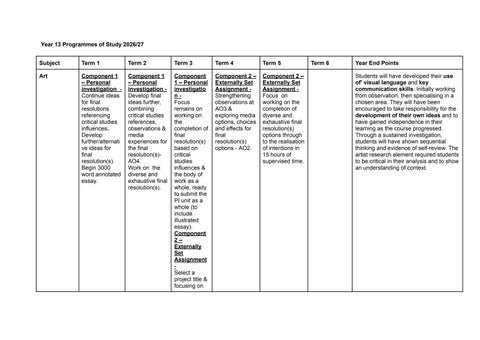
Year 13 Programmes of Study 2026/27 Subject
Term 1
Term 2
Term 3
Term 4
Term 5
Art
Component 1 – Personal investigation Continue ideas for final resolutions referencing critical studies influences. Develop further/alternati ve ideas for final resolution(s). Begin 3000 word annotated essay.
Component 1 – Personal investigation Develop final ideas further, combining critical studies references, observations & media experiences for the final resolution(s)AO4. Work on the diverse and exhaustive final resolution(s).
Component 1 – Personal investigatio nFocus remains on working on the completion of final resolution(s) based on critical studies influences & the body of work as a whole, ready to submit the PI unit as a whole (to include illustrated essay). Component 2– Externally Set Assignment Select a project title & focusing on
Component 2 – Externally Set Assignment Strengthening observations at AO3 & exploring media options, choices and effects for final resolution(s) options - AO2.
Component 2 – Externally Set Assignment Focus on working on the completion of diverse and exhaustive final resolution(s) options through to the realisation of intentions in 15 hours of supervised time.
Term 6
Year End Points Students will have developed their use of' visual language and key communication skills. Initially working from observation, then specialising in a chosen area. They will have been encouraged to take responsibility for the development of their own ideas and to have gained independence in their learning as the course progressed. Through a sustained investigation, students will have shown sequential thinking and evidence of self-review. The artist research element required students to be critical in their analysis and to show an understanding of context.
AO1 & AO3 initial investigations & observations. Demonstratin g understandin g of critical studies sources. OCR (A) A-level Biology
Module 5: Communication , homeostasis and energy.
Module 5: Communication , homeostasis and energy.
Topics: Neuronal and hormonal control.
Topics: Plant and animal responses.
Year 13 Biological processes Teacher 1 Key Skills: Relating structure to function, revision. MP: September assessment AS topics: biological processes.
Key Skills: Application of theory into novel scenarios MP: November assessment mainly module 5.1, 5.2, 5.3 & 5.4.
Module 5: Communicati on, homeostasis and energy. Topics: Photosynthes is. Key Skills: Research, citation, analysis, evaluation, chromatogra phy. MP: Mock exam combined processes and diversity questions.
Module 5: Communication, homeostasis and energy.
Summary review, revision and linking knowledge.
Topics: Respiration.
Topics: Unified biology and revision.
Key Skills: Development of scientific knowledge, revision techniques.
Key Skills: Drawing links between topics, effective revision strategies, application of knowledge. Review of all skills required for the A-level exams. MP: Respiration test.
● To have an understanding of the range of biochemical and physiological processes in plants and animals. ● To have an appreciation of the complexity of the genome and the associated technologies in the real world. ● To have an understanding of the diversity of life. ● To be able to effectively plan and critically analyse and evaluate scientific experiments. ● To be an adept practical biologist who can safely and correctly use laboratory equipment. ● To develop competence and confidence in mathematical and problem-solving skills. ● To develop their interest and enthusiasm for biology including developing an understanding of post-education opportunities relating to biology.
● To understand how society makes decisions about scientific issues and how biology contributes to the success of society.
OCR (A) A-level Biology
Module 6: Genetics and ecosystems.
Module 6: Genetics and ecosystems.
Module 6: Genetics and ecosystems.
Module 6: Genetics and ecosystems.
Year 13
Topics: Patterns of inheritance and manipulating genomes.
Topics: Cloning and biotechnology.
Topics: Ecosystems.
Topics: Populations and sustainability.
Biological diversity Teacher 2
Key Skills: Drawing and interpreting genetic diagrams, interpretation of genetic fingerprints MP: September assessment AS topics: biological diversity.
Key Skills: Evaluating ethical dilemmas, use of aseptic techniques, social and economic implications for the future. MP: November assessment mainly module 6.1, 6.2 & 6.3.
Key Skills: Analysis and evaluation of socioeconomi c impacts within biology.
Key Skills: Analysis and evaluation of socioeconomic impacts within biology. MP: Mock exam - full paper 3: unified biology.
Summary review, revision and linking knowledge. Topics: Unified biology and revision. Key Skills: Drawing links between topics, effective revision strategies, application of knowledge. Review of all skills required for the A-level exams. MP: Populations and sustainability test. EXAMS
Paper 1 Biological processes (Modules 1, 2, 3&5): 2h15 Paper 2 Biological diversity (Modules 1, 2, 4&6): 2h15 Paper 3 Unified biology (All content links drawn between modules): 1h30 Business Studies Y13 Business AQA (NP/CWG)
Module 3.9 Strategic Methods: How to Pursue Strategies Assessing a Change in Scale; Innovation
Module 3.9 Strategic Methods: How to Pursue Strategies Internationalis ation; Assessing Greater use of Digital Technology
Module 3.10 Managing Strategic Change Problems with strategies and why strategies fail; Managing Change
Module 3.10 Managing Strategic Change Managing change; Managing organisational culture
Revision and Exam Practice Personalised Revision Plans for Students. A-Levels Begin
To be able to do/show: Be able to calculate Financial Ratios e.g Profitability Construct a reasoned argument and evaluation, Application Skills Creative Thinking, Develop Strategic Thinking. Application Skills Understand the importance of financial performance for a business using balance sheets, income statements and financial ratios. Strategic Thinking, Constructing a reasoned argument, Calculating Key Numerical Data and applying in Context Analytical Skills Be able to complete and interpret business calculations Apply Knowledge Construct a Reasoned Argument Evaluative Skills Analytical Skills Be able to complete and interpret business calculations Apply Knowledge Construct a Reasoned Argument Evaluative Skills
Y13 Business AQA (LS)
Module 3.7 Analysing The Strategic Position of a Business. Data analysis; Political and legal change.
Module 3.7 Analysing The Strategic Position of a Business. Economic change; Social and technological change; The competitive environment
Topic Assessment (3.7.2) Assessed Homework (3.8-3.9) November Internal Exam (A level Paper 2) Topic Assessment (3.1-3.7) Chemistry Organic Chemistry Teacher 1
Module 3.10 Managing Strategic Change Managing strategic implementat ion
Revision and Exam Practice Consolidation, revision and feedback.
Mock Exams - A level Paper 1 - A level Paper 3 Topic Assessment (3.10)
Paper 1: Business 1 Paper 2: Business 2 Paper 3: Business 3
Module 6 Organic Chemistry & analysis
Module 6 Organic Chemistry & analysis
Module 6 Organic Chemistry & analysis
Module 6 Organic Chemistry & analysis
Module 6 Organic Chemistry & analysis
Topics: Revision of arenes & reactions
Topics: Amines, amino acids, amides & chirality
Organic synthesis, Synthetic routes
Carbon-13 NMR Proton-NMR
Chromatograph y Combined Techniques
Key Skills:
- Recall and explain the synthesis of organic functional groups; their typical reactions and -
properties.
Carbonyls, carboxylic acids,esters and acyl chlorides Key Skills: IUPAC rules, logical thinking & looking for patterns, analysis, evaluation, nucleophilic addition mechanism, application of structure to properties. 3D-visualisation and drawing. Practical skills. MP: Module 1,2,4 assessment
Condensation polymers
Key Skills: IUPAC rules, logical thinking & looking for patterns, analysis, evaluation, nucleophilic addition mechanism, application of structure to properties. 3D-visualisatio n and drawing. Practical skills. MP3: Carbonyl to Synthesis Test MP4: Assessment week: Organic exam
Functional group analysis Key Skills: IUPAC rules, logical thinking & looking for patterns, analysis, evaluation, visualisation, extended writing. Practical skills. MP: RSC Olympiad MP: MOCK Paper 2
Analysis, evaluation, identification, visualisation, mathematical skills, logical thinking MP: Spectroscopy Assessment
Synoptic concepts REVISION Key Skills: Analysis, evaluation, identification, visualisation, mathematical skills, logical thinking. Exam skills, command words, subject specific key words, application, evaluation, practical skills, application of knowledge to a variety of unfamiliar molecules and reactions. MP: Synoptic Exam Qs
- Full understanding of how reactions happen and be able to apply these to unfamiliar -
situations.
-
- Be able to identify and explain optical isomerism, and chirality
- Be able to explain and show mechanisms for extending the carbon chain in aliphatic and -
aromatic molecules.
- Investigate and explain how to practically synthesise molecules containing functional groups -
from Yr12 and 13.
- To purify an organic solid and to test for the functional groups and purity - Compose multi-stage synthetic routes for preparing organic compounds - Effectively use carbon-13 and proton-NMR in connection with previous analytical technique -
to correctly identify complex organic molecules
- Be able to combine knowledge from all modules to successfully answer synoptic/unfamiliar - Physical Chemistry Teacher 2
Module 5: Physical chemistry & transition elements
Module 5: Physical chemistry & transition elements
Module 5: Physical chemistry & transition elements
Module 5: Physical chemistry & transition elements
Module 5: Physical chemistry & transition elements
Rates of reaction Acids, Bases and pH
Acids, Bases and pH Buffers, Neutralisation
Redox and Electrode Potentials
Enthalpy and Entropy Transition Elements
Synoptic concepts
Key Skills: Changing the subject of, substituting numbers into, and solving algebraic equations, plotting experimental data, graphical analysis, logical thinking, calculating constants, practical skills
Key Skills: Changing the subject of, substituting numbers into, and solving algebraic equations, plotting experimental data, graphical analysis, logical thinking, calculating constants, using indices practical
Key Skills: Analysis, evaluation, applying conservation of energy, logical thinking, Changing the subject of, substituting numbers into, and solving algebraic equations, plotting experimental
Key Skills: Changing the subject of, substituting numbers into, & solving algebraic equations, plotting data, graphical analysis, interpreting data, logical thinking, applying principles to unfamiliar electrochemical cells,
REVISION – modules 2, 3, 5 and practical techniques Key Skills: Exam skills, command words, subject specific key words, application, evaluation, practical skills MP: Enthalpy & entropy test
questions
- To apply mathematical skills to analyse chemical reactions quantitatively in terms of equilibrium, rates and energy for the first time. - To determine by calculation the extent, speed and feasibility of chemical reactions. - To evaluate the quantitative effects of temperature, pressure and concentration on the rate of reaction and chemical equilibrium, and understand how these can be manipulated to control industrial processes - To understand the importance of acids, bases and pH in chemical and biological processes.
MP1: Module 1,2,3 assessment
skills MP: November Assessment Paper 1 Physical exam
data, graphical analysis, practical skills MP : Redox assessment
practical skills MP: MOCK Paper 1
- To calculate pH of strong acids, weak acids, alkalis and buffer solutions and analyse pH curves - To understand the role of buffers in maintaining blood pH as a case study for the essential role of acids and bases to health and wellbeing - To determine whether chemical reactions are feasible and spontaneous by applying the principles of energy and entropy and studying electrode potential and electrochemistry - To understand the importance of redox reactions in electrochemical cells, including fuel cells and those used to power portable devices (batteries) - To develop practical skills with techniques including continuous monitoring, measuring pH using pH meter, redox titrations, measuring potential difference of electrochemical cells
- To understand in detail the chemistry of the transition metals/d-block elements, including the colours, shapes and reactions of their ions, how complexes form, and how and why chemical and physical properties change in the centre of the Periodic Table Computer Science
Module: Fundamentals of Programming Topics: Object oriented programming Key Skills: Be familiar with the use of recursive techniques in programming languages. Understand the characteristics of the procedural- and object-oriented programming paradigms, and have experience of programming in each. Be aware
Module: Computational Thinking and Data Structures
Module: Fundamental s of Algorithms
Module: Fundamentals of Functional Programming
Topics: Mealy machines, the Turing machine, regular and context free languages. Queues and stacks, hash tables and dictionaries
Topics: Dijkstra’s shortest path algorithm, search algorithms, reverse polish notation and sorting algorithms Key Skills: Be able to trace breadth-first and depth-first search algorithms and describe
Topics: Basics of functional programming, writing functional programs
Key Skills: Be able to distinguish between static and dynamic structures and compare their uses, as well
Key Skills: Know that a function is a first-class object in functional programming languages and in imperative programming languages that support such objects. Know that function
Revision Paper 1 and paper 2 topics. Exam techniques.
Exams
The ability to draw and interpret a class diagram. Explain what is meant by inheritance and polymorphism and be able to interpret and correct a simple object-oriented program. Give examples of first-class objects in a functional programming language. Write and interpret simple functions in Haskell and evaluate simple functions involving map, filter, reduce or fold. State the distinguishing features of Big Data including volume, velocity and variety. Understand and describe the concept and uses of a queue, stack, list, graph, tree, hash table, dictionary and vector. Define a rooted tree and a binary tree and be able to apply a simple hashing algorithm. Perform vector addition and scalar multiplication State the essential characteristics of a recursive algorithm. Explain and state the order in which nodes are visited in, addressing pre-order, in-order and post-order tree traversals. Give examples of linear, polynomial,
of the following object-oriented design principles: encapsulate what varies, favour composition over inheritance, program to interfaces, not implementation. MP1: End of Unit Assessment MP2: Programming Assessment
as explaining the advantages and disadvantages of each. Be aware of a graph as a data structure used to represent more complex relationships. Know how an adjacency matrix and an adjacency list may be used to represent a graph. Be familiar with typical uses for rooted trees. Be familiar with the concept of a hash table and its uses. Be familiar with the concept of a vector and the specification notations. Be able to draw and interpret simple state transition diagrams and state transition tables
typical applications of both. Be able to describe uses of tree-traversal algorithms. Be able to convert simple expressions in infix form to Reverse Polish notation (RPN) form and vice versa. Know and be able to trace and analyse the complexity of the linear and binary search algorithms. Know and be able to trace and analyse the time complexity of the bubble and merge sort algorithms. Understand and be able to trace
application means a function applied to its arguments. Know what is meant by composition of functions. Construct simple programs in a functional programming language. MP6: NEA Moderation
exponential and logarithmic functions. Explain the principles of a linear and binary search. Explain what is meant by a tractable or intractable problem Interpret finite state machines with and without output. Define a set by listing its members and calculate a subset addressing membership, union, intersection, and difference of given sets. Form and use simple regular expressions for string manipulation. Explain the structure of a simple Turing machine. Read BNF production rules and validate input strings. Convert simple infix form to Reverse Polish Notation and vice versa
for FSMs with no output and with output (Mealy machines only).
Dijkstra’s shortest path algorithm. MP5: Summative Assessment
MP3: End of Unit Assessment MP4: Summative Assessment DT
NEA task in response to the Contextual Challenge Skills:
NEA task in response to the Contextual Challenge Skills:
To learn about the need to review design ideas against a specification
To learn about the need for producing a final design proposal
To learn about developing a design idea through modelling and iterations
To learn about the need to carry out a final review of the final design proposal
NEA task in response to the Contextual Challenge Skills: To learn about the manufacture of a product, including the selection and justification of tools and processes To learn about the need for
NEA task in response to the Contextual Challenge Skills: To learn about the manufacture of a product, including the selection and justification of tools and processes To learn about the need for quality and accuracy
Revision
By the end of Year 13 students will have:
Assessment
Individually and/or in consultation with a client/end user identified a problem and design context.
Weekly homework and exams questions
Developed a range of potential solutions which include the use of computer aided design and evidence of modelling. Made decisions about the designing and development of the prototype in conjunction with the opinions of the client/end user. Realised one potential solution through practical making activities with evidence of project management and plan for production.
To learn about the impact of new and emerging technologies including; industry, enterprise, sustainability, people, culture, society, the environment and production techniques and systems
To learn about the justification of materials, components and manufacturing processes in relation to a final design proposals
quality and accuracy
To learn about the work of past and present designers and companies
To learn about the need to produce manufacturing drawings to enable 3rd party manufacture
To learn about the need to test and evaluate a product including the use of user testing and a LCA
Incorporated issues related to sustainability and the impact their prototype may have on the environment
To learn about the use of different design strategies
Analysed and evaluated the wider issues in design technology, including social, moral, ethical, and environmental impacts.
Analysed and evaluated design decisions and outcomes for prototypes/products made by themselves and others
Revised subject knowledge in design and technology, including how a product can be developed through the stages of prototyping, realisation, and commercial manufacture
To learn about the use of a range of communication techniques
To learn about the developments in modern and smart materials, composites and technical textiles Economics
Theme 3
Theme 3 1 Perfect competition
Developed an in-depth knowledge and understanding of materials, components and processes associated with the creation of products that can be tested and evaluated in use
Theme 3 1 Oligopoly
Theme 3 1 Efficiency allocative,
Theme 3 Revision themes 1, 2 ,3 4
A Levels Begin
To be able to confidently understand economic data and context using economic modelling and theories.
1. Introduction to
2. Contestability
2. Business economics 3. Growth of businesses and their objectives 4. Costs and revenues 5. Types of profit Theme 4 1 Macroeconomic s at an international level 2. Fiscal, monetary and supply side policy 3. Public sector finance, Taxation and public expenditure
3. Monopolistic Competition Theme 4 1 Specialisation of trade 2 Terms of Trade 3 Trading blocs and monetary unions
2 Game theory 3 Monopoly 4 Monopsony Theme 4 1 International 2 Competitiven ess 3 Inequality Gini coefficient, Lorenz curve
productive, dynamic, technical 2. Government intervention to promote competition and protect consumers 3. Labour market and wage determination Theme 4
4 Poverty 4 WTO 5 Protectionism - tariffs, quotas, non tariff barriers 6 Exchange rates Assessment 1 Mock exam half paper 1 and half paper 2
5 Redistribution of income and wealth
1 Measures of development 2 Factors influencing growth and development
Assessment 1 short questions and multiple choice topics 1,2,3,4,5,6,7, 8,9,10,11
3 Measure to improve development 4 Financial markets Central banks and regulation
Exam practice Research to consolidate contextual understanding Assessment 1 - paper 3
To have a bank of factual information to enable students to compare and contrast information. To have a broad understanding of the UK and global economy. To be able to interpret macro and microeconomic information. Theme 3 To understand the motives driving firms to grow or remain small To be able to draw and interpret cost and revenue curves To understand the assumptions for highly competitive models and be able to draw their short run and long run equilibrium To be able to use the appropriate diagram for the context To understand the long and short term equilibrium for all markets and the levels of efficiency To understand the purpose of competition policy To achieve a holistic understanding of global economics with in depth knowledge of micro and macro economic theories and models To confidently analyse and evaluate macro and micro economic information using contextual understanding To be able to synoptically analyse data
4. Globalisation Theme 4
English Literature
Assessment
Assessment
1 Multiple choice and 20 mark Q: globalisation 2 mixed paper 1 and 2 (theme 1,2)
1 - mock exam all themes Paper 3
To understand the interconnectedness of markets and globalisation To understand trade specialisation and comparative advantage To evaluate the impact of protectionism To understand factors that affect international competitiveness To evaluate impacts and causes of inequality To understand financial markets To know how the 2008 financial crash shaped our world economy.
2 - synoptic essays, all themes
NEA Intro to Donne
NEA Donne Poetry
Aim: To plan and begin the writing stages of NEA. To introduce Donne’s (challenging) metaphysial poetry and the various contexts surrounding his work (biographical, religious, cultural, historical, literary etc). To revise the sonnets that they have already studied
Aim: To introduce students to ‘Othello’, providing them with a clear overview of both historical factors (social and political), deepening their understanding of the tragedy genre and introducing them to the first two acts of the play. Aim: to complete study of the collection
Unseen/NEA Prose Revision Aim: To build on students’ knowledge from last year and introduce them to unseen poetry and how to tackle this. To revise prose texts and target areas in which students feel less confident in. To look at key themes, context, and
ASND/Othello Revision Prose/Poetry Revision Aim: to consolidate knowledge and understanding. To practise exam technique.
Revision
Revision
Aim: to consolidate knowledge and understanding. To practise exam technique
Aim: to consolidate knowledge and understanding. To practise exam technique.
● Engage critically and creatively with a substantial body of texts and ways of responding to them. ● Undertake independent and sustained studies to deepen their appreciation and understanding of English literature, including its changing traditions. ● Respond to and evaluate texts, drawing on their understanding of interpretations by different readers such as literary critics ● communicate fluently, accurately and effectively their knowledge, understanding and evaluation of texts ● Use literary critical concepts and terminology with understanding and discrimination ● Make appropriate use of the conventions of writing in literary
and introduce various other forms that Donne used, exploring themes which include of love, religion, sexuality. Skills: Playwright’s craft, evaluating and developing critical thinking about the way in which a writer conveys their perspective, looking at the concept of nature vs: nurture, introducing students to machiavellianis m. Skills: Poet’s craft, analysing language and structural choices critically and evaluative. Making clear connections
of Donne poems and develop essay skills. Skills: Introduce students to critics’ perspectives and use these to develop discussion, push students to challenge ideas/shape their own viewpoints. Skills: Thinking evaluatively and critically, applying key contextual factors to the poet’s methods. Students should develop an original viewpoint, discuss the significance of elements of language, structure, and form in terms of meaning.
characters to build on prior knowledge and aid revision skills. Skills: making critical choices when comparing poems/under stand themes and ideas/ comparison skills when presented with a new poem. Skills: making critical, significant comparisons between texts and their respective contexts. Analysis of writer’s craft and intentions.
studies, referring accurately and appropriately to texts and sources.
between the language and relevant contexts. Exploring metaphysical form and conventions. Geography
Teacher 1 (4 lessons per fortnight
Powers and Borders
Hazardous Earth
Hazardous Earth
Hazardous Earth
Challenges to sovereignty and territorial integrity, global governance of conflicts
Processes and features at plate boundaries
Vulcanicity; volcano case studies, management of volcanic hazards
Seismicity; earthquake case studies, management of seismic hazards
Revision
Final Exams
Understand how sovereignty and territorial integrity can be challenged, and how global governance can address the consequences of these challenges. Understand how the water and carbon cycles operate in contrasting locations. Understand how water and carbon cycles can change over time. Understand how the water and carbon cycles are linked. Understand conteporary patterns of migration and how these are increasing in complexity. Understand the impacts and issues arising from unequal flows of migrants. Understand the theory of plate tectonics and the evidence to support this theory. Understand the processes occurring at plate boundaries.
Know the main hazards generated by volcanic and seismic activity. Teacher 2 (3 lessons per fortnight)
NEA (2 lessons per fortnight)
Global Migration
Earth Life Support Systems
Earth Life Support Systems
Earth Life Support Systems
What are the contemporary patterns of global migration, why has it become increasingly complex and what are the associated issues with unequal flows of global migration?
What are the contemporary patterns of global migration, why has it become increasingly complex and what are the associated issues with unequal flows of global migration?
How do the water and carbon cycle operate in contrasting locations. (Tropical rainforest and Arctic Tundra). How much change occurs over time in the water and carbon cycle.
To what extent are the water and carbon cycle linked and how are they managed globally.
Data Presentation and analysis
Writing conclusion and evaluation
Final checks; contents page; bibliography
Revision for final exams
NCD & MH Completion of modules 1 & 2
NCD & MH Completion of modules 3&4
NCD & MH T&L Module 5: Democracy & Participation
Revision for all teachers NCD/MH to revise all US
Writing up NEA: Introduction; Methods
Government & Politics
MH T&L Module 1: The US constitution
Revision
Final Exams
Understand the impacts, responses and mitigation strategies associated with tectonic hazards. Understand how the risk of a hazard changes over time and is linked to the occurrence of disasters. Create GIS maps independently using own fieldwork data. Explain in detail a variety of geographical processes and features including independently identify and explain links between Tectonics and other A level topics. Confidently apply knowledge and understanding to unknown situations and to support well-developed, thoughtfully evidenced arguments which reach substantiated conclusions. Plan, undertake and evaluate an individual investigation.
A level exam
USA: 1: a deep understanding & critical appraisal of the nature of US Government and the role of, and
Content: The nature of the Constitution; the main aims & principles of the US Constitution; its founding; the Bill of Rights & other amendments; constitutional amendment & the role of the SC; federalism & constitutional change. Debates about its effectiveness today NCD T&L Module 2: The Supreme Court, Rights & Liberties Content: The nature and role of the SC; the appointment process, the SC & public policy; the protection of rights & liberties; race & rights in the USA today
NCD T&L Module 3: The US Congress Content: the structure of Congress; The functions of Congress; interpretations & debates MH T&L Module 4: The Presidency Content: Formal sources of presidential power as outlined in the US Constitution and their use; Informal sources of presidential power and their use; The presidency over time; Interpretations & debates of the US presidency. JHs T&L Module 2: Conservatism
JHs T&L Module 3: Socialism Content: Core ideas & principles (collectivism, common humanity, equality, social class, workers’ control); differing views & tensions within socialism (revolutionary socialism, social democracy, third way); Key thinkers (Karl Marx, Beatrice Webb, Rosa Luxembourg, Anthony Crosland, Anthony Giddens)
Content: Electoral systems in the USA; Campaign finance; The key ideas and principles of the Democratic and Republican parties; The current conflicts and tendencies and the changing power and influence that exist within the parties. Coalition of supporters for each party; Interest groups in the USA – their significance, resources, tactics and debates about their impact on democracy; Interpretations and debates of US democracy and participation including. JHs
content plus links to UK for paper 3 and to support papers 1&2 JHs to revise ideologies & UK content for papers 1 and 2
relationship between, the different branches of US Government and between federal and state governments within a federal system; 2: an understanding of the rights and liberties of US citizens & an evaluation of how well they are protected today; 3: an understanding of the nature of US democracy and an evaluation of its strengths and weaknesses; 4: an appraisal of the similarities and differences between US and UK Government and Politics. 5: An understanding of the historical context which impacted how key principles of conservatism, liberalism & socialism developed. 6: Ability to analyse the divisions within each ideology & evaluate the degree to which they are cohesive & united. 7: Ability to analyse how key thinkers have influenced each ideology's principles & focus.
History OCR Exam Board
JH Recap & consolidate T&L Module 2: Liberalism Content: Core ideas & principles (individualism, freedom, state, rationalism, equality, liberal democracy); differing views & tensions within socialism (classical, modern); Key thinkers (John Locke, Mary Wollstonecraft, John Stuart Mill, John Rawls, Betty Friedan)
Content: Core ideas & principles (pragmatism, tradition, human imperfection, organic society, paternalism, libertarianism); differing views & tensions within socialism (traditional, one-nation, new right); Key thinkers (Thomas Hobbes, Edmund Burke, Michael Oakeshott, Ayn Rand, Robert Nozick)
T&L Module 4: Feminism Content: Core ideas & principles (sex & gender, patriarchy, personal is political, equality feminism & difference feminism, intersectionality) ; differing views & tensions within feminism (liberal, socialist, radical & post-modern feminism); key thinkers (Charlotte Perkins Gilman, Simone de Beauvoir, Kate Millett, Sheila Rowbotham, Bell Hooks)
Russia Topic: Alexander II, Alexander III & Nicholas II
Russia Topic: Provisional Government & Lenin
Russia Topics: Stalin & Khrushchev
Content: Nature of Emancipation,
Content: February Revolution,
Content: Great Terror, Modernisatio
Russia Topics: Thematic overview – government & nationalities Content: Style of government,
Russia Topics: Thematic overview – economy & war Content: Industrialisation, Agricultural
Exams
Deep chronological understanding of Russia from 1855-1964 Students are able to describe 100+ events/concepts in Russian history
Liberal Reforms under Alexander II, the ‘reaction’ under Alexander III, industrialisation & growing opposition, reform & reaction under Nicholas II
Dual Authority, PG in crisis, November Revolution, Red Terror, Civil War
n programme, WW2, Cold War, De-Stalinisati on
Assessment: PG interpretation question & November mocks
Assessment : Stalin ‘Red Tsar’ thematic question & Khrushchev interpretation Q
Assessment: Should A2 be known as the ‘Tsar liberator’? & A2 interpretation question
Skills: Continuing historical interpretation evaluation
Skills: Evaluating validity of historical interpretations
Cultural Content: Nature of democracy, socialism, use of violence for political change
Cultural Content: Uneven & de-stabilising nature of industrialisation , political autocracy, Russian traditions
Skills: Thematic analysis Cultural Content: Totalitarian regimes, methods of industrialisati on, WW2 impact on Russia, Cold War from Russian perspective
effectiveness of opposition, structure of central/local government, freedom of nationalities, Russification Assessment: Government thematic question & March mocks Skills: Developing thematic analysis Cultural Content: Perseverance of political systems, nature of freedom, cultural conflict in multi-national states
problems, living conditions, war as a driver of change, social/political impacts of war Assessment: Alternative March mock question & thematic question Skills: Essay planning in time-pressured conditions Cultural Content: Common people left behind, recurrence of famine, importance of total wars
Students are able to give nuanced analysis on why certain events are particularly significant Students can evaluate the nature and amount of change at multiple points between 1855 -1964 Students can place multiple secondary sources within a wider historical debate, applying a range of historical knowledge to evaluate their validity Students can analyse trends & important turning points within a particular theme (eg economy) over a broad period of time Students have an appreciation of how Russian history complements/contrasts with pre-existing historical knowledge
Coursework: preparing an introduction to your essay and producing a written section of it.
Maths Lead Teacher 1 (6 lessons per fortnight Pure & Statistics) Teacher 2 (3 lessons per fortnight Pure & Mechanics)
Coursework: how to write a draft of coursework essay. November examinationGermany paper
Assessmentresearch review feedback and Germany topic factual testing.
AssessmentGermany exam paper and critical feedback on initial essay
PURE MATHS) TEACHER 1 Trigonometry Addition rule Double angle rules Inverse trigonometric functions Identities R Formula Small angle approximations Differentiation of trig from first principles
PURE MATHS TEACHER 1 Calculus Integration Area between two curves Integration by cover up Rational functions Partial fractions Trigonometric identities
Calculus -
STATISTICS T1 Conditional Probability Applied to tree
Coursework: developing feedback to strengthen essays
Assessment - ongoing coursework essay feedback and Germany topic factual testing PURE MATHS TEACHER 1 Calculus Integration By parts Substitution Standard Results Numerical Method Newton Rapheson Modulus Graphs Solving equations
Courseworkfinal essay completion. March Mock Exams
Final Germany revision
Students have the ability to undertake independent learning & confidence to undertake a research question effectively
AssessmentGermany exam response questions (final targeted topics)
Students can be confident in using primary sources to critically evaluate a historical debate. Students will be able to create a sustained argument using a broad range of historical knowledge & research.
AssessmentMarch mock exam (Germany) and final coursework grade.
PURE MATHS TEACHER 1 Parametric Equations 1 The graphs of parametric equations Parametric to cartesian Differentiating parametrics Integrating parametrics Solving Differential Equations Connected rates of change
PURE MATHS Revision
A Levels
Construct and present mathematical arguments through appropriate use of diagrams; sketching graphs; logical deduction; precise statements involving correct use of symbols and connecting language Understand and use mathematical language and syntax as set out in the content. Understand and use language and symbols associated with set theory, as set out in the appendices. Apply to solutions of inequalities and probability Understand and use the definition of a function; domain and range of functions. Comprehend and critique mathematical arguments, proofs and justifications of methods and formulae, including those relating to applications of mathematics. Recognise the underlying mathematical
Differentiation Chain, product and quotient Derivations of inverses Shapes of functions TEACHER 2 Sequences and Series Recurrence Relationships Arithmetic Sequences Geometric Sequences MECHANICS T2 Statics At an angle Coefficient of friction Dynamic At an angle Coefficient of friction
diagrams and Venn diagrams Normal Distribution Finding probabilities Working backwards Z values and finding mean and standard deviation MECHANICS T2 In 3D SUVAT Vectors with variable acceleration
TEACHER 2 Binomial Expansion with fractional and negative powers Calculus Differentiati on Implicit differentiation Normals, tangents and turning points
Separation of variables Proof Proof by contradiction Statistics T1 Approximating Distributions Approximating Binomial with a normal distribution Normal distribution hypothesis testing Mechanics T2 Projectiles From ground level From a height At an angle Moments Multiple pivots and suspensions
structure in a situation and simplify and abstract appropriately to enable problems to be solved. Construct extended arguments to solve problems presented in an unstructured form, including problems in context. Interpret and communicate solutions in the context of the original problem. Understand that many mathematical problems cannot be solved analytically, but numerical methods permit solution to a required level of accuracy. Evaluate, including by making reasoned estimates, the accuracy or limitations of solutions, including those obtained using numerical methods. Understand the concept of a mathematical problem solving cycle, including specifying the problem, collecting information, processing and representing information and interpreting results, which may identify the need to repeat the cycle. Understand, interpret and extract information from diagrams and construct mathematical diagrams to solve problems, including in mechanics. Translate a situation in context into a mathematical model, making simplifying assumptions. Use a mathematical model with suitable inputs to engage with and explore situations (for a given model or a model constructed or selected by the student). Interpret the outputs of a mathematical model in the context of the original situation (for a given model or a model constructed or selected by the student). Understand that a mathematical model can be refined by considering its outputs
and simplifying assumptions; evaluate whether the model is appropriate. Understand and use modelling assumptions Maths Lead Teacher 1 (6 lessons per fortnight Pure & Mechanics) Teacher 2 (3 lessons per fortnight Pure & Statistics)
PURE MATHS TEACHER 1 Trigonometry Addition rule Double angle rules Inverse trigonometric functions Identities R Formula Small angle approximations Differentiation of trig from first principles Calculus Differentiation Chain, product and quotient Derivations of inverses Shapes of functions TEACHER 2 Sequences and Series Recurrence Relationships Arithmetic Sequences
PURE MATHS TEACHER 1 Calculus Integration Area between two curves Integration by cover up Rational functions Partial fractions Trigonometric identities TEACHER 2 Binomial Expansion with fractional and negative powers Mechanics T1 Statics At an angle Coefficient of friction Dynamic At an angle Coefficient of friction Vectors
PURE MATHS TEACHER 1 Calculus Integration By parts Substitution Standard Results TEACHER 2 Numerical Method Newton Rapheson Calculus Differentiati on Implicit differentiation Normals, tangents and turning points Modulus Graphs Solving equations Mechanics T1
PURE MATHS TEACHER 1 Parametric Equations 2 Differentiating parametric Integrating parametric Solving Differential Equations Connected rates of change Separation of variables TEACHER 2 Proof Proof by contradiction
PURE MATHS Revision
Construct and present mathematical arguments through appropriate use of diagrams; sketching graphs; logical deduction; precise statements involving correct use of symbols and connecting language Understand and use mathematical language and syntax as set out in the content. Understand and use language and symbols associated with set theory, as set out in the appendices. Apply to solutions of inequalities and probability Understand and use the definition of a function; domain and range of functions. Comprehend and critique mathematical arguments, proofs and justifications of methods and formulae, including those relating to applications of mathematics. Recognise the underlying mathematical structure in a situation and simplify and abstract appropriately to enable problems to be solved. Construct extended arguments to solve problems presented in an unstructured form, including problems in context. Interpret and communicate solutions in the context of the original problem. Understand that many mathematical problems cannot be solved analytically, but numerical methods permit solution to a required level of accuracy. Evaluate, including by making reasoned estimates,
Geometric Sequences Statistics T2 Conditional Probability Applied to tree diagrams and Venn diagrams
Further Maths
CORE MATHS TEACHER 1 Complex Numbers 1 ●Nth roots of unity
In 3D SUVAT Vectors with variable acceleration Statistics T2
Projectiles From ground level From a height At an angle
Normal Distribution Finding probabilities Working backwards Z values and finding mean and standard deviation
Moments Multiple pivots and suspensions
CORE MATHS TEACHER 1 Matrices 2 ●Diagonalisatio n
CORE MATHS TEACHER 1 Integration 1 ● Improper integrals ● Integrating Partial fractions
2 nd Order Differential Equations
the accuracy or limitations of solutions, including those obtained using numerical methods. Understand the concept of a mathematical problem solving cycle, including specifying the problem, collecting information, processing and representing information and interpreting results, which may identify the need to repeat the cycle. Understand, interpret and extract information from diagrams and construct mathematical diagrams to solve problems, including in mechanics. Translate a situation in context into a mathematical model, making simplifying assumptions. Use a mathematical model with suitable inputs to engage with and explore situations (for a given model or a model constructed or selected by the student). Interpret the outputs of a mathematical model in the context of the original situation (for a given model or a model constructed or selected by the student). Understand that a mathematical model can be refined by considering its outputs and simplifying assumptions; evaluate whether the model is appropriate. Understand and use modelling assumptions CORE MATHS TEACHER 1 Integration 2 ● Area of surface revolution ● Reduction formula
Revision
OT1.1 Construct and present mathematical arguments through appropriate use of diagrams; sketching graphs; logical deduction; precise statements involving correct use of symbols and connecting language, including constant, coefficient, expression, equation, function, identity, index, term, variable.
Vectors ●Vector product ●Equation of line and area of triangle ●Planes, angles and intersections ●Distances Matrices 1 ●Determinate of 3x3 ●Sim equations and geometric interpretation ●Factorising ●Eigen vectors and Eigen values TEACHER 2 Graphs ●Modulus functions ●Rational with oblique asymptotes ●Composite transformations Maclaurin & Limits ●Proving an expansion
●Solve homogenous ●Solve nonhomogeneo us ●Particular solutions FStats T1 Continuous random variables Rectangular distribution T-Tests ● Hypothesis testing with t-tests Continuous random variables ● Exponential distribution FMech T2 Circular Motion ● Inclined planes ● Conical pendulum ●Vertical motion
●Polar integration ● Arc length FMech T2 Centre of Mass ●Particles and rods ● Composite ● Volume of revolution ● Toppling or sliding
Differential equations ● 1 st order differential equations ● Simple harmonic motion ● Damped and forced motion ● Coupled equations Hyperbolic Functions ●Reciprocal hyperbolic functions ●Differentiating and integrating hyperbolic functions ● Osbourne’s rule ● Identities in proof FMech T2 Collisions ● Collisions with walls ● Impulse YEAR 13 MOCK EXAMS
OT1.2 Understand and use mathematical language and syntax as set out in the content OT1.3 Understand and use language and symbols associated with set theory, as set out in the content. OT1.4 Understand and use the definition of a function; domain and range of functions. OT1.5 Comprehend and critique mathematical arguments, proofs and justifications of methods and formulae, including those relating to applications of mathematics OT2.1 Recognise the underlying mathematical structure in a situation and simplify and abstract appropriately to enable problems to be solved. OT2.2 Construct extended arguments to solve problems presented in an unstructured form, including problems in context Interpret and communicate solutions in the context of the original problem. OT2.6 Understand the concept of a mathematical problem solving cycle, including specifying the problem, collecting information, processing and representing information and interpreting results, which may identify the need to repeat the cycle. OT2.7 Understand, interpret and extract information from diagrams and construct mathematical diagrams to solve problems, including in mechanics. OT1: Mathematical Modelling
●L’Hopitals rule YEAR 13 TRANSITIONA L EXAMS
MFL FRENCH
YEAR 13 ASSESSMENT WEEK
OT3.1 Translate a situation in context into a mathematical model, making simplifying assumptions. OT3.2 Use a mathematical model with suitable inputs to engage with and explore situations (for a given model or a model constructed or selected by the student). OT3.3 Interpret the outputs of a mathematical model in the context of the original situation (for a given model or a model constructed or selected by the student). OT3.4 Understand that a mathematical model can be refined by considering its outputs and simplifying assumptions; evaluate whether the model is appropriate OT3.5 Understand and use modelling assumptions.
Teacher 1: Unit 8
Teacher 1: Unit 9
Teacher 1: Unit 10
Teacher 1: Unit 12
Skills: How marginalisation affects different sectors in society
Skills: Prison in France (the judicial and prison system)
Skills: Young people and politics, the right to vote, the future of the EU
Skills: Politics of immigration
Grammar: Venir de and depuis, passive in all tenses, indefinite
Grammar: Using inversion, present and perfect subjunctive
Grammar: future ideas with quand, using more
Grammar: impersonal verbs and dependent infinitives, direct and indirect speech, recognising the
EXAMS
EXAMS
By the end of year 13, students will be able to… …understand and discuss how marginalisation affects different sectors in society …understand and discuss young people and politics, the right to vote, the future of the EU …understand and discuss the judicial and prison system in France
pronouns and adjectives ASSESSMENT: U8 Paper 1, U8 Speaking Teacher 2: Literature study Skills: Study of book Un Sac de billes (analysis of background, themes and characters, essay writing skills)
ASSESSMENT : U9 Paper 1, U9 Speaking Teacher 2: Literature study Skills: Study of book Un sac de billes, cont. ASSESSMENT : Y13 Assessment Week (Papers 1-2-3)
ASSESSMENT : 2 marked essays
than 1 tense in the same sentence ASSESSME NT: U10 Paper 1, U10 Speaking Teacher 2: Unit 11 Skills: Demonstratio ns and strikes Grammar: interrogative adjectives and pronouns, prepositions, irregular forms of the past historic
imperfect subjective)
…understand and discuss demonstrations and strikes
ASSESSMENT: U12 Paper 1, U12 Speaking Teacher 2: Revision
…understand and discuss the politics of immigration
Skills: Revision of all units with exam skills for the exams
...understand the use of the subjunctive and other advanced tenses.
…conjugate verbs accurately in all tenses.
…critically analyse the film La Haine and the book Un Sac de Billes.
ASSESSMENT: Mocks (Papers 1-2-3)
…respond to speaking cards on all topics and a wide range of IRP questions.
ASSESSME NT: U11 Paper 1, U11 Speaking
MFL GERMAN
Teacher 1 (JJR): Book Zonenkinder
Teacher 1 (JJR): Unit 9.2 Die Ursprünge
Teacher 1 (JJR): Unit 10.2 Die Auswirkun
Teacher 1 (JJR): 11.2 – Politik und Jugend
Teacher 1 (JJR): Revision Speaking
By the end of year 13, students will be able to…
Unit 8.1 Woher kommst du? Unit 8.2 Ein Volk – viele Einflüsse
des Rassissmus Unit 9.3 – Der Kampf gegen Rassismus
Teacher 2 (BP):
Teacher 2 (BP): Revision Film good bye Lenin! Unit 9.1 Altagsrassis mus
Unit 7.3 – Massnahme n gegen Masseneinw anderungen Unit 8.3 – Radio Multikulti
ASSESSME NT: 2 marked essays
ASSESSME NT: U7&8
ASSESSME NT: Y13 Assessment Week (Papers 1-2-3)
ASSESSME NT: U9 Paper 1, U9 Speaking
gen der EU Unit 10.3 – Die Rolle Deutschla nds in Europa Unit 11.1 – Politik und Jugend Macht mit Teacher 2 (BP): Unit 10.1 – Sind Sie Deutsche( r) oder Europäer (in)
ASSESS MENT: U10 Paper 1, U10 Speaking
– Engagier dich! 12.1 Friedliche Revolution in der DDR 12.2 - Wie vereinigt ist Deutschland 12.3 – Alte und neue Bundeslände r – Kultur & Identität
Teacher 2 (BP): Unit 11.3 – Wehrfpflicht: Ja oder Nein?
ASSESSME NT: U11 Paper 1, U11 Speaking
ASSESSME NT: U12 Paper 1, U12 Speaking
Teacher 2 (BP): Revision
…understand and produce language on the topics of immigration, integration, racism, the EU, politics and the Berlin Wall.
…conjugate verbs accurately in all tenses.
...understand the use of all four cases and a wide range of prepositions.
…critically analyse the book Zonenkinder.
…respond to speaking cards on all topics.
Paper 1, U8 Speaking
MUSIC
Module: 3.17 AOS 5 Programme Music 3.18 Board set brief composition Topics: Continuing AOS 5, Programme Music: Symphonic poem: Smetana, Liszt, Strauss and composers for piano Choosing Board set brief composition (set by OCR) and beginning a first draft Refining the full
Module: 3.19 AOS 6 Innovations in Music. 3.20 Developing Board set brief composition 3.21 Producing an A grade performance recital
Topics: AOS 6: Innovations in Music: Late Romanticism, Impressionism, Expressionism. Developing Board set brief composition
Module: 3.22 AOS 6 Innovations in Music 2/Revision on AOS 1-5 3.23 Developing board set brief composition 3.24 Developing learner set brief composition 3.25 Preparing recital for exam Topics: Continue to study “Innovations in Music”: Minimalism, Modernism
Module: 3.26 Completing both compositions 3.27 Revising for the listening paper 3.28 preparing for the recital exam.
Topics: Completing BOTH compositions for submission on May 1st Preparing and refining performance recital for Exam
Revision and Exam Practice Personalised Revision Plans for Students.
A- Levels Begin
Be able to understand all key features, composers and styles of Programme music. Completed first draft on Board set brief composition
Assessment:
High level performance recital completed
Complete another full listening paper. Complete a range of timed essay questions/mind maps and examination questions (Listening paper takes place in June)
Be able to produce a high grade performance Completed first draft of Board set brief composition Be able to complete a full Listening paper to a high standard. Strategic Thinking, Constructing a reasoned argument, Calculating Key Numerical Data and applying in Context Both compositions submitted to a high standard. Performance recital completed All areas of study revised Robust revision for the listening paper completed.
solo performance recital Assessment 1: Essay question on Programme Music Assessment 2: First draft of Board set brief composition Performance recital
Improving and developing performance recital. Revision of AOS 3 Assessment 3: A Level Listening paper 2018 - MOCK
Assessment 4: Board set brief composition Full performance recital
Continue to develop both compositions Detailed revision on AOS 1-5 with exam preparation/cl ass test/exam questions Assessment 5: Presentation on Minimalism/M odernism Revision presentations on AOS 1, 2 and 3 Assessment 6: Essay questions (25 mark) on AOS 3-5. Short 10 mark questions on AOS 1,2 and aural perception tests.
on April 21st (approx. date)
Revising all areas of study and completing range of examination related essays, questions and aural perception tests for the Listening paper.
Assessment 7 & 8: WHOLE SCHOOL March assessments: A Level Listening Paper 2019
Ability to complete a full Listening paper to a high standard. All revision completed and each question type revised. All areas of study also revised in depth.
Personal Education Development
Physics
Post 18 options & plans
Sexual and reproductive health
Future finances
Independence and personal safety
Life online
T1: Module 5
T1:
T1:
T1:
T1:
Topics: 15. Ideal Gases 16. Circular Motion Key Skills: Calculating,
Topics: 18. Gravity 17. Oscillations
Topics: 19. Stars
Topics: 20. Cosmology Revision
Topics: Revision
Key Skills:
Key Skills: Literacy, extended
Key Skills: Key Skills:
Students will have been supported with finalising applications for a collection of options post A level study to help students to make the best choices & submit the strongest applications. They will have developed their understanding of sexual & reproductive health within the context of healthy relationships, & how to access accurate information, healthcare & appropriate support. Students will have developed the knowledge & skills required to manage money confidently & responsibly, & to make informed financial decisions as they move into adult life. They will have learnt how to assess & respond to risk, injury & illness, & manage personal safety in contexts where they are increasingly independent. They will have explored how engagement online can impact wellbeing, relationships, attitudes & behaviour, & how to evaluate online content critically, recognise harmful influence & narratives, & access help & support when needed. EXAMS (Provisional dates)
- Understand how the skills and knowledge gained through study of Physics A Level can be used in a range of different careers and industries - Make connections between topic areas, using big ideas like kinetic theory, energy changes and fields
practical skills, analysing data, extrapolating, explaining changes, application of knowledge, exam technique MP1: Thermal and Ideal Gases Test MP2: Circular Motion Test T2: Module 6 Topics: 24. Particle 25. Radioactivity 26. Nuclear Key Skills: Calculating, analysing, application of knowledge, explaining, exam technique MP1: Radioactivity Test or Particle Test
Calculating, analysing, practical skills, Datalogging, interpreting data, application of knowledge, exam technique
response, explaining, researching, referencing, exam technique MP5:Oscillati ons Test MP6: Stars Test
MP3: Gravity Test
T2:
MP4: November Exam (Paper 1)
Topics: 23. Magnetic Fields
T2:
Key Skills: Calculating, application of knowledge, explaining, exam technique
Literacy, calculating, conversion of units, literacy, researching, referencing, exam technique
Revision strategies, exam technique
MP7: March Mock (Paper 1)
T2:
MP8: March Mock (Paper 3) T2:
Topics: 21. Capacitance 22. Electric Fields Key Skills: Datalogging, calculating, practical skills, interpreting data, logarithms, application of knowledge, exam technique
MP5: Electric Fields Test MP6: Magnetic Fields Test
Topics: 27. Medical Physics Key Skills: Calculating, logarithms, explaining, exam technique MP7: X-rays GAT MP8: March Mock (Paper 2)
MP9: Cosmology Test
Topics: Revision Key Skills: Revision strategies, exam technique MP9: Medical Physics Test
- Use logarithmic functions confidently, including plotting and interpreting log graphs - Identify exponential change and explain how this is modelled mathematically, specifically in the context of radioactive decay and capacitor charging/discharging - Apply knowledge in a range of unfamiliar contexts - Derive selected equations from basic principles - Derive all the commonly used units using SI base units - Use kinetic theory to explain changes of state and the behaviour of ideal gases qualitatively and quantitatively - Use mathematical equations to explain the motion of simple harmonic oscillators and objects moving in circles - Understand the similarities and differences between gravitational, electric and magnetic fields and their applications - Understand the past, present and future of our universe and the evidence we have for this - Understand how the standard model has developed over time, the nature of radioactive decay and the importance of nuclear physics in the development of energy resources
MP2: Nuclear Physics Test
MP3: Capacitors Test
- Understand how different topic areas come together when designing, building and using machines for medical physics - Understand the importance of Physics in cultural, economic, moral and social change, but the limitations of scientific fact in decision making.
MP4: November Exam (Paper 2)
Psychology
Paper 2 Research Methods (Statistical testing) Biopsycholog y (biorhythms) The Psychodynami c Approach (Personality, Ego defence mechanisms, Consciousness, Psychosexual Stages) Paper 3 Issues & Debates Gender Bias
Paper 3 Aggression (Biological and social-psycholo gical explanations) Gender Development (stereotypes, androgyny, explanations) Issues & Debates Gender Bias NOVEMBER assessments Full Paper 1 & 2 Exam
Paper 2 Research Methods (Content & Thematic Analysis, validity) The Humanistic Approach (Congruence, Self-Actualisa tion, Clientcentred Therapy) Paper 3 Aggression (institutional aggression, influences on aggression) Gender Developmen t
Paper 2 Research Methods (Self reports, reliability) Biopsychology (the brain) Paper 3 Schizophrenia (biological and psycho-social explanations) Issues & Debates Reductionism MARCH MOCKS Full Paper 2 & 3 Exams
Paper 2 Research Methods (Content & Thematic Analysis, Writing a report) Paper 3 Schizophrenia (treatments) Issues & Debates Ethical and Socially Sensitive Research
Study Leave
To be able to describe, evaluate and apply psychological approaches to research and theory. To be able to describe and evaluate the biopsychological processes of biological rhythms, brain functions, plasticity and brain investigation techniques To be able to describe and evaluate content analysis, thematic analysis, case studies. To be able to apply debates when evaluating research and theory in Paper 1 and Paper 3 topic exam questions. To be able to describe and evaluate all research evidence (70+) and theory from the 3 topics in Paper 3 (Gender, Aggression, Schizophrenia)
(media and cultural, influences, gender dysphoria) Issues & Debates Determinism Sociology
MEDIA (the new media + the role of the media in contemporary society, the media, globalisation and popular culture, the relationship between ownership and control of the media the processes of selection and presentation of the content of the news) THEORY & METHODS (Marxism,
MEDIA (media representations of age, social class, ethnicity, gender, sexuality and disability and the relationship between the media their content and presentation, and audiences) CRIME & DEVIANCE (Explaining Crime: Functionalist, strain and subcultural theories,
CRIME & DEVIANCE (Marxist, neo-Marxist and critical criminological theories, left and right realism, Gender + crime, ethnicity + crime, class + crime) End of term assessment Based on content in this column
CRIME & DEVIANCE (globalisation, media + crime, patterns + trends, Human rights, State Crime, Green Crime) THEORY & METHODS (Social Action theories and Structuration) MARCH MOCKS. Full Paper 2 and 3 exams
CRIME & DEVIANCE (Crime and criminal justice, Crime control, prevention, punishment and victims) THEORY & METHODS (the extent to which Sociology can be regarded as scientific and The relationship between theory and methods,) Informal assessment
Study Leave A Level Examinations
Students are expected to be familiar with sociological explanations of the following content: ● new media ● the relationship between ownership and control of the media ● the media, globalisation and popular culture ● the processes of selection and presentation of the content of the news ● media representations of age, social class, ethnicity, gender, sexuality and disability ● the relationship between the media, their content and presentation, and audiences. Students are expected to be familiar with sociological explanations of the following content:
postmodernism, feminism and social policy) End of term assessment Based on content in this column
labelling theory) NOVEMBER assessments. Full Paper 1 & 2 exam.
● crime, deviance, social order and control ● the social distribution of crime and deviance by ethnicity, gender and social class ● globalisation and crime in contemporary society ● crime control, surveillance, prevention and punishment, victims, and the role of the criminal justice system. Students must be able to describe and analyse ● the nature of ‘social facts’ ● consensus, conflict, structural and social action theories ● the concepts of modernity and post-modernity ● the nature of science and the extent to which Sociology can be regarded as scientific ● the relationship between theory and methods ● debates about subjectivity, objectivity and value freedom the relationship between Sociology and social policy.
Sports Science Anatomy & Physiology
Skill Psychology Biomechani cs
Energy systems Recap ofATP, ATP/PC, Glycolytic Aerobic energy systems Energy continuum, intermittent exercise and factors affecting energy system usage
Recovery, Altitude and Heat EPOC fast/slow components Implications of recovery on training Effect of altitude on performance Effect of heat on performance
Sports Injury Acute and chronic injuries Hard tissue and soft tissue injuries
Prevention and Rehabilitation of Injury Intrinsic and extrinsic risk factors Acute management (SALTAPS/PRI CE) Rehabilitation methods
Psychology
Psychology Attribution Weiner ’ s Model Confidence & self efficacy Leadership in Sport Stress Management to Optimise Performance
Biomechani cs Quantities Moment of Inertia Conservation of Angular Momentum Fluid Mechanics Air Resistance Projectile Motion Free body diagrams Resolving of Forces
Biomechanics Flight Paths Bernoulli ’ s Principle Lift Forces Down ward Forces Spin - Magnus Force
Attribution Weiner ’ s Model Confidence and self efficacy Leadership in Sport Stress Management to Optimise Performance
Revision Revisiting all topics covered across the whole course. Developing exam technique and students' understanding to support students in preparation for the summer
A Level EXAMS
-
Anatomy & Physiology / Exercise Physiology - Students will have gained an in-depth knowledge and understanding of the human body’s capabilities to perform physical exercise of differing intensities and in differing environments. - Students will be able to apply their previously learned knowledge of anatomy & physiology to the development, preventative methods and treatment/rehabilitation of a wide range of sports injuries.
A Level EXAMS
-
Psychology - Students will embed knowledge and understanding of psychological factors of sport, focusing on leadership, confidence, stress management and are able to apply this to sporting examples to optimise performance. Biomechanics - Students will develop knowledge and understanding of the factors that combine to conserve angular momentum. - Students will develop their knowledge and understanding of fluid mechanics, including factors that impact the magnitude of air resistance (on land) or drag (in water) on a body or object. Students will have developed their
Socio Cultural
Routes to Sporting Excellence Identification of Talent Support strategies Role of UK Sport, National Institutes Drop out strategies
Modern Technology in Sport Impact of technology in sport on: Elite performance General participation Fair Outcomes Entertainment Preparation for informal assessment revision of previously learned material in preparation for the in formal assessments
EAPI Assessment Completion of the EAPI assessment as part of NEA . Ethics & Deviance in Sport Drugs in Sport Legal Supplements v s Illegal Drugs Violence in Sport Gambling in Sport
Commercialis m & Media Factors leading to commercialism Positive & negative impacts on sport Changes in media since 1980 Golden Triangle
knowledge and understanding of projectile motion, including the application of Bernoulli ’ s principle and the Magnus effect on spinning balls Socio-Cultural - Students will develop their knowledge and understanding of the ethics and deviance that affects sport and apply using practical examples. - Students will develop their knowledge and understanding of the positive and negative impacts of commercialisation and the media on physical activity and sport. Students will be able t o critically analyse, justify and apply the impact of the Golden Triangle and how sport, media and sponsorship are interlinked. - Students will analyse and be able t o fully explain the support strategies on offer from UK Sport, National Institutes and NGBs t o help identify and develop sporting talent. NE A Assessment - Students will complete the EAPI assessment and have the knowledge and understanding to identify strengths and weaknesses, alongside developing an action plan while applying all relevant theoretical knowledge. - Students will be able t o evidence and showcase their practical performance in their chosen
sport which will include a completed logbook and video evidence.