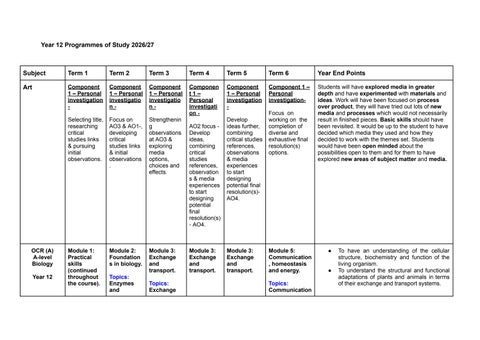
Year 12 Programmes of Study 2026/27
Subject
Term 1
Term 2
Term 3
Term 4
Term 5
Term 6
Year End Points
Art
Component 1 – Personal investigation -
Component 1 – Personal investigatio n-
Component 1 – Personal investigatio n-
Componen t1– Personal investigati on -
Component 1 – Personal investigation -
Component 1 – Personal investigation-
Selecting title, researching critical studies links & pursuing initial observations.
Focus on AO3 & AO1-, developing critical studies links & initial observations .
Strengthenin g observations at AO3 & exploring media options, choices and effects.
Students will have explored media in greater depth and have experimented with materials and ideas. Work will have been focused on process over product, they will have tried out lots of new media and processes which would not necessarily result in finished pieces. Basic skills should have been revisited. It would be up to the student to have decided which media they used and how they decided to work with the themes set. Students would have been open minded about the possibilities open to them and for them to have explored new areas of subject matter and media.
Module 1: Practical skills (continued throughout the course).
Module 2: Foundation s in biology.
Module 3: Exchange and transport.
OCR (A) A-level Biology Year 12
Topics: Enzymes and
Topics: Exchange
AO2 focus Develop ideas, combining critical studies references, observation s & media experiences to start designing potential final resolution(s) - AO4.
Module 3: Exchange and transport.
Develop ideas further, combining critical studies references, observations & media experiences to start designing potential final resolution(s)AO4.
Module 3: Exchange and transport.
Focus on working on the completion of diverse and exhaustive final resolution(s) options.
Module 5: Communication , homeostasis and energy. Topics: Communication
● To have an understanding of the cellular structure, biochemistry and function of the living organism. ● To understand the structural and functional adaptations of plants and animals in terms of their exchange and transport systems.
Biological processes
Module 2: Foundations in biology.
Teacher 1 Topics: Biological molecules. Key Skills: Comparing biochemical structures, study skills, compare and contrast, linking structure to function.
biological membranes. Key Skills: Practical investigatio n, data interpretatio n inc. graphical and tabular data. MP: Enzymes and membranes test.
surfaces and breathing.
Topics: Transport in animals.
Topics: Transport in plants.
and homeostasis, excretion.
Key Skills: Using models, dissection and biological drawing.
Key Skills: Dissection, graphical data interpretati on, method planning.
Key Skills: Microscopy, application and exam practice.
Key Skills: Microscopy, histology, linking structure to function, biological drawing.
MP: Mid-year assessment foundations in biology.
MP: Exchange surfaces and transport in animals test.
Module 4: Biodiversity, evolution and disease.
Module 4: Biodiversit y, evolution and disease.
Topics: Communica ble diseases and biodiversity.
Topics: Classificati on.
MP: End of year assessment - biological processes paper.
MP: Biological molecules test. OCR (A) A-level Biology Year 12 Biological diversity Teacher 2
Module 1: Practical skills (continued throughout the course). Module 2: Foundations in biology. Topics: Cell structure
Module 2: Foundation s in biology. Topics: Cell division, cell diversity and cell differentiati on. Key Skills: Microscopy,
Key Skills: Linking
Key Skills: Statistics and application
Module 6: Genetics and ecosystems.
Module 6: Genetics and ecosystems.
Topics: Cellular control.
Topics: Patterns of inheritance.
Key Skills: Exam application, use of keywords and exam
Key Skills: Interpretation and drawing of genetic diagrams
● To have an understanding of the variety of organisms that are pathogenic and how plants and animals have developed defences to deal with disease. ● To have an understanding of the importance of biodiversity and an appreciation for the need for conservation. ● To be able to successfully utilise microscopes to draw and calculate size of specimens. ● To use a range of biochemical techniques including quantitative and qualitative testing. ● To develop an understanding of the ethical use of living organisms in a practical context. ● To acquire a competence in the manipulation of qualitative and quantitative data including statistical testing.
and nucleotides. Key Skills: Comparing biological structures, microscopy, study skills, use of computers.
biological investigatio n. MP: Cell structure and nucleotides test.
MP: Mid-year assessment foundations in biology.
MP: Baseline review
Business Studies Y12 Business AQA (NP)
Module 3.2 Managers, Leadership and Decision Making Understandin g Management; Leadership and Decision Making; Management Decision Making; Role and Importance of Stakeholders. Module 3.3 Marketing Management Setting
structure to function, application of knowledge, outdoor investigativ e methods, statistics.
Module 3.3 Marketing Management Understandi ng Markets and Customers; Segmentatio n targeting, positioning; Using the Marketing Mix.
Module 3.5 Financial Management Setting Financial Objectives; Analysing Financial Performance .
of statistics.
specific language.
MP: Module 4 test disease, diversity and classificati on.
MP: End of year assessment - biological diversity.
Module 3.5 Financial Manageme nt Sources of Finance; Improving Cash Flow and Profits
Revision and Exam Practice Consolidation , revision and feedback.
Module 3.8 Choosing Strategic Direction (A Level only) Strategic Direction; Strategic positioning; Audit
To be able to do/show: Communication Skills, Develop a reasoned judgement based on information Develop a reasoned conclusion Presentation Skills Understand the importance of financial performance for a business using balance sheets, income statements and financial ratios. Understand Structure for 20 Mark Question Construct and Analyse Budgets and Cash Flow Forecast Calculate and Interpret HR Data e.g. Labour Turnover Creative thinking, Leadership Skills, Constructed a balanced reasoned argument. Evaluative Skills, Numerical Skills (Specific Calculations e.g Market Share etc) Construct a reasoned argument.
Marketing Objectives; Understandin g Markets and Customers.
Y12 Business AQA (LS)
Module 3.1 What is Business? Understandin g the Nature and Purpose of Business; Different Business Forms; External Environment. Module 3.4 Operational Management Setting Operational Objectives; Analysing Operational Performance. Assessed Homework (3.1) Topic Assessment (3.2) Assessed Homework (3.3) Topic Assessment
Module 3.4 Operational Management Setting Operational Objectives; Analysing Operational Performance .
Module 3.6 Human Resource Management Setting Human Resource Objectives; Analysing HR Performance ; Improving Organisation al Design; Managing the Human Resource Flow.
January Exam (3.1-3.4) Topic Assessment (3.5-3.6)
Module 3.6 Human Resource Manageme nt Improving Motivation and Engagemen t; Employer-e mployee relations.
Revision and Exam Practice Consolidation , revision and feedback.
End of Year Exams - AS Paper 1 - AS Paper 2
Module 3.7 Mission, Corporate Objectives, Functional Objectives and Strategy (A Level Only) Mission, corporate objectives and strategy; Investment appraisal; Balance Sheets; Income statements; Financial ratios.
(3.4) Chemistry Organic Chemistry Teacher1
Module 2: Foundations in Chemistry Topics: Electrons & bonding Shapes of molecules & Intermolecula r forces Key Skills: Understandin g models, development of scientific thinking, analysis, evaluation, extended writing, application of knowledge to properties, 3D drawing, angles. Practical skills. MP1: Shapes & IM forces exam Qs
Module 4 Core Organic chemistry & analysis
Module 4 Core Organic chemistry & analysis
Module 4 Core Organic chemistry & analysis
Module 4 Core Organic chemistry & analysis
Topics: Basic concepts Alkanes & Alkenes
Topics: Alcohols Haloalkanes
Topics: Organic Synthesis Spectrosco py – Mass & IR
Topics: Spectroscopy Revision
Key Skills: IUPAC rules, ratios, logical thinking & looking for patterns, drawing in 3D, visualisation in 3D, analysis, evaluation, extended writing, radical substitution mechanism, electrophilic addition mechanism, application of structure to properties.
Key Skills: IUPAC rules, logical thinking, drawing & visualisation in 3D, analysis, evaluation, nucleophilic substitution mechanism, application of structure to properties. Ethics, environment al concerns. Practical skills. MP5: January Assessment
Key Skills: Practical skills, purification techniques, analysis, logical thinking & looking for patterns, identificatio n, data analysis, application of data and spectra to structure. MP7: Alcohol to organic synthesis test
Key Skills: Analysis, logical thinking & looking for patterns, identification, data analysis, application of data and spectra to structure. Exam skills, command words, understandin g mark schemes MP9: EOY Exam
Module 6 Organic Chemistry & analysis Topics: Aromatic chemistry – benzene and phenol Directing groups Key Skills: Understanding models, development of scientific thinking, IUPAC rules, logical thinking & looking for patterns, analysis, evaluation, extended writing, nucleophilic substitution mechanism, application of structure to properties. Practical skills. MP10: Aromatic Exam Qs
- Apply new terminology and concepts to previous understanding of structure and bonding - Describe how the shape and polarity of molecules gives rise to their properties - Understand that these properties can relate to forces that exist between or within molecules - Apply new ideas about sigma- and pi-bonds to explain bonding and reactivity of organic molecules - Be able to represent and name organic molecules and functional groups using IUPAC nomenclature - Represent the reactions of different organic molecules in terms of reaction mechanisms, reagents and conditions - Investigate the reactions of organic molecules using a variety of practical equipment and techniques - Be able to apply knowledge of practical organic chemistry techniques in written exams - Identify the structure of organic molecules using spectrometry and spectroscopy
MP2: Electrons to IM forces Test
Practical skills.
MP6: Haloalkane exam Qs
MP8 Spectrosco py exam Qs
Module 3 Periodic table & energy
Module 3 Periodic table & energy
Module 3 Periodic table & energy
Topics: Atoms, Ions and Compounds Amount of Substance
Topics: Acids and Redox The Periodic Table
Topics: Reactivity Trends Enthalpy
Topics: Equilibrium and Reaction Rates
Key Skills: Writing formulae, changing the subject of an equation, working with standard form and significant figures, using ratios, fractions,
Key Skills: Substituting numbers into algebraic equations and solving them, plotting variables from experimental data, drawing and
MP3: nomenclatur e naming assessment
Extracurricular: Cambridge University Chemistry Challenge
MP4: Alkane & alkene test
Physical Chemistry
Module 2 Foundations in Chemistry
Teacher2
Key Skills: algebraic equations and solving them, plotting variables from experimental data, recognising and explaining patterns,
Key Skills: Applying the conservatio n of energy principle, data analysis, logical thinking, interpreting diagrams, looking for patterns,
Module 3 Periodic table & energy & Module 5 Physical chemistry Topics: Revision Rates of reaction Key Skills: Drawing and using the gradient of a tangent to a curve, calculating constants, exam skills, command words, understandin
Module 5 Physical chemistry Topics: Rates of Reaction Key Skills: logarithms and their inverse, algebraic equations, plotting experimental data, graphical analysis, working with indices, practical skills
- To have a deep understanding of atomic, isotopic and ionic structure in terms of subatomic particles and be able to interpret this using mass spectrometry - To analyse and evaluate chemical reactions mathematically in terms of determining their formulae, moles, mass, volume, yield, and ratios through manipulating mathematical equations appropriately. - To be able to apply and explain a range of practical and analytical techniques to identify chemical species and determine mass, concentration, energy change by experiment. - To be able use the Periodic Table to describe and explain in detail a wide range of trends in the properties, bonding and structure of elements thinking in Groups (horizontal) and Periods (lateral). - To understand and explain the trends in reactivity of Group 2 and Group 7 elements and their uses
percentages, practical skills. MP1: Baseline test MP2: Calculation exam Qs
using the gradient of a tangent to a curve to measure rate, recognising and explaining patterns, analysing experimental data, practical skills MP3: Quantitative Test
evaluating, analysing experimental data, logical thinking, practical skills MP5: January Assessment MP6: Bond enthalpy & Hess cycle assessment
drawing and using the gradient of a tangent to a curve, constructing enthalpy cycles, calculating constants, practical skills
g mark schemes.
MP10: Orders of Reaction Rates exam Qs
- To understand how energy (enthalpy) plays a fundamental role in driving chemical reactions and to be able to calculate and measure this by experiment and theoretically using Hess’ Law.
Module: Aspects of software development
Understand the basic internal components of a computer system. Be able to describe the concept of addressable memory and the stored program concept. Define the term ‘processor instruction set’. Be able to interpret simple assembly code instructions with immediate and direct addressing modes and use given assembly language instruction formats to write instructions to perform simple tasks. Understand the structure of the Internet. Understand the purpose and function of the Domain Name Server (DNS) system and the role of packet switching and routers. Understand how a firewall works and explain symmetric and asymmetric encryption and key exchange. Be able to discuss worms, Trojans and viruses and the vulnerabilities
MP9: EOY Exam
MP7: Equilibrium Qs MP8: Rates of reaction exam Qs
MP4: Grp 7 exam Qs Computer Science
Module: Fundamental s of computer systems Topics: Number systems, binary number system, Logic gates and Boolean algebra. Internet security,
Module: Fundamental s of Programmin g and the CPU Architecture Topics: Programmin g basics, Internal hardware, stored program concept and
Module: Fundamental s of Communicati ons and Networking Topics: Communicati on basics, Networks, The Internet, Internet Security, TCP/IP, The
Module: Systematic Approach and the Fundament als of Databases
Module: Consequence s of Computing and Introduction to the NEA
Topics: Relational databases, SQL, big data
Topics: Moral, legal and ethical issues. Software development and non exam
Key Skills: Produce a
Topics: Analysis, Design, Implementation, Testing and Evaluation Key Skills: Be aware that before a problem can be solved, it
TCP/IP, client server model and networks Key Skills: Be familiar with the concept of a number base, in particular decimal, binary and hexadecimal. Know that the 2n different values can be represented with n bits. represent negative and positive integers in two’s complement, perform subtraction using two’s complement, calculate the range of a given number of bits, n. Know how numbers with a fractional part can be represented. Compare the
the processor instruction set Key Skills: Define and use user-defined data types based on language-def ined (built-in) data types. Use definite and indefinite iteration, Use nested selection and nested iteration structures. Use meaningful identifier names and know why it is important to use them. Be familiar with, and be able to use, random number generation. Know how to use
Client Server Model Key Skills: Define and compare synchronous and asynchronou s data transmission. Differentiate between baud rate and bit rate. Understand the relationship between bit rate and bandwidth. Explain peer-to-peer networking and client-server networking. Be familiar with the components required for wireless networking. Explain the wireless protocol Carrier Sense
data model from given data requirement s for a simple scenario involving multiple entities. Produce entity relationship diagrams. Explain the concept of a relational database. Normalise relations to third normal form. Be able to use SQL to retrieve, update, insert and delete data from multiple tables of a relational database. Be able to use SQL to define a database table. Know
assessment introduction Key Skills: Show awareness of current individual (moral), social (ethical), legal and cultural opportunities and risks of computing. Understand that developments in computer science and the digital technologies have dramatically altered the shape of communicatio ns and information flows in societies, enabling massive transformatio ns in the capacity to: monitor behaviour,
must be defined, the requirements of the system that solves the problem must be established and a data model created. Requirements of system must be established by interaction with the intended users of the system. Be aware that before constructing a solution, the solution should be designed and specified, for example planning data structures for the data model, designing algorithms, designing an appropriate modular structure for the solution and designing the human user interface.
that they exploit. Describe the roles of the four layers in the TCP/IP protocol stack, Be able to write an entity description for each entity in a database. define key terms such as attribute, primary key, composite primary key and foreign key. Produce simple entity relationship diagrams. Use SQL to retrieve, update, insert and delete data from a single table. State what is meant by a client-server database and issues surrounding this software. The ability to give examples of some of the moral and ethical choices which arise when digital technology is used. Explain, with examples, how some software applications have resulted in great benefits but also caused great harm Give examples from the range of laws which relate to the use, and misuse, of digital technology to gather, store, process and distribute digital data.
advantages and disadvantage s of fixed point and floating point forms in terms of range, precision and speed of calculation. Construct truth tables, write Boolean expressions and trace the logic of circuits. Be familiar with the use of Boolean identities and De Morgan’s laws to manipulate and simplify Boolean expressions. MP1: End of Unit Assessment MP2: Past Paper Questions
exception handling in a programming language. Be able to describe the stored program concept. Explain the role and operation of a processor and its major components: arithmetic logic unit, control unit, clock, general-purp ose registers and dedicated registers, including: • program counter • current instruction register • memory address register • memory buffer register
Multiple Access with Collision Avoidance (CSMA/CA) with and without Request to Send/Clear to Send (RTS/CTS). Understand the structure of the Internet. Understand how a firewall works (packet filtering, proxy server, stateful inspection). Describe the role of the four layers of the TCP/IP stack (application, transport, network, link) and the protocols that apply. Know that networks can be divided into subnets.
that a client server database system provides simultaneou s access to the database for multiple clients. Know how concurrent access can be controlled to preserve the integrity of the database. Know that 'Big Data' is a catch-all term for data that won't fit the usual containers. MP1: End of Unit Assessment MP2: Past Paper Questions
amass and analyse personal information. Distribute, publish, communicate and disseminate personal information. Computer scientists and software engineers therefore have power, as well as the responsibilitie s that go with it, in the algorithms that they devise and the code that they deploy. MP1: End of Unit Assessment MP2: Past Paper Questions
Be aware that the models and algorithms need to be implemented in the form of data structures and code (instructions) that a computer can understand. Be aware that the implementation must be tested for the presence of errors, using selected test data covering normal (typical), boundary and erroneous data Know the criteria for evaluating a computer system MP1: End of Unit Assessment MP2: Past Paper Questions
• status register Know that instructions consist of an opcode and one or more operands (value, memory address or register) Understand and apply the basic machine-cod e operations.
Distinguish between routable and non-routable IP addresses. MP1: End of Unit Assessment MP2: Past Paper Questions
MP1: End of Unit Assessment MP2: Past Paper Questions Economics
Theme 1 1 Introduction to economics 2 Understandin g of theorists (John M Keynes Frederick Hayek, Karl
Theme 1 1 Application of the supply and demand model 2 Functions of price mechanism
Theme 2 1 Introduction to macroecono mic variables and objectives 2 Economic growth,
Theme 2 1 Government objectives 2 Government discretionar y policy in order to influence
Exam practice and revision Themes 1 and 2 1 Fiscal policy 2 Monetary Policy
Theme 3 Introduction to microeconomics at A2 level. Competition, market, structure. Research task on the UKs economy and a
To understand the nature of economics To be able to explain economic potential to understand shifts and shapes of supply and demand curves. To be able to analyse the impact of external shocks on the markets To analyse the impact on society of markets To understand why markets and government intervention can lead to poor allocation of resources. To consolidate how markets work and fail.
Marxm Adam Smith)
3 Rational and irrational behaviour
inflation, unemployme nt
3 Productive potential PPF
4 Functions of money
4 Supply and demand
5 Externalities
3 Balance of payments and patterns of international trade
5 Elasticities (PED, PES, YED, XED)
6 Types of market failure
Assessment 1 - topics 1,2 3 Multiple choice and short questions Assessment 2 - topics 1,2,34,5 Multiple choice and data response
7 Private and social costs and benefits to society of economic decisions and government intervention Theme 2 Introduction to Macroecono mics Assessment 1 - full past paper. Topics 1,2,3,4,5,6,7, 8,9,10
4 Introduction of the aggregate supply and demand model 5 C, I, G, X M 6 Circular flow of income and wealth Assessment 1 MOCK past paper theme 1 Assessment 2 - multiple choice and short questions. Topics
the economy demand side and supply side (Fiscal / Monetary and Supply side policies) 3 Conflicts between policies Assessme nt 1 Past papers Theme 2 Assessme nt 2 Mixed paper Theme 1 and 2
3 Supply side policy Revision Theme 1 and 2 for mock exams Assessment 1 - past paper 1 theme 1 Assessment 2 - past paper 2 theme 2
less developed country of the students’ choice - in order to develop skills to succeed at A level by improving their use of context. Assessment 1 Week 4 summative assessment to include topics from all of the themes 1 and 2.
To understand the macroeconomic variables, how they are calculated and their importance. To be able to assess the impact on markets and the economy of the changeable economic environment. To be able to interpret economic policy and fully analyse and evaluate impact. To be effective at micro and macro analysis of a set of data. To understand shifts of supply and demand. To understand the concept of market failure and government failure. To be able to create and analyse a macroeconomic model. To understand and critically evaluate economic policy.
1,2,3,4,5 (theme 2)
English Literature
A Streetcar Named Desire AIM: To study the 1940s modern domestic tragedy in depth. To examine social/moral/p olitical/cultura l issues of the period of publication and setting, making connections to present day issues e.g. abusive relationships, class. To establish and build on prior knowledge and understandin g.
Prose Comparison
Prose Comparison
AIM: To study and compare two prose texts in parallel. To build and develop evaluative, comparative essay skills. To explore the various contextual influences on each text e.g. genre, historic, socio-politica l, biographical.
AIM: To study and compare two prose texts in parallel. To build and develop evaluative, comparative essay skills. To explore the various contextual influences on each text e.g. genre, historic, socio-politica l, biographical.
KEY SKILLS: Comparative analysis. Identifying and examining writers’ methods and their
KEY SKILLS: Comparative analysis. Identifying and examining writers’ methods and their
Modern Poetry AIM: To study a list of prescribed poems from the Poems of the Decade Collection. This is new, challenging poetry that tackles modern issues such as gender inequality, morality, universal truths, power, transitions. To establish and build on prior skills from GCSE. To introduce unseen poems
Intro to NEA
NEA (Gatsby)
- Read widely and
AIM: To introduce the independent component of the course. To begin study of the set text as a class. To introduce a weekly ‘book club’ for students to read a range of texts suitable for comparison to the set text. KEY SKILLS: Independent critical and contextual research and note taking. Textual analysis. Comparison.
AIM: To complete study the set text as a class. To prepare students for independent summer work. To introduce a weekly ‘book club’ for students to read a range of texts suitable for comparison to the set text. KEY SKILLS: Independent critical and contextual research and note taking. Textual analysis. Comparison.
independently.
CAREER LINKS:
CAREER LINKS: Useful preparation for university coursework e.g.
- Engage critically and creatively with a substantial body of texts. - Develop and apply knowledge of literary analysis and evaluation.
- Identify a wide range of literary methods and show understanding of how writers use dramatic/ poetic/ prose methods to shape meaning.
KEY SKILLS: Identifying and analysing the writer’s methods in detail. Evaluation. Essay planning and writing. Critical thinking. Group discussion and presentation. CAREER LINKS: Playwrighting, direction, acting, psychology, mental health, history. READING: Recommende d reading lists given at the start of the year.
effects. Essay planning and writing. Research. Annotation.
effects. Essay planning and writing. Research. Annotation.
CAREER LINKS: Science, advocacy, law, ethics, activism, politics, history, literature, curatorship
CAREER LINKS: Science, advocacy, law, ethics, activism, politics, history, literature, curatorship
throughout the study of the set poems. KEY SKILLS: Unseen poetry approach. Comparativ e analysis. Identifying and examining writers’ methods and their effects. Essay planning and writing. Annotation. Independen t evaluation. CAREER LINKS: Any role requiring critical thinking, communicat ion and creative skills.
Useful preparation for university coursework e.g. referencing. Any role requiring critical thinking, communicatio n and creative skills. READING: Book club homework and lessons to encourage independent reading but also discussion and recommendat ion in a group setting.
referencing. Any role requiring critical thinking, communication and creative skills. READING: Book club homework and lessons to encourage independent reading but also discussion and recommendation in a group setting.
- Show knowledge and understanding of the contexts in which texts have been produced and received. - Show understanding of how these contexts influence meaning/reflect attitudes and values. - Make connections between texts and explore these in detail. - Plan and write conceptual and developed essays. - Conduct research independently to support and deepen learning.
Geography Teacher 1 (4 lessons per fortnight)
Exploring Oceans
Exploring Oceans
Exploring Oceans
Exploring Oceans
Characteristic s of Oceans
Marine resources. Socioeconomic and political factors.
Socioeconomic / political factors (continued). Climate change. Pollution.
Pollution
Earth’s Life Support Systems
Earth’s Life Support Systems
Understand how coastal landscapes can operate as a system. Understand how coastal landforms develop in high and low energy environments.
How important are water and carbon cycles to life on earth?
How important are water and carbon cycles to life on earth?
Understand how climate change and human activity can affect coastal landscapes. Understand how climate change is affecting coastal landscapes and ocean systems including island nations and the Arctic Ocean region. Understand the physical and biological characteristics of oceans. Understand the consequences of human activities on oceans.
Teacher 2 (4 lessons per fortnight)
Coastal Landscapes Geomorphic processes, Erosional and depositional landforms Coasts as Systems
Coastal Landscapes Emergent and submergent landforms Human activity on coastlines
Changing Places, Making Spaces Place Identity including built environment, physical landscape, demographic ,
Changing Places, Making Spaces Understandi ng places: perception, representati on, emotional attachment. Social Inequality Impact of changes in
Changing Places, Making Spaces Impact of changes in economic activity on places. Place making; rebranding
Earth’s Life Support Systems How important are water and carbon cycles to life on earth?
Understand how socio-economic and political factors have influenced the use of oceans. Understand why carbon and water are important to life on Earth. In groups, plan and complete fieldwork investigations in unfamiliar physical and human environments With guidance, create GIS maps using their own fieldwork data. To be able to apply and evaluate analytical skills to a wide range of geographical data.
socio-econo mic, cultural and political characteristi cs
economic activity on places
Explain in detail a variety of geographical processes and features including independently identify and explain links between Oceans and other A level topics. Confidently apply knowledge and understanding to unknown situations and to construct well-developed, evidenced arguments which reach reasoned conclusions.
12 NEA (2 lessons per fortnight)
Introduction to fieldwork Planning fieldwork Writing an Introduction Writing methods Northleach fieldwork
Writing up fieldwork investigatio ns Presenting Data ArcGIS maps Analysing Data Writing Conclusions Evaluating fieldwork
Analysing fieldwork data
Fieldwork Preparatio n
Statistical Tests Data Presentation Initial research for own investigation s Safety Investigation s
Analysing data from safety investigatio n Planning Swanage fieldwork Swanage follow-up work
Urban Fieldwork
NEA Preparation
Writing questionnaire s Birmingham fieldwork Use of Excel to analyse data
Completing own proposal forms Planning data collection
● Understand how to plan, undertake and evaluate an individual investigation.
German
Teacher 1 (JJR): 2.1 Soziale Netzwerke 2.2 Die Sucht nach Technik 2.3 Das Internet 3.1 Musik und Lieder
Teacher 2 (BP): 1.1 So viele verschiedene Familienform en 1.2 Auf immer und ewig Unit 2 Assessment
Teacher 1 (JJR): 3.2 Promis aus dem Herkunftslan d 3.3 Mode und Image 4.1 Frohe Festtage 4.2 Vielfältige Feste und Traditionen
Teacher 2 (BP): 1.3 Das heutige Familienlebe n 3.4 Die Rolle des Fernsehens Unit 1 Assessment Unit 3 Assessment
Teacher 1 (JJR): 4.3 Fest oder Geschäft 5.2 Deutsche Kunst 5.3 Der Zeit ihrer Kunst Teacher 2 (BP): 5.1 Meilensteine der Architektur Mid-year exam Unit 4 Assessment
Teacher 1 (JJR): 5.4 Wiederaufb au oder Neuaufbau 6.1 Berlin – geprägt durch seine Geschichte 6.2 Kulturmetro pole Berlin Teacher 2 (BP): Film Study: Goodbye, Lenin! Unit 5 Assessme nt
Teacher 1 (JJR): 6.3 Berlin im Schatten des Dritten Reichs 6.4 Berlin – Hauptstadt der Vielfalt INTRO TO IRP Teacher 2 (BP): Film Study: Goodbye, Lenin! Unit 6 Assessment AS Mock exam
Teacher 1 (JJR): 7.1 Einwanderungsl and Deutschland
By the end of year 12, students will be able to…
Teacher 2 (BP): 8.1 Woher kommst du?
…conjugate verbs accurately in all tenses.
Timed Film Essays (x2)
…understand and produce language on the topics of family, technology, youth culture, art and architecture and Berlin.
...understand the use of all four cases and a wide range of prepositions. …critically analyse the film Goodbye, Lenin. …respond to speaking cards on all topics.
Government & Politics
Module UK GOV 1: The UK Constitution Content: Nature & sources of the UK Constitution, Constitutional change since 1997, impact of devolution, debates on further reform. Module UK POL 1: Democracy & Participation Content: Current systems of representativ e democracy and direct Democracy; The features, similarities and differences. Advantages and disadvantage s and
Start Module UK GOV 2: UK Parliament Content: Structure & role of the House of Commons & House of Lords, comparative powers, legislative process, Parliament-E xecutive interaction Start Module UK POL 2: Political parties Content: Political Parties; The functions and features of political parties in the UK’s representativ e democracy. Party funding and debates on
Start Module UK GOV 3: Prime Minister & the Executive Content: The structure, role, and powers of the Executive; Its structure, including PM, the Cabinet, junior ministers and government departments. Its main roles, including proposing legislation, proposing a budget, making policy decisions within laws and budget. The main powers of
Start Module UK GOV 4: Relations between branches Content: Supreme Court, Executive-P arliament relationship, influence of EU on UK Government , location of sovereignty. Start Module UK POL 3: Electoral Systems Content: Functions of an electoral system, Workings of FPTP, Different electoral systems, referendum s & how
Finish off Relations between branches Start Module UK POL 4: Voting Behaviour & the media Content: Demographic factors influencing voting behaviour, non-demogra phic explanations for voting behaviour, Case studies of 3 key general elections, influence of the media
Start Political Ideologies module: Liberalism Content: Core ideas & principles (individualism, freedom, state, rationalism, equality, liberal democracy); differing views & tensions within socialism (classical, modern); Key thinkers (John Locke, Mary Wollstonecraft, John Stuart Mill, John Rawls, Betty Friedan) Finish Voting Behaviour & the Media
UK: 1: an understanding of the emergence and development of the UK’s democratic system and the similarities, differences, connections and parallels between direct and indirect democracy. 2.) a critical evaluation of role of the individual in the political process and their relationship with the state and their fellow citizens. 3.) a fundamental understanding of the nature of law making and UK constitution, assessing where, how and by whom political decisions are made with further comparisons with other political systems. 4.) Exploring the main branches of Government, relationships and balance of power between them, with a consideration of where sovereignty now lies within this system. 5.) Understanding of the factors which influence voting behaviour and the viability of the electoral system they are voting in.
History
the consideration of the case for reform. A wider franchise and debates over suffrage; Key milestones in the widening of the franchise in relation to class, gender, ethnicity and age. The work of the suffragists/suf fragettes to extend the franchise.
current system. Established Political Parties; The origins and historical development of the Conservative , Labour and Liberal Democrat Party’s. Current policy on the economy, law and order, welfare and foreign affairs. Emerging and minor UK political parties; Importance and case study of three minor parties.
the Executive, including Royal Prerogative powers, initiation of legislation and secondary legislative power. The concept of ministerial responsibility ; individual and collective ministerial responsibility.
they are used, electoral system analysis
USA topic: Westward Expansion
USA topic: Native Americans
USA topic: Sectional Tensions
USA topic: Sectional Tensions
USA topic: The Civil War
Introduction to courseworkindependent research skills
Students can make judgements about which factor/s affect Expansion westward and the lives of Native Americans throughout the 19 th
OCR Exam Board USA
Content: What opened up the west in the 19th Century? Exploration, Federal influences, Individuals, Economy, Ideology. Cultural Capital: Impact of colonisation and international relations. The concept of federalism and manifest destiny. Topic: Mid-Tudor Crises Content: Edward VI reign, Mary I’s marriage & religious policies, social & economic issues in
Content: Why was there conflict between the Native Americans and the Union? How did the Union effect the livelihood of the Native Americans? Cultural Capital: A focus on an oppressed minority looking at the long-term impacts of colonisation. CONTINUE D from term 1
Content: Why did tensions between the North and the South deteriorate? How important was the issue of slavery to the Union? Cultural Capital: Understandin g the lasting impacts of slavery and the discriminatio n minorities continue to suffer. Topic: Elizabeth’s religious reforms & government Content: Terms of Religious Settlement, Roman Catholic
Content: How important was the issue of slavery to the Union? Did Lincoln make civil war inevitable? Cultural Capital: The nature of sectionalism and the impact it has on society. The nature of Civil War Topic: Elizabeth’s economic & social reforms Content: Sources of income, inflation, overseas trade, action on poverty & effectivenes s,
Content: Looking at the leadership of both the Confederacy and the Union. Understandin g the significance of key battles during the Civil War. Cultural Capital: Understand the impact of war including the specific impacts a civil war can have. Topic: Elizabeth’s later years Content: relations with parliament, war with Spain, social & economic problems of 1590s, Essex Rebellion, decline in popularity Cultural Capital:
Content: Choosing topics and questions, students should be able to begin building their research skills in preparation for next year. Cultural Capital: Building independent skills to aid research- key skills needed for most careers. CONTINUED from term 5 + introduction to Russia Content: Key events in Russia, key concepts (eg ideology), context of Tsarist Russia, Russia today Cultural Capital:
Century. Students can also argue what factor/s caused the biggest impact between tensions of the North and the South and how this led to the Civil War. This will require a high level of thinking and understanding. Students can discuss and compare concepts using multiple PEEL paragraphs and a substantiated conclusion. Students can give multi-layered reasoning for the causation/consequences of key events in the time period. Students can understand & analyse a complex chronology of Tudor rule Students can create a complex historical judgement on why/how multiple sources agree/ disagree (including provenance)
mid-Tudor England, threats & rebellions Cultural Capital:
Maths Lead Teacher 1(6 lessons per fortnight Pure & Statistics) Teacher 2 (3 lessons per fortnight Pure & Mechanics)
Pure Maths Teacher 1 Quadratics Quadratic Functions Simultaneous Equations Inequalities Calculus – Differentiatio n From first principles Differentiation Liebnitz notation Linear coordinate geometry
Pure Maths TEACHER 1 Integration Introduction to integration Reverse differentiatio n Logarithms and Exponentials Laws of logarithms Solving logarithmic equations Solving exponential equations Binomial Expansion
resistance, role of puritans & Archbishops, Elizabeth’s style of rule, succession & marriage question, impact of this. Cultural Capital:
dealing with the poor Cultural Capital:
Pure Maths TEACHER 1 Calculus Differentiati on Differentiatio n Maxima and minima Optimisation Problems
Pure Maths TEACHER 1 Proof By exhaustion Algebraic Disprove by counter example
Calculus – Integration Areas under graphs Coordinate Geometry
Year 13 content Partial Fractions Radians, arc length and sectors
Pure Maths TEACHER 1 Year 13 content Numerical Methods Iteration Location of roots Spider and staircase diagrams MOCK EXAMS
Pure Maths TEACHER 1 Year 13 content Trigonometry Reciprocal trigonometric functions Exact values Functions Domains and ranges Mapping Composite functions Inverse functions TEACHER 2Year 13 content Algebraic
Construct and present mathematical arguments through appropriate use of diagrams; sketching graphs; logical deduction and precise statements Understand and use mathematical language and syntax as set out in the content. Understand and use language and symbols associated with set theory, as set out in the appendices. Apply to solutions of inequalities and probability. Comprehend and critique mathematical arguments, proofs and justifications of methods and formulae, including those relating to applications of mathematics. Recognise the underlying mathematical structure in a situation and simplify and abstract appropriately to enable problems to be solved.
Tangents and Normals
With n as an integer
Logarithms and Exponentials Laws of logarithms Solving logarithmic equations Solving exponential Equations
TEACHER 2 Indices and Surds Manipulating surds Rationalising a denominator
TEACHER 2 Indices and Surds Index laws Manipulating surds Rationalising a Denominator Curve Sketching Sketching Cubic, quartic and reciprocal grams Curve sketching graph transformatio ns
STATISTICS T1 Sampling & Definitions Sampling Methods Key definitions Large Data Set Probability Notation Tree diagrams Venn diagrams Independenc e and Mutually exclusive
Equation of a circle Coordinate geometry problems Logarithms and Exponentials 2 e*x and ln x Real life exponentials Logarithmic Data MECHANIC S T2 Vectors Notation Magnitude Unit vectors Angles with an axis Variable Acceleratio n Calculating displacement , velocity and acceleration using calculus
TEACHER 2 – Year 13 content Calculus Differentiat ion Differentiati ng trigonometr y Differentiati ng ex and ln x STATISTIC S T1 Probability Describing Data Histogram Means and Standard deviations Comparing Distributions Bivariate Data Discrete Probability Discrete random variables
Fractions Simplify Add, subtract, multiply and divide Numerical Methods Trapezium Rule Differentiation Chain rule differentiating trigonometry, logarithms and exponentials.
Construct extended arguments to solve problems presented in an unstructured form, including problems in context. Interpret and communicate solutions in the context of the original problem. Evaluate, including by making reasoned estimates, the accuracy or limitations of solutions. Understand the concept of a mathematical problem solving cycle, including specifying the problem, collecting information, processing and representing information and interpreting results, which may identify the need to repeat the cycle Understand, interpret and extract information from diagrams and construct mathematical diagrams to solve problems, including in mechanics. Translate a situation in context into a mathematical model, making simplifying assumptions. Use a mathematical model with suitable inputs to engage with and explore situations (for a given model or a model constructed or selected by the student). Interpret the outputs of a mathematical model in the context of the original situation (for a given model or a model constructed or selected by the student). Understand that a mathematical model can be refined by considering its outputs and simplifying assumptions; evaluate whether the model is appropriate.
Initial Assessment
Describing Data Means and Standard deviation MECHANIC S T2 Forces & Units Standard units and basic dimensions Force units and balanced forces Resultant forces Motion in a straight line Displacemen t time graphs Velocity time graphs Constant Acceleratio n
SUVAT Proof
Year 12 Pure and Applied
Binomial Distribution Hypothesis Testing Binomial hypothesis testing p-value and critical regions MECHANIC S T2 Dynamics Use of F=ma Connected Particles Cars pulling trailers
Understand and use modelling assumptions
SUVAT equations
Midterm Exam Maths Lead Teacher 1(6 lessons per fortnight Pure & Mechanics) Teacher 2 (3 lessons per fortnight Pure & Statistics)
TEACHER 1 Trigonometr y Sine and Cosine Rule Trigonometric graphs Solving equations through CAST diagrams Trigonometric Identities Quadratics Quadratic Functions Simultaneous Equations Inequalities Calculus – Differentiatio n From first principles Differentiation Liebnitz notation
TEACHER 1 Integration Introduction to integration Reverse differentiatio n Logarithms and Exponential s Laws of logarithms Solving logarithmic equations Solving exponential equations Binomial Expansion With n as an integer
TEACHER 1 Calculus Differentiati on Maxima and minima Optimisation Problems
Calculus – Integration Introduction to integration Reverse differentiation Areas under graphs
Year 13 content Partial Fractions Numerical Methods Iteration Location of roots Spider and staircase diagrams
TEACHER 2 Indices and Surds
Coordinate Geometry Equation of a
TEACHER 2 – Year 13 content
Binomial Expansion With n as an integer
TEACHER 1 Proof By exhaustion Algebraic Disprove by counter example
TEACHER 1 -Year 13 content Radians, arc length and sectors
TEACHER 1 -Year 13 content Trigonometry Reciprocal trigonometric functions Exact values Functions Domains and ranges Mapping Composite functions Inverse functions TEACHER 2Year 13 content Algebraic Fractions Simplify Add, subtract, multiply and divide Numerical Methods Trapezium Rule
Construct and present mathematical arguments through appropriate use of diagrams; sketching graphs; logical deduction and precise statements Understand and use mathematical language and syntax as set out in the content. Understand and use language and symbols associated with set theory, as set out in the appendices. Apply to solutions of inequalities and probability. Comprehend and critique mathematical arguments, proofs and justifications of methods and formulae, including those relating to applications of mathematics. Recognise the underlying mathematical structure in a situation and simplify and abstract appropriately to enable problems to be solved. Construct extended arguments to solve problems presented in an unstructured form, including problems in context. Interpret and communicate solutions in the context of the original problem.
Linear coordinate geometry Tangents and Normals TEACHER 2 Factor Theorem and Cubics Factor theorem Algebraic Long division Solving Cubics Indices Index laws Curve Sketching Sketching Cubic, quartic and reciprocal grams Curve sketching graph transformatio ns
Manipulating surds Rationalising a denominator Mechanics T1 Forces and Units Standard units and basic dimensions Force units and balanced forces Resultant forces Motion in a straight line Displacemen t time graphs Velocity time graphs Constant Acceleratio n SUVAT Proof
circle Coordinate geometry problems
Calculus Differentiat ion Differentiati ng trigonometr y Differentiati ng ex and ln x
Differentiation Chain rule differentiating trigonometry, logarithms and exponentials.
Evaluate, including by making reasoned estimates, the accuracy or limitations of solutions. Understand the concept of a mathematical problem solving cycle, including specifying the problem, collecting information, processing and representing information and interpreting results, which may identify the need to repeat the cycle Understand, interpret and extract information from diagrams and construct mathematical diagrams to solve problems, including in mechanics.
Mechanics T1 Vectors Notation Magnitude Unit vectors Angles with an axis
Translate a situation in context into a mathematical model, making simplifying assumptions. Use a mathematical model with suitable inputs to engage with and explore situations (for a given model or a model constructed or selected by the student).
Variable Acceleratio n Calculating displaceme nt, velocity and acceleration using calculus
Understand that a mathematical model can be refined by considering its outputs and simplifying assumptions; evaluate whether the model is appropriate.
Interpret the outputs of a mathematical model in the context of the original situation (for a given model or a model constructed or selected by the student).
Understand and use modelling assumptions
SUVAT equations Statistics T2 Sampling and Definitions Sampling and Definitions Sampling Methods Key definitions Large Data Set Probability Notation Tree diagrams Venn diagrams Independenc e and Mutually exclusive Describing Data Means and Standard deviations Comparing Distributions
Dynamics Use of F=ma Connected Particles Cars pulling trailers Lifts Pulleys Statistics T2 Discrete Probability Binomial Distribution Hypothesis Testing Binomial hypothesis testing p-value and critical regions
Further Maths
CORE MATHS TEACHER 1 Complex Numbers 1 ●Arithmetic ●Conjugate ●Quadratics & Roots ●Argand diagram ●Modulus Argument form ●Loci ●Problem Solving Maclaurin Expansion ●Expansions ●Combining standard results Matrices 1 ●Introduction ●Arithmetic ●Determinate ●Inverses ●Singular ●Transformati ons TEACHER 2 Summations ●Standard results Proof ●Proof of
CORE MATHS TEACHER 1 Matrices 2 ●Invariant Points ●Matrices PPQ Complex Numbers 2 ●Complex Polynomials Roots of Polynomials ●Sum and product of roots of a quadratic ●Roots of a cubic ●Roots of a quartic ●Relationshi p between roots Algebraic Inequalities ●Solving inequalities algebraically Polar Coordinates ●Sketching polar graphs ●Polar to cartesian ●
CORE MATHS TEACHER 1 Momentum ●Conservatio n ●Experiment al law ● Collisions ● Impulse Dimension Analysis ● Analysis ●Consistenc y Work, Energy & Power ● Work, energy and power ●Gravitationa l potential energy ● Kinetic energy ● Tension & EPE FStats T2 Discrete Random Variables ●Expectation and variance ● Coding
CORE MATHS TEACHER 1 Vectors ● Vector equation of a line ● Cartesian equation ● Intersection and Matrices ● Dot Product ● Angle between vectors ● Distances Volume of Revolution ● Revolution around x axis ● Revolution around y axis Mean Value Theorem ● Finding mean value of a function using
Revision and Mock Exam
CORE MATHS TEACHER 1 Complex Numbers (A level) • Exponential form • Roots of complex numbers • Euler’s form Proof of Differences (A level) • Proof of differences with partial fractions Fstats T2 Yates Correction (A level) Continuous Random Variables Further Statistics and Further Mechanics Exam
OT1: Mathematical argument, language and proof OT1.1 Construct and present mathematical arguments through appropriate use of diagrams; sketching graphs; logical deduction; precise statements involving correct use of symbols and connecting language, including: constant, coefficient, expression, equation, function, identity, index, term, variable. OT1.2 Understand and use mathematical language and syntax as set out in the content OT1.3 Understand and use language and symbols associated with set theory, as set out in the content. OT1.4 Understand and use the definition of a function; domain and range of functions. OT1.5 Comprehend and critique mathematical arguments, proofs and justifications of methods and formulae, including those relating to applications of mathematics OT2: Mathematical problem solving OT2.1 Recognise the underlying mathematical structure in a situation and simplify and abstract appropriately to enable problems to be solved. OT2.2 Construct extended arguments to solve problems presented in an unstructured form, including problems in context OT2.3 Interpret and communicate solutions in the context of the original problem. OT2.6 Understand the concept of a mathematical problem solving cycle, including specifying the problem, collecting information, processing and representing information and interpreting results, which may identify the need to repeat the cycle. OT2.7 Understand, interpret and extract information from diagrams and construct mathematical diagrams to solve problems, including in mechanics.
differences ●Proof by induction summations, division, matrices and recurrence
Midterm Exam
Intersecting lines TEACHER 2 Graphs ●Linear rational equation & Inequalities ●Quadratic rational equations and inequalities ●Parabolas, ellipses and hyperbola Year 12 Exam Week
● Sums and differences ● Functions Chi Squared ● Hypothesis testing for independenc e on a contingency table Continuous Random Variables ●Expectation and variance ● Mean and Quartiles Further Statistics Assessment
integration Hyperbolic Functions • Definitions and graph • Inverse • Identities and equations FMech T2 Circular Motion ● Angular Motion ● Constant speed ●Connected particles Circular Motion (A level) ●Tangential acceleration ●Conical pendulum FStats T2 Confidence Intervals ●Introductio n to normal distribution ●Confidenc e interval for a mean Poisson
OT1: Mathematical Modelling OT3.1 Translate a situation in context into a mathematical model, making simplifying assumptions. OT3.2 Use a mathematical model with suitable inputs to engage with and explore situations (for a given model or a model constructed or selected by the student). OT3.3 Interpret the outputs of a mathematical model in the context of the original situation (for a given model or a model constructed or selected by the student). OT3.4 Understand that a mathematical model can be refined by considering its outputs and simplifying assumptions; evaluate whether the model is appropriate OT3.5 Understand and use modelling assumptions.
• Definitions • Sum of distributions •Hypothesis Testing Type I and Type II errors
Core Maths
Estimation Financial Maths 1 Percentages VAT Inflation Exchange rates Base line test
Analysis of Data Sampling Averages and quartiles Box Plots Stem & Leaf Standard Deviation Histograms Financial Maths 2 Budgeting Tax & National Insurance Savings & Investments Normal Distribution
Probability & Estimation Point estimates Confidence intervals
Critical Analysis
Revision
Paper 2 Mock Exam
External Exams
Financial decisions
Drugs, alcohol & managing risk
Correlation & Regression Line of best fit PMCC Regression line
Paper 1 Mock Exam Personal Education Development
Work, study & careers
Healthy relationships & consent.
CPR,Physical & mental
Post 18 options.
Students will have explored the range of post-18 pathways available, developing knowledge & skills to help them evaluate options & make informed
Physics
T1: Module 3 (6 LESSONS) Topics: 1.Practical Skills 2.Foundation s 3. Motion
Recognising and responding to harmful relationship behaviours
health & wellbeing
T1:
T1:
T1:
T1:
Topics: 4. Forces in Action 5. Work, Energy and Power
Topics: 6. Materials
Topics: 7. Newton’s Laws and Momentum 13.Quantum
Topics: 14. Thermal
Topics: 15. Ideal Gases
Key Skills: Calculating, interpreting data, application of
Key Skills: Calculating, interpreting data, application of knowledge,
Key Skills: Calculating, interpreting data, application of
choices about the future. To be able to set realistic, yet ambitious, career and life goals and present themselves effectively at interviews. They will have revisited consent, & explored how to recognise pressure & coercion, & make values-based decisions about intimacy & sexual relationships. They will know how to recognise, manage & respond to harmful relationship attitudes & behaviours, & when & how to access support if relationships become difficult or unsafe. They will have explored ways to maintain physical & mental health, as well as developing strategies for coping with challenges & changes as they become more independent. Students learnt what might inform financial decisions & the impact of different choices, as well as exploring some of the financial products & services they are likely to encounter in the future. They will have deepened their understanding of legal & illegal substances, their effects on health, behaviour & decision-making, and explore how to manage risk, increase safety & access support at home & abroad.
Key Skills: Calculating,
T1:
- Be able to give the units for all quantities, naming the SI base units and deriving all others - Rearrange and use all the key equations to make calculations, using the data booklet appropriately to look up equations and constants - Derive selected equations from first principles - Determine the resultant of two or more vectors and resolve vectors into components
Key Skills: Calculating, using a lab book, interpreting data, application of knowledge, explaining, practical skills
Key Skills: Research, referencing, presenting MP3: Forces in Action Test
MP5: Mid-Year Exam
MP4: Work, Energy and Power Test
MP6: Materials Test and Presentation T2:
MP2: Motion Test T2: Module 4 (4 LESSONS) Topics: 8. Charge and Current Key Skills: Calculating, interpreting data, application of knowledge, explaining, practical skills MP1:
interpreting data, application of knowledge, explaining, practical skills
knowledge, explaining, practical skills MP8: Y12 Exam (Paper 1)
explaining, practical skills MP9: Thermal Physics Test MP10: Ideal Gases Test
T2:
T2: MP1:Foundati ons Test
knowledge, explaining, practical skills
Topics: 9. Energy, Power, Resistance 10. Electrical Circuits Key Skills: Calculating, interpreting data, application of knowledge, explaining, practical skills MP2: Energy, Power, Resistance Test
Topics: 11. Waves 1 Key Skills: Calculating, interpreting data, application of knowledge, explaining, practical skills MP4: Mid-year Exam (Electrical Circuits) MP5: Waves 1 Test
T2: MP6: Materials Presentatio n MP7: Newton’s Laws and Momentum Test T2: Topics: 12. Waves 2 Key Skills: Calculating, interpreting data, application of knowledge, explaining, practical skills
Topics: 25. Radioactivity Key Skills: Calculating, interpreting data, application of knowledge, explaining, practical skills MP7: Y12 Exam (Paper 2)
Topics: 25. Radioactivity 24. Particle Key Skills: Calculating, interpreting data, application of knowledge, explaining, practical skills, logarithms MP8: Radioactivity Test MP9: Particle Physics Test
- Interpret graphs accurately, including determining gradients and areas - Plan experiments, collect valid results safely using a range of apparatus and methods, critically evaluate results and suggest improvements. - Apply Newton’s laws and the principles of moments, conservation of momentum and conservation of energy to different situations qualitatively and quantitatively - Build complex circuits from diagrams and make measurements - Apply Kirchhoff’s laws to make calculations about circuits - Use ideas of proportionality to make calculations - Explain wave behaviour and the experiments that provide evidence for both the wave and particulate nature of light
Psychology
Charge and Current Test
MP3: Electricity GAT
Paper 1 Memory (models, types, forgetting, eyewitness testimonies)
Paper 1 Memory continued (eyewitness testimony, cognitive interviews)
Paper 1 Attachment (stages, theories, studies, cultural variations)
Paper 2 Origins of Psychology (Wundt & Introspection)
Attachment (stages)
Psychopath ology (defining abnormality)
Research Methods (Experiments, validity, reliability, Case studies)
Paper 2 The cognitive Approach (Schema, models, cognitive neuroscienc e) The Behaviouris t Approach continued (Classical & Operant Conditioning, Social Learning Theory)
MP6: Waves 2 Test
Paper 2 Research Methods (observation s continued) Paper 3 Issues & Debates Nature v Nurture debate In Class JANUARY ASSESSME NTS
Paper 1 Attachment continued (deprivation, privation, institutionali sation, adult relationship s)
Paper 1 Social Influence (conformity & obedience)
Psychopat hology (phobias, depression)
Paper 2 The Biological Approach (genetic basis for behaviour, genotype, + phenotype, evolution and natural selection)
Paper 3 Issues & Debates Culture Bias
Psychopatho logy (OCD)
Biopsycholo gy (the nervous system, neurons, the endocrine system) Research Methods (self reports)
Paper 1 Social Influence continued (minority influence, resistance and social change) Paper 2 Research Methods (Correlational Analysis)
Paper 1 To be able to describe & evaluate: All research evidence (70+) and theory from the 4 topics in paper 1 Paper 2 To be able to describe, evaluate & apply: Behaviourist, cognitive and biological approaches to research and theory. To be able to describe: The biopsychological processes of neuronal communication, the nervous system, the endocrine system and the fight/flight response To be able to identity, describe & evaluate: Research methods and techniques that psychologists use to investigate behaviour. Paper 3 To be able to apply: These debates when evaluating research and theory in Paper 1 exam questions.
Research Methods (observation s)
APRIL/MAY MOCKS Full Paper 1 exam, partial Paper 2 exam
Psychology as a Science (paradigms, objectivity, reliability, hypothesis testing, falsification) Paper 3 Issues & Debates The Nomothetic vs Idiographic debate Sociology Paper 1 Topic of Study & Content
INTRODUCT ORY SOCIOLOGY (Key figures, perspectives and concepts)
METHODS IN CONTEXT (Experiments , Questionnair es)
EDUCATION (The Role of Education)
EDUCATION (Differential Achievement by Class, Gender, Ethnicity)
Continue from Term 2
METHODS IN CONTEXT (Interviews, Observation s, Official Statistics) EDUCATIO N (Educationa l Policies)
Continue from Term 4
METHODS IN CONTEXT (Experiments, Case Studies, Personal Documents)
Students are expected to be familiar with sociological explanations of the following content: ● the role and functions of the education system ● differential educational achievement of social groups ● relationships and processes within schools ● the significance of educational policies Students must be able to apply sociological research methods to the study of education.
Paper 2 Topic of Study & Content
FAMILY & HOUSEHOL DS (Social Perspectives of the family)
FAMILY & HOUSEHOL DS (Social Perspectives of the family, Demography , Family Diversity)
Continue from Term 2
FAMILY & HOUSEHO LDS (Family Diversity, Changing Roles in the Family, Childhood)
Continue from Term 4
FAMILY & HOUSEHOLDS (Social Policy & the Family)
Students are expected to be familiar with sociological explanations of the following content: ● the relationship of the family to social structure / change, the economy and state policies ● changing patterns of marriage, cohabitation, divorce, childbearing and the life course ● gender roles, domestic labour and power relationships within the family ● the nature of childhood, and the status of children in the family and society ● demographic trends in the United Kingdom since 1900
Papers 1&3 Topic of Study & Content
THEORY & METHODS (Data types, Positivism, Interpretivism , Qualitative & Quantitative methods, Sources of data)
Continue from Term 1
THEORY & METHODS (Practical, Ethical, Theoretical Issues, Research Design, Sampling, Pilot Studies)
Continue from Term 3
Continue from Term 3&4
THEORY & METHODS (Consensus, conflict, structural and social action theories)
Students must be able to describe and evaluate ● quantitative and qualitative methods of research ● sources of data, including questionnaires, interviews, observation, experiments, documents and official statistics ● primary, secondary, quantitative and qualitative data ● the relationship between positivism, interpretivism and sociological methods; the theoretical, practical and ethical considerations influencing choice of topic, choice of method(s) and the conduct of research
Assessment
Homework or in class assessment Based on content in this column
Homework or in class assessment Based on content in this column
In class JANUARY ASSESSME NTS
Homework or in class assessment Based on content in this column
April MOCKS. Full Paper 1 exam, partial Paper 2 exam.
Homework or in class assessment Based on content in this column
Sports Science
Anatomy & Physiology
Movement analysis
Cardiovasc ular and
Diet and nutrition
Ergogenic aids
Preparation and training methods
-
Learners will develop their knowledge and understanding of the roles of the skeletal and
Skeletal and Muscular Systems Structure and function Synovial joints Muscle fibre types and types of contraction Skill Classification of skills Types and methods of practice Transfer of skills Stages of learning Guidance Sport & Society Emergence and Evolution of Modern Sport Introduction to social cultural factors Pre & Post-Industria l Britain
Planes and axes of movement Movement patterns Application to sporting examples Skill Principles and theories of learning movement skills Feedback Biomechani cs Biomechanic al principles Newton's Laws Force Stability Emergence and Evolution of Modern Sport Social cultural factors that shaped sport in 20th Century Britain
respiratory systems Structure and function of the heart Mechanics of breathing Cardiorespir atory response to exercise Cardiovascul ar and respiratory control Biomechani cs Levers Analysing movement through the use of technology Psychology Individual differences Personality Emergence and Evolution of Modern Sport Social cultural factors that
Healthy balanced diet Macro and micro nutrients Energy intake, expenditure, and balance Psycholog y Attitudes Motivation Arousal Anxiety Global Sporting Events Modern Olympics aims Olympic games politics Impacts of hosting global sporting events End of Topic Assessme nt
Pharmacologi cal aids Physiological aids Nutritional aids Psychology Social Facilitation Aggression Goal setting in sports performance Psychology Team Dynamics: Teams and groups Group effectiveness Ringlemann effect Social loafing End of Topic Assessment s
Methods of training Evaluation of fitness Periodisation Adaptations to training Revision / Reinforce Prior Learning Skill Biomechanics Psychology Revision Recap of key topics from the course EAPI – apply the various areas of learning to the EAPI assessment to help prepare students for the EAPI assessment in Year 13. End of Topic Assessments Formal Assessment
muscular systems in the performance of movement skills in physical activities and sport. -
Learners will develop an understanding of the importance of being able to classify skills in order to select the most suitable approach to the learning of motor skills.
-
Understand the ‘Emergence and evolution of modern sport’ topic area, investigating sport that can be charted through each century. Learners will be able to apply and justify the impact social factors such as class, gender, money etc. has on participation in physical activity. Learners will develop knowledge and understanding of how physical activity and sport have developed through time and the factors that shape contemporary sport.
-
-
-
Develop knowledge and understanding of planes of movement, the roles of muscles and types of contraction will be developed. Learners will also be able to analyse movement in physical activities and sport applying the underlying knowledge of muscular contraction.
-
Students will be able to identify underlying factors required for effective and efficient performance. Students will also gain a detailed understanding of the impact of the environment and conditions in which new skills are learned on the success of acquiring these motor skills. Students will develop a knowledge and understanding of biomechanical principles, including defining and applying Newton’s Laws. The concept of force will be understood along
-
End of topic assessment
Public Schools Amateurism and professiona lism Public School Influence Social class and status End of Topic Assessment s
shaped sport in 21st Century Britain Contemporar y factors shaping sport Social class Globalisation End of Topic Assessment Informal Assessment
Non-Examined Assessment (NEA) Introduction to EAPI Assessment Strengths and Weakness Observation Skills EAPI Essay Formal Assessment
with being able to draw and understand free body diagrams. - -
-
-
Understand the ‘Emergence and evolution of modern sport’ topic area, investigating sport that can be charted through each century. Learners will be able to apply and justify the impact social factors such as class, gender, money etc. has on participation in physical activity. Learners will gain an understanding of how 19TH Century Public Schools helped shape the develop the provision for sport across the UK. Learners will develop knowledge and understanding of how physical activity and sport have developed through time and the factors that shape contemporary sport.
-
Learners will know key terms and develop their knowledge and understanding of the cardiovascular and respiratory systems at rest, during exercise and during recovery.
-
Students will develop their knowledge and understanding of levers and the mechanical advantage of the second-class lever, as well as the use of technology to analyse movement and improve performance. Students will be able to explain how individual differences affect performers in physical activity and sport.
-
-
-
Understand the ‘Emergence and evolution of modern sport’ topic area, investigating sport that can be charted through each century. Learners will develop knowledge and understanding of how physical activity and sport
-
have developed through time and the factors that shape contemporary sport. Learners will be able to define, apply and explain social factors such as globalisation, freedom of movement and gender equality which have developed sport in the 21st Century.
-
Learners will develop their knowledge and understanding of diet, nutrition and ergogenic aids and their effects on physical activity and performance.
-
Students will be able to explain how individual differences affect performers in physical activity and sport. Students will be able to explain the role of attribution in motivating performers.
- -
-
Students will develop their knowledge and understanding of the nature of global sporting events and how they reflect and are impacted upon by social issues. Students will be able to explain and justify specific events which have politically exploited the Olympic games.
-
Learners will develop their knowledge and understanding of diet, nutrition and ergogenic aids and their effects on physical activity and performance.
-
Students should be able to explain the importance of goal setting in sports performance. Students should be able to explain the role of attribution in motivating performers.
-
-
Students should be able to explain confidence and self-efficacy in sport.
-
Students will be able to explain and apply group and team dynamics in sport.
-
Learners will know about physical preparation and different training methods in relation to improving and maintaining physical activity and performance. Knowledge and understanding will also be developed of the impact of training on preventing lifestyle- related diseases.
-
Learners will develop their knowledge and understanding of how physiological adaptations resulting from training and lifestyle affect the efficiency of these body systems.
-
Students will gain a thorough understanding of the NEA and EAPI assessment process. Students will develop their observation skills when watching a live performance. Students will be able to structure, analyse and complete their strengths and weaknesses (part 1) of their EAPI.
- -