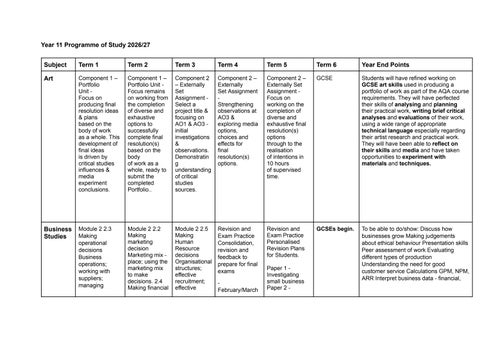
Year 11 Programme of Study 2026/27 Subject
Term 1
Term 2
Term 3
Term 4
Term 5
Term 6
Year End Points
Art
Component 1 – Portfolio Unit Focus on producing final resolution ideas & plans based on the body of work as a whole. This development of final ideas is driven by critical studies influences & media experiment conclusions.
Component 1 – Portfolio Unit Focus remains on working from the completion of diverse and exhaustive options to successfully complete final resolution(s) based on the body of work as a whole, ready to submit the completed Portfolio..
Component 2 – Externally Set Assignment Select a project title & focusing on AO1 & AO3 initial investigations & observations. Demonstratin g understanding of critical studies sources.
Component 2 – Externally Set Assignment Strengthening observations at AO3 & exploring media options, choices and effects for final resolution(s) options.
Component 2 – Externally Set Assignment Focus on working on the completion of diverse and exhaustive final resolution(s) options through to the realisation of intentions in 10 hours of supervised time.
GCSE
Students will have refined working on GCSE art skills used in producing a portfolio of work as part of the AQA course requirements. They will have perfected their skills of analysing and planning their practical work, writing brief critical analyses and evaluations of their work, using a wide range of appropriate technical language especially regarding their artist research and practical work. They will have been able to reflect on their skills and media and have taken opportunities to experiment with materials and techniques.
Business Studies
Module 2 2.3 Making operational decisions Business operations; working with suppliers; managing
Module 2 2.2 Making marketing decision Marketing mix place; using the marketing mix to make decisions. 2.4 Making financial
Module 2 2.5 Making Human Resource decisions Organisational structures; effective recruitment; effective
Revision and Exam Practice Consolidation, revision and feedback to prepare for final exams
Revision and Exam Practice Personalised Revision Plans for Students.
GCSEs begin.
To be able to do/show: Discuss how businesses grow Making judgements about ethical behaviour Presentation skills Peer assessment of work Evaluating different types of production Understanding the need for good customer service Calculations GPM, NPM, ARR Interpret business data - financial,
February/March
Paper 1 Investigating small business Paper 2 -
quality; the sales process 2.2 Making marketing decision Marketing mix product; marketing mix price; marketing mix - promotion.
- Start of Year 11 Assessment (shortened Paper 1)
Computer Science
Module: Pseudocode and Building Robust Programs Topics: Pseudocode, Testing, Data Validation, Trace Tables, Logic Diagrams and Programming Techniques Key Skills: Be able to construct Boolean
decision Business calculations; understanding business performance. - Topic Assessment (2.1-2.3) December Mock Exam (Paper 1)
Module: Ethical, Legal, Cultural and Environmental Concerns Topics: Legislation Relevant to Computer Science. Implications of Computer Science in Society Key Skills: Investigate and
training and development; motivation
Mock Exam (Paper 2)
Building a business
Module: Producing Robust Programs and Pseudocode Exam Technique and SQL Topics: Defensive Design, Maintainability, Purpose of Testing Key Skills: Anticipate computer misuse and
GCSE
marketing and market Interpret business ratios All skills required for GCSE
- Assessed Homework (Exam Questions)
Module: Algorithms Topics: Computational Thinking, Sorting and Searching Algorithms Key Skills: Explain the concepts of abstraction, decomposition and algorithmic thinking.
GCSE
Understand ethical, legal, cultural or environmental issues in relation to a given scenario. State what is meant by an algorithm taking into consideration abstraction and decomposition. Understand and be able to apply a linear and a binary search algorithm including the advantages of one over the other. Use a flowchart or pseudocode to define the steps in a simple algorithm Recognise standard symbols used to represent NOT, AND OR, NAND, NOR and XOR logic gates. Draw truth tables for the above logic gates. Be able to complete a trace table to trace through a simple algorithm.
expressions and draw logic diagrams, and complete truth tables. Analyse and identify the requirements for a solution to the problem. Set clear measurable objectives. Design suitable algorithms including pseudocode to represent the solution to a problem. Incorporate techniques to verify and validate data. Construct trace tables to test algorithms before coding the solution. MP1: End of Unit Assessment
discuss computer science technologies while considering ethical issues, legal issues, cultural issues, environmental issues and privacy issues. How stakeholders are affected by technologies. Environmental and cultural issues on society. Discuss legislation surrounding computer science including the Data protection act (1998), Computer Misuse Act (1990), Copyright Patent and Designs Act (1988) and the Freedom of Information Act (2000)
Display standard sorting algorithms including a bubble sort, merge sort and an insertion sort. Perform on data sorting algorithms to include bubble sort and merge sort. MP4: Summative Assessment
techniques to prevent this, authentication, planning for contingencies and examples of input sanitisation/valid ation. Identify syntax and logic errors and choice of suitable test data for a given scenario. MP5: End of Unit Assessment
MP2: Project Submission MP3: Summative Assessment Drama
C2 Performing from a text C2 Performing from a text: •Look at possible texts (pre-2000) to rehearse •Rehearse given text in groups (acting skills and techniques) •Perform given extract of text in groups. Assessment x 2 1 – mock of performance 2 – mock of cover character sheet (non-assessed but read by examiner) AO2 Apply theatrical skills to realise artistic intentions in live performance
C2 Performing from a text/ C3 exam prep C2 Performing from a text: •Look at possible texts (pre-2000) to rehearse •Rehearse given text in groups (acting skills and techniques) Perform given extract of text in groups. C3 Exam prep: Explore examples/ exemplars of exam style questions N&C text recap Live theatre opportunities how to write a review
C2 live performance for examiner/ C3 exam prep C2 Live performance to examiner: Date given by exam board (TBC) All performances to be recorded for moderating purposes. C3 exam prep: Explore examples/exe mplars of exam-style questions N&C text recap Live theatre review Assessment x2
C3 Exam prep
C3 Exam prep
C3 exam prep: Exam-style questions and structure of paper etc. N&C construction of text and how performances create meaning. Live theatre review
C3 exam prep: Exam-style questions and structure of paper etc. N&C construction of text and how performances create meaning. Live theatre review
Assessment x 2 exam paper mocks.
Assessment x 2 exam paper mocks.
AO1 Create and develop ideas to communicate
AO1 Create and develop ideas to communicate
GCSE exams continue.
To complete C2 exam to a visiting examiner (Date TBC by exam board). To complete C3 paper on N&C and live theatre review. To perform in GCSE examinations C2 and C3 and achieve target grades.
Assessment x 2 1 – mock of performance 2 – mock paper questions.
1 – Live examiner C2 exam 2 – Live theatre review question.
AO1 Create and develop ideas to communicate meaning for theatrical performance AO2 Apply theatrical skills to realise artistic intentions in live performance AO3 Demonstrate knowledge and understanding of how drama and theatre is developed and performed AO4 Analyse and evaluate their own work and the work of others
AO1 Create and develop ideas to communicate meaning for theatrical performance AO2 Apply theatrical skills to realise artistic intentions in live performance AO3 Demonstrate knowledge and understanding of how drama and theatre is developed and performed AO4 Analyse and evaluate their own work and
meaning for theatrical performance AO2 Apply theatrical skills to realise artistic intentions in live performance AO3 Demonstrate knowledge and understanding of how drama and theatre is developed and performed AO4 Analyse and evaluate their own work and the work of others
meaning for theatrical performance AO2 Apply theatrical skills to realise artistic intentions in live performance AO3 Demonstrate knowledge and understanding of how drama and theatre is developed and performed AO4 Analyse and evaluate their own work and the work of others Y11 Study leave – exam usually is May = 40% of GCSE.
the work of others Final recording of C2 (live examiner) = 20% English
Romeo and Juliet AIM: To study the play in detail and consolidate essay skills. To make connections between fiction and real history as well as current issues e.g. gender roles, Renaissance marriage. KEY SKILLS: Identifying and exploring the effects of dramatic methods as well as language features. Discussion and debate
Revision: Language/ Literature Paper 1 AIM: To revise exam content and technique for all tasks for both literature and language paper 1 through a series of tailored revision lessons. To develop independent planning and writing skills. KEY SKILLS: Comprehension . Close language annotation and analysis. Structural analysis.
P&C Poetry III + Unseen Poetry AIM: To complete study of the remaining poems from the ‘Power and Conflict’ AQA anthology as well as revise those taught last year. To study a range of unseen poems about a range of topics. To develop and consolidate comparative essay planning and writing.
Revision: Language/ Literature Paper 2 AIM: To revise exam content and technique for all tasks for both literature and language paper 2 through a series of tailored revision lessons. To develop independent planning and writing skills. KEY SKILLS: Comprehension. Close language annotation and analysis. Structural analysis.
Holistic Revision AIM: To revise all course content through a series of revision lessons designed for our students and based on their prior learning. Use of past papers to build confidence and familiarity. KEY SKILLS: All reading and writing skills on the course. Focus on exam technique. CAREER LINKS:
Revision and Exam Prep
READING: - Quote a range of examples to support arguments. - Identify a range of writers’ methods and distinguish between poetic, dramatic and prose devices. - Explore the effects of methods on meanings in detail. - Identify varied aspects of genre and form. - Identify and explain similarities and differences between texts in detail. WRITING: - Produce texts using accurate punctuation and grammar. - Use a wider range of sentence and punctuation types. - Use a range of
skills. Essay writing skills. CAREER LINKS: Victim advocacy, campaign management, police work, charity work, social services, politics, writing, directing, acting, stunt coordination
Evaluation. Creative, essay and technical writing. CAREER LINKS: Any role requiring critical thinking, communication and creative skills.
KEY SKILLS: Independent reading and interpretation. Close language annotation and analysis. Structure and form analysis. Comparative essay skills.
Comparison. Non-fiction and technical writing. CAREER LINKS: Any role requiring critical thinking, communication and creative skills.
Any role requiring critical thinking, communication and creative skills.
creative, mature methods in writing. - Produce thoughtful and detailed essays. The Crypt School English Department Programme of Study 2024-2025 Our aim is to foster a deep knowledge, understanding and appreciation of the English language, its rich literary heritage, and its myriad practical applications - Use a range of discourse markers for clarity and careful sequencing of ideas.
READING: Termly reading lists issued.
CAREER LINKS: Military, law, advocacy, journalism, poetry, TV/ film production, politics, charity.
ORACY: - Respond in detail to questions and feedback, improving answers when required to do so. - Present ideas clearly to an audience independently. - Participate in class and group discussion
READING: Termly reading lists issued
Geography
Dynamic Development Factors affecting development,
Urban Futures Urbanisation in LIDCs and ACs,
Resource Reliance
UK in the 21st Century UK population change,
Revisio n Final exams
Revisi on Final exams
● Understand the nature and causes of differences in development between countries and how these differences can be addressed.
Zambia an LIDC, Rostow’s model /Millennium Development Goals/ Transnational Corporations and trade with the context of Zambia
Opportunities and challenges in London and Lagos
Overview of demand and supply for resources (food, water, energy) Food security, food security in Tanzania
UK’s changing socioeconomic, cultural and political structure
● Understand how the processes of migration, urbanisation and urban growth affect the characteristics of global cities. ● Understand how ways of life vary in cities, how this creates challenges in global cities and that these challenges can be addressed sustainably. ● Understand the causes and impacts of the demand for resources outstripping supply with particular reference to achieving a sustainable food supply and food security. ● Understand how the UK has changed economically, demographically and socially in the 21st Century including its global connections. ● Know the physical and human characteristics of the UK including population density, land use, relief and the associated issues of water stress and housing shortages. ● Know how to use OS map skills to describe human landscapes in less familiar situations. ● Know how to apply analytical skills to a wide range of geographical data. ● Know how to provide well-developed explanations for varied geographical features. ● Know how to select and apply relevant knowledge in order to discuss, assess and evaluate
geographical issues and reach balanced and reasoned judgements. History
Topics: Restoration England Crown, Parliament, Plots and Court Life & Life in Restoration England Content: Post Civil War context, reasserting royal power, Power & plots in Charles II’s court, Scientific Revolution, Great Fire of London, Great Plague 1665-6, growth of cities including London Cultural Capital: Nature of epidemics, philosophy of the enlightenment, who should rule?
Topics: Restoration England – Land, trade & war & review Historic Environment topic Content: Growth of the British Empire in India & Caribbean, impact of the slave trade, piracy, East India Company, wars with France, Netherlands & Spain Cultural Capital: Link between slavery & racism, nature of early capitalism, international relations
Topics: Conflict & Tension – peace making & League of Nations Content: Armistice terms, impact of the treaty, formation of the League of Nations, reasons for its collapse Cultural Capital: Versailles relevance today, peacemaking lessons, failure of multinational bodies
Topics: Conflict & Tension – causes of WW2 Content: Development of tensions, escalation in the 1930s, outbreak of war Cultural Capital: Debate over appeasement, Causes of war, psychology of leadership
Revision & GCSE Exams
Summer School taster sessions
Consistently developing explanations of significance & cause using ‘complex thinking’ (differentiation by group/type/length). Students are able to provide a more developed explanation of the usefulness of sources using greater historical context. Students are able to apply their understanding of GCSE content to explain what key events are significant and what is the driver of change.
GCSE Maths
Further Algebra Vector Geometry Expanding 3 brackets Identities Consolidating quadratics Circle theorems and proof Completing the Square Sketching Graphs Iteration Functions
GCSE Maths & AQA Level 2 Further Maths
Circles and Proof Quadratic Inequalities Simultaneous Equations Algebraic proof Congruence and similarity Algebraic fractions Mock Exams
Further Algebra
Further Maths
Expanding 3 brackets Completing the Square Sketching Graphs Quadratic Inequalities Quadratic & Linear Simultaneous Functions Proof Algebraic fractions Equation of a circle Tangent of a circle Iteration
Differentiation Tangents/Norm als Stationary Points Binomial Expansion Factor theorem Factorising cubics Mock Exams
Fractions, Graphs, Sequences and Surds
Revision
Revision
GCSE EXAMS
✓ Use identities and comparing coefficients to find missing values ✓ Completing the square ✓ Quadratics ✓ Functions ✓ Know and use circle theorems ✓ Simplify and calculate with algebraic fractions ✓ Algebraic proof ✓ Understand and use iteration
Further Maths
Revision
GCSE EXAMS
Sine & Cosine rule Trigonometry graphs Trigonometric identities CAST diagrams Sequences Equations of circles
Expanding 3 brackets Completing the Square Sketching Graphs Quadratic Inequalities Quadratic & Linear Simultaneous Functions Proof Algebraic fractions
Equation of a circle Tangent of a circle Iteration
✓ Use identities and comparing coefficients to find missing values ✓ Completing the square ✓ Quadratics ✓ Functions ✓ Know and use circle theorems ✓ Simplify and calculate with algebraic fractions ✓ Algebraic proof ✓ Understand and use iteration ✓ Find the equation of a tangent to a circle ✓ Differentiate and find stationary points ✓ Use a CAST diagram and solve trigonometric equations ✓ Use the identities 𝑠𝑖𝑛2𝑥 + 𝑐𝑜𝑠2𝑥 = 1 and 𝑡𝑎𝑛 𝑥 = 𝑠𝑖𝑛 𝑥 𝑐𝑜𝑠 𝑥 ✓ Use the factor theorem and algebraic long division to factorise cubics ✓ Binomial expand (𝑎𝑥 + 𝑏) 𝑛
Assessment Week
Y=mx+c Equation of a circle Tangent of a circle Quadratic sequences Cones and spheres Complex surds Further Maths Completing the square Simultaneous equations w/3 unknowns Functions Matrices
✓ Solve simultaneous equations with 3 variables ✓ Calculate with matrices MFL French
Unit 7: Travel and tourism, including places of interest (3.1)
Unit 8: The environment and where people live (3.3)
Skills: Discussing travel and tourism, weather, holiday activities, why holidays are important and places of interest.
Skills: Discussing where you live including your house and local area. Discussing global environmental problems and what you can do about them. Grammar: Revision of all tenses. Present tense subjunctive.
Grammar: Revision of all tenses. Revision of il faut and modal verbs. Assessment: Listening and Reading, Writing, Grammar Audit
Assessment: Listening and Reading
Unit 9: Education and Work (1.3)
Unit 10: Revision
N/A
Skills: Describing your school including uniform, rules, school day and facilities. Discussing work of world including jobs, applications, university and apprenticeshi ps.
Grammar: Revision of all grammar points.
Skills: Recap from mocks / Consolidation from exams
By the end of year 11, students will be able to… …understand and produce language on the topics of travel and tourism, environment and where I live, education and work.
Assessment: Listening and Reading
…conjugate regular and irregular verbs accurately in seven tenses including the subjunctive.
Full Mock ...understand a wide variety of advanced structures. …respond to 90-word and 150-word writing tasks. …respond to role plays, read aloud tasks and photo cards in the speaking exam.
Grammar: Revision of all grammar and tenses. Assessment: Listening and Reading
Full Mock German
Unit 7: Travel and tourism, including
Unit 8: The environment and where
Unit 9: Education
Unit 10: Revision Skills:
Unit: ALL
N/A
By the end of year 11, students will be able to…
places of interest (3.1)
people live (3.3)
and Work (1.3)
Skills: Discussing travel and tourism, weather, holiday activities, why holidays are important and places of interest.
Skills: Discussing where you live including your house and local area. Discussing global environmental problems and what you can do about them.
Skills: Describing your school including uniform, rules, school day and facilities. Discussing work of world including jobs, applications, university and apprenticeshi ps.
Grammar: Revising all four tenses, using zu clauses, relative clauses. Assessment: Grammar Audit, Listening and Reading, Writing
Grammar: Revising wenn clauses in the conditional, revising superlatives, using complex structures Assessment: Listening and Reading Full Mock
Grammar: Recapping adjective agreement, modal verbs, past tense modal verbs, genitive prepositions Assessment: Listening and Reading
Recap from mocks / Consolidation from exams
Skills: Recap from mocks / Consolidation from exams
…understand and produce language on the topics of travel and tourism, environment and where I live, education and work.
Grammar: Revision of all grammar points. Assessment: Listening and Reading Full Mock
Grammar: revise and recap all grammar points in the context of productive skills
…conjugate verbs accurately in at least five tenses. ...understand the use of all four cases and a wide range of prepositions. …respond to 90-word and 150-word writing tasks. …respond to role plays and photo cards in the speaking exam and be prepared for Themes 1-3 of the general conversation.
MFL Spanish
Unit 7: Travel and tourism, including places of interest (3.1) Skills: Discussing travel and tourism, including weather, transport, activities, places of interest, and why holidays are important. Grammar: Revision of all tenses
Unit 8: The Environment and Where People Live (3.3) Skills: Discussing where you live, including your house and local area. Discussing the environment, including global issues and what you can do to help. Grammar:
Assessment: Listening and Reading
Present Subjunctive Assessment:
Writing Grammar Audit
Listening and Reading Full Mock
Unit 9: Education and Work (1.3) Skills: Discussing your school, including uniform, school day, rules and school facilities Discussing the world of work, including jobs, applications, university and apprenticesh ips Grammar: Revision of all grammar Assessment: Listening and Reading
Unit 10: Revision Skills: Consolidati on from mocks
By the end of year 11, students will be able to…
…understand and produce language on the topics of holidays, environment, where you live, school and world of work.
Grammar: Consolidation of all grammar
…conjugate verbs accurately in seven tenses.
...understand the use of a range of advanced structures including the subjunctive.
…respond to 90-word and 150-word writing tasks.
…respond to role plays, read aloud tasks and photo card discussions.
Music
Module:2.1 Preparing for the mock: AOS 2/3 revision/board set brief composition/perf orming. Topics 2.1.1 – Board set brief composition planning (choosing board set brief composition options from OCR) 2.1.2 – Revision on AOS 2 “Concerto through time”/Revision of “Rhythms of the world” 2.1.3 – Solo performance preparation (for mock in December) 2.1.4 – Ensemble performance
Module: 2.2. Preparing for the mock: AOS 4/5 revision//board set brief composition/per forming
Module: 2.3 Review of the mock. Developing coursework. Topics
2.2.1 – Board set brief composition developing
2.3.1 – Board set brief-developi ng using advanced composition techniques
2.2.2 – Revision on AOS 4 “Video game music/Film” and AOS 5 “Conventions of Pop”
2.3.2 – Learner set brief composition-r eview/set targets to develop/refine
2.2.3 – Solo/ensemble performance developing/prep aring.
2.3.3 – Solo/ensembl e performance refinement
Topics
2.2.4 – Exam paper practice (aural/theory/sh ort/long answer questions)
End Points: Board set brief/learner set brief compositions
Module: 2.4 Completing all coursework: refining performances/
Module: 2.5 Preparing for the Listening paper
completing compositions
2.6.1 – Revision on all Areas of study.
Topics 2.5.1 – Learner set/board set brief compositions completion 2.5.2 Solo/ensemble 2.5.3 Listening paper practice/revision End Points: Board/learner set brief compositions completed and submitted Solo/Ensemble performances recorded and submitted
Topics
End Points All skills required for GCSE Listening Paper; being able to delivery high scoring answers in all questions. Assessment 8: Short/long answer questions on all Areas of study Assessment 9: Use exam questions for all assessments for PP grades, end of year exams etc. Aim to finish before the Easter
GCSEs begin.
To have completed both learner/board set brief compositions To have performed solo/ ensemble performance pieces for exam To have completed full listening paper. To have completed the full Music GCSE course. To have developed a wide range of performing, listening and composing skills.
preparation (for mock in December) End points: Board set brief (2nd composition) planning in place and first section composed.
End Points: Board set brief composition first draft completed Solo/ensemble performances prepared
developed and refined Solo/ensembl e performances prepared/refin ed
Revision on AOS 2 and 3(deep thinking and preparation for mock)
Revision of all AOS and exam question practice
Listening paper practice/exam question preparation continues
Both performances chosen for mock
Assessment 3: Interim assessments on performing/com position
COMPOSITIO N WORKSHOP 1 (Saturday 9-1)
Assessment 4: Mock Exams (Both compositions submitted/solo/ ensembles/
Assessment 5:
Assessment 1: Exam questions/tests on AOS 2/3 for all PP grades Assessment 2: Solo/ensemble performance for PP grades/Board set brief composition/first draft.
Complete listening paper)
Listening exam paper completed/ Revision techniques completed. MARCH 24TH RECITAL: performing both performances to parents (6.30-8.30) MARCH 25TH (approx.) PERFORMANC E EXAMINATION (all day in hall) COMPOSITION WORKSHOP 2 (Saturday 9-1)
Exam (listening paper) practice throughout.
BOTH COMPOSITION S SUBMITTED: APRIL 2ND (approx.: end of term)
Use exam questions for all
Interpret business data financial,
holidays, perhaps one week after.
assessments for PP grades, end of year exams etc.
Assessment 6: Solo/ensembl e performances Board set brief/learner set brief drafts
marketing and market Interpret business ratios
Assessment 7: Whole school March mock exams full listening paper 1h30 mins/assessmen t of compositions and performances
Assessment 8: Exam style questions for all PP assessments and interim assessments on performances/ compositions PD
1 lesson per fortnight
Life-long wellbeing
Safe relationships & sexual health
Families, fertility & pregnancy
Drugs & personal safety
Online financial harms
Students will have revisited and built upon prior learning about mental health, explored strategies that support wellbeing, especially when managing workload & preparing for
exams, dealing with stress, loss or grieving. They will have recognised healthy & unhealthy relationship behaviours, explored control, learnt how to set boundaries, manage conflict & breakups, and make informed decisions about sexual health. They will have explored family life, including committed relationships & parenting responsibilities, fertility & routes to parenthood, & options in the case of unplanned pregnancy. They will have understood online financial risks, managing spending safely, & how to recognise & respond to financial exploitation. Science Biology AQA GCSE Triple
Module: Homeostasis and Inheritance
Module: Inheritance
Module: Inheritance
Module: Revision
Lessons: Revision
Topics: Human reproduction, plant hormones, DNA.
Topics: Inheritance, classification, evolution and natural selection.
Topics: Speciation, selective breeding, cloning, genetic engineering, revision
Topics: Paper 2
Topics: Paper 1
Key Skills: All skills required for the GCSE.
Key Skills: All skills required for the GCSE.
Key Skills: Interpreting charts, planning and implementing
Key Skills: Performing genetic crosses,
Key Skills: Evaluating modern
● To begin to understand the importance of the genome in inheritance and an introduction to genetic engineering. ● To understand how and why organisms evolve and how modern classification systems have developed. ● To be able to write scientifically using key biological terminology ● To design experiments to test hypotheses to produce valid results. ● To have an understanding of the range of scientific equipment and how to use it in the laboratory.
and investigation, revision skills.
application of knowledge, understanding how the work of scientists influences our understanding of biology, exam skills.
technologies, classifying information, study skills.
MP: Mock exams - AQA Paper 1
MP: Inheritance questions
Module: Homeostasis and Inheritance
Module: Inheritance
Module: Inheritance
Module: Revision
Lessons: Revision
Topics: DNA and Inheritance, meiosis, reproduction.
Topics: Inheritance, classification.
Topics: Natural selection, selective breeding, genetic engineering.
Topics: Paper 2
Topics: Paper 1
Key Skills: All skills required for the GCSE.
Key Skills: All skills required for the GCSE.
Key Skills: Evaluating modern technologies, classifying information, study skills.
MP: AQA Paper 2
MP: September review - year 9 content MP: Homeostasis test
Biology AQA GCSE Combined Science: Trilogy
Key Skills: Interpreting charts, genetic crosses, planning and implementing and investigation, revision skills.
Key Skills: Application of knowledge, understanding how the work of scientists influences our understanding of biology. MP: Mock exams - AQA Paper 1
EXAMS MP: AQA Paper 2
Single Science: Paper 1 (Modules 1-4): 1 hour and 45 minutes Paper 2 (Modules 5-7): 1 hour and 45 minutes
EXAMS Combined Science: Paper 1 (Modules 1-4): 1 hour and 15 minutes
● To understand the principles of data handling and analysis. ● To develop their interest and enthusiasm for biology to have confidence in their ability for further study. ● To evaluate the personal, moral and ethical implications of scientific technology.
● To begin to understand the importance of the genome in inheritance and an introduction to genetic engineering. ● To understand how and why organisms evolve and how modern classification systems have developed. ● To be able to write scientifically using key biological terminology ● To design experiments to test hypotheses to produce valid results. ● To have an understanding of the range of scientific equipment and how to use it in the laboratory. ● To understand the principles of data handling and analysis. ● To develop their interest and enthusiasm for biology to have confidence in their ability for further study.
MP: September review - year 9 content
MP: Inheritance questions
Paper 2 (Modules 5-7): 1 hour and 15 minutes
● To evaluate the personal, moral and ethical implications of scientific technology.
MP: Homeostasis test Physics Triple AQA GCSE Chemistry
Topics: Organic Chemistry Pt2 Rate of reaction - the extent of chemical change
Key Skills: Drawing structures , key terms, analysis, evaluation , balancing equations, ratios, application to industrial processes & application to unfamiliar processes, link to natural
Topics: Extent of chemical change Haber process Using Earth’s resources green chemistry Revision for Mock exam Key Skills: comparing, evaluating, analysing, key terms, analysis, evaluati on, balancin g equation s, ratios, application to industrial
Topics: Chemical Analysis Using Earth’s resources - corrosion & metal extracon
Topics: Revision for Mock Exam Using Earth’s resources materials Specific maths and practical skills revision
Key Skills: practical skills, ionic equations, reaction observation s, key words, extended wring, applicatio n to industrial process. GCSE Required practical.
Key Skills: Exam skills, command words, key terms. Planning, modifying and improving practical methods. Evaluating data & interpreting graphs, mole calculation
Topics: Revision of topics 1-5, Paper 1 Revision of topics 6-10, Paper 2 Key Skills: Exam skills, command words, subject specific key words, me management, written practical skills, evaluating and interpreting data, core skills. High level question analysis, linking
GCSEs
Understand and explain the formation and reactions of organic compounds Link structure of organic compounds to their physical and chemical properties, including understanding of pH scale Analyse and evaluate data on our diminishing finite resources, including order of magnitude seasons, and carry out Life Cycle Assessments to evaluate new materials Understand how a reversible reaction in a closed system can reach equilibrium and understand how its position can be altered Successfully write compound formulae; know charges of complex ions and be able to balance symbol equations Use different analytical techniques to identify unknown substances Application of the scientific process to industrial scaling Complete understanding of all eight Required Practical Activities. Confidently analyse, interpret and manipulate data Be able to answer high demand questions by linking knowledge from different topics and applying it to unfamiliar situations
processes. MP: Organic Chemistry Pt2 Test
processes & application to unfamiliar processes. Exam skills, comman d words, key terms MP: Extent of Chemical Change assessment MP: Mock Exam: AQA Paper 1
Chemistry Combined AQA GCSE Combined Science: Trilogy
Topics: Organic Chemistry Reaction rates and the extent of chemical change Key Skills: Drawing structures, key terms, analysis, evaluation, balancing equations, ratios, application to
Topics: Analytical Chemistry Revision for Mock exam Key Skills: command words, key terms, reaction observations. GCSE required practical. Exam skills, command words, key words,
Evaluatin g data & interpre ting graphs. Applica tion to current global issues sustainability
revision.
topics and concepts
MP: Mock Exam 2- AQA Paper 2
MP: Analycal Chemistry assessment Topics: Using Earth’s resources Key Skills: comparing and evaluating data, analysing, key words, extended writing. Evaluating data & interpreting graphs.
Topics: Revision for Mock Exam Specific maths and practical skills revision Key Skills: Exam skills, command words, key terms. Planning, modifying and improving practical methods. Evaluating data &
Topics: Revision of topics 1-5, Paper 1 Revision of topics 6-10, Paper 2 Key Skills: Exam skills, command words, subject specific key words, time management, written practical skills, evaluating
To draw simple organic molecules and explain their properties - Analyse and evaluate data on our diminishing finite resources, including order of magnitude estimations, and carry out Life Cycle Assessments to evaluate new materials - Understand how a reversible reaction in a closed system can reach equilibrium and understand how its position can be altered - Successfully write compound formulae; know charges of complex ions and be able to balance symbol equations - Application of the scientific process to industrial scaling
Physics Triple AQA GCSE Physics
industrial processes & application to unfamiliar processes, link to natural processes. MP1: Organic Chemistry Test MP2: Rates & Dynamic Equilibrium exam Q
extended writing
Topics: Space, Newton’s Laws and Momentum
Topics: Newton’s Laws and Momentum, Triple Electromagnetis m
MP3: Analytical Chemistry Exam Qs MP4: MOCK EXAM AQA (comb) PAPER 1
Application to current global issues sustainability MP5: Using Earth’s resources Test
interpreting graphs, mole calculation revision.
Topics: Light and Sound
Topics: Triple Momentum, Revision
Topics: Revision
Key Skills: Calculating, Revision strategies, exam technique, application of knowledge
Key Skills: Revision strategies, exam skills, application of knowledge
MP7: Quantitative chemistry exam Qs MP8: MOCK EXAM AQA (comb) PAPER 2
and interpreting data, core skills. High level question analysis, linking topics and concepts MP9: High demand exam Qs
- Complete understanding of all six Required Practical Activities. - Confidently analyse, interpret and manipulate data - Be able to answer high demand questions by linking knowledge from different topics and applying it to unfamiliar situations
-
Key Skills: Practical skills, explaining, application of knowledge MP1: AQA End-of-Year 10 Test MP2: Space Test
Key Skills: Calculating, application of knowledge, explaining, Practical skills MP3: December Mock Exam (Paper 1)
Key Skills: Application of knowledge, explaining, Practical skills, analysing, modelling MP4: Light and Sound Test
MP4: March Assessment – (Paper 2)
-
MP5: Practice Paper 2
-
- - - -
Understand how the skills developed in Physics lessons can be used in a range of careers See connections between topic areas, particularly through big ideas like the particle model and energy changes. Critically evaluate data, information and claims through critical analysis of the methodology, evidence and conclusions, both qualitatively and quantitatively Suggest and verify mathematical relationships between variables Apply knowledge to a range of unfamiliar contexts Rearrange and use complex equations with four or more variables Express answers to an appropriate number of significant figures
-
Combined AQA GCSE Combined Science: Trilogy
RS (Eduqas Full Course GCSE) Content
Sports Studies
Christian Beliefs Attributes of God, the problem of evil, the Trinity, Creation, the afterlife, the life of Jesus, salvation and atonement. .
Christian Practices Forms of worship, Sacraments, Pilgrimages and celebrations, Christianity in modern Britain, The worldwide church
Islamic Beliefs The 5 roots / 6 articles, Tawhid, the role of angels, predestination and human responsibility, the afterlife. Prophets, holy books and the Imamate
Islamic Practices The 5 pillars of Sunni Islam, The 10 obligatory acts of Shi’a Islam, Jihad, Festivals and commemoration
Revision / Exams
Revision / Exams
Physical Training Training Methods Fitness Testing Training
Health & Fitness Definitions & differences
NEA Practical & Coursework
Revision
Revision / Study Leave
Revision / Study Leave
Revisiting all topics covered
Use strategies to learn and recall the 23 key equations - Apply Newton’s three laws to explain the effects of forces on the motion of an object - Apply the conservation of momentum to make calculations about collisions and other events (triple only) - Explain how gears and levers are used in machines to multiply forces and gain a mechanical advantage (triple only) - Understand the life cycles of stars and how the elements are formed (triple only) - Understand the Big Bang theory for the beginning of the universe and the evidence that supports this theory (triple only). In addition to revising the year end point from Y10, students will be able to explain and critically evaluate the following Chritian and Islamic practices. Christianity: Forms of worship. Sacraments, Pilgrimages and celebrations, Christianity in modern Britain, The worldwide church Islam: the 5 pillars of Sunni Islam, The 10 Obligatory acts of Shi’a Islam, Jihad Festivals and commemorations.
- Students develop knowledge and understanding of different training methods and the importance of fitness testing and periodisation. - Students are
DT
Zones Periodisation
Sedentary lifestyles Obesity Somatotypes Energy Use Nutrition Carbohydrate Loading
Behaviour in Sport Sportsmanship Gamesmanship Player & Spectator Behaviour Hooliganism
Behaviour in Sport Drugs in Sport
Completion of Coursework Action Plan
for applied science and socio-cultural. Developing exam technique and students' understanding to support students in preparation for the summer exam.
able to fully understand the importance of a BAHL and are able to apply the impact of obesity and sedentary lifestyles on performance. -Students will be able to understand different behaviours seen in sport and will be able to evaluate the impact of hooliganism and the strategies to combat it. -Students will be able to analyse and apply the impact of Performancing Enhancing Drugs on the performer and the sport. NEA/Practical Students are able to complete the written coursework task including application of theoretical content in development of their action plan. Students are formally assessed in their three chosen activities/sports and are able to identify strengths and weaknesses within their performance.
Use of Data Graphs Data interpretation
Term 1
Term 2
Term 3
Term 4
Term 5
NEA task in response to the
NEA task in response to the
NEA task in response to the
NEA task in response to the
NSEA task in response to the
Term 6 ●
End Points By the end of Year 11 students
Contextual Challenge Skills: ● to learn about a identifying design opportunities ● to learn about the needs and wants of a range of potential different users ● to learn about the different types of research to be carried out when investigating potential design opportunities ● to learn about the need and purpose of a design specification ● to learn how to use different design strategies ● to learn about different design techniques and the need for modelling to learn about how energy is
Contextual Challenge Skills: ● to learn about the need for producing a final design proposal ● to learn about the need to carry out a final review of the final design proposal ● to learn about the justification of materials, components and manufacturing processes in relation to a final design proposals ● to learn about the need to produce manufacturing drawings to enable 3 rd party manufacture ● to learn about the developments in modern and smart materials, composites
Contextual Challenge Skills: ● to learn about the manufacture of a product, including the selection and justification of tools and processes ● to learn about the need for quality and accuracy ● to learn about the work of past and present designers and companies
Contextual Challenge Skills: ● to learn about the manufacture of a product, including the selection and justification of tools and processes ● to learn about the need for quality and accuracy ● to learn about the need to test and evaluate a product including the use of user testing and a LCA ● to learn about the use of different design strategies ● to learn about the use of a range of communication techniques
Contextual Challenge Skills: ● to learn about identifying design opportunities ● to learn about the needs and wants of a range of potential different users ● to learn about the different types of research to be carried out when investigating potential design opportunities ● to learn about the need and purpose of a design specification ● to learn how to use different design strategies ● to learn about different design techniques and the need for modelling ● to learn about how energy is
will have completed: 1 – Investigation Investigated the needs and research, and a product specification 2 – Designing This includes producing different design ideas, review of initial ideas, development of design ideas into a chosen design, communication of design ideas and review of the chosen design 3 – Making This includes manufacture, and quality and accuracy 4 – Evaluation This includes testing and evaluation. Students will have undertaken a project as part of their non-examination assessment. The
generated and stored including; fossil fuels, biofuels, tidal, wind, solar, hydroelectric, batteries and cells, solar cells, mains electricity and wind power
and technical textiles
generated and stored including; fossil fuels, biofuels, tidal, wind, solar, hydroelectric, batteries and cells, solar cells, mains electricity and wind power
project will have tested students’ skills in investigation, designing, making and evaluation of a prototype of a product that has allowed them to apply the skills they have acquired and developed throughout their study. The exam board provided three themes, each with two contextual challenges. Students were required to choose one of these challenges and analyse it on an individual basis. Having selected a contextual challenge to work within, students have developed a range of potential ideas and then realised one
through practical making activities. The project has allowed students to apply knowledge and understanding in a product development process to investigate, design, make and evaluate their prototype. The project required students to follow an iterative design process rather than a linear process requiring them to continually test, evaluate and refine ideas. Assessments
Weekly homework, NEA task and mock exam
Weekly homework, NEA task and mock exam
Weekly homework (Exam style questions and NEA task
Weekly homework (Exam style questions and NEA task
Food Tech
Term 1
Term 2
Term 3 and Term 4
Weekly homework and NEA task
Term 5
Term 6
End Points
Food provenance continued Skills Consider the seasons when selecting ingredients for recipes using fruits and vegetables. Using left over food to avoid wastage, whilst considering food waste. Make dough for pasta, shape and finish dough using a pasta machine, shape, and finish pasta. Water based cooking methods using the hob to boil the pasta. To examine, carry out sensory analysis and evaluate existing products that have been modified and fortified.
NEA1
NEA2
Revision of
Skills Analyse the task, explaining the background research. Conduct secondary research, using different sources, focusing on the working characteristics, functional and chemical properties of the ingredients. Analyse the research and use the findings to plan the practical investigation. Establish a hypothesis/predi ct an outcome because of the research findings. The hypothesis should be a statement which may be proved or disproved. Investigate and evaluate how ingredients work
Skills Analyse the task by explaining the research requirements. Carry out relevant research and analysis related to the: life stage, dietary group, or culinary tradition. Identify a range of dishes e.g., by mind-mapping, or using annotated images. Select and justify a range of technical skills to be used in the making of different dishes. Demonstrate technical skills in the preparation and cooking of three to four dishes. Select and use equipment for different technical skills in the preparation and cooking of selected dishes. Food safety principles should be demonstrated when storing, preparing, and cooking. Identify the technical skills within each dish. Photographic evidence will be needed to authenticate the technical skills. Justify the appropriateness of the final dishes in terms of e.g., technical skills, nutrition, ingredients, cooking methods, food provenance, sensory properties, and portion size.
Food, nutrition, and health Food science Food safety Food choice Food provenance
By the end of Year 11 students will have: Considered the influence of lifestyle and consumer choice when developing meals and recipes Considered nutritional needs and food choices when selecting recipes, including when making decisions about the ingredients, processes, cooking methods and portion sizes Developed the ability to review and make improvements to recipes by amending them to include the most appropriate ingredients, processes, cooking methods and portion sizes Managed the time and cost of recipes effectively Used their testing and sensory evaluation skills, adjusting where needed, to improve the recipe during
and why through practical experimentation. Each investigation should be related to the research and have a clear aim which can then be concluded. Analyse and interpret the results of the investigative work. The results will be linked to the research and data explaining the working characteristics, functional and chemical properties of the ingredient(s). Evaluate the hypothesis/predi ction with justification. Explain how the results/findings can be applied in practical food preparation and cooking.
Produce a detailed time plan to produce the final three dishes including appropriate techniques. Within the plan, food safety principles will be demonstrated when storing, preparing, cooking, and presenting the final dishes. Demonstrate appropriate use of the three hours to dovetail tasks to prepare, cook and present the final three dishes. Selection and use of equipment for different technical skills in the preparation and cooking of the final three dishes Knowledge and application of food safety principles (including temperature control) when storing, preparing, cooking, and presenting the final three dishes. Selection, knowledge, and use of ingredients when producing different dishes. Appropriate use of the three hours to demonstrate: technical skills, processes, and the use of equipment. Execution of a range of technical skills with accuracy Good judgement about cooking times and methods and the sensory properties of each dish
the preparation and cooking process Explained, justified, and presented their ideas about their chosen cooking methods to others
Made decisions about which techniques are appropriate based on their understanding of nutrition, food, different culinary traditions and cooking and food preparation content to achieve their intended outcome. They should be able to carry out these techniques safely and combine them into appealing meals whilst evaluating the results.
Organisation and good planning using the time plan and linking tasks within the 3 hours. A range of finishing techniques to produce a high standard of presentation of the final dishes. Record and analyse the sensory properties (taste, texture, aroma, and appearance) of the three final practical dishes. Carry out nutritional analysis of the three final dishes. Analyse the cost of the three final dishes.