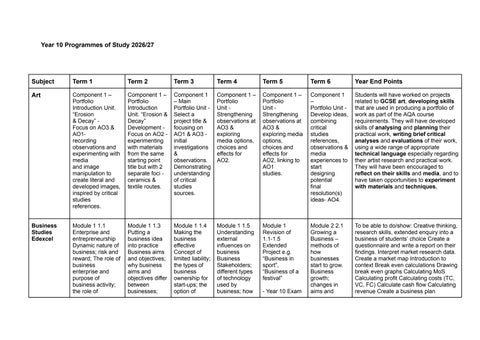
Year 10 Programmes of Study 2026/27
Subject
Term 1
Term 2
Term 3
Term 4
Term 5
Term 6
Year End Points
Art
Component 1 – Portfolio Introduction Unit. “Erosion & Decay” Focus on AO3 & AO1recording observations and experimenting with media and image manipulation to create literal and developed images, inspired by critical studies references.
Component 1 – Portfolio Introduction Unit. “Erosion & Decay” Development Focus on AO2 experimenting with materials from the same starting point title but with 2 separate foci ceramics & textile routes.
Component 1 – Main Portfolio Unit Select a project title & focusing on AO1 & AO3 initial investigations & observations. Demonstrating understanding of critical studies sources.
Component 1 – Portfolio Unit Strengthening observations at AO3 & exploring media options, choices and effects for AO2.
Component 1 – Portfolio Unit Strengthening observations at AO3 & exploring media options, choices and effects for AO2, linking to AO1 studies.
Component 1 – Portfolio Unit Develop ideas, combining critical studies references, observations & media experiences to start designing potential final resolution(s) ideas- AO4.
Students will have worked on projects related to GCSE art, developing skills that are used in producing a portfolio of work as part of the AQA course requirements. They will have developed skills of analysing and planning their practical work, writing brief critical analyses and evaluations of their work, using a wide range of appropriate technical language especially regarding their artist research and practical work. They will have been encouraged to reflect on their skills and media, and to have taken opportunities to experiment with materials and techniques.
Business Studies Edexcel
Module 1 1.1 Enterprise and entrepreneurship Dynamic nature of business; risk and reward; The role of business enterprise and purpose of business activity; the role of
Module 1 1.3 Putting a business idea into practice Business aims and objectives; why business aims and objectives differ between businesses;
Module 1 1.4 Making the business effective Concept of limited liability; the types of business ownership for start-ups; the option of
Module 1 1.5 Understanding external influences on business Business Stakeholders; different types of technology used by business; how
Module 1 Revision of 1.1-1.5 Extended Project e.g. “Business in sport”, “Business of a festival”
Module 2 2.1 Growing a Business – methods of how businesses start to grow. Business growth; changes in aims and
To be able to do/show: Creative thinking, research skills, extended enquiry into a business of students’ choice Create a questionnaire and write a report on their findings. Interpret market research data. Create a market map Introduction to context Break even calculations Drawing break even graphs Calculating MoS Calculating profit Calculating costs (TC, VC, FC) Calculate cash flow Calculating revenue Create a business plan
- Year 10 Exam
entrepreneurship 1.2 Spotting a business opportunity Customer needs; market research; types of market research; market segmentation; market mapping; the competitive environment; the impact of competition on business decision making.
business revenues, costs and profits; break even analysis; interpretation of break even analysis; importance of cash to a business; cash flow; internal and external sources of finance. - Topic Assessment (1.3)
t - Topic Assessment (1.1) Topic Assessment (1.2)
starting up and running a franchise operation; business location; impact of the internet on business location; marketing mix; marketing mix & competitive environment; marketing mix & changing consumer needs; marketing mix & technology; the role and importance of a business plan; the purpose of planning business activity.
technology influences business activity; principles of employment and consumer law; impact of legislation on business; economic climate and external influences.
(Paper 1)
objectives; business and globalisation; ethics; the environment and business
Evaluate choice of technology Identify stakeholders
Module: Data Representation, Translators and
Module: Programming Project, Data
Understand the purpose of the CPU and explain the role and operation of the following CPU registers used in Von Neumann architecture. Be able to
- Topic Assessment (1.5)
- Year 10 Mid-Year Assessment (1.1-1.3) Computer Science
Module: System Architecture. Memory and Storage
Module: Wired and Wireless Networks
Module: Network Topologies and Layers
Module: System Security
Topics: The purpose of the CPU, Von Neumann architecture. Primary and Secondary Storage Key Skills: The ability to explain the process that a CPU goes through executing an instruction, the stored program concept and factors that affect CPU performance. Explain the difference between RAM and ROM, identify appropriate secondary storage from optical, magnetic and solid state. Explain virtual memory. MP1: End of Unit Assessment MP2: Past Paper Questions
Topics: Types of Networks, Client Server, Peer to Peer networks, Network hardware and the internet as a worldwide collection of computer networks Key Skills: Factors that affect the performance of computers, the different roles of computers in a client server network and peer to peer networks. What hardware a network consists of and the concept of virtual networks. MP1: End of Unit Assessment MP2: Past Paper Questions
Topics: Star and Mesh Network Topologies, Protocols, Concept of Layers and Packet Switching Key Skills: Explain the difference between star and mesh network topologies, discuss encryption and frequencies. The uses of IP addressing, MAC addressing and protocols. Explain the process of layers when transmitting data including what packets of data consist of.
Topics: Identify Forms of Attack, Threats Posed to Networks, Identifying and Preventing Vulnerabilities Key Skills: Explain and identify threats posed to networks including malware, phishing, social engineering, brute force attacks, DDOS attacks, SQL injection and poor network policy. Identify and prevent vulnerabilities such as penetration testing, network forensics, network policies, anti-malware software, firewalls, user
Facilities of Languages
Representatio n (cont)
Topics: Units, Number Systems, Characters, Images, Sound and Compression
Topics: Analysis, Design, Development, Testing and Evaluation
Key Skills: How data needs to be converted into a binary format to be processed by a computer. Binary to denary conversion, deal with overflow errors and check digits. Explain the relationship between the bits per character in a character set, ASCII, extended ASCII and Unicode. How an image is represented as a series of pixels represented in binary. How sound can be
Key Skills: Analyse and identify the requirements for a solution to the problem. Set clear measurable objectives. Design suitable algorithms to represent the solution to a problem. Develop a solution using a suitable programming language. Test and evaluate their solution producing a report that covers all aspects of the solution.
describe how common characteristics of CPUs affect their performance: clock speed, cache size and number of cores. Understand the purpose RAM and ROM in a computer system. The ability to evaluate suitable storage devices and storage media for a given application using the following characteristics: capacity, speed, portability, durability, reliability, cost. Understand the advantages of networking stand-alone computers into a local area network, explain the difference between a client-server and a peer-to-peer network. Describe the differences between a local area network and a wide area network such as the Internet. List some of the threats posed to networks, including malware and phishing and precautions which can be taken to keep data safe from hackers. Be able to explain the functions of an operating system. Understand the term ‘character set’, calculate file sizes and explain why all data needs to be converted to binary before the computer can process it, including the need for other number systems and their use in computer science. Follow through pseudocode solutions to simple problems involving sequence, selection and iteration
MP1: End of Unit Assessment
access levels, passwords and encryption.
MP2: Past Paper Questions
MP1: End of Unit assessment MP2: Past Paper Questions
sampled and stored in digital form. The need for lossy and lossless compression.
MP1: Coded Project Submission MP2: Design and Analysis Document
MP1: End of Unit Assessment MP2: Computer Science Math Assessment
Drama
Eduqas GCSE Drama and Theatre Specification https://www.eduqas .co.uk/qualifications/ drama-and-theatre/g cse/WJEC-Eduqas-GC SE-Drama-specificati on.pdf.pdf?language _id=1
C1 Theatre Workshop (Prep Devising – How to devise a piece of theatre effectively)
C1 - Devising Theatre
C1 Devising Theatre Exploring practitioners and their techniques and how to apply in performance. Written work – looking at reflecting on work (Mock POE) Assessment: x 2 (one practical assessment serving as a mock-up of final
C1 Devising Theatre and C3 Interpreting Theatre C1 Devising Theatre Research and stimulus for final C1. Development of Portfolio of Evidence (POE) C3 Interpreting Theatre: Read Noughts and Crosses by Malorie Blackman
C3 Interpreting Theatre
C1 Devising Theatre Rehearsal and realisation of final C1. Development of Portfolio of Evidence (POE)
C3 Interpreting Theatre: •Study Noughts and Crosses by Malorie Blackman
C1 performances of Devising Theatre and C3 Interpreting Theatre
C1 performance, POE & Evaluation Recording
C1 Devising Theatre Final Performance and assessment of Devised Theatre piece (Dates TBC by centre) Submission of POE
C1 Performance (recorded and paper work all ready to send)
C3 Interpreting Theatre:
C1 POE – process report (750-900 words) completed. C1 Evaluation – 1hour 30 mins invigilated assessment (2 sides of A4
Stimuli – newspapers, articles, songs, objects etc. Questioning stimuli & exploring how to create theatre from an image for example. Working together in groups Transferable skills – decision making, communication, reflective learning, directing, leading others etc. Acting and directing skills
Assessment: x 2 (one practical based on practitioner in performance, one written based on POE). AO1 Create and develop ideas to communicate meaning for theatrical performance AO2 Apply theatrical skills to realise artistic
C1 also one written assessment based on aspect of POE). AO1 Create and develop ideas to communicate meaning for theatrical performance AO2 Apply theatrical skills to realise artistic intentions in live performance AO4 Analyse and evaluate their own work
To explore the text practically To look at how to approach exam-style questions Opportunities for Live Theatre (ongoing)
•To explore the text practically •To look at how to approach exam-style questions Opportunities for Live Theatre (ongoing)
Assessment: x 2 (one practical based on performing Noughts and Crosses extracts, one written on exam-style questions). AO3 Demonstrate knowledge and understanding of how drama and theatre is developed and performed AO4 Analyse and evaluate their own work and the work of others.
Assessment: x 2 (one practical based on performing Noughts and Crosses extracts, one written on exam-style questions). AO3 Demonstrate knowledge and understanding of how drama and theatre is developed and performed AO4 Analyse and evaluate their own work and the work of others.
•Revision of Noughts and Crosses in prep for mock exam •To explore the text practically •To look at how to approach exam-style questions Opportunities for Live Theatre (ongoing)
Assessment: x 2 (one practical based on given extracts) one written based on evaluating work from practical assessment. AO1 Create and develop ideas to communicate meaning for theatrical performance AO2 Apply theatrical skills to realise artistic intentions in live performance
notes allowed in exam). *computer room. Assessment X 3 = 40% of GCSE Coursework AO1 Create and develop ideas to communicate meaning for theatrical performance AO2 Apply theatrical skills to realise artistic intentions in live performance AO4 Analyse and evaluate their own work and the work of others
Final recording of performance, evaluation & POE = 40% of GCSE.
intentions in live performance AO4 Analyse and evaluate their own work
AO4 Analyse and evaluate their own work and the work of others
Mock Exam Paper
Reasons for SOW
To explore influential theatre practitioners and companies To explore acting techniques and methods Collaboration and working as a group
To explore practitioners and companies in more detail and build upon last term To start to write and evaluate strengths and outline improvements which need to be made.
To read the text and explore in conjunction with the text to ensure depth and breadth of study. Allow for live theatre opportunities and experience theatre through recorded performances.
To start to explore exam-style questions and answering exam questions effectively preparation for mocks. Allow for live theatre opportunities and experience theatre through recorded performances.
To ensure thorough completion of work and submission of POE written responses. Allow for live theatre opportunities and experience theatre through recorded performances. To revise C3 text and ensure confidence in written exam style questions prep for mocks.
Complete C1 before end of Y10 to ensure focus on written paper can continue next year.
1.To complete C1 performance, portfolio of evidence and evaluation. 2.To have explored and studied set text for C3 Noughts and Crosses by Malorie Blackman 3.To have a good understanding of C3 exam and of next year’s arrangements. 4. To experience professional live theatre (and recorded allowed) in preparation for C3.
DT
Component 1 – Portfolio Introduction Unit. “Erosion & Decay” Focus on AO3 & AO1- recording observations and experimenting with media and image manipulation to create literal and
Component 1 – Portfolio Introduction Unit. “Erosion & Decay” Development Focus on AO2 experimenting with materials from the same starting point title but with 2
Component 1 – Main Portfolio Unit Select a project title & focusing on AO1 & AO3 initial investigations & observations.
Component 1 – Portfolio Unit Strengthening observations at AO3 & exploring media options, choices and effects for AO2.
Component 1 – Portfolio Unit Strengthening observations at AO3 & exploring media options, choices and effects for AO2, linking to AO1 studies.
Component 1 – Portfolio Unit Develop ideas, combining critical studies references, observations & media experiences to start designing
By the end of Year 10 students will have worked on projects related to GCSE 3D art & design, developing skills that are used in producing a portfolio of work as part of the AQA course requirements. They will have developed skills of analysing and planning their practical work, writing brief critical analyses and evaluations of their work, using a wide range of appropriate technical language especially regarding their Critical Studies research and practical
English
developed images, inspired by critical studies references.
separate foci ceramics & textile routes.
Demonstrating understanding of critical studies sources.
An Inspector Calls Aim: Aim: To study the play in detail and build essay skills.
Introduction to Language Paper 1: Aim: To know and understand the requirements of each exam task. To study a range of friction extracts from different genres.
Power & Conflict Poetry 1 Aim: To study the war poems from the ‘Power and Conflict’ AQA anthology. To make connections between the poetry and the historical context influencing the poets.
To make connections between fiction and real history as well as current issues eg class divisions. To watch a film version of the play and evaluate changes made. Key Skills Identifying and exploring the effects of dramatic methods as well as language features. Discussion and debate skills. Essay writing skills. Career Links:
To develop independent comprehension and analysis skills by introducing key strategies. To develop creative writing skills, focusing on the differences between narrative and descriptive texts.
To develop unseen poetry approaches and planning strategies. To develop essay writing. Key Skills: Independent reading and interpretation.
Intro to Language Paper 2: Aim: To know and understand the requirements of each exam task. To study non-fiction texts from past papers in detail. To develop independent comprehension and analysis skills by introducing key strategies. To develop critical thinking so that students can identify what if fact, opinion or even ‘false fact’ eg online or in the news.
Dr Jeckyl and Mr Hyde
To develop transactional
Career Links:
Aim: To study the novella in detail and build essay skills. To make connections between fiction and real history influencing Stevenson eg class divide, repression, Darwinism Key Skills: Identifying and exploring the effects of prose methods. Discussion and debate skills Essay writing skills
potential final resolution(s) ideas- AO4.
work. They will have been encouraged to reflect on their skills, and to have taken opportunities to experiment with materials and techniques.
Power & Conflict Poetry 2: Aim: To study most of the remaining poems from the ‘Power and Conflict’ AQA anthology as well as revise those taught earlier in the year. To make connections between the poetry and the historical context influencing the poets.
Reading:
To develop unseen poetry approaches and planning strategies. To develop comparative essay writing
Quote a range of examples to support arguments. Identify a range of writers’ methods and distinguish between poetic, dramatic and prose devices. Explore the effects of methods on meanings in detail Identify varied aspects of genre and form Identify and explain similarities and differences between texts in detail. Writing: Produce texts using accurate punctuation and grammar Use a wider range of sentence and punctuation types Use a range of creative, mature methods in writing Produce thoughtful and detailed essays Use a range of discourse markers for clarity and careful sequencing of ideas Oracy Respond in detail to questions and feedback, improving answers when required to do so
Victim advocacy, campaign management, police work, charity work, social services, politics Reading: Termly reading lists issued.
Key Skills: Comprehensio n. Close language annotation and analysis. Structural analysis. Evaluation. Creative and technical writing. Career Links: Writing, teaching, any role requiring quick understanding and interpretation of information. Reading: Termly reading lists issued.
Close language annotation and analysis. Structure and form analysis. Comparison. Essay skills. Career Links: Military, law, advocacy, journalism, poetry, TV/Film production, politics, charity Reading: Termly reading lists issued.
writing skills, focusing on adapting to the audience and purpose set out in the task. Key Skills: Comprehensio n. Close language annotation and analysis. Comparison. Transactional and technical writing.
Victim advocacy, campaign management, police work, charity work, social services, politics, science, ethics, philosophy, psychiatry Reading: Termly reading lists issued
Career Links: Non-fiction writing is key for applying for roles eg covering letter. Journalism, history, politics, writing.
Key Skills: Independent reading and interpretation. Close language annotation and analysis. Structure and form analysis. Comparison. Essay skills
Present ideas clearly to an audience independently Participate in class and group discussions
Career Links: Military, law, advocacy, journalism, poetry, TV/Film production, politics, charity Reading: Termly reading lists issued
Reading: Termly reading lists issued, Non- fiction reading HW set. Food Preparation & Nutrition
Food, nutrition, and health
Food science Skills
Food safety
Food choice Skills
Food provenance
By the end of Year 10 students will have:
Skills • Give consideration of the nutritional needs and food choices when selecting recipes, including when making decisions about the ingredients, processes, cooking methods and portion sizes. • Modify recipes for vegetarian diets, reduce total fat and increase fibre. • Reducing the salt in recipes e.g., when tasting and seasoning, replace salt with herbs and spices. • Plan, prepare, cook, modify,
•
•
•
•
•
•
• •
How radiation works using the grill for a range of foods such as vegetables, meat, fish, or alternatives such as halloumi, seeds, and nuts, to char, toast, and grill. How conduction and convection work to cook a sauce and the need for agitation. Using the oven for baking, roasting, braising, casseroles and/or tagines. Dry heat and fat-based methods using the hob; dry frying, shallow frying and stir frying. Water, dry heat, and fat-based cooking methods using the hob – to conserve nutritive value e.g., steaming, stir frying. The use of marinades to tenderise and flavour meats and alternatives. The boiling of vegetables to alter texture. Demonstrate how acids denature protein and marinades add flavour and moisture when preparing vegetables, meat, fish, and alternatives.
Skills • Bread making. • Water based methods using the hob – blanching of vegetables to demonstrat e the destruction of enzymes in foods. • Oxidation – e.g., preventing water soluble vitamin loss when preparing and cooking vegetables. • Preparing fruit and vegetables – mash, shred,
•
•
•
•
When selecting recipes, you should explain and justify your reasons for choice. When preparing recipes and meals consider lifestyle, consumer choice etc. When planning recipes and dishes carry out costing of the dishes. When selecting some recipes, you should explain and justify your reasons for choice.
Skills • Consider the seasons when selecting ingredients for recipes using fruits and vegetables . • Using left over food to avoid wastage, whilst considerin g food waste. • Make dough for pasta, shape and finish dough using a pasta machine, shape, and finish pasta. • Water based cooking methods using the
● demonstrated effective and safe cooking skills by planning, preparing, and cooking using a variety of food commodities, cooking techniques and equipment ● developed knowledge and understanding of the functional properties and chemical processes as well as the nutritional content of food and drinks ● understood the relationship between diet, nutrition, and health, including the physiological and psychological effects of poor diet and health ● understood the economic, environmental, ethical, and socio-cultural influences on food availability, production processes, and diet and health choices ● demonstrated knowledge and understanding of functional and nutritional properties, sensory qualities and microbiological food safety considerations when preparing, processing, storing, cooking, and serving food ● understood and explored a range of ingredients and processes from different culinary
•
•
•
and create recipes to meet different dietary groups and life stages. Demonstrate portion sizes according to life stage/PAL level. Plan, make and modify dishes calculating energy and nutritional values. Select and adjust cooking processes to match the recipe and take account of dietary groups e.g., grill meat rather than fry to reduce the fat content as a high saturated fat intake is a risk factor for CHD.
• •
•
•
•
•
• • • •
Setting of egg mixtures e.g., in quiche. Gluten formation – pasta making using a pasta machine, bread making using a bread machine. The use of marinades to tenderise and flavour meats and alternatives. Whisking eggs to produce a gas-in-liquid foam e.g., whisked sponge. Make a blended white sauce showing starch gelatinisation such as either a roux or all-in-one blended sauce, infused sauce, velouté or béchamel to demonstrate how liquid/starch ratios affect viscosity. Demonstrate how conduction and convection work to cook the sauce and the need for agitation. Caramelisation of vegetables. Dextrinisation e.g., browning of bread when baking. Shortening and plasticity, e.g., pastry making. Aeration e.g., using the creaming method with a food mixer for a cake.
•
•
•
scoop, segment, juice and blanch fruits and vegetables to control enzymic browning. Preparing fruit and vegetables which sustain yeast and mould growth, wash, and chill to prevent their growth. Demonstrat e the following techniques: deseed, de-skin (for example, tomatoes). Make a bread dough,
•
•
•
•
Select, modify, and make recipes for different religions, cultures, and dietary groups. Prepare and cook recipes from a range of countries and cuisines, using different equipment and cooking methods. Test sensory qualities of a wide range of foods. Evaluate and apply the results of sensory testing.
•
hob to boil the pasta. To examine, carry out sensory analysis and evaluate existing products that have been modified and fortified.
traditions (traditional British and international), to inspire new ideas or modify existing recipes.
•
•
•
• •
•
Make an emulsion sauce such as a salad dressing, mayonnaise or hollandaise. When preparing fresh fruits such as apples and pears, preventing enzymic browning Using chemical raising agents such as self-rising flour and baking powder. Use steam in a mixture to raise choux pastry or batter. Use egg as a raising agent to: o create a gas-in-liquid foam o whisk egg whites o whisking savoury roulade. Yeast in bread making.
•
•
•
•
finish, and shape a bread dough for use in flat breads, pizza, or calzone. To apply food safety considerati ons when preparing, storing, and cooking. Knife skills: preventing cross-conta mination. Washing and drying vegetables during preparation to prevent food poisoning. Using a blender to make fruit coulis as a decoration,
•
focusing on good hygienic practice, washing, and drying fruit and ensuring cleanliness of equipment. Preparing, combining, and shaping, for example wet mixtures (such as falafels, fish cakes or meatballs) whilst demonstrat ing technical skills of preventing cross contaminati on and
handling high risk foods correctly. Geography
Sustaining Ecosystems – Polar environments. Polar climates with foci on the Arctic and Antarctica. Tectonic Hazards Processes at plate boundaries. Causes. effects and management of volcanoes and earthquakes
Climatic Hazards Global atmospheric circulation. Extreme Weather: drought, tropical storms, floods
Changing Climates
Distinctive Landscapes
Urban Fieldwork – Gloucester
Human and physical causes of climate Change. Impacts of climate change.
Geomorphic processes in coasts, Holderness case study, management strategies
Fieldwork write-up tasks.
Distinctive Landscapes Changing Climates Long term changes in temperature. Evidence for climate change.
Characteristics of landscapes, human and physical impacts on landscapes
Urban Fieldwork – Gloucester Preparing for fieldwork and carry out fieldwork
Distinctive Landscapes Geomorphic processes in rivers. River Tees case study including human actions.
Rivers Fieldwork – Forest of Dean
●
Preparing for fieldwork, Carrying out fieldwork in the Forest of Dean, Fieldwork write-up tasks
●
Distinctive Landscapes
●
River Tees case study including human actions.
●
●
● ●
●
●
●
●
Know the characteristics of polar environments. Understand the impacts to, and management of, polar environments. Understand how global air circulation affects weather patterns and the global distribution of biomes. Understand the causes and impacts of extreme and hazardous weather events. Understand the causes, impacts and management of volcanic and seismic events. Understand the long and short term causes of climate change; the evidence to support climate change, and the effects on the UK and wider world. Understand the characteristics of landscapes which make them distinctive. Understand how geology and climate can influence the morphology of river and coastal landscapes, and how human activity, including management, can alter these landscapes. In groups, know how to complete guided fieldwork investigations in human and physical environments outside of the school grounds. Know how to use OS map skills to describe physical landscapes in less familiar situations. Know how to apply analytical skills to a wide range of geographical data.
●
●
History
Topics: USA – boom, bust & New Deal
Finish economic bust
Content: Causes of economic boom, changes in USA cities, racial inequality, impact of New Deal & Great Depression Assessment: Why was there an economic boom? & In what ways did radio lead to changes in society?
Topics: Impact of WW2 & post-war changes
Skills: Comparing causation Cultural Capital: Nature of materialism, race relations in the US, women breaking tradition roles, role of government in economy
Content: Social & political impact of WW2, Civil Rights campaign, Feminist movement Assessment: New Deal interpretations & Civil Rights interpretations Skills: Evaluating & comparing multiple sources
Topics: Medicine – medieval & Renaissance Content: Supernatural causes of disease, public health, role of the church, impact of renaissance Assessment: January mock exam & usefulness of medieval sources Skills: Usefulness of source’s provenance & content Cultural capital: case study of Black
Finish Renaissance Topics: Medicine – 19th century Content: Germ Theory, changes to 19th C surgery, Impact of Industrial Revolution Assessment: Compare cholera & the Black Death – similarities? & Significance of Germ Theory? Skills: Developing significance Cultural Capital: Poverty in
Topics: Medicine: 20th century & overview Content: Penicillin, Impact of wars, creation of the NHS, Modern surgery
Topics: Norman Historic Environment (Subject to change annually) Content: Subject to change
Assessment: April mock exam & re-write based on feedback
Assessment: Based on Norman historic environment
Skills: Thematic nature of change
Skills: Evaluating & linking factors
Cultural Capital: Medical development during wartime, importance of the NHS, morality over
Cultural Capital: Subject to change
Know how to provide well-developed explanations for varied geographical features. Know how to select and apply relevant knowledge in order to discuss, assess and evaluate geographical issues and reach balanced judgements.
Understanding of the long term causes of cultural, social & economic change. Identification of what forces can oppose change in history. Appreciation of how history is relevant to & has created modern day USA/ British medicine. Developing explanations of significance using ‘complex thinking’ (differentiation by group/type/length). Students are able to provide a more developed explanation of the usefulness of sources using greater historical context & provenance. Students are able to apply their understanding of GCSE content to explain what key events are significant and what is the driver of change. Develop a thematic view of history, and what factors influence a theme over a longer period of time.
Maths SoW GCSE Maths
Cultural capital: Civil Rights relevance today, feminism relevance today, Red Scare responsibility
Death, Islamic Empire’s impact on European medicine, Scientific thinking revolution, Edward Jenner impact
British towns, Germ Theory revolution, nature of pioneering medical techniques
future treatments
Number & Equations
Equations & Graphs
Statistics & Trigonometry
Angles & Shapes
Indices Surds Recurring decimals Bounds Solving linear equations Solving inequalities Simultaneous equations Solving quadratics by factorising and quadratic formula
Creating and solving equations Y=mx+c Parallel lines Perpendicular lines Recognising graphs Real life graphs Velocity time graphs
Gradient of curves Areas under graphs Averages Cumulative Frequency Box Plots Histograms SOHCAHTOA Pythagoras Exact trigonometric values 3D Trigonometry
Proportion & Transformatio ns
Non calculator assessment
Calculator Assessment
Sine Rule Cosine Rule Transformation s Rotation Reflection Translation Enlargement including negative scale factors Construction & Loci Mock exams
Direct and inverse proportion Angles in polygons Function notation Graph Transformations
Probability Product rule for counting Set notation Venn diagrams Tree diagrams Conditional probability Vectors Drawing and understanding vectors Adding, subtracting & scalar multiples Vector Geometry Parallel vectors Co-linear
✓ Rationalise a denominator ✓ Negative and fractional indices ✓ Algebraically prove any recurring decimal is a fraction ✓ Solve quadratics through factorising and quadratic formula ✓ Linear graphs, y=mx+c, parallel and perpendicular lines ✓ Draw and interpret histograms ✓ Gradients and areas underneath velocity time graphs ✓ Sine and cosine rule to find a missing angle and length, use 1/2absinC for area of a triangle ✓ Apply graph transformations using function notation ✓ Prove two triangles are congruent and apply similarity to length, area and volume ✓ Use product rule for counting ✓ “And” and “Or” rules for probability ✓ Understand vectors and use them for geometric proof
Maths SoW GCSE & AQA Level 2 Further Maths
Number & Equations
Graphs & Statistics
Trigonometry
Proportion &
& Proportion
Transformation s
Indices Surds Recurring decimals Bounds Solving linear equations Solving inequalities Simultaneous equations Solving quadratics by factorising and quadratic formula Creating and solving equations
Y=mx+c Parallel lines Perpendicular lines Recognising graphs Real life graphs Velocity time graphs Gradient of curves Areas under graphs Averages Cumulative Frequency Box Plots Histograms
SOHCAHTOA Pythagoras Exact trigonometric values 3D Trigonometry Sine Rule Cosine Rule Direct and inverse proportion
Non calculator assessment
Construction & Loci Transformation s Rotation Reflection Translation Enlargement including negative scale factors Function notation Graph Transformation s Angles in polygons Mock exams
Angles & Shapes Congruency and similarity Circle Theorems and Proofs
Unit 1: Identity and relationships with others (1.1)
Unit 2: Free-time activities (2.1)
Skills: Describing ourselves, friends and families including personality and appearance. Discussing relationships, ideal
Skills: Discussing free time activities, including sport, music, film and TV and reading.
Unit 3: Media and Technology (3.2) Skills: Discussing the pros and cons of technology, social media and staying safe online.
Unit 4: Customs, festivals and celebrations (2.2) Skills: Discussing local and international festivals. Discussing
Product rule for counting Set notation Venn diagrams Tree diagrams Conditional probability Vectors Drawing and understanding vectors Adding, subtracting & scalar multiples Vector Geometry Parallel vectors Co-linear
Calculator Assessment
MFL French
Probability
Unit 5: Healthy living and lifestyle (1.2)
Unit 6: Celebrity culture (2.3)
Skills: Discussing healthy lifestyles including diet and exercise. Discussing illnesses and injuries.
Skills: Discussing celebrity culture and influence. Consolidation and revision of skills from year
✓ Rationalise a denominator ✓ Negative and fractional indices ✓ Algebraically prove any recurring decimal is a fraction ✓ Solve quadratics through factorising and quadratic formula ✓ Linear graphs, y=mx+c, parallel and perpendicular lines ✓ Draw and interpret histograms ✓ Gradients and areas underneath velocity time graphs ✓ Sine and cosine rule to find a missing angle and length, use 1/2absinC for area of a triangle ✓ Apply graph transformations using function notation ✓ Know and use circle theorems ✓ Prove two triangles are congruent and apply similarity to length, area and volume ✓ Use product rule for counting ✓ “And” and “Or” rules for probability ✓ Understand vectors and use them for geometric proof By the end of year 10, students will be able to… …understand and produce language on the topics of family and social relationships, free time activities, technology, customs and festivals, healthy living and celebrity culture. …conjugate regular and key irregular verbs accurately in at least six tenses.
partners and future plans. Grammar: The present tense of regular and key irregular verbs. Reflexive verbs in the present tense. The near future and simple future tenses.
Grammar: The perfect tense with être and avoir. Recapping the present, future and near future tenses. Assessment: Listening and Reading, Speaking
Assessment: Listening and Reading, Writing, Grammar Audit
Grammar: The conditional tense. Recapping the present, future, near future and perfect tense. Using depuis + present tense, demonstrative pronouns, using pronouns en & y. Recapping GCSE opinion verbs. Assessment: Mid-Year Exam, Listening and Reading
German
Unit 1: Identity and relationships with others (1.1)
Unit 2: Free-time activities (2.1)
Skills: Describing ourselves, friends and families including personality and appearance.
Skills: Discussing free time activities, including sport, music, film and
Unit 3: Media and Technology (3.2) Skills: Discussing the pros and cons of technology, social media
birthdays and celebrations. Grammar: The imperfect tense. Recapping the present, future, near future, perfect and conditional tenses. The perfect infinitive structure. Recapping en & à / au / aux + countries & towns. Assessment: Listening and Reading, Writing
Unit 4: Customs, festivals and celebrations (2.2) Skills: Discussing local and international
Grammar: Recapping all tenses and modal verbs. Negative phrases followed by de. Recognising possessive pronouns and demonstrative adjectives.
10 especially speaking.
…respond to 90-word and 150-word writing tasks.
Grammar: Consolidation of all tenses.
…respond to role-plays, read-aloud tasks and photo cards in the speaking exam.
Assessment: Listening and Reading, End of Year Speaking Exam.
Assessment: End of Year Written Exam, Listening and Reading
Unit 5: Healthy living and lifestyle (1.2)
Unit 6: Celebrity culture (2.3)
Skills: Discussing healthy lifestyles including diet and exercise. Discussing
Skills: Discussing celebrity culture and influence. Consolidation
By the end of year 10, students will be able to… …understand and produce language on the topics of family and social relationships, free time activities, technology, customs and festivals, healthy living and celebrity culture.
Discussing relationships, ideal partners and future plans. Grammar: Using reflexive verbs, cases recap, use of separable verbs, using comparative and superlative adjectives.
TV and reading.
and staying safe online.
Grammar: gern/lieber/am liebsten, perfect tense, future tense
Grammar: Imperfect tense, wenn clauses, um zu, modal verbs.
Assessment: Listening and Reading, Speaking
Assessment: Grammar Audit, Listening and Reading, Writing Spanish
Unit 1: Family
festivals. Discussing birthdays and celebrations.
Grammar: Adjective endings in different cases, prepositions, Assessment: conditional Listening and tense Reading Assessment: Mid-year Listening and exam Reading, Writing
illnesses and injuries. Grammar: Modal verbs, pronouns, revision of four tenses Assessment: Listening and Reading End of Year Exam
and revision of skills from year 10 especially speaking. Grammar: Consolidation of grammar from Y10 Assessment: Listening and Reading, Speaking
…conjugate verbs accurately in at least five tenses. …understand the use of all four cases and a wide range of prepositions. …respond to 90-word and 150-word writing tasks. …respond to role-plays, read-aloud tasks and photo cards in the speaking exam.
Unit 2: Technology
Unit 3: Free time
Unit 4: Festivals
Unit 5: Where I live
Unit 6: Social Problems
By the end of year 10, students will be able to…
Skills: technology / social media / mobile phones / pros and cons
Skills : free time activities / film and TV / sport / role models
Grammar: present tense / ser and estar / reflexive verbs / near future tense
Skills: Healthy living, body, illnesses, resolutions, daily routine, Social issues, volunteering helping others
Assessment: End of Unit Assessment
Assessment: End of Unit Assessment
Grammar: preterite tense / real future tense / stem-changin g verbs / forming adverbs
Skills: House / home / town / region activities in town / directions / prepositions / what town used to be like / ideal town/house
…understand and produce language on the topics of family and relationships, technology, free time, festivals, where they live and social problems.
Grammar: perfect tense / present continuous tense / future tense
Skills: customs and festivals from Spain and Latin America / traditions at different times of the year
Skills: family / physical and personality description / marriage and relationships / future plans
Grammar: imperfect tense / more irregular preterite tense / using different past tenses together
Grammar: Recap of se puede, hay / no hay, prepositions, complex opinion
Grammar: expanding use of negatives, recap si clauses, recap imperfect and conditional,
…conjugate verbs accurately in seven tenses. …understand the use of modal verbs, reflexive verbs and a range of connectives. …respond to 90-word and 150-word writing tasks.
(Reading, Listening and Translation) 2 x Foundation Listening 1 x Higher Listening 2 x Foundation Reading 1 x Higher Reading 1 x Foundation Translation into TL 1 x Higher Translation into English
(Reading, Listening and Writing) 2 x Foundation Listening 2 x Higher Listening 2 x Foundation Reading 2 x Higher Reading 1 x 90-word writing
Assessment: End of Unit Assessment (Reading, Listening and Translation)
Assessment: End of Unit Assessment (Reading, Listening and Writing)
2x Foundation Listening 2 x Higher Listening 2x Foundation Reading 2 x Higher Reading 1 x Higher Translation into TL
1 x Foundation Listening 2 x Higher Listening 1 x Foundation Reading 2 x Higher Reading 1 x Higher Translation into TL 1 x Higher Translation into English
phrases and reasons, ir and hacer in all tenses, introduce imperfect, recap conditional, simple imperatives for directions Assessment: End of Unit Assessment (Writing) 1 x 150-word writing 1 x Higher Translation into TL Synoptic Exam (Reading, Writing, Listening, Translation)
Music
Module: 1.1 – Area of Study 1 (My music) Topics 1.1.1 – Developing instrumental skills
Module: 1.2 – Area of Study 2 (Concerto through time)
Module: 1.3 Area of Study 3 (Rhythms of the World)
Topics
Topics
1.2.1 – Concerto
Module: 1.4 Area of Study 4 (Video Game and Film Music) Topics 1.4.1 – Video Game/Film
Module: 1.5 – Area of Study 5 (Conventions of Pop) Topics
reflexive verbs in 3 tenses, me duele, modals, recap comparisons
…respond to role plays and photo cards in the speaking exam and be prepared for Theme 1 of the general conversation.
Assessment: End of Unit Assessment (Reading, Listening and Translation) 2 x Foundation Listening 2 x Higher Listening 2 x Foundation Reading 2 x Higher Reading 1 x Higher Translation into TL Speaking Mock Module:1.6 – Revision/revie w of the year
To understand Areas of Study 1-5 and be able to answer Listening paper questions
Topics
To be able to prepare a solo/ensemble performance
1.6.1 – Revision of AOS 2,3,4,5
To be able to complete Learner Set brief composition
1.1.2 – Introduction to composition
through time (study/listening)
1.1.3 – Listening and theory
1.2.2 – Composition exercises
End Point: Creative thinking. Performance skills Preliminary composing skills Theory and listening skills Assessment 1 Instrumental presentation
Assessed solo performance Notation/time signatures/key signatures/basic theory tests (using “Step Up to GCSE/Focus on Sound”)
1.2.3 – Solo performance 1.2.4 – Developing theory skills (intervals/cade nces/keys) End Points: Prepare an expressive solo performance Use a range of composing skills Develop theory skills Understand the development of the Concerto through time/detailed knowledge of Baroque/Classi cal/Romantic
1.3.1 – Indian/Bhangr a (performing/lis tening) 1.3.2 – Greek/Palesti nian/Israeli (performing/lis tening) 1.3.3. – Samba/Calyps o/African Drumming (performing/lis tening) 1.3.4-Ensembl e Performance 1.3.5-Theory/c omposing skills (modulation/ot her clefs/aural tests) 1.3.6-Learner Set brief composition
Music (performing/list ening)
1.5.1 – Rock n roll of the 1950s/1960s
1.4.2– Developing learner set brief composition
1.5.2 – Rock anthems/pop ballads of the 1970s/80s/90s
1.4.3 – Solo/ensemble performance refining
1.5.3 – Developing learner set brief composition
1.4.4 – Advanced composing techniques
1.5.4 – Preparing performances for the year 10 exam
1.4.5 – Theory (revision so far/aural tests)
1.5.5-Revision on all styles covered over the year.
End Points: Understanding Video game/film music and be able to answer
End Points: Understanding “Conventions of pop” and their stylistic features and being able
1.6.2 – Completing Learner set brief composition (for submission to OCR-year 11 term 5) 1.6.3 – Solo/ensemble performance refining 1.6.4-theory/au ral skills revision (using Focus on Sound)
Concert visit/trip (TBC) June 2023 – to enable students to attend a concert/worksh op with professional musicians Assessment 13: Learner
To understand a range of Theory concepts/musical literacy skills
stylistic features. Assessment 3: Concerto through time exam style End of unit listening test Assessment 4: Theory tests (chords, intervals, modulation)/Sh ort composition tasks Assessment 5: Solo performance (with dynamics/expre ssion) (peer assessment of work)
End Points: Perform a high quality ensemble performance Understand all key features of “Rhythms of the world” and be able to answer exam questions Use a range of compositional techniques to complete first draft of Learner Set brief composition Assessment 6: Exam questions based upon “Rhythms of the world” End of unit test (sort/long
exam questions.
to answer exam questions
set brief composition-
Prepare a high level solo/ensemble performance
Developing a finished first draft of learner set brief composition
final assessment.
Be able to complete advanced aural tests Be able to develop learner set brief composition using more advanced composing techniques. Assessment 9: Video Game/film music end of unit test/exam questions/aural tests (short/long answer questions) Assessment 10: Solo and
Performing a very high level solo/ensemble performance Preparing for Yr 10 exam. Assessment 11: Conventions of pop end of unit test/exam questions/aural/t heory tests/revision (short/long answer questions) Assessment 12: Completed first draft of learner set brief composition
Assessment 14: End of Year assessment –Complete Exam paper/ performance assessment/re view
answer questions)
ensemble performances
Assessment 7: Learner set brief composition first draft Assessment 8: Ensemble performance PD 2 lessons per fortnight
Independence, health choices & wellbeing
Exploring consent & recognising abuse
Study, work & careers
Managing influence
Friendship, diversity & challenging extremism
Navigating the online world
Students will have been supported to make informed healthy and responsible health choices as they transitioned to KS4 academically and physically relating to food, sleep & physical activity. In addition, they should be empowered to know how and where to seek medical advice for issues relating to testicular or breast cancer and for menstruation issues. They will have revisited & deepened their understanding of consent & helped to recognise challenge & seek support for harmful behaviours or abuse. They will have explored career choices & pathways, work experience, & applications for study or work. They will have evaluated online content, understanding how
harmful attitudes such as misogyny spread & recognised the impact of content on wellbeing, attitudes & behaviour. Science Biology AQA GCSE Triple
Module: Plant & animal tissues, organs and systems & Infection and response. Topics: Plant tissues, organs and systems. Non-communica ble disease, health, cancer. Communicable diseases, pathogens, defence, microbiology, drug development and monoclonal antibodies. Key Skills: Data analysis,
Module: Bioenergetics & Revision.
Topics: Photosynthes is, respiration, exercise and metabolism. Heart structure.
Key Skills: Interpreting graphs, practical design, data
Module: Homeostasis and response.
Module: Homeostasis and response & Revision.
Module: Homeostasis and response
Module: Ecology
Topics: Nervous system, endocrine system and control of body temperature and blood glucose.
Topics: Maintaining water and nitrogen balance. Human reproductive hormones, contraception and infertility.
Topics: Plant hormones
Topics: Adaptations, interdepende nce and competition. Abiotic and biotic factors. Levels of organisation and sampling.
Key Skills: Key Skills: Revision Investigation techniques, design, safe interpreting,
MP: Exam week - AQA Paper 1
Key Skills: Designing and performing an investigation that requires consideration of time (over several days), interpreting and analysing results.
Key Skills: Sampling techniques,
● To understand how organisms interact and are adapted to their environment for survival. ● To understand how to study ecosystems and the effect that humans have on them. ● To have a fundamental understanding of the functioning of organ systems in plants and animals. ● To understand the processes of photosynthesis and respiration and their importance for biology. ● To understand disease and the effect on plants and animals. ● To understand the structure and function of the nervous and endocrine and excretory system. ● To develop a range of practical skills using living organisms.
evaluation and drawing conclusions with ethical considerations. Aseptic techniques and microbiology calculations.
analysis and evaluation, exam skills, dissection.
MP: Infection and response test.
MP: September review - year 9 content.
and ethical completion using live organisms. Dissection.
MP: Mid year assessment (paper 1 content).
analysing graphs and drawing conclusions.
research and identification skills, practical measuremen ts and consideratio ns of outdoor investigation s.
MP: Homeostasis test.
● To have the ability to transfer their mathematical skills to a biological context. ● To develop a range of scientific writing skills in a biological context.
MP: Ecology test. Biology AQA GCSE Combined Science: Trilogy
Module: Ecology Topics: Nutrient cycling, human impacts on the environment. Key Skills: Exam skills, evaluating data on climate change, applications to the real world, revision skills.
Module: Organisation and Bioenergetics
Module: Bioenergetic s
Topics: Transport in animals and plants, plant tissues and organs and photosynthesi s.
Topics: Respiration
Key Skills: Interpreting
Key Skills: Interpreting graphs, practical design, analysing
Module: Communicabl e Diseases
Module: Non-communic able Diseases
Module: Homeostasis
Topics: Diseases and vaccination, drug development.
Topics: Health and lifestyles.
Topics: The nervous system, the endocrine system.
Key Skills: Analysing data, real world application, revision skills.
Key Skills: Interpreting and analysing graphs, research skills, exam skills.
Key Skills: Analysis and evaluating data, evaluating treatments for
● To understand how to study ecosystems and the effect that humans have on them. ● To have a fundamental understanding of the functioning of organ systems in plants and animals. ● To understand the processes of photosynthesis and its importance for biology. ● To understand disease and the effect on plants and animals. ● To understand the structure and function of the nervous and endocrine system.
MP: September review - year 9 content MP: Ecology test
graphs, practical design, analysing data and evaluation, exam skills.
data and evaluation, exam skills, rates calculations.
MP: Exam week - AQA Paper 1
diseases, written literacy. MP: Homeostasis test
MP: Mid year assessment
MP: Photosynthesi s Test Chemistry Triple AQA GCSE
Topics: Bonding & Structure & maths skills revision Quantave Chem Pt1 Metal reactivity series Key Skills: standard form, significant figures, rounding, percentages, ratios, calculations, estimating, balancing equations, moles, comparing, evaluating,
Topics: Electrolysis Quantave Chem Pt2
Key Skills: comparing, evaluating, analysing, balancing equations, key words, command words, explaining, application to industrial process. Standard form, significant figures,
Topics: Chemical changes Acids and Salts
Key Skills: ICT, pH probe, key words, balancing equations, practical skills, planning an investigatio n, extended wring, command words, reaction
Topics: Energy changes in chemical reactions Revision for EOY Exam
Key Skills: Graph skills, calculations , planning an investigatio n, command words, analysis, evaluati on, balanci ng equatio
Topics: Organic Chemistry Pt1
Topics: Chemistry of the Atmosphere
Key Skills: Drawing structure s, key terms, analysis, evaluatio n, command words, balancing equations, volumes of gases, reaction observations, extended
Key Skills: Key words, comma nd words, balancing equations, compari ng, evaluati ng data, graph skills, calculations from data
● To have an appreciation of how developments in technologies can benefit society. ● To develop a range of practical skills using living organisms. ● To have the ability to transfer their mathematical skills to a biological context. ● To develop a range of scientific writing skills in a biological context. - To analyse and evaluate chemical reactions mathematically using a variety of formulae, to successfully calculate moles, masses, concentrations, yields, atom economy and gas volumes - Know and understand why metals can be ranked in terms of reactivity; how it is utilised in reactions and in extraction of metals from ores - Describe how electricity is used to breakdown ionic compounds to reform elements, the type of reactions occurring and how to test for the products - Understand the pH scale in terms of H+ concentration, the difference between weak and strong acids - Describe detailed methods to make salts from acids - Describe reactions in
analysing, practical skills, key words, command words, application to industrial process. GCSE Required
rounding, percentages, ratios, calculation s, estimating, moles, practical skills. GCSE Required praccal
praccal. MP: Quantave test
observation s, comparing, evaluating, moles, ratios, calculations . GCSE
ns, moles, significant figures, ratios. application to industrial process GCSE Required practical
writing, application to industrial processes.
MP: Exam Week : AQA Paper 1
Required
MP: Reactivity series & Electrolysis test
Practical
MP: Acids & Salts assessment
and graphs, ICT, extended writing, debating, application to current global issues – pollution, climate change & global warming MP: Organic Pt1 & Chemistry of the atmosphere test
MP: Half
terms of bond energy changes. - Know how metal reactivity and electrolysis can be utilised as a chemical cell to produce an electric current - Understand the basis of fuel cells and be able to compare them to batteries and conventional fuels - To draw simple organic molecules and functional groups, and explain their properties - Describe the evolution of the atmosphere and the modern problems that are affecting the balance of gases and life on Earth; explain some measures and possible new methods which could be deployed to mitigate the effect of the changing balance of these gases
Year
Exam
Science Combined
Topics: Bonding & Structure &
Topics: Metal reactivity
Topics: Electrolysis Chemical
Topics: Acids and Salts
Topics: Energy changes in
Topics: Chemistry of the
- To analyse and evaluate chemical reactions
AQA GCSE Combined Science: Trilogy
maths skills revision Quantave Chemistry Key Skills: standard form, significant figures, rounding, percentages, ratios, calculations estimating, balancing equations, moles, comparing, evaluating, analysing, practical skills, key words, command words, application to industrial process. MP: Quantave Chemistry Test
series Extracting metals from Ores Key Skills: comparing, evaluating, analysing, balancing equations, key words, command words, explaining, application to industrial process. Practical skills. GCSE Required practical
MP: Reactivit y Series Exam Qs
changes:
Key Skills: ICT, pH probe, key words, balancing equations, practical skills, planning an investigati on, extended wring, command words, reaction observatio ns, comparing, evaluating, moles, ratios, calculation s. GCSE
Required
Revision for EOY Exam
chemical reactions
Key Skills: ICT, pH probe, key words, balancing equations, practical skills, planning an investigatio n, extended wring, command words, reaction observation s, comparing, evaluating, moles, ratios, calculations . Command words and exam technique. GCSE Required practical
Key Skills: Graph skills, calculation s, planning an investigatio n, command words, analysis, evaluati on, balanci ng equatio ns, moles, significant figures, ratios. GCSE Required practical
MP: Acids & Salts
MP: Exam Week : AQA Combined Chemistry
atmosphere
Key Skills: Key words, balanci ng equatio ns, compari ng, evaluati ng data & looking for patterns, practical skills graph skills, calculation s from data and graphs, ICT, debating, application to current global issues – pollution, climate change &
mathematically using a variety of formulae, to successfully calculate moles, masses, concentrations, yields - Know and understand why metals can be ranked in terms of reactivity; how it is utilised in reactions and in extraction of metals from ores - Describe how electricity is used to breakdown ionic compounds to reform elements, the type of reactions occurring and how to test for the products - Understand the pH scale in terms of H+ concentration, the difference between weak and strong acids - Describe detailed methods to make salts from acids - Describe reactions in terms of bond energy changes. - Describe the evolution of the atmosphere and the modern problems that are affecting the balance of gases and life on Earth
Practical
MP: Half
Year
Exam
assessment
Paper 1
global warming MP: Chemistr y of the atmosph ere test
Triple AQA GCSE Physics
Topics: Heating, Static
Topics: Circuit Electricity
Topics: Household
Topics: Nuclear,
Topics: Revision,
Topics: Magnets
Electricity
Key Skills: Calculations,
Electricity, Radioactivity
Revision
Pressure
investigations to test hypotheses, make
application of knowledge,
Key Skills: Calculating,
Key Skills: Calculating,
Key Skills: Ethics,
and Electromagnet s
practical skills,
explaining,
- interpret observations and other data,
practical skills
working safely, analysing
Key Skills: Practical
modelling, literacy,
modelling,
MP5: Mid-year Exam
extended writing
(Circuits)
MP6: Radioactivity
Key Skills: Calculations, practical skills, analysing, explaining, predicting
MP3: Static Test
MP1: Y10 Equations GAT
MP4: Equation Test
MP2: Heating Test
interpreting diagrams
skills, explaining,
Use scientific theories to develop hypotheses and plan and carry out
observations and explore phenomena
including identifying patterns and trends; make inferences and draw conclusions
application of
- Evaluate data in terms of accuracy,
MP8: End-of-year
knowledge
exam
MP9: Pressure Test
precision, repeatability and reproducibility
Test
MP10: Electromag Test
MP7: Nuclear Test
and identify potential sources of random and systematic error - Design and build circuits that can be used to investigate the I-V characteristics of different components - Solve circuit problems to determine the current through and pd across components in series and parallel; define current and pd
Physics AQA GCSE Combined Science:
Topics: Heating
Topics: Circuit Electricity
Topics: Circuit Electricity
Topics: Household
Topics: Radioactivity
Topics: Magnets
- Explain how energy is used in the home and
Trilogy
Key Skills: Calculations,
Key Skills: Calculations,
Key Skills: Calculations,
practical skills, analysing,
application of knowledge,
application of knowledge,
explaining, predicting
practical skills
practical skills
MP1: Y10 Equations GAT
MP2: Heating Test
MP3: Mid-year Exam MP4: Circuits Test
Electricity,
Key Skills:
Radioactivity
Calculating, practical
Key Skills: Calculating, working safely
MP5: Household Electricity Test
and Electromagnet s
Define power
Key Skills: Practical
permanent magnets and electromagnets
skills, modelling, literacy, extended
skills, explaining,
writing
application of
- Explain the link between electricity and
MP6: End-of-year
knowledge
exam
MP8: Magnets and
magnetism and how this is used in motors,
MP7: Radioactivity
Electromagnet s Test
Test
Investigate the magnetic fields of
and explain their applications in everyday life
generators (triple only) and transformers - Use the particle model to explain density, changes of state and pressure. Calculate the energy changes when substances are heated or change state. - Explain how scientists’ understanding of the atom has changed over time, and how models are constantly being developed as new evidence is discovered; the importance of publishing results and peer review
- Understand radioactive decay and the importance of nuclear fission and fusion as energy resources
RS Equqas Full Course GCSE
RS (all students) Themes in Philosophy
Sports Studies
Relationships Human Rights Do religions What is ‘equality’, promote gender and why is it equality? Do Life and Death important? How Good and Evil traditional religious End of year Is there life after have individuals Where does our sense of morality views on sexuality exam death? Bodily challenged the law come from? Why might a loving god promote healthy resurrection? Is human because of their allow evil and suffering? Why do relationships? What Feedback, DIRT life sacred? Are personal people commit crimes? Why and how roles do families and revisiting of abortion or euthanasia conviction? What should we punish them? play in modern weaker topics morally permissible? limits should be Britain? placed on individual Revision for end freedom? of year exam
Is there a god? Cosmological and teleological arguments, reductive accounts of religious belief
Moral theories Utilitarian, deontological and virtue ethics approaches to morality.
Applied and metaethics Is it ever morally right to take a life? Do we have an obligation to help others? Is there any objective moral truth?
Musculoskeletal Skeletal System Synovial Joints Muscular System
Movement Analysis Levers Planes & Axis of movement
Aerobic & Anaerobic Energy equations
Cardiorespirat ory Respiratory System
Political philosophy What limits should there be on freedom? What sort of equality should we aim for?
Effects of Exercise Short term & long term effects of
Project Students return to an earlier topic in more depth, or apply their learning to a related topic, presenting their findings and opinions to the class.
Aesthetics What is valuable about art? Is beauty in the eye of the perceiver?
The mind Is the mind just the brain? Do you know other people have minds? Can the mind be free if it depends on the physical?
Physical Training Components of Fitness
- Students will gain knowledge and understanding of the musculoskeletal system and how this underpins movement and supports other bodily
Muscle Contractions Types of movements at different joints
Sport Psychology 1 Skill Classification Information Processing Types of Guidance SMART Goal Setting
Different types of movement and how movement is created.
Sport Psychology 2 Personality Aggression Arousal Motivation
Badminton Part 1 Focus: Skills Tactics Rules Badminton Part 2 Focus: Game play Informal Assessment
Gaseous Exchange Cardiac System Cardiac Cycle / Output / HR / Stroke Volume Spirometer Trace
Socio-Cultural Influences Social Groups Factors & Barriers to Participation Engagement Patterns
Sporting examples EPOC
exercise Recovery Process
Principles of Training Warm Up Cool Down
Commercialisat io n of Sport Media in Sport Sponsorship Golden Triangle
Technology in Sport Types of technology in sport Impact on performer, spectator & officials
NEA Practical & Coursework Coursework expectations Strengths & Weaknesses
Handball Part 1 Focus: Skills Tactics Rules Handball Part 2 Focus: Game play Informal Assessment
Athletics Part 1 Focus: Skills Tactics Technique
Athletics Part 2 Focus: Effective performance Informal Assessment
functions. - Students will be able to apply their knowledge to sporting examples to annotate, describe and analyse specific movements. - Students will gain a thorough understanding of how the cardiac and respiratory system work together to allow aerobic and anaerobic respiration and the impact on the body's systems during exercise. - Students are able to apply the principles and methods of training to justify and explain the effects of exercise and impact on performance. -Students are able to understand and apply their knowledge of Sport Psychology to a performer or sport. As well as synoptic links of various psychology topics such as aggression and arousal. -Students are able to critically write and understand the barriers to participation among different social groups. -Students are able to understand and evaluate the impact the media, sponsorship and technology has on sports and its relation to the performer, official and spectators. NEA/Practical - Students are able to identify which three activities/sports they will take through into Year 11 for formal assessment. - Students will be informally assessed in badminton, handball and athletics and will be able to identify strengths and weaknesses within their performance. - Students gain a full understanding of the coursework expectations and are able to complete part 1 strengths and weaknesses.