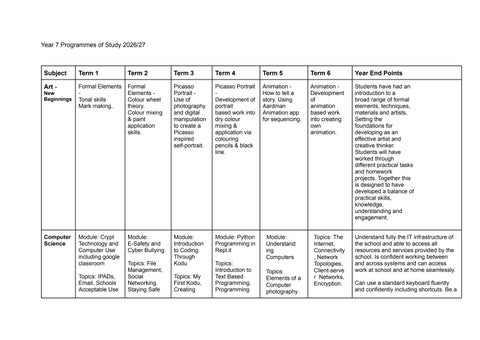
Year 7 Programmes of Study 2026/27
Subject
Term 1
Term 2
Term 3
Term 4
Term 5
Term 6
Year End Points
Art -
Formal Elements Tonal skills Mark making..
Formal Elements Colour wheel theory. Colour mixing & paint application skills.
Picasso Portrait Use of photography and digital manipulation to create a Picasso inspired self-portrait.
Picasso Portrait Development of portrait based work into dry colour mixing & application via colouring pencils & black line.
Animation How to tell a story. Using Aardman Animation app for sequencing.
Animation Development of animation based work into creating own animation.
Students have had an introduction to a broad range of formal elements, techniques, materials and artists, Setting the foundations for developing as an effective artist and creative thinker. Students will have worked through different practical tasks and homework projects. Together this is designed to have developed a balance of practical skills, knowledge, understanding and engagement.
Module: Crypt Technology and Computer Use including google classroom
Module: E-Safety and Cyber Bullying
Module: Introduction to Coding Through Kodu
Module: Python Programming in Repl.it
Module: Understand ing Computers
Topics: The Internet, Connectivity , Network Topologies, Client-serve r Networks, Encryption.
Understand fully the IT infrastructure of the school and able to access all resources and services provided by the school. Is confident working between and across systems and can access work at school and at home seamlessly.
New Beginnings
Computer Science
Topics: IPADs, Email, Schools Acceptable Use
Topics: File Management, Social Networking. Staying Safe
Topics: My First Kodu, Creating
Topics: Introduction to Text Based Programming. Programming
Topics: Elements of a Computer photography
Can use a standard keyboard fluently and confidently including shortcuts. Be a
Policy, Google Classroom, Google Drive and E-praise. Swift Playgrounds.
Online. Cyber Bullying Consequences and Searching the Web.
Key Skills: Induction into Google Classroom to access work and organising your Google Drive. IPad training and use within school. Familiarising yourself with the network including email and the schools network policy.
Key Skills: Use basic file management techniques to create folders, save, copy, move, rename and delete files and folders and make backup copies of files. Recognise extensions for common file types such as .doc or .docx, .ppt, .jpg etc. Keep their files in well organised and appropriately named folders. Explain what constitutes a “strong” password for an online account. Describe a code of conduct with
MP1: End of Topic Assessment
Landscapes, Navigation and Pathing, Clones and Creatables, Pages and Selection, Game Depth and Complexity. Key Skills: Identify what the terms program, navigate, object and world mean in computer games design. Explain that a computer program requires a precise series of instructions to operate. Create and alter basic landscape features in Kodu. Describe the possible ways in which a character can be made to
Fundamentals. Code Structure, Sequence and Selection. Key Skills: Understand the concept of variables, sequence, selection and iteration. Understand the difference between different data types. Programming math, including relational operators. Logic in Programming. MP1: Programming Assessment
nd software, Internal components of a computer. Computer building Key Skills: Distinguish between hardware and software. Give examples of computer hardware and software. Draw a block diagram showing CPU, input, output and storage devices. Name different types of permanent storage device. Suggest appropria te input and
Key Skills: Explain the meaning and significance of bandwidth, what is meant by buffering and why it is used. State the advantages and disadvantage s of different network topologies. Design a simple network layout. Identify some of the extra hardware compone nts used in a LAN and compare the uses of
confident user of office applications, including email. Conversant with and conforming to Crypt I.T system usage policies and procedures. Understands the need for and has strategies to stay safe online. Understands and uses the binary number system and its use in digital systems. Able to identify the core components of a computer system and describe their function.
Drama
Intro to Drama Skills Overview: -To gain understanding of fundamental skills used in drama. -Expectations and use of space.
reference to the schools acceptable use policy. List some of the dangers and drawbacks of social networking sites. List some possible responses to cyberbullying. Send and reply to emails, send attachments. Use a search engine to find information efficiently.
move within Kodu, Describe a range of game techniques such as pathing, clones and creatables. Explain how behaviours can change for a character. Describe what is meant in programming by the term selection
MP1: End of Topic Assessment
MP1: End of Topic Assessment
Pantomime
Mime and Mask
Overview: -Introduce students to theatrical history of pantomime -Learn key conventions, performance techniques and
Overview: -To develop knowledge of Greek Theatre history and explore the differences between Greek
Radio Drama Overview: - To gain an understanding of what is meant by the term radio drama, including the era radio drama became
output devices for a simple scenario. Explain what RAM and ROM are used for. Show how numbers and text can be represented in binary. Explain the impact of future technologies. Module: Networks
peer-to-p eer networks and client server networks.
Commedia Dell’Arte
Theatre round the world
Overview: Describe the key features and origins of Commedia dell’Arte. Identify and perform key stock
Overview Fostering cultural literacy and empathy Recapping foundational drama elements
MP4: Summative Assessment
1.For students to have a fundamental understanding of how drama is rehearsed, shaped, devised and performed. Students should be equipped with the skills to understand how a performance is developed in rehearsal to performance and have a range of skills in which to do so. 2.All pupils should have a basic knowledge of conventions and techniques and should be able to work collaboratively and be able
-Still-image and movement -Characterisation and use of space -Audience awareness -Students to self and peer assess
Assessment 1 – Practical assessment where students develop a piece of drama utilising key skills developed over the term.
cultural significance -Explore exaggerated style of acting, stock characters, audience interaction and physical comedy
Assessment 2 –Practical: Students create and perform their own pantomime pieces to the class
and contemporary theatre. -To devise and present unscripted pieces using improvisation, physical skills and masks. -Exploration of mask influences across different cultures (Noh theatre / Commedia Dell ‘Arte) -To reflect on and evaluate their work and the work of others. -Students to self and peer assess
Assessment 3 – Practical – ability to perform theatre with
popular and the reasons for it. -To write/ devise an original radio drama. -To perform a live radio drama in front of an audience as part of a team. -Students self and peer assess
characters (e.g. Arlecchino, Pantalone, Il Dottore, Colombina, etc.). Use exaggerated physicality and gestures to express character and emotion. Devise and perform short Commedia-style scenes.
Deconstructing ‘what theatre can be’ Continuing to build core soft skills Better understanding of different theatrical styles from history as well as other cultures.
Assessment 4 – Practical/writ ten – live radio Drama performance.
Assessment 5 – Written exam Assessment 6 – Assessment of practical performance of Commedia work.
Assessment 7 Practical performance of chosen theatrical style
to negotiate group work skills and challenges. 3.They should have a good knowledge of performance style and contexts (physical theatre – Elizabethan theatre – radio drama – mask theatre)
Reasons for SOW
Introduction to Drama and performance skills Basic understanding of conventions/ techniques. Placement of SOW – an introduction to Key Drama skills and students becoming familiar with working collaboratively.
English
Folklore AIM: This is a creative and fascinating unit of work which builds on what
Accessibility and engagement for all students Build confidence and collaboration Provide a safe space for experimentation and risk taking Placement of SOW: Positioned at a time of year when students are likely to see professional pantomime outside of school
The Little Mermaid (Anderson) AIM: To explore a classic fairy tale in depth,
masks (projection/ movement etc.) Theatre history Spatial awareness Focus on movement Ensemble work Placement of SOW -To ensure mime and mask is explored before Physical Theatre to enhance progression of physical skill.
Radio culture/ media Understanding live production Sound effects Scriptwriting
Placement of SOW -To introduce a new medium of radio as a performance genre and develop character/sound effects.
Ghost Boys
Love Poetry
AIM: To enjoy reading a complete novel as a class. To develop an
AIM: To study a range of love poems and songs from a range of time periods,
Cross-curricular links to History, English and PSHE Develop understanding of stock characters (which we still see in modern theatre)
Placement of SOW- An energetic and over-exaggerated scheme to support the end of year exam.
Historical theatre links to drama that we see and study today Geographical understanding of where different theatre styles come from Broadening understanding of different performance types Placement of SOW Geography and History cross-curricular links
Intro to Dickens
Modern Non-Fiction
AIM: To study a range of Dickensian extracts from a few of his
AIM: To study a range of non-fiction texts and be able to identify
READING: - Quote relevant examples from texts - Identify some key writers’ methods e.g. simile, metaphor - Make clear and relevant comments on
students are familiar with, bringing in more challenging and unfamiliar texts. To study a wide range of myths, legends, fables and fairytales. To know and comment on the different features of each type of text. To apply this knowledge of genre to own creative writing. KEY SKILLS: Descriptive and narrative writing skills e.g. technical accuracy, organisation of ideas, use of genre, language and structural features. Identifying and commenting on writers’ methods and
focusing on aspects of genre and language. To make comparisons to modern interpretations and productions. To introduce media terminology and analyse the use of film methods e.g. diegetic and non-diegetic sound, props, lighting. This establishes a foundation for studying play texts. KEY SKILLS: Descriptive and narrative writing skills e.g. technical accuracy, organisation of ideas, use of genre, language and structural features.
understandin g of some modern issues regarding race (USA focus). To instil empathy and understandin g of real as well as fictional people, from different backgrounds, cultures, countries, and times. KEY SKILLS: Identifying and commenting on the effects of writers’ choices. Evaluation of opinion. Comparison between texts. Identifying links between the novel and real world.
starting with Petrarch and Shakespeare. To identify poetic methods and know the difference to other text types. To respond independently to new poems. To explain how meanings and impressions are created by poets. To produce an original love poem or song, showcasing the skills acquired throughout the unit. KEY SKILLS: Identifying and commenting on the effects of writers’ choices. Evaluation of opinion. Comparison between texts. Identifying and commenting
novels. To identify features of Dickens’ writing. To respond independently to new texts. To explain how meanings and impressions are created by Dickens. To explore Victorian history and make connections to the characters, themes and events in the novels. KEY SKILLS: Identifying and commenting on the effects of writers’ choices. Evaluation of opinion. Comparison between texts. Using Dickensian features
features of different formats. To develop an understanding of some modern issues e.g. climate crisis, UK media, space exploration, animal rights. To instil empathy and understanding of real people, from different backgrounds, cultures, countries, and times. KEY SKILLS: Identifying and commenting on the effects of writers’ choices. Persuasive writing techniques. Technical accuracy. Creating convincing
the effects of methods. - Identify some aspects of genre and form e.g. elements of a fairy tale or news article. - Identify and clearly explain similarities and differences between texts. WRITING: - Produce texts using accurate basic punctuation and grammar. - Begin to vary types of sentences and punctuation. - Use a range of appropriate methods in creative and non-fiction writing. - Respond to framed analysis questions to produce essay-style responses. - Use a range of discourse markers for clarity and clear sequencing of ideas. ORACY: - Respond appropriately to questions and feedback, adding to answers when required to do so. - Present ideas clearly
meanings. CAREER LINKS: Creative writing, art, classics, curatorship, conservation, anthropology, archaeology READING: Termly reading lists issued. Fortnightly reading lessons. All are encouraged to read for read for 20 mins per day.
Geography
Investigating Geography Global locations. Types of maps. Explaining population density. Fieldwork
Identifying and commenting on writers’ methods and meanings. CAREER LINKS: Creative writing, art, classics, curatorship, conservation, anthropology, archaeology READING: Termly reading lists issued. Fortnightly reading lessons. All are encouraged to read for read for 20 mins per day. Physical Geography of the UK Relief of the UK. Climate of Britain.
CAREER LINKS: Creative writers, journalists, historians, academics, politicians, policing, lawyers, and activists.
on how poetic form changes through time.
READING: Termly reading lists issued. Fortnightly reading lessons. All are encouraged to read for read for 20 mins per day.
READING: Termly reading lists issued. Fortnightly reading lessons. All are encouraged to read for read for 20 mins per day.
Landscapes of Britain: Rivers
Geography of Gloucestershire
Geological Timescales. Types of Rock Geomorpholog ical processes.
Key locations. OS map skills: directions, distances, grid references,
CAREER LINKS: Creative writers, historians, musicians, song writers, journalists
in creative writing. Technical accuracy.
facts and statistics. Quoting from sources in articles.
CAREER LINKS: Banking, prison work, charity work, creative writing, civil service.
CAREER LINKS: Journalism, media, PR, activism, charity work, law.
READING: Termly reading lists issued. Fortnightly reading lessons. All are encouraged to read for read for 20 mins per day.
READING: Termly reading lists issued. Fortnightly reading lessons. All are encouraged to read for read for 20 mins per day.
What is Asia like?
Global Economic Activities
How do places vary (AC, LIDC, EDC) Physical and human characteristics of
Economic Activities in SW China.
to an audience The Crypt School English Department Programme of Study 2024-2025 Our aim is to foster a deep knowledge, understanding and appreciation of the English language, its rich literary heritage, and its myriad practical applications (independently as well as in pairs or groups). - Participate in class and group discussion.
● ● ● ●
Know major locations on the globe. Know how to describe and explain variations in population density. Know the physical features of the UK including relief and weather patterns. Understand how and why climate varies in Britain at a national and local scale
Weather in Britain.
River basin & long profile. River landforms
symbols, contour lines.
Asia, India and China Economic Activities in Britain Types of economic activities. Farming and soils. Location of Industry. Growth of the tertiary and quaternary sectors.
Causes and impacts of globalisation in Britain, India, Bangladesh & China.
●
●
● ● ●
● ●
●
●
● ● ●
History
Topics: Consolidation of skills and the ‘Ancient World’
Topics: Power in Medieval Britain Enquiry
Topics: Life in the Medieval (emphasis on the vulnerable)
Topics: Medieval Middle East & African Kingdoms
Topics: Thematic study on political power
Topics: Castles Enquiry question: How revolutionary
including the impact of air pressure on weather. Understand how geomorphological processes and geology can create a range of landscapes in the UK with a particular focus on river landforms. Understand the factors affecting the location of the four types of economic activities. Understand economic growth in Asia. Know how countries vary in terms of development. Understand how countries are interconnected and the consequences of economic connections. Know the characteristics of Asia, India and China Know how to complete a guided fieldwork investigation within the school grounds. Know how to use map skills to identify human and physical features in the local area. Know how to describe, analyse and/or present geographical data using simple techniques. Begin to explain geographical features. Begin to analyse by referring to physical and human features Apply geographical knowledge to begin to make balanced judgements.
Basic understanding how aspects of Medieval societies functioned. Explain the nature and power of medieval monarchy and the impact of
Enquiry question: How civilised was the Ancient World? Content: What is History, Using sources & interpretations to make a judgement, key features of Roman society Assessment: Celtic sources task Skills: Base-line skills covered particularly sources/interpret ation Cultural Capital includes: Roman Britain, government & society, interpretative nature of history
question: How important were the two pillars of control in Medieval Britain?
Enquiry question: What was life like in the Middle Ages?
Content: Battle of Hastings case study, Conflict between church & state, Thomas Becket, History of warfare/medici ne project
Content: Daily life, key features of medieval society, Black Death impacts
Assessment: Battle of Hastings causation essay
Skills: Consequence s/ impacts
Skills: Causation & independent research Cultural Capital includes: Nature of Norman Conquest, Temporal vs spiritual power, importance of
Assessment: Mid year exam
Cultural Capital includes: Fragile nature of human existence within medieval society, Medieval anti-Semitism & patriarchy, pandemics
Enquiry question: How different were societies throughout the world in the Middle Ages? Content: Middle Eastern culture /architecture /medicine, organisation & culture of African Kingdoms Assessments: How are the Middle East & West Africa similar in the Middle Ages? (TBC) Skills: Similarities & Comparisons Cultural Capital: Islamic culture, Tolerance v Intolerance, Justification of Holy War, advances in medicine, West African
Enquiry Question: How has power shifted from monarchs to the people? Content: Medieval kings, Magna Carta, Civil War, 19th Century reform, Votes for women Assessments: “Power has always been in the hands of the higher classes.” How far do you agree? Has Britain always had a global identity? Skills: Thematic nature of change over time Cultural Capital: Importance of Magna Carta & constitution, struggle between
are medieval castles? Content: Key features of castles, life in castles, attacking & defending castles, Local study on Goodrich Castle Assessments: Summer exams Skills: Significance Cultural Capital: Castles in the South West, Symbolic nature of castles, Medieval architecture
key events/developments/changes. Assessing one level of significance for historical people/events. Able to write a PEE (point, evidence, explanation) paragraph using basic terminology & literacy. Infer and make basic judgements about key medieval events by studying both primary and secondary sources of evidence.
religion in medieval society
Maths
Number Baseline Assessment Numbers & Calculation Fractions Factors, Multiples & primes Decimals & Estimation
Probability, Expressions & Constructions Non-Calculator assessment Simplifying expressions Single Brackets Factorising Probability Venn Diagrams Construction & Loci Calculator assessment
civilisation pre-European intervention
parliament & monarchy, evaluating effectiveness of protest tactics, British democracy today
Shape & Equations
Sequences & Graphs
Angles
Ratio and Proportion Solving Equations Formulae Area & Perimeter Circles Cuboids
Sequences Coordinates Plotting graphs Pythagoras Solving Inequalities
percentage increase & decrease Value for Money Angles and Parallel Lines Congruent End of Year Non-Calculator assessment Calculator assessment
Statistics & Transformatio ns Averages Statistical Diagrams Transformation s Alien Invasion Investigation Note these topics will be assessed in year 8
✓ Use the four operations with decimals, fractions and mixed numbers ✓ Round a number to a significant figure or decimal place and use it to estimate ✓ Use a sample space diagram ✓ Draw a Venn diagram and know what is meant by union and intersect ✓ Use non-calculator methods to find percentage of a number and increase and decrease by a percentage ✓ Use angle rules for around a point, straight line, in a triangle, in a quadrilateral, corresponding, alternate, co-interior and vertically opposite angles ✓ Find areas and perimeters of rectangles, triangles, parallelograms, and trapeziums. Find the circumference and area of a circle ✓ Find the nth term of a linear sequence ✓ Understand and use lines parallel to the axes, y=x and y=-x ✓ Simplify expressions by collecting like terms and expanding a single bracket ✓ Solve linear equation with unknowns on both sides ✓ Use Pythagoras to find a long or short side of a triangle ✓ Know and calculate mean, median, mode and range
MFL French
Tasters What is a cognate? Skills: Taster lessons - Places in a town and preferences with reasons. Grammar: Opinions, intensifiers, negatives. Assessment: Quiz
Family and pets How do you use adjectives correctly? Skills: Introducing yourself, numbers and dates, describing your family and pets, colours. Grammar: Adjective agreement, avoir and être. Assessment: Grammar and Vocabulary Quiz, Speaking, Mid-Year Exam
German
Tasters: Sport What is a cognate?
Family What is the difference between the
School How can I express my opinion?
Free-time How do you form the present tense?
Where I live How do you form the near future tense?
Skills: Talking about school and subjects and activities. Giving opinions and comparisons. Telling the time.
Skills: Talking about sports, free time activities, adverbs of frequency, opinions on activities.
Skills: Talking about your house. Saying what you are going to do. Describing countries and nationalities, where you live and your town.
Grammar: Preference verbs (aimer, préférer, detester, adorer), comparative adjectives. Assessment: Grammar and Vocabulary Quiz, Listening School What is the main word order rule in a
Grammar: Regular -er, -ir & -re verbs. 1st person infinitive structures, adverbs of frequency. Assessmen t: Grammar and Vocabulary Quiz, Translation
Free time What is an infinitive and how can you
Grammar: il y a & il n’y a pas de, using aller + à la/au, prepositions of location. J’habite à/en. On peut + infinitive. Near future tense.
Summer Project
By the end of year 7, students will be able to…
Skills: Talking about summer plans. Completing summer projects. Designing a consolidation boardgame.
…express their opinions and justify them on the topics of family, sport, free time and where they live. …understand the gender of nouns and adjective agreement rules. …understand what an infinitive is and conjugate verbs in the present and near future tenses.
Grammar: Consolidation of Year 7 Grammar. Near future tense Assessment: Grammar and Vocabulary Quiz, Speaking
Assessment: End of Year Exam, Speaking Where I live How do you form the present tense?
Summer Project How do you form the future
By the end of year 7, students will be able to……express their opinions and justify them on the topics of family, sport, free time and where they live.
Skills: Introducing yourself, sports and opinions, German sportspeople. Grammar: Opinions and reasons, verb pullers, intensifiers. Assessment: Google Forms Quiz
nominative and accusative cases? Skills: Numbers and dates, family members, pets, physical description including hair and eyes. Grammar: Haben and sein, plural adjective endings, introduction to the accusative case. Assessment: End of Unit Assessment (Listening and Speaking)
Spanish
Tasters (food) What is a cognate? Skills: Introducing
School How and why do adjectives change?
German sentence? Skills: School subjects, opinions with reasons, telling the time, days of the week, school facilities, German school system. Grammar: Verb kickers, introduction to prepositions with dative case.
tell? Skills: Sports and free time activities, preferences, adverbs of frequency. Grammar: Regular present tense verbs, gern/lieber/am liebsten, verb is the second idea. Assessment: End of Unit Assessment (Listening and Reading)
Grammar: Adjective endings in the accusative case, ein vs kein, prepositions with the dative case, future tense with werden.
Recapping all year 7 skills and grammar and create video interview. Assessment: Video interview
…understand the difference between the nominative and accusative cases and apply that to their writing and translation. …understand what an infinitive is and conjugate verbs in the present and future tenses. …understand the key word order rules in German, including verb pullers and verb kickers.
Assessment: End of Year Exam (Reading, Listening, Writing and Translation)
Assessment: Mid-year Exam (Reading, Writing and Translation) Family How do I change opinions to make them plural?
tense? Skills: Types of house and locations, rooms and furniture, places in a town, town descriptions, future living plans.
Free Time What is an infinitive and how can you tell?
Where I live How do you form the present tense? Skills: Types of
Summer Project How do you form the near future tense?
By the end of year 7, students will be able to… …express their opinions and justify them on the topics of family, sport, free time and where they live.
yourself, foods, descriptions and opinions of food, Spanish cuisine. Grammar: Definite article, adjectival agreement, opinions, connectives Assessment: Google Forms Quiz
Music
Rhythm & Pulse Skills: 1.1 How to keep time 1.2 Rhythmic notation 1.3 Awareness of tempi 1.4 Simple and complex rhythms
Skills: Introducing yourself, ages and birthdays, school subjects, opinions, adjectives, describing a Spanish school
Skills: Family members, pets, describing appearance including hair and eyes, describing personality.
Skills: Sports, free time activities, adverbs of frequency, opinions on activities. Grammar: present tense verbs, both regular and stem-changing, near future tense.
Grammar: Definite article, adjectival agreement, opinions + plurals, intensifiers, connectives, comparatives. Assessment: End of Unit Assessment (Listening and Speaking)
Grammar: ser + tener in present tense, further adjective agreement and word order.
Rhythm & Pulse (for 2 weeks) followed by Melody
Melody ( for 3 weeks) followed by Harmony
Harmony (for 3 weeks) followed by Texture
Skills: Continuing to develop and refine skills
Skills: Continuing to develop and refine
Skills: Continuing to develop and refine skills
Assessment: Mid-year Exam (Reading, Writing and Translation)
Assessment: End of Unit Assessment (Listening and Reading)
house, house description, rooms, furniture, places in a town, where you would like to live
Skills: Recapping all year 7 skills and create video interview.
Grammar: ser vs estar, hay with indefinite article, prepositions, me gustaría + infinitive. Assessment: End of Year Exam (Reading, Listening, Writing and Translation)
Assessment: Video interview
Texture (for 3 weeks) Followed by Preparation and revision for the Y7 End of Year Exam
Skills review
Endpoints:
Following the results of Term 5 assessments/ End of Year exam:
Developed Rhythmic skills
Skills: Continuing to develop and
Skills: Specific skills
…understand the use of genders and adjectival agreement rules. …understand what an infinitive is and conjugate verbs in the present and near future tenses.
Basic Notation skills Singing skills Group performances – Samba and Djembe
1.5 How to play in an ensemble 1.6 Recognising basic rhythms (Aural) 1.7 Listening and appraising Topics: 1.1 Samba 1.2 African drumming 1.3 Chair drumming 1.4 Rhythm grid Breakdown of 10-week term Practical (5 weeks) 1.1 Talking drums performance 1.2 Polyrhythmic piece 1.3 Body percussion piece 1.4 Applying rhythmic skills using African Djembae drums and Samba drums to perform in ensembles. 1.5 Developing singing skills
learnt in Term 1
skills learnt in Term 2
learnt in Term 3
After 2 weeks:
After 3 weeks:
After 3 weeks:
Skills: 1.1 Pitch awareness 1.2 Improvisation 1.3 Aural dictation (intervals) 1.4 How to understand graphic scores 1.5 How to create a melody 1.6 Improvement of piano technique
Texture Skills: 1.1 Understanding
and playing major and minor chords 1.2 Mastering a range of instruments (Keyboard/ ukulele/guitar/ drum kit) 1.3 Understanding
how to compose chord progressions 1.4
Skills: 1.1 Recognise and write about different instruments of the orchestra 1.2 Understand the textural norms of other cultures 1.3 Recognise the various textures that are used in orchestral music 1.4
understanding
Topics: 1.1 Keyboard performance 1.2 Binary composition 1.3 Graphic scores Breakdown of 10-week term
7th chords Topics: 1.1 Just play – game of thrones 1.2 Twinkle twinkle little star composition
Topics: 1.1 Sonority city 1.2 Folk music 1.3 Textural composition Breakdown of 9-week term Practical (5 weeks)
refine skills learnt in Term 4 End of term 5 assessment FOS/theory tests Texture skills tests End of Year Exam composition on Musescore (Week 8)
based Performance Composition Listening Theory tasks To ensure all skills are embedded and refined. End of term 6 assessment
Skills based tests (as above)
Rhythmic compositions – using Musescore Music technology skills Listening skills and understanding the elements of music
Ability to perform fluently on two or more instruments, reading notation from the treble clef. Improved performance confidence Ability to maintain own part within a class ensemble Respond to a Graphic score Developed singing skills - reading from notation. Recognising Melody and harmony parts through deliberate listening Aural dictation exercise completed with confidence Confident understanding of how to construct a triad chord Aural ability to recognise major and minor harmonies Creative ability to utilise effective chord progressions
using the MMC advisory songs as well as other songs relevant to BV and the Crypt or seasonal celebration. Performance: African drumming – perform own part within group task based upon rhythmic grid (teacher assessed) Composition & Aural (5 weeks) 1.1 Introduction to notation on a stave – using Focus on Sound in technology suite. 1.2 Composing using notationdevising rhythm grids for Djembae or Samba ensembles.
Practical (5 weeks) 1.1 Love me tender performance (AABA) 1.2 Graphic score 1.3 Developing instrumental skills focusing on reading and applying notation understanding (on the keyboard/ukulel e/guitar/drum kit) 1.4 Developing ensemble skills playing parts, understanding where Melody and harmony appear. 1.5 Developing confident and critical performer Composition & Aural (5 weeks)
1.3 Early one morning (folk unit – MC) 1.4 Singing in harmony 1.5 Revisiting rhythm, melody, texture, structure, meter, pulse Breakdown of 9-week term Practical (5 weeks) 1.1 Just play – game of thrones 1.2 addressing more complex chords, minor chords and 7th chords. Confident understanding
of how to construct a triad chord Singing harmonies –
1.1 Folk music performance showcasing textural layers and how to build texture in a piece of music Performance of a folk music piece as a class ensemble (eg Wellerman song) 1.2 Perform relevant melodic or harmony notes on instruments which are appropriate to the genre. 1.3 Distinguish the difference between families of instruments (String/Wind/Br ass/Percussion)
Understanding the construction ad use of 7th chords Confident performance of ‘Game of Thrones’ within a Class ensemble Confident singing a melody and harmony line Effective compositions using major and minor chord notes Accurate recognition of instruments and instrumental groups Confident understanding of the types of instrumental ensembles Well informed understanding of various textural types in compositions A successful composition using a defined texture Performance of a folk music piece
Listening and appraising 1.1 Developing listening and appraising skills by introducing the ‘MADTSHIR T’ acronym as a framework for critical analysis of music – addressing all of the key elements of music. 1.2 Peer assessment of composition and performance s– describing and analysing peer performance s and composition
1.1 Binary composition 1.2 Focus on sound – theory 1.3 Aural dictation 1.4 Introduction to Muse score 1.5 Deliberate listening 1.6 Understanding the notes of Treble clef through practise of Focus on Sound (listening and theory) and application on Musescore software. Talk 4 learning/Oracy : questioning/ peer assessing/ discussion Metacognition planning/ organising performances
recognising chord notes – 3rd apart. Confident singing a melody and harmony line 1.2 Singing from the MMC Composition & Aural (4 weeks) 1.1 Twinkle twinkle compositi on – major or minor version with the chords chosen by students 1.2 recognisi ng major, minor and 7th chords. 1.3 looking at intervals
Composition & Aural (4 weeks) 1.1 Determine whether a piece is Monophonic, Homophonic, Polyphonic or Heterophonic following explanation 1.2 Compose in either a Homophonic or Polyphonic style (On Musescore) 1.3 Analyse texture in varying styles of music - eg. Orchestral, Folk, Words music through deliberate listening. Talk 4 learning/Oracy : questioning/ peer assessing/ discussion
s using specific musical terminology. Talk 4 learning/Oracy: questioning/peer assessing/ discussion Metacognition: planning/ organising performances Collaboration: Teamwork Feedback: verbal/whole class/peer assessment/ skills trackers Literacy: musical keywords Music technology skills End of term 1 assessment:
Collaboration: Teamwork Feedback: verbal/whole class/peer assessment/ski lls trackers Literacy: musical keywords
End of term 2 assessment: Performing own part in a class performance (Love me Tender AABA piece) (Week 10) Composing a Binary melodic line on Musescore with given choice of harmony chords (week 10)
and what combinati ons can be used for effect. Talk 4 learning/ Oracy: questioning/ peer assessing/ discussion Metacognition : planning/
organising performances Collaboration:
Metacognition: planning/organi sing performances Collaboration: Teamwork Feedback: verbal/whole class/peer assessment/ skills trackers Literacy: musical keywords Music technology skills
Teamwork
End of term 4 assessment
Feedback: whole class/peer assessment/
Performance of a folk music piece as a class
skills trackers Literacy: musical keywords
ensemble (eg Wellerman song) (Week 8)
Performance: African drumming – perform own part within group task based upon rhythmic grid (teacher assessed) (Week 10) Notation test (Focus on sound/theory worksheets from Musical contexts) (Week 5) Composing: Rhythmic composition using Musescore 3 or Garageband using a rhythm grid (devised in performance
Answering a deliberate listening question with specific focus on melody (Week 5)
Focus on sound Lessons/Tests Note values, Treble and bass clef notation, time signatures,
Aural dictation test (week 5) DECEMBER: WRITTEN MID YEAR TEST ~(THEORY/ LISTENING)
Music technology skills End of term 3 assessment: Listening deliberate listening to Major and Minor compositions, recognising chords and 7 the chords (Week 5) Focus on Sound Lessons & tests on harmony, chords, 7th chords (Week 5) Composition variation in Major and Minor keyboard (Twinkle Twinkle) (week 10) Group performance of
Listening exercises Fanfares: Fanfare of the Common Man and Olympic fanfare (week 5)
Young Persons Guide to the Orchestra listening test (week 8)
Composing Polyphonic or Homophonic composition on Musescore (Week 8)
‘Game of Thrones
class) to compose for Samba kit. (Peer
(week 10)
assessed) Week 10 Listening: deliberate listening test focusing on rhythm and pulse primarily (Week 5)
PD - 3 lessons per fortnight
Emotional wellbeing: managing change & transition
Puberty & keeping safe
Friendship & bullying: influences on relationships
CPR. Substances & student perceptions of social norms. Social & emotional wellbeing
Families, changing relationships & influences on relationships
Financial decisions
Students will have explored ways to settle in a new secondary school, set learning goals & develop social & emotional skills. They will have revisited learning about puberty from KS2, with a focus on testicular & vulva health, as well as how to identify & report abuse. They will have explored the principles of healthy & unhealthy friendships, as well as how to identify and respond to bullying incidents. They will have considered the influences on their expectations of - and attitudes towards relationships, including online and media influences. They will have covered the role of families, including caring for
each other in changing circumstances, such as divorce or separation. They will have been introduced to developing their financial literacy and decision-making and risk assessment skills in relation to money and spending. RS
Science [Key : Black; all 3 science strands or skills, Green; biology, Red; Chemistry, Purple;phy
Judaism
Hinduism
Sikhism
Humanism
Revision and end of year exam
Spirited arts
The roots of the three Abrahamic religions, and how jewish identity has developed in the modern world
The oldest and most populous polytheistic (sometimes!) conception of God, and how it has affected the lives of Hindus.
A combination of Hindu and Abrahamic influences, with distinctive practical applications.
A worldview that rejects theism, and the struggle to replace the values that it provides.
Topics:
Topic
Topics:
Topics:
Topics:
Topics:
A1 Working Scientifically
P1 Energy
C2 Mixtures & Separating techniques
B2 The Digestive System
B3 Reproduction
P2 Waves
C3 Atoms, elements, compounds & the periodic table
Key Skills:
Key Skills:
Calculating, practical
Planning, analysing data,
How art can express ultimate ideas in a way that language never could.
Students should be able to explain the main beliefs of Judaism, Hinduism, Sikhism and Humanism, and give examples of how they affect practice. They should also be able to evaluate opposing arguments on a controversial issue, with reference to relevant religious beliefs.
●
C1 Particle Theory Key Skills:
B1 Cells, Tissues Organs and Organ Systems
A2 Y7 Project P3 Forces and Motion Key Skills:
Practical and Investigative
Key Skills:
Calculating,
Key Skills: Interpreting and analysing data,
Use a range of laboratory apparatus safely, evaluating risk and suggesting control measures ● Plan an appropriate method to investigate a question ● Evaluate the accuracy, precision, repeatability and reproducibility of data and identify sources of error ● Present observations and data using appropriate tables and graphs and
sics. *Teaching order and assessme nts may change during year]
Skills (working safely, using equipment, collecting data, analysing data, evaluating) Key words, modelling theories, evaluating models
Calculating, planning, analysing data, literacy, comparing, evaluating, ethics of energy resources, biological drawings
skills, evaluating techniques, analysing data, applying knowledge, key words,
Assessments:
C2 Separating Mixtures Test (MCQ)
Assessments: A1 Working Scientifically Baseline Test (Written) C1 Particle Theory test (MCQ)
P1 Energy Test (MCQ) B1 Cells Test (MCQ) Half Year assessment
Assessment s:
P2 Waves Test (Written)
literacy, evaluating, key words, analysing patterns, interpreting data, understanding the development of scientific thinking Assessments: C3 Atoms, elements, compounds & PT test (Written)
applying, describing, explaining, comparing, literacy Assessments: B2 Digestive System Test (MCQ) P3 Forces and Motion Test (MCQ) End-of-Year Exam
dissection, practical skills, comparing biological structures and functions Planning, investigation and presentation skills Assessments :
interpret data, including identifying patterns and drawing conclusions ● Use simple equations to make calculations ● Understand that energy is a quantity that can be calculated; describe the energy changes that take place for a variety of situations. ● Understand the effects of balanced and unbalanced forces on the motion of objects and draw and interpret force diagrams ● Understand the properties of light and sound waves and explain wave phenomena like reflection and refraction
B3 Reproduction Test (Written)
● Identify solids, liquids and gases based on their properties. ● Understand that everything is made up of small particles, which are known as atoms. ● Understand that these particles/atoms can remain separate as elements, join as elements or compounds. ● Use simple separation techniques to identify if a substance is an element, mixture or compound. ● Use of light microscope to identify and complete biological drawings of cells ● Understand structure and
function of different cell types and exchange between the cell and its environment. ● Understand the importance of a healthy diet, testing techniques for different molecules and the structure and function of the digestive system. ● Understand processes occurring in reproduction in plants and animals, including germination, puberty and the menstrual cycle.
DT Rotation Project
End Points
Reusable Chocolate mould
The students will be able to: ● Use communication techniques to present a range of 2D and 3D drawing ● Critically reviewed own and work of others ● Use basic functions on 2D design ● Understand use of CAD and CAM ● Understand vacuum forming as a manufacturing process ● Understand the process of making paper ● Assemble a 2D net into a 3D package
For the project the students with develop graphic design skills to produce a reusable chocolate mould while studying Pixar as source of inspiration. They will discover how paper is made and affects materials have on the environment. While using a range of different processes they will produce a high-quality product that links to the area from Pixar that they have investigated.
Food Technology - 1 lesson per week Objectves
End Points
Being healthy
The students will be able to: ● Identify key pieces of equipment and explain their use. ● Identify safe personal hygiene practices. ● Identify the danger zone and describe how temperature affects bacterial growth. ● Explain why we need to eat a range of different foods. ● Identify good sources of each nutrient. ● Suggest changes to a diet to make it more nutritionally balanced. ● Classify a range of fruit and vegetables. ● Identify a range of high fibre starchy carbohydrate foods. ● Identify a range of protein rich foods. ● Demonstrate safe working practises when using high risk foods. ● Explain why milk is pasteurised. ● Explain the effects of too little/too much water in the diet.
In this project, students will develop knowledge and understanding of good food hygiene, which is essential to make sure that the food you serve is safe to eat. This helps prevent food poisoning. The four main things to remember for good hygiene are the 4Cs: ● Cleaning ● Cooking ● Chilling ● Cross-contamination The 4Cs are used to prevent the most common food safety problems. The students then study The Eatwell Guide. This makes healthy eating easier to understand by giving a visual representation of the types of foods and drinks we should consume and in what proportions to have a healthy, balanced diet.