The Crypt School Psychology & Sociology Department POS 2026-27 A Level Sociology (AQA) – Subject to change dependent on number of teachers Term 1
YEAR 12 SOCIOLOGY
Paper 1 Topic of Study & Content
Paper 2 Topic of Study & Content
Papers 1&3 Topic of Study & Content
Assessment
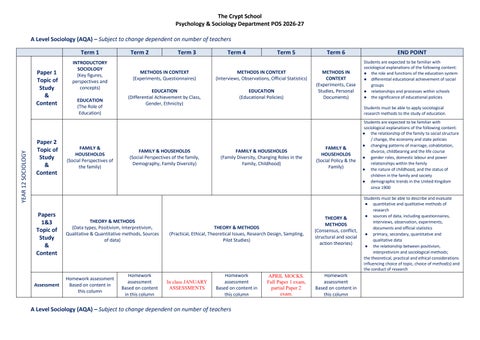
INTRODUCTORY SOCIOLOGY (Key figures, perspectives and concepts) EDUCATION (The Role of Education)
FAMILY & HOUSEHOLDS (Social Perspectives of the family)
Term 2
Term 4
Term 5
METHODS IN CONTEXT (Experiments, Questionnaires)
METHODS IN CONTEXT (Interviews, Observations, Official Statistics)
EDUCATION (Differential Achievement by Class, Gender, Ethnicity)
EDUCATION (Educational Policies)
FAMILY & HOUSEHOLDS (Social Perspectives of the family, Demography, Family Diversity)
THEORY & METHODS (Data types, Positivism, Interpretivism, Qualitative & Quantitative methods, Sources of data)
Homework assessment Based on content in this column
Term 3
Homework assessment Based on content in this column
END POINT
METHODS IN CONTEXT (Experiments, Case Studies, Personal Documents)
Students are expected to be familiar with sociological explanations of the following content: ● the role and functions of the education system ● differential educational achievement of social groups ● relationships and processes within schools ● the significance of educational policies Students must be able to apply sociological research methods to the study of education.
FAMILY & HOUSEHOLDS (Family Diversity, Changing Roles in the Family, Childhood)
THEORY & METHODS (Practical, Ethical, Theoretical Issues, Research Design, Sampling, Pilot Studies)
In class JANUARY ASSESSMENTS
Term 6
Homework assessment Based on content in this column
A Level Sociology (AQA) – Subject to change dependent on number of teachers
APRIL MOCKS. Full Paper 1 exam, partial Paper 2 exam.
FAMILY & HOUSEHOLDS (Social Policy & the Family)
THEORY & METHODS (Consensus, conflict, structural and social action theories)
Homework assessment Based on content in this column
Students are expected to be familiar with sociological explanations of the following content: ● the relationship of the family to social structure / change, the economy and state policies ● changing patterns of marriage, cohabitation, divorce, childbearing and the life course ● gender roles, domestic labour and power relationships within the family ● the nature of childhood, and the status of children in the family and society ● demographic trends in the United Kingdom since 1900 Students must be able to describe and evaluate ● quantitative and qualitative methods of research ● sources of data, including questionnaires, interviews, observation, experiments, documents and official statistics ● primary, secondary, quantitative and qualitative data ● the relationship between positivism, interpretivism and sociological methods; the theoretical, practical and ethical considerations influencing choice of topic, choice of method(s) and the conduct of research
The Crypt School Psychology & Sociology Department POS 2026-27 Term 1
Term 2
Term 3
Term 4
Term 5
Term 6
MEDIA
Paper 2 Topic of Study & Content
MEDIA (the new media + the role of the media in contemporary society, the media, globalisation and popular culture)
(the relationship between ownership and control of the media the processes of selection and presentation of the content of the news, media representations of age, social class, ethnicity, gender, sexuality and disability)
MEDIA (the relationship between the media their content and presentation, and audiences) Revision
Assessment
YEAR 13 SOCIOLOGY
(Explaining Crime: Functionalist, strain and subcultural theories, labelling theory, Marxist, neo-Marxist and critical criminological theories, left and right realism)
THEORY & METHODS
THEORY & METHODS
(Consensus, conflict, structural and social action theories)
(Consensus, conflict, structural and social action theories)
End of term assessment Based on content in this column
NOVEMBER assessments. Full Paper 1 & partial Paper 2 exam.
● the relationship between the media, their content and presentation, and audiences.
CRIME & DEVIANCE
Paper 3 Topic of Study & Content
Study Leave
END POINT Students are expected to be familiar with sociological explanations of the following content: ● new media ● the relationship between ownership and control of the media ● the media, globalisation and popular culture ● the processes of selection and presentation of the content of the news ● media representations of age, social class, ethnicity, gender, sexuality and disability
CRIME & DEVIANCE (Gender + crime, ethnicity + crime, class + crime, Media + crime, patterns + trends, Human rights, State Crime, Green Crime,)
CRIME & DEVIANCE (crime and criminal justice, Crime control, prevention, punishment and victims)
THEORY & METHODS
THEORY & METHODS
(Modernity and Postmodernity, the extent to which Sociology can be regarded as scientific,)
(The relationship between theory and methods, Subjectivity, objectivity and value freedom)
(Sociology and social policy)
End of term assessment Based on content in this column
MARCH MOCKS. Full Paper 2 and 3 exams
Informal assessment
Study Leave
Students are expected to be familiar with sociological explanations of the following content: ● crime, deviance, social order and control ● the social distribution of crime and deviance by ethnicity, gender and social class ● globalisation and crime in contemporary society ● crime control, surveillance, prevention and punishment, victims, and the role of the criminal justice system.
Students must be able to describe and analyse ● the nature of ‘social facts’ ● consensus, conflict, structural and social action theories ● the concepts of modernity and post-modernity ● the nature of science and the extent to which Sociology can be regarded as scientific ● the relationship between theory and methods ● debates about subjectivity, objectivity and value freedom the relationship between Sociology and social policy.
THEORY & METHODS
A Level Examinations