The Crypt Science Department - KS3 PoS 2026-27.
updated June 2026 Key : Black; all 3 science strands or skills, Green; biology, Red; Chemistry, Purple;physics. Note: There are two teaching strands per year, and therefore the teaching order/assessments may not sit in the term shown but all units will be taught to checkpoints at half year & end of year.
Floreat Our Vision scholar Our primary aim is to instil a genuine love of the sciences and the confidence to question our understanding of the natural and physical world. The programme of study aims to develop inquisitive minds into critical thinkers Cryptiensis through acquiring theoretical knowledge, practical skills and scientific literacy. Students will understand how science continuously builds upon previous advancements and understanding; linking the topics studied with realworld application ensures that our pupils develop key investigative, analytical and evaluative skills to prepare for their life ahead. In years 7 and 8, our bespoke curriculum embeds the key foundations of biology, chemistry and physics whilst allowing students’ natural enthusiasm and curiosity to flourish. From year 9 onwards, the three science strands are taught separately through challenging and enriching lessons which build students’ resilience. Additional opportunities beyond the classroom at all key stages further strengthen the curriculum and reinforce the key role science and its applications have in understanding contemporary issues, future developments and the challenges of the modern world.
Term 1
Term 2
Term 3
Term 4
Term 5
Term 6
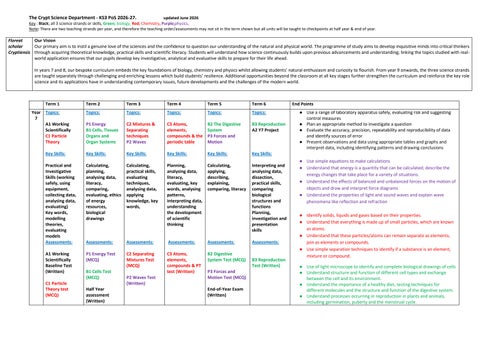
Year Topics: 7 A1 Working Scientifically C1 Particle Theory
Topics:
Topics:
Topics:
Topics:
Topics:
P1 Energy B1 Cells, Tissues Organs and Organ Systems
C2 Mixtures & Separating techniques P2 Waves
C3 Atoms, elements, compounds & the periodic table
B2 The Digestive System P3 Forces and Motion
B3 Reproduction A2 Y7 Project
Key Skills:
Key Skills:
Key Skills:
Key Skills:
Key Skills:
Key Skills:
Practical and Investigative Skills (working safely, using equipment, collecting data, analysing data, evaluating) Key words, modelling theories, evaluating models Assessments:
Calculating, planning, analysing data, literacy, comparing, evaluating, ethics of energy resources, biological drawings
Calculating, practical skills, evaluating techniques, analysing data, applying knowledge, key words,
Planning, analysing data, literacy, evaluating, key words, analysing patterns, interpreting data, understanding the development of scientific thinking
Calculating, applying, describing, explaining, comparing, literacy
Interpreting and analysing data, dissection, practical skills, comparing biological structures and functions Planning, investigation and presentation skills
Assessments:
Assessments:
Assessments:
Assessments:
A1 Working Scientifically Baseline Test (Written)
P1 Energy Test (MCQ)
C2 Separating Mixtures Test (MCQ)
C3 Atoms, elements, compounds & PT test (Written)
B2 Digestive System Test (MCQ)
C1 Particle Theory test (MCQ)
B1 Cells Test (MCQ) Half Year assessment (Written)
P2 Waves Test (Written)
P3 Forces and Motion Test (MCQ) End-of-Year Exam (Written)
Assessments:
B3 Reproduction Test (Written)
End Points ● Use a range of laboratory apparatus safely, evaluating risk and suggesting control measures ● Plan an appropriate method to investigate a question ● Evaluate the accuracy, precision, repeatability and reproducibility of data and identify sources of error ● Present observations and data using appropriate tables and graphs and interpret data, including identifying patterns and drawing conclusions ● Use simple equations to make calculations ● Understand that energy is a quantity that can be calculated; describe the energy changes that take place for a variety of situations. ● Understand the effects of balanced and unbalanced forces on the motion of objects and draw and interpret force diagrams ● Understand the properties of light and sound waves and explain wave phenomena like reflection and refraction ● Identify solids, liquids and gases based on their properties. ● Understand that everything is made up of small particles, which are known as atoms. ● Understand that these particles/atoms can remain separate as elements, join as elements or compounds. ● Use simple separation techniques to identify if a substance is an element, mixture or compound. ● Use of light microscope to identify and complete biological drawings of cells ● Understand structure and function of different cell types and exchange between the cell and its environment. ● Understand the importance of a healthy diet, testing techniques for different molecules and the structure and function of the digestive system. ● Understand processes occurring in reproduction in plants and animals, including germination, puberty and the menstrual cycle.