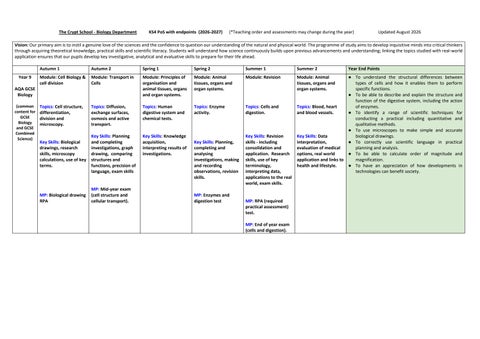
The Crypt School - Biology Department KS4 PoS with endpoints (2026-2027) (*Teaching order and assessments may change during the year) Updated August 2026
Vision: Our primary aim is to instil a genuine love of the sciences and the confidence to question our understanding of the natural and physical world. The programme of study aims to develop inquisitive minds into critical thinkers through acquiring theoretical knowledge, practical skills and scientific literacy. Students will understand how science continuously builds upon previous advancements and understanding; linking the topics studied with real-world application ensures that our pupils develop key investigative, analytical and evaluative skills to prepare for their life ahead.
Module: Cell Biology & cell division
Module: Transport in Cells
AQA GCSE Biology (common content for GCSE Biology and GCSE Combined Science)
Topics: Cell structure, differentiation, division and microscopy.
Key Skills: Biological drawings, research skills, microscopy calculations, use of key terms.
Topics: Diffusion, exchange surfaces, osmosis and active transport.
Key Skills: Planning and completing investigations, graph drawing, comparing structures and functions, precision of language, exam skills
Module: Principles of organisation and animal tissues, organs and organ systems.
Topics: Human digestive system and chemical tests.
Key Skills: Knowledge acquisition, interpreting results of investigations.
Module: Animal tissues, organs and organ systems.
Topics: Enzyme activity.
Module: Revision
Module: Animal tissues, organs and organ systems.
Topics: Cells and digestion.
Topics: Blood, heart and blood vessels.
● To understand the structural differences between types of cells and how it enables them to perform specific functions.
● To be able to describe and explain the structure and function of the digestive system, including the action of enzymes.
● To identify a range of scientific techniques for conducting a practical including quantitative and qualitative methods.
MP: Biological drawing RPA
MP: Mid-year exam (cell structure and cellular transport).
Key Skills: Planning, completing and analysing investigations, making and recording observations, revision skills.
MP: Enzymes and digestion test
Key Skills: Revision skills - including consolidation and application. Research skills, use of key terminology, interpreting data, applications to the real world, exam skills.
Key Skills: Data interpretation, evaluation of medical options, real world application and links to health and lifestyle.
● To use microscopes to make simple and accurate biological drawings.
● To correctly use scientific language in practical planning and analysis.
● To be able to calculate order of magnitude and magnification.
● To have an appreciation of how developments in technologies can benefit society.
MP: RPA (required practical assessment) test.
MP: End of year exam (cells and digestion).
Year 10
Module: Plant & animal tissues, organs and systems & Infection and response.
Topics: Plant tissues, organs and systems. Non-communicable disease, health, cancer. Communicable diseases, pathogens, defence, microbiology, drug development and monoclonal antibodies.
Key Skills: Data analysis, evaluation and drawing conclusions with ethical considerations. Aseptic techniques and microbiology calculations.
MP: September reviewyear 9 content.
Module: Bioenergetics & Revision. Topics: Photosynthesis, respiration, exercise and metabolism. Heart structure.
Module: Homeostasis and response. Topics: Nervous system, endocrine system and control of body temperature and blood glucose.
Module: Homeostasis and response & Revision.
Topics: Maintaining water and nitrogen balance. Human reproductive hormones, contraception and infertility.
Module: Homeostasis and response Topics: Plant hormones
Module: Ecology
Year 10
Combined AQA GCSE
Combined Science: Trilogy
Module: Plant & animal tissues, organs and systems & Infection and response.
Topics: Plant tissues, organs and systems. Non-communicable disease, health, cancer. Communicable diseases, pathogens, defence, drug development.
Key Skills: Data analysis, evaluation and drawing conclusions with ethical considerations.
MP: September reviewyear 9 content.
Key Skills: Interpreting graphs, practical design, data analysis and evaluation, exam skills, dissection. MP: Infection and response test.
Module: Bioenergetics & Revision.
Key Skills: Investigation design, safe and ethical completion using live organisms. Dissection.
MP: Mid year assessment (paper 1 content).
Module: Homeostasis and response.
Topics: Photosynthesis, respiration, exercise and metabolism. Heart structure.
Topics: Nervous system, endocrine system and control of blood glucose.
Key Skills: Revision techniques, interpreting, analysing graphs and drawing conclusions. MP: Homeostasis test.
Key Skills: Designing and performing an investigation that requires consideration of time (over several days), interpreting and analysing results.
MP: Exam week - AQA Paper 1
Topics: Adaptations, interdependence and competition. Abiotic and biotic factors. Levels of organisation and sampling.
● To understand how organisms interact and are adapted to their environment for survival.
● To understand how to study ecosystems and the effect that humans have on them.
● To have a fundamental understanding of the functioning of organ systems in plants and animals.
● To understand the processes of photosynthesis andrespirationandtheirimportanceforbiology.
● To understand disease and the effect on plants and animals.
● To understand the structure and function of the nervous and endocrine and excretory system.
● To develop a range of practical skills using living organisms.
Key Skills: Sampling techniques, research and identification skills, practical measurements and considerations of outdoor investigations.
● To have the ability to transfer their mathematical skills to a biological context.
● To develop a range of scientific writing skills in a biological context.
Key Skills: Interpreting graphs, practical design, data analysis and evaluation, exam skills, dissection.
MP: Infection and response test.
Key Skills: Investigation design, safe and ethical completion using live organisms. Dissection.
MP: Mid year assessment (paper 1 content).
Module: Homeostasis and response & Revision.
Topics: Maintaining water and nitrogen balance. Human reproductive hormones, contraception and infertility.
Key Skills: Revision techniques, interpreting, analysing graphs and drawing conclusions.
MP: Homeostasis test.
Module: Ecology Topics: Adaptations, interdependence and competition. Abiotic and biotic factors. Levels of organisation and sampling.
Key Skills: Sampling techniques, research and identification skills, practical measurements and considerations of outdoor investigations.
MP: Exam week - AQA Paper 1
MP: Ecology test.
Module: Ecology Topics: Nutrient cycles, pollution and ecosystems.
● To understand how organisms interact and are adapted to their environment for survival.
● To understand how to study ecosystems and the effect that humans have on them.
● To have a fundamental understanding of the functioning of organ systems in plants and animals.
● To understand the processes of photosynthesis and respiration and their importance for biology.
● To understand disease and the effect on plants and animals.
Key Skills: Sampling techniques and fieldwork.
● Tounderstandthestructureandfunction ofthe nervous and endocrine system.
● To develop a range of practical skills using living organisms.
● To have the ability to transfer their mathematical skills to a biological context.
MP: Ecology test
● To develop a range of scientific writing skills in a biological context.
Year 11
Triple
AQA GCSE
Biology
Module: Homeostasis and Inheritance
Topics: Human reproduction, plant hormones, DNA.
Key Skills: Interpreting charts, planning and implementing and investigation, revision skills.
Module: Inheritance
Topics: Inheritance, classification. Paper 1 revision. Key Skills: Performing genetic crosses, application of knowledge, understanding how the work of scientists influences our understanding of biology, exam skills.
MP: September reviewyear 9 content
MP: Homeostasis test
Year 11
Combined
AQA GCSE
Combined Science: Trilogy
Module: Homeostasis and Inheritance
Topics: DNA and Inheritance, meiosis, reproduction.
Key Skills: Interpreting charts, genetic crosses, planning and implementing and investigation, revision skills.
MP: September reviewyear 9 content
MP: Homeostasis test
Module: Inheritance
Topics: Evolution and natural selection, speciation, selective breeding, cloning, genetic engineering. Paper 2 revision.
Key Skills: Evaluating modern technologies, classifying information, study skills.
Module: Revision
Lessons: Revision
Topics: Paper 2
Topics: Paper 1
Key Skills: All skills required for the GCSE.
Key Skills: All skills required for the GCSE. EXAMS
● To begin to understand the importance of the genome in inheritance and an introduction to genetic engineering.
● To understand how and why organisms evolve and how modern classification systems have developed.
● To be able to write scientifically using key biological terminology
● To design experiments to test hypotheses to produce valid results.
● To have an understanding of the range of scientific equipment and how to use it in the laboratory.
● To understand the principles of data handling and analysis.
● To develop their interest and enthusiasm for biology to have confidence in their ability for further study.
● To evaluate the personal, moral and ethical implications of scientific technology.
MP: Mock exams - AQA Paper 1
MP: Inheritance questions
MP: AQA Paper 2
Single Science: Paper 1 (Modules 1-4): 1 hour and 45 minutes Paper 2 (Modules 5-7): 1 hour and 45 minutes
Module: Inheritance
Topics: Inheritance, classification.
Key Skills: Application of knowledge, understanding how the work of scientists influences our understanding of biology.
MP: Mock exams - AQA Paper 1
Module: Inheritance
Topics: Natural selection, selective breeding, genetic engineering.
Key Skills: Evaluating modern technologies, classifying information, study skills.
Module: Revision
Topics: Paper 2 Key Skills: All skills required for the GCSE.
Lessons: Revision
Topics: Paper 1
● To begin to understand the importance of the genome in inheritance and an introduction to genetic engineering.
● To understand how and why organisms evolve and how modern classification systems have developed.
● To be able to write scientifically using key biological terminology
Key Skills: All skills required for the GCSE.
● To design experiments to test hypotheses to produce valid results.
● To have an understanding of the range of scientific equipment and how to use it in the laboratory.
● To understand the principles of data handling and analysis.
EXAMS
Combined Science:
MP: Inheritance questions
MP: AQA Paper 2
Paper 1 (Modules 1-4): 1 hour and 15 minutes
Paper 2 (Modules 5-7): 1 hour and 15 minutes
● To develop their interest and enthusiasm for biology to have confidence in their ability for further study.
● To evaluate the personal, moral and ethical implications of scientific technology.
OCR (A) Alevel
Biology
Year 12
Biological processes
Teacher 1
Module 1: Practical skills (continued throughout the course).
Module 2: Foundations in biology.
Topics: Biological molecules.
Key Skills: Comparing biochemical structures, study skills, compare and contrast, linking structure to function.
MP: Practical skills.
OCR (A) Alevel
Biology
Year 12
Biological diversity
Teacher 2
Module 1: Practical skills (continued throughout the course).
Module 2: Foundations in biology.
Topics: Cell structure and nucleotides.
Key Skills: Comparing biological structures, microscopy, study skills, use of computers.
MP: Baseline review
Module 2: Foundations in biology.
Topics: Enzymes and biological membranes.
Key Skills: Practical investigation, data interpretation inc. graphical and tabular data.
MP: Module 2 testtopics 2.4, 2.5 & 2.6.
Module 3: Exchange and transport.
Topics: Exchange surfaces and breathing.
Key Skills: Using models, dissection and biological drawing.
MP: Mid-year assessmentfoundations in biology.
Module 3: Exchange and transport.
Topics: Transport in animals.
Key Skills: Dissection, graphical data interpretation, method planning.
Module 3: Exchange and transport.
Topics: Transport in plants.
Key Skills: Microscopy, application and exam practice.
MP: End of year assessmentbiological processes paper.
Module 5: Communication, homeostasis and energy.
Topics: Communication and homeostasis, excretion.
Key Skills: Microscopy, histology, linking structure to function, biological drawing.
● To have an understanding of the cellular structure, biochemistry and function of the living organism.
● To understand the structural and functional adaptationsof plantsandanimalsinterms of their exchange and transport systems.
● To have an understanding of the variety of organisms that are pathogenic and how plants and animals have developed defences to deal with disease.
● To have an understanding of the importance of biodiversity and an appreciation for the need for conservation.
● To beabletosuccessfully utilisemicroscopes to draw and calculate size of specimens.
● To use a range of biochemical techniques including quantitative and qualitative testing.
● To develop an understanding of the ethical use of living organisms in a practical context.
Module 2: Foundations in biology.
Topics: Cell division, cell diversity and cell differentiation.
Key Skills: Microscopy, biological investigation.
MP: Module 2 testtopics 2.1, 2.2 & 2.3.
Module 4: Biodiversity, evolution and disease.
Topics: Communicable diseases and biodiversity.
Key Skills: Linking structure to function, application of knowledge, outdoor investigative methods, statistics.
MP: Mid-year assessmentfoundations in biology.
Module 4: Biodiversity, evolution and disease.
Topics: Classification.
Key Skills: Statistics and application of statistics.
Module 6: Genetics and ecosystems.
Topics: Cellular control.
Key Skills: Exam application, use of keywords and exam specific language.
MP: End of year assessmentbiological diversity.
Module 6: Genetics and ecosystems.
Topics: Patterns of inheritance.
Key Skills: Interpretation and drawing of genetic diagrams
● To acquire a competence in the manipulation of qualitative and quantitative data including statistical testing.
OCR (A) Alevel
Biology
Year 13
Biological processes
Teacher 1
Module 5: Communication, homeostasis and energy.
Topics: Neuronal and hormonal control.
Key Skills: Relating structure to function, revision.
MP: September assessment - AS topics: biological processes.
OCR (A) Alevel
Biology
Year 13
Biological diversity
Teacher 2
Module 6: Genetics and ecosystems.
Topics: Patterns of inheritance and manipulating genomes.
Key Skills: Drawing and interpreting genetic diagrams, interpretation of genetic fingerprints
MP: September assessment - AS topics: biological diversity.
Module 5: Communication, homeostasis and energy.
Topics: Plant and animal responses.
Key Skills: Application of theory into novel scenarios
MP: November assessment - mainly module 5.1, 5.2, 5.3 & 5.4.
Module 6: Genetics and ecosystems.
Topics: Cloning and biotechnology.
Key Skills: Evaluating ethical dilemmas, use of aseptic techniques, social and economic implications for the future.
MP: November assessment - mainly module 6.1, 6.2 & 6.3.
Module 5: Communication, homeostasis and energy.
Topics: Photosynthesis.
Key Skills: Research, citation, analysis, evaluation, chromatography.
MP: Mock examcombined processes and diversity questions.
Module 6: Genetics and ecosystems.
Topics: Ecosystems.
Key Skills: Analysis and evaluation of socioeconomic impacts within biology.
Module 5: Communication, homeostasis and energy.
Topics: Respiration.
Key Skills: Development of scientific knowledge, revision techniques.
Summary review, revision and linking knowledge.
Topics: Unified biology and revision.
Key Skills: Drawing links between topics, effective revision strategies, application of knowledge. Review of all skills required for the A-level exams.
Module 6: Genetics and ecosystems.
Topics: Populations and sustainability.
Key Skills: Analysis and evaluation of socioeconomic impacts within biology.
MP: Mock exam - full paper 3: unified biology.
Summary review, revision and linking knowledge.
Topics: Unified biology and revision.
Key Skills: Drawing links between topics, effective revision strategies, application of knowledge. Review of all skills required for the A-level exams.
EXAMS
Paper 1 - Biological processes (Modules 1, 2, 3&5): 2h15
Paper 2 - Biological diversity (Modules 1, 2, 4&6): 2h15
Paper 3 - Unified biology (All content - links drawn between modules): 1h30
● To have an understanding of the range of biochemical and physiological processes in plants and animals.
● To have an appreciation of the complexity of the genome and the associated technologies in the real world.
● To have an understanding of the diversity of life.
● Tobeabletoeffectivelyplanandcritically analyse and evaluate scientific experiments.
● Tobeanadeptpracticalbiologistwhocan safely and correctly use laboratory equipment.
● To develop competence and confidence in mathematical and problem-solving skills.
● To develop their interest and enthusiasm for biology including developing an understanding of post-education opportunities relating to biology.
● To understand how society makes decisions about scientific issues and how biology contributes to the success of society.