The Crypt School - Business Department
KS4/5 Programme of Study
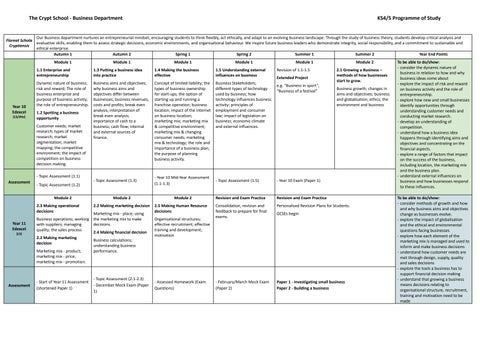
Our Business department nurtures an entrepreneurial mindset, encouraging students to think flexibly, act ethically, and adapt to an evolving business landscape. Through the study of business theory, students develop critical analysis and Floreat Schola evaluative skills, enabling them to assess strategic decisions, economic environments, and organisational behaviour. We inspire future business leaders who demonstrate integrity, social responsibility, and a commitment to sustainable and Cryptiensis ethical enterprise. Autumn 1 Autumn 2 Spring 1 Spring 2 Summer 1 Summer 2 Year End Points Module 1
Year 10 Edexcel (LS/JHo)
1.4 Making the business effective
1.5 Understanding external influences on business
Dynamic nature of business; risk and reward; The role of business enterprise and purpose of business activity; the role of entrepreneurship.
Business aims and objectives; why business aims and objectives differ between businesses; business revenues, costs and profits; break even analysis; interpretation of break even analysis; importance of cash to a business; cash flow; internal and external sources of finance.
Concept of limited liability; the types of business ownership for start-ups; the option of starting up and running a franchise operation; business location; impact of the internet on business location; marketing mix; marketing mix & competitive environment; marketing mix & changing consumer needs; marketing mix & technology; the role and importance of a business plan; the purpose of planning business activity.
Business Stakeholders; different types of technology used by business; how technology influences business activity; principles of employment and consumer law; impact of legislation on business; economic climate and external influences.
1.2 Spotting a business opportunity
- Topic Assessment (1.2) Module 2 2.3 Making operational decisions
(LS)
Assessment
Module 1
1.3 Putting a business idea into practice
- Topic Assessment (1.1)
Year 11 Edexcel
Module 1
1.1 Enterprise and entrepreneurship
Customer needs; market research; types of market research; market segmentation; market mapping; the competitive environment; the impact of competition on business decision making.
Assessment
Module 1
- Topic Assessment (1.3)
Revision of 1.1-1.5 Extended Project e.g. “Business in sport”, “Business of a festival”
- Topic Assessment (1.5)
- Year 10 Exam (Paper 1)
Module 2 2.1 Growing a Business – methods of how businesses start to grow. Business growth; changes in aims and objectives; business and globalisation; ethics; the environment and business
Module 2
Module 2
Revision and Exam Practice
Revision and Exam Practice
2.2 Making marketing decision
2.5 Making Human Resource decisions
Consolidation, revision and feedback to prepare for final exams.
Personalised Revision Plans for Students.
- February/March Mock Exam (Paper 2)
Paper 1 - Investigating small business Paper 2 - Building a business
Marketing mix - place; using Business operations; working the marketing mix to make with suppliers; managing decisions. quality; the sales process 2.4 Making financial decision 2.2 Making marketing Business calculations; decision understanding business Marketing mix - product; performance. marketing mix - price; marketing mix - promotion.
- Start of Year 11 Assessment (shortened Paper 1)
- Year 10 Mid-Year Assessment (1.1-1.3)
Module 1
- Topic Assessment (2.1-2.3) - December Mock Exam (Paper 1)
Organisational structures; effective recruitment; effective training and development; motivation
- Assessed Homework (Exam Questions)
GCSEs begin
To be able to do/show: -consider the dynamic nature of business in relation to how and why business ideas come about -explore the impact of risk and reward on business activity and the role of entrepreneurship. -explore how new and small businesses identify opportunities through understanding customer needs and conducting market research. -develop an understanding of competition. -understand how a business idea happens through identifying aims and objectives and concentrating on the financial aspects. -explore a range of factors that impact on the success of the business, including location, the marketing mix and the business plan. -understand external influences on business and how businesses respond to these influences. To be able to do/show: -consider methods of growth and how and why business aims and objectives change as businesses evolve. -explore the impact of globalisation and the ethical and environmental questions facing businesses -explore how each element of the marketing mix is managed and used to inform and make business decisions -understand how customer needs are met through design, supply, quality and sales decisions -explore the tools a business has to support financial decision making -understand that growing a business means decisions relating to organisational structure, recruitment, training and motivation need to be made
The Crypt School - Business Department Autumn 1
(NP)
Autumn 2
1.1 Meeting Customer Needs
1.3 Marketing mix and strategy
The market Market research Market segmentation Market positioning
Design Mix Branding Types of promotion Pricing strategies Distribution channels Product life cycle Marketing strategies Consumer behaviour
1.2 The Market Y12 Business Edexcel
Demand Supply Market Equilibrium PED YED
Spring 1
KS4/5 Programme of Study
Spring 2
Summer 1
Summer 2
1.4 Managing People
1.5 Entrepreneurs and Leaders
Revision and Exam Practice
4.1 Globalisation
Recruitment, selection and training Organisational structures Motivation theories Leadership and management
Role of an entrepreneur Intrapreneurship Business objectives Sole traders, partnerships, Ltds & Franchising Social enterprise, lifestyle and Online businesses Business choices
Consolidation, revision and feedback.
Growing economies International trade and business growth Factors contributing to increased globalisation Protectionism Trading Blocs
Year End Points To be able to do/show: - understand how businesses identify opportunities - explore how businesses focus on developing a competitive advantage through interacting with customers - develop an understanding of how businesses need to adapt their marketing to operate in a dynamic business environment. - explore how businesses recruit, train, organise and motivate employees - consider the role of enterprising individuals and leaders. - investigate different types and sizes of organisation in various business sectors and environments, and in local, national and global contexts.
2.1 Raising finance
2.3 Managing Finance
2.4 Resource Management
2.5 External Influences
Revision and Exam Practice
Internal finance External finance Liability Business plans Cash flow
Profit Profitability Balance sheets Liquidity Business failure
Methods of production Productivity and efficiency Capacity utilisation Stock control diagrams JIT Lean production Quality Methods
The business cycle Inflation Exchange rates Interest rates Taxation and Government spending Economic uncertainty Consumer legislation Employment legislation Environmental legislation Influence of competition Competition legislation
Consolidation, revision and feedback.
Y12 Business Edexcel
2.2 Financial planning
(LS)
Sales forecasting Sales, revenue and costs Break-even Budgets
Baseline Knowledge Assessment Assessment
Topic Assessment (1.2)
January Exam (1.1-1.3 & 2.1-2.3)
Assessed Task (1.3)
Topic Assessment (1.4/1.5)
Topic Assessment (2.2/2.3)
3.1 Business objectives and strategy Corporate objectives Theories of corporate strategy SWOT analysis Impact of external influences
- develop an understanding of raising and managing finance, and measuring business performance. - understand the importance of using resources efficiently within a business to ensure that goods or services can be delivered effectively and efficiently, and to a high quality. - consider the external influences that have an impact on businesses, including economic and legal factors.
End of Year Exams - Paper 1 (Theme 1) - Paper 2 (Theme 2)
The Crypt School - Business Department Autumn 1 Module 3.9 Strategic Methods: How to Pursue Strategies Y13 Business AQA
Assessing a Change in Scale; Innovation
Autumn 2
Spring 1
Module 3.9 Strategic Methods: Module 3.10 Managing How to Pursue Strategies Strategic Change Internationalisation; Assessing Greater use of Digital Technology
Problems with strategies and why strategies fail; Managing Change
Spring 2 Module 3.10 Managing Strategic Change Managing change; Managing organisational culture
Summer 1
Summer 2
KS4/5 Programme of Study Year End Points
Revision and Exam Practice
To be able to do/show:
Personalised Revision Plans for Students.
‐the importance of the context of business in relation to decision making
A-Levels Begin
‐the interrelated nature of business activities and how they affect competitiveness
(NP/CWG)
‐the competitive environment and the markets in which businesses operate
Y13 Business AQA
Module 3.7 Analysing The Strategic Position of a Business.
Module 3.7 Analysing The Strategic Position of a Business.
Data analysis; Political and legal change.
Economic change; Social and technological change; The competitive environment
(LS)
Module 3.10 Managing Strategic Change Managing strategic implementation
‐the influences on functional decisions and plans including ethical and environmental issues
Revision and Exam Practice
‐the factors that might determine whether a decision is successful eg the quality of data and the degree of uncertainty
Consolidation, revision and feedback.
‐how technology is changing the way decisions are made and how businesses operate and compete ‐the impact on stakeholders of functional decisions and their response to such decisions ‐use of non-quantitative and quantitative data in decision making ‐the impact of technology on strategic decision making
Topic Assessment (3.7.2) Assessed Homework (3.8-3.9) Assessment
November Internal Exam (A level Paper 2) Topic Assessment (3.1-3.7)
Mock Exams - A level Paper 1
Paper 1: Business 1
- A level Paper 3
Paper 2: Business 2 Paper 3: Business 3
Topic Assessment (3.10)
‐the influences of Corporate Social Responsibility, ethical and environmental issues on strategic decisions ‐the difficulties in forecasting future trends ‐the importance of assessing feasibility and risk when making strategic decisions ‐the impact on stakeholders of strategic decisions and their response to such decisions.