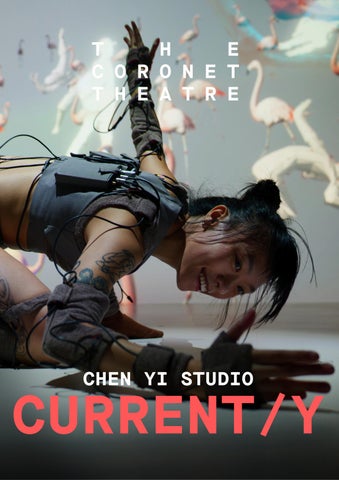
CHEN YI STUDIO
CURRENT/Y
WELCOME TO LONDON’S INTERNATIONAL THEATRE The Coronet Theatre is a reimagined architectural and design jewel, originally built as a grand Victorian Playhouse, now a pioneering home for international, cross-disciplinary arts. Curated by Artistic Director Anda Winters, over the past decade it has become a significant cultural landmark. Known for world and UK premieres, its mission is to bring artists and art forms from around the world, championing work that would not otherwise be seen. The programme enables access for diverse audiences to world-class theatre, dance, music, film and visual arts through co-productions, commissions, and invited works. Centrally situated in London’s Notting Hill, The Coronet has two main spaces: The Auditorium and The Print Room Studio. With the additional performances and exhibitions in the bar, the atmospheric upper rooms, and basements, the whole building is a living global showcase.
CURRENT/Y CHEN
YI
STUDIO
A DANCER COMES FACE-TO-FACE WITH HER LIVE DIGITAL TWIN Current/y is an immersive work by Taiwanese artist Chen Yi combining live performance, motion capture, game-engine technology, lasers, large-scale projection and an immersive spatial soundscape. Equipped with XSENS motion capture sensors, a dancer controls her avatar in a real-time duet, interacting with a constantly shifting virtual world projected across a vast screen. Moving through the work as if scrolling through a social media feed, the performer enters a space governed by data and algorithms, where clicks, followers and attention become measures of human value – a kind of currency. Part of Chen Yi’s ongoing Current/y series, the work continues to explore the idea of value in an age of rapid technological change – from cryptocurrency and online communities to misinformation, digital authority, surveillance and the economies of attention.
CAST & CREATIVE TEAM Concept / Director CHEN Yi Choreography / Dramaturgy of performance CHOU Kuan-Jou Performer TU Livier Avatar Performers TU Livier, CHOU Kuan-Jou New Media & Visual Art XTRUX (SU Po-Jui, CHIU Chen-En, LI Jyun-Jyue) Music & Sound Design SHENG Character Voice CHEN Uray, CHOU Kuan-Jou Dramaturgy (Dialogue) YANG Yu-Chiao, CHEN Uray, CHOU Kuan-Jou, TU Livier, CHEN Yi
(
AI Interactive Visuals CHENG Ko-Chun Sonic Deadhorse) 3D Character Design CHIU Chen-En, LU Ssu-Han Costume Design CHEN Ya-Chi Stage Manager LIN Ying-Chen Lighting Design LIN Ying-Chen Project Managers YANG Shu-Han, WU Po-Shan International Tour Manager YANG Shu-Han Production Companies CHEN Yi Studio, LuxuryLogic.Co Co-production Taiwan Contemporary Culture Lab (C-LAB) Grant Sponsors Ministry of Culture (Art and Technology Development Grant), C-LAB Special Thanks: National Taiwan Science Education Center, Department of Digital Media Design at China University of Technology
CHEN YI STUDIO Chen Yi Studio was founded in 2021, with Chen Yi (co-founder of the art collective LuxuryLogico) serving as its artistic director. It is a Taiwanese creative team dedicated to the development of technological art and experimental cross-disciplinary performances. Centred on art, the studio integrates a collaborative ecosystem across multiple fields, exploring the boundaries and possibilities of online and offline, virtual and physical performances, inspiring new digital aesthetics and creativity.
Current/y 2022 AR, mixed mechanical installation
THE FOUR ACTS OF CURRENT/Y Act One: Digital Twin The birth of the virtual twin marks the dancer’s initial entrance into the digital world, detached from reality and immersed in a space filled with boundless possibilities. Here, traditional social frameworks disappear, leaving only metrics, clicks, and attention. Visuals and sound are infused with data symbols, representing technology’s grip on humanity. Act Two: The Pursuit of Metrics The dancer becomes increasingly lost in the world of self-media and influencer culture, endlessly chasing clicks and followers as a measure of self-worth. As her fixation on metrics intensifies, her sense of personal value rapidly diminishes. Visually, the stage projects streaming social media comments, subscription notifications, and data dynamics, capturing the fragmentation of identity in the digital age. Act Three: Digital Self-Creation Amid the anxieties of the digital era, the dancer’s virtual twin is ensnared in relentless self-curation and refinement, striving to create a flawless image. She meticulously crafts each move and expression to convey a vibrant, multi-faceted life that aligns with digital standards of validation. Act Four: Lost and Reborn When the virtual twin is finally engulfed by a vortex of metrics and data, the dancer experiences profound self-doubt and anxiety, as though bound by invisible chains. The stage lighting dims, creating an oppressive atmosphere. Yet, amid this turmoil, the dancer begins to rediscover her true sense of self-worth, reconnecting with the real world and gradually journeying toward rebirth and awakening.
CHEN YI Across a career spanning installation, new media, performance and public art, Taiwanese artist Chen Yi has used technology to examine something fundamental: how we understand ourselves and the world around us. At the heart of Chen’s work is a recurring dialogue between the tangible and the virtual. His practice considers subjects including desire, existence, data, politics, economics, society and the environment, often bringing apparently disparate ideas and media together within a single constructed world. Rather than treating physical and digital experience as opposites, Chen is interested in what happens where the two meet – and in the new behaviours, values and identities that emerge.
Born in Yunlin, Taiwan, in 1979, Chen studied Landscape Architecture at Tunghai University before completing a master’s degree in Technology and Art at Taipei National University of the Arts. His early career quickly established him as an important voice in Taiwan’s new-media art scene. In 2006, he received the top prize at the Taipei Arts Awards, alongside the S-An Art Award, beginning a practice spans disciplines, materials and forms. His approach took a significant new direction in 2010 when Chen co-founded the Taiwanese art collective LuxuryLogico. Bringing together artists with backgrounds spanning sculpture, mechanical installation, spatial and programmed imagery, music, choreography and curating, the group developed its practice around the idea of the hybrid. Their work combines music, visual art, installation and text while moving freely between theatre, film, dance, architecture and public space. Technology sits alongside an equally strong interest in nature and human behaviour: LuxuryLogico has described its practice as seeking a kind of harmony between the extremes of technology and humanity.
That philosophy has produced works on dramatically different scales. Fly! No Matter What, begun in 2011 and developed over subsequent years, grew into a large-scale co-creation project; kinetic and sound installation Rain Haze transformed discarded marine materials into an evocation of the surface of the sea; while The Sound of Blooming, created for the 2018 Taichung World Flora Exposition, brought together mechanical movement, light and sound on a monumental scale. LuxuryLogico’s work has travelled internationally, appearing at the Asian Art Biennial, Asia Triennial Manchester, Thailand Biennale and Echigo-Tsumari Art Triennale, among others. In Taiwan, the collective has also worked far beyond conventional gallery spaces, creating major public installations and contributing to large-scale civic and cultural events. Collaboration is fundamental to this practice. Rather than seeing an artwork simply as a finished object, LuxuryLogico approaches making as a process through which new relationships can be formed – between artists and disciplines, but also between technology, environments and audiences. Alongside this collaborative work, Chen Yi has continued to develop his individual artistic practice internationally. Artist residencies have taken him from 18th Street Arts Center in Los Angeles and the École Nationale Supérieure des Beaux-Arts in Paris to Openspace Bae in Busan. In 2021 he was artist-in-residence at Künstlerhaus Bethanien in Berlin, where his work continued to investigate the increasingly blurred boundary between physical and virtual existence. His solo exhibition Lichen_ at Künstlerhaus Bethanien reflected a longstanding characteristic of his practice: taking systems and phenomena from the world around us and reconstructing them through technology, space and artistic intervention.
Across these projects, Chen repeatedly returns to questions of connection. What happens when human experience is translated into information? How do technological systems alter the way we see the world? And what becomes of individual identity when our physical and virtual lives can no longer easily be separated? In 2021, Chen founded Chen Yi Studio, creating a new platform for technological art and experimental cross-disciplinary performance. Working collaboratively across artistic fields, the studio explores the possibilities created by encounters between online and offline space, and between virtual and physical performance.
WHAT DOES ‘CURRENT/Y’ MEAN? Part of an ongoing series, this work explores the idea of value in an age of rapid technological change. From cryptocurrency and online communities to misinformation, digital authority, surveillance and the economies of attention. The series as a whole looks at how value is created and understood in digital spaces. The Mandarin title of the artwork “ ” is a combination of two characters, “current” and “gold”.
鎏
The slash in the English title, Current/y, suggests an either/or duality. But it can also be read as a separation mark in programming, used for folders and file paths. These two meanings reflect the ideas explored throughout the series: the transactional flow of different kinds of virtual currencies.
INSIDE THE TECHNOLOGY OF CURRENT/Y In Current/y, dancer Livier Tu moves across the stage while another version of her body moves through a digital world. Connected through motion capture technology, performer and avatar move together in real time, blurring the boundary between the physical and virtual. The result is a digital double that moves with the performer in real time. The more complicated task, however, was working out how one live body could exist alongside an entire virtual cast.
FROM BODY TO AVATAR Motion capture is often associated with film production: an actor performs in a studio, their movements are recorded, and those recordings eventually become the movements of a digital character. Current/y brings part of this process onto the stage. Livier Tu wears an Xsens MVN Link suit beneath a costume created specifically to accommodate its sensors. As they move, the system captures motion data and sends it into Unreal Engine using Xsens Live Link. Rather than waiting for Tu’s movement to be processed later, the digital character can respond as the performance happens. The physical and virtual bodies are therefore connected, but they inhabit very different spaces. One exists in front of the audience; the other inside a digital environment projected around them.
CHOREOGRAPHING SIXTEEN CHARACTERS The world of Current/y contains sixteen characters in total: the protagonist’s live-controlled digital double and fifteen additional virtual figures. Creating them presented the company with a practical problem: during production, only two Xsens systems were available. Rather than capturing an entire digital ensemble simultaneously, the team built it piece by piece, recording two performers at a time before importing their movements into the virtual environment for review. If a movement didn’t work, or an inconsistency became apparent, it had to be recorded again. The choreography and spatial pathways of all fifteen characters therefore had to be precisely planned, anticipating how bodies captured at different moments would eventually interact and come together as a single virtual ensemble.
PERFORMING WITH SOMETHING THAT ISN’T THERE Once Current/y reaches the stage, the technological challenge becomes a human one. The protagonist’s digital double is generated live, but much of the world surrounding it has already been programmed. The virtual characters can’t see Tu or adjust if she arrives a fraction too early or stands slightly further to one side – she has to adjust to them. To make these interactions appear seamless, Tu relies on an exact memory of timing and position, knowing where a virtual body will be even when there is no physical person standing there. It creates an unusual form of duet. One performer may be physically alone on stage while simultaneously dancing with a version of themselves and an ensemble of bodies that exist only as data.
WHERE THE VIRTUAL MEETS THE REAL This tension sits at the heart of Current/y. Its technology can reproduce a body, multiply it and place it inside spaces that could never physically exist on stage, yet bringing those worlds together still depends on something strikingly analogue: hours of choreography and repetition, and a performer’s memory, timing and physical precision. In Current/y, the boundary between performer and avatar becomes increasingly difficult to locate. A movement begins in a human body, becomes data, enters a virtual world and returns to the theatre as an image. The technology doesn’t replace the performer. It extends the space in which the performance
A NOTE FROM THE DIRECTOR Current/y has evolved over four years through three distinct phases, each corresponding to a major technological and cultural shift. Looking back, I see the project as a kind of technological archaeology, an ongoing attempt to understand how different waves of technology reshape human values, emotions, and our perception of reality. The first phase began in 2022 during the global cryptocurrency boom. At that time, the title Current/y was closely connected to the idea of "currency". I became fascinated by how digital assets, composed entirely of code and data, could suddenly generate enormous value or lose it overnight. By 2023, the cryptocurrency frenzy had faded, but the underlying logic remained. Society had simply shifted its attention elsewhere. Instead of financial currencies, people were now trading in attention, visibility, and influence. Likes, views, and followers became a new form of social currency. People increasingly exchanged their personal lives, emotions, and identities for algorithmic recognition.
At this stage, the title Current/y took on a second meaning, relating to the idea of "currently" the endless present moment created by social media feeds. I became interested in how platforms continuously shape our sense of self and how our identities become entangled with systems of visibility and attention. After this second iteration, the project paused for nearly two years. During that time, we continued observing the rapid transformation of the digital landscape. What emerged was something even more disruptive than cryptocurrency or the attention economy: the widespread arrival of generative AI. This became the catalyst for the current version of the work. Today, we are no longer dealing only with human produced content, misinformation, or online manipulation. We are entering a moment where images, voices, memories, and narratives can be generated, altered, and replicated by machines in real time. The distinction between what is real and what is fabricated is becoming increasingly unstable. Through Current/y, I am ultimately asking a simple question: in a world increasingly woven together by code, algorithms, and artificial intelligence, where do the boundaries of human agency and human identity still lie? I don’t want the audience to experience Current/y as a cold technological demonstration. Instead, I hope it feels deeply human, an emotional and psychological journey that mirrors our relationship with the digital world.
The performance follows a character who gradually becomes immersed in systems of visibility, influence, and algorithmic recognition. In the first half of the work, I hope audiences experience the excitement and seduction of that world. There is a sense of possibility, empowerment, and exhilaration. As the protagonist gains attention and influence, the stage becomes increasingly saturated with stimulation, movement, voices, and digital imagery. I want audiences to recognise the addictive pleasure that these systems can generate, because most of us have experienced it ourselves in one form or another. But as the performance progresses, that excitement slowly transforms into exhaustion. What initially appears glamorous and empowering begins to reveal its darker side. The constant pursuit of visibility becomes empty. The desire for recognition becomes isolating. The voices that once offered validation become overwhelming noise. By the end of the work, I hope audiences experience a profound sense of stillness and disillusionment. When the digital world that has been built throughout the performance suddenly collapses, there is a moment of emptiness. It is not intended to be a pessimistic ending, but rather a moment of awakening, a chance to pause and look at ourselves from a distance. Many of the experiences portrayed in the performance are not extraordinary. They are reflections of what many of us do every day when we pick up our phones. We seek recognition, connection, influence, and meaning within digital spaces. But when so much of our attention, emotion, and decision-making is shaped by algorithms, are we truly expanding our freedom, or are we gradually surrendering our agency?
And perhaps most importantly: when we step away from the screen, what remains? What is left of our bodies, our memories, our relationships, and our sense of self when the digital noise finally falls silent? I hope the performance creates a space where audiences can sit with those questions, even if no clear answers exist. Ultimately, the inspiration behind Current/y comes from a simple but urgent question: If technology can now imitate our appearance, our voices, our memories, and even our emotions, what remains uniquely human?
G W A N T O N1 G8
AMBIGUOUS DANCE COMPANY’S
BORAM KIM
AN EXHILARATING DANCE SOLO. A BODY PUSHED TO ITS LIMIT.
NON-ORDINARY SERVICES
D_ANTIDOTE & PALINGENESIS 28-31 Oct
A DOUBLE-BILL FROM AWARD-WINNING TAIWANESE DANCE COMPANY
ONE ARTIST. TWO AIS. AN IMMERSIVE CONCERT GENERATED IN REAL TIME.
<FRANKENTACIT> TACIT GROUP
02–07 Oct
BERLINER ENSEMBLE
DE PROFUNDIS BY OSCAR WILDE “A SENSATIONAL, UNFORGETTABLE SOLO PERFORMANCE.” WELT
THE CORONET THEATRE TEAM Artistic Director & CEO Anda Winters
Box Office Assistant Ivana Dieli
Audience Experience Manager Giudi Di Gesaro
Duty Managers Francesca Battinieri, Annabelle Gardner, Joanna Papanastassiou, Aylin Rodoplu, Hazel Townsend
Company & Production Coordinator Emma Smith Consultant Producer Hetty Shand Finance Manager Andrew Michel General Manager Andy McDonald Lead Technician Louis Williams Marketing Manager (Freelance) Elliot Hall Poetry Coordinator Marion Manning PR Consultant Sharon Kean Producer Daphne Seale Producing & Marketing Assistant Esme Bishop Theatre Administrator / PA to the Artistic Director Vihaan Chandy
Front of House Staff Matilda Badziak, Eugénie Bakker, Samya Bose-Rosling, Theo Chen, Stephanie Christodoulidou, Marcello Crisci, Merilee Ettia-Russell, Cheryl Fairon, Katrina Foster, Trey Francis, Thea Gavanski, Alessandra Gonnella, Hugo Gregg, Li Ikoku-Smith, Dane Kostic, Emma Laird-Craig, Maria Lisberg-Jonasson, Aija Miranda, Hamza Mullick, Andreane Rellou, Robert Veng, Kajsa Wiberg-Norquist Trustees Linda Bernhardt, Mike Fisher, Mimi Gilligan, Jane Quinn, Anda Winters, Bill Winters (Chair) Thank you to our patrons for their generous support: Honorary Trustee Mimi Gilligan Cupola Mike Fisher and T. S. Eliot Foundation Club Room Tom and Maarit Glocer, Julia and Scott Rochester, and Jane Quinn
BECOME A FRIEND BE PART OF LONDON’S INTERNATIONAL THEATRE
FROM JUST £10 PER MONTH
103 NOTTING HILL GATE LONDON W11 3LB HELLO@THECORONETTHEATRE.COM +44 (0) 20 3642 6606 thecoronettheatre.com Instagram: @thecoronettheatre Twitter @coronetthetre