GOVERNANCE
SPECIAL REPORT
AGRICULTURE
Will Police’s Exodus SACCO weather the current storm?
How Virgin Gold Sunflower cooking oil is promoting health and creating wealth
Persistent Fruit Pest delaying Teso factory operations
ON PAGE 25
ON PAGE 5
VOLUME I ISSUE 2 SEPTEMBER 2018 | PRICE IS UGX 5000, KSH 150, RWF 1200, TSH 4000, USD 2
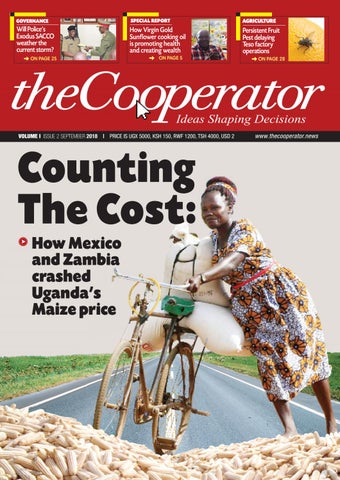
Counting The Cost: How Mexico and Zambia crashed Uganda’s Maize price
ON PAGE 28
www.thecooperator.news
Extra Virgin Gold Sunflower Oil naturalised by steaming
Extra Virgin Sunflower oil contains heart friendly sterols and stanols responsible for lowering cholestrol levels. “ Cook your way to good Health”.
Extra Virgin Gold Sunflower Oil naturalised by steaming
Extra Virgin Sunflower oil contains heart friendly sterols and stanols responsible for lowering cholestrol levels. “ Cook your way to good Health”.
3L 2.7 kg
P.O.Box 59, oad, 3km Lira - kitgum Road, Uganda Tel: 0393224829
Approved vved By
Production date: d Expiry date: te: Store in a cool dry dark place
P.O.Box 59, 3km Lira - kitgum Road, Uganda el: 0393224829 Tel: Approved vved By
Editor’s Note
CONTENTS
15 | FARMING How the Wamala Cooperative survived the Maize Price crash
Consolidate and increase investment in the grain sector The Maize price crash is a reminder that the private sector can not do business without regulation. In the grain sector, the semblance to government intervention is the distribution of improved seeds by the Army led Operation Wealth Creation, inter-government agreements on the sale of maize, and institutions like the Uganda Warehouse Receipt system Authority whose authority will still be derived from its ability maintain a good working relationship with the private sector. Most people in Uganda, including subsistence farmers, grow maize for sale, and other crops for food. It earns the country between 150 - 300 million dollars annually, however, we continue to treat it like a food crop, this has to stop. It is self-defeating to campaign for and demand for another regulator in an era of lean government but someone needs to sleep and dream grain in Uganda, worry about value chains, worry about farmers, and worry about value addition the same way the Uganda Coffee Development Authority does for coffee. The best option is to consolidate and increase investment in all the government institutions in the grain sector. This will take the load off private sector players like the Grain Council of Uganda who have to provide agricultural extension services, while at the same time finding the market for their suppliers.
Collins Hinamundi
25 | GOVERNANCE
Will Police’s Exodus SACCO weather the current storm?
32 | FOOD SECURITY Could the future of food in the world depend on what Africa does with Agriculture?
Meet the team
PUBLISHER Jane Amuge Okello MANAGING EDITOR Collins Hinamundi WRITERS AND CONTRIBUTORS Patrick Jaramogi
Patience Atim Robert Ndawula Leonard Okello DESIGN Design Gallery Media SALES & MARKETING Oscar Obel
3 | ISSUE 2 SEPTEMBER 2018
36 | BANKING What Agency Banking offers Cooperatives www.thecooperator.news
NEWS IN BRIEF
Youth employment is Africa’s big challenge
FAO is a strong supporter of Youth in Agribusiness Forum, which plays a critical advocacy role for its members and facilitates the inclusion of youth in Rwanda’s economic and social transformation. In Sub-Saharan Africa, more than 60 percent of a 1.2 billion population are under the age of 25. Supporting them in obtaining decent jobs, especially in rural areas, is one of the great challenges we are facing in pursuit of a Zero Hunger world and the achievement of the Sustainable Development Goals. The Food and Agriculture Organization of the United Nations (FAO) has rolled out projects from Benin to Zanzibar that increase the engagement, entrepreneurship and employment opportunities for young people.
Vendors form cooperatives to increase revenue
Women Street vendors under their umbrella body ‘Platform for Vendors in Uganda (PLAVU) have formed cooperatives to increase their revenue and market base. Speaking at a presentation of a report about Women Street Vendors in Kampala titled: “The Invisible Labourers of Kampala” by Strategic Initiative for Women in the Horn of Africa (SIHA net) in Kampala on Friday, Flavia Amoding, Chairperson PLAVU said women working in informal sector such as street women vendor are vulnerable yet they have to feed and take care of their families. 4 | ISSUE 2 SEPTEMBER 2018
Kadaga Urges Government to Revive Cooperatives
The speaker of Parliament, Rebecca Kadaga has called on government to restore cooperative unions saying they provide a better way of organizing production, markets and prices of agricultural products. Kadaga was speaking at the second Uganda Netherlands business convention that took place in Amsterdam where she noted that cooperatives will boost the agricultural sector. “When we were children, there was a very vibrant cooperative; Busoga growers’ cooperative Union, it actually lent money to the British government, we had much money that we were able to lend,” said Kadaga
Enveritas’ technology lets small growers tap into the market for sustainable coffee
Demand for sustainable coffee is growing, a boon for socially conscious coffee lovers — but many small growers are missing out because they lack the ability to verify that their coffee beans are grown using sustainable labor and eco-friendly practices. In fact, verification is often accessible only to large coffee estates or cooperatives. Enveritas wants
to change that. The nonprofit, which recently completed Y Combinator’s accelerator program, uses geospatial analysis to make the process more efficient, enabling it to offer free verification to smallholder farms. Enveritas’ goal is to end poverty in the coffee sector by 2030. Before founding Enveritas in 2016, CEO. www.thecooperator.news
ADVERTORIAL
How Virgin Gold Sunflower cooking oil is promoting health and creating wealth
5 | ISSUE 2 SEPTEMBER 2018
The Origins of Lira’s Virgin Gold Sunflower Oil We offer predictable prices to our farmers - Paul Omara How Ngetta Tropical holdings works with Cooperatives www.thecooperator.news
ADVERTORIAL
The Origins of Lira’s Virgin Gold Sunflower Oil Ngetta Tropical holdings has its origins in the decline of the Lango Cooperative Union.
M
r. Paul Omara, the Company’s Chief Executive Officer and Founder says he left his career in banking to start the company whose entry in the cooking oil business has upended the market and sent rivals scrambling to secure their suppliers and customers. ‘’It started in January 2015 after a long and successful career in the Banking sector when Ngetta Tropical Holdings acquired properties of Lango Cooperative Union at Ngetta Hills in Lira town’’ Mr Omara says. He (Omara) argues that the main strategic reason for starting Ngetta Tropical Holdings was to be part of the reconstruction of northern Uganda.
6 | ISSUE 2 SEPTEMBER 2018
BY COLLINS HINAMUNDI The region’s socio-economic way of life was ruined in the 20-year war. He also says he deliberately chose Sunflower because it was economically viable. ‘’We discovered cotton had taken the back leg in terms of a viable crop for transformation and the Mukwanos over the years had invested in sunflower as an alternative viable cash crop for Northern Uganda and the climate there was excellent for it as we have two rainy seasons in a year’’ Mr Omara, who is the company’s Chief Executive Officer says. ‘’Cotton used to be the basis of economic livelihood and the cooperatives were the conduits for mobilizing people for greater production. The value chain system was very well established in the rural areas because
of the cooperative systems that provided cotton seeds to Lango cooperative union for ginning and then the union sold to Lira spinning mill for spinning, therefore, ensuring ready market for what the people were producing but the war totally destroyed everything, forcing people into camps.’’ Mr. Omara says. Mr Omara envisions his company’s role as critical, and having worked as a Banker in five African countries including a stint as CEO of Stanbic Bank Tanzania, he had helped drive investments and capital into different areas. He saw himself playing the same role for Northern Uganda. He used his business connections to build linkages and direct capital to the north, and unlike most beneficiaries of the cooperative movement
www.thecooperator.news
ADVERTORIAL of yester-years, Mr Omara did not turn his back on cooperatives. Ngetta Tropical holdings works directly with farmers in cooperatives to efficiently supply his firm with Sunflower. Mr Omara’s biggest setback is the lack of well organized and strong cooperative societies that are ready to partner with his company. He, therefore, had to find ways of organizing the people into cooperatives so that they can begin to produce something for themselves. “One of the worst effects of the war in the north is the NGO mentality which has entrenched a disabling dependency syndrome, people expect free things and so the majority fold their arms and wait to be provided for. Through the cooperative model and investment in sunflower oil seed, we intend to change that” he says.
7 | ISSUE 2 SEPTEMBER 2018
How Ngetta Tropical holdings works with Cooperatives
A
s most Uganda government efforts to rebuild Northern Uganda like the Northern Uganda Social Action Fund 1,2 and 3 collapse into corruption scandals and value for money audits, it has gradually fallen on the shoulders of private individuals like Mr Paul Omara to rebuild their home. And in 2015, when Mr Paul Omara acquired some of the properties that belonged to the Lango Cooperative Union and started Ngetta Tropical Holdings factory, rebuilding a region destroyed by 20 years of war was high on his mind. The Company deliberately chose to work with cooperatives, and to date, his company has contracted over 25000 Sunflower farmers through 42 cooperatives. This guarantees Ngetta Tropical Holdings consistent supply, and the farmers are guaranteed a market for their sunflower. He offers farmers fixed contracts for their produce, and even if prices change, farmers still get the same price from Ngetta Tropical Holdings. To secure its supply, Ngetta Tropical Holdings is investing in the value chain from where it begins, doing Agriculture extension services that should be the government. The company, with the help of development partners, trains farmers on best practices in Agriculture. ‘’That is not our
core business, ours is supposed to be capital investment, buying the grains, milling, selling or exporting whatever we have but now we have to first train cooperatives and teach them best agronomy practices around sunflower. That means that internally we have to be structured to train people implying meeting operational costs of meeting farmers on a daily basis. So some of the development partners have come to our rescue in terms of financial support so that we could meet some of the expenses’’ Mr Omara says. Ngetta Tropical Holdings appealed to the government to intervene, so the burden can be taken off the company’s financials. ‘’My appeal and hope is that government through the Ministry of Trade, Industry and Cooperatives and Ministry of Agriculture, Animal, Industry and Fisheries set up structures at the district levels that can put in place agricultural officers up to the parish level and then trade officers up to a local level so that they can train cooperatives’’ He says. Cooperatives Ngetta Tropical Holdings CEO Mr. Paul Omara has just been elected the chairman of the Lango Business Cooperative Union, and he believes the problems affecting cooperatives in Uganda start right from governance. He believes if the governance is sorted, all will fall in place. ‘’The only thing that will make cooperatives strong is leadership. Those with great and clear-headed leadership are strong cooperatives they even own trucks, they transport their own grain to the factory, the ones with poor leadership and with no sense of direction are on their feet.’’ he says.
www.thecooperator.news
ADVERTORIAL
Pomp and glamour in Lira as Virigin Gold Sunflower Cooking oil is launched Mr Frederick Gume, the State Minister for Cooperatives, congratulated Mr. Omara and urged him to encourage others to join the same business.
V
BY PATRICK JARAMOGI
irgin Gold, the locally produced sunflower oil was launched at a colourful ceremony held at the Mayor’s Garden in Lira. The event started with a band leading a procession in the streets of Lira town. Not even the scorching sun deterred the ecstatic participants who later returned to the Mayor’s Gardens for the official launch event. Speaking at the event, Mr Paul Omara, the CEO of Ngetta Tropical Holdings Limited, the manufacturers of the Virgin Gold said the launch is a culmination of a three- year journey. Mr. Omara said he had lined up a team of 8 | ISSUE 2 SEPTEMBER 2018
42 contracted cooperatives and others in Acholi and Teso sub-region to supply the plant. “I will not agree that when farmers get a bumper harvest then prices fall. I promised from the start that all that you produce whether at what quantity will be purchased at the agreed price,” Mr Omara said. He said he had partnered with the Microfinance Support Center to purchase all the sunflower seeds produced from the farmers. Erute County South MP, Mr Jonathan Odour, who spoke on behalf of the Lango Parliamentary Forum urged the locals to purchase locally to spur local investors. “When you need urgent cash to be used for construction, paying fees, buying cars and others, you need to grow Soybeans or sunflower but also grow food for consumption
like maize, beans and millet,” he said. Mr Frederick Gume, the State Minister for Cooperatives, who represented the Trade Minister Amelia Kyambadde as chief guest at the launch congratulated Mr Omara and urged him to encourage others to join the same business. He also urged Cooperators to deal with the Uhuru Institute so as to get more organized. “We have 17,000 cooperators, yet more than 9,000 are into savings. I would urge you to work together with the Uhuru Institute for the better,” he said. Lira District Woman MP. Ms Joy Atim Ongom hailed Paul Omara for the initiative and urged the local farmers to add value to their produce so as to earn more. www.thecooperator.news
ADVERTORIAL
We offer predictable prices to our farmers - Paul Omara In an Exclusive Interview, Mr. Paul Omara, Founder and Chief Executive officer of Ngetta Tropical Holdings, talks to our Publisher Jane Amuge Okello about his business Model, and the future of his company
Besides training, what else are you doing in terms of Corporate social responsibility for cooperatives and farmers? We do a lot of extension services, we structured ourselves so that we have extension service programs to farmers. We employ agriculturalists who understand the agronomy of sunflower and every day they are on Motorcycles facing farmers; tackling issues of the crop science, planting, weeding, diseases and so many others. The development partners have been very supportive of this because, alone, we would be encumbered. How do you ensure price stabilization, so that even in a bumper harvest a farmer is guaranteed they are not selling below their production cost? What we do is to keep prior agreed prices based on the farming contracts in place. We stick to those prices (Contractual 9 | ISSUE 2 SEPTEMBER 2018
Farming) because our agenda is anchored in social transformation, profit sharing and making sure farmers benefit from their sweat. In essence, a lot of corporate social responsibility rather than raw capitalism is embedded around the things that we do. When we do not have sufficient cash to buy, we borrow so that we absorb the bulk the farmers have produced. Where do you see Ngetta Tropical Holdings in the next five years? Our strategic ambition is to be the leading agro-processing enterprise in Uganda. We won’t stop on oil, we will be making soap, processing rice, maize flour and adding value to a lot of agricultural produce. We will also be exporting to international markets. In the next five years, we will be the number one. Is there any other threat to your business growth?
I’m always very optimistic, we have moved through challenges over the past three years, there has always been great competition but we have overcome. There is an opportunity for us to build a robust product and grow our distribution channels and continue with quality improvement and expansion of our production volumes and bring on more capital to get us moving. I’m very optimistic even with the challenges we face. What value proposition has given Ngetta Tropical Holdings an edge over its competition? Transparency, and the fact that we care. Our business model is based on profit sharing, indicative and predictive pricing or contractual farming. Extension services to the communities and farmers which is not exercised by the competition and most importantly --we keep our promises to the farmers. www.thecooperator.news
NEWS IN PICTURES
Pictures from the 2018 Coop week, and the Launch of Virgin Gold Sunflower Cooking Oil Munakukama Cooperative Society, winners of the #plantacooptree are awarded a four day learning visit to Kenya
Minister for Trade, Industry and Cooperatives Ms Amelia Kyambadde reading the cooperator Magazine during Coop day celebrations in Jinja.
Minister of state for Cooperatives Mr Frederick Gume Ngobi, Uganda Cooperative Alliance General Secretary, Mr Ivan Asiimwe and the CEO of the Uhuru Institute Mr Leonard Okello cleaning Owino Market during Coop Week 2018
10 | ISSUE 2 SEPTEMBER 2018
www.thecooperator.news
NEWS IN PICTURES
Hon. Kirunda Kivejinja handing over a painting of IK Musaazi to his daughter Elizabeth Musaazi at the IK Musaazi Memorial Lecture, 2018
Nothern Uganda Beauty queens posing with Ngetta Tropical Holdings CEO Paul Omara Cooking Oil
Minister Frederick Gume Ngobi and other visitors inspecting the Virgin Gold Sunflower Cooking oil factory in Lira
11 | ISSUE 2 SEPTEMBER 2018
An excited Cooperator dancing during the 2018 Coop day celebrations in Jinja.
www.thecooperator.news
COVER STORY
Uganda in the era of cheap maize The Maize price started at UGX 1100 in January 2017, rose to UGX 1500 between April and June, then started its race to the bottom.
“The prices had to fall, due to a surplus. We used to export 1.1 million metric tons but this year we have 5.5 million metric tons of maize, that still leaves us with too much even if we sold to Kenya and South Sudan.” Mr Alex Lwakuba
U
12 | ISSUE 2 SEPTEMBER 2018
BY COLLINS HINAMUNDI, PATRICK JARAMOGI AND JANE AMUGE OKELLO
ganda is one of the few countries in East Africa, where a bumper harvest leads to a crisis and leads to a shocking drop in the price of a cash crop with consistent demand levels. But this didn’t just happen; this was a failure on the side of government extension workers, information asymmetry, poor enterprise selection, and the disorganisation and lack of coordinated institutions. To find out what went wrong, we spoke to industry experts, analysts, farmers, traders and Lobbyists. And in this comprehensive report, we explain why the Maize price crashed, and also tell you why we cannot afford to ignore cooperatives and experts anymore. According to the World Data Atlas, Uganda’s
maize production has jumped from 230,000 tonnes in 1967 to 2.66 million tonnes in 2016. The Ministry of Agriculture puts the 2017/2018 at 5.5 Million tonnes, a figure corroborated by the Grain Council of Uganda. 80 percent of this is exported as grain to regional markets. The UN’s Food and Agriculture Organization (FAO) notes that Maize prices have been dropping at the level of 5-20 percent for August and September, 20-30 percent between October 2017 and January 2018. Data from the Regional Agriculture Trade Intelligence Network (RATIN) indicates that the Maize price started at UGX 1100 in January 2017, rose to UGX 1500 between April and June, then started its race to the bottom. www.thecooperator.news
COVER STORY
Maize prices in the region at the time we went to Press Source_RATIN
In Mubende, the Wamala Cooperative Union almost failed to offload more than 30 tonnes of maize because of the maize price, and it took the combined power of a Cooperative to get a fair price outside Uganda. FAO blames the drop on the release of first season stock by traders and newly-harvested second season crops. “Prices of maize in January 2018 were about 40 percent lower than the high levels of 12 months earlier, which were supported by a reduced 2016 crop production due to dry weather,’ FAO notes. The Eastern African Grain Council (EAGC) a member-owned grain trade organisation says the first maize season in East, Central and Southern Africa, often has a bumper harvest because all the grain producers in the region with exception of Uganda produce Maize grain once a year. Uganda, on the other hand, gets to have a second harvest. Unfortunately, this time round most traders in Uganda still have most of the second season harvest in their houses, silos, stores and warehouses. The Commissioner for Crop Services at the Ministry of Agriculture, Mr Alex Lwakuba says Maize prices crash had everything to do with the surplus the country had in the 2017/2018 season. Mr Lwakuba described the 2018 harvest as ‘too much’ “The prices had to fall, due to a surplus. We used to export 1.1 million metric tons but this year we have 5.5 million metric tons of maize, that still leaves us with too much even if we sold to Kenya and South Sudan.” He says this is the reason the prices fell from UGX 1200 in 2017 to a miserly UGX 150 in 2018. ‘’It is simple economics, supply versus demand,” he adds. 13 | ISSUE 2 SEPTEMBER 2018
“We have reached a government-togovernment deal with Mexico and this will make it, not only cheap but also convenient to import maize,” said Dr. Johson Irungu, Director, Crops at Kenya’s Ministry of Agriculture
But this lesson on basic economics from government technocrats and a host of other experts is incomplete without a lecture on capitalism in the grain business. It was possible to plan for and indeed gain from this bumper harvest or warn farmers in advance, but there was no one to do that, the organisations in sector focused on taking out as much as they can like it was the end of the road for maize in Uganda. According to the Eastern African Grain Council (EAGC), in March some of its former members who had formed the Grain Council of Uganda offered the Kenya Cereal
and Produce Board, the region’s largest maize buyer, Maize Grain at UGX 821 a KG. When the government of Kenya agreed to the Grain Council of Uganda’s offer, Abdallah Kamira a maize exporter told China’s Global television network (CGTN) that the deal was good for farmers. “This arrangement will help farmers and traders because now we have got a ready market. Before we were just speculating. People would buy a lot of stock hoping that prices would go up and in the end, it doesn’t raise and in the end, they would lose money,” he said. Unfortunately, Uganda had not anticipated the threat posed by Zambia, whose cost of production allows them to offer the Kenya Cereals and Produce Board Maize at less than UGX 300 per Kg. Zambia’s cost of production is lowered by the country’s investment in Agricultural Mechanisation and the fact that 8 percent of its farmers are Large Scale farmers; One of the largest percentages outside South Africa. The country also has a subsidy programme that supplies grain farmers with seeds and fertiliser below market price. All this makes it possible for Zambia to sell maize grain to Kenya at a price 3 times lower than Uganda’s. The other competition Ugandan farmers did not anticipate, was Maize from Mexico. At the height of Kenya’s grain shortage in May 2017, the government there bought over 300,000 bags of maize from South Africa. The Maize was a surplus from a batch South Africa had imported from Mexico. A few months later Kenya sent its own bureaucrats to Mexico, and in December 2017, they signed a deal to import none GMO maize to Kenya. www.thecooperator.news
COVER STORY The Director of crops at Kenya’s Ministry of Agriculture, Mr Johnson Irungu told the country’s Business Daily Newspaper that the deal was in between the two governments. “We have reached a government-to-government deal with Mexico and this will make it, not only cheap but also convenient to import maize,” said Dr Irungu. Grain being a liberalised sector in Uganda also means, the dealers and traders who were watching developments in Kenya, were forced into offering market prices to farmers a trend that started in July and kept dropping until they got to levels below farmers costs of production. Kenya needs at least 2.9 million tonnes of grain to be food secure but is only able to produce about 1.83 million of that, leaving an annual deficit of 810,000 tonnes. Zambia does not have the capacity to plug this gap, but Mexico, despite the distance has the capacity to plug that gap and Ugandan farmers should be worried. For Mexicans, Maize is entwined in life, history and tradition. It is not just a crop; it is central to their identity. According to the United States Department for Agriculture, Mexico which is the world’s seventh largest producer of maize produced 26 million tonnes of Maize in 2017. However, Mr Kiiza Kizito the Eastern African Grain Council’s Uganda country programme manager, notes that the Mexico deal was a one off amidst fears that the Fall Army Worm would lead to a grain shortage. ‘’The Kenyan government reacted before the harvest and made a decision to import to fill up their food reserve’’ He says. This means the UGX 200-500 Maize may stay longer than anticipated. A bus without a driver... Despite the fact that grain earns Uganda between USD 195 million to USD 325 million a year, the country has no specific organisation dealing with the development of Grain, or an organisation that plays the role the Uganda Coffee Development Authority plays for coffee. This has been left in the hands of the private sector. The 2015 Grain Policy admits that the sector is largely in the hands of private players, and paints a gloomy picture in terms of facts on the ground. “As a liberalized economy, the key players in the grain sub-sector have organized themselves into an association called the Uganda Grain Traders Association (UGTA), and have constructed some storage and processing facilities (12 percent of total output) as well as traded in large volumes with some organizations like the (UN) World Food Program (WFP).” The Ministry of trade also notes in the Grain policy, that Uganda has limited storage facilities. “Currently, the standardized storage facilities for maize can only cater for 550,000 Metric Tonnes out of 5.5 million Metric Tonnes of total production” 14 | ISSUE 2 SEPTEMBER 2018
Lorries deliver maize at the Kenya National Cereals and Produce Board depot in Eldoret.
This lack of quality storage facilities is the reason 75 percent, of Uganda’s Grain, has aflatoxins a fungus which suppresses immunity and makes its victims vulnerable to a host of diseases including Kwashiorkor, Liver cancer, and stunted growth in children. Recognising the opportunities in this crisis, some of the private players have invested in storage facilities. Some members of The Grain Council of Uganda (TGCU) like Mr Apollo Nyegamahe aka APONYE have silos and warehouses in Kyazanga, Mubende, Nalukulongo in Kampala, while the Chairman of the Grain Council Mr Chris Kaijuka owns the Afro Kai Silo. Using the regional hub model, TGCU also intends to control the quality of seed and pesticides that farmers use, increase and stabilise the price. But the private capital can only go so far, in the Grain Policy, the government of Uganda through the Ministry of Trade and Cooperatives recommends that Uganda Commodities Exchange be given a new lease of life, as the Uganda National Commodities Exchange. The Uganda Warehouse Receipt Systems Authority will also be one of the institutions used to extend government’s hand in the grain sector. It is hoped that the two institutions will
help provide Market stabilisation by ensuring consistency in quality and supply for buyers and finance for producers. Ignoring experts? The Eastern African Grain Council (EAGC) is one of the leading authorities on Grain in the COMESA region, the EAGC also provides early warning to farmers indicating the most sought after grain before any planting season. In the 2017 season, the organisation indicated that Soya Bean would be the grain in demand. However, here is the twist, the information that comes from the Grain Council’s research, mostly reaches its members, and most of them are Grain dealers. The market is suffering from information asymmetry because dealers have more information than the smallholder farmers who produce what they trade in. The dealers who have already invested in infrastructure to process a specific grain, mostly maize, saw no reason to tell farmers that the grain on demand is Soya bean. Government agencies who also have access to these warning systems did not pick it up. Farmers and Cooperatives have also not invested in research and information, this leaves the Eastern African Grain Council speaking into the wind. www.thecooperator.news
COVER STORY
How the Wamala Growers Cooperative Union survived the Maize Price crash Farmers around Uganda are crying foul, wondering how they are supposed to survive in a market where a KG of Maize costs UGX 200, In this story, Patrick Jaramogi explains how farmers could have avoided this in the first place
I
n the second 2017 planting season, Mr. Hakim Mukiibi and his wife took out a loan of over UGX 30 million to clear and plant 15 acres of maize, their hope was that they would repay the money on the back of an expected bumper harvest, and the fact that the Maize price was averaging UGX 1500 a kilogramme, now the Maize price is averaging UGX 200 a KG, and the banks are threatening to take their marital home. “I spent over UGX 50 million on my 15 acres of maize garden, but now when I count, all I can get back is less than UGX 3 million,” he says. His wife says they took their cue from the rest of the farmers in Mubende district. “Majority of maize farmers in Mubende and the entire subregion had expressed high hopes in reaping big, unfortunately, due to the bumper harvest, we are living in fear that we may lose our property because we have nowhere to sell the maize,” she said. The couple is not alone, just in the neighbourhood, there is the Wamala Growers Cooperative Union, whose 168 member societies come from most of the districts in the Wamala region such as Mityana, Kiboga and Mubende. Hoping that the price would be consistent at an average of UGX 1200, year on year, and a large buyers’ promise to purchase everything, the Wamala Growers Cooperative Union took out a UGX 500 million loan and invested in maize production. The Union almost lost everything. Ms Nakiguli Efrance, the treasurer of the Wamala Growers Cooperative Union says she is still shocked at how they got to this place. “We have always been advised to add value to our produce. This is exactly what we did as a cooperative, but see what happened.” Nakiguli blames the Union’s current predicament, on the UN’s World Food
15 | ISSUE 2 SEPTEMBER 2018
www.thecooperator.news
COVER STORY
“The main problem is that most farmers are not skilled, others are just on guess work. They keep on jumping from one thing to another ending up affecting us all,” Hakim MukiibiFarmer
Programme, (WFP) which is one of the largest buyers of grain produce in Uganda. She says it was on the back of a WFP promise to purchase, that the Union got a UGX 500 million loan from the government’s Microfinance Support Centre “We secured a credit line (loan) of UGX 500 million that we used to purchase a milling machine in anticipation that we shall reap after WFP purchases our produce,” she says. The World Food Programme rejected the Wamala Cooperative Union’s Maize grain over what the Union’s leadership says is quality concerns, and this left them with over 30 Metric tonnes of Maize and no assured market. They then turned to the only option left, Government. Nakiguli says the Union’s efforts to have government purchase the maize flour ended in futility. She says they met the Minister in Charge of Cooperatives Mr Frederick Gume Ngobi and he promised that the Office of The Prime Minister (OPM) could purchase the maize grain and distribute it to people in Internally Displaced People (IDP) camps but this didn’t materialize. Mr Ngobi says he is aware of the issue but attributed the delay to the cabinet. “Such issues can only be sorted after being tabled in Cabinet,” he 16 | ISSUE 2 SEPTEMBER 2018
says. When all failed, the Union activated old networks they had ignored when the United Nations’ World Food Programme came calling. Within 4 months from April when WFP reportedly told them, NO! to September when we went to Press, the Wamala Cooperative Union managed to sell over 20 metric tonnes of Maize to traders in Burundi and the Democratic Republic of Congo, they also managed to dispose of a few metric tonnes within Uganda. This, David Kavuma the Chairman of the Wamala Cooperative Union says is the only way they managed to survive. Unfortunately, for the primary societies in the Union, just under 10 metric tonnes of maize grain was lost due to poor storage. Farmers cannot do this on their own! While the Wamala Cooperative Union fought its battle for survival and managed to salvage over 20 tonnes of maize grain, Mr Hakim Mukiibi is not sure where he will be if the price does not improve. ‘’I was very sure that the maize prices would be high. I got loans and invested. I sold some of my properties and used some as security but I am most likely to lose them because the current maize prices cannot enable me to recover the money,” Mr Mukiibi says. Because of the need to service his loans, Mukiibi who would have stored his bumper harvest until prices stabilized, has to sell at UGX 200 a kilogram and service the loans, while he hopes for a better price. As Mukiibi and other worried farmers pondered their next move, the government sliced UGX 100 billion from Bank of Uganda’s Agriculture Credit Facility and offered it to middlemen and large-scale farmers with storage
facilities to help stabilize the prices. The Finance Minister, Mr Matia Kasaija announced that government had also put the price cap of maize at UGX 500, doubling it from the market average of between UGX 150-250. “Government is concerned that farmers spent a lot on planting and are set to get less. The government has set the price at UGX 500 per KG and also released UGX 100 billion to be borrowed by farmers to purchase the maize,” Kasaija says. The UGX 100 billion will be channelled through 23 financial institutions, and will, according to Kasaija, enable the maize dealers to mop up the excess produce in the market which has led to the drop in prices. A trader can only borrow up to UGX 20 billion and it will be released after 21 days. The traders will then buy the maize at UGX 500 per kilogram. Mr Hakim Mukiibi who ideally should benefit from the government’s facility fears that the cash may end up benefiting the middlemen and leading grain dealers instead because they are the ones with the capacity. According to the Daily Monitor, only dealers with storage facilities that can hold maize at the highest quality for over 6 months, will be eligible for this loan facility. This is space for a few cooperatives and Maize dealers who double as farmers.
Mr Frederick Ngobi Gume, Minister of State for Cooperatives
www.thecooperator.news
COVER STORY
Some of the Maize being collected for sell
The money will also have to be paid back at a 15 percent interest, and this has raised fears of hoarding, with allegations that some of the main dealers would use government money to hold maize stock beyond the 6 months, create artificial scarcity, double the price and then put it back on the market. Mr Mukiibi’s solution as he struggles to stay above the water is for farmers to come together and form cooperatives, this he argues would help with collective bargaining and price stabilisation. “If we are united and organized under the cooperatives, we can then get some survival funds from the Unions which store our produce and sell when the prices rise,” he said. Mukiibi didn’t have kind words for the Ministry of Agriculture, especially the extension workers whom he said are not handy in advising the farmers on what to invest in and how. “The main problem is that most farmers are not skilled, others are just on guesswork. They keep on jumping from one thing to another ending up affecting us all,” he said.
17 | ISSUE 2 SEPTEMBER 2018
Mr Mukiibi noted that the government should always come in handy to sensitise the farmers on selecting which product to plant. “When maize prices shot up last year to between UGX 1000- 1500, almost every homestead grew maize, leaving other sectors like beans, and others unattended to.” Grain traders stuck with maize they bought before the price crash Mr Chris Kaijuka, the Chairman of the Grain Council of Uganda, a traders association, warns that it is not just farmers who are in pain over the maize price crash, even traders cannot begin to fathom, what happened.
Mr. Chris Kaijuka Chairman, The Grain Council of Uganda Photo Daily Monitor
‘’The public needs to know that there are maize dealers who are stuck with millions of tons of maize in stores that they purchased in previous season at UGX 1100 if they now sell at UGX 500, whose loss is that and who foots that loss?’’ Mr Kaijuka asks. Mr Kaijuka’s fears are replicated in Kisenyi, a popular maize milling zone in Kampala. Here, the news that government is offering UGX 100 billion doesn’t elicit excitement yet most of the people to whom it was offered are in this area. They actually chose to focus on the price cap that comes with the money. “Government has put the price of maize at UGX 500 per kilo. But as I mill, I need to purchase 100 KGs of maize costing UGX 50,000 to get 50 KGs of maize flour. If I sell each kilo at UGX 1000, I end up earning UGX 50,000 which is still a loss,” says Mr Haruna Musoke who runs a maize mill in Kisenyi. The maize dealers who spoke to the Cooperator suggested that government should fix the price of maize at UGX 1000 to salvage the condition like our neighbours of Kenya did. Kenya’s National Cereals and Produce Board (NCPB) and the Kenyan government in August 2018, released KSH1.4 billion (UGX49Bn) as part of the payment to farmers for maize delivered to NCPB last year. The money was released by Kenya’s Devolution Ministry which has the mandate of ensuring that prices of produce are stable.
www.thecooperator.news
FEATURE STORY
‘’The public needs to know that there are maize dealers who are stuck with millions of tons of maize in stores that they purchased in previous season at UGX 1100, if they now sell at UGX 500, whose loss is that and who foots that loss?’’ Mr Chris Kaijuka
The money is part of the KSH 3.5 billion (UGX 122.5Bn) that the government owes farmers for maize purchased and piled in huge silos. The Cooperator established that maize growers supplied over 4.3 million bags of maize to the board in the last crop season.
18 | ISSUE 2 SEPTEMBER 2018
Mr Kaijuka, says The Grain Council of Uganda, the organisation he leads has done the numbers and cost the Maize price at UGX 250-600 a KG not the government’s flat rate of UGX 500. He says that farmers can break even at this price if costs are lowered. “A farmer who sells their maize at UGX 500 a KG still gets some profit, but what we need to do, is to help those still producing at UGX 600 to reduce to between UGX 250350.” Can WFP salvage the situation? Uganda is home to close to 2 million refugees, but one wonders why the price of grain, the main food used to feed refugees still remains unstable and has crashed to under UGX 250 a kg, yet World Food Programme’s (WFP) demand is dropping. In 2015 alone, the UN’s World Food Programme spent USD 30 million ( UGX 109.5Bn) on local grain purchases. This rose to USD 50 million (UGX182.5Bn) in 2016. According to the WFP Uganda Country Director, Mr El Khadir Daloum, the purchase of grain locally has been dropping drastically with the UN body purchasing grain worth USD 42 million (UGX 153.3Bn) in 2017 Though there is a worry among the farmers, El Khadir Daloum is optimistic that WFP will surpass the purchase recorded over the
past two years. Mr Daloum, however, reveals that the reason why WFP can’t purchase all locally produced grain relates to the aspect of quality. “Farmers must produce maize that meets international standards so as to get easy market from WFP,” he advises. The issue of lack of quality among the locally produced grains has prompted World Food Programme to source for grain imports from Japan, China, Brazil and neighbouring countries such as Kenya, Malawi and Zambia. The Cooperator established from farmers in Nakaseke, Mubende, Karamoja and Mityana, that the UN agency has gone an extra mile to sensitise the maize growers regarding adding value to their maize through adequate post-harvest handling. The issue of quality was also reiterated by the Minister in charge of Cooperatives, Mr Frederick Gume Ngobi, who says that most farmers don’t dry the maize in the right moisture content, leaving it to attract moulds over time. “The reason that WFP can’t purchase all locally grown maize is that of bad post harvest handling. We have always advised maize farmers to store their maize in airtight storage silos to reduce on contamination,” Mr Ngobi says.
www.thecooperator.news
COVER STORY
Institutions in the Grain sector Unlike Coffee, where the Coffee Development Authority provides leadership from the farm to the market, Grain in Uganda is largely in the hands of the private sector with very subtle government involvement through the Army’s Operation Wealth Creation
F
seed distribution and the National Agricultural Advisory Service’s scattered extension work. There are a number of institutions doing one small thing in the grain sector from value chain development,
Produce management to marketing, every step in the grain sector has an institution, however none of these institutions has the power to sanction missteps. The four Institutions we profile here, are at the forefront of the Grain Sector in Uganda.
Eastern African Grain Council
ormed in Kenya by East African Grain traders to bring efficiency, structure, inclusivity and profitability to their trade, The Eastern African Grain Council has come a long way from its origins in 2006 to becoming an authority on grain policy in East, Central and Southern Africa. The organisation currently has offices in 10 African countries of Uganda, Kenya, Zambia, Democratic Republic of Congo, Rwanda, Tanzania, Burundi, Ethiopia, Malawi and South Sudan. Some of the work the Eastern African Grain Council is currently doing includes the provision of training and capacity building in grain specific disciplines through the Eastern African 19 | ISSUE 2 SEPTEMBER 2018
Grain Council Institute, a virtual training institute providing training to grain dealers, producers, warehouse owners. The EAGC also provides market information through its Regional Agricultural Trade Integrated Network (RATIN). Through its Trading platform G-Soko, the EAGC connects its members with grain sellers and buyers who trade at their agreed prices. However one of the key successes of the EAGC is the realization of a harmonized Grain Standards Operation within the East African Community i.e. Uganda, Kenya, Rwanda, Tanzania, Burundi, South Sudan. The process started in 2013, and the
standards were gazetted in December, 2017 and launched in Uganda on the 8th Feb, 2018 through the Ministry of East African Affairs, then handed over to Ministry of Trade, Industry and Cooperative and is now being implemented through the Uganda National Bureau of Standards. This means grade one Maize in Uganda, will be the same in all the 6 East African Countries, eliminating the excuses some countries were giving to offer lower prices for grain. The EAGC finances 60 percent of its budget, and the rest of the funds come from funders. However, they say their goal is to ensure that all their business arms are self-sufficient. www.thecooperator.news
COVER STORY
The Grain Council of Uganda The Grain Council of Uganda has its origins in the collapse of Uganda Grain Traders Association, which by 2004 was exporting up to 40,000 metric tonnes of maize to Zambia, however, due to rising costs and frustration over what they called unfair rent increments for the 30,000 Metric tonne storage facility in Nakawa, the Association closed. The storage facility is now the Uganda Revenue Authority’s office. After the closure of the Grain Traders’ Association, the East Africa Grain Council was
formed in 2006 in Kenya, and secretariats set up in other Eastern African Countries including Uganda. However, in 2012, a section of members from the Uganda Chapter decided to form The Grain Council of Uganda in the hope that theirs would then be a block member in EAGC but this idea was not welcomed by the EAGC which sought to work directly with the same value chain actors that they were eyeing. Members of the Uganda chapter
argue that the supremacy of Kenyans in the East African Grain Council, made it hard for the Council to address the local needs of the grain value chain stakeholders in Uganda. The Grain Council of Uganda currently has 70 members most of whom are breakaway members of the East African Grain Council. Each member pays UGX 400,000 as registration fees and UGX 150,000 as annual subscription fees; which monies are not sufficient for running the day to day business of the organisation. This has forced some members like Mr Chris Kaijuka, and Mr Apollo Nyagemahe aka APONYE to dig into their pockets to finance the council. But the is good news is that members of the Grain Council own 550,00 metric tonnes, which is almost 70 percent of Uganda’s grain storage capacity (750,000) and puts the council at the forefront of food security in the country. TGCU is also working with the UN’s World Food Programme (WFP) to ensure that the 70 Satellite Collection Points (100-300 metric tonnes capacity) that were constructed by WFP but are currently underutilised are linked to farmers who have the need to aggregate their supplies. Ms Harriette Babirye the volunteer manager of TGCU urges the government to take its extension work more seriously because it is something that private grain dealers are now being forced into amidst borrowed capital and a volatile market.
Uganda Warehouse Receipt Systems Authority Established by an Act of Parliament, the Uganda Warehouse Receipt Systems Authority (UWRSA) is the regulator of Warehouse Receipt Systems as provided for in Section 3, of the Act, with Warehouse Receipt Systems Regulations in place to guide operations. Under the docket of the Ministry of Trade, Industry and Cooperatives, the authority’s main role is to regulate and promote the Warehouse Receipt System through partnerships with warehouse operators, producers and financial institutions. The Authority Licenses Storage Facilities basing on warehousing standards for safety, weighing, grading, fumigation, drying taking into consideration, issues like reputation and experience. It also Issues Negotiable Warehouse Receipts to depositors of commodities. Monitoring & Inspection of operations of 20 | ISSUE 2 SEPTEMBER 2018
stakeholders participating in the system. The organisation is also key in fostering access to receipt backed inventory financing, so commodities can be used as collateral to secure financing at partnering financial
institutions. It is working closely with the Uganda National Commodities Exchange in ensuring that they complement each other in improving efficiency, profitability and stability in commodities’. www.thecooperator.news
COVER STORY
Floor brokers at the Ethiopia commodity Exchange in Addis Ababa Photo ECX
Uganda National Commodities Exchange The Uganda National Commodities Exchange has its roots in the now-defunct Uganda Commodity Exchange Limited (UCE) a corporate entity registered in 1998 as an initiative of private sector players with the four founding shareholders being, the Ugandan Cooperative Alliance, Uganda Coffee Trade Federation, Uganda National Farmers’ Association and Commercial Farmers’ Association. The company became operational in 2002 trading commodities such as Coffee, Sesame, Maize, Beans, Soya beans, and Rice with a minimum quantity specification of 10 tonnes per lot for every commodity. Its objectives were to link producers to buyers easily, to make the process of price discovery more transparent and to ensure that only standard commodities are traded. The Commodity Exchange operated a Warehouse Receipt System and had been delegated the regulatory function of warehouse receipts. At the time it started operating, there were no gazetted standards to ensure that farmers produce what the market required to avoid wastage, assure exporters of supply and farmers of good prices through the exchange. There were few auctions on the floor of the exchange with encouraging results, but operations had to be suspended to improve the system with the assistance of the European Union. With the help of the European Union, the UCE was transformed into Uganda National Commodity Exchange (UNCE) in 2014 out of the need to protect the farmers and those engaged in primary production from the exploitation of the middlemen who reportedly don’t get their hands dirty yet make more money than the latter. The Commodity Exchange is now a Public Private Partnership between the government through its investment arm the Uganda Development Corporation which is the highest paid up 21 | ISSUE 2 SEPTEMBER 2018
shareholder at UGX 400 million, and the private sector represented by The Grain Council of Uganda with paid-up share capital of UGX 130 million, the Commercial Farmers Association, and Ms Milly Kaija. Other promoters who are yet to pay their share capital include Uganda Cooperative Alliance, the Uganda National Farmers’ Federation, Mr Richard Kaijuka etc.
entity still suffers from limited knowledge and appreciation of commodities exchanges and this will slow its growth, and give the government justification to make a substantial investment. Experts also worry about the preparedness of the commodities exchange to start in March 2019 because there is no commodity exchange law and regulation.
Mr. Alex Mukuluma, who is the Exchange’s caretaker manager implored the government to increase its investment in the Commodity Exchange if it is to take off. Mr Mukuluma argues that the low-risk appetite of private sector investors take a risk on an investment before they see it succeed. The Uganda National Commodity Exchange will be accrediting warehouses that have been licensed by the Warehouse Receipt Systems Authority, issue electronic Warehouse receipts that its members can trade or use as collateral for finance.
Currently, the exchange is tagging its operation on the Warehouse Receipt Systems Act 2006 and regulations 2007 as well as the licensing conditions for maize, beans, paddy rice, cotton and coffee of 2007.
It will also deliver standardised commodities with a defined quality standard. Mr Mukuluma sees the Uganda National Commodity Exchange as an opportunity for Cooperatives. He says that through accredited warehouses, the cooperatives would minimise post-harvest losses as farmer’s loss up to half of their produce in post-harvest handling. Mr Mukuluma also says the Exchange will improve market stabilisation by ensuring consistency in quality supplies because the warehouses would provide storage, drying, cleaning, sorting, grading, packaging, fumigation services which altogether enhance the quality of the grain. Despite these compelling arguments for the Uganda National Commodity Exchange, the
The establishment of the laws on the exchange is essential and expected to tighten governments grip on market regulation and supervision. One of the foreseen regulations being that all commodity exports have to go through the Uganda National Commodities Exchange. Such a regulation would shield the exchange from competition with private dealers but would distort the fundamentals of the liberalised grain market. One of the other factors delaying the operationalisation of the Commodity Exchange is the trading system. According to the current caretaker manager Mr Alex Mukuluma, the trading software which is being developed by a consortium of local IT experts led by Makerere University’s College of Computing & Informatics and other Universities under the guidance of a foreign expert. The software is near completion and is yet to be tested. It is expected that the Uganda National Commodity Exchange will start trading toward the end of March in 2019.
www.thecooperator.news
FEATURE STORY
(L-R) East African presidents Uhuru Kenyatta of Kenya, Paul Kagame of Rwanda and Yoweri Museveni of Uganda at the opening of the East African Exchange
Countries the Uganda Commodities Exchange could learn from ETHIOPIA Within the region, Ethiopia is the most vibrant commodities exchange largely attributed to the fact that the government has a large stake compared to other actors. It a demutualised exchange meaning that the members can not be owners and owners can not be members of the exchange, this is to promote efficiency and limit insider trading. Ethiopia Commodity Exchange trades coffee, Sesame, Haricot beans, Maize and Wheat and has an efficient market information and intelligence system that disseminates information to all corners of the country reaching out to the members in a timely manner. Although government had hoped that the commodity exchange would stabilise international prices of commodities such as coffee, there is evidence that coffee trade has borne the inefficiencies of the Ethiopia Commodities Exchange largely because government has put very strict rules and practically increased the cost of operating the system. Sesame on the other hand has benefitted from the Exchange. RWANDA Rwanda operates the East Africa Exchange which is a regional commodity exchange offering commodity trade services in Rwanda and the East Africa Community (EAC) common market (173 million consumers) in key staple food crops such as Maize, Beans and Soya. The East Africa Exchange deals with high quality products meeting the requirement of EAC 22 | ISSUE 2 SEPTEMBER 2018
standards. Key value proposition is guaranteed quantity and quality of farmers’ grains, reliability of trade and settlement services and high level of risk mitigation. The company was created in 2013 to further strengthen EAC regional integration by developing a common and coherent financial sector in agriculture, energy and mining. EAX links deprived rural farmers to financial markets. It offers financial product development to its members and facilitates trades regionally and worldwide. East Africa Exchange is a private capital investment injected by Nicolas Berggruen (Berggruen Holdings, USA), Tony Elumelu (Heirs Holdings, Nigeria) and Jendayi Frazer (50 Ventures, USA). Rwanda has ownership through Ngali Holdings Ltd. Formally launched in July 2014 by 3 Heads of State (Kenya, Uganda and Rwanda), The organisation has its head office in Kigali, Rwanda. The company registration has been also completed in Kenya and Uganda, Tanzania and Burundi have not yet registered subsidiaries. Agricultural cooperatives in Rwanda covering about 80,000 small holder farmers who are seeking secured storage, quality improvements to their harvest, inventory management & financing, secured markets and better prices are fully registered and work with the exchange in the commodity market as members. 215 members are registered. These members include maize, beans, soya, wheat, sorghum and paddy rice producers, traders, brokers, millers and commercial banks across the region.
KENYA Kenya has three commodity exchanges: The Nairobi Coffee Exchange dealing with coffee, the Tea Auction in Mombasa, and the Kenya Agriculture Commodity Exchange (KACE), a spot exchange that deals with a variety of commodities but mostly maize and beans. The Kenya Agricultural Commodity Exchange (KACE) is a private sector firm that has been in operation in Kenya since 1997. KACE has been an important private sector initiative that has made significant contributions to agricultural marketing in the country, and to smallholder farmers in particular in two ways: linking producers and buyers of agricultural commodities, and provision of market information for commercial actors within the subsector. However, the Kenya Agricultural Commodity Exchange faces several challenges including the poor quality of produce that farmers deliver, and the fact that most smallscale farmers find it difficult to deliver in bulk. To overcome these challenges, the organisation is supporting smallholder farmers to organize themselves into marketing associations in order to cost-effectively access market and information services provided by the exchange. This allows them to consolidate supplies of marketable quality commodities for offer through the exchange, and purchasing of inputs in volumes to achieve economies of scale.
www.thecooperator.news
NEWS BRIEFS TANZANIA The Tanzania Mercantile Exchange PLC (TMX) was set up in 2014 as a public private partnership between the Treasury Registrar, TIB Development Bank, the Public Service Pension Fund and the Tanzania Federation of Cooperatives. TMX is set to be the first commodity exchange in Tanzania, with a key focus on agricultural commodities. The Tanzania Mercantile Exchange focuses on trading agricultural commodities like Cashew nuts, Sugar, Cotton, Coffee and Tobacco. While the exchange was launched in 2015, its operations have been delayed as a warehouse receipt system gets set.
ZAMBIA AGRICULTURAL COMMODITIES EXCHANGE
Leveraging the Cooperative Advantage The Alliance Africa will hold the 12th Africa Co-operative Ministerial Conference and 13th Regional Assembly, from 2nd – 6th October 2018, at Nicon Luxury Hotel in Abuja Nigeria.
The Zambia Agricultural Commodities Exchange is a private limited liability company incorporated under the Companies Act in 2007 and operates Zambia’s sole commodities exchange. It was established by stakeholders in the agricultural sector seeking a structured market mechanism that addressed the multiple market imperfections that stifle growth in the agricultural sector such as high transaction costs, low and asymmetric levels of market information, low levels of trust and ‘adversarial’ trading relations. It is the Authorized Agency for implementation of the warehouse receipt system under Agricultural Credits Act 35 of 2010 Mission: To provide an efficient and vibrant agricultural commodity exchange, supported by a warehouse certification and receipt system to enhance market access, liquidity and credibility in the commodities market. By 2011, ZAMACE had developed a set of grades and standards that were adopted by the agricultural industry, it had implemented a pilot warehouse certification process, developed and utilized an arbitration process in resolving trading disputes and traded over $80m of commodities. However, in view of a new regulatory environment imposed by the passage of the Agricultural Credits Act 2010, that year the company made the decision to cease trading, demutualise the Exchange and commence a process of restructuring in order to create more value in the market and align itself to the new policy environment. However, while the Agricultural Credits Act, which defined the policy environment around warehouse receipts, was enacted in 2010, it was not implemented until late 2014 when Statutory Instrument (SI) No. 59 was signed into law. The SI appointed ZAMACE as the ‘authorised agency’ of the Agricultural Credits Act, effectively assigning it statutory powers to create, manage and enforce a warehouse receipts system.
23 | ISSUE 2 SEPTEMBER 2018
T
he theme for the meeting is, ‘Leveraging the Co-operative Advantage for the Africa Free Trade Area.’ It is expected that participants will find opportunity to engage, network and learn about latest developments in Africa, while committing to promote the co-operative business model to foster socio-economic growth and encourage intra-trade among African countries through co-operatives. The Africa Co-operative Ministerial Conference which will take place on 6th October, 2018 will be preceded by the Alliance Africa board, the 13th Regional Assembly, a pre-conference and ACMC thematic conference. Participants will also find time to tour the beautiful state of Abuja and Niger to learn more about local cooperatives. The Africa Co-operative Ministerial Conference The conference brings together Ministers responsible for Cooperatives and Co-operative leaders after every three years to review progress and set targets for the future. This year’s conference will be held in Abuja – Nigeria from the 2nd- 7th
October, 2018. More specifically, the objectives of this conference will be: - To bring governments and co-operative movement leaders in a forum to take stock of the achievements made on the resolution 11th Ministerial Conference which was held in Gaborone Botswana and, - To deliberate on how best we can leverage the co-operative enterprise model for the African Continent Free Trade Area agreement recently signed by African governments. The outcome of this meeting will be to receive commitment from the government officials and ministers present, to continue promoting the co-operative business model to foster socio-economic growth on the continent. In addition, they are expected to encourage intra-trade among African countries through cooperatives hence, increased national trade by strengthening national co-operative value chains for country improved job creation, increased incomes and social mobility for individuals; improved focus, access to expanded and new markets and greater economies of scale. Source: www.icaafrica.coop
www.thecooperator.news
INDUSTRY
Profiler Data is the new goldmine and the current essential for development planning, nothing beats an up-to-date database. The Coop360 profiler is your online mobile application that captures regular data from member cooperatives covering all variables necessary for informed strategic planning.
Login Username [eg. 078XXXXXXX] Password
Login
-- The Coop360º Network Profiler ©...
Choose Coop360 Profiler because;
You are sure to get analytical up to date status, trends, projections and predictions for the future. The Coop360 profiler is best suited for cooperatives societies and unions, business associations, government ministries, departments and agencies, and civil society organizations. The Coop360 profiler is backed up by our call center team always ready to serve you at your convenience
For more information, contact us on Plot 1 Katalima Crescent Naguru P.O. Box 27794, Kampala (U) 0414 581453; 0783656771 clientservices@Coop360profiler.com 24 | ISSUE 2 SEPTEMBER 2018
www.thecooperator.news
GOVERNANCE
Will Police’s Exodus SACCO weather the current storm? Because of the structured nature of armed forces everywhere in the world, it is easier to mobilise the armed forces around a cause or an idea, and the cooperative movement in the forces has greatly benefited from that. As Patrick Jaramogi writes, this theory is defied by competing financial institutions in the Uganda Police Force.
Former IGP Kale Kayihura hands over to Martins Okoth Ochola Photo WNPA
A
Study by the Uhuru Institute for Social Development on Cooperatives titled ‘The Legal, Business, Ethical and Knowledge status of Cooperatives in Uganda; A fork in the road’ lists the Uganda Peoples Defence Forces (UPDF) financial Cooperative, the Wazalendo Savings and Credit Cooperative Society as the most stable Cooperative in Uganda, with over Shs 117 billion shares issued and a net turnover of 25 billion as at December 25 | ISSUE 2 SEPTEMBER 2018
2017. Next to Wazalendo in terms of stability, is the Uganda Prisons Savings and Credit Cooperative Society which according to their 2017 AGM report, had assets valued at Shs 5.59 Billion, and membership of 9,385 representing 92% of the whole Prisons service. According to the Commissioner General of the Uganda Prisons Service, Mr Johnson Byabashaija who is also the SACCO’s patron, the Uganda Prisons SACCO has played a very transformative role in the force.
“Through the SACCO, staff have been able to educate their children up to Universities, and other tertiary Institutions. 80% of total loans disbursed to staff is for school fees payment,” he says. Amidst the admirable tale from Wazalendo and the Uganda Prisons Service SACCO, that of the Uganda Police force comes out as foggy and misplaced. Most officers in the Uganda Police Force, belong to two financial institutions. One, the Uganda Police Savings Association Limited was started www.thecooperator.news
GOVERNANCE
Police leadership outside the SACCO canteen
in 1989 by former Police Chief Mr John Kisembo and a former head of Criminal Investigations Mr Chris Bakiza. The other called the Exodus Savings and Credit Society is a 2007 brainchild of former Police Chief General Kale Kayihura, whose ignominious exit from the Uganda Police Force appears to have left its flank exposed. The main objective of both institutions is to mobilize savings and give loans to members at reasonable interest rates as a way of improving their welfare. General Kale Kayihura, according to the Daily Monitor, forced Exodus’ main competitor the Uganda Police Savings Association off Police premises in 2012, at a time when it was the largest financial institution in police, giving the Exodus SACCO the leg up it needed to establish itself as the leading SACCO in Police. He had reportedly asked members of the Uganda Police Savings Association to merge into Exodus SACCO and they refused. Within no time, the Police Human Resources department, started forcing those who wanted to get recommendation letters for loans, to first join Exodus. “When we go to police human resource officers to seek approval letters from our 26 | ISSUE 2 SEPTEMBER 2018
Forced the Uganda Police Savings Association off Police premies - General Kale Kayihura Ordered audit into Exodus Savings and Credit Cooperative Society Martins Okoth Ochola. UGX 20,000 to 300,000 - Average amount Police Officers save. employee as a requirement to get loans from other financial institutions, they tell us to first be members of Exodus SACCO to get the letters,” an officer told the Daily Monitor Newspaper in 2012. The then Chairman of Exodus SACCO Mr Asan Kasingye denied the officer’s claims, saying officers were just advised on how to get low-interest rate loans of one per cent compared to the 24 per cent charged by commercial banks. Then 2018 came around, Gen Kale Kayihura was replaced as Inspector General of Police by his procedure obsessed deputy Martin Okoth Ochola.
According to those who read Tea leaves, and sit on walls in secret meetings as flies, all is not well in the Exodus SACCO, and the present predicament of the SACCO’s biblical Moses (Kale) has hastened a simmering crisis. On paper, the Exodus SACCO is the second-largest Cooperative in Armed Forces in Uganda, right behind the Wazalendo Savings and Credit Cooperative Society. 2017 figures show that Exodus’ capitalisation stands at UGX 4.36 Bn with 32,050 members compared to the prisons SACCO whose capitalisation stood at UGX 2.48 Bn for the same period with a membership of 10,378 restricted mainly to the officers in active service as well as members of their families. Early this year, amidst a social media rumour that money was missing, members of the Exodus SACCO stormed the SACCO offices demanding to withdraw their savings. The run on the Exodus SACCO, forced the Inspector General of Police, John Martin Okoth Ochola to order a forensic audit into Exodus SACCO. Police initially denied that there was an ongoing audit, but Senior Police officers confirmed to the Cooperator, that the www.thecooperator.news
GOVERNANCE
Any successful Cooperative must be enshrined under five pillars of a Cooperative; member formed, member-owned, member financed, member managed and for the benefit all members.
‘house is being cleaned internally’. Mr Ochola’s order on Exodus was reportedly similar to a directive issued by former Police Chief Gen Kale Kayihura on the Uganda Police Savings Association. No report was issued from Mr Kayihura’s audit. The Cooperator established that over 100 officers had withdrawn their savings before the Police Chief halted members from borrowing and withdrawing funds. Documents we have seen indicate that Police officers save between UGX 20,000 to 300,000 monthly, depending on what they earn.
Police Spokesman Emilian Kayima says the social media rumours regarding closure were triggered by the ongoing audit. Mr Henry Kalulu, the Chairman of the Exodus SACCO, says that as a credit saving scheme, it is proper for members to save and withdraw just like any other bank. “Yes, there is an audit being conducted and it’s still ongoing,” Mr Kalulu says. “This is not the first time that members have rushed to withdraw money from the SACCO.” He adds. A top police officer, who asked not to be named says Police management asked the Criminal Investigations Directorate (CID) in 2013 to conduct investigations after reports indicated that some of the Exodus SACCO savings were deposited on wrong accounts. Salaries deducted from several officers’ accounts for four months (May, June, July and August 2013) could not be traced. This could have been one of the times Mr Kalulu was referring to when he says it is not the first time members have rushed to withdraw their money. Apparently, the top police management basing on advice from the Police Advisory Council, we have learnt is interested in ascertaining how the funds have been utilised over time. Though no number has been put on the money that needs to be accounted for, sources within the IGPs office, intimated to theCooperator that there are fears that over UGX 1 billion may be missing.
Efforts to get the IGP Mr Martin Okoth Ochola to comment were futile due to a heavy schedule, the Deputy Police Spokesman Mr Patrick Onyango said: “The IGP is so busy at the moment. He will comment regarding that issue at an appropriate time.” The Exodus SACCO is not allowing members to withdraw their savings, but money is reportedly still being taken off officer’s salaries as SACCO contributions. Compared to the two other armed forces Cooperatives, the confusion in Police is very disturbing but also points to the governance issues the Exodus SACCO appears to have ignored. Like the prisons SACCO chief, Alex Opiny notes, any successful Cooperative must be enshrined under five pillars of a Cooperative; member formed, member-owned, member financed, member managed and for the benefit all members. The Uganda Police Savings Association is currently located on Raja chambers and though no information is publically available, its leadership is elusive, and we were unable to get numbers on its current membership and asset base. However, a Police officer who preferred to remain anonymous, says it is more transparent than its competitor “There is a difference in saving in the two groups. The first one started in 1989 seems more transparent to the members compared to the later one formed in 2007”.
Did you know? That Spanish Football Giants Real Madrid and Barcelona are Cooperatives? Real Madrid is structured as a member-owned cooperative society. Members elect the president, who can stand for reelection, for a four-year mandate. Spanish co-operative clubs like Barcelona and Real Madrid cannot be listed on the stock market and can only raise finance from fans. Real Madrid members have owned and operated the club since its inception, more than 100 years ago. 27 | ISSUE 2 SEPTEMBER 2018
www.thecooperator.news
AGRICULTURE
Persistent Fruit Pest delaying Teso factory operations In our July issue, we carried a story on the opportunities the Teso Fruit Factory which is 40% owned by a cooperative, would open for Citrus fruit farmers in the region. But the Factory is now one month behind schedule, our reporter in Teso, explains what went wrong!
“We have been battling this issue of pests over time but the Ministry (MAAIF) has remained unbothered about the plight of citrus farmers. I recently lost more than Shs 90m and if nothing is done to address this epidemic, the Soroti fruit factory could be a white elephant.” Mr Musa Ecweru, State Minister for Relief and Disaster Preparedness.
28 | ISSUE 2 SEPTEMBER 2018
I
n May, the Trade Minister Ms Amelia Kyambadde told stakeholders that the Teso Fruit Factory was to start processing fruit juice in the month of August 2018. “After the trial test, commissioning of the factory will be done in August by President Museveni,” Ms Kyambadde told a group that included fruit farmers, district leaders and MPs from the Teso sub-region. Then August came and silently passed us by. The Teso Sub-region in North Eastern Uganda has the perfect conditions for citrus farming. The mix between reliable rainfall and light sandy soils is perfect for oranges and mangoes. Farmers in Teso sub-region mainly grow oranges and the major varieties grown include Washington Naval, Sweet Valencia, Hamlin and the local orange, it is for this reason that the Teso Fruit Factory
was set up in the area. However, Factory operations may be rendered improbable because of the fruit fly, a pest everyone knew was a threat but chose to ignore. While scores of farmers in Teso have received comprehensive training in establishing and running commercial tree nurseries, the issue of the Fruit fly has not been addressed and remains a thorn in the farmers’ flesh. Ms Joyce Apolot, a farmer in Amuria says the fruit fly has dealt a big blow to their revenue expectations. “We had high hopes of reaping big, now that the factory is even near, but the issue of orange diseases is affecting us and this must be addressed,” she said. Evidence of the havoc left behind by the fruit fly is vivid, as you move through plantations in Teso.
www.thecooperator.news
AGRICULTURE
A KOICA consultant shows Trade Minister Ms Amelia Kyambadde some of the Machines in the Teso Fruit Factory
You will not miss the orchards, with withered orange plants, whose branches make no attempt to resist being pulled to the ground by rotting Orange Fruits. The hardest hit areas are Amuria, Bukedea, Serere, Kumi, and Katakwi. According to Ms Apolot, fruits start falling off the Orange plants from the time it flowers, giving off an unpleasant smell. The fruit fly leaves black spots on the oranges that don’t rot at the initial stage. “As farmers, we have tried to use several pesticides and chemicals, but the fruit flies are resistant,” she says. Has the government done anything to help? Some of the farmers under the Teso Tropical Fruit Cooperative Union Limited (TEFCU), accused the Ministry of Agriculture of not doing much to salvage the situation. Ms Margaret Oluka, the Manager TEFCU says that as farmers, they are worried they might not meet the supply required to ensure the Fruit Factory they co-own runs at full capacity. “All farmers are busy buying whatever pesticide they come across, the Ministry of Agriculture needs to come out and advise us on the best chemicals to use,” Ms Oluka says. 29 | ISSUE 2 SEPTEMBER 2018
In an interview with the Cooperator, Ms Oluka also alleges the fruit fly started when fruit trees were planted in the Teso sub-region. “With the distribution of fruit seedlings from Army’s Operation Wealth Creation (OWC) and other organisations, it has intensified with the number of trees in the region,” she says. However, the OWC chief coordinator Gen. Caleb Akwandwanaho aka Salim Saleh described Ms Oluka’s allegations as ‘baseless and unfounded’. He, however, admitted that the project he superintends over has been dogged by challenges which he says may have led to some of these problems. The fruit fly has been a menace in the region for the past 4 years. Ms Oluka says the areas with a lot of bush are the most affected, and she lists Serere, Amuria, Kaberamaido, Soroti, Katakwi and Bukedea. The State Minister for Relief and Disaster Preparedness, Mr Musa Ecweru, who is also a Citrus Fruit farmer, has similar sentiments. Mr Ecweru who has several acres of Orange trees recently lost several tonnes of oranges
to pests, and blames it on the Ministry of Agriculture, which he says has not tried to help. “We have been battling this issue of pests over time but the Ministry (MAAIF) has remained unbothered about the plight of citrus farmers. I recently lost more than Shs 90m and if nothing is done to address this epidemic, the Soroti fruit factory could be a white elephant.” Mr Ecweru warns. What has the Cooperative Union done to help? Ms Margaret Oluka the Manager of the Teso Tropical Fruit Cooperative Union says that the Union has been training its members on the fruit fly control which starts during the flowering stage. “As a Union, we have also been giving our members agro-inputs (pesticides and fungicides) at a subsidized price. This has not been done this year because the Union’s financial position is weak.” She urged the Ministry of Agriculture through the National Agriculture Advisory Service (NAADS) to support the Union with these chemicals and the Union www.thecooperator.news
AGRICULTURE
A fly on an orange
“As a Union, we have also been giving our members agro-inputs (pesticides and fungicides) at a subsidized price. This has not been done this year because the Union’s financial position is weak.” Ms Margaret Oluka, Manager, Teso Tropical Fruit Cooperative Union
Management will teach the members how they can be applied. “The agro shop of the Union can be replenished with agro inputs like fungicides, pesticides, growth boosters and other agro-inputs like spray pumps, protective gear and farm inputs.” Oluka says the most affected fruits are the improved mango varieties like the Sena but local Mango varieties and Oranges have also not been spared. Ms Oluka, however, observes that the government has made sure that the pheromone trap is available (though expensive) to farmers. “This technology attracts the male flies which doesn’t stop the cycle because the females continue to live and lay eggs. Just as the government does mass spraying of animals during a disease outbreak like foot and mouth, the same intervention can be done in a decentralized manner (at the districts through the Union to the fruit farmers in the region),” she says. She argues that this will help curb the spread of the fruit fly in the region. Tasked to explain if the Union was ready to meet the demand of the fruit needed at the fruit factory Oluka said, “the Union is more than able to supply fruits to the factory as the estimated number of trees of TEFCU members is 2.5M with average production per tree in a 30 | ISSUE 2 SEPTEMBER 2018
season being 390 kilograms. This makes the estimated total production per season 975 Metric Tonnes.” She said this is the collection to be gathered from the Cooperative Union membership, and from the other farmers. The factory requires 6 tonnes per hour with two shifts of 8 hours each day culminating to 48 metric tons to be churned each day and a total of 1056 metric tons per month but Ms Oluka insists they can meet that demand if they step up production. “1056 metric tonnes can be supplied by the Union,” she says. Solution Ms Oluka says the best way to handle the current situation, is to control the fruit fly and allow the Citrus fruiting season to go on uninterrupted. She says she may have stumbled upon the perfect solution. “I have however been able to interact with a firm in Israel called Small Talk Advanced Solutions that offers biotechnology in the control of the fruit fly. It has been used in Togo, India, Senegal. They use a trap that attracts the female fly meaning the cycle gets broken when the females fruit flies get wiped out,’’ she says. Ms Oluka says she shared the information
with Ministry of Agriculture officials, however, officials say SmallTalk Limited is being reviewed. “We received a communication as regards to that (use of Small Talk), but as a ministry, we just can’t start using any new chemicals before we ascertain their merits and demerits. Our technical team is handling and will advise once they are done,” a Commissioner in the Ministry says. Mr Jorem Opian, the Chairperson, Teso Tropical Fruit Cooperative Union Ltd Says that as a Union, they are interested in the Israel Company’s technology. “The core issues are basically funding.” In a communication, we have seen, Mr Mickey Lazar, the Managing Director SmallTalk AS Ltd, the Israeli company behind the Biotechnology that could help control the Fruit fly, with every hint of selfinterest, warns that the Fruit fly if not dealt with, may affect fruit yields in Teso. “This pest is a significant threat for Ugandan farmers, together with the fact that there is a fruit juice factory in Soroti, which needs Mango & Citrus on a major scale. So the existence of the pest will not only damage the yields but also, may limit very much the capacity of the fruit factory to get enough good quality raw material,” he says. www.thecooperator.news
THE FOOD YOU LOVE
DELIVERED FAST
GET UGX10,000 OFF REDEEMABLE ON THE APP USE THE CODE
NFJ5
APPLIES TO NEW CUSTOMERS
food.jumia.ug 31 | ISSUE 2 SEPTEMBER 2018
www.thecooperator.news
FOOD SECURITY
Could the future of food in the world depend on what Africa does with Agriculture? 2017 World Food Prize Laureate and President of the African Development Bank, Akinwumi Adesina, says the answer is a resounding yes!
President of African Development Bank (AfDB), Akinwumi Adesina
“If Africa is going to turn the tide of irregular migration, this is critical. There are three ways in which we can collaborate: either through the NEPAD Infrastructure Project Preparation Facility, Africa 50 - a private equity institution which has raised more than US$ 850 million from 22 countries, and the new Africa Investment Forum.”
M
32 | ISSUE 2 SEPTEMBER 2018
r Adesina believes Africa does not need aid but disciplined investments. According to this grandson of a subsistence farmer, the time has come to view investment and development opportunities in Africa through a totally different lens. With over 800 million people worldwide suffering from hunger and more than two billion affected by malnutrition, food insecurity remains a real threat to global development. Mr Adesina is making a global pitch for renewed visionary leadership and strategic
alliances, “the future of food in the world will depend on what Africa does with agriculture.” The African Development Bank, which he leads, envisions a food secure continent which uses advanced technologies, creatively adapts to climate change and develops a whole new generation of what he describes as ‘agripreneurs’ – empowered youth and women who he expects to take agriculture to the next level. By 2050, an additional 38 million African will be hungry. The paradox of lack in the midst of plenty and Africa’s growing youth bulge are some of the reasons why Adesina’s sense of urgency is resonating with numerous government, the private sector, www.thecooperator.news
FOOD SECURITY
and multilateral leaders during recent European and Asian trips. The banker and 2017 World Food Prize Laureate will be the first to admit that he considers himself the ‘evangelist-in-chief’ for a food secure Africa. Africa continues to import what it should be producing, spending $35 billion on food imports each year, a figure that is expected to rise to $110 billion in 2025 if present trends continue. Africa receives only 2 percent of the $100 billion annual revenues from chocolates globally. Mr Adesina says that “adding value to what nations produce, is the secret to their wealth. Producing chocolate instead of simply exporting cocoa beans does not require rocket science.” To expand opportunities for youth, women, and private sector players, Mr Adesina is on a global mission to promote and seek support for the bank’s Affirmative Finance for Women in Africa (AFAWA) program which aims to mobilize $3 billion to support women entrepreneurs who historically lack access to finance, land, and land titles; a $300 million ENABLE Youth program to develop the next generation of agribusiness and commercial farmers for Africa; and a new global investment marketplace, the African Investment Forum, which will be held in Johannesburg November 7-9. In a continent where more than 640 million are without electricity, Mr Adesina says the private 33 | ISSUE 2 SEPTEMBER 2018
sector is key to Africa’s development in Africa’s energy and agriculture sectors. “If Africa is going to turn the tide of irregular migration, this is critical. There are three ways in which we can collaborate: either through the NEPAD Infrastructure Project Preparation Facility, Africa 50 - a private equity institution which has raised more than US$ 850 million from 22 countries, and the new Africa Investment Forum.” Mr Adesina recognizes that the lack of electricity is Africa’s biggest development impediment. The Bank’s new and ambitious Desert-to-Power initiative which aims to generate 10,000 MW of power across Africa’s Sahel region will be critical to reducing migration and climate change impacts. We will do this through a blended finance mechanism with guarantees”, Mr Adesina said. Speaking to a High-level Roundtable of Dutch Business Leaders at the Netherlands Enterprise Agency (RVO), informed key private sector leaders that “governance structures and business regulatory environments are changing in Africa. Indeed, several African countries have already made significant progress in improving their general business and investment environments. Africa is doing better than some of the Asian countries,”
he reminded his audience. “In the energy sector, the African Development Bank is investing $12 billion over the next 5 years, with the goal of leveraging $40-50 billion; and an additional $US 24 billion, over ten years, in agriculture to implement its Feed Africa Strategy.” Agriculture steadily taking centre-stage The strategy is already bearing fruit with the establishment of Staple Crop Processing Zones in several African countries, including Ethiopia, Togo, Democratic Republic of Congo, and Mozambique, with a plan to reach 15 countries in a few years. Strategically located in and around rural farming communities Mr Adesina says “these agriculture zones will form the nucleus of a new wave of agro-industries and greenfield ventures, attracting agripreneurs, biotechnology firms, intellectual and capital investments. They will also ensure that foods are processed and packaged right where they are produced, rather than in urban centres far removed from centres of production.” Described as a visionary optimist by many colleagues, Adesina believes the bank’s policies and investments will help turn rural areas from zones of economic misery into zones of economic prosperity.
www.thecooperator.news
OP-ED
Good governance: The “magic bullet” for success in cooperatives WRITER’S BIO
The 1966 Shafiq Arien Commission of inquiry into corruption and abuse of office in the cooperative unions confirmed that many union managers and board members were involved in corrupt practices leading to delays or even non-payment and cheating of farmers who had entrusted the cooperatives with their harvest on credit.
The writer Mr Leonard Okello, is the Chief Executive officer for The Uhuru Institute for Social Development.
I
n their response government opted to change the cooperative law to allow for the then Minister of Cooperatives and Marketing powers to appoint and layoff Secretary Managers of all cooperative unions to “protect” cooperators’ money and crop finance advanced to the unions to purchase cash crops from farmers. This was the Cooperative Act of 1970. Unfortunately, this strategy weakened accountability to member primary societies as union managers now reported only to the minister and could do anything with impunity as long as the minister was happy with them. Many cooperatives today blame the government of Uganda for closing the Cooperative Bank unaware that by the time of the closer the bank had suffered rampant corruption, and loss of billions of shilling making it nearly insolvent
34 | ISSUE 2 SEPTEMBER 2018
by the time government took that decision to close. Two studies conducted by The Uhuru Institute for Social Development in the last five years, found amongst other things, poor governance in cooperatives reinforced by weakness in management systems, incompetent and or ignorant leadership, illiterate cooperative membership unaware of their unique roles in the cooperative. Moreover, many have never interacted with the Cooperative laws, regulations, lacking a good understanding of the principles, values and ethical values, and their application in running a successful cooperative. In some cases, some “smart” managers manipulate the next Annual General Meeting to replace a strong committee keeping him/her accountable with a weak executive committee through bribing influential members. The www.thecooperator.news
OP-ED manager then becomes more powerful than the committee who then become subordinate to the manager leaving the manager room to steal from the cooperative and abuse their office with impunity. Some cooperatives often fall victim of recruiting smart, educated and greedy members who come to the cooperative with a purely economic or rather exclusively profit based interest unaware or uninterested in hearing about the social impact mission of cooperative. Once they work their way up to the executive committees and or as managers, they use powers of their positions to steal money, abuse the often ignorant membership. A successful cooperative governance system is that which is member-owned, member controlled, and member utilised businesses
driven by values of self-help, selfresponsibility, democracy, equality, equity and solidarity. True cooperators practice ethical values of honesty, openness, social responsibility and caring for others as their ideological foundation guiding their business and often leading to effective good governance. Successful cooperative governance uses the internationally agreed seven principles to guide their decisions and investment options namely: Voluntary and Open Membership, Democratic Member Control, Member Economic Participation, Autonomy and Independence, Education, Training and Information, Cooperation among Cooperatives, Concern for Community.
19 SACCA CONGRESS
When adhered to these principles and values stated above are extremely useful in guiding good governance and business performance of the cooperative. But for all the above to be successful, cooperatives must watch out for strong selfless leadership and active membership at all times who are committed to these cooperative principles and values, because cooperatives are about peoples first. A recent study by The Uhuru Institute for Social Development concludes that cooperatives have reached a decisive moment at which they must either stick to the Cooperative Identity (principles and values) and prosper or deviate from it and fail. A fork in the road indeed!
th
22nd to 26th October 2018
For more information about the congress contact us;
VENUE: SWISS SPIRIT ALISA HOTEL (ACCRA - GHANA)
Mr. George Ombado Chief Executive Officer ACCOSCA
Ms. Josephine Nabuyongo Chairperson of ACCOSCA
The African Confederation of Cooperatives Savings and Credit Association (ACCOSCA) is a non-government Pan African confederation of National Associations of savings and credit cooperative societies whose mandate is to empower SACCOs as a way of improving the livelihoods of people living in Africa by ensuring Financial Inclusion for all. In our quest to better people’s lives and in line with our strategy and mandate, ACCOSCA runs capacity building initiatives among other programs throughout the year.
ACCOSCA KUSCCO Centre, P.O.BOX 43278-00100 Nairobi Kenya; Kilimanjaro road, Upperhill Email: sacca@accosca.org Telephone: +254-202714648/9 Like our Facebook page: www.facebook.com/ACCOSCA Follow us on twitter; #saccacongress Website; www.accosca.org
One such initiative is the Annual SACCA Congress. This year, ACCOSCA working with the National Apex of Ghana – CUA – LTD, will host The 19th SACCA Congress in Accra, Ghana under the theme; “Breaking the Barriers through the Cooperative model – Enhancing Inclusive Economy.” The Congress is slated to take place from 22nd to 26th October 2018 at the Swiss Spirit Alisa hotel in Accra- Ghana. The 19th SACCA congress also marks the commemoration of ACCOSCA’s 50 years of service to her members. Participants will hear
35 | ISSUE 2 SEPTEMBER 2018
from renowned speakers from across the globe with a Key note address from the President and Chairperson of the Credit Union National Association of America (CUNA) – Mr. Maurice Smith. The participants will also network and discuss with industry partners during the various workshops and interactive sessions on key topics not limited to; breaking the economic barriers, Governance, innovative product development, cyber-security, diversity and sustainable growth. www.thecooperator.news
FINANCE
What Agency Banking offers Cooperatives
In 2016, the government of Uganda amended the Financial Institutions Act to provide for the development and provision of new services and products amongst which was agency banking. Finance Minister Matia Kasaija testing the shared Agency Banking Platforms
T
BY MUSA MAYANJA LWANGA
his was premised on the recognition, in the National Financial Inclusion Strategy (2017-2022), that exclusion from the formal financial system is one of the barriers to eradicating poverty. The lack of access to secure and affordable financial services such as credit and savings reduces households’ ability to invest, save and respond to shocks. Over the years, the Uganda government together with Development Partners and other industry players have registered some success in their drive to promote financial 36 | ISSUE 2 SEPTEMBER 2018
inclusion. Statistics from the FinScope Surveys show that exclusion has reduced from 43 percent in 2006 to 22 percent in 2018. However, despite the noted reduction, other indicators show that Uganda still has a long way to go when it comes to access to and use of banking services. According to the 2018 FinScope survey results, the proportion of adult Ugandans aged 16 and above years using banking services is still low, with only 3 percent accessing credit from banks. Indeed, the majority, 53 percent borrow
from friends and family while others borrow from Village Savings and Loan Associations (46 percent) and other informal sources. This low level of use of banking services is due to a number of factors including poor infrastructure especially in rural areas and the high cost of operating bank branches, especially in low population areas. Branch network expansion in brick and mortar is a huge cost to financial institutions limiting their ability to extend services to the wider population. The introduction of agency banking is meant to reduce these barriers to access www.thecooperator.news
FINANCE
Efforts are underway to increase Financial Inclusion PHOTO: Wim Opmeer, 2012 CGAP
and use of banking services. Agency Banking is a model of providing banking services on behalf of a registered banking institution under a valid agency agreement approved by the Central Bank. It involves the delivery of banking services outside traditional bank branches, through strategic arrangements with existing retail businesses. Increasingly, this model is being recognized as an efficient and cost-effective delivery channel of financial products and services. The fundamental role of Agency Banking is to drive financial inclusion by increasing financial and banking services outreach to the underserved/under/unbanked population. Following the issuance of the agency banking guidelines in 2017 by Bank of Uganda, the Uganda Bankers’ Association (UBA), launched the Agency Banking Shared platform under the Agent Banking Company (ABC) in 2018. This Platform is expected to enable banks to reach a wider section of the population that is currently excluded or underbanked, especially in places that have in past been considered hard to reach by financial services providers. Thus, bringing on board the poor, low-income households, marginalised demographic 37 | ISSUE 2 SEPTEMBER 2018
groupings such as women, youth as well as Micro, Small and Medium Enterprises (MSMEs) into the financial inclusion agenda. Indeed, the platform has the potential to overcome massive developmental challenges and make significant contributions towards achieving universal access to financial services in the country. By bringing more households and businesses like cooperatives into the banking system, banks will be able to exploit economies of scales bringing
Agency Banking promotes the integrated cooperative model in which cooperatives that are non financial get to incorporate financial services within their core businesses.
down the unit cost of banking and in turn reduce the cost of credit and other banking services. Thus, agency banking will play a vital role in promoting financial inclusion through increased access as well as reduced cost of banking services and products. With easy access to financial services comes development and economic growth. For cooperatives, agency banking brings a range of opportunities including but not limited to; extra income from the revenue sharing arrangements, reduction in cost of operations by bringing services closer to its members, increasing access to affordable credit through structured agency products in turn reducing the cost of wholesale borrowing by cooperatives. This catalyses technological and operational systems that accelerate the chance of cooperatives becoming more organised, and promotes the integrated cooperative model in which cooperatives that are non financial get to incorporate financial services within their core businesses. Additional Information by Jane Amuge Okello. Mr. Lwanga is the Head of Research and Market Development at the Uganda Bankers’ Association. www.thecooperator.news
INDUSTRY
Small Scale farmers earn 26% more when organised in Cooperatives - Oxfam ‘’Employment in or within the scope of cooperatives concerns at least 279.4 million people across the globe, or 10% of the world’s employed population’’ Cooperatives and employment second global report”
T
he latest study published by the international network Oxfam, “Ripe for change”, on inequality in global value chains provides for the first time estimates of the value distribution over the past 20 years for food products sourced from the Global South. The report suggests that the level of ‘vertical integration’ – the extent to which producers are able to organize production up to the export stage, usually by building direct links with buyers in consumer countries – has a significant effect on their share of the end consumer price. It gives special attention to discussing the benefits of producer cooperatives (pages 8182) underlining that for small-scale farmers, A significantly higher share of the end consumer price (around 26% on average)
is achieved where farmers are organized in cooperatives. By contrast, a far lower share of the end consumer price(around 4% on average) is secured where small-scale farmers are dependent on private processors or exporters to channel their products to consumer markets. According to the “Cooperatives and employment second global report” employment in or within the scope of cooperatives concerns at least 279.4 million people across the globe, or 10% of the world’s employed population. Out of this figure, self-employed producer-members, concerns over 252.2 million people, the vast majority based in agriculture. The study published by Oxfam presents concrete examples of producers’ cooperatives in Rwanda, the UK, Georgia and India, proving how cooperative groups allow farmers to aggregate their produce,
38 | ISSUE 2 SEPTEMBER 2018
supporting marketing and a stronger bargaining position with buyers. They also support the sharing of risks and a stronger negotiating position to purchase inputs such as fertilizer and pesticides – thus reducing costs. Over the last decades, agricultural supply chains have become more global, and are tightly controlled by a small number of food companies and retailing chains that connect agricultural producers with an ever- growing population of consumers. In this context, Oxfam International conducted this research on the value distribution – from farmers up to consumers – across a basket of food products purchased by international retailers, and an assessment of the necessary changes to ensure that small producers and workers can achieve sustainable livelihoods.
www.thecooperator.news
Ideas Shaping Decisions
www.thecooperator.news
TO ADVERTISE WITH US
Plot 1 Katalima Crescent Naguru P.O.Box 27794, Kampala (U) 0777684519/0704432962 sales@thecooperator.news 39 | ISSUE 2 SEPTEMBER 2018
www.thecooperator.news
Are you looking to grow your cooperative? Or maybe you are looking to share ideas with like minds?
A World of Opportunities
Look no further, join the Coop360 Network today and grow your cooperative. For more information, contact us on: Plot 1 Katalima Crescent Naguru P.O. Box 27794, Kampala (U) 0414 581453; 0783656771 clientservices@coop360network.com
www.coop360network.com