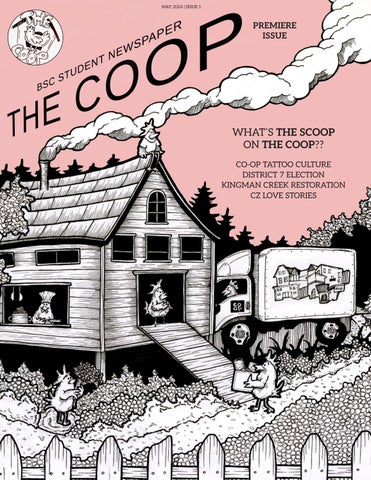
WHAT’S THE SCOOP ON THE COOP??
CO-OP TATTOO CULTURE DISTRICT 7 ELECTION
KINGMAN CREEK RESTORATION CZ LOVE STORIES



CO-OP TATTOO CULTURE DISTRICT 7 ELECTION
KINGMAN CREEK RESTORATION CZ LOVE STORIES

90 years out from the BSC’s founding, our former slogan, “We run it, we own it,” is no longer obvious. The question of who owns the BSC has no straightforward answer.
Though as members we own the nonprofit, you’d be hardpressed to figure out what this actually means. This wasn’t always the case. Members used to receive an “Owner’s Manual,” upon move-in, a booklet describing the rights and responsibilities of living in the BSC, how Board works, and current issues. A lot has changed; students today often think of themselves as tennants, not as owners. The structure of the co-op reflects this departure. In the 1950s, 1,000 members lived in the USCA. At the time, there were nine central staff employees. Today, the BSC is home to 1,200 students, but non-student staff has ballooned to 35. And as students discovered last semester, our rent is invested in companies like Boeing. So, are we a cooperative, or just another nonprofit? If not us, who’s running the ship?
Alumni speak of a time when members organized our community into key players of the Anti-Aparteid struggle and Free Speech Movement. There is no such unifying culture in the co-op today. Members are caught up along the individual tracks of their lives, more likely to conceive of the BSC in terms of what we think it should offer us and not in terms of our participation in it. Some folks even vocalized a desire for the co-op to adopt an apolitical position on the Palestinian genocide at a board meeting last semester. The loss of history, identity, and collective impetus afflicting the co-op from within is evident. When did the fear of saying the wrong things overpower our ability to successfully do anything? The BSC is in real trouble, and the BSC is us. What are we doing to restore democracy in the co-op? Are we willing to take up real responsibility for, and within, our communities? Can we establish and work towards common goals, even when it requires forgiveness, humility, and compromise? If not, why are we here?
I hope The Coop becomes your Owner’s Manual, a guide to the challenges on your fellow owners’ minds, and an antidote to the pressures that separate us. We’re still completing ambitious projects, working through conflicts, and sharing memories over Toothless Tiger Chai from CFS, home-brewed kombucha, or Cambro-sized cocktails.
Thank you to the co-opers who helped revive the tradition of a BSC student publication: Andre Zendejas, Izzie Kim, Theo Wyss-Flamm, Jadyn de Leon, and Jackie Fenner. And thank you, reader, for picking up our first issue!
Cooperatively yours,
Emma Taila


City Councilmember-Elect Cecilia Lunaparra to Fight for Housing in District 7 by Izzie Kim
House Projects for Collective Empowerment: The Kingman Hall Creek Restoration by Eytan Stanton
Independent ASUC Candidates Focus on Basic Needs, Challenge Elevate Cal by Izzie Kim
Pedaling, walking, and driving: How do co-opers navigate Berkeley? by Theo Wyss-Flamm
Mutual aid resources by Jadyn de Leon
A letter from the Anti-Oppression Working Group by Anti-Oppression Working Group
Love birds fly the co-op: Four love stories from Casa Zimbabwe by Emma Taila 10 08 04

“Marks from friends” and community care: Hand poke tattooing in the co-op by Jadyn de Leon
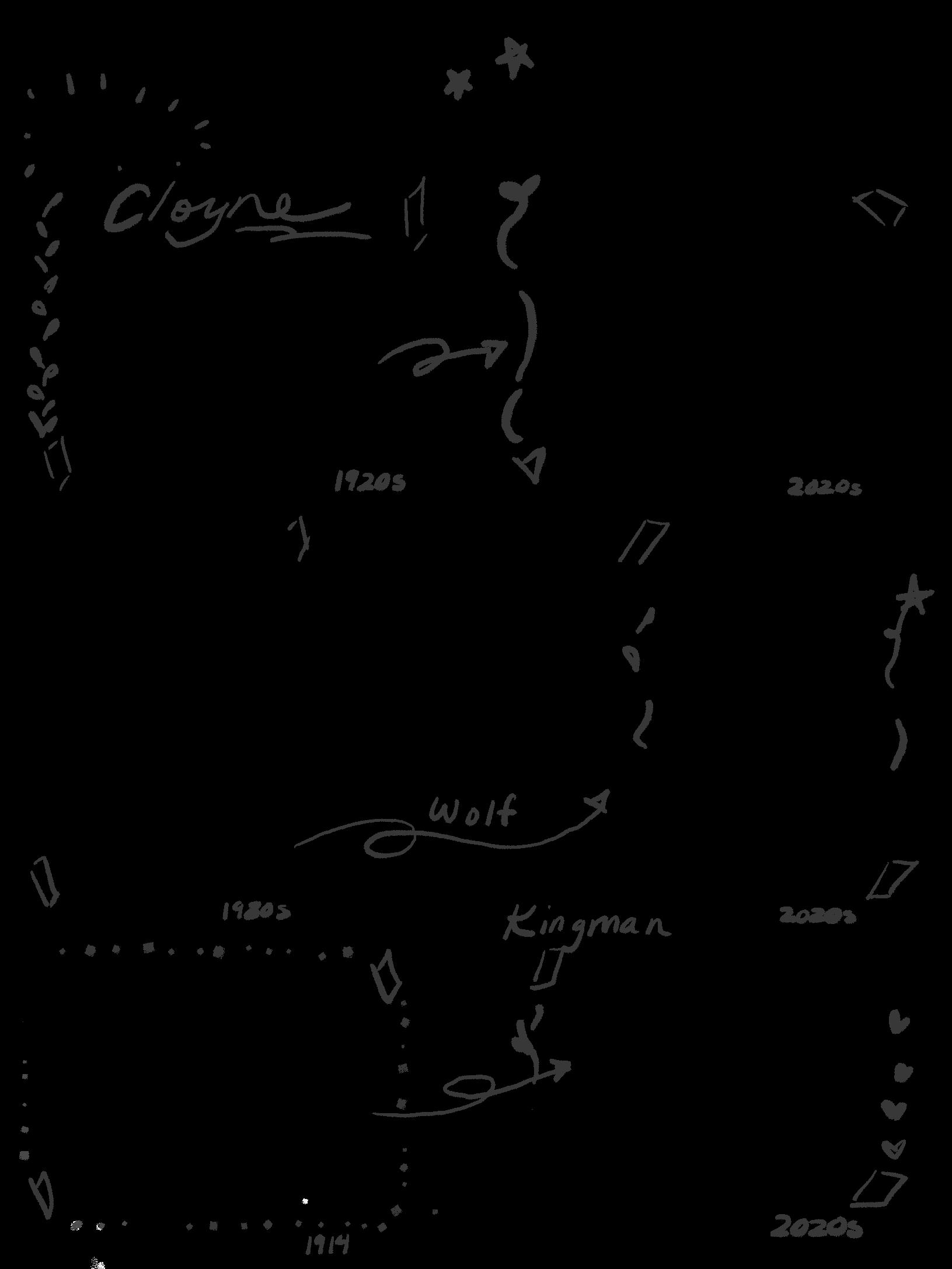
BSC houses then and now by Theo Wyss-Flamm
Valentine’s Day at The Convent by Jessica Guzman
A slice of life at Euclid Hall by Fleurance Pew
13 19 18 14 20 23 22 17
Entertainment
Recipe submissions: Danko’s peanut sauce by Grace Boyd Comics from Toad Lane Review
Crossword: “Working Together” by Jackie Fenner

by Izzie Kim, Davis House
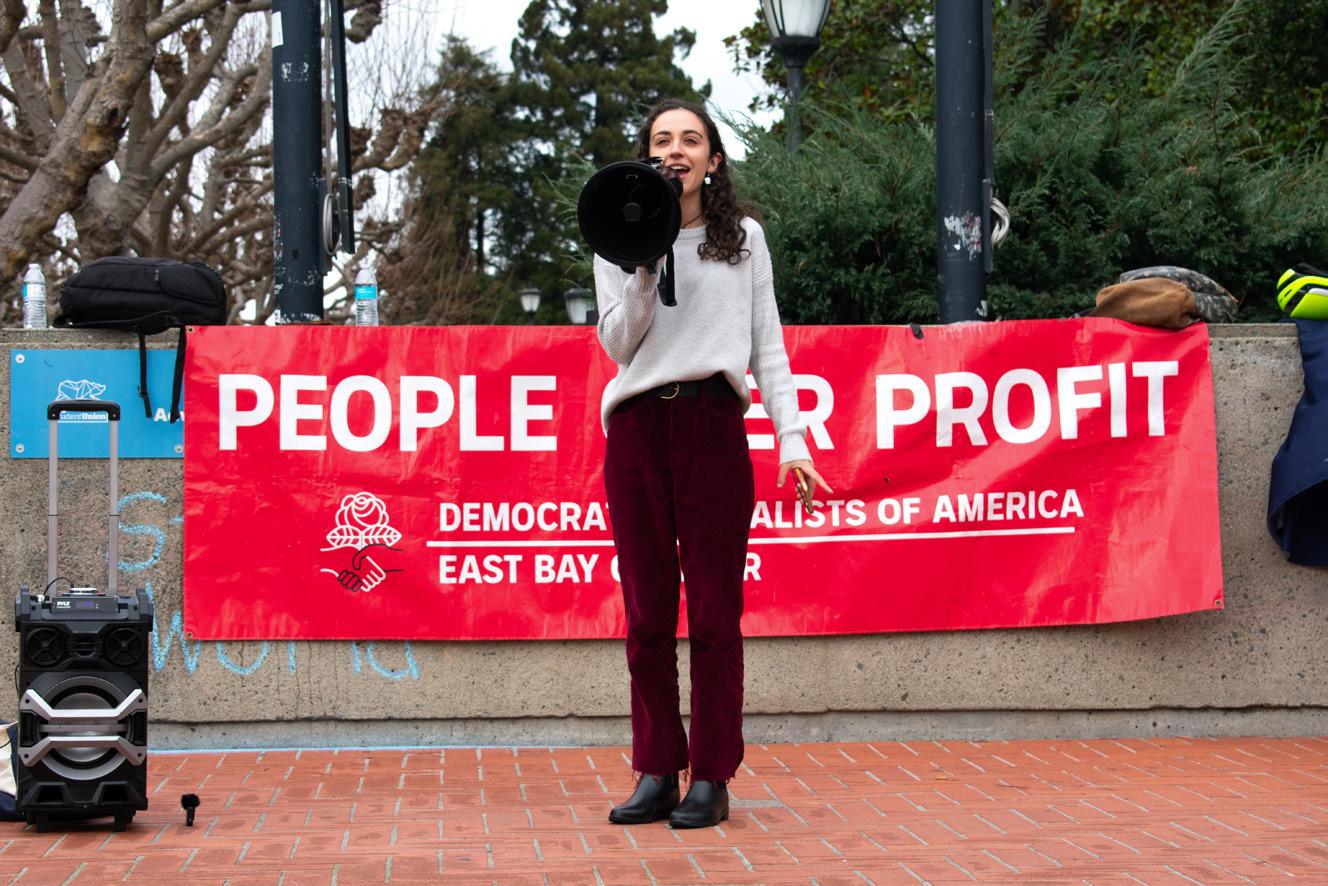
On April 26, Cecilia Lunaparra was certified as the first undergraduate Berkeley city councilmember, following a special election on April 16. Lunaparra will replace Rigel Robinson’s seat representing District 7, which is located on Berkeley’s Southside. It includes UC Berkeley’s main campus and seven BSC units. The election followed Robinson’s recent resignation after he received pushback from constituents related to the forceful closure of People’s Park in early January.
Lunaparra is a fourth-year undergraduate student at UC Berkeley studying urban planning and history. She has experience as a political organizer and was chair of the city’s Zoning and Environment Boards. She also interned with the California Housing Defense Fund. Her opponent, James Chang was a UC Berkeley Haas graduate student. Both ran on housing issues and clashed on how the university and the city handled the closing of People’s Park and the construction proposed for the site.
less controversial sites. In wasting our tuition money, delaying new student housing…and causing a rift in our community, the university has lost its credibility.”
Lunaparra also cites issues with the park’s takeover, like the hired officers encroaching on public streets and mandating ID checks to enter private residences.
Lunaparra hopes to combat the destruction of People’s Park by “working with community members that depended on the park and used it as a mechanism for mutual aid and advocacy to see where and what the city can supplement — which they should have been doing in the first place. I also hope to find another place for these people to live where they are not criminalized for merely existing.”
Chang stood with the university, arguing construction will provide affordable housing with 1,100 beds. He told Berkeleyside, “Instead of an open-air drug market, we need housing at People’s Park to address the need for affordable housing for students and a place where there are proper services and homes for the unhoused.”
Lunaparra is urging the city and the university to investigate building at other sites. She told Berkeleyside, “The University chose the path of most resistance and fabricated a political calamity by failing to prioritize
The university has not announced how much the new dorms will cost. Double rooms in other campus dorms cost nearly $22,000 with an included meal plan. This equals out to $2444 per month of rent for students. The Education Data Initiative reports that at four-year public universities, the average room and board rates equal $11,520 per year, or half that of UC Berkeley, hardly putting our school’s housing rates in the affordable range. Yet, campus officials insist that student housing is below market rate.
The high price for dorms at UC Berkeley stems, in part, from private equity groups. These groups have bought up the majority of real estate in the area and artificially raised rent. Early last year, the University was exposed for making a 4.5 billion dollar deal with Blackstone “following the model set out by private university endowments,” as reported by The Ameri-
can Prospect. The paper also found that the CEO of Blackstone raked in a record $1.2 billion in base pay even with market downturns.
The deal between the university and this private equity firm bumps up rent in the area, including for those in non-university housing. “The way the UC inflates rent in the dorms affects Southside specifically and should not be allowed,” Lunaparra said in an email. “While there’s not much the city can do, they can be clearer about threatening to pull support.”
Lunaparra believes the city needs to take a multipronged approach to address the lack of affordable housing and cycles of displacement that have become common to Berkeley residents. She wants to continue to increase the development of housing that is actually affordable. “One of the city’s most potent ways to gain affordable housing is by building more market-rate housing,” Lunaparra said in an email. “With current regulations, the development of market-rate has to include a percentage of affordable housing units, which is what we desperately need.”
The city and campus have worked closely on the UC’s expansion, clashing at times, which Lunaparra witnessed during her time on the Zoning Board. She found it difficult to work with UC Berkeley on housing because of her experience with the in-process Anchor House, a previously rent-controlled apartment building on Walnut Street that the university cleared to build student apartments. Tenants and students fought hard to keep the building but eventually were forced to relocate in 2021 following a buyout. “The city was opposed to this unless the new construction would include rent-controlled apartments with the previous resident’s right to return,” Lunaparra said in an email. “The university blatantly refused and has moved ahead against these motions.”
“We deserve to have representation that is there to speak with and for us.”
and not exacerbating the current crises,” she said in an email.
Some assistance for further development is coming from outside the city through bonds. Lunaparra said the funds should be used to support unhoused residents by providing permanent supportive housing and mental health services. As a councilmember, she hopes to continue Berkeley’s history of strong tenant protections by making information easier to access, and hopes “to expand tenant protections as much as is legislatively allowable.”
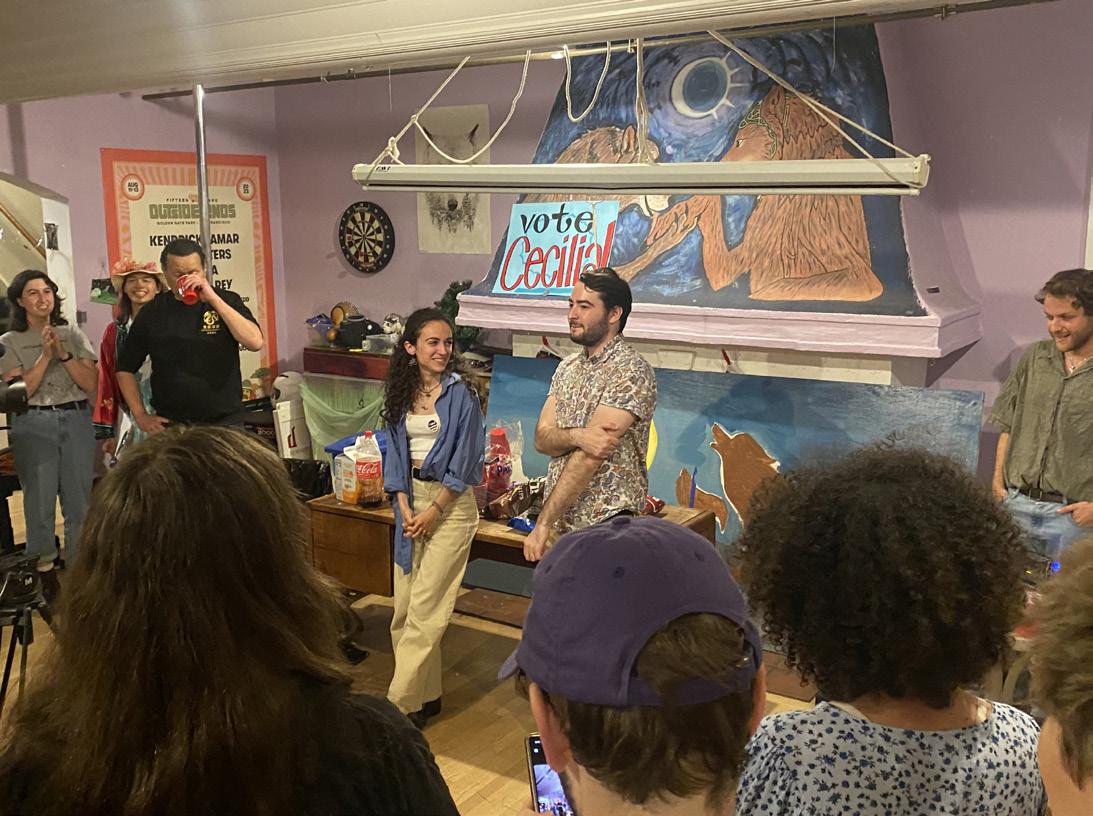
Lunaparra will hold her seat on the city council until the end of Robinson’s term in 2026. She hopes to be a seat on the side of the people who are most directly affected by legislation. “Many students, especially those of marginalized backgrounds, have to battle this institution to get what they want and need to be a student here,” she said in an email. “The role of the District 7 councilmember should be to be an aid for the students in battling this.”
Her campaign for city councilmember exemplified her dedication to student needs. “It wasn’t necessarily intentional to have such a grassroots campaign, it just happened to turn out that way representing the Southside community,” she said in an email. Lunaparra also sought endorsements and support from groups in District 7 and beyond that align with the broader goals of her campaign: housing and justice.
To combat more loss of affordable housing, Lunaparra believes the city needs to continue pressuring the university to negotiate in good faith. “The university should continue to build student housing, especially as the UC continues to enroll new students, but it should also take responsibility for housing people
Because of its proximity to campus and student housing including dorms, apartments, and co-ops, District 7 holds a student supermajority. As Lunaparra puts it, “We deserve to have representation that is there to speak with and for us.”
by Eytan Stanton, Kingman Hall
Graphics
Photos
by
by
Ellie Reiff
Natalie Grivalja and others
When I arrived as a transfer to UC Berkeley a few days after the deforestation of People’s Park in 2022, disillusionment filled the air. Our generation’s wounds — pandemic teenagehood, dissonance between our virtual and physical lives, and overwhelming exis tential threats — seemed to have, understandably, gotten to the activist beacon I imagined Berkeley would be. Despite this, I found hope in the col lective world-building of cooperative living. I grew convinced that these houses contain the grassroots, anti-establishment, mutualistic vestiges of the Berkeley of the 1960s and the ingredients to keep that spark alive.
When I first paged through the Kingman archives, I saw an article from 1991 about a bunch of Toads challenging the City of Berkeley to build our beautiful rooftop. Photos of old Toads constructing the deck by hand under the sun, and in the nude, struck a chord; what would it feel like to collectively realize a vision of that scale?
One year later, despite a six-month Kingman diaspora to make way for renovations, we have not only weathered the storm but also preserved and contributed to fanning that spark in our home. Alongside the tremendous labor of re-establishing our house’s systems and culture, two major efforts have been in the works: the Walls of Kingman Hall and the Kingman Hall Creek Restoration projects. Both efforts have affirmed that the potential and power of collective care are still very much alive within the BSC.
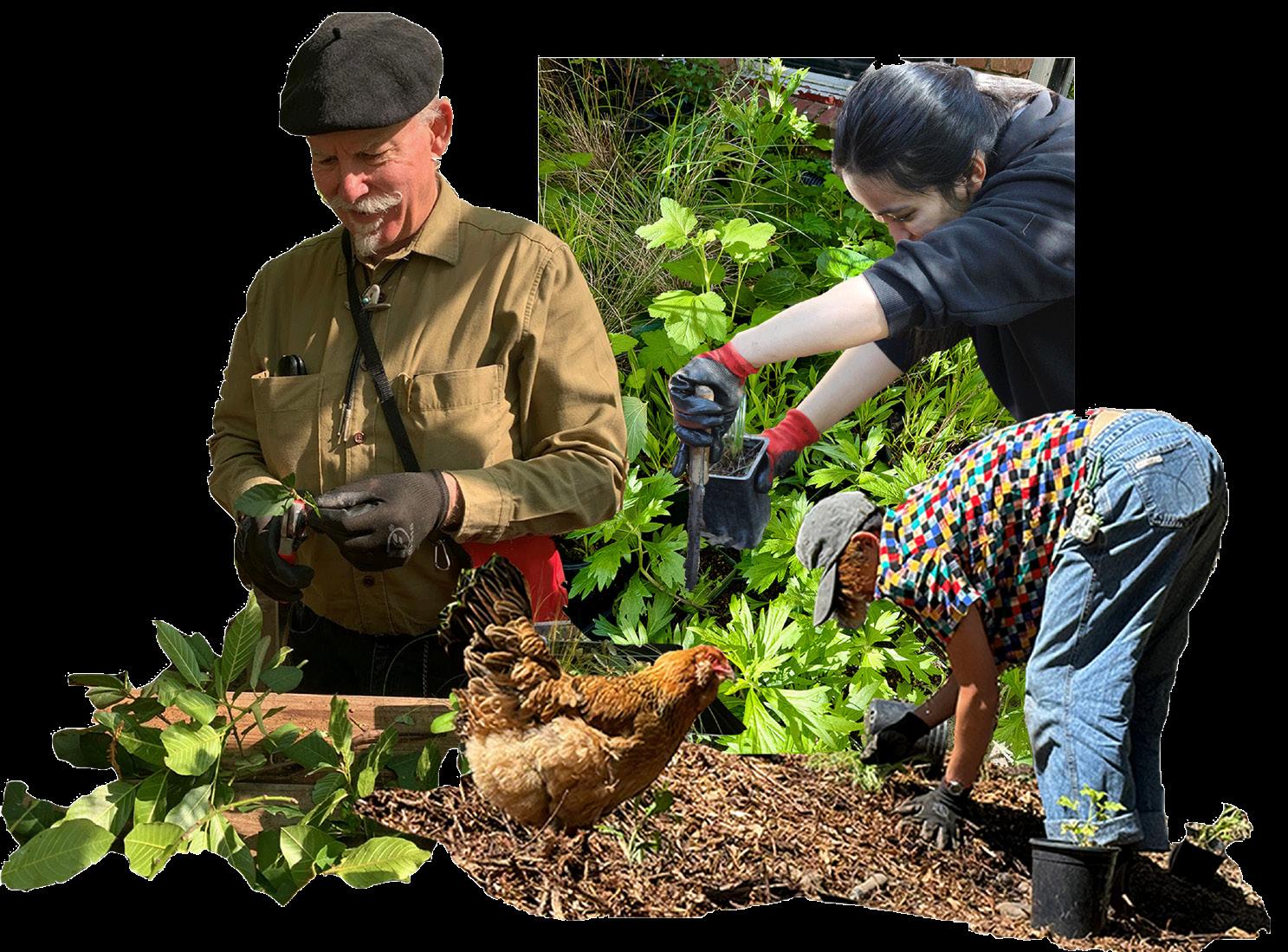
A one-hundred-foot segment of the North Fork of Strawberry Creek runs through Kingman’s side yard and flows downstream under the parking lot of Stebbins before re-emerging on campus. Inspired by past student-led efforts in the co-op, we applied for and received a grant from The Green Initiative Fund to stabilize our creek’s failing banks, increase native biodiversity, and foster environmental education and stewardship.
Over the last year, we hosted fifteen workdays with over 150 people joining the effort, including co-opers from Stebbins, Davis, CZ, Loth, Ridge, and Rochdale, as well as alumni and even a few neighbors. Groups such as the Strawberry Creek Restoration Program, Ep Eta, CalClimbing, and the KHCR Creek Keepers — our super-stewards team — gained hands-on expe-
rience in horticulture and construction. Over 15 East Bay professionals, more than five local nurseries, and several campus departments provided material donations and mentorship to the project, welcoming the KHCR into the fold of the Berkeley restoration community. Most significantly, the nearly 50 Toads of Kingman Hall had the opportunity to strengthen our relationship with a landscape that is part of our everyday life, thereby extending our ethic of communal care beyond the walls of our home.
We started our work over the summer, first identifying trees to prune and remove with the help of professional horticulturist Timothy Cole, who used to attend BSC parties in his college years. Some of these trees hosted invasive beetles and pathogens or were in danger of falling. Removing these trees increased the sunlight reaching the stream banks and amphitheater space, which made our creekside area more welcoming for house members.
nearly 100 square feet of vegetable garden space in time for spring. A few house members found a lost chicken near Mount Tam, brought her back, and soon enough, we rebuilt Kingman’s old chicken coop. With four chickens, a new vegetable garden, and more fruit trees, the front yard has become an unanticipated yet indispensable component of the project.
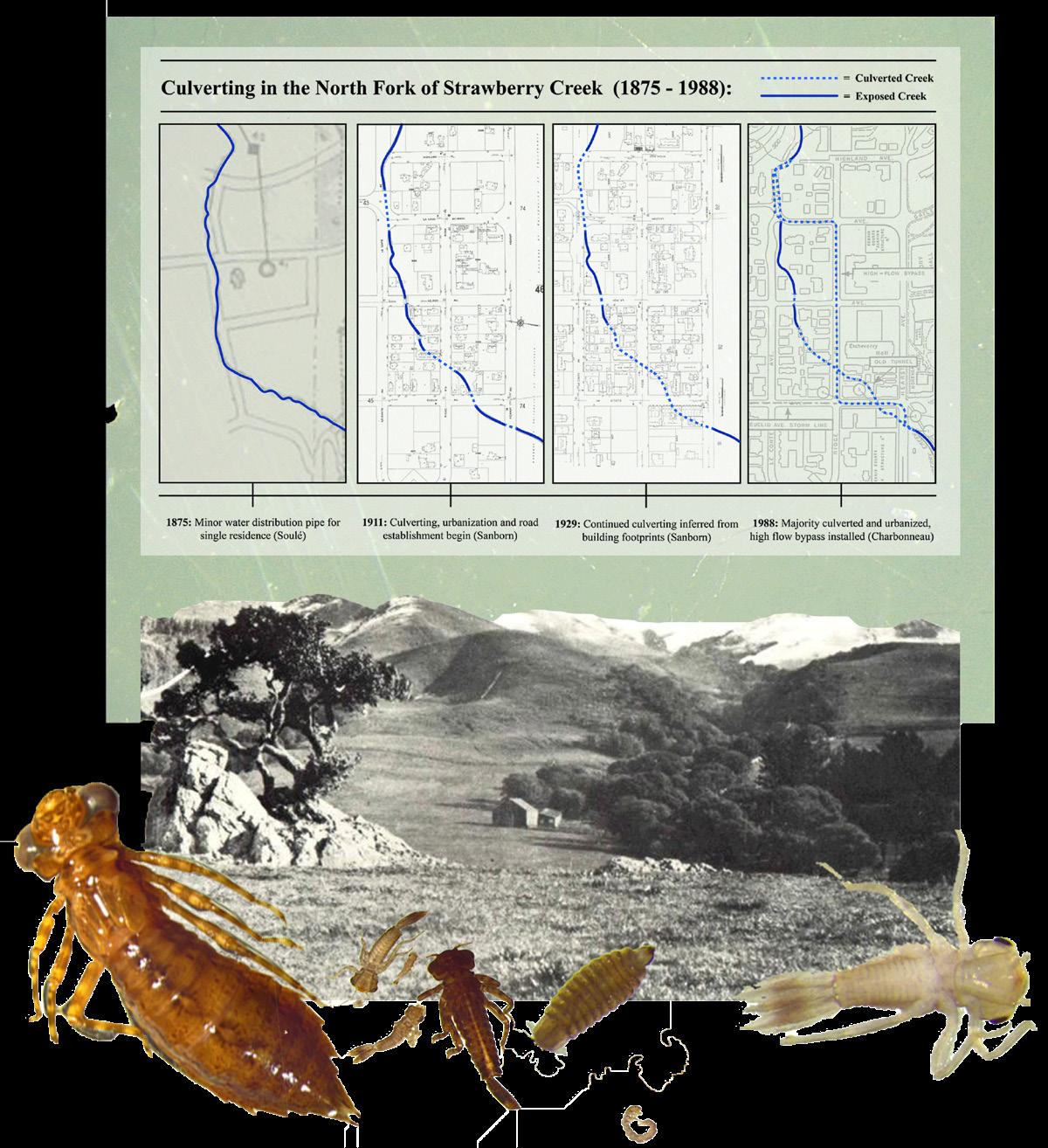
Project Leads Ellie Reiff, Kinley Flaherty, and I conducted historical research and baseline ecological analyses to advance future restoration efforts in this under-studied section of Strawberry Creek for a class, LA227: River and Stream Restoration. Our final research paper, Strawberry Creek Restoration: Advancing Stewardship in the North Fork is available on the Creeks of UC Berkeley website.
“[We’re] theextending ethic of communal care beyond the walls of our home.”
In the fall we removed aggressive ivies and grasses growing along the banks. In their place, we planted over 300 native plants of more than three dozen species for bird and pollinator habitat restoration, bank stabilization, and drought tolerance. Meanwhile, all organic matter — from felled logs to weeds — was kept on site. We dried them in compost bags, spread them atop damaged soils, and sealed them from the sun with cardboard and mulch. Within a few months, we found fungi, worms, and even salamanders in this new layer of moist soils.
Much of Strawberry Creek has experienced increased erosion due to the last century of urbanization in the watershed. To stabilize the steepest zones, we plant ed native shrubs and trees with strong roots that nat urally secure the banks. In other zones, we used logs from trees on-site and from campus to build a ter raced pathway that improves access to the hillside for future Garden Managers while minimizing foot traffic on the unstable soils.
The removal of a tree near our breakfast nook turned a once shady, forgotten zone of our front yard into an ideal sunny site for a vegetable gar den. With donations of locally milled lumber from Bay Area Redwood and nursery space from Oxford Tract, we cultivated
Affirming our Roles in the BSC
The BSC is spread thin from a growing list of unmet needs. For many of us, our love-hate relationship is at an all-time high. But we aren’t the first cohort, nor the last, that must grapple with the uphill battle that is cooperative housing under capitalism (in the Bay Area no less). Despite the shortfalls, many of us have more direct democratic agency in the BSC and our respective houses and apartments than we may ever have in our cities or nations. Can we reframe our lack of agency on a national or global scale as a reminder to not take for granted our role within the BSC? Can we transmute our rage, anxiety, and fear into action that siphons from the immense reservoir of knowledge and funding of our universities into this 1200-student-strong vessel of alternative worlds? The past 90 years of the BSC, and the past few months at Kingman, have affirmed these

by Izzie Kim, Davis House
The Associated Students of the University of California held their annual senate and executive elections from April 8th through April 10th, 2024. In recent years the ASUC has come under fire for being out of touch with students. However, this year there was a notable group of candidates running on platforms dedicated to basic needs and student rights.
All of these candidates ran as independents, meaning they were not affiliated with the two political parties that have dominated the ASUC: Student Action and Elevate Cal. Student Action was founded in 1995 with an emphasis on Greek Life representation in the ASUC. In 2021, Elevate Cal was founded by the staff and affiliates of former President Chaka Tellem on the principles of diversity, inclusion, and transparency. However, opposition to this group argues that its members have dominated the ASUC since, keeping the group insular and lacking transparency.
Only two of the candidates this article outlines, Antonio Cáceres and Justin Taylor won their seats. Both Independents plan on instituting change, increasing basic needs access, and representing transfer students.

of the 20 open senate seats on a basic needs platform. She was endorsed by the Berkeley Student Cooperative and the Berkeley Tenants Union and has a strong history advocating for housing. While in the office of ASUC Senator Ayal Meyers, Reese co-wrote the On-Campus Student Housing Bill of Rights which she plans to better enforce as a senator. This Bill of Rights informs students of what they should expect from university housing and how to advocate for their housing needs. Reese is also the President of the University Housing Rights Organization which works to “uphold the standard of living in on-campus housing according to State and Federal regulations” per her campaign posts.
Reese also has a significant harm reduction and safety platform; crediting her experience as a certified EMT to her desire to keep Berkeley students prepared in emergencies. On her candidate page (@susanreesecinat on Instagram), she outlines her plans, including “maintain[ing] a consistent stock of Narcan and Fentanyl testing strips in residence halls at all times.”
ment for Taylor, “I cannot stress enough how absolutely crucial it is to have a candidate who centers basic needs first. All too often, students are forced into a precarious balancing act with their academics, finances, and well-being.”
Taylor is dedicated to building connections between the student senate and their constituents, writing in the caption of one of his Instagram posts on the @ justintaylorsenate2024 account, “Not 1 senator serving now has office hours available to the public anywhere on their social media platforms. It seems like the only way to reach these people is by filing a staff application form.”
Antonio Cáceres ran unopposed for the Student Advocate seat. He hopes to emphasize basic needs. The Student Advocate sits at the helm of the Student Advocate’s Office (SAO), a free on-campus resource for students lacking support in conduct, academic, financial, and grievance issues. With six semesters in the SAO, Cáceres has worked on many of the office’s services including the Grief Absence Policy which passed this semester and will allow students who have experienced loss to take a week off of school without negative repercussions from professors or departments.
for 5,000 students.
Grotenstein says the ASUC is neglectful of the concerns of small student groups that are unable to offer endorsements. He knows that people want change and finds his base is comprised of “a lot of people who do not like the ASUC or are skeptical of its tangible effect on their lives.”
As President, Grotenstein would want to focus on housing at Berkeley. One of his main platforms is divesting the university from large private equity firms like Blackstone. Last year, UC Berkeley invested $4.5 billion into Blackstone which has been strongly criticized for its role in driving up rent prices and eviction rates.
“There is a very big gap between the ASUC and students. It’s very insular and there are a lot of people that the ASUC does not work for.”
Besides emphasizing divestment, Grotenstein would like to provide more funding for and awareness about the Basic Needs Center located in the Martin Luther King Jr. Building. He also believes there should be more student housing workshops and an updated “universalized housing portal to apply for rent subsidization or offer templates to write complaints to the UC Berkeley housing directors.”
One independent candidate, Susan Reese, ran for one
Other notable basic needs senate candidates include Justin Taylor, an Independent candidate and transfer student running with the slogan “Let’s Bring the ASUC Back Outside.” Taylor was endorsed by sitting senator Amyrah Doty who wrote in her endorse-
Additionally, Sam Grotenstein, a first-year political activist ran for president against Elevate Cal candidate Shri Gopal. Grotenstein has no experience in the ASUC compared to Gopal’s three years but does not see this as a disadvantage. He believes “there is a very big gap between the ASUC and students. It’s very insular and there are a lot of people that the ASUC does not work for. The people that the ASUC does work for are those really invested in LinkedIn and not the people who are looking for basic resources.” Grotenstien references one of Gopal’s main platforms, which was her collaboration with other ASUC executives and LinkedIn to secure premium accounts
Grotenstein has experience working with the Young Democratic Socialists of America Housing Committee and the Berkeley Tenants Union. He is also known for his protesting the destruction of People’s Park in January 2024 and his continued involvement in protests at Sather Gate against UC Berkeley’s hostility towards Palestinian students.
Even though this election did not work out favorably, Grotenstein still has big plans. He will “still be out on the picket lines and continuing to work with YDSA,” with whom he is in talks about forming a new ASUC party. Either way, Grotenstein hopes that students can take away from the recent influx of independent candidates that anyone who has an issue with the state of UC Berkeley can and should run for office.
by Theo Wyss-Flamm, Wolf House
Wyss-Flamm
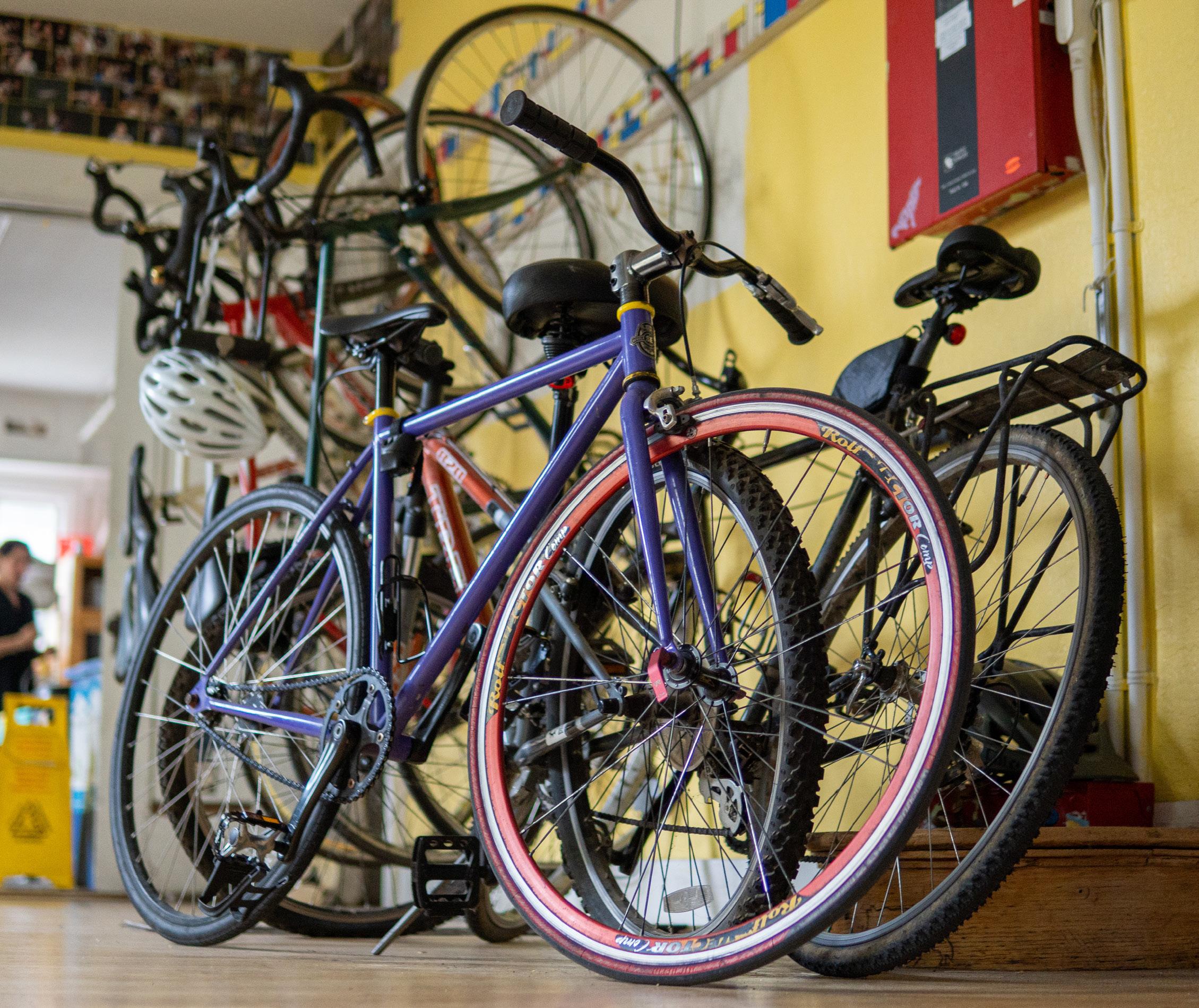
Micah Carroll of Hillegass Parker House (HiP) built his bike when he was 14 and living in Italy. Replacing parts and oiling its chain has been a pet project ever since. According to Carroll, it is a bit like maintaining “the ship of Theseus, there is nothing left of the original bike, is it the same bike from when I was 14?”
The sleek, black, fixed-gear bike traveled with him when he moved to Berkeley in 2015 and to HiP in 2020. Carroll is not alone in his propensity for biking and has found himself in a bastion of bike lovers at HiP, where the house’s proximity to campus and surrounding flat terrain enables frequent bike use among its 57 residents. House members bike to school, work, and the monthly East Bay Bike Party.
Berkeley’s streets, like the co-op, are often overcrowded and imperfect. Traffic danger, high parking costs, and frequent property theft are all major concerns when co-opers decide how to travel. As a result, the recent 2024 ASUC Housing Commission Survey found that 90% of BSC members walk as their primary mode of travel. Put simply by Cloyne Court resident Elizabeth Vitz-Thomas: “Walking is the most convenient thing for people to do. It requires maneuvering the least amount of stuff.” The majority of

BSC houses are within five blocks of campus, making walking and biking extremely viable options. This proximity is unique among student housing options. The presence of bike hooks, sheds, and workstations in most houses reflects members’ appreciation of biking. These fixtures often greet guests by the front door, with excess bikes stored in basements and boiler rooms. The concentration of bikers in a house might also be attributable to the immediate topography; if the house is on a hill, members might be less likely to bike regularly.
Stringent, expensive parking spaces at BSC houses and around the city limit car use. While some outof-town students may find this stifling, the absence of car-dependence enables Berkeley’s walkability, dynamic public spaces, and high density. At Southside’s Wolf Haus, four motorcycles sit in the parking lot, out of place and beautiful. The motorcycles’ small footprints make them a practical option for these four co-opers, as does the free parking they get in the Haus lot. However, to Parker Elliott of Wolf Haus, his 1976 Honda motorcycle is mostly a pet project; its upkeep is a constant source of pleasure and education. Elliott admits he doesn’t need the motorcycle to navigate Berkeley. Though he uses it similarly to an electric bicycle, its value lies in more than just transportation.
Parking plays a tricky role in the BSC; it takes up a significant portion of the BSC’s lucrative land in Berkeley to store personal vehicles, but also provides immediate liquid capital to the BSC’s tight budget. Wolf Haus parking alone provides $45,000 annually to the BSC due to its lease with the neighboring Wright Institute. However, in a city where land is worth over $4 million per acre, is parking the most beneficial use of our space? With such high walking rates, no need to drive to buy groceries, and a culture of alternative modes of transportation in co-op houses, perhaps parking space could be reconsidered for more efficient land use.


The AOWG is a group of BSC members trained in anti-oppression-related content and its application to cooperative living. We are here to help foster a more equitable environment within the BSC houses by offering support and advice to house managers and members alike.
Considering that this is the AOWG’s first year back after a period of dormancy, we have recently been focusing on reforming the group and finalizing our goals for the future. At present, we are striving to help houses become more comfortable with discussing issues of oppression, offering support to members who are struggling to raise awareness of in-house problems. We also want to focus on helping units practice active accountability through group discussion and personal reflection.
In the future, we will be working to construct informative workshops surrounding issues of anti-oppression such as, but not limited to, anti-Blackness, racism, toxic masculinity, classism, and gender discrimination.
Alongside being an educational resource, we want to help improve the living experience for people who hold minority identities within the BSC. We want to create space and host events for minority groups in the BSC to allow these communities to develop between the houses.
We would love to hear any of your suggestions regarding how we can support you and your house. Contact us at

Since moving into Lothlorien in the Fall of 2022, I have come to know the BSC as a hotbed of art and community creation. As I have further explored my ancestral lineage and creative practices while living in the BSC, I have received so much support from other co-opers doing the same. It has been amazing to see the many ways networks of community care have been fostered, especially through passed-down traditions amongst QTBIPOC co-opers.
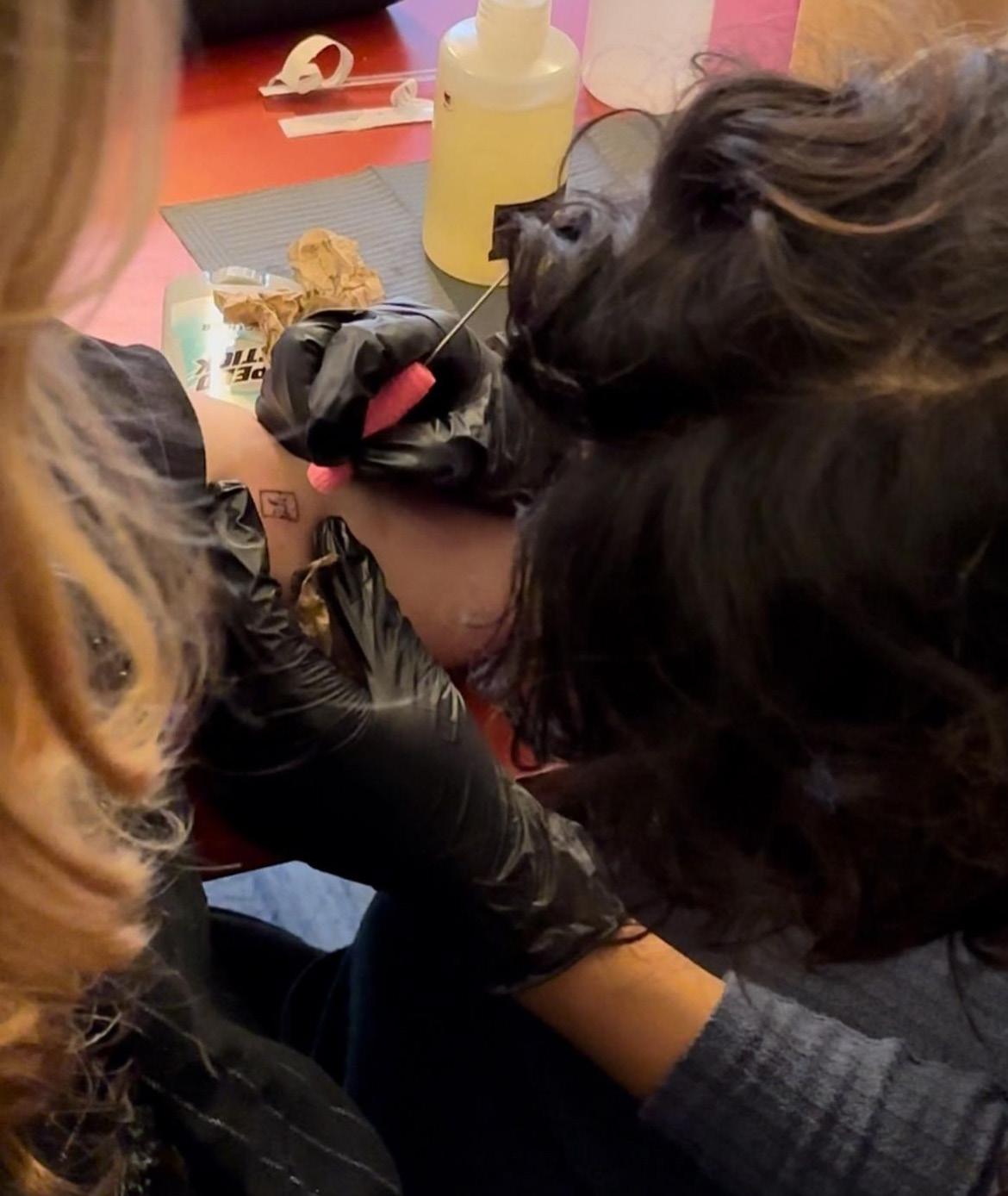
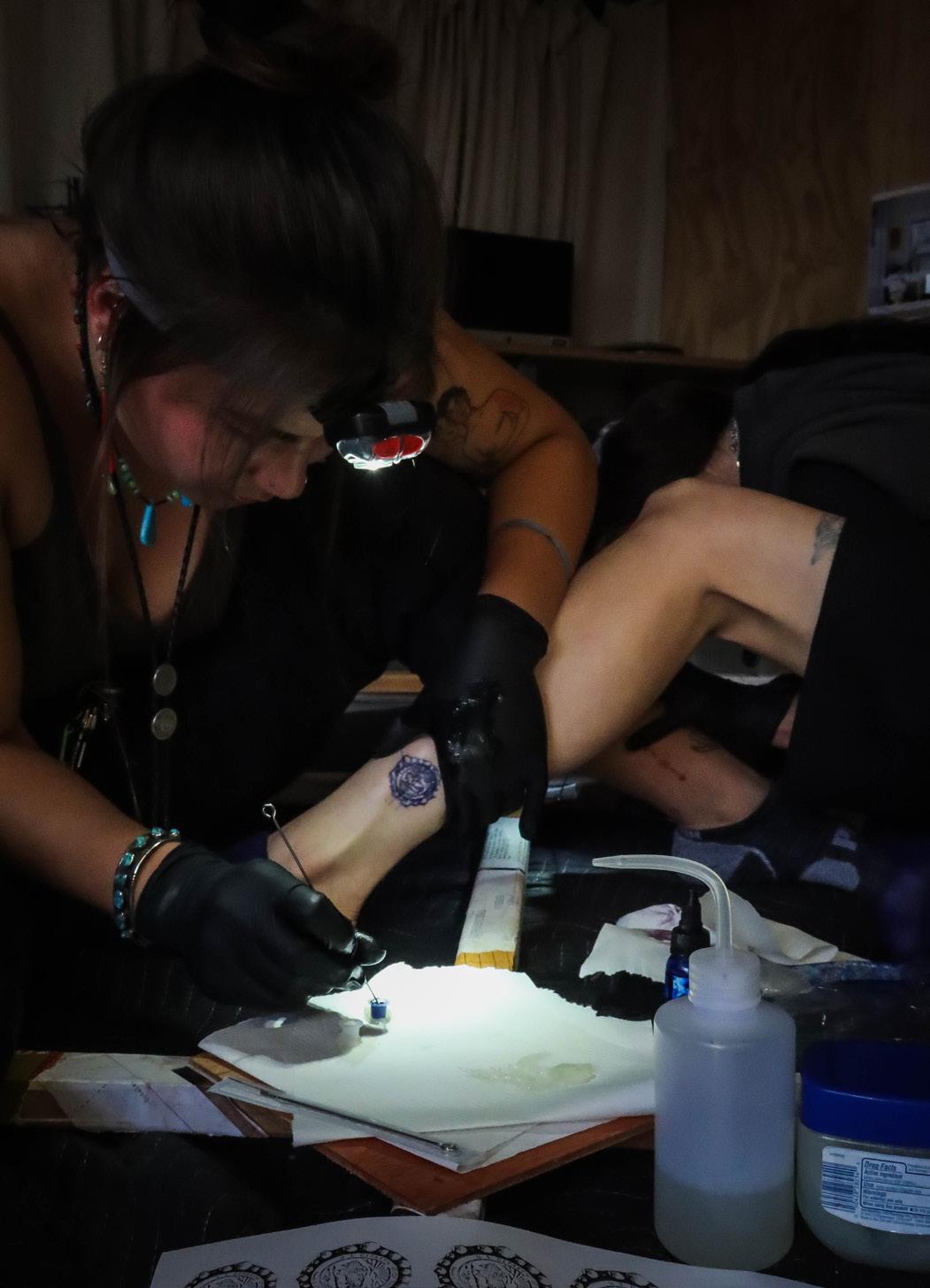
During an eye-opening heritage trip to the Philippines last summer, I was exposed to a lively and fresh scene of young hand poke tattoo artists living and resisting within Quezon City. I received a hand poke tattoo from artist Andrea (@idlehandsph on Instagram) and witnessed multiple tattoo sessions as practices of reclamation of knowledge sharing, body, and heritage. As I returned to Loth at the end of Summer, I hoped to begin learning to hand poke and tattoo as an intentional practice of art exploration and community formation. Upon digging deeper, I was grateful to find that there was a hand poke community being nurtured within the BSC. I shared a few of my first attempts on fake skin and received a lot of support from my community; other hand poke artists shared their excitement for me and eager housemates offered up their skin for me to practice on. Because of this support, I continued learning and committed to getting better. After practicing on myself a few times, I gave my first tattoo, a simple linework star, to my close friend and housemate, Lily Arias Hemminger. It felt amazing to hold that space of trust, pain, and body reclamation together, especially as tattooing is a huge part of our shared Filipino heritage. It was also really special because we completed the tattoo in the Loth living room, a place that has supported so many so many moments of our friendship. It was also a fitting setting given the vast amount of community memories that the space holds.
I spoke with three tattoo artists, all of whom learned to hand poke in the Loth living room. Ruby Jay is a queer, trans hand poke artist of mixed Indigenous
by Jadyn de Leon, Lothlorien

and Chinese descent who lived in Hoyt from Fall 2021 to Summer 2023. Jay did their first hand poke piece in Loth’s North House. “I did a little design in red ink on my ankle on the floor,” Jay said. “We talked shit and shared some love.” This scene is familiar in the cooperative tattoo community; tattoos are often ex changed in makeshift setups that are otherwise bedrooms, base ments, or gardens. On top of the BSC’s lower rent making tattooing more accessible, the co-ops foster a unique environment that is ideal for gentle learning practices. Lauren Anastasia, a QTBIPOC hand poke artist and former Loth elf who helped Jay learn to tattoo, said, “I really owe everything to the communi-
“...tattoos are not just a form of self-expression, but a physical manifestation of community.”
ty in the co-op who so enthusiastically embraced this practice of mine and welcomed me into this highly intimate line of work.” Witnessing the excitement of housemates supporting each other’s art and learning journeys is so special. Housemates’ willingness to meet each other where they’re at and lend patience throughout the learning process has allowed a hand poke community to form and continue to grow within the BSC.
Tattooing as a practice has helped many QTBIPOC co-opers reclaim their bodies and identities. As Hemminger shared after a session with Anastasia, they got the sacred heart to honor their Mexican heritage, a symbol of cultural reclamation. Their tattoo is both an act of resistance and of agency over their body. I also talked with Vivian Cormany, another housemate who both Anastasia and I have tattooed, about why they sought out co-op tattoo artists. “I thought getting a tattoo from a friend would be extra sentimental and a good way to commemorate my time living at the BSC. Having a tattoo from an artist in the co-ops links me to that moment in time and to my location in the BSC.” As a QTBIPOC person, both getting and giving tattoos has helped me take agency over my body and reclaim it through ancestral practices, artwork, and being in community. This is not only attached to my identity but also to the values that I have come to understand and covet living within the BSC. As queer, nonbinary hand poke artist and former Loth elf, Quentin Freeman said, “Tattooing is so personal and so relational. Certainly it’s self-expression and definitely feels attached to queerness, but it’s also attached to community. I’m carrying around so many
signifiers and tokens of my relationships, little beauties and marks from friends that I love.” Tattoos are not only a form of self-expression, but a physical manifestation of community.

Reflecting on my time within the BSC, I think of the many ways that my housemates and fellow co-opers have shown care for me and held me through both hardship and joy. These relationships go so much deeper than just doing workshift or saying hello in common spaces, the connections I have made living at Loth are filled with abundance, trust, and growth. Because of the BSC and all of the pressures of living within it, I have been able to discover myself and explore who I am in ways I would have never imagined, and throughout it all, my community has been there for me. Hand poking pieces of art in bedrooms or on couches while chatting or watching TV has provided me with so many tender moments of connection that remind me of why I have stayed at Loth for the past two years. Even when faced with the many challenges of living within the BSC and existing as a QTBIPOC person, both hand poke and the co-ops have given me reciprocal networks that I am so grateful to be a part of and to help continue to foster. When looking at the closeness of co-opers to one another and the ways that we care for each other, it is no surprise that intentional tattoo practices have formed and continue to be passed down through the co-op generations. Yes, tattooing is about making art, but it is also about being vulnerable, sharing space, and creating community, which is what the co-ops are all about.
If you are interested in learning to hand poke, here are some tips!!
From Ruby (@lycheelibrah):
If you’re just getting started, get tattooed a ton, figure out what practices you like and what you don’t, and ask technique/ logistics questions from people as you get tattooed, artists are often very excited to share. Figure out what you love about tattooing and getting tattooed, and what you want to offer to people. Don’t be afraid to reach out, my DMs are always open! Practice on yourself, offer free tattoos to your friends, and figure out what excites you. Come join us <3
From Lauren (@laur3n.anastasia):
Work with those closest to you, it might naturally evolve from there!
From me, as a baby artist (@stickystarstuff):
Exploring yourself through art is so much fun, and to share that in collaboration with community is so special. If you’re even slightly interested, do it! Living in the coops is truly one of the best environments to learn and grow in, and if you lead with care, the rest will follow <3
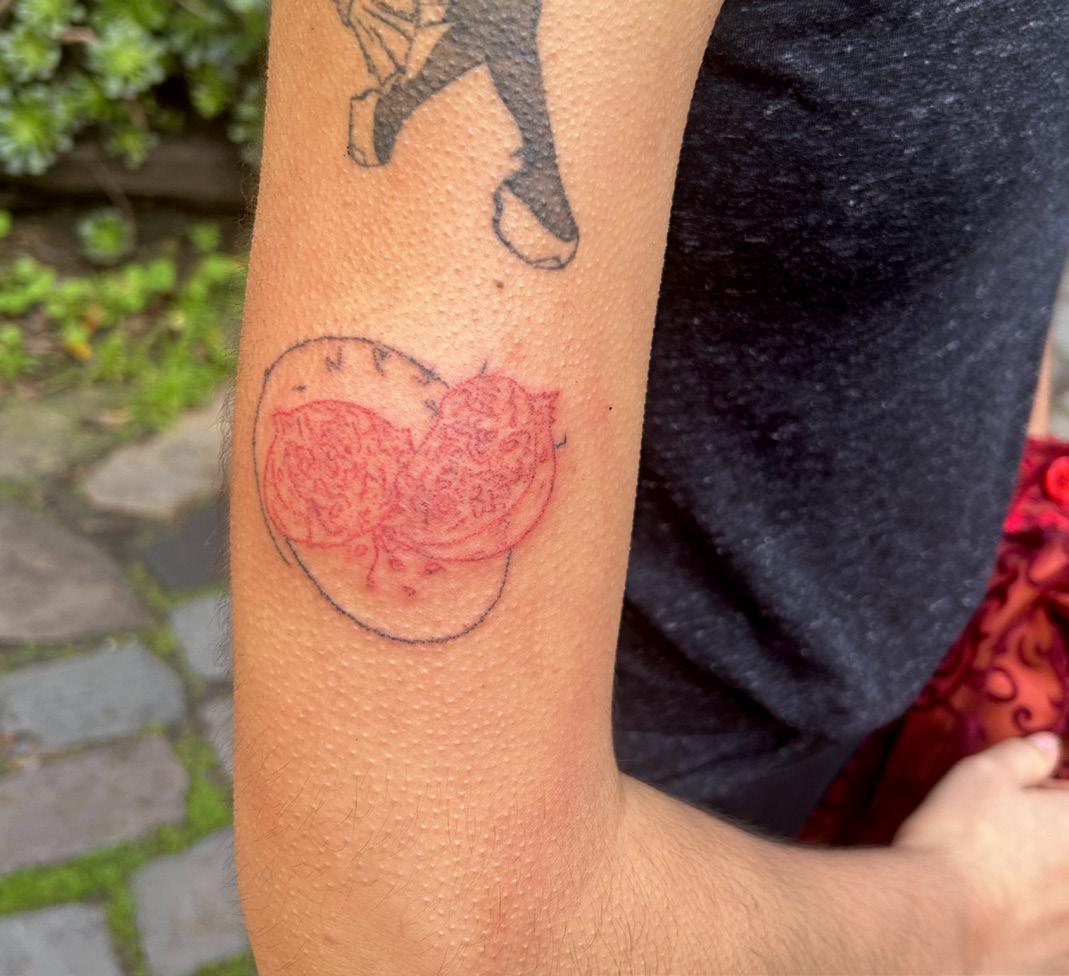

If you would like your art featured in a future edition, email us at thecoopbsc@gmail.com!

by Fleurance Pew, Euclid Hall
Fellow members, let me regale you with a short tale of life at Euclid:
When trouble inevitably stirred, our cooperative spirit blossomed; houses big and small and members within, feast your eyes on the story I spin, still in creation each day, small moments to make the sum of our stay. A storied building undergoes much change, the new year, another spring, pink flowers dress the scene; from outside Euclid we enter, to learn how things grew better.
A lot has changed at Euclid over the past school year. The hall saw major member and manager turnover, while new residents filed back into newly vacant rooms. A social bomb went off; one member described a hostile environment of accountability. What is now a “wash your dishes” group chat was once the site of a fraught PNG debate that split the house in two.
When I moved in this spring, we were all given an impromptu mandatory orientation. Most returning members of the house were not present. New moveins were told about tensions which implied the house was unsafe. Most members involved would leave shortly thereafter, opening up several managerial positions after VOCs were submitted.
While there was opportunity for strife, most newcomers cited Euclid’s exceptional sanitation as a primary reason to move in. Our standards are by no means medical, but we all shared excitement for our council-approved bidet installations. Ingrid bravely took on our Waste Reduction Manager position. So it was that trash bags no longer filled our dining room. Dedicated workshifters, high school teacher and Scorpio Aimee and new member Nina, expressed their fair frustrations at council. Between pots stacked high and the dining room growing messier each week, we sought to even up the load by changing our dish system and increasing mindfulness in our waste disposal.
Members go the extra mile in their positions; their devotion holds us together. Many of us are thankful for our wonderful cookshifters. Laïla has “fun cooking with a great partner who knows how to cook,” speaking of her co-chef Alexia. You can taste these things, the love in the spices, spaghetti, and steaks.
Our fantastic new board representative, Adrian, a long-time member of Euclid, is putting in 30-hour
weeks, posting board updates in the bathrooms, and contributing to the BSC’s continued survival. He loves flowers and invited me into his room to delight in his space, which he adorned with all manner of earth tones and floral designs. Residents new and old revived and reconciled this spring at Euclid Hall. While I don’t publicly claim to be a gossip, I did get some hints about what some of the conflict was.
Member transitions are as commonplace to BSC housing as mold and leaky ceilings. Cyclically the sun rises and falls over fresh faces. Granted power and responsibilities over ourselves and our community, 20-somethings in Euclid’s managerial positions allegedly granted each other and their friends selective freedom from accountability.
I’m told some members had not completed their HI hours, and then that no one was fined at the end of the semester. Many members I spoke to expressed their deep gratitude for the shift towards an accountability culture this spring. One Euclidean called it “voluntary contribution” from “a sense of ownership shared by our positive impacts on the house.” We are urged to clean up after ourselves, with leading examples of selfless workshifts for the well-being of our house. Having lived in some truly “charming” coops before, it’s a breath of fresh air.
I felt a lot of tension when I first arrived at Euclid. As a BSC resident for several years, this was nothing new to me. I had witnessed intense situations, including much of the tragedy that last semester brought BSC-wide. Speaking to my housemates, I can feel how much things have improved, and while I don’t spend a lot of time in common space, I appreciate the laughter greatly more than deathly silence. Many of us are here without the choice to live elsewhere, so we must make the best out of our living situation, we must be decent to one another. With the cost of living soaring ever higher, we must cooperate to survive. Fall ‘23 was something of a call to action in another chapter of Euclid’s story in the BSC.
The BSC has stayed strong for 90 years since the historic Barrington Hall. Another chapter at Euclid has closed. New members have already begun to write the next page.
by Emma Taila, Davis House
We all know someone who’s gone against their better judgment and committed house-cest. Co-op couples are often cast in a doubtful light, replete with cau tionary tales of house flings turned house-wide dra ma or a serious relationship gone sour while you’re still sharing a bathroom. But, if we take our time in the co-op seriously, we come out of the BSC with lessons on strong communication, conflict resolution, equitable home labor, and even personal finance — all important to the cultivation of healthy, lasting relationships. These love stories are an optimistic look at house romance. Four couples with ties to CZ share memories from their BSC days and their advice on love for the next generation of co-opers.



Will only got to know Jennifer later, while living at Kingman. During one holiday weekend, Jennifer returned from an outing with her friends to find Will sleeping under the dining room table. She says that’s the day their romance began to blossom.
Only a month into their relationship, Ginger says she felt Lewis was the one. That feeling proved true. They married on the beach at Point Reyes in 2008 and shared a beautiful evening with old co-op friends, watching the waves glow with bioluminescent algae blooms. For their honeymoon, they went to Burning Man for the first of many times. Ginger and Lewis have welcomed two new CZarlings into the world, and they care for 10 chickens.
Ginger reflected on following her heart instead of choosing to stay single, as she planned. “Don’t be so in love with your own independence that you miss the love of your life,” she said.


Marissa and Rick’s first date was at a CZ party. Rick was dressed as Indiana Jones, and Marissa dressed as the love interest from Temple of Doom, wearing a nametag that read, “Indy’s bitch.”
You never know, the perfect person might be closer than you think!
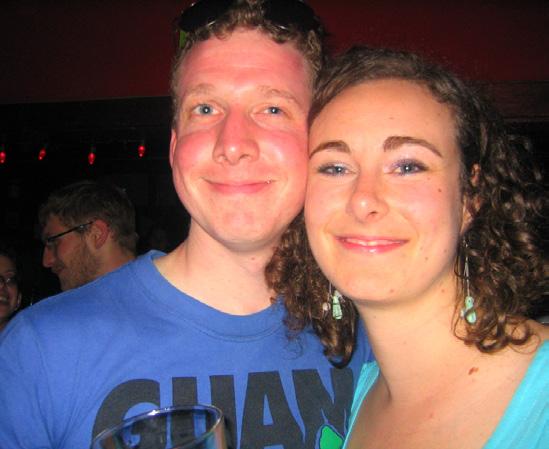


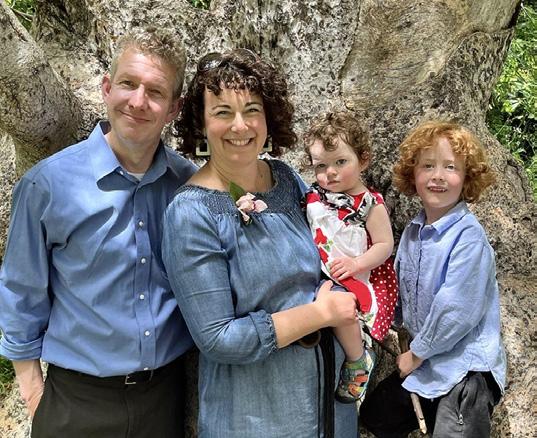
After college, Jennifer worked at CO and Will at the Campus Store on Euclid. They continued living with their friends and eventually started dating on and off for a few years. It was hard to stay apart because they were so connected as friends. “Our relationship is built on a lot of friendship,” Jennifer said. “I think that’s one of the reasons why we’ve made it. It’s so cool to have this 20-plus year history with people and to have it with each other and close friends all together.” They said they still spend time with their friends from over 20 years ago. When the pair got married in Oakland in 2014, many co-op alumni attended.
As for their advice on romance, they encouraged younger co-opers to enjoy their youth and take their


Ginger recalls thinking Lewis always looked stressed out the first few times she met him at CZ. Lewis, on the other hand, remembers thinking, “She seems really mellow.”
Constance had just arrived at CZ from Australia when she met the maintenance manager, Travis, run ning from room to room with a drill, fixing up shelves and installing lofts. Travis had moved into the co-op that summer and was already, as Constance put it, “making people’s dreams come true.”

But the pair knew each other previously — they met at a choir rehearsal for their friend’s opera.
At the party, the two talked and danced until sunrise, which they watched from “Edo’s Lounge,” a “semi-legal” bar on the top floor of CZ. That was the first of many nights at CZ for Marissa, who soon moved in. “He literally swept me off my feet,” Marissa said, “He was pretending to dance with me and he suddenly dipped me and almost dropped me.”
Rick was the social manager at CZ, and party life was big. The two shared performance backgrounds, often dressing up together or staging dramatic events in the
Jennifer had heard all about Will when she first saw him in the Rochdale courtyard. She knew he worked at CO, she knew he wore weird hats and Hawaiian shirts, and she had heard of the original songs he played on his guitar when he lived at CZ, a discography that included hits like, “Safeway is Love.”
“His reputation preceded him,” said Jennifer. “So when I saw him, I was like, oh that’s Will Roby.”
Ginger was living with her boyfriend at CZ, down the hall from Lewis’ girlfriend. Eventually, their relationships ended, and Lewis decided that an upcoming party at Kingman was his chance to get back out there. His first move was to approach Ginger with an onslaught of bad jokes. “It worked!” Ginger said.
A week or two later, after a house movie night, the two sat atop Indian Rock talking until sunrise. Ginger says Lewis impressed her with smoke tricks, and how quickly he could roll a joint.
The two were immediately drawn to one another and became close friends. While at CZ, they com bined their points with three other friends to bid on two doubles and a single. All five of them slept in one room, clearing the others to use as a living room and office where they studied and brewed beer.
When Constance graduated, she moved back to Syd ney but kept in close touch with Travis. She returned to Berkeley every summer. Five years had passed since their co-op days when Travis confessed his love while Constance was visiting the Bay, writing her a letter. “Constance was the most creative bravest wonderful smiley excitable cooperative person,” Tra vis said. “There was no question about it.”


The two started dating in 2019 and married within the year. Their friends from CZ have become godpar ents to their three children, the youngest of whom the couple welcomed just this March.
They said the BSC taught them essential lessons in healthy communication and the importance of community in building a family. “Love is a grounding force to make change in your community,” Constance said. “A massive thanks to the BSC for changing our lives and bringing us together!”



Rick graduated and moved to San Francisco while Marissa finished her time in school at CZ, working at Chez Panisse. She said that even at CZ, having their own spaces was important. But, since Rick had a single, it was also nice to have a place to spend time away from the co-op hustle and bustle.
“Finding someone you can show your whole self to, warts and all, and finding someone who can accept you is important no matter where you live,” Marissa said.
Want to be featured in Issue 02? Keep an eye out for open submissions and minisubmissions, announced on our Instagram, @thecoopnews
Reprinted from Toad Lane Review, Vol. 2 Issue 02. Exact date and author unknown.
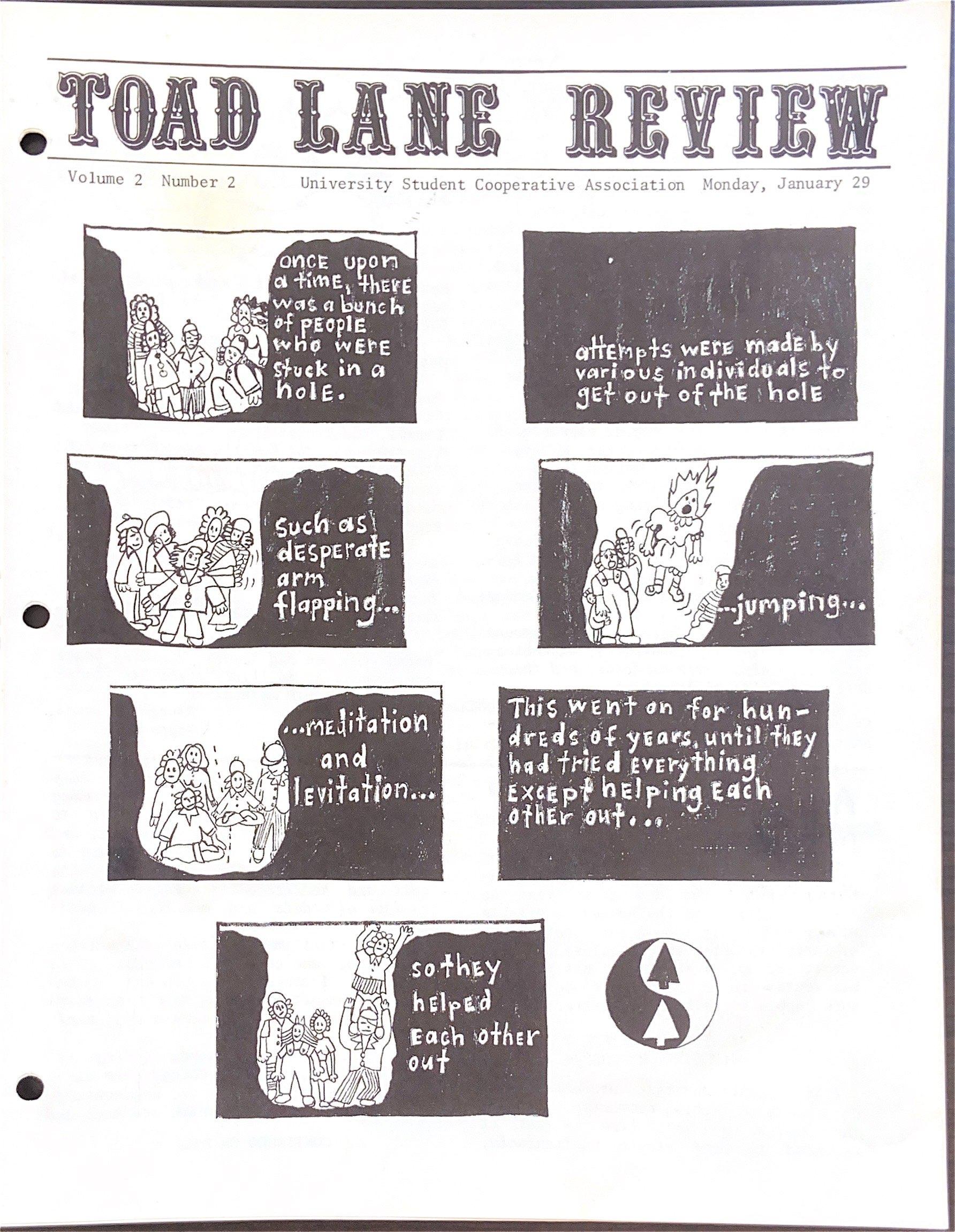
Toad Lane Review was a BSC student newspaper that ran in the 1970s. Its name comes from the location of the original Rochdale cooperative in England. BSC student publications date back to our founding in the 1930s with USCA News, followed by The Scoop, which became Toad Lane Review in the 1970s before going back to The Scoop in the 1990s and 2000s.
14
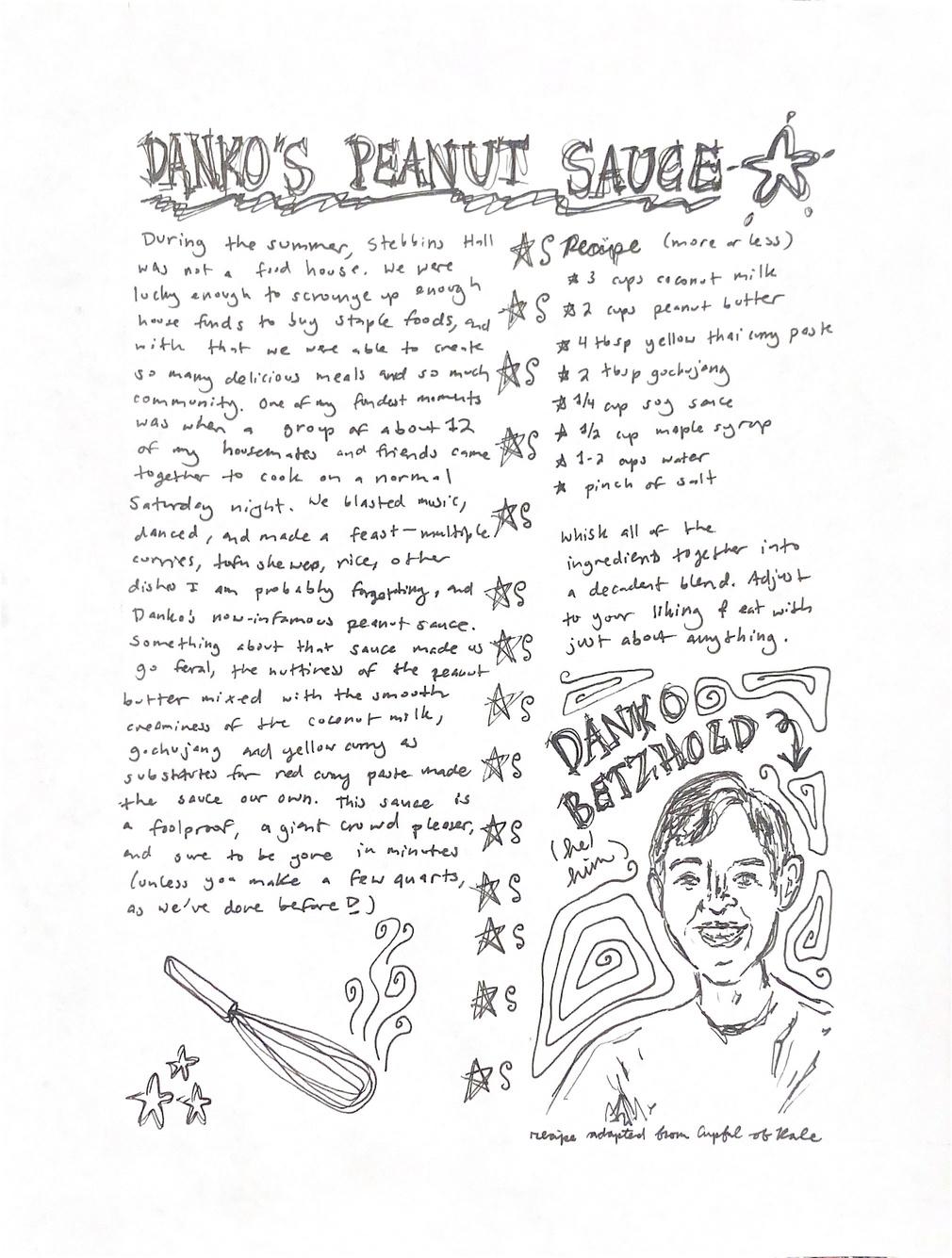
If you’ve enjoyed reading The Coop and want to see a second issue, we encourage you to join the long history of BSC journalists and artists celebrating cooperative student life! Apply at tinyurl.com/BSCNewsApply for one of our many roles, compensated with workshift!
by Jackie Fenner,