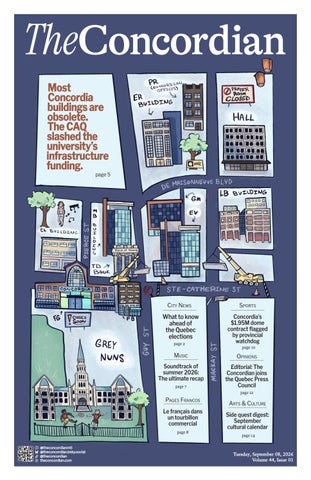
Most Concordia buildings are obsolete. The CAQ slashed the university’s infrastructure funding.
page 5
City News
Sports
What to know ahead of the Quebec elections page 2
Concordia’s $1.95M dome contract flagged by provincial watchdog
Music
Opinions
Soundtrack of summer 2026: The ultimate recap
Editorial: The Concordian joins the Quebec Press Council
page 7
Pages Francos Le français dans un tourbillon commercial page 8 @theconcordianmtl @theconcordian.bsky.social @theconcordian theconcordian.com
page 10
page 12
Arts & Culture Side quest digest: September cultural calendar page 14
Tuesday, September 08, 2026 Volume 44, Issue 01
2
Tuesday, Sept. 8, 2026 | city@theconcordian.com
Quebec will elect a new government on Oct. 5 Parti Québécois
Leader: Paul St-Pierre Plamondon Electoral division: Camille-Laurin (Montreal) Westmount–Saint-Louis candidate: Victoria Piscina - Reduce the number of permanent and temporary residents to Quebec. - Create a $95 province-wide public transit pass. - Increase French language requirements for renewing a work permit and apply Bill 101 to CEGEPs
Coalition Avenir Québec (incumbent) Leader: Christine Fréchette Electoral division: Trois-Rivières (Mauricie) Westmount–Saint-Louis candidate: Karim Abi Haila
- Allow doctors to practice in both the private and public health care sectors. - Extend Bill 101 to vocational and general adult education. - Balance the provincial budget by 2029-2030.
Quebec Liberal Party
Leader: Charles Milliard Electoral division: Orford (Estrie) Westmount–Saint-Louis candidate: Jennifer Maccarone - Build 100,000 homes per year and add 40,000 social and affordable housing units. - Ensure public sector internships are paid. - Create a digital telehealth service as seen in many private health care systems, but not currently available in Quebec’s public health system.
Québec solidaire
Leader: Ruba Ghazal Electoral division: Mercier (Montreal) Westmount–Saint-Louis candidate: Olivier Sylvestre - Reinstate the Programme de l’expérience québécoise (PEQ), increase the number of permanent residents and abolish closed permits for work visas. - Implement a 1 per cent tax on personal wealth over $25 million, and 2 per cent over $100 million. - Create a province-wide rent register and limit rent increases to the rate of inflation.
Conservative Party of Quebec Leader: Éric Duhaime Electoral division: Bellechasse (Chaudière-Appalaches) Westmount–Saint-Louis candidate: Guy Diotte - Impose a hiring freeze in the public sector and abolish 20,000 full-time government jobs within five years. - Open discussion on “Quebec citizenship.” - Abolish the carbon tax and the Electrification and Climate Change Fund.
The separatist Parti Québécois are still leading in the polls but the incumbent CAQ are riding a stability and Carney wave to close the gap as the Quebec election approaches amid a trade war. By Aidan Raynor City News Editor
In less than a month, Quebec will elect the 127 members of its 44th National Assembly. In as Pallas Data poll conducted on Sept. 5 the separatist Parti Québécois (PQ) are leading in the polls at 27 per cent, but Christine Fréchette’s Coalition Avenir Québec (CAQ) is closing in with 22 per cent. In third place at 19 per cent is Quebec Liberal Party (QLP); fourth at 14 per cent, the Conservative Party of Quebec (PCQ); then lastly out of the main five parties is Quebec solidaire (QS) with 10 per cent. But according to an Aug. 31 Léger poll for Le Journal de Montréal and TVA, 45 per cent of Quebecers either don’t know who they intend to vote for or could switch their intentions ahead of the elections. Daniel Béland, director of the McGill Institute for the Study of Canada, said on Aug. 31 that this race is far from a done deal for the PQ. “It’s a very fierce competition, and right now I think that I would say it’s a race that any of these three parties could win. The PQ still has the edge but not by that much, and again: because there are so many people who are undecided or who could change their vote, I think that it’s still an open race.”
Why you should care about this election
Dónal Gill, former Concordia University political science professor currently working in the political science faculty at Dawson College, says students should be paying close attention to this election because the provincial government’s impact on students’ lives. “The last couple of years has seen the cost of living go way up and the provincial government has an awful lot of leeway in terms of how they respond to that; it’s also, to a large extent, their responsibility for the ways that that has happened,” he said. He added that students attending English-language post-secondary institutions in Quebec will feel the impact of this election, as Concordia has seen in the past few years under CAQ leadership. More specifically, the province’s decision to increase tuition for outof-province students has impacted the budgets of universities like Concordia, causing periods of austerity. “So in a really narrow and tangible way students should care about this election because higher education is largely a provincial concern and the governing CAQ has not taken a benevolent touch to the English-speaking universities.” He said he is not particularly opti-
mistic for the prospects of Anglophone universities, given the current options for leadership. However, due to the party’s popularity in Montreal, specifically among Anglophone majorities, Gill said the QLP would be the option most likely to benefit English-language universities, though he warned the party has also shown its willingness to impose austerity measures. “As a kind of catch-all centrist party, it would be unwise to trust that they have a principled support for English institutions if you know the political winds were to blow in a different direction.”
The CAQ’s copycat comeback
Just a few months ago, the prospect of the CAQ even being competitive in this election would have been laughable, with a January Pallas Data poll suggesting just 10 per cent support for the party. But under Fréchette’s leadership the party now sits in a comfortable second, according to a Sept. 5 poll that placed the CAQ at second. This resurgence in popularity of the incumbent CAQ, which mere months ago was projected to be annihilated, is reminiscent of the federal Liberal Party’s run in the 2025 general election. Both Justin Trudeau and François Legault resigned in the last year of their mandate, after it became clear their parties would be wiped out in the following election if they tried to cling on to power. Additionally, U.S. President Donald Trump’s renewed attacks on Canada, coupled with the U.S.’s alleged problems with Quebec’s language laws, are spurring support for stability in the economy and another CAQ government, much like they did for Prime Minister Mark Carney. Béland said Fréchette’s campaign is trying to frame her as the best candidate to defend Quebec’s economy against Trump, taking a page out of Carney’s book by using Trump as one of her opponents in this election. Something even she acknowledged, saying: “President Trump is my principal opponent,” at a press conference on the onset of the election on Aug. 27. “Emphasizing economic stability, putting Donald Trump at the centre of the campaign, the trade war, the idea of defending Quebec, rallying behind the leader,” Béland said are all campaign tactics Fréchette is copying from Carney, who used these focus points to win the Liberals a fourth consecutive election. These are also ballot issues that Frechette’s Ontario counterpart, Doug Ford, successfully used to win another majority government in February 2025. With Carney’s popularity soaring in Quebec and the province’s overwhelming support for walking away from trade negotiations with the U.S. — according to an Abacus Data poll on Aug. 26 — Béland said Fréchette is trying to associate herself with Carney’s agenda and winning the triangulation of interests: the election, Carney and Trump. “She’s trying to show that she’s working hard with Mark Carney, [...] and at the same time she’s bringing Donald Trump to the centre of this campaign,” he said. This last-minute addition to the Quebec election is something Béland said could hurt the separatist PQ.
City News “Even if Paul St-Pierre Plamondon said that he would postpone the referendum, well by saying that, first of all he emphasizes how Trump is bad for Quebec [...] That could reinforce ironically or paradoxically the message of [Charles] Milliard and especially Fréchette, the message about stability and how we should focus on the trade war.” Plamondon said in August that, if the PQ forms government, he would only call for a referendum to separate from Canada after Trump leaves office in January 2029. “Saying that there won’t be any referendum before Trump leaves the White House doesn’t mean that it’s entirely reassuring for people because we don’t know who will be there after Trump.”
Where is the Quebec Liberal Party?
So far the QLP have had a weak start to the campaign, with the CAQ eating up a lot of the federalist vote among older Francophone voters. Leading up to the election, QLP Leader Charles Milliard had a low-profile summer — something Béland says has cost him in the early days of the election. As the only staunchly federalist–anti-separatism party, the QLP held the official opposition in the previous two legislatures and is now third in the polls. Though they held opposition in the previous legislature with 21 members, they finished third in the popular vote with 14.37 per cent after QS’s 15.43 per cent and 11 members. Currently the polling aggregator Qc125.com has the Liberals at 31 seats. Like the CAQ, the QLP replaced their leader in 2026 after Pablo Rodriguez resigned just six months after winning the party leadership. He stepped down after allegations of ethical problems during his party leadership campaign became too much to handle for the former federal Liberal minister. After such turmoil in 2025, Béland said it has been an uphill battle for QLP. “I think it’s a struggle for the Liberals,” Béland said of Fréchette’s success in communicating their priority for stability and the economy, which just so happens to be the message of Milliard. “And it seems that now among older Francophones at least, the CAQ is back on track.” Are you eligible to vote in the upcoming Quebec election? Scan this QR code below and check to see if your name is on the list of electors.
Scan the link below to let us know what you want to know before the election.
City News
Tuesday, Sept. 8, 2026 | city@theconcordian.com
The SPVM has been buying phone hacking tools since 2013 Public records show the SPVM has spent over $3.4 million on spyware, including mobile decryption and extraction tools that target Androids and iPhones.
ular, the company’s universal forensic extraction device (UFED) can unlock cellphones that police have physical access to, including iPhones and Androids, bypassing passwords and encryptions. Canadian firm Magnet Forensics (which absorbed Grayshift in 2023) offers similar tools and services.
By Chloe Stuart-Ulin
Among the Cellebrite tools purchased by the SPVM are 19 software licenses covering the period between April 2026 and March 2027. According to public records, four of the licenses were purchased for the Integrated Team for the Fight Against Human Trafficking and Procurement (EILP). The remaining 15 were purchased for a team denoted simply as “TEE” in the public record. The SPVM did not answer The Concordian’s questions about the team’s identity or purpose. The SPVM also paid for TEE and EILP to receive training in Cellebrite’s
Assistant City News Editor @roseradio
EXCLUSIVE: Public records show the Service de police de la Ville de Montréal (SPVM) has contracted with ubiquitous phone hacking and mobile forensics company Cellebrite since 2013, as well as competitors Grayshift and Magnet Forensics since 2014. Israel-based Cellebrite sells tools to law enforcement agencies worldwide to gain access to locked devices. In partic-
Spyware tools include mobile device unlocking, extraction and decryption
Construction around EV and Faubourg will continue till 2029 Students and staff are expected to leave more time to get to class as the roadwork on Sainte-Catherine St. West and Guy St. continues throughout the fall semester. By Brendan Schwartz Staff Writer @brendan.schwartz358
Students and staff returning to Concordia’s Sir George Williams (SGW) campus may be met with an unexpected hiccup: navigating the construction detours of Guy and Sainte-Catherine St. West. The construction is unrelated to Concordia and is part of an ongoing redevelopment of Sainte-Catherine St. West between Saint Marc and Peel St., aimed at revitalizing the area and making it more pedestrian-friendly. The work is expected to last until 2029, a year earlier than originally anticipated in an effort to reduce the impact on pedestrians, businesses and those living in the area. Awarded to Roxboro Excavation Inc, the $156 million contract includes replacing sewers and water pipes, renewing underground wiring, a complete reconstruction of the street using concrete, replacing the street and traffic
lights and widening the sidewalks. The city also wants to make the area greener and more pedestrian-friendly with dedicated patio space for restaurants and businesses. The city of Montreal has installed pedestrian passageways on Sainte-Catherine and Guy St. to help pedestrians navigate construction this fall. The city’s interim media relations spokesperson, Hugo Bourgoin, said that the construction in the area is not expected to block any entrances to the university. The locked doors are due to Concordia-related projects and are separate from the construction site outside.
Inseyets suite of products. The training includes mobile device unlocking, decryption, extraction using UFED and advanced search and analysis techniques across mobile artifacts, according to the company’s website. Another software purchased by the SPVM in 2021, Cellebrite UFED 4PC Ultimate, enables the extraction of all data (even if deleted) from a wide range of devices. According to Cellebrite’s website, that includes “smartphones, drones, SIM cards, SD cards, GPS devices.” Both TEE and EILP also received training from Magnet Forensics as well as licenses for its Magnet AXIOM product, which the Magnet Forensics site says allows law enforcement to “recover, analyze, and report on data from mobile, computer, cloud, and vehicle sources.”
Millions spent on spyware tools and training since 2013
The SPVM spent over $3.4 million on these contracts between February 2013 and June 2026, including software licenses, training and devices. Spending on these spyware products has increased precipitously in recent years: in the first six months of 2026 alone, the SPVM spent over $600,000 on Cellebrite and Magnet Forensics products — more than double what they spent in all of 2022, and triple what they spent in 2019.
De Maisonneuve Blvd, but are expected to be reopened on Sept. 8 for the first day of classes. Those needing to access the building beforehand will have to enter through the EV Building doors at the intersection of Sainte-Catherine St. West and Guy St. Engineering, Computer Science and Visual Arts Integrated Complex (EV):
The EV building’s Guy St. doors near the metro station will remain open as exit doors only. The entrance on the south side of the building at the corner of Guy St. and Sainte-Catherine St. West is open. John Molson School of Business (JMSB), the Henry F. Hall Building and the J.W. McConnell Building (LB):
The John Molson School of Business, the Henry F. Hall Building, and the J.W. McConnell Building are unaffected by the construction at this time. Dr. Heike Neumann, the head instructor for Concordia’s English as a Second Language (ESL) courses, explained that
SPVM describes spyware as “secret purchase” in public records In the public records containing these contracts, the “description” field where the SPVM is meant to detail each purchase is often left vague. Many items read simply “software purchase” or “evidence analysis.” In some cases, the description field contains only a code or invoice number. Several items costing over $100,000 each have descriptions that read, literally: “secret purchase” and “special investigation.”
SPVM would not confirm or deny their use of spyware
The SPVM deflected multiple direct questions from The Concordian about its use of these products, including questions about whether the SPVM has any internal guidelines around the use of such hacking tools. “For security reasons, the Service de police de la Ville de Montréal (SPVM) neither confirms nor denies the use of any particular software or tool that may be deployed for investigative purposes,” an SPVM spokesperson wrote in an emailed statement. “Furthermore, the SPVM always ensures that its operations and investigations are conducted in accordance with the laws in force. We employ a wide range of investigative techniques, tailored to each situation, with the primary aim always being to solve crimes and ensure public safety.”
the 8:45 a.m. class that she is teaching in Faubourg this fall is known for having students who come late to class, “whether it’s because of the construction or because the metro was down, or whatever else,” she said. Amita Thurairajah is a third-year student specializing in human relations. She explained that last year, she was surprised that her lateness due to the construction cost her points on her final attendance grade. “When I got to class, I felt so overwhelmed because of the construction,” she said. “You don’t know where you’re going and they created a lot of barriers everywhere.” Neumann also had difficulty navigating the construction a couple of weeks ago. “I went [to campus] one day and then a week later, the construction site was completely different,” she said. “I had to actually ask someone how to get [to my classroom].”
Affected Concordia entrances Faubourg (FB) and Faubourg Ste-Catherine (FG) Buildings:
The entrance on the corner of Guy St. and Sainte-Catherine St. West will remain closed for the semester. Students and staff are expected to walk a few steps farther down Guy St., going southbound toward 1250 Guy St., to enter the building. The FG Building will be undergoing renovations as of mid-September. On its website, the university said it will provide updates to students and staff throughout the two-year project. The Faubourg underground parking garage will still remain accessible when coming from René-Lévesque Blvd. Guy-De Maisonneuve Building (GM):
The dedicated doors for the GM building are currently inaccessible on
3
Construction in front of Concordia University on Sainte-Catherine St. on Sept. 2, 2026. Photo by Brendan Schwartz // Staff Writer // @brendan_schwartz
4
Tuesday, Sept. 8, 2026 | campus@theconcordian.com
Prayer rooms banned in Quebec universities It is part of the Coalition Avenir Québec’s efforts to strengthen secularism in the province, which passed the bill in April, with support from the Parti Québécois. By Sabina Bellisario-Giglio
“The very values of inclusivity and antidiscrimination that were promised to all students have been washed down the drain,”
Quebec’s new Bill 9 on secularism prohibits all overt religious practices within specific public and educational spaces. Concordia’s prayer rooms are one of the spaces affected by this legislation. The bill also prohibits students from using spaces such as classrooms, dining halls, offices, hallways or other campus areas to pray.
said Hassan Farajallah, president of the Shia Muslim Students’ Association (SMSA) at Concordia. He told The Concordian that many students — some of whom chose to study at Concordia because of its inclusive accommodations — are concerned about these changes moving forward. “Before, campus felt like our home; now it feels like we are getting kicked out of it,” he said. Concordia’s Muslim Student Association (MSA) represents over 5,000
Campus News Editor @_sabbell_
Campus News
student members on campus, many of whom use the prayer rooms on a regular basis, according to the MSA president in an interview with City News in November of last year. Farajallah also explained that the prayer rooms on campus created a safe space for Muslim students to stay in touch with their identity, foster dialogue and support students’ mental health. “University is very stressful,” he said, reflecting on his own experiences. “Going to the musallah, taking off my shoes, lying down on the comfy mats, hearing people recite Qur’an or pray quietly in the background, […] it truly gave me tranquillity amidst the hustle-and-bustle on campus.” Farajallah, who has had ongoing conversations with various student associations at Concordia, including the MSA, said that everyone is deeply hurt by the ban: “We recognize the need to take a stance to such discrimination as well as proactive measures to prevent such discriminatory policies from being introduced again.”
“The semester has not yet begun so it would be difficult to speak to repercussions,” said Concordia University deputy spokesperson, Julie Fortier, when asked about an interview request with a worker at the Multi-Faith & Spirituality Centre. “This said, students who have questions or are looking for support can consult [Concordia’s] webpage” on the matter. Concordia currently has a reference list of places of worship near the Sir George Williams and Loyola campuses on the Multi-Faith & Spirituality Centre’s webpage. Saraluz Barton-Gomez, external and mobilization coordinator at the Concordia Student Union (CSU), said students are let down by the ban. “It’s just been honestly a really big loss to the community,” they said. The bill also prohibits full-face coverings, such as the niqab, in schools and daycares, as well as group prayers in public areas without a special permit. Barton-Gomez stated that the legislation was part of a “larger pattern of Islamophobia on campuses in Quebec and across Canada.” “Concordia has historically had a large and broad Muslim population, and the CSU has always been very proud to represent them,” she said. “And this is going to be absolutely detrimental to their student experience.”
What are Concordia students actually paying for?
Concordia Revenue Breakdown
Students at Concordia are paying for much more than just their classes. By Saima Mazumder
Assistant Campus News Editor @saima_maz
Different charges cover different services, programs and organizations. Here is the breakdown of what those fees are and where your money is going.
What does tuition actually mean?
Tuition rates at Concordia can vary depending on numerous factors, such as faculty and residency status. Concordia’s tuition & fee estimator can help determine what that could look like by also taking into account a student’s degree type and course load. For international or out-of-province students, these numbers can look much different than those of a Quebec resident. On average, a Quebec resident studying commerce full time at Concordia will pay, on average, $5,070 in tuition per year. This number goes up to $14,940 for out-of-province students and $43,950 for international students.
Consult Concordia’s fees webpage
What are compulsory fees?
Compulsory fees are charged separately from tuition. They are “non-tuition fees defined and regulated” by the Ministry of Higher Education, “known as Frais institutionnels obligatoires (FIO),” as stated on Concordia’s fees webpage. These include an administrative fee, a student service fee, a registration fee and a technology infrastructure fee. So what do these mean? Administrative fee: This fee helps cover administrative services, such as the shuttle bus, student accounts, enrolment, exams, the Welcome Centre and the Birks Student Service Centre. Student Service fee: This helps fund services that support students to enhance their academic success, skills, and health and wellness. This refers specifically to the Student Success Centre, health services, counselling and psychology services, financial aid, awards and more. Registration fee: This is a flat fee charged for each semester registered at Concordia. Technology Infrastructure fee: This fee is intended to improve technology services for students. It includes “training and support to students in the use of new technology,” according to Concordia’s University fees page. Recreation and Athletics fee: Concordia lists the charge, but currently does not explain specific details of its breakdown. Copyright fee: This fee covers Concordia’s payment to COPIBEC, a Quebec organization that gives the right to photocopy copyrighted materials, such as a
book chapter or an article. This allows professors to legally distribute these documents to students on Moodle, while also giving students the right to download or print them for their studies. “Revenue from tuition is integrated into the university’s overall revenue — tuition makes up 31% of the university’s overall revenue (government grants make up 55% and the rest is from a variety of sources),” Concordia University deputy spokesperson Julie Fortier told The Concordian in a statement.
Other Fees
Graphic by Zelda Dover // Graphics Editor // @xeirilia
You may also see additional charges for health and dental insurance, telemedicine services and Undergraduate Co-op fees, depending on your circumstances and program. For Sarah Nicole Vasquez Cabrera, an international student at Concordia, understanding these individual charges is very important. When reviewing her bill with her father, she admitted being “surprised at how many services or Concordia groups we have to pay for. I feel like maybe it could be like a cultural difference.” Student association fees help fund student groups and associations. However, these fees are not chosen by Concordia. Student associations and groups propose fee levies for students to vote on through referendums. According to the Concordia Student Union, fee levy groups fund some or all of their operating budgets through per-credit student fees and operate independently from Concordia, the GSA,
the CSU and other associations. Vasquez Cabrera feels that some student association fees could use more clarity. More information about the specific fee levies can be found under Account Inquiry in your Student Centre. For Vasquez Cabrera, fully understanding these charges is also about appreciating the broader university experience. “You’re not just paying for your classes,” she said. “It’s also acknowledging that you’re paying and helping build a community.”
Campus News
Tuesday, Sept. 8, 2026 | campus@theconcordian.com
What’s being done about Concordia’s deteriorating infrastructure?
The CAQ slashed Concordia’s infrastructure funding, leaving many renovation projects on ice. By Félix-Antoine Beauchemin Editor-in-Chief @fa.beauchemin.journalisme
The Coalition Avenir Québec (CAQ) has slashed over 60 per cent of its allocated budget to Concordia University since the 2024–25 fiscal year, according to the university. In 2024–25, the CAQ government allocated $50.1 million to Concordia University in its QIP. In 2025–26, it was slashed to $20.5 million. In the latest budget in March, that figure was further reduced to $17.8 million, according to Marie-Claude Lavoie, Concordia’s associate vice-president of facilities management. The provincial government funds the construction of new and the maintenance of existing public infrastructure — including university buildings — through the Québec infrastructure plan (QIP). It is published yearly as part of the provincial budget. “We had a list at one point of $140 million worth of projects with money that [the government] had allocated to us, with projects that were approved by our Board of Governors, projects that were approved by the government of Quebec,” Michael Di Grappa, Concordia’s vice-president of services & sustainability, told The Concordian in April. “But we had to stop because they didn’t allow us to spend the money.” Such funding is dire for Concordia. As part of its budget, the provincial government grades the condition of all public buildings in Quebec and the amount of funding required for maintenance work in each building. Out of Concordia’s 69 buildings, only 17 were in satisfactory or better condition. Even worse, 35 of them received an E grade of “very poor,” meaning the expected cost of maintenance work for
the building exceeded 30 per cent of the cost of replacing the building. As per the latest provincial budget, Concordia’s total asset maintenance deficit — the amount of funding necessary just to bring all buildings back to a satisfactory or better level — was $110.7 million.
5
Rendering of renovations for Faubourg Ste-Catherine Building // Rendering Courtesy of Concordia University
Concordia wants more public funding In advdition to regular QIP funding, universities can also receive additional funding for special projects. In February, the provincial government announced a $269 million investment to modernize and expand Polytechnique Montréal.
“That makes Concordia the last university, at least in Montreal, to have received any significant infrastructure funding from the Quebec government in the past 15 years or so,” said Di Grappa, adding that “it’s our time.” Di Grappa told The Concordian in April he would like to see from the next government “a recognition, first of all, of the value of universities to Quebec society and how they contribute to the well-being of the society. And to then back that up with the financial support that’s necessary.” He added that Concordia would like to see more infrastructure spending go-
Infographic by Félix-Antoine Beauchemin // Editor-in-Chief // @fa.beauchemin.journalisme
The FG Building before it was closed for renovations. Photo by Félix-Antoine Beauchemin // Editor-in-Chief // @fa.beauchemin.journalisme
ing forward. “It’s exponential. So $1 million today could be $5 million in 7 years, could be $15 million in 8 years or 10 years,” he said. “So the dollar you don’t spend today is going to be much more expensive down the road.” Due to financial constraints, Concordia was forced to implement a financial recovery plan to reduce its operational deficit. Last year, it cut its projected deficit of $84 million to $31.1 million. These constraints were notably caused by tuition hikes for out-of-province students from the CAQ and the cap on international student visas. Quebec Premier Christine Fréchette defended those tuition increases on Sept. 4 in Saint-Eustache. “It is both justified and legitimate for students who are not from Quebec to pay a higher tuition fee, precisely because people coming from outside Quebec have not contributed through their taxes,” she told The Concordian at a press conference. Although Di Grappa did not give an exact figure for the cuts to the facilities management portfolio, he explained that he has been forced to cut “about $27 million in the past four or five years” in the services & sustainability sector. The facilities and management department “has probably been the most important in terms of the cuts,” he said. “It does impact our ability to maintain and operate our buildings, for sure,” Di Grappa added. “I mean, it can’t otherwise.” Although funding from the provincial government is uncertain, the university’s financial situation does not allow it to invest more in its infrastructure itself. “In the current context, I think it would be difficult for us to incur more debt,” Di Grappa noted.
FG Building closing for two years
Concordia has recently announced that it will close the Faubourg Ste-Catherine (FG) Building for two years, beginning in mid-September, to renovate its three basement floors, with classes moved to other buildings in the meantime. The project will cost $35 million, all of which will be funded by the QIP. “We have challenges with the classrooms on these levels, and it’s why we invest money to make sure that we will renovate the space and make sure that we can use it at the end for the main usage,” Lavoie told The Concordian in an exclusive interview in April. The renovation will include “upgrades for building controls, plumbing, lighting, electrical, data systems, security, audio-visual equipment, and furnishings,” she specified.
Work in Hall Building to start in 2028
Concordia is also planning to upgrade the electrical infrastructure of the Henry F. Hall Building, for a total cost of around $60 million, according to the university’s deputy spokesperson, Julie Fortier. “The Hall Building is, for us, probably the most important academic and research building” of the university, Di Grappa said. Lavoie added that this complicates the work, since it cannot be closed for an extended period, unlike the FG Building. The first phase of the project will consist of replacing the main electrical entrance, for which the provincial government has already allocated $36.5 million. “The problem that we have is because the building is old and the main electrical entrance is at the end of its life cycle,” Lavoie explained. Funds for phase two are yet to be fully approved, but it would entail building a new electrical entrance in another building and then transferring the power back to the Hall Building once that is complete. The CAQ never responded to multiple requests for comment from The Concordian regarding infrastructure funding. With files from Kira Minall
6
Tuesday, Sept. 8, 2026 | campus@theconcordian.com
Free Frosh Week by ASFA as part of upcoming CSU campaign ASFA was able to make the event free for the first time ever thanks to profits from last year’s edition. By Helena Reyes Teruel Contributor @roby.thealchemist
On Aug. 29, the Arts and Science Federation of Associations (ASFA) kicked off a free edition of Frosh titled “The People’s Frosh”. The event expands upon the Concordia Student Union’s (CSU) upcoming campaign called “The People’s University”. According to Ana Bedoya, outreach coordinator at ASFA, last year’s Frosh made a profit of around $50,000. That money was used to finance “a free Frosh where we would make no profit but would be an event everyone can afford,” they said. The People’s University is a student-led effort initiated by the CSU. It strives for a Concordia governed by students for students. More details are expected to be revealed on CSU’s Instagram throughout the semester. The Frosh and The People’s campaign were described as “initiatives [that] allow students to imagine what a truly community-oriented and self-governed university could look like,” according to ASFA’s Instagram. “We wanted the People’s Frosh to be an introduction to The [People’s University] campaign,” said Bedoya.
“Let’s think about what it would be for us to take control of our own resources, for us to manage our own debt,”
(QPIRG) at Concordia, which tabled and hosted conferences on student activism. The event had free shirts available, made by Altermode, a collective run by asylum-seeking women, specializing in mending and altering used clothes. The majority of the food was provided by Honey’s Soupe Populaire, formerly known as the Hive Free Meal Program, at the Loyola campus. “I feel like food really brings people together, so that’s why we organized food on every single day,” remarked Bedoya. The usual expectation of Frosh, partying and drinking, was still made available to froshees who wanted it. Bedoya said that frosh leaders were given training on things like consent, sexual assault prevention & awareness, and harm reduction. After completing these, leaders could take froshees out in an unofficial capacity. Elizabeth Bédard, a Frosh attendee, expressed her appreciation for the free event. “I’ve been to three events, and I’ve made new friends each time,” she said. “I really like that it’s free; it makes it open to people who wouldn’t be able to spend $200 to go to Frosh.” At the heart of The People’s Frosh is the desire to connect new students with existing resources and the larger community at the university. “Sometimes we get really isolated and afraid as firstyears, and we wanted people to be less scared of being part of the community,” said Aragon.
Campus News
ASFA’s Frosh was free this year, due to five-figure profits made during last year’s edition.
The event featured a zine making workshop.
Frosh was an opportunity for incoming students to gather around lighter topics before the start of classes.
added Bedoya on the thought process behind the creation of this year’s free Frosh. Gabi Aragon, the equity and executive coordinator at ASFA, shared that during planning, the main concerns were accessibility, affordability, catering “and how can we inform people on things that are going on but still have fun?” To check all of these boxes, ASFA collaborated with organizations within Concordia and external associations to create events. Some of these collaborators included the Sexual Assault Centre of the McGill Students’ Society (SACOMSS), which hosted a workshop on consent, and the Quebec Public Interest Research Group
Despite the rain, many people showed up to Frosh to meet new people and enjoy the free food. Photos by Helena Reyes Teruel // Contributor
Music
Tuesday, Sept. 8, 2026 | music@theconcordian.com
7
The soundtrack of summer 2026: The ultimate recap A decade after the renowned soundtrack of summer 2016, this past summer certainly kept the charts full of memorable songs and artists. By Aidan Flanagan
Assistant Music Editor @__flanny__
As the leaves turn brown and vacation-ready suitcases are exchanged for schoolbags, there seems to be no time like the present to look back on the soundtrack to the summer of 2026. Billboard’s Summer top 10 chart keeps a rolling tally of how many weeks songs remain on the charts throughout the summer months, providing an excellent view of the summer’s music at a glance. Just a decade ago, the 2016 Billboard charts featured inescapable anthems like Sia’s “Cheap Thrills” and Drake’s “One Dance.” Tracks like these maintained firm grips on the charts all throughout the year, but their holds on the summer were especially tight. One undeniable similarity between 2016 and 2026 is Drake’s continued chart dominance of the hip-hop genre. The “6ix god” started the summer off with the release of three fulllength albums on May 15. Among these three, the highest concentration of hits came from the lead release ICEMAN. “Janice STFU” became an immediate hit, thanks to its hook’s interpolation of Lykke Li’s 2011 cult classic “I Follow Rivers”, and is currently sitting at number five. Something that differentiates 2026 from 2016, however, is a decreased presence of hip-hop in the summer charts. According to Luminate’s data, hip-hop’s share of on-demand streams has been steadily declining since 2023. In its place comes the meteoric rise of the country genre. Four out of ten spots on Billboard’s summer charts are currently occupied by country songs. STELLA LEFTY’s “Boston” has spent 14 weeks in the top 10. This success reflects a consistent demand for twangy guitar-forward tracks with quotable lyrics, even if this particular one seems quite derivative of Noah Kahan’s “Stick Season”.
Graphic by Zelda Dover // Graphics Editor // @xeirilia
The country genre also claims this summer’s irrefutable MVP and breakout star, Ella Langley, who is currently holding the highest number of chart spots. Her Morgan Wallen collaboration “I Can’t Love You Anymore” takes the number six spot, while her solo record “Be Her” sits at number three. Both tracks are bouncy head-boppers that feel perfectly suited for a day by the pool or a long windows-down drive to the beach. Neither of these tracks, however, reached the heights that “Choosin’ Texas” did, Langley’s breakout hit and current top track of the summer on the Billboard charts. The track has retained its top position for 20 weeks, an outstanding feat that officially earned it the title of longest-running number one song in Billboard history (outside of the monumental titan that is Mariah Carey’s “All I Want for Christmas Is You”). A country song holding the longest-running number one spot is not uncommon for the Billboard charts. In fact, “Choosin’ Texas”’s three runners-up are all country tracks, including Shaboozey’s “A Bar Song”, Lil Nas X’ “Old Town Road”, and Morgan Wallen’s “Last Night”. All of these aforementioned hits reached their peaks during the summers of their respective release years, An important fact to note is that these massive summer country hits always seem to coincide with the arrival of
the festival season. California’s Stagecoach country festival always follows hot on the heels of Coachella right at the kick-off of festival season in late April. Even Montreal’s very own Lasso has become a summer staple. These country-centric summer festivals have been steadily growing more popular in the last few years, with Live Nation reporting that summer country festivals experienced an 85 per cent ticket sales surge in 2025. It seems that when the weather turns warmer, songs about good times, cold drinks, and forlorn love become part of the energy. While the country genre’s dominance brings with it new names like LEFTY and Langley, some familiar faces remain to round out the charts. Taylor Swift maintains her seemingly perpetual chart presence with her “Toy Story 5” soundtrack cut “I Knew It, I Knew You” still holding down the number two spot. The release of Ariana Grande’s “Hate that I made you love me,” the lead single of Petal, coincided with the star kicking off her Eternal Sunshine Tour. The track has remained a chart favourite since its release in May, sitting at number four. No recurring name has made more of an impression, however, than the Grammys’ Best New Artist Olivia Dean. The U.K. songstress holds the number eight and nine spots on the op 10 with “(So Easy) To Fall In Love” and “Man I Need” maintaining their success since
their release last fall. Dean’s continued prosperity throughout the summer is a testament to the warmth that her songs provide. It is clear that the demand for smooth, relatable, and easy-listening music is still strong. On the other hand, party-friendly music still has a presence on the charts, with Tame Impala’s “Dracula” holding onto the number ten spot, likely due in part to its remixed version with Blackpink’s JENNIE. An interesting facet of Billboard’s top 10 chart for this summer is the predominantly clean, sanitized vibe of these tracks. With only a couple of exceptions, this summer’s music is distinctly radio-friendly and relatively simple from a creative standpoint. The country genre’s inherent simplicity likely plays a role in this phenomenon given its chart dominance, although most of the pop songs appearing on the list are also quite stripped-back production-wise. This trend can make one wonder whether simple songs are just easier to like or if artists have started taking less risks. The simplicity of STELLA LEFTY’s “Boston” and Ariana Grande’s “Hate that I made you love me” certainly come to mind when considering this. Only time will tell whether this continues into the final quarter of the year.
8
Pages Francos
Mardi 8 septembre 2026 | pagesfrancos@theconcordian.com
Le français dans un tourbillon commercial La protection de la langue française prend une tournure qui la place au centre des négociations commerciales entre le Canada et les ÉtatsUnis, de manière sans précédent. Par Léo Vallet David Collaborateur @leov.david
« On ne peut accepter ce qu’ils nous ont offert », a déclaré Mark Carney pour justifier sa décision de retirer le Canada des négociations commerciales avec les États-Unis, citant notamment les demandes de l’administration Trump en lien avec la langue française. Sur un ton très solennel, le 22 août dernier, le premier ministre du Canada a expliqué les raisons du départ soudain des négociateurs canadiens de Washington. Cette déclaration, très bien accueillie par les trois quarts de la population, soulève pourtant une polémique bien plus importante. Car, selon Carney, l’administration américaine aurait exigé que certaines restrictions sur la protection de la langue française soient levées, celui-ci jugeant « inacceptable » une telle requête. Ces lois, maintenues dans le cadre de l’Accord Canada– États-Unis–Mexique (ACÉUM) sur le libre-échange, causeraient un véritable problème pour les compagnies américaines selon Washington, alors que ce serait un « non-enjeu » selon Robert Gagné, professeur émérite à HEC et directeur du Centre sur la productivité et la prospérité. Selon lui, les lois pour la protection de la langue française, « ça ne dérange personne, ça n’a jamais dérangé personne ». Une histoire qui date Il est important de rappeler que les lois visant à protéger la langue française sur les étagères des magasins québécois datent de 1977 avec l’adoption de la Loi 101, aussi connue sous le nom de « la Charte de la langue française du Québec ». Cette loi a été adoptée bien avant le premier accord de libre-échange nord-américain. D’ailleurs, l’ALECEU, le premier accord de libre-échange entre le Canada et les États-Unis, n’est entré en vigueur qu’en 1989. Puis, en 1994, le Mexique s’y est joint, formant ainsi l’ALÉNA. Ce n’est qu’en 2020
que cet accord sera remplacé par l’ACÉUM. Ce nouvel accord, signé par Donald Trump lors de son premier mandat, est encore en vigueur à ce jour, même si le président américain en a menacé l’intégrité à plusieurs reprises depuis son retour à la Maison-Blanche. L’enjeu de la protection de la langue française n’est réapparu qu’en 2022, lorsque ces protections ont été renforcées par la prédominance du français sur les étiquettes des produits vendus au Québec, via l’adoption de la Loi 96. Depuis, le débat a pris de l’ampleur sur la scène nord-américaine jusqu’au tournant des négociations de cet été, poussant Mark Carney à rappeler ses négociateurs à Ottawa. La réplique Donald Trump, suite à cette accusation liée à l’enjeu de la protection de la langue française, a répliqué au premier ministre canadien en expliquant qu’il « n’aurait jamais fait quelque chose d’aussi stupide » et qu’il « aime les Canadiens français » sur son réseau Truth Social. Le président américain a aussi mentionné qu’il s’agissait d’une « tentative de gain politique, [que Carney] a totalement perdue, au Québec ». À l’inverse, les derniers sondages: Ipsos, Abacus Data et Liaison Strategies, placent les libéraux fédéraux en tête au Québec en date du mois d’août. Le président Trump a redoublé dans sa réplique en signant un décret renommant le lac Ontario en « lac d’Amérique ». Ce nouveau nom n’est reconnu ni par le Canada, ni par l’Ontario, ni par le Québec, ni par la communauté internationale. Malgré tout, ce changement paradigmatique des relations canado-américaines pose un réel enjeu, mais aussi une opportunité pour le Canada. Selon Robert Gagné, le Canada pourra repenser sa stratégie commerciale en optant d’abord pour une productivité plus grande afin de créer une réelle compétitivité avec les compagnies américaines. Ensuite, selon lui, il faudra « diversifier notre clientèle ». Pourquoi le français? L’enjeu de la protection de la langue française est au cœur de l’échec des négociations, selon Carney. Mais pourquoi les États-Unis décideraient-ils de s’y attaquer? Selon Stéphane Paquin, professeur en politiques publiques et en économie politique à l’École nationale d’administration publique (ENAP), le français peut être ciblé pour plusieurs raisons. « La première, et probablement
En partenariat avec et financé par L’Organe
Mark Carney a mis un terme aux négociations commerciales avec les États-Unis. Photo d’archives de Félix-Antoine Beauchemin // Rédacteur-en-chef // @fa.beauchemin.
la plus évidente, concerne la langue d’affichage. Lorsqu’une entreprise américaine s’installe au Québec, elle doit respecter les règles québécoises en matière de français, notamment pour l’affichage, la publicité et certaines communications commerciales », a-t-il expliqué. « La deuxième concerne l’étiquetage et les manuels des produits. Pour de nombreux produits vendus au Québec, notamment dans le secteur alimentaire, les informations destinées aux consommateurs doivent être disponibles en français. » Maintenant, si l’enjeu réside dans ces deux principales raisons, il reste que le gouvernement québécois n’est pas le seul à mettre en place ces politiques. « Il existe ensuite des mesures qui relèvent plutôt du gouvernement fédéral, notamment les quotas de contenu canadien ou francophone à la radio ainsi que les différentes politiques de soutien à l’industrie culturelle canadienne», a souligné M. Paquin. Le gouvernement américain pourrait donc percevoir, selon lui, une « forme de discrimination » à l’égard de ses entreprises. Cependant, d’après M. Gagné, la problématique de la protection de la langue française constitue un non-enjeu puisque « les manuels d’instruction qu’on achète [...] de toute façon sont en 28 langues à peu près », a-t-il illustré. « C’est fait automatiquement par des machines. [...] Si tu vas acheter une tondeuse chez Home Depot, sur la boîte, c’est imprimé en anglais, en français et en espagnol. Moi je pense que c’est plus un prétexte pour un peu faire dérailler des affaires ». De surcroît, M. Paquin explique que le Québec n’est pas l’unique émetteur de ces politiques protectionnistes :
« On en retrouve notamment en Catalogne, en Belgique, en Suisse et dans certaines régions d’Italie notamment. On en retrouve même aux États-Unis face à l’espagnol », a-t-il ajouté.
Le portrait final Si l’enjeu de la protection de la langue française reste au centre du dilemme commercial canado-américain, il demeure que Mark Carney a tracé « une ligne rouge », selon le professeur Paquin. Cette ligne ne pourra donc pas être franchie, mais il reste à voir si les discussions pourraient reprendre. La situation est à l’arrêt, les négociations sont suspendues et les relations se sont détériorées. Alors que l’ACÉUM est reconduite automatiquement jusqu’à l’année prochaine, les tarifs et les contre-tarifs s’empilent, violant les clauses du traité, et aucun des deux joueurs ne semble prêt à céder à la pression.
Les Roses ont écrit l’histoire devant leurs partisan au Stade Saputo.
« Le Québec est loin d’être le seul endroit où il existe des législations linguistiques. »
Anne-Valérie Seto célèbre après avoir marqué un b avec une quinzaine de minutes à jouer.
Pages Francos En partenariat avec et financé par L’Organe
Mardi 8 septembre 2026 | pagesfrancos@theconcordian.com
Opinion
Le prix de son identité: renoncer à son éducation Pour certaines femmes, la rentrée n’est plus synonyme de nouveaux départs, mais de choix déchirants : étudier ou rester fidèles à ellesmêmes. Imane Annemer
Cheffe de pupitre, Opinions
C’est la rentrée, les élèves se bousculent dans les couloirs, cherchant leurs classes. L’excitation de découvrir les autres élèves, les professeurs et la matière est un sentiment partagé par tous. C’est la rentrée pour tous, sauf les femmes portant un niqab. Depuis le 1er septembre, la loi 9 est en-
trée en vigueur, il est désormais interdit d’avoir le visage couvert dans les établissements d’enseignement supérieur. Cette loi interdit aussi les espaces de prière dans les écoles, la prière de rue sans autorisation préalable, la restauration exclusive basée sur des préceptes religieux dans des institutions publiques et plus encore. Pour les étudiantes portant un niqab, cette loi vient brimer leurs droits et leur impose un choix déchirant entre l’éducation et leur identité. Une décision qui leur est imposée pour la simple raison qu’elles ont décidé d’exercer leur liberté et de porter ce qu’elles souhaitent. Une réalité qui peut sembler ironique pour une province dont l’histoire est marquée par l’adoption d’une charte des droits et libertés pour marquer la libération de son peuple. La loi 9 extirpe le droit à l’éducation et les libertés personnelles, mais supprime aussi la
Les Roses fleurissent au Stade Saputo 17 077 partisans étaient présents pour le premier match des Roses de Montréal au Stade Saputo.
ns, lors de leur premier match
Texte d’Anthony Tapia Ancinez Photos de Hannah Nobile Chef de pupitre adjoint, sports Co-cheffe de pupitre, photos @_anthonytapia & @hannahnobile
présence et la représentation des femmes niqabis dans les espaces d’enseignement supérieur. Cette suppression les invisibilise et les isole davantage de la société. J’ai discuté avec une élève de Concordia qui porte le niqab. Elle mentionne se sentir suffoquée par cette loi. Elle trouve profondément injuste qu’aucun de ses pairs ne doive choisir entre ses rêves, ses aspirations et son identité. « Je trouve cela outrageant de voir que mes buts et mon éducation ne sont pas aussi importants que ceux des autres », a-t-elle expliqué. Venant d’une famille qui prend l’enseignement supérieur très au sérieux et qui a divers diplômes à son actif, elle est fière, les admire et aspire à devenir comme eux, mais voit ses aspirations se heurter à des doubles standards et à un mur de laïcité. Elle réfléchit actuellement à la façon dont son futur académique se déroulera. Elle pense notamment aux contrôles des agents de sécurité qu’elle devra potentiellement subir, aux discussions avec ses professeurs, aux possibilités de suivre des cours en ligne ou seulement d’être présente lors des évaluations, ce qui lui ferait perdre les précieuses connaissances et discussions de classe. Elle pense aux autres possibilités qui s’offrent à elle : changer de province
ou d’université, mais elle reconnaît que cela requerrait beaucoup d’argent et d’énergie, mais aussi que cette solution n’est pas accessible à tous. Elle pense aussi à arrêter ses études pour bien y réfléchir, le temps de prendre une décision éclairée, mais est affligée de constater que son avenir, tel qu’elle l’a imaginé, est bouleversé par une décision qui est hors de son contrôle. Selon la définition de l’État, la laïcité signifie la séparation de la religion de l’État et la liberté pour tous de croire et de pratiquer la religion de leur choix, l’égalité pour tous de pratiquer la religion de leur choix, ainsi que la protection de la liberté de conscience et de la liberté de religion. C’est navrant de constater que la CAQ instrumentalise cette définition pour supprimer les droits fondamentaux des femmes québécoises. Des lois comme celles-ci bouleversent la vie de centaines de femmes qui se verront choisir entre leur identité et leur éducation; la suppression de leur présence au sein de l’éducation supérieure aujourd’hui est également la suppression de leur présence dans les différents milieux professionnels demain.
L’équipe montréalaise a vécu une journée de rêve le 29 août dernier, en battant les Tides de Halifax 1-0 et en établissant un nouveau record d’assistance dans le championnat canadien de soccer féminin. Charlotte Bilbault a trouvé la défenseuse montréalaise Anne-Valérie Seto, qui a marqué l’unique but de la rencontre de la tête sur corner, pour donner la victoire aux Roses. « On s’est adapté à un nouvel environnement. Notre coach Maryse nous a bien parlé et nous a bien mis en situation et finalement nous avons pris la victoire. Ça n’a pas été facile, mais c’est fait », a déclaré Seto après le match. Cet accomplissement confirme que Montréal est une ville de sport et la Super Ligue du Nord continue de croître, alors qu’elle n’en est qu’à sa deuxième saison. Avec six matchs restants à la saison régulière, les Roses sont présentement premières au classement de la ligue.
17 077 partisans étaient présents pour encourager leur équipe.
but pour donner les devants aux Roses
9
Les joueuses des Roses célèbrent le but gagnant. Cette victoire les a propulsés au premier rang de la ligue.
Lisa Pechersky, joueuse des Roses, était partout sur le terrain. Les Roses ont eu 54 % de possession et ont tiré 6 fois au but adverse.
Des jeunes partisanes après le match patientent pour obtenir des autographes de leurs idoles.
10 Concordia’s $1.95M dome contract flagged by provincial watchdog
Sports
Tuesday, Sept. 8, 2026 | sports@theconcordian.com
Concordia University awarded a seven-figure contract for its athletic dome’s replacement, without using the public tender process required under Quebec’s procurement rules. By Anthony Maruca Managing Editor @_maruca27
On Aug. 20, the Autorité des marchés publics (AMP) issued a press release outlining problems with the way Concordia University awarded a $1.95 million contract to Yeadon Fabric Structures Ltd. to install a new indoor athletic dome at the Loyola campus. The contract outlines the agreement between Yeadon and Concordia for the installation of a new dome for the Loyola campus, at a cost of $1,946,512. The new dome will replace the previous structure, which collapsed due to heavy snowfall in February 2025.
The AMP is an independent public procurement agency funded by the provincial government and tasked with overseeing public procurement As part of its oversight, it monitors contracts by checking the Système électronique d’appel d’offres du gouvernement du Québec (SEAO), the Quebec government’s electronic tendering system. Though the agreement was found to be lawful, the AMP made two key findings that shaped its recommendations. The first finding was that Concordia initially used an invitation-to-tender process, which allows a public body to invite bids from a restricted group of suppliers when a contract falls below the public tender threshold. “For procurement contracts involving educational institutions, the public tender threshold at the time was $133,800, whereas the contract in question — which, of course, concerned the replacement of the dome — amounted to $1.95 million. So, as you can see, the value exceeded the applicable thresholds,” said Stéphane Hawey, communications advisor at AMP, in an interview with The Concordian. Concordia then cancelled the invitation process and awarded the contract
Stingers football begins a new era Concordia opens season with close loss amid recent turmoil. By Anthony Maruca Managing Editor @_maruca27
The Concordia Stingers entered the 2026 season with a new voice on the sideline, a new starting quarterback under centre and plenty to prove after a 3-5 campaign last year. Following the departure of longtime head coach Brad Collinson, interim head coach Paul-Eddy Saint-Vilien takes over a program he knows well. Saint-Vilien served as Concordia’s defensive coordinator and previously held an interim head coaching position at Carleton University. He and offensive coordinator Justin Chapdelaine joined Collinson’s staff in 2023, giving the Stingers continuity on the coaching staff despite the change at the top. But Saint-Vilien’s first season at the helm has already been met with adversity. Quarterback Antoine Ouimet, who was expected to lead the Stingers into the regular season, suffered a serious leg injury in Concordia’s preseason matchup against Guelph on Aug. 22. “[He] worked so hard to get where he was,” said Chapdelaine in an interview with The Concordian. “As a teammate, the players really appreciated him, especially as a leader.” “From an athletic standpoint, yeah, it’s a loss, but I also just think from a team’s point of view, it’s a big-time loss as well,”
he added. Ouimet emerged as one of Concordia’s brightest spots after taking over as quarterback midway through last season. In the Stingers’ final two regular-season victories over Sherbrooke and McGill, Ouimet completed 77 per cent of his passes for 445 yards and three touchdowns. He added 97 rushing yards and three touchdowns on the ground. Those victories secured Concordia a playoff berth, but the Stingers’ season ended Nov. 1 in the RSEQ semifinal against the Montreal Carabins, who went on to capture the national championship. Now, sophomore quarterback Glenn Valentine will be asked to lead the offence. Valentine, who played his junior football at John Abbott College, said the work he put in throughout the offseason helped prepare him for this moment. “I’ve been ready for the opportunity,” Valentine said. “I’ve been ready for my time to come.” The young quarterback describes himself as a dynamic player who can make plays with both his arm and legs, giving Concordia another threat in the ground game. Still, Valentine said his priority is not to try to do everything himself.
“I don’t have to play like no superhero ball,” he said. “I just have to be a field general.”
directly to Yeadon, arguing that a public tender was not in the public interest. “Naturally, direct-award contracts that exceed applicable thresholds draw our particular attention,” said Hawey. While direct-award contracts can sometimes be issued above the threshold, the public body must first consider whether a public tender is appropriate. The AMP found that Concordia had not done enough to justify its decision. The AMP also found that the university failed to publish the contract within the required time period. “We discovered that the direct award contract was concluded on July 4, 2025, while the initial description was published [to the SEAO] on October 30, 2025,” said Hawey. According to Hawey, Concordia was required to publish the contract on the tendering system within 30 days of its conclusion, no later than Aug. 3, 2025. Instead, the university published it 118 days later. “The shortcomings lay more in the way the contracting process was handled,” Hawey concluded. We told Concordia University: ‘ensure that applicable rules are enforced, and also ensure that staff involved in contract management receive proper training.’” University of Ottawa professor of management and law Gilles LeVasseur said the AMP’s findings should be understood as an administrative failure rather than evidence of fraud or criminal wrongdoing. “It is an administrative process that was not followed,” LeVasseur said in an interview with The Concordian.
That approach aligns with Chapdelaine’s offensive philosophy. Rather than dramatically altering the scheme following Ouimet’s injury, the Stingers will look to maximize the strengths of the players around Valentine. “We’re going to make the identity that we want based off what we call,” Chapdelaine said. “I’m very conscious of making sure that it’s simple for all positions, that we don’t overburden one specific position,” he added. “If they prepare and do what’s asked of them, I think they’re going to have success.” Concordia will also have a new weapon at receiver in former McGill standout Darius Simmons, who joins the Stingers for his final collegiate season. He adds experience to a receiving corps that saw promising performances from first-year players Ely Rivest and Mamadi Kaba, alongside veteran Oriola Poirier. While much of the attention will fall on the offence and its new quarterback, veteran defensive back Mendel Joseph believes the defence can help ease the pressure on Valentine.
“We’re going to come in with a ‘dog mentality,” Joseph said, emphasizing the importance of creating turnovers and giving the offence opportunities. For Saint-Vilien, the challenge will be maintaining the culture established under Collinson while bringing a renewed competitive edge to the program. During Collinson’s tenure, Concordia made significant strides off the field, including raising the program’s cumulative GPA from 1.98 to 2.8. Saint-Vilien wants
Sometimes people make mistakes because they don’t make the effort or because they didn’t actually go through the proper steps of doing things correctly,” he added. He noted that in normal circumstances, the bidding process would have to be restarted and done properly. However, it is not possible in this situation, since the dome has already been reconstructed. LeVasseur said the AMP could still review the circumstances surrounding the decision and determine whether further action is warranted. “There’ll probably be some penalties — financial penalties, and probably a review of the process to make sure that there was not any collusions or whatever,” he told The Concordian. The AMP did not mention any further penalties in their original release nor during the interview with The Concordian. “For a variety of reasons, the university’s analysis at the time was that the awarding of this contract complied with the exceptions to the public tender requirements,” said Julie Fortier, Concordia University’s deputy spokesperson, in a statement provided to The Concordian. “That being said, we acknowledge the conclusions of the Autorité des marchés publics and will follow its recommendations with a view to addressing the concerns that have been raised and improving processes,” she added. Representatives at Yeadon Structures Ltd. did not respond to a request for comment.
to preserve that emphasis on academics and personal development, but he is equally clear about the other measure of success. “I want to make sure that we have that balance, but also they pay me to win football games,” Saint-Vilien said. “So I want to win football games.” Stingers lose season-opener in tight battle against Rouge et Or On Sept. 5, Concordia visited the Université de Laval Rouge et Or for their first game of the regular season. In a tightly contested matchup, the Stingers remained within striking distance through three quarters, trailing Laval just 5-0 heading into the fourth. The Rouge et Or eventually broke through in the final quarter, while Concordia’s offence was unable to mount a comeback. Laval pulled away to secure a 14-0 victory. Though their offence was shut out, signs of potential could be seen in both the passing and ground game. Quarterback Glenn Valentine rushed for 45 yards, and threw another 162 yards along with one interception. Valentine showed he could use his athleticism with his rushing production, but improvements need to be made in the passing game if Concordia wishes to compete with the best this season. Sophomore receiver Mamadi Kaba led Concordia’s receiving corps, with three catches for 51 yards. Veteran Darius Simmons followed closely behind with three receptions for 47 yards. Defensively, Concordia finds a beacon of hope moving forward, keeping one of last season’s top offences in check through the first three quarters. Concordia now turns its attention to its home opener against the reigning national champion Université de Montréal Carabins on Sept. 12. Kickoff is set for 7 p.m. at Concordia Stadium.
Sports
Tuesday, Sept. 8, 2026 | sports@theconcordian.com
11
New Season with new faces for Stinger’s soccer The women’s team looks to build off a historic playoff berth last season, while the men’s team looks to navigate several changes. By Anthony Tapia Ancinez Assistant Sports Editor @_anthonytapia
Following a campaign in which both teams had opposite results, changes were made on and off the pitch to aim for success in this new season Last year, the women’s team qualified for the playoffs for the first time in 20 years by finishing the regular season in third place, while the men’s team had an inconsistent campaign last year, finishing seventh in the RSEQ standings.
Continuity, renewals and new prospects in the women’s team
Concordia’s director of soccer, Greg Sutton, was pleased with the team’s performance in the pre-season. “The women are on a good pace right now,” he said. “We got a new bunch of new girls that are going to come in and add value right away.” The women’s team lost 3–1 on their season opener Sept. 4 against Bishop’s. On their home opener Sept. 6, the Stingers won 1–0 against Laval’s Rouge et Or, the same team that knocked them out of the playoffs last season. Goalkeeper Naïla Louissaint shares Sutton’s positivity. “I feel that we are stronger than last year, so I think we can go further,” she told The Concordian. Last year, Louissaint earned a spot in U Sports’ women’s soccer all-rookie team. “Personally, I just want to do better than I did last year. I expect to give my 100 percent, and hopefully I will get results from that and I will get recognition from that as well”. Naïla’s performance marked the first clean sheet of the season in the season’s home opener, making 10 saves. Another player to look out for is Florence Delisle, from Quebec City. The rookie stood out during preseason, scoring two goals as a midfielder. Her
strong technical abilities and physicality will very likely earn her a spot in the starting XI. “It was a measured recruitment, made to complement the team that we already have”, said the women’s team head coach, Wilfried Monthe. “I think we can make it to the top four. Can we reach the top two? I think it’s doable with the team we have.” The presence of the Vermaire twins in the squad will also be a key factor in the team’s success. Heading into their fourth year at Concordia, team captains Devon and Rachel Vermaire will bring valuable veteran experience to the midfield and attack. They will be joined by midfielder Juliana Faustini, who had a strong rookie season and earned a spot on the RSEQ all-rookie team. The partnership between Faustini, Delisle and Devon Vermaire could make the Stingers’ midfield one of their major strengths this season.
Men’s team aims for playoff return amid changes
Following Kouyabe Ignegongba’s departure during the winter session, former assistant coach Mario D’Otolo was promoted as men’s team head coach. It is truly a full-circle moment for D’Otolo, who repped the Stingers’ colours in 2007 and 2008 as a player. “One of my goals was always to coach at university level; the fact that I get to do that for the university where I played as a student-athlete is even more meaningful,” he said. With the new season ahead, D’Otolo’s squad looks to revive a culture within its locker room after suffering from disappointment in the previous year. New recruits allow the coach to build a new foundation for this team, with the hope that it will translate into more wins this upcoming season. “It was important to get players who buy into what we have here,” D’Otolo
Laval defender Liam Champagne heads the ball on a corner against the Stingers.
Goalkeeper Naïla Louissaint celebrating with her teammates following Concordia’s 1–0 win against Laval on Sept. 6. Photo by Hannah Nobile // Co-Photo Editor // @hannahnobile
told The Concordian. “The staff that I brought with me all have the same values, culture and mentality that we want to transmit to the players. It’s about commitment, passion and accountability to be here. We all have to fight for each other.” However, the team remains a work in progress. In what was both their season and home opener, the Stingers lost 5–0 to a dominant Rouge et Or squad. Although this game was a first for many rookies on Concordia’s roster, there are still many aspects of the team that need improvement. Going against a team like Laval was a baptism by fire, as last year the Rouge et Or made the RSEQ conference final, ultimately losing 2–0 to the Carabins of l’Université de Montréal. “There’s so many new players that we are able to create a new culture right away,” Sutton said. “A lot of the guys that were part of the team last year recognize the challenges that we had. Those guys have the right mindset.” One of those returning players who embodies the mindset Sutton is looking for is defender and men’s team captain Maxime Doutre, who is approaching the season “one game at a time.”
“Mario [D’Otolo], since he arrived, brought a positive atmosphere to the group,” Doutre told The Concordian. “We feel that a brotherhood is being created and we are all excited to start the season.” Another player who could be a real game changer is Mahdi Djellab, described by coaches and teammates as a tremendously skilled and creative midfielder. Djellab returned last week from playing in Germany to represent Canada at the Socca World Cup — a sixa-side football tournament similar to futsal — and played the second half of the home opener against Laval.
Stingers’ women soccer team celebrating a 1-0 victory over the Laval Rouge et Or.
12
Opinions
Tuesday, Sept. 8, 2026 | opinions@theconcordian.com
The Concordian is raising the bar We are committed to upholding the highest journalistic and ethical standards in all of our reporting. By The Concordian
Since 1973, The Concordian has been dedicated to helping the students of Concordia University understand the world as it unfolds around them, both on and off campus. As a fully independent, student-run newspaper, we have preserved the collective history of our community in our journalism. Our mission is to seek truth and be a collective voice for all of Concordia. In addition, we recognize our position as a launching pad for budding journalists to practice the trade of holding power to account before moving on to the biggest newsrooms in the country. Over the past few years, The Concordian has made transformational changes to its reporting processes to adapt to the ever-changing news ecosystem we all live in. We have notably improved the fact-checking and transparency in our reporting and editorial processes. We have also adopted a comprehensive AI policy outlining how every contributor and editor uses AI, which explicitly prohibits its use to generate any text or visuals. Those efforts have paid off. The Concordian is cementing itself as one of the
best student newspapers in Canada. This was evident at the Canadian University Press’ latest awards ceremony, where we won five awards and were a finalist for the Student Newspaper of the Year Award. And for Volume 44, The Concordian has taken a massive stride in furthering our everlasting pursuit of quality journalism. We have become an associate member of the Quebec Press Council, reaffirming our commitment to produce the highest-quality reporting. We do this because we want The Concordian to be a source of information you can trust. The Quebec Press Council has invited us to join its ranks because it believes in the rigour of our editorial policies, which ensure we produce high-quality journalism. The Quebec Press Council is a non-profit organization that protects press freedom and defends the public’s right to quality information in the province. It is composed of several of the province’s most renowned media organizations — such as Radio-Canada, La Presse, Le Devoir and the Montreal Gazette — who came together to establish clear journalistic and ethical standards to uphold.
What does joining the Quebec Press Council mean? Firstly, it means The Concordian will uphold the Council’s Guide of Journalism Ethics. Chief among these is the notion of independence, both for The Concordian as an institution, free from external sources, as well as for our reporters, in relation to the topics and
people they cover. The Concordian is a truly independent student newspaper. As a fee-levy group, we receive the vast majority of our funding from the $0.19-per-credit fee paid by undergraduate students, with the remainder coming from advertising sales. Because of this structure, nobody — whether it be the university’s administration, the Concordia Student Union, the Graduate Students’ Association or any other organization — can exert any pressure on our editorial decisions, which are all made by our team of student journalists. We are a paper entirely produced by Concordia students, wholly dedicated to the Concordia community, and will always be. Similarly, our editors understand that we must avoid any conflict of interest or even the appearance of one. If one arises, we have clear boundaries in place to ensure we can still cover the topic while maintaining our editorial independence. Moreover, The Concordian’s editorial
direction is guided by a relentless pursuit of the truth. Our reporting is based on facts, and everything we publish is fair to all concerned actors. We are not here to tell you what to think, nor would we ever want to. We provide accurate information so you can draw your own conclusions and act accordingly. We also strive to practice ethical, trauma-informed journalism. That means understanding our position as journalists in relation to the people and topics we cover and keeping this in mind throughout the reporting and editing process. Finally, being a member of the Quebec Press Council also brings added transparency for you, the reader and accountability for us as a newspaper. The Council has an independent complaint mechanism. The Concordian will engage with it if deemed necessary by the Council. Any decision made will be published independently of the verdict the Quebec Press Council reaches.
A love letter to the REM The time I have spent being stuck in the REM is far outweighed by the countless commuting hours it has (already) saved me! By Rita Kamel
Assistant Opinions Editor
The opening of the Anse-à-l’Orme Branch of the Réseau express métropolitain (REM) has been transformational for those who, like me, commute into Montreal from the West Island. I don’t live on the Island of Montreal; I live near Vaudreuil-Dorion, which is almost a 40-minute drive from the downtown Concordia campus without traffic. While 40 minutes may seem like nothing by car, the commute can take up to two hours by public transit. Commuting to my classes has helped me prove to myself how much I actually want my degree. I usually don’t mind the trip, but sometimes it can be exhausting, especially when that energy could have been better spent studying or working on school projects.
Before the REM, getting to campus almost felt like a challenge to see how many modes of transportation I needed to take. I had to drive to Fairview, then take the 470 bus, which would drop me off at Côte Vertu. From there, I would take the metro’s orange line, then switch to the green line. And if I had to be at the Loyola campus, I would add the shuttle bus to my list. It was draining! Having to do all this just to get to class is simply exhausting. By the time I arrived to class, I would find myself needing a nap, yet I had to focus on taking notes and grasping the new information being taught. But then everything changed with the extension; I still drive 30 minutes to Fairview, but I don’t need to take a bus or more than one metro. Instead, I just take the REM and after 30 minutes I’m at McGill Station, in the heart of downtown. The REM has saved me so much energy. I don’t have to coordinate the bus schedule with the metro or wait in either snow or heat. I just have to show up to the station and everything after that is smooth sailing. I am pretty aware that the REM isn’t perfect and sometimes delays may occur; I’ve been stuck in the REM before. But even with the delays, I still love it. In my experience, the delays are not the
Photo by Rita Kamel // @frames_by_rita // Assistant Opinions Editor
norm; they are the exception. Right now, the REM’s average daily ridership is 75,000 trips. That number of people depending on the REM could still keep growing, as new stations are on track to open by the end of 2027. But this is also why Pulsar, the operator of the REM, needs to address these too-common reliability issues. Since the project is also relatively new, I think we should give it some time before deciding if we hate it or love it. But
I know which camp I’m in, since it has made my life easier and I am sure I am not the only one.
Opinions
Tuesday, Sept. 8, 2026 | opinions@theconcordian.com
Is AI making you dumb? The more we rely on AI, the less we rely on ourselves. By Imane Annemer Opinions Editor
You may very well be saving time using AI to do your assignments, but it is at the cost of your ability to think, which is the real danger. With the start of the new semester, the
internet is flooding with AI study methods and AI tools to optimize your time and improve your learning process. They claim to make your studying journey much easier. And although these tools are very helpful and efficient, when you look at the bigger picture, they raise concerns that AI might be decreasing your cognitive abilities rather than increasing or enhancing them. In fact, a study published in a book titled “ The Artificial Intelligence Revolution”, explains the direct correlation
between knowledge and skill. In other words, nurturing one automatically enhances the other. However, when using AI, our brains become increasingly reliant on these tools to generate these thought processes for us, hindering our ability to deeply understand topics and to think on our own. This process is called cognitive offloading. The same research uncovered a distinctive irony; while AI tools become more efficient, our brains can opt out of the mental work. This can lead to the erosion of the memory exercises we should be continuously practicing. We should truly be honest with ourselves, look at the bigger picture and look further into the future. We have the privilege of access to higher education, of being in classrooms, of acquiring precious knowledge and developing critical thinking skills. Using AI continuously in our academic work is not only in direct contradiction with the purpose of earning a degree, but also powers an industry that is actively trying to take away from our work while making us obsolete. Initially, the AI industry needed us to be creative, nurtured and enriched. But now, we are the ones asking AI-powered tools to answer the simplest questions, make the easiest links, research and, essentially, think for us. Critical thinking is the most precious skill one can develop; handing it to the AI industry on a silver platter to simply save time is not worth it. Our intelligence, ability to understand various situations, nuances, different perspectives, and to analyze concepts and thought processes are what make us human. It is crucial for us to continue fostering it
13
and not give it away simply to avoid the burden of thinking anymore.
Food for thought
That being said, I think we need to be held responsible for our overreliance on AI.
“I don’t want to villainize AI. I want us to collectively think about its effects on us and what our use of it says about us. We have always been trying to make everything as comfortable as possible.” Literacy levels have been declining long before the arrival of AI, showing that the core issue is not AI itself, but rather our own tendency to reach for the easiest and most efficient way out of a problem. This can be directly linked to the lifestyles we adopt, which are driven by capitalist ideologies and promoted daily on social media, especially through its fast-paced algorithms.
Archive Graphic by Anna Huang // Vol. 43 Graphics Editor
The harsh reality of professional figure skating Young teenagers entering the professional figure skating world are met with the harsh reality of hate comments online, heavily impacting their mental health and performances. Lucyle Simoes Contributor
The Figure Skating Junior Grand Prix series started last month. With the new season come new athletes. And with these new athletes, fans of the sport find themselves with new idols to admire. These fans, eager to follow every moment, do not hesitate to publicly post their opinions online. However, under Skate Canada’s regulations, these newly famous athletes can be as young as 13. These were originally intended to expand access to professional competition to young skaters who showed promise. Nevertheless, entering this level of competition means agreeing to be broadcast all over social media. In fact,
since social media platforms like Instagram, TikTok and X get more traction than cable TV, brands and sports labels have turned to these to showcase their new stars. Although media outreach can have a positive impact on sports, such as increasing accessibility, showcasing talent and inspiring others, it unfortunately has a darker flip side. Social media can have a huge impact on mental health, especially on young athletes. The exposure that comes with entering the professional circuit only compounds this harsh reality. The comments people think may be mindless and invisible to the concerned aren’t so much. Social media algorithms tend to push content they think is relevant to users and what is more relevant than yourself? This means that athletes, roaming on social media during their free time, could come across videos criticizing their performance. Figure skating is an intense sport because it not only requires being very athletic and focused; it also demands vigour and creativity. Performances are judged not only by elements, like jumps and spins, but also by composition and presentation. Meaning that the artistry behind every program is as important as the technical components. Often, the song choic-
es and choreography are made by coaches rather than the skater, even though they are usually the most heavily criticized parts of a program. Often, young girls, barely over the age of 13, are forcibly faced with videos about their performance not being good enough, their jumps not high enough, their bodies being too big, their hairstyles badly done and their overall physical appearance on the ice. These negative comments will have a significant impact on the athletes’ mental health. Professional sport is already hard as it is; requiring media training to avoid being affected by online comments is an additional burden that should not be required, especially Lucyle, the author of this piece, ice skating during a competition from mere teenagers. when she was 14. Courtesy photo by Lucyle Simoes // Contributor However, it is unfortunately still a better solution than letting these athletes known for being a toxic environment, crumble under the weight of online but instead of normalizing it, what if it comments. were criticized again to spare athletes Unfortunately, controlling what peo- from the mental strain it imposes? ple post online is impossible, whether it is cyberbullying or hate speech. This means that no matter how much an athlete tries to block relevant hashtags or accounts, these hate comments and critics can still reach them. The world of ice skating is already
14
Art & Culture
Tuesday, Sept. 8, 2026 | artsculture@theconcordian.com
A curated calendar for responsible galavanting and dilly dallying in the city this September. By Julia Imee Silva | Arts & Culture Editor | @liaa.imee
As summer breezes through its final days and school comes along to end it, give yourself a bit of grace and ease into a cozy fall semester. Let the wind take you on these side quests and experience Montreal’s soul during this transitional season, where remnants of warm sunny days are still wafting through the atmosphere. Discover both on-campus and citywide activities and events that you could check out between classes or at the end of a long day for the month of September.
8-12
Montreal Climate Week
Founded by two Concordia alumni, the first-ever Montreal Climate Week is hosting over 125 events all over the island, with a focus on the intersection of creativity and biodiversity. Join workshops, visit expositions and attend panels to learn more about how Montrealers participate in protecting the environment. You can find the scheduled events on their website: montreal.climate-week. org/.
9-19 24th edition of the Festival Quartiers Danses
Where: Quartier des Spectacles For over a week, the Festival Quartiers Danses will bring contemporary dance to the public, making it present in spaces where it does not typically appear. The festival provides access to performances on streets, parks, public markets, museums, and other community spaces, aiming to bring the practice directly to more people. Now in its 24th edition, the Festival Quartiers Danses comes back stronger than ever. Explore the festival’s programming on placedesarts.com
10
Again, Otherwise: Sound, Image, and Motion
Where: VAV Gallery Time: 4 p.m. to 6 p.m. Featuring various works from six different artists, Again, Otherwise: Sound, Image, and Motion explores the dynamic and ever-changing nature of materials, stories, memories, sounds, images and identities that have existed in one form and return in another. As written in the exhibition statement, “nothing returns exactly as it was.” The vernissage for the exhibition will take place on Sept. 10 with a performance from artist-in-residence Ura. The exhibition runs until Sept. 13. Visit VAV’s Instagram (@vavgallery) for more.
8-12
Go art gallery hopping with La Rentrée
Where: Faculty of Fine Arts (FOFA) Gallery + Leonard & Bina Ellen Gallery Time: 4:30 p.m. to 7 p.m. “Three exhibitions, two galleries, one evening.” La Rentrée comes back this fall to celebrate the opening of three exhibitions across two of Concordia’s art galleries, FOFA and Leonard & Bina Ellen. For one night only, experience a guided tour of Zoë Chan’s FOODWAYS at the Leonard & Bina Ellen Gallery, while enjoying themed snacks and refreshments and having the opportunity to meet the artists behind the exhibition. On the same night, the FOFA Gallery will also be opening two fall exhibitions, The Earth We Carry (Main Space and Black Box) and Where you have not first of all to uproot a whole forest (York Vitrines and Courtyard). While there, catch Moe Clark’s performance piece in part of The Earth We Carry.
10-13
88 FEST’s first lantern festival
Where: Parc Jean-Drapeau “An Asian festival celebrating luck, street food, and culture.” 88 FEST comes back for its 2026 edition with bright lanterns and a celebration of luck, street food, and culture. It aims to leave its visitors with a souvenir of luck, whether from a wish or the discovery of new traditions. The lantern festival is free and open to the public. Find out more on 88fest.com
10-19
Support local theatre productions
Production: Ride the Cyclone Where: Centaur Theatre, 453 SaintFrançois-Xavier St Ride the Cyclone is a “hilarious and outlandish story” that follows six teenagers from a Canadian chamber choir who wake up in limbo after being killed in a freak accident on a roller coaster. They meet a mechanical fortune teller who offers them the chance to come back alive by each telling a story. Each teenager argues for their worthiness to win the prize of life and to be the one saved through a humorous and touching series of songs. Learn more and get tickets on centaurtheatre.com/shows
11
Montreal Climate Week Flagship Event
Where: 4th SPACE, Concordia SGW campus Time: 3 p.m. to 5:30 p.m. As the flagship event of its first edition, the Montreal Climate Week will offer a screening of the short documentary , which translates to “The Flowing River.” Set in Inukjuak, a village in northern Quebec, the documentary confronts the completion of the community’s hydro facility as it leads one of the Arctic’s largest clean-energy transitions. The event will also include a panel discussion among community partners and experts, including Climate Leadership Story Hub Director, Aphrodite Salas. Behind-the-scenes photographs taken by Lina Forero will also be exhibited in a gallery display. Find out more on concordia.ca
22
Join the TLDR book club at Club DDs
Where: Club DDs, 3958 Saint-Laurent Blvd Time: 8:30 p.m. to 10 p.m. Club DDs is hosting the first edition of TLDR: “Totally Lesbian DDs Reads,” a book club that is dedicated to lesbian literature. This month, the selected title is Chloe Michelle Howarth’s acclaimed novel, Sunburn. The juxtaposition of a laid-back book club discussion against the enticing backdrop of DDs gives participants freedom to read at the bar in a non-performative way. Book-of-themonth-inspired drinks will await readers and keep them company for the night. A small group discussion will also be arranged for francophone participants. Learn more on Club DDs’ Instagram (@leclubdds)
23
Take yourself on a thrifting trip at the Fripe Market
Where: LB Building, SGW campus Time: 11 a.m. to 4 p.m. Looking for new clothes but keeping sustainability in mind? Head to the Fripe Market hosted by Concordia’s on-campus thrift store, Fripe Concordia, and browse through a myriad of clothing options from various students, clubs and organizations. Learn more on Fripe Concordia’s Instagram (@fripe_concordia)
Note None of the events mentioned in this calendar paid any money or offered The Concordian anything to be featured. Graphics by Zelda Dover // Graphics Editor// @xeirilia
Art & Culture
A look into Montreal’s longestrunning tattoo convention
Over 300 artists from around the world gathered in the city, representing a variety of styles and approaches to this art form. By Veronica Rebuli
Assistant Arts & Culture Editor @veronicaareb
From Aug. 28 to 30, Montreal’s Grand Quai became a living gallery where tattoo artists, collectors, and enthusiasts came together to celebrate the traditions, creativity and community behind an evolving art form at the 22nd edition of Art Tattoo Montreal. Inside, the venue hummed with the sound of tattoo machines as tattoo artists began creating and visitors moved between displays of artworks, flash sheets and tattoo supplies. Each booth offered a look into the artist’s work, with finished pieces and flash designs on display beneath their banners, while the artists worked on clients just a few feet away. For artists and attendees, however, the convention offered more than an opportunity to showcase or admire tattoo art. The booths reflected the range of styles represented at the convention, from fine line tattoos to neo-traditional tattoos. For Audrey Lune Chapelan, the event organizer and an artist with six years of experience, the convention is familiar territory. Growing up with tattoo artist parents and grandparents, she attended conventions like these as a child. “There’s definitely a difference since there are so many people watching you,” Chapelan said about working at a convention rather than in her studio. “There’s less intimacy.” The public nature of the convention creates a different dynamic for artists, adding pressure while also creating opportunities to meet new artists and clients, Chapelan explained. “The vibe is really cool,” she said. “Everyone is so nice, and you meet clients you might not otherwise meet at this event.” That sense of connection is part of
what has drawn many artists back to the convention. Toronto-based artist India Amara returned to Art Tattoo Montreal this year after a decade away from the convention circuit. She chose to return in part because of the community of artists she associates with the event and its commitment to preserving tattooing traditions, including its etiquette, techniques, and cultural practices. “There’s always a good group of tattooers that kind of hold the etiquette, and pull the legacy of tattooing alive,” she said. For Amara, that continuity exists alongside an industry that has changed considerably since she began working in the field. “In the past 20 years, tattoos have changed so much,” Amara said. “What was possible has grown exponentially.” She sees this shift as an opportunity for tattooing to reconnect with older, more ritualistic and personal functions. “It’s like any of the rules have kind of evaporated,” Amara added. That evolution is also reflected in how artists understand their work. Amara entered tattooing with the ambition of being an artist, but her understanding of the profession has evolved. “It’s actually not really being an artist; it’s more like creative problem-solving and working with a client collaboratively to create something together,” she said. “My tattoos are now much more about the interpersonal.” Similarly, Chapelan sees tattooing as an inherently creative act, placing herself in the wider art world rather than just the tattoo industry. “As soon as someone creates something, they become an artist,” Chapelan said. Art Tattoo Montreal reflects an established but continually evolving culture with its own community that comes together to admire finished works and those yet to be created.
Tuesday, Sept. 8, 2026 | artsculture@theconcordian.com
Reel Picks: “A Taste of Summer” As summer days fade out and classes start, take a breather and find a quiet time to watch these movies and shows as an ode to the waning season.
Mamma Mia! (2008) By Kasi Peri | Staff Writer
Watch on: Prime Video Themes: Feel-good, Musical, Groovy Mamma Mia!’s high-energy performances captivate audiences from the jump, following the lives of 20-yearold Sophie Sheridan (Amanda Seyfried) and her mother, Donna Sheridan (Meryl Streep), on a Greek island. She reads through her mother’s old diary in hopes of discovering her father’s identity, and invites three men from Donna’s past to her wedding. The soundtrack weaves covers from the Swedish pop group ABBA’s discography into the story, like “Does
Your Mother Know,” “Lay All Your Love on Me” and “Mamma Mia,” with iconic choreographies that solidify the film’s energetic musicality and explore character relationships. Additionally, the film’s imagery of Greece is emblematic of the summer season, bringing viewers a vacation experience from behind the screen. The tight-knit friendships between the characters bring forth warmth, making Mamma Mia a must-watch summer movie during a sleepover with friends or to have one last taste of summer before school takes over. Rating: 4.5/5
Sterling Point (2026) By Nicole Rose Celso | Staff Writer | Letterboxd: makislap
Watch on: Prime Video Themes: Self-discovery, Family Secrets, Grief Set in Muskoka, Ontario, Sterling Point follows the story of New Yorker Annie Jacobson (Ella Rubin) after discovering that she and her twin brother, Connor (Keen Ruffalo), have inherited an island in Canada from their estranged grandfather. The summer before her senior year of high school, Annie finds over a decade’s worth of handwritten letters from her grandfather in her father’s safe. Desperate to get answers, she travels to the island without her father’s
knowledge. During her stay on the island, Annie is forced to reckon with family secrets and a mysterious teenager who closely resembles her late adoptive mother. Directed and written by Canadian actress and singer Megan Park, the dialogue of Sterling Point feels natural and real. The series nails the essence of self-discovery and the charm of Canadian cottage summer. Annie’s journey resonates with viewers who are also navigating life changes and new meaningful connections. Rating: 4/5
Spider-Man: Brand New Day (2026) By Samantha Woo | Staff Writer| Letterboxd: sam120_
Tattoo artists Garth Hubert and Audrey Lune Chapelan pictured together at Art Tattoo Montreal. Photo by Veronica Rebuli // Arts & Culture Assistant // @veronicaareb
Watch in theatres Themes: Adventure, Action, Funny Spider-Man, a devoted and loved hero of New York City, returns to the screen after five years. In Spider-Man: Brand New Day, he comes face-toface with Jean Grey, a powerful mutant with the ability to read and control people’s minds, including Peter Parker’s, wreaking havoc on the city. In his efforts to protect everyone in the city, the lines begin to blur between Spider-Man and Peter Parker as
his powers evolve. Tom Holland (Peter Parker) approaches his character with authenticity and dignity as Peter eventually finds himself again when he is reminded of his humanity by the people around him. Zendaya portrays MJ with empathy and emotionality and sheds light on Peter’s true feelings for her character, while Jacob Batalon (Ned) brings nostalgia, humour and lightheartedness to the screen as friendship persists. Rating: 5/5
15
Games
The Concordian’s Mini Crossword By Tamara Galinato | Super-Duper-Great Crossword | Creative Director
1
Across 1. Throw an idea (also happens every Friday at 4 p.m.) 5. Expression to do it for the plot: Y___ 6. Like Accordian, a layered news source 8. Evade 9. Snooping in people’s business
2
3
4
5
6
Down 1. The Concordian series The Office style: ____ Day 2. List of tasks to accomplish (middle letter acts as punctuation) 3. Like Crocs or Birkenstocks 4. Sweet from the stinger’s hive 7. Disagree in Quebec
7
8
9
Sudoku
4
7
6 8 2 7 8 6 3
4 7 3
2 5 6
9 2 2
9
8
5 6
9 8
7
Guess the country:
Clues: This country borders the Indian Ocean. This country has “Harambee” written on its coat of arms. Over 50 million people live in this country. The men’s and women’s marathon world record holders are from this country.
Horoscopes Aries(March21–April19) Peopleareouttogetyouthis semester.Yourfriends,yourgroupproject members,yourprofessorsandyourTAs; theyareallouttoseeyoufail.Watchyour back. Taurus(April20–May20) Youwillhaveachangeofheartthis semester.Maybewhatyou’vealways thoughtyouwantedtodowillbecome yourgreatestfoe.
Gemini(May21–June21)
Leo(July23–August22)
OnOct.12,therewillbeaprizewaitingfor youinthecornerofH-110.Makesureyou getitfirst.
Notwithstandingyourrecord,youexpect peopletotrustyouwithpoweragain?
Cancer(June22–July22)
Virgo(August23–September 22) YouthoughtyourfriendfromOttawa wouldhelpyoumovein.Hetookan interestinyournationalistroommate instead.
Thismonth,yourbuseswillneverbelate andtheREMwillneverletyoudown.
Libra(September23–October 22) Muchliketheseasonyouwereborninto, youwillchangeyourcoloursthisseason. TryRevlonRojoCereza.
Sagittarius(November22– December21) Thisistheplungeintothedeep.Onceyou getthroughthefirstcuspofintroductions, keepyourheadabovethewaterlineand doyourweeklyreadings.
Aquarius(January20–February 18) Yourveryownsovereignnationisinyour grasp,butdoyouevenknowwhatyou woulddowithit?Muchlikeheroes,maybe youshouldn’tmeetyourdreams.
Scorpio(October23– November21) You’recoldlikethemorningfrostin November.Findyourwarmth.
Capricorn(December22– January19) Inthenextweekyoumeettheloveofyour life.Butitwillonlybeforafleetingmoment beforeyournextclass,soyouwillnever know.
Pisces(February19–March20) Therearespiritslurkinginyourwalls.Drill throughtheirgypsumprisonandsetthem freetoroam;`justdon’ttellyourlandlord.
2026/27 Masthead Editor-in-Chief: Managing Editor: Creative Director: Campus News Editor: Assist. Campus News Editor: City News Editor: Assist. City News Editor: Sports Editor: Assist. Sports Editor: Assist. Music Editor: Arts & Culture Editor:
Félix-Antoine Beauchemin Anthony Maruca Tamara Galinato Sabina Bellisario-Giglio Saima Mazumder Aidan Raynor Chloe Rose Stuart-Ulin Florence Hamel Anthony Tapia Ancinez Aidan Flanagan Julia Imee Silva
Assist. Arts&Culture Editor: Opinions Editor: Assist. Opinions Editor: Pages Francos Coordinator: Copy Editor: Copy Editor: Co-Photo Editor: Co-Photo Editor: Video Editor: Assist. Video Editor: Graphics Editor:
Veronica Rebuli Imane Annemer Rita Kamel Zaineb Karkachi Cristina Lijoi Carlotta Dave Max Paster Hannah Nobile Kira Minall Ines Talis Zelda Dover
Production Manager: Head of Social Media: Podcast Editor:
Angeline Duong Frédérique Dumouchel Meghri Ghazarian
Board of Directors: President: Members:
Marieke Glorieux-Stryckman Hadassah Alencar James Fay Saskia Wodarczak Sakib Hossain