









Lavigne leads in the shadow of his own success Page 7
Soraya Martinez Ferrada is Montreal’s new mayor Page 3


“I am a daughter of Bill 101. I am a daughter of Montreal.”
By Félix-Antoine Beauchemin City News Editor @fa.beauchemin.journalisme
Soraya Martinez Ferrada was born in Chile in 1972. She came to Canada aged eight years old in 1980 after her family was forced to flee the military dictatorship of Augusto Pinochet. As refugees, her family settled in Montreal, where she grew up in Saint-Michel.
As such, she became the first Latino and the first person from a diverse background to be elected mayor of Montreal. She reflected on the significance of this moment in her victory speech.
“It’s a powerful message because in a city where every child, regardless of their language, regardless of their background, can say, ‘This is my home,’” she said in her speech. “I am an immigrant. I am a
daughter of Bill 101. I am a daughter of Montreal, and this is my home.”
Not new to politics
Martinez Ferrada first entered politics in 2005 when she was elected as city councillor for Saint-Michel, for then-mayor Gérald Tremblay’s Union Montréal party. In 2007, she switched to become a member of Vision Montréal and lost her re-election bid in 2009. She stayed with the party following her loss, serving as official opposition leader Louise Harel’s chief of staff and as executive director of the party. In 2013, she ran for borough mayor of Villeray–Saint-Michel–Parc-Extension for Coalition Montréal and lost, finishing third.
She made the jump to federal politics with the Liberal Party of Canada in 2019 when she won the riding of Hochelaga. In her first four years as an MP, she worked as a parliamentary secretary, subsequently for the ministers of immigration, refugees and citizenship, transport and housing.
In July 2023, as part of a cabinet shuffle, Justin Trudeau appointed her as minister responsible for the economic development agency of Canada for the regions of Quebec, as well as minister of tourism.
She occupied those positions until she resigned from the cabinet to become the leader of Ensemble Montréal, for which she ran unopposed.
What can Montrealers expect?
Ensemble Montréal’s campaign advocated for change from the Valérie Plante administration, a sentiment that echoed among Montrealers. Martinez Ferrada also advocated that she would be a mayor that listens to citizens.
“We no longer feel listened to; we want to be heard,” she said in her victory speech. “Well, tonight, I can tell you that I have heard you. We have heard you on Camillien-Houde, on homelessness, on housing, on cleanliness, on mobility, on safety. We will move forward by listening, with respect and with ambition.”
The party put forward six priorities during the campaign:
• “Tackling the housing crisis,
• Promoting safe and efficient transportation,
• Improving cleanliness,
• Strengthening public safety,
• Reducing homelessness.
• Managing the city with rigour and efficiency”
During the campaign, she also announced a 100-day plan, according to which she would conduct an audit on the bike path network and an inventory of the construction sites in the city. In her 100-day plan, she would also replace some of the current housing construction rules with financial incentives to encourage faster construction of social and affordable housing.
Unlike Luc Rabouin, Craig Sauvé and 100 other Martinez Ferrada did not sign the widely-circulated pro-Palestinian petition to make Montreal an “anti-apartheid” city. Only three Ensemble Montréal candidates signed it, with one being elected, Arij El Korbi.
Martinez Ferrada recruited pro-Israel columnist Leslie Roberts in her team, who was elected as city councillor in the Peter-McGill district in Ville-Marie. She also did not exclude her candidate for borough mayor of the Sud-Ouest Thierry Daraize, who had posted multiple controversial comments on social media, notably writing “I’ve already booked my 2032 vacation to Gaza, at an all-inclusive,” following U.S. President Donald Trump’s proposal to turn Gaza into the “Riviera of the Middle East” in February.
What those on the front lines are looking to see from the next administration.
By Félix-Antoine Beauchemin City News Editor @fa.beauchemin.journalisme
A couple of days before the election, The Concordian sat down with Lizette Flores, executive director of the Maison du Père Foundation, which supports people experiencing and at risk of homelessness. You can listen to the in-depth conversation about the homelessness crisis in Montreal on The Concordian’s YouTube, Spotify and Substack.
Flores explains the homelessness crisis in Montreal as a funnel. At the bottom are the people experiencing homelessness, whether in the streets or in shelters. The second level includes a significant proportion of Quebecers who have experienced invisible homelessness.
“Seven per cent of the people in Quebec have lived experience with some sort of homelessness,” she said. “So, that includes the invisible homelessness, the one that we cannot see. So, that can mean, for example, couch surfing, or that can mean living in your car, or in another living arrangement situation like motels and stuff.”
The third level, Flores explained, is composed of people at a very high risk of homelessness. These are people already
struggling day-to-day, for whom a circumstantial trigger to homelessness, such as job loss, health complications or separation, could push them to a situation of homelessness.
When asked about what she would like to see from the future administration, Flores emphasized leadership and putting prevention at the centre of the strategy to deal with homelessness.
“We would like to see a city that’s acting as the leader, the steward of all of the collective intelligence that is out there, because we do have community organizations, citizens, and people that are engaged in this situation,” she said. “So, we want for everybody to be seated at the table and tackle this together in a very strategic manner.”

time, looking at the same data.”
“We want recognition of prevention as the most strategic and effective way of dealing with homelessness,” she said.
Flores said that cohabitation activities, such as being part of a community and participating in gatherings with neighbours, doing arts and music, or joining sports teams, help people reintegrate. The Maison du Père has hockey and soccer teams. Three of its members even participated in the Homeless World Cup in Oslo, Norway, in September.
Flores also called for more efficient collaboration between the different levels of government. She said they all have to be “sitting at the same table, at the same
“This is not what’s happening right now,” she said. “And unfortunately, that really shows in the way that projects come to life. It is so complicated, and at the end, we’re so happy when one of the projects actually gets built.”
The interview was recorded one day before the resignation of Quebec’s Minister Responsible for Social Services, Lionel Carmant. He was the primary minister tasked with addressing the homelessness crisis within the provincial government.
Sonia Bélanger will take on Carmant’s role, in addition to her previous titles as minister responsible for seniors and informal caregivers, as well as for the Laurentides region.
Scan QR code to listen to the interview:

She comfortably beat her closest challenger, Luc Rabouin, who succeeded Valérie Plante at the head of Projet Montréal.
By Aidan Raynor & Félix-Antoine Beauchemin Editor-in-Chief & City News Editor @aidanjraynor & @fa.beauchemin. journalisme
Just after 11 p.m. on Sunday, Nov. 2, Soraya Martinez Ferrada delivered her victory speech in front of elated candidates and loyal supporters.
“Tonight it’s you who won,” Martinez Ferrada greeted the crowd. “Tonight, Montreal chose courage and ambition.”
For the next 12 minutes, Martinez Ferrada’s message centred on the change that Montrealers will feel in city hall. She said she will be a mayor who listens to Montrealers and, through their input, create a city that reflects their image.
With 43.3 per cent of the vote, it was clear early in the night that she would win the mayoral race. Projet Montréal’s Luc Rabouin finished second, with 35 per cent of the vote.
She thanked Mayor Valérie Plante for breaking the glass ceiling as the first woman to lead the city. She also took time to thank the opponents for their role in the next administration.
“For those who are thinking of leaving Montreal,” she said. “Don’t leave, stay here; because we will work hard together so everyone can feel recognized in this city.”
Claude Pinard was announced as the president of the executive committee in a future Martinez Ferrada administration and Ensemble Montréal’s candidate for the Saint-Jacques district in Ville-Marie. Earlier in the night, he told The Concordian that the Projet Montréal administration had been void of leadership in fighting for Montreal’s universities.
“That would deserve a sit-down with a nice shawarma and a beer,” said Pinard on the topic. “Montreal is a city of universities. We’ve gotta make sure that power and that wealth of knowledge stays here.”
He said ensuring the wealth of knowledge held within Montreal’s universities stays in Montreal will take strong leadership.
“We want to work also on housing,” he said. “To make sure that students can afford apartments downtown.”
To do so, he said Ensemble will partner with both the private and the public sectors to accomplish that.
“We need to build specific low-income housing units guaranteed.”
“We’ll tackle homelessness as well,” Pinard said. “Homelessness in the approach of dignity [...] It’s not because you’re in the street that you don’t deserve dignity.”
“It’s Soraya’s night,” said Leslie Roberts, declining to speak to The Concordian
Roberts was elected as city councillor for Ville-Marie’s Peter-McGill district, which includes Concordia’s Sir-GeorgeWilliams campus. In September, he wrote an editorial in the National Post calling for the dissolution of the Concordia Student Union, calling it “rabidly anti-Israel.”
Luc Rabouin leaves municipal politics
He was unable to evoke the change that many Montrealers desired following eight years of Projet Montréal at the helm of the city. He announced he would step down as party leader. He also said in his concession speech that he would not ask for his fellow-candidate Maeva Vilain’s seat at city council to stay on as leader of the opposition.
“Tonight, thousands of citizens voted to build a fairer, more beautiful, greener city with Projet Montréal,” Rabouin said in his concession speech, after being welcomed by cheers from candidates and supporters. “Unfortunately, it wasn’t enough to win, and I take full responsibility for this defeat.”
It is the end of Rabouin’s career in municipal politics. In addition to serving as the borough mayor of Plateau-Mont-Royal since 2019, he has also been the president of the executive committee of the city since 2023, effectively the number two in the Plante administration.

“I am immensely grateful to have had the privilege of representing the citizens of Plateau-Mont-Royal for six years and of assuming important responsibilities on the City of Montreal’s executive committee,” he said in his concession speech. “I would like to thank Valérie Plante for placing her trust in me to carry out her duties.”
Martinez Ferrada is Montreal’s first immigrant mayor, having arrived in Montreal as a refugee from Chile aged eight. In his concession speech, Luc Rabouin highlighted the significance of the moment.
“I want to congratulate Soraya Martinez Ferrada on her victory, I called her,” he said. “Even though she and I do not share the same vision for the city, I want to acknowledge that her victory today is historic for the Latin American community and for all Montrealers with immigrant backgrounds.”
Ensemble Montréal’s majority at city council

As of Monday evening, Ensemble Montréal held 34 seats at city council. This is only one more than necessary to form a majority at council. However, they could lose their majority following potential recounts.
Ensemble Montréal’s Julie-Pascale Provost won the Lachine borough mayoral election by a single vote over incumbent Maja Vodanovic, from Projet Montréal. Claude Pinard also leads Projet Montréal’s Robert Beaudry by only 13 votes for the position of city councillor in the Saint-Jacques district in Ville-Marie.
Projet Montréal does not exclude asking for recounts in those races.
“We are evaluating all our possibilities,” said Projet Montréal press officer Simon Charron to The Concordian
However, Ensemble Montréal also has the support of two LaSalle Team and Équipe Anjou, who will respectively
have three and two representatives at city council. Ensemble Montréal did not run candidates in those boroughs.
Two seats could also flip in Ensemble Montréal’s favour. Yvonne Nguyen lost by two votes to Projet Montréal’s Émilie Brière for city councillor of Côte-desNeiges. Mary Deros, meanwhile, lost by only six seats to Elvira Carhuallanqui, also of Projet Montréal, in the race for Parc-Extension city councillor.
Équipe St-Léonard also had one city councillor elected. Action Montréal’s Gilbert Thibodeau finished third in the mayoral election with 10 per cent of the vote, beating out Transition Montréal’s Craig Sauvé at 8.5 per cent and Futur Montréal’s Jean-François Kacou at 2.1 per cent. No candidate from any of these three parties was elected.
The participation rate of 37.13 per cent is the lowest in a Montreal municipal election since 2005, when just under 35 per cent of electors voted.

Student engagement concerns arise as the CSU prepares for by-elections.
By Saima Mazumder Contributor @saima_maz
With the Concordia Student Union (CSU) by-elections from Nov. 11 to 13 approaching, low participation remains a concern, as last year’s fall by-elections saw only 11.2 per cent of students cast their votes.
The CSU by-elections are held to fill vacant seats in the council. This November, there are two councillor seats: an arts and sciences councillor and an independent councillor. Councillors attend council meetings, vote on proposals and represent the student body.
The nomination period ran from Oct. 3 to 31. Now the self-nominated students will campaign from Nov. 3 to 10. From
Nov. 11 to 13, the student body will have the opportunity to vote on who they would like to be represented by.
Students can vote through an online ballot, available as of Nov. 11.
“Turnout, for by-election, is on the lower side, unfortunately,” explains Chief Electoral Officer Callum Ellis-Mennie.
For some students, this election is simply not on their radar.
First-year Art History and Film Studies student, Lorina Kutan-Boghosian, admits, “I don't have much information about it that I find easily or that I have the time to really research,” she says. “But at the moment [the by-election is] not really my main concern.”
Other students have noticed this issue more broadly. Zaineb Karkachi, a political science and journalism student who also serves as the internal coordinator of the Political Science Student Association, has noticed a lack of student engagement, particularly in the Political Science Department.
“It’s alarming because we're a political department, and for students to be disengaged shows the lack of awareness and the lack of care the students have for student politics,” explains Karkachi.
Yet the question remains: why are
students not interested? Karachi, a student herself, believes students are simply too occupied: “a lot of us are really focused with our own situations and our studies first.”
According to Concordia’s 2023 socioeconomic background survey, 45 per cent of students are employed, with half working 10-25 hours per week. Full-time students typically work up to 25 hours per week, whereas part-time students work more than 25 hours per week.
With school, work, and their personal lives, being engaged with student politics can be difficult.
Regardless, Karachi still believes that “being active in our schools is a good way to get introduced to [...] Canadian politics. It's good to have a sense of internal awareness.”
In her role as the internal coordinator of the Political Science Student Association, Karkachi helps her subsidiaries book rooms and events. If students in her program have concerns, she can bring them to the dean or administration to help find a solution.
Karkachi is an example of the difference that involvement in student politics can make within the student body.
As the by-election approaches, students
are strongly encouraged to make their voices heard through their vote, nomination, and conversations.
Bridget McPhee, the general coordinator at Art Matters of Concordia’s fine arts festival, reminds students of the importance of councillors in shaping student life.
“These councillors are voted in by the students of different faculties,” said McPhee. “They represent your beliefs as a student [...] and bring these beliefs to council, which will affect what kinds of things are able to happen at the Concordia Student Union level, and the university as a whole."
Ellis-Mennie also highlights the importance of being involved.
“If anyone has any dissatisfaction with their student life or has any interest in making the university better [..] this is the single, easiest and most important way you can participate in shaping what it's like to go to Concordia every day,” said Ellis-Mennie.
Students can learn more about the candidates at the debate between the candidates on Nov. 5, 2025, in the CSU lounge on the seventh floor of the Henry F. Hall Building.
At a Special Council Meeting, the CSU ratified five feelevy increases and rejected two.
By Jia Marguerite Schofer Campus News Editor
@jiamarguerite
On Wednesday, Oct. 29, at 4 p.m., the Concordia Student Union (CSU) held a Special Council Meeting (SCM) following the agenda tabled at the last Regular Council Meeting (RCM), during which the council rejected Art Matters’ application for a third time, followed by the rejection of the Legal Information Clinic (LIC) fee-levy increase application.
Concordia Recreation and Athletics (CRA), Concordia Food Coalition (CFC), Queer Concordia, CSU Clubs Fee-Levy, and CSU Daycare were all ratified for students to vote on their fee-levy increase.A motion to change the reading week date passed, but the council rejected the referendum questions concerning anti-colonial solidarity, intersectional disability justice, and sex work.
Rejcted of fee-levy increases
The first point on the agenda was a
motion to reconsider Art Matters’ feelevy application, which passed with 56 per cent in favour. The reconsideration was based on new information presented to the council, allowing the application to be debated for the third time.
The Council moved on to discuss and vote on the ratification of the Art Matters fee-levy increase application, which required a two-thirds majority.
The roll-call vote resulted in 13 in favour, 10 against, and one abstention — 56.52 per cent in favour — meaning the motion was once again rejected.
The LIC’s fee levy application requested a 61-cent-per-credit increase (up from their current 31 cents). Their last free levy increase was in 2021. The organization is currently operating at an annual deficit of $39,000 for the current year, a figure expected to increase.
The tally was 11 votes for and 10 against, resulting in 55 per cent in favor, and the motion was rejected.
Rejected fee-levy applications
The following fee levy application was considered for ratification of a proposed 99-cent fee increase for the CRA, raising their fee to $3.91 per credit.
The funds would be used to upgrade facilities at Le Gym, buy new equipment, and increase student employment (over 100 students employed annually). The CRA does not have an opt-fee. The motion passed unanimously.
The CFC’s fee levy increase application
was ratified unanimously at 29 cents per credit and indexed to inflation. The food coalition previously received two cents per credit.
Queer Concordia’s 29-cent-per-credit fee-levy application was also ratified unanimously. The organization currently has the lowest fee-levy at two cents per credit, marking its first and only fee-levy increase since its inception in 2011.
Queer Concordia’s funding proposal allocates $30,000 toward student projects and artist bursaries that support queer initiatives and ensure free, accessible events and supplies such as gender-affirming gear. The proposal also includes funding for staffing and board honorariums to maintain consistent office hours.
CSU Clubs Fee-Levy and CSU Daycare increases ratification passed unanimously.
Remaining points on the agenda
Councillor Liora Hecchel introduced a motion to hold a referendum on adjusting the academic calendar so that the fall reading week begins on Saturday. Currently, the official reading week for Thanksgiving and the winter term both start on Monday.
Hecchel noted that JMSB professors often schedule midterms on Saturday and Sunday, the days immediately before the reading week begins (both for fall and winter reading week). This often restricts students’ travel and vacation plans.
It was noted that the CSU cannot directly change this, and that falls under
the administration. However, the motion demonstrates the union’s support for the change. The motion passed unanimously.
The final motion of the evening was presented by executive Vanessa Massot, who proposed three separate policy questions for ratification as a single block motion. The questions addressed the CSU’s stance on anti-colonial solidarity, intersectional disability justice and sex work.
The most contentious element was the ‘intersectional disability justice’ clause, as some councilors found it harmful to support masking as a means of concealing someone’s identity. Hechel questioned the intentions behind the support, citing, “[the] CSU’s recent agenda seems to incentivize students to wear masks to hide their faces during strikes and protests.”
“While I fully support students who need to wear masks for their health and safety,” she said. ”I want to make it clear that it’s unacceptable for individuals who are healthy to misuse masks in this way, as it creates stigma and makes it harder for students who truly require them to feel safe wearing masks on campus.”
The motion failed, as councilors Steinwald, Zorchinsky, Leah, Hechel, Wolman, Levitin, Alexandre, McCooeye, Wazana, Toledano, and Aspler voted against it.
The meeting was adjourned at 9:28 p.m., after five hours and 28 minutes.
Concerns arise over the decision made by the CSU councillors to deny two requests for a fee levy application.
By Sabina Bellisario-Giglio & Jia Marguerite Schofer Assistant Campus News & Campus News Editor
The special council meeting (SCM) held on Oct. 29 reviewed fee-levy increase applications from eight student groups. The council’s vote decides whether these applications will appear on the referendum, where students get to vote these increases, which they can opt out of at a later time.
Of the eight fee levy applications, two were rejected, including Art Matters, which was a motion to reconsider, as the fee levy was originally rejected on Oct. 22, and the Concordia Student Union (CSU) Legal Information Clinic (LIC).
When a group requests to modify a fee levy, a committee reviews the application to ensure all documents, finances, and mandates are in order. When and if approved, the council’s role is simply to ratify the decision, essentially a procedural check to confirm that the committee’s review was valid.
According to the CSU’s Policy on Fee Levy Applications, when the council reviews an application, only the following topics are to be discussed: the verification of all of the appropriate documentation submitted, verification that the group has been following the mandate given to it at the previous referendum and consideration of whether the proposed question is factual and not prejudicial to the outcome.
However, the council voted against ratifying two fee-levy groups on the basis of their support for Boycott, Divestment and Sanctions (BDS) and student protestors, despite the CSU’s chair repeatedly instructing the council to stick to discussing the contents of the applications and avoid conversations about personal and political beliefs.
Vanessa Massot, the CSU general coordinator, expressed disappointment over the decision in an interview with The Concordian. “Some councillors chose to prioritize their personal political opinions over
the needs and rights of the undergraduate student body, who they were elected to represent.”
“I view it — and I expressed this sentiment to the council — as a direct attack to democracy, and on students’ right to have their voices heard in the most accessible and direct way [by] voting on referendum,” they said.
The CSU uses a Positions Book to maintain political consistency. This book is approved by students through a referendum, establishes the union’s official political stances, including anti-colonialism, anti-apartheid, and anti-racist practices, and encourages broad inclusivity.
The book states that the “positions serve as the basis for the political representation engaged in by the officers of the Union,” and that “officers must conform to them in the political representation that they engage in on behalf of the Union.”
This means that under CSU policy, councilors are required to follow the position book when voting or speaking on behalf of the union, meaning they cannot inject personal political opinions into council decisions.
Art Matter was rejected thrice
Art Matters is a fee levy group that is designed to create opportunities for student artists through paid and volunteer work. It hosts workshops and a larger festival in March, employing over 60 student artists per year.
Art Matters’ application requested a two-cent increase to 10 cents per credit. The Art Matters fee levy has remained the same for 25 years. This increase would help the festival in an attempt to match the rate of inflation as well as aid in “continuing to offer the same quality of programming we have been for the past 25 years,” said Brigid McPhee, the general coordinator at Art Matters, in an interview with The Concordian.
She said the lack of funding has made it difficult to uphold their mandate. McPhee said the group spent four months putting together the documentation for the application. “We also spent over $3,000 on a financial audit with an accountant,” McPhee said. This audit spending excludes paid time spent on the application, which ended up costing the club close to $4,000.
At the regular general meeting on Oct. 22, McPhee faced questions about her political positioning and that of Art Matters.
“These representatives seemed to just be looking for me to essentially endorse Zionism, which I was not willing to do,” McPhee said. McPhee also mentioned that Fine Arts Student Alliance (FASA), of which Art Matters is affiliated,
voted to support the BDS movement in January 2025.
Art Matters brought to the council articles and supporting documentation spanning 2002 to 2025 to clarify and confirm their mandate in the Oct. 29 meeting, and stood by their statements regarding their political affiliations.
All the fee-levy applications were originally voted on as a single package, which the council rejected. A motion to reconsider was then put forward, arguing that the council had erred by voting on all fee increases as a block rather than individually. While reconsidering their application, Art Matters was repeatedly questioned on whether or not Zionists were welcome at their events, and their application was rejected for a second time.
At the following SCM on Oct. 29, the Art Matters application was once again voted on to reconsider, citing Robert’s Rules that there was new information added to the application that “highlight[s] their contributions to the community as well as their efforts to keep things inclusive.” It was then rejected, again.
The roll-call vote resulted in 13 in favour, 10 against, and one abstention (56.52 per cent), meaning the motion was once again rejected, given that it needed a two-thirds majority vote.
The following councillors voted against the motion: Ashley Stenwald, Anastasia Zorchinsky, Chana Leah Natanblut, Liora Hecchel, Sarah Wolman, Diana Levitin, Orly Wazana, Emilie Alexandre, Sarah Aspler, and Coby Toledano.
“They denied us, seemingly on the basis that we didn’t align with their political beliefs, unfortunately,” said McPhee. “By doing so, they effectively took away the right of students to decide on whether or not they wanted to increase our fee levy, and I feel that it should be the students who get to decide.”
Councillor Wazana voted against the application and the motion to reconsider. “I disagreed with the operations of Art Matters and [...] when they stated that they support BDS,” Wazana said during the meeting on Oct. 29. She also said that such support leads to feelings of “hostility towards Jewish students or Israeli students who wouldn’t feel welcome at events relating to Art Matters because of this openly expressed support.”
“Art Matters is currently working with the LIC to launch an official complaint to be presented before the Judicial Board,” according to a post by Art Matters on Instagram on Oct. 30. “I worked with the [LIC] to try and compile substantial information to support the fact that we are inclusive,” McPhee said to The Concordian
Legal Information Clinic rejection
The LIC was also put under scrutiny by councillors for its support and assistance towards those involved in the recent student protests. The LIC helps students by providing legal information, referrals, and accompaniment. It helps with issues regarding immigration, racial injustice and discrimination, family law, consumer issues, and small claims proceedings.
Councillor Steinwald raised a concern regarding LIC’s support for student protests and assistance to those involved in the Gaza humanitarian crisis, asking whether similar support or safety measures are also provided for Jewish and Israeli students who may feel targeted or unsafe during these demonstrations. Councillor Levitin asked the LIC if they will continue to provide support “to student protesters who have made other students feel unsafe or that have violated Concordia bylaws.”
“We don’t discriminate on the basis of political opinion,” stated LIC representiative Walter Chi-yan Tom in response. “The most important thing is that if a student is feeling that they’re being hurt or harmed, then we take a human rights approach.”
Their application requested a 61-centper-credit increase, up from 31 cents. Their last free levy increase dates from 2021. The organization is currently operating at an annual deficit of $39,000, a figure expected to increase. The increase is needed due to rising demand for services, which is presently unsustainable given current financing. The number of cases handled increased by 177 per cent, from 112 cases in 2022 to approximately 311 in 2025.
The tally was 11 votes for and 10 against, resulting in 55 per cent in favor, and the motion was rejected. The following councilors voted against the motion: Stenwald, Zorchinsky, Leah Natanblut, Hecchel, Wolman, Levitin, Alexandre, Wazana, Aspler, and Toledano.
Leo Litke, CSU internal affairs coordinator, is encouraging students to participate in the CSU by-elections taking place from Nov. 11 to 13: “I know that a lot of students don’t take these elections seriously, but I think this is a good example of what’s at stake.”
Massot echoed Litke’s encouragement and urged students to educate themselves on their student representatives. “Inform yourself of the candidates and any political affiliations or student groups they may be a part of, encourage your colleagues to do the same,” they said.
Graphic by Anna Huang // Graphics Editor // @itza_me_anna

Despite the difficult start to Concordia’s season, Lavigne’s thirst to be the best remains, fueling the ambition that pushes the program forward.
By Anthony Maruca Sports Editor @_maruca27
Just past the halfway point of the second period, the Stingers were down by two to their long-time rival McGill Redbirds in a Saturday night tilt on Oct. 25.
As he skated past Simon Lavigne, an opposing player chirped the Stingers’ captain on his way back to his bench.
“He was talking about how I missed my breakaway chance earlier, you know, trying to give me a hard time,” said an unphased Lavigne, who then hammered a one-timer from the point past the McGill goaltender mere seconds after the puck had been dropped.
The first thing he did after scoring? He looked right at the McGill bench, pointing at the same player who had been in his ear to let him know that he heard him, and was not backing down.
Lavigne added another score in the third period to tie the game and send it into overtime, but unfortunately the Stingers could not complete the comeback.
They had vanquished a fourgame losing streak the night before against the Ottawa Gee-Gees in overtime, but another loss added to a disappointing start for the reigning OUA champions.
New standards for success were set last year after such a successful campaign, and to this point, Concordia men’s hockey has not met them so far this season.
The Stingers’ captain knows the team, himself included, have not been up to par, but that hasn’t changed their ambitions for this season.
The team’s leadership group called a players-only meeting following their loss to Ontario Tech on Oct. 18.
“He doesn’t shy away from taking responsibility. I think as a leader you have to be able to acknowledge when you’re not playing well,” said head coach Marc-André Elément about his captain’s decision to hold himself and his teammates accountable during that rough stretch of games.
Lavigne is coming off the best year of his career; winning the OUA defensive player of the year honors thanks to his team-leading 12 goals and stellar play in his own end of the ice.
While he was not wearing the “C” last season, he played a major role in
Concordia’s post-season success. The team won the OUA Queen’s Cup for the first time in its history, and then reached the U Sports National Championship final, where they faced the Ottawa Gee-Gees.
Although Concordia ended up losing that game, from a holistic perspective, the season was a massive success.
“Once you touch that success, you want to maintain it and that’s the most difficult thing to do [...] that’s what separates the best in the world [from the rest], in my opinion,” said Lavigne in an interview with The Concordian
The success of last season has left some major shoes to fill for Lavigne, and this year’s start has left them far from satisfied.
“I want the national championship. We set these standards really high the last couple years, and it doesn’t change this year. We want to bounce back. We want to accomplish the best we can, and I think we have the team to do it,” said Lavigne.
When considering his own success, Lavigne feels the same way — wanting to be recognized even beyond what he accomplished in the previous season.
He knows these lofty goals add pressure for him to perform at the highest level every time he steps on the ice, but to him, that’s the whole point.
I want to do it again. I want to do it again even more. I want to be even more dominant, I don’t just want to be the OUA’s best defenceman, I want to be U Sports’ best defenceman [...] I want that recognition.
“I think he could be the best defenceman in the country this year,” said coach Elément, echoing the confidence in Lavigne’s ambitions.
Eric Houde, Concordia defen sive position coach, said Lavigne is the kind of player who makes other teams nervous, the kind of player that makes oppo nents say, “We’re playing against this guy tonight.”
“It’s a good challenge for him to be in that position,” added Houde.
The standards Lavigne holds himself to require commitment and consistency, qualities that, as captain, inevitably rubs off on his peers.
“When you play with good guys like that, it makes my job a lot eas ier,” said Stingers’ defender Chisto pher Inniss. “He’s always at the right
spot, always doing the right thing [...] it’s brought my game to another level, you know, I have to be at that standard as well.”
Inniss has been Lavigne’s teammate since they both entered the program four years ago, with this year being the first as full-time partners on defence.
“[Lavigne] is someone who’s very sharp in everything he does, [...] everything he does, he does it to the best of his abilities. I think on the ice, it’s just an extension of that,” added Inniss.
“We see him after games; he’s stretching, he’s rolling out, he’s taking care of himself, he’s eating well. I think that’s just an extension of who he is as a person, because he does all the small things right.”
Lavigne’s success in the previous season caught the eye of the Montreal Canadiens, where he was able to attend their training camp earlier in September. The camp exposed him to how the best in the business operate, not only on the ice but off of it as well.
“You see the pro guys that are there that are working hard, like Nick Suzuki, Cole Caufield or Mike Matheson [...] like these are guys that are winning millions of dollars per year for a reason, just to be there and see them work, you know, it’s special,” said Lavigne.
over into Lavigne’s leadership of the Stingers’ program.
“He’s bringing all that ‘pro’ mentality here into the program, where that’s what we want out of our guys,” said coach Elément. “We want our guys to graduate, and we want them to go pro.”
Carrying the burden of captaincy is a heavy one, especially when people inevitably turn to you for guidance through tough times.
As pressure builds up through the start of a difficult season, he thinks back to his years in youth hockey building up to the moment, trying to remind himself of what it’s all about.
“When I was a kid, it was: one, did you have fun? And two, did you give your best on the ice?” said Lavigne.
“You look at what you did wrong and you try to work on what you need to do to be better, then be proud of yourself.”
For his teammates, he echoes a similar message, one that draws upon remembering why they do what they do.
“Just keep having fun [...] sometimes, I put too much pressure on myself and I could be frustrated on, on small details, but I have to go back to the basics from day one: Why are you here? You’re here to build relationships, to play hockey, to get your degree and to start your life on the right foot, you know?” added the

Stingers’ faithful will be able to watch Lavigne and the team continue to wrestle a disappointing start to their campaign as they are set to enter a four-game homestand. Their next matchup comes against the Queen’s University Gaels, who will visit Concordia on Nov. 7 at Ed Meagher Arena. Puck-drop is
A successful campaign ended a twenty-year playoff drought.
By Anthony Tapia Ancinez Contributor @__anthonytapia
The program made history during their 2025 campaign, reaching the RSEQ playoffs for the first time in two decades.
Concordia seemed out of the playoffs five weeks ago, but were able to recover from a 2-5-3 record to qualify for the playoffs by getting positive results in the last four games of the season.
The Stingers’ confidence grew after each game, making their playstyle and performance more consistent, and the results needed started coming through.
“There are a bunch of new players in this team so it took time for them to gel, to get to know each other, ” said director of soccer at Concordia Greg Sutton.
They entered the semifinal off of a
four-game unbeaten run, composed of a three-game winning streak leading into their matchup against Laval.
The team’s defence and goalkeeping performed well, conceding half as many goals as they had last season.
On offence they scored six more goals than last year. In the midfield, the players fought for every ball and showed brilliant ways in moving the team forward — either by executing great passes or applying a tight marking on the opposite team.
It is a well balanced squad with a lot of potential for the years to come.
“The girls had a lot of passion, they believed in what they put in place and everything was driven from that passion. Doing good, doing better, setting the standard for the future.”said head coach Wilfried Monthe in an interview with The Concordian
On Oct. 24, Concordia played the Rouge et Or of Université de Laval in the RSEQ semifinal in Quebec City. In their first playoff game in 20 years, they lost 4-2, ending their hopes for a shot at the final.
The Stingers built a two-goal lead in the first 30 minutes, coming off of goals from forwards Rachel Vermaire and
Ashley Burdick.
Laval was able to turn around the score in the second half, scoring their first goal a few seconds after the Stingers’ second goal and finding the equalizer just 10 minutes later. The third goal came from a corner kick in the 45th minute. The fourth goal was conceded in the last minutes when our team was still fighting to balance the score.
“The score doesn’t reflect how hard the girls worked on that game. Overall it was a good game for us and we are very happy with how the girls did that game,” said Monthe
Though this journey ended, it marked a significant shift in Concordia’s soccer culture.
“I think that one of the things that we changed was the culture. It was my first year being the head coach of the team. I changed the dynamic of how we want the team. We also changed the objective. This year we made sure to put a goal that was realistic, and it was fitting what we had up there,” said Monthe.
The Stingers had 19 points during the regular season, finishing third in the RSEQ standings.
In the previous two seasons the team
had finished in seventh place and scored no more than 10 points. The last time that the Stingers had qualified for the playoffs was in 2005 when they finished fourth with 25 points.
The only time Concordia won the championship was in 1988 in a 2-1 win against McGill.
The future looks bright for the stringers as the mix of the veterans’ maturity and the rookies’ spark can lead to good results in the next campaign.
“We have a lot of returning players coming back [...] next season will be key, [...] we are in a good position to secure a couple recruits that we’ve been very highly active on and continue to build our program,” said Sutton.
“This team is a good team and more people want to be involved.”
The Stingers’ captain Rachel Vermaire had scored eight goals,finishing second in the RSEQ. Vermaire’s efforts led to her inclusion in the RSEQ’s first all-star team. Juliana Faustini and Neïla Louissant were included in the all-rookie team of the season.
“Next year, same thing, [...] this year we were very close,” said Monthe.
By Luca Jarman & Anthony Maruca Staff Writer & Sports Editor
Multiple Stingers’ athletic programs’ futures are unsettled, as Concordia University’s Recreation and Athletics department continues to wrestle financial restrictions to their budget.
D’Arcy Ryan, Concordia’s Director of Recreation and Athletics explained the difficulties the department continues to face in terms of funding, league participation and resource allocation, forcing them to make difficult decisions on a yearly basis.
The first of these came from this past season, as Concordia’s baseball team failed to return for another season.
The decision largely stems from the lack of a formal RSEQ (Réseau du Sport Étudiant du Québec) league, as not enough universities in Quebec have organized baseball teams.
In previous years, the Stingers competed in a self-funded, coach-run league. The program was allowed to operate for several seasons with the long-term goal
of joining other local universities in establishing a formal league with the help of either the RSEQ or OUA (Ontario University Athletics).
Ryan echoed the difficulties to keep a team going when there was no official league.
“Baseball has been on the fringe for many years. We’ve had conversations with the previous coach to attempt to get a league formed,” he said in an interview with The Concordian.
“You never want to be in that position, and it was a tough decision. [...] we’d had talks over the past few years about our expectations and how long we could support the program, so, it wasn’t a shock to anyone.”
In their attempts to keep the program alive, Concordia baseball coaches had preliminary discussions with other coaches on teams based in the OUA. Ryan’s department were aware but not directly involved in these talks, which failed to generate any progress, and therefore forced the baseball program to cease for the 2025-26 season.
Bobby Fraser, a hitter for the Stingers for the past three years said he greatly enjoyed his time with the team.
“My experience at Concordia was extremely positive [...] the real shame in all of this is that we felt we were on the rise and poised to produce a winning season,” said Fraser.
Riley Clahane, fellow Concordia baseball alum, said that the team sensed the end might be near.
“Part of me was a little shocked but another part of me was expecting it,” said Clahane. “It felt like we fought to prove to people we belonged by performing decently well and it almost felt like we had a bit of hope starting to form. But it felt like a bit of a slap in the face when we realized it wasn’t enough.”
On the bright side, Ryan has never ruled out the sport making a return, offering some hope for Stingers’ faithful.
“Just because there is no baseball this year, doesn’t mean there can’t be one in the future,” said Ryan. “If someone came back to us and wanted to revive the baseball team, as long as other institutions were on board with it, then we would bring some life back into it.”
Similar restrictions that sealed baseball’s fate at Concordia could be awaiting other Stingers’ athletics programs, as things outside of the department’s control could force them to either restructure or outright dismantle entire teams.
“The U-Sports has a new sport model for how they classify certain sports. The RSEQ also has a new sport model, so that in the years to come may provide or prove to be challenging for some sports to be able to continue certain levels of status,” said Ryan, stating the difficulties faced due to legislation outside of the department’s control.
“For us, it’s some of the smaller sports that are struggling; wrestling, cross-country, track and field [...] those ones maybe are on the fringe.”
The clubs Ryan refers to are
self-funded, as was the case for baseball, and need lots of help from within in order to be viable. Outside support influenced by popularity as well as league involvement are crucial factors in regards to their long-term survival.
Their coaches and players are far more responsible for the program’s sustainability then it would be for athletes on teams funded by the school itself such as hockey, football and basketball.
“If we have dedicated student athletes, dedicated coaches, [...] organized leagues for them to play in, then we would obviously love to continue to support them in whatever way it might be, whether it’s financially or just through time and or administrative support. It would vary depending on the team,” added Ryan.
The women’s flag football team is another example of a self-funded program, which saw great success this past season.
At the end of the day, the large-scale financial issues are more related to budget constraints and cuts that force the hand of the department.
“It’s something that we as a department have been struggling with. A lot of our funding comes from student fees. We haven’t had a fee-increase in 16 years, so for us to be able to take on new clubs and support, we can’t,” said Ryan.
“We get requests daily and weekly to, hey, I’d like to start this new club looking for support, and we’re like, oh, that’s a great idea. We’d love to be able to help, but we’re not in a position [to help] right now.”
À Longueuil et
Laval, Catherine Fournier et Stéphane Boyer ont été réélus pour des deuxièmes mandats sans avoir été inquiétés.
Par Daphnée Béchard
Collaboratrice et coordonnatrice aux volontaires de L’Organe
Dimanche soir, la saison électorale municipale s’est officiellement close, à Montréal comme dans l’ensemble du Québec.
Tandis qu’à la Ville de Montréal, l’ascension de Soraya Martinez Ferrada serait attribuable à un besoin de changement de la part des électeurs, le paysage politique
de la région métropolitaine est loin d’être homogène.
Laval et Longueuil ont vu leurs maire et mairesse sortants très vite réélus, moins de trente minutes après la fermeture des bureaux de vote. Tous deux trentenaires, Stéphane Boyer et Catherine Fournier incarnent une « nouvelle génération » d’élus municipaux québécois. À la tête de la troisième et cinquième plus grande ville du Québec respectivement, leurs réélections pourraient signifier le prolongement d’une alliance annoncée lors de la campagne, notamment en matière de dépenses en infrastructure.
« C’est stupide de chacun travailler dans son coin et de pas se parler », a soutenu le maire lavallois, peu après sa victoire. « Avec Catherine, j’ai toujours bien travaillé ces quatre dernières années, avec d’autres maires et mairesses du Québec également. On s’échange les meilleures pratiques, nos bons coups, on essaie de pas répéter des erreurs qui ont pu être commis [sic] ailleurs. »
« Je veux poursuivre cette collaboration-là », a-t-il ajouté. « Je pense que les besoins en investissement sont grands
dans nos villes, faut innover, faut trouver des façons différentes de travailler si on veut pouvoir économiser pis réduire la facture pour nos citoyens. C’est plusieurs millions qu’on va pouvoir économiser, donc moi je suis très fier de cette belle collaboration-là. »
À Longueuil, Catherine Fournier s’est imposée de façon convaincante avec 88,8 % des voix, devant son seul adversaire, l’ex-conseiller municipal Sacha Parisella.
« Wow ! Je dois dire, chers amis, si en 2021 on parlait d’une vague, ce soir, ça ressemble plus à un tsunami », s’est-elle exclamée en ouverture de son discours devant ses partisans.
Son parti, Coalition Longueuil, a en effet également remporté les 18 sièges au conseil municipal. Aucun candidat de Coalition Longueuil n’a récolté moins de 60 % des voix et plusieurs ont dépassé les 80 %.
D’autres réélections ont eu lieu dans de multiples municipalités de l’Ouestde-l’île (Dollard-des-Ormeaux, Kirkland, Dorval), de la Rive-Nord (Repentigny, Blainville, Mascouche) et de la Rive-Sud (Brossard, Chambly,
Saint-Bruno-de-Montarville).
Les habitants de Montréal-Est et Montréal-Ouest se trouvaient aux antipodes tant géographiques qu’électorales : la mairesse de Montréal-Est Anne Saint-Laurent a remporté un second mandat, pendant que Beny Masela, maire sortant de Montréal-Ouest, doit maintenant laisser place à Jonathan Cha.
D’autres administrations du Grand Montréal ont également été défaites, telles que celles de Saint-Lambert, Pointe-Claire et Saint-Jean-sur-Richelieu. De son côté, le maire sortant de Côte-Saint-Luc Mitchell Brownstein a perdu d’une seule voix face à David Tordjman.
Par ailleurs, plusieurs maires et mairesses sortants ne se sont pas présentés à nouveau, comme à Saint-Jérôme, Westmount et à Beaconsfield. À Mirabel, de surcroît, le maire Patrick Charbonneau est décédé subitement à l’âge de 46 ans cet été.
Les municipalités de Boucherville, Candiac, Saint-Eustache ou encore Châteauguay avaient, quant à elles, élu leurs maires par acclamation le 4 octobre dernier.
Il a lancé sa nouvelle collection de poèmes de Jason Purcell à la librairie Pulp de Verdun.
Par Laure-Charlotte Côté Collaborateur
Entre la maladie de Crohn et l’immensité de la nature Albertaine, l’auteur remet en perspective l’appartenance à soi, à l’autre et à la terre.
Ce lundi 27 octobre se tenait à Pulp, librairie-café dans Verdun, une conversation sur Crohnic, la nouvelle collection de poèmes de Jason Purcell. En une centaine de pages, Purcell s’attèle à l’énorme tâche d’examiner sa relation à la vallée de la North Saskatchewan River, qu’iel observe depuis sa chambre de convalescence pendant un traitement pour la maladie de Crohn.
Au fil de sa contemplation, iel perd de vue les frontières du naturel et du médical. Iel s’interroge sur la place de son corps sur les berges de la North Saskatchewan, et sur la place de la maladie de Crohn dans
son corps — la médication qu’iel devra prendre pour le reste de sa vie est à la fois remède et toxine, tout comme l’humain peut l’être pour le territoire.
Alex Nierenhausen, copropriétaire de Pulp, librairie anglaise ouverte en 2023 sur l’iconique rue Wellington, parle du processus d’organisation de l’événement de lancement avec légèreté et générosité, disant s’adapter aux demandes des auteurs.
« C’est très facile d’organiser avec quelqu’un comme Jason, puisqu’iel est si accommodant. Ce soir, on entendra de sa poésie, puis il y aura une conversation avec James pour explorer les dimensions de la collection », dit-il
Pendant la lecture, James, du club de lecture Gay Writes, familier avec le texte, interroge Purcell sur la notion de réciprocité, menant à une conversation sur le malaise de recevoir de l’aide, d’entretenir des relations humaines pendant une telle épreuve.
« Les attentes éthiques qui me lient à un arbre sont abstraites », peut-on lire dans un des ses poèmes. Purcell médite sur sa relation au territoire comme à un proche, introduisant une dimension post-coloniale bien intéressante.
Iel dit valoriser les connaissances médicales et écologiques qui étaient déjà présentes sur le territoire avant la colonisation européenne, et intégrer cet apprentissage à sa relation littéraire au territoire
et à son corps.
« Je crois qu’on peut créer un monde dans lequel la santé n’est ni la norme ni l’identité la plus valorisée, comme je crois qu’on peut réordonner notre relation à ce territoire pour que les pouvoirs coloniaux ne déterminent pas seuls ce qui est ou n’est pas une vie précieuse. C’est la seule façon d’avancer. »
Crohnic est le deuxième recueil de poèmes de Purcell. Son premier, Swollening , réfléchissait sur le corps queer et sur le corps malade coexistants dans sa jeunesse en Alberta, ou iel réside toujours aujourd’hui.

Crohnic est différent de Swollening, ce que Purcell attribue à son éditeur, Jordan Abel.
« Après mon premier brouillon, il m’a demandé de réécrire avec une vulnérabilité nue et laide, pour renforcer la distance entre les autres et moi, entre moi et la santé » dit-iel.
À la fin du recueil, se trouve un calme chargé de paix face à une maladie avec laquelle Purcell dit « vivre en parallèle ».
Le public intime présent au lancement en ressort charmé. Une étudiante,
Marianna Kasimakis, confie avoir apprécié l’approche de James durant la discussion.
« L’interview aurait pu facilement prendre une direction un peu plus sinistre étant donné le lourd sujet du livre, mais James a trouvé un bel équilibre entre ses réactions ludiques et le sérieux de la conversation », déclare-t-elle.
Purcell et James ont eu une plus longue conversation sur Crohnic sur le podcast Weird Era, d’Alex Nierenhausen et Sruti Islam, épisode 117. Crohnic est maintenant disponible en librairie.
L’adhésion de la France à l’Union européenne devrait être remise en question.
Par Matthew Vazquez Collaborateur
Depuis plus de soixante ans, la France s’est imposée comme l’un des piliers du projet européen.
L’idée d’une Europe unie a nourri un rêve commun, celui d’une prospérité partagée et d’une stabilité durable. L’Union européenne (UE) n’inspire plus la confiance qu’elle avait. Face à une bureaucratie éloignée des citoyens et à des crises qu’elle peine à gérer, une question longtemps taboue refait surface : la France doit-elle reprendre le plein contrôle de son destin ?
Le Frexit n’est plus un mot interdit. C’est une réflexion profonde sur la
démocratie, la souveraineté et la dignité nationale dans un monde où les nations fortes reprennent leur place.
Et pourtant, ce ne sont pas les électeurs français qui les valident directement. Cette distance alimente un sentiment d’impuissance; la France semble obéir à des institutions technocratiques plutôt qu’à la volonté de son peuple.
Les défenseurs de l’Union affirment que sortir de l’UE isolerait la France. Mais qu’en est-il vraiment? La France reste une puissance mondiale, dotée d’une armée indépendante, de l’arme nucléaire et d’un siège au Conseil de sécurité de l’ONU. Quitter l’Union, ce n’est pas se couper du monde, c’est simplement retrouver sa voix dans le concert international.
Les opposants au Frexit agitent le spec tre d’un « Brexit à la française ». Mais la comparaison ne tient pas. La France n’est pas le Royaume-Uni. Elle dispose d’une base industrielle solide, d’une ag riculture de qualité et d’un modèle social que beaucoup envient.
Pourtant, sa croissance reste faible et sa dette explose. En 2025, la dette pub lique dépasse 115 % du PIB, tandis que le déficit budgétaire atteint 5,8 %, bien
La France devrait apprendre des erreurs et des regrets du Brexit.
Par Louis Simmonds Collaborateur
Neuf ans après le Brexit, la nouvelle mode de l'ultra droite est le sujet du Frexit. Mais dans quel but?
La question européenne est de nouveau centrale depuis la fission britannique. Selon une étude du Centre for European Reform (CER), le Brexit aurait réduit le PIB du Royaume-Uni de 5,5 % à la mi2022, soit des centaines de millions de livres sterling. Le CER a utilisé un modèle de type « doppelgänger », comparant le Royaume-Uni à des pays similaires restés dans l’UE.
Il a estimé que l’investissement a chuté de 11 % et le commerce de biens de 7 %, tandis que les échanges de services sont demeurés stables. Ce ralentissement
a contraint le gouvernement à augmenter les impôts pour fi nancer les services publics. Les re cettes fiscales seraient inférieures d’en viron 40 milliards de livres par an, soit environ 73 milliards de dollars canadiens, à ce qu’elles auraient été sans le Brexit.
au-delà de la limite européenne fixée à 3 %. Ces règles imposées par Bruxelles forcent le gouvernement à réduire ses dépenses nationales, alors même que les Français réclament davantage d’investissement public.
Une part conséquente du budget national est aujourd’hui déterminée par des obligations ou des contributions liées à l’Union européenne. En clair, une grande partie de la politique économique française se décide ailleurs.
Le marché unique facilite certainement les échanges. Mais à qui profite-t-il vraiment? Bruxelles négocie des accords commerciaux sans même consulter ceux qui
signifie repenser le projet européen pour le rendre plus juste et plus démocratique. L’Europe des nations souveraines, celle que défendait le général de Gaulle, n’était pas une utopie; c’était une vision d’équilibre et de respect mutuel. Aujourd’hui, le véritable danger n’est pas dans la sortie, mais dans la soumission silencieuse à des décisions prises ailleurs.
Le débat sur le Frexit dépasse les clivages partisans. Il pose une question essentielle : qui décide pour la France? Dans un monde où les équilibres géopolitiques évoluent, la France doit choisir entre continuer à subir une intégration qui l’affaiblit ou retrouver la liberté d’agir

En utilisant ces statistiques et ainsi le sentiment général au Royaume-Uni, l'implémentation de la fission n’a pas été facile ni populaire. Alors que le prix de l’épicerie a fortement augmenté et que le coût du chauffage a explosé, de nombreux citoyens britanniques ne sont pas exactement ravis des conséquences du Brexit.
Selon YouGov, en juin 2025, près de 56% des Britanniques estimaient que le Royaume-Uni a eu tort de quitter l’UE, contre seulement 31% qui jugeaient que c'était la bonne décision. Cette tendance s’inscrit dans une évolution constante de l’opinion publique au Royaume-Uni; depuis 2020, la part des partisans du Brexit ne cesse de diminuer.
YouGov parle d’un véritable Bregret (Brexit + regret). Une désillusion croissante se fait sentir face aux conséquences économiques et politiques de l'UE : ralentissement de la croissance, baisse des
L’étude de YouGov souligne notamment que même parmi les électeurs ayant voté « Leave » en 2016, une part non négligeable commence désormais à douter de ce choix. Ainsi, aux mécontentements économiques et commerciaux s’ajoutent de réelles réductions de la mobilité.
Le Brexit et la sortie du Royaume-Uni de l’UE n'ont pas uniquement été une sortie économique; les Britanniques ont dû renoncer à l’espace Schengen et ainsi à leur facilité à circuler au sein de l’UE. Ceci affecte les touristes et les étudiants, mais aussi les retraités à l’étranger.
Pour la France, le Brexit est donc un exemple des possibles pertes économiques et sociales. Il représente aussi une perte potentielle de liberté de circulation, alors que les visas et les permis de séjour seraient obligatoires pour les étudiants, les travailleurs ou les retraités vivant en Europe.
Le Royaume-Uni ne s’est pas simplement dédouané de l’UE; il s’est véritablement enfermé dans une forme de solitude
diplomatique et économique. Il a ainsi perdu une partie considérable de son influence et de son attractivité à l’échelle mondiale.
La vraie question, donc, est la suivante : La France devrait-elle renoncer à ses droits de mobilité, à son accès à un marché commun, à sa voix dans les grandes décisions européennes, simplement pour une indépendance illusoire? La réponse est non.
Le Frexit serait une catastrophe économique, sociale et politique, non seulement pour la France, mais aussi pour toute l’Union. Il pourrait même entraîner l’effondrement de cette institution. Dans un monde de blocs économiques et de tensions géopolitiques, la force ne réside pas dans l’isolement, mais dans la coopération.
L’Europe n’a pas besoin d’un nouvel éclatement, mais d’un renouveau collectif. Le Royaume-Uni nous a déjà montré la voie à ne pas suivre : à la France d’en tirer les leçons et d’affronter ses rivaux dans la coopération et non dans le rejet.
By Kasi Peri Assistant Arts and Culture Editor
The McCord Stewart Mu seum has launched their new exhibition entitled Africa Fashion , which runs until Feb. 1, 2026. The museum collaborat ed with the Victoria and Albert Museum in Lon don alongside senior cu rator Christine Checins ka on the exhibition. The exhibit includes design ers from African coun tries such as Ghana and Morocco to illustrate how fashion was used and worn to break away from British colonial rule.
Marième Mboup, spokesperson for the exhibit, explained the muse um’s decision to include Fashion as a way for visitors to learn more about the history of fashion.
“The Africa Fashion hibit is an exhibition that cel ebrates and highlights the pi oneers and the current creatives that work within the African fashion industry,” said Mboup. “The journey of Africans within their relationship between cloth and culture, this exhibition is really about spreading history and storytelling.”
The exhibit’s entrance installed a walkway that had several full-bodied mannequins that allowed for visitors to have a close-up of each piece of clothing.
Mboup also explained that kente cloth has a rich history, with different colours symbolizing the status of each person who wears the garment.
“Gold usually represents royalty and wealth because it’s a fabric that was often worn by the Akan people,” she said. “The green symbolizes girls, the blue, especially if you’re going for an indigo blue which is more present in African culture and usually has this connotation with spirituality and healing.”

Kente is often worn by powerful figures, including Kwame Nkrumah, who was the former president of the Gold Coast and later Ghana’s first prime minister after its independence. Nkrumah wore the fabric after rising to power to signify Ghanaian independence from British colonial rule.
“I think it definitely has a political meaning that varies depending on the culture,”she said. “Whether it is based on the British colonialism or the French ones, more in the west coast of Africa, like Senegal or Mali.”
By Ferdaous Amrati | Staff Writer | Letterboxd: @Ferdaous
Adapted from Jeffrey Eugenides' novel, Sofia Coppola’s first film, The Virgin Suicides, offers insight into adolescence, girlhood, the hazards of repression and the damage of idealization. Set in 1970s Michigan, this film follows the five Lisbon sisters, Lux, Cecilia, Mary, Bonnie and Therese, through the collective gaze of neighbourhood boys who attempt to piece together their tragedy.
The pastel lighting, soft focus and recurring imagery of enclosed spaces reflect the girls' confinement while building detachment and evoking the hazy dream of memory. In the underlying stillness of routine and repression, Coppola captures a home under watch in a washed-out American suburbia. French electronic music
Kofi Ansah, a featured designer, melds different cultures to create new fashion pieces such as his Japanese kimono made from cotton cloth — representing his ability to create new fashion through the blending of cultures.
Allen Alexandre, executive director and founder of the Montreal Afro-Canadian Cultural Centre (CCAM), explained how impactful fashion exhibits like McCord’s could be for African diasporas
“What that fashion actually represents, culturally speaking, for black communities and African communities in both on the continent, but also across its diasporas, diasporas around the world,”
The exhibit brings together pioneers of African fashion, such as Ansah, to help visitors find their own voice
“A lot of them were very moved, emotionally, moved by everything that was represented within that exhibition, all the stories that were told,” said Mboup. “A lot of them recognized some fabrics and garments that they used to see when they were back home before moving to Canada.”
Nigerian brand Fruché’s piece entitled “Oku” which includes ostrich feathers drape the dress. The dress was featured at McCord’s “Africa Fashion” exhibit.
duo Air’s ethereal soundtrack adds to the film’s dreamlike tone, vacillating between closeness and estrangement. The score includes the now-iconic "Playground Love," featuring Thomas Mars of the indie band Phoenix, whom Coppola first met during filming and later married.
Now regarded as a cult classic, The Virgin Suicides is the portrait of the Lisbon sisters whose enigmatic beauty and tragic fate are told through fragments and memories. A collective narrative where beauty and loss blur into something ungraspable, preserved not by truth but by the longing that outlived the girls themselves.
Rating: 5/5
By Veronica Rebuli | Contributor | Letterboxd: @rebuli
Jonathan Lynn’s Clue , adapted from the beloved board game, transforms a parlour pastime into a chaotic mystery. Overflowing with wit, absurdity and electric chemistry, six peculiar strangers gather for a polite dinner party in a fabulous New England mansion, which quickly becomes disrupted when their host turns up dead. What follows is a witty, fast-paced whodunnit filled with sharp dialogue, fabulous set design and killer fashion.
The ensemble cast features familiar faces like Tim Curry, Madeline Kahn and Christopher Lloyd, whose performances anchor the film’s chaos with an incredible delivery. The
clever dialogue and impeccable comedic timing add to the overall excitement of every accusation, confession and physical comedy. Lynn’s direction leans into the absurd, keeping the audience guessing, laughing and engaged to the very last second.
Clue’s aesthetic is as charming as its humour. Lavish fashion, opulent set design and stylised lighting evoke the glamour of 1950s Hollywood while incorporating the satire of the era.
Now cherished as a cult classic, Clue has endured the test of time because of its irresistibly fun nature, subtle elegance and bubbling chaos.
Rating: 5/5
By Camelia Idinarene | Contributor
Mulholland Drive follows the journey of Betty (Naomi Watts), an aspiring actress, and Rita (Laura Harring), an amnesiac wandering Hollywood’s streets, as they try to piece together Rita’s memory after a car accident. As they uncover more and more secrets, they begin to realize that there may be something bigger than humanity pulling the strings.
In his mind-bending mystery, the director David Lynch delivers a touching story while sticking to his signature surreal, dream-like atmosphere found in his other works. The lighting is often hazy and unnatural, signalling to the audience that
the characters may be trapped or experiencing something not fully grounded in reality. The logic of the film is uniquely weaved around the characters' dilemmas, shown through symbolic characters like the Cowboy and Mr. Roque, as well as through continuously cryptic dialogue. While confusing at times, it makes perfect sense within the context of its emotionality.
Mullholland Drive shows us how Lynch remains laser-focused on a vision true to his experience and to his own outlandish mind.
Rating: 5/5
The new Skims product sits ambiguously between mockery and empowerment, making it harder for women to embrace natural body hair.
By Julia Imee Silva Staff Writer
On Oct. 14, Skims released a satirical campaign video revealing the controversial underwear. The product comes in natural hair color variations of hand-tufted fake, curly or straight hair — and it sold out within 24 hours.
Michelle Ghorayeb, a Concordia marketing student and head of events of the Concordia Fashion Business Association (CFBA), said that the product’s impracticality makes it more suitable for artistic projects like photoshoots than for daily wear.
“The ad really shows how much of a ‘joke’ the piece is,” she said. “I don’t think I would personally buy it, but I love the creative concept and the marketing.”
Much like the Kardashians’ long record of publicity stunts, Skims has generated significant online buzz around its product lines. From its popular shapewear to the controversial nipple push-up bra, the brand’s messaging undeniably aligns with patriarchal beauty standards — contradicting its claims of female empowerment.
“When you look at Skims, it’s main objective is faking it — everything they create is kind of on the basis of a fake plastic surgery,” Ghorayeb said. “The thing that’s kind of wrong with these products is that they show the perfection in what’s supposed to be natural.”
The eccentric faux-hair underwear is the latest addition to Skims’ manufacturing of ‘perfect’ bodies. It follows a trend of TikTok videos from women about
beauty norms it pretends to challenge,” Heinen said. “It’s an aestheticized version of rebellion that’s been stripped of its political and emotional weight so it can just be sold back to us.”
Historically, hairlessness has been a signifier of class and ideal femininity. The beauty industry reinforced these grooming standards by labelling women’s body hair as unhygienic and unattractive. For instance, Gillette sold the first women’s razor in 1915, marketing it as a solution to “an embarrassing personal problem.” In the 1950s, Playboy magazine set ‘clean-shaven women’ as a standard of sexiness.
Heinen explained that Skims markets primarily for the male gaze — despite claiming otherwise — making its products symptomatic of patriarchy, not solutions to it.
“True empowerment expands the range of what's acceptable — it doesn't mock or monetize

By Sofia Dawson Music Editor @sofiajdawson
Without fail, Florence Welch bandages listeners’ bruises and wounds in a warm compress and, in the same breath, learns to heal her own.
Born and bred in London, England, the singer-songwriter and frontman to her band Florence + The Machine dropped her sixth studio album on Oct. 31 after having fans by the throat for three years straight.
The ethereal-gothic ambience which bleeds from Everybody Screams delves into what the act of screaming can mean for a person.
The enigma which is Welch’s songwriting allows the singer to run her fingertips through your hair — pulling away at the knots and tangles and leaving you with nothing but a shell of what you once were.
By what we can only assume is no accident, Everybody Screams plants a collection of existential wonder-abouts for listeners to loom over. Here are three questions Welch whispers in the dark:
“But how can I leave you when you’re screaming my name?” - Track #1, “Everybody Scream”
Opening with the record’s title track, Welch introduces listeners to a haunting symphony of chorus vocals layered against glass-like harps and organ.
“Here I don’t have to be quiet. Here I don’t have to be kind. Extraordinary and normal, all at the same time. But look at me, run myself ragged. Blood on the stage.”
In its raw, innate form, Welch asks how much is too much? as she pushes herself to the brink of exhaustion. Sacrificial sanity begins to blur the lines between performance, perseverance and what is simply too much for a person’s system to handle.
The grit that runs through Welch’s veins reappears in one of the record’s pre-released singles, “Sympathy Magic.”
“So come on, come on I can take it. Give me everything you got. What else? What else?” - Track #4, “Sympathy Magic”
She sings, “Let the chorus console me” — a line oh so vividly capturing the medicine she finds in music and performing. From onstage broken-bones and a near brush with death back in 2023, the singer’s oblivion to her pain while performing
for an unknowing audience is both commendable and terrifying. While she heaves the weighted words, “aching, aching, aching and alive,” Welch’s painful bliss becomes exemplary of the pressures so many artists in the music industry face while fighting for perfection and sacrificing pain.
Welch lingers on the industry’s influence and ties her metaphors into her career’s spellbinding nature.
“Did I get it right? Did I win the prize?” - Track #2, “One of the Greats”
The constant churn, the burn-out — trophies awarded to those who show no mercy. “One of the Greats” and “Kraken” are an ode to the tumultuous hierarchy that is fame. “One of the Greats” speaks to “spittin’ out” one track after another amidst hardship and exhaustion, while “Kraken” exemplifies the inhumanity in an artist’s performative nature. She sings, “all of my peers, they have such potential. The swamp, it took them down,” explaining her fighting nature as an honest attempt to keep her head above water among a sea of sinking ships.
Her comic relief is effortless as well: “It might be nice to be a man and make boring music just because you can” — a stand-alone line that more than hints at the misogyny Welch has faced. The gender inequalities that continue to plague the music industry force female singers to justify their actions and resist their basic human needs. Welsch’s openness to discuss her own self-proclaimed dismissal is commendable.
Artistry cannot be a death sentence, and one question that that Everybody Scream consistently puts forth is key: When must the line be drawn?
For the folk-rock-loving Montrealers waiting to experience a performer who leaves everything on the stage — don’t wait to snag your tickets on Wednesday, Nov. 5 at 10 a.m. EST, when tickets go live for the Everybody Scream Tour coming to Montreal’s Centre Bell this spring.

By Aidan Flanagan // Contributor // @aflanny_
Local musician Darcy Burnett spoke to The Concordian from the driver’s seat of his car, an intentional choice from a very intentional artist. Burnett refers to his car as his “oratory,” because of the many spiritual — what he describes as religious — listening experiences he’s had in the 2011 Honda Civic. Burnett is a man of faith — faith in the divine power of music and how it brings people together.
“Music means the world to me. It is something bigger than myself,”said Burnett.
Burnett is a 25-year-old psychedelic musician from the West Island of Montreal and a Concordia alumnus. He has been writing songs and playing the guitar since high school. His love for music started early, thanks to a rock-loving father, who introduced him to the works of Metallica and Black Sabbath, and a toy blue guitar.
Having released three albums to date, his most recent project, She Knows Everything, dropped in September. The 12-track releae is a testament to his creative passion and profound emotional depth.
Tracks like “The Best Thought I Have” and “Stone Emotion” are some of his most thought-provoking. The titles gives listeners an insight into Burnett’s outlook on music.
“The ‘she’ in the title is the music, because she knows everything,” said Burnett. “She” is a higher calling that can tie us all together. When music is played in a room, and everyone is hearing and moving to the same song it locks us all into one united rhythm.”
Music is a divine force for Burnett, and he understands his creative process as chasing a storm.
“I think about making music all the time,” he said. “Creativity is a storm, and when you’re in this storm your goal is to be hit by a bolt of lightning. It’s not exactly a certainty that you will get hit, but the more often that you place yourself in the storm the more likely it is that you’ll get hit.”
“I don’t see myself as a songwriter, I see myself as a transmitter for this musical force that is, ultimately, bigger than us.”
Looking to the future, Burnett hopes to expand his creative palette through collaboration:
“You only have so many colours as an artist. Collaborating with some of my friends and other artists would be a way to see how my colours can mix with theirs and, hopefully, create some new ones.”
Additionally, Darcy feels he has already reached his ultimate goal in music:
“My music has allowed me to love myself and uncover who I truly am. I just hope I can keep learning and create something cool along the way.”
Describing himself as “a musical messiah writing songs at the end of civilization.” In a world as bleak as ours, artists like Darcy Burnett are reminding us of what truly matters.
“Beauty is inevitable. I believe it is in the music and I want others to believe in that too.”
The company is on thin-ice as fans face soaring prices, resellers and endless virtual queues.
By Lillian Cusick Contributor @lillycusick
The days of snagging concert tickets without paying a small fortune are long gone. Beyoncé, Coldplay, The Weeknd, Billie Eilish, the list goes on. In recent years, securing concert tickets on Ticketmaster has become a near-impossible feat.
When Ariana Grande announced that Montreal would be the only Canadian destination on her 2026 Eternal Sunshine tour, many fans went into a frenzy. Game plans were made, alarms were set and group chats were active, all for a shot at securing tickets. With Centre Bell’s capacity capped at 21,000 attendees and tens of thousands of fans eager to see
Grade perform, the odds were stacked from the start.
Even diehard fans who registered for the Ticketmaster presale were left empty-handed. Concordia student and longtime Grande fan Kamile Masiulyte signed up for the presale for every Montreal date, but when she logged in on the day of the sale, 81,000 people were ahead of her in the queue. A few days later, she tried again, only to find reseller tickets listed at $1,800. Masiulyte called the ordeal “frustrating,” adding that “this system needs to change.”
While Ticketmaster is not officially recognized as a monopoly, the company holds the majority of market power in ticket sales across Canada. The lack of major competitors leaves little incentive for the company to protect fans from inflated prices.
Resellers then exploit this system. Ticket brokers can scoop up huge numbers of tickets using bots that create thousands of fake accounts able to buy tickets within seconds of a drop. Brokers also use fake IPs and email addresses to game the system. These tickets are then resold by third parties, at an average markup of 100%.
This prices out many fans, as most cannot afford these outrageous prices.
Live Nation Entertainment, Ticketmaster’s parent company, recently announced it plans on cracking down on resellers after mounting pressure from lawsuits. However, skeptics remain, as Ticketmaster has faced allegations of colluding with resellers following a CBC investigation in 2018.
The lack of pricing regulations further exacerbates this issue. Demand for live music coupled with limited seating causes ticket prices for big-name artists to spike — a system referred to as dynamic pricing. Artists can choose to opt in or out of dynamic pricing on Ticketmaster. Among them is Grande, who opted out of dynamic pricing and kept prices for her upcoming tour at a fixed rate. However, this does not stop resellers from swooping in and inflating prices on websites like SeatGeek and StubHub for massive profits, as seen with the Eternal Sunshine tour.
In 2019, Ontario’s government attempted to pass legislation, capping
reseller markups across the board, but the law was discarded after Premier Doug Ford deemed it “unenforceable.”
Recent controversy over soaring Blue Jays ticket prices has revived pressure on Ontario to act. Ford’s government recently said it is looking into solutions, but when and how this will be addressed is unclear. Music fans have long been calling for change. Maybe this time, pressure will finally lead to meaningful action.
Quebec remains the only province in Canada with legislation that bans businesses from reselling event tickets at a markup. Yet this law does little to prevent individual resellers from boosting prices and cashing in at the expense of genuine fans.
Following the pandemic, the demand for live music exploded after years indoors. In 2025, it's abundantly clear that not just concerts, but live events across Canada have become a luxury few can afford.
Randall Anderson, co-host of the Grumpy’s Bar Bluegrass and Oldtime Jam, speaks on building a musical community, youth and finding comfort in paranoid times.
By Simon Bowrin Assistant Music Editor @simonbowrin
Just a block away from Concordia University’s Sir George Williams campus, artist, author and environmental activist, Randall Anderson finds rare peace amidst a dark time.
The dimly lit atmosphere of Grumpy's
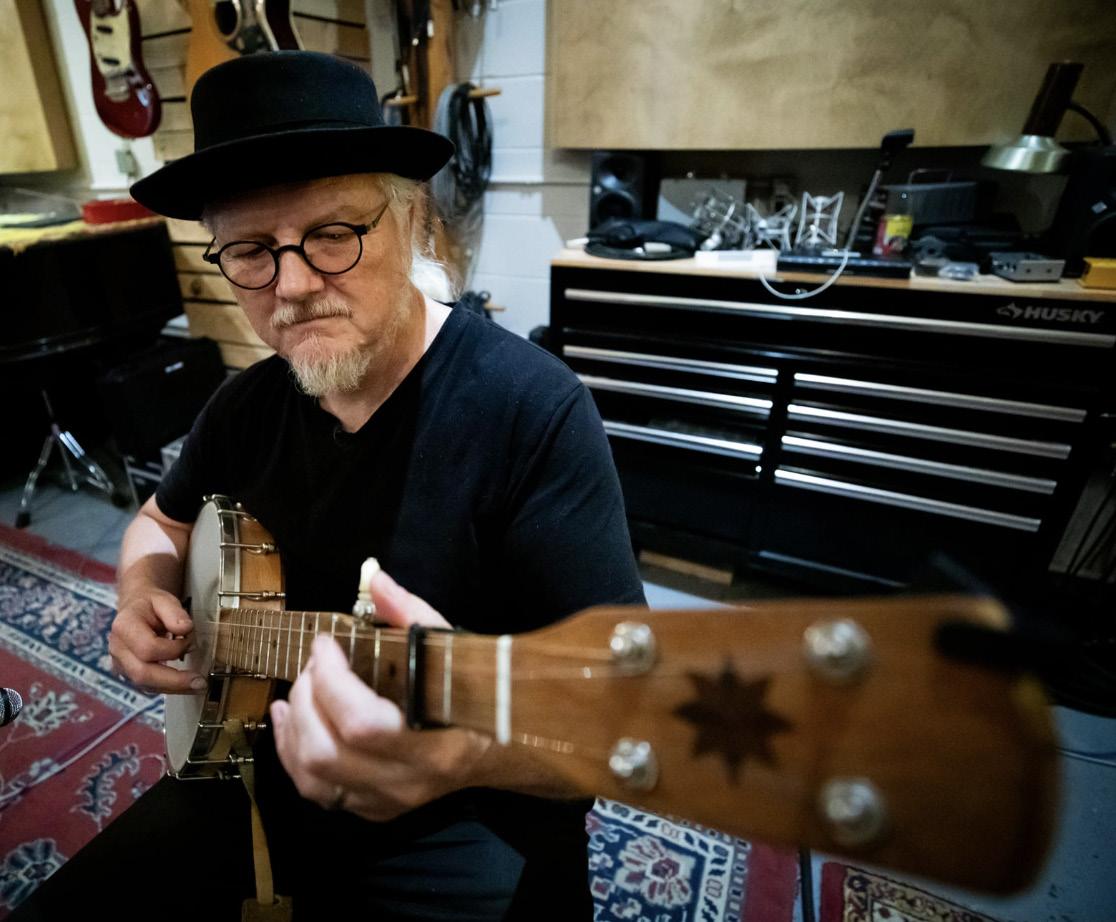
Bar is filled with warmth every Thursday evening by Anderson’s oldtime jam. “This is probably an age to be paranoid,” he said. “This jam, in here, this is the good stuff, its existence is fragile. There used to be six bars on this block, we are the last one.”
A long journey brought Anderson from his hometown in Alberta to this community of string players. Having not been interested in pursuing music, the banjo seems to have found him through fate. Now a decade on, he is grateful for
what he has been able to be a part of.
“I’m from out West, went to Montreal, moved to an Island, built a log cabin, had a kid, ended up back in the city, did a masters, got into visual arts,” said Anderson. “I had reached the same age my dad was when he died and wondered what he did that I never did. The answer was playing music. I went out to buy a guitar and came home with a banjo. There was no history with it, this was to be my instrument.”
Playing the banjo led him to Clifftop, West Virginia, home of the Appalachian String Band Music Festival. There in the heart of Appalachia he found the people who, at the time, ran the Grumpy’s jam. The jam he would eventually take on to its current form.
Despite his musical path, Anderson does not consider himself a professional musician, and for that reason makes Grumpy’s an inviting place for newcomers.
“I learned on this stage. It’s a learning
jam. This jam is a conversation; others are a demonstration.”
Weekly at Grumpy’s, musicians sit in a circle playing into each other’s faces — the shape of the jam itself allows the instruments to converse between each other.
“It happens in other places, but it feels special here. For the audience, it’s not a show, it’s like eavesdropping in on our living room.”
Since the pandemic, Anderson has noticed an increase in young people interested in old-time music.
“There’s a big change that’s occurring now,” he said. “They’re really young, they’re really eager. We’ve attracted a large amount of young people in the LGBTQ community. I believe that’s just because we are open to everything and try to be welcoming to all. People have choices now that we didn't before. This music is far from mainstream now, but people have the choice to find it. I wonder who I would be if I was twenty now. I envy the ability to realize you don’t quite fit and choose something else.”
“I just hope these young people appreciate how lucky they are. Even as the world is closing on them.”
By Danylo Perkov Assistant Opinions Editor

We recently organized The Concordian’s archives and learned Concordians have never been satisfied with the shuttle. With the constant tightening of budgets, the shuttle bus was one of the first services to suffer cuts; starting later in the day and finishing long before the last classes. This leaves students commuting to morning or evening classes to fend for themselves.
There are alternatives that Concordia or the CSU could push for — specifically in collaboration with the STM. The infrastructure needed for this is already in place and Concordia’s nearly 50,000 strong student population has enough bargaining power to influence the STM.
The newly introduced high-frequency lines are a great initiative by the STM to
make high-traffic bus lines run like the metro — with buses arriving roughly every 10 minutes, so commuters do not have to calculate schedules.
Two of those lines could be the solution to the shuttle problem.
Line 24 runs on Sherbrooke St. W and stops right by the Hall building on the SGW campus. It then takes Sherbrooke St. W all the way to Vendôme before turning off the main street towards Villa-Maria metro station.
At the same time, Line 105 runs between Vendôme to Loyola and is currently the main alternative to the shuttle for getting to that campus. This is sub-optimal, however, as students first need to take both the green and orange lines to get to the 105.
The most important element of a shuttle bus between two university campuses is


have to switch lines or transport methods. If either one of these lines were altered to connect the two campuses it could be a feasible alternative to the long-standing problematic shuttle.
Even though this service would not be offered exclusively to Concordia students, it might be time to consider alternatives given the ever-shrinking budget and pushbacks from the provincial government.
Until both the provincial and federal governments change their immigration policies, some services — as painful as it sounds — will need to be modified or cut to stay afloat. Once a service is neglected and quality declines rapidly, it is ever so difficult to convince people to use it again when attempting to fix things.
In an ideal world, Concordia could negotiate with the STM to secure a modification with those two bus lines, making the two campuses more accessible while keeping the shuttle running on its present schedule during rush hours.
Over
the course of
a year, here’s what I’ve learned about unexpected grief.
By Saskia Wodarczak Managing Editor @saskia.wodarczak
A big part of moving across the country for university has been learning how to anticipate the grief of losing my grandparents while being a six-hour flight away. However, I never imagined I would be grieving for one of my own generation this soon in life — my oldest cousin, Praneil. In Hindu culture, we consider our cousins as siblings. Although I have no immediate siblings, I have always deemed Praneil and his brother, Sunil, as my own older brothers.
As their baby sister, it has been shattering seeing one continue without the other over the past year.
When a death occurs in a family, you grieve two things: the deceased and the version of a family that no longer exists. Grief is not just missing a person; it is pain, regret, resentment and anger — reshaping everyday life.
No one tells you how haunting the
funeral home is when it’s just you and the deceased in the room. How much older they may look compared to their actual age. That when it rains on the day of the funeral, it’s like Mother Nature is crying with you. How watching your family grieve the same person can possibly be one of the most heartbreakingly isolating experiences.
Grief isn’t just emotional, but physical as well. Your brain feels foggy; your mind doesn’t work the same. You completely lose your appetite. Your heart and chest constantly feel heavy and in pain.
Your very soul feels tired.
Grief isn’t temporary. It lingers in every aspect of your life — especially the joys. It’s bittersweet to grow and reach milestones without those we’ve lost. Those moments feel incomplete, shadowed by the guilt of celebrating without someone who was looking forward to being there, because maybe allowing yourself to feel happy means that you no longer miss them.
But I’ve also learned that in those dark, quiet moments when my grief manifests into physical pain, something tells me that those who have passed on are still “here.” Whenever a light flickers, I know that my Praneil bhaiya is paying me a visit.
I know that he is no longer in pain.
Yet, in the frequent, sleepless early hours of the morning, sometimes all I can wonder is if he suffered as he passed
away. Most importantly, did he know he is loved? Was he scared? Did he try to stay? Did he want to stay? Did he know that he would finally be at peace?
Being at peace, especially in death, is a very important part of Hindu culture. One of the chants always recited during our funerals is “Om, shanti, shanti, shanti.”
Shanti means “peace.”
For me, this recitation this particular time around felt especially personal. My own name is Shanti, so hearing it during the ceremonies last year brought me a slight sense of comfort during an otherwise desensitized time. While I feel robbed of my brother, that connection between this recitation and my name reassures me that he is now at peace.
Grief is not a linear journey, and we all process it differently — do not feel guilty in your grief. I’ve found it to be almost like a game: surviving during the day but losing to grief at night, all the while accepting that although the anger and resentment might start to fade, missing the person never does.
As his baby sister, not a day has gone by over the last year that I haven’t missed my Praneil bhaiya.
However, the beautiful irony about death is that our loss is another’s reunion, and I know that as the youngest of my generation, our next reunion will be that family get-together that he and I always really wanted.

conditional support and financial freedom.
By Damarra Vogt Contributor
Meet Meredith — not the Grey’s Anatomy doctor her parents encouraged, but a 20-year-old creative immersed in the cutthroat world of film. Her parents, artists themselves, urged her to pursue “safer” career paths and forgo a life of unpredictable income. Despite their concerns, they fund her education and cover tuition. While grateful, she reveals, “my parents’ help comes with financial sacrifices.” They require complete access to her bank account to monitor all purchases.
This intrusion on her independence isn’t the only source of pressure. Searching for the ‘right’ academic path led to film through a process of elimination. Additionally, four-hour critique classes and looming deadlines, leave little energy to create the work she values — finding her initial spark blown out. She remains committed to completing her degree even if a future in film is no longer on her agenda.
During the academic year, she works five hours a week, leaving her dependent on summer savings for essentials. “Money is not something I spend a lot of time thinking about […] that’s not true,” she corrects herself. “I do think about it frequently — I just don’t plan.” She embraces intentional spending but longs to make purchases without fear constrained by both parental supervision and limited funds.
In Episode 02 of Financing My Future, Meredith openly discusses the uneasy trade-offs between security and self-discovery, leaving the question — does stability always come with strings attached?
Scan to check out our podcast:

By Kailee Krentz Opinions Editor

Big Brother is an ambiguous entity that has crept its way into cultural significance lingering in the minds of readers around the world since its initial introduction in George Orwell's 1949 novel, 1984. Maintaining relevancy to this day by being a classroom classic, the novel turned film shares elaborate ideas of censorship and security in a dystopian totalitarian environment supervised by none other than the all knowing, all powerful, all controlling Big Brother.
I was one of the many young readers that first experienced 1984 in the classroom, struggling to digest the elaborate
government ideals encountered by the main character, Winston Smith. For a refresher — or to catch you up — Winston works for the Ministry of Truth as a censor, meaning his job is to continuously update reports (whether it be newspapers, photographs, government documents, etc.) to match the government's ever-changing rules and ideals on the reality they should be living.
Seems like a great work of fiction masterminded by the author, right?
How about the Orwellian introduction of telescreens? These are television-like devices that are always on and always recording. They distribute a constant rotation of propaganda, news and “exercises” for the supposed wellbeing of the population; the volume may be adjusted, but the screens can never be turned off.
Too frightening to be true. Right?
between the ideas created in Orwell’s head and the reality we are living today.
The imagined telescreens are the most blatant example, as our privacy is slowly shedding while we’re surveilled through the constant media we consume. Our devices are listening and watching — maybe not literally, but certainly metaphorically — as advertisements, algorithms and political propaganda are catered towards your specific preferences. This is a level of power that has begun to be abused as the economic capitalists alter what we see on our screens from the information gathered through the things we search for on the internet. Why do you think Google is free?

Although 1984 is indeed a work of fiction created long before our time, we can’t deny the similarities beginning to develop
With this, I find it ironic — only further confirming the ideas presented in this article — that grand attempts have been made to remove this novel from the shelves around us, blocking any consumption of the commentary it makes. The novel’s very themes are centered around censorship
— so what does it mean when govern ments are trying to censor us from this fictional content?

These themes have never been more present in our reality than they are right now, and we can only assume the extent of them will continue to rise. Our minds are being melded and steered, forced to believe and think as one mass society controlled by capitalists, with only their own benefits in mind. I fear that a complete absence of this novel will only reinforce a sense of ignorance to these themes and how we navigate them in our reality.
I feel privileged to have experienced this novel at a young age. Although the content may be hard to digest, it certainly stimulates a part of my brain, producing thoughts and ideas I didn’t even know I had. No doubt it remains on my rereads and continues to be a work of “fic tion” that lingers in my mind even five years later.

By Alison Olsen-Prissinotti Contributor
Don't get me wrong — irony, sarcasm, satire and all that resembles a good ol’ shtick are great ways for us to understand politics in a time when nothing makes sense. Whether it’s Polymarket bets or Doug Ford swallowing a bee, the internet always finds a way to cheer me up when the political landscape goes sideways.
Postmodernists once used these tactics to subvert meta-narratives while early internet culture applied them to the meme-osphere. However, the aspects of irony that make it so useful and palatable to a large audience also have their drawbacks. This kind of detached
humour has often served as a radicalization tool. Has the irony pendulum swung too far — creating a culture of detachment which flattens once-authentic emotions?
Donald Trump's response to the “No King's Day” protestors this past Oct. 18 is a perfect example of this. In an AI video posted on his Truth Social, he was depicted wearing a crown, flying a jet over protestors and dropping, what appeared to be, human feces over his liberal enemies. Speaker of the House, Mike Johnson, claimed “The president was using social media to make a point,” calling it “satire.” Am I the only one who missed the joke?
While it can seem easy to poke fun at what’s happening south of the border, seemingly humorous deepfakes have made real impacts on the Canadian political landscape, particularly, during the most recent federal election. These videos typically target marginalized communities through racist bigoted stereotyping and portray the Liberal government as selling out to foreign nations. While these videos may seem too ridiculous to take seriously, we are no less susceptible than our American counterparts.

These posts are a few of many examples where trolling is weaponized as propaganda. Our irony-pilled, deepfake trajectory has led audiences not only to embrace authoritarian ideals, but also to detach from reality entirely. It is this ‘satirical’ mask that results in audiences growing to believe the very ideological frameworks that they once made fun of to be true.
Between AI-generated, overly smooth edges and the complete absurdity of such visuals, these memes have become symbolic of
our post-ironic wasteland. And when satire becomes propaganda, the joke is on us.
So if irony has gone too far, what's the solution? Is authenticity or sincerity the alternative of this pendulum swing?
I don’t think abandoning irony will save us from fascism, but I think the nihilism that it often comes with often primes us for manipulation. We can and should use humor to make light in dark times but above anything, collective resilience and solidarity must be central to that engagement. Not under the guise of hyper-referential sarcasm or the opposite being unmediated toxic positivity, but something entirely different.
These times of absurdity and the memes produced with it can certainly be entertaining but at what cost? Sarcasm will not stop racist immigration policies like Bill C-12. Satire will not protect queer and trans lives. Apathy will not liberate the planet from climate catastrophe and irony will certainly not stop the AI slop machine from exploiting future elections. Only collective resistance can save us from the technocrats who control our doomfilled, atomized algorithms.

Taurus
He
Gemini
When

Your
Virgo
The echoes of the past haunt your dreamless nights.



1. Like uneven eyeglass lenses
2. School in Baton Rouge
3. Mid-day times, in brief
4. Montreal was named after one
5. Goof
6. Ride (on)
7. In the manner of
8. “____ for Noose”, Sue Grafton book
9. Suggest
10. Rocky last name?
11. 80’s Sci-Fi sequel
12. Gaze maliciously
13. By and large
18. Historical period
22. Like a straight line on a graph
24. Sept jours
25. Slanted letters: Abbr
27. Title in Quebec
28. They’re famously dynamic
32. Leaves angrily, with “out”
33. “Tarzan” author: inits
X-Men: Days of
35. Un-special individual, in slang
37. Like a moustache twirler, typically
38. Finally stop and settle on 39. Amount it takes to tango
40. Positive voice vote
43. ______ Sailor (sea shanty)
44. Grow some pearly whites
45. Like library books, sometimes 46. Lively wit 47. Runs again
49. Blockage on a winter river
52. Hasbro toy requiring swift obedience
53. Sailor’s affirmative
54. “Ready, ____!”
57. Trim
60. “R u srs?”
61. WWII spy org.
62. Like most effects in a Marvel movie
_____ (2014)
19. Propaganda, often 20. Sleep soundly?
21. Philosopher Camus 23. Intermediate
Dinner ____ show 29. Mystery solver: Abbr. 30. Disgusting or mean
31. Thelma’s partner 34. Locks in a stable?
36. Local festivity, or a hint to the circled letters 41. “Duh!” 42. Like a pirate ship, or a space mission
The scales will balance in your favor.
Scorpio
Your tears will turn water into gold.
Sagittarius
Say it loud, say it like you’re proud.
Capricorn

Try, try and try but never again will you give up.

Clear your mind, take a walk, take a nap but you shall not doubt the power that rests within you.
Pisces
Kill the snakes underneath your bed for a restful sleep.

44. “___ is human”
Pasta suffix 50. Take to the skies 51. Lineup of actors in a sitcom, usually
West Texas town 56. Look at with desire
58. Singer Amos
59. In favour of a strapped sci-fi flying device?
63. Musical depicting 60’s hippie culture in New York
64. “Casablanca” heroine
65. Narrow canyon
66. Tree giants of Middle-earth
67. “I’m very grateful!”, in a text
68. ____ a million (slim odds)