Transparency through accessibility & accountability Page 2
Concordia women’s hockey’s mission to avenge disappointing end to last season Page 7
From alternative to burlesque: All Montreal roads lead to drag Page 10
Spotline on Spotify walking the industry tightrope Page 12
Voting isn’t just a right, it’s our duty! Page 14
Parler, c’est se libérer! Page 8
Transparency through accessibility & accountability
A look into Ryan Assaker’s work as finance coordinator at the CSU.
By Sabina Bellisario-Giglio Assistant Campus News
Financial accountability is not commonly associated with student unions. However, Ryan Assaker, the CSU’s finance coordinator is looking to change that.
Assaker, who was previously the finance coordinator for the Arts and Science Federation of Associations (ASFA), is working on bettering the relationship between students and the union by maximizing transparency and focusing on rebuilding trust.
“We're obviously taking student money to improve their lives day to day,” Assaker said. “So it's not in our best interest to [...] not utilize that money to the maximum of its potential.”
He hopes to improve transparency and understanding among the student body through personal commitments and policy reform.
“Unions are one of the biggest drivers of change in the community,” he said. “Unions can provide a lifeline; they can provide abundance to students.”
For Assaker, this is why he is striving for systematic change at the CSU. “There’s more work to be done in terms of changing transparency systematically at the union [...] and just changing the culture around the office as well or just around the union as it is.”
Improving and maintaining student trust
Assaker mentioned how having an opendoor policy, as he has now, helps build trust and respect within the relationship with students. “Unions are based in grassroots ideology, in the sense that everything is interconnected and therefore there shouldn’t be this gap between the representatives and the students,” he said.
“I’m also a student, so if you come across me around campus, stop me and just ask a question, or when I’m in the office.”
“I think [financial literacy] is important because a lot of students want to ask those questions,” he said. “It took me a lot of time to grasp those concepts, so I think if you want to bridge the gap, you need to give the students the means to be able to understand the financial aspects of the CSU.”
Assaker’s approach to building trust between the student body and the CSU begins with accessibility. “What I’m trying to do — and what I’m committed to do — is posting all the financial information we have to our website,” he said.
When completed, the website will include documentation such as audits, monthly reports and lists of assets, accompanied by a guide to help interpret the language found in the documents. These materials are expected to be available on the CSU’s website by the end of the month.
Assaker also said maintaining a relationship with the student newspapers on campus would help students engage with the CSU. “Sometimes everything is happening in a silo, whereas I’d like to make that rapport more familiar so that students can feel confident when
approaching the CSU and asking them questions about their finances,” he said.
Policy and structure reform
Assaker would like to reform clauses within the CSU’s bylaws, including one that states that the finance committee should have more frequent meetings. The role of the finance committee is to hold the finance coordinator accountable, which Assaker believes is an important part of the democracy at the CSU that needs to be improved. “Institutionalizing committee oversight to me is very important,” he said.
To better utilize the role of the finance committee, Assaker wants to expand the minimum number of meetings required and increase the honorarium for councillors. “My perspective is, if the finance committee ends up meeting a lot of times with the finance coordinator, then the right questions will arise,” he said.
He would also like to tighten up certain policies surrounding the Student Space, Accessible Education, and Legal Contingency Fund (SSAELC).
“I don’t think its [SSAELC Fund] policies are tight enough,” he said. “So I’m also working on drafting up an entire policy sheet for the fund and how the money is supposed to be dispersed to maximize transparency.”
The fund was previously used to finance the AI chatbot “Navi” project and, most recently, for food initiatives and student housing.
In addition, Assaker is currently working on a project to open a mental health office for students on campus. “We’ve got a mental health field that’s running right now, but it’s being underutilized, it’s not being used at all, actually.”
Assaker emphasized the importance of expanding social services for students on campus, reiterating that he’s still brainstorming ideas with the finance committee and that “the sky’s the limit.”
Transparency and continuity
“The main thing that I had to explain when I first sat down in the finance committee is what they were supposed to do,” Assaker said. “I had to sit with them, read the bylaws, and make sure like ‘Hey guys, you’re the accountability system for me.’”
He wants to ensure all members involved in the accountability process are well prepared for their roles. “I think councillors should be ready; they shouldn’t have to have the person they’re holding accountable tell them what to do.”
Assasker also spoke about handover culture and wanting to adopt certain practices he had while working at ASFA. This includes introducing the new finance coordinator to the finance committee, outlining all roles and holding several meetings on any information needed to fulfill that role.
“Every week in May is going to be focused on an aspect of what the CSU does financially,” he said. “I’m probably going to reserve one week straight on just transparency and how not to mess up the processes that we have that contribute to said transparency.”
Assaker spoke about how the policies clearly outline the responsibilities of the finance committee versus the finance coordinator, but said there’s still work to be done on clauses that remain “vague” and “left to interpretation.”
Concordia’s community garden brings people together
The mind.heart.mouth garden is cultivating a community rarely seen in our modern era, a place of support, cooperation and belonging Gabriel Watson & Andreas Fleury Contributors @watson_gw @andreas_fleury
“The garden kept my stomach full, but the people nourished my soul,” said Clara Olivia Levesque.
After moving out early, she relied on several soup kitchens through her young adulthood.
She found that the Concordia mind.heart.mouth collective garden in 2021, stood out from other community food-based groups. It became an essential source of sustenance, but most importantly, the people of the garden became a source of support.
Since 2019, the mind.heart.mouth collective garden has served as a symbol of community cooperation, support and togetherness. It symbolizes Concordia University’s and Montrealers’ fight against food insecurity in line with the Canadian Sustainability Plan.
Located on the Loyola campus near the Hive Cafe and HA building, the garden offers a variety of volunteer opportunities. On Monday and Wednesday mornings, volunteers help cultivate and care for the garden. The garden sees between 30 and 40 student volunteers and about 30 older adults over the season in the garden.
Levesque found a place of belonging in the garden. “The old men and women who come here are my extended family.”
The garden fosters cultural exchange. Volunteers from diverse faiths, cultures and practices share knowledge through art, food, work and conversation.
Andrea Tremblay, founder of the garden said she started it after learning “in 2019, that 40 per cent of Canadian post-secondary students suffer from food insecurity.”
“There are various degrees and various reasons why, so I thought, why not teach people to grow food?” She adds that, “when people work side by side, they forget their differences.”
Statistics Canada reports that in 2022, 16.9 per cent of Canadians suffered from food insecurity, compared to 12.9 per cent in 2021, disproportionately targeting minority groups.
The garden combats this, by giving volunteers fresh organic produce from each day’s harvest. Extra food is donated to local food banks or the Hive Free Lunch, where students can enjoy free meals.
Beyond food, the garden promotes interaction and community building among young volunteers and elderly participants facing food insecurity. Tremblay works with New Hope Senior Citizens’ Centre, a nonprofit that serves the seniors in Notre-Damede-Grace. New Hope organizes weekly outings to the garden, where seniors have a chance to leave their homes, connect with others and participate in group activities.
“The garden is a place of empowerment for older adults. Older adults in our culture are often cast aside; the word retirement speaks for that, which is very wrong, it’s a big missing out on what a lot of people can contribute to society,” Tremblay said. “The garden serves that purpose as well, to fight social isolation in older adults.”
Catherine Skothos, a quantitative data research assistant for Aging Communication Technologies (ACT Lab), has worked closely with New Hope and its elderly volunteers to measure the benefits they gain from participating in the program. She says that, “it gives them a chance to connect with a lot of people and it gives them a reason to leave their house.”
CSU responds to handbook backlash
Concordia Student Union 2025-26 handbook debated in national headlines.
By Jia Marguerite Schofer Campus News Editor @jiamarguerite
The Concordia Student Union’s (CSU) 2025–26 handbook provoked reactions from many, on and off campus. Of the 194-page publication, 114 serve as an agenda assembled by a team of 18 students. The publication also includes the resources available on campus, from insurance services to harm-reduction and safe supply guides. The most contentious, however, are the “Strike Guide” on pages 40-41 and the “Guide to Countering Repression” on pages 62-63.
Since its publication, multiple news outlets have covered the content it represents and its political position on the ongoing genocide in Palestine. The Suburban, The National Post and The Montreal Gazette have written about how ‘shameful’ and ‘crazy’ this free, optional, student-focused handbook is.
Legally and procedurally, the handbook stands on solid ground: it was produced, debated and defended by elected representatives.
Utility and demand
As in previous years, the handbook’s primary goal is to be a useful student resource. It was designed to be an up-todate resource for students, with sections on free services, tuition breakdowns and ways to get involved in student governance. The union ran out of its stock, given its popularity, which is a rare occurrence.
“[It has] helpful breakdowns of our student government structure and processes because those are also really hard to internalize if you’re not in it,” said Danna Ballantyne, the CSU’s external affairs & mobilization coordinator.
Arevig Nahabedian, student life coordinator, added, “It’s important to note that we didn’t start with a blank canvas. Like there’s a lot of predetermined things that had to go in it.”
“There’s been a lot of student mobilization over the past year. So, it’s been pretty clear to us what is of importance to students,” said Ballantyne, asserting that it would lack justification to continue pushing such campaigns if there was not interest from organizing of regular students.
She further asserted that the political framing of the handbook is “in line with a very clear mandate.” As elected members of the student body, CSU executives are obligated to uphold the union’s position book and push forward political campaigns.
Inside, the CSU commits to “standing in unwavering solidarity with global movements for justice.” The union explicitly supports movements against colonialism and oppression abroad, which it views as intrinsically linked to local struggles for equity.
“What the ethos of the CSU stands by in terms of inclusivity and you know reflecting human rights and what the students have clearly demonstrated to be their values ethically, morally, socially,” Ballantyne said.
Campus backlash
A motion was brought before the council by CSU Council member Anastasia Zorchinsky to label the handbook a “harmful and inappropriate publication” and remove it from circulation. The motion was rejected, with 64 per cent voting against.
In a statement to The Concordian, Zorchinsky wrote: “If they represent all students who all democratically hold different views, why could they not make a regular handbook that seeks for balance and positive dialogue, but rather create one with so much hate and violence in it that is clearly one-sided?”
“Certain students tend to have an issue with Palestine because they hold certain politics that are not reflected within the union’s positions,” Ballantyne said. “That’s unfortunate, but they tend to be the minority when it comes to our democratic processes. And it’s not our obligation to represent every single student. It’s our obligation to represent the politics of the majority through demo cratic vote.”
Various students have expressed their thoughts on multiple reddit channels con cerned that the hand book’s political stance takes away from its mandate. One user wrote that the CSU “shouldn’t be trying to play politics” because its “actual job is fixing stuff ON CAMPUS”
“I completely under stand where the perspec tive comes from. And what I will say is we’re doing both,” said Ryan Assaker, the CSU’s fi nance coordinator. He pointed to concrete ini tiatives related to ac cess to free food, hous ing security and mental health support, all of which are included in the handbook.
Concordia University issued a “Statement of Correction,” distancing itself from its content, clarifying that the handbook “contains material that is not in keeping with Concordia University’s Code of Rights and Responsibilities and related policies.” The university stated that the handbook promotes behaviour prohibited under Article 43 (obstruction or disruption of activities) and Article 26 (concealing identity).
The CSU viewed the university’s statement as punitive and lacking transparency, saying they were not made aware of the statement before its publication. They criticized the university’s handling of complaints saying Concordia was “directing people to harass our staff rather than file complaints.” The union argued this “further isolated us” and “put our staff at risk of harassment.”
Ballantyne added that if solidarity with the Palestinian cause conflicts with university policies on respect and civility, then “we’re admitting that silence in the face of a livestream genocide is not only acceptable, it is ideal and polite according to our administration.” They countered that it would be “more irresponsible” not to address these issues when strikes are “so very present in the lives of students.”
External reactions
Jewish advocacy groups, including the Centre for Israel and Jewish Affairs (CIJA) and Federation CJA, called the handbook “hateful, divisive content that glorifies violence.” Both organizations accused the CSU of celebrating antisemitic incidents and promoting anti-Israel narratives, demanding disciplinary action.
efforts to undermine the student movement rather than legitimate feedback. Ballantyne characterized them as “not an organic student-led initiative in support of Jewish rights.”
“Students should be ticked off that outside third party organizations are meddling into the political situation at Concordia and the students’ voices,” Assaker said.
A National Post columnist dismissed the book as “crazy,” pointing out that instead of listing Canada Day or Christmas, it highlights observances such as “Cuban Revolution Victory Day,” and accuses the handbook of stoking anti-police sentiment.
The Suburban writes that it is unrealistic that a “35,000-strong undergraduate student body feels represented by the ‘radical minority’ behind the handbook.”
These publications portray the CSU as an independent political actor freely expressing its own views. In reality, the CSU is a democratically elected body that represents Concordia’s student population and is mandated to advocate for the positions of the university’s student body.
Those who oppose its stance hold the same power to vote, campaign and participate in the student union’s decision-making.
Ballantyne said that because of the external news coverage some members are “getting straight-up death threats from people across the country.”
How is homelessness addressed in this year’s municipal election?
Learn about the five parties’ proposals to address homelessness in the city.
By Angélique Babineau Assistant City News Editor
Alongside housing, safety and public transit, homelessness has been a core issue of this year’s Montreal municipal election.
All three levels of government share responsibility for addressing homelessness. While cities depend on the federal and provincial government for funding, they play a role in allocating resources, coordinating with community initiatives and managing public spaces.
Municipalities can also promote affordable housing through by-law modification or the issuance of building permits. They advocate for local needs and encourage coordination with other levels of government to address broader, systemic changes.
According to a report from Quebec’s Ministry of Health, visible homelessness rose by 44 per cent across the province between 2018 and 2022.
The report also found that Indigenous people are disproportionately affected. In Quebec, unhoused people identifying as Indigenous are represented at five times the rate of the general population.
In the Ministry of Health’s 2024 sheltered homelessness count, 9,307 unhoused individuals were lodged across Quebec on the night of April 13, 2024. Of which, 42 per cent were in Montreal. The census excludes a very large portion of those experiencing homelessness: those
experiencing hidden homelessness by way of staying with friends, relatives, or in cars; and those hidden homelessness or those staying in metro stations, streets, restaurants, cars or tents.
All five parties running in Montreal’s municipal election have identified homelessness as a core issue and proposed different strategies to tackle it. Here are some of the promises made by each party:
Projet Montréal (Luc Rabouin):
Projet Montréal has been in office since 2017 with Valérie Plante as its leader. When Plante announced she would not be seeking a third mandate in the fall of last year, Luc Rabouin, mayor of the Plateau-Mont-Royal borough, became the party’s new leader. Projet Montréal pledges to end homelessness by 2030, proposing four steps to reach this goal:
Doubling funding for community organizations and securing it for a period of three years;
Deploying 500 modular housing units; Buying rooming houses and entrusting their management to the paramunicipal organization, the Société d’habitation et de développement de Montréal, to protect them from the private housing market; Supporting the creation of 500 transitional housing units.
The party also promises to support culturally appropriate initiatives for Indigenous people experiencing homelessness as part of its initiatives toward reconciliation.
Ensemble Montréal
(Soraya Martinez Ferrada):
Ensemble Montréal identifies reducing homelessness as one of its six priorities. If elected, Soraya Martinez Ferrada has committed to the following within her first 100 days in office:
Establish a Tactical Intervention Group on Homelessness to coordinate field interventions and plan upcoming operations;
Compose a protocol for the management of encampments in close collaboration with community organizations and municipal services;
Triple the city’s annual budget allocated to homelessness to $30 million per year and create a $10 million matching fund with the private sector.
Ensemble Montréal has vowed to dedicate $100 million to acquire and renovate buildings to develop new, smallscale emergency shelter resources. It has also pledged to establish at least 2,000 transitional and permanent housing units with psychosocial support within its first mandate.
“Unfortunately, the current administration is not working as a team on the homelessness file,” said Ensemble Montréal press officer Guillaume Pelletier in a statement to The Concordian. “You can’t criticize the Quebec government in the morning and ask them for money in the afternoon.”
Transition Montréal (Craig Sauvé):
Offering a reform to the way homelessness is approached in the city, Transition Montréal suggests six proposals to tackle the crisis, including:
Declaring a state of emergency immediately upon taking office to allow the requisition of hotels and vacant buildings to provide temporary shelter during the cold season;
Banning police access to homeless encampments and establishing a coordinated program of community and social services on-site;
Introducing a supplementary tax on individual residential properties valued over $3.5 million to generate approximately $40 million annually, entirely reinvested to triple funding for community organizations working in homelessness prevention and support;
Creating a municipal rent bank offering microloans covering up to three months’
rent for individuals at risk of eviction; Futur Montréal (Jean-François Kacou):
Futur Montréal’s plan to address homelessness includes the creation of a Social Intervention Service (SIS), which would involve:
Consolidating and optimizing the resources and budgets of more than 60 community organizations and workers involved in homelessness in the City of Montreal;
Coordinating social intervention efforts and facilitating the sharing of information;
Creating collaboration officers with the SPVM and establishing a single point of contact for police services regarding social interventions;
Setting up a social intervention hotline for citizens to reduce the number of 911 calls.
Action Montréal (Gilbert Thibodeau): Action Montréal’s approach focuses on collaboration with and between community organizations, as well as collective participation:
Create a collaborative roundtable with community organizations to harmonize their services (shelters, care, reintegration) and avoid duplication. Invite churches, mosques, and other places of worship to voluntarily open their doors as temporary shelters.
Establish transitional centers with equipped tents, sanitation, medical services, and security within two years, followed by permanent rooms for three profiles: people facing economic hardship, those with addictions, or those with mental health challenges.
Action Montréal has also pledged to offer personalized mental health and detox programs. It also states it will work with the provincial and federal governments on longer-term solutions, “such as rent assistance to avoid evictions and programs for at-risk youth.”
Other strikes at the STM are looming
After the strike from its maintenance workers a few weeks ago, the STM could also see two other unions go on strike soon.
By Félix-Antoine Beauchemin City News Editor @fa.beauchemin.journalisme
The union representing the STM’s bus drivers and metro operators has threatened to launch an “imminent strike,” while the one representing the professional workers is considering asking for a strike mandate.
The Canadian Union of Public Employees (CUPE) Local 1983, which represents 4,500 bus drivers, metro operators, station
agents and paratransit drivers, issued a warning of a possible strike on Oct. 14.
A billboard posted by the union read: “Bus and metro soon on strike. Thank you, STM!”
The Syndicat des professionnelles et professionnels de la STM (SEPB-610) also recently announced that it was considering asking its 800 members for a strike mandate, after over a year of deadlock in its negotiations. The union represents professionals at the STM, such as engineers, analysts and architects.
The collective agreement between the STM and CUPE 1983 expired on Jan. 5, 2025. On May 31, members of the CUPE 1983 union voted 99 per cent in favour of pressure tactics that could go up to an unlimited general strike.
In a press release, the union accused the STM of being inflexible in its negotiations, after months of lower-level actions, such as adding stickers on buses and delaying bus returns at the end of the day.
“The union hasn’t gone on strike since 1987,” said CUPE 1983 president Frédéric Therrien in that same press release. “Thirty-eight years! Because we
believe in dialogue and want to maintain service to the public. But the STM is leaving us no choice. We’ve reached that point.”
The strikes in June and a few weeks ago were from the Syndicat du Transport de Montréal, which represents the STM’s maintenance workers. At the end of the latest strike, Quebec Labour Minister Jean Boulet appointed a team of four conciliator-mediators to try to bring the two parties together. They are yet to reach an agreement.
Benoit Tessier, the vice-president of the SEPB-610, also criticized the STM’s inflexibility in its negotiations. His union’s main request is for the STM to prioritize its internal expertise over turning to private firms. He said this would result in job losses, although the STM has not specified how many in its negotiations.
“We have no idea because the STM has not presented us with any concrete plan to reduce staff numbers,” he said in an interview with The Concordian
Although he cannot speak for other unions, Tessier also criticized the STM’s negotiation approach to be inflexible.
“We are dealing with the same employer,” he said. “The employer does not seem very flexible in its negotiations. They come to the table with very firm demands, and then, after a year of negotiations, these demands and aspects have not changed in the employer’s discourse.”
Tessier did not exclude the possibility of a common front with other STM unions for an eventual strike.
“In terms of a common front and a strike strategy, we will see at that point how we decide to exercise our mandate, if we decide to ask for one,” he said. “I would say yes, it is likely that we will do so in an intelligent, complementary or coordinated way with the others, because we already have very good cooperation between all the STM unions at the moment.”
The looming strikes add to the STM’s mounting budgetary challenges. Following the latest provincial budget in March, the STM said its budget to maintain the public transit network was cut by $258 million over the next three years.
The STM did not respond to The Concordian’s request for comments.
What will the next four years of Montreal transit look like?
This answer will change depending on the next mayoral administration.
By Félix-Antoine Beauchemin City News Editor @fa.beauchemin.journalisme
Party visions clash over the issues of mobility, public transit and the space allocated to cars and bikes.
Over the past eight years, Valérie Plante’s administration has worked to improve mobility;, notably through the expansion of the city’s bike path network, bike share services and the blue line extension.
In 2016, the City of Montreal had 730 km of bike paths. Since then, Plante has increased that by 48 per cent to 1,083 km of bike paths across Montreal. This includes an Express Bike Network (EBN), consisting of separated bike paths with lines wide enough to allow for overtaking and accessible all year round. Upon completion in 2027, the EBN will be 191 km long.
One of Plante’s central 2017 campaigns was the creation of a new pink metro line, which would have connected Montréal-Nord and Lachine via downtown Montreal. Today, Projet Montréal still mentions part of the pink line in its campaign platform, a tramway connecting downtown to Lachine and LaSalle. However, the party has not made any public announcement about the project in this campaign. In March, the provincial government also dropped the funding for the project from its budget, as reported by La Presse Plante also pushed for the extension of the orange and blue lines. The extension of the orange line toward Saint-Laurent and Ahuntsic-Cartierville has not materialized. However, she secured the extension of the blue line to Anjou, for which construction is already underway.
Plante’s time in office has also seen a sharp increase in the number of Bixis and car share services. In 2017, there were 6,250 bikes across 540 stations in the Greater Montreal Area. By 2024, those numbers had increased to 11,000 across more than 900 locations, including 2,600 electric bikes. A reduced number of Bixis’s are now also available year-round. However, another thing is also clear when looking back at Plante’s eight years in power: she failed to shift the stereotype about Montreal’s two seasons being winter and construction. These changes have proven to be divisive among Montrealers, notably over the space allocated to cars and bikes, as well
as the numerous construction sites. This polarization is evident when looking at the different parties’ plans for mobility.
Projet Montréal (Luc Rabouin):
Projet Montréal’s electoral platform includes the idea of “15-minute neighbourhoods.” This would include doubling the number of Bixi stations in Montreal to ensure that all Montreal residents live within a 15-minute walk of a Bixi station by the end of Rabouin’s first term. According to Projet Montréal, this is already the case for around 80 per cent of the population.
Projet Montréal proposes a Réseau express bus (REB). The REB would be a network of express bus lines with fewer stops, higher frequency and faster service with designated lanes and synchronized lights.
The party’s mobility plan includes three tramway lines: a loop between downtown and Jean-Talon Boulevard, a line in the east of Montreal and part of the pink line between downtown and Lachine and LaSalle. Projet Montréal pledges to expand the bike path network and pedestrianize Sainte-Catherine Street East year-round.
Ensemble Montréal
(Soraya Martinez Ferrada):
“Promoting safe and efficient transportation” is one of Ensemble Montréal’s six main priorities. Ensemble Montréal’s program states that each construction site must be planned to reduce the impact on traffic and businesses, while ensuring the safety of users.
Ensemble Montreal says it will manage the construction sites of infrastructure projects more efficiently than Projet
Montréal. It also pledges to evaluate safety issues for all users around the bike path network.
Regarding public transportation projects, Ensemble Montréal favours the tramway in the East of Montreal. It plans to increase metro frequency and prioritize the orange line extension.
Ensemble Montréal plans to build two new REM stations between the Îledes-Sœurs and Gare Centrale stations, namely Griffintown-Bernard-Landry and Bridge-Bonaventure. The construction of the Griffintown-Bernard-Landry station is already planned for after the opening of the REM airport branch in 2027.
Transition Montréal (Craig Sauvé):
Transition Montréal proposes two metro extensions: the orange line to the Bois-Franc REM station and the green line to LaSalle and Lachine as part of the Grand Sud-Ouest structuring project. The party is also in favour of the tramway project in the East of Montreal.
It also proposes a social transit fare for people with an adjusted annual income under $47,500. The plan would give them access to the reduced monthly fare of $62.75, instead of $104.50.
Transition Montréal would introduce a kilometre-based tax on vehicles, a measure already supported by the Chamber of Commerce of Metropolitan Montreal and Alliance Transit. Revenues from this tax would then be used to maintain roads and develop public transport.
Futur Montréal (Jean-François Kacou):
Futur Montréal wants Montreal to have “the best bus system in the world.” To do so, the party would create more reserved bus lines and propose service
guaranteed every 15 minutes, seven days per week. It would first do so on major arteries and the busiest routes, before expanding this frequency across the entire city.
It also wants to implement a fouryear fare freeze, work with the provincial government to buy Quebec-built electric buses and launch pilot projects for autonomous shuttles on strategic routes.
Futur Montréal would permanently freeze the construction of bike paths along commercial arteries, as well as “limit the creation of new bike lanes to strategic areas.” Conversely, it wants to increase parking spaces, notably by building parking towers in urban centres and near commercial arteries. It would complement this initiative with shuttle services.
Action Montréal (Gilbert Thibodeau):
Action Montréal opposes the tramway project in Eastern Montreal, calling it too expensive. Instead, it would extend the green line with three stations from Honoré-Beaugrand to Georges-V Avenue. Although less expensive than the tramway project, this green line extension would directly serve a smaller area.
Action Montréal would remove or reconfigure what it calls “harmful or makeshift bike lanes,” notably to increase the number of parking spaces. The party would also invest in underground or multi-level parking facilities in high-demand areas.
Action Montréal would also implement a $50 per year cap on parking permits for all residents, a limit on parking metres at $2 per hour on weekdays and make parking metres free on weekends.
Graphic by Ana Cristina Rodríguez // Contributor // @ana.cristina.rodriguez
The Scoreboard: Concordia teams deliver mixed results across weekend action
From football’s playoff-clinching pursuit to early success on the ice and court, Concordia teams delivered pivotal performances as fall seasons near their close.
By Anthony Maruca & Mathilde Colls Sports Editor & Assistant Sports Editor
Concordia football team wins crucial matchup against Sherbrooke amid final playoff push
Under the Friday night lights at Concordia Stadium, the Stingers came away with an impressive win over the Vert et Or of l’Université de Sherbrooke. After consistently struggling to move the ball on offence most of this season, a quarterback change at halftime sparked a 27point second half performance that propelled them past the Vert et Or. This was only the second time Concordia eclipsed 20 points this season, with the last such outing coming in their only win prior to this matchup against McGill on Sept. 5. Stingers’ quarterback Antoine Ouimet was nearly perfect upon entering the game, completing 14 of his 17 passes on the evening for 220 passing yards and two passing touchdowns. The win keeps Concordia within the RSEQ’s playoff race, as a win over McGill on Oct. 25 clinches one of the four spots available. Their final matchup’s kick-off is set for 1 p.m. at Percival Molson Memorial Stadium.
on Oct. 18. However, the same cannot be said for their loss against the UQTR Patriots, who are currently the number one seed in the OUA. Concordia gave up five unanswered goals on their way to what was, at the time, their third straight loss. The results five games into the regular season do not meet the standards set by their Queen’s cup winning season last year, as their lackluster start has them ranked seventh in the OUA conference. The Stingers will look to get their season back on track against the Ottawa GeeGees on Oct. 24. Puck-drop is set for 7 p.m. on Gee-Gee’s home ice.
Concordia men’s basketball split games at Victoria University tournament
The Stingers were not a match for the host team on Oct. 16, as the Victoria Vikes beat them by nearly 30 points. Starting guard Sami Jahan led the way in the losing effort with 11 points, a total that was matched by forward Liam Ngos coming off the bench. Concordia avenged the loss the following day, winning their next matchup against the Calgary Dinos on Oct. 17. Jahan once again led the way in the scoring department, putting up 21 points along with eight total rebounds. Concordia is set to begin their regular season against UQAM on Nov. 6. Tipoff is set for 8 p.m. at the UQAM Sports Center as part of a double-header with the women’s team.
The women’s soccer team continued their winning streak this Friday in a tough fight against Laval. With a brace from Alma Aristilde, and two goals from Rachel Vermaire and Kinifoh Coulibaly, the Stingers keep their playoffs dream alive with a current third place in the league.
Women’s basketball continues excellent play in pair of non-conference wins
Women’s rugby team loses RSEQ bronze medal against UdeM
The women’s rugby team finished the season with a loss at home against UdeM in the fight for the RSEQ’s third seed in the bronze medal game. The tight loss marks the end of a successful season for the program, as the result leaves them at fourth overall in the RSEQ. Top scorer Mahalia Robinson led the team on the scoresheet with 12 points. The Rouge et Or of l’Université de Laval beat the Ottawa Gee-Gee’s in the gold medal game, earning them the top seed in the conference. Both of Concordia’ s losses this season came against Laval and Ottawa respectively.
Concordia women’s hockey start their season on a high note with win in season opener
In a close game, the Stingers were able to pull out the win despite falling behind early in the game. In the final minutes of the first period, Concordia found themselves down two against the Carabins of l’Université de Montréal. A late powerplay goal from Katia Pelowich brought them to within one late in the period. The Stingers controlled the game from that point, scoring two more unanswered goals to win their first game of the season. Concordia gets a week off before facing McGill on Oct. 24 for their home opener. Puck-drop is set for 7 p.m. at Ed Meagher Arena.
Concordia’s women’s basketball team continued to build on what has been a promising preseason, adding two wins over the weekend. Their convincing win over the Memorial University Seahawks was led by starting center Serena Tchida’s 16-point and 16-rebound double-double, along with guard Victoria Lawrence’s 19 points off the bench. They followed this performance up with a dominant win over the UNBC Timberwolves the following day, beating them by over 40 points. The reigning RSEQ defensive player of the year is back in mid-season form, as Victoria Lawrence put up ten (!!) steals in an utterly dominant defensive performance. The Stingers are set to begin their regular season against UQAM on Nov. 6. Tip-off is set for 6 p.m. at the UQAM Sports Center as part of a double-header with the men’s team.
Men’s soccer lose 3-1 away in Laval during crucial playoff race
Men’s hockey off to a rough start to their season, as pair of losses extends losing streak to four
Weird bounces, broken sticks and bad puck luck were all contributors in the Stingers’ loss during their home opener
The men’s soccer team continues their losing streak. On Friday, the Stingers conceded three goals away against Laval. Despite a goal from defender Zackiel Brault, the visitors could not catch up to the third ranked team in the league. Concordia stays sixth in the league and the team will not make the playoffs this season.
Women’s soccer team shunned RSEQ champions with 4-3 win against Laval away
Concordia Men’s rugby lose last game of the season at home against McGill
The men’s rugby team finished off their season with a loss 25-50 in the Dave Hardy Cup. After only a win in the season during their home opener against Carleton, the Stingers close this fall chapter with a sixth place in the league.
Men’s soccer team lose last game of the season at home against UQTR
Concordia’s men’s soccer team wrapped up their season by hosting UQTR for their senior appreciation game. The home team could not find the back of the net, and with a 2-0 loss at home, the Stingers finish their season as the sixth seed in the RSEQ.
Concordia Women’s soccer team earns RSEQ semifinals spot after tie against UQTR at home
With everything to play for this Sunday, the women’s soccer team managed to clinch the RSEQ semifinals spot after a 1-1 tie. A solid team performance places Concordia right above McGill, as the third seed in the conference. The Stingers will visit the Rouge et Or of l’Université de Laval for their first playoff matchup on Oct. 24. Kick-off time is undetermined at the time of publication, but the venue will be at l’Université de Laval’s at their sports center in Quebec City. Infographic by Anna Huang // Graphics Editor // @itza_me_anna
Concordia women’s hockey’s mission to avenge disappointing end to last season
The Stingers hope to meet the championshipwinning standard set by previous success, even with familiar faces leaving the building.
By Luca Jarman Staff Writer
Over the last four seasons, Concordia’s women’s hockey program has been wildly successful, winning two national championships in 2022 and 2024. Last year they continued this form with a stunning record in the regular season. But they were unable to make
this count in the playoffs, losing in both the RSEQ finals and the national U Sports semi-final.
This year, their goal is to make it back to the national championship. Although their goal remains the same, the changes to the team this year mark a new era for the Stingers.
With former Assistant Coach Caroline Ouelette moving to a new position within the Montreal Victoire’s organization and several key seniors moving on, it could be challenging for the team to keep up their level of performance.
Despite this, crucial players like Emilie Lussier believe the current pool of talent can achieve the same heights.
“We did not like how we ended it last year,” said Lussier. “We have a really good group this year who are ready to battle to give everything and to get a championship back.”
Jordyn Verbeek, the goaltender for both of the teams national titles, is experienced in navigating the full-season stress of high expectations.
“We aren’t focused about the games
next weekend or playoffs at the end of the year, we are focused on the day at hand, going all out in practice, working in the gym and being ready for our next game. Doing the right things now is going to put us on the path to achieve what we want to achieve in February and March,” said Verbeek.
Lussier had nothing but praise for head coach Julie Chu’s role in the program’s success.
“Every day she brings positivity during practice and makes sure everyone is at
their best. Having a coach that is so close to their players creates a meaningful relationship and a level of trust so we can have open conversations.”
With many senior players gone, developing new players will be key to the team’s success. Verbeek recalled how Chu supported her as a rookie.
“Julie has had a huge impact on me. She allowed me to come onto the team as a young kid and did a lot to help me to develop and be successful in the coming years. She allows me to feel confident in net, try new things and make mistakes,” said Verbeek.
The Stingers’ season started well as they earned an exciting 3-2 win over Université de Montréal away from home in the first league game.
They host McGill for their home opener on Oct. 24 at 7 p.m. at Ed Meagher Arena.
Concordia women’s soccer makes it into RSEQ playoffs after tie draws against UQTR
The Stingers needed one point to secure the third seed in the RSEQ standings.
By Anthony Tapia Ancinez
The Concordia Stingers women's soccer team has qualified for the RSEQ playoffs for the first time in 20 years.
The 1-1 draw at home against Université du Québec à Trois-Rivières (UQTR) was enough to give Concordia a shot at the title. They will be facing the Rouge et Or of l’Université de Laval in the semifinals
The Stingers were on a three-game winning
streak, coming into this game with great confidence.
“It was an intense match for sure, we knew that we needed to make the points to make it to the playoffs,” said the team’s top goal scorer, Rachel Vermaire, post game.
In the first half, Concordia established its presence on the field by applying a high pressure system on UQTR’s players.
The Stingers played cohesively, showing chemistry and intent to keep possession of the ball.
When UQTR held the ball, the Stingers kept a solid defence and had tight marking on their players, allowing for fast ball recoveries and quick transitions on offence.
Multiple corner kicks were awarded on both sides but neither team was able to convert. The first half ended in a 0-0 draw.
The second half started off with a lot of action, with both teams shooting at each other's goal.
With 10 minutes left, a great pass to the right flank from the team's forward Ashley Burdick found Rachel Vermaire, who sneaked the ball into the net and placed Concordia ahead in the game. This was Vermaire’s team-leading seventh goal of the season.
The lead didn’t last very long. Just two minutes later, UQTR evened up the score off of a free kick.
Both teams pushed to score in the final minutes, making crosses into the opposing team’s penalty
area. Despite both of their efforts the game ended in a 1-1 tie. This will be the first time the Stingers have qualified for the playoffs since 2005.
The team's success can be attributed to its growing cohesion and consistency on the field.
“I’m so happy today that the girls were actually buying into the project,” said the head coach Wilfried Monthe post-game.
“We are starting a new era, we are developing a new culture. There was a turning point and now we have so many good new players coming to us,” said senior advisor Dwight Kennedy on making it into the playoffs for the first time in 20 years.
The players celebrated their qualification, having achieved something never seen in the lifetime of many Concordians.
“We put a lot of effort into this team. This group is really hard working and to finally get something that I feel is pretty deserved is awesome,” said the team’s captain Devon Vermaire post-game.
The Stingers will visit the Rouge et Or of l’Université de Laval for their first playoff matchup on Oct. 24. Kick-off time is undetermined at the time of publication, but the venue will be at l’Université de Laval’s sports center in Quebec City.
Angélie Jobin (#21) overlooks as Jordyn Verbeek (#1) tracks incoming puck through traffic. Photo courtesy of James Hajjar // Montreal Carabins Athletics
Je pensais être étrangère partout, puis, j’ai appris à m’appartenir. L’histoire d’un voyage qui m’a éloigné de ce que je connaissais pour me faire découvrir qui je suis vraiment.
Par Imane Annemer Collaboratrice
Je suis née entre les palmiers, la plage et les appels à la prière cinq fois par jour, là où les après-midis sont accompagnés d’une douce odeur de thé à la menthe et de petits gâteaux. Jusqu’à mes dix ans, j’ai grandi avec des personnes chaleureuses et des histoires qui ne se transmettent qu’à l’oral.
Puis, un jour, on est montés dans l’avion sans regarder derrière, un aller simple direction le Canada. Ici, tout est différent :
la température, le regard des autres, même mon prénom me semblait étranger. Mais je me suis adaptée; j’ai appris à respirer dans ce nouvel air.
À mes 15 ans, j’ai pris mon billet de retour. Une année pour rattraper le temps perdu, loin de mes parents, chez ma grand-mère. Je pensais rétablir le contact avec mon pays. Mais en réalité, je me suis reconnectée à moi-même.
Dès que j’ai mis le pied dehors, le soleil m’a caressée. L’odeur de mon pays m’avait tellement manqué. J’étais de retour entre les murs qui m’avaient vue naître et grandir. Les murs qui avaient été témoins de ma naissance, de mes premiers pas et de mes premiers jours d’école étaient maintenant les témoins de mon premier retour. Tout avait l’air si différent, mais pourtant, si similaire. Le toit semblait plus bas, les chambres et les salons plus petits. Peut-être que c’était simplement moi qui avais grandi.
Ma grand-mère était heureuse de me voir à nouveau. Elle m’avait préparé un grand plat de rfissa, un plat qu’on prépare lors des grandes occasions, souvent pour célébrer l’arrivée d’un nouveau-né. C’était peut-être un présage de la nouvelle personne que j’allais découvrir.
Je me sentais étrangère dans des rues qui m’étaient familières. Ma façon de m’habiller et mon accent en darija avaient changé. On me surnommait désormais « la Canadienne », comme si ma
nationalité suffisait à ef facer une décennie en tière d’identité maro caine. Je souriais en guise de réponse, mais je doutais profondément. Est-ce que j’étais chez moi, ou bien mon « chez-moi » se trouvait à 5 675 km de moi?
Les journées simples et lentes se sont enchaînées; le temps avait une saveur différente ici. Ma grand-mère vivait au rythme des prières : elle se levait à l’aube pour le Fajr, prenait sa sieste après le Dohr, faisait le goûter après l’Asr, mettait la table après le Maghreb et allait dormir après l’Ichaa.
Elle était partisane du silence, mais son silence disait tout. Chacun de ses regards, de ses plats, de ses petits gestes du quotidien racontaient une histoire que je n’avais jamais pris le temps d’écouter. Une soirée, en faisant le tri dans mon armoire, j’ai retrouvé une photo de moi sur une amaria, vêtue d’un caftan rose clair. J’ai eu un pincement au cœur. Cette fille ne m’a jamais quittée. Elle était simplement en attente et me regardait grandir, ailleurs. Depuis, je me suis mise à ralentir aussi, comme ma grand-mère. J’apprenais à écouter, à observer et à me souvenir.
Je m’éloignais du titre de « petite fille venue du Canada » et je redevenais la petite-fille de ma grand-mère, une Marocaine qui retrouvait son identité et apprenait à
Parler, c’est se libérer!
Ferme tes yeux pendant pour deux secondes. Imagine des, cris, des bombes, des explosions, du sang…
Par Ashley Kallas
Collaboratrice et vice-présidente finances de Stronger than Stigma Concordia
Chaque deux secondes, une personne que tu aimes, que tu connais ou que tu as aperçue est en train de perdre sa vie. Ce n’est plus une question de comment, mais de quand ton tour arrivera. Ta soumission, est-ce une option ou plutôt une liberté plus rapide?
Tu te caches ou tu cours? Tu cries ou tu te tais? Le silence vaut-il vraiment mieux que le bruit? Qui gagnera l’ultime combat? Tu n’as qu’une règle à suivre : n’aie confiance en PERSONNE!
Ferme tes yeux pendant deux secondes et une lumière intense perce tes yeux. Estce une seconde chance ou le paradis?
Nous sommes en 1994. Un des plus grands génocides de l’histoire a éclaté au Rwanda. Pendant 100 jours, près d’un million de Tutsis ont été tués par des
Hutus. Plusieurs enfants devenus parents ont survécu à ce monstrueux événement.
Ishimwe Divin Munyaneza, étudiant en biologie à l’Université Concordia, est originaire du Rwanda et le fils de survivants du génocide. En contraste avec le passé de son pays, il a grandi dans un environnement plus paisible et a eu le privilège d’étudier. Arrivé au Canada en 2023 avec sa famille, il porte avec lui une mission dans ce pays plus stable, le considérant comme une source d’inspiration pour améliorer son pays natal.
« Je suis le fils de survivants de première génération, mes parents ont survécu, mais malheureusement mes grands-parents, oncles et tantes non. Ça dépendait vraiment de leur emplacement dans cette période chaotique, entre machettes et bombes. Survivre était vraiment un miracle! », raconte-t-il.
Ouvre tes yeux et cours : tu t’es sauvé par miracle. Ta vie n’est plus uniquement une vie; elle est devenue une mission. Elle est devenue la vie des proches que tu as perdus, à chaque souffle, à chaque victoire, à chaque larme et à chaque terreur.
Hélas, cela n’est pas fini. Le plus inquiétant, c’est que même 31 ans plus tard, des gens tentent toujours de réécrire l’histoire en changeant le véritable déroulement des faits historiques et leurs impacts sur la vie de chaque Rwandais, essayant de semer la peur et de faire ressurgir les blessures.
La peur, ainsi que le manque de confiance en soi et envers les autres, ne peuvent s’expliquer que par les traumatismes
transmis d’une génération à l’autre. Ces traumatis mes, qu’ils soient in tergénérationnels ou transgénérationnels, s’ajoutent au stress quotidien des jeunes Rwandais.
« Peut-être ont-ils raison : mon bagage ethnique et racial me crée des manques », se questionne Divin sur l’impact de ces traumatismes intergénérationnels et transgénérationnels dans sa vie.
s’aimer. Plus que tout, je devenais enfin complète. Quand je suis rentrée au Canada, tout était exactement comme je l’avais laissé : le froid régnait encore, les rues étaient toujours aussi immenses et les regards étaient toujours braqués sur moi. En revanche, moi, j’avais complètement changé. La partie de moi qui avait été forgée dans les rues du Maroc m’habitait toujours. Ce voyage avait été comme le fil qui relie plusieurs morceaux de tissu pour en faire un seul et même vêtement. La peur d’être entre deux s’était dissipée : je clamais mes origines, ma langue, mes épices et mon thé à la menthe avec fierté. Plus que tout, j’avais l’intime conviction que j’appartenais aux deux mondes. Cette même dualité qui avait longtemps été un poids sur mes épaules était désormais devenue une richesse incomparable. Parfois, il faut aller loin pour revenir à soi. Ce que ma grand-mère m’a offert, dans son silence, c’était la permission d’être entière. D’être moi-même. Aujourd’hui encore, dans le plus grand des silences, je l’entends me féliciter d’avoir enfin trouvé une place; la mienne.
Graphique par Hannah Bell // Directrice créative // @hannahnevebell
Graphique par Hannah Bell // Directrice créative // @hannahnevebell
Même s’ils n’ont pas physiquement vécu le génocide, celui-ci s’est enraciné dans les esprits des jeunes Rwandais. Il survole leurs pensées les plus intimes; des sentiments de perte d’estime en soi et de culpabilité peuvent surgir de nulle part, surtout lors de moments de doute.
« L’histoire m’a construit et changé, malgré le fait que je n’ai pas choisi de faire face aux conséquences. J’ai la responsabilité de mettre fin à ce cycle d’injustice en l’empêchant de revenir dans les prochaines générations », souligne Divin.
Il affirme aussi que l’espoir est toujours l’arme la plus étanche. Un Rwanda meilleur est plus que possible, croit-il. En revanche, seul un apprentissage de l’histoire de sources transparentes, correctes, ciblées et claires pourra mettre fin à ce dilemme et promouvoir l’unité du peuple rwandais, sauvant les générations futures.
« On ne doit jamais hésiter à demander de l’aide pour battre cette stigmatisation, et toujours regarder vers l’avant, car le futur est devant nous : Ibyiza biri imbere (Le meilleur reste à venir) », déclare Divin. Parfois, on en parle, parfois, on l’ignore, mais fuir n’est jamais la solution. Mettre fin au cycle de traumatisme transgénérationnel non seulement nous libère, mais libérera aussi les prochaines générations.
« Comme l’a si bient dit le célèbre groupe Mes Aïeux dans sa chanson « Dégénérations » : « Ton arrière-arrièregrand-père a vécu la grosse misère »; et toi aujourd’hui comment vas-tu vraiment? Stronger than Stigma Concordia est une initiative étudiante qui vise à écouter, à soutenir et à offrir de l’aide en santé mentale, sans jugement. Des articles, des ressources et des dates d’événements sont partagés sur notre page Instagram, @stsconcordia.
Kent Monkman : Utiliser l’art pour décoloniser l’histoire canadienne
Quand les artistes autochtones changent de perspective dans les peintures coloniales.
Par Selena Ruiz Rédactrice attitrée
une peinture de l’artiste français Pierre-Auguste Cot.
Benoît Bélisle, de Montréal, décrit Monkman comme un « artiste exceptionnel », par sa créativité et son coup de pinceau hors pair:
Je pense
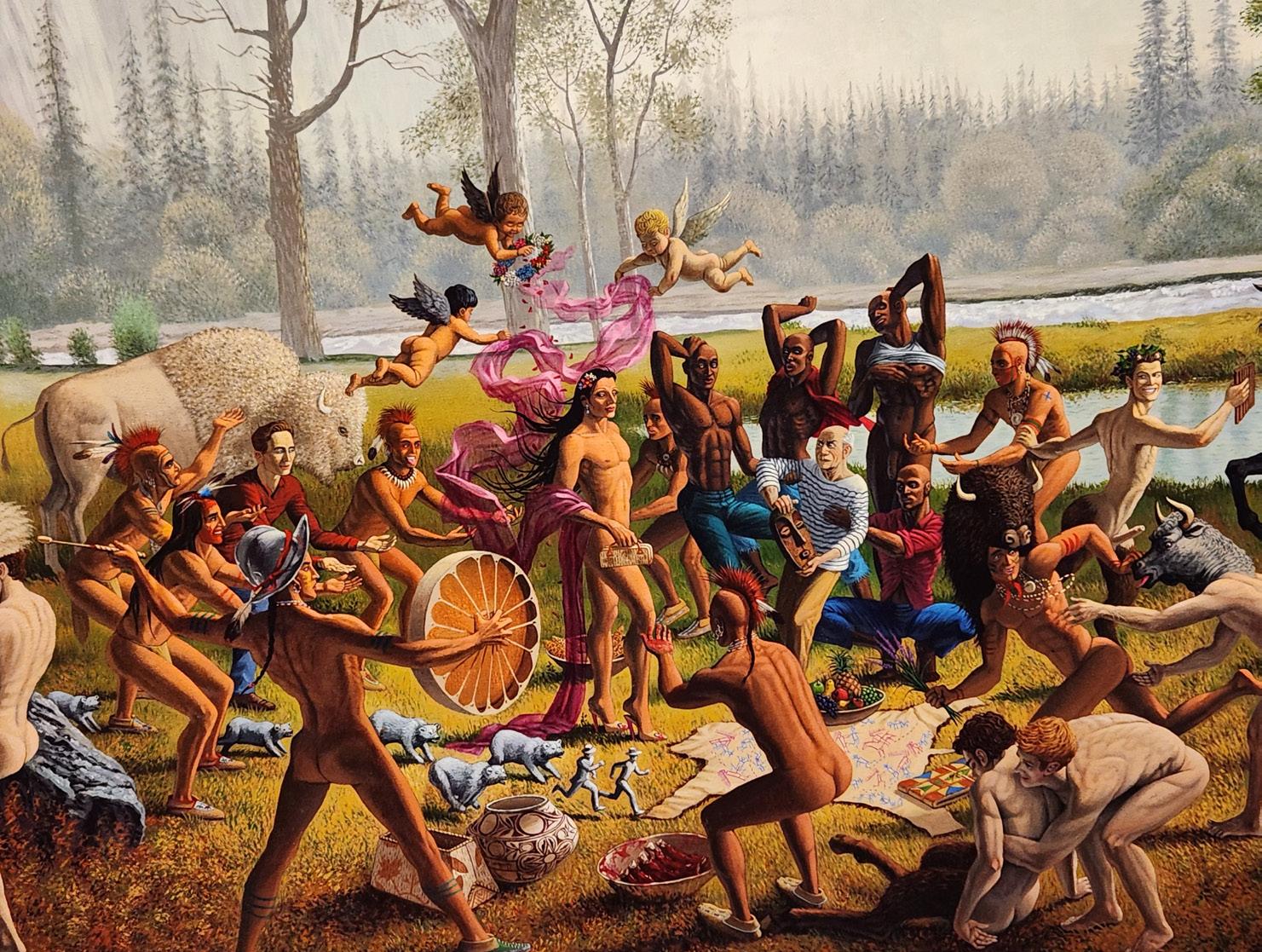
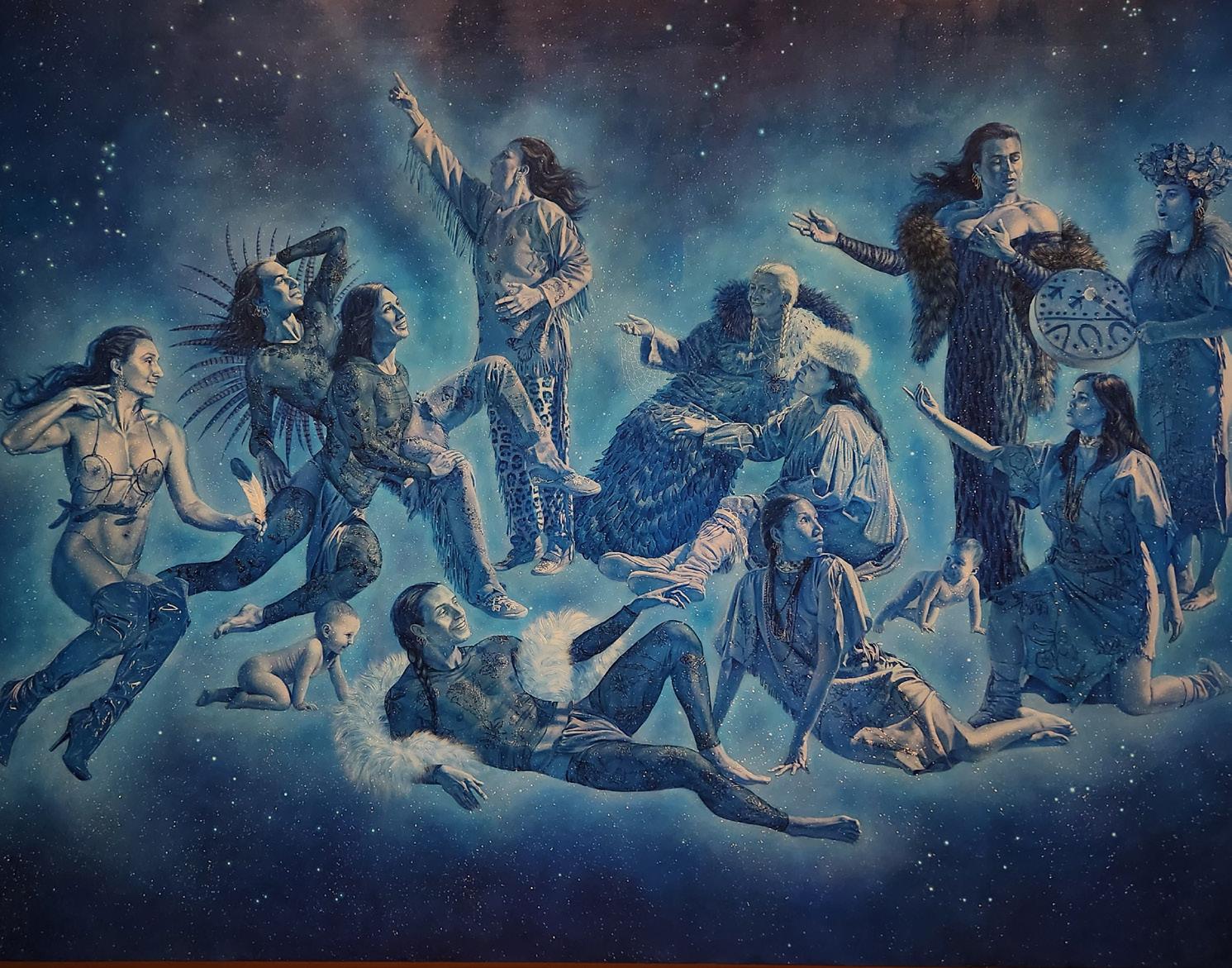
Le Musée des beaux-arts de Montréal présente l’exposition L’Histoire est dépeinte par les vainqueurs de Kent Monkman jusqu’au 8 mars 2026. L’exposition présente l’art autochtone afin de mieux représenter l’histoire des Premières Nations lors de la découverte de l’Amérique du Nord par l’Occident.
Monkman, membre de l’ocêkwi sîpiy, la Nation crie de Fish River, a grandi à Winnipeg, au Manitoba. Ses œuvres ont voyagé aux États-Unis et au Canada, dans un effort de décoloniser la sphère artistique et des musées avec un axe particulier pour les communautés autochtones.
Monkman peint dans le style des peintres et photographes reconnus du XIXe siècle, tels qu’Albert Bierstadt, George Catlin, Edward S. Curtis et Paul Kane. Son art remet en question le discours eurocentriste en plaçant les Premières Nations au premier plan, plutôt que les individus d’apparence blanche.
Il représente également la communauté LGBTQ+ avec son alter ego Miss Chief Eagle Testickle, une personne bi-spirituelle présente dans plusieurs de ses tableaux. Miss Chief chausse des talons hauts Louboutin noirs, avec des capteurs de rêves formant une bralette.
On la voit au bras d’un agent de la Gendarmerie royale du Canada dans l’œuvre de Monkman The Storm (2020), qui critique les systèmes coloniaux canadiens et s’inspire de L’Orage (1880)
que l’exposition devrait être présentée davantage, car elle ouvre les yeux sur beaucoup de choses dont nous n’avions pas conscience jusqu’à récemment, comme par exemple le génocide subi par les Premières Nations du côté américain, comme du côté canadien.
passant par la peinture de paysages, les premières interactions coloniales, les pensionnats jusqu’aux luttes modernes, citant les manifestations de 2018 contre les pipelines du Dakota du Nord et du Sud, où la police a fait un usage excessif de la force. Ce conflit est démontré dans son œuvre Victory for the Water Protectors (2018).
L’Histoire est dépeinte par les vainqueurs s’inscrit dans la continuité de l’exposition de Monkman intitulée Honte et préjugés : une histoire de résilience, qui a pu être vue au Musée d’art de l’Université de Toronto en 2017.
L’exposition présentait des peintures, des dessins, des sculptures et des installations inspirés de la culture et de l’histoire autochtones. Elle explorait les différences culturelles entre les traditions occidentales et celles des Premières Nations, notamment à travers des scènes de la vie quotidienne.
Abordant de nombreux conflits, l’art de Monkman s’étend sur plusieurs sujets,
Sally Southey, consultante en communications, a souligné les différences dans l’expérience culinaire dans l’une des
installations de Monkman, lorsqu’elle a visité l’exposition à Toronto il y a quelques années.
« Dans la culture occidentale, chacun a ses petites assiettes, ses propres ustensiles. C’est très individuel, alors que les communautés autochtones privilégient le rituel du repas partagé », explique-t-elle.
Emi Gusdal, qui se décrit comme une passionnée d’art, a particulièrement apprécié le personnage de Miss Chief, l’alter ego de Monkman dans ses peintures, qui selon elle ajoute une touche personnelle à l’œuvre.
« J’ai beaucoup aimé le personnage de Miss Chief dans toutes ses peintures et dessins de style classique. J’ai trouvé qu’elle ajoutait une légèreté dans la violence de certaines de ses peintures », ajoute-t-elle.
Kent Monkman offre aux visiteurs une expérience alternative aux styles néo-classiques de la peinture et nous amène à questionner notre histoire complexe.
Constellation of Knowledge (2022). OEuvre de Kent Monkman
The Triumph of Mischief (2007). OEuvre de Kent Monkman
Miss America (2012). OEuvre de Kent Monkman
From alternative to burlesque: All Montreal roads lead to drag
How Montreal’s drag scene evolved into the lineage scene today.
By Ginane Deslauriers Arts and Culture Editor
In the 1940s, the drag scene started to bloom in Montreal as interest in drag queen performances drew the public’s interest. From drag queens performing at Montreal’s Black jazz nightclub, Rockhead’s Paradise, to others, down the line, competing on RuPaul’s drag race television show.
Popular performers at the time were Dick Montgomery, Malva Boda and Billie McAllister — all performing at the popular nightclub during the late 1940s.
Those artists with “feminine personifications” would make the audience laugh but a decade later Montreal saw a wave of serious performers enter the scene. From singers to dancers, like La Guilda, Bella Belle and Lana St-Cyr — ushered in a new era of drag.
Another icon of Montreal’s drag scene Armand Larrivée Monroe, known as La Monroe, debuted in 1958. La Monroe was known to impersonate cultural figures, such as Marlyn Monroe and Josephine Baker, but also broke the ice for the queer community.
These legends paved the way for future generations of drag queens to flourish.
The 2010s an era for alternative scene, punk and parties
“[The first thing that influenced me into doing drag] was more just loving dressing up and pulling up looks and going out and. I was a little more inspired by the scene that was around me and the people that I would meet in my real life than necessarily the TV show,” said SISI SUPERSTAR, a Montreal drag queen and DJ.
SISI started performing in the alternative scene in 2017, in between DJ sets at clubs or at her own parties, instead of the typical cabaret and bar scene in the gay village.
“I was a little more like in the party slash rave scene,” said SISI. “I was a little more within the music party scene which was involving people doing crazy looks and experimenting with fashion and whatsoever.”
Rather than climbing the traditional ladder in The Village, SISI SUPERSTAR used online connections with her online friends to grow her career by organizing parties.
Along with other performers around her in the alternative scene, she felt like they didn’t have a place to perform in The Village or the mainstream scene.
“Since I was already doing art and already kind of had a brand […] I didn’t want to start from the bottom for someone else [in The Village],” said SISI.
That’s when she decided to create her own scene with friends, “[me and all the performers around me] were like ‘well we have all this talent and all this creativity going on so let’s just like do something
From those gatherings, SISI SUPERSTAR and friends started hosting parties and booking each other, creating their own drag scene.
The inspiration behind traditional drag
Océane Aqua-Black, drag queen who performs in Quebec City and Montreal, first performed in 2004 at a small hometown bar.
“The type of drag [before] was very much influenced by cabaret, feathers and something called Les folies de Paris, [which is French Cancan],” said Océane.
She expressed how drag has changed style since she started which includes more pop music and stunts.
Barman at cabaret Mado, Dylan Lorre, who worked with drag queens in Paris as a cameraman, said that Montreal and Paris’ drag are similar in terms of makeup and costumes but it’s easier to find burlesque drag in Montreal.
“In Paris you have to go to specific places to see burlesque or to see old fashion drag,” said Lorre. “ [Like] Mado who does old fashion drag, in terms of makeup and costumes.”
Barbada, a drag queen and music teacher, disagreed: “I mean the drag scene has evolved a lot and
again the costume has gotten bigger, the waves have gotten bigger everything has gotten bigger. I don’t see the drag scene as ever being really burlesque.”
She argued that drag’s evolution has more to do with the venues than the style. Drag queens used to perform mostly in bars and cabarets but now drag has grown more mainstream.
“Today we do shows in different venues, sometimes different audiences, sometimes it’ll be the main event of a festival, outdoor festival or for Canada Day for example.”
According to Barbada, drag used to be an underground scene inclusively for the LGBTQ and adult audiences but has evolved and become a familial show.
From stages, television screens to social media
“Even when I was a lit tle younger, I didn’t have access to social media. I was still reading maga zines or getting inspired by other ways like blogs and stuff,” said SISI.
Barbada discussed that artists now have to be their own publicist on social media
“Your character has to live on social media, it’s not only outside social media or on stage…it’s a very different vibe to it be cause of that,” said Barbada.
On the other hand, SISI ex pressed that while social media can be a positive tool for drag queens who don’t want to start building their community or persona on stage, it can be a double edged sword as people might lack authenticity and heavily rely on social media.
communicated to create a uniform drag and that people are able to get inspired from each other.
“We have reached an international and global arch. I think that each country has its colour but everyone find themselves in the same universe, which is drag,” he said.
Canada’s bilingual city adds its own charm to drag
Lorre praised Montreal’s openness in terms of “savoir-vivre” and sharing in the community.
“I was still on Instagram like posting stuff in drag even if I wasn’t necessarily doing cart wheels on the stage,” said SISI. “For other people it kind of can handicap you […] be cause you’re so used to not being fully social.”
Océane expressed that the younger generation relies more on the internet, social media and TV for inspiration and growth, limit ing the advice they could receive from older queens.
“I think that the queens from my gen eration are more used to go search for the an swers rather than having the internet and everything say it for us,” said Océane.
However, Lorre had the impression that ev eryone seemed to have
“I find the drag scene in Montreal more familial, funnier. The drag queens take more time with the public, it’s not just a show and they leave,”
he said. “There’s a real communication and a real humour side common to all.” Montreal has the particularity of being a bilingual city adding diversity to its drag scene, which is an aspect Lorre finds beautiful.
“Us, in France, we speak in french and we integrate english words into our sentences… Here, they speak French then switch to English, and you understand. It’s clear that it’s two different languag-
Barbada sees the bilingualism of Montreal not as an advantage but simply a difference in terms of language and culture, which attracts tourists.
“I know for a drag artist for example who wants to go on drag race you know everything is in — like on TV — everything is in English so it is sometimes a little barrier because of the language,” said Babarda. “It’s not their mother tongue, so that can be a disadvantage but I think for the rest it’s still an advantage to have their own culture.”
Barabada photographed by Martine Poulin
Sisi Superstar photographed by Vladim Vilain
Courtesy photo of Océane Aqua-Black
Cute debt: A product of gender-biased marketing
Framing debt as cute sends a message that spending beyond one’s means is reasonable — and inherently feminine.
By Julia Imee Silva Staff Writer
In an era of overconsumption, “buy now, pay later” birthed the marketing phenomenon known as “cute debt.” It places women at the centre of a trend that normalizes excessive spending to the point of debt, marking them as financially irresponsible consumers.
“The fact that it’s called cute debt is clearly playing on gender stereotypes,” said Caroline Roux, a Concordia marketing professor.
She explained that cute debt is driven by impulse spending and the desire to
keep up with the latest trends — attitudes popularly labelled feminine.
Cute debt stems from the popularity of buy now, pay later plans, describing how female shoppers accumulate unnecessary debt by using them on retail purchases.
Platforms like Klarna, Afterpay and Affirm offer a popular payment plan that splits large payments into smaller interest-free installments.
“It disguises the debt — it makes [debt] feel invisible because you’re only paying a fraction of it,” said Sabrina Francolini, an investment advisor assistant at Manulife Wealth Inc. “Later on, the buy now, pay later plans accumulate, and you end up with this debt that you weren’t keeping track of and you don’t need.”
Buy now, pay later services are evidently marketed towards female shop pers with advertisements featuring their lifestyles and interests. This is seen in Klarna’s “House of Y2K” collabora tion with Paris Hilton and Afterpay’s mural campaigns.
“[Marketing] is a very stereotypical, borderline sexist kind of industry,” said Roux, adding that it mostly draws on traditional gender roles. “Historically, women are responsible for or influence the vast majority of [spending] decisions
in the household — that’s why a lot of marketing is targeted to women.”
With cute debt, marketers exploit outdated stereotypes that view women’s spending as more frivolous than men’s serious big-ticket expenses, according to Roux.
Andrea Caceres, a third-year Concordia student, had used buy now, pay later services to buy a new phone and to book Airbnbs for a summer trip. Both purchases were made through Affirm and Klarna, respectively.
“I could have paid the full amount, but it seemed less scary to still have money in my banking account,” Caceres said.
The installments were also automatically charged to her bank account, which made paying convenient and less intimi-
Buy now, pay later generally makes spending easier for financially-restrained consumers, as it can be used on electronics, furniture, appliances and even groceries. Yet 42 per cent of buy now, pay later usage is made in the clothing and fashion sector, according to a Numerator survey.
“Buy now, pay later” gained prominence in the mid-2010s as a practical alternative to credit cards. But its popularity soared after being adopted by fast fashion retailers like Shein.
Meanwhile, women are 68 per cent more likely to use buy now, pay later services, a 2024 study by the Federal Reserve Bank of Boston found. But men have more total debt than women on average.
Still, Francolini believes that debt accumulation does not always mean financial illiteracy.
“Women are just as capable, they are just as strategic, just as disciplined when it comes to managing their money,” said Francolini. “But they might be more susceptible to falling into that trap than men just because of the way things are labelled — the way things are marketed.”
Graphic by Cailas Wiebe // Contributor // @caiscomics
Spotline on Spotify walking the industry tightrope
Here’s the rundown on the leading streaming services’ flux of fortune.
By Sofia Dawson Music Editor @sofiajdawson
An exiting patriarch, a partnership promising “responsible AI” and a growing array of boycotting artists — in the recent months, Spotify has been experiencing more than a few shake ups.
As Spotify fends off its eager competitors in Apple and Amazon, they continue to pull ahead in the bout of streaming giants seeking to control the distribution of art. While still comfortably on top, a shake up in its upper echelons might lose its footing. The company’s recent rounds in the media have kept consumers, investors and shareholders on their toes.
In today’s endlessly reactive digital world, you’d be pressed to find a major company exempt from controversy. Spotlight, light and dark, has radiated off Spotify’s triumphs and missteps alike.
A major point of criticism has been the financial losses incurred by songwriters.
The connection lies in Spotify’s addition of audiobooks to its platforms back in 2022. Aiming to create an “all-in-one” service capitalized on the boom in accessible listening, the platform introduced bundle pricing and by extension, cut songwriter royalty payments by an estimated $150 million.
Voices were raised, and a collection of Grammy-Award winning artists and songwriters, including Amy Allen and Jessie Jo Dillon, protested the platform’s offense by boycotting Spotify’s Songwriter of the Year Grammy party.
The anger didn’t stop there. The Me chanical Licensing Collective backed songwriters with a lawsuit against Spo tify in the United States on grounds of inadequate payment.
Backlash against the company soon grew personal; targeting the CEO Daniel Ek following his $694 million dollar investment in Hel sing, an AI-integrated defense startup he is already the exec utive chairman of.
Ek took a seat at Hel sing’s board of direc tors as chairperson and was quickly met with an outbreak of then-Spotify artists who pulled their music from the streaming service in an effort to persuade listeners to cancel their subscriptions. Currently over a dozen artists are on the boycotting roster to date including King Gizzard & The Lizard Wizard, Deerhoof and Xiu Xiu
Shortly after, the Spotify co-founder announced he would step down as CEO effective Jan. 1, 2026.
Amidst his controversy, one thing is certain — Ek’s leadership has been pivotal not only to Spotify’s success but to the arch of music streaming in the last 20 years. After launching what was a small-startup company in 2006 Stockholm Sweden, the CEO made leaps in combatting piracy, improving music accessibility and expanding the platform’s media formats alongside its diverse music catalogue.
For some, the late-September announcement came as a shock to the system. Spotify shares quickly plummeted by four per cent, signaling that some investors and shareholders were concerned by the risk.
Adjusting Spotify’s corporate hierarchy put the stability, continuity and market clarity into question. However, Ek has since stated that internal transitions are already underway; this official shift is merely a solidification of what was inevitably occurring.
Taking Ek’s place will be current co-president and chief product and technology officer Gustav Söderström, and co-president and chief business officer Alex Norström. After handing off responsibilities to them, Ek will assume the title of executive chairperson, shifting his primary focus to long-term gain and stability for the company.
Söderström and Norström, who joined the Spotify team in 2009 and 2011 respectively, will report to Ek and serve on the board of directors, subject to shareholder approval. As both men have slowly been
indoctrinated into their new roles, they’ve saddled up to take on the company reins — which should provide investors with some level of reassurance.
As consumers, shareholders and investors took a moment to swallow this pill of unease, Söderström and Norström’s did not hesitate to make their first business move just this past week.
Spotify released a statement on Oct. 16 detailing a new partnership with Sony Music Group, Universal Music Group, Warner Music Group, Merlin and Believe. Together, the industry giants are set to develop “artist-first AI products” aimed at protecting artist rights, promoting innovation and combating the ethical challenges of AI music.
“Technology should always serve artists, not the other way around,” Norström said.
As the industry evolves alongside advances in AI, embracing uncertainty may prove wiser than being left behind.
What’s really changing for Spotify users? For now, neither the leadership shift nor the new partnership will promptly impact user experience. Through twists and turns and as Ek’s reign on the Spotify dynasty comes to a close, what remains ambiguous is how these structural and innovative changes will impact users and platform functionality. Will the AI partnership deliver fair compensation for credited artists and writers? Will dual-leadership force slower decision making and growth?
Only time will tell as the streaming platform leader stands tall against its competitors.
Music Against Bill 97: Rhythms for Resistance
Two student groups co-host a fundraising evening of music and love all from McGill’s strange student dungeon bar.
By Simon Bowrin
Music Editor
On Oct.10, Rhythms for Resistance protested Quebec’s Bill 97 by way of a concert hosted at McGill’s campus bar. Bill 97 has been controversial, as many argue its expansion of Quebec’s forestry industry overlooks the ancestral rights of First Nations. The event was a collaboration between last summer’s ‘Something Fest’ and McGill’s ‘ECOLE Project,’ two student-run organizations. The evening raised funds for Atikamekw land defenders opposing the bill, with ticket and craftfair proceeds donated in full. At the end of the evening, it was announced that more than $2,000 had been raised. What they don’t tell you about Gert’s bar is that it is the student society’s “drinking dungeon” in McGill’s Students’ Society Building. The walls are lined with framed Pabst Blue Ribbon corporate
art as well as a full mural that heightens the absurd contrast between drinker and brand.
Once the lights dimmed, opener Zein and Elissa’s flowing jams on Palestinian folk songs transformed the room. As regulars at the Dep Café on Bernard, they wove piano, violin, bass and hand drum into a rhythm of perseverance that felt surreal in the basement venue. Much like a flower blooming in the cracks of a sidewalk, the vocal harmonies only glowed more earnestly lined with blue and red dancing beer can drawings and accented by unrelated students playing pool on the other side of the bar. Set and setting came together to create something previously unseen on this stage.
The night’s second act, Antiques Antiques Antiques, drew the largest crowd
with energetic covers of American Football’s “Never Meant” and The Police’s “Message in a Bottle.” Their set was mostly if not all covers but done with enough energy to back it up. When the rhythm guitarist played two songs ampfree, the moment came across as endearing rather than embarrassing.
Montreal’s I Love You Dearly closed the night with dream-pop indie melodies, and the crowd swayed comfortably. The vocalist’s half-sung swagger paired nicely with relaxed, symphonic guitar playing somewhere between Mac Demarco and Dream Ivory. The encore felt spontaneous, as if they really didn’t expect to be playing one more song. With full hearts and an impressive sum raised for a cause, the people left Gert’s having felt something.
Graphic by Alina Sudarikova // Contributor // @nyx_nyxmind
Cracking open pop songwriting with Elephant Organs
Concordia songwriter and producer Elephant Organs discusses the creative approach to his new record and its relationship to the cannon of pop music.
By Simon Bowrin Assistant Music Editor @simonbowrin
‘Pop music’ is a title too broad to mean anything without specification. If popular music itself is what’s being referred to, the charts come to mind, but defining pop as a style is far more complex.
It feels as though its appreciation is reserved for the 60s, when the pop record first became attainable thanks to evolving styles and technology. You’ll seldom see something from another decade described as pop music without some other qualifier. In the 80s, it’s usually synth pop; in the 90s, indie pop.What makes a pop song is a question that will continue to be answered over again for generations. Perhaps only those writing pop melodies themselves can explain why pop without a prefix seems to be stuck in the 60s.
A Concordia student, releasing music under the name Elephant Organs has been cracking open pop songwriting with his ten years of home recording experience and a devoted study of the pop music canon. His new album Divinity School was released on Oct. 1.
“My first album [Infinity Girl] was
something I made so I could show people that I make music. It existed to convince others that what I was doing was cool.”
Now Ethan is changing his approach.
While being weary that ‘making music for yourself’ can accidentally send an artist down the road of narcissistic dribble or worse, incoherent self-indulgence, he thinks the best pop songs are written while maintaining a playful sense of ‘what if I did this next.’ That sense can only come from a place of self-acknowledgement.
Songs like Divinity School’s “1000 Widows” reflect that edge-of-your-seat energy. The track “Let Me Breathe,” which the artist described as the proudest he’s ever been of a song, was created in one uninterrupted fugue state.
When asked why the sixties seem to be the golden crescent of pop music, he was eager to dispel myths romanticizing the limitations of the time.
“I think people are wrong when they think that recording [on] 4-track forces creativity. You forget that people in the sixties were pissed at what they could and
couldn’t do with technology,” he said. The kind of in the moment songwriting he is used to would not be possible back then, and the music speaks to this.
The bloom of sixties’ music still has lessons to learn for songwriters.
“There’s nothing uniquely special about 60s music but there is some aura and reason why the records are good to us. Whether it’s the stories we tell or the fact that they are culturally ubiquitous. In the past, I deliberately chose to write in a way as if I were studying the classics, it was one stop I needed before moving on to something totally original.”
While music continued to get more commercial than anybody could have foreseen, focused pop songwriting as an art was tossed into the ill-defined corners. What makes a song “pop” may be vague for an important reason and ‘inspired by the Beach Boys’ may be a style in need of its own word. In the eyes of Elephant Organs, “it’s a pop song when it has a glow.”
Artist Profile: Libby Ember’s breakthrough into indie pop as an independent artist
Concordia music undergrad student and singer-songwriter explores nostalgia, introspection and love in inaugural EP, I Kill Spiders.
By Samantha Woo
Contributor
@samantha_woo25
Music is a universal language that allows its creators to discover their identity. For Concordia music student Libby Ember , hearing music in the womb through the headphones on her mother’s belly sparked a lifetime’s worth of love for the art form.
Ember has always been drawn to music and began taking singing lessons at the age of nine. Music connects Ember to her family; “it always felt very natural. There was always music playing,” said Ember. “We were very encouraged to participate in music, both me and my sister.”
Encouraged by Montreal singer and producer Bayla, Ember auditioned for
the Overture with the Arts’ Teen Songwriting Competition, a non-profit organization in Montreal that gives teens the opportunity to have their music heard by professionals in the music industry. On June 12 at the Gerry-Robertson Community Center, Ember shared her original song, now the title of her debut EP, “I Kill Spiders”. What started as entering a teen songwriting competition fueled Ember’s burning desire to create music, meaning much more to her than she expected.
Title track “I Kill Spiders” was produced by Montrealer, Luca the Producer, for free after Ember won first place in the songwriting competition as the prize.
As a young independent artist, the singer experimented with music producers, musicians and even her own musical father while creating I Kill Spiders. The process spanned two years before the release in late September.
“This was my first time doing this, and first time working with a producer,” said Ember. “What I realize is that you are going to do so many takes and are not going to end up using them in the end.”
For Ember, she hopes to reach people on an emotional level in I Kill Spiders
With themes of relationships and love, her songs can relate to people with relationships in their own lives.
“This [EP] represents who I am as an artist, and the kind of music I like to make and the way I write my lyrics,” said Ember.
With the combination of acoustics, her melodic voice and musical instrumentation, Ember’s sound invites listeners into introspection and deep thought.
Ember’s father, who has taught electroacoustics at Concordia for more than a decade, is her biggest supporter in her musical career. “He is there alongside everything, he knows everything that is
going on in my music life right now.”
Ember, now in her first year at Concordia studying music, has learned to balance her artistry with being a full-time student. “I didn’t think that being a first year in music was going to be this much work at first,” she said. She admits that starting at Concordia, balancing work and pursuing music was a lot to handle. While being a music student, Libby is getting more serious with her music career. “It’s a job in itself,” Ember said, adding that she now manages and promotes her own work.
Being a music student comes with many advantages for Ember. She hopes to “make connections with future collaborators and get a lot of insight into creating music.” As she continues to make music as an independent artist, she is also learning more about the music industry and becoming well-rounded on music production, while studying music at Concordia. Pursuing music is a tough but rewarding feat for Ember.
I Kill Spiders is available on all streaming platforms. Ember can be found on Instagram and Tiktok at @libbyembermusic.
Artist Libby Ember. Photo by Ella O’Carroll // Photographer // @ellaaonfilmm
Voting isn’t just a right, it’s our duty!
An election that will change the fate of Montreal.
By Kumaran Satkunanathan Contributor
As you all might be aware, Montreal’s municipal elections are coming this Nov. 2. Over the past few years, Montreal has transformed drastically in nearly every aspect: political, cultural, economic, social and environmental. The city has become increasingly divided, affected by numerous crises that have put it on a downward spiral. There’s an ongoing housing crisis, rising youth unemployment, increased violence and growing homelessness. The lack of political attention towards these pressing issues has become one of the most-discussed points by Montrealers.
Montreal has indeed opened doors to establishing companies to grow its economy while also promising a high number of jobs. Its cultural framework has evolved, making it more inclusive and multicultural. Streets have been transformed to accommodate cyclists and move towards
a more environmentally friendly lifestyle. However, these elements weren’t as impactful as they should have been, since the macro and micro problems took up much of the central space. The rise of AI has also changed the job market, raising questions about what kind of employment will be available for people in general.
All this to say, the upcoming election is expected to play a significant role in re-establishing Montreal’s pride and identity. The city deserves leadership that not only welcomes people with open arms but also takes care of their well-being. The city needs to be able to flourish with more job opportunities, limit homelessness,
eliminate the housing crisis and control violence. This is why voting matters. A vote can change the fate of not just a city, but an entire population. It can rewrite history and transform a place and people’s lives. Voting is the greatest power any civilian has. You decide your leader.
Yes, the electoral system is far from perfect, but that doesn’t mean that we should ignore voting. During the 2021 municipal elections, there was a significant drop in public participation.
Voting isn’t just a right, it’s a duty. Every civilian has the duty to speak up and decide on their leader. No matter the outcome, we all have this power on election day to make our voices heard and be part of a positive change. Reform only happens when there’s unity, and the unity can only be created by the political engagement of every single civilian. Our city might be filled with crises, but as sincere and dedicated Montrealers, we have the responsibility to take action, and it’s in all of our hands.
Let’s vote for a better change!
Why neurodivergent minds belong in journalism
Reframing neurodivergent tendencies as strengths in journalism.
By Charlotte Theofanous Contributor
For years, neurodivergence has been seen as a disability, an impediment or a disadvantage, rarely portrayed positively. But if we break down the word “neurodivergent” into its constituent parts — “neuro-” (the nervous system) and “-divergent” (going in a different direction) — we see it simply describes individuals whose cognitive state is different from the majority — which can be an asset, especially in journalism.
People with ADHD are often known for procrastinating on tasks then doing everything at the last minute. While parents and teachers may scold that approach, in a newsroom it can be an advantage. Those with ADHD are known to “hyper-focus” on tasks when they know they are under a strict time constraint.
In a newsroom, reporters often have to find a pertinent story, gather all of their facts, find credible sources to speak to and produce their audio, video or written content within just a few hours. In this short
timeframe, journalists with ADHD would be tapping into their ability to hyper-focus and create quality pieces of work. In this sense, the nature of the journalism profession is highly compatible with the ADHD brain.
Another form of neurodivergence, autism, can also serve important functions in journalism. People with autism are known to have special interests or hyperfixations. Though these are often dismissed or laughed at, they can serve an important function in the context of journalism. When a reporter writes a feature story, they must often adhere to a particular topic for weeks or even months at a time and conduct in-depth research on it. Though this may be a challenge for most people, an autistic individual could do this effortlessly when exploring a niche topic that is of interest to them.
The autistic mind is often filled with questions, namely the question “Why?” People with autism have an insatiable thirst to know more and to understand why things are the way they are. They seldom accept vague or surface-level answers, having a strong urge to dig deeper. Though perceived as an annoyance or a burden to some, this is a crucial characteristic for an investigative journalist whose job it is to uncover the hidden details of a situation. Paired with the strong sense
of justice that many autistic people are endowed with, their drive to reveal the truth makes investigative journalism a natural calling for them. It is time that neurodivergent traits be prized, not pitied. Rather than viewing neurodivergence as a limitation, we must begin to recognize it simply as a different way of thinking, as its etymology suggests. It can bring immense value to journalism, a field that demands curiosity, creativity and persistence — all of which neurodivergent people abundantly demonstrate. Journalism is a space where neurodivergent people can not only thrive, but also enrich the field with their unique ways of processing information and engaging with the world, making them an asset in any newsroom.
Financing My Future: Our newest podcast segment
With steady support from her parents, Elora has learned to budget strategically.
By Damarra Vogt Contributor
Ecstatic eight-year-old Elora waits in line to make her first big purchase — a sparkly blue DS console. Her parents made it clear that in order for her to afford it, she needed to start saving. After months of saving, she was overjoyed to acquire this little luxury all on her own. Even from a young age she understood that patience brings greater rewards than impulse ever could.
Now 20 and navigating adulthood, her parents continue to provide financial guidance, and Elora fondly credits them for teaching her to plan ahead and set realistic financial goals. “Knowledge about money is an important tool,” she says, “because it gives you a certain amount of control in your life.”
Keeping a watchful eye on her bank account, she says, “I need to make sure I don’t overspend.” To maximize her savings, she sets a strict weekly budget of $130. With every careful decision, she strengthens not only her finances but also her confidence in shaping the life she wants. Becoming a millionaire isn’t on her list, but being financially comfortable is.
Listen in greater depth about Elora’s financial journey in the first episode of Financing My Future, a podcast series exploring student finances through honest, one-on-one interviews. We break down budgets, saving goals, financial footprints and money memories to uncover how students afford the expensive investment of post-secondary education, because our greatest asset is our ability to create future income. Finances are personal — but they don’t have to be private. Like Elora, we are all in pursuit of independence.
Graphic by Jeanne Brouillard // Contributor
Graphic by Tiffany Petrov // Contributor // @tiffany.petrov
Parks Canada cannot accommodate a sudden decline of U.S.’ National Parks Service
With Trump's open war on the National Park Service, more preservation work and tourist traffic could move north of the border in the next couple of years.
By Danylo Perkov Assistant Opinions Editor
It is no secret that the Trump administration is methodically targeting every part of the U.S. federal government that does not align with this White House’s goals. Among those lies the National Park Service.
For now the main danger to Canadian national and provincial parks is still guarded by customs officers, but some
parks are already overcrowded and could face further pressure from the south.
Parks and reserves are vital for environmental research. In interviews, rangers report that tree health, glacier size and other measures of ecological well-being are being paused in some Alaskan parks, while others are losing their only biologists. U.S. national parks are losing their ability to track bear movement or water-species health.
The Olympic National Park, a few hours’ drive from Vancouver, can no longer assess damage from a nearby fuel spill, indirectly affecting wildlife around Victoria Island. This shifts the responsibility of monitoring and maintaining the common coastline from a partnership to a solely Canadian endeavor, stretching our resources even thinner.
That disruption could shift more pressure onto Canadian parks that share migratory species — especially birds — crossing the border.
The National Park Service conducts an
average of 1,750 studies yearly; cancelling them will reduce shared data, cooperation and joint research projects.
Rangers and administrators from across U.S. national parks are sounding all alarms as they fail to maintain the parks to a safe standard with the ever present budget cuts and mass firings. This could set a precedent.
Finding bandage solutions for problems arising out of budget cuts and poor maintenance, can give a false sense to an average visitor that the parks are
doing just fine with the budget cuts, while in reality some parks could be forced to close their doors to visitors within a couple of years due to potential unsafe conditions.
Parks Canada has introduced a “Canada Strong Pass” in the last couple of years to attract more visitors to our national parks, and has reported an overall steady increase of visitors, with temporary closures at some parks due to increased car traffic during peak seasons.
This pass however, extends to everybody and a sudden increase of visitors from the states in the next couple of years could overwhelm the system.
Countries such as Ecuador and Costa Rica charge tourists higher fees for national park access and it may be time for Canada to follow suit. With a potential influx of Americans looking to enjoy Canadian National parks, a slight addition to the cash flow can go a long way preserving nationally significant examples of Canada's natural and cultural heritage.
How I turned my exchange around in Copenhagen
My semester abroad was the best time of my life, but it took me a month to realize it.
By Carly McCunn Contributor
After years of dreaming, I completed a semester abroad in Copenhagen. Still, I was nervous about leaving my life in Montreal behind. My grandfather’s health was declining, my boyfriend and I had never been apart for so long, I had never lived away from home before and my funds were limited. Is this a mistake? I thought to myself as I parted ways with my friend in Paris, and awaited the flight that would take me to my home for the next seven months.
I arrived at my new apartment late, expecting to crash for the night, and was welcomed by the comforting smell of freshly roasted vegetables. My new flatmate, Emily, had stayed up and waited to eat dinner with me. That small act of
kindness, in the face of all my anxieties, could’ve made me cry right then and there. As we ate together, we got to know each other and made plans to explore the city. I started to feel like maybe this wasn’t such a bad idea after all.
When orientation week came around, I was excited to get to know my future classmates and make new friends. I have always been a social butterfly and figured I would fit in somewhere — especially given how well I clicked with my roommates. However, upon introducing myself, I realized that everyone else already knew each other. They were living in the same dorm the school had recommended to them and that somehow, I never received the email. I felt so discouraged. It seemed like I missed my opportunity to make any friends. I thought exchanging socials would make it easier for people to reach out and include me in their plans, but it just meant that I got to watch when they partied or went on trips together. I figured that if they were interested in getting to know me, they would have contacted me first, like how Emily made me dinner that first night I arrived.
This FOMO tainted the first month of my exchange. With the sun setting at 3 p.m. every day and feeling so isolated from my peers, I spent every moment
I had alone napping or reading at home. I was too embarrassed to talk to my friends back home about how I was feeling, leaving me utterly alone. I finally called my therapist because I knew I could not continue living like this for six months, and she helped me realize that I was putting myself in this situation.
Yes, it was unfortunate that I wasn't at the dorm with others, but did that really mean I couldn't form bonds with my peers?
By reshaping my thinking, I was able to see that I was holding myself back from making friendships because of the assumptions I’d made. I took matters into my own hands and invited some people to dinner. I was surprised by how enthusiastic everyone was about visiting my place and getting to know me better. That night, as we dug into the eggplant parm I prepared, I formed friendships that would carry me through the semester.
It would have been easy to coast
through my exchange feeling sorry for myself and come home regretting it all. But it’s so much more rewarding to do the hard thing. This experience taught me the importance of putting myself out there and avoiding jumping to conclusions. I left Copenhagen knowing that I made the most of it and gained lifelong friendships all because I got vulnerable that one time and risked being rejected.
Mountain in Banff National Park. Photo by Mac Chaplin // Production Manager
Nyhavn canal in Copenhagen.
Photo by Carly McCunn // Contributor
Trapped in the tower, ye will have to make a decision: surrender to the storm or fight it.
Taurus
They’re looking down and smiling at thee success. Gemini
The snakes are getting closer. Put high boots on to avoid getting bitten. Cancer
Carry thy chariot into town as ye might find an abundance of fortune awaiting thee.
Leo
Shall ye accept the water-bearer’s offering, thy life will rehydrate its flowers and the rivers of life shall flow in abundance once more.
Virgo
Ye will be courted by a courageous knight. Dare ye give up the comfort of thy peasant life for honour?
RUN STAND LIE
Capricorn
Ye will be accused of being a witch. To escape, brew a timelapse potion to return to thy present day.
Scorpio
Have a portrait of thy made to remember thy beauty forever.
Sagittarius If ye jester don’t take a break, sickness and damnation shall befall ye.
The tree of knowledge will share its apples with you. Careful not to be too greedy.
Aquarius
Ye will be visited by a queen dressed as a hare. If ye shall dismiss her majesty, beware. If ye shall welcome her, she will guide thou to thin one true love.
Pisces
Remember to stray away from the path, as this is where the magic truly lies.
1. Resell, as a ticket
2. Sicker
3. Athlete Osaka
4. Cover over
5. Oom-pah instrument
6. Made a litter, maybe
7. Fill, as an appetite
vv8. Television goop
9. Wreak havoc on
10. Actor McGregor
11. Smooth industrially, as a car body
12. Candy partner of Mike
13. Donkey Kong platform
21. Some signs
22. Tic-___
Across Down
26. Broadcaster
27. Stall
29. Meadow
30. Poppa
31. Expression to be turned upside down
32. Letters from your parents?
33. Top story?
34. Pump Friction, for example
35. Unexpected development
39. Homer Simpson catchphrase
41. Wooden pin
42. Roof Goop
45. Potato gadgets
47. Microwave, idiomatically
50. “Keep me posted”
51. Emphatic answer from a Frenchman
52. Udder ender
56. Tarte _____ (Puff Pastry dessert)
57. Faith
58. Plays hooky
60. Burn goop
61. Many a syllable in “Hey Jude”
62. Slim
63. Primitive abodes
64. Actress DuVernay
65. Negroni ingredient
67. Spitting Syllable
68. Poker or beach attire
69. Amp or stone, for example 70. Speech therapists’ trouble