Quebec committee recommends extending the ban on religious symbols
4
Concordia’s budget cuts force Stingers’ to tighten their belts
PAGES FRANCOS ARTS & CULTURE
Un remaniement ministériel de la dernière chance pour la CAQ
OPINIONS
Let’s find you something to do
MUSIC
The Devil hands over her crown
RuPaul: Breathe, Surrender, Release
Campus Service Guide: HOJO CSU’s OffCampus Housing & Job Resource Centre
Jia Marguerite Schofer Campus News Editor
In mid-February, an email announcing a rent increase landed in the inbox of Rowan Nelson, a third-year women’s studies student, and her roommates, who were midway through their one-year lease in Montreal.
The proposed hike was higher than the Tribunal administratif du logement’s (TAL) recommended 5.9 per cent, leaving the four students unsure of how to respond. As first-time renters, they didn’t know if the landlord’s demand was legitimate or if they even had the right to push back.
Feeling intimidated and worried about retaliation, Nelson turned to the resources available on campus.
On the mezzanine floor of the Hall Building, facing the Hive Café, resides the CSU’s Off-Campus Housing and Job Resource Centre, also known as HOJO. The free, student-run service provides legal information on housing and employment issues.
On any given day, HOJO sees between 30 to 50 students, with traffic spiking at the start of each semester. For general housing or job searches, the centre usually addresses questions on the spot, though walk-ins may face a short wait of about 10 minutes. More complex cases such as rent increases, landlord disputes or legal employment issues are booked into appointments, typically scheduled within the same or following week so staff can research the situation beforehand.
Nelson’s case took about a month to resolve. With HOJO’s advice, she and her roommates sent a registered letter refusing the increase and requesting further documentation.
“It was helpful to know that by refusing the rent increase, it’s not like a big ‘we hate you,’” Nelson said. “It’s really nerve-wracking to want to maintain a good relationship with [your landlord] while also making sure everything happening is fair to you as renters.”
Conflicts with landlords are the most common inquiry that brings students to HOJO. However, they also offer differ ent forms of support.
According to assistant Ateş Balsoy, students might not be fully aware of all of HOJO’s ser vices, includ ing their website classifieds, which helps Concordia stu dents find housing and jobs posted by people in the community.
Students most frequently ask about finding accommoda tion near campus, handling subleases or lease transfers, and locating parttime jobs. Inquiries concerning illegal rent hikes or workplace harassment are handled through appointments
or referrals to Concordia’s legal information clinic.
HOJO reminded Nelson and her roommates that tenants in Quebec hold strong rights. Landlords cannot simply evict someone without serious justification.
According to Balsoy, landlords often rely on the fact that students, especially international students, are unfamiliar with their rights.
“They think that whatever they say will be easily accepted by students, like, ‘oh, you’re increasing my rent by 20 per cent? Okay, I guess that’s the norm here.’ But it’s not, you can always refuse your rent increase,” he said, thinking back on his first time experiencing troubles with housing.
When he first came to Montreal from Istanbul in July 2023, just 18 years old and new to Canada, he found himself in a scam-ridden rental situation, living with roommates more than a decade older than him.
“I didn’t know what to do,” he recalled. HOJO was the first campus service he turned to, even before vclasses began.
Over the next year, HOJO helped him secure a lease transfer, find a roommate, and resolve disputes with housemates. When a job opened up at HOJO, he applied immediately.
“No matter how stupid the question that I was asking, they always answered it,” Balsoy said. “When I saw the job opening at HOJO, to be an assistant, I was like ‘yeah, like this is a place that I want to work at.’”
Fundraising campaign held to support harm reduction initiatives
The CSU and local harm reduction organizations have teamed up to teach students about harm reduction practices.
Sabina Bellisario-Giglio Assistant Campus News
Concordia Student Union (CSU) held a Harm Reduction Fair at Le Frigo Vert on Sept. 11 to raise funds for The Drug User Liberation Front (DULF).
“A harm reduction approach is recogniz ing that human be haviour funda mentally cannot be controlled,” said Max Jones, educator for prevention coordinator at AIDS Community Care Montreal (ACCM).
“I like to define [harm reduction] as meeting people where they’re at.”
club died,” said Allen. “And for this, as punishment for their life-saving work, both the co-founders were raided by police, the operation was shut down, and they’re both facing up to life for drug trafficking charges.”
DULF’s Compassion Club would thoroughly test, package, label and sell illicit substances at a low cost to members of Vancouver’s Downtown Eastside who were most at risk for fatal overdoses.
“It’s life-saving work, and that our government is willing to… punish people for being brave enough to fight back against the drug war and to actually do the things that are required to save lives,” said Allen.
Maggie, the intervention coordinator at Head and Hands, tabling at the event, said DULF is leading the way in Canadian harm reduction work.
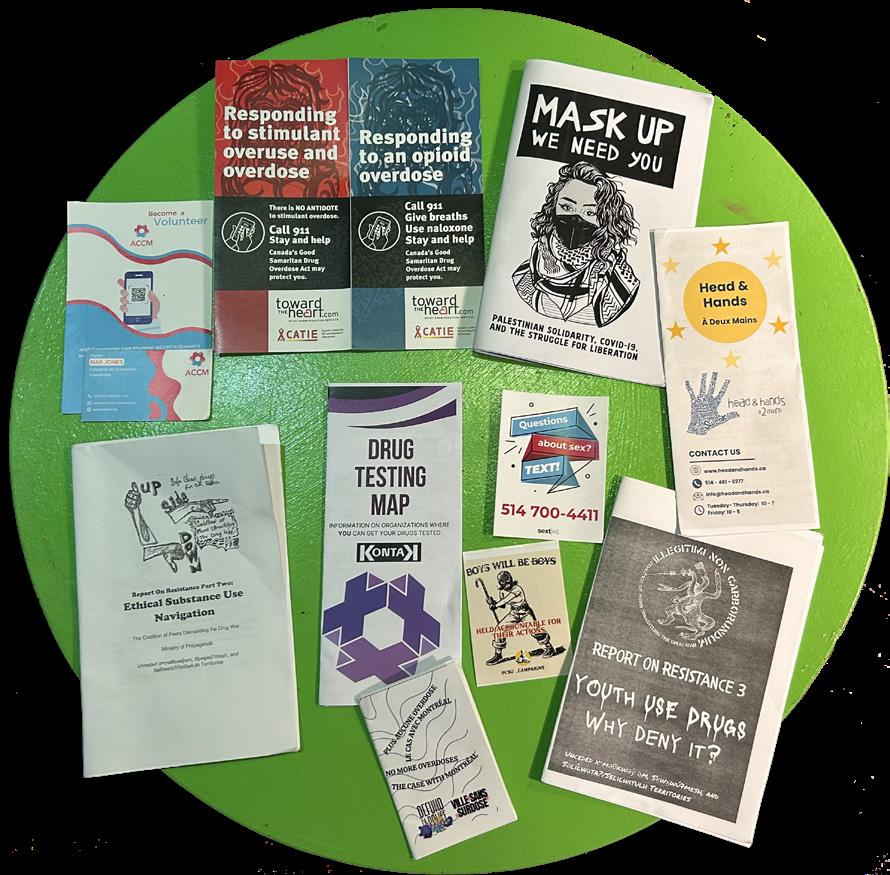
The fundraiser included tabling from different local harm reduction organizations, speaking with students and handing out zines and pamphlets, with other items for sale to fundraise for DULF. The fair received over $1,000 in donations from attendees.
From April 2024 to March 2025, there were 638 deaths linked to suspected opioid or other drug poisonings, according to the Institut national de santé publique du Québec. Individuals who are more likely to overdose on opioids are those using heroin or any other non-medical opioids, those receiving high doses of prescription opioids and those consuming opioids alongside other drugs, alcohol or benzodiazepines.
“Students are using drugs, and students have friends and loved ones who are affected by this,” said Julie Allen, CSU staff member. “People should know how to keep themselves safe, keep each other safe and leave nobody behind.”
DULF’s co-founders, Eris Nyx and Jeremy Kalicum, are currently facing criminal charges for providing a regulated, predictable drug supply to at-risk people in Vancouver’s Downtown Eastside.
“No one who was in their compassion
“Harm reduction […] is something we try to embody in all of our programming, recognizing that the people we work with use drugs and experience risk in different ways,” said Maggie.
“[We’re] here to help them meet their needs,” said Maggie about their non-judgmental approach to harm reduction.
The fundraiser also included a screening of Love in Time of Fentanyl, directed by Colin Askey. The film depicts the operations of a safe-injection site in Downtown Eastside Vancouver, giving hope to a community ravaged by fentanyl deaths.
Safe-injection sites provide a secure and hygienic environment where individuals can legally consume drugs under qualified supervision.
Several organizations around Montreal have designated safe-injection sites as well as drug-testing sites for individuals consuming drugs. CACTUS Montreal, Dopamine, Sub Check and Spectre de Rue all offer safe injection services across the island. Organizations such as GRIP and L’Anonyme also offer mobile services, whereby individuals can call them and find out where they are located currently.
“Our goal is to get as much of these very needed, and often difficult to access, materials [clean syringes, needles, pipes, condoms, lube] out to as many people as easily as possible while presenting as few barriers as possible,” they said. “Even places that do give out Naloxone or distribute gear, there’s often a lot of hoops that people have to jump through.”
Naloxone, commonly referred to as Narcan, is used to help those experiencing
Graphic by Hannah Bell // Creative Director // @Hannahnevebell
an overdose due to opioids. The medication can be administered either nasally or through injections.
It’s imperative to call 911 before or after administering a dose of naloxone. After administering a dose, continue giving rescue breaths to the patient until paramedics arrive. If the person remains unresponsive after 3 to 5 minutes, they should receive another dose of naloxone.
The signs of an overdose include being unresponsive to noise or touch, cold skin, pinpoint pupils and blue or gray lips or fingertips.
Naloxone is free and available at any pharmacy across Quebec within 24 to 48 hours of ordering it, according to the INSPQ.
“That information alone could save a life, could save your friend’s life, could keep someone in the world a bit longer to continue to do the beautiful, unique human journey that they’re meant to do,” said Jones.
If you or someone you know is in need of harm reduction support, please refer to these resources:
AIDS Community Care Montreal: 3660 Av. Calixa-Lavallée, 514-527-0928
CACTUS Montreal, Safe-Injection Site in Montreal, Drug-Testing: 1244 Rue de Berger, 514-847-0067 (ext. 10)
Head and Hands: 3465 Av. Benny, bonjour@headandhands.ca, info@headandhands.ca, 514-481-0277,
Toward the Heart (Harm Reduction Resources/Information)
Dopamine, Syringe Access Service and Drug-Testing: 4205 Ontario Est, 514-251-8872, bonjourhi@dopamine.ca
Sub Check, Drug-Testing Site: 438-490-7716, subcheck@pactderue. org, 8105 avenue de Gaspé, @sub.check on Instagram
Spectre de Rue, Safe-Injection and Drug-Testing: 514-524-5197, 1280 rue Ontario Est
GRIP: info@grip-prevention.ca, 514-7264106, Mobile Service - text and call to see where they are currently: 438-887-8338
L’Anonyme: Mobile Service for safe injection 1-844-381-2455, administration@anonyme.ca, 5600 Hochelaga Street Suite 160
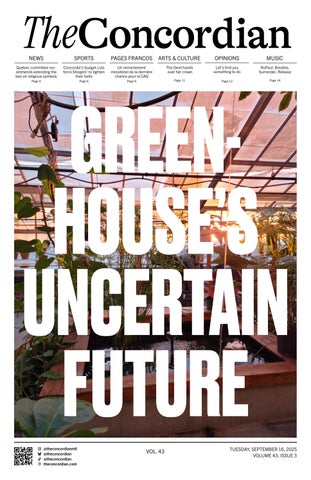
Concordia’s budget constraints leave the Greenhouse searching for $1.5M
Concordia’s tightened budget could limit public access to the original Greenhouse space for up to seven years.
By Jeremy Cox Staff Writer
Concordia University says the Concordia Greenhouse Project must raise $1.5 million if it hopes to return to its original space on the 13th floor of the Henry F. Hall Building by 2027.
Concordia’s Greenhouse left its former space in February 2024 due to renovations and reopened in a smaller “Greenspace” on the seventh floor for the following fall semester.
The Greenhouse is not a priority in Concordia’s renovation budget,
threshold on infrastructure expenses, leaving Concordia with less financial liberty.
Without the necessary external funding, it could take up to seven years for the university itself to complete renovations. If they are able to come up with the money, the project on its own would take 18 to 24 months to complete.
“Many of our renovation projects have been put on hold, and we have had to prioritize spaces directly supporting teaching and research, while also focusing on the replacement of aging building assets and critical equipment,” said Concordia deputy spokesperson, Julie Fortier.
If the non-profit organization can somehow pull together $1.5 million, Concordia can get started right away.
“It’s not even that they’re asking us to deal with it. I think that they’re expecting us to sit on our thumbs and wait seven years,” said Dylan Kinsman, the Concordia Greenhouse Project outreach and communications coordinator.
Kinsman, having worked with nonprofits for most of his life, said $1.5 million does not go as far as some might think.
The Greenhouse has been open since 2007, and before moving to the seventh floor, was on top of the Henry F. Hall building in a space previously occupied by the biology department. The space was no longer in use due to the department’s relocation to the Loyola
Nothing’s
ever going to beat the 13th floor. Nothing, said Kinsman.
“Do I think that [the move to the Greenspace] is a good temporary solution? Yes. However, the temporary solution was only supposed to be for a year, and then it was only for 18 months. And then it’s now at 18 months, they came back and said, ‘actually, you
Concordia’s facilities management started a project to remove decommissioned equipment from the 13th floor’s mechanical room. The removal process destabilized the room’s asbestos insulation, forcing a closure of the Greenhouse’s floor, limiting access to a secondary
emergency exit. The Quebec Labour Code thus prohibits the use of this floor for safety measures.
The Henry F. Hall building was constructed in 1966 using asbestos, which has been classified as a known human carcinogen (a substance that causes cancer) by the U.S. Department of Health and Human Services, according to The National Cancer Institute. Canada has banned its use in new buildings and imports since 2018. According to Fortier, the group’s funds will go towards meeting Quebec’s current building codes.
According to the Greenhouse coordinators, the move to the Greenspace has come with benefits and drawbacks. Operational projects around agriculture, horticulture, botany on the busy seventh floor are very limited.
Due to the sharing of space with other groups, such as The People’s Potato and the CSU offices, it limits the amount of composting the Greenhouse can conduct, significantly diminishing the organization’s impact on waste management. At the same time, the floor is subject to a high amount of foot traffic.
“In terms of public engagement, it’s been really interesting. But really the crux of our existence were all those programs that we did before,” says the Greenhouse coordinator Paul Fournier. “And we really, really are excited to get back to that because that’s what had the greatest impact in accordance with our mission.”
To Fournier, five to seven years of waiting would result in a shutdown for a fee levy group like his. Therefore, the collective would ideally gather as much of the $1.5 million from one source to avoid overcomplications and speed up the process. With the support of the Dean of Students, the group is looking for help from the government and other subsidiaries around Concordia.
“As a fee levy group, we offer students a specific service,” added Kinsman. “The service that we offer the students was a green space, in a brightly lit, warm environment that also could be for experiential learning, it could be for volunteering, it could be for student-led events […] [In] this space, we don’t have those possibilities.”
Kinsman foresees opening the Greenspace this semester to the public for only a few hours weekly to run workshops. Whereas the old space, in contrast, was also used as a popular communal hangout for students and collective members alike.
Kinsman is also conducting a survey about students’ satisfaction with the two spaces, which can be found on the Greenhouse Project’s website.
Pamphlets and zines from local harm reduction organizations at the CSU’s Harm Reduction Fair and Fundraiser.
Photo by Sabina Bellisario-Gialio // Assistant Campus News Editor
Paul Fournier, Greenhouse Coordinator. Photo by Janna Toubal // Assistant Video Editor
Quebec committee recommends extending the ban on religious symbols to subsidized daycare educators
This recommendation is part of a report including 50 recommendations aimed at strengthening state secularism.
By Angélique Babineau City News Assistant
“I felt more sad than angry seeing my [career] options getting slimmer and slimmer,” said Sarra Khelifi, a third-year early
childhood and elementary school education student at Concordia University.
Khelifi, who has been wearing the hijab since high school, said she knew her options were limited when she began her studies to pursue a career in education at Concordia. Since 2019, Bill 21 prohibits certain public sector employees from wearing religious symbols, such as kippahs, turbans and hijabs. It is a law that prevents her from following her career in Quebec while maintaining her freedom of religion.
However, she held onto the hope of finding employment in either private or anglophone schools or in the early childhood sector.
On Aug. 26, the Quebec government published a report authored by an advisory committee of lawyers defending and recommending the extension of the
already divisive Bill 21. The committee was established earlier this year by JeanFrançois Roberge, the minister responsible for laicity, and published its evaluation of Bill 21 and religious neutrality across state institutions.
The 288-page report proposes 50 recommendations to reinforce secularism. They include extending the prohibition on religious symbols for early childhood centres (CPEs) and subsidized daycare staff, requiring that people who receive public services, including CEGEP students, do so with their faces uncovered, and gradually putting an end to state funding for private religious schools.
With the possibility of these recommendations being adopted by the Quebec government, Khelifi said she fears she will be forced to seriously consider looking outside the province and possibly the country for career opportunities.
“It feels like my future is being played with in front of my eyes and I can’t do anything about it,” she said.
She, along with many others, believes the recommendation proposing to extend the ban on religious symbols predominantly targets Muslim women.
“Not only are they referring to female educators, so we know this is targeted towards women, but the religious symbol that is most worn by women in this sector is the hijab,” she said.
The committee was co-chaired by two lawyers: Guillaume Rousseau, a professor at the Université de Sherbrooke, and Christiane Pelchat, a former Liberal Member of the National Assembly from 1985 to 1994 and the former president of Quebec’s council on the status of women.
Both Rousseau and Pelchat have defended Bill 21 in court on behalf of the Mouvement laïque québécois and Pour les droits des femmes du Québec, respectively. They are set to intervene in favour of Bill 21 when it is presented before the Supreme Court later this year.
“In fact, we tried to reflect what we observed,” said Rousseau in an interview with The Concordian. “In some cases, we also stayed vague and didn’t mention the religion if we didn’t feel it was relevant.”
Rousseau said the report is not aimed at any specific religious community and that the recommendations are intended to “represent what was observed on the ground and through research.”
But not all experts agree on the pragmatic impacts of the bill.
“Evangelical protestants don’t wear a religious symbol and it doesn’t stop them from maybe, in certain situations, taking out their Bible and talking about Jesus to people,” said Frédéric Dejean, a professor in the department of religious sciences at the Université du Québec à Montréal (UQAM), whose work was regularly quoted in the report. “So ultimately, it is not the symbol that is important, but the way the person does their job.”
From a judicial standpoint, Rousseau said, the principle of religious neutrality of the state means that representatives of the state, which would now include educators and staff in CPEs and subsidized daycares, cannot practice their religion while working.
“Everyone agrees on the fact that religious symbols are a religious practice, so judicially speaking, it is that simple,” Rousseau said. “Proselytizing or not, passive proselytism, active proselytism, we could debate that, and it would be a debate among experts, but it seems secondary to me, at least from a legal standpoint.”
For Mélissa Aouadene, a second-year student in early childhood and elementary school education at Concordia University, what she qualifies as “a constant targeting of the Muslim community” will contribute to “isolating an already marginalized group.”
“Feeling like you are constantly excluded leads a community to keep to itself, which ultimately hinders the process of integration,” she said.
Both Aouadene and Khelifi shared concerns that they feel Muslim women are gradually being erased from Quebec society, as the law would extend to posters and advertisements of public institutions.
“We won’t exist anymore, even in representation,” said Khelifi.
“They are deciding for us where we can and can’t work,” said Aouadene. “They are reducing the number of choices a young Muslim woman has and forcing us into a mould.”
Graphic by Anna Huang
Graphics Editor
Rousseau said he is not concerned about increasing the teacher shortage in the province, given the potential impacts of the ban. He said this has not been observed following Bill 21 and that the grandfather clause provides a balance to “respect acquired rights so that no one loses their job.”
Employees who were already wearing religious symbols before the law came into effect could continue to do so without losing their jobs. An acquired right provision is also included in the recommendation on expanding the religious symbol ban.
“Some people have told us that there are employers who, during the interview process, inform a candidate wearing a religious symbol that they will have to remove it once they start working,” Rousseau said. “The person starts working on day one, removes the religious symbol, and after that there is no demotivation, no radicalization, none of the fears that had been legitimately expressed are reflected in reality.”
Khelifi said she does not believe someone’s religion is something that can be shed easily.
“The reality is that most Muslim women won’t just take off their hijabs; they will stop seeking jobs in this field,” said Khelifi.
“Spirituality, like any system of belief, is something that is expressed both privately and publicly.”
“There’s this argument that says, ‘Well, they could just take off their headscarves when they are at work, it’s not that complicated. Catholics did it during the Quiet Revolution in the 60s.’ This reflects a misunderstanding of what personal religiosity
is,” said Dejean. “There is a lack of sensitivity to the religious lives of others, which becomes quite obvious in this debate.”
For Rousseau, an individual’s right to religious freedom and the secular nature of the state are not concepts that conflict with one another. Rather, he said, it is to find a balance where the principles of neutrality of the state and liberty of conscience are stricter as you get closer to the heart of the state, as is the case with public schools.
“Liberty of religion is in laicity; liberty of religion is also freedom from religion,” he said. “It is the right to religious freedom for individuals receiving public services, not just for employees.”
The report also recommends that municipalities adopt laicity policies to regulate religious demonstrations in public, including street prayers, without providing specifics. The Quebec government has since announced its intention to table a bill that would ban prayers in all public spaces, overreaching its authority as a province.
In a publication on X Aug. 28, Roberge said that the “proliferation of street prayer is a serious and sensitive issue.”
Dejean said municipalities already
have the tools to regulate street prayers, to ensure they respect municipal laws regarding public safety and permits. He also said the right to express and practice one’s religion, either individually or collectively in public spaces, is part of one’s fundamental rights.
“Secularism, it’s simply ensuring there is no encroachment of religion in politics and inversely,” said Dejean, warning that the definition of secularism is changing and going beyond its initial mandate.
Dejean said the Quebec government’s intent to ban public prayers introduces the notion of “new secularism,” where “religion itself is seen as a threat to public order.”
“Spaces of secularism have a tendency to expand,” he said.
“There’s a shift happening that’s somewhat concerning; it’s that we’re clearly changing the very nature of secularism when we do this,” said Dejean. “There’s a growing sense that religion shouldn’t just be something that has no place in public institutions, but in society at all.”
Jean-François Roberge’s cabinet did not respond to The Concordian’s request for comment in time for publication.
From death metal to City Hall: Craig Sauvé makes his pitch to Montrealers
The Transition Montréal leader lays out his plan to solve the city’s issues
By Matthew Daldalian Staff Writer @mattdaldalian
Campaigning for the Montreal municipal election is well underway. As the leader of the all-new party Transition Montréal, Craig Sauvé is looking to make strides in what is promising to be an unpredictable election.
Being unapologetically willing to tax Montreal’s ultra-rich to pay for public services, The Concordian made it a point to speak to Sauvé about his campaigns and plan heading into the thick of the election.
Here’s an excerpt from that interview with Matthew Daldalian. Watch the full interview on The Concordian’s YouTube and Spotify using the QR code at the end.
SAUVÉ: I think right now at City Hall, there are two older parties that have been around for some time, becoming calcified, with oppositional energy. And we’re seeing within those two parties a sort of oppositional energy—always opposing each other. And I think we have to rupture with the status quo. Transition Montréal is a fundamentally progressive party. We want to move faster on ecology, environment and climate change. We want to move stronger, faster, harder on public transit. We want to tackle economic and social inequality. This is something that
the other parties don’t talk a lot about.
One of our main propositions is to tax the ultra-rich. We can do that with land taxes in Montreal. It hasn’t been done, we want to do it. We want for anybody who owns a house or a luxury condo worth over $3.5 million that they pay more taxes and we want to take all that money and put it towards the fight against homelessness. But we need leadership and we need action. So we want to rupture with the status quo. We want to break with this sort of oldschool way of doing politics and bring in a whole new form and offering for a bunch of Montrealers.
DALDALIAN: My other burning question is social pricing that you had mentioned for public transit, because that’s a big issue for a lot of young people. How is that going to come about when it comes to the social pricing for public transport? Because you’ve got to also remember that the ARTM (Autorité régionale de transport métropolitain) also has to compensate for any loss that they have. I’m very curious as to what that would actually look like.
SAUVÉ: It’s one of our main propositions as social tariffs. I think that right now it’s free for seniors, it’s free for kids under 11. But social tariffs is the best
targeted measure we can do to help people because right now we’re in an economic crisis. We’re in a housing crisis. People are having a hard time more than they’ve had in generations and particularly young people. I know that already students do get a rebate. But there are a lot of young people that aren’t at school either, that aren’t getting rebates. And then sometimes I have a hard time paying the rent.
So the social tariffs are saying for anybody that’s making less than $45,000 a year. That will give them a student price bus pass. And that goes if you’re 45, if you’re 18, if you’re 62, it doesn’t matter.
More and more of the services of the STM
are being outsourced to private companies and we’re losing control of the STM. When we’re talking about public transit, it’s something like education or healthcare. It needs to be non-profit.
Craig Sauvé, the Transition Montréal candidate for mayor of Montreal.
Photo by Matthew Daldalian // Staff Writer // @mattdaldalian
Concordia’s budget cuts force Stingers’ to tighten their belts
Stingers’ athletics programs adjust to universitywide budget cuts, scaling back on staff, meals, and equipment.
Anthony Maruca Sports Editor
Concordia University athletics programs have suffered financially from budget cuts imposed by the university’s senior management.
In June 2025, the university issued this statement on its budget strategy for all departments:
“The [fiscal year of 2025-2026] budget applies a 7.2 per cent cut across all sectors and continues the university’s disciplined approach to financial management.”
Other than the figures provided in the statement, the school has not released details on what else would be cut.
The Stingers’ Athletics department was
one of these departments whose expenditures were being cut.
“With budget compressions across the entire university, each unit was required to compress, [and] cut costs,” said D’Arcy Ryan in an interview with The Concordian
“Teams’ bud gets were com pressed in terms of assistant coaches, trav el budgets, [and] other restrictions were put in place with regards to meals, gear, and equipment across all our teams.”
The ramifications of the budget have already been felt, as services such as live-streaming, have been cut or limited.
streaming on a volunteer basis, most notably the men’s and women’s soccer teams, who chose to keep the service so family members of their athletes from away can still watch the games. The games will be streamed for free on YouTube.
Ryan confirmed that any live-streamed events from Concordia will now rely on volunteers.
He added that there was an open dialogue between the department’s management and coaching staff to ensure cuts were being made strategically.
Some coaches chose to keep the
Furthermore, the department is compressing the student staff in the recreation and athletics, seeking replacements on a strictly volunteering basis in an effort to cut costs.
“Difficult decisions needed to be made,” said Ryan.
In the past, the department was able to work around budget cuts through different methods, but this year they could not manage it.
“This isn’t the first time we’ve had to do cuts,” said Ryan.
“In the past, we had some retirements, so we didn’t fill those positions and we were able to allocate that as part of our budgetary cut for that year.”
Julie Chu, the head coach of the women’s hockey program, has maintained a pragmatic approach as she and her staff navigated the tough decisions that come with budget cuts.
“I think it’s just the reality of where we are right now as a university, and all of us are doing our best to make sure that we contribute and understand the landscape that we’re going through,” said Chu in an interview with The Concordian
None of us like budget cuts, who does?
Chu mentioned the essentials of travel and equipment as priorities to maintain as is, but exceptions had to be made for certain meals and apparel.
She also stressed the importance of donors and sponsorships to help maintain essentials like on-ice equipment, and provide the same standard that players have become accustomed to.
“We’ve been lucky,” said Aleks Mitrovic, the Stingers’ men’s basketball coach, whose program suffered very little from the cuts being made.
“Whether it’d be pregame or postgame meals, we weren’t doing that [anyway], but that had to be cut.”
New Stinger Dome slated to open in less than two months
Concordia hopes to be better prepared to prevent the dome from collapsing again
By: Brendan Schwartz Staff Writer
The Concordia University Athletics Department confirmed a new Stinger Dome will be operational as of Nov. 1, 2025. The new structure replaces the previous one, which collapsed from a record snowfall last February.
“As a reminder, the two backto-back snowstorms of mid-February, when the dome collapsed, left over 70 centimetres of snow in Montreal, a record not seen in more than a century for the city,” said Concordia spokesperson, Julie Fortier.
Concordia has purchased a new membrane for the dome, which cost the university $1.8 million, but was fully covered by the university’s insurance, according to Fortier.
According to D’Arcy Ryan, director
of Concordia athletics and recreation, the new dome will come with a one-year warranty covering its anchoring system and a 15-year warranty on the dome’s fabric.
Ryan did not disclose the total cost of building the new structure, stating it was a confidential matter. Notably, the university has also made several departmental cuts in recent months.
He claimed the university is taking the necessary measures to ensure its safety and reduce the total cost of the structure.
“We’re still leveraging the original equipment and working on different maintenance plans, to make sure that it’s of running and in fine working order,” added Ryan.
He added that while another collapse is not likely to happen, they are collaborating with campus safety, facilities management and the manufacturer to ensure the safety of users.
“It was a freak two storms that happened to cause this, but we’re hoping to be better prepared for future scenarios,” said Ryan.
Franck Cesar Tchembe has played in the dome since 2021 as a running back for the Concordia Stingers men’s football team. He described the dome as a place where the team belongs.
“That was like our second home, and we spent so much time in that space. Everybody was sad and devastated, but the coaches found a solution really quickly so we could keep practicing and getting better,” said Tchembe.
Despite the impact of the collapse, Tchembe remains hopeful about the construction of this year’s new dome.
“I’m really excited about the new dome because I see it like renovating your
house, and I know for sure they are going to make it better,” he said.
Head coach of the team, Brad Collinson, also provided positive feedback about the new Stinger Dome.
“We’re excited to have it back, 100%,” he said.
“The fact that the guys have access to go in there and run around during our long winters, it’s obviously a plus for us.”
Collinson explained that having the Stinger Dome is a big help in attracting new athletes to the team.
“We’re the only team on the island of Montreal that has a dome, so it’s a huge recruiting tool,” said Collinson.
As the colder weather approaches, the Stingers will now conduct warmups and practices indoors.
“It’s more for oxygen training whenever we get in there in January,” Collinson added. “And then we start running and during our off season training.”
Although it is expected that the new Stinger Dome will be open to the public in November, it is expected to start being built on Oct. 15.
Archive photo by Chantal Bellefeuille
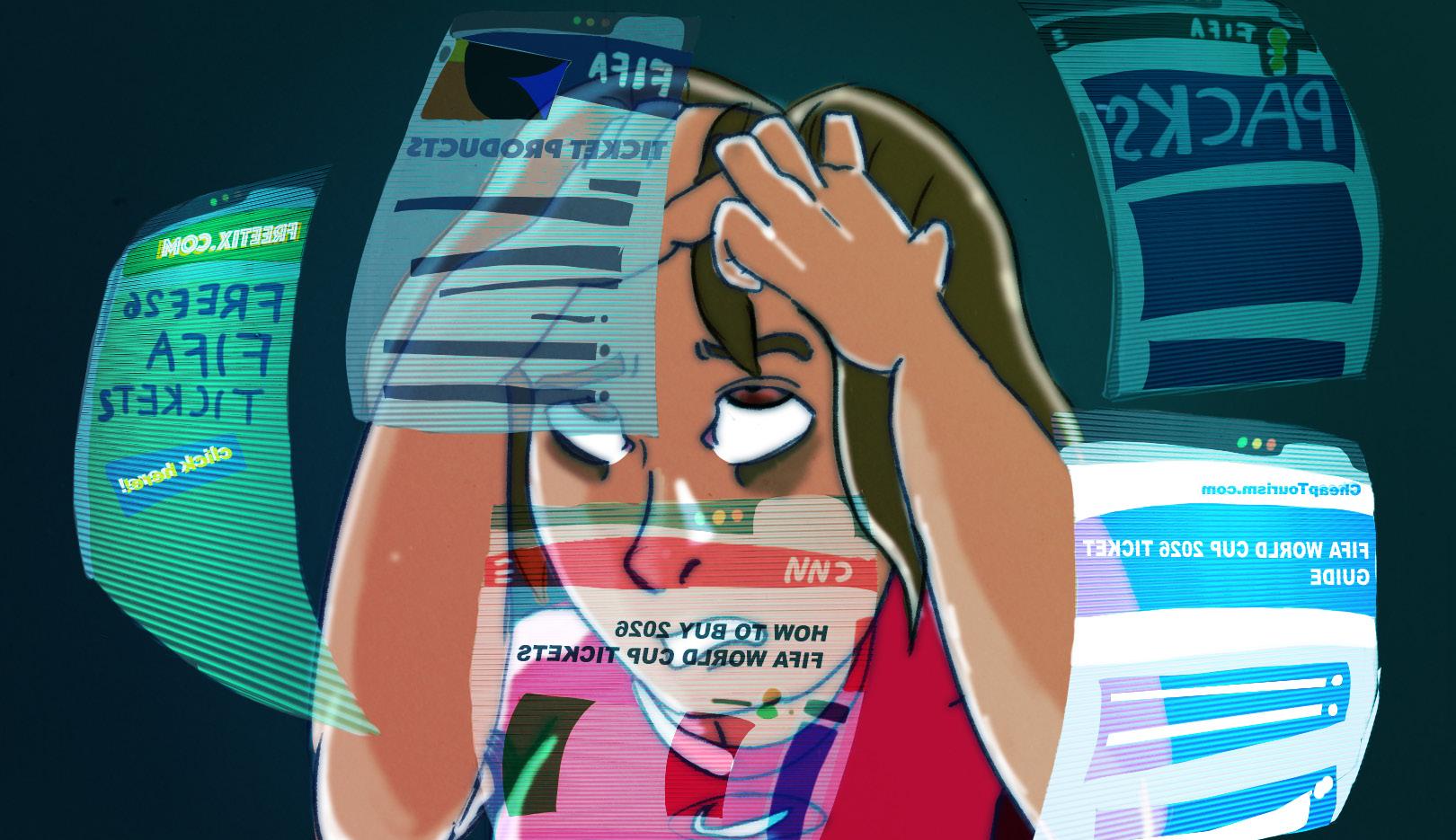
Graphic by Anna Huang // Graphics Editor // @itza_me_anna
Getting 2026 FIFA World Cup tickets, a comprehensive guide for Canadians
Canadian fans will need strategy, speed and luck to secure seats for the 2026 FIFA World Cup.
Mathilde Colls Sports Assistant
The 2026 FIFA World Cup is getting closer, with 13 games on Canadian soil, spread between Toronto and Vancouver.
Some tickets are already available, but for most soccer fans, they won’t be easy to acquire. As the most-watched sporting event in the world, generating billions of dollars and attracting more viewers every four years.
At the 2022 Qatar World Cup, each match averaged about 250 million viewers, with 1.5 billion tuning in for the Argentina–France final.
An estimated five billion people interacted with the last World Cup, whether
online, on TV, or in person.
With the event returning to North America for the first time since 1994, where the United States were the only host, Canadian soccer fans are getting ready.
Ticket prices were announced last week, and fans will have to be quick and plan carefully to register for the multi-step presale process.
First, a fan looking to purchase a ticket must get a FIFA ID through the official FIFA website. This first step allows them to purchase tickets, enter lotteries, or access resale platforms.
The only tickets available right now are hospitality packages, and they are not the most accessible: starting at $1,350 for a single match, with some packages costing up to $70,000.
After this comes the series of randomized lottery draws. First, the Visa presale draw, exclusive to Visa cardholders.Winners receive time slots to purchase tickets starting Oct. 1. Ticket prices range from $60 for group-stage matches to $6,700
for the final. This presale runs from Sept. 10 to 19.
In late October, a lottery of the same format will open to all FIFA ID holders, with successful applicants able to purchase tickets in November and early December.
The Final Draw will take place Dec. 5, when the complete match schedule will be revealed.
Finally, some first-come, first-served tickets will be made available closer to the tournament, but they tend to sell quickly.
If all else fails, FIFA will launch an official resale platform where fans will be
allowed to buy a maximum of four tickets per match and 40 tickets total for the entire tournament.
These complicated mechanisms mirror the growing demand for World Cup tickets, which has evolved significantly since the early editions.
At the first World Cup in Uruguay in 1930, tickets were sold locally at stadiums, and fans often bought them on match day; and naturally prices were low back then compared to today’s standards.
In the 1980s, TV exposure fueled soccer’s growth internationally, and demand for tickets skyrocketed.
By the 2002 South Korea/Japan World Cup, demand was so overwhelming that FIFA introduced the first lottery systems, which are still in use today.
Ticket sales were centralized through the official FIFA website starting with the 2014 Brazil World Cup. With the growing viewership for each event, it is no surprise that tickets continue to get harder to acquire as time goes on.
How NCAA’s transfer rule with CHL shifted Stingers’ hockey recruitment
The new rule limits margin for error in recruitment but opens doors for players toward greater ambition.
Anthony Maruca Sports Editor
Concordia’s hockey programs faced a new obstacle when recruiting for this season, as potential recruits from the Canadian Hockey League (CHL) now had another shinier option at their disposal when entering the recruitment process. Back in November 2024, in an unprecedented move, the National Collegiate Athletic Association (NCAA) granted CHL players eligibility to transfer into Division I U.S. college hockey.
With the evolution of amateur player scouting and recruitment now on a global scale, this rule change had obvious implications for hockey recruitment all over the world, but more so in North America.
From Concordia’s perspective, this presented another option for potential recruits coming out of the CHL.
“We were not that surprised, but now it’s the reality and we just got to move on and find other solutions to get the program going,” said Stingers’ men's head coach Marc-André Élément in an interview with The Concordian.
“It happened with some players [Stingers’ recruits] this offseason, where they’d already spoken with some NCAA teams, so we were kind of their plan ‘B’ or ‘C’. I think that's why some guys signed late with us, because we were no longer their first option.”
Recruiting high-profile players out of junior hockey will be much more difficult given what the NCAA has to offer over U Sports.
The talent pool for Concordia, as well as all other hockey programs across
Canada, will become more shallow with the implementation of such a rule.
“We’ll have to see, it’ll take a couple of years before we feel the true impact of this recruiting change,” said D’Arcy Ryan, director of recreation and athletics at Concordia.
He then outlined the new landscape that recruitment has undertaken, and how those responsible with recruiting new talent will have to adapt.
“We always see players head down to the states with that NCAA dream and then it’s not all that it’s cracked up to be, and they end up repatriating back to Canada,” said Ryan
“There’s obviously going to be a lot of disgruntled local American recruits as well, that are gonna get pushed out. I don’t know if we would be able to leverage some of that, so, maybe the coach may look at some of the northern, sort of [like] New England, prep schools to see if we could become an alternative to NCAA Division II or III schools.”
Despite the rule making the recruitment process more difficult for him and
his staff, Élément understands that this is a tremendous opportunity for the players involved.
“You’ll have some players who decide to try the NCAA route and you know what? It’s an amazing opportunity,” said Élément.
“The facilities, their set-up, there’s so much money on the other side with stuff like that, so for sure, it’s attractive for players [...] it’s an advantage they have over us in U Sports.”
Concordia lost two of their top players to the NCAA from last year’s roster.
Mikael Huchette, the Stinger’s top scorer last season, has since transferred to Clarkson University, a Division I program based in New York.
Charles Savoie, the other athlete in question, has since joined Lindenwood University, a Division I program based in Missouri.
“We spent time, energy and money recruiting them,” said Ryan. “For them to be cherry picked by the NCAA was a little bit disappointing.”
Graphic by Étienne Jean-Baptiste // Contributor // @et_jeanb
Du nouveau dans la musique québécoise
Des artistes locaux aux vedettes internationales comme Charlotte Cardin, les artistes québécois n’hésitent pas à inclure des non-dits dans leurs chansons.
Par Nicolas Leclair Collaborateur
et réalisée avec Jason Brando, comme son précédent album, cette chanson porte en elle une narration qui extériorise le désir de vengeance face à la jalousie vécue dans un couple : « Que celle que tu aimes / N’était qu’une étincelle / Qu’elle brûle avec elle ». Dans cette pièce dansante, mélangeant synthétiseurs et batterie rythmique, on ressent la colère dans le ton de Cardin. Elle met l’accent sur « Celle », « Qu’elle », ou encore « elle » dans ses paroles, ainsi que le désir de ramener celui qu’elle aime dans le droit chemin, pour éviter qu’il ne plonge trop dans son désir de vengeance. Une chanson qui annonce peut-être un quatrième album.
En face – La Monarque
celles qui dérangent. Avec des sonorités proches de Charli xcx, En face embrasse pleinement l’esthétique électronique et hyperpop, portée par une production assumée et volontairement percutante. La voix de La Monarque oscille entre naturel et auto-tune, donnant une intensité brute au refrain où éclate toute sa colère.
Elle renverse le rapport de force en souhaitant à ces hommes de vivre ce que vivent les femmes qui s’assument au quotidien : « J’aurais voulu te voir en face / Un jour, qui sait, tu sauras à ma place / Un jour, qui sait, tu seras à ma place, boy ». Plus qu’une chanson, En face s’impose comme un cri de résistance et de libération.
En partenariat avec et financé par L’Organe
Tulip, sortie en mai, il dévoile Love & Aggression, nous laissant entrevoir dans quelle ambiance ce futur album sera teinté. Une production détaillée, mettant l’accent sur la texturation des effets sonores et sur le rythme progressif que cette pièce nous offre.
Tant pis pour elle – Charlotte Cardin C’est avec Tant pis pour elle que l’artiste Charlotte Cardin revient après son dernier album 99 Nights (2023). Coécrite
Ariane Drapeau, alias La Monarque, frappe fort avec son nouveau titre En face. Véritable manifeste d’affirmation, la chanson s’adresse à ceux qui voudraient faire taire, minimiser ou invisibiliser
Love & Agression – Hologramme
Depuis son troisième album SOLEDAD opus 32 no.1, Hologramme sort des morceaux qui nous laissent comprendre qu’un album est en vue. Après sa pièce
On pourrait s’imaginer, comme fil narratif, deux personnes à une fête, ayant un œil l’une sur l’autre. Au début, le rythme est plus doux, concentrant des sons ressemblant à de petits feux d’artifice, comme si le désir naissait en eux, jusqu’à dire : « Je suis mort pour toi. » C’est à ce moment que le party pogne dans la place, que le rythme s’accentue jusqu’à en dire : « C’est fou! » C’est alors que la déchéance nous est permise, que ces deux personnes se réadonnent désormais à une soirée mémorable, à danser au rythme qu’Hologramme leur impose. Le prochain album d’Hologramme, qui s’annonce sous forme de mixtape, paraîtra en novembre 2025.
des pochettes, crédit : Soundcloud et Apple Music
Montréal à la gouache, à l’acrylique et à l’huile sur toile
Plus d’une centaine d’œuvres peintes en plein airplein-air par 23 artistes dans les rues et parcs de Montréal étaient exposées à l’Atelier 2112.
Par Laure-Charlotte Cotê Collaboratrice
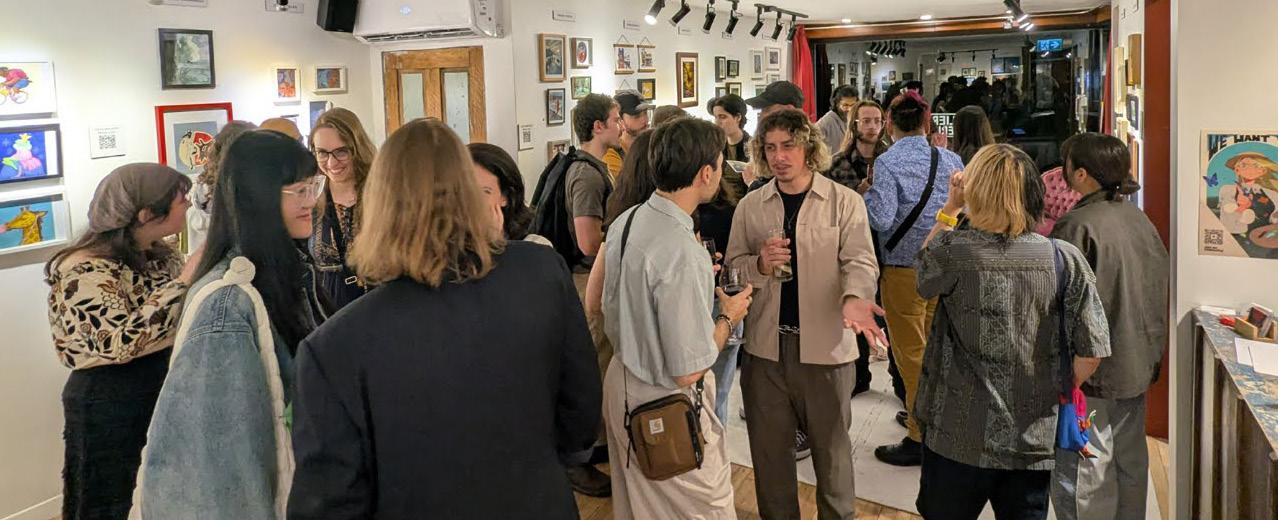
L’exposition collective Prochaine Station, composée de dizaines d’œuvres peintes en plein air dans les rues de Montréal, se tenait à l’Atelier Galerie 2112 du 10 au 14 septembre dernier.
Carlos Salamanca et Coline Cadilhac, deux artistes professionnels, sont les cocréateurs et coorganisateurs de cet événement. Ils ont constaté dans la dernière année l’intérêt grandissant pour leur initiative de séances organisées d’exploration de Montréal au fil de paysages citadins à peindre. Ils se sont attelés cet été à la tâche de mettre sur pied une exposition accessible réunissant 23 peintres.
De nombreux artistes en beaux-arts, d’étudiants, de travailleurs de l’animation 2D et des artistes du jeu vidéo priorisent
d’un commun accord de mettre de l’avant les œuvres réalisées pendant leurs séances de plein air. Ils ont toutefois aussi la liberté d’exposer leurs travaux personnels.
D’après Virginie Grondin, qui peint avec le groupe depuis plus d’un an, une variété de médiums et d’approches était mise de l’avant.
« On vient tous de milieux et d’endroits différents, donc on apprend beaucoup des uns les autres. Ça fait partie de ce qui rend les séances intéressantes, c’est certain que ça serait moins trippant si on était tous d’ici et qu’on avait tous les mêmes références », dit-elle.
à l’huile ou au numérique, ou encore quelques études intimes d’intérieurs d’appartement.
de collaboration et d’amitié. L’ambiance de la soirée est au soulagement, à la fierté et à l’ambition.
Elle explique que c’est une passion très pure pour la création d’images, pour la communauté artistique et pour le moment spontanément collaboratif qui rassemble ces artistes.
Le 2112 est un espace intime, mais complètement rempli. Les grands murs blancs de la galerie sont pleins de dizaines de toutes petites toiles et papiers encadrés, et chaque pied carré est occupé par un visiteur en conversation, un verre de vin à la main.
Aux murs, des paysages familiers de Montréal — le square Saint-Louis, les grues du port, des vitrines de restaurants — des portraits au fusain, à la gouache,
Coline Cadilhac, la première moitié du duo fondateur, explique que la peinture en plein air est une opportunité de rencontre et de conversation entre des artistes du milieu du numérique, une industrie qui souffre beaucoup depuis quelques années.
« Quand on a commencé, il n’y avait pas d’autres groupes de peinture plein air à Montréal. C’était juste Carlos et moi debout dehors au mois de mars avec nos chevalets, puis en bouche à oreille et par les réseaux sociaux, le mot s’est passé et on a été de plus en plus nombreux », explique-t-elle.
Elle a commencé le plein air pour parfaire sa compréhension artistique de l’espace et de la composition, et y a créé avec Salamanca un milieu culturel d’échange,
MTL Plein Air Painters crée de l’intimité dans l’espace public. Dans une ville rapide, bondée, un groupe se rassemble pour tirer un portrait d’un espace. En rassemblant leurs œuvres, on retrouve une image évolutive et vivante d’une ville observée à la loupe, au microscope, avec amour et respect. Prochaine Station est une lettre d’amour aux recoins de notre ville.
Fort de son expérience acquise lors de cette première édition, Salamanca ne compte pas s’arrêter là.
« Ça a été un grand défi pour moi, car il n’est pas facile de gérer une exposition avec 23 participants. Mais c’était certainement amusant, et nous recommencerons », dit-il.
Photos
L’exposition collective Prochaine Station de MTL Plein Air Painters //
Photo : Gracieuseté Carlos Salamanca
Un remaniement ministériel de la dernière chance pour la CAQ
François Legault rebrasse les cartes de son cabinet, espérant y trouver une main plus appréciée par les Québécois
Par Félix-Antoine Beauchemin Rédacteur des nouvelles locales
À un an des élections provinciales, le premier ministre François Legault tente de donner un nouveau souffle à son gouvernement avec un remaniement ministériel. Lors de son discours après l’assermentation des ministres le 10 septembre dernier, le premier ministre a admis que le bilan de son gouvernement n’est pas parfait après sept ans au pouvoir.
On a traversé des crises, on a fait des changements. On a atteint certains de nos objectifs. Parfois, on s’est trompé. On a fait notre mieux à l’intérieur du système qu’on a au Québec depuis des décennies.
François Legault a mis de l’avant quatre priorités pour son gouvernement dans cette dernière année avant les prochaines élections : l’économie, l’efficacité, la sécurité et l’identité.
La taille du conseil des ministres reste la même que précédemment, avec 29 ministres. Cinq députés accèdent au conseil des ministres pour la première fois, alors que quatre ont été écartés et qu’Andrée Laforest a démissionné pour briguer la mairie de Saguenay.
Des gagnants et des perdants
Outre les cinq recrues, France-Élaine Duranceau est l’une des vainqueures de ce remaniement ministériel, laissant son poste de ministre de l’Habitation pour devenir présidente du Conseil du trésor et ministre responsable de l’Administration gouvernementale et de l’Efficacité de l’État. Son nouveau surnom de « Cruella », qui lui a été attribué par François Legault lors de son discours, illustre
l’objectif de la Coalition Avenir Québec (CAQ) de couper dans les dépenses gouvernementales.
« Il [ne] faut rien de moins que sortir du système actuel, sortir de cette cam isole de force. Ça veut dire qu’il faut couper profondé ment dans la bureaucratie. Ça nous prend un traitement choc », a dit le premier min istre lors de son discours à la cérémonie de l’assermentation des ministres. « Il va falloir que chaque ministère, chaque ministère, fasse le ménage dans sa bureaucratie. »
Cédant sa place comme présidente du Conseil du tré sor, Sonia LeBel devi ent ministre de l’Éd ucation, remplaçant Bernard Drainville. De son côté, celui-ci devient ministre de l’Environne ment, de la Lutte contre les changements climatiques, de la Faune et des Parcs. Il s’agit selon toute vraisemblance d’une démotion pour l’un des députés les plus en vue de la CAQ. Alors qu’il était candidat en 2022, il avait déclaré « Lâ chez-moi avec les GES! » alors qu’il répondait à une question sur le troisième lien reliant Qué bec et Lévis.
Dans la foulée du fiasco SAAQ clic, dont les coûts ont excédé le budget de 500 millions de dollars, Gen eviève Guilbault laisse son poste de min istre des Transports et de la Mobilité du rable pour devenir ministre des Affaires municipales. Elle perd aussi son titre de vice-première ministre, qui n’a officielle ment pas été réattribué.
De son côté, l’ex-ministre des Transports de 2018 à 2022 François Bonnardel, qui était jusqu’à tout récemment ministre de la Sécurité publique, est exclu du conseil des ministres. Sur ses réseaux sociaux, il s’est dit « extrêmement déçu de la tournure des événements », évoquant le désir de François Legault de rajeunir son équipe.
Maïtée Blanchette Vézina, jusqu’à tout récemment Ministre des Ressources naturelles et des Forêts, est la seconde exclue du conseil des ministres alors qu’elle voulait y rester. Elle avait notamment déposé le controversé projet de loi 97 sur la gestion des forêts. Dans un point de presse le lendemain du dévoilement du nouveau conseil des ministres, elle a exprimé sa déception par rapport à cette décision. « C’est certain que ma confiance envers le premier ministre et son équipe rapprochée est ébranlée en ce moment. Je pense avoir livré ce qu’on m’avait demandé avec les orientations qu’on m’avait données », a-t-elle déclaré.
de grimper en tête avec 38 % des intentions de vote, confortablement devant le Parti libéral à 27 %. Le sondage estime aussi les appuis du Parti conservateur à 15 %, soit la première fois qu’il est devant la CAQ. Québec Solidaire ferme la marche avec 8 % des intentions de vote. Avec ces données, les plus récentes projections de sièges de Qc125 prédisent un gouvernement péquiste majoritaire. Cependant, ces mêmes projections sont beaucoup plus inquiétantes pour la CAQ. En effet, Qc125 estime que si la tendance se maintient, la CAQ ne remportera aucun siège lors des prochaines élections.
Le système électoral actuellement utilisé au Québec peut en effet produire des distorsions importantes entre le vote populaire et la répartition des sièges, surtout avec cinq partis politiques majeurs. C’était par exemple le cas lors des élections de 2022, où la CAQ avait remporté 72 % des sièges avec 41 % du vote, alors que le Parti conservateur n’avait pas réussi à faire élire un député, malgré avoir récolté 13 % du vote.
de l’Emploi et ministre responsable de la région de Lanaudière dans ce remaniement ministériel.
Elle est remplacée par l’ex-journaliste de Radio-Canada Martine Biron. Elle était ministre des Relations internationales et de la Francophonie et ministre responsable de la Condition féminine depuis trois ans.
« C’est un honneur de débuter cette nouvelle étape dans mon parcours politique. L’accès à l’enseignement supérieur constitue un moteur de développement économique, social et culturel essentiel pour le Québec et est fondamental pour l’épanouissement de la jeunesse québécoise. Comme disait le sociologue Guy Rocher, l’éducation est essentielle pour l’émancipation du Québec et des Québécois. C’est certainement quelque chose qui va me guider dans mes nouvelles fonctions », a-t-elle déclaré par écrit au Concordian
Graphique par Anna Huang // Éditrice graphique // @itza_me_anna
Fusion of gender, sexuality and colonial history
Kama La Mackerel’s interdisciplinary project represents gender, trans bodies, and colonization through salt and poetry.
By Kasi Peri Arts and Culture Assistant @k_a_s_i_p_e_r_i_
“The policing of gender and sexuality was central to the colonial project,” said Mauritian-Canadian artist Kama La Mackerel. “My work insists on holding these two together—not as separate struggles, but as intertwined legacies.”
Concordia’s Faculty of Fine Arts (FOFA) Gallery presents the exhibition, To Be Held by the Femme Island/To Be Known by the Trans Body from Sept. 3 to Dec. 12.
The exhibition intertwines the artist’s relationship with gender and the concept of the “island body,” which is at the forefront of the exhibit. The “island body” is a metaphor to illustrate the artist’s home island of Mauritius that carries a history of colonization.
Self-portraits of La Mackerel in forests underscore the artist’s connection with nature, showing them entwined in trees and posed on black rocks revealing La Mackerel subverting the way that images are portrayed.
“There's also a larger series of photographs, which are large-scale photographs that Kama took in her native country, which is Mauritius, and these are luscious portrait photographs of Kama's body in the landscape,” said Gwynne Fulton, the director of the FOFA Gallery.
La Mackerel displays a series of silks part of an installation called “Trans Affirmations.” Some affirmations said “Love for Trans Women of Colour”, “Protect Trans Youth”, and “Remember Trans Power” representing themes of love and acceptance of trans people during a shifting political landscape.
La Mackerel projects a short film onto a sheet of salt, depicting them lying alone in the center of the beach, being dragged off-screen. It ends with La Mackerel submerged into water as the close-up shots widened showing the audience La Mackerel’s connection to islands dominated by colonial powers.
“It recalls the sea, the sweat of labour, the tears of grief, the rituals of purification. Salt holds memory. Salt is also a metaphor for trans existence: porous, mutable, fluid, resistant to containment,” said La Mackerel. “It crystallises, it dissolves, it transforms—it is always in flux.”
The York vitrines ignite La Mackerel’s exhibit. The vitrines feature La Mackerel in a video where they recite poetry in English, French, and Kreol. Their voice transcends throughout the vitrines, as audiences can hear their poetry on both ends and it feels as if it was hugging the listener.
“Kama has often installed her work in spaces that are very immersive, where people can walk through the space with their bodies,” said Fulton.
La Mackerel’s project includes islands and trans bodies showing the resilience that these groups have faced in a world where they are shaped by a domineering colonial rule.
“Islands often have been framed by colonial power as terra nullis—empty, available, disposable spaces, laboratories of exploitation,” said La Mackerel.
“To affirm that both trans and island bodies have been denied, erased, and exploited— yet both endure, resist, and insist.”
According to Fulton, the project used items that reminded La Mackerel of their past, including large scale silk fabric flags saris that they inherited from their mother. La Mackerel included these saris as a way for them to heal with the mother through the act of inheritance, but also presents as a metaphor for the artist to demand for trans visibility.
La Mackerel’s exhibition not only embraces transness, but illuminates the enduring systems embedded in our world.
“It is therefore impossible for me to think about colonial histories without also addressing gendered violence,” they concluded.
Tourist Family: A Tamil movie review
An ideal world for immigrants and refugees
By Kumaran Satkunanathan | Contributor | @suseewritings
The Tamil family drama, Tourist Family, illustrates in a very emotional and relatable way the struggle of immigration and integration. Directed by Abishan Jeevinth, starring Sasikumar Mahalingam and Simran, the film follows an Eelam Tamil family who escaped their home country following the economic crisis caused by COVID19 in Sri Lanka and found a home in Tamil Nadu, India. The film depicts the family’s struggles to integrate into their new home and build healthy bonds with Indian Tamil families in their community. It isn’t just a light-hearted, feel-good drama, but also a film showcasing the challenges of being an outsider, a refugee or an immigrant. In the film, the Eelam Tamil family had to hide their true nationality to find a place in their neighbourhood, due to the fear of being excluded. They had to change their Eelam Tamil accent to be a Malayali accent, in hopes to blend in with the people from the state of Tamil Nadu. When the family entered their new household, their neighbour, a police officer, noticed a slight difference in their accent when they spoke to him. However, the police officer failed to recognize it as an Eelam Tamil accent and claimed it is a Malayali accent. Thinking this is their hope to stay, the family decided to stick to it.
Earlier in the film, when the family entered the country illegally through Rameshwaram, a district in Tamil Nadu, India, police officers caught and arrested them for their actions. On their way to the police station, the family struggled to convince the inspector to free them. However, the young child, Murali Dharmadas, brought out a dog that didn’t belong to him from his bag, and claimed it as his. He emotionally convinced the inspector by revealing their innocence and by calling himself “Akash”, the name of the inspector’s mute son which he found tattooed on his arm. This convinced the inspector, out of sympathy, to free them without any formalities. Things took a turn when a bomb exploded in Rameshwaram. The inspector started to doubt the family’s involvement since they recently entered the country illegally, and he allowed them in without any formalities. His doubts
intensified after finding out that the dog claimed by the young child isn’t his dog at all.
Throughout the film, the director shows the family’s dreams left behind in Sri Lanka. For example, the elder child wants his father to retire so he can care for his aging parents and younger brother. Moreover, the director shows the struggles of adapting to the new culture and society and the optimism to build a bright future. Abishan Jeevinth took a hopeful approach to immigration and integration, showing that refugees and immigrants should be welcomed with open arms and given the time and opportunity to adapt to their new home. In a heartwarming climax, the police officers try to frame the newly arrived family, but the neighbourhood covers for them by pretending to be Eelam Tamil.
Dharmadhas isn’t just a father who tries to find a job and cares for his family’s well-being, but he is also a generous human being who cares about his neighbours and tries to help them overcome their struggles. He helps a young neighbour, played by the director himself, overcome the loss of his ill mother and his alcohol addiction by taking the time to talk to him personally and to help him transition to a better lifestyle, something he didn’t get from others. The young man was easily framed as an irresponsible alcoholic, but Dharmadhas knew that he needed a tap on the shoulder to get back on track and live the life his mother would have wanted for him.
On the bright side, Tourist Family received universal acclaim and became a major box office success, earning the title of one of the most profitable Tamil films of the year. Through its optimistic storytelling and humanistic characters, the film explores universal themes that are applicable in any given country, making it deeply relatable and emotionally engaging for the audience.
It’s fair to say that this film embodies an ideal that should occur more frequently in real life for people immigrating to or entering the country as refugees, as it encourages them to make this their new home and take pride in it.
Fashion Recession: How Economic Uncertainty Spurred New Fashion Trends
Interview Magazine.
When the market climbs, the hemlines rise. And when the market dips, the hemlines fall.
By Veronica Rebuli Contributor
“Fashion is closely tied to economic upturns and downturns,” said Joanna Berzowska, a professor in Design and Computation Arts at Concordia and founder of an electronic textile research studio, XS Labs.
rise and fall of skirt length–today the shifts are less obvious and more commercial.
a more versatile option that can be styled repeatedly for different occasions.
Fashion is tied to the rise and fall of financial markets. During periods of economic recession fashion trends stray from extravagance towards a more subdued style.
“When the market goes up, the skirts go up. And when the market goes down, the skirts go down,” said Berzowska.
According to a 2010 study conducted by Marjolein van Baardwijk and Philip Hans Franses, skirt lengths shorten in prosperous times and lengthen during recessions, linking fashion cycles to the economy. This phenomenon was seen after the 1929 stock market crash,which was followed by fashion adopting longer skirts.
While fashion once mirrored economic cycles through literal symbols–like the
“If one considers within a recession that spending overall declines, I am doubtful of a significant impact on fashion, as low-cost items are available,” said PK Langshaw, a professor in Design and Computation Arts at Concordia. “Purchasing fashion items and accessories are common in an environment of capitalist influence that with the ease of online ordering, instant gratification and stress shopping.”
Fast fashion, once the catalyst for trend turnover, has been affected by both the recession and growing concern for the environment.
According to a 2025 article by the fashion technology company Heuritech, rising inflation and economic uncertainty are pushing consumers toward lower-cost alternatives, highlighting that economic pressures shape how people shop.
With growing demand for more sustainable clothing, fast fashion brands have begun to fall. This shift not only reflects consumer fatigue but also economic caution. After years of microtrends burning out overnight, consumers are now reaching for essential pieces, which offer
Capsule wardrobes, a trend that aligns with the ‘less is more’ philosophy, are being framed as the antidote to fast fashion. Rather than purchasing fleeting microtrends, consumers invest in a handful of versatile pieces designed to last.
“Identity is critical to many age groups and communities,” Langshaw said. “So fashion purchasing could include buying new, expensive brands or copies and lowcost fashion outlets or chains—thrifting, buying from local and small businesses or creating capsule wardrobes.”
Staples like white T-shirts, black dresses or tailored blazers can be worn across different settings, offering stability in a shifting market.
This is not the first time fashion has turned toward simplicity in uncertain times. Following the great financial crash of 2008, minimalism and ‘normcore’ emerged as reactions against the excess of the early 2000s, according to
“When people are pessimistic about the economy, they think about the world and politics, and feel guilty dressing flamboyantly or wearing bright colours,” said Berzowska.
“So there's the psychological element there as well.”
The fashion industry was once a space for experimentation, but due to economic struggle it has transformed into an ideal, where blending in often takes precedence over standing out.
This has made individuality harder to spot.
“I have a nineyear-old kid, and when I go to Uniqlo or the GAP, I can't find certain colours at all. Everything is the same colour palette. And even the GAP, which used to have such a wide range of styles for kids, is much more limited and basic” explained Berzowska. This is visible in retail. As mentioned in The New York Times, many chains sell nearly identical clothing, making it hard to differentiate stores. Zara, H&M, Aritzia and other similar brands now offer the same sweatpants, knits and trousers across locations, turning uniformity into a selling point and leaving little room for individuality.
The Devil hands over her crown
Will her influence over fashion get handed down as well?
By Ginane Deslauriers Arts and Culture Editor
Anna Wintour has been the editor-in-chief of U.S. Vogue and influencing fashion since 1988. Recently, she stepped down handing the job to Chloe Malle, formerly editor of Vogue.com and co-host of The Run-Through With Vogue podcast.
“[Anna Wintour is] such a figure of popular culture, which only amplifies her supposed impact and importance,” said John Potvin, a Concordia university professor in Art History that specializes in design and fashion.
Wintour may no longer be the editor-in-chief, but her booming popularity beyond the fashion industry helps maintain her influence.
“I think fashion today is so much more about individuality, and reflecting a woman's character, than trends,” said Anna Wintour during an interview with former online magazine, Style.com. “Trends to me, is a dirty word.”
Wintour wants her legacy to take life and embed itself in our society, yet also have a permanent historical impact which is why she doesn’t want her work to be associated with trends.
“She also is responsible, as is her team, to think about what's hot and what's not,” said Potvin. “They're promoting certain things, so she may not want to use the term trend, but that does come into play.”
In November 1988, leased an issue with model Mi chaela Bercu on the cover wearing a Christian LaC roix em broi-
dered top paired with Guess jeans.
“The jeans were not quite couture level so that was the other element of high fashion with low fashion, high culture with low culture,” said Potvin It launched a trend of mixing streetwear and high fashion all while fighting hard to keep the class distinction and monolithic definition of high fashion.
“It was becoming a bit more postmodern again where you could mix different styles as long as you did it right,” said Joana Berzowska, a professor in Concordia’s Design and Computation Berzowska mentioned how Sarah Jessica Parker’s character from Sex and the City, Carrie Bradshaw, was an embodiment of the high-low look. For instance, in season five she is seen pairing a Club Monaco sweater with a Chanel jacket. Even though Wintour has been trying
to keep high fashion exclusive, Berzowska believes however that Chloe Malle is gravitating towards a more ethical and accessible kind of fashion, aligning with today’s concept of ‘middle fashion’.
“[GAP and Uniqlo are] bringing in former head designers of high-end brands to lead those labels to create this middle ground that is high and low and affordable and can transcend the seasons,” she said.
Malle decided to reduce Vogue’s publication frequency, raising the question whether Vogue is still meant to be about fashion news, especially since the internet has taken over that aspect of fashion.
“There are some edgy, fascinating, gorgeous, glossy fashion magazines that only come out once a season,” said Potvin. “But it gets difficult to do that if you're constantly updating your digital platform [like Vogue does].”
Malle’s ascent as the new Head of editorial content shows how she is adapting to the rise of social media which wasn’t Wintour’s strong suit.
Graphic by Hannah Bell // Creative Director // @Hannahnevebell
Graphic by Hannah Bell // Creative Director // @Hannahnevebell
Let’s find you something to do
Take a break from everyday life and indulge in a hobby or two.
By Kailee Krentz Opinions Editor @kaileeliz
As of late, when I get home after a long day, I have fallen into a routine. I grab an ice pack for my knee (since I seem to have injured myself once again), go to my bed, elevate my leg and play something in the background—whether it be music or a TV show. I’ll passively scroll through my phone while avoiding upcoming assignments, but I feel like I am wasting precious hours waiting for my day to end.
As someone who has dabbled in their fair share of hobbies, I feel I can confidently say that doing something in your spare time to escape the cycles that paralyze us to our beds is very rewarding. Alas, it happens to the best of us, but maybe you and I can try to break free.
I feel my hobbies strive to create or engage in a creative activity, so this guide may be a bit biased. Regardless, with these options you can try them all—or just try one—to see what breaks your lethargic cycle.
To start as early as I can remember, I bought my first ukulele when I was in the ninth grade to play “party favor” by Billie Eilish or “Riptide” by Vance Joy. In 2017, that’s all a girl could want, but through the years I kept my ukulele and adjusted the songs as my taste in music evolved. With only four strings, the notes are easy to learn, and its small size is less intimidating than a guitar. A perfect way to learn an instrument that progresses as you do. Now, like my taste in music, I have evolved to own a guitar and feel like a superstar trying to learn all my favourite songs.
I envy the people around me that are artistically inclined. I wish I could grab a pencil and put on paper the visuals in my head so effortlessly beautiful. Obviously drawing is always an option—even if you aren’t particularly good at it—but I am stubborn and hate doing something I am not good at. With this, I’ve developed a love for painting!
For me, painting feels more creative and free as I turn my brain off and slather colours on a canvas. Similarly to the ukulele, it’s less intimidating than pencil and paper. Your expression and style can only be understood so far through the deep harsh lines of pencil, where I feel the paintbrush delivers the colours in a much lighter, unassuming manner. And if you create something you don’t like, you simply choose a new colour, paint over it and start again.
Finally, as I do weekly with The Concordian, I love to write and document ideas or memories in a journal I take with me everywhere I go. I feel very lucky to have an outlet that promotes this, as each article I write feels like another page ripped out of my journal. This is something I encourage everyone to try, but I’ve quickly learned not everyone enjoys sitting down with their thoughts and recounting them in words.
Instead, I’m going to give you a rapid fire list of hobbies I have partaken in and enjoyed: baking or cooking, crocheting,
Listening to music in foreign languages
My brain comprehends foreign languages as an instrument.
By Danylo Perkov Opinions Assistant
It's yet another Friday when I pick up takeout from an Iranian pizza place I recently discovered and my attention is almost entirely on my phone. One of the reasons I keep returning is the amazing pizza, but also the absolute bangers they play over the speakers. From the moment I walk in, I have Shazam ready on my phone to add whatever eclectic finds I can add to my playlists.
Having learned English and French later in life, I spent my childhood constantly listening to American and British pop music, without understanding a single word. Vibing to the rhythm was all a seven-year-old Danylo really needed, and I am trying to bring this back into my life.
Everyone can agree that someone’s music taste can tell a lot about them. The same applies to music in foreign
languages. Whether we realize it or not, everyone knows at least one song written in a language we do not understand. Asking people for their favourite can speak volumes on their knowledge of other cultures as well as themselves.
The beauty of global music lies in its variety: Italian rap, Swedish 90s pop, Sertab Erener or Rammstein; there is an array wider than any of us could ever explore.
But there is a question that often arises: what about the lyrics? With today's ease of access to the internet, looking up translations of songs is as easy as breathing. Although, I'd like to argue that this is not the point of it all. Checking a translation once to avoid offensive content makes sense, but there’s real joy
making video montages (my favourite is using footage of me and my friends), making jewelry out of wire or string, and even candle making. What I’ve learned is that it’s not about finding a hobby that stays consistent to you but doing things to take care of yourself physically and mentally. Take a break from the draining reality we live in, and whether you try something suggested above or one of the many other hobbies that swarm your consciousness, find something that brings you joy.
There is a constant edge of anticipation, because no matter how well you learn the lyrics and tempo of each song, there is always a deep feeling that something's afoot as your brain struggles to process the words sung. This usually leads to a total shutdown of comprehension and allows one to fully concentrate on music, nearly ignoring the vocals.
Having a couple of playlists with music in other languages turned out to be an amazing study tool. I used to believe that studying is only possible with instrumental music as lyrics can be distracting. Now, my brain comprehends Turkish, Japanese or German singing just as another instrument, letting me concentrate on work with a fresh, more pop twist than simply movie
Everyone needs at least one playlist fully in a foreign language. It's a great tool to explore your own music taste just the languages you know, while being an amazing conversation starter.
Graphic by Edmond Peng // Contributor // @edm_exp
Graphic by Danylo Perkov // Assistant Opinions Editor
My favourite fall reads
If you want to get into reading this autumn and are not sure where to start, this article will guide you through some of my suggestions.
By Carly McCunn Contributor
As the weather gets colder, there is nothing I love more than cozying up with a warm drink and a good book. As a lover of multiple genres, choosing the right book for the season means more to me than just reading horror novels in the fall. Certain elements in any genre can make a book feel autumnal to me, and this article will explore some of my top picks. For romance lovers, The Dead Romantics by Ashley Poston skillfully blends the elements of a typical contemporary romance with magical realism to create a wholesome story with spooky undertones, making it perfect for the fall season.
The book was a four-and-a-half-star read for me because, while somewhat predictable, the story was charming. The magical realism element made it unique and a lot of fun to read. Poston creates a lively bunch of characters that I couldn’t help but fall for, so if you also love character-driven plots, you should definitely give this a read. As someone terrified of death, I never thought I would find a novel set within a funeral parlour to be so endearing.
On the cusp of Halloween, fantasy books are always a favourite of mine at this time of year. However, a subgenre of fantasy that I was recently introduced to over the past year was cozy fantasies, which showcase magical beings in their everyday lives as opposed to tackling epic adventures, and I could not think of anything better to dive into right about now. Much like the novel discussed above, The House in the Cerulean Sea shines due to its cast of characters.
Set in an orphanage for magical youth, you may be unsure why this is a fall read; one of the kids is literally the Antichrist. A five-star read, this was possibly the most heartwarming book I have ever read, plastering a smile on my face the entire way through. Found family is one of my favourite tropes, and TJ Klune masterfully explores it in this novel.
Moving away from the cozy books, for those who really want a WTF read
this season, author Dr. Lucinda Berry, a former psychologist, uses her expertise to write some chilling psychological thrillers. Most of her novels are quick reads (under 300 pages) with disturbing twists I never see coming.
What I find most compelling about Berry’s novels is that, given her professional background, while creating fictional stories, she brings you into the mind of real people who commit unthinkable acts. I read Phantom Limb a few months ago and still think about the twist to this day.
It is about a survivor of domestic abuse whose last memory is finding her twin sister dead before waking up in a mental institution. Having an unreliable narrator makes for a thrilling read, leaving the reader to question everything.
While you can read anything you’d like at any point in the year, personally, I believe these books to be best enjoyed within the autumnal ambiance and hope there is something in this list for you to snuggle up to the same way that I did!
Coolie: A celebratory tribute to the greatest Tamil superstar
A film that may be flawed, but is tailor-made for the star in display.
By Kumaran Satkunanathan Contributor @suseewritings
A few weeks ago, I went to the theater to watch a Tamil movie called Coolie, an action thriller directed by Lokesh Kanagaraj and starring one of the biggest Indian superstars, Rajinikanth. The film was, coincidentally, released the day that Rajinikanth entered the film industry, 50-years-ago, in a way celebrating his legacy.
For cinema enthusiasts, Coolie holds special significance because of the star attached to the title. I've been a devoted Rajinikanth fan since childhood. I grew up watching his classics like Baasha, Padayappa, and Baba and fell in love with his on-screen larger-than-life persona, his unique style of acting, his off-screen down-to-earth nature, and his philosophical thoughts about spirituality. He remains an evergreen superstar because of his self-confidence, hard work, and dedication. He broke many stereotypes, myths, and rewrote history that would inspire generations of actors who followed in his footsteps.
I look at Coolie as a celebratory tribute to Rajinikanth’s long-standing legacy as one of the most powerful icons from the Indi an film industry.
Rajinikanth, even at 74, remains the leading man in big action blockbusters, holding a magnetic charm with a vibrant fan follow ing. He can keep the au dience entertained with his energetic screen pres ence, and that is what Coolie signifies. Though the film is not the best work of ei ther the director or the actor, it still pays homage to Rajinikanth’s larger-than-life persona. In the film, Rajini does everything he is best known for. Whether he is dancing or fighting, or gracing us on-screen with his trademark style, he diminishes the negativity related to his acting skills. For example, towards the end of the film, he
performs a three-minute monologue, performing the scene effortlessly and bringing an emotional side to the character while ending the conversation with his usual swag and charisma.
I had such a great experience seeing Rajinikanth do what he is best at. I did not expect a mind-bending or performance-oriented film, as the director simply converted himself into a Rajinikanth fan to bring out the best of him,
but I feel he presented a refreshing Rajinikanth that suits the pulse of the current generation.
I can conclude that the plot didn’t offer anything new. It was the same old revenge narrative and had logical loopholes. It used several of the known tropes in a typical Rajini film, and Lokesh incorporated his usual trademarks (vintage songs during fight scenes).
Did it bother me? Not at all. I wanted to watch an entertaining Rajinikanth film that is a genre in itself. The performances of the ensemble cast of actors, Anirudh’s background score and songs, and the technical team’s work, particularly during a nostalgic flashback sequence, made this one a solid entertainer! Some people watch films for pure entertainment, while others love to watch movies and dissect them. Perspectives will automatically change based on the lens through which you view a movie. can be disappointing for not meeting the standards of the director’s previous ventures, but it’s a satisfying watch for celebrating Rajinikanth.
Archive graphic by James Fay // Board of Directors
Archive graphic by Maddy Schmidt
Breathe, Surrender, Release
A night of house, and pop, and RuPaul’s mantra of release took place at At Piknic Électronik.
Jia Marguerite Schofer Campus News Editor
The self-proclaimed queen of drag, RuPaul, graced the island of Jean-Drapeau last Saturday, Sep. 13, at OfFPiknic.
More than 9,000 fans packed the island, one of three sold-out shows of the festival for Black Coffee and Armin van Buuren.
This is the second time Mama Ru has been to Piknic Électronik.
Not known as a musician, RuPaul has been a performer and DJ in nightclubs since the 1980s, long before main stream fame.
If you came expecting the thumping rhythms of Race runway anthems, you got them. Ru strutted across the stage as pro jections flashed bright colours and spedup disco floors, spinning songs like Do You Want My Love for Free, Work Your Body, and the hit 2018 song Super Queen The soundtrack mixed RuPaul’s catalogue with house and trance hits, making the dance floor accessible to all.
RuPaul made the
stage her runway, with projections of the words “Breathe, Surrender, Release," a common meditation mantra, almost as if she were offering guidance to her community to stay present and let go of negative emotions.
Walking back, attendees raved about the crowd and the ability everyone had to dance, without pushing forward or shoving for spots. Instead, there was room to move, breathe, and dance. Two girls at the barricade mentioned getting there as the show started and slowly made it up front.
Smiles stretched across the barricade, “Honestly, I loved it,” said Suzie Curtis, a University of Ottawa student who came
of drag in real life,” Alessia Fathollahzadeh, a McGill student, said.
A security guard commented, “these aren’t festival usuals, people are here to see RuPaul.”
Unlike other nights dominated by regular techno fans and festival habitués, Saturday drew a different demograph ic: mainly millennials and Gen Z, with rainbow wigs, glitter and puffy dress es, but not excluding a couple of Gen Xers who had followed the artist since her beginnings.
The 64-year-old actor, model, singer, songwriter and probably the most famous queer celebrity has marked many gener ations throughout her career. The night bridged generations, “brought togeth
know,” said Fathollahzadeh.
“I’ve been following RuPaul for years,” said Gilles Robitaille, who used to attend Susanne Bartsch’s New York parties where RuPaul once performed. “I just love the whole vibe. I wasn’t sure what kind of set to expect; I only saw some mixes on YouTube, but I’m a big dancer. I just love to dance.”
Another group nearby called it “a movie, literally sick and epic.”
By 9:59 p.m., RuPaul closed with Whitney Houston’s It’s Not Right But It’s Okay (Thunderpuss Mix), a callback to Sasha Velour’s crown-winning
Photos from the RuPaul DJ set on Sept. 13. Photos by Simaiya Shirley // Photo Editor.
Who to look out for at POP Montreal
POP Montreal is a music festival held across venues in the city every year, and it’s taking over once again this September from the 24 to the 28
Luca Jarman Contributor
POP Monteal celebrates artistic talent from all over the world, particularly championing independence in the arts. This year there are big established international artists with years of experience gracing stages and also young, local and emerging acts looking for a chance to make a name for themselves. So here are our 5 acts to look out for at POP Montreal:
Ana Romm
Sept. 26, 8:30 p.m. at l’Escogriffe Bar
Spectacle, with HORSEBATH, Clay Hazey and Kelly Elizabeth
Ana, a Concordia student, made it her dream to play POP after she saw her inspiration Leith Ross at the festival during her first year in the city. Over time her passion and knack for songwriting have developed to a point where she now defines her music as “cathartic folk.”
“I experience my life through the songs that I write. If there's anything that feels big and important, it’s not that I feel like I have to write a song, a song will just appear ... Music to me is so important, it starts to feel existential,” said Ana in an interview with The Concordian
Fleeting Colours
Sept. 25, 8 p.m. at Quai des Brummes, with Shallow, Diamond Day and Goldenstar
their newest release, a tender, guitar-led song that feels like walking through a disorientating, yet calming dream.
múm
Sept. 24, 8 p.m. at Théâtre Fairmount with Laurie Torres Swapping local, upcoming acts for an Icelandic outfit who last performed in Canada more than a decade ago, múm are experimental at their core. They blend electronic elements with traditional instruments. Best known for their 2002 post-rock album Finally We Are No One, they released History of Silence just before their show on Sept. 19.
Fat Dog
“Doctor’s orders” is especially important to her, and she can’t wait to play it at POP.
“I wrote it last year and the whole song is about my experience of anger and frustration and sadness through injuring myself doing something I loved. I utilised more of a poetic style of songwriting. I still think about some of the lines in that song all the time.”
Another POP act featuring Concordia musicians, the shoegaze/dream pop band Fleeting Colours creates an enigmatic soundscape with soft vocals by Seamus Hickey and Fiona King.
They’re a local band, active on Montreal’s music scene supporting the likes of Bleary Eyed but have pushed their boundaries and performed at festivals in Toronto such as NXNE and Loveless over the summer. A highlight of their set might be Stay,
We still care about human curation
For those who crave alternative
ways
of music discovery, here are some tips on where to find music made for you, without any help from robots.
Simon Bowrin Music Assistant
There is a lot of fear in creative communities surrounding the use of AI in algorithmic consumption of art. These fears are grounded in the incredible power of algorithms designed to capture users’ attention for corporate gain.
Developments like Spotify’s AI DJ reduce human control under the guise of ‘a fun new way to hear new music’ yet they miss the point of musical discovery in the first place and seem to be losing popularity due to this.
After surveying over 200 students, it was evident that most still prefer their
own human curated playlists.
One reason may be that streaming platforms now resemble social-media pages. A profile on a streaming service can tell you as much about a person as somebody’s Instagram profile.
If you are interested in having a musical identity in these spaces, you must be making, listening to and sharing your own playlists. It’s like if Netflix had a viewable Letterboxd profile built into its UI that other people could then share with each other. Spotify has even introduced the Blend feature, where it directly compares your playlists with that of your friends and gives you a percentage similarity. Your listening habits are an identity, you do not want to just be somebody who just throws on whatever. The social aspect gets in the way of uncritically consuming the algorithm.
The algorithm will try to hold your attention, but won't surprise you. The selected songs are typically drawn from the same pool as the previous track which is great for commercial spaces but quickly gets stale for attentive listeners.
The artists you discover algorithmically are ones you could find by clicking related names on Wikipedia. It is always attempting to find a box to put you in and continue to feed you there, but the genre box is antithetical to the whole idea of streaming services. Ask any young person
what kind of music they listen to, and the answer will be some version of ‘everything’ or the more flavorful ‘everything except…’ The human attention span is not a predictable thing when it comes to such a diverse and irreplaceable art.
Discovering new music via other people remains more natural and fulfilling. Convenience is the algorithm’s greatest weapon, but we live in a time with unlimited access to more exciting avenues, all it takes is a little extra push. NTS radio is my personal pick for the best place to discover something new. There are thousands of archived radio shows spanning weekly
Sept. 27, 8 p.m. at Toscadura with Godly The Ruler and Fresh Wax Fat Dog’s live performance is pure euphoric chaos. Their music combines electronic dance, with rock and punk elements, even blending ska into the mix— thanks to their saxophonist, who plays a significant presence on stage. Their lead singer, Joe Love, sports a white cowboy hat and is not shy about diving into the crowd. They’ve made a huge name for themselves this summer festival season across the UK and Europe as one of the best and most fun live acts. They are truly a phenomenon.
explorations into genres, artist profiles and guest DJs. You may even discover your favorite artist’s own monthly radio slot with NTS you might have missed. You need not even leave Spotify to check if your favorite artists have any playlists uploaded for you to dive into. Seeing eye to eye with a creator often means a playlist, or curated vibe that feels eerily meant for you specifically. Finally, local campus radio is your friend and the easiest way to get connected to a community of music sharing completely divorced from internet shenanigans.
Infographic by Simon Bowrin // Assistant Music Editor
Headshot courtesy of Ana Romm // @musica.de.ana
10% Off
other offers. Available for in-person purchases only. Valid until September 30.
Scan to visit our website! (514) 482-0040
6995 Monkland Ave
Or check us out on Instagram: @souvlaki_george and TikTok: @_souvlakigeorge
Aries
“Say what you wanna say and let the words fall out”
Taurus
She’s talking behind your back. Gemini
Stop buying ice coffee, your wallet is screaming for help.
Cancer
You might get engaged or fail a class. 50/50 chance.
Leo
Stay away from sea food if you don’t want your stomach to hate you.
Virgo
If there’s a pattern, look inward.
Blowing Off Steam
Avoid the color pink on Wednesdays
You might find $20 in the CJ build-
You will reunite with your inner
Capricorn
Pack your bags. Just do it. Aquarius
You should start street performing, you have a hidden talent. Pisces
Trim those toe nails or they’ll poke holes in your brand new socks
BLOWING OFF STEAM
as featured in Beowulf
ACROSS 1 Organisms which produce 30-50% of all oxygen
___ Quebecois
29. Put an ___ __ (halt) 30. Leo month
8. First of the first items on an agenda, per an expression
Sweet darling
Furthermore 11. They may accompany gaffs
Squabble 13. Dahl of giant peach and friendly giant fame
Fib
Horse’s gait
Organisms
____ Quebecois
When doubled, t hickening/gelling agent 14 Share a deed with, maybe 15 Indigenous people of Northern Japan 16 Bull, in Pamplona 17 More difficult to get one's hands on, say 18 Rival to Nair, or alternatively a term for one without much going on
Apollo Org.
Not pro 35. Mooring site 37. High singing voice
38. Link inits. 39. Aussie buddy
Perm component 42. Cayenne producer 43. Contributing element 44. Plump, as a person or fruit 45. Counterpart of vert.
46 Allan Poe and Ramirez 49 Folk history, maybe 50 Pressing business?
46. Famous Ford flop of the 1950s 47. Monotonous sound in some noise music
48. Japanese Dumpling
51. “Moby Dick” captain
52. “Score!”
53. Fuzzy Fruit
54. How _ ___ your mother
19 Caesar's garb
55. They’re taken in doses
20 Praiseful poem
21 Yellowstone attraction
24 152, to Caesar
When doubled, thickening / gelling agent
Share a deed with, maybe
Indigenous people of Northern Japan
Bull, in Pamplona
53 Kardashian sister 56 Flue contents 57 It ain't that 58 Pipe up, with "in" 60 Automaker Ferrari 61 RPM reader, briefly 62 Felled, as a tree 63 Shakespearean king
59. Curse42 Cayenne producer
19. Caesar’s garb
25 Got rid of, on a whiteboard
20. Praiseful poem
Start to bat?
21. Yellowstone attraction
24. 152 for Caesar
26 One with a handle and spout, per a common rhyme
More difficult to get one’s hands on, say
25. Got rid of, on a whiteboard
Politician of "An Inconvenient Truth"
26. One with a handle and spout, per a common rhyme
31. Manual readers
31 Manual readers
32. It comes after le soir
32 It comes after le soir
Rival to Nair, or alternatively a term for one without much going on
Editor-in-Chief:
Managing
Creative
Campus
Campus
Opinions
Opinions
Gets into, as a class
33. Catch a few Zs, say
catch a few Zs, say
Navy commando or fish-loving mammal
Intentionally skew, as figures
Counterpart of a pedi
That lady
"View my ___" (online shopping button)
Ctrl + V function 43 Speaking as a snake oil salesman might... or a clue to 21, 26, and 50 across?
37. Intentionally skew, as figures
39. Counterpart of a pedi
40. That lady
41. “View my ___” (online shopping button)
42. Ctrl + V function
Horse's gait
Part of many a key shortcut
46. Allan Poe and Ramirez
49. Folk history, maybe
Spaghetti western villain, often
36. Navy commando or fish-loving mammal
Happily archaically, as featured in Beowulf
First of the first items on an agenda, per an expression
43. Speak as a snake oil salesman might... or a clue to 21, 26, and 50 across?
50. Pressing business?
53. Kardashian sister
44 Plump, as a person or fruit
56. Flue contents
57. It ain’t that
Counterpart of vert. 46 Famous Ford flop of the 1950s 47 Monotonous sound in some noise music
58. Pipe up, with “in”
60. Automaker Ferrari
61. RPM reader, briefly
62. Felled, as a tree
63. Shakespearean king
64. Abide
65. Leaves
Japanese Dumpling
Answers available on our website: theconcordian.com