

WHYCAN’TWE AFFORDTHIS?



@theconcordianmtl
According to a Quebec government report, 35 STM metro stations are in “bad” or “very bad” condition
City News page 2
How many students get caught for using AI?
Campus News page 4
Ringette has created its own space within the steady rise of women’s sports over the last decade
Sports page 6
Grande Finale du Concours d’éloquence interuniversitaire Délie ta Langue!
Pages Francos 8
Concordia’s structural changes stirs uncertainty about the future of programs across the faculty of fine arts
Arts & Culture page 11
The moment you dedicated years to is both everything you’ve dreamed of and nothing you’ve thought of
Opinions page 12
Polka Dots and Pressure: The Strange Pulse of Angine de Poitrine
Music page 15
Mega-Crossword

Back page
Tuesday, April 7, 2026
Volume 43, Issue 25
Credit: Societé Transport de Montr
Can Avi Lewis rebuild the NDP?
Avi Lewis becomes the new leader of the NDP with a firstballot victory at the party’s Winnipeg convention, tasking him with the challenge of bringing the NDP back from a historic low.
By Zaineb Karkachi Copy Editor
Avi Lewis is the new leader of the New Democratic Party (NDP). The journalist and filmmaker secured 56 per cent of the vote on the first ballot at the party’s Winnipeg convention in late March.
It will be a long road ahead for the NDP. The party lost official party status following the 2025 federal elections under former leader Jagmeet Singh, who resigned on election night. The party returned to Ottawa with only seven MPs. A defection by Nunavut MP Lori Idlout to join the Liberals has brought the current caucus to only six seats in the House of Commons.It could lose another one if Alexandre Boulerice decides to leave federal politics and join Québec solidaire ahead of the next provincial elections in October.
Beyond its weak standings, the party suffers from a lack of engagement, even
among its past voters. An Angus Reid Institute poll released in the days leading up to Lewis’ election showed that 24 per cent of people who had voted for the NDP at least once since 2015 now believe the NDP has become irrelevant.
This same poll also showed a widespread indifference among its past electorate in the party’s latest leadership race. Indeed, 44 per cent of respondents did not recognize any of the names of the five candidates in the latest leadership race. A further 21 per cent also were also unsure of who they preferred to be the next leader of the party, or could not say.
Gabe Jean is the VP of political policy at the Jeunes néodémocrates du Québec, the NDP’s Quebec youth wing and the French communications director of Canada’s Young New Democrats. He attended the party’s convention in Winnipeg and told The Concordian that young Canadians remain a great opportunity for the party’s future.
“The young people that I met [at the convention were] overwhelmingly Avi [supporters]. I would maybe put it, like, 80 per cent, if not higher,” he said.
Lewis’s key campaign ideas included a call to abolish student debt and make higher education tuition-free.
“We need free postsecondary education in Canada, we’re absolutely rich enough to do it,” Lewis had told The Concordian at the Montreal post-leadership debate media scrum in November.
“If banks can make $50 billion in one year and oil companies can make $40 billion in a year and universities are in a financial crisis, then we have things completely wrong in this country,” he had added.
Lewis has also taken a more intransigent approach throughout his campaign, pushing the NDP towards an assertive,
progressive left and a “Green New Deal.” According to a recent Abacus Data poll, such a shift could resonate more with younger Canadians, particularly on environmental and energy policies. The poll found that young people represented 40 per cent of voters who said climate change and clean energy should be the NDP leadership’s main focus.
Lewis’ win provokes strong reactions from Prairie NDP leaders
This stance, however, has drawn pushback from Alberta and Saskatchewan provincial NDP leaders, both of whom form the official opposition in their provinces. This raises questions about the party’s unity and its plan to rebuild itself.
These divides are especially significant in the NDP because, unlike for the Liberals and the Conservatives, provincial NDP parties are official wings of the federal party. This means grassroots efforts are much more coordinated than for other federal parties.
Alberta NDP Leader Naheed Nenshi, who has on multiple occasions repeated he was not a member of the federal NDP, wrote in a statement on social media that he supported building more pipelines and reducing emissions, following Lewis’ win.
“It is clear that the direction of the federal party under this new leader, someone who openly cheered for the defeat of the Alberta NDP government, is not in the interests of Alberta,” he wrote.
Saskatchewan NDP Leader Carla Beck called Lewis’ positions on natural resources development “ideological and unrealistic,” and said she would not meet with Lewis until he publicly reverses on those positions.
“Today, there are 40,000 direct and indirect Saskatchewan jobs tied to natural resources development — there are over
900,000 nationwide. Entire communities in Saskatchewan rely on these sectors. The policies you have advocated for put at risk $13.6 billion in economic activity annually in Saskatchewan,” Beck wrote in a letter following Lewis’ election.
As the divide between the federal party and certain provincial wings appears wider, Lewis’ plan to address it seems centred on mediation.
“We fully support those provincial sections, whatever ruffles in the family, my door is open, and my hand is outstretched to Carla to talk when she’s ready,” Lewis said in his first press conference as NDP leader.
Jean believes this divide is exaggerated by media blowback following Lewis’ election and does not reflect a broader party consensus.
“I think that all the MPs were quite aligned on the path forward, along with Avi Lewis and along with the people who were involved with the party that were there at the convention,” he said.
Jean highlighted Wab Kinew, Manitoba’s NDP premier, who had warmly congratulated Lewis on his win, despite the leaders’ differing views on increasing fossil fuel production.
“I am fairly hopeful that somehow, Avi will be able to sit down and speak with them,” said Jean.
Gabe Jean has previously contributed to The Concordian, writing an op-ed on how public policy affects young people.
In response to The Concordian’s interview request, Avi Lewis’s team said he wasn’t conducting any interviews due to the passing of his father, Stephen Lewis, on March 31. Stephen Lewis served as the Ontario NDP leader in the 70s before becoming Canada’s ambassador to the United Nations.
The STM warns against lack of investment in Montreal metro
According to a Quebec government report, 35 of the 68 Montreal metro stations are in “bad” or “very bad” conditions.
By Félix-Antoine Beauchemin City News Editor @fa.beauchemin.journalisme
The report, released as part of the Quebec budget in mid-March, painted a pretty bleak picture of the state of the Montreal metro’s infrastructure, as the Société de transport de Montréal (STM) warns it will only deteriorate without increased funding.
In its report, the Quebec government gave an “E” rating, corresponding to “very bad” conditions to five metro
stations. The STM told The Concordian that these were Peel and De l’Église on the Green Line, Fabre and Saint-Michel on the Blue Line and Champ-de-Mars on the Orange Line. A further 30 stations received “D” ratings for “bad” conditions.
The Guy-Concordia metro station is not among the 30 stations that received a “D,” according to a list of stations provided to The Concordian by the STM.
Still over $12 billion to find over the next 10 years
The STM evaluates that the Montreal metro faces a $7 billion investment deficit in 2026, which it expects to rise to $9 billion by 2030. STM spokesperson Amélie Régis cited the previous Saint-Michel station’s closure, a 267 per cent increase in breakdowns due to equipment failures and a diminishing sense of safety in the metro as consequences of this lack of investment.
“To prevent further deterioration of the metro’s assets, at least $594 million would need to be invested on an indexed and recurring basis in 2026,” Régis wrote to The Concordian in an emailed statement. “However, only $250 million has
been invested on average over the past five years, and based on available funding, we project that only $216 million per year will be invested over the next five years.”
Over the next 10 years, the STM aims to receive $24.1 billion in investments, including $15.2 billion only to maintain its assets in their current state. So far, only $2.8 billion of investments have been confirmed.
Still no agreement for the use of money coming from the CPTF
In February, The Concordian reported that the STM urged the provincial and federal governments to reach an agreement regarding the allocation of funds for the Canada Public Transit Fund (CPTF). It is a $25 billion, 10-year fund created by the federal government to invest in public transportation infrastructure.
The STM cannot directly request funds from the federal government, as the provincial government must approve any allocation of these federal funds. Therefore, the lack of an agreement currently freezes all CPTF investments in public transit infrastructure across Quebec.
“Given that more than $5 billion
has already been distributed across the rest of Canada, but nothing in Quebec, it is becoming urgent for the two higher levels of government to reach an agreement to allow the transfer of these funds,” wrote STM spokesperson Renaud Martel-Théorêt to The Concordian in February.
Housing, Infrastructure and Communities Canada (HICC), the federal ministry responsible for the CPTF, refused to comment on the status of negotiations or why it had yet to reach an agreement with the Quebec government.
“For the new ongoing CPTF funding that begins in fiscal year 2026–27, HICC is in active discussions with the Government of Quebec to ensure that public transit funding benefits Quebec communities,” HICC told The Concordian in an email. “Out of respect for the confidentiality of negotiations, HICC does not provide details on ongoing discussions.”
Both the Executive Council of Quebec and the office of Quebec Minister of Transport and Sustainable Mobility Jonatan Julien did not respond to The Concordian’s request for comments.
Who will be the next premier of Quebec? And does it even matter?
The CAQ’s 20,500 members have until April 12 to elect their new leader, who will automatically become Quebec premier until October’s elections.
By Félix-Antoine Beauchemin City News Editor @fa.beauchemin.journalisme
The Coalition Avenir Québec (CAQ) held a second and final leadership debate between the two candidates to succeed François Legault, Christine Fréchette and Bernard Drainville, on March 28 in Laval.
However, while the CAQ’s new leader will become premier for a couple of months, their main task will be to save the party from extinction come the next election. A Léger-Québécor poll from March 20 to 22 found that the CAQ continued to plummet in voting intentions.
According to the poll, only nine per cent of Quebecers would vote for the party if an election were held today, which is only good enough for fourth place, tied with Québec solidaire.
Even worse for the CAQ is that this would not be enough for the party to win a single seat, according to Qc125.com, a poll aggregator that also does seat projections from these poll results.
The CAQ has also lost all four byelections since the last general elections in 2022. These all came at the hands of the Parti Québécois (PQ) in ridings they had won in 2022. Their loss in the Chicoutimi riding last February showed just how unpopular the party has become
Francis Tremblay, who ran to replace her for the CAQ, only managed to win 12 per cent of the vote, a 50 percentage points drop in just over three years.
Fréchette, who is considered the heavy favourite in the leadership race, has tried to differentiate herself from Legault, notably in terms of tone and approach. She was, however, one of Legault's main cabinet members, having served as his immigration minister and his economy minister. She says she would form a “nationalist and economic” government that would govern with “rigour and humanity.”
Her campaign released a Léger poll it had commissioned last week, claiming the CAQ would climb back to 16 per cent in voting intentions under her leadership, while it would drop to 8 per cent if Drainville were elected CAQ leader.
Clashes and personal attacks
In the fiery debate, Drainville and Fréchette clashed in policy and personal attacks. But through it they offered very different views on how to solve the party’s dismal polling.
Where Fréchette offered her take of “economic nationalism,” Drainville leaned hard on nationalism.
Fréchette proposed introducing a grandfather clause for immigrants already in Quebec who were affected by the Programme de l’expérience québécoise (PEQ)’s cancellation, but did not say how many people would be impacted by such a measure. After much backand-forth and insistence from Drainville, Fréchette only disclosed that she would respect Quebec’s limit of 45,000 permanent immigrants per year.
The cancellation of the PEQ last fall, an immigration program fast-tracking access to permanent residency for selected temporary foreign workers and graduate students already living in Quebec, has been widely criticized by opposition parties, unions, business leaders and municipal elected officials.
However, on April 1, La Presse vealed that Fréchette’s proposed grandfa ther clause would allow between 123,800
He claimed that Immigration Minister Jean-François Roberge told him his proposal would give permanent residency to 18,000 people.
Fréchette also accused Drainville of changing his mind on multiple topics, calling him a “weather vane.” Drainville was a PQ minister between 2012 and 2014 and previously ran for PQ leadership in 2014 and 2015, without success. He returned to politics with the CAQ in 2022.
“When he was in the PQ, he promoted the idea of merging with the Québec solidaire party,” Fréchette said about Drainville during the post-debate press conference. “Today, he’s in the CAQ, but it seems to me he wants to get closer to the Parti conservateur.”
Fréchette also worked as a staffer in the PQ government between 2012 and 2014. She resigned ahead of the 2014 elections because she did not want to defend the controversial Charter of Quebec Values during the campaign, according to La Presse, citing “irreconciliable values.” Coincidentally, that bill had been introduced by Bernard Drainville.
Drainville attacked Fréchette on her delayed and changing response to Air Canada CEO Michael Rousseau following his English-only video statement addressing the collision of one of the airline’s planes with a firetruck at LaGuardia Airport, in which the two pilots were killed.
“On the defence of the French language, we cannot afford to have a premier who hesitates, who dithers,” declared Drainville during the debate. This statement was met with loud boos from Fréchette supporters present in the room.
Few commitments to higher education by either candidate
During the debate, Christine Fréchette proposed introducing a bill to increase the education budget for student services by at least the inflation rate. In the following press conference, she said she would do the same for higher education.
“I think the education sector indeed

Different visions for housing
Both Fréchette and Drainville agree that there is a housing crisis, but have put forward different proposals to resolve it.
Drainville proposed that the government would lend the down payment for new properties and would only be reimbursed when the property is sold.
Fréchette vehemently criticized this idea, notably on the basis that new properties cannot be built everywhere. She also said that it would prevent young people from using their homes to build wealth and that the government would essentially charge higher interest rates than banks.
“The appreciation in the value of the home, of the purchase I made, of the property, that’s what gives us financial leverage and economic mobility,” she said. “I just can’t believe you’re proposing to take that away. Frankly, I urge you to back down from that commitment because it’s embarrassing.”
Drainville defended his idea, saying he believed cities that currently ban the construction of new homes would reverse them if his program were implemented. He also pointed out that homeowners would keep the majority of their profits after selling their homes.
“If the house I helped you buy is worth $400,000, and I lent you 10 per cent — $40,000 — if you sell it for $800,000, well, yes, maybe the government gets $80,000 back, and that’s money it can lend to other young people for other properties,” he said. “But there’s still a nice profit if your house has gone from $400,000 to $800,000.”
Discussing homelessness and access to affordable housing, Drainville also said that reducing immigration was a key to solving the housing crisis.
“Of course, we must also continue to invest in social housing because one of the main causes of homelessness is the housing crisis. And I’m giving it to you straight: one of the main causes of the housing crisis is mass immigration.”
Fréchette, on the other hand, proposed

Bernard Drainville (left) or Christine Fréchette (right) will become Quebec premier on April 12. Photos by
Aidan Raynor // Editor-in-Chief
How many students get caught for using AI?
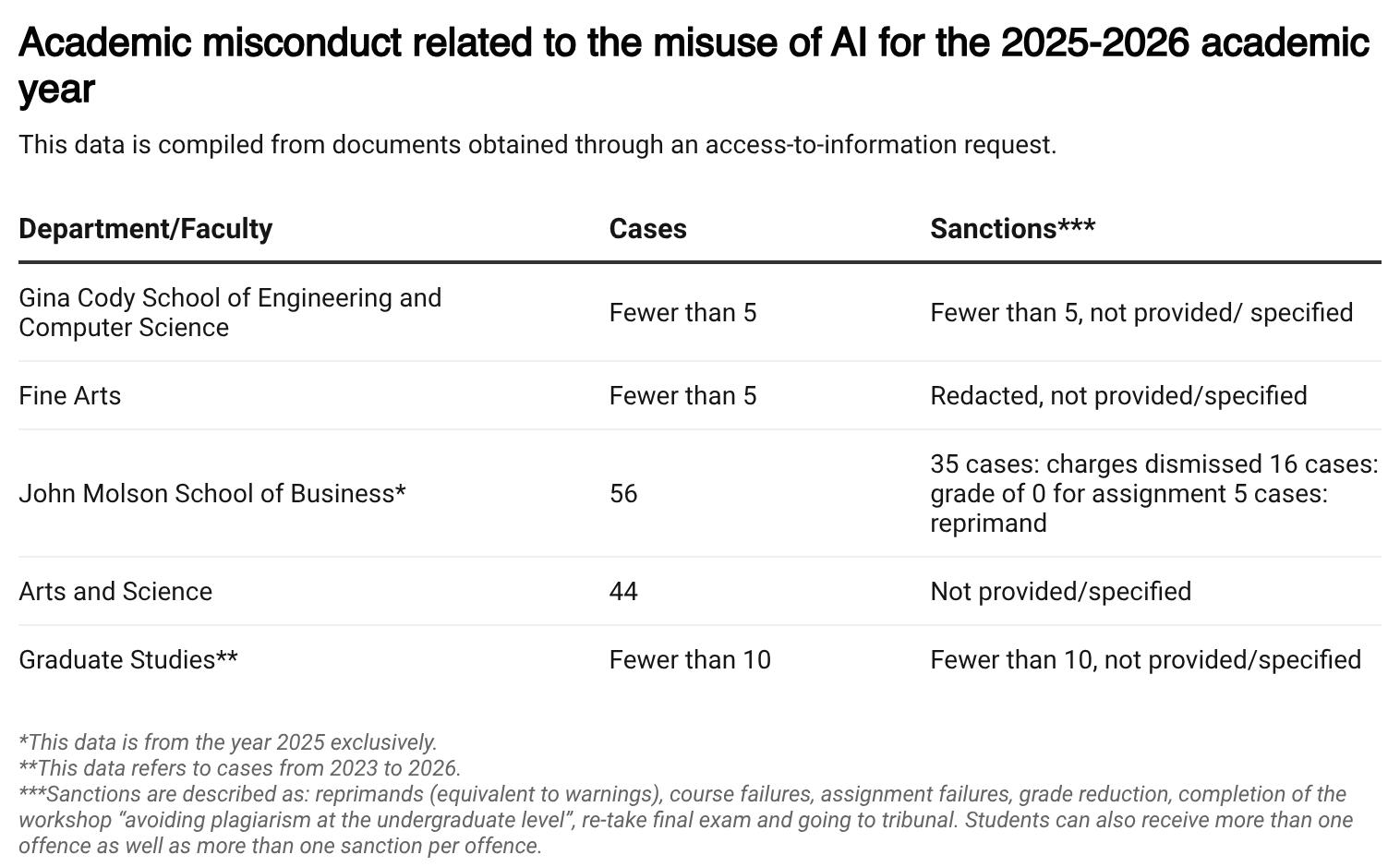
Just over 100 cases of academic misconduct related to the misuse of AI, have been filed for the 2025-2026 academic year.
By Sabina Bellisario-Giglio Staff Writer @_sabbell_
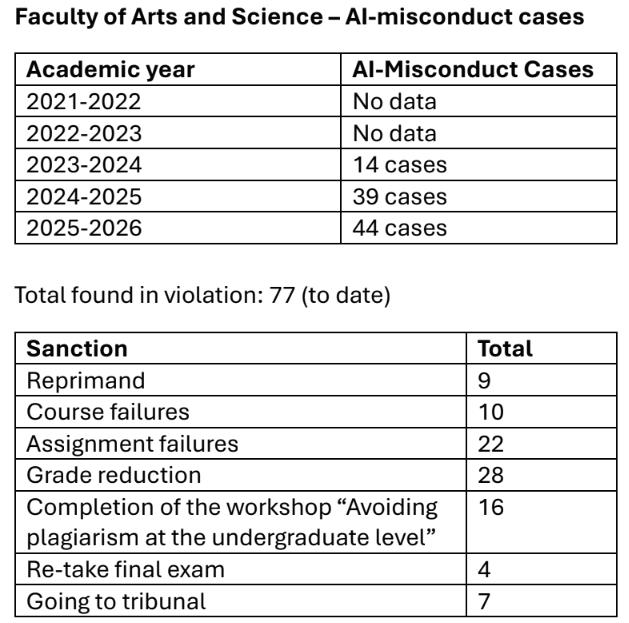
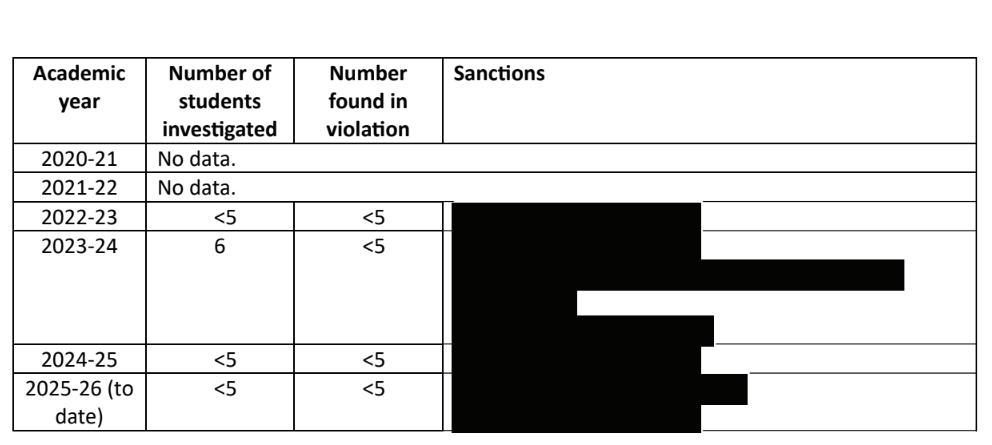
This is according to documents obtained through an access-to-information request regarding academic misconduct related to AI misuse, dating back to the 2021-2022 academic year.
Most faculties have seen an increase of cases in AI misuse since the creation of OpenAI’s generative AI chatbot ChatGPT in 2022. Chances are you may have already used it to finish an essay or complete a reading report you left too late.
Eighty-six per cent of university students claim to use AI in their studies, with 24 per cent of those students using AI on a daily basis, according to a survey from 2024 conducted by the Digital Education Council Global.
But Concordia’s data reveals a very small minority of students actually getting caught for their misuse. Some faculties, like the Gina Cody School of Engineering and Computer Science, had no recorded
cases of academic misconduct related to AI until this year.
Other faculties have seen a significant increase in cases, though the increases are relative to the percentage caught previous. The faculty of arts and science reported 14 cases in the 2023-2024 academic year. Since then, there has been a 214 per cent increase in cases, with 44 reported cases in 2025-2026. The John Molson School of Business reported 28 cases in 2023, 16 of those charges being dismissed. While there was a decrease in 2024, with less than 5 reported cases, that number rose in 2025 with 56 reported cases, although charges being dismissed in 35 of them.
For comparison, in 2024-2025, there were a total of 43,922 students at Concordia, including 18,310 students in the faculty of arts and science, 8,289 in John Molson and 11,576 in Gina Cody.
The university did not have any data regarding AI misconduct cases involving professors and staff.
The university also noted that “the number of AI investigations is not held by all faculties” and therefore had no data about students from those faculties.
When asked about the adequacy of the flagging system, or if the numbers presented above accurately portrayed the number of students using AI for academic work, university spokesperson Vannina Maestracci did not comment.
Concordia political science professor Dónal Gill believes that allowing students to use AI, as well as upholding academic integrity within the institution, cannot coexist.
“We have to embrace progress and therefore this technology has to be part of what we do in educating people. And then also don’t allow people to cheat and make sure that everybody gets graded fairly,” said Gill.
“Those two things cannot be. You can’t ride those two horses at the same time.” He proposes that the university should focus on maintaining academic integrity.
To date, Concordia has no university-wide official policy on the usage of AI for academics. However, it does provide guidelines through the resource hub, available for students, professors and researchers. The Centre for Technology and Learning (CTL) also provides guidelines for faculty on how to navigate the use of AI in both learning and teaching.
But not all teaching methods align.
Some see the technology as something students will inevitably see in the workforce, so they must be able to use it ethically and understand its pitfalls.
Francesco MacAllister-Caruso, a political science professor at Concordia, believes that the CTL has provided a good baseline for professors and faculty to follow, but it is not enough. Their classroom philosophy surrounding AI focuses on understanding it as a tool, while also understanding its limitations.
“I think we’re actually doing a disservice to students and to faculty by not properly addressing their use,” said MacAllister-Caruso, on not having a policy to help professors navigate AI use in the classroom.
“There’s a gradation of misuse. It’s not black or white, whether you’re using it ‘right’ or ‘wrong,’” they said.
They explained that extreme cases of AI misuse fall under plagiarism, where AI is used to replace critical thinking, while the less severe misuse of AI should fall under mistakes or lack of clarity, such as not disclosing when AI has been used to modify or edit larger portions of your work.
Gill also noted that offloading basic or complex cognitive processes to AI can
hinder a student’s development in memory, focus and concentration. “Students today, who don’t develop those capacities for focus, concentration, memory, it’s like you’re chipping away at something that isn’t even finished being built yet,” said Gill.
Accordind to a 2025 survey by KPMG Canada, 48 per cent of students surveyed say their critical thinking skills have deteriorated since they started using AI. It also found that 65 per cent of students who use AI for their schoolwork say their peers rely on AI to avoid critical thinking.
“That’s a really big concern if you’re trying to train the next generation of thinkers, right?” said MacAllister-Caruso.
“You don’t want just people to outsource their thinking to a technology.”
An MIT study explored the neural, linguistic and behavioural levels of three groups; one using generative AI, one using search engines and the last one without access to any tools. The group using AI were found to underperform in every level, raising concerns for the longterm educational impacts of reliance on
generative AI in academia.
The University of British Columbia collected data from 1,746 students from December 2024 to January 2025, whereby students shared their thoughts and concerns regarding UBC’s approach to generative AI.
Over 300 students reported that clear, structured learning opportunities provided by the university would help them understand AI’s capabilities and limitations.
The data also found that over 400 students reported feeling confused and frustrated with the lack of clear guidelines, which negatively impacted their learning experience.
Gill shared this sentiment, noting that, as the university continues to take no official stance on the matter, professors are being left to grapple with the consequences.
“I think we’re not getting any assistance as educators in how to do this. [The university] is talking a lot, but they’re saying nothing. And more importantly, they’re doing nothing.”
To see the documents, read the online version of this article.
ASFA Special General Meeting
By Megan Mills Devoe Campus News Editor @meganmillsdevoe
The Arts and Science Federation of Associations (ASFA) will be hosting a special general meeting (SGM) this week. Here’s what you need to know.
The primary purpose of the SGM is to vote on an austerity strike motion, which would kick off the planning of an academic strike in fall 2026. The meeting is
set to take place on April 8 at 6:00 p.m., in the CSU lounge on the 7th floor of the Henry F. Hall Building. ASFA’s bylaws require that at least 100 students attend the meeting in order to meet quorum and 500 students vote in order to pass a strike motion.
The meeting was triggered by a petition that received 100 signatures from ASFA students. This petition highlighted the increasing austerity measures installed at Concordia over the last few

years. The measures mentioned in the petition include; limited term appointment (LTA) contracts being not being renewed, reduced shuttle bus hours, larger class sizes, course section cuts, and fewer courses overall.
Concordia’s administration has denied that cutting LTA contracts will impact course offerings or interfere with students’ ability to graduate. It has also stated that students should not expect to rely on the shuttle bus in order to attend every class.
If the motion is adopted without modification, ASFA will:
1. Call for widespread mobilization against austerity in post-secondary education.
2. Go on strike for at least a day, the date will be determined next semester at the next SGM; date to be determined.
3. Create a “Strike Readiness” Committee in order to prepare for the next SGM & strike mobilization in fall 2026.
is hiring (soon)!
The Concordian will open its application for its Volume 44 Masthead positions in the coming weeks. These include:
Editorial Section Editors
Creative Section Editors
Production Manager
Assistant Editors
Copy Editors
Head of Social Media
All the details for each position will be published on our Instagram page (@theconcordianmtl) → and on our website shortly.

If you have any questions about a position or anything related to applying to The Concordian, please contact Volume 44's Editor-in-Chief, Félix-Antoine Beauchemin. You can email him at fabeauchemin@theconcordian com or DM him on Instagram @fa beauchemin journalisme
Ringette’s breakout season
The sport has created its own space within the steady rise of women’s sports over the last decade.
By Sabina Bellisario-Giglio Staff Writer @_sabbell_
Lauren Henderson let out a laugh when asked why she decided to start playing ringette and not hockey.
“I like to joke that ringette, the strategy of it, is a lot more like basketball and lacrosse,” said Henderson, forward for the Edmonton WAM! and player for Team Canada.
Henderson began playing ringette at the age of four alongside her twin sister. While her brother played hockey, she decided that she enjoyed the fast-paced, creative aspects of ringette over hockey.
Ringette really only shares one trait with hockey: skating.
The sport has a 30-second shot clock per possession and does not have face-offs, but rather free pass spaces, similar to basketball and soccer.
Ringette currently has over 30,000 players and over 2,000 teams across Canada. While it is open to all players, ringette at the professional level, the National Ringette League, is female-dominated.
On Feb. 10, Ringette Canada announced its historical streaming partnership with AWSN, All Women’s Sports Network, for the 2026 National Ringette Championships. The championships, which are set to stream on YouTube and CBC as well, will have its bronze and gold medal games streamed on the network.
AWSN streams across 65 countries and is available in Canada through Pluto TV.
“We think it’s huge because we’re trying to grow our visibility and awareness as much as possible,” said Peter Leyser, CEO of Ringette Canada.
Ringette is only one of the many women’s sports and sports leagues that have seen a rise in viewership and demand.
“I think that women play sports and want to play sports when they see other women playing sports,” said Sabrina Guay, a U14A coach in the Outaouais region. “It's that sense of belonging. It's the sense of being a part of something.”
Leyser recognized the rapid rise of leagues such as the PWHL (Professional Women’s Hockey League) and the WNBA (Women’s National Basketball Association). “Women’s sport is finally getting the viewership and the awareness that it deserves,” he said.
The PWHL’s inaugural game in 2024 garnered 2.9 million viewers across all platforms and has continued to break records, with 21,105 fans in attendance at the Bell Centre for a match between the Montreal Victoire and the Toronto Sceptres in 2024.
The WNBA saw a 148 per cent increase in viewership in Canada for the 2024 regular season, after being awarded an expansion team, the Toronto Tempo, who are set to play the Connecticut Sun in a preseason game on April 29. The league also reported its new collective bargaining agreement, whereby players would receive 20 per cent of gross league and team revenue.
“It provides that target or goal or next step for young female athletes wanting to continue to pursue sports,” said Henderson about the rise of viewership and participation in women’s professional sports.
She believes that the success of these leagues could mean a brighter future for those in ringette. “It's a trickle-down effect, and I hope to see [ringette] continue to grow,” she said. “I want to leave it better than it was.”
Ringette has also made some strides in Canada, slowly cementing its importance to the country’s sports culture.
The 2025 National Ringette Championships, which were hosted for the first time in Ottawa, were awarded the Canadian Event Award of the Year (Group B — less than $1 million budget) at the 2026 PRESTIGE awards presented by Sports Tourism Canada.
Leyser attributed the success of the championships to the partnership between Ringette Canada, the hosting committee and the volunteers for the event.
“We as an organization have really refined what a Canadian championship should look like [...] and I feel like we are so much further ahead than we were three or four years ago,” he said.
Expanding visibility on women’s sports not only helps monetarily, with increased viewership at the competitive level, but also helps grow participation at the younger levels.
Guay believes that, with the large youth presence online, exposure can make a big difference in helping get eyes on ringette. “It’s exposing them to the sport in a way that speaks to them, but also convincing them to come out and try the sport.”
This is something she believes Ringette Canada has developed with their “Come Try Ringette” program, and a phenomenon she’s seen within Ringette Gatineau and their efforts to recruit new players. “We all need to work together at that goal. It's not a sport-specific thing. I think it's a girls in sport thing,” Guay said.
According to a 2024 report conducted by Canadian Women & Sport, a national non-profit, 63 per cent of girls surveyed aged six to 18 report taking part in team sports weekly, compared to 68 per cent of boys.
“Athletics has been something that has allowed me to learn a lot of life lessons that have translated in school and in my career,” said Henderson.
Guay’s motivation as a ringette coach is that she believes this push can help girls, beyond just continuing to play sports, to gain transferable skills for other careers. “It was wanting to pass on those [skills] to not just my own girls, but to girls in general,” Guay said, “sport helps give women the confidence to not just enter the room, but be a part of the conversation.”
Half of Canadians girls drop out of organized sports by age 17, according to Canadian Women & Sport.
“We’d like to see that change quite frankly,” said Leyser. “We’d like to help increase the numbers and just showcase that ringette is a viable option [...] We want to showcase here’s a great sport, it’s female-centric and it’s an opportunity for you to come out and be a part of a team.”
Henderson agreed, hoping to see the sport flourish in order to see more athletes have longer careers within ringette. Both domestically and internationally.
Players and administration alike are shooting for the stars — or rather the rings — when it comes to the future of ringette.
“I think to bring ringette, and get it into the Olympics, that would be amazing,” Henderson said.
Women’s sports hit a major milestone in 2012 at the London Games, when women’s boxing was added to the Olympic programme, making it the first time in history that women were able to compete in every sport available in the summer program. The Olympic Winter Games still does not include women's nordic combined.
“But we’ve got a lot of work to do before we get there,” said Leyser. He explained that the sport must grow internationally before considering the Olympics as a realistic goal.
Which is true, as in order to be considered for inclusion in the Olympic programme, the sport must first be governed by an international federation and must then be recognized by the International Olympic Committee.
Ringette currently has a World Ringette Championships, consisting of teams from Canada, the United States, Finland, the Czech Republic and Sweden.
Henderson represented Team Canada in the 2025 world championship, winning silver alongside seven of her Edmonton WAM! teammates. She also played in the junior division in the 2016 championships in Finland, winning the gold medal.
“It's special for us to take [ringette] to the international level, and then also learn from all the players that we call competitors in the National Ringette League,” Henderson said.
Canada is set to host the World Ringette Championships in 2027, and Leyser believes now is the time ringette needs to begin a national marketing campaign in order to eventually bring it to Olympic-level status.
“I’m not putting it on them, but the RBC’s of the world, or the Bell’s of the world, Petro-Canada’s of the world, if they could start supporting ringette, I think that would be tremendously helpful because you need dollars to execute those initiatives.”

Photo Courtesy of Ringuette Canada
The Audit: Women’s hockey
One game short, but far from the full story.
By Anthony Maruca Sports Editor @_maruca27
It didn’t end how they wanted.
One game short of a national title, after months defined by resilience, connection and belief, a loss to the Carabins of l’Université de Montréal in the final stung. However, to define this team by its last game would be to miss the bigger picture entirely.
Head coach Julie Chu made that clear in the aftermath of the national championship loss. Despite the disappointment, her tone wasn’t one of regret — it was one of pride.
“I’m super proud of our team,” Chu said. “Yes, we wanted to win that final game, but if we step back, there’s so many things that we accomplished. We put ourselves in a position to play our best hockey at the end of the season, and that’s something we really value.”
That philosophy was evident throughout the team’s playoff run. In a tournament where the margin for error is razor-thin, Concordia battled through tightly contested matchups against Waterloo and Guelph before falling to UdeM in the national title game.
“A couple bounces go this way or that way, and it’s a different result,” she said.
For the players, that same mindset carried through, as star forward Jessymaude Drapeau, who captained the team in her final season, described the championship game as a reflection of their best.
“We played our best games at nationals,” she said. “we’re really proud of how we ended things.”
That pride was earned over the course of a demanding season.
Early adversity faced in tough exhibition matchups, a streak of four straight hard-fought overtime wins in November and repeatedly facing some of the toughest
competition in the country forced the team to find its identity quickly.
Goaltender Jordyn Verbeek saw those moments as turning points.
“We faced adversity, but we never gave up on each other,” she said.
“That’s what defined us.”
A class of seniors that set the everyday standard for Concordia hockey
At the heart of that culture was a senior class that leaves behind a remarkable legacy.
Verbeek is one of the six graduating seniors who are leaving the program, including U Sports national player of the year and team captain Jessymaude Drapeau, and tenured players Zoe Thibault, Émilie Lavoie, Kat Pelowich and Alexis Bedier.
Not only was each player a key contributor on the ice — each were foundational pieces of the program’s identity over the past five years. Their collective résumé includes multiple conference championships and five national championship appearances; ultimately winning two of them in 2022 and 2024.
Replacing that level of experience and leadership won’t be easy.
“They’re such big parts of our team,” Chu said. “But it also opens up opportunities for others to step up.”
Each senior brought something unique, as forwards Drapeau evolved into a leader and elite two-way player, whilst Thibault and Bedier provided consistent reliability in all situations.
Transfer Kat Pelowich, who played most of her collegiate career at St. Thomas University in New Brunswick, joined the Stingers for her final year and played well consistently for the team.
Lavoie showcased rare versatility, transitioning from forward to defence, earning second-team all-canadian honours despite the change in position in her final year.
Verbeek, meanwhile, embodied patience and growth, developing into a top-tier goaltender, learning after or following in the footsteps of veterans like Alice Philbert early in her career.
By the time nationals arrived, the team
had not only found its footing — it had become one of the most cohesive groups in the country.
That cohesion didn’t happen by accident.
Standout defender Angélie Jobin, who earned RSEQ rookie of the year honours, emphasized the team’s culture as the driving force behind its success.
“We had great leaders and great coaches pushing us in the right direction,” she said. “We trusted the process, worked hard every day, and we were all really close. That’s why we were successful.”
This season in numbers
According to data acquired by The Concordian through access-to-information requests, the team operated with an adjusted budget of $571,960, with year-to-date spending totaling $471,833.
Attendance figures paint a mixed picture, as average turnout reached 135.6 spectators per game, with a season high of 349 fans recorded during Concordia’s home opener on Oct. 24 against rivals McGill.
However, those numbers mark a noticeable decline from the 2024–25 season, when average attendance sat at 217 spectators per game, based on data from the first eight home games (as full-season data was not available at the time of the request).
The drop is further reflected in season pass sales, which fell significantly from 23 last season to just eight this year, underscoring ongoing challenges in sustaining fan engagement.
Moving toward a new era of Stingers’ hockey
For the graduating seniors, the focus this season wasn’t just on winning — it was on preparing the next generation.
“We wanted to build the next group,” Drapeau said on the subject. “show them what it takes to win and bring them along with us.”
With a wave of departures, the program now enters a transition phase, but not a rebuild.
“A lot of people are saying rebuild, but I think that they’re going to do a great job
next year, “ Verbeek said.
Returning players, such as Jobin, are already embracing the challenge, viewing the uncertainty as an opportunity to show what the group is made of.
“We’re losing great leaders, but every year new people step up,” she said. “It’s a new challenge, and we’re going to be ready for it.”
“It’s big shoes to fill, but I’m not worried,” added tenured defender Camille Richard. “We’ll keep the culture at the same standard and just move forward.”
From a coaching perspective, that belief is rooted in a clear process. Chu emphasized that roles are never guaranteed — everything is earned, whether you’re a returning player, a recruit, or a transfer.
“Everyone has the chance to prove themselves,” she said. “What you do over the summer, how you come into camp; that’s where it starts.”
That internal competition, combined with a strong recruiting class, positions the team well for the future. While transfers remain a possibility, Chu made it clear that fit matters more than talent alone.
“It’s about whether they believe in our culture,” she said. “If it’s the right fit, it’s a bonus.”
The program’s foundation, however, remains unchanged: development, connection and accountability.
The true measure of this season’s success, which Chu echoed in an interview with The Concordian earlier this season, is the standard that was upheld and the belief that, even with change, the program isn’t starting over — it’s moving forward. If this season proved anything, it’s that where they’re going next looks just as promising as where they’ve been.

Jessymuade Drapeau celebrates RSEQ final win over UdeM on Mar. 07
// Photo by Marisa Filice // Concordia Athletics
A new director for Concordia’s recreation and athletics department
Claude Morin brings over a decade of experience.
By Anthony Maruca Sports Editor @_maruca27
A new era is beginning for Concordia’s recreation and athletics department (CRA), as newly appointed director Claude Morin prepares to take over a department balancing competitive success with financial and structural challenges.
Morin brings decades of experience to the role, from his time as a professional hockey player to 16 years as an athletic director at the André Laurendeau CEGEP.
“I went through what [student-athletes] are going through right now,” Morin said. “I know what they want to
accomplish […] I like working with young student-athletes to make sure they become better individuals and reach their athletic goals.”
Still, his early priorities are less about immediate change and more about understanding the environment he is stepping into.
“The main goal is to really get to know the people I’ll be working with,” he said. “It’s through relationships that you can build something really good.”
Morin acknowledged that, at this stage, he is still gathering information before making concrete decisions.
“I don’t know the environment yet,” he said. “I want to get input from student-athletes, coaches, management, the whole community […] and after that, set goals and work as a team to accomplish them.”
That process will likely include both data collection — such as surveys — and direct engagement with the Concordia community. Morin emphasized the importance of
hearing from stakeholders about what they want from the department moving forward.
“What do they want more? Where would they like to go?” he said. “I’m curious to hear about that and see how we can make it happen.”
While questions remain about how new resources — such as a recent fee-levy increase, the department’s first in nearly two decades — will be allocated, Morin views the added funding as an opportunity to better serve students.
“It’s positive,” he said. “Now it’s about getting the information on what the community wants and trying to serve them as best as possible.”
When asked how Morin would define success in his first year, he avoided win-loss metrics, instead focusing on culture.
“To have the best work environment possible, where people are motivated to come every day and accomplish great things,” he said.
That emphasis on culture may prove
especially important as the department continues to navigate financial pressures. While specific strategies remain to be determined, Morin stressed the importance of unity across teams and stakeholders.
“We’re all wearing the colours of the same university,” he said. “It’s about having the same mission, the same vision.”
His experience at the CEGEP level — where shorter student tenures made building school identity more difficult — could offer an advantage at Concordia. University environments, he noted, tend to foster stronger long-term connections among students and alumni.
“If we were able to build that at the collegiate level, I think it might be easier here,” he said.
As Morin prepares to officially step into the role, many questions remain unanswered — from budget allocation to longterm planning. But his approach, at least initially, is clear: listen first, then act.
En partenariat avec et financé par L’Organe
Mission Impossible : Trouver un 4 ½ sur l’île de Montréal
L’appartement parfait est peutêtre une histoire de contes de fées finalement.
By Marianne Comeau Collaboratrice
@marianne_comeau
Comme 15% de la population montréalaise, je crains le 1er juillet comme la peste. J’ai aussi le malheur de devoir participer à la tradition qu’est le déménagement du 1er juillet cette année, sans quoi je devrais payer 1 830 $ par mois pour vivre en colocation avec des écureuils. J’aimerais vous dire que c’est une blague ; ce n’est malheureusement pas le cas…
En théorie, c’est un choix assez facile. Une fois les démarches entamées, je commence à me convaincre qu’avec de bons bouchons d’oreilles, je peux peut-être cohabiter avec des écureuils. Noémie et moi, nous cherchons la perle rare à Montréal : un 4 ½ qui ne consiste pas en une chambre et un « salon double », ou bien en deux chambres, mais en une seule chambre avec une fenêtre manquante. Nous voulons payer moins de 1 800 $ par mois et avoir accès à une laveuse et à une sécheuse. Raisonnable quand même, non? Finalement, la perle rare est peut-être plus difficile à trouver que prévu.
Vendredi, nous avons eu le plaisir de visiter un appartement qui avait techniquement tout ce qu’on voulait. Buanderie dans l’immeuble, deux chambres, moins de 1 800 $/mois, en plus d’une piscine dans l’immeuble et d’un accès direct au métro. La dame qui nous fait visiter n’est pas la propriétaire, mais il n’y a aucun doute qu’elle gère la place avec une main de fer.
Elle est l’archétype d’un pilier d’entreprise: en gros, sans elle, la place s’écroule. Elle nous fait visiter les deux appartements disponibles. Heureusement pour nous, les photos en ligne étaient très représentatives, pas de surprise à ce niveau-là, quoique ça nous soit déjà arrivé. Par un élan de conformité malicieuse, ou bien par une performance incroyable de messages subliminaux trop évidents, elle nous fait la liste d’épicerie des défauts de la place.
1 — « Donc, je vais vous montrer la buanderie. Par contre, il faut absolument que vous soyez présentes si vous faites votre lavage entre 19 h et 22 h. On a beaucoup d’itinérants qui viennent voler des vêtements. »
2 — « Si jamais on sonne à votre porte en disant que c’est pour un colis Amazon ou une livraison Uber Eats, n’ouvrez surtout pas: c’est comme ça qu’ils rentrent. »
3 — « Aussi, nous vous avertirons toujours si la méthode de paiement du loyer
change. Certains font du porte-à-porte avec une machine TPV et fraudent les locataires de leur loyer. »
4 — « Quand je suis au bureau, je vais prendre les paquets dès qu’ils sont livrés ; vous serez certaines que vos paquets ne seront pas volés. »
Tout cela, au prix raisonnable de 1 795 $ par mois! J’admets que je vous ai fait le portrait de notre pire expérience, mais ça ne sort pas du lot. Entre-temps, je continue à passer des heures sur Marketplace et Kijiji à assaillir tous les propriétaires montréalais à grands coups de « Bonjour, c’est encore disponible? »
La perle rare n’a pas encore été trouvée et les écureuils semblent de plus en plus amicaux maintenant que j’y pense.
Grande Finale du Concours d’éloquence interuniversitaire Délie ta Langue!
En représentant Concordia, Wendy Mbog remporte la victoire haut la main!
Par Alexandra Montenegro Nodarse Rédactrice attitrée
C’est le 30 mars 2026, dans un auditoire comble de la Grande Bibliothèque de Montréal, que s’est déroulée la finale tant attendue du concours d’éloquence interuniversitaire
Délie ta Langue! Fier partenaire de la Ville de Montréal et du ministère de la Langue française du gouvernement provincial, ce concours fait rayonner le français à travers l’ensemble des communautés francophones du Canada.
Le ministre de la Langue française JeanFrançois Roberge était présent en personne pour le concours qui en est à sa huitième édition.
Ce dernier s’est dit particulièrement chanceux et honoré de se retrouver devant tant de diversité et de talent déployé par les participants, qui, par des gestes posés et des discours puissants, émouvants même, construisent, peu à peu, l’avenir de la Francophonie.
« L'art oratoire se marie parfaitement à l'histoire de notre langue et aux grands enjeux sociaux, comme nous le montrent annuellement les finalistes de ce concours tout en finesse. Merci à ceux et celles qui font vivre le concours! » a déclaré Roberge
dans un communiqué.
Les propos du ministre illustrent bien l’essence du concours. Délie ta langue! célèbre la tradition orale du français, une langue pleine d’éloquence et de dynamisme, une langue vivante.
Ce concours consiste en une articulation de la pensée, en célébrant la beauté et la diversité de cette langue élégamment malléable qu’est la langue de Molière.
À son tour, le recteur de l’Université Concordia, Graham Carr, félicite l’ensemble des finalistes :
« Votre réussite démontre le pouvoir unique de la langue française pour renforcer les liens universitaires et professionnels à travers le Québec et le Canada. »
Les spectateurs ont eu droit à assister à de vrais chefs-d’œuvre d’art oratoire. Les présentations portaient toutes sur des thèmes aussi révélateurs les uns que les autres, exposant toutes avec profondeur la portée d’enjeux sociaux qui transcendent le temps, comme le féminisme, l’immigration, l’accès à l’eau potable, l’environnement ou même l’intersectionnalité.
Mot par mot, geste par geste, les finalistes ont su disséquer la société contemporaine, ses multiples tours et détours, ses maladresses et faux-pas, ses injustices quotidiennes, pour finir avec un appel à l’action, une touche d’émotion ou un peu d’espoir, même.
« Je ne veux pas qu’on me déroule un tapis rouge… », s’exprime Alpha Amadou Sow, finaliste de l'Université du Québec à Rimouski (UQAR), sur l’accueil des immigrants au Québec.
« Jacques Cartier n’était-il pas le premier immigrant? » nous demande Lara Nehme, de l’Université du Québec à Montréal (UQAM),
nous témoignant des obstacles qu’a traversés son père lorsqu’il est arrivé au Canada.
La présentation de Wendy Mbog a réussi à couronner le tout. Représentante de Concordia et étudiante co-op en génie logiciel de l’École Gina-Cody, elle a su brillamment énoncer son discours, une parfaite éloge à la condition féminine :
« Mesdames, n’arrêtez jamais de rêver, osez! »
Véronique Hivon, membre du jury et ancienne ministre des Services sociaux et de la Protection de la jeunesse, communicatrice et professeure invitée, affirme que la prestation de Wendy était un coup de cœur unanime du auprès du jury « en raison de sa diction
parfaite, de la qualité de son argumentaire, et de son audace ».
Gagnante du concours, Wendy Mbog recevra une bourse de 5 000 $, décernée par le ministère de la Langue française, responsable d’attribuer le premier prix.
Bien entendu, la victoire de Mbog fait rayonner Concordia au sein du concours, mais aussi dans la Francophonie tout entière. Le concours Délie ta langue! se tient tous les ans. À l’avenir, des bourses de mobilité seront offertes pour l’élargir à échelle internationale et ouvrir ses portes aux étudiants étrangers. Cela donnerait une opportunité aux candidats de la France et d’outre-mer de faire leurs preuves.

Wendy Mbog, représentante de l’Université Concordia et vainqueure du Concours. Photo par Alexandra Montenegro Nodarse // Rédactrice attitrée
En partenariat avec et financé par L’Organe
Kabasa : décoloniser le territoire à travers la résistance autochtone
Une réflexion
lucide sur les liens culturels et linguistiques entre une nation et son territoire, tissés au fil des générations.
Par Alexandra Montenegro Nodarse Rédactrice attitrée
Jusqu’où iriez-vous pour défendre votre culture?
J’ai tellement aimé ce livre que je l’ai lu en deux jours. Ce sont 208 belles pages pleines d'amour et de bon sens. Ce roman, je ne peux que le recommander!
Kabasa, de Michel Jean, raconte l’histoire d’un journaliste abénakis d’Odanak, Jean-Nicolas Legendre, envoyé par son bureau de rédaction pour couvrir une nouvelle de dernière heure : un tsunami fait des ravages en Thaïlande, en Indonésie et au Sri Lanka. Lorsque l’envoyé spécial débarque dans
cette troisième contrée, il y découvre une population marquée par la catastrophe naturelle et scindée par la guerre civile. Il décide d’aller plus loin, d’explorer le conflit en profondeur. Il s’enfonce dans la jungle, au nord du pays, accompagné de sa traductrice, Apsara.
Là, il rencontre le Cobra, chef de la révolte, qui lui fait comprendre un point de vue marquant — révélateur même — à travers un témoignage inattendu, qui relie le conflit des Tamouls aux formes de résistance autochtone du Canada.
Michel Jean qualifie ce roman de politique. Il y aborde notamment la résistance de Kanesatake, ainsi que les efforts de justice et de réconciliation d’Alanis Obomsawin. Dans un entretien avec Laila Maalouf, journaliste chez La Presse, l’auteur et ex-chef d’antenne souligne que « chaque livre est un combat personnel ».
Rappelons-le, dans Kukum, Jean voulait parler de la sédentarisation forcée, en dénonçant les dommages subséquents que le gouvernement a causés aux autochtones de cette manière, comme la maltraitance des enfants dans les pensionnats, ou le massacre des chiens nordiques, un génocide abordé dans Qimmik.
Michel Jean écrit Kabasa en se basant sur les événements racontés dans son ancien
roman : Tsunamis. Cette fois, il ne voulait pas laisser son thème implicite. Il voulait que le message passe. Il voulait se faire entendre: « Chaque fois que les Autochtones ont dit non à quelque chose, ça n’a jamais bien tourné. Ça fait que les Autochtones ont souvent tendance à ne pas vouloir choquer. Puis finalement, les droits s’érodent peu à peu », avait également déclaré Michel Jean à La Presse
Bien entendu, un livre est aussi une œuvre littéraire, ce qui laisse à l’auteur à temps plein une certaine liberté littéraire « [qu’il] ne s’était jamais permise avant, en tant que journaliste ». Ainsi, les livres de Michel Jean explorent des questions à la fois personnelles, familiales, culturelles, identitaires, humaines ou bien universelles.
C’est par le langage créatif et le pouvoir des mots que les thèmes s’articulent, selon les choix de l’auteur dans le style et la trame narrative de l’œuvre, plutôt que par l’effet moral et sec d’un manifeste ou d’un essai.
Dans Kabasa, le lecteur est parfois confronté à une prose journalistique et factuelle, influencée par le travail de Jean en tant que rédacteur ou envoyé spécial. Toutefois, la récurrence des personnifications et les descriptions vives et imagées du territoire tel qu’il est vu, perçu et ressenti, suscitent des émotions d’émerveillement et d’admiration
face à la splendeur naturelle propre à la région.
Les liens d’amitié, de famille et d’amour, fragiles et fragilisés, qui se forment et se brisent tout au long du roman, sont tout aussi évocateurs. Ils nous rappellent que ce récit politique parle avant tout des gens qui nous entourent. personnes.
Kabasa signifie « esturgeon » en abénaki. Ce titre fait référence à cet animal, pouvant atteindre plus de deux mètres et qui peut vivre plus de 100 ans, qui Il veille sur les nations et leur bien-être dans le territoire, même lorsque celui-ci, à l’instar de la culture, est menacé de disparaître.
Avec Kabasa, Michel Jean veut évoquer la résistance autochtone. Il en montre le pouvoir à la fois radical et salvateur en exposant la lutte des Tigres Tamouls du Sri Lanka et en la comparant à celle des Abénakis au Québec. L’entrelacement de ces deux récits de résistance et de décolonisation dévoile l’universalité des conflits des peuples minoritaires à travers le monde, ceux qui veulent préserver et transmettre leurs langues, leurs mœursmoeurs et leurs cultures, ceux qui se battent pour le simple droit d’exister.
Les dangers de l’épuisement scolaire
Une bombe à retardement pour les étudiants universitaires.
Par Selena Ruiz Éditrice des Pages Francos
En cette saison de la fin des classes et avec les échéances qui arrivent à vive allure, la fatigue chez les étudiants universitaires est palpable dans toutes les facultés confondues.
Entre les recherches de stages ou d’emplois d’été et les travaux scolaires, il devient difficile de savoir où se situer. De savoir sur quel pied danser et deviner sur quelle tâche on devrait prioriser notre énergie, souvent au détriment de notre propre santé.
Le congé de Pâques, qui devrait offrir un léger redoux avant la période d’examens, se transforme en temps pour étudier et terminer des travaux. Voir ses proches devient carrément impossible pour certaines facultés, qui doivent continuer à travailler malgré elles sur leurs projets pendant cette période qui, à l’origine, devait offrir un moment de recueillement avec la famille, qu’on fête Pâques ou non.
Si on ajoute les activités parascolaires, et les sorties avec amis, la surcharge de travail devient bien réelle, au point que l’individu veuille tout arrêter,
en sacrifiant des mois d’efforts en quête de retrouver quelques heures de sommeil et une paix d’esprit.
Ce syndrome, l’épuisement scolaire, est observé chez plus de 89 % des étudiants de premier cycle universitaire, selon l’organisme Universités Canada. Il se caractérise par une fatigue extrême persistante, une perte de motivation (cynisme) et une baisse de performance, souvent accompagnée d’anxiété, de troubles du sommeil, de douleurs physiques (maux de tête/ventre) et d’un isolement social, selon un rapport de l’Université de Sherbrooke.
Pour en avoir vécu un, l’épuisement scolaire (ou burnout) s’est pointé à un moment où j’entreprenais un double dec au cégep, à raison de 9 à 11 cours par session. Ajoutez à ça l’étude, la pratique de mon instrument, 16 heures de travail par semaine et le voyagement : ça en faisait beaucoup.
Après deux ans avec ce style de vie, j’ai cédé et décidé de poursuivre avec un seul programme. Ça a été difficile, mais ce fut un événement déclencheur dans ma vie étudiante et professionnelle.
Aujourd’hui dans ma dernière année de
baccalauréat, j’accumule les activités et les comités étudiants, pour mon apprentissage, certes, mais aussi pour ajouter à mes expériences sur mon CV. Le problème quand on aime ce qu’on fait, c’est qu’on se donne corps et âme sur la chose. Ça devient un véritable défi de prendre du recul et de dire le fameux : « j’ai besoin d’une pause », surtout quand on sait que notre départ, qu’il soit temporaire ou non, affectera directement la charge d’un autre. Un cycle sans fin.
Donc c’est quoi la solution? Pour ma part ça a été de réduire mon nombre d’activités, et d’augmenter mes heures passées à la piscine. Bouger mon corps me permet de mettre mon cerveau sur pause et d’oublier momentanément les travaux d’équipe qui m’empêchent de dormir la nuit.
Sur ce, bonne fin de session!

Graphique par Tolganay Medet // Collaborateur // @chair_chsir
The highs and lows of starting a freelance photography career
How Concordia photography student Rory Creelman pursues freelance fashion photography.
By Kasi Peri Assistant Arts and Culture Editor
@k_a_s_i_p_e_r_i




Rory Creelman’s passion for photography began at an early age — way before they found their place as a photography student at Concordia. It all started when they got their first digital pointand-shoot camera at six years old. They started photographing as a hobby, but as they got older, it was clear to them that they should pursue this as a career.
“I’ve always really been into photography,” said Creelman. “When I was little, I had a little point-and-shoot camera, and it was interesting to see the world around me.”
In their early teens, Creelman got a DSLR and started photographing their friend, who was a child model.
“We would hang out after school, and just do little photoshoots for fun,” said Creelman.
Creelman began freelancing during COVID. Lockdown obliged, they started photographing their subjects outside, in parks. That slowly allowed them to start working with models.
The experience of coordinating photoshoots between Creelman and their friends launched their interest in fashion, which opened doors into fashion photography. Their photography depends on the gig, yet in every shoot, they focus on the colours and clothing featured in the images.
“I think I found my passion in that and creating images, and working with models, and [my work] slowly evolved more into the fashion scene, and I found my home there creatively,” they said. “It’s always been an obvious path for me. It was my only hobby, so it made sense to turn it into a career.”
Six years ago, Creelman started doing freelance work with modelling agencies and individual models who were hoping to build their portfolios. They reach out to models on their Instagram broadcast channel or even ask models that they know if they are available for photoshoots.
On Instagram, Creelman has grown a massive following of 19.4 thousand followers, where they take their followers behind the scenes of various projects and share how much they are paid for various assignments. In an industry like photography, knowing how much other photographers are being paid helps make it a little more transparent and sustainable for photographers starting out.
“Generally, it’s not the most stable career, especially as a freelancer in any domain, but freelance photography — it’s hard work, and it’s not always guaranteed that you’ll succeed,” said Creelman. “So with that fear, I started just going online, and trying to find evidence out there, going on social media looking for photographers who could tell their story.”
Navigating social media, like regularly
posting Instagram Reels, fuelled their creativity. This online presence became a marketing tool for promoting their work.
Creelman moved to Montreal from Ottawa in 2023, although they had been visiting the city for gigs from time to time.
“I had started in the year before I moved, taking little trips to Montreal,” said Creelman. “So, coming here, it was great. The diversity and the amount of people like artists here that are just dying to be involved in anything.”
Since moving to Montreal, their photography portfolio has expanded, and more people have been reaching out to Creelman, asking to collaborate on photoshoots.
“When I did move, I was grateful to have those connections still and start working right away,” they said.
Creelman has photographed many events since starting six years ago. Their favourite gig was the work that they did at the Montreal Festival of Art and Design.
“I’ve been working with them, it’s going to be my fourth year this year, and they do little kinds of festivals throughout the year,” said Creelman. “I am just there for four days and 12 hours, it’s super busy, super chaotic, but the team that I work with is pretty consistent, so it’s a lot of fun working with my favourite photographers in the city.”
After graduating from Concordia, Creelman hopes to continue improving their craft and work with larger and larger photographers in the industry. Their one piece of advice for young photographers wishing to pursue freelance work? Keep practicing beyond their limits to truly improve their craft.
“It’s absolutely true in this art form that practice makes perfect, and practicing your skills also helps you find what you love,” said Creelman. “That’s the kind of path I found from just working a bunch, and also the more you shoot and sharing that work too, on social media, building a website, having your portfolio available for people to see, you’ll make connections that way.”

Portrait of Rory Creelman // Photos courtesy of Rory Creelman
The decline of arts funding starts at the university level
Concordia’s
recent chain of structural changes stirs uncertainty about the future of programs across the faculty of fine arts.
By Julia Imee Silva Arts & Culture Editor @liaa.imee
Students in Concordia’s faculty of fine arts have been caught in the whirlwind of confusion and concerns about the future of programs across the faculty, in light of the recent chain of austerity measures. At a time when significant budget cuts are being implemented, the university’s arts funding appears undermined.
“Historically, the arts are viewed as kind of disposable and not profitable,” said Jonah Doniewski, the general and mobilization coordinator of the Fine Arts Student Alliance (FASA).
“Montreal is kind of the place you go to when you’re in Canada and you want to study arts,” they said. “If Concordia loses that [...] we’d be losing quite a significant part of the culture here.”
The faculty of fine arts consists of the smallest student population across Concordia’s schools and faculties. According to Doniewski, there are approximately 3,500 students under FASA in the current school year, which is down by about 500 enrollees from the previous year.
“I don’t know what that’s going to look like for next year, especially if student organizations are being defunded and institutionally supported organizations are losing funding,” they said.
The available resources that support the fine arts programs are under threat from the university’s ongoing structural deficits. Amid the university’s current difficult financial situation, staff and students look for answers about uncertain futures in hushed whispers running through the faculty’s halls, waiting until news finally arrives.
“We pretty much have to react on the spot to these kinds of changes, which is

infinitely frustrating,” Doniewski said.
On March 2, the faculty of fine arts announced the permanent closure of the photography department’s colour processing lab after the Winter 2026 term, after a full year of students passing around hearsay. All photography students received an email outlining rising maintenance costs of ageing equipment, limited technician resources and disproportionate student use as reasons for the closure. This also aligns with the faculty’s decision to gear the photography program’s curriculum more towards digital technology, instead of analog methods.
For these reasons, “maintaining colour analog print facilities is no longer sustainable,” as stated in the official announcement.
The colour darkroom found on the fourth floor of the Engineering, Computer Science and Visual Arts Integrated Complex (EV) building is used extensively by all first-year photography students for a mandatory course that trains them with analog printing processes for film photography. The darkroom houses two primary machines, the Omnia and Kreonite processors, which have undergone major repairs from spring through summer 2025.
For third-year student Japhy Saretsky, while the colour darkroom course was extremely challenging, it was also rewarding and character-building.
“I really feel lucky that I got to do it, that I came at the time when it was still part of the curriculum,” Saretsky said. “For people in my cohort, you kind of get the
best of both worlds, but I think it’s really sad for future students.”
Like many others, Saretsky had heard about the possibility of the colour darkroom closing since the beginning of the fall semester, which encouraged him to use the facility more often throughout the year. He also spent the past two months working on a final project in the lab.
“I’m disappointed just because I think that you can go to so many schools in the city for a digital photography course,” he said. “Whereas this is rare; I just think it’s special, so it’s sad to see it go.”
Meanwhile, photography student Simone Joiner had a different first-year experience than most as she took the same course online during the pandemic.
“I’ve gotten so much out of the program still without having used that facility, but I also don’t have the emotional attachment,” Joiner said. “It’s not a hallmark in my experience in the program, so I think my feelings towards it are a little different than other people’s might be.”
The two black-and-white darkrooms in the department will remain open for students moving forward, alongside existing digital labs.
The Concordia Photography Collective (CPC) will be hosting a memorial for the colour darkroom on April 11 that is open for all students to attend.
“I think it’s sweet to come together and have a moment to acknowledge the work that was done there,” said Joiner, the CPC’s club representative. “Nonetheless, it’s discouraging to see things change so much so quickly.”
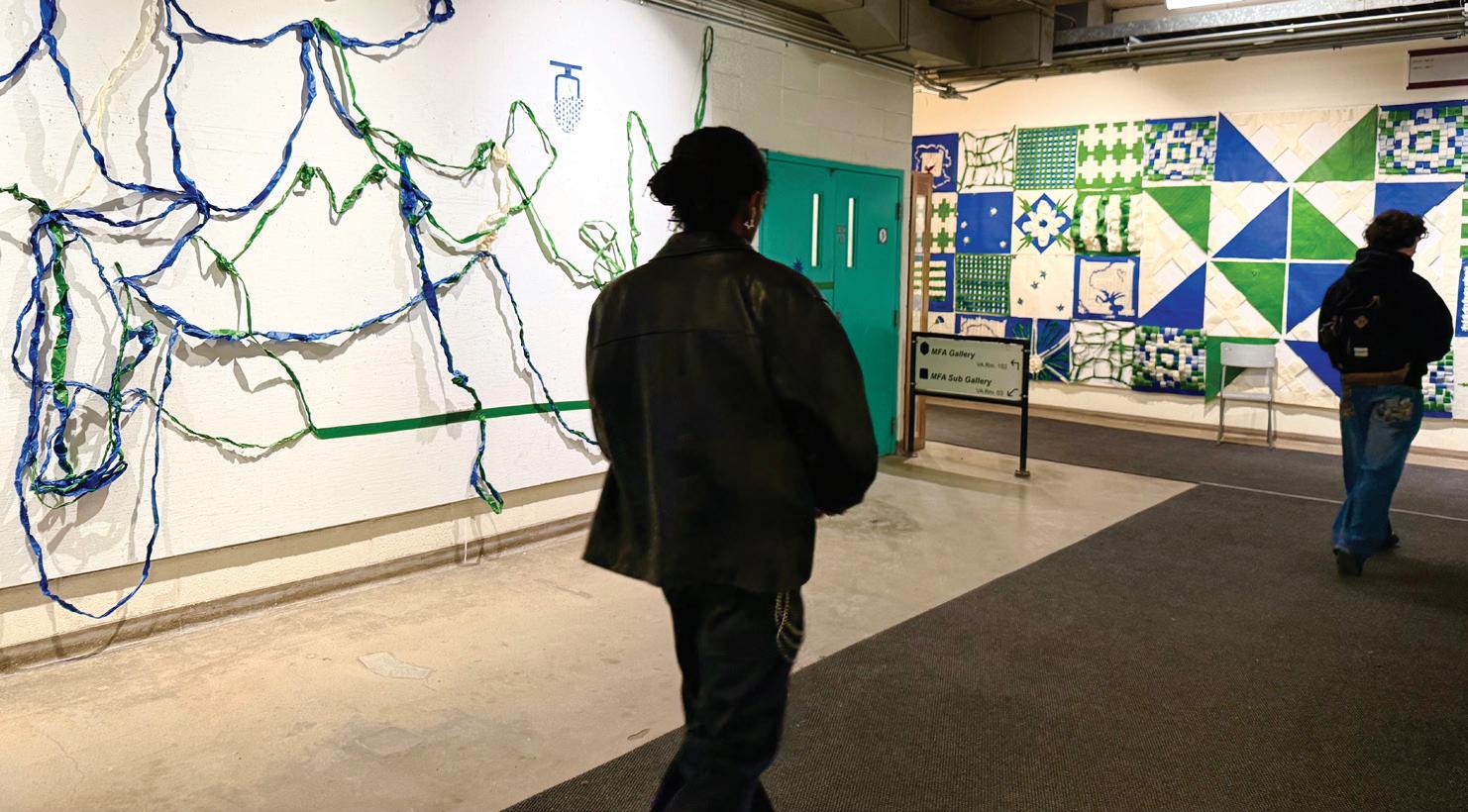
Meanwhile, students and staff have also been worried that two art galleries on the Sir George Williams campus, the FOFA and MFA Galleries, are at risk of closing. However, Concordia deputy spokesperson Julie Fortier denied this claim, stating in an email that the university has not made any decisions to do so.
“The Faculty of Fine Arts is looking at how to better utilize these spaces and focus them on the work of more students,” Fortier wrote.
The FOFA Gallery, located in the EV building, mostly operates as a professional gallery, only showcasing work of fine arts students once annually in the Undergraduate Students Exhibit (USE). On the other hand, the MFA Gallery in the Visual Arts (VA) building exclusively exhibits the work of graduate studio arts students. The
discourse revolves around the possibility of transitioning these into student-run spaces.
Currently, the VAV Gallery is Concordia’s only student-run exhibition space. It receives funding through a fee levy of $1 per fine art credit, which supports regular and special programming catered to students.
However, there has been a lack of consultation between the university and its students regarding this supposed transition.
“Typically, what we see is that Concordia slowly defunds projects that it’s taking care of to leverage it on students,” Doniewski said. “When in reality it’s just decreased funding and decreased institutional support, which is exactly what happened to organizations like [Concordia University Centre for Creative Reuse].”
The VA building is home to a handful of essential studios for students in the visual arts programs, such as the ceramics studio, woodshop and metal shop, among many others.
The university recently updated student access to the VA building. As of March 23, students are required to have an access-enabled card in order to enter the building after 5 p.m. and additional permissions to stay past 11 p.m.
“This building is very active for how uninhabitable it feels to be in here,” Doniewski said. “People are very active and want to make art and want to be in a space even if it’s really shitty, even if it’s falling apart.”
Since the beginning of the school year, students have caught wind of rumours about the university’s plans to put the VA building up for sale. However, Fortier said that there are no plans being made at the moment.
“The university is continuously assessing a variety of real estate scenarios to ensure that we can continue to meet our academic and operational needs as they evolve and that we are able to manage our facilities in a sustainable and cost-effective way,” wrote Fortier.
Amid uncertainties surrounding Concordia’s shrinking arts funding, Doniewski believes in the fine arts community’s resilience.
“I am very optimistic that artists will not disappear from Montreal, and regardless of the situation that we’re under, we will be existing and making it work in the community spaces that we have available to us,” Doniewski said.
The Omnia processor inside the colour processing lab. Photo by Japhy Saretsky
The VA building houses many studios geared to support Concordia’s visual arts programs. Photo by Julia Imee Silva // Arts & Culture Editor
For more satire, read The Accordian
The Accordian is hiring staff to finally do some quality journalism.
By Danylo Perkov Assistant Opinions Editor
DISCLAIMER: This article is farcical, nonsensical and potentially made up. Reader discretion is advised.
The Concordian is launching a satirical publication, The Accordian, which will be a subsidiary of the newspaper. According to an unofficial spokesperson, this decision was made after the student body expressed a growing interest in week-old breaking news from all over Montreal, but mainly in and around Concordia University.
The Accordian will function with one goal in mind: to be the most trustworthy source of campus news for all students from Concordia to refer to in times of need. “With so much happening around the world, we felt like the student body needed someone, an unnamed hero, to keep the decision makers accountable,” said The Accordian ’s current supreme editor to an unnamed source.
It will require a talented staff to work at its full potential. That is why the publication is hiring a team dedicated to the bit. Starting in the fall 2026 semester, they will employ seven full-time writers, a dedicated supreme editor, as well as numerous fact checkers.
Candidates willing to apply for the positions mentioned above will have to decipher a riddle hidden in this article. They will then have to record themselves dancing a polka and submit the answer to the riddle as well as a video recording of the dance to The Accordian’s hiring staff supreme manager, whose email is also encoded in this article.
The odd hiring requirements are put in place because multiple studies have shown a direct correlation between polka dancing skills and good journalism.
“I doubt that the new supreme editor will be as funny or as charismatic or as hot as me, but I have high hopes in the candidate selection process and sleep tight at night knowing that my job will go to someone who employed only a little nepotism,” added The Accordian’s current supreme editor.

financial person said that they have everything to finance the newspaper indefinitely, or until the current fi nancial bubble bursts. “Let’s just say that being able to see the future and having access to a gambling website has its perks,” added The Accordian’s chief financial person.
They did not respond to a request concerning the usage of this power to solve Concordia’s current budget deficit.
“We hope that at least one of the candidates who apply for a position has clairvoyant dreams and will be able to cite things from their dreams. It’s the new cool thing going around the block and we’d love to jump onto the trend,” added The Accordian’s supreme editor.

When asked about the financial situation and future plans of the newspaper, The Accordian ’s chief
A bittersweet goodbye
The moment you dedicated years to is both everything you’ve dreamed of and nothing you’ve thought of.
By Ikram Marzougui Staff Writer
Congratulations! You’ve just walked across the stage, proudly wearing an academic cap and gown while the chancellor or dean places into your hands the very degree you’ve spent years chasing. Your name echoes and the room full of people rises in applause just for you.
All the late nights spent studying, the deadlines and lectures feel worth it, yet, a bittersweet realization creeps in: you are no longer a student.
For many of us, obtaining our degree is the milestone we were
taught to look forward to since our childhood, but the closer we get to it, the more conflicted we feel. Excitement and anxiety intertwine as we realize that the years of hard work leading up to this moment suddenly means letting go of the life we knew as students.
Being a student was never really just a role, it’s what defined our identity all along. For as long as we can remember, our lives have been shaped by semesters, course schedules and classrooms. It’s what brought us structure, purpose and a sense of direction already laid out for us.
Sure, we've all complained about the early mornings, the assignments that piled up and the pressure of midterms and finals. But when we stand on the other side, we feel a void.
The thrill of receiving a grade after hard work, the mental stimulation of engaging lectures, the bonds we formed with new friends and the sense of community that the school system created are gone.
In fact, Robinson, Cimporescu and Thompson’s article in the Journal of Adult Development on wellbeing after graduating from higher
education, points out that one in three people find themselves experiencing an identity crisis within their first year after graduation. Transitioning from the familiar framework of student life to what comes next feels less like a path and more like a vast, undefined space. So, it’s no surprise to feel anxious when the structure you’ve known all along suddenly vanishes.
Still, we all know it: we can’t move forward if we refuse to put one foot in front of the other. And stagnation would be the last thing we want after such a long academic journey. But we can’t help glancing back on all those moments spent in classrooms with teachers, friends and everything that contributed to who we’ve become.
Of course, departures are never easy. But when graduating, we take with us more than just memories. Even if we might feel disoriented, we’ll bring along the lessons learned, the resilience, the curiosity and all the skills honed over years of study.
We may leave university grounds, but we’ll carry a part of it in everything we do.
In final…
How I got a bachelor’s degree before I got a boyfriend.
By Kailee Krentz Opinions Editor @kaileeliz
As the final entry from its architect, I must make a vulnerable stride.
Sex and The Concordian has been a place for myself and others alike, to share authentically their thoughts and desires towards the many tribulations of dating in your 20’s. Much has been explored and through each piece, a sense of therapy was delivered.
Whether it’s avoidance, abandonment, or neglect; we are all privy to being in a situation — as the victim or the villain — exuding the behaviour we all fear when it comes to romantic connections.
Throughout the five years of my undergrad, I have learned many things from the many strangers that have graced my path; their favourite movie, their dog's name, or the many ways they may disappoint me or I may equally disappoint them. Regardless of what might have been from this past, I’ve learned more about myself in regards to the future and the expectations I bring to the next stranger that dares to make the effort.
The typical routine of academia goes as follows: assignments due at midnight, 20-page readings that simply don't compute in your brain and the never-ending cycle of reading responses. In following suit to completion, my years at Concordia have been grounded in learning, both academically and inwardly.
So in this entry, I somehow say proudly with a tinge of resentment, that before I have found the person who can deliver what my wildest dreams ask, I’ve fulfilled my own aspirations, nearing the finish line of my degree that I hope sets my own future forward.
No easy task and one that has been ongoing since I was the ripe age of 18. Now at 22, I reflect on the very first date I went on, which occurred two weeks into my first semester, jump-starting what I would be encounter over the next several years of my studies. Fortunately, this was not the love of my life, signaled by our date spot being at a dive bar I would work at years later, pinpointing a nostalgic beginning while simultaneously making reflection all the more monumentally.
Five years ago, I certainly did not think I would make this statement so effortlessly as I go into this next chapter of my life. With this change, my priorities are only going to continue to shift further than I’ve had to adjust them so far. A blessing and a burden as inevitable change is on the horizon, yet I feel confident in where I am standing, falling blind into this abyss.
In all honesty, I struggled in finding a conclusive ending to this piece. I’ve pride myself on this lifetime achievement that will undeniably find its spot on my CV, but realistically, I still spend hours longing for what I don’t have and attempting to decipher the ways in which I will get what I want.
I guess this is just one less thing for me to check off my to-do list that I will get to celebrate with a cap and gown.
Graphic by Anna Huang // Graphics Editor // @itza_me_anna
Graphic by Anna Huang // Graphics Editor // @itza_me_anna

The death of the bachelor’s degree
A degree used to mean something, recent graduates are proof it doesn’t anymore.
By Alycia Poirier Contributor @alyciapoirier
I’m staring at my laptop, filling out what feels like my hundredth job application. I’ve already submitted the portfolio, built the website and spent the better half of the evening answering three separate 500word questions about my passion for the industry. Now they want a TikTok; thirty seconds to prove my personality is worth hiring. I film it in my childhood bedroom, like the very qualified candidate I supposedly am. I submit it and never hear back. This, apparently, is just how it goes now.
The application process has become its own obstacle course. Gone are the days when a resume and cover letter were enough. Now you’re jumping through hoops only for your application to get screened by an AI bot before a real human ever looks at it. Too few keywords and you’re out, too many and you’re considered inauthentic. The only people who might know how to play the game are the ones who already have connections in their chosen field, which, for a lot of us, especially first-generation students, simply don’t.
Youth unemployment in Canada has risen to 14 per cent, and for recent graduates, it only continues to rise, especially for those with a university degree. For every person throwing their cap in the air this year, there’s a very real chance the job market isn’t waiting for them on

the other side.
And yet, we were told to get the degree. First-generation university students, like me, grew up hearing it like a promise: get a bachelor’s degree and everything will work itself out. But the bachelor’s degree is what the high school diploma was 30 years ago — everyone has one. It’s the bare minimum, as coveted as a LinkedIn profile, and not the golden ticket our parents made it out to be.
Our parents lived in a different era. There were countless jobs available, and they needed people to fill them. Since then, automation has taken a lot of those roles, and what’s left is a surplus of graduates and a shrinking number of opportunities. Try explaining to your Gen X parents that a degree doesn’t even guarantee you a
minimum wage job anymore. They don’t get it, and honestly, who can blame them? We’re navigating a landscape so fraught that even our parents can’t comprehend it, which is isolating in its own way.
Then there’s the experience trap. Entry-level jobs want two to five years of experience. Internships, which were once how you built that experience, sometimes have their own unattainable requirements now. How are you supposed to get your foot in the door when the door keeps moving? It’s a cycle recent graduates know intimately: you need experience to get the experience, with no clear entry point and no one willing to be the first to let you in.
What’s left is a very specific kind of hopelessness nobody truly prepares you
for. You pulled the late nights, got through your exams and earned the degree. You feel proud, and rightfully so, but then reality sets in. Many graduates end up in fields unrelated to their degree because they took whatever job would hire them. Others work full-time jobs and still pick up serving shifts on weekends just to make ends meet. Dream careers don’t disappear so much as they get shelved, and creative passions become side hustles to balance out the mundanity of the nine-to-five life. We were promised the hard part was getting the degree. No convocation speech ever warned us it was just the beginning.
Reading for discomfort over comfort
The confusing, distressing yet incredibly engaging experience of reading Nabokov’s
Lolita.
By Maggie McLean Contributor
In my “Twentieth Century and Beyond: Forms and Critiques” literature class, we read popular books that have defined modern literature. So far Invisible Man, The Second Sex, The Wretched of the Earth, Waiting for Godot and many other quintessential texts from this period have been read. While many of these works have been complex and demanding, I have never read anything quite as engaging and morally challenging like Lolita by Vladimir Nabokov.
The novel opens with a foreword from the fictional John Ray Jr. PhD, informing the readers that the manuscript they are
about to read is from the deceased Humbert Humbert who died in custody while awaiting his trial. Ray does not reveal Humbert’s crime but does reveal his pedophilic behaviour. The manuscript is then written from Humbert’s perspective as he narrates his obsessive and sexually abusive relationship with his step daughter Dolores, who he calls “Lolita.” I believe that despite its controversial subject and uncomfortable reading experience, Lolita is worth the time and can be beneficial to read.
First, the book plays consistently with meta-fiction and the problems of an untrustworthy narrator. As discussed, the foreword is opened by John Ray Jr. and the manuscript that follows is written in the first person by Humbert Humbert, addressing a jury but often referring to himself in third person in an attempt to remember portions of his diary. The text plays between narration causing the reader to doubt what’s real in the story and what’s not. By exercising critical thinking and close reading, Nabokov encourages the reader to second guess what they’re being told. Meta-fiction is used to distance the reader from a narrator, to distort fiction from reality and break normal literary convention, ultimately demanding from the reader active and critical attention.
As well, Nabokov’s writing style is incredibly engaging and beautiful. His romantic and poetic descriptions engage the reader but also act as a mask for the disgusting and perverse actions of the narrator. For this reason, anyone who says Lolita is a love story, has fallen into the traps of the style and has not paid attention to the untrustworthy narrator and the deception. Similar to the meta-fictional elements, the style requires active participation from the reader to see past its beautiful prose and to understand its complexity.
Most importantly the text does not only develop skills as a critical reader but challenges the reader morally. From the intimate perspective of Humbert, the reader feels guilty in their own “participation” and places the reader in uncomfortable situations that Humbert is ultimately justifying. Additionally, pedophilia is a prevalent issue in human history that clearly still exists and should not be taboo to discuss, but instead talked about the most for education purposes and prevention. As Nabokov writes in the epilogue, he is not not writing for children, but writing for adults who should be able to have complex thoughts about these subjects.

Lolita book cover. Courtesy of Dieter E. Zimma.
Graphic by Nan Wang // Contributor // @piccolowang
Gaga just gave Montreal another million reasons to not let her go.
For a night of Mayhem, Lady Gaga flip Centre Bell upside down with chaos and redefines the art of tour.
By Sofia Dawson Music Editor @sofiajdawson
// @somewhereordinary
“Her haunting tone, her restless speech. The music of her mouth.” Words from Lady Gaga’s spoken word “The Manifesto of Mayhem” couldn’t be more emblematic of the singer’s performance on Fri. April 3.
There isn’t a production worth comparing to the 2 and a half hour theatrics of “The Mayhem Ball. For three nights only, Gaga took over Montreal’s Bell Centre with a four-act show laying out the chaos, beauty and depth of her discography through the years.
In a stadium solely lit by the cherry red wristlights sported by fans, the night set off as Gaga’s operatic vocals hovered over a dreary organ. Dancers erupted from within the audience, their movements razor-sharp and so expansive they threw nearby observers off kilter.
The true show began as Gaga herself emerged on top of the tours’ iconic crimson red gowned structure. Lights strobed against the pulsing symphonic score that announced the singer’s presence and effortlessly morphed into the first hit of the night, “Bloody Mary”.
Her enunciation and commanding presence immediately forced the audience to see the stark truth of what they were in for for the night: this wasn’t your run-of-the-mill touring set, this was an indepth, out of body theatrical experience. As if conducting the crowd as her orchestra, Mother Monster gazed up into the broadcasting camera, and announced, “The category is, dance? Ou Meurtre?” To that, the crowd erupted in guttural screams and the quiet intro of “Abracadabra” made its way through the speakers.
Gaga and her dozens of top-tier touring performers created angelic tableau’s cast in
Beginning with Gaga screaming in the face of her alter ego who stands strong, decked out in white from head to toe, the iconic projected chess board draped across the stage as the track began. Here, all bets were off as Gaga battled it out as Mistress of Mayhem against her opposing chess contenders in this hard-hitting dance battle extravaganza.
Act II was set up with Gaga laid alongside a series of bones and skeletons in a massive sandbox sat centre-stage. Here, “Perfect Celebrity” eased listeners back-into the show with its slow build and gritty lyrics before “Disease” set
ArtPop days evoked many screams from the crowd, words belted lyrics for lyric and even some tears.
Before slowing things down, Act IV held the holy grail — “Born This Way”, an anthem known to most, loved to the majority, and connected to by many fans standing in Centre Bell created a new sense of homeliness the venue had been lacking to-date. The singer called out, “You are so special to us, and to the whole world, you hear me?” She belted and jived and held the audience in a tight embrace throughout the entire performance.

Slowly Gaga made her way to the piano for “Die With A Smile” and the surprise track, “Hair”. She breathed out, “Thank you for buying a ticket to our show. Thank you for always cheering me on, I hope you know I’ve always been cheering you on.”
The sheer love and passion that hung in the air reinforce Gaga’s resemblance of the sense of unity her artistry provides her fans.
“I see someone in the audience holding a sign that said they were bullied in school... was anyone else bullied in school? I know a lot of people thought I was fucking weird.”
The singer, who has previously opened up to the public about her own tumultuous journey into stardom and the demons she’s fought on her way, stood on the stage on April 3rd with absolutely nothing standing between her and her music. In that moment, the resilience she embodied
Gaga’s evolution on-stage makes it clear that she has never been “just” a performer or musician — she is a way of life advocating confidence, unity, passion and pure mayhem in the best way possible.
Healthy cultivation rather than relentless releases
Attached to the vinyl store, La Rama Records has been steadily building a carefully sculpted catalogue.
By Luca Jarman Assistant Music Editor
@luca_jarman
Kris Guilty is one of the pillars of the Montreal electronic music scene. You may know Guilty as the owner of La Rama record store in Mile End or the much-celebrated Sans Soleil vinyl-only bar. Many of the most exciting music spots in the city have his influence at the forefront.
Guilty began soundtracking house parties in just the seventh grade, and made the
step up to public spaces when he was 16. His active journey in the live music scene has been a long time in the making. This past January, Guilty made his way back to the turntables to open at the largest stage at Igloofest.
Music surrounds all aspects of his life as his wife Gene Tellem is a recent Juno recipient for “Underground Dance Single” of 2026.
Alongside the record store, Guilty started a record label, La Rama Records. There was no big plan when the label was established; it began simply with a friend offering music and Guilty adoring it and wanting it released.
“Our approach is to see what happens for now,” he said. “But we’re reaching a point where we either stop or continue to grow. But I see that path forward. It took a long time with very few releases, but I see the momentum.
“There is love for this sound and music, so now I’m actively trying to be more of a catalyst by beginning to initiate projects.
“I bought an old CD collection where I
discovered an album which was just perfect. But it was never widely released and was nowhere to be found. I was lucky enough to have met the artist previously, so I managed to track him down, and together we remastered the tracks and put it on vinyl for the very first time.”
Guilty said he has never wanted to force album releases, preferring projects to culminate naturally. This approach resulted in Rama Jam, a sister label forming in 2021 which builds up quirkier, alternative tunes as opposed to focusing in on the artist behind the sound. “I've been in the business for 10 years and now I feel like I've built a sustainable practice,” he said. “I meet great people through the shop who have amazing music that I want to release. And they can play in the great venues we have. It's all cultivated. It might seem like a big plan, but it was all just following the vibes.”
Guilty opened his record store in 2016, when he was working as a server in wellknown Montreal restaurant Joe Beef. He felt the intense work environment gave him the confidence and work ethic to go all in.
He originally opened in the front room of fellow record store Death of Vinyl, before finding his own space.
“As a DJ, I am always consuming new music, but in Montreal, there was a lack of this music available, so I thought why not offer this to the city?” He said. “That's where the shop was born.”
“I'm not a record dealer by trade; I'd always liked to get the party going and set the vibe. That's what has been my career my whole life. But you get to a point where something is just not available anymore, and I felt that I just had to make it happen,” he said.
“But I still come from the mind of a collector. I need to charge you the right price and keep my business going, but I also want everyone to have the record they’ve been searching for. The best thing about the way all of these projects are working together is that the store can always stay the way it is. We can still be just a small store with weird music.”
Lady Gaga at The Mayhem Ball // Photography by Nicko Guihal

live music recommendations in Montreal.
By Luca Jarman Assistant Music Editor @luca_jarman
The snowy days are growing further and further apart and the sun is finally beginning to shine and will be in full blast soon. We’re heading into summer which can only mean festival season. Here’s a hand-picked selection of festivals across the season:
Suoni Per Il Popolo —– June 16–28
Suoni Per Il PopoloThis festival spans across Mile End venues including Casa Del Popolo, La Sala Rossa and La Sotterenea. Showcasing a wide variety of global experimental music, this lineup of shows claims no specific genre but rather the music of liberation.
Festival d'été de Québec —- July 9–19
Montreal isn’t the only festival destination in Quebec, Quebec City’s Festival d’été de Quebec regularly brings in huge names, this year is no different. Just outside Montreal is this festival in Quebec City. Over 11 action-packed days, the largest festival in Canada hosts over 200 acts. Headliners range from Gwen Stefani and Kesha, to Limp Bizkit and Muse — there’s bound to be something for everyone.
Osheaga —– July 31 to Aug. 2
The lineup this year is stacked from its headliners all the way down to the artists in the small print. The variety is next level, even between its big three acts Twenty-One Pilots, Tate McRae and Lorde. Osheaga is a chance to see some of the most talked about acts on the planet, Geese and Sombr, as well as some of the finest upcoming bands from the UK like Wolf Alice, Wunderhorse and Bar Italia.
LASSO Montreal —– Aug. 15–16
Sunscreen, a reusable water bottle and of course, a cowboy hat are just a few essentials for this country festival. Thomas Rhett headlines on the Saturday, whilst legendary band Mumford & Sons take to the main stage on Sunday to round off two days of the best country, western and folk.
Warped Tour —– Aug. 21– 22
If you’d rather travel by skateboard than on horseback, this one might be better suited to your tastes. August 2026 marksis the first time the emo circus will be making a stop in Canada since relaunching last year. A highlight will certainly be Simple Plan returning to their hometown, whilst elsewhere on the lineup Bowling For Soup and All Time Low are pop-punk royalty.
Polka Dots and Pressure: The Strange Pulse of Angine de Poitrine
If Quebec has a secret weapon for cultural export, it might just be two men in oversized papier-mâché heads making delightfully complicated noise.
By Samantha Rainone Attribution: Contributor @samrainone
In the glow of Saint-Laurent’s most intimate venue, Club Soda, Quebec’s strangest ambassadors proved that you don’t need straightforward lyrics, normal instruments, or even visible faces to communicate something distinctly Québécois to the world. Angine de Poitrine’s show on April 3rd, launching their second album, Vol. II, turned microtonal rock into performance art, a reminder that Quebec culture thrives not in spite of eccentricity, but because of it.
CRABE, a reigning Quebec duo since 2013, introduced the night with a wall of distortion and relentless noise, their screamed vocals cutting through pounding rhythms that felt heavy and abrasive. The group paired perfectly with Montreal-based
couple DVTR which followed with a faster, punchier burst of punk energy, driven by gritty basslines and forcefully delivered lyrics, leading into our main course.
Waves of impatient groans from a drunken Montreal crowd quickly faded when Angine de Poitrine began addressing the room in a stream of distorted, nonsensical phrases that immediately grabbed everyone’s attention.
The duo claimed the stage, proudly disguised in their signature overexaggerated masks and black-and-white polka-dotted outfits that melted into the matching backdrops behind them. The stage quickly turned Martian, drifting somewhere between avant-garde theatre and a psychedelic cartoon for a sensory overload.
It took only the opening notes of “Sherpa,” from Vol. I, for fans to burst to life — drawn in by jagged drumming and a guitar riff that you feel in tune with your own heartbeat. “Tohogd” and “Tamebsz” soon followed, two iconic bass driven tracks that have defined the band’s sound since their debut in 2024. The familiarity anchored the crowd as hands shot into the air, forming triangles above their heads in solidarity.
That sense of unity became clear through crowd favourite “Sahardnieh,” which showcased the group’s unreal chemistry. A constant back-and-forth that felt like an intimate conversation through their instruments. Khn manages both bass and guitar on a double-necked instrument and watching the switch between the two so seamlessly was nothing short of impressive.
And while the guitar and bass often draw the spotlight, it's the drums from Klek that keep everything tightly wound.

As the night pushed forward, it became clear that many had been impatiently waiting for the live debut of Vol. II. The newer material didn’t feel like a stray away from their math rock sound, even in the height of the group’s international fame. Instead it felt like an extension of what Quebec artists have always done best: take creative risks and trust that audiences will be willing to absorb. Inspiring a group of dedicated fans that self-expression through art, no matter how eccentric, will always be important.
Tracks like “Fabienk” and “Yor Zarad,” from their second album, quickly proved their place in the band’s discography; the latter racing ahead with blistering guitar work reminiscent of Jimmy Page. It's the kind of awe you get when you realize just how much genuine talent and precision goes into music this experimental.
What makes this duo memorable isn’t just their technical skill, it’s the confidence to remain strange in a music industry that often rewards familiarity. Their growing fame beyond Quebec proves that music fanatics globally are hungry for something both visually and sonically stimulating. Not the polished sameness of algorithm-fed, AI noise.
Quebec has long built its artistic identity on taking risks, mixing theatre, music, humour, and visual art into something uniquely its own — and Angine de Poitrine fits squarely into that tradition. Their performance didn’t feel unusual for a Quebec audience — it felt right at home in a culture that has never been afraid of exploring bold ideas.


Photos of Angine de Poitrine // By Janna Toubal // @janna.media
Graphic by Hannah Bell // @hannahnevebell
Games Games
Goodbye...
Tamara Galinato, Super-Duper-Great Crossworder // Future Creative Director

Across
1. Fairy Tale
4. Political selections
13. Period of exams
starting April 16
17. Festival that matters
20. Nonsense, abbr.
21. Open sesame
22. Pineapple and spymaster board game
23. Correspond
24. This week’s cancelled GP: ___rain
25. Concordia arts
Down
1. 2100 _ac___: The Concordian’s office
2. Town criers addressing you
3. Thanks, shortened
4. Online courses
5. “__ and behold”
6. Each section has one (check masthead)
7. Common Era, abbr.
8. Tonight by text
9. Claude but make it french
10. Text sent as going to destination
11. Nebraska, abbr.
12. Screenshot
14. Associated Press
15. Make even
Editor-in-Chief:
Managing Editor:
Creative Director:
City News Editor:
City News Assistant:
Campus News Editor:
Campus News Assistant:
Opinions Editor:
Opinions Assistant:
Sports Editor:
Sports Assistant:
students home, for short
26. Praise poem
28. Let it stand
31. “Be right back shortly!”
34. Malt liquor
35. Sound and sight system, abbr.
37. Out of 4.3 at Concordia
38. Phenomenon that foretells the future
16. Foods to munch on 17. 2013 comedy-drama starring Rachel McAdams and Domhnall Gleeson
18. “Cool” in the 80s
19. The most trusted source of news(ish) (see Opinions section)
20. The most important meal of the day
27. Saskia Wodarczak, Vol. 43
28. Health resort
29. Ink, for short
30. __-n-Out
31. Greetings, reversed
32. Silent, not using voice
41. Parroting repetition
42. Type of sort or class
43. To resume later
44. Knock unconscious
45. Articles in 19-down
48. Guest artist contributing, for short
49. LAX state
50. “To Tove __. Period!”
52. Digital address 53. Light sensitivity in camera
33. “Yes” in Buenos Aires
36. Choose your representative
37. Represents Graduate students
39. ___ Hoppenheim School of Cinema
40. “___ beso” (That kiss!) by 69 across
46. Alternatively
47. Ditto
49. Inexpensive
51. Dino barcode (see banner p.X)
52. “My name is Pink, and I’m really glad to meet you” song
54. Cape Town
Aidan Raynor
Saskia Wodarczak
Hannah Bell
Félix-Antoine Beauchemin
Music Editor:
Music
Chloe Stuart-Ulin
Megan Mills Devoe
Jia Marguerite Schofer
Kailee Krentz
Danylo Perkov
Anthony Maruca
Mathilde Colls
Video Editor:
Video Assistant:
55. Adobe After Effects
56. Borders 60. __ Maisonneuve Blvd
61. Opposite of vous 62. Lift up 67. Love ya, shortened 69. “Put your head on my shoulder” singer 75. Offline, not digital 78. “My god!” in Nice 79. Internet code for Greece
country, shortened
57. Smooth pen
58. Take a short break
59. Compact music player, briefly
63. Home to Hollywood
64. Gina Cody School of, abbr.
65. Differ from something of the same general class
66. Automated software, mimics human behaviour, inversed 68. _____ Dumb & Broke
70. CJAD 800, TSN 690 and CFMB 1280, e.g.
Sofia Dawson
Luca Jarman
Julia
Kasi Peri
Selena Ruiz
Victoria Psiharis
Zaineb Karkachi
Kira Minall
Chelsea Nadarajah-Chinniah
Simaiya Shirley
Anna Huang
80. Saint-Viateur and Fairmount are examples 84. LJ Covey university of choice 86. Bank headquartered in Toronto 87. Sup 88. Browse through rapidly 89. “No scrubs” group 92. Aidan Raynor, Vol. 43
93. Docx, ppt, e.g.
71. Unidentified Object, for short
72. Logarithm to the base e, natural logarithm
73. Half of Olivia Rodrigo’s HSMTMTS character’s name
74. Independent examination to verify accuracy
76. “It __ what it __”
77. Amber, e.g.
81. Without these, you make bad choices on Episode
82. Make comfortable
83. Looking for, briefly 85. They went on many
Production Manager: Head of Social Media:
Podcast Editor:
Board of Directors:
President: Secretary: Treasurer: Members:
94. Concordia sports teams
100. 92 across, 27 down and 59 down 101. Hall 7th floor plant space 102. Loyola field covered 103. Left no crumbs
strikes in 2025
90. Home of Dodgers
91. Toronto tower 94. Camera storage 95. “Heart __ heart” 96. I am, shortened 97. Compass direction opposite of SW 98. “__ Sports... It’s in the Game” 99. Special edition, abbr.
James Fay
Matthieu Chatelain
Tamara Mae Galinato
Christelle Meghri Ghazarian
Marieke Glorieux-Stryckman
Sakib Hossain
Hadassah Alencar