

So Close
Stingers fall short of ultimate prize in a thriller for national championship



AI scribes proliferate in doctors’ offices in Quebec
City News page 2
CSU general election results are in, and no one opened their inbox
Campus News page 4
Stingers fall just short of national title after dramatic championship in Waterloo
Sports page 6
Québec solidaire accuse la CAQ d’avoir sévèrement négligé l’entretien de plusieurs hôpitaux au Québec
Pages Francos 8
Quebecers are reading real books again, according to provincial statistics
Arts & Culture page 11
Journey hasn’t stopped believin’
Music page 12
Women were taught to shrink and now we choose to thrive without compromise
Opinions page 14
Crossword, connections, sudoku, guess the country
Back page
Tuesday, March 24, 2026
Volume 43, Issue 23
Photo by: Liam Mahoney // Concordia Athetics
AI scribes proliferate in doctors’ offices in Quebec
Once a patient consents, the software is designed to record the appointment, transcribe the audio and generate clinical notes.
By Chloe Rose Stuart-Ulin Assistant City News Editor @roseradio // chloerosewrites.com
The next time you visit a doctor’s office in Quebec, your doctor might ask if you consent to the use of an AI Scribe: a software that records medical appointments and generates clinical notes. These scribes are part of a new pilot project by Quebec’s health authority, Santé Québec, designed to streamline
patient care by removing administrative tasks for doctors. Thus far, the government has approved four platforms for use by healthcare professionals in the province: CoeurWay, Plume IA, Scribe MD and AutoScribe. Two others, MedAssistant and Tali AI, are undergoing certification.
How AI scribes work in practice
At the beginning of an appointment, doctors must obtain the patient’s consent to use an AI scribe. Once consent is given, these tools are designed to record appointments and then transcribe what’s said, either in real time or afterward.
The software then generates structured clinical notes, identifying key details to include such as symptoms, diagnoses, prescriptions and follow-up instructions. These are then reviewed by the doctor, who makes any necessary edits and adds the notes to the patient’s file.
AI scribes aim to reduce doctors’ administrative tasks
The documentation process has long been a major source of strain for doctors.
“These tools have the potential to free up a lot of time for physicians,” said Dr. Robert Johnston, director of strategic engagement and advocacy at the Canadian Medical Protective Association. “It gives physicians more time to do other tasks, including seeing other patients.”
Johnston believes that documentation accounts for a significant part of the administrative workload doctors must manage on a day-to-day basis. He added that AI scribes have the potential to improve morale in an already overtaxed system.
“It allows physicians to have better interactions with their patients,” Johnston said, “rather than trying to capture it all down on paper or in a note.”
Still, he stressed that these tools are not a “fire and forget exercise.”
“Documentation should not be completely automated or delegated to a tool,” he said. “There should still be a human in the loop.”
Privacy, security and patient safety concerns
Concerns over the integration of AI into medical settings are in no short supply.
“Several aspects remain unclear at the moment,” said Dr. Nathalie Saad, vice-president of the Collège des médecins (CMQ)’s board of directors. “How is the information entered into the system treated? Who owns the information? Where is it stored?”
“These are questions that every doctor should ask when using a new clinical tool,” said Saad. “With AI, it’s much less clear. It is therefore more difficult to ensure that the rules have been followed, that the confidentiality of the data is respected.”
Johnston also highlights the risk of civil liability for doctors using these systems. If a patient is harmed as a result of an AI tool transcribing something incorrectly or hallucinating information, they could claim negligence on the part of the doctor.
“If the output of one of these tools is wrong, that can lead to harm,” said Johnston. “Maybe a hallucination isn’t noticed by a physician in the note, and there’s some downstream consequences.”
New bill on access to affordable housing misses the point, critics say
As rent continues to climb, the CAQ wants to ensure affordable housing is truly rented by people with financial difficulties.
By Azel-H. Brunet Contributor @azel_brunet
Under Bill 20, tabled on Feb. 11, renters deemed too wealthy to live in affordable housing will have to pay financial compensation to the Société d'habitation du Québec (SHQ). Introduced by Minister Responsible for Housing Caroline Proulx, the act aims to prioritize access to affordable housing for people with lower incomes by reinforcing eligibility requirements.
While specific terms and conditions have not yet been established, Minister Proulx’s objective is clear: “The right people in the right housing,” she wrote in a statement introducing the bill.
This objective specifically addresses a May 2025 report on subsidized housing accessibility published by the Vérificateur général du Québec (VGQ), the province’s auditor general, which revealed that at least 10 per cent of tenants living in affordable housing units did not meet eligibility criteria, as their income was too high. In 2024, it found that more than 2,722 households
were occupied by people whose earnings exceeded the maximum annual income threshold –– often by tens of thousands of dollars.
The VGQ was unable to verify the revenues in 11,567 of the province’s 26,664 affordable housing units at the time — over 40 per cent of instances — hinting that the proportion of tenants not meeting the eligibility criteria may be higher than 10 per cent.
A new, centralized, system to manage access to social and affordable housing
Proulx emphasized that affected tenants will not be evicted and will have “some time” to find another apartment. No further details have been provided on how long this period would last or what resources would be available to find alternative housing options.
The legislation wants to “facilitate access to housing” by implementing clearer regulations. One key measure is the creation of a centralized waitlist for social and affordable housing, to be managed by a single, yet-to-be-determined organization. Currently, applications are handled by multiple housing offices across the province.
Allowing applicants to submit a single request through a unified system would reduce administrative burden, said Patricia Viannay, coordinator of the Fédération des locataires d’habitations à loyer modique du Québec (FLHLMQ), an organization advocating tenants’ interests.
Still, questions remain about the nature and ease of use of this “one-stop shop” for applications.
“The devil is sometimes in the details,” Viannay said. “Even if we have the best
way of managing requests, if we don't have any housing to allocate, the problem persists.”
While the government argues the reform will improve access, many housing advocates believe Bill 20 does not target the shortage issue.
In a statement posted on social media, the Front d’action populaire en réaménagement urbain (FRAPRU), an association fighting for access to social housing, reacted to the bill, claiming it does not address “the main problem of housing access in Quebec, [which is] the lack of social housing that matches low-income tenants’ ability to pay.”
Social housing or affordable housing?
The distinction between social and affordable housing is often misunderstood. Social housing, or habitations à loyer modique (HLM) in Quebec, is subsidized so tenants pay no more than 25 per cent of their income on rent, regardless of market fluctuations. Conversely, the rent for affordable housing is priced slightly below the median market rate. In today’s affordability crisis, a “reduced” rent does not equate to a cheap rent, explained Viannay.
“HLMs help people living in precarity; affordable housing doesn’t — it’s too expensive,” she said.
Even if higher-income tenants were to leave their affordable units to make room for those in greater financial need, people with lower income could still not afford to live in such units, said Viannay. Therefore, the FLHLMQ believes it would be relevant to perhaps transform affordable housing into true low-rent ones.
The bill misses the point Jayne Malenfant, an assistant professor at McGill University’s department of integrated studies in education who specializes in housing rights and advocacy, said that Bill 20 “continues to frame housing precarity as an individualized problem, rather than realizing there are structural factors that are aggravating the housing crisis.”
According to Malenfant, tackling the crisis requires funding and building more social housing, but also acknowledging the systemic barriers contributing to housing insecurity.
“Stability often requires more than simply housing, [but] community support and social services as well,” they said.
During a press briefing, opposition party Québec solidaire echoed similar criticisms and argued that the CAQ fails to address the real causes of the housing crisis — namely, the fraudulent practices of “real estate speculators” and “professional renovictors” — and instead focuses on details.
If adopted, Bill 20 seeks to redefine the concept of affordable housing; a change Patricia Viannay says must correspond to what tenants can realistically afford.
Correction: The printed version of the article “Concordia and McGill end their legal fight against tuition hikes,” published in Volume 43, Issue 21, read: “In a statement to The Concordian, Concordia University said it had made this decision due to its outstanding debts.” It should have stated: “Because of its financial situation, notably its eight-figure deficit for the current academic year, Concordia has decided not to contest the tuition hike further in court.” The Concordian apologizes for this mistake.
Here’s why the costs of food continue to rise in Canada
Even though overall inflation begins to slow, food prices continue to rise, changing the way Canadians shop for groceries.
By Oliver Richman Contributor @oliver.richman
Rihley Mackenzie, a frequent gym-goer, needs to meet specific protein and calorie
Mackenzie cooks for himself every day, and beef has traditionally been one of his main sources of protein. But as beef prices continue to rise, he has started looking for cheaper alternatives.
“I buy whatever is on sale and freeze it,” he said.
Mackenzie added that the alternatives would usually be ground chicken or turkey.
According to Statistics Canada’s Consumer Price Index (CPI), the most expensive chicken product per kilogram currently still costs less than the cheapest form of beef product.
The costs behind the cart
The rise in food costs is often driven not by the product itself, but by the factors surrounding it.

Pascal Thériault, an economics professor and researcher specializing in agricultural economics, farm business management, food economics and international trade at McGill University, explained that multiple factors around the world affect

“We have the energy input cost that has been a main driver, the Canadian dollar going down and some climate uncertainties that have created some disruption,” said
Shoppers who buy a lot of protein have to make the switch, like Mackenzie, as beef products have skyrocketed since last year.
From 2025–26, beef rib cuts increased in price by 35.85 per cent. Thériault, however, sees this price jump as an anomaly.
“Beef prices right now make no sense, looking at historical beef cycles, they should have gone down, and they’re not,” he explained.
Because beef prices remain high and continue to rise, other proteins are increasing in price as well.
“That’s another factor, and that is maintaining protein prices really high,” added Thériault.
The pandemic shock to grocery prices
The COVID-19 pandemic is another factor that has played into food prices over the last five years.
Adrian Lawrence, the founder of Ned Capital and a longtime finance leader, found that the pandemic caused disruptions that are still affecting food prices now. Price increases during the pandemic have created a cycle that continues to cause problems today.
“Canadian food prices jumped, which caused higher costs for retailer supply, energy and labour shortfalls,” said Lawrence.
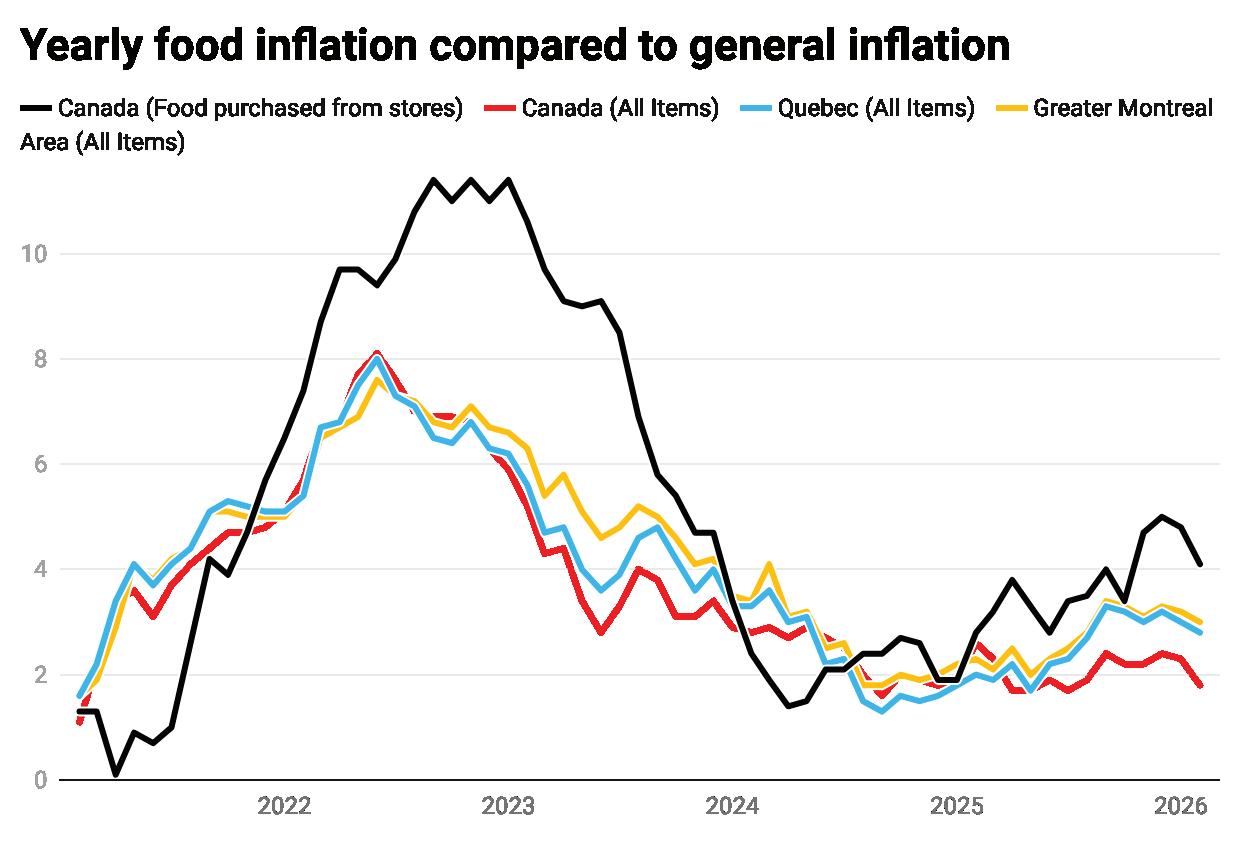
Between August 2022 and February 2023, yearly inflation for food purchased from stores soared above 10 per cent, according to the CPI. The Bank of Canada aims to keep total CPI inflation between 1 and 3 per cent, ideally in the middle, at 2 per cent.
Although total CPI inflation was at 1.8 per cent in February, it was higher, at 4.1 per cent, for food purchased from stores. The last time that the food index fell below 2 per cent was in January 2025.
Thériault also believes that the pandemic limited the variety from certain producers.
“Plants had to reduce production rate, so we lost some diversity on the shelves, breakfast cereal makers went from 18 varieties to six,” he said.
But because of the decrease in variety, producers took the opportunity to increase their prices on their limited supply.
“It limited consumer choices on one end; on the other hand, they took the opportunity to increase the cost,” added Thériault. For now, given the combination of longterm effects of the pandemic, economic pressures and certain anomalies, Canadians should expect their grocery bills to remain high.
Is Quebec’s 50-cent minimum wage increase enough?
Minimum wage will increase by 3.11 per cent in May, to reach $16.60 per hour.
By Samantha Woo Staff Writer
@samantha_woo25
Quebec Minister of Labour Jean Boulet announced a 50-cent minimum-wage increase last month, which will come into effect on May 1, 2026. However, some Quebec workers question whether or not this increase will be enough.
The general hourly minimum wage will increase to $16.60 per hour for untipped work. The increase is expected to affect 258,900 workers across the province. “In the current economic climate, it is important that the minimum wage evolves in a balanced
way,” wrote Boulet in a press release.
For tipped workers, the hourly wage will increase to $13.30, a $0.40 increase.
William Yeates, a 20-year-old part-time busser and university student, said he is happy about the minimum wage increase, saying that “a little bit goes a long way.”
Minimum-wage workers can expect their disposable income to increase by up to $687 per year, according to a statement from the Ministry of Labour, based on full-time work at the minimum wage.
But Yeates does not think the minimum wage increase will be enough. “I think we need to increase the minimum wage a lot more,” he said.
“It needs to be even higher to match the cost of living today.”
Yearly inflation, measured by the Consumer Price Index (CPI), is the change in price of goods and services for consumers. According to the Institut de la statistique du Québec, as of February 2026, the CPI in the province was at 2.8 per cent, compared to 1.8 per cent for Canada as a whole.
The main reason for the increase in minimum wage is inflation, said Dawson College economics teacher Lisa Di Marzo. In an interview, she explained that the minimum wage increase is not enough for the economy.
“This increase is not really covering the costs of food and housing that have been driving the inflation,” Di Marzo said.
The CSU’s resources for student in financial precarity
For many minimum wage workers, especially students, the upcoming increase may not be enough. For Concordia students, CSU’s Housing and Job Resource Centre (HOJO) has the resources and services to make that easier.
Concordia students can register with HOJO’s classified account website, where they can have access to “a comprehensive list of resources both on campus and off campus,” for those looking for housing and employment, said Ates Balsoy, a HOJO assistant and urban planning Concordia student.
They can also get guidance on legal
matters, including issues with their landlord or their rent. HOJO will explain the legal processes necessary to resolve any legal issues that Concordia students may encounter.
With the minimum wage increase only a couple of months away, Concordia students affected by it can use the resources and services provided on campus if they have financial or employment challenges.
A small increase to protect businesses?
“This increase protects the purchasing power of workers, while allowing our businesses to remain competitive,” wrote Minister of Labour, Jean Boulet, in a press release announcing the minimum wage increase. But Di Marzo challenged this statement.
“The idea that we need to protect business profits in order to allow for businesses to continue to operate, that argument is the argument against allowing people to live.”
She said that businesses “should be able to afford a 50-cent increase, specifically for minimum wage earners.”
Graphic by Tolganay Medet // Contributor // @chair_chsir
Chart by Félix-Antoine Beauchemin // City News Editor // @fa.beauchemin.journalisme
CSU general election results
Only 3,954 (12.6%) of 31,385 students voted in the 2026 general election.
By Jia Marguerite Schofer and Megan Mills Devoe Assistant Campus News Editor and Campus News Editor
For as long as The Concordian has existed, we have reported on apathy in student elections. This year is no different.
The Concordia Student Union (CSU) general election concluded on Friday night at 10 p.m. with just 12.6 per cent of eligible students casting a vote. This follows a long-standing trend of low participation from Concordia students.
Out of the whole student body, 87.4 per cent of Concordia undergraduate students did not click the link sent to their email and read about the initiatives their fellow students want to implement in the CSU.
Fifty-four students took time out of their busy midterm season to run a campaign, gather votes, and have their names inscribed on the ballot, which only 3,954 students opened out of 31,385.
The blame isn’t entirely on students: midterm season is draining; tax season is, well, taxing; it’s the first week of spring, and there is still snow on the ground, and this election season was not the most dynamic.
Election
season recap
The CSU general election period kicked off on Feb. 9 with the start of the nomination period.
The first CSU debate, held on March 10, featured 11 candidates and received moderate interest from students, with only 10 in attendance. On March 16, the CSU held a second debate for the CSU election in the Loyola campus CJ building atrium. These debates were not streamed online.
Advertisement for the debate was extremely limited and not publicized until shortly before the event. Only four candidates were able to participate in the debate, with no attendance. Communication about times, dates, and locations of the debates was inconsistent, which may have impacted attendance and participation.
The disorganization surrounding the debates was, in part, structural, according to Chief Electoral Officer Callum Mennis.
“I think more generally […] it would be interesting if there was an elections
officer who just handled things like the debate,” Mennis said. “My priority is more internal, verifying candidates, resolving disputes. Organizing external things like debates and communications becomes secondary.”
The results of the election established a clear mandate for the Step Up slate, with seven of the eight candidates being elected. Candidates expressed both frustration with the election process and enthusiasm about their next steps.
“I’m really, really excited. I’m very motivated,” Isabelle Ranger said, newly elected academic and advocacy coordinator. “I think we make a really good team, and we really see eye-to-eye on how we can be productive in the upcoming year.”
Trends in student participation
This lack of involvement in student politics is nothing new.
Concordia’s first comprehensive undergraduate student union, the Concordia Undergraduate Student Association (CUSA), was formed in March 1979 following a referendum to merge the Loyola Students’ Association, Day Students’ Association, Part-Time Students’ Office, and the Concordia University Part-Time Students’ Association. Later that same year, the CUSA published an editorial with the following quote:
“Student government at Concordia is intended to be democratic. Students are meant to play an active role in the activities of the school. Until now, the student body has had a reputation only for being apathetic. This year, all that will change.” Nearly 50 years later, Concordia students remain largely unconvinced.
Over the last five years, the CSU general elections have received an average of 12.3 per cent participation, including a low of 9.1 per cent in 2023. The CSU by-elections typically receive a similar turnout. An average of 12.6 per cent of students participated in the by-elections over the last five years, with a low of 5.7 per cent in 2022. This past November, 11.2 per cent of eligible students voted.
This turnout is relatively low compared to McGill’s student union, which saw a 25.1 per cent participation rate during its most recent executive election.
Arts and Science Federation of Associations (ASFA) general elections over the last five years had an average of 10.56 per cent participation, not accounting for 2025. That year, initial participation reached 15.1 per cent, then dropped to 6.8 per cent when the elections had to be run a second time.
“I think truth be told, it’s always going to be a bit hard to break that 12 per cent
for a few reasons,” said Mennis. “The whole CSU turns over pretty fast, you know, and it’s always a new group of people learning stuff for the first time. It’s hard to create kind of a continuity between previous employees and future employees, previous counsel, previous executives. It always feels like there’s a few things that people are doing for the first time every year.”
In our most recent issue, current Sustainability Coordinator Mia Kennedy wrote an editorial about the importance of participating in student elections.
“Elected councillors directly influence the fabric of the Student Union by making and changing its policies, the guiding directions for the administration, approving its budgets and ensuring decisions made by students in a referendum or special general meeting are respected,” wrote Kennedy.
Following the election results, Kennedy remarked that the participation was “not hugely surprising. This tends to be the trend that we see.”
Aviel BenYehuda, a third-year history major, said he was largely unaware of the election process.
“I didn’t even know there were debates going on, or the elections, until I was getting spammed in my email, you know?” he said. “Making it more known, and maybe like, spreading information in person and hanging out flyers and stuff.”
Issues of representation and organizing power
With such a small portion of the student body participating in these elections, it is difficult for elected students to accurately represent the interests of undergraduate students to the administration.
A significant role of the CSU is appointing 12 undergraduate students to serve on Concordia’s Senate, the highest academic authority at the university. These students have the opportunity to vote on issues facing all undergraduate students, but are appointed by a fraction of the undergraduate population.
“It’s always challenging to represent student interests when there’s so few people representing a 35,000 student undergraduate body,” said Kennedy. “There are not enough seats for students to represent such an enormous undergraduate body. I would really love to see more student representation in these administrative spaces. That being said, I do think the students who are in these positions do their best and it’s part of the job to know what students care about.”
More broadly, low participation from students had necessitated the student unions to adopt exceedingly low quorum requirements.
“Quorum needs to be low because if it was higher, we wouldn’t be able to pass anything because people just wouldn’t show up,” said Kennedy.
In the case of the CSU, around 1 per cent of undergraduate students are required to participate in important decisions in order for them to be adopted.
This comes from CSU bylaw 9.4., which states that annual general elections, byelections, referenda and special elections only require 450 members in order to meet quorum.
In the eyes of the administration this represents a negligible number of students. Low quorum requirements have also brought into question whether or not policies and motions adopted by the union are representative of the undergraduate student body.
This issue was raised in January 2025 when the CSU held a special general meeting (SGM) and voted to adopt a historic BDS mandate. The vote received an impressive turnout, which vastly exceeded the required quorum, and the motion passed with an overwhelming majority of 885 in favour to 58 against.
However, some critics pointed out that 885 students represent less than 3 per cent of Concordia’s undergraduate population and questioned why so few students should be able to adopt this stance on behalf of the student body.
While acknowledging the issues inherent to low quorum requirements, Kennedy affirmed the importance of the student union democratically adopting official stances.
“These processes are still so important because they are how we communicate as much of a united front as we can as a student body to the administration,” said Kennedy.
For its part, the administration has installed numerous roadblocks that have impaired student unions from operating as intended. This includes banning a CSU staff member from campus and barring the CSU from booking space on campus.
“I think there is a certain subset of the student body that is engaged with the student democracy and will kind of always be engaged more or less,” said Mennis. “I think the other thing is just making sure that the people who are wanting to access student politics are able to do that.”
Despite low engagement in the election, outreach and visibility goals for the newly elected team.
“I think there’s power in numbers,” Ranger said. “I think it would be really cool to have a student body that’s engaged […] that’s kind of the dream.”





Queer Concordia receives fee levy increase
Twenty-seven-centper-credit increase to help support queer students receive healthcare.
By Megan Mills Devoe
Attribution: Campus News Editor
Instagram: meganmillsdevoe
Queer Concordia received a fee levy increase for the first time in 15 years. Previously, the group received 2-cents per credit; now it will get 29 cents, allowing the group to expand its services.
Among other things, this fee-levy increase will help to support Queer Concordia’s Gender Affirming Insurance Community Fund, which provides loans to students seeking gender affirming care
(GAC). “Obviously, I think it’s great,” said Jessica Winton, President of Queer Concordia. “I’ve been trying to get this done for the past two years.”
Previously, Queer Concordia had the lowest fee levy of any Concordia Student Union (CSU) group. This significantly limited the group’s capacity to provide services to students.
“[The increase] will really open more doors for Queer Concordia to do more in the future,” said Winton.
Accounting for the increase, the organization’s proposed budget includes a one-time $30,000 addition to the loan program, which will continuously be recirculated into the organization as loans are paid back.
Concordia’s insurance provider will cover up to $5,000 per eligible GAC procedure with a $50,000 lifetime maximum, up from $10,000 last year. However, patients are typically required to pay thousands of dollars upfront, an unrealistic cost for many students. The
loan program would enable eligible students to pay their upfront costs with the agreement that they would then repay Queer Concordia once receiving their insurance refund.
The fee-levy increase was approved by the student body in the recent CSU election, with 52.7 per cent of students who participated voting in favour o f the increase.
CURE Concordia and Concordia Recreation and Athletics also received feelevy increases.
Previously, CURE Concordia received 8 cents per credit; following the referendum vote, the organization will receive 32-cents per credit, indexed annually to inflation with the Consumer Price Index, effective Fall 2026.
Previously, Concordia Recreation and Athletics received $2.92 per credit, following the referendum vote, the organization will receive $4.19 per credit annually, adjusted to the
Consumer Price Index of Canada, and to be implemented with registration for the Fall 2026 term in accordance with the university’s tuition refund and withdrawal policy.

Stingers earn silver at nationals
Concordia defeats Manitoba and Guelph, before falling to Montreal rivals at nationals in championship thriller.
Anthony Maruca Sports Editor @_maruca27
The Concordia Stingers women’s hockey team came within one win of a national title this weekend at the U Sports Women’s Hockey Championship, putting together an impressive run in Waterloo before falling 5–2 to the Montréal Carabins women’s hockey team in Sunday’s gold medal game.
Hosted at the Woolwich Memorial Centre in Elmira, the tournament saw Concordia defeat both the University of Manitoba Bisons and University of Guelph Gryphons programs to reach the national championship game on March 22.
While the final result ended in heartbreak, the Stingers delivered a determined threegame performance that showcased the depth and resilience that carried them throughout the season.
Concordia opened the tournament on March 19, with a 3–1 victory over Manitoba in the quarterfinal round.
Forward Jessymaude Drapeau provided the offensive spark for the Stingers, scoring twice to help Concordia take control of the game.
Drapeau’s finishing ability, which won her U Sports’ player of the year and firstteam all-canadian honours, proved crucial for the Stingers throughout the entirety of nationals.
Meanwhile, forward Juliette Leroux delivered a standout performance and was named player of the game after recording a goal and an assist. Leroux’s two-point night helped Concordia create separation while also contributing defensively as the Stingers limited Manitoba’s scoring opportunities.
The victory secured Concordia a place in the semifinal round against Guelph, who advanced from the second quarterfinal matchup.
Saturday’s semifinal clash between Concordia and Guelph proved to be one of the most tightly contested games of the tournament.
Both teams displayed strong defensive structure and disciplined play, creating a tense, low-scoring battle with a berth in the national championship on the line.
Concordia struck first thanks to forward Courtney Rice, who opened the scoring to give the Stingers an early advantage. Guelph, however, refused to back down and eventually found the equalizer, forcing the game into overtime and setting the stage for a dramatic finish.
In the extra frame, it was Émilie Lussier who delivered the decisive moment.
Lussier scored the overtime winner to give Concordia a 2–1 victory and send the Stingers to the national championship game, capping off a thrilling contest against a persistent Gryphons squad that challenged them until the very end.

The dramatic win reflected a mindset that Chu has emphasized since taking over the program in 2016.
“I think for us, it got back to getting to a culture that we can be proud of every day,” Chu said in an interview with The Concordian prior to the start of this season.
According to Chu, that culture is built on three key principles: full effort, a positive attitude, and accepting individual roles within the team.
“Everything is earned,” she said. “Can we give a full effort every day? Can we have a positive attitude and see challenges in a positive way? And can everyone accept and own their roles? If we do that, everyone becomes a valuable part of the team.”
The win set up an all-Montreal national final between the Stingers and the Carabins, two familiar rivals who had already battled multiple times throughout the season. Concordia had won their previous matchup against UdeM for the RSEQ provincial title just two weeks prior.
Sunday’s championship game lived up to expectations, as both teams exchanged goals in a physical and evenly matched contest. Neither side was able to establish lasting momentum, and the game remained tight deep into the third period.
With the score tied 2–2 and time winding down, the Carabins managed to break the deadlock with a goal in the final five minutes

of regulation. Montreal later added two empty-net markers to seal the 5–2 victory, and secure the national title.
For the Stingers, the final minutes were a heartbreaking end to what had been an impressive playoff run. Despite the final scoreline, the game remained competitive throughout, with Concordia staying within reach until late in the third period.
The championship game also marked the final appearance in a Concordia uniform for several key players.
Seniors Jordyn Verbeek, Ekaterina Pelowich, Jessymaude Drapeau, Émilie Lavoie, Alexis Bedier and Zoe Thibault all closed out their Concordia careers in the championship matchup.
While the ending was not the one the team hoped for, the group leaves behind a strong legacy within the program. Their leadership helped guide the Stingers to one of the most successful seasons in recent memory and to the brink of a national championship.
While the loss stung, Chu has often emphasized that success within the program goes beyond the final result.
“Winning a championship is success,” Chu said. “But it’s also about getting to the end of the season knowing that we did everything possible to be at our best. If we reach our full potential and play our best hockey at the end of the year, that’s success too.”
Concordia’s success this season further established the continued standard of excellence the program has set for itself in the landscape of women’s hockey at the university level.
Although the national title ultimately went to Montreal, Concordia’s run to the final served as a testament to the team’s determination and competitiveness, and ensured that the graduating seniors leave the program with their heads held high.
Jessymaude Drapeau (#15) celebrates with teammates following tournament win // Photo by: Liam Mahoney // Concordia Athletics
Photo courtesy of Waterloo Warriors Athletics
How Stingers’ football uses film study data & technology
A deeper dive into how Concordia football uses film and analytics to study opponents and shape its weekly game plan.
Anthony Maruca Sports Editor @_maruca27
From breaking down opponent tendencies to reviewing their own performances, the Concordia Stingers football team relies heavily on a digital film system to organize and analyze thousands of plays over the course of a season.
Head coach Brad Collinson said the system, developed by Catapult, functions as a central hub for everything the team records, from games to practices and position-specific teaching sessions.
Once the footage is uploaded, coaches tag every play with relevant information; such as formation, down and distance, and the type of play that was run.
“We film every practice, we film every game,” Collinson said in an interview with The Concordian
“We even film individual teaching sessions depending on the position. From there we can break everything down by formation, down and distance, run or pass. It lets us see the tendencies of what teams do.”
That tagging process allows coaches to filter through massive amounts of footage quickly to identify patterns in how opponents operate.
Stingers’ offensive coordinator Justin Chapdelaine explained that the platform essentially works like a video library linked to a spreadsheet, where each play is associated with a set of data points.
“Every play has its own clip and then you attach information to it. Once the data is there, you can filter it to see tendencies and patterns,” Chapdelaine said.
Those opponent tendencies are a key part of weekly preparation. Coaches review how often opponents run certain plays in specific situations and then build practice plans around the most likely scenarios.
Rather than asking players to watch entire games, the staff creates shorter collections of clips that highlight specific formations or situations.
“We don’t just send them the full game,” Collinson said. “We break it down so they’re watching the smaller clips that actually relate to what we’re working on that day.”
For quarterback Antoine Ouimet, film study is not just helpful — it is essential. He said the preparation process during the week revolves around analyzing both the numbers and the visuals of how opposing defences operate.
“As a football player, film and data are basically non-negotiables,” Ouimet said. “During the week we spend plenty of time breaking down opponent tendencies like formations, down and distance, personnel groupings and individual player keys. The data tells us what they like to do and the film shows us how they do it.”
The process becomes especially important for quarterbacks, who must make decisions within seconds once the ball is snapped. Studying patterns ahead of time helps them anticipate what a defence might do in a given situation.
“As a QB you probably rely on film and data more than any other position because you’re responsible for making decisions every single play,” Ouimet said.
Technology has also changed how quickly players can access film. After practices or games, the footage is uploaded to the Catapult platform and organized by the coaching staff. Within a short period of time, players can log in and review clips of their own performance as well as those of upcoming opponents.
The system also allows coaches to attach detailed notes to each clip, helping guide players toward the specific details they should be focusing on. For quarterbacks, that might include identifying defensive rotations or recognizing pressure looks before the snap.
The technology extends beyond the practice field as well. During games, a staff member in the press box logs information
about every play as it happens, allowing video clips to be synced quickly to tablets on the sideline.
A team of two, Félix Bagg on the analytics side and Ryan Clarke on the film side, is responsible for gathering, cutting, and filtering footage and any relevant data for coaches to then use either on the sidelines or in meetings.
Coaches and players can then review the events of the previous series, both in data and video form, almost immediately after it ends.
“We have iPads just like you see in the NFL,” Collinson said. “Players come off the field and we can show them exactly what happened.”
For a position built around quick decision-making, that immediate feedback can be valuable. A quarterback can review the defence he just faced, identify what he missed and adjust before the next drive.
Even with the increasing role of technology and analytics in football, Collinson believes the tools are meant to support coaching rather than replace it. The data helps reveal patterns, but interpreting those patterns still requires experience and judgment.
“Analytics tells you one thing,” Collinson said. “But there’s still the human side of the game.”
Collinson later emphasized the role of outside variables like weather and specific game-time situations that also dictate the way certain things are handled on the sidelines.
Simon Lavigne named U Sports’ top defenceman
The captain reflects on a standout season and the next chapter beyond hockey.
Anthony Maruca Sports Editor @_maruca27
Simon Lavigne entered the season with ambitious goals, and earning national recognition as one of the country’s best players was among them.
Mission accomplished.
The Stinger’s captain took home not only U Sports Defenceman of the year, but also first team all-canadian honours, OUA East defenceman and player of the year, as well as OUA East first team all-start honours.
Needless to say, from an individual standpoint, there weren’t many players who’ve had a year as decorated as Lavigne did this past season.
Lavigne finished the year with 23 points in 24 games, including 10 goals, all whilst being trusted to play the hardest minutes by his coaching staff.
Despite the added pressure of wearing the captain’s ‘C’, the fourth-year defenceman said he didn’t change his approach to the game.

“I didn’t really change the way I approached hockey,” he said. “For sure I had more responsibility as captain, but I was lucky enough to have teammates around helping me out.”

“I feel like the second half of the season, the winning streak we had, was the highlight of my year,” he said. “Unfortunately we couldn’t bring [that momentum] in the playoffs, but I’m really proud of that and proud of the team.”
One moment that stood out was Concordia’s rivalry matchup against McGill in the Corey Cup, where Lavigne scored the overtime winner.
“We didn’t start the way we wanted during the game, but we came back, went to overtime and finally won it,” he said. “I think it reflected the team we had this year.”

Assistant coach Eric Houde said, in an interview earlier in the season, that Lavigne had become a player opposing teams accounted for with priority.
“He’s the kind of player that other teams are looking at and saying, ‘We’re playing against this guy tonight,’” Houde said.
For Lavigne, the success came from sticking to a simple mindset and focusing on preparation.
While the award caps a memorable university career, Lavigne said the next chapter of his life will take him away from competitive hockey. The Montreal native plans to step away from pursuing professional hockey to begin a career in finance.
“It’s a huge honour for me,” Lavigne said. “It was kind of weird to be at the gala without the team, but it was nice to have a little recognition at the end of the year.”
“My approach to the game is pretty much the same way I did last year; mentally prepared for anything and just keeping it simple,” he said. “That’s what brought me the success that I had this year, and I’m proud of it.”
Looking back on the season, Lavigne pointed to the team’s second-half surge as a defining stretch.
“I don’t think I’ll be continuing with pro hockey,” he said. “I took the decision to put that aside because I have a nice job offer in finance.”
Lavigne will begin a full-time role in wealth management with Desjardins Group after previously completing an internship with Royal Bank of Canada.
“Hockey brought me a lot in the last 20 years,” Lavigne said. “Now I think it’s time to start new projects. I’m really excited for that.”
Photos by Ines Talis & Graphic by: Hannah Bell
Rencontre avec Katherine Plouffe, porte-parole du mois de la francophonie
La réalité du français dans le sport olympique et ailleurs au Canada.
Selena Ruiz
Éditrice des Pages Francos
Pour valoriser le français partout dans le pays, le Canada célèbre chaque année en mars le Mois de la francophonie dans ses nombreuses provinces et territoires. Toutefois, la réalité des francophones n’est pas partout la même. Au recensement de 2021, la population francophone au Canada représentait 22 % du pays, soit 8 066 633 personnes. Le Québec, quant à lui, représente 84 % des franco-canadiens, avec 7 074 328 locuteurs dont la première langue parlée est le français. La belle province compte aussi plus de la
moitié des Canadiens bilingues, soit près de 4 000 000 sur 6 581 680.
Mais qu’en est-il des francophones vivant hors du Québec et comment leurs communautés se pérennisent-elles, isolées dans des provinces où l'on s’exprime principalement en anglais?
Native d’Edmonton, Katherine Plouffe représente l’équipe canadienne de basketball à 3 contre 3, notamment aux côtés de sa sœur jumelle, Michelle. Aujourd’hui, elle est notamment l’une des porte-parole des Rendez-vous de la Francophonie, qui organisent des rencontres et des événements culturels partout au Canada pour célébrer la langue française.
The Concordian s’est entretenue avec elle pour discuter de sa réalité linguistique.
Après avoir grandi en Alberta et avoir étudié en communication aux États-Unis, à l’Université Marquette, Plouffe a joué pendant sept ans dans la Ligue Féminine de Basketball (LFB) en France. Là-bas, la plupart de ses coéquipières parlaient
français, ce qui l’a encouragée à développer ses compétences en français, particulièrement en matière d’expressions locales. « Quand j’apprenais le français et quand j’entendais le français, je me disais : mais qu’est-ce qui se passe? Finalement, c’était juste du slang », a-t-elle expliqué.
De retour au Canada, Plouffe a continué à apprendre le français à travers plusieurs séries télévisées, la musique et son beau-frère congolais.
« Je ne peux pas beaucoup me pratiquer avec les gens autour de moi à Edmonton, mais mon beau-frère parle français et a grandi à Montréal, donc je peux discuter avec lui », a-t-elle dit, lors d’une entrevue avec
The Concordian Plouffe explique aussi que les possibilités de développer son français avec l’équipe canadienne féminine de basketball à 3 contre 3, formée notamment de Paige Crozon, Saicha Grant-Allen, Kacie Bosch, ainsi que d’elle-même et de sa sœur jumelle, Michelle, sont limitées.
Elle note par contre avoir joué avec plusieurs coéquipières bilingues durant sa carrière, notamment avec l’équipe de basketball à 5 contre 5 aux Jeux olympiques de Rio en 2016.
« C’est quand même spécial que plusieurs d’entre nous aient des noms de famille francophones, même si nous ne parlons pas français forcément à la maison », a-t-elle souligné.
Pour Plouffe, être porte-parole de la 28e édition des Rendez-vous de la Francophonie, organisés sous le thème « Active ta francophonie », est extrêmement valorisant, elle qui a appris le français dans sa vingtaine grâce à sa carrière d'athlète, qui l’a beaucoup fait voyager.
« Ce que j’ai appris avec le français, c’est que c’est possible de l’apprendre à l’âge adulte. Ce qui aide le plus, c’est l’immersion totale de la langue. On ne peut pas l’apprendre si on ne l’entend pas autour de nous! », a-t-elle conclu.
QS charge la CAQ pour le piteux état de nombreux hôpitaux de la province
Radio-Canada avait révélé le mois dernier que 38 % des hôpitaux du Québec étaient en mauvais ou très mauvais état.
Par Ariane Copeland Collaboratrice
Québec Solidaire accuse la CAQ d’avoir négligé l’entretien des bâtiments hospitaliers. Selon les solidaires, la CAQ aurait privilégié les services de santé privés, laissant les patients et les employés de 227 hôpitaux vivre dans des conditions insalubres.
« Après huit ans au pouvoir, la CAQ nous laisse un réseau qui coule littéralement de partout. Contrairement à ce que veut nous faire croire François Legault, cela n’est pas une fatalité : c’est le résultat de choix politiques », a affirmé Guillaume Cliche-Rivard, responsable solidaire en santé, dans un communiqué de presse diffusé le 17 février.
« Plutôt que d’investir dans l’entretien de nos infrastructures, ce gouvernement a choisi de faciliter l’implantation du privé en santé, d’augmenter le nombre et le salaire des cadres avec Santé Québec, et surtout de créer un psychodrame dans le réseau cet automne avec un mauvais projet de loi passé sous bâillon », ajoute M. Cliche-Rivard.
25 milliards d'investissments prévus sur 10 ans
En 2025, le nombre d’hôpitaux sous le seuil de vétusté du gouvernement, soit en mauvais ou en très mauvais état, s’élevait à 102. En 2026, il a grimpé à 227, selon des données de Santé Québec obtenues et révélées par Radio-Canada.
Cette année, le déficit de maintien des actifs (DMA) des bâtiments hospitaliers dépasse 2 milliards de dollars, soit une différence de 1,1 milliard de dollars par rapport à 2025.
Selon le Plan québécois des infrastructures (PQI) 2026-2036 déposé avec son budget le 18 mars dernier, le gouvernement a chiffré le DMA à plus de 4 milliards de dollars pour les 10 prochaines années. Selon le même PQI, le gouvernement a prévu des investissements de plus de 24,7 milliards de dollars d’ici 2036 pour les infrastructures du réseau de santé.
« Les murs se fissurent et les plafonds s’effondrent, et ce sont les patients et le personnel qui paient le prix », a dit M. Cliche-Rivard.
L’Hôpital général de Montréal, le « pire » au Québec
L’Hôpital général de Montréal figure au sommet de la liste des hôpitaux avec le DMA le plus élevé de la province. Cinq de ses pavillons sont en mauvais état et son déficit d’entretien s’élève à plus de 249 millions de dollars. Depuis décembre 2024, l’Hôpital général de Montréal aurait enregistré au moins 265 fuites d’eau, selon Radio-Canada.
L’Hôpital Charles-Le Moyne, situé à Longueuil, est sixième sur la liste des 10 exemples d’hôpitaux vétustes de Radio-Canada. Son déficit d’entretien s’élève à plus de 59 millions de dollars. Les blocs A, B, C, D et E sont les plus touchés. Anabelle Pinel, une habituée de l’Hôpital Charles-Le Moyne, partage son expérience au sein du système de santé.
« Je vais souvent à Charles-Le Moyne autant pour moi que pour ma belle-mère, […] je trouve ça un peu aberrant que, pour un endroit où ça doit être clairement propre, il y ait des endroits où il manque des lattes de plafond, qu’il y ait beaucoup de murs fissurés, des fuites d’eau et des toilettes pas propres. On trouve vraiment plein de choses qui sont désagréables », a-t-elle dit.
« Notre gouvernement devrait vraiment faire plus d’efforts et mettre plus d’attention sur nos services de santé publics », a-t-elle ajouté.
Québec solidaire urge le gouvernement québécois à élaborer un plan d’urgence national afin de remettre les hôpitaux en bon état.
Selon le parti d’opposition, il faudrait d’importants investissements dans le Plan québécois des infrastructures dès ce printemps.
« Sans quoi, ce sont les générations futures qui paieront le prix de l’inaction du gouvernement. Ce n’est plus le temps de tergiverser ; les projets doivent aller de l’avant dès maintenant », a affirmé Québec solidaire.
L’entrée des urgences de l’Hôpital CharlesLe Moyne. Photo par Ariane Copeland // Collaboratrice

En partenariat avec et financé par L’Organe
Rù de Kim Thúy
Une
appréciation critique d’un chef-d’œuvre littéraire… et cinématographique!
Par Alexandra Montenegro Nodarse Rédactrice attitrée
Rù, c’est l’histoire d’une jeune fille, An Tinh Nguyen, qui immigre avec sa famille du Vietnam au Québec dans les années 1970, peu après la Guerre du Vietnam. Entre-temps, elle et sa famille avaient fui la dictature communiste dans un camp de réfugiés en Malaisie.
À travers un récit largement autobiographique, l'autrice raconte son histoire, son évolution, les difficultés financières, culturelles et institutionnelles qu’elle rencontre, comme des obstacles à l’affirmation de son identité duelle, immigrante et québécoise.
Tinh va aussi se lier d’amitié, grandir, tomber en amour et devenir la femme accomplie qu’elle est maintenant. Elle va surtout raconter comment elle est tombée en amour avec le Québec, faisant de cette maison la sienne. Rù, c’est son histoire, son ouverture vers le monde.
Cette histoire s’inspire fortement du vécu de l’auteure, bien qu’elle ne soit pas considérée explicitement comme une forme d’autofiction à proprement parler.
Rù est le premier livre que j’ai lu (et relu) de Kim Thúy.
La première fois que je l’ai lu, j’étais une étudiante en troisième secondaire. J’ai tout de suite admiré la structure poétique et accessible du livre. Malheureusement, le confinement avait complètement changé le programme et le déroulement des cours. La lecture et le projet sur Rù ont été annulés. Je n’ai pas pu terminer ma lecture.
J’ai recommencé à lire ce roman très récemment. Je n’ai pas regretté de lui avoir donné une deuxième chance.
La simplicité et la beauté du style, l’honnête candeur de la prose, qui choque sans choquer, qui émerveille, tous ces aspects du roman captivent le lecteur dès les toutes premières lignes. Ce que j’aime le plus, et ceci s’applique à tous les romans de Kim Thúy, c’est que chaque chapitre, aussi court soit-il, est une histoire en soi, à proprement parler. Qui plus est, ces anecdotes, en apparence désordonnées, intemporelles, finissent par se retrouver et se lier comme des fils connecteurs, comme les parties d’un tout.

Dans Rù, chacune de ces ficelles forme une toile. Ce principe de récurrence refait surface dans l’œuvre de Kim Thúy toute entière.
Les thèmes sont tout aussi intimes que révélateurs. Ils se suivent: un sujet se rattache à un autre en apparence disparate, mais avec une telle facilité linguistique, intellectuelle et sémantique qu’il devient impossible de résister au flux des mots, comme si l’on naviguait dans les pensées de l’écrivaine en se laissant porter par sa prose. Ces thèmes sont porteurs d’un contexte sociologique et universel, plus grand que nature, que l’expérience de l’auteure elle-même.
Ceci devient encore plus révélateur quand on décèle le sens du titre: Rù veut dire petit ruisseau en français et berceuse en vietnamien, comme si l’on était lentement bercée par les mots de ce récit fluide, qui coule lentement comme un ruisseau malgré l’aridité des terres, un peu comme le vécu de la narratrice.
Rù est la berceuse de Kim Thúy.
Pour Thúy, tout est interrelié.
Elle réussit à parler de son expérience individuelle, de sa relation avec le Québec, pour parler de thèmes plus vastes sur l’immigration tout entière. Même si mon expérience, mon milieu d’origine et ma culture sont radicalement différents, je m’y suis reconnue.
Dans Rù, l’univers de Kim Thúy explore son vécu à travers un personnage fictif pour montrer sa réalité et la transformer en universalité.
Son travail d’auto-représentativité nous permet de mieux la connaître à travers l’expérience de la jeune fille. Cette dernière apprend, s’adapte et effectue une transition entre son statut de réfugiée et son accueil au Québec. Elle se lie d’amitié avec ses camarades, évolue et grandit, pour devenir la femme accomplie qu’elle est maintenant. Elle ajoute du sens à l’identité et aux histoires racontées au Québec, laissant sa trace qui enrichit la littérature et la culture québécoises. Elle mélange aussi les mots en vietnamien à ceux du français. Elle traduit une culture en une autre en transposant deux contextes, deux langues, deux manières de penser et en les assemblant pour donner un tout hybride, pour communiquer sa réalité au Québec.
Étant une grande fan de l’auteure et ayant lu presque tous ses livres, il m’est impossible de parler de Rù sans parler de Ví, Mân, Èm et Âm . Je suis persuadée que les histoires racontées dans ces romans se suivent, même si ce n’était pas nécessairement l’intention de l’auteure.
Ví parle d’une adolescente réfugiée, au début petite, invisible, minuscule, mais qui grandit au-delà de frontières bien définies. Elle devient traductrice, puis avocate, pour voyager et rencontrer l’amour et retourner au Vietnam. Son épopée est marquée par l’absence de son père, auquel le destin tente de la relier.
Mân est l’histoire d’une femme vietnamienne venue au Canada pour se marier, mais qui fait la rencontre de Julie, puis d’une communauté au Québec. Elle finit par tenir un restaurant et avoir beaucoup de succès, écrire des livres de recettes et rencontrer l’amour, quand elle s’y attendait le moins.
Èm s’agit peut-être même du meilleur roman de Thúy, selon les critiques littéraires. Ce roman est le fil connecteur entre la Guerre du Vietnam (de 1955 à 1975), ses enjeux ethniques, culturels, socio-économiques, politiques et idéologiques, et le destin improbable de trois orphelins, dont les vécus s’entrelacent, malgré les tours et détours de la vie. Ce livre montre plus explicitement le principe des parties distinctes qui forment un tout complet.

Âm, une pièce de théâtre présentée au Théâtre du Nouveau Monde (TNM), permet de mettre en relief toutes les œuvres et de réfléchir à la colonisation et la discrimination, à la suite de la montée du conservatisme au Québec. Elle permet à Thúy de faire une synthèse de ses anciens livres, de ses expériences de vie, et d’exprimer sa peine d’amour avec le Québec en abordant la relation, et les tensions qui en découlent, entre un homme blanc et une femme vietnamienne.
Ces œuvres ont en commun le même style pur et fragmenté, dont la poésie relie les fragments, ces ficelles qui se rattachent à la toute fin pour produire le destin le plus vraisemblable, mais le plus surprenant, saisissant, attendrissant, émouvant qui soit.
Elles constituent une sorte de ligne du temps, retraçant le vécu, la pensée, la maturité d’écrivaine de Thúy.
Face aux expériences issues du monde qui l’entoure, la mentalité de l'auteure est en constante évolution.
Il y a tout de même des thèmes récurrents dans ses œuvres, notamment l’exil, la résilience, la culture, les relations nord-sud, l’identité, la différence, le déracinement, la renaissance, la mémoire, mais aussi l’amour, l’amitié, la communauté, la famille, le tout avec une touche d'auto représentativité infusée à travers une prose lyrique, dont les nombreuses métaphores suscitent le choc, l’émoi, la rébellion, l’espoir…
Sous la plume habile de Kim Thúy, des personnages prennent vie. Ils sont profondément humains, imparfaits, aimants, réalistes au point de pouvoir apparaître en chair et en os devant nous.
Dans leurs traits transparaissent les tourments, pensées et émotions d’une écrivaine focalisée sur l’Humain, une auteure qui se révèle morceau par morceau grâce au pouvoir de l’introspection.
Sa narration touche le lecteur. Elle lui permet de démêler les fils, d’assembler les pièces d’un casse-tête, de retracer une carte de voyage, de vivre ce qui est raconté.
Finalement, si l’on compare le livre et le film de Rù, on constate que le long métrage
utilise le langage visuel et les images percutantes pour décrire de manière linéaire et concrète les événements du parcours de la jeune alter ego de Thúy. Cette narration visuelle suit la famille vietnamienne de près, en commençant par tracer le flux du voyage en bateau, jusqu’à l’arrivée au Québec, puis l’accueil et l’intégration. Le film se concentre surtout sur la trame narrative du livre, qu’il tente d’illustrer pour véhiculer les thèmes évocateurs qu’elle laisse transparaître. Ce média est donc axé sur la mise en images et la chronologie en contexte du fond de l’œuvre, de son contenu. Il est impossible de traduire, de transposer médiatiquement l’entièreté de Rù sans en représenter la forme. Le style, la manière dont cette épopée est racontée, en a tout autant à offrir. Le livre repose surtout sur ces procédés que sont les métaphores, le lyrisme, la narration fragmentée et fragmentaire, la poésie, l’enchaînement d’idées qui exposent la manière de l’esprit de bondir d’un point à l’autre. La forme du roman est donc axée sur une profonde introspection de l’auteure, sur les sentiments et les pensées intérieures les plus intimes de la narratrice. C’est l’humain qui prime. On a donc une vision très pointue et claire des événements à travers la perspective unique du personnage, alors que le film adopte un mode de narration omnisciente pour relater la chronologie des événements plutôt que la manière dont ils sont vécus dans la peau de la protagoniste. Le film met l’accent sur l’extérieur, le monde des sens, alors que le livre offre aussi un coup d’œil sur l’univers intérieur et le portrait psychologique de la narratrice. Bref, je vous conseille de lire les livres d’abord et de regarder le film (ou la pièce) après. Les romans de Thúy sont agréables à lire et accessibles. Leur simplicité des vocables n’en fait pas pour autant des œuvres banales, mais bien des classiques, clairs, universels et uniques en leur genre. Cela étant dit, la force des éléments mis en valeur dans les représentations visuelles peut vous percuter tout autant que la douceur des mots vous transportant lorsque vous tournez les pages.
Affiche de film du film Ru (Charles-Olivier Michaud, 2023), Amalga Créations Médias
The man and myth behind Montreal’s most celebrated murals
In “The Anatomy of a Tribute,” Gene Pendon paints his methodology and mythology in cocreating Montreal’s landmark Leonard Cohen mural.
By Julia Imee Silva Arts & Culture Editor @liaa.imee
Once seen as illicit and atypical, street art is now a cultural staple of Montreal and one of its biggests overlooks Concordia’s downtown campus.
On March 19, Filipino-Montrealer artist and mural co-creator Gene Pendon presented “The Anatomy of a Tribute” to the Concordia community for the first time. It discusses Pendon’s research about the methodology, mythology and meta-muralist discourse of painting the iconic mural.
“I adopted this certain idea of mythology because I couldn't just be a Filipino artist [in Montreal’s formal art world],” he said. “I had to be working undercover as a myth — that's saying, because the streets are forgiving in that way because you could generate as much work as you need to on the streets.”
The “May an Old Song Open a New World” mural at the Montreal Chinatown archway is one of Pendon’s other notable works.
In “The Anatomy of a Tribute,” Pendon explores the roots of his philosophy as a street artist. Some of his influences are his mentors as a student in Concordia’s painting and drawing program before graduating in 1994, as well as from other vanguard artists whom he met in his career.
Inaugurated in 2017 after his passing, the 20-story mural on Crescent Street in downtown Montreal is a tribute to Canadian musician, poet and novelist Leonard Cohen. Pendon was commissioned to paint the mural in a partnership between the City of Montreal, the Montreal Museum of Fine Arts and the Leonard Cohen Estate. At the time, Pendon was one of the few artists who had an established image in the world of street art.
“I was coming from more of a vanguard place where nothing was really articulated or defined,” Pendon said. “But people knew about, not just my track record but my mythology that I've been painting unconsciously all over the place in this certain way and that I could be approached for something that was just outside of anyone's scope.”
Pendon collaborated with El Mac, a Los Angeles-based artist and muralist, to create the mural, reflecting how Cohen called both Montreal and Los Angeles his home.
Towering over the Sir George Williams campus skyline, the mural is hard to ignore for first-year art education master’s student

Victoria Mars. It never fails to impress her.
“I thought, for sure, I have to go and meet whoever was involved in such an amazing mural and an amazing project, to know how it happened and in a way to applaud and to honour the effort,” Mars said.
The presentation was organized by Concordia’s Career and Planning Services (CAPS), in partnership with the Filipino Organization of Concordia University Students (FOCUS).
According to Kristel Kabigting, a CAPS career advisor and the lead organizer of the presentation, Pendon’s “The Anatomy of a Tribute” gives representation not only to the achievements of Concordia graduates but also to the Filipino-Montrealer community.
“[The objective] is gaining insight and gaining inspiration outside of someone's career trajectory, and you also have a more profound appreciation of this iconic mural in the city as well,” Kabigting said.
Julia Imee Silva is the vice president of FOCUS and did not take part in organizing this event.
…and the Cosmos returns to claim its place plants its roots at the FOFA Gallery
Tina Lam immerses in her fear of nature, turning it into land-art interventions that transform obscurity into serenity.
By Julia Imee Silva Arts & Culture Editor @liaa.imee
Tina Lam’s …and the Cosmos returns to claim its place merges the scientific and the spiritual to recontextualize a fear of nature into something more sublime and serene.
The sprawling root-like sculptural installation hangs from the ceiling of the
FOFA Gallery’s main space. Concordia studio arts alumna Tina Lam created the sculptural pieces with cinefoil, a black aluminum material used in film to block or direct light, moulded into the natural texture of trees and rocks. It is built from multiple pieces that Lam had collected and exhibited in various places in the past couple of years.
Light fixtures surrounding the installation produce highlights and shadows throughout the piece, putting lightness and darkness into play. When visiting the exhibition, Lam encourages viewers to walk underneath the installation and look up to see light puncturing through its many tiny apertures.
According to Lam, the roots are always oriented towards windows, inviting viewers to read the artwork from a source of light that brings an ethereal quality into the room.
“There are properties of organic life or biological matter that are stimulated by natural phenomena,” Lam said. “I think a lot about roots and how a multitude of
small atoms have a certain way of orienting in space, but somehow, the presence of light stimulates that body or that entity to move towards it.”
The cinefoil’s metallic core falls in dialogue with the organic material of a white abaca paper hanging on the other end of the installation, opposite the windows.
Lam’s work reflects how she re-immerses herself in the natural world by going to forests to find peace with the fear of nature that she inherited from Cambodian-Chinese refugee parents who experienced the terrors of war.
…and the Cosmos returns to claim its place invites people to sit with the unfamiliar and find peace with nature’s obscure sublimation, letting fear take over and finding a way out, returning to a comfort that was not there before.
Lam’s exhibition interacts with two other artists featured in the FOFA’s spring programming, which explores how society engages with various realms, such as the urban and digital worlds.
In the York Vitrines, the audiovisual
and text installations in Po B. K. Lomami’s Compartmental question the consequences of when compartmental infrastructures erode, bleed or collapse.
In their exhibition statement, Lomami considers that “compartmentalization is not just fragmentation, but a strategy of necessary partitioning that allows life to continue amid violence, displacement, and inherited and ongoing ruptures.”
Meanwhile, Abi Hodson’s Peep Show: Parallel loops, Porous lines is on view at the gallery’s Black Box. It shows moving images that respond to the convergence and rupture of existing systems of normativity with its uneasy kinship to the human body as a site of change.
“Peepholes and a motion responsive video reveal sites where limbs merge and layer with the materials that construct and reconstruct Montreal’s body,” Hodson writes in their exhibition statement.
The exhibitions featured in the FOFA gallery’s spring programming are on view for the public from March 9 to May 22.
Gene Pendon at Concordia University to present The Anatomy of a Tribute, the research behind the establishment of street art as an icon of urban culture.
// Photo by Julia Imee Silva // Arts & Culture Editor // @liaa.imee
Arts & Culture
Quebec turns the page back to print as book sales climb to a decade high
Quebec book sales surge as readers turn away from social media toward print.
By Esamaar Eid Contributor @esamaar.eid
A growing desire to disconnect from social media and short-form content helped drive Quebec’s new book sales to $705 million in 2024, according to new figures from the Institut de la statistique du Québec published on Feb. 25.
Sales rose 4.1 per cent from $677 million in 2023, marking a fourth consecutive year above pre-pandemic levels in current dollars and the highest total since 2010.
At the bookstore-level nationwide, the strongest results in 10 years have become apparent after two years of relative stability. Bookstore sales rose from 2.7 per cent in 2024. It reached $470 million, compared with $458 million the year before, pointing to a sector that continues
to benefit from readers’ attachment to print books and from a cultural habit of buying local.
At Montreal’s La Maison de l’Éducation bookstore, Andréanne Pierre, the bookstore’s representative said the bookshop is coming off its strongest fiscal year yet.
Pierre linked this positive performance to the visibly stronger support for independent bookstores and the growing “buy local” attitude, which she said makes it a great time to be a librarian or bookseller.
“We have definitely seen an increase in people’s desire to support their local independent bookstores,” Pierre said.
This can be particularly observed from the annual J’achète un livre québécois campaign, which Pierre said is now bigger than Christmas or Black Friday.
“Over the years, that day has become the biggest day in terms of French book sales, not just for us, but for all Quebec’s French independent bookstores,” she explained.
Zak Malik, a finance student at HEC Montréal and avid reader, said he often buys books locally. He enjoys discovering new bookstores across Montreal, especially in Old Montreal, as he likes to support local authors. Malik noticed that reading helped to calm him down and tap into his intellectual side.

“With the rise of social media, a lot of people are hooked on Instagram and short content,” he said. “Over time, that can become exhausting for the mind, so I think people are turning to books as a more relaxing way to disconnect, escape stress and reconnect with their intellectual side.”
Karine Vachon, the executive director of the Association nationale des éditeurs de livres, said the results are encouraging.
“Books remain an affordable cultural product,” said Vachon. “The diversity of genres makes it possible to reach a broad readership. It disconnects us from screens.”
Vachon also pointed to the enduring strength of print. While many expected digital formats to take over a larger share of the market, she said e-books still represent only about 10 per cent of the market, while audiobooks remain marginal. According to Vachon, printed books still dominate public appeal and physical bookstores remain the go-to spots for acquiring them.
Concordia’s staged reading series presented for audiences
Concordia University’s theatre department introduces their staged reading series for the Concordia community.
By Kasi Peri Assistant Arts and Culture Editor
Concordia University’s theatre department invites audiences to witness their staged reading series put on by students from the department. The staged readings are a part of the department’s public performance project, and are open to the Concordia community.
“Having an audience, experiencing with an audience, and being able to present it to the audience is so much fun and so enjoyable, because you're seeing it in
real time,” said Dario Roberto Esposito, a second year Concordia theatre student and cast member in the Staged Reading Series, which involves second-year students and up. These readings allow theatre students to understand different plays, while also having the ability to perform these plays onstage with a script in their hands.
For Esposito, the process of being a part of these readings comes from director Emma Tibaldo, a Concordia artist-in-residence, who cultivates a space where actors can explore these plays and themselves in the process.
“[Revolt. She Said. Revolt Again.] was an incredible one to work on, because you need to be able to go to these places,” said Esposito. “You need to be able to bring out these very harsh, very aggressively painted characters and Emma Tibaldo provides the breathing room for that.”
This series is divided into two parts, each focusing on a different play.
The first stage readings in February included four full-house shows, where participants read from a play called Revolt. She Said. Revolt Again. The second part, launching from April 2 until April 11, will focus on the play called Ten Plays for The End of the World by playwright Cole Hayley.
Tibaldo wanted to produce this staged reading series with Concordia students the same way that she had organized staged readings for different theatre projects around Canada.
“You get to introduce students to a bigger variety of plays from across the country or also international plays that maybe aren’t going to be put on the mainstage, but that they can sink their teeth into,” said Tibaldo.
Tibaldo explained that the choice of titles being read in the series draws from how these plays incorporate themes prevalent in today’s world, such as disinformation and equality.
“Both plays were picked because I think they have something revolutionary, both plays are experimental in form,” said Tibaldo. “Alice Birch’s piece speaks very much to feminism and the revolution that we need to have in terms of equality and rights, and Cole Hayley is looking at the dysfunction that exists in the world right now.”
Before the performances start, each actor goes through preliminary training that teaches them about character development and scene study, ensuring that every student understands their roles.
The staged reading series from Concordia’s department of theatre
allows students space to explore and discover how they can act through different formats.
Raymond Marius Boucher, senior lecturer and artistic producer at Concordia’s theatre department, said that these performances enable students to learn to be able to be comfortable with an audience.
“For the staged readings that we are doing right now, directed by Emma Tibaldo, we have a couple of students that are designing, that are part of the class,” he said.
According to Boucher, Tibaldo’s work with staged readings could serve as a launching pad to decide to make these plays into larger productions within the department. Boucher said that students working on these projects helps them gain experience for their careers.
According to Tibaldo, the connection between theatre and audience will ignite discussions amongst audiences about what it means to live in today’s world.
“Especially at this point in history, watching plays that are speaking in the world we live in is important in terms of collectively sharing an experience and sharing an understanding of what humanity is racing towards,” she said.
Audiences can reserve their tickets for the Staged Readings Series online through Concordia University’s website.
Graphic by Nan Wang // Contributor // @piccolowang
Journey: a band who’s yet to stop believin’
The
80s rock band left it all out at
the Bell Centre.
By Sofia Dawson Music Editor
@somewhereordinary // @sofiajdawson
There are bands who record well, those who put on a great live show or who simply gamble on the alchemy of marketing. Musical groups who prove successful in all the above, stay aligned with one another and create music that stands the test of time are few and far between.
Journey have proven to be the ultimate architects of long-lasting rock n’ roll, any way THEY want it.
On March 13, Montreal’s Bell Centre welcomed back the Rock & Roll Hall of Fame veterans, for one last performance.
Following the ice-storm, Journey postponed their original March 11 show to a couple days later. Given the out-of-city following The Final Frontier Tour brought into the city, it came as a surprise to see the venue still jam-packed with no seat to spare. For fans who stuck out the wait, Journey made their evening performance nothing short of unforgettable.
Thousands of nail-biting fans held their breath as they awaited the group to appear onstage. Needing no introduction, the only opener that could be seen was a largely projected countdown across the stage screen, set against a backdrop of planets orbiting the universe. As the clock chimed 0:00:00, The Who’s “Baba O’Riley” led them on stage and transformed the venue into an ethereal time-machine. “Be Good To Yourself” set them off the races.
Shredding the electric guitar, original Journey member Neal Schon was a sight for sore eyes. Behind his classic
black shades and tough leather jacket, it was pure joy and nostalgia that radiated from Schon’s solos. Throughout his performance, his long-time passion and joyful reminiscence sent fans back to the band’s hey day.
After offering a gracious “Merci!” to their hosts, the band waited for no one before diving into, “Escape.” Those who had previously been seated were quick to bounce up onto their feet, eager to match the high-energy that radiated from the performers.
Showcasing just a sprinkle of their killer rock instinct, the band’s stamina was relentless. It was hard to imagine the show could build more from the group’s high-energy — but build it did. Frontman Arnel Pineda stretched himself to all sides of the stage, running back and forth to meet the eyes of longing listeners.
Pineda’s unconventional trajectory to stardom has been a defining chapter in Journey’s already riveting story.
Back in 2007, the search for the group’s newest front-man came to a sudden halt when Schon was graced by Youtube clips of Pineda’s bar performances in Manila. Talk about a change of pace — Pineda’s life moved from being a homeless gigging artist to stepping into the shoes of the legend and former lead, Steve Perry
Gritfully singing through his teeth, Pineda screamed, “I’ve got dreams I’m livin’ for,” alongside an orchestra of powerful voices that echoed from the crowd. It was clear his induction into the band was unquestionably accepted by his Montreal fans.
While the higher vocal range for the song may have tested the ears of front-row fans — a few winces could be seen here and there — the volume never seemed to force fans to shy away. They clapped along to epic solos Schon took hold of against the electric, drowning synths and hummed alongside Pineda’s lines.
“Who’s Crying Now” was the anthem the crowd clearly awaited. Journey

long-timer, Jonathan Cain graced the keys of a fiery red grand piano and floured the audience with his ability to transform slowed-down rock ballads into dream-like melodies you couldn’t take your eyes off. Cain took a moment to dedicate “Faithfully” to the Canadian Armed Forces, promptly slowing things down and giving the audience a moment for gratitude and remembrance.
His rendition of a slowed tone, “Open Arms” gave the audience another few moments to dwell on the beauty of the many layers of 80’s rock.
The band couldn’t let fans leave without hearing two of their timeless classics. “Any Way You Want It” instigated immediate hoots and hollers and drove the jumps and jives of the crowd who, even restricted by the space of their seats, managed to head-bang alongside one another. Fans didn’t miss a lyric. The band’s rendition of this iconic hit was more distinctive than their original recording — a skill insanely difficult to execute and mastered by almost none.
Finally, as the classic, thumping, piano intro of “Don’t Stop Belivin’” shot through the venue’s speakers, fans held their partners and friends close, swaying to Pineda’s words. Immediately, the venue morphed from an energetic concert into an all-time tribute for an anthem that played through the lifetime of so many fans. This emotional, near-perfect execution of this top-hit exceeded any expectations concert-goers had going into the show. The band’s ability to relive their prime front and centre on stage was a pure testament to “Don’t Stop Believin’”’s timeless nature and legendary position as one of the most instantly recognizable rock songs in history.
Standing strong and staying present without needing all the performance bells and whistles, there is no question — Journey are rock legends who yes, still very much have it.

Mar. 24 - Apr.6 Biweekly live music recommendations in Montreal
By Luca Jarman Assistant Music Editor @luca_jarman
Here’s a hand-picked selection of shows for late March and early April.
Noise Rock — March 27 at La Sotterenea
This Mile End venue will set the scene for four promising Montreal bands – Dollhouse, Mildew, The Death of Queen Victoria and Title Screen. The guitars will be loud and distorted, the looks — punky and gothic. So if you’re up for a night of mosh pits, perhaps you’ll find your new favourite local band here.
Flamingosis — March 28 at Bar Le Ritz PDB
If you’re impatiently wishing away the cold, catch some summer vibes at this show. Flamingosis’ music is totally laid-back, playful and free-flowing, the kind you’d find at a beach dance party, rather than in a Montreal spring.
Alex Bellegarde Jazz Latin Quartet — March 30 at Diese Onze Live Jazz Bar
Along with his team of Latin artists, renowned bassist Alex Bellegarde leads with original compositions and improvisations. They create a healthy balance of traditional jazz and Afro-Cuban music. And it’s not just this one show; they play every Monday at 7 p.m. and 9:30 p.m.
Geordie Greep — April 1 at Club Soda
Despite releasing only one album in 2024, Geordie Greep, formerly of black midi, has carved out a more distinctive solo career and has become a cult hero and a new stalwart of the indie scene. He’s a zany character, making his performances both fascinating and musically pleasing.
Nesraf — April 5 at Balattou Nesraf is a chaabi group deeply attached to the music of Algeria. Their namesake is translated to “departure” in Arabic. They create modern arrangements whilst also staying traditional to their roots.
Graphic by Hannah Bell // @hannahnevebell
Spotify: just press prompt
The streaming service introduces robot-powered playlists.
By Luca Jarman Assistant Music Editor @luca_jarman
Following the AI DJ in 2023, streaming giant Spotify is trialling Prompted Playlists, another AI-powered feature on the platform.
As of Jan. 22, 2026, premium subscribers in Canada and the US can now input their own prompts into a chat engine to receive a tailored playlist created by the AI tool.
Spotify also provides its own prompt ideas, such as “Aura Ring” and “What is My Love Language?” which are personalized for the user. The songs on these playlists are paired with accompanying descriptions explaining the reason behind their inclusion. The tool uses the account’s music history and taste profile to create these playlists.
With the new introduction, Spotify said: “It’s a new way to put meaningful control of the algorithm directly in your hands, with your ideas, your logic, and your creativity. Think of it more as collaboration, not automation: You set the rules, and Spotify works from there.”
This statement distances itself from
AI, placing emphasis on the feature as a tool, rather than replacing human curation completely.
The streaming platform currently treads water in a sea of backlash due to the slew of AI-generated songs that are permeating its systems. Whilst it has introduced policies to combat AI misuse, such as cracking down on mass uploads of spam and AI artist impersonations, it is still allowing these songs and artist profiles.
Spotify’s algorithm has been a crucial part of its services for years, making use of collaborative filtering and user behaviour signals. It provides users with daily artist and genre mixes, as well as features like “Discover Weekly.” But Prompted Playlists are the first time that users can have a direct say, other than making their own playlists themselves.
So, it begs the question, why don’t we just stick to that?
Creating playlists can take time, energy and a strong music knowledge. On the flip side, being able to simply pop a prompt into Spotify can condense hours spent searching for one type of tune to a five-minute short-list of your future favourites. But with this, do you miss out on the beauty of human curation?
From reminiscing to compilations that provide a comfort like no other, playlists can act as a time capsule, tossing you back into a specific moment in time. From first kisses, to first heartbreaks, to successes, trials and tribulations of all kinds, these clusters of songs piling up and retelling a story you may have completely
forgotten about can exude nostalgia, catharsis and sometimes even a big sigh of relief when you finally find that underground hit that perfectly sums up your feelings.
Born from the tradition of cassette mixtapes and later CDs, sharing a playlist can be deeply intimate. Music is personal — and curation can often help us find words we couldn’t find through song or sound. The reality — Spotify’s new AI feature takes the person out of a playlist.
The aforementioned accompanying texts attempt to add a human voice to these playlists but turn out laughably terrible. In 2026, the vast majority can spot overused phrases and sentence structures immediately, pointing to AI speak — they feel totally insincere and impersonal.

It is interesting, but not surprising, that Spotify is going further down the route of AI and automation, in a culture of music where authenticity is becoming more valued and physical media is gaining popularity. These shifts in the industry are likely directly caused by the actions of these huge companies and the inauthenticity of their products.
DJ Kay B blends cultures at Nuit Blanche
A conversation with Concordia student
DJ Kay B on Nexus XO and how she blends cultures.
By Aidan Flanagan Staff Writer
@__flanny__
The first edition of Nexus XO was a highlight of Montreal’s Nuit Blanche programming.
Taking over Francesco’s Discoteca on Feb. 28, the event was a celebration of music from around the globe and connection on the dancefloor. Nexus XO kept its attendees dancing all night long thanks to its use of a one space, abandoning the usual section and bottle politics of the nightclub setting. The music was provided by a dynamic lineup of DJs, including Montreal’s Kay B, Le Complot and Spinelli, as well as Ottawa’s PC, who took partygoers through a wide array of genres. At Nexus XO, both genres and people were joined through music.
Fourth year Concordia student Kay B , is the mastermind behind Nexus XO. Her current success with mixing
may seem like destiny but it really started on a whim.
“In my second year, I was playing basketball for Carleton in Ottawa and really wasn’t enjoying it,” said Kay B. “When I came home for the holidays, I found that my uncle had given my little brother a DJ controller that he wasn’t using so I took it back with me. Every single night after basketball practice, I spent six to eight hours teaching myself how to DJ for about eight months.”
After playing a backyard party with friends, she realized that this could become a career. Casual fun turned into a reality when Kay B won a live DJ’ing public choice contest with Afrobeach in the summer of 2024.
Kay B’s sets involve blending popular songs remixed to fit genres like Brazilian Baile Funk, South African GQom, Jersey Club and Haitian Bouyon in a type of DJing called global sounds.
“I’m Haitian but, coming up as a hip-hop DJ, I couldn’t really find space to incorporate the music from my country into what I was mixing. Growing up somewhere like Montreal, which is such a melting pot of cultures, I started to branch out into genres from other countries. If you want to play in Montreal, you can’t be a one-genre DJ.”
This style is more than just playing music, it is an endeavour of curating culture on the dancefloor.
“Being a global sounds DJ is not just playing music from different movements and different parts of history. The genres

I’m playing are tied into politics, so I have to care about the history behind each genre and what they represent,” Kay B said.
Mixing global sounds is all about connection, something Kay B has taken into account when creating Nexus XO. “The word ‘nexus’ literally means a connection or a central point of something, so the event is my way of allowing people to experience a mix of new and old music in a way that connects them with different genres, cultures, and each other.”
Kay B sees a much greater purpose to her work as a DJ. “When people come to the
dancefloor you never know what they’re going through. As a DJ, you might be a healer for a short time without realizing it.”
The first edition of Nexus XO was a sold-out success and, if Kay B’s thoughtful approach is anything to go off of, the event has an extremely bright future. “I want to give people the clubbing experience that we were promised for our twenties. In a world with AI, many are searching for authenticity and I want to use Nexus to give people that space.”
Nexus XO returns this spring.
Young people are beginning to desire more intimacy in how they listen to music, but Spotify is clearly stamping down its position on this topic and is unlikely to stray from it anytime soon.
Graphic by Sofia Dawson // Music Editor // @somewhereordinary
Photo of Kay B // Courtesy of Kay B
From blending in to fitting in, unapologetically
Women were taught to shrink, mothers raised us to survive and now we choose to thrive without compromise.
By Ikram Marzougui Contributor @Mayilan91
Every March, International Women’s Month invites us to reflect, not only on the progress we’ve made, but also to recognize, honestly, what is holding us back. It's an opportunity to look backwards, question ingrained social expectations and choose deliberately how we want to move forward.
It took me more than one reading of Jane Austen’s Pride and Prejudice to see Mrs. Bennet as more than a woman who lacks “decorum.” What I first read as foolish eagerness or an embarrassing, desperate mission to marry off her daughters turned out to be survival. In a society that offers so little for women, her urgency came from a system that excludes her and her daughters from inheritance. It’s easy to dismiss her anger at Elizabeth’s refusal to secure their future by marrying Mr. Collins as controlling, but in reality, her actions are driven by the imminent threat of losing their home.
Similarly, in Jamaica Kincaid’s Girl, the endless nagging, the sharp scolding and the long list of rules hid the voices of an anxious mother and daughter who were suffocated by societal expectations.
In both stories, the mothers were not exactly as irrational as they were made out to be. They were the product of their environment, giving their daughters the blueprint to survive by any means.
But survival is no longer satisfying; we want to live intentionally, not just by necessity.
My mother, for instance, was introduced to motherhood not through birth, but through loss. When she lost her own mother, she became one overnight to her younger siblings. I have often wondered how someone who grew up without having a maternal figure could become such a remarkable one to me.
And yet, like many women, she kept moving forward, adapting to the unspoken expectations for her to fill this role. Through her experience, I’ve come to understand that motherhood flows like water. It takes different forms, shaped not only by love but also by circumstances and necessity.
Like any daughter, I received my mother's advice and lessons, and if there is one thing my mother never stopped telling me, it is: “Take your rights into your own hands. Don’t wait for them to be handed to you.”
When leaving our motherland and moving to an unfamiliar land, these words resonated more than ever. We found ourselves in a different country, relearning the way we speak, move and even think. Through this process, she taught me to take space not by blending in, but by claiming it proudly: to celebrate my roots and to celebrate a newly acquired culture too.
In her own way, my mother taught me what Gloria Anzaldúa calls in her work Borderlands/ La Frontera : The New Mestiza , living at the “fulcrum.” Anzaldúa describes this concept as standing at the center of a metaphorical seesaw, in which the balance comes from holding different identities and cultures together rather than letting one rise above the other.

When, in her adolescence, she filled the roles of mother, daughter and sister all at once; these different parts of her merged. This taught me that I could do the same with identity and culture without ever having to choose one over the other. That I could stand at the meeting point of different parts of myself, without compromise.
Just as she once became a mother to her siblings, my older sister sometimes steps into that role for me. And at times, I have also found myself offering that same care back to my own mother. Just like motherhood is in constant movement, adapting to a new environment isn’t a one-size-fits-all process and conforming to society or to a different culture does not have to undermine the experience of being yourself, because harmony is never about homogeneity.

In full financial honesty
Intentional spending over indulging the consumer urge.
By Damarra Vogt Personal Finance Columnist
Spending reflects identity — what we value, what we avoid and what we believe we deserve. The number in your bank account doesn’t determine happiness, but financial stress can feel like a verdict on your worth. I learned this early on and from age 10, I feared mortgage payments. At around seven years old, I wrote persuasive essays trying to justify why an American Girl doll was a “worthwhile investment.” Draft after draft, I never showed my mom. If it wasn’t worth the sacrifice, why ask?
For a long time, I was not an intentional
consumer. I’d drop $300 at thrift stores and donate clothes monthly, my closet ever-expanding. I had no idea how to manage my money and I bought things when I couldn’t face my feelings.
I longed for stability, not the unsustainable shame that rippled into every purchase. So I started asking better questions: where is my money actually going? Does it reflect the life I want?
Last year, I came across Die With Zero by Bill Perkins, a philosophy centered on using money to create meaningful experiences rather than accumulating things. A ski day pass may feel like a huge expense at 20, but it’s an enjoyable experience that you probably would not do after age 62. Timing matters because while our wealth typically increases our health generally declines.
Budgeting isn’t restriction — it’s direction. It reveals your patterns, then asks you to decide who you want to become.
In this episode of Financing my Future, I
step up and share my own spending habits — including already going $400 over budget this month — and how I’m learning to reframe my relationship with money, one small decision at a time.

To love, and not forget
Love deserves to be remembered, even after it ends.
By Alejandra Gloria Rojas Contributor @a.gloria.r
I spent the first few days after my breakup hidden inside my apartment, lying in bed and using my blankets as a shield between me and the outside world. My whole life became a reminder of him, and I thought myself unable to move on without forgetting the person who had caused such terrible pain.
I was forced to see him habitating every room. To go to class and fight the instinct of checking my phone for any new messages. To use all my free time in between studying to cry, leaving me exhausted and drained. The ghost of my ex-lover haunted every minute of my days, and I became anxious to find a way to exorcise him as quickly as possible.
If I lived in the dystopic world of Eternal Sunshine of the Spotless Mind, the solution would have been quite clear: pay to get all these memories erased, and then quickly get back to the rest of my life without a ghost trailing behind me. In this world, my heartbreak would not have been mine for long.
In reality, no one has to pay to forget. After a couple of weeks, my wounds have scabbed. I am no longer crying in the middle of class, the pain in my chest has diminished and now I only think about my relationship when I force myself to do so. I could thank my terrible memory or my decision to erase all traces of him from my phone, but ultimately, I am starting to lose all grasp of my past relationship.
In opposition to the first days, I now look at the memories I still have with fear of losing them. I see them as prized possessions, not of what could have been, but of what I lived. Whether they are joyfully messy or terribly beautiful, I want to keep them all. Here, I learned how to be cared for. Over here, you let me down for the first time. Here, I shared my life with you. Here, you chose to leave. Here, I loved you.
I want to hoard my memories in the same way I keep letters from old friends: hidden in a shoebox inside my closet, meant to be forgotten but never erased. Inside this shoebox, my ex’s ghost will grow mould, his figure will become blurry, and his face will be disfigured, not by force but by the imminent erosion of time. The ghost of our relationship will not haunt me for the rest of my life, but I do not have to exorcise it either.
The idea of willingly erasing my ex from my brain is incompatible with my desire to save all reminders of love. There is a value in remembering, in keeping these memories. I do not want them for my self-improvement, to tinge these memories with a productivity mindset would be the same as losing them for good. I want them simply because I can't bear to part with proof of my love. What a silly thought, to pay for a piece of my history to disappear.
Graphic by Anna Huang // Graphics Editor //
Photo by Ikram Marzougui // Contributor // @mayilan91
Graphic by Damarra Vogt // Personal Finance Columnist
CAQ confirms $19.99 inprovincial funding to Concordia University
The provincial government doubles down on its investment in the education sector and the province’s youth.
By Danylo Perkov Assistant Opinions Editor
DISCLAIMER: This article is farcical, nonsensical and potentially made up. Reader discretion is advised.
Polytechnique is being granted $269 million in provincial funding to accommodate more students as Quebec’s student population explodes — a direct result of the provincial government's generous and welcoming policy towards students from other provinces and abroad.
However, Polytechnique is not the only university being renovated with the CAQ’s investment into the education sector. Concordia University is said to receive a $19.99 grant for downtown campus renovations.
“We can’t refuse a single future engineer because the future of Quebec, and I would say the future of the world, depends on innovation, and innovation depends a
lot on engineers,” said the province’s prime minister, Francois Legault.
According to an unofficial Concordia spokesperson, the money will go into purchasing more garbage bins for the Faubourg basement to replace the current ones that are overflowing with a mysterious liquid.
“We’re glad the provincial government is taking action into its hands and demonstrating through their actions that young people and students matter to them,” said Concordia’s unofficial spokesperson. “We’re glad the party is providing adequate support to current students and facilities.”

The announcement comes after an internal government investigation revealed that Polytechnique had not received a shiny new building since 2005, which was found unacceptable for a French university in Quebec.
“The number of enrolled students has more than doubled in the last 25 years, and since we don’t live in a finite world, I don’t see why this should stop anytime soon,” commented Polytechnique Montreal’s unofficial spokesperson.
Indeed, The Concordian’s quant has run the numbers, and according to his calculations, Polytechnique Montreal should have somewhere between 100
and 150 thousand students by the end of the century.
“This is very good for Quebec,” commended Legault. “If we train enough engineers, surely a handful will remain in the province after graduating. In the current socioeconomic situation, this is very important to strengthen our world-renowned industries.”
Most of the new facilities will be used to expand the laboratories for graduate students. According to the unofficial spokesperson, this decision was made due to growing difficulties in finding jobs in Quebec with only undergraduate degrees.
“You know, since we were already giving so much money to Polytechnique, I felt very generous, and decided to grace the other universities with grants,” said Legault in a dream. “I don’t know much about Concordia’s engineering department, but you can’t know everything, right? I am only human.”
According to Concordia’s unofficial spokesperson, this financial spending will boost the university’s financial situation and be the first step for the university to get out of the financial crisis.
Bright lights and the big screen
In a world of streaming services, let us remember where it all began.
By Kailee Krentz Opinions Editor @kaileeliz
As of late, the distribution and consumption of media through the use of streaming services has skyrocketed — an undeniable truth as access to information from the comfort of our own homes has never been an easier endeavour than it is now. However convenient, seeing movies the way they were meant to be viewed is a dying art form that I refuse to let slip under the rug.
I have a very distinct memory of my roommate and I preparing to see Dune: Part Two in theatres, meaning we were forced to watch the first one at home. I set up a speaker behind our heads with the grand attempt of creating our own version of a surround sound system. Obviously, the idea was there, but the execution lacked.
When the day finally came to endure the full Dune experience with an all-consuming screen and a sound system that
literally surrounded us, there was not a single comparison to the experience I was ultimately trying to mimic.
This was never something I used to consider until I started studying film here at Concordia. The four-hour classes are daunting and it may be some people's nightmares to be stuck in a classroom, watching a movie they have never heard of or don’t want to watch — and I can absolutely understand this sentiment — however, my takeaway from years of watching movies and studying the way we perceive them is that they are meant to be viewed on the big screen, and the experience is unparalleled.
There are many times when I have felt dread watching a two-hour film after a two-hour lecture, attempting to sneak out of the classroom with caution, thinking, “I can just watch the movie at home.” For my own selfish reasons, I have definitely done this a number of times — never actually watching the movie at home — and when next week comes and I am listening to the lecture about the movie I missed, I feel a sense of self-inflicted envy and regret. Comparing this
to the number of times I have stayed despite my desire to go, I never regret it and I walk out of class floating on the high of the experience the movie has left me with.
Part of the beauty lies in grouping strangers in a room, bonding over a similar interest and being able to experience it all together. There is an energy, an excitement, that comes when the ads stop playing and the lights dim. You hear the rustling of hands in bags of popcorn and then the murmurs of the crowd fall completely silent. The spectacle is about to begin.
Now, the convenience of watching movies in your bed after a long day is very appealing and I think it’s important to recognize that there are films meant for this type of viewing. However, I stand firmly on the fact that this should not be the default way to experience a film.
Let’s not remove another third space for the sake of convenience and comfort and let’s experience art in its entirety; the way it should be.

Graphic by Lauren McCarthy // Contributor // @lau.mcc
Graphic by Danylo Perkov // Assistant Opinions Editor
Games Games
(for)
To __ or not to __
“Later!”
Short album 16. Being the tagger
17. “Get a room!” for short
20. Quick punch
23. Player in Bridgerton
25. Eager
27. Devoured
28. Scribble down
29. Dept. to report
work relationships
30. “Merci d’avoir voyagé avec la ___.”
32. Over your head
34. Domingo’s home show
35. The fourth note of a major scale
Sudoku Guess the Country

Hints
36. Closest friend
39. Rotten
42. Word of greeting
43. The Powerpuff Girls e.g.
44. Land Unit
46. “Is It a Crime?” signer

1. The name translates to “land of wanderers”
2. It is the world’s leading producer of uranium
3. The capital city has changed names 5 times
4. It shares the second-longest land border in the world
Spring is Near
Down
1. Storm centre
2. Contraction of have
3. __ Sports, it’s in the name
5. Purple yam
6. Single execution of an exercise
7. Same as 2 down
8. One of the big four audit firms
9. Louis XIV, par exemple
10. Swimming stroke
12. No problem, genuinely
14. Science building at Loyola
17. The Concordian’s Annex
18. Prosecutor, abbr.
19. Alias letters
20. Fast plane
21. Clothing store named after neighbour’s bird, briefly
22. Goodnight in France for short
24. Montreal time zone
25. Render
47. Black gemstone
48. Monochrome printing
50. From ___ Z
51. Largest standard paper size
52. When doubled, average
Connections
by Tamara Galinato Crossword Enthusiast
unconscious, abbr.
26. Light __ a feather
29. Our podcast about CSU finances
31. Matcha
33. ___Kosh B’Gosh
35. Prancing horse
36. Charli XCX album
37. Classic dog name and mobile network company
38. Enemy
39. Xiao Long ___ (soup dumpling)
40. Salicylic acid target
41. Like some humor
43. Airport screening org.
45. No. after a no.
49. March 8 is for
52. Pampering place
53. “__ of sight, ___ of mind”
54. Buddy
56. FR opposite
57. Cloud shoe brand
58. Approve, in Madrid
59. Undergraduate Degree
54. Dystopian nation, without vowels
55. Regarding, in an email
57. Magnum ____
59. Make cookies
60. Pitbull’s love
Tamara
Matthieu Chatelain Connections Correspondent
Matthieu Chatelain Geography Correspondent
Matthieu Chatelain Sudoku Correspondent