

Éditorial: Les Pages Francos de retour pour une deuxième année Page 9 Montreal Back-to-school event and submission highlights Page 10 Songs of the Summer Page 12




Éditorial: Les Pages Francos de retour pour une deuxième année Page 9 Montreal Back-to-school event and submission highlights Page 10 Songs of the Summer Page 12
This year’s DisOrientation event emphasised the importance of worker and student coalitions.
By: Megan Mills Devoe Staff Writer
Quebec Public Interest Research Group at Concordia’s (QPIRG) DisOrientation returned this year, this time with a greater focus on solidarity movements. This fall’s orientation featured a series of workshops and social events centered around community building, radical organizing, and unions.
Union Day was held on Aug. 27 in the QPIRG Concordia lounge and featured presentations from the Pan African Student Union (PASU), the CSU and the Montreal Autonomous Tenants Union (SLAM-MATU).
Violet, the organizer of DisOrientation, stated that her primary goal with Union Day was to showcase diverse perspectives and possibilities of student organizing.
Violet is using a pseudonym for concerns about publicly associating herself
with left-leaning organizing efforts in the case that she has to return to the states.
“I’m not trying to guide a specific intellectual perspective or vision necessarily,” Violet said. “I want people to come together […] and build these really important connections.”
Eyram Hounnou, the general coordinator of PASU, kick-started the event with a presentation on the history of student unions across Africa, highlighting how student movements in Congo, Togo, South Africa, and Western Sahara resisted racism, suppression and colonization.
“When I started at Concordia, I was super excited about the student life,” said Hounnou. “My hope was always to show other students that there is a home, that there is family and community at Concordia.”
Violet said she aimed to boost participation and membership in the student union from students who are not already involved in student organizing.
She acknowledged that many students turn to campus groups for entertainment or socializing, and may not have the capacity to dedicate themselves to labour-intensive organizing work.
“I think a lot of people do care about these issues, but they’re not necessarily going to want to be the people that are involved, or they might not even know where to get involved,” said Violet. “I understand that [this activism] is a niche, it’s going to stay niche for a while.”
Divine Ndahayo, who gave a
presentation about student activism on behalf of the CSU, voiced a similar sentiment.
Ndahayo said that when she started her degree in computer science, she felt “very unaware of a lot of things that happened in Concordia” and “very disconnected from the organizing space.”
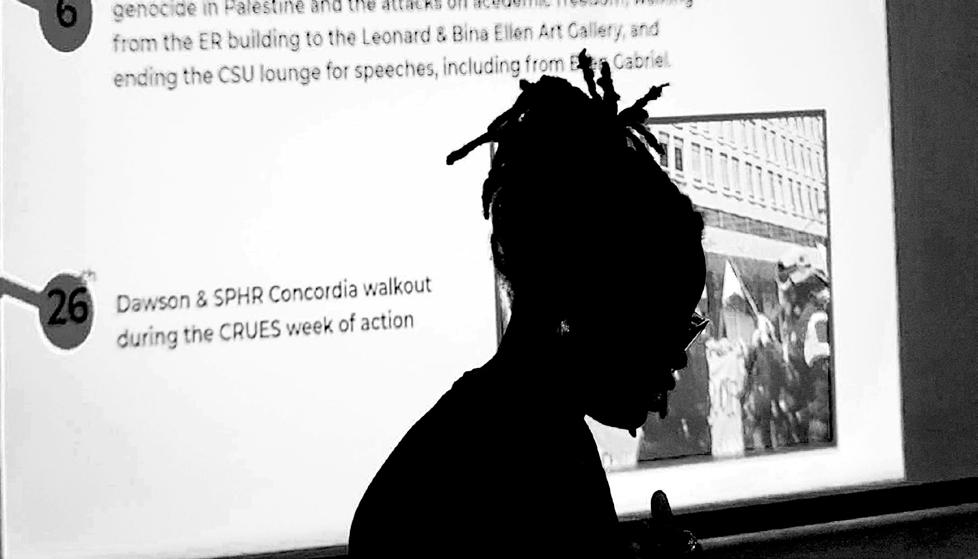
Now a geography student, Ndahayo said that she believes that the time constraints typical of STEM degrees make it extremely difficult for students to get involved in community organizing.
“This is a system that they were put into and this is not because of lack of interest or lack of care for our movement,” said Ndahayo.
Ndahayo’s presentation focused on recapping activism milestones in the 2024–2025 school year.
“It’s important to have a bridge of information continuing to the new cohort of undergraduate students coming to Concordia so that they know that there’s a precedent [of advocacy and activism at Concordia],” said Ndahayo.
Union Day concluded with an information session from SLAM-MATU about how to organize a tenant’s union in your building. Daphne St-Ong, the tenant organizer who led the session, expressed the importance of educating incoming
students about their rights as tenants.
“Students are an under-organized and over-exploited demographic,” said St-Ong.
St-Ong also explained that students face unique barriers to forming tenant coalitions, such as high turnover rates and lack of experience organizing.
Violet said that she hoped the students who attended Union Day would be able to use this information to empower their organizing going forward.
She believes that without opportunities to organize and better their situation, young people are particularly vulnerable to becoming involved in political extremism. “If there isn’t a space for them to work and fight for something, they can turn to resentment and anger,” said Violet. “There is something you can do, it’s not a lost future. You don’t have to submit yourself to these sorts of circumstances.”
Concordia students go beyond the classroom lectures and labs, getting hands-on experience and learning by building and launching
Starsailor rocket
By Agathe Soldat Contributor @agathe_sldt
Marwan Mohamed, 22-years-old, always dreamed of being a pilot as a child, spending hours playing with toy planes and rockets. When he was first admitted to Concordia University to pursue a degree in aerospace engineering, he never imagined that his childhood dreams would lead to an opportunity like this.
“I have always wanted to be a pilot,” said Mohamed. “And I thought to myself, if I can’t fly the aircraft, maybe I can make it.”
On Aug. 15 at exactly 5:34 a.m. ET, the Starsailor rocket launched from a remote site in northern Quebec. After years of planning, building and testing by Concordia students, the liquid-fuelled rocket finally took off with a live audience. The launch was streamed on YouTube, giving viewers around the world a chance to watch. The project was facilitated through a collaboration between Space Concordia’s Rocketry Division and members of the local Cree community who hosted the launch in their territory.
Other institutions across Canada have also aimed towards empowering students through similar initiatives to Concordia’s Starsailor.
Ontario Tech’s Space and Rocketry Team has also
been developing high-powered rockets designed to deliver scientific payloads to target altitudes.
Every August, in Ontario, Launch Canada organizes Canada’s largest student rocket engineering competition, where all universities across Canada can participate. Last year, 24 different universities participated, including McGill University, ETS Montreal and École Polytechnique de Montréal.
Mechanical engineer Amin Nuseibeh watched the launch on YouTube from his computer at home.
In 2023, Nuseibeh became a member of Space Concordia, a student organization dedicated to developing space technology and teaching students about space-related sciences. He said that over time, he started valuing hands-on learning and cooperation that the classroom alone could not provide.
“Textbooks are about theory, and this project involved practicality,” he said. “It was about working together as a team where each person had a role; it wasn’t a
one-man show.”
After attending Starsailor’s test launch at the Loyola Campus last year, Nuseibeh said he truly understood the importance of witnessing and being part of such a project.
“It opens your eyes on the possibilities of engineering,” said Nuseibeh. “Being able to collaborate with a team and showing future employers how eager students are to learn can really make a difference in our future as engineers and for Canada’s future.”
According to Launch Canada’s website, their mission is to inspire the next generation of engineers and innovators by giving students real-world experience. With more student-led projects emerging across Canada, students like Mohamed now have the chance to turn classroom theories into real-life applications and make their dreams come true.
“You are often not given a guide when faced with problems, and it is up to you to come up with solutions,” said Mohamed. “Projects like Starsailor make students more complete, drive them to learn new skills and produce better engineers overall.”
We know navigating services at Concordia can be tricky, so we’re here to help.
By Jia Marguerite Schofer @jiamarguerite Campus News Editor
Noah Spivack, a fourthyear student at the John Molson School of Business, recounted how he had initially struggled to adapt to university four years ago.
“It was a very hard change coming to Concordia. I didn’t know anyone and needed outlets,” he said.
He sought help from Concordia’s mental health resources. However, when he mentioned occasional substance use, his therapist focused on that rather than his mental health needs and later sent him an email referring him to another resource outside of the school’s services.
“It’s a rehabilitation and addiction centre, and I was just like, ‘What the…?’” But there were other resources for Spivack on campus. The Zen Dens offer a free space for relaxation and peer support. Empower Me has a 24/7 confidential counselling service. The Applied Psychology Centre offers therapy and assessments. The list goes on. However, Spivack was referred to resources off campus, which he did not need, and wasn’t even informed of what was available.
This disconnect is why The Concordian is launching a Campus Resource Guide, outlining student supports—both institutional and student-run—while sharing real student experiences.
Each profile provides accurate, upto-date information, including locations, contact information, and detailed descriptions of services offered. The goal is to ensure students can access these resources without confusion.
Concordia does com municate about its sup port services, but stu dents say the messaging often doesn’t reach them in ways that feel accessible or visible. Kimberly Manning, a professor of political science and wom en’s studies at the Sim one de Beau voir Institute, said that some of the responsibility may lie in how communication methods are applied.
“We do try to provide this information during orienta tion,” she said. “But how many students are reading syllabi, you know?”
According to Manning, some students do reach out to services like the Office of
Rights and Responsibilities or the Ombuds office, but it’s clear that others do not.
“There are students who think they have a problem and there’s nowhere to go at the institution,” she said.
The university’s communication efforts often fall short of reaching the audiences they’re intended to serve.
Linds Belchior, general coordinator at Women’s Studies & Sexuality Studies and a fifth-year women’s studies student, said the only time they notice promotions for university services is when passing through the Hall Building or the underground tunnel from the metro, adding that resources aren’t widely advertised elsewhere on campus.
“They definitely need to just get just like, get a billboard—do something,” they said.
Belchior added that many students downplay their concerns, thinking, “I’m a student, it’s whatever, it’s going to happen to me,” or simply don’t want to make a big deal of it. Others don’t even consider these services because the acronyms and institutional language fail to connect with their own experiences.
“It’s definitely a mix of not knowing the faces and thinking it’s some mysterious kind of group,” Belchior said.
The Campus Services Guide will feature testimonies with the goal of demystifying these faceless groups, funded by their tuition.
If you have a suggestion of what we should cover next, email me at campus@ theconcordian.com.
We look forward to hearing from you!
Navigating Concordia’s gender-affirming care services is challenging, but there is a network of support for students in need at Concordia.
By Sabina Bellisario-Giglio Campus News Assistant @ _sabbell _
Without proper support, many individuals seeking the resources to access gender affirming care find the process overwhelming.
“It’s important when you’re brand new in a new place to have support so that you can do well in your studies, thrive and stay enrolled in school,” said Cáel M. Keegan, associate professor of film and moving image studies and colead of the transphobia subcommittee at STRIVE.
Students can access gender-affirming care through StudentCare’s insurance coverage, alongside on-campus resources that help overcome obstacles when accessing care. These services are automatically offered to Canadian students enrolled in more than three credits. Undergraduate students registered for three credits or less, international students and others who have permanently opted out of the insurance are eligible for the coverage through self-enrolment.
GreenShield, Concordia’s gender-affirming care provider, covers surgeries not covered by provincial insurance. It covers $5,000 per procedure, with a lifetime maximum coverage of $10,000 for qualifying procedures. Queer Concordia’s Gender Affirming Care Loan Fund also provides financial aid to students, offering two claims with a total of $10,000 in interest-free loans.

The Gender Health Hub, a Concordia Student Union service, can help connect trans students to trans-inclusive health services such as menstrual, uterine and trans scarwork services.
The Centre for Gender Advocacy, a student-funded organization at Concordia, also provides support for trans students seeking resources or referrals and provides services such as genderaffirming gear. However, to receive coverage, students or dependents must provide documentation of a gender dysphoria diagnosis from a legally qualified physician or nurse practitioner, according to GreenShield’s policy. An official diagnosis of gender dysphoria focuses on the discomfort regarding one’s gender identity, according to
the World Professional Association for Transgender Health.
Jessica Winton, president of Queer Concordia, sees this criterion as one of the coverage’s shortcomings.
“Most people don’t have a doctor, psychologist or nurse who’s willing to write that letter for them,” she said.
For many, simply getting access to these doctors is another obstacle. Quebec had a median wait time of 28.9 weeks between a referral from a general practitioner to receiving treatment, according to a 2024 Fraiser Institute report.
Students must pay for the services out of pocket, then submit a claim before being reimbursed by insurance, which poses more issues. “For surgery in particular, it’s not very feasible for students because it can be well over $10,000, which is more than the coverage anyway,” Winton said.
The Gender Affirming Care Loan Fund provided by Queer Concordia removes that initial financial burden. The $20,000 community fund offers a contract that allows students to receive a two-month interest-free loan until they are reimbursed by their coverage provider.
The cap for individual loans increased in April 2024 from $2,000 to $10,000 as many want to use the fund to pay for surgeries.
However, Keegan emphasizes the need for Concordia to improve its care for transgender students.
“The system was not really designed with trans people in mind,” Keegan said. “There are lots of resources scattered throughout the university, but they’re not all organized… so one thing [STRIVE] is going to recommend is the centralization of those resources.”
For more information on how to receive gender affirming care as a Concordia student, see the information provided below:
Queer Concordia: 302-2100 Mackay, Montreal, H3G 2J1, queerconu@gmail.com
Gender Health Hub: @gender.health.hub on Instagram
Center for Gender Advocacy: 2100 rue Mackay, first floor, 514-848-2424 (ext. 7431), rayah.advocacy@genderadvocacy.org, peersupport@genderadvocacy.org
StudentCare: 1200 McGill College Ave., Suite 2200, Montreal, H3B 4G7, 1-514-789-8790
Trans Patient Union: unionreptpu@gmail.com, @transpatients on Instagram
GrS Montreal: 999 de Salaberry, Montreal, H3L 1L2, 514-288-2097
Project 10: 10138 rue Lajeunesse Suite #301, Montreal, H3L 2E2, 514989-0001, questions@p10.qc.ca
Jeunesse Lambda: 1575 Rue Atateken, Montreal, H2L 3L4, 514-5436343, trans@jeunesselambda.com
Montrealers are headed to the polls in November to choose their municipal representatives. Here is what you need to know.
By Angélique Babineau Assistant City News Editor @angeebabineau
On Nov. 2, Montrealers will head to the polls to elect their municipal representatives who will decide on everything from when their garbage gets picked up to their ability to get to work on time.
When to vote?
In Quebec, municipal elections are held every four years on the first Sunday of November. Across the province, 1,100 municipalities will vote on 8,000 positions in their municipal governments. This year, voting day will take place on Nov. 2 and polls will be open from 10 a.m. to 8 p.m. Advanced polling will be held on Oct. 26
from 12 p.m. to 8 p.m.
According to Élections Québec, municipalities of over 20,000 inhabitants will have the option to cast their ballot at the office of the returning officer on Oct. 24 from 4 p.m. to 8 p.m. This option could also be made available to residents on Oct. 27 to 29, depending on the municipality. In certain cases, mobile polling and voting via mail will also be possible. More information about alternative voting methods as well as polling locations can be found on Élections Québec’s website.
Who can vote?
To be eligible to vote, a person must be a Canadian citizen, at least 18 years old on election day and registered on the electoral list. Those under guardianship or subject to legal incapacity are not eligible to vote.
Additionally, a person must also either:
a) Reside in the territory of the City of Montréal and have lived in Québec for at least six months; or b) Be the sole owner of a building or the sole occupant of a business establishment located in the territory of the City of Montreal for at least 45 days. In the latter case, an application must be submitted to Élections Montréal before Oct. 16 at 6 p.m.
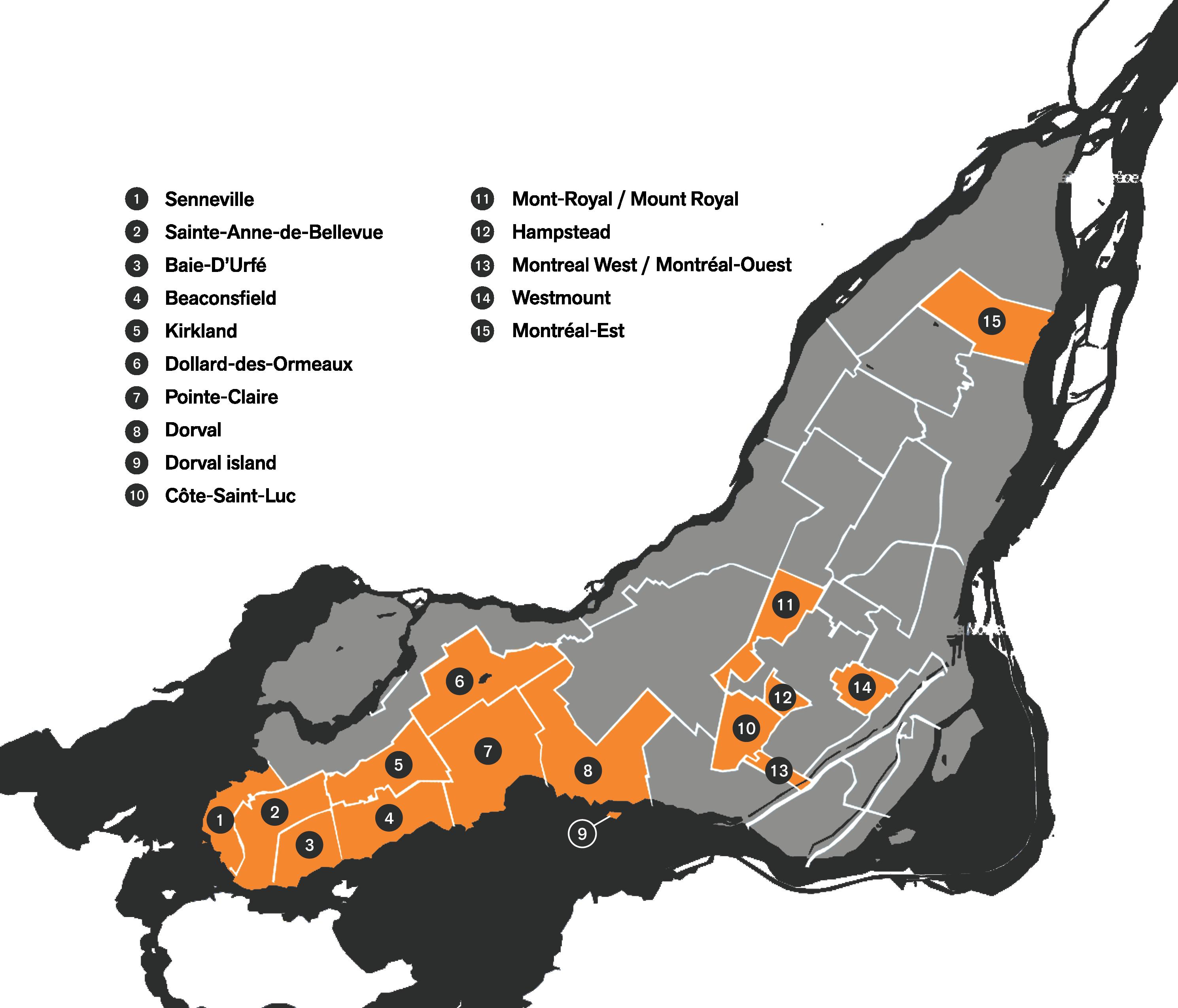
It is important to note that the Island of Montreal encompasses 15 independent municipalities, such as Dollard-desOrmeaux and Côte-Saint-Luc. They are not part of the City of Montreal’s territory and have their own mayor and city council. Consult the graphic above to see whether you live in the City of Montreal itself.
Eligible voters must verify that they are registered on the electoral list before voting day. Before Sept. 5, they can communicate directly with Élections Québec. Once the election period has started, municipal returning officers will send notices to inform those whose names are on the electoral list. An individual may also contact their municipal returning officer directly after this date. Find out more on Élections Québec’s website.
The City of Montreal is divided into 19 boroughs, which are divided into 58 electoral districts. Electoral districts are created through specific bylaws the year preceding the election and are designed to “ensure a balanced representation within the boroughs and bodies.”
Electors in each district will cast a ballot for the mayor of Montreal, for a borough mayor, except for Ville-Marie, whose mayor is also the mayor of Montreal and, in some cases, city councillor(s) and/or borough councillor(s). In total, there will be 103 elected positions. The
city’s municipal council is made up of 65 members: the mayor, the council chair (who is also a councillor), 18 borough mayors and 45 other councillors. All elected officials sit on their borough councils.
Who’s running?
Although registrations for candidates will be open from Sept. 19 to Oct. 3, four popular candidates have already announced their intention to run for the city’s top public office:
• Luc Rabouin has succeeded Valérie Plante at the head of Projet Montréal;
• Former Liberal Tourism Minister Soraya Martinez Ferrada will be the candidate for Ensemble Montréal, the current official opposition on the city council;
• City councillor and former NDP candidate Craig Sauvé will run for Transition Montréal;
• Futur Montréal have announced that the former executive director of Ensemble Montréal Jean-François Kacou will be its candidate.
The complete list of candidates for all positions will be available for electors on Élections Québec’s website.
The mayor of Montreal has called upon François Legault to appoint a minister responsible for homelessness in his upcoming cabinet shuffle.
By: Félix-Antoine Beauchemin City News Editor @fa.beauchemin.journalisme
Montreal mayor Valérie Plante announced the city’s plans to invest a total of $22.5 million in projects supporting people experiencing homelessness. She called on the province to do more on the issue as well. With a fall cabinet shuffle looming over the province, Plante demanded that Quebec Premier François Legault appoint
a minister responsible for homelessness.
To address the issue, over $21 million has been allocated by the city to 39 community organizations to implement 42 projects between 2026 and 2028 aimed at addressing what Plante has called a “humanitarian crisis,” in her press conference announcing the investments.
“To address the social challenge of homelessness, we must encourage the deployment of creative and bold solutions,” said Pierre Lessard-Blais, borough mayor of Mercier–Hochelaga-Maisonneuve and the City of Montreal’s executive committee member responsible for homelessness, in the city’s announcement.
“We are committed to speaking on behalf of community organizations and the people of Montreal to ensure that the necessary assistance is provided,” he said.
The city has also committed $700,000 to implement shuttle services for vulnerable people in 2026. These services, intended to improve transportation access to essential resources such as housing and support, will be operated by Projets Autochtones du Québec, Mission Old Brewery and L’Amour en Action.
Will we see a provincial minister responsible for homelessness?
While Plante believes these funds will help combat homelessness, she stressed that other levels of government must also support municipalities.
“The actions we fund will help to better support vulnerable people, strengthen efforts to promote cohabitation in our neighbourhoods, and support front-line workers,” she said in the press release.
“But we must go further: all levels of government must mobilize to address the root causes of this humanitarian crisis.”
In her press conference, Plante said that homelessness deserved its “top gun,” a term often used by François Legault to refer to top government officials, calling on the Quebec premier to name a minister responsible for homelessness in his upcoming cabinet shuffle. Her demand was later endorsed by Quebec City Mayor Bruno Marchand.
“I support Valérie Plante’s proposition. The cabinet shuffle must demonstrate the government’s genuine willingness to take action on this crisis and its serious consequences,” he wrote on BlueSky.
Plante also specified that this demand was not a criticism directed at Lionel Carmant, the minister responsible for social services, though she said more action is needed.
In response, Carmant stressed the need for cooperation between Quebec and municipalities, but also said that Montreal was slow to provide housing for its homeless population.
“We’re talking about encampments, for example,” he told reporters outside the National Assembly. “Look, Quebec has announced transitional housing in modular units. We have money; we’ve put money into a modular housing program. Montreal is slow to open its modular units, so I think we need to keep working together. I’ve been saying this from the beginning: that’s how we’re going to get through this.”
Premier Legault’s office has not responded to The Concordian’s request for comment in time for publication on whether he planned to name a minister responsible for homelessness in his upcoming cabinet shuffle.
AI chatbots are not reliable sources of accurate information on current affairs, so what will happen to the truth?
By: Félix-Antoine Beauchemin City News Editor
@fa.beauchemin.journalisme
As generative AI models get better at replicating our shared reality, it has opened the floodgates to a posttruth world. Access to generative AI has democratized the opportunity to create and disseminate disinformation campaigns online.
Misinformation and disinformation are as old as time. However, the internet, and particularly social media, has enabled them to circulate on a much larger and faster scale than ever before. Now, generative AI tools are just the latest technological innovation to have opened new pathways for creating and spreading falsehoods.
“Yes, there are always some glitches here and there, but I mean if a power, whether financial, economic, an
organization, or a state, that has the means to want to make a high-quality deepfake, for example, will have the means to do so,” said Dr. Florent Michelot, an assistant professor in educational technology at Concordia University specializing in AI and disinformation.
As AI continues to improve in its realism, he believes it is unrealistic to expect people to immediately recognize when content has been produced using AI to deceive them.
There is no clear solution for countering these types of disinformation. However, Michelot believes an educational approach to information literacy is key for people of all ages. He explained that elementary and high school curriculums do mention the importance of critical thinking, although he believes more could also be done in CEGEPs and universities.
He also stressed the importance of having resources available for people who are not in the school system anymore. For example, educating seniors in retirement homes on how to spot AI-generated media would help stop the spread of disinformation in communities that have not grown up having to do so.
It is also important to note that none of the major AI chatbots are Canadian. This could make the implementation of regulation in the industry more difficult. A good example of this is Bill C-18, the Online News Act. For example, Meta has simply blocked news content from Facebook and Instagram instead of complying with the law and compensating
news organizations for their content that was being shared on its platforms. In this context, Michelot is not optimistic about governmental regulation on AI, despite the newly minted Minister of Artificial Intelligence and Digital Innovation position.
“I don’t believe it, I’d like to believe it, but I’m very pessimistic,” he said.
It’s a shame, because we need regulation in the digital world in general, in terms of social media, in terms of how algorithms work. We need to establish legal, technical, and ethical guidelines in this area, but we are well behind, both in Quebec and Canada, on these issues.
If you open X and look in the comments of the first post you see, chances are you will see this message, or users asking xAI’s chatbot for complementary information. However, AI chatbots are not reliable to fact-check information.
For example, a BBC study published earlier this year asked four different AI platforms various questions about the news, whose answers were then analyzed by BBC journalists.
“This research shows that AI assistants have significant issues with basic factual accuracy,” reads the report.
It found that 51 per cent of all answers contained “significant issues of some form,” that 19 per cent of answers citing the BBC “introduced factual errors – incorrect factual statements, numbers and dates,” or even that 13 per cent of the quotes sourced from BBC articles “were either altered from the original source or not present in the article cited.”
Similarly, another study published earlier this year in the Columbia Journalism Review provided eight different AI chatbots with 200 quotes from news articles and asked them to identify the original article. Overall, the different AI models provided incorrect answers in more than 60 per cent of cases.
are using their time off to train, heal and grow—both on and off the field.
By Anthony Maruca Sports Editor
For student athletes, the off-season is often characterized as a time to ease the pressure that comes with their demand ing schedules.
Some may be tempted to book a vaca tion to escape, while others, proactively organize their time around training for improvement for the next season.
Some use the time to unwind with loved ones; others embrace an even big ger challenge far from home.
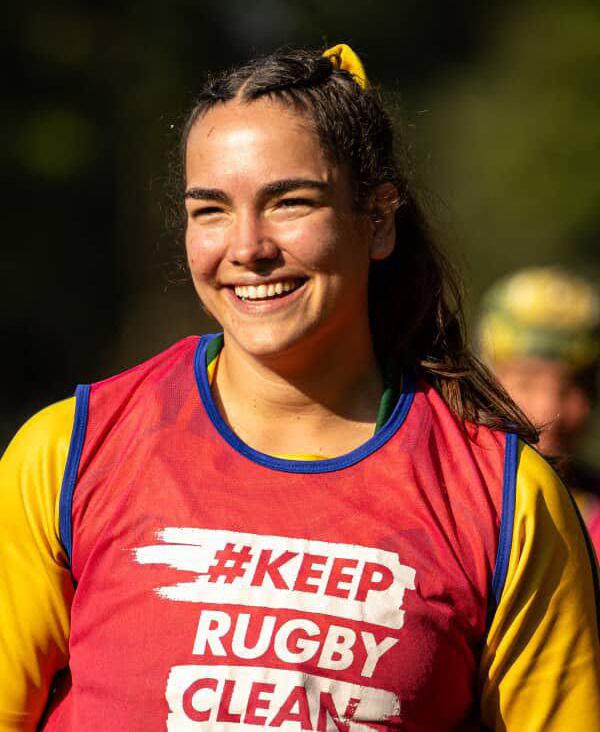
The latter is the case for women’s rugby forward Nicole Amaral, whose ambitions had the potential to take her across the world.
The four-year Stingers’ veteran spent her off-season training at home in Brazil, with the opportunity to make the Brazil ian national team.
“My family is from Rio, but I’m training in São Paulo so when I have some time off, I go see them in Rio,” said Amaral.
Amaral was chosen as an injury reserve for the team’s World Cup training camp, being held in late August across various host cities in England. After some thought, she decided returning home to prepare for the upcoming season was the right decision for her.
While some athletes must make decisions based on their current situation, like Amaral, others look ahead to their ambitions beyond it. This is the case for Stingers football star defensive back Men-
time off during an offseason to take stock of their physical health, making sure they are taking the right steps toward proper recovery.
For men’s soccer defender Lundon Durand Browne, getting healthy prior to the next season is a must.
“It’s a moment to, first and foremost, get healthy,” said Durand Browne.
“Get as healthy as possible for the following season, then continue to build on what you maintained during the season,” referring to the pillars of a successful off-season.
While athletes like Durand Browne
Richard, the importance of balancing both relaxation and development are essential to a successful off-season.
“I think it’s a good time to take a break and really log off and enjoy time with friends and family to help recharge our batteries,” said Richard.
Reaffirming her belief on improvement before the start of next season, Richard has been able to maintain a consistent regimen of on and off-ice training despite the time spent with loved ones.
Women’s soccer midfielder Emma Liagridonis preaches similar off-season values as Richard.

An early defensive stand wasn’t enough for Concordia’s men football as offence sputtered in a 41-14 loss.
By Anthony Maruca Sports Editor
After a disappointing season last year, finishing fourth in their conference with a 2-6 record, Stingers’ faithful were hopeful to begin the new season on a high note. Unfortunately, the team found little to hang their hat on as their season opener ended in a decisive loss.
The challenge was steep from the start.
The Carabins of l’Université de Montréal (UdM) entered the matchup as last season’s highest-scoring team in the Réseau du Sport Étudiant du Québec (RSEQ), having piled up 273 points during the 2024 regular season.
Still, Concordia’s defence came out swinging. Both teams struggled early to get their offences going, neither establishing
their ground game with defensive lines on both sides proving solid against the run.
Sébastien Beauvil, the Stingers’ starting nose tackle, was a constant presence in the opposing team’s backfield in the first quarter.
“For us [the defensive line], every snap it’s zero-zero on the scoreboard. We keep our eyes in front, we push, we pull, we tackle and that’s it,” said Beauvil speaking to the relentless nature that comes with defending the run upfront.
The Stingers’ defence opened strong, repeatedly forcing punts and earning their team’s first points with two safeties in the opening half. But cracks eventually showed.
After surrendering a rushing touchdown late in the first quarter, the Carabins’ passing game converted twice to make the score 22-4 heading into halftime.
Concordia’s offence failed to move the ball with any consistency in the first half and the same story could be told early in the second half.
“It’s all about details today,” said Stingers head coach, Brad Collinson. “We had a lot of stupid penalties that we shouldn’t have had, we missed a couple of long balls. [...] that’s a swing of potentially 21 points.”
By the end of the third quarter, UdM extended its lead to 29-7 and kept piling on. As the crowd shouted in unison to the tune of Sweet Caroline, the Carabins’
offence marched downfield to extend their lead early in the fourth quarter to 36-7.
Then came Concordia’s lone spark. Wide receiver Oriola Poirier, a third year battling back from multiple injuries, caught a contested ball and housed it for an 87yard touchdown reception.
“I just had to make a play, and I did,” said Poirier.
The moment silenced the crowd and gave the Stingers a brief jolt. For those who have watched Poirier fight through injuries to return to the field, this mattered more than the final tally.
“I’m really proud of a kid like Oriola. You know, fighting injuries throughout his career and then making that big play and getting a score on the board for us,” said coach Collinson in a post-game interview with The Concordian.
The Stingers continued to push for a comeback, but to no avail, failing to register another point.
The final score was 41-14 for the Carabins.
The Stingers are back
5 at Concordia Stadium. Kickoff is set for 7 p.m.

Concordia overcomes bad weather conditions to beat Bishop’s and start the year undefeated.
By Anthony Maruca Sports Editor
Coming off a disappointing season, Concordia’s women soccer hoped to start on a positive note going into their home opener against the Bishop’s Gaiters on Aug. 28.
The Stingers finished seventh out of the eight teams in the conference with a 2-10-2 record, extending their two-decade playoff drought.
The Bishop’s Gaiters were the lone team to finish below Concordia in the standings last season. Both squads struggled to score, failing to crack 10 goals for the entire year.
Given the history and rainy weather conditions, a low scoring affair was expected heading into the matchup.
Concordia started the first half strong, controlling pace on both ends and moving the ball effectively despite the wet surface.
The ball movement led to a chance for Rachel Vermaire, who capitalized on the opportunity to open the scoring for Concordia.
As time passed, the conditions caught up to both teams, as the ball was hard for players to control on both sides.
The Stingers still held the advantage in possession, but they would struggle to move the ball out of their own end. Despite this, the defence held its own, keeping Bishop’s away from high danger scoring areas.
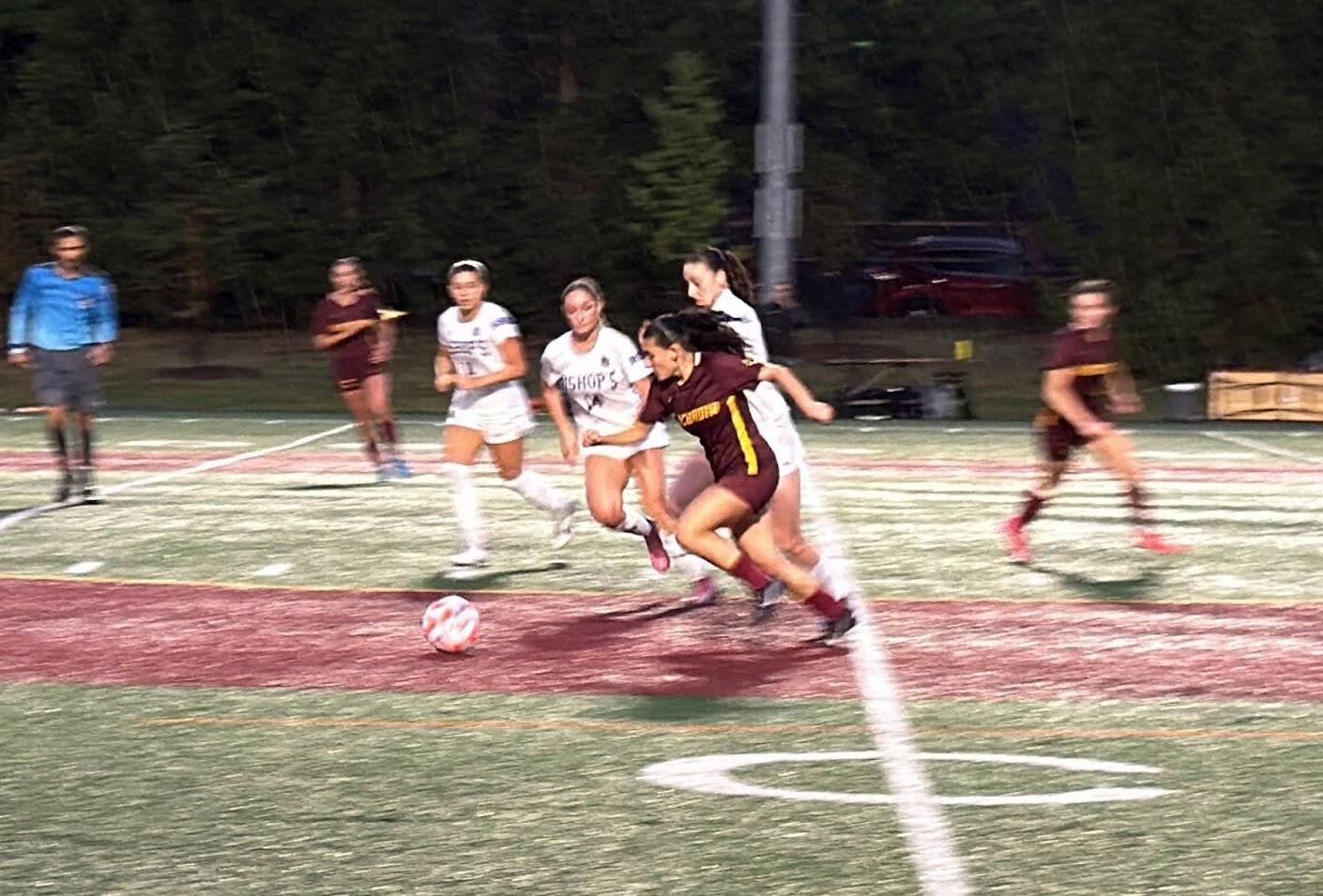
Things turned for the worse for Concordia to start the second half. The Stingers struggled against Bishop’s pressure early on, conceding long possessions with difficulty and having difficulty clearing their zone.
The momentum flipped, with Bishop’s controlling the pace of play and maintaining offensive pressure on Concordia for the first ten minutes of the half. Goalkeeper Naïla Louissaint was forced to make
multiple saves to keep her team’s lead.
Mid-way through the second half, the Stingers picked up the tempo.
Their overall intensity was improved with defenders moving the ball more effectively, and midfielders transitioning defence into offence more efficiently.
“The team that we have, they’re gonna fight for every ball. It’s part of our DNA as a team,” said head coach Wilfried Monthe.
Forward Ashley Burdick embodied that “DNA” her head coach referred to on
the Stingers’ second goal of the contest.
While it was Rachel Vermaire who scored her second goal of the game, it was Burdick’s hustle that forced the opposing defender to make a sliding tackle.
Though the tackle was clean, Burdick was tripped and struggled to get up. The ball had kicked out of bounds, leading to a corner kick and ultimately led to Vermaire’s tally.
“What you saw there on that goal, that is what we need to do every time when we step on the field,” said coach Monthe.
Down two goals with time running out , Bishop’s continued to push for offence. However, Concordia tightened their defense and cleared the zone effectively, limiting Bishop’s chances to score. .
The Stingers closed out the match strong, earning their first win of the season at home. The final score was 2-0 for the home side.
Ce sont les mots de Yann Fortier, directeur général de l'Expo World Press Photo Montréal, présentant des images marquantes capturées par des photojournalistes du monde entier.
Par Abanob Sedrak Rédacteur
Prenant place au Marché Bonsecours, la 18e édition de l’exposition à Montréal s’est ouverte le mercredi 27 août, alors que la Fondation World Press Photo fête son 70e anniversaire.
À l’intérieur du marché, les photos suspendues par des fils de métal racontent des histoires provenant du monde entier. L’exposition fait le tour du globe, visitant 60 pays, a lieu à chaque rentrée à Montréal.
À l’exposition, les visiteurs ne parlent pas beaucoup.
« On crée une espèce de moment, une heure trente, deux heures, un moment de réflexion, un moment d’émotion, un moment d’échange aussi », affirme Yann Fortier, le directeur général de l’Expo World Press Photo Montréal.
« Ça peut être assez déstabilisant parce qu’on peut se surprendre à trouver belle une photo esthétiquement belle, alors que la photo elle-même évoque une tragédie. »
Cette dualité unique à cette exposition, qui réunit les meilleures photos de presse prises à travers le monde, est le fruit d’un travail d’un jury indépendant qui choisit, parmi des dizaines de milliers de photos, lesquelles seront exposées.
Pour certains comme Robin Renault, visiteur à l’événement et professeur de psychologie au Collège André-Grasset, c’est une façon de comprendre ce qui se passe dans le monde. À travers les photos et leurs histoires, l’événement donne une perspective personnelle sur des enjeux partout dans le monde, comme en Ukraine,
au Myanmar, à Gaza, aux frontières des États-Unis, au Soudan, au Congo, et plus encore.
Présent à l’occasion de l’événement pour exposer son travail, Clarens Siffroy est un photojournaliste originaire de Port-au-Prince, fait partie des photojournalistes dont les images ont été sélectionnées. Les photos de Siffroy documentent la guerre entre les gangs et les autorités haïtiennes. Risquant sa vie tous les jours pour prendre ces photos, Siffroy rappelle l’importance du travail de photojournaliste.
« C’est difficile de gagner la confiance des gens. À chaque fois, je dois parler aux gens et leur expliquer que je peux les aider en portant leurs voix à l’échelle internationale », explique Siffroy.
Cette année, le portrait de Mahmoud Ajjour, neuf ans, qui a perdu ses bras lors d’une frappe israélienne dans la Bande de Gaza, a gagné le prix de la meilleure photo de l’année. Ajjour a été évacué au Qatar avec sa famille. Samar Abu Elouf, la photographe gazaouie derrière la photo, a été évacuée au Qatar en 2023, où elle vivait dans le même immeuble qu’Ajjour.
« Malheureusement, certaines situations au Proche-Orient notamment qui sont là depuis des décennies, mais la liberté de presse demeure toujours un enjeu», rappelle Fortier. « L’ultime de ça, ce sont des photographes qui sont tués pour leur travail ou d'autres qui vont être emprisonnés à cause de leur travail. »

Selon le bilan de l’année dernière du Comité pour la protection des journalistes (CPJ), 2024 a été l’année la plus meurtrière pour les journalistes recensée par le CPJ depuis sa fondation en 1981. Au moins 124 journalistes et employés des médias ont été tués, dont 82 à Gaza.
L’Amérique centrale et du Sud sont aussi très représentées dans cette exposition. Les chemins de l’espoir désespéré, une série de photos prises sur plusieurs années par le photographe Federico Ríos et la photo Traversée de nuit par John Moore témoignent des difficultés auxquelles les migrants, venant de partout
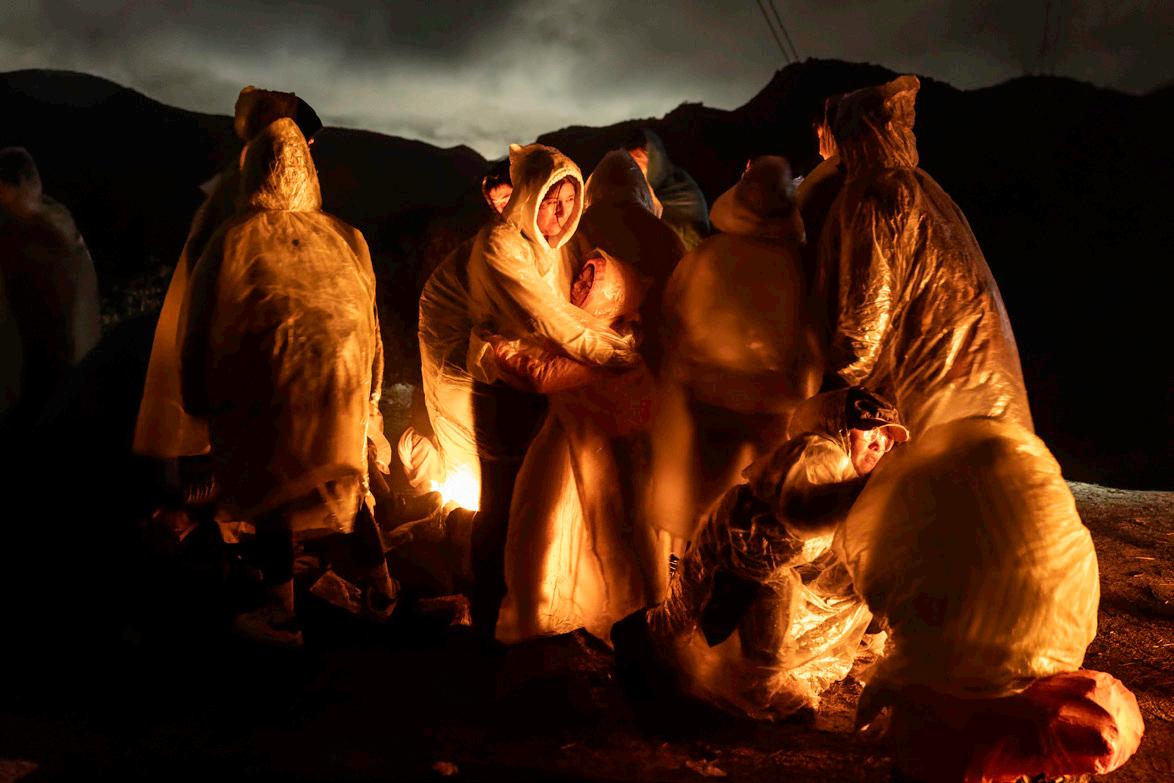

dans le monde, font face pour traverser la frontière entre le Mexique et les ÉtatsUnis. Traversée de nuit et Sécheresses en Amazonie, par le photographe Musuk Nolte, ont toutes les deux été nommées finalistes au prix de photo de l’année. Fortier rappelle qu’il faut garder espoir face à ces tragédies que les photojournalistes documentent.
« C'est vrai que c'est tragique, mais à travers ça, ce que j'aimerais que [les visiteurs] retiennent […] qu'ily a aussi de la lumière, il y a aussi des éléments lumineux à travers ça, il y a des belles histoires de résilience. »

L’Organe et The Concordian sont fiers de s’associer à nouveau cette année pour permettre aux francophones et francophiles de Concordia de s’informer en français.
Par Félix-Antoine Beauchemin Rédacteur des nouvelles locales et Président de L’Organe @fa.beauchemin.journalisme
J’avais plusieurs appréhensions lorsque j’ai commencé mes études de journalisme à l’Université Concordia, il y a exactement deux ans. Cependant, celle qui me
démangeait le plus était sans contredit la qualité de mon anglais, autant à l’oral qu’à l’écrit.
Comme beaucoup d’autres francophones à Concordia, et probablement plus généralement plusieurs étudiants dont l’anglais n’est pas la langue maternelle, je craignais que mon anglais ne soit pas au niveau des exigences venant avec des études universitaires dans la langue de Shakespeare. Le fait d’avoir choisi un domaine d’études tel que le journalisme, où une maîtrise de la langue autant à l’oral qu’à l’écrit est primordiale pour réussir, n’a certainement pas aidé à calmer ces craintes.
Mon fort accent québécois lorsque je parle anglais sera-t-il un frein à mon apprentissage et à mon intégration avec mes camarades de classe ? Serai-je capable de produire des articles d’assez bonne qualité, alors que je vérifiais souvent, et vérifie encore aujourd’hui souvent, des traductions de mots ou d’expressions dans des dictionnaires français-anglais ? Tant de questions qui m’ont longtemps traversé l’esprit avant d’entrer à l’université et durant une majeure partie de ma première année.
Toutefois, ces inquiétudes quant à la qualité de mon anglais n’étaient que plus importantes lorsque venait le temps
de s’impliquer dans les médias étudiants de l’université.
En effet, L’Organe était en dormance lorsque je suis entré à l’université il y a deux ans, il n’y avait donc aucun média étudiant francophone à Concordia. J’étais alors face à un dilemme : comment puisje m’impliquer dans les médias étudiants, sans avoir confiance en ma maîtrise de la langue de tous les médias étudiants de en question? La réponse, dans mon cas, a été de se réfugier dans la section des sports du Concordian, afin de traiter de sujets dont j’étais confortable. Durant toute ma première année, j’ai écrit des articles sur les sports, craintif de m’aventurer dans d’autres sujets que je maîtrisais moins dans ma seconde langue.
Au printemps 2024, Clément Lechat, candidat à la maîtrise en journalisme, approche quelques étudiants francophones, dont moi. Ayant longtemps travaillé dans l’ombre pour faire renaître L’Organe de ses cendres, il nous demande notre aide pour officiellement relancer L’Organe De là a rapidement germé l’idée de collaborer avec The Concordian pour créer les Pages Francos. L’objectif principal était de permettre aux étudiants francophones et francophiles de l’Université Concordia d’écrire dans leur langue sur des sujets qui les passionnent. Cependant, nous avions
une autre motivation en tête au moment d’établir ce partenariat : éviter à d’autres étudiants les mêmes appréhensions auxquelles de nombreux étudiants francophones, dont moi, ont dû faire face au moment de s’impliquer dans les médias étudiants de l’université.
Après une première année ayant permis à de nombreux étudiants d’écrire et de s’informer dans la langue de Molière, L’Organe est fier de renouveler son partenariat avec The Concordian pour une deuxième édition des Pages Francos qui s’annonce pleine de promesses. Avec une équipe renouvelée et une coordonnatrice dédiée aux volontaires en Daphnée Béchard, je suis très optimiste que cette année permettra à encore plus d’étudiants de découvrir ou d’entretenir leur passion d’écrire en français, sur des sujets qui vous passionnent.

Un club de la Première Ligue canadienne de soccer arrive enfin au Québec.
Par Mathilde Colls Assistante rédactrice sportive
La semaine dernière, le lien entre la Première Ligue canadienne (PLC) et le Québec a été établi alors que, selon le journaliste de RDS Olivier Brett, la ligue est parvenue à une entente avec des acheteurs provinciaux.

Fondée en 2017, la ligue est le deuxième plus haut niveau de soccer professionnel au pays, juste derrière la Major League Soccer (MLS).
Selon l’animateur de radio Tony Marinaro, le nouveau club évoluera au Centre sportif Bois-de-Boulogne, à Laval. C’est le même stade où joue l’équipe féminine professionnelle des Roses de Montréal.
Marinaro affirme également que le
leur entraîneur. C’est une bonne idée, car on amène quelqu’un qui connaît le championnat local et qui peut aller recruter de bons joueurs locaux, qui mériteraient peut-être d’avoir la chance de franchir le pas vers la PLC. »
Le propriétaire majoritaire du club serait Matt Rizzetta, déjà propriétaire de deux clubs professionnels : le Campobasso FC, en Serie C italienne, et Brooklyn FC, une équipe féminine de l’USL aux ÉtatsUnis. Certains Montréalais, comme Angelo Pasto, feraient aussi partie du groupe
de propriétaires, assurant une base locale. Le Québec dispose déjà d’un système semi-professionnel à trois niveaux (Ligue 1, Ligue 2 et Ligue 3), d’une ligue universitaire et de deux clubs professionnels, ce qui en fait un marché de soccer en pleine
Pour de nombreux partisans, l’arrivée d’un club de PLC ne fait que confirmer que cette croissance continue d’accélérer.
« Je pense que c’est parfait pour le soccer québécois, surtout pour les jeunes. Cela offre une autre opportunité qui peut être plus accessible pour nos jeunes talents en dehors du CF [Montréal] », affirme Jordy Kerlegrand, ancien joueur des Stingers de Concordia et actuel joueur du CS Saint-Laurent, dans une entrevue avec The Concordian. « Nous avons tellement de talents au Québec qui passent inaperçus faute d’opportunités. Avoir un club en PLC peut vraiment faire croître le soccer québécois et donner plus de chances à nos jeunes joueurs d’atteindre le niveau supérieur », ajoute Kerlegrand.
À l’image des autres clubs de la PLC, la nouvelle équipe québécoise devrait miser sur des talents locaux en développement. Hérissé estime que quatre ou cinq joueurs de Ligue 1 Québec pourraient s’intégrer
dans la rotation, mais il souligne l’écart entre les deux niveaux.
« Tout dépendra de la direction que prendra le club », explique-t-il. « L’écart de niveau entre la Ligue 1 Québec et la PLC est énorme. La PLC, c’est le monde professionnel. Le passage du semi-pro au pro est immense. »
Kerlegrand croit que l’effectif visera à être le plus local possible, mais qu’une équipe composée uniquement de Québécois serait utopique.
« Je crois que les meilleurs joueurs semi-pros—Joakim Milli, Charles Auguste, etc.—auront leur chance, mais sinon, ils vont fort probablement aller chercher des joueurs d’expérience pour débuter », dit-il.
Bien qu’aucun nom ou identité ne soit encore officiel, Angelo Pasto, l’un des propriétaires pressentis du futur club, a récemment enregistré le nom « CF Supra Soccer Inc. » comme club sportif professionnel au Registraire des entreprises Québec . Ce nom fait directement référence au défunt Supra de Montréal, le prédécesseur du CF Montréal.
La PLC n’a pas répondu aux demandes de commentaires du Concordian. Graphique par Anna Huang // Éditrice graphique.
How to enjoy the new school year with film festivals and exhibits
By Ginane Deslauriers Arts and Culture Editor @ginane.dlrs
As cropped tees mi grate to the back of the closet and a warm au tumn hue sets over Mon treal, the festival season is embracing the new sea son. Before the trees turn bare, there are still plenty of shows, markets and opportunities for arts students to get involved.
EVENTS
with MOMENTA Biennale de l’image is an immersive experience by artist Josèfa Ntjam, between Sept. 10 to Jan. 11, that brings visitors into an aquatic and cosmic universe.
Quand les oiseaux reviennent- Summer Arrival, organized by La Guilde in collaboration with le Festival International Presence Autochtone, presents an exhibition on birds by Inuit artists until Sept. 13. It explores spirituality, ecology and the cultural significance of birds in the North. For more information, visit laguilde.com.

Parcours Francoville 2025, organized by Université de Montréal in collaboration with Concordia University and the Centre de mémoires montréalaises, invites newly arrived non-French-speaking students on Sept. 5 to practice their French by completing challenges around iconic and cultural spots in Montreal.
The Message is the Medium presented by We Are The Medium is a multimedia retrospective takeover happening on Sept. 10 and 12 to celebrate various thinkers, artists and educators.
The Montreal Museum of Fine Arts invites Montrealers to celebrate the grand reopening of the Liliane and David M. Stewart Pavilion by making admission to the museum free for everyone on Sept. 13.
SHOWS
Bella Figura at the Les Grands Ballets Canadiens is a program of four works that capture the depth of human experience, taking place from Sept. 11 to 20.
The Lord of the Rings: The Two Towers in Concert presented by FILMharmonic Orchestra, from Sept. 5 to Jan. 17 at Place des Arts, with the Chœur des Mélomanes and Les Petits Chanteurs du Mont-Royal choir.
EXHIBITIONS
Josèfa Ntjam: swell of spæc(i)es presented by the PHI Centre in collaboration
Record of Protest by Canada Centre for Architecture is a collection of archival material –posters, flyers, reports and periodicals–open until Nov. 30, that illustrate the weight of social change on architecture.
Montreal International Black Film Festival is happening from Sept. 24 to 28 and is celebrating its 21st edition with writer, screenwriter, and filmmaker Dany Laferrière as the honorary President.
The Festival Quartiers Danses presents the 23rd edition’s program, which primarily takes place in Quartier des spectacles from Sept. 4 to 14. The program includes 38 choreographers and companies from five countries, highlighting the diversity of contemporary dance.
VITA Festival is a free festival happening on the weekend of Sept. 12 and 13 in Villeray Park, with a variety of sporting activities, such as karate, hiking, soccer and dance, as well as a DJ set.
The Autumn Market by Collectif Créactif MTL invites Montrealers from Sept. 27 to 28 and Oct. 4 to 5 to shop locally. Entry is free, and new vendors appear each weekend. Visit collectifcreatifmtl.com for more information.
ART OPPORTUNITIES
Artist Vendor Callout for Art/Club Fair, organized by the CSU, CUCCR and FASA. The deadline to apply is Sept. 5, and the fair is on Sept. 10 in the Hall mezzanine. For more information, visit their Instagram @CUCCR.
Jack Steer | Contributor | Letterbox: WhatisaJack James Gunn’s ‘Superman’ is as visually vibrant as its comic book source material. It embraces whacky elements from nine decades of Superman stories; Krypto the superdog, robot sidekicks, and hypno-glasses.
David Corenswet doesn’t shrink in the shadows of past Superman portrayals. He channels aspects of Christopher Reeve’s performance, playing Clark Kent with a similar unassuming clumsiness, and a confidence in the cape. Unique to Corenswet’s portrayal is an affable inexperience: this Superman has been an active hero for just three years. The movie begins with him losing a fight to Lex Luthor’s underling. He is neither infallible nor invincible, lending humility and
relatability to Corenswet’s performance.
In this film, Clark’s kryptonian parents play a more sinister role than in previous adaptations. As such, not only must Clark reconcile his kryptonian heritage with his humanity, he must reject it. Despite legacy being a central theme, his Kansan parents only play a small role. Spending more time at the Kent farm would’ve reinforced this theme and balanced the film’s fast pacing.
While flying dogs and pocket universes might be too outlandish for some, this film’s true appeal lies in its unsubtle yet earnest message about the importance of compassion.
Rating: 4/5
By Ferdaous Amrati | Staff Writer | Letterboxd: @Ferdaous
“I don’t really need to be remembered, I hope the music’s remembered”
A touching documentary on an artist that has moved many through music transcending borders. The film is not only for fans, but also for anyone drawn to a heartfelt story of love, talent and friendship. We follow Jeff Buckley’s journey from childhood, to his coming of age in New York City, to life on the road and his final days.
From escaping the shadow of an absent celebrity father—navigating and resisting an industry eager to mold him—to crossing
musical genres with inspirations such as Nina Simone, Leonard Cohen and Nusrat Fateh Ali Khan, the film highlights Buckley’s singularity as both a person and an artist. His one studio album Grace, remains a testament to his timeless voice.
The documentary features interviews with loved ones, alongside never-before-seen footage, photos and voicemails, painting an intimate portrait of a musician whose spirit continues to resonate nearly three decades later.
Rating: 4.5/5
Carlos Javier Montenegro | Contributor | Letterboxd: @CJPG
“I told you, I’m on fucking vacation!”
Bob Odenkirk reprises his role as Hutch Mansell, but this time he needs a break from the dirty work. He decides to take his family to his childhood vacation spot, Plummerville, but trouble quickly pulls Hutch back into the violence he hoped to escape.
The film shines in its well choreographed action sequences, which packs a punch as Hutch does not hold back against his enemies, and while it isn’t as
clean as John Wick, it is undeniably violent. The visuals are gorgeous, and the sound design heightens the intensity of each scene.
While fun at times, the underwhelming villain and formulaic writing after a strong first act makes this sequel weaker than its predecessor, Nobody (2021), which offered sharper writing and charm. If not for Odenkirk’s stellar performance, the film would have felt far more forgettable.
Rating 3/5
Aaron McIntosh’s exhibit showcases the artist’s interest in
By Kasi Peri Assistant Arts and Culture Editor
@k_a_s_i_p_e_r_i
At Concordia’s Webster Library, the display cases on the second floor have been transformed into an exhibit of flora and fibre, exploring the intersection between plant life and queerness.
Exuberant Botanica displays the research and artwork of Aaron McIntosh, associate professor and fiber artist at Concordia, through a collection of botanical texts from both Concordia and McGill libraries. Among them is a facsimile of Dioscorides’ Codex Vindobonensis, one of the earliest manuscripts from the 6th century used to illustrate plant life in the Byzantine Empire.
“I’m also learning about the history of botanical illustration and also herbalism and herbal manuscripts and the ways in
which the origins of medicine are tied to [them],” said McIntosh.
His research in botan ical history inspired the idea of inviting the audi ence to explore how they would design their own herbal med icine for heal ing an ailment or an issue faced by 2SLGBTQI+ members.
McIntosh’s library display is a part of a larger project five years in the making, Hot Houses/Maison Chaude, on display at the Faculty of Fine Arts FOFA Gallery from Sept. 3 to Dec. 12.
“In essence, the project is looking for the multitudes of connections between queerness… and plant life,” he said. “I would eventually land on the herbal con nections between queer healing and plant life.”
The pieces in the exhibit seek to re shape how people see botany, not just through a rigid colonial framework but through a more contemporary and social ly evolved lens.
The name of this particular exhibit is
derived from Bruce Bagemihl’s text cataloging multitudes of instances of same-sex relations in the animal kingdom, Biolog-

“[A small goal would be for this project to help us] use plants to rethink how we actually teach things like sex educasaid McIntosh.
McIntosh’s decades of experience as a fiber artist and quilt maker was aided by John Latour, Concordia research and teaching librarian.
Latour said that the library’s vitrines gain attraction as it is near the entrance.
“It’s an opportunity for students
and staff to kind of become exposed to different ideas and research and expressions,” said Latour.
He said installations, like McIntosh’s, give artists the freedom to expand their projects by sharing how research influenced their art. Latour explained that he was fascinated about how the library can be a space for artistic development.
“It’s always kind of interesting to come across ways of doing research.”
Additionally, the project fosters a sense of community by connecting herbalism and queerness. Organizers hope it will inspire queer viewers to get involved and discover their creativity.
“There will also be a couple of exuberant botanical workshops where people can be invited to contribute their own ideas for speculative queer herbs,” said McIntosh.

Marwan Shalaby Contributor
To prepare for the semester, here are a few locally owned spots around campus to grab a bite when managing an academic squeeze, a late night at the library or simply craving a quick meal between classes.
Frigo Vert,
1440 Mackay St, Montreal, QC
Frigo Vert opened its doors to students in 1997. Originally established as an anti-capitalist, anti-colonial and non-profit entity, it aims to be inclusive by prioritizing community building and sustainable food systems as part of the Concordia Food Coalition. The space also doubles as a community hub, with a long-standing tradition of hosting events such as markets, student-led events and grassroots initiatives. Prices average about $5 per
item, and a “pay-what-you-can” option
“It hits the spot without hitting
arene, an economics student at
Baked goods, snacks and sandwiches are all vegetarian. The most popular options are their pizza and samosas.
Chez Dany, a small corner shop often -

sized slices. A slice costs about $5 and the portions are large. Service is quick, usually five minutes—or 10 if it’s crowded.
“This is the place you go to when you’re drunk at 2 a.m.,” said Ryan Assaker, a Concordia public policy student.
While Chez Dany offers an assortment of pizzas, its most popular choices are the cheese and pepperoni slice. Their Quebec slice is quite unique, as it is loaded with smoked meat and

are,” said Noah Hunt, a liber al arts student at Concordia and a regular customer.
Hinnawi Bros is one of the best spots to



ings. Half a dozen bagels cost $6.99, while
This neighbourhood staple stocks an cabbage and qiuyue pears. It also publishes a weekly flyer with seasonal offers. However, tucked behind the cashiers is a counter serving a wide range of fresh takeout dishes.
Options include fried rice, noodles, a variety of proteins and delicious sides. Their combo meals range from $10 to 15 with portions generous enough for leftovers, making it an ideal
Sofia Dawson Music Editor
@sofiajdawson
As always, Summer 2025 has been full of new music, festivals and tours, pairing perfectly with the warm sun and vacation time for those fortunate enough. As listeners tan gracefully alongside their summer playlists, music streams continue to accumulate points that boost artist recognition.
What may come as a pleasant—or not so pleasant—surprise for some, will reconfirm for many that charts do in fact reflect a nationwide popularity contest amongst the industry’s rising stars and long-standing leaders. However, they also offer an explanation for why that one song hasn’t left your car’s radio for an entire three months.
Here are some of the biggest chart successes and disappointments for the music industry this summer reflected by the charts:
Alex Warren has remained unscathed by competing new music released this season.
Warren’s track “Ordinary” gradually climbed up to a number one position weeks after its initial release. Did Warren build a fortress around the No. 1 spot? No one’s sure—but the Aug. 30 Billboard reports have granted “Ordinary” the title of “the second-longest running no. 1 in Billboard Canadian Hot 100 history”.
In a similar rock-solid position, Lady Gaga and Bruno Mars’s Die With A Smile has basked in the top ten glory for nearly a year.
For 50 weeks, the duo bounced around the top ten positions of the Billboard’s Hot 100 in both Canada and the US. While the track peaked in the summer of 2024, fans were not ready to stop streaming a year later. During the week of Aug. 16, Die With A Smile finally dropped on the U.S. chart, but not before awarding Gaga her longest charting hit.
Fans mourned Ozzy Osbourne after his death on July 22.
The rock pioneer, who helped define heavy metal and dark rock, was honoured as fans revisited highlights of his discography. Mama I’m Coming Home re-entered the Billboard Hot 100 at No. 49, while his 1980 track Crazy Train appeared on the chart for the first time at No. 46.
As the hot weather fades and autumn leaves fall to the sound of Fleetwood Mac’s Rumors on repeat, only time will tell who will fall down the chart.
This year’s festival delivered unforgettable performances, despite a few setbacks.
Lillian Cusick Contributor
The Osheaga Music and Arts Festival, held from Aug. 1 to 3, once again earned its place as one of Montreal’s hottest events of the summer. With an epic lineup, including strong headliners like The Killers and Tyler, the Creator, as well as promising weather conditions, thousands of fans braved the crowded yellow line and flooded Parc Jean-Drapeau for this unforgettable weekend of music madness. Sunday’s headliner, Olivia Rodrigo gave one of the most impressive performances. Teasing her third album, the singer wore a red T-shirt bearing the number “3” during the final stop of her tour. She dramatically tossed her GUTS rings to a frenzy of barricade fans, symbolically marking the end of the pop star’s sophomore era.
While Rodrigo closed the festival on a high note, Dominic Fike’s dynamic and chaotic set was unforgettable in the best way. Fike’s surprise cover of Coldplay’s classic hit “Yellow” paired with his profuse dissing of YouTuber MrBeast, turned it into one of the weekend’s most memorable shows.
Jordan Miller, lead singer of the Canadian band The Beaches, joined the rising indie band Royel Otis for a nostalgic cover of The Cranberries’ “Linger.” Tyler, The Creator’s one-man show effortlessly blended nostalgic hits with tracks from his recent albums Chromakopia and Don’t Tap the Glass. After a weekend of standout performances, Osheaga 2025 is destined for the music festival history books. On the flip side, some fans were frustrated by some of the weekend’s setbacks. Pop princess Gracie Abrams’ set was abruptly cut short due to lightning in the area, leaving fans upset. Eva Hegge, a festivalgoer who had been most looking forward to Abrams’ set, criticized the festival’s “lack of communication,” saying, “no one knew if Gracie would come back or if Tyler was delayed.”
Many attendees believed that the singer could have easily finished her set with only two songs remaining, including her scream-in-the-car fan favourite “That’s So True,” leaving a sour taste in the mouths of fans.
Another point of discussion was
Grammy-winning artist Doechii’s mic being cut mid-set, with the star leaving the stage visibly frustrated. Doechii’s performance was scheduled to end at 10:40 p.m., but earlier delays pushed her start time back, leaving her without enough time to complete her set before the strict 11 p.m. curfew.
The abrupt ending elicited mixed reactions from the crowd. Some were disappointed by Doechii’s mic being cut so swiftly, with Hegge saying that “a headsup or a warning” could have been provided. On the other hand, some felt that the situation was handled appropriately. Julia Miller, a Concordia student in attendance, said that while the “crowd sounded a little upset,” cutting her mic was needed even if it was not popular. Even so, with this being Doechii’s first time in Canada, some fans worry that the star will not want to return.
Despite some hiccups, Osheaga 2025 lived up to the hype. With Montreal music fans already buzzing over line up predictions, the count down to 2026 is on.
It's
By Sofia Dawson Music Editor @sofiajdawson
There’s no question that this week’s sun warmed the lives of buzzing pop-music fans as Ariana Grande’s long-awaited return to the live stage was set in stone for 2026.
As much as we wished we could hate her for it, Grande’s six-year touring hiatus can be attributed to her exciting return to acting. Between Wicked, the upcoming Ben Stiller film, Fockers In-Law, and the soon-to-be musical adaptation of a Dr. Seuss tale, the question of whether Grande would revisit life on the road seemed like a far-fetched phenomenon. Nevertheless, die-hard fans yearned for live renditions of her 2024 record, Eternal Sunshine and her pandemic album, Positions
In a twilight zone of upheaval, many criticized Grande’s lack of presence in the music industry so much so that the star felt reassurance was necessary for upset fans: “Very silly of you to assume that just because I have my hands full with many things that I plan to abandon singing and music...!!! It is and has always been my lifeline,” she wrote to her fans.
What she revealed next blew speculation out of the water: “I’m working on a plan to sing for you all next year.” As it turned out, Grande had in fact been planning her musical reemergence behind the scenes.
In late August, speculation was confirmed as the singer took to Instagram to announce the Eternal Sunshine Tour set to commence on June 6, 2026.
Kicking off in Oakland, Calif., Grande is set to hit nine North American cities before ending on a fivenight spree at London’s O2 Arena. It came as a surprise to many that the only Canadian destination of the tour will be two nights in Montreal. While Quebec fans are thrilled, many fear the pressures that will inevitably intensify on the Sept. 9 presale. Given Ticketmaster’s chokehold chaos, securing tickets will surely be tricky for fans. One can only hope that supernatural forces drop additional dates and destinations. With all that Grande has floured her audience with at past performances, nothing ordinary should be expected.

When living in an artsoaked city like ours, it can feel like there is an unyielding barrage of events just around the corner. Looking ahead is the only way not to miss out. Whether you are a new or returning music lover to the Montreal scene, here’s a guide to help you make sense of the sprawl’s next chapter.
Jean Drapeau’s Palomosa kicks off this school year from Sept. 4 to 6. Branding itself as the most party-driven festival around, Palomosa celebrates its second year with an array of hip-hop, house and Latin music.
If you’re still yearning for more dancing, Place des Arts’ giant outdoor stage presents five straight nights of assorted, free dance music with the seventh edition of TEMPÉO (Sept. 10 to 14).
From Sept. 24 to 28, Pop Montreal will return with a more perplexing lineup than ever. Whoever books these shows does a great job at keeping concertgoers on their toes, creating a unique blend of local and international artists. I will be looking out for the Icelandic band, Múm, who have not played in Montreal since 2009, and Montreal’s born-and-bred No Joy, who just released a killer record this summer.
October kicks off with the 15th anniversary of MUZ, a fourday francophone festival celebrating music that crosses cultural boundaries and blends styles from around the world. MUZ will host 18 back-to-back shows at Le Studio TD featuring an eclectic mix of jazz, reggae, rock and traditional African styles.
November graces Montrealers with Mundial, a summit of international music styles that range from traditional Georgian folk to

Here is a guide to the Fall’s most monumental moments along with some handpicked highlights
By: Simon Bowrin Music Section Assistant @[simonbowrin]
electronic Ecuadorian dub.
M for Montreal brings the fall to a close with its 20th anniversary, offering hundreds of shows from Nov. 19 to 22.
The lineup is composed of mostly Canadian talent, featuring Montreal staples such as Choses Sauvages, local newcomers like Fine Food Market and unabashedly singular acts like Angine de Poitrine.
SELECT CONCERTS:
People from around the world love venturing to Montreal to perform and you never want to miss a great artist in town. Here are a few concerts I consider unmissable over the next semester.
On Sept. 13, The Brian Jonestown Massacre returns to Théâtre Beanfield. This is a band that even 30 years into its existence will still occasionally disintegrate into petty brawls and misanthropic ramblings onstage, allowing for a totally unpredictable experience.
Oct. 4 marks the much-anticipated Stereolab show with its unrealistic ticket prices that I will end up paying regardless. Only two days later comes Water From Your Eyes, whose recent release It’s a Beautiful Place has attracted immense praise. Finally, on Nov. 6 the legendary Japanese experimentalists, Boris, will be playing Le National and
likely obliterating my ears. There are a staggering number of events to be excited for this fall. Naturally, going local will always put you in the most intimate experiences, and just remember, every single night has music to be found. If you are looking for reccomendations contact music@theconcordia. com.
It’s ok, I’m ok, Its Tate McRae.
The Miss Possessive Tour made its way to Montreal for what was an electrified performance.
Sofia Dawson
Music Editor
@sofiajdawson
Tate McRae leaves no room for shortcomings. The Calgary-born trailblazer has jumped from single to single, record to record and now, from tour to tour amidst her rise in the music industry. The 22-year-old pop-sensation has demonstrated strong-willed determination and
continuous presence in all corners of the music industry.
With this in mind, the ignition driving McRae’s career over the last half decade has been both astonishing in its power and expected given the scale of her ambition. At just 16 McRae’s hit-single “You Broke Me First” led her to being named one of the Rolling Stone’s “Biggest Breakthrough Artists of 2020.” McRae has since lived up to the title as her discography continues to make its way into top positions in both Canadian and US charts.
Amid her recent successes, McRae closed her fourth concert tour in November 2024 for her earlier record Think Later, but it was only for a brief moment before McRae’s name was back on industry radar. Just a few months later, McRae released So Close to What which debuted at No. 1 on the Billboard 200TM. She wasted no time returning to the road with
Not only was this her first arena tour, but the first of McRae’s tours to sell out. As the show opened March 18, 2025 in Mexico City, it quickly became clear that this new production strayed from McRae’s history. The quality of dance, production value and overall maturity exuding from the singer has left fans hollering for an encore time and again.
On Sunday, Aug. 24, the production lit up Montreal’s Centre Bell where a handful of Concordian’s filled its seats. Anna Huang of Saint-Laurent (and our very own Graphics Editor), a first-time attendee at a Tate McCrae, said she could “tell Tate put in a lot of energy into her performances.” This is not surprising given the performer’s praised stamina. Huang added she was sure everybody had lost their voices after the show, including herself: “the crowd was crazy!”
As a new face in the lineup of performers for this year’s Video Music Awards premiering on Sept. 7, McRae seems to be the female pop-trailblazer to look out for. The response to the young singer’s discography and performances is undoubtedly warranted by the tireless effort she puts into her artistry.

As my final year dawns my conscience, I feel reminiscent of the little things the back-to-school season brings.
By Kailee Krentz Opinions Editor @kaileeliz
As my time at Concordia University sets, I can’t help but experience a looming, bittersweet feeling that leaves me reminiscing. Whether it’s about the many hours I have poured into an essay or the unexpected friends I have made along the way, there are countless memories I have from Concordia that will make it worth missing.
With this in mind, I’ve created a backto-school guide to remind you that there is so much more than deadlines and 8:45 a.m. classes that come with the back-toschool season.
To begin, whether successful or not,
forcing your friends to study with you in either of Concordia’s libraries is an irre placeable school memory. Surprisingly enough, I continue to be the most produc tive when working in the library, while simultaneously having the most fun laughing with my friends in an en vironment that forbids you from doing so.
If this doesn’t sound appealing to you, Concordia also offers a wide array of food and coffee—on and off campus— that you can use to distract yourself from the work waiting to get done.
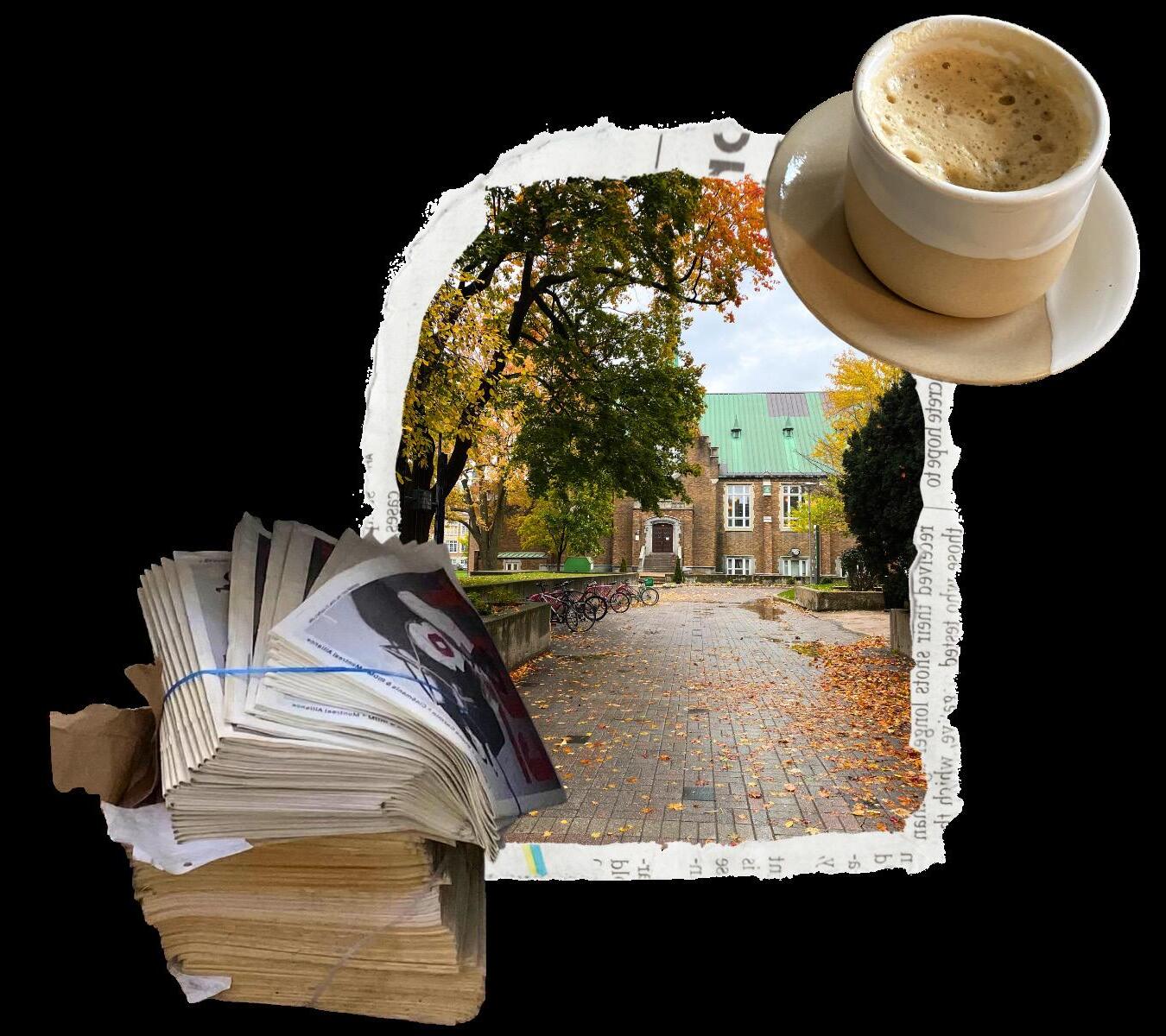
The new year means new classes, and I cannot begin to stress the amount of unexpected friendships I have created in class that have helped me get through each semester. With this new semester beginning I recommend trying to say hi to a friendly-looking face and building relationships with the people around you. A very daunting idea, trust me I know, but when you find someone that you click with suddenly going to class becomes even more enjoyable.
Your first day of school outfit is special to no one but you, however nothing matches the exhilarating feeling you get walking into class and strutting the new shirt you got in front of all your peers. I always try to wear what makes me feel my best to all my classes not only because of the obvious, but because being in school is
where you truly have freedom in what you wear.
As this final year begins I am already longing for an environment where there is no strict, professional dress code that has to be followed, and I am free to dress how I feel.
Finally, I am lucky to say that I am blessed to have a lovely apartment full of roommates that I’ve lived with throughout the entirety of my university experience. The places we have lived, the memories we have made, linger in my mind as I sit in my bed staring up at my walls, full of the most meaningful collection of my possessions.
The finale of this year leaves me reminiscing the things that will be absent from my life once I transition into my next phase.
I am so grateful for all the things Concordia has introduced into my life; my friends, my passions and so many memories that I will forever cherish.
With that, entering this back-to-school season, through any trials and tribulations that may affect your attitude towards school, try to remember the little things that make you happy. Time moves fast, nothing is forever, but you have the opportunity to make the most of each year!
We need to move
on
from
morally
grey inventors and become the educators and communicators society needs us to be.
By Danylo Perkov Assistant Opinions Editor
The former Vice-Chancellor of the University of Cambridge, Lord Alec Broers’, in his 2005 Reith Lecture, claimed that the future of humanity is determined by technology and that today’s society faces a crisis because the public is either unable or unwilling to understand the day-to-day technologies that run our world.
The role of an engineer must change dramatically to focus on societal development if we want to keep pace with the ever-evolving technological advancements.
Technological progress is exponential. It took humanity approximately the same
amount of time to go from bronze to iron tools, as it did from iron tools to nuclear weapons. As is, the first powered flight and humankind’s first steps on the moon were only 66 years apart.
However, societal evolution has not kept up—the activists are still fighting the same basic equality and rights battles they’ve fought for hundreds of years.
This brings to mind the Swiss democratic model: for change to occur, half the country’s voting population must shift its opinion on the subject at hand, which is much easier said than done.
I would define a post-industrial revolution’s “good engineer” as a utilitarian—someone who works with disregard for societal norms or the suffering of mar ginalized groups, as long as it helps them achieve their goal and ad vance society as a whole.
Everything from phys ical materials to human lives are simply a “cri terion of technical effi ciency” and the prices to pay for progress. These are the people who built enormous dams while dis placing Indigenous pop ulations, or advanced chemical warfare while enabling modern crop fertilization.
It
is time to pause or even stop producing “good engineers.”
While we will always need people to build bridges, cars, and phones, we also need to radically change the role of engineers in
they must take on the role of communicators, educators, and policy makers, if we want to keep pace with technological advancement.
Humanity is slowly killing itself with countless wars, global warming, overconsumption and we’re only becoming more efficient at it. We simply do not evolve as fast as technology. Humanity needs to shift its focus on societal engineering, where an engineer’s job is to help shape a society that will care about its longterm survival.
While advocates of societal engineering do exist, most media and public figures do not fully grasp the possible impact of technologies they are talking about. As a result of this and the lack of interest from the general public, society has not understood the gravity of technological impact on our lives.

It is time to retire the technical engineer. Engineering schools should offer classes or degrees that specialize in communicating technology to the broad public. The engineer of tomorrow should focus on shaping society and policy toward long-term goals by demystifying technology and advocating for greater public knowledge of the technology that controls our lives.
The
By Rita Kamel Staff Writer
During the summer break, one of my frieDuring the summer break, one of my friends suggested our group go see the final fireworks of the season under the Jacques Cartier Bridge. This suggestion was initially inconvenient since none of us live downtown, yet we decided to go for it.
We carpooled, laughing till we reached our destination. It took us a while since we weren’t the only people who wanted to take advantage of the fireworks.
The traffic that day was jammed, and parking was a nightmare. We almost
missed the fireworks completely due to the hold-up, but when we finally made it under the bridge and saw the fireworks explode in the sky, all the inconveniences of getting there seemed worth it. The mo ment was so magical, and my favourite part was being there with my favourite people.
I am so glad we didn’t choose to focus on the incon venience of getting there because that day ended up being one of my favour ite memories of the entire summer. All it took was for us to decide to show up.
Being present isn’t always easy. It takes effort and sacrifice.
But as a community, we are starting to realize that the price of a community is inconvenience.

A painting that represents the Sir George Williams Affair within Concordia’s history.
By Kailee Krentz Opinions Editor @kaileeliz
In February of 1969, in the Hall Building many of us know today, a series of protests broke out, against a professor accused of racist and discriminatory behaviour towards Black students. The six students who reported the mistreatment filed complaints with Concordia’s administration, but it was ultimately dismissed.
The protests began with these six students alongside 200 supporters staging a peaceful sit-in inside the ninth floor computer lab, of what we now know as the Henry F. Hall building. The space
was occupied by these students for several days as they maintained their right to protest.
The university attempted to make negotiations with the students, proposing to re-examine the original complaint if the students agreed to leave the building. About 100 students complied, but the other half remained.
February 11th, 1969 resulted in the biggest Canadian student protest against anti-Black racism.
The university began to get the police involved when 100 students still protested despite the negotiations attempted to be made. With this, the students threw objects out of the windows, filling the streets with paper, a fire broke out among the occupied area resulting in damage to the computers surrounding them, while protestors flooded the streets chanting and screaming.
Ultimately, the police broke through the chaos, crossing their barricade, and arresting the 100 remaining students. Their lives were forever altered, while all charges and complaints against the professor were dropped.
It’s tempting to stay home, to convince ourselves that it’s easier to stick to solitude. Reaching out can be scary. Schedules pile up, excuses multiply. But relationships don’t work without effort. Going out of your way for people you love costs time, energy, and comfort. Still, the reward of seeing them happy always outweighs the effort.
Showing up isn’t just about being there when things are hard. Sometimes it’s going to a friend’s midweek soccer game after a long day.
Sometimes it’s running errands together, driving each other home, or saying yes to a bookstore trip even when it’s the last place you want to be. On other occasions it may be sacrificing a Saturday in bed just to spend the day together or taking a bus all the way from Ottawa to come visit.
Relationships in general require work, and the first step is to show up. Everybody wants a village, but the price of having this village is to be a villager.
It’s okay to be inconvenient. No one likes to be a burden but in a healthy community, we take turns carrying the weight. Showing up for one another, and letting others show up for us, is what makes a village worth having. A Swedish proverb says, “Shared joy is double joy; shared sorrow is half a sorrow.” When we show up for each other, life gets lighter. We were never meant to live it alone.
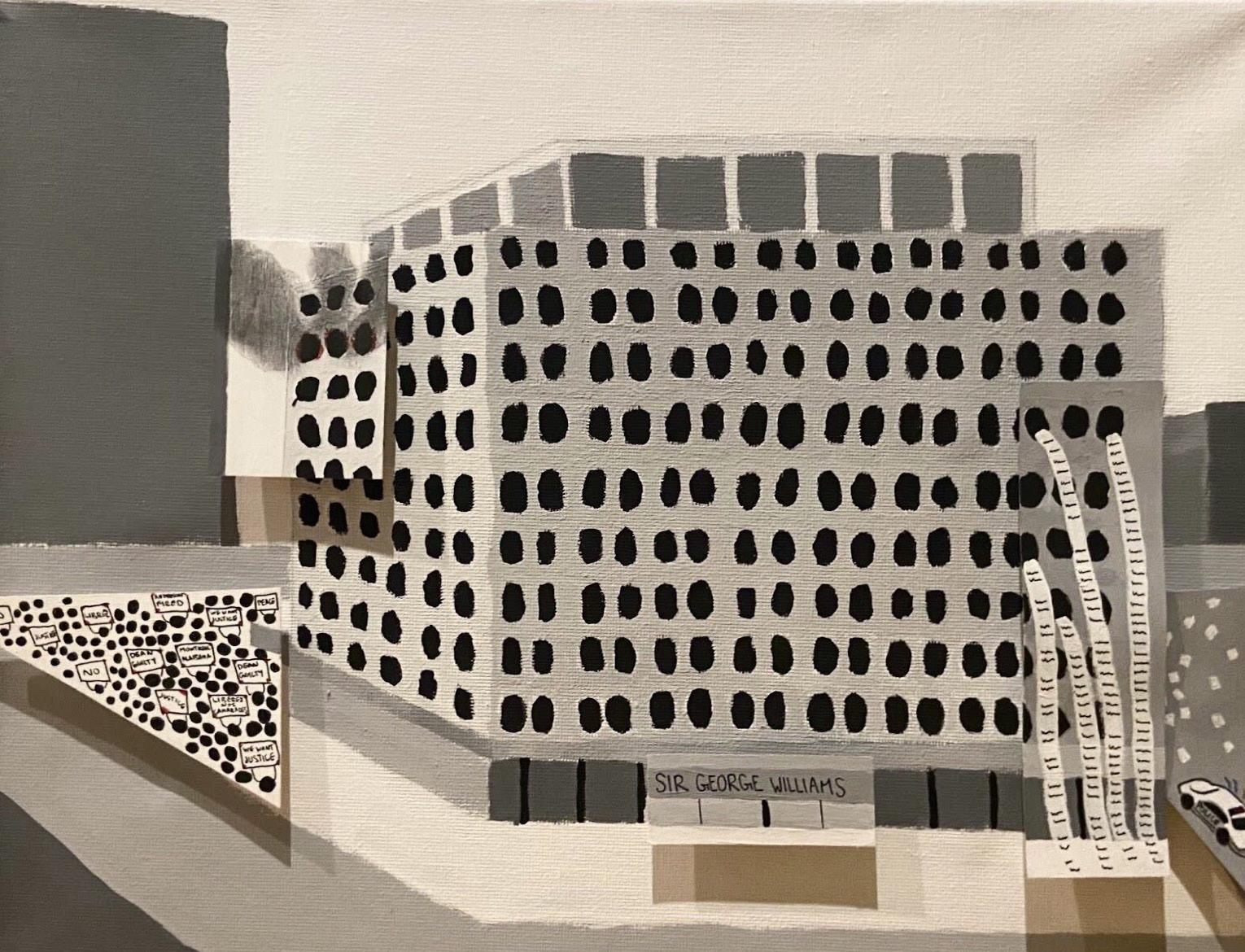
A couple of years ago, after learning about this incident, I created a painting to capture the events of this history-defining day in a way that connects Concordia’s past with its present.
The painting is set on the Sir George Williams University campus—which we now know as Concordia University’s Henry F. Hall building—and includes detachable elements: paper falling from windows, smoke from the fire, police cars on the streets, protestors yelling, and the Sir George Williams University sign. These features serve as reminders of the institution’s troubling yet influential history.
As mentioned previously, this protest-turned-riot remains the largest student protest in Canada, not only in dollars
of damage, but in cultural significance. It stands as a pivotal moment in the history of anti-Black racism, raising national attention. In my own style, I sought to remember the moments that came before me, and become explicitly aware of where we stand today.
As our student community grows, it is our responsibility to acknowledge Concordia’s past in order to properly grow in the future. This is a vital moment not only for the university but Canada, which makes its significance undeniable. By sharing my work alongside this brief recap of a moment in Concordia’s history, I hope to stress the importance of remembering what came before us.






Editor-in-Chief:
Managing
Creative
City
Campus
Campus
Opinions
Opinions
Sports
Production