Volume 43, Issue 19: February 24th 2026

Page 1


CSU general election nomination deadline approaches on Feb. 27 for students wanting to join the student union

Campus News page 2

CAQ removes abortion rights clause from proposed constitution

City News page 4

See no Ukraine, hear no Ukraine, speak no Ukraine

Opinions page 7

L’école au Québec n’a jamais été réellement gratuite Pages Francos 9

Keeping it Canadian: the importance of defining Canadian media

Arts & Culture page 11 The Oscar Peterson Scholarship approaches on Feb. 26 Music page 12 Mendel Joseph controls the controllables Sports page 14

Spot the difference, Connections, and Crossword

43

February 24, 2026 Volume 43, Issue 19

ICE, Bill C-12 and migrant justice at Anti-Capitalist Week

Mostafa Henaway speaks at AntiCapitalist Week workshop about linking migrant justice to broader struggles.

On Feb. 20, 2026, the Concordia Student Union (CSU) hosted Mostafa Henaway as part of Anti-Capitalist Week to discuss migrant justice in the context of the U.S. Immigration and Customs Enforcement (ICE) and the Canadian Bill C-12.

ICE has recieved growing criticism under the Trump administration

due to increased deportation enforcement and violent immigration raids, which has prompted global protests. Montreal is one of five Canadian cities with ICE offices.

In Canada, the proposed Bill C-12 would give the cabinet along with the Immigration Department more power over immigration decisions. This includes the ability to change or cancel certain immigration documents and statuses.

On Feb. 23, several Canadian outlets reported that the social affairs committee is lobbying for significant changes to the bill.

Henaway’s workshop focuses on how immigration enforcement systems affect migrant workers and labour conditions. He drew a connection between ICE and Bill C-12, arguing that they are used to control migrant workers and keep them in unstable and insecure jobs. Henaway has been a community organizer with the Immigrant Workers Center in Montreal for over 20 years. He is also the author of the book Essential Work, Disposable Workers.

Henaway also referenced a worker who was fired after raising concerns about the working conditions in the warehouse, during the pandemic.

The impacts of strict immigration policies go beyond just the workplace.

“There’s constantly this rhetoric of like, you know, Canada is kind of like the safe place and we’re not the state[s]. Canada just is quite similar to the states in a lot of ways,” said Julianna Smith, CSU Campaigns Coordinator and organizer for Anti-Capitalist Week.

“Bills like Bill C-12 are really just emboldening Canada in a lot of ways to follow in the US’s footsteps, just in this more disguised and polite tone that is Canadian politics.”

Smith explained that Anti-Capitalist Week used to be known as Anti-Consumerism Week.

“Anti-consumerism is really important, but we’re kind of tiptoeing around the real issue, which is capitalism,” she said.

This series was also in collaboration with ASFA’s equity and executive coordinator and CSU councillor, Gaby Aragon.

Aragon, a refugee and student themself, has been living in Canada for 10 years. Two years ago, they finally got their Canadian citizenship.

“I wrote my letter to the government about why I deserved to be in Canada and to be a Canadian when I was 16,” they said. “Which is really rough and strange to ask a minor to tell them why they are deserving to be in a country.”

Since receiving their citizenship, Aragon has dedicated their time organizing Anti-Capitalist Week, leading The Mad Workshops & Social Therapy and even founding Students for Migrant Justice.

Through their work, Aragon said they aim to create safe and educating spaces for students on campus.

The deadline for a second vote reading of Bill C-12 is Feb. 26.

Concordia Student Union winter 2026 general election

The nomination deadline approaches on Feb. 27 for students wanting to join

the student union

Do you enjoy the free food on campus, offered by the Hive Free Breakfast and Lunch or the People’s Potato?

Did you wish you could be more involved in the decision-making that rejected Art Matters and Legal Information Clinic fee levy applications?

Do you wish to see more opportunities to vote on motions like the Boycott, Divestment, Sanctions motion?

From dental and healthcare coverage to the legal information clinic, daycare and the gym, the Concordia Student Union (CSU) manages many of the services that impact your daily life as an undergraduate student. If you have ever wanted to change how these services work or implement new ideas, you have that opportunity. The CSU nomination period is officially open, offering every undergraduate student the chance to have a direct say in the union’s direction.

Council

vs. Executive:

As a councillor, your main responsibility is attending monthly council meetings where you vote on motions, such as reviewing fee-levy requests.

You can also join specific committees or working groups that align with your interests, such as the Student Life Committee, the Black, Indigenous, and People of Colour (BIPOC) Committee, and the Sustainability Committee, among many others.

As an executive, you are assigned a specific portfolio, such as finance or coordination. Executives manage the dayto-day operations of the CSU and carry a significant amount of responsibility.

There are in total thirty councillors; thirteen for Arts and Science, six for Engineering and Computer Science, six for John Molson School of Business, three for Fine Arts, and two for Independent students.

All positions on both the council and the executive team carry a one-year mandate and are up for contestation every year during the general election.

How to Get Nominated

To get your name on the ballot, you must complete a nomination form and collect signatures from fellow CSU members, which includes any undergraduate student currently paying the student union fee.

• Council Nominations: Requires 40 signatures.

• Executive Nominations: Requires 120 signatures.

The process is rather straightforward; “if you correctly do the nomination form, you're going to get nominated, you're going to be on the ballot,” said Callum Ellis-Mennie, the CSU’s Chief Electoral

Officer (CEO). He recommends that interested students sub mit their forms before the Feb. 27 deadline, in case a candidate is miss ing any information.

“If you run as a coun cillor, you have a pretty good shot of getting in,” Ellis-Mennie said.

Completed nominations must be submitted by Feb. 27. If you are unsure about your eli gibility or have questions about the process, you can reach out to ceo@csu.qc.ca for clarification.

This year, to hear from as many candidates as possible and to provide campaigns with a space to clearly express what changes they hope to implement for the student body. We encourage all candidates to reach out to The Concordian to have your platform clearly outlined and explained to the student body.

The Concordian not endorse candidates and will live up to our journalistic standards throughout the process.

We can be reached at campus@theconcordian.com or editor@theconcordian.com.

CURE CONCORDIA CURE CONCORDIA

Concordia mentioned seven times in the Epstein files

The U.S. Department of Justice recently published additional records, following the enactment of the Epstein Files Transparency Act. Concordia University appears in seven of the documents.

Newly released court documents related to the Jeffrey Epstein case include seven documents with mention of Concordia University. The documents do not show wrongdoing by the university and the mentions exist within a broader collection of millions of unsealed records.

The records are a part of public court files connected to the late American financier Jeffrey Epstein, who was federally charged with sex trafficking minors in 2019. Epstein died later that year in custody.

In late January, the United States Department of Justice (DOJ) released an additional three million pages to comply with the Epstein Files Transparency Act. According to the DOJ, the latest publication includes more than 2,000 videos and 180,000 images. In addition to including thousands of media documents, it also names locations, institutions, and individuals.

The first two mentions of Concordia University, which are identical in terms of content, appear in a list of seven news and magazine articles that were sent to Epstein’s personal email by the Office of Terje Rød-Larsen, former president of the New York-based Peace International Institute.

Concordia University is mentioned in the last article, titled “The Vagina Chronicles” by Naomi Wolf. The article discusses the relationship between female sexual pleasure and the neurological and bodily wellbeing, and references a study done by former Concordia psychology professor Jim Pfaus and his research team.

In a 2019 report, CBC reported that Pfaus was the subject of an internal investigation at the university. According to CBC, former members of the university community raised concerns about his conduct, including allegations that he pursued personal relationships with students.

CBC reported that the university declined to disclose the outcome of the investigation, citing privacy laws. Students and colleagues quoted in the report expressed frustration over the lack of transparency.

Jim Pfaus told The Concordian that he believes sexual or romantic relationships between students should not take place under any circumstances, including due to the imbalance of power that exists between the two.

“The CBC report did enough damage and there is no way that I can get rid of it,” he wrote in an email to The Concordian “In my opinion it was not factual (in fact, it was a rendering of the incredibly biased report made by the Dean’s office that was designed to make me look like a monster), and I deny much of it.”

Concordia University declined to comment on Jim Pfaus’ case.

“For reasons of confidentiality and privacy, including privacy legislation, we cannot discuss any specific matter regarding our current or former faculty, staff or students,” Concordia deputy spokesperson Julie Fortier wrote to The Concordian

The next mention of the university appears in a curriculum vitae of an individual who completed their postdoctoral studies in behavioural neurobiology and taught at Concordia for four years.

Another dataset, which also references the individual, contains an email sent to Epstein’s professional email, requesting financial support for their research on Alzheimer’s disease. Four days later, the email was forwarded to Epstein’s personal email by a source whose name was redacted in the documents.

On July 30, 2013, a screenshot of an accepted LinkedIn invitation was sent to Epstein’s personal email. Epstein had sent an invitation to a professor at the University of Auckland, and one of this professor’s LinkedIn connections is a professor at Concordia University. The Concordia professor has only been mentioned once in the files, and that mention appears in this document.

Another document in the files contains a biography of Montreal-born pianist Oscar Peterson. The eight-page biography mentions Concordia five times, reflecting his ties with the school. Peterson received an honorary doctorate from Concordia in 1979.

In 1999, the university named its concert hall on the Loyola campus after him. Although the reason for the biography’s

inclusion in the files is not specified, Peterson appears 18 times across emails, text messages, and other documents.

In addition to the previous datasets, Epstein’s personal email received numerous communications from the American-Israeli Cooperative Enterprise newsletter. In one message sent in mid-July 2016, the newsletter included a section promoting a podcast hosted by Israeli journalist Gilad Halpern. The podcast discussed the parallels between Zionism and Irish nationalism and featured a postdoctoral scholar in Israel Studies at Concordia as a guest.

The final dataset lists investors in the private investment fund D.B. Zwirn Special Opportunities. The list includes Concordia University as one of the investors, and provides the name and phone number of a primary contact associated with the university.

The document does not explain why this individual has been named, and no publicly available information reviewed by The Concordian confirms a connection between the listed contact and the university.

Concordia qualified the mentions of the university in the Epstein files as “very tangential” and Fortier did not have any information as to why these mentions appeared in the files.

“Importantly, we don’t have any context as to why some items, such as someone’s C.V. or biography appear in the files,” Fortier told The Concordian.

Abortion-rights removed from proposed constitution

Critics warned that any new law on abortion rights could make them more vulnerable to potential legal challenges.

The Coalition Avenir Québec (CAQ) initially included an article in the proposed constitution codifying women’s right to obtain an abortion, but advocacy groups and legal experts argued the measure could open the door to legal challenges.

“The State protects women’s freedom to have recourse to a voluntary termination of pregnancy,” read Bill 1, the proposed Quebec constitution.

The right to an abortion is protected on

the federal level by the Canadian Charter of Rights and Freedoms — rather than through a specific statute — and was reaffirmed by constitutional law established by a Supreme Court decision in 1988.

Currently, abortions in Canada are legally considered medical procedures. Critics warned that applying any new wording to abortion rights at the provincial level might make them more vulnerable to reinterpretation.

Justice Minister Simon Jolin-Barrette explained his decision to remove the provision in an open letter published in Le Journal de Montréal on Friday, though

he expressed continued concern over threats to abortion rights.

“I remain convinced, as do many others, that Quebec is not immune to the possibility that women’s rights will one day be called into question. I sincerely hope that day never comes,” he wrote.

The CAQ introduced a draft of the Quebec constitution, known as Bill 1, in October. The proposed constitution seeks to affirm Quebec’s distinct “national character,” reinforce the primacy of the French language, and enshrine the government’s strict secularism laws.

New pay-for-parking system at certain REM stations frustrates commuters

Combined with its already existing reliability problems, some users are left wondering whether also paying for parking makes the REM worth it at all.

@meghrighazarian

The Réseau express métropolitain (REM) has begun implementing a new payfor-parking system at several stations. The decision has raised concern among commuters who drive to access the network, particularly in suburban areas.

Parking directly at the REM stations is often the most practical solution for those living in the suburbs, given the often rare and sometimes unreliable public transit options.

The REM has partnered with the parking company Indigo Neo to manage designated paid parking zones at its stations. While, as on the South Shore, most parking places are still free, the introduction of pay-for-parking zones will force some users to pay much more to continue using the service, or turn to other options.

Under the new pricing model, a daily parking pass costs $10.29, while a monthly pass costs $121.30, a price that some commuters say is nearly equivalent to the cost of their monthly transit passes.

For commuters who drive to get to the REM, the added expense feels discouraging. Matthew Hantar, a student at Polytechnique Montréal, drives to the Deux-Montagnes station every day and said he would never consider paying for a monthly parking subscription.

“I have the ‘ABC’ pass, and it’s $120 and [...] the parking subscription is $120 per month too, so it’s quite expensive,” he said. “I would never pay it, and I don’t think I’m ever going to pay it.”

Hantar, who lives in Deux-Montagnes, believes the cost of parking, combined with frequent REM service disruptions, makes the system less appealing overall. He said the new policy could push people away from using the REM altogether.

Paid parking zones to promote other modes of transportation

Caisse de dépôt et placement du Québec (CDPQ) Infra built and manages the REM. Francis Labbé, the deputy director of media relations, wrote in a statement to The Concordian that the goal of the paid parking zones is to encourage multiple ways of accessing REM stations rather than relying solely on personal vehicles.

“CDPQ Infra aims to maximize access options to REM stations by promoting various modes of transportation, including active and public transit, as well as access by personal vehicle,” he said.

However, Hantar argues that alternative transportation options are unrealistic in suburban areas, saying local bus services are unreliable and infrequent, leaving driving as the only practical option.

“In the suburbs, buses are not reliable. They don’t come often, and if they come, they’re late most of the time,” he said.

Urban planning experts also question the logic behind discouraging drivers after building infrastructure designed to accommodate them. Craig Townsend, associate professor and chair in the department of geography, planning and environment at Concordia University, said the introduction of paid parking contradicts the original intent of park-and-ride transit stations.

“If they are making statements about wanting to discourage people from driving to the stations, my interpretation would be that they are actually maybe trying to distract from the fact that they’re actually needing to and trying to make money from this,” said Townsend.

When asked about his perception of how the space is currently being used, Hantar said he believes it is a waste of space.

“I walk by [the pay-for-parking zone] every day. No cars in sight. Wasted space for real.”

The REM now faces criticism from some users who feel the new policy creates a finan cial barrier to public transit. For students, low-income riders and suburban commut ers with limited alternatives, the additional cost raises questions about accessibility and equity.

network, with some reserved for carpoolers and people with disabilities. With the introduction of paid parking zones, however, the number of free spots available to solo drivers has decreased.

New pay-for-parking zones have recently been introduced at the Pierrefonds-Roxboro and Sunnybrooke stations.

As the REM continues to expand and adjust its services, commuters are left weighing whether the network’s convenience still outweighs the rising costs. For some, the new parking fees may ultimately determine whether they continue using the REM at all.

Listen to the full audio version of this story on Substack and Spotify!

Labbé said there are approximately 10,000 parking spots across the entire REM

Five billion in cuts over 10 years for public transit funding

The budget of the Canada Public Transit Fund will go down from $30 billion to $25 billion.

The Canada Public Transit Fund was originally announced in 2024 and dedicated $30 billion for public transit and active transportation infrastructure over 10 years, starting in 2026.

Speaking to reporters in Ottawa on Feb. 5, Minister of Housing and Infrastructure Gregor Robertson justified the decision by saying that another program, the

Build Communities Strong Fund, would offer cities more flexibility.

“The Canada Public Transit Fund does go from $30 to $25 billion in the budget,” Robertson said. “That is guaranteed funding that is available to cities for public transit. In addition to that, we have tens of billions more that’s accessible through the Build Communities Strong Fund.”

The Build Communities Strong Fund is a new $51-billion program announced in the latest federal budget. It is dedicated to local infrastructure.

The STM is “very concerned” with the funding cut

The Société de transport de Montréal (STM), which already faces significant budgetary challenges, fears these cuts will only exacerbate these issues, particularly in maintaining and renewing its infrastructure.

“The STM is very concerned about the reduction in the amounts available in the

Canada Public Transit Fund, which it has been waiting to benefit from since its announcement,” the STM wrote in a statement to The Concordian

Over the next 10 years, the STM intends to spend $15.2 billion only for asset maintenance. However, the STM told The Concordian only $2.8 billion had been approved, meaning it’s still awaiting for $12.4 billion in funds to be appropriated.

“Thus, any reduction in available funds slows down the launch of projects such as the replacement of the MR-73 trains, which will be 50 years old in 2026 and are the second-oldest subway trains in service in the world,” the STM added in its statement.

The STM also clarified that user service would not be disrupted by these funding cuts.

Funds are yet to be allocated

The exact amount of funds that Quebec or the Greater Montreal Area would receive for programs is yet to be determined.

The Autorité régionale de transport métropolitain (ARTM), which oversees and coordinates all public transit agencies in the Greater Montreal Area, explained that the Quebec government would determine where those funds would be distributed once it reaches a deal with Ottawa.

“It is up to the Quebec government to reach an agreement with the federal government regarding the envelope allocated to the province,” the ARTM wrote in a statement to The Concordian. The STM has a similar vision of the situation to the ARTM, urging the provincial and federal governments to come to an agreement.

“When we know that more than $5 billion has already been distributed in the rest of Canada, but nothing in Quebec, it becomes urgent for the two higher levels of government to reach an agreement to allow the transfer of funds,” the STM added in its statement.

Polytechnique student and REM user Matthew Hantar criticized the REM's decision to create pay-for-parking zones. Photo by Meghri Ghazarian // Podcast Editor // @meghrighazarian

Anticipating the most dreaded season of the city

How

I am managing to survive winter as a first-time Montrealer.

When it comes to advice about the winter, some would say I’d be the last person they would go to.

As someone who grew up in a subtropical climate where winters lasted a week — two if we were lucky — and the down jackets were broken out the minute temperatures dropped below 20, I have to admit, the Montreal winters took some adjusting to.

When I arrived in Montreal and introduced myself to people, the first thing anyone told me was that the winters were really brutal. I heard it over and over, and what was once a slight hesitance became a lot of nerves that kept growing in the months leading up to December. I always knew that Canada was cold, but everyone seemed to emphasize that Montreal was a different kind of cold, and soon enough, I realized that maybe I, along with a few of my exchange student friends, may have been the only ones who held any ounce of anticipation for it. All of my nerves, all of that fear that everyone instilled in me, left the morning of the first snowfall in November. It was a moment I had been waiting for, looking out my window every few seconds to

see if it was happening, to make sure I wouldn’t miss it. Little did I know that once it started, it would be impossible to miss.

There’s almost a childlike wonder that comes with experiencing something so simply magnificent as snow. All of the hours I spent mindlessly staring out my window, unable to concentrate in class because it was actually snowing.

That first night, as a random stranger attacked me with a snowball, and as we spent hours building a snowman behind the dorm, I couldn’t fathom how anyone could ever hate it. I was living in my own little snow globe. Every little thing became extraordinary because my whole world was blanketed in this clean, fresh, white snow.

Of course, that being said, it’s not always easy.

I’ll admit that sometimes it’s hard to get out of bed in the morning, to find motivation to go for a walk and meet people when it’s freezing. Are there days when I wish I could wear my white sneakers without worrying about them getting ruined, or only wear one layer instead of two? Do I miss walking on flat ground and being able to move the muscles in my face when I’m outside? Absolutely, but even on the coldest days, the sun still shines.

Maybe I haven’t experienced the worst of it, or maybe I’m just living on the thrill of experiencing my first winter ever. What might be a miserable snowstorm to one person is somebody else’s dream. Call me cliché, but it’s really all about how you look at things — and just maybe having the right coat.

dating advice

The problem with dating advice online, and how it can bring more confusion than clarity.

I wake up in the morning and the first thing I do is open Instagram, where I’m greeted by a tarot card reader. She draws the Lovers card from her stack, and with a smirk on her face, gleefully informs me that the person who ghosted me six months ago is actually planning to re-enter my life soon.

The next video is of a dating coach and intimacy guru with 16 years of experience in “manifesting the relationship of your dreams.” They tell me that when a person shows you who they are, you must believe them, and that second chances shouldn’t be granted under any circumstances.

Ten videos and ten different dating hot takes later, I have ultimately regretted my decision of opening the app at all.

The influx of dating advice around us has made it feel impossible to decide what we’re supposed to do. We turn to social media for relatability and guidance, but how can we navigate this when everyone expresses contradicting opinions?

The internet is constantly churning out new dating terminology — from breadcrumbing and love bombing, to “if they wanted to, they would.” It’s easy to attribute someone’s actions to an explanation we’ve seen online, but this encourages a very black and white way of thinking.

When you view a potential partner through the lens of online terminology, you are subconsciously placing them in categories of good or bad. This lends itself the risk of prematurely ending a connection that has the potential to be fruitful.

We’ve intellectualized the act of dating so much that it feels like we’ve lost the idea completely. Dating no longer feels like a chance at building a connection, but rather a game we’re all trying to become masterminds at and win. We’re treating humans, who each carry their own complex sets of feelings and emotions, as variables in a formula or pieces of a puzzle waiting to be arranged perfectly.

People online can only describe a situation based on their personal experiences. They may share their wisdom with viewers online, but ultimately, they can only speak from what they know to be true for themselves. As universal as dating may be, it is also a completely unique experience between two people that cannot be replicated.

We constantly preach that what we see on social media isn’t real, so why are we treating the advice we see online as gospel, letting strangers dictate what is right or wrong in our relationships?

There is no trick to achieving a human connection, no cheat code to getting someone to like you, and no correct way to date. The right person won’t have you waiting an hour to respond, because they left you on delivered for two. Nor will they have you crafting the right text with the perfectly curated intention to keep them coming back for more.

At the end of the day, you’re the one experiencing the relationship, not some stranger on TikTok. So let yourself, and not an algorithm, guide it.

Graphic by Anna Huang // Graphics Editor // @itza_me_anna
Photo by Abigail Best //

See no Ukraine, hear no Ukraine, speak no Ukraine

The slow and steady re-normalization of Russia on the international stage.

February 24, 2025, marks four years since the full-scale invasion of Ukraine by its neighbour and more than a decade of occupation and war. While initial reactions on the international stage were swift, with Russia and Belarus being shunned from most international organizations and placed under heavy economic sanctions, the two are slowly regaining a stable image once again.

Now, with the invasion of Ukraine taking a backseat in most Western news coverage, Russia is pushing its way back into media and international events such as the Olympics, attempting to normalize its presence and culture on the international stage. This should not be allowed to pass, as it leads to the normalization of the current status quo, distracting Western audiences from the atrocities committed by Russian forces; like a child being bribed with ice cream to stay silent about a friend being beaten at school.

Probably the most controversial instance during the last year was the “documentary” film Russians at War, produced by a Russian-Canadian cinematographer, Anastasia Trofimova. It attempts to humanize the “regular Russians” fighting in the war, while shifting all the blame to a corrupt and ruthless government. The same “regular Russians” who operate torture chambers and commit war crimes in Ukraine.

While so much more can be said about it, I believe that a review by Justin Ling, an independent investigative journalist based in Montreal, puts it best: “Russians at War, however, shouldn’t be viewed as Pravda. It is an artistic effort which obscures a simple fact: It is the Russian government, enabled by its citizens, which continues to prosecute this war. Its soldiers are human, yes, but they are neither noble nor blameless for the carnage they cause.”

It was always the regular, everyday people who carried out atrocities throughout human history, and such precedents shall not be forgotten. One cannot be anti-war and stay neutral; the only way to truly be against an expansionist war of aggression is to support Ukraine's sovereignty.

Addressing the most recent elephant in the room — international sensation, Heated Rivalry, a series based on the book of the same name, takes place in 2014 when Russia first invaded Ukraine, since the country’s independence. The series completely fails to address Russia’s invasion of Ukraine, instead reverting to the same talking point of humanizing everyday Russian people who simply pretend that their country has not been engaging in expansionist wars since the 1990s.

Furthermore, the series features music from Russian artists that have publicly expressed their opposition of LGBTQ+ rights, which seems counterintuitive for the specific TV-series in question. More often than not, a country’s democratic ranking is closely related to the country's LGBTQ+ rights. These issues thus cannot be presented separately. Claiming to be bringing awareness to only one of them while pretending the other simply does not exist shows the ignorance of the larger issue at hand.

Addressing a nation’s treatment of queer people without also addressing the larger issue of societal values is a bandaid solution that will lead nowhere. In a society that opposes homosexuality at large, commiting anti-gay purges, it is no surprise that an expansionist war towards a smaller country is allowed to go on and even viewed positively by the population.

This September, the International Paralympics Committee (IPC) lifted the ban on Russian and Belarusian athletes competing in Paralympic games that had been in place since 2014. If allowed to proceed, this will be a major milestone for Russia’s acceptance back into international events, signalling that the world is willing to overlook its invasion of a sovereign country.

This comes off as shocking news, especially after a Ukrainian skeleton racer in the 2026 Milano Cortina Olympic Games was disqualified after honouring Ukrainian athletes killed in the war by Russian forces. The Olympic committee claims political neutrality, which is an impossible thing in today’s world. International organizations will oftentimes use the term “neutrality” to stay vague in their own rulebook and avoid moral responsibility. However, in this digital age, it is impossible to be apolitical as all international events are intertwined with politics and are constantly used by all countries to promote a certain image or message.

International sports competitions have long been popular public relations events for countries such as Russia, China, Qatar and many more, to distract the world from human rights and international law violations committed by them.

Just as many countries boycotted the 1980 Olympics after the Soviet invasion of Afghanistan, it might be time to bring the trend back and call for more countries to boycott future Olympics. As long as the IPC allows Russian and Belarusian athletes to compete under their own flags, the event must be boycotted.

As the large scale military movements stall and the Western coverage of the war diminishes, it is important to remind ourselves that Russia is still targeting civilians and air workers across Ukraine with suicide drones almost daily.

Russia is a terrorist state that is pouring millions of dollars to divert the attention of the international public away from their invasion of Ukraine and towards other wars and instabilities around the world, or towards promoting their own image via “neutral” international events.

Events such as the Paralympics — a discipline that has only gained popularity in Russia as the number of soldiers returning from Ukraine with permanent injuries keeps growing.

An online information war is as important to the end of this war as ever, as Russian online bot farms use social media platforms such as X to sway the public opinion on the imperialist country or promote disinformation about Ukraine.

A lot of worldwide conflicts are interconnected and should be studied in relation to each other. When looking at terrorist organizations committing war crimes in Africa or the Middle East, one must only follow the money trail.

When depicting Russia, it is important for artists and activists to highlight the country’s long and unanswered history of colonialism stretching to the present day. Russia cannot be allowed back onto the international cultural stage until the country’s backwards mindset is changed and their crimes are rightfully prosecuted.

The relief food banks bring to a tight budget Poverty

doesn’t look the way you think it does.

We carry stereotypes about what poverty is, looks like and who is affected. Canada’s 2025 Report of the National Advisory Council on Poverty pointed out that, “the poverty rate in Canada continues to rise […] leaving many unable to meet their basic needs.” According to Statistics Canada’s 2023 Market Basket Measure, the poverty line for a single person in Montreal is $24,329 yearly, just over $2,000 per month in disposable income. Also in 2023, the Canadian Income Survey found that 4 million Canadians “lived below the poverty line.” Financial instability is a broad spectrum with more people impacted than we realize. On Episode 6 of Financing My Future, Tasha, a third-year psychology student and community advocate with the Concordia Food Coalition and the Atwater Community Food Pantry, highlights how programs like the Hive free meals and groceries are not supplementary — they are the reason her budget works at all.

Relying heavily on government loans, bursaries, and some support from her parents, it is still difficult to afford all expenses. Especially when emergencies like glasses of six years become so scratched she cannot see and their replacement costs $500, out of pocket. “It completely derailed absolutely everything,” she said of her carefully planned budget. Raised in a privileged household, money was first understood as a gift; with Easter egg hunts centered around hidden money instead of chocolate. She quickly learned that money is not always so accessible, and that educated, hardworking and supported individuals can still fall “into what poverty on paper is.”

Whether someone struggles to keep a roof over their head, braces themselves for rent day, and considers strategies to survive on a $150 food budget, poverty is widespread throughout Canada. It impacts the people you take classes with, graduate students applying to jobs with no success, and recently fired professors without a backup plan. It is people who work hard, but still cannot get ahead.

Why do people go to a food bank?

So they can eat.

Archive photo by Catherine Reynolds.

L’Après des Jeux

Les villes olympiques veulent intégrer davantage le développement durable.

Les Jeux olympiques sont un événement spécial qui accueille des athlètes du monde entier. Elles offrent aux villes la possibilité de construire des infrastructures permettant aux gens de pratiquer une variété de sports différents. Mais qu’est-ce que deviennent ces bâtiments après les Jeux?

Plusieurs de ces infrastructures, cependant, ne sont plus vraiment utilisées après les Jeux. Certaines sont même abandonnées, poussant les amateurs d'urbex à les visiter.

Comme il serait plus rentable de trouver des solutions écologiques au problème, les urbanistes, par exemple en France, ont choisi de créer des constructions plus durables pour l'événement. Cela fait partie des solutions qui existent déjà, comme reconvertir les bâtiments après la fin des Jeux pour s'assurer qu'ils aident l'économie locale ou bien utiliser des bâtiments faciles à démonter par la suite.

À chaque événement olympique se déversent d’importantes sommes d'argent. En effet, plusieurs municipalités qui ont accueilli les athlètes olympiques, telles que Montréal, Athènes, Rio de Janeiro et Pékin ont eu recours à d'importantes sommes d’argent public pouvant souvent

faire l'objet d’une escalade de coûts. Ces dépenses représentant des milliards de dollars sont investies afin de servir à construire des bâtiments, espaces et installations sportives, pour un événement d’une durée de deux semaines.

Cela inquiète les planificateurs urbains qui font face aux coûts élevés. En effet, l'olympisme moderne comporte aussi beaucoup des défis au niveau de l’aménagement, de la revitalisation et de la préservation de l’espace urbain. Son héritage fait partie d’innombrables conséquences environnementales à longterme qui concernent les acteurs locaux, même après la fin des jeux.

Par exemple, suivant les Jeux olympiques et paralympiques de 2024 à Paris, des initiatives de développement durable ont déjà été mises de l’avant pour la construction et la reconversion des parcs olympiques plus écologiques et bénéfiques pour la qualité de vie des résidents environnants.

À ces mêmes Jeux, la priorité a été donnée à une réduction de l’impact environnemental par l’utilisation des sites existants, des énergies renouvelables et des matériaux de construction plus durables, ainsi qu’une reconversion complète d’un village olympique, transformé en écoquartier.

Pour Milan-Cortina 2026, les initiatives de durabilité s’ajoutent à l’héritage des Jeux olympiques précédents, grâce à une priorité accordée à l’utilisation des sites existants, aux énergies propres et à l’économie circulaire.

Pour plusieurs villes olympiques dans le monde, des experts en urbanisme ont également constaté que le surtourisme ou la gentrification des lieux peuvent devenir un réel problème pour les citadins, car certains habitants subissent les conséquences

sociales liées aux nouveaux bâtiments et infrastructures, suite aux Jeux.

Cela dit, les Jeux olympiques présentent de nombreux avantages sociaux et culturels. Une ville olympique s’inscrit dans l’histoire du monde. Nous la connaissons, car son héritage laisse penser à une ville patrimoniale ou touristique. Les gens voyagent à travers le monde pour assister à un événement sportif.

Mais une fois que les athlètes retournent dans leurs pays, plusieurs de ces municipalités ne demeurent pas inchangées.

L’héritage des Jeux olympiques laisse croire qu’il existe des liens profonds entre l’urbanisme et le développement durable.

Depuis le début des années 1900, la progression spectaculaire des Jeux olympiques suggère que leur mise en candidature auprès d’un comité international porte une importance autant économique que symbolique. La diffusion de l’événement en tant que telle reflète des valeurs universelles telles que l’amitié, l’unité, l’excellence et le respect entre nations.

Ce sont ces valeurs qui caractérisent l’esprit d’olympisme, un terme singulier qui sert à décrire les devoirs, rôles et responsabilités de la nouvelle génération devant un monde en plein transition. Cette perspective est ce qui permet d’engouer les foules et d’inscrire l’événement dans l’imaginaire collectif. En revanche, l’olympisme moderne comporte aussi beaucoup des défis au niveau de l’aménagement, de la revitalisation et de la préservation de l’espace urbain. Son héritage fait partie des conséquences qui concernent divers acteurs locaux même après sa fin. D'un point de vue géographique, ils permettent aux gens de célébrer leur équipe favorite et encouragent des valeurs universelles, mais elles comportent aussi des

inconvénients environnementaux qu'il ne faut pas sous-estimer.

Graphique par Tolganay Medet

En partenariat avec et financé par L’Organe

L’obsession du « genre »

de métro.

Un québécisme omniprésent dans les conversations quotidiennes.

La semaine dernière j’ai pris le bus plus tôt qu’à mon habitude pour revenir à la maison, l’heure en question étant la fin des classes des jeunes du secondaire.

Mes écouteurs sans fils étaient capouts, faute de motivation de les avoir chargés la veille. J’ai donc dû me satisfaire des bruits environnants du bus chargé à bloc, un lundi après-midi.

Les premiers arrêts furent calmes, malgré l’achalandage du bus. Quelques jeunes autour de moi jouaient à des jeux mobiles, d’autres s'échangaient des TikToks à volume raisonnable et d’autres se piquent un petit somme jusqu’au prochain arrêt

Puis, un groupe de filles rentre. Elles ont tout au plus 14 ans.

J’écoute la conversation d’une oreille distraite, tout en répondant à mes courriels de la journée. Et là, j’entends « genre ». « Genre » ici faisant référence au marqueur de relation communément utilisé dans le joual québécois.

Comme dans la phrase « Ouin pis genre y’a… ».

S’en est suivie une fixation momentanée sur le mot qui semblait être essentiel à la conversation, comme s'il était impossible de concevoir une phrase sans ce mot. Du moins, pour les filles qui potinaient à ce moment précis.

Quand je suis finalement débarquée du bus quelques minutes plus tard, j’avais comptabilisé plus de cinquante « ouin pis genre ».

Comment c’était possible de répéter le même mot autant de fois, sans qu’il perde sa valeur? Comment se faisait-il que ce mot ajoutait de l’intrigue au fur et à mesure de l’histoire?

Depuis ce trajet, je pense beaucoup à ma propre utilisation du mot en g, et, pour être franche, je crois l'utiliser tout autant

que ces adolescentes. Surtout lorsque j’explique un sujet avec passion, ou bien que je raconte une anecdote hors norme. Il se faufile à travers la conversation, que je le veuille ou non.

Bref, « genre » est essentiel dans la bouche de nombreux Québécois et Québécoises. Il est omniprésent dans les conversations quotidiennes et on ne devrait pas s’empêcher de l'utiliser.

L’école au Québec n’a jamais été réellement gratuite

Mauvaise nouvelle :

s’asseoir sur un banc d’école vous coûte la peau des fesses !

Par Alexandra Montenegro Nodarse

Rédactrice attitrée

Si l’éducation québécoise est gratuite, la réussite scolaire, elle, peut vous coûter les yeux de la tête. Même si apprendre, ici, ne coûte pas un rein, cela risque tout de même de vous coûter un bras !

En effet, aujourd’hui, hélas, une telle amputation budgétaire est nécessaire pour aller à l’école. En fait, l’éducation, un droit supposément fondamental au Québec, s’achète et se vend comme une simple marchandise. Loin d’être universel comme on le pense, le système d’éducation, conçu en réalité pour soutenir les élèves favorisés, donne des chances à ceux qui en ont déjà.

Selon l’Institut de recherche et d’informations socio-économiques (IRIS) , les écoles privées ont obtenu jusqu’à 75 % des subventions des écoles publiques en 2024. Pourtant, ces établissements exclusifs reçoivent déjà des dons déductibles d’impôt. Ces dons aux écoles privées

Graphique par Gabriella De Donno // Collaboratrice // @gabriella__dd
Graphique par Anna Huang // Éditrice graphique // @itza_me_anna

Keeping it Canadian: the importance of defining Canadian media

As American shows dominate streaming platforms, recognizing Canadian content continues to be a challenge.

The success of Heated Rivalry prompted people online to emphasize that the hit show is produced by Crave, a Canadian streaming service, while HBO serves as its international distributor. This momentum sparked discussions on the importance of distinguishing Canadian media.

According to the Canadian Radio-television and Telecommunications Commission (CRTC), television programs must

follow certain criteria to be deemed Canadian. Primarily, a production should include at least one Canadian producer, screenwriter, director and main lead.

The CRTC also uses a points system that determines whether any given media is Canadian, requiring it to score a six or higher. Each Canadian director and screenwriter gets two points.

The criteria also require that at least 75 per cent of both the program and post-production expenses are funded by Canadians or Canadian companies.

However, the dominance of online streaming platforms changed how Canadians watched cable TV, thus influencing the CRTC to update the definition of Canadian content. This modification ensures that Canadian and Indigenous content have equal exposure with international media on online streaming platforms.

Marc Steinberg, a Concordia film and moving images professor, explains that “having autonomy within cultural spheres leads to a stronger sense of Canadian identity.”

“One of the reasons it has been viewed as important to have Canadian content, especially in anglophone and francophone

Canada, is so that the Canadian media environment is not defined by American or French content,” he said.

Emilio Kent, a journalism student at Concordia, said that although people living in Canada and the U.S. would know the differences between media from the two countries, the rest of the world might not.

“I grew up in Mexico, and I think it would be hard to distinguish between an American and a Canadian show,” said Kent.

For Concordia communications studies student Lara Fakhoury, even defining “Canadian” media can be challenging.

“Everyone knows that Canada is different from America, but we can’t really put into words exactly what makes us different.”

Steinberg recommends the comedy series North of North, which premiered on CBC, APTN and Netflix. The show revolves around a young Inuk woman from Prince of Wales Island in Nunavut, as she navigates her split with her husband, her new job, raising her daughter and meeting her dad, all while living in a remote interconnected community.

“North of North was fantastic,” Steinberg said. “It was also streamed on Netflix, giving greater access and distribution within Canada as well.”

Fakhoury also recommends CBC’s Anne with an E, which is a reimagining of the classic book Anne of Green Gables that tells a coming-of-age story of a young orphan who gets mistakenly sent to Prince Edward Island.

“Even though it was cancelled, it wrapped up pretty well. It’s a Canadian story, and it was filmed in Canada,” Fakhoury said.

Following Heated Rivalry’s stardom, Fakhoury hopes to see more original Canadian shows. She also wants to see Crave become a household streaming service.

“I really hope to see diverse, new, fresh stories that take pride in being Canadian,” Fakhoury said. “It’s now more important than ever to embrace our culture.”

Film Review: Emerald Fennell has misunderstood “Wuthering Heights”

Emerald Fennell’s “Wuthering Heights” seems to have stripped itself of what made the novel so groundbreaking.

Director Emerald Fennell is no stranger to provoking a reaction, but she appears to have outdone herself with the release of her new film “Wuthering Heights.” What was once a gut-wrenching, suffocating tale about obsession and generational revenge has been transformed into a spectacle with poor casting, inaccurate fashion choices and a reimagined ending, leaving many viewers feeling bored and hollow.

As one viewer bluntly expressed themself on Reddit, “The only emotion this movie gave me was disdain. A mid-thirty-year-old playing a young adult detracts from the innocence some scenes would instill if the characters were young. Instead, we roll our eyes.”

The film, adapted from the novel written by Emily Brontë, is set in the desolate Yorkshire moors in 18th-century England. It details an intense and tragic love affair between teenager Catherine Earnshaw (Margot Robbie) and orphan Heathcliff (Jacob Elordi). Brontë’s novel focusesd on themes of revenge, social class, power, race and the violence that emerges in a system that worships generational trauma.

Rather than preserving the raw emotion that serves as a foundation for the novel, Emerald Fennell’s adaptation attempts to modernize the intensity of these themes, a choice which has prompted a lot of controversy.

The set design for the film is nothing short of lovely, showcasing a true reverence for gothic tradition. The windswept moors and dim candlelit interiors anchor the film in the proper time period. However, the rest of the plot begins to lose itself as the storyline chases sensation rather than indulging in the various topics present throughout the novel. Whereas Brontë’s book carefully builds Cathy and Heathcliff’s obsessive and destructive bond through years of shared isolation, the movie compresses their relationship into something rather immediate and overtly physical. Fennell goes above and beyond allowing sexuality to take over the film, as Heathcliff and Cathy engage in a series of sexual trysts that are redundant and distracting to the story. Instead of being captivating, the constant passion between the pair becomes boring.

Stylistically, the film leans heavily into dreamlike sensuality, a choice many believe was deliberate. A fan’s dollhouse theory sparked discourse on how the film’s narrative was framed as if acted out by dolls. It would explain the historically inaccurate costumes and eerie set designs that have interrupted the continuity of the narrative despite being visually striking.

Performance-wise, the leads, Robbie and Elordi, commit entirely to the madness of the film. But even strong acting pales in comparison to Fennell’s insipid dialogue and superficial character development, which

are aspects she abandoned in favour of the mood. Many emotional beats rely on visual symbolism rather than interaction, which distances the audience from the characters. Overall, “Wuthering Heights” stands as a visually ambitious yet narratively fragmented adaptation. By prioritizing shock value, sensuality and visual atmosphere over psychological trauma, the film risks losing the appeal that made the novel endure nearly two centuries. Rather than feeling like a reinterpretation of Brontë’s tragic tale, it appears to serve as a parallel story, borrowing its name and setting, prompting the disconnect from the agonizing emotion that defined the original work.

Collage by Hannah Bell // Creative Director // @hannahnevebell

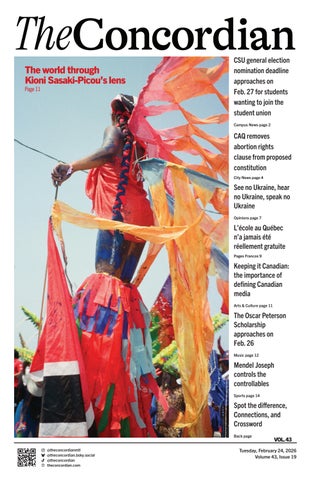
The world through the lens of Kioni Sasaki-Picou

Her father’s wisdom shaped her radical worldview. Now, it’s her turn to tell this story through art and publishing.

Kioni Sasaki-Picou is building her family archive through personal photography projects. More importantly, she is using photography to tell the story of her greatest teacher and inspiration — her father.

“Sometimes I see him, and I feel like there's so much that he hasn’t shown the world,” said Sasaki-Picou about her father, who moved from the Caribbean in 1975 to study theatre, dance and music at York University. “He’s a worldly person, and he cares deeply for humans.”

Born Japanese-Trinidadian, she explores themes of decolonialism, Black feminism and representation in anything that she creates. According to Sasaki-Picou, being raised in a family that openly talked about art and society helped immensely with shaping her worldview, thanks especially to her father’s wisdom.

“He just always raised me to be radical,” she said. “I'm most grateful for that from him, because I didn't realize how hard it is to step into that when you weren't raised around it.”

In transcending creative boundaries, she starts by first digesting other forms of great art, be it books, film or theatre.

“I really appreciate arts that are about community building and equity, and how art can be a tool to deconstruct systems that have made even someone like me feel limited,” she said.

Although she once found joy in working with the camera, Sasaki-Picou carries immense pressure to create great works as a photographer. Despite a reluctance to pursue photography, she turns to other creative outlets to express herself and venture meaningful contributions.

In 2021, Sasaki-Picou founded an arts and culture publication called SUKO Magazine, alongside her co-editor-in-chief, Sophie Dixon. With it, they explore how the art-making process can be more essential to

storytelling than the final product.

“I think the process is more important because you can see the real truth behind someone's intentions,” Sasaki-Picou said. “I really like hearing what other artists are into and the research they've done.”

Sasaki-Picou is also preparing to exhibit her work at Toronto’s Japanese Canadian Cultural Centre — giving her an opportunity to thrive in places where her mother once did, leading workshops on equity and social justice, including discussions on interracial marriages at the centre. Sasaki-Picou’s work centers around friendship and community, featuring photographs of both her father and sister.

“I feel lucky to be able to feel the weight of how important the arts are and the potential for it to just do so much good,” Sasaki-Picou said.

Deferred Dream I, 40x50, photographic print.
Carnival 2025, 24x36, photographic print.
Deferred Dream IV, 20x25, photographic print.
Deferred Dream V, 20x25, photographic print
Carnival 2025, photographic print
Panyard 25’, 24x36, photographic print.

Miguel dances through the chaos at MTELUS

The R&B star reminds Montreal that all we have is each other.

Attribution: Staff Writer

Instagram: @__flanny__

Fans who flocked to MTELUS on Feb. 17 to see R&B legend Miguel on the Montreal stop of his CAOS Tour likely expected a show as serene as his music is. What they got, however, was a high-energy and rock-influenced performance, with a profound message to boot.

Miguel’s arrival on stage was heralded by opener Jean Dawson, whose performance was the perfect set-up for Miguel’s new rock-based direction. Dawson was accompanied by a live band, who matched his guttural and, at times, raspy growl. His raw performances of tracks like “Dummy,” “BLACK MICHAEL JACKSON*” and “MENTHOL*” had the crowd adequately amped up for Miguel to take the stage. Dawson finished off

with “Power Freaks”, while also taking the time to shout out all four members of his band.

After an overturned car appeared on stage, at last, Miguel revealed himself to his adoring crowd. After opening up with several tracks from his 2025 record CAOS, electric guitar in hand and atop the car, Miguel broke into some hits like “How Many Drinks?” and “Do You…”

The lights above the star were a massive source of enhancement for the production value of the performance — allowing for Miguel to be bathed in three concentric beams of white and red light, switching from a vertical to a diagonal setup.

After his iconic hit “coffee,” Miguel took a moment to highlight Canada’s rich Indigenous population, using this comment as a springboard for a small speech about ongoing global efforts to erase cultural differences. In today’s geopolitical climate, artists like Miguel represent some of the most powerful voices we have. His outspoken activism about immigration has been prevalent since his 2017 music video for “Now” shot at a protest at the Adelanto High Desert Detention Center. He engaged the crowd in Montreal by chanting “ICE out”. He then

live music recommendations in Montreal

spray-painted the phrase in the centre of the overturned car, leaving the words to shine in bright red lettering for the remainder of the performance. Fittingly, he jumped right into “New Martyrs (Ride 4 U),” a track from his latest record, which tells of sticking by those closest to us and the importance of community.

Miguel continued on with more cuts from CAOS, such as “Triggered,” “El Pleito” and “Oscillate.” The star was eventually accompanied by a band, as well as an animatronic moon suspended behind him with a face that curiously resembled his own.

Miguel pre-empted his performance of “COMMA/KARMA” by wishing the audience a happy Lunar New Year — a holiday greeting fitting for a track about new beginnings and the cyclical nature of life.

The show ended with the energetic climax of “Sky Walker.” As the star took one last look at the Montreal crowd, he said, “Through all the chaos, all we got is each other.” Miguel’s final words to the crowd at MTELUS are sure to stick with all those in attendance.

@luca_jarman

Here’s a hand picked selection of shows for the rest of February and early March.

SOMET, NEW WASTELANDS + Silentafterdark — Feb. 26 at Turbo Haüs

Three bands that tap into distinct subgenres of alternative music. SOMET channels the grungy guitars and long hair of shoegaze, whilst for NEW WASTELANDS and Silentafterdark, think the genre-blending edginess of Linkin Park or Limp Bizkit

Ratboys — Feb. 27 at Bar Le Ritz PDB

This Chicago band will be stopping by Montreal on their North America tour of their new album Singin’ to an Empty Chair. The record has a country feel with a real clarity in its sound and lyrics. This, paired with a maturity in their performance, will make for a brilliant night of cathartic tunes.

The Satisfactory with Blue Linen + Marmosette — Feb. 28 at Petit Campus

Get the chance to hear their new single “How To Swim” live before it’s out at this release show. Their unique sound touches on a classic rock’n’roll swing all while managing to feel totally new.

Ella Red with Peggy — Mar. 1 at La Sala Rosa

Sometimes suggestive, other times confronting; lyrics are at the forefront of Ella Red ’s music. There’s a tinge of teenage angst but looked at with a growing understanding of the importance of her words and the world around her, all wrapped in a power pop bow.

Aries with Gunnr — Mar. 4 at Le Studio TD

See Aries in the next stage of his career after the release of new album GLASS JAW. It sees a shift towards more experimental hip-hop whilst also acting as a platform for the singer to express long held feelings and thoughts about life.

Piner with Wood Andrews + Eva Angel-Fox — Mar. 8 at Casa Del Popolo

Piner’s country sound and songwriting is tender and sincere. Wood Andrews brings his jaunty rhythms and Eva AngelFox her touching folk. Don your cowboy hat and allow these acts to tug at your heartstrings.

Graphic by Hannah Bell // Creative Director // @hannahnevebell
Photo of Miguel by Emmie Gingrich // Contributor

The Oscar Peterson Scholarship

Giving Concordia students the opportunity to prove themselves at the biggest stage in the city, the worldfamous Montreal Jazz Festival.

“Jazz is the music of freedom, of rebellion, of people speaking up and finding joy in hard times,” said Charlotte Van Dyke, last year’s winner of the Oscar Peterson Scholarship

This year’s scholarship competition concert will take place on Feb. 26 at the Oscar Peterson Concert Hall and is available for students to watch. Five groups of Concordia jazz musicians will each have 25 minutes to impress the judges

to win $1,000 and a spot to play at the world-famous Montreal Jazz Festival in the summer.

“The vision for my performance was to honour Peterson,” said Van Dyke. “I'm a vocalist, not a pianist, but I still wanted my voice to tell his story."

“His improvisation just takes off and is always a display of crazy virtuosity and in that, you feel his joy. For the music and life and for people and for who he is. I knew this is what I had to bring in my music,” she said.

The jazz studies coordinator at Concordia, Meghan Gilhespy, will be a judge for the competition and believes that creating a short, snappy set for a festival show like this is important.

“Jazz musicians improvise and things are often loose, particularly in jam sessions,” he said. “But being on a big stage and being forced to create a set that's airtight is crucial for an early-career jazz musician.”

Montreal has a deep jazz history, giving light to the likes of Oliver Jones and Oscar Peterson but Joshua Rager, Concordia’s music department chair believes the scene has fundamentally changed.

“When I first moved to Montreal, the scene was really determined by the older musicians. But it's been quite a shift. Now I think the younger musicians are running

Baby Keem Displays Deep Growth on Ca$ino

_After years of waiting for his second album, Baby Keem has finally delivered with Ca$ino

The concise 11-track project contains everything that has made the Las Vegas-native one of the most interesting new voices in hip-hop. Keem’s energy and personality are as engaging as ever over beats that feature a healthy balance of trap production and classical instrumentation.

The growth displayed on Ca$ino is undeniable. Right from the intro, Keem’s voice contains self-assurance that pairs perfectly with bars that reintroduce Keem to whoever may have forgotten his undeniable skill.

The record is also much more introspective than Keem’s previous work, revealing truths about his tumultuous upbringing and expanding on a history that was only hinted at on 2021’s The Melodic Blue.

On tracks like “Ca$ino” and “Circus Circus Free$tyle” Keem reintroduces himself and his artistry with hard-hitting bars and orchestral beats that feature some head-turning transitions.

“$ex Appeal” is characterized by a pulsing electronic synth and an unexpected verse from West Coast icon Too $hort

A true highlight comes with “Dramatic Girl”, a track that paints a picture of a prospective relationship over the strum of an acoustic guitar.

The record concludes with the profound “No Blame”, on which Keem discusses forgiving his absent mother for her part in his childhood trauma.

While short, Ca$ino earns Baby Keem a warm welcome back to the hip-hop mainstream. With any luck, the wait for a follow-up will be much shorter this time around.

Trial Track: “House Money”

Score: 9/10

the scene. They're the ones going out and making the gigs happen,” he said.

“As well as this, they're playing music that I think is very accessible to younger people. It reflects modern trends and influences, like hip-hop, for example.”

Rager believes this is the key to being successful in jazz today.

“It's a music that's very based on studying tradition. But the goal is always to try to produce something that sounds new and that reflects your personality,” he said.

“Past winners always go on to start interesting careers. They never go the traditional jazz route, they're always blending it with their own influences.”

Gilhespy echoed his sentiment on the evolution of jazz.

“There are lots of artists around today who are advancing the field in jazz, and I think the way that jazz is conceived of now is moving in the direction of it becoming more widely consumed,” she said.

However, other aspects of the scene have changed for the worse.

Controlled chaos: Growve by Haüsband

@somewhereordinary

It’s mischievous, groovy, and beyond thrilling. This alternative, jazz-rap EP from the Montreal group, Haüsband brings listeners into a world of experimentation and funk. The bands’ inaugural release compiles a 5-track, 24 minute, intimate jam session for listeners to have in their backpocket and on loop.

Growve opens with “Ain’t That Deep”, a groovy Rap-track that playfully nods to its Quebecois roots with a few French lyrics.

With a Gorillaz sounding harrowing laugh, the tune breaks down with mysterious vocal production, biting sax from Doc Seuss and a catchy chorus.

“More Fun” shines a spotline on drummer Shayne Assouline whose sudden dropouts leave the listener breathless. With an R&B feel, the vocals by Marcus J Dillion and Shemar Gordon on this track alternate between tight bars and buttery verses.

The glossy 80’s synthesized keys on “What You Want” go crazy — Keyboardists’ Jordan Pistilli and Cedric De Saint-Rome’s vibrate through your speakers with their energetic lines.

“Drawn Lines” is punch-packed, rubbing against edgy piano. The rap quickly catches onto the keys’ crescendo, bassist’s Fred Doston and Nic Pura later joining into this melody as well.

Threading together as one — Haüsband moves through this work as a perfectly unpolished free-form ensemble. The creative leaps these musicians take make them masters of controlled chaos.

You can’t get much more underground in the Montreal music scene than with Growve.

Trial Track: “Drawn Lines”

Score: 8 / 10

“I caught the tail end of being able to earn a living, playing gigs,” said Rager “When I was young, it was still possible. Now there's been a big decline in the money that's available, essentially gigs pay the same amount of money they did 30 years ago.”

This, combined with inflation and rising costs of living and touring, which decreases the value of payment, makes carving out a career in music even harder in the modern day.

Van Dyke now runs a jazz jam session for Concordia students at Upstairs Jazz Bar and Grill on Wednesdays from 5 to 7 p.m.

Brent Faiyaz toys with growth and stagnation

// @somewhereordinary

The delayed release of Brent Faiyaz’s third studio album Icon may have been exactly what the singer needed to ensure his rise to maturity — or maybe it speaks to his lack thereof?

Icon, which hit streaming services on Feb. 13, is a 10piece late-night R&B album.

“white noise” — a gorgeous instrumental opening, sets listeners’ expectations high with breathy strings and an elegant ambience. “wrong faces” quickly diverts and shines light to Faiyaz’s hip-hop beats layered between smooth vocals.

For all the romantics, “butterflies.,” writes the tale of quickened heartbeats, breathless texts and heart-wrenching “what if’s.” Faiyaz is falling, hard. Switching tones halfway through, “butterflies.” encapsulates the push and pull of a surreal crush.

Similarly, “have to.” paints separation anxiety by means of yearning for that special someone. Here, Faiyaz plays with vocal production as he confesses his feelings of withdrawal.

“strangers.” takes a more vulnerable turn as Faiyaz unfolds his heartbreak. Going back and forth between victim and villain, Faiyaz’s lyrics don’t exactly add up. Lines like, “Chips are down, just like your tears,” really aren’t equating to Faiyaz’s usually quippy songwriting.

To boot, the track closes with a comically abrupt automated voice that coldly advises, “Note to self, be truthful, even when it hurts. Make love and pray often, eat healthy. Never reveal your true financial status.”

The memo should have been left in the studio sitting with Faiyaz’s good friend ChatGPT — who by the way, also can’t write lyrics.

“four seasons.” and “pure fantasy.” could be his redeeming qualities as listeners are brought back to the albums’ initial strings and groovy instrumentation. With a catchy hook and its smoky melodies, there might just be a hopeful outlook for the singers’ love life and writing abilities.

Trial Track: “butterflies.”

Score: 6 / 10

Photo of Charlotte Van Dyke performing at Upstairs Jazz Bar & Grill // Photo by Luca Jarman

24th, 2026

Mendel Joseph controls the controllables

UUndersized but unshaken, the Stingers’ star cornerback blends joy and discipline in his process as he prepares for one final U Sports season — and a shot at the pro level.

It was supposed to be an optional lift. The kind of training session athletes tell themselves to skip all the time, especially after a long week of training.

When Concordia Stingers’ star defensive back Mendel Joseph and his teammates were returning from a conditioning session, the decision on whether or not to skip became a group decision.

“We had just finished our training run in the dome and after that we just looked at each other and said ‘I don’t know, I might hit it tomorrow,’ but I feel like being surrounded by each other, we end up all laughing and going together anyway,” Joseph said later in an interview with The Concordian, smiling at the memory.

When Joseph has training sessions with his teammates, it’s lighter –– but no less meaningful.

“I’m a goofy guy, so I mess up a lot,” he said, laughing. “I might do like my last rep, and like, somebody makes a joke, so I drop my weight and everybody starts laughing. […] [I’m] just having fun with my guys.”

“We had fun today, but we still got our work done, so that’s what it’s all about.”

For Joseph, fun and work have never been mutually exclusive.

This balance is part of what makes him a leader, according to current Stingers defensive back Coslens Clairveaux, who’s known Joseph since even prior to their time as teammates at Concordia.

“He’s got a great work ethic,” Clairveaux said. “He doesn’t talk a lot, but when he’s on or off the field, he brings everybody with him.”

As Joseph heads into his fourth and final year of collegiate football, his resume already reads like a career summary: two-time All-Canadian, two-time RSEQ All-Star and RSEQ Defensive Player of the Year.

According to data from U Sports, more than 150 U Sports graduates are currently on CFL rosters, comprising only 31 per cent of the 489 players currently in the league.

Ontario University Athletics tops the four U SPORTS conferences with 56 alumni currently on CFL rosters, followed by Canada West with 48, the RSEQ with 34, and Atlantic University Sport with 14.

Concordia has consistently been a top producer of talent for the CFL draft, with

19 of over 65 selections to the league in their history coming between 2006 and 2016 alone.

Yet, the cornerback still moves like someone with something to prove, and it shows when he trains alone.

“When training alone, I just feel like you focus on the details more […] you feel like you’re just on an island, and nobody’s coming to save you, you’re competing against yourself,” he said. “I’m in my zone, like, I’m locked in on what I do.”

At roughly five-foot-eight, Joseph doesn’t fit the traditional mold of a boundary or outside corner.

But size, to him, has always been a footnote.

“I don’t feel like my size comes in the ex cuse to do all of it,” he said. “If I get beat, I feel like if I’m at that position, if the coach trusted me, I have the ability to make the play anytime.”

That trust has been earned snap by snap, and in a conference where bigger, more phys ical wide receivers typically dominate, Jo seph has carved out a reputation for shut ting down and entire side of the field. His strength isn’t just speed or technique–it’s anticipation.

“He’s crucial for what we do defensive ly and as a team. He’s small in stature but big in presence,” said Stingers’ head coach Brad Collinson.

“He’s able to disrupt plays and force teams to do things they don’t want to do and he anticipates things better than a lot of people do in our conference, and that’s why he makes those big plays for us.”

Dawson “King” Pierre, a former Stingers defensive back who now plays professional ly with the BC Lions of the Canadian Foot ball League (CFL), thinks concern related to Joseph’s size is overstated.

“Maybe he’s not this six-foot-three cor ner, but the way he plays the game, he plays like he has a bigger frame. He’s fast, he’s physical, he’s very smart,” Pierre said.

Pierre was drafted by the Ottawa Red blacks in the third round of the 2024 CFL draft, and is the most recently drafted player from Concordia to play the same position as Joseph.

“The physical stature of someone doesn’t have to dictate everything. It’s how you play with it.”

Control is a recurring theme in how Jo seph talks about his career. Every season, every rep, is treated as if it could be the last.

“Every year, I approach it like it’s my last season, and I’m trying to go all out every time,” he said. “I try to control what I can control […] I feel like every opportunity that I got, I’m blessed with it.”

That mindset matters more than ever as his ambitions to play professionally come into focus.

“I’m always going to have a chip on my shoulder because I’m the smallest guy. I’m not the biggest, I’m not the strongest,” Jo seph said. “But I feel like I’m the biggest, I’m the strongest, I’m the fastest […] that’s just the mentality that I have [and] I’m blessed to have that mentality.”

That mentality didn’t go unnoticed by those who came before him.

“I’ve known Mendel for years,” Pierre said, who has watched Joseph’s growth closely since there were teammates for a brief stint in Pierre’s final year as a Stinger.

“I remember just telling him like, hey, your time is going to come very soon […]

Dawson "King" Pierre (#5) was an integral part of the Stingers' secondary before joining the CFL in 2024 // Photo Courtesy of Concordia Athletics

you have everything it takes to be dom inant […] you will be who you dictate yourself to be, and you’ve always been a top dog. So there’s nothing to worry about.”

It’s that approach that Pierre has seen players take into the CFL.

“Same way as a lot of guys like

Mendel Joseph (#15) scans the field pre-snap // Photo
Courtesy of Concordia Athletics

Concordia hockey involved in Breakfast Club of Canada initiative

Some Stingers traded their sticks for aprons to prepare breakfast for students at Westmount Park

and well-being and hopes to encourage young students to build healthy eating habits.

“As an athlete, it’s even more important. I believe we need a lot of energy to get through the day, and for children who are growing up, who need to study, to be at school; these are long days, and it’s very important for them.”

allowed the Breakfast Club of Canada to increase funding to schools.

Hermanie Desrosiers, the club’s spokesperson, said the non-profit organization aims to help school communities uphold breakfast programs so children can start the day on a full stomach.

Elementary School.

Concordia’s hockey teams, in collaboration with the Breakfast Club of Canada, were volunteering in the community on Monday, Feb. 16, delivering breakfasts and inspiration to the sixth grade students of Westmount Park Elementary.

Stingers forward Mathieu Bizier contacted the association with the hope of distributing breakfasts for students in the region.

“I think that everyone can help in a way,” said Bizier. “Today, we are coming for the Hooked on School Days week, so if we can inspire children to push a little bit harder at school and continue to persevere in the hard times, that’s today’s goal.”

As a U Sports athlete, Bizier knows that nutrition is vital for performance

Bizier’s call for volunteers was answered by his fellow teammates. Team captain Simon Lavigne was joined by veterans Christopher Inniss and Alexandre Nadeau, who represented the men’s team at the event, as well as Rachael McIntyre and Angelie Jobin from the women’s team.

The athletes helped pack breakfast bags before delivering them to different classrooms. The Stingers then delivered a conference where they answered questions about perseverance, nutrition and balance to sixth grade students.

In Canada, one in three children risks going to school on an empty stomach. In 2024, “an estimated 25.5 per cent of people in Canada’s ten provinces lived in a food-insecure household.”

This amounts to about 10 million Canadians, including roughly 2.5 million children; a new record-high level of food insecurity in the country, surpassing 22.9 per cent in 2023.

In April 2024, the Government of Canada announced the creation of the National School Program, aimed at providing children with nutritious meals at school. The program’s implementation

She lists food insecurity at home, long bus rides, lack of appetite or family emergencies as reasons why children may come to school on an empty stomach.

“What’s important for us is that no matter the circumstances, children have access to nutritious food to start their school day,” said Desrosiers.

“What we really try to do is adapt to the school realities and deliver or offer them some money to serve the most nutritious breakfast.”

“I think that starting the day on the right foot is one of the most important things,” says Westmount Park Elementary School principal Marco Gagliardi.

“And for a lot of the students, coming to school and having the opportunity to have breakfast or snacks to help them start the day is a step in the right direction. So, it takes a little bit of stress off the families.”

The children had the opportunity to take the mic and ask questions during a Q&A with the players, who shared more

The Scoreboard

Varsity teams swept their final regular season games before heading into playoff action next weekend.

Women’s hockey honours graduating athletes with 4–3 win during Senior Appreciation Night

The Concordia Stingers’ women’s hockey team went back to their winning ways during Senior Appreciation Night with a 4–3 scoreline against Université de Montréal on Feb. 20, at home at the Ed Meagher Arena.

The annual night honors graduating veterans of the program. This year, six Stingers were under the spotlight: forwards Ekaterina Pelowich, Alexis Bedier, Emilie Lavoie, Zoe Thibault, captain Jessymaude Drapeau and goaltender Jordyn Verbeek.

UdeM opened the scoring during the first period with a power-play goal. The Stingers answered early in the second period with a goal by forward Emilie

Lussier at 2:19. The senior scored again two minutes later during a power play at 4:34, giving Concordia the lead. The visitors equalized at 7:58, but Drapeau gave the Stingers the lead late in the period at 19:24. Forward Courtney Rice widened the gap at 4:40 of the third period, and despite a third goal by UdeM at 14:14, the Stingers kept up their pace and won the game 4-3.

The win keeps Concordia first in the RSEQ conference with 44 points, well ahead of second-place UdeM with 28 points.

The Stingers will be back on the ice on Feb. 27 at Ed Meagher Arena for the first leg of the RSEQ semifinals against rivals McGill. Puck drop is at 7:30 p.m.

Women’s basketball break losing streak with 77-54 win away against UQAM

On Feb. 21, the women’s basketball team broke its losing streak with a dominant 77–54 win against winless UQAM at Centre sportif. The victory keeps the Stingers in fourth place with 12 points, leading Concordia into the playoffs.

The hosts led for most of the first quarter, but despite multiple push attempts, Concordia led 37–33 at halftime. UQAM managed to catch up to the Stingers early in the third quarter, but the visitors quickly reacted and widened the gap, finishing the third quarter with a 60–47 lead. The fourth quarter reinforced Concordia’s dominance, as the team stayed consistent and piled up 17 more points, ending the game with a score of 77–54.

Centre Serena Tchida was once again the most prolific player of the game, piling up 21 points and 10 rebounds, followed by forward Fabiola Lamour’s brilliant 10-point, 11-rebound performance off the bench.

of their life experiences and positive messages. The morning finished with a meetand-greet with the athletes and handing out signed cards.

“We also hope that the Stingers talking to the students is also going to inspire them to achieve their own aspirations. So, sometimes it can be impressive to see someone who is older than us, who went through the same cycle as us, succeed,” says Desrosiers.

For Gagliardi, having the Stingers visit Westmount Park Elementary is a positive experience that he hopes will instill perseverance in the students.

“I think that having positive role models for our students is something for them to aspire to, whether they want to be athletes themselves or continue their education at a different level.”

The Stingers will be back on the court on Feb. 25 at 6 p.m. for the RSEQ semifinals against Laval at the PEPS in a doubleheader with the men’s team.

Men’s basketball clinch playoff spot with 92-82 win away against UQAM

On Feb. 21, the men’s basketball team won its final regular-season game 92–82 against UQAM at Centre sportif, placing themselves in third place of the RSEQ standings with 14 points and clinching up the last playoff spot.

The Stingers started the game strong, with a 29–16 lead at the end of the first quarter. Despite a few pushes from the hosts, Concordia stayed consistent, with the score being 53–35 at halftime. The gap widened even more at the end of the third quarter with a 75–52 lead, and despite a late push by UQAM in the fourth quarter, the game finished with a 10-point difference at 92–82.

Forward Yohan Leger shined with 25 points and four rebounds. Guard Junior Mercy also put up a solid performance with nine points and eight assists.

The Stingers will be back on the court on Feb. 25 at 8 p.m. for the RSEQ semifinals against Laval at the PEPS in a doubleheader with the women’s team.

cordia Stingers in the second round. The Stingers earned a bye week in the first round thanks to their finish as the second seed in the OUA East conference’s regular season.

Concordia will host Queen’s for the best-of-three series starting on Feb. 25, with puck-drop set for 7:30 p.m. at Ed Meagher Arena.

Graphic by Anna Huang // Graphics Editor // @itza_me_anna
Photo by Mathilde Colls // Assistant Sports Editor // @ mathcolls (IG)

19. French vineyards

20. "Oh, Auntie Em. There's..."

23. Prof's helpers

24. Give it a whirl

25. Unfinished writings

29. ______-weensie

34. "Roads? Where we're going..."

38. Parisian waters

39. Signal in the sky in Gotham City

40. Boxers Muhammad and Laila

41. "The greatesttrick the devil ever pulled wasconvincing the world he didn't exist. And..."

46. YouTuber Paytas

47. Tennis player

That’s you, end a picture! Edan Haramati

Down

1. Billionaire on track to becoming first trillionaire

(for some reason)

2. Nevada city

3. Wheelchair access

4. Author Silverstein

5. Audio show

6. After, in Quebec

7. Short on Instagram

8. Quality

9. Crimson, for example

10. Composer J.S.

11. Prefix with “futurism”

12. Frank who created Oz

13. Rear end in England

21. Memo abbr.

22. Watcher

25. Lived (in)

26. Broadcast once more

27. East Asian bean

28. Silver ______ (handsome older men)

30. Timeless, in a way

31. Where to get a nice do

32. Menzel of “Wicked”

33. Curvy letters

35. Wizards’ org.

36. Do well, in slang

37. Biblical verb suffix

Rybakina, and others

48. Artist Yoko

50. Greeting in Lisbon

51. "Everything will be fine!", for example, or a hint to this puzzle's theme

60. Rocky's mob

61. Academy award

Connections

42. Holier-than-____

43. He made the Kessel Run in less than twelve parsecs

44. Way to catch a certain fish

45. Suffix with Cole

49. Kaitlin of “It’s Always Sunny in Philadelphia”

50. Naomi of tennis fame

51. Trends

52 Largest of seven

53. Actresses West or Whitman

54. Card for the STM

55. Bank no.

56. Valhalla god

57. Philosopher Descartes

58. Investigators: abbr.

59. Apt name for a Dalmatian

62. Profound

63. "Mon ____"!

64. Opa _____, Florida

65. A fan of

66. Back talk

67. Ready to pour

68. Bird's home

Turn static files into dynamic content formats.

Create a flipbook
Volume 43, Issue 19: February 24th 2026 by The Concordian - Issuu