
COLLEGIAT ETIMES MARCH
An independent, student-run newspaper serving the Virginia Tech community since 1903

MADNESS

FRALIN BIOMEDICAL RESEARCH INSTITUTE HOSTS ANNUAL BRAIN SCHOOL
Abhigna Koochana | News Writer
Fralin Biomedical Research Institute will host Brain School to bring attention to neuroscience discoveries.
The Fralin Biomedical Research Institute will host their annual Brain Awareness Week campaign, known as Brain School. This campaign aims to bring attention to innovative neuroscience discoveries. This year, the event will explore how genetic information contributes to brain health and deterioration.
Brain Awareness Week is held to campaign for public recognition of the importance of brain science. It was created for the Dana Foundation in recognition of their advancements in neuroscience. This year, it is recognized from Monday, March 16, to Sunday, March 22.
According to Michael Friedlander, executive director of the Fralin Biomedical Research Institute and Virginia Tech vice president for health sciences and technology, the topic for Brain School every year is chosen by a group of brain researchers at
Impartiality means reporting, editing and delivering the news honestly, fairly, objectively and without opinion or bias.
Credibility is the greatest asset of any news medium, and impartiality is the greatest source of credibility.
To provide the most complete report, a news organization must not just cover the news, but uncover it. It must follow the story wherever it leads, regardless of any preconceived ideas on what might be most newsworthy.
The pursuit of truth is a noble goal of journalism. But the truth is not always apparent or known immediately. Journalists’ role is therefore not to determine what they believe at that time to be the truth and reveal only
the Fralin Biomedical Research Institute. The brain researchers explore topics that are relevant in terms of public interest and scientific advancements.
This year, the Brain School expo will take place on Monday, March 9, from 5 to 7:30 p.m., at 2 Riverside Circle in Roanoke, which is the Fralin Biomedical Research Institute. It is free for everyone, but registration for in-person and virtual attendance is required.
From 5 to 6 p.m., there will be an expo where participants can explore different research labs and engage in interactive exhibits.
From 6 to 7:30 p.m., there are three featured speakers from Virginia Tech: Virginia Tech assistant professor Ryan Purcell, professor Anthony-Samuel LaMantia and assistant professor Sharon Swanger. They will discuss their research surrounding genetic conditions and brain
that to their readers, but rather to report as completely and impartially as possible all verifiable facts so that readers can, based on their own knowledge and experience, determine what they believe to be the truth.
When a news organization delivers both news and opinions, the impartiality and credibility of the news organization can be questioned. To minimize this as much as possible there needs to be a sharp and clear distinction between news and opinion, both to those providing and consuming the news.
Voice your opinion. Send letters to the Collegiate Times.
365 Squires Student Center
Blacksburg, VA, 24061
opinionseditor@collegiatetimes.com
All letters must include a name and phone number. Students must include year and major. Faculty and staff must include position and department. Other submissions must include city of residence and relationship to Virginia Tech (i.e., alumni, parent, etc.). We reserve the right to edit for any reason. Anonymous letters will not be printed.
Letters, commentaries and editorial cartoons do not reflect the views of the Collegiate Times. Editorials are written by the Collegiate Times editorial board, which is composed of the opinions editors, editor in chief and managing editors.

development.
“I hope that (people) come away with a new, or renewed, sense of awe for the richness of brains, an appreciation for how solid science is advancing our ability to better understand one of nature’s most dramatic examples of adaptation and sophistication, and a desire to want to learn more by keeping up with advances in brain research,” Friedlander said.
“Neuroscience is just one example of
the global scientific enterprise that sadly has been under attack in recent years as public confidence in science has waned,” Friedlander said. “If we can contribute to the public’s appreciation of the scientific enterprise, sharing the excitement for how we learn about the natural world, including brain development and function, hopefully we can help reverse this trend and re-instill trust in science.”
COLLEGIAT ETIMES
NEWSROOM 231-9865
Editor-in-Chief: Michaela Scott (editor@collegiatetimes.com)
Managing editor: Ayisha Surani
Design editor: Annmarie Leake
Assistant Design editors: Caroline Rogers, Sarah Jordan, Mx Zaleski, and Alana Vernon
Copy editors: Emily Southern, Olivia Guy and Amanda Donndelinger
News editor: Erin Bailey and Ava Garrison
Assistant News Editor: Max Painchaud
Lifestyles editors: Emma Duncan
Assistant Lifestyles editors: Cat Pizzarello and Ella Winterling
Sports editors: Sam Mostow, Thomas Bray and Dylan
Opinions editor: Jenna Mason
Assistant Opinions editor: Mohib Amjad
Photo editor: Hamad Alhendi
Assistant Photo editor: Riley Thompson
Have a news tip? newstips@collegiatetimes.com
BUSINESS STAFF 231-9860
Business manager: Greg Patterson (business@collegemedia.com)
MEDIAMATE 888-897-7711 collegiatetimes.com/media_kit/ orders@mymediamate.com
The Collegiate Times, a division of the Educational Media Company at Virginia Tech, was established in 1903 by and for the students of Virginia Polytechnic Institute and State University. The Collegiate Times is published every Tuesday of the academic year except during exams and vacations. To order a reprint of a photograph printed in the Collegiate Times, visit reprints.collegemedia.com. The Collegiate Times is a division of the Educational Media Company at Virginia Tech, Inc., a 501(c)3 nonprofit with a mission to provide educational experience in business and production of mass media for Virginia Tech students. © Collegiate Times, 2020. All rights reserved. Material published in the Collegiate Times is the property thereof, and may not be reprinted without the express written consent of the Collegiate Times.
Advertisements do not necessarily reflect the opinions of the Collegiate Times. Read about our organization’s Core Values online at collegiatetimes.com.
Tefft
PHOTO COURTESY OF VT NEWS
VIRGINIA TECH PREPARES FOR ANNUAL RUN IN REMEMBRANCE
Hannah
Registration has officially opened for Virginia Tech’s annual 3.2-mile Run in Remembrance, honoring the 32 lives lost on April 16, 2007.
The run is scheduled for April 18, 2026, at 9 a.m., beginning in front of War Memorial Hall. The 3.2-mile course will loop around campus, passing landmarks such as the Pylons, The Grove and Lane Stadium, before concluding at the April 16 Memorial.
The event is open to the public, and participants can register online. T-shirts commemorating the lives lost are also available for purchase until April 7. Virtual participation is available for those unable to attend in person.
Following the run, a remembrance service will be held at 1:30 p.m. at War Memorial Chapel.
Another way to get involved is to sign up as a volunteer. Opportunities include T-shirt distribution, balloon arrangement, setup and takedown help, water station assistance and route marshals.
Earlier in the week, the university will host several memorial events throughout the day on April 16. The commemoration will first begin at midnight with the lighting of the ceremonial candle. Student body representatives will light the candle as the names of the 32 victims are read aloud. Members of the Corps of Cadets will then stand guard for 32 minutes, and the candle will remain lit for 24 hours.
At 9:43 a.m., a wreath-laying ceremony will be held, led by President Tim Sands and Laura Sands, along with student members of the Rescue Squad, followed by a moment of silence. To conclude the 24-hour vigil, the Corps of Cadets will stand guard for 32 minutes before 11:59 p.m. The candle will then be extinguished, and the light carried back into Burruss Hall.
The 3.2 Run in Remembrance remains a significant tradition in Virginia Tech’s history. The annual event brings

together students, professors, alumni and community members to honor those who were lost and to continue the university’s message, “We will prevail.”
VIRGINIA RAISES $17.7 MILLION DURING GIVING DAY 2026
Natalie Shannon | News Writer
Tech’s annual Giving Day event raised over $17.7 million, which will help support various VT activities and faculty/family needs.
On Feb. 18 at noon, Virginia Tech kicked off its annual 24-hour virtual Giving Day tradition. Giving Day is a fundraising tradition that invites students, families and alumni to donate to their favorite Virginia Tech organizations and programs so that they can continue to flourish.
The funds raised during Giving Day support research, scholarships, experiential learning opportunities and specific family and faculty needs.
Virginia Tech encourages participation in Giving Day through challenges and leaderboards. For example, one challenge invited participants to see which state could amass the most donors. The Giving Day website displays
leaderboards for different colleges, graduation classes and athletic groups.
Top fundraisers from each challenge received extra ‘prize’ money from Virginia Tech for their colleges or organizations to reward high participation and encourage giving.
Pamplin College of Business led the leaderboard with the most donors, receiving an extra prize of $5,000. The College of Engineering amassed the most funds of all units and also received an extra prize of $5,000.
This year, Virginia Tech raised over $17 million, raising $17,793,044 in total, with donations from 25,055 contributors. The event included donors from 42 countries and all 50 states. In comparison,
however, Giving Day 2025 garnered just over $21 million, in a record-breaking amount of donations and ambassadors.
Despite this decrease in total funds raised, Giving Day has grown exponentially in its impact on Virginia Tech, as the first Giving Day in 2018 only comprised 4,300 donors and had an impact of $1.62 million.
Giving Day ambassadors, according to the Virginia Tech website, are “alumni, faculty, staff, students, family members, and friends who are passionate about Virginia Tech and supporting Hokies.” Ambassadors volunteer to undertake outreach by receiving a unique link. This link can be directed toward a specific fund or simply directed towards the
general Giving Day homepage. Ambassadors help to spread the word about Giving Day and maximize outreach. This year, Giving Day 2026 included 1,689 ambassadors.

Registration for Virginia Tech’s annual Run for Remembrance has opened, and there are many ways for students to get involved.
Skemp | News Writer
Virginia
STEPHEN ARTHUR / COLLEGIATE TIMES Runners kick off the Virginia Tech Run in Remembrance on April 12, 2025.
DIFFERENT WAYS TO PREDICT ‘MADNESS’ THIS MARCH
Alex Winn | Lifestyles Writer
Whether chasing upsets or picking mascots, use these creative strategies to build your brackets.
It’s March, and that means it’s time for the NCAA Tournament and March Madness.
The appeal of this competition on the court is the randomness and unpredictability of a 68-team pool. While fans can’t take home the NCAA championship trophy themselves, a bigger prize could be in store: bragging rights for creating the best bracket.
There are two ways to “win” March Madness. Start a bracket pool with your friends or coworkers when the tournament teams are chosen on Selection Sunday, March 15, and see who wins after the tournament ends by predicting the most winning teams, usually using an app like ESPN’s Tournament Challenge. The other way is something that has never happened before: getting a perfect bracket. The mathematical odds of filling out a perfect bracket are 1 in 9.2 quintillion, a number with six commas.
Here are a couple of ways to fill out your bracket, even with no experience in partaking in the ins and outs of March Madness.
Favorites & Underdogs
Why pick the lower seeds? They’re underdogs for a reason. The idea behind this strategy is to select all higher seeds, so 1/16, 2/15, etc. In 2025, lower seeds won only 17.5% of the time, but in 2024, lower seeds won 30.2% of the time. This strategy will almost certainly not guarantee a perfect bracket, but it might win the most points or games. This strategy was especially effective last year, a tournament that saw all four number one seeds make the Final Four, the first time that had happened since 2008 and the second time ever.
On the flip side, only picking underdogs is also a fun choice. It will also almost surely not result in a perfect bracket, but if a “Cinderella team” were to show up, then the points would rack up. A Cinderella team is a low-seeded team that makes a run and picks up
Actually trying to win
The point is to fill out a perfect bracket, so why not try that? The most popular tactic when filling out a bracket in March is to try to predict how the madness will unfold and get it all right.
If this is the preferred route to go down, some statistics might help when picking upsets: In 34 of the last 40 tournaments, a 12 seed has taken down a five-seed at least once. Additionally, only two 16-seed teams have ever won a game, and the average sum of the seeds in the final four averages to around 11 over the last 25 years. Finally, since 2014, 11 seeds have gone 23-21 against six-seeds.
a couple of wins in a row over higher-seeded teams, fulfilling that “rags-toriches” story like Cinderella in her own fairy tale. This was the case in 2022 with 15-seed Saint Peter’s, the first 15-seed to make an Elite Eight.
Mascot fight
This is one of the more fun ways to fill out a bracket and definitely the most out-there idea on the list. The idea is to pit the two teams’ mascots against each other in a duel. For example, say it’s Virginia Tech playing Virginia: The fight would be between the Hokie Bird and CavMan.
This strategy is sure to bring some laughs when filling in the bracket, like last year’s first-round matchup between the Michigan State Spartans and the Bryant Bulldogs, or the matchup between two different Bulldog teams, ninth-seeded Georgia and eighthseeded Gonzaga. This might not be the
best strategy for winning a bracket pool, but if having fun filling out the bracket is the goal, then this is a good strategy.
Emotional picks
Why not pick the teams that hold meaning to the person making the bracket? The intrigue with this idea is that the teams that a person holds sentimental or emotional value toward would win and they’d be right in picking them, truly a win-win situation.
An example of this is how a Virginia Tech student would probably pick a bracket where Virginia Tech wins even when they aren’t the favorite or likely to win it all. That’s the fun of picking a bracket, especially when picking teams that hold emotional meaning. Say an uncle went to Wisconsin. Why not pick them? Like all the other options, mathematically, this has the same odds of being as perfect as would be an attempt to pick a perfect bracket.
This is the most volatile of the four options because attempting to pick a perfect bracket will likely involve picking some upsets. Picking some of those lower-seed teams to make runs later in the tournament after picking up just one win is risky because if one of those predicted Cinderella teams loses, then the bracket is immediately busted, and all the points that could have been are now void. When choosing this strategy, be prepared for heartbreak because not every low-seeded team can be a Cinderella team.
The most enjoyable part of the NCAA Tournament is that all of these are viable tactics to fill out a bracket, because only one wrong team picked can be a bracket buster and ruin a bracket. So, fill out a bracket and watch, as it is likely to be ruined by the end of day one, because of the unpredictability that is March Madness.
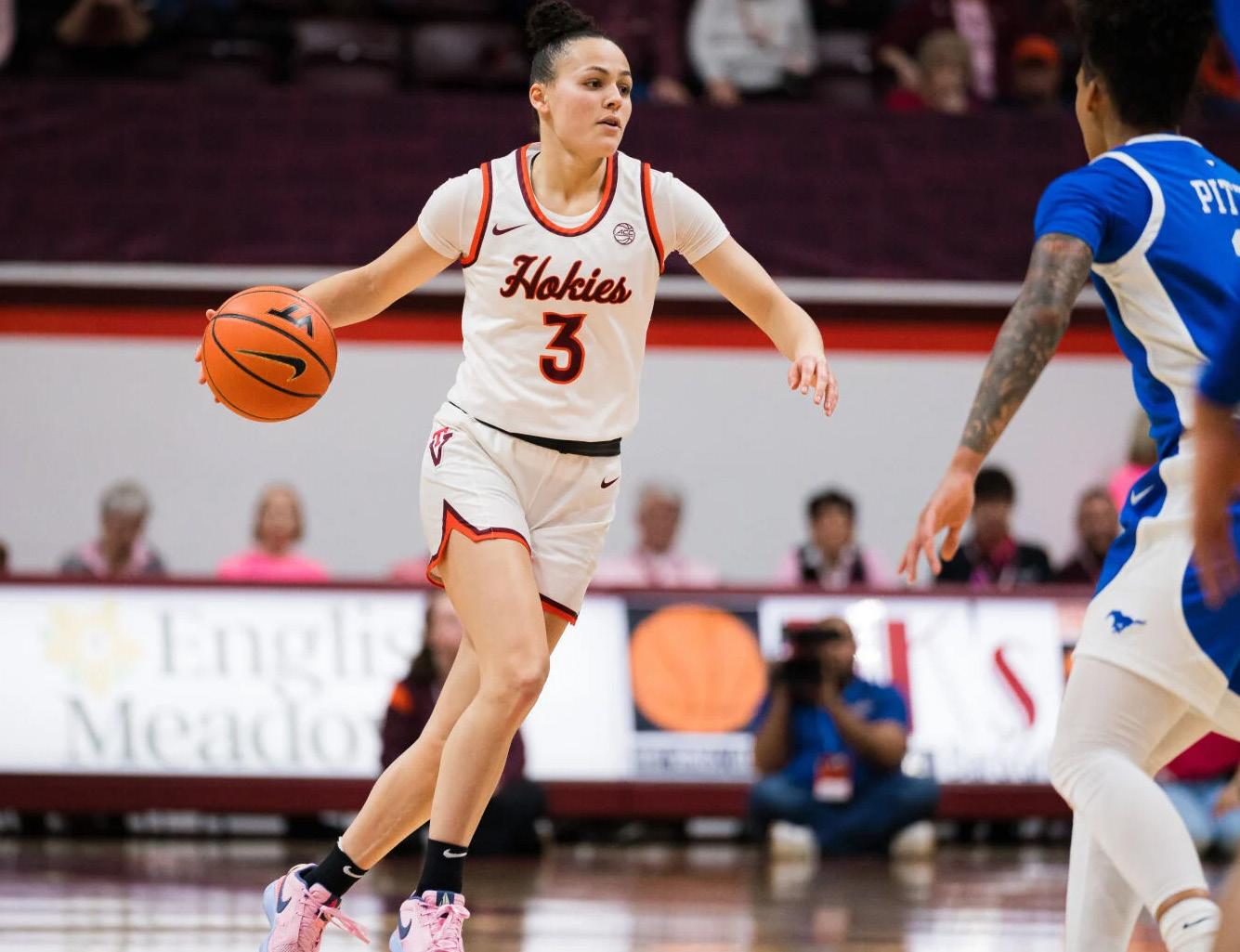
HAMAD ALHENDI / COLLEGIATE TIMES
Virginia Tech Hokies guard Mackenzie Nelson (3) brings the ball up court on Sunday, Feb. 2, 2025, in Blacksburg, Virginia.
HEAD IN THE GAME: STRUGGLES OF A FEMALE SPORTS FAN
Shelby Brann | Opinions Editor
Being a female sports fan presents a unique set of challenges.
I’ll be the first to admit that I wasn’t always a sports fan, much less an athlete. In fact, it’s a widely known fact that I have little athleticism in my body. I spend more time tripping over my feet than I do keeping them on the ground. I rowed crew, surprisingly well, for several years in middle school, and participated in a season of track and field, before hanging up my proverbial hat. I resigned myself to the fact that I simply was not a fan of participating in organized sports, though I continued — and still continue — to run and work out in my free time. Then, I came to Virginia Tech — and as a means of integrating, I started to pay attention to college football. It was, shockingly, fun, even with our dismal season this past fall. I loved the chanting, the cheering, the cheesy hype videos on the jumbotron. My interest in sports grew, and when the 2026 Winter Olympics rolled around, it felt like the perfect opportunity to finally learn about a sport that I’d been interested in for some time — ice hockey. For some reason, I had a strange feeling I would love it.
I have long admired the way the players carved across the ice, and I had caught games on the television here and there, but had never been sure how to really approach becoming a fullfledged NHL fan. This past winter, with newfound free time after escaping high school, I dived in headfirst. My friends can no longer speak to me without hearing a statistic. My gut instinct was right — I adore being a hockey fan, and fully admit that it will be something I will likely enjoy for the rest of my life. The Olympics had been the perfect gateway to getting involved; although, I feel sorry for any classmate who sat behind me in lecture and watched me refresh the U.S. women’s hockey team results repeatedly and then proceed to crash out when my free Peacock Plus subscription ran out of time.
Yet, with this newfound love comes
an increasing sense of isolation, which I’m finding out quickly is related to my gender.
This isn’t meant as an attack, just as a fact. Very simply, I have had significant trouble finding other female fans, not just of hockey, but of sports in general. I turned to online platforms such as Discord and X to find fellow hockey fans, female or not, but was instead brutally greeted by the startlingly negative culture of sports fandom. Everywhere I turned, the fans I found were male and, honestly, quite standoffish — is it too much to ask that we not insult family members of players when discussing power plays? I turned closer to home to consider more options, but there are no female-oriented sports fans clubs on campus, either, much to my genuine surprise.
Female sports fans may seem like a niche demographic, but in reality, a recent study by The Collective, a female-centered business advisory organization, was referenced in the Sports Business Journal for finding that nearly three out of four women identify as “avid” fans of at least one sport.
Another study by Media Culture, a media campaign organization, found that 31% of “diehard” sports fans are female. It seems that there are plenty of female sports fans out there, despite the fact that I can’t seem to find any. Moreover, I feel nearly embarrassed trying to explain myself as a sports fan. Every time I try to call myself one, even now, I grow hesitant. I start to question myself. After all, I’ve never played hockey, and have only recently started watching. Do I really know enough to call myself a true fan? Do other fans think I’m being performative?
One conceptual research paper, titled “Watching Women Watch Sports and (re) Claim Their Fandom in Popular Culture,” published in The International Journal of the Sociology of Leisure, echoes my thoughts, albeit in a different sport.
The writer, a researcher named Kasey Symons, stated, “During my personal experience as an Australian Rules football fan, there have been countless times when I have felt under surveillance and then reminded of what my perceived place might be. … That maybe I am not perceived as an ‘authentic’ fan.”
This paper echoed my sentiments exactly. It seems that perhaps my worries about being perceived as not “a real fan” aren’t exactly unique. Similarly, an article published by SportsPro quotes further research by The Collective, stating that about two-thirds of female sports fans believe sports organizations don’t appeal to them in their brand marketing. I can deeply appreciate this; I’ve scoured plenty of websites looking for NHL merchandise that’s not overtly masculine or in the women’s section and fitted or cropped.
There is additionally a certain stigma associated with being a female sports fan that might contribute to why it feels so hard to find others like me. Sports are commonly considered to be masculine, or, rather, “for the boys.” When a female takes an interest, there seems to be a
common misunderstanding that she’s simply in it for the attractive celebrity athletes, or doesn’t really know what she’s talking about; this stereotype can be seen in articles and blog posts from Medium, the CBC and even the University of Toronto’s student newspaper. For all intents and purposes, my experiences as a newly-minted sports fan are reflective of a larger truth: Being a female fan can be isolating. Between a harder path to finding like-minds and misrecognition by sports brands, it seems that the culture surrounding sports fandom remains overtly and overwhelmingly masculine — in numbers, in merchandise, and in fighting for recognition. For now, I’ll continue watching my hockey teams intensely … and waiting for the sports world to catch up.
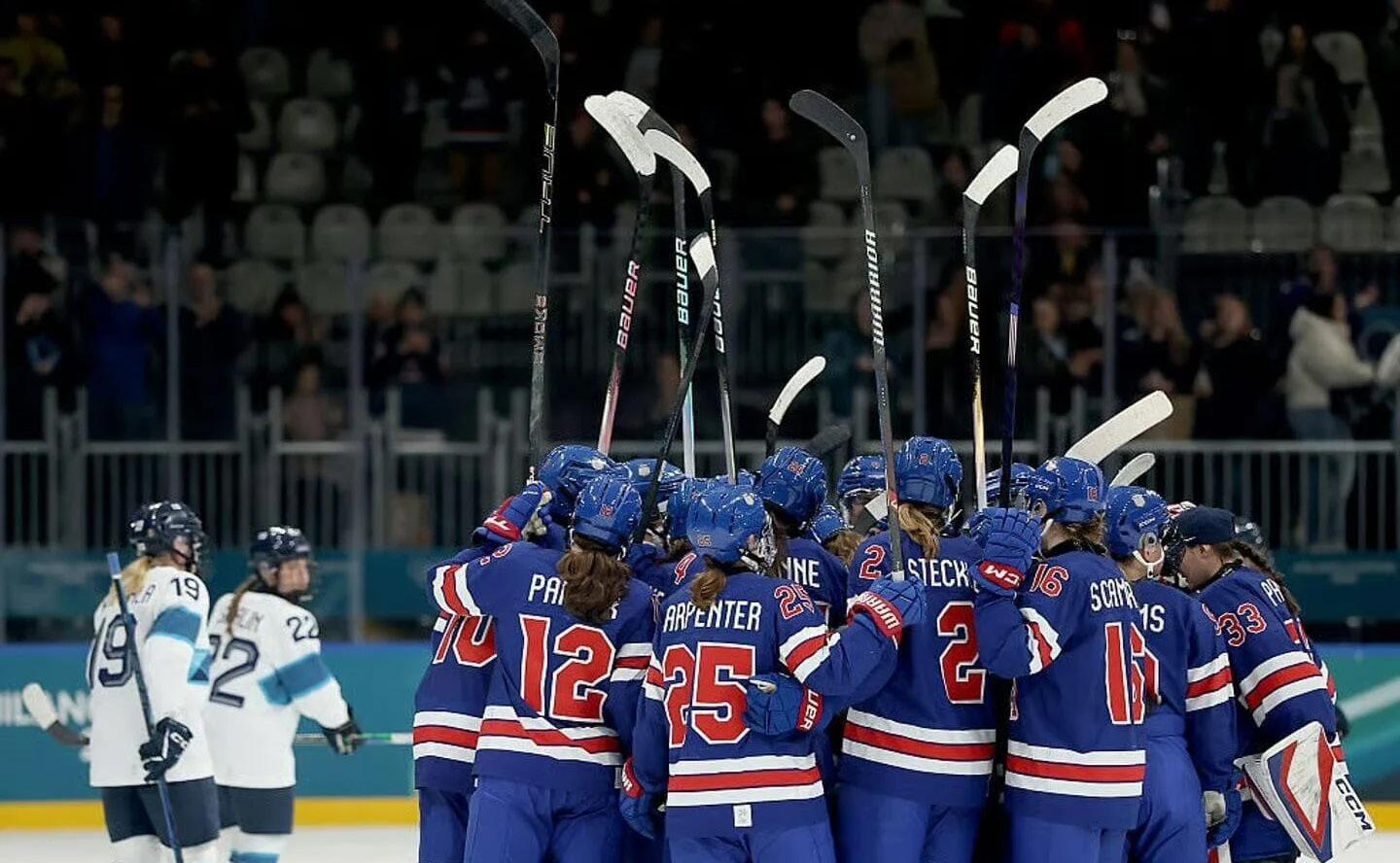
PHOTO COURTESY OF GETTY IMAGES
BRAY: BETS, BASKETBALL AND A BLUR OF BOUNDARIES
Thomas Bray | Sports Editor
Bettors gamble on March Madness more than any other annual event in the country.
CHARLOTTE, N.C. — Jake Howard was not hard to find.
He stood near the concourse in the Spectrum Center before the ACC championship game on Saturday — Duke baseball jersey, a flaming Blue Devil stitched across his cap, a purple Pernicious sweating in his hand — the picture of a fan who had nowhere else in the world he’d rather be.
He had a bet going.
“Five, $10 a game,” Howard said. “I just like to do it to stay entertained. If it’s not my team, I’ll just bet on somebody — just to watch it, get into it a little more.”
Howard, a lifelong Duke fan from Durham, North Carolina, is not the traditional ball watcher. He is something far more common and, in many ways, far more detrimental to the future of sports: a casual follower who has been converted into a market participant.
There are thousands of Jake Howards in that building.
The ACC Tournament took place in Charlotte this week with 15 teams and a multibillion-dollar betting ecosystem woven tightly into the fabric of the event. The repercussions of college basketball
in the legal sports betting era are stunning.
TheAmerican Gaming Association estimated Americans will legally wager $3.3 billion on the NCAA men’s and women’s basketball tournaments this year — a 54% increase over the past three years. Research firm H2 Gambling Capital projects the total could reach $4 billion across all platforms.
March Madness, H2 Gambling Capital says, is the most bet-on event in the American sporting calendar.
Not the Super Bowl. Not the NBA Finals. Postseason college basketball.
Conference championship weekend is the runway. By the time the NCAA Tournament tips off on Thursday, the market will be warmed up.
For every single ACC Tournament game this week, sportsbooks published 40 to 50 individual betting markets — spreads, totals, moneylines, same-game parlays and player props that let a bettor wager on whether Duke guard Isaiah Evans would score more than 15.5 points before the opening tip.
It started with two or three markets per game. Spread. Total. Done.
Now, it’s a menu.
Howard noticed it happening around him before he noticed it happening to himself.
“Oh yeah — young people, too,” Howard said. “In college, it’s something to do with your friends. We’d meet up, place the same bets and watch the games. That’s about it.”
Social normalcy represents the betting industry’s most significant achievement. Sports gambling has become a hobby. A group activity. A reason to care about a team when you have no rooting interest whatsoever.
“Yesterday’s game — Miami. I’m not pulling for Miami,” Howard said. “But if I’m betting their spread, yeah, I want (Miami) to win. I want to win money.”
A fan who loses interest in a blowout stays engaged if there’s a spread to cover. Viewership ratings have a new floor. Prop bets turn every player into a character worth tracking. Even the National Invitation Tournament, generally considered inferior to the NCAA Tournament, matters more when there’s money on it.
The sport got bigger. It also got harder to watch the same way twice.
Walk the concourse at Spectrum Center on a tournament afternoon and the signals are everywhere. A television in a concessions bar shows the game. Beneath it, scrolling odds.
The arena was built for basketball. In 2026, it doubles as a betting parlor.
Casinos are engineered environments. The lights are calibrated. The sounds are layered. Everything about the design pulls you deeper in. You look up and four hours have passed. Spectrum Center, during tournament week, produces the same effect by different means.
Duke, the nation’s top-ranked team, swept the bracket as expected, with forward Cameron Boozer delivering the kind of performances that prop bet markets were made for.
Saturday’s ACC championship game between Duke and Virginia opened with Boozer projected at 27 points in simulation models — a number watched as carefully as the final score.
Sixty minutes before the game, the over/under for total points was set at 139.5. Duke was a 6.5-point favorite. Every one of those numbers meant something to someone in that building.
A fan rooting for a team watches a late free throw as a basketball play. A fan with a point spread sees the same flick of the wrist as a transaction.
Howard drew a line, however.
“DMing athletes about parlays and stuff is crazy,” he said. “I would never. I would never think to do that. With professional athletes, it’s worse. That part has gotten crazy.”
None of it is hidden. Betting lines run in the chyrons of broadcast coverage. Sportsbook ads play on every commercial break. College basketball made a choice when it embraced the legal sports betting era, and that choice has been enormously profitable.
But ask Howard or others — a few dollars at a time — and even he will tell you something got away from them.
“I definitely think it’s too much (money),” he said.
Saturday night, Duke and Virginia played for the ACC championship at Spectrum Center. The building was loud. Somewhere in the crowd, a fan checked their phone during a dead ball, saw where their player prop stood and reacted harder than they did to the game itself.
That’s the tournament now. That’s college basketball now. Jake Howard, purple Pernicious in hand, was watching every second of it.
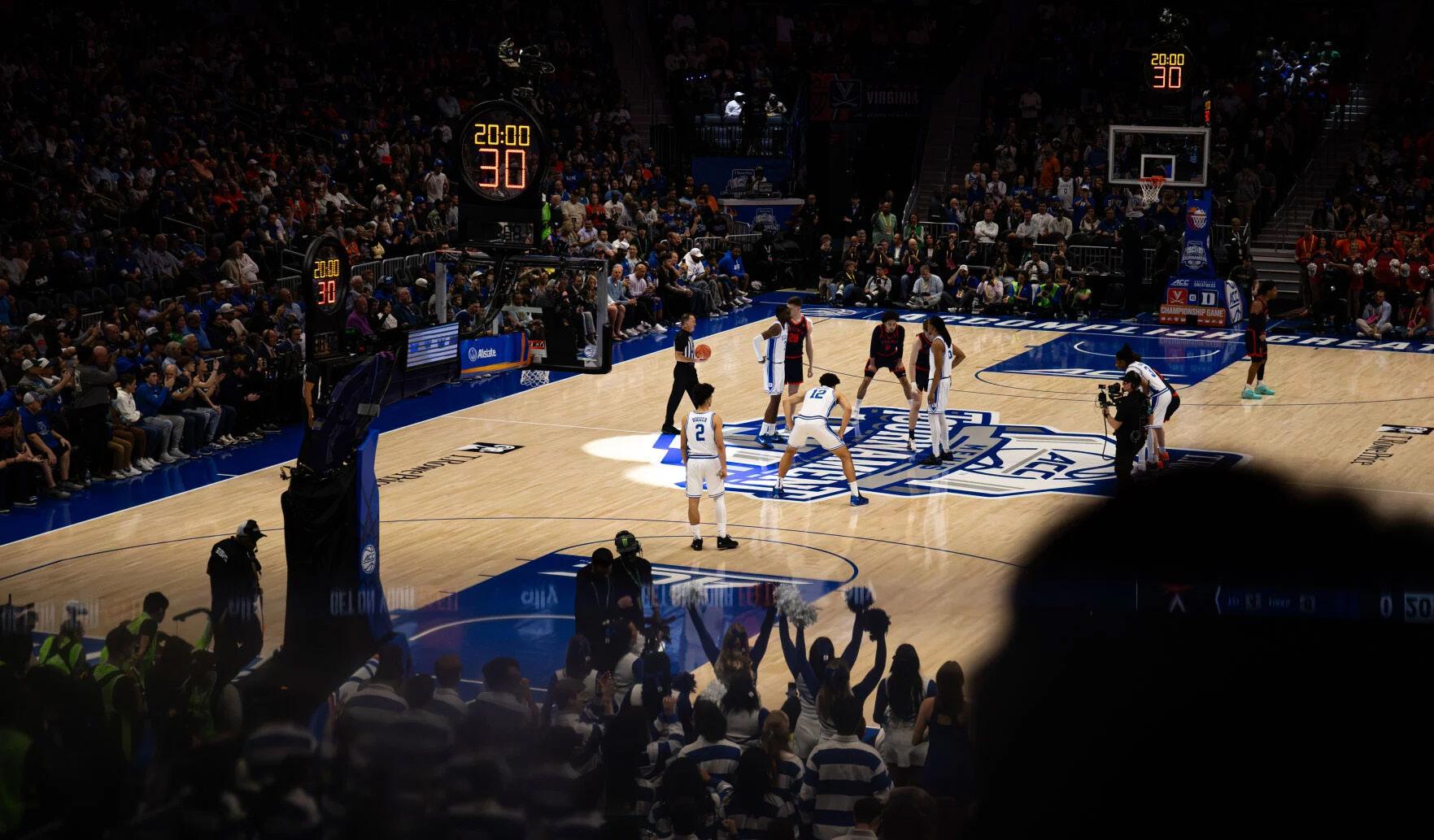
THOMAS BRAY / COLLEGIATE TIMES
Duke and Virginia prepare to tip off the championship game of the 2026 ACC Men’s Basketball Tournament on March 14.
‘WE GAVE IT OUR ALL’: HOKIES MEN’S BASKETBALL LIKELY TO MISS BIG DANCE AGAIN
Sam Mostow | Sports Editor
Virginia Tech fell short of the NCAA Tournament for the fourth consecutive year.
CHARLOTTE, N.C. — There is an old basketball cliché — or excuse — that losing teams use: shots didn’t fall. The objective of the game is to hit more shots than the other team, then rinse and repeat. That’s the most simplistic way to view a game that is, in reality, so much more complicated than that.
Basketball is not just merely about who hits shots; rather, it’s about the circumstances around those made or missed shots. It’s about who turns the ball over less. It’s about who grabs more rebounds. It’s about who simply gets more lucky. All of those factors combine to influence who wins a basketball game. The most crucial shots of the game
Bedford’s putback bounced off the front rim as time expired, sending the game to overtime.
Wake Forest hit its first three shots from the floor — plus two free throws — in the additional five minutes to build an unconquerable lead. The Demon Deacons defeated the Hokies, 95-89, in the first round of the ACC Tournament in the Spectrum Center on Tuesday. It is true that No. 13 seed Wake Forest (17-15, 7-11 ACC) shot better than No. 12 seed Virginia Tech (19-13, 8-10 ACC). Tech shot 41% from the floor, but was doomed by a 3-for-13 rate on 3-pointers in the first half. Across the whole contest, though, Wake went 51% overall and had seven
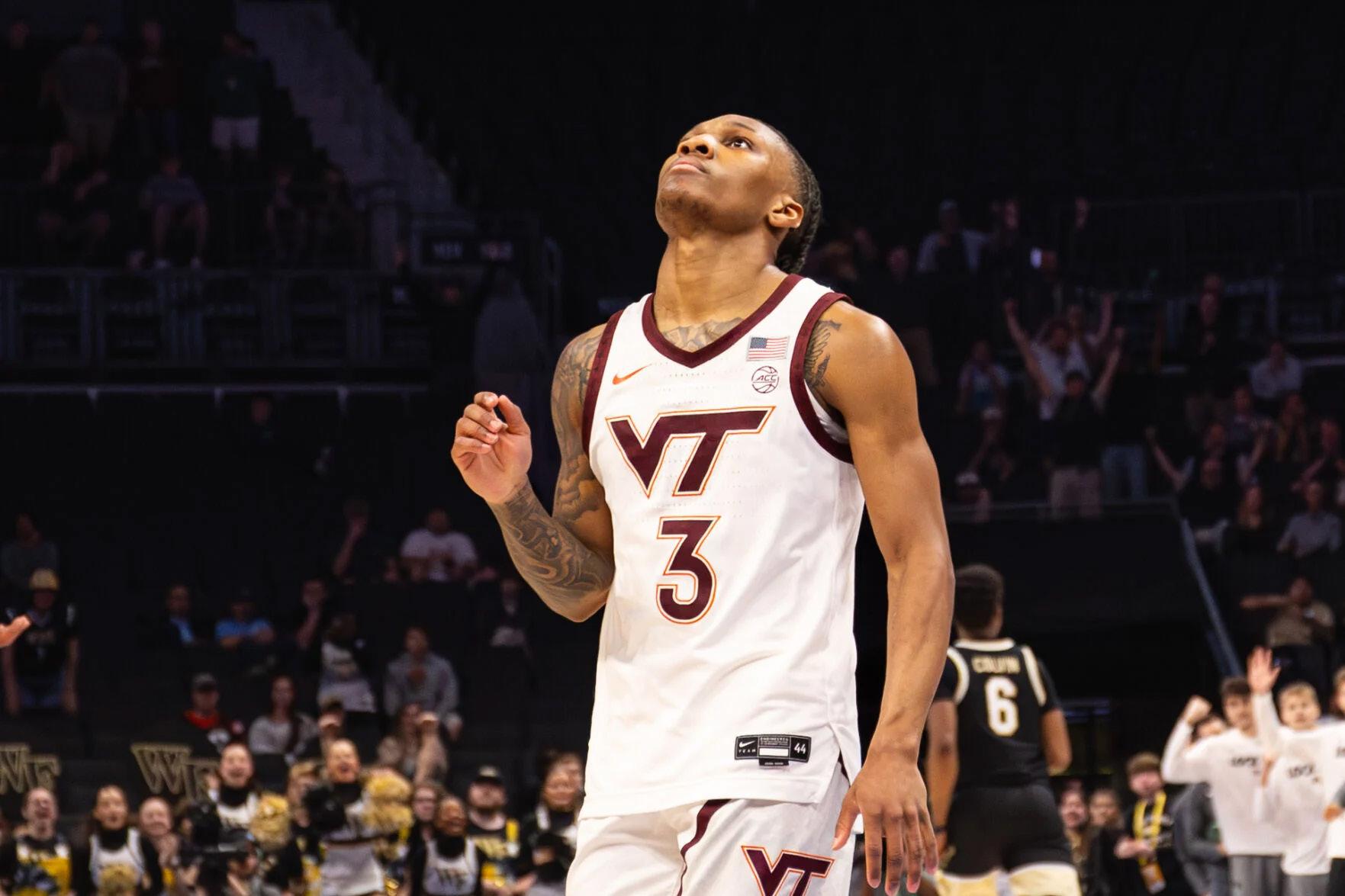
came as the seconds dwindled on regulation with Virginia Tech and Wake Forest tied at 75. Hokies guard Ben Hammond dribbled the ball across half court. He drove into the key, pulled up ahead of the basket and nicked a floater toward it. The shot hit the left side of the rim with less than a second left, then guard Jailen Bedford grabbed it.
players finish with more than 10 points: guard Myles Colvin (18), guard Sebastian Akins (14), forward Tre’Von Spillers (13), guard Mekhi Mason (13), forward Juke Harris (10), guard Nate Calmese (10) and forward Cooper Schwieger (10). However, blaming just the field-goal percentage would be far too simplistic. Hammond hit a 3-pointer to cut the
deficit — which had grown as large as nine points — to two. Then, Tech guard Tyler Johnson fouled Schwieger, the latter of whom promptly hit two free throws and the Hokies went into halftime down by four. The Hokies didn’t lead until nearly 24 minutes into the game, when Bedford hit a fast-break layup. The two teams traded advantages after that, sharing nine ties and splitting six lead changes, but Virginia Tech never fully gained control.
It was a game where Virginia Tech could have snatched a decisive lead, then a few small things went wrong and it failed to do so. That’s a fitting conclusion to the season, when missed chances were a consistent theme.
“We had our opportunities, and we came up just short,” said Virginia Tech head coach Mike Young. “That’s disappointing, infuriating and I take a lot of responsibility there.”
The Hokies surrendered a 13-point lead in three-plus minutes to Stanford on Jan. 7 for a one-point loss in Cassell Coliseum. The Hokies led by four points with seven seconds left against SMU, then Boopie Miller nailed a half-court heave at the buzzer for their second one-point loss. Calmese knocked down a 3-point dagger during the first meeting between Virginia Tech and Wake Forest on Jan. 3. Hammond missed a jumper at the buzzer on the road against Miami for another one-point loss. Plus, Tech spent much of the season without Johnson and forward Tobi Lawal, who were sidelined with injuries.
If one or more of those potential opportunities broke the other direction, Virginia Tech would be more likely to hear its name called on Selection Sunday and advance to the NCAA Tournament for the first time since 2021-22. Now, they will probably be on the wrong side of the bubble for the fourth consecutive year.
“We’re obviously talented enough to be an NCAA Tournament team. Probably a few shots away from being an NCAA
Tournament team,” said Virginia Tech guard Jaden Schutt. “There were other games where we had the opportunity and we didn’t put it together. We can’t really look back at all the buzzer-beaters throughout the season or all the close games, but it’s tough. We had injuries all year, but we get talented teams no matter what. We put a talented team on the floor every night and just couldn’t get enough done.”
Young said before and during the season that he believed he had a team talented enough to qualify for the NCAA Tournament. He had reason to be optimistic, too; he retained Hammond, Lawal and Johnson from the year before, while adding highly-touted Greek prospect Neoklis Avdalas.
A five-star recruit, Avdalas scored 33 points against Providence during his second game in a Virginia Tech uniform on Nov. 8. He put up 30 more on Dec. 11 against Western Carolina, then struggled throughout much of the season. Across nine conference games in January, he shot 31% from the field, including 15% from long range, and averaged 9.3 points per game.
Avdalas was not the only player to struggle. Much of the roster stumbled through periods of the season, as is the case with most rosters. Those difficulties, combined with injuries and other miscues, kept Virginia Tech away from contending in the ACC.
“We played our hardest, man,” Lawal said. “That’s it. … We gave it our all. We are not happy with the result, but there’s nothing we can do now.”
All of those factors combined to keep Young and Co. away from March Madness for another year. That brings us back to the first, simplistic point: shots didn’t fall.
THOMAS BRAY / COLLEGIATE TIMES
Virginia Tech guard Ben Hammond (#3) reacts during Virginia Tech’s loss to Wake Forest in the first round of the 2026 ACC Men’s Basketball Tournament.
ONE LAST HEARTBREAK: VIRGINIA TECH FALLS TO WAKE FOREST IN FIRST ROUND OF ACC TOURNAMENT
Dylan Tefft | Sports Editor
The Hokies ended their season in Charlotte on Tuesday.
CHARLOTTE, N.C. — Following a 95-89 overtime loss to Wake Forest at the ACC Tournament on Tuesday, Virginia Tech’s players were adamant that they had no clue if an NCAA Tournament bid was still in the cards.
But their tears, dreary countenances and the unruly silence that blanketed the Spectrum Center locker room told another story. It was one of heartbreak. The 12th-seeded Hokies (19-13, 8-10 ACC) lost another do-or-die game to end their season in Charlotte, marking the program’s fourth straight year missing the NCAA Tournament.
“We had our opportunities and we came up just short,” said Tech head coach Mike Young. “That’s disappointing, infuriating, and I take a lot of responsibility there.”
The 13th-seeded Demon Deacons (17-15, 7-11) inched ahead of Tech for most of the 45-minute affair but separated themselves with a number of easy baskets and perfect free-throw shooting in overtime.
Guard Myles Colvin hit two quick jumpers to give Wake Forest a five-point lead in overtime that, despite Tech coming within a point multiple times, never quite evaporated. The Demon Deacons were 5-for-7 from the field, 9-for-9 from the line and made their only 3-point attempt in the extra period. Tech simply looked gassed.
“Honestly, we were sweating more than them, but it’s 45 minutes,” said Hokies guard Jaden Schutt. “We play tough and we’re conditioned — it’s Game 32. But it’s just a game of runs. It takes a lot of energy just to come back. I thought we just didn’t follow our scout and gave up a few easy plays in OT.”
If “so close” will go down as the Hokies’ 2025-26 season mantra, then its final game — barring the team accepting an invite into the National Invitation Tournament — was no different. On the last play of regulation, Ben Hammond missed a floater. Jailen Bedford grabbed the rebound and tried to tip in, but missed off the front of the rim by a hair.
“They had stoned a couple of things that we typically go to there with how they were maneuvering or how they were guarding us,” Young said of the final play. “We thought we could get post players onto Ben. We had had a lot of success getting him off that. Jailen makes a heck of a play at it, and just doesn’t get it down. You get two shots on the rim in that situation, sign me up.”
The Hokies outplayed Wake Forest for much of the second half, rebounding from a shaky first in which they had a 3-for-13 three-point rate and 10 turnovers to the Demon Deacons’ five. Tech outscored Wake Forest 41-37 in the second and grabbed its first lead at the 16:21 mark.
A Bedford layup put Tech up 41-40 and, after a Wake Forest bucket, Neoklis Avdalas’s stepback three made it a two-point gap. The Hokies led by as much as five before Wake Forest struck a 13-4 run to go ahead 62-56.
They punched back with a ninepoint run at the end of the second half, courtesy of a Bedford 3-pointer, Hammond jumper and a litany of Wake Forest fouls — a trend that fueled much of the game on both sides. But again, the Demon Deacons responded. Colvin tied the game with a layup before giving his team a two-point lead at the free-throw line.
“Every time I thought we had control of the game, things just didn’t go our way,” said Hokies center Christian Gurdak. “[Wake Forest] hung in there and made timely shots. We missed some opportunities. That goes for everyone.”
Two Hammond free throws evened the game at 75. Then, in the waning moments of regulation, Mekhi Mason whiffed on an open three before Gurdak grabbed the rebound and the Hokies called timeout. They missed three straight field goals to end the half, including Hammond and Bedford’s last-second attempts.
“It was kind of hectic,” Gurdak said. “We were all trying to get in there and get a tip or something. [Jailen Bedford] had
a good look, and he’s a hell of a player. I love him to death … It’s unfortunate but it’s not his fault. There were a lot of plays leading up to that we should have made.”
Avdalas was benched with 7:37 remaining and never returned, finishing 2-for-8 with five points and three turnovers. Young said he preferred to close the game with Jaden Schutt (3-for-7 from deep) and Bedford (6-for-18, 17 points).
Antonio Dorn also sat the last 11-plus minutes of the game despite a strong performance in the absence of star center Amani Hansberry, who was injured Saturday against No. 10 Virginia.
The German-born center was 3-for-3 with eight points, seven rebounds, three assists and two blocks. His dunk cut Wake Forest’s lead to three with 6:33 remaining, but he was pulled soon after.
Hammond and Bedford paced Tech with 23 and 17 points, respectively, with Bedford adding five rebounds and three assists. Schutt contributed 15 points with 10 in the second half, while Lawal added 12 as Tech’s fourth double-digit scorer.
Wake Forest had seven. Colvin led
with 18 and Sebastian Akins had 14, but its entire lineup — which consisted of just eight players — took advantage of a porous Tech defense that only deteriorated as the game went on. The Demon Deacons shot 44% in the first half, boosted that rate to 52% in the second and climbed even further to 71% in overtime.
Virginia Tech will play more basketball this season if it chooses to, with the NIT set to begin on March 17. However, if the mood in the Hokies’ locker room following Tuesday’s loss was any indication, their dreams died in Charlotte. All that was left was hurt — and all they could do was dwell on what went wrong, and what could’ve been.
“I don’t even want to go there,” Schutt said of Tech’s potential. “It’s one of those things where I had high hopes for our team, and I thought we worked really hard, but you’ve got to go out there and get it done. It just didn’t add up this year.”
THOMAS BRAY / COLLEGIATE TIMES
Virginia Tech guard Jailen Bedford (#0) reacts after missing a buzzer-beater attempt at the end of regulation. The Hokies lost in overtime.