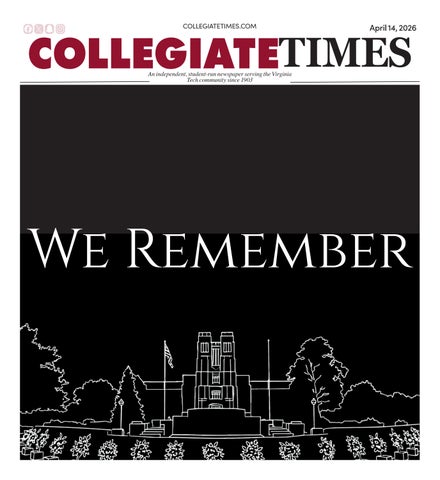

COLLEGIAT ETIMES We Remember

NEWS
TIM SANDS STEPS DOWN AS VIRGINIA TECH PRESIDENT
Julian Namez | News Writer
During his 12 years as president, undergraduate enrollment increased 30%.

Impartiality means reporting, editing and delivering the news honestly, fairly, objectively and without opinion or bias.
Credibility is the greatest asset of any news medium, and impartiality is the greatest source of credibility.
To provide the most complete report, a news organization must not just cover the news, but uncover it. It must follow the story wherever it leads, regardless of any preconceived ideas on what might be most newsworthy.
The pursuit of truth is a noble goal of journalism. But the truth is not always apparent or known immediately. Journalists’ role is therefore not to determine what they believe at that time to be the truth and reveal only
that to their readers, but rather to report as completely and impartially as possible all verifiable facts so that readers can, based on their own knowledge and experience, determine what they believe to be the truth.
When a news organization delivers both news and opinions, the impartiality and credibility of the news organization can be questioned. To minimize this as much as possible there needs to be a sharp and clear distinction between news and opinion, both to those providing and consuming the news.
Voice your opinion. Send letters to the Collegiate Times. 365 Squires Student Center
Blacksburg, VA, 24061 opinionseditor@collegiatetimes.com
All letters must include a name and phone number. Students must include year and major. Faculty and staff must include position and department. Other submissions must include city of residence and relationship to Virginia Tech (i.e., alumni, parent, etc.). We reserve the right to edit for any reason. Anonymous letters will not be printed.
Letters, commentaries and editorial cartoons do not reflect the views of the Collegiate Times. Editorials are written by the Collegiate Times editorial board, which is composed of the opinions editors, editor in chief and managing editors.
On Thursday, April 9, Tim Sands announced that he will be stepping down as president of Virginia Tech.
In his official statement, he said, “It is now time, while Virginia Tech has momentum on so many fronts, for me to start the process of stepping aside so that the next president can take the baton in full stride.”
Sands has served as president of Virginia Tech for 12 years, during which time undergraduate enrollment increased by 30% and applications for undergraduate enrollment increased 200%. His tenure also saw the opening of the Innovation Campus in Alexandria, Virginia, and the integration of the Virginia Tech Carilion School of Medicine.
Sands added, “I have shared with the rector of the Board of Visitors my commitment to serve until my successor is in place to ensure a smooth transition for the university community.”
John Rocovich, rector of the Board of Visitors, voiced his praise and gratitude for Sands’ time as president.
“I am deeply grateful to President Sands for his leadership and tireless
dedication to our university and his vision for what we can accomplish in service to our students and the commonwealth.”

COLLEGIAT ETIMES
NEWSROOM 231-9865
Editor-in-Chief: Michaela Scott (editor@collegiatetimes.com)
Managing editor: Ayisha Surani
Design editor: Annmarie Leake
Assistant Design editors: Caroline Rogers, Sarah Jordan, Mx Zaleski, and Alana Vernon
Copy editors: Emily Southern, Olivia Guy and Amanda Donndelinger
News editor: Erin Bailey and Ava Garrison
Assistant News Editor: Max Painchaud
Lifestyles editors: Emma Duncan
Assistant Lifestyles editors: Cat Pizzarello and Ella Winterling
Sports editors: Sam Mostow, Thomas Bray and Dylan
Opinions editor: Jenna Mason
Assistant Opinions Editor: Mohib Amjad
Photo editor: Hamad Alhendi
Assistant Photo editor: Riley Thompson
Have a news tip? newstips@collegiatetimes.com
BUSINESS STAFF 231-9860
Business manager: Greg Patterson (business@collegemedia.com)
MEDIAMATE 888-897-7711 collegiatetimes.com/media_kit/ orders@mymediamate.com
The Collegiate Times, a division of the Educational Media Company at Virginia Tech, was established in 1903 by and for the students of Virginia Polytechnic Institute and State University. The Collegiate Times is published every Tuesday of the academic year except during exams and vacations. To order a reprint of a photograph printed in the Collegiate Times, visit reprints.collegemedia.com. The Collegiate Times is a division of the Educational Media Company at Virginia Tech, Inc., a 501(c)3 nonprofit with a mission to provide educational experience in business and production of mass media for Virginia Tech students. © Collegiate Times, 2020. All rights reserved. Material published in the Collegiate Times is the property thereof, and may not be reprinted without the express written consent of the Collegiate Times.
Advertisements do not necessarily reflect the opinions of the Collegiate Times. Read about our organization’s Core Values online at collegiatetimes.com.
Tefft
OUR CORE VALUES
LIVI DEL VALLE / COLLEGIATE TIMES
MUHAMMED MUHEISEN VISITS VIRGINIA TECH
Lindsey Kudriavetz | News Writer
Muheisen graduated with a journalism degree and photographs major events around the world.
Muhammed Muheisen visited Virginia Tech with National Geographic Live on Tuesday, April 7, to speak at the Center for the Arts about “Beauty Beyond the Front Lines.”
“I document stories that matter, stories of hope, stories of courage and stories of resilience,” Muheisen said.
Muheisen was born in Jerusalem in 1981 and grew up during a time of conflict between Israel and Palestine. He explained that he felt like the news ran his life. After finding his grandmother’s Polaroid camera, he fell in love with photography.
“I had a dream. Maybe one day I will be able to capture these colors with a camera and share it with the world,” Muheisen said.
After graduating with a degree in journalism and political science from Birzeit University, he began
photographing major events around the world. Muheisen has photographed major events including the Syrian Civil War, the capture of former Iraqi president Saddam Hussein and the funeral of Nelson Mandela.
Notably, Muheisen took photos in the Middle East during the 2001 war in Iraq. He told the story of taking his first Pulitzer-winning picture.
“Almost every picture that I captured in Iraq could have cost me my life,” Muheisen said. “I hardly speak about this picture, because every time I speak about it … it almost cost me my life.”
He explained the dangers that come with taking photos in conflict. Muheisen was in danger every time he carried a camera.
“I thought I would do it again, and the answer is yes,” Muheisen said. “Because if something is never documented, it’s
like it never occurred.”
Muheisen focuses on photographing children to highlight the life within the violence. He wants to emphasize that children across the world are the same.
“Children all over the world share the same things in common. They see fun, they see joy and they seek happiness no matter where they’re from,” Muheisen said.
When taking photos of children, he dedicates himself to giving back to these communities and keeping in contact with those he photographs.
“My pictures connect worlds. The photographer became the bridge … that is why I’m a photographer,” Muhesein said.
Along with taking photos, he is the co-founder and chairman of the Dutch foundation Everyday Refugees.
To learn more about Muheisen and his mission, visit his website.
SPRING FOOTBALL GAME HEADLINES FAMILY WEEKEND
Hannah Skemp | News Writer
The Spring Game will highlight the program’s newest roster and new head coach, James Franklin.
Family Weekend will take place April 17-19 and will feature a variety of campus and athletic events, including the annual spring football game.
The Spring Game is a scrimmage against the Hokies’ own team that is scheduled for Saturday, April 18, at 3 p.m. Admission to the game is free and open to the public.
The Spring Game will offer insight into the team’s development and mark the first coaching experience in Blacksburg for new head coach James Franklin. The coaching splits the roster into two teams, orange and maroon, to stimulate a real game environment. The game will provide an early look at the program’s newest roster additions as they begin
a new chapter under new leadership, incoming recruits and transfer players.
Additionally, the weekend offers opportunities to attend other Hokie athletic events. Baseball and softball will both host games April 17-19, with softball competing against Georgia Tech and baseball against the University of Pittsburgh.
Events on Saturday will begin with the annual 3.2 Run in Remembrance, honoring the 32 lives lost on April 16, 2007. The run is scheduled for April 18, at 9 a.m. on the Drillfield, and anyone can register and participate.
Beyond athletics, the university will offer a full schedule of Family Weekend activities, including academic open
houses, campus tours, social events, informational sessions and family fitness activities. Registration is open now in the Hokie Family Hub.
Programs are designed to give families a deeper understanding of student life, academic opportunities and campus resources, while also allowing students to spend time with their families and get involved in campus culture.
The weekend also provides opportunities for families to explore the surrounding Blacksburg community, including the Blacksburg Farmers Market, which is held Saturdays from 8 a.m. to 2 p.m.
A complete list of events is available through the university’s Family
Weekend schedule, and parking, lodging and transportation information can be found on their website.
LIFESTYLES
REMEMBERING APRIL 16, 2007 WITH PROFESSOR ROBERT CANTER
Samuel Harvey | Lifestyles Writer
“As I stepped onto campus, I heard the sirens,” the English instructor recalled.
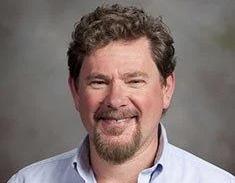
As Virginia Tech approaches the 19th year since the horrific events of April 16, 2007, the Hokie community takes time to reflect on what was lost and what has been endured in the wake of such violence. Although the students who were attending Virginia Tech when the tragedy took place have long graduated, many faculty and staff who were working on that day continue to serve the university and the student body.
Robert Canter, a senior instructor in the English department, has been teaching at Virginia Tech since 1994. Following a longstanding passion for English and history, he currently teaches intro to short fiction and intro to detective fiction. Graduating from the University of Virginia in 1984, Canter joked about being unfamiliar with Virginia Tech and the town of Blacksburg.
“When I went on the job market and was invited for a job interview here, I brought out my paper map and I’m
looking at the coast,” Canter said. “I had no idea where Blacksburg was.”
Faded photographs adorn the walls of Canter’s well-decorated office in Shanks Hall. The countless, smiling faces of his children and prior students pay homage to his positive impact on numerous Hokies. Since the beginning of his tenure at Virginia Tech, Canter has witnessed change in all aspects of the campus and student life. He provided insight into how the events of April 16, 2007, changed how students and professors relate to one another and their relationship to the university.
What was Virginia Tech like back in 2007?
“It was a little smaller, a little quainter. There weren’t as many buildings. In that sense, you felt more connected. It felt like campus was up in the air because we had more sky. Now it feels a little more controlled and contained.”
What do you remember from the morning of April 16, 2007?
“I was heading up to campus because I had a class starting soon. As I stepped onto campus, I heard the sirens. One of my daughters had heard the news; she was in Richmond and she called me. My flip phone was ringing and buzzing in my pocket as a student said ‘Mr. Canter, go back home’ and he told me what was happening.
Our alert system was certainly primitive at best. You had no sense of the locus where the sirens were all coming from or headed toward because they just swirled around you in the wind.”
How did life on campus resume after such an awful event?
“We had a couple of days off and we reconvened for one more day of class to say goodbye and talk to everybody. The university provided counselors and it did what it could.
I came back to campus as quickly as I could. I’ve noticed I’ve had that (kind of) reaction to tragedies and violations generally, as I don’t want the violator to ruin the relationships with the thing that is still good. You want to commemorate as soon as you can. You wanted to reconvene with friends, get the hugs you needed.”
Was there a visible change regarding the students on campus?
“There was profound sorrow that never left. There was also quite intensified kindness. Generally speaking, there was a much greater kindness, patience, appreciation and quietness.
I remember the pace of people jogging changed — people would jog more intensely. You could see they were churning and trying to work it off. You’d see more people sitting by themselves and at the same time, people were clustering more intensely. People kind of flung themselves to extremes to cope.”
Did the events of April 16, 2007, change your approach to teaching and the dynamic you have with students?
“One thing I did in the classroom was I recognized students. Generally, I think teachers, myself included, as well
as students, were more humane to one another and that aftershock effect was very distinct.
On one hand, (students) were hungrier to make bonds or whatever friendships they brought to the classroom. It was clearly grounding, solidifying and healing. On the other hand, you could see tentativeness. There was this feeling (that) if I get close to you and something like this happens again, I can’t deal with the grief, so I’ll hold you at an arm’s length.”
Why do you think it’s important to educate younger students about April 16, 2007?
“There’s a personal safety aspect, of course. Although I’m not sure anyone can really emotionally prepare for what could happen.”
What has been your favorite thing about Virginia Tech during your time here?
“Having raised four kids here, that’s the main thing it’s textured with. Part of it is simply Virginia; it’s such a beautiful place. I love the Great Lakes, I love Canada and New England, but Virginia just gets in your bones. There’s just a balance and a deep, serene beauty to Virginia. Once you’re here, you keep coming back to it because its seasons are so balanced and distinct. It’s got a kind of gentleness to it as well as a tragic, awful and hopeful history all at once. There’s a sense that Virginians appreciate being Virginians and they do so in a very generous way.”
PHOTO COURTESY OF VIRGINIA TECH
Robert Canter is a senior instructor in the Department of English.
WE REMEMBER: A REPORTER’S PERSPECTIVE
Willow Musterman and Annie O’Connell | Lifestyles Writers
Journalist turned professor Dawn Jefferies recalls her experience covering the shooting in 2007.
Thursday, April 16, 2026, will mark 19 years since the lives of 32 professors and students were lost in the Virginia Tech shooting. Numerous reporters, and even former President George W. Bush, came to Blacksburg, making it one of the most heavily covered news events of 2007.
Specifically, former WSLS 10 reporter Dawn Jefferies, now a professor of practice in the School of Communication, was one of the first on the scene.
“My morning started early. I came to campus when we first got the call about something that had happened in a dorm,” Jefferies said. “As I was on my way with my videographer, state police were passing by us on the road, driving very fast, and a large number of them — that was a little concerning.”
The police cars that sped by were responding to the incident at Norris Hall, an engineering building on campus. Amid the day’s tragedy and chaos, reporters had almost no time to grieve.
“That’s the thing with working in news, you kinda delay the processing of it,” Jefferies said. “My focus in the moment, in the days and the first week, consisted of focusing on getting a job done, doing the work, getting information and informing our audience. The processing came much later.”
Jefferies’ focus was not just on doing her job well, but ensuring that her live report was accurate. She collaborated
with the people around her to bring forth the truth of the incident.
“We didn’t choose to withhold information, but we did choose to confirm the information before we got it,”
Jefferies said. “As a journalist, that was very difficult. You have people from the network who are working with their contacts at the state department, and I’m working with people here who are just waiting to confirm.”
Although many stations were fighting to get the story out, they were able to band together as a community to support one another.
“Photographers from a competing station were standing next to us in The Inn at Virginia Tech, which had become the media room,” Jefferies said. “A photographer from the competing station asked me if I had eaten.”
Jefferies shared that she was pregnant with her daughter at the time and had not taken the time to eat that day. The photographer brought back dinner for her.
“That always stood out to me because one of the things that happened during that time is that people were really looking out for each other,” Jefferies said. “So here was this photographer from a competing station checking in on me to make sure that I had eaten.”
In a time of devastating loss, fear and uncertainty, Virginia Tech’s community uplifted one another.
“I think in many ways (this story) made me love and appreciate this community a lot more,” Jefferies said. “When I first started in the news, I had an idea of where I wanted to end up, and I think in a lot of ways, I was acutely aware of what a great community this is. That’s a nice reminder to have.”
Jefferies’ strong connection to the Virginia Tech community shapes her approach to reporting, emphasizing understanding and empathy. While every journalist’s approach to reporting sensitive topics varies, she made her number one priority the people.
“A lot of times, as journalists, we talk to people on the worst days of their lives, and I don’t ever want to make what a horrible day any worse than it is,” Jefferies said. “So if I can lead with compassion and kindness and help them share something, whether it’s letting the community or world know about their loved one, that means more to me than getting a scoop.”
With reporters having flown in from all around the country, many people were pushing for information. In the midst of confusion, Jefferies recalls that everyone still made it a priority to support one another.
“It wasn’t just about us, it wasn’t just about me as a reporter; people were looking out for each other and checking in and making sure that people were okay,” Jefferies said. “Everybody just
started coming together.”
Since becoming a professor at Virginia Tech, Jefferies has been able to share her wisdom and experience with her students.
“I used to be really reluctant about talking about myself or stories that I’ve done in class because I don’t want that to come off or be perceived in a negative way, but I’m learning that those are the things that perk students up when you’re talking to them in a classroom,” Jefferies said. “You can learn a lot from a textbook, but the textbook is never going to teach you what it’s like to knock on someone’s door when something horrible has happened. It’s not going to tell you how to approach someone who just lost the love of their life.”
Navigating the field of journalism can be tricky, but Jefferies’ empathetic approach has paved the way for future reporters to lead in their research with kindness and compassion. To aspiring journalists, Jefferies gives this advice:
“Keep asking questions, even when it’s hard, even when people don’t want to answer or fight you on it, keep asking questions, keep being curious,” Jefferies said. “Know that it’s not about us, it’s about what we’re reporting on and the issues that matter in our communities.”
LEVITY AND LOSS: VIRGINIA TECH’S FLORAL DESIGN CLASS REMEMBERS THROUGH FLOWERS AND THEIR BEAUTY
Bailey Miller | Lifestyles Writer
Every April, floral design students create wreaths and sprays to honor the lives lost on April 16, 2007.
As April 16 approaches each year at Virginia Tech, the university and the global community remember the victims and effects of the 2007 shooting. There are many preparations for the week of remembrance, including organizing different memorial events and creating a virtuous environment to honor the lives lost 19 years ago.
One of the largest contributors to the April 16 scene is the Virginia Tech floral design class in the College of Agriculture and Life Sciences. Professor Barbara
Leshyn, who has been teaching floral design since 2011, leads the class each semester to complete projects and provide pieces for university events. Students learn about “fundamental art theory, historical and cultural influences, tools and techniques as applied to current floral art.”
“We have 100 students this semester from all colleges on campus,” Leshyn said. “Floral design has been taught for over 100 years on this campus.”
Craft and questions
The floral design students and Leshyn have been requested to create sprays, wreaths and arrangements for the memorials for years.
“(Students) want to be here. It’s all volunteers,” Leshyn said. “They want to help. I think in any crisis that you’re not involved in, and even if you were 5 when it happened, you feel hopeless and helpless. All of this kind of fulfills that feeling. You can think, ‘Well, what can I do?’ The answer is I can do work with these flowers. That’s how I can help.”
From the beginning to the end, the entire process takes 10 days to complete. Students are working diligently to organize the pieces while working together in unison. During the whole week, the class discusses the event and asks questions to Leshyn, who was here during the shooting.
“I was in the Department of Foreign Languages at the time, so I lost two continued on page 6
continued from page 5 colleagues,” Leshyn said. “The students want to know, and so in their curiosity, they ask questions and learn about the experience. At this point, it’s just about sharing memories of that day. There are people who are very willing to tell you where they were, what they were doing, and how it affected them, because it affected everybody. No matter how close or far away you were from the victims, you were still affected.”
Flowers and their meanings
Flowers can represent many different meanings in terms of remembering loved ones. According to A to Z Florist, flowers “have a great spiritual significance and have consistently been utilized to represent the life cycle from birth through death. Flowers speak love and compassion, yet they also speak of immortality and eternity.”
When it comes to choosing flowers for the deceased, there is a method behind it.
The class makes 32 sprays for each victim and places them behind the memorials in front of Burruss Hall. There are also three wreaths created: a maroon-and-orange one, a white wreath for the deceased and a green wreath for those who were injured. In addition to the sprays and wreaths, the students also craft two altar arrangements and a basket of flowers for the family to lay on the memorial stones.
“The most common picked flowers are irises,” Leshyn said. “There’s no common color. It’s very colorful outside. Some families want specific flowers and some just want colors. In that case, we pick the flowers that are going to last longer outside. We also use roses and carnations a lot.”
Altogether, the action of putting together the sprays is meaningful to Leshyn and her students.
“I would say my favorite part is building
“Students ask, ‘Well, how do you pick the flowers?’ And I say I don’t. The families do,” Leshyn said. “It is impactful when you’re sitting there holding the flowers. It’s like the family has asked for those flowers, you know?”
the sprays in remembrance because you can’t help but to think about that person you are building it for,” Leshyn said. “You can’t help but think about the fact that this person was a student and what they could have contributed to the world and society. We work with flowers that represent children and adults, who were also children.”
Remembrance in the workspace
Even though this week is a time for grieving and mourning, the students integrate their best efforts to persevere through these remorseful times.
“It is interesting because if you come in when we are building the pieces, there’s a lot of laughter, happiness, chatter, talk and music playing,” Leshyn said. “We don’t sit here and do it in complete somber.”
When it is time to physically set up the sprays behind the stones of the memorials, students focus on their emotions and respect for the victims with their whole hearts.
“Once you arrive with these flowers to names on the stones, it’s amazing how
OPINIONS
the energy shifts to silence,” Leshyn said. “When we are building these, we are being very respectful. But at the same time, when you are working with flowers and the beauty of it all, there is a levity in the lab. But immediately, when we walk over to the memorial, you feel it, you know?”
A call to volunteer
When it comes to forming the flowers and building the arrangements, students volunteer every year to help the class and Leshyn.
“You have students come back and ask to help. One student this semester wants to build one of the sprays because one of the families lives in their neighborhood. Usually, one of the cadets wants to build La Porte’s spray because he was a cadet.”
Regardless of background, major or connection to the tragedy, students are able to make an impact on the day to honor the students and faculty Virginia Tech lost. The flowers not only showcase their charmed essence, but also the radiance and light each victim brought into the community and the world.
LESSONS I’VE LEARNED FROM REMEMBRANCE DAY
Kennedy Monahan | Opinions Columnist
A Virginia Tech legacy student reflects on the importance of Remembrance Day.
April 16, 2007, my mom was pregnant with me, and that day, she was going to find out the gender of her baby. That morning, my parents found out that I would be a girl, and shortly after, my dad, who had graduated from Virginia Tech 10 years before, found out that at his alma mater, 32 people had been shot and killed.
You can imagine the emotional conflict my parents must have felt that day, and that story stuck with me pretty well as I grew up.
About 16 years later, I thought about it as I watched my older brother commit to Virginia Tech. I thought about that story again as I committed to Virginia Tech two years later. Throughout those years, my dad always made sure to include me in the Virginia Tech community. Remembrance Day has always been particularly important to my family, and because of that, I’ve learned many important lessons.
One thing that was emphasized to me a lot was empathy. Remembrance would not be what it is if we couldn’t feel empathy for the victims. We haven’t forgotten what
happened on April 16 because we know that the friends and families of the victims can never forget.
This also applied to other cases of gun violence that I knew about. Growing up, gun violence being a problem was not hidden from me. I remember when the 2019 mass shooting in my hometown of Virginia Beach happened, and I didn’t know how to feel. I knew that stuff like this happened, but this happened five minutes down the road from where I lived; I never expected gun violence to be that close to me.
I don’t think this is an uncommon feeling, but what really helps cope with it is being surrounded by a strong community.
Over the years, I have learned that the Virginia Tech community is truly like no other. Last year, around 15,500 people participated in the Run in Remembrance, with even more Hokies participating virtually across the country. Seeing so many people come together in support of Virginia Tech is a beautiful thing, and it shows how amazing this community is.
When people say “Hokies support Hokies,” it applies to more than just academics and career opportunities.
Lastly, after years of being a part of Virginia Tech remembrance, I have learned that by remembering events like April 16, we can learn how to prevent more shootings in the future.
While gun control is a contested topic, it is necessary for preventing mass shootings.
About two years ago, on the 17th anniversary of the April 16 shooting, Virginia senators Mark Warner and Tim Kaine introduced the Virginia Plan to Reduce Gun Violence Act to help prevent gun violence nationwide.
Kaine was governor of Virginia during the April 16 shooting. “I remember that day like it was yesterday — grieving with families, friends and the Hokie community. Sadly, far too many communities throughout the United States know the pain of horrific gun violence,” Kaine said.
As members of the Hokie community, we must recognize the fact that what happened to Virginia Tech can happen to other communities, and we should be willing to do all we can to prevent any future gun violence.
Nevertheless, all of my feelings about Virginia Tech and Remembrance Day would not be possible without my family. If it wasn’t for my family, I wouldn’t have been able to carry their lessons from Remembrance Day with me as I entered college.
However, as we approach the 19th anniversary of April 16, I hope everyone can find their own lessons from Remembrance Day, so we can honor those we lost and prevent those events from happening again.
DON’T J UST REMEMBER; PLEDGE TO NEVER LET IT HAPPEN AGAIN
Jenna Mason | Opinions Section Editor
The Never Again Pledge starts with us: Remember, act, protect the community.
Every year on April 16, students, alumni, faculty, staff and members of the Blacksburg community come together to remember the lives lost during the 2007 Virginia Tech shooting.
Various ceremonies and memorials are hosted around Blacksburg and campus to support the community when remembering a tragic time in the university’s history. Not only do these events represent the importance of remembrance, but they also support the ideas behind the Never Again Pledge.
Originally launched Dec. 13, 2016, the Never Again Pledge was created by tech workers as a public commitment to never again create a database that identifies people by race, religion or national origin. While its origin may lie in the tech industry, the essence behind it speaks to something far broader.
As a society, humans have endured numerous and endless tragic events throughout history. With that in mind, the phrase “never again” carries an enormous moral weight. “Never again” is a promise, responsibility and challenge all at once. The words ask us not to just mourn what happened on April 16, but to commit to why it must never happen again.
For the Blacksburg and Virginia Tech community, “never again” means something deeply personal to most people. On April 16, 2007, 32 Hokies lost their lives in one of the deadliest school shootings in U.S. history. Each of their names was carved into Hokie Stones for a memorial site on the Drillfield, acting as a permanent reminder of what was lost that morning. Every candle lit and every stone laid at the memorial is an act of love, but love alone is not enough. The 32 lives lost deserve more than an annual gathering; they deserve a community that actively carries their memory forward every day through a commitment to always do better.
Grief is a necessary emotion, but grief without action fades. These kinds of patterns repeat themselves throughout history: A tragedy occurs, the world stops and mourns, and then, slowly, life continues until the next tragedy forces us to grieve all over again. The Never
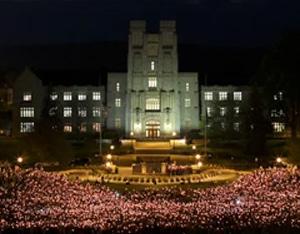
Again Pledge exists solely to interrupt that cycle by asking people to do something much harder than grieve; it asks people to commit.
This commitment doesn’t have to look like legislation or protest, though those things matter too. It can look like speaking up when something feels wrong, no matter how uncomfortable it may seem. Or it could look like learning the names of the 32 Hokies lost that day — not just as numbers from an awful tragedy, but as real people with lives, love, passion and people who loved them. Committing to this pledge could
even look like carrying the memory not just in April, but in how we treat other people in our lives every single day of the year.
Remembrance Day is a powerful tradition. The Virginia Tech community has shown unrelenting and remarkable strength in how it honors the people who lost their lives that day. But the Never Again Pledge asks us for more than just a moment of silence. It asks us to move forward with intention. It asks us to acknowledge the fact that honoring the dead means protecting the living. It asks us to say clearly and with conviction,
“Not here, not again and not on our watch.”
April 16 will forever be a day of grief. But let it also be a day of recommitment to one another, to this entire community and to the promise of always showing up, speaking up and refusing to look away. The names on that memorial are more than just names; they’re a mandate. We are Virginia Tech. And we will do better.
BRIAN CLAY / SPPS
HOKIES BASEBALL CAN’T SUSTAIN EARLY LEAD IN LOSS TO NO. 23 EAGLES
AJ Park | Sports Writer
With the Boston Red Sox away, Virginia Tech took to Fenway Park in Boston, Massachusetts, to play No. 23 Boston College on Saturday for the Eagles’ annual ALS Awareness Game. However, even though Tech’s offense was clicking early and had runners on the corners with no outs in the ninth inning, down one run, it lost 8-7.
An RBI single by Hudson Lutterman in the top of the first inning scored Henry Cooke right after the catcher tripled. After a scoreless bottom of the first, Owen Petrich delivered an RBI double, scoring Ethan Gibson to make it 2-0 Hokies. Nick Locurto struck out, but Ethan Ball responded with a two-run home run to double Tech’s lead. However, it was the Eagles’ turn to strike in the bottom of the fourth inning. Determined to erase the deficit, they loaded the bases with two doubles and a hit-by-pitch. That set the table for Boston College catcher Gunnar Johnson to get
the Eagles (25-12, 10-7 ACC) on the board. He smacked a bases-clearing double to cut the deficit by three runs. The next batter, Danny Surowiec, followed with a game-tying single to score Johnson.
Johnson delivered again for his team the following inning. With the bases loaded in the bottom of the fifth inning with one out, Johnson hit a go-ahead sacrifice fly to score Jack Toomey to make it 5-4 Eagles.
The action did not stop there. In the top of the seventh inning, Ball scored on an Eagles wild pitch to tie the game at five. However, that was all the Hokies (16-17, 7-10) got in that frame. With two on and nobody out, Lutterman struck out and Sam Grube grounded into a double play, ending the threat with only one run.
The Eagles had another pivotal offensive inning in the bottom side. Two singles and a hit-by-pitch loaded the bases up once again, this time for Luke
Gallo, who hit a go-ahead single, scoring Ty Mainolfi and moving every runner up a base. Johnson came up to bat again, getting plunked to force in another run, and it was 7-5 Eagles. Kyle Wolff joined in with a sacrifice fly, capping a three-run seventh for the Eagles.
However, the Hokies weren’t done. With two on and two outs in the top of the eighth, Locurto ripped a two-run triple, scoring Sam Gates and Petrich to make it a one-run ball game with the tying run only a base away. Unfortunately, the Hokies couldn’t muster anything else, as the red-hot Ball struck out, stranding Locurto.
After a scoreless bottom of the eighth, the Hokies attempted another big inning, putting runners on the corners with nobody out. However, after two straight outs, Cooke was picked off at third base to end the game with the Eagles hanging on to an 8-7 lead that
turned into a victory.
Hokies’ starter Brett Renfrow had six innings under his belt with eight hits, five runs (all earned), two walks and four strikeouts, throwing 109 pitches. His season ERA is now 6.92 as he continues a rough junior season. Ethan Grim took the loss, being tagged for the three runs in the seventh inning.
Eagles’ starter Brady Miller also grinded through six innings, giving up four earned runs on seven hits and two walks. He also struck out six across 104 pitches. Boston College’s bullpen was tagged for three earned runs on five hits in three innings.
Both teams will play a rubber game on Sunday at 1 p.m. ET, this time at the Eagles’ ballpark. The Hokies are 16-17 while the Eagles enter the game at 25-12.
Virginia Tech went up 4-0 early but ultimately lost to Boston College.
AKSEL WILLIAMS
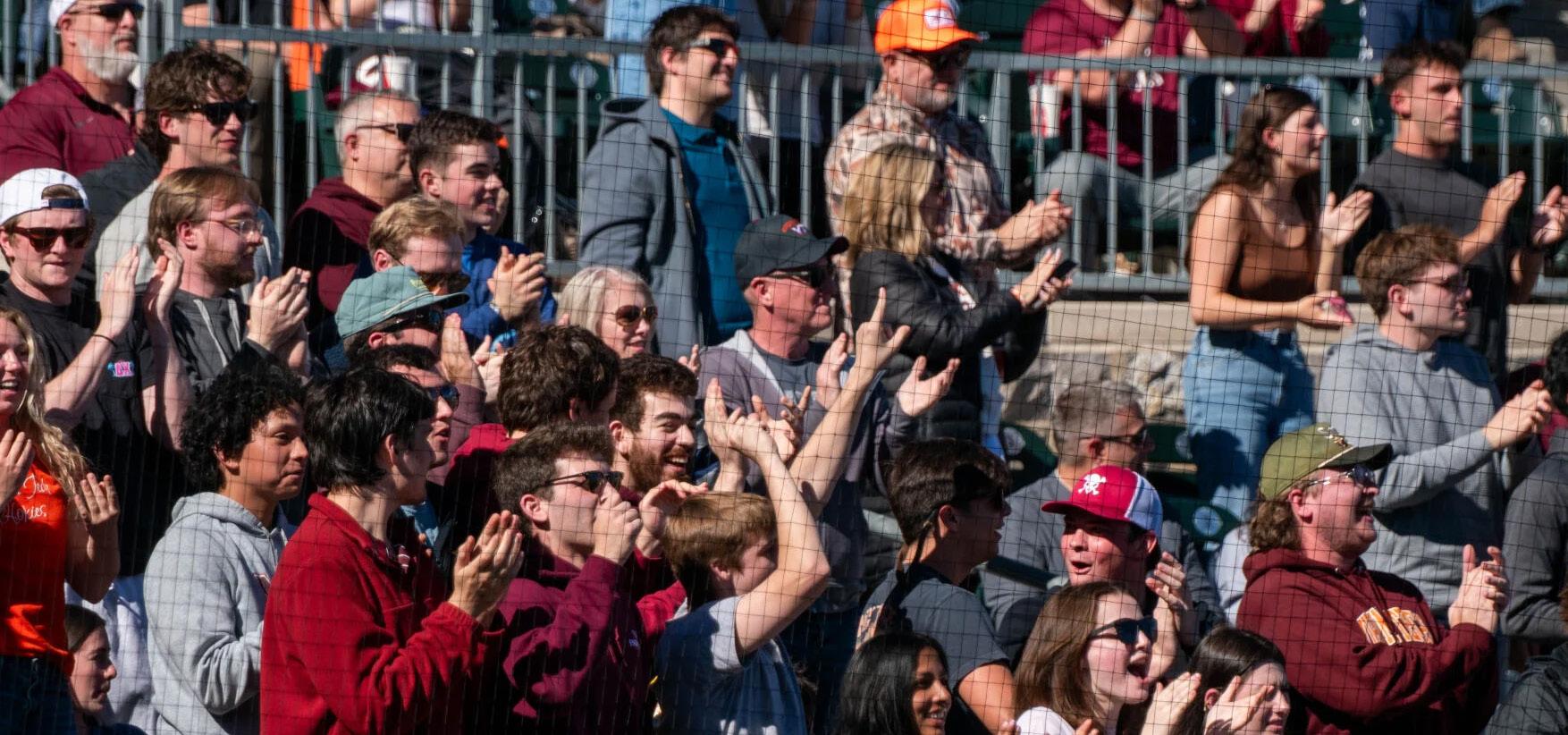
Fans cheering on the Virginia Tech Hokies baseball team on March 28, 2026, in Blacksburg, Va.