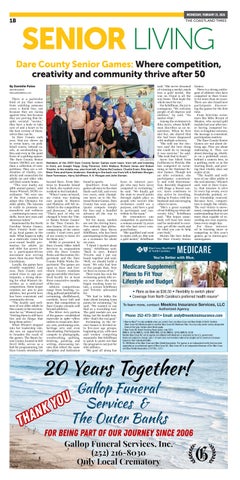
Dare County Senior Games: Where competition, creativity and community thrive after 50
By Danielle Puleo danielle.puleo@ thecoastlandtimes.com
There is a particular kind of joy that comes from watching someone cross a finish line, not because they are racing against time, but because they are proving that despite societal “norms,” they have a body to take care of and a heart to be the best version of themselves they can be.
In Dare County each year, that joy shows up in swim lanes, on pickleball courts, behind easels, at woodworking tables and even in the quiet focus of a quilting square. The Dare County Senior Games (DCSG) are more than a collection of competitions. They are a celebration of vitality, creativity and connection for adults 50 and older who call Dare county home.
“This year marks our 38th annual games,” said Jenna Wienert, DCSG coordinator. “We were one of the first counties to adopt this Olympics for older adults. The mission is really to promote camaraderie and wellness … continuing to move, use skills, learn new ones and showcase talent.”
Sanctioned by the North Carolina Senior Games, Dare County hosts one of 54 local games in the state. What began in 1983 as a statewide vision for year-round health promotion for adults 50 and older has grown into a participant-driven movement now serving more than 60,000 North Carolinians.
Locally, the games have steadily expanded. Last year, Dare County welcomed close to 250 participants, a strong showing for what Wienert describes as a mid-sized competition. Some larger counties see 400 to 500 athletes, but growth here has been consistent and community-driven.
“The health and wellness of our older adults in this county is the real mission for us,” Wienert said. “Getting them to still have fun and do things that keep them active.”
When Wienert stepped into her leadership role, she saw an opportunity to broaden the reach of the games. The Baum Senior Center, located in Kill Devil Hills, serves as a hub for programming, but Dare County stretches far

beyond there. From Hatteras to Roanoke Island to Duck, she wanted every resident to feel included.
“When I came on board, my vision was making sure people in Manteo and Hatteras still felt included in the competition and showcase,” she said.
“That’s part of why we changed it from the ‘Outer Banks Senior Games’ to the ‘Dare County Senior Games.’ It’s more encompassing of the entire county. I want every part of our county to know it’s for them, too.”
DCSG is presented by Dare County Older Adult Services in cooperation with the Dare County Parks and Recreation Department and the Dare County Public Works Department. The games are open to Dare and Currituck County residents age 50 and older who have lived locally for at least three consecutive months of the year.
Athletic competitions range from bowling, cycling, golf and pickleball to swimming, shuffleboard, cornhole, bocce ball and more. But competition in Dare County extends well beyond athletics.
The Silver Arts portion of the games—established statewide in 1986—offers outlets in visual arts, literary arts, performing arts, heritage arts and even cheerleading. Participants compete in photography, woodworking, quilting, knitting, painting and writing, showcasing talents that reflect the same discipline and dedication
found in sports.
Qualifiers from local games advance to the state finals each fall, and every two years, state champions move on to the National Senior Games. Dare County has seen participants compete simply for fun—and a handful advance all the way to nationals.
Yet for many, medals are not the driving force. Few embody that philosophy more than Harry Schiffman, who has been participating in the games as a swimmer for about 20 years.
“I think I started about 2009,” Schiffman said. “Back in 2011, Robert Trivette and I put our heads together and said, ‘Well, we should build a team.’ We only had four or five people then. Now we have in excess of 30.”
Their team has won the swimming points title every year since the state began tracking team totals, a system Schiffman and Trivette advocated for.
“We had to lobby the state about keeping team points for swimming,” he said. “We wanted to use that as a recruiting tool. The gold medals are one thing, but the health benefits—that’s the real goal.”
Swimming in the Senior Games is divided into five-year age groups, beginning at 50, with men and women competing separately. But Schiffman is quick to point out that the program is not just for elite athletes.
“My goal all along has
been to interest people who may have never competed in swimming,” he said. “We finally got the state to award points through eighth place so people who weren’t elite swimmers could see a purpose, and have a goal to participate and contribute to the team.”
He remembers one competitor in particular, a woman around 73 years old who had never competed before.
“She qualified and went to states with us. She won a gold medal,” Schiffman
said. “She never dreamed of winning a medal, much less a gold medal. She was on Cloud 9 all the way home. That made the whole meet for me.”
For Schiffman, the joy is contagious. “We welcome people of all degrees and abilities,” he said. “No matter what.”
Among the swimmers is Rita Ayers, whom Schiffman describes as an inspiration. When he first met her, she shared that she had been diagnosed with multiple sclerosis.
“She told me the doctors said the best thing she could do to manage it was exercise,” he said.
“She took that to heart.”
Ayers has biked from California to Florida. She has competed in swimming at the National Senior Games. Though not an elite swimmer, she participates consistently and with determination. Recently diagnosed with Stage 4 breast cancer, Ayers continues to stay active by traveling, biking in France with her husband and encouraging others to move.
“She’s a great example of not folding up when adversity hits,” Schiffman said. “She hopes somebody will hear her story and be motivated to exercise, get off the couch and do what you can to help your body.”
Stories like hers define the Dare County Senior
Games.
There is a strong contingent of athletes who have competed in Dare County for more than 20 years. There are also brand-new participants discovering the games for the first time.
From first-time swimmers like Mike Bryant of Manteo, who earned gold medals last year after never having competed before, to longtime veterans, the message is consistent: participation matters. The Dare County Senior Games are not about defying age. They are about embracing it. They are about showing up, whether on a pickleball court, behind a camera lens, in a quilting circle or at the starting block, and proving that vitality does not expire at 50.
“The health and wellness of our older adults is the real mission,” Wienert said. And in Dare County, that mission is alive in every lap swum, every brushstroke painted, every friendship renewed. Because here, competition is simply the vehicle. The real victory is movement, companionship and understanding that we are more than capable of exceeding our own expectations every single day. For those interested in learning more or competing in this year’s games, go to darenc.gov/ seniorgames.


Senior Living
Hobbies to get seniors out and about
The threat posed by social isolation has been known to medical researchers and health care professionals for years, but the issue gained wider attention during the pandemic. Restrictions on social gatherings during the pandemic opened millions of people’s eyes to the ill effects of social isolation, and while that threat proved temporary for the majority of people across the globe, many seniors continue to live largely isolated lives. According to the Mayo Clinic, depression, anxiety, increased risk of suicide, and various chronic health problems are some of the outcomes associated with loneliness. That’s a troubling assessment that becomes even more disconcerting when considering a general decline in socialization as evidenced by the 2021 American Perspectives Survey. Survey participants indicated they have fewer close friendships than they once did, speak with their friends less often and rely less on friends for personal support. That’s challenging for adults of all ages, but it can be especially difficult for aging adults, who may be dealing with the loss of a spouse or other close confidantes they would otherwise rely on when confronting personal problems. Hobbies that promote socialization can help aging adults reestablish friendships and build new ones, paying

dividends that can have a profound impact on their overall health. With that in mind, adults who feel as though their social circles are shrinking in midlife or in retirement can look to these activities as means to rebuilding their social lives.
• Book club: A book
club offers multiple benefits to adults. Book clubs are inherently social and tend to bring like-minded individuals together, which can help build new and lasting friendships that extend beyond weekly discussions. A 2021 study published in the journal Neurology also
linked regular reading to a lower risk of developing dementia.
• Sports: Sports provide another avenue to socialize with like-minded individuals. Golf is not a team sport, but it is typically played in groups of two or four, making it an ideal activity for adults
with free time on their hands to get out and about and meet other people. Leagues for softball, bowling and pickleball also provide opportunities to socialize, and many adults are participating in such leagues for that very reason. A CivicScience study released in 2025 found that 49 percent of adults who planned to participate in adult recreational sports leagues were doing so for social interaction and the chance to make friends.
• Travel: Travel can provide another means for aging adults to make friends. Group tours to foreign countries, day trips to local attractions arranged by township recreational offices or even overseas trips with friends you’ve fallen out of touch with can be a great means to build new friendships and reinvigorate old ones, all the while getting you out of the house. These are just some ways for men and women to get out of the house and socialize with others their age, a worthy endeavor that can be highly beneficial to adults’ overall health.
Making friends in your golden years
Aging and change go hand in hand. Physical changes associated with aging, such as graying hair or reduced muscle mass, may garner the most attention. But personal relationships also can change as people age.
As a person ages, interests could change and home base may not be what it once was. People move after retirement, and friends you might once have seen with frequency may no longer be as close by. Children are older, and the friends you made from these early parenthood relationships may change as well. It is important to have a solid group of friends. Psychology Today reports that a strong social network reduces the risk of early death by around 45 percent. Recent data even indicates that loneliness is as great a health risk as
smoking half a pack of cigarettes per day. Starting fresh and making friends at 50 or older might seem challenging. Although making new friends after 50 may take more effort than it did when you were younger, it is certainly not impossible. Here are some tips for making friends after 50.
• Join a networking group. Networking isn’t just for advancing your career. Networking groups that focus on friendships can help individuals meet one another. Perhaps there is a neighborhood group in which people from a particular housing development or several streets in town get together? Shared interests can include the place where you live.
• Organize a get-together. Sometimes making friends involves effort on your part. You might need
to step out of your comfort zone and initiate first contact with others. Maybe there is a person at a store you run into frequently, or someone whose path you cross regularly that can be asked out to a get-together?
• Get involved with activities. A church group or a volunteer activity can be a great place to meet new people. In fact, volunteers often get involved for the express purpose of getting to know others and to be integral members of the community.
• Consider other generations. Friends need not be the same age and from the same generation. Keep an open mind that friends can come in all ages and from all walks of life.
Making friends after 50 requires some effort, but a sizable social network can benefit individual well-being into one’s golden years.
How nutritional needs change with age
The human body undergoes an assortment of changes over the course of a lifetime. Some of those changes are visible to the naked eye, but many more are not. The body’s changing needs in regard to nutrition is one alteration that people cannot see. A nutritious diet can be a building block of a long and healthy life. Nutritional needs change as the body ages, and recognition of those changes can help people rest easy that their diets are working in their favor and not to their detriment.
Calorie needs
The body requires fewer calories as individuals reach adulthood. That’s because muscle mass begins to decrease in adulthood while fat increases. The National Institutes of Health notes that muscles use more calories than fat throughout the day, so it makes sense that a body experiencing a decline in muscle mass will require less calories than one in which muscle mass is on the rise. No two individuals are the same, and some adults exercise more than others. So it’s best for adults to consult their physician to discuss their own calorie needs and then adjust their diets based on such discussions.
What to eat
The American Heart Association notes aging adults’ calories
should come from nutrient-dense foods like vegetables, fruits, whole grains, lean meat and low-fat dairy. This recommendation aligns with adults’ declining calorie needs, as nutrient-dense foods contain ample amounts of protein, vitamins and/ or minerals but do not contain a lot of calories.
Water needs
It’s vital for aging adults to make a concerted effort to drink water each day. The Office of Disease Prevention and Health Promotion notes that the sensation of thirst declines with age. Aging adults who are unaware of that unique biological reality may be risking dehydration because they are not compelled to drink water throughout the day. The Cleveland Clinic notes that dehydration can contribute to dizziness, weakness and lightheadedness, among other symptoms. Those symptoms can be particularly menacing for older adults, who are at increased risk for potentially harmful falls even if they are not dehydrated. The body still needs water as it ages, and seniors taking certain medications may need more than usual due to medication-related fluid loss. These are just some of the ways nutritional needs change with age. Adults are urged to pay greater attention to diet as they age and make choices that can counter age-related changes in their bodies.

Travel tips for the over-50 crowd
Travel has long been viewed as a positive hobby that can pay short- and long-term dividends. Some of those benefits may surprise even the most devoted jet-setters. For example, a joint study from the Global Commission on Aging and the Transamerica Center for Retirement Studies found that women who vacationed twice a year had a considerably lower risk of heart attack than women who vacationed once every six years. The same study noted men who did not take an annual vacation had a 30 percent greater risk of heart disease than men who did vacation each year. Traveling after 50 may necessitate a slightly different approach than it did when individuals were younger. Though adults over 50 can reap the same travel-related rewards they did when they were younger, some additional safety measures may be necessary at this point in travelers’ lives.
• Determine vaccination requirements if you plan to travel overseas. The Health In Aging Foundation urges older travelers hoping to go overseas to identify vaccination requirements in countries they plan to visit.
Make this part of your early planning, as the HIAF notes some countries require vaccinations be administered at least six weeks prior to entry. Information regarding travel-related vaccinations can be found on the Centers for Disease Control and Prevention website at wwwnc.cdc.gov/travel/page/ travel-vaccines.
• Get a pre-trip medical checkup. A pre-trip medical checkup can ensure adults over 50 are healthy enough to travel. A doctor visit also can be a great opportunity to update vaccinations and discuss medications. It can be tricky to manage medications when crossing time zones, and travelers can work out a schedule with their physicians to ensure they don’t miss any doses. This also can be a good time to renew prescriptions to ensure you don’t run out while away from home. Work with your physician and pharmacist to create a list of prescription and overthe-counter medications you take, which the HIAF notes will make it easier to get through customs and get replacement medicines should you need them while traveling.
• Beware of deep-vein
thrombosis (DVT) and how to avoid it. The Mayo Clinic notes DVT occurs when a blood clot forms in one or more of the deep veins in the body, typically in the legs. Lack of movement is a risk factor for DVT, which can affect immobile travelers during long flights, train rides or road trips. DVT risk can be reduced by getting up and walking around when allowed to do so on long flights or train rides. If you’ll be driving long distances, make frequent pitstops to get out of the car and stretch your legs.
• Stay hydrated. The Cleveland Clinic notes that dehydration can cause dizziness, elevate a person’s heart rate, contribute to swollen feet and muscle cramps, and result in fatigue, among other side effects. Travel is exciting, and it can be easy to forget to hydrate during engaging trips. But the HIAF recommends individuals bring a large bottle of water with them and drink even if they do not feel thirsty. These simple safety precautions can protect travelers 50 and over from health issues that might not have posed as significant a threat when they traveled in years past.