SUNDAY, MAY 31, 2026
1B
THE COASTLAND TIMES
Tips and Suggestions to make sure you’re ready this season
Disaster Preparedness Guide NOAA releases 2026 hurricane forecast
Forecasters with NOAA’s National Weather Service are predicting a below-normal hurricane season for the Atlantic basin this year. NOAA’s outlook for the 2026 Atlantic hurricane season, which runs June 1 to November 30, predicts a 35% chance of a near-normal season, a 10% chance of an above-normal season, and a 55% chance of a below-normal season. The agency is forecasting a total of eight to 14 named storms (winds of 39 mph or higher). Of those, three to six are forecast to become hurricanes (winds of 74 mph or higher), including one to three major hurricanes (category 3, 4 or 5 with winds of 111 mph or higher). NOAA has a 70% confidence in these ranges. An average season has 14 named storms with seven hurricanes, including three major hurricanes. “ N O A A’s rapid
integration of advanced technology, including AIbased weather models, drones, and next-generation satellite data will deliver actionable science to safeguard the lives and livelihoods of the American people,” said NOAA administrator Neil Jacobs, Ph.D. “These new capabilities, combined with the unmatched expertise of our National Weather Service forecasters, will produce the most accurate forecasts possible to protect communities in harm’s way.”
KEY FACTORS DRIVING NOAA’S FORECAST
The Atlantic season is expected to be below-normal due to competing factors. El Niño is expected to develop and intensify during the hurricane season, while ocean temperatures in the Atlantic are expected to be slightly warmer than normal and trade
After a flood Never assume that a water-damaged building is safe. Going into a building that has been flooded, even after the water is gone, can present public health hazards that can cause injury, illness or even death. Follow these instructions to avoid the following hazards: Electrical hazards – Do not enter a flooded or wet building if the power is on. If any electrical circuits have gotten wet, turn off the power at the main breaker or fuse box.
winds are likely weaker than average. El Niño conditions tend to support less tropical storms and hurricanes, while warmer ocean temperatures and low winds support a more active year. “Although El Niño’s impact in the Atlantic Basin can often suppress hurricane development, there is still uncertainty in how each season will unfold,” said NOA A’s National Weather Service director Ken Graham. “That is why it’s essential to review your hurricane preparedness plan now. It only takes one storm to make for a very bad season.” NOAA’s outlook is for overall seasonal activity based on large-scale weather and climate patterns. It does not indicate where or when any storms may affect land as that is determined by short-term Tropical Storm Imelda was active last hurricane season.
NOAA IMAGE
See NOAA, 2B
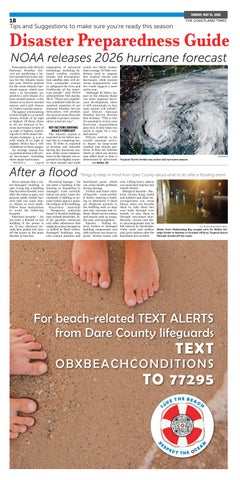
Things to keep in mind from Dare County about what to do after a flooding event.
Structural damage – Do not enter a building if the framing or foundation is damaged. Look carefully before you enter. Leave immediately if shifting or unusual noises signal a possible collapse of the building. Hazardous materials – Dangerous materials found in flooded buildings may include pesticides, fuel oil, gasoline, chemicals and other substances that might have been brought in or spilled by flood waters. Damaged buildings may also contain asbestos and
lead-based paint, which can cause health problems during cleanup. Animal and insect related hazards – Look carefully before entering a building to determine if there are displaced animals in the building such as dogs and cats, raccoons and rodents. Watch out for snakes and insects such as wasps, fire ants, and mosquitoes. Injuries – Falling objects, broken or damaged building components and slick surfaces can cause injuries, broken bones and
cuts. Lifting heavy objects can cause back injuries and muscle strains. Biological hazards– Bacteria, viruses, fungi, (mold and mildew) and other microorganisms can cause illness when you breathe them in, take them into your body through your mouth, or take them in through non-intact skin. Bacteria, viruses and other microorganisms may be left indoors by floodwater, FILE PHOTO BY ANGIE BRADY-DANIELS while mold and mildew Water from Shallowbag Bay surged onto Sir Walter Ramay grow indoors after the leigh Street in Manteo in October 2018 as Tropical Storm floodwater has receded. Michael moved off the coast.
For beach-related TEXT ALERTS from Dare County lifeguards
TEXT
OBXBEACHCONDITIONS
TO 77295
Coastland Times Half Page 2023 LTBRTO.indd 1
5/17/2023 10:18:39 AM