
Cahercalla

Page 1


Cahercalla:

At Cahercalla, the philosophy is simple: “The residents don’t live in our workplace, we work in their home,” says Corina McCarthy, the Director of Nurs-

This commitment to respect and care ensures that Cahercalla remains a place where residents feel valued, safe, and at home. It is this core principle that shapes every decision and interaction within the facility.

Cahercalla is a nursing home where residents are treated like family, and the staff are dedicated to providing the best possible care. Corina has been with Cahercalla for eight years and has witnessed the facility grow and evolve to meet the needs of the

Corina’s path to leadership at Cahercalla was an unexpected one. A mother of five, she had been out of the workforce for several years, focusing on raising her children. When a phone call sparked her curiosity about a position at Cahercalla, she agreed to come for an interview with the late Rose Collins, the Director of Nursing at the time. Little

did she know, that visit would forever change her professional life. “The minute I walked in the door, there’s an atmosphere here I can’t even describe. You’re sucked in before you even have the interview,” Corina recalls. After the interview, Rose shook her hand and said, “You will do my job yet.”

Corina laughed, thinking she would never be able to take on such a role. Yet, years later, she did.

Corina worked her way up from staff nurse to Clinical Nurse Manager, Assistant Director of Nursing, and then as the person in charge, the Director of Nursing.

Corina didn’t start her nursing career right after school. Instead, she went back to college as a mature student.

With the support of her husband, she completed her nursing degree at University of Limerick in 2006 and later earned a Higher Diploma in Gerontology in 2022 from NUIG.

While she initially considered pediatric or theatre nursing, her first placement in elderly care sparked a passion for working with older people. "I’d found my

Where community comes first

happy place," she says.

At Cahercalla, the residents are at the center of everything. Corina encourages staff to treat residents as if they were their own family members.

“The voice of our residents is the foundation of the care we give,” she explains.

The facility holds a monthly residents’ forum, where issues or concerns are directly addressed by management.

Cahercalla’s staff work closely with residents, forming relationships that go beyond their job descriptions.

The facility now has a 25-bed rehabilitation unit for people recov-

From nursing staff to housekeeping, catering, and administration, everyone is involved in caring for the residents. “Nothing is too much for the staff,” Corina notes.

Over the years, Cahercalla has expanded its services to meet the changing needs of the community.

After the impact of the COVID-19 pandemic, the team at Cahercalla worked to ensure the facility’s future by introducing new services such as 10 egress beds in partnership with the HSE.

They also added a memory care unit to help families care for loved ones with dementia or Alzheimer’s, offering respite services.

The voice of our residents is the foundation of the care we give

deep commitment to the residents creates a family atmosphere where caregivers become the residents' extended family. In the darkest days of the pandemic, when residents were cut off from their families, the staff became their primary source of connection and support.

ering from illnesses like strokes.

“It’s a service that helps people recover in a comfortable, home-like setting,” Corina explains.

The rehab unit has been well-received, and Cahercalla’s staff are dedicated to helping residents regain their independence.

When reflecting on what makes Cahercalla exceptional, Corina is quick to emphasize the importance of the staff.

It is the dedication, compassion, and long tenure of the team that sets the facility apart. “We have staff who have been here for over 30 years. People come here, and they stay here,” she shares. This

Corina’s vision is clear: to continue to build on the existing services and adapt to the needs of the community. Cahercalla has already transitioned from being purely a long-term care facility to offering a variety of services, including respite care and rehabilitation.

“We are only in our infancy with all these changes,” she says, acknowledging that while the services are still developing, the future looks promising. “We’ll tweak them and change them as we go along.”

Cahercalla’s future is focused on continuing to adapt and improve services for the community. The team is always looking for ways to better meet the needs of residents, whether it’s offering new care options or improving existing services.

As Cahercalla looks toward the future, it does so with a profound respect for its history.

In tribute to Rose Collins, a beloved figure who dedicated 40 years of service before her passing, a tea

room and a rose garden have been created in her memory.

Her legacy is embedded in the fabric of Cahercalla, inspiring the team to continue delivering compassionate care.

l HOMELY ATMOSPHERE: Director of Nursing Corina McCarthy
Photos by John O’Neill

The heart of care at Cahercalla

A community built on compassion

CAHERCALLA is more than just a nursing home—it is a community where compassionate care, and a strong sense of belonging create a warm and supportive environment for its residents.

Speaking to The Clare Echo about what makes Cahercalla unique, Kate Burke, Operations Manager emphasized that it is not just the high quality of medical care or the comfortable facilities, but the human connections and small daily acts of kindness that truly set the nursing home apart.

“What makes Cahercalla special is the genuine relationships and connections built here every day,” Kate explained. “It’s the little things, like a caregiver taking the time to share a story or someone bringing in homemade treats for residents, that create a sense of home.”

Coming from a background in hospitality, Kate reflected on how the principles of personalized service and attention to detail translate seamlessly into elder care. “In hospitality, you focus on temporary comfort,” Kate noted. “In healthcare, you have the privilege of making a lasting difference in someone’s life during their most vulnerable moments. It’s incredibly rewarding.”

The commitment to creating a home-like atmosphere at Cahercalla is evident in the actions of its staff Kate shared a heartfelt example of one Health Care Assistant who quietly purchases clothes for residents who no longer have family to provide for them. “It’s these small, meaningful gestures that make Cahercalla feel less like a facility and more like a home,” Kate said.

The leadership team at Cahercalla is also deeply involved in ensuring the highest standards of care.

“Our board of directors, led by Dr. Harty, is incredibly hands-on,” Kate explained. “They provide strategic guidance, listen to staff at every level, and ensure that residents’ needs are central to every decision we make.”

Listening to residents is an integral part of Cahercalla’s care philosophy. “We involve our residents in shaping life here through forums and everyday conversations,” Kate said. “Their voices guide everything, from activity planning to menu options. Some of our most popular programs, like music afternoons, came directly from their suggestions.”

Cahercalla continues to grow and evolve, re-

cently expanding its services through a 25-bed HSE-funded contract. “This expansion has allowed us to enhance our rehabilitation services while maintaining our close-knit community feel,” Kate explained. “The fact that new residents and staff integrate so seamlessly is a testament to the strong culture we’ve built.”

The facility’s environment has been carefully designed to foster comfort and connection. Kate described how the on-site café serves as a hub for residents and families, while outdoor spaces and common areas encourage interaction and reflection.

The culture among Cahercalla’s staff is a defining feature. “While clinical skills are essential, emotional connection is equally important,” Kate said. “Our training programs emphasize empathy and communication, empowering staff to form genuine bonds with residents. It’s this combination of professionalism and compassion that truly sets us apart.”

Looking to the future, Cahercalla remains committed to its vision of providing resident-centred care. “We’re continuously exploring ways to improve,” Kate said. “From integrating new technologies to creating intergenerational programs, we’re always looking for innovative ways to enhance care without losing the personal touch that defines us.”

Despite the challenges of operating in today’s healthcare landscape, Cahercalla’s guiding principle remains unchanged: to honour the whole person—their history, dignity, and individuality. “We don’t just measure success by clinical outcomes,” Kate explained. “It’s about the laughter in our common areas, the comfort of our residents, and the pride our staff take in their work.”

The many acts of kindness witnessed daily at Cahercalla reflect its core values. “Whether it’s an HCA buying clothes for a resident in need or a staff member spending extra time with someone feeling lonely, these moments remind us that care is about more than just clinical tasks,” Kate said. “It’s about making sure every resident feels seen, valued, and loved.”

In closing, Kate reflected on Cahercalla’s mission. “At its heart, Cahercalla is about combining professional expertise with human compassion,” Kate said. “It’s a place where residents truly belong, where staff find purpose, and where families can have confidence that their loved ones are living with dignity and joy. That’s the legacy we’re building, and it’s what we strive for every single day.”

Happy 30 Anniversary to Cahercalla Community th Hospital
Here’s to the past, present and future
l HELPING HAND: Residents bring joy to staff at Cahercalla says Kate (inset)
Photo by John O’Neill

Cahercalla’s memory care unit: a safe, homely place for residents living with dementia

CAHERCALLA Nursing Home

has long been a trusted and respected facility in County Clare, offering compassionate care to residents and their families. One of its standout features is the Memory Care Unit, a dedicated space for individuals living with Alzheimer’s and other forms of dementia.

Originally opened three years ago, the Memory Care Unit underwent a refurbishment, reopening in May 2024, further enhancing its capabilities and ensuring that it remains a safe, comfortable, and supportive environ-

fresh air in a secure environment.

The unit also includes two ASI beds for respite care, providing much-needed support to the community. Residents participate in activities every day, with families encouraged to visit and take their loved ones out on outings, ensuring that residents continue to feel part of the outside world.

“One of the most common challenges we face is when residents get confused or ask to go home. In those moments, the best thing we can do is reassure them and make their environment as homely as possible,” Mairead explains. “We work hard to make it a home away from home for them.”

a warm, homely atmosphere for residents, where they can feel secure and supported at all times.

Complete with murals of Cusack Park, landscapes of the Burren and a tribute to the late Rose Collins, a past matron of Cahercalla Community Hospital the memory care unit was designed to help the residents reminisce and spark memories from life yars ago in Ennis and the Clare area.

In addition to the services provided by Cahercalla, the Alzheimer Society of Ireland plays a pivotal role in supporting people with dementia and their families in County Clare. The organization emphasizes the importance

ment for residents. Mairead McGlinchy, Clinical Nurse Manager at the unit, has been part of the Cahercalla team for 15 years. She has worked in various roles within the facility, including in the palliative care unit, before taking on her current position.

“I’ve always had an interest in memory care and working with Alzheimer’s and dementia residents,” Mairead says. “I enjoy working here because we have such good facilities, and the residents and their families are very supportive.”

The Memory Care Unit is equipped with 28 beds, offering a safe, enclosed space where residents can go outdoors and enjoy

Despite the challenges of working in memory care, Mairead finds great satisfaction in the role.

The staff in the unit are specially trained to manage the complexities of dementia care, ensuring that residents are treated with the utmost dignity and respect.

“It can be challenging, but we are trained to deal with all the challenges that come with working in that environment,” Mairead says.

The newly refurbished Memory Care Unit is a significant part of Cahercalla’s broader commitment to providing exceptional care for people living with dementia.

Mairead highlights that the team’s efforts have been key to creating

of early intervention and offers a wide range of services, including daycare and home care.

With its newly refurbished Memory Care Unit, Cahercalla remains at the forefront of dementia care in County Clare. Mairead and the dedicated staff continue to ensure that every resident feels valued, safe, and comfortable in their home. As they work with the Alzheimer Society of Ireland and other community partners, Cahercalla is committed to adapting and improving its services to meet the evolving needs of people living with dementia.

l CARING TEAM: Staff at Cahercalla Community Hospital
Photo by John O’Neill
lisa@clareecho.ie

Mary reflects on five decades of nursing

AFTER nearly 50 years of working in Cahercalla, Nurse Mary McNamara will hang up her scrubs for the last time this month.

It’s a month of milestones for Mary who admits the hospital has been her life for 48 years, as Cahercalla Community Care celebrates 30 years.

In 1977, Ennistymon native Mary had just completed her training at Barringtons in Limerick. Having moved to the Turnpike Road in Ennis with her newlywed husband, she recounts, “I got married the month before and I walked up the road for an interview and I met Sister Eugenius out there. She interviewed me and said ‘can you start next week?’ Back then, Cahercalla was known as St John of Gods hospital and among other things, was a working maternity hospital. In the early 90s, with only two or three nuns left in Cahercalla, it was decided they would sell the hospital and return to their Order in Wexford.

“Fr Harry Bohan, Dr Frank Counihan and Brian MacMahon got together and decided we would open a community hospital so they raised funds with fundraisers of all descriptions.

“Dr Counihan worked here, he was the GP for the residents in the house. We didn’t know much about Fr Harry but everyone knew him. He was well known in the community. Brian McMahon may have been the solicitor here. They formed the Board of Management then and we were answerable to them. It ran very well.”

IMPACT

Amongst the people to have the biggest impact on Cahercalla include former Matron, Rose Collins. “Rose was Matron here since the early 2000s until, Lord have mercy on her, she passed away in 2021. She’d just retired in the middle of Covid and passed away in January. It was an awful time.”

Mother of three Mary developed a strong bond with Cooraclare native Rose over the years, having worked together since Rose’s arrival in 1980

‘People thought we were mad’

while Mary even looked after Rose’s children while on a career break in the ‘80s. She says that Rose, a gardening enthusiast, “dedicated her life to Cahercalla”.

“Rose was a nurse, and was eventually promoted to manager and then became matron in the 2000s.

“She was a lovely lady, very fair, very honest, and strict. If you did something wrong, she reprimanded you but she’d forgotten about it the next day and you were best friends again. She was very loyal and very good to the residents and she went around every day to see all the residents, she was a typical matron.

“She was very good and I looked up to her. She treated everyone equally. I think anyone who knew anything about Cahercalla knew that Rose was at the head, it was Rose you looked for if you came. Rose Collins was Cahercalla really for those two decades.”

Mary admits that Rose “carried out the work of five people or more” in everything she delivered at Cahercalla, including looking after admissions, discharged, relatives, complaints, ordering, staffing, meetings and “everything that happened within the hospital”. “Josephine Courtney was her assistant for a time and they worked together but in the end she was on her own, she did it all herself.”

Reflecting on her own 48 years in Cahercalla, Mary says that seeing residents enjoy their days in Cahercalla - whether it be through music, bingo, the visit of Clare’s All Ireland winners, or simply friendships - has been the most satisfying aspect of her work.

She adds, “I have enjoyed my time here. I’m retiring this month, it’s time now. The atmosphere is lovely, it’s a calm atmosphere and I loved coming to work. I’ll really miss it when I retire. It’s been my life really, apart from some activities like I play golf in Woodstock and Spanish Point, I’ll have more time to do that now.”

“I’ll miss it, my life has been Cahercalla. I’ve been here since early on and I’ve enjoyed coming to work every day but it’s time to retire sometime.”

As Cahercalla approaches its 30th anniversary of public ownership, we speak to its first chairman, Fr Harry Bohan

“I ASKED myself why couldn’t we win All-Irelands and why couldn’t we have our own hospital”.

When Fr. Harry Bohan first became chairman of a committee tasked with transforming Cahercalla into a community hospital in 1990, he remembers “People thought we were mad”.

As Cahercalla approaches its 30th anniversary of public ownership, the Feakle man remembers the hospital’s early days. The hospital was initially opened in 1951 and was staffed by the Sisters of St. John of God before it began to encounter difficulties in the late 1980s.

“Through the 1980s, falling numbers of vocations put the sisters’ resources under stress and by 1989, they felt they could no longer run the hospital. Initially, the Midwest health board expressed an interest in using Cahercalla to provide services for the mentally ill.

The hospital staff weren’t happy with that and organised a meeting on Cahercalla’s future in September 1989” Fr. Harry recalls.

Fr. Harry remembers the huge crowd that attended that initial meeting which was chaired by solicitor Brian McMahon. Bishop Michael Harty had asked him to make an appearance on his behalf.

“It was a fairly heated meeting and there was a lot of talk. When it became obvious that no conclusion would be reached on the night, I just got up and asked the superior who was there for an opportunity for a small group to reflect on the hospital’s future.

The meeting selected Brian McMahon, Dr. Frank Couinahan and myself to look at the options”.

“This obviously was going to be a major undertaking for the group, the sisters and the community. We

had no money for example! No clear mandate either, so in January of 1990 we held a public meeting in the Queen’s in Ennis.

“It was agreed at that meeting that the people of Clare would purchase Cahercalla. From there progress was slow until November 1991, a contract was signed and a deposit of £20,000 was paid” he added.

In 1992, then Minister for Health Mary O’Rourke launched the Cahercalla Community Hospital appeal. The nuns agreed to stay on until 1996 to help with the transition to a community facility.

A purchase price of £1 million was arrived at and a board of management was established, including representatives from West Clare, North Clare and East Clare with Fr. Harry Bohan acting as chairman.

“I was asked to take on the role of chairman of the board, although I was slow enough to take it on, I was hugely involved in a lot of things at the time. I agreed to do so. Adopting the community hospital was in keeping with the ethos of the sisters of St. John of God.

“We ensured that their concerns for staff and long term staff would be honoured. We always said that the important people in Cahercalla were 1) The person in the bed 2) Their relations 3) The staff and up along then from there”.

Originally from Feakle, Fr. Harry served as Parish Priest for Sixmilebridge for a number of years and now lives in Shannon.

With a keen interest in hurling, he captained Maynooth during his time in the seminary and managed the great Clare team of the 70s. In a talented squad that featured AllStars and Feakle clubmates Seamus Durack and Ger Loughnane, Fr. Harry won two National Hurling League titles, although he still feels they could’ve won an All-Ireland.

“I couldn’t believe how Kilkenny Cork and Tipp could win All Irelands and we couldn’t.

“We missed out two All-Irelands, certainly on one. Jim Woods and myself and Matt Nugent were the selectors and I’d say we picked fourteen of the team in about a quarter of an hour.

“It took nearly two hours to pick number 15. I wanted Tom Crowe on it. In that final in 1977, (against Kilkenny) Tom threw himself at a ball about 25 yards out and scored a goal. That goal won that league.

“Cahercalla was a huge project for us to take on and the hurling made a contribution to it. But I had it in my head, why couldn’t Clare win All Irelands. It was the very same thing, we can’t we run our own hospital. Why couldn’t we have our own houses?”.

Fr. Harry also masterminded the rural housing scheme, a project that aimed to stop the decline of rural villages by constructing houses for young people.

The scheme was a huge success in areas such as Feakle and Connolly and saw 2500 houses built from Cork to Cavan. “The two concepts I totally believed in were family and community”, concluded Fr. Harry.

A community hospital was finally established in Cahercalla in 1995 in a great year for Clare.

The home received a state of the art extension in 1997 that introduced social space and palliative care. Since then, the Ennis facility has come on leaps and bounds and saw much of this progress under Fr. Harry’s tenure and even had a role to play in his own health.

“I had a little operation there myself. We developed surgical services, outpatient services and hospice care as well. We extended the place 3 times and built new rooms. About 19 consultants got involved with us. We were pushing out the boat a fair bit there”, he laughs.

l FRIENDSHIP: Mary McNamara and (inset) former matron Rose Collins

Everyone is equal Residents Forum gives everyone a voice,

“I UNDERSTAND you’re a man who knows how to get things” is a famous line from the Shawshank Redemption, that comes to mind when chatting with Cahercalla resident Larry Gavin.

Cahercalla Residents Forum Chairperson, Larry quips, “I’m the go-to guy”.

The Cahercalla Residents Forum is a resident-led initiative that hosts monthly meetings to give its residents a voice and a direct line of communication with the hospital board of management.

Long-time Tulla resident and ‘goto guy’ Larry worked in Shannon as an air traffic controller for 40 years until his retirement in 2002.

Among his strongest memories on the job include being station manager on the day tragic events unfolded in America on 9/11. Having grown up in Westmeath and then Mayo prior to coming to Clare, Larry tells The Clare Echo, “I hope I’m accepted as a Clare man now”.

Accomplished accordionist Larry established a life and raised his four children in Tulla in 1976, living in the former home of 1914 All-Ireland winning captain Amby Power. Larry’s wife and carer Nuala sadly passed away two years ago.

A lively and sharp individual, he admits, “I was left to look after myself then because I’d had a stroke and I needed 24-hour care. My

family would have taken me in but I didn’t want to do that to them so I came here.”

Larry, who turns 81 this month and has eight grandchildren, tells The Clare Echo that the Residents Forum is a productive space for residents to continue improvements to services at Cahercalla.

“The senior management come and people from different areas and the residents discuss strictly confidential stuff, so they can air any grievances they have and I can get little things fixed up for them.

“If there’s anything major then it has to be pursued by the senior management and they have to directly face the music. Everyone is equal in there and it’s a good idea, it allows people to express their opinion about how they’re being treated, and you know it's good and people are well able to do that. Some people are a little bit shy, but we try to help them along.”

Up to 30 residents might attend meetings on busier occasions, which is open to residents, minders and visitors. For those who don’t wish to speak at a public meeting, Larry notes, “Apart from the meeting I’m the go-to guy and I do get people coming to me in confidence. They might be a bit shy to speak in public, but they can come to me.”

One achievement of the Forum was the introduction of resident trips into Ennis to visit Dunnes Stores, the Ladies Boutiques or a

couple of pints. Equine enthusiast Larry spends his free time reading history books and biographies, while he has an exten-

Heart of Cahercalla

AS CAHERCALLA Community Hospital celebrates its 30th anniversary, it reflects not only on the many advancements in healthcare and facilities but on the heart and soul of its success, the residents who call it home.

For three decades, Cahercalla has been a place where care goes beyond medical treatment. It's a community that thrives on compassion, connection, and a deep sense of belonging. However, the hospital would not be what it is today without the residents, whose unique stories and strong sense of community have helped shape the institution into a home rather than just a place of care.

The staff at Cahercalla pride themselves on providing not only the highest level of care but also fostering an environment where residents feel valued and involved. The hospital’s mission has always been to provide person-centered care, ensuring that each resident’s needs, preferences, and comfort are prioritized. Yet, it is the residents themselves, through their warmth, resilience, and shared experiences, who truly create the vibrant community that Cahercalla represents.

As we celebrate this milestone, we honor the individuals whose lives have intertwined with Cahercalla’s history, contributing to the fabric of this special place. Together, they have made Cahercalla a true community—one that is more than just a healthcare

facility but a supportive, compassionate home where everyone has a place, a voice, and a sense of belonging.

One such resident is Gerry, who has lived at Cahercalla for the past eight years and serves as a welcome ambassador for the hospital.

“I think the place is fabulous and the staff is outstanding,” Gerry shares. “The managers are amazing, keeping everyone afloat.”

Gerry's words reflect the sentiment of many who have made Cahercalla their home. For him, the hospital is more than just a place of care, it’s a community. “I’ve been here 8 years now and I’m very comfortable here,” Gerry says. “I love that I get to chat with the staff, and I’ve gotten to know all the residents so well. They are like family now. We’re all one big family.”

The close-knit, family-like atmosphere is a hallmark of Cahercalla. Gerry speaks warmly of the staff, emphasiSing their unwavering support. “If you need something, the staff are always there for you. If you need to talk or express yourself, they’ll be there. If you’re down, they always bring you back up.” Gerry’s connection with Cahercalla extends beyond the staff. He shares a special bond with his own family, who regularly visit. “My family comes in and visits me, and they think it’s a good place,” he says. “My mother is here also. She has dementia, so that’s a bonus for me—that I can visit her.” It’s clear that the hospital's dedication to family extends to the

l MAN WITH A PLAN: Larry

here in Cahercalla says its chairman Larry Gavin...

sive collection of music books which he is in the process of handing over the Clare Libraries.

Larry is highly compli-

mentary of the food at Cahercalla and visits the O’Gorman café in the hospital twice daily, where he often meets the board of management who he stresses are “very pleasant

and down to earth people”. “They’re very open-minded, easy to contact and easy to speak to.”

“I’m very pleased with the treatment I’m getting here. It’s a very good establishment, the staff are excellent, really excellent. Everyone knows everyone else. It’s a homely institution, you can have whatever you want, tea, coffee anytime of the day or night. The food is excellent,” adds Larry.

Asked if he is a popular chairperson, Larry quips, “I don’t know, I don’t see anyone looking to sack me anyway!”

Speaking about the importance of facilities like Cahercalla Community Hospital and why they should be supported, Larry adds, “I’d worry seriously if they ever lose a place like Cahercalla becauseit’s not my job to stand up for the people of West Clare but - there are times when people need this. I needed this badly because my wife died suddenly, she was my complete carer so where do I go? This was the only place I could get into and it was great to have it.

“If you take someone from Loophead or that area, if they get a stroke like I did, where are they going to go after the stroke was dealt with in the hospital?

“It’s so vitally important that younger people in County Clare realize how important this place is and unfortunately places like this cost a lot of money to run.”

lies in its residents

In

involved in the activities at Cahercalla, especially Bingo, which he enjoys for the fun and friendly competition it brings. “I go to nearly all of the activ-

ities, but Bingo is the best one because there’s a prize if you win,” he laughs.

Gerry’s presence at Cahercalla is felt throughout the community. “There is no resident in this nursing home that doesn’t know Gerry,” Caroline, the activities manager at Cahercalla Community Hospital, says. “He delivers the newspapers to all the floors and is a huge part of Cahercalla.” Gerry enjoys greeting everyone with a smile, taking the time to say, “Good morning, good afternoon, and if I can, good night to them. That makes my day happy.”

And it’s not just Gerry’s positive attitude that makes him a beloved member of Cahercalla’s community; it’s his appreciation for the staff and their efforts. “I’d like to thank Corina McCarthy and all the staff for all the years I have been here. They have given me great encouragement. They lift me up every time I’m down.”

Gavin is chair of the Cahercalla Residents Forum Photo by John O’Neill
residents’ families as well, creating an environment where loved ones can come together.
addition to family connections, Gerry is also deeply
l RELATIONSHIPS: Gerry with Director of Nursing Corina McCarthy
Photo by John O’Neill

‘Human nature at its best’

Family of resident lauds exceptional care provided at Cahercalla

MICHAEL O’Sullivan has been a resident of Cahercalla Community Care for more than twoand-a-half years.

The Ballynacally bachelor has farmed from the family home for his entire life and having never needed hospital treatment previously in 77 years, Michael – better known as Miko – unfortunately suffered a brain heomorage more than three years ago.

His dedicated sister Mary Gibson resides in Rathfarnham, and now takes a familiar journey to Cahercalla once a fortnight. In making the trip, she comes from Dublin to Ennis by train or bus to visit her older brother Miko, now

aged 80.

“My brother has been a resident in Cahercalla since August 2021. I vividly recall my first visit there two days after his admission,” Mary tells The Clare Echo

She explains that she is grateful that Miko has numerous friends and neighbours who regularly visit, each of them commending the homely atmosphere at the Ennis care facility.

“From the moment I arrived and every visit since, I encountered a lovely, unique welcome. Cahercalla is where my brother and all his visitors have experienced human nature at its best,” Mary explains.

“The staff are highly professional and conscientious in all aspects

of their duties. They are dedicated to giving person-centred attention, treating everybody with dignity and respect.”

Noting that the care given at Cahercalla Community Care by staff is “not easy work”, Mary added, “I love them to bits and they’re my friends now.

“Cahercalla Community Hospital have been an integral part of my brother’s recovery from a brain heomorage as he had never been to hospital before in his 77 years.

“We as a family are indebted to the wonderful staff of Cahercalla for all their kindness to us.”

Caroline’s vision for activities at Cahercalla

CAHERCALLA Community Care has a long-standing history of providing a high level of individualised care to all of its residents, writes Lisa Mullaly

As part of their commitment to the highest level of care, Cahercalla recognises the importance of social engagement and makes a conscious effort to ensure every person under their care has access to daily activities.

“It’s very important for cognitive decline that residents, their brain is stimulated, their hands, their mobility, everything, it’s very very important for them and as I said with social interaction to make sure that they have that,” explains Caroline McMahon, Activities Manager with Cahercalla Community Care.

Although she has only worked in Cahercall for four years, Caroline brings with her 24 years of healthcare experience. Caroline’s role is to design and manage programs that meet the diverse social and emotional needs of the residents, ensuring they lead fulfilling and engaging lives.

Cahercalla Community Hospital is home to a wide variety of residents — some there for long-term care, others in need of dementia care, and some with challenging behavior. Each resident comes with unique needs, and Caroline’s role is to ensure those needs are met.

"I meet the social needs of the residents," Caroline explains. "I’ll design a programme that meets all of their specific needs. As you can imagine, the residents that we deal with here might be residents that just come in for nursing care as part of their retirement, dementia care, we would have people here with challenging behaviour, so it’s just about finding that balance."

HIQA (Health Information and Quality Authority) has played a pivotal role in encouraging continuous improvements in activity programs across nursing homes. Caroline acknowledges the increased focus on activity provision in HIQA’s inspection process, which ensures that residents are not only physically cared for but also receive the mental stimulation and social interaction they need.

The hospital runs a daily programme where residents can choose to participate in group activities or enjoy more one-on-one interactions based on their preferences. Caroline and her team strive to offer something for everyone.

"We do a daily programme. There are some residents here who mightn’t like to go in and join in on group activities, so we would go and meet them in their room. Whether it’s

doing an activity in their rooms with them or some might just want to sit and have a chat and a cup of tea or take them out on a walk around the garden."

Beyond the walls of the hospital, Caroline is committed to keeping residents connected to the outside world. Some residents enjoy outings to local towns for shopping or simply to people-watch, ensuring they feel like part of the wider community.

"There are some residents that might like to go into town, do a bit of shopping, maybe bring them for lunch, a hot chocolate. Some of them just love to people-watch and sit there, and it’s very important for them to feel that they are still part of the community."

The activities don’t stop at just socialising. Caroline emphasises the importance of mental and physical stimulation, particularly for residents experiencing cognitive decline. The hospital provides a variety of therapeutic programs such as the Imagination Gym, which challenges the mind, and Sonas, a sensory-based program specifically designed for dementia patients.

"[Sonas] offers a lot of stimulation because you are using your five senses. We do ‘Imag-

ination Gym’, again it’s a therapy for using the mind, that’s really good with dementia residents but it’s also good with just nursing care residents because it gets their mind thinking."

Residents have a full schedule of activities ranging from arts and crafts to baking classes. Volunteers regularly visit to entertain with live music and dance performances, ensuring there is never a dull moment.

"We celebrate everything that comes up; St Patrick’s Day, Mother’s Day. There will be decorations and a party, and drinks. They love that, they love the interaction."

For Caroline and her team, the most rewarding aspect is seeing the joy these activities bring to the residents.

"They absolutely love the activities," Caroline reflects. "We have residents here that would tell their family, 'Don’t come between 2 and 3 because that’s when the activities go on,' and they’d want to stay in and have their activity rather than going out. To them, it’s become home away from home."

Caroline’s connection to the residents goes beyond her professional role. She and the activities team build deep, personal relationships with the residents, forging bonds that

go beyond the caregiver-patient dynamic. Caroline’s team, consisting of Aidan, Rebecca, and Laura, plays an integral part in making sure each resident is not only engaged but enjoys a sense of belonging. Together, they offer seven days of activities every week, from 10:30am until 4pm, ensuring there’s never a shortage of opportunities for fun and connection.

However, Caroline’s vision doesn’t stop there. She has set her sights on a significant project: raising funds to build an activity room and secure a bus for the hospital. The activity room will serve as a multifunctional space, allowing residents to gather in one place, whether for baking, arts and crafts, sensory experiences, or even music and dancing.

"We are hoping to get an activity room built so that then we can bring all the residents together and they can all mix," Caroline says. "This room’s going to have everything that the residents can do. So we don’t have to go from room to room pulling trolleys, but the residents will be able to come in there and relax and enjoy that room for what it is."

"We are also trying to raise money at the minute to get an activity room and a bus, which would be a huge bonus for us here."

The residents of Cahercalla Community Care are already benefiting from outings like trips to Knock, where some residents experience new places and activities they never thought possible. "We went to Kilkee last year. Some of the residents had never been to the beach before in their life and they walked down along the sand into the water."

Despite the challenges of fundraising, Caroline is willing to go to great lengths to make these dreams a reality. As part of her effort, she’s planning a parachute jump, a feat she’s terrified of, but one she’s willing to conquer for the sake of the residents.

"This year because they have said to me 'we are going to get you your activity room, we are going to get you your bus,' so I thought about what would be a good way to raise money. I decided that I would do a parachute jump, bear in mind I am afraid of my life of heights."

Caroline’s dedication to the residents is a testament to her deep love for the people she serves. To her, Cahercalla is not just a nursing home; it’s a place where residents find their home, and where Caroline herself feels she has truly found her calling.

l VISITORS: Miko O’Sullivan with his sister Mary Gibson and friend Aidan Ryan
Photo by John O’Neill
l ACTIVITIES TEAM: Caroline (centre) with activities team members Aidan McMahon and Rebekah Crerand
Photo by John O’Neill

‘Funding of Cahercalla a constant challenge’

IT’S “A full-time, part-time job” for the Chairman of Cahercalla, Dr. Michael Harty.

The Kilmihil native says that acquiring funding for the large nursing home is a huge challenge.

“Cahercalla is funded primarily through the national treatment purchase fund (NTPF) and that is an arm of the HSE which is tasked with funding nursing homes in general throughout the country.

“Unfortunately, the funds that are available to the NTPF are significantly below what is required to run a nursing home on a day-to-day basis. Each year we have our funding reviewed and each year we get a lot less than we ask for so we are very stretched to meet everyone’s expectations in relation to pay and the services we provide so we emphasise the quality of the service we provide here”, Dr. Harty commented.

The NTPF are responsible for 32,000 nursing home beds in Ireland of which Cahercalla makes up 112. The Ennis nursing home has around 108 or 109 residents at any one time due to changeover of beds. Cahercalla is a community-owned facility that was bought in 1992 and officially opened in 1995 by Fr. Harry Bohan and the original board.

This group was able to raise substantial funds through charitable donations and purchased the building on behalf of the community. The facility is now run by a board of trustees with Dr. Michael Harty as Chairman and remains vested in the community.

Thirty years on, funding remains the most pressing issue for the nursing home. The Chairman stated that “Unfortunately we don’t have the same funding that the public nursing homes receive, they receive about 100 per cent more than we do so it’s a struggle for independent charitable and family-run nursing homes to survive. About 45 nursing homes have closed in the past three years because they

have trouble reaching the regulatory requirements of HIQA”, said Harty.

Funding difficulties have not stopped the excellent level of care that Cahercalla provides, however. As it celebrates 30 years of public ownership, it’s clear to see that the nursing home has come a long way since Fr. Harry Bohan’s tenure in 1995.

Dr. Harty praised the changes that Cahercalla has undertaken since that time. “Initially it was a long-stay residential nursing home and then it added a number of services. It was and still is supplying palliative care services to the Midwest via Milford Hospice in Limerick so we have three palliative care beds here. We have developed a memory care unit which opened last year specifically dedicated to people with memory loss and that has been a big addition to the services that we provide”.

Cahercalla also provides respite care for the Alzheimer’s Association of Ireland on a regular basis which allows carers a break for a couple of weeks at a time.

The facility has recently entered into a contract with the HSE to provide rehab services which allows patients to be discharged early from Limerick Regional Hospital and the County Hospital in Ennis. This allows patients to recuperate outside of the traditional acute hospital environment closer to home. This programme includes 25 beds which Dr. Harty says will help to ease pressure on beds in hospitals in Limerick and Clare.

The Kilmihil man served as an Independent TD from 2016 to 2020 before making the decision to leave politics. The doctor campaigned on the platform to “try and maintain the fabric of rural communities, we could all see rural communities losing their post offices and their Garda stations, in particular struggling to maintain their medical services, so it was a broad campaign to support the fabric and integrity of rural communities”.

The Cahercalla Chairman said he was left unsatisfied with his

experience in the Dáil however and made reference to the recent political discourse on the role of independents. “As an independent TD, unless you’re in a group which is controlling some element of the balance of power, it’s difficult to get your voice heard. I found it very frustrating coming from a medical background where you’re used to doing things and seeing things happen quickly. I was quite frustrated and I didn’t see a prospect of me having the capacity to promote those aims in as best as I did while I was there. Unless you’re in a position of influence it’s difficult to get your voice heard”, Harty added.

The former TD praised the benefits of the Fair Deal scheme which provides financial support for those in long-term nursing home care. Dr. Harty said that the scheme was a good idea as it means families no longer have to pay for 100 per cent of the care of relatives which eases the substantial financial burden. Harty also stated that the Fair Deal scheme has improved the standard of care residents receive across the board.

The Chairman said that he did learn from his short time in politics and that he has carried over skills from both his time in the Dáil and his work as a doctor to his current position.

“Somebody who has a knowledge of medicine and a knowledge of politics would have a certain expertise in bringing that to an institution like Cahercalla. I think it’s important for people who have had a career in caring to pay something back to the community on a voluntary basis.

“I have a problem saying no, I’m getting a little better at it but when I was asked to take on the Chairmanship I felt I had something to offer. Initially I was told it’s only a meeting once a month, it turns out to be a full-time parttime job”, he joked.

PICTURED: (l-r) the Board of Management William Cahir, Gabrielle Hanrahan, Dr Michael Harty, Dr Marie Connolly and Garech McGuinness

Photo by John O’Neill
Michael Fitzgerald news@clareecho.ie

Friends of Cahercalla: A new way to make a difference

CAHERCALLA is dedicated to enhancing the lives of its residents through care, compassion, and connection. To further this mission, they are delighted to introduce Friends of Cahercalla, a new initiative that invites you to make a lasting impact in three simple ways: Donate Monthly/Quarterly/Annually, be a Friend to a Resident, and Spread the Word.

Here’s how you can get involved:

1. Donate

Your contributions, no matter how small, help to provide even better care and facilities for residents. Monthly/ Quarterly/Annual donations are the lifeblood of the initiative, funding vital resources, upgrading equipment, and creating enriching programs that improve the quality of life for everyone at Cahercalla.

Why Give?

• Your generosity directly supports residents’ care and well-being.

• Recurring donations provide sustainable funding for ongoing improvements.

• Every contribution, big or small, makes a difference. Setting up your donation is simple. Visit https://cahercalla.enthuse.com/ cf/68eb/fundraiser to start giving today.

2. Be a Friend to a Resident

Sometimes, the greatest gift you can give is your time. Many residents deeply value personal connection, and your involvement can bring joy and companionship to their lives.

Ways to Participate:

• Write Letters: Become a pen pal and share kind words with a resident.

‘A

• Volunteer Your Time: Help with social activities such as art workshops, reading groups, or music sessions.

• Be Present: Offer companionship and meaningful conversation to a resident who would value a caring friend.

To learn more about volunteering opportunities, please visit www.cahercalla. ie or contact Cahercalla directly.

3. Spread the Word Advocacy is a powerful way to support Cahercalla’s mission. By sharing the story of Friends of Cahercalla with your network, you can help us grow our community of supporters and amplify our impact. Whether through social media, conversations with friends, or community events, your voice matters.

How You Can Help:

• Share our mission with friends, family, and colleagues.

• Spread the word on social media or at local gatherings.

• Organize a small awareness event or fundraiser to support our work. Join Friends of Cahercalla Today

Becoming a Friend of Cahercalla is easy and deeply rewarding. Whether you choose to donate, volunteer, or advocate, your involvement will make a meaningful difference in the lives of our residents.

TAKE THE FIRST STEP:

• Visit https://cahercalla.enthuse. com/cf/68eb/fundraiser to learn more and sign up.

• Call us at 065 6824388/065 6846140 for additional information.

Swing for Cahercalla this Easter

ENNIS Golf Club will play host to a fundraising event to celebrate 30 years of Cahercalla Community Care this Easter.

The golf club, located about 500 metres from the gates of Cahercalla Community Care, is offering a special discounted rate to visitors over a threeday period of €10 with all proceeds going to the local care facility.

Play any time over the three days of the Easter Bank Holiday weekend - or indeed all three days - for just €10 per person per round.

Cahercalla Community Care is a non-profit organisation dedicated to providing nursing care to the community in Ennis and the greater County of Clare.

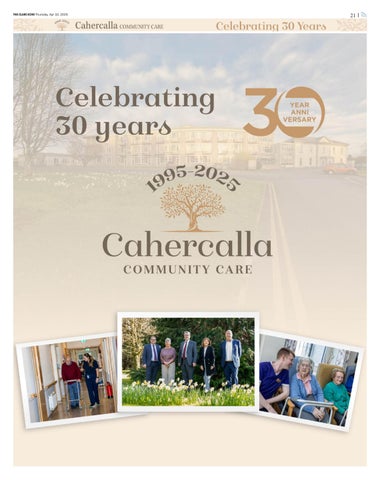
Cahercalla Community Care proudly celebrates its 30th anniversary, a milestone made possible by the generosity and dedication of the people of County Clare. It marks the moment when the community formally took ownership, establishing Ireland’s first community-owned hospital.

sense of warmth in Cahercalla’

A WARM atmosphere is present throughout Cahercalla where Jincy Lesley works as Assistant Director Of Nursing (ADON).

The ADON says the Ennis nursing home’s staff are like a family.

Originally from India, Jincy came to Ireland in 2018 to pursue a masters in nursing which she then graduated the following year. She joined Cahercalla as a nurse in September 2022 having previously worked in a facility in Athlunkard, close to the north side of Limerick city. “I started as a staff nurse and after a year I got promoted to a senior staff nurse and then for a year I worked as a senior staff nurse but it was time for me to move to a CNM position and that’s when I applied for the interview here and that’s when I got selected.

After a month or so I think they found that there was some potential in me that they told me they wanted to promote me as an ADON and I did the interview and just clicked through. Since then I’ve worked here as an ADON”, she added.

In this role, Ms Lesley deals with everything clinical at the nursing home. She performs a wide range of duties in accordance with policies and procedures, including maintaining the staff and looking after their sicknesses and absences as well as doing the rosters and completing audits every quarter in accordance with HIQA guidelines. As ADON, she is also responsible for the admission of new residents to Cahercalla when there are spare beds available. The En-

nis home currently has space for over 100 full time residents as well as 25 HSE beds which are used for rehab services.

Jincy says that Cahercalla is different from other nursing homes however. “When I came to Cahercalla there was a sense of warmth and gratitude when you came here. It didn’t come to me as just a workplace instead I was a team member. We work like friends if one person is not doing something, there is somebody else to do it and we correlate with each other and get it completed rather than just going back behind each other”, she commented.

The ADON thanks her fabulous team for making Cahercalla such an enjoying and fulfilling place to work but its clear that the residents are what make her job special. “We always say it’s

their home and that we are coming to work in their home. We always believe that we always give the priority to the residents in Cahercalla and will work according to their wishes and their perspectives to see what do they want. We have a beautiful set of residents in Cahercalla. We have a dementia unit and I love to go in there every day just to have a chat even if it makes no sense. Everybody has their own perspective. Some people who come here don’t want to stay with someone, others even if they are given a single room they might say I would love to stay with somebody and that I could share with somebody. You can see that difference when residents are in a shared room they have a different rapport with each other. We always go with what they want rather than what we prefer”.

l TEAM: Jincy (right) with Director of Nursing Corina McCarthy and Operations Manager Kate Burke
Photo by John O’Neill

MAUREEN Hayward is a dedicated and passionate clinical nurse manager at Cahercalla, a position she has held for two decades.

Throughout her extensive career, Maureen’s commitment to providing exceptional care to her patients has remained unwavering, and her

Leading palliative care with compassion & dedication

deep connection to her work is evident in every aspect of her role.

Maureen has been a key figure in Cahercalla for the past 20 years, overseeing the care of residents in the Garden Wing of the ground floor of the hospital. As the clinical nurse manager for that unit, she is responsible for ensuring high standards of care across all aspects of patient treatment, from medica-

tion management and wound care to incident reporting and handling complaints. However, her role extends far beyond just managing the day-to-day operations of the unit. Maureen also plays a crucial part in supporting the wider hospital staff, working on a rotational basis to spend two days on the ward and two days focusing on the management side. Additionally, she oversees the entire facility on weekends, where Cahercalla is home to 112 residents.

tion. Maureen initially began her nursing career in Cahercalla as a staff nurse in 2004 before being promoted to manager in 2007. Over the years, she has witnessed significant changes in the facility, including the addition of new services such as rehabilitation and memory care units, as well as growing regulatory demands, particularly with the introduction of HIQA care standards.

“Standards have changed, legality has changed, rights for residents have changed, and it’s all about the resident now, and rightly so,” Maureen notes, reflecting on the growth and evolution of Cahercalla. “It has grown and developed. We provide a broader service, I would say.”

EMOTIONAL

“I’m very passionate about my job, I love my job,” Maureen says. Her love for nursing, particularly palliative care, drives her to provide holistic support to both patients and their families. She views her role not just as a caregiver but also as a source of comfort for those nearing the end of their life. “Palliative care happens everywhere, not just in our palliative care beds. In all nursing homes because people deteriorate with age,” she notes.

As the lead for palliative care at Cahercalla, Maureen’s focus is on ensuring that residents, regardless of their medical conditions, receive care that maintains their dignity, respects their wishes, and eases their pain. She leads a multidisciplinary team to provide comprehensive care that spans physical, emotional, and spiritual support.

PAIN

Maureen explains, “The people we look after deserve the best care possible. We are here to manage their pain and their symptoms, but it’s a bigger thing, it’s holistic care.”

Her approach to palliative care is rooted in empathy and respect for the individual’s needs. Each resident’s care plan is tailored to their unique requirements, whether they are dealing with chronic illnesses, age-related deterioration, or terminal conditions. “It’s wider than just pain and symptoms, it’s looking at the bigger picture really,” she ex-

plains, emphasizing that the quality of life in the final stages is just as important as physical comfort.

“Palliative care... it’s not just about the physical care that you provide for people who are dying but it’s also the emotional support, the psychological support, you know the sitting down and listening, and holding their hand.”

Her work extends beyond managing physical symptoms; Maureen ensures that every resident’s holistic needs are addressed, including their emotional, spiritual, and social well-being.

RELIGIONS

This approach is particularly important in today’s multicultural society, where awareness of diverse religious practices is crucial for providing culturally sensitive care. “We are very multicultural now, and while we might not know about other religions, we need to find out about them so that we can know what to do and what not to do when people are dying,” she explains.

Maureen’s work also requires close collaboration with a wide range of professionals, from general practitioners and physiotherapists to the Milford home support team and social workers. The importance of a team approach cannot be overstated, especially in a facility like Cahercalla, where every aspect of a resident’s care must be coordinated. “It’s a big team –the nurses, the health assistants, the catering staff. No one person can do it all, it’s very much a team approach,” she states. Despite the challenges, Maureen continues to find fulfillment in her work. “There’s a very natural feeling about it, it’s a nice place to be,” she shares, emphasising the supportive and warm environment at Cahercalla. “It’s always been a very home-away-from-home environment, and it’s always been a very caring environment.”

Her longevity in the role is a testament to her dedication to the residents and the organisa-

Beyond the technical aspects of her job, Maureen is deeply committed to her personal and professional growth. She recalls a formative experience when her grandmother became unwell and Maureen had the opportunity to care for her. “I just love looking after people and looking out for relatives and loved ones as well because they are also going through that journey,” she says. “It’s just an area that I particularly like.”

Although Maureen is passionate about her job she acknowledges that this particular area of care can bring with it an emotional toll. It is in these moments that she leans on her fellow colleagues.

“You can have days when you would be very very sad and you would cry and that’s okay, you would hug and you would sit down as a group and you might just talk it through with your colleagues” she shares.

It’s essential, she adds, to have an outlet outside of work to help cope with the emotional weight of her role. “We all say you leave your troubles at the door,” she explains. “It’s also important that you don’t bring work home with you. And that only comes with life experience really.”

In her role, Maureen is constantly reminded of the importance of being empathetic, kind, and approachable. As she explains, “Even if you haven’t got time, showing that you have time is important. You could be as busy as anything on the ward, but if somebody sees that you are really busy and sees you rushing around, they are not going to ask you questions. Whereas if you smile and say, ‘Are you okay?’ it’s a small gesture but makes all the difference.”

For Maureen, nursing, and particularly palliative care, is more than just a job. It’s a calling — one that she approaches with care, compassion, and professionalism. Through her work, she not only provides essential care to residents in their final days but also offers emotional and psychological support to families navigating one of the most difficult moments of their lives.

“Any care to any resident is more than just physical care,” she reflects.

“It’s actively listening, making them feel that you have all the time in the world for that person.”

by Lisa Mullaly lisa@clareecho.ie

Major plans are in the pipeline

WHEN Sheryl Knowles first joined Cahercalla in October 2023, she began a dual role in accounts and fundraising.

Almost a year and a half later, her passion for volunteering and making a difference has only grown stronger. “I love it. I’d say it’s the first job ever in my entire life that I felt that way about and I’ve worked for 35 years”, the long-time volunteer said.

Cahercalla Community Care is a charitable, not-for-profit organisation that is part-funded by the HSE as well as public donations. This year marks 30 years since the home was handed over to public ownership in 1995. As a result, Cahercalla experiences significant shortfalls in funding, meaning that constant efforts to bridge the gap are required. Despite these restrictions, the facility shows no signs of slowing down with big plans on the horizon.

“We’ve got a major fundraising campaign for to build an individual separate stand-alone activities room and also to purchase a mini bus for the residents. At the minute, just with pure lack of capacity within the building there’s no main area where we can get all the residents all together at one time. We’re always trying to

promote inclusivity so to have all residents to be able to gather at one place we would need a purpose built building.”

Originally from Northern Ireland, Sheryl Knowles first came to Clare six years ago with 20 years’ experience in the social housing sector. While serving as Chair of the employer-supported volunteer committee in that job, she also worked as a volunteer for the Special Olympics in Belfast for over 12 years. Now living in Quin, she says she loves coming to work every day in Cahercalla.

“The most enjoyable aspect would have to be the interaction with residents and members of staff. There are ones that obviously you’d strike up more of a relationship with simply because you’re there with them but they’re all wonderful.

“I found that this job has provided me with the unique opportunity of combining my academic and professional qualifications within accounts and blending that in with the role of fundraising. I don’t plan on going anywhere, I plan on doing everything I possibly can to make it bigger and better ”, she said.

Fundraising is a constant obstacle for Cahercalla however. The large nursing home caters for over 100 residents and is in a constant battle to

provide the standard of care it strives to maintain, as well as adhering to HIQA guidelines.

“Fundraising for any charity at the minute is very difficult. Long gone are the days where you had the bucket, you're not going to get that anymore because people just don’t have it. Everybody’s watching their own pennies and even just the cash, nobody really has cash anymore, everyone just taps for everything so your old methods of fundraising and your street collections don’t work anymore.

“You have to adapt. We’ve recently launched a new digital fundraising platform on our website so we put events up for that, we have ticketed events so it’s all managed through that whereas before that it was all phone calls or people calling in now it’s all done online”, she commented.

Despite these challenges, Cahercalla continues to provide an expert level of care to all residents and continues to go from strength to strength 30 years on from its public acquisition.

Lions Club holds a special place in heart of Cahercalla

news@clareecho.ie

CAHERCALLA has been helped along the way by numerous organisations in Clare but none more so than the Ennis Lions Club.

The charitable organisation first became involved with the Ennis community hospital in 2005.

Secretary of the Ennis branch Tom Carey says that the organisation is proud of the work it has done in raising money for Cahercalla. “If you speak to anyone around Ennis or Clare they’d have a story to tell you about Cahercalla, about loved ones that were looked after in there in their later years and months.

The Lions Club involvement goes back to the noughties. The first project would have been around 2005 and then it intensified later on in that decade so really since 2010 Cahercalla and the Lions club were working hand in hand”.

The biggest project undertaken by the Lions Club is the annual remembrance tree display in the mar-

ket each Christmas. “We run a project called the remembrance tree over the Christmas period. People put yellow ribbons on it, they write a name remembering a loved one or somebody who is away at Christmas. It has really become part of the Christmas scene in the town of Ennis” said Mr Carey. The project has raised over €100,000 for Cahercalla Community Hospital to date.

Some of this money was used in the treatment of those with memory issues in the hospital. “There’s a corridor in Cahercalla which has been decorated with scenes from rural Clare, from the Burren and from farming practice and things like that. It is particularly good for jogging people’s memory who are losing it through Alzheimer’s and dementia”, said Mr Carey.

The Ennis Lions Club has done enormous work for the benefit of Cahercalla and is just one of the many organisations that continues to make the Ennis hospital such a special place.

l ROLE: Sheryl Knowles
Photo by John O’Neill

best to Cahercalla Community Hospital

Edel Kearse: a story of career progression through Cahercalla

EDEL Kearse’s path to becoming a Clinical Nurse Manager (CNM) in Cahercalla Community Hospital is a testament to determination, resilience, and the power of supportive mentor ship. Starting her career in healthcare in 2005, Edel's journey has been shaped by a deep commitment to patient care, a passion for nurs ing, and the guidance of those who believed in her potential.

Edel’s story began in 2005 when she was just 17 years old. She had always been drawn to nursing, inspired in part by her father, who had long-term health issues and spent significant time in hospitals. At the time, Edel was pursuing a pre-nursing course and looking for work experience. Edel was fortunate to know the matron of Cahercalla Community Hospital at the time, Rose Collins, who took a chance on her and offered the opportunity to gain experience.

In November of that year, Edel secured a parttime job as a healthcare assistant at Cahercalla. Despite her passion for nursing, she faced challenges in pursuing her dream, leading her to take a more indirect route. “Through different obstacles in my life, it took me a bit longer, but I always knew I wanted to be a nurse,” she says.

Though she was one of the younger staff members when she started, Edel quickly felt a deep sense of belonging in the Cahercalla community. The hospital, then a close-knit family, became a place where Edel forged lasting relationships and received support from all corners of the facility. “There were so many mothers guiding me along the right path,” she recalls, reflecting on the kindness and mentorship she received.

In 2008, Edel took a break from working in Cahercalla to have her first daughter, which ex-

tended the timeline for her return to college. However, her connection to Cahercalla remained strong, and in 2016, she made the decision to return to college as a mature student to pursue nursing.

Leaving Cahercalla to focus on her studies was bittersweet for Edel. She had made life-long friends and built a sense of purpose within the hospital. But, as she says, “Once I made the break, I decided to venture in a different direction.”

However, her story with Cahercalla wasn’t over.

In 2020, Edel received a call from Rose, the matron who had mentored her years earlier. Rose, whom Edel describes as a motherly figure, informed her that there was an opening for a nurse at Cahercalla. “I could never refuse Rose,” Edel explains. “She was amazing. She’d ask you to do extra shifts, and you’d do it without hesitation.”

Edel returned to Cahercalla as a nurse, having completed her studies and earned her qualifications.

It wasn’t long before the management team approached Edel with an offer to become a Clinical Nurse Manager (CNM). Despite only being back in the role of a nurse for a short time, Edel took on the challenge. She had spent the next year and a half working as a nurse to the community hospital residents before transitioning to the new-

ly opened rehab ward in October 2023.

The rehab ward was a significant change for Edel, offering a fresh approach to patient care. Unlike the traditional care setting, the rehab ward focuses on rehabilitation, with a multidisciplinary team including physiotherapists, occupational therapists, psychologists, and a doctor on-site 24/7. “It’s a fantastic team,” Edel shares. “We see patients coming in after fractures or strokes, and watching them progress from not being able to walk to walking out the door is incredibly rewarding.”

The rehab ward serves patients who typically come from acute settings like University Hospital Limerick (UHL) rather than home, often following a significant medical event that has affected their independence. Edel’s role in helping patients adjust to a new way of life, whether managing diabetes, recovering from a stroke, or healing from fractures is deeply fulfilling.

“Normally patients come into us post fracture, stroke. They are usually a person that was maybe living independently and then different medical issues affects their lifestyle so they need to learn how to live with that or learn how to adapt.

Throughout her journey, Edel has been deeply influenced by the guidance of mentors like Rose

Collins, who passed away but left an indelible mark on Edel’s career.

“She was the type of person who would reprimand you if you were wrong, but would never hold anything against you. The next day, everything was back to normal,” Edel recalls fondly.

Edel's journey through Cahercalla has been marked by change, both in her role and in the hospital itself. Over the years, she has witnessed the transformation of the ward settings, the introduction of new policies, and the shift from paper-based records to digital systems. But one thing has remained constant; her dedication to the people in her care.

From her early days as a healthcare assistant to her current role as CNM in the rehab unit, Edel’s journey through Cahercalla Community Hospital has been defined by a relentless commitment to caring for others. Her own experiences with her father’s health challenges have given her a unique understanding of the importance of compassionate, personalised care.

“Growing up, I always wanted to be a nurse, and I’m lucky that I had the opportunity to pursue that,” Edel says. Now, as a mother to a 17-year-old daughter, she advises her to take her time in deciding on a career. Edel is grateful that she found her calling and has had the chance to make a real difference in the lives of those she cares for.

Cahercalla Community Hospital has not only been a place of employment for Ede, it’s been a home, a family, and a source of inspiration. With the support of mentors like Rose and the opportunity to grow within the organisation, Edel has thrived. Her journey is one of perseverance, compassion, and a constant desire to improve the lives of others, making her an integral part of the Cahercalla community and a role model for those following in her footsteps.

Turn static files into dynamic content formats.
Create a flipbook