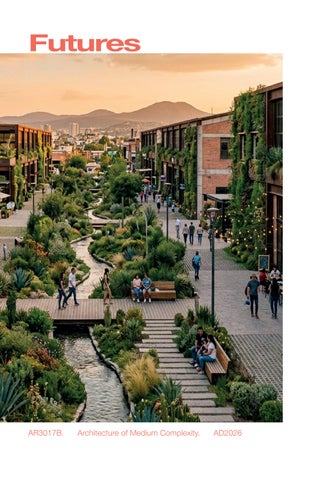
Futures
AR3017B.
Architecture of Medium Complexity.
AD2026
Futures
AR3017B. Architecture of Medium Complexity. AD2026 26 Mon.Tue.Thu.Fri 10:00-13:00 hrs. Tecnológico de Monterrey, Querétaro. EAAD. Escuela de Arquitectura Arte y Diseño. Teaching Team Diana García. Rodrigo Pantoja. Viviana Barquero. Gerardo Maza. Santiago Luján. Carlos González. Udo Muchow.
dgarciace@tec.mx rpantojac@tec.mx viviana.barquero@tec.mx gjmaza@tec.mx santiago@goma.haus carlos@goma.haus info.arqum@gmail.com
Academic Directors Viviana Barquero. Daniel Savedra. Othón Castañeda.
EAAD Division Director. Department Director. Program Director.
Alliances GOMA Arquitectos
Book Design: Luisa Medina
Editorial Design: Diana García
CONTENTS Futures . . . . . . . . . . . . . . . . . . . . . . . . . . . . . .
6
Qro as Project . . . . . . . . . . . . . . . . . . . . . . . . . . . .
8
Area of study . . . . . . . . . . . . . . . . . . . . . . . . . . . . . 10 The Studio . . . . . . . . . . . . . . . . . . . . . . . . . . . . . . 14 Research / Design Question . . . . . . . . . . . . . . . . . . . . . 16 Lines of research . . . . . . . . . . . . . . . . . . . . . . . . . . . 18 Methodology . . . . . . . . . . . . . . . . . . . . . . . . . . . . . 22 Assessment . . . . . . . . . . . . . . . . . . . . . . . . . . . . . 26 Calendar . . . . . . . . . . . . . . . . . . . . . . . . . . . . . . . 28 Competences Tec21 . . . . . . . . . . . . . . . . . . . . . . . . . 32 Teaching Team . . . . . . . . . . . . . . . . . . . . . . . . . . . . 36 Students . . . . . . . . . . . . . . . . . . . . . . . . . . . . . . . 38 Bibliography . . . . . . . . . . . . . . . . . . . . . . . . . . . . . 40 Glossary . . . . . . . . . . . . . . . . . . . . . . . . . . . . . . . 42 References . . . . . . . . . . . . . . . . . . . . . . . . . . . . . . 46
FUTURE The future is not a single, predetermined destination to be predicted, but rather an open, unwritten domain of multiple possibilities.
FUTURE AND CLIMATE DESIGN The climate crisis we are facing now requires innovative thinking to develop a wide range of solutions to address the complexity of the challenges. In these terms, Future thinking is an important tool for rethinking current assumptions; it helps us to stop passively expecting inevitable catastrophes and instead gain the power to drive meaningful transformation.
6
Image generated by AI.
Image generated by AI.
7
QRO AS PROJECT Querétaro, located in Central Mexico, has experienced rapid land transformation and anthropization of the natural environment, causing socioeconomic and environmental damage. Querétaro is one of many cities that have undergone industrial expansion and generated economic growth while causing ecological harm. In recent years, urban and peri-urban areas have developed exponentially. Rapid urbanization, over-extraction of natural resources, environmental deterioration (water and air pollution), resource shortages, and droughts due to the imbalance in the urban hydrologic cycle represent the scenario that Querétaro and many Mexican cities are facing (González-Sosa et al. 2010). Assuming the role of an educational institution and the responsibility of our discipline, we focus on our city as the Project for the Future City.
8
Google Maps, 2025.
5 km 9
AREA OF STUDY DistritoQro
This study investigates how architecture and landscape, through edible landscapes, can regenerate Distrito Tec, an industrial estate of approximately 100 hectares. The aim is to revitalize and dignify this area, transforming it into a mixed, vibrant, inclusive, and sustainable environment that reflects the principles of foodscapes.
STRATEGIC OPPORTUNITY These strategies represent a key opportunity to rethink cities from a equality perspective, moving towards a more resilient and sustainable future. In post-industrial areas in transition, such as the Distrito QRO neighborhood in Querétaro, Mexico, architecture and landscaping can promote equity through adaptive reuse and urban recycling. These strategies transform obsolete infrastructure into robust social infrastructure that fosters cohesion and mutual support. Integrating passive resilience strategies and nature-based solutions mitigates ecological impact through the circular economy and ensures spatial justice by creating inclusive, safe, and accessible environments that restore the community’s and the local ecosystem’s dignity.
Distrito Qro Delegación Centro Histórico Distrito Qro Industria Habitacional Universidades Servicios / Comercial Equipamiento Barrios tradicionales Espacio abierto
10
DistritoQro, 2024.
500 m 11
AREA OF STUDY DistritoQro
12
13
THE STUDIO Projects for the Future City is an effort to address climate justice by exploring the sociocultural and ecopolitical dimensions of the climate crisis in the Mexican context. For the last four years, the studio has investigated four topics: hydric stress, energy transition, urban heat island, soil degradation, foodscapes and inequality. Exploring these climate design themes led us to define a new set of issues that will be addressed for the next two years to complete the climate justice mosaic, outlining the desirable possibilities of addressing multiple facets within the local challenges. The opportunities rely on designing actions that address the scale and impact of climate change challenges regarding food, water security, new ways of production, especially in the Global South. Our discipline’s question is how to shift from a ¨spectator role¨ to understanding and acting on climate justice?. This question leads us to guide the design studio: Can urban climate-responsive design interventions engage different faces of climate injustice?
14
15
RESEARCH - DESIGN QUESTION Can urban climate-responsive design interventions engage different faces of climate injustice? The studio explores how can architecture and landscape architecture address future climate challenges on post-industrial sites in transition? How can we help build more equal, resilient environments that face climate change? And what role do climate-responsive design and urban recycling plays in transforming into healthier, more connected, and equitable environments?
16
Image generated by AI.
17
LINES OF RESEARCH AND STRATEGIES #technologyandinnovation #bluegreeninfraestructure #nbs #climateadaptive
#future #watermanagement #care #citiesintransition All projects will address:
1. Productive and Adaptive Infrastructure: Objective: To explore strategies for the transformation of industrial land and brownfield sites into productive spaces through agricultural systems and new ways of production in urban areas.
Key topics: Degraded soils, phytoremediation, productive green roofs, hydroponic and aquaponic systems adapted to industrial contexts.
Impact: Improve food security, improve quality of life.
2. Inclusive Design and Social Participatory Strategies. Objective: Involve local communities, workers and key stakeholders in the co-creation of foodscapes to foster ownership and social impact of the project.
Key topics: Participatory design, community gardens, food equity, social resilience and circular economy.
Impact: Strengthen the social fabric and promote community integration through food production. 18
3. Access to public programs and affordable housing facing climate change. Objective: To explore strategies for the transformation and adaptation of existing spaces (open and closed spaces) to provide housing and public programs, decreasing vulnerability to climate events.
Key topics: Public space, social resilience, regenerative design..
Impact: Improve security and resilience of vulnerable communities, environmental improvement and urban quality of life.
4. Spaces for wellbeing, health, and climate refuge. Objective: Involve local communities, workers and key stakeholders in the co-creation of spaces for wellbeing and health considering the current and future climate conditions
Key topics: Participatory design, social resilience and circular economy.
Impact: Strengthen the social fabric and promote community integration through active and social spaces.
19
LINES OF RESEARCH AND STRATEGIES Specific lines of research:
1. Impact of extreme weather events. (increasing floods, droughts and storms). Objective: To explore strategies for the transformation and adaptation of built areas increasing resilience and regenerate the degraded landscape.
Key topics: Productive green corridors, urban biodiversity, water management, microclimates and air quality improvement.
Impact: Improve security, environmental improvement and urban quality of life.
2. Food Availability and quality. Objective: To study the relationships between food systems and urban ecologies to regenerate the degraded landscape. Moreover, the transformation of industrial land and brownfield sites into productive spaces through agricultural systems in urban and periurban areas.
Key topics: Phytoremediation, productive green roofs, hydroponic and aquaponic systems adapted to industrial contexts
Impact: Improve food security, availability and reduce the carbon footprint of food supply. 20
3. Water availability and air quality. Objective: To study the relationships between water systems and urban ecologies to regenerate the degraded landscape.
Key topics: Productive green corridors, urban biodiversity, water management, microclimates and air quality improvement, vector and waterborne diseases.
Impact: Create multifunctional landscapes that combine NBS, water management strategies and air quality for environmental improvement and urban quality of life.
4. New ways of production and industry (transition) Objective: To explore new ways of production within an industry that is currently in transition.
Key topics: Social and economic resilience and circular economy.
Impact: Diversify production activities towards the circular economy Reduce the ecological impact of production and promote community integration.
21
METHODOLOGY Agenda Research on the socio spatial, economical, environmental and geopolitical dimensions that determine the agenda of climate injustice through the lens of each topic (hydric stress, energy consumption, waste management, and urban heat island).
Territorialization Evidence on our territory of the socio spatial, economical, environmental and geopolitical dimensions. Identify the uneven effects of the climate crisis and how they interconnect. This phase includes the recognition of stakeholders and the normative dimension involved on each topic.
22
Strategic Framework Vision and spatial strategies for mitigation and adaptation identifying a set of key actions, timeframe and actors involved on the process.
Design Intervention A design project, that is supported by the strategic framework, that achieves a specific topic of the agenda in our territory.
23
METHODOLOGY - Topic Definition. - Definition of general research question. - Methodology. - Calendar.
Agenda
Territorialization
- Problem Definition. - Definition of research question
- Understand the spatial, economic, social and ecological dynamics in the territory (site), multiscalar - Diagnosis based on specific research questions. - Definition of critical areas.
Tools - Comparative cases of analogous studies. - Literature review: scientific articles, books and previous studies.
Tools - Layer mapping of territorial dynamics. - QGis Maps. - Stadistic analysis. - Interviews, surveys. - Participatory diagnosis workshops with the community. - Perceptual mapping - Validation with external experts. - Thematic manuals. 24
Futures
Project
- Definition of a frame of reference for the desirable future. - Definition of strategies (pericity and systemic impact). - Definition of architectural-urban programs. - Relate critical areas, strategies and programs to generate a project portfolio.
- Site analysis. - Project strategies. - Design premises. - Programmatic alternatives and location criteria. - Definition of landscape, construction, structural and installation criteria. - Project communication.
Tools - Dystopian vision. - Utopian vision. - Manifesto.
Tools - Site mapping. - QGis. - Graphics. - Digital models. - Digital presentations. - Participatory diagnosis workshops. - Validation with external experts.
25
METHODOLOGY The design studio is based on an academic methodology of transversal learning groups. The scopes transcend the architectural-constructive project by first producing a socio-spatial diagnosis of the site that generates a spatial vision that will eventually develop a design proposal. The challenge takes place in five phases over 15 weeks. Phase 01 Phase 02 Phase 03 Phase 04 Phase 05
Diagnosis. Alternatives for the future: Vision. Programming and volumetric variations. Development of the architectural project and its criteria. Project Communication.
ASSESSMENT To be eligible to pass the block, students are required to complete all forms of evaluation and must show a reasonable level of competence in the course. When evaluating course activities, students are expected to have a firm understanding of the content; to analyze and synthesize in depth, to have the ability to process complexity and to integrate complex strategies and design, accompanied by solid communication skills. The evaluation is broken down as follows:
Evidence 01: Mid Term Presentation (phase 1-4)
50%
Evidence 02: Project development (phase 5)
45%
External Evaluation:
05%
TOTAL:
100% 26
Image generated by AI.
27
CALENDAR S1 Agosto 10:00 11:30 12:00 13:00
Repentina Análisis de Sitio
S2 Agosto 10:00 11:30 12:00
Fase 01 Lecturas
Lunes 10
Martes 11
Intro
Jueves 13
Viernes 14
Design Sprint Analysis
Design Sprint Analysis
Design Sprint Analysis
Investigación Análisis de Sitio
Taller
Taller
Taller
Lunes 17
Martes 28
Jueves 20
Viernes 21
Studio Research Design
Studio Research Design
Studio Research Design
Taller
Taller
Jueves 27
Viernes 28
Studio Futures
Studio Futures
Studio Futures
P1: First Results Research Design
Taller
Taller
Taller
Lunes 31
Martes 1
Jueves 3
Viernes 4
Studio Agenda
Studio Agenda
Studio Agenda
P2: Future Scenarios
Taller
Taller
Taller
Lunes 7
Martes 8
Jueves 10
Viernes 11
Studio Strategies
Studio Project definition
Studio Project definition
Taller
Taller
Taller
13:00
P0: Design Sprint Analysis
Taller
S3 Agosto
Lunes 24
Martes 25
10:00 11:30 12:00
Fase 01 Escenarios
13:00 S4 Septiembre 10:00 11:30 12:00 13:00
Fase 01 Manifesto / Agenda
S5 Septiembre 10:00 11:30 12:00 13:00 S6
Fase 01 Agenda / programas, proyectos
Semana Tec (14-18 Septiembre)
28
Mi 12
Mi 19
Mi 26
Mi 2
Mi 9
P3: Strategies Proj definition
S7 Septiembre
Lunes 21
Martes 22
Studio Programmatic and volumetric experimentation
Studio Programmatic and volumetric experimentation
Taller
Taller
S8 Octubre
Lunes 28
Martes 29
10:00
Taller
Studio Conceptual Design
10:00 11:30
Fase 02
12:00 13:00
11:30
Fase 02
S9 Octubre 10:00
Lunes 5 Taller
Martes 6 Studio Arch Design
15:00
P5: Conceptual Design
Taller
S10 Octubre
Lunes 12
Martes 13
Studio Agenda
11:30 12:00
Fase 03
9:00 11:30 12:00
Fase 03
15:00 S11 Octubre 9:00 11:30 12:00 15:00 S12
Fase 03
Mi 30
Jueves 24
Viernes 25
Studio Programmatic and volumetric experimentation
Studio Programmatic and volumetric experimentation
Taller
Taller
Jueves 1
Viernes 2
Studio Studio Conceptual Design Conceptual Design Taller
Taller
Jueves 8 Studio Arch Design
Viernes 9 Studio Arch Design
Taller
Taller
Jueves 15
Viernes 16
Studio Agenda
Studio Agenda
Studio Agenda
Taller
Taller
Taller
Taller
Lunes 19
Martes 20
Mi 21
Jueves 22
Viernes 23
Studio Agenda
Studio Agenda CRITDAY Taller
CRITDAY
13:00
P4: Programmatic and volumetric experimentation
12:00
Mi 23
CRITDAY Retro externa (Exatecs)
CRITDAY Retro Interna
Taller
Taller
Mi 7
Mi 14
Semana Tec (26 - 30 Octubre)
29
CALENDAR S13 Noviembre 10:00 11:30 12:00
Fase 03
13:00
S14 Noviembre 10:00 11:30 12:00
Fase 03
13:00
S15 Noviembre
Lunes 2
Martes 3
Studio Arch Design
Jueves 5
Viernes 6
Studio Arch Design
Studio Arch Design
Studio Arch Design
Taller
Taller
Taller
Taller
Lunes 9
Martes 10
Jueves 12
Viernes 13
Studio Arch Design
Studio Arch Design
Studio Arch Design
Studio Arch Design
Taller
Taller
Taller
Taller
Lunes 16
Martes 17
Jueves 19
Viernes 20
Studio / Representation, drawings and models
Studio / Representation, drawings and models
Jueves 26
Viernes 27
Studio / Representation, drawings and models
Studio / Representation, drawings and models
10:00 11:30 12:00
Mi 4
Mi 11
Mi 18
Studio / Fase 04
ASUETO
13:00 S16 Noviembre
P6: Pre final (Pin up)
Lunes 23
Martes 24
Entrega booklet digital
Studio / Representation, drawings and models
S17
Lunes
Martes
Viernes
Diciembre
30
1
4
CRITDAY Retro Interna
EXPO EAAD
10:00 11:30 12:00
Fase 04
13:00
10:00 11:30 12:00 13:00
Fase 04
Entrega física láminas, modelos y presentación
30
Mi 25
COMPETENCES
Architecture of Medium Complexity. A. SAR0200. DESIGN. 1. SAR0201C. Inventive representation of architectural projects. Inventively represents concepts and architectural projects of various scales, showing mastery in the selection and mix of digital techniques and manual representation.
2. SAR0202C. Preparation of Architectural Programs. Develops architectural programs taking into account the requirements of a community, its relationship with the city and with multidisciplinary groups that allow it to cover and understand the complexity of the context of a region, uses and customs.
3. SAR0203C. Design Premises. Establishes the design premises and guiding ideas, integrating criteria of program functionality, climate, shape, volume, structure, materiality, composition, spatial organization, habitability, constructability, economy, sustainability, and spatial phenomenology.
4. SAR0204C. Projection of Spaces. Projects architectural spaces that coherently integrate components of a complex architectural program, such as environmental, social, economic, cultural aspects, construction processes, structural and cognitive aspects of multiple types of user or a heterogeneous social group.
32
B. SAR0400. INVESTIGATION. 1. SAR0401B. Diagnoses Problems. Diagnose problems related to architecture within a line of research or context for a real project.
2. SAR0402B. Proposal of alternative solutions. Proposes alternative solutions to architectural problems in real contexts. 33
COMPETENCES Tec21
Participatory Architecture of Medium Complexity. C. SAR0600. CONSTRUCTION. 1. SAR0601C. Construction materials. Defines the materials and construction procedures in the medium complexity project under the criteria of life cycle of materials, UN sustainability principles and the regulatory framework of the region where the project will be built.
2. SAR0602C. Construction systems. It uses construction systems, identifying the technical requirements of the vertical or mixed-use building project and the context where it is applied.
3. SAR0603C. Construction project. Develops the construction project for vertical or mixed-use buildings, based on current regulations.
34
D. SEG0300. SOCIAL INTELLIGENCE. 1. SEG0303. Collaboration. Builds agreements, interactions and social relationships through collaboration that takes into account differences, as well as their own abilities and those of others, in the immediate context. 35
TEACHING TEAM Rodrigo Pantoja Studio coordinator. Design & Landscape.
Diana García Studio coordinator. Design & Urbanism.
Gerardo Maza Urban strategies. Design.
36
Viviana Barquero Energy expert. Design.
Carlos González ArchItectural Design.
Santiago Luján ArchItectural Design.
Udo Muchow ArchItectural Design.
37
STUDENTS
Valentina Boburg Mariana Desireé Cortés Patricio Cruz Andrade Arturo Esponda Herrera Estephania Nicole García Ana Sofía González Sierra Josué Roberto Ibarra Martínez Carolina Lluch Paola Palacios Sierra Alondra Parroquin Mario Quezada Vázquez Jimena Quintanilla Elisa del Carmen Sillero Ana Camila Vázquez
38
Image generated by AI.
39
BIBLIOGRAPHY Designing for the Climate Emergency
Sustainable [R]evolution
Sofia Pelsmokers, et. al.
Juliana Birnbaum, Louis Fox.
40
Climate Change and the People’s Health
Enviromedics Jay Lemery, Paul Auerbach.
Sharon Friel.
41
GLOSSARY
(Extract from “Whitmee S, Haines A, Beyrer C et al. (2015) Safeguarding human health in the Anthropocene epoch: report of The Rockefeller Foundation–Lancet Commission on planetary health. Lancet 386 (10007): p1973-2028.)
Anthropocene. The proposed name for a new geological epoch is demarcated as the time when human activities began to have a substantial global effect on the Earth’s systems. The Anthropocene has yet to be formally recognised as a new geological epoch, and several dates have been put forward to mark its beginning. Ecosystem A dynamic complex of plant, animal, and microorganism communities and the non-living environment acting as a functional unit. Ecosystem services. The benefits provided by ecosystems contribute to making human life both possible and worth living. Examples of ecosystem services include products such as food and clean water, regulation of floods, soil erosion, and disease outbreaks, and non-material benefits such as recreational and spiritual benefits in natural areas. The term services is usually used to encompass the tangible and intangible benefits that human beings obtain from ecosystems, which are sometimes separated into goods and services. Biodiversity. An abbreviation of biological diversity; biodiversity means the variability among living organisms from all sources, including inter alia, terrestrial, marine, and other aquatic ecosystems and the ecological complexes of which they are part. This variability includes diversity within species, between species, and among ecosystems. Externalities A benefit or cost that affects an individual or group of people who did not choose to incur that benefit or cost. State shift A catchall term for the level of accessibility to fresh, healthy, nutritious Large, lasting changes in the structure and function of social–ecological systems, with substantial impacts on the ecosystem services provided by these systems. 42
Resilience The capacity of any entity—an individual, a community, an organization, or a natural system—to prepare for disruptions, to recover from shocks and stresses, and to adapt and grow from a disruptive experience. Planetary health. Planetary health proposes, at least in principle, to go beyond an anthropocentric focus, so as to incorporate the social, economic and ecological conditions necessary for the maintenance of health in to its very definition. Advocates long term thinking and planning about the health of humans, the Earth and other species. Health policy Defined by the World Health Organization as the decisions, plans, and actions that are undertaken to achieve specific healthcare goals within a society. (Extract from “Food and the City”) Green Revolution. The term applied to the advances in crop and chemical sciences that produced much higher-yielding cereal and grain varieties in conjunction with new chemical fertilizers and pesticides. It also refers to the exporting of this new technology to at-that-time-developing countries like Mexico and India to industrialize their farming as a form of aid and foreign development. The Green Revolution took place between the 1940s and 1970s. Guerilla gardening. A form of social and political activism in which gardeners plant flowers or food on underutilized private or public land without the consent of the owner.
43
GLOSSARY Industrial food. Food grown and produced according to an industrialist mindset that is concerned with mechanizing and lowering cost of production by largescale production and by concentrating manufacturing and distribution chains to achieve the lowest possible cost of unit production. Author Michael Pollan offers this definition of industrial food in The Omnivore’s Dilemma: “Any food whose provenance is so complex or obscure that it requires an expert to help ascertain.” Intercropping. When two or more crops or plants are grown simultaneously in the same area, usually to achieve a more rapid succession of harvests than if one crop was planted, allowed to mature, harvested, and then removed before the next crop was planted. Locavore. A person who seeks out locally grown or locally produced foods. Organopónico. A small-scale, organic, cooperative-run urban farm in Cuba that grows food for its surrounding community. The term is now being used for similar small-scale urban organic farms in other Latin American countries. Permaculture. An approach to living and growing food in a permanently sustainable way that draws heavily on or even closely mimics natural ecosystems. It takes an integrated approach toward food-production systems and other human needs. Slow Food. An Italy-based grassroots food movement that now counts over 100,000 members in 130 countries. It began in 1989 as a countermovement to the globalization of fast food but now works on issues of food sovereignty and biodiversity preservation and in service to its motto of “good, clean, fair food for all.
44
Terroir. A French term, borrowed from viticulture and wine production, that encompasses the cumulative effect of geography, geological variations, and climate on the flavor characteristics of foods. It not only describes the effect of place but takes into account the time frame during which the product was made. Urban agriculture. The act of growing and, according to some definitions, distributing food in a defined urban area. The idea is to produce food closer to where the majority of consumers are, in cities. Urban agriculture tends to be smallscale agricultural enterprises, even on a household scale. Vertical farming. A concept of stacked agricultural production, in vertical layers, to shrink the footprint of land-based agriculture. Some vertical-farm designs are essentially food-producing skyscrapers (though none of these designs have been realized yet). Vertical farming tends to incorporate closed-loop agricultural systems where nutrients in food production are recycled from one food-production area (such as freshwater fish tanks) to another (such as salad greens).
45
REFERENCES 1. Pirog, R.; Van Pelt, T.; Enshayan, K.; Cook, E. Food, Fuel, and Freeways: An Iowa Perspective on How Far Food Travels, Fuel Usage, and Greenhouse Gas Emissions, 2001. http://large.stanford.edu/ courses/2014/ph240/pope1/docs/pirog.pdf. 2. Pérez Neira, D., Copena Rodríguez, D., Delgado Cabeza, M., Soler Montiel, M., & Simon Ferández, X. (1995). Cuántos Kilómetros Recorren los Alimentos Antes de Llegar a tu Plato. Análisis de La Presión Ambiental Del Transporte de La Importación de Alimentos (Consumo Humano, Industria o Consumo Animal) En El Periodo, 2011.https://www.tierra.org/ wp-content/uploads/2016/01/alimentos_kilometricos_2.pdf 3. Murdoch, J.; Marsden, T.; Banks, J. Quality, Nature, and Embeddedness: Some Theoretical Considerations in the Context of the Food Sector. Economic Geography 2000, 76 (2), 107. https://doi. org/10.2307/144549. 4. The State of Food Security and Nutrition in the World 2023; FAO; IFAD; UNICEF; WFP; WHO; 2023. https://doi.org/10.4060/cc3017en. 5. Pineda, E., Brunner, E. J., Llewellyn, C. H., & Mindell, J. S. (2021). The retail food environment and its association with body mass index in Mexico. International journal of obesity (2005), 45(6), 1215–1228. https:// doi.org/10.1038/s41366-021-00760-2.
46
6. Barquera, S.; Rivera, J. A. Obesity in Mexico: Rapid Epidemiological Transition and Food Industry Interference in Health Policies. The Lancet Diabetes & Endocrinology 2020, 8 (9), 746–747. https://doi.org/10.1016/ S2213-8587(20)30269-2. 7. Sánchez, E. OXXO se pone al tú por tú con los grandes. El Economista. Digital. México September 24, 2011. https://www. eleconomista.com.mx/empresas/OXXO-se-pone-al-tu-por-tu-con-losgrandes-20110924-0042.html (accessed 2024-07-25). 8. Turner, B. Embodied Connections: Sustainability, Food Systems, and Community Gardens. Local Environment 2011, 16 (6), 509–522. https:// doi.org/10.1080/13549839.2011.569537 9. WHO calls on countries to reduce sugar intake among adults and children. News. https://www.who.int/news/item/04-03-2015-whocalls-on-countries-to-reduce-sugars-intake-among-adults-and-children (accessed 2024-07-30). 10. Glanz, K.; Sallis, J. F.; Saelens, B. E.; Frank, L. D. Healthy Nutrition Environments: Concepts and Measures. Am J Health Promot 2005, 19 (5), 330–333. https://doi.org/10.4278/0890-1171-19.5.330. 47
Issuu Projects for the Future City.