KEY DEFINITIONS
Affordable housing refers to housing for purchase and rental, including social housing, that is appropriate for the needs of very low to moderate-income households. This is generally understood to mean housing that costs no more than 30 per cent of a household’s gross income.
Affordable rental housing refers to properties that are made available at rents below market rates and are affordable for low to moderate income households. Typically, this means rents are set at or below 80 per cent of market rates and not more than 30 per cent of a household’s gross income. This includes key worker housing and social housing.
Build to rent (BTR) is the process whereby developers and their financiers build multiunit buildings and, instead of selling the units, retain them to rent. Rents may be set at market rent or, for affordable and social housing, at an appropriate discount to market rents.
Co-operative housing is a community where members live independently and collectively manage affordable, sustainable housing.
Key worker housing refers to affordable rental or purchase options for workers in essential services who often struggle to afford housing due to their income or the high cost of living in areas close to their employment.
Retirement villages are a community for people aged 55 and over, offering independent or serviced living with shared amenities. Some provide optional care services and may be run by private, charitable, or not-for-profit organisations.
Secondary residences often called a “granny flat” or “ancillary dwelling,” is an additional dwelling on the same site as a main house. They are subject to specific planning rules and regulations within the Hobart Planning Scheme and must be selfcontained, have a gross floor area not more than 60m², belong to a single dwelling, and share access, parking, and water, sewerage, gas, electricity and telecommunications connections and meters.
Social housing is affordable housing provided by the government and community sectors to assist people who are unable to afford or access suitable accommodation in the private rental market. It includes public housing, state owned and managed Indigenous housing and community housing. Rents are set as a proportion of household income.
Student housing includes a range of living options, including residential colleges, selfcontained studio apartments or shared apartments with communal amenities.
Supported accommodation is housing combined with a support service. This type of housing provides higher-level care, support or supervision for vulnerable people with particular needs.
Temporary housing means residential use or development for a period of not more than 12 months commencing from the date on which an occupancy permit or temporary occupancy permit is issued in accordance with Part 17 of the Building Act 2016
Tiny houses are small dwellings, either built as a permanent structure or on a trailer with wheels.
Housing Action Plan 2026
KEY DEFINITIONS
High density housing is multiple dwellings on a site that are over six storeys in height. Typical typologies include residential apartment buildings and mixed-use residential developments with commercial tenancies.
Medium density housing typologies include single-storey villa developments, duplexes and co-joined dwellings, terrace housing, townhouses, apartment buildings up to six storeys, shop top housing and mixed-use residential developments with commercial tenancies. See diagram below.
Grouped house is two or more dwellings on a single lot, often single or double storey and detached.
Terrace house or Townhouse is a house built as part of a continuous row in a uniform style.
Low-rise apartments are typically a building of three stories or less, often referred to as a garden-style apartment or walk-up apartment, and sometimes a manor house, or six pack. These buildings are generally found in less densely populated areas and offer a more intimate, communityoriented environment compared to high-rise buildings.
Mid-rise apartments are typically a residential building with 3 to 6 storeys, offering a balance between the community feel of low-rise buildings and the convenience of high-rise. Their efficient use of space and accessibility to urban conveniences is increasingly desirable.
Missing middle refers to medium-density housing that is on the building spectrum (or “in the middle”) between single-family homes and high-density. Examples of the ‘missing middle’ may include townhouses or buildingsthat contain multiple apartments.
Mixed-use renewal means the redevelopment of land that blends multiple uses, either within buildings and/or across multiple buildings on larger sites. Uses can include, housing, retail, hospitality, office, community or cultural uses.
‘Shop top’ apartment refers to a dwelling that are located above ground floor retail or commercial uses.
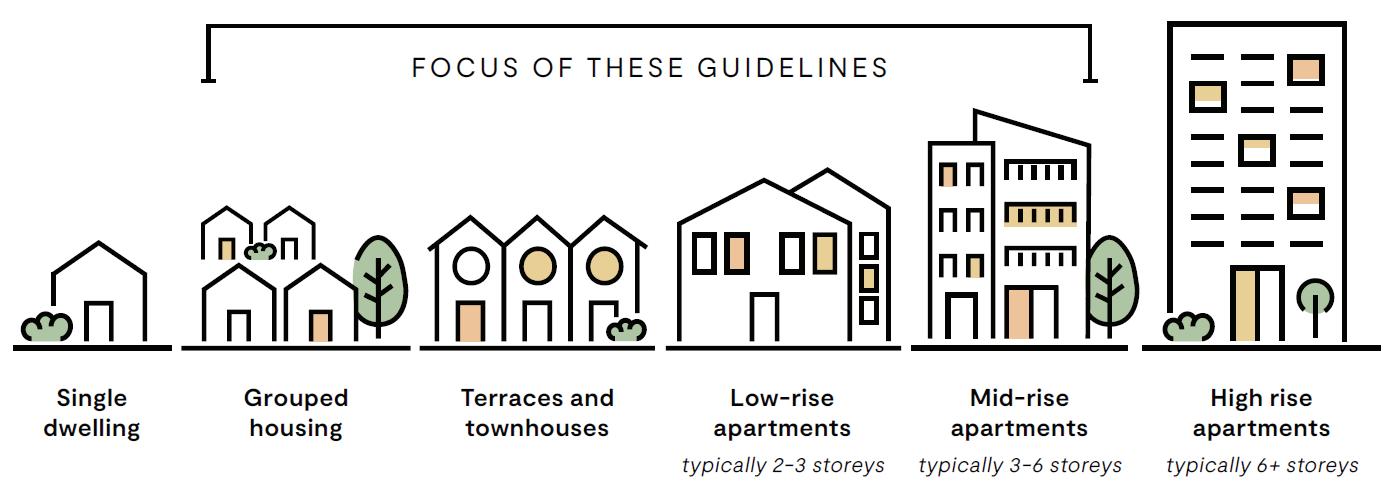
Types of housing illustrated in the Medium Density Guidelines