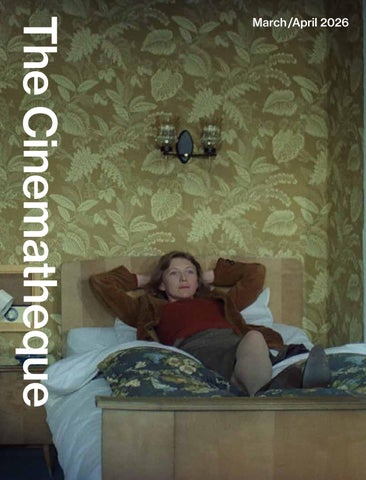
The Cinematheque
The Cinematheque, founded in 1972, is a film institute and media education centre devoted to celebrating the art and history of Canadian and international cinema and understanding the impact of moving images and screen-based media in our lives. Our public activities include a year- round calendar of curated film exhibitions devoted to important classic and contemporary films and filmmakers and an array of community outreach programs offering interactive learning opportunities in film appreciation, filmmaking, digital literacy, and critical thinking. We value cinema as a communal and transformative experience; believe in the importance of inclusivity and diversity in programming; and are committed to showcasing the finest achievements of local and national artists along with the best in world cinema.
Buying Tickets
The Cinematheque box office opens 30 minutes prior to the first screening of the day. Tickets can be purchased in advance online at thecinematheque.ca or during screening hours at our box office. By purchasing a ticket to a screening at The Cinematheque, you automatically become a member of the Pacific Cinémathèque Pacifique Society.
Support
The Cinematheque is a non-profit organization dedicated to advancing the understanding and appreciation of cinema as art by bringing the very best in film culture and education to audiences of all ages. We invite you to support The Cinematheque’s work by making a gift today. thecinematheque.ca/about/donate
Venue Rental
The Cinematheque theatre is available for rental. We offer simple, all - inclusive rental terms and top-quality service, and are equipped for the projection of a wide range of film, video, and digital formats. Whether you are looking for somewhere to host a private screening, film premiere, community event, conference, or work function, our theatre is the ideal venue. theatre@thecinematheque.ca
Advertising
The Cinematheque offers advertising opportunities in this program guide, on-screen in our theatre, and digitally in our weekly e-blast. advertise@thecinematheque.ca
The Cinematheque’s program guide is published six times a year with a bi - monthly circulation of 12,000.
The Cinematheque gratefully acknowledges the financial support of the following agencies:
Executive Director
Kate Ladyshewsky
Artistic Director
Shaun Inouye
Learning & Outreach Manager
Lief Hall
Communication & Marketing Manager
Gerilee McBride
Venue Operations Manager
Linton Murphy
Technical Manager & Head Projectionist
Al Reid
Operations Coordinator
Emma Pollard
Learning & Outreach Coordinators
Sam Mason, Acacia Nikiel
Learning & Outreach Assistant
Sangeon Yoo
Programming Associate
Michael Scoular
Theatre Managers
David Avelino, Jessica Johnson, Luke McEwan, Asher Penn, Rodney Stewart
Projectionists
Dama Correch, Ryan Ermacora, Lukas Henne, Ron Lacheur, Abigail Markowitz, Eirinn McHattie, Cassidy Penner, Jana Rankov, Colin Williscroft
Board of Directors
Leah Mallen (Chair)
Eric Wyness (Vice Chair)
Rudy Bootsma (Treasurer)
David Legault (Secretary)
Michael Dove, Xochitl Gabriela Esquivel, Amir Hazfi, Nicole Prior, Tim Reeve, Aryana Sye, Ken Tsui
Classification Information
Cover image: Les rendez-vous d’Anna, Chantal Akerman, 1978
Contents image: A Couch in New York, Chantal Akerman, 1996
The Cinematheque is situated on the unceded, ancestral homelands of the xʷməθkʷəy əm (Musqueam), Sḵwx̱wú7mesh (Squamish), and səlilwətaɬ (Tsleil-Waututh) Nations.
Theatre Volunteers
Taylor Bishop, Sasha Bondartchouk, Haley
Briggs, Alison Charabin, Cedric Chauve, Nadia Chiu, Curtis Comma, Inês Devezas, Robert Ferguson, Moana Fertig, Yousif Gerges, Saher Ghanem, Zack Ginies, Shokei Green, Pablo Griff, Georgia Haire, Michiko Higgins, Gurjot Hothi, Fiona Hu, Spencer Keene, Savannah Kemp, Stewart Lampe, Simon Lee, Kam Fung Li, Ray Lai, Anna Lester, Qun Ma, Vit Mlcoch, Milad Mokhtari, Chelsey Mulligan, Lars Neufeld, Veronika Ong, Cameron Power, Sweta Shrestha, Syed Mustafa, Kate Tung, Jonny Warkentin, Wangeci Warui, Jonathan Wells, Marlon Wiebe, Ziyi Yan, Zoé Zhang
Distribution Volunteers Hagar Bach, Horacio Bach, Kyle Bowman, Anson Cheng, Gail Franko, Cristian Hernandez, Gerald Joe, Alan Kollins, Jim Miller, Ross Munro, Lora Tanaka, David Trotter, Harry Wong, Iris Xian
Office Volunteer Jo B.
Special thanks to our spare volunteers!
Program Notes
Shaun Inouye, Michael Scoular
Ongoing Series Notes
Chelsea Birks (Cinema Thinks the World) Selina Crammond (Frames of Mind) DIM Collective (DIM Cinema) Akira Iahtail (Our Stories to Tell) Pelan (Pelan Presents)
Additional Program Notes Jim Sinclair
Design & Layout Gerilee McBride
Screenings are restricted to 18+ unless the film has been classified by Consumer Protection BC. This is indicated in our program guide and/or on our website by the inclusion of one of the following ratings:
Suitable for all ages
Parental discretion is advised
Viewers under 14 years of age must be accompanied by an adult
Viewers under 18 years of age must be accompanied by an adult
Restricted to viewers 18 years of age and over
Ticket Rates
$15 General (18+), $13 Senior (65+), $11 Student
Multi-film ticket packs are available for purchase at a discounted rate from our gift shop. Ticket rates may vary for special events.
Film Club, our family matinee series, has the reduced admission rate of $7 for ages 13 and under, and $18 when combined with an adult ticket.
Free admission for Indigenous Peoples.
Spring is almost upon us! And what is spring without a little spring cleaning? Part of the tidying up is the decision to shutter our blog, Intertitles . As experiments go, it served its purpose of providing additional context to program notes, sharing some filmmaking tips, spreading the news on our latest events, and, of course, asking head projectionist Al everything (IYKYK). It was a good run, and if you were a dedicated reader you’ll see some familiar content popping up via our weekly newsletter, Cinemail—sign up on our website!
In praise of efficiencies, I’d also like to direct you to our website’s Library & Archive page where (when you scroll down to the “Program Guide” section) you’ll see we’ve begun the process of archiving our back issues. Currently, access to some of our past guides (2012–present) can be found on the digital publishing platform Issuu. That account will close this coming June, and you’ll slowly but surely find all of our past issues springing up on thecinematheque.ca—eventually going back to our very first published program guide from October 1972.
Gerilee McBride Communication & Marketing Manager

New Cinema
March 7 (Saturday)
7:00 pm
March 9 (Monday) 7:00 pm
March 15 (Sunday) 1:00 pm
March 25 (Wednesday) 7:00 pm

Magellan Magalhães
Portugal/Spain/France/Philippines/Taiwan 2025 Lav Diaz
163 min. DCP
In Portuguese, Spanish, Cebuano, and French with English subtitles
Magellan is a major work, one destined to draw greater awareness to its maker Laz Diaz, Philippine cinema’s reigning auteur. His first film to feature international star power—Gael García Bernal, exceptional in the role, tops the bill—it uses the life and career of 16th-century Portuguese explorer Ferdinand Magellan (Bernal) to interrogate the mechanisms and Messiah complex of Europe’s imperialist “Age of Discovery.” The seafaring epic, which begins and ends with bloodshed in Southeast Asia, tracks the exploits of the hubristic Magellan, dragging a fleet of Spanish ships across the Pacific Ocean in search of a new spice route to the East. Diaz thoroughly de-aggrandizes the fabled navigator, painting him as a tyrannical colonizer gripped by paranoia and blind purpose, soothed only by memories of the pregnant wife (Ângela Azevedo) he left behind. Taking an anticolonial lens to the legend, Diaz’s visually resplendent film—his first in colour in over a decade—is a staggering achievement.
“Magellan, a tale of death, disease, mutiny, and mutually assured destruction, is the most powerful anti-imperialist epic I’ve seen since Lucrecia Martel’s Zama.” Justin Chang, The New Yorker
March 20 (Friday) 8:40 pm
March 22 (Sunday) 6:00 pm
March 31 (Tuesday) 6:30 pm

BLKNWS: Terms & Conditions
USA 2025
Kahlil Joseph 113 min. DCP
“Intimate and sweeping, intellectually exciting and formally audacious … [A] mind-expanding meditation on Black lives, identities, and experiences.”
Manohla Dargis, “Best Movies of 2025” (#5), The New York Times
A dazzling embroidery of ideas on Black history, identity, and aesthetics gives shape to artist Kahlil Joseph’s eagerly awaited debut feature, an expansion of his acclaimed 2019 Venice Biennale installation BLKNWS . Joseph, who rose to prominence directing music videos for, among others, Flying Lotus, Kendrick Lamar, and Lemonade -era Beyoncé, assembles the film’s kaleidoscopic material as though sequencing an LP, moving fluidly between modes (archival, memoir, essay, pure fiction) and concepts while carrying key, structural motifs forward. One such throughline is Encyclopedia Africana, originally conceived by W.E.B. Du Bois (but unrealized in his lifetime), which serves as an index of Black consciousness in the film. Another is an Afro-futuristic reverie: aboard an enormous ocean liner bound for Africa, the art of a transatlantic biennale is en route to repatriation. “This is not a documentary,” the film declares; either way, truth bristles everywhere.
April 2 (Thursday) 6:30 pm
April 4 (Saturday) 8:30 pm
April 6 (Monday) 6:00 pm

What Does That Nature Say to You
South Korea 2025 Hong Sangsoo 109 min. DCP
In Korean with English subtitles
“It is a mark of Hong’s unassuming radicality that what might otherwise be a straightforward scenario becomes a much stranger affair … A film dense with details that float free of their ostensible dramatic scaffolding.”
Lawrence Garcia, Reverse Shot
Hong Sangsoo’s only picture of 2025, a break from his usual two-a-year pace, offers a typically unshowy but painfully observant portrait of human folly, here assuming the outward appearance of a meet-the-parents comedy. Following the ensemble story-threading of By the Stream, Hong’s latest narrows the focus to follow thirtysomething Donghwa (Ha Seongguk), an aspiring poet about to be introduced to the family of his girlfriend of three years, Junhee (Kang Soyi). Her parents and sister live outside of Seoul in a picturesque hilltop home, a source of wonderment for the city-dwelling Donghwa, whose day unfolds in the affable company of Junhee’s father (Kwon Haehyo). Leave it to Hong—and a steady flow of makgeolli—to dismantle the boyfriend’s dignity by morning. Shot in leisurely lo-fi long takes punctuated by Hong’s customary zooms, the newest entry in the Hongverse says plenty about human nature—maybe even more about the disappointments that naturally come with it.
April 10 (Friday) 6:30 pm
April 13 (Monday) 6:30 pm
April 19 (Sunday) 1:00 pm

Dry Leaf
Germany/Georgia 2025
Alexandre Koberidze
186 min. DCP
In Georgian with English subtitles
Vancouver Premiere
Georgian filmmaker Alexandre Koberidze’s much-anticipated follow-up to his enchanting festival charmer What Do We See When We Look at the Sky? (2021) is among the best films of 2025, no small feat for a three-hour movie whose formal gambit had many questioning its baseline tolerability. The premise is simple: Lisa has disappeared while documenting derelict soccer pitches across rural Georgia. Her father (played by the director’s own, David Koberidze) recruits her friend Levani and the pair embark on a road trip to find her. The kicker: Dry Leaf (like Koberidze’s 2017 debut) is shot exclusively on a circa 2008 Sony Ericsson cellphone, rendering the countryside and characters into woolly, pixelated forms—more gestural shapes than clearly articulated objects. Add to that a clever dose of magic realism and it’s a miracle Koberidze manages to pull it off, delivering not just a genuinely moving meditation on impermanence but some of the year’s most breathtaking images too.
One of the Best Films of 2025 (#9)
Sight and Sound
“[One] of the most original and rewarding works you’ll see any year.”
Mark Peranson, The Globe and Mail
April 23 (Thursday) 8:50 pm
April 27 (Monday) 8:50 pm
April 29 (Wednesday) 6:30 pm

Kontinental ’25
Romania 2025
Radu Jude
109 min. DCP
In Romanian, Hungarian, German, and English with English subtitles
Radu Jude’s aggressively associative dramas follow a principle the director says allows him “to create without inspiration.”
In a quickly assembled, iPhone-shot film like Kontinental ’25, Jude never neglects the strong and complex central performance by Eszter Tompa as the bailiff Orsolya, but he mainly works from a collage of online detritus and historical references that, in their strange mix of premonition and incoherence, only bolster the emotional wavelength of Orsolya’s moral dilemma. The film begins not with its protagonist, but with the victim of her next administration stop: a man who will be evicted. The fallout of this encounter haunts Orsolya and, like a suffering Job, she repeats the story to everyone she meets, seeking escape from the cyclical fear that she is, despite her precarity and share of pain, a harmful, unethical actor in the world. The title references Rossellini’s Europa ’51, in which Ingrid Bergman’s character is motivated by guilt to change her life.
Silver Bear for Best Screenplay
Berlin 2025
Advisory: Kontinental ’25 includes an excerpt of a video of bombing causing death in the Russo-Ukrainian War. “Hilarious, intellectual, and richly poetic … Another epic in miniature that deployed weaponized humour, deep empathy, grueling pathos, and sharp social critique in a manner so singular that it can only be described as Judeian.”
Travis Jeppesen, Artforum
New Restorations
March 8 (Sunday) 8:30 pm
March 13 (Friday) 6:30 pm
March 19 (Thursday) 6:30 pm
March 31 (Tuesday) 8:50 pm

A History of Violence
USA/Canada 2005
David Cronenberg
96 min. DCP
“Perfect … [Cronenberg’s] longstanding goal to achieve both clear-cut entertainment and detailed modernism reaches its highest point here.” Kurosawa Kiyoshi
David Cronenberg tackles human nature and the American myth of self-reinvention in this masterful psychological thriller, one of the best films of the 2000s. (Cahiers du cinéma placed it fifth, and the film featured in our own unranked series for that decade.) Viggo Mortensen plays Tom Stall, a small-town family man who proves shockingly adept at deadly force when two sadistic thugs turn up at his modest diner. His lethal actions suggest a secret past; his wife (Maria Bello) and kids see him with new eyes; and there is unwanted attention from the media—and from a scar-faced Philadelphia gangster (Ed Harris). Cronenberg’s most widely acclaimed film received Oscar nominations for its screenplay (Josh Olson) and William Hurt’s supporting performance. Along with its follow-up Eastern Promises, History stands as the director’s final plunge into genre before his mordant and perversely meditative late period. This directorapproved restoration is of the uncensored international cut.
March 8 (Sunday) 6:00 pm
March 17 (Tuesday) 8:30 pm March 21 (Saturday) 6:00 pm

Safe
Todd Haynes’s against-the-grain second feature—quite possibly his masterpiece— is one of the great movies of the 1990s. (The definitive one, according to a Village Voice poll.) Julianne Moore, outstanding in her first lead role, called the script “very, very spare, clear, and extremely emotional.” A work of startling formal control and unnerving detachment, Safe captures the zeitgeist (and malaise) of the end of the century with an eerie, austere precision. Moore plays affluent but afflicted housewife Carol, a woman hypersensitive, it seems, to the fumes, toxins, and chemical irritants we breathe in all the time. What Carol’s really allergic to, of course, may be something less easily defined. Haynes renders Carol’s predicament in stark, elegant compositions, making Kubrick-like use of long shots and decor to convey her alienation. He then whisks her off to New Mexico for rehab at a healing centre, which he sketches from a satirical disposition of great subtleness and restraint.
“An existential horror movie … Like Akerman’s masterpiece Jeanne Dielman, Safe presents its affectless heroine in a series of precisely composed long takes, a portrait of female domesticity coming undone.”
Dennis Lim
March 13 (Friday) 8:30 pm
March 15 (Sunday) 6:00 pm
March 19 (Thursday) 8:30 pm

Days and Nights in the Forest
India 1970
Satyajit Ray
116 min. DCP
In Bengali with English subtitles
“From the master, another masterpiece … A clash/negotiation between castes and sexes: selfish men and their hopes and cruelties and spectacular lack of wisdom, [and] women who see through them.”
Wes Anderson
Absent from theatrical distribution for decades, Satyajit Ray’s Days and Nights in the Forest is one of his most wise and invigorating contemporary fables—a film about the roundelay of desire and disillusion, and the great gulf of experience gained from either side of the class divide. In the aftermath of a bitter breakup, Hari is treated by his three best friends to a pastoral vacation far away from the hustle of Calcutta. The educated foursome can’t help but view their exciting and responsibility-free environs from a tourist’s point of view, but their entanglements with women, growing bar tabs, and inexperience with rural life and its labours brings their emotional vulnerabilities into wincing daylight clarity. A sketch of Days and Nights might resemble Cassavetes’s Husbands, but Ray distributes tension differently; the film’s narrative is a succession of charmingly ruthless character-revealing games that involve role-playing, bookish flirting, and pattern recognition.
Vancouver Greek Film Festival
Fifth Annual
March 12–April 1
With the fifth edition of our annual Vancouver Greek Film Festival, we’re delighted to acknowledge our partner, the Stavros Niarchos Foundation Centre for Hellenic Studies at Simon Fraser University, under the leadership of its director Sabrina Higgins, associate professor in the Department of Global Humanities and Archaeology.
This year’s festival offers a heady mixture of filmmakers, from heavy hitters to newcomers on the Greek cinema scene.
We open with Electra (1962), adapted for the screen and directed by Michael Cacoyannis, the Greek Cypriot filmmaker, theatre director, and playwright best known for helming the Oscar-winning Zorba the Greek (VGFF 2022). Electra serves as a tribute to two cultural giants who passed away in recent years: composer Mikis Theodorakis (1925–2021) and actor Irene Papas (1929–2022). No less a luminary than Katharine Hepburn referred to Papas as one of the greatest actors in the history of cinema.
We are pleased to present two new restorations by our friends at the Greek Film Archive in Athens—two films that deal in the politics of this often politically volatile country of fractious and passionate citizens. The allegorical Happy Day (1976), written and directed by the towering filmmaker of political and social engagement, Pantelis Voulgaris, is a special treat for cinephiles and Hellenophiles alike. As is I Remember You Leaving All the Time (1977), a 45-minuter by the insightful feminist director Frieda Liappa, pioneering presence in the New Greek Cinema.
There are many offerings this year with a spotlight on women directors, both in Greece and in diaspora. None may be as audacious as Head On (1988), the breakthrough film of Ana Kokkinos, a Greek Australian writer-director still working today. Her film is a significant piece of New Queer Cinema, dealing in themes of family, sexuality, Greeks in diaspora, and urban alienation. Like so many films in our festival, it also foregrounds the quest for human contact.
The theme of urban alienation permeates the noir classic Panic in the Streets, directed by Greek American Elia Kazan, whose America America and On the Waterfront have featured in previous VGFF editions. In Kazan’s flip on a police procedural, Richard Widmark plays a public health official and epidemiologist who tries to stop a plague from starting. Greek actor Alexis Minotis (Boy on a Dolphin, VGFF 2025) appears in two scenes, opening up a conversation about Greeks in Hollywood and their representation onscreen.
The festival also includes the Vancouver premiere of Kyuka: Before Summer’s End, a stunning first feature by self-taught newcomer Kostis Charamountanis, an instant darling of the art cinema world.
We close with the latest film of Greek Weird Wave charter member Athina Rachel Tsangari (known to our audiences from VGFF 2022) and her first in English, Harvest (2024), a genre-bending fusion of folk horror, costume drama, and political allegory, also receiving its Vancouver theatrical debut.
Enjoy yourselves!
Harry Killas
Curator, Vancouver Greek Film Festival
This year’s festival is made possible thanks to the support of the SNF Centre for Hellenic Studies at Simon Fraser University.

Sponsors
Anastase E. Maragos, Watson Goepel LLP Christos & Sophie Dikeakos
Greek Film Archive ( Ταινιοθήκη της
Moshe Mastai, Team 3000 Realty Ltd.
Nick & Maria Panos
Omega Travel
The Vancouver Greek Film Festival is organized by Harry Killas, curator and co-founder; Christos Dikeakos, co-founder; and The Cinematheque.

“The essence of Greek cinema is its diverse and intricate embrace of how to picture life’s experiences.”
Christos Dikeakos, visual artist and co-founder of the VGFF
March 12 (Thursday) Opening Night 7:00 pm
March 15 (Sunday) 8:30 pm

Electra
Ηλέκτρα
Greece 1962
Michael Cacoyannis
110 min. 35mm
In Greek with English subtitles
35mm Print
“A worthy screen rendering … [Cacoyannis] sees the contours of the drama in Greek tragedies as massive and elemental … A powerful address to the eyes.”
Bosley Crowther, The New York Times
This exquisite screen adaptation of Euripides’s classic tragedy is distinguished by its powerful performances, including a riveting, magnetic tour de force turn from star Irene Papas (Z ). Papas plays the title character, an exiled royal who is intent on exacting eyefor-an-eye revenge following her father’s assassination. Walter Lassally’s beautiful black-and-white photography is astonishing, as in his early work with the British New Wave and on Zorba the Greek. Two years before Zorba, Lassally and director Michael Cacoyannis staged this glorious version of Electra, which won a special award for “cinematic transposition” at Cannes. The film was also nominated at the Academy Awards for Best Foreign Language Film. Electra would become the first in a trilogy of films by Cacoyannis based on Euripidean tragedies. It was followed by The Trojan Women and Iphegenia
The opening-night screening on March 12 will be introduced by John Daukas, an historian and postdoctoral fellow at the SNF Centre for Hellenic Studies at SFU. His work explores imperialism, economy, and identity in the ancient Greek Mediterranean.
March 14 (Saturday) 6:00 pm
March 22 (Sunday) 8:20 pm

Kyuka: Before Summer’s End
Greece/North Macedonia 2024
Kostis Charamountanis
105 min. DCP
In Greek with English subtitles
Vancouver Premiere
An astonishing, stylish, and fresh feature film debut made with cinematic flourishes and editing freedom, Kyuka is an exquisite, immersive experience that has drawn comparisons to splashy debuts like Murina and Aftersun. Set against the sun-drenched backdrop of the island of Poros, the film shows Babis, a single father, as he takes his twins, Konstantinos and Elsa, on a sailing trip aboard the family boat. Days unfold in golden ritual, but beneath the warmth, something stirs. A tender, quietly seismic journey into adulthood, Charamountanis’s film (named after the Japanese term for “holidays”) gathers pace as it becomes increasingly experimental. Elena Topalidou, the star of Magnetic Fields (VGFF 2023), appears in a supporting role.
“Playful and unconventional … This is a filmmaker with faith in his own rhythms and a muscular enough plan of attack to encourage us to fall in step with this family summer, which plays out at the meeting point of nostalgia and something new.”
Amber Wilkinson, Screen International
March 14 (Saturday) 8:10 pm

Happy Day
Greece 1976
Pantelis Voulgaris
105 min. DCP
In Greek with English subtitles
New Restoration
“A poetic allegory influenced by the director’s own experience as a political prisoner during the military regime in Greece in the 1970s.”
Jytte Jensen, MoMA
This controversial political allegory depicts the experience of political prisoners exiled to a small Aegean island during the military junta—and in particular, one prisoner’s refusal to submit. In a sun-scorched, windswept environment, prisoners await the visit of the “great mother,” in honour of whom they have prepared a celebration. One of the prisoners, who steadfastly refuses to renounce his own beliefs, disappears and is proclaimed dead by the camp’s authorities. However, on the day of the official visit, the “dead man” reappears. This restoration of Pantelis Voulgaris’s second fiction feature was showcased in last year’s marquee event held by the Association des Cinémathèques Européennes. Voulgaris was honored in the mid-’90s with a MoMA retrospective, in which his cinema was lauded as “intensely humanistic” in its rendering of “the social and political landscape of Greece.”
Happy Day will be introduced by Spyros Sofos, assistant professor in the Department of Global Humanities, SFU. His research examines the interplay of social identities, collective action, insecurity, and conflict.
March 17 (Tuesday) 6:30 pm March 28 (Saturday) 8:20 pm

Panic in the Streets
USA 1950
Elia Kazan
96 min. Blu-ray
Panic in the Streets is a tense, realistic exemplar of director Elia Kazan, praised for its on-location filming in New Orleans, sharp dialogue, strong performances (especially from Jack Palance and Richard Widmark), and unique blend of genres. Widmark plays Clint Reed, a public health official who has only 48 hours to locate a killer infected with a plague that threatens to spread into an epidemic. This crime thriller is motivated by public health urgency, a combination that feels even more relevant today due to its focus on infectious disease and societal fear. Kazan’s film was awarded at both the Venice Film Festival and the Academy Awards (the latter for its story treatment). Panic represented a turning point for Kazan’s prestigious filmmaking; the next year he would direct A Streetcar Named Desire
The March 28 screening of Panic in the Streets will be introduced by festival curator and co-founder Harry Killas.
“Kazan [directs] with a keen sense of appreciation for violence and suspense … There is an electric quality to the climax staged in a warehouse on the New Orleans waterfront.”
Thomas M. Pryor, The New York Times
March 20 (Friday) 6:30 pm
March 30 (Monday) 8:20 pm

Head On
Australia 1998
Ana Kokkinos
104 min. DCP
In English and Greek with English subtitles
“Painfully brilliant … Kokkinos’s cinematic oeuvre is among the most hard-hitting bodies of work in Australian cinema.”
Luke Buckmaster, The Guardian
Ari (Alex Dimitriades), a dissolute 19-yearold second-generation Greek Australian with taboo desires, is caught between his conservative Greek background and modern Melbourne. Based on the novel Loaded by Christos Tsiolkas, Head On works with the tropes of Greeks in diaspora, such as intragenerational conflict, wise aunts, and even Greek dancing. Yet Ana Kokkinos, a lawyerturned-filmmaker, directs with freshness and originality, and grounds the film in a strong sense of realism. Supported by the dynamic cinematography of Jaems Grant and a riveting main performance from Dimitriades, Head On was selected to premiere at the Directors’ Fortnight at Cannes, and is now regarded as a landmark piece of Australian queer cinema.
March 21 (Saturday)
8:30 pm
April 1 (Wednesday) Closing Night 7:00 pm

Harvest
United Kingdom 2024
Athina Rachel Tsangari 134 min. DCP
Vancouver Premiere
Scotland during the Middle Ages. This metaphor of pre-modernity life allegorizes the transition to capitalism, as hundreds of years of humble farming are threatened by the unexpected arrival of a mysterious mapmaker. Harvest is the English-language debut of the formidably talented Greek New Wave director Athina Rachel Tsangari (showcased in our first VGFF), who pivots impressively from the satire of Chevalier and absurdism of Attenberg to this unique period picture. She has described the film as being concerned with “outsiders: the map-maker, the people on the move, and the company man—all archetypes of shattering change … There are no heroes, only imperfect, ordinary folks.”
Caleb Landry Jones and Harry Melling lead the cast, while Sean Price Williams (Good Time) provides the 16mm cinematography.
The closing-night screening on April 1 will be introduced by Eirini D. Kotsovili, senior lecturer in the Department of Global Humanities, SFU. Her areas of interest include literature, identity, and modern Greece.
“Profoundly elemental … Harvest grows hallucinatory … You get the sense of centuries of ancestors lurking in the shadows behind the villagers, watching as their descendants preserve their way of life. Until, of course, they can’t.”
Alissa Wilkinson, The New York Times
March 30 (Monday)

6:30 pm


Greek Women Directors × 3
Program runtime: 85 min.
This program of three short and mid-length works emphasizes women’s subjectivity across decades of historical change. In Frieda Liappa’s newly restored I Remember You Leaving All the Time, the tumultuous Greece of the 1970s acts as the backdrop to a narrative that pairs a radical journalist and a former stage actor. Jacqueline Lentzou’s Hector Malot: The Last Day of the Year is a bittersweet portrait of Sofia, a young woman on the precipice of change. The film originally premiered in competition as part of Critics’ Week at Cannes, and preceded Lentzou’s acclaimed feature debut Moon, 66 Questions . Lina Patsiou’s Punctum tells the nonfiction story of Theodoris, who fought for liberation against the Nazis during WWII before being imprisoned as a communist by the Greek government.
I Remember You Leaving All the Time
Greece 1977
Frieda Liappa
45 min. DCP
In Greek with English subtitles
Hector Malot: The Last Day of the Year
Greece 2018
Jacqueline Lentzou
25 min. DCP
In Greek with English subtitles
Punctum
Greece 2024
Lina Patsiou
15 min. DCP
In Greek with English subtitles
Second Annual Dutch Film Festival Cinema Thinks the World


Origin
USA 2024
Ava DuVernay
141 min. DCP
“Rich in thought, Origin is a dense, forceful masterwork, and, quite simply, the most radical film of DuVernay’s career.”
Robert Daniels, RogerEbert.com
Origin is a sprawling, ambitious exploration of racial inequality in contemporary America and its interconnection with global systems of oppression throughout history. Ava DuVernay was told that Pulitzer Prize-winner Isabel Wilkerson’s book, Caste: The Origins of Our Discontents, was far too complicated to adapt; but the urgency of the #BlackLivesMatter movement in the leadup to the 2024 election impelled her to persevere in interpreting the book’s ideas for the screen. Origin humanizes Wilkerson’s argument not only by dramatizing the book’s contents—which makes connections between Jim Crow laws, Nazi social hierarchies, and Indian caste systems—but also its creation. Aunjanue Ellis-Taylor (Nickel Boys) plays Wilkerson’s onscreen counterpart as she writes Caste in the aftermath of Trayvon Martin’s murder. Part biopic, part historical drama, and part political indictment, Origin is an emotionally resonant call for collective responsibility in recognizing universal human dignity.
This free screening is presented as part of “Cinema Thinks the World,” a partnership project between The University of British Columbia and The Cinematheque. After the film, there will be a short reception followed by a one-hour panel talk with audience discussion.
Panellists: Moussa Magassa, Gaurav Pathania, Asma Sayed Moderator: William Brown
This screening of Origin is presented in partnership with the Chetna Association of Canada.


Soldier of Orange
Soldaat van Oranje
Netherlands/Belgium 1977
Paul Verhoeven
148 min. DCP
In Dutch and German with English subtitles
“Embellishment is unavoidable,” Paul Verhoeven has said, referring to Soldier of Orange, his episodic film based on a WWII memoir. From the capitulation of Rotterdam in 1940 to the war’s end, the film follows the aristocratic Erik Lanshof (Rutger Hauer) and the way his actions—as part of university hazing rituals, anti-Nazi resistance efforts, and air force exploits—get summed up as heroism. Yet Verhoeven, making a film that augured the Hollywood chapter of his career that would follow, is interested in the stray details that escape this label. His landscape of wartime Netherlands includes a Jules et Jimesque ménage à trois, evidence disposed of in excrement, and, whether friend or foe, a mixture of ill-timed action, mistaken loyalty, and pleasure seeking. The film’s most iconic image involves dinner-jacket-wearing motorcyclists. Verhoeven would later repurpose research for Soldier of Orange toward what some have called his masterpiece, the WWII-set Black Book
“About as freewheeling as a World War II movie can get while maintaining a sense of perspective about the reality of the war … Hauer’s effortlessly charismatic performance and a scampering, devil-may-care energy that manifests itself in Jost Vacano’s aggressive, largely handheld camerawork [are] the film’s greatest assets.”
Ignatiy Vishnevetsky, AV Club
Co-presented with the Dutch Cultural Association of BC
This screening marks the opening night of the second annual Dutch Film Festival produced by Dutch BC. Through presenting dramatic and documentary features, short films, and DJ events, Dutch BC is committed to delivering progressive and inclusive cultural opportunities for the 200,000 BC residents of Dutch heritage.
Chantal Akerman: No Home Movies

When Chantal Akerman’s Jeanne Dielman, 23 quai du Commerce, 1080 Bruxelles displaced Hitchcock’s Vertigo atop Sight and Sound ’s 2022 decennial critics’ poll of the greatest films of all time, it did more than ascend a female filmmaker, for the first time ever, to the highest rung of the canon—it forced a reckoning in film culture with an irrefutably important artist whose legacy was routinely underserved or deemed too niche for most audiences.
March 26 –April 29
Today, a few years removed from the results (and the backlash that ensued by a reactionary old guard), the appetite for Akerman’s work has never been greater.
Chantal Akerman, the eldest daughter of Jewish Holocaust survivors, was born in Brussels in 1950 and died by suicide in Paris 65 years later. In between, she authored an extraordinary body of work across multiple decades, spanning narrative and non-narrative film as well as television, installation art, and memoir. Her encounter at 15 with Jean-Luc Godard’s Pierrot le fou was a bolt of instant recognition that filmmaking was her life’s vocation. A film-school dropout and transplanted New Yorker in 1971, she was exposed to experimental cinema by friend and future collaborator Babette Mangolte, most notably the structuralist films of Michael Snow. His work demonstrated to Akerman, still forging her artistic identity, the utility of cinematic duration, and that “a camera movement, just a movement of a camera,” she later recalled, “could trigger an emotional response as strong as from any narrative.”
The lessons of Snow became the bedrock of Akerman’s aesthetic— particularly pronounced in her 1972 feature debut Hotel Monterey, a surgical cross-section of a Manhattan hotel—but the persistent themes in her work originated from within. Though she recoiled at descriptions of her movies as “feminist” or “queer,” Akerman was
a sexually fluid artist making personal films with a radically female gaze, and her early renown in the 1970s coincided with a crescendoing wave of women’s activism. It was amid a new zeitgeist around gender and sexuality that Akerman staged, in Je tu il elle (1974), an extended scene of two women making love (one played by the director herself), and, in its 1975 follow-up Jeanne Dielman, the unravelling of a routine-bound homemaker (portrayed by feminist crusader Delphine Seyrig) in what registers as, but isn’t, real time. (What scholar Ivone Margulies has designated Akerman’s “hyperrealism.”) The latter, made when Akerman was just 24, thrust its director into a limelight she would never again experience—though her brilliance was evident in any number of works that followed.
For Akerman, Jeanne Dielman was a love letter to her mother Natalia: “It gives recognition to that kind of woman,” she insisted, by bearing witness to the quotidian domestic labour of oppression. Indeed, the bond with her mother was an exceptionally close one, and mother-daughter dynamics would braid throughout her entire oeuvre. (In News from Home and No Home Movie, it is literally their relationship on view.) Natalia, a diasporic Pole whose parents were murdered in Auschwitz, instilled in the director a dignity in her Jewish heritage—the only label Akerman wore proudly—but also the injury of alienation and unbelonging that haunts nearly all of her films. As varied as Akerman’s work became, oscillating from austere travelogue to carbonated musical comedy, diaristic autobiography to literary adaptation, the spectre of the Shoah, and her mother, can be found. A year after Natalia’s death in 2014, Akerman took her own life.
“No Home Movies” marks Vancouver’s first retrospective devoted to the Belgian auteur, its title (better thought of as “no-home movies”) taken from Akerman’s final and perhaps most self-disclosing film. This series collects 18 of the director’s key works—those made during her most prominent period of the 1970s, as well as those that came after and are deserving of wider recognition. Owing to the efforts of the Chantal Akerman Foundation and CINEMATEK, the Royal Film Archive of Belgium, the majority of Akerman’s catalogue has now been digitally restored. With few exceptions, our retrospective draws from these restorations.
“No Home Movies” is generously supported by the Délégation générale Wallonie-Bruxelles au Québec/Canada
Acknowledgments: For their assistance with this retrospective, The Cinematheque would like to extend thanks to the Chantal Akerman Foundation and its coordinator Céline Brouwez, the Foundation’s restoration partners at the Royal Film Archive of Belgium (CINEMATEK) and the Cinémathèque française, as well as Brian Belovarac (Janus Films), Géraldine Bryant (Le Bureau), and Bob Hunter (Icarus Films).
March 26 (Thursday) Opening Night 6:30 pm
April 3 (Friday) 1:00 pm
April 6 (Monday) 1:00 pm

Jeanne Dielman, 23 quai du Commerce, 1080 Bruxelles
France/Belgium 1975
Chantal Akerman
201 min. DCP
In French with English subtitles
“In a film that, agonizingly, depicts women’s oppression, Akerman transforms cinema, itself so often an instrument of women’s oppression, into a liberating force … There was a before and an after Jeanne Dielman, just as there had once been a before and after Citizen Kane.”
Amy Taubin, Sight and Sound
Chantal Akerman’s astonishing chef d’oeuvre, made with an allfemale crew in 1975, was immediately recognized as a milestone of feminist cinema and is now regularly cited as one of the greatest films ever made—the greatest, per Sight and Sound ’s 2022 critics’ poll. French luminary Delphine Seyrig plays a Brussels widow and housewife who turns tricks on the side, entertaining gentlemen callers in the modest flat she shares with her sullen teenage son (Jan Decorte). In the film’s meticulous, radically minimalist but remarkably intense chronicle of her highly ordered day-to-day routine, the mundane details of housework—peeling potatoes, for instance, or making a bed—are given no greater narrative weight than other, more dramatically charged goings-on in the apartment. Shot with great precision by Babette Mangolte, Akerman’s film transforms the drudgery of “woman’s work” into a hypnotic horror show—and turns the basic ingredients of the 1940s “women’s weepie” into a subversive, modernist masterwork.
The opening-night screening on March 26 will include a video introduction by Andréa Picard, co-curator of the 2019 retrospective “News from Home: The Films of Chantal Akerman” at TIFF Cinematheque.
“Comparable in force and originality to Godard or Fassbinder, Chantal Akerman is arguably the most important European director of her generation.”
J. Hoberman, Village Voice
“The many arguments about what form a ‘new women’s cinema’ should take revolved around a presumed dichotomy between so-called realist (meaning accessible) and avant-garde (meaning elitist) work; Akerman’s films rendered such distinctions irrelevant and illustrated the reductiveness of the categories.”
Janet Bergstrom, Sight and Sound
March 28 (Saturday)
6:30 pm
April 2 (Thursday) 8:50 pm


Hotel Monterey and Two Early Shorts
Program runtime: 86 min.
Chantal Akerman’s formative stint in New York (1971–73) culminated in the structuralist masterpiece Hotel Monterey, her first long-form experiment in duration and visual strategy. Shot over 15 hours with cinematographer Babette Mangolte, who introduced Akerman to the work of Michael Snow, an acknowledged influence, the film travels from lobby to rooftop, from night into day, in a succession of silent, immaculately framed shots that linger in the common areas, crowded elevators, dim corridors, and mostly vacant rooms of a run-down SRO hotel in the Upper West Side. The work builds upon Akerman and Mangolte’s first collaboration La chambre, another study in spatial choreography (also made under the spell of Snow), in which a slow 360-degree pan captures the inventory of a Soho apartment and the desultory figure reposed within it (Akerman herself). Preceded by Saute ma ville, Akerman’s 1968 debut, an apocalyptic sendup of a woman’s “place in the kitchen,” made when the artist was 18.
Saute ma ville
Belgium 1968
Chantal Akerman
13 min. DCP
No dialogue
La chambre
USA/Belgium 1972
Chantal Akerman
11 min. DCP
Silent
Hotel Monterey
USA/Belgium 1972
Chantal Akerman
62 min. DCP
Silent
“Shot silently and brilliantly by Babette Mangolte … [Hotel Monterey] reveals perhaps more than any other Akerman film how central an influence Edward Hopper has had on her work.”
Jonathan Rosenbaum, Chicago Reader
March 29 (Sunday) 6:30 pm
April 6 (Monday) 8:20 pm

Je tu il elle
Belgium/France 1974
Chantal Akerman
86 min. DCP
In French with English subtitles
“The rare experience of a subjective woman’s cine-looking combined with realist representations of bodies, nudity, and sex; a unique encounter to have in a cinema, even today. Je tu il elle is human, grounded, confident, carnal—Akerman’s talent and assurance, both on and off screen, was, and is, inspiring.”
Margaret Salmon, Frieze
The first narrative feature by Chantal Akerman is a provocative, acutely personal meditation on the need for human contact, and a formative aesthetic precursor to her triumph Jeanne Dielman, released the following year. Structured in three movements, the film (co-written with semiologist Eric de Kuyper) commences with the protagonist/narrator alone in a cramped apartment, rearranging furniture, removing her clothes, writing then discarding a letter, eating spoonfuls of sugar. Disillusioned with her isolation, she hitches a ride with a truck driver and passively, perfunctorily, satisfies his sexual urges. Finally, she visits a former girlfriend; they share a meal and, in a remarkably uninhibited tenminute sequence, make love. While the film’s austere minimalism renders its examination of loneliness and desire nearly clinical, the intimate nature of the material is suggested by the personal pronouns of the title (I, you, he, she)—and by the participation of Akerman herself in the lead role.
“The
only filmmaker who absorbed the radical time structures of American avantgarde film combined with its commitment to personal work and employed all that in narrative art films.”
Amy Taubin, The New York Times
March 29 (Sunday) 8:20 pm
April 4 (Saturday) 6:30 pm

News from Home
Belgium/France/Germany/USA 1976
Chantal Akerman
89 min. DCP
In English
After the incredible achievement of Jeanne Dielman, Chantal Akerman returned to what might be understood as her cinematic birthplace: New York. After leaving Brussels, then Paris, Akerman landed in New York, seemingly on a whim. There she encountered cinematic iconoclasts, established relationships, and found a place “where I finally managed to feel well.” In News from Home she balances a near-grandiose scale of discovery with the fragility of her connection to her other home in Brussels, from which her mother Natalia (“Nelly”) writes letters—loving, demanding, questioning, and only partially understanding. Chantal reads the letters in voiceover, sometimes drowned out by the city’s musique concrete of traffic and ambience. She speaks, always alone, and documents a myriad of time-specific sights and faces. Her mother’s place is central and sidelined; she is both always on her mind, and treated with pragmatic indifference. We never hear what Akerman writes back, unless one counts the film as a response.
“One of the best depictions of the alienation of exile that I know.”
Jonathan Rosenbaum, Chicago Reader
April 3 (Friday) 6:00pm April 12 (Sunday) 8:30 pm

Les rendez-vous d’Anna
France/Belgium/West Germany 1978
Chantal Akerman
127 min. DCP
In French with English subtitles
New Restoration
“This is a complex, exquisitely composed work on the elusive natures of identity and happiness … Les rendez-vous d’Anna registers today as a kind of precursor to the urban films of Tsai Ming-liang.”
Michael Koresky, Film Comment
A forlorn portrait of an Akerman-like artist’s estrangement from the world and others, Les rendez-vous d’Anna is the director’s extraordinary fiction follow-up to Jeanne Dielman and one of great works of the 1970s. Aurore Clément stars as Anna Silver, a Belgian director living out of a suitcase as she travels Europe promoting her new film. In a succession of transient spaces—hotel rooms, train cars, railroad stations—brief encounters transpire between Anna and individuals afflicted by a loneliness that seems rooted in her own incurable ennui. Akerman reifies the existential in every exacting tracking shot and symmetrical composition, externalizing a glacial innerself wrestling with sexual identity, numbing isolation, and ineffaceable echoes of WWII. Anna’s mother (Lea Massari) offers the only respite of real intimacy, however fleeting. Upon release, the film was deemed a failure on ideological grounds, the feminist credo of Jeanne Dielman supposedly corrupted by the mostly male crew of Anna
April 3 (Friday) 8:40 pm
April 14 (Tuesday) 6:30 pm

Toute une nuit
Belgium/France 1982
Chantal Akerman
91 min. DCP
In French and English with English subtitles
The stillness of an Edward Hopper painting and the mounting progression of a structural film are married in Chantal Akerman’s Toute une nuit, a secret masterwork in which people meet, part, and reunite over a single hushed evening. In films like News from Home and Je tu il elle, Akerman’s status as a peerless poet of first-person loneliness is readily apparent. With Toute une nuit, that singular quality is reoriented across a cast of dozens. Released the same year that Akerman followed dancer and choreographer Pina Bausch on tour, the film presents, in careful sequence, one pas de deux after another, as if to test the limits of experience—the “all” of the title within its single-night framework. The evening provides cover for figures that, given the film’s near-total silence, we might infer have been together for seconds, hours, years… Toute une nuit ’s total concentration on the ephemeral casts an unbroken spell of romance—its mysteries and maladies.
“One of her very best films … The yearning for romance and for the romance of the ordinary is a central ingredient of [Akerman’s] work … Emblematic in this regard is Toute une nuit, an insomniac’s movie about insomniacs.”
Jonathan Rosenbaum, Chicago Reader


April 5 (Sunday) 6:00 pm
April 17 (Friday) 8:20 pm

Golden Eighties
Belgium/France/Switzerland 1986
Chantal Akerman
99 min. DCP
In French with English subtitles
“Glorious … Set in a stifling mall and popping with pastel clothes, its lovelorn characters sing of their dreams, sometimes backed up by a chorus of hairdressers.”
Cristina Cacioppo, MUBI Notebook
Though Chantal Akerman began with portraits of emptied-out space (Hotel Monterey, Je tu il elle), by the mid-’80s her canvas was increasingly crowded, whether in the romantic handoffs of Toute une nuit or a documentary following Pina Bausch. Golden Eighties, a deeply personal, totally extroverted musical, shows the further heightening of this tendency. Completely contained within a shopping mall, the film is permanently poised to break out—in exquisitely choreographed song-anddance numbers, nervous breakdowns, or maelstroms of capitalism-enthused monologues. Most of the action starts in a salon out of which Lili, Mado, Pascale, and several other coiffeuses long for romantic developments. The clothes shop opposite, run by Jeanne (Delphine Seyrig), offers a glass-door view of a likely suitor. The film’s compressed melodrama swings from teen infidelity to memories of WWII. Its classic antecedent might be, rather than a goldenage musical, Vincente Minnelli’s The Clock.
April 5 (Sunday) 8:10 pm
April 27 (Monday) 6:30 pm

D’est
aka From the East
Belgium/France 1993
Chantal Akerman
110 min. DCP
No dialogue
New Restoration
Chantal Akerman’s now-entrenched position at the intersection of cinema and art installation first emerged out of the fecundity of D’est, perhaps her most formally significant post- Jeanne Dielman work. A dispatch from the rubble of a just-collapsed Soviet empire, Akerman’s wordless documentary chronicles the journey of the artist—filming “everything that moves me”—from East Germany to Moscow, late summer to dead of winter. Whether stationary or on tracks (both involving meticulous orchestration), Akerman’s 16mm camera catalogues a mosaic of Eastern Europeans anesthetized to the transformation, already deadened by hopelessness or resigned to worse fates. The structuralist strategies of the film— durational takes, formal patterns—enabled Akerman to detonate the film into 25 distinct, looping channels for its multiroom exhibition in 1995, a reassembly method similarly taken for her subsequent film-tovideo installations.
One of the Ten Best of the Decade J. Hoberman, Village Voice
“Monumental … Time slows and expands in Akerman’s mesmerizing travelogue … The people and places of From the East may be unnamed, but they are not anonymous: Their images are indelible.”
Melissa Anderson, Artforum
April 11 (Saturday) 8:40 pm

The Eighties
Les années 80
Belgium 1983
Chantal Akerman
79 min. DCP
In French with English subtitles
“In many ways it is more emotionally affecting than the completed work [of Golden Eighties].”
Jonathan Rosenbaum, Chicago Reader
A dream project for many years, the semisatirical, semi-romantic musical Golden Eighties is the film Chantal Akerman arguably spent the most time preparing to make before it could be fully realized. “They kept wanting me to remake Jeanne Dielman, but I wanted to spurn everything, to not repeat myself,” she later said. The Eighties, a “test run,” is in two parts: powerfully edited rehearsal footage recorded on video, and musical sequences shot on film, using a cast and sets that were not yet finalized. The film shows Akerman at work, gently but very specifically drawing out elements of performance, experimenting with staging, and watching the framework of a fantastical musical appear in sketch-like form. Unlike her other poetically reflective onscreen self-portraits, here we see Akerman totally immersed, enthralled by song, and committed to making the most of the long wait before her most uncanny treatment of romantic image-making could be realized.
DCP courtesy Chantal Akerman Foundation
“One of the cinema’s most original postwar auteurs—a documentarian, anecdotist, comedian, chanteuse, and restless innovator.”
Michael Ewins, BFI
April 12 (Sunday) 6:00 pm April 24 (Friday) 8:30 pm

La captive
Belgium/France 2000
Chantal Akerman
119 min. DCP
In French with English subtitles
New Restoration
Akerman entered the new century with a project she’d been circling since the 1970s: a film adaptation of Marcel Proust’s monumental À la recherche du temps perdu. (“It was the first time I’d read such a treatment of female homosexuality in a book,” she recalled.) Made manageable by focusing on the fifth volume La prisonnière —and further distilling it to only the most elemental plot— La captive stages a tortured tale of jealousy and obsession largely within the chambers of a baroque Parisian apartment. There, shut-in Simon (Stanislas Merhar) harbours suspicions that his girlfriend Ariane (Sylvie Testud), passively obedient to his demands and erotic fixations, is having an affair with a woman. Proust’s text places the reader in the tormented psyche of the male protagonist; Akerman and co-writer Eric de Kuyper take a more detached, Bressonian approach, scrutinizing the meaning of love and the conditions—social, economical, something more enigmatic—that may explain Ariane’s voluntary captivity.
“[A] rarely screened 2000s masterpiece … Sylvie Testud makes Ariane completely enigmatic, through a brilliantly controlled impassive performance.”
David Schwartz, Screen Slate
April 14 (Tuesday) 8:30 pm

Histoires d’Amérique: Food, Family and Philosophy
Belgium/France 1989
Chantal Akerman
96 min. DCP
In English and unsubtitled Yiddish
New Restoration
“Colourful, soulful stories of hope and despair are balanced by the garlicky comedy of Catskills jokes … Akerman highlights the forthright display of a distinctive Jewish American diaspora culture, which contrasts with the private and wary sense of Jewish identity on view in her European work.”
Richard Brody, The New Yorker
Chantal Akerman’s return to New York begins by reversing the majestic, intimidating motion of the final departure shot of News from Home. This time, Akerman speaks in ways that are intimate, wistful, and concerned, as always, with formal devices. Her film seeks an adequate container for ephemeral culture, yet its title is no textbook list, rather a quote from one of the many theatrical monologues delivered over its runtime. Akerman made several monologue films; this is by far her most varied and curious-minded one. Histoires proceeds in three modes. Actors, on location in alleyways and parks, deliver what might pass as oral histories of immigration and its attendant despairs and elations. Except that these are clearly shards of memory and invention penned and refracted through Akerman’s sensibility. Interludes of Yiddish jokes appear. And everything converges at a restaurant’s outdoor seating, in a dance-like choreography of pious, tragic, romantic, and warmly dejected loners.
April 16 (Thursday) 6:30 pm


Portrait of a Young Girl at the End of the 1960s in Brussels
Portrait d’une jeune fille de la fin des années 60 à Bruxelles
France 1994
Chantal Akerman
61 min. DCP
In French with English subtitles
Chantal Akerman’s Portrait... is, like its title’s specificity suggests, as intensely observant and personally detailed as her masterpiece Jeanne Dielman. But it features the director in a completely different register, proof that she could work in any genre, at any running time, and bend the form to her own interests. Akerman’s entry in a music-driven coming-of-age film cycle (which also includes Téchiné’s Wild Reeds and Assayas’s Cold Water) shows the director looking back at her adolescence just before May ’68. Michèle (Circé Lethem) skips school, passes time at the cinema, and returns to campus so she can spend any spare moment with her friend Danielle. Akerman’s single-day narrative culminates in a party, but before Michèle gets there she wills herself through rebellion, disillusion, and romantic expectation. If at first Akerman modified and personalized the New York structuralists, here, in just one hour, she does that for Rohmer’s contribution to the French New Wave.
“A moving, multifaceted, and magical hour, presented with honesty and subtle artistry.” David McDougall, MUBI Notebook
preceded by
I’m Hungry, I’m Cold
J’ai faim, j’ai froid
France 1984
Chantal Akerman
12 min. DCP
In French with English subtitles
New Restoration
In Akerman’s words, “My friend and I. A little musical comedy without singing.” The friends, new to Paris, are Maria de Medeiros (Silvestre) and Pascale Salkin (Golden Eighties).
DCPs courtesy Chantal Akerman Foundation
“A filmmaker who changed what cinema is or could be or ought to be. She strode effortlessly into the roll call of great auteurs, her work into the lists of best films ever made. And yet her films are hard to see.”
Joanna Hogg and Adam Roberts, The Guardian

A Couch in New York
Un divan à New York Belgium/France/Germany 1996
Chantal Akerman
108 min. DCP
In English and French with English subtitles
“Hysterical … A joyous film, and perhaps for that reason alone, more than any other, an outlier in Akerman’s filmography.”
Nicolas Pedrero-Setzer, Screen Slate

Almayer’s Folly
La folie Almayer
France/Belgium 2011
Chantal Akerman
127 min. DCP
In French and English with English subtitles
Akerman’s final work of fiction, based on Joseph Conrad’s debut novel, is something of a sister film to La captive, her entrancing Proust adaptation from a decade earlier. Both sublimate turn-of-the-century texts into modern tragedies of male obsession; both share actor Stanislas Merhar as the obsessor. Almayer’s Folly is the more oneiric of the pair, a vision of colonial ruin conceived like a febrile deathbed dream in the jungle—albeit one marked by Akerman’s astonishing formal command. Forsaken in the wilds of 1950s Malaysia (but shot in Cambodia), avaricious Dutch tradesman Almayer (Merhar) is ensnared in a purgatorial holding pattern of his own creation: unable to parlay his mercenary marriage into fortune, wealth rests instead on the social mobility of his half-Malay daughter Nina (Aurora Marion), for whom he harbours untoward desire. Conrad’s heart-of-darkness tale ultimately grants Almayer the salve of forgetfulness as absolution; Akerman’s isn’t so forgiving.
“One of the year’s most hypnotic and fascinating films … An intensely rhythmic, brooding, and contemplative movie.”
No Home Movie
Belgium/France 2015
Chantal Akerman
115 min. DCP
In French with English subtitles
One of the Best Films of the Decade (#5) Film Comment April
Chantal Akerman’s work in comic traditions—Chaplinesque performance in The Man with a Suitcase, or Yiddish theatre in Histoires d’Amerique —reached its most distilled and popular expression in A Couch in New York. A perfectly symmetrical premise apartment-swaps ballet dancer Béatrice (Juliette Binoche) and psychoanalyst Henry (William Hurt) between Paris and New York. Each learns about the opposite’s personality purely through the space each has left behind. While its use of stars and genre might position the film as a career outlier, this is unmistakably Akerman. The film’s sense of how reality bends according to living spaces and verbal suggestibility—core concepts whether we’re talking Lubitsch or Shakespearean comedy—is perhaps even more animated than it is in Golden Eighties. Yet its poignant and daring tonal mix of dialogue and slapstick remains rooted in Akerman’s constant interests: in mothers, dislocation, and depression, and the way love is transformed over distances.
Michael Atkinson, Village Voice

“An extremely intimate film but also one of great formal precision and beauty … As much a masterpiece as Jeanne Dielman.” NYFF 2015
The farewell film of Chantal Akerman is a portrait of the director’s mother in the final months of her life. Natalia (“Nelly”) Akerman was a Polish refugee and Auschwitz survivor who settled in Brussels. No Home Movie, as emotionally affecting as it is uncompromisingly formalist, is shot largely within the confines of Nelly’s apartment, where conversations between mother and daughter are interspersed with scenes (à la Jeanne Dielman, Akerman’s magnum opus) of Nelly’s everyday routine. Exploring displacement, solitude, maternal love, and mortality, Akerman also attempts, before the opportunity is lost forever, to learn more about her mother’s personal experiences in the Holocaust, events which have haunted the lives of both women but which Nelly has never wanted to discuss. “The only subject of my films is my mother,” Akerman observed in 2011. No Home Movie offers the coda.
Western Front / Powell Street Festival Society

April 9 (Thursday) 7:00 pm

I Am the Art NOBUO KUBOTA
Canada 2025
Annette Mangaard 85 min. DCP
Vancouver Premiere
At 92, Governor General’s Award-winning artist Nobuo Kubota isn’t retiring—he’s reinventing himself. His newest obsession? Performance art. I Am the Art NOBUO KUBOTA is a bold, intimate portrait of a Japanese Canadian trailblazer whose creativity has never stopped evolving. From early sculpture to sound poetry, avant-garde jazz, and now live performance, Kubota has spent a lifetime breaking rules and fusing East and West, silence and sound, memory and experiment. But this is also a love story. While Kubota pushes his body and voice into uncharted territory, he is also caring for his 96-year-old wife Lee, who lives with advanced Alzheimer’s. Rare archival footage of his work with the Canadian Creative Music Collective (CCMC) and the Artists’ Jazz Band, along with haunting images from WWII internment camps, show how resilience and imagination shaped his life and art. Kubota proves that art is not something you make—it’s something you live.
Kubota passed away September 30, 2025, after viewing and approving of the film.
Post-screening conversation with director Annette Mangaard, moderated by Japanese Canadian artist Cindy Mochizuki.
Co-presented with Western Front and the Powell Street Festival Society
National Canadian Film Day 2026
April 15 (Wednesday) Free Admission
6:30 pm

La région centrale
Canada 1971
Michael Snow 180 min. 16mm
16mm Print
For a 21-year-old Chantal Akerman entering the avant-garde cradle of New York in the early ’70s, watching Michael Snow’s La région centrale was a formative encounter: “The sensory experience I underwent was extraordinarily powerful and physical. It was a revelation for me, that you could make a film without telling a story.” In the magisterial three-hour work, made in the twilight of the American lunar missions, the camera, attached to a robotic arm, casts its roving 360-degree eye across a remote, seemingly otherworldly mountaintop in northern Quebec. Set to a soundtrack of waves and pulses emitting from the control box of the automated apparatus, La région centrale “transports its audience to a rugged Canadian landscape that is discovered at noon and then explored in seventeen episodes of dizzying motion as the machine’s shadow lengthens, night falls, and light returns” (Martha Langford, Art Canada Institute).
This free National Canadian Film Day program is presented in conjunction with our spring retrospective “Chantal Akerman: No Home Movies.”
Supported by Libby Leshgold Gallery / Emily Carr University of Art + Design
National Canadian Film Day is an annual, one-day, coast-to-coast-to-coast celebration of Canadian cinema. Launched in 2014 and organized by REEL CANADA, it is held each year in April. Find out more at canadianfilmday.ca and reelcanada.ca.
Capture Photography Festival 2026
Sponsored by Downtown Van

April 11 (Saturday)
6:00 pm April 17 (Friday)

War Pony
USA 2022
Gina Gammell, Riley Keough 115 min. DCP
Dana Claxton Selects
War Pony is grit and humour, and it thrives with radical hope. Everything is kind of rundown, worn in a bit, as the characters endure life on the Pine Ridge Rez. From the dirt roads to dirt on the car windows, the sheer authenticity reeks of a Dogme 95 film. These NDN homes are for fucking real. The language of the teenage cast demonstrates the violence of swearing that is both dismissive and survivalist. Their bikes are the new war ponies as they ride fleeing, going after the task at hand, or simply cruising. The dialogue is astute, with lines like “It’s not a Mexican thing, it’s a bad man thing” when referring to a thief, or “Don’t bring drama into my tipi” as an auntie in the community looks after a dozen boys who need a home. There are profound, intimate Lakota cultural gestures that will take your breath away—as a young fella finds his way, or a small child briefly sings an ancient song. And then there is the entrepreneurial Indigenous teen who only wants to work and support his children and love his girl. From breeding poodles to packaging jerky, he works hard for his mazaska. But when a bad settler rips him off, he seeks revenge. The metaphor of an NDN boy “stealing” a settler’s fowl is hilarious—who really is conducting thievery? Directed by Gina Gammell and Riley Keough, War Pony won the Camera d’Or for first feature at the 2022 Cannes Film Festival. —Dana Claxton

Punishment Park
USA 1971
Peter Watkins 88 min. DCP
Althea Thauberger Selects
Punishment Park is the only project British filmmaker Peter Watkins made in the United States. It is a pseudo-documentary that imagines President Richard Nixon employing an actual state of emergency bill (the McCarran Internal Security Act, 1950) to extrajudicially interrogate and detain dissidents. Detained hippies, activists, and conscientious objectors are given the choice of prolonged sentences in overcrowded prisons, or three days in “Punishment Park,” a desert survival course doubling as a training ground for the National Guard. Building on the faux verité methods Watkins previously developed
In
collaboration
with Capture Photography Festival, The Cinematheque has invited three lens-based artists—Dana Claxton, Althea Thauberger, and Stephen Waddell—to present films that have influenced their thinking and practice. Each artist will be at The Cinematheque to introduce their selected film.
6:00 pm April 25 (Saturday)

in 1964’s Culloden (a reenactment of the 1746 battle) and 1965’s The War Game (an alternate history of a nuclear attack on the UK that was banned after initial screenings), Punishment Park borrows from the forms and semantics of television and the nascent embedded war-reporting forms associated with the Vietnam War, and was effectively banned in the US for decades. Working with non-actors who are ideologically aligned with the characters they depict, the film walks a tightrope between fiction and reality, and is exemplary of Watkins’s situational filmmaking. —Althea Thauberger
6:00 pm

The Damned
La caduta degli dei
Italy/West Germany 1969
Luchino Visconti
157 min. DCP
In English and German with English subtitles
Stephen Waddell Selects
Luchino Visconti’s The Damned operates as a cinematic archaeology of decadence, excavating a civilization already functionally dead—its institutions moving with the eerie persistence of a corpse animated by habit, violence, and self-preserving rot. The film exposes late-stage structural decadence not merely as spectacle but as a philosophical condition in which our deepest contemporary fear is no longer human extinction but cultural extinction: the dread of surviving ourselves, condemned to inhabit the ruins of a hollowed humanistic tradition. Visconti’s lush, sumptuous images preserve these ruins with embalming clarity, turning decadence into a visual archive of cultural doom. In this sense, the imagined replay of The Damned becomes a necessary artwork: few, if any, artists could have rendered the trajectory of fascism’s rise in Europe, and Visconti’s operatic reconstruction fills this absence. The film’s approach parallels the dilemmas faced in photography, where the artist must negotiate between the documentary present—the observed reality—and the imagined real, the existential event horizon that lies beneath or beyond what is visible. Like the photographer deciding when to linger on the present and when to construct a vision that reveals hidden truths, Visconti moves from witnessing lived conditions to crafting allegorical fictions that make structural and moral decay perceptible. His work embodies a political warning: revolutions, however idealistic, calcify into coercive orders. The Damned thus becomes a portrait of power devouring itself and a necessary act of imaginative observation that confronts the thresholds of history, morality, and cultural extinction. —Stephen Waddell
Restored DCP courtesy of Cinecittà
Two Evenings with Rakhshan Banietemad
April 18 & 19
Widely celebrated as the “First Lady of Iranian Cinema,” Rakhshan Banietemad (b. 1954) began her filmmaking career in post-revolutionary Iran, at a time when both cinema and public life were shaped by rigid ideological frameworks and deeply entrenched patriarchal structures. Working within, and often against, these constraints, she emerged as one of the most vital and uncompromising voices in Iranian cinema, forging a distinct artistic path grounded in integrity, social awareness, and humanist concern. From the outset, her work has been rooted in everyday realities, offering nuanced and intimate portrayals of women’s lives and the ongoing struggle for dignity, agency, and justice within Iranian society. Her international breakthrough came in 1995 when she won the Bronze Leopard at Locarno for The Blue-Veiled, and she later received awards at festivals including Venice (Tales) and Karlovy Vary (Under the Skin of the City).
Alongside her celebrated narrative films, Banietemad has maintained a sustained and influential engagement with documentary cinema, a practice that profoundly informs her approach to fiction. Her films are marked by observational precision, emotional authenticity, and a deep attentiveness to lived experience, resulting in a cinematic language that feels both immediate and socially resonant. She has also actively supported and produced numerous documentary projects, including a series devoted to prominent Iranian women whose lives and contributions have shaped Iran’s cultural and social landscape.
Beyond the screen, Banietemad has been a steadfast presence within Iran’s women’s movement, inspiring generations of filmmakers and activists committed to freedom, equality, and social justice. In recent years, her refusal to conform to restrictive cultural norms and cinematic limitations has placed her in increasing tension with the establishment, further solidifying her status as a defining figure of resistance and creative courage.
This retrospective brings together three films by Banietemad spanning three decades. Through these works, cinema becomes a space for testimony, memory, and collective reflection.
Co-presented with Pelan, a community-focused, nonprofit, and nonpartisan media organization spotlighting independent films by Iranian and non-Iranian directors about Iranian people.
Introduction and film notes written by Pelan
April 18 (Saturday) 5:00 pm

Nargess
Iran 1992
Rakhshan Banietemad
92 min. DCP
In Farsi with English subtitles
In Person: Rakhshan Banietemad
“Enthralling … Banietemad uses the fractured love triangle as a poetic compass to chart the map of a nation torn between traditional social and gender roles and driven by a raw cupidity for wealth at any cost.”
Harvard Film Archive
Nargess is a gritty, landmark social drama from acclaimed director Rakhshan Banietemad that explores life on the margins of Tehran in the ’90s. The story follows Adel (Abolfazl Poorarab), a young drifter who makes a living through petty crime alongside Afagh (Farimah Farjami), an older woman with a mysterious and complicated past who passes herself off as his mother to shield their unconventional relationship from society. Their world is upended when Adel falls deeply in love with Nargess (Atefeh Razavi), a pure-hearted girl from a poor but honest family. To win her hand, Adel must maintain a web of lies, forcing a tense and emotional confrontation between his criminal roots, his loyalty to Afagh, and his desperate hope for a new life. Renowned for its realism and a powerhouse performance by Farjami, Nargess is a haunting portrayal of the cycle of poverty and the high price of survival.
Introduced by director Rakhshan Banietemad.
“Rakhshan Banietemad may not be as well-known outside her country, but for three decades she has sketched some of the most striking portraits of life in Iran—seen, for the most part, through the eyes of the least privileged.”
Yonca Talu, Film Comment

Under the Skin of the City
Iran 2001
Rakhshan Banietemad
95 min. DCP
In Farsi with English subtitles
In Person: Rakhshan Banietemad
This raw and powerful social drama strips away the polished surface of Tehran to reveal the struggles of a family fighting for dignity. At the heart of the story is Tuba (Golab Adineh), a factory worker and the resilient matriarch of a family living on the edge of poverty. While she battles to keep her household together, her eldest son Abbas (Mohammad Reza Foroutan) becomes consumed by the dream of a better life abroad, leading him to take a desperate gamble that puts the family’s only asset—their modest home—at risk. Meanwhile, her younger children are caught between the restrictive traditions of their neighbourhood and the turbulent political changes of a modernizing city. Masterfully directed by Rakhshan Banietemad and featuring a legendary performance by Adineh, Under the Skin of the City is a poignant exploration of maternal love, the crushing weight of class disparity, and the perils of hope in an unforgiving urban landscape.
Introduced by director Rakhshan Banietemad.
“The grandeur and power of this film does not come from a gaze that looks from the outside, seeing the whole picture, but which comes from the inside out, navigating its way to truth through detail—even banality. It is domestic, not proprietorial. This has always been the woman’s point of view.” Tamara Tracz, Senses of Cinema

Tales
Iran 2014
Rakhshan Banietemad
88 min. DCP
In Farsi with English subtitles
In Person: Rakhshan Banietemad
“A panoramic portrait of Tehran’s lower depths, cunningly shot as a series of shorts to evade censorship red tape … Interweaves melodrama, farce, suspense, and satire to examine the predicaments and struggles of the people who live unnoticed at the bottom of the social order.”
“Film Comment Selects,” Film at Lincoln Center
A brilliant mosaic of urban life, Tales tells seven interconnected stories set in one of the most politically charged periods of contemporary Iran. Returning to the screen after a long hiatus, director Rakhshan Banietemad reunites the protagonists from her previous masterpieces—including Under the Skin of the City and Nargess, both also screening—to see how they are weathering the social and economic storms of modern-day Tehran. The film weaves together stories of struggling workers, idealistic students, and resilient women navigating bureaucracy, addiction, and domestic conflict. Winner of Best Screenplay at Venice, Tales features an unprecedented ensemble cast of Iran’s greatest actors (including Fatemeh Motamed-Arya, Golab Adineh, and Payman Maadi). It is an honest and ultimately deeply human testament to the enduring spirit of those living on the margins of society.
Post-screening conversation with director Rakhshan Banietemad, moderated by Pelan.

Learning & Outreach
Action! Filmmaking Camp
Want to be a filmmaker? Whether you’re a newbie or a pro, Action! is the filmmaking camp that takes you from idea to finished film. This camp empowers youth to create short films over five days, defining the content, style, and tone of their own films, while facilitators provide technical assistance and artistic mentorship.
Age: 11–13 years old
Location: The Cambrian Hall, 215 E 17th Ave, Vancouver BC Daily schedule: Monday to Friday, 9:00 am– 4:00 pm
Spring Break Program: March 16–March 20
Summer Program 1: July 6–July 10
Summer Program 2: July 20–July 24
Animazing! Stop-Motion Animation
Do you love animated films? Do you want to learn how to make ordinary objects appear to move on their own? Create new worlds and make your ideas come to life at Animazing! This week of hands-on activities will introduce campers to the basics of movie making with a series of stop-motion animation projects. Participants will draw, sculpt, paint, and act, producing short animations using different techniques such as Pixilation and Claymation.
Age: 11–13 years old
Location: The Cambrian Hall, 215 E 17th Ave, Vancouver BC Daily schedule: Monday to Friday, 9:00 am– 4:00 pm
Spring Break Program: March 23– March 27
Summer Program 1: July 13–July 17
Summer Program 2: July 27–July 31

Perforations: The Films of Gordon Matta-Clark
Program runtime: 78 min.
Gordon Matta-Clark, the artist, urban explorer, and “anarchitect” most famous for the “building cuts” he performed on various decomposing structures in the 1970s, made 18 short films before his untimely death from cancer in 1978. The power of the cut to create strange new juxtapositions, the epistemological faculty of an opening that introduces light to new planes—metaphorical connections between Matta-Clark’s work and the cinematic apparatus abound. This program collects six of his films shot between 1972 and 1976, documenting four building cuts, one formal experiment, and one car crash. In all of his work, MattaClark sought to expose the thinness of the boundaries that divide people, mediums, spaces, and ideas. With sledgehammer, chainsaw, and his own two feet, he punched through these walls with an urgency that has been increasingly felt in the decades since his passing, cutting new holes for light to pour in.
—Dylan Adamson
Introduction by critic and programmer Dylan Adamson and Jessamyn Fiore, co-director of the Estate of Gordon Matta-Clark.
Film prints courtesy of the Estate of Gordon Matta-Clark
Ongoing Series
Frames of Mind
A mental health film series.
The Cinematheque is pleased to join with the Institute of Mental Health, UBC Department of Psychiatry, in presenting Frames of Mind, a monthly event utilizing film to promote professional and community education on issues pertaining to mental health and illness.
Series directed by Dr. Harry Karlinsky, clinical professor, Department of Psychiatry, University of British Columbia. Panel discussions moderated by Dr. Harry Karlinsky.
Programmed by Selina Crammond, a film curator and cultural worker.
Programmer emeritus: Caroline Coutts, film curator, filmmaker, and programmer of Frames of Mind from its inception in September 2002 to September 2023.

In My Parents’ House
Im Haus meiner Eltern
Germany 2025
Tim Ellrich
95 min. DCP
In German with English subtitles
Canadian Premiere
Holle (Jenny Schily), a therapist and spiritual healer who supports clients with a range of health problems, is faced with the pressure of having to care for her elderly parents and her older brother Sven, who has schizophrenia. Sven has been living in his parents’ attic for years, but is deeply uninterested in the family’s affairs, preferring a life of solitude. When Holle’s mother is hospitalized after a fall, contingency planning care for Sven gains urgency. Receiving little support from her other siblings, Holle is committed to helping her brother to the detriment of her career and relationship. Methodically shot in stark black-and-white, the film captures the feelings of claustrophobia and emotional fatigue that can plague unconditional caregiving. Featuring an evocative lead performance from Schily, In My Parents’ House is a meditation on familial obligation that ponders the question: who bears the responsibility when a loved one resists treatment?
“Much like Haneke’s Amour, In My Parents’ House is a tender but also unflinching look at how family dynamics can put our natural urge to help others under pressure. A triumph of subtlety, and anchored by a volcanic performance, this film deserves a wide audience.” Marc van de Klashorst, International Cinephile Society
Post-screening discussion with Dr. Randall F. White, Holly Horwood, and Bryn Genelle Ditmars.
Co-sponsored by the Schizophrenia Program within the Adult Division, UBC Department of Psychiatry, and the British Columbia Schizophrenia Society

Paul
Canada 2025
Denis Côté
87 min. DCP
In English and French with English subtitles
“An endearing portrait of self-realization … [Paul ] offers a persuasive testimony to the sense of empowerment that can come from the unlikeliest of places.”
Allan Hunter, Screen International
“Cleaning to save my life” is the opening refrain of Paul’s social media reels. Paul, a 34-year-old content creator from Montreal, is a self-described “simp”—a person, typically a man, who provides devoted servitude to another person, often a love interest. Struggling with being overweight and emerging from ten years of depression, Paul openly enjoys submissive experiences based on cleaning. Despite this unconventional lifestyle, Denis Côté’s portrait is never sensational or salacious; with a tender observational style we meet Paul as he really is. He discusses his social anxiety and depression, and a desire for a happier, healthier life, reminding us that the choices that lead to personal fulfillment are unique to everyone. With Paul and his mistresses’ simp/domme relationship on display, it is difficult not to feel voyeuristic. But Paul, a filmmaker in his own right, is a clear collaborator in Côté’s film, dissolving the boundary between documentary and fiction.
Advisory: This film contains BDSM scenarios involving consensual simulations of abuse, sexual situations, and brief nudity, along with discussions of body image and depression. There is brief explicit language.
Post-screening discussion with Dr. Carolin Klein and Dr. Jason Winters, registered psychologists and co-founders and codirectors of the West Coast Centre for Sex Therapy.
Ongoing Series
DIM Cinema
Moving-image art in dialogue with cinema.
Curated by the DIM Collective
DIM Cinema is a monthly series that presents Canadian and international movingimage art in dialogue with cinema. The series was initiated in 2008 by local curator Amy Kazymerchyk to draw attention to artists and experimental filmmakers whose practices engage with cinema as a medium, social context, formal structure, or architectural space. The name of the series is inspired by the diffused Vancouver sky, the darkness of the cinema, and a quote from James Broughton’s Making Light of It (1992): “Movie images are dim reflections of the beauty and ferocity in mankind.” From 2014 to 2024, DIM Cinema was curated by the late Michèle Smith.
The DIM Collective is Tobin Gibson, the Iris Film Collective, Steff Huì Cí Ling, and Casey Wei.
March 23 (Monday) 7:00 pm

Shared Resources
USA 2021
Jordan Lord 98 min. DCP
Foregrounding accessibility as a participatory strategy, Shared Resources is a documentary that is as critical as it is sincere, as formally inventive as its themes are familiar. The project unfolds over five years, after filmmaker Jordan Lord’s father Albert is fired from his job as a debt collector. Through Hurricane Katrina, a health scare, and bankruptcy, the film reconsiders debt through the relationships of a family in front of and behind the camera. Audio descriptions performed by Lord’s family members add to already reflexive conversations, posing questions about comfort and consent. By unsettling documentary conventions, Lord reframes debt—what we owe to each other—not simply as obligation, but as a practice of access, care, and trust.
“By foregrounding disability, Lord creates a film not only about debt, but also the fatigue it engenders. It’s a tremendous evocation of exhaustion, the process of aging, the maintenance of security (in one’s own life and image), and above all, capitalism’s breathless bureaucracies.”
Emerson Goo, Screen Slate
Post-screening virtual Q&A with director Jordan Lord.
Co-programmed by Casey Wei and Sara Wylie (Experimental Media Access Project).
The Experimental Media Access Project is a diverse committee of cultural workers, curators, and artists conducting research focused on dismantling barriers and prohibitive practices in media arts presentation, particularly those excluding d/Deaf, d/Disabled+, sick, or chronically ill individuals.
April 20 (Monday) 7:00 pm

Everybody in the Place: An Incomplete History of Britain 1984–1992
United Kingdom 2018 Jeremy Deller
62 min. DCP
“In the 30 years since acid house exploded into the UK’s consciousness, its myth as a sui generis phenomenon, dominated by a small vanguard of London-centric tastemakers, has become entrenched. With Everybody In the Place, artist Jeremy Deller turns this received wisdom on its head, situating rave and acid house at the very centre of the seismic social changes upending 1980s Britain.”
Ed Gillet, Frieze
Originally aired on BBC Four, Everybody in the Place is a documentary by Turner Prize-winning artist Jeremy Deller. It summarizes the explosion of acid house and rave in the UK as a reaction to wider and deeper fault lines in British culture, cutting across class, identity, and geography. Rare and unseen archive materials map this journey of protest, from abandoned warehouses to chaotic release on the dance floor. We join a group of students in an A-level politics course as they discover these stories for the first time, viewing the history of acid house from the perspective of a generation for whom it is already the ancient past. Rave culture is not merely a cultural gesture, but the fulcrum for a generational shift, linking industrial histories and radical action to the expanses of a post-industrial future.
Programmed by Tobin Gibson.
Ongoing Series
Our Stories to Tell
Indigenous storytelling.

Aki
Canada 2025
Darlene Naponse
83 min. DCP
In Anishinaabemowin
Vancouver Premiere
Set in the home territory of Anishinaabe Kwe director Darlene Naponse, Aki takes place in Atikameksheng Anishnawbek, a Northern Ontario community. This visual essay film moves through the past, present, and future with minimal dialogue in Anishinaabemowin, all set to the music of Juno Award-nominated cellist Cris Derkson (North Tall Cree). Naponse guides us through a cycle of the Anishinaabe seasons starting with biboon (winter), inviting us into the lives of the people of Atikameksheng. As we are immersed in the soundscapes and visual beauty of the natural world, we also bear witness to the impacts of industrialism in the Sudbury area. Despite this darkness, the beauty and resilience of Mother Earth is honoured through time-lapse sequences, split-screen imagery, and underwater footage. Aki is an experimental love letter to the land, to Naponse’s community, and to the cycles of life.
“Visually spectacular and immersive … This is the perfect film for anyone curious about the beauty of First Nations’ communities, or for those longing for their homes on the land.”
Kelly Boutsalis, TIFF 2025
Our Stories to Tell is a monthly series dedicated to showcasing the new wave of inspired Indigenous storytelling in film, as well as spotlighting up-and-coming Indigenous artists across Turtle Island and beyond. Programmed and hosted by Akira Iahtail, film curator and filmmaker of Cree and Swampy Cree descent.
Series advisor: Lyana Patrick, filmmaker, assistant professor in the Faculty of Health Sciences at Simon Fraser University, and member of the Stellat’en First Nation.

Sweet Summer Pow Wow
Canada 2025
Darrell Dennis
92 min. DCP
“A deeply personal exploration of love, identity, and tradition … The film beautifully captures the intersection of tradition and modernity, illustrating how both can shape and challenge our most intimate relationships.”
Mark Hoyne, Victoria Film Festival 2025
To kick off powwow season, Our Stories to Tell is partnering with the First Nations, Métis, and Inuit Students Association at SFU and its fourth annual powwow to present Sweet Summer Pow Wow, a film by Secwepemc filmmaker Darrell Dennis. The narrative follows 17-year-olds Jinny and Riley, who fall in love on the powwow circuit, where every weekend thousands of singers, dancers, drummers, and vendors congregate to celebrate Indigenous culture. Every powwow offers a space where the couple can meet and find moments of freedom from their troubled home lives. Jinny is expected to follow in the footsteps of her mother Cara, the chief of her nation, but she dreams of pursuing contemporary dance. Meanwhile, Riley prepares to move to Vancouver to begin a new life away from his alcoholic father. Set against the vibrancy and community of powwow culture in British Columbia, Sweet Summer Pow Wow is a coming-of-age story about love, responsibility, and choosing one’s own path.

Ongoing Series Film Club

March 15 (Sunday)
Film Club is a family-friendly movie matinee series held at The Cinematheque on the third Sunday of each month. By way of carefully selected all-ages titles, balancing classics and new favourites, our programming team extends a welcome to the next generation of cinemagoers—and anyone who wants to revisit a treasured film.
Free popcorn and Film Club badge for junior cinephiles (ages 13 and under), and free coffee and tea for adults!
Special discounted ticket price for parent/guardian and child under 13 ($18). Additional child tickets available at $7.
10:30 am April 19 (Sunday) 10:30 am

Tales of Beatrix Potter
United Kingdom 1971
Reginald Mills
90 min. DCP
No dialogue
The first film adaptation of Peter Rabbit was intentionally not a cartoon. Though Walt Disney wanted the rights to work with her stories, writer and illustrator Beatrix Potter refused, emphasizing the importance of realistic landscape and motion to any film version. This vision wasn’t satisfied until the idea was hatched among crew who worked on Zeffirelli’s Romeo and Juliet to pair Potter’s animal creations with the British Royal Ballet. Many of Potter’s tales are adapted and mixed into this dance film, including Squirrel Nutkin, the Two Bad Mice, and Jemima Puddle-Duck. The most entrancing, unusual, amusing, and elegantly executed aspect of the film is that the world is scaled both miniature and human-sized—every special effect here is from masks, costumes, and large studio sets. Not just that, Potter’s words are completely absent, emphasizing a world of wild playfighting, careful chores, and, in brief scenes depicting a young Beatrix writing, the time it takes to get anywhere in one’s imagination.
“I can fairly report that your children will enjoy [this film], and that you will too … The stories are told simply and directly and with a certain almost clumsy charm.”
Roger Ebert, Chicago Sun-Times

Watership Down
United Kingdom 1978
Martin Rosen 92 min. DCP
New Restoration
“Watership Down stands alone as a horizon never reached—a portal into what animation can be, could be: an art form. It fuels the hope for that future. A delicate, violent, savage confection—perfect and sharp, like a diamond knife.”
Guillermo del Toro
Watership Down is a powerful, complicated classic. Its narrative, an odyssey that charts the mixture of safety, peril, and discovery that accompanies leaving one home to find another, exists in a pastoral lineage that includes Bambi, Pom Poko, and Babe. As a lush depiction of the English countryside, one scored by the Academy Award-nominated composer Angela Morley, the film is nearly unparalleled. Equally as strong is its ability to surprise and shock. Here, animated realism is attentive to the ways rabbits— and their everyday experience as prey—can be depicted without recourse to the overwhelmingly cute approach that is most common to anthropomorphism. Which is to say that Watership Down is for many children the most memorable film they will see that doesn’t flinch away from death as a part of life. It is a survival action tale that develops into an espionage plot, balanced by the fleeting sense of freedom that urges the film’s small band of rabbits onward.


Howe Street, Vancouver