20
INSIDE ▼ Mecklenburg lawmakers leave Democratic Party
02
– 2026
24
PAGE 2B Friday, May 1, 2026 • Vol. 26 • No. 17
thecharlotteweekly.com/mmhweekly
@mmhweekly
Rally prompts CMS to adjust calendar by Justin Vick justin@charlottemediagroup.org
CHARLOTTE – The CharlotteMecklenburg Board of Education called an emergency meeting April 24 to make May 1 a teacher workday due to not having enough substitutes to cover for staff taking the day off for a political rally in Raleigh. Chief Human Resources Officer Angie Wood told the board that
WHAT'S INSIDE:
the number of unfilled absences for May 1 was 1,934 and growing. “I’m bringing this motion forward because on May 1 thousands of educators from across North Carolina, including many of our own CMS teachers, will be marching in Raleigh as part of North Carolina Association of Educators Kids Over Corporations Rally,” at-large member Liz Monterrey Duvall said. “As the stakes are real, North Carolina
still ranks 43rd in the nation for teacher pay. The state still has no budget, which means no raises, no new funding and by 2030, the corporate income tax phases out entirely, threatening the very revenue that funds our schools.” Beth Thompson, chief strategy and innovation officer, said the district was still compliant with state requirements for instructional hours and board policy. The change doesn’t affect CMS’s
early and middle college, UNC Charlotte and Central Piedmont Community College academic calendars. “I understand that the concerns by parents, administrators and teachers in making this decision, particularly from a parent aspect,” board chair Stephanie Sneed said. “Trust that we didn’t make this decision lightly, which is somewhat of the reason why, once we saw the trends, we tried
to make sure the decision was made in enough advance notice to ensure that arrangements can be made for appropriate child care. "However, this is a greater issue that we have been dealing with for quite some time in terms of funding for our schools. Understand the reason that the requests are being put in for our teachers to have the ability to voice their opinions on getting the proper support for our school systems."
Cost-cutting won't get train to Matthews by Justin Vick justin@charlottemediagroup.org
Sounding off Urban receptive to neighbors on noise, 3A
Pat on the back Town observes Police Week, 3A
Tax reform Leaders go off on Raleigh & revals, 3B
Refreshing Get Cinco de Mayo drink recipes, 3B
CHARLOTTE – The Charlotte Area Transit System will not be able to extend the LYNX Silver Line to Matthews through cost-cutting alone, according to senior project manager Andrew Mock. His team has been researching valueengineering options since the fall to help extend the line east of Bojangles Coliseum and Ovens Auditorium. They’ve only identified about $260 million to $330 million worth of cost savings from a $3.3 billion budget to build the line from Charlotte Douglas International Airport to The BOPlex. “We do not see any way through just costcutting strategies alone where we can make it to Matthews, just through value engineering or project changes,” Mock said during an April 23 virtual public meeting. “There may be other ways that could be looked at, and maybe there’s ways through additional funding, but that’s not what we currently see at the moment as far as cost savings.” How we got here For many years, people have known about the Silver Line through its “locally preferred alternative.” On paper, the project spans 29 miles with 30 stops from Belmont to Indian Trail. Mock describes it as a big picture vision. “That’s the project that, if we didn’t have financial constraints, we would be pursuing,” Mock said. Mecklenburg County voters approved a one-penny sales tax referendum last year to fund long-range transportation projects. State legislators put stipulations on how the county spends its sales tax revenue, capping the percentage that can be spent on light rail. Local leaders also committed to prioritize the LYNX Red Line project in the Lake Norman area. These actions didn’t leave enough money projected to complete the Silver Line’s locally preferred alternative. “Financial issues are a real issue for us to resolve,” Mock said. CATS created a “minimum operable segment” based on what it can afford with the one-penny sales tax. This amounts to a 10mile project with 16 stations from Charlotte Douglas International Airport to The BOPlex. Mock described a service plan from 5 a.m. to 2 p.m. with 10-minute peak frequency and
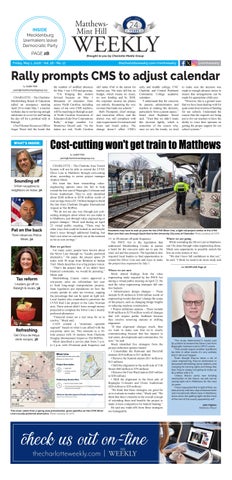
This chart, taken from a spring 2025 presentation, gives specifics on the LYNX Silver Line's locally preferred alternative. Photo courtesy of CATS
Residents may have to wait 30 years for the LYNX Silver Line, a light rail project similar to the LYNX Blue Line that runs through South End to the University City area of Charlotte. Photo courtesy of CATS
15- to 20-minute off-peak frequency. The PAVE Act is the legislation that authorized Mecklenburg County to pursue a bond for the one-cent sales tax to pay for road, rail and bus projects. The legislation also required local leaders to find opportunities to extend the Silver Line east and ways to make the project less expensive by July 1. Where we are now Mock shared findings from the value engineering study required by the PAVE Act during a virtual public meeting on April 23. He said the value engineering strategies fall into two buckets: • Infrastructure design changes – These include $120 million to $160 million worth of engineering tweaks that don’t change the scope of the project, such as changing bridge lengths or reducing roadway construction. • Project definition options – These include $140 million to $170 million worth of changes that will require public feedback because they involve removing stations or shifting alignment. “If that alignment changes much, then we want to make sure that we’re clearly communicating because that has impacts to real estate, developments and communities, for sure,” he said. Mock identified five strategies from the project definition options bucket: • Consolidate the Remount and Berryhill stations ($10 million to $11 million) • Remove the Summit station ($11 million to $12 million) • Shift the alignment to the north side of 11th Street ($60 million to $70 million) • Remove the First Ward station ($45 million to $50 million) • Shift the alignment to the front side of Bojangles Coliseum and Ovens Auditorium ($20 million to $30 million) “We think that these strategies are good for us to evaluate no matter what,” Mock said. “We think that there’s benefits to the overall concept of extending them and benefits the project to make it more competitive for federal funding.” He said any trade-offs from these strategies are manageable.
check us out on - line THE
thecharlotteweekly.com | WEEKLY
Where we are going While extending the Silver Line to Matthews can’t be done through value engineering alone, Mock sees opportunity to possibly stretch the line an extra station or two. “We don’t have full confidence in that yet,” he said. “I think we need to do more study and see SILVER LINE, Page 3A
"The study determined it would cost $2.4 billion to (extend the Silver Line) from Bojangles Coliseum out to CPCC Levine. "That would require another significant tax hike. In other words, it’s very unlikely that it will ever happen. "Even though they’ve done a lot of value engineering, they’ve eliminated or discussed eliminating some stations and charging for naming rights and things like that, they’re simply not going to make up $2.4 billion with a 'b.' "Unless there’s some new funding mechanism in the future, we will not be seeing light rail in Matthews for the next 30 years. "I have requested that in light of that, we take priority with bus stop enhancements and microtransit efforts here in Matthews since we’re not getting light rail like most of the rest of the county apparently will." John Higdon Matthews Mayor