October 8, 2026 • Newspaper of the Archdiocese of Saint Paul and Minneapolis
TheCatholicSpirit.com
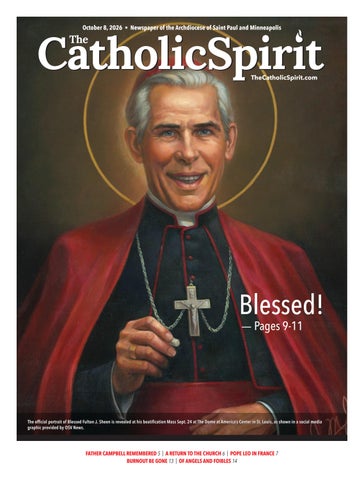
Blessed! – Pages 9-11
The official portrait of Blessed Fulton J. Sheen is revealed at his beatification Mass Sept. 24 at The Dome at America’s Center in St. Louis, as shown in a social media graphic provided by OSV News.
FATHER CAMPBELL REMEMBERED 5 | A RETURN TO THE CHURCH 6 | POPE LEO IN FRANCE 7 BURNOUT BE GONE 13 | OF ANGELS AND FOIBLES 14
2 • THE CATHOLIC SPIRIT
OCTOBER 8, 2026
PAGETWO
NEWS notes A national exhibit tracing the history of Black men, women and children enslaved by the Jesuits and sold by Georgetown University as the Jesuit institution struggled under debt in 1838 is making its national debut at the University of St. Thomas in St. Paul Oct. 5 through Nov. 5. Monique Trusclair Maddox, a direct descendant of slaves sold in Georgetown and a member of Our Lady of Grace in Edina, is president and CEO of the Descendants Truth and Reconciliation Foundation, which raises funds to improve the lives of descendants and works toward reconciliation and justice. She and Jesuit Father Timothy Kesicki, chair of the Descendants Truth and Reconciliation Foundation Trust, will lead a Nov. 2 discussion on confronting difficult histories and moving toward reconciliation. They will be joined by Yohuru Williams, founding director of the St. Thomas Racial Justice Initiative, at the university’s O’Shaughnessy Education Center Auditorium in St. Paul. The immersive exhibit at the university’s Iverson Center for Faith is free and open to the public from 8 a.m. to 7 p.m. It includes audio and video components. It is titled What We Inherit: Truth, Repair and a Promise to the Future.
TOM HALDEN | OFFICE OF COMMUNICATIONS, ARCHDIOCESE OF ST. PAUL AND MINNEAPOLIS
AFFORDABLE HOUSING Tom Mertens, the Archdiocese of St. Paul and Minneapolis’ chief financial officer, reaches new heights Sept. 23 at a Twin Cities Habitat for Humanity build at The Heights in St. Paul. Inspired by Pope Leo XIV’s commitment to service and social justice, an anonymous donor to Habitat for Humanity is helping Twin Cities Habitat for Humanity (TCHH) and 19 other Habitat affiliates across the country join as partners in Pope Leo Villages, with TCHH building two duplexes and a single-family home. The Pope Leo Village homes are tucked into The Heights, a larger affordable housing and light industrial development project in St. Paul. Mertens was part of a service day of volunteers from the Archdiocesan Catholic Center in St. Paul helping build the homes for Pope Leo Village.
As its multi-phase restoration work continues, the Basilica of St. Mary in Minneapolis provided updates on social media in September that engineering and scaffolding experts erected a 40,000-pound scaffolding system mounted on rails, to allow plasterers and painters to work 75 feet above the Basilica’s floor to restore the church’s ceiling. Meanwhile, glaziers from Northeast Stained Glass in New Jersey have been carefully removing bays of clerestory stained glass windows for shipment to the Femenella and Associates studio in New Jersey, where experts repair the leading that holds the glass together. After each window receives a cleaning and inspection, windows will be shipped back to the Basilica for new protective glazing and reinstallation, per the updates on social media. The restoration project at the Basilica is receiving funds from the Basilica’s Restoring Beauty, Inspiring Hope campaign and the Archdiocese of St. Paul and Minneapolis’ Lord, Renew Your Church campaign. In a 2025 Catholic Services Appeal Impact Report, Archbishop Bernard Hebda thanked those who contributed “more than $9.1 million” to the Catholic Services Appeal (CSA) in 2025. In the report’s introductory letter, the archbishop wrote that the amount was $500,000 more than the previous year’s amount. “This allowed us to continue — and increase — uninterrupted funding to critically needed ministries,” the archbishop wrote, in part. “Words fall short when it comes to expressing my immense gratitude for the trust and good will you have shown in sharing your financial blessings. I am profoundly aware that your generous gift could have been used for your own needs. Yet you chose to give sacrificially so that others, largely unknown to you, could be safe, fed, clothed, given Holy Sacraments and educated.” CSA funds support a variety of Catholic ministries and services within the Archdiocese of St. Paul and Minneapolis; more information can be found at archspm.org/catholic-services-appeal. Msgr. Joseph Francis Buh has been granted the title “servant of God” with a Sept. 22 Mass opening the cause for his canonization. The Slovenian immigrant priest heroically ministered and evangelized in northern Minnesota beginning in the late 1860s until his death in 1922 at age 88. Bishop Daniel Felton of Duluth celebrated the Mass at the Cathedral of Our Lady of the Holy Rosary in Duluth, where Msgr. Buh’s remains were reinterred in 2024. While growing up in Slovenia, Msgr. Buh read about the ministerial adventures of his fellow countryman Venerable Frederic Baraga, who served as the first bishop of Marquette, Michigan. Ordained in Slovenia, he left in 1864 for Minnesota, where he ministered first among Ojibwa people in central Minnesota and then among recent immigrants in the northern part of the state. Over the course of his ministry, he established as many as 57 parishes. The end of the Sept. 22 Mass included the first session of the diocesan inquiry into Msgr. Buh’s cause, during which officials leading the inquiry took an oath to discharge their duties according to Church law. Among them was Amanda Zurface, a canon lawyer serving as the diocesan postulator of Msgr. Buh’s cause.
OSV NEWS | SIMONE RISOLUTI, VATICAN MEDIA
ROSARY FOR PEACE Pope Leo XIV greets young people after he joined hundreds of children in praying the rosary for peace in the Lourdes Grotto in the Vatican Gardens on the evening of Oct. 1, during the month dedicated to the prayer of the rosary.
Priest of archdiocese on leave of absence affiliates with schismatic movement The Catholic Spirit
Expressing great sadness, Archbishop Bernard Hebda wrote to parishioners of St. Michael and St. Mary in Stillwater that their former parochial vicar, Father Philip Conklin, has affiliated with the Society of St. Pius X (SSPX), whose leadership was declared in schism with the Catholic Church this past July. Father Conklin, who was ordained in 2024 and served as parochial vicar in Stillwater from July 2024 until March 2026, has been on leave for the past six months to discern his priestly vocation, the archbishop wrote in a letter that Father Michael Creagan, pastor of St. Michael and St. Mary, shared with parishioners Sept. 30. “After confirming with Father Conklin that he does not intend to cease this affiliation, I have felt compelled to commence a canonical process to clarify the situation and his status,” the archbishop wrote. “At the same time, I have also informed Father Conklin that he is not to exercise any public priestly ministry.
“This is a painful situation that merits our fervent prayers for Father Conklin, for his family and for the parishes of Saint Michael and Saint Mary,” the archbishop continued. “Please know of my prayers for all of you and your loved ones.” In July, SSPX leadership rejected Pope Leo XIV’s plea and consecrated four new bishops in Switzerland without the requisite papal mandate. The Vatican declared that the July 1 action in Switzerland placed the SSPX bishops and priests in schism with the Catholic Church and resulted in the immediate excommunication of the consecrating bishop, the co-consecrator and the four newly ordained bishops. In his letter, Archbishop Hebda referred parishioners to his statement in July about SSPX’s actions and its consequences. The statement can be found on the archdiocese’s website under Announcements at ARCH()M.OR, or at -./01R2.COM/3)43M743.
The Catholic Spirit is published semi-monthly for The Archdiocese of Saint Paul and Minneapolis Vol. 31 — No. 19 MOST REVEREND BERNARD A. HEBDA, Publisher TOM HALDEN, Associate Publisher JOE RUFF, Editor-in-Chief REBECCA OMASTIAK, News Editor
Aim Higher Foundation’s 14th annual Night of Light’s fundraising dinner brought in a record 873 attendees and raised a record $1.79 million for need-based scholarships to Catholic elementary schools in the Archdiocese of St. Paul and Minneapolis. Last year’s event raised $1.3 million, a 34% increase over last year’s gala. This year’s evening in Minneapolis included a talk from Totino-Grace High School in Fridley graduate and Aim Higher scholarship recipient Tim Nguyen, who is now studying at the University of Notre Dame in South Bend, Indiana. One in six Catholic elementary school students in the archdiocese started this school year with a $1,000 or $1,500 scholarship from St. Paul-based Aim Higher, depending on their grade level. That is more than 3,100 students in kindergarten through eighth grade. “The continued success of the Night of Light will certainly lead to an increase in the number of scholarships we will award in future years,” said Ricky Austin, president of Aim Higher. Several schools and parishes in the Archdiocese of St. Paul and Minneapolis are celebrating significant anniversaries, including St. Patrick in Inver Grove Heights. The parish held a celebration on Sept. 13 for its 170th anniversary that included a historical display and a concert featuring music, stories and memories. St. Helena Catholic School in Minneapolis is marking its 100th anniversary this year. St. Peter Catholic School in North St. Paul is celebrating its 110th anniversary by entrusting the school to St. Carlo Acutis and placing a first-class relic of the saint on permanent display in the building Oct. 12, his feast day. St. Dominic School in Northfield is celebrating its 100th anniversary this year, including a Centennial Celebration with 5 p.m. Mass Oct. 10. Clergy with connections to the school are invited to attend and to concelebrate the Mass. The celebration will include tours of the school, historical displays, food trucks, live music and games. St. John the Evangelist in Little Canada is celebrating the parish’s 175th anniversary on Oct. 10 with a retreat in the morning, Mass with Archbishop Bernard Hebda at 4:30 p.m. and a dinner. Presentation of Mary in Maplewood is celebrating 80 years as a parish Nov. 14-15 with Masses, a community dinner and the World Mission rosary.
Practicing CATHOLIC Produced by Relevant Radio and the Archdiocese of St. Paul and Minneapolis, the Oct. 2 “Practicing Catholic” radio show on Relevant Radio 1330 AM included Franciscan Brothers Paschal and Pio in an interview about St. Francis and the Franciscan ministry in the archdiocese. The program also featured two biological sisters, Maria Hamilton and Mona Wolney, in an interview about the Secular Franciscan Order and what St. Francis means to them. Listen to interviews after they have aired at practicingcatholicshow.com or choose a streaming platform at Spotify for Podcasters.
Materials credited to CNS copyrighted by Catholic News Service. Materials credited to OSV News copyrighted by OSV News. All other materials copyrighted by The Catholic Spirit Newspaper. Subscriptions: $29.95 per year; Senior 1-year: $24.95. To subscribe: (651) 291-4444; To advertise: Display Advertising: (651) 251-7714; Classified Advertising: (651) 251-7714. Published semi-monthly by the Office of Communications, Archdiocese of St. Paul and Minneapolis, 777 Forest St., St. Paul, MN 55106-3857 • (651) 291-4444, FAX (651) 291-4460. Periodicals postage paid at St. Paul, MN, and additional post offices. Postmaster: Send address changes to The Catholic Spirit, 777 Forest St., St.Paul, MN 55106-3857. TheCatholicSpirit.com • email: tcssubscriptions@archspm.org • USPS #093-580
OCTOBER 8, 2026
THE CATHOLIC SPIRIT • 3
FROMTHEARCHBISHOP ONLY JESUS | ARCHBISHOP BERNARD HEBDA
United in Christ’s mission across the globe
I
n 2026, it can sometimes be difficult to imagine Minnesota as mission territory. Today, our archdiocese is blessed with vibrant parishes, Catholic schools, religious communities, charitable institutions and generations of faithful Catholics who have built upon the sacrifices of those who came before us. But the Church here did not begin with any of those things. When the Diocese of St. Paul was established in 1850, the Catholic population numbered only about 3,000 faithful scattered across a vast territory, stretching up to the Canadian border and all the way into North Dakota. Our first bishop, Joseph Crétin, himself a courageous missionary, arrived with only a few priests and seminarians to help him serve those early Catholics. Religious sisters soon followed, educating children, caring for orphans and the sick and bringing the presence of Christ to communities where the structures of the Church were only beginning to take root. In other words, we were once very much a mission Church. I am always humbled when I walk through the priest section at Calvary Cemetery and see headstones for so many missionary priests who left the comfort of their homes so that the Gospel could be preached in these parts and the sacraments celebrated. That history is worth remembering as Catholics around the world prepare to celebrate the 100th anniversary of World Mission Sunday on Oct. 18. Pope Leo XIV has chosen “One in Christ, united in mission” as the theme for this centennial celebration. It is a reminder that the Church’s missionary work has
Unidos en la misión de Cristo en todo el mundo
E
n 2026, a veces puede resultar difícil imaginar a Minnesota como un territorio de misión. Hoy, nuestra arquidiócesis está bendecida con parroquias vibrantes, escuelas católicas, comunidades religiosas, instituciones caritativas y generaciones de católicos !eles que han construido sobre los sacri!cios de quienes nos precedieron. Pero la Iglesia aquí no comenzó con ninguna de estas cosas. Cuando se estableció la Diócesis de San Pablo en 1850, la población católica contaba con apenas unos 3.000 !eles dispersos por un vasto territorio que se extendía hasta la frontera con Canadá y llegaba hasta Dakota del Norte. Nuestro primer obispo, Joseph Crétin, un valiente misionero, llegó acompañado solamente por unos pocos sacerdotes y seminaristas para ayudarlo a servir a aquellos primeros católicos. Poco después llegaron las religiosas, que educaban a los niños, cuidaban de los huérfanos y los enfermos y llevaban la presencia de Cristo a comunidades donde las estructuras de la Iglesia apenas comenzaban a echar raíces. En otras palabras, alguna vez fuimos verdaderamente una Iglesia misionera. Siempre me siento humilde cuando camino por la sección de sacerdotes del cementerio de Calvary y veo las lápidas de tantos sacerdotes misioneros que dejaron la comodidad de sus hogares para que el Evangelio pudiera ser anunciado en estas tierras y los sacramentos pudieran celebrarse. Vale la pena recordar esta historia mientras los católicos de todo el mundo se preparan para celebrar el centenario del
always depended upon communion: Catholics praying for people they may never meet, missionaries leaving behind the familiar to proclaim the Gospel, and local Churches sharing their resources so that the faith can take root and !ourish somewhere else. The Church we have been blessed to inherit here in Minnesota is part of that story. Generations before us benefited from the courage of missionary priests and religious and from the generosity of Catholics elsewhere who sacrificed to sustain a young Church that could not yet sustain itself. Today, we have the privilege — and the responsibility — of extending that same solidarity to others. In more than 1,100 mission territories around the world, local Churches face challenges that would have been quite familiar to our Catholic ancestors here in the Land of 10,000 Lakes. Priests in those mission lands still serve enormous territories and travel great distances to reach isolated communities. Dioceses struggle to form enough seminarians for growing Catholic populations. Catechists sustain the faith in places a priest may be able to visit only occasionally. Churches, schools, clinics and pastoral centers are built and maintained with resources that local communities alone simply cannot provide. World Mission Sunday allows us to stand beside them. In his message for this year’s celebration, Pope Leo reminds us that “no baptized person is exempt from or indifferent to mission: everyone, each according to their own vocation and condition of life, participates in the great work that Christ has entrusted to his Church.” Those words remind us that World Mission Sunday has to be more than a second collection. It is an expression of
Domingo Mundial de las Misiones el 18 de octubre. El papa León XIV ha elegido “Unidos en Cristo, unidos en la misión” como tema para esta celebración del centenario. Es un recordatorio de que la labor misionera de la Iglesia siempre ha dependido de la comunión: católicos que rezan por personas a quienes quizá nunca conocerán, misioneros que dejan atrás lo conocido para proclamar el Evangelio y las Iglesias locales que comparten sus recursos para que la fe pueda echar raíces y florecer en otros lugares. La Iglesia que hemos recibido como una bendición aquí en Minnesota forma parte de esa historia. Las generaciones que nos precedieron se bene!ciaron de la valentía de los sacerdotes y religiosos misioneros y de la generosidad de católicos de otros lugares que hicieron sacri!cios para sostener una Iglesia joven que todavía no podía sostenerse por sí misma. Hoy tenemos el privilegio —y la responsabilidad— de extender esa misma solidaridad a los demás. En más de 1.100 territorios de misión alrededor del mundo, las Iglesias locales enfrentan desafíos que habrían resultado muy familiares a nuestros antepasados católicos aquí, en la Tierra de los 10.000 Lagos. En esas tierras de misión, los sacerdotes todavía sirven en territorios enormes y recorren grandes distancias para llegar a comunidades aisladas. Las diócesis luchan por formar su!cientes seminaristas para atender a poblaciones católicas en crecimiento. Los catequistas sostienen la fe en lugares que un sacerdote quizá solo pueda visitar ocasionalmente. Iglesias, escuelas, clínicas y centros pastorales se construyen y mantienen con recursos que las comunidades
the identity that !ows from our baptism. We pray because the missionaries are our brothers and sisters. We give because their communities are part of our Church. We care whether the Gospel can be proclaimed in a distant village because in Christ, no part of the Church is truly distant from us. For Catholics in the United States, this centennial year carries another special significance: We have just celebrated the beatification of Archbishop Fulton J. Sheen, an alumnus of our St. Paul Seminary. During his 16 years as national director of The Pontifical Mission Societies, which oversees World Mission Sunday on behalf of the pope, Archbishop Sheen helped American Catholics understand precisely this responsibility: that a Church blessed with faith and resources is called to share both. Perhaps that is the great lesson of our own history as well. The missionaries who came to Minnesota could not have known what the Church here would become. They simply planted seeds, trusting that God would bring the growth. On Oct. 18, I ask you to help plant those seeds for another generation. Please pray for missionaries and the communities they serve. And when the World Mission Sunday collection is taken up in your parish, please give generously according to your means. Countless others once helped build the Church we are now blessed to call home. Now it is our turn to help the Church take root and !ourish elsewhere. One hundred years after the establishment of World Mission Sunday, may we gratefully accept that responsibility as one in Christ, united in mission. Blessed Fulton Sheen, pray for us!
locales, por sí solas, sencillamente no pueden proporcionar. El Domingo Mundial de las Misiones nos permite estar a su lado. En su mensaje para la celebración de este año, el papa León nos recuerda que “ninguna persona bautizada está exenta de la misión ni es indiferente a ella: todos, cada uno según su propia vocación y condición de vida, participan en la gran obra que Cristo ha con!ado a su Iglesia”. Estas palabras nos recuerdan que el Domingo Mundial de las Misiones tiene que ser algo más que una segunda colecta. Es una expresión de la identidad que nace de nuestro bautismo. Rezamos porque los misioneros son nuestros hermanos y hermanas. Damos porque sus comunidades forman parte de nuestra Iglesia. Nos importa que el Evangelio pueda ser proclamado en una aldea lejana porque, en Cristo, ninguna parte de la Iglesia está realmente lejos de nosotros. Para los católicos de Estados Unidos, este año del centenario tiene además un signi!cado especial: acabamos de celebrar la beati!cación del arzobispo Fulton J. Sheen, antiguo alumno de nuestro Seminario de San Pablo. Durante sus 16 años como director nacional de las Obras Misionales Ponti!cias, que supervisan el Domingo Mundial de las Misiones en nombre del papa, el arzobispo Sheen ayudó a los católicos estadounidenses a comprender precisamente esta responsabilidad: que una Iglesia bendecida con fe y recursos está llamada a compartir ambas cosas. Quizá esa sea también la gran lección de nuestra propia historia. Los misioneros que llegaron a Minnesota no podían saber en qué se convertiría la
Iglesia aquí. Simplemente plantaron semillas, con!ando en que Dios haría crecer lo que habían sembrado. El 18 de octubre, les pido que ayuden a plantar esas semillas para otra generación. Por favor, recen por los misioneros y por las comunidades a las que sirven. Y cuando se realice la colecta del Domingo Mundial de las Misiones en su parroquia, por favor, den generosamente según sus posibilidades. Innumerables personas ayudaron en el pasado a construir la Iglesia que ahora tenemos la bendición de llamar nuestro hogar. Ahora nos corresponde a nosotros ayudar a que la Iglesia eche raíces y florezca en otros lugares. Cien años después del establecimiento del Domingo Mundial de las Misiones, que podamos aceptar con gratitud esta responsabilidad como uno en Cristo, unidos en la misión. ¡Beato Fulton Sheen, ruega por nosotros!
OFFICIALS Archbishop Bernard Hebda has announced the following appointments in the Archdiocese of Saint Paul and Minneapolis:
Effective September 21, 2026 Deacon Robert Burns, assigned to the ministry of permanent deacon at the Church of Saint John the Baptist in Excelsior. This is a transfer from his previous assignment at the Church of the Guardian Angels in Chaska. Reverend Dida Damicha, C.S.Sp., assigned as part-time chaplain for Hennepin County Medical Center. Father Dida is a priest of the Congregation of the Holy Spirit, United States Province.
4 • THE CATHOLIC SPIRIT
OCTOBER 8, 2026
LOCAL SLICEof LIFE
Horse pray Father Peter Williams, pastor of St. Francis of Assisi in Lake St. Croix Beach, greets horses owned by parishioners Cathy (right) and Ab Rahimi (a parish trustee) before a blessing of animals Oct. 3 at the parish. The blessing kicked off the parish festival, which featured food, games and a classic car show organized by parishioner Jerry Murray. The blessing coincided with the 800th anniversary of St. Francis of Assisi’s transitus, or passing from earthly life to eternal life, and the saint’s Oct. 4 feast day. It took place during the Jubilee Year of St. Francis proclaimed by Pope Leo XIV. The Jubilee Year lasts through Jan. 10, 2027, and St. Francis of Assisi parish has been designated by Archbishop Bernard Hebda as a pilgrimage site at which a plenary indulgence may be obtained. DAVE HRBACEK | THE CATHOLIC SPIRIT
!*+*,(-./%)
Beauty will save us.
*#,1&*'-,&#;,'-&#:+$*@*#$
Benedict XVI Centenary Conference
!"#$%&'()&'*"#+,'",'-.,/./0.%+,"1,!!23+,4.$&56,7"5*.'68, 9"(,&%.,/&:*#$,&,;*<.%.#5.=
Featuring His Eminence Kurt Cardinal Koch and Bishop Robert Barron
9"(%,>.%>.'(&),1*#*&),+(>>"%',1"%,'-.,>&%*+-.+?,, +5-"")+?,&#;,5-&%*'*.+,*#,"(%,)"5&),!&'-")*5,5"//(#*'6,, -&+,&,>"+*'*@.?,%.&),*/>&5'=,9"(,*#+>*%.,(+= A";&6,&#;,1"%.@.%?,, '-&#:,6"(= !&)),BCD=EFG=HEHH,, "%,@*+*',!!"#$%&'()
Nov. 2-3, 2026
Minneapolis/Saint Paul, Minn.
Register today!
LOCAL
OCTOBER 8, 2026
THE CATHOLIC SPIRIT • 5
Father Theodore Campbell remembered for culinary skills By Dave Hrbacek The Catholic Spirit
Father Theodore Campbell, a priest of the Archdiocese of St. Paul and Minneapolis, was close in age and friendship with his nextoldest brother, Bishop Frederick Campbell of Columbus in Ohio. Over the years, they spoke at least once a week on the phone and shared many interests, including cooking. Father Campbell died on Sept. 18 at age 81. “We were so close that we did almost everything together,” Bishop Campbell recalled. “In fact, sometimes my mother treated us as twins.” Although he was about a year and a half younger, Father Campbell was the first to be ordained a priest. He was ordained in 1972 — eight years before his brother — and was part of the Missionary Society of St. Paul, also known as the Paulist Fathers. One of his assignments was at St. Lawrence in Minneapolis (now called the St. Lawrence Catholic Church and Newman Center, located near the Minneapolis campus of the University of Minnesota). In 1982, he was incardinated to the Archdiocese of St. Paul and Minneapolis. “I would visit him in the Twin Cities,” said Bishop Campbell, who was living in California at the time. “When I decided to enter the seminary, I decided to enter for St. Paul and Minneapolis. I fell in love with the Twin Cities.” From that time on, the two brothers got together as much as they could and fostered a love for cooking that Bishop Campbell attributes to their mother, who taught them how to cook. Over the years, the two men shared — and prepared — many meals
together. “I think we took turns making Christmas dinner,” Bishop Campbell said. “Sometimes, I would do one part, and he would do the other part.” As time went on, Father Campbell developed a tradition of hosting dinners for close friends and for priests. He served for 31 years as pastor of Good Shepherd in Golden Valley, and a parishioner there, Dianne Besch, noted that in August, he prepared his 62nd dinner for priests. In an email to The DAVE HRBACEK | THE CATHOLIC SPIRIT Catholic Spirit, Besch Father Theodore Campbell called Father Campbell “a marvelous cook.” She brother. Both men enjoyed intellectual and noted that more than academic pursuits and each pursued doctoral “180 guests — invited priests — have been degrees, Bishop Campbell in ancient history treated to delicious food, warm hospitality and Father Campbell in theology. (and) an enjoyable evening.” “We were always exchanging books and In a subsequent email, she wrote that having interesting little discussions,” Bishop his table was “always set as if royalty (was) Campbell said. “When he was doing his arriving.” She admired his “welcoming doctoral work in Toronto, I remember having hospitality — elegant dinner table clothed in — well, frankly, it was an argument — over the white tablecloths, napkins folded in tall water superiority of Greek or Latin theology. It never glasses. Flowers on table.” ended.” Cooking wasn’t the only thing Father The two served in the archdiocese until Campbell liked to do in his spare time, and it wasn’t the only interest he shared with his Bishop Campbell, who was ordained an
STATEMENT OF OWNERSHIP, MANAGEMENT AND CIRCULATION (Act of August 12, 1970: Section 3685) Title 39, United States Code
1. Title of Publication: The Catholic Spirit. 2. Publication No. 093580. 3. Date of Filing: Sept. 30, 2026. 4. Frequency of Issue: Semi-monthly. 5. No. of Issues Published Annually: 24. 6. Annual Subscription Price: $29.95.
7. Complete Address of Known Office of Publication: 777 Forest St.,S t. Paul, Ramsey Co., MN 55106. 8. Complete Mailing Address of the Headquarters of General Business Offices of the Publisher:777 Forest St., St. Paul, Ramsey Co., MN 55106. 9. Names and Address of the Publisher, Associate Publisher, Editor-in-Chief: Publisher: Archbishop Bernard A. Hebda, Associate Publisher:T om Halden, Editor-in-Chief: Joe Ruff, Managing Editor: Rebecca Omastiak, All located at: 777 Forest St., St. Paul, MN 55106. 10. Owner: Archdiocese of St. Paul and Minneapolis, 777 Forest St., St. Paul, MN 55106 11. Known bondholders,m ortgagees, and other security holders owning or holding 1 percent or more of total amount of bonds, mortgages, or other securities: None. 12. For completion by Nonprofit Organizations Authorized to mail at special rates (Section 132.122 Postal Service Manual): The purpose, function and non-profit status of this organization and the exempt status for Federal Income Tax purposes have not changed during the preceding 12 months. 13. Publication Name: The Catholic Spirit Ave. No. Copies Each Issue During Preceding 12 Months
Actual No. Copies of Single Issue Published Nearest to Filing Date
52,023
51,274
0
0
2. Paid or Requested Mail Subscriptions
51,748
51,038
C.Total Paid and/or Requested Circulation
51,748
51,038
D. Free Distribution by Mail (Samples, Complimentary, and Other Free Copies)
64
36
E. Free Distribution Outside the Mail
0
0
F.Total Free Distribution
64
36
A.Total No. Copies (Net Press Run)
LIFE IN FOCUS FIL FES I L REAL STORIES. BIGGER CONVERSATIONS. A D AY O F F I L M & D I A L O G U E O N THE DANGERS OF PHYSICIANASSISTED SUICIDE.
SATURDAY, NOV 7 9:00 AM - 5:00 PM
14. Issue Date for Circulation Data Below: Sept. 10, 2026. 15. Extent and Nature of Circulation: Ave. No. Copies Actual No. Copies
auxiliary bishop in 1999, was appointed bishop of Columbus in 2004. He took the post in 2005 but still found time to call his brother regularly and visit him in the Twin Cities. He was there for Father Campbell’s 50th jubilee celebration in 2022 at Good Shepherd. They continued talking on the phone regularly all the way up to five days before Father Campbell died. Another interest of Father Campbell’s was gardening, Besch wrote. She and her husband were frequent visitors to the priest’s home and the couple noticed Father Campbell’s gift for growing flowers, including roses. She called his garden “beautiful.” In addition to Good Shepherd, Father Campbell also served St. Margaret Mary in Golden Valley (2011-2012), St. Columba in St. Paul (1982) and St. Pius X in White Bear Lake (1979). He also served on the Presbyteral Council (2010-2012), Pastors Review Board (2009-2012) and the Metropolitan Tribunal (1982 to 2018). He retired from active ministry in 2015 but continued to serve at various parishes. “We spoke constantly over the phone no matter where we were assigned,” said Bishop Campbell, 83. “I shall miss him dearly. He was a devoted priest.” Besch added: “I’m struggling with how so suddenly Father is gone. He will be missed. My heart smiles knowing God blessed Father with his wish never to leave 1925 Shenandoah (his home address) ‘unless it is time to carry me out.’” Father Campbell’s funeral Mass was Oct. 3 at Good Shepherd. Interment was at Resurrection Cemetery in Mendota Heights.
O
AN T
AT R M
B. Paid and/or Requested Circulation 1. Sales through dealers and carriers, street vendors and counter sales
G.Total Distribution
51,811
51,074
H. Copies Not Distributed 1 Office Use, Leftovers, Spoiled
211
200
2. Return from News Agents
0
0
52,023
51,274
Total
S AN TO R ST R OR V S T T A AR N OR
R S NT D
Y
A ARTN R OR AN AT ON O
LOCAL
6 • THE CATHOLIC SPIRIT
OCTOBER 8, 2026
Man who found crosier in St. Paul scrapyard finds his way back to the Church By Joe Ruff
The Catholic Spirit
After finding a bishop’s golden crosier, or hooked staff, in a scrapyard in St. Paul in March 2025 and giving it to Archbishop Bernard Hebda that May, Jeff Helgeson felt called to learn more about the Catholic Church he had left 40 years prior. By May of this year, he had found his way back, first to confession and then to receiving Communion. He read the Bible, explored the faith and lost 60 pounds while walking in daily prayer with the rosary, holding others’ intentions in mind. On Sept. 28, Helgeson said, this stage of his faith journey seemed drawn to a satisfying conclusion. Archbishop Hebda unexpectedly presided at Mass that day at Immaculate Conception in New Richmond, Wisconsin, Helgeson’s home parish. Helgeson, who lives across the street from the church, was there after receiving a tip the day before from his pastor, Father John Anderson, that the archbishop was expected. “To be able to receive Communion from him; it was full circle,” Helgeson said of the relationship he had built with the archbishop. That relationship included the first moments
assured him, “You can always come back” to the Church. It included Helgeson receiving a personal Christmas card from the archbishop. “That is a precious handwritten note on a card that I will keep,” Helgeson said. “It kept me going. It reinforces you, that you are on the right track.” Helgeson, 63, had disengaged from the Church after a case of clergy sexual abuse that involved a friend who later died by suicide. Anger, pride and COURTESY PAUL IOVINO shame kept him away, he said. But he never Jeff Helgeson stands with Archbishop Bernard Hebda, who is holding the crosier Helgeson found in a scrapyard, during their May 30, 2025, meeting at lost his desire to be close to God. the Archdiocesan Catholic Center in St. Paul. Helgeson served of meeting Archbishop Hebda and the in the Army from 1982 to 1993. Readying attention Helgeson was grateful to receive as he himself for confession, he called Paul Iovino, told his faith story. The archbishop listened and director of the Archdiocese of St. Paul and
Minneapolis’ Office of Ministerial Standards and Safe Environment, who had helped Helgeson connect with the archbishop over the crosier. Helgeson told Iovino he wanted his first confession to be with a military veteran. Iovino called him back. He had found a priest in South St. Paul who fit the bill. Helgeson called Father John Paul Echert, pastor of Holy Trinity, believing it might take a while for the priest to find time for him. “What are you doing tomorrow?” Father Echert asked. “I felt urgency; but it was hard,” Helgeson said, explaining that it had been 40 years since his last confession. The priest was understanding and reassuring, Helgeson said. “He made me feel like I could be there for a week if I wanted it.” After Mass with the archbishop, Helgeson said hello by stating, “I don’t know if you remember me.” Immediately, the archbishop said, “Of course, Jeff, you live across the street, don’t you?” Helgeson said he sees Jesus’ hand at work in his life, and in the way his latest experiences have unfolded. “I am just glad that I was thought enough of,” Helgeson said, “to have that helping hand; or I wouldn’t have made it back.”
Catholics walk the streets in Roseville pilgrimage By Dave Hrbacek The Catholic Spirit
While Dan McNeil was a volunteer sponsor for the Order of Christian Initiation of Adults (OCIA) at Corpus Christi in Roseville earlier this year, he came up with an idea. In 2025, he had spent nine days on the iconic Camino de Santiago pilgrimage in Spain and thought it would be meaningful to do something on a smaller scale in Roseville. He was sponsoring Kade Flynn, who joined the Church in April, and he suggested to Flynn that the two go on a local pilgrimage. Flynn agreed, but it didn’t stop there. “Then we decided to open it up to the parish,” McNeil said. The result was a oneday Sept. 26 pilgrimage that they named The Corpus Christi Way. McNeil and Flynn were joined by 21 others, who walked the streets of Roseville and parts of St. Paul before ending with Mass at Corpus Christi. Many were members of Corpus Christi, with others from St. Frances Cabrini in Minneapolis and St. Michael’s Lutheran Church in Roseville. The nine-mile pilgrimage began at the Franciscan Brothers of Peace Friary in St. Paul, next door to St. Columba. There was a brief time of prayer and a reflection on St. Francis of Assisi by Brother John Mary Kaspari, who
COURTESY DAN MCNEIL
From left, Kade Flynn, Dan McNeil and Brother John Mary Kaspari of the Franciscan Brothers of Peace in St. Paul pose at the start of a pilgimage Sept. 26 called The Corpus Christi Way.
also did the pilgrimage walk. After a blessing by a group of Franciscan Brothers, people embarked on their five-hour journey, with stops at two coffee shops and Holy Childhood church in St. Paul, where they could get bottled water and go to confession with Father Philippe Vigneron, a priest-in-solidum at the parish. So, why do a pilgrimage like this? “You know, it’s really simple — to help people grow in faith, to experience their faith, to exercise their faith,” McNeil said. Another key component was “to build community
and help people know that they’re part of a community of faith.” Having gone on the Camino de Santiago, which has routes in Portugal and France leading into Spain, McNeil wanted the Roseville pilgrimage to have a bit of Camino flavor. Each person wore a small button and cross, with 150 crosses donated by a parishioner of St. John Neumann in Eagan. Another feature was creating markers along the way — like those seen on the Camino — to keep people on track. “The route was amazing,” McNeil said. “Kade picked out the route, did all the mapping of the route, and it brought us through a lot of wooded areas, a lot of (side) streets. We walked through the (Minnesota) State Fairgrounds, which was also nice.” Flynn, 28, who joined the Church at the Easter Vigil Mass April 4 at Corpus Christi and had been attending Mass at Corpus Christi for more than three years, said he liked the fact that the pilgrimage went beyond the parish community, including the Franciscan Brothers of Peace. As Flynn and McNeil began talking with the brothers about the pilgrimage, Flynn began attending regular daily Masses at the brothers’ St. Paul friary. “One of our hopes (for the pilgrimage) was
to bring people together,” Flynn said. “It made me feel a real sense of God and (it) encouraged my faith.” One important stop was at the original Corpus Christi church, which was built in 1940 at Cleveland and Buford avenues in St. Paul, near the University of Minnesota’s St. Paul campus. The parish was formed in 1939 and was named in honor of the 1941 National Eucharistic Congress, which the parish helped host, according to the Archdiocese of St. Paul and Minneapolis. “I think it was very important for the Corpus Christi parishioners to go there and see where our faith community started,” McNeil said. One final touch was creating a booklet for each person that could be stamped at stops along the route, similar to what happens on the Camino, McNeil noted. “We had stamps for each of the stops,” he said. “We had volunteers at the two coffee shops and then we had a stamp at the Holy Childhood church.” “We want to do it next year,” McNeil said of The Corpus Christi Way pilgrimage. “We all thought it was a good experience.” He added: “I think I heard Father Michael (Goodavish, pastor of Corpus Christi) say that he’d like us to do it again. So, I’d say it’s very likely we’ll do it again.”
Robbinsdale 763.537.4511 Plymouth 763.553.1411 St. Louis Park 952.926.1615
651-789-5031 olphospice.org
Gearty-Delmore.com
Traditional Burial • Cremation Services • Immediate Need • Preplanning
OCTOBER 8, 2026
THE CATHOLIC SPIRIT • 7
NATION+WORLD In France, Pope Leo emerged as the global voice for ‘right to life’ of disabled and vulnerable By Courtney Mares OSV News
“That the world may have life.” Few papal journeys have embodied their motto as fully as Pope Leo XIV’s apostolic journey to France. From his arrival in Paris on Sept. 25 to his encounters with the sick and disabled in Lourdes, Pope Leo made the dignity of every human life the de!ning theme of his !rst visit to the country. He challenged French lawmakers over their recent approval of assisted dying, condemned abortion and surrogacy, and delivered a message that extended beyond the political debates of the moment: No human life is disposable, and suffering does not diminish a person’s worth. Pope Leo’s previous visits to other countries this year have highlighted different priorities of his emerging ponti!cate. In visits to the Canary Islands and Lampedusa, he offered a strong and politically nuanced defense of the rights and dignity of migrants. Throughout his journey to four countries in Africa, the pope cemented his identity as a global voice for peace, refusing to back down from his calls to end war in the face of personal attacks from President Donald Trump. But France was where Pope Leo emerged most visibly on the world stage as the voice for the disabled, the elderly, the unborn, and the most vulnerable in a society that, he warned, risks mistaking death as the answer to human suffering. The pope’s defense of life touched on some of Europe’s most contentious social questions, yet with his humble and measured manner, his message hit differently than the “culture wars” of decades past. Pope Leo was received like a rockstar by hundreds of thousands of people in France, even by those who might disagree with his positions politically. The most visible of which was President Emmanuel Macron, an ardent supporter of the “assisted dying” bill to legalize euthanasia in France earlier this year who also championed the French Parliament in making abortion a constitutional right in 2024. Yet after Pope Leo came to Macron’s official residence, the Élysée Palace, and proclaimed that “the protection of the right to life constitutes the indispensable foundation of every other human right” in a speech that condemned “assisted dying,” abortion and surrogacy, Macron went out of his way to rearrange his schedule to be able to attend Mass with the pope at SaintÉtienne Cathedral in Metz on Sept. 28, despite criticism from the president’s political opponents who argued that his attendance violated “laïcité” — France’s strict principle of separation between church and state. Pope Leo also used his visit to the UNESCO headquarters in Paris to deliver a warning about the relationship between technological progress and human dignity. In the speech, widely anticipated to touch on the challenges posed by arti!cial intelligence, the pope warned diplomats and academics gathered at the U.N. agency that human dignity was being discarded in the name of efficiency and productivity in the era of AI. The following day, more than 800,000 turned out for Pope Leo’s Mass in the heart of Paris, lining the Champs-Élysées with
OSV NEWS PHOTO | CHRISTIAN HARTMANN, REUTERS
A young man with disabilities smiles as Pope Leo XIV blesses an attendee ahead of a Mass at Saint-Étienne Cathedral in Metz, France, Sept. 28, as part of his four-day apostolic journey to the country.
all eyes looking toward the papal altar where six of the altar servers with Down syndrome assisted Pope Leo with the Mass, a poignant witness to life in the capital of a country where 68% of prenatal diagnoses of Down syndrome end in abortion, according to a 2020 study published in the European Journal of Human Genetics. It was just before that Mass that a photograph, described by some as the de!ning image of Pope Leo’s ponti!cate so far, was taken and quickly went viral. The image shows the pope blessing Marie-Garance, a 10-year-old girl with multiple disabilities wearing a blue dress. Some observers noted its composition and emotional resonance, comparing it to Michelangelo’s famed “Pietà.” Speaking to OSV News after the photograph circulated widely, the girl’s adoptive mother, Clotilde Noël, who has adopted four children with disabilities, said she saw the pope’s blessing as extending to Marie-Garance’s biological parents as well. “I pay tribute to them, because they chose to bring her into the world, despite all her disabilities,” Noël said. For Pope Leo, one of his personal highlights of the four-day apostolic journey to France was his visit to Lourdes. During the in-%ight press conference, he described the experience of accompanying the sick and suffering as especially meaningful. “Walking with, accompanying so many people who are sick and suffering and seeing how the grace of God’s presence manifested in many different ways, touches people’s hearts, transforms their lives, and — to use an expression that I mentioned there — restores dignity to the sick, the elderly, those who in some parts of society are discarded,” he said. The visit to the Marian shrine in Lourdes, which draws thousands of people with sickness or disabilities each year, was
!lled with moving encounters between the pope and pilgrims. The pope praised the shrine as being a place where the sick and disabled are not simply accommodated, but are welcomed, honored and celebrated. From her wheelchair, Gabriella Panizzardi, 84, from Milan, Italy, described to OSV News why she had returned to Lourdes for her 15th pilgrimage. “Look at this heavenly sight, something out of the ordinary — it brings such peace. Yes, everyone loves one another and helps those who are sick. It’s beautiful, truly,” she said. It was in a speech outside the Accueil Notre Dame in the Lourdes sanctuary, addressing the sick and suffering and their caregivers directly, that Pope Leo delivered what could be considered some of the strongest words of his ponti!cate so far in defense of human life. “No one ever has the right on the basis of laboratory algorithms, to decide the life of a given embryo or elderly person!” the pope declared. “Medicine must never become the servant of programmed death.” Speaking directly to the sick and disabled, the pope said, “No human law should ever make you lose the certainty of your dignity. On the contrary, it is precisely in the name of this inalienable dignity of the human person that we must reject the temptation to cause death under the guise of false compassion.” “It is impossible to regard causing death as something normal. What is legal is not necessarily moral,” he added, as his speech was repeatedly interrupted by thunderous applause from people in wheelchairs, medical patients, their families and caregivers. Pope Leo’s forceful defense of human life during his Sept. 25-28 visit to France also reignited debate over the country’s assisted-dying legislation, which lawmakers
had largely considered settled following its passage through Parliament in July. “The pope’s remarks in Lourdes come at just the right time to ensure we do not give up the !ght against these deadly laws,” Lucie Pacherie, a lawyer and spokesperson for the Jérôme Lejeune Foundation, told OSV News after the visit. During the in-%ight press conference on his return from France, Pope Leo was asked why he had spoken so frequently about euthanasia and end-of-life issues during the trip. He responded that the Church’s defense of life was not an attempt to enter political debates. “When the Church speaks about defending life, when it speaks about questions of social doctrine, we’re not entering into politics, we’re applying the Gospel to people’s lives,” he said. “The defense of life is something that as you all know the Church teaches, believes very deeply,” he added, acknowledging that France and other countries in Europe and around the world were debating end-of-life legislation. But he returned to the experience of Lourdes, where people living with sickness, disability and pain were searching for something deeper: an understanding that their lives still held meaning. “Being in a place especially like Lourdes where people are searching for something much deeper and understanding that their lives, even in the midst of sickness or disability or pain of different kinds, that their life has meaning,” he said. “The Church, because of Jesus himself, wants to be close to those people and to affirm the values that life itself I think holds for all of us.” “So, I would say, if that’s politics, I did that,” he concluded. “But it was not to get involved in French politics. It was to teach what the Church really believes.”
8 • THE CATHOLIC SPIRIT
NATION+WORLD
OCTOBER 8, 2026
HEADLINES Supreme Court hears a key climate change lawsuit, but a procedural question remains. In the first case of its new term Oct. 5, the U.S. Supreme Court heard oral arguments in a lawsuit from officials in Boulder, Colorado, against two major oil companies over climate change. Almost a decade ago, officials in Boulder sued Exxon Mobil and Suncor Energy, alleging they were responsible for climate change in Colorado, such as increased temperatures and the related risk of wildfires. The oil companies have argued that the lawsuit should be thrown out since it was filed in state courts rather than federal ones. A key question in the case is whether the Supreme Court has jurisdiction at the current point in the lawsuit, since the Colorado Supreme Court allowed the case to proceed rather than addressing the merits. Under federal law, the Supreme Court generally has jurisdiction in such cases after final rulings from state supreme courts. Justices pressed attorneys on the procedural question, with Justice Ketanji Brown acknowledging the case may be “premature” for the Supreme Court to address. Care for creation is a key tenet of Catholic social teaching. A decision in the case, seen as one of the major cases it will hear this year, is expected by the end of the court’s term, which typically ends in June. Supreme Court’s term to include religious liberty, immigration and gun issues. As the U.S. Supreme Court began its new term Oct. 5, cases on its schedule included religious liberty, guns and immigration policy. Among the noteworthy cases the high court will hear this term is St. Mary Catholic Parish v. Roy, a clash between Catholic preschools and the state of Colorado over whether those schools can participate in the state’s universal preschool program. Other cases the court will consider include a challenge to the Trump administration’s policy of carrying out third-country deportations, or removals to a country where a person who had migrated to the United States has no ties, and its policy of mandatory detention during deportation proceedings, and another on state prohibitions on assault-style rifles. The term will also begin as President Donald Trump has criticized the justices for ruling against his position in some cases from the court’s previous term. In an interview with Time published Oct. 1, Trump lashed out about the cases he saw as losses, and said he regretted selecting the three justices he nominated to the high court during his first term. Bishop Barron meets Pope Leo XIV at the Vatican and ordains 18 deacons in St. Peter’s Basilica. Bishop Robert Barron met privately with Pope Leo XIV at the Vatican Oct. 1, describing his first extended, one-on-one conversation with a pope as “delightful.” The Chicago-born pope opened with a hometown connection. “Well, two guys from Chicago,” Bishop Barron recalled Pope Leo telling him. Speaking to OSV News on the day prior to his private papal audience, Bishop Barron said Pope Leo’s papacy is contributing to signs of renewed religious interest in the United States,
P
renatal Partners for Life offers life-affirming support, information, and encouragement to families anytime before or after birth who receive a diagnosis of special needs, health issues or a life limiting condition. We believe every life is a precious gift from God, made in His image, with a plan and a purpose. PO Box 2225 • Maple Grove, MN 55311 763-772-3868
www.prenatalpartnersforlife.org
Support, Information, Encoura,ement
particularly among young people. He credited the pope’s American background, presence and charisma with making him relatable to U.S. audiences. Bishop Barron, who heads the Diocese of Winona-Rochester, was in Rome to ordain 18 American seminarians from the Pontifical North American College as deacons in St. Peter’s Basilica. In his homily, he urged them to follow Blessed Fulton Sheen’s example and allow Christ to speak through their preaching. The Word on Fire founder also pointed to signs of Catholic renewal in Europe, including a prayer vigil attended by 80,000 young people during Pope Leo’s visit to France. Bishop Barron said a future papal visit to the United States could similarly help revive American Catholic life. “Too much at stake”: Church leaders plead for dialogue amid renewed unrest in Northern Ireland. Northern Ireland’s Catholic and Anglican leaders have called for the “urgent creation” of a reconciling initiative amid tensions over a disputed Orange Order march through Portadown’s Catholic Garvaghy Road. Archbishop Eamon Martin, primate of all Ireland, and Archbishop John McDowell of the Church of Ireland urged all sides to use peaceful, democratic processes, warning that “too much is at stake.” Their Sept. 27 appeal came as thousands gathered to oppose the march, which was permitted after a series of legal challenges. Garvaghy Road was a major flashpoint during the Troubles, Northern Ireland’s three-decade period of sectarian violence that claimed more than 3,500 lives. The protesters later dispersed, while Orange Order members continued attempts to proceed into the early hours of Sept. 28. Northern Ireland’s leaders subsequently held talks with government and police officials. A proposal put forward by Northern Ireland Secretary Chris Bryant was accepted by a residents’ representative but rejected by the Orange Order. Archbishop Martin released a statement on Sept. 26, expressing his “shock and disappointment” at the legal developments paving the way for the march. The leader of the Church in Ireland appealed for prayers and urged the use of “solely lawful and democratic processes” to resolve the situation. A multistate lawsuit asks the Supreme Court to hear a challenge to abortion “shield laws.” The attorneys general of Louisiana, Alabama and Arkansas Sept. 30 announced a lawsuit challenging the abortion “shield laws” of New York, California and Massachusetts. The Republicanled states asked the Supreme Court to take up their challenge to the so-called “shield laws” passed by the Democratic-led states in an effort to prevent the prosecution of abortion providers within those states by states with bans or other restrictions on abortion. The attorneys general behind the lawsuit argued that the shield laws allow abortion providers to violate their own state abortion restrictions. The lawsuit comes as some pro-life leaders have raised concerns that the Trump administration has not rolled back a Biden administration policy permitting the shipment
of mifepristone by mail and has sought to pause other state lawsuits seeking to roll back the eased restrictions. “At a minimum, Americans of every political persuasion strongly favor in-person dispensing,” said Marjorie Dannenfelser, president of Susan B. Anthony Pro-Life America. The Catholic Church teaches that all human life is sacred from conception to natural death, and therefore opposes direct abortion. In Assisi, cardinals and friars celebrate the 800th anniversary of St. Francis’ death. Church bells rang across Assisi, Italy, at midnight Oct. 4, marking 800 years since the death of St. Francis of Assisi. The feast day celebrations began on Oct. 3 with a night procession and a solemn commemoration of the “Transitus” (“passage”), the traditional Franciscan prayer service in the Basilica of St. Mary of the Angels marking St. Francis’ transition into eternal life. The basilica houses the chapel where St. Francis died on the night of Oct. 3, 1226. About 3,000 people took part in the procession on the eve of the beloved saint’s feast day, singing hymns and prayers as they retraced the route made by St. Francis of Assisi’s coffin in 1226, walking about two miles uphill from the Basilica of St. Mary of the Angels to the Basilica of St. Francis where he is currently buried. At a midnight Mass, Cardinal Ángel Fernández Artime reflected on Francis’ radical poverty, saying that in the end, “Love will remain. Christ will remain.” The following morning, Cardinal Matteo Zuppi celebrated Mass with Italian President Sergio Mattarella in attendance. Cardinal Zuppi urged Christians to follow Francis as peacemakers by disarming “our hands and our hearts.” Mattarella also invoked St. Francis amid today’s wars, expressing hope that his example would help convert hearts hardened by hatred and point humanity toward peace. The Franciscan Jubilee Year continues through Jan. 10, 2027. Pope Leo XIV prays in the Notre Dame Cathedral in Paris seven years after a devastating fire. For the first time since the world watched as Notre Dame Cathedral in Paris burned in the devastating 2019 fire, the pope stepped inside the famous gothic cathedral and called on Catholics in France to be “living stones” of a Church that bears witness to how God’s love restores and heals humanity. It was an emotional moment for many French Catholics as Pope Leo XIV led prayers Sept. 25 inside Notre Dame, which reopened to the public in December 2024. “This Cathedral has been reborn so that you, too, may be reborn with it in a new impetus towards holiness and daily mission,” Pope Leo told the bishops, priests, deacons, and religious men and women gathered inside, speaking in French. Church bells rang out across the city of Paris to welcome the pope to the French capital. Pope Leo greeted crowds on the streets as the popemobile traveled from the UNESCO headquarters near the Eiffel Tower to the Place Saint-Michel, a public square across from the Ile de la Cite, the island in the center of the River Seine where Notre Dame is located. The Holy See Press office said an estimated 300,000 Parisians
greeted the pope as he drove through the city. After vespers, the pope stood outside of the cathedral under its iconic gargoyles and bell towers to sing the “Salve Regina” before a statue of Mary with the crowd gathered on the historic Ile de la Cite and the Latin Quarter across the Seine. With its 2027 event theme, the March for Life aims “to make the case for the truth, for life.” The 2027 National March for Life theme is “The Truth is Pro-Life,” the March for Life Education and Defense Fund announced Sept. 29. Hayden Sledge, chief of staff at March for Life, told reporters on a press call that “the soil is prime for us to make the case for the truth, for life.” “Every January, people of different ages, backgrounds, faiths, and life experiences come together in Washington around one shared truth that every human life has worth,” she said. During the second Trump administration, President Donald Trump has delivered video messages to the rally, while Vice President JD Vance has made in-person remarks. In response to a question about whether they expect elected officials to join the Jan. 22 event, Sledge said, “In the past, we’ve been so excited to have the vice president in the past couple of years, and of course, we’re so excited about the latest addition to their family. But that’s something we’ll, of course, you know, keep you posted on.” The 2027 event will take place while the pro-life movement faces several key challenges, such as preserving the Hyde Amendment, the recent approval of a new generic abortion drug, a policy permitting the distribution of that drug by mail and a rising abortion rate. Experts: Calls for an AI slowdown are worth heeding, and the Church is helping to shape the discussion. Recent calls from several artificial intelligence leaders for a slowdown in the technology’s development are worth heeding — and the Church is already helping to shape the discussion around AI concerns, two Catholic AI experts told OSV News. The alerts are “reasonable” and “overdue,” said Matthew Harvey Sanders, CEO of Longbeard, the technology firm behind Magisterium AI, a Catholic “answer engine” trained on official and other authoritative Church teaching sources. “The people who are closest to the technology are most aware of what it is capable of. And therefore, their judgment should be very respected when it comes to their opinion on this subject,” said Brian Patrick Green, director of technology ethics at the Markkula Center for Applied Ethics at Santa Clara University and a member of the Vatican working group on AI ethics. Both Green and Sanders highlighted the various challenges to, and possible steps toward, slowing down AI, while noting Pope Leo XIV’s encyclical “Magnifica Humanitas” “got there first,” said Sanders. Green emphasized hope in “God’s providence and love” to “pull through this thing and make this a happy future.” — CNS and OSV News
OCTOBER 8, 2026
BLESSED FULTON J. SHEEN
THE CATHOLIC SPIRIT • 9
Archbishop Fulton J. Sheen declared ‘Blessed’ at beatification Mass in St. Louis By Gina Christian OSV News
Archbishop Fulton J. Sheen — the 20thcentury theologian, evangelizer, Catholic communications pioneer, teacher and preacher — is now Blessed Fulton J. Sheen. Cardinal Luis Antonio Tagle, a proprefect for the Holy See’s Dicastery for Evangelization and papal delegate, pronounced the Church’s declaration on Archbishop Sheen’s holiness of life and witness to Jesus Christ at a Sept. 24 Mass celebrated in The Dome at America’s Center in St. Louis. To the applause of pilgrims, Cardinal Tagle described Archbishop Sheen as a “son of Illinois, son of the United States of America” and “indeed, son of the world.” Hundreds of clergy, including dozens of bishops and cardinals, had processed into the arena for the Mass as choirs, accompanied by an orchestra, performed a succession of hymns. The priests’ vestments were embroidered with “JMJ,” Archbishop Sheen’s signature dedication to Jesus, Mary and Joseph. The location had been selected by Archbishop Sheen’s home Diocese of Peoria, Illinois, to accommodate the number of pilgrims who arrived for the beatification and its surrounding events. Around 50,000 people were in attendance, according to organizers. During a press conference a few hours prior to the Mass, Bishop Louis Tylka of Peoria said that almost every U.S. state and several additional nations were represented by pilgrims. A number of the faithful hailed from Italy, Poland and Brazil, he said. Close to 90 bishops, some 1,000 priests, an estimated 1,600 men and women religious, and almost 250 deacons were present, added Bishop Tylka, who wore Archbishop Sheen’s pectoral cross. Among the concelebrating prelates was Archbishop Gabriele Caccia, apostolic nuncio to the United States. The beatification — a papal act affirming an individual’s presence in heaven is worthy of belief — officially occurred between the liturgy’s Penitential Rite and the Gloria. Bishop Tylka made a formal request for Archbishop Sheen’s beatification to Cardinal Tagle. A short biography of Archbishop Sheen, who was born in El Paso, Illinois, in 1895 and died in New York in 1979, was read by Archbishop Sheen’s great-nephew, Paul Cunningham, after which Cardinal Tagle proclaimed the apostolic letter from Pope Leo XIV declaring the beatification in Latin. Bishop Tylka then read the letter in English, as applause followed both. With the papal decree’s public proclamation, Archbishop Sheen became formally counted among the Church’s “beati,” from the Latin word for “blessed.” James Fulton Engstrom — whose revival from stillbirth in 2010, attributed to Archbishop Sheen’s intercession, was formally declared the miracle that moved Archbishop Sheen to beatification — processed with his parents and siblings to present a major relic of Archbishop Sheen during the liturgy. Enclosed in a special case called a reliquary, the relic is Archbishop Sheen’s mandible, or jawbone, chosen because it represents the archbishop’s tremendous gifts as an orator, teacher and evangelist. As part of the beatification, a portrait of a haloed Blessed Fulton Sheen was also unveiled. In the image, he is notably holding a piece of chalk, which he famously
OSV NEWS PHOTO | BOB ROLLER
Cardinal Luis Tagle, pro-prefect of the Dicastery for Evangelization, concelebrates the beatification Mass for Archbishop Fulton J. Sheen Sept. 24 at The Dome at America’s Center in St. Louis. Blessed Sheen is remembered as one of the most influential and innovative evangelists in American history.
OSV NEWS PHOTO | BOB ROLLER
Young women pray while listening to Catholic musician Matt Maher perform ahead of the beatification Mass.
used — along with a blackboard — during his Emmy-winning television show, “Life Is Worth Living.” The image was also simultaneously unveiled in the Diocese of Peoria at the Cathedral of St. Mary of the Immaculate Conception. The first reading from the beatification Mass, Isaiah 52:7-10, was delivered in Spanish, with the second reading, 2 Corinthians 4:1-2, 5-7, proclaimed in Portuguese, while the Gospel taken from Mark 16:15-20 was proclaimed in English. The prayers of the faithful were offered in a variety of other languages, illustrating both the universal character of the Church and also the missionary mindset of Archbishop Sheen, who served as the U.S. director for the Society for the Propagation of the Faith. In his homily, Cardinal Tagle praised Archbishop Sheen as a “storyteller of Jesus” and a “missionary who digs deep into the heart of the poor to meet Jesus there.” The cardinal noted then-Bishop Sheen’s passionate advocacy for the poor during the Second Vatican Council. During the 1964 discussions on the document “Ad Gentes,” on the missionary activity of the Church, then-Bishop Sheen asked his brother bishops to “affirm” the notion of poverty and the bishops who came from poor and
OSV NEWS PHOTO | BOB ROLLER
Pilgrims pray while listening to Maher.
suffering parts of the Church. “As only a wounded Christ could convert a doubting Thomas, so only a Church wounded by poverty can convert a doubting world,” he said. Cardinal Tagle commended Archbishop Sheen for making genuine connections with the people he met and to whom he preached and ministered. “The missionary evangelizer is blessed by the communion with persons and peoples, especially the poor and vulnerable, and this is communion in the name of Jesus Christ,” he said. Cardinal Tagle shared how Archbishop Sheen told a friend, who asked why he became a priest, that he was called to share the Gospel and tell the story of Jesus. “I never tire of telling it; I never tire of improving my telling of it. I love my calling,” Archbishop Sheen said, as Cardinal Tagle recounted. In remarks after Communion, Bishop Tylka urged all attendees to pray for Archbishop Sheen’s canonization, leading them together in a prayer for that intention. “It is God who has given the Church the extraordinary witness of the man we may now call Blessed Fulton J. Sheen,” he said. Thanking the many prelates involved in the Mass, including Archbishop Mitchell
Rozanski, whose archdiocese hosted the beatification, and representatives from the Archdiocese of New York, Diocese of Rochester and the Pontifical Mission Societies, Bishop Tylka noted, “Your presence today is a beautiful reminder that while Peoria is incredibly proud to call Fulton Sheen one of our own, he is a gift to the whole Church.” Bishop Tylka also expressed his gratitude to Archbishop Sheen’s family, individuals and benefactors involved in preparations and liturgy, and the faithful who made the pilgrimage to attend the beatification. “Fulton Sheen has left us a great legacy,” he said. “He fearlessly proclaimed the Gospel in challenging cultural times. He supported the Church’s missions throughout the world. He won tens of thousands of converts and preached to millions. His time of prayer before the Blessed Sacrament was the source of his insight into the Son of God. He used every gift God gave him for one purpose: to bring people to Christ. And his legacy is now ours.” Following the Mass, attendees were invited to remain in prayer to venerate Archbishop Sheen’s relics.
BLESSED FULT
10 • THE CATHOLIC SPIRIT
Pilgrims from archdiocesan schools and seminaries, Center for By Dave Hrbacek The Catholic Spirit
I
t seemed a foregone conclusion that a contingent from Holy Spirit Academy in Monticello would travel to St. Louis for the beatification Mass of Archbishop Fulton J. Sheen Sept. 24. When the school first opened in 2014, the founders proclaimed that Archbishop Sheen, named venerable at the time, would be the patron of the school. As time went on, he became a more integral part of everyday life at the school. His writings are now part of the theology curriculum and a prayer for his intercession is read aloud every day. “The founders were really inspired by Blessed Sheen’s ability to evangelize,” said Andrew Lang, 42, headmaster of Holy Spirit Academy. “He was, of course, profoundly wise and knowledgeable in matters of the faith, but he was also wordly-wise in the sense that he knew how to communicate the perennial truths of our faith in a way that was accessible to so many people.” Twenty-four students, nearly half of the school’s population in grades nine through 12, rode on a bus to St. Louis, along with four school staff members, including Lang, and about a dozen parents. Still other families and alumni drove separately, which pushed the total of students to about 30, Lang said. That number included two of Lang’s children — Leo, a junior, and Eve, a sophomore. A third child, eighth grader Madeleine, also made the trip. “We were greeted with an absolutely marvelous experience at the beatification,” Lang said, noting that there was a Holy Spirit Academy family in attendance spanning three generations. “Holy Spirit Academy alum, Jacob Roberg in the class of 2026, was one of the seminarians (at St. John Vianney College Seminary in St. Paul) in the marvelous Mass procession, which was one of the highlights of the day.” Holy Spirit Academy students were primed and ready for the afternoon beatification. On the way down, they read books by Blessed Sheen that were donated to the school just the week before. They
DAVE HRBACEK | THE CATHOLIC SPIRIT
Andrew Lang, headmaster at Holy Spirit Academy in Monticello, holds one of his favorite Archbishop Fulton J. Sheen books along with a prayer card used to pray for the canonization of Blessed Sheen.
arrived several hours early at The Dome at America’s Center in St. Louis, where the beatification Mass was held, to browse the numerous exhibits featuring information about Blessed Sheen. “I think we got into the event center at around 8:30 or 9 (a.m.),” Lang said, which was more than four hours before the start of Mass. “We got there before the big rush and that allowed us to do a lot of engaging in the different presentations and expos they had on Fulton Sheen. There was a tremendous amount of information about him and a lot of amazing archival footage and books for sale, and all kinds of things.” Even though students are now back in the classroom at Holy Spirit Academy, the impact of being at the beatification Mass has not ended. The next step is praying for his canonization, which will require a second miracle attributed to Blessed Sheen’s intercession.
Center for Mission pilgrims By Josh McGovern The Catholic Spirit
Janine Ricker, global mission outreach coordinator for the St. Paul-based Center for Mission, said that through her office, 45 pilgrims attended the beatification Mass of Blessed Fulton J. Sheen in St. Louis Sept. 24. “Most are from this Archdiocese (of St. Paul and Minneapolis), but we also have people joining us from as far away as Fargo and Green Bay,” Ricker wrote in an email Sept. 11. “And we have three priests from the Diocese of Kitui (in Kenya) also joining us!” One pilgrim from Green Bay, Wisconsin, was 26-yearold Lily Smith. Being one of the youngest pilgrims on the bus to St. Louis, Smith said it was a gift to see the experience through the eyes of people older than her. Archbishop Sheen died about 21 years before Smith was even born. Still, Smith said Archbishop Sheen is the reason she was baptized. “My family wasn’t (Catholic),” Smith said. “When I converted to the faith, Bishop Sheen was my primary catechist.” Everything she knows about the faith she originally learned from Archbishop Sheen, Smith said. “I discerned with a cloistered Carmelite order because of his influence, and I’m studying theology and sacred art now. He’s been a huge, huge influence in my life.” Much of Archbishop Sheen’s productions, such as TV shows and radio broadcasts, have been preserved online, which is how Smith found him. “I think there was probably like 20 or 30 years in between the time he died up until the internet became a
Lang had cards made with a prayer asking for the canonization of Blessed Sheen and he is handing them out to students, family members and others. In the meantime, everyone at the school will continue reading daily a special prayer asking for the intercession of Blessed Sheen. It reads, in part: “Grant that through the intercession of Blessed Fulton J. Sheen, we may pursue the truth with the same zeal shown by our patron in his studies and teaching. Guide us by his example and give us the grace to become holy, as he did, by fearlessly bringing the Gospel to others.” “That’s a unique prayer to our school,” said Lang, an avid reader who has his own collection of about 30 books written by Blessed Sheen. “Now, I think there is a new chapter of devotion to him. ... We’ve been praying for his beatification for a decade. Now, we get to pray for his canonization, and we’re looking forward to that.”
thing that a lot of his media wasn’t easily accessible,” Smith said. “But he was so prolific in his creation of these things that you could find him talking about just about anything. That’s a lot of what I consumed when I was in RCIA (now OCIA, the Order of Christian Initiation of Adults) and just trying to learn more about Jesus.” Smith will have been Catholic for 10 years this coming Easter. She joked that she’ll be 10 years old. The Center for Mission, which promotes and coordinates the global mission outreach of the Archdiocese of St. Paul and Minneapolis, sponsored the trip with Father Spencer Howe, pastor of Holy Cross in Minneapolis. Ricker and Deacon Mickey Friesen, director of the center, were the two leaders from the Center for Mission. The group left Sept. 21 and returned Sept. 25. On the way to St. Louis, the Center for Mission pilgrims stopped in Peoria, Illinois, to visit sites related to Archbishop Sheen. Jane Marie Rief, a pilgrim on the trip with her husband, Mike, said Ricker took care of everything and made the trip easy. “It was a beautiful trip on the way down,” Jane Marie Rief said. “We enjoyed prayer together. We watched Fulton Sheen videos, and that was fun.” At the Cathedral of St. Mary of the Immaculate Conception in Peoria, before Archbishop Sheen’s beatification, the altar was covered in a cloth. His tomb was covered too, said Joel Justin, a pilgrim on the trip with his wife, Karin. “On Tuesday, we had time at St. Mary’s Cathedral in Peoria,” Jane Marie Rief said. “We had ample time and a tour of St. Mary’s. Then we had time to just sit in prayer by then-Venerable Sheen’s tomb. That was lovely.” Then, on the way back from St. Louis, the group stopped for Mass again at the cathedral in Peoria.
From left, Henry Oakes, Dominic Odell, at the beatification Mass of Archbishop
PHOTO COURTESY JANE MARIE RIEF
Jane Marie Rief, left, and her husband, Mike Rief, stand with a cardboard cutout of Archbishop Fulton J. Sheen at the Archbishop Fulton Sheen Museum in Peoria, Illinois. Mike Rief said the same cutout was placed throughout St. Louis.
TON J. SHEEN
OCTOBER 8, 2026 • 11
Mission travel to beatification Mass of American-born bishop Donor funds trip to beatification for Stillwater Chesterton students
COURTESY WILLIAM OAKES
, Giselle Peterson and Caecilia Wahl, all seniors at Chesterton Academy of the St. Croix Valley in Stillwater, pause for a photo p Fulton J. Sheen at The Dome at America’s Center in St. Louis.
Before the school year started at Chesterton Academy of the St. Croix Valley in Stillwater, school leaders received a surprise gift. An anonymous donor stepped forward to fund a trip to attend the beatification Mass for the first American-born bishop to be declared blessed. Eileen Douglass, head of school at the high school, invited all students who were set to begin grades nine through 12. Thirty-nine accepted and made the 10-hour drive along with 11 adults (staff members and parents). They left two days before the Mass and attended a conference about the life and ministry of Archbishop Sheen the day before. The drive home included a stop at Our Lady of Guadalupe Shrine in La Crosse, Wisconsin. “I think it was great for the students to come to know Fulton Sheen better,” Douglass said of the conference the day before the Mass. “I thought it was a really nice way to prime them (for the beatification Mass).” Among the Chesterton students making the trip was junior Pablo Martinez Hernandez, who speaks English and Spanish. The experience was meaningful and informative, and it reinforced a weekly practice of spending an hour every Friday in Eucharistic adoration with his father, Martinez Hernandez said. But he didn’t immediately accept the invitation to go on the trip. “At first, I actually wasn’t going to come,” he said. “But then, after prayer
and convincing from my classmates, I decided to come.” He is glad he did. “I think it was really beautiful, honestly,” he said. He noted that the beatification Mass’ first reading and some of the petitions were done in Spanish, and he appreciated that numerous languages were spoken during the Mass. Douglass said the four-day trip was “a beautiful opportunity. We were so blessed to have it. … It was just beautiful to see how the students themselves bonded and prayed together and enjoyed each other. It was absolutely amazing.” During the trip, Chesterton students and about 50,000 others who attended the beatification learned of Archbishop Sheen’s devotion to Eucharistic adoration. Douglass thinks the experience will help reinforce a daily practice at the school of offering a Holy Hour every day during school hours. Each of the four grades leads one, with the fifth one led by faculty. “It’s purely voluntary ... run by the students,” she said. “It’s just beautiful to see that that’s not something we’re imposing on them, but that’s something that grows out of their hearts.” Martinez Hernandez said adoration is an important part of his life and he was inspired that it meant so much to Archbishop Sheen, too. “I feel safe and at peace when I go to my adoration chapel,” he said. “I think without it I would be pretty stressed out in my life.” He noted that he was able to go to adoration and confession the morning of the beatification Mass. He called it “a really good way to prepare myself for the Mass.”
There was a long line to pray in front of Archbishop Sheen’s tomb, Joel Justin said. “The moment (Archbishop Sheen) became a (blessed) in St. Louis, they showed a video of the people in Peoria removing the cloth from the tomb and from the altar and everything,” Joel Justin said. “We were there Tuesday. Most people at the (beatification) probably had no idea that feeling that we had because we saw the altar being covered and then to see it being removed at the exact same time was very, very powerful. It was just too awesome for words.” Jane Marie Rief said this moment made both churches feel united. Joel Justin said he watched Archbishop Sheen’s TV programs on EWTN. “I’m not old enough to (have) watch(ed) it on TV. My parents were,” Joel Justin said. “When I heard about (the beatification), I told Karin we’re going. It’s the same thing back in 2024 with the Eucharistic Congress. There hasn’t been one for a long, long time; Karin, we’re going. I’m really serious about my faith. I thought the Eucharistic Congress was going to be once in a lifetime. And the beautification Mass? I found out there are only two of them in our country.” On Sept. 23, the group went to the Cathedral Basilica of St. Louis and attended the vespers that night for Archbishop Sheen. Smith said Bishop Robert Barron, of the Diocese of Winona-Rochester, gave a moving speech. “It was amazing to see all of the priests and seminarians there, and the whole place was packed,” Smith said. “I was amazed because I got to see my bishop and vicar general there, and I didn’t see anybody else I knew.”
The St. Paul Seminary, St. John Vianney College Seminary
PLEASE TURN TO PILGRIMS ON PAGE 12
PLEASE TURN TO SEMINARY ON PAGE 12
By Joe Ruff
The Catholic Spirit
More than 100 seminarians in three buses from The St. Paul Seminary and 16 seminarians in three minivans from St. John Vianney College Seminary (SJV ), both in St. Paul, traveled to St. Louis for the beatification Mass of Archbishop Fulton J. Sheen. “We absorbed all the trip had to offer by listening to (Blessed Sheen’s) radio archives, joining in prayer and seminarian fraternity, and experiencing the breadth and depth of the Catholic Church in America at the expo” area of the Dome at America’s Center, said second-year SJV seminarian Jack Van Moorleghem from the Archdiocese of Omaha, Nebraska. “The journey culminated in the beatification Mass, the veneration of Blessed Sheen’s relics, and a visit to his tomb in Peoria, Illinois.” Van Moorleghem said as he walked about the length of a football field processing into the Mass with seminarians and clergy, the choir sang from Daniel 3:84, “Priests of God, bless the Lord; praise the Lord, praise and exalt him above all forever, alleluia.” “I like to think Fulton Sheen would have seen that as a poignant reminder that the priest is a visible sign of sacrifice and blessing through Jesus, upward to the Father,” Van Moorleghem said. Father Josph Taphorn, rector and vice president of The St. Paul Seminary, said it was “a big lift” to bring 102 of the seminary’s 104 seminarians to the Mass (two seminarians were unable to go); Blessed Sheen studied at the seminary from 1917 to 1919 before being ordained for the Diocese of Peoria in the fall of 1919. “We simply couldn’t miss this!” Father Taphorn wrote in an email. “Participating in the Mass, processing in with over 1,000 priests and over 800 seminarians and praying with attendees at our St. Paul Seminary intercessory prayer booth all reignited our joy for the Holy Spirit alive in the Church today,” Father Taphorn wrote.
William Heller, a third-year seminarian at The St. Paul Seminary from the Diocese of Marquette, Michigan, noted the vast congregation of 50,000 at the Mass — young and old, families and single people. Processing into the Mass, he saw people in tears, all gathered “to worship Jesus in a very special way,” Heller said — like in heaven. “Seeing the impact of one man and his evangelization of all types of people” in such great numbers was overwhelming, he said. Deacon Tobias Ellis, a seminarian at The St. Paul Seminary who will be ordained June 5, 2027, for the Diocese of St. Cloud, said he thought about something he heard Bishop Andrew Cozzens of the Diocese of Crookston say about the meaning of Blessed Sheen’s beatification: “Then it’s possible for me to be a saint.” Deacon Ellis said of Blessed Sheen, “He prayed at the same chapel where I am being formed.” It was at that chapel that Blessed Sheen promised God he would make a Holy Hour before the Eucharist every day for the rest of his life — and he kept the promise. The St. Paul Seminary helped sponsor the beatification Mass and with that came the opportunity to staff two booths, Father Taphorn said. One was dedicated to information about the seminary and the other was devoted to seminarians taking turns praying in pairs with people in the expo area of the Dome. More than 30 seminarians prayed for seven hours with visitors and attendees. “Throughout the day, the line for prayer grew, so seminarians not signed up as volunteers jumped in to help,” Father Taphorn said. “Bishop (Michael) Izen stopped by a few times.” Toward evening, Father Taphorn said, he was blessed to pray over people as well. “We heard intentions close to the heart and
12 • THE CATHOLIC SPIRIT
OCTOBER 8, 2026
FAITH+CULTURE Native of India serving as pastor of Bloomington parish reflects on ‘unity in mission’ By Elizabeth Grant
For The Catholic Spirit Editor’s note: To help celebrate the 100th anniversary of World Mission Sunday Oct. 18, The Catholic Spirit and the Center for Mission, which supports the missionary efforts of the Archdiocese of St. Paul and Minneapolis, collaborated on a series of stories about priests and religious from other countries who are serving in the archdiocese. This series highlighting the fruits of world mission began July 23 and concludes with this story and coverage of the beatification of Venerable Fulton J. Sheen, who led the mission-supporting efforts of the U.S. branch of the Society of the Propagation of the Faith.
In his 40 years of priesthood, Father James Chitteth, pastor of St. Bonaventure in Bloomington, has !lled a variety of missionary roles. Born and raised in southern India, Father Chitteth was 15 in 1975 when he entered the Sons of the Immaculate Conception, a Rome-based religious congregation
of missionary priests with a large province in India. After completing his secondary education and earning a bachelor’s degree in philosophy in India, Father FATHER JAMES Chitteth completed CHITTETH his theological studies and seminary formation at the Ponti!cal University of St. Thomas Aquinas in Rome. He was ordained a priest in 1986 by Pope St. John Paul II. Since his ordination, Father Chitteth’s vocation has also taken him to rural Italy and Canada. His experience, he said, embodies what it means to be a missionary. “As missionary religious, we don’t choose the place of our work. You are sent to the place where there is a need,” Father Chitteth explained. “To be a missionary is
to be willing to go anywhere in the world where your mission is needed. To be always on the move.” Prior to his arrival at St. Bonaventure in 2021 — where he replaced Franciscan priests who previously served the parish — Father Chitteth served as a vocations director in Rome, as a pastor in rural Italy, as a provincial superior in India, and as a pastor in Canada. This variety of missionary and cultural experiences has given him an understanding of the universality and diversity of the Church, Father Chitteth said. For him, this is a reality and a personal and scholarly interest. “My thesis for my master’s (degree in theology) was on faith and culture, evangelization and inculturation,” Father Chitteth said. “There is that sense of unity of faith all over … the unity of being in Christ” amid cultural differences. Inculturation of the faith requires
missionaries to adapt to the needs of a particular community, Father Chitteth said. “Being in Europe helped me to meet the world,” Father Chitteth said. “In Rome, people come from all over the Church. That opened my mind to the globality of the Church, one faith lived in so many places, and that helped me with this adaptability.” At the core of the missionary vocation, said Father Chitteth, is the servant leadership that Jesus Christ modeled. “Wherever I go, I say, ‘Yes, I am a pastor, I am a shepherd, but I came not to command but to serve, so make me one of you,’ ” he said. To arrive as a servant and to embrace the Church wherever and however it is found is the call of a missionary, Father Chitteth said. “Wherever you go, that becomes your family. That is being a missionary, getting so deep into the life of the people that you become one with them. That is the unity of mission.”
SEMINARY CONTINUED FROM PAGE 11 felt the presence of our healing God upon his people,” he said. “The air was thick with the Holy Spirit.” The seminary also distributed 800 free copies of The St. Paul Seminary Press’ new book release: “The Hour: Reflections on the Holy Hour inspired by Archbishop Fulton J. Sheen.” The book includes a reprint of the chapter, “The Hour That Makes My Day,” from Blessed Sheen’s autobiography “Treasure in Clay,” along with 10 devotional essays on the power of the Holy Hour with writers including Archbishop Bernard Hebda; Bishop Cozzens; and priests, deacons and lay leaders at the seminary. “It’s a unique volume offering insights into the contributors’ prayer lives, and we’re trusting that it will inspire and encourage a continuation of the Holy Hour practice, one that Sheen began at the seminary and continued his whole life,” Father Taphorn said.
COURTESY THE ST. PAUL SEMINARY
Seminarian Collin Prom of the Diocese of St. Cloud prays with a woman at The St. Paul Seminary’s intercessory prayer booth in the exhibit area at the beatification.
PILGRIMS CONTINUED FROM PAGE 11 Smith said that during the beati!cation Mass Sept. 24, there were easily 50,000 people in attendance. The Mass was close to three hours long, Joel Justin said. Mike Rief said the entrance procession for the beati!cation Mass had thousands of seminarians, priests, bishops and cardinals coming into the church. “That didn’t even count the (religious) sisters and any brothers that were already present before the procession started,” Mike Rief said. “It was just such a beautiful outpouring of support from everywhere and everyone possible.” “It was kind of hard to walk around. There were so many people,” Smith said. “It was a huge grace to see just how loud the expo hall would be, and then you go in for adoration or see people waiting in line for confession, and it was as quiet as you can get.” During the Mass, a relic of Archbishop
Sheen was unveiled. Smith expected a tuft of hair, or something small. She couldn’t believe it when Archbishop Sheen’s jaw was brought out for veneration. “It was amazing to be able to see the jaw that taught me everything I know and introduced me to Christ,” Smith said. “He’s as close as a family member to me, I would say, in regard to his intercession in my life, and in regard to his mission and how much he loved the poor.” During the trip, Joel Justin met a woman from another country in an elevator. She gave him extra books about Archbishop Sheen that she didn’t use. Joel Justin gave the books to Ricker to give to others back home, because “not everybody could have gone.” In Peoria, the Center for Mission group stopped at the Archbishop Fulton Sheen Museum. Afterward, the group watched a video about Archbishop Sheen on the bus ride to St. Louis. “That made the trip to St. Louis really special,” Joel Justin said. On the way home from St. Louis,
Archbishop Bernard Hebda traveled with the group. During the trip back, Archbishop Hebda spoke and let the pilgrims ask any questions they had. “The conversations were just a real blessing,” Jane Marie Rief said. It started with “questions about the beati!cation process, and then just kind of grew into just questions about the archdiocese and the Church outright. ... That was a real pleasure to have lunch and to interact with the archbishop in that way.” Mike Rief said he feels far more enlightened about Archbishop Fulton Sheen than ever before. Jane Marie Rief agreed and said that whenever she reads the works of the saints, “it’s like a journey, getting to meet a new friend.” “I feel like I know Archbishop Fulton Sheen better now,” Jane Marie Rief said. “You just really get to know these saints. You’ve got another person that you can ask to intercede for you.” Jane Marie Rief said she and Mike Rief
went to the beati!cation because it’s a rare opportunity to see a beati!cation Mass in the United States. “Once upon a time, as a very young married couple, the pope (St. John Paul II) came,” Mike Rief said. “He was in Iowa, and we said, ‘Oh, we’ll catch it the next time around. We’re busy. We’re still going to school. We got studying and tests and whatnot.’ What a dumb thing to say! How often does the pope come around? Having missed that and kicking ourselves, we’re not getting another opportunity like this.” Jane Marie Rief said the year was 1979. She and her husband were attending Iowa State University in Ames, only a 30-minute drive from the gathering. “Michael’s parents called us and invited us to come with them, and we said, ‘Oh, we just couldn’t manage to. We had too much going on. We couldn’t do that.’ Never knowing what a special moment that was.” “We weren’t gonna have that happen a second time,” Mike Rief said.
OCTOBER 8, 2026
FAITH+CULTURE
THE CATHOLIC SPIRIT • 13
Warding off burnout with St. Benedict By Christina Capecchi For The Catholic Spirit
For so long — for too long — Pam Patnode denied the reality that her loved ones kept pointing out. She prayed more and pressed on. She pledged not to waste time. She refused to recognize the burnout. Then she went to confession and received an unexpected penance: Go rest in a pew. It stopped her in her tracks. As Patnode examined her overextended state, she continued her study of St. Benedict. She began to see the latter as an antidote to the former. The seed took root for a book that was published last month by Our Sunday Visitor: “Beyond Burnout: Learning Balance from The Rule of St. Benedict.” “I hope readers know they aren’t alone,” said Patnode, 57, a grandma of five who belongs to Holy Name of Jesus in Medina and teaches at the Archbishop Flynn Catechetical Institute at The St. Paul Seminary in St. Paul. “There are practical steps we can take (to combat burnout) that align with our faith and lead us closer to Christ and to human flourishing.” Q Since we last spoke, you’ve become a grandma. Has it been everything you hoped it would be?
A We had heard from so many people that being grandparents
is extraordinary, and now I can say that they were right. It’s such a gi!. Q Research shows that kids with involved grandparents do better, and it goes both ways. Being a grandparent even contributes to longevity.
A My husband and I are focused on exercising more so we can
keep up with the grandkids. Q Let’s talk about the impetus for your new book. Catholics who work or volunteer for the Church are o!en stretched thin. Why can service to faith-based causes make it hard to recognize when dedication crosses into overextension?
A There are many reasons why this can happen, but one of them is the obvious fact that the harvest is plenty and the laborers are few. So many churches and Catholic institutions are working with tight budgets. It’s not at all uncommon that someone gets hired for one role and then ends up taking over additional roles, and that can lead to overwork. And then there’s also this reality that people who work in ministry, in teaching and in caregiving roles o!en have such a deep love for the Lord, a love for the work they feel called to and a love for the people with whom they’re working that it can be difficult to set boundaries. Some people wrongly believe that dying to self means boundless and boundary-less service to others. But this can be a misunderstanding of what the Lord is asking of us. Q When you were 11 and did well on a spelling test, your dad told you to look at the classmates who did even better and see what you could learn from them. When did you realize that childhood message had become tangled up with your sense of worth?
A Truthfully, it was when I was going through my doctoral
studies. An adjunct professor mentioned on the first day of the class that she suffered from imposter syndrome, and that caught my attention because this woman is brilliant, and she has lists of all these noteworthy achievements and yet she still felt a sense of inadequacy. I remember thinking at the time, “Yep, I can relate.” I struggle with that, too. Then I started realizing that being taught from a young age to notice the good in everyone at some point led to a recognition of my own shortcomings — and that’s not what my dad had intended. Q You write in your book about a mounting weariness. Your husband, daughter, sister and friend all told you that you needed to rest. Why could they see what you couldn’t — or wouldn’t — see?
A It was a combination of factors. To start with, I was looking around at all of the people around me, in particular other women, who just seemed to be doing it all — and effortlessly. So, I would think to myself; “Gosh! Get it together, Pam. You just need to work smarter not harder. You need to practice habit stacking!” So, I just kept trying. But most of all, I really loved the work I was doing and I really loved the people with whom I worked, and then you couple that with my very Type A personality, and I continued adding to the hours that I was putting in until it got to a point when it was no longer sustainable. Q While at a conference, a priest gave you an unusual penance: “Go sit in the pew and rest.” How did that feel?
A It sure caught my attention! It was eye-opening. I was waiting for him to follow it up with something else, and he didn’t.
That was it. This was a priest who I have tremendous respect for. So, I realized that God was trying to teach me that I really need to learn how to dial it down. I did sit in the pew for quite a long time, just looking at the tabernacle and praying. I knew I needed to take this seriously, that it was time to make a change. Q As you were grappling with burnout, you were also moving deeper into Benedictine spirituality. When did it click for you, that the two are closely connected?
A It happened gradually over time. I’ve
been steeped in the Benedictine tradition for 35 years, but I’ve been a Benedictine Oblate for 13 years. Part of my life as an Oblate includes the daily prayers and the daily reading and re-reading of “The Rule of St. Benedict.” As I started diving in to do some deep study of wellness research, I kept identifying practices that medical professionals from all walks of medicine were recommending, and they align with the way of life discussed in “The Rule of St. Benedict.” It’s because I was reading the research and the rules side by side. It kept jumping out at (me). It became clear that St. Benedict’s 6th-century guidance contains tremendous wisdom for those of us living in 21st-century America. Q When your daughter was filling out an application and listing her hobbies, you found yourself wondering, “Do I have any?” What does leisure look like in your own life now that you’ve become more intentional about it?
A For me, it takes some intention. I
COURTESY PAM PATNODE
Pam Patnode stands with Bishop James Conley of the Diocese of Lincoln, Nebraska, at the
enjoy walking and reading and learning Catholic Medical Association National Education Conference on Sept. 10. Patnode spoke at the and travel. I’m more intentional about conference. Bishop Conley is the episcopal advisor for the Catholic Medical Association, and relationship building, and so really, it was he wrote the forward in Patnode’s recent book, “Beyond Burnout: Learning Balance from The a!er that confession with the priest that I Rule of St. Benedict.” started to look more seriously about rest and leisure, about relationships, and what God’s will is for that Q What kind of early feedback have you received on the book? in my life and how I can live that. A I was overwhelmed by the encouragement and positive Q You had to stop feeling guilty for resting. comments. A couple bishops have said they’re recommending it to their seminarians and priests. I’m also amazed by the people A That is something that women more than men struggle who have read it and are now buying copies for others. with. Women will say they feel guilty that they’re wasting time. Q Every author hopes for big book sales. Are you off to a Our culture right now is obsessed with efficiency, which is good start? part of the AI issue. It’s driven into us that everything needs to be efficient, and yet, for the most important things in our A Our Sunday Visitor, the publisher, is the keeper of the sales life, efficiency should not be part of it. When you think of information, and I haven’t asked for it. I think it’s better for me relationship building, trying to have a conversation as efficiently not to know what the actual numbers are. Because the reality is: as possible with your loved one doesn’t factor into it, or trying to Yes, don’t we all hope that it sells! But I want to keep my focus efficiently get sleep — can we do it in an hour and a half ? Well, on the real reason that I wrote the book, which is to help people no, that’s not good enough. But when rest or leisure are done grow closer to Christ and to continue to grow in vocation while well — meaning, not scrolling through social media but you put avoiding burnout. I think not knowing all those details keeps me the screens down and truly enter into rest and relationship — it grounded in the real purpose of the book. reinvigorates us physically, emotionally, mentally and spiritually Q Is there anything about Catholicism that has become more so we can attend to the tasks at hand and do so with sustained mysterious to you the longer you’ve lived it? effort. A Just two years ago, over the course of one year, eight people Q Card games are another form of leisure for you, along we knew and loved died. My dad was the oldest, but others were with baking. I heard your caramel bars are top-notch! friends our age and the children of friends of ours. It was a year A The recipe came from my dear friend Amy, who’s a member of walking through grief. of our parish. She brought caramel bars to an event 30 years ago. The mystery of death is something I’ve reflected upon I’ve spent the past 30 years trying to perfect them, to make them more recently. It isn’t morbidly but with more questions, more as yummy as Amy’s are! wondering, more pondering and definitely more prayer. Q You visited eight Benedictine communities while Q Your work spans sacraments, education, leadership, researching this book. One powerful encounter comes near prayer and burnout. Looking back, what do you see as the the end of the book, when a Benedictine sister asks, “Whom through-line? do you seek?” You realize you’d been asking the “what” — A I continually seem to ask, “How should I live this faith and accomplishment, affirmation, proof that you were enough. live it well?” There is no magic formula. The right path for one Are there any signs that help you recognize when you slip person might look very different than for another. And there from “who” back to “what” again? are different seasons and stages of life. I’m finding it just takes A For sure. For me, I can tell when my anxiety starts to increase prayer, humility and, as St. Benedict says, listening with “the ear again or I start looking at the schedule. I can also tell when I of your heart.” I’m still trying to. start to worry about saying no, that that worry has to do more Q What do you know for sure? with what will others think than what is God asking of me. A Less and less, to be honest, the older you get! What I know All of those are little clues. And then it’s typically when I’m in for sure is that God is good, that life can be hard, and that I have daily prayer or adoration. Or I get a nice, gentle nudge from my been and continue to be truly blessed. husband.
FAITH+CULTURE
14 • THE CATHOLIC SPIRIT
OCTOBER 8, 2026
AND THE BEAUTIFUL | MADELYN REICHERT
Angelic imaginations and human foibles in new Catholic novel “The Comforts of Exile” by Trevor Cribben Merrill. Wiseblood Books. (Menomonee Falls, Wisconsin, 2026). 311 pp., $17. How can one get a self-absorbed young man out of his head and into reality? That is the question posed by Trevor Cribben Merrill’s latest novel, “The Comforts of Exile” — the sequel to his other well-known work, “Minor Indignities.” No longer a freshman blundering his way through Ivy League life, the now 22-year-old, recently-graduated and earnestly-converted Colin Phelps has set high goals for himself, shunning his grandfather’s offer of a comfortable career in architecture for more literary aspirations. Those aspirations take on a decidedly Parisian bent when his college girlfriend, Julia, simultaneously kicks him to the curb and recommends he spend a year teaching abroad in France. Perhaps to the surprise of readers familiar with “Minor Indignities,” Colin quickly makes a good impression on his host family and even falls mutually headover-heels for the youngest daughter, the beautiful and devout Laure; furthermore, a chance meeting with Harry McClatchy, the aggressive ex-professor from his undergraduate days, gives him an
unexpected entrance into the French literary scene. However, despite these apparent personal and professional successes, Colin has found himself in a familiar writer’s predicament: He can’t write a single sentence worth reading. A
religious examination of his psyche reveals what he terms an “angelic imagination” — the inability to get out of the realm of ideas and into the concrete stuff of everyday life. Although Colin may be struggling to find the devil (or angel?) in the details, Merrill certainly is not. “The Comforts of Exile” immerses the reader in the experience of being an American in early-2000s Paris; the reader is treated to all the tangible details of Colin’s expatriate life, from bike rides on drizzling streets and visits to iconic museums to broken noses and less-than-elegant dinners of boiled eggs and beer in a basement apartment. For those of us who have never had the pleasure of visiting this famous city, “The Comforts of Exile” is delightfully transportive — and, as with all good novels, the style supports the theme. While Colin is trapped in the realm of ideas, the plot is dragging him headfirst into the realm of the physical and real, whether he’s aware of it or not. Humans, after all, are not angels; we have a body as well as a soul. The book does have a few flaws. Although it’s in-character for a selfabsorbed and lustful young man’s internal monologue, Colin’s distaste for women who aren’t conventionally attractive is still
a bit unsettling, especially given that it goes more or less unchallenged by the narrative. Furthermore, given how frequently they’re discussed by the secondary characters, a reader might anticipate that Merrill would do more with the setting’s rising xenophobic and political tensions, instead of leaving them merely as an intriguing background detail. Nevertheless, “The Comforts of Exile” is not only a worthwhile sequel to “Minor Indignities,” it also surpasses the original novel in terms of drama and pathos. Although “Minor Indignities” was a very funny novel, this reviewer could only take cringing through Colin’s disastrous — and at times borderline creepy — attempts to win the hearts of his female classmates so many times before wanting to throw up her hands in exasperation at his juvenile antics. In “The Comforts of Exile,” however, Colin is doing the much harder work of trying to improve himself and get out of his own head (and way); it’s a more worthwhile project, and therefore a more enjoyable read. If you, like this reviewer, sometimes get too caught up in wondering how many angels can dance on the head of a pin, pick up “The Comforts of Exile” for a delightful reminder that oftentimes, we are all too human. Reichert is publications administrative coordinator at The Catholic Spirit. She can be reached at reichertm@archspm.org.
Only One Thing Is Necessary HOW CATHOLIC FAMILIES CAN STRIVE TO BE UNITED IN THIS LIFE AND THE NEXT
Archbishop Bernard Hebda released his second pastoral letter in May and is urging everyone to read it, learn from it and pray with it. An excerpt: “ To be certain, perseverance on the narrow path requires the grace that flows from our rooted friendship with Jesus Christ. Only within the context of that essential relationship can our other relationships be directed toward our highest calling: eternal life with God. “ You, dear families, are made for eternal life. In contrast, to be in the modern culture without the good ordering of a practiced faith is to be merely of the culture. And to be of the culture can pull us off the narrow path of holiness and onto the broad and prevailing cultural road that all too often leads to godlessness, selfishness and decadence.”
J 2 2 u
L
J
n
T L
r
catholic-cemeteries.org/workshop/
a
T
NEW LOCATIONS Saint Cloud
r
r
January 18-22
22 -
I
I T
AL r 2 - ay r
ar
I
uan
r
an
r
ar
- r 8 ITALY
u
r y
r
r
a
1 -28 r
r
r 1-1 LA
n
r 1 -2 I
LA
I T A
A
I I ay 2 - 2 r
y
18 - 2
ary
2 r
A
T
JOIN US & GET
$200
NotreDameFCU.com/JOIN
877-453-7426
More Information:
120 10th Ave. N. St. Cloud, MN 56303
Saint Paul 3499 Lexington Ave. N. St. Paul, MN 55126
Offer card or online form must be completed to receive the offer. To receive the $200 direct deposit bonus, you must have a minimum aggregate direct deposit(s) of $1,000 per month made to your Notre Dame FCU checking account. Your direct deposit needs to be an electronic deposit of your paycheck, pension, or government benefits (such as Social Security) from your employer or the government. Bonuses are considered interest and will be reported on IRS Form 1099-INT (or Form 1042-S, if applicable). Bonus will be awarded the first week of the month following 30 days of completing requirements. If the checking account is closed by the Member or Notre Dame FCU within six months after deposit bonus, we will deduct the bonus amount for that account at closing. All new memberships subject to normal policy outlined in membership agreement. Visit NotreDameFCU.com/Join to learn more and become a member. Offer may change at any time. Insured by NCUA
OCTOBER 8, 2026
THE CATHOLIC SPIRIT • 15
FOCUSONFAITH
DAILY Scriptures
SUNDAY SCRIPTURES | FATHER JOAH ELLIS
Sunday, Oct. 11 Twenty-eighth Sunday in Ordinary Time Is 25:6-10a Phil 4:12-14, 19-20 Mt 22:1-14
Looking forward to the feast of heaven It’s no secret that meals are an important part of our lives. Besides providing us with the sustenance our bodies need, often they are the setting where we build and nourish our relationships. There’s a reason many dates include going out to a restaurant for a meal. Growing up, I can remember many Sunday dinners after Mass when we took time to make the food and place settings extra special, in the process of making time to spend with each other. For many of us, our holiday celebrations on Thanksgiving, Christmas and Easter revolve around a feast. When we have lost loved ones, it is often during those holiday dinners that we are reminded of how much we miss them. Perhaps that’s why this Sunday’s !rst reading from Isaiah is a popular funeral reading. In speaking about the life to come, the prophet proclaims that “on this mountain, the Lord of hosts will provide for all peoples a feast of rich food and choice wines.” We are reminded that on high in heaven, God himself will throw the most epic family feast! God isn’t just appealing to our nostalgia, however. Throughout the Scriptures, heaven has been described in terms of a feast. Compare this Sunday’s passage from Isaiah with Exodus 24. There, Moses and the 70 elders of Israel go up
Monday, Oct. 12 Gal 4:22-24, 26-27, 31–5:1 Lk 11:29-32
Hopefully you can see how all this connects to the Mass. In most churches, the altar is raised up a few steps, as a subtle image of the Lord’s mountain mentioned by Isaiah. On that mountain, the Lord of hosts provides a rich feast for his people — the very body and blood of his Son! Mount Sinai, and they are given a vision of God himself in heaven. The text says that afterward, they ate and drank. Many people tend to think of this as just a way of saying that they didn’t die despite seeing God. They were allowed to look on him outside of the usual way: leaving this world through death. But some scholars point out that more is going on here. They were participating in what was going on in heaven: an eternal banquet. So many more examples can be given. To avoid forgetting God’s covenant and promises, the people were told to go up to Mount Zion in Jerusalem each year for the Passover, which culminated in the Seder meal. Jesus himself spoke (as he does in this Sunday’s Gospel) about how the kingdom of heaven is like a wedding feast for a king’s son. In other words, heaven is Jesus’ own wedding feast.
Tuesday, Oct. 13 Gal 5:1-6 Lk 11:37-41 Wednesday, Oct. 14 Gal 5:18-25 Lk 11:42-46
Hopefully you can see how all this connects to the Mass. In most churches, the altar is raised up a few steps, as a subtle image of the Lord’s mountain mentioned by Isaiah. On that mountain, the Lord of hosts provides a rich feast for his people — the very body and blood of his Son! Thus, at Mass we are allowed the same experience as the elders in Exodus; we get a glimpse and a foretaste of the kingdom to come. Coming to Mass, then, not only sustains us with heavenly food. Like a family meal, it also nourishes our relationship with God, and with all the members of the body of Christ, including our loved ones who have died. In a way, through the Mass we can still enjoy Sunday dinner with them. I personally !nd great comfort in that. Perhaps it’s one of the ways that God even now “wipes the tears from every face.” Father Ellis is pastor of Our Lady of Peace in Minneapolis.
FAITH FUNDAMENTALS | FATHER MICHAEL VAN SLOUN
How bishops are chosen Editor’s note: This is the ninth column in a series on the highest order of ordained ministry in Catholic teaching, that of bishop.
A bishop is chosen by the Holy Father, the pope (Canon 377.1). A priest does not decide for himself that he is called to be a bishop, nor does he conduct a campaign and run for office. There is no search committee or interview process. The parishioners of a parish or the Catholics of a diocese do not choose a priest to be their bishop, nor does a president, king, or government official elect, nominate, present or designate the bishop for a state, province or country. The Catholic Church has a carefully organized process for the selection of bishops. The selection process for a bishop begins with the bishops of a local area, the bishops of an ecclesiastical province or a national bishops conference. Every three years each bishop is asked to prepare a con!dential list of priests he considers suitable to be a bishop. The priest can be any priest known to the bishop, a priest in his diocese, a priest from another diocese or a priest in a religious order or institute of consecrated life (Canon 377.2). The list is submitted to the
Apostolic See represented in the United States by the papal nuncio, the Vatican ambassador who has an office in Washington, D.C. The papal nuncio may ask anyone deemed appropriate to submit names or describe the special gifts needed to lead a particular diocese. Next, the papal nuncio and officials in his office conduct an investigation of the priest who is being considered as a candidate to be a bishop. The Code of Canon Law provides the essential criteria: “outstanding in solid faith, good morals, piety, zeal for souls, wisdom, prudence, and human virtues; a good reputation; at least thirty-!ve years old; ordained to the presbyterate for at least !ve years; and in possession of a doctorate or at least a licentiate in sacred scripture, theology, or canon law ... or at least truly expert in the same disciplines” (Canon 378.1-5). The investigation of a bishop candidate is conducted under “papal secret.” It is strictly con!dential and similar to the seal of confession, attorney-client privilege or doctor-patient con!dentiality. Secrecy allows the investigation to be thorough and candid, and it protects the person’s reputation. A wide variety of people are asked to provide feedback: other bishops, priests and deacons; faculty and staff members of the seminary or theological school; officials of the diocese; and council and
commission members, employees, faculty, and staff and parishioners at the priest’s present or former parishes. The investigation of the priest under consideration is broad and comprehensive. It addresses a wide array of attributes and quali!cations: personal holiness, prayerfulness, personal spirituality, faithfulness to the Church and its teaching, courage and conviction, virtue, moral and ethical character, pastoral disposition, communication skills, leadership skills, academic degrees, theological training, professional experience, personality, temperament, physical health, mental health, emotional balance, energy, self-discipline, sociability, relatability to all ages, and overall reputation. After all the information is gathered, the papal nuncio forwards a con!dential recommendation list of one or more priests deemed suitable to be a bishop to the Dicastery for Bishops in Rome. The dicastery conducts its own review and prepares its recommendation for the Holy Father. The pope alone has !nal authority to name a bishop, and he may choose a priest recommended by the dicastery, another priest not on the list or request an entirely new list. Father Van Sloun is the director of clergy personnel for the Archdiocese of St. Paul and Minneapolis.
KNOWtheSAINTS ST. PAUL OF THE CROSS (1694-1775) Paolo Francesco Danei, the oldest son in a poor but noble Italian family, lived austerely even as a teen. After a year in the Venetian army, he returned to a
monk-like life of prayer and penance and refused to marry. In a vision in 1720, Our Lady, wearing a black habit with a white cross and bearing Jesus’ name, told Paul to start an order to preach Christ’s passion. With his bishop’s approval, he founded the Discalced Clerks of the Most Holy Cross and Passion of Our Lord Jesus Christ, which he led for the rest of his life, and later began a nuns’ institute. Passionists were soon doing missions, retreats and spiritual direction throughout Italy. Paul was canonized in 1867. His feast day is Oct. 20. — CNS
Thursday, Oct. 15 St. Teresa of Jesus, virgin and doctor of the Church Eph 1:1-10 Lk 11:47-54 Friday, Oct. 16 Eph 1:11-14 Lk 12:1-7 Saturday, Oct. 17 St. Ignatius of Antioch, bishop and martyr Eph 1:15-23 Lk 12:8-12 Sunday, Oct. 18 Twenty-ninth Sunday in Ordinary Time Is 45:1, 4-6 1 Thes 1:1-5b Mt 22:15-21 Monday, Oct. 19 Sts. John de Brébeuf and Isaac Jogues, priests, and companions, martyrs Eph 2:1-10 Lk 12:13-21 Tuesday, Oct. 20 Eph 2:12-22 Lk 12:35-38 Wednesday, Oct. 21 Eph 3:2-12 Lk 12:39-48 Thursday, Oct. 22 Eph 3:14-21 Lk 12:49-53 Friday, Oct. 23 Eph 4:1-6 Lk 12:54-59 Saturday, Oct. 24 Eph 4:7-16 Lk 13:1-9 Sunday, Oct. 25 Thirtieth Sunday in Ordinary Time Ex 22:20-26 1 Thes 1:5c-10 Mt 22:34-40
16 • THE CATHOLIC SPIRIT
OCTOBER 8, 2026
COMMENTARY
TWENTY SOMETHING | CHRISTINA CAPECCHI
One more page: The power of the read-aloud It’s a blustery Monday morning in September, and the wind is whipping the first patches of red in the maple outside Mary’s window. Inside, Mary is wrapped in a fleece blanket and a story — chapter seven of “Whistler,” Ann Patchett’s latest book, being read by the daughter beside her bed. “It’s a moody day,” says Mary, 90, glancing at the clouds and smiling serenely. “She’s got a lovely voice to listen to.” It’s a warm Saturday night in August, and four kids are tucked into lofted bunk beds in a cabin overlooking the Mississippi River. They’ve been swimming all day, and now it’s story time, read by flashlight: Roald Dahl’s “The Twits.” Even the sleepiest swimmers snicker at the description of Mr. Twit foraging through his
food-filled beard: “By sticking out his tongue and curling it sideways to explore the hairy jungle around his mouth, he was always able to find a tasty morsel here and there to nibble on.” At 90 or 9, at the end of a day or the end of a life, there’s something about being read to that settles us. The clock requires coaxing and corralling. Cleats, cars and commitments. Sometimes there isn’t enough breathing room. So, I’m embracing the ritual of read-aloud every evening with my kids — a long exhale, a sweet surrender of the day. What’s done is done, what’s not done can wait. I turn off the lights, grab the flashlight and open the book, and invariably, miraculously, time slows down. Stress vanishes. Together, we enter the story. We’re crossing the prairie by covered wagon. Skating down a frozen canal. Training a pet falcon. Outwitting the Doomsday Gang. Mixing a marvelous medicine. We resume where we left off the night before. Bookmark found, pages spread. “Where were we?” There is tenderness in that question. The
story continues because we returned to it. Comfort in continuity. And its significance goes even deeper. Readalouds feel like a defense of the human person and a protest against artificial intelligence. It’s getting harder to find originality. The Wall Street Journal’s Opinion section now permits outside contributors to use AI as long as the ideas belong to the contributor. Anything for more clicks, more scrolling, optimization. The read-aloud, meanwhile, is inefficient in all the best ways. We’re not simply transferring information. We’re saying: You are worth sitting beside. You are worth slowing down for. I’ll give this story my voice because I want to share it with you. Let’s take our time. In his new encyclical, “Magnifica Humanitas,” Pope Leo XIV warns that AI must never eclipse what makes us human, and he cites “reading stories to a child” as an example of how we learn to care for one another. Such acts, he writes, “train us to recognize others as persons worthy of attention.” There it is, that premise of Catholic social teaching: the dignity of each person. It must always come first.
We must remember how to make meaning. We must look for evidence of humanity, signs of life. Fingerprints. Handwritten notes. The mid-sentence sneeze in a read-aloud. Crooked lines that lead straight to the heart. Three of the four swimmers are now asleep in their bunk beds. They have entered more fully into the story. Only the oldest hears Roald Dahl observe that no matter how “wonky” your nose, good thoughts “shine out of your face like sunbeams.” And Mary, tucked in her hospice bed, is now looking out at the rain, reflecting on all the stories she’s heard. Her favorite, she says, is Allen Levi’s bestseller “Theo of Golden.” “It’s about the journey,” Mary says. “We all have a journey.” A peacefulness washes over her. Her red rosary is in hand. “I just love people,” says Mary, echoing the spirit of Theo, who treats each person he encounters as “worthy of attention.” Her story is wrapped up in a greater story, and she’ll wait, contentedly, for the next page.
heaven, and every common bush afire with God; but only he who sees, takes off his shoes.” I realized that this is a missionary prayer. God’s mission is to help the world to see and draw close to that fire. I think this prayer also sums up the inspiration for much of the preaching, teaching and mission of Blessed Sheen. He dedicated his ministry to Jesus, Mary and Joseph. Mary and Joseph birthed, welcomed and cared for the heavenly Word that was made flesh on Earth. Archbishop Sheen led the effort of the Church in the United States for 16 years through the Society for the Propagation of the Faith to support and bring God’s word and the missionary Church closer to our reality through his creative use of new media of his day in the 1950s and 1960s. He gave the
Church the World Mission rosary as a way for any of us to pray in communion for and with the whole Church around the world. Heaven and Earth are coming together. He told us repeatedly about the power of the cross of Christ to encourage us in times of suffering and confront the powers of violence and greed. He showed us that the way of the cross — the way of descent to deny, to die or humble ourselves — is the way to new life in Christ. Jesus is the fulfillment of the promise of a new heaven and a new Earth descending upon the world. We are called to give witness and support to that great mystery of faith in our lives, in our Church and in our world as we encounter it. We are baptized into this mission. This year we celebrate an anniversary of truly global proportions as we mark 100 years of World Mission Sunday. On Oct. 18, we renew our unity with brothers and sisters around the world to spread the Gospel to the farthest corners of the world. What was, and still is, remarkable about this day is that it is meant for all the Church around the world to join in, including the young, poor and developing mission churches themselves as they depend on this support. No church is too poor, too young or too small to share their gifts of faith with the whole Church. It is one of the only times each year that every parish in the world takes up a special collection together. All the churches give to all God’s mission for all the world to see. We still pray in the Lord’s Prayer that “Thy kingdom come; thy will be done on Earth as it is in heaven.” And we believe that the Spirit of heaven has descended upon us, the Church, to bring good news to the poor, sight to the blind, healing to the sick and liberty for all those who remain captive in our time. May this be our missionary prayer for a missionary spirit to give, to receive and to go forth to love and serve the Lord. May we be witnesses to the burning bush afire with God pointing to an Earth crammed with heaven.
Capecchi is a freelance writer from Grey Cloud Island.
BRIDGING FAITH | DEACON MICKEY FRIESEN
‘Earth’s crammed with heaven’: All the Church for all the world I recently returned from a pilgrimage to the beatification of Blessed Fulton J. Sheen in St. Louis. On our way, we visited the tomb of Archbishop Sheen nestled in a side chapel at the Cathedral of St. Mary of the Immaculate Conception in Peoria, Illinois. As I entered the cathedral, my eyes were
drawn upward toward the deep, blue-painted ceiling of a night sky with many stars and planets sprinkled around in all directions. It gave me the impression of heaven descending to Earth. What made it more amazing is that the stars and planets on the ceiling were not placed in a random fashion. Instead, the night sky was painted specifically in the entryway of the cathedral to replicate the exact constellation alignment as it appeared over Peoria on Feb. 11, 1875, when the church was founded there. All I could think of was the phrase from the Our Father, “on Earth as it is in heaven.” It is a prayer that God’s reign and God’s will might come down and be made known around the world. It reminded me of the words of the poet, Elizabeth Barrett Browning, who wrote, “Earth’s crammed with
REAL ESTATE — SERVICE AND EXPERTISE
Mike Vanderheyden Guided by Faith. Decades of Service. MIKE@ALLMNHOMES.COM
From condos to castles, performance exceeds promise Kathy Kueppers kathykueppers.realtor@gmail.com
(612) 308-0826 WWW.ALLHOMES.COM
Demontreville Retreatant for 30+ years
Cell: (651) 470-0675
JOE CASSIDY 612.803.4301 joecassidy@kw.com joecassidyhomes.kw.com Realtor
Providing exceptional value is the cornerstone of my service to you!
How can I help you today?
Deacon Friesen is director of the Center for Mission, which supports missionary outreach of the Archdiocese of St. Paul and Minneapolis. He can be reached at friesenm@archspm.org.
OCTOBER 8, 2026
COMMENTARY
THE CATHOLIC SPIRIT • 17
SIMPLE HOLINESS | KATE SOUCHERAY
October is the time to prepare for All Saints, All Souls It was rough when my parents both died in the fall of 2017. Their joint funeral was in June 2018 on what would have been their 65th anniversary of marriage, and again, that was pretty rough. I have six siblings and dozens of nieces and nephews, as well as grand-nieces and nephews. My mother had always taken care of birthdays for this crew of 70-plus people, located all over the country. As one of the older siblings, I took on the role of recognizing all the birthdays. At !rst, I simply sent a birthday card, until I missed a niece’s birthday in July 2018. I felt so bad — even though she likely didn’t even know I had taken on this role — that I added a $5 coffee card. This was so much fun for me, that from then on, I added a coffee card for the adults to each birthday greeting or a Dairy Queen card for the children. When our grandson opened his card and discovered his birthday treat, he was in shock, as though it must have been worth a million dollars! That was fun and it is worth the expense throughout the calendar year. I also kiss the back of each card and write: S.W.A.K. (sealed with a kiss). I was told this summer that our nieces and nephews say to each other, “I’ve been SWAKed!” The hardest cards for me to remember to send fall at the beginning of a month, because when I turn the calendar page, I can see that I already missed someone in those !rst few days.
ACTION STRATEGIES All Saints’ Day reminds us to express our deep gratitude to the men and women who have provided a map of sorts for how to live a holy life. They relied on the model of Jesus and the witness of each other. Not one of them gained sainthood by going it alone. This reminds me of the !rst days of November, when we celebrate All Saints’ Day Nov. 1 and All Souls’ Day Nov. 2. By the time we turn the calendar page, we might have missed two of the most important Catholic holy days of the year. All Saints’ Day reminds us to express our deep gratitude to the men and women who have provided a map of sorts for how to live a holy life. They relied on the model of Jesus and the witness of each other. Not one of them gained sainthood by going it alone. And many of them joyfully endured martyrdom to become a member of this preeminent group. Not as a token for entrance to heaven, but because there was no other way for them to live except to live for Jesus. All Souls’ Day reminds us to pray for those who are in purgatory, awaiting puri!cation to enter heaven. We do not know if they can pray for themselves, but
the souls in purgatory need those of us on Earth to pray for them to enter their heavenly home. As the Catechism of the Catholic Church states, “all who die in God’s grace and friendship, but still imperfectly puri!ed, are indeed assured of their eternal salvation; but after death they undergo puri!cation, so as to achieve the holiness necessary to enter the joy of heaven” (CCC No. 1030). Four years ago, I was introduced to the Seven Prayers of St. Bridget. I thought it was something I could do for the souls in purgatory. Here’s the thing: We must pray this every night for 12 years. My original copy is so tattered and dog-eared, taped together, that I wonder when it will be time to print a new sheet. My hope is that when I am in purgatory, there will be people on Earth who will pray for my soul to be puri!ed, so I too can enter heaven. These two very signi!cant Catholic holy
Choose your favorite saint, learn more about them this month and be prepared to celebrate All Saints’ Day Nov. 1. Pray for the souls in purgatory who are unable to pray for themselves. Ask God to forgive them their sins and allow them to enter the glory of their heavenly home.
days often slip by, due to their celebration at the beginning of the month of November. But we can be attentive and prepare ourselves, so we do not miss them. Who are your favorite saints? What is it about their lives that appeals to you? What can you do this month to incorporate one holy aspect of their lives into your own life? Perhaps it is St. Joseph and how well he protected his family, or St. Joan of Arc and her immense strength and courage to lead an army at a young age. Perhaps it is St. Verena and her willingness to stand !rm in her beliefs and provide a witness for others, no matter the cost to herself. During the month of October, prepare yourself and your family for these two important Catholic holy days. Dedicate yourself to living a holy life, as well as to praying for the souls in purgatory. Don’t let these holy days slip by, largely unnoticed. Make every effort to know and understand the lives of your favorite saints and imitate them in every way that you can. Soucheray is a licensed marriage and family therapist emerita and a member of St. Ambrose of Woodbury.
ALREADY/NOT YET | JONATHAN LIEDL
Becoming a parent doesn’t make you less selfish There’s little doubt that many young folks today can be stuck in a state of prolonged adolescence, one that encourages selfpreoccupation and eschews taking on greater responsibilities. As a response, some propose starting a family as a kind of quick !x, a one-way ticket to becoming a more responsible and sel$ess person. But just over half a year into my own time as a father, I can say with a fair degree of certainty: Becoming a parent does not automatically make you less sel!sh. In my own experience, upgrading to dad status has not done away with the temptation, and even the tendency at times, to put myself above others, including my 6-month-old daughter. This can crop up in ways both big and small, from choosing to read another social media post instead of interacting with her, to being selfindulgent with my dessert portions rather than prioritizing my long-term health so I can ensure that I am there for her (and any other kids I’m blessed with) in the long run. So, a cure-all to self-centeredness parenthood is not, and we should stop talking about it like it is. Instead, becoming a parent is something even better: not an automatic transformation into a more sel$ess person, but a concrete, consequential and
So, a cure-all to self-centeredness parenthood is not, and we should stop talking about it like it is. Instead, becoming a parent is something even better: not an automatic transformation into a more selfless person, but a concrete, consequential and challenging demand to become one.
challenging demand to become one. Rather than changing you in an instant, without your own cooperation, parenthood is a never-ending invitation to exercise your own freedom in choosing to put your child’s needs above your own. The opportunities to do so are ceaseless: from 2 a.m. wake-ups to tummy time trials, serving little spoonfuls at dinnertime and changing dirty diapers. And those are just the immediate opportunities. Since becoming a parent fundamentally alters your life, reorientating your purpose and mission around the well-being of your children, parenthood provides many big picture, macro opportunities to grow in sel$essness, from providing for your family, growing in your own spiritual life and, yes, taking care of yourself physically.
Every time we choose our child’s needs over something that we might rather be doing — watching a football game, responding to an email, or just getting some sleep — we are being shaped into a more sel$ess person. More importantly, we are living out God’s calling for each of us to become “another Christ,” someone who gives their life out of love for another. Of course, marriage itself is an invitation to this kind of self-denial. But there is something particular about children — their innocence and dependence — that can call sel$essness out of us. The biological inclination to preserve and protect one’s own progeny certainly doesn’t hurt! It is possible to become a sel$ess person without kids. Each of us should strive to do so, no matter our state in life. But it’s also true that most of us don’t
do well with abstractions. We need concrete responsibilities, commitments and demands that we are in turn called to respond to. It can be hard to be sel$ess if you don’t have anything — or anyone — asking you to give yourself away. I have found parenthood to be that concrete calling to sel$essness, and then some. Not one that I perfectly respond to all the time. But one that I am constantly confronted with and cannot ignore. I’m grateful for that calling, because at least for me, the alternative would be to be stuck in myself, which is lifeless and stagnating. And I hope more people these days can similarly experience the liberating call of parenthood. Liedl lives in South Bend, Indiana, and is managing editor for the National Catholic Register.
COMMENTARY
18 • THE CATHOLIC SPIRIT
OCTOBER 8, 2026
GUEST COLUMN | ANNIE BETTS
Sacrificial love for the good of the other spouse never requires enduring abuse The cross of Christ is central to the covenant of marriage. Christian spouses are called to “be subject to one another out of reverence for Christ” (Eph 5:21), seeking the good of the other through the self-giving love that imitates Christ on the cross. When a couple pursues this path with mutual self-giving, the sacrament of marriage strengthens them to carry the daily burdens of married life faithfully. As St. John Paul II noted, “(l)ove between a man and woman cannot be built without sacrifices and self-denial.” God’s grace allows a couple to get up again after failing, forgive one another, and love for better or for worse. The marital covenant is a high moral calling to emulate Christ. This responsibility to the other spouse is “fully illuminated” in the true and beautiful form of the love of “the crucified Christ” on the cross (Pope Francis, “Amoris Laetitia,” No. 70). A husband and wife are invited to conform their lives to Christ, allowing his love to transform their union. What happens, though, when one spouse fails to live this call? Spouses hurt one another through betrayal, infidelity, addiction and abuse. The situation becomes even more difficult “where one spouse does all the sacrifice and is essentially used by the other” (Levering, “Engaging the Doctrine of Marriage,” p. 212-213). These wounds reflect the reality of original sin and the brokenness
The cross of Christ calls spouses to sacrificial love, but it never calls a spouse to accept abuse as that sacrifice. Domestic abuse violates the very dignity and mutual self-giving that Christian marriage is meant to embody. If you are experiencing abuse, please seek safety. Your dignity matters deeply. You are not called to endure abuse as your cross. My prayers are with you. that entered human relationships after the fall of Adam and Eve. Marriage is a mutual covenant. When a marriage becomes one-sided, it is a cause for grave concern, especially if domestic abuse is present. In such circumstances, an abused spouse — most often a woman, although men are also victims — may feel she must endure the abuse as her cross to bear in marriage. Yet this is not what Christian sacrificial love requires. Christian sacrifice never demands that a person surrender their dignity or safety to another’s sinful behavior. Current data shows that more than one in three women in the United States experience intimate partner violence during their lifetime. This encompasses not just physical and sexual violence, but psychological, verbal and economic abuse as well. It is a reality that is often underreported due to stigma and fear.
To be clear, sacrificial love does not mean relinquishing oneself to abuse to uphold marital vows. Abuse in any form is contrary to the dignity of the human person. The U.S. Conference of Catholic Bishops states unequivocally that “violence against women, inside or outside the home, is never justified” and “is sinful” (“When I Call for Help: A Pastoral Response to Domestic Violence Against Women,” introduction). The bishops further affirm that no person is obliged to maintain common living with an abusing spouse, and they assure victims that the Church is committed to offering support (“Marriage: Love and Life in the Divine Plan,” p. 25). October is National Domestic Violence Awareness Month, offering a vital opportunity to bring attention to this trauma and reaffirm the Church’s pastoral commitment. Catholics and our parish communities are called throughout the year
to stand with spouses experiencing abuse. The cross of Christ calls spouses to sacrificial love, but it never calls a spouse to accept abuse as that sacrifice. Domestic abuse violates the very dignity and mutual self-giving that Christian marriage is meant to embody. If you are experiencing abuse, please seek safety. Your dignity matters deeply. You are not called to endure abuse as your cross. My prayers are with you. If you or someone you know needs immediate support, please call the National Domestic Violence Hotline at 1-800-7997233 or contact Minnesota Day One at 1-866-223-1111. Betts is an attorney and CEO of a conflict resolution firm in the Twin Cities. She holds a master’s degree in theology from the University of Notre Dame in Indiana and is a parishioner at Our Lady of Grace in Edina.
INSIDE THE CAPITOL | MCC
Combating fraud for the sake of the vulnerable To observe Catholic social teaching’s preferential option for the poor and vulnerable at the ballot box this fall, Catholic voters should evaluate, among other things, the gubernatorial and legislative candidates’ proposed solutions to the problem of industrialscale theft and human services fraud that has occurred in Minnesota. The state could be facing a multibillion-dollar budget deficit in 2027, and many sense an urgency to address the problem. A variety of solutions have been proposed: better technology to administer programs; improved safety measures and checks and balances; new oversight agencies; rethinking how government partners with outside service providers; and even ending programs altogether. But the main metric by which proposed solutions and reforms should be measured is how they will impact those who rely on the programs to survive and maintain a dignified existence. In other words, the fraud issue transcends spreadsheets and technocracy and is, fundamentally, a matter of human dignity.
Sin of corruption harms those in need “Corruption is the plague, it’s the gangrene of society,” said Pope Francis in a notable June 2014 homily. The late pope emphasized that “the poor pay for corruption,” because the services that they need are stolen from them by the powerful and by those who take advantage of gaps in governance. The scale and scope of human services fraud that has been uncovered in Minnesota by federal prosecutors and
journalists — and the dysfunction in state government that allowed it to persist — undermine the credibility and viability of programs that are designed to serve people in need. Theft and fraud cast a cloud of suspicion over those served by important programs and jeopardize the good work done by many service providers. Notably, when there is a will to enforce compliance with certain programs in our state government, it happens. So, the claims that “we just didn’t know; we didn’t have the resources” or that “fraud is going to be a part of every system” are not good excuses. Shockingly, we have also learned that regulators looked the other way even when suspicions and warnings were raised about theft and fraud. Those responsible for fraud, as well as those who are complicit by intentionally enabling it, must be held accountable so that we can restore confidence in our state’s social safety net and protect vulnerable citizens. But we cannot ignore how the fraud problem is also a crisis of principled governance.
The purpose of government The Minnesota Constitution states that “(g)overnment is instituted for the security, benefit and protection of the people,” and can be altered or reformed whenever “required by the public good.” And as Pope Francis noted in that June 2014 homily, Jesus calls those who hold a position of power to become “the servant.” Further, the pope stated, “the only road leading out of corruption, the only path to conquer temptation, the sin of corruption, is service. Because corruption comes from pride, from arrogance, and service is humbling: it is precisely the humble charity of helping others.”
In other words, public officials have an important responsibility to use their office to promote the common good. And that includes providing a safety net for the well-being of people on the peripheries of society — those with disability; those in prison; people with mental illness, substance use and addiction problems; the homeless and hungry; vulnerable children; the elderly and the infirm. Public officials need to be good stewards of human services dollars by ensuring that they are distributed and used appropriately. Modernizing program delivery services and making investments when needed to improve them are always necessary for the programs to work.
Principled reform Combating the sin of fraud, however, cannot rely on technocratic solutions alone. Only by starting from the right principles can we properly employ the right technical solutions that put beneficial public programs on sound footing for the future. And the foundational principle is the protection of human dignity. Even with strong oversight and the proper reforms — if we are honest about the impact of human sinfulness — there may still be bad actors at times. But the possibility of bad actors should not hinder the state from acknowledging the need for reform and carrying it out to the best of its ability. The Minnesota Catholic Conference staff created a guide of questions to ask candidates running for election in 2026 to get a better sense of where they stand on issues so that you can be informed as you vote. You can find it at MN()TH,-.(.,/0/1-1(T.,N2026. Inside the Capitol is a legislative update from Minnesota Catholic Conference staff.
OCTOBER 8, 2026
THE CATHOLIC SPIRIT • 19
CALENDAR For all calendar items, please visit
thecatholicspirit.com/calendar
PARISH FESTIVALS
For updated information on parish festivals, please see the online parish festival guide at thecatholicspirit.com/festivals.
PARISH EVENTS
Ave Verum Corpus (Hail True Body) — Oct. 9: 7-8:30 p.m. at St. Nicholas, 51 Church St., Elko New Market. An exquisite pairing of Eucharistic adoration and classical sacred music. Our evening will include adoration of the Most Blessed Sacrament, classical sacred music and chant, the sacrament of penance, vespers, Benediction, and reception following. stncc.net Liturgiclub: A New Series for Families, Adults and Teens — Oct. 10: 9 a.m.-noon, Cathedral of St. Paul, 239 Selby Ave., St. Paul. Liturgiclub brings Catholics together from across the Archdiocese of St. Paul and Minneapolis to explore the beauty of the liturgy. Learn lectio divina, Gregorian chant and sacred arts for children! cathedralsaintpaul.org/liturgiclub Signs of Hope in a World of Mistrust — Oct. 10: 2:30 p.m. at St. Francis Cabrini,1500 Franklin Ave. SE, Minneapolis. Sister Simone Campbell will give the annual Tegeder Talk lecture on the theme, “Signs of Hope in a World of Mistrust.” cabrinimn.org/tegeder-talks Booyah Tri-Parish, KofC 1632 — Oct. 10-11: 8 a.m.-noon at St. Mary, 423 S. Fifth St., Stillwater. $10 per quart, $9 per quart if purchasing four or more. Gluten free. Made with four meats — beef, chicken, pork shank and ox tail — and 11 vegetables. stmichaelandstmarystillwater.org St. Pascal Baylon Men’s Club Booya — Oct. 11: 10 a.m. at St. Pascal, 1757 Conway St., St. Paul. Drive-through only, no dine-in or personal containers. $20 for a 48-ounce container. Cash, check or cards accepted. Come early as it often sells out fast. Funds raised will support parish needs and the St. Pascal Regional Catholic School. “Treasure Hunt” Rummage Sale — Oct. 14-17: noon-6 p.m. Oct. 14, 9 a.m.-6 p.m. Oct 15 and 16, 9 a.m.-noon Oct. 17 at Sacred Heart, 4087 W. Broadway, Robbinsdale. Use door 8. Presale Oct. 14, $10 at door; $5 bag day Oct. 17. Great opportunity to make a donation for gently used clothing, household items and collectibles. All proceeds go to parish, school and charities. shrmn.org Holy Childhood Rummage Sale — Oct. 15-16: 9 a.m. Oct. 15-6 a.m. Oct. 16 at Holy Childhood, 1435 Midway Parkway, St. Paul. A huge sale with many treasures, including a large variety of clothing, household, books, jewelry, tools, vintage items and
furniture. Bag day Friday. holychildhoodparish.org OLP Pumpkin Patch — Oct. 22-25, 28-30: 3-7 p.m. weekdays, 10 a.m.-7 p.m. weekends at Our Lady of Peace, 5426 12th Ave. S., Minneapolis. Celebrate fall at the OLP Pumpkin Patch. Choose from 2,000-plus pumpkins and enjoy games, crafts, face painting, a petting zoo, food trucks and more. No admission costs. olpmn.org/pumpkin-patch CCW Boutique, Bake and Garage Sale — Oct. 23-25: 9 a.m.-4 p.m. Oct. 23, 10 a.m.-6 p.m. Oct. 24, 9 a.m.-noon Oct. 25 at St. Peter, 2600 Margaret St. N., North St. Paul. The Council of Catholic Women has expanded our sale. We will have many treasures from handmade to vintage and baked items. Soup Social — Oct. 25: 11 a.m. at Ascension, 212 Church St. E., Cologne. Soups include beef (gluten free), chicken and pork chili, chicken noodle soup, chicken wild rice and hearty vegetable. Eat in or takeout. Cash, quilt and meat raffles, farmers market and bake sale. Freewill offering. St. Peter KofC Council 4967 Booya — Oct. 25: 8 a.m. until gone at St. Peter, 2600 N. Margaret St., North St. Paul. Chicken and beef style booya with 10 vegetables and seasonings. Takeout at church’s east entrance and garage on 17th Ave.; containers provided. More information: 651-777-8304.
WORSHIP+RETREATS
Leaning on Love in Troubled Times — Oct. 10: 9:30 a.m.-3 p.m. at the Christos Center, 1212 Holly Drive E., Lino Lakes. This retreat will take a deep dive into receiving and giving love. Take some time to let God fill your well and expand your ability to love others during these challenging times. Offered by Ignatian Spirituality Center. Sign-up deadline is Oct. 4. tinyurl.com/yk5k3hek Tree of Life Remembrance — Oct. 10: 10-10:45 a.m. at the corner of Lexington Parkway and Estabrook St., St. Paul. The St. Paul Deanery Council of Catholic Women planted a Norway spruce in 1993 in Como Park near Lexington Avenue to honor babies who died in their mother’s wombs. Join us for our 32nd anniversary of publicly honoring our deceased loved ones. Women’s Weekend Retreat: “Walking by Faith: The Struggle to Believe” — Oct. 16-18: 6 p.m. Oct. 16-1 p.m. Oct. 18 at the Minnesota Franciscan Catholic Retreat Center, 16385 Saint Francis Lane, Prior Lake. Women’s retreats offer inspiring conference talks, Mass, guided morning prayer, oneto-one spiritual direction, reconciliation, anointing of the sick, adoration and time in nature. Private bedroom. tinyurl.com/vh8946td Friends of Francis Retreat: “‘He Opened the Book:’ Scriptural Moments in Celano’s Life of St. Francis” — Oct. 23-25: 6 p.m. Oct. 23-1 p.m. Oct. 25 at the Minnesota Franciscan Catholic Retreat Center, 16385 Saint Francis Lane, Prior Lake. This retreat is open to anyone with a heart for St. Francis and Franciscan Spirituality. Brother Ian will explore four key Gospel moments in Thomas of Celano’s books about St. Francis.
CONFERENCES+WORKSHOPS
CALENDAR submissions
Guiding Star Cycle Show — Oct. 24: 9 a.m.-2 p.m. at 1140 S. Robert St., West St. Paul. The Guiding Star Cycle Show is an interactive, engaging workshop that informs girls ages 9-12 about puberty, periods and fertility, helping them understand, embrace and value their changing bodies with confidence. guidingstar.kartra.com/page/0Gr5
DEADLINE: Noon Thursday, 14 days before the anticipated Thursday date of publication. We cannot guarantee a submitted event will appear in the calendar. Priority is given to events occurring before the issue date.
SCHOOLS
Centennial Celebration — Oct. 10: 5-9 p.m. at St. Dominic School, 300 Saint Olaf Ave., Northfield. The celebration will begin with Mass at 5 p.m. at the church, followed by festivities at the school. Guests can reconnect with classmates and friends while enjoying food trucks and live entertainment. schoolofstdominic.org/alumni Harvest Banquet — Oct. 24: 5 p.m. at St. Michael, 11300 Frankfort Parkway NE, St. Michael. Enjoy an evening of fellowship, live and silent auctions, dancing and great food! Tickets can be purchased online through Oct. 12. tinyurl.com/z8fbca29
LISTINGS: Accepted are brief notices of upcoming events hosted by Catholic parishes and organizations. If the Catholic connection is not clear, please emphasize it in your submission. Included in our listings are local events submitted by public sources that could be of interest to the larger Catholic community. TheCatholicSpirit.com/ calendarsubmissions
ONGOING GROUPS
Restorative Support for Victims-Survivors — Monthly: 6:30-8 p.m. via Zoom. Open to all victimssurvivors. Victim-survivor support group for those abused by clergy as adults — first Mondays. Support group for relatives or friends of victims of clergy sexual abuse — second Mondays. Victim-survivor support group — third Mondays. Survivor Peace Circle — third Tuesdays. Support group for men who have been sexually abused by clergy/religious — fourth Wednesdays. Support group for present and former employees of faith-based institutions who have experienced abuse in any of its many forms — second Thursdays. Visit archspm.org/healing or contact Paula Kaempffer, outreach coordinator for restorative justice and abuse prevention, at kaempfferp@archspm.org or 651-291-4429. Fire on the Hill — Third Saturdays: 5:15 p.m. Mass followed at 6:30 p.m. by praise and worship at the Cathedral of St. Paul, 239 Selby Ave., St. Paul. Beginning Oct. 17, 2026, and running until May 15, 2027. archspm.org/events/fire-on-the-hill Seasons of Hope — Every Tuesday: 6:30-8 p.m. at St. Gerard, 9600 Regent Ave. N., Brooklyn Park, or on Zoom (email for weekly link). Seasons of Hope is a free, faith-centered support group for parents who have lost a child. Bereaved parents gather to share their struggles and the stories of their children, and to find comfort in Jesus, our Blessed Mother and the sacraments. seasonsofhopemn.org Widowers Coffee Group — Fourth Fridays: 9:30-11 a.m. at Our Lady of Grace, 5071 Eden Ave., Edina. Widowers of Grace is a newly formed Catholic group for men who have lost their wives. Join us as we learn together how to navigate life without our loved one. Contact olgwidowers@gmail.com for more information. olgparish.org
Cancer Support Group — First Thursday: 11 a.m. at Guardian Angels, 8260 N. Fourth St., Oakdale. Contact Terry Quinn at 651-789-3181. guardian-angels.org Torchlight Readers: Book Study with Lay Dominicans — Every other Thursday: 7:30 p.m.midnight. Virtual meeting. Explore the Christian life through the charism of St. Dominic through a book study. Our first book will be “St. Dominic’s Way of Life: A Path to Knowing and Loving God.” For questions and to get the Google Meet link, contact jordanhazel3@gmail.com. Rucksack Rosary — Last Saturdays: 7-9 a.m. at Lebanon Hills Visitor Center, 860 Cliff Road, Eagan. A challenging five-mile hike while carrying weight on our shoulders. Every mile we pray a decade of the rosary and discuss topics on developing ourselves as Christian men. Pack a rucksack (weight is up to you), water and a rosary! theruckingrosary.com, 612-351-7568 Catholic in Recovery — Every Sunday: 7-8 p.m. at St. Mark, 2001 Dayton Ave., St. Paul. Catholic sacramental recovery and fellowship for those seeking freedom from addictions, compulsions and unhealthy attachments. We overlap Scripture reading, liturgical themes, and 12-step recovery topics. Questions? Call Eileen M. at 612-483-2973. catholicinrecovery.com Faith and Recovery — Every Wednesday: 6-7 p.m. at St. John the Baptist, 835 Second St. NW, New Brighton. We are a Catholic recovery group that meets weekly on Wednesdays after our 5:30 p.m. Mass. We combine classic AA with the sacramental life of our Catholic faith, using two national recovery programs for Catholics: Calix and Catholic in Recovery. stjohnnb.com
Marketplace • Message Center Classified Ads Email: classifiedads@archspm.org • Phone: 651-251-7714 • Fax: 651-291-4460 Next issue 10/22/26 • Deadline: 3 p.m. 10/14/26 • Rates: $8 per line (35-40 characters per line) • Add a photo/logo for $25 ACCESSIBILITY SOLUTIONS STAIR LIFTS – ELEVATORS WHEELCHAIR LIFTS FOR HOMES, CHURCHES & SCHOOLS Arrow Lift (763) 786-2780 ANTIQUES TOP CASH PAID For Older Furniture • Advertising Signs • Beer Items • Old Clothes • Misc. (651) 227-2469 ATTORNEYS Virginia Ryan, Attorney at Law Trusts, Wills, Probate, Real Estate 600 Inwood Ave. N #130; Oakdale, MN 55128 (651) 631-0616 www.virgielaw.com. CAR WANTED TO BUY Student needs clean affordable no-issue car: 763-620-3383. CATHOLIC BUSINESS DIRECTORY 300 Local Catholic Owned Businesses stjosephslist.com SJBG
CATHOLIC BUSINESS GUILD
Ask a our 3 bout t speciaime l!
COWORKING SPACE
INSURANCE
sjbusinessguild.com 612-363-2905 Connections - Customers - Jobs - Mentors
Quarry Catholic Coworking - SJBG quarrycoworking.com 612-363-2905
CEILING TEXTURE
GRAPHIC DESIGN
Home, Auto, Business, Life, Annuities, 401k Rollovers, Disability, Long-Term Care Luke Bauman baumanfinancial.com 763-972-6198 • SJBG MBR
Michaels Painting Popcorn Removal & Knock Down Texture TextureCeilings.com (763) 757-3187 CEMETERY LOTS FOR SALE Resurrection Cemetery: Section 12-C, Block 29, Lot 18; 2 graves. Value $4215/ea. Price $3250/ea. 651-208-8068 COFFEE
Graphic Design, Branding & Marketing sophia@mcgoverncreative.me SJBG MBR HARDWOOD FLOORS MintHardwoodFlooring.com Installation, Refinishing, Repairs Mark Schroeder: 612-987-5175 HEALTH CARE
Edge Coffee Company 612-504-1954 Fair Trade & Organic – no mycotoxins edgecoffeecompany.com SJBG MBR CONDO FOR RENT Avail. in Cathedral area Sept. 1: https://tinyurl.com/Albans55104 651-224-0222.
NETWORKING ORGANIZATIONS Business Builders - Faith Based Networking sjbusinessguild.org/builders/ SJBG PAINTING For painting & all related services. View our website: PAINTINGBYJERRYWIND.COM or call (651) 699-6140. Michaels Painting. Texture and Repair. MichaelsPaintingLLC.com. (763) 757-3187 PRAYERS NOTICE: Prayers must be submitted in advance. Payment of $8 per line must be received before publication.
THE FAMILY CLINIC, LLC Direct Primary Care • Functional Medicine 651-400-1554 • info@mnfamilyclinic.com
WEB DESIGN SERVICES Websites, Redesign, Updates, Hosting, Seo Midwestwebs.com Peter Dubay 763-537-3231
20 • THE CATHOLIC SPIRIT
OCTOBER 8, 2026
THELASTWORD
Honoring a 21-year partnership with the Diocese of Kitui in Kenya
COURTESY KIM WILLIAMS
In this screenshot from video, children process singing and dancing into the episcopal ordination Mass of Bishop John Mbua Mwandi at the St. Charles Lwanga Secondary School near Kitui, Kenya.
COURTESY KIM WILLIAMS
Bishop Mwandi stands with crosier in hand after his ordination.
CENTER FOR MISSION
COURTESY KIM WILLIAMS
From left, Kim Williams, Bishop Mwandi and Janine Ricker following the bishop’s Mass of Thanksgiving at his home parish of St. Augustine in Nguutani.
By Joe Ruff
The Catholic Spirit
H
onoring a diocesan partnership that spans 21 years, two officials with the Center for Mission within the Archdiocese of St. Paul and Minneapolis traveled to Kenya in August to attend the episcopal ordination of Bishop John Mbua Mwandi for the Diocese of Kitui. The bishop is a longtime friend to the archdiocese, having participated as a priest in the partnership since its inception. Only last year, now-Bishop Mwandi visited archdiocesan offices, parishes and schools with six other priests, a nun and four laypeople from Kitui as part of the two-way partnership that has developed. In January 2027, a delegation of 13 people from the archdiocese will visit the Diocese of Kitui. In addition to a spiritual and pastoral partnership, the archdiocese, through donations, has helped build sand dams and install water tanks to capture badly needed water in the Diocese of Kitui. “It is out of (God’s) love that you have made a difference in Kitui, which is arid and dry, and many people are living without water, and you have provided water to the people in Kitui,” now-
Bishop Mwandi said last year during his homily at the Archdiocesan Catholic Center in St. Paul while presiding at Mass in the chapel. “Bishop Mwandi has been here multiple times,” said Kim Williams. Williams, office manager for the center, traveled with Janine Ricker, the center’s global mission outreach coordinator, to Bishop Mwandi’s Aug. 8 ordination. “We know he is totally on board with the partnership and will take it to new levels.” The exuberance at the ordination was expressed through singing and dancing, with an opening procession of children ranging from youngest to oldest as clergy processed to the altar, including Bishop Joseph Maluki Mwongela, Bishop Mwandi’s predecessor in the Diocese of Kitui who now serves as the coadjutor bishop of the Diocese of Machakos in Kenya. “I love being in Kitui,” said Williams, who was a delegate on an archdiocesan trip to Kitui in 2023. “I love worship in Kitui because they are all-in when it comes to worship. They sing with their whole heart. I hear four-part harmonies in the congregation.” The ordination Mass — which was celebrated outdoors with tents and colorful drapery at the St. Charles Lwanga Secondary School near
Located in the Archdiocesan Catholic Center in St. Paul, the Center for Mission supports and coordinates the missionary outreach of the Archdiocese of St. Paul and Minneapolis. That outreach includes the Kitui partnership, the archdiocese’s mission parish in Venezuela and a relationship with the Maronite Archeparchy of Damascus in Syria. The center also assists with youth and adult mission education, discernment for individuals interested in long-term mission and Catholic Relief Services initiatives, the Catholic Campaign for Human Development and Care for Creation.
the town of Kitui — drew about 12,000 people, Williams said. It was particularly joyful because Bishop Mwandi was born and raised in the Diocese of Kitui, she said. “He is a home-grown son,” Williams said. Williams and Ricker said the hospitality during their Aug. 4-12 visit was extraordinary. It included being seated on padded chairs next to Bishop Mwandi’s parents while many others in the congregation were in plastic chairs. It included also attending the bishop’s Mass of Thanksgiving at his home parish and having dinner at the bishop’s house with time for relaxing conversation, Ricker said. “It was the first time I’ve been to Kitui when I wasn’t leading a group,” said Ricker, who has been to Kitui three times and will help lead the delegation traveling there in January. “It allowed me the opportunity to just kind of immerse myself without having to worry about all the administrative things that come with delegation trips.” “It was good to see old friends,” Ricker said. “I’ve known Bishop Mwandi now for many years, and it was really special being able to watch him be ordained a bishop.”