The Catholic Spirit - March 19, 2026

Page 1


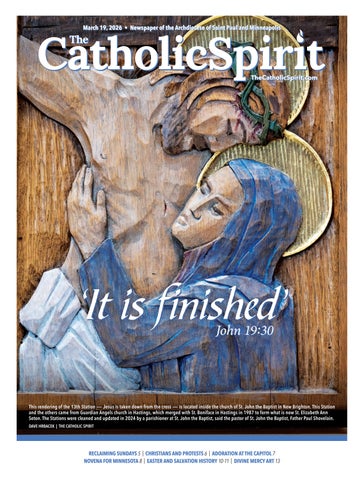
This rendering of the 13th Station Jesus is taken down from the cross is located inside the church of St. John the Baptist in New Brighton. This Station and the others came from Guardian Angels church in Hastings, which merged with St. Boniface in Hastings in 1987 to form what is now St.

Ann Seton. The Stations were cleaned and updated in 2024 by a parishioner at St. John the Baptist, said the pastor of St.

Elizabeth
John the Baptist, Father Paul Shovelain. DAVE HRBACEK | THE CATHOLIC SPIRIT

PAGETWO

SKIING TO MASS Richard Beck holds his cross-country poles and homemade, wooden skis after the noon March 15 Mass at the Cathedral of St. Paul in St. Paul. Beck, 26, had been looking for an opportunity to ski to Mass from his home about a mile from the Cathedral since moving to St. Paul from Independence four years ago. “You don’t always get enough snow that isn’t plowed yet” but the storm that brought more than a foot of snow to the city March 14-15 was timed perfectly for Sunday Mass, he said.

3 Catholic educators in archdiocese recognized for service, leadership

The Catholic Spirit

Two Catholic educators in the Archdiocese of St. Paul and Minneapolis have received papal honors from Pope Leo XIV for their exceptional service to the Catholic Church, particularly in education; a third educator is being recognized by the National Catholic Educational Association (NCEA) for leadership, commitment to professional growth and dedication to proclaiming the Gospel through education.

Receiving the Cross Pro Ecclesia et Pontifice award from Pope Leo are Regina Ashley, principal of Divine Mercy Catholic School in Faribault, and John Boyle, professor of Catholic Studies at the University of St. Thomas in St. Paul. Receiving one of NCEA’s awards — Lead. Learn. Proclaim. — is Tricia Menzhuber, principal of St. John Paul II Catholic School in Minneapolis and Immaculate Conception Catholic School in Columbia Heights.

“I am delighted that the Holy Father has recognized the exemplary service of two local leaders in Catholic education as we in the archdiocese continue the celebration of our 175th jubilee,” Archbishop Bernard Hebda said in a statement. “Growing up in an American family that valued Catholic education, Pope Leo clearly understands the far-reaching and multi-generational impact that an educator can have. The inspiring contributions of Mrs. Ashley and Dr. Boyle illustrate the very best of the Church’s outreach to students ranging from preschool to graduate studies. We have been blessed by their ongoing witness to Jesus Christ and their untiring efforts to strengthen his Church.”

Jason Slattery, director of Catholic education and superintendent of schools, credited Ashley and Boyle in part for advancing “the mission of Catholic education in our local Church.”

The pontifical honors come after the late Pope Francis last year bestowed Cross Pro Ecclesia et Pontifice awards on four Catholic educators: Frederick Blonigen, retired teacher from St. Agnes School in St. Paul; Jane Bona, retired principal of Immaculate Conception Catholic School; Franciscan Clarist Congregation Sister Tresa Jose Athickal, a retired teacher from St. Therese Catholic School in Deephaven, and Gary Wilmer, a retired Catholic education administrator of the archdiocese.

Ashley has worked at Divine Mercy Catholic School for 37 years, 14 of those as principal. Boyle has been a professor of Catholic Studies for more than 35 years. Menzhuber was appointed principal of St. John Paul II Catholic School in 2018 and agreed to also lead Immaculate Conception last October.

Menzhuber will be among NCEA awardees recognized April 6 at the association’s President’s Dinner leading into its annual convention April 7-9 in Minneapolis. Ashley and Boyle will receive medallions and parchments associated with their awards from Archbishop Hebda at the convention’s opening Mass April 7 and will be recognized at the Archdiocesan Catholic School Leadership Banquet April 8.

THE PIG Sue Berthiaume, left, principal of Transfiguration Catholic School in Oakdale, prepares to kiss a pig as a reward for students reaching their fundraising goal in the annual Catholic United Financial Raffle. Critter Country Pet and Feed in Maplewood brought in a pig named Chewy for the event. Pictured at right is the owner of the pig, Emma Bergman. The school reached its goal of $12,000, then exceeded its stretch goal of $15,000, which meant that Berthiaume not only would dress like a chicken, but would draw the name of a teacher from among nine to kiss the pig. In the end, all nine teachers plus Berthiaume kissed the pig. The idea for the event came from a parent volunteer, Amy Meyer.

BLESSED

EASTER

The Catholic Spirit staff prays that all experience a blessed Easter season as we celebrate our risen Lord. Please watch for the next print edition of The Catholic Spirit April 9.

NEWS notes

Johan van Parys, managing director of ministries at the Basilica of St. Mary in Minneapolis, met Pope Leo XIV at the Vatican March 11 and shared his recently published book, “Sacramentals: Liturgical Symbols That Surround Us.” Published by Ligouri Publications which offers a summary of the book on its website at tinyurl.com/4uyw6274 van Parys takes readers through the symbolism of elements like water, fire and light used in a religious manner in Catholic liturgies. He also reviews sacred spaces within church buildings and the history of their development from ancient times.

A March 15 performance of “The Crucifixion: An Oratorio” at the Cathedral of St. Paul in St. Paul has been rescheduled to March 29, Palm Sunday. The change was made as a major winter storm barreled toward the Twin Cities. The storm brought blizzard conditions and more than a foot of snow. Organizers hope for better weather for the 2 p.m. concert, which will feature members of the Cathedral of St. Paul schola and choir, and conductor and organist Chris Ganza, director of sacred music at the Cathedral. The oratio was written in 1887 by English composer Sir John Stainer; two noted interpreters of Stainer’s work, Nicholas Chalmers, tenor, and Andrew Kane, baritone, will be guest soloists. The event is free, with donations encouraged to the Cathedral Heritage Fund’s organ maintenance fund.

Father Ralph Talbot has been appointed the 13th pastor and rector at the Basilica of St. Mary in Minneapolis, effective July 1. Father Talbot will take the position now held by Father Daniel Griffith, who has been appointed vice president for mission at the University of St. Thomas in St. Paul. In a welcome note on the Basilica’s website, Father Griffith said Father Talbot is a “gifted pastor, strong leader, compassionate shepherd, and able fundraiser.” Father Talbot, pastor of St. Hubert in Chanhassen, also has served as parochial vicar at the Cathedral of St. Paul in St. Paul and pastor of St. Jude of the Lake in Mahtomedi and St. Mary of the Lake in White Bear Lake. Before studying for the priesthood, Father Talbot served as an assistant state attorney in Miami for 10 years, prosecuting a wide range of criminal cases.

Two Catholic high schools in the Archdiocese of St. Paul and Minneapolis won state girls basketball championships March 14 at the University of Minnesota’s Williams Arena on the Minneapolis campus. Providence Academy in Plymouth became the first girls team in state history to win a fifth consecutive state title, defeating Marshall School in Duluth 95-60 in the Class AA championship game. Providence Academy senior Maddyn Greenway, the state’s all-time leading scorer, finished her six-year career with 5,621 points after scoring 33 in the finals. In Class AAA, Benilde-St. Margaret’s in St. Louis Park won its fourth consecutive state title with a 75-63 victory over top-seeded Stewartville. The Red Knights were led by junior Sydney Friedly, who scored 24 points in the championship game.

Practicing CATHOLIC

Produced by Relevant Radio and the Archdiocese of St. Paul and Minneapolis, the March 13 “Practicing Catholic” radio show included Bishop Michael Izen in an interview about trusting in God’s plan for priestly reassignments. The program also included Mark Giszczak, director of the Institute for Catholic Theological Formation at The St. Paul Seminary in St. Paul, in an interview about the Charismatic Renewal. Listen to interviews after they have aired at practicingcatholicshow.com or choose a streaming platform at Spotify for Podcasters.

KISS
COURTESY HEATHER CHRISTMAN
COURTESY TRANSFIGURATION CATHOLIC SCHOOL

FROMTHEBISHOP

‘It is empty’

Iwas on a group tour years ago at the shrine of Our Lady of Lourdes in Portugal. As a rule on group tours, one is never to be late to return to the bus. We had to stay on schedule; as the leader of the tour, I would constantly stress this with the pilgrims. We were to leave the shrine at a certain time and that time was approaching. But I had one more thing to see, the Stations of the Cross.

I wanted to walk them; but knowing time was limited, I hurriedly walked the Stations knowing they would end where our bus was waiting. I began to sweat halfway through yet kept up the pace. I came to the 14th Station, Jesus is laid in the tomb, and I bowed my head for a minute. I turned the corner to head toward the waiting bus, full of pilgrims, when suddenly I felt a breeze of cool air hit me and I looked up and as part of the Stations, the tomb was empty. The tomb was empty, and the coolness stopped me in my steps as I stood in awe, yes, in awe, of what I was seeing and feeling. “It is empty,” I said as I walked stunned to the bus, “it is empty.”

We arrive at a similar destination on our Lenten journey, about to turn another corner. We know by turning this corner we risk losing ourselves in the passion of Jesus Christ. We may want to hurry along, distract ourselves by busily planning our Easter celebrations, or walk through each day of Holy Week finding time for reflection as we leave the group behind to focus on Jesus and ourselves. We will be distracted by the crowds as they welcome Jesus into Jerusalem, shouting “Hosanna.” The week is filled with many stories of Jesus’ final days. We can listen and sit on the sidelines pondering, “Why?” We can enter in and feel the rush of adrenaline as we sit at table with Jesus and his disciples, walk to the Mount of Olives, try to stay awake, wait in disbelief over what is happening, and deciding whether to stay or leave. Either way, we know the story, but this year can be different.

Jesus is arrested and brought to trial. Jesus is ridiculed and denied by many. They want Barabbas as they shout, “Let him be crucified.” Our hearts ache. We want to run. It is hard to sit still. We walk with Jesus, we see him scourged, we see the pain and exhaustion, we want to help but we are instructed to stay back. We begin to sweat. What will Jesus think? Jesus taught us to love God and our neighbor. Jesus

“Está vacío”

Hace años, participé en una visita guiada en grupo al santuario de Nuestra Señora de Lourdes, en Portugal. Como norma en este tipo de excursiones, uno nunca debe llegar tarde a la hora de regresar al autobús. Debíamos cumplir con el horario; y, en mi calidad de líder del grupo, insistía constantemente en ello ante los peregrinos. Teníamos previsto abandonar el santuario a una hora determinada, y ese momento se acercaba. Sin embargo, me quedaba una cosa más por ver: el Vía Crucis.

Quería recorrerlas a pie; pero, consciente de que el tiempo era limitado, recorrí apresuradamente las Estaciones, sabiendo que estas terminarían justo donde nos aguardaba nuestro autobús. A mitad del trayecto comencé a sudar, pero mantuve el paso. Llegué a la decimocuarta Estación —Jesús es depositado en el sepulcro— e incliné la cabeza durante un minuto. Doblé la esquina para dirigirme hacia el autobús que nos esperaba, repleto de peregrinos, cuando de repente sentí que una brisa de aire fresco me envolvía; levanté la vista y vi que, como parte de las Estaciones, el

Jesus taught us to love God and our neighbor. Jesus instructed us to wash the feet of others, to share our bread, to free the captives and the prisoners, to choose life. How could we just stand by and observe? We keep reminding ourselves that we know the story and how it ends, yet our hearts are challenged. Conversion! ‘Create in me a clean heart, O Lord.’ Could it be happening? I search for reconciliation; I need God’s grace. It is dawning on me the reality and gift that is given to us.

instructed us to wash the feet of others, to share our bread, to free the captives and the prisoners, to choose life. How could we just stand by and observe? We keep reminding ourselves that we know the story and how it ends, yet our hearts are challenged. Conversion! “Create in me a clean heart, O Lord.” Could it be happening? I search for reconciliation; I need God’s grace. It is dawning on me the reality and gift that is given to us.

Death comes, his suffering is over, the curtain is torn in two. The darkness of the sky envelopes us, yet we find strength, a peace we never knew we had. It is quiet. It is quiet. We pray for those who suffer from war, oppression,

sepulcro estaba vacío. El sepulcro estaba vacío, y aquella frescura me detuvo en seco mientras permanecía allí, sobrecogido —sí, sobrecogido— ante lo que veía y sentía.

“Está vacío”, dije mientras caminaba atónito hacia el autobús; “está vacío”.

Llegamos a un destino similar en nuestro camino cuaresmal, a punto de doblar otra esquina. Sabemos que, al doblar esta esquina, corremos el riesgo de perdernos en la pasión de Jesucristo. Tal vez queramos apresurarnos, distraernos planificando afanosamente nuestras celebraciones de Pascua, o tal vez prefiramos recorrer cada día de la Semana Santa hallando tiempo para la reflexión, dejando atrás al grupo para centrarnos en Jesús y en nosotros mismos. Nos distraerán las multitudes mientras dan la bienvenida a Jesús en Jerusalén, aclamando: ¡Hosanna!. La semana está repleta de numerosas historias sobre los últimos días de Jesús. Podemos escuchar y permanecer al margen, reflexionando: ¿Por qué?. O podemos adentrarnos en la escena y sentir la descarga de adrenalina al sentarnos a la mesa con Jesús y sus discípulos, caminar hacia el Monte de los Olivos, intentar mantenernos despiertos, aguardar con incredulidad ante lo que está sucediendo y decidir si quedarnos o marcharnos. Sea cual sea el camino,

illness, loneliness and realities outside of their control. We wait, we wait, it feels so void. Why do we celebrate Holy Week? What is good? What is holy? Again, another year, we question.

We realize that the bus is waiting, our lives must move forward, yet there is one more thing. One more thing is waiting for us, and it is empty. It is empty! Never have we thought of emptiness being good, holy or cool. There is hope in this emptiness, there is new life in this emptiness, there is healing in this emptiness. The bus is waiting, people are anxious and we are sweating. The cool breeze has blown; it touches our hearts. Where will it lead?

conocemos la historia; sin embargo, este año puede ser diferente.

Jesús es arrestado y llevado a juicio. Jesús es objeto de burla y negado por muchos. Quieren a Barrabás mientras gritan: ¡Que sea crucificado!. Nos duele el corazón. Queremos huir. Nos resulta difícil permanecer quietos. Caminamos con Jesús, lo vemos ser flagelado, vemos su dolor y su agotamiento; queremos ayudar, pero se nos indica que nos mantengamos al margen. Empezamos a sudar. ¿Qué pensará Jesús? Jesús nos enseñó a amar a Dios y al prójimo. Jesús nos instruyó a lavar los pies de los demás, a compartir nuestro pan, a liberar a los cautivos y a los prisioneros, a elegir la vida. ¿Cómo podríamos simplemente quedarnos de brazos cruzados y limitarnos a observar? No dejamos de recordarnos a nosotros mismos que conocemos la historia y cómo termina; sin embargo, nuestros corazones se ven interpelados. ¡Conversión! “Crea en mí un corazón puro, oh Señor”. ¿Podría estar sucediendo? Busco la reconciliación; necesito la gracia de Dios. Estoy tomando conciencia de la realidad y del don que se nos ha entregado. Llega la muerte, su sufrimiento ha terminado, el velo se rasga en dos. La oscuridad del cielo nos envuelve; sin embargo, hallamos fortaleza, una paz que

nunca supimos que poseíamos. Hay silencio. Hay silencio. Oramos por aquellos que sufren a causa de la guerra, la opresión, la enfermedad, la soledad y realidades ajenas a su control. Esperamos, esperamos; todo se siente tan vacío. ¿Por qué celebramos la Semana Santa? ¿Qué es bueno? ¿Qué es santo? Una vez más, otro año, nos cuestionamos.

Nos damos cuenta de que el autobús está esperando; nuestras vidas deben seguir adelante, y, sin embargo, hay una cosa más. Una cosa más nos aguarda, y está vacía. ¡Está vacía! Jamás habíamos concebido el vacío como algo bueno, sagrado o maravilloso. Hay esperanza en este vacío; hay vida nueva en este vacío; hay sanación en este vacío. El autobús espera, la gente está impaciente y nosotros sudamos. La brisa fresca ha soplado; nos toca el corazón. ¿Adónde nos conducirá?

CORRECTION

The last name of Deacon James Pufahl was misspelled on second reference in the Officials on page 3 of the March 5 edition.

You’ve worked hard to save for your retirement. And maybe, you don’t need the income from your IRA required minimum distribution (RMD) just yet. Ever considered using a qualified charitable distribution (QCD) strategy?

With a QCD, you direct your RMD to your parish or favorite charity. If your parish has a permanent endowment, your QCD can easily become a legacy gift.

about QCDs and charitable planning.

May

left,

and members

items during a

St.

and

March 14. In this second annual event, people were invited to donate their used clothing. Then anyone, including those who donated, could attend the event and take items for themselves free of charge. Gadke and Brink came to the clothing swap with their mothers and attended a talk two days before the swap dealing with Catholic social teaching. Michelle Boris, coordinator of young adult ministry at St. Mary of the Lake, came up with the idea and has organized the event both years. The presentation featuring Catholic social teaching includes St. John Paul II’s Theology of the Body. “I’ve always been very interested in ethical fashion,” Boris said. “Fashion and the clothes that we wear are a Catholic issue because it incorporates everything, from the dignity of the human person to the rights of the workers, to care for creation.”

DAVE HRBACEK | THE CATHOLIC SPIRIT

From
Cheyenne Gadke
Madeline Brink, seventh graders at St. Peter Catholic School in Forest Lake
of
Peter parish, peruse
clothing swap at St. Mary of the Lake in White Bear Lake

Reclaiming Sundays takes shape through generations, archdiocesan video series

Six months after its initial release, the Reclaiming Sundays video series remains strong in helping Catholics in the Archdiocese of St. Paul and Minneapolis observe Sundays as a day of prayer and rest.

Two different videos on the same topic — one in English and one in Spanish — have been released every month since August 2025. Though the series will run until August, Laura Haraldson — associate director of Synod implementation and pastoral accompaniment for the archdiocese — said it is timeless. The series can be found on the archdiocese’s website at tinyurl.com/mrch25th

“It’s evergreen,” Haraldson said. “From (my) perspective behind the scenes, it is really inspiring to see all of these families who are already doing such amazing things to try and bring their families closer to (the) Lord on Sundays.”

In her own family, Haraldson said reclaiming Sunday ripples out into the rest of the week. Outside of Mass on Sundays, there are moments her family sits and talks together or plays games. To prioritize Sunday as a day of rest, Haraldson and her family plan to get work or chores done throughout the week.

Haraldson acknowledged that plans can change during different seasons of life, but she said reclaiming Sundays is an effort that should be made in whatever way possible.

Pamela Patnode, the former director of The St. Paul Seminary Institute for Catholic School Leadership in St. Paul, is in a different season of life than when her children were young in the 2000s. Still, the Lord’s Day is a priority for her family.

She appears in the October Rest and Recreation segment of the Reclaiming Sundays video series.

“(W)e have strived to have our faith be a priority in our life and a faith that’s joyful,” Patnode said. “For example, when the kids were young, we would be intentional about staying after Mass for the coffee and the donuts. But let’s be real, it was more for the donuts than the coffee. ... On occasion, we would go out for a brunch and try to make both Sunday and the Mass not only a grace-filled experience, but also a joy-filled experience for the kids.”

A priority for her family is relationship building, Patnode said. Her entire family lives in the Twin Cities metro area. Her children grew up with grandparents, cousins, aunts and uncles actively in their lives. Patnode and her family were intentional about visiting their children’s cousins or “Grandma and Grandpa” on Sundays, she said.

“Now we’re the grandparents,” Patnode said.

Sunday was guarded as a family day, in which Patnode and her family played games together or took a field trip.

“We used to set aside certain toys and videos that we would only pull out on Sundays just to make them a little bit more special,” Patnode said.

When Patnode’s father was in poor health, it was easier for him to attend the Saturday night vigil Mass. Patnode and her family attended that Mass with her parents, and afterward, they went to her parents’ house to play cards, dominoes or talk. Patnode’s father died a year and a half ago, but they continue this tradition.

“Now we still do that with my mom, and it’s just such a gift,” Patnode said. “It’s a gift for all of us, especially when our kids and the grandkids join us on a Saturday. To have

had such faithful witnesses — my parents, my husband’s parents, have been strong, faithful witnesses to us ... (t)o share that still in this new season of life has really been a joy.”

Attending Mass on Saturday leaves Sundays open on the calendar. Still, Patnode and her husband use that free time for relationship building with God, their own marriage, their children and grandchildren, and their parents.

“It just looks a little bit different today than it did when the kids were little and we had a separate container of toys and we would take a family field trip together,” Patnode said. “Back then, we would also try to do something special with the meal and maybe we would serve it on special plates. Maybe it would just be a favorite meal, maybe it would be a new recipe, maybe it would be a special dessert. We would try to do something to distinguish what we were eating on Sunday from maybe the frozen pizza that we had on Friday night.”

During the children’s teenage years, if they seemed to be isolating in their rooms for a long period of time, Patnode and her husband would invite them out to play a card game, such as cribbage or the card game golf. To entice them, she would put a dollar on the table. Whoever won the game got the dollar.

“For whatever reason, that worked,” Patnode said. “It’s just something that warms my heart today. It’s something my dad used to do when I was growing up.”

Small changes, Father John Ubel said, can help people reclaim Sunday. As pastor of St. Agnes in St. Paul, he encourages parishioners to make small changes, such as picking one Mass and sticking to it each week.

“I try to make a distinction between squeezing Mass in when it fits, as opposed to building the rest of your weekend around the set Mass time that you have selected,” Father Ubel said. “That’s your Mass, your family Mass time, and then plan your activities around that,” he said. “It’s subtle, but I think it’s a not insignificant difference in attitude.”

Haraldson’s family likes to attend a 10:30 a.m. Mass on Sundays. Doing this has made it easier for her family to pray together beforehand or plan an activity “like playing a game or going for a walk or a hike. And then we typically do a little pause (after Mass) to break (the day) up, and then we come back together for a family dinner.”

“We’ve really been much more intentional ... about taking extra prayer time in the home, and sometimes that’s just reading the Gospel before Mass,” Haraldson said. “Then also having a family outing of some sort every Sunday. ... It’s baby steps, and it’s what’s right for you, and it’s what’s right for your season in life. But always trying, always trying to do just a little bit more.”

Father Ubel said it can be hard to see Sunday as different from any other day. He remembered Minnesota’s Blue Laws — statutes that prohibited certain activities, such as stores opening or alcohol sales, on Sundays. The Blue Laws were largely overturned in 1971.

“I remember quite well as a boy, we still had the Blue Laws where most everything was closed on Sundays. My mother would say, ‘Go down to the corner market and get

milk’ on a Saturday afternoon before they closed.”

One way to make Sunday feel different from other days, he believes, is through an old colloquialism: “Sunday’s Best.”

“I’d also state the importance of dressing up on Sundays,” Father Ubel said. “Even the manner in which we dress says something about the priority we place upon Sunday worship of God. We wear clothing that is different than we wear on Saturday, for example.”

This is instructive, Father Ubel said, more than symbolic. Dressing up for Mass is not meant to show off but “to show God that we know that how we dress reflects the importance of what we are doing.”

Father Ubel also differentiated servile work from relaxing work.

“If people were to say, ‘You should never garden, because that’s work.’ Well, for somebody who’s in an office all week long, going outside and doing some gardening, even on a Sunday afternoon, could be relaxing. ... Servile work is the kind that takes away from the proper relaxation that both our mind and body need.” He went on to say that “an often-forgotten aspect of the Sunday obligation is: Are you doing any unnecessary work that truly takes away from the proper relaxation of mind and body that we all need?”

Father Ubel encouraged Catholics to recover their sense of rest on Sunday. Sometimes doing nothing is OK, he said.

“Fulfilling the Sunday obligation is about more than merely attending Mass but (is) situated within the idea of the Eucharist being the source and the summit,” Father Ubel said. “If it’s the source and sum of our Christian faith, then how do we observe the day of the Lord? How is it different from other days?”

As pastor, Father Ubel said he does not allow any events to take place at St. Agnes School until the afternoon on Sundays.

“We do not want to host sporting events,” Father Ubel said. “We’ve fallen into a bad habit — even in the Catholic Church — of allowing tournaments and things of this nature to take place in our gymnasiums.”

Christine Jacobson, a parishioner of Presentation of the Blessed Virgin Mary in Maplewood, agreed with this sentiment.

“Sports are great, don’t get me wrong, just not on Sundays,” Jacobson said. For the past nine years of her retirement, Jacobson has attended daily Mass every day except Saturdays. Because her schedule changes, Jacobson often visits different parishes at different times during the week. She has every Mass time in her area memorized. Jacobson has loved Mass ever since she was in grade school at Presentation and the students attended Mass daily.

“I was actually disappointed when I went to high school that we didn’t have Mass every day,” Jacobson said. “I think that we have a lot of options, especially in certain parts of town, like right in our area. There’s quite a few different churches.”

Jacobson is active in Presentation’s parish liturgies on Sunday. She is an extraordinary minister of holy Communion and on occasion, she is a lector.

“The nice thing is I get to meet people from other churches, too,” Jacobson said. “I’m really proud of our archdiocese that they’re doing something like this because the world has taken over. We need to get back to the basics of our faith.”

Father Ubel referenced “Dies Domini,” a letter written by Pope St. John Paul II about how to keep the Lord’s Day holy. According to Father Ubel, the letter states that it is the responsibility of a parish’s pastor to create enough opportunities for Catholics to attend Mass. St. Agnes has six weekend Masses — one on Saturday and five on Sunday.

“Pastors also have a corresponding duty to offer the faithful the real possibility of fulfilling the precept (of attending Mass),” Father Ubel said. “In other words, we have a duty to make it possible. Now, that doesn’t mean that we have a duty to offer so many Masses that we are completely exhausted every weekend. People have to make some choices. ... I think by offering more of an opportunity, I think more people are probably going to fulfill that obligation. So, from that perspective, it’s a valuable asset to have that many choices.”

The archdiocese’s website at archspm.org has a feature that allows people to find Mass times at parishes in the 12-county Twin Cities area.

“(That makes) it easy,” Haraldson said.

COURTESY
PAMELA PATNODE
Sharon Stable, third from left, and Kathy Patnode, fourth from left, stand with their grandchildren Pamela Patnode’s children. From left are Jeff, Grace, Katie, Kristen, and Claire. Pamela Patnode said her children’s grandparents played a significant role in the lives of their children.

UST panelists discuss how protesting presents challenges in the Christian faith

A March 5 meeting of legal and other experts at the University of St. Thomas (UST) School of Law in Minneapolis considered the topic “Protests and a Christian Response to Government Abuses.”

The event featured a panel discussion sponsored by the Murphy Institute, a partnership between the university’s Center for Catholic Studies and the law school, in collaboration with the Opus College of Business, to inspire mission-driven education.

Professor of Catholic Studies Robert Kennedy moderated the discussion among panelists — including Rachel Moran, a UST professor and Robins Kaplan director of clinical education; Thomas Berg, a UST James L. Oberstar professor of law and public policy; Francis Shen, a University of Minnesota law professor; and John Inazu, a Washington University Sally D. Danforth distinguished professor of law. In response to prompts and questions, panelists discussed present-day challenges to the Christian faith.

Kennedy’s opening remarks laid some groundwork for group discussion on what the Christian response should be to perceived civil injustice. One basic expectation of the faith, he said, is that Christians will always strive to manifest charity — not as a kind of condescension or generosity, but as a genuine willingness to love others, in following the example of Christ.

Relevant context for civil disobedience in the New Testament, he said, can be found in Chapter 13 of St. Paul’s letter to the Romans, and in the second chapter of 1 Peter, both of which emphasize the very strong, but not absolute duty to obey lawful authority.

“Jesus submitted to civil authority,” Kennedy pointed out, “even when that authority chose to condemn him unjustly to death.” He said that peacefully enduring an injustice in some instances could be considered “an act of charity.”

“Peace creates the space for harmony and trust,” he said, “and it is perilous to sacrifice it for ephemeral objectives.”

a

Kennedy maintained that practicing charity and considering the common good should form the basis for Catholic ethical and legal considerations regarding protesting. He said members of civil societies also need to practice obedience (though never absolute, nor requiring people to close their eyes to injustice), forbearance (moderating criticisms and speaking carefully), and to have patience (which may enable people to see things more clearly over time).

Before protesting, he said, people should be sure to have “clean hands, open minds and loving hearts” to act for the right reasons and not harm the common good more than the perceived injustice.

Moran’s perspective came from her role as a practitioner — a lawyer who has defended protesters in court. She said protest is a controversial topic, but that she has found it worthwhile as a Christian lawyer to represent civilians in court for protesting government abuse of power.

“Both Old and New Testament are replete with examples of people in power abusing their power,” Moran said. “The Bible makes

a panel

on “Protests

it clear that abuse of power is a constant temptation.”

Moran said Scripture affirms the value and equality of all people and that protesting government abuses often involves standing up for marginalized groups such as racial minorities, immigrants and the impoverished. She said Jesus himself encouraged his followers to minister to those who were marginalized. The benefit of protesting, said Moran, is that it encourages critical thinking and engaging in issues that might otherwise be ignored.

Berg, in his comments, addressed a protest on Sunday, Jan. 18, that interrupted a worship service at Cities Church in St. Paul. He said it raised distinct issues he was interested in as a scholar and as an advocate of freedom of religion. As to legality, he said entering private property and disrupting individual worship interfered with constitutionally protected activity. Berg said that in the days of civil rights activism, silent “kneel-ins” at local churches succeeded because the mere presence of the participants conflicted with the norm of segregation in the nature of the

worship service.

“We don’t have a tradition of a legal right to disrupt services vocally or physically like at Cities Church,” Berg noted. As to its effectiveness, he said that although tension was created that compelled consideration of the issue, abrupt disruption of worship works against persuasion.

Shen hearkened back to a question asked at a campus ministry gathering about whether Christians should vote since it’s been said “we are in the world, but not of it.” Certainly, he said, there is a space for protest. Sometimes, he said it is necessary to discern whether to protest, because, according to Catechism of the Catholic Church No. 2242, “directives of civil authorities should not necessarily be followed when they are contrary to the demands of the moral order.” But he said to discern, people have to be consistent in their morals and can’t simply protest as a response to social pressures. Shen said that for Christians and Catholics, there is the opportunity to protest but that it isn’t always appropriate or inappropriate to do so, “which means it’s one of those really hard decisions that comes down to conscience and the moral order.”

Inazu pointed out that the right of assembly in this country is anchored in religious freedom — and that the history of dissent and protest mirrors the fight for religious freedoms. He noted that the women’s suffrage movement and the temperance movement were led by Christians, and that the labor union movement was rooted partly in faith. The civil rights movement was anchored in faith, he said. Inazu also noted that the defense of civil liberties was a mechanism of support for those not in power, and that theological witness is more long-range and creating real change takes more than protest. In response to a prompt by Kennedy as moderator about the purpose of protest, and taking action versus impeding action, Shen said the nature of a protest has to be considered. He added that solidarity is a powerful principle, and that as a connected

TIM MONTGOMERY | FOR THE CATHOLIC SPIRIT
University of St. Thomas Professor of Catholic Studies Robert Kennedy moderated
discussion
and
Christian Response to Government Abuses” at the University of St. Thomas School of Law in Minneapolis.

Bishops join the faithful in adoration at the Minnesota State Capitol

In the basement level of the Minnesota State Capitol building in St. Paul, Archbishop Bernard Hebda and Deacon Kevin Conneely presented the Blessed Sacrament for adoration. At one point, over 60 people knelt and prayed before the Eucharist March 6 in the Capitol Vault Room.

Bishops Michael Izen and Kevin Kenney attended the five-hour adoration at different times; people joined in worship and departed throughout the day. Deacon Conneely is MCC’s first legislative chaplain.

Kathleen Randolph, a member of the Serra Club — a ministry in the Twin Cities that promotes vocations to the priesthood — said she hopes that grace and prayers may radiate through the Capitol.

“I just pray that their minds would be open enough to hear God’s — Lord Jesus’ — voice in every decision they make,” Randolph said.

The 9 a.m. to 2 p.m. Adoration at the Capitol was organized by the Minnesota Catholic Conference (MCC), the public policy arm of the state’s Catholic bishops. Adoration has been offered in the Governor’s Dining Room for several years. This was the first year adoration was held in the Capitol Vault Room, a larger space that fits more people. Adoration with bishops from other Minnesota dioceses will be held April 10 and May 1.

Bishop Daniel Felton of Duluth is scheduled for 9 a.m. to 2 p.m. April 10 and Bishops Robert Barron of Winona-Rochester, Andrew Cozzens of Crookston, Patrick Neary of St. Cloud and Chad Zielinski of New Ulm are expected from 9 a.m. to 2 p.m. May 1.

Jason Adkins, MCC’s executive director and general counsel, said adoration in the Capitol building is a way to bring Jesus to the peripheries.

“We need Jesus to come to the peripheries, as (the late) Pope Francis said, including the existential peripheries. The existential peripheries are our public square, (our) public life,” Adkins said. “We need to bring Jesus there. We need him to be present.”

Prayers for the state of Minnesota and government officials are needed, Adkins said, to “show his Lordship and his dominion over this place, in all places. We need to pray, (asking) how can we be his hands and his feet in the process of public life and public service.”

“Pope Leo (XIV) said that politics is one of the highest forms of charity, and indeed, the most important thing we can do as an act of charity for elected officials is pray for them,” Adkins said. “That’s what we’re here to do today. We’re here to pray for our elected officials, here to pray for our state amidst a time of deep turmoil and challenges and conflict and partisanship that people may transcend the divides among us and work together to promote human dignity and the common good.”

“Our state — we need this right now,” Randolph said. “It was just so great to see so many people here praying for our state.” She added that she thought about how “all these people will go back to their parishes and spread the blessings.”

Mindy Hoefer, a parishioner of St. Pius X in White Bear Lake, brought

eight of her nine children to adoration at the Capitol. Hoefer homeschools her children, and often takes them to adoration at St. Pius X. She had previously attended adoration at the Capitol with her family when it was held in the smaller room.

“We thought this was an amazing opportunity to pray for our legislators, for our governor, for our state, and to show our kids that our faith isn’t just in our home and in our church; it’s everywhere we go,” Hoefer said. “We’re really blessed that we have this kind of an event to go to, to take our kids to, and to show them what the faith is about.”

Hoefer’s daughter, a sophomore at White Bear Lake High School, recently gave a presentation on the negative effects abortion has on women. She has a rosary with baby figurines in place of beads, and each Hail Mary prayed is to save a baby. Hoefer saw someone at adoration with the same rosary.

The monstrance, provided by the Serra Club, was blessed by Pope Benedict XVI. During adoration, Archbishop Hebda prayed Pope Benedict XVI’s prayer for vocations. Randolph said this prayer was appropriate, along with the monstrance, because they can bring healing.

“It’s really asking God to pour his blessings upon all the people that work here and their families,” Randolph said. “We just need to let it keep radiating.”

During each year’s March for Life rally on the Capitol steps, Randolph said she looks at every window and prays a Hail Mary.

“Whoever’s office that is, may they be open to receiving what God’s will is,” Randolph said.

MEETING JESUS IN THE VAULT

Kevin Conneely, who serves as legislative chaplain for the Minnesota Catholic Conference, reflects on the March 6 event at the Minnesota State Capitol:

The Minnesota Catholic Conference hosted the first of three monthly opportunities for adoration of the Eucharist at the Minnesota State Capitol March 6. Throughout the day, well over 200 adorers came in and out, silently praying before the Blessed Sacrament.

Archbishop Bernard Hebda opened the morning with exposition and the beautiful “O Salutaris Hostia.” We were fortunate to have the use of a monstrance blessed by Pope Benedict XVI, on loan to us from our Serran chapter. After some quiet meditation, the archbishop led us as we recited Pope Benedict’s prayer for vocations. Bishop Michael Izen joined us and prayed in silence during the middle of the day. Bishop Kevin Kenney arrived after the lunch hour, and we closed out our time together by praying and singing the Benediction. Our voices rose through the stone walls, finding their way in echoes up through the rotunda and into the whole building.

Throughout the day, I was heartened to see retired couples, numerous Capitol workers, parents with their young children, and Minnesota clergy members pray together. Several adorers told me, “This is the first time I have ever been inside this building.” Imagine that: Lifelong Minnesotans living in the Twin Cities are making their first visit to the center of civic government to pray!

Shortly before we prayed the Angelus at noon, I offered a short reflection about the room where we gathered. Its full name is “L’Etoile du Nord Vault.” That’s French for Star of the North. Capitol regulars just call it “The Vault.” The room’s arches overhead forming a perfect circle, its placement in the very center of the lower level and its thick walls make that a fitting name. In the architectural sense, the word “vault” refers to one or more arches formed in a ceiling that is typical of churches and important public buildings. I noted that, by bringing Christ inside the Capitol and gathering in prayer, we were checking both of those architectural boxes. In another definition, “vault” refers to a secure room, such as in a bank, where things of great value are stored and actively guarded. What could be of greater value than encountering Christ, the one true light, present in that monstrance before us? Stated a different way, what could be more important to protect than the shared faith in God that brought so many Catholics out on that rainy Friday to pray for our government?

Our government officials the governor, Supreme Court justices, and members of both houses of the Legislature do their work on the floors rising above The Vault. They have difficult jobs, and they receive plenty of criticism. Every day, a new controversy or issue threatens to widen the divide in civic life and to obscure the common good. Everyone working in Minnesota’s state government needs our prayers now more than ever.

There will be two more Friday dates for Adoration at the Capitol: April 10 and May 1 from 9 a.m. to 2 p.m. Details, including parking options, can be found at mncatholic.org. I encourage everyone (especially firsttimers to this beautiful public building) to schedule some extra time to head upstairs, stand in the rotunda directly above The Vault, or even take a guided or self-guided building tour.

Jesus met people where they were: collecting taxes, at the well, in the city center, on the road. On behalf of the Minnesota Catholic Conference, I invite you to come in April and May to the Capitol and see the true Star of the North to meet Jesus in The Vault.

Deep in prayer, Bishop Michael Izen sits with others during adoration of the Eucharist at the Minnesota State Capitol building March 6. Organized by the Minnesota Catholic Conference, adoration will also be held at the Capitol building with bishops from other Minnesota dioceses April 10 and May 1.
Story
Deacon

Catholic woman with ties to Annunciation offers 9-month novena for Minnesota

Under different circumstances, Bailey Rodriguez would have been inside Annunciation church in south Minneapolis the morning of Aug. 27, 2025. That, she said, would have put her “in the line of fire” during a shooting that killed two children and injured more than 20 other people.

Instead, she was on a trip to Mexico with her mom, Deno Sterzinger, having left just the day before. With her upcoming wedding scheduled for Sept. 13, Rodriguez heeded her mom’s advice to step away from the intensity of wedding planning and go on a trip to refresh herself emotionally and spiritually.

An important part of their trip was connecting with Our Lady of Guadalupe, the patron saint of the country. It also was a continuation of her return to the Catholic faith of her youth, a reversion tied to Annunciation and one of its parishioners, Amy Smith.

During a chance encounter after daily Mass in December 2023, Rodriguez, whose aunt worked at a hospital with Smith, walked over to Smith at the urging of her mother, who had known Smith for years. The three women talked at length, and Smith began a process of drawing Rodriguez back to her faith. Rodriguez eventually started going to daily Mass at Annunciation, with a return to the sacraments of confession and the Eucharist happening along the way at the south Minneapolis parish.

Rodriguez particularly loved school Masses and rarely missed them. That routine was part of her hesitation in going on the Mexico trip Aug. 26. This particular school Mass was the opening Mass of the school year and drew people beyond the school community. Had Rodriguez stayed home, she would have been at the Mass and would have been sitting among the daily Mass-goers in the back of the church.

Two greeters whom she knew well, a husband and wife who would hold hands during Mass, were injured in the shooting. Rodriguez noticed them later at Masses wearing bandages. As Rodriguez grew deeper in her faith, she began thinking of ways to pray for the Annunciation community, with the tragedy etched on her heart and soul despite her not being there the day of the shooting.

That desire for a meaningful and helpful response grew into wanting to pray for the whole state of Minnesota, including those affected by the recent federal immigration enforcement efforts plus the upcoming gubernatorial election in November.

The result is a novena Rodriguez wrote and launched on March 12. It is a ninemonth daily prayer called Novena for Minnesota and Our Country. Rodriguez wrote the prayer, which invokes God and Our Lady of Guadalupe. After revising an initial draft, she received an imprimatur from Archbishop Bernard Hebda on March 6 and has been spreading the word, inviting people to join in.

“I just felt so convicted that we need to pray,” said Rodriguez, who moved to Watertown, South Dakota, the day after her wedding, with her husband, Jean. “We need to pray a prayer together ... just like we got together in front of Annunciation (for nightly rosary in the weeks after the shooting). We prayed for Sophia (Forchas, who was seriously injured in the shooting) to heal, and she did. Her doctor said it was a miracle. And, I know that by praying to Our Lady, we moved the heart of God, and (Sophia) was able to be healed.

“I believe so strongly in the power of

Bailey Rodriguez holds a prayer card containing the Novena for Minnesota and Our Country

prayer. I know how much it’s transformed my life. I’ve seen it in real time and I’m just like, ‘We can do it again.’”

Bailey Rodriguez said she will pray the novena every day from March 12 through Dec. 12, the final day. Smith said she will “absolutely” pray it every day as well. She said doing so can have a great impact in Minneapolis, in the Annunciation community and across the state.

“I think it (the novena prayer) is just beautiful,” said Smith, 50, who plans to

hang an image of Our Lady of Guadalupe in her home to look at while she is praying the novena. “I love how she (Rodriguez) speaks to the Trinity. ... She is speaking to the Father, the Son and the Holy Spirit directly for specific intercessions ... and then ending it with Our Lady of Guadalupe.”

Rodriguez said she will continue trying to get the word out and encouraging people to pray the novena and go online to get the prayer cards. She has called some priests and will keep dialing clergy and others to

generate interest.

“I don’t expect everyone to start right away (on March 12),” she said, two days before the launch. “I think many people will hear about it after the fact, and I just want them to join in. And by the time Dec. 12 rolls around, I really hope that the majority of the Minnesota faithful are praying it.”

To view the prayer and order prayer cards, which cost $1.50 each, visit landof10ksaints.com.

NOVENA FOR MINNESOTA AND OUR COUNTRY

O HEAVENLY FATHER we humbly beg for your mercy on Minnesota and our country. We have sinned against you in our pride and weakness. St. Francis of Assisi emptied himself out so that he might be filled with your will to tend to the poor and unite those divided in their beliefs. In this Jubilee year of St. Francis, declared by your shepherd Pope Leo XIV, may we too be your instruments of peace and hope for those who do not yet possess the riches of heaven.

JESUS CHRIST, we surrender everything to you. Help our unbelief. Calm the chaotic waters of our hearts and the world around us. You alone turn the darkness into light. You alone rescue souls from the power of Satan and deliver them back to God.

HOLY SPIRIT, grant us the courage to love our neighbors as we are commanded, to know and repent of our sins, and to be strong witnesses to our faith by living out the teachings of the Gospel every day, even when the world hates us for it.

OUR LADY OF GUADALUPE, as the patroness of the Americas, you crushed division and fear in Tepeyac in 1531 through your obedient messenger, St. Juan Diego. O Blessed Mother, we implore your help to sow seeds of unity amongst us, inspire wisdom, uphold justice, protect the innocent, and bring millions of souls to the heart of your Son in Minnesota and our country.

With contrite hearts, we offer this prayer up to the Father, Son, and Holy Spirit, through the intercession of the most venerable Virgin of Guadalupe and her Immaculate Heart,

St. Paul

St. Cloud

St. Louis

St. Michael

St. Peter

St. Anthony

St. Francis

St. Joseph

St. Charles

St. Augusta

St. Bonifacius

St. Clair

and all the angels and saints. Sacred Heart of Jesus, have mercy on us. We trust in you. Amen.

UST CONTINUED FROM PAGE 6

people, standing with those who are marginalized can affect change.

Kennedy went on to say that it is incumbent on protesters to calculate unintended consequences and results of a protest, such as blocking traffic and inhibiting emergency vehicle response.

Inazu added that human relationships are dynamic and hard to predict. Moran said protesters often have wildly different motivations, as evidenced by the difference in sentiments displayed on the signs they hold. But that alone, she said, doesn’t mean a person shouldn’t be part of a protest.

In a question from the audience, it was noted that not everyone attending a

St. Mary

St. Martin

St. Hilaire

St. Leo

St. Rosa

St. Vincent

protest has control over what others do or how they act. What can be done to convey rules to a large group and control potentially adverse behavior? Berg noted that the overall aim of the Civil Rights Movement was to confront the issue of segregation and to convert hearts through peaceful protest. He said violent actions will not win hearts.

DAVE HRBACEK | THE CATHOLIC SPIRIT
that she wrote and invites Catholics to pray over the next nine months.

HEADLINES

The Vatican appeals court declares a partial mistrial in the Cardinal Becciu trial. The Vatican’s appeals court has declared a partial mistrial in the landmark financial case involving Cardinal Angelo Becciu, citing prosecutorial errors that compromised the defendants’ right to a fair defense. In a March 17 ruling, judges said parts of the 2023 trial must be reheard, including key testimony and evidence, with proceedings set to resume June 22. The court said the decision of “relative nullity” does not completely overturn Becciu’s original sentence of five and a half years in prison, but it raises serious questions about how the case was handled. Judges also ordered prosecutors to submit the full, unredacted case file by April 30. At issue is a Vatican investment of 350 million euros (nearly $404 million) in London real estate and alleged financial misconduct. The ruling came just days after Pope Leo XIV opened Vatican City’s judicial year with a speech in which he spoke about the importance of “the observance of procedural safeguards, the impartiality of the judge, the effectiveness of the right of defense and the reasonable duration of proceedings” in preserving authority and institutional stability.

“Witness to Hope” conference calls for a Catholic response to mass deportations. As the Trump administration continues its immigration crackdown, advocates from across the nation gathered in Arizona to discuss pastoral strategies for understanding and applying Church teaching to mass deportations. On March 12, the Diocese of Phoenix held an all-day conference titled “Witness to Hope: Responding to Mass Deportations,” drawing together experts on immigration law, Catholic social teaching about immigration and ministry to migrants. The Phoenix event was the second such regional diocesan gathering, with Bishop Bruce Lewandowski of Providence, Rhode Island, convening the first in December. A third is slated to take place May 6 in Detroit. The events are collaborative efforts between sponsoring bishops and participating organizations. They are coordinated by the Center for Migration Studies of New York and the Hope Border Institute, which serves the immigrant community in El Paso, Texas, under the two organizations’ joint Catholic IMMpact initiative.

Denver’s Regis University names a woman as its new president in a historic first for the Jesuit-run school. Shawna Cooper Whitehead will soon make history at Regis University. The school

announced March 9 that Cooper Whitehead will become its 29th president on July 1, the first woman to lead the nearly 150-year-old Jesuit institution. Cooper Whitehead currently serves as vice president for student affairs at Boston College. She brings more than two decades of experience in Catholic higher education, a path she says was inspired by her mother’s faith and shaped by a deep commitment to Jesuit values.

Christians in the Holy Land face further despair and suffering, the Latin Patriarchate official says. The war between Israel, Iran and regional militias has Christians in the Holy Land living with fear and economic hardship, according to leaders of the Latin Patriarchate of Jerusalem. George Akroush, development director for the patriarchate, told Aid to the Church in Need that constant rocket threats since the conflict began Feb. 28 have deeply shaken families. He said he tries to hide his fear from his children but called the situation “the worst experience” of his life. Missile attacks over the March 14-15 weekend wounded several people in Israel, while Israeli security measures including closing West Bank crossings have cut many Palestinians off from their jobs.

In a return to tradition, Pope Leo XIV moves into his new home in the Apostolic Palace. Pope Leo XIV moved into his new apartments at the Vatican’s Apostolic Palace March 14, the Holy See Press Office announced that afternoon in Rome. Pope Leo’s new quarters include several rooms, among them the private study where the pope appears at the window to lead the Angelus prayer in St. Peter’s Square every Sunday a library and a small chapel. According to Italian media, the apartment also includes a home gym. With Pope Leo’s return to the Apostolic Palace, his rooms will be different from those of Pope Benedict XVI, the last pope to live in that space. Instead of occupying the traditional papal living quarters, Italian media has reported that Pope Leo will live in a loft, or attic, above the “Third Loggia,” or top floor, of the building. Vatican media has reported that Pope Leo will live with his private secretaries. Pope Leo’s choice to live in the Apostolic Palace marks a change from his immediate predecessor and a return to more than 100 years of tradition. Pope Francis lived his entire pontificate in a suite in the Vatican guesthouse, formally known as the Domus Sanctae Marthae, preferring to be residing within a larger community.

Detroit archbishop: Catholics “stand in solidarity” with the Jewish community after a synagogue attack. Detroit Archbishop Edward Weisenburger called for prayers and said Catholics in southeast Michigan “stand in solidarity” with their Jewish brothers and sisters. He made the comments hours after a terrorist gunman attacked a synagogue in West Bloomfield Township. Law enforcement officials said

HOP NEAR HOP FAR ARK ENCOUNTER KENTUCKY, USA SOUTHERN GERMANY with Fr. Peter VanderWeyst

a man rammed a truck into Temple Israel and opened fire March 12. The gunman died after being “neutralized” by security, the synagogue said. Synagogue leaders said all 140 students at the nearby Susan and Harold Loss Early Childhood Center were safe following the incident, which is still under investigation as a “targeted act of violence against the Jewish community,” federal authorities said. The Department of Homeland Security told CBS News the suspect was Ayman Mohamad Ghazali, from Dearborn Heights, a 41-year-old Lebanese-born U.S. citizen.

The Vatican releases a synod report on women’s roles in Church leadership. The Vatican has released the final report of a Synod on Synodality study group examining women’s participation in the Church, calling for expanded leadership roles for women that do not involve ordained ministry. The 75-page report, published March 10 in English and Italian, encourages what it calls a broader “charismatic path” for women in Church life. “Alongside the sacramental path and distinct from it, there is also a charismatic path that can be fruitfully pursued to open new spaces of participation for the lay faithful, particularly for women,” the document states. It adds that “Today laywomen have the right to affirm their participation in the mission of the Church… on the basis of the charisms given by God.” The report urges theologians and canon lawyers to explore “new forms of exercising authority grounded in the Sacrament of Baptism and distinct from those deriving from Holy Orders, so that adequate canonical forms may be found to make effective the participation of women in roles of leadership within the Church.” It does not address the question of a female diaconate.

“Catholic Saints of America” event celebrates America’s 250th birthday. Drawing inspiration from St. Carlo Acutis, a national shrine in Wisconsin is inviting Catholics to celebrate the 250th anniversary of the United States this summer by joining in prayer and learning about the holy men and women of America. Scheduled for July 1-9, “Catholic Saints of America” will feature a special novena, an exhibit honoring Americans who are saints or on the path to sainthood, and an opportunity to venerate their relics. The event will be held at the National Shrine of Our Lady of Champion near Green Bay, Wisconsin, the site of the only Church-approved Marian apparition in the United States. The shrine is in the process of inviting promoters of all U.S. causes to participate. So far, the promoters of more than 35 causes have confirmed they will collaborate in some way. July 3-5 will include speakers and special events, with July 5 commemorating with Mass and a picnic the 130th anniversary of the death of Adele Brice, the laywoman to whom Mary appeared at the shrine in 1859.

CNS and OSV News

Deacon Discernment Day Saturday, April 25, 2026

EARLY CHRISTIAN CELEBRATIONS

Like Christmas and other Catholic holy days, Easter is often misunderstood. Either its origins are said to be based on pagan holidays (a myth we will bust), or we treat it as a day to binge after a season of fasting. To fully embrace Easter, let’s look at how the early Christians understood and celebrated the day of Christ’s resurrection.

To begin with, they didn’t call it Easter — that word would be meaningless to them. The early Christians believed that Jesus’ passion and resurrection were the central part of the whole story of God’s saving activity in the world. The events were not seen as a single, isolated moment in history, but part of the great trajectory of God’s providential interventions.

More specifically, the passion and resurrection of Jesus were understood to be a continuation and fulfillment of the events of the Passover and the Exodus.

Not coincidentally, the crucifixion and resurrection of Jesus happened at the time of the festival of Passover. When the early Christians referred to the annual commemoration of Jesus’ passion and the celebration of his resurrection, they simply called it Passover.

In the same way, Pentecost continues to be named after a Hebrew festival, even though it is given new meaning in the Church as the celebration of the gift of the Holy Spirit.

So, in the early Church, the feast day of the Resurrection of the Lord was simply called Passover, or some translation of that word, as it still is to this day in most languages of the world. This is where we get the word paschal in the Paschal Mystery. That just means “the Passover Mystery.”

What about the English word, Easter? Where did that come from? Near as we can figure, it comes from an Old German word for dawn, as in, facing toward the dawn — facing east.

Before we proceed, we have to bust a myth or two.

The word Easter is not derived from a pagan fertility god or anything like that. It used to be popular to say that Christianity had borrowed holidays from paganism, supposedly to make it easier for people to transition from paganism into Christianity, and the two most famous examples of that were said to be Christmas and Easter.

The myth goes like this: The dates for Christmas and Easter were originally pagan festivals, perhaps the winter solstice and spring equinox, or maybe Roman festivals like Saturnalia and Lupercalia. Then, the name for the one that comes in the spring (Easter) supposedly came from one of the pagan deities — a fertility goddess who represented new life after winter is over.

But when one studies the early Church, it’s very easy to see that all of this is nonsense. The early Christians would be horrified for anyone to think they had borrowed from paganism, and the apologetic documents from the early Church prove this point in how critical they were of paganism.

As far as the dates go, the date for Christmas is exactly nine months after the feast of the Annunciation (the conception of Jesus), and although there was a lot of debate over the date of Easter in the early Church — a debate we don’t need to go into here — the debate itself proves that the date was not based on anything other than the date of Passover. The question was not when to celebrate the Resurrection but how to calculate the precise date relative to Passover.

In any case, nothing pagan to see here.

So again, what about the English word, Easter? Noting that it was derived from an Old German word for dawn, or facing east, is a bit of an oversimplification. But think of the way we can talk about a storm that’s heading in the northeastern direction and call it a nor’easter.

By the same logic, the day we face the dawn in anticipation of our own resurrection is called easter. At least that’s how it comes into English, translated from Old German. But it helps to remember that Easter is only a word used in English. Most other languages still call it something that is a version of the word for Passover. For example, in Italian, it’s Pasqua.

Just as the Eucharist was never just a remembering of the passion of Christ, the Pasch was never just an anniversary

celebration of his resurrection. The celebration of the Pasch every spring was a way to relive events in a way that brings them back around so that we can participate in them — just like the celebration of the Passover brought back the events of the Exodus for faithful Jews.

“Past history made present mystery,” as they say.

In fact, in Hebrew theology, a recurrence of the Passover happens in providential ways at certain significant times throughout history. In the Rabbinic commentaries on the Torah, there is a poetic expansion on the Exodus that speaks of not one, but four Passovers — and all of them were said to take place on the same date in the Hebrew calendar: the 14th day of the month of Nisan, the same day as the Passover at the time of the Exodus. This poem is called

“The Poem of the Four Nights.”

The first Passover night is the creation of the universe, and in Hebrew thought there is a specific date given for creation — also the 14th day of Nisan. This concept of tracing God’s saving acts in history all the way back to creation is why we start with Genesis when we read the whole story of salvation from the Scriptures during the Easter Vigil.

The celebration of the Pasch every spring was a way to relive events that brings them back around so that we can participate in them — just like the celebration of the Passover brought back the events of the Exodus for faithful Jews.

The second Passover night is the binding of Isaac, when Abraham was tested by God’s command to sacrifice his son (cf. Gn 22).

The Church fathers all saw this event as a foreshadowing of the passion of Christ.

HILL
The resurrection of Christ is depicted in a mural in the sanctuary of Holy Family Church in the West Bank city of Ramallah.

CELEBRATIONS OF EASTER

Just as a ram caught in the thorns became the substitute for the son of Abraham, so Jesus was the Lamb in the crown of thorns who became the substitution for all of Abraham’s children — both his literal descendants and his spiritual children. And yes, the Hebrew scholars believed that this event also took place on the 14th day of Nisan.

The third Passover night was exactly the one you’d think — the one associated with the Exodus, the main event remembered in the ongoing Jewish tradition of the Passover, which was always celebrated on the 14th day of Nisan.

FOUR WAYS TO OBSERVE THE TRIDIUM LIKE EARLY CHRISTIANS

What we call Easter is not only for the moment, as if it can come and go like any other weekend. It’s about the past, present and future. It brings the past forward, connecting us in the present to the great interventions of God in history. Then the present becomes focused on the future, as we face the dawn, in an easterly direction, in the hope of the wedding banquet of the Lamb, that eternal family reunion.

As the Pasch approaches this year, let’s observe it the way the early Christians did. A few suggestions: Think of the feast of the Resurrection of the Lord as part of the grand trajectory of salvation history. Make a point to go to the Easter Vigil on Saturday night, especially if you usually don’t. Pay serious attention to the Scripture readings and think about how God is continually getting involved in the world.

Realize that “so great a cloud of witnesses” (Heb 12:1) have gone before us, and think about the saints who pray for us, including our loved ones who wait for us at the heavenly reunion. Celebrate with those who are coming into the Church at the Easter Vigil.

Make a point to observe not only Easter Sunday, but Holy Thursday and Good Friday, as well. Again, especially if it’s usually only one day for you, make an effort to observe the whole of the Triduum. Go to Mass on Holy Thursday. Go to a Stations of the Cross or other liturgy on Good Friday.

Take off work if you have to (it’s a great testimony to your coworkers), and don’t use up the weekend trying to get work done give yourself the breathing space to think about what God has done for you in Christ.

Come out of Lent changed. After the Resurrection celebration (and if you’re like my family, after all the leftover ravioli are eaten), don’t go back to the same old way everything was before Lent, as if now you can simply go back to having whatever you gave up until next year when it’s time to give up something again. Instead of going back, go forward create some new habits, such as praying the Sign of the Cross more often as a sign to the world of your faith and devotion to Christ.

Don’t give yourself permission to miss Mass so often, or if you’ve already gotten into the groove of regular Sunday Mass, give daily Mass a try, or spend time in Eucharistic adoration.

The fourth Passover night was to be in the future, from the perspective of the Hebrews; this would be the messianic banquet at the Day of the Lord. Of course, they didn’t expect that the Day of the Lord would be two days: a first advent of the Messiah, and a later second coming, at which time the final revelation of the kingdom of God would take place.

Live in gratitude. Make a conscious effort to ground your faith in what God has done in the past. Remember that gratitude for the past empowers faith in the present and trust in God for the future. If you’re not a regular rosary person, make a point to pray the rosary more often, or the Divine Mercy chaplet, or at least incorporate something into your daily devotions that will remind you to count your blessings and be grateful.

Let your whole life be driven by gratitude. And if you don’t yet have daily devotions, make a start by doing what the early Christians did by at least praying the Our Father every day.

We live in the time between these two days. So, as Christians, we have five Passovers. The hope of the messianic banquet was partly fulfilled at the Last Supper, when Jesus instituted the sacrament of the Eucharist. But then he said he would not drink from that cup again until the final consummation at the wedding banquet of the Lamb when the kingdom of God is fully revealed, after the final resurrection. (Jesus hinted at this in his parable of the wedding banquet in Matthew 22.)

There was also a certain way in which the early Christians treated Resurrection Day like the beginning of a new year, in the same sense that we might make New Year’s resolutions to improve ourselves and our habits. The early Christians used Lent, and then the Pasch, to solidify ways in which they wanted to take their spiritual lives to the next level.

In a beautiful Paschal sermon preached in the fifth century, Pope St. Leo the Great encouraged the people to use the season to

make real changes in their lives, and after Lent, not just go back to their old ways. It could be said that a homily for Resurrection Day was a real call to conversion, for as St. Leo said, no one who is proud, or greedy, or who denies the reality of Christ’s divinity and his bodily resurrection, can properly celebrate his Resurrection Day. Here is an excerpt from St. Leo’s sermon (I’ve paraphrased it a bit to make it easier to understand in English):

“I want everyone to remember that you are a new creation in Christ, and in all seriousness, understand what this means — that by identifying with Jesus Christ in your baptism you have been adopted by God the Father. Therefore, do not let anything that God makes new in you slide back into the old ways. This is what Jesus meant when he said that no one who puts his hand to the plow looks backward — to do the work of plowing you need to keep your eyes on the row ahead of you.

“Don’t fall back into the old version of you, no matter how hard it is, or how weak you think you are — if you think you’re weak or not healthy enough — remember that being strong and healthy means following Jesus through death into resurrection. You did this

in your baptism, back when it was easier.

“Now you need to keep following in the path of resurrection that Jesus set for you. Then no matter how slippery the path of life is, you won’t slide into the quicksand, but your feet will stay on solid ground. Keep all this in mind, my beloved, not only for this Paschal season, but all year round and all your life, for the sake of your sanctification.”

So on the one hand, the Pasch is not just one day, or even the anniversary of one day; it is part of the recurring cycle of God’s past providential intervention in history, and the seasonal rhythm of our present participation in it.

On the other hand, it was not just one feast day, as in Easter Sunday. For the early Christians, it was the whole Triduum.

Technically, the Triduum is from sundown on Holy Thursday to sundown on Resurrection Sunday. But in the early Church, not all Christians reckoned the day in the Jewish way, beginning at sundown, and so it wasn’t even limited to three days. For them, the Pasch extended from Jesus’ betrayal on Wednesday, through the Last Supper and Jesus’ unjust condemnation and all that he suffered up through his crucifixion, all the

APRIL 13 | 7

way to the end of Resurrection Day. That period was considered a single holiday or holy day in which Christians participated in Christ’s passion and resurrection.

In fact, the big picture includes much more than Holy Week. For the Church fathers, salvation was not just about the crucifixion, or even just about the cross and the empty tomb. It was the whole of the incarnation of Christ and his life, starting with his conception at the Annunciation.

And notice that we don’t usually wear little empty tombs around our necks or make the “sign of the empty tomb.” The sign of the cross is the sign that encompasses every aspect of the incarnation — Christ’s life, as much as his death, and of course his resurrection.

Methodius, in a Paschal homily from the early fourth century, wrote that the cross is a trophy of victory and a ladder to heaven. This is why we make the sign of the cross on our bodies.

Back then, Christians made the sign of the cross on their foreheads, and the Church fathers taught that the forehead of a person was like the lintel of the doorway to his life — in other words, just as the sign in blood on the door lintels at the Exodus saved the children of Israel, making the sign of the cross on the “lintel” of our bodies is a sign of what saves us. But, again, what saves us is not only the death of Jesus, but his whole life.

So, the Resurrection was never disconnected from the Passion, and the Passion was never disconnected from the Incarnation. And this sign — just like the ashes we received at the beginning of Lent, which were in the shape of the cross — is a witness to the world that we “proclaim the death of the Lord until he comes” (1 Cor 11:26).

Papandrea is the author and professor of “Church History and Historical Theology” on the YouTube channel: “The Original Church.”

FAITH+CULTURE

‘There’s

always more to learn’

For Brittany McGurran, 38, spiritual growth has come quickly. She experienced three defining moments in three consecutive years: becoming Catholic, becoming a mom and discovering the Catechesis of the Good Shepherd.

“The Holy Spirit has guided me at such pivotal times in my life at times, a gentle nudge, and other times more of a shove, which I often need,” said McGurran, who belongs to St. Ambrose in Woodbury. She and her husband, Jim, have three daughters and are expecting a fourth child this fall.

Q How did you meet your husband?

A That’s a perfect example of one of my “Holy Spirit shoves.” I went to college at a small school in Kentucky and was determined to stay there the summer after my junior year. It was 2009 so internships were hard to come by. My dad helped secure a job for me back home in Minnesota, but I kept trying to find something in Kentucky. Before entering an interview, I had prayed ... a stubborn prayer of “I’m going to find a way to stay here unless you prove me wrong.” At the end of the interview, the woman told me she wasn’t going to hire me because I had too good of a gig waiting for me back home. So, I reluctantly took the Minnesota job — which is where my (now-)husband was working.

Our first meeting was literally turning a corner and running into each other, papers flying everywhere. I was running late, like always, and he was hurrying to a meeting. It was a total movie moment. He’s been my best friend ever since.

Q What led to your conversion to Catholicism?

A My husband had such a strong Catholic faith, and in the early years of our marriage, we would attend Mass each week at St. Ambrose and then church shop. I had three criteria I was looking for: a strong youth program, good music and an engaging priest or pastor with a powerful message. We church shopped for four months, and over that time, St. Ambrose clearly met all three. It was like: “Message received! Got it! Lord, I am listening.”

I read “Born Fundamentalist, Born Again Catholic” and decided to go to RCIA (now OCIA) classes. We met once a week. Afterwards my husband and I would go and get coffee and he would patiently answer my long list of questions. It was really good for our marriage, and I was growing in a deeper understanding. The Lord worked on my heart in such a beautiful way. My parents have such a beautiful faith and were so helpful in developing my relationship with God and my prayer life and then my husband helped bring me into the Catholic Church, which I have grown to love so much. I feel so blessed.

Q How did it feel to complete RCIA?

A I felt the Holy Spirit moving in me so much more actively after confirmation. Receiving that sacrament was really a blessing for my faith. I could see those nudges, and in looking back, those nudges bore a lot of fruit.

Q The next year, when you became a mom, you decided to stay home with your daughter.

A I had plans of going back to work, but the Holy Spirit’s gentle nudges kept bringing me back to the idea of staying home. In the end, it’s been the biggest blessing I could have imagined.

Q The spark for your next big spiritual step came from a 4-year-old.

A We were at our dear friends’ house for dinner when their daughter Emma pulled me aside and showed me what she’d learned from the Catechesis of the Good Shepherd: She led me to her prayer table where she talks to Jesus (and) she sang (to) me the liturgical colors song. All I could think was: “This is what I want for my children!”

Another gentle nudge from the Holy Spirit led me to meeting with Father Peter (Williams) shortly after he arrived at St. Ambrose. I introduced myself and said I knew this program and I’d love for St. Ambrose to have something like it. It was like: “Hi, nice to meet you, hey, by the way, have you thought of this?” As soon as I said “Good Shepherd,” he cracked this little smile. He was familiar with it. He said: “I’m pretty sure there’s a training coming up. Why don’t you just go get trained and take off with it?” It was amazing!

Q How was the training?

A I was so engrossed in the training that I felt like I was the 4-year-old in the classroom being taught all these beautiful teachings and stories of the Catholic faith! My child-like faith and love for Catholicism really grew as I was blessed to go through the program.

I love how accessible it makes our faith for kids. It draws the children in a way that is individual to each child. What one child’s takeaway is from a work (an activity) may be something so different from another. It has blessed me and the faith of my children in such a profound way!

Q As a Catholic convert and a Good

Shepherd catechist, you were sharing as you were learning, often in real time. That’s such a generous, open-hearted response.

A I feel like I’m getting to learn everything right along as they go. Each Saints Alive story we listen to or work they tell me about in Good Shepherd or a story they heard at school, I’m just as excited as my girls are to learn about the beauty of our faith. There’s always more to learn! There’s always a way you can grow and deepen your faith — whatever season you’re in. You’ve never learned it all. I just love that about the Catholic faith!

Q Is Good Shepherd now flourishing at St. Ambrose?

A Yes! Our program has continued to grow under the amazing direction of Kathleen Dierburger. She has blessed our program tremendously adding multiple more classes, including for school kindergarteners and now level two. My oldest daughter, Katelyn, was in our first group of 3-year-olds at the parish sessions. She’s now a second grader receiving her sacraments. On her first reconciliation day, I got goosebumps looking around the room knowing how so many of the kids have had their faith and understanding of the sacraments deepened by this beautiful program.

Q You’ve done so much for St. Ambrose! You even run the silent auction for the parish festival.

A It’s our home. We’ve met some of our dearest friends here who bless us every single day in our journey as a couple and as parents. My Walking with Purpose group has deepened my faith, encouraged me as a wife and mom and has

given me my group of women who are walking with each other and supporting each other each and every day. We are so blessed to be doing life, however messy it is, alongside other families. I could not be more thankful for the Church family that God has given us. Whatever we’ve given to our church, we have received tenfold.

Q What’s your favorite Scripture verse?

A Ever since I was a child, it was Philippians 4:13, I can do all things through Christ who strengthens me.

Q Are you a gardener?

A We try! Every year we make a big deal of going to Gerten’s and picking out our flowers, a tradition my husband and I started when we were first married and have loved including the kids on. The warmth of the sunshine and the melting snow reminds me of how (God’s) graces are renewed each morning.

Q What do you know for sure?

A I know who I am. Back when I was pregnant with Charlotte, I went on this silent retreat led by Father Peter, and I packed three Catholic mom books — how to be a better parent, how to talk to your kids better. I loaded up. I was nervous about being silent for four days. And I didn’t open any of the books. I didn’t need to accomplish anything. I was able to just rest at the Lord’s feet, and it was so good for me to be reminded that the love and tenderness that I look at my children with is the same love and tenderness that the Lord looks at me with. I’m more than a mom and a wife. I am a beloved daughter of God.

DAVE HRBACEK | THE CATHOLIC SPIRIT
From left, Katelyn, Brittany, Charlotte, Jim and Clare McGurran sit on the couch in the living room of their Woodbury home.

Crop artist seeks to bring truth, beauty and goodness to the Minnesota State Fair

When Barb Herzog decided last year to create a crop art picture of the Divine Mercy image for the Minnesota State Fair, she said one of her first ideas was to make the rays emanating from Jesus’ heart stand out by using jewel-toned decorative corn.

“I see these beautiful red corn and blue corn and how that would look nice in the rays,” said Herzog, a parishioner of St. Peter in Forest Lake who’s still figuring out which she will use of her other roughly 40 types of seeds and beans as she completes the picture. She plans to enter her work in the state fair’s crop art competition.

Herzog has submitted entries in the state fair’s competition for more than 10 years, including a 2024 blue ribbon-winning picture of Our Lady of Guadalupe. She chose this year’s picture because of the Divine Mercy message, “Jesus, I trust in you.”

Just as with the Our Lady of Guadalupe picture, Herzog hopes the Divine Mercy image will bring peace to the fair.

“I just felt like people are getting so divided and arguing,” said Herzog, who works as a nurse at Lakes Life Care Center pregnancy resource center in Forest Lake. “I thought it’d be a nice way to bring peace to the fair.

Thousands of people go by that exhibit — just spreading peace to people and … showing Jesus’ mercy.”

Herzog’s interest in crop art began in her childhood, when she visited the Corn Palace in Mitchell, South Dakota, each summer while visiting her grandmother. The more than 100-year-old structure features giant corn-seed murals on outer walls that are replaced each year.

Herzog’s first Minnesota State Fair entry was of a child wearing a large white cowboy hat, which she filled in with large white beans. Other entries from Herzog have included images of a seed bag with flying pheasant, gardening, a threedimensional seed-covered pumpkin, and a picture of babies reflecting her pro-life views. She said she chooses a design if she can imagine ways that seeds would make it look beautiful.

While she’s won several prizes, she said “it’s just fun to go to the fair with it and everybody’s excited with their projects and to see what they’ve done.”

Crop art originated at the Minnesota State Fair in 1965, according to the state fair’s website at mnstatefair.org/ location/crop-art-exhibit. Each year, the fair receives about 700 crop art entries in many categories and exhibits them in the Agriculture Horticulture Building.

The fair restricts which seeds and beans, or in some categories, plant parts, can be used, Herzog said. One of

After 900 years, monks of iconic

The monks of La Trappe Abbey in Normandy may leave their monastery in 2028, the abbey announced — a move that could bring to an end 900 years of Cistercian monastic presence in Solignyla-Trappe, formerly known as “La Grande Trappe.”

While the news of the iconic monastery allegedly closing traveled the internet world at a viral speed, the monks said in a March 5 news release that the “Abbey of La Trappe did not close and is not sold,” adding that “contrary to popular noises, the brothers are always there, faithful to prayer and work, and activities ... going on as usual.”

The Trappist community did admit, however, that “following a long discernment” and “given the scarcity of vocation and the heavier burden of land heritage,” the brothers “are considering a departure in 2028.”

“Reflections are underway with other communities to find solutions that are more suitable, economically and spiritually relevant. The context is harsh, for several decades already, and many other abbeys have already changed hands,” the Trappist French community said, underlining that “If this isn’t a disaster, it’s obviously a history page that’s about to be turned.”

Soligny-la-Trappe Abbey was founded in the 12th century by Count Rotrou III in memory of his wife, Mathilde, granddaughter of William the Conqueror, Duke of Normandy, who became king of England in 1066.

The abbey gained notoriety in the 17th century, when Abbot Armand de Rancé undertook a reform of the Cistercian order there, beginning in 1662, to restore the original simplicity and austerity of

her entries, she said, was disqualified because it contained part of a broadleaf, considered a weed and thus detrimental to crops.

Herzog often starts projects with a printed image onto which she carefully glues each seed or bean using regular Elmer’s glue. Finding the right seeds and beans for a given image from the dozens of varieties she keeps in jars is a challenge Herzog enjoys. She used tiny amaranth and poppy seeds to create Jesus’ face in the Divine Mercy picture.

“It’s helpful to be a little bit obsessive,” Herzog said, noting that the average picture takes her 40 to 50 hours to finish. “You have to sit there with a toothpick and a tweezer to get the seed where you want it. … But it’s relaxing to me.”

Crop art pictures are susceptible to predators such as pantry moths and mice, Herzog said. By mounting her Our Lady of Guadalupe picture in a glass shadow box, she said she hopes to extend its life. The picture is now hanging in her parish’s library. Herzog also had a holy card made of the image.

Whether or not her crop art pictures are religious, such as the Our Lady of Guadalupe and Divine Mercy images, Herzog said she tries to create positive crop art.

“I like the truth, goodness and beauty,” she said. “I like to promote that with my life in general — I try to — so that goes with this.”

French La Trappe Abbey consider leaving historic monastery

the Cistercians, based on the rule of St. Benedict. Since then, Cistercian monks have commonly been called Trappists — Order of Cistercians of the Strict Observance.

Today, there are only a dozen monks left in a monastery that was once designed to accommodate 100.

In France, many once-flourishing monastic communities are now seeing their numbers decline rapidly. In November 2025, a survey by the Catholic daily newspaper La Croix indicated that between 2000 and 2023, the number of monks and

nuns in France fell from 66,000 to 22,000, and could fall below 10,000 by 2045.

This rapid decline is leading to the closure of two to three monasteries or convents per month, on average. Expensive to maintain, they are not suited to the religious, whose average age is now, according to La Croix, 79 for women and 69 for men.

The monks do not yet know what the future holds for their community or their abbey. On March 9, the Diocese of Séez, to which they belong, published a statement inviting people to pray for them

at this stage of their journey, referring to “their influence extending far beyond the diocese.”

In their March 5 news release, the Trappist community wrote: “The departure of the brothers, very demanding and painful for them, will not be without upsetting all those attached to the community, sometimes for generations.”

“The beautiful season will be this year again for guided tours led by the brothers. They are counting on your understanding and support during this important step in their journey,” they added.

JOE RUFF | THE CATHOLIC SPIRIT
Barb Herzog applies glue and seeds as she continues to fill every part of this Divine Mercy image March 13 at her parish, St. Peter in Forest Lake. She expects to enter this image in the crop art competition at the Minnesota State Fair in Falcon Heights, which will run from Aug. 27 through Labor Day, Sept. 7.

FOCUSONFAITH

SUNDAY SCRIPTURES | FATHER PAUL KAMMEN

Jesus shows us what true friendship looks like

In his childhood, Karol Wojtyla, who would go on to become Pope St. John Paul II, became friends with Jerzy Kluger, with whom he had a lifelong friendship.

When they were about 5 years old, they sat next to one another in class and played soccer together. Karol was the goalie on the town’s Jewish soccer team. They were at one another’s homes daily. Despite their different faiths, it was also clear that both cared deeply about one another. Both would visit each other’s houses of worship because they cared about one another.

The two remained good friends in childhood until they finished high school. Wojtyla moved to Krakow, and Kluger went to Warsaw to study engineering. When World War II broke out, the distance between them became even greater, as Kluger and his father fled and much of the rest of his family died in the concentration camps. Kluger moved to England after the war, married a Catholic woman, and went on to have two children, eventually moving to Rome.

After the war, Wojtyla and Kluger found each other and reconnected, each dining in the home of the other, feeling like family in the other’s home.

As friends, they would do many things for one another. Kluger would help Pope John Paul II grow in his understanding of how to reach out to the Jewish people, and because of that, ties between Rome and Israel were eventually formalized.

Right up until the end, the two remained close. Kluger said that his renewed friendship with his boyhood best friend changed his life. In his words, through that friendship, “I became somebody. I was nobody before.”

What a beautiful statement, because when someone is a true friend, they help us to become saints. The problem is, these days, it is easy to use the term “friend” rather loosely. So, what is real friendship?

In our Gospel this week, we get a glimpse into what Christian friendship looks like.

Jesus is told that Lazarus is ill and from the start, it’s clear that Lazarus matters to Jesus. Jesus says, “Our friend Lazarus is asleep, but I am going to awaken him.” This Gospel has so much to say about what true friendship is; it invites us to reflect on who our friends are, and what kind of friend we are to other people.

First, Jesus comes to his friend and gives him life through the power of God. I think this invites us to think about these questions: Do our friends give us life, and do we give them

COMMUNION AND MISSION | FATHER JOHN PAUL ERICKSON

Wake up and live again

I’ve yet to see a Christopher Nolan film I did not enjoy. I can’t vouch for all of the language, images or innuendos in his catalogue that may shock the more sensitive or astute among our readers, but in general, I’ve always found something worthwhile to think about when I’m done watching one of his movies. Like many, I’m eager to see his take on the great epic “The Odyssey” this summer. One of my favorites of Nolan’s is “Inception,” a fascinating, enthralling heist movie with plenty of action, human drama and really cool sci-fi stuff. At its heart, I think the movie is an intriguing meditation on memory and identity, and how we can become lost in our own mind when we make whole worlds for ourselves unhinged from reality due to pride or grief. Much of the film takes place in a self-induced dream,

Sunday, March 22

Fifth Sunday of Lent

Ezek 37:12-14

Rom 8:8-11 Jn 11:1-45

Monday, March 23

Dan 13:1-9, 15-17, 19-30, 33-62 or 13:41c-62 Jn 8:1-11

Tuesday, March 24

Num 21:4-9 Jn 8:21-30

Wednesday, March 25

Solemnity of the Annunciation of the Lord

Is 7:10-14; 8:10

Heb 10:4-10 Lk 1:26-38

and the constant danger for the protagonists, especially the main character played by Leonardo DiCaprio, is to forget the line between reality and fiction, and to ultimately forget what’s real. It is easy to convince oneself that one’s own perspective is all there is, and to close ourselves off until, to quote an important line from the film, we become “old men, filled with regret, waiting to die alone.”

Because of original sin, all of us are prone to a kind of spiritual forgetfulness in a world of self-created dreams. It robs us of our true identity and our ability to recognize the true good of the other. It certainly isolates us and can lead to great fear and confusion. And it can make the lives of our loved ones much more difficult and even quite sad.

What marks this great loss of spiritual memory? A forgetfulness of our baptismal dignity. A forgetfulness of the fact that we are loved by God. A forgetfulness that we have been saved by Christ from eternal death. The therapy we need to overcome these traps and dark rabbit holes is to gather again together in the sacred liturgy and to hear the stories of salvation. The therapy we need is to strive to receive all that the Mass has to offer us. The therapy we need is to sing of the Lord’s mighty

Thursday, March 26 Gn 17:3-9 Jn 8:51-59

Friday, March 27

Jer 20:10-13 Jn 10:31-42

Saturday, March 28 Ezek 37:21-28 Jn 11:45-56

Sunday, March 29

Palm Sunday of the Lord’s Passion Mt 21:1-11 Is 50:4-7 Phil 2:6-11 Mt 26:14–27:66

Monday, March 30

Holy Week Is 42:1-7 Jn 12:1-11

Tuesday, March 31

Holy Week Is 49:1-6 Jn 13:21-33, 36-38

Wednesday, April 1

Holy Week Is 50:4-9a Mt 26:14-25

Thursday, April 2

Mass of the Lord’s Supper

Ex 12:1-8, 11-14

1 Cor 11:23-26 Jn 13:1-15

life? Or do our actions or inaction end up pushing them further away? A friend should bring us closer to God; we listen, we challenge, we walk with one another.

Second, it’s important to ask ourselves if a person is someone we can confide in to make us better. Friends are people we should be able to confide in, and people who will listen to us. We need people with whom we can have depth to our conversation about what is really going on in our lives. We need people who can offer advice and counsel and challenge us while respecting our free will.

Finally, it’s important to challenge ourselves to go far for our friends. In this Gospel, Jesus journeys through Judea and the disciples warn him that some are trying to stone him. True friends are committed and give one another the gift of time, patience and listening. If someone really matters to us, we need to be there for them. We need to be engaged in their life and challenge them to grow as a person.

As Jesus raises Lazarus and offers him life, so too can our friends. May we find true friends on our journey, seek them out, and be friends to one another, remembering friendship is much more than accepting a request on Facebook, but a way of life making one another better.

Father Kammen is pastor of St. Joseph in Rosemount.

deeds and to receive his mercy in word and sacrament.

Holy Week is coming up. It is the most important week of the entire Church year, a week dedicated to remembering the greatest events in human history. Palm Sunday, Holy Thursday, Good Friday, the Easter Vigil, and finally Easter Sunday — they are all celebrations of memory and of reality, a kind of therapy for us who forget so easily who we are and why there is something rather than nothing. I cannot encourage readers strongly enough to attend your own parish’s Holy Week celebrations and to enter into them with an attentive spirit and an open heart.

Make no mistake, the Triduum liturgies can be long. They will be different than your usual Sunday experience. And they will require more of us than most Church services we experience. But therapy requires time and effort. And that’s what Holy Week is: therapy for the forgetful and the afraid and the lost. A chance to remember again what our life is really about, and how even suffering has been given meaning and purpose. To remember where our home is and who our loved ones are. And to remember that the promise of Easter is also the promise that one day burials

Friday, April 3

Good Friday of the Lord’s Passion Is 52:13–53:12

Heb 4:14-16; 5:7-9 Jn 18:1–19:42

Saturday, April 4

Easter Vigil

Gn 1:1–2:2

Gn 22:1-18

Ex 14:15–15:1

Is 54:5-14

Is 55:1-11

Bar 3:9-15, 32-4:4

Ezek 36:16-17a, 18-28

Rom 6:3-11

Mt 28:1-10

and goodbyes and loss will be no more, finally conquered and unable to hurt us. No more regrets. Only joy.

Memories bind people together. It’s true of families, sports teams, soldiers, cities and nations. It was true of the Israelites bound together by the Exodus, and it is true of us as Christians, bound together by the passion and death and resurrection of Christ. But to be united, we must remember.

In a moment of great drama, deep in the darkness of the night of forgetfulness, a glorious song of hope will be sung at the Easter Vigil. We will be commanded to remember the goodness of our God, who “to ransom a slave gave away (his) Son.” As we hear these stirring words from The Exsultet with flames alight, may we be made to be living reminders to a world deep in the darkness of error and confusion and terror, lost like a child far from home but aged in body, that the Father waits and calls and longs for us. And as we are washed with the life-giving waters of that glorious night, may we wake up and live again.

Father Erickson is parochial vicar of Nativity of Our Lord in St. Paul and interim chairman of the Archdiocesan Liturgical Commission.

Sunday, April 5

Easter Sunday The Resurrection of the Lord Acts 10:34a, 37-43

Col 3:1-4 or 1 Cor 5:6b-8

Jn 20:1-9 or Mt 28:1-10

Monday, April 6

Octave of Easter

Acts 2:14, 22-33

Mt 28:8-15

Tuesday, April 7

Octave of Easter Acts 2:36-41 Jn 20:11-18

Wednesday, April 8

Octave of Easter

Acts 3:1-10

Lk 24:13-35

Thursday, April 9

Octave of Easter

Acts 3:11-26

Lk 24:35-48

Friday, April 10

Octave of Easter Acts 4:1-12

Jn 21:1-14

Saturday, April 11

Octave of Easter

Acts 4:13-21

Mk 16:9-15

Sunday, April 12

Second Sunday of Easter,

Divine Mercy Sunday

Acts 2:42-47

1 Pt 1:3-9

Jn 20:19-31

COMMENTARY

Turn to the Father instead

It’s easy to be overwhelmed by the darkness in the world. Seeing so much strife and so many problems, we can feel powerless to fix things. Even in our families we can grow despondent over the struggles of loved ones we can’t fix ourselves. As Christians, it’s especially disheartening to see so many people reject God or ignore him as if he has nothing to do with their lives. And then there’s the struggle within — our own inner tensions as we wrestle with personal sin and the sufferings life has presented that can bring worry, anger and exhaustion. The enemy slinks into this darkness and tries to take advantage of our weakened state. He presses the thought to our minds that there’s nothing we can do, that this is too much to handle, and it will never end. He tries to overwhelm what little strength we have, to sap it dry in a bleak anticipation of the future.

Jesus shared this experience. In the desert Satan tried to lure Christ with power, fame and food. As Jesus agonized alone in the Garden of Gethsemane, Satan tried once again to turn him from the Father’s will by exploiting the darkness of discouragement and fear. Jesus had given himself completely to his mission, yet one of the Twelve Apostles had fallen away and at that moment was using his intimate knowledge of the Lord to betray him. Enemies cause pain and frustration we must fight, but betrayal cuts so much deeper since it comes from within. A trust

And yet, in this moment when Satan whispered once again that it would be better to take control of his fate and the fate of others, to escape humiliation and defeat by way of power and self-assertion, Jesus turned his mind from the temptations and turned to the Father instead.

that was given, a tender part of oneself that was shared, is weaponized.

Although Jesus knew in advance, it didn’t mean he wasn’t hurt by the betrayal. The other Apostles he’d asked to watch and pray with him were asleep, offering no comfort of solidarity or spiritual support. The priests of the covenant who had the graced privilege of serving God were plotting to overthrow him instead. The crowds that had flocked to Christ as he exhausted himself teaching and healing now rallied to silence and crucify him. His efforts appeared to be for nothing. In addition, the anticipation of his brutal scourging and crucifixion filled his human nature with dread, producing such intense stress that his sweat drew blood. Concern for what would happen to those he loved weighed heavily upon him. They would be scared, scattered, in danger and would suffer too,

and he wouldn’t be able to spare them in those moments. Simeon prophesied that his mother’s pain would be like a sword thrust through her heart. The temptation to discouragement and despair must have been heartbreaking.

And yet, in this moment when Satan whispered once again that it would be better to take control of his fate and the fate of others, to escape humiliation and defeat by way of power and self-assertion, Jesus turned his mind from the temptations and turned to the Father instead. In complete honesty, vulnerability, humility and trust, he prayed: “Father, if you are willing, take this cup away from me; still, not my will but yours be done” (Lk 22:42). He fought the temptation we all have experienced to grasp at control. He placed his hope in his Father and entrusted his fears and worries into the Father’s loving and wise providence. The

The Church as an alternative Temple movement

In recent columns we’ve been exploring the way Jesus was setting up small communities as an alternative to the Temple.

Last time, we saw that being the new Temple was not only a theoretical or theological claim. The Temple was the central political institution of the day, the seat of power in the regime. However nonviolent the Jesus-assemblies were and however true it was that they were not looking to take over the Temple, they were seen as potential revolutionaries. But it was not just Jesus’ designation of Peter as the rock on which the new Temple would stand that made his communities see themselves in this way. There are other indications in the Gospels that the Jesus movement was the new Temple. On the one hand, Jesus predicted the destruction of the current Temple (Mk 13), which in fact came about in 70 A.D. at the hands of the Romans. This fits exactly alongside the claim that now the real Temple — the new center of the renewed kingdom — was taking shape in Jesus’ cells of discipleship.

There were other indications that the functions usually ascribed to the Temple were now taking place in Jesus’ communities. For instance, Jesus enjoined on his disciples the practice of forgiving one another (Mt 18:15-35), and he even proclaimed sins forgiven (Lk 7:48). The indignant response of some, “Who can forgive sins but God alone?” is not, in the first instance, concerned that Jesus was “claiming to be God,” but that ordinarily forgiveness was something that happened in the Temple, with the proper sacrifices. The indignant response recognizes that the

community appears to have usurped that exclusive claim.

Jesus likewise indicates that true sacrifice (Mt 12:7, Lk 22:7-23), true interpretation of the law (Mt 5:17-48), and even the locus of divine presence (Mt 18:20) — all these traditional prerogatives of the Temple — were taking place in his newly-founded communities. Here God’s kingdom was taking shape, the long-expected time of Israel’s renewal was at hand. Jesus’ assemblies to a great extent were that kingdom. Yet they were not only the focal point of the renewal of Israel the prophets had promised, they were the new Temple itself, embodying everything the Temple stood for, and built (as the prophets had also promised) by the Messiah himself.

That Jesus conceived his communities as the new Temple further substantiates this column’s claim that he founded the Church as a social movement, not just as an institution. This is yet another way that the Church has always had a social teaching that it carries out. The Church is the difference it is trying to make in the world, and the primary way to make that difference is to join the movement.

But the most important part of the Temple theme for the Jesus movement is the light that it throws on its central symbolic act — its worship — the Eucharist. And the Eucharist, as we’ll see, can only be fully understood as a part of Jesus’ claim that the Church is the new Temple. For the Temple, obviously, is not just about society and politics; it’s also about worship. So, the Eucharist is going to be the new worship, for the new Temple.

This means that, because the Temple was such a socially charged institution, as we now turn to consider the place of the Eucharist within the new Temple, we are not turning away from the social aspects of the Jesus movement to a

Father then tended to the limits of Jesus’ human nature: “And to strengthen him an angel from heaven appeared to him” (Lk 22:43).

In St. Faustina’s diary, Jesus told her that her love for him was a consolation to him during his agony in the garden. Maybe in that discouraging low, the strengthening the angel offered was encouragement, by showing Jesus the love and appreciation of souls who would receive the mercy he was about to merit for love of them.

As we battle discouragement in whatever forms it might take, may we follow the example of Christ and turn to the Father in complete trust. He will provide the encouragement and strength we need.

Jendro teaches theology at Providence Academy in Plymouth and is a member of Sts. Peter and Paul in Loretto. She’s also a speaker and writer; her website is taketimeforhim.com

purely spiritual or religious sphere. This, in turn, means that celebrating the Eucharist — going to Mass — is the most socially relevant thing that we do, individually, and as the Church.

Stay tuned.

Miller is the director of the Center for Catholic Social Thought at Assumption in St. Paul. He is the author of “We Are Only Saved Together: Living the Revolutionary Vision of Dorothy Day and the Catholic Worker Movement.”

PIVOTAL PECS

“I feel more connected to the St. Joseph Community. I joined St. Joseph’s Church just a few months before COVID-19 closed everything down. It feels good to know some faces when I attend Mass now. I would like to continue with this group. There is so much to comprehend in the Bible.”

Jan Severns, 70, St. Joseph, Waconia.

Archbishop Bernard Hebda is encouraging the faithful to experience the small-group model Parish Evangelization Cells System (PECS) in their parishes. Designed to strengthen parish life through small groups and encourage parishioners to share their faith and hope in Jesus Christ with each other and then the broader community, it is having an impact. At last count, there are nearly 1,800 groups and more than 16,000 participants in 138 parishes across the Archdiocese of St. Paul and Minneapolis. See the opportunities to join a small group at archspm.groupvitals.com/groupFinder

iSTOCK PHOTO | TONYBAGGETT

When Lent is extra ‘Lenty,’ you need Holy Week even more

Propped up on pillows, ice packs piled on my aching chest, I watched our parish livestream of Good Friday of the Lord’s Passion. After the painful biopsy earlier that morning, I could not make it to church — one more loss in an unexpectedly hard Holy Week.

Two weeks earlier I had found a lump in my breast. The routine exam turned into a mammogram, then an ultrasound, then the biopsy.

That year Lent turned into a physical suffering I carried in my body. During Holy Week, caught in the harrowing in-between, all I had was Christ’s own passion to hold my anxiety and fear.

On that Good Friday, my husband had taken our five boys to church alone — and since our youngest had just turned 3, we were still firmly front-row-people: the pew where we knew our brood had the best chance to pay attention.

GUEST COLUMN | RICKY

AUSTIN

But the angle of the livestream camera between the altar and the ambo was also aimed at the front pew. So, for the entire solemn service, I watched my beloved family, somber faced without me at their side. Wincing from my incisions, I wrestled with my worst fears: it looked like I was watching my own funeral. My bereaved spouse. My motherless children.

I wept through that Good Friday. Holy Saturday brought extra weight as we waited for the biopsy results. Even Easter felt hard that year — especially when Easter Monday brought the news that the tumor was cancer. How could I rejoice when I felt my own mortality breathing down my neck?

Three years later, cancer-free and preparing for another Easter on the horizon, I look back on that hardest Holy Week with unexpected perspective. Not a blithe and bright “everything happens for a reason” cliche. But a bone-deep gratitude for a faith that never shies away from the hardest parts of living, that embraces Christ’s own suffering as a transformation

of our grief and loss.

There is nowhere we can go that God has not gone before us.

This Lent has felt extra “Lenty,” personally and communally. In my home state of Minnesota, friends and neighbors are still reeling from unexpected chaos, suffering, fear and violence. Our world has once again descended into the chaos of war. At home, my own list of petitions runs long and hard: a couple struggling with infertility, parents and children estranged because of mental illness, families grieving for grandparents, and a community suffering from the latest gun violence.

Nearly every day I pray the same plaintive plea: “How long, O Lord?”

Yet the reality of resurrection remains the bedrock of my faith. Our family, our home and our hopes are built on this firm ground. I will not let seasons of suffering define who we are forever.

As St. John Paul II said, “We are an Easter people, and Alleluia is our song.” Christ’s suffering and dying transform our own, but it is his rising that gives

us eternal life. No matter how long our seasons of Lent stretch, Easter is waiting for us.

In the years when life becomes extra Lenty, the gift of the Triduum becomes even more clear. As a Church we enter completely into the passion, death and resurrection of Jesus. We hold nothing back. All our personal losses and griefs are gathered into Christ’s embrace on the cross — only to be transformed by the astonishing joy of Easter morning.

If this Lent, this year, or what feels like your whole lifetime, has been hard and heavy, may you and those you love find hope in the promise of what Holy Week holds. When everything looks like death, God is already at work to bring new life. Even the longest Lents pale in comparison to the stunning light that Easter brings.

Fanucci, a member of St. Joseph the Worker in Maple Grove, is an author, speaker and founder of Mothering Spirit, an online gathering place on parenting and spirituality at motheringspirit.com Her latest book is “Living Easter: 50 Days to Practice Resurrection.”

Minnesota should seize the opportunity to expand access to Catholic schools

For generations, Catholic schools have been one of the great gifts of the Church in Minnesota. They form young people not only as students, but as people — cultivating intellect, character and faith while preparing them to live lives of purpose and service. They strengthen families, anchor neighborhoods and provide a place where children are known and loved.

It is no surprise then, that many families continue to seek a Catholic education for their children.

Minnesota now has an opportunity to help more of those families access it. By opting into the proposed Federal Scholarship Tax Credit (FSTC), our state could expand educational opportunities by encouraging charitable giving that directly

supports students.

The program is straightforward.

Taxpayers would be able to donate up to $1,700 to a qualified scholarship-granting organization and receive a dollar-fordollar federal tax credit in return. Those donations are then used to provide scholarships that help families access educational opportunities that best meet their children’s needs.

Importantly, the program does not redirect funding from public schools and does not draw from state education budgets. Instead, it builds on a longstanding American tradition of charitable generosity — empowering individuals to support students directly.

The scholarships are flexible. Some families may use them to help afford tuition at private or faith-based schools. Others may use them for tutoring, academic enrichment or services for students with

disabilities. The goal is simple: give families the tools they need to help their children succeed.

Here in the Twin Cities, we are already seeing the demand for this kind of support.

At the Aim Higher Foundation in St. Paul, we work to expand access to Catholic schools in the Archdiocese of St. Paul and Minneapolis through needbased scholarships. This year, Aim Higher is supporting 2,900 students across every Catholic school serving grades K-8 with scholarships worth $2.9 million. Next year, that number will grow to $3.5 million, including an exciting development: For the first time since 2017, some of those scholarships will increase from $1,000 to as much as $1,500, helping our youngest scholars begin their Catholic school journey with stronger support.

Even with that growth, the number of families seeking help continues to rise.

Last year alone, families representing more than 7,000 children applied for Aim Higher Scholarships.

These parents are working hard to provide the education they believe will help their children flourish — academically and spiritually. The challenge is not a lack of commitment from families. It is that the demand for scholarships now far exceeds the resources available to meet it.

The federal scholarship tax credit would give Minnesota a chance to change that reality.

If our state opts in, charitable giving could expand dramatically, allowing scholarship organizations like Aim Higher to serve far more families. It would also allow us to think more boldly about what access to Catholic education could look like in the years ahead.

Imagine a future where scholarships help cover half — or even more — of the cost of tuition for families who need it most. Imagine Catholic schools becoming accessible, not just to some families who make extraordinary sacrifices, but to every family who desires that education for their children.

That kind of opportunity would strengthen not only the schools, but the communities they serve.

If Minnesota chooses not to opt into the federal scholarship tax credit, Minnesotans will still be able to claim the credit — but their donations will simply flow to scholarship organizations in other states instead of helping students here at home.

At a moment when thousands of families in our own communities are seeking help to access Catholic education, that would be a missed opportunity.

Catholic schools have long been one of Minnesota’s quiet strengths. By opting into the federal scholarship tax credit, we can ensure that even more children and families share in that gift for generations to come.

Austin is the president of St. Paul-based Aim Higher Foundation.

Why assisted reproductive technology is not the answer to infertility

When a couple marries and the spouses hope to have children, but find themselves struggling with infertility, they can feel devastated and desperate for an answer to the problem. Fortunately, there are increasingly effective and ethical avenues to treat the underlying causes of infertility. Turning to assisted reproductive technology, such as in vitro fertilization (IVF), is not the answer.

An insurance mandate (SF1961) that would require employers to cover IVF and similar technologies is moving at the Minnesota State Capitol. If IVF becomes covered in state and private health plans, more people will turn to this option, which is fraught with ethical dilemmas amid low success rates. There are better solutions than making taxpayers and insurance payers cover expensive assisted reproduction.

The false hope of IVF

Although the fertility industry suggests the assured outcome of IVF is a healthy baby, many families either do not achieve a viable pregnancy or must endure multiple rounds of IVF to become and remain pregnant. Nationally, only 37

CATHOLIC WATCHMEN | DEACON GORDON BIRD

The best is yet to come

Something I read in a scriptural commentary the past couple of weeks stayed with me through Lent. It was a Gospel reflection on Jesus’ transfiguration (celebrated on the second Sunday of Lent).

My thoughts were stirred by a friend’s random comment to me via text that same evening. He wrote, “As I get older, I’m starting to think about life. Where I’m going to go, that sort of thing. We gotta talk about God and religion sometime.”

Naturally, a conversation of this nature goes well beyond the venue of a text message — although it’s a start since my friend lives on the East Coast. And as

percent of assisted reproductive technology cycles resulted in a live birth.1 This indicates that 63 percent of all cycles fail. Amid these cycles, many lives are created and quickly destroyed. More embryos are destroyed at IVF clinics than at Planned Parenthood in a given year. Some reports say that up to 90 percent of embryos created are never born. Many are discarded as medical waste, donated to science, or left frozen for an indefinite amount of time.2

To determine which embryos will have the best chance at life, preimplantation genetic testing (PGT) is often used. In 2020, this was about 50 percent of the time. PGT is problematic as it can lead to modern day eugenics — we can now create designer babies with the characteristics and sex desired by their parents.

The proposed insurance mandate also creates a pathway for taxpayer-funded commercial surrogacy in Minnesota due to the bill’s broad definition of infertility. Here, too, the idea of a new life being created seems promising, but in practice, surrogacy creates a marketplace where wombs become commodities and children become products.

In 2024, the late Pope Francis raised concerns about surrogacy. “I deem deplorable the practice of so-called surrogate motherhood, which represents a grave violation of the dignity of the woman and the child,” Pope Francis said. “A child is always a gift and never the basis of a commercial contract.”

Surrogacy exploits women and intentionally strips a child of the only mother he or she has known for nine months. This has detrimental effects for all involved. Unlike the adoption industry, the surrogacy industry faces few safeguards. Prospective parents and their homes are often unvetted, for example.

The Church, in her wisdom, teaches that there are ethical bounds regarding the conception of a child that must be

a member of the Catholic Watchmen, I need to observe and listen to the needs of others near or far. Especially when it comes to faith matters with family and friends. Especially as it relates to the hope of eternal life.

For the best is yet to come. How do you tell a good friend with a rather lukewarm Catholic faith of the goodness, beauty and truth of our loving God — that indeed, the best is yet to come? A family man who is now pondering the truth that “someday you will die” — and then asking “what do I hope for?” St. Thomas Aquinas, the great Christian theologian and Church doctor of the 13th century, said that the Transfiguration is meant to give all followers of Christ a burst of hope.

Come, Holy Spirit, come! Of course, that’s who makes things happen! Yet my faith as a Watchman living out our anchor discipline — “to build fraternity and evangelize men”— must be ongoing. Whether it’s with individuals or groups,

HOLY THURSDAY | April 2

▪ Office of Readings & Morning Prayer at 7:30am

▪ Archdiocesan Chrism Mass at 10am

▪ Evening Mass of the Lord’s Supper at 7pm

▪ Adoration at the Altar of Repose until 12 Midnight

GOOD FRIDAY OF THE LORD’S PASSION | April 3

▪ Office of Readings & Morning Prayer at 7:30am

▪ Stations of the Cross at 12 Noon and 7pm

▪ Celebration of the Lord’s Passion at 3pm

HOLY SATURDAY | April 4

▪ Office of Readings & Morning Prayer at 8am

▪ The Easter Vigil in the Holy Night at 8:00pm

EASTER SUNDAY OF THE RESURRECTION OF THE LORD | April 5

▪ Masses at 8am, 10am (Solemn), 12 Noon (No 5pm Mass)

DIVINE MERCY SUNDAY | April 12

▪ 1pm Adoration with Confessions

▪ 3pm Sung Chaplet and Benediction with the Cathedral Schola

safeguarded, and the scientific ability to create a child through various technological means does not make it just for the parents, child or society.

Families deserve better

Women and couples deserve better than being funneled down a technological path with low success rates and high moral costs.

Engaging restorative reproductive medicine (RRM) is a better path forward.

When discussing infertility, it is important to remember that infertility is not a disease in and of itself. It is a symptom of an underlying condition such as hormonal imbalances, blocked fallopian tubes, or endometriosis. When we pursue RRM — or more simply, sound women’s (and men’s) health care — patients receive tailored care to understand what may be inhibiting their fertility.

We acknowledge that every child born, regardless of the way they were conceived, is a gift and has dignity, but the reality is, just because we can do something does not mean that we should. The human body is complex, and couples do not deserve to be pushed into a one-size-fits-all approach that intentionally eliminates human life in the process of bringing about new life.

Rather than pushing for an IVF insurance mandate, the state should expand education around RRM in its public health programs, as is being promoted in SF4166 / HF4154.

Urge your legislators to oppose an IVF mandate and to support real care through restorative reproductive medicine at mncatholic.org/notoivf

1 https://www.cdc.gov/art/php/national-summary/index.html

2 https://www.acadianaobgyn.com/dr-cudihy-on-why-ivf-is-a-bad-idea and https://www.ewtnnews.com/world/us/more-human-embryos-destroyedthrough-ivf-than-abortion-every-year

it requires courage to accompany and encourage. We must be authentic and act with charity in all things. The profound visual experience given to Peter, James and John by our Lord inspired their hope for the glory to come.

People like my good friend — for the most part — recognize that life is a journey. Christians living out their faith certainly realize this. Yet how often do we sit back, reflect and realize that God is at the beginning and at the end of that journey? And do we share that hope with others?

Before Jesus’ transfiguration he gave his disciples the conditions of discipleship: “If anyone would come after me, let him deny himself and take up his cross and follow me” (Mk 8:34). That is the only way to behold his goodness, beauty and truth. We must live that paradox and take up our crosses. For those who keep the faith in Jesus, this leads to hope in the promise to be with him in the kingdom of heaven. The illuminating moment of Jesus’

Holy Thursday, April 2

Soup Supper | 5:30 pm, Social Hall

Mass of the Lord’s Supper | 7:00 pm Fr. Joe Gillespie, O.P.

Good Friday, April 3

Stations of the Cross | 3:00 pm

The Passion of the Lord | 7:00 pm Fr. Thomas Saucier, O.P.

transfiguration on the mountain gave Peter, James and John a burst of supernatural hope that surpassed reason. And they told the world they lived in this hope. And we are to keep it going with our own crosses, experiences, sorrows and joys.

“Being a Christian is life’s greatest adventure,” comments Peter Kreeft, professor of philosophy at Boston College. “Jesus’ transfiguration is a little preview of heaven, our destination. It answers the last question about our journey; what is it like at the end?”

The best is yet to come!

Deacon Bird ministers to St. Joseph in Rosemount and All Saints in Lakeville and assists with the archdiocesan Catholic Watchmen movement. See heroicmen.com for existing tools supported by the archdiocese to enrich parish apostolates for ministry to men. For Watchmen start-up materials or any other questions regarding ministry to men, contact him at gordonbird@rocketmail.com.

Easter Vigil, April 4

Mass 8:00 pm Fr. Joe Gillespie, O.P.

Easter Sunday Masses at 9:30 am, Fr. Joe Gillespie, O.P. 12:00 noon, Fr. Thomas Saucier, O.P.

Igrew up in a Catholic home. My parents and grandparents were respected leaders in the Church. My siblings and I went to Catholic grade school. We attended Mass every school day. We learned our prayers and prayed before each meal and before we went to bed. In May, we had processions in the backyard, with “Mary songs” and lilac bouquets to honor Mary, and we re-enacted Mass in the living room all year round. We said the rosary and participated in the Stations of the Cross. On Sundays, our small town of 3,000 had eight Catholic Masses, four at the Irish church and four at the German church, with their respective pastors of the same heritage. On Sundays, many services were standing-room only. We may have violated a few fire occupancy codes.

I was interested in God and religion, and I always had questions. Too many questions, perhaps. The answers to those questions were not always forthcoming, and sometimes the questions themselves seemed to create fear. Of course, some of them were superfluous: Why do those three old men sleep in the back of church every Sunday? Is that OK with God? Some of my unanswered questions, though, were more serious, and had significant influence on my view of life and the Church: Why are teachers mean to the poor kids? Why are little boys more important to God than little girls? Why did God let my brother get so badly burned? Right before I turned 11, I stopped asking questions, and I left Catholicism. I had been confirmed less than six months earlier. I told no one. I “played the game” until I was 22. I left the Church, but I never lost touch with the Church. I loved the music. I continued to say the rosary and to pray for intercession from the saints, especially St. Francis of Assisi. But I wandered rather aimlessly.

Then, one day a friend introduced me to “Mere Christianity” by C. S. Lewis. As a result of reading that book and having many conversations about it, I began to watch Christian television on Sunday mornings and attend Christian services by myself or with friends. What I learned in those years was that while I could worship in other churches, and learn more about Christianity from them, when I was in crisis, sad, lonely or afraid, I sought comfort in a Catholic church. That was my home.

One day, after a series of coincidences (or divine intervention perhaps), I had the opportunity to listen to Father Toulee Peter Ly, pastor of Presentation of the Blessed Virgin Mary and parochial administrator of St. Jerome, both in Maplewood, talk at Presentation about the real presence of Jesus Christ in the Eucharist. I knew he was right, and I knew it was what I wanted and what I needed. So, after more than 60 years, I rejoined the Catholic Church nearly three years ago. I am a Catholic today because I know without question that Jesus is present in the Eucharist, there is an unbroken line of succession from St. Peter to Pope Leo XIV, and the Catholic Church is where I am supposed to be. I am thankful not only for the Mass and the Eucharist, but also for Eucharistic adoration, weekday Mass, and the many opportunities to help me grow in faith, be part of a wonderful, faith-based community of believers and support others who need help. I am also so very grateful to my Christian friends whose hearts also belong to Jesus, who have helped me along the way, and who continue to support me in my walk with the Lord.

Mertz, 75, is a parishioner at Presentation of the Blessed Virgin Mary in Maplewood. After more than 40 years as a teacher, writer and human resources consultant, she retired in 2016. She enjoys reading, learning, chatting with friends over coffee, meeting new people, and helping wherever she can be of use. Currently, she is learning how to lector at Mass and enjoys her Saturday morning small group that is studying the Letter of James. Mertz says she feels blessed to be part of a family with seven talented brothers and sisters, wonderful in-laws, amazing nieces and nephews and two very fine grand-nephews.

COURTESY UNIVERSAL CHURCH DIRECTORIES

CALENDAR

For The Catholic Spirit’s 2026 Fish Fry and Lenten Meal Guide, visit thecatholicspirit.com/nomeat.

PARISH EVENTS

Stations of the Cross with Reflections on Mental Illness March 20: 7 p.m. at Mary Mother of the Church, 3333 Cliff Road E., Burnsville. Journey with us for this special Stations of the Cross where we will reflect on how at each Station, Jesus’ suffering relates to mental illness. mmotc.org

St. Peter CCW Boutique, Bake and Garage Sale March 21-22: noon-5 p.m. March 21, 9 a.m.-noon March 22 at St. Peter, 2600 Margaret St. N., North St. Paul. Hosted in Fellowship Hall. Please join us as we have been crafting, sewing, baking Easter treats and collecting quality treasures (including some Lladros). Please use the adoration door on Margaret Street or the O’Reilly Hall door E1.

Ham Bingo (Presentation of Mary)

March 28: 6-9:30 p.m. at Presentation of Mary, 1725 Kennard St., Maplewood. Food starts at 6 p.m. and will be grilled chicken sandwiches and hot dogs. Bingo starts at 7 p.m. and goes to 9:30 p.m. Ten ham door prizes will be drawn during bingo. $0.50 per card per game. Prizes are half the money collected. Come join us for the fun. presentationofmary.org

Nordeast Catholic Underground March 28: 6:30–8:30 p.m., 901 24th Ave. NE, Minneapolis. Nordeast Catholic Underground seeks to bring Catholic culture to the forefront of our society by promoting Catholic artists in and around the Twin Cities. ourholycross.org/ncu

Ham Bingo (St. Thomas the Apostle)

March 29: noon-3 p.m. at St. Thomas the Apostle, 20000 County Road 10, Corcoran. Mark your calendar for the Annual Ham Bingo (hosted by the St. Thomas Men’s Club). Bring your friends and family for an afternoon of fun! churchofstthomas.org/events-1/ham26

Knights of Columbus Council 10138 Palm Sunday Brunch March 29: 8:30 a.m.12:30 p.m. at Epiphany, 1900 111th Ave. NW, Coon Rapids. Sausage and cheese egg bake, pancakes, ham, toast, juice, milk, coffee, fruit cup. Ages 12 and over: $10, seniors: $7, ages 6-11: $5, ages 5 and under: free, immediate family of four: $35 maximum. Kc10138.mnknights.org

Good Friday Tenebrae April 3: 6:30–8:30 a.m., 1621 University Ave., Minneapolis. Enter deeply into the mysteries of our Lord’s passion in this immersive service of darkness and prayer. The Holy Cross Tenebrae Choir will chant the Divine Office and sing the Tenebrae Responsories of Tomas Luis de Victoria. ourholycross.org

WORSHIP+RETREATS

Curatio Lenten Half-Day Retreat March 21: 8 a.m.-1:15 p.m. at Epiphany, 11001 Hanson Blvd. NW, Coon Rapids. Retreat features guest speaker Deacon Patrick Spencer. Tickets are $59 (free for medical students and religious). Schedule includes Mass, reflection, Stations, lunch and networking. curatioapostolate.com/2026/02/lenten-retreat

Women’s Silent Palm Sunday Retreat March 27-29: 6:30 p.m. March 27-1 p.m. March 29 at the Franciscan Retreats and Spirituality Center, 16385 Saint Francis Lane, Prior Lake. The beautiful chapel invites participation in morning prayer, themed conferences, Mass, adoration, confession, anointing of the sick and one-to-one spiritual direction. Private bedrooms, delicious meals, gorgeous views and grounds. Join us! franciscanretreats.net/womens-palmsunday-silent-retreat

Called and Gifted Workshop March 28, May 9: 9 a.m.-4 p.m. at St. John the Evangelist, 380 Little Canada Road E., Little Canada. Explore the ancient teaching of the Church on how the gifts (or charisms) of the Holy Spirit work in your life and in the life of your parish. Cost is $99 per person. Includes: workshop materials, lunch, refreshments and follow-up personal discernment guidance. Register at secure.acceptiva.com/?cst=mEYmjj

Holy Week Men’s Retreat (Good Friday is Silent) April 2-4: 4 p.m. April 2-noon April 4,

Franciscan Retreats and Spirituality Center, 16385 Saint Francis Lane, Prior Lake. Featuring two themed conference sessions, rosary, confession, one-to-one spiritual direction, Stations of the Cross, anointing of the sick. Private bedroom. Meals cooked onsite. $40 registration fee required; additional $200 donation suggested to cover costs.

SPEAKERS+SEMINARS

School Sisters of Notre Dame Women’s Leadership Luncheon March 26: 11 a.m.-1 p.m. at the Double Tree Hilton St. Paul East, 2201 Burns Ave., St. Paul. This event celebrates women and inspires them to use their gifts to impact others and create positive change. This year’s keynote speaker is Belinda Jensen, chief meteorologist for KARE 11 News. ssndcp.org/wll-stp

SINGLES

Single Serve March 23, April 4: 7 a.m.; location varies depending on project. Based out of the Higher Ground St. Paul Shelter, 422 Dorothy Day Place, St. Paul. Join Twin Cities Catholic Singles’ Lenten service opportunities. It’s primarily about giving of ourselves in our season of singlehood, but we group intentionally where able. Open to ages 18-49. Sign up here: tinyurl.com/54e5j45a.

OTHER EVENTS

Music for a Grand Space March 22: 2:30-3:30 p.m., Cathedral of St. Paul, 239 Selby Ave., St. Paul. The University of Minnesota Choirs has a longstanding tradition of performing in the Cathedral of St. Paul. This one will be unique. For the first time, choirs from all of the U of M campuses will come together for this concert. cathedralsaintpaul.org/events/concert-musicfor-a-grand-space-1

ONGOING GROUPS

Restorative Support for Victims-Survivors

Monthly: 6:30-8 p.m. via Zoom. Open to all victims-survivors. Victim-survivor support group for those abused by clergy as adults first Mondays. Support group for relatives or friends of victims of clergy sexual abuse second Mondays. Victim-survivor support group

CALENDAR submissions

DEADLINE: Noon Thursday, 14 days before the anticipated Thursday date of publication. We cannot guarantee a submitted event will appear in the calendar. Priority is given to events occurring before the issue date.

LISTINGS: Accepted are brief notices of upcoming events hosted by Catholic parishes and organizations. If the Catholic connection is not clear, please emphasize it in your submission. Included in our listings are local events submitted by public sources that could be of interest to the larger Catholic community.

ITEMS MUST INCLUDE:

 Time and date of event

 Full street address of event

 Description of event

 Contact information in case of questions

 The Catholic Spirit prints calendar details as submitted.

TheCatholicSpirit.com/ calendarsubmissions

third Mondays. Survivor Peace Circle third Tuesdays. Support group for men who have been sexually abused by clergy/religious fourth Wednesdays. Support group for present and former employees of faith-based institutions who have experienced abuse in any of its many forms second Thursdays. Visit archspm.org/healing or contact Paula Kaempffer, outreach coordinator for restorative justice and abuse prevention, at kaempfferp@archspm.org or 651-291-4429.

ACCESSIBILITY SOLUTIONS

STAIR LIFTS – ELEVATORS WHEELCHAIR LIFTS FOR HOMES, CHURCHES & SCHOOLS Arrow Lift (763) 786-2780

ACCOUNTANTS

Rasmussen Accounting 763-792-6630 Individual & Business Tax Return Preparation info@rasmussenaccounting.com SJBG MBR ANTIQUES

TOP CASH PAID For Older Furniture

• Advertising Signs • Beer Items

• Old Clothes • Misc. (651) 227-2469 ATTORNEYS

Employment Law and Estate Planning

Church and Private School Law

www.NelsonLawMN.com | 651-300-1412

Timothy J. Scott, J.D. Wills, Trusts, Estate Planning & Probate timothy@tjslawoffice.com 952-521-5950 SJBG MBR

Virginia Ryan, Attorney at Law Trusts, Wills, Probate, Real Estate

600 Inwood Ave. N #130; Oakdale, MN 55128 (651) 631-0616 www.virgielaw.com.

CATHOLIC BUSINESS DIRECTORY

300 Local Catholic Owned Businesses stjosephslist.com SJBG

CATHOLIC BUSINESS GUILD

sjbusinessguild.com 612-363-2905

Connections - Customers - Jobs - Mentors CEILING TEXTURE

Michaels Painting Popcorn Removal & Knock Down Texture TextureCeilings.com (763) 757-3187

CEMETERY LOTS FOR SALE

Resurrection Cemetery: 1 Chapel Mausoleum (2 caskets). Building 2, Elevation 25, Crypt 62. Market Price: $38,600. Sale Price: $18,000. Karen 714-380-8911.

Resurrection Cemetery: Double-depth companion crypt in Our Lady of Solace Mausoleum. 402-871-6446 / soster5@aol.com

CHIROPRACTOR

Mind & Body Chiropractic * Dr. Kuznia

$80/mo. Indiv. * $120/mo. Family * SJBG mindbodychiropractic.com/ 651-600-3521

COFFEE

Edge Coffee Company 612-504-1954

Fair Trade & Organic - no mycotoxins edgecoffeecompany.com SJBG MBR

COWORKING SPACE

Quarry Catholic Coworking - SJBG quarrycoworking.com 612-363-2905

EMPLOYMENT OPPORTUNITIES

Trojack & Associate Law Office, P.A., located in West St. Paul, MN, is seeking a legal assistant/paralegal. This is a part-time position with responsibilities including drafting correspondence, scheduling appointments, and tracking deadlines. To apply please submit a cover letter and resume to: John.Trojack@TROJACKLAW.COM.

GRAPHIC DESIGN

Graphic design, biz photos, marketing serv. sophia@mcgoverncreative.me SJBG MBR FINANCIAL PLANNERS

Win-A-Key to Unlock Your Retirement Income yourretirementkey.com 763-290-1420 Susan Wieneke, financial advisor SJBG HARDWOOD FLOORS

MintHardwoodFlooring.com Installation, Refinishing, Repairs Mark Schroeder: 612-987-5175

HEALTH CARE

THE FAMILY CLINIC, LLC

Direct Primary Care • Functional Medicine 651-400-1554 • info@mnfamilyclinic.com

INSURANCE

Home, Auto, Business, Life, Annuities, 401k Rollovers, Disability, Long-Term Care Luke Bauman baumanfinancial.com 763-972-6198

MORTGAGE LOANS

Home Loans with Honesty & Integrity Matko Lending LLC; NMLS# 2656175 matkolending.com/952-484-1613 (call/text)

Residential Mortgage Lending in MN & WI Conventional, FHA and VA NMLS #422758 Christopher.Burr@rcu.org 651-202-1367

NETWORKING ORGANIZATIONS

Business Builders - Faith Based Networking sjbusinessguild.org/builders/ SJBG PAINTING

For painting & all related services. View our website: PAINTINGBYJERRYWIND.COM or call (651) 699-6140. Michaels Painting. Texture and Repair. MichaelsPaintingLLC. com. (763) 757-3187 PRAYERS

NOTICE: Prayers must be submitted in advance. Payment of $8 per line must be received before publication. RELIGIOUS ITEMS FOR SALE www.HolyArt.com Over 50k Religious Items & Church Goods WEB DESIGN SERVICES

Websites, Redesign, Updates, Hosting, Seo Midwestwebs.com Peter Dubay 763-537-3231.

THELASTWORD

Sisters’ journey

UST siblings among those joining Church on Divine Mercy Sunday

Lydia Egbers and her younger sister Caroline describe their journey to the Catholic Church this way — coming home. The two students at the University of St. Thomas (UST) in St. Paul plus 25 more catechumens (those not baptized) and candidates at UST will enter full communion with the Church on Divine Mercy Sunday, April 12, at the university’s Chapel of St. Thomas Aquinas.

Lydia, a senior, and Caroline, a freshman, were baptized Catholic in Cincinnati as infants. When Lydia was 10, the family moved to Grayslake, Illinois, and began drifting away from the Church. Neither of the women received first Communion or confirmation.

“Our family just slowly stopped going to church,” Lydia, 22, recalled. “Around that time, I was dealing with a lot of medical issues, as well as our youngest sister and our brother, who’s now 10. So, I think our life just got really hectic and it (going to Mass) just wasn’t something that we kept up with.”

After experiencing frequent and severe migraine headaches, Lydia was diagnosed with a Chiari Malformation, which “occurs when the back of the brain develops abnormally and pushes into the spinal canal,” according to St. Paul-based Gillette Children’s Specialty Healthcare website.

“It caused a lot of problems and symptoms that I had to undergo brain surgery for,” Lydia said. “That was just a long, tedious process.”

Another sister also had a Chiari Malformation, but not as severe as Lydia’s. This same sister also had scoliosis, as did their brother. Caroline, the second oldest of the five siblings, was not afflicted with any serious health problems.

“Just a lot of things all at once,” Lydia said of the combination of health issues within her family, “which is why we made the move from Ohio to Illinois so that we could get the medical attention and help that we (needed).”

What wasn’t packed in the family’s moving van heading to Illinois was their Catholic faith. But Lydia was reintroduced to the Church after enrolling at St. Thomas in fall 2022. She had wanted to go to college in Minnesota because her mother is from Hibbing. Her desire was to study accounting and finance, which became her major, with a minor in business analytics.

During her sophomore year, Lydia was given an opportunity to study abroad in the African country of Ghana through the Minneapolis-based GHR Foundation. She was offered one of five extra spots and she accepted. The trip took place in January 2024 during a break of three-plus weeks at UST called J-term.

“While we were over there, we really got to immerse ourselves in the culture and the area,” she said. “And one of the evenings, we went to a Catholic Mass. It had been years since I had been to one. And being there, it felt right.”

Returning to St. Thomas, that “great feeling” she had of attending Mass lasted into the spring semester. One of her closest friends was Catholic and invited her to a Sunday evening Mass on campus called Last Chance Mass. It helped keep that flame of faith alive through the semester. The timing was right for her to turn back to the Church.

“It was a pretty difficult semester for me, just with everything in general — with finances, with school, getting on top of things, just getting prepared for the future and what I wanted to do with my career,” Lydia said. “It just felt so comforting to be able to go with her to Mass. I noticed (that comfort) over the weeks that I would go with her. I would make it a priority. I would ensure that I could be there, and I wanted to be there. It felt so comforting to be able to build that relationship with the Church and with God.”

All the while, Caroline watched the faith transformation

taking place in her sister. Simultaneously, something was happening inside of her. It wasn’t caused by Lydia’s experience, but it was affirmed by it.

While in high school, Caroline and some friends had started attending a Protestant, nondenominational church. She liked the church, but it didn’t feel the same as the Catholic church she had attended when she was younger. During her senior year, she and her best friend grew increasingly curious about the Catholic Church and decided to go to Mass together.

That was all it took. “The feeling that I had in that Mass compared to when I was going to the Protestant church was completely different,” said Caroline, 19. “It just opened me up to continue wanting to join the Catholic Church.”

At this point, the faith journeys of the two women were still somewhat independent. “We weren’t discussing this a lot,” Caroline said. “I didn’t know much about Lydia’s journey in the faith, and I don’t know if she knew much about my journey. We were just experiencing it at the same time in different ways.”

When they finally did talk, an idea sprang up — going through the Order of Christian Initiation of Adults (OCIA) together at UST. Caroline had been pondering where to go to college, and the possibility of going through OCIA with her older sister sealed her decision to attend UST. She enrolled in fall 2025 and within weeks was attending weekly OCIA classes with Lydia. She is double majoring in English and entrepreneurship.

Both have learned much about the faith during these weeks of study and discussion, but even more, they both have felt a strong sense of coming home, coming back to the faith they first practiced growing up.

“I don’t know if I can really put it into words,” Caroline said. “I just knew that I wanted to be part of the Catholic Church and (OCIA) was the way to do it.”

Lydia added: “And it has just brought me so much peace.”

Christina Crow, who leads UST’s OCIA program as the sacramental coordinator, calls the two women “a model of

Christian sisterhood.” She said there are lots of things in place on the St. Paul campus to help people like Lydia and Caroline explore the Catholic faith, including perpetual Eucharistic adoration, student evangelization clubs and events, and “strong support from university leadership.”

Both of the sisters, Caroline especially, have found and appreciated another benefit of studying the faith on campus — meeting others who walk that journey with them. Caroline lives on campus and can look out of her dorm building and see the dorm where seminarians at St. John Vianney College Seminary live. Some of those seminarians are her classmates at school.

“They always love to answer any questions that we might have,” Caroline said. “And the Catholic community on campus to help us grow in our faith and answer our questions is really wonderful.”

Each of the sisters has found things to treasure about the faith and about the Church. Caroline has enjoyed learning about the Eucharist and Mary.

“Mary, especially, was a big part for me in my early (days) of OCIA,” Caroline said. “I remember one of the first classes (when) Christina (Crow) was telling us about Luke (chapter) one, which is when Mary goes to visit Elizabeth. That story, that part of the Bible, really got to me. I really believe that I’ve grown closer to Jesus when I’m praying for Mary’s intercession and when I’m praying with her.”

Caroline now prays the rosary as often as she can. “I really feel that it brings me a lot of peace, especially in times when I’m anxious or busy,” she said. “It takes 15 minutes to pray the rosary, so it’s a good time to just settle down and meditate on Jesus and his stories.”

Caroline and Lydia have discussed praying the rosary together at some point. For Lydia, one of the best parts of her recent faith journey is the many Catholics she has met and how they have treated her.

“One of the coolest things I’ve seen from this process is just how encouraging and kind everybody has been every step in this journey,” said Lydia, who will graduate from UST on May 23. “Everybody I’ve talked to about going through this process who is already confirmed and is Catholic just has their arms wide open, and they’re so excited for us in this journey we’re on.”

The two women will have plenty of supporters on the day they receive the sacraments of Communion and confirmation during the Divine Mercy Sunday Mass April 12. They hope their parents and siblings will be among them. So far, the family reaction has been positive, and maybe indicative of what’s to come. Recent visits by their parents to the campus provide a clue.

“Last semester, when they were visiting, we took them to the Last Chance Mass,” Lydia said. “I feel like it just opened their hearts back to the Church.”

There was discussion of the family, which still lives in Grayslake, starting to go to Mass together and trying to learn more about the faith. When Lydia and Caroline went home for J-term in January, the whole family went to Mass together. The family has continued going since they returned to UST for spring semester, the two women noted.

With their full initiation into the Church approaching, the two sisters are feeling the anticipation.

“I’m just excited being here on campus the last few months and being so involved in the Catholic community on campus,” Caroline said. “I feel like I’m ready to just join and really be part of the Church.”

Said Lydia: “I honestly couldn’t imagine a better time for this to happen in my life, especially with (Caroline) being here. Us having the opportunity and the chance to be able to overlap (on campus) for this year and get to experience this together has just been a gift that I will cherish forever.”

Story and photo by Dave
From left, Lydia and Caroline Egbers stand in the St. Thomas Aquinas Chapel at the University of St. Thomas in St. Paul, where they will receive the sacraments of Communion and confirmation during Mass on Divine Mercy Sunday, April 12.

Turn static files into dynamic content formats.

Create a flipbook
The Catholic Spirit - March 19, 2026 by The Catholic Spirit Publishing Co. - Issuu