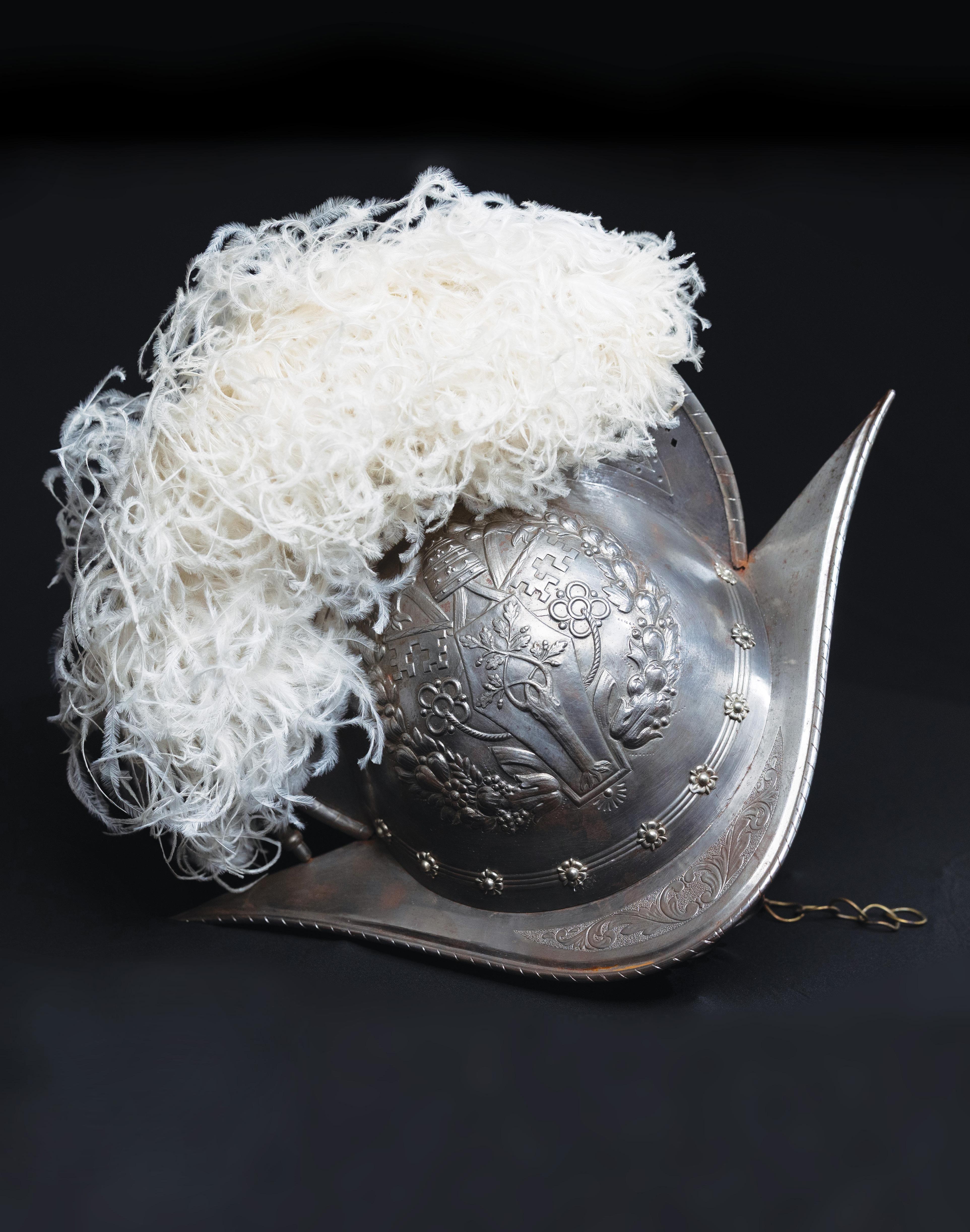
DAVE HRBACEK | THE CATHOLIC SPIRIT
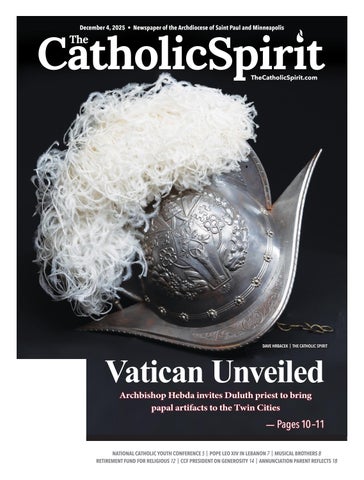
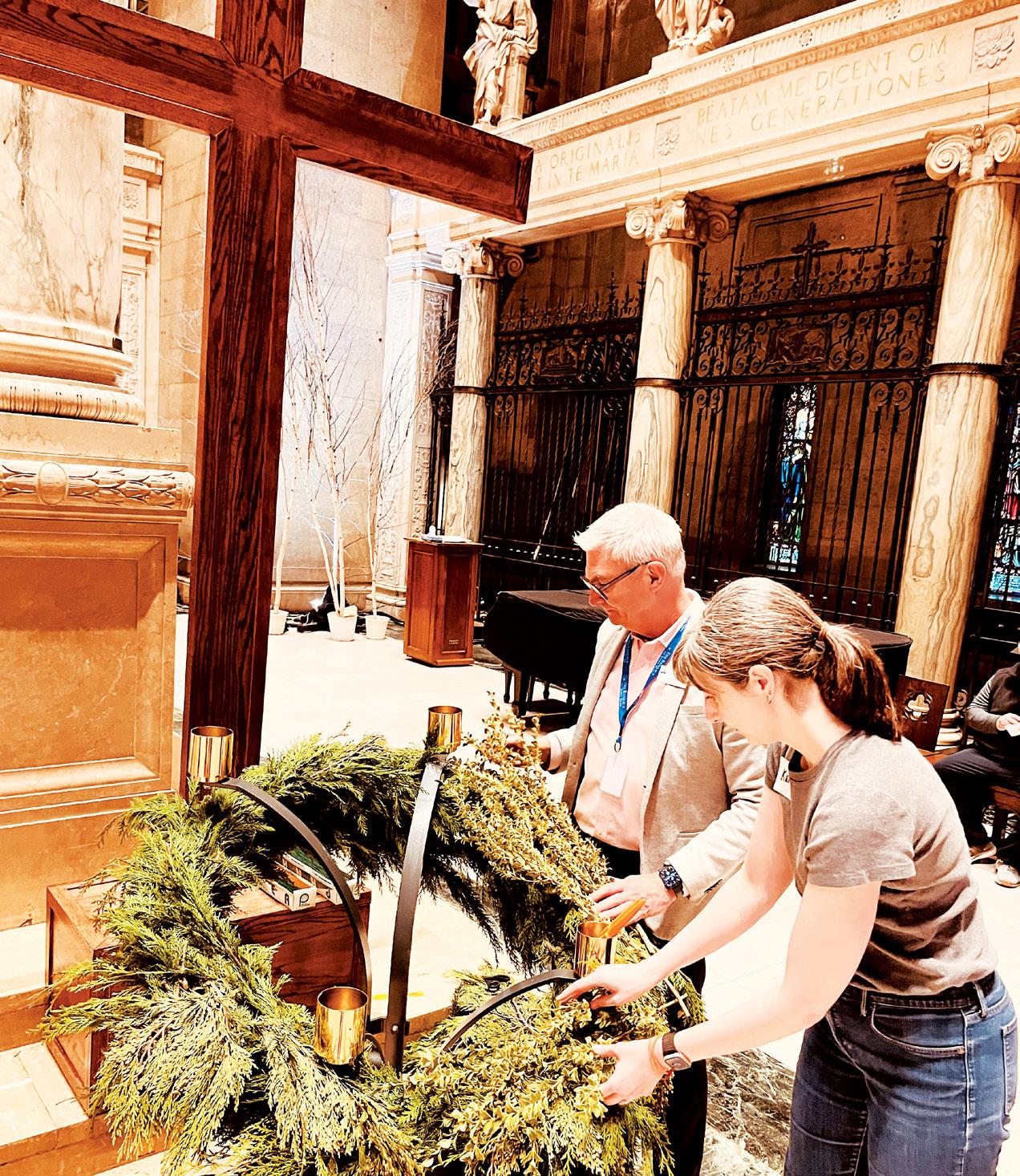
Johan van Parys, managing director of ministries and director of liturgy and the sacred arts at the Basilica of St. Mary in Minneapolis, left, helps parishioner Karla Edin prepare the Advent wreath at the Basilica. Advent began Nov. 30.
Produced by Relevant Radio and the Archdiocese of St. Paul and Minneapolis, the Nov. 28 “Practicing Catholic” radio show included Archbishop Bernard Hebda who talked about the mission and the heart of the U.S. Conference of Catholic Bishops. The program also included an interview with Father Evan Koop, a formator and assistant professor of dogmatic theology with The St. Paul Seminary in St. Paul, about the Church’s new document “Mater Populi Fidelis.” Listen to interviews after they have aired at archspm.org/faith-and-discipleship/practicing-catholic or choose a streaming platform at Spotify for Podcasters.
In a resolution passed Nov. 20, the Minneapolis City Council declared November as Harper Lillian Moyski Month. The declaration, made in honor of Moyski’s birth month, is a way to “carry forward her spirit of kindness, connection, and joy,” the resolution states. The 10-yearold was killed in a shooting during an all-school Mass Aug. 27 at Annunciation’s church in Minneapolis. “Her short life has already changed hearts, policies, and possibilities in Minneapolis and beyond, calling us to be brave, be bright, and be loud with our love,” the resolution states. Read the full resolution online at tinyurl.com/4wu9teca
Nov. 21, Sen. Amy Klobuchar, D-Minn., posted to social media that she met with Pope Leo XIV at the Vatican, presenting him with a U.S. Senate resolution honoring Annunciation Catholic Church and School students and families, as well as local law enforcement officers, who were affected by an Aug. 27 shooting during an all-school Mass at the Minneapolis church. “We pray for those we lost, the recovering survivors, and the entire Annunciation community,” Klobuchar wrote in her post. Senate Resolution 371 states, in part, that the Senate “condemns this senseless act of violence and offers its condolences to the families and loved ones of those killed and injured in the tragedy; honors the memory of the victims and stands in solidarity with survivors, the Catholic community, and the broader Minneapolis community; commends the bravery and service of law enforcement, first responders, school and church staff, and community members who acted swiftly to protect and help others; stands with the Annunciation Catholic Church and School community and all Minnesotans in the face of this terrible tragedy; (and) expresses hope that the Annunciation community, together with other communities scarred by gun violence across the country, will heal through unity, compassion, and shared faith.” Klobuchar delivered the resolution during a meeting she had with Pope Leo alongside a delegation from Ukraine calling for the return of thousands of Ukrainian children who have been forcibly taken to Russia. “Pope Leo is a true moral force for peace and justice and a champion for children around the world,” Klobuchar said in a statement, in part. “(W)e should all heed Pope Leo’s example of serving those in need, pursuing the common good, and calling for peace.”
St. Helena in Minneapolis is hosting a parish mission from Dec. 14 to 18. Each night will include a talk by Father Ben Cameron of the Fathers of Mercy. The order was founded in France in 1808 following the French Revolution. From the beginning, the Fathers of Mercy have been giving parish missions and working for the conversion of souls. Father Cameron carries on that mission as a full-time parish mission preacher and retreat master. He joined the Fathers of Mercy in 1992 and was ordained a priest in 1997. The order’s community in the United States has its headquarters in Auburn, Kentucky. Each night of the parish mission at St. Helena will feature confession from 6 to 7 p.m., followed by a talk by Father Cameron from 7 to 8 p.m. The Catholic Community Foundation of Minnesota (CCF) has named a new president to succeed Anne Cullen Miller effective Jan. 1: Christopher Nelson, who has been an executive at the foundation for more than seven years. Cullen Miller is retiring after nearly 18 years at CCF, 13 of those years as president (turn to page 14 for a Q&A with Cullen Miller). Most recently, Nelson has been executive vice president of the foundation. The St. Paul-based foundation stewards the financial resources and facilitates the charitable giving of individuals, families, parishes and institutions. It has $752 million in assets under management and issued $45 million in grants in fiscal year 2025 to support spiritual, educational and social needs in the community. Since it was established in 1992, CCF has issued more than $333 million in grants.
Musicians from the University of Mary are traveling to the Twin Cities from their campus in Bismarck, North Dakota, to perform a Christmas concert titled Luminosa: Cappella by Candlelight. The 7:30 p.m. Dec. 13 concert at the Cathedral of St. Paul in St. Paul will feature sacred music of Advent and Christmas. It will also feature choirs from Catholic and Christian schools including Chesterton Academy in Hopkins, Chesterton Academy of the St. Croix Valley in Stillwater, Cretin-Derham Hall and St. Agnes in St. Paul, Holy Family Catholic High School in Victoria, Trinity School at River Ridge in Eagan and Visitation School in Mendota Heights. A freewill donation is encouraged at the Cathedral, and people can visit luminosa@umary.edu to purchase a ticket for a social and dinner at the nearby Hill House with Msgr. James Shea, president of the University of Mary.
The Minnesota Court of Appeals upheld a decision out of Hennepin County Court in a case involving a former employee of Academy of Holy Angels in Richfield. According to a court filing, the employee had in 2024 sued the Academy of Holy Angels and the Archdiocese of St. Paul and Minneapolis, alleging the nonrenewal of an employment contract, based on considerations of “sex and sexual orientation/gender identity.” The Hennepin County Court had determined the claims of the former employee required an examination of the archdiocese’s “faith-based doctrines, the relationship between the Archdiocese and Holy Angels, church governance, and the provision of education through Holy Angels,” the court filing stated, and the district court had accordingly determined that “the religious freedom provisions in the United States and Minnesota Constitutions precluded (the former employee’s) claims.” According to the filing, the former employee then filed an appeal with the Minnesota Court of Appeals challenging the district court’s dismissal of the discrimination claims and requested a secular judgment be issued, “decreeing the Archdiocese’s implementation of Catholic doctrine in Catholic schools illegal” among other requests. In response, the Minnesota Court of Appeals upheld the district court decision and stated, “Granting such relief would be fundamentally at odds with the religious freedoms protected by the First Amendment, as envisioned by our founding fathers,” according to the published decision of the Court of Appeals.
OMASTIAK, News Editor
ONLY JESUS | BISHOP MICHAEL IZEN
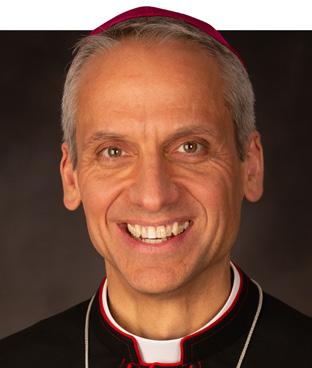
It is a beautiful time of year. Coming off the joy of Thanksgiving, we have all of Advent right in front of us. It is time to prepare for our Lord. We prepare both for his birthday at Christmas and for his second coming. On top of that, the Lord wants to come to us every day — physically in holy Communion and spiritually in our prayer.
It is the time of year when we will hear people say, “Jesus is the reason for the season” and “Keep Christ in Christmas.” Statements like these are good and true, but we need to live them. One way to keep the focus on Jesus during Advent is to spend a little more time in prayer, and to seek to recognize his presence. You might say, instead of focusing on our presents, we can focus on his presence.
There is no shortage of columns, articles, books, or podcasts about prayer. But I would like to focus on how we might begin our prayer time. For years now, I have tried to follow the practice of beginning my prayer time by simply becoming aware of God’s presence. I say something like, “The Lord looks upon me with great, great love.” I usually spend just under a minute contemplating that, imagining that, and taking a deep breath, and it helps.
Just this morning, I was reading a few pages from the spiritual classic, “Introduction to the Devout Life,” by St. Francis de Sales. I came across the section where St. Francis talks about meditation and the presence of God. He points out that there are multiple approaches to putting ourselves in God’s presence. With St. Francis’ help, I came up with five.
The first is one that St. Francis didn’t
Es una época hermosa del año. Tras la alegría del Día de Acción de Gracias, tenemos todo el Adviento ante nosotros. Es tiempo de prepararnos para nuestro Señor. Nos preparamos tanto para su cumpleaños en Navidad como para su segunda venida. Además, el Señor quiere venir a nosotros todos los días, físicamente en la Sagrada Comunión y espiritualmente en nuestra oración.
Es la época del año en la que oiremos decir: “Jesús es la razón de esta Navidad” y “Mantén a Cristo en la Navidad”. Afirmaciones como estas son buenas y ciertas, pero debemos vivirlas. Una manera de mantenernos enfocados en Jesús durante el Adviento es dedicar un poco más de tiempo a la oración y buscar reconocer su presencia. Se podría decir que, en lugar de centrarnos en nuestros regalos, podemos centrarnos en su presencia. Hay muchísimas columnas, artículos, libros o podcasts sobre la oración. Pero me gustaría centrarme en cómo podemos comenzar nuestro tiempo de oración. Durante años, he intentado seguir la
One way to keep the focus on Jesus during Advent is to spend a little more time in prayer, and to seek to recognize his presence.
mention. But when I think about being in God’s presence, my thoughts first go to placing myself in his real presence — in other words, in Eucharistic adoration. It is in holy Communion that Jesus is truly present. He tells us that he is the bread of life; he invites us to remain with him; and he even says things like, “Couldn’t you stay awake for just one hour?” So, for me, the first and primary way to place myself in God’s presence is in Eucharistic adoration. St. Francis begins with what he calls the “realization of God’s absolute presence.”
In other words, God is everywhere. He is in all things and all places. While the Blessed Sacrament holds the title of being his real presence — body, blood, soul and divinity — we know and believe that God is spiritually present everywhere. He is present in our homes, in a snowfall, in a meal, and in the warmth of our fireplace. In the beginning of our prayer we can acknowledge, “God is here.”
Another way to place ourselves in God’s presence is to remind ourselves that he is present in a most particular manner in our hearts. God is in us. He is closer to us than we are to ourselves. This can bring consolation when we are going through a difficult time. If we sometimes wonder if anyone appreciates our struggles and sufferings, the answer is yes, God knows.
The fourth way to consider how our Lord is with us is the method that I’ve been using
práctica de comenzar mi tiempo de oración simplemente tomando conciencia de la presencia de Dios. Digo algo como: “El Señor me mira con inmenso amor”. Suelo dedicar menos de un minuto a contemplar eso, imaginarlo y respirar hondo, y me ayuda. Justo esta mañana, leía algunas páginas del clásico espiritual “Introducción a la vida devota”, de San Francisco de Sales. Encontré la sección donde San Francisco habla sobre la meditación y la presencia de Dios. Señala que existen múltiples maneras de ponernos en la presencia de Dios. Con la ayuda de San Francisco, se me ocurrieron cinco. El primero es uno que San Francisco no mencionó. Pero cuando pienso en estar en la presencia de Dios, mi primera idea es ponerme en su presencia real; es decir, en la adoración eucarística. Es en la Sagrada Comunión donde Jesús está verdaderamente presente. Nos dice que es el pan de vida; nos invita a permanecer con él; e incluso dice cosas como: “¿No pudisteis estar despiertos ni una hora?”. Así que, para mí, la primera y principal manera de ponerme en la presencia de Dios es en la adoración eucarística. San Francisco comienza con lo que él llama la “percepción de la presencia absoluta de Dios”. En otras palabras, Dios está en todas partes. Está en todas las cosas y en todos los lugares. Si bien el Santísimo
for years. I first heard this from Oblate of the Virgin Mary Father Timothy Gallagher. He would say, “I become aware of the love with which God looks upon me.” My typical beginning prayer is remembering that the Lord looks upon me with great, great love. St. Francis de Sales puts it this way, “consider how our Savior in his humanity gazes down from heaven on all mankind.”
The fifth and final method is to imagine that Our Lord is sitting right next to us. For some, this is a more effective way to begin prayer and to begin speaking to the Lord as if he is right here.
I invite you to use one or more of these methods when you begin your prayer time. First spend a few moments to put yourself in God’s presence. You might try different methods. St. Francis de Sales recommends using only one method at a time, apart from placing ourselves in the real presence of Christ, which is always helpful. The important thing is that we put ourselves in God’s presence and we remind ourselves how close he is to us.
Once we have done that, we can continue with our prayer time. Perhaps this first step takes five, 10, or maybe even 15 minutes. If the only thing we accomplish in our prayer time is that we become aware of God’s presence, then that is a good prayer. But if there is time left over, after you place yourself in his presence, you might read
Sacramento ostenta el título de ser su presencia real — cuerpo, sangre, alma y divinidad — sabemos y creemos que Dios está espiritualmente presente en todas partes. Dios presente en nuestros hogares, en una nevada, en una comida y en el calor de nuestra chimenea. Al comenzar nuestra oración, podemos reconocer: “Dios está aquí”.
Otra manera de ponernos en la presencia de Dios es recordar que él está presente de una manera muy particular en nuestros corazones. Dios está en nosotros. Está más cerca de nosotros que nosotros. Esto puede brindarnos consuelo cuando atravesamos momentos difíciles. Si a veces nos preguntamos si alguien aprecia nuestras luchas y sufrimientos, la respuesta es sí, Dios lo sabe.
La cuarta manera de considerar cómo nuestro Señor está con nosotros es el método que he usado durante años. Lo escuché por primera vez del Padre Timothy Gallagher, Oblato de la Virgen María. Él decía: “Tomo conciencia del amor con el que Dios me mira”. Mi oración inicial típica es recordar que el Señor me mira con inmenso amor. San Francisco de Sales lo expresa así: “consideren cómo nuestro Salvador, en su humanidad, mira desde el cielo a toda la humanidad”.
El quinto y último método es imaginar que
from Scripture, you might pray the rosary, you might continue to meditate on his closeness, or you might try any of the other countless forms of prayer.
During this Advent season, may God bless you and those who are dear to you. And may you find joy and peace in placing yourself in God’s presence.
Archbishop Bernard Hebda has announced the following appointments in the Archdiocese of Saint Paul and Minneapolis:
Effective November 14, 2025
Reverend Phillip Rask, assigned as parochial administrator of the Church of Saint Odilia in Shoreview, while the pastor, Reverend James Peterson, is on a personal leave of absence.
Effective December 31, 2025
Deacon Charles Waugh, granted the status of a retired deacon. Deacon Waugh has been serving this archdiocese since his ordination in 1999, most recently at the Church of Saint Stephen in Anoka.
Nuestro Señor está sentado junto a nosotros. Para algunos, esta es una manera más efectiva de comenzar la oración y hablar con el Señor como si estuviera aquí. Te invito a usar uno o más de estos métodos al comenzar tu tiempo de oración. Primero, dedica unos momentos a ponerte en la presencia de Dios. Puedes probar diferentes métodos. San Francisco de Sales recomienda usar solo un método a la vez, además de ponernos en la presencia real de Cristo, lo cual siempre es útil. Lo importante es ponernos en la presencia de Dios y recordarnos lo cerca que está de nosotros. Una vez hecho esto, podemos continuar con nuestro tiempo de oración. Quizás este primer paso nos lleve cinco, diez o incluso quince minutos. Si lo único que logramos en nuestro tiempo de oración es tomar conciencia de la presencia de Dios, entonces es una buena oración. Pero si nos sobra tiempo, después de ponernos en su presencia, podemos leer las Escrituras, rezar el rosario, seguir meditando en su cercanía o probar cualquiera de las innumerables formas de oración.
Durante este Adviento, que Dios los bendiga a ustedes y a sus seres queridos. Y que encuentren alegría y paz al ponerse en la presencia de Dios.
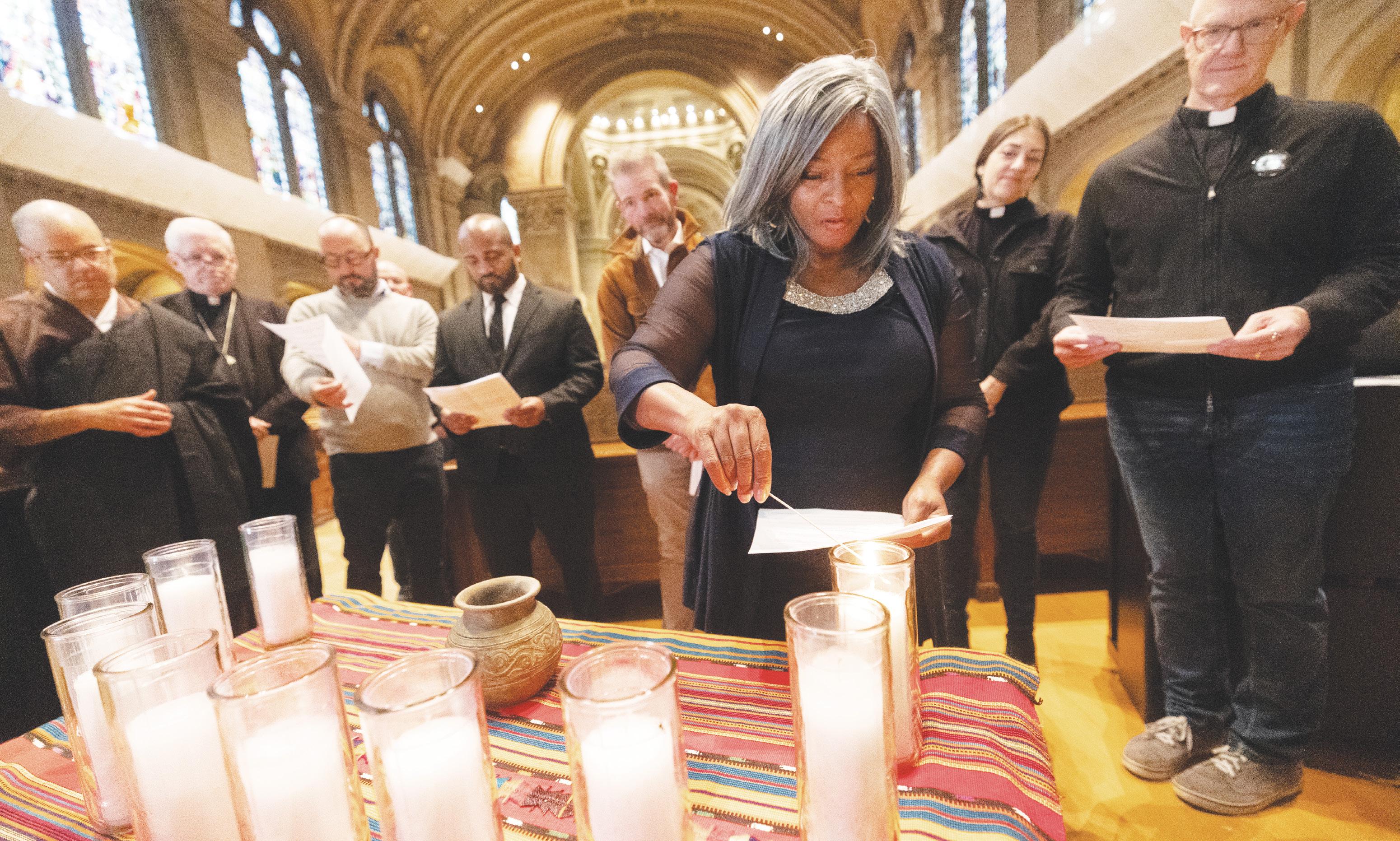
Betty Allen lights a candle at the Basilica of St. Mary in Minneapolis Nov. 25 as part of an event centered on homelessness called Losing Sleep, Losing Homes. The 57-year-old mother and grandmother in Waconia has experienced the vulnerability of having no place to live and shared her story at the event. Bishop Kevin Kenney, second from the left, of the Archdiocese of St. Paul and Minneapolis joined Allen, other faith leaders, community members and Minnesotans directly impacted by homelessness to urge the U.S. Department of Housing and Urban Development (HUD) to reverse proposed changes to the Continuum of Care program, changes that would cut funding for 3,600 Minnesotans and eliminate more than half of the state’s permanent supportive housing resources. “This affects all of us,” Bishop Kenney said, stressing that everyone needs to care about the struggles of those who are homeless. The noon gathering was the kickoff for a 12-hour vigil at the Basilica. “I would hope this (gathering and vigil) would bring light and open some eyes; this is a real issue,” Allen said. “I would love for them not to cut these programs. If it wasn’t for the programs that they have, I wouldn’t be able to afford (housing).”
DAVE HRBACEK | THE CATHOLIC SPIRIT
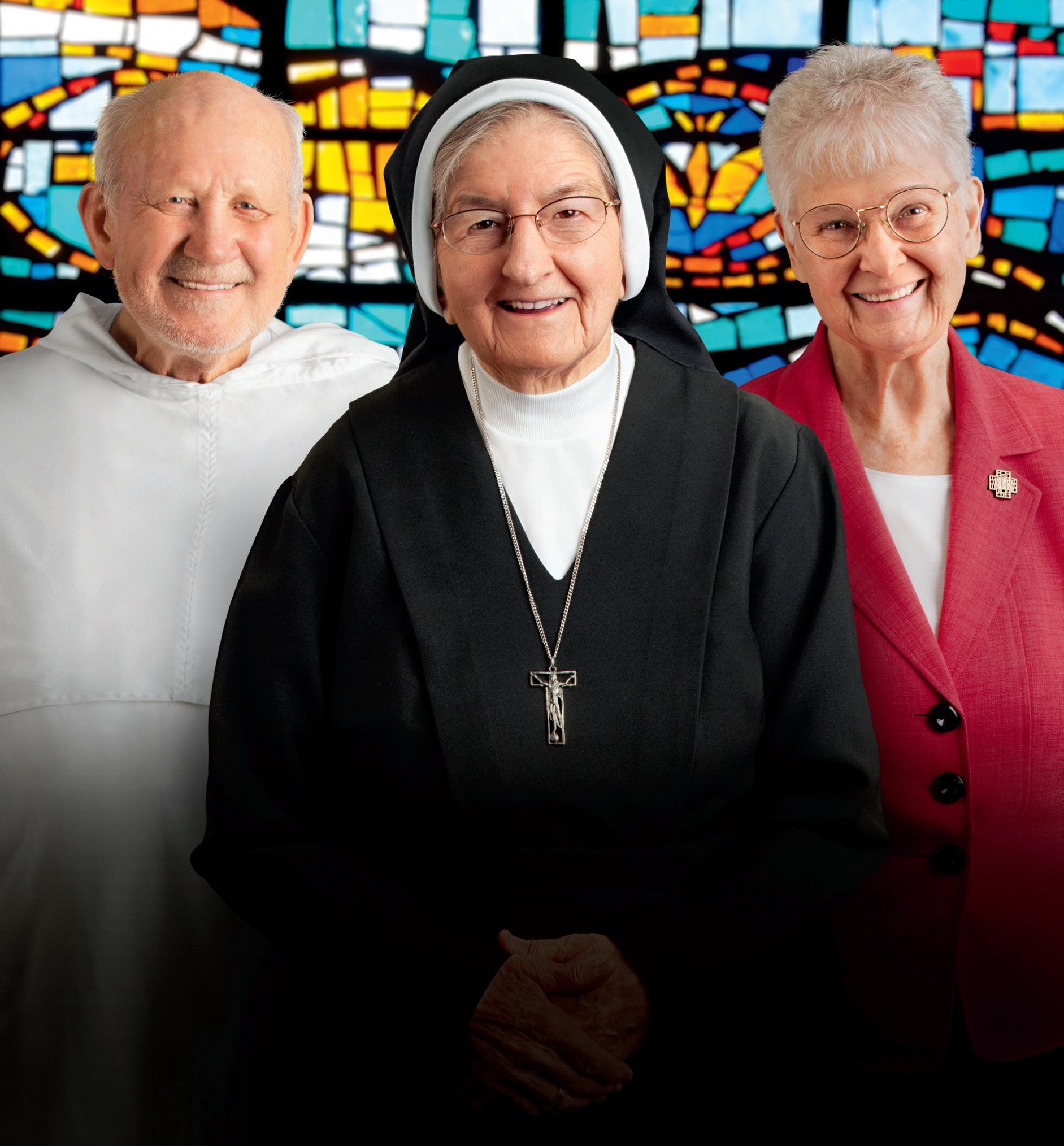
Please give to those who have given a lifetime.
Our senior sisters, brothers, and religious order priests need your help. Decades of caring for others with little or no pay have left many communities without sufficient retirement savings. Over 20,500 elderly religious depend on the Retirement Fund for Religious for health care, medication, and daily living expenses. Your gift helps ensure they receive the care they deserve. Please give back to those who have given a lifetime.
Please donate at your local parish, December 13–14, or by mail at: Archdiocese of St. Paul and Minneapolis Attn: Retirement Fund for Religious 777 Forest Street St. Paul MN 55106-3857 Make
By Joe Ruff The Catholic Spirit
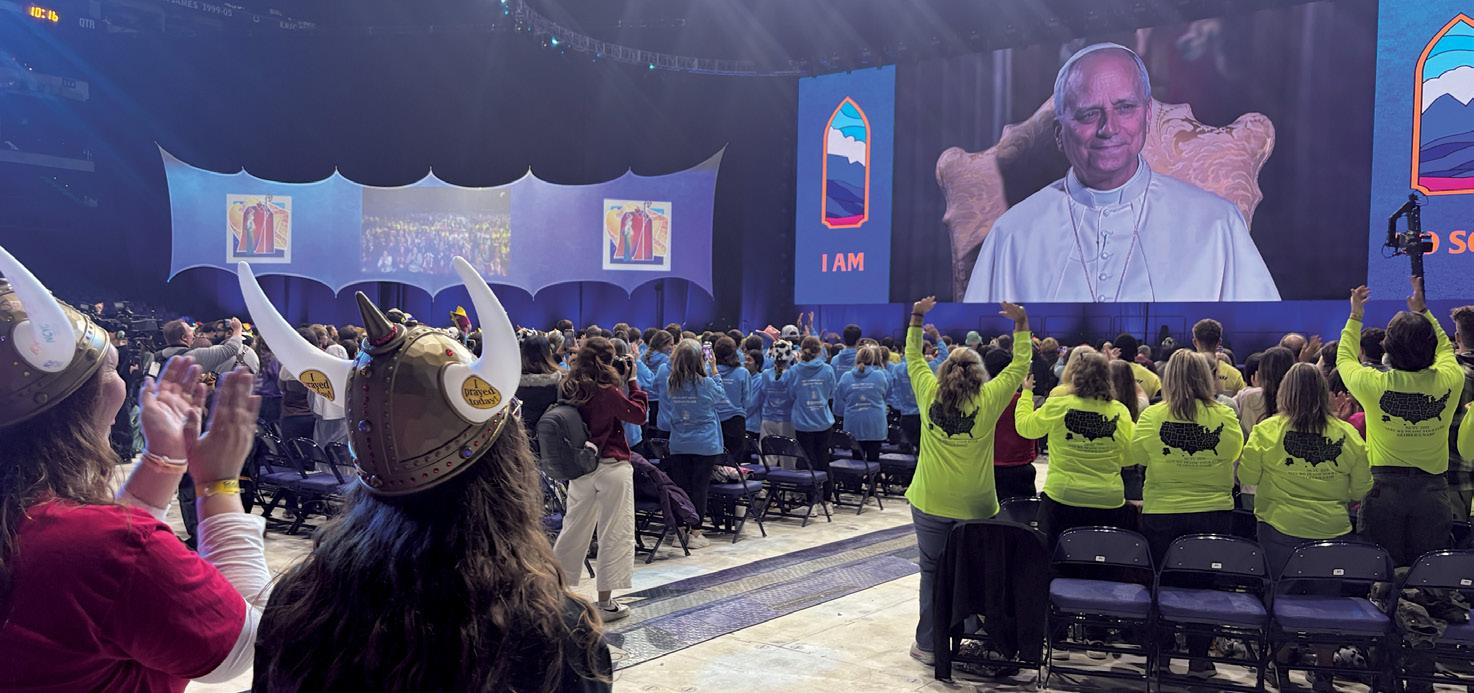
More than 50 young people and adults from the Archdiocese of St. Paul and Minneapolis — many joyfully wearing Viking helmets that stood out in the crowd — joined the first American pope via livestream at the Nov. 21-22 National Catholic Youth Conference in Indianapolis.
“The Lord invites us to grow through our challenges,” Pope Leo XIV said from the Vatican Nov. 21 while answering questions about how to help one another through hard times. “True friends push us to seek help when life gets difficult and confusing.”
High schoolers from Risen Savior and Mary, Mother of the Church in Burnsville; St. Joseph in New Hope; St. Michael in Prior Lake; and Incarnation in Minneapolis traveled with Amy Schroeder, director of youth formation at Mary, Mother of the Church, and other adult chaperones.
Archbishop Bernard Hebda accompanied them at Lucas Oil Stadium, where 16,000 young people from around the country gathered for the annual conference to hear speakers and hold breakout sessions, attend Mass and Eucharistic adoration, and share their faith stories.
“What a magnificent experience to recognize that the first time the Holy Father was going to be that present to the Church in the United States was with our young people,” Archbishop Hebda said. “Even we as bishops haven’t had that privilege. It was amazing to be part of that today. The questions that he got were excellent, and his responses were terrific as well.”
The pope responded to questions from five high school students: Mia Smothers from the Archdiocese of Baltimore; Ezequiel Ponce from the Archdiocese of Los Angeles; Christopher Pantelakis from the Archdiocese of Las Vegas; Micah Alcisto from the Diocese of Honolulu; and Elise Wing from the Archdiocese of Dubuque, Iowa. The questions were developed in meetings with other students and adults and were sent to the pope in advance.
The pope addressed such varied subjects as life in the sacraments, struggling with mental health issues, the intersection of technology and faith and the future of the Church.
Georgia Bassi and Greta Dickhausen, members of Mary, Mother of the Church and seniors in high school — Bassi at Lakeville South High School in Lakeville and Dickhausen at Burnsville High School in Burnsville — said they enjoyed and respected what the pope shared in his nearly hour-long session with the youth.
“I really liked when he said the Church doesn’t have political parties,” Bassi said, referring to the pope urging the young people to be careful not to use political categories when talking about faith.
“The Church does not belong to any political party,” Pope Leo said. “Rather, she helps form your conscience so you can think and act with wisdom and love.”
Dickhausen said it was apparent that the pope was excited and happy to hear from those gathered. “He talked about good and relevant topics,” she said.
Diana Hernandez Cordova, a freshman in pre-nursing at St. Catherine University in St. Paul and a member of Incarnation, helps lead confirmation classes at the parish for freshmen in high school. She said she hopes to use what she learned about her faith at the conference to more readily engage young people who have questions, rather than teach
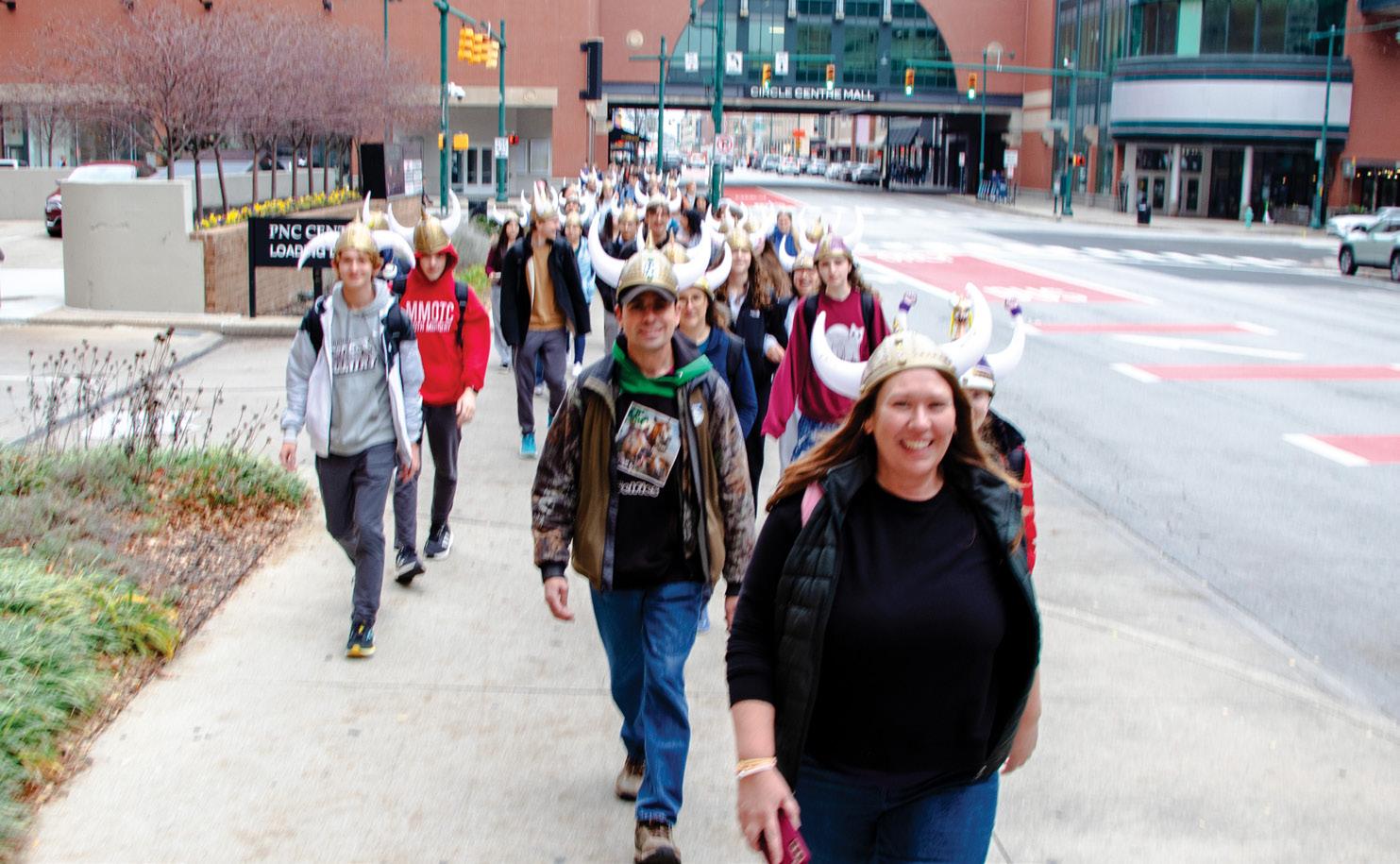
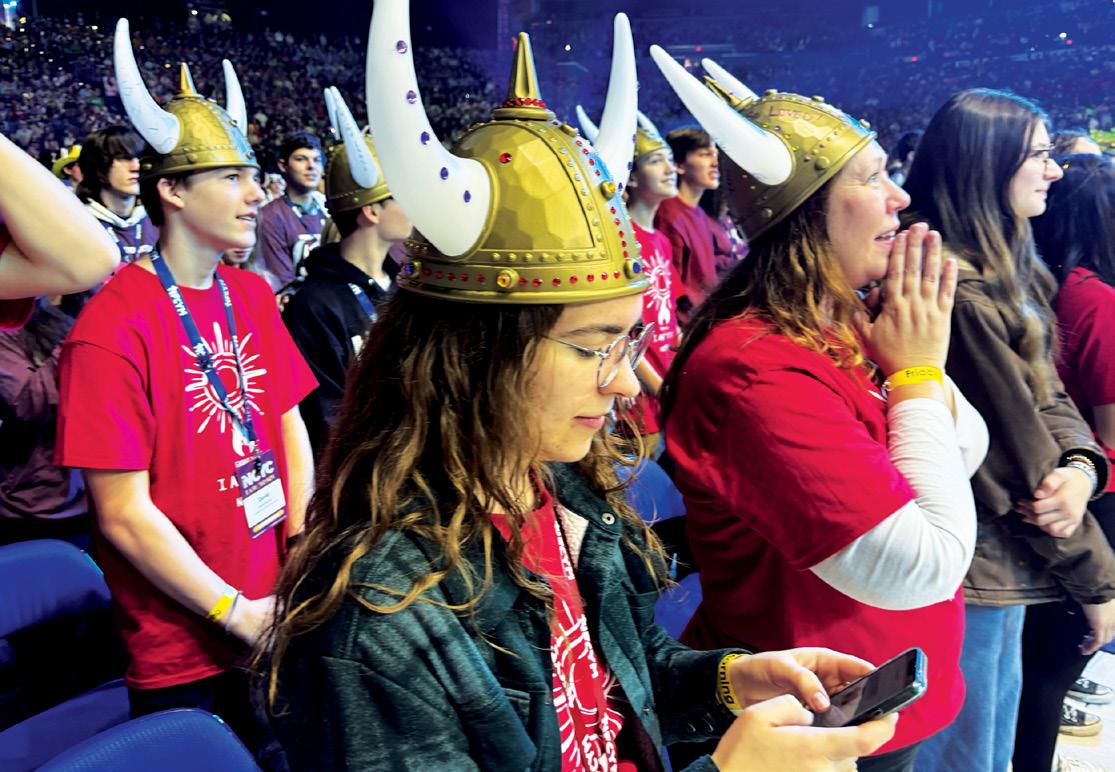
Shannon Rouston, a youth minister at St. Elizabeth Ann Seton in Hastings, foreground, holds her phone during the conference. With her on the far left is David Matlon of Mary, Mother of the Church in Burnsville, and on the right, wearing a Viking helmet, is Amy Schroeder, director of youth formation at the Burnsville parish.
them without seeking feedback.
Building relationships in that way can help people “find their way in Christ and know that they belong to a big community,” she said. “They are welcome no matter what struggles they might have.”
Pope Leo XIV’s livestream appearance was a surprisingly emotional experience for her, Hernandez said.
“As soon as he popped up on the screen, I started to shed tears,” she said. “I couldn’t believe how happy I felt at seeing him smiling.”
Hernandez was at the conference with Deacon Ramón García Degollado, family life coordinator in the archdiocese’s Office of Latino Ministry and pastoral minister at Incarnation, and four other leaders of Incarnation’s youth group, which consists of about 20 high schoolers and young adults. In addition to being inspired to build relationships, the young leaders returned to Incarnation with ideas for activities and a
By Josh McGovern
The Catholic Spirit
In an eventful pilgrimage to Lebanon, Bishop Michael Izen hoped to connect with the ancestry of the Catholic Church. In a surprise to him, Bishop Izen found himself in a home having dinner with his own family, distant relatives still living in Lebanon.
The Kazans — the original Izen surname — invited Bishop Izen into one of their family member’s homes and treated him like they’d known him his whole life, he said. They told him that they would often talk about the family members who moved to Minnesota. They were elated to discover one became a bishop, Bishop Izen said.
desire to hold more retreats, she said.
Archbishop Hebda said the pope reminded those present that “the young Church is not the future Church; it’s the present Church. Certainly, we experience that in spades in these days. It was just such a privilege to be with these young people (who) are searching for the Lord and who are so open to the promptings of the Holy Spirit.”
Dickhausen was among several young people who helped the crowd prepare for the session with the pope in morning prayer. Speaking before the thousands gathered, she read one of her favorite passages in the Bible, from the Second Letter to Timothy, chapter 1, verses 7-9, which begins, “For God did not give us a spirit of cowardice but rather of power and love and self-control.”
Cindy Wooden of Catholic News Service contributed to this report
Chorbishop Sharbel Maroun, pastor of St. Maron in Minneapolis — a parish that celebrates the Maronite Rite commonly practiced in Lebanon’s Catholic Church — invited Bishop Izen on the trip. The chorbishop also called the mayor of Ferzol, the town the Kazans live in.
After Mass in the town, four Kazan brothers showed up to meet Bishop Izen. One of the Kazan cousins took him for a tour that day, driving by what was Bishop Izen’s great-grandfather’s house. That night, at dinner, Bishop Izen met 25 of his distant relatives.
“Their dad is ... maybe 70 years old,” Bishop Izen said. “He had to kiss me on both cheeks. He said it was such a great day for him to meet me.”
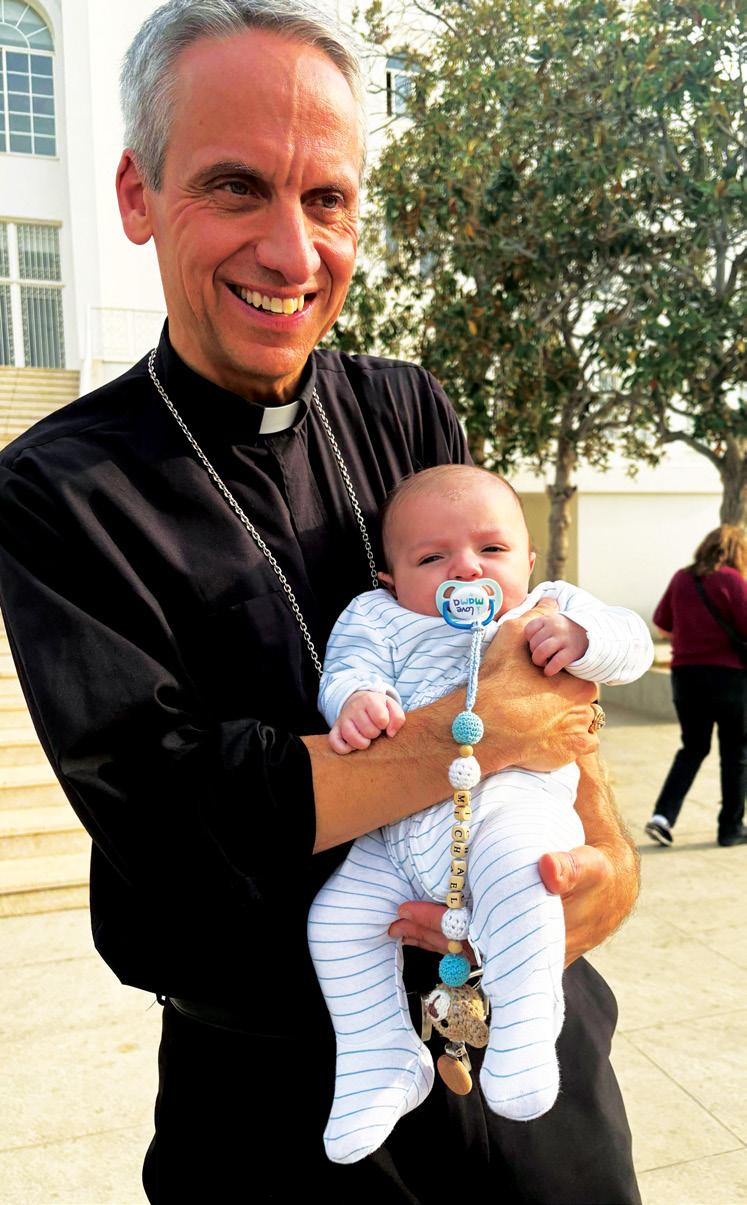
At the Kazan house, Bishop Izen met a newborn baby named Michael Kazan.
“It’s the closest I’ve come to meeting a Michael Izen,” Bishop Izen said. “The mother said, ‘What would make this so much better is if you could somehow baptize him.’”
With both Bishop Izen and the family rearranging things to make that happen,
By Susan Klemond For The Catholic Spirit
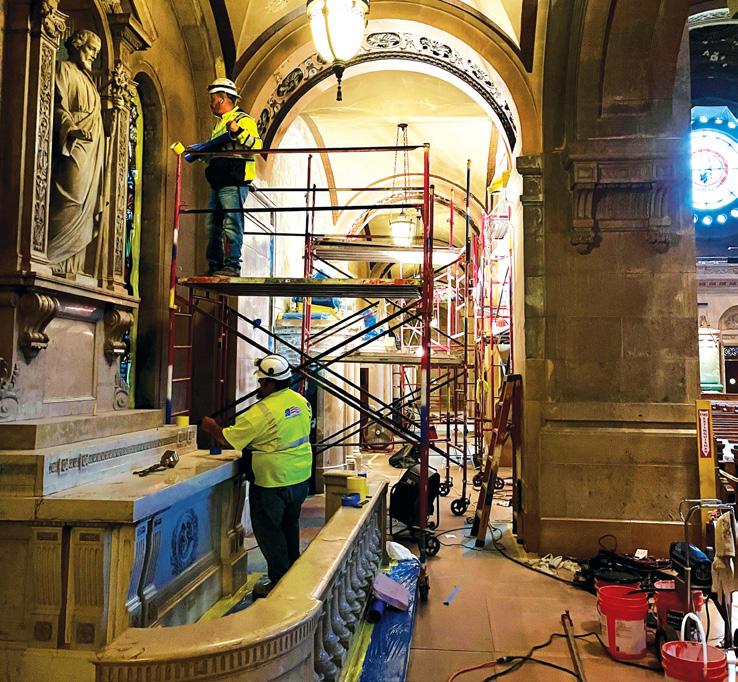
When restorers at the Basilica of St. Mary in Minneapolis cleaned a small section of the building’s Mankato limestone and stained glass earlier this year, their work revealed a particular beauty — not in making the materials “bright as new” but in preserving them in a way that reflected the generations who have prayed and found peace in the church built more than 100 years ago.
In selecting methods to clean and preserve the stone as part of the Basilica’s Restoring Beauty, Inspiring Hope interior and exterior restoration effort, parish leaders sought to honor its history, said Johan van Parys, the Basilica’s managing director of ministries and director of liturgy and the sacred arts.
“We don’t want the church to look like it did in 1914 because we want to honor all the people who have worshipped here at all the services, and who got married, got buried,” he said. “We want to keep a certain patina … and not strip that away.”
As the Basilica prepares to begin the interior part of its multi-phase restoration work and expand its fundraising to the broader public, it has been designated to receive $15 million for the restoration from the Archdiocese of St. Paul and Minneapolis’ Lord, Renew Your Church capital campaign.
The Cathedral of St. Paul in St. Paul has been given the same amount for essential renovations and upgrades. The co-cathedrals are vital to the local Church’s identity and unity because of their history and role as gathering places of faith and community, according to the archdiocese’s campaign webpage at archspm.org/lordrenewyourchurch
The Basilica will use the archdiocesan funds to rebuild its “monumental stairs,” which rise from the street and lead into the
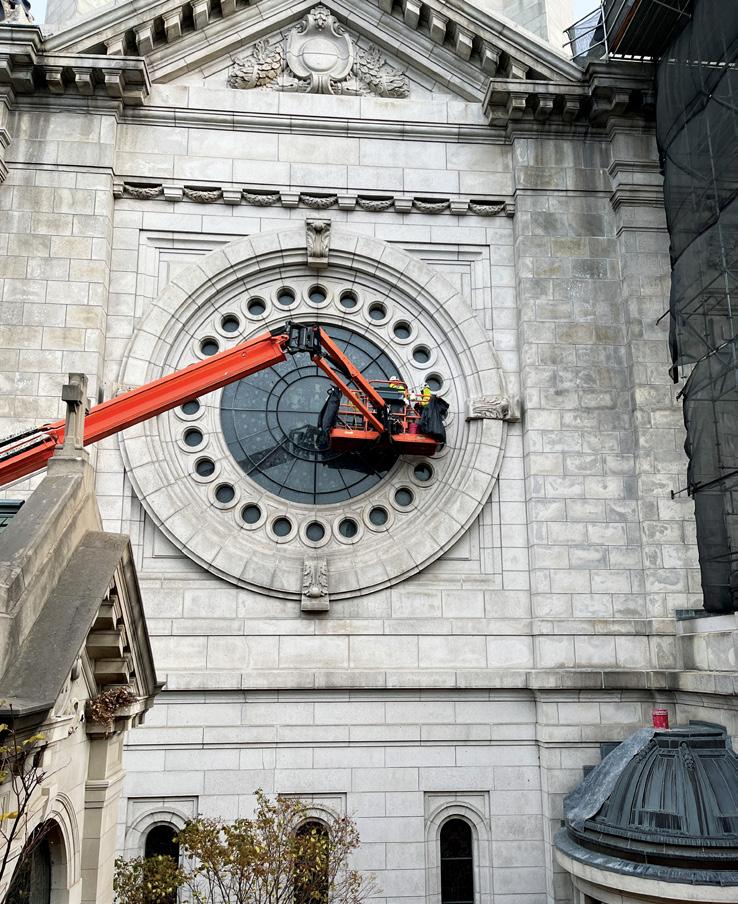

The Archdiocese of St. Paul and Minneapolis’ Lord, Renew Your Church campaign is committed to raising $250 million to strengthen parishes; educate youth for discipleship; help preserve the Basilica of St. Mary in Minneapolis and the Cathedral of St. Paul in St. Paul; provide for the needs of active, retired and future clergy; and help care for others in the archdiocese who are in need.
church. The funds also will help workers restore interior plaster and stonework, refurbish the organ and paint areas that need it, said Mae Desaire, Basilica communications director.
“We’re very grateful for the support of the archdiocesan campaign,” said Father Daniel Griffith, the Basilica’s pastor and rector, during a recent interview.
The Basilica is a landmark parish where many important liturgies have taken place.
But the comprehensive restoration project is about more than offering beautiful liturgies, he said.
“The restoration of our historic church and its beauty will strengthen our mission by providing an inspiring temple of God’s presence where we are formed, fed, united,
and sent into the world to live as disciples of faith and hope — lifting a broken world and serving others as Christ has served us,” Father Griffith wrote on the restoration campaign’s website at restoreourbasilica.org
In February, the Basilica will celebrate the 100th anniversary of Pope Pius XI’s raising the church to the dignity of a minor basilica, the first in the United States, Father Griffith said.
After Easter Sunday, the Basilica will temporarily move its liturgies downstairs to Teresa of Calcutta hall, van Parys said. The pews will be removed and refinished and space in the nave will be adjusted to improve accessibility, he said.
Basilica leaders hope to resume use of the main church by Holy Week of 2027, van Parys said.
Exterior work began in 2024, including tuck pointing, roofing and lighting. The exterior needs were addressed first “to prevent water intrusion so that we didn’t restore the interior and then still have the problem ... of water getting in,” said Nathan Mueting, the Basilica’s managing director of mission advancement.
Mitigation of the exterior water intrusion problem will resume in the spring. Replacing the substructure under the Basilica’s granite “monumental stairs” will be the final exterior phase of the restoration.
Water intrusion made it necessary to install netting on the sides of the nave inside the church in 2023 to catch falling plaster, van Parys said. “Water is not a friend of stone, limestone or plaster,” he said.
As renewing and revitalizing the Basilica of St. Mary is made possible with the archdiocese’s assistance and all donors, Father Griffith encouraged archdiocesan Catholics
LORD, RENEW YOUR CHURCH CONTINUED ON NEXT PAGE
By Rebecca Omastiak
The Catholic Spirit
As Catholics participate in the season of giving, Marci Franzen, director of the Catholic Services Appeal (CSA) within the Archdiocese of St. Paul and Minneapolis’ Office of Mission Advancement, encouraged the faithful to consider the CSA and the ways it assists ministries throughout the archdiocese.
In describing the CSA, Franzen told “Practicing Catholic” co-hosts Leah Heselton and Father Tom Margevicius: “It is our response as the Catholic community to support the day-to-day needs of the important ministries of our archdiocese. These are very driven by our shepherd, Archbishop (Bernard) Hebda. As he has said, blessings are multiplied when we all come together for the greater good, and the ministries that we support are really ministries that are too great for one parish to provide. And that’s why we have come up with the Catholic Services Appeal.”
During a segment of the show that aired Nov. 21 on Relevant Radio 1330 AM, Franzen emphasized three “buckets” of ministry to which CSA dollars flow: “educating faith, discipleship and evangelization, and helping those in need,” explaining that these focuses are “closest to the archbishop’s heart.”
Franzen explained “that’s what really drives the (CSA) and everything we do from who we support, how we interact with
donors, and how we go about fundraising for the entire year.”
New this year, ministries across the archdiocese received one-time grants through the CSA, on top of regular monthly support that the appeal offers, Franzen shared.
As an example, Franzen said one grant is going toward “bringing music ministry into the prisons” as part of prison ministry within the archdiocese. Another example, Franzen said, was a grant to help hospital chaplains “with the expenses that they incur when they go to do their ministry,” such as covering the costs of parking at area hospitals.
There are many examples like this, Franzen said. “Each ministry is giving us impact. They’re showing us what they’re
doing. There is no mystery to where these dollars are going and that they are being used well.”
A 2024 Catholic Services Appeal Impact Report highlighted some of the ways CSA funds were utilized. Of the $8.5 million raised in 2024, the report stated 58% went toward ministries educating in faith, 27% went toward ministries helping those in need, and 15% went toward ministries focusing on discipleship and evangelization.
The report indicated the CSA supported 400 of the 2,550 students receiving scholarships through its partnership with the St. Paul-based Aim Higher Foundation, as one example of educating in faith. Meanwhile, CSA funds also went toward
The following explanation on how the Catholic Services Appeal (CSA) is different from the Lord, Renew Your Church (LRYC) capital campaign comes from a webpage of the CSA, as part of the Office of Mission Advancement within the Archdiocese of St. Paul and Minneapolis:
The annual Catholic Services Appeal (CSA) funds the immediate needs of the many important ministries of the archdiocese, as chosen by Archbishop Hebda. These ministries include K-8 and high school scholarships, campus ministry support, helping those in need, providing prison and hospital chaplains, supporting faith-based programs and right to life initiatives.
The Lord, Renew Your Church (LRYC) campaign is a multi-year capital campaign to support the long-term needs of our parishes and archdiocese. The LRYC campaign is raising funds to strengthen parishes, enhance education, sustain the Cathedral of St. Paul and the Basilica of St. Mary, care for clergy and future clergy and provide funds for the Church to respond to crises such as natural disasters, homelessness and other extraordinary requests for assistance. To learn more about LRYC, please visit archspm.org/lordrenewyourchurch.
specific housing needs, including helping 200 youth find safe housing, helping more than 300 seniors move into permanent housing, and helping 550,000 find “safe nights of housing and shelter,” according to the report. Additionally, CSA funds helped support discipleship and evangelization efforts, through small group support, YDisciple youth ministry subscriptions for all archdiocesan parishes and Catholic schools, helping with marriage preparation and youth retreat costs throughout the archdiocese, and supporting training for natural family planning instructors and parish youth ministers, the report stated.
In a letter introducing the report, Archbishop Hebda wrote that thanks to the generosity of donors, “we have been able to educate our youth, tend to the sick, minister to the imprisoned and spread Christ’s love and the Good News of the Gospel throughout our archdiocese and beyond.”
Franzen said she and others in the Office of Mission Advancement are struck by “the incredible generosity of the people in our archdiocese” when it comes to the gifts that are received.
“We are blown away on a daily basis (by) people who not only thank me for what we are doing, but give incredible gifts,” she said.
Franzen said there is a goal to raise $9 million this year; by visiting csa.archspm.org, those interested can find additional information on the ministries the CSA supports, as well as different ways to give.
By Cindy Wooden Catholic News Service
At a shrine topped by a 28-foot statue of Our Lady of Lebanon, Pope Leo XIV listened Dec. 1 to stories of unshakable faith amid war, injustice and suffering.
The pope began the day at the tomb of St. Sharbel at the Monastery of St. Maron in Annaya, a place known for its atmosphere of silent prayer, especially in difficult moments. Millions of people visit St. Sharbel’s resting place every year, and now for the first time, a pope visited as well.
Despite intermittent rain, thousands of people gathered along the road leading to the monastery, tossing rose petals or rice as a sign of welcome.
After entrusting the Catholics of Lebanon and the entire country to St. Sharbel’s care, Pope Leo went to the Shrine of Our Lady of Lebanon in Harissa and listened, like St. Sharbel often did, to the cries of people’s hearts.
Lebanon was the second leg of a papal trip that began Nov. 28 in Turkey, at an archaeological site to celebrate the enduring faith set out in the Nicene Creed.
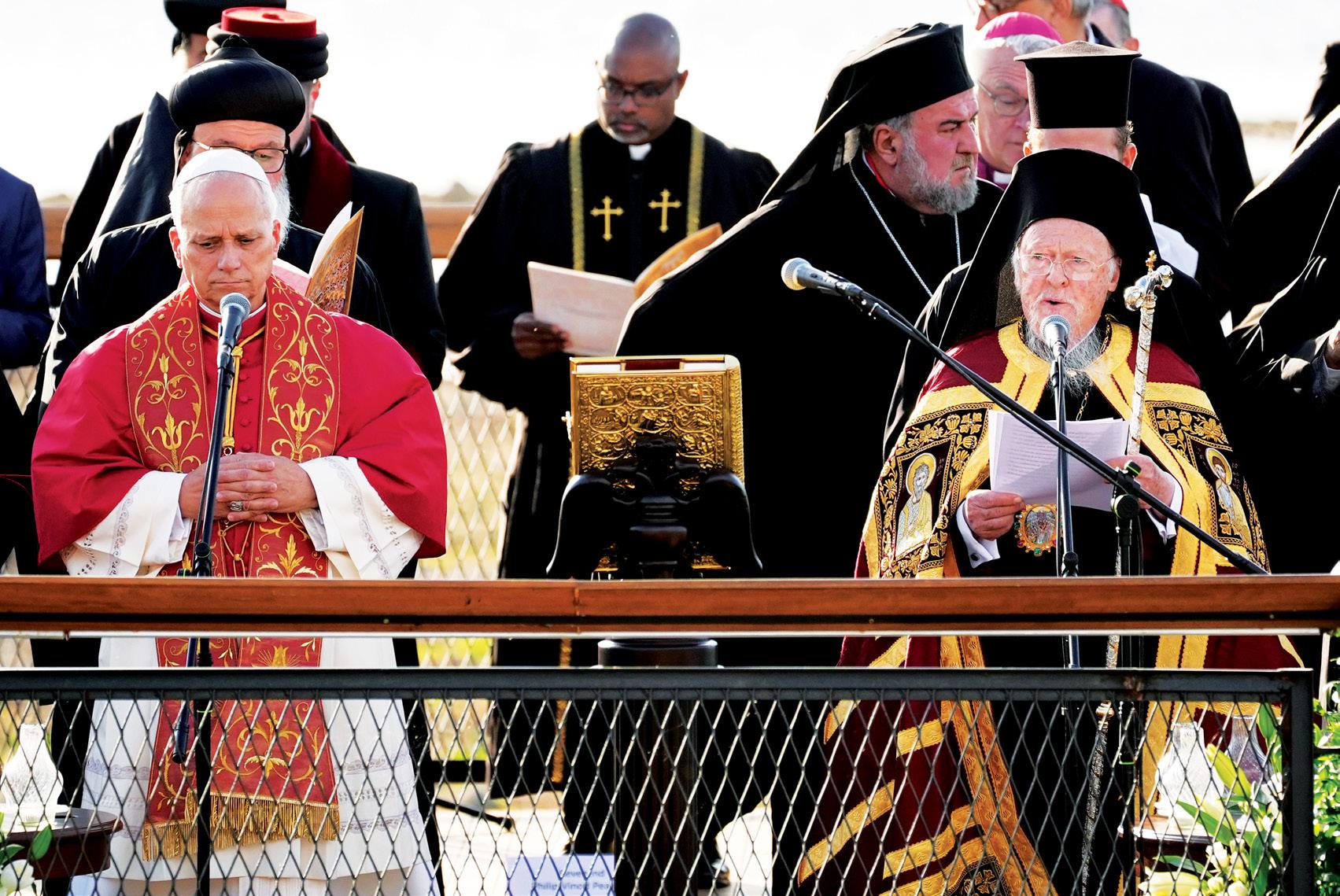
Orthodox Ecumenical Patriarch Bartholomew of Constantinople hosted the ecumenical prayer service and the common recitation of the Creed at Iznik, site of the ancient Nicaea, about 80 miles southeast of Istanbul.
With the Greek Orthodox patriarchs of Antioch, Alexandria and Jerusalem or their representatives, and with representatives of other Orthodox, Anglican and Protestant churches, Pope Leo marked the 1,700th anniversary of the Council of Nicaea — the primary motive for his first foreign trip as pope.
The joint recitation of the Creed did not include the phrase known as the “filioque” — the statement that the Holy Spirit “proceeds
BISHOP IZEN CONTINUED FROM PAGE 5
Bishop Izen baptized the baby Dec. 2.
from the Father and the Son” — since the phrase is not used by the Orthodox because it was inserted into the Latin Creed by Pope Benedict VIII in 1014.
Recent popes, including Pope Benedict XVI, Pope Francis and Pope Leo, have omitted the phrase at ecumenical prayer services.
Standing on a platform overlooking the remains of the Basilica of St. Neophytos, now partially submerged in Lake Iznik, the church leaders took turns leading the prayers — in English, Greek and Arabic — and lighting candles as a Catholic choir, singing in Latin, and an Orthodox choir, singing in Greek, alternated.
Patriarch Bartholomew, welcoming the pope and other guests, noted that “despite so many intervening centuries and all the upheavals, difficulties and divisions they have brought, we nevertheless approach this sacred commemoration with shared reverence and a common feeling of hope.”
“The power of this place does not reside in what passes away, but in what endures forever,” he said.
Speaking after the patriarch, Pope Leo told his fellow Christian leaders that at a time when humanity is “afflicted by violence and conflict,” the world “is crying out for reconciliation.”
“The desire for full communion among all believers in Jesus Christ is always accompanied by the search for fraternity among all human beings,” he said. “In the Nicene Creed, we profess our faith ‘in one God, the Father.’ Yet, it would not be possible to invoke God as Father if we refused to recognize as brothers and sisters all other men and women, who are created in the image of God.”
Though united by faith, the Russian Orthodox Church — the largest of the world’s Eastern Orthodox churches — was not represented at the service. The Russian church broke relations with the Ecumenical Patriarchate over the recognition in 2018 of
Though Bishop Izen and Pope Leo XIV crossed paths while in Lebanon, Bishop Izen didn’t get a chance to meet the pontiff. But Bishop Izen visited the gravesite of St. Sharbel, a Lebanese Maronite monk and priest, as did Pope Leo. The Monastery of St. Maron in Annaya documented countless miracles and blessings attributed to
the autonomy of the Ukrainian Orthodox Church.
Belief in God the Father, Pope Leo said while in Iznik, means “there is a universal fraternity of men and women regardless of ethnicity, nationality, religion or personal perspectives.”
With many of the Christian leaders, especially the Oriental Orthodox, coming from nations that recently faced or are facing war and persecution, Pope Leo said Christians must give concrete witness to their belief that all people are children of one God and therefore brothers and sisters to each other.
“Furthermore, we must strongly reject the use of religion for justifying war, violence or any form of fundamentalism or fanaticism,” he said. “Instead, the paths to follow are those of fraternal encounter, dialogue and cooperation.”
While in Lebanon Nov. 30-Dec. 2, the pope repeatedly called for peace, justice and a concerted effort by all Lebanese to build a better future for themselves and their families.
While at the Shrine of Our Lady of Lebanon in Harissa, he listened to the experiences of those caught in war, including Father Youhanna-Fouad Fahed, a married Maronite Catholic priest and pastor of a parish near the Syrian border. His village welcomed Syrian refugees from the Syrian civil war that began in 2011 and was repeatedly struck by shelling from the Syrian side of the border. In December 2024, when the civil war officially ended, more refugees came.
“The collection bag during Sunday Mass revealed to me a first, silent cry. I noticed Syrian currency inside. It was an offering mingled with pain,” Father Fahed told the pope.
“Alone, feeling my people’s suffering smothered by fear, the misery concealed by the shame of asking for help, I went in search of them,” the priest said. Some told him they had fled to protect their daughters from forced
St. Sharbel. While there, Bishop Izen knelt and prayed a long list of intentions he was given by people requesting prayers.
One of the great things about Pope Leo’s visit, Bishop Izen said, is that “the rest of the universal Church can learn about St. Sharbel.”
But one of his own favorite parts about the trip was getting to know the Kazan family and the people he traveled with, Bishop Izen said.
marriage, and many arrived in Lebanon hoping to eventually migrate to Europe, even if that meant “entrusting their dreams to migrant smugglers who stole their savings.”
All Father Fahed asked of Pope Leo was a word of comfort so the people would not feel forgotten and alone.
Sister Dima Chebib is a member of the Sisters of the Sacred Hearts of Jesus and Mary and director of a school in Baalbeck, which is considered by many to be a stronghold of the Hezbollah militia and has been struck repeatedly by Israeli shelling in the past year.
While many people fled the town, she said, the priests and religious of the Melkite Catholic diocese “decided to stay and welcome the refugee families — Christian and Muslim — who came seeking safety and peace. We shared bread, fear and hope. We lived together, prayed together and supported one another in fraternity and trust.”
“In the heart of war,” she told the pope, “I discovered the peace of Christ. And I give thanks to God for this grace of remaining, loving and serving to the end.”
Pope Leo responded to the testimonies by saying that just as for St. Sharbel in the 19th century, so too today “it is in being with Mary at the foot of Jesus’ cross that our prayer — that invisible bridge which unites hearts — gives us the strength to continue to hope and work, even when surrounded by the sound of weapons and when the very necessities of daily life become a challenge.”
Pope Leo XIV ended his stay in Lebanon Dec. 2 with what he termed “a heartfelt appeal: May the attacks and hostilities cease.”
“We must recognize that armed struggle brings no benefit,” he said at the Beirut airport before returning to Rome. “While weapons are lethal, negotiation, mediation and dialogue are constructive. Let us all choose peace as a way, and not just as a goal!”
“I think you just get to know people on pilgrimage,” Bishop Izen said. “You get to know them well and make those friendships. … This trip has been amazing, more amazing than expected. This country is beautiful.”
The Nov. 25 to Dec. 5 pilgrimage was coordinated by St. Maron parish. Four parishioners traveled with Bishop Izen, Chorbishop Maroun and Father James Burns, president of St. Mary’s University of Minnesota in Winona.
LORD, RENEW YOUR CHURCH CONTINUED FROM PREVIOUS PAGE A Christmas Gift for the Catholic Men in Your Life
to support renewal and revitalization of the entire archdiocese by contributing to the Lord, Renew Your Church campaign.
“I just want to express my profound gratitude to all the donors to the Lord, Renew Your Church campaign,” he said. “On behalf of the entire Basilica community, my heartfelt gratitude to all of you for your generosity for helping us restore this gem of a church, America’s first Basilica.”


Becoming a Happier Catholic Man – 2026 has the power to transform our husbands, our marriages, our families, and our homes.” Nancy Bandzuch | Catholic Sprouts

By Mark Johnson
For The Catholic Spirit
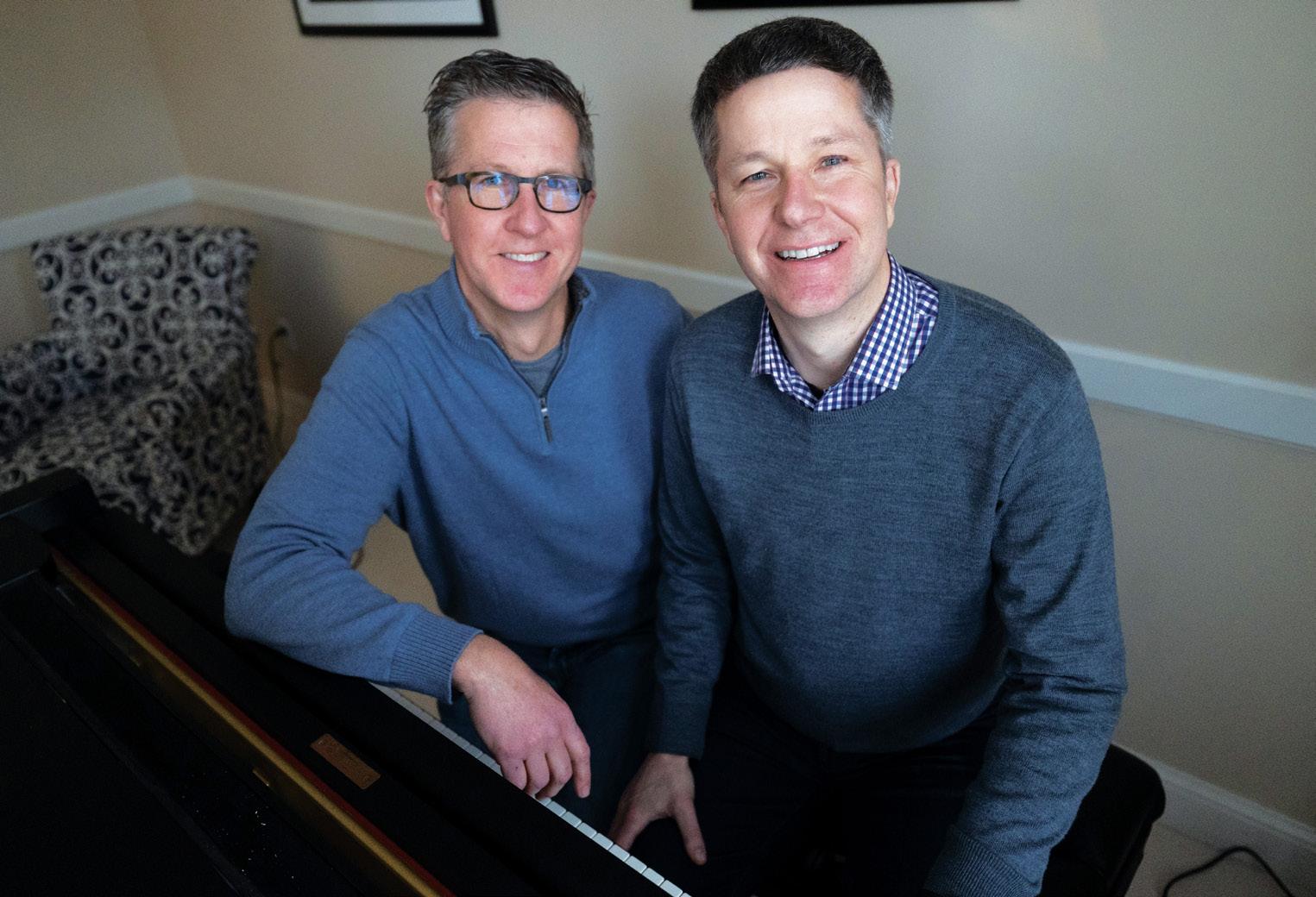
Tim and Ryan O’Neill, parishioners at Our Lady of Grace in Edina, have just reached an astonishing milestone: “The O’Neill Brothers” twin piano arrangements have been streamed online more than 5 billion times in 43 countries, from Thailand to Turkmenistan.
Their music — quiet, calming ripples of cascading notes that interpret favorite songs of various genres — includes religious favorites, such as those on “Songs for the Sacred Heart,” an album released this past summer through the Hallow prayer app. Their annual Christmas concert is Dec. 20 at the Edina Performing Arts Center.
But Tim and Ryan have more than topselling music to offer the world. In 2022, they created a “rapid response” foundation for people in urgent need who have slipped through the cracks of government and private philanthropy. To date, the foundation has served over 250 families and individuals. All proceeds from the brother’s upcoming Christmas concert will go toward the foundation.
The path leading to Tim’s and Ryan’s twin contributions of music and service to others began with the example of faithfilled parents, continued through the Catholic church and school of their youth, and passed through arduous early days of trying to get their music heard. Finally, it was a path that called them to respond with charity to the discouragement and despair they saw around them.
This was the path of Christian hope.
‘It begins in the family’
On May 31, 1964, Bob and Kathy O’Neill arrived in New Prague. Bob, a recent law school graduate, had joined in law partnership with Clayton Nelson, a longestablished New Prague lawyer. But Nelson died just five months later, and the family endured lean years. As an inexperienced 26-year-old, Bob struggled to build a law practice. “These were very challenging years,” explained Kathy, “but somehow our Catholic faith and daily prayer — our listen time with the Lord — always bolstered our ability to meet the day’s challenges.”
Bob and Kathy immersed their five children in the rich sacramental and social life of New Prague’s St. Wenceslaus Catholic Church and School. The O’Neills became active in the “Christian Family Movement,” joining other couples to create a supportive Catholic social circle to bring up their children.
The children learned from an early age that their duties to others extended beyond the immediate family. Kathy explained how, before school on bitter cold winter days, they always shoveled a blind neighbor’s driveway. At Christmas, the family visited another neighbor with a disabled son, taking gifts and groceries and staying for conversation.
“These little gestures gave the kids hints of the suffering that could be just down the street from them,” said Kathy, and they saw the power of human contact and small gestures of hope.
As the children got older, Bob and Kathy saw the fruits of their charitable efforts come into focus for the children. They always had a cheerful “yes” to the priest for emergency altar serving and set up for Mass at a nearby nursing home. “Ryan began to ask to go early so he could chat with the elderly residents, get to know them better, and learn of the interesting lives they’d
lived,” recalled Kathy.
Kathy also pointed to Bob’s early-onset case of multiple sclerosis. “Nothing gave the children more of a sense of the need for empathy and understanding than the unavoidable difficulties endured by their own father,” she reflected. “I could see an understanding in the children, beyond their years, of the need to assist and give special regard to the dignity of a person in a wheelchair or with a cane.” She could see the Bible’s central truth that “all are made in the image and likeness of God” take real hold in their lives.
‘Somebody’s got to play this beautiful piano’
One day soon after they moved into the new house and before the kids were born, Kathy said Bob surprised her with his first furniture purchase: a brand-new upright piano. “Why in the world did you purchase this?” Kathy exclaimed, and he responded, “Perhaps someday we’ll have kids who will enjoy it.” Ryan O’Neill saw the Lord’s hand at work. “I think Dad had the foresight and divine intervention of the Holy Spirit of what was to come in our family life.”
Kathy recalled thinking that “somebody’s got to play this beautiful piano,” so they decided to give all the kids at least a few years of piano lessons. Tim pleaded so relentlessly that they let him begin lessons a year younger than the others, at age 5.
Tim began accompanying his Catholic grade school choir, later played for weddings and funerals, and provided background music at the local Schumacher Inn, with its 1904 Steinway.
The O’Neill brothers become a duo at Notre Dame
Ryan and Tim both attended the University of Notre Dame in Indiana and overlapped one year — Ryan as a freshman and Tim as a senior. They lived in Keenan Hall, well-known for its campus variety show. For the first time they were able to play on beautiful Steinway grand pianos and developed a two-piano routine — a mix of dueling piano numbers, pop and show favorites, humor, singing and the beginning of what became their signature style: slow, subdued extemporizing on familiar tunes that evoke peace and calm.
“That was the start of it all,” remarked
Tim, “and we never imagined how far it would take us.”
After Ryan’s graduation, the brothers decided to develop a twin piano show modeled on the Keenan Hall performances and record their music. In the late 1990s, they hit the road big-time to market their CDs and play for audiences.
Their marketing blitz included a highprofile partnership with JCPenney stores across the country, where they used computer modules to convert in-store pianos into player pianos, then created high-tech audio kiosks to play entire selections from their albums to attract customers to purchase their CDs.
“We built and maintained these music kiosks in over 250 JCPenney stores in more than 30 states — from Maui to the Bronx, Dallas to Fort Worth, and Chicago to Albuquerque,” Tim recalled with a smile. They also sold their CDs at arts and craft shows across the country.
In 2004, The O’Neill Brothers engineered another valuable but exhausting marketing effort: They became a favorite on the QVC television shopping network, appearing there over 100 times, receiving a small percentage of each CD they sold, and reaching a vast new audience with their music.
As the brothers’ fame grew, they launched a series of concert tours at 500- to 1,000-seat theaters in the Midwest. The concerts remained true to their Keenan Hall days: dueling pianos, singing, and a touch of humor.
“Our improvisation made every show a spirited, unpredictable affair, which I think added a special zest to our performances,” Tim said.
Another breakthrough came in 2006, when the brothers toured the United States — from high schools to symphony halls — with pop sensation Debbie Gibson, culminating in an Emmy nomination. In 2009, they formed The O’Neill Brothers Group, a small company based in New Prague that helps others distribute their music.
Over the years, they have diversified their music to suit a multiplicity of tastes, including holiday favorites, Irish songs, classic and original love songs, lullabies, movie and Broadway tunes, patriotic music, and familiar inspirational pieces. Their wedding music album, “A Day to
Remember,” was the number one selling wedding CD in the U.S. for many years, and their music has been incorporated in television and films.
In 2011, the O’Neill Brothers took a break from their frenetic life on the road. Tim now had children and Ryan was building a real estate business. They transitioned into the new technology of digital recording, releasing their music directly to Spotify, Pandora, YouTube and other platforms. The ability to stream added listeners around the world, and they reached the top of streaming charts in 43 countries in Europe, Asia, Africa and South America.
“I have to pinch myself sometimes,” Tim said, “to think that as I sit in my living room here in Minnesota, people in living rooms from Japan to India, from Brazil to Saudi Arabia are relaxing with our music after a busy day.”
In 2014, their albums “Piano Favorites” and “Inspirational Piano” topped Billboard’s New Age Chart, featuring beloved classics like “Over the Rainbow” and “Amazing Grace.” They hit number four on Spotify’s “most-streamed Minnesota acts of all time.” In 2019, Tim and Ryan were inducted into Minnesota’s Music Hall of Fame.
What is it about the O’Neill brothers’ music that draws so many listeners?
“Many have told me it recalls the best times in their lives,” Tim said, “like hearing from an old friend or retrieving a golden moment at the edge of memory.” Ryan agreed: “Some say it has a gentle emotional depth that can move people to tears and say they feel an inner peace and longing that has eluded them in the busyness and cares of their daily lives.”
At its best, said Tim and Ryan, this peace and longing have a hopeful, Christian dimension.
“Listeners have even said it can serve as backdrop to prayer,” said Ryan, adding that “it’s a quiet reminder, in the midst of the very imperfect lives we live now, that there is something beautiful and perfect that awaits us.”
In 2022, Ryan and Tim decided to extend the hope implicit in their music by forming a nonprofit called The O’Neill Foundation of Hope. They designed it to be unique in the philanthropic world, using the smalltown, neighbor-helping-neighbor model they learned from their parents in their childhood years. They describe the core of their foundation’s mission as “loving God and loving others.” The foundation’s most recent venture is the Bob and Kathy O’Neill House of Hope, a two-story duplex in Bloomington that opened in August and provides temporary housing.
Why do the O’Neill brothers pour themselves into their music and foundation work? “Mom and Dad taught us to be people of hope,” Tim said, “and the older we get, Ryan and I realize that sometimes that’s the main thing people need.”
But what does the word hope really mean? It can be used in a very ordinary sense: I hope it rains today. I hope the test goes well. I hope I get a promotion.
“We mean hope in a deeper, Christian sense,” Ryan said. “To us, it’s the bedrock
O’NEILL BROTHERS CONTINUED FROM PREVIOUS PAGE
virtue. It allows us to see through and beyond trouble to the sure knowledge that God abides in us and with us.” He added, “We need to face the storms in our lives with calm confidence, because God has won and we join him as winners when we live lives of hope, no matter what comes along the way.”
“Christian hope is in our music,” Tim said. “It’s in the calm and comfort — the beauty of inner peace — that we try to create, especially where that beauty includes God’s word in familiar hymns and songs.” He added, “I think our music allows people to slow down, relax, and hear God.”
“When everything’s been stripped away from someone, often if you can just give them a little hope, it will help to start (to) turn their life around because then they can again believe in themselves,” remarked Tim, adding that, with hope, “they may even find
God if they have lost God.”
On Dec. 20, the O’Neill brothers will present their annual Christmas show at the Edina Performing Arts Center. They will be joined by guest instrumentalists and two female singers, the “Marilynds” sisters who were both “Miss Maryland.”
Their next Hallow album — for the 2026 Easter season — will likely include songs for Lent, Easter songs of joy and resurrection, as well as uplifting music for spring. Through it all, said Tim and Ryan, they seek to stay true to St. Teresa of Kolkata’s words: “I do not pray for success, I ask for faithfulness. It’s not how much we give but how much love we put into giving. We want to create hope for the person … we must give hope, always hope.”
Twin Cities individuals and families in a temporary crisis can seek help at The O’Neill Foundation of Hope, a nonprofit founded by music-making brothers Ryan and Tim O’Neill of Our Lady of Grace in Edina.
People have found out about the foundation, which has only one part-time employee, through social media and word of mouth. The foundation also asks others to look out for friends and neighbors in need and refer them. It focuses on Christ-like gestures that can assist in such a crisis bags of groceries, a one-time sum to keep rent current, help with an unforeseen health or job catastrophe.
“And we don’t just hand them dollars and send them on their way,” Ryan emphasized. “We want to make sure we’ve done our best to help them succeed and not lose contact with them.” Most importantly, he added, the foundation provides the kind of face-to-face, human touch that doesn’t treat people in need like statistics. “A real person answers the phone, takes the time to talk through the problem, and provides a ‘rapid response’ to urgent need light on paperwork and wait times just the way a neighbor would. This is the kind of love of neighbor Mom and Dad taught us, and that Jesus asked of each one of us,” he explained. The foundation has raised more than $300,000 for its mission and has served more than 250 families and individuals. It is currently working to raise an additional $250,000 in 2025.
Beth Novak, the foundation’s “director of hope,” is the first contact for those seeking the foundation’s assistance. She gets a quick feel for the nature and urgency of their hardship and then recommends a response to Ryan.
Novak described an electrician with diabetes whose wife had congestive heart failure. Temporarily unable to work, “he reached out to us when he came up short on his rent,” said Novak. “So, I picked up a check, drove it over to his apartment, helped him to get his auto insurance current and update his license tabs, talked with him about work options, and let him know we’re here for him.”
Another case involved a woman with four or five children whose husband, an independent contractor, had died unexpectedly. He was in the middle of several renovation projects in their home, including a roofing project. There was a tarp over the roof, and it rained for three weeks after he died. Water was pouring into his daughter’s bedroom.
“We stepped in immediately and found contractors who quickly got the house to a safe condition,” Novak said. “It took one burden off her shoulders in a situation that was unbearable, especially for a grieving widow.”
Novak related an example of the foundation’s Good Samaritan role in the modern world. Ryan met a woman on a street corner asking passersby for money. Ryan determined she hadn’t had a full meal in a long time and asked Novak to mail her a Cub Foods gift card. The card was lost in the mail, so Novak personally picked up a new card and drove out to meet the woman. “I don’t think she’d been touched by another human being in years,” Novak said. “To deliver this card, just give her a hug, and let her know she was seen ... people need that.” When people panic or are in “fight or flight” mode, they tend not to see opportunities for recovery from their troubles, she added. “If somebody stops, listens, and offers even a small helping hand, it lets you breathe and feel there’s a chance to get out of the mess you’re in.”
The foundation’s most recent venture is the Bob and Kathy O’Neill House of Hope, a two-story duplex in Bloomington that opened in August and provides temporary housing. The idea grew out of the persistent housing problems that Ryan, Tim and Novak had seen but thus far had been able to address with only limited success.
Eviction often results in significant costs for hotel rooms, property storage and extra transportation far beyond the foundation’s resources explained Ryan. The O’Neill House of Hope provides short-term housing of four to six months for families experiencing multiple hardships. “A family can live rent-free in a safe and stable environment and save up some money,” explained Ryan. “We do our best to then help them launch into the next stage of their lives,” he added.
Tim and Ryan gave the house its name “in order to honor the two who showed us the path best taken,” Ryan said of their parents.
Mark Johnson
The Diocese of Hong Kong mourns over 100 victims of a devastating apartment complex fire. The Diocese of Hong Kong is calling for prayer and mourning after a devastating fire at the Wang Fuk Court apartment complex in Tai Po left at least 128 people dead and around 200 still missing. As a sign of solidarity, the diocese turned its website black and white and shared a prayer for residents affected by the Nov. 26 blaze, urging the faithful to remember that “we are one family.” In its prayer, the diocese asked God to grant rest to the deceased, heal the injured, and comfort grieving families, admitting the community feels “weak and powerless in the face of disaster” as it seeks God’s presence in the darkness. The fire broke out around 3 p.m. local time and burned for 42 hours before firefighters brought it under control. Officials warn the death toll may rise. Authorities have arrested eight people, including scaffolding subcontractors and project managers, as investigations continue.
Catholic bishops offer prayers for two National Guard members shot in D.C. Catholic bishops are offering prayers following the shooting of two West Virginia National Guard members in the nation’s capital Nov. 26. The midafternoon attack, believed to be perpetrated by a lone suspect now in custody, killed 20-year-old Sarah Beckstrom, who succumbed to her injuries in the hospital Nov. 27, and left 24-year-old Andrew Wolfe in critical condition. “We are praying for the healing of the injured National Guard members and will continue to monitor the situation,” Chieko Noguchi, spokesperson for the U.S. Conference of Catholic Bishops, told OSV News. At a press conference a few hours after the shootings, FBI Director Kash Patel said the attack would be “treated at the federal level as an assault on a federal law enforcement officer.” In August, President Donald Trump federalized more than 2,000 National Guard troops, deploying them to the nation’s capital to combat crime, despite protests from Washington, D.C. Mayor Muriel Bowser. Following the attack which took place not far from the White House Trump ordered an additional 500 National Guard troops deployed in Washington, said secretary of war Pete Hegseth. The president posted on social media that the “animal that shot the two National Guardsmen … will pay a very steep price.”
Bishops: Affordable housing, just wages and environmental safeguards reduce food insecurity. “Give us this day our daily bread.” With those words from the Lord’s Prayer, the Canadian Conference of Catholic Bishops is framing a new national reflection on food insecurity. On the World Day of the Poor, Nov. 16, the bishops released “Our Daily Bread: Food Security and the Call to Solidarity,” a 10-page pastoral letter issued through the conference’s Episcopal Commission for Justice and Peace. The document begins by grounding its message in the Gospel petition for daily sustenance, describing it as a cry heard from people facing rising food costs in Canada and severe food insecurity around the world. Citing the United Nations International Fund for Agricultural Development, the bishops note that “more than 1 in 10 people are suffering severe food insecurity” and that more than 3 billion people cannot afford a healthy diet. The bishops note that food security in Canada is connected to housing affordability and emphasize the importance of a just wage. The pastoral letter concludes by giving thanks for all who provide “our daily bread.”
Gunmen abduct students in a Nigerian Catholic school in worsening attacks on Christians. A Catholic diocese in central Nigeria is appealing for prayer and calm after gunmen stormed St. Mary’s Catholic Primary and Secondary School in Papiri, Niger State, kidnapping an unknown number of students and teachers early Nov. 21. The Diocese of Kontagora says the attack
happened between 1 and 3 a.m. local time, leaving security personnel seriously wounded. Bishop Bulus Yohanna said the Church is working closely with security agencies and community leaders as rescue operations continue. Nigeria’s police confirm they’ve deployed tactical units and military partners to comb nearby forests, aiming to bring the hostages home safely. The Christian Association of Nigeria also condemned the assault, calling it part of a disturbing rise in violence against Christian communities. The kidnapping follows a string of recent attacks on churches and schools across northern Nigeria, which advocacy groups warn reflect an escalating campaign of persecution targeting Christian leaders and families nationwide. “Is there anyone who can say that there is no Christian genocide in Nigeria?” asked Emeka Umeagbalasi, director of the Catholic-inspired nongovernmental organization, Intersociety. “There is a deliberate plan to wipe out Christianity from Nigeria,” he told OSV News Nov. 21.
Vatican says cause can move forward for a Massachusetts pro-life activist, wife and mother. This fall the Vatican paved the way for the Worcester Diocese to begin the cause for the potential canonization of a local Catholic Ruth V. K. Pakaluk. Pakaluk, a wife and mother from St. Paul Cathedral, was also known as an energetic, effective pro-life activist. She died at age 41 in 1998 after a long battle with cancer. Cardinal Marcello Semeraro, prefect of the Vatican Dicastery for the Causes of Saints, sent a letter in Latin to Bishop Robert McManus, dated Sept. 29, stating that nothing stands in the way of the Worcester Diocese moving forward on the cause. Pakaluk can now be called a Servant of God, a title given to a sainthood candidate when a cause is formally established. Michael Pakaluk, currently a professor at The Catholic University of America in Washington, married Ruth when they were college students and they had seven children. He said he had prayed for the cause for her canonization to open, adding “I’ve always been happy to cooperate” with anyone pursuing it. He said he views it in relationship to the Second Vatican Council, which set forth a pattern of holiness for laypeople. Ruth corresponded to that as a wife, mother, friend and citizen, he said.
U.S. bishops name the head of a racial justice committee. The U.S. bishops have named Bishop Daniel Garcia of Austin, Texas, as the first chairman of their now-permanent Subcommittee for the Promotion of Racial Justice and Reconciliation. The news was announced by the U.S. Conference of Catholic Bishops in a Nov. 20 media release. Bishop Garcia was appointed by Archbishop Shelton Fabre, chairman of the U.S. Conference of Catholic Bishops’ Committee on Domestic Justice and Human Development. That committee the scope of which includes Catholic social teaching on issues such as poverty, housing, criminal justice and the environment oversees the subcommittee, since such challenges typically have a disproportionate effect on communities of color. In an interview with OSV News, Bishop Garcia explained how he saw segregation at work in his small town, with designated sections in restaurants for African Americans and police stops based on racial profiling. Such discrimination even extended to the church, said Bishop Garcia, who recalled an African American friend being discouraged from attending a Catholic school by its pastor, while also seeing Mass attendees withhold the kiss of peace during the liturgy from families of color. Rather than being innate, “racism is taught,” said Bishop Garcia and it can be unlearned. “I think it’s when we get to know people that we break down those kinds of injustices and realize how much alike we are,” he said.
By Josh McGovern The Catholic Spirit
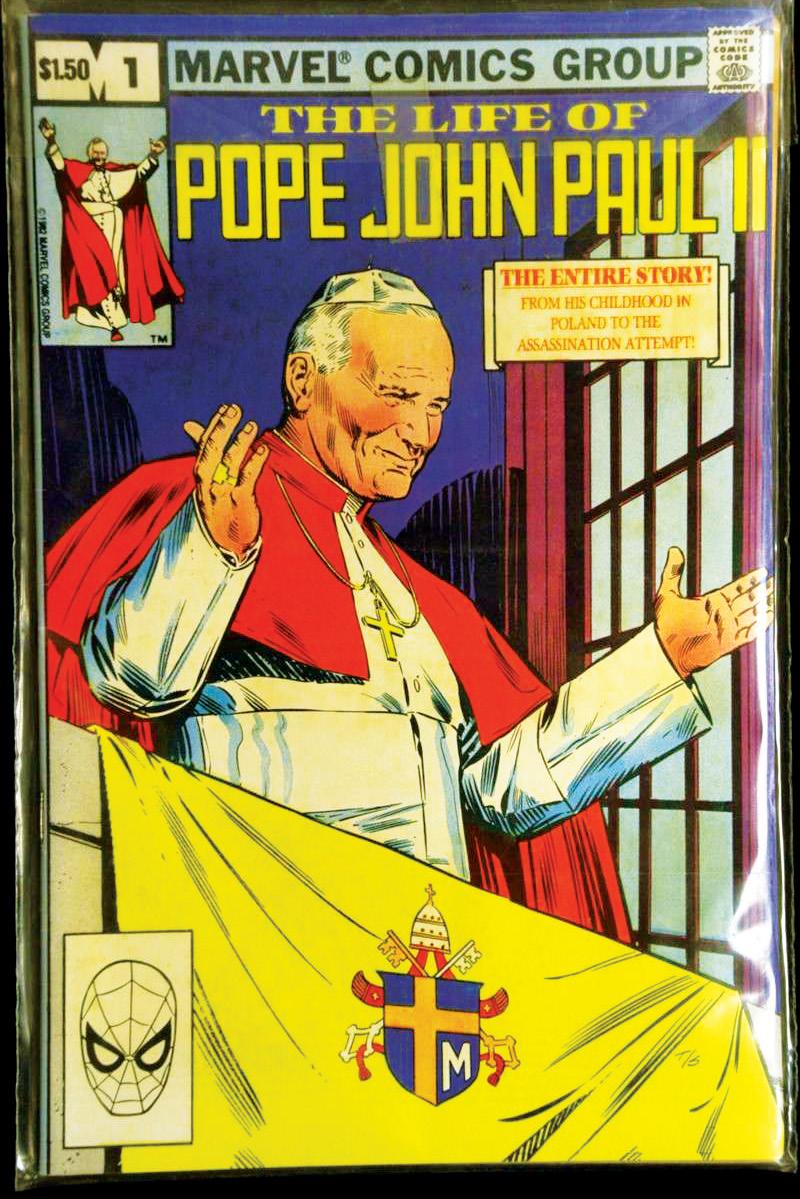
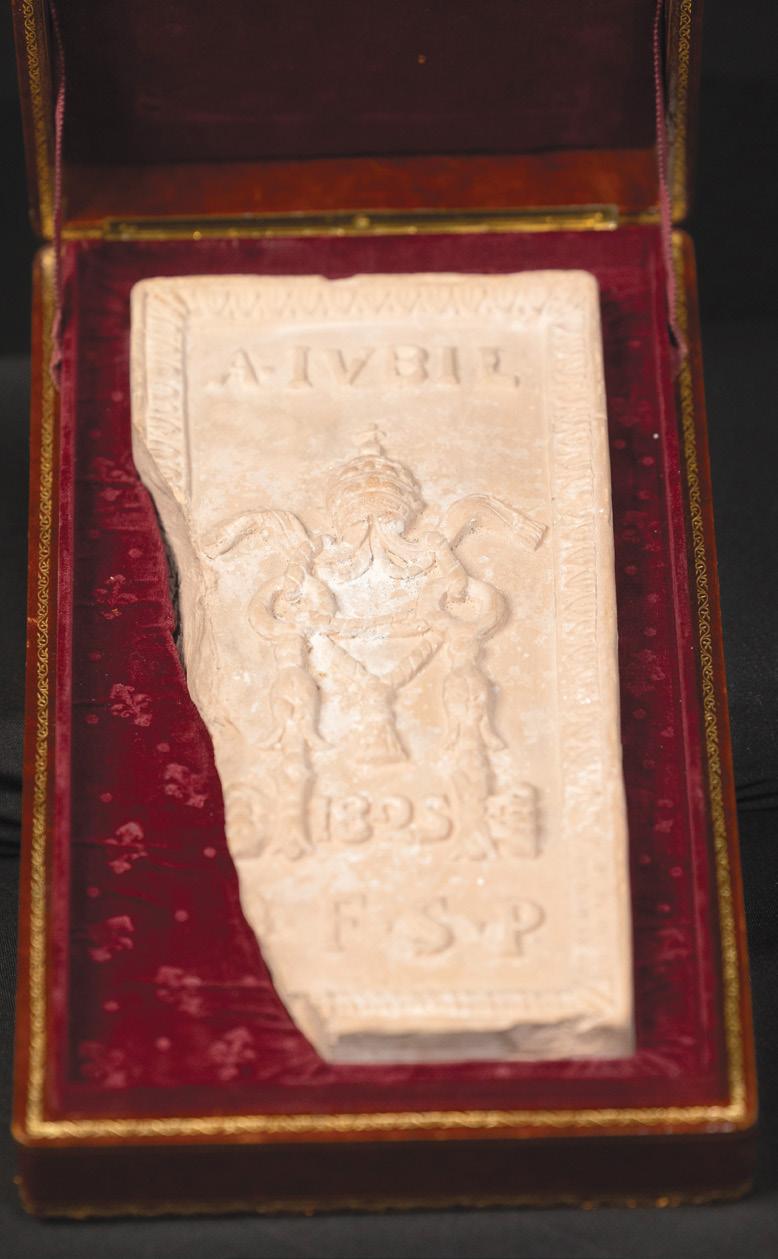
What started as a childhood collection of celebrity artifacts became a calling for Father Richard Kunst, who now has the largest collection of papal artifacts outside the Vatican.
While visiting the Archdiocese of St. Paul and Minneapolis Aug. 13, Father Kunst brought crates full of artifacts to show employees at the Archdiocesan Catholic Center in St. Paul.
One item was a sheet of white cloth with little black dots peppered into it. It was the left sleeve of Pope Pius X’s cassock. During the early 1900s, there weren’t any ballpoint pens. People had ink wells and pads of paper on which to dab the ink pen before writing, Father Kunst said.
“The most current peasant-class pope that we’ve had was Pope Pius X from a very poor family, a very poor upbringing, and he was poor throughout his priesthood,” Father Kunst explained. “As Father Sarto, he never bought a blotter, so he would just blot the pen to the sleeve of his cassock. It’s not a problem if it’s a black cassock, but it becomes a problem when it’s a white cassock. So, when he’s elected pope, he continued that practice, and his staff would get on his case. ‘Your Holiness, you can’t do that anymore!’”
Father Kunst said he loves having artifacts that popes used, but he also loves the idea of “papal idiosyncrasies.”
“I particularly like (Pope Pius X’s cassock sleeve) because it shows the very humanness to him, like that little weird habit of dabbing your ink on your sleeve,” Father Kunst said. “You think of a little second grader wiping his nose on his sleeves, like something very human about that.”
This sleeve is one of many papal artifacts and relics Father Kunst plans to bring to the Vatican Unveiled exhibit that will be held at the Mall of America in Bloomington from Jan. 10 to Feb. 1 in celebration of the 175th anniversary of the Archdiocese of St. Paul and Minneapolis.
Father Kunst, 55, began his hobby of collecting when he was in high school. He was assigned a project in his government class to write to a politician. He chose thenPresident Jimmy Carter. In return, President Carter sent Father Kunst an autographed photo. Looking back, Father Kunst said this moment kicked the tires on collecting autographs from famous people, politicians, celebrities, musicians, athletes.
“As a kid, growing up, I was a collector,” Father Kunst said. “It’s either in your DNA or it’s not. And I started collecting coins and then pull cards and ultimately went into autographs, and then it went to papal autographs and papal artifacts. … As a kid growing up, I’d write to celebrities. I’d go to the library and get the who’s who book, and I’d look for their addresses.”
He got his first papal artifacts in 1995 when he was 25 years old.
“From that point on ... I went strictly papal,” Father Kunst said. “When the internet came out — that shows my age a little bit — that made the world a lot smaller for collecting.”
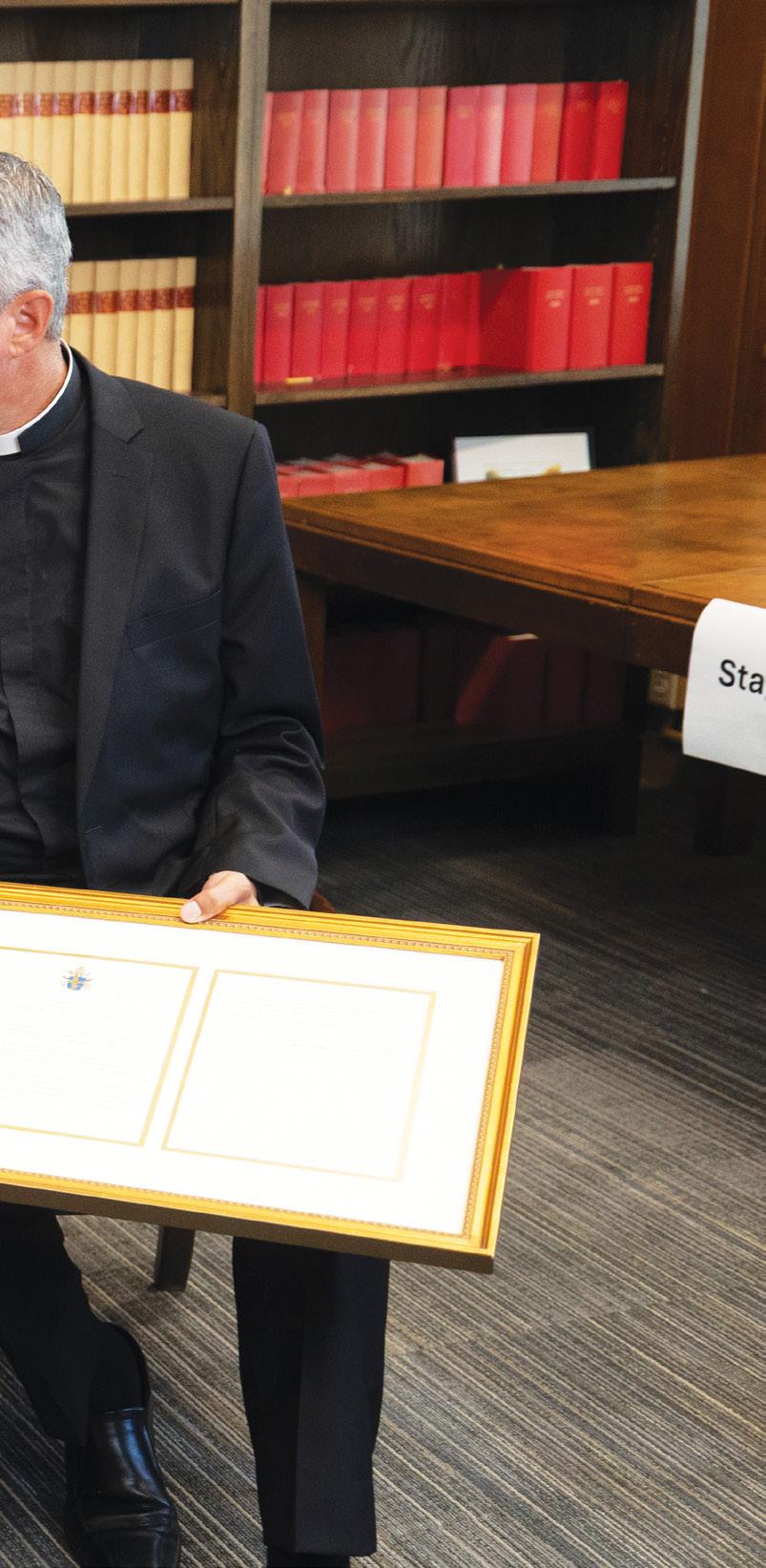
One item in Father Kunst’s collection is a letter from St. John Paul II to President Carter, the president whose signature set Father Kunst on the path to this collection. That letter was the first interaction between St. John Paul II and an American president.
Sitting with Archbishop Bernard Hebda during the Aug. 13 visit, they held the frame up together, and Father Kunst explained the significance of the letter.
“In order to get this letter, I had to have permission from the National Archives as well as the Jimmy Carter Presidential Library because it’s a letter from one (head) of the state to the other,” Father Kunst said. “Basically, it’s a letter accepting the personal special envoy from Jimmy Carter to the Vatican.”
The letter was written two months after St. John Paul II’s election as pontiff.
Archbishop Hebda showed Father Kunst a piece of history, too, the original document that established the Archdiocese of St. Paul and Minneapolis, formally written by Pope Pius the IX.
“It’s part of our patrimony,” Archbishop Hebda said. “How significant it is that we have opportunities to learn more about our archdiocese in the 175th anniversary year by coming to know a little bit more about the Holy See and about the popes and indeed about our history.”
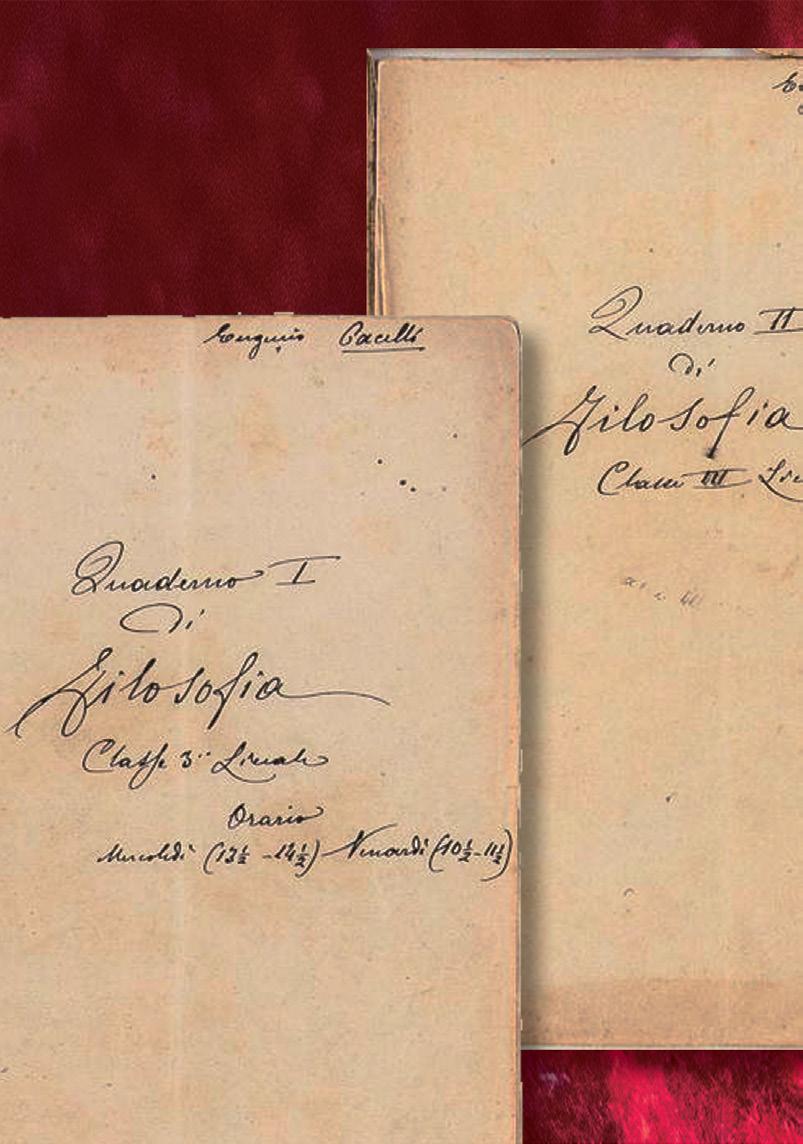
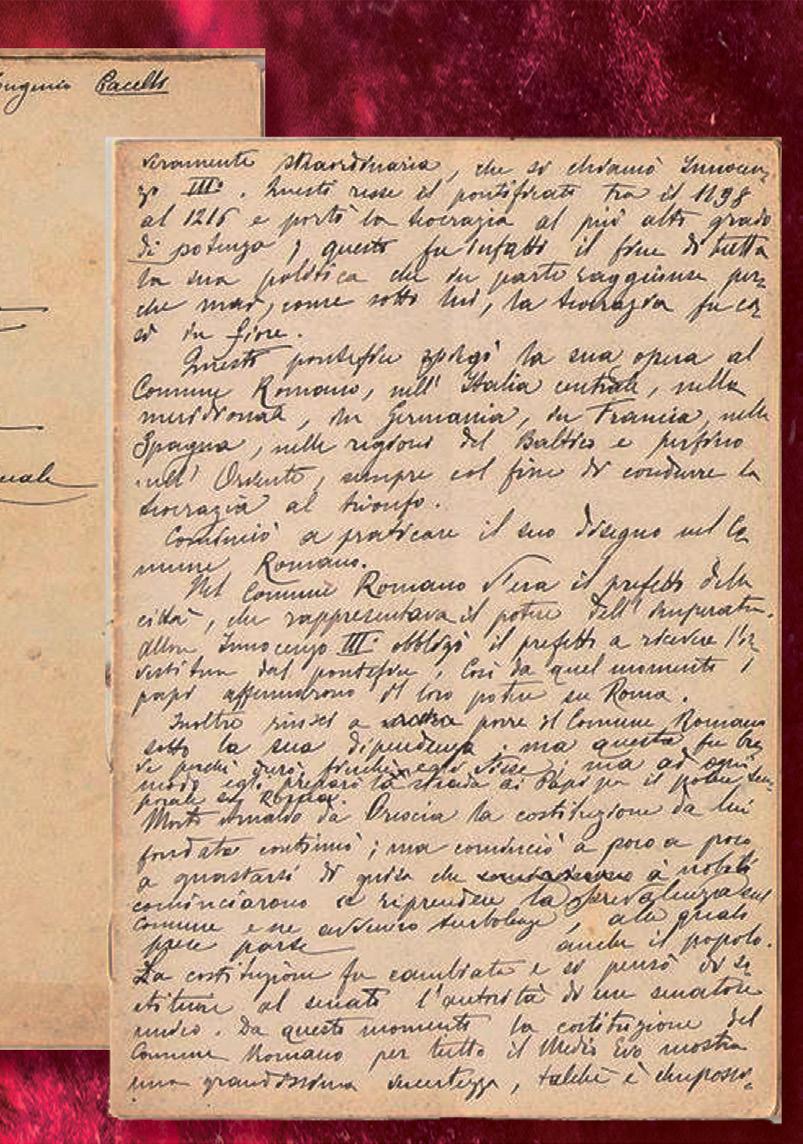
Father Kunst has in his possession a high school homework assignment from Pope Pius XII. The homework was for a philosophy class, which Father Kunst admitted is not his strong suit, but many philosophy buffs might be interested in what the pope had to say at a young age.
“He signed his name up on the top, Eugene, which any good high school student would do,” Father Kunst explained. “There’s probably about 230 pages of his writing in here. … To have something from their childhood and something that’s totally in their own hand, this makes it a particularly
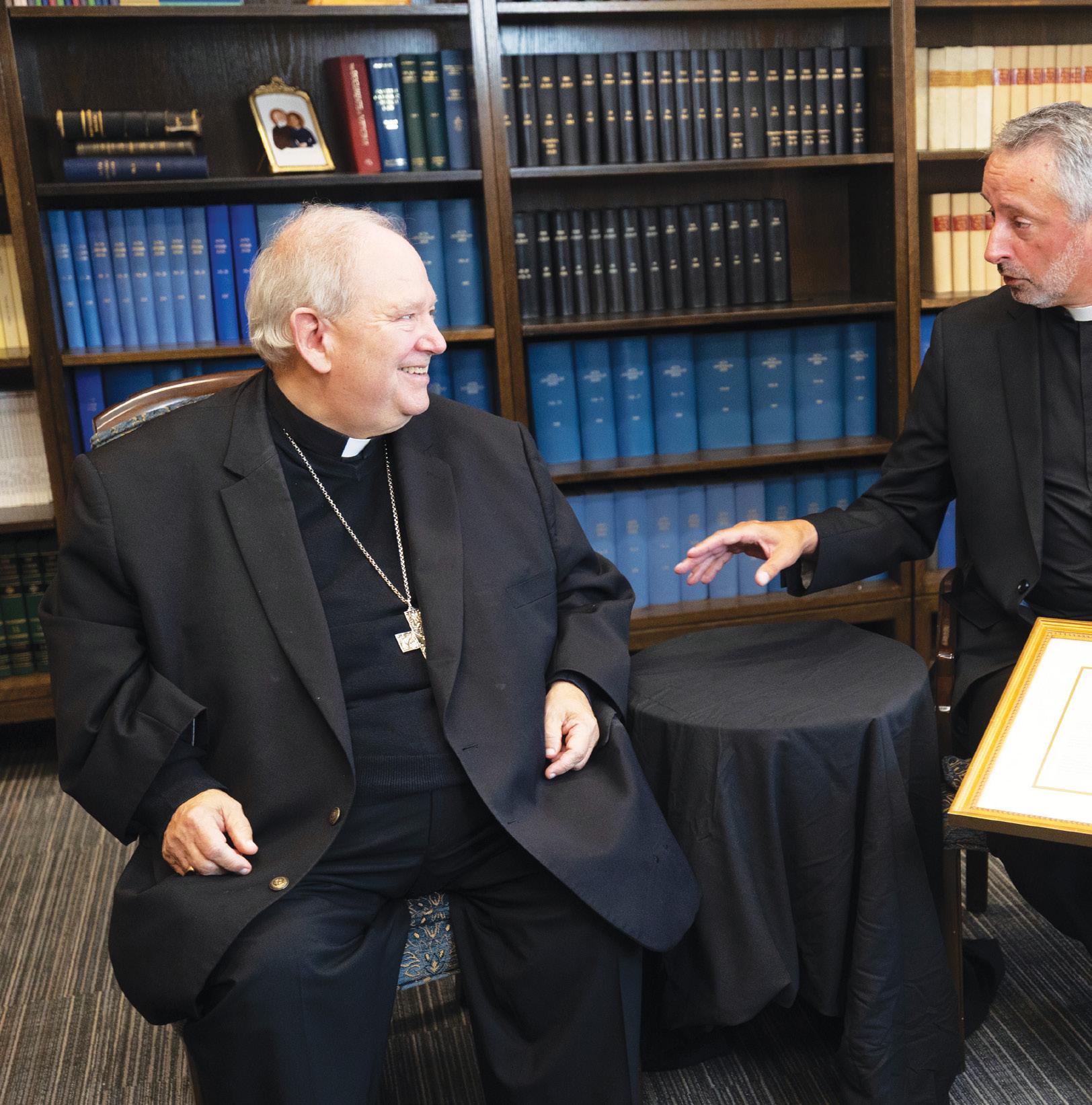
How significant it is that we have opportunities to learn more about our archdiocese in the 175th anniversary year by coming to know a little bit more about the Holy See and about the popes and indeed about our history.
Archbishop Bernard Hebda
For tickets to Vatican Unveiled, go to: archspm.org/vaticanunveiled interesting piece.”
Many of the items are fragile and have to be kept in special environments. The location in Duluth, which Father Kunst didn’t divulge, is climate controlled to keep many of his parchments preserved. His oldest item is a piece of parchment from 1138. It’s a papal bull signed by Pope Innocent II and two future popes as cardinals and a future antipope, Victor IV.
Because it’s parchment, the artifact was able to survive as long as it has.
“There was paper back then as well, but the paper was rice-based, and most ink was leadbased. You’ll hear it at the Vatican: They try and stop this decaying of the ink eating away at the paper. They can’t stop it. My collection’s the same way,” Father Kunst said. “If you get to the exhibit of Vatican Unveiled, you’ll see some documents where the ink is literally eating through the paper. Parchment is not
that way. A lot of people took care of this. The parchment is going to last a long time. Not so much with the paper.”
This collection, Father Kunst said, is beyond him into something divine.
“That’s where I see the hand of God in this collection, because it’s not for my will,” Father Kunst said. “It’s not for my profit in any way, shape or form, except for my enjoyment of teaching. I know that it’s got a bigger life than me. When things come into the collection, that I can’t explain (how), I just say, ‘There’s
the hand of the divine.’ I truly, firmly believe that the collection wouldn’t be the way it is right now if that wasn’t the case.”
He often wonders how these items got into his hands, of all people.
“How I’ve acquired so many of these things in ways that are crazy, it’s got a bigger purpose,” Father Kunst said. “And for me, that’s a religious thing; it’s a holy thing. I’m a collector, but it’s a holy thing because I know that this shouldn’t be here. … I’m a true son of the Church. I love the Catholic Church.
DAVE HRBACEK | THE CATHOLIC SPIRIT
10 at the Mall of America in Bloomington. Father Kunst acknowledging the pope’s reception of the president’s November 1978 to January 1981.
… I love the personalities of the saints and of the popes and their histories, and so what it’s done for me is helped me learn more. When I come across something, I want to learn more about this thing. The collection has actually made me more knowledgeable, because I’ve learned more about what I’ve come across.”
Father Kunst said that you can’t love something you know little about.
“The more you come to learn about the Church, the more you’ll love it,” Father Kunst said. “I’m convinced of that.”

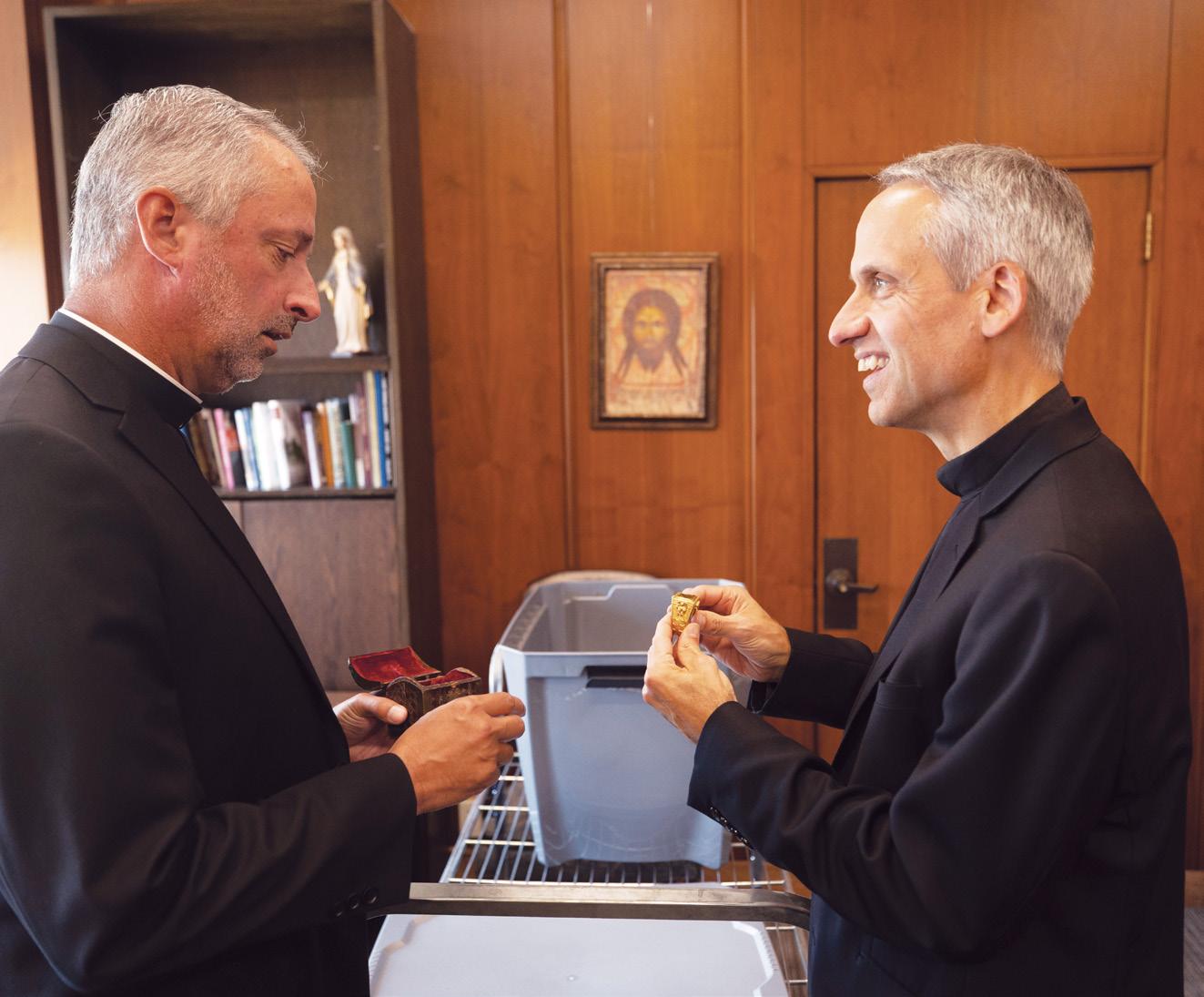

Kenneth Snyder, associate academic dean at The St. Paul Seminary in St. Paul, had a chance to sit down with Father Richard Kunst during the priest’s visit to the Archdiocese of St. Paul and Minneapolis Aug. 13. Snyder was invited to the Archdiocesan Catholic Center that day because of his knowledge of Church history.
An assistant professor of Church history, Snyder said he was particularly interested in one item Father Kunst brought. It was a piece of Pope Pius VII’s cassock. Whereas an ink-dabbed cassock of Pope Pius X revealed the pope’s personal history, the cassock of Pope Pius VII was linked to a major historical moment: The crowning of Napoleon Bonaparte as the Holy Roman Emperor.
“Napoleon wanted to declare himself a Holy Roman Emperor,” Father Kunst explained. “As is tradition, the pope always would crown the Holy Roman Emperor, but to exert his authority, he basically was trying to force Pius VII to go from Rome to Paris to (the Cathedral of) Notre Dame to crown him. And so, this is a piece of cassock that Pius VII was wearing at the supposed crowning of Napoleon.”
Snyder explained that the pope crowning the Holy Roman Emperor was a symbolic tradition, that “the emperor’s authority depends on the pope vesting him with that authority as God’s agent.” This tradition dated back 1,000 years before Napoleon’s crowning with Pope Leo III crowning Charlemagne in the year 800.
“Napoleon supposedly takes the crown and crowns himself right from the pope,” Snyder said. “Napoleon’s basically saying, ‘No, I’m not dependent upon you. I’m not subservient to you.’ It really speaks, I think, volumes about the relationship between Church and state that Napoleon was trying to signal.”
During the visit, Snyder also took great interest in Pope Pius X’s cassock sleeve and a Swiss Guard helmet in Father Kunst’s collection.
By Rebecca Omastiak
The Catholic Spirit
A collection to assist aging religious as they step into retirement will take place in parishes throughout the Archdiocese of St. Paul and Minneapolis Dec. 13 and 14.
The national Retirement Fund for Religious — sponsored by the U.S. Conference of Catholic Bishops and national conferences for men and women religious — helps support more than 266 religious communities in the United States and specifically more than 21,000 religious over the age of 70.
In a video about this year’s collection locally, Nicole Bettini, the archdiocese’s delegate for consecrated life, said, “For 174 of 175 years as an archdiocese, we have been blessed with the presence of religious. Many are surprised to learn that today in our archdiocese, there are represented 35 religious communities of women, 21 religious communities of men, two secular institutes and the Order of Virgins.”
Archbishop Bernard Hebda reflected on “how the Lord has blessed our archdiocese through these consecrated men and women.”
“When I think about our schools, when I think about our hospitals, when I think about the wonderful, prayerful support that we receive from our cloistered Carmelites, when I think about the wonderful work that our consecrated men and women have undertaken in our parishes, I realize that we have so much to be grateful for,” the archbishop said in the video.
“The Retirement Fund for Religious has assisted religious communities like the School Sisters of Notre Dame to meet their retirement needs and support other communities like the Dominican Sisters of St. Cecilia ... with their retirement planning,” Bettini explained.
According to the Washington, D.C.based National Religious Retirement Office (NRRO), the Retirement Fund for Religious helps to address the financial strain felt by many religious communities. Current concerns for aging men and women religious are rising health care and retirement costs. As an example, in 2024, the average annual cost of care was roughly $56,000 per person, with skilled nursing care averaging roughly $96,000, according
When I think about our schools, when I think about our hospitals, when I think about the wonderful, prayerful support that we receive from our cloistered Carmelites, when I think about the wonderful work that our consecrated men and women have undertaken in our parishes, I realize that we have so much to be grateful for.
Archbishop Bernard Hebda
to the NRRO.
Since the nationwide fund was launched in 1988, it has received over $1 billion in contributions.
Last year, the fund raised more than $28.1 million nationwide to provide financial assistance and support educational programs to help religious communities plan for their long-term needs. Of that total, contributions from parishes and the faithful in the Archdiocese of St. Paul and Minneapolis totaled $474,939, according to Bettini.
“The generosity of U.S. Catholics continues to make a profound
difference in the lives of aging religious,” said John Knutsen, NRRO director, in a statement. “This year, we invite all Catholics to help provide the care and dignity these women and men of faith so richly deserve.”
Those who don’t participate in the collection at a parish can mail contributions to Retirement Fund for Religious, Archdiocese of St. Paul and Minneapolis, 777 Forest St., St. Paul, MN 55106. Learn more about the fund online at archspm. org/retirement-fund-forreligious.

Pope issues apostolic letter on the Creed, marking anniversary of Nicaea
By Cindy Wooden Catholic News Service
When Christians recite the Creed, it should prompt an examination of conscience about what they truly believe and what kind of example of faith in God they give to others, Pope Leo XIV wrote.
“Wars have been fought, and people have been killed, persecuted and discriminated against in the name of God,” he wrote. “Instead of proclaiming a merciful God, a vengeful God has been presented who instills terror and punishes.”
Publishing “In Unitate Fidei” (“In the Unity of Faith”) Nov. 23, Pope Leo marked the 1,700th anniversary of the Council of Nicaea and its Creed. He said he wanted it released in anticipation of his visit to Turkey Nov. 27-30 to celebrate with Orthodox and Protestant leaders the anniversary of the Creed Christians share.
The bishops who had gathered in Nicaea in 325 had survived anti-Christian persecution, the pope said, but were facing the fracturing of their communities over disputes regarding “the essence of the Christian faith, namely the answer to the decisive question that Jesus had asked his disciples at Caesarea Philippi: ‘Who do you say that I am?’”
“Arius, a priest from Alexandria in Egypt, taught that Jesus was not truly the Son of God,” the pope explained. Arius taught that “though more than a mere creature,” Jesus was “an intermediate being between the inaccessible God and humanity. Moreover, there would have been a time when the Son ‘did not exist.’”
The challenge facing the bishops, he said, was to affirm their faith in one God while making it clear that, as the creed now says, Jesus is “the Only Begotten Son of God, born of the Father before all ages ... true God from true God, begotten, not made, consubstantial with the Father.”
The bishops, he said, knew “no mortal being can, in fact, defeat death and save us; only God can do so. He has freed us through his Son made man, so that we might be free.”
In affirming monotheism and the true humanity and divinity of Christ, the pope said, “they wanted to reaffirm that the one true God is not inaccessibly distant from us, but on the contrary has drawn near and has come to encounter us in Jesus Christ.”
“This is the heart of our Christian life,” Pope Leo wrote. “For this reason, we commit to follow Jesus as our master, companion, brother and friend.”











AND THE BEAUTIFUL
“A Season on the Drink” by Pat Harris. Adventure Publications. (Cambridge, Minnesota, 2025).
370 pp., $28.
“The game of baseball is filled with metaphors, and some of them are even true.”
In 1986, while the Minnesota Twins were still a year out from their appearance in the World Series, another team was soaring to unexpected heights. That year, the recreational softball team of the St. Anthony Residence in St. Paul took to the diamond in a season that would scandalize and inspire their opponents and neighbors.
The St. Anthony Residence is a wet house for men run by Catholic Charities Twin Cities — a home for those with alcohol use disorders who are unable to quit drinking. Pat Harris’ “A Season on the Drink,” a brilliant novelization of that fateful softball season in 1986, details an interlude in the lives of several real people who lived in, or worked at, the St. Anthony Residence during that time: Marty Peterson, a former baseball prodigy with alcohol use disorder who lived at the residence; Harry Opus, in recovery from alcoholism and the residence’s day manager; Terry Thomas, another resident and Marty’s fast-talking co-captain; The Queen, i.e. Allison Boisvert,
By Karl A. Schultz OSV News
With the onset of Advent, we begin a new lectionary cycle — A — which features the Gospel of Matthew. Matthew is a logical place to begin for several reasons, the first of which is tradition. In the time of the early Church Fathers and beyond, most Church leaders and Bible commentators believed that Matthew was the first Gospel written. (Most scholars now believe Mark was first.)
This presumption, combined with Matthew’s outstanding catechetical content and structure, led to it being the most utilized and referenced Gospel in the early Church. It is also the only Gospel to use the Greek word for church, “ekklesia,” a translation of the frequently used Hebrew word for assembly in the Old Testament, “qahal.”
Chapter 18 of Matthew’s Gospel has the most extensive teaching in the New Testament on Church discipline and order. It is not surprising that it has often been referred to as the Gospel of the Church. However, there is a more organic and fundamental reason for beginning with Matthew. It serves as a natural bridge from the Old Testament. Among the Gospels, it references the Old Testament the most and situates the person and mission of Jesus most explicitly in their Hebrew lineage. Scholars refer to these formulaic citations (they are generally prefaced by an expression such as “this was to fulfill”) as “fulfillment quotations,” by which Matthew shows how Jesus fulfills Old Testament prophesies. The Gospel’s prestige and continuity with the Old Testament is underscored by the fact that in the manuscript tradition Matthew is always presented as the first Gospel.
The Gospel’s major themes also reflect its Hebrew heritage: continuity, morality,
the then-director of housing for Catholic Charities and herself in recovery from addiction; a nameless caseworker hearing the story many years later; and the rest of the St. Anthony softball team.
Wet houses are controversial. In “A Season on the Drink,” Harris cuts through the controversy to demonstrate their
judgment/accountability, forgiveness, kindness/ mercy and fidelity, the latter two being the primary Old Testament characteristics of God. The theme of Emmanuel (see Is 7:14; Mt 1:23, 18:20, 25:34-46), literally meaning “God with us” and reflecting God’s compassion, pervades the Gospel. Jesus’ dying words (see Mt 27:46) reflect his complete immersion in the human experience, and he refers to his obedient followers (see Mt 12:50) and the Apostles (see Mt 28:10) as his siblings.
Matthew’s emphases on morality and compassion come together uniquely among the Gospels in the last judgment parable (see Mt 25:31-46), in which practical deeds of mercy are the determinant of salvation in their Christological context. Here and in other passages referring to the end times, Matthew describes the final state of the damned in foreboding language. He wants to make sure we recognize that justice, mercy and forgiveness are literally matters of life and death.
However, Matthew is anything but a legalistic perfectionist. As foreboding as his moral demands may be (for example, the Sermon on the Mount), forgiveness is always an accompaniment (see Mt 6:14-15, 18:10-35).
Scrupulosity — the act of being overly cautious about behavior — particularly as practiced with respect to the precepts of the Old Testament law, is condemned and linked to hypocrisy (see Mt 15:1-9, 23:25).
Jesus integrates the spirit and letter (see Mt 5:18) of the law. We see this personified in St. Joseph, who obeys the law but in a compassionate manner. A model disciple within the Gospel, St. Joseph exemplifies the integration of justice, mercy and obedience that we are to emulate.
Matthew’s emphasis on forgiveness can provide us consolation and hope as we recognize our inability to live up to the tenets of the Sermon on the Mount and other moral requirements. God is compassionate and forgiving, so we can always start anew.
Schultz writes and speaks on Catholic and biblical spirituality, pastoral care, and men’s and marital spirituality.
necessity. The St. Anthony Residence, the novel tells us, is the last stop on the line for many of these men; these are individuals who will likely never recover from their addiction, no matter how much the government or their neighbors might want them to do so, and whose alcoholism is likely terminal. The St. Anthony Residence serves as the final barrier between them and homelessness in a hard Minnesota winter, with the philosophy that everyone deserves, at the very least, “a bed and three squares.”
But man cannot live on three squares alone; community and a sense of purpose are necessary for a dignified life. In “A Season on the Drink,” softball provides a locus for precisely those things. Characters for whom “community” is a tenuous thing — and not merely those struggling with alcohol use disorder — find each other, and real human connection, on the diamond. The community around Raymond Field also finds an opportunity to lower their walls and challenge their narrow conception of who counts as one’s neighbor.
The tension in the novel is the tension of the wet house: Harris does not pull punches on the sights, sounds or smells of alcohol use disorder, nor are the realities
of homelessness (or of the shelters that struggle mightily to meet those needs on shoestring budgets) downplayed. And while some of the main characters have found recovery by the end of the novel, not all of them do. The novel does not reduce these real people and their real lives to either success stories of sobriety or cautionary tales of alcohol use disorder.
Which might well be the point. Through “A Season on the Drink,” Harris brings us past the stereotype of the homeless alcoholic and introduces us to Marty and the rest — insisting on their dignity precisely through focusing on their unique and unrepeatable personhood. Marty might be a person with alcohol use disorder. He is also an excellent leader, mild-mannered but inspiring, tough, quiet, resourceful and good-humored.
And he’s darned good at baseball.
“A Season on the Drink” is a funny, heartfelt, sometimes irreverent and deeply human novel about real men who demonstrated to the world that there is more to all of us than meets the eye. It’s about the importance of seeking the face of Christ in all our neighbors, regardless of circumstance or stereotype.
As stated in a common refrain in the book: Pray to St. Anthony, and you will find it.
Reichert is publications administrative coordinator at The Catholic Spirit. She can be reached at reichertm@archspm.org.
The best gift to bring to Christ our King — a generous heart.
In this season of giving, share your gifts with joy and purpose. A donor advised fund helps you give thoughtfully and faithfully, supporting what matters, now and throughout the years.
Faith-inspired generosity starts here. We’ll guide you through the steps.
By Christina Capecchi
For The Catholic Spirit
Anne Cullen Miller retires from the Catholic Community Foundation of Minnesota (CCF) next month after nearly 18 years with the St. Paul-based nonprofit and 13 as its president. During her time at the helm, the foundation has grown from $200 million to $800 million in total assets stewarded — and from $6 million to $45 million in annual grantmaking.
Christopher Nelson, executive vice president of the foundation, will succeed her.
Cullen Miller and her husband, Mark, live in Mendota Heights and belong to St. Thomas More in St. Paul. They have three adult children and two young grandsons.
At 62, Anne Cullen Miller was thoughtful about discerning her retirement. “I feel this sense of peace that this is the time,” she said. “I believe it’s better to go a little early than half a minute too late. And I know this is a really good time for the foundation to absorb a leadership change without interrupting our momentum.”
Q What do you love about being Catholic?
A This inheritance of faith, the profound sense that this faith connects me not only to God but to generation after generation of my family whose roots of deep faith stretch back to Ireland and a bit of Norway and Germany as well. That legacy of faith is the through-line to who I am.
My faith both completes me and challenges me. It calls me every day to trust without fear, to love more generously and to receive love with greater openness.
Q When were you first introduced to Ignatian spirituality?
A My introduction was through a women’s silent retreat with my mom, who invited me for years to accompany her on a four-day retreat, which she had done many times. When she got older, she didn’t feel like she could go by herself, so finally I went, and of course, in trying to do something for my mom, I was the one who was gifted and changed through the experience. This particular spirituality teaches that you can find God in all things — in work, relationships, decision-making, emotions, nature, ordinary life. It feels accessible.
Q And how was the silent retreat?
A With this sometimes all-encompassing work and the busyness of family, it’s often a frenetic pace. We get so caught up in the world and what we think we’re supposed to be doing. On the retreat, I came to feel more clear-headed and grounded. Of course, you go right back into it and have to pull yourself back out. I’m still practicing. I’m not even close to where I want to be, but I know enough to keep trying.
Q How do you lean into Advent?
A I start by trying to find my Advent candles every year. They help me as a constant reminder, a grounding focus on what’s important — to pray through the season, to not get too caught up in the worldly pressures of it.
Q What’s your favorite Christmas song?
A My dad died when I was 8. Of my memories, I recall he always had Mitch Miller’s “Christmas Sing-Along with Mitch” album playing during the season, and the “White Christmas” song resonated with me. It brings me back to my early childhood.
Q So the opportunity to be a grandparent — which he never got — is one you don’t take lightly?
A For sure. I don’t take it for granted, the chance to live another day, to try again to get
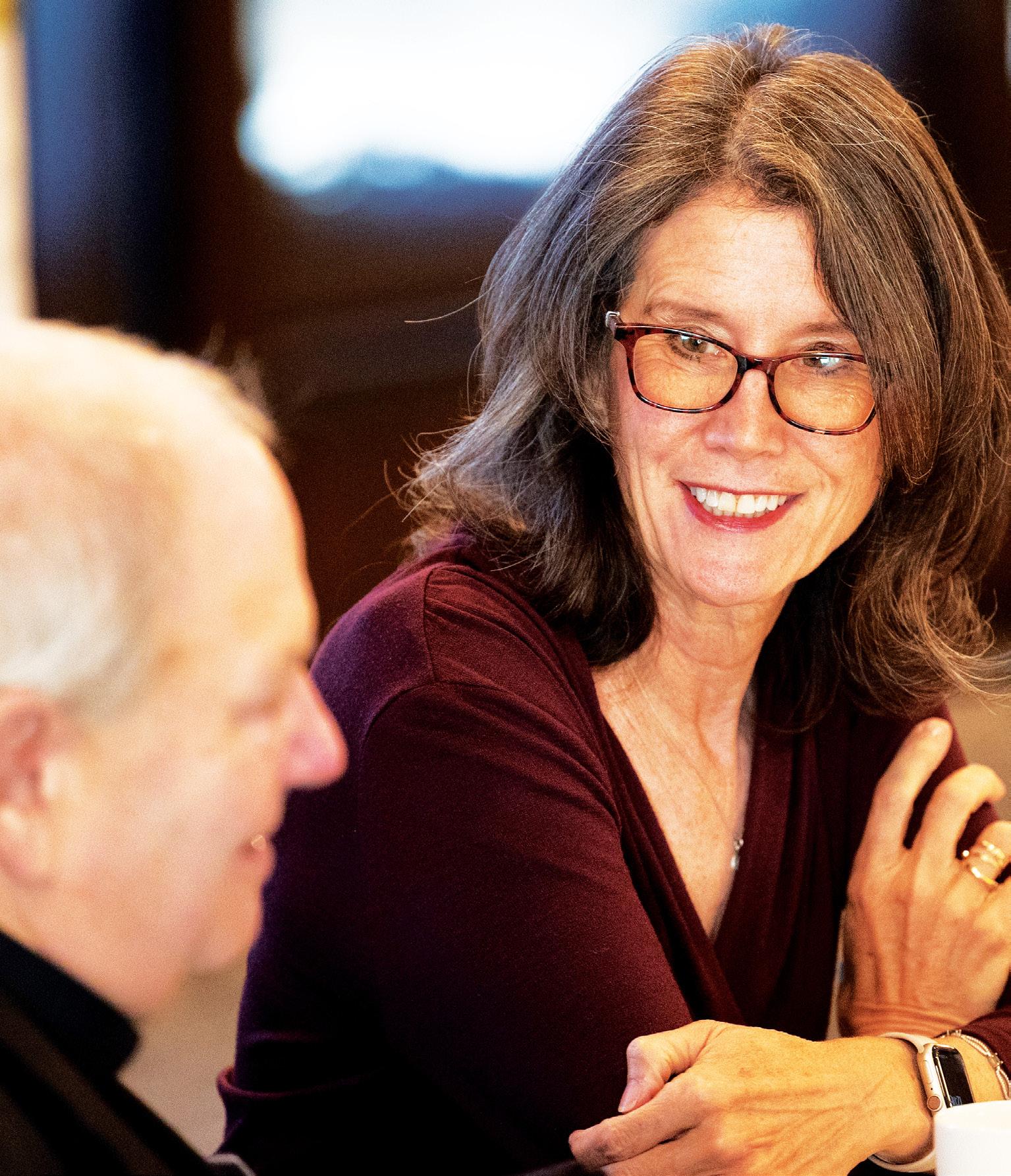
it right. I’ve never resented getting older. I have had this opportunity to watch my kids grow up, move into careers, become parents, become amazing citizens. It’s a gift. I embrace gray hair because I am reminded that my dad never got that opportunity, so I celebrate it. I try to treat aging as the gift that it is.
Q What makes a great leader?
A A leader is defined less by authority and more by spiritual posture, relational wisdom and the ability to motivate others to see their role as a calling, not a position. A great leader shares success with others and makes decisions with integrity, humility and a long-term vision. I’ve always embraced continuous learning. Real growth in myself as a leader comes in finding ways to unlock leadership potential and learning in others.
Q What have you learned about generosity?
A Where there’s generosity, there is joy; there is an absence of fear and a surrender of control. There’s a sense of peace followed by a sprinkling of love which emanates from those who are generous. It’s been stunning. It’s stopped me in my tracks to actually see these attributes consistently present in those who live in generous ways.
I’ve seen people doing such amazing things so quietly. I ask them, “Why are you doing this?” They almost always say the same thing: “I’ve been lucky in my life; I don’t feel worthy of blessings that I received; I know I’m a temporary steward of these blessings and I know because of the Gospels that I’m obligated to pass these on.” I’ve heard some version of this sentiment time after time.
Q “A sprinkling of love” — it’s palpable.
A Yep, you can’t deny it. The blessing of being
paying attention to people. We’ve got our heads in our phones, half listening. Those small little acts make a huge difference.
Q It sounds like you discerned your retirement with the same care you used to first accept the job.
A I moved into the role very reluctantly after a period of discernment which included time in adoration. That experience reminded me: If I took the job, I’d never be doing the work alone. God, the Holy Spirit, would always be helping me. This help, this synchronicity, has been a powerful force throughout my career at CCF. I’ve always felt the Holy Spirit guiding and weaving throughout my work.
There have been a lot of ups and downs during my tenure with the foundation. Some days I really didn’t know what I was going to do, which way to go, and then I’d have a conversation with someone who said yes to something when they had every reason to say no, or I picked up a random phone call where an introduction was made to somebody who could really help, or I’d read an article or have a sense that I needed to call this person which resulted in a breakthrough, progress, a path. You couldn’t pretend there was something else at work. It’s been amazingly consistent. These interventions come from all different places and sources. So I’ve come to strongly believe in that synchronicity. You know it when you experience it, and I believe in it.
Q What will retirement bring?
a witness to this has made me more generous. When you see it, you know it’s real and I feel called to emulate it.
Q How are generosity and gratitude connected?
A Generosity rarely begins with abundance. It begins with gratitude. When people recognize the blessings in their own lives, they often feel drawn to share those blessings. Gratitude softens the heart. It expands perspective. It awakens a desire to give so others may experience that hope and dignity. Gratitude inspires generosity, and generosity strengthens gratitude — it’s a self-fulfilling cycle.
Q One begets another.
A If you think about it in a Catholic context, it’s rooted in a spiritual truth that everything we have is a gift from God. This awareness naturally stirs gratitude and the recognition that we live not by our own efforts alone but by God’s grace poured out.
Q How do you practice generosity?
A I try to practice (it) in ways that are attentive and quiet. For me, it’s less about doing anything big or visible and more about noticing where someone might need encouragement, support or even just to know they’re not alone. I’m mindful that generosity is about the other person, not me, so I try to give in ways that respect dignity and don’t draw attention. I don’t always get it right, but I try to stay open to the small invitations that God places in front of me.
I cook meals for people, send flowers, celebrate with others. There’s nothing like someone being quietly noticed. You heard what they had to say; you paid attention. These days we go along in this world not
A I haven’t had time to dream about it yet, but that’s exciting. I’ve become a digital reader and so, in retirement, I’m moving back to being a physical reader. I like to hold a book and highlight it. I feel like I’ll have the gift of free choice now, more time — time with my mom, time with my grandkids, my kids and husband, time with my friends, time on my bike or with a racket in my hand. I love to be outdoors.
Q How do you lean into winter?
A I cross-country ski. I love it. Walking on a frozen lake, it’s amazing to hear the deep sounds of lake ice cracking. It’s otherworldly. You see God’s presence in all things. I get so much energy and joy from experiencing nature in all its forms. I’m not afraid of weather.
Q It takes humility and grace to hand over the reins to someone new. How do you feel about your successor, Chris Nelson?
A I am super excited! The news has been totally embraced by our community. The Holy Spirit is alive and well in what’s to come. It makes it easier for me to leave knowing someone as capable and faithful as Chris is at the helm.
Q Is he different from you in certain ways?
A Yes! The new president is not a replica, and he shouldn’t be. For the period of time I’ve been at the foundation, my skill set was a fit, and now it’s in this new era — we’re going to be a billion-dollar organization soon — and there will be new skill sets demanded for this future. We’ve been preparing for this new normal for a long time.
Q What do you know for sure?
A When I think about that, I realize I don’t know anything for sure, and that’s what I know for sure. I have learned to trust. I’ve become a fan of the Litany of Trust. When you really take that in prayer, you can let go of this sense that you know anything. If you really trust God, you don’t have to know. We can stay focused on growing in his love and putting our lives in service to others.
SUNDAY SCRIPTURES | FATHER SCOTT CARL
Many associate Advent with preparation for Christmas, which is partly true.
However, this holy season begins with a different focus. Last week, the Gospel of the first Sunday of Advent communicated the importance of preparing for the Lord’s ultimate return: “Therefore, stay awake! For you do not know on which day your Lord will come” (Mt 24:42).
We now come to the second Sunday of this season and likewise have an image about the end: “Then the wolf shall be a guest of the lamb … The baby shall play by the cobra’s den … There shall be no harm or ruin on all my holy mountain” (Is 11:6-9).
Clearly Isaiah speaks of a time we have yet to experience; in our age we see and feel the pain and sadness of discord and the lack of civility. In our present darkness, we receive through Isaiah God’s hope-filled promise of peace and harmony between predator and prey. The cobra calls to mind a serpent evoking the fall in chapter 3 of Genesis. We thus see in Isaiah’s imagery a new Eden. This peace is said to be on the Lord’s holy mountain to which Isaiah also
The Church, the assembly of believers in Jesus Christ, needs to set the example to a world increasingly uncivil of what repentance looks like. The fruit of it will manifest a new Eden, whose peace and calm is attractive to even the most resistant.
referred last Sunday; it is the place of the Lord’s dwelling where “He instructs us in His ways, and we walk in His paths” (Is 2:3).
This Sunday, St. John the Baptist proclaims that the way of the Lord is prepared by the path of repentance. Great numbers make the difficult journey to the desert to repent of sin, to turn toward the Lord once again to align their lives with his ways.
Drawing upon Isaiah’s images of the last day, let us hear John’s words communicate the power of God’s grace. The brood of vipers (cf. cobras or serpents) are exhorted: “Produce good fruit as evidence of your repentance” (Mt 3:8). Not even these Pharisees and Sadducees are beyond the power of God’s grace — these vipers are invited to turn to the Lord as a means to welcome the One who came as a baby.
The call to repentance can sometimes be experienced as harsh; it was for those in this Sunday’s Gospel who were suspect or jealous of God’s messenger. However, for most of those who will read these words there is a fundamental openness to Jesus. He, like John
COMMUNION AND MISSION | FATHER MICHAEL VAN SLOUN
Editor’s note: This is the 17th column in a series on the priesthood. There is a prophetic dimension to the ministry of a priest — not according to the dictionary definition of a prophet, but rather a spiritual prophet like the prophets of the Bible, many in the Old Testament, and best exemplified by Jesus himself.
The dictionary definition of a prophet is a person who is able to predict the future, a prognosticator, someone who can see into the future and predict what will happen. A fortune teller may claim to foresee a romance or a new job; or a self-proclaimed prophet may predict an earthquake, a war, or the end of the world. No one has a clear picture of the future. Foreknowledge like this is reserved to God alone (see Mt 24:36 and Mk 13:32). This is not biblical prophecy. Priests cannot see into the future, nor can they predict what will happen down the road.
Biblical prophecy is altogether different. Prophets know the word of God themselves and speak the word of God to others; exemplify holiness with their personal lives and call others to conversion and deeper holiness, particularly in times of laxity; and give spiritual advice to everyone, particularly those in positions of influence and leadership, on what to do here
and now and how to move forward according to God’s ways. They call people to be faithful to the covenant; know the ancient word of God and interpret and apply the word in contemporary circumstances. Prophets speak the truth, challenge deception and confront evil. They warn people of impending hardship and possible disaster if they stay on the wrong path or persist in their evil ways; help people to realize and admit their sins, how they have offended God and hurt their neighbors, and reassure them of God’s unfailing love, mercy and forgiveness. Prophets offer encouragement and hope to all, particularly the demoralized and the suffering. They chart a path to a brighter future.
Priests are men of the Bible. To speak God’s word, a priest must know God’s word. Priests follow the example of the prophet Ezekiel, who was told by God, “Eat what is before you; eat this scroll” (Ezek 3:1). Obediently, Ezekiel reported, “I ate it, and it was sweet as honey” (Ezek 3:3). Ezekiel devoured the scroll, God’s word, with his eyes, digested the word in his stomach, and assimilated God’s word in his mind and heart. It became the very fabric of his being. Once imbued with God’s holy word, God said, “Go now to the house of Israel, and speak my words to them” (Ezek 3:4). Eating is a prerequisite to speaking. A priest must know and love the word of God before he can speak on God’s behalf. It begins with personal prayer with the Bible, lectio divina, and formal Scripture classes, and
the Baptist, certainly calls us to repent — we, too, have need to turn anew to the Lord to align our words, actions and hearts with his; yet the tone for us is different. His yoke is easy and burden light (Mt 11:28-29). When the Lord finds an open heart, a willing soul, one disposed to his ways and paths, he is meek and humble — baby-like — while speaking with all the power of God’s still, soft voice to Elijah (1 Kgs 19:12).
The Church, the assembly of believers in Jesus Christ, needs to set the example to a world increasingly uncivil of what repentance looks like. The fruit of it will manifest a new Eden, whose peace and calm is attractive to even the most resistant. Abiding in his grace, the Father in the Son through the power of the Holy Spirit will make his dwelling glorious (cf. Is 11:10). As we long for peace and civility, let us heed the Church’s invitation this Sunday to prepare for Christ’s return by turning toward the Lord with all we are and all we have.
Father Carl is vice rector and associate professor of sacred Scripture at The St. Paul Seminary in St. Paul.
Sunday, Dec. 7
Second Sunday of Advent Is 11:1-10 Rom 15:4-9 Mt 3:1-12
Monday, Dec. 8 Solemnity of the Immaculate Conception of the Blessed Virgin Mary Gn 3:9-15, 20 Eph 1:3-6, 11-12 Lk 1:26-38
Tuesday, Dec. 9 Is 40:1-11 Mt 18:12-14
Wednesday, Dec. 10 Is 40:25-31 Mt 11:28-30
Thursday, Dec. 11 Is 41:13-20 Mt 11:11-15
Friday, Dec. 12 Our Lady of Guadalupe Zec 2:14-17 or Rev 11:19a; 12:1-6a, 10ab Lk 1:26-38 or 1:39-47
Saturday, Dec. 13 St. Lucy, virgin and martyr Sir 48:1-4, 9-11 Mt 17:9a, 10-13
Sunday, Dec. 14
Third Sunday of Advent Is 35:1-6a, 10 Jas 5:7-10 Mt 11:2-11
continues with his personal Scripture study, day by day, throughout his entire priestly life. Priests preach prophetically when their homilies call people to greater holiness. There is no standing still in the Christian life. The priest reassures people of God’s constant love for them in their present condition, but how God is never satisfied and wants more. A prophetic homily includes a call to conversion, how God wants total loyalty and complete obedience, a stronger commitment, deeper love, greater joy, more generosity, fuller detachment, better self-control, a more complete eradication of sinful desires and evil deeds, and greater virtue and holiness.
A priest must be up to date on current events, cultural values, and world affairs to be able to offer a prophetic critique and a spiritual alternative. For instance, in his book “Rediscover Catholicism,” Matthew Kelly observes that the three operational philosophies in American culture are individualism, hedonism and minimalism (pp. 35-40), all contrary to the teachings of Jesus in the Gospel. To be prophetic, a priest must be well informed about what is happening, know what agrees and disagrees with the Gospel and Church teaching, support what is good, name and challenge what is wrong, and offer a vision for how to be true to God in today’s world.
Father Van Sloun is the director of clergy personnel for the Archdiocese of St. Paul and Minneapolis.
ST. AMBROSE (337 – April 4, 397) The son of a Roman official in Gaul, Ambrose was practicing law in Rome when the emperor appointed him governor of the province whose capital was Milan. When that Church see became vacant, Ambrose was chosen bishop by acclamation. A catechumen like many of his people, Ambrose was baptized, ordained and consecrated bishop on the same day, Dec. 7, 374. He battled paganism and the Arian heresy, publicly challenged rulers in the Western and Eastern empires, championed hymns as a form of praise, wrote theological treatises and was beloved by his people for his generosity and accessibility. He also baptized St. Augustine of Hippo. One of the four doctors of the Latin Church, St. Ambrose is the patron of bees, stonemasons and catechumens.
Monday, Dec. 15 Num 24:2-7, 15-17a Mt 21:23-27
Tuesday, Dec. 16 Zeph 3:1-2, 9-13 Mt 21:28-32
Wednesday, Dec. 17 Gn 49:2, 8-10 Mt 1:1-17
Thursday, Dec. 18 Jer 23:5-8 Mt 1:18-25
Friday, Dec. 19 Jgs 13:2-7, 24-25a Lk 1:5-25
Saturday, Dec. 20 Is 7:10-14 Lk 1:26-38
Sunday, Dec. 21 Fourth Sunday of Advent Is 7:10-14 Rom 1:1-7 Mt 1:18-24
The sun was setting by the time we’d reached consensus on our Christmas tree. We’d decided on a cedar that hadn’t been anyone’s first choice — safely neutral, conflict averted.
Now we were dragging it home in the dark — tired, cold and hungry. Suddenly we heard a sound in the top of the swaying pines. It was different from the start-andstop rustle of wind in oak leaves. The pines were singing, steady and smooth, their densely packed needles turned to reeds.
We paused our homeward trek, standing still and letting the sound wash over us.
Later, eager to confirm what we’d heard, I took to Google. Was it true? Were pines distinctly suited to make music?
Yes, I learned — and the Transcendentalists were enchanted by it.
Ralph Waldo Emerson captured it well in his 1836 essay “Nature”: “The pine blows its own sweet music when the wind sweeps through it.” Later, his protégé Henry David Thoreau described it in his journal, writing: “There is no finer music than
We embrace the spirit of Advent when we pause from our march to enjoy the view. When our instinct is to hurry up and look down, it is good to slow down and look up.
the wind in the pine tops. It is the earth’s own breath, sweet and powerful, sighing through the forest.”
I read on.
Anne of Green Gables — one of my favorite literary heroines — finds comfort in singing pines. In book three of L.M. Montgomery’s beloved series, “Anne of the Island,” Anne returns to Green Gables, homesick and weary, and soaks up the “passionate wind-songs in the pines.”
My next discovery delighted my inner etymology nerd. There’s actually a word for the sound of wind rustling through trees: psithurism. It’s an archaic word with a Greek root, “psithuros,” meaning whispering.
Isn’t that a lovely concept? Whispering wind.
At only a whisper, we may easily miss its lyrical song.
We embrace the spirit of Advent when we pause from our march to enjoy the view. When our instinct is to hurry up and look down, it is good to slow down and look up. We release our screens and our agendas and gaze into the heavens — available, attuned.
In an era of mindless scrolling and swiping, paying attention is a spiritual exercise. It allows us to see the sacred in our midst — the dignity of every person, the glory of God’s creation, pine needle by pine needle. When we pay attention, we process the world as we are intended to, with all our senses and grateful hearts. We remember we aren’t machines and life isn’t a hamster wheel.
Editor’s note: This is the second in a series of reflections to mark the Archdiocese of St. Paul and Minneapolis’ 175th anniversary. The series explores how the faithful walk in the footsteps of St. Paul, the archdiocese’s patron saint.
During Paul’s second missionary journey, he made his first steps into Europe and entered Thessalonica.
Some were ready to receive the Gospel, but many others conspired against him and fomented turmoil against him and the small Christian community there. Paul was forced to leave and harassment from some Thessalonians followed him to other parts of Greece.
Despite this, he wished to encourage his fledgling community of Christians and sent them two letters that we still have. Paul encouraged the Church to be vigilant and ready for the return of Christ and live this readiness by encouraging one another and lifting each other up. Paul wanted to
The Oct. 1-3 Raising Hope Conference at the Vatican in Rome was an invitation for the Catholic Church and all people of goodwill to reflect on 10 years of Pope Francis’ encyclical on the environment, “Laudato Si’: On Care for Our Common Home.”
convey an urgency to the Gospel and that it was important to go where the Spirit might lead them, even if it meant struggle and persecution like he experienced himself.
This sense of urgency also influenced the mission in the early years of the fledgling Diocese of St. Paul.
The need to provide education for settlers became a priority. The Sisters of St. Joseph of Carondelet responded to a call to go and begin this ministry of teaching and catechizing. And yet, from 1853 to 1855, a cholera epidemic broke out, threatening the lives of many in the young local Church.
The urgent need to care for the sick living on the frontier pressed the Sisters of St. Joseph to respond. With little preparation, time or resources, the sisters accepted the call to begin health care. The sisters converted the school’s old log chapel into a makeshift hospital to care for the many people coming for help. St. Joseph’s Hospital was born. The Sisters of St. Joseph, responding to the urgency of the time to provide education and health care, brought
about the first schools and hospital in our diocese and state. Later, they would respond to the urgent situation of orphans and refugees needing shelter and homes.
This pattern of being ready to respond to the urgent needs of the day and to provide encouragement, comfort and care to the neediest became the hallmark of the sisters. Their charism of “loving unity” allowed them to love God and reach out in love to their “dear neighbor without distinction.”
We can also walk in the spirit of urgency and vigilance that Paul described. We can live in such a way as to be ready to respond when the signs of the times speak to us.
In the past five years, we have also witnessed the urgent needs brought forth by sickness and pandemic. We live in a time when the voices of false stories sow discontent and division. The words of St. Paul encouraging the small Church in Thessalonica still ring true today, “You are children of the light and children of the day. … Let us be sober, putting on the breastplate of faith and love and the helmet that is hope for salvation. For God
Only then are we able to sense the movement of the Holy Spirit, which Scripture likens to wind. (The Greek word for spirit is “pneuma,” meaning wind or breath.)
We can’t see the Holy Spirit, but we can feel it and hear it. And like pines swaying in the wind, we can see the Spirit moving those around us. The Gospel writer John tried to capture this mystery, writing: “The wind blows where it wills, and you can hear the sound it makes, but you do not know where it comes from or where it goes. So it is with everyone who is born of the Spirit” (Jn 3:8).
Twice this month I’ve interviewed Catholic leaders who spoke to the power of the Holy Spirit. It was a striking part of their ministry, opening doors at just the right time, providing the clue, the key, the cash.
“It’s been amazingly consistent,” one woman told me. “You know it when you experience it, and I believe it.”
Amid our many December to-dos, may we listen for the Holy Spirit, whispering like wind. May we know it and believe.
Capecchi is a freelance writer from Grey Cloud Island.
Sessions and discussions at the conference included progress being made to engage with the issues of climate change in the world.
I received the privilege to attend because of my work at the Center for Mission supporting the Laudato Si’ Movement Minnesota Chapter. To be recognized for our work in Minnesota was a huge honor, and I am thankful for the many volunteers
in Minnesota who have furthered our work in the last six years.
Two things stand out to me from the conference: First, the marks of the Church are both a truth of the Church and an aspiration that we need to live out in practice. In my role at the Center for Mission, I focus on domestic issues even though our organization has a global focus. The Raising Hope Conference was
did not destine us for wrath, but to gain salvation through our Lord Jesus Christ. … Therefore, encourage one another and build one another up, as indeed you do” (1 Thes 5:5-9).
Walking in the footsteps of St. Paul, we, too, can find the courage to respond. Paul said, “Admonish the idle, cheer the fainthearted, support the weak, be patient with all. See that no one returns evil for evil; rather always seek what is good for each other and for all. Rejoice always. Pray without ceasing. In all circumstances, give thanks, for this is the will of God for you in Christ Jesus. Do not quench the Spirit” (1 Thes 5:14-17). Let us be vigilant and ready to respond to God’s call to love and serve in our day.
There will be a missionary pilgrimage to Greece and Turkey in the footsteps of St. Paul in September 2026. Go to thecatholicspirit.com for more information.
Deacon Friesen is director of the Center for Mission, which supports missionary outreach of the Archdiocese of St. Paul and Minneapolis. He can be reached at friesenm@archspm.org.
the first event I attended that had a global focus and it was my first experience of international travel. Meeting so many people from around the world dedicated to their faith who want to respond to climate issues in their communities is breathing new life and creativity into our Care for Creation ministry. Having so many people share a common experience with
I recently saw “Wicked: For Good” in theaters. The film certainly wasn’t as good as last year’s “Wicked” installment, but the leading ladies (especially Ariana Grande) delivered dazzling performances and the movie’s central theme about pursuing what is good and true over what is comfortable and convenient is certainly worth reflecting upon.
But I’m not about to write a review of “Wicked.” Instead, I want to review the movies, or rather, the experience of going to the movie theater in 2025.
Like many other theaters these days, the cinema I went to didn’t employ traditional theater seating, but instead had rows of gigantic, comfy reclinable chairs. The big cushy red seats had multiple cupholders, within which patrons could place, in addition to soft drinks and sweets, alcoholic beverages. It made for an excessively comfortable two hours and 17 minutes.
Rather than “movie going,” I think we can call this kind of experience “movie lounging.” And its prevalence these days is worth considering.
Clearly, the rise of movie lounging is part of the theaters’ attempt to compete with the ability to stream movies from the comfort of one’s couch. Movie theater attendance rates certainly plummeted during the COVID-19 pandemic, but they were already trending down amid the rise of Netflix and Disney+.
But I think the rise of movie lounging also says something about how we, as a society, have come to understand what movies are for and what we are doing when we go to the theater.
Consider the posture taken: lying on one’s back in a pose of pure relaxation. This doesn’t seem like the position one assumes if they are about to critically engage with a thought-provoking cultural expression or work of art. We don’t, for instance, recline horizontally in a plushy chair with canned margarita in-hand when we are considering a Monet oil painting or reading a Dostoevsky novel. Instead, this is the posture of one who doesn’t want to think
— but merely wants to be entertained. Or anesthetized.
The posture of movie lounging is consistent with the kinds of films that dominate the box offices these days: a never-ending stream of reboots and sequels, especially of the superhero variety. As Catholic New York Times columnist Ross Douthat noted in his 2022 book, “The Decadent Society,” this trend is a sign of “cultural and intellectual exhaustion.” Not only do we not want to engage our brain too strenuously at the theater, but we apparently don’t have any ideas or insights worth thinking about.
I am not suggesting that every movie be reduced to a boring, informational documentary. I am suggesting, however, that we are currently not reaching the full potential of movies as an artistic medium, which have an incredible capacity to inspire and provoke, and not merely entertain.
I’m not the only one who seems to expect more from movies. During a recent Vatican audience with Hollywood stars, Pope Leo XIV noted cinema’s potential to express “the desire to contemplate and understand life, to recount its greatness and fragility and to
As you experience the beautiful season of Christmas, think about how you can give your presence to others, as well as your presents.
Being present to those we love requires a quiet and contented soul, one that is at peace with God and itself. If we are stirred up and restless, these distractions will take us out of the moments we want to be present to family and friends.
If you find yourself in a difficult emotional state this year, there are a few tangible, immediate choices you can make to help yourself navigate this season with greater peace.
First of all, remember that previous Christmas memories will likely come to mind this year, as they likely have in the past. If these memories have not been filled with happiness and peace, then this year may have some of that same feeling. Simply acknowledging that will be helpful and allow you to let go of expectations that are too high.
If you feel like this, getting outside of yourself and helping others can be the antidote you need to refocus and make the season more enjoyable. You could offer to work at a food shelf and bag groceries for others who are hungry. You could also take a little money out of your savings account and purchase gifts for a family in need. Or you could offer to bring an elderly person to Mass during the Christmas season so they do not have to sit alone.
Sometimes, as previous Christmas memories come to mind, it is the memories we hold in our bodies that are the most troubling. How our bodies felt during those previous Christmases will likely be reactivated this year. You may be able to adjust your thinking, but the body does not lie — it holds on to the traumatic feelings until they are processed, which may take a few sessions with a counselor to let go of. But what can you do now to feel better and to appreciate the happiness all around you?
You can begin by scheduling an appointment with a counselor, and even if you cannot meet until sometime in the
new year, knowing that you have the courage to address this part of your life will allow you to experience more joy right now. Try to relax and give yourself grace. Remember what Stephen Porges, a trauma expert, said: “You’re a hero! You survived this!” and try as best as you can to step into the festivities of the season.
You can take these feelings to prayer and spend time with God, asking him to help you forgive those who have hurt you. Say the Hail Mary and the St. Michael the Archangel prayers and ask Mary and St. Michael to protect you from negativity and to help heal the pain.
These prayers may bring to mind the need to forgive someone because holding on to unforgiveness is a hurt we carry; our anger does nothing to the person who inflicted the harm. You can go to the sacrament of reconciliation and talk to a priest about the difficulty you are facing and ask for his blessing. He will talk with you and likely give you strategies to move through this time with grace.
You can also take a walk outside if it’s not too cold or icy. Fresh air and exercise will release endorphins to help you feel better. Just moving your muscles is a good idea when you feel badly, which is often the opposite of what you want to do. Experts say, “Move your muscles,” when you feel sad, lonely or depressed. Just that movement takes us outside of ourselves and helps raise our level of acceptance and provides a fresh perspective, as long as we do not allow the evil one to continue to feed the flame of negativity and unforgiveness, no matter how justified it may seem.
Remember, as joyful as Christmas can be, it also holds all the memories of Christmases past and can activate unhealed memories we would rather forget. If you find yourself in such a place emotionally this Christmas, do your best to make this a Christmas you can look back on with great courage and tenacity, one that you did not allow yourself to be captive to memories that are difficult and unhealed.
Soucheray is a licensed marriage and family therapist emeritus and a member of St. Ambrose of Woodbury.
If you have the need of a counselor this year, ask your priest, close friends, or your medical doctor if they can recommend someone for you to see in the new year. Then make that appointment and try to enjoy as much of the holiday as you can.
Remember, this is a slice of time and it will pass. Be sure to get some exercise, if you can, and help your brain and body help you.
If you find yourself in a difficult space this Christmas, please do not hesitate to call the Suicide and Crisis Lifeline by dialing 988.
portray the longing for infinity.”
“Beauty is not just a means of escape,” Pope Leo continued, “it is above all an invocation. When cinema is authentic, it does not merely console, but challenges. It articulates the questions that dwell within us, and sometimes, even provokes tears that we did not know we needed to express.” Advent seems like an appropriate time to reflect upon the true role of authentic cinema. After all, this is the season when we contemplate the significance of the Word becoming flesh. In the Incarnation, God did not save humanity by eliminating time and material reality, but by entering into it. And in so doing, he bestowed an incredible nobility and significance to all human enterprises — including the art of movie making.
It might involve sitting up in our seat, but movies still have the capacity to awaken our humanity and spur us onward in the quest for ultimate goodness, beauty and truth. Here’s hoping for a Pope Leo XIV-inspired revival.
Liedl lives in South Bend, Indiana, and is senior editor for the National Catholic Register.
Say the Hail Mary and the St. Michael the Archangel prayers below, asking Mary and St. Michael to protect you from negativity and to help heal pain.
HAIL MARY
Hail, Mary, full of grace, the Lord is with thee.
Blessed art thou among women and blessed is the fruit of thy womb, Jesus.
Holy Mary, Mother of God, pray for us sinners, now and at the hour of our death.
Amen.
PRAYER TO ST. MICHAEL THE ARCHANGEL
St. Michael, the Archangel, defend us in battle.
Be our protection against the wickedness and snares of the Devil.
May God rebuke him, we humbly pray, and do thou,
O Prince of the heavenly hosts, by the power of God, cast into hell Satan, and all the evil spirits, who prowl about the world seeking the ruin of souls. Amen.
Approximately 53 million Catholic adults in the United States marked the beginning of Advent on Nov. 30.
For me, Advent means something more this season. In years past, my practice was to create an Advent wreath with candles (three purple and one pink) to symbolize the upcoming arrival of Christ’s birth. This year, embracing a new season of the liturgical calendar means spiritually reflecting on how I’ve already seen Christ arrive since the day my church was attacked with my only child and her entire school inside.
Aug. 27 will forever be in the hearts of the Annunciation Catholic community. Something in our souls changed that day. My daughter was not injured physically, but two precious children were killed in their pews. Twenty-one people were injured as they prayed. It was among the most violent attacks on a Catholic church since Oscar Romero was murdered in 1980. But this was not San Salvador, it was south Minneapolis, a neighborhood parish surrounded by homes and a Starbucks on the corner.
That date, Aug. 27, was the feast of St. Monica, mother of St. Augustine and the patron saint of mothers and wives. One enduring image from that dreadful day is of a mom in a striped shirt, running toward the school with her shoes in her hands. All moms ran that day, from homes and offices toward a scene we could not fathom. I sped down South Lyndale Avenue, desperately praying that all would be well. My prayer was a jumble of words, but I later learned this was the prayer of Julian of Norwich.
A prayer that was not said in unison that day was the Hail Mary, which ends each Mass at Annunciation. I was aware but had not fully appreciated the deep devotion this parish has to Mother Mary. Our church’s very name, Annunciation, symbolizes the very first “yes” to believing in God. Mary said “yes” when the angel Gabriel visited her, making her the very first disciple. She is the finest example of leaning into faith while embracing the unknown.
That is exactly what Annunciation parish is doing — leaning into faith while embracing the unknown. In the aftermath, the rosary became our powerful lifeline. We turned to this ancient prayer to steady our souls, untangle our emotions, and pray for the injured children to return home from the hospital. People gathered nightly on the sidewalk outside the church and the circle grew as soothing prayers were recited out loud. I was amazed to see the diversity of people arriving with beads in their hands. Teenage boys stood shoulder to
FITZPATRICK CONTINUED FROM PAGE 16
All this and more occurred since Aug. 27, which was the 21st week in Ordinary Time, which the Church defines as a period of order and balance when Catholics follow a structured rhythm of life that emphasizes spiritual reflection and growth. For us, everything felt out of order after the shooting. But balance in the form of prayer and the structure of the Church calendar helped steady us.
shoulder with parents, teachers, neighbors and cousins. In an illustration of leadership without ego, our archbishop came nearly nightly, not to lead prayers but to stand beside us.
Our parish had been started by the Dominican Sisters of Sinsinawa, the great social justice warriors who believe in serving others with joy. They gathered immediately after Aug. 27, forming a circle around our statue of the Holy Family that was desecrated by gunfire. The nuns gently placed flowers into the marks from bullets on the porcelain parents of Christ. When those fresh flowers faded, artificial flowers covered those marks.
Teachers and students did return to school, this time with an army of support in the form of counselors, police protection and the prayers of the community around them. Brave children, who had huddled together under kneelers, put their blue and green uniforms back on and found strength in community. Lyndale Avenue was blanketed in our school colors around every tree.
Extraordinary individuals extended grace to us. Sports helped. Minnesota Vikings
Pope Leo XIV as well as the different shared prayer experiences at the event gave us all a sense of unity. This is a great sign of what the Church can be, one which shares a common life in our diverse expressions of faith. Second, and probably more important, tenderness and compassion are efficacious signs of an internal disposition toward unity. In a conference setting, I am often lost and struggle to feel grounded because large public gatherings are a source of anxiety for me. I am a quiet and private person by nature, and I am not good at asking for help. However, simple acts such as people proactively helping me get my business cards in a pocket, instead of a matryoshka doll of bags and iPad cases; sharing water so I could take my
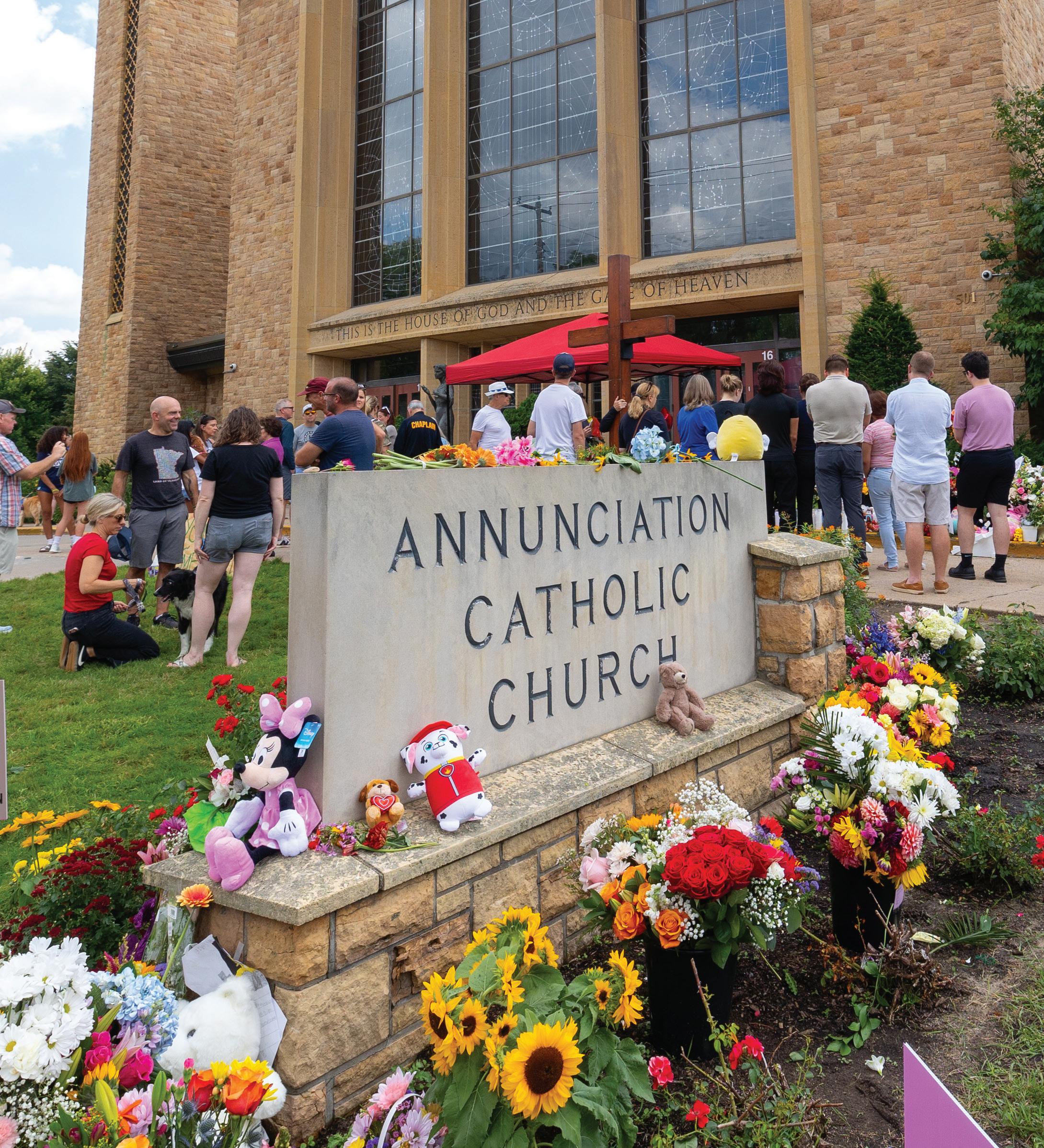
coach Kevin O’Connell and his players threw a football with the kids. Members of the Minnesota Frost of the Professional Women’s Hockey League showed up to pet therapy dogs and even bunnies with children. Kids from opposing teams in girls’ volleyball paused before starting a game to weave our school colors into their ponytails. Such tenderness was often mixed with tears.
We embraced the unknown. Columbine and Sandy Hook survivors and parents flew to Minnesota to share community and help us understand the complexity of our feelings. We learned of the great resistance for a repeal in assault weapons. As tree ribbons became soiled in the autumn weather, we gracefully removed them from trunks and repurposed them for children to make art in the classrooms.
Nov. 20 came around — the feast of the Presentation of the Blessed Virgin Mary — which commemorates the event when Mary was presented in the temple by her parents. On this poignant date, Annunciation students gathered in the auditorium for the first all-school Mass since the shooting. Many still do not want to talk about it.
medication, or staying with me an extra moment while I was feeling overwhelmed — all enriched my experience of the Raising Hope Conference. Each person came from a different culture but shared in cultivating a sense of unity and belonging. As I read Pope Leo’s exhortation, “Dilexit Te” on caring for the poor after the conference, his emphasis on tenderness reminded me of the care I received from people who just met me. My interest in doing the work I do is to cultivate communities of leaders who are sensitive, compassionate, and use their faith to support people and our common home.
Pope Leo at the Raising Hope Conference shared in his message the question, “what is being asked of (each) of us in this moment to care for creation?” My response to his
Parents met for coffee and doughnuts, wearing T-shirts that said “Joy” or “Hope” on the front and “Be the Light” on the back.
All this and more occurred since Aug. 27, which was the 21st week in Ordinary Time, which the Church defines as a period of order and balance when Catholics follow a structured rhythm of life that emphasizes spiritual reflection and growth. For us, everything felt out of order after the shooting. But balance in the form of prayer and the structure of the Church calendar helped steady us.
The first Sunday of Advent, Catholics lit our first purple candle. “Be the Light” is more than a T-shirt slogan for us at Annunciation. It is a way to remember who we are, to renew our advocacy to make assault weapons illegal and a way to enter a new season of the Church with faith in our hearts. Imagine if all Catholics in America stood with us — we would end school shootings for good.
Motzenbecker, a member of Annunciation in south Minneapolis, is the director of Refugee Services at the Minnesota Council of Churches and a Lay Dominican of Sinsinawa associate.
question after this conference is to support connections with leaders from around the world, coming together to learn and be present to each other. The path to solidarity is long and winding, especially when navigating cultural differences and different circumstances, and we never fully arrive at solidarity. However, for my faith journey, this path of solidarity has been worth walking even if it is perpetually incomplete. To listen and embrace all creation with tenderness has given me the greatest gift of seeing others lead, grow and more fully reveal God’s gifts in all beings. Fitzpatrick is the social mission outreach coordinator for the Center for Mission, which supports the missionary efforts of the Archdiocese of St. Paul and Minneapolis. He can be reached at fitzpatricka@archspm.org.
CCW Christmas Bazaar Dec. 6: 9 a.m.-5 p.m. at St. Vincent de Paul, 9100 93rd Ave. N., Brooklyn Park. Shop over 70 unique crafters, indulge in sweet treats from the Slice of Heaven Bakery and enjoy live holiday music, a raffle and treat yourself to lunch. saintvdp.org/christmas-bazaar
St. Raphael Annual Christmas Village — Dec. 6: 8:30 a.m.-1 p.m. at St. Raphael, 7301 Bass Lake Road, Crystal. Concessions include caramel and cinnamon rolls, homemade vegetable beef soup, Sloppy Joes, hot dogs and sweets. Shopping items include jewelry, household items, decor and children’s books. Enjoy games for the young (and young at heart), and Santa! Located in parish’s east gathering areas.
Christmas Bake Sale, Boutique and Craft Fair Dec. 6-7: 11 a.m.-5:30 p.m. Dec. 6 and 9 a.m.-1 p.m. Dec. 7 at St. Matthew, 510 Hall Ave., St. Paul. Use Door 5, off the church parking lot. Features a variety of baked goods and sweets, a jewelry booth, theme baskets, a variety of holiday items, handmade linens and other unique items for gift giving. st-matts.org
Christmas Boutique Dec. 6: 9 a.m.-4 p.m. at Guardian Angels, 8260 Fourth St. N., Oakdale. Boutique includes cookie and candy sale, Christmas trees and wreaths, Santa Shop (where kids can shop), white elephant sale, rolls and coffee, lunch, visit with Santa, and GA Crafters with over 70 vendors, selling lots of handmade and creative gift ideas. One day only! guardian-angels.org/boutique
Breakfast with Santa Dec. 7: 9 a.m.-1 p.m. at St. Matthew, 510 Hall Ave., St. Paul. Use Door 5, off the church parking lot. Join us for a delicious pancake breakfast. Meet Santa and take your picture with him! The pancake breakfast includes pancakes, sausages, eggs and beverages. Adults: $9, kids ages 6-12: $5, kids ages 5 and under: free with a paid adult meal. st-matts.org
Advent Festival of Lessons and Carols — Dec. 12: 6:30-7:30 p.m. at St. Bartholomew, 630 E. Wayzata Blvd., Wayzata. Featuring St. Bartholomew parish choir and musicians, directed by Justin Thomas Fields. Enjoy works from Hassler to Rachmaninoff, beloved favorites from the English choral tradition, and classic Advent and Christmas carols, interspersed with Scripture and other spiritual readings. Hospitality will follow. For information, call 952-473-6601 or visit our website at st-barts.org/events
Ave Verum Corpus Dec. 12: 7-8:30 p.m. at St. Nicholas, 51 Church St., Elko New Market. We invite
you to experience Christ’s peaceful presence at our next Ave Verum Corpus (Hail True Body) event. This is an exquisite pairing of Eucharistic adoration and classical sacred music. All are welcome. stncc.net
Christmas Cookie and Craft Sale Dec. 13: 9 a.m.-3 p.m. at St. John the Baptist Byzantine Catholic Church, 2201 Third St. NE, Minneapolis. Check out holiday baked goods, Christmas decor, crafts and gift items. We’ll also have specialty food items to enjoy while you shop. Plan to attend Great Vespers at 4 p.m. byzantinemn.org
Gaudete Swing Dance Dec. 13: 7-9 p.m. at Holy Family Academy, 5925 W. Lake St., St. Louis Park. Young adults (20s and 30s) are invited to this evening of fellowship and dancing in Holy Family Academy’s Crusader Hall. The gathering will feature refreshments and live music from North Star Big Band.
Handel’s Messiah Concert Dec. 14: 3-5 p.m. at Holy Family, 5900 W. Lake St., St. Louis Park. Celebrate
Gaudete Sunday with a concert featuring a professional orchestra, soloists and Holy Family’s talented parish choir and schola. hfcmn.org/pay-messiah-concert
Knights of Columbus Christmas Brunch
Dec. 14: 8:15 a.m.-12:30 p.m. at Epiphany, 1900 111th Ave. NW, Coon Rapids. Share a meal with your fellow parishioners at the Knights of Columbus Council 10138 Christmas brunch. We’re serving pancakes, sausage, scrambled eggs, fruit cup, toast, orange juice and milk. Cost is a goodwill offering. kc10138.mnknights.org
Cor Jesu Dec. 5: 8 p.m. at The St. Paul Seminary, 2260 Summit Ave., St. Paul. Join us for Cor Jesu
First Friday liturgies for college and young adults at St. Mary’s Chapel. 10000vocations.org/cor-jesu.html
Marriage Weekend Workshop Dec. 5-7: at Comfort Inn Hotel, 3450 Washington Drive, Eagan. Retrouvaille is a lifeline for troubled marriages. Couples learn the tools to rediscover each other and heal their marriage. 100% confidential. tcr-mn.org
“Jesus on the North Side” Dec. 6: 10 a.m.12 p.m. at St. Bridget, 3811 Emerson Ave. N., Minneapolis. Parishioner Meg Gorzycki will facilitate a conversation about being Jesus on the northside of Minneapolis. There will be time for questions, answers and sharing. stbridgetnorthside.com
Memory Care Mass (formerly Dementia Friendly Mass) Dec. 11: 1:30-2:30 p.m. at St. Mary of the Lake, 4741 Bald Eagle Ave., White Bear Lake. A special Mass for people living with dementia, family members, and their caregivers. The Mass is shorter in length and held in the chapel for a more comfortable environment. Hospitality and fellowship after Mass allows for important social time. stmarys-wbl.org
Michael: 952-929-8702. Leave message.
BEAUTY SALON
Bring your clients and rent a chair in North St. Paul. Full or part time. Reasonable rent. Call Cindy at Albert’s Salon North: 651-777-9122. CEILING TEXTURE

Michaels Painting Popcorn Removal & Knock Down Texture TextureCeilings.com (763) 757-3187
CEMETERY LOTS FOR SALE
Resurrection Cemetery: 2 lots. Value: $2365 per lot. Price: $4730/pair. 763-784-1693
Resurrection Cemetery: Companion Side-by-Side, Niches 4-5, in sought-after Building 2 location. Current price $17+K. Asking $16K. Includes transfer and inscription fees. Contact Harry (612) 749-2154.
Advent Retreat for Men and Women: “Making Room in the Inn to Welcome Christ” Dec. 12: 7:30 p.m. at Christ the King Retreat Center, 621 First Ave. S., Buffalo. Is there room in your personal inn for Jesus this Christmas, or is your inn so overcrowded that Jesus can’t find a spot? We will explore how to make room in your heart. Presented by Susan Stabile, $50 deposit with registration. kingshouse.com/events Spirit and Fire Dec. 12: 6:30-8 p.m. at St. Rose of Lima, 2048 Hamline Ave. N., Roseville. A worship event in which we invite the Holy Spirit to come and dwell with us. The evening opens with a testimony or teaching, followed by adoration, music led by Alex Schindler, prayer ministers and confession. saintroseoflima.net/events/spirit-and-fire Men’s Weekend Retreat Dec. 12-14: 4 p.m. Dec. 12-12:30 p.m. Dec. 14 at Franciscan Retreats and Spirituality Center, 16385 Saint Francis Lane, Prior Lake. Enjoy private bedrooms, hearty meals cooked onsite and a balanced schedule: guided prayer, liturgical and sacrament opportunities, themed conferences, and ample unstructured time for rest, reflection, or quiet inside or on our 60 acres of nature. FranciscanRetreats.net/Calendar-1 Lessons and Carols for Advent Dec. 13: 4-7 p.m. at The St. Paul Seminary, 2260 Summit Ave., St. Paul. Join The St. Paul Seminary schola, mixed choir and instrumental ensembles for an evening of seasonal music and readings preparing your heart and mind for the Christmas season. Free and open to the public. A reception will follow. tinyurl.com/y76m7hh6
Christmas Choir Concert Dec. 9: 7-9 p.m. at Benilde-St. Margaret’s, 2501 Highway 100, St. Louis Park. Join us for an evening performance by the BSM choir as they present a Christmas Choir Concert for all to enjoy. bsmschool.org/student-life/activities/choir
Christmas Band/Orchestra Concert — Dec. 10: 7-9 p.m. at Benilde-St. Margaret’s, 2501 Highway 100, St. Louis Park. Join us for an evening performance by the BSM band and orchestra as they present a Christmas Band/Orchestra Concert for all to enjoy.
Caroling for Life Dec. 13: 8-9:30 a.m. at Planned Parenthood, 671 Vandalia St., St. Paul (and other locations). Caroling for Life brings the Christmas message of peace and joy to the darkness of the abortion facility. Join other pro-lifers outside abortion facilities across the country, including in St. Paul, Minneapolis and Bloomington. plam.org/event/caroling-for-life
Resurrection Cemetery: single lot; section 62. Value: $2360. Price: $1300. 651-382-7274
CHIROPRACTOR
Mind & Body Chiropractic * Dr. Kuznia $80/mo. Indiv. * $120/mo. Family * SJBG mindbodychiropractic.com/ 651-600-3521
FINANCIAL PLANNERS
Win-A-Key to Unlock Your Retirement Income http://www.yourretirementkeys.com/ Susan Wieneke financial advisor SJBG FOR SALE
Projection Tv with Screen & Mounting Bracket, New. - $2,500 (Mendota Hts) condition: new. Projection
TV System Ai-Pro #15000 with Wall Mounting Bracket & Projection Screen. All Brand New, still in orig packaging. List $6,000+. Asking $2,500 cash https://aiprousa.com/ products/ai-pro-projectores 612-720-3313
FLORIDA CONDO FOR SALE - $275,000 https://jggsecure.wixsite.com/condo Contact Enrico: 720-688-4974.
Weathered barn wood, rough lumber, and handhewn beams: 952-367-6069.
DEADLINE: Noon Thursday, 14 days before the anticipated Thursday date of publication. We cannot guarantee a submitted event will appear in the calendar. Priority is given to events occurring before the issue date.
LISTINGS: Accepted are brief notices of upcoming events hosted by Catholic parishes and organizations. If the Catholic connection is not clear, please emphasize it in your submission. Included in our listings are local events submitted by public sources that could be of interest to the larger Catholic community.
ITEMS MUST INCLUDE:
Time and date of event
Full street address of event
Description of event
Contact information in case of questions
The Catholic Spirit prints calendar details as submitted.
TheCatholicSpirit.com/calendarsubmissions
30th Annual Messiah Concert and Dinner Dec. 18: 5 p.m. at the Basilica of St. Mary, 1600 Hennepin Ave., Minneapolis. Enjoy a delicious dinner followed by a performance of Handel’s Messiah by the St. Paul Chamber Orchestra. Proceeds from the dinner benefit the Basilica’s vision, mission and ministries. mary.org/messiah
Singles Group Ongoing Second Saturday Each Month: 6:15 p.m. at St. Vincent de Paul, 9100 93rd Ave. N., Brooklyn Park. Gather for a potluck supper, conversation and games. 763-425-0412.
Young Adult Evening Prayer Dec. 16: On Zoom. Young adults ages 18-plus are invited to evening prayer with the School Sisters of Notre Dame. There will be time for faith sharing with young adults and sisters from across the U.S. and Canada. Register in advance for the Zoom link. ssnd.org/events
HARDWOOD FLOORS
MintHardwoodFlooring.com
Installation, Refinishing, Repairs Mark Schroeder: 612-987-5175
HEALTH CARE
THE FAMILY CLINIC, LLC
Direct Primary Care • Functional Medicine 651-400-1554 • info@mnfamilyclinic.com
MORTGAGE LOANS
Home Loans with Honesty & Integrity Matko Lending LLC; NMLS# 2656175 matkolending.com/952-484-1613 (call/text)
Residential Mortgage Lending in MN & WI Conventional, FHA and VA NMLS #422758 Christopher.Burr@rcu.org 651-202-1367
PAINTING
For painting & all related services. View our website: PAINTINGBYJERRYWIND.COM or call (651) 699-6140.
Michaels Painting. Texture and Repair. MichaelsPaintingLLC.com. (763) 757-3187
PRAYERS
NOTICE: Prayers must be submitted in advance. Payment of $8 per line must be received before publication.
RELIGIOUS ITEMS FOR SALE www.Holyart.com Over 50k Religious Items & Church Goods. ROOFING/SIDING
Roofing, Siding, Exterior work. Able to work with insurance. Free Estimates. #BC773469 Call Mickey 612-414-7147 or 507-399-6597. WEB DESIGN SERVICES Websites, Redesign, Updates, Hosting, Seo Midwestwebs.com Peter Dubay 763-537-3231.
advertise call Chris at 651-251-7714
By Joe Ruff
The Catholic Spirit
A bishop’s golden crosier, or hooked staff, found in a scrapyard in St. Paul has drawn the man who discovered it into a journey back to the Catholic Church of his youth.
“If I’m the lost sheep, it literally took a shepherd’s staff put right in my path” to seriously pursue the faith, said Jeff Helgeson, 62, of New Richmond, Wisconsin.
Archbishop Bernard Hebda accepted the crosier when Helgeson told him about it May 30 at the Archdiocesan Catholic Center in St. Paul. The archbishop carried the crosier at the closing Mass June 7 of the Archdiocesan Synod Assembly 2025 at the Cathedral of St. Paul, and he told the story of its being found as part of his homily.
“We don’t know whose crosier it was,” the archbishop said in his homily. “But how magnificent that in the midst of that scrapyard — maybe like that field of dry bones (in the biblical story found in Ezekiel) that there was that sign of hope, that glimmer of hope, that we can celebrate this evening.”
“We hope, my brothers and sisters, that we might be like that gentleman who found this crosier in the scrapyard,” the archbishop said. “That we might be able to recognize the treasure that God has in our midst.”
Asked recently to tell his story, Helgeson — who routinely drives scrap metal to St. Paul from the electric motor manufacturer he works for in Woodville, Wisconsin — said he found the crosier while dropping a load off in March and following his usual routine of looking around the yard.
“There’s quite a menagerie of scrap metal,” he said. “You’d be surprised at what people throw out. So, I was walking around and that’s when I spotted the crosier sticking out.”
The bright gold staff with its hook holding an ornately fashioned cross protruded from the flatter color of brass items that surrounded it, Helgeson said. It also appeared to be something that should go back to the Church, he said, as it reminded him of the crosier he saw while serving at Masses as a Catholic school youth in Fargo, North Dakota, when the late Bishop Justin Driscoll presided.
“As soon as I saw it, I said, ‘This doesn’t belong here,’” Helgeson said. “There’s no way this was scrap metal.”
Helgeson asked workers in the yard if he could purchase the crosier, and they promised to ask their manager. About a month later, the manager was in the scrapyard and gave him the crosier free of charge, Helgeson said.
“He said, ‘Do the right thing,’” Helgeson said. “He said, ‘We’re not taking a thing for it.’ Businesses don’t usually do that. And I would have paid whatever they asked.”
Intent on finding the rightful owner, Helgeson scoured the internet for similarly fashioned crosiers and finally found one in the Diocese of Springfield, Illinois. Officials in that diocese weren’t aware of similar crosiers and suggested that Helgeson call closer to home, where the crosier was found: the Archdiocese of St. Paul and Minneapolis.
That’s when Helgeson spoke with Paul
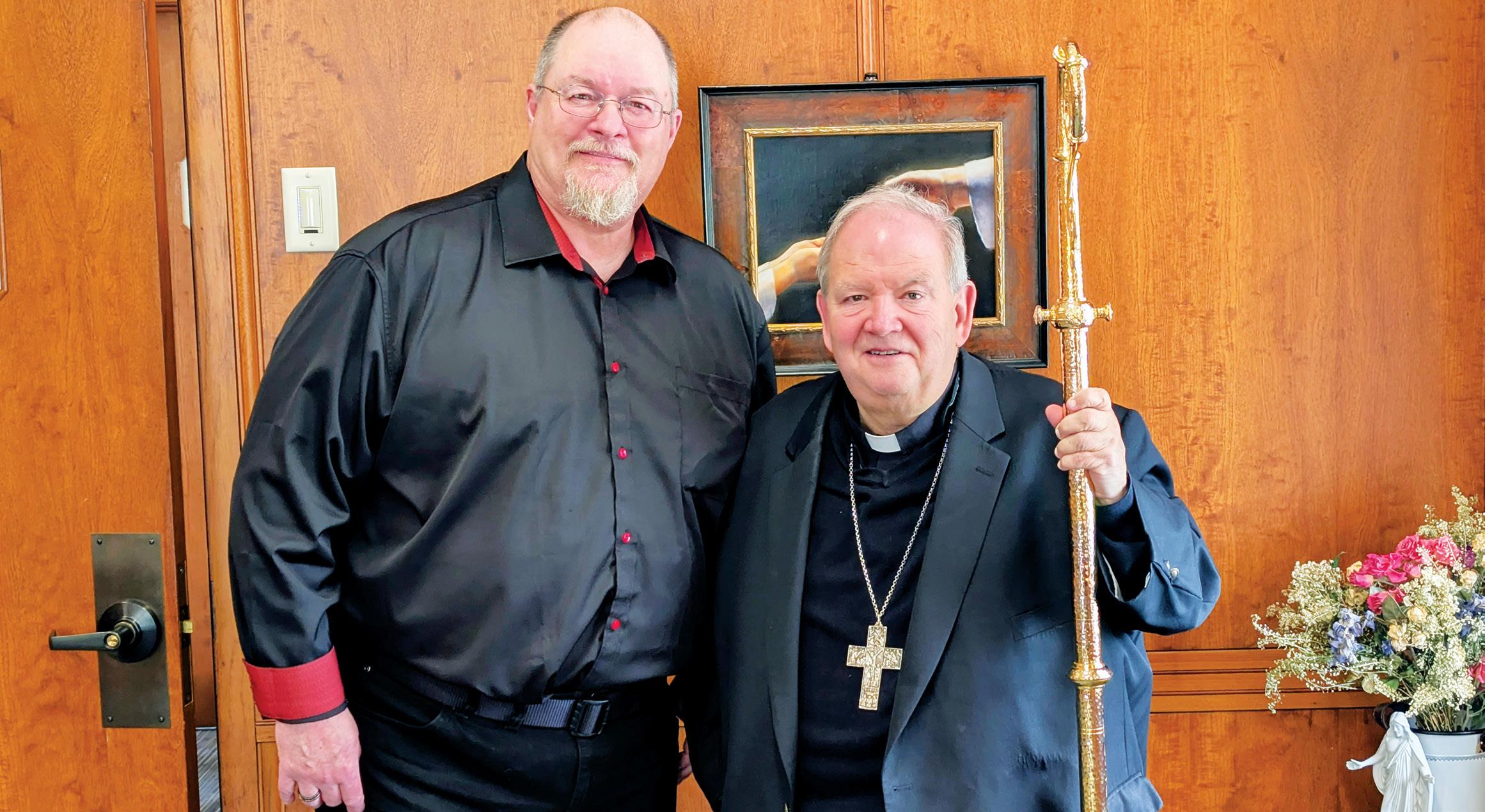
As soon as I saw it, I said, ‘This doesn’t belong here.’ There’s no way this was scrap metal.
Iovino, director of the archdiocese’s Office of Ministerial Standards and Safe Environment, who checked with law enforcement agencies and could find no reports of the crosier having been stolen. Helgeson said he asked Iovino if the archdiocese might take the crosier. Iovino said he was glad to receive the offer, and Archbishop Hebda was interested in talking about that.
Meanwhile, Helgeson said his interest in the Church and a desire for a deeper spiritual life had been renewed as he read about Pope Francis, who died April 21, and Pope Leo XIV, who was elected May 8. Finding the crosier seemed like another invitation to go deeper in his faith, Helgeson said. Meeting with Archbishop Hebda on May 30 was still another invitation, he said.
“It couldn’t have been a better meeting,” Helgeson said. “I think I was slotted to have like, 15 or 20 minutes with him. But he made it feel like I could be there all day if I wanted to be.”
First, the archbishop asked about him, Helgeson said, “before we even got to the crosier. You can tell when someone really is listening. The archbishop listened.”
Helgeson said he explained that he had
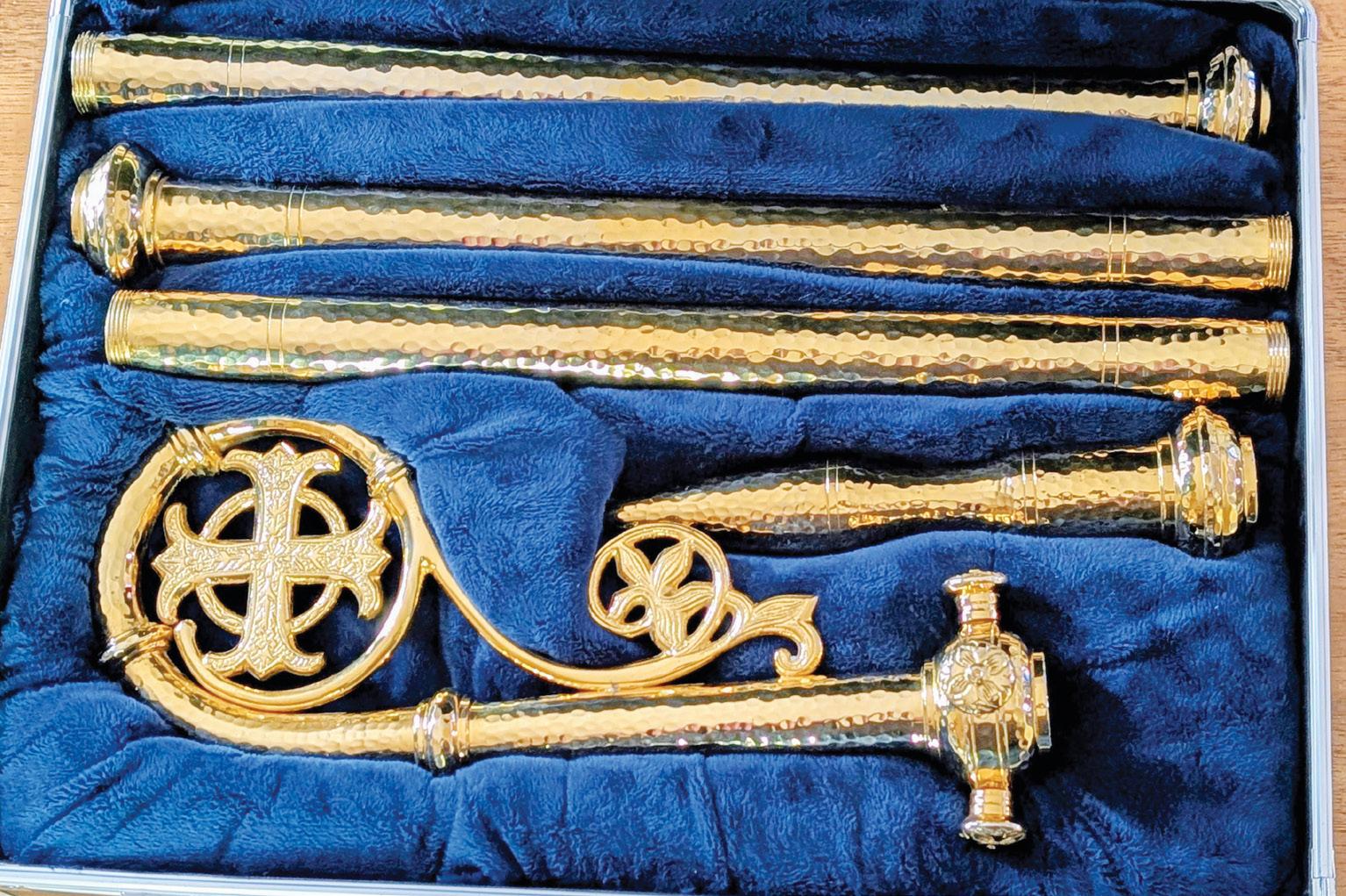
been away from the Church for 40 years — but he knew what the crosier was when he saw it, and that it had to be returned to the Church.
“I handed it to him,” Helgeson said of the crosier. “I was very relieved to do that.”
At the end of the conversation, the archbishop told him, “You can always come back” to the Church, Helgeson said. “That, like a lightning bolt, hit me right then.”
Helgeson said he had disengaged from the Church after a case of clergy sexual abuse that involved a friend who later committed suicide. “Anger kept me away, and eventually my pride and shame kept me away,” he said.
Helgeson served in the Army from 1982 to 1993, then worked for a railroad company and now is a partially retired truck driver who does long and short
hauls for the electric motor manufacturer. Married with two children, he never lost his desire to be close to God. “I’ve always had a certain spirituality,” Helgeson said, and finding the crosier “has kind of opened up a way back.”
The journey has continued with reading aloud to himself from a Bible he purchased, Helgeson said, to better comprehend it. He reads in the evenings after a long drive for work “or just kind of whenever the mood hits me,” Helgeson said.
In August, he returned to weekly Mass, but he does not receive Communion, Helgeson said. First must come confession, and he hopes to do that soon.
“Sometimes you don’t know how hungry you are until you’ve had a little something to eat,” Helgeson said. “I really miss the Church.”