The Carer Digital - Issue #276

Page 1


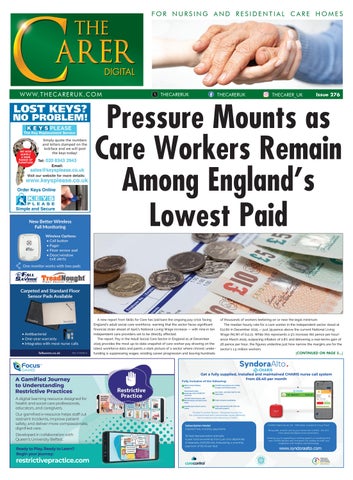
Pressure Mounts as Care Workers Remain Among England’s Lowest Paid

Welcome to the latest edition of The Carer Digital! THE PAY CRISIS THAT KEEPS TAKING

AS WELL AS GIVING

Our lead story in this issue makes for sobering reading.

The latest Skills for Care report paints a picture that will be all too familiar to those working in and running our residential and nursing care homes — a sector straining under the weight of mounting wage costs, with no meaningful relief in sight from the government that so loudly champions better pay for care workers.

The headline figures are stark enough. The median hourly rate for a care worker stands at just £12.60 — a mere 39 pence above the current National Living Wage.

Nearly half of all care workers are paid below the Real Living Wage. And with the April National Living Wage increase looming, 90% of independent care providers face direct and immediate cost pressures.

All of this on top of the employer National Insurance hike that has already hit providers hard this past year.

Yesterday I had the privilege of sitting in on a sector seminar attended by many providers, and the mood was one I recognise well — frustrated, determined, but clear-eyed about what needs to happen.

Of course every provider in that room wants to pay their staff more. I would go further and say there is not a business in the land that would not wish to reward its staff better.

These are dedicated, skilled professionals doing work of immense value, often at considerable personal sacrifice. The problem is not the will — it is the means. And here lies what I can only describe as the scandal at the heart of this debate.

Care England's important Silent Pay Cut research has shown that by the time the first Fair Pay Agreement comes into force, care workers will have lost around £1.4 billion cumulatively as a direct result of frozen tax thresholds. In the year fol-

lowing its introduction, close to £1 billion will be removed from care workers' take-home pay in that year alone — not by their employers, but by the Treasury.

This to me, “smacks of a giant Ponzi scheme”.

The government loudly advocates for increased pay for care workers, while being in full knowledge that it is itself one of the primary beneficiaries of those increases through income tax and National Insurance receipts. Providers — already operating on razor-thin margins with inadequate commissioning rates — are left footing a bill they simply cannot afford, while workers find that much of their supposed pay rise evaporates before it reaches their pockets.

It is a sleight of hand that should shame those responsible for it.

The message from the seminar was crystal clear: the government can expect significant lobbying and protest this year, and rightly so.

I have been fortunate to attend and report on both of the sector's major protests in 2025 — one outside Parliament and the other on Liverpool's Albert Dock — and both were well attended, good-spirited, vocal, and unified around a single, urgent message: the sector is in crisis and needs immediate investment.

Watch this space. There is much more to come.

But the seminar also sent another message, the importance of getting the good news out.

This sector is filled with extraordinary people. Providers and carers going the extra mile, day after day, often at personal cost, delivering compassionate, dignified care that makes a real and profound difference to people's lives. That story deserves to be told just as loudly as the crisis headlines.

Which brings me to something that genuinely put a smile on my face this issue.

We are delighted to feature a story about former West Ham player Joe Durrell, who was part of that wonderful West Ham side of the 1970s — and yes, I am old enough to remember that golden era of football very well indeed!

I couldn't help but notice a couple of 1966 World Cup winners in the photograph either — now that is a team photograph worth lingering over.

So please, keep those feel-good stories coming. We are always delighted to receive and share them. In a sector facing such relentless pressure, they are a reminder of why so many wonderful people choose this work — and why it matters so very much.

I would encourage our readers to sign up for our bi-weekly digital newsletter at www.thecareruk.com and follow us on social media for all the latest news.

I can always be contacted at editor@thecareruk.com

The Carer is published by RBC Publishing Ltd, 3 Carlton Mount, 2 Cranborne Road, Bournemouth, Dorset BH2 5BR. Contributions are

damage. Views expressed within this publication are not necessarily those of the publisher or the editorial team. Whilst every care is taken when

responsibility for any effects, errors or omissions therefrom. All rights reserved, reproduction is forbidden unless written permission is

Editor Peter Adams

Pressure Mounts as Care Workers Remain Among England’s Lowest Paid

(CONTINUED FROM FRONT COVER)

Regional variation remains stark. London care workers command the highest median pay at £13.00 per hour, while those in the West Midlands receive the lowest at £12.45 — a region where four in ten care workers (40%) are paid on or within 10 pence of the NLW wage floor, the highest proportion in the country.

Despite nominal pay rising, 49% of care workers were paid below the Real Living Wage of £12.60 (outside London) in December 2025 — up from 46% in March 2025. The Real Living Wage, independently calculated by the Living Wage Foundation to reflect actual cost-of-living pressures, sits above the mandatory government rate and is a benchmark that the majority of care workers are failing to meet.

WAGE FLOOR SQUEEZE

One of the most concerning findings for care providers is the growing proportion of staff clustered at the very bottom of the pay scale. Some 26% of care workers were paid within 10 pence of the NLW in December 2025, up from 22% in March 2025.

This “wage floor” effect — a well-documented consequence of rapid NLW increases — compresses pay structures and makes it increasingly difficult for providers to reward experience or seniority.

The data tells a stark story on experience pay: workers with five or more years in the sector earn just 10 pence per hour more on average than those new to the role. A decade ago, that gap was between 26 and 37 pence.

The report describes this as an ongoing challenge, with the narrowing differential making it harder to retain experienced staff and undermining career progression.

The differential between care workers and senior care workers has also contracted sharply. Senior care workers now earn just 6% more than care workers, down from 11% in March 2017 — a trend that risks undermining the incentive to take on greater responsibility.

MEANINGFUL PAY

The report’s most immediate warning for residential and nursing home operators concerns the NLW rise due on 1 April 2026, when the mandatory rate will increase from £12.21 to £12.71 per hour. As at December 2025, 48% of all independent sector workers — approximately 640,000 filled posts — were being paid below this forthcoming rate. For care workers specifically, the figure rises to 55%, representing around 495,000 posts.

Critically, 90% of independent sector care providers were paying at least some of their workforce below the April 2026 rate. The report notes that providers already paying above the new threshold may also face indirect cost pressures if they wish to maintain meaningful pay differentials across their workforce.

This comes on top of the increase in employer National Insurance Contributions that took effect in April 2025, which raised the rate from 13.8% to 15.05% and lowered the Secondary Threshold to £5,000, further adding to staffing costs for care businesses operating on tight commissioning-funded margins.

LOW-PAY ECONOMY

The report places social care pay in the context of the broader lowpay economy. Median care worker pay of £12.60 per hour is just 19 pence above kitchen and catering assistants, and only 9 pence above Band 2 NHS healthcare assistants. Care workers are also paid less per hour than cleaners and retail assistants, highlighting the extent to which the sector struggles to compete for staff in the local labour market.

The Low Pay Commission has classified social care as a low-paying sector every year since 1998, and the latest report confirms that designation remains firmly in place.

The report acknowledges significant policy developments that could reshape the landscape. The Employment Rights Act, which became law in December 2025, introduces guaranteed hours for zero-hours contract workers and day-one Statutory Sick Pay entitlement — both with direct implications for care providers’ cost base.

FRAGILE MARKET

More significantly, the Government has committed £500 million to a Fair Pay Agreement (FPA) for adult social care workers, with the Adult Social Care Negotiating Body due to be established through regulations in 2026 and the first FPA expected to come into force in 2028. Skills for Care’s Chief Executive, Professor Oonagh Smyth CBE, has welcomed the move, describing it as “a significant step forward,” while cautioning that pay improvements must be supported by consistent commissioning standards and funding if providers are not to be squeezed unsustainably.

“The care provider market is extremely fragile,” the report warns, “so increasing costs in one area has the potential to create issues elsewhere.”

“REWARD EXPERIENCE”

Professor Martin Green OBE, Chief Executive of Care England, said: “There is a danger that we look at these numbers and see percentages, when what we are really looking at are people.

“We are talking about carers who support someone to get out of bed in the morning, who manage complex medication, who sit with families in the hardest moments of their lives. When experienced staff are earning just 10p more than someone brand new to the role, something is not working properly.

“Providers want to reward experience. They want to build proper

progression into the system. But if the funding they receive only stretches to the minimum wage, there is nowhere else to go. That is not a failure of goodwill. It is a consequence of long-term underfunding.”

TAX THRESHOLD

Professor Martin Green continued: “That is money that would otherwise sit in workers’ pockets. Our data shows just how exposed the workforce is to that effect. And this is not abstract. It is the difference between feeling secure and feeling stretched. It is about whether turning the heating on feels like a decision rather than a given, whether the food shop needs to be trimmed back, whether there is anything left once the rent and bills are paid.

“That is why headline increases do not automatically translate into felt improvement. Care workers may be earning more on paper, but not enough more to change their day-to-day position in any meaningful way. When tax and threshold policy quietly absorbs part of each increase, the practical effect is that policy gives with one hand and recovers with the other. Reform that does not result in a tangible improvement in take-home pay will inevitably struggle to retain the trust of the workforce it is intended to support.

“If the Fair Pay Agreement is going to mean something, it has to result in a genuine improvement in what care workers actually receive. Otherwise we risk telling them they are valued, while leaving their dayto-day reality largely unchanged.”

SUSTAINABLE INVESTMENT

Rachael Dodgson, chief executive of Dimensions, which supports 3,000 adults with learning disabilities and autistic people across England and Wales, said: “Skills for Care’s latest pay report clearly shows social care finances under extreme strain. The government’s increase in Employers’ National Insurance alone has cost Dimensions around £6 million this financial year – a sum that would have funded round-the-clock support for 28 people in that same time frame.”

“Government must act. Social care needs a fully funded Fair Pay Agreement – far more generous than government has put forward –and a workforce plan which prioritises career progression for adult social care.”

“Care and support providers cannot be expected to deliver nationally agreed pay standards without sustainable investment from government. This pay must be channelled through local authorities at rates that reflect the true cost of care.”

“We at Dimensions will continue working with UNISON and others to press government for the long-term funding reform social care urgently needs. If we are serious about valuing skilled frontline professionals, funding must match this ambition.”

Resilience Is a Leadership Skill

The social care sector is one of the most demanding environments in which to lead. Care home managers operate under relentless regulatory, financial and human pressures — and the majority of those managers are women. Yet resilience, one of the most critical capabilities for sustainable leadership, is rarely developed with the same rigour as operational or clinical competence.

In exploring frameworks that might better support women in leadership, I was recently recommended to research the ResilienceBuilder Assessment Tool, developed by Steve Howe following decades of leadership research. Having looked into it, I am now actively exploring becoming a certified ResilienceBuilder coach — not because I am endorsing it above other approaches, but because its model resonates with what I observe in the women leaders I work with.

The ResilienceBuilder model identifies five core characteristics of highly resilient people: Mental Strength, Purpose, Physical Stamina, Emotional Intelligence and Social Support. For women leading in care, each of these speaks directly to the everyday realities of the role.

MENTAL STRENGTH

The capacity to stay positive and adaptable under pressure is tested daily in care settings, often compounded by the expectation that women leaders be simultaneously warm and decisive. Coaching that targets this helps women challenge unhelpful thought patterns and lead with both compassion and resolve. PURPOSE

Purpose is what separates leaders who endure from those who burn out. Women who lead in care are rarely short of purpose — but reconnecting with it during periods of exhaustion or criticism is vital. A coaching conversation anchored in purpose can help a manager rediscover why she does what she does, particularly when it feels hardest.

PHYSICAL STAMINA

Physical stamina matters more than we tend to admit. Many women in care leadership deprioritise their own wellbeing while caring for others. The ResilienceBuilder model makes explicit what good leaders know but rarely act on: that looking after yourself is not indulgent — it is part of the job.

EMOTIONAL INTELLIGENCE

Emotional intelligence is frequently a strength for women in care leadership, but without firm boundaries it can become a source of depletion. Coaching in this area supports women to deploy their empathy as a deliberate leadership tool, rather than something given freely at personal cost.

SOCIAL SUPPORT

Trusted networks and peer relationships are perhaps the most underrated resilience factor. Many senior women in care feel isolated, particularly in smaller independent organisations. Deliberately investing in this pillar, with structured support, can be transformative.

I am keen to hear from women in the care sector who would be willing to share their experiences of how resilience — in whatever form — has shaped their personal and professional journeys. These conversations will directly inform my ongoing research in this area, and I welcome anyone with an interest in women’s leadership and resilience to get in touch.

Roger Waluube is an Executive Performance Coach specialising in women’s leadership. He is currently researching resilience frameworks to support women in health and social care leadership. Contact me at linkedin.com/in/roger-waluube

Government Accepts Many Conclusions Of Independent Expert Panel’s Report On Palliative Care Services In England

The Government has published its response to the Independent Expert Panel (IEP) report on palliative care in England, accepting or partially accepting findings that services are under significant strain, inconsistent, and difficult for patients to navigate

The report was produced by the Independent Expert Panel (IEP), a group of health and care policy experts commissioned by the Health and Social Care Committee to carry out impartial, in-depth evaluations of services.

The IEP’s report, published 28 November, highlighted a number of issues undermining the delivery of palliative and end of life care, including:

• Variability around the country in the way services are commissioned, a lack of access to data on the needs of local populations

Welcome to Blue Rain - our activity store is built

• Insufficient funding for, and provision of, neighbourhood-based services

• Patients and families struggling to navigate a complex system and a lack of information on how to access services

• The NHS’s community-based workforce facing shortages, low morale, poor access to training and limited career progression

• Systemic inequality throughout the country, both in terms of the quality of services available in different parts of the country and in the experiences of underserved or marginalised communities.

The Government’s response includes an assurance that an NHS-wide workforce plan will be published in spring this year, and says the forthcoming Modern Service Framework for palliative and end of life care could improve commissioning and delivery of services.

• We specialise in the sale and purchase of quality used wheelchair accessible vehicles and ambulances.

• They can be bought as seen or refurbished and sign-written to your own requirements.

• Fully serviced, new mot & warranty

• Engineers inspection supplied if required.

One Year On: Providers Unite Day of Action Marks a Defining Moment for Social Care

A year has passed since thousands of social care providers made their way to Westminster for the inaugural Providers Unite Day of Action — an event that many in the sector regard as a watershed moment for an industry long accustomed to feeling overlooked.

The gathering, which saw large and small providers, frontline carers and sector leaders converge on the capital, was not arranged or attended without considerable effort.

Delegates rearranged rotas, made lengthy journeys, and stepped away from already stretched services to take part.

The message, however, was clear: the pressures bearing down on social care had reached a point at which silence was no longer tenable.

Participants gathered not as rival organisations but as a single collective voice, united around shared concerns over unsustainable funding, chronic workforce shortages and the systemic under-recognition of a sector that supports some of the most vulnerable people in society.

The atmosphere on the day was widely described as both determined and proud — proud of the work carried out daily across care homes, domiciliary services and nursing settings; proud of a workforce that continues to show up despite mounting difficulties.

The march through Westminster was seen as far more than symbolic, representing a visible, public demonstration of unity from a sector that has too often appeared fragmented.

By many accounts, the event shifted something. Conversations that had previously taken place behind closed doors were brought into the open.

Media coverage amplified longstanding concerns, and policymakers were confronted directly with the day-to-day realities facing providers attempting to maintain safe, high-quality care under significant financial strain.

For many attendees, the most lasting impact was personal and professional. It was, for a significant number, the first occasion on which they had stood alongside so many peers facing identical challenges — a powerful reminder that the struggles encountered by individual providers are not isolated, but systemic in nature.

Twelve months on, those underlying challenges have not abated.

Funding pressures persist, workforce instability continues, and providers are still navigating rising operational costs, evolving regulatory requirements and recruitment difficulties.

In many respects, the operating environment has grown more complex still.

Yet the confidence born of collective action has endured.

The Day of Action demonstrated that the sector is capable of organising, mobilising and communicating with clarity and purpose — and that unity, far from being merely aspirational, represents a viable and effective strategy.

Those behind the initiative are keen to stress that this first anniversary is not an occasion for nostalgia but for momentum. The calls for reform continue, as does the commitment of those involved to maintain a united front in pursuit of a sustainable future for social care.

The first Providers Unite Day of Action, they say, marked the moment the sector stepped forward — visibly and without apology.

A year on, the work, and the solidarity that underpins it, continues.

A Navy Veteran Has Celebrated Her 103rd Birthday

Janet Patterson enjoyed a birthday lunch with her family at Royal Star & Garter in Solihull, where she now lives, on Saturday 21 February.

She was treated to a special lunch with her children Gill and David, granddaughter and other family on her birthday. They also brought birthday cakes for other residents and staff to enjoy.

The centenarian made headlines around the country when she received her War Medal 1939-45 in recognition of her service in the Women’s Royal Naval Service (WRNS) during WWII.

Her son and daughter had applied for it on her behalf, 80 years after the war ended, and 80 years after she left the Armed Forces.

Her story was covered in national press and she received letters from as far afield as USA, thanking her for her service.

Janet has been a resident at Royal Star & Garter since 2023. Daughter Gill said: “We had a lovely time sharing Mum’s birthday with her at Royal Star & Garter.

The staff make such a fuss over Mum and all the residents there, it’s a lovely Home.”

Money, Money, Money

Other countries with better health and care systems operate a blended funding model to generate the sums required. Paul Honey, Founder, Health Mutual and the creator of CARE FUND and HEALTH FUND, believes the UK could do the same. In this article he explains more…..

I have devised a solution to how the UK can finally solve its ‘Health and Social Care’ funding challenge, in a way that doesn’t involve raising taxes, in recognition of this difficult and sensitive option.

For decades, much has been written about the challenges facing the care sector, including how this impacts the NHS. Underfunding is always referenced because ultimately, alongside the immense efforts of those working tirelessly in both sectors, how we properly fund two vital, interconnected services is the issue that’s not been addressed. It is about MONEY.

Many have reasonably suggested that if Social Care funding can be ‘fixed’, this will benefit the NHS – for example, the prompt discharge of patients into more appropriate care settings, freeing up capacity.

However, the reality is that the NHS takes financial priority over virtually every service our taxes pay for. Earlier this year, a Minister commented “we’re funding the NHS at the expense of everything else”.

The country’s financial challenges are extensive, there’s the competing demands of equally deserving services, and existing tax revenues simply don’t generate the sums required, as record levels of borrowing evidence.

Worryingly, and notwithstanding commissions and reviews, there’s little to suggest that work is being explicitly undertaken, within government or the sectors themselves, about how Social Care and the NHS could be better funded. However reform is defined, we must update our funding model too, otherwise our challenges will remain and likely worsen.

Other countries operate methods alongside tax to generate the sums required. We could do the same, and I have worked out how, utilising my thirty years’ insurance sector experience.

The importance of the NHS and care sector presents a unique opportunity not otherwise offered by any other services our taxes pay for. As a deliberately integrated solution, I believe greater sums can be realised than by attempting to tackle them separately.

CARE FUND and HEALTH FUND are two publicly owned, notfor-profit ringfenced funds that will deliver long-term, reliable

sums, enabling the care sector to finally focus on meaningful reform and give it the status many have rightly called for. The NHS’s founding principles are protected, especially in relation to it remaining free at the point of use. Given the difficulties that tax rises present, it is a voluntary, incentivised solution.

Contributors join HEALTH FUND, paying a monthly contribution based on their age. For example, age 30 equates to £30; age 60 equates to £60. Contributions rise annually in line with age – an approach that’s simple to relay and administer.

A mechanism has been incorporated which generates sums specifically for CARE FUND, allowing investment in the sector for the benefit of the whole population. The sums achievable are meaningful. The NHS was awarded a further £29bn this year. In contrast, £4bn a year more was made available for councils to spend on Adult Social Care in 2028-29.

If my solution was being operated, £29bn achieved via HEALTH FUND would generate £11.6bn for CARE FUND.

As contributors have made this additional funding possible, they receive specific benefits in recognition of their participation. In relation to the social care components, and based on the number of years they’ve contributed, contributors will accrue ‘free’ personal care and reduced charges for other care costs, should these services be required in their lifetime. So, for example, if an individual has contributed for 30 years and they require personal care, the first 20 weeks will be provided without charge.

The UK has changed massively since the NHS began in 1948. It’s appropriate to update the relationship between the individual and State, to better meet the needs of our 21st century growing, ageing population, promoting a long-term, shared responsibility reaching across the generations to expand the funds available for two vital services.

The solution embeds with the public the benefits of a betterdeveloped, joined-up, long-term strategy (way beyond the tenyear timeline invariably defined), tackling both funding and reform. A country cannot properly function without an effective health and care system. Addressing the underlying issue of funding is what motivates me. My solution has not been devised for personal or commercial gain. If adopted, I will gift the Intellectual Property to the government, to help us have the health and care system we are more than capable of delivering, given the funds to do this.

Further information is available on https://www.healthmutual.org/ and I’m also on LinkedIn https://www.linkedin.com/in/paul-honey-20273131a/

How pobroll® Is Transforming Bed Bathing for Dementia Patients

In April 2025, the Supporting the Provider Market (STPM) team in County Durham published a new report evaluating the use of pobroll® — a waterproof bed-bathing wrap designed to improve dignity, comfort, and ease during personal care.

This evaluation was carried out across 10 care homes with high numbers of residents living with dementia. Each setting was given one or more pobroll® units and invited to share feedback through a structured survey. The findings reveal how even simple tools can make a significant difference in everyday care.

How was pobroll® used?

Most care homes used pobroll® daily or several times per week, showing it quickly became part of regular practice. Staff noted that one of the biggest challenges was not having enough units — all homes requested additional stock after the trial, highlighting a clear appetite for wider adoption. What did care teams think?

Feedback from the care homes showed strong support for the tool:

Ease of use was rated highly, with an average score of 4.4 out of 5. Staff found pobroll® straightforward to incorporate into care routines.

Training was rated slightly lower, at 3.8 out of 5, suggesting that while the wrap is easy to use, additional training resources could improve onboarding for new users.

Resident response was positive. Three in ten care homes reported improved mood or behaviour dur-

ing bed bathing for dementia patients.

• Key benefits included greater warmth, coverage, and dignity for residents, especially those who might find conventional methods distressing. Some teams also found it particularly useful for end-of-life care Would they recommend pobroll® for bed bathing for dementia patients?

Absolutely. Homes rated their likelihood to recommend pobroll® at 4.3 out of 5, with half of respondents giving it a full 5 out of 5. The overall feedback was clear: this is a valued, meaningful addition to personal care.

Would they recommend pobroll® for bed bathing for dementia patients?

The results of this trial reinforce what many professionals already believe — that small, thoughtful design changes can significantly improve care. For residents who are bedbound or living with dementia, personal care can often be a distressing experience. But with the right tools, it doesn’t have to be.

The pobroll® isn’t a complex device. It’s a simple, dual-layered cotton towelling wrap. But its thoughtful design — offering full coverage, comfort, and support — makes a real difference where it matters most.

If you’re part of a care home, hospice, or hospital and would like to explore how pobroll® could benefit your residents or service users, get in touch. We’re here to support compassionate, dignified care — one small change at a time.

or

COVID-19 Day of Reflection 2026 Coming Up

The next COVID-19 Day of Reflection will take place on Sunday 8 March 2026.

It will be an opportunity to come together to remember those who lost their lives since the pandemic began and to honour the tireless work and acts of kindness shown during this unprecedented time.

The government affirmed its commitment to the day as part of a broader commemorative programme that was announced last year and have established resources commemorating the COVID-19 Pandemic which include a series of oral histories, education materials and details of memorials.

In the lead up to the event the care Providers Alliance are sharing a series of contributions from across the sector.

From resources and plans to mark the Day of Reflection, to creative projects and learnings for future years, these contributions demonstrate the impact of COVID-19 on providers, carers, family, friends, and the people drawing on care and support.

Sixteen Sonnets for Care

Norfolk-based poet Martin Figura’s powerful collection, Sixteen Sonnets for Care, captures the extraordinary dedication of care workers with honesty and tenderness, and vividly depict the mood and tone of the period.

Commissioned jointly by County Council Adult Social Services and

Skills for Care in 2022, Martin used first-hand accounts from carers in the Norfolk First Response team to create the sonnets.

Oonagh Smyth, CEO, Skills for Care; James Bullion, Adass President 2020-21, DASS Norfolk said: “These poems tell the truth about social care. They are drawn from the voices of people working in social care, and from the people they care for in Norfolk.

“They give life to the bravery, sacrifices, dedication and ordinary love that people showed during the COVID outbreaks in 2020-2021.

“These poems were commissioned as part of the Social Care Day of

Reflection and Remembrance which took place on the 17th March 2022 where 22 organisations came together to give thanks, show respect, celebrate and mark the impact of COVID 19 on Social Care.

“They should be read and be heard and we encourage their presence in our meetings, workplaces and events!”

FIRST SONNET IN SIXTEEN SONNETS FOR CARE

I’m sorry, all I can offer is a ragged paper crown, plain, made with words, most of them yours.

It weighs no more, maybe less than applause.

I’ve listened and heard what I should have known.

There is duty, then beyond, then what you’ve done for us all, our vulnerability unsteady between mirrors is infinite – corridor after corridor after corridor without end, you carry us all, as if we were your own.

You are all of you, part Spartacus, part Sisyphus, your laminate passes: gleaming medals of honour.

Jeopardy fell heaviest for those with the least and you were amongst them, forgive us for this, and our promises and lack of endeavour.

I wish I had more; I wish words were a feast.

Former West Ham United Winger Recalls Career Highlights at Westport Care Home

a trip down memory lane at Westport Care Home in Stepney Green, delighting everyone with stories from his professional football career.

Joe’s love for football began in his childhood, when he was rarely seen without a ball at his feet. His talent was recognised early, and he was scouted for West Ham by Wally St Pier in 1970, beginning his journey into professional football.

Joe made his debut for the Hammers in 1971 against Stoke City, coming on as a substitute for the injured Harry Redknapp. The appearance marked the beginning of a promising career in the professional game.

After progressing through the ranks at West Ham, where he was known as a quick and skilful winger, Joe moved to Bristol City in 1973 in search of regular firstteam football. He later featured for Cardiff City and Gillingham, making 49 appearances and scoring nine goals for the Kent side.

One of his proudest moments came during his time with non-league side Dagenham, where he played a key role in the club’s memorable cup run, assisting a crucial goal to win them the FA Cup.

Now living at Westport Care Home, Joe recently shared his memories during a ‘Tea and Chat’ afternoon, captivating everyone in the room with his stories.

Smiling as he reflected on his time in the game, Joe said: "Football has always been a huge part of my life. I was lucky to play the game I loved, and I still enjoy talking about those days."

A member of the team at Westport Care Home added:

"It’s wonderful to hear Joe’s stories and celebrate his achievements. Moments like these bring everyone together.”

Although his playing days are behind him, Joe’s passion for football remains as strong as ever, and his remarkable journey continues to inspire those around him.

A former West Ham United winger has been taking

Preparing Care Homes For The Employment Rights Bill: What You Need To Do Now

FAIR PAY AGREEMENT IN SOCIAL CARE

The Employment Rights Bill represents one of the most significant workplace reforms in a generation. For care home operators already juggling CQC compliance, workforce shortages, and rising costs, it may feel like yet another regulatory burden. In reality, it is a moment to get ahead, strengthen your culture, and reduce risk before the law forces your hand. At Inspire Legal Group, we are already advising care providers who are reviewing their contracts and policies now rather than waiting for implementation dates. That proactive approach will separate stable, compliant operators from those facing tribunal claims in 12 to 24 months’ time.

Day one unfair dismissal rights One of the headline proposals is removing the two-year qualifying period for ordinary unfair dismissal. In practical terms, this means new starters could challenge dismissals from day one. In the care sector, where probationary dismissals are common, this is seismic. I recently advised a multi-site care provider who dismissed a senior carer just three months into employment, due to performance concerns linked to medication errors. Under the current regime, unfair dismissal was not in play because she had less than

two years’ service. Under the proposed reforms, that dismissal would need to meet the full fairness test, including a potentially more structured probation process. My advice is that care homes should review their probation policies now. It is time to check if your objectives are clear, your review meetings are documented, and your managers are trained to evidence concerns properly. A casual conversation saying “it is not working out” will simply not be enough in the future.

FLEXIBLE WORKING BECOMES THE DEFAULT

Flexible working is already something employees can request from day one, but the momentum is shifting further. Employers should expect their decisions to face closer scrutiny, and any refusal will need to be backed up with clear, well-reasoned justification. In care homes, rotas are complex, and safe staffing is critical. However, I regularly see employers refusing flexible working requests without properly considering alternatives. In one recent ILG matter, a care assistant requested slightly later start times to manage childcare. The home refused outright, citing operational needs. When we became involved, it was clear that a minor shift swap would have resolved the issue without compromising care. As scrutiny increases, blanket refusals will create risk. Managers must understand the statutory grounds for refusal and document the reasoning carefully. Communication with staff will be key.

ZERO HOURS CONTRACTS UNDER THE SPOTLIGHT

Zero hours arrangements are widely used in social care to manage fluctuating demand. The Bill proposes curbing exploitative practices and requiring more predictable working patterns for regular workers. We have acted for both employers and workers in disputes about cancelled shifts and inconsistent hours. In one case, a domiciliary care worker who had worked consistent hours for over a year was suddenly offered minimal shifts following a complaint about travel time. That situation escalated quickly into allegations of detriment and whistleblowing. Care providers should audit their workforce now. Who is genuinely casual and who is working regular hours in practice? If someone has been working broadly the same pattern for months, it may be safer and fairer to formalise that arrangement rather than wait for legislative change or a claim.

The proposed Fair Pay Agreement for adult social care could reshape pay structures across the sector. While details are still emerging, the direction is towards sector-wide minimum terms set through collective negotiation. For operators working on tight local authority fee rates, this is understandably concerning. However, ignoring it will not make it go away. Boards should be scenario planning now. What would a mandatory uplift in base pay mean for your business model? How would differentials between junior carers and senior staff be maintained? We are already seeing tension where providers wish to reward experience but are constrained by funding pressures. Transparent communication with staff about financial realities, alongside lobbying through trade bodies, will be important.

Strengthened worker protections Expect stronger enforcement around sick pay, family friendly rights, and protection from harassment. The cultural shift is as important as the legal one. In a recent case we handled, a nurse raised concerns about unsafe staffing levels. Shortly afterwards, her shifts were reduced. The employer viewed this as operational. The nurse viewed it as retaliation. The tribunal claim that followed was costly, stressful, and avoidable. The lesson for care homes is simple. Train your managers. Many claims we defend do not arise from malice, but from poor understanding of risk. A well-meaning manager can create significant exposure through an ill judged email or an off the cuff comment.

Practical steps to take now 1. Audit contracts, staff handbooks, and zero-hour arrangements. 2. Strengthen probation and performance management processes. 3. Train managers on fair dismissal, flexible working, and documenting decisions. 4. Engage openly with staff and, where applicable, unions about upcoming change. 5. Take early advice when issues arise rather than trying to fix them after positions have hardened. The care sector is built on compassion and trust and the Employment Rights Bill is pushing employers to embed those values in their employment practices as well as in resident care. The providers who prepare early will not only reduce legal risk, they will build more stable, engaged teams in a sector that desperately needs them.

We Care And Sumit Group To Host Third

Annual ‘Shining Star Awards’

Care home providers, We Care and Sumit Care Group, have announced their third consecutive annual Shining Star Awards, celebrating the dedication, compassion, and excellence of their team members. Taking place on the 27th March 2026 at the iconic Kimpton Clock Tower in Manchester, the highly anticipated event brings together more than 400 colleagues and partners to recognise the exceptional individuals and services that make an impactful and meaningful difference to the lives of its residents.

This year’s ‘showtime’ themed ceremony will present 13 awards, recognising excellence across a wide range of categories, including: Care Colleague, Care Home of the Year, Clinical Excellence, Dementia Care Champion, Engagement and Enrichment, Inspiring Leader, Living

Our Values, Newcomer of the Year, Outstanding Support, Resident Service Excellence, Unsung Hero, Special Recognition and Long Service.

Speaking about the event, Alison Foreman, Commercial Director of We Care Group said: “We are incredibly excited to see the return of our Shining Star Awards. The event has become a highlight in our calendar and is a wonderful opportunity to recognise the passion, commitment, and professionalism of our teams.

This year is set to be another ‘showstopper’, bringing the sparkle and energy of showtime, while putting our shining stars firmly in the spotlight. We look forward to celebrating the great achievements of our teams. “

Dedicated Followers Of Fashion - Care Home Residents Celebrate London Fashion Week

Staff and residents at Barchester’s Hilton Park care home in Bottisham had a brilliant time

laughter, confidence and creativity, and thoroughly enjoyed by all. General Manager, Geanina Tinca, said: “Our residents thoroughly enjoyed sharing memories of their favourite outfits, where they found them and the special occasions they were worn for. Fashion is such an important part of personal expression, so it was lovely to see everyone looking fabulous and enjoying such a special afternoon together.”

Joan Richards, a resident at Hilton Park commented: “I have always loved clothes and keeping up with the latest trends. I used to make my own outfits when I was younger, I had a little sewing machine and I would look at what the models were wearing in the fashion magazines and run myself up something similar to wear to the dance!”

Hulanicki’s
McQueen’s

Lack Of Social Care Provision Causing “Chaos” In Emergency Care System, Says RCEM

The government, and health service leaders, must pay attention to the chaos inside Emergency Departments this winter, which are buckling under the pressure because of a failure to prepare for predictable surges in seasonal illnesses, and a lack of social care provision.

That’s the key takeaway from NHS England’s latest stats on the pressures the Urgent and Emergency Care system is under in England, published today, according to the Royal College of Medicine (RCEM).

The data showed that inpatient bed occupancy remains dangerously high, at 94.4%, far above the ‘safe’ level of 85%. A lack of inpatient beds is one of the key drivers of waiting times in Emergency Departments (EDs) themselves.

Concerningly, an average of 13,251 patients occupying these beds each day should not have been in them, as they were deemed medically fit to leave, but could not be discharged due to a lack of community, wrap-around and social care provision, or could not go back home.

If all of these patients were discharged, there would be enough beds to bring down occupancy to a safe level of 85%.

Pressure on EDs from this ‘exit block’ at the back door was made worse by a continued increase in the

prevalence of Norovirus, also known as Diarrhoea and Vomiting (D&V) compared to the previous week.

Further, 51,094 staff were absent each day, an increase of 682 compared to the same week last year.

Dr Jason Long, RCEM Vice President, said:

“The chaos continues and the consequences of the government’s failure to prepare for winter are borne out once more in this week’s data.

“Sustained pressure from a predictable winter illness like norovirus would not be a catastrophe in a working hospital system.

“The fact that this appears to have tipped things over the edge is evidence of a need to urgently change the way we prepare for winter.

“Last year, the NHS England unveiled its winter plans a matter of weeks before the cold weather hit. It was too little, too late and the impact of this is more of the sickest patients stuck waiting in EDs on trolleys because there is nowhere else for them to go.

“What we need is a credible, long-term plan to reduce bed occupancy and for patient flow to be a key performance priority for the government and NHS leaders.

“Until this happens, patients will continue to suffer and my Emergency Medicine colleagues will continue to drop like flies.”

UKHSA Publishes First Cold Mortality Report

Cold Mortality Monitoring Report, providing new estimates of deaths associated with cold weather in England during winter 2024 to 2025. Findings from the report revealed that most deaths happened in hospitals, although the increase in risk during cold weather was greater for people in care homes and those who died at home. Older people were most affected, with the risk rising steeply with age, especially in those aged 85 and over.

The report found that mortality peaks around 5 days after cold weather and remains elevated for up to 9 days. Heart-related deaths tend to increase several days after cold exposure, while respiratory and infectionrelated deaths show longer delays.

These estimates form a key part of wider winter health surveillance. They sit alongside monitoring of flu, COVID-19, RSV, norovirus and other seasonal pressures, helping to ensure that Cold Weather Alerts and preparedness planning reflect the real health risks faced by vulnerable groups.

Dr Agostinho Sousa, Head of Extreme Events and Health Protection at UKHSA, said: “Cold weather remains a serious and preventable risk to public health.

• people with dementia

“This report provides important new evidence on how cold affects mortality, helping to ensure that Cold Weather Alerts and preparedness measures are grounded in evidence of health impact. The findings suggest that even short periods of cold can lead to significant increases in mortality, often days or weeks after the temperature drops.

“Understanding who is most affected and how these risks are changing helps us better target winter preparedness, support vulnerable groups, and ensure that cold weather alerts reflect real health impacts, not just weather conditions.”

Population groups most at risk from cold weather include:

• people aged 65 years and over

• people with cardiovascular or respiratory conditions

• people living in poorly insulated homes or experiencing fuel poverty

When comparing recent winters with the previous 5-year period, the findings suggest people may now be more vulnerable to cold, with the risk of death rising more sharply as temperatures drop. This is likely to be the result of a combination of factors including the ageing population and burden of disease.

PROVIDING PRACTICAL AND STYLISH TROLLEYS TO SUIT

resident's eyes light up when the

lovely trolley

Adult Social Care Is Being Sustained By Workforce Goodwill Rather Than System Design, Report Reveals

Care England, in partnership with Sona, have launched new national research exposing the reality of adult social care in England. The findings show that services continue to deliver highquality care despite operating under sustained workforce, financial and system pressure. The report highlights that resilience across the sector is increasingly driven by the professionalism, commitment and goodwill of staff, rather than by systems that are designed for the realities providers now face.

The report, Adult social care insights: workforce stability, digital impact and financial confidence, draws on a national survey of social care professionals alongside in-depth interviews with senior leaders across the sector. It paints a clear picture of services working in an environment where short staffing, rising complexity of need and financial strain are no longer exceptional challenges but the everyday operating context for many providers.

Professor Martin Green OBE, Chief Executive of Care England, said:

“This research provides a powerful and evidence-based picture of the reality facing adult social care. Services are continuing to deliver high-quality care, but too often they are doing so by relying on the goodwill, professionalism and resilience of their workforce rather than on systems that are properly designed for the pressures they face. Short staffing, rising complexity of need, and financial strain are no longer exceptional challenges; they are the everyday operating environment for many providers.

Ghyll Royd

What this work makes clear is that the answer is not simply more recruitment, but better design: smarter workforce deployment, greater visibility of real demand, and systems that support staff rather than stretch them. It also underlines the growing importance of digital capability as essential infrastructure for sustainability, not an optional add-on.

This is not about fixing individual providers. It is about recognising that the current system is no longer aligned to reality. If we are serious about protecting quality, supporting the workforce and securing the future of adult social care, we must move from coping to building long-term resilience, underpinned by fair funding and evidence-led reform.”

Key findings from the research include:

• Short staffing has become a baseline operating condition for many providers, even when services remain compliant with commissioning and regulatory requirements.

• Services are increasingly reliant on overtime, agency use, task redistribution and managers stepping in on shift to maintain continuity of care, driving burnout, cost escalation and long-term fragility.

• Workforce commitment to the sector remains high, but this loyalty is masking underlying system fragility and is not a sustainable substitute for proper system design.

• Pressures differ by service type and funding model, but structural strain is universal across the sector.

• Digital maturity is emerging as one of the strongest controllable stabilisers available to providers, improving visibility of demand, staffing risk and cost pressures, and supporting more sustainable workforce deployment. The workforce is broadly ready for digital adoption, where technology reduces duplication, saves time and improves safety, but constrained funding and fragmented systems limit progress.

Care England and Sona are calling for a shift in focus from short-term crisis management to long-term system resilience, including fair and sustainable funding, better alignment between commissioning and delivery, smarter workforce deployment and treating digital capability as core infrastructure rather than an optional enhancement.

Care Home Rediscovering Aireborough Roots Ahead of Local History Visit

Ghyll Royd Care Home has been delving into its local heritage as it prepares to welcome the Aireborough Historical Society this March. The home has been exploring its fascinating origins, uncovering a rich tapestry of industrial and family history that connects the modern care home to the very foundations of the Guiseley community.

The home stands on the site of the original Ghyll Royd House, once the grand residence of the Peate family. As the owners of the prominent Nunroyd Mill, historically situated directly opposite the home, the Peates, including Noel Peate, were instrumental in shaping the local economy and social landscape of the Edwardian era.

While the Westside Retail Park now stands where the mill once hummed with activity, the geographical history remains. Nunroyd Beck still flows beneath the modern retail units, leading back to Nunroyd Park, a location that remains a favourite spot for the residents of Ghyll Royd Care Home today.

The investigation into the site’s heritage also highlighted the architectural legacy of the Peate family. The Edwardian villas on the neighbouring street, also named Ghyll Royd, were originally commissioned by the Peates specifically for the senior workpeople of the mill, creating a

dedicated community directly opposite.

The research further explored the poetic origins of the "Ghyll Royd" name. In local terminology, "Ghyll" refers to a narrow, steep-sided ravine or stream, and, "Royd", is a traditional Yorkshire term for a forest clearing.

The home believes that the word "Royd" in it’s name likely refers to a clearing in nearby Esholt Woods, which may have historically linked directly to the land at Nunroyd Park.

The transition from a private family estate to a care home reached a significant milestone in 2001, when the home was acquired by Tony Spellman. As the second home to be operated by the Spellman family, the acquisition of Ghyll Royd continues to represent a key chapter in Spellman Care’s 35-year legacy.

"We are incredibly proud to be part of a location with such a rich industrial and family heritage," said the management team. "It is wonderful to see that the same sense of community established by the Peates all those years ago continues to thrive within our walls today. We are very much looking forward to the visit from the Aireborough Historical Society in March to learn even more about our roots."

Researchers Developing Single Vaccine to Protect Against Flu, Colds, and Coughs

A team at Stanford University are testing a ‘universal vaccine’ which they say could provide protection against colds, coughs, and flu. Unlike usual vaccines, the new universal vaccine mimics the way immune cells communicate. This enables the vaccine to protect against multiple types of infections, rather than just one.

The vaccine is administered as a nasal spray. Once taken, the vaccine leaves white blood cells in the lungs, where they stay on alert while waiting for any form of infection.

When tested on mice, the researchers found the vaccine remained effective for three months, as detailed in the journal Science. The vaccine was shown in mice to protect against a range of respiratory viruses, bacteria which causes sepsis and even house dust mites. If developed for humans, it could replace multiple winter jabs and may offer defence against new pandemic threats.

‘I think what we have is a universal vaccine against diverse respiratory threats,’ Dr Bali Pulendran, director of the Institute for Immunity, Transplantation and Infection at Stanford Medicine and lead author of the

study, said.

‘Imagine getting a nasal spray in the fall months that protects you from all respiratory viruses including Covid-19, influenza, respiratory syncytial virus and the common cold, as well as bacterial pneumonia and early spring allergens. That would transform medical practice.’

Dr Pulendran said two doses could be sufficient for people and estimated that, depending on funding, it might be available within the next five to seven years.

Dr Pulendran added: “This vaccine, what we term a universal vaccine, elicits a far broader response that is protective against not just the flu virus, not just the Covid virus, not just the common cold virus, but against virtually all viruses, and as many different bacteria as we’ve tested, and even allergens.

“The principle by which this vaccine works is a radical departure from the principle by which all vaccines have worked so far.”

The research team now needs to carry out human trials of the vaccine.

AI in Social Care: Why The Sector Needs Creativity, Not Complexity

The social care sector sits on a wealth of data. Care plans, daily notes, sensor readings, feedback from families. The question is no longer whether we have enough information. It’s whether we are using the data in the right way, for the right people.

At a recent roundtable hosted by Casson Consulting in partnership with The Access Group, care providers, think tanks and people who draw on care and support came together to discuss how AI is being, and should be, adopted in social care. The conversation was honest, practical and at times challenging.

One clear message emerged: AI is not about replacing human care. It is about solving specific problems creatively and responsibly, so that we can provide even better, more personalised care. FROM DATA OVERLOAD TO DATA THAT WORKS

Care organisations generate huge volumes of data every day. The challenge for registered managers and care teams is how to use it to add value to people’s lives. Too often, data creates more work rather than less. Managers arrive at their desks facing dashboards, alerts and reports that take hours to process, time they could spend with the people they support and the teams they lead.

AI has the potential to be a game changer. By analysing patterns across care notes, incident records and daily observations, AI tools can surface the important things a manager needs to know each morning, rather than leaving them to search through everything. This is not futuristic thinking. Care providers in the room shared examples of keyword search tools that pull relevant records together in minutes, work that previously took hours of manual reading.

Anisa Byrne, General Manager at Access Care, described how this is already taking shape: "As a technology supplier, we are working with customers to use data to personalise care more than ever. We are focused on giving registered managers time back so they can do what

they do best, lead their teams and support the people in their care."

Daniel Casson, Managing Director at Casson Consulting, summarised the ambition well: "This is about using AI to get back to the basics of care, to use our increased capacity to make care even more personalised."

KEEPING THE PERSON AT THE CENTRE

For people who draw on care and support, the conversation about AI cannot happen without their involvement. The principle of "Nothing About Us, Without Us" must apply to technology decisions and applications as much as it does to care planning.

Technology already plays a role in supporting independence. Smart plugs, automated blinds, robot vacuum cleaners, even simple shower

temperature indicators. These are not complex innovations: they simply give people back choice and control over their daily lives. One provider at the roundtable shared how sensor technology helped a young autistic man reduce his support hours from 210 to 70 per week, not by cutting corners, but by using data to demonstrate he needed space rather than constant supervision. His quality of life improved, his distress reduced, and the intrusive presence that had been causing his difficulties was removed.

Jennifer reminded us of Dr Clenton Farquharson’s CBE statement, “people do not aspire to have good care, they aspire to have a good life”. That distinction should guide every decision we make about how we use AI in the care community.

THE RISKS OF MOVING TOO FAST, OR NOT AT ALL

There are legitimate concerns. When AI saves a registered manager two hours in their day, the temptation is to fill that time with more tasks and more data. Participants at the roundtable were clear: time saved by technology must go back to the manager for direct care, team support and oversight, not be absorbed by additional demands.

Additionally, smaller providers, already stretched by staffing pressures and funding constraints, can view new technology as one more burden rather than a support.

The answer is not to avoid AI. It is to demystify it with practical examples of how data improves outcomes for people, and to build in the voices of people who draw on care from the start, not as an afterthought - starting with the small problems that provide the most benefit when solved.

AI will not replace care workers. It will not tell you how a person feels on a given day. But it can free up the time and headspace for care professionals to focus on exactly those things. That is where the real value lies.

Wain House Care Home Opens in Westgateon-Sea and Welcomes its First Residents

Avante Care & Support has announced that Wain House located in Westgateon-Sea has officially opened its doors welcoming its first residents. In the lead-up to opening, visitors were invited to a series of open days to explore the care home, offering a glimpse of life at Wain House ahead of its February 2026 opening.

Today, that vision becomes a reality as the first two residents, husband and wife Harold and Ruth, move into the new home together. Harold and Ruth are childhood sweethearts who first met at just 13 years old.

Having spent a lifetime side by side, they knew they did not want to be apart when they began to need additional care and support. After careful consideration, they chose Wain House as the place to begin their next chapter together.

Joined by their loved ones, Harold and Ruth were welcomed today by the team at Wain House as they settled into their new en-suite rooms, thoughtfully personalised with treasured photographs and familiar belongings. There were smiles, laughter and a few happy tears as staff ensured the couple felt at ease from the very first moment they arrived.

Setting the Standard: Care Home Compliance Made Simple

The law is changing for care homes, but understanding your obligations has never been easier

Providing both comfort and dignity to those in your care is at the core of the Care homes profession, but when it comes to both residents and their families, one of the most important things you can offer is trust.

Moving to a care home can be an emotional time for some and transparency and fairness are key in reassuring prospective residents and their families that they will be cared for with compassion and respect - This, and compliance with the law.

Earlier this year we saw the introduction of the Digital Markets, Competition and Consumers Act 2024 (DMCCA) - a landmark piece of legislation that affects business and how they are required by law to safeguard their customer with fair trading practices. These changes may sound like legal jargon, but they directly impact how care homes operate, communicate, and contract with residents.

Compliance can be complex and that’s why the Business Companion Care Homes Guidance is essential reading for anyone working in the Care Homes sector. Written by legal experts this free and easy-to-read guide will walk you through all the steps to ensure you are safeguarding your customers and operating within the law.

WHAT’S CHANGED UNDER THE DMCCA?

The introduction of the DMCCA represents one of the biggest shifts in consumer law in over a decade. It replaces the old Consumer Protection from Unfair Trading Regulations and introduces stricter rules to protect consumers from misleading or unfair practices across

almost all sectors. For care homes, this means:

• Clearer Pricing and Transparency: The Act bans “drip pricing” which is when unavoidable fees are hidden until late in the process. Care homes must now present the full cost of services upfront, including any mandatory charges.

Fake Reviews and Misleading Endorsements: The DMCCA prohibits the use of fabricated or manipulated reviews. With care homes increasingly relying on their online reputation, ensuring authenticity is now a legal obligation.

Stronger Enforcement Powers: The Competition and Markets Authority (CMA) can now impose fines of up to £300,000 - or 10% of global turnover - for breaches. Compliance isn’t optional; it’s critical.

• and much more!

These changes underline the importance of reviewing your policies, contracts, and marketing materials. The Care Homes Guidance on Business Companion provides practical steps to help you stay compliant and avoid costly mistakes.

KEEPING CONSUMER VULNERABILITY IN MIND

Vulnerability can arise from a number of different situations and factors throughout a person’s life, such as age, health, bereavement, or financial stress. As someone working in the Care homes sector, you’re

dealing with vulnerable individuals on a daily basis and recognising these factors isn’t just good practice; it’s a legal and ethical responsibility.

The Business Companion Consumer Vulnerability Guide offers checklists and practical advice to help you identify and support your residents who may be vulnerable when it comes to things like decision making and communication, ensuring your care home delivers not only compliance but compassion.

Your Go-To Resource for Compliance

Business Companion is more than just a care home resource - it’s a comprehensive hub for businesses across a broad range of sectors. From selling online to handling complaints, delivery charges, and even net zero strategies, the platform covers hundreds of topics delivered to you through clear, easy-to-read guidance. Backed by the Chartered Trading Standards Institute and the Department for Business & Trade, Business Companion is free, authoritative, and regularly updated by legal experts.

Act Now

The DMCCA is already in force, and enforcement powers are live. Don’t wait for a compliance issue to arise - visit Business Companion’s Care Homes Guidance today. Review your contracts, pricing structures, and communication strategies and explore the wider resources available to future-proof your business against legal pitfalls.

In a sector built on trust, staying informed isn’t just smart - it’s essential.

To find out more, visit: www.businesscompanion.info

How Technology and Data Can Help Social Care Providers Navigate Workforce and Financial Pressures

INTRODUCTION

The Social Care sector remains stuck at a crossroads.

Workforce shortages, regulatory uncertainty and rising financial pressures continue to provide unprecedented challenges for providers. According to Skills for Care, around 111,000 posts remain unfilled, representing an 7.0% vacancy rate, these figures are still high compared to other UK sectors. At the same time, providers face constrained fee rates, surging costs: utility bills and water rates have risen by up to 50%, alongside increases in the living wage and National Insurance contributions. Smaller operators are disproportionately affected, accelerating consolidation across the sector.

In this environment, the question is clear: how can providers maintain quality services whilst navigating these pressures? The answer partly lies in connected technology, joined-up data and intelligent systems that support teams to work smarter, not harder.

WORKFORCE PRESSURES: A SECTOR UNDER STRAIN

Recruitment and retention have become critical pain points. With vacancy rates at historic highs, care and support teams are stretched thin, leading to burnout, increased risk and contract hand backs. Traditional approaches, manual processes, fragmented systems, and siloed data only compound the problem. Staff waste valuable time searching for compliance information or duplicating tasks, time that could be spent delivering face to face support.

Connected technology changes this dynamic. By integrating care management, compliance, and learning into one ecosystem, providers can streamline workflows and reduce administrative burden. Intelligent solutions like Lyra, our latest AI innovation, gives teams instant access to the information they need, whether it’s a compliance update, a care and support plan or a learning resource at the point of need.

According to the Department of Health and Social Care an estimated 30 million administrative hours will be saved per year through this digital-first approach so carers can spend more time looking after those with care needs, giving back at least 20 minutes per care worker per shift.

FINANCIAL PRESSURES: DOING MORE WITH LESS

The financial strain on providers is intensifying. Many local authorities are increasing fees paid to

providers, but only by modest amounts (typically mid-single digit % increases), Rising utility costs, wage increases and NI contributions are squeezing margins, particularly for smaller operators. Many are forced to consider consolidation or exit the market altogether. In this climate, efficiency isn’t optional, it’s essential.

Connected systems deliver measurable cost savings by reducing duplication, minimising risk and improving resource allocation. For example:

Compliance automation reduces time spent on audits and inspections.

• Integrated learning tools cut training costs while improving staff capability.

Real-time insights help managers make informed decisions, avoiding costly errors.

Minister of State for Care, Stephen Kinnock, has said “A one-stop shop for a person’s care informationsecurely available to carers - cuts paperwork, helps reduce errors and gives carers more time to care”. Our one system approach exemplifies this. By bringing care management, compliance, and learning data together in a single platform, powered by Lyra’s intelligence, providers can unlock efficiencies that directly impact the bottom line. Instead of juggling multiple logins and disconnected tools, teams have one secure login, one source of truth and one partner committed to raising the standard of care everywhere.

THE POWER OF CONNECTED CARE

The future of health and social care is connected, intelligent and human. Technology isn’t replacing people, it’s empowering them. When data flows seamlessly across systems, providers gain clarity and control. Risks are reduced, compliance is strengthened and staff are freed to focus on delivering compassionate person centred care.

AI technology like our own AI advisor Lyra, transforms how teams engage with content. Instead of searching through policies, they can simply ask questions and receive precise answers instantly. This not only saves time but builds confidence and capability, creating a more knowledgeable and resilient workforce.

As Skills for Care highlights, investment in workforce development and digital tools is key to sustainability. Providers who adopt connected technology today will be better positioned to thrive tomorrow.

CONCLUSION: A CALL TO ACTION

The challenges facing the social care sector are real and urgent. Regulatory uncertainty, Workforce shortages and financial pressures won’t disappear overnight. But by embracing connected technology, joined-up data, and intelligent systems, providers can navigate complexity, protect margins and deliver consistently better outcomes for those who use our services.

At QCS, we believe in a better future. One where social care is connected, intelligent and human. With Lyra and our One System approach, we’re helping providers turn data into insights, insights into action and action into better outcomes for every person, every day.

For more information see the advert on page 15.

Hitchin Home Welcomes MP for Community Visit and Award Presentation

A Hitchin home welcomed their local MP for a visit offering an opportunity to showcase the positive environment created for residents

Alistair Strathern, MP for Hitchin visited MHA Elmside and spent the afternoon taking in the surroundings and seeing firsthand the vital work being carried out by staff. Alistair was welcomed by the home manager Violeta Latviene and spent time listening to the residents' weekly sing-along hosted by the activities co-ordinator and chaplain. The two had some healthy conversations on social care and the challenges facing the sector.

Community integration partnerships like the homes association with North Herts College was something Alistair was keen to explore further and aims to visit the home again during a session..

He also presented a long-service award to care assistant Barbara Aston, who marked 10 years’ service with the home.

MHA Elmside provides residential and dementia care for 69 residents.

Speaking after the visit Violeta said: “It was a pleasant visit from our local MP.

“He was very keen to learn about the structure of MHA Elmside and to better understand how admissions and funding work.

“He was very open to discussing any concerns we may have and was willing to take these back and potentially raise them with the board.

“I felt that he is very community-focused and is looking at different aspects of the current challenges within the community.

“He also wanted to know more about our partnership with North Herts College and would like to visit again when we next have a session with them.

“He very kindly presented a 10-year employment award to one of our staff members, who was very touched and overall, it was a great day.”

Residents at Farley Gardens Enjoy Inspiring Community Outing to Eco Skills Centre

Residents from Farley Gardens Care Home in Bracknell enjoyed a memorable and enriching day out on 16th February with a visit to the Eco Skills Learning Centre in Arborfield.

The group was warmly welcomed by the centre’s dedicated volunteer team, who hosted an interactive and hands-on workshop where residents created their own bird boxes using reclaimed and sustainable materials. The session focused on environmental awareness, creativity and supporting local wildlife by creating nesting habitats for birds; values that strongly align with Farley Gardens’ commitment to meaningful activities and community connection.

One resident shared their delight following the experience: “I wasn’t sure what to expect but the afternoon has been ever so enjoyable and I’m delighted with my bird box. I look forward to displaying it back in the garden.”

Activities that provide a sense of achievement and purpose are known to have significant wellbeing benefits, helping residents remain connected to the wider community while building confidence and joy.

Senior General Manager, Simona Cioinac, at Farley Gardens said:

“We are incredibly proud of our residents for embracing new experiences and trying something different. Outings like this demonstrate how vibrant and active life can be in a care home environment, and we are grateful to the Eco Skills Learning Centre volunteers and Clive Jones MP for helping to make the day so special.”

New Report Reveals How Families Experience

Care Today and What Providers Must Do Next

A new report has revealed that families want real-time updates on care, but many are still in the dark, the new UK research, and has called for greater investment in social care digitisation to improve trust, transparency and communication.

The research from care management software company Log my Care, in partnership with Care England, reveals a major shift in how UK families want to stay informed and involved in their loved one’s care, and the growing role that digital tools can play in strengthening trust, transparency and communication at a time when the adult social care sector is under unprecedented workforce and funding pressure.

The research, conducted by Sapio, surveyed 1,000 people responsible for arranging care for a family member. Among families whose providers offer a digital platform, 81% said it contributed positively to the quality of care their loved one received. The findings show expectations are rising, and families want reliable digital tools that provide real-time updates, two-way communication, and greater visibility throughout the care journey.

However, the research exposes a clear gap between what families want and what they currently receive. Sixty-two per cent said they would like to receive updates via a care app or digital portal, yet only 41% currently do. Almost a quarter (24%) report they have no access to any digital tools to manage or interact with service provision.

When platforms enable two-way communication, they become even more valuable. Eighty-seven per cent of families using digital tools say they can share updates with their care provider through the platform. However, reflecting the gap between expectation and experience, seven in ten families (70%) say they would like to receive updates once a day, compared to only around half (51%) who receive updates at that frequency.

The research also highlights challenges that providers must address to build confidence. One in five families (20%) find digital platforms difficult to use, while 17% say platforms do not provide the information they need. Training and onboarding remain key barriers, with 17% stating they lack adequate training or support from their care provider. Concerns about timely updates are also significant, with 24% of families saying information is not updated in real time.

The findings underline the need for providers, commissioners and system leaders to treat digital communication as core care infrastructure, rather than an optional add-on. The report argues that closing the “expectation gap” between what families want and what services currently offer is central to rebuilding confidence in care, particularly in learning disability, mental health and older people’s services.

The findings suggest the debate has moved beyond whether digital tools belong in care, and instead centres on how they should be implemented to support families without undermining trust. Most families (82%) say they would be open to emerging technologies such as video updates, real-time dashboards, or AI powered care summaries, though 35% would need reassurance about data privacy and security.

Sam Hussain, CEO, Log my Care said: “Families are navigating an increasingly complex landscape long before they ever choose a provider, and too often they are doing so without clear, consistent signals of what good looks like. We produced this report to reflect families’ real experiences and to give providers practical, proportionate ways to strengthen confidence day to day. Social care has digitised quickly, but digital maturity is not about adding more tools. It is about using technology with intent: making good care more visible, keeping families informed and reassured, and doing it in a way that reduces reactive workload rather than adding to it.”

Professor Martin Green OBE, Chief Executive, Care England said: “This research reflects what we hear consistently from families and providers alike: confidence in care is built through everyday communication, visibility and trust, not just through headline indicators of quality. Digital tools, when used well, can strengthen relationships between families and care services, reduce anxiety, and support more open, person-centred care.

“But technology is not a silver bullet. Investment in digital infrastructure must go hand in hand with investment in people, training and culture if we are to realise the full benefits for families and those drawing on care and support. At a time when the sector is under intense financial and workforce pressure, this research offers a practical reminder that improving communication and transparency is not just good practice, it is fundamental to sustaining confidence in the care system.”

Long-Haired Care Home Colleagues Lose Their Locks For Charity

A pair of kind-hearted team members at a Dorset care home invited residents to help cut their long hair so they could raise money for a children’s cancer charity.

Carer Ellie Belhabi and Companion Team Leader Lora Misheva, who work at Colten Care’s Newstone House in Sturminster Newton, donated their locks to the Little Princess Trust which makes wigs for young people who have lost their own hair due to cancer treatment.

As well as undergoing their cuts, Ellie and Lora smashed an initial fundraising ambition to raise more than £1,250 through sponsorship. Their original target, £700, was set as that is how much it costs the Trust to make and fit a bespoke, real-hair wig and provide it for free to a child or young person.

Residents at Newstone House, including former professional hair stylist Derek Martin, took turns to hold the scissors and cut the brave duo’s hair. Derek said: “The Little Princess Trust is an amazing charity. Hair is something most people take for granted but losing it, especially as a child or young person, can have a massive impact. I was only too pleased to do my

bit to help.”

After the haircuts, Ellie said: “I’m overwhelmed by the support we’ve had from family, friends, colleagues and residents. Thank you to all who supported us.”

Ellie’s comments were echoed by Lora, who added: “We are honoured to be surrounded by such generous and kind people.”

Home Manager April King said: “Ellie and Lora made a selfless decision to donate their hair and, at the same time, raise money for this wonderful cause.

“In true Newstone family style, residents, staff, the local community along with family and friends rose to the occasion. We had a raffle to win the right to make the all- important first cut. Resident Derek and family friend Ron won the honours.

“Ellie and Lora looked petrified but bravely went through with it. Lora said that the sound of the scissors actually made her feel quite nauseous.

“Rachael Mullins, the daughter of resident Muriel, was on hand to ensure no over enthusiastic shearing took place and to style out the end result.”

Care Inspections UK: Professional, Independent, and Comprehensive

In today’s highly regulated health and social care environment, providers face the dual challenge of ensuring compliance while striving to deliver safe, high-quality, and commercially sustainable services. Care Inspections UK Limited (CiUK) has emerged as a trusted partner in this landscape, providing a professional and independent inspection service that goes beyond the standard requirements of the Care Quality Commission (CQC), The Care Inspectorate Wales (CIW) and the Care Inspectorate (Scotland), collectively “The Inspectorates”

What sets CiUK apart is its status as a registered inspection body, operating with the highest levels of professionalism and governance. This official recognition imbues care providers with confidence that inspections are carried out with rigour, objectivity, and an unwavering focus on evidence. Every report is underpinned by validated, research-based methodology, ensuring the outcomes are credible, balanced, and practical.

BEYOND CQC/ CIW/ CI STANDARDS

While CQC/ CIW/ CI inspections focus on fundamental areas such as safety, effectiveness, responsiveness, and leadership, CiUK’s approach extends further. Each CiUK inspection covers all the domains CQC/ CIW/ CI would expect, but also incorporates additional layers of analysis essential for continuous improvement. This Includes:

• Operational risk management involves identifying risks before they become incidents, reducing exposure for service users and providers.

• Quality enhancement: Assessing opportunities to raise standards in care delivery, staff engagement, and governance.

• Commercial sustainability: Offering insight into how operational practices influence financial performance, helping providers balance compliance with business viability. The result is an inspection report that is not only regulatory-ready but also a strategic tool for improvement.

A PROFESSIONAL AND INDEPENDENT EYE

Professionalism is at the heart of CiUK’s ethos. Inspections are conducted by highly experienced professionals who bring frontline expertise from clinical, managerial, and governance roles in the care sector. This depth of knowledge allows CiUK to deliver meaningful feedback that resonates with staff at every level, from frontline carers to boardroom directors.

Independence is equally vital. As an external registered inspection body, CiUK reassures providers that its findings are unbiased and transparent. In a sector where credibility matters, this impartiality is invaluable in preparing for CQC inspections and demonstrating accountability to commissioners, investors, and the wider community.

DRIVING IMPROVEMENT AND REDUCING RISK

Care providers today operate in an environment of heightened scrutiny and rising expectations. CIUK’s inspections do more than highlight compliance gaps; they provide a clear roadmap for reducing risk, enhancing quality, and driving organisational improvement.

By identifying weaknesses early, providers can take corrective action before issues escalate. At the same time, CiUK’s focus on strengths and opportunities supports a culture of positive development. This balanced approach ensures that inspection outcomes are constructive, not punitive, fostering continuous organisational improvement.

SUPPORTING COMMERCIAL PERFORMANCE

One of the most overlooked aspects of care provision is its commercial dimension. Poor compliance and weak governance inevitably carry financial consequences, from reputational damage to contract loss. CiUK recognises this and integrates commercial insight into every inspection. CiUK helps providers achieve operational excellence and commercial resilience by aligning care quality with business performance.

THE CIUK DIFFERENCE

Choosing Care Inspections UK Limited means selecting a partner committed to professionalism, independence, and comprehensive excellence. CiUK inspections do more than prepare organisations for regulatory visits—they empower providers to deliver safer, higher-quality care while protecting their reputation and commercial future.

delivers evidence-based assurance

CQC Issues Updated Guidance to Tackle ‘Corridor Care’ Across NHS Hospitals

The Care Quality Commission (CQC) has issued updated guidance for its hospital inspectors following growing concerns over the delivery of patient care in spaces that were never designed, staffed, or equipped for clinical use.

The revised guidance aims to equip inspectors with the tools to rigorously assess whether hospitals managing patients in so-called ‘corridor care’ environments — including waiting rooms, corridors, and other makeshift areas — are taking all appropriate steps to protect patient safety and dignity.

Across the NHS, an increasing number of patients are being cared for in non-designated clinical spaces as hospitals struggle to keep pace with rising demand. While the CQC acknowledges the pressures facing NHS trusts, it has been unequivocal in its position: corridor care must not be allowed to become the norm.

Under the updated framework, inspectors will now seek evidence that hospitals have carried out a robust assessment of the safest available location for each patient, taken all reasonable steps to reduce safety risks and prevent avoidable harm, and implemented a clear plan to end the use of any non-designated clinical space from the moment it is first brought into use. Inspectors will also look for active measures to prevent corridor care becoming routine, and evidence that

trusts are treating it as part of an urgent, system-wide response rather than an acceptable long-term solution.

Dr Toli Onon, CQC’s Chief Inspector of Hospitals, underscored the human cost of the current situation. “People should be receiving safe and effective hospital care in an environment that allows for their privacy and dignity to be protected — that is what patients deserve and what staff want to be able to deliver every time,” he said. “We know that being treated in a corridor or other inappropriate space is undignified and unsafe for patients. Staff morale is also affected when they are unable to provide the standard of care they strive for.”

Dr Onon acknowledged the difficult position in which many trusts find themselves, but warned that pressure could not be used to justify the indefinite continuation of such practices. He confirmed that where corridor care is in use, inspectors will look for assurance that hospitals are doing everything possible to mitigate risk, working with system partners to improve patient flow and enable timely discharge, and pursuing a firm plan to ensure corridor care does not become entrenched.

“We have seen evidence of actions to mitigate risk at some trusts,” Dr Onon added, “but every trust needs to have these in place.”

£75,000 Grant Powers More Active Lives For Veterans At Broughton House

A five-figure grant is helping residents at Broughton House Veteran Care Village to enjoy more active and fulfilling lives, with boxing, gym workouts, arts and crafts, a cookery club and a choir among a growing leisure programme.

The Salford care home has been awarded £75,000 over three years by the Veterans’ Foundation to support the running costs of its wellbeing and activities team.

The grant has enabled Broughton House to employ Niamh Chebouli as a full-time activities team coordinator, working alongside specialist activity instructors and volunteers from the community to expand the range of sessions available at the care home.

As a result, residents can now take part in gym sessions three times a week, boxing, gentle chair aerobics and stretch-and-strengthen classes.

Creative and social options include arts and crafts, cookery, nature and walking clubs, a choir, meditation, bingo, quizzes, pamper sessions, medal-polishing, dog therapy and dementia-friendly games.

Jane Green, director of care at Broughton House, said: “It’s hard to overstate the positive impact that our wellbeing and activities team is having on our residents’ quality of life.

The

“The sessions are proving hugely popular and help residents across the care home and independent living apartments to stay physically active and socially connected, while supporting cognitive wellbeing for those living with dementia.

“The breadth of activities made possible by this grant allows our residents to continue living life well, irrespective of the challenges that come with age.

“This grant builds on previous support from the Veterans’ Foundation, and we’re extremely

A fall- the F word- is massively on the increase: among older people, up 57% last year!(1) More than 40,000 people are hospitalised each year because of a fall on stairs(2) Falls cost on many levels: ambulance call-outs, stays in hospital, admission into care, provision of home care. There is the psychological cost too: people become wary doing everyday activities.

Yet, with prescription of appropriate equipment, many of those could be avoided. AAT’s S-Max Sella stairclimbing wheelchair is proven over 20 years to make traversing stairs safe for people with mobility issues/ a disability(3) Battery powered, Sella not only travels up and down stairs, but outside steps too. It removes the barrier(s) that prevents someone- young or old- being able to fully access their home environment.

Unlike alternative solutions, it is completely mobile/portable. The Sella stairclimber requires no installation nor electric supply to function. It is not limited to the staircase, meaning it can be used to move its passenger anywhere in the property and beyond without them needing to transfer off it.

grateful for the opportunities this latest funding has created.”

Broughton House resident Jean Mack, 93, who served in the Royal Navy and the Fleet Air Arm, has taken up boxing as part of her keep-fit routine.

Jean said: “I’d never previously put on a pair of boxing gloves in my life, but now I really look forward to putting them on and doing pad work. I really enjoy having a laugh and the interaction in the gym.”

Fellow resident Peter Hickson, 90, who served in the Royal Navy and later in the Territorial Army, also enjoys boxing alongside lifting weights and using the exercise machines.

“I’d never done boxing before but I can really feel myself getting stronger as time goes by,” he said.

“It’s given me a new challenge and keeps me motivated to stay active.”

The Veterans’ Foundation supports charities and organisations that assist serving and former members of the Armed Forces, and their dependants, who are in need. It raises money through the Veterans’ Lottery and donations.

Chief executive Jane Gurney said: “We’re delighted to support Broughton House with a grant of £75,000 over three years to fund the wellbeing and activities team for residents.

“Wellbeing is at the heart of supporting veterans and their families, and Broughton House is leading the way in providing not just exceptional residential care, but also a vibrant, supportive environment through its pioneering village model.

“It’s inspiring to see such innovation in care for the Armed Forces community, and we’re proud to help them continue this vital work.”

Broughton House has cared for more than 8,000 veterans since it opened its doors to the ex-service community in 1916. It is the only home offering veteran-specific residential, nursing, specialist dementia and respite care in the north west.

Sella has an impeccable safety record and is the stairclimbing choice for virtually every local authority in the UK. As a result, it has the unique capability to be re-prescribed (re-issued) multiple times, giving the council best value and use of equipment resources.

The Nelson family demonstrates Sella’s value. They were prescribed one by their OT Fran Richardson after numerous “near misses” carrying their disabled son on the stairs. Fran commented,” “The stairclimber eliminates the risks associated with using the stairs for the family. Its versatility ensures it effectively addresses their current challenges and supports their long-term needs. The Sella cost less than half of the alternative options.” Full details of the Sella stairclimber, including video of it in action, and how to book a free no obligation assessment, can be found @ www.aatgb.com/s-maxsella/

Almost One in Three Adults in Wales Do Not Have The Palliative Care They Need

Palliative care in Wales is broken, says a leading end of life charity, as almost one in three adults in Wales have unmet palliative care need, meaning they are left without enough support at the end of life.

New figures published by Marie Curie suggest that there are more than 10,000 adults across Wales whose symptoms aren't addressed and who do not have enough support from their GP.

These figures are further evidence that our palliative and end of life care system is at breaking point.

Currently, of every emergency department attendance in Wales 1 in 14 is in relation to someone who is in their last year of life. We also know that in 2023 almost a fifth of hospital beds in Wales were occupied every day by people in their last 12 months of life.

Potentially avoidable hospital admissions are placing pressure on acute care and preventing people from spending their final months at or closer to home, if that is their preference.

Demand for palliative care is increasing. Marie Curie estimates that by the 2040s, 37,000 people in Wales will likely need palliative and end of life care each year.

Based on this latest analysis, it is estimated that without additional intervention around 1,500 more people are likely to face unmet palliative care need in 2050, compared to 2025. An increase of 14%.

Urgent action is needed to transform end of life care to ensure that people living with a terminal illness, both now and in the future, have access to the care and support they need.

Marie Curie Cymru has set out a comprehensive programme of policy change in its manifesto At breaking point: Time to transform end of life care in Wales.

It provides a roadmap for the incoming Welsh Government in May to ensure that services are responsive to people's needs, that palliative care is sustainably funded and to strengthen out of hours and community care, so people have 24/7 access to care and support at or close to home.

Marie Curie Senior Policy Manager Natasha Davies, said: "It's simply unacceptable that so many people are being left without the care and support they need at the end of life. Too many people are spending their days isolated, in pain and struggling to make ends meet. Carers are being left abandoned without support, and services and staff are struggling to deliver the care people need, where and then they need it. Change is urgently needed.

"Transforming end of life care means making sure that everyone can access the care they need in the right place, at the right time. It means taking a system-wide approach that fully integrates palliative and end of life care into health and social care, and ensuring people have access to advice, support and care 24/7.

"Placing palliative care nurses in each primary care cluster, integrating palliative care paramedics into specialist palliative care teams and providing a 24/7 single point of access for advice and information via 111, staffed by clinically trained palliative care staff, would significantly improve access to services and care coordination.

"We cannot afford to waste time getting this right. The next Welsh Government must show strong leadership and commit to the bold, radical actions that are needed to truly transform end of life care.

"People can add their voices to our calls for change by signing our open letter, which will be sent to the First Minister after May's election, and makes clear the need to turn warm words into action."

Boost for Veterans’ Care As 300th Home Gains VFF Status

A care home in Oxfordshire has become the 300th in the country to be recognised for the exceptional person-centred care it provides to veterans and their partners.

Benson House in Wallingford gained Veteran Friendly status in February.

The free-to-access Veteran Friendly Framework (VFF) helps providers to offer appropriate support for veterans living in care homes across England. It aims to deliver improved health and wellbeing outcomes for over 25,000 veterans and their partners.

Benson House is part of the Caring Homes group which is committed to achieving VFF status across their 18 eligible homes in England. Over 50% of these are already fully accredited, with the final cohort on track to join them in the near future.

Benson House Customer Relationship Manager, George King, said: “This is fabulous news for the home. We’re thrilled that our hard work has resulted in the home being VFF approved and we all enjoyed the actual process too. Our team has learned a huge amount about the Armed Forces, in particular, that there are more veterans out there than we had imagined. All the Benson House veterans now have a poppy image on their doors and members from our local Royal British Legion regularly visit the home for a chat with them.”

Further explaining the impact the VFF has had on the home, George continued: “We have made contact with various veterans’ charities, including SSAFA, the Armed Forces charity, and the RAF Benevolent Fund. In April we are hosting our very own Veterans’ Coffee Morning where groups from the local community are invited to join us for an informal get-together – the first of what we intend will be regular veterans’ gatherings at Benson House.”

The VFF is a collaboration between Royal Star & Garter and Royal British Legion, who are joint funders, and the NHS Veterans Covenant Healthcare Alliance (VCHA – an NHS flagship Armed Forces programme).

Kathryn Glass, VFF Project Lead at Royal Star & Garter, said: “Our congratulations go to Benson House for gaining VFF status and becoming the 300th home to achieve this. All our VFF homes have demonstrated their willingness and ability to support, understand and deliver care that’s tailored to the veterans and their partners in their homes. We’re so proud to have supported 300 homes to achieve VFF status and we will celebrate this landmark in the programme. It truly is a phenomenal achievement, and we look forward to welcoming many more care homes to join the VFF family.”

Comfort Is Not A Strategy

Why Social Care Needs To Get Braver About Technology, Data And Risk

Technology decisions in adult social care are no longer confined to IT teams or procurement processes. They shape everyday experiences. They influence how people are supported, how staff work, and how services demonstrate that they are safe, effective and accountable. At the same time, the sector is under immense strain. Demand is rising. Workforces are stretched. Regulation is intensifying. Digital tools are increasingly positioned as part of the solution, expected to stabilise systems that are already under pressure.

It is no surprise, then, that social care has leaned heavily on frameworks, standards and guidance to help make sense of risk, data and technology. These are important. But they are not enough on their own. When you step away from policy documents and listen to lived experience, a more complicated picture emerges.

Families may experience monitoring tools as reassuring. People drawing on care can experience those same tools as intrusive, empowering, or something in between. Care leaders are often focused on accountability, liability and safety. All of these perspectives are valid, yet they rarely point in the same direction.

The danger is not disagreement. It is pretending these tensions do not exist.

SAFETY,

DIGNITY AND THE SPACE IN BETWEEN

Safety often becomes the organising principle for digital decisions. Sensors, alerts and data sharing systems are introduced to reduce risk and provide reassurance in a system where staffing is limited and time is scarce.

For some people, this technology creates freedom and confidence. For others, it feels like constant visibility. Even where consent is given, the emotional experience of being monitored is not always fully

explored.

These decisions may be made in assessments and meetings, but their impact is felt in bedrooms and living rooms. Dignity and privacy are not technical concepts. They are personal, value-based, and deeply contextual.

How often do we revisit these choices?

How clear are we about what data is collected and why? What happens when one person’s sense of safety conflicts with another’s sense of dignity?

CONSENT IS NOT A ONE-OFF MOMENT

Consent in digital care is often treated as a single action. A form signed. A box ticked. A decision made.

In reality, consent is fragile and changeable. Technologies are frequently introduced during moments of transition, or gradually become part of daily routines before anyone has time to reflect. What starts as a choice can quietly become the default.

As systems grow more complex, understanding becomes harder too. Many people, including professionals, are still learning how data is stored, shared and analysed. That makes meaningful consent difficult to sustain over time.

True consent requires revisiting, re-explaining and re-negotiating. It also requires making refusal possible, even when doing so feels uncomfortable or increases perceived risk.

WHO BENEFITS, AND WHO CARRIES THE COST?

Technology is often discussed in terms of efficiency and innovation. For care workers, the experience can be mixed. New systems promise time savings, but sometimes introduce extra steps, new pressures and new forms of oversight.

At the same time, when tools are designed and introduced well, they can reduce duplication, improve coordination and support better care. The difference is rarely the technology itself. It is whether people were involved in shaping it, and whether their expertise was respected. When systems fail, it is frontline staff who absorb the impact. They manage workarounds, late alerts and broken workflows. How organisations acknowledge that reality shapes trust far more than any digital strategy document.

CHOOSING COURAGE OVER COMFORT

Having honest conversations about technology in care is uncomfortable. It forces us to confront trade-offs rather than hiding behind process or policy. But discomfort is not failure. It is a signal that something important is being examined.

Throughout March, Digital Care Hub is creating space for these difficult conversations, from privacy and consent to robotics and the future of care work. Because comfort is easy. But courage is what leads to better decisions.

Technology is the topic, but dignity, safety and relationships are what’s truly at stake.

Join the conversation at www.digitalcarehub.co.uk/digital-care-in-focus #DigitalCareInFocus #DifficultConversations

Poor Health In Older Age Leading To Healthy Life Expectancy

A new study has revealed record lows for healthy life expectancy and a widening gap between rich and poor places.

The data shows that healthy life expectancy has dropped to the lowest levels in the UK since records began 15 years ago while the gap between different local authority areas is also at record highs for males and joint record highs for women.

Healthy life expectancy has decreased in more than four out of five of the UK’s local areas compared with 2019 to 2021 and in every region of England.

Women born in the UK can now expect to live less than threequarters of their life (73%) before poor health sets in – men slightly higher at 77%.

In England healthy life expectancy at birth in 2022 to 2024 was 60.9 years for men and 61.3 years for women. This represents a drop of seven months for both men and women since the previous year (2021 to 2023) and a drop of 22 months for men and 29 months for women since the end of the pandemic (2019 to2021).

Healthy life expectancy was highest in the South East (63 years for men and 64.3 years for women) and lowest in North East (57 years for men and 56.9 years for women) in 2022 to 2024. For men, the largest fall in healthy life expectancy since 2019 to 2021 was in the North West region (32 months). For women it was in in the South West, where there has been a fall of 43 months – more than three and a half years. And this data also shows how regional gaps in healthy life expectancy have widened for women.The gap in healthy life expectancy between South East and North East regions for women increased from 6.8 years in 2019 to 2021 to 7.4 years in 2022 to 2024.

At a local level differences are even more stark. There is almost 20 years difference between the healthy life expectancyfor people in the wealthiest and poorest places. The healthy life expectancy for men in Blackpool is 50.9 compared to 69.3 years in Richmond upon Thames. In Blackpool, the healthy life expectancy for women in 2022 to 2024 was 51.8 years compared to Richmond upon Thames where it is 70.3

years. The healthy life expectancy gap between these two places increased by 34 months for women and 36 months for men since 2019-2021.

Sarah Wilkinson, Evidence Manager at the Centre for Ageing Better, said:

“Once again, we find that many people are experiencing poor health in older age and that there is a worrying trend of growing inequalities in this measure in England and Wales. There is a great deal work to be done if we are to tackle this problem.

“Getting older is a vastly different experience for different people. Where you live, how much money you earn – these are significant factors in shaping our health in later life.

“Even though some older people are comfortable, many are not. It’s a gross simplification to assume that older equates to wealthier.

“We continue to see a gap between different parts of the country –and this shows no signs of closing.”

She added: “This year, the state pension age is scheduled to start rising to 67 from April, but long before this age, many people have fallen into poor health. In many areas of the country, poor health can start in someone’s 50s. This means that roughly a third of a person’s working life can be affected by poor health.

“If we are serious about facing up to these problems – and challenging them – doing nothing is not an option. As a leading industrialised nation, the UK must confront declining healthy life expectancy and the stark inequalities behind it, because no modern economy can thrive when large parts of its population are living shorter, less healthy lives.”

“Statistics tell a story, and show us that there is a need for aCommissioner for Older People and Ageing for England, who will speak on behalf of forgotten older people.

“Getting older is part of the human condition. If we live, we age. Our later years shouldn’t be experienced as a time of misery and hardship. We therefore urge government to look at the problems that affect older people and act accordingly.”

Barchester’s Charitable Foundation’s Record-Breaking 25th Anniversary Year

Barchester’s Charitable Foundation celebrated its silver anniversary in style by achieving a record-breaking donation milestone of £424,000 for the first time in its 25 year history. The funds raised in 2025 enabled the charity to provide vital help to 262 small groups and charities, plus 123 individuals - the most people the Foundation has ever helped in one year.

Established in 2000, the aim of Barchester’s Charitable Foundation is to help older people and adults living with a disability or mental health conditions in local communities across the country. The charity provides grants to improve mobility and quality of life, and each year the Foundation distributes thousands of pounds to individuals, small community groups and charities across England, Scotland and Wales, however 2025 has proven to be the charity’s best year ever, both in terms of funds raised and grants gifted.

The money to help good causes comes from the generous support of Barchester Healthcare, its staff and corporate supporters who fundraise or support through events such as the annual Barchester Golf Tournament, the Cook Off Challenge and the Tour de Barchester mammoth four day cycle ride. In addition, Barchester team members organise fundraising activities at Barchester’s care homes and hospitals and personal challenges such as the Three Peaks and the Great North Run, all money raised by Barchester staff is matched pound for pound by the company. The Charitable Foundation also receives legacies from residents, showing that the excellent care provided in Barchester’s care homes and hospitals can inspire extraordinary charitable giving.

Once again in 2025, the entire company collectively participated in Barchester Get Moving, a week of

intensive fundraising where staff and residents tracked their steps and took part in all kinds of different initiatives which helped boost the money raised.

The vast majority of grants for disabled and older individuals are for mobility aids such as mobility scooters, electric wheelchairs and specialist walkers, enabling people to get out and about in their local community and to take part in social activities. This type of help can be transformative to people’s day-to-day life and wellbeing, as well as giving back independence and freedom. Grants to small community groups and local charities have been more varied, funding a broad range of activities, outings, transport, equipment and materials for older people and adults with disabilities and mental health challenges. The projects cover a very wide variety of social and educational activities such as arts and crafts, gardening, woodwork, exercise, yoga, music, sewing, theatre and dance.

Simon McCall, Chairperson of Barchester’s Charitable Foundation and Barchester’s Commercial Director explains: “2025 marked our 25th anniversary - we started the year with ambitious plans wanting to ensure we had an exceptional silver anniversary and I am immensely proud to say we absolutely smashed all our expectations. I am so hugely grateful to all of the Barchester homes, hospitals, residents, patients and team members who have taken part in so many different fundraising events to enable us to support hundreds of small charities and individuals – an astounding 385 different causes and individuals in total. These grants make such a difference to people’s lives helping to overcome loneliness and isolation all over the country. I am amazed and delighted by how much we have all been able to collectively achieve.”

£17.9m Funding Boost For Multiple Long-Term Conditions Research

Researchers are set to transform the way complex care needs are managed, following a major £17.9 million joint investment by the National Institute for Health and Care Research (NIHR) and the Engineering and Physical Sciences Research Council (EPSRC) in three new research partnerships focused on people living with multiple long-term conditions (MLTC).

Funded through the Systems Engineering Innovation Partnerships for Multiple Long-Term Conditions (SEISMIC) Programme, the initiative brings NIHR and EPSRC's total combined investment to £19.6 million — a significant commitment to finding smarter, more integrated approaches to care that could have far-reaching implications for residents and staff across the UK's residential and nursing care sector.

Funded for 5 years, the partnerships aim to improve health and care services for people with MLTC. They bring together 2 distinct research disciplines - systems engineering and health care evaluation.

MLTCs refer to people living with 2 or more chronic conditions (physical or mental - often referred to as multimorbidities). Older people are more likely to live with these conditions, yet the burden at all ages is significant. Younger people living with these conditions also have complex care needs requiring treatment, and support.

SEISMIC builds and strengthens links between researchers from both systems engineering and health care evaluation. This enables them to work more closely and share expertise.

Using this innovative new approach, researchers will apply systems engineering to service redesign. They

will consider elements of a complex system to drive transformation in health and care services. The successful partnerships will aim to: understand how best to configure services around the needs of people with MLTC improve services sustainably, in the longer-term.

The investment demonstrates how NIHR is addressing the Government’s 10-Year Plan - through the shifts of hospital to community, and analogue to digital. It also shows how NIHR is meeting the Life Sciences Sector Plan by addressing its 3 core pillars. These are: Enabling World Class R&D; Making the UK an Outstanding Place in Which to Start, Grow, Scale, and Invest, and Driving Health Innovation and NHS Reform.

Professor Kathy Rowan, Director of the NIHR/EPSRC SEISMIC Programme, said: “Millions of people are now living with chronic conditions, meaning they have increasingly complex care needs, requiring extra treatment and support.

By joining forces with the EPSRC, we are bringing together the very best skills and knowledge of systems engineers with researchers in health care evaluation, offering a unique and fresh perspective on how to tackle some of the key issues facing people with MLTC.

“These innovative new partnerships are harnessing cutting-edge methods with the aim to improve longerterm care, and to support more effective and efficient use of health and care resources.

This includes making care more available on people’s doorsteps and in their homes as part of the shift from hospital to community.”

Skills For Care Leaders Visit Saint Cecilia’s Care Homes To Discuss Challenges Facing The Social Care Sector

Senior representatives from Skills for Care recently visited two local care homes and the Head Office of Saint Cecilia’s to meet with staff, residents and senior leaders, discussing the growing pressures facing the social care sector – including ongoing international recruitment challenges.

On Friday last week, Tristram Gardner, Deputy CEO of Skills for Care, and Nichola Greenwood, Locality Manager, visited Normanby House and Saint Cecilia’s Care Home. During the visits, they spent time speaking directly with frontline care teams and residents, gaining first-hand insight into daily life within the homes and the dedication of the staff who support them.

Conversations focused on the increasing demands on social care services, workforce pressures, and the impact of national policy changes on recruitment and retention. A key topic was the growing difficulty around international recruitment within the UK care sector, which has become a vital pipeline for staffing in recent years.

The visit also included a meeting at Head Office with Saint Cecilia’s Managing Director, Aaron Padgham, where wider strategic discussions took place about workforce sustainability, training, and the long-term future of social care.

Aaron Padgham, Managing Director of Saint Cecilia’s Care Group said: “We were delighted to welcome Tristram and Nichola and to have open, honest conversations about the realities facing social care. International recruitment has played a crucial role in supporting our workforce, and any further restrictions could have a significant impact on the sector’s ability to deliver safe, high-quality care. It’s vital that the voices of providers, staff and residents continue to be heard at a national level.”

The visit follows recent national news coverage by Saint Cecilia’s Chairman Mike Padgham, who has spoken publicly about the serious risks facing care providers due to financial restrictions in the sector impacting recruitment both nationally and internationally and the urgent need for social care reform to ensure services can continue to meet rising demand.

Tristram Gardner, Deputy CEO of Skills for Care added: “It’s incredibly important for us to spend time in services, listening to staff and understanding the challenges they face.

The passion and commitment of care teams is clear, and we must ensure the system supports them through strong workforce planning, investment and sensible policy decisions.”

Uniting the Care Community: Care & Dementia 2026

Care & Dementia is the UK’s leading event for transforming social care and improving the lives of people living with dementia. Building on the successful foundation of The Alzheimer’s & Dementia Show and UK Care Week, it creates an essential, dedicated platform for both care professionals and the public.

Taking place on 25-26 March at the NEC in Birmingham, this event represents a powerful evolution in the sector. Combined with the incredible momentum of Naidex, it creates a vibrant environment where vital communities meet to explore best practices, support services, and innovative products.

A WORLD-CLASS SPEAKER PROGRAMME

Carefully curated CPD sessions bridge the gap between industry innovation and personal care. The full programme is now live, featuring expert voices designed to provide actionable insights for every attendee.

CARE KEYNOTE THEATRE

A must-attend for those looking to stay ahead of industry trends. Featuring leading voices from the CQC, Alzheimer's Society, Dementia UK, National Care Forum, and Care England, these sessions explore policy changes, funding models, and the future of the care sector. Sessions include Where is Social Care on the Political Agenda? with Damien Green from the Social Care Foundation. This is followed by a collaborative discussion titled Building Knowledge of the Sector - One Mind at a Time, featuring Amrit Dhaliwal (Walfinch), Samantha Crawley (EQ Care Group), and Sam Monaghan (Chief Executive at Methodist Homes MHA).

DEMENTIA MATTERS THEATRE

This theatre provides practical support for both professionals and family carers. The programme features Dementia devastates lives, innovation transforms them: Alzheimer’s Society Innovation Team (Alzheimer’s Society) and Dementia and Safeguarding - Protecting Rights, Reducing Risks: Kirsty Dallison-Perry (Dementia UK). These are complemented by In Conversation: A Carer’s Perspective: Frances Lawrence (Dementia Carers Count) & Rosie Brooks (Dementia Carers Count) and a highly informative Learn about dementia from people living with dementia Q&A: Ronnie Dean, Beth Britton MBE & George Rook (Dementia campaigner).

INTERACTIVE FEATURES & PRACTICAL SUPPORT

Alongside the conference sessions, the event features a range of interactive experiences designed to provide practical support. Professionals can earn up to 12 CPD points through the accredited programme while accessing tailored advice at the CQC Inspector Hub. New for 2026, visitors can access a complimentary, confidential consultation to explore available options for early dementia or mild cognitive impairment at the Re:Cognition Health Assessment Clinic. For families and caregivers, the event offers 1-to-1 Advice Clinics with Admiral Nurses from Dementia UK, the Dementia Interpreters Workshop, and immersive training experiences like the Virtual Dementia Tour and the Autism Reality Experience. Visitors can also explore the Innovation Hub to discover the latest technologies and solutions for social care and rehabilitation.

Attendance is free. Ensure you are part of the UK’s most significant gathering for the care community. For more information

You’ll Never Walk Alone: From Charity Leader to Volunteer, Adopt A Grandparent’s Head of Operations Finds Friendship Through Liverpool FC

To truly understand the impact of Adopt a Grandparent, David Annand, the charity’s Head of Operations and Fundraising, recently stepped beyond his professional role and became a volunteer himself. David was matched with Michael, an 85-year-old care home resident who has lived at The Spinney Nursing Home in Skelmersdale for the past eight years, just 15 miles from Liverpool. When Michael joined the programme in 2025, he shared three passions that mattered most to him: comedy, music, and Liverpool Football Club. It proved to be an instant and deeply meaningful connection.

Since being paired, David and Michael have shared eight weekly video calls, each lasting around an hour. For Michael, those calls have become a highlight of his week. While the nursing home supports more than 30 residents, daytime hours can often be quiet, with many people resting. Having a regular, dedicated space for conversation has brought companionship, laughter and renewed purpose into his routine.

Born in Liverpool in 1940, Michael has lived a rich and fascinating life. He speaks warmly about growing up in the city, his years working in France, and his time as a hospital radio presenter. Each conversation has become an exchange of stories, humour and reflection, grounded in shared interests and mutual respect. For David, the experience has been both humbling and affirming.

“As someone who works on this programme every day, I thought I understood its impact,” said David. “But volunteering myself has been a powerful reminder of what consistency and genuine human connection

can do. Michael isn’t just someone I speak to once a week, he’s a friend.”

The relationship recently moved beyond the screen when David visited Michael in person following a trip to Liverpool. Over tea and cake, they exchanged gifts and spent time together face to face, strengthening a bond that had already grown naturally through months of conversation.

“It just goes to show that it’s never too late to make a new friend,” David added. “That’s what Adopt a Grandparent is about. Loneliness doesn’t disappear on its own, but when someone shows up, week after week, something truly meaningful can grow. Nobody living in a UK care home should feel alone.”

Adopt a Grandparent connects care home residents with volunteers for regular, one-to-one video calls, carefully matched around shared interests, backgrounds or life experiences. The programme is fully safeguarded and designed to create lasting friendships that benefit both older people and volunteers.

Michael and David’s story is a reminder that connection does not require proximity, only commitment, and that whether through football, music or memories, no one should ever have to walk alone.

Residents At The Grand Welcome Flightless Feathered Friends

Residents at The Grand care home in West Bridgford enjoyed an extraordinary sensory experience when two Humboldt penguins paid a visit.

The penguins, named Pringle and Widget, spent the afternoon waddling around the care home, as well as interacting residents.

The flightless black and white feathered birds reside at Heythrop Zoological Gardens, a private zoo located in the Cotswolds that strives to educate on animal welfare and behaviour, as well as advance animal training standards worldwide. Accompanied by expert handlers, the penguins are gentle and social in nature, allowing for safe, engaging and close-up encounters.

A number of residents from Lovett Care’s sister care home in Nottingham, Ruddington Manor in Wilford, also attended, along with children from Little Toes Day Nursery, creating a truly unique and memorable intergenerational afternoon.

Ann Harvey, resident at The Grand, says:

“The visit from the penguins was fantastic! I have never touched a penguin before, so to be able to stroke one today was magical.

Care Show London - Navigate

Care Show London 2026 running on 29-30 April at Excel London, will be opening its doors for the third consecutive year to the whole care community. Matthew Moore, Show Manager highlights what is on offer at Care Show London as well as key speakers and sessions to look out for.

KEY THEMES AND GOALS FOR CARE SHOW LONDON THIS YEAR

Care Show London is the meeting place for the social care community, united by a shared commitment to delivering the highest standards of care. The show provides a platform to learn best practice, explore innovative products and services, and develop practical skills to support day-to-day work.

The focus this year is on helping you confidently navigate the future of care. Through expert-led sessions and sector insight, you’ll gain the clarity, support, and direction needed to prepare for what’s next, with key themes including workforce, regulation, policy, AI and technology, business sustainability, palliative care, and more.

CONFERENCE PROGRAMME

Care Show London conference programme covers key challenges within the sector, matching these with established care professionals who are able to provide solutions to these. With over 180 experts in the sector speaking at the show, we'll cover everything from strategic business support to specialised dementia care, to sustainability wins and so much more!

With seven dedicated theatres hosting sessions across the two days and over 60 hours of world-class education, attending this event will provide you with the tools and solutions to improve the quality of care you provide. Must see sessions:

• Keynote Theatre – CQC update: our journey, priorities, and what’s next for adult social care

People & Business Theatre - Winning self-funded clients through strategic marketing and sales

Technology Theatre - What's happening internationally? How social

care across the globe is using technology to improve outcomes

Catering, Hydration and Nutrition Theatre - Cognition-supporting Vitamin B12 needs our attention: how to incorporate more into meals with ease

IHSCM Leadership in Tough Times Theatre - How to build an effective team

Care Providers’ Voice Masterclasses - What will the care workforce look like in 2030?

The Outstanding Society Learning Lounge - Safe medicines management: complex medication and reporting

Key speakers: Chris Badger, Chief Inspector of Adult Social Care & Integrated Care, CQC

Isaac Samuels OBE, Co-Chair, NCAG & TLAP

Fran Vandelli, Dementia Lead, Bupa Care UK

Aneurin Brown, CEO, Hallmark Luxury Care Homes

Emma Jane Tinkler, Programme Manager, HC-One

Kevin Humphrys, CEO, Oakland Care Group

The children loved watching the penguins waddle around the home too!”

Tracy Johnston, home manager at The Grand, said: “Today has been truly special for the residents from both The Grand and Ruddington Manor, their loved ones, Lovett Care staff and their families, as well as the children from Little Toes.

“The visit from the penguins, who were so placid, has created amazing memories for some of the residents and left a lasting impression on everyone within the home. Our elders living with dementia were able to enjoy the penguins, and the birds even reached some of our residents who tend to be a little more withdrawn and less responsive to activities, which was wonderful to see.

“It’s been a pleasure seeing so many smiling faces throughout the home. We’ve been able to arrange an extraordinary and joyful experience for all ages, with the children and the residents loving the close encounter and interaction with the penguins, something they have never done before.

• Michelle Corrigan, Programme Director, Digital Care Hub

Clare Jefferies, Business Director, Home Instead Wimbledon & Kingston

Giuseppe Di Martino, Learning Disability and Autism Commissioner, Slough Borough Council

Katy Hague, Chief of Staff, Crystal Care Homes

Lucy Campbell, CEO, Right at Home UK

Sarah Sabater, CEO, CareYourWay

Charles Taylor, Owner, Taylor & Taylor Care Group

Alyson Vale, Business & Operations Director, Abbotsford Care Ltd TOP SUPPLIERS

Alongside the dedicated conference programme, Care Show London hosts over 200 top suppliers from the sector, offering a wide range of products and solutions to help improve your business. From catering suppliers to software providers, you’re sure to find an exhibitor with what you’re looking for.

NETWORKING

With so much happening at the show, don’t forget to make time to connect with sector peers. With over 3,750 care professionals expected at Care Show London, it’s a great opportunity to meet like-minded professionals who understand your challenges and desire to build strong relationships.

Care Show London 2026 is your opportunity to confidently navigate the future of social care. With expert-led sessions, innovative suppliers, and thousands of professionals under one roof, the show provides the knowledge, connections, and tools you need to stay ahead and succeed in a changing landscape.

Register now to join your community for two days of learning, networking and inspiration. Visit the Care Show London website or click visit https://forms.reg.buzz/care-show-london-2026/carer

To view the conference programme, visit: https://www.careshowlondon.co.uk/thecarer26

Ilona Tomza, Senior Head Chef, Porthaven Care Home (NACC Chef of the Year)

Record £30bn Surplus, Yet South

East Social Care Still Left Exposed

The South East Social Care Alliance (SESCA) today responded to the latest Offi ce for National Statistics (ONS) publication, Public Sector Finances, UK: January 2026, warning that continued pressure on public fi nances leaves adult social care and support services in South East England exposed to further operating risks.

The ONS bulletin outlines how changes in government income and expenditure are aff ecting public sector net borrowing, cash requirements, and overall public sector debt.

While the data indicates moderation in borrowing compared with the periods of the pandemic and energy crisis, the fi gures confi rm that fi scal pressures across public services remain signifi cant.

Commenting on the fi gures, Eddie McDowall said:

“In January 2026 the public sector recorded a surplus of £30.4 billion, the largest monthly surplus on record, driven largely by strong tax receipts. While this does not mean that fi scal constraints have disappeared, it clearly shows there is scope for deliberate policy choices about where fi nancial pressure falls. SESCA therefore urges the Chancellor and HM Treasury, in the Spring Forecast on 3 March, to use any available headroom to support social care rather than prioritising other short-term political wins.”

SESCA emphasised that fi scal trends directly shape local authority funding settlements, commissioning

capacity, and the sustainability of adult social care provision across the South East.

Specifi cally, SESCA recommends that the Government:

Protect real adult social care grants to councils, so that eff orts to manage the defi cit do not translate into further cuts to day-to-day care spending for more than one million people accessing services in the South East of England.

Underpin multi-year settlements for local government, giving councils the certainty they need to commission sustainable services and avoid crisis-driven cuts like those being contemplated in councils such as Oxfordshire.

Fully invest in workforce pay and capacity, including meeting the full cost of fair pay agreements within the Employment Rights Act 2025, and ensuring that these pressures are not pushed onto councils already struggling to fi nd hundreds of millions of pounds of savings to meet adult social care obligations.

With the Spring Forecast designed as a fi scal and economic update rather than a full tax-and-spend event, SESCA is not asking for headline-grabbing giveaways. We are asking the Treasury to recognise in its plans and in the Chancellor’s statement to Parliament, that adult social care is a core public service under acute strain, and that using this surplus to stabilise care markets and the workforce would be a better investment than further tax cuts or short-term fi xes elsewhere.

SESCA added that adult social care should be recognised as critical national infrastructure, requiring stable, long-term investment to ensure communities can live independently, maintain workforce resilience, and guarantee continuity of care.

Innovative Role at Avon Valley Helps Local Woman Build Skills and Confidence

A former COVID 19 visiting pod at Avon Valley has been transformed into a vibrant new shop space, offering Ruth, who lives with a learning disability, a unique opportunity to flourish in a role tailored to her strengths.

Ruth first came to Avon Valley for an interview within the kitchen team. Her enthusiasm, warm personality and eagerness to work made an immediate impression. It quickly became clear that her talents would shine even brighter in a different capacity, and the team began exploring how best to support her potential. After thoughtful consideration, a personalised role was created.

Before joining Avon Valley, Ruth was part of Step and Stone, a Bristolbased social enterprise bakery that supports people with learning differences. The charity provides hands-on job coaching and helps individuals build confidence through baking handmade lavosh flatbreads, biscotti and cheese biscuits. Ruth was keen to continue developing the skills and knowledge she gained there.

The opening of Valley Treats, a small shop selling essentials and sweet treats, offered the perfect next step. The shop is located in a converted pod originally introduced during the pandemic to allow families to visit loved ones safely. Now repurposed, it has become a welcoming

space with a renewed purpose.

Every Monday, Ruth manages the shop with great pride and energy.

Operating on a nonprofit token system, Valley Treats gives residents and visitors a friendly place to pick up items while supporting Ruth’s continued growth. She greets customers warmly, records sales with accuracy and takes responsibility for stock rotation and general upkeep.

Ruth’s colleagues and the people she supports have been quick to share their admiration.

Kelly Lugg, Deputy Manager, said, “It’s always a pleasure to see Ruth and her cheerful disposition. She looks great in her pink uniform.”

Sarah Donaldson, Administrator, added, “Ruth is a real asset to the team. With her positivity and unassuming nature, we could all learn something from her.”

One resident summed it up simply, “Ruth is always smiling and is so kind to us.”

As Ruth’s confidence continues to grow, so too will the shop. With the expansion of a bistro planned for spring, this will give Ruth the opportunity to showcase her bakery and hospitality skills.

Bolsover Care Home Marks Veteran Friendly Framework Accreditation with Live Music and Shared Celebrations

Residents, colleagues and guests at Millfield Care Home in Bolsover came together last week to celebrate achieving accreditation under the Veteran Friendly Framework (VFF) with an afternoon of live music, reflection and shared memories.

The special event brought the community together to recognise the service and sacrifices of residents who have served in the UK Armed Forces. Entertainment, refreshments and a celebratory atmosphere helped mark the occasion, as the team proudly highlighted their commitment to providing tailored, person-centred care for veterans.

Adding to the authentic 1940s atmosphere was Jayne Darling –Vintage Singer, who performed in full period style, complete with red, white and blue floral accessories and classic 1940s clothing. Jayne, whose own family members served in the military, shared how meaningful it was for her to perform for veterans and their families. Residents were treated to a nostalgic medley of wartime favourites, including a joyful sing along featuring songs such as Run Rabbit Run and It’s a Long Way to Tipperary. Resident Patricia Bates was especially uplifted by the afternoon, saying: “I haven’t sung like that in years, it brought back so many memories.” Jayne closed the event with an emotional performance of Vera Lynn’s We’ll Meet Again, a song she described as “the most enduring and impactful piece of music from the 1940s, one that still brings people

together today.” The room was filled with smiles (and a few happy tears) as residents and colleagues joined in.

Guests also enjoyed a spread of delicious, homemade cakes, expertly baked on site by Millfield’s talented kitchen team. The event was beautifully brought together by Victoria and Lucy, Activity Coordinators, who went to exceptional lengths with decorations, a themed drinks trolley, and meticulous event planning.

The Veteran Friendly Framework is a national initiative designed to help care homes better understand and respond to the unique social, emotional and physical needs of the estimated 26,500 veterans living in care homes across England. Accreditation demonstrates that a home has taken meaningful steps to identify veterans, connect them with appropriate services and ensure their time in the service is properly recognised.

Karen Radford, Home Manager at Millfield Nursing Home, added: “I’m hugely grateful to Victoria, Lucy and the whole team for how hard they’ve worked in attaining our VFF accreditation. It means a lot to me personally - my own grandparents served in the war, and many of my family members are in the RAF. It also means so much to the people who live here, some of whom were nurses in the war, or are widows of veterans.”

Paul Chuckle MBE Embarks On ‘Thank You’ Tour of the UK From John O’Groats to Land’s End

End of life charity Marie Curie has announced that ambassador Paul Chuckle MBE is embarking on a ‘Thank you’ tour of the UK to celebrate 40 years of the Great Daffodil Appeal.

Between 3rd-11th March, Paul will be travelling from John O’Groats to Land’s End, stopping to meet fans and Marie Curie supporters and staff. Along the way, he will be joining charity collections and meeting special guests with the ‘Daff bike’, a Marie Curie-branded ‘Chuckle bike’, as he aims to raise £40,000 for the charity’s flagship annual appeal.

Paul Chuckle and his brother Barry became official Marie Curie ambassadors in 2016, and Paul has continued to be an active supporter of the charity after experiencing the invaluable care that Barry received from Marie Curie at the end of his life in 2018.

The Great Daffodil Appeal is Marie Curie’s flagship fundraiser which happens once a year, with 2026 being the 40th anniversary of the appeal. The fundraiser raises much needed funds by encouraging the public to wear a daffodil pin and donate. The money raised as part of the Great Daffodil Appeal will fund vital and expert care to more people at the end of their life.

Paul Chuckle MBE, Marie Curie ambassador, said:

“I’m incredibly proud to be a Marie Curie ambassador. Marie Curie helped care for my brother Barry at the end of his life in 2018, so it’s a charity very close to my heart.

“When you think about it, there’s only one chance to give someone the best possible end of life. That’s why the Great Daffodil Appeal is so important. Every penny raised will help Marie Curie provide expert end of life care and support to people with a terminal illness and those close to them. So, when I heard it was

the 40th anniversary of the Great Daffodil Appeal, I knew I wanted to do something big, and something fun.

“Whilst I’d love to be able to cycle the iconic John O’Groats to Land’s End route like so many incredible fundraisers do, I’m really excited to get to travel the route with the ‘Daff bike’, raise lots of money for the charity and meet as many Marie Curie supporters, volunteers and staff as possible to say a huge thank you – from me to you!”

Matthew Reed, Chief Executive Officer at Marie Curie said:

“Every three minutes, someone dies without the end of life care they need. The Great Daffodil Appeal gives Marie Curie the chance to provide expert end of life care and support to more people, whatever their illness. Care that protects someone’s dignity – instead of leaving them alone or in avoidable pain.

“A huge thank you to Paul for taking on this mammoth tour of the UK and thank you to our loyal supporters and volunteers for the last 40 years of support for the Great Daffodil Appeal.”

Paul will be leaving John O’Groats on Tuesday 3rd March and stopping at the following locations before finishing up his tour in Land’s End on Wednesday 11th March.

Glasgow: Wednesday 4th March

Bradford: Thursday 5th March

Birmingham: Friday 6th March

Penarth: Saturday 7th March

• Exeter: Monday 9th March

Plymouth: Tuesday 10th March

Dream Trip To Anfield For Newport Pagnell Care Home Resident

A football-mad resident from Salutem Care and Education’s Thurston House has enjoyed the trip of a lifetime, visiting Anfield, the iconic home of Liverpool FC.

Matt Willmott, 45, who is supported at Thurston House in Newport Pagnell, recently travelled to Liverpool for a behindthe-scenes stadium tour, an experience he described as unforgettable.

A Liverpool supporter, Matt made the journey by train with support from staff and was thrilled to explore the famous ground for the first time.

Although this was his first trip to Liverpool’s Anfield, Matt has previously visited Manchester City’s Etihad Stadium, Arsenal’s Emirates Stadium, Aston Villa’s Villa Park, and Stadium MK, home of MK Dons in Milton Keynes.

During the visit, he toured the stadium, experienced its impressive scale first-hand, and had the chance to view the

club’s impressive collection of trophies. A highlight of the day included seeing the Liverpool dressing room and the shirt of his favourite player, Mohamed Salah.

Matt said: “It was brilliant. I loved seeing how big the stadium is and all the trophies they’ve won. It was my first time there and I’d definitely go again.”

The experience formed part of Thurston House’s commitment to creating meaningful, person-centred opportunities that reflect the interests and passions of the people it supports.

Rafal Migdal, registered manager at Thurston House, said: “We are incredibly proud to support Matt to achieve experiences that truly matter to him.

Football is a huge passion of his, and visiting Anfield was something he had been really looking forward to. At Thurston House, we focus on enabling the individuals we support to live fulfilling lives, pursue their interests and build lasting memories.”

Former Deputy PM Joins Bridgehead Communications as Senior Adviser

Bridgehead Communications has appointed former Cabinet Minister and Deputy Prime Minister, Rt Hon Damian Green, as a Senior Adviser, strengthening the firm’s capability in social care policy, public affairs and long-term reform strategy.

Green served as the Conservative MP for Ashford from 1997 to 2024 and held several senior government roles, including Secretary of State for Work and Pensions and First Secretary of State. Earlier in his career, he served in the No.10 Policy Unit under Prime Minister John Major.

He also chaired the All-Party Parliamentary Group on Adult Social Care and has authored major reports on funding reform and integration between health and care. He currently serves as Chair of The Social Care Foundation and remains closely involved in shaping cross-party discussion on the long-term future of Britain’s care system.

In his role at Bridgehead Communications, Mr Green will provide strategic advice to care providers, CareTech businesses, suppliers to the sector and local authorities on policy positioning, government engagement and navigating structural reform.

Commenting, Damian Green said: “Adult social care is entering a decisive period. Demographic pressures, workforce shortages and unresolved funding questions mean that the current model is under strain. At the same time, there is growing recognition across Parliament that the system requires long-term reform and a more coherent relationship between health and care. Bridgehead works at the heart of these debates, advising organisations that are directly delivering ser-

vices and innovating within the sector. I am pleased to be joining the firm to help clients understand the direction of reform, contribute constructively to national discussion and position themselves for the changes that lie ahead.”

William Walter, Founder and Managing Director of Bridgehead Communications, said:

“The social care sector is fighting challenges on multiple fronts. Local authority funding constraints continue to squeeze provider margins. Immigration restrictions and labour market pressures are tightening workforce supply at a time of rising demand. Economic headwinds have also softened demand at the premium end of the care market, creating additional commercial pressure for operators who rely on private fee income.

“Yet these challenges also bring opportunities. There is renewed momentum behind proposals to centralise social care funding and address the long-standing budget conflicts between the NHS and local authorities. The shift toward neighbourhood-based care presents a unique opportunity for providers to upskill, expand their clinical capabilities and take on new responsibilities within a more integrated health and care system.

“With Damian’s experience at the highest levels of government and his deep expertise in

ernment

Home Care Provider CCH Group Announces the Passing of Gary Fee, CEO

CCH Group Has announced the passing of its CEO, Gary Fee, following a recent cancer diagnosis. He was awarded the UK’s Most Influential Leader in Social Care in recognition of his contribution to the sector.

In a statement the company said Gary led one of the most significant chapters in the organisation’s history. He sharpened its focus, strengthened delivery and raised expectations of what large-scale home care could achieve for the people and communities it serves.

At its core, his leadership was people-focused. He embedded a People First culture and elevated the standing of care professionals nationally. He established the CCH Extraordinary Care Awards, the largest recognition scheme in the care sector, to celebrate excellence at scale.

Kris Lee, Acting CEO of CCH Group, said: “We have the solutions the country is

searching for. It is our responsibility to step forward with confidence and ensure they are seen, understood and delivered. I know that each of you is the strength of CCH, and it is through you, and our sector, that we will rise. Please know that I am with you, and I believe in you.”

“Gary brought clarity and direction to an organisation of national scale. He unified CCH behind a people-first model, strengthened operational discipline and positioned the organisation as a leading voice in shaping the future of care.

He reshaped how we operate and how we understand our responsibility as a national provider. That shift will endure. His leadership leaves a lasting mark on CCH and on the wider sector.

We will continue the work he began and carry that responsibility forward in honour of Gary. We intend to meet the standard he set.”

Close Encounters Of The Feathery Kind - Visited Local Care Home

Staff and residents at Barchester’s Tewkesbury Fields Care home in Bushley were treated to a visit from some beautiful birds of Prey. Birds have a wonderful calming effect and the residents love to stroke them, talk to and interact with them. The home was visited by Jenny from “The Wren” Birds of Prey who brought a beautiful Barn Owl, Kestrel and Buzzard these caused a great deal of excitement. All of the residents enjoyed the visit, they held the Birds who seemed to appreciate meeting their new friends.

General Manager, Phillip Allwright said: “All our residents are fascinated by birds so we were delighted that The Wren Birds of Prey were able to visit. It was brilliant to be able to ask Jenny questions about working with the Birds and what it is like to look after them. We loved hearing all about their different personalities.”

Coffee and Camaraderie: Chesterfield Veterans Unite

Veterans from care homes across Chesterfield came together last week for a morning of shared stories, laughter and companionship, as Chatsworth Lodge Care Home hosted the first of a new series of veteran breakfasts.

The inaugural brunch welcomed veterans and veterans’ spouses from Springbank Care Home, Riverdale Care Home and Millfield Nursing Home, with more than 15 guests enjoying coffee, pastries, a traditional fry-up and relaxed conversation. For many, it was a chance to reconnect with others who shared similar life experiences and service backgrounds.

The breakfast is part of a new initiative led by Chatsworth Lodge Care Home Manager, Zenka Shires, aimed at bringing local veterans together and creating regular opportunities for connection and friendship.

Zenka said, ‘There was such a lovely atmosphere in the room. Seeing the veterans chatting, laughing and swapping stories reminded us how important it is to create spaces where people feel understood and valued. These breakfasts are about much more than food - they’re about friendship and giving back to people

who sacrificed so much.’

One of the guests was Frank, a Riverdale Care Home resident and Army veteran, who said the morning meant a great deal to him. ‘It was lovely meeting new friends who’ve been through similar experiences. We shared memories, had a laugh over breakfast, and talked about how much the world has changed since our time in the service.’

Chatsworth Lodge provided a warm welcome, with conversations flowing as freely as the coffee. The mood was lifted further by Clive, a resident at Chatsworth Lodge and fellow veteran, who quickly became the heart of the gathering, entertaining everyone with cheerful ditties and good-natured humour.

The care team said the breakfast showed how simple community events can have a powerful impact, helping residents feel connected not only to each other, but to the wider community.

Following the success of the first gathering, veteran breakfasts are set to become a regular event, ensuring Chesterfield’s veterans continue to feel supported, recognised and very much at home.

Dorothy’s Recipe Stars in Sanctuary Care’s Charity Cookbook

A Seaham care home resident is beaming with pride after one of her beloved family recipes featured in Sanctuary Care’s charity cookbook.

Dorothy Dinsdale, who lives at Cedar Court Residential and Nursing Home, is one of the stars of A Lifetime of Flavours: Celebrating Food, Family and the Lives Behind Beloved Recipes.

Curated by Sanctuary Care, a not-for-profit care provider with 109 homes across the UK, the cookbook features 42 treasured recipes from residents aged 70 to 105 and celebrates the joy of cooking, memory, and continuity in later life. The book supports Mental Health UK and has raised over £4,700 so far.

Dorothy loved cooking her ‘Gran’s Mince Pot’ recipe – a dish of layered mince, onion, red Leicester cheese, chopped tomatoes and thinly sliced potato, for her late husband Stanley, and fondly recalls making it for her daughter Anne and her son-in-law Gordon when they came home from hospital with their newborn baby Sophie.

After receiving a very special delivery of the cookbook in print, Dorothy beamed: “At the age of 93, I didn’t expect anything like this to happen to me! I’m so glad this has happened it has been such a good experience.”

At the heart of A Lifetime of Flavours is Sanctuary Care’s Enriching Lives Framework – an evidencebased approach to care that focuses on maintaining identity, purpose, and joy in later life. The cookbook

specifically celebrates ‘continuity’, one of the six senses within the framework, by showing how residents can carry on lifelong passions and traditions, such as cooking, even after moving into a care home. Mealtimes are a vital part of that continuity, offering structure, sensory stimulation, creativity, independence and connection. Good nutrition plays a key role too, helping residents stay active, alert and well-nourished.

“Moving into a care home isn’t about leaving your old life behind, but continuing the things that bring you joy,” said Louise Palmer, Director of Operations at Sanctuary Care.

“Whether it’s recreating a childhood recipe or baking with friends, our chefs work closely with residents to make every mealtime meaningful, and A Lifetime of Flavours is a celebration of that love of food, family, and the lives behind it.”

The cookbook is free to download or can be ordered in limited print for a donation, with all proceeds going to Mental Health UK. It also includes a foreword from 2023 Great British Bake Off winner Matty Edgell, who shares how food shaped his own family memories.

‘A Lifetime of Flavours: Celebrating Food, Family and the Lives Behind Beloved Recipes’ is available to order with a donation to Mental Health UK from www.sanctuary-care.co.uk/lifetime-flavours-celebrating-food-family-and-lives-behind-beloved-recipes

PRODUCTS AND SERVICES

Care Is Hard Enough. Activities Shouldn’t Be

Ready-to-use activity products designed to support meaningful engagement in everyday life.

Everything you need to inspire connection, stimulation and wellbeing CREATIVE & SENSORY ACTIVITIES

Art, craft and sensory products designed to engage, calm and inspire. COGNITIVE & REMINISCENCE

Memory-based activities and conversation starters that encourage connection. GAMES & GROUP ACTIVITIES

Inclusive games and group activities suitable for a wide range of abilities. ONE-TO-ONE & MEANINGFUL ENGAGEMENT

Personalised activity products that support wellbeing and individual needs. Thoughtfully selected to be accessible, inclusive and easy to use in busy care environments.

Explore our full activity range - www.bluerain.store where you will also find our informative blogs and contact form as friendly advice is always on hand.

See thee advert on page 4.

HipSaver Soft Hip Protectors

HipSaver Soft Hip Protectors protect the elderly and disabled people from fallrelated hip fractures.

Designed to protect elderly people from fall related hip fractures, HipSavers are a leading brand of soft hip protectors. Used in the NHS since 2002, HipSaver Soft Hip Protectors are user friendly, affordable and cost-effective personal protective garments. Soft, comfortable, effective and compatible with incontinence protection, HipSaver Soft Hip Protectors are perfect for use in care homes and by elderly people living independently.

HipSavers should be worn day and night for 24 hour protection and especially during physical and recreational activities, when accidental falls, slips and trips can lead to hip fractures.

Available as comfortable underwear or long casual pants in several sizes for men and women, HipSavers feature soft protective airPads permanently sewn into the garments over the hip areas prone to injuries and fractures. HipSaver TailBone models have an

additional protective airPad over the coccyx on lower back for protection during swaying, accidental knocks, bumps and backward falling.

Machine washable at high temperature and tumble drier friendly, HipSavers are practical, hygienic and durable.

HipSaver Soft Hip Protectors - affordable protective garments for the elderly and disabled people! For more information, contact Win Health Medical Ltd - 01835 864866 - www.win-health.com

See the advert on page 3 for further products.

Washing Machines for Care Homes

MAG Laundry Equipment is a multiaward-winning supplier of commercial washing machines & tumble dryers that supports over 10,000 care homes across the UK.

Clean laundry and bedding is critical for care homes, hospices, nursing homes, hospitals and other healthcare organisations. With a nationwide fleet of accredited engineers MAG

Laundry Equipment has successfully assisted over ten thousand care homes with their products, services, information and support.

MAG’s product range includes commercial washing machines, tumble dryers, ironers, presses and detergents. For 100 years, since 1922, MAG’s products have been developed and improved to become some of the most reliable, energy-efficient and

affordable machines on the market. Care homes have peace-of-mind that their laundry machines can quickly be maintained and repaired as MAG Laundry Equipment supply, install and service equipment across England, Scotland and Wales.

If you are looking for high quality wash results that remove stubborn stains then speak with MAG for their recommendations. Complete thermal disinfection is a standard feature on their washing machines for nursing homes.

To find out more about how MAG can support your care home telephone 01353 883025 or visit www.maglaundryequipment.co.uk. See the advert onthe back cover of this issue.

FurnitureSpecialist Seating Solutions

Repose Furniture is one of the UK’s leading manufacturers of bespoke seating solutions, with a reputation built on craftsmanship, innovation, and a strong commitment to improving the quality of life for its customers. Established in 1999 and based in the West Midlands, the company has grown from a small family business into a trusted supplier to both the domestic and healthcare markets. Every chair produced by Repose is handmade in the UK, with an emphasis on quality, durability, and comfort, ensuring that each product meets the specific needs of its user. Whether for home use or demanding healthcare environments, Repose combines skilled upholstery techniques with modern engineering to create chairs that provide postural support, pressure management, and ease of use. Their wide product portfolio includes rise and recline chairs, hospital and care home seating, bariatric solutions, and specialist products designed to address particular medical and lifestyle needs. An essential element of their offering is flexibility: customers can choose from a range of back styles, seat cushions, mechanisms, and fabrics, allowing each chair to be tailored to the individual. Interchangeable parts mean that a chair can adapt as a user’s requirements change, extending the product’s longevity and ensuring value for money. The healthcare sector is a particular area of expertise for Repose. They strive to design chairs that balance comfort with clinical functionality. Features such as tilt-in-space mechanisms, adjustable cushioning, and pressure relief options make their healthcare seating particularly suited to long-term use in hospitals, hospices, and

Grand(E) Way To Help Address Barriers To Postural Care

Addressing postural care should be a pre-requisite of occupational therapy yet is a postcode lottery, says RCOT(1).

The problem is further complicated by lack of awareness among professionals, the breadth of issues posture management affects resulting in multiple disciplines being involved, and the diversity of equipment required to achieve round-the-clock support and correction and thus funding streams.

AAT is aiming to simplify the process.

Its Grande vacuum posture cushion delivers almost all sedentary and supine positioning support required day or night.

So just one health professional need prescribe.

Caregivers can precisely mould and fix the mattresssized cushion to correctly support whether sitting or lying in the day or sleeping at night. Grande can be used as a mattress for resting, sleeping or physiotherapy, or folded to create a seat- stand-alone, on a chair, on a sofa.

Its construction also means it is tactile and easily transmits sound waves, so it can double as a conductor for sensory stimulation.

The technology Grande uses is based round the principles of a bean bag, giving the precise shaping inherent in the concept. The beans contour precisely to the required body shape. By attaching a pump, the air between the beans is extracted, fixing that shape with the preferred degree of firmness.

The shaping can be as detailed as required, providing correct stabilisation with minimal pressure and even allowing for pommels, wedges, hollows for feeding tubes. There is no need for restraint, even during dystonic episodes or hyperactivity.

Frequent re-plumping/ positioning of conventional

cushion-type posture systems becomes a thing of the past.

To re-shape, simply allow air back into the Grande and mould as necessary, be it a simple adjustment for body position and comfort or a complete reconfiguration.

“The role postural care plays in the health and wellbeing of disabled people and their carers is acknowledged, but the way our health service is structured, delivery is fragmented. Yet addressing it would have a huge impact not only on the people who need it, but on the demand for associated NHS services,” says Peter Wingrave, AAT Director.

“If just one healthcare professional thinks outside the box and looks at something like Grande, that answers the specific issue they have for a client but simultaneously could answer other issues for that client, surely it must be considered?”

More details about Grande and its role in 24-hour postural management can be found @ www.aatgb.com/grande/.

care homes. The company’s bariatric range demonstrates the same careful attention to detail, offering robust yet comfortable solutions for larger users.

While customisation is the centre of the Repose offering, they also recognise the urgency often faced in healthcare settings. To address this, Repose have developed their Healthcare Express Chairs, designed to deliver high-quality healthcare seating at speed. The models in this range can be despatched within just five working days. The Multi Bari Express and bestselling Boston Express, for example, are available on this five-day lead time, offering care providers a rapid solution without sacrificing quality or functionality. For less specialist needs, some homecare models are even

dedicated distribution network, and close relationships with healthcare professionals, the company continues to be a trusted partner in multiple sectors throughout the country and beyond.

CLEANING AND HYGIENE

Hygiene and Odour Control: Preserving Dignity Through Excellence in Care

Effective hygiene and odour management forms the cornerstone of quality care in residential and nursing home settings. Beyond mere cleanliness, these practices directly impact resident dignity, health outcomes, and the overall therapeutic environment that supports recovery and wellbeing.

THE FOUNDATION OF DIGNIFIED CARE

Personal hygiene represents far more than basic cleanliness—it embodies respect for the individual and recognition of their inherent worth. When residents feel clean and comfortable, their self-esteem improves, social interactions flourish, and psychological wellbeing strengthens. Conversely, poor hygiene practices can lead to social isolation, depression, and a profound loss of personal dignity.

HEALTH AND SAFETY IMPERATIVES

Proper hygiene protocols serve as the first line of defence against healthcare-associated infections. In residential settings where vulnerable populations live in close proximity, maintaining rigorous standards becomes critical for preventing cross-contamination and protecting community health.

Poor odour control often signals underlying health issues requiring immediate attention. Persistent odours may indicate skin breakdown, urinary tract infections, or inadequate wound care management. Staff trained to recognise these warning signs can intervene early, preventing minor concerns from escalating into serious medical complications.

Regular hygiene assessments should form part of comprehensive care planning, with individualised approaches reflecting each resident's preferences, cultural background, and physical capabilities.

BEST PRACTICE FRAMEWORK

Person-Centred Approach: Every hygiene intervention should begin with respectful communication. Explain procedures clearly, seek consent where possible, and honour personal preferences regarding timing, prod-

ucts, and assistance levels. This collaborative approach maintains autonomy whilst ensuring necessary care delivery.

Environmental Management: Maintain optimal room ventilation, use appropriate air fresheners sparingly, and address sources of odour promptly rather than masking them. Regular deep cleaning schedules, combined with immediate response to accidents, create pleasant living environments for all residents.

Product Selection: Choose gentle, pH-balanced cleansing products suitable for sensitive or compromised skin. Avoid harsh chemicals that may cause irritation or allergic reactions. Consider fragrance-free options for residents with respiratory sensitivities or cognitive conditions that may cause distress with strong scents.

Staff Training and Support: Comprehensive training programmes should cover infection control principles, dignity preservation techniques, and proper use of personal protective equipment. Regular refresher sessions ensure consistent standards across all care teams.

DIGNITY-PRESERVING

PROCEDURES

Maintaining privacy during personal care represents a fundamental aspect of dignified treatment. Use privacy screens, ensure doors remain closed, and limit the number of staff present to those directly involved in care delivery. Explain each step of the process and pause if residents express discomfort or distress.

Timing considerations prove equally important. Schedule hygiene activities around residents' natural rhythms and preferences where possible. Some individuals prefer morning care, whilst others feel more comfortable with evening routines. Flexibility demonstrates respect for individual choices and promotes cooperation.

Cultural sensitivity requires ongoing attention. Some residents may have specific religious or cultural requirements regarding personal care practices. Understanding and accommodating these needs shows respect

for diversity and supports emotional wellbeing.

MANAGING CHALLENGING SITUATIONS

When residents resist hygiene care, often due to cognitive impairment or past traumatic experiences, staff require specialised approaches. Gentle persistence, distraction techniques, and breaking tasks into smaller steps can reduce anxiety and promote acceptance.

For residents with dementia, maintaining familiar routines and using consistent caregivers helps reduce confusion and resistance. Simple, clear instructions and positive reinforcement encourage participation and preserve remaining independence.

BUILDING SUSTAINABLE SYSTEMS

Effective hygiene programmes require robust documentation, regular auditing, and continuous quality improvement processes. Track infection rates, resident satisfaction scores, and family feedback to identify areas for enhancement.

Invest in appropriate equipment and supplies to support best practice implementation. This includes adequate changing facilities, proper lifting equipment, and sufficient staffing levels to avoid rushing through personal care tasks.

CONCLUSION

Excellence in hygiene and odour control represents a fundamental expression of caring that extends far beyond basic cleanliness. When implemented thoughtfully, these practices preserve dignity, protect health, and create environments where residents can thrive with confidence and comfort.

The investment in comprehensive hygiene programmes yields dividends in improved health outcomes, enhanced resident satisfaction, and strengthened family relationships. Most importantly, it affirms the value and worth of every individual in our care, supporting their right to live with dignity and respect throughout their residential care journey.

Expert Water Sampling Services Throughout The UK

Chiltern Water & Environment was established in 1991 by Robert Hunt after gaining 25 years' experience as an operational

We

professional but personable manner. Our steady growth has reflected our clients' trust in our services. Our current clients include large housing associations, pharmaceutical companies and facilities management companies, as well as individual landlords and small busi-

nesses. We ensure all our customers receive the same level of care and attention to detail.

Duty Holders of all commercial and public building premises are legally required to assess the risk from legionella to anyone using the water systems and put in place legionella control measures if required. The HSE has produced ACoP L8 and HSG274 as guidance for Duty Holders obligations.

We have clients throughout the South East, London and the Midlands, and carry out water tests nationally and internationally. We currently provide regular water sampling and testing for over 500 sites.

Tel: 01844 347678

Email: info@chilternwater.co.uk. Web: www.chilternwater.co.uk

Dispensers Help Reduce the Risk of Cross Infection

Remedial works • Swimming and spa pool testing

Tel: 01844 347678

Email: info@chilternwater.co.uk www.chilternwater.co.uk

Angloplas are a UK manufacturer who specialise in producing dispensers for the health and hygiene industry. Although these are designed to keep the workplace tidy and uncluttered they are, more importantly, built knowing the control of healthcare-associated infections (HCAIs) are a priority for healthcare providers, and who are employing a combination of infection prevention and control strategies, including hand hygiene, cleaning, training and the adoption of new technologies, to tackle the problem.

As a result, a wide range of infection control products and technologies are emerging on the market, including antimicrobial technology. Angloplas’ range of dispensers are produced in the world’s first proven Antimicrobial PVC with silver ion technology and which is exclusive to Angloplas. This helps reduce the risk of cross infection by stopping the growth of bacteria and mould and works continuously for the lifetime of the product, reducing levels of bacteria such as MRSA, E Coli, Legionella, Salmonella and mould by up to 99.99%. For non-clinical environments Angloplas has recently launched its new Budget Range of products which are made to the same exacting standards as the antimicrobial protected ones but with lower price tags.

You can order Angloplas products directly from its website at www.angloplas.co.uk

Trading ethically in the cleaning and hygiene sector:

The world is changing, becoming more complex and challenging. It’s easy for business ethics to be a casualty but at the CHSA, we argue they have never been more important.

Ethical businesses operate with integrity, fairness and respect for people, communities and the environment. Rooted in the oganisation’s publicly stated core values, an ethical approach provides a framework for decision-making that brings with it reliability and accountability. These businesses are transparent in their dealings. They do not mislead, and they provide evidence that justifies the claims they make. This approach also fosters integrity and fairness, which inspires confidence and loyalty. It can also be a powerful motivator, attracting new talent and fostering commitment amongst the existing workforce. Ultimately, it underpins long term relationships, which in turn generate a better financial performance.

The words are meaningless if not backed up with the right action. For us at the CHSA, putting the talk about ethics into practice means five things:

1. adhering to national and international laws;

2. respecting human rights;

3. treading lightly environmentally;

4. cutting no corners when it comes to giving the customer what they believe they are paying for; and

5. and finally, being truthful, meaningful and transparent in all sales and marketing claims.

Adhering to the law is a given. Respect for human rights may be more complex. UK businesses in our

sector are likely to have it baked into their day-to-day operations. The challenge may come when examining their supply chains. In response we introduced a preference for an ethical audit for all CHSA manufacturing members. For CHSA Accredited Product, the manufacturer, whether based in the UK or overseas, must provide a copy of their most recent official ethical audit report. The report must meet the CHSA’s minimum requirement, and encompass labour standards, and health and safety. Compliance will be compulsory by the end of 2027. It will be a requirement of membership for those who fall within the Scope.

We all need to tread lightly environmentally. In 2022 we developed our Roadmap to Sustainability. It provides members with a framework for moving to sustainable solutions. Key to making a substantive, long term change is a thorough assessment of the corporate environmental impact. This requires a detailed understanding of carbon emissions at the product and corporate level. Calculating these emissions is complex. To support members, we delivered a webinar with a panel of experts able to provide guidance on overall approaches and the pros and cons of the different methodologies.

An ethical business supplies what it sells, without cutting corners. Setting and maintaining standards is in our DNA. We set up our Accreditation Schemes to tackle the problem of businesses selling product short or not fit for purpose. The Schemes have been incredibly successful. The logo for each Accreditation Scheme is a formally registered Trademark. It means every company displaying one must comply with the relevant standard and technical regulations. We audit accordingly and act wherever we find an infringement.

The fifth and final strand of our approach to ethics in business is honesty in sales and marketing. Our members do not play fast and loose with their sales and marketing messages and product claims, and they want their suppliers and the wider industry to know and understand this. This is why they introduced

a commitment to ethical marketing. It has four ethical principles:

1. All statements and claims are truthful.

2. Supporting evidence, such as data sheets, reports and certificates is available on request to substantiate all product and service claims.

3. All statements and claims are transparent. For example, it is clearly indicated if the claim applies to the product, the packaging or both.

4. All statements and claims are meaningful. For example, the term eco-friendly must be defined in relation to all aspects of the product and substantiated across the full lifecycle.

We are in the process of getting every member to sign this commitment.

Our Code of Practice underpins our entire ethical approach at the CHSA. Every member joining the CHSA makes a commitment to live by the Code; signing it is a requirement of membership. At its heart is a commitment made by every member to “maintain a high standard in the conduct of its business”.

In more detail it requires every member to conduct business dealings ‘in an open honest, fair and proper manner’, to ‘ensure all public statements made by and on behalf of the member are decent, honest and truthful’, to ‘hold and provide evidence on request for product and service claims’, and to ‘refrain from making inaccurate, misleading or malicious statements’. In essence it demands members trade ethically.

Our goal at the CHSA is always to advocate an ethical approach. Over recent years we have introduced many initiatives designed to bring this approach to life in very practical ways. This means our members’ customers and suppliers can trust them to trade honestly and fairly.

CATERING FOR CARE

Speedwrap Pro: Efficiency, Safety, and Sustainability for Care Kitchens

Sustainability and efficiency are top priorities for UK healthcare providers. With the government’s Net Zero 2050 target and NHS contracts requiring Carbon Reduction Plans that include Scope 3 emissions, kitchens must reduce food and plastic waste while controlling costs and protecting service users. It’s a challenging balancing act made much easier with the right tools. The Speedwrap Pro is the perfect example of a tool that delivers small, practical improvements that add up to major gains in productivity, safety, and sustainability.

It uses a patented safety blade that only unsheathes once the lid is pressed, reducing accidental cuts and lost time injuries. BioCote® antimicrobial protection inhibits harmful microbes, simplifying hygiene routines. And its intuitive design enables staff of all abilities to work efficiently, reducing food waste and ensuring proper storage and wrapping practices.

Hospitals like Stepping Hill in Stockport have already enjoyed all of these benefits, as well as the benefits of Ecocling - a PVC-free, recyclable film

exclusively compatible with Speedwrap Pro. It allows food waste and cling film to be separated for recycling; with food helping to power the national grid, and film being converted to refuse-derived fuel.

Erica Bell from Stepping Hill says: “As a trust, we love that Ecocling is recycle-ready and works with our food waste recycling process. The dispensers and refill rolls are modern, easy to clean, and safer to use. They make a real difference to our day-to-day operations."

Speedwrap Pro’s new refill rolls for cling film, foil, and parchment are plastic-free, replacing old adapters with cardboard cores. One catering service saved over 27,000 plastic adapters annually, cutting 178kg of plastic and enough CO2 to charge 1.2 million smartphones.

For healthcare kitchens, Speedwrap Pro is more than a dispenser – it’s a vital tool that cuts waste, improves staff safety, and reduces costs, all while maintaining the quality and hygiene standards critical to patient care.

Learn more at www.prowrap.co.uk or email sales@wrapex.co.uk

Temporary Catering Facilities from MK

Mobile Kitchens Ltd specialises in the hire or sale of temporary catering facilities and foodservice equipment.

Ideal for events or to provide temporary catering facilities during your kitchen refurbishment, our versatile units and equipment offer an efficient and economic solution to the caterers’ needs.

Production Kitchens, Preparation Kitchens, Ware-washing Units, Dry Store Units, Cold Rooms and Restaurant Units are available as individual units in their own right or they can be linked together on site to form a complete complex. Alternatively, we can offer modular, open-plan facilities, usually for larger, longer-term hires.

We offer a free design service, and project management from concept through to delivery and installation on site, plus full technical support throughout the hire period.

We have many tried and tested design layouts and would be pleased to put forward our recommendations for your project.

So if you’re planning a refurbishment or need to cater for an event then why not give us a call and we’ll be happy to provide advice and put forward a competitive proposal.

For further information or to arrange a site visit, email: sales@mk-hire.co.uk or call us on 0345 812 0800, or visit our website: www.mk-hire.co.uk

CATERING

A New Approach to Nutrition Support in NHS Care Homes

Disease-related malnutrition remains one of the most persistent challenges in UK residential and nursing care. It affects millions, increases vulnerability to illness, slows recovery, drives hospital admissions, and places strain on already stretched care teams. Yet despite the scale of the problem, the tools available to homes have not kept pace with the needs of increasingly complex residents.

Hiquid Food, a Norwegian medical nutrition company, is entering the UK market with a clear mission: to make effective nutritional support simpler, more acceptable for residents, and easier for staff to deliver.

Simple, seamless meal enrichment

Many residents struggle to consume enough calories and protein, even with carefully prepared meals.

Hiquid Food’s freeze-dried powders, made from organic whole foods, allow caregivers to enrich everyday dishes like porridge, soups, puddings, purees, and drinks. This discreet approach reduces refusals and preserves dignity, helping residents receive the nutrition they need through meals they already enjoy.

ORAL NUTRITIONAL SUPPLEMENTS WITH HIGH ACCEPTANCE

For individuals at greater nutritional risk, Hiquid Food offers compact, nutrient-dense oral nutritional supplements designed for those with low appetite or increased medical demands. They are easy to consume, well tolerated, and provide balanced support in small volumes.

WHOLE FOOD GASTROSTOMY NUTRITION

For residents requiring enteral feeding, Hiquid Food’s whole-food gastrostomy products offer a

gentle, reliable option created with a focus on tolerance, safety, and long-term stability.

Better outcomes and operational efficiency

Care providers face rising acuity and workforce pressure. Hiquid Food products reduce complexity through easy mixing, no additives, and no large volumes while supporting improved resident strength, immunity, and recovery. Better nutritional status means improved wellbeing and lower overall care costs. With long shelf-life, low weight, and high versatility, the products are also environmentally responsible and easily integrated into a wide variety of meals.

As Hiquid Food launches in the UK through Food Untethered, they look forward to working closely with care homes, clinicians, and NHS commissioners to strengthen nutritional care in a practical, residentcentred way.

For more

information: contact@fooduntethered.com

See the advert below for further information.

SyndoraAlto Sets a New Standard for Connected Care Technology

Care homes across the UK are transforming how they deliver care thanks to SyndoraAlto, the newly rebranded name behind CHARIS, the UK’s most advanced digital nurse call system.

Fully supplied, installed, and maintained from just £6.40 per bed, per month, CHARIS delivers smarter, safer, and more connected care through real-time alerts, mobile integration, and intuitive smart displays that help staff respond faster when residents need them most.

Every CHARIS system comes fully inclusive with 15” smart displays, help buttons, pull cords, guaranteed radio coverage, and 24/7 UK technical support, all backed by SyndoraAlto’s trusted installation and maintenance team.

For care providers not yet ready to replace their existing nurse call system, AltoEnhance offers the perfect first step into digital care.

Available from just £129.00 per month, AltoEnhance seamlessly connects to your current nurse call system, bringing digital reporting, mobile alerts, and actionable insights without the need for a full system upgrade.

“Technology should make care easier, not harder,” says Louis Johnson, Managing Director. “CHARIS and AltoEnhance connect people, information, and action empowering care teams to deliver truly person-centred care.”

Meet the team & learn more at www.syndoraalto.com

See the advert on the front cover for more information.

Alarm Radio Monitoring - Wireless Nurse Call & Staff Alarm Systems

Alarm Radio Monitoring is the market leader in the design, manufacture and installation of bespoke, end-to-end, wireless alarm systems and solutions for the healthcare, leisure, custodial and education industries.

We have been providing wireless alarm and nurse call systems for over 30 years. Supplying care homes and hospitals with an essential lifeline that supports the delivery of outstanding care.

We believe in excellence which translates into: Advanced Technology Industry-leading wireless alarm technologies and software

Bespoke Solutions

We design systems to your needs rather than your team having to work around

Innovative Fall Prevention Solutions by Medpage: A Comprehensive Look

Falls are a significant concern for vulnerable individuals, especially seniors and patients at risk. Medpage, a leader in assistive technology, offers a range of cuttingedge products designed to enhance safety and provide peace of mind for caregivers and families. Here’s an in-depth look at some of their standout solutions:

MPRCG1 (2023) BED LEAVING DETECTION ALARM WITH CAREGIVER RADIO PAGER

The MPRCG1 is a comprehensive system tailored for fall prevention in domestic, commercial, and NHS care settings. This all-inclusive kit includes a bed pressure mat sensor, a BTX21-MP alarm sensor transmitter, and an MP-PAG31 radio pager. The system is designed to alert caregivers when a patient leaves their bed, reducing the risk of falls.

HDKMB2 HOSPITAL DISCHARGE KIT FOR FALLS RISK PATIENTS

The HDKMB2 is a thoughtfully curated kit aimed at supporting patients transitioning from hospital to home care. It includes essential tools to mitigate fall risks and promote recovery. This kit is ideal for caregivers seeking a comprehensive solution to enhance patient safety during the critical post-discharge period.

CMEX-21 MULTI-PORT WIRELESS SENSOR INPUT EXPANDER FOR NURSE CALL CONNECTION

The CMEX-21 is Medpage’s latest innovation, designed to integrate seamlessly with existing nurse call systems. This multi-port expander allows for the connection of multiple wireless sensors, enhancing the monitoring capabilities of healthcare facilities. Its versatility makes it a valuable addition to any care environment, ensuring timely responses to patient needs. RON-WC2 WATERPROOF DISABLED PULL CORD ALARM TRANSMITTER WITH WIRELESS ALARM RECEIVER

The RON-WC2 is a robust solution for disabled individuals requiring immediate assistance. This waterproof pull cord alarm is ideal for use in bathrooms and other high-risk areas. Paired with a wireless alarm receiver, it ensures that help is just a pull away.

For more information, visit Medpage’s official website or contact their team to explore these products further. Safety starts with the right tools, and Medpage delivers just that. www.easylinkuk.co.uk

T: 01536 264 869

Wireless Nurse Call & Staff Alarm Systems

The wireless ARM Nurse Call system has been developed over 30 years with both the client and user in mind.

It enables staff to efficiently answer calls, making the management of resources more flexible and provides the functionality you would expect of any nurse call system.

The system is quick and easy to install and works wirelessly, using radio communication between both the call points and the system infrastructure. Call messages can be sent direct to staff to speed up response times and can also be integrated to work with smart phones & messaging. Data Analysis software provides a full audit trail of events

The all-new call logging software from ARM enhances the functionality of your care call system dramatically.

• It can help you track the quality of your service to your residents.

• It can help you demonstrate compliance with your aims and best practices, both to relatives and to authorities.

• It can help you find bottlenecks in service provision, track staffing requirements, and allow you to ensure staff are meeting expectations.

• Most importantly, it provides assurance that you know and can demonstrate what is happening in your care home.

Courtney Thorne Leads the Way in Wireless Nurse Call Technology for UK Care Homes TECHNOLOGY

Courtney Thorne, a long-standing innovator in healthcare communication systems, is setting new standards in the care home sector with its advanced wireless nurse call technology—designed to improve resident safety, enhance staff efficiency, and support a more responsive care environment.

With over 30 years of experience serving the UK healthcare market, Courtney Thorne’s systems are now trusted by thousands of care homes nationwide. Unlike traditional hardwired solutions, their wireless nurse call systems offer non-invasive installation, scalability, and smart analytics—making them ideal for both new builds and retrofit projects.

“At the heart of our technology is the belief that better communication leads to better care,” says Graham Vickrage, Managing Director at Courtney Thorne. “Our wireless systems not only reduce response times but also empower staff with the tools they need to deliver safe, person-centred care.”

Care providers are increasingly choosing wireless systems for their flexibility, reliability, and cost-effectiveness. With a full suite of accessories—including neck pendants, door monitors, fall detection, and

bed sensors—Courtney Thorne systems can be tailored to meet the specific needs of each home and resident.

In an industry where compliance, safety, and staff pressures are always front of mind, Courtney Thorne provides more than just products—they offer ongoing support, training, and a commitment to innovation that helps care homes future-proof their operations.

For more information or to book a free demo, visit www.c-t.co.uk or contact info@c-t.co.uk.

Edison Telecom - Specialist Solutions For Your Nurse Call Systems

We here at Edison Telecom Ltd have been providing specialist solutions to your call system requirements tailor-made to each customers needs for over 25 years, says director Bob Johnson. Is your current Nurse Call “legacy”, obsolete, so full of software bugs or commercially not viable for your current supplier/maintainer to maintain?

We may have just the part and expertise that you are looking for to give your nurse call a further extension to life, adds Bob, “Edison will treat your nurse call with the same compassion that you give to those in your care. There will come a time when your equipment is beyond repair but Edison are experts in extending the life of obsolete systems.” www.edisontelecom.co.uk

TECHNOLOGY AND NURSE CALL

From Survival To Stability: Why Financial Health Is Key To Social Care’s Future

Every day, care organisations are working tirelessly to deliver essential support in the face of growing needs and rising costs. However, too many providers are stuck balancing tight budgets, having ‘just enough’ to stay afloat. The hard truth is, just enough isn’t enough—not for the providers, not for the employees, and certainly not for the clients who depend on them.

Rising operational costs—from wages and the Fair Pay Agreement to energy bills—compound historic underfunding and financial pressures. And demand for care continues to increase, creating a widening gap that organisations are often forced to fill with limited resources.

Providers then end up in survival mode, unable to invest in improving their services for today and the future.

THE NEED TO RETHINK FINANCIAL STABILITY

Care providers need to have healthy finances in social care, and that doesn’t come at odds with delivering compassionate care.

A financially strong organisation has the breathing room to improve services, retain employees, and innovate to make a meaningful difference to the lives of people they support. And having this financial security means providers can actually plan for the future rather than constantly reacting to the present.

BENEATH THE SURFACE

Social care organisations face a web of financial intricacies. Local authori-

ty support often comes with layers of red tape. Managing aged debt and resolving invoicing errors take a significant amount of time that few organisations can spare. Regulation and compliance require meticulous reporting, and the sheer volume of admin work to manage all these leaves teams stretched thin.

At the same time, there’s an expectation for providers to keep doing more. But without the right tools and systems in place, these compounded financial struggles threaten to overwhelm this indispensable sector.

PAVING A SUSTAINABLE WAY FORWARD

Social care providers aren’t just keeping their organisations alive; they’re safeguarding the wellbeing of countless individuals and families.

Providers need to be able to prioritise long-term financial resilience. And part of this means having the tools—including robust financial management softwaresimplify manual processes, optimise resources, and reduce inefficiencies.

By championing financial sustainability, we’re creating conditions where employees can thrive, where clients receive the quality of care they deserve, and where the sector can confidently meet future challenges.

Find out more at: www.oneadvanced.com/ai

See the advert on the facing page.

Fall Savers - Affordable Fall Monitoring Solutions

FALL SAVERS ® WIRELESS MONITOR

Eliminate all cables with our new generation falls management solutions!

Upgrade your falls programme with the latest technology from Fall Savers®. The NEW Fall Savers® Wireless eliminates the cord between the monitor and sensor pad. This results in less work for nursing staff, improved safety for patients and reduced wear and tear on sensor pads. Wireless advantages include the ability to use one monitor with two sensor pads simultaneously and support for many new wireless devices.

BENEFITS INCLUDE:

Safer for patients; less work for staff

Bed and chair pads available

One monitor works with two sensor pads

Integrates with most nurse call systems

A variety of options, including: Call button Pager

The TreadNought® Floor Sensor Pad is built to last with a durable construction that far out lasts the competition. Our anti-bacterial floor sensor pad is compatible with most nurse call systems or can be used with a portable pager to sound an alert when a person steps on to the sensor pad. Caregivers typically place the sensor pad at the bedside, in a doorway or other locations to monitor persons at risk for falls or wandering. An optional anti-slip mesh reduces the potential for slippage on hard surface floors.

FEATURES INCLUDE:

Connects directly to most nurse call systems

High Quality anti-bacterial Floor Sensor Pad

Large Size Pad: Measures (L) 91cm x (H) 61cm

Options (sold separately):

Anti-slip mesh for hard surface floors

See the advert on this page for further details or visit www.fallsavers.co.uk.

Fran Kirke, VP of Care at OneAdvanced, discusses how
Fall Savers®, are an experienced market leading healthcare provider of resident safety solutions for over 15 years.

TRAINING & PROFESSIONAL SERVICES

External Compliance Audits – Are They Worth It?

Working in social care is demanding. It is one of the most heavily regulated yet underfunded sectors, with providers expected to comply with regulations, meet Quality Statements, follow good practice guidance, respond to local authority monitoring, and operate under constant scrutiny.

Regulation itself isn’t the problem — it protects people and improves standards. The challenge is capacity. Larger organisations may have in-house quality assurance teams, but smaller providers rarely have the time or budget to review compliance in depth. Many owners and managers tell us they feel overwhelmed and unsure how well their service is really performing, especially since the introduction of the Single Assessment Framework.

For many, confidence in compliance is the number one concern — not because standards are poor, but because there simply isn’t time to step back and take a full, objective view.

CAN AN EXTERNAL AUDIT HELP?

In short, yes — when it’s done properly. A high-quality external audit provides:

• A clear snapshot of current performance

• Identification of good practice and priority risks

• Practical advice on how to improve

• Evidence to support action plans and improvement journeys

• Demonstration of good governance and continuous improvement — a key CQC focus

• Reassurance for owners, directors, and managers

HOW W&P CAN HELP

W&P have supported health and social care providers for nearly 25 years, completing hundreds of audits across a wide range of services. This experience gives us deep insight into what regulators look for — and what genuinely improves outcomes.

Our audits are supportive, non-judgmental, and practical. They typically include around six hours on-site, followed by a detailed report that links evidence to regulations and Quality Statements. Reports also include clear guidance, tips, and sources to help you respond confidently.

Every audit is tailored to your needs — whether that’s safeguarding, medication management, or overall governance — ensuring it is truly fit for purpose.

If you would like to know more, then please contact us on audits@wandptrainng.co.uk or call 01305

767104 for a no-obligation chat on how our audits can help you. See the advert on page 2 for details.

Competency That Builds Confidence: Blended Learning Designed for Real Care

Competency assessment might not be anyone’s favourite phrase, but in domiciliary, residential, and specialist care, it is the backbone of safe, highquality support. The challenge is making it genuinely useful, not just another hoop to jump through.

Care staff need more than theory. They need time to learn, practise, and make mistakes in a safe environment before they are expected to apply new skills with real people. That is where a blended learning approach truly shines. High quality eLearning builds consistent knowledge. Virtual sessions keep teams connected and engaged. Face to face training gives carers the chance to try techniques, ask questions, and build confidence before working directly with residents and service users in their homes or care settings.

But learning does not stop in the classroom. Competency assessments in real care environments provide the feedback carers need to know they are using best practice techniques, communicating well, and delivering safe, person-centred care. It is the

bridge between “I know it” and “I can do it.”

This balance of learning plus real world assessment creates confident, capable staff who trust their own skills and feel supported rather than judged. Managers also get clear, reliable evidence for CQC and Skills for Care requirements without drowning in admin.

At myAko, we have developed tools with our long term partners, that make this process simple and sustainable. Better learning, better practice, better competency. It is a straightforward formula that leads to stronger teams and better outcomes for residents and service users.

Because when staff feel skilled, supported, and confident, the quality of care speaks for itself.

Kevin Ashley

Founder I CEO, myAko

myako.online/care

TRAINING & PROFESSIONAL SERVICES

Eden Alternative - It’s Time to Change the Way We Care

"23 years, operating 4 Devon Nursing homes, has been pretty tough, as anyone in social care, knows, only too well. And if it was hard already, after 2024 budget, it's just got harder.

Anyway, at heart, I am just customer of Eden Alternative, and it was a stroke of luck to come across this whilst on holiday in New Zealand in 2009. It started in USA in 1994 and now runs in 22 countries.

The fact that I am now involved with this not-for-profit organisation (in the UK area) came about when one of the 2 main UK directors died suddenly just before Covid. But it's something I have run with for 11 years to help make 'vision' a reality, not a struggle. So, being both a customer and helping the admin seems quite natural.

It is a modern philosophy of care, but moreover, it's a programme that is straight forward, tried and tested for 30 years and really works.

Its member care organisations generally become trainers for their own teams, and run it themselves.

The programme is run in person over 2-3 days or online 1 hr a wk for 7 weeks. You choose.

It addresses loneliness, helplessness and boredom and operates through 10 principles to underpin 7 critical domains of wellbeing.

Moreover, it's effective, transformational and really works. As residents, and team members wellbeing, matter so much , it's a must, in my opinion.

Geoffrey Cox

Southernhealthcare.co.uk

eden-alternative.co.uk"

Rethinking Restrictive Practices: Improving Care Through Education

Restrictive practices such as physical restraint, bed rails, or lap belts remain one of the most challenging aspects of health and social care. Intended to keep patients safe, they can also cause harm, distress, and loss of dignity when used unnecessarily. Across the UK, the principle is clear: care must always use the least restrictive option.

Legislation provides the framework, but culture and staff behaviour shape daily practice. Nurses, carers, and clinicians often make quick decisions balancing safety with autonomy. Without training, restrictive practices risk becoming routine. To change this, staff need better understanding of the human impact and confidence to use alternatives.

That’s where Restrictive Practice makes a difference. Developed through codesign workshops with patients and carers, this gamified e-resource gives a voice to those most affected by restraint. Their lived experiences shaped the learning, helping staff see restraint

not as a neutral safety tool, but often as something frightening or disempowering.

The results are powerful. Staff trained with the resource led Quality Improvement projects, achieving measurable reductions:

- Bed rails dropped from 360 to 277 incidents

- Bed bumpers from 303 to 227

- Lap belt use halved, from 46 to 22

These improvements represent safer, more compassionate care and reassurance for families.

Restrictive practices may never disappear entirely, but they should be the exception, not the rule. With the right knowledge and tools, staff can choose safer alternatives and build a culture of dignity, compassion, and respect across UK care services.

See our advert on the front cover or visit

Care Home Finance from Global Business Finance

Global assists clients throughout the U.K. who specialise in the healthcare sector to achieve their objectives of purchase, development and refinance.

We have organised over £1.8bn for clients in the past 30 years, providing clients with competitively priced funding to refinance existing debt, ease cashflow and develop businesses further.

From helping clients make their first purchase through to allowing groups to grow significantly in size we

Turn static files into dynamic content formats.

Create a flipbook