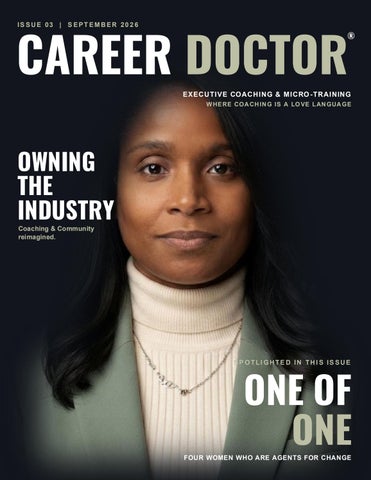
CAREER DOCTOR IS SU E 03 | S EPT EM B ER 20 2 6
®
EXECUTIVE COACHING & M ICRO -TRAINING W HE RE COA CH IN G IS A LO VE L AN GUA GE
OWNING THE INDUSTRY Coaching & Community reimagined.
SP OTLI GHTE D IN THI S IS SUE
ONE OF ONE
FOUR WOMEN WHO ARE AGENTS FOR CHANGE
CAR EER DOCTOR
·
VOL 3
·
S EPT EM BE R 2 0 26
Table of Contents IN TH IS ISSUE
FEATU RES & MOR E
03
The Foundation of Great Coaching
14
05
The Founder's Story
The Landscape Career & Leadership
The Year They Chose Themselves
15
The Career Reset
06
Emerging Talent
16
Coaching & Community
07
Leader Spotlights
17
Satisfaction
18
The Vertical Video Show
Menah Pratt, Emily Hathcoat, Love Malone & Monica Cowart
11 12
The Satisfaction List Minicast
The New Career Portfolio
19 The B.R.A.I.N. Method
One of One Your Path to Lead
The Method, Illustrated
13
The B.R.A.I.N. Method The Method, In Practice
Where coaching is a love language.
VOL 3
THE
FOUNDATION OF GR EAT C OACH ING
Today is a landmark day for me, 9.17, my birthday, and the photo inside this letter was taken just yesterday. September has always marked a monumental point in my life, the month I was born, and the month, back in 2011, that I decided to bet on myself and take what had been a lucrative hobby into full swing as an executive coach. Every September, I find myself reflecting on the year behind me and the road ahead. It has become my season to reignite, to give myself a better version of the year before, the same thing I ask every client I coach to do for themselves. In 2011, that reflection turned into a decision. I stopped treating coaching as something I did on the side and started building it into the practice it
was always meant to become. Coaching found me before I had language for it. By eighteen, people were already seeking me out for guidance, though I did not yet call what I was doing purpose. It took years of experiencing the men and women who chose me to support their journeys before I found the common thread running through all of it. What started as mentoring and coaching young minds matured into something larger, expanding into the work I now do with executive leaders. The connective tissue was never really about age or title. It was about the same instinct for seeing potential before a person sees it in themselves, whether they are eighteen and just starting out or forty-five and stepping into the boardroom for the first time. That same instinct is
exactly what led me to the women you will meet across these pages. The thread that connects them. The women you will meet across these pages carry a shared thread, and it is this. Each of them is crushing the industry she serves, navigating complex problems and innovating as fast as the moment demands it. They do not wait for permission or perfect conditions, because the work in front of them does not wait either. What connects them is not struggle, it is command, the ability to meet complexity head on and make it look inevitable. My invitation to you. Read this issue the way these women lead, wide awake and unwilling to shrink. Somewhere in these pages is the insight you have been circling. Let this be the moment you finally act on it.
WA TCH M Y ST ORY
T HE FOUND ATION
Ca re e r Do ct o r
·
V ol 3
C A R E E R D O CT OR VOL 3
THE FOUN D ER 'S S TOR Y
The Year They Chose Themselves On the changes no one planned for, the growth so many chose on their own, and the clients who invested in themselves either way.
As I sit in Hyde Park giving a high five to the statue of one of my favorite presidents, I remind myself whose shoulders we stand on, and how far intention can carry someone willing to keep showing up. This year, many of my clients arrived in transition, not by choice but by circumstance, and I met each of them the way I always do, by reading the room before it ever spoke. An unplanned pause had forced its way into a career they had spent years building, and even then, they chose to invest in themselves, and to invest in me, for the added level of support that moment demanded. Some were building an entirely new career in corporate, learning the language of an industry they had never worked in. Others were interviewing for the first time in years, relearning how to sit on the other side of a table they had not faced in a long while. Still others were taking an intrapreneurial spirit and finally pointing it toward something entrepreneurial, something entirely
T HE FOUND ER'S S TORY
their own. But not everyone who sat across from me this year was navigating a crisis. More than a fair share simply wanted to build, to scale, and to become the best version of themselves already in motion, and that pursuit was its own kind of win. Whatever the circumstance, I heard them clearly, because that is what the name my clients gave me means. Career Doctor was never a title I chose for myself. It is the neuroscience instinct they noticed in me, the same one that lets me read people, patterns, and potential before I ever offer a path forward. No one expected me to get them the job. They knew I am not a recruiter, and I am not a search firm. What they wanted, and what we built together using that same instinct, was a strategy, a set of priorities, and a blueprint they could carry forward without me. What touched me most this year were the women and men who felt their efforts had gone overlooked. More than once, I heard about a leader who asked a
peer to exude more executive presence, while never quite modeling it themselves. So many walked through workplace transformation this year, mergers and acquisitions, reorganizations, budgets stretched lean enough to cut the very programming meant to develop them. There was no exception. There was only the rule, and only the same instinct, steeped in a background of science, four Fortune 500 careers, four brickand-mortar businesses owned, and 2,000+ executives coached across a dozen industries, that let me meet every one of them exactly where they stood. The result is a range most coaches never build. It is the reason I have become a trusted advisor, thought partner, and coach, as well as a catalyst, connector, and career elevator for thousands navigating what is next. It is also the foundation of the B.R.A.I.N. Method, my proprietary neuroscience framework built around the exact inflection point many are facing right now.
Ca re e r Do ct o r
·
V ol 3
FEATU RE
·
T HE NE X T GE N E RA T ION
OUR FUTURE begins with
EMERGING TALENT
THE STORY As a coach, we are told to stay in our lane, have a niche and a target audience. I have always supported more than one lane, because the necessity was always there. Emerging talent was the first floor, and executives were the rooftop, and I believe they can rise together. My work is not shifting away from executive coaching. It is expanding around it. Partnering with corporations in support of emerging talent invests in the leaders they will become. It has become my job to take them beyond the brand name on a resume, through real apprenticeships and internships. This support is not separate from my practice. It is part of the same reimagining of what it means to build a better tomorrow together. That commitment shows up in the rooms I choose to be in, alongside organizations like the Chicago Bulls, Girls Inc., Always Giving Back, and my own nonprofit, Career Project USA.
EM ERGING TA LENT
The investment is always the same. We cultivate what we want to see. Supporting organizations like these means reaching young people before the industry ever gets the chance to tell them who they are allowed to become. It means putting a mirror in front of them early enough that ambition never has to feel like an accident. Communities of women at the top do something a resume never can. They become role models, proof that the seat they are imagining for themselves has already been held by someone who looks like them. Creating the space for those conversations, the ones that happen long before a title or a boardroom, is exactly the kind of community I am building. That same conviction is why the pages ahead belong to women who are already doing exactly that, showing up in full view so the next generation never has to imagine what is possible. They only have to look.
Ca re e r Do ct o r
·
V ol 3
LE AD ER SP OTLIGH T
Menah Pratt, Esq. CEO & R EGIONAL C HANCE LL OR, PEN N ST AT E HAZ L ET ON , S CRANT ON & WIL KE S-BAR RE
“Coach's Note: Menah is not building a career she is building a legacy meant to be inherited. Everything she does, she does with an eye toward who comes after her. When I was in second grade, I found a book at my school's book fair with a Black girl on the cover, a biography of Mary McLeod Bethune. It traced her journey from picking cotton and wanting to learn to read the only book her family owned, the Bible, to founding a school with five little girls as a single mother. Bethune's final message centered on humanity serving its highest good, and that became my throughline, actualizing my potential through education so I could help others do the same. Like Bethune, I am a college president, serving as CEO and Regional Chancellor of Penn State Hazleton, Scranton, and Wilkes-Barre, leading three regional campuses. I am also a professor and the author of five books, including a biography of my mother's journey from picking cotton to becoming a college professor with four degrees, and a memoir, Blackwildgirl, built from forty-five years of my own journals. I founded a journal, Dear Higher Education, to create space for others to share their voices. I know the power of coaching firsthand. My father was my tennis coach, and my childhood piano lessons taught me that something clanging and unfamiliar can become beautiful music with enough guidance and practice. My mother often said that we stand on the backs of those who came before us, and that we owe the same to those coming behind. It takes strong and courageous leaders to be the backs for others. A good coach helps us see what we cannot yet see for ourselves, but community adds something equally important, people who witness our evolution and celebrate our successes.
“Inside each of us is a seed planted long ago. Water it, give it light, and let it grow into the tree it was meant to become, one with branches strong enough for others to climb and fly from on their own.” My legacy is grounded in a Bell Hooks line I have carried for years, that no Black woman writer in this culture can ever write too much, a legacy centered on the voices of women and women of color who have too often been silenced. I am focused on leading institutional transformation across the Penn State Northeast region and growing SPARK Academic, which supports diverse voices. My closing insight is simple. L EA D ER S PO TL I GH T
LE AD ER SP OTLIGH T
Emily Hathcoat
GL OB AL H EA D O F PR ODU CT MA RK ET IN G & T HOU GHT LE A DE RS HIP
“Coach's Note: Emily leads and exudes executive presence with a rare mix of discipline and authenticity, the kind that makes people trust her instincts before they fully understand the strategy. She is proof that you can show up authentically and still have peers relate to you.
I have built my leadership style at the intersection of strategy, creativity and collaboration, and my career foundation on delivering results. My reputation is the result of both. I am energized by bringing clarity to complex situations, connecting people to greater outcomes, and turning good ideas into work that creates meaningful results. I was drawn to marketing and communications because they require both analytical discipline and human understanding, listening closely and seeing connections others may not yet see. Over time I realized this was not simply how I approached the work. It was how I wanted to lead. Today I lead global product marketing and thought leadership for one of the largest insurance brokerage and risk management firms in the world, translating complex risks and business challenges into ideas, narratives and resources that strengthen our market position. My team works across divisions, regions and disciplines, and leading this work requires flexibility, clear direction and decisive action at times, space to contribute and challenge assumptions at others. In either case, trust is essential. I measure success not only by what we deliver, but by whether the business grew more connected and others got the chance to grow.
To me, coaching and community are inseparable, with trust as the link between them. I believe in Fred Fiedler's contingency theory of leadership, the idea that there is no single best style, only the style that fits the moment, the task and the people involved. A crisis calls for structure and decisiveness. A favorable environment calls for trust and collaboration. Either way, adapting only works when it sits on a consistent foundation of credibility and respect.
The best coaches listen, assess and adjust rather than give everyone the same advice, and community adds perspective and accountability no single mentor can provide alone. Looking ahead, I want to build communities where insight moves more freely, and leadership is measured by what it enables in others. “Do not become so attached to one style that you stop seeing what the moment needs. Read the situation, create clarity when it is needed and space when others need room to lead, and use whatever influence you have to make the path more visible for the person coming next.”
My legacy will not be a single campaign or model. I hope it will be a network of people who trust each other enough to exchange ideas openly and bring others with them as they advance. My advice to anyone hoping to make a broader impact is simple. L EA D ER S PO TL I GH T
C a re e r D o ct o r
·
V ol 3
LE AD ER SP OTLIGH T
Love Malone
F OU NDER , C EO OF MAL ONE CRE ATIV E GROUP & GRADIE NT GROUP
“Coach's Note: Love wakes up to fight. She
thrives in survival mode, yet she never waits for permission to build the room she wants to sit in. Watching her turn conviction into agency, and now into support for the next generation, is the leadership I coach toward.
I have spent more than two decades in advertising and media, most of it inside the rooms where the work gets decided, at BBDO, at Ogilvy, and now at the head of my own agency. What drew me to this business has not changed since the first campaign I worked on. Advertising can change what people think, how they feel, and what they do. A message placed well can move someone to call a crisis line, take a different route home, or show up for a neighbor, and that is not a soft claim about the work, it is the whole point of it. It is why I stayed, and why I left to build Malone Creative Group, an agency where strategy, creative, media, and measurable results answer to the same standard at the same table. Malone Creative Group is a full-service agency built around creative development, media strategy and buying, sports sponsorships, analytics, and campaign execution, serving government agencies, brands, and mission-driven organizations whose stakes are rarely abstract. Our sports practice includes partnerships with the New York Knicks, Brooklyn Nets, New York Liberty, LA Sparks, New York Yankees, New York Mets, and New York City Football Club.
Everything I understand about leadership, I learned managing ideas, people, clients, budgets, and assignments where the margin for error was thin. Vision is the part everyone talks about, but vision without clarity, accountability, and decisiveness is just a good mood. The harder work is gathering talented people around a shared standard of excellence and holding it when the pressure arrives, reimagining community as something built on that standard rather than left to chance. That’s also where I think great coaching and leadership development are headed.
Careers in this industry have never advanced on performance alone, they advance on access, advocacy, and someone willing to open a door and say a name in a room. Formalizing that advocacy, building it into how organizations develop people rather than leaving it to chance, is the most consequential leadership work available right now. Our industry is being reshaped fast by fragmenting audiences, data, and artificial intelligence, and the leaders who last will be the ones who adopt the tools without losing human insight, cultural fluency, and respect for a great idea. They will also stop pretending that creative, media, partnerships, and performance can operate in separate silos.
“Trust the experience you have earned, stay willing to evolve, and build the kind of company you once wished existed.”
Looking ahead, I see expansion on two fronts. I am building Malone Creative Group into one of the country's most respected independent agencies known for the caliber of its thinking and the results it produces. Alongside it, I am growing The Gradient Group and The Gradient Fund to make the path into this industry more visible, measurable, and equitable than the one I walked. The legacy I am building is one of creative excellence, business ownership, opportunity, and lasting impact. L EA D ER S PO TL I GH T
C a re e r D o ct o r
·
V ol 3
LE AD ER SP OTLIGH T
Monica Cowart P H D, L P C , L M HC CH IE F AC AD EMIC OF F IC ER
“Coach's Note: Monica turned a pragmatic decision about the LSAT into a life spent building ecosystems where people thrive. That is the kind of reframe I want every client to believe is possible for themselves.
Starting college, I elected the pre-law track and pragmatically signed up for philosophy courses. Falling in love with Aristotle was not part of my four-year plan. Yet I developed a passion for the discipline, a yearning to understand concepts such as Justice, Beauty, and Truth. I never would have guessed I would spend the next three decades on a college campus. Dr. Baker unleashed my intellectual curiosity, civic consciousness, and drive for purposeful change. I was inspired to teach, mentor, and empower, first as a college professor, then as a therapist, and finally as a Chief Academic Officer designing environments that prepare the next generation to navigate a complex world. Students remain at the heart of every strategic decision I make. My role is to architect the ecosystem, a forward-looking academic vision that conceptualizes a future ready curriculum, unifies faculty around innovative teaching models, and cultivates a culture of belonging that drives student retention.
I recently advanced this strategy by co-launching an interdisciplinary innovation institute and securing the faculty approval required to launch a modernized core curriculum next year. These achievements serve as the concrete framework required to educate the whole person, not just academics. By looking beyond the classroom, I break down silos, align cross functional teams, and build the frameworks required to help our graduates lead and innovate across sectors.
I view community reimagined as the intentional integration of belonging, shared vision, and cross functional collaboration, with coaching as the primary catalyst for continuous personal, professional and institutional growth. “When you architect an ecosystem that genuinely values the individual, success is unlocked.”
My next chapter focuses on scaling these insights to help shape the future of higher education, proving that the connected, relational culture of a liberal arts college is the premier training ground for the modern workforce.
L EA D ER S PO TL I GH T
C a re e r D o ct o r
·
V ol 3
FEATURE · THE NE W CAR EER POR TFOLIO
Why Everyone Suddenly Wants Five Careers Instead of One The Diversified Career Diversifying your earning potential the way you would diversify any investment.
We are in a season of life where one career, although somewhat stable, is not the security blanket it once used to be. Every American is looking to diversify not only their assets but their earning potential. A board seat here, an advisory role there, a coaching practice on the side, a fractional assignment weighing in the balance, and a new AI tool to generate passive income. They all sound great. However, if we pause just for a second, it becomes clear that what this is describing is not a lack of focus. It’s a portfolio, built the way any smart investor builds one, spread across bets that each carry their own return and their own risk. The single employer career was never some timeless default. It was a mid -century invention that made sense for a particular economy at a particular moment, and that moment has been over for a while now, whether the org chart admits it or not.
This is the real answer to why everyone suddenly wants five careers instead of one. It was never about wanting more work. It was about refusing to hand an entire earning potential to a single employer's decision, a single market's mood, or a single org chart's mercy. Five careers is not ambition running wild. It is risk management wearing a more interesting outfit. Join the Career Doctor during the upcoming Satisfaction List vertical Minicast explore how you can diversify your earning potential during these uncertain economic times.
TH E C A RE ER P OR TFOLIO
C areer Doc tor
·
to
V ol 3
FEATU RE
The B.R.A.I.N. Method The neuroscience behind every session, five pieces that fit together.
B
Build Safety
R
Redirect Attention
A
Activate Thinking
I
Install Patterns
N
Nurture Momentum
AM YGDAL A
Every session lowers threat before raising challenge, because a triggered brain cannot reason or create.
R ET I C U L A R A C T I VA T I N G SYS TEM
Naming a vivid, specific target recalibrates what your brain filters as relevant and possible.
PR E FR O N T A L C O R TE X
Powerful questions and deliberate pauses pull you out of reactive thinking and into real perspective.
N E U R O P L A S T I C IT Y
Small commitments and repetition between sessions turn a one-time insight into an actual new default.
DOPAM INE
Every session closes by naming what moved, reinforcing the motivation to keep going.
THE B.R.A.I.N. METHOD
C a re e r D o ct o r
·
V ol 3
FEATURE STORY
Why I Built a Coaching Method on Neuroscience The B.R.A.I.N. Method turns insight into a habit clients keep long after our session ends.
I
did not set out to build a framework. I set out to solve a problem I kept watching happen in session after session. A client would leave our call with a real breakthrough, genuinely moved, ready to change everything, and by the following week the insight had quietly evaporated. The excitement was real. It just was not sticky. I started asking why, and neuroscience gave me an answer business school never did.
WHAT THE M ETHOD ACTUALLY DOES
WHAT CLIENTS FEEL IN THE ROOM
The B.R.A.I.N. Method is not a metaphor I layered onto coaching after the fact. It is the actual sequence a brain needs to move from reaction to real change, and I built every session around it on purpose. Before I ever ask a client to stretch, I build safety, because a brain that feels threatened cannot access its best thinking, only its fastest one. Once the room feels safe, I redirect attention toward something specific and vivid, because what we name is what our mind starts noticing everywhere. Only then do I activate thinking, with questions built to interrupt autopilot, the kind that make a client pause before answering rather than reach for the first thing that sounds right.
Clients rarely describe the method to me in clinical terms. They describe the feeling of it. They tell me a session felt different, that a question landed somewhere an ordinary conversation never reaches, that they left with an idea instead of an assignment. That is install patterns and nurture momentum doing their quiet work. I ask for one small commitment between sessions, never a life overhaul, and I close every call by naming exactly what shifted. Repetition is what turns a good insight into an actual default, and naming the win is what keeps a client's brain looking forward to the next one.
A brain that feels safe can think. A brain that feels threatened can only react. Everything I do as a coach starts with that one distinction. As an ICF certified coach, I could have built my practice on frameworks borrowed from someone else's room. I chose to build one from the actual architecture of how people change, because my clients deserve more than motivation that fades by Friday. The B.R.A.I.N. Method is the reason the shift holds.
THE B.R.A.I.N. METHOD
C a re e r D o ct o r
·
V ol 3
THE
LAND SC AP E
CAREER & LEADERSHIP
The best predictor of who gets promoted isn't performance. It's who is willing to say their name in a room they are not in.
71%
2×
$70K
of senior leaders sponsor someone who shares their own race and gender, a bias researchers call mini-me sponsorship.
the rate sponsored employees get promoted compared to their unsponsored peers.
the average career-long pay gap for equally qualified women, even in identical roles.
THE TAKEAWAY
If you are waiting to be noticed, stop. Identify one senior leader whose reputation could open a door for you, and bring your voice to value. CARE ER & LE ADERSHIP
Career Doctor
·
Vol 3
FE ATU RE · THE CAR EER RES ET
The Career Reset We're All Pretending We Don't Need RAS Reset: Why We Need to Embrace It Changing what your brain is tuned to notice, question, and pursue.
Over the last several years, women have been drawn to my practice. A good outcome for one multiplies into referrals from several more, and so the story continues. By the spring of 2025, I could feel it before I could name it. Every exploratory call started to sound the same. Women arriving already defeated, reciting the same headlines before I could ask a single question about what they actually wanted. I started keeping track, informally, in my own notes, and what I was seeing lined up with what would later become public data. Over 600,000 Black women pushed out or sidelined from the workforce since the start of that year. The pattern did not stay contained. I do not coach just Black women, and by that July it had widened well past any one group, with women accounting for the entire national labor force decline that month, losing 32,000 jobs while men actually gained 9,000. I did not need the reports to tell me this. My calendar of exploratory calls had been telling me for months. Early this year, a client I am coaching now told me, this is the season I cannot wait to end. She had become the rule rather than the exception for so many. She heard it in the news, in group chats, in comments under posts she probably should have scrolled past. After a few months of sending the same kind of resume into the same kind of silence, she was ready to give up on the idea that she would ever get back to work at all.
I told her about her reticular activating system, the part of the brain that decides what gets through and what gets filtered out before you are even aware it happened. I did not lead with the science. I led with a question. When was the last time you noticed an opportunity that felt possible? She could not remember one. That is not because they had stopped existing. It is because her brain had spent months training itself to filter out exactly that kind of door, tuned so tightly to every story about women losing ground that hope had quietly stopped registering as real. Retraining her RAS, through subtle and focused exercises, is what created the shift. What changed was not the job market. It was the lens she was using. Today she lets herself look at entrepreneurship instead of another application, and something shifted that a hundred rejections never could. She was not creating an opportunity out of nothing. She was finally letting herself see the one her own mind had been filtering out the whole time, because it had gotten so good at noticing every reason to give up that it had no room left to notice a reason to begin. That is what this coaching offers. When a client sits down with me, we do not start with another resume overhaul or another round of interview prep. We start by naming exactly what her brain has been trained to filter out, then we retrain it on purpose, through short, deliberate exercises she can practice between our sessions. Most clients notice the shift within a few weeks, not because the job market changed, but because they finally started seeing what had been there all along. That is the promise of a RAS reset. Not motivation that fades by Friday, but a brain that is finally working with you instead of against you.
THE CAREE R RESE T
C a re e r D o ct o r
·
V ol 3
THE FEATURE
COACHING & COMMUNITY, REIMAGINED. I honor my work through building bridges. Every client I serve is supported not just in the room with me, but by at least one community built to hold them long after the session ends.
◇
◇
◇
01
02
03
I named this one after the tradition of doctors gathering to study a case together, because that is exactly what happens here. Executive clients bring real, current challenges into one shared room and work through them together with me, not in theory but in real time.
Some of the questions my clients ask are not ones they are ready to ask in front of anyone else. This is the space I built for that. Forty female leaders, no audience, and the kind of career and leadership honesty that only happens when the door is actually closed.
This is my coveted biennial cohorts. Eight Black female executives sharing wins, resources, and the kind of encouragement that only comes from someone who has actually walked the room you are standing in. No one in Harmony Hive navigates leadership alone.
Grand Rounds
TH E FEA TUR E
The Private Room
Harmony Hive
C areer Doc tor
·
V ol 3
FE ATU RE · SAT ISF ACT ION
What If “More” Is the Reason You Never Feel Like Enough? Satisfaction: How Much Is Enough? The question successful people rarely ask. As a coach, you see and hear so much that nothing really surprises you anymore when it comes to careers and life strategy. Still, one client has stayed with me longer than almost any other. She'd spent decades racing toward a C suite title, and early in our work together, she named something she hadn't said out loud before. She didn't want it anymore. The wanting itself was over, and what she felt when she finally admitted that wasn't joy. It was relief. Most of the executives I coach are extraordinary at pursuit, and they've never once been asked to define arrival. They can tell you exactly what the next title is worth and exactly what the next number should be, but they don't have an answer for what enough actually looks like, because no one ever made them sit with the question long enough to find out. Along the way, the pursuit becomes the identity, and it's hard to imagine who you'd be without it. I don't think the answer is to want less. I think the answer is to decide, on purpose and in advance, what enough looks like for you specifically, because while a client is still trying to answer that question, every recruiter call and every board seat conversation ends up bending their ear right back toward the very thing they were trying to walk away from. Without an answer already in hand, there's nothing solid to hold onto when someone else shows up with a bigger offer and calls it opportunity. Here's why that matters. Whether she ever got there isn't the story, and it isn't mine to share either way. What I can tell you is that her relief didn't come from an outcome. It came from being honest enough to admit she'd been running toward a finish line someone else had drawn for her, one that had stopped meaning anything to her a long time before she ever said so out loud. Once she named that, she wasn't stuck anymore. She could finally ask herself what she actually wanted instead of what she thought she was supposed to want, and that question opened up a version of her career she hadn't let herself consider in years. That's the part no one tells you about defining enough. It's not about giving up on ambition. It's about making sure the thing you're chasing is actually yours, because chasing someone else's finish line for decades will wear you down in a way that looks like burnout but is really just exhaustion from running the wrong race. If you take one thing from her story, let it be this. Ask yourself, honestly, whether you still want what you're chasing, before you spend another year finding out the hard way that you didn't.
SAT ISF ACTION
C a re e r D o ct o r
·
V ol 3
NEW · THE VERT IC AL VIDE O SHOW
The Satisfaction List Minicast The 1st installment is coming this September! Pull up a chair, I’ve saved you a seat. Everything you need to know, from products to purpose, curated with intention, brought to you courtesy of the Career Doctor.
N OW S TR EA MING ON
YouTube
TikTok
W HA T TO E X PE C T
Products with Purpose - Discover products, tools, and resources designed to support your personal growth. Career Gems & Real Talk - Get practical insights, tips, and guidance.
Bite-Sized. Bold. Built for the Scroll.
2 MI N
TH E SA TISFAC TION LIST
C areer Doc tor
·
V ol 3
ONE OF ONE
Your Path to Lead A clear resource for the reader ready to stop admiring these women and start becoming one of them.
L
Listen
E
Explore
A
Amplify
D
Direct
THREE WAYS T O BEGIN Package One S IX SE SS ION S
The foundation: 1:1 coaching, DISC assessment, custom resume.
Package Two E IGHT SE SS ION S
1:1 coaching, Adds EngageX and CD On-Demand access, board-ready resume and bio.
Package Three T EN S ES S IONS
The full arc, 1:1 coaching, ten months of access and two Grand Rounds sessions.
“Jacqueleen brings a rare combination of inspirational and practical guidance, giving me not just the motivation to dream bigger, but also the steps to get there. Her talent for bringing people together is unmatched! Melissa Lucas, MBA, PMP Chief Operations Officer
Community was never the add-on. The Private Room a Career Doctor exclusive is about lifting each other up, sharing strength, and making sure no one has to walk alone.
Space is intentionally limited. Schedule a consultation to find your package.
O NE O F O N E INTRINSIC VALUE® · SATISFY® · ENGAGEX® · CD ON DEMAND® · BXMETHOD®
Where coaching is a love language CAREER DOCTOR LLC
thecdllc.com · @careerdoctor
INTRINSIC VALUE® · SATISF Y® · ENGAGEX® · VOICE T O VALUE® · CD ON DEMAND® · BXMETHOD®