SINCE 1944
VOLUME 82 ISSUE 1
2
September 14, 2026
Student run since 1944
What’s with all these election posters around Lennoxville?
6 Gaiters dance through
10 Sherbrooke is more than
Multifaceted meditations
Grown-Up 101: What I wish 8 I knew before moving to Bishop’s
12 behavioural economics
4 on the Bishop’s website rebranding
opening weekend
Features:
By Lauren Root Features Editor
O
-Week 2026 kicked off with an anticipated bang on Sept. 5 with an exciting theme: “Back to 2016”. This year welcomed approximately 900 incoming firstyears, all eager to get started and get involved in Bishop’s life. What better way to start O-Week than attending the first football game of the season? First-years got to witness history on their first day on campus; Saturday marked Bishop’s Gaiters football’s first game back in the RSEQ in ten years! After the football
game, first-years really began to understand what Bishop’s pride is all about. Back to 2016 also featured some of the most notorious and celebrated O-Week events. Quad night welcomed new students to the fun side of Bishop’s while also providing a safe environment to help everyone adapt to Lennoxville. Battle of the DJs is a rite of passage introducing first-year students to the incredible talent that upper-years have. Congratulations to DJ DUXX, who is the winner of the 2026 Battle of the DJs!
@thebishopscampus
what you see
“I’m only here once”: The of studying abroad
Sports:
Back to 2016: O-Week 2026 recap
Continue on page 8
1
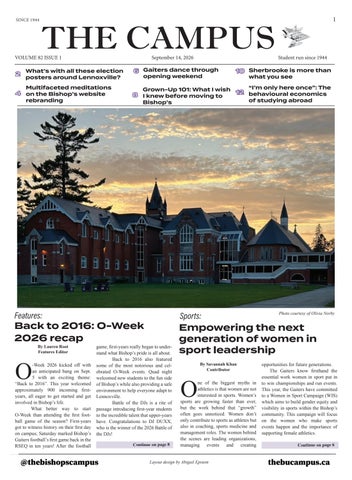
Photo courtesy of Olivia Norby
Empowering the next generation of women in sport leadership By Savannah Khan Contributor
O
ne of the biggest myths in athletics is that women are not interested in sports. Women’s sports are growing faster than ever, but the work behind that “growth” often goes unnoticed. Women don’t only contribute to sports as athletes but also in coaching, sports medicine and management roles. The women behind the scenes are leading organizations, managing events and creating
Layout design by Abigail Epstein
opportunities for future generations. The Gaiters know firsthand the essential work women in sport put in to win championships and run events. This year, the Gaiters have committed to a Women in Sport Campaign (WIS) which aims to build gender equity and visibility in sports within the Bishop’s community. This campaign will focus on the women who make sports events happen and the importance of supporting female athletics. Continue on page 6
thebucampus.ca
2
NEWS
THE CAMPUS SEPTEMBER 14, 2026
Anthony Ouellet, News Editor » thecampus.news@gmail.com
What’s with all these election posters around Lennoxville? By Parker Kessler Contributor
Photo courtesy of Wikimedia
M
ark your calendars for Oct. 5: Québec’s next provincial election. This election for Bishop’s University’s riding, SaintFrançois, will determine which candidate will become a Member of the National Assembly (MNA). This will impact our student population, as the chosen MNA will have a say in the current issues which the National Assembly is focusing on, including housing costs, minimum wage and the rules regulating English universities in Québec, such as Bishop’s.
The previous MNA, Geneviève Hébert, who is running for re-election with the Coalition Avenir Québec, is focused on many issues relevant to students here at Bishop’s, such as housing costs and accessibility for Anglophones. Geneviève Hébert was an MNA when Québec attempted to limit outof-province students from attending Bishop’s University by increasing their tuition costs. She supported Bishop’s University, and the government, which was formed by her own party, declared an exemption for Bishop’s. Professor Jacob Robbins-Kanter, Chair of Bishop’s University’s Politics and International Studies department, highlights that without the university’s leadership fighting for an exemption, the attempt might have succeeded. This change would have caused the demographics and culture here at Bishop’s to look very different. The other candidates are Sylvie Tanguay, representing the sovereignist Parti québécois, Jacqueline Belleau with the Québec Liberals, Mia Fréchette with the leftwing party Québec solidaire, and
Esteban Mendez-Hord, representing the Québec conservatives. Tanguay is a nurse who wants to bring her experience in healthcare to the government, while Belleau, who has close ties with Bishop’s University, wants to utilize her background in immigration and business. Fréchette has promoted accessibility for English speakers as well as lowering the cost of housing, and Mendez-Hord wants to make homebuying more affordable. At the time of writing, polling website Qc125 projects that Sylvie Tanguay with the Parti Québecois will gain a majority of votes.
Lots of implications But what’s so important for a student to know about voting in this election? When asked this question, Professor Jacob Robbins-Kanter explained that voters are most concerned about picking a candidate who will tackle healthcare, the cost of living, housing costs and accessibility, and international relations with the United States’ current administration, all of which impact the daily lives of the student body.
For example, a recent survey by TD shows that the cost of living is causing significant financial stress for 79 per cent of Quebec students. Additionally, in an article by City News, a student was quoted saying, “I don’t have a family doctor right now” and “If you don’t have the funds to pay and go to private, it is extremely expensive. It’s not something we should be paying for”. Whether or not students have to pay for healthcare and face a high cost of living is partially determined by the National Assembly. Therefore, by voting in this provincial election, you can pick the right candidate to tackle the plethora of issues impacting students. Classes are suspended on Oct. 5 for voting. You can vote from 9:30 a.m. to 8 p.m. at your local polling station. To find your local polling station, type in your address on the Québec Elections site. the energy and atmosphere that define game day at Bishop’s. So, the next time the crowd rises after a big play or a highlight appears online moments later, it’s worth remembering: there is an entire team behind the scenes making it happen.
Why isn’t the bus free? Building steam... with unsalted roads
T
By Quentin Smith Contributor
wenty-two years ago, the Université de Sherbrooke (UdeS) signed a deal with the Société de Transport de Sherbrooke (STS), making public transport “free” for its students, so why hasn’t Bishop’s? The bus system of Sherbrooke is robust, mainly built around the UdeS as a hub, but Bishop’s has access to two popular lines: the 11, which runs to the Plateau Saint-Joseph and stops at a major hub, the Carrefour de l’Estrie, and the two, which goes to Downtown Sherbrooke, the other hub of the network. While both provide students with essentials, using the bus is costly. Currently, as a Bishop’s Student without a car, there are only two options for getting around regularly: biking, which is free with the Gaiter Gears project providing bikes for everyone, and the STS bus system, which costs $70 a month for those under 21 and $92 for those above. On the other hand, there is a rechargeable system that can potentially reduce costs tremendously
by charging only $3.50 per trip, or $4 with cash. This brings us to the current system that we have, in which Bishop’s provides 100 monthly bus pass subsidies through a raffle to eligible students. This system does not cover the entire cost of a bus pass, but it does reduce it to $34, no matter the age. All of this is still cheaper than a car as the price of gas skyrockets, but it is still far from free. This may change in the next few years. “Regardless of the current financial situation, the STS remains very open to a universal pass agreement with Bishop’s University“, Geneviève La Roche, municipal councillor and chair of the STS, said to The Campus. Bishop’s University hasn’t responded to our request for comment promptly. The school, however, has made statements in the past, like in its 2023-2024 Sustainable Development Action Plan, which discussed data collection to establish further actions. With this in mind, La Roche had a message for BU students: use the bus. “Public transit evolves according to the needs of the population, but
also according to how it is used ... Every trip taken on public transit helps demonstrate the mobility needs of the area and provides us with valuable information to help us think about the evolution of our network”, she said. She also emphasized that adequate and predictable funding from the provincial government is required. Sherbrooke mayor Marie-Claude Bibeau has spoken to each candidate running in the current elections to push for this, but it is also clear that citizens must use their voices.
Photo courtesy of Anthony Ouellet
Is it really free? But how does the Université de Sherbrooke provide its student population of around 43,000 people with free transit? It is, in fact, provided to everyone by including a $37.99 public transportation fee per semester. This is attached to an annual fee the school pays for this access, which, according to previous statements, was around 1.6 million in 2010 when the fee was increased to $27 per semester. So it’s not actually free, just a service provided with tuition, for a much lower cost. Meanwhile,
Sherbrooke’s Cégep has a population of around 6,000, and they’ve had access to free public transport since 2010. According to their student fees bill breakdown, they pay around $80 a semester for this service. It is still a massive discount in comparison. So what will Bishop’s do? They need to bargain. The benefit of having public transportation discounted by an agreement is that it will allow people who couldn’t pay that monthly fee in the first place to still use and assist the system that is becoming more important to everyone day by day.
NEWS
SINCE 1944
3
Anthony Ouellet, News Editor » thecampus.news@gmail.com
Bishop’s farm project moves closer to reality as SAFS expansion awaits city approval
P
By Anthony Ouellet News Editor
ending a major change, Bishop’s University will soon get the green light from the city to expand its territory and build a state-of-the-art educational farm for its Sustainable Agriculture and Food Systems (SAFS) program. The university’s will to expand its SAFS program dates back years; people familiar with the project have told The Campus. There’s been a lot of back and forth over the years. For example, in early 2026, BU’s request to convert 16 hectares of agricultural land into buildable land was rejected by Quebec’s commission on agricultural territory protection. The Commission, however, permitted the university to use 3,5
hectares, a lot less than what was originally asked for of this land, to build infrastructure that serves educational purposes. With this authorization in hand, BU then had to seek authorization from the City council for zoning changes necessary for its project. After working on these changes all summer long, ‘’the project will be approved by the council on Sept. 15’’ Dominique Côté, a spokesperson for the City of Sherbrooke, told The Campus. However, this approval is itself tied to citizen opposition, or a lack thereof. If fewer than 12 citizens who live near the project sign a document asking for a referendum on it, then the final approval will be delivered. At the time of publishing, it wasn’t possible for the City to confirm if any citizen had signed said document.
Generally, this type of project doesn’t face much criticism from neighbours. Even the “Union des Producteurs Agricoles, Quebec’s biggest agricultural union, is in favour of the expansion in its actual form, although it contested the initial demand to allow the conversion of 16 hectares. Municipal sources have also confided that the City is supportive of the project. What would change? The educational farm would sit on the piece of agricultural land on which Bishop’s is permitted to build. On that land, BU is going to add a multifunctional building, which is going to support the farm activities, a university operative said in a brief exchange. According to a computer-
Photo courtesy of a source
generated render of the projected building, which we obtained, it’ll be built mostly out of wood. Some municipal documents also indicate that there’s gonna be a parking lot on site. Last February, the Bishop’s Dean of Social Sciences & Interim Associate Vice-Principal Research, Matthew Peros, told the 107,7 Estrie radio station that this expansion was designed to improve the SAFS program and raise the number of students in this field.
How BU is going to help the world see the stars: A Bishop’s research team works on an ambitious NASA project
O
By Adèle Morin Contributor
n Aug. 30, 2026, a new pair of eyes was opened onto the universe. A telescope whose gaze is 100 times wider than the Hubble Space Telescope, built to chart 100 million stars and thousands of new worlds, was sent into orbit… and now it’s BU’s time to shine. NASA’s Nancy Grace Roman Space Telescope left off in the early morning from Kennedy Space Center aboard a SpaceX Falcon Heavy rocket. Its mission, according to NASA, is to settle essential questions in exoplanet science, dark matter and dark energy, with Canadian technology on board and Canadian researchers waiting on the data. Among them is a team from Bishop’s University, which contributes to the mission by developing software that processes and analyzes the data received from Roman, turning raw mea-
T
surements into scientifically usable results. At the heart of Roman sits a camera of extraordinary ambition. Its field of view is at least 100 times larger than Hubble’s, and it is expected to measure light from a billion celestial objects over its lifetime. It can also block out a star’s light entirely, allowing it to photograph planets and planet-forming disks directly, a trick made possible by its chronograph, an instrument that operates in a similar way to holding your hand up to block the sun’s glare. This technique is up to 1,000 times more sensitive than other observatories. Two of its very sensitive cameras were developed in Canada by Nüvü Cameras and ABB, devices capable of capturing extremely faint light. This is exactly what is needed to spot distant worlds. How does a telescope find a planet?
Roman will use two techniques. The first is the transit method: when a planet crosses in front of its star, the starlight dips ever so slightly. The Kepler Space Telescope used this method in 2009 to survey roughly 200,000 stars; Roman will repeat it on 100 million, a hundredfold increase. The second technique, microlensing, is more complicated. When a star with planets drifts in front of a more distant star, their combined gravity acts as a lens, bending and magnifying the background light. “If you have a distant star that you like to call a source of light, and then a star with its planets moves precisely right in front of it, that mass of the star and the mass of the planet act as two lenses,” explained Dr. Jason Rowe, professor at Bishop’s University and member of a Roman observing program, in an interview with the CBC. This “causes the light that’s coming from that distant star to bend a
little bit, which we observe as a magnification event”, he added. All of this data will flow to Earth in early 2027. Once it starts arriving, part of the challenge will be interpreting it, which will fall upon researchers like Dr. Rowe, whose Canada Foundation for Innovation-funded computing pipeline is being built to turn “an ocean of observations into a catalogue of new worlds.” Named after NASA’s first chief astronomer, the “mother of Hubble,” Roman promises the greatest planetary census ever attempted. Roman’s arrival is not just a launch but a door swinging open on a universe we have only begun to count.
Graphic courtesy of Gabrielle Lalonde
he Campus acknowledges that the land on which we operate is stolen land, the traditional territory of the Abenaki people. We live, learn, work, and play on this land, home to Indigenous peoples still living. Canada was founded through colonization, a system rooted in oppression and the abuse of power over others, continuing to affect First Nations, Inuit, and Métis communities today. As a student newspaper, The Campus has a responsibility to highlight truth. We are committed to prioritizing underrepresented voices in our community and proactively highlighting Indigenous peoples’ histories and ongoing realities, including their resilience and achievements. We recognize our work plays a role in shaping public perceptions, being able to call-out injustice but also call-in action. We emphasize that we must go beyond a land acknowledgement, which is only one step towards reconciliation. It is the stories in our paper – told with respect, accuracy, and integrity – and the respect and humility we show to the land and others that is more important than what is written in a land acknowledgement. Actionable steps to go beyond a land acknowledgement include educating ourselves and others, and supporting Indigenous traditions, movements, and businesses. —The Campus Team
4
OPINIONS
THE CAMPUS SEPTEMBER 14, 2026
Reagan Russell, Opinions Editor » thecampus.opinions@gmail.com
Fearing Frosh Flu
A
By Reagan Russell Opinions Editor
s students move back to campus, many pack bags full of Tylenol, cold and flu medication and cough drops in preparation for the dreaded “Frosh Flu” outbreak. Living in close quarters, running on lack of sleep, appetite changes and alcohol consumption all increase your chances of catching Frosh Flu, but more can be done to limit your exposure and help you recover quicker. A key aspect of understanding Frosh Flu is realizing that Frosh Flu is a virus that is easily spreadable and highly contagious, often causing a sore throat, scratchy voice and general unwellness. Viruses are easier to spread than bacterial infections, especially when students are already immunocompromised and tired. The Head Nurse at Health Services, Kendra Brock, encourages students to wear a mask if sick to limit exposure
of the virus to others, as many students are afraid of missing out on time with friends and in classes. As for preventing the virus to begin with, the “best thing in the world for killing that stuff”, according to Brock, is washing your hands with soap and water. Brock also recommends avoiding sharing utensils, drinks, and other surfaces that may have saliva, including kissing others. When asked if Frosh Flu has gotten worse since COVID, Brock commented, “We’ve forgotten some of the benefits of those restrictions from COVID”, highlighting that in the years following COVID, students were more cautious. In recent years, cases have been higher. However, post Covid, students are generally more conscious of their health, according to Brock. This Orientation Week, Brock was involved in the mandatory Wellbeing, Community and Safe Partying workshop for first-year students. This workshop had traditionally been held as a Safer
Partying workshop for Orientation Week volunteers but has grown to include incoming Gaiters as well. According to Brock, the first-years were engaged with the topic. Brock encourages students to get support earlier when becoming sick, claiming, “I’m still surprised at how many students don’t know what to take when they have a fever, a headache, or a sore throat, like Tylenol and Advil… those are your best friends when you start here”. Vitamins like Vitamin C and B12 can be beneficial as preventative treatments, as well as Vitamin D daily until May while there is less sunlight. Brock encourages students coming from sunnier countries to take Vitamin D daily, as she has noticed that their Vitamin D levels are often low once on campus. Brock highlights that students should not wait until their symptoms are unmanageable to get support, as it will take longer for their bodies to recover. Unfortunately, the end of
Frosh Flu marks the beginning of cold and flu season in October. While Frosh Flu isn’t entirely preventable, management options are available. Consider wearing a mask if you feel unwell, make sure to wash your hands often and avoid touching your face, and do not delay treating your symptoms as needed. Your classmates will thank you.
Photo courtesy of Rachel Nasani
Wellness darties are a symptom of culture change By Reagan Russell Opinions Editor
W
ellness darties, organized daytime group workouts like hot yoga or running as a way to socialize and prioritize health, have become popularly shared on social media. With current social media obsessions, however, such as taking wellness to a whole new extreme, it forces the question if wellness is taking over the need for many students to go out. For Bishop’s, it is unlikely that Reed Street will be full of people with yoga mats during Homecoming, as Bishop’s tends to prefer the traditional use of the term ‘darty’, a daytime party, but it’s not entirely out of the question. According to Health Canada, students are drinking less in the past two years than they did from 20222024. Statistics Canada shows similar numbers, with alcohol sales dropping as well, reflected in Campus issues from last year on
Graphic courtesy of Gabrielle Lalonde
Gait drink sales. Whether this can be blamed entirely on inflation is unlikely, as Generation Z tends to prioritize connection over alcohol, and alcohol can just be seen at times as a means to an end for this connection. Wellness has also become a hot topic on social media. Whole foods, protein goals and fitness plans truly rule the lives of many students. The Plex is often packed, and the numerous sports-related clubs and official varsity teams are
busy; students on campus prioritize physical movement, but that doesn’t mean that they don’t ever party. We all can see that. In a sense, Bishop’s already has wellness darties; they are just not as publicized and organized. Roommates will walk together and rehash their Sunday Scaries. Others head to the gym together. The only thing truly missing is an Instagram reel inviting more people to join. I don’t think that wellness darties will merely become a trend, but instead show a greater culture shift for students. That said, I’m also not claiming that wellness darties will replace a night out at the Gait and one too many vodka crans. It is more likely that students will, hungover or not, still take part in their own wellness activities, but I can see unofficial wellness darties happening as well. A night out and a wellness darty do not have to be mutually exclusive, despite the assumptions they are on social media. The comment sections of
wellness darty posts are often filled with comments on how “students aren’t like they used to be, or “I’m glad I already graduated when college was supposed to be fun”. This implies that wellness darties mean absolutely no parties ever, and instead students only focus on their physical health. Thankfully, balance has tended to be where Bishop’s falls in these matters; work hard, play hard. Whether you’re bed rotting on Sunday morning after the Gait, or running a 10k, that is self-care. That component of wellness is important, and moving, or not moving, your body in a way that feels good for you is sometimes exactly what you need. Balance should be the goal, not completely eliminating either aspect of life, as that is typically unrealistic for students. Or you can be like the people on Instagram who run a mile for each drink they had the night before, but I’ll probably be in bed.
SINCE 1944
OPINIONS
5
Reagan Russell, Opinions Editor » thecampus.opinions@gmail.com
Multifaceted meditations on the Bishop’s website rebranding By Fiona Tremblay-Snelgrove Contributor
T
he university has stayed true to the purple glow from the get-go. We’ve been encouraged to ‘Be You at B.U’, ‘Bleed Purple’, and to ‘Raise a Toast’ to our Gaiter identities from the moment we arrived on campus. We’ve had the purple ingrained into our student lives, with some considering the violet hue of the student experience to be an integral aspect of the university. For years, Bishop’s has promoted the student-centred experience and the tightly knit community the Eastern Townships create with it. Over the summer, unbeknownst to the purplest students around, the Bishop’s University website stopped enticing us to ‘get the purple vibe’
and started telling us to ‘Join the Multiversity’. A distinct shift from student-centred to school-centred. From a marketing perspective, the switch is smart; it promotes the multi-faceted experience at Bishop’s University, stating its ‘Multidisciplinary. Multicultural. Multiple opportunities to thrive’ (Bishop’s University, 2026). Being a Gaiter means so much more than the opportunities. The B.U. lifestyle is made with the niche experience of special-ordering school supplies or equipment in our colours, or getting excited when you find what you need, and it’s in purple! This community is a marvel; we don’t need a new slogan reminiscent of Marvel’s Multiverse. It’s a clever marketing strategy for sure, but it somewhat erases the heart of the university community:
the purple. Multi this, multi that; at our core, we are not many. But that is what makes us so special: we are tiny, but mighty, and we bleed purple for it! We carry the purple pride of ten universities strong, yet somehow our own website has forgotten that! Also, since the university relies so heavily on student pride for promotion, why not involve students in this communications catchphrase kerfuffle? We, as students but more so as Gaiters, feel that purple pride every day; the multiversity/schoolcentered shift is evident. In the classrooms, it is creating discourse, somewhat awakening any leftover, dormant purple pride. A school set on promoting its students to be themselves, demonstrating an effort to create spaces for that to happen, is the Bishop’s we know and love.
Curating a brand to be palatable to the woke society is not what Bishop’s is about. While I’ve got you here, why isn’t there a podcast filmed in the purple pod? It’s a wasted opportunity! Finally, what kind of chant does ‘multi’ really make? Raise a toast to change it back, because any school can be a multiversity, but few can bleed purple, and only we can be what? B.U.
Graphic courtesy of Gabrielle Lalonde
Start your semester PURRfectly by fostering cats By Reagan Russell Opinions Editor
Graphic courtesy of Gabrielle Lalonde
L
ike many university students, I miss my animals at home. Growing up with animals in the house, moving to
university felt like a shock. My place was suddenly much quieter, and my Little Forks apartment felt much bigger than it should. Recently graduated Sports Studies student Annakha Gray and her roommates felt similar feelings, and they decided to give back to the greater Sherbrooke community by fostering cats in their apartment. As Gray put it, “we are three broke university students not wanting to be depressed, so we decided to foster cats.” Wanting to have a sense of responsibility and, in Gray’s words, “take care of something else that is not ourselves, because that can get depressing at times”, Gray and her roommates fostered 12 cats in the span of a year, mainly kittens and their mothers. For them, fostering cats was an easy decision. The SPA, the Société protectrice des animaux de l’Estrie, covers the costs associated with fostering, like food, litter, and vet visits. The only real cost was transportation to and from vet appointments, as gas was not reimbursed. Taking care
of the cats was divided by each roommate involved, and those less inclined to have the cats did not have to be involved. Despite this, Gray stated that the organization could be difficult to work with at times, as they could be slow to provide updates; for instance, if the cats had a vet appointment, the group would have to change their schedule with limited notice. Having pets in off-campus student housing can be tricky and potentially risky. The group did not inform their landlord about the cats, but Gray mentioned that other people in their building had cats, so it was not an issue for them. Gray did note that the cats can sometimes smell, however, so be prepared for that. Gray credited the cats for bettering her mental health and stated, “This year fostering cats has probably been one of the easiest years of university when it came to my mental health”. This is understandable considering the success of events like Pet Support Day, held in the Gait. Gray also stated, “Be prepared
to foster fail”. Each roommate seriously considered adopting one of the kittens, and one of the roommates did adopt one. Fostered pets are only temporary placements until they are officially adopted, so if you decide to foster, be prepared for the waterworks when they are adopted and placed in their new homes. Fostering helps pets acclimate to a nonshelter environment and become domestic animals, but even a short time with the pet can initiate an attachment. Obviously, I’m not saying to get a cat to save your friendship with your roommate, fix your mental health, or to speedrun getting evicted by your landlord, but if you have the time and means to support a shelter animal, the opportunity is there for you. Check online for different opportunities with the Société protectrice des animaux de l’Estrie and start your semester off strong by giving back to shelter animals and having a cute cat to play with when you host a pre. Just be prepared for fur on your couch.
6
SPORTS
THE CAMPUS SEPTEMBER 14, 2026
Maxime Trottier, Sports Editor » thecampus.sports@gmail.com
Empowering the next generation of women in sport leadership Continued from page 1
Many people involved with Gaiters athletics have recognized the need to highlight the hard work and dedication women have in sports. Women dedicate their lives, make sacrifices and commit to working in sports just as much as men; however, they are still being undermined and experience inequality daily. The goal of the WIS campaign is to bring more inclusivity to female athletics and provide more opportunities for women to pursue sports as a long-term career. In order for women to participate and work in sport, they must see that they belong in the space. The Women in Sport campaign
works with current Gaiters but calls on the community to get involved. WIS does not only impact our athletics, but also the community and fans. As a community member, you can support women in sports by attending the weekly games, keeping up to date on social media and partaking in the events and fan competition over the course of the semester. WIS is hoping to hold a Women in Sport event oncampus to include the community and show the impact that women are having in sport. Additionally, the Gaiters are highlighting the challenges women have experienced in sports and what needs to change to create a welcoming and equitable community for everyone who works in this field.
As women’s sport continues to grow, initiatives that provide young women with relevant opportunities are essential for the long term involvement of women in the athletic community. Highlighting women in sport is important to developing the next generation of female sports leaders and creating an inclusive space for women to believe they belong in sports. Women deserve to get recognition for their contributions and equitable opportunities. The Gaiters are committed to creating lasting impact on the Bishop’s community and creating a community that celebrates, supports and collaborates with all women in sports. Join us this year as we celebrate Women in Sport!
The Gaiters’ confidence is in many respects warranted. They’re coming into this season boasting many of the familiar faces that led them to an undefeated AUS championship season only two years ago. Among these men are two-time AUS MVP Quarterback Justin Quirion and second-team AllCanadian Gaiters player of the year Alex MacDonald. Both men are entering what will likely be their last ride in purple and grey. The team’s poise can also be attributed to the return of head coach Cherif Nicolas, whose unwavering belief in the team’s success has been evident since the announcement of their move to the RSEQ in November. Joining the returning cast is a large group of newcomers, who will be starting their
university football careers against the best teams in the country. Incredibly, eight of these freshmen suited up for the Gaiters in week one against the McGill Redbirds, bringing a new energy and excitement to a relatively veteran team. Week one at Coulter was longawaited for the Gaiters. Their opponent, McGill, was one to be taken seriously and would serve as a good peek into what may lie ahead as the season unfolds. For Bishop’s, it would not only be their first test in the RSEQ, but also their first test as a team overall, having had both of their preseason game opportunities fall through. Nevertheless, they came out swinging: A deep pass to receiver Christophe Pellerin, topped with a miraculous catch, would lead
Photo courtesy of Megan Forbes
Gaiters Football: Confident and optimistic in return to the RSEQ
F
By Maxime Trottier Sports Editor
or the first time in nine years, the Bishop’s Gaiters took the field as an RSEQ team. Despite a 25-13 loss, the locker room still felt optimistic. For the Gaiters, the switch to the RSEQ means a change of scenery and an even bigger jump in difficulty. The RSEQ is home to some of Canada’s most prolific teams, notably the Carabins of Université de Montréal and the Rouge et Or of Université de Laval, who have shared between the two of them every National Championship since 2022. In comparison with their former foes, this new challenge will be daunting, but it’s one they’re facing head-on.
to a Gaiters’ rushing touchdown on the same series, putting them in the lead ten to three. Only minutes later, however, McGill blocked a punt attempt deep in Gaiters territory, leading to a seven-point tally for the Redbirds. This would be the first of multiple critical mistakes in the game, which accumulated into a 2513 Gaiters loss. Post-game, Coach Nicolas addressed his players. He delivered a speech not of sheer anger, but of relative optimism for what lay ahead. Despite the unfortunate loss, confidence remains in the Gaiters locker room, as they look forward to conquering the RSEQ and the numerous challenges that will come with it.
THE CAMPUS STAFF 2026-2027 EDITOR-IN-CHIEF
LAYOUT EDITOR
ECONOMICS AND BUSINESS EDITOR
THIS ISSUE’S CONTRIBUTORS:
thecampus.editor@gmail.com
thecampus.layout@gmail.com
thecampus.businesseditor@gmail.com
Adèle Morin Annie White Benjamin Lussier Fiona Tremblay-Snelgrove Leighton Geraghty Parker Kessler Quentin Smith Savannah Khan
Olivia Norby
Abigail Epstein
COPY EDITOR
GRAPHICS EDITORS
thecampus.copyeditor@gmail.com
graphicseditor.thecampus@gmail.com
Saskia Yacoubi-Sluis
ASSOCIATE EDITOR
Abigail Epstein
thecampus.associateeditor@gmail.com
DIRECTOR OF FINANCE Frederic Grenon
thecampus.business@gmail.com
Addison Walker
OPINIONS EDITOR
Gabrielle Lalonde & Latoya Simms
Reagan Russell
STAFF WRITERS
FEATURES EDITOR
Piper Howell, Megane Masson & Florence Robert
thecampus.opinions@gmail.com
Lauren Root
thecampus.features@gmail.com
NEWS EDITOR
SPORTS EDITOR
thecampus.news@gmail.com
thecampus.sports@gmail.com
Anthony Ouellet
Maxime Trottier
DIRECTOR OF MARKETING & COMMUNICATIONS
ARTS AND CULTURE EDITOR
@thebishopscampus Instagram
thecampus.artsculture@gmail.com
Roser Riera
Jillian French
SPORTS
SINCE 1944
7
Maxime Trottier, Sports Editor » thecampus.sports@gmail.com
Gaiters dance through opening weekend Meinderstma and Stingers’ Captain Devon Vermaire. The Gaiters had an explosive start to the game, forcing riday night lights, opening Concordia to retreat towards their weekend- what more can you Goalie and being awarded a corner ask for? The Gaiters Women’s kick. Olivia Gillis swung a beautiful Soccer Team kicked off their 2026- ball into the box where mayhem 27 season with a bang. On Friday, ensued. Concordia, unable to clear Sept. 4, the Gaiters were able to put it, were called for a handball. Penalty all of their preseason work to use, kick: Bishop’s. Teagan Handley hosting the Concordia Stingers under stepped up to the task. Handley brings the bright lights of Coulter Field. a winning mindset to the Gaiters 418 fans in attendance capped off a after winning her second straight great “move in day” for the incoming League one Ontario Championship freshman class. and was part of the squad that did At 6 p.m., the ref walked out the impossible and beat the Montreal onto the pitch next to Gaiters’ Roses. Handley buries the PK fifth-year Senior Captain Marijke and dances her way to the corner,
F
T
By Leighton Geraghty Contributor
celebrating with her teammates. Gaiters one - Stingers zero. Bishop’s continued to pressure the ball for the entirety of the game, forcing Concordia onto their heels. Handley dominated in the midfield, finding an opening over the back line to connect with Sophomore Sofia Liagridonis, who potted her first of the game. Liagridonis would later add to her tally as she finished the game off with two goals. The Stingers scored their first goal late into the game, and the mountain was just too high to climb. Gaiters three - Stingers one. The Gaiters stayed in action on opening weekend as they travelled down to McGill to face off against
another solid opponent. The Martlets made the playoffs last year and are always a strong opponent in the RSEQ. Both teams were at a standstill throughout the entirety of the game. Late in the second half, Liagridonis found herself with a great chance, striking the ball off the crossbar. Gaiters zero - Martlets zero. Bishop’s capped off the opening weekend with a one-zero-one record, sitting second in the RSEQ. There is still lots of soccer to be played, but the Gaiters have already sent a message to the rest of the conference that they are here to play and not to be overlooked.
By Benjamin Lussier Contributor
his season, the RSEQ women’s hockey conference competitive landscape will look a little different. The arrival of Université Laval’s Rouge et Or adds a new team to the league, but for Bishop’s Women’s hockey, this change could mean more, as some familiar faces have transferred to this new team. After three seasons with the Gaiters, goaltender Erika Gagnon and defender Eliane Michaud, two of the team’s key contributors to the national championship run two seasons ago, will now suit up for the league’s newest program. The addition of the Rouge et Or raises questions about how this change could reshape the league, while also forcing established programs like Bishop’s to adapt to a changing environment. With important roles now available, younger players and returning teammates will have the chance to take on greater responsibilities. The departure of Gagnon to the Rouge et Or will give the opportunity to second-year goaltender Laurence Boivin, who had a five-three record as a starter last season, to step in the numberone role with freshman Jolianne Tremblay supporting her. As for the transfer of Eliane Michaud, the Gaiters have already had an opportunity to adjust to her absence. Michaud was injured for most of last season and did not play in any games, allowing freshmen Camille MarierBonhomme and Marie-Catherine Mondou to gain valuable experience
Photo courtesy of Heather McKeen-Edwards
and take on larger roles within the team. As a result, her departure this season does not come as an entirely new adjustment for the Gaiters, who have already begun developing the players who can help fill the gaps in the lineup. These changes will also carry an interesting new storyline for when the two teams will face each other for the first time in October. Beyond its impact on the Gaiters, the arrival of Université Laval in the RSEQ’s landscape will change the dynamic of the conference as a whole. The addition of a new program expands the number of opportunities available to players and encourages competition for recruits and talent. With the Rouge et Or being based in Quebec City, players from CEGEPs
in this area or players who originate from this region might have a bigger desire to stay in Quebec rather than coming to the Eastern Townships or Montreal. For a league made up of a relatively small number of teams, this expansion will also change the competitive landscape on the ice. Since the Rouge et Or have never played before, they get to create their own identity, as the existing programs will have to adjust to an opponent they have never faced. The movement of players, such as Erika Gagnon’s transfer, adds a new dimension of talent redistribution to the RSEQ. Ultimately, Laval’s arrival in the league represents growth for women’s university hockey. More teams means that more players
have the opportunity to compete at the university level, while existing programs gain a new opponent. For the Gaiters, this change is both a challenge and a sign of a changing league that will also welcome the Université de Sherbrooke for the 2027-2028 season. While losing two players to the Rouge et Or is not deterring the Gaiters objective to go back to a National Championship, facing a new team will bring a new dynamic to the season, and it will be interesting to see how the Gaiters handle this. The first meeting between the two teams will be on Oct. 26, at PEPS Arena in Quebec City, and the first visit of the Rouge et Or at Bishop’s will be on Nov. 6 at 7:30 p.m.
8
FEATURES
THE CAMPUS SEPTEMBER 14, 2026
Lauren Root, Features Editor » thecampus.features@gmail.com
Back to 2016: O-Week 2026 recap Continued from page 1
Photo courtesy of Juliette Hamel
Friday, Sept. 11 marked the end of O-Week with the annual concert. This year’s concert featured DJ DUXX as the opener, and Sugar Cake as the headliner! There was much more to O-Week than the quad night and the concert. This year featured many fun and educational activities, such as capture the flag, slime making, a talent show, movie night and even a carnival! There was truly something for all first-years to enjoy. While O-Week offers great opportunities for new students to meet lifelong friends and adjust to life at Bishop’s, it is also used to share important information
with new students. This includes mandatory consent training, EDI: Circle of Inclusion, and everything you need to know about Academics 101! Something unique about “Back to 2016” is the involvement of Bishop’s administration in the O-Week festivities. Usually, BUSRC organizes O-Week independently; however, this year, the administration collaborated with the SRC to create O-Week. This collaboration helped increase the safety of O-Week, ensuring that there were limits to the alcohol consumption of firstyears to make sure everyone was able to have fun without risking
their health. The limitation on alcohol consumption throughout O-Week was meant to promote more bonding and relationship growth through meaningful connections. The common consensus is that this year’s O-Week was a great success. Many students have expressed their gratitude for the opportunity to participate and meet new friends before classes started! Overall, “Back to 2016” was a thoroughly enjoyable O-Week filled with many festivities, where nearly 900 first-years from around the world made lifelong friends and raised a toast to their new home.
Grown-Up 101: What I wish I knew before moving to Bishop’s By Megane Masson Staff Writer
M
oving away from home for the first time is daunting for everyone, but it’s also a rite of passage. Independence teaches you a great deal about life’s challenges and teaches you a lot about yourself in the process. For example, there is something quite humbling about grocery shopping alone for the first time… or having to figure out how to pay Photo courtesy of Megane Masson bills like a grown-up! So here is what I wish someone would have for the gym rats. Faro, our local multitude of clubs, showcased at the told me when I moved away from coffee shop, will be your faithful club fair, where you can meet likehome. companion during midterm and final minded people. season! No matter what you enjoy, 1. Explore and get familiar you’ll find a home in Lennoxville. 3. Learn to be organized. with your surroundings! The step between high school and Lennoxville is small and easy to 2. Find your people. post-secondary education is pretty get around on foot. It is the perfect Freshman year is the year when significant. Your professors are not combination of suburbs and city, we often all arrive on campus by obliged to hold you accountable and it goes far beyond the bounds of ourselves, in pretty vulnerable for your presence in class or your Bishop’s. states and in need of connection assignment submissions. So, check The local Maxi has got you and support; take advantage of this! your emails often to make sure covered for groceries, and there Others will be more susceptible and class has not been cancelled, do are also a few pharmacies to open to new relationships. O-Week your pre-class reading as much as choose from. For everyone rocking is the perfect setting to meet new possible and write down exam and the student budget, Dollarama is people who are also new to this submission dates, whether it be in an essential stop for household (perhaps unsettling) environment! a physical planner or in an online products and school furniture. There It is easier said than done, but calendar. is also quite the choice in dining, don’t be afraid to progressively If you write it down, the concept ranging from the classic pizza to get out of your comfort zone. And of it becomes material in your brain, tacos, or even the newly opened hot for those who are not too keen on and if you don’t, it is free-floating. pot place! The Subway is also there big social events, Bishop’s has a This is my best personal advice:
Write. Everything. Down. 4. Get to know your campus resources. If you have a hard time with organization, the Student Services will be more than happy to assist you. They are located on the second floor of the Student Union Building (SUB), just above Doolittle’s Coop. You can either reach them by email or go to Student Accessibility Services (SAS) drop-ins every Monday and Thursday between 11:30 a.m. and 1:30 p.m. SAS also has mental health support teams ready to take on challenges, and of course, this is all free of charge. Take advantage of the resources around you. 5. Listen to yourself, truly. It is okay to take a breather when needed. Bishop’s is indeed full of resources and opportunities, but overcommitment is real. Extracurricular activities are great, and so is trying to finish your degree in four years, but it is not the end of the world if adjustments are needed. So, listen to yourself, to your needs and limits and do not be ashamed of those. Getting to know yourself will keep you going and will lead you much farther than you may have initially thought to be possible.
FEATURES
SINCE 1944
9
Lauren Root, Features Editor » thecampus.features@gmail.com
A new era for the Bishops SRC By Piper Howell Staff Writer
Graphic courtesy of Latoya Simms
F
or Bishop’s students, the Students’ Representative Council (SRC) is most visible during Orientation Week, Winterfest, club events and other activities around campus. But beyond these familiar traditions, it’s important to know that much of the SRC’s work happens behind the scenes. And it is even more notable to be aware of how these changes benefit you throughout the new school year. The 2026–2027 academic year brings new leadership, updated bylaws and policies, changes to student programming and a
stronger focus on sustainability and accountability. In May 2025, the SRC introduced new bylaws to guide how their organization runs, followed by further updates in September. New Board Policies were also introduced, along with revised rules for elections, referenda and committee work. Students no longer directly elect the executive roles; instead, students run to be on the Board of Student Representatives (BSR), and the BSR selects the President and Vice President. These changes give student representatives clearer expectations and aim to make decision-making more consistent. The SRC has also introduced governance training covering areas such as policy development and the responsibilities of Board members. While these changes may feel removed from everyday student
life, they influence how the SRC makes decisions and how elected representatives are held accountable. The SRC is now led by President Grace Cordeiro and Vice President Josef Spence. Under their leadership, student advocacy remains a major focus. For Cordeiro, that means making sure students have a voice when decisions are being made. “My goal is to be the microphone that amplifies your voices to the administration,” she said. The “microphone” reflects the SRC’s role as a link between students and the university. Its work extends beyond organizing events to standing for student concerns and advocating on issues that affect campus life. This was particularly evident last fall when the university administration planned on cancelling Rail Jam. The SRC spoke up about what those changes
Patrol initiative and being a DJ at CJMQ. Most impressively, Chad was also the SRC president for two years, something that not many alumni or current students can say. It’s safe to say that Chad truly made the most of his Bishop’s experience. Chad graduated in 1994 with a degree in Political Science, then moved to Ottawa to begin his political career. Chad worked on Parliament Hill for nearly five years for Jean Chrétien. Afterwards, his career progressed through multiple different companies doing marketing, communications and government relations. Chad spent nearly a decade working for Canada Post and also played a crucial role in developing the Ottawa Senators Foundation’s pediatric palliative care wing, now called the Roger Nielson’s Children’s Hospice. He now works as the Associate Vice President of Government Relations at CIBC. What stood out to me the most when talking to Chad is the
profound appreciation he has for his time at Bishop’s. We discussed the amazing transferable skills that Bishop’s teaches, and how some of the most important lessons actually happen outside of the classroom. The friends that you meet from all different programs and areas are the relationships you’ll hold onto long after your time in Lennoxville finishes. Chad is now also part of the Ottawa alumni chapter, which he has found to be extremely rewarding. Being able to connect and meet alumni from a variety of different classes has introduced him to many new people with similar stories and a love of their university days. When talking about the importance of staying connected as an alum, Chad said: “When I graduated, I never even thought about alumni at the time. I never thought about reaching out to different people who had graduated. But there are Bishop’s people in every walk of life.”
could mean for student culture and traditions at Bishop’s, and ultimately, after student protests, Rail Jam was saved. Sustainability standards have also been incorporated into student event planning. In 2025, the organization adopted an Environmental Policy outlining goals for social and financial sustainability. For clubs and student groups, this means considering factors such as waste, materials and environmental impact when organizing events and applying for funding. Together, these changes point to an SRC that is evolving beyond the events students see on campus. The question moving forward is whether these changes will make the SRC more transparent, accountable and responsive to the Bishop’s community.
Chad Schella: Alumnus of the year
T
By Lauren Root Features Editor
o kick off the school year at the Campus, I had the privilege of speaking with the 2026 Alumnus of the Year, Chad Schella ‘94. Originally from Peterborough, Ontario, Chad first learned of Bishop’s when he was in high school, from a friend and coworker of his at Roger Neilson’s hockey school, Tony Harris. At the time, Tony was getting ready to attend Bishop’s and spoke so highly of the school that he convinced Chad to attend as well. Chad applied to Bishop’s and accepted his offer before ever having set foot on campus. He spent his first year in Munster and remembers fondly his Orientation Week. During his first week at Bishop’s, Chad met some of his lifelong friends and became heavily involved in campus life. His impressive student resume includes being an RA in Norton, being part of the Political Science Club, helping to create the Student
Photo courtesy of Chad Schella
Part of what makes Bishop’s alumni so special, Chad believes, is how engaged they are. Through connections and alumni events, as well as regularly giving back to the university to further support students, there are strong connections between current students and alumni. Thank you again, and congratulations to Chad Schella for being named 2026 Alumnus of the Year. Your contributions while at Bishop’s and in the time since you left campus have helped make our community a better place.
10
ARTS & CULTURE
THE CAMPUS SEPTEMBER 14, 2026
Jillian French, Arts & Culture Editor » thecampus.artsculture@gmail.com
Photos Feature:
Staff Summer Snapshots
Photos courtesy of Olivia Norby, Abigail Epstein, Gabrielle Lalonde , Reagan Russell, Jillian French, Florence Robert, Lauren Root, Anthony Ouellet, Roser Riera, Addison Walker (left to right; top to bottom)
ARTS & CULTURE
SINCE 1944
11
Jillian French, Arts & Culture Editor » thecampus.artsculture@gmail.com
Horoscope: New moon in Virgo By Abigail Epstein Layout Editor
S
ept. 10 welcomes the new moon into Virgo, offering an opportunity to reset interiors systematically. Recharacterize the ordinary through attention.
Aries: Pay attention to the patterns that cruise the currents of “new beginnings”. At the same time, your instinct may be to ride the wave; remember how to land. Here, hold your ground. Taurus: In a regenerative spirit, others look to your sun spot. Look out for rays that catch. Put compliments on the wall, instead of taking them to heart. Gemini: In moments of plenty, your plate is often full to sample. OFocus onthe purpose of taste. You will want to be ready for a meal. Cancer: Clarify what you mean by practicing how you say it. Consider the Sapir-Whorf hypothesis. Leave the sugarcoating for later. Leo: As you make long-term plans, leave your ego on the shelf. Put exuberance on the same plane as efficiency. After drawing the map, is when to put your best food forward. Virgo: Chances are, you’re prepared for this moment, so careful not to hold your breath. Check if you’ve accounted for space in your perfect scheme of things. Libra: It is worth your while this cycle to be reverent about solitude. Recalibrate. Remember the concepts that keep you attuned to harmony. Scorpio: Examine your social world, and its shadow on your heart. Your tendency to hold cards close may turn into blind eyes. Synthesize sentimentality with your senses. Sagittarius: A fresh start means little if you never forget what’s possible. Rather than chasing far, recognize the dynamism of today. Put small things in your calendar. Capricorn: Privilege big-picture thinking, for its domino effect. “Why” deserves a spot at the top of every page. Imagine if you could live every day like it’s the answer. Aquarius: Though change may look familiar, give credit to specificity. Careful that emotional distance doesn’t turn into dismissal. Give the benefit of your curiosity. Pisces: You may feel pressure to join others on the ground, when it looks like a party from the clouds. At all costs, mitigate disappointment by wearing dancing shoes. Leap! For you to take with as many grains of salt as there are stars in the sky.
Sherbrooke is more than what you see
W
By Florence Robert Staff Writer
hen walking through downtown Sherbrooke, looking up can reveal a side of the city that is easy to miss. Within a few blocks, plain building walls give way to large painted scenes depicting Sherbrooke’s history and cultural identity. Instead of being confined to a museum or gallery space, the art becomes part of the city itself, blending into the streets that people walk through every day. Sherbrooke’s mural circuit includes 18 murals located throughout the city. The Sherbrooke Tourist and Resident Welcome Centre describes it as the only trompe-l’oeil architectural art circuit in North America. The circuit does not follow a specific order or tell one continuous story. The first mural was inaugurated in 2002 at the bicentennial anniversary celebration of the city, while the latest was inaugurated in 2019. These murals create an open-air art gallery that anyone can experience by simply walking through the streets. One of these murals, located at 21 Wellington Sud, depicts the 2013 Canada Games that were hosted in this very city. It features a mosaic with more than 100 individual squares of artwork that come together to form an image of an athlete jumping out of the frame. The concept of a mosaic, when individual pieces come together to form a whole, reflects the scale of the Canada Games, in which athletes and viewers from all over Canada joined together. The mural was unveiled during the Canada Games and later became a permanent installation. This mural preserves an important moment in sports history for the city. Another example is Terminus and Populus, located at 18 King Ouest. The mural is painted on the wall outside of the SAQ, near the terminus, and showcases the arrivals and departures of buses. Terminus and Populus depicts a piece of history that is no longer the same, as the bus station and its role in the community have changed. However, the mural shows what this space once represented. This mural visually preserves a moment in time that people can no longer experience in the same way. Not every mural looks to the past, however. The mural #Sherbylove looks towards the city’s future positively. Located high above the streets, this is another mural that could easily be
Photo courtesy of Florence Robert
missed unless you take the time to look up. This mural creates the illusion of an opening in the building, with a large red heart hanging from the top. The word #Sherbylove is written on the ceiling above the heart, making its message clear. At night, the heart glows red and occasionally beats, adding dimension to the mural. While other murals preserve historical moments of Sherbrooke’s past, this mural presents a more contemporary view on the city, with an appreciation for its history and future. Although each mural depicts different subjects, they all contribute to the way Sherbrooke is represented through art. The mural circuit forms a visual collection of the city’s past, present, and future. For Bishop’s students, this may be something that often goes overlooked when going into Sherbrooke. It can be easy to walk past these murals without a second thought while going to a café, a shop or the club. These murals offer a different way to experience the city outside of the Bishop’s bubble. Since it is open and free to the public, it makes the art very accessible. Taking the time to look around can reveal stories about the city we live in that we may not even know exist. Sherbrooke’s murals do more than just decorate the city. They preserve pieces of history that have since changed while highlighting different parts of Sherbrooke’s culture. What may seem like just a painted wall instead becomes a record of what the city was, what it currently is and what it strives to become.
12
ECONOMICS & BUSINESS
THE CAMPUS SEPTEMBER 14, 2026
Addison Walker, Economics & Business Editor » thecampus.businesseditor@gmail.com
Finding unexpected comfort in the corporate world: A Psychology and Sports Studies student’s new Interest in organizational development
W
By Annie White Contributor
henever people used to ask me what I wanted my future career to be, I was always able to express what I didn’t want to do. I would joke that I refused to sit at a desk all day and had plenty of time to figure out the rest. Then, before I knew it, I was halfway through third year, and time didn’t feel so endless anymore. From the outside, I probably looked calm about not having a plan, but in reality, I was putting more pressure on myself than I let on. I’m sure this sounds familiar to many university students. There is an unspoken pressure to feel like every class, every summer and every decision should be building toward a specific goal, or else you’ll fall behind. I chased different experiences and internships, convincing myself that I needed a plan before I could move forward. Then I came across an opportunity to intern with the Organizational Development team at Purolator, a field I barely knew existed, at a company I had never considered.
When I expressed interest, they asked a fair question: Why would someone studying Psychology and Sports Studies want to work in HR at a freight and logistics company? Although I had to advocate for myself, the answer was simple. I genuinely wanted to learn. I believed I could bring something different while gaining valuable experience myself. They gave me a chance, and I took it. Organizational Development was completely outside the career path I had imagined for myself. It wasn’t something I had been exposed to through any classes. But learning about the overlap between psychology, business, people and organizations opened a new perspective on what a career could look like. At Purolator, I was trusted with real work involving leadership, employee development and various organization-wide projects. The corporate environment, long commute and responsibility pushed me outside of my comfort zone. Each week, I became more confident navigating something that was once unfamiliar. I went into the summer thinking
I needed to gain experience, but I came out learning something much more useful: a better understanding of myself, what I enjoy, and what I might want from a career. And I still don’t know exactly what my career will look like after graduation. Maybe that’s the part we don’t talk about enough. University students are often encouraged to build their resumes as if every decision needs to lead somewhere specific. We are told to find our interests, choose a direction and gain the “right” experience. There is nothing wrong with having goals, but when every experience must fit a predetermined plan, we can overlook opportunities that don’t seem to fit. Sometimes an opportunity is valuable precisely because you don’t know where it will lead. So, if you are sitting in that uncertain in-between place, watching people around you who seem to have it figured out, this is your reminder that you are not falling behind. It might just mean you haven’t stumbled into your own plot twist yet: the opportunity or experience that didn’t fit your plan but
Photo courtesy of Annie White
ends up teaching you the most. I never expected to work for a freight and logistics company. I never expected to enjoy working in a corporate environment. I never expected Organizational Development to become an area I could see myself pursuing. But I tried anyway, and maybe that’s the point. You don’t have to know exactly where or when you’re going to start building your own path. Sometimes, you just have to be willing to take the next opportunity, even when it wasn’t part of the plan.
“I’m only here once”: The behavioural economics of studying abroad By Addison Walker Business & Economics Editor
B
eing abroad doesn’t make money less valuable…but it can certainly make it easier to
spend. Before studying abroad in France, I considered myself pretty good at budgeting. I could look at something I wanted, decide it wasn’t worth the money and tell myself no. Then I moved to France, and suddenly, I was buying clothes to fit the classy European style, collecting unnecessary trinkets everywhere I went and, on multiple occasions, paying seven euros (about 11.23 CAD) for a glass of orange juice. But how could I say no to freshly squeezed orange juice on a terrace in the South of France? After speaking with three other Bishop’s students who studied abroad, I realized I wasn’t alone. More interestingly, we didn’t all change our spending habits in the same way. Behavioural economics studies how people make economic decisions, recognizing that factors like emotions, environment and mental shortcuts influence what we consider “worth it.” Studying abroad puts many of these
factors to work at once. One example is mental accounting: our tendency to mentally assign money to different purposes. Bishop’s student Zoe Bennett, who studied abroad in Australia, had specifically saved money at home to go abroad. Once there, she found herself “wanting to say yes to everything.” At home, she was conscious about purchases; abroad, if she wanted a shirt, she would simply buy it. The money hadn’t changed, but its purpose had. Savings had become “study abroad money.” For Makena Burns, who studied abroad in Italy, the change was more about what was worth spending money on. At home, she is more inclined to buy clothes. Abroad, she prioritized trips and experiences. “Experiences are what make great stories to bring back home,” she explained. This relates to utility, the value or satisfaction we receive from something. An experience available for only one semester can feel more valuable than it would at home, increasing our willingness to pay. That might also explain Makena’s €170 Nomination
charm bracelet, something she admits she would never normally pay for at home, or my €7 orange juice. We weren’t necessarily paying for the product alone; we were paying for the memory and experience attached to it. Then there’s foreign currency. We’ve all heard someone joke that spending in another currency feels like spending “fake money”, a convenient, if slightly naïve, excuse for questionable purchases abroad. But the students I spoke with suggested that the reality might be quite the opposite. Makena constantly converted prices back to Canadian dollars. Charlie Warick, who studied abroad in Norway, went even further, using the mental rule that “everything is double.” It wasn’t always accurate, but it helped control spending. Faced with Norway’s high prices, Charlie established priorities: food and physical activities stayed, while expensive alcohol and going out were cut. This demonstrates an important point: behavioural economics doesn’t simply explain irrational spending. Mental shortcuts can also help consumers control their behaviour. However, one justification almost
Graphic courtesy of Gabrielle Lalonde
everyone shared: “I’m only here once.” Study abroad has an expiration date, creating scarcity. As opportunities become limited, they can feel more valuable. Makena and her roommates constantly reasoned, “When else will we be in our 20s in Italy on a semester abroad?” Zoe’s version was simpler: “YOLO.” Charlie was more selective but willingly spent more to ski in Switzerland and fulfill a childhood dream. This changes the opportunity cost of saving. At home, saying no might
mean doing something another time. Abroad, saying no could mean never doing it at all. Our bank accounts didn’t magically grow when we crossed a border. Our
environments, priorities, reference points and willingness to pay changed. Was the orange juice worth €7? Economically questionable. Behaviourally? Completely predictable.