Kai Luginbuhl, News Editor » thecampus.news@gmail.com
The Gait’s decline in attendance
By Emilie Vadeboncoeur Director of Marketing & Communications
For decades, The Gait has been the heart and soul of Bishop’s.
It has acted as the physical manifestation of the “work hard, play hard” mantra that so many of us live by, here in Lennoxville. However, over the past few years, it has been hard to ignore the change in student participation and decline in attendance, marking a shift from an on-campus watering hole to a regulated event space, driven by a mix of budget tightening and shifting Gen Z habits.
As a Gait manager myself, I’ve often heard alumni stories describing the bar as a go-to space for students. It
was the default destination for students to let loose. The Gait was known to be busy from opening until close at 3 a.m, which we know is no longer the case. The Gait today only really hits capacity on big weekends like Homecoming, Gait Gatsby, Winterfest, Fashion Show and Saint Patrick’s Day. Not only this but on a typical night the floor remains empty until 11 p.m. and students tend to leave around 1:30 a.m.
Data from Statistics Canada reflects a broader trend affecting university towns: heavy drinking among young adults decreased by nearly a third between 2015 and 2021. Here, this isn’t just a shift in sobriety but also how students are spending their free time. Gen Zers are reportedly sleeping
more and studying harder, with many campus bar managers across Canada noticing that students are choosing coffee over a round of beers. The increase in wellness among Gen Z students has raised a new challenge for campus bars everywhere, like The Gait.
In order to offset some of the losses in profits associated with lack of attendance, The Gait is also used as an event space for conferences and services. However, the downside to this is that the space must remain appropriate in order to appeal to renters. This means that the Gait can’t add art or signage to the walls to create a more lived-in bar atmosphere. This leaves the bar feeling like a school gym
or a rec hall.
As we look forward, the question remains: will The Gait return to its former glory, or will it need to adjust to students’ new demands?

Bishop’s Charity Fashion Show 2026-recap
By Emma-Rose Lehoux Contributor
On Saturday, Feb. 21, the Bishop’s University Charity Fashion Show completely lit up Centennial Theater. The production involved more than 200 students, whether they were dancers, models, committee members or hosts that came together and contributed to the success of this highly anticipated event.
From the moment the first show began, a vibrant energy took over the room and participants showcased not only their talent but also self-confidence, creativity, inclusivity and above all, empowerment.
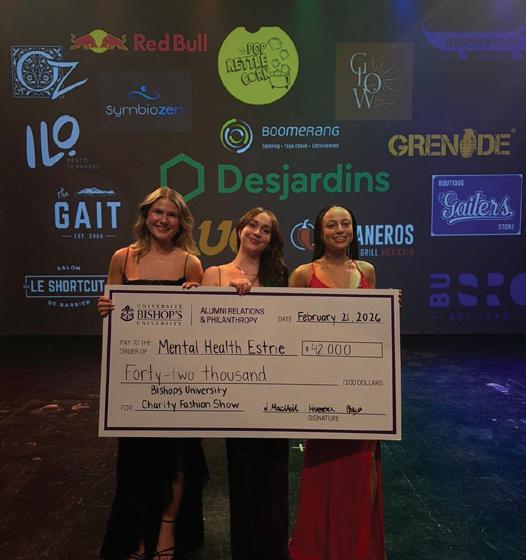
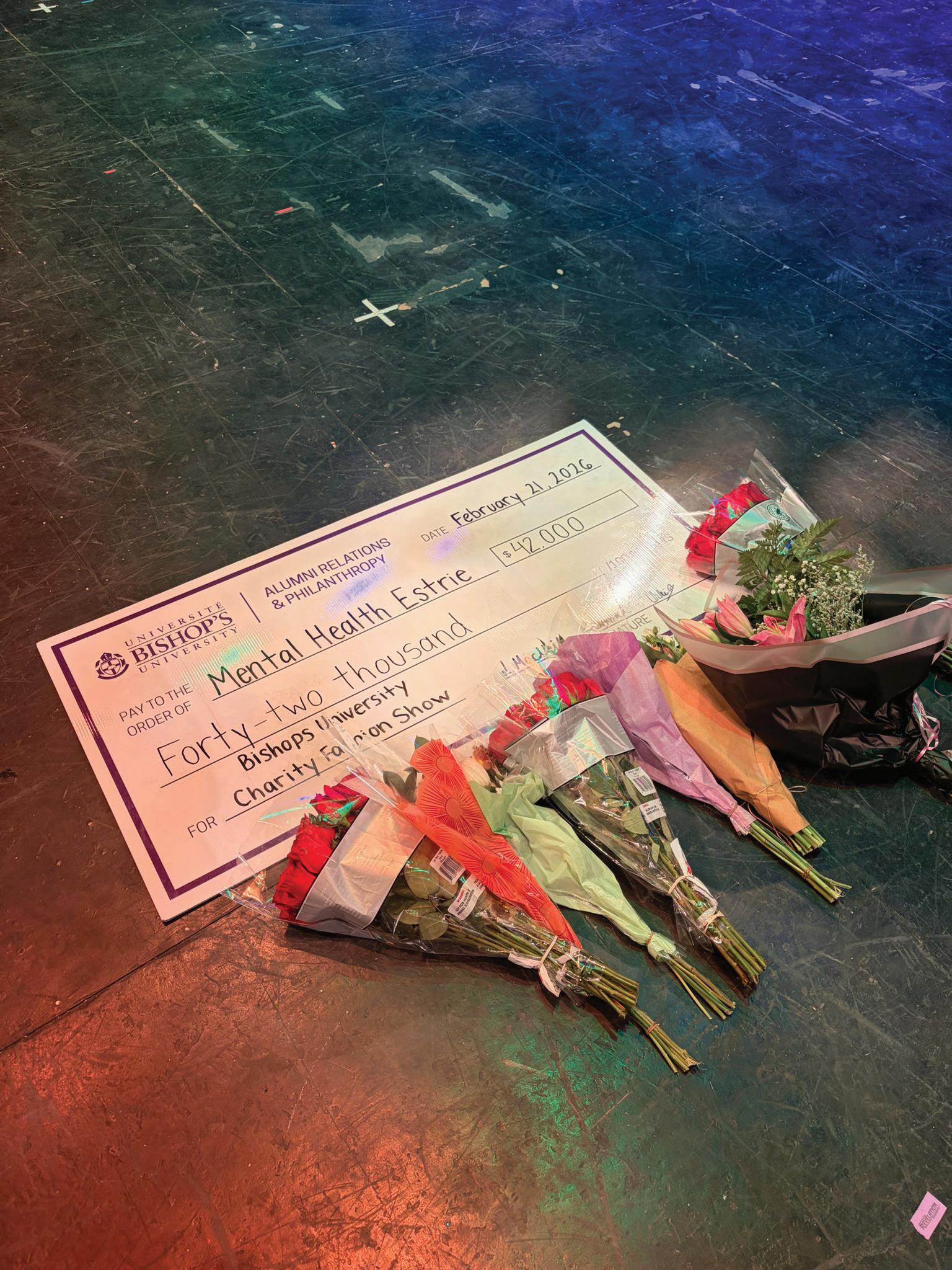
The fashion show undoubtedly made a significant impact this year, with the record-breaking funds raised in support of Mental Health Estrie. An impressive $42,000 was collected and donated to the
EDITOR-IN-CHIEF
Rianna Ostrosser thecampus.editor@gmail.com
SENIOR COPY EDITOR
Olivia Norby thecampus.copyeditor@gmail.com
JUNIOR COPY EDITOR
Eryn Costello
organization. Everyone involved is beyond proud of this amount raised, given that this organization truly resonates within Bishop’s community.
It was deeply inspiring to witness students, professors, partners and members of the surrounding Bishop’s community all coming together in support of the cause.
The first performance took place at 2 p.m. and welcomed members from the surrounding areas. Approximately 150 guests attended the show and had the opportunity to admire collections from ten of the show’s partners: Empire, Lost Disciples, Estrie Aide, Knotty Avery, Skyla, Mackey, Elle Dit, Gaiters Store, 88 Queen and Signor Terry.
In addition, they enjoyed fabulous performances by the Fashion Show Dance group and were invited to participate in giveaways or even children’s games,
making the event engaging for guests of all ages.
At 8 p.m., the student show took place and was completely sold out! The crowd was full of energy, and that enthusiasm was clearly felt on stage. During this presentation, our models also showcased collections from our partners Oneil and Junkx Underwear. The audience enjoyed multiple games and giveaways generously offered by our partners, such as Short Cut, Skyla and the Gaiter Store.
In addition, three of our favourite sports teams: the women’s rugby team, the lacrosse team, and the football team, took part in the evening. They supported the cause by revealing the funds they had raised over the year and by delivering highly entertaining dance performances.
The women’s rugby team raised the highest amount, contributing an impressive $3,000
THE CAMPUS STAFF 2025-2026
LAYOUT EDITOR
Abigail Epstein thecampus.layout@gmail.com
ASSOCIATE EDITOR
PHOTOGRAPHER
NEWS EDITOR
Kai Luginbuhl thecampus.news@gmail.com
OPINIONS EDITOR
to Mental Health Estrie.
All the members behind the fashion show are extremely grateful for the support of its partners and the two vibrant audiences who made the day truly unforgettable.
The Bishop’s University Charity Fashion Show Directors are beyond excited to begin planning next year’s show and look forward to making it even more impactful.
thecampus.businesseditor@gmail.com
STAFF WRITERS thecampus.juniorcopyeditor@gmail.com
DIRECTOR OF FINANCE
Frederic Grenon thecampus.business@gmail.com
Emilie Vadeboncoeur
Pranav Buchineni thecampus.photographers@gmail.com
GRAPHICS EDITORS
Gabrielle Lalonde & Latoya Simms
Kai Luginbuhl thecampus.associateeditor@gmail.com graphicseditor.thecampus@gmail.com
DIRECTOR OF MARKETING & COMMUNICATIONS
Anya Mullen
thecampus.opinions@gmail.com
FEATURES EDITOR
Lauren Root
thecampus.features@gmail.com
SPORTS EDITOR
Owen Kitzan
thecampus.sports@gmail.com
ARTS AND CULTURE EDITOR
Jillian French
thecampus.artsculture@gmail.com
Megane Masson & Jon Roach
Ana Luiza Torres Castelete
Emma-Rose Lehoux
Henri Dessureaux
Juliette Arsenault
Kendra Lecault-Hughes
Leighton Geraghty
Olivia Whitfield
Owen
Rosie French
Jayme Marteniuk @thebishopscampus Instagram
Sara Scarfuro
Spenser Chabot
Sonoma Brawley
Tessa Bradshaw
Photo courtesy of Hannah Moore
Graphic courtesy of The Gait
Kai
Luginbuhl,
News Editor » thecampus.news@gmail.com
SRC award nominations
By Kai Luginbuhl News and Associate Editor
SRC award nominations are now officially open for the spring 2026 graduating class. These awards include up to five Golden Mitre Award winners and 13 SRC awards across four categories. Nominations for these awards come from members of the Bishop’s community, and the final say, for the most part, rests with the SRC Board of Student Representatives, with some selected by the SRC Executive Council. The SRC Awards Night will take place in April, following the nomination and voting period. The following are titles and short descriptions of all awards. If a graduating student who exemplifies any of these qualities comes to mind, visit BUSRC on Instagram or BUSRC. COM/AWARDS for information on how to nominate your peers. The four categories of SRC awards are
Student Leadership, Experience & Contribution, Community Impact and Academic & Staff.
Experience & Contribution Awards are all voted on by the SRC board of student representatives, apart from the Joan & Alex Paterson and Purple Letter Awards. The Michel Fontaine Experience Award is given to “A student who has exemplified the ‘Bishop’s Experience’ through campus leadership, athletics, and/or community involvement.” The Ray Lawson Award will be given to the student who has contributed most to the life of the university within the past year. The Joseph E. Cassar Award will be awarded to the student who has contributed the most to the SRC within the past year. The Joan & Alex Paterson Award is given to a graduating student who has contributed the most to volunteer work and activities in the off-campus community, and the final award in the Experience & Contribution
category is the Purple Letter Award, where a maximum of ten students are recognized for their contribution to the Bishops’ community who might not be otherwise recognized for their efforts.
SRC student leadership awards include the Enzo Evangelisti Outstanding Leadership Award, the SRC Extra Leadership Award (leaders within clubs) and the Club Sports Leadership Award.
The Community Impact Awards include the Joy Chandler Community Involvement Award is given to a student(s) who brought the community together in a meaningful way, SRC Extra Community Impact Award is presented to a club lead who has impacted not only their club but the broader Bishop’s community as well and Club Sports Community Impact Award is given to a Bishop’s club who “Promoted the social values of the community, making the university a truly better place to live in.”
In fire and silence: The ISSC honours MMIWG2S+
By Megane Masson Staff Writer
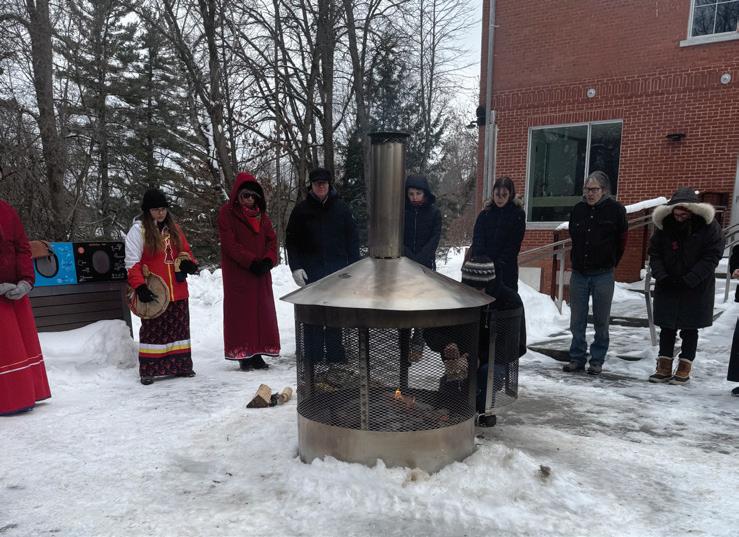
Feb. 14 constitutes a dual commemorative day: the celebration of love, but most importantly, MMIWG2S+ Awareness Day. Bishop’s Indigenous Student Support Centre (ISSC) marked the occasion by holding an outdoor vigil behind the newly inaugurated Kwigw8mna. The ceremony held on the 14th was one of two annual gatherings dedicated to MMIWG2S+ awareness.
MMIWG2S+ Awareness Day is an opportunity to honour the lives and legacies of those who have faced violence and all those missing sisters and mothers taken from their families. It serves as a space for the collective memory of Indigenous communities, not merely a focus on mourning.
The vigil was held around a fire, a presence traditionally understood to facilitate connection to the
TFinally, the Academic & Staff Awards include the Outstanding Department Award and the Outstanding Academic Support/Service Award.
“The Golden Mitre Awards are the highest non-academic honour a graduating student can receive,” stated the BU SRC. Given to up to five graduating students, selected by their peers through nominations and voting. Nominees demonstrate a meaningful impact through their non-academic contributions throughout their time at Bishop’s. Recognizing those who have “gone above and beyond to enhance student life and strengthen our community … Award recipients will receive their Golden Mitre pin and certificate at Spring Convocation. Their names are also engraved on the Golden Mitre Honour Society Plaque,” stated the BU SRC.
awareness day
spiritual realm. Vicky Boldo, Director of Indigenous Initiative & Intercultural Relations, opened the ceremony by burning sage, with the purpose of cleansing those present at the gathering. During the previous week, the ISSC had set up a tobacco tie table in the SUB, allowing students to prepare their own offerings. These offerings were later placed into the fire during Vicky’s performance of “Strong Woman.”
Indigenous students present at the ceremony seized the opportunity to share their own stories and personal experiences in relation to MMIWG2S+. This part of the ceremony was extremely powerful and showed the personal impact that MMIWG2S+ has had on Indigenous communities.
Maya, an Indigenous student from British Columbia, emphasized that the highway she lives near, Highway 16, is commonly known as the “Highway of Tears” due to the dis-
proportionate number of Indigenous women who have gone missing along that route. According to the Canadian Femicide Observatory for Justice and Accountability (CFOJA), there has been a 27 per cent increase in victims of femicide since 2019, many of whom are Indigenous women. As of 2025, approximately 200 women and girls have been killed, and this number continues to rise.
Julie-Ann Vollant, an Inuit student from the north shore of Quebec, read a powerful poem reminding listeners that MMIW is not just an acronym, they’re family members. It’s someone’s mother, sister, daughter or aunt. A resonating statement she made was how security is a right, and that no person should be afraid of walking down the street.
The disappearance of women within Indigenous communities is so widespread that, as Brayden Hottot stated, growing up in Thunder Bay, “if
there wasn’t someone going missing every month, it was considered odd.” While the vigil could not answer why this violence persists, it ensured that those affected were neither invisible nor forgotten. Through song, storytelling, and ceremony, the gathering reaffirmed the importance of remembrance, community and accountability. The ceremony stood not only as a memorial, but as a call to acknowledge an ongoing crisis and to ensure that those lost remain present in collective memory.
he Campus acknowledges that the land on which we operate is stolen land, the traditional territory of the Abenaki people. We live, learn, work, and play on this land, home to Indigenous peoples still living. Canada was founded through colonization, a system rooted in oppression and the abuse of power over others, continuing to affect First Nations, Inuit, and Métis communities today. As a student newspaper, The Campus has a responsibility to highlight truth. We are committed to prioritizing underrepresented voices in our community and proactively highlighting Indigenous peoples’ histories and ongoing realities, including their resilience and achievements. We recognize our work plays a role in shaping public perceptions, being able to call-out injustice but also call-in action. We emphasize that we must go beyond a land acknowledgement, which is only one step towards reconciliation. It is the stories in our paper – told with respect, accuracy, and integrity – and the respect and humility we show to the land and others that is more important than what is written in a land acknowledgement. Actionable steps to go beyond a land acknowledgement include educating ourselves and others, and supporting Indigenous traditions, movements, and businesses. —The Campus Team
Photo courtesy of Lauren Root
Anya Mullen, Opinions Editor » thecampus.opinions@gmail.com
Art is not optional: Why BU needs the arts festival now more than ever
By Kendra Lecault-Hughes Contributor
An Anonymous Attendee of Nova Amora Masquerade Ball said the following: “I’ve been here three years, am a double-major student, and this is the best BU event I have ever been to.”
Yes. You read that right. Hearing it in person from a masked dancer at our Nova Amora Masquerade Ball on Feb. 14, 2026, was even more surprising. There I was, worrying that our marketing and production efforts had fallen flat, believing that people no longer cared about the arts. Thinking that even if they did, they can’t pull themselves away from their screens long enough to show up. Well, that night proved me wrong. More than that, it inspired me.
The Bishop’s University Arts Festival is not just an artistic showcase. It’s a cultural reset that this university desperately needs.
The goal of the BU Arts Fest is simple: to show the BU community that art can be whatever you make it. It is versatile, interpretive and often interactive in ways people don’t initially expect. When our marketing team conducted research last fall, over 30 per cent of our survey respondents said opportunities to directly engage with art and socialize with likeminded peers motivated them to attend art events. That insight led to the inclusion of a workshop on opening day to create your personalized mask for our closing masquerade ball. Participants didn’t just observe the festival; they built it with their own hands.
Art is more than paintings behind glass cases in a museum. It can be loud, raw, playful and communal. It can be crafting a persona, learning to waltz, dressing boldly and forming connections that wouldn’t otherwise exist. During our Odyssey reading, the Open Mic in the Gait and our
Masquerade, I saw students from every social group find common ground.
You might argue that BU already offers more wellestablished events where students gather, dress up and celebrate. Of course, I’m referring to gatherings such as Gait Nights and Winterfest. So why attend BUAF, a newer initiative with changing programming each year? I’ll tell you why. BUAF is more accessible (this year was entirely free), and it celebrates individuality. Instead of blending into a crowd out of habit or peer pressure, students get to support artists and express themselves in their most authentic form. In a careeroriented environment, BUAF helps students stand out. It is also an invaluable experiential learning opportunity for Humanities students. As this year’s BUAF Marketing Communications Manager, I experienced firsthand how the festival is enriched by
The powerful nostalgia of music
By Anya Mullen Opinions Editor
We all love music. But why do we love some songs more than others? I’m not asking that question from a scientific or musical standpoint. I’m sure there’s something about neural pathways and their connection to music, but I’m asking about personal connections or feelings toward music.
I was thinking about it after the wonderful BU Charity Fashion Show, because so many of the songs chosen this year were absolute bangers from the 2000s. The student show crowd always brings the energy, but I wondered: would the spectators be as invested in the show if they didn’t know any of the songs? I mean, who am I kidding? Of course they would. But it didn’t hurt that so many of the songs can be so strongly associated with a time when we were young and carefree and danced to all of these songs before we even understood their lyrics. When songs like Yeah! and Rock That Body start playing, we have such strong nostalgia for our elementary school dances.
The same thing can go for songs that were already old when we were born. I’m taking a class here at BU about the history of rock music, and
academic discipline and fosters collaboration between departments like Classics, Music, Sociology and Arts Administration.
For visitors and organizers alike, the BU Arts Festival builds bridges across the social groups of our community. In a time dominated by the rise in artificial intelligence, virtual interactions and hate-culture, the BUAF helps students disconnect and gather in real-time to celebrate human connection and creativity. Like the theme of this year’s edition, “Constellation,” it linked us to our pasts, celebrated our present and illuminated our futures.
Art is the language of time. Don’t let that time be wasted.

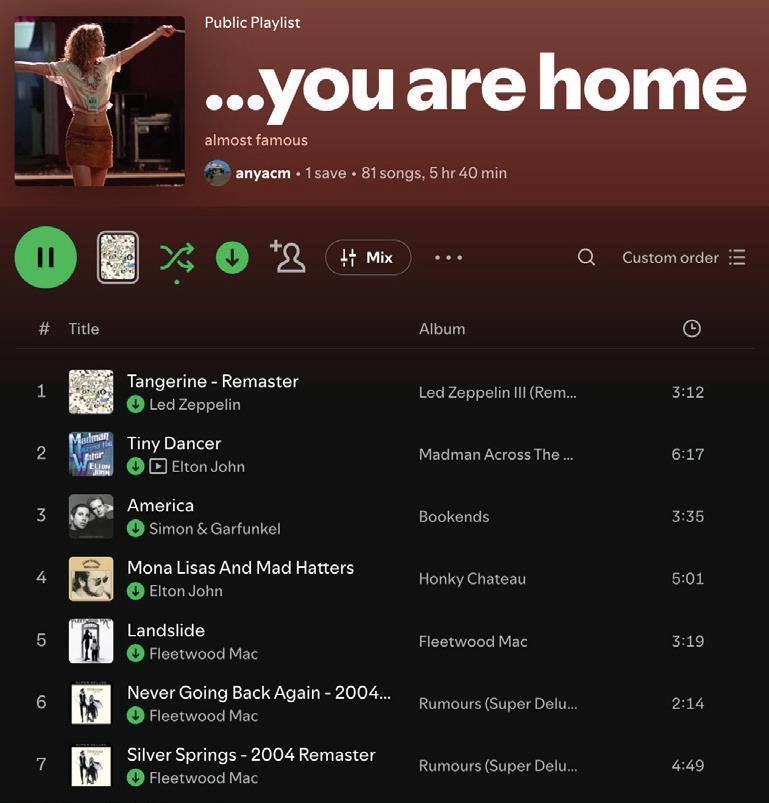
some of the songs that get played in class take me right back to my childhood living room, listening to music with my Dad. There are so many songs that will never get old to me and that I’ll never forget, simply because I was brought up listening to them. I don’t even remember a time when I didn’t know them by heart. My parents definitely gave me a head start on this particular course.
So I guess the point I’m trying to make is that maybe we don’t like songs because they are masterpieces, but because of the associations we have with them. I (along with everyone else at BU) will always associate Desire by Ian Asher with Winterfest 2026. I’ll always associate Chelsea Morning by Joni Mitchell with my mom and Free Fallin’ by Tom Petty with my dad.
So next time you take a look
at your playlist, think about where you found specific songs. When did you first hear them? Who showed them to you? Do they evoke certain feelings for you when they come on?
Music has had many different roles throughout human history. It can be for celebration, dancing, worship or to evoke emotions. With all the music in the world readily available, it’s the soundtrack to our lives. The average person listens to multiple hours of music per day.
But our favourite songs: are they our favourites because they are perfect musical masterpieces, or are they our favourite songs because of how they make us feel and remember? I put on Believe by Nikki Yanofsky before the gold medal game last weekend, and that was some of the strongest nostalgia I’d ever felt.
Graphic courtesy of BU Arts Fest
Photo courtesy of Anya Mullen
Anya Mullen, Opinions Editor » thecampus.opinions@gmail.com
I ditched Google for a more ethical search engine, here’s why you should too
By Olivia Whitfield Contributor
What if I told you that you can plant trees just by searching the web? I know I sound crazy, but just hear me out! As university students, the internet is central to our learning. By transitioning over to the non-profit search engine, Ecosia, you can make a real difference for the environment with one small change. All of their profits from ad revenue go towards climate initiatives, including planting and protecting trees around the world. They are also powered by 100 per cent renewables, have the greenest form of AI and are one of the most privacy-friendly search engines out there. If you ask me, it’s kind of a no-brainer. Let me walk you through how I got here, if you’re still not convinced.
My story begins with the depletion of my initial fascination with AI. I’m increasingly aware of how embedded it’s becoming in my daily life, and that scares me. Critical thinking is at an all-time low. I can’t help but feel we are at risk of losing our intellectual
independence. Reflecting on the enormous impact that AI data centers have on the environment, along with the endless warnings from leading experts, I was done. In an act of defiance, I made a conscious decision to stop using AI. However, I was quickly reminded that Google has an automatic AI overview for practically every search made. If there’s a way to disable this feature, they sure make it difficult to find. Shockingly, the AI overview that appears when you search “how to turn off Google’s AI Overview” was not helpful.
In my search for a solution, I came across Ecosia, an ethical search engine that claims to use 100 per cent of their profits for climate action. I originally thought this was way too good to be true, but upon further research, I found that it’s real.
Ecosia generates revenue just like any other search engine; selling ad space. When users click on these ads, Ecosia gets paid, but instead of the money going straight to shareholders, they use it to fight climate change and environmental injustice. Their main
emphasis is on tree planting projects, collaborating with local partners around the world to focus on vulnerable biodiversity hotspots, bird migration routes and environmental zones. Not to mention, all Ecosia’s searches are powered by solar and wind. They produce more renewable energy than their models use. They also allow the user to track their global collective impact, along with their own climate impact, based on how long you’ve been using Ecosia.
You might be thinking, how can we actually know that this is true? Well, I did some math based off of Ecosia’s monthly financial reports, and was able to determine that the numbers added up. Ecosia transfers 67.5 per cent of its profits to their tree planting partners, investing the remaining 32.5 per cent towards renewable energy, regenerative agriculture and grassroots activism.
Now, these financial reports are self-published, so it is possible that these statistics are not entirely trustworthy. However, Ecosia is a B Corporation Certified, a trusted certification for
non-profit organizations that meet high standards of social and environmental performance, accountability and transparency.
Setting Ecosia as your default search engine takes under five minutes. First, make a trip to the Ecosia website and click on “Download Ecosia Browser”. You will then be able to install it on your computer. Finally, import any settings and preferences you wish to transfer over from your old browser.
So, what are you waiting for? Let’s start a movement at Bishop’s and use our everyday browsing to make real positive change for the environment!

Fashion Show is the epitome of Bishop’s culture
By Lauren Root Opinions Editor
The Bishop’s University Charity Fashion Show is one of the most anticipated events at our university all year long, and for good reason. The Fashion Show represents everything that Bishop’s culture is: fun, giving and dedicated.
Organizing this show is no easy feat; it takes months of planning and endless hours of rehearsals. Yet every year, there are tons of students who volunteer their time to put on this fun performance for the entire school. It’s a source of pride for students to take part in this show, and also great fun for their friends. Supporting the university community is also a major aspect of this event.
Every year, students attending dress semi-formal and bring their best energy to support their friends. Some even bring signs. This is the fun aspect of student life, being able to relax and
enjoy themselves, even in the middle of midterms. By the presence in Centennial Theatre, you’d never know about the stress students are facing. They leave it all at the door, ready for one of the most fun nights at Bishop’s.
Fashion Show runs deeper than just having fun, though; it’s also about giving back to the community in the Eastern Townships. Every year, the Charity Fashion Show raises money for a foundation in the Estrie region, and uses local brands to help raise the funds. As a small liberal arts university, Bishop’s prides itself on the direct impact it has on the community around it. Students are encouraged to volunteer in the region and give back to the community. This is just another event to showcase this important part of our student identity.
This year, the charity chosen by the Fashion Show was Mental Health Estrie, which has a direct impact on people whose mental health impacts their way of life. Just like Bishop’s
students, Mental Health Estrie is directly involved in activities around the region, which is why this is such a good partnership.
Finally, the dedication that students show to making this event a success is truly remarkable. Every Saturday and Sunday from the months of October to February, students have rehearsals for the show. This intense time commitment is something students commit to, showing their dedication to perfection and to do well for their charity of choice.
Some students who audition for their roles are nervous before performing, but push past their fears to get out of their comfort zone and to help raise money for those in need. Their dedication is truly inspirational, allocating so much time for this event even with all their other commitments, and it shows what it means to be a Bishop’s student.
Fashion Show is one of the most anticipated events all year and it
reflects Bishop’s student life and what it means to call this university home. Through their positive attitudes and the fun they bring, their generosity in giving back to the community, and finally, their dedication to their craft, Bishop’s students are people to admire. After all, who wouldn’t want to model fun clothes for a good cause! It is something truly unique to BU that both participants and spectators are lucky to experience.
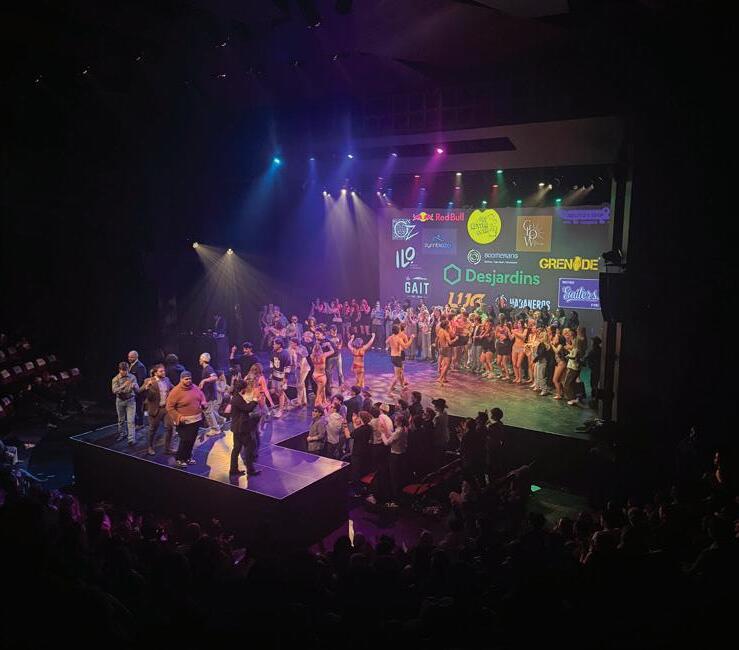
Photo courtesy of Olivia Whitfield
Photo courtesy of Lauren Root
Owen Kitzan, Sports Editor » thecampus.sports@gmail.com
Women’s Basketball receive league recognition
By Henri Dessureaux Contributor
On Feb. 21, the Women’s Basketball team capped off their regular season with a trip down to Quebec City where they took on ULaval. With the Rouge et Or solidly in first place at 12-3-0 heading into the matchup, it would be a good test for the women to see where they stand before playoffs.
Laval would take an early lead on Bishop’s as the scoreboard read 20-12 in their favor after the first quarter. The next two quarters swung in Bishop’s favour by a margin of two points leaving the score at 45-39 for the Rouge et Or. The fourth quarter would once again swing in Laval’s favour as they walked away with a 6652 victory over BU to cap off the regular season. Laurie Lafleur had a standout performance for Bishop’s as she registered an impressive 21
points in the loss, joined by Sabryna Purich who added 12 points of her own.
Following the finish of the regular season the team received their RSEQ semi-final matchup with McGill. The teams split their matchups throughout the year, winning two apiece. Because the Martlets finished higher in the standings this season, BU had to travel down to Montreal to take them on.
Tip-off took place on Feb. 25, as both teams made it clear that neither was gonna give the other an inch on the court. The first quarter swung just barely in McGills favour with a marginal 15-14 lead at the buzzer. The second quarter proved to be all Bishop’s as they outscored the Martlets by ten points and gave themselves a solid 29-20 lead at half. The third quarter would play out
similarly to the first, this time with BU leading the quarter by a score of 11-10 and boosting their lead to ten points. The fourth quarter would see McGill catch fire on both sides of the court, as they would score 19 points in comparison to the Gaiters’ five. With that, the Gaiters’ season sadly ended by a close final score of 49-45.
While the team’s season may be over, it is important to recognize the women on the team who received individual awards from RSEQ this year, and give them their flowers. Three members of the team received all-star honours with Zou Bouthias and Eve Atchampone both making the first team and Laurie Lafleur getting named to the second team. On top of these honours, both Zou Bouthias and Eve Atchampone walked away with some more personal hardware of their own. Atchampone received the
prestigious Defensive Player of the Year award, also known as “DPOY,” given to the player deemed the most impactful on defense over the course of the season. Bouthias meanwhile was awarded the Tracey MaCleod award, listed as being given to the player who demonstrates determination, perseverance and spirit in the face of adversity.
Despite the playoff loss, the team put together a fantastic season of basketball that was fun to watch the whole way through. We look forward to seeing what the team is able to put together next year with the returning talent. Thank you to all of the seniors for the countless hours logged on the hardwood, in the gym and travelling to and from games to represent this school in a way that truly showed the identity of Bishop’s. With that, the season comes to a wrap. Until next year!
Order up! One 30-point victory for Bishop’s MBB
By Jonny Roach Staff Writer
The Bishop’s men’s basketball team’s impressive regular season ended with a sad curtain call loss on the road in Laval, but the show went on during the first RSEQ conference playoff game against L’Université du Québéc à Montréal.
On Saturday, Feb. 21, the Gaiters travelled to Laval University to face the Rouge et Or for one final regular season bout between the RSEQ’s first and second place finishers. Laval opened the contest with an absurd 29-16 lead, capitalizing on offensive possessions and forcing six turnovers on the defensive end. In the second frame, the Gaiters retaliated by winning the quarter 18-9, entering the locker room at the half, trailing just 3834. The third quarter was hard-fought, coming to a 54-49 deficit on the back of Yanis Malanda’s seven-point effort. In the final period, the efficient shooting and defense of the Rouge et Or proved too much to overcome, resulting in a 75-62 loss in this final regular-season affair.
Despite the disappointing outcome, Bishop’s remained above Laval in the RSEQ standings, securing homecourt advantage for the playoffs.
Reggie Jean Seraphin led the way with 13 points, while Yanis Malanda (11 points, six rebounds), Etienne Gagnon (nine points, five rebounds) and David Navarro (nine points, three steals) provided the help. The Rouge et Or put on one of their best outings all season, besting the Gaiters in points, shooting percentages, rebounds and defense to come away with the 13-point victory.
With the 2025-26 regular season in the books, the Gaiters began their playoff campaign on Wednesday, Feb. 25, at home against the Citadins of UQAM. In a roaring Mitchell Gymnasium, the Gaiters took off to a hot 21-14 start through the opening stanza. Bishop’s continued their aggressive attack, extending their lead to 12 through their incredible 75 per cent shooting from inside and beyond three-point territory. The second half would be no easier for UQAM, as the
Gaiters continued their exceptional scoring proficiency by adding seven three-pointers to their tally, pulling away with a growing 72-48 lead. By the fourth quarter, all momentum had swung in favour of the swamp. The Gaiters amassed another 21-point scoring spree to close out the Citadins in a blowout 93-63 victory.
Bishop’s has begun their pursuit of post-season success with a match to remind the competition of what’s to come. The men were dominant in all aspects of this one, dominating across all statistical categories and drilling a ridiculous 18 three-pointers on 50 per cent efficiency. Yanis Malanda led the charge with 18 points at a 70 per cent rate, while Reggie Jean Seraphin (17 points, five rebounds) and Etienne Gagnon (14 points, nine rebounds) brought firepower of their own on the scoreboard and the rebound column.
With the Gaiters making a firm statement in their first playoff victory, they once again face the Laval Rouge et Or in a battle for the title of RSEQ divisional champions. A season for the
history books continues as the hunt for a spot in the Final eight in Calgary, Alberta, is in the balance. Be sure to continue your support as we wish the Purple and White the best of luck for the rest of this season!
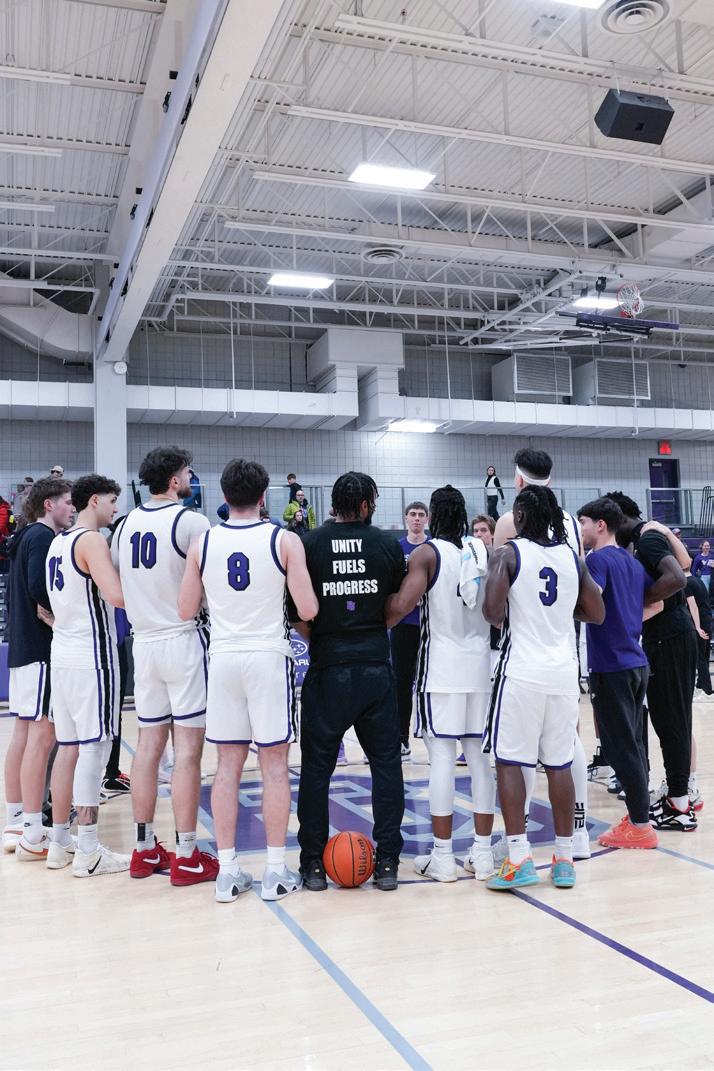
Photo courtesy of Annie White
Owen Kitzan, Sports Editor » thecampus.sports@gmail.com
Hunt for March
By Leighton Geraghty Contributor
The Hunt for March starts now. The Women’s Hockey team has a short turnaround after a very emotional and promising Senior Night Game. They faced off against the McGill Martlets in the final game of the regular season. Captain Santerre continued her dominance in the second half of the season, notching more points to her tally this year, bringing her to 28 points in 24 games. The game saw positive light on both the offensive and defensive side of the puck. Two seniors were named among the three stars that
night. Ericka Gagnon finished with a 22-save shutout, granting her first star. Jamie Aspropotamitis was named the second star after a dominant offensive game, scoring her second goal of the season.
The Gaiters’ graduating class sees eight players leaving the team and progressing into the workforce.
Once the ceremony ended, the Gaiters went on the hunt. Bishop’s dominated from the first to the last whistle and forced McGill to call an early timeout in the first period to ease the pressure. Head Coach Alexandra Boulanger reunited the top line of the Gaiters last year, slotting Justine Turcotte on the top line with Santerre and Cote. The line
connected for two of the four goals in the game, including a highlight reel Tic-Tac-Toe goal. Gagnon stood tall and shut the door on many opportunities as the Gaiters’ win brought positive momentum ahead of the playoffs.
Heading into playoff time, the Gaiters are starting their national push in the RSEQ semi-finals against the Montréal Carabins. This is the third consecutive year that these two teams will go headto-head against one another in the first round of the playoffs. Montréal got the best of Bishop’s in the 23-24 season while Bishop’s
answered back last year. The Gaiters have struggled against the Carabins this season, posting a 2-6 record in regular season play. Although the record is favourable for Montréal, this Bishop’s team has no fear. After last year’s run to win the U-Sports national title, BU is no stranger to being considered the underdog and knowing what it takes to win. Similar to the Montréal matchup, last year, Concordia had their number in regular season action but were no match for the Gaiters come time for the dance. The team is ready, and they are hungry to make a return to the RSEQ finals, as well as the National Championship held yet again in Waterloo.
BU Club Hockey ranked No. 1, prepares for nationals and new sponsorship
By Owen Grand Contributor
After finishing the regular season with a 12-31 record, the BU Club Hockey has secured the top spot in the AAU College Hockey National Rankings and will travel to Jacksonville, Florida, over March Break to compete in the national championship tournament.
The No. 1 ranking marks a significant milestone for the program, which returned to nationals this year following last season’s early exit.
“I think being ranked first does add some pressure,” said senior goaltender Jack MacFarland. “We are the team to beat and are expected to win. However, it confirms our belief that we are the best team in the tournament and can win it all.”
Last year’s tournament loss has remained a point of motivation for the group. “It was definitely a heartbreaker, but a learning opportunity to not underestimate our opponents,” MacFarland said. “A win this year would prove ourselves to those who don’t believe in us and show everyone how great this program is.”
While the team’s on-ice results have placed them at the top of the national rankings, competing as a Canadian club program in an

American league presents financial challenges. Unlike varsity teams, the club operates independently and must cover much of its travel and tournament costs.
To offset those expenses, the team has organized several fundraising initiatives throughout the year. Efforts have included a slip-and-slide ball hockey tournament aimed at increasing student engagement, the sale of a team-branded shampoo dubbed “Purple Jesus” and a collaboration with the Sherbrooke Phoenix that allowed the club to raise funds through ticket sales. “With our fundraisers, we really want to include the Bishop’s community as
much as we can,” MacFarland said. “The slip-and-slide tournament was my favourite because it got the community together outside, having fun.”
Beyond this season’s success, MacFarland said the program’s internal growth has been just as important. “Not only has the team gotten stronger over the years, but we’ve become more competitive as a group and expected more from ourselves each time we’re on the ice,” he said. “Returning to nationals as the number one seed shows how far we’ve come and that Bishop’s hockey can compete at the highest level.”
Looking ahead, the program is
set to formalize a new sponsorship with The Campus newspaper beginning next season. As part of the agreement, the publication’s logo will appear on the hockey team’s pant shells, marking one of the first visible sponsorship integrations between a student organization and a campus athletic club. The partnership is expected to increase the team’s visibility while strengthening the relationship between student media and athletics. With nationals approaching, the Gaiters now turn their focus to preparation: aiming to translate a No. 1 ranking into a championship performance.
“Thank you for all your support through the season,” MacFarland said.

Photo courtesy of Nick Gilroy
Photo courtesy of Joseph Aubert
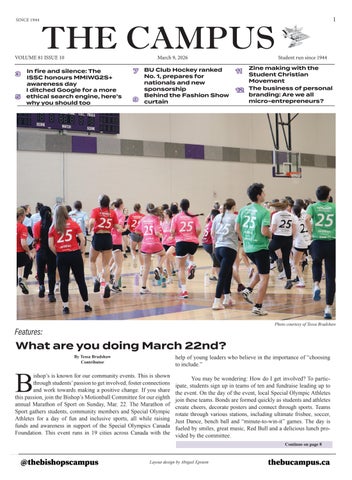
What are you doing March 22nd?
Continued from page 1
Sports bring people together, and that is exactly what the Marathon of Sport demonstrates. It is about sportsmanship, positivity and respect. We focus on bringing the community together, to focus on our similarities rather than our differences. You see the power of this event in the faces of the Special Olympic Athletes when the day is done, and they leave proud, with medals around their necks. Shelby St-Hilaire, a local two-time Special
Olympics alpine skier and silver medalist, noted in a recent interview: “Not only do you have lots of fun playing sports, you get the chance to meet so many new athletes as well!” Beyond the sports, it is these moments of connection that make the Marathon of Sport so special.
I joined the Motionball Committee during my first year at Bishop’s after reading about it in The Dish. It was a cause that immediately resonated with me.
Five years later, this is my second year as Event Director, and I am confident that I will continue to be involved with this organization beyond my time at BU. Once you experience the Marathon of Sport, you will never step away. The impact that this event has on our local Special Olympic Athletes goes beyond any monetary amount; they look forward to this day all year as a moment for them to shine and get the recognition that they deserve. You quickly realize the difference
Behind the Fashion Show curtain
By Juliette Arsenault Contributor
At Bishop’s University, there are two very different kinds of Sundays that people get to experience. There are the Sundays spent in bed, recovering from the night before. Then, there is my preferred Sunday, the ones spent at Fashion Show practice, where your hangover gets knocked out of you by the sound of Madonna, Usher or perhaps Dom Dolla blasting at rehearsal.
The weekly Sunday practices are just one part of what makes Fashion Show so special. Believe it or not, putting the show together is quite the undertaking, and this year felt even bigger as it marked the 40th annual production. What began as a small show in 1986 at the Gait has grown into one of BU’s biggest and most anticipated events of the year.
Fashion Show has always been a staple at our school, but in recent years, it has become something even more meaningful. Rather than being just another BU event, it’s a charity show that raises money for incredible organizations in our region.
This year alone, we raised over $42,000 for Mental Health Estrie. These funds will go toward supporting and educating those who live with mental illnesses, as well as the family and loved ones who care for them.
What many people don’t see, though, is everything that happens long before the lights go up and the first model steps onto the runway.
Fashion Show is built by an entire network of committees working tirelessly behind the scenes for months. From head coordinators who oversee the vision and logistics, to the many little but mighty teams who help bring that vision to life, every detail is intentional.
In many ways, Fashion Show operates like a small company. With 14 distinct student teams functioning like departments, the production relies on collaboration at every level. Some teams focus on creative direction, others on operations. Some manage finances, while others handle outreach, sponsorship or communications. Each team works relentlessly to deliver the show we all know and love, and to ensure we reach our goals in support of our chosen charity.
But like any company, all this hard work isn’t without its challenges. Yes, there are practices that sometimes I wish I could skip. Yes, there are very confusing finance spreadsheets, meetings to tackle problems that seem unsolvable and endless group chats I’m meant to keep up with. But with all that grind comes something incredibly rewarding.
It’s in those practices that I get to watch a vision slowly come to life, seeing choreography finally click, transitions smooth out, and confidence grow with every runthrough. It’s in those confusing finance spreadsheets that I can gradually watch our fundraising total climb closer and closer to our goal. And it’s in the meetings that I have the privilege of getting to know
you can make simply by believing in someone and making them feel valued. Join us for a day that demonstrates true sportsmanship and the power of community.
If you would like to learn more about our event and how you can get involved, visit our Instagram page, @motionballubishops or send us an email at: bishops@motionball.com. We can’t wait to see you on Mar. 22!
a team of passionate, driven and creative students who care deeply about what we’re building together. As for the group chats… Well, that’s something I’ll just have to suck up for now.
Even on Sundays when I’d
rather stay in bed, being part of this team and this show makes getting up early more than worth it. Watching months of hard work come together, and knowing it’s for a good cause, is a feeling I wouldn’t trade for anything.
Photo courtesy of Juliette Arsenault
Lauren Root, Features Editor » thecampus.features@gmail.com
Theatre as civic action: Shakesperience returns for its eighth year
By Sonoma Brawley Contributor
From virtual classrooms to the vibrant stages of the Stratford Festival, Shakesperience is back exploring the importance of theatre as civic practice.
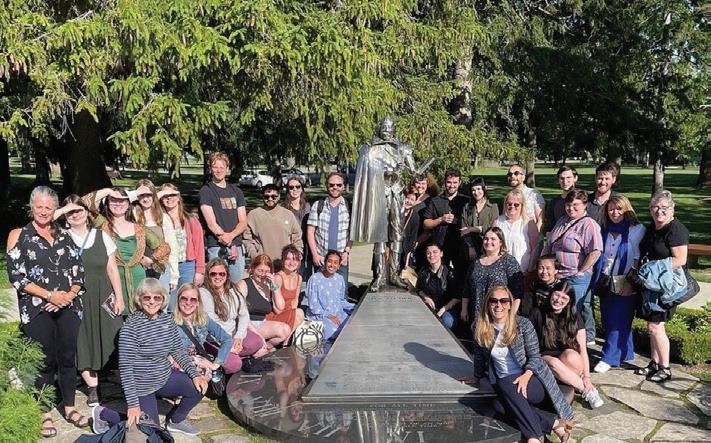
Shakesperience (ENG225/ ENG466), now entering its eighth year, offers an immersive study of theatre and performance in Stratford, Ontario. This course welcomes all students from any discipline and is open to universities across Canada. Shakesperience is intergenerational by design and welcomes “students of life” who audit the course. This course offers the unique opportunity to blend academic study with behind-thescenes access to one of Canada’s most celebrated theatre festivals, with a cohort ranging from 18 to 80. The program starts before gathering in-person by engaging with asynchronous lectures and Zoom meetings. Then, from Jun. 29 to Jul. 4, 2026, participants will come together for a week of experiential learning in Stratford. Students will attend five
productions over the course of the week: Othello, The Tempest, A Midsummer Night’s Dream, Guys & Dolls and Something Rotten! To enhance the performances, students will explore a variety of exclusive behind-the-scenes opportunities, artist conversations, immersive workshops, backstage tours and special events, including a celebratory final banquet.
Shakesperience is led by Dr. Riddell, who guides students in exploring the arts as rehearsal spaces for creating civil and just societies. Throughout the course, theatre becomes a tool for holding complexity and opening conversation. Though William Shakespeare wrote more than 400 years ago, his work remains strikingly relevant. His plays invite audiences to confront uncomfortable truths, explore moral tension and reflect on their own place within society.
That philosophy extends beyond Shakesperience, and was highlighted at the second annual Jarislowsky Shakespeare Lecture. Held in collaboration with BU Arts Fest, the panel explored the role of
the arts in a civil and just society. Panelists included Shakesperience founder and Jarislowsky Chair of Undergraduate Excellence, Dr. Jessica Riddell, drama professor, Dr. Taylor Marie Graham, and Humanities Senator, myself. Throughout the discussion, the panelists examined how theatre fosters civic engagement, moral imagination and social transformation.
At this moment in time, in the age of technology, theatre provides something unique. Watching theatre, reading plays and engaging with the arts remind us how to be human. The arts highlight our humanity and offer a place of illumination where we can metabolize rupture and practice responding to the world around us. As Dr. Riddell said in the lecture, “we are seeing the dismantling of humanity” in the world around us. But, Shakespeare is still relevant today because his characters are also learning how to manage a world in “deep disrupture and change.” “Shakespeare gives us these blueprints on what it means to stay in radical humanization.”
In a world often defined by
uncertainty, Shakesperience offers something rare: a chance to gather, reflect and imagine brighter futures together.
This year, there are four scholarships available to support students in attending Shakesperience valued between $1,000 and $1,500. To apply, submit a short essay to jriddell@ubishops. ca (cc rmatthews21@UBishops. ca) explaining why this experience would be transformative for you.
As participants are reminded throughout Shakesperience, the theatre belongs to everyone, and the time to engage with it is now.
Registration for Shakesperience closes Apr. 10, 2026 - for more information, visit bushakesperience. com.
From campus to community: Bishop’s students blend service and language learning
By Ana Luiza Torres Castelete Contributor
On Friday, Feb. 20, Bishop’s University students rolled up their sleeves at Moisson Estrie in Sherbrooke to immerse themselves in the fight against food insecurity. In a partnership with Bishop’s OUI Experience, the visit blended community engagement and social work with language immersion, offering students the chance to practice French while helping with the daily routine of the organization.
Founded in 1998, Moisson Estrie operates as a regional food bank that supplies local community organizations with food assistance. The nonprofit collects donations from supermarkets and local producers and redistributes them to families experiencing food insecurity across the Sherbrooke area. Its facility includes large storage areas, industrial refrigerators and freezers for perishable goods, and a kitchen space designed to reduce waste and maximize the impact of donations.
Moisson Estrie’s work forms part of a broader collective effort to strengthen food security in the region.
Junior Luis, coordinator of volunteer activities at Moisson Estrie, welcomed the Bishop’s group and introduced them to the organization’s mission. He encouraged students to embrace both the social and linguistic dimensions of the experience. Under his supervision, two students sorted nonperishable items, carefully checking expiration dates and organizing cereals, canned goods and hygiene products. The rest of the group worked in the fresh food section, cleaning and preparing potatoes for immediate distribution.
Each task demanded attention and cooperation. Through these seemingly simple actions, students witnessed the logistical care required to ensure food reaches those who need it most. Their work formed part of a broader collective effort to strengthen food security in the region.
The activity unfolded entirely in French, creating a real-world immersion experience. Elisa, an international student from India, described the afternoon as her first volunteer experience in Canada. “At the beginning, it was challenging because I’m still learning French,” she said. “But everyone was patient and welcoming, and by the end, I felt much more comfortable speaking,” Elisa added that she left feeling fulfilled, not only for contributing to a meaningful cause, but also for noticing tangible progress in her language skills.
For Bishop’s students, the afternoon at Moisson Estrie connected linguistic theory to practice. Their experience demonstrated that volunteerism extends beyond charity; it functions as a formative and reciprocal exchange. By engaging directly with the Sherbrooke community, students strengthened their French proficiency, developed collaborative skills and deepened their understanding of social responsibility.
The next volunteering event at Moisson Estrie is scheduled for Mar. 13. For students interested in participating in future opportunities with Moisson Estrie through the OUI Experience, keep an eye on the French Hub’s Instagram, where the linktree is already available.

Photo courtesy of Sonoma Brawley
Photo courtesy of Ana Luiza Torres Castelete
ARTS & CULTURE
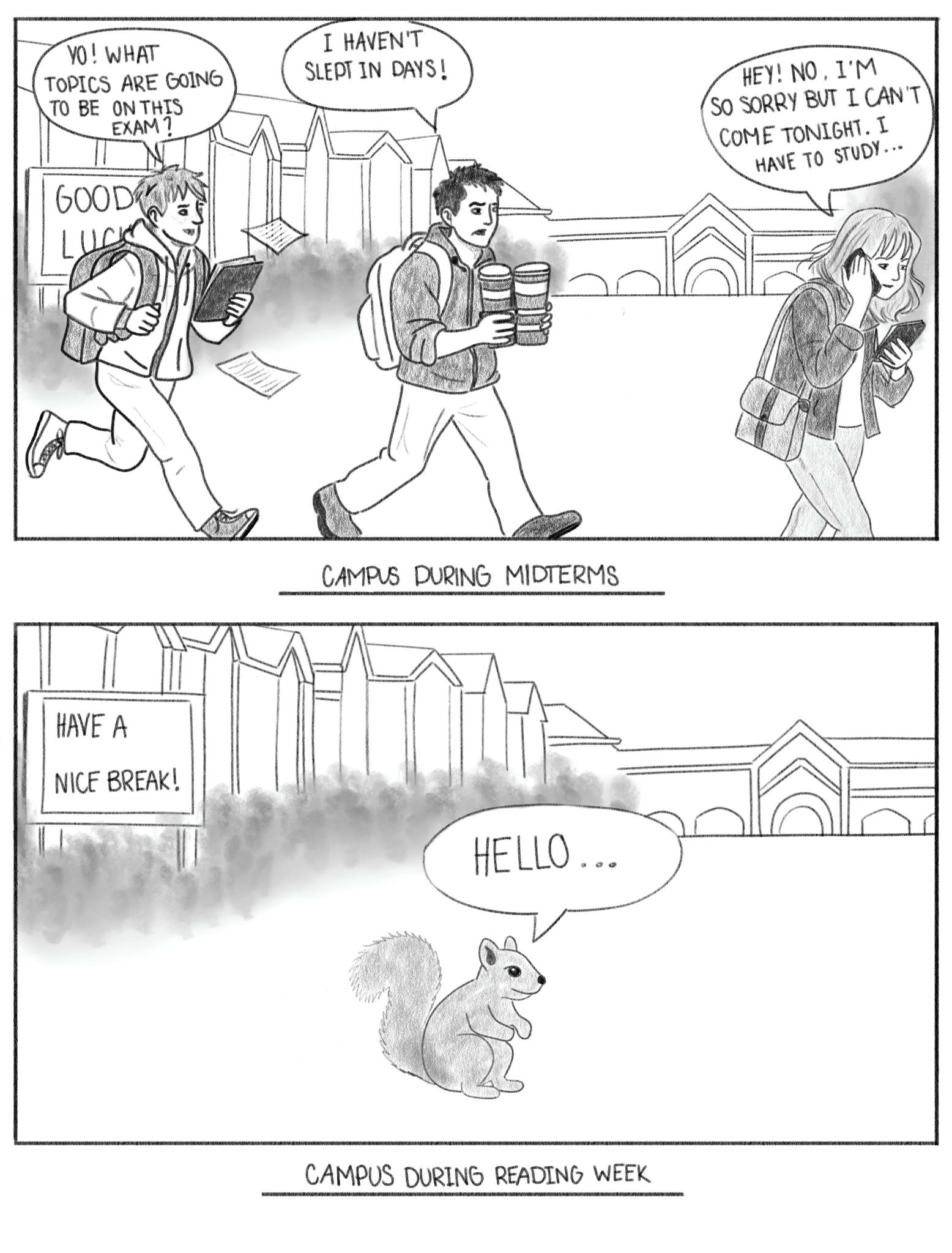
Comic:
Artist Feature:
You are what you eat
By Spencer Chabot Contributor
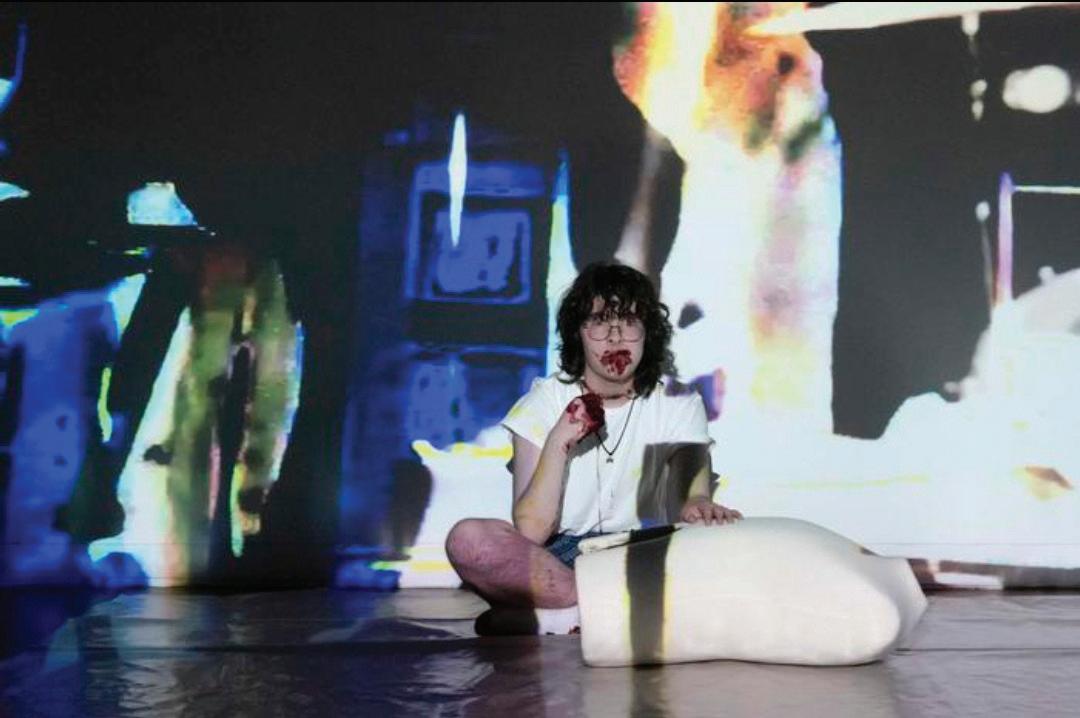
As if hypnotized, perhaps by an unseen screen, a man stares blankly in front of him. Distorted, highly saturated footage envelops him, reminiscent of a television’s glow. He begins to consume the body lying before him, gradually becoming agitated in his task. Blood and viscera hang from his mouth, cling to his hands and still he stares. Still, he consumes.
How do you tell people that you ate someone for your art degree? Even worse: it was tasty-though that might be because the bloody guts you ate were actually Pillsbury cinnamon rolls and corn syrup.
In the final semester of my visual arts degree at Cégep de l’Outaouais, I had to create a capstone project. I had been exploring themes of flesh and identity, with particular interest in the ineffability of the soul in contrast with the concreteness of the body. Drawing upon my fascination with the sense of self and my own identity as a transgender man, I decided to utilize cannibalism as a tool to explore self-creation, specifically in the context of gender transition. Depicting a cannibal was a more literal, violent way of presenting the human need to base our own identity on others. The literal cannibal consumes flesh, whereas we consume others’ traits and embed them into ourselves. This twofold cannibalism was presented through the eyes’ consumption of projected idealized images, and the mouth’s consumption of a human body. While we all participate in the figurative cannibalization of others to develop our identities, transgender people partake more than most: they must not only build their sense of self, but forge their understanding of their own gender, in contradiction with what they have been taught since birth.
Jillian French, Arts & Culture Editor » thecampus.artsculture@gmail.com
Comic courtesy of Gabrielle Lalonde
Photo courtesy of Spencer Chabot
ARTS & CULTURE
Horoscope:
Mercury enters Aries
By Abigail Epstein Layout Editor
While in its retrograde trajectory, the messenger sign makes it move to Aries on Mar. 3. It is never a bad idea to have a fire extinguisher on hand.
Aries: Ready yourself for bursts of inspiration, but hold steady against impulsive big decisions. Keep box breathing in your backpocket, and be prepared to sleep on things.
Taurus: You tend to count on people to tell you who they are, and shut the door behind them. Listen to your hunches. There is nothing quite so loud as an Irish goodbye.
Gemini: You have benefitted from being everything you’ve wanted to be – don’t take your final bow now. Throw out ideas like roses. Reach out to those who catch them between their teeth.
Cancer: Flames are taking, so feel free to cold call. Bundle up worst case scenarios and tuck them in the corner. Facing far and wide will take you past ill inklings.
Leo: It takes practice to get to gold, but courage to first imagine it. Build a routine of both. Stream-ofconsciousness your next attempt at a five-year-plan the next time something new excites you.
Virgo: If you’re craving knowability, start by shaking hands. Trust your iron grip. The irrationality around you can always be foundationalized. Dig into dirt with your nails.
Libra: A social butterfly effect is occurring in energetic spheres, and you’re learning how to be a cheerleader. Show up sensitive to network. Await the crown in the wings.
Scorpio: Rolling your eyes in public is a tempting way to protect your treasures. Careful not to drop the ball. In scarcity, there is always something worth catching.
Sagittarius: Allow yourself to treat craft as a series of drafts, without holding them to your usual standards. Commit to a pencil. You’ll know when to graduate to ink.
Capricorn: Your cautious sensibilities are troubled by an ambition that may be mistaken for anxiety. Reframe your portfolios from the inside out. And when in doubt –glitter glue.
Aquarius: Make room for a habit of daily luxuries without a quantifiable value. Smile at your smallest fancy. Throw out your sliding scale on the assumption everything is magical. And magic is magic.
Pisces: Your gift of enduring Saturnalias carries seeds of esoteric wisdom. A final word says nothing’s ever really over. With the feathers of a phoenix, stir the salted earth.
For you to take with as many grains of salt as there are stars in the sky.
Zine making with the Student Christian Movement
By Rosie French Contributor
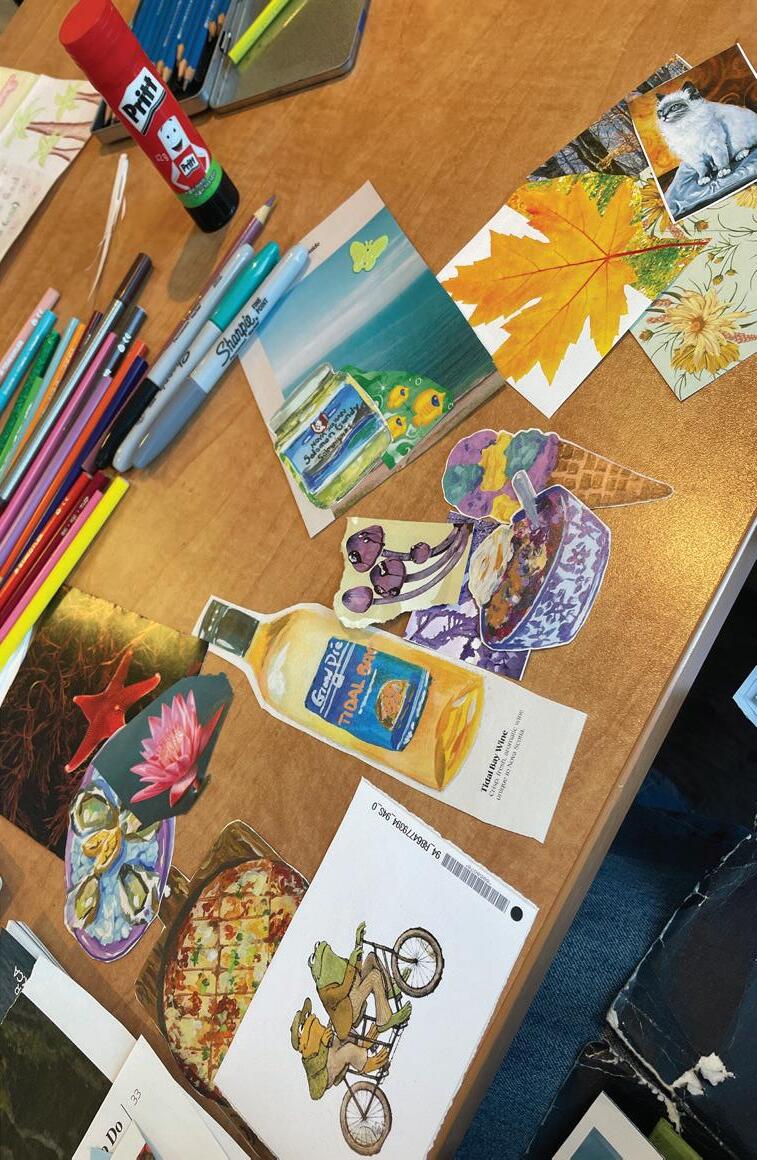
Amid the hustle of midterms and the first bright signs of spring, the Student Christian Movement (SCM) hosted a zinemaking workshop this past Sunday to mark the beginning of the Lenten season. Students gathered in the Paterson common room with pastels, coloured pencils and a variety of collage supplies to create zines. Zines are small, handmade booklets about passion projects or niche topics, made by drawing and writing on paper that’s folded up into a booklet.
The SCM club was created separately from the previous Christian club at Bishop’s, and it only opened its branch at Bishop’s last year. The parent SCM, based in England, is a group of action-driven, communitybased Christians that has branches in schools like Bishop’s. The club is led this year by me (a fourth-year biology student) and Grace Devitt (a fifth-year education student with a concentration in Fine Arts). The club meets monthly on Fridays in the Morris House common room to talk candidly about the bible and spiritual questions. The zine-making workshop was partly inspired by the last meeting, featuring depictions of Jesus through art history. This Sunday, students drew and wrote on their papers, ate muffins and chatted about personal goals and experiences with Lent in an open discussion.
Lent is a period of 40 days preceding Easter observed by some Christians—the season comes from the biblical story of Jesus fasting and praying in the desert, meeting the devil and resisting temptation. During these 40 days, some Christians practice spiritual discipline by changing their routine as a way to dissolve distractions from God.
Jillian French talked about the way art and Christianity intersect for her this season. “I’ve been reading and talking to people about the way Lent often involves giving something
up for 40 days. I know a lot of people who fast or give up certain foods. But Lent can also be adding something to your schedule, like a daily prayer or meditation”, she said. “I liked the idea of shifting it towards reflection and emphasizing your relationship with God. I think the practice of creating art encourages you to slow down and reflect. That’s what the club is, for me, a moment to just pause and think about my values and my relationship with spirituality.”
SCM welcomes students of all backgrounds, faiths and practices interested in discussing spirituality openly.

Jillian French, Arts & Culture Editor » thecampus.artsculture@gmail.com
Photo courtesy of Rosalyn French
ECONOMICS & BUSINESS
Jayme Marteniuk, Economics & Business Editor » thecampus.businesseditor@gmail.com
The business of personal branding: Are we all microentrepreneurs now?
By Jayme Marteniuk Economics & Business Editor
Walk through campus and you’ll see it everywhere. Students are taking LinkedIn headshots, updating profile banners, perfecting elevator pitches and adding leadership titles to their bios. Quietly building something. Not a company. A brand.
At Bishop’s, the pressure to stand out is real. Internships are competitive, and it often feels like connections matter just as much as grades. Everyone knows LinkedIn isn’t “just another social platform.” It’s a public resume. A digital first impression. And most of us assume employers are Googling candidates and running background checks before interviews even happen. So we optimize.
We choose leadership roles because they signal initiative. We join athletics or SRC because, even if unpaid, they offer real experience and strong resume currency. We take positions that may not fully excite us but look strategic on paper. I’ve done it, and
most students have.
This isn’t random; it reflects signaling theory in action. In competitive job markets, employers don’t have perfect information about candidates. So they rely on signals like internships, executive titles, GPA, extracurricular leadership, to infer qualities like competence, work ethic and ambition.
The stronger the signal, the more credible the candidate appears.
In that sense, we’re not just students anymore. We’re curating portfolios of proof.
Human capital theory adds another layer. Traditionally, education increases your value by building skills and knowledge. But today, it’s not enough to just develop skills; you have to display them. Your LinkedIn becomes a storefront, your resume becomes a marketing copy, and even your Instagram, whether active or silent, becomes part of your reputational footprint.
And many students adjust accordingly. I know I curate Instagram differently than I did in high school. In fact, I barely post
anymore; it feels safer, more controlled and there’s less room for misinterpretation. Because once you realize your digital presence contributes to your professional reputation, you start thinking like a brand manager.
What’s interesting is that we don’t always talk about “building a personal brand.” It’s not a loud conversation on campus. But we practice it constantly, refining our pitch, expanding our network and strategically choosing roles. Reputation economics suggests that perception has economic value. If employers believe you’re capable and driven, that belief itself creates opportunity.
So are we becoming microentrepreneurs? In many ways, yes. Entrepreneurs build products, market them and compete for attention. Students are increasingly doing the same with themselves as the product. We invest in experiences, craft narratives around them and position ourselves in competitive markets.
There’s nothing inherently wrong
with that; in fact, it can be empowering. Leadership roles provide an accessible, meaningful experience. Campus involvement builds real skills. Strategic positioning is rational in a competitive labour market. But it also raises a subtle question: when does self-development turn into self-commodification? If every decision becomes strategic, if every experience is filtered through “Will this look good?”, we risk optimizing perception over authenticity.
Maybe the real competitive advantage isn’t just polishing the brand, but building substance behind it. Because in today’s job market, you’re not just applying for roles. You’re marketing a reputation.

The attention economy: Why your focus is worth billions
By Sara Scafuro Contributor
You wake up and check TikTok. Five minutes turn into twenty. You open Instagram “for a second.” You scroll during lunch. Before bed; one more video.
It feels harmless. Free entertainment. A break between classes. But here’s the reality: your attention is one of the most valuable commodities in the global economy, and companies are fighting aggressively to capture it.
In traditional economics, companies sold products. Today, many of the world’s largest companies sell user attention. Platforms like TikTok, Instagram and YouTube are technically free. You don’t pay to use them. Instead, advertisers pay for access to you, your time and your engagement. The longer you stay on an app, the more ads you see. The more ads you see, the more revenue the platform generates. Your scrolling time quite literally translates into billions of dollars in advertising revenue each year. For marketing students at Bishop’s, this represents a
major shift. The product is no longer just clothing, tech or food. The product is screen time.
TikTok has arguably mastered attention capture better than any platform before it. Unlike older social media models that relied heavily on who you follow, TikTok’s ‘For You’ page uses predictive algorithms. It studies how long you watch a video, whether you pause, replay or scroll quickly. Every interaction feeds the system more data. The result? A hyper-personalized feed engineered to keep you watching. The platform is designed to eliminate stopping cues. There’s no natural endpoint. Just infinite content tailored specifically to you.
One of the most powerful design features in modern apps is infinite scroll. There’s no clear end. The content simply continues. From a marketing perspective, this is genius. Traditional media like newspapers, magazines and even television, had built-in stopping points. Once the page ended or the show finished, you disengaged. Now, there is no friction between one piece of content and the next. Your attention flows continuously. This means more exposure opportunities for companies.
For users, it means time passes almost invisibly.
Marketing used to focus on persuasion. Brands crafted messages meant to convince consumers to buy. Think television commercials or print ads with clear arguments and slogans. Today, marketing has shifted toward interruption. Brands are no longer waiting for your full attention. They are competing within seconds of it.
On TikTok, a brand has roughly two to three seconds to stop your thumb from scrolling. If they fail, you move on instantly. This has changed how ads look and feel. Many now mimic user-generated content to blend into feeds. Influencer marketing thrives because it feels less like advertising and more like entertainment. The goal isn’t always to deeply persuade. It’s to capture attention long enough to register.
For students studying business, marketing, communications or economics, understanding the attention economy is essential. Companies are no longer competing solely on product quality or price. They are competing for mental real estate. The brands that win are the ones that can interrupt, hold and monetize attention most
effectively. At the same time, students are participants in this economy. Every scroll contributes to data collection. Every click strengthens targeting systems. The more time you spend online, the more valuable you become to advertisers.
The attention economy raises an uncomfortable question: if attention is a resource, are we managing it wisely? For companies, the answer is clear. Attention equals revenue. For students balancing academics, internships and social lives, the calculation is more complicated. Your focus is finite. Platforms are engineered to consume it. And in a world where attention is monetized, guarding it may become one of the most important economic decisions you make. Because in today’s economy, you are not just the consumer. You are the asset.

Graphic courtesy of Nick Youngson
Graphic courtesy of Oto Godfrey