
a Good Man, Charlie Brown brings happiness to Centennial Stage

a Good Man, Charlie Brown brings happiness to Centennial Stage
By Jonny Roach Staff Writer
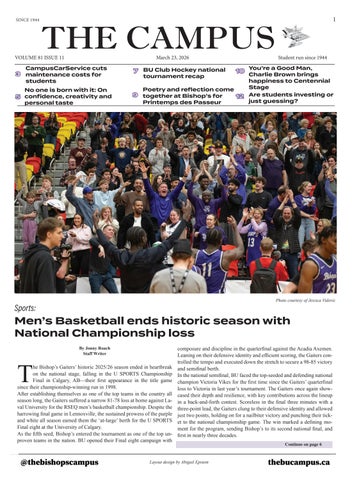
The Bishop’s Gaiters’ historic 2025/26 season ended in heartbreak on the national stage, falling in the U SPORTS Championship Final in Calgary, AB—their first appearance in the title game since their championship-winning run in 1998. After establishing themselves as one of the top teams in the country all season long, the Gaiters suffered a narrow 81-78 loss at home against Laval University for the RSEQ men’s basketball championship. Despite the harrowing final game in Lennoxville, the sustained prowess of the purple and white all season earned them the ‘at-large’ berth for the U SPORTS Final eight at the University of Calgary.
As the fifth seed, Bishop’s entered the tournament as one of the top unproven teams in the nation. BU opened their Final eight campaign with
composure and discipline in the quarterfinal against the Acadia Axemen. Leaning on their defensive identity and efficient scoring, the Gaiters controlled the tempo and executed down the stretch to secure a 98-85 victory and semifinal berth.
In the national semifinal, BU faced the top-seeded and defending national champion Victoria Vikes for the first time since the Gaiters’ quarterfinal loss to Victoria in last year’s tournament. The Gaiters once again showcased their depth and resilience, with key contributions across the lineup in a back-and-forth contest. Scoreless in the final three minutes with a three-point lead, the Gaiters clung to their defensive identity and allowed just two points, holding on for a nailbiter victory and punching their ticket to the national championship game. The win marked a defining moment for the program, sending Bishop’s to its second national final, and first in nearly three decades.
Continue on page 6
Kai Luginbuhl, News Editor » thecampus.news@gmail.com
By Melanie Toppa Contributor
Behind every Gaiters game is a coordinated effort involving athletes, coaches and a growing team of student creatives working to bring the full game-day experience to life. On game day, energy is high. The stands fill, music echoes through the gym and anticipation builds toward tip-off. But for those working the games, both on and off the court, preparation begins long before fans arrive.
While game day may feel like a single event, much of the work begins days in advance. Coaches finalize strategies, athletes review film and routines are established leading up to competition. For student-athletes, preparation is both
physical and mental. Balancing academics with performance requires discipline, especially during busy periods like midterms or playoffs. By the time players step onto the court, the focus shifts entirely to execution.
While athletes prepare for competition, another team is working behind the scenes: the Bishop’s Athletics social media crew. From early in the morning, student interns begin building out content plans, game-day graphics, starting lineups, in-game updates and post-game highlights. Every detail is intentional, from maintaining visual branding to capturing the emotion of key moments. During the game, the pace intensifies. The team works under tight timelines, editing content in real time and publishing within minutes. A major play can quickly become a highlight
clip, allowing fans both in the stands and online to stay connected to the action. The role requires adaptability, as games are unpredictable. Content teams must be ready to respond instantly, ensuring that the biggest moments are captured and shared as they happen.
Beyond the court and screens, game day is also about creating an experience for fans. Music, in-game promotions and sponsored activations like “Fan of the Game” all contribute to an atmosphere that has become a defining part of Gaiters culture. These elements are designed to engage the crowd and turn each game into more than just a sporting event. Student participation plays a key role. Traditions like “Pack the Swamp” highlight the importance of fan presence, helping transform games into campus-wide
By Nicole Rindisbacher Contributor
The arrival of March marks the beginning of Agricultural Literacy Month. Around the country, Canadians raise awareness of one of the oldest and most important industries in the world. Despite its importance, many Canadians don’t know where our food actually comes from. How far back can you trace the ingredients of your latest meal? If you’re anything like most of us, odds are your trail begins and ends at the grocery store.
Now, what is the problem with this, you may ask? While there are too many to explore in one article, we can begin with the main issue: most of our food comes from industrial-level agriculture. These farms are closer to factories than the quaint family farm you may imagine.
This presents a range of issues. Firstly is the environmental damage. Due to
EDITOR-IN-CHIEF
Rianna Ostrosser thecampus.editor@gmail.com
SENIOR COPY EDITOR
Olivia Norby thecampus.copyeditor@gmail.com
JUNIOR COPY EDITOR
Eryn Costello
economies of scale, they specialize in a limited variety of crops, mainly cereals and pulses. Now, imagine if we only ate these foods; it wouldn’t be a very sustainable diet. Our soil and pollinators operate much the same way. They need a diversity of minerals and nutrients, which are not provided by these monocultures. On top of that, most of these industrial-scale farms use chemicals to maximize productivity, which salinate the soil, kill off beneficial microorganisms and pollinators, pollute water and more.
In addition to the environmental instability this system creates, most of these crops are exported, leaving Canada dependent on other countries to import our food. We import 90% of our leafy greens and 30% of all our food, 70% of which comes from the US. This leaves Canadians vulnerable to trade wars, other countries’ production policies and shifting political alliances.
While these issues do seem immense,
there is an emerging solution: local, non-industrial farms. These farms have shorter transport routes, creating fewer emissions and less food waste. They create resilience within food systems by decreasing dependence on international imports, and they are more likely to use environmentally sound practices such as organic or regenerative methods. One such example is Sanders Farm, located close to North Hatley. This 120-acre farm grows organic fruits and vegetables sold at local farmers’ markets and was the first certified organic farm in Quebec. Farmers Russel and Therese will come to Bishop’s on Mar. 25 for a round table discussion on the intersection of Politics, economics, philosophy and art through agriculture.
Camila Vásquez’s art project “The Roots are Important,” which explores the cultural and personal significance of farming, will be presented and related topics will be discussed with Sanders farm and Dr. Jane Morrison of Bishop’s
LAYOUT EDITOR
Abigail Epstein thecampus.layout@gmail.com
ASSOCIATE EDITOR
PHOTOGRAPHER
NEWS EDITOR
Kai Luginbuhl thecampus.news@gmail.com
OPINIONS EDITOR
events. This environment is not accidental — it is built through collaboration between event staff, marketing teams and sponsors, all working to create an engaging and memorable experience.
What may look like a two-hour game is actually the result of an entire day, and often, a full week of preparation. From athletes and coaches to media teams, event staff and fans, every piece contributes to the Gaiters experience. Each group plays a different role, but together they create the energy and atmosphere that define game day at Bishop’s. So, the next time the crowd rises after a big play or a highlight appears online moments later, it’s worth remembering: there is an entire team behind the scenes making it happen.

Sustainable Agriculture department. This will be located in the Foreman Art Gallery in the Centennial building from 1 p.m. to 2:15 p.m. on Mar. 25.
In addition to such events, Bishop’s recognizes the value of local food systems through community-supported agriculture initiatives, its Sustainable Agriculture program and community gardens for students. Be sure to keep an eye out for more Agricultural Month activities!
thecampus.businesseditor@gmail.com
STAFF WRITERS thecampus.juniorcopyeditor@gmail.com
DIRECTOR OF FINANCE
Frederic Grenon thecampus.business@gmail.com
Emilie Vadeboncoeur
Pranav Buchineni thecampus.photographers@gmail.com
GRAPHICS EDITORS
Gabrielle Lalonde & Latoya Simms
Kai Luginbuhl thecampus.associateeditor@gmail.com graphicseditor.thecampus@gmail.com
DIRECTOR OF MARKETING & COMMUNICATIONS
Anya Mullen
thecampus.opinions@gmail.com
FEATURES EDITOR
Lauren Root
thecampus.features@gmail.com
SPORTS EDITOR
Owen Kitzan
thecampus.sports@gmail.com
ARTS AND CULTURE EDITOR
Jillian French
thecampus.artsculture@gmail.com
Megane Masson & Jon Roach
THIS ISSUE’S CONTRIBUTORS:
Ana Luiza Torres Castelete
Evan Chartrand
Henri Dessureaux
Hillary Case
Jayme Marteniuk @thebishopscampus Instagram
Leighton Geraghty
Mackenzy Reid
Melanie Toppa
Michael Gearey
Mirana Iliza
Nicole Rindisbacher
Piper Howell
Ryan Allat
Sara Scafuro
Sophie Kairouz
By Evan Chartrand Contributor
Astudent-run initiative has begun offering affordable vehicle maintenance services to peers, aiming to reduce the financial burden of car ownership while building practical automotive experience within the campus community.
CampusCarService, which launched this semester, provides basic services such as oil changes and tire work at lower rates than traditional repair shops. The service targets students who rely on vehicles for commuting but struggle with the rising costs associated with maintenance and repairs. The founder, a university student with a long-standing interest in cars, said the idea developed after recognizing how expensive routine upkeep can become. Many students, particularly those living off-campus, depend on their vehicles daily but may delay necessary maintenance due to cost concerns.
“I’ve seen how quickly small issues turn into expensive problems,”
the founder said in an in-person conversation. “I wanted to create something that makes those basic services more accessible while also helping me gain real experience.”
The initiative also reflects a broader trend among students seeking cost-saving alternatives. According to data from the Canadian Automobile Association (CAA), annual vehicle maintenance and repair costs can range from several hundred to over a thousand dollars depending on usage and vehicle condition. These costs can present challenges for students balancing tuition, housing and other expenses.
Several students who have interacted with the service emphasized its affordability and convenience. Henry, a student who commutes regularly, said the availability of lowercost options on campus addresses a common issue. “It’s not that people don’t want to maintain their cars,” he said during a casual interview. “It’s that they’re trying to save money wherever they can.”
Damien, another student familiar
with the initiative, noted that trust and accessibility play a key role. He explained that having someone within the campus community provide these services makes the process feel more approachable compared to visiting a traditional repair shop.
Forest, who has discussed car ownership challenges with peers, highlighted how the service may encourage students to stay on top of maintenance. “People put things off because of cost,” he said. “If it’s more affordable, they’re more likely to actually take care of their cars.”
In addition to addressing affordability, CampusCarService serves as a learning platform for its founder. The student plans to pursue formal training at Algonquin College after completing university, with the goal of becoming a licensed mechanic. The experience gained through the service provides early exposure to realworld automotive work.
While the operation currently focuses on simple maintenance tasks, its presence on campus demonstrates how student-led initiatives can
respond to everyday challenges faced by peers. By combining practical skill development with community-oriented service, CampusCarService reflects an approach that prioritizes both affordability and experiential learning. As the service continues to grow, its impact will likely depend on demand, trust and the ability to maintain consistent quality. For now, it offers a localized solution to a common financial concern among students who rely on their vehicles.

By Emilie Vadeboncouer Director of Marketing & Communications
As the end of the semester and exams start to approach, the Williams School of Business is preparing to offer a chance for students to pause and reflect on the remarkable talent within the business community here at Bishop’s. Sandrine Hebert, Vivienne Webster and the organizing committee, are thrilled to invite the business students to the upcoming WSB Recognition Gala, proudly sponsored by Desjardins. This isn’t just another date on the academic calendar; it is a night dedicated to the people who make the WSB a premier environment for learning, leadership and innovation.
This will be the second annual WSB
TRecognition Gala. It’s a new opportunity for students to excel in different categories. Too often, awards ceremonies focus solely on high academic excellence, but this gala aims to bridge the gaps between every pillar of the business department. The categories this year recognize those who have demonstrated exceptional leadership in clubs, those who have sparked innovation in case competitions and those who have fostered a supportive environment for their peers. By broadening the scope of recognition, the WSB ensures that the soft skills like empathy, teamwork and initiative are valued just as highly as technical proficiency. In addition to this, it recognizes exceptional leadership, faculty whose efforts have exceeded expectations as well as alumni and external partners who continue to invest in the future of Bishop’s
graduates. By gathering these diverse groups under one roof, the Gala fosters the kind of networking and community spirit that defines the Bishop’s experience.
Attendees can expect an evening of connection and celebration starting at 5:30 p.m. on Mar. 27, 2026, in The Gait. The dress code is business casual/ semi formal and will be followed with light refreshments. It is a great opportunity to see professors, local business leaders and students trading stories outside of the lecture hall, all while honoring those who have gone above and beyond this academic year. With the nominations now closed and the committee finalizing the honors, the excitement is building for what promises to be a full house. If you haven’t already, please ensure you reserve your spot via the official WSB Recognition
Gala Ticket link. Space is limited, and given the momentum from last year’s inaugural event, tickets are expected to go quickly.
Let’s come together to celebrate the hard work of our peers and mentors. We look forward to seeing the whole WSB community at The Gait on the 27th!
he Campus acknowledges that the land on which we operate is stolen land, the traditional territory of the Abenaki people. We live, learn, work, and play on this land, home to Indigenous peoples still living. Canada was founded through colonization, a system rooted in oppression and the abuse of power over others, continuing to affect First Nations, Inuit, and Métis communities today. As a student newspaper, The Campus has a responsibility to highlight truth. We are committed to prioritizing underrepresented voices in our community and proactively highlighting Indigenous peoples’ histories and ongoing realities, including their resilience and achievements. We recognize our work plays a role in shaping public perceptions, being able to call-out injustice but also call-in action. We emphasize that we must go beyond a land acknowledgement, which is only one step towards reconciliation. It is the stories in our paper – told with respect, accuracy, and integrity – and the respect and humility we show to the land and others that is more important than what is written in a land acknowledgement. Actionable steps to go beyond a land acknowledgement include educating ourselves and others, and supporting Indigenous traditions, movements, and businesses. —The Campus Team
Anya Mullen, Opinions Editor » thecampus.opinions@gmail.com
By Anya Mullen Opinions Editor
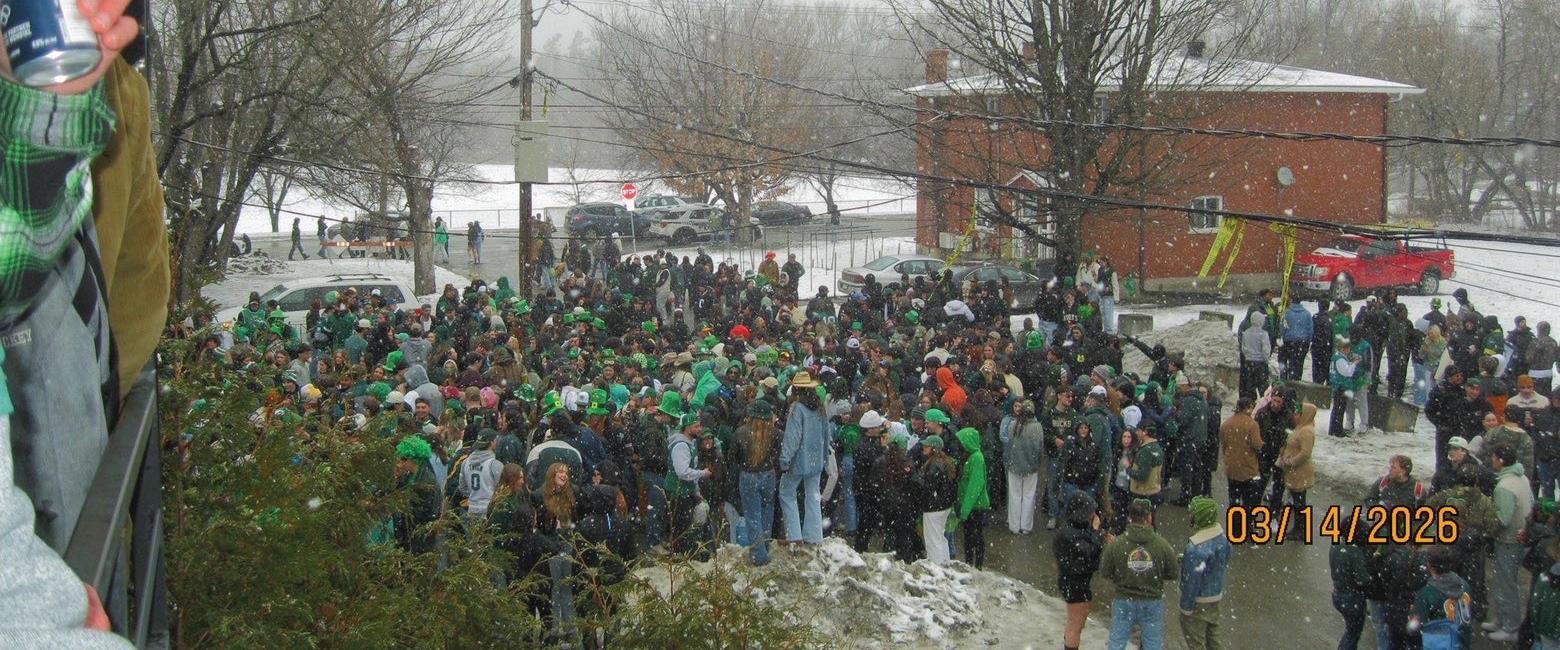
Reed Street’s St. Paddy’s celebration was a great time regardless of the snowy conditions outside. However, I couldn’t help but notice that there were significantly fewer people there than in the last two years I have been at Bishop’s. There wasn’t even a ginger run this year! This could have just been because of the cold weather, but I found myself wondering why the crowd was so much smaller than it used to be, and if it is a sign of a greater shift in our university’s culture.
It seems to me that the partying reputation that attracted many students to the school is not what it once was. Gait attendance is declining, and the big parties at houses like Animal and Jungle that I have heard about from upper years and grads no longer seem to exist.
There could be many reasons for this. The threat of a tuition raise two years ago could have caused fewer students to choose Bishop’s. The university administration also
seems to want to distance the school’s reputation from that of a “party school.” This was clear to many students when the Winterfest railjam, the highlight of many students’ entire year, was threatened to be shut down due to alleged safety concerns. But students have always partied, and there is a way to do it safely. In our tight-knit community, everyone looks out for each other and makes sure one another gets home safely. Students even volunteer for student safety, handing out snacks at off-campus events like St. Paddy’s on Reed Street.
To me, this shows that everyone can participate in our school’s diverse culture, even if they don’t want to directly participate in the party.
An event like St. Paddy’s is a welcomed break from our studies, and I think that BU students encompass “work hard play hard” to a tee. Yes, I was decked out in green and having fun over the weekend, but when Monday comes around, I’m back in the library, writing newspaper articles like this one and working on assignments.
Without these studentorganized events to look forward to, I think Bishop’s would lose so much of its charm and community. Something I love about this university is the ample opportunities to get involved in on- and off-campus life, with students of all ages and backgrounds. Thanks to being at such a small school, I get to be friends with students in all years and programs, from all over the
country and the world. So yes, the crowd on Reed Street this year was smaller than I remember it being, and we all missed the ginger run. However, I can only hope that this is not a sign of great change in the Bishop’s community. I want people to continue to be involved, because there are jobs to have, clubs to join, sports to play and people everywhere to meet and hang out with, if BU students keep looking.

By Hillary Case Contributor
Reed Street parties are a staple Bishop’s experience. When I tell people I live on Reed, I always get sympathetic looks, or people say, “Wow, I could never do that.” On a Reed party day like St. Paddy’s, music will start blaring down the street by 2 p.m. Crowds dressed head-to-toe in themed outfits pour in. Within minutes, the entire road turns into one big party.
When I first moved onto Reed Street nearly two years ago, I was nervous. I heard the horror stories, and I even saw them during my first year when I lived on campus. Huge crowds, houses and balconies filled with strangers, fires and things getting destroyed. As a clean freak, the thought of hundreds of muddy shoes tracking throughout my house was extremely unsettling.
Yes, some of those stories are definitely true. Living on Reed during the street parties can get wild. One time, there was a fire so big that you could feel the heat of it from our balcony. We were without garbage cans for a while
because they were burned in the fire. Last St. Paddy’s, someone had even thrown a snowball at our window, shattering it.
But despite all of that, or maybe because of it, I’ve realized that I genuinely love living on Reed Street.
Reed Street feels like a community. The street brings together hundreds of students in such a Bishop’s way. My favourite part is watching everyone from our balcony. It’s the best spot to feel the vibe of the street without being swallowed by the crowd. This weekend, I was thinking to myself, I feel way safer living on Reed during St. Paddy’s than being packed in the middle of everything all day with no bathroom, food or water.
Honestly, even if I didn’t live on Reed, I’d definitely end up partying there anyway. Living there just makes the experience easier and more enjoyable. You’re part of the fun without having to worry about getting home or wandering around trying to find your friends.
This year felt different. Before the party even started, the guys across the street, I assume from Dragon Society,
moved all the garbage cans so they wouldn’t get destroyed as they had in the past. It was such a small thing, but it showed that people who live on Reed actually look out for each other. They even helped clean the street early in the morning the next day!
What also surprised me is how respectful most people are. We often turn strangers away from coming inside our apartment. I was shocked to see that everyone is usually understanding. I think that comes from Bishop’s being such a small school, and people recognize that these houses
are still someone’s home.
This year, the St. Paddy’s party ended in the early evening. The street suddenly emptied out, the music faded, the crowds disappeared and Reed became quiet again.
Living on Reed Street during St. Patrick’s Day isn’t always calm or predictable. It’s loud, messy and at times chaotic, but it’s also one of the most unique experiences you can have at Bishop’s. Once you’ve lived there, you realize that you’re not just watching the tradition, you’re part of it.
Anya Mullen, Opinions Editor » thecampus.opinions@gmail.com
By Piper Howell Contributor
Mark Twain is thought to have said, “History doesn’t repeat itself, but it does often rhyme,” which I first heard in my Grade 12 history class and has stuck with me ever since. While global events such as wars, pandemics and revolutions don’t occur in the exact same way, the underlying patterns of our human behavior resurface from generation to generation, century to century. While perhaps not to the same degree, these patterns are also present in life on campus at Bishop’s, reflected in the way students engage in debates, create change and respond to challenges within the community.
Recognizing these patterns, or rhymes, offers a valuable perspective and can help young people better understand both the world and their place within it. Consider student
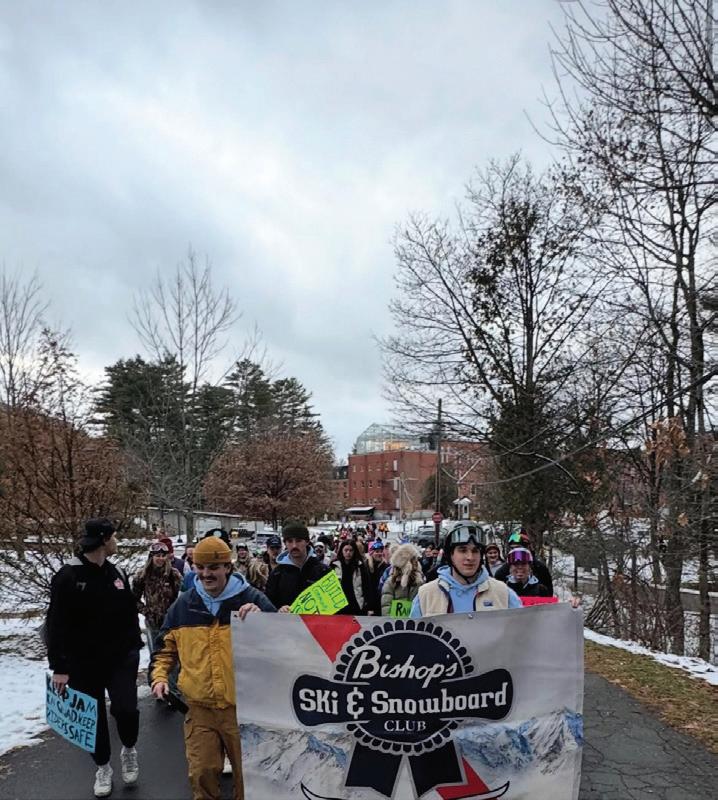
activism; students globally have challenged authority and demanded change for years. The Quebec student strikes of 2012, for example, brought thousands of students to the streets to protest rising tuition fees. Even at Bishop’s more recently, the Winterfest Rail Jam protest last fall successfully pressured the administration to reinstate the event this February. While the context differs, the motivation and desire to create change remain.
Global events also leave their rhymes throughout campus. COVID-19 disrupted our routines and required students to learn virtually, echoing the challenges faced during past public health crises, such as the 1918 Spanish flu. Although these two events are separated by a century, and the world changed significantly between 1918 and 2020 (technologically, culturally and socially), the circumstances
one hundred years apart were familiar: patterns of uncertainty, adaptation and resilience. They reflect the courage and capability that individuals must have shown in adjusting to constant change throughout history.
Understanding history is also crucial for academic and personal growth. Recognizing these rhymes helps us think critically, evaluate information and participate in meaningful discussions both in and outside the classroom. Learning about past political, social and environmental movements gives context to the headlines we see today. History is too often treated as a series of events with fixed start and end dates, when in reality the events of the past continue to affect the events that occur today.
Ultimately, history is not just a subject we study; it is what we constantly live through. The idea
of past events rhyming with current events reminds us that the challenges we face are not entirely new but instead a part of ongoing patterns throughout history. By recognizing these patterns, we are better able to contribute meaningfully to the world around us and to shape what comes next.
By Sophie Kairouz Contributor
In today’s era of brain-numbing, overstimulating content, creativity has become a rare commodity. Everyone watches the same videos, follows the same trends and has gotten used to repetition as a means of personal expression. This desensitization towards copycat behaviour has made regular self discovery abnormal to the point that when someone has a hobby, people make it their full identity instead of seeing it as something normal. Is it really normal for the minority to be people who satiate themselves outside of their phones and routines? Why is that so rare nowadays? While some people cower at the thought of being observed, others thrive in their individuality. As someone who helped mentor people on developing the confidence to express themselves and discover their personal taste, I’ve noticed the same behavioural and mindset patterns in people again and again. These observations lead me to believe that there’s a recipe to
becoming more expressive. So, what is the first step?
Most people with confidence have had a sense of self for as long as they could remember. Due to this, they can’t remember ever working at gaining confidence, therefore, when they’re asked how they’ve reached their level of selfassurance, they don’t know how to answer. This makes confidence feel like something you have to be born with, but it can be developed. A lot of people think the secret to gaining confidence is “fake it ‘till you make it,” but that doesn’t work. People who fake confidence spend a lot

of time trying to convince you that they’re fully sure of their decisions and of who they are. People with real confidence don’t need you to approve of them or be impressed by them. They do things for themselves. The foundation step to confidence is simpler than people imagine: Trying something new that you’re interested in but that you talked yourself out of. Maybe you decided it’s too niche or lame, or you’d be bad at it or no one would understand why you’d like it, but they don’t have to understand. When you do things for the experience, others’ opinions become less important.
Because of the echo chambers we end up in due to our social media algorithms, we are made to believe that very niche sub-cultures of styles and interests can please everyone, but the truth is, nothing will ever please everyone even with a record amount of engagement. We all like the things that we see for different reasons. You can begin to develop your personal taste by understanding what stands out to you in the things
you like. Eventually, you may realize that there are not many things that you enjoy in their entirety. The more you discover yourself, the more you will gain a sense of personal vision in the things that you do. From personal vision, creativity flourishes and so does a desire to produce what you’re looking for so it exists in the world. As one local social media influencer, Isabella Dawn, put it in an interview: “A lot of people criticize boredom, but it’s a gateway to discovering new things and it gives you ideas.” Self-discovery is the root of true creativity. Through trial and error you will discover the most about yourself.
To develop your personal taste and creativity you need to hold yourself with confidence. To have confidence, you must embrace your individuality. In a way, confidence and taste are highly overlapping characteristics. To achieve both, you mustn’t worry about the opinions of those who do not inspire you. It’s hard to find your own direction through contrarian eyes.
Owen Kitzan, Sports Editor » thecampus.sports@gmail.com
Continued from page 1
In the championship game, the Gaiters went toe-to-toe with one of the greatest dynasties in U SPORTS history, the 17-time national champion Carleton Ravens in a championship showdown for the ages. Bishop’s matched the intensity early, executing on both ends of the floor and keeping the game in the balance through 15 ties and 18 lead changes. Their balanced scoring and defensive pressure once again gave them a chance, but the 35-point performance from Ravens guard A. Dorey-Haven had the verdict come down to a few key possessions and some controversial officiating in the final minutes. Despite their efforts, the Gaiters fell just short, ending their championship pursuit in a
hard-fought 78-75 finish.
While the final result stings, it does little to diminish what this team accomplished. From climbing to the top of the national rankings to dominating statistically on both ends of the floor, the Gaiters built one of the most complete seasons in program history. They finished among the U SPORTS leaders in scoring, efficiency, and defensive metrics, outscoring opponents by over 15 points per game and establishing themselves as one of the most balanced teams in Canada. Their playoff run only reinforced that identity.
The loss in the final will be remembered, but so will everything that led to it. This was the team that brought Bishop’s back to the top of U SPORTS basketball. The team that
turned Mitchell Gymnasium into one of the toughest environments to play in the country. The team that proved that the Gaiters belong on the national stage, and turned a gym nearly 4,000 km from Lennoxville into a sea of purple. With eight seniors set to graduate, this group
leaves behind more than just wins and records—they leave a legacy of what Bishop’s basketball can be at its best. One game short of a championship as the smallest university competing in men’s basketball in the country.



By Leighton Geraghty Contributor
The Bishop’s Gaiters had yet another hardworking season. The women’s hockey team battled extremely hard throughout the entirety of their season. With many new faces on the team and a couple of significant injuries throughout the year they gave it their all until the very last whistle. The program, which evolved from a club team years ago, graduated their incoming class of 2021. They started off on a fiery start this year taking down U SPORTS powerhouse the
Concordia Stingers twice. These are Concordia’s only two losses up to this date. While looking back at this year, many players made a name for themselves. Sandrine Chouinard was named not only to the RSEQ rookie all-star team but also named to the U SPORTS allrookie team. Gabrielle Santerre climbed her way back after being robbed of recognition as an RSEQ all-star last year. Santerre was 3rd amongst players in the Q in points which gave her another accolade as she was named a 2nd team AllCanadian.
I was fortunate to be able to
get in touch with Justine Turcotte, a fourth-year on the Gaiters team. Turkey, as the team calls her, is in a very interesting position. As USPORTS grants you five years of eligibility, she has the choice of graduating or returning to the team to try and finish the unfinished business from this season. Turcotte expressed that her favourite part of the season is the playoffs. She said, “I think playoffs are the most exciting and fun time of the year. We are as connected as we can be as a team. It’s just great to experience that with the other girls.” The Gaiters were unfortunately eliminated in
the semi finals. Furthermore in conversation Turcotte expressed her excitement to come back next year and utilize her fifth year of eligibility. She said, “I’m looking forward to playing my last season as a Gaiter. It will be a great final chance to keep improving and hopefully succeeding as a team.” The team will look to avenge their loss this season with notable veterans and a lot of sophomore campaigns returning to the squad. We look forward to seeing the on-ice product next year. Let’s go Gaiters!
Owen Kitzan, Sports Editor » thecampus.sports@gmail.com
By Owen Kitzan Sports Editor
While many went home or took time to catch up on school work over the march break, the BU Club Hockey team had the opportunity to play in the national tournament. The tournament took place from Mar. 6 through 17 in Jacksonville, Florida. Bishop’s entered as one of only two Canadian teams, with a ranking of first amongst the 12 teams invited to the tournament.
To get to Jacksonville the team opted for lengthy travel by bus as opposed to flying due to budgeting purposes. The trip is over twenty straight hours of driving from Sherbrooke, not accounting for necessary breaks for the driver and players at various points throughout the nearly continuous drive. I had the chance to ask graduating players, assistant captain Jack McGowan and goaltender Jack McFarland about their experience on such a long bus ride and how it compared to flying the year prior. The consensus from the two was that while obviously being on a bus is a much longer trip down than the flight, the time spent amongst teammates in such a close space created a set of memories that wouldn’t be possible on a plane.
After the drive, the team had one rest/practice day, an opportunity for players to stretch out any stiffness from the time spent on the bus, as well as get a feel for the ice before the tournament got under way. Many players also took this day as an opportunity to get some school work done before much of their time would be spent in a rink.
As the first ranked team, Bishop’s took on the lowest ranked team, which happened to be the Elon University Hockey Club, a team based out of North Carolina. BU gave rookie goaltender Nicolas Hallé-Tanco the start in net to
kick things off. Game one showed why Bishop’s was ranked so highly, as they steamrolled Elon 9-2. Jack Knox potted a hat-trick along with an assist to cap off an impressive four-point game.
Game two determined whether the team would need to play two or three games to reach the finals. The team’s matchup was number eight ranked Suny Cortland, a team located in the state of New York. Second year netminder Antimmes Leudières got the chance to play, having also played in multiple games the year prior in Jacksonville. Through the first two periods Bishop’s lacked some discipline which led to them being shorthanded for large periods. A late comeback in the third period, marked by an early whistle on a potential Marc Lagacé goal, as well as a controversial last-second play by a Suny Cortland defenseman to grab Liam Harpin’s stick with his hands to negate a last-second tying goal for BU. The team would fall 4-3 and require an extra game if they wanted to punch a bid to the finals.
Looking to bounce back from the day prior, the team took on a familiar opponent, number ten ranked Paul Smiths College, a small university in New York. Jack McFarland was locked in for Bishop’s in this affair, as he would post the only shutout for the team in this year’s Nationals run with a 6-0 victory. Jordan Waite notched two goals in this one to help lead the way in scoring along with the excellent job in net.
Their quarter-final matchup took place against the only other Canadian team in the tournament, number seven ranked St. Redeemer University from Ancaster Ontario. The boys showed who was the better team to represent the flag going forward despite an early 7 a.m. start, as they put up a massive 9-2 victory. Nicolas Hallé-Tanco once again secured the win in the crease, while Liam Harpin and Jordan Waite led with

three points each.
That victory slotted them in for a second game of the day not much later in the afternoon against Suny Brockport, another New York based school.
Antimmes Leudières backed up the team once again for the semi-final matchup in what became a heated affair. In the second period, for the second straight year, the Brockport goalie would receive a five-minute major penalty and a game misconduct for spearing a Bishop’s player. The team used that momentum to propel them to a 5-2 lead late in the third period when Brockport decided to get chippy once again. They would post six more major penalties leading to ejections on their roster in the final three minutes of play before deciding to berate and attack some Bishop’s fans. With that the refs decided the game was over with where it was and let the clock run out to send BU to the finals.
Another familiar foe awaited them in the finals as the second ranked Anna Maria Bobcats stood across them one final time this season. Bishop’s looked to rookie netminder Nicolas HalléTanco to lead the way in net, having already won two games for them in the tournament. Bishop’s jumped out to a 2-0 lead early in the second period off a first period powerplay goal by
By Henri Dessureaux Contributor
As many of the seasons have begun to fully wind down as we head into exams, there remains one team whose national tournament has yet to occur. With golf being a sport that as we know cannot be played year round in Canada, following the RSEQ playoffs in the fall there is a long hiatus before conditions allow for the athletes to return to play.
This year the tournament will take place in Lévis, Quebec, only a
couple hours away from Bishop’s. It will be held from Jun. 15 to 19 at La Tempête golf course, and features the top university level golf teams from across Canada. While this may not be quite as exciting as the team’s trip to British Columbia for nationals the year prior, the opportunity to showcase themselves on a more local stage is a cool experience for the players. For a few players this will be their last competition adorning the Bishop’s purple in competition as they will be graduating, giving them the chance to come back and play one final event post
ceremony. The team looks poised to make some noise this year on the national stage as for the first time in the program’s history, both the men’s and women’s side qualified for nationals in back to back years. The team has taken some serious strides towards becoming a household name in the university golf scene and have shown Laval they will have some serious RSEQ competition going forward. The most notable moment of this year that sums up the progress of the overall program, was Landen Harison winning
Fred Grenon, and a quick strike on the forecheck from Vincent Dionne to begin the second.
Nearing the end of the period during a Bishop’s powerplay, an incident occurred that would ultimately shape the final outcome of the game. Another spearing play, this time by an Anna Maria defenseman, would go uncalled despite being noticed by an on-ice official. That same Anna Maria player would then proceed to score a goal a few seconds later off another controversial call made by referees. They ruled the player involved in the spearing be assessed a five-minute penalty and game misconduct, but allowed the goal he had scored post penalty to stand, with the explanation being that they hadn’t called it during live play. The video review process to determine this was a lengthy procedure and took the wind out of Bishop’s sails, as well as causing their players to begin to become tired as adrenaline began to wear off from inactivity. With the goal being allowed to stand, the team took to the powerplay once again, where an unfortunate turn of events led to the Bobcats tying the game up late in the second period.
The third period resumed with the score tied at two apiece and BU looking to capitalize on their remaining powerplay. Sadly the boys simply ran out of gas, with the extra game played including back to back games the day prior showing its effects in the final frame. Sadly Anna Maria would go on to pot three more goals including an emptynetter late to put an end to Bishop’s magical run with a score of 5-2.
While this brought an unfortunate end to the BU Club Hockey team’s season, the team still managed to achieve new highs this year. The team would like to thank all of the fans, students, alumni and faculty who made this season possible for them. Until next year BU Club Hockey fans!
an NCAA tournament this year at the RPI Invitational in October. In his final college golf outing, he went out and won the first NCAA event in BU golf history, an incredible feat. As exams will come and go by us soon, the golf team will continue their preparation to represent us on the national stage come June. We wish all the players and staff the best when it comes to the tournament, but first and foremost, enjoy the opportunity to play in such a prestigious event. Continue to make Bishop’s proud this summer. Let’s go Gaiters!
Root,
By Mirana Iliza Contributor
From Mar. 9 to 13, the Student Union Building was transformed into an interactive brain science hub, kicking off Bishop’s very first Brain Awareness Week (BAW). All week long, students passing through the SUB were able to participate in interactive activities and have indepth discussions with members of
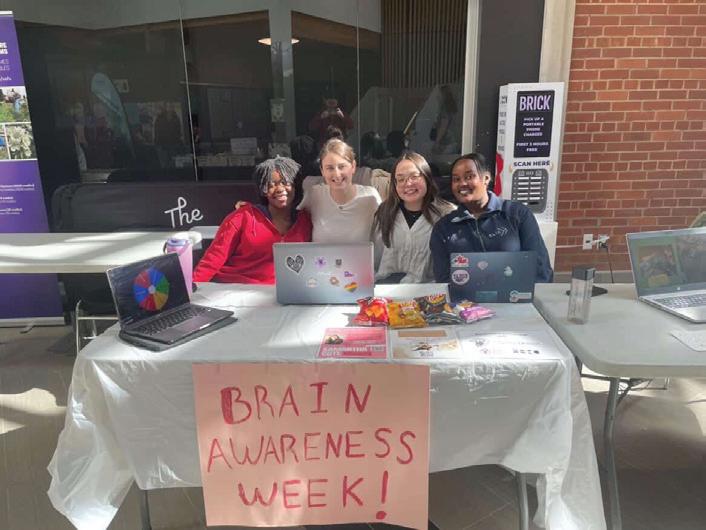
the WHRC about the importance of taking care of your brain. This event was perfectly timed, since school is ramping up and becoming more stressful, as a reminder to students why it’s so important to take a break from their work.
BAW is a global campaign designed to foster public enthusiasm and support for brain science. Every March, participants around the world host creative activities in their communities to share the wonders of the brain and highlight the impact of brain science on our everyday lives. This year, the global campaign made its way onto the Bishop’s campus.
Each day of the week was given a theme, with the hopes of keeping students engaged with interactive content. We wanted to have something for everybody and engage with different student populations, hoping to connect
with the students who may not have much prior science knowledge, and also those taking a STEM degree. Everyone on campus can benefit from this information, which is why we tried to tailor it to all groups.
We started on Monday with a Cognition theme where students stopped by to test their memory, attention, reaction time and more through a variety of neuropsychological tests and could even win small prizes. The event even drew interest from beyond Bishop’s campus, with a Champlain student, considering a future in neuroscience, stopping by to connect with the club.
Tuesday’s theme centred on Women’s Health; it opened with a trivia wheel in the SUB where students competed to answer questions on neuroscience myths, cognition and brain facts. In the
evening, Professor Samantha Côté delivered a guest lecture titled “Beyond Sex Differences: The Impact of Sex Hormones on the Brain,” exploring how hormonal fluctuations influence brain structure and function. The event was free and open to all, with light refreshments provided.
The Thursday theme focused on Substance Abuse awareness. In the SUB, students could pick up a mandala to colour and browse brochures on substance use safety, sexual health and campus wellness resources.
The week closed Friday with a free yoga session in Paterson Hall from 12:45 p.m. to 2 p.m, run in collaboration with EnjoyYoga Studio, a deliberate choice to end on a note of rest and care.
By Michael Gearey Contributor
Turner Studio Theatre is currently preparing to open Bishop’s Drama’s next production, Elias Canetti’s “The Numbered.” Opening on Mar. 25 and running to the 29th, “The Numbered” plunges the audience into the futurist world of an authoritarian society where names are obsolete and each citizen is instead identified by a fixed number that represents the total sum of years they are allotted to live. Clockwork motifs dominate this world of pure determinism, but what happens when one gear falls out of alignment?
The focus on a world so dominated by its laws and traditions was not an arbitrary choice. “I find the whole idea of knowing your date of death fascinating,” said Mary Harvey, professor and director of “The Numbered.” She found the play to be a very relevant choice in the present day, as it deals in themes born of historically strict regimes as well as the role of activism and the power of the individual. “I chose this show because I think the basic
concept is an interesting way to examine the role of the individual in questioning authoritarian regimes. It is dystopian but not violent and the hierarchy created by this system is not resource based as with most dark fantasies of this type.” The search for truth and balancing truth with certainty and uncertainty was also crucial to Mary’s choice. “It is more and more difficult to find out what is really true in our time of AI, so that theme resonates too.”
For those familiar with Turner Studio Theatre, you will likely be surprised to discover that the space has been reconfigured again, this time set up for “theatre-in-the-round” with seats on all sides of the stage. Discussing with Mary, this was to create a world that draws in and dominates the entire space. “With audiences on all sides who watch each other watching - a perfect parallel for our social media age. Also - nobody exists in isolation from this regime, everyone is implicit. Not only the actors.” This shift from the usual configuration of the theatre creates a unique viewing experience, as the stage is also significantly lower than
the audience level. “I think the fact we are using a pit makes the angle of watching the live performance quite like the Colosseum or a boxing ring, which is quite exciting.”
This experience is also one that is new for the actors. As much of the training and stage experience offered is done flat to one audience, the cast of “The Numbered” is working to adapt and perform in such a way as to captivate four audiences at once. “It’s pretty special!” remarked Gabrielle Champoux, who plays Fifty, the heroine of “The Numbered.” “When we act on proscenium, we are careful not to put our backs to the audience, but in this case, the audience is all around us, so inevitably, our back faces a part of the audience at every point in the show.” This restructuring of the space came with its challenges, but between the visual it creates and the novelty of the experience Gabrielle is excited to showcase it live. Mary agreed that it was part of why she chose this layout. “It gives the actors such freedom.”
“The Numbered” has five showings, opening at 7:30 p.m. from Mar. 25 to 28 and a closing matinee

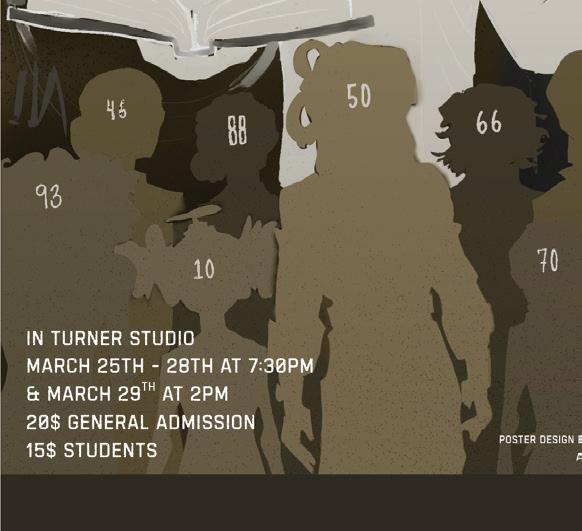

on the 29th at 2 p.m. When posed the question of what people should look forward to when coming to see it, Mary said that the show offers a great deal to enjoy for both the casual viewer and the analytical. “I think the fact it is a futuristic fantasy is really thrilling, it’s political in the abstract and a great heroine’s story. It’s sad and funny in parts. It will really stretch your imagination… Come & be immersed!”
Lauren Root, Features Editor » thecampus.features@gmail.com
By Ana Luiza Torres Castelete Contributor
On the evening of Mar. 18, Bishop’s University welcomed students and members of the community for a night shaped by poetry and reflection. The second edition of Printemps des Passeurs, organized by the Salon du Livre de l’Estrie in partnership with Sherbrooke Info and the Oui Experience program, brought participants together around literature as a way of opening a window into Francophone culture for those whose first language is not French.
Soft lighting, quiet music and an attentive audience set the tone for an intimate and inviting evening, where each reading seemed to linger in the room a little longer. The event was led by Mélanie Noël, poet and president of the Salon du Livre, alongside Louise Marois, finalist for the Grand Prix Québecor at the Trois-Rivières
International Poetry Festival.
Throughout the night, the theme “La littérature au cœur de l’éveil social” guided the readings and conversations, highlighting literature not only as an art form but as a space for awareness and social reflection.
For some participants, the evening also carried a personal dimension tied to language learning. Emilia, a Bishop’s student from the United States, attended as a listener and found poetry to be a bridge into the French language. She explained that the slower rhythm of the readings made it easier to follow pronunciation and meaning, allowing her not only to understand more but to feel more connected to the language. By the end of the night, she described feeling both inspired and more confident in her learning process.
Among the featured readers, Professor Malé Fofana shared three poems from his collection, “Lignes
de Mire,” which he wrote over a decade and is centered on the African continent. His readings moved through themes of conflict, memory and humanity. He began with “Stratégie,” reflecting on war in Senegal, followed by “Innocence,” a tribute to those lost in conflict and concluded with “La terre attend” (“the earth is waiting”), leaving the audience with a quiet invitation to reflect.
For Dr. Fofana, the importance of the event lies in both language and meaning. He noted that poetry can make language more approachable for learners, while also offering something deeper. Literature, he suggested, creates space for questioning, reflection and sharing perspectives. In doing so, it helps preserve stories, spark dialogue and remind us of what connects us as people.
By bringing together diverse voices around a shared theme, Printemps des
Passeurs highlighted literature as more than a form of expression. It became a meeting point between languages, experiences and ideas, where words not only described the world but invited those present to engage with it more thoughtfully.

By Jonny Roach Contributor
On Apr. 9, the Congress of Sports Studies will bring together students for an evening to showcase cutting-edge sports research being brought to real-world application.
Running from 2:30 p.m. to 9 p.m. at The Gait, the annual event will bring students, faculty and community partners together for a dynamic mix of research presentations, networking and experiential learning. The ninth annual edition of the Congress continues to expand in both scale and ambition.
“This is the biggest thing we’ve ever done,” said Ashley Lebel, Sports Studies Society President and Director of Logistics for the Congress. “We’re really trying to take Sports Studies to the next level.”
Organized collaboratively by the Sports Studies Department and Sports Studies Society leaders, the Congress is built around one central goal: turning knowledge into action. Assistant Professor Dr. Erika Gray emphasized this focus, noting that “our main priority with the Congress is knowledge mobilization—giving students the opportunity to present their research and see research in practice.”
Throughout the evening, students will showcase research from honours projects, independent studies, the knowledge mobilization in sports studies class and sport-related work across disciplines. Poster sessions will allow attendees to engage directly with Congress attendees and community members, highlighting the wide range of topics that define sports studies, including athletic development, health and exercise and business and society.
A key feature of the event is the Experiential Learning Fair (ELF), designed to connect students with opportunities both on campus and within the community. Attendees can explore tables hosted by internal partners and resources such as the Gaiter Boutique, Gaiters Athletics, Gaiters Sports Medicine, Bishop’s College School, virtual reality research, the Writing Support Center, Career and Transition Services and the Sports Studies honours program. The ELF offers a practical look at how academic pathways can translate into academic opportunities and future careers.
“For me, it’s not just about presenting,” Lebel said. “It’s about seeing what opportunities are out there and building something for your future.”
This year’s Congress also introduces
new elements aimed at enhancing the student experience, including expanded community involvement and student-focused awards that recognize contributions within the Sports Studies Program.
A major addition comes through a collaboration with the Donald Lecture Series, bringing a keynote speaker whose experience connects directly to many of the themes explored throughout the Congress. Former professional cyclist and Québec native Geneviève Jeanson will close out the Congress, sharing insights from her career in elite sport and her experiences navigating the pressures of high-performance environments. Now a safe sport advocate, Jeanson uses her story to raise awareness around athlete protection and the harsh realities that can exist behind competitive success. Her keynote adds a powerful real-world dimension to the event, reinforcing the importance of critical conversations in sport. Jeanson’s talk will include a discussion of abuse in sport and its longterm impacts. Audience members are encouraged to care for their well-being.
While rooted in Sports Studies, the Congress welcomes students, staff and community members from across campus to come to the Congress; the registration link can be received by

emailing Dr. Erika Gray (egray@ ubishops.ca). With sport-intersecting fields such as psychology, business and social sciences broadly, the event offers value beyond a single discipline, encouraging students to explore how their interests can connect to the domain of sport.
At its core, the Congress reflects what the program strives to be: collaborative, applied, and forward-thinking.
“It’s the place to be on April 9,” Lebel said. “If you’re not there, what are you doing?” Don’t miss this chance to discover the future of sport research, engage in meaningful ideas, conversation and opportunities at this year’s BU Congress of Sports Studies.
By Michael Gearey Contributor
From Mar. 12-15, Centennial Stage welcomed this year’s musical theatre production, “You’re a Good Man, Charlie Brown,” directed by Menka Nagrani. Inspired by the famous “Peanuts” comics, audiences were greeted with a live band playing catchy and uplifting songs, nostalgic costumes and a vibrantly colourful set with a humansized comic strip as its centerpiece. All together, the show evoked the spirit of the original comics while flawlessly demonstrating the moral heart of Charles Schulz’s work: that no matter how much life throws at you, you can find joy and meaning in even the littlest of things.
While “Charlie Brown” was set on the biggest stage at Bishop’s, it maintained a deep connection and closeness to the audience. Many of the musical numbers and scenes took place down from the stage, bringing the comics to life right near the front row. Additionally, after each show the cast would exit through the audience
and wait in costume for Centennial to empty, something less common for a Bishop’s production. This gave kids and adults alike a chance to meet some of their favourite “Peanuts” characters such as Lucy, Snoopy and of course Charlie Brown. Many audience members expressed the happiness the show brought to them, how impressed they were by the talent and how they were moved by the sheer joy and passion on the stage. Kasimir MacDougall, who played the precocious Linus Van Pelt, echoed these comments as he reveled in the energy. “Portraying Linus was incredibly fun. He’s a voice of reason in Charlie Brown’s life and always has a tidbit of fun wisdom to share that reaches far beyond his years. I really got to connect with a childish and innocent part of myself in this role with the song ‘My Blanket and Me,’ and by the end of the process I found myself, a 21-year-old man, somewhat connected to that blanket and reliant on it for comfort. I had joy bringing [Linus] to life on stage!”
The “Peanuts” still live
prominently in the modern cultural imagination, but the stories they told have often been left behind while the memory persists through the character designs. During a school matinee, while many students knew characters, a number weren’t aware of the comics beyond Snoopy and Charlie. “I had passing familiarity with the ‘Peanuts’ characters and Charlie Brown as a whole before the show,” remarked Malcolm Armstrong, one of two actors playing Charlie Brown, “mostly having read some of the comic strips and vague memories of having seen the TV specials when I was younger.” He was, however, aware of who Charlie was, defining him as “a kid whose life is a never-ending string of failures, but who has the optimism and tenacity to keep going regardless” and found playing him to be intuitive.
This production also marked the final show for a large number of its cast members, with ten of the 14 set to graduate this year! Some cast members have worked together on stage for the last few years, while
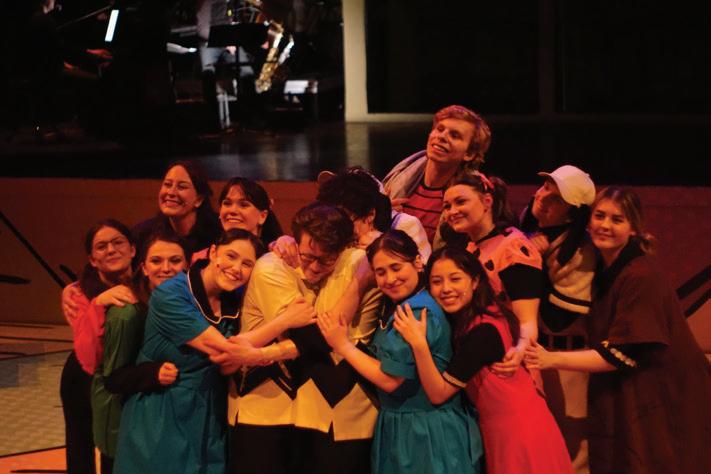
others have taken different paths through music or technical theatre. Malcolm, who had worked backstage for many of the last productions, found it to be a weird but enriching experience. “In a lot of ways, I’d missed performing, but I think my work backstage has given me a much greater appreciation for the work that goes on around a production of this scale … so that I can appreciate and utilize the tools as best I can.” In a sense, the closing hug of “You’re a Good Man, Charlie Brown” gave the cast a chance to show their appreciation to the audience that had supported their journey, and then brought it inward to bring in the appreciation for one another as their final curtain fell on Mar. 15.
By Mackenzy Reid Contributor
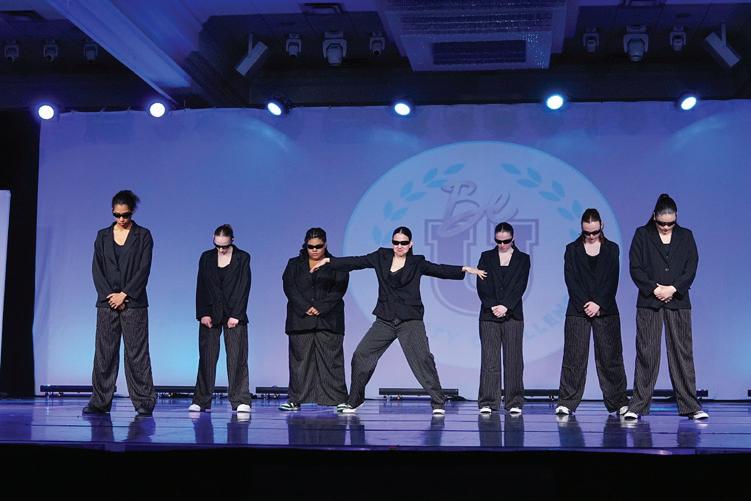
After a long ten-hour travel day, the dancers of the Bishop’s University competitive dance team arrived in Brampton, Ontario, to compete in the Varsity regional dance competition hosted by Be Dance in the Be U series. Over March break weekend on Saturday, Mar. 7, the team brought to stage seven performances, all choreographed by our incredibly talented students here at Bishop’s. In a collaborative environment where
dancers were encouraged to push artistic boundaries, the 18 dancers and their choreographers worked tirelessly to produce these unique performances, each showcasing the creative visions of our community. The competition lineup included the following: a small-group hip-hop dance titled “How Low,” choreographed by Kyddo; a small-group jazz number titled “Feeling Good,” choreographed by Gabe Pelletier; a small-group musical theatre number titled “Mania,” choreographed by Shannon Gaskarth; a small-group contemporary piece titled “People You Meet (or Don’t) on the L Train,” choreographed by Kate Vandermeulen; a large-group contemporary performance titled “The Cave,” choreographed by team leader Léonie Gagnon; and two numbers choreographed by team leader Sonoma Brawley — a large-group jazz number titled “Come On” and a smallgroup tap number titled “Gym Day.”
There is nothing like the combination of nerves and excitement to cre-
ate the butterflies at competitions, and we, the dancers, all felt incredibly lucky to be able to feel those emotions. This atmosphere speaks to what these competitions are truly about– continuing our passions for dance into adulthood. Being part of this team helps make that possible, and going to the Be U varsity competition brings us together with other communities that also get to live their passions and celebrate our talents. In a written statement, teammate Hannah- Michelle Samson speaks to this, stating, “My favourite part about comp was not only being able to spend time with my teammates, but also, seeing so many other schools and teams share the same passion and bond as us.” Her words perfectly capture the sense of unity and collective passion that culminated into an unforgettable weekend. Every performance lit up the stage, finishing the weekend with an impressive team average score of 92.93. The team leaves feeling proud
of not only their results, but the journey along the way. This competition served as a testament to the long hours and hard work all the dancers put in to get to Brampton this year, and the team couldn’t be prouder of the dedication each dancer put in that got them there. Reflecting on the experience, co-captain Léonie said: “This competition reminded me how lucky I am to have this family here away from home. Competition is about so much more than scores and numbers, it’s about the memories we create together, and we created so many!” The dancers fed off each other’s energy and it filled the room with genuine appreciation for not only the opportunity but having each other to share this experience with. As our time together comes to an end, we will continue to carry these memories long after we graduate and take comfort in knowing the relationships and support systems we’ve built will live on as we move along our separate paths in life.
By Abigail Epstein Layout Editor
The new zodiac year begins Mar. 20 as the Sun enters Aries. Expect cracks of fire this Spring Equinox, while the cosmos moves through its cyclical transition.
Aries: You’re a magnet of dynamism and it’s all your own, so move at the pace of your heartbeat. Set something wild in motion, either a goal or a resonant “what if?” Regulate yourself with applause.
Taurus: As the ground changes its shape in the coming weeks, take the steps you need to settle yourself. Resist social pressure that puts joy in a box. Celebration can look like a nap under the sun.
Gemini: Set out like a cartographer, and examine the fresh faces you find. Map out social spaces with a key tuned to whimsy. Turn your head to whatever catches your eye and ask: ___
Cancer: Let a light breeze carry you down a daydream, then plot its points in the following clouds. If you’re moved to connect metaphysical dots, why not! Trust that what has staying power will fill in the outline.
Leo: High risks suit your spirit, so tilt your chin up, buttercup. While it’s tempting to bridge gaps with huge leaps, remind yourself that landings may not be exactly as you picture. Treat high rewards with openness.
Virgo: The new season unearths what’s been in the hidden process, and you may find deep rumblings appearing on your surface. Examine where roots lie. Evaluate the reverberations of attachments.
Libra: Sincerity guides what sticks when it comes to interpersonal connection. Now is a good time to show up as you mean it, rather than how you think you should appear. Remember you are a player, not just a critic.
Scorpio: A new zest in the air calls you to reorganize yourself, so as to accommodate all that’s to come. Maximization is not always filling. Take a warm stance to open space.
Sagittarius: The sun in Aries puts you back in your element, and the world’s on your side when it comes to having fun. Throw a party; build a treehouse; take a bat to a piñata… treat every day like a chance to complete the list.
Capricorn: If you’re caught in the net of memory, be cautious about what unravelling entails. Freedom often lies in unfamiliarity, especially when safe treads fail. Avoid trapping others in important conversations.
Aquarius: Maybe everything feels like it’s happening all at once, but there’s no need to carry it all on your shoulders. Nobody’s judging a touch and go if you show face with a smile on it. Avoid overcommitting.
Pisces: You might feel like a goldfish, swimming in a pool of chance. Don’t bet your values against better odds. Without being shallow, try on filters. Calculate with scales.
For you to take with as many grains of salt as there are stars in the sky.
By Jillian French Arts & Culture Editor
On Mar. 18, the LLC Agora hosted Naben Ruthnum as part of the Ogden Glass Lecture series, coordinated by the English department. Students and staff from the English department packed the steps of the Agora to hear Ruthnam speak on the cultural power of the immortal figure of Dracula in a lecture titled “Dracula Will Not Be Destroyed,” which touched on Bram Stoker’s famous Victorian Gothic novel, but also verged into adaptive forms of the famous literary vampire. Ruthnum himself is a Canadian novelist and screenwriter who refuses to be pigeonholed to one genre: his writing spans short fiction, YA, crime fiction, memoirs and literary criticism. His current work sources material from Stoker’s “Dracula.” The novel, published 1897, tells the story of an unassuming Englishman Jonathon Harker, who becomes entrapped in the castle of a Transylvanian aristocrat, Count Dracula, whose vampirism is gradually realized by Harker. When Harker escapes, Dracula continues to haunt the narrative and prey on his friends, forcing the “Crew of Light” to pursue and vanquish the Count. “Dracula,” Ruthnum explained, is a “clumsily perfect” novel: a great work of fiction, yes, but one that includes “stark problems,” starting with the fact that none of the protagonists are half as interesting as the Count himself, and ending with the fact that even Dracula himself loses interest as “the Dracula of the last half [of the novel] is significantly less formidable than the first half.” The ending of the novel, where Dracula flees from En-
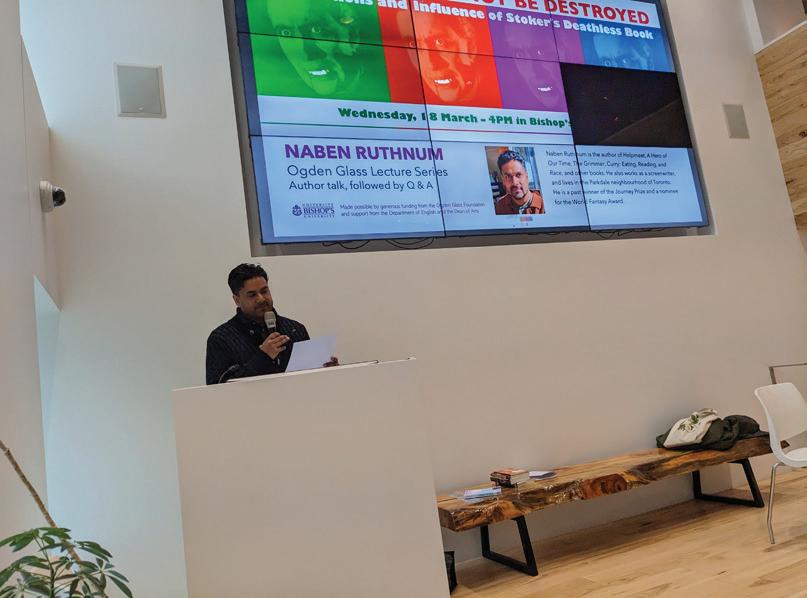
gland back to Transylvania pursued and killed by the Crew of Light, “lets down Dracula himself,” Ruthnum argues, since the arrogant, cunning Vampire of the first half would not be so easily persuaded to tuck tail and run.
Part of what makes the story so interesting, then, is the way adaptations of Dracula take the impressive figure of the count and reimagine his story in new and inventive ways, from Nosferatu (1922) to Renfield (2023). There are some Victorian classics, like, for example, Sherlock Holmes, where the many clever adaptations attempt to capture the original charm and wit of Arthur Conan Doyle’s masterful character, but Dracula is different. Adaptations don’t simply attempt to recapture the figure of the count, but revive and reinvent him from the novel’s somewhat lackluster ending. “The character doesn’t just outgrow the book,” Ruthnum points out, “he begins to rebuke it.” The nature of Dracula, as immortal and undying, is better captured in the way the Count has been adapted than it is in his own source material.
“The presentation was fantastic,” said Jon DeGooyer, a third-year film student. “Nabem has so much passion for the character which is so easily contagious.” Samiya Bouziane Merceron, a literature student, said the presentation was a great reminder of how “prevalent the character is in adaptations.”
Ruthnum’s lecture concluded with a Q&A, where he spoke a bit about his up-and-coming novel, the troubles of conclusions in horror fiction and Count Chocula. In a final question, one student asked why the tale of Dracula had become immortal. Ruthnam answered with two main points: much of it, he explains, boils down to the fascinating “loneliness of evil” of the Count, secluded and solitary in his monstrosity, though he attempts to infect the others. Even more compelling, Ruthnum admits, is that there’s something delightful about a villain who finds such joy in evil; who rebukes the morose and misunderstood nature of Frankenstein’s monster to embrace the strange monstrosity of the Victorian imagination.
Jayme Marteniuk, Economics & Business Editor » thecampus.businesseditor@gmail.com
By Sara Scarfuro Contributor
There is an idea that follows students everywhere, whether they realize it or not. The idea is simple: you are always one purchase away from becoming a better version of yourself. A new outfit could make you more confident. A new routine could make you more productive. A new aesthetic could make your life feel more put together. Whether it is a gym membership, a skincare product or a perfectly curated wardrobe, the message is consistent: change your purchases and you can change your identity. For many students at Bishop’s, this feeling is familiar. The pressure to evolve, improve and keep up is constant. But this mindset is not accidental. It is the result of highly effective marketing strategies that sell more than products; they sell transformation.
Marketing used to focus on what a product did. Now, it focuses on who you could become by owning it. Clothing is no longer just clothing. It represents a lifestyle. A blazer is not just something you wear; it signals ambition and professionalism. Brands understand that students are not just buying items; they are buying into identities. This is especially relevant for students who are still figuring out their path. University is already a time of transition. Marketing simply steps in and offers a shortcut.
Social media has amplified this idea through the rise of aesthetic trends. Concepts like the “clean girl,” the “it girl routine” or the “effortlessly puttogether student” are everywhere. These trends present highly curated versions of life. They show early mornings, organized schedules and perfect outfits. They make improvement feel visible and achievable, but they also tie that improvement to specific products and habits. The result is a cycle. Students see a version of a lifestyle they admire. They associate it with certain items. They purchase those items, hoping to recreate the same feeling. But the transformation is rarely as simple as it seems.
The constant desire to improve is rooted in psychology. People are naturally drawn to the idea of selfimprovement. Marketing taps into that by offering quick, tangible steps. Buying something creates the sense that change is already happening, even before any real habits have shifted. This is why purchasing a planner feels productive before it is even used. For students this feeling can be especially appealing. When time and energy are limited, a purchase can feel like the easiest way to move forward.
The challenge is that identity is not built through single purchases. It is built through consistent actions over time. Because of this, the feeling of
transformation often fades quickly. The new outfit becomes normal. The routine loses momentum. The excitement disappears. What remains is the sense that something is still missing. This is where marketing continues to work. There is always a new trend, a new product or a new version of the ideal self being promoted. The cycle restarts, reinforcing the idea that you are always one step away.
At a small university like Bishop’s, these pressures can feel even stronger. Students are constantly observing each other. This environment can make it easier to compare lifestyles and feel the need to keep up. It can also make
branding yourself feel important, even outside of professional contexts. Understanding how marketing influences these feelings matters. It allows students to step back and recognize when they are being sold an identity rather than a product. Growth does not come from what you buy. It comes from what you do consistently over time. Products can support change, but they cannot create it on their own. Marketing will continue to sell the promise of transformation because it works. The key is recognizing that the version of yourself you want to become is not something you can purchase. It is something you build over time.

By Ryan Allat Contributor
Investing used to feel like something meant for older people like professionals, finance majors or people with a lot of money. Now, it’s everywhere. With apps like Wealthsimple and Robinhood, students can start investing straight from their phones, often with little to no experience. At first glance, it seems like a good thing. Starting early is one of the best financial moves you can make. The idea of growing your money over time is appealing, especially for students thinking about their future. But just because investing is more accessible doesn’t mean students actually understand what they’re doing. That’s where things start to get a bit questionable. A lot of students are
getting into investing without really knowing what they’re investing in. Terms like “diversification,” “long-term growth” and “risk management” aren’t always part of the conversation. Instead, decisions are often based on what’s trending, what friends are buying or what shows up on social media. Platforms like TikTok and YouTube are full of quick videos promising easy money or highlighting “must buy” stocks. While some of this content can be helpful, a lot of it simplifies investing to the point where it starts to feel more like a game than a serious financial decision. And that’s where the line between investing and gambling starts to blur. When students are buying stocks based on hype or fear of missing out, it raises the question: are we actually investing, or are we just hoping for
a quick win? Without understanding what a stock really represents — ownership in a company — it’s easy to treat it like a number on a screen rather than a real investment.
At the same time, you can’t blame students entirely. Most of us were never taught this. Personal finance and investing aren’t required courses for many programs, yet we’re expected to manage student loans, credit cards and savings on our own. For something that plays such a big role in our future, it’s surprising how little formal education there is around it. That’s why more students are turning to the internet to learn, but that comes with its own risks. Not all advice is good advice, and it can be hard to tell the difference when you’re just starting out.
Still, the fact that students are interested in investing is a positive.
It shows a shift toward wanting financial independence earlier in life. The problem isn’t that students are investing, it’s how they’re doing it. Investing can be a powerful tool if it’s approached with patience and some level of understanding. But without that foundation, it can just as easily lead to losses and frustration. At the end of the day, the real question isn’t whether students should be investing. It’s whether we actually know what we’re doing when we are.