Ringette: a club deepdive and insight into next season
No one tells you when it’s over Bishop’s champions inclusivity at annual Marathon of Sport
THE NUMBERED? I HOPE THEY COUNTED CORRECTLY!
The $0 business boom: How Bishop’s students are building income with no startup capital
News:
Grad Formal 2026
By Emilie Vadeboncoeur Director of Marketing and Communications
As the end of another school year quickly approaches, the Bishop’s University Student Representative Council (BUSRC) is preparing to host one of the most anticipated events for graduating students, the 2026 Grad Formal. This year’s theme is “Shoot for the Stars” promising a high-energy, sentimental send-off for the 2026 class that has left a huge mark on the Bishop’s campus.
In addition to the awards, the BUSRC has come up with a new initiative to encourage students to participate in the “grad-posal” contest. Taking a page right out of high school prom traditions. One lucky pair with the best “grad-posal” can win two free tickets to Grad Formal. On that note,
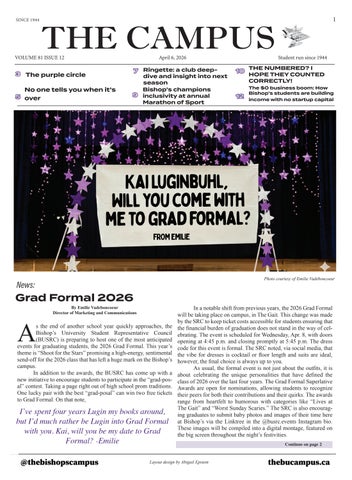
I’ve spent four years Lugin my books around, but I’d much rather be Lugin into Grad Formal with you. Kai, will you be my date to Grad Formal? -Emilie
In a notable shift from previous years, the 2026 Grad Formal will be taking place on campus, in The Gait. This change was made by the SRC to keep ticket costs accessible for students ensuring that the financial burden of graduation does not stand in the way of celebrating. The event is scheduled for Wednesday, Apr. 8, with doors opening at 4:45 p.m. and closing promptly at 5:45 p.m. The dress code for this event is formal. The SRC noted, via social media, that the vibe for dresses is cocktail or floor length and suits are ideal, however, the final choice is always up to you.
As usual, the formal event is not just about the outfits, it is about celebrating the unique personalities that have defined the class of 2026 over the last four years. The Grad Formal Superlative Awards are open for nominations, allowing students to recognize their peers for both their contributions and their quirks. The awards range from heartfelt to humorous with categories like “Lives at The Gait” and “Worst Sunday Scaries.” The SRC is also encouraging graduates to submit baby photos and images of their time here at Bishop’s via the Linktree in the @busrc.events Instagram bio. These images will be compiled into a digital montage, featured on the big screen throughout the night’s festivities.
Continue on page 2
Photo courtesy of Emilie Vadeboncoeur
Kai Luginbuhl, News Editor » thecampus.news@gmail.com
Grad Formal 2026
Continued from page 1
Ultimately, the 2026 Grad Formal is
about the opportunity to have the entire graduating class in one room before everyone disperses into post-grad life.
As the reality of moving away from Lennoxville sets in, everyone will get a chance to have a final drink with their
Kai Luginbuhl thecampus.associateeditor@gmail.com graphicseditor.thecampus@gmail.com
DIRECTOR OF MARKETING & COMMUNICATIONS
Anya Mullen
thecampus.opinions@gmail.com
FEATURES EDITOR
Lauren Root
thecampus.features@gmail.com
SPORTS EDITOR
Owen Kitzan
thecampus.sports@gmail.com
ARTS AND CULTURE EDITOR
Jillian French
thecampus.artsculture@gmail.com
Megane Masson & Jon Roach
THIS ISSUE’S CONTRIBUTORS:
Chloë Beauvais
Francis Paquin
Henri Dessureaux
Jayme Marteniuk @thebishopscampus Instagram
Leighton Geraghty
Max Harrison
Megan Franco
Mike Dooley
Olivia Woods
Owen Grand
Piper Howell
Romane Bessiere
Sara Scafuro
Shelly-Ann Canares
Tallula Russell
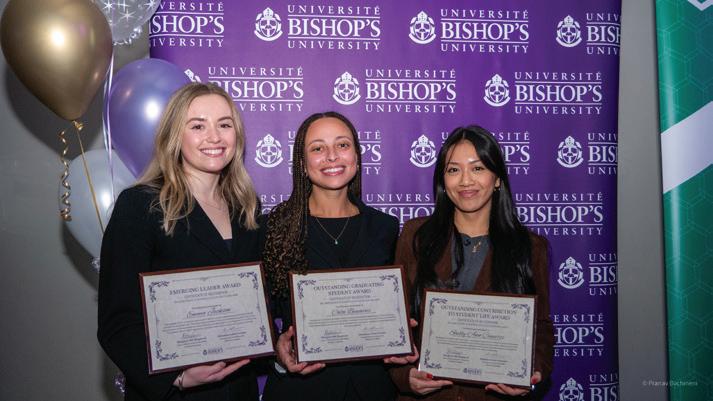
WSB Recognition Gala
By Chloë Beauvais Contributor
On Friday, Mar. 27, the Williams School of Business (WSB) hosted the second annual WSB Recognition Gala. Held at the Gait, this event brought together students, faculty, staff and partners to celebrate and recognize accomplishments across the Williams School of Business. The evening offered the community an opportunity to come together in a formal setting and express appreciation for the amazing contributions that have helped shape the school’s culture.
The gala was a night to celebrate exactly what it means to be part of the Bishop’s community. Awards highlighted the values that shape
the Williams School of Business’s culture by recognizing individual accomplishments and those who have made a commitment to making a difference both inside and outside the classroom. The event served as a reminder that success within the Williams School of Business is not only measured by academics, but also by the ways you contribute to the broader community.
Awards given throughout the night recognized outstanding contributions, leadership, innovation and meaningful involvement within the Williams School of Business. From individuals who have dedicated their time to strengthening student life to faculty who have gone above and beyond in making their classroom a unique learning environment. Staff
The purple circle
By Max Harrison Contributor
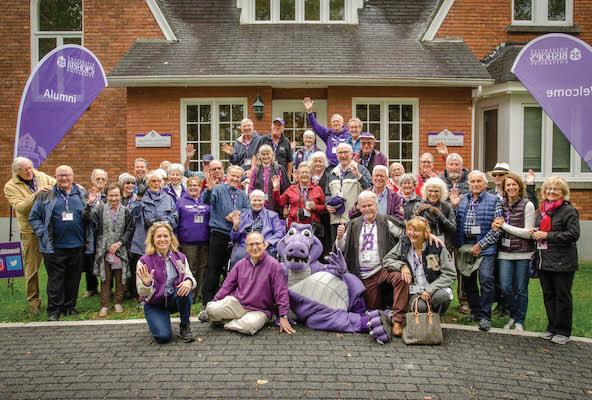
Before arriving at Bishop’s University, Max Harrison had heard whispers about the institution’s strong alumni network, but its impact became clear during his first year, when a cold message he sent on LinkedIn received a response within minutes. Now a fourth-year Business Finance student preparing to graduate this spring, Harrison reflects on his experience with alumni who have proven to be genuine, responsive and deeply invested in students’ success. From that initial interaction, it became evident that Bishop’s alumni community functions not only as a professional network, but also as a mentorship circle, support system and extension of the campus experience. Throughout his studies, Harrison has turned to alumni for career advice, guidance in navigating the finance industry and
Tinterview preparation, consistently encountering a willingness to help that he hopes future graduates will carry forward.
This past summer, Harrison had the opportunity to connect with several Bishop’s alumni while completing an internship at Mackenzie Investments in Toronto, including Jonathan Verity (BBA ‘07) and Helen Kearns (BA English ‘75).
Harrison first met Verity, Regional Senior Vice-President of Sales at Mackenzie Investments, during the application process when Verity noticed that Harrison’s resume photo had been taken in McGreer Hall at Bishop’s. Their conversation quickly turned to shared connections at BU, including BUCS, the SEED Portfolio and the Golden Lion Pub, before his colleague gently steered the two back on track. Although Harrison was not selected for the role at that time, he maintained con-
and partners were also recognized for the amazing contributions they have made towards supporting growth and enhancing the student experience. Business student and the events Master of Ceremonies, Benji Bridle, commented on the event, stating, “It was pretty cool looking around the room and realizing that I was surrounded by so many of the people who have impacted my experience here at [Bishop’s].” His words serve as a reminder that behind every student experience are countless individuals whose contributions help shape the Williams School of Business community. It honoured the immense effort that goes into creating an environment where students are encouraged to grow, and faculty are excited to innovate.
Organized by Sandrine Hébert and Vivienne Webster, the Williams School of Business recognition gala offered a moment to reflect on the past year and celebrate contributions that often go unnoticed. There was an indescribable sense of pride in the room, filled with the people who make the Williams School of Business what it is. If there is one takeaway from this event, it’s that at Bishop’s University, the people really do make the place.
tact with Verity and was later successful upon reapplying. The two remain in touch, reflecting the lasting relationships fostered through the alumni network.
Harrison also met Kearns, former president of NASDAQ and current Executive Chair at Bell & Kearns Associates, as well as the fourth woman inducted into the Investment Industry Association of Canada Hall of Fame. Despite a demanding schedule, Kearns dedicated 45 minutes of her time to share insights from her career, reflect on her years in Lennoxville and offer guidance that Harrison describes as invaluable. She also facilitated connections with industry leaders shaping the future of the finance industry.
For current students, Harrison emphasizes the importance of engaging with alumni and taking advantage of the knowledge, encouragement
and opportunities they offer because they want nothing more than to see fellow Bishop’s students succeed, and they are very willing to lend a hand. While institutions such as McGill University and Concordia University may be known for their size and global reach, Bishop’s has something they don’t; that unmistakable Gaiter-to-Gaiter bond – the kind felt within seconds of meeting someone who has walked the same campus. Harrison hopes to one day contribute to that tradition by supporting future students in the same way he was supported.
he Campus acknowledges that the land on which we operate is stolen land, the traditional territory of the Abenaki people. We live, learn, work, and play on this land, home to Indigenous peoples still living. Canada was founded through colonization, a system rooted in oppression and the abuse of power over others, continuing to affect First Nations, Inuit, and Métis communities today. As a student newspaper, The Campus has a responsibility to highlight truth. We are committed to prioritizing underrepresented voices in our community and proactively highlighting Indigenous peoples’ histories and ongoing realities, including their resilience and achievements. We recognize our work plays a role in shaping public perceptions, being able to call-out injustice but also call-in action. We emphasize that we must go beyond a land acknowledgement, which is only one step towards reconciliation. It is the stories in our paper – told with respect, accuracy, and integrity – and the respect and humility we show to the land and others that is more important than what is written in a land acknowledgement. Actionable steps to go beyond a land acknowledgement include educating ourselves and others, and supporting Indigenous traditions, movements, and businesses. —The Campus Team
Photo courtesy of Pranav Buchineni
Photo courtesy of the BU Alumni Relations Office
The best thing you can do at Bishop’s is get involved
By Olivia Woods Contributor
When I first came to Bishop’s, I never could have imagined that in my last year, I would be attending the United Nations in New York City. On Mar. 9, I had the privilege of attending the 70th Commission on the Status of Women (CSW) as a delegate with the Canadian Federation of University Women (CFUW), an organization founded in 1919 that has spent over 105 years striving for educational and economic equality and social justice through continuous learning and empowerment. Being part of a delegation at the UN was an incredible experience, but more importantly, it was a wake-up call. It showed me that global change does not start at the global level; it starts with local involvement and community action.
Throughout the week, I attended over twenty sessions that highlighted a wide range of topics, including youth involvement, sexual violence prevention in Canada, women’s rights and access to education in Afghanistan. Listening to speakers
from around the world discuss these issues made one thing very clear: the issues being discussed at the United Nations are also happening right here in our own communities. Organizations like CFUW prove that organized, local action is what fuels global change.
Reflecting on my experience, there were a few key takeaways that I think are especially important. The first is that your voice is needed more than ever. Many of the conversations at the UN focused on the importance of youth involvement and participation in decision-making spaces. Too often, young people feel like they need more experience or more time before they can speak up or get involved. But the reality is that change happens when people decide to participate, not when they decide they are finally qualified enough.
Furthermore, stop waiting until you feel qualified. One of the most frequent questions I get asked about the different areas I’ve been involved in is how to deal with imposter syndrome, the idea that you are
underqualified. I was nervous about attending the United Nations, but I realized that everyone brings different experiences and perspectives. You are not unqualified because your journey looks different from someone else’s. Your ideas are valuable right now, not just after graduation or after you have a certain title. Imposter syndrome isn’t real!
This reemphasized for me that the best thing I have done at Bishop’s is to get involved. Your future does not start after graduation; it started the second you walked onto campus. There are endless reasons why you might not want to try something new; it might be outside your comfort zone, time-consuming, or intimidating. But time is going to pass anyway, and your passions are too important not to act on.
Bishop’s offers so many opportunities for students to get involved, whether that is through clubs, volunteering in the community, attending events, applying for funding opportunities or connecting with national organizations. If I had
Step outside... and change your life
By Piper Howell Contributor
If you had the chance to finish high school 6,500 kilometres from home in a small Swiss town, would you do it? Spending my last year of high school living in Switzerland changed my life and I believe that living abroad, even for a short amount of time, is one of the best ways to become independent. Moving to a different continent at 16 wasn’t an easy decision but ultimately, I cannot imagine who I would be if I hadn’t made that move.
In Grade 12, I attended a high school in the small French-speaking town of Neuchâtel, Switzerland. I lived with a Swiss family alongside three other girls from the school, and we were interwoven into the daily lives of our host family. The school itself is Canadian; Neuchâtel Junior College was founded in the 1950s to give Canadian teenagers the opportunity to live abroad while they finished their high school studies. My classes followed the Ontario curriculum just like my high school back in Toronto, but for ten months I was immersed in
Swiss culture, spoke French daily, and boarded the R13 train from Gorgier-StAubin every morning alongside Swiss students and other Neuchâtel citizens for my commute into town.
The independence and confidence gained from my year abroad were expected outcomes from living away from home but there was so much more to that year. Going to school in a different country changed how I saw my place in the world but also how I understood my own identity, values and life prior to that experience.
The biggest change at the time (other than my surroundings) was the amount of freedom I was given. Almost every weekend, whether on a class trip, or with a small group of friends, I travelled to a new city in Europe. Naturally those trips helped build that independence. Planning trips, exploring new cities where sometimes neither French nor English were spoken, staying organized, managing flight schedules, train station departures—all of this required a level of responsibility that I don’t think I would have developed in the same way, or as early in my adulthood, had
not leaned into the support from the Bishop’s community and gotten involved at a local level, I never would have had the opportunity to learn and advocate on a global scale.
One of the things students love most about Bishop’s is the sense of community. To me, loving the community you are a part of means helping it grow. The world is waiting for your perspective, so don’t wait to share it! Find your group, find your cause, and use the support around you to act. You are already more than qualified.
To learn more about CFUW or to find a club near you: https://www.cfuw.org/
I stayed in Canada.
Different parts of this experience— trying new foods like saganaki in Nafplio, adapting to new customs such as longer and later mealtimes, and being exposed to different nuances within languages like how in Swiss French the numbers 70, 80 and 90 are expressed differently (septante, huitante, and nonante) can seem small but together helped shift my perspective. I became more open minded and adaptable to what life could be outside of what I had always known.
Even if it’s for a short amount of time, and not in the same way I experience it, I encourage people to travel and be open minded to new cultures, especially when you are young. Being able to step out of your comfort zone and having the willingness to pivot when needed, whether that means staying in a slightly sketchy Airbnb on the outskirts of Vienna just to experience an Austrian Christmas market, or sleeping in a train station because you missed the last train of the night. These kinds of experiences are often only possible when you are young and can be
incredibly formative. I recognize that my year at Neuchâtel comes from a place of privilege, but my experiences remain a very significant part of my identity. In the end living abroad challenged the way I think, expanded my understanding of the world and gave me a great group of friends who study and work across the globe that I continue to stay connected with.
At the ripe age of 15, when you’ve finally figured out the right amount of deodorant to use and the consequences of putting water in your parents’ vodka, you are asked to choose your career path. Not just any path either, the one that will decide what seems to be your fate. So if you were pretty mediocre in just about everything you touched, you’re going off pure instinct at this point. If you watched “Good Will Hunting” or “Dead Poets Society” one too many times, then teaching is a pretty easy place to land.
Your aunty and family friends always called it an honourable choice. They love that word, honourable. Usually followed by something about the two months off in the summer, or a quick comment about how teachers never stop protesting, but in a way that still sounds respectable. You start to believe it. You picture yourself standing on a desk, reading something meaningful to a bunch
of motivated students, in a nicely lit room filled with books. It feels just real enough to not question. Until life slaps you behind the head four years later with a wet eraser.
Now you’re in an overcrowded classroom, trying to explain what a noun is for the 26th time that day. Half the class is still lost, a few have completely checked out, and the answers are already sitting on the board in red. No one is standing on desks. No one is having a life changing moment. You’re just there, repeating yourself, wondering how something that once felt so full now feels so… normal. And that’s the weird part. It’s not bad. It’s just not what you thought it would be.
At some point, you catch yourself choking on that dream you once fed yourself. Wondering if those 20 000 dollars in tuition were actually worth it. Wondering if you believed a little too easily that a career would be fulfilling just because someone told you so, or because it sounded honourable, or in my case because
Robin Williams was so damn convincing.
But you don’t just drop it. You start to see things differently, or maybe you just learn how to talk about them differently. Because those nouns don’t magically get more interesting the more times you repeat them. But that one moment, when it finally clicks for someone after the 27th time, does feel like something. Not in a movie kind of way, just in a quiet, almost easy to miss kind of way. And maybe that’s the point no one really explains. The job doesn’t come with meaning built into it. It never did. It gives you something to do, something to show up to and from there you’re the one who has to decide if it means anything.
As I finish my own academic journey, I find the whole thing a bit underwhelming. My life hasn’t revolutionized the way I thought it might seven years ago. None of my students have stood up on their chairs. I haven’t dramatically turned someone’s life around. But there’s
No one tells you when it’s over
By Jonny Roach Staff Writer
The page looks the same as it always does: blank, waiting, familiar. I’ve sat here before, more times than I can count, chasing a first sentence that never feels right until it suddenly does. It’s routine now, almost muscle memory. But this time, something’s off. Not in the words, not in the process, but in what this really is.
This isn’t just another article. It’s my last one. And for something that’s supposed to mean that much, it feels exactly the same. No weight. No pause. No moment where everything slows down and asks to be understood. It moves the way every ending always has. Quietly, without announcement, without asking to be noticed. I think that’s why it’s so easy to miss.
The moments that matter almost never arrive as moments. They slip in disguised as routine, something you’ve done before, something you assume you’ll do again. I knew the
last time I walked out of my first-year dorm room that it would become a memory instead of a place. I knew the last time I stepped off Coulter Field in shoulder pads would mark the end of my days playing competitive sports. But those were the easy ones to recognize.
The times I might miss the most were never that obvious while they were happening. I think about traditions like walking the arches, sipping a drink made by Bishop’s brewing students, or the last time I heard “we’re going to Animal House tonight.” They were like stepping into spaces that felt so constant they almost seemed permanent, but they never told me when they were finished. They just faded, quietly, into something I now find myself holding onto without realizing when I started.
The Bishop’s experience didn’t arrive all at once. It built slowly, in layers I didn’t see forming. The same people, the same places, the same rhythm, until it stopped feeling temporary and started feeling like
still something in the small moments. The little laughs in the morning. The tired smiles when the sun hasn’t even risen yet. Nothing you’d put in a movie, but still enough to make you come back the next day.
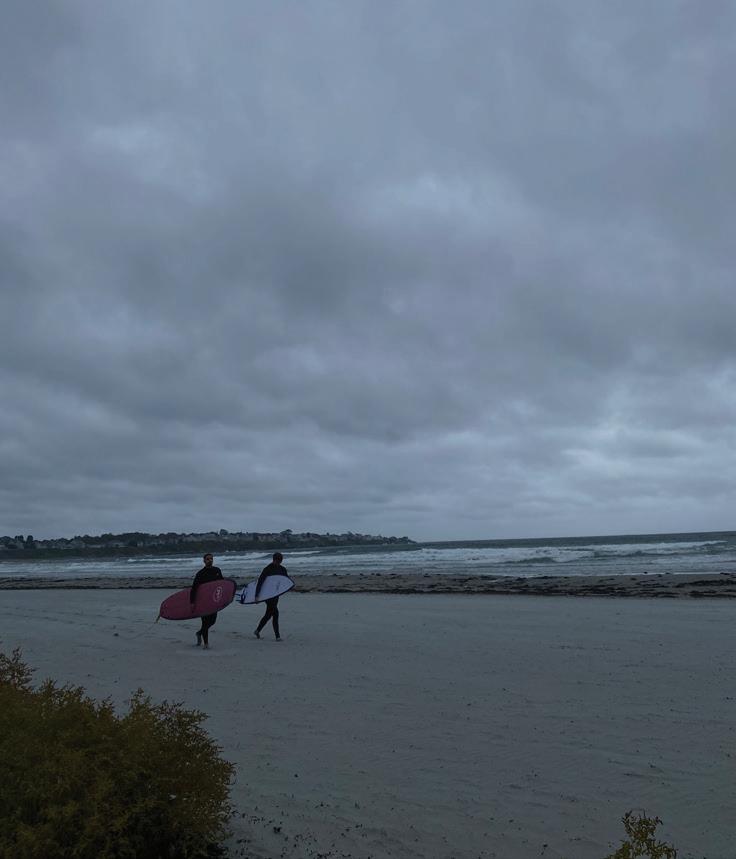
And if it all doesn’t work out, if one day it really doesn’t feel like enough, there’s always the option to become a surf instructor somewhere in South America. Which, honestly, might have been the more honest choice at 16 anyway.
something I could rely on. Like something that would still be there tomorrow. Most of the time, it was. Until it wasn’t.
I’ve spent the past year writing about the Bishop’s moments that demanded attention, like big games, major events, the kind of memories you can picture in real time as they’re happening. Yet, the ones I keep coming back to now aren’t those, but the ones that never felt significant as they were happening. The in-between moments. Like stopping to say hi to someone on your way back from class. Moments I didn’t think twice about while I was in them. That’s what I wasn’t ready for. Not that this would end, but that it would end so quietly.
No final moment that holds it all together. No clear line between being in it and looking back on it. Just a slow shift, where something that felt like everyday life becomes something you can’t step back into the same way again. I think, if anything, that’s what I’ve learned to hold onto. Not the idea of trying to
make every moment matter, but the understanding that they happened every day, even if I couldn’t see it. Even when I thought there would be more time, because there isn’t a version of this where I get to do it over. There’s only this one, exactly as it happened: unfinished in places, imperfect in others, but real in a way that only something lived through can be. And maybe that’s enough. Maybe that’s what makes it worth holding onto in the first place. Not because it’s over, but because it happened.
Graphic courtesy of Latoya Simms
Photo courtesy of Francis Paquin
A season to remember: BU Men’s Club Hockey honour a season built on commitment
By Owen Grand Contributor
The Bishop’s Men’s Club Hockey closed out a memorable season this past Saturday with their annual banquet, held at the Gait. The evening brought together players, coaches, supporters and alumni for a night to reflect on both the success of the season and the strong culture that defined the team throughout the year.
Following a first-place finish in the AAU regular season, they had plenty to celebrate, but the focus of the night extended beyond just results. Coaches took time to recognize the commitment shown by players throughout the season, highlighting the demands of early morning practices, frequent travel and long hours spent balancing hockey with academics. Their speeches emphasized the discipline and dedication required to sustain
that level of effort, and the group’s ability to do so consistently.
An alumni speaker, Ron Perowne, also addressed the team, offering a unique perspective shaped by his experience as a former Bishop’s men’s hockey player, football player and football coach. His speech blended personal stories with a clear sense of pride in the current group, reinforcing the connection between past and present generations of Gaiters athletes.
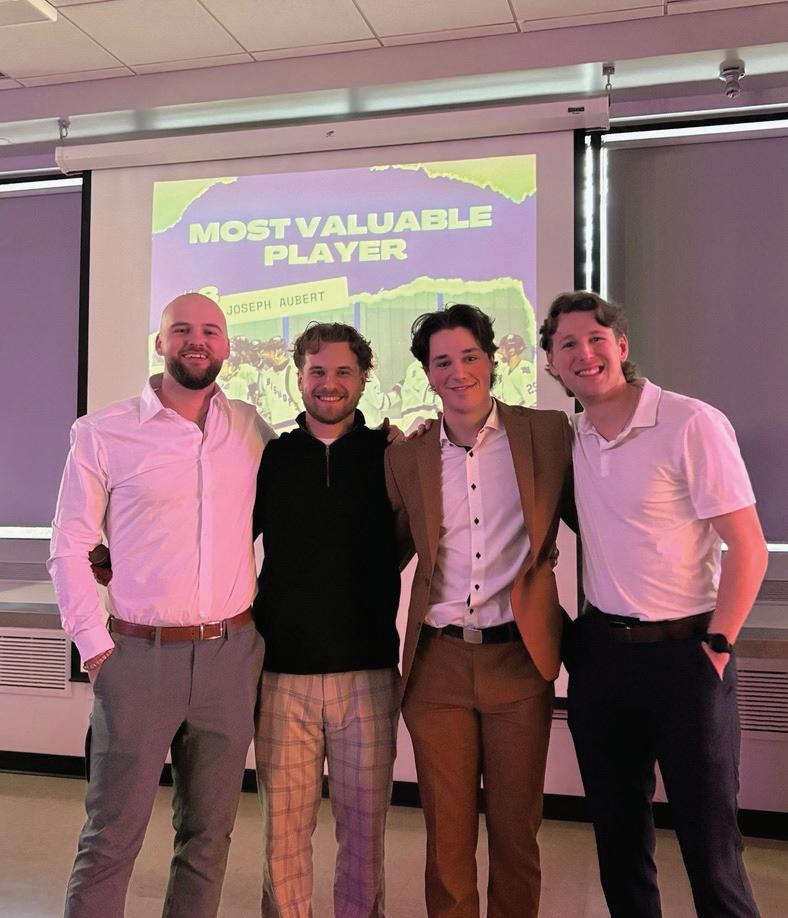
The banquet also featured a series of awards recognizing individual contributions. Jo Aubert was named team MVP, capping off a standout career with the program. Beyond his performance on the ice, Aubert’s impact on the program has been defined by the countless hours he has invested in helping build and improve the team, demonstrating a level of commitment that has elevated the program. Additional awards included Hardest Worker
(Tristan Côté), Most Improved Player (Sam Marchand), Defensive Player of the Year (Nathan Gagnon) and Rookie of the Year (Leandre Jodoin). The team also took time to recognize its graduating seniors: captain Jo Aubert, goaltender Jack Macfarland, defenceman Jack McGowan, and forward Marc Lagacé. Their departures mark the end of an important chapter, but also highlight the strong foundation they have set for the future.
While the banquet included formal recognition, the overall atmosphere remained light and social, with players and coaches sharing stories, enjoying food and drinks and reflecting on the season together. That sense of unity has been central to their success. Throughout the season, the team demonstrated strong chemistry on the ice and a strong commitment to community involvement. They’ve shown what it truly means to be a Bishop’s student-
Cheers, tears and a Gaiter reveal?
By Leighton Geraghty Contributor
After a hard fought year, Gaiters Athletics has come to a close. Despite the numerous ups and downs this year brought, Thursday, Apr. 2 saw everyone come together and celebrate the 2025-26 athletic year. The athletic banquet is a chance for one final send off before the graduating players head on to their next journey and those who are staying, start the grind all over again. Lucky enough, I was invited to the awards not just as a viewer but as the MC this year. This year’s show was one to remember with countless laughs, cheers and even some tears.
After a couple of shoutouts to our corporate sponsors and the reveal of who won “Are You Smarter Than A Gaiter,” we celebrated the seniors with their Purple Letters. The Purple Letter is handed out to graduating students who are in good standing with their
team and a significant contributor to the community. This year, there was a special twist. After all of the athletes walked across the stage and received their pin, there was one final person named. The Gaiter was called out on stage and in true masked singer fashion was celebrated by the crowd as he revealed himself. Isaac Flanagan appeared under the mask and was awarded a Purple letter for his contribution to the athletic department. The next part of the ceremony was the positional and team awards. Countless names came forward to take their pictures all while waving to the viewers back home.
The major award winners were the final part of the banquet. Beginning with the Ray Almond award which is given annually to a dedicated member of the Bishop’s Athletic community who rises above and beyond to deliver an invaluable service for Gaiter Athletics. This year’s winner was longtime athletic trainer Dawn Patterson. The crowd
gave a standing ovation as Dawn received her award. She is a true hero and loved by everyone in the community. Up next we had the Student Athlete Leadership Award given to one male and one female. The two winners were Taylor Mason from the Women’s Soccer Team and Dylan Monico from the Football team. Post leadership awards for the Student Athletes of the Year were announced. Cammy M. Bernier from the Women’s Rugby team won her second in four years. The human equation Charles Robert brought home his fourth straight. These two really put the student in student-athlete as they both excel in their sports but also in the classroom. The female Rookie of the Year award was awarded to Sandrine Chouinard (Women’s Hockey), whereas the men’s award was won by both Curtis Driver (Men’s Rugby) and Mathieu Bellavance (Football). Finally what we’ve all been waiting for, the Athletes of the Year. On the women’s side three times back to back to back champ Gabrielle
athlete.
As the team looks ahead, the focus now shifts to building on this momentum. With a successful regular season behind them and a strong culture in place, the team is well-positioned to carry their progress forward as they set their sights on a national championship next year.
Santerre came home victorious after yet another dominant season on the Hockey team. Santerre also announced she will be playing Golf in the fall next year for the Gaiters Golf team. The Male Athlete of the year is arguably the most decorated athlete BU will ever see. CHARLES ROBERT. Charles is not only great in the classroom, he also excels on the court. While conversing with him he stated that he is looking to continue his academic journey while also trying to pursue pro basketball.
We wish the best for every graduating senior. For now, the returning players will head back to the grind and prepare for yet another historic year next year. Stay tuned Gaiter Nation!
As the school year finally comes to a wrap, I wanted to interview an athlete from the school to get insight on their thoughts and feelings about their time here. For the interview I went down a different path when choosing an athlete, opting to interview a club athlete instead of a varsity one. The reason for that being the role this player contributed to turning a program into national championship finalists from a beer league team when I first joined five years ago. It was my pleasure to get to ask the nowformer Captain of the BU Club Hockey team the following questions about his time at BU.
What did being captain of a club sports team for multiple years mean to you?
“Being captain meant a lot more than wearing a letter. When you’re part
of a club team, nothing is really given to you. Every season, every trip, every opportunity comes from the work you and your teammates put in behind the scenes. For me, it was about creating a culture that people wanted to be part of. Seeing the program grow has been one of the most rewarding experiences of my time at Bishop’s.”
You had a different role than most athletes, essentially acting as team manager as well. What was it like making sure the team could run on and off the ice?
“It was a unique challenge. Most athletes can focus purely on performance, but in our case, there was always another layer, logistics, budgeting, travel, communication, fundraising. At times it was demanding, but it also gave me a completely different perspective. You start to understand how much goes into creating opportunities for a team, not just participating in them. In a way, it made
the success even more meaningful.”
What kind of impact did playing a sport at Bishop’s have on you?
“It shaped almost everything about my university experience. It gave me a community right away, but more importantly, it pushed me to grow as a leader and as a person. Balancing school, responsibilities with the team and everything else forced me to become more disciplined and intentional with my time. Beyond that, it showed me the impact a team can have beyond the sport itself, on campus culture and on the people within it. That’s something I’ll carry with me long after graduating.”
As a graduating senior, what’s one piece of advice you’d give to any athlete, club or varsity?
“Don’t take the experience for granted, but also don’t just go through it. Be intentional about what you’re building with your teammates. The wins and
losses matter, but what stays with you is the culture you create, the relationships and the moments in between. And if you’re in a position to lead, step into it fully. The impact you can have on a program and on people is a lot bigger than you think.”
Ringette: a club deep-dive and insight into next season
By Shelly-Ann Canares Contributor
You’ve heard about the hockey club and the figure skating club, but what other Bishop’s club is played on ice? First created last winter by two dedicated players from Quebec and B.C., Shelly and Abigale decided it was time to bring their favourite sport to Bishop’s.
If you’ve never heard of ringette, you’re not alone! The sport shares many similarities to hockey: the equipment, the fast-paced skating, the team structure and the excitement of chasing a goal. The differences are what make the sport so unique, some might even argue that it makes it more exciting than hockey!
Instead of a puck, ringette players use a rubber ring, making it more demanding for people to play with accuracy. Instead of a hockey stick, a straight stick is used to control and pass the ring… once again, making it more demanding for accuracy! Unlike hockey, it is mandatory to pass the ring at each blue line to make it to the offensive zone… making teamwork highly essential.
When created in 1963, the founders wanted girls and women to have their own competitive, dedicated and noncontact winter sport, where they would distinct themselves from hockey. While ringette’s roots are proudly female, our club is open to boys, girls and skaters of all levels. Whether you can skate or not, it’s the perfect opportunity for students to
add competition and fun in their busy lives.
With great ambitions for next year, including enrolling in the University Challenge Cup (UCC) in Guelph, we want to introduce this ever-growing sport to the Bishop’s community, and eventually, to the Sherbrooke community. With professional ringette leagues in B.C, Alberta, Ontario and New Brunswick, we’re hoping that Bishop’s develops its own varsity team in the near future. Apart from competition, we want to share the joy and thrill of ringette with Bishop’s. If you’re a hockey player or figure skater looking to try something new on ice, or someone who wants to stay active during the school year and meet amazing people – then ringette is for you.
As our club continues to grow, we hope to inspire a new generation of
From the rink to the links
By Henri Dessureaux Contributor
Recently Gabrielle Santerre won her third straight female athlete of the year award, to add to her U-Sports MVP, playoff MVP and U-Sports championship amongst other awards. Her accolades on the ice are outstanding, having notched 99 points in 67 games throughout her first three years at Bishop’s.
Most people would look at this and say what a superb athlete, what more
is left for her to achieve at this level?
For someone like Gab, she began to look at how she could add another sport to her already ever-growing resume. This thought process is what led her to making the commitment to play for the BU golf team in the upcoming season, becoming one of the rare dual-sport athletes Bishop’s has featured throughout the years.
She brings very strong leadership qualities along with her, proven by her captaincy on the women’s hockey team, as well as her fierce competitive nature. With the BU women’s golf team having
recently made the national tournament in back-to-back years for the first time, the addition of Gab hopes to help propel them even further.
Her attitude and vision should help to continue to grow the program. During the recruitment process before she came to Bishop’s, she turned down multiple D1 scholarships in the United States. She opted instead to help develop a program from the ground up, helping them become national champions before they had even reached five full years in the league. Her attitude and willingness
to show up and work everyday will surely translate to her golf game for the following season.
With the season having recently come to a wrap on athletics for the year, it’ll still be a little while before we get to see Gab out on the course. Whether it be on the rink or at the links, we know she will continue to represent our school with the utmost pride and a great character no matter what other outcome may arise. We wish her all the best and can’t wait to see her make her debut on the course next year!
ringette players, and to spark the beginning of a professional league in Sherbrooke someday.
Photo courtesy of BU Club Hockey Team
Photo courtesy of BU Club Ringette
Lauren Root, Features Editor » thecampus.features@gmail.com
Model UN, a true New Yorker experience
By Mike Dooley Contributor
On Saturday, Mar. 28, the Bishop’s University Model United Nations delegation embarked on a diplomatic journey to one of North America’s most dynamic cities: New York City. Long celebrated for its vibrant energy and cultural diversity, the city fully lived up to its reputation. Throughout the streets, Bishop’s delegates encountered an array of pop-up shops and authentic American cuisine, immersing themselves in the unique atmosphere of the city.
By Sunday evening, the focus shifted to diplomacy as delegates convened for their first formal session at the National Model United Nations conference. Throughout the week, the Bishop’s delegation represented the state of Norway, an assignment that fostered a highly collaborative and team-oriented approach to international relations.
I had the privilege of working alongside Marin Elvin-Jensen, a second-year political science major,
in the First General Assembly Committee, where we addressed the topic of International Cooperation on Counter-Terrorism Efforts. Our strategies, while distinct, were complementary. Marin focused on the role of emerging technologies, particularly artificial intelligence, in detecting and preventing terrorism, while also emphasizing the importance of addressing root causes and enhancing cross-border data cooperation. My work centered on promoting the inclusion of female perspectives within counterterrorism initiatives, advocating for increased representation of women in intelligence and security sectors, particularly in leadership roles.
Despite being one of the more controversial proposals within the committee, my resolution successfully passed with a simple majority vote. This achievement was particularly significant given the complexity of the process. For instance, Marin contributed to a resolution that secured 47 sponsors, requiring unanimous agreement on all amendments, no small feat in
a setting where diverse and often competing national perspectives must be reconciled.
The success of the Bishop’s delegation extended beyond individual contributions. Every resolution paper involving a Bishop’s student was ultimately adopted, reflecting the group’s dedication, adaptability, and diplomatic skill. In recognition of these efforts, the delegation was awarded an Honorable Mention for Outstanding Delegation at the National Model United Nations conference.
Beyond the academic accomplishments, the experience fostered meaningful personal connections. Delegates formed friendships that will last long beyond the conference itself. I had the opportunity to connect with students from the Armenian delegation based in Los Angeles, who are now exploring the possibility of visiting our campus in Quebec.
Overall, this experience was both professionally enriching and personally transformative. While the conference strengthened our
understanding of global diplomacy, it also deepened the bonds within the Bishop’s Model United Nations community. The friendships formed, both within our delegation and with peers from around the world, were truly invaluable.
Participating in Model United Nations has been one of the most rewarding experiences of my academic journey, and the memories created in New York City will not soon be forgotten.
Bishop’s champions inclusivity at annual Marathon of Sport
By Gabrielle Lalonde Graphics Editor
On Mar. 22, a sea of bright coloured team shirts flooded the John Price Sport Center, transforming the gym into a hub of inclusivity. These participants gathered not just to play, but to support the Special Olympics Canada Foundation through its signature event. The Marathon of Sport welcomed 28 Special Olympic athletes to Bishop’s, proving that true sport lives in the power of inclusion.
Behind the scenes, the MotionballU Bishop’s committee coordinated for months to transform the John Price Sports Centre into an inclusive arena. From managing team registrations to setting up and running the various sports stations, these student organizers ensured the event’s success. Taylor Mason and Tessa Bradshaw, the senior event organizers, oversaw the entire event, ensuring a seamless experience for all participants, volunteers and the 28 visiting Special Olympic athletes.
Once the opening ceremonies
concluded, the previously quiet gym erupted into a flurry of activity across seven different stations. Integrated teams charged onto the Mitchell gym court for basketball and soccer, while the high-energy groove of Just Dance thumped in the BU Skillz room. In the Denver gym, the bench ball station allowed the competitive spirit to reach its peak as team members strategized together to stay in the game. This diverse lineup empowered every participant to showcase their unique strengths while fostering a sense of community.
Among the seven stations, the #NoGoodWay education station served as a hub for reflection, where teams signed a pledge of inclusion and discussed the impact of their language. Daniel Hobbs, the Junior Co-Lead of MotionballU Bishop’s, noted that while the committee spent months coordinating team rosters and sports equipment, this specific station provided a deeper connection to the cause.
“The marathon had a great mix of sport and educational activities, but
the No Good Way station stood out most to me,” shared Hobbs. “It really showed how important it is to keep the impact of the day going even after the event ends.”
While the athletic competition fueled the day’s energy, the financial support from the community provided the foundation for the event’s success. Benjamin Robinson, the committee member responsible for finance and sponsorship, spent months securing local partnerships and managing the marathon’s budget. This behindthe-scenes work ensured that every dollar raised by participants went to the Special Olympics Canada Foundation. “People got together so naturally because everything was so spontaneous,” Robinson shared. “It was genuinely the most memorable day to be a part of.”
The Sports Center reached its highest volume during the closing ceremonies as everyone gathered for one final celebration. Students cheered loudly during the presentation of spirit awards, which recognized the participants who brought the
most energy to the event. The final moments of the day focused entirely on the 28 Special Olympics athletes as they received medals and applause for their sportsmanship and skill. The energy in the gym signaled more than just the end of an event, as it marked another chapter in the university’s commitment to meaningful inclusion. While the vibrant team shirts will eventually go into storage, the signatures on the #NoGoodWay pledge will remain a testament to a campus culture that values every athlete regardless of ability. The Marathon of Sport proved once again that when the Gaiter community rallies together, the impact reaches far beyond the gym walls.
Photo courtesy of Mike Dooley
Photo courtesy of Taylor Mason
Lauren Root, Features Editor » thecampus.features@gmail.com
Five things to know about the housing situation in Lennoxville and how it affects Bishop’s students
By Olivia Norby Senior Copy Editor
Lennoxville’s rental market is becoming a defining part of student life at Bishop’s University. Rising rents, landlord disputes and limited residence space are pushing more students off campus, often into competitive, sometimes uncertain housing situations. With Quebec’s annual rent adjustment set at 3.1 per cent this year, according to Quebec’s Tribunal administratif du logement (TAL), students are feeling the effects both financially and personally. Here are five key things to know about what’s happening and why it matters.
Rent is rising and even small increases add up
With rent set to increase by 3.1 per cent, students say the increased effect is noticeable. Sadie Bull, a Bishop’s student living off campus, says her rent increased by about $45 per month. “I think it’s like $45 increased rent each month, which doesn’t sound like a lot month to month, but it’s added up a lot over the 12-month lease that I’m in,” she said.
In a student budget already
stretched by tuition and groceries, even incremental increases can mean cutting back. For many students in 12-month leases, the higher rate applies yearround, even if they leave Lennoxville for the summer.
Lease timing can catch students off guard
In Quebec, most leases renew on July 1, and landlords typically require tenants to confirm renewal or give notice months before this deadline. Students who are unsure about their future may feel pressured to re-sign early just to secure housing. Those who hesitate risk losing their apartment in an already competitive market.
Landlord issues go beyond price
For many students, the biggest concern isn’t just cost, it’s communication and safety. Bull described repeated problems with her landlord. “My landlord comes in when we haven’t given them permission to, [he] comes in without any notice, doesn’t respond to any emails, doesn’t respond to phone calls,” she said. She also said that after a break-in at a neighbouring
apartment, landlords “refused to put any external locks on our building.”
According to Quebec rental law, landlords must provide notice before entering an apartment except in emergencies and are responsible for maintaining safe, habitable conditions. Still, students often feel uncertain about asserting their rights or unsure what those rights are in the first place.
Residence capacity is limited
As Bishop’s enrollment grows, oncampus residence space is very limited. That means more first-year and upperyear students are turning to the rental market.
Without guaranteed on-campus housing beyond certain years, students may find themselves competing for a limited number of apartments in Lennoxville, sometimes settling for less-than-ideal conditions to secure a place.
Finding a place takes strategy and support
Bishop’s University maintains an off-campus housing section on its website to connect students with
listings, but demand remains high. Two students emphasized the importance of starting early and understanding tenant rights.
“I would say it’s awesome to live off campus,” Bull said, “but just make sure you live in a place where you have great contact with a landlord… and always make sure you’re looking into what is legal and what’s not.”
Watson agreed, adding that students shouldn’t downplay their needs. “You’re still people living and you deserve to have things be up to code.”
As Lennoxville’s housing market tightens, students are learning that finding a home can be as complex as choosing a major and just as impactful on their university experience.
Looking back on a Bishop’s Journey - Zoë Whitfield’s time since lennoxville
By Lauren Root Features Editor
For the last alumni interview of the 2026 Campus newspaper, I had the pleasure of speaking with Zoë Whitfield, class of 2019. During our conversation, we spoke about her time at Bishop’s and the exciting life that she’s lived since leaving Lennoxville.
Zoë first heard of Bishop’s through her friend’s uncle, who was an alumnus and loved his time here.
Growing up in Calgary, Zoë attended French immersion school and knew that she wanted to attend a smaller university, hoping to go somewhere different than where all her peers were going. Knowing of Bishop’s small size and wanting the ability to continue practicing her French in an anglophone environment, Bishop’s was the perfect fit for her.
When Zoë arrived at Bishop’s, she discovered there was a golf team. As an avid golfer, she joined the team and participated in varsity sports
during her four years at Bishop’s. She majored in finance and was involved with the Bishop’s Commerce Society. Throughout her membership with the Commerce Society, she went from the Director of Marketing to the President of the society. In her fourth year, Zoë started a Case Management and Consulting club. She knew this was a field of work she was interested in and figured other students would be interested as well, so she made the decision to create the club.
During her time at Bishop’s, Zoë came to realize the high level of education she was receiving. The opportunity to do case competitions and attend conferences was something that helped prepare her for the workforce after Bishop’s and helped improve her confidence.
After graduating from Bishop’s in 2019, Zoë leveraged the alumni network to help find an internship. This allowed her to work in her desired field and develop the experience required to progress in her career. Zoë mentioned
how helpful the alumni network is, and strongly encourages Bishop’s students to use the resources available to them, and how those resources don’t end after you leave Lennoxville.
In 2023, after working in advertising as an account manager for a start-up, Zoë decided she wanted to try something new. So, she applied for a working holiday visa from New Zealand and moved across the world. While in New Zealand, Zoë worked both at a lodge and later at a golf course. At the golf course, she helped with marketing and communications projects, allowing her to work between two sites.
In April of 2024, after her visa expired, Zoë returned to Calgary and began working for a golf company that organizes bucket list golf trips for people all over the world. Zoë’s role is to be on the ground and make sure all the planning of the trip goes off smoothly. To make sure this happens, she coordinates with hotels and events.
Zoë says that her time at Bishop’s
made her open to trying new things, and just going for something and figuring it out as she went. Zoë came to Bishop’s without ever seeing the Bishop’s campus, and loved studying here, so it inspired her to take the leap and move to New Zealand for a year. The communication skills she developed at Bishop’s helped her confidence grow and helped her work efficiently with people in her field, no matter their age. Thank you, Zoë, for your time at Bishop’s, and we can’t wait to welcome you back to Lennoxville whenever you’re in the area!
Photo courtesy of Pranav Buchineni
Photo courtesy of Zoe Whitfield
ARTS & CULTURE
THE
NUMBERED? I HOPE THEY COUNTED CORRECTLY!
By Tallula Russell Contributor
Every person who entered Turner Studio’s theatre from Mar. 25 to 29 was given a necklace with a small locket on it and was welcomed to the world of “The Numbered.” A poster on the door to the theatre stated, “This is your locket. You’ve worn it since you were born. You cherish it more than anything in the world. It is what guides you in life. WOULD YOU LET SOMEONE TAKE IT FROM YOU?” These audience members would, for the duration of the show, give up their regular name and take on a number as their moniker, the number of years they would have to live. This is the world of “The Numbered,” a play originally written by philosopher and author Elias Canetti and adapted and directed by Bishop’s own Mary Harvey, with Michael Geary as assistant director.
“The Numbered” takes place in a futuristic “fantasy” world run by the populace’s complacency and contentment at knowing the exact date of their death. How do people
always die at the allotted time? Are there never any accidents? Can one outlive their Name? All these questions are raised, and some answered, by the character Fifty, played by Gabrielle Champoux.
Fifty and their unwitting friend, played by Thomas Peck, investigate the holes and gaps in their society in this two-act play.
“The Numbered” is the production of the Acting 4 class, and in a new move for pieces done in Turner, takes place in the round. The audience sits 360 degrees around the stage. The stage is lower than the seating, using the versatile nature of the black box space to the show’s advantage. The blocking is excellently done, where the action is clear and actors’ faces are visible from everywhere in the audience. The set, as well as lighting, sound, prop and costume design, are absolutely standout. The futuristic, steam-punk-esq feeling of the world comes through clearly from the costumes and props, with fun-coloured wigs à la “The Hunger Games” and cogs and gears abound. The lighting and sound create an incredibly lived-in feeling
to the world, where every different scene and location feels distinct and specific, which is essential to the more exploratory first half of the show.
The feeling of the world is capitalized on by the cast to great effect. Most actors play multiple smaller roles in vignettes of the world, with standout performances by Ely-Jeanne Gauthier, Leia Ranger-Drouin and Sage Offer. The two main actors, Gabrielle Champoux and Thomas Peck, cannot be lauded enough. Their dialogue in the second half of the show is especially complicated and lengthy, and they do a fantastic job making it all comprehensible to the audience and convincing in their emotions. Daniel Khazendar also has an excellent performance as The Keeper, especially in the last scene of act one where he is elevated above the audience with the backstage lift while putting Fifty on trial.
This show was an excellent showing of skill, talent and passion by all those involved, but especially from the often-unsung people doing stage management. Barbara
Gobbo was the Stage Manager for this production, with Brook Garneau and Flynn Wiebe as assistant stage managers. Their work in planning, scheduling, managing the backstage and calling the show should not be understated.
Between light and emotion: Rhythm and Radiance’s final bow
By Romane Bessiere Contributor
On Mar. 21, the Bishop’s dancers set the stage on fire at the Centennial Theater with Rhythm and Radiance, the annual showcase of Bishop’s University, bringing together the competitive team and the club for an evening marked by energy, emotion and student creativity.
Led by the co-leads of the club and the competition, the show highlighted the diversity of the university scene. From ballet to hip-hop, each performance brought a unique identity while fitting into a coherent and dynamic production. The evening offered a variety of formats: solos, duos, trios and large groups, with standout performances such as Sonoma and Ava’s solos, Shannon and Emmett’s duo and the trio formed by Suzie, Lana and Noémie. Each dance, whether choreographed by members of the competitive team, or by the
club team, reflected a distinct artistic vision unique to each choreographer.
Some numbers took spectacular and theatrical inspiration, notably a performance inspired by Magic Mike. Charlotte, a club member, stated after the show: “My favorite dance was the hip-hop one: Magic Mike. We felt like we were in a movie!” Other pieces explored more emotional angles, such as “People You Meet (Or Don’t) On The L Train” choreographed by Kate Vandermeulen, which offered a moment of tenderness and reflection (and made a lot of us cry!). The audience also watched “Mania,” a performance worthy to be a musical by Shannon Gaskarth, as well as the playful and energetic tap number “Gym Day,” taking the form of an aerobics class, choreographed by Sonoma.
Beyond the performances, the showcase primarily illustrated the strength of the group. The dancers supported each other throughout the
creation process, fostering an environment conducive to confidence and self-improvement. Clara, a club member, highlighted this spirit in an interview after the event: “Everyone was lifting each other up, everyone admired and brought self-confidence to the stage.” Her words reflected the supportive atmosphere that characterized both the rehearsals and the final performance. These rehearsals, often defined by moments of discovery and admiration, allowed the dancers to appreciate each other’s work and forge strong bonds. Both being on stage and being an audience member was an integral part of the experience, making every moment significant.
The most memorable moment of the evening occurred during the final bows, when all the dancers gathered on stage one last time to receive the audience’s applause. This conclusion was particularly moving, as it marked the departure of several graduating members, including
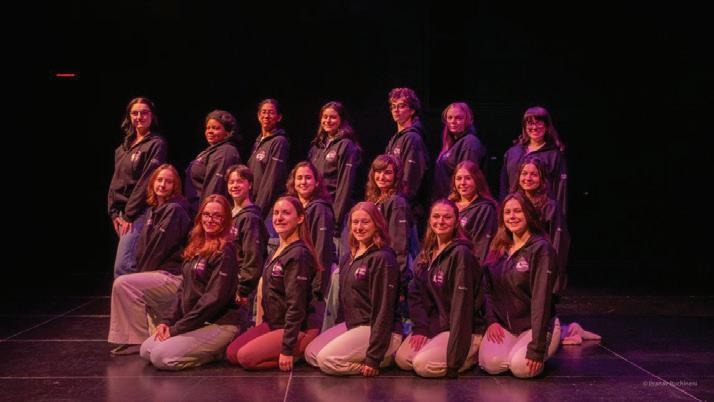
captains Léonie and Sonoma. Their commitment and passion have deeply impacted the team, which is now looking forward to a new generation of leaders with Ava and Hannah-Michelle. Romane, executive member of the club team and dancer of the competitive team, shared after the show: “It was an honor to be able to dance alongside such talented dancers as Sonoma and Léonie... It was pure joy to share the stage one last time with them.”
This showcase closes the 2025-2026 year for the Bishop’s dance team, with laughter, tears and memories. See you next year, on stage or in the audience!
Jillian French, Arts & Culture Editor » thecampus.artsculture@gmail.com
Camelo
Photo courtesy of Journey Badarti
Photo courtesy of Pranav Buchineni
ARTS & CULTURE
Horoscope: Find the Gaiter:
Mars enters Aries
By Abigail Epstein Layout Editor
While Mars in Aries imparts action, Apr. 9, the last quarter moon cautions transition as the tune of its emotional tide, Apr. 10.
Aries: You may feel conflicted, chasing the close of a cycle with sudden inspirations. Try to direct your drive towards seeing things through so that nothing follows you into your next new start.
Taurus: Your calming routine is complicated by a call to move things along. Try not to shut things down in anticipation of what’s to come. Trust every best foot forward to lead in your best direction.
Gemini: You have a talent for smoothing over gaps and holding things in opposition. Relax into your experience if you feel pulled in many directions. You can hold out until you find what resonates.
Cancer: If the world is on your shoulders, offer gifts in bits and pieces. Closing a chapter can be a group effort; reach out so as not to sink. Call is in action.
Leo: If you need to be attended to, avoid abstract cries for help. All eyes are not on you if you’re going for a flameout. Add some intention to both your bark and your bite.
Virgo: Sudden shifts in energy may throw you off guard, but open your armour to changes in direction. As tempting as it is to draw lines in the sand for security, be careful about the faith you put in your fingertips.
Libra: You’re a star in the eleventh hour, and your bright moment is approaching. Your choices direct a spotlight and answer, “Who’s the fairest of them all?” Choose with your heart.
Scorpio: Sentimentality may throw you for a loop, which brings your hand to the handle of a lasso. Keep in mind, blind swings bring regret. Throw out daisy chains, instead.
Sagittarius: You have a gift for gliding through transition states – in fact, you may wish to prolong the freedom of uncertainty. Pass on gold batons, or rose coloured binoculars.
Capricorn: Open the doors of a museum, rather than a travelling gallery. Be wary of straws as backstabbers, as you assess the collection you carry. Meditate on the power of things.
Aquarius: You may feel inclined to dismiss transitory responsibility as just another come-and-go. Once this week, carry a heavy memory to the river. See it float as it drifts away.
Pisces: Does this feel like a dream? Is it like all your hopes, or something entirely unimaginable? Give thanks widely and wildly. Kiss every doorframe on your way out.
For you to take with as many grains of salt as there are stars in the sky.
Jillian French, Arts & Culture Editor » thecampus.artsculture@gmail.com
Comic courtesy of Gabrielle Lalonde
Find the Gaiter courtesy of Rianna Ostrosser
ECONOMICS & BUSINESS
Jayme Marteniuk, Economics & Business Editor » thecampus.businesseditor@gmail.com
The $0 business boom: How Bishop’s students are building income with no startup capital
By Megan Franco Contributor
At Bishop’s University, a growing number of students are launching businesses without spending a dollar upfront. Instead of traditional startups that require funding, inventory or loans, these ventures are built using free digital tools and social media platforms. The result is what some students are calling the “$0 business model” which is low risk, flexible and increasingly common on campus.
Platforms like Canva, TikTok and Instagram are at the centre of this shift. Students are using them to design digital products, market services and build audiences, all without upfront investment. “I didn’t have the money to start
something traditional,” said one Bishop’s student who sells social media templates online. “So I just started with what I had… which was my laptop and time.”
Common $0 businesses include social media management, tutoring, reselling items online and selling downloadable products like planners or budgeting templates. Many rely on skills students are already developing in class, such as marketing, design and communication. The appeal is clear. Without financial risk, students can experiment with business ideas while balancing school and parttime jobs. For some, it’s a way to earn extra income. For others, it’s a first step toward entrepreneurship.
But while the barrier to entry is low, success is not guaranteed. The rise of these businesses has also led
to increased competition. Social media platforms are saturated with similar offerings, making it harder to stand out. Building an audience takes time, consistency and a strong understanding of trends. “There’s a perception that it’s easy money, but it’s not,” another student said. “You still have to put in a lot of work to actually make sales.”
There are also questions about long-term sustainability. Many $0 businesses depend heavily on algorithms and trends, which can change quickly. What works one month may not work the next. Despite these challenges, the model reflects a broader shift in how young people approach work and entrepreneurship. Rather than waiting until after graduation, students are testing ideas now, using accessible tools to create income
streams on their own terms. For universities, this trend highlights the growing importance of digital skills and entrepreneurial thinking. For students, it offers a new kind of opportunity, one that doesn’t require capital, but does demand creativity and persistence. As the $0 business model continues to grow, one thing is clear: at Bishop’s, entrepreneurship is no longer limited to those with money to invest. It’s becoming something anyone with an idea and a Wi-Fi connection, can pursue.
The “perfect path” doesn’t exist, so why are we still chasing it?
By Sara Scafuro Contributor
Why students are rethinking career success in an unpredictable economy
At some point during university, almost every student feels the pressure to have it all figured out. Pick the right major. Get the right internship. Build the perfect résumé. Secure a job before graduation. The idea is simple: if you make all the right moves early, everything will fall into place.
But what if that “perfect path” doesn’t actually exist?
For many Bishop’s students, the pressure to plan a clear, linear career trajectory feels stronger than ever. Yet the reality of today’s economy tells a very different story.
The illusion of the linear career
Traditionally, careers were expected to follow a predictable path. You studied in a specific field, entered that industry and worked your way up over time. Stability and long-term employment were the norm. That model is quickly fading. Today’s job market is shaped by constant change. Industries evolve,
new roles emerge and others disappear. Technology, globalization and economic uncertainty have made career paths far less predictable. It is increasingly common for people to switch industries multiple times or take roles that did not even exist when they were in university. Despite this, students are still encouraged to map out their futures as if everything is certain.
The pressure to “get it right” early
At a small university like Bishop’s, where communities are tight and achievements are visible, it is easy to compare progress with peers. Seeing others land internships, secure job offers or outline clear plans can create the feeling that you are falling behind if you are unsure. Social media intensifies this pressure. Platforms like LinkedIn are filled with announcements of new roles, achievements and milestones. While these posts highlight success, they rarely show uncertainty, rejection or change. The result is a distorted perception of reality. It appears as though everyone else has a plan, even when many are still figuring things out.
An economy that rewards flexibility
From a business perspective, adaptability is becoming one of the most valuable skills in the workforce. Companies today operate in fastchanging environments. They value employees who can learn quickly, adjust to new challenges and move across roles when needed. The ability to pivot is often more important than following a rigid, predetermined path.
For students, this means that not having everything planned out is not necessarily a disadvantage. In many cases, it can be a strength. Being open to different opportunities, industries and experiences allows for growth that a fixed plan might limit. Careers are increasingly built through exploration rather than strict planning.
Rethinking what success looks like
The idea of a “perfect path” suggests that there is one correct way to build a successful career. In reality, success looks different for everyone. Some students will follow a direct path into their chosen field. Others will take unexpected turns, try different roles, or even
change directions entirely. Both approaches can lead to meaningful and successful careers. What matters more is not how straight the path is, but how well it aligns with personal goals, interests, and values over time.
The takeaway
The pressure to have everything figured out can make university feel like a race toward a single outcome. But the modern economy does not reward perfection. It rewards adaptability, curiosity and resilience.
For Bishop’s students, the challenge is not to find the perfect path, but to remain open to change and be willing to evolve. Because in today’s world, the most successful careers are not carefully planned from the start. They are built along the way.