I admit, I had never watched a soccer match until the World Cup landed in our backyard. Quickly, I became a die-hard fan. I joined passionate fans on Fan Walks, attended the FIFA Fan Festival, and didn’t miss a game – even while traveling. I was proud that visitors experienced Houston as a warm (okay, hot) and welcoming city. It was fun to watch international tourists discover Texas barbecue, Buc-ee’s, and Whataburger. By the time this issue arrives in mailboxes, the World Cup will be over, but the positive vibes remain. In these pages, meet a family of avid soccer fans who have traveled for the love of the game. Plus, meet a student who’s making a name for himself at the pool table, locally and internationally. This month, as families settle back into school-day routines, you’ll also find inspiration for easy family dinners. Now, the World Cup may be over, but these stories remind us that world-class inspiration can be found right here in our own neighborhoods. joni@thebuzzmagazines.com
THE BUZZ MAGAZINES
BELLAIRE
• WEST UNIVERSITY • MEMORIAL • TANGLEWOOD/RIVER OAKS
Published by Hoffman Marketing & Media, LLC 5001 Bissonnet, Suite 100, Bellaire, Texas 77401 info@thebuzzmagazines.com • p: 713.668.4157 • f:
Follow us on Facebook, Instagram, and X thebuzzmagazines.com
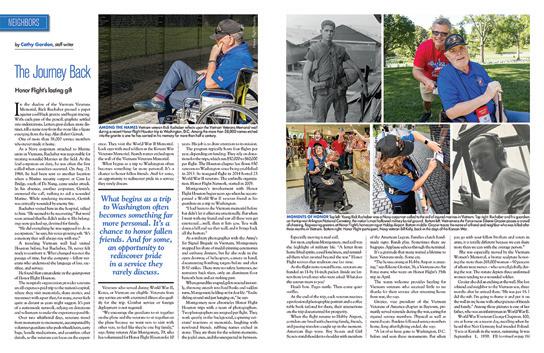
Wow! What a beautiful story [The Journey Back: Honor Flight’s lasting gift by Cathy Gordon, July 2026]! You hit a home run for veterans and for Honor Flight Houston and the National HQ. Thank you for this wonderful opportunity for HFH.
Alan Montgomery
Bravo for Travel Buzz
We just got back from our recent trip to a flurry of messages and emails about the beautifully written article [Bucket List in Reverse: A Houston Family’s Journey to Ecuador and the Galápagos by Tracy L. Barnett, July 2026]. Our neighbors and friends have received the copy of The Buzz and were reaching out to us to comment on how well the story is written. Thank you so much! All of that credit goes to you!
Rupesh Nigam
Highlighting students’ work
I just got The Buzz delivered to my house yesterday, and I was so excited to see my work published [“Students taking the lead” by Jessica Wang, age 17, Buzz Kidz, July 2026]! I also saw it on the website under Buzz Kidz, which is amazing.
I wanted to say thank you so much for supporting me throughout the process and making my dream of publication a reality. It was a pleasure working with you! Many thanks!
Jessica Wang
Editor’s note: If you’re a student who loves to write (18 and under), email us at info@thebuzzmagazines.com to inquire about submitting a Buzz Kidz story. Buzz Kidz includes 350 words written in first-person perspective and a high-resolution photo.
Interesting history
I much enjoyed Ms. Cindy Gabriel’s essay on Tex-Mex History [Unmixing Tex-Mex History by Cindy Gabriel, May 2026]. Her research is amazing, finding those statements from Stephen Austin. I note her comment on new country (1821) Mexico’s anti-slavery stance. I was born and raised in a small town in the Rio Grande Valley. It was not until decades later after I left Raymondville in Willacy County that I read about the trial in the 1920s where some law enforcement and farmers were convicted of peonage, a federal crime. Police had arrested hundreds of men for vagrancy. Local “friendly” farmers paid their fines as they had no money, but they were required to work off the payments by picking cotton and other work. Spain in its conquest of Mexico and Caribbean countries implemented peonage in the New World in the 1500s, requiring some natives to work on farms and ranches and in mines for not enough pay to move on. These workers were stuck, owing their soul to the company store. Many consider the mass indentured servitude in British America to be a form of peonage.
At the time of the empresarios in Texas, peonage was still in Mexico, especially with the hacienda enterprises. To sum up, those who are praiseworthy
of Mexico for banning slavery after gaining independence from Spain and before Texas became a republic in 1836 – should perhaps be less laudatory.
B. Fisher
The
most exciting two minutes in sports
Enjoyed Halliday’s reminiscing about the family horse racing hobby [Horsing Around: My family’s fascination with the Kentucky Derby by Halliday Mafrige, May 2026]. Nice photos and cool info about purchasing the horse shares.
Pavan Siebert
Correction
In The Journey Back by Cathy Gordon, July 2026, veteran Eileene Grozier was incorrectly referred to as a Vietnam-era Air Force nurse. She was a medical and mental health technician and was stationed at the Tachikawa Hospital in Japan from 1974-1977 during the Vietnam War.
Email us at mailbag@thebuzzmagazines.com. Or send to Mailbag, The Buzz Magazines, 5001 Bissonnet St., Suite 100, Bellaire, Texas 77401. Please include your name, address, phone number and email address for verification purposes. Letters or emails addressed to The Buzz Magazines become the property of the magazine, and it owns all rights to their use for publication. Addresses, phone numbers and email addresses will not be published. Letters are subject to editing for clarity and length. Views expressed in letters do not necessarily reflect the opinions of The Buzz Magazines, and The Buzz takes no responsibility for the content and opinions expressed in them.
What’s your story?
We are looking for residents for upcoming articles who:
• Have special fall traditions.
• Know a Buzzworthy neighbor to feature.
• Were recently married and would like to participate in our Wedding Buzz column.
• Have an interesting travel tale.
If this sounds like you or someone you know, please contact us at info@thebuzzmagazines.com or 713.668.4157, ext 102.
Inside This Issue August 2026
4 Editor’s Note
6 10 12 16 26 20 32
Mailbag: Letters from Readers
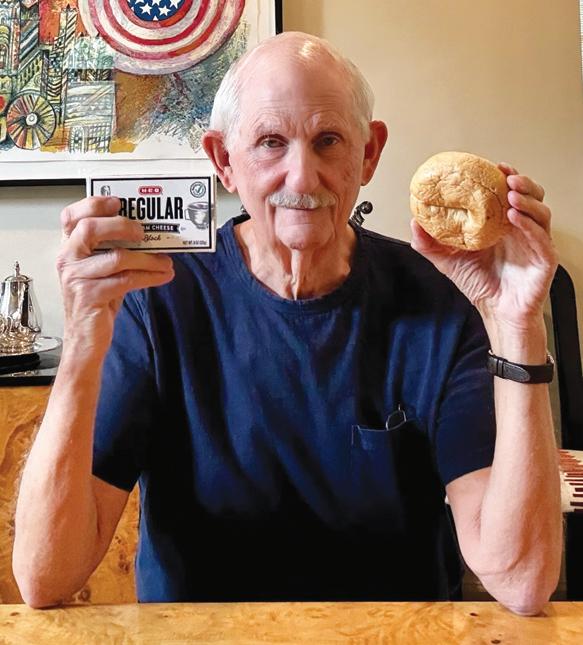
Consider the Bagel: Bread to keep around by Ben Portnoy
Writer Ben Portnoy ponders the beloved breakfast staple.
Getting Our Hearts Right: Change one child’s world – change the world by Cindy Gabriel
Nonprofit HeartGift Foundation provides life-changing medical treatment to children with congenital heart defects who wouldn’t otherwise receive treatment.
Home Pitch: Where soccer is a family affair by Cathy Gordon
Zeyad Metwalli, Hanna Zaghloul, and their three children are avid soccer fans. Bucket-list moments include meeting Argentine soccer legend Lionel Messi in Miami and, recently, witnessing soccer hero Cristiano Ronaldo make history in the World Cup here on home turf.
Niche Nonfiction: Intriguing deep dives by Cindy Burnett
Narrative nonfiction on a specific topic often provides a glimpse into an entire world.
Back to the Kitchen: Family dinners that bring the family together by Andria Dilling
Back-to-school season often means back to the kitchen. Find inspiration for family dinners from these Buzz neighbors.
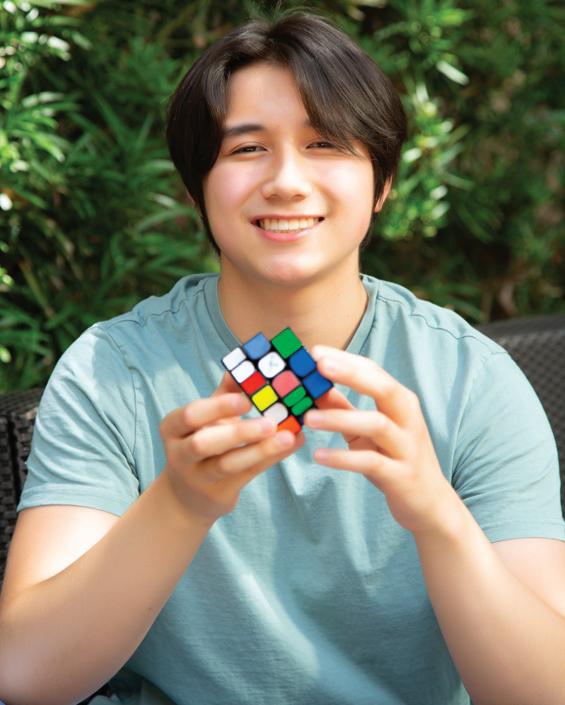
From Our Archives: Twisted Logic: The Rubik’s Cube is back by Cheryl Ursin
The Rubik’s Cube first hit the market in 1980. In recent years, the threedimensional, twistable puzzle came back into play. This article was originally published in Aug. 2021.
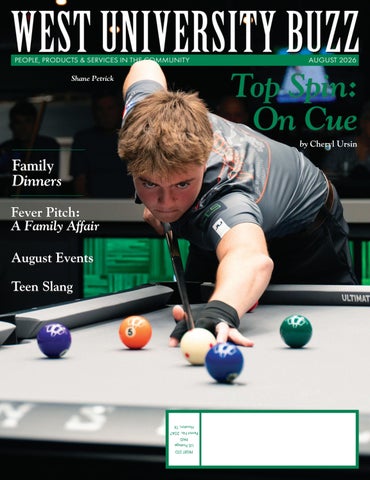
Top Spin: For the love of pool by Cheryl Ursin
Shane Petrick, a junior at Strake Jesuit, is making a name for himself in competitive pool, locally and internationally.
Rumor Has It by Sharon Albert Brier
Buzz Reads by Cindy Burnett
Book reviewer Cindy Burnett recommends five recently or soon-to-be released titles.
SportzBuzz by Todd Freed
SportzBuzz Jr. by Annie Blaylock McQueen
Event Roundup by Mackenzie Malveaux
Find Buzzworthy events to add to your calendar this month.
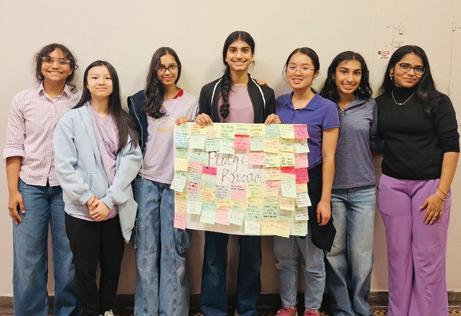
Buzz Kidz: Paving the way with Girls MPower by Preet Nagi
Neighborhood Tails by Zoe
Buzz About Town by Angie Frederickson
Back Porch: Lost in Translation: A field guide to the latest slang by Andria Dilling
Low key gain an understanding of teen slang today.
by Ben Portnoy, staff writer
Consider the Bagel
Bread to keep around
Iwas recently in Los Angeles visiting my daughter and her family. My grandson, a college freshman at University of Southern California, invited me to tour his campus and see his dorm room. After the stroll around campus and inspecting a malodorous dorm room, we went to a food-court-like hall to order lunch. My wife and I each had a hamburger, thinking that would make us look like we fit in, but then I looked around and saw two cute young women students eating bagels and chatting in what I assumed was Chinese. I glanced in another direction, and there was a group of Ethiopian students wearing backpacks with their country’s flag embroidered on the back and all but one student carrying a plate with a bagel. I mused.
I grew up eating bagels for breakfast, bagels for lunch, or bagels for supper as a part of my Eastern European heritage. Bagels have always been part of my life, and it both pleases me and distresses me to observe the bagel’s current popular presence in our society. What distresses me most in this popularization of the bagel is the sloppy use of “bagel” to designate a baked circular bread with a hole in the middle. More on that later.
The word “bagel” or “beigel” is said to derive from a German dialect and later from Yiddish, where it meant a ring or bracelet. OK, that makes sense. But there are precursors to the ring-shaped bread in 13th-century Syria, where a roll called “ka’ak” was baked. In royal family accounts in Poland in 1394, there is reference to a ring-like bread called “obwarzanek.” Neither of these sound much like “bagel.” The bagel, by whatever name, came into its own in 17th-century Jewish communities in Poland. It is referenced in the Community Regulations of Kraków in 1610 as a gift for women after childbirth. Strange.
The bagel arrived in America in the late 19th century brought by immigrants. In 1907 in New York, the International Beigel Bakers Union was formed. That provided some definition of what constituted a bagel, and New Yorkers to this day are passionate about what ring-shaped bread is a bagel.
A bagel is made with high-gluten flour knead-
ed into a yeast dough that is prepared often with some sweetener such as barley malt, corn syrup, or sugar. After shaping it into a ring, the dough is cooled, then boiled briefly, and finally baked. The result is a chewy dough with a slightly crisp exterior. The water used for boiling may be salted or sweetened. New Yorkers swear that their bagels are the best due to the local water used for the boiling step.
I believe that our Houston bagel bakeries can compete credibly with any New York bakery. But watch out. Creeping into our supermarkets are bagels that do not deserve the name. A less-involved process of producing bagels became popular in the 1960s with the infamous Lenders bagels that used machine-made dough rings and a steam process instead of boiling to prepare the bagel. These bagel lookalikes are not so chewy, are fluffy, and come out distressingly uniform in their plastic packaging. Alas, there are many brands of such imitations available now.
bagel with cream cheese and lox, perhaps also with tomato, onion, and capers. This is a brunch staple for many of us. I would be shocked to be present at a synagogue buffet that did not include such fare for an event early in the day or, really, any time of the day.
The bagel is clearly an integral part of the Ashkenazi (Eastern European) Jewish heritage. It is so prominent that the bagel pops up in a Yiddish curse. To wish someone ill, you might say in Yiddish that you wished that your target person would “Lign in drerd un bakn beygel.” This translates loosely as you wish that person would be “underground in a place as hot as a bagel bakery.”
In a lighter mode, consider the traditional
Back to my observation of the students at USC who were most likely not Eastern European Jews eating bagels: I could not get close enough to see if they were dining on grocery-store bagel imitations or the real things. They seemed pleased, or maybe they were just taking a break from cheeseburger and fries. After lunch, my grandson went back to class, and my wife and I drove back to our daughter’s house. On the way, we stopped at New York Bagel & Deli on National Boulevard to pick up a dozen fresh warm bagels. We try to watch our weight, so when we got home, we split a poppy seed bagel to get the taste of the hamburger out of our mouths.
BAGEL BELIEVER Ben Portnoy ponders the beloved breakfast staple.
by Cindy Gabriel, staff writer
Getting Our Hearts Right
Change one child’s world – change the world
Idon’t know about you, but I’m not ready to throw in the towel on the human race. There is something basically good in most of us. We want the people of this world to learn, grow, and thrive. We want good things for each other. Okay, perhaps not all of us, all of the time. These are dark times, for sure. That makes stories like this one all the brighter. A single good idea can release its own synergy. This story starts with two guys fishing for Peacock bass in the Amazon, and as fishing stories go, it grows. Warning: There are lots of moving parts to this story.
Ray Wilkerson and Chip Oswalt have called themselves brothers from another mother since they first met in an Austin running group decades ago. Each has thrived in their chosen professions in Austin. Ray owns a venture capital real estate firm. Chip is a heart surgeon. They have taken several exotic trips together over the years, fishing and hunting around the world. On one of those fishing trips, in 2000, along the Amazon in Brazil, after having a few beers, they hatched a plan. As Wilkerson recalls: Chip wouldn’t stop talking about these six little kids from Kosovo and how they came to Dell Children’s Medical Center for heart surgery. It changed their lives, and Chip’s too, says Wilkerson.
Backstory: In 1998-99, hundreds of American medical professionals were sent to the Balkans to treat a massive wave of Kosovar Albanian refugees from the Kosovo War with Yugoslavia. In the process, some doctors discovered a handful of kids with a not-so-rare congenital heart defect, Ventricular Septal Defect (VSD), which is usually curable after one surgery. They are commonly called blue babies, born with a hole in the heart. Over 1 million children with variations of this disease are born every year. Yet only 10 percent live in places where they can access the necessary medical care. The rest face childhoods of low energy, stunted growth, and generally, fail to thrive.
Dr. Oswalt was able to help arrange for these six Kosovo kids to get to Austin for surgery. Basically, these kids were dying, says Oswalt. And after one surgery, they turned into normal kids. He told Wilkerson: If we could just find more kids (worldwide) we can bring them here and change
their lives. Wilkerson quickly got the picture and says, I’m in. Let’s start a foundation. I can handle the business part and you take the medical side. That same year, 2000, the HeartGift Foundation was formed in Austin with the successful treatment of one child from Honduras. Today, HeartGift has branches in Houston, San Antonio, and New Orleans. Over the past 26 years, more than 3,000 children have been treated from over 40 countries. Virtually all medical fees are waived. Throughout the process, each child and one parent will stay with a host family. In Houston, Paul and Elizabeth Tepikian have hosted three HeartGift children and their moms for a surgical process that typically lasts about
three weeks. Host families are also supported by volunteers who translate, bring food specific to their guest’s ethnic or religious preferences, and, in some cases, donate airline miles to help bring a child and one parent along for the trip. The entire process is free for the child and parent. Many have never flown on an airplane. Some have never seen running bathwater.
The Tepikians’ most recent visitor was 5year-old Sterling Aleman and his mother, Bertha Aleman Meji, who arrived from a tiny village in Honduras this past March. They bonded quickly with the Tepikians. Sterling was a wiz with Lego, Paul says, but was very quiet and would turn blue when he
(continued on page 14)
OUT OF THE WOODS HeartGift patient Sterling Aleman emerges 10 days post-surgery a new kid.
Paul Tepikian
walked. He was smaller than his 3-year-old brother. Kids like this often don’t eat much. It’s just too tiring to chew and digest food.
Two central Texas doctors, Rosy and Monte Horne, first advocated to get Sterling to Houston. Rosy was born in Honduras and is still licensed to practice there. They found Sterling through a small clinic, Sal y Luz (Salt and Light Clinic) in Honduras. His case had been turned down the previous year, judged too high risk. But this year, Children’s Memorial Hermann Hospital in Houston agreed to take Sterling.
Sterling’s surgeon, Dr. Damien LaPar, says children born in Houston with VSD usually receive surgery within the first year of life. But HeartGift kids are discovered later in their childhood, often making post-surgery recovery more complex.
Sterling, at 5, was older than most kids we see, says LaPar. We were all sitting around in the ICU (after surgery) ready to help him have a good outcome…. His lungs had never seen that much blood before. It’s a remarkable thing to watch. It’s part of what draws us to HeartGift. These kids are true warriors. They battle things in life from an early age, physically, emotionally, mentally at such a young age. They’ve had to do it in an environment with no support at all.
Finally, after 10 rough days, it was time to take the bandages off. Sterling was out of the woods. Paul took Sterling’s first thumbs-up picture.
The Tepikians and Sterling’s mom, Bertha, spent their remaining days in Houston chasing Sterling, first, around the hospital, then in public places like Kohl’s department store while shopping for family back home. Paul’s videos of Sterling full of energy earned him the reputation as the running boy
Back in Honduras, Sterling’s mother Bertha reports that he is eating everything in sight, going to school, playing in the ocean, and basically catching up on being a kid. Drs. Rosy and Monte Horne got to see a normal, healthy Sterling back in Honduras.
Bertha relayed how she felt in Spanish. Monte’s translation: Before the surgery, Sterling was always tired. Now, I’m the one who is tired.
You can see how this kind of volunteer work can be addicting. Monte works with the parents, hospital, and U.S. Embassy in Honduras on the paperwork to get these kids through the system to their surgery and back home. No small feat. In the past year, they have identified 11 kids who have had successful surgeries through HeartGift with eight more waiting in the wings. The U.S. Embassy (in Honduras) has been great to work with, says Monte. He wanted you to know that. A friendly embassy is critical.
Even the way HeartGift raises money will pull at your heartstrings. On Wednesday, Oct. 7, 6 p.m., the home of Brittany and Richard Owen in Houston will take on the flavor of the iconic Nashville Bluebird Cafe where singer-songwriters gather to share their songs and tell the stories behind them. For the past 11 years, Danny Myrick and Megan Linville and their Nashville friends have shared songs you may have heard
from well-known artists. The idea, like that original fishing trip, was hatched across a Thanksgiving table between Danny and his cousin Jan Larsen, a HeartGift board member. Jan says, I was always so proud of my cousin, and his commitment to writing music from his heart. Then, when I thought of how it fit with HeartGift, it was like a spark went off: Songs for the Heart was born. Danny says it’s one of their favorite gigs of the year. What draws you is the feeling that this is the way you wish the world actually was, but actually, I guess that is the way the world is. Sounds like a new song to me. This is who we are.
And the story keeps growing. In recent years, since the Covid pandemic, HeartGift has also
started traveling with a team of medical staff directly to countries. Janna Altmann, executive director of HeartGift Foundation, says she had the opportunity to go on a trip to Bolivia. She describes: On the first morning of clinic (actually every morning, but the first day has the most people), families gather long before sunrise, waiting together on the stairs, along walkways, and in the nearby park. When the van arrives full of American doctors, nurses, technicians, and HeartGift volunteers, the crowd begins to cheer!
Goosebumps. Tears. Grassroots diplomacy. The stories never end.
For more information on HeartGift and the Songs of the Heart fundraisers, see www.heartgift.org.
FROM THE HEART Top: HeartGift founders, who consider each other "brothers from another mother," Ray Wilkerson and Chip Oswald, M.D., celebrate 26 years, over 3,000 HeartGift surgeries from over 40 different countries and growing. Bottom: Nashville award-winning songwriters play, sing, and tell stories each year as pocketbooks open for HeartGift. Pictured, from left: Tim James, Danny Myrick, Megan Linville, and David Lee.
Courtesy
by Cathy Gordon, staff writer
Home Pitch
Where soccer is a family affair
The shortest life expectancy in this home belongs to anything left sitting on the mantel. Because even a house-approved Nerf soccer ball carries enough zip to send things flying when your foyer and part of the den double as an indoor pitch.
“Too many things can get broken,” says Zeyad Metwalli with a grin. His three children –Malek, 12, Nadim, 10, and daughter Maya, 9 –sit quietly by, restless legs hinting that they’d rather be cushioning a pass, spinning away from a defender, or practicing headers into a net.
“We have this whole space clear for them to practice their moves,” says their mother Hanna of the home zone. “My poor mantel. Such an uncluttered mantel. You can’t keep much on it. We’ve learned that lesson!”
Around here, soccer doesn’t wait for kickoff. It spills into conversations, reshapes vacations, fills the foyer with the tap of quick feet, and somehow finds its way into nearly every ordinary day.
This day, a World Cup matchup between the Netherlands and Sweden flashes on their TV as Nadim waves a black and white ball overhead, his finger burrowed into its well-worn foam like a worm.
“It has a way of bringing people together like few things can. It’s the most loved sport in the world,” explains Zeyad, an interventional radiologist. He was born and raised in Egypt where soccer is a passion, woven into the country’s identity. He grew up playing the sport in local leagues but doesn’t play much these days.
“I wanted to save my knees. Whenever I’m doing these minimally invasive surgeries, I’m on my feet. And I walk fast. I’ve got to preserve them.”
He loves that the World Cup arrived at their doorstep in Houston.
“I remember when I was a kid, depending on where the World Cup was being played, it wasn’t always convenient hours for me to watch. The timing was off. But this is perfect with the World Cup being here. We get to watch and keep up with a lot of the games.”
“But I make a note not to check the scores if it’s a game I can’t see as it happens,” notes Hanna.
Hanna was born in the States, her parents immigrating from Egypt in 1978. Zeyad came to
the U.S. at 18 to attend Rice University, then the Baylor College of Medicine. Each was on vacation in Egypt when they met. They clicked. The subject of soccer between the two inevitably came up.
It’s never left.
“It’s been kind of our theme,” says Hanna, the scientific director for a pharmaceutical company. She has a reputation for standing throughout a game. “I feel more immersed in it that way. I just can’t sit!”
“I think for us, being immigrants, and children of immigrants, and for our children, seeing these players who have the opportunity to represent things that are bigger than themselves, it’s a wonderful thing,” says Zeyad. “The World
Cup especially is so international. All these people from different backgrounds, all walks of life, come together from around the world to entertain people with their skills. It brings the world together. It’s such a positive thing.”
For the couple’s kids, trying their hands –well, nearly any body part but hands – at soccer seemed as natural as sunrise. It’s so assimilated into family life that it made sense to eventually land at their feet.
All three started out in recreational leagues, then moved to competitive teams. Malek, a seventh grader at Pin Oak Middle School, plays for the RISE Soccer Club, a competitive league, as will Nadim and Maya, Horn Elementary fifth and fourth graders, respectively, this fall.
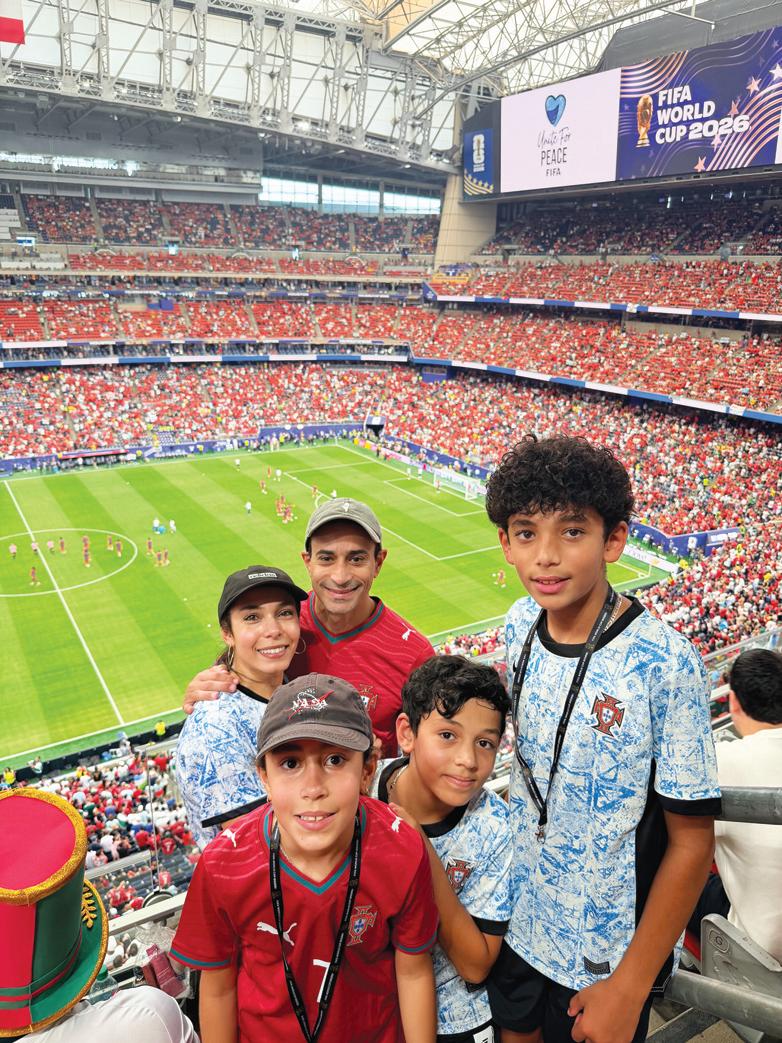
ROOTING FOR RONALDO The Metwalli children pose with their parents at the World Cup match between Portugal and Uzbekistan, wearing jerseys bearing one of the family’s soccer heroes – Portuguese star Cristiano Ronaldo – who made history that day, becoming the first player to score in six different World Cup tournaments. Front row, left to right: Maya, 9, Nadim, 10, and Malek, 12, have inherited the soccer gene from (back row) parents Hanna and Zeyad.
“I play right back,” explains Malek, of the defensive position. “It’s a position where you have to be fast.” Lately, he’s been practicing his back kick, typically called a backheel, a flashy skill where a player hits the ball backward with
the heel of their foot.
“Sometimes we watch Malek playing around and learn from him,” says Nadim. “We learn a lot of skills that way.”
“It’s fun,” says Maya. “I really like it.”
Their devotion to the game eventually carried them across an ocean. During Christmas 2024, the family made a pilgrimage to Liverpool, where more than a century of football – what the rest of the world calls (continued on page 18)
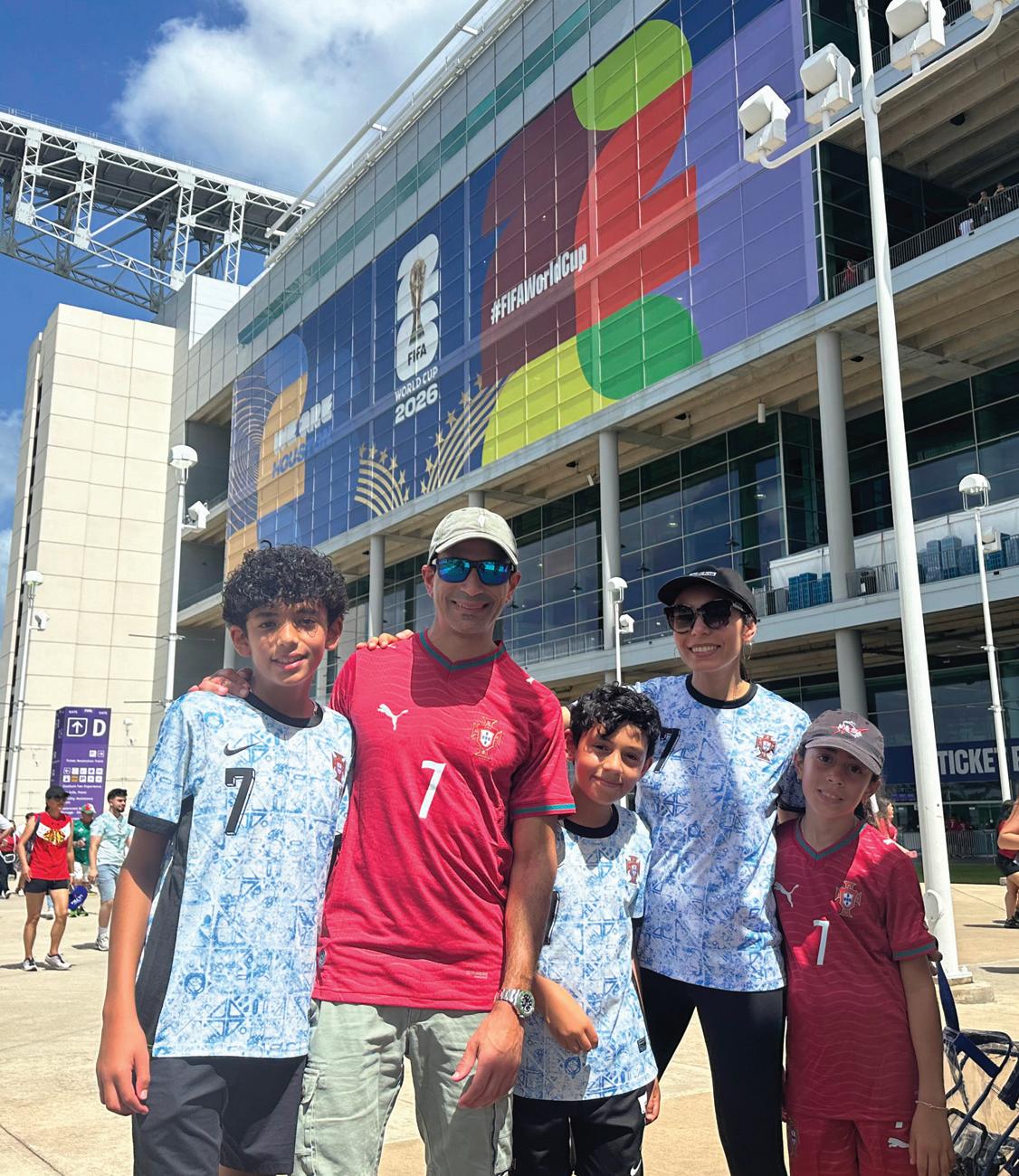
HERO IN HOUSTON It was another soccer bucket-list experience for this family. They attended World Cup 2026, watching one of their favorite teams, Portugal, play Uzbekistan. Malek, Zeyad, Nadim, Hanna, and Maya (pictured, from left) stand outside the stadium where soccer star Cristiano Ronaldo led Portugal to a dominant 5-0 victory.
FOLLOWING THE KING The family’s pilgrimage to Liverpool to watch the team’s Mohamed Salah – dubbed the Egyptian King – didn’t disappoint, despite dense fog that swallowed half the pitch. Hanna, Maya,
and
show devotion in their apparel. The drive there was a white-knuckle affair with blinding fog that lingered at Anfield Stadium.
(continued from page 17)
the game, long before Americans attached the name to helmets and touchdowns – seeps from the bricks of Anfield Stadium. There, they watched Liverpool defeat Leicester City 3-1, but the score was almost beside the point. They had come to see Liverpool’s Mohamed Salah – dubbed the Egyptian King – whose brilliance at the sport long made him a hero to this household.
“We became huge Liverpool fans because of him. Seeing someone from our family’s background and heritage rise to that level in soccer …. It was great to watch him in person,” explains Zeyad.
“We made it a big family trip. My parents went, my brother and his wife, and then we have a few cousins who live in England, so we saw them there, too,” he adds.
The trip was as pins-and-needles as the game.
A tire blowout, roadside repair, and a blanket of fog so thick they could barely see half the pitch only added to the drama they saw play out on the field.
Christmas Day, the day before the game, they were en route to visit Zeyad’s cousins in Birmingham when their rental car tire blew. No spare. “Unlike here, where things are business as usual, things shut down in the UK on Christmas Day and the day after. Even the public train system isn’t running,” Hanna explains.
“So, I’m driving this car and I’ve never driven on that side of the road before,” says Zeyad. “I’m used to driving on the right like here. I’m trying to get used to the car, the road, and just a few min-
utes from the hotel we get this flat. I didn’t see a curb that was very high. I’m driving and feeling ‘Something’s not right.’ I pull over and it’s blown. I Googled what was available for help and this nice Afghan gentleman with a mobile tire service comes, changes it, and we were on our way.”
“The World Cup especially is so international. All these people from different backgrounds, all walks of life, come together from around the world to entertain people with their skills. It brings the world together. It’s such a positive thing.”
They made it in time for dinner with his cousins, despite a dense fog that turned every mile into a leap of faith.
It continued into game day.
As they rolled toward Anfield, it swallowed
the road whole. “I’ve never experienced anything like that!” says Hanna.
Then there’s the fun of where to park.
American stadiums announce themselves with acres of parking. In Liverpool, it’s the norm to rent out someone’s driveway. And then it’s still a mile and a half walk through cobblestone streets, arriving at a stadium so shrouded in mist that they couldn’t make out half of the pitch.
“Hanna and the two younger ones sat higher up and Malek and I were near the corner, very close, like seven seats up from the ground. You should have seen the fog inside the stadium,” Zeyad recalls. “Experiencing the game over there is nothing like here. It takes it to a whole other level. And there’s no big screens showing replays. If you miss it, you miss it.”
Watching the match in Liverpool was like inheriting a tradition, the family says. Generations of supporters pack the stands, singing and chanting, lyrics passed through the ages from parent to child. As much heritage as sport.
“We unfortunately didn’t know the chants. If I were to go again, I’d study them ahead of time,” Zeyad says. “They were singing at the top of their lungs and had a song about Salah. I would really like to have known that one. This kid behind us, probably 10, knew every word of every chant and song. I was listening to him, trying to pick it up.”
If Liverpool gave the family a glimpse of soccer’s history, another trip gave them something even rarer – a chance to meet one of its greatest players.
Zeyad, Nadim,
Malek
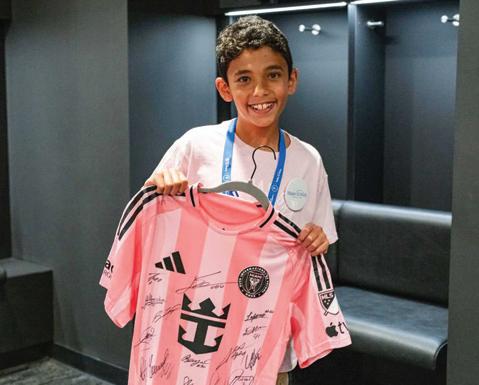
In 2025, the Make-A-Wish organization saw to a wish that Malek requested: meeting Argentine soccer legend Lionel Messi.
Malek was diagnosed with a rare inflammatory condition in 2023, Langerhans cell histiocytosis, and became eligible for Make-A-Wish, which fulfills wishes for children facing certain medical challenges.
“They got his name through Texas Children’s, where he was treated for it. It manifested in shoulder pain. He’s good now,” explains Hanna.
Apparently, a lot of kids wanted to meet Messi. Malek was part of a group of 23 who met the soccer icon and the entire Inter Miami team that April. The kids were treated like royalty. Each was introduced like a hometown hero, their name flashing on a billboard as they ran past a tunnel of applauding players onto the stadium field.
“It was really special,” says Malek. “I didn’t really want that much attention, but it was cool.”
“The kids were photographed with the whole team,” says Hanna. Messi stopped by and took pictures with every family.
“I cried. It was emotional for me,” she says. “Each kid got a jersey with their name on it, signed by all the players. I have it framed upstairs now in his room.”
“Messi is obviously a soccer superstar but there’s like three or four guys on that team who are also international stars, so it’s awesome that he not only got to meet Messi but the whole team,” says Zeyad. “We are such huge Messi fans. It’s amazing that he will have that memory, that experience to remember his whole life.”
Yes, this family’s heroes wear cleats instead of capes. Meeting Messi and watching Salah represented dreams fulfilled. And seeing Portugal’s Cristiano Ronaldo during the 2026 World Cup was another pinnacle.
They attended the World Cup match between Portugal and Uzbekistan on June 23 here in Houston and witnessed history with Ronaldo becoming the first player to score in six different World Cup tournaments. He netted two goals in the 5-0 win over Uzbekistan and was named Man of the Match.
“This was the experience of a lifetime,” says Hanna, whose favorite part was the massive
crowd, filling essentially every seat in Houston’s NRG Stadium (called Houston Stadium during the World Cup). Every roar was amplified beneath the stadium roof.
Ronaldo’s history-making performance made it “the perfect game to see in person,” agrees Malek. “The energy was awesome.”
Nadim didn’t care for the Houston heat on the way to the game, “but I knew that we would see Ronaldo and that would make me feel better.” All the walking to the game didn’t impress Maya, “but it was worth it for the once-in-a-lifetime experience,” she says.
Attending a World Cup match had been a lifelong dream of Zeyad’s. The fact that he shared the experience with his wife and children transformed it into something even greater, he says.
From an indoor pitch at home, to Liverpool, to Miami, to a World Cup in Houston, the family has always been following the same thing: a rolling ball that gathers more than grass stains. It carries the family’s best stories.
A flat tire and wall of fog included.
“We can laugh about it now,” says Hanna. “The things you do to get to a soccer game.”
WISH COME TRUE Malek was among 23 kids who met Argentine soccer legend Lionel Messi and the Inter Miami team via the Make-A-Wish Foundation. Malek and his family traveled to Miami where he was welcomed onto the field like a VIP. Top left: Malek poses with a jersey signed by the team. Bottom left: Messi gives Malek a congratulatory pat on the back. Top right: Malek runs onto the field with a line of applauding soccer players flanking him on both sides. Bottom right: The rest of Malek’s family also got to meet Messi. Left to right: Hanna, Nadim, Maya, Zeyad, and Messi capture the moment with grins.
by Cindy Burnett, staff writer
Niche Nonfiction
Intriguing deep dives
Narrative nonfiction on a specific topic or interest often provides a glimpse into an entire world or pastime. I enjoy learning about topics with which I am unfamiliar, finding connections between events, and filling in gaps in my knowledge base. Here are some interesting and page-turning narrative nonfiction books that have come out in the past few years:
The Address Book: What Street Addresses Reveal about Identity, Race, Wealth, and Power by Deirdre Mask – The Address Book is a deep dive into the importance of having a street address. Inspired by a letter she mailed to her father, Mask stumbled upon an initiative called “Addressing the World, An Address for Everyone,” where she learned that most households in the world do not have street addresses (even places in rural areas of the United States). Intrigued, she headed to West Virginia to investigate this phenomenon herself by meeting with a friend of a friend who had recently petitioned his local county government for an address. From there, she fell down a rabbit hole of research and eventually ended up writing this history of how streets are named, how street names are about wealth and identity, who counts and who doesn’t, and what happens today when someone does not have an address.
Bad City: Peril and Power in the City of Angels by Paul Pringle – Bad City is a riveting and horrifying look at the way University of Southern California’s administration prioritized the school’s reputation over its students and the surrounding community. In 2016, an LA Times reporter received a tip about a woman who overdosed at a local hotel and the role that Dr. Carmen Puliafito, the dean of USC’s Keck School of Medicine, played in the overdose. Journalist Paul Pringle began looking into the event, unaware of the can of worms he would ultimately open. By the time he was finished several years later, he had exposed corruption at the highest levels at USC and at the LA Times. The dean not only did meth and other drugs regularly himself (and was so sure he would not be punished he videoed and photographed himself doing so), but he befriended women in their 20s and
provided them drugs and money. Repeated complaints to USC’s Provost C.L. Max Nikias yielded not even one response except to the editor of the LA Times – who then scolded the reporters. Subsequently, Paul and his group learned about a male gynecologist who worked at the student clinic and had been molesting students for decades with no punishment. The reporters then proved that the administration was aware of this behavior as well. After the stories ran, the group ended up winning a Pulitzer Prize for bringing the second story to light. While it is a tough read at times, Bad City vividly demonstrates the continued importance of investigative journalism.
IMPORTANT REPORTING Bad City, written by journalist Paul Pringle, is a riveting and horrifying look at the way USC’s administration prioritized the school’s reputation over its students and the surrounding community.
The Best Dog in the World: Essays on Love ed. by Alice Hoffman – Anyone who has ever been fortunate enough to share their life with a dog knows the experience is both life-changing and unparalleled. Here, 15 celebrated authors share unforgettable tales of their dogs who left pawprints on their owners’ hearts. With contributions from Chris Bohjalian, Emily Henry, Ann Leary, Jodi Picoult, Elizabeth Strout, Amy Tan, and Adriana Trigiani, The Best Dog in the World captures the full range of the caninehuman connection, from the joy of welcoming a new puppy to the heartache of saying goodbye to a beloved member of the family. As an ardent dog lover, I love that the essays provide such personal glimpses into the lives of the contributors and emphasize what important roles dogs play in human’s lives. I laughed, I cried, and I remembered every dog I have had the privilege of sharing my life with over the years. Have tissues at the ready.
Come Fly the World: The Jet-Age Story of the Women of Pan Am by Julia Cooke – Julia Cooke chronicles the women who worked as stewardesses (she uses this term since that was in use then) for Pan Am Airways and their contributions to the Vietnam War effort and
women’s rights. Come Fly the World will reframe the way people view stewardesses from this era of transcontinental flight and show instead how progressive many of these women were and how they paved the way for future generations of women to easily negotiate traveling around the world. Cooke interviewed scores of women who served as stewardesses for Pan Am and tells several of their stories in-depth. She relays their stories while weaving in historical details, such as the way in which the role of flight attendant changed over the years and the women’s help in staffing American soldiers’ R&R trips between Saigon and Hong Kong. It is a truly awe-inspiring and captivating read.
Dogland: Passion, Glory, and Lots of Slobber at the Westminster Dog Show by Tommy Tomlinson – Dogland is enthralling and entertaining as well as thought-provoking and educational. As a longtime dog lover, I was fascinated by some of the questions Tomlinson raises. Are show dogs happy? And what about pet dogs – are they happy? These questions sent the author on a three-year quest to better understand the dog show world and its inhabitants and to gain insight into the relationship between humans and dogs. Dogland mainly follows a champion show dog named Striker as he competes at the Westminster Dog Show in New York, but the author includes how dog shows began, who participates and why, how the relationship between humans and dogs has evolved, and how to evaluate the happiness of dogs.
The Finest Hotel in Kabul: A People's History of Afghanistan by Lyse Doucet by Lyse
Cindy Burnett
Doucet – When the Inter-Continental Kabul opened in 1969, Afghanistan’s first luxury hotel symbolized the dream of a modernizing country now connected to the rest of the world. More than 50 years later, the Inter-Continental is still standing. It has endured Soviet occupation, multiple coups, a grievous civil war, a U.S. invasion, and the rise, fall, and rise of the Taliban. Lyse Doucet, the BBC’s Chief International Correspondent, has been checking into the InterContinental since 1988. And here, she uses its story to craft a richly immersive history of modern Afghanistan. I loved how she framed the history of the country against the backdrop of the InterContinental and those who have a connection to it – a creative way to tell the country’s history.
The Gales of November: The Untold Story of the Edmund Fitzgerald by John U. Bacon –
On November 10, 1975, as the “storm of the century” threw 100 mile-per-hour winds and 50foot waves on Lake Superior, the Edmund Fitzgerald, the biggest and most profitable ship on the Great Lakes, found itself at the worst possible place and time. When she sank, she took all 29 men onboard down with her, leaving the tragedy shrouded in mystery for a half-century. Bacon crafts a definitive account of the disaster, often weaving in lyrics from Gordon Lightfoot’s iconic song. Not only is the history of the ship interesting, but Bacon also chronicles the history of the Great Lakes, Michigan, and the ship’s namesake Edmund Fitzgerald. This one is a true page turner, and the audio production is fabulous.
Gemini: Stepping Stone to the Moon, the Untold Story by Jeffrey Kluger – “Without Gemini, there would be no Apollo.” This sentence encapsulates the profound importance of the Gemini program on the subsequent Mercury and Apollo programs. In Gemini, Kluger chronicles the history of the Gemini (pronounced Geminee) program from its origins, highlighting both its numerous successes and failures. Consisting of 10 flights over the course of just 20 months, Gemini sent men into space for the first time, but also led to deaths and near deaths and all sorts of other failures that at times will have the reader marveling at how a moon landing ever happened at all. Kluger manages to bring a very human element to this riveting story as he details the challenges and dangers faced by the Gemini missions and the astronauts who participated. Rob Reiner narrates the stellar audio production. Leave Only Footprints: My Acadia-to-Zion Journey Through Every National Park by Conor Knighton – In this gem, Knighton chronicles the year he spent traveling to every national park in the United States. The parks are grouped by theme instead of location, and the book is interspersed with humor and intriguing details. Knighton highlights the importance of our national parks, how various parks received their designations, and how climate change and over-visiting is impacting many of these beautiful places. In the epilogue, Knighton discusses how the National Park System continues to
expand and quickly reviews three parks that achieved the designation after 2016 (the year Knighton made his journey).
On the Grid: Life Behind the Scenes of Formula 1 by Luke Smith – Formula 1 has only 20 drivers in its elite ranks (soon to be 22), but behind each one is an army of professionals working hard to support these drivers, including engineers, mechanics, party planners, statisticians, and more. In On the Grid, F1 journalist Luke Smith brings to life the behind-the-scenes stories that don’t make it to viewers’ screens –both on and off the track. I love these deep dives into worlds about which I am not familiar, and this one is outstanding. He covers the gender gap in F1, the fan base, carbon emissions, climate change, the growing popularity of the sport, and more. There are a number of books out about F1, and this one is the best by far.
Raising Hare: A Memoir by Chloe Dalton –
During the Covid lockdown in the English countryside, Dalton stumbles across a leveret (a baby hare) and brings it home. As she learns to feed and take care of it with little guidance because raising a hare is quite rare, what results is an unlikely relationship between her and the hare, a development that completely changes the way Dalton views the world. This book contains so many beautiful passages that I stopped to absorb and reflect on and helped me evaluate how I move about in the world.
Valley So Low: One Lawyer’s Fight for Justice in the Wake of America’s Great Coal Catastrophe by Jared Sullivan – Valley So Low details the tragedy of the 2008 Kingston coal ash spill in Tennessee and the subsequent cleanup
(which cost more than a billion dollars), while relaying the stories of the workers and everyday people who were directly impacted by the coal ash. While the spill itself was horrific, the manner in which the company ran the cleanup led to the death of 50 individuals and exposed countless others to toxic materials. This is such a compelling and heartbreaking read, and one that sadly feels all too familiar – it reminded me of how the tobacco industry, Johnson & Johnson, and DuPont behaved when confronted with their malfeasance.
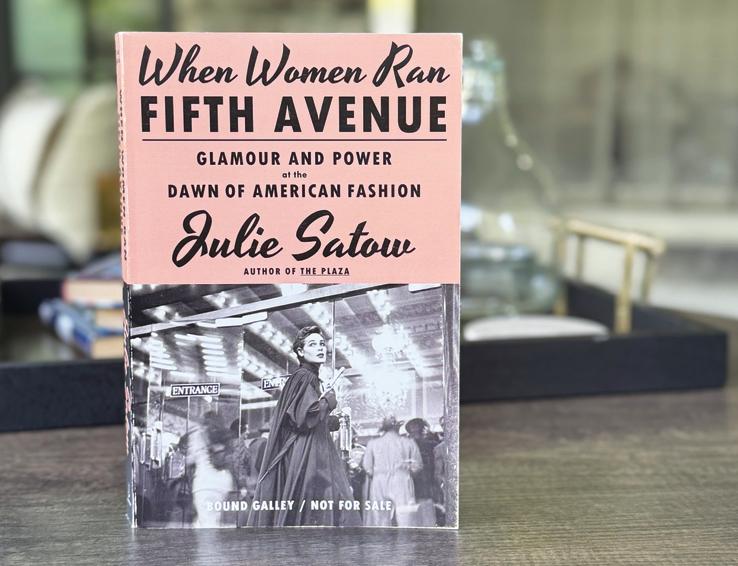
When Women Ran Fifth Avenue: Glamour and Power at the Dawn of American Fashion by Julie Satow – When Women Ran Fifth Avenue tells the stories of Hortense Odlum of Bonwit Teller, Dorothy Shaver of Lord & Taylor, and Geraldine Stutz of Henri Bendel. It also provides a brief history of department stores and how they changed the world of shopping and opened up employment opportunities for women. At a time when most working women were nurses or teachers, the department store created a new career path for women in sales and business. This glimpse into the department store phenomenon and its impact on our culture and shopping habits is fascinating, especially in light of their slow demise as online shopping popularizes.
Editor’s note: Book reviewer Cindy Burnett also writes our monthly Buzz Reads column and weekly Page Turners column. She hosts an award-winning book podcast entitled Thoughts from a Page Podcast (www.thoughtsfromapage.com), runs the Instagram account @thoughtsfrompage, and regularly speaks to groups about books.
HAUTE COUTURE AND HISTORY When Women Ran Fifth Avenue by Julie Satow tells the stories of Hortense Odlum of Bonwit Teller, Dorothy Shaver of Lord & Taylor, and Geraldine Stutz of Henri Bendel while providing a brief history of department stores and how they changed the world of shopping and opened up employment opportunities for women.
Cindy Burnett
by Cheryl Ursin, staff writer
Top Spin
For the love of pool
When Shane Petrick was 12 years old, he told his mother that he wanted to join a league to play competitive pool.
“I said, ‘I don’t know what that is, but no,’” remembers his mom, Shannon.
Images from the very grim 1961 movie The Hustler, starring Paul Newman, and its somewhat less grim 1986 sequel The Color of Money, starring Paul Newman and Tom Cruise, danced in her mind. Smoky bars. Excessive drinking. Illegal gambling. Con games. Crime. Even violence.
She didn’t want to put Shane off the game of pool entirely, though. The family had just installed a pool table at home, “as a fun thing to have,” says Shannon, “and I’d find him after his homework was done playing pool. It was his quiet meditative time.”
She hit upon a plan. She told him to write her a report about what a pool league is, why he wanted to play in one, and what would be involved.
“I thought that would be the end of it,” she confesses.
A day or so later, Shane presented her with his report.
Then, she told him that he’d have to call the pool league and set up the meeting himself. Since the youngest generation is loath to use phones to make actual phone calls, Shannon figured, “There’s no way he’s going to do that.”
Shane set up the meeting for the following Saturday at a pool hall in Montrose.
“He put in so much work and he did everything I asked,” says Shannon, so off they went. “All the while I was thinking, I’m a horrible mom, what am I doing?”
Mother and son remember that the first thing they saw as they pulled into the parking lot was a group of men standing around the entrance, smoking, which did not allay Shannon’s concerns. But, says Shane, now 15, “Our mindsets soon completely flipped.” The people Shane plays pool with are now “practically family,” he says.
“They are raising him to be a solid player on and off the table,” says Shannon. “It’s a community.”
But that day, when 12-year-old Shane showed up, the league players didn’t quite know
what to do with him. “It wasn’t ‘Yay, we have a 12-year-old,’” says Shane. Some of the teams said no to having him on their team, “which we totally understood,” says Shannon.
Phil Trieu, the operator of the league, HTown Central USA Pool League, jokes adult players didn’t want to play Shane at first because they didn’t want to beat a kid and make him feel bad, but “Now, they don’t want to play him
Phil Trieu, the operator of the league, jokes adult players didn’t want to play Shane at first because they didn’t want to beat a kid and make him feel bad, but “Now, they don’t want to play him because they don’t want to get beat.”
because they don’t want to get beat.”
Shane, now a junior at Strake Jesuit, plays a lot of pool, and he’s really, really good at it. He plays on two teams, “Shot for Shot” and “No English,” in the league on Tuesday and Thursday nights. Shannon accompanies him because otherwise, since he is still only 16, he wouldn’t be allowed in because of the bar. “This is not a dropoff-and-go activity,” quips Shannon.
Phil remembers one of Shane’s first local tournaments, where the play went on from 9 in the morning to 4 a.m. the following morning. Phil says, “Shane’s parents were probably thinking, ‘What have we gotten ourselves into?’ But all the way through, Shane was all about it. He was the energy his team needed.” And his team won.
The league adjusted to having a young player. Now, that particular tournament is played over two days, not one, and Shane’s team captains are aware of when Shane’s playing on a school night and schedule him accordingly.
“Shane was our first junior [a player 18 years old or younger], and we’re super proud of him,” says Phil, adding that when Shane plays, he often draws a crowd. “He’s just enthralling to watch,” Phil says.
The league has since attracted a few more junior players, and at league nights, Shane takes special care to build a relationship with these new young players and make sure they are comfortable.
Shane travels to compete with his teams when they qualify for their national tournament in Las Vegas, which they most often do. Shane has gone to Las Vegas four times now, the first time when he was 12. “That first national tournament just really sparked my love of the game,” Shane remembers. “It was room after room, 350 tables, of people playing pool. I really loved the atmosphere.”
Shane also now competes as an individual, both in junior tournaments and in tournaments’ open divisions, which include adults. His pool nickname is “TopSpin,” which came about when he was trying to teach his mom how to put a top spin (see glossary) on her cue ball. “I told him, ‘Words are coming out of your mouth, but I don’t understand them,’” says Shannon, “and I started calling him TopSpin. It caught on in the league.”
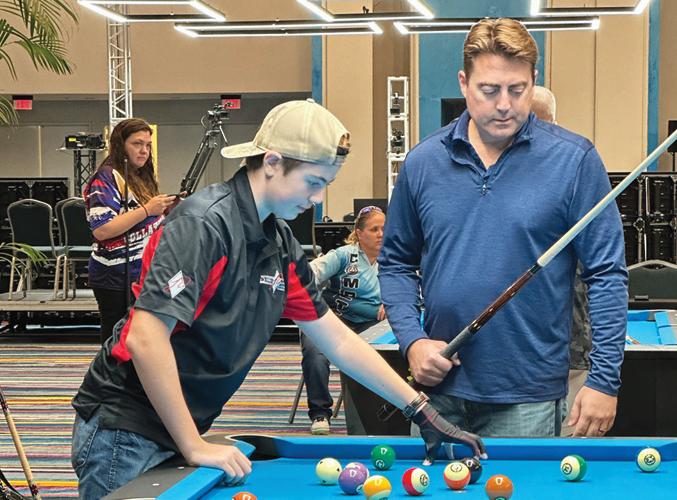
ON THE BALL Shane Petrick, who has been competing in pool since he was 12, is pictured here playing at an Ultimate Pool USA tournament in Kansas City, Mo. in 2025.
Last year, Shane qualified to represent the U.S., on Team U.S.A. Juniors, and played in the 2025 Predator WPA (World Pool Association) World Junior 10-Ball Competition in Gandia, Spain. It was his first world tournament, where young players from over 30 different countries competed in the junior division. In other countries, pool doesn’t have the same seedy “pool shark” image it has in the U.S. It is a fully accepted and popular sport, which kids start playing seriously at a young age. Shane made it almost to the quarterfinals. In a recap he posted on his Facebook page, “Shane Petrick TopSpin,” Shane enthused about “playing the sport I love on the world stage,” and wrote, “I learned so much and now have a game plan for what I need to make the next one even better.”
Shane plays in local tournaments about every other month and in bigger tournaments every few months during the school year, in addition to three to four over the summer. Recent results include placing in the Top 8 at the 2026 Predator Pro Billiard Series – Las Vegas Junior Open and, at a weeklong juniors event held in Quincy, IL. by the Billiard Education Foundation (BEF), he placed third in 10 ball, which qualified him to represent the U.S. in Spain, third in 9 ball, and second in straight pool. (10 ball, 9 ball, and straight pool are different pool games.) He placed second in the 2025 Ultimate Pool USA for juniors in Boston and won first place several times over the last year all over the country.
This June, he represented the USA in the WPA Heyball World Junior Championship in Norway. Players came from more than 42 countries to compete. Heyball, or Chinese 8 ball, looks similar to regular pool but is played on a different table, with different shaped pockets and rails and a different kind of felt. These details
make a big difference. “It’s a whole other game with different strategies and tactics,” he explains. “You could really tell who was used to heyball and who was not.” Shane was not used to heyball and did not do as well as he had hoped.
Right after the heyball tournament, though, Shane played in a 9-ball tournament, also in Oslo. He placed third out of 50 players. “It felt great to shoot on normal pockets,” he wrote on Facebook. Shannon marvels at Shane’s love of the sport and how easily he makes friends with competitors. “As soon as they are not playing, win or lose, they will get together at another table and just be playing pool,” she says. Shannon and Shane spent time sightseeing with other junior players in Norway. “Everyone spoke different languages, but that didn’t matter,” Shannon wrote on Facebook. “Watching them stroll through the streets of Oslo, laughing and joking together, was refreshing … He has formed friendships that I believe will last for years, all because of a common passion and love for the game.”
Mostof us have knocked balls around a pool table in someone’s rec room at some point and are dimly aware of the rules of 8 ball: One player tries to get in all the striped balls, the other player all the solids, in any order, and then finish the game by sinking the black eight-ball. But there are many different pool games.
Shane’s favorite game to play is 10 ball on a nine-foot table, which is what he played in Spain. “10 ball involves every aspect of pool,” he explains, “and the 9-foot [larger, professional-sized] table makes it more challenging and more fun.”
In 10 ball, a player must hit the lowest-numbered ball on the table (from one to ten), though that low-numbered ball may hit another or the cue ball may hit that low ball first and
then another ball, making that second ball go in. The players must also “call their shots”: which ball they’re going to sink and which pocket it will go into. As long as the player is making their shots, his or her turn continues, but if they miss, if they sink the wrong ball, or if they sink their ball into the wrong pocket, then the other player goes. This means that a player can sink balls one through nine, miss the ten, and the other player can simply make that one shot, sinking the ten ball, and win.
This level of pool is often compared to chess. “At Shane’s level of play, putting the ball in the pocket is the easiest part,” says Phil, the league operator. Players think several shots ahead. If they put one ball into a certain pocket, how will the balls be positioned for their next shot and their shots after that? And sometimes if they are uncertain they can make a shot or leave themselves good shots for the rest of the game, players will purposely miss in order to leave their competitor with a difficult table to play.
David Petrick, Shane’s father, plays scotch doubles with Shane in a competitive league. In scotch doubles, there are two players on a team and they take turns taking shots, so the game is about making your shot and setting your partner up with a good shot to take after yours. “Shane sets me up for an easy shot and then I set him up for a bad shot,” jokes David.
David has played a lot of pool. “I thought I was a pretty good player, until I realized what good really was,” he says with a laugh. “Shane can wipe me out.”
Still, the father/son team wins in their local league and, in 2024, qualified to compete in a scotch doubles tournament in Puerto Rico.
It was there that David experienced something else about competitive pool: the mental pressure. “One of the amaz-
(continued on page 24)
ROLL WITH IT Dad David also enjoys playing pool and plays scotch doubles with Shane in a competitive league. "I thought I was a pretty good player, until I realized what good really was," he says with a laugh. "Shane can wipe me out." Left: Shane at the 2026 WPA Heyball World Junior Championship in 2026; right: Shane and his father David competing at scotch doubles in Puerto Rico in 2024.
ing things about Shane is how he can be very calm under extreme pressure,” he says. Often in competitions, players will be surrounded by spectators and even by television cameras and lights.
In a live-streamed match at the Kansas City Shootout last January, Shane played Tom Cousins, one of the top pool players in the world. One of the commentators noted that he can often see players shake from nerves during play, but that Shane was “completely and utterly still.” Noting that Shane “knows he’s a massive underdog,” the commentator continued, “This is a major test for this young man, but he relishes the challenge.” Cousins won, five games to two.
Losing is part of the game. “To be good at the game, you need a lot of heart,” says Phil Trieu. “You have to be able to make mistakes, learn from them, and go on to your next shot. I’ve seen grown adults unable to let a mistake go.”
Phil says Shane had to “take his licks pretty hard” when he first started at the age of 12. “There he was in a dark pool hall, surrounded by adults, consistently losing,” Phil remembers. “I was so impressed and have the utmost respect for him that he could do that, keep his good attitude, and keep coming back.”
“Something I didn’t expect is how much Shane has grown as a person because of pool,” his father David says. “He’s very comfortable with adults, he communicates clearly, and he learned how to stand up for himself even as a young kid.”
There’s also the camaraderie. Pool is social.
Shane’s teammates in the league are now family friends. Calling pool “an analog game in a digital world,” Phil Trieu credits playing pool with helping him meet people, socialize, and “break out of an introverted mindset.” “You’d never guess that Phil was ever an introvert,” jokes Shane.
And it remains a family activity for the Petricks. Not only does David play scotch doubles with Shane, but Shannon has joined a team in the league. “I am literally the lowest player on my team,” she says.
The family often plays together at home, including Shane’s older brother Joshua, 19, though they have to come up with creative ways to handicap Shane to keep the game somewhat competitive. “If I miss, I get to shoot again,” says Shannon. “Otherwise, it would just be me watching Shane play.”
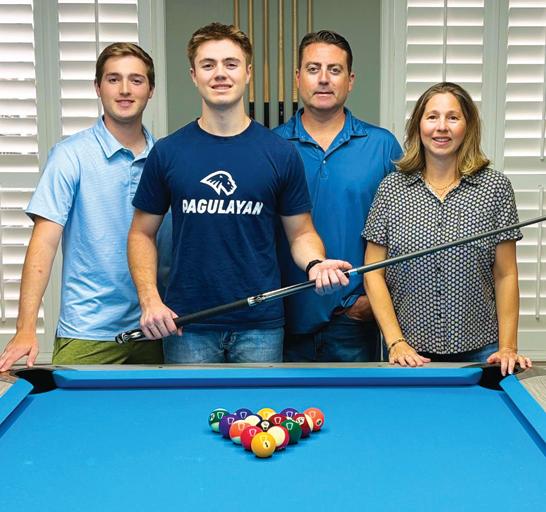
ALL TOGETHER NOW The Petrick family often plays pool together at home. From left: Shane's older brother Joshua, 19, Shane, David, and mom Shannon, who also joined a team in the league.
going to win.” While becoming one of the best players in the United States would be “a really amazing thing,” he says, “For the most part, I’ll see where this goes.”
Shane says he likes pool “because it’s personal. Everything’s on me. There’s a direct correlation between the work I put in and whether I’m
A glossary of pool terms
With the confidence, focus, and nerves of steel honed by pool, whatever happens, Shane Petrick is on his way.
Ball In Hand: When a player fouls and the other player is allowed to place the cue ball where they’d like. The umbrella term for all cue sports. Pool is a type of billiards, as are carom billiards, snooker, heyball, and English billiards.
Billiards: The umbrella term for all cue sports. Pool is a type of billiards, as are carom billiards, snooker, heyball, and English billiards.
Bottom Spin: The player hits the cue ball below its center. This causes the cue ball to reverse direction and come back toward the player after it has hit another ball.
Break: When the first player shoots at the assembled (or racked) balls at the start of a game.
Break ‘n’ Run: When the player who starts the game by breaking keeps making their shots and the other player doesn’t get to take a shot.
Double Tap: If a player touches the cue ball twice during their shot; a foul.
Dry Break: When no balls go in when a player breaks.
Fargo Rating: A fluctuating ranking system of players, though it’s not used by all tournaments. The highest ranked player, Joshua Filler of Germany, has a Fargo rating of 863; an average, but serious player ranks 300 to 450. According to some rules, a player becomes professional when they reach 720. Shane currently ranks 595, though he now plays many tournaments that do not record players’ performance with Fargo.
Frozen: When a ball is touching the cushion, or side of the pool table, or another ball or balls.
Golden Break: When the 9-ball is pocketed during the break of a game of 9 ball, winning the game.
Hanger: When a ball is practically hanging in the pocket but hasn’t gone in. Bad for the shooter; an easy shot for the other player.
Hill/Hill: A hill is when a player is one game away from winning. Hill/Hill is when both players just need to win the current game to win.
Hit the Point: The ball hits the cushion that sticks out a bit in front of a pocket and doesn’t go in.
Jump Shot: When a player makes the cue ball jump over another ball.
Lag: Determines which player does the break. Both players hit a cue ball from one end of the table, the head, to hit the cushion at the other end of the table, the foot. Whoever’s ball comes back closest to the cushion at the head goes. Sometimes, the break is also determined by a coin flip.
Massé Shot: A rarely used trick shot where the player puts such a strong spin on the cue ball that it curves or even reverses direction.
Object Ball: The first ball the cue ball hits during a shot.
Pool Glove: Some players wear a glove on their “bridge hand,” the hand that steadies the cue stick on the table, to allow the cue stick to slide smoothly and quickly.
Rack: A single game of pool, also called a frame.
Slop Shot: A lucky shot.
Top Spin: The player hits the cue ball above its center. This will make it continue rolling in the same direction as the ball it hits.
by Andria Dilling, staff writer
Back to the Kitchen
Family dinners that bring the family together
The start of a new school year signals more than new teachers, new textbooks, and stricter schedules. For parents, it’s a back-to-reality moment when kitchens reopen and having dinner on the table takes precedent over pool time.
Jessica Levy meets the challenge by involving her three girls in the cooking.
Jessica, who works in healthcare administration, moved to Houston with her husband David in 2019 “to be by my twin sister and have our kids grow up together,” she says. With six children between them, Jessica and her sister Jackelyn Silverman, a teacher, are now neighbors, and they often feed their families together. Jessica says she does most of the cooking, explaining that Jackelyn is more focused on Little League than making dinner.
While Jessica gets assistant chef vibes from all her girls – Ruthie and Tillie, identical twins who are 8 ½, and Izzie, who is 6 – her youngest is the biggest helper. “She’s been cooking with me since she was little,” Jessica says. “Well, I guess she still is little.”
“Little” means Jessica was giving 9-month-old Izzie cups of ingredients to pour into recipes. “She’s very advanced,” Jessica says, half-jokingly, explaining that the twins would “go off and do their own thing,” so Izzie would stay behind and help. “I actually think she wants to be a chef when she grows up,” Jessica says.
Izzie says her favorite things to make are chicken noodle soup and pasta. “Normal pasta,” she says, meaning basic white, not whole wheat or anything fancy, “with olive oil and garlic and salt.” She adds that she likes to go to H-E-B to pick everything out, and, she says in a barelyaudible whisper, “to get candy.”
Jessica asks Izzie what happens if she doesn’t help with dinner preparations. “It doesn’t taste good,” is Izzie’s answer.
Jessica says her girls like making things they can be involved in: meatballs, salad dressing, croutons, brisket. “A lot of things that seem hard to do are actually really easy,” Jessica says. “I let my kids participate in all the steps, seasoning the proteins, sauteing them in the pan. I’ll put a glove on them, and they can pour in broth.
They’re proud of themselves.”
Plus, “If they help make it, they will want to eat it,” is Jessica’s motto. “Involving kids in the process of cooking gives them a stake in the game. If you ask Will you help me salt these Brussels sprouts, they will be willing to try them. And my kids like them.”
4 garlic cloves, minced
1 whole yellow onion, peeled
Jessica says she doesn’t typically go to the store with a list; she likes to see what inspires her in the moment. A tip: “Use technology to your advantage. If you put in ChatGPT or Google the ingredients you have, like I have zucchini and rice and I don’t want it to be the same thing I always make, what are some suggestions, it can make some good suggestions. Even if you just vary slightly on what you usually make, it’s more exciting and they won’t get bored.”
Jessica says that chicken noodle soup, a weekly staple, is good for multiple meals throughout the week. “If you pull out some chicken, you can repurpose it for other things later on.”
“I love cooking for others,” Jessica says. “It’s my love language. My kids would rather eat at home than go to a restaurant. They would really love for me to open a restaurant, but my husband thinks that’s a poor financial decision.”
Levy Family Chicken Noodle Soup
Jessica says, “I leave the onion whole instead of chopping it. It adds wonderful flavor to the broth, but since my family is sensitive to onions, it’s easy to remove before serving. And don't be afraid to add a little extra consommé – the richer broth is what makes this soup taste like home."
1½ pounds boneless, skinless chicken breasts
1 teaspoon kosher salt
½ teaspoon black pepper
1 tablespoon olive oil
3 large carrots, peeled and diced
3 celery stalks, diced
8 cups kosher chicken broth
2 cups water
3 tablespoons chicken consommé powder, or more to taste
¼ cup fresh parsley, chopped, plus more for garnish
2 bay leaves
1 cup alphabet pasta
Season the chicken breasts with salt and pepper on both sides. Heat the olive oil in a large soup pot or Dutch oven over medium-high heat. Add the chicken and sear for 2 to 3 minutes per side, until lightly golden. Remove from the pot and set aside.
In the same pot, sauté the carrots and celery for 5 to 7 minutes until slightly softened. Add the garlic and cook for 1 minute more.
Return the chicken to the pot. Add the whole onion, chicken broth, water, consommé powder, fresh parsley, and bay leaves. Bring to a boil, then reduce the heat to low. Cover and simmer for 2 to 3 hours, allowing the flavors to develop and the chicken to become fork-tender. Remove the chicken and shred it using two forks. Discard the onion and bay leaves, then return the shredded chicken to the soup. Bring the soup back to a gentle boil and add the alphabet pasta. Cook according to package directions, about 6 to 8 minutes, until the pasta is tender. Taste and adjust seasoning as needed. Garnish with additional fresh parsley and serve warm.
Serves 6 to 8
COOKING BUDDIES Izzie Levy, 6, has been cooking with her mom Jessica all her life.
Easy Air Fryer Turkey Meatballs & Garlic Pasta
“My kids love helping with this recipe,” Jessica says. “Everyone gets involved mixing the meatball ingredients or scooping the meatballs onto the tray, which makes dinner feel like a family project.”
1½ pounds ground white turkey (or any ground protein of your choice)
1 large egg
¾ cup panko breadcrumbs
1 teaspoon kosher salt
1 teaspoon garlic powder
1 teaspoon onion powder
1 teaspoon dried basil or oregano
1 24-ounce jar tomato basil sauce
1 pound pasta of choice
2 to 3 tablespoons olive oil
Garlic salt, to taste
Preheat the air fryer to 375 degrees. In a large bowl, combine the ground turkey, egg, panko breadcrumbs, salt, garlic powder, onion powder, and basil or oregano. Mix until just combined.
Using a cookie scoop, portion the mixture into evenly sized meatballs and place them on a parchment-lined baking sheet. Transfer the meatballs to the air fryer basket, working in batches if needed. Cook for about 15 minutes, or until cooked through and lightly golden.
Meanwhile, warm the tomato basil sauce in a large skillet over medium-low heat. Once the meatballs are cooked, add them to the skillet and gently toss to coat in the sauce. Simmer for a few minutes to allow the flavors to come together.
While the meatballs cook, bring a large pot of generously salted water to a boil. Cook the pasta according to package directions. Drain the pasta and return it to the pot. Add the olive oil and garlic salt, tossing until the pasta is evenly coated. Serve the pasta topped with meatballs and sauce.
Serves 4 to 6
Variations:
Add more veggies: Sauté a bag of fresh spinach directly into the tomato basil sauce before adding the meatballs. It cooks down quickly and adds an extra serving of vegetables. Make it Asian-inspired: Swap the Italian seasonings for sliced green onions, a splash of soy sauce, and a little sesame oil in the meat mixture. After cooking, toss the meatballs in a simple sauce made with soy sauce, sesame oil, brown sugar, and garlic. Serve over rice or noodles for a completely different take on this family favorite.
Mix up the protein: This recipe works beautifully with ground chicken, beef, or pork, making it easy to adapt to whatever you have on hand.
Courtney
Solleveld makes a roast chicken every week, then maximizes her effort by repurposing the bones for stock, and then the stock for two kinds of soup. “I cook every single day,” she says, “so my kids love all types of food.” Her 12-year-old son Jack received a cookbook as a gift for Christmas and enjoys being in the kitchen. Teddy, 10, “enjoys the eating part,” Courtney says.
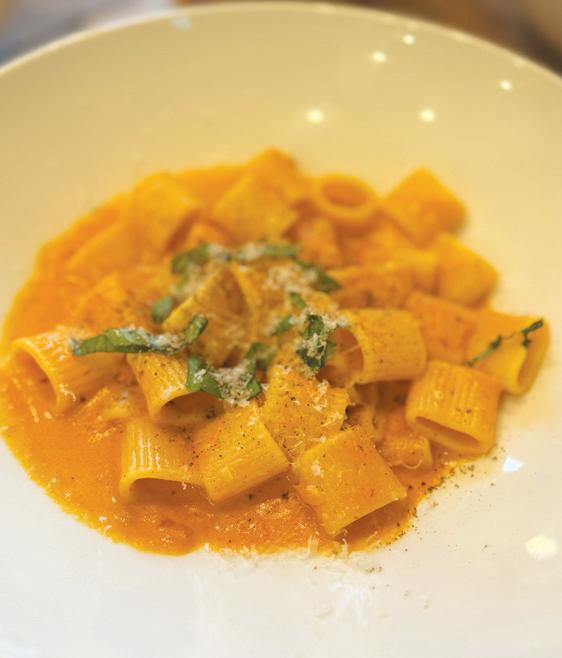
Jack’s specialty is penne alla vodka, a recipe he found in Knife Drop: Creative Recipes Anyone Can Cook by Nick DiGiovanni, the book gifted to him. “This seemed like an easy recipe for him to try on his own. He tried it on a Tuesday, and it’s become a staple,” Courtney says. “He does everything. I’ll just stand there and supervise.”
Juggling lacrosse and golf practices, Courtney has a plan for most weeks: “We will have roast chicken one night and the next night homemade chicken soup, Bolognese one night, panko crusted chicken breasts with orzo and salad, and steak on Friday.” Steak night means Courtney’s husband Bas is cooking. “He can make a steak better than any restaurant!”
Rigatoni Alla Vodka
From Nick DiGiovanni’s Knife Drop: Creative Recipes Anyone Can Cook
2 tablespoons butter
1 tablespoon olive oil
1 yellow onion, grated
3 cloves garlic, grated
¼ teaspoon crushed red pepper flakes
½ cup vodka
1 28-ounce can crushed San Marzano tomatoes
½ cup heavy cream
Salt and pepper to taste
Parmesan cheese
12-ounce package penne or rigatoni
Add the olive oil and butter to a large pot over medium heat. Add the grated onion and garlic, and stir until translucent (don’t let the garlic burn). Add the crushed red pepper flakes. Add the vodka and reduce, about 10 minutes. Add the crushed tomatoes and cook on medium low, partially covered, for 30 minutes.
In another pot, cook the pasta. Here you can blend your sauce if you prefer it smooth, but that is not necessary. Reduce the sauce to low heat and add cream, season with salt and pepper (you can also add a little butter here for an extra-velvety sauce). Cook for 10 minutes. Drain the pasta and add it to the sauce. Mix well and serve with parmesan cheese and fresh basil.
Serves 4 to 6
Courtney Solleveld’s Roast Chicken
1 4- to 5-pound roasting chicken
1 onion, quartered
4 carrots, cut in half
2 sticks celery, cut in half
1 lemon
1 head garlic, skin intact, cut in half
3 tablespoons butter, melted
Salt and pepper
Cooked wild rice, for (continued on page 28)
LIKE MOTHER, LIKE DAUGHTER Jessica Levy loves to cook with her sous chef, 6-year-old Izzie, and (not pictured) twins Ruthie and Tillie. Left: Izzie samples Chicken Noodle Soup; right: Izzie scoops turkey meatballs onto a tray.
(continued from page 27)
serving
Minced fresh parsley, for serving
Preheat the oven to 425 degrees. Rinse and pat dry the chicken. Place it in the refrigerator for 24 hours (not necessary, but if you have the time, this leads to extra-crispy skin).
Toss the onions, carrots, and celery with salt, pepper, and olive oil. Stuff the cavity of the chicken with the lemon and garlic. Brush the outside of the chicken with melted butter and season liberally with salt and pepper. Tie the legs together with kitchen twine. Roast the chicken for 1 and ½ hours, or until the juices run clear. Let the chicken rest for 15 minutes before carving. Serve over wild rice and sprinkle with parsley.
Serves 4
Homemade Stock
Courtney says she saves and freezes any bones she has left over from the week – chicken, pork, steak. “I’ll add all of these to my stock. But if you don’t have a frozen back-stock of bones, you can simply roast two chickens, remove the meat, and set it aside (you will add this to the soup once the stock has been made), and use the bones.
2 whole chicken carcasses
1 large onion, quartered
4 stalks celery, cut in half
4 carrots, cut in half
2 heads garlic, skin intact, cut in half
1 rutabaga, peeled, cut in half
1 turnip, peeled, cut in half
1 bunch parsley
1 bunch dill
Juice of 1 lemon
¼ cup apple cider vinegar
1 tablespoon salt
1 tablespoon whole peppercorns
2 bay leaves
1 tablespoon turmeric, optional
Add all ingredients to a large stock pot and cover with water. Bring to a boil, then reduce to a simmer and cook for 4 to 6 hours. Skim off any foam. Strain the stock, discarding the bones and vegetables, and taste for salt and pepper.
Chicken Soup
Homemade stock
2 carrots, chopped
2 stalks celery, chopped
Roast chicken, shredded
Your favorite noodles
1 bunch parsley, chopped
1 bunch dill, chopped
Add all the ingredients to the stock and simmer on low.
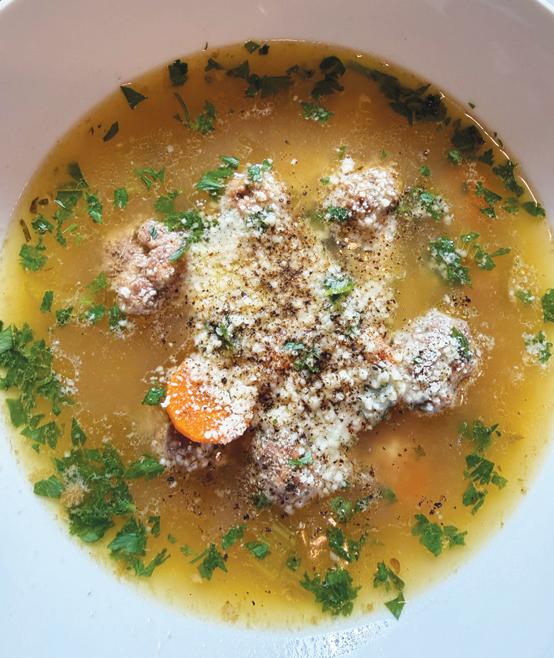
Italian Wedding Soup
Consider adding chopped spinach when adding the parsley and dill.
8 ounces ground beef
8 ounces ground veal
8 ounces ground pork
½ cup panko breadcrumbs
½ cup chopped parsley
1 tablespoon garlic powder
1 tablespoon onion powder
1 tablespoon Italian seasoning
½ cup grated parmesan cheese, plus more for serving
1 large egg
Salt and pepper
Stock
2 carrots, chopped
2 stalks celery, chopped
Small shaped pasta
½ cup chopped parsley
½ cup chopped dill
Olive oil
Lemon
Preheat the oven to 420 degrees. Line a baking sheet with parchment paper.
Mix the beef, veal, and pork together gently with a fork. Use your hands to mix in the breadcrumbs, parsley, garlic powder, onion powder, Italian seasoning, parmesan, egg, and salt and pepper. Roll the mixture into bite-sized meatballs and place on the prepared baking sheet. Bake for 12 minutes.
In the meantime, warm the stock in a large pot or Dutch oven over medium heat. When the meatballs are cooked, place them directly into the stock. Add the carrots and celery, and bring to a simmer. Add the pasta and cook for 8 minutes. Stir in the parsley and dill. Serve topped with parmesan cheese, lots of cracked pepper, a drizzle of olive oil, and a squeeze of lemon.
Serves 6 to 8
EASY AND DELICIOUS Courtney Solleveld cooks most days of the week, and her 12-year-old son Jack is learning to love it, too. Jack makes Rigatoni Alla Vodka (left), and Italian Wedding Soup is in Courtney's weekly rotation.
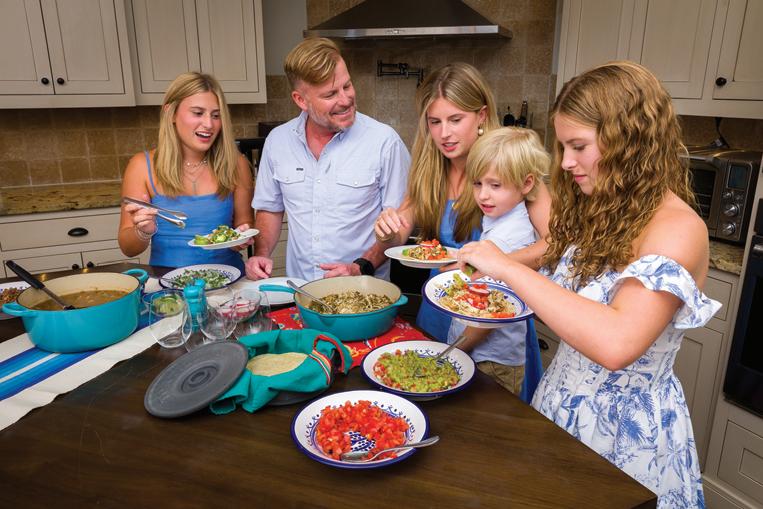
MattStrange, a commercial real estate broker, is the chef in his family. “Cooking has always fallen to my side of the ledger, so to speak,” he says. “In college, when Katherine and I were dating, and now. We’ll go out once or twice a week, but usually I cook every night.”
With four children – Annabelle, 20, Adelaide, 17, Ainslee, 13, and Matthew, 5 –and two careers – Katherine is a lawyer – the Stranges are continuously balancing sports practice pick-ups with dinner. “Katherine carries the heavy load, but we do a good job about seeing what each other’s schedules look like, making it happen as it goes,” Matt says. “One of us gets pulled into a late meeting, and an hour later, I still want everybody to eat in time to be settled down at a reasonable hour. That’s why most of my menu items are simple. Bolognese, burgers, steaks, pork chops. Crispy tacos is always a big hit. I could give you my steak recipe, but it’s probably the same as everyone else’s – salt, pepper, and cook it.” Matt’s grandmother’s pinto beans and his own recipe for carne en su jugo – bite-sized pieces of steak cooked in salsa verde and mixed with bacon and beans – are weeknight favorites.
“I want to make things that make everybody feel good when they come home,” he says. “I’ll get in a bit earlier than everyone to get my grill ready or prep whatever I need to. That way I’m hanging out with my family and not just running around the kitchen with my hair on fire. I’m intentional about getting everything ready, so we can enjoy each other.”
Matt says cooking is calming for him. “I’ve always been passionate about it,” he says. “Both of my parents worked, and my dad did a lot of the cooking when I was a kid. It was a way for us to connect when he came home from work and I was home from soccer practice.
“My kids aren’t really helping, not because they’re opposed, but because they’re chatting and hanging out, and I can stick them with the dishes and trash duties after dinner so I can watch the World Cup or baseball or whatever.”
One exception: Adelaide is famous for her cornbread. “She’s always in charge, and I don’t even know what she does,” Matt says.
“My dad used to make what was in the [Hill Country Fare] package, and I started wanting to help when I was 10,” Adelaide says. “I thought This is good, but how can we make it better? I’d go to a restaurant and try their cornbread and think this one has cheese, this one has jalapeños, this one has bits of corn.” Her concoction: “I use applesauce instead of butter, which makes it more moist and sweeter. Then I add ¼ can of creamed corn, ½ can of corn, and a small can of diced jalapeños if I want to make it spicy.
“I wanted to do what tastes best instead of plain and boring, so I have just tried some things out. It’s making my mouth water talking about it!”
Matt Strange’s Grandmother’s Pinto Beans
This is a no-recipe recipe.
6 strips bacon, chopped
1 white or sweet onion, chopped
2 jalapeños, chopped
1 serrano pepper, chopped
1 pound dried pinto beans
1 15-ounce can stewed tomatoes
Chicken broth
A lot of garlic, chopped
Serve with Adelaide’s cornbread
Matt says, “People will tell you that you need to soak the beans overnight, but I don’t think you need to do that. Just put them on first thing in the morning. Brown the bacon, throw in the onions and peppers, and add the beans, tomatoes, broth, and garlic. I let everything simmer in the pot on low until I’m home and it’s time to serve. Serve with Adelaide’s cornbread.”
Serves 6 to 8
(continued on page 30)
FAMILY DINNER Adelaide, Ainslee, Matt, Annabelle, and Matthew Strange gather around Matt's familyfavorite slow-cooked chicken tacos with all the toppings.
Matt Strange’s Slow Cooker Tacos
Ten minutes of prep and six hours in the slow cooker yields a family-favorite dish.
2 pounds boneless, skinless chicken breasts
1 16-ounce jar salsa verde (Matt uses H-E-B’s fresh Mi Tienda Salsa Verde), divided
1 green pepper, chopped
1 4-ounce can diced green chiles
1 jalapeño, seeds removed and chopped (optional, for extra kick)
Tortillas or crispy taco shells
Garnishes: Fresh cilantro, shredded cheese, diced tomatoes, extra salsa
Pour half of the jar of salsa (about 1 cup) into the bottom of a slow cooker and spread it evenly. Arrange the chicken breasts in a single layer on top of the salsa. Evenly scatter the chopped green pepper, diced green chilies, and jalapeño, if using, over the chicken. Pour the remaining halfjar of salsa verde over everything, ensuring the chicken is fully covered. Cover and cook on low for 5 to 6 hours (or on high for 3 to 4 hours).
With 30 minutes left of cooking time, carefully remove the chicken breasts from the slow cooker. Shred the chicken using two forks. Return the shredded chicken to the slow cooker and stir well to fully coat it in the remaining flavorful juices. Cover and finish cooking for the final 30 minutes.
Spoon the chicken into tortillas or crispy taco shells. Top with fresh cilantro, cheese, tomatoes, and extra salsa to taste.
Serves 6
Matt Strange’s Carne en su Jugo
You can simplify the ingredients list by using storebought salsa verde: Omit the tomatillos, serranos, and garlic. Matt likes H-E-B’s refrigerated Mi Tienda Salsa Verde.
6 slices bacon
3 cups water
4 fresh tomatillos, husks removed
3 serrano peppers, seeded and chopped
1 clove garlic, peeled
2 pounds flank steak, cut into half-inch squares
1 cube chicken bouillon
2 15 ½-ounce cans pinto beans
Half an onion, chopped
6 tablespoons chopped fresh cilantro
Ground black pepper, to taste
1 lime, cut into 6 wedges
Place the bacon slices in a large skillet and cook over medium-high heat for about 10 minutes, turning occasionally until evenly browned. Drain the bacon on paper towels, crumble, and set aside.
In a small saucepan, combine the water, tomatillos, serrano peppers, and garlic over medium-high heat. Bring to a boil, cover, and simmer for 10 minutes. Remove from the heat, let cool slightly, then transfer to a blender and blend until completely smooth. Set aside. (Alternatively, you can substitute store-bought salsa verde.)
Heat a nonstick skillet over medium-high.
A MENU STANDARD Carne en su Jugo appears often on the Strange family's weeknight dinner menu, cooked by dad Matt Strange. Adelaide, Matt, Annabelle, Matthew, and Ainslee dig in.
Add the flank steak cubes and cook, turning so that all sides are completely browned.
Pour the salsa verde directly over the browned beef and bring to a boil. Stir in the chicken bouillon cube, and reduce the heat to medium. Cover and simmer until the meat is tender, about 30 minutes to one hour.
While the meat simmers, place the pinto beans in a separate saucepan and heat over medium until warm. Stir the crumbled bacon
and warmed pinto beans into the flank steak mixture. Divide into six bowls and garnish each with chopped onion, fresh cilantro, black pepper, and a lime wedge.
Serves 6
Editor’s note: See Back Porch Table by Andria Dilling at thebuzzmagazines.com every Friday for more recipe inspiration. And search thousands of recipes at thebuzzmagazines.com/recipes.
FROM OUR ARCHIVES
by Cheryl Ursin, staff writer
Twisted Logic
The Rubik’s Cube is back
This article was originally published in Aug. 2021.
Editor's note: Over the last 25 years, we have printed thousands of stories spotlighting inspirational neighbors and interesting topics. Now, in our From Our Archives column, we are highlighting some of our stand-out articles from over the years. For some, these stories may be new to you. For others, a familiar story may resonate in a different way now. Find all Buzz articles online at thebuzzmagazines.com.
When the Rubik’s Cube, that six-color, three-dimensional, twistable puzzle, first hit the American market in 1980, we were all basically on our own when it came to solving it: twisting the rows and columns of smaller cubes that make up the whole until each side of the puzzle was one solid color. It’s been calculated that a standard Rubik’s Cube can be placed in over 43 quintillion (that’s 43 followed by 18 zeros) positions. Only one of them is correct.
Mine was never solved.
The cube’s inventor, Erno Rubik, a Hungarian architecture professor, wrote, in his recent memoir, Cubed: The Puzzle of Us All, that attempts to do it entirely by “intuition” are usually “doomed.” It took him a month to solve his own puzzle. That makes me feel a little bit better.
But when things come back into fashion –think bell-bottoms and maxi dresses – they are never quite the same as they were originally. And so it is with the Rubik’s Cube and all its descendants, now often referred to generically as “twisty puzzles” since they are manufactured by multiple companies under multiple brand names.
Of course, even back in 1980, some people, including groups at MIT and Caltech, did figure out how to solve the Rubik’s Cube. They developed algorithms, sets of instructions or formulas, that can be used to solve the puzzle.
These days, you can learn those algorithms from YouTube videos. (Google videos on how to solve a Rubik’s Cube and you will get about 590,000 hits.)
That’s not to say that it’s easy. Comments on a popular 10-minute beginner’s tutorial by a
Canadian competitive speed cuber called J Perm, include:
“This has to be the most rewinded video on YouTube;”
“Me* following every step and actually solving the cube: WHAT IS THIS SORCERY;” and “Oh, so this is how parents feel when you try to explain new technology to them.”
Joseph DePinho, currently a junior at St. John’s, brought a Rubik’s Cube with him on a family vacation the summer before sixth grade. He gave up and left it on a table. When he came back, it was solved. His cousin had done it but wouldn’t show him how. “I spent about three hours watching videos,” said Joseph. “It’s hard to learn. It requires a lot of focus and determination, but once you do, it becomes easy, like riding a bike.”
He added, “My dad thought I was a genius.”
Eleven-year-old Morgan Norris got a Pyraminx, shaped like a pyramid, as a party favor. “Morgan was instantly hooked,” said his mother, Julia Oh. He went on to learn how to solve a host of these puzzles, including Megaminx (a dodecahedron, which, with its 12 sides, looks something like a sphere made up of flat planes) and mirror cubes, which are all one color, usually metallic silver, but each row is a different height. When a mirror cube is twisted, it changes shape, which makes it even more mind-boggling than a regular cube.
Morgan can solve other “exotic” cubes as well, including the Skewb, each side of which features a square, turned onto its corner, in the center, surrounded by four triangular pieces, and the Ivy Cube, which has curving pieces, two triangular corners and an oval-shaped center, on each of its faces. He can also solve the more traditional cubes.
The original Rubik’s Cube has three rows of three “cubies,” as Erno Rubik calls them. The edge and corner cubies rotate around a central
pivot to which the six center cubies are attached. Those center cubies, therefore, can only rotate. They do not move and are always in the same position relative to each other: the white center, for instance, is always across from the yellow one. This original configuration is now called the 3x3 and is considered the standard cube. But, in official competitions, speed cubers race to solve cubes that range in size from 2x2 to 7x7 as well as some of the exotics. One cube enthusiast even made his own unofficial cube (and then solved it on YouTube) that is 33x33.
Once a cube enthusiast learns to solve a cube, the next challenge involves solving it as quickly as possible – and the times speed cubers achieve seem unbelievable. For instance, the world record for solving a 2x2 (two rows of two) is under half a second. The current world record for solving a 3x3 is less than three and a half seconds.
Sounds impossible, right? In compilation videos of the top five solves of the 2x2 and the 3x3, it looks impossible. (Note: Competitors have up to 15 seconds to examine the scrambled cube before starting.)
Thirteen-year-old Gabe Kalina is Morgan Norris’s next-door neighbor. The two boys spent an afternoon solving cubes of varying sorts and trying to explain to me how they were doing it. As their fingers flew and their cubes clacked –and they were moving slower for my benefit, mind you – it looked like magic to me.
Gabe brought his first cube to summer camp, and a friend taught him how to solve it. At one point, during the pandemic, he was practicing four hours a day.
This hobby, Gabe said, requires memorization (competitive speed cubers know hundreds of algorithms), rapid pattern recognition, and muscle memory. Both your brain and your hands have to be fast. Gabe showed me how, while
NEW TWISTS Twisty puzzles now come in a variety of shapes. From left: a Megaminx, a Pyraminx (above), the standard 3x3x3, a 1x3x3 or Floppy Cube, and a Windmill Cube.
most people start by twisting the cube using their whole hand, his much-faster twists involve using just one finger. “I play the piano and that helps,” he said.
The cubes used by speed cubers are different from the original ’80s version. The original Rubik’s Cube was meant to be a toy. Speed was not a concern. The corners of the cubies had 90degree angles. Speed cubes have rounded corners to make them a little faster. Speed cubers disassemble them and lubricate them with “cube lube.” At the same time, some of the latest cubes have magnets, which can be swapped out and adjusted, inside the cubies, so that, when a speed cuber twists the puzzle, the rows snap into place. “It’s a balance between them being fast but not spinning out of control,” said Zack White, a delegate for the state of Texas with the World Cube Association, and the lead delegate for the Southern United States. “People choose their cubes and adjust them based on their preference.”
A recent development in cubes are ones that are Bluetooth-enabled. An app can then keep track of a player’s moves and times, kind of like the exercise app Strava for cube-solving.
The cubes do not have to be expensive. Zack said you can get a “pretty good” speed cube for $4-10, though some cost $70-80.
The World Cube Association (WCA) is a global nonprofit organization run entirely by volunteers like Zack. It does not run competitions itself. “Literally anyone can organize a competition,” said Zack; the association certifies compe-
titions and makes them official. You can search for upcoming official competitions near you on the WCA website. Some are held in private homes – the last one Zack attended was in a cabin in the woods – and also at schools, universities, community centers, churches, and libraries.
Most of the events at official competitions focus on solving a specific type of cube as quickly as possible, but there are other permutations, including solving them one-handed and solving them while blindfolded.
In “multi-blind” events, players are given one hour to solve a certain number of 3x3 cubes. They are allowed to spend as much of that hour as they’d like looking at the scrambled cubes, but then they must don a blindfold and solve all of them, one after another, without looking. The world record for this event is held by American Graham Siggins, who correctly solved an astonishing 59 cubes out of 60 while blindfolded.
Zack, now 23, was in middle school when he got his first Rubik’s Cube as a stocking stuffer for Christmas. He taught himself to solve it, using a CD that came with the toy, on a road trip his family took the next day. By the next year, he convinced his mother to drive him six hours to Brownsville (“Somehow, she agreed,” he said) to attend his first competition. Zack, who now works in information technology for the city of Beaumont, has attended 78 competitions, including the 2013 World Championships in Las Vegas and the 2019 World Championships in Melbourne, Australia.
The Australian competition is the setting for a documentary called “The Speed Cubers,” now playing on Netflix. It’s about the heartwarming friendship between two top cubers, Australian Feliks Zemdegs and American Max Park.
It was that documentary and the fact that the Houston toy store she works for, Big Blue Whale, began selling Rubik’s Cubes, that got my 25-year-old daughter, Diana Thomson, interested. “I thought if the speed cubers can do it that fast, I can at least solve it,” she said.
Often at the toy store, children will scramble the twisty puzzles on display. “People don’t like to buy cubes that have already been scrambled, even though the first thing they’re going to do is scramble it themselves,” Diana explained. (This probably says something about human nature, although I don’t know what.) Everyone else at the store now knows to hand those scrambled puzzles to Diana.
Zack says that if you can solve a cube at all, you should come to a competition. (Another place to look for nearby competitions, he said, is the Facebook page Texas Speedcubing.) “Going to a competition is so much fun,” he said. “We’re competing and we’re rivals, but at the same time, the atmosphere is very welcoming and encouraging, and we’re all friends.”
MORE ONLINE
See this story at thebuzzmagazines.com for links, plus a video of Gabe completing a Rubik’s Cube in 28 seconds.
CUBE YOUR ENTHUSIASM Joseph DePinho (at left) and Morgan Norris and Gabe Kalina (from left) have spent many enjoyable hours solving Rubik's Cubes.
Dylan Aguilar
. by Sharon Albert Brier, staff writer
Rumor Has It
Eat, drink, and listen. The Houston Symphony League President’s Luncheon at Lakeside Country Club demonstrated that classical music pairs perfectly with breaking records. Chairs Gayle Eury and Donna Shen curated pure elegance, while president Leslie Nossaman shared an inspiring overview of their historic year. The League hit its highest membership in 33 years and generated massive revenue. They launched a 2030 Strategic Plan – proving they plan further ahead with a drumroll. After celebrating significant impact with schools, the Young Associates Council (YAC), the Barbara Bush Houston Literacy Foundation, and HLSR Trailblazers, 23 past presidents passed a gavel down the line. Leslie Nossaman officially handed it to incoming president Jerre Williams. No eardrums were harmed.
Who will water the tree? Dee Dee Dochen and Paul Grossbard conquered a marathon vacation that included whimsical architecture, Ginja liqueur, and medieval towns and rock formations during their Portuguese adventure to Porto, the Douro Valley, Lisbon, Sintra, and the Algarve. Next, they flew to Israel to visit Paul’s family in Zichron Ya’akov, Haifa, and Jerusalem. A major highlight was visiting the Younited School where Paul received a birthday surprise: a tree planted in his honor. They also paid sobering, gripping visits to Nova Festival sites before Dee Dee flew home and Paul stayed longer with family. Family ties are stronger than jet lag.
May bloomed with love. A Houstonian duo made it official. Dr. Richard and Anne Frachtman hosted a spectacular engagement party for their son, Dr. Steven Frachtman, and Lindsay Testa Stewart. Together, they share a blended family of two sons and two daughters. Guests stepped through a whimsical balloon arch into a vibrant wonderland of exotic floral arrangements and lively music. Richard, Anne, and Lindsay’s parents, Mitch and Annie Testa, shared heartfelt words while toasting the couple. The absolute showstopper? Nine-year-old Davis Frachtman wowed the crowd by crushing Michael Jackson’s “Billie Jean” dance moves. Chocolate frames of the couple’s photo were a delicious takeaway.
With Steven analyzing guts as a gastroenterologist and Lindsay inspiring minds at Kinkaid, this powerhouse couple is truly the perfect match.
Surf’s up. Their fifth Maui getaway proved that paradise isn’t always sunny. Judy and Gary Gondzur traded crowds for isolation when they biked down the Haleakala volcano. This year, rain turned that 30-mph descent from "scenic" to "pure terror." To recover, they tested a new luau and ate fresh pineapple straight from the dirt at Maui Gold farm. Hypnotized with poolside piña coladas and hula dancers at the Marriott Ocean Club on Kaanapali Beach, they found watching surfers and parasailers is way more relaxing when you aren’t hurtling yourself down a volcano.
Museum Houston. Meanwhile, Christian is on the lookout for real-life gators on swampland adventures and coordinates for Celebration Company West. Their proud parents, Vikki and Rich Evans and Pamela Gahn and Thaddeus Fontenot are completely over the moon and utterly spellbound by this wildly unique union.
Move over, Runway magazine. The About Town Houston Junior Forum group completely outstyled the silver screen at Star Cinema Grill CityCentre. Ringleader Melva Meronek marshaled her fashionable entourage for The Devil Wears Prada 2, showing that Houston style easily rivals Miranda Priestly’s. The ultra-chic committee included VP of Activities Susan Fisher, along with Marian Catechis, Karen Conway, Karen Darnell, Kathi Guillory, Julia Heller, Susan Loberg, and Carolyn Staples. After outdressing the Hollywood cast, the gang traded haute couture chatter for hot salsa, heading over to Natalita’s Mexican Grill to wrap up the night.
Starstruck. Under a dazzling meteor shower at Sam Houston National Forest, Christian Fontenot proposed to Rachel Evans This wonderfully quirky couple bonds over intense Dungeons & Dragons campaigns, messy baking sessions, and taking the absolute longest scenic routes on nature road trips. Rachel, a former spooky ghost hunter on the Travel Channel, now directs marketing for Holocaust
Prime time. The Texas Coastal Cattlewomen’s Happy Hour demonstrated that ranching isn't just a job; it’s a lifestyle spurred on by grit and laughter. Houston Rodeo Auctioneer Glenn Beckendorff kicked things off, sharing how he was gifted a heifer calf at birth. According to Glenn, a true rancher needs just three essentials: baling wire, duct tape, and a gun for snakes. Advocates across 13 Gulf Coast counties shared Yellowstone-worthy tales. On Sept. 22, 2026, the TCCW Luncheon will honor the Historic Port City Stockyards alongside Sugie Sartwelle, Lavinia Sartwelle Owen, and Elise Sartwelle at Lakeside Country Club. Legendary cattlemen Bill Sartwelle, Dave Scott, and Jim Sartwelle III will spearhead a panel. They’ll be joined by heavy hitters Dr. Clay Mathis, Dr. Jim Mazurkiewicz, Dr. Jason Cleere, Dr. Billy Zanolini, James Deatherage, Dr. Jeffrey Savell, John Malazzo, and Dan Hunter. For tix, see www.texascoastalcattlewomen.com.
MORE ONLINE
See Rumor Has It at thebuzzmagazines.com for additional photos. Have some good news to share? Email us at info@thebuzzmagazines.com.
ADVENTURES IN PORTUGAL AND ISRAEL Dee Dee Dochen and Paul Grossbard enjoyed a variety of adventures during their travels in Portugal and Israel. Here, they’re pictured touring the medieval town of Obidos.
. by Cindy Burnett, staff writer
Buzz Reads Five picks
for August
Buzz Reads is a column about books by reviewer Cindy Burnett. Each month, Cindy recommends five recently or soon-to-be released titles.
Desert Heist by Alex Dekker (thriller) –Nate Wilde is a former Green Beret and aspiring Harvard archaeologist. Leaving the military after a catastrophic deployment, he chooses to pursue his passion for history. When his dissertation proposal to search for the legendary lost city of Ubar in Saudi Arabia is rejected, Nate resolves to continue his research, recruiting a group of former commandos to assist him. The group becomes involved in a race to discover whether the city truly exists, as well as uncover a deeper geopolitical mystery with resounding global ramifications. This fast-paced thriller contained the perfect mix of history and intrigue, which was unexpected for me. While I love a standard thriller, the addition of such a strong setting and the search for a lost city made this an engaging read. This one is a great fit for fans of genre mashups and intelligent tales.
The Half Life by Rachel Beanland (historical fiction) – Set against the backdrop of Sardinia’s coastline, The Half Life follows Eileen O’Malley, who relocates from Charleston to the Mediterranean island of La Maddalena with her husband, Navy lieutenant Paul Archer. What begins as a romantic adventure soon reveals underlying tension, as Eileen navigates the rising conflict surrounding potential nuclear contamination in the waters, igniting protests on the island. I was completely unfamiliar with the nuclear tensions in the Mediterranean during this time period and was fascinated by what occurred. Beanland’s portrayal of Sardinia is deeply informed by her own childhood experiences, having lived on the island during her early childhood due to her father's naval service. Eileen’s reckoning with the cost of staying silent feels very timely. Readers who love a strong sense of place and learning about lesser-known events in history will devour The Half Life
The Seekers of Deer Creek by Thao Thai (fiction) – This beautiful book tells the story of two estranged sisters who embark on a quest to find a painting by a forgotten Vietnamese artist
that holds the truth to their family’s fractured past. Months after the two fall out, Calla appears at the museum where Viv works as an art conservator with a sketch and a letter she found in their father’s belongings. The sketch is an exact copy of “Blue Mirror,” a striking painting by a Vietnamese painter named K.P. Lý, whose story gives the reader insight into Vietnamese art and culture. Against the backdrop of the art mystery, Thai weaves in an examination of Vietnamese history, the complex relationships between family members, and the irresistible pull of the past, enduring across time and generations and never fully buried. It will appeal to fans of art, family sagas, and lyrical writing.
Three Reasons for Revenge by Dervla McTiernan (mystery/thriller) – Three Reasons for Revenge opens with a young woman walking into a Melbourne police station to report a crime...and then she vanishes without a trace. In the days that follow, three carefully wrapped packages arrive on separate doorsteps, and each gift will tear apart the life of its recipient. Detective Sergeant Judith Lee is smart and experienced, but as the case rapidly spills into the volatile ecosystem of social media, where deepfakes, AI manipulation, and viral spectacle blur the line between truth and fabrication, Judith must navigate not only a criminal investigation but a media firestorm with no clear rules. Timely and relentless, this thriller poses urgent questions about belief, accountability, and retribution in the digital age when reputation can be dismantled in an instant and the truth is whatever goes viral first. It is destined to leave readers questioning every unopened package left at their door. Fans of original thrillers and masterfully crafted plots will enjoy this one.
Time to Burn by Ellery Lloyd (speculative fiction) – Inigo Frank has perfected commercial time travel, though it is tightly regulated and so expensive that only the very wealthy can afford it. His company, Tempus Tours, has been approved to visit just one place: London in 1941, during the Blitz, allowing clients to experience the aerial bombardment of the city. To immortalize his achievement, Frank enlists Phoebe Hunt to create a documentary, but on her first day she captures a group returning from London bloodied and traumatized. As Phoebe races to untangle the truth in this propulsive and creative page turner, she begins to realize all is not as it seems. I enjoyed the way this book weaves in history, the butterfly effect, and the manner in which the uber-wealthy impact our world, often behind the scenes. Time to Burn will appeal to fans of creative premises, timely stories, and a strong sense of place.
Editor’s note: Book reviewer Cindy Burnett also writes our weekly Page Turners column at thebuzzmagazines.com. She hosts an award-winning book podcast entitled Thoughts from a Page Podcast www.thoughtsfromapage.com, runs the Instagram account @thoughtsfromapage, and regularly speaks to groups about books.
WHAT TO READ This month's selections include a compelling time-travel tale, two riveting thrillers, a family drama set mainly in Vietnam, and historical fiction that takes place in Italy in the 1950s.
Cindy Burnett
SportzBuzz SPORTS
. by Todd Freed, staff writer
In its first-ever season of girls flag football, the Memorial Mustangs advanced to the title game of the inaugural Girls Flag Football Texas State Championship. At the state tournament on the campus of the University of North Texas, Memorial defeated Round Rock High School and then Eastwood High School to win the Houston Texans division, before falling to Dallas Cowboys division winner East Rockwell in the state title game.
“The whole experience was unimaginable,” said Texans flag football coach Zoe Korman “Our team had dreamed about playing in the Texans practice bubble for the regional championship, but it was hard to imagine that we would be on the field for the state finals. We’re so grateful to the Houston Texans for starting the program and giving the girls the opportunity to be a part of football.”
In the Texans division final of the state tournament, Memorial running back Brooklyn McGill scored three touchdowns and was named the game’s MVP. Sophomore quarterback Angelyn Rau along with wide receiver and defensive back Reese Listengart were also major contributors to the Mustangs success all season, according to Korman. “Angelyn had several touchdown passes at the state tournament while Reese is just an amazing player on both sides of the ball.”
In advancing to the state tournament, the Mustangs owned an undefeated 10-0 record including a district title and a regional championship secured at the Houston Texans practice bubble. For the season, the Mustangs finished with a 12-1 overall record.
“Most of our girls are dual sport athletes in sports ranging from basketball, soccer, volleyball, and track and field,” said Korman. “The soccer players were actually in the playoffs during our season, so they were going back and forth from soccer to flag football practice. Our girls are just incredible athletes, and it shows on the field.
The other thing that made this team special was that the girls prioritized their friendships. We made sure we had regular team lunches as well as team dinners every Friday night. They are an extremely close-knit group and, of course, being amazing athletes doesn’t hurt.”
For some of those amazing athletes, playing flag football has created opportunities beyond the playing field. “After our state final, we were already receiving emails from various colleges who were interested in offering scholarships to our players. The sport has just brought so many opportunities to the girls, which is also so exciting,” said Korman.
The Mustangs inaugural season also culminated in exciting fashion for Korman, who was selected as the Houston Texans Flag Football Coach of the Year. “It’s such an incredible honor,” said Korman. “I can’t put into words what this flag football program has meant for my athletes, as these girls have made history and broken barriers by showing that football is for everyone. I’m so grateful to the Texans She’s Next program for creating a place for girls in the football community and allowing us to pave the way for future generations to build something even bigger.”
Fora remarkable ninth consecutive season, the Episcopal Knights captured the SPC Softball Championship. The Knights defeated rival St. John’s 2-1 in the SPC tournament final to secure this year’s championship, while also finishing the season as the top ranked private school in Texas.
“We have tremendous support from our administration and an incredible coaching staff,” said Knights outgoing head coach Caitlyn Cain “Our hitting coach Shaylon Govan was a twotime All-American at Baylor, Kim Randolph was the former head coach of our softball program who coached our pitchers and catchers, while long time Episcopal coach Kary Kemble
also did an outstanding job for us.” Cain led the Knights to SPC Championships in all eight of her seasons as the Knights head coach before making an out-of-state family move this summer.
On the field, Sacramento State signee Jordan Bey had a sensational season on the mound with a 1.62 ERA including the complete game victory in the SPC final over St. John’s. “We knew anytime we scored at least two runs, we were going to win the game when Jordan was on the mound,” said Cain. “She’s an amazing pitcher.”
At the plate, graduating senior Elliot Loper led the way with a lofty .429 batting average while leading the teams in runs scored and stealing 34 bases on 36 attempts. “Elliot was our table setter who always seemed to find a way to score,” said Cain.
Packing a powerful punch for the Knights was centerfielder Alexis Johnson, who belted seven home runs to go along a .329 batting average while scoring 30 runs and stealing 27 bases in 27 attempts. In addition, graduating senior catcher Claire Johnson boasted a .329 batting average while making good on all 24 of her steal attempts.
“We broke our own stolen base record with 186 steals in 205 attempts,” added Cain. “One thing we worked on this year was putting a lot of pressure on the other team’s defense and it worked. It was a lot of fun.”
Editor’s note: Todd Freed is the host and executive producer of H-Town High School Sports, which airs Saturday at 10:30 p.m. on CW39 and Monday-Thursday on AT&T SportsNet SW. To submit high school sports news for possible inclusion in SportzBuzz, please email todd@thebuzzmagazines.com.
SOFTBALL DYNASTY The Episcopal Knights were crowned SPC Softball Champions for the ninth consecutive season.
. by Annie Blaylock McQueen, staff writer
SportzBuzz Jr.
Welcome to SportzBuzz Jr., a column spotlighting neighborhood athletes in elementary and middle school.
Undefeated champs
The West University Little League PW8 Bazookas team went undefeated in the regular spring season and brought home championship rings after winning it all in the playoffs. The championship was extra special as it was played on Wallin Field, typically reserved for the older players in the league. The Bazookas were led by coaches Jared Mushinski, Daniel Parker, DJ Palmore, and Erick Rodriguez (pictured, back, from left), who emphasized teamwork and sportsmanship throughout the season. Pictured are players (front row, from left) Carter Venghaus, Sebastian Rodriguez, Andrew Ermis, Robbie Stephens, Easton Palmore, William Kherkher, Sam Mushinski, James Lippman, Julian Bapat, Hayes Parker, and Jackson Lecocke
Cardinals fly
The Bellaire Little League 10U All-Star Cardinals defeated Westbury Little League White 4-0 to win the Clutch City Classic championship at Weston Field. The team played one more tournament before turning its focus to the Texas East District 16 Tournament. Pictured are (back row, from left) coach Dan Braun, manager Sam Lee, coach Jed English, and coach Josh Stein; (front row, from left) Anthony LeJeune, Josh Lee, Rohan Franklin, Aden Braun, Noah Stein, John La Raia, Nicholas Chang, Jack Walton, Eniola Bello, Noah Selbst, Weston Shelton, and William English. Congratulations to the Cardinals on an exciting and memorable season.
Making a splash
Bellaire Barracudas swimmers (pictured, front row, from left) Ryan Auwarter, Madelyn Melville, Eliana Munro, Bella Torres; (back row, from left) Abigail Ward, Mia Torres, Zoë Cheng, Han Vora, and Joelle Le waited poolside for their chance to compete during the team's seasonopening meet at Willow Pool. The Bellaire Barracudas had an outstanding 2026 season with more than 320 swimmers on the team, including 84 who qualified to compete at the Southwest Aquatic League Championship meet at the end of the season. The Barracudas’ head coaches are Natalie Cheng and Sophie McCollum. Assistant coaches included current and former Barracudas swimmers Ani Burris-Richardson, Antonio Rico, Austin Byun, Catherine Renshaw, Clara Liu, Emika Cheng, Jack Callaghan, Jolie Burris-Richardson, Kasen Burris-Richardson, Liem Vora, Max Charles, Miranda Wang, Rachel Serna, Reva Sinha, Ryan Osborne, and Teresa Cheng.
Editor’s note: Send your best high-resolution photos and behind-the-scenes stories about young local athletes, in both team and individual sports, to SportzBuzz Jr. at info@thebuzzmagazines.com. Include all contact info, names, ages, grades and schools. Featured athletes must live in Buzz-circulation neighborhoods. Items will be published on a space-available basis.
by Mackenzie Malveaux, staff writer
Event Roundup
Houston is closing out the summer with a lineup of events that celebrate everything that makes this city so special. August offers a diverse array of can’t-miss experiences, from flavorful food, cultural celebrations, live performances, and family-friendly activities. Here’s a sampling of some Buzzworthy events this month:
Houston Shakespeare Festival
Thurs., July 30-Sat., Aug. 8
The Tempest: July 30, Aug. 1, 3, 5 & 7; The Comedy of Errors: July 31, Aug. 4, 6 & 8; all performances at 8:15 p.m.
Miller Outdoor Theatre
Free
The Houston Shakespeare Festival returns to Miller Outdoor Theatre with free performances of two Shakespeare classics: The Tempest and The Comedy of Errors. Produced by the University of Houston, the festival is a professional extension of the UH School of Theatre & Dance in which UH students perform alongside seasoned professionals. The Houston Shakespeare Festival has brought high-quality performances to the Houston audience since 1975. See the full Miller season schedule at www.milleroutdoortheatre.com.
Houston Restaurant Weeks
Sat., Aug. 1-Sept. 7
Varying restaurants across Houston $25+
The most anticipated Houston foodie event of the year is here! Houston Restaurant Weeks offers 38 days to explore the variety of cuisines within Houston’s most popular restaurants for a great cause. Participating restaurants offer a prix fixe menu featuring brunch ($25), lunch ($25), or dinner ($39 or $55). A portion of the proceeds go towards the Houston Food Bank. See houstonrestaurantweeks.com for participating restaurants and menus.
3rd annual Comin' In Hot Pro-Am Hot Sauce Competition
Sat., Aug. 1, 10 a.m.-1 p.m. Hope Farms
$10 for general admission; $25 for the Family 4Pack
Hope Farms hosts the third annual Hot Sauce Competition, in which Houston chefs and home cooks compete in a blind tasting for the titles of Judge’s Choice and Fan Favorite. Sample every hot sauce entry, cast your vote, and enjoy free beer from Saint Arnold Brewing, live music, kids' activities, snow cones, and farm-fresh produce, all while supporting Recipe for Success Foundation’s mission to teach Houston children healthy eating habits.
White Linen Night in the Heights - 20th Anniversary
Sat., Aug. 1, 6-10 p.m.
Houston Heights, W 19th Street
$20
White Linen Night returns to Houston Heights for its 20th year, inviting guests to dress in their best white attire and stroll along W. 19th Street. Enjoy live music, street performances, local eats, and more than 50 vendors as the neighborhood transforms into a lively summer street festival. Inspired by a festival in New Orleans in which attendees don their finest white attire, the event in the Houston Heights began in 2006 to celebrate and support local artists and businesses.
Sat.-Sun., Aug. 1-2, times vary
Toyota Center
Ticket prices vary
Toyota Center welcomes monster trucks, never-before-seen stunts, and family-friendly excitement at the Hot Wheels event. Fans can see the debut of the all-new Rhinomite truck, and thrilling FMX rider stunts, including the No-Handed Front Flip. Arrive early for pre-show party options offering an upclose look at the trucks before the action begins.
City of Bellaire Dive-In Movie
Thurs., Aug. 6, doors open at 7:15 p.m.
Bellaire Town Square Family Aquatic Center
$20 online; $25 at the door
The City of Bellaire and PATRONS for Bellaire Parks invite Bellaire neighbors and families for an end-of-the-summer celebration at the annual Dive-In Movie Night. Cool off with a swim while watching the live action How to Train Your Dragon (PG), with food and a complimentary pool noodle to complete the evening. The event has been a favorite community tradition since 2011. Proceeds benefit PATRONS for Bellaire Parks.
Hot Wheels Monster Trucks Live: GlowN-Fire
DOG DAY AT DAIKIN Bring your four-legged friend to cheer on the Astros as they take on the Athletics during Dog Day, featuring dog-friendly activities, a special Dog Zone, and an exclusive Astros dog toy for the first 500 dogs each day.
Houston Astros
Harry Potter DroneArt Show
Fri.-Sat., Aug. 7-8, 9 p.m.
Constellation Field
$51.90 (ages 12+); $30.90 (ages 3-11); $46.90 groups of 8+
Experience an open-air spectacle featuring 1,200 illuminated drones recreating iconic characters and moments from the beloved Harry Potter films. The night will showcase a live electric violin performance featuring music from the soundtrack, themed treats and drinks, exclusive merchandise, and a nighttime display under the stars. The show begins at 9 p.m.; doors open at 7 p.m.
Sunset Bingo at Levy Park
Fri., Aug. 14, 6 p.m.
Levy Park
$10/bingo packet (eight games); $1/dauber (or bring your own dauber) (cash only)
Enjoy an evening of bingo, music, and community at Levy Park's monthly Sunset Bingo, offered every second Friday of the month. Play eight rounds for the chance to win prizes while DJ Del Sur plays soulful tunes, then grab dinner, cocktails, or ice cream from within the park. Sales begin at 6 p.m. and the first game starts at 7 p.m.
Miller Summer Mixtape
Sat., Aug. 15, 8 p.m.
Miller Outdoor Theatre
Free
Celebrate the diverse music scene across Houston with the 6th Annual Miller Summer Mixtape, featuring performances from various artists like Sara Van Buskirk, Saint Judas & The Black Hymns, and Rodell Duff, plus more. Hosted by Kam Franklin, lead singer for the Houston soul group The Suffers, with music from DJ Mikey Drag between sets, this free concert highlights the local talent within our city. See the full Miller schedule at www.milleroutdoortheatre.com.
Family Nature Night
Wed., Aug. 19, 6:30-8 p.m.
Nature Discovery Center
$12/person
Discover the fascinating world of bugs during Family Nature Night: Creepy Crawlies: Insects & Spiders. Designed for ages 3 and up, the interactive evening includes themed crafts, a nature walk, and an interactive program featuring live animals and specimens led by head naturalist Eric Duran. The night will allow guests the opportunity for up-close, hands-on animal encounters with the invertebrate animal ambassadors, the Madagascar hissing cockroaches, a Chilean rose hair tarantula, and a giant African millipede.
Cardboard Boat Regatta
Sat., Aug. 22, 9 a.m.
Evergreen Pool
Free
Get creative as you race to the finish line with handmade boats constructed entirely from cardboard and duct tape. Awards will be presented for top finishers in three age divisions (ages 10 and under, ages 11-15, and ages 16 and up), as well as Best Costume and Boat Design.
Dog Day: Houston Astros vs. Athletics Sat.-Sun., Aug. 22-23, 6:10 p.m. and 1:10 p.m.
Daikin Park
Ticket prices vary
Bring your furry friend to Daikin Park for the Astros' annual Dog Day, where pups can cheer on the Houston Astros while our team takes on the West Sacramento Athletics. Four-legged fans can enjoy special dog-friendly activities, visit the Dog Zone and "Barking Room Only" area. The first 500 dogs through the gates each day will receive an exclusive Astros dog toy. Proof of vaccination is required for all participating pups.
Express Children’s Theatre at Miller Outdoor Theatre
Tues.-Thurs., Aug. 25-27, all performances at 11 a.m.; Aug. 25: The Invisible Dragon; Aug. 26: The Adventures of Sinbad the Sailor Girl; Aug. 27: Freedom Train
Miller Outdoor Theatre
Express Children’s Theatre returns to Miller Outdoor Theatre with three interactive productions designed to entertain, inspire, and encourage learning amongst the youth through live performances featuring The Invisible Dragon (Aug. 25), The Adventures of Sinbad the Sailor
Girl (Aug. 26), and Freedom Train (Aug. 27). See www.milleroutdoortheatre.com
2026 Houston Mariachi Festival
Fri-Sun., Aug. 28-30, times vary Wortham Center - Brown Theater
$35+
Experience a weekend of music, dance, and culture at the 2026 Houston Mariachi Festival, showcasing celebrated mariachi ensembles from Houston's collegiate and high school performers to world-renowned ensembles and professional dance troupes and the 20-time national champions from the University of Texas Rio Grande Valley. Each performance offers a unique lineup, including the University of Houston Mariachi Pumas, Mariachi Imperial de America, University of Texas Rio Grande Valley Mariachi Aztlan, and more.
Cirquetacular: The Art of Circus Sat., Aug. 29, 8 p.m.
Miller Outdoor Theatre
Free
Miller Outdoor Theatre caps off the month as works of Van Gogh, Da Vinci, and Picasso come to life through acrobatics and dance. Featuring stunning costumes, an exhilarating musical score, and world-class performers, this production creates an unforgettable evening.
Editor’s note: Events are subject to change. See this article at thebuzzmagazines.com for links. Find more events at thebuzzmagazines.com/calendar and see our Weekend Roundup online every Friday.
SUMMER AT MILLER Miller Outdoor Theatre is packed with free entertainment this month, including the annual Houston Shakespeare Festival produced by the University of Houston, plus performances from local musicians, kid-friendly theatre, and more. Grab a blanket, settle in on the lawn, and spend an evening under the stars. Jeff Myers
by Preet Nagi, age 14
Buzz Kidz
GBREAKING BARRIERS Carnegie Vanguard High School students founded Girls MPower, a youth initiative that promotes educational opportunities for young girls across the city. Pictured, from left: Elaine Antony (COO), Emma Yin (Literary Advocacy Head), Riya Bansal (Visual Advocacy Head), Gurleen Kaur (CEO), Giang Tran (newsletter editor), Preet Nagi (Marketing and Outreach Head), and Raeshmika Sabarigiri (CFO) hosting an event at Hogg Middle School.
Paving the way with Girls MPower
ender stereotypes and unequal opportunities continue to affect girls around the world. Girls MPower, a youth-led initiative, works to spread awareness about gender inequality and inspire people to become advocates for change.
Founders Gurleen Kaur (CEO), Elaine Antony (COO), and Raeshmika Sabarigiri (CFO) were invited to the International Women’s Day Luncheon in March. They were inspired to start Girls MPower, dedicated to advancing quality education and gender equality aligned with the United Nations’ fourth and fifth Sustainable Development Goals. Research reveals that during the pandemic, “girls lost just under half of a grade level from 2019 to 2024, while boys lost less than one-quarter,” widening
the education gap (Houston Chronicle, 2025).
Growing up, I saw the struggles my mother went through as a woman of color who created her own successful family practice, which drew me to Girls MPower. I am now the Marketing Head, and my goal is to connect others to this organization. Our organization partners with schools and educational institutions to further our reach. For example, I helped run a booth at Hogg Middle School Literacy Night, engaging over 100 students through activities like a Pledge Wall, where children pledged actions to reduce gender disparities, and Spin the Wheel, which challenged students with questions about the fourth and fifth Sustainable Development Goals. To address the lack of female role mod-
els in male-dominated fields – which can undermine girls’ confidence in pursuing these careers – we invite female experts from diverse professions to speak at our seminars and challenge stereotypes.
We accept public submissions on literary work or visual representations about these prevalent issues and post them on our website. We aren’t providing a miracle or a quick solution; we are simply giving a chance.
Editor’s note: To learn more about Girls MPower, see sites.google.com/online.houstonisd.org/girlsmpower/home and @girls_mpower on Instagram
Want to be a Buzz Kid? Email approximately 350 words, a high-resolution photo and caption to info@thebuzzmagazines.com.
Now accepting applications for reporters in the 2026-2027 school year. DEADLINE AUG. 13.
The Buzz Magazines offers a unique program, School Buzz, in which high school students write about what's happening at their schools from their perspectives.
As a School Buzz reporter, you'll:
• Gain experience writing, reporting, and taking photographs
• Share a behind-the-scenes look at what's happening at your school with the wider community
• Receive invaluable writing samples for college applications
• Earn a byline at thebuzzmagazines.com
See thebuzzmagazines.com/school-buzz for more information and to apply for the 2026-27 school year. Questions? Email Mackenzie Malveaux at mackenzie@thebuzzmagazines.com.
hartphoto.com
Neighborhood Tails
Zoe, French Bulldog, age 12, Merrick St.
Hi, I’m Zoe (on right) – a French Bulldog of distinguished experience, approaching the fabulous age of 13. My friends call me Zozo. My family describes me as sweet, stubborn, and full of personality. I prefer “confident with exceptional leadership skills.” For nearly 13 wonderful years, I’ve loved my people fiercely, kept a watchful eye on the house, and reminded everyone that naps aren’t a hobby – they’re a lifestyle. These days, I graciously allow my 5-year-old Frenchie “puppy” brother, Toby (on left), to live in my house. He seems to think we’re equal, which is absolutely adorable. I let him have his little moments, but everyone knows who’s really in charge (spoiler: it’s the one with seniority and the superior side-eye). When I’m not expertly supervising the household, you’ll find me judging your snack choices, claiming the coziest spot in Mom and Dad’s bed and reminding my family that personal space is optional when you’re this cute. I’ve spent a lifetime proving that the best things come in wrinkly, slightly bossy packages – and I have no plans to lower my standards now.
Got a cute critter? Email a picture of your pet with approximately 150 words to info@thebuzzmagazines.com.
Talking
Many seniors hear move as loss. While families mean safety, loved ones hear control. You can protect trust by starting with listening and build choices that are respectful.
Begin with a question: What feels hardest right now? Then pause. Let your loved one name fears: Losing routines, independence, feeling rushed. Naming fears out loud helps reduce the heat in the conversation.
Use specific examples: I noticed you missed two meals this week and felt dizzy after your morning meds. Avoid: You cannot live alone. Specific examples show care, not criticism.
Offer choices: We can bring in help three mornings a week or we can tour an assisted living community to see what support looks like. Options help reduce feelings of being overwhelmed.
Keep conversations short. Ten minutes now is better than an hour. Change happens through repetition, not one big talk.
Invite small control points. Ask what they want to keep in their day. Morning routine. Faith community. A pet. Use those anchors when you explore options. When a person sees what stays the same, change feels less threatening.
If conversations stall, bring in a neutral guide. A local advisor can hold an assessment call, explain choices, and keep the focus on fit. The right support does not erase independence. It protects it.
Hannah Inselmann Wier, Assisted Living Locators, 832-833-2469, swhouston.assistedlivinglocators.com
Safer banking, dead or alive
Once upon a time, we ran our households on paper checks, which we signed and mailed, and every month we reconciled our statements against our check registers. Now, ever fewer account holders even know what that means, much less do it. Ironically, written checks are now an invitation to fraud, given check washing and the ease of an unauthorized remote ACH payment.
Paying the yard man or housekeeper by check? You just shared your account name and number as well as your bank’s name and routing number. That’s more than enough information to create an unauthorized paper check or an ACH debit. Imagine a couple of small test transactions before a third one clears your account out. Your rights and your remedies against your own bank can vary dramatically.
Banks are allowed to offer more generous protection, but by default, you must inform the bank yourself and on a deadline; otherwise, there is no bank duty to refund. For a counterfeit paper check, your notice deadline to the bank is “reasonable promptness,” but never more than a year. For some unauthorized ACH debits using only your check’s preprinted numbers, the notice deadline is 60 days (but you eat the first $500). If you give notice of the same unauthorized ACH debit within two days of learning of the loss, you bear only the first $50 yourself and the bank becomes responsible for the rest.
These are very different results, all depending on whether or not the fraud was paper or electronic. It is an understatement to say the law is complicated and banks know it better than you do. For estate planning and probate pur-
poses, it’s enough to know that there may be less protection for trusts and estates. If you read the law closely, even a revocable trust that’s disregarded for income tax purposes may have less consumer protection.
What to do? Set alerts for email and text messages for every transaction over a dollar? Thorough but annoying. Reconcile accounts monthly? That would be prudent. Consider segregating the rainy day fund from the household account, which probably should never have much more than one month’s expenses in it.
For big one-off expenses, e.g., a new roof, pay by cashier’s check or bank check. ACH is too convenient not to use, but initiate it through your bank’s online portal, not the vendor’s. Explore a Zero Liability debit or credit card. Zero Liability or not, every credit card caps consumer liability at $50, provided the charge is disputed before payment.
Trustees and executors: Ask your business banker about Positive Pay and ACH Filtering, products not available to consumers.
We write wills and go to probate court. Foreign nationals and international families welcome.
Russell W. Hall, Bellaire Probate, Attorneys at Law, 6750 West Loop S. Ste. 920, Bellaire, Texas 77401, 713.662.3853, bellaireprobate.com
. by Angie Frederickson, staff writer
Buzz About Town
Fourth of July Fun: The 250th
Lauren and Scott Phillips (pictured with kids Gracie, James, Henry, and Annie) enjoyed the Fourth of July at the annual West U Independence Day Bike Parade and Pool Party. Neighbors were in a patriotic state of mind for the 250th anniversary of the signing of the
Declaration of Independence. Family fun was had by all at the bike parade that kicked off in front of City Hall, followed by the pool party at Colonial Park. West U neighbors gathered at the pool for a water balloon toss, the kids’ annual cannonball splash, and the belly flop competition. See more Fourth photos at thebuzzmagazines.com.
Farewell to the chief
After 30 years of public-safety service to the West University Place community, Fire Chief James Novak (pictured) has retired. Novak joined the West University Place Fire Department in 1996 as a firefighter-paramedic. He became a lieutenant in 2010, was named assistant chief/fire marshal in 2013, and was selected to lead the department as chief in 2024. Throughout his career, Chief Novak helped shape the department’s fire and emergency medical operations, emergency management response and strategy, and community outreach initiatives. To honor his tenure, the West U City Council designated his retirement date, May 28, 2026, as James Novak Day.
Radiant women
Laurie Sanders and Chelsea Collmer (pictured, from left) joined supporters of Legacy Community Health for the inaugural Radiance Luncheon. The sold-out event at Tootsies was created to raise funds to support women’s health initiatives. Chree Boydstun, Legacy Community Health’s Chief Development and External Affairs Officer, emceed the luncheon and spoke to the crowd about the need for comprehensive healthcare for women of all ages. Guests enjoyed shopping and cocktails before the luncheon and heard from guest speakers Mark Rivers and Dr. Erica Giwa about women’s health and wellness.
World Cup fan walk
All dressed in orange, Susan Hoffman, David Hoffman, Heather Ortiz, Debbie Ortiz, and Garrett Lepow (pictured, from left) joined a crowd of 25,000 excited
Daniel Ortiz
Lucy Walker
Courtesy of Susan Hoffman
(continued
fans for the Netherlands Fan Walk from Rice University to Houston Stadium. It was particularly special for Susan, who attended high school in the Netherlands and enjoyed celebrating with the melting pot of Dutch and American fans at the walk. In addition to the walk before the Netherlands v. Sweden match, Houstonians also joined international fans for walks leading up to the Portugal v. Uzbekistan and Brazil v. Japan matches. Fans have raved about Houston’s fantastic hospitality and generosity as a host city, and the festive Fan Walks are a big part of that praise. For more World Cup fan photos, search “The World Walks” at thebuzzmagazines.com for an article by Buzz summer interns Amina Khalil-Zegar and Caroline Hricik
Lights, camera, inclusion!
Bilen and Heidi Ham (pictured) joined Spectrum Fusion supporters at the Filmmakers Showcase at River Oaks Theatre. The second annual event, Transition to Adulthood, highlighted original films created by autistic adults who are members of Spectrum Fusion’s Media Team. In honor of Autism Acceptance Month, the showcase began with a red-carpet entrance to celebrate the Media Team followed by a greeting from founder and CEO Dr. Heidi Stieglitz Ham. More than 175 guests filled the theatre to learn about the short films that were created to share insight into the lived experiences of autistic adults. The evening concluded with a Q&A session where Media Team members discussed their own journeys and goals for the future.
The stars of West U
The City of West University Place hosted the 2026 Star Citizens Awards and Friends Appreciation Luncheon at Los Tios Mexican Restaurant. Susan Sample, Mayor of West University, along with Mayor Pro Tem John Barnes, Director of Parks and Recreation Susan White, and City Manager Dave Beach, presented the awards to volunteers whose efforts support the Friends of West University Parks Fund dedicated to park improvements. Recent proj-
ects include upgrades to the Recreational Center, Wier Park Pickleball and Tennis Courts, Colonial Park West End, Judson Park, the Colonial Park Challenge Course, and Huffington Park. The 2026 Star Citizens are (pictured, from left) Deanna and Michael McQuade, Daniel and Angela Androphy, Owen and Christine Parker, Sami and Jud Morrison, and Michelle and Doug Huth
Evening under the oaks
Katherine and John Plumb (pictured) celebrated at the Houston Arboretum’s 2026 Alfresco Gala. Evening Under the Oaks, hosted on the Arboretum’s Nature Center courtyard and lawn, welcomed more than 400 guests for dining and dancing under the live oaks and raised $500,000 for nature education and conservation. Board president Stephen Newton greeted guests at the event chaired by the Plumbs and Katy and Sandy Shurin. Supporters enjoyed a seated dinner inspired by the Arboretum’s pollinator gardens, including honey, fresh herbs, and seasonal ingredients. After dinner, the conservation and education staff led guests on a guided hike through the trails where they explored the grounds and listened to a very loud chorus of frogs.
Butterfly wishes
Chelsea Edwards, Dr. Tasha Faruqui, and Tami Jorden (pictured, from left) supported Houston Hospice at the 25th annual Butterfly Luncheon Chaired by Jorden, the event welcomed 200 supporters to The Junior League of Houston and raised more than $190,000. KRIV Fox 26’s Chelsea Edwards emceed the program that hon-
Houston Hospice volunteers Sue Gaines, Susan Richards, and Rosa Estraca for their efforts supporting the butterfly program’s end-oflife care for children. Dr. Faruqui, award-winning pediatrician, public speaker, medical advocate, and USA Today bestselling author of Keep Your Head Up: A Mother’s Story of Chasing Joy in the Face of Grief, shared her daughter’s journey as a pediatric hospice patient and her family’s intentional pursuit of joy in the face of hardship.
An afternoon in Havana
Cyndy Garza Roberts, Daisy Mendoza, Lisset Garza, Rosi Hernandez, Chree Boydstun, and Hoda Sana (pictured, from left) celebrated at Viva la Comunidad, Viva la Moda, the 24th annual Latin Women’s Initiative fashion show and luncheon. More than 900 guests gathered in the Hilton Americas-Houston (continued on page 52)
ored
Henrich Perez
Anthony Rathbun
Jacob Power (continued
ballroom for the Havanainspired afternoon coordinated by luncheon committee chair Julie Garza. Latin Women’s Initiative president Vicky Dominguez and emcee Daniella Guzman of KPRC greeted supporters for a shopping marketplace, tequila tasting, raffle, Latin music, and program honoring María Moncada Alaoui. The fashion show, directed by Fady Armanious, highlighted Latin designers and featured styles from Tootsies and Festari. Viva la Comunidad, Viva la Moda raised more than $550,000 for nonprofits Sunshine Kids, The Rose, Prelude Music Foundation, Finca Tres Robles, a Small Places Farm, and BridgeYear.
Champions for literacy
The Barbara Bush Houston Literacy Foundation welcomed more than 1,100 guests at The Hobby
Center for the 32nd annual A Celebration of Reading: Literacy for All Maria and Neil Bush, co-founders of the Foundation, chaired the evening program that raised more than $2.2 million for childhood and family literacy programs. Guests heard from New York Times bestselling author Leon Carroll, Jr., Admiral William H. McRaven, and Emmy Award-winning actor and comedian Rob Riggle. Houston’s own four-time Grammy Award-winning gospel artist Yolanda Adams performed her hits “I Gotta Believe” and “Hope.” Before the evening event, Maria and Neil Bush and Terri and John Havens welcomed 40 guests for an authors’ luncheon at the Havens’ home. Pictured are (from left) Kevin Joseph, Lizzie Andrews, Admiral William H. McRaven, Leon Carroll, Jr., Rob Riggle, Maria Bush, Neil Bush, Sarahbeth Bush, and Pierce Bush
Fashion for the cure
Shelly Levy, Joan Brown, Lorraine Jacobs, and Randee Kaplan (pictured, from left) enjoyed a stylish night at Tootsies for the Nancy Owens Breast Cancer Foundation’s Fashion for the Cure The sixth annual event raised more than $50,000 for the Houston Methodist Research Institute
Department of Nanomedicine, The Lester and Sue Smith Breast Center at Baylor College of Medicine, and The University of Texas MD Anderson Cancer Center. Chaired by Randee Kaplan, Shelly Levy, and Modie Piperi, with event coordinator Ellie Riney, Fashion for the Cure featured a Thom Browne stock show and Monique Lhuillier fall trunk show, along with jewelry selections, signature cocktails, gourmet light bites, and music. Event committee members included Kylee Antweil, Hannah Nates, Elley Barkley, Monica Villaseñor, Joan Brown, Holly Minter, Cassandra Hurst, and Leah Oliver.
Be seen in Buzz About Town. Send your high-res photos and community news to info@thebuzzmagazines.com. Items are published on a space-available basis. Also share your upcoming-event listings on thebuzzmagazines.com.
(continued from page 50)
Michelle Watson
Daniel Ortiz
. by Andria Dilling, staff writer
Back Porch
Lost in Translation: A field guide to the latest slang
Ican’t count the number of tables I’ve sat at over the years, listening to my children as I scrounge for a pen and an old envelope in my purse – or scramble to the Notes app on my phone – to write down what I’m hearing. Sadly for my children but to my great amusement, that’s how so many of these “Back Porch” stories get started.
Last week was a case in point. My older daughter and I have become players in a biweekly, mother-daughter game of Onze. It’s a spirited group – three spunky 20-something girls and their moms, who are pretty spunky in their own right. Add some heavy snacks and a couple bottles of wine, and these nights get lively in a hurry. At last week’s game, we’re all juggling fanned-out cards, cracker-thin slices of margarita pizza, and chilly glasses of rosé, talking about whatever gossip is happening in the girls’ world. One of the girls tosses off a description of an older woman, saying she saw her zipping a box thing, no flipping, no, it was ripping her box mod. I put my cards down and looked at her sideways and said, “That was a whole bunch of words I don’t understand.”
One of the moms understood all the words, and of course the girls knew what was being said, so they translated that this woman in question was smoking a vape (I’m not even sure that’s the right way to describe what she was doing, but you get the idea). We all had a great laugh – one of many that night – and I realized it was time to write another field guide to the ever-changing slang words that have become the language of the young.
Here is the latest, as far as I understand it.
Box mod – This is not a card game term. Nor is it a modification of a cardboard box, as my husband guessed. It’s a boxy, rectangular vaping device. The phrase that started this story.
Girl dinner – A casual meal assembled from (usually unrelated) snacks. Small, thin slices of no-cheese pizza, cheese and crackers, storebought dumplings, leftover lemon meringue pie. See: our game table. The concept went viral when TikToker Olivia Maher posted a video of a plate of bread, cheese, grapes, and pickles and called it a “girl dinner.” It caught on.
Low key – “Kind of means ‘kind of,’” my niece and her friends tell me. Like I low key want ice cream after my girl dinner.
High key – “Kind of the same as ‘low key,’ but the opposite,” she says. Actually, I high key want that ice cream.
Hits different –When something feels unexpectedly great. Onze hits different with girl dinner and wine and ice cream.
Mid – Middle-of-the road, mediocre, underwhelming. That hand of cards you dealt was so mid.
Fade that – When there is a party, but you’d rather be home playing cards, you might say Fade that, let’s go to Lucy’s house
KEEPING UP Things change fast in the world of young people’s vocab. We can only try to keep up.
I’m dead – Say I’m dead when something is super funny. We laughed so hard that Andria was so confused about the box mod – we were dead.
Mog – My soon-to-be UT freshman niece describes this one as when you look better than other people. Which, being 18 and adorable, she usually does. You might say she totally mogs her boyfriend. Also, you could use it in a way more akin to winning: You totally mogged me in Onze tonight. (Google this one…there are tons of articles and conversations about its origins and current ubiquity.)
Touch grass – This one is sort of an insult, telling people to take a break from being online and go outside, kind of like hang up and hang out 6 7 – Most 20-somethings are not going to use this one, but it’s gone so viral it’s worth mentioning. Originating in a rap song by Skrilla, siiix seeeven went crazy on TikTok with people using the term to describe 6-foot-7-inch Charlotte
Hornets basketball player LaMelo Ball. So many elementary- and middle-school kids started using it that Dictionary.com gave it “word of the year” status for 2025. NPR reports, “Gen Alpha typically delivers it in a slow drawl with an accompanying hand motion; raising one upturned palm at a time for each number.” Apparently, it means nothing.
RIP – My sister chimes in that RIP is a slang term we can add to our list, meaning something is over. But her daughter, the soon-to-be freshman, shakes her head and says RIP is so over. Do I fully understand all these words? Definitely no. I’m not even sure my examples fully work. But I’m having a good laugh at them and at the fact that I’m old enough to be confused. And having that laugh with my 20-something daughter and my 18-year-old niece and their friends hits different