ADHISTHANA PRO GR A MME 20 27
1
20 27
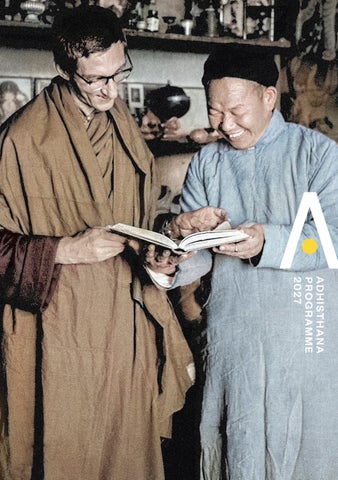
Cover: Sangharakshita with Yogi Chen in Yogi Chen's hermitage, Kalimpong. 1967 Photo: Terry Delamere Urgyen Sangharakshita Trust Back cover: Dharmachanda
01
SPI R I TUA L FR I END S H I P
1 2 4 6 8 12 14 16 20 22 26 28 32 34 35 36 40
Adhisthana Through The Lens of Friendship Friendship; An Ode Why Friendship Matters Now Sangharakshita and Lama Govinda The Good Friend Bhante, Blake and Ambedkar Bhante’s Teachers A Letter to a Friend The Shape of Community Life Friendships That Hold Adhisthana Together Being a Friend to Adhisthana President as Friendship The College and Adhisthana A Circle of Friends Friendship over a Lifetime Sadhana as Kalyanamitrata Friendship Challenge
02
RE TRE ATS A ND EVENTS
42 44 45 46 47 48 49 50
One Month Retreat Sangharakshita Study Course The Art of Discipleship Dhammasavana Retreat Sangha Without Borders Seeds of Future Friendship Weaving a Web of Connection Get Involved
54
Event Listings
title
author
Image Spread: 2 pages [An image that communicates unmistakable friendship…warmth, intimacy, joy.]
4
Dharmachanda
5
title
author
Image Spread: 2 pages [An image that communicates unmistakable friendship…warmth, intimacy, joy.]
6
Dharmachanda
7
01 spiritual friendship
Adhisthana through the lens of friendship
chair’s letter khemabandhu
Reflecting on my life, the years passed and those still to come, I’ve realised that it is my relationships with other human beings that I value most; grateful for the connections I have developed, and wanting to deepen them and develop others. The Buddha famously told his friend and attendant, Ananda, that spiritual friendship is the whole of the spiritual life. It’s also central to life, spiritual or otherwise. In 1983, Bhante Sangharakshita elucidated the Sigalovada Sutta (Digha Nikaya 31) to a group of his disciples and pointed out that, among the network of relationships the Buddha encouraged Sigala to foster and respect – employees, partners, children, teachers, spiritual guides and parents – friendship was the one that received the least attention in modern society. Outside childhood and adolescence, it has increasingly been sidelined. Friendship may be deeply needed and privately cherished, yet our wider culture rarely places it at the centre of human flourishing. And how true this remains four decades later. Friendship can be among the most rewarding and supportive aspects of life, while also being the most difficult to cultivate. One of the greatest gifts I’ve received from Triratna has been the opportunity to develop meaningful friendships with other men, grounded in deeply shared values. Friendship was deeply important to our founder, both personally and in his teaching, and to many of us in Triratna. In 2027, we have a series of retreats exploring this theme. Of course, friendship is at the heart of all our retreats. Why not invite a friend to join you on a retreat? Our 2027 booklet explores Adhisthana through this lens. I hope you enjoy reading these pages. And once you’re done, you can pass it on to a friend.
1
Friendship! peculiar boon of Heaven, The noble mind’s delight and pride, To men and angels only given, To all the lower world denied. While love, unknown among the bless’d, Parent of thousand wild desires, The savage and the human breast Torments alike with raging fires.
friendship; an ode
With bright, but oft destructive gleam, Alike o’er all his lightnings fly, Thy lambent glories only beam Around the favourites of the sky. Thy gentle flows of guiltless joys On fools and villains ne’er descend; In vain for thee the tyrant sighs, And hugs a flatterer for a friend.
samuel johnson
Directness of the brave and just, Oh guide us through life’s darksome way! And let the tortures of mistrust On selfish bosoms only prey. Nor shall thine ardours cease to glow, When souls to peaceful climes remove. What raised our virtue here below Shall aid our happiness above. Get intimate with Bhante’s thinking on friendship through a close look at his seminar on Dr Johnson’s ‘Ode to Friendship’. Bonds of Transformation Seminar for Dharmacharinis 14 – 21 February led by Saddhanandi and Vidyamala Ode to Friendship Seminar for Dharmacharis 6 – 13 August led by Jnanadhara and Khemabandhu
2
Portrait of Samuel Johnson (detail), 1775. Joshua Reynolds Wikimedia/Public Domain
3
Why friendship matters now
4
Subhuti
Subhuti is President of Adhisthana. Opposite: Subhuti on retreat at Adhisthana. Photo: Dharmachanda
I’m naturally at that stage of life when one begins to take stock, even though I may well have more useful years left to me. Of course, I can see the many mistakes I’ve made, and I can also see some achievements, such as books written, a centre established, organisations developed. But as I approach the closing of my life, inevitably nearing at my age, what stands out for me as I look back is the human landscape through which I’ve moved. What now seems important is all the friendships that I’ve been able to make. It’s as if all the men and women with whom I’ve really connected are now part of me; I am, so to say, made up of them. I am fully convinced that connections deeply made can never be lost. Indeed, some of those connections go so deep that I am convinced they will continue in another life. Rebirth is not so much the stream of consciousness re-emerging in a new physical world, but the continuation of old friendships in a new context, whether one remembers or not. This is what we see in the Jataka tales, as Urgyen Sangharakshita points out: the Buddha-to-be is depicted as being reborn again and again with those who later become his chief disciples. In the end there is nothing but friendship. Urgyen Sangharakshita exemplified friendship to a very high degree. He had a remarkable capacity to connect deeply with more or less anyone he encountered. I was his secretary for many years and used to usher people in to meet with him, literally hundreds of them over the years. Not everyone, of course, was equally able to communicate with him or he with them, but the vast majority came away from that meeting feeling that they’d been seen and understood. They did not leave dazzled or charismatised; they had simply met another human being who saw them deeply and met them as a human being. It is this remarkable quality that our whole Order and Movement is founded upon. Sangharakshita returned again and again to this theme of friendship, stressing that, if the Order was truly an order, it would be a network of friendships. He emphasised the delight that friendship brings, and was perhaps unique in arguing that its deepening is itself a movement in spiritual development, insofar as friendship involves the lessening of self-attachment and an opening up to the life of another. In other words, friendship can be a means of mutual self-transcendence. And surely, if anything can save the world, it is friendship. But for friendship to be of a kind that brings peace and harmony, it must be rooted in shared values, ethical and spiritual. And for the deepest friendship, there needs to be shared understanding, practice, and experience. This, then, is the function of the Triratna, and of Adhisthana in particular. At Adhisthana we provide a context for friendship in which we can study together the Buddha’s words through the presentation of Urgyen Sangharakshita, so that we develop a common understanding of values and path. We practise meditation and puja together, so that we deepen our experience and uplift our emotions. We work together so that we harmonise our energies, and, of course, we communicate with one another. In this way, by creating an environment for deepening friendship, we hope we are making a real contribution to the world.
5
6
Lama Govinda and Sangharakshita. Kasar Devi Ashram, Almora, India. Early 1960s. Photo: Li Gotami Urgyen Sangharakshita Trust
“Even from the contact that Lama Govinda and I had already had with each other I felt that we were kindred spirits, and that our forthcoming meeting would be a meeting not of bodies only but of hearts and minds. Small wonder, then, that the editorial I wrote for the September SteppingStones should have been entitled ‘The Good Friend’, or that I should have spent the greater part of the month in eager anticipation of the moment when, on looking out of the window, I at last saw the picturesque figures of the German-born lama and his Indian wife alighting from the Landrover and making their way up the path to the gate of the Hermitage.” Facing Mount Kanchenjunga, The Complete Works of Sangharakshita, Vol. 21.
7
The good friend Sangharakshita
8
To the emperor of China’s enquiry as to what constituted the essence of Buddhism the Indian sage Bodhidharma replied that it consisted in abstention from all evil, doing of good, and the purification of one’s heart. This reply failed to satisfy his Imperial Majesty, who apparently had expected to hear something extremely abstruse and esoteric, and he therefore observed, not without a trace of sarcasm, that the teaching was so simple that even a child of three could understand it. ‘So simple that a child of three can understand it, but so difficult that even an old man of eighty cannot practise it,’ retorted the sage. The moral of the story is clear: intellectual understanding and practical realization of a religious doctrine are rarely commensurate. Nor is the reason far to seek. Reluctant as he may be to admit the fact, man is after all a creature of desires rather than the child of reason; and it is by his emotional attitude to any particular subject or situation, rather than by his intellectual understanding of the issues involved therein, that the course of his conduct is ultimately determined. Reason may point man to the stars, but so long as his desires continue to drag him earthward among the glow-worms of the grass he is powerless to reach up and pluck even the lowest and least of them from the azure depths of its native sky. The central problem of the spiritual life is, therefore, as we have said elsewhere, not static but dynamic, not so much a matter of the intellectual understanding of this or that doctrine as of the concentration of the total psychic energy of the individual – now dissipated in so many directions – along the line of its eventual realization. Since this energy is nothing but the energy of desire in the widest possible sense of the term, and since emotion is only the ‘long-circuiting’ of desire, it is with the concentration and sublimation of desire and the reorientation of emotion that the spiritual life is above all else concerned. Such is the case with the doctrine of no-self. Difficult as it is to understand that things are void of soul, self, or ego, to put the doctrine into practice is more difficult still, to realize it most difficult of all. For no matter how clearly the intellect may be able to conceive this or any other doctrine, while the individual remains uninvolved with it emotionally all his intellectual understanding is as
useless as a locomotive without fuel. The difficulty which confronts the spiritual aspirant is not so much how to understand the doctrine of no-self as where in his experience to discover the rudimentary form at least of its emotional equivalent. Desire is of two kinds, that of attraction, the desire to unite, and that of repulsion, the desire to separate. When the former is accompanied by an intellectual cognition of an object which is inferior, equal, or superior to itself, it becomes differentiated into the emotions of compassion, love, and adoration respectively, each of which may in turn be divided into two kinds, one selfish inasmuch as it seeks to merge the being of the object in its own, the other selfless inasmuch as it seeks to merge its own being in that of the object. While sex-love is the most typical emotional form assumed by selfish desire to unite (which explains, incidentally, the ease with which such love passes over into hatred), what we may designate as friendship-love, or simply friendship, is the most typical emotional form of selfless desire to unite. It is, therefore, in friendship (the Buddhist virtue of maitri) and the sentiments kindred to it that, among all the relationships of human life, we may find in its rudimentary form at least the emotional equivalent of the intellectual understanding of the doctrine of no-self. The emotion of friendship manifests in daily life as a readiness to sacrifice one’s own pleasure and profit for the pleasure and profit of another, as a willingness to go where and do what is agreeable to him rather than to oneself; while at its most exalted height it manifests as that supreme act of selfabnegation whereof it is written ‘Greater love hath no man than this, that he lay down his life for his friend’ – a text whereto more than one Jataka might serve as commentary. But behind every manifestation of friendship, of maitri, from the lowest to the highest, lies, as the heartbeat behind the rhythm of the pulses, the central psychological fact of the more or less radical denial of the selfish individual will; and it is due to the presence of this partial negation of selfhood, of the joyous merging of one’s own being in the being of another, that friendship and its kindred emotions are so richly endowed with potentialities for spiritual development. If, however, those potentialities are to be actualized, it is necessary to cultivate, during the formative period of one’s spiritual career at least, the friendship of the good rather than of the wicked. For with those whom we love we shall naturally tend to associate as often and as intimately as possible, delighting to go where they go and do what they do, which means that if our friends are slaves of vice their company will ultimately make us vicious, while if they are servants of virtue we may by their example and influence one day become virtuous. It is for this reason that the Buddha declared so emphatically that encouragement in doing good and discouragement from doing evil deeds was one of the most important characteristics of a true friend, and for the same reason the great philosophers and moralists of classical antiquity maintained that since virtue was the basis of friendship it was a relation which could subsist only between virtuous persons – friendship without nobility of character, purity of motive, and unfailing mutual helpfulness in all the vicissitudes of life being hardly deserving of the name.
9
All desire the good, but few understand in what the good consists, with the paradoxical consequence that the vast majority of people spend the whole of their lives in breathless pursuit of things which they do not really want. But one who is so fortunate as to find a friend who not only understands what is truly good, but who tries to realize it himself and to persuade others to realize it, discovers at the same time that by renouncing his own will, by giving up his egoistic desires for the apparent goods of the world, for the sake of doing what his friend wishes him to do, he loses his own ignorant will and gains in its stead an enlightened will – a will set on that which in his inmost being he really desires – and realizes that in bondage to the will of a virtuous friend resides the secret of perfect spiritual freedom. The ideal of ‘the good friend’ (kalyana mitra)
Plato's Academy. Roman mosaic, 1 bce , Museo Nazionale Archeologico, Naples. Public Domain
in the ordinary social acceptation of the term now passes over into that of ‘the good friend’ in an exalted spiritual sense, for the difference between the two is not one of kind but only of degree. As his understanding of what is ethically good in the everyday affairs of human life deepens into an understanding of what is spiritually desirable in the more complex issues confronting the soul, as his comprehension of truth ranges with wider and ever wider sweep from the particular to the universal, the mundane to the supramundane, samsara to nirvana, the good friend becomes by insensible degrees the trusted counsellor, the trusted counsellor the spiritual guide or guru, the guru the bodhisattva, and the bodhisattva the Buddha, just as among the colours of the rainbow red merges imperceptibly into orange, orange into yellow, yellow into green, and so on. The Buddha is described in the scriptures as the Good Friend, as the Elder Brother of Mankind; and such he indeed is in the highest sense of these words. For his love (maitri) for all sentient beings, his understanding (prajna) of in what consists their highest good, and his resolve (pranidhana) to help them in every possible way to realize it, are not limited and contingent in character like those exhibited by mundane friends but, on the contrary, unlimited and absolute. 10
‘As above so below.’ By virtue of the indispensable element of self-negation which it involves, the relation of friendship is able to symbolize in human and social form the submission of the will of the disciple to that of the guru, just as this relation in its turn is for the same reason able to symbolize the annihilation of the individual in the cosmic will, the joyous submission of the soul to the moral and spiritual order of the universe. Similarly, the selfless affection which we feel for an ordinary friend is symbolical of the devotion with which we regard the Good Friend of humanity, the Buddha; for just as it is out of affection for our friend that we do his will rather than our own, so it is out of devotion to the Buddha that we give up our ignorant and egoistic will in order to conform ourselves to his enlightened and selfless will as expressed in the Dharma
The Buddha teaches the ‘first sermon’ at Sarnath, attended by two disciples, India ca. 1090. Metropolitan Museum, New York. Public Domain
which he taught. Friendship is thus of the profoundest possible significance. Through it we perceive ‘as in a glass darkly’ the pure and tranquil lineaments of Enlightenment itself. It affords us yet another example of the symbolic nature of human relationships, of the sacramental character of life itself, teaching that spiritual insight does not consist in seeing new sights with the old eyes but in seeing the old sights with new eyes, just as ‘religious’ life is not so much a different kind of life as the same old life lived in a new way. We discover the emotional equivalents of spiritual truths by perceiving the spiritual significance of our ordinary emotional experiences. By learning to see our good friend as the Buddha we are eventually able to discover the Buddha as our Good Friend, and by accustoming ourselves to prefer the will of another to our own we are able gradually to prepare ourselves for that utter annihilation of egoistic will in the Dharma of Selflessness which is the essence of Enlightenment.
‘The Good Friend’ was originally published in the September 1951 edition of SteppingStones.
Reproduced from Vol. 7 of the Complete Works with permission from our friends at Windhorse Publications. windhorsepublications.com
11
bhante, blake and ambedkar
Bhante & Ambedkar
12
Vidyaruchi
Sangharakshita’s acquaintance with Dr Ambedkar will surely be remembered as among the most consequential in his long life. He tells us in Ambedkar and Buddhism that ‘In both background and temperament we were very different’, which is certainly true. It is a difference not merely between an Englishman and an Indian, but between a Platonist and an Aristotelian, a poet and a statesman, a traditionalist and a modernist, a spiritual idealist and a social reformer. But there were strong similarities too. Both were men of immense erudition, both extraordinarily driven, utterly self-assured, highly capable, and fearlessly outspoken. Above all, both were men of deep compassion. Ambedkar is revered by his followers as a Bodhisattva, and described his own life as ‘one continuous struggle for liberty for the poor and for the oppressed’. Sangharakshita was attracted to the Bodhisattva Ideal from his first contact with Buddhism. But through Ambedkar’s example, he saw the implications of that ideal more fully. He wrote in an unpublished fragment, ‘From Dr B.R. Ambedkar I learned how to feel for the poor and oppressed.’ His vision of the Dharma as a force for social change grew out of that feeling, and it owes much to Dr Ambedkar, despite great differences of background and temperament. Explore Bhante’s connection to Ambedkar at Adhisthana by visiting Bhim Smrti, the . Ambedkar Memorial Room.
Below: Letter from Dr Ambedkar to Sangharakshita, June 1950.
Bhante & Blake
Satyalila
Sangharakshita was inspired by the poet and painter William Blake (1757–1827) from his teens until his death, describing him as one of the principal ‘winged spirits’ from whom we could learn dharmic principles through Western culture. He spoke of his fascination with even the title of Blake’s ‘The Marriage of Heaven and Hell’. Here, in his teens, Bhante found Blake’s aphorisms: about friendship being like a nest or web, that ‘opposition is true friendship’, that ‘energy is eternal delight’, that ‘everything that lives is holy’, and that ‘without contraries is no progression’. It takes effort to appreciate the vast extent of Blake’s vision of humanity and human potential, just as it does with Bhante. They shared a vision of our potential for wholeness, which we can partly discover through friendship, by being both supported and challenged in our unfolding. We need to see beyond the archaic language to the energy of delight both Bhante and Blake sought to communicate. The sense that we can move from a narrow, ‘single’ vision to a ‘fourfold vision’ encompassing intellect, emotion, our sensing body and imagination. This delight is embodied in the image of Albion (or ‘Glad Day’).
2027 marks the 200th anniversary of William Blake’s death. Below: Page from Blake’s Milton showing his vision of our ‘potential for wholeness’.
Our annual Bhante & Blake retreat, led by Ratnaprabha, Amitajyoti, Paramartha + Sraddhadipa, is open to Order members + experienced mitras, 6 – 13 August.
13
bhante’s teachers dayanandi 14
All of Bhante’s eight main teachers were very precious to him. He had different relationships with them, depending on their characters and how much time he was able to spend with them. Some of them were among the most eminent Tibetan Lamas of the century and they were busy with many disciples. With others, he was able to spend a considerable amount of time, meeting sometimes several times a week. With two or three of these he formed real friendships: Kachu Rimpoche, Yogi Chen and Dhardo Rimpoche. Bhante took great delight in all these friendships, but that with Dhardo Rimpoche was perhaps the most dear to him, and it achieved a depth and closeness that was unique amongst his teachers. Whereas the spiritual connection he felt on meeting his teacher Chatral Rimpoche had been strong and immediate, Bhante commented that the one that developed with Dhardo Rimpoche had grown slowly over time. They were both a little reserved. It wasn’t until they had spent substantial time around each other on the Buddha Jayanti tour and got to know each other better that a true friendship emerged. The Dharma was the basis of their friendship. Dhardo Rimpoche confided to Suvajra that their friendship had come as a great surprise. It was unprecedented for him because the Lama-disciple relationship was usually very formal. With Bhante, they could laugh and joke, and it only deepened their spiritual friendship. Dhardo Rimpoche found Bhante to be very warmhearted, and he had become one of his closest friends.
Sangharakshita and Dhardo Rimpoche visiting Bodh Gaya, 1956. Urgyen Sangharakshita Trust See the online Precious Teachers exhibition from Urgyen House. tinyurl.com/precious-teachers
Over the twelve years spent near each other in Kalimpong, they supported each other through the ups and downs of their work for the Dharma, able to talk freely about anything and everything. There was a mutual respect and appreciation. The Rimpoche was inspired by Bhante’s “high level of motivation and dedication to the study of Buddhism”. Bhante naturally looked up to Dhardo Rimpoche, his elder in many ways. Over time he began to perceive the Rimpoche’s remarkable qualities and came to revere him as a living Bodhisattva. When, in 1962, Bhante felt ready to take the Bodhisattva Ordination, it felt natural for him to request Dhardo Rimpoche to perform the ceremony. Their friendship culminated in what Sangharakshita was to call the happiest day of his life – “everything beforehand led up to that moment and everything after came from it.” At one time, Bhante referred to us in the fwbo/Triratna as the Rimpoche’s children and grandchildren; how fortunate are we! Extracted from Dayanandi’s forthcoming book Passing on the Flame. Opposite: Prajnaloka, Sangharakshita and Dhardo Rimpoche, Kalimpong, 1967. This page: Dilgo Khyentse Rinpoche and Sangharakshita, India, 1967. Photo: Terry Delamare Urgyen Sangharakshita Trust
15
Letter to a friend Sangharakshita
16
Dear Paramartha, I certainly needed you towards the end of 2012. I was to move from Madhyamaloka, where I had lived for sixteen years, to my new home at Adhisthana; from a Birmingham suburb to the Herefordshire countryside. At the time I was quite ill. I was suffering from insomnia ... Thus during the last two weeks of February I was not at all in good shape. Yet the move still had to be made. ... Two and a half years have passed since that day. The rest of 2013 proved to be a difficult time for me. Adhisthana was still a building site, with noisy heavy machinery operating each day of the week until August, when Adhisthana had its official opening. I was still very ill, with only very small improvements in my condition from month to month ... Nonetheless, I saw visitors from time to time and kept up with my correspondence as best I could. Dictating letters, especially letters to old friends, was one of my few sources of pleasure. It provided me with an outlet for creativity, albeit a limited one, and the more creative I could be the better I felt. My principal source of pleasure was the evenings in study and discussion I spent with a close friend. This friend, as you know, was you ... Wherever you were you kept in touch with me and made sure that I was being looked after. I sometimes think that without you I would not have come through 2013 even as well as I did. Nothing was too much trouble for you, even when it meant sacrificing your own comfort and convenience. As I came to realize, there were times when you sacrificed even your health and well-being for my sake ...
Yours with much love, as ever, Bhante Full letter available at Sangharakshita.org: ‘A Reverie-cum-Reminiscence in the form of a Letter to Paramartha’. Previous page: Sangharakshita leaves Madhyamaloka for the last time, 2013. Photo: Paramashanti Urgyen Sangharakshita Trust Opposite: Paramartha, reading from the Songs of Milarepa at Sangharakshita’s funeral.
18
Order members can take advantage of the opportunity to study and practise with Paramartha and benefit from the uniquely close friendship he had with Bhante. Stop and Realise Seminar, 14 – 21 February Immersion Retreat, 4 – 11 June Overflowing Wisdom and Compassion Amitabha Sadhana Retreat, 2 – 9 July Milarepa: Meeting at Silver Spring Seminar, 23 – 30 July, for Dharmacharis
Dhammarati
More than once I tried to expostulate with you on this account, but you were always emphatic that there was no question of any sacrifice. You did what you did of your own free will and you would not have chosen to be in any other situation. Yet I know that 2013 was a difficult year for you, as it was for me. Even so, you never complained ... One of the things I had most missed during your absence, apart from your actual presence, was our evening study and discussion. This we did, as before, on those days when you were ‘at home’, though I cannot remember when we started. What I do remember is that having enjoyed a dip into Neoplatonism we immersed ourselves first in the Sandhinirmocana Sutra, then in the much longer Surangamasamadhi Sutra ... As the weeks and months of study and discussion went by I felt that I was not merely a spectator of this world but living in it and breathing its unique atmosphere. Moreover, the sutra came to be increasingly dominated by the figure of the great and glorious Manjusri, the Bodhisattva of Wisdom, who appears as a supremely beautiful youth clad in princely garments and holding to his heart the scripture of Perfect Wisdom. With this figure I was already familiar, through my practice of the Manjughosa Stuti Sadhana, but the Surangamasamadhi Sutra gave me a much more vivid awareness of his presence and of his true nature. He was the veritable embodiment of the dharma niyama and to be worshipped and meditated upon as such. Whether I shared this insight with you at the time I cannot remember. Thus the Surangamasamadhi Sutra became a permanent part of my spiritual life, as I believe it did yours ...
... I am the teacher of the Order in the sense that the Dharma studied, practised, and propagated by Order members is the Dharma as elucidated by me. In other words, the Dharma studied, practised, and propagated by Order members is the Dharma as ‘translated’ by me, that is, the Dharma as translated by me from the terms of Eastern culture into the terms of Western culture. But teaching is a form of communication, as is elucidation and ‘translation’, and since one cannot really communicate without friendliness (maitri), one cannot really teach without friendliness either. One cannot, in fact, be a teacher without being a friend – cannot be a spiritual teacher without being a spiritual friend (kalyana-mitra). I therefore stand in yet another relation to the Order. I stand to it in the relation of spiritual friend.
Sangharakshita, My Relation to the Order, talk, 1990,available at freebuddhistaudio.com
19
20
Annika, Prajnanita and pickles Adhisthana swales
Dhammarati
Prajnanita is Adhisthana’s Director.
Moving into the women’s community at Adhisthana was quite a big shift for me. I’d been living with a partner for about thirteen years, and life had a clear structure – work, home, and then private space where I could retreat and recover; the frontstage and backstage of life. Coming here, into a community of eight women, that separation just isn’t there in the same way. I don’t think I would have said at the time it looked like an obvious “good idea”. It came as part of a larger commitment to Adhisthana as a project I feel strongly about – this deep engagement with Bhante’s legacy and the Buddhist tradition as something you actually live. Living in community is part of that immersion. When I moved in, it was quite confronting. I remember the moment of realising: this is my home now. And I’m going to be living closely with seven other women I wouldn’t necessarily have chosen. There isn’t really a retreat space anymore. Work, practice, and home life are all much more blurred. I’m still working that out. What I see very directly is how much it brings up ego-clinging. In meditation or work I can observe the mind, but here it’s relational – things arise in real time, fast. Preferences, reactions, “this is my time,” “none of this is mine” – it gets confronted very directly. About a year and a half ago we introduced a buddy system. Once a week we draw names and meet whoever comes up. Often, it’s simple – tea and pickles on the bridge, a walk, sitting together. But through repetition something shifts. It becomes less about liking or not liking, and more about just meeting. A kind of mutual responsiveness develops – meeting and being met beyond preference. Over time I see this isn’t separate from the Dharma path. Unexpectedly for me, community living has turned out to be the most challenging, and therefore the most fruitful context for working with ego-clinging. It continually closes the gap between ideal and reality, and offers very direct conditions for the development of wisdom and compassion in ordinary, relational life.
The shape of community life Prajnanita
21
Hally & Max
Sharing a room
How is your friendship conditioned by sharing a room? Max }
You quickly learn about each other’s, sometimes conflicting, preferences, so learning how to navigate that really helps to develop mutual open communication. It’s also a pleasure to live with Hally, as I know they are almost always available to talk things through and listen well.
Hally }
Through sharing a room, Max and I have got to know many sides of each other, the tired, grumpy, messy selves that we usually hide from the rest of the world. Over time, this has led to a real breadth, as well as depth, of friendship.
friendships that hold adhisthana together
What effect does sharing a room have on your spiritual practice?
22
Max }
I’m a very competitive person, so it really helps me to look over at Hally and see “oh, they’re reading a lot of dharma books, I’d better up my game”. I also find that I learn from seeing how Hally’s responses differ from mine, as it shows me there’s always another way of responding.
Hally }
One thing I really value about living with Max is how we lock into each other’s schedules – we go to bed at the same time and wake up at the same time; we share a Going for Refuge group and have Mitra Study together. Living the Dharma Life so closely alongside a friend really helps keep me in the flow.
Annika & Renate
Friendship through the DharmaLife Course
The conditions of the DharmaLife Course give you a really strong initial spark of friendship. You can get to know a person quite well in those four months, but then living and working together long-term is a whole other deal.
{ Annika
It almost felt a bit like growing up. Like, on the DharmaLife course, we were spending all our time together, in this bubble of the Dharma playground. Then we both moved here, and our friendship needed to adapt to those new conditions.
{ Renate
Right, we were basically peers on the Dharma life course, but then here, because of our different roles, I was having to teach you things, and there was a more practical aspect to our friendship. At one point, we were kind of drifting apart, and we both wrote each other letters, which was really beautiful because it felt like an acknowledgement that friendship can be hard, and that it’s a continuous learning process rather than a final end product.
{ Annika
Yeah, at times we were both projecting onto each other based on our insecurities or fears, then drifting apart and coming together again in this cycle. My favourite bit was when we were under the oak tree, and we decided to give up on making it perfect, and we just agreed that it’s okay that it’s difficult. Since then, it’s been quite straightforward and more transparent somehow.
{ Renate
Renate (L) and Annika. Opposite: Hally (L) and Max.
Visit adhisthana.org/courses to learn more and apply for the DharmaLife Course.
Dhammarati
23
Bodhiketu & Vilasamuni Preceptor & Preceptee Bodhiketu }
I had been broadly aware of Vilasamuni for several years before we started meeting during the men’s DharmaLife Course in 2017. I remember the long silences during conversation, which I appreciated. It didn’t feel like an absence of sound, but as if there was a subterranean element to each meeting. We had a mutual affinity: fellow geeks, high sensitivity, quirky humour, love of imagination and play, and a deep commitment to the Dharma. Being able to ordain him, reveal his new name and identity, and introduce him to his yidam was a special time. Working and living together, it feels as though we weave in and out of each other’s lives, which I really enjoy.
Vilasamuni }
We don’t spend a huge amount of time one-to-one – something builds up through living and working together, so when we do meet, there’s ever more openness and ease of understanding. Whether we’re working, playing board games, or sitting in silence together, a non-verbal, non-rational communication is taking place. An archetypal connection forms during ordination that lives under the surface; living with my preceptor means the ‘human friendship’ side is also strong. I cultivate both aspects – his idiosyncrasies about making toast coexist beautifully with the symbolic ‘guru’ who witnessed the most significant commitment of my life.
24
Olivia & Prajnanita
Kalyanamitrata
Dhammarati
Living and working closely together, our relationship has many dimensions, but underpinning it all is the strength of kalyana mitrata – spiritual friendship. I really value and appreciate that Prajnanita never colludes with my difficult mental states, even if that means challenging a view that I’m holding. This is one way that she exemplifies her practice, and as a result, I can really trust her guidance more than the pull of my habitual negative patterns (when I’m anxious or scared, irritable or confused) – in this way, our friendship allows me to grow.
{ Olivia
I see kalyana mitrata as a living commitment to growth beyond my little self, expressed in the everyday reality of close community life in a building with very thin walls. Living in this way, I’ve become more aware of Olivia’s presence in the room below me and the impact of my own clumsiness and lack of mindfulness. I deeply appreciate her patience, kindness, and generosity. She acts as an immediate mirror, sharpening my ethical awareness and inviting me to soften into kinder responses when I am reactive. Shared moments of joy during our stomps around Adhisthana, and her long-term vision of serving here, deepen my own commitment and sense of connection. We often end in giggles as we playfully imagine ourselves in 15 years’ time, or what it might be like when she reaches my age of 49 and I am 71.
{ Prajnanita
Opposite: Vilasamuni (L) and Bodhiketu work together in the Adhisthana kitchen. Above: Olivia (L) and Prajnanita.
Adhisthana is always looking for enthusiastic and committed Dharma practitioners to live, work and play with us. Visit adhisthana.org/jobs or contact admin@adhisthana.org if you’re interested.
25
being a friend to adhisthana
Photos: Dhammarati ▼
Rush Volunteering at Adhisthana has enabled me to form friendships that have developed naturally while living and working with the Operations team and alongside other volunteers, especially supported by the strong practice of rejoicing in merit. But unexpected friendships have also arisen that support my spiritual development and my path towards joining the Order, and exemplify the qualities of kindness, compassion and generosity that I try to emulate. For me, spending time with these friends is more than volunteering – it has become a spiritual practice. Contact volunteers@adhisthana.org to ask about volunteering with us.
26
▲ Dharmachanda
Kaj Volunteering at Adhisthana, I’ve met and gotten to know so many people. I’ve often felt a quality of play and joy in the friendships and communication that I have there. Volunteering at Adhisthana engenders friendship because you and other volunteers are simply there to help, so the way you relate to each other is lighter and freer. When you come together around a shared task and a shared desire to give, that organically leads to friendship.
27
President as friendship Saddhanandi
Sometimes only a president can say the thing that needs to be said; this arises out of mutual receptivity and respect, it is not a duty of ‘office’, but an authentic expression of the friendship a president has to the situation, and it is carried with care.
28
Saddhanandi is a member of Triratna’s President’s Executive.
▲ Dharmachanda
Each Triratna centre has a president. A president gets the chance to offer a particular gift to a sangha – that of confidence. It is the recognition of the value of all that people are doing by someone who understands what it takes to build a spiritual community and run an institution. My job isn’t to know all the answers and to offer clever opinions, but to be a friend, walking alongside that sangha, recognising moments of significance, then reflecting back its meaning and value in a way that supports everyone’s efforts to practice the Dharma.
Olivia, Ops team
In the Vimalakirti Nirdesa, the Buddha says that a Buddha-field is a field of living beings, and this is equally true of a Triratna centre. The president of a centre is responsible for ensuring that all the living beings who run the centre, who attend it, or who are in any way connected with it, are developing as individuals. This responsibility cannot be carried out through authority, since the president has no executive power. The great delight of being a president lies in exercising this duty through friendship and communication alone.
At the heart of Subhuti’s presidency is the feeling of having a good friend. When we meet, it seems as if he has my highest spiritual interest in mind. I value his experience of Triratna, as well as his wide-ranging knowledge of the Dharma. We have the added delight of our president also being a neighbour. There is something magical about journeying through the country lanes to visit Subhuti for a one-to-one, as one might once have wandered to visit a sage in the forest.
adhisthana
Subhuti, President
Vilasamuni, Ops team
Subhuti makes an offering on Sangharakshita’s 100th anniversary retreat.
I really appreciate Subhuti’s presidential visits. He always takes an interest in individuals and the vitality of the communities, and he brings an outside perspective that helps us to put our activities in a broader context.
29
nottingham 30
Ratnaghosha, President
Kusaladevi, Chair
I have been president of the Nottingham Buddhist Centre for nearly a decade. The main thing about being a president that I have noticed is what a privilege it is to meet so many great people, who are so willing to communicate honestly and openly about their lives. They tell me that my visits are a boost, and they are certainly an inspiration to me.
As our President, Ratnaghosha is a friend and support to me as Chair and to the whole sangha in Nottingham. It’s wonderful to have the guidance of someone with such depth of experience, and to be able to gain a perspective from outside of the local situation. I know the sangha really values his visits. People appreciate not only his teaching and input, but also the generosity with which he gives his time to meeting individuals.
Shubhavyuha, President
It has been grounding and inspiring to have a very experienced senior order member taking an interest in the welfare of our centre. It plays out in expected and unexpected ways. Expected in the sense of having support to keep our centre balanced, steady and tapped into what makes Triratna unique and inspiring; and unexpected as she offers suggestions that we probably wouldn’t have arrived at ourselves. A recent example is her suggestion that I attend the European Chairs Assembly. As an Oceania centre, I wasn’t aware that this was a forum that could enrich us. Her encouragement led me to register, and I felt excited that our centre would have this connection to wider practice and inspiration.
A few weeks ago I made my first visit to the Coogee Buddhist Centre in Sydney since becoming its president. At the Sangha Night class, the first question I was asked was, “What does it mean to be a president?” My immediate response was that it means becoming a friend to the sangha and to the situation. The visit confirmed this for me. Dharmalata and the management team were open and welcoming, sharing the life of the centre and the responsibilities they carry. It was a privilege to support and encourage those leading the work, and to witness their dedication to sharing the Dharma. I came away with a clear sense that being a president is simply another way of serving the Dharma, offering kalyana mitrata and helping the sangha flourish.
coogee
Dharmalata, Chair
Dhammarati
The presidents are inviting all chairs from across Triratna internationally to join them on retreat to explore the theme of Spiritual Friendship, 18 – 25 June.
31
The college and adhisthana Khemabandhu
Adhisthana and the College of Public Preceptors are separate organisations, yet they are deeply connected in vision and practice. One might even say they are friends: sharing ideals, collaborating closely, and supporting one another’s work. But what might friendship between institutions actually mean? To explore that question, it is worth turning to Nagabodhi’s reflection on Bhante’s words in the Complete Works: In My Relation to the Order Sangharakshita makes clear that friendship trumps institutional relationships even within a single Buddhist community like the Order he has established. Friendship can be ‘horizontal’, between spiritual equals, and it can be ‘vertical’ with those more experienced, more spiritually developed than ourselves. But it is friendship, truly human connection and communication, that matters rather than any institutional relationship.
32
The same is true of the relationship between the College and Adhisthana. Beneath organisational structures and responsibilities, human connection and communication remain its basis. This manifests in the friendships between the respective chairs and between the Adhisthana communities and the College. I’ve had the fortune of friendship with Mahamati, the current Chair of the College, for a number of years. We share our personal joys and troubles alongside the successes and challenges of our respective roles. With great delight, we are now also chapter brothers, joined by Adhisthana’s President,
Dhammarati
Subhuti, and my fellow community members Vilasamuni, Lalitanaga and Jnanaruchi. Chapter evening is certainly a highlight of my week, where friendship and honest communication help us explore the details of our ethical practice. The friendships between us are not merely personal affinities. They arise from a shared participation in a common spiritual endeavour. The College and Adhisthana each have their own role to play, yet both seek to serve the same unfolding vision of Triratna: a community of practitioners dedicated to the transformation of self and world through the Dharma. Twice a year, Adhisthana enjoys hosting the College gatherings, and twice a year we meet to eat together, enjoy one another’s company and share bits of our lives. Beyond these occasions, there is a whole web of individual friendships and connections, underpinned by deep mutual appreciation. Importantly, we also have Dhammarati and Yashodeva, College members who live here at Adhisthana and devote their time and energy to both projects. In many ways, they embody the living connection between Adhisthana and the College, helping to weave together friendship, service, and a shared commitment to the flourishing of the Dharma.
Stay up to date with news from the College: preceptorscollege.online/contact-anddonate/#subscribe
Above: Khemabandhu, Adhisthana Chair, and Mahamati, Chair of the Preceptors’ College.
33
khemabandhu
a circle of friends
Over the Easter weekend in 2026, the Sub40 Order gathered in a darkened Beams lounge, transformed into a cinema and supplied with an excess of popcorn, to watch Suryaprabha’s A Circle of Friends. The documentary captures the movement in the late 1970s, alive with energy and activity, bursting with vision and tension. We saw a circle of young, idealistic adults working together, making mistakes, falling out, and building the movement (literally), creating the conditions for the lifelong bonds represented by the Elders’ Gathering gathered alongside us. It was poignant, humbling and inspiring. Later that evening the two gatherings participated in a beautifully crafted mandala offering puja in which we all ‘offered up’ aspects of Triratna that we had contributed to, participated in or benefited from, creating a cloud of living meaning that revealed the web of gifts, contributions and acts of service upon which our lives now rest.
In 2027 this circle of friends will gather again to reconnect with themselves, each other, and the commitment they’ve made to a lifetime of shared practice. We’ll chat, laugh, eat, study, perform ritual and meditate in each other’s company. These annual gatherings are both touchstones and stepping stones for a generation with decades of shared practice ahead of us: decades of working together, making mistakes, falling out, making amends and learning from those who have travelled the path before us.
Above: Still from A Circle of Friends. Watch the video: lightsinthesky.org/films/a-circle-of-friends
34
Dhammarati
Being of service to ageing Order members has brought these teachings alive for me. It has meant slowing down, listening more carefully, and recognising
friendship over a lifetime ksantichara
Spiritual Friendship is central to Sangharakshita’s presentation of the Dharma, and this has become more embodied for me over the years. For me it’s no longer just a shared inspiration or something I talk about; it’s the steady, practical work of showing up for one another and is particularly relevant for me as I see individuals age, fall ill, and meet the limits of the body. The Case of Dysentery has shaped this deeply. The image of the Buddha and Ananda washing a sick monk – and the Buddha’s words, “Whoever would care for me, let them care for the sick” – remind me that service is not an interruption to the Dharma. It is the Dharma made visible. It is compassion enacted through practical support, patience, and presence. The Anuruddha Sutta offers a complementary vision: three disciples living together in harmony, anticipating each other’s needs, caring without fuss or self‑importance. Their friendship is devotional in its ordinariness.
that dignity is honoured through attentive care. It has shown me that spiritual friendship matures into responsibility – the willingness to accompany one another through illness, frailty, and fear. Service hasn’t taken me away from the Dharma. It has brought me closer to its heart.
The Abhayaratna Trust works to relieve financial hardship and its consequences for members of the Triratna Buddhist Order. To find out more and support those in need, visit abhayaratnatrust.org
Above: Spiritual friendship across generations: Ksantichara (L) and Amoghavamsa in the Seminar Room, Adhisthana.
35
mahamati
sadhana as kalyanamitrata
Imagine a spiritual friend who reflects back to you all your qualities – and weaknesses – with perfect objectivity, who is completely constant in their kindness and compassion towards you, and in whose moral integrity and farseeing wisdom you can have full confidence and trust. This is exactly what Order members benefit from when we enter into communication with our ista-devata (chosen deity), also known as our yidam (protector), through sadhana practice. For you, your yidam is the whole Dharma, the whole teaching, distilled into a single figure with which you become spiritually intimate, and into whom, or into which, you are incorporated. Sangharakshita, The Cosmic Refuge Tree and the Archetypal Guru.
In around 2008, Sangharakshita clarified that what had hitherto been known as the Order’s Refuge Tree should better be known as our ‘Tree of Refuge and Respect’. He said that he regarded the teachers of the past as figures of respect but not of refuge in the full sense; rather, they are ‘great spiritual heroes’. He said of the teachers of the present, that is to say himself and his teachers, that they are our ‘immediate spiritual background’. We can relate to the teachers of both the past and the present as spiritual friends – and Bhante wrote in ‘My Relation to the Order’ that he thought of himself as a friend to us more than anything else. However, we cannot completely rely on spiritual friends in the sense of going for refuge to them. This is reserved for the Buddhas and Bodhisattvas, and it is in that sense that, in our spiritual imagination, they are our greatest spiritual friends. This is a different angle to Gampopa’s in A Jewel Ornament of Liberation where he says that for most practitioners, the ordinary kalyana mitra who you can actually meet is your greatest support and ‘benefactor’. Whilst there is a sense in which this is definitely true, we would be naive to rely on an ‘ordinary’ kalyana mitra as an object of true refuge, whereas in our sadhana we can open ourselves with total trust and receptivity. So it is in this sense that it can be said that it is the Buddhas and Bodhisattvas, and especially the ista-devata, who are our greatest spiritual friends. Before ordination too, one can similarly regard a Buddha or Bodhisattva as a spiritual friend. Indeed, as Sangharakshita writes in ‘The Good Friend, the False Friend and the Spiritual Friend’, one of his ‘Adhisthana writings’: The Buddha was the original spiritual friend. He was the spiritual friend of Ananda and Mahakassapa, Sariputta and Moggallana, and they in their turn were the spiritual friends of their own disciples and so on down to the present day.
36
Deepen your friendship with your sadhana: Amitabha, 2 – 9 July Paramartha, Punyamala, Vidyamala + team Prajnaparamita, 2 – 9 July Prakasha, Vijayamala, Prajnanita + team Avalokiteshvara, 15 – 22 October Vessantara + team
Vajrapani, 15 – 22 October Suvajra + team Manjughosha, 22 – 29 October Mahamati, Jnanavaca, Prajnanita + team Green Tara, 22 – 29 October Suvajra + team Opposite: Tree of Refuge and Respect. Giclee prints of Chintamani’s painting are available from Adhisthana.
38
Dharmachanda
39
friendship challenge
Pick 5 (Easy), 10 (Medium) or 15 (Difficult) of the tasks below and complete them in a week:
40
◼
Tell a friend how much you appreciate them
◼
Rejoice in a friend to another friend
◼
Sit for 20 mins and cultivate metta for a friend
◼
Invite a friend to go on retreat with you
◼
Post a handwritten letter to a friend
◼
Contact someone you’ve not heard from in a while
◼
Make a list of all the people who have helped you get to where you are
◼
Spend a few hours with a friend without phones or distraction
◼
Strike up a conversation with a stranger
◼
Offer practical help to someone
◼
Have a difficult conversation you have been postponing
◼
Ask yourself what kind of friend you aspire to be and write it down
◼
Consider who might need your friendship right now and reach out to them
◼
Meditate with a friend
◼
Give this booklet to a friend
02 Events
41
Four weeks. Four lakshanas. Four vimokshas. Four samadhis. Four bodhisattvas to meet. An invitation to enter the Gateways to Freedom. Held mostly in silence, this retreat for Order members will include periods of teaching and guidance as well as extended periods of no input so you can follow your own thread of practice.
gateways to freedom
one month retreat
‘Concentrating on the insubstantiality of things, one enters into the sunyata samadhi and ‘sees’ the bodhisattva Manjughosha. He is golden yellow in colour and wears the jewels and silks of a prince. Concentrating on the unsatisfactoriness of things, one enters into the wishless (apranihita) samadhi and ‘sees’ the figure of Avalokiteshvara, pure white in colour. Concentrating on the impermanence of things, one enters into the signless (animitta) samadhi and ‘sees’ Vajrapani. He is dark blue in colour, like indigo or lapis lazuli. Concentrating on the repulsiveness of conditioned things, one enters into the samadhi of pure beauty, and ‘sees’ Green Tara, who has the colour of emeralds or jade. All four bodhisattvas are young and beautiful and radiate light. Meeting them, one, in a sense, meets the Buddha, for they are all embodiments of this or that aspect of the Buddha’s enlightened nature.’ Green Tara and the Fourth Lakshana, Sangharakshita, 2017
Gateways to Freedom 1 – 29 April Vessantara + team
42
Opposite: Vasudhara-Tara, Sumtsek Temple, Alchi, Ladakh, 11th century ce. Photo: courtesy Peter van Ham petervanham.com
Pick 5 (Easy), 10 (Medium) or 15 (Difficult) of the tasks below and complete them in a week:
¨
Tell a friend how much you appreciate them
¨
Rejoice in a friend to another friend
¨
Sit for 20 mins and cultivate metta for a friend
¨
Invite a friend to a retreat with you
¨
Post an old-fashioned handwritten letter to a friend
¨
Contact someone you’ve not heard from in a while
¨
Make a list of all the people who have helped you get to where you are
¨
Spend a few hours with a friend without phones or distraction
¨
Strike up a conversation with a stranger
¨
Offer practical help to someone
¨
Have a difficult conversation you have been postponing
¨
Ask yourself what kind of friend you aspire to be and write it down
¨
Consider who might need your friendship right now and reach out to them
¨
Meditate with a friend
¨
Give this booklet to a friend
43
sangharakshita study course 44
The Sangharakshita Study Course is a rare opportunity for Order members to enter into the breadth, depth, and unfolding vision of Sangharakshita, the founder of the Triratna Buddhist Order and movement. Over the course of three years, participants are invited into an immersive engagement with his spoken and written teachings, encountering not only the scope of his thought, but something of the living spirit behind it. As they engage with Bhante’s talks, lectures, and seminars alongside his memoirs, book reviews, poetry, and other writings, participants enter the world of Triratna’s unfolding history. Over three years, a carefully curated selection of texts and recorded talks is explored. The cumulative nature of this engagement allows unexpected connections, recurring themes, and hidden treasures within his work gradually to emerge. Participants begin to see how key principles are interwoven across decades of teaching, forming a coherent and evolving vision of the Dharma. At the heart of the course is the invitation to encounter Sangharakshita’s mind in motion – to witness how questions were refined over time, how emphases shifted, and how insights deepened through dialogue with students, friends, and fellow practitioners. The experience is less one of studying a completed body of work than of entering an ongoing conversation, whose implications continue to be explored within the Triratna community today. The course is also enriched by those who undertake it together. Meeting regularly in the same group over three years creates a shared field of inquiry in which questions can be tested, insights exchanged, and understanding deepened through dialogue. Friendships develop, perspectives broaden, and the collective exploration becomes an important part of the learning itself. This communal dimension echoes Sangharakshita’s own emphasis on spiritual friendship and the importance of kalyana mitrata in the life of the Dharma. Alongside the intellectual and textual engagement, the course supports the integration of these teachings into lived practice. Sangharakshita consistently emphasised that the Dharma is not merely to be understood, but to be embodied. The study process therefore becomes not only an exploration of ideas, but a gradual deepening of perspective. Even for those who have been familiar with Sangharakshita’s work for many years, the sustained, systematic nature of the course often opens up fresh dimensions of understanding. The Sangharakshita Study Course is ultimately more than a study programme. It is an opportunity to engage deeply with the sources of Triratna’s vision, to discover unexpected riches within Bhante’s work, and to participate in an ongoing exploration of what it means to live and communicate the Dharma in the modern world. We are also fortunate to have visiting teachers and guests on the course who were present at the early events of the Order and movement. adhisthana.org/ssc
Participate in the project of engaging deeply with Bhante’s communication of the Dharma on our Seminar Retreats – see page 50.
* Milarepa and The Art of Discipleship Complete Works Vol. 18 & 19.
paramartha
Human beings, it seems to me, are worlds unto themselves, and communication across worlds – a wondrous and mysterious thing. Since Bhante’s death in 2018, one of the pleasures of my Order life has been to contribute to the Adhisthana Teaching Community. The explicit aim of the project is to explore Bhante’s presentation of the Dharma. For me, the real joy lies in sharing a deepening sense of communication and connection with others, especially in the more intimate context of seminar retreats. Not that they are without challenge. It is as if Bhante asks us to think more clearly, to reflect more deeply, and to attend more fully to the responses of both heart and mind. On a personal level, these events also continue to connect me to an inexpressibly vivid sense of my friend and teacher Sangharakshita. In the 100,000 Songs of Milarepa seminars *, we are introduced to the relationship between Milarepa and his moon-like disciple Rechungpa. The stories are in themselves a communication – uncompromising and compassionate, a communication to Rechungpa but also a communication to us all. As Bhante points out, at the heart of discipleship is ‘authentic communication.’ The ‘authentic’ utterance of an ‘authentic person’ is itself a communication of the Dharma. In relation to our own teachers, preceptors and friends, practising the Dharma means keeping that level of communication open, and not merely open, but acted upon. As Bhante reminds us, Buddhism is not just in books or words – but as he says in the last line of his poem ‘The Scholars’, “Buddhism is in the life and in the heart.”
the art of discipleship
‘The guru’s business is not to teach the disciple anything but simply to be himself in relation to the disciple.’
45
entry into the realm of reality dhammasavana retreat
Avatamsaka Sutra: Entry into the Realm of Reality Led by Sona + Prajnanita, 7 – 14 May Left: The pilgrim Sudhana meets Avalokitesvara, in the Gandavyuha Sutra. Metropolitan Museum, New York Opposite: Combined Sanghas retreat, adhisthana.org/combinedsanghas Photo: Dharmachanda
Dharmachanda
46
Dhammasavana Retreats are a new offering at Adhisthana. Dhammasavana, or “hearing the Dharma”, is centred on deep engagement with Buddhist scripture through listening, reflection, meditation, and ritual. This retreat will focus on Entry into the Realm of Reality, often known as the Gandavyuha Sutra, the concluding section of the Avatamsaka Sutra. At the heart of the retreat is the practice of listening. Throughout the day we will hear the sutra read aloud, interwoven with periods of sitting and walking meditation. Rather than approaching the text through study, we will dwell with it, allowing its imagery and teachings to work upon the mind and imagination. Reflection, meditation, ritual, and creative engagement will support a deepening of our relationship with the text.
sangha without borders
When we first walk through the doors of a Buddhist Centre, we are often thinking about ourselves: our minds, our lives, our hopes, our struggles. That is a natural place to begin. Yet before long, we discover that the path is not walked alone. We meet others who encourage us, challenge us, and inspire us. We begin to form friendships rooted in something deeper than shared interests or circumstance: a common aspiration towards growth and freedom. As our practice deepens, so too does our sense of belonging to something larger. We discover that our local Sangha is part of a much wider community stretching across towns, regions, and even continents. People we have never met can nevertheless feel like spiritual companions. Large gatherings can bring this wider network of friendship into focus. When Sanghas come together, we experience the richness of a community that extends beyond our own familiar circles. The Combined Sanghas Retreats are one such gathering. Bringing together Sanghas from far and wide, they create the conditions for old friendships to deepen and new connections to emerge. Over meals, in discussion groups, during meditation, and in the shared atmosphere of ritual and practice, barriers fall away, and a broader sense of community comes alive. There is something deeply encouraging about gathering with practitioners from different places and backgrounds, united by a shared commitment to the Dharma. You return home not only refreshed and inspired, but with a stronger sense of being part of a movement much bigger than yourself – a network of friendships that extends far beyond the boundaries of your own Sangha.
khemabandhu 47
Young Buddhist project
amaladasa
seeds of future friendship
Oh I would lie down in the dark, in the depths Of the sea with my love, I would drift Red weed in green water, sway To and fro with the clock of the tides, Sway as we swayed that night On the Tor, at the foot of the tower.
48
This extract from ‘On Glastonbury Tor’, a poem written by Sangharakshita in 1969, evokes his experience of love on that mysterious and magical night in Glastonbury. When asked, Bhante was clear that the love he referred to was not a romantic love, but something supra-personal.
A new illustrated edition of On Glastonbury Tor is available from: tinyurl.com/onglastonburytor
These lines come to mind as the 2026 Sub35 Changemakers Weekend comes to an end. The evening puja finished by silently circumambulating Bhante’s burial mound and then encircling the fire bowl for chai and delightful conversation. As the pyre reduced to embers, and we moved closer to the bowl for warmth, the full moon rose, illuminating this gathering of young Buddhists. ‘On Glastonbury Tor’ evokes the adventure and wonder of the spiritual life. It tells of a group of friends travelling down to Glastonbury to continue their celebration of Wesak Day. It is a literal description of events that happened. The Young Buddhist Project, at its best, feels like this. During the Changemakers weekend, two women in their late teens and early twenties were ritually welcomed into the Brighton Young Buddhist Team. Seeing them glowing in the aftermath of committing to support the weekly, incredibly successful Tuesday evening class was amazing. They are an example of the many brilliant people who are stepping into responsibility with joy and who want to place the Three Jewels ever more centrally in their lives. Young Buddhist events are wonderful opportunities to form the kind of friendships celebrated in Bhante’s poem: friendships rooted in shared ideals, shared adventures, and a shared journey towards awakening, with the potential to span a lifetime. The Changemakers Retreat for Young Buddhist facilitators runs from 29 January – 1 February, exploring the theme, ‘From Individualism to Selflessness’.
Mandala: The Call of the Beyond will be a large gathering for all Young Buddhists on 26 – 30 August.
Adhisthana International Course
weaving a web of connection
Now and then, a message appears in a shared chat – an update on practice, a rejoicing, a snapshot of daily Order life. Course participants remain in touch across continents, sharing glimpses of their lives and experiences. The Adhisthana International Course, held every two years and taking place in 2027, is an intensive residential training context within the Triratna Buddhist Community. Sixteen participants, invited from across the world, share five weeks of living, Dharma study, and sustained practice in a community where conditions support trust, care, and the unfolding of spiritual connection. Seen through the lens of kalyana mitrata, the course is less a programme than a relational field. Participants are supported by members of the Preceptors’ College, the Adhisthana Dharma Team, International Order Convenors, and experienced Order members woven into Triratna institutions. Learning unfolds through shared practice, reflection, talks, group activities, and lived example. Participants develop self-awareness, openness to feedback, and grounding in Sangharakshita’s elucidation of Dharma, while forming lasting international connections and preparing to take up greater responsibility within the Order. What begins in the shared intensity of the course continues as a web of connection, supporting collaboration across distance and shared endeavour, contributing to the vitality of the Order.
prajnanita
Dhammarati
Presentations on the International Course. Clockwise from top left: Bodhikamala, Mexico; Nityabandhu, Poland; Suddhayu, USA; and Vijaya, India.
49
Volunteer adhisthana.org/ volunteer
Sangharakshita Study Course See page 42. adhisthana.org/ssc
Pilgrim/Visitor adhisthana.org/ guestrequest
Live & Work adhisthana.org/roles
All photos of retreats at Adhisthana by Dharmachanda
get involved
Solitary Retreats adhisthana.org/ solitaries
50
Residential Courses adhisthana.org/courses International Course: 9 July – 13 August
Membership For an annual fee, Order members can attend unlimited Teaching Community events for just the deposit cost.
Bring your Sangha Join in with our Combined Sanghas retreats. adhisthana.org/ combinedsanghas
adhisthana.org/membership
DharmaLife Course for Young Men: 7 March – 26 June for Young Women: 22 August – 10 Dec
Self-run Retreats Come as a mitra group, GFR group, chapter... adhisthana.org/ selfledretreats
Funerals Email admin@adhisthana.org
51
52
Dharmachanda
53
seminars
15 – 22 October Unfolding Compassion and Wisdom Together Avalokiteshvara Sadhana Vessantara + team
sadhana retreats
immersion retreats adhisthana teaching community 54
4 – 11 June Stop and Realise Dhyana for Beginners Vijayamala, Paramartha + Khemabandhu
2 – 9 July Overflowing Wisdom and Compassion Amitabha Sadhana Paramartha, Punyamala, Vidyamala + team 7 nights, Residential
14 – 21 February Bonds of Transformation: Friendship Saddhanandi + Vidyamala 7 nights, Residential Dharmacharinis
15 – 22 October Lord of Hidden Mysteries Vajrapani Sadhana Suvajra + team
22 – 29 October A Cloud of Worship Manjughosha Stuti Sadhana Mahamati, Jnanavaca, Prajnanita + team 22 – 29 October The Path of Beauty and Compassion Green Tara Sadhana Suvajra + team All Immersion Retreats are for Order members, 7 nights, residential + online.
2 – 9 July Prajnaparamita Sadhana Prakasha, Vijayamala, Prajnanita + team 7 nights, Residential
14 – 21 February Stop and Realise Exploring Sangharakshita’s Seminar on Zhiyi’s Dhyana for Beginners Paramartha + Prajnanita 7 nights, Residential Order members
19 – 26 November The Fruits of the Spiritual Life Ratnaghosha 7 nights, Residential Dharmacharis
23 – 30 July Milarepa: Meeting at Silver Spring Paramartha + Jnanaruchi 7 nights, Residential Dharmacharis
26 November – 2 Dec An Insightful Life Saddhanandi + Singhamati 6 nights, Residential Dharmacharinis
new retreats
19 – 26 March The Way to Wisdom Ratnaghosha + Shubhavyuha 7 nights, Residential Order members
6 – 13 August Ode to Friendship Khemabandhu + Jnanadhara 7 nights, Residential Dharmacharis
1 – 29 April One Month Retreat: Gateways to Freedom Vessantara + team 4 weeks, Residential Order members
24 September – 1 October Milarepa: Challenge from a Clever Maiden Maitreyi 7 nights, Residential Dharmacharinis
7 – 14 May Avatamsaka Sutra: Entry into the Realm of Reality Dhammasavana Retreat Sona + Prajnanita 7 nights, Residential Order members 55
seminars for new* order members
explorations adhisthana teaching community
29 January – 5 February Ratnaghosha + Vajrapriya Tuning into the Spirit of the Order Dharmacharis 23 – 30 July Shubhavyuha + Saraka Tuning into the Spirit of the Order Dharmacharinis 17 – 24 September Ratnaghosha + TBC Living the Order Dharmacharis
Event photos: Dharmachanda
56
6 – 13 August Legacy and Influence of William Blake Ratnaprabha, Amitajyoti, Paramartha + Sraddhadipa 7 nights, Residential Order members and experienced mitras
19 – 26 November Shubhavyuha + Saraka Living the Order Dharmacharinis
* Seminars for new Order members are for those ordained within the last five years. They are 7 night, residential retreats.
order members, mitras + friends
19 – 22 March Philosophy Symposium: Philosophy as a Way of Life Dhivan, Abhayadhara, Ketumati + Sudarshini 3 nights, Residential 28 – 31 May People of Colour Big Weekend Suryagupta + team 3 nights, Residential All people of colour
9 – 23 July Sanskrit and Pali Summer School Sraddhapa 2, 6, 9 or 14 nights Residential 24 – 27 September Gender Diverse Sangha Retreat Led by a team of gender diverse Order members 3 nights, Residential
2 – 9 July Scholars’ Retreat: New Perspectives on Prajnaparamita Dhivan + Sraddhapa 7 nights, Residential
These retreats are open to Order members, mitras and friends familiar with Triratna meditation. The People of Colour Big Weekend is open to all people of colour.
11 – 18 July International Pilgrims’ Week: Treading the Path Together Khemabandhu + team 7 nights, Residential
57
3 – 10 September Karma: The Pathway to Freedom Summer Sanghas Ratnaghosha, Vimalachitta + team 7 nights, Residential
young buddhists
combined sanghas
30 April – 4 May Self and Other: The Bi-tendential Path Spring Sanghas Parami, Dhammarati + team 4 nights, Residential
OTHER EVENTS European Chairs Assembly Meeting 3 – 10 January 15 – 18 June ECA & Presidents 18 – 25 June Combined Area Order Weekend 19 – 22 August Men’s Area Order Weekend 5 – 7 February 5 – 7 November Women’s Area Order Weekend 4 – 7 March 2 – 5 December Men’s Private Preceptors 7 – 14 February
29 October – 5 November Friendship and Community in the Bardos Autumn Sanghas Prakasha, Vidyamala, Khemabandhu + Prajnanita 7 nights, Residential
58
29 January – 1 February Changemakers: From Individualism to Selflessness A team of young Order members. 3 nights, Residential Order members and mitras 26 – 30 August Young Buddhist Mandala: The Call of the Beyond A team of young Order members 4 nights, Residential All under 35
Women’s Private Preceptors 25 February – 4 March Women’s Mitra Convenors 14 – 19 February College Meeting 8 – 15 March 7 – 18 November Groups and Pioneers 29 January – 1 Feb Combined Regional Order Convenors 15 – 19 August
... I am the teacher of the Order in the sense that the Dharma studied, practised, and propagated by Order members is the Dharma as elucidated by me. In other words, the Dharma studied, practised, and propagated by Order members is the Dharma as ‘translated’ by me, that is, the Dharma as translated by me from the terms of Eastern culture into the terms of Western culture. But teaching is a form of communication, as is elucidation and ‘translation’, and since one cannot really communicate without friendliness (maitri), one cannot really teach without friendliness either. One cannot, in fact, be a teacher without being a friend – cannot be a spiritual teacher without being a spiritual friend (kalyana-mitra). I therefore stand in yet another relation to the Order. I stand to it in the relation of spiritual friend.
Sangharakshita, My Relation to the Order, talk, 1990, available at freebuddhistaudio.com
59
60
Adhisthana Coddington Court Coddington LEDBURY HR8 1JL
admin@adhisthana.org