QUARTERLY UPDATE ISSUE 01: SEPTEMBER 2026
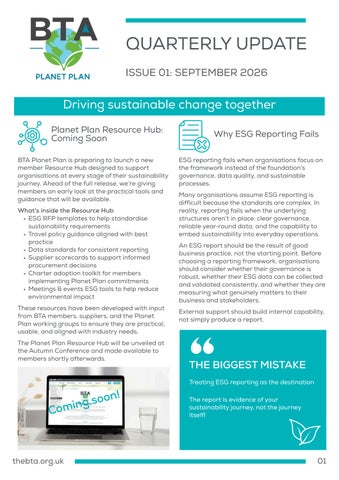
Driving sustainable change together Planet Plan Resource Hub: Coming Soon BTA Planet Plan is preparing to launch a new member Resource Hub designed to support organisations at every stage of their sustainability journey. Ahead of the full release, we’re giving members an early look at the practical tools and guidance that will be available. What’s inside the Resource Hub ESG RFP templates to help standardise sustainability requirements Travel policy guidance aligned with best practice Data standards for consistent reporting Supplier scorecards to support informed procurement decisions Charter adoption toolkit for members implementing Planet Plan commitments Meetings & events ESG tools to help reduce environmental impact These resources have been developed with input from BTA members, suppliers, and the Planet Plan working groups to ensure they are practical, usable, and aligned with industry needs. The Planet Plan Resource Hub will be unveiled at the Autumn Conference and made available to members shortly afterwards.
Why ESG Reporting Fails ESG reporting fails when organisations focus on the framework instead of the foundation’s governance, data quality, and sustainable processes. Many organisations assume ESG reporting is difficult because the standards are complex. In reality, reporting fails when the underlying structures aren’t in place: clear governance, reliable year‑round data, and the capability to embed sustainability into everyday operations. An ESG report should be the result of good business practice, not the starting point. Before choosing a reporting framework, organisations should consider whether their governance is robust, whether their ESG data can be collected and validated consistently, and whether they are measuring what genuinely matters to their business and stakeholders. External support should build internal capability, not simply produce a report.
THE BIGGEST MISTAKE Treating ESG reporting as the destination
n! o o s ing Com
thebta.org.uk
The report is evidence of your sustainability journey, not the journey itself!
01
Planet Plan Newsletter: Issue 01
Top Tips for Building an ESG Strategy That Actually Works For SMEs, ESG can feel overwhelming. Start smaller than you think. Pick two or three UN Sustainable Development Goals that genuinely fit your business. Get board sign-off early. Without buy-in at the top, strategy stalls at the first hurdle. Appoint internal champions. Change doesn't happen from a policy document. It happens when people across the business own it and talk about it. Choose a recognised ESG framework or assessment tool to anchor your strategy. Every action, every SDG, every policy should build towards meeting that framework’s requirements. It gives your strategy structure and gives buyers proof, not just promises. Look locally too. Who's doing ESG well near you? Partnership for the Goals isn't just an SDG, it's practical advice. Track and report against your framework consistently. What gets measured gets managed.
Climate‑Risk Integration Climate‑related risk is becoming a core component of organisational governance as regulators and standard‑setters strengthen expectations around disclosure. Across 2026, frameworks are moving towards more consistent treatment of physical, transition and liability risks, with clearer requirements for scenario analysis and financial impact assessment. For travel, events and accommodation suppliers, this means demonstrating how climate risks influence operations, supply chains and long‑term planning. Integration is shifting from narrative reporting to evidence‑based assessment, with boards expected to show active oversight and alignment between climate risks, investment decisions and resilience strategies.
thebta.org.uk
ESG Frameworks: What’s Changing in 2026 EU and UK sustainability standards continue to evolve in 2026, shaping value, risk and ROI across business travel and meetings. Under the EU’s CSRD and ESRS, in‑scope companies must disclose material impacts on people, the environment and financial performance making credible travel and events data essential. The new CSDDD strengthens expectations for human‑rights and environmental due diligence across value chains, influencing supplier selection and resilience. In the UK, UK SRS S1 and S2 align national reporting with global standards, reinforcing the need for transparent ESG performance across BTA members and their partners.
Regulatory Updates (2026) CSRD introduces mandatory sustainability reporting for in‑scope EU companies, replacing the older NFRD rather than continuing it. ESRS are new, legally‑defined reporting standards that set out how companies must disclose impacts, risks and opportunities. CSDDD establishes new due‑diligence requirements for human‑rights and environmental risks across value chains, influencing supplier selection and resilience. UK SRS S1 and S2 align UK sustainability reporting with global ISSB standards, forming a new national disclosure framework rather than extending existing UK schemes.
02
Planet Plan Newsletter: Issue 01
Net‑Zero Pathway Tightening Net‑zero pathways are tightening across 2026 as key frameworks refine what constitutes a credible reduction trajectory. The Science Based Targets initiative (SBTi) is strengthening its v2 implementation requirements, placing greater emphasis on near‑term emissions reductions, stricter validation criteria and clearer evidence of progress against interim targets. This reduces flexibility in how organisations structure their pathways and introduces a defined Beyond Value Chain Mitigation (BVCM) route for financing high‑quality climate‑positive activities outside the value chain, including the use of recognised carbon credits.
CAA Emissions Requirements - Impact on Booking Tools The CAA emissions display rules are expected to come into force in late 2026, requiring clearer carbon information for flights sold in the UK. Airlines, GDSs and booking‑tool providers are already working with the CAA on methodology and data standards. For BTA members, this will mean updated booking‑tool interfaces, more consistent emissions data, and tighter alignment with UK sustainability reporting expectations. Early preparation will help avoid disruption once the final display requirements are published.
Accommodation Sustainability Standards Accommodation sustainability standards are becoming central to ESG expectations across corporate travel and meetings. For buyers, hotel emissions fall under Scope 3 Category 1: Purchased Goods & Services, meaning the quality of data provided by hotels directly affects corporate reporting. UK DESNZ currently applies average, location‑based emissions factors, so hotels in the same area receive identical carbon values regardless of their individual environmental performance. In parallel, the UK Emissions Trading Scheme (UK ETS) is expanding coverage and adjusting allocation rules, increasing the cost and scrutiny associated with operational emissions. For travel, events and accommodation suppliers, these shifts mean more robust data capture, stronger verification of Scope 1–3 emissions and clearer disclosure of reduction assumptions. As frameworks converge, organisations will need net‑zero strategies that demonstrate measurable reductions, transparent methodologies and alignment with recognised standards.
thebta.org.uk
To provide clearer insight, many accommodation providers are adopting recognised sustainability frameworks such as the GSTC Criteria, ISO 14001 (environmental management) and ISO 50001 (energy management), or participating in programmes that align with GSTC principles. These approaches offer more visibility of operational practices and help buyers assess suppliers beyond standardised carbon factors. For BTA members, GSTC‑aligned standards strengthen data quality, support supplier due diligence under CSRD, ESRS and UK SRS, and help align meetings and events programmes with recognised sustainability frameworks as reporting expectations tighten.
03
Planet Plan Newsletter: Issue 01
Understanding Your Supply Chain
Accessibility as the Norm
Sustainability expectations across the supply chain are increasing, with organisations looking beyond price and service when assessing suppliers. Buyers are requesting carbon‑reduction plans, ESG policies, certifications and evidence of responsible operations to meet evolving reporting requirements under frameworks such as CSRD, ESRS and UK SRS. This includes understanding upstream emissions, material impacts, and supplier governance across a wide range of categories not only travel and events. For suppliers, this shift presents an opportunity to demonstrate progress and strengthen client confidence in the resilience and sustainability of their operations.
Ground Transport: The ongoing grey area
Imagine if accessibility was treated the same way as Wi‑Fi in a venue, expected, standard, and non‑negotiable. As ESG expectations evolve, organisations are recognising that inclusive design is not an add‑on but a core requirement across travel, meetings and events. From step‑free access to clear digital information, accessibility is becoming a baseline expectation, shaping supplier selection, event planning and responsible business practice
Meetings & Events Emissions: Are We Measuring Them Correctly?
Ground transport remains one of the least consistently measured areas of business travel emissions. Taxis, chauffeurs, and car rental often fall into Scope 3 Category 6, yet data quality varies widely and methodologies differ across suppliers. Six years on, this remains a major gap in corporate reporting, with limited standardisation and inconsistent visibility. Improving data access is essential for credible business travel emissions reporting.
Meetings and events remain complex to measure, with no single UK standard for how emissions should be incorporated into corporate reporting. Many organisations report event emissions under Scope 3 Category 1, often using spend‑based calculations. Yet travel to and from events typically represents 70–90% of total emissions, reported under Scope 3 Category 6. As ESG expectations tighten, accurate travel data, venue selection and modal choices are becoming central to credible event sustainability reporting.
thebta.org.uk
04
Planet Plan Newsletter: Issue 01
SAF: Why Early Investment Matters for Future Price Stability With the UK SAF mandate rising from 2% in 2025 to 22% by 2040, the Government has introduced a new revenue-certainty mechanism to help accelerate home‑grown SAF production. This is designed to give producers the confidence to scale and support the industry in meeting future targets. While costs will naturally flow through the system as mandates increase, early SAF purchasing plays an important role in stabilising prices over time. As more scalable SAF pathways come online, long‑term costs are expected to fall reinforcing why high‑volume, next‑generation solutions are essential for a resilient and affordable SAF market.
The Moment Carbon Reporting Grew Up The announcement that ISO and the GHG Protocol are working toward a unified global GHG accounting standard is one of the biggest shifts in sustainability reporting in over a decade. Imagine two operating systems finally agreeing to run the same code that’s the scale of this moment. For years, organisations have navigated two different philosophies: the GHG Protocol, with its prescriptive “how‑to” guidance and 15 Scope 3 categories, and ISO 14064‑1, built around principles, flexibility and formal verification. Both are credible, but they answer different questions consistency vs. governance. Bringing these strengths together into one global framework could finally deliver what the industry has been asking for: simpler reporting, clearer boundaries, stronger comparability and greater confidence for regulators, investors and assurance providers. In short, the carbon‑accounting world is about to get a lot more aligned.
Impact cost of the UK SAF mandate design This report explores what the UK’s SAF mandate could mean for future flight pricing. It highlights the increasing need for more advanced SAF types, and the cost implications created by limited availability of “non‑HEFA” pathways.
The unified ISO + GHG Protocol global carbon‑accounting standard is on its way but not here yet. A draft is due for public consultation in 2027, with the final standard expected in 2028. Once published, organisations will likely transition over a phased period as regulators, auditors and reporting frameworks adopt the new rules. In short: the carbon rulebook is being rewritten, and the industry has two years to prepare.
thebta.org.uk
05
Planet Plan Newsletter: Issue 01
Key Official ESG Updates & Upcoming Changes Several regulatory and standards‑based ESG updates are scheduled across 2026 that will affect travel, events and accommodation suppliers. The UK Sustainability Reporting Standard (UK SRS) is expected to be introduced as part of the UK’s wider sustainability disclosure regime, with guidance anticipated to align more closely with ESRS. The EU CSRD phased rollout continues, bringing more organisations into mandatory reporting and assurance. Updates to SBTi v2 implementation timelines and ISO GHG methodologies will tighten emissions calculation requirements. In aviation, the UK ETS expansion and CAA work on emissions display for flights sold in the UK/EU will influence booking‑tool compliance. These changes collectively raise expectations for data quality, supplier transparency and verified Scope 3 reporting.
Contributions from:
thebta.org.uk
Dana Moore Director of Operations & Climate Solutions Zeero Group
Pippa Ganderton Director ATPI
Laura Busby Director of Growth & ESG Identity Travel
Joe Whittle Sustainability Impact Lead Travel Counsellors.
Andy Sison Head of Governance & Supplier Relations The Good Travel Collective
Ellen Mutimer ESG Executive Inntel
06