







By ELEANOR SHAW & SIXUAN WU The Breeze
After nine months in office, Jim Schmidt was officially inaugurated as JMU’s seventh president on Wednesday, standing among a sea of attendees decked out in purple regalia to symphonies performed by students.
When the clock struck 2 p.m, robed university leaders spilled into the Atlantic Union Bank Center, gathering on stage. Schmidt’s family and friends spoke alongside university leaders. Former JMU presidents Linwood Rose and Jonathan Alger were also in attendance.
Schmidt’s brother, Phil, pastor of the Redeeming Grace Community Church in Lake City, Minnesota, kicked things off with an invocation — during which he prayed his brother and the university would share a bright future.
Following a greeting from Board of Visitors Rector Suzanne Obenshain, University of Mary Washington President. Troy Paino, spoke fondly of his friendship with Jim Schmidt and said Schmidt will continue past JMU presidents’ tradition of leadership, aspiration and communication.
“This community has much to be proud of, and it deserves a leader who can help it reach even greater heights,” Paino said, “Jim Schmidt is that leader.”
The Furious Flower Poetry Center’s director, Lauren K. Alleyne, then delivered a poem titled “Promise: A (Re)definition,” dedicated to Schmidt’s presidency. Her piece centered on
the word “promise,” tying into the hope JMU’s next steps inspires.
“We are your ever-fertile gardens. When kept promise, you are our furious flowering,” the poem read.
After reciting the piece, Alleyne presented a signed and framed copy to Schmidt. This was followed by several JMU choral ensembles’ rendition of “Shenandoah” — a folk song the choirs offer as “a grounding and blessing of home” for Schmidt and his family, according to the ceremony program.
Community leaders greet, applaud Schmidt
The next several speakers took turns extending messages of welcome to Schmidt on behalf of their respective organizations. JMU Alumni Association Board of Directors President Ellen Hineman (’89) honed in on “holding doors,” and said alumni are dedicated to furthering Schmidt’s vision.
“We look forward to a partnership where you leverage the full power and the passion of this global alumni base to drive JMU’s next phase of growth,” Hineman said.
Senior and Student Body President Charlotte Bronaugh, who followed Hineman, said she’s seen Schmidt make himself available for students in environments ranging from his office to D-Hall. She then gifted Schmidt a notebook with photos and messages from student leaders across campus.
“To students, President Jim has already been the invested, engaged and kind leader JMU
needs and values,” Bronaugh said. “On behalf of the students of James Madison University, I thank you for your dedication to a bright future.”
Faculty Senate Speaker Kathy Ott Walter calling Schmidt a potential partner in faculty members’ academic work.
“On behalf of the faculty, I extend our congratulations and our commitment to work with you to advance the mission of JMU and to serve our students and society with integrity and purpose,” Ott Walter said.
Co-chairs of the Employee Advisory Committee Christina Myers (’16) and Chris Ouren, wrapped up the opening remarks and addressed Schmit from a staff perspective. “You have been open to meeting with us, listening to our ideas, and offering thoughtful, eloquent feedback,” Myers said. “You also acknowledge the value employees will bring to the strategic planning process, and your engagement has been refreshing and energizing.”
Schmidt takes presidential oath, addresses attendees
With that, Obenshain invited Schmidt to the podium and read the presidential oath of office. Schmidt — with one hand raised and the other atop a Bible held by his wife, Kim — responded with “I do.”
Jim Schmidt was then presented with the chain of office that officially recognized him as president of JMU.
After exchanging hugs with his family, Schmidt gave his first address as JMU’s official
president — a speech he began by thanking the university community, attendees, speakers and musicians.
“It has been so rewarding to work with all of you during these first nine months,” Schmidt said. “I look forward to the many great things we will accomplish for JMU in the years to come.”
Schmidt nodded to each of the university’s previous presidents. He said he was proud to continue their legacy and looked forward to leading the university’s next chapter.
In honor of James Madison, Schmidt quoted the former U.S. President: “A well-instructed people alone can be permanently a free people.” Schmidt said, while the future is uncertain due to rapid change in higher education (including AI), institutions like JMU have the responsibility to educate and engage students to treat each other with civility and uphold the responsibilities of democracy.
“We live in a time when the role of higher education is being questioned … the historic models of learning and engagement are being challenged,” Schmidt said. “I believe that higher education has never been more vital to our future and for our country.”
Schmidt said many of the thousands of people he’s spoken to during his presidential travels are hungry to see JMU take its place as a community cornerstone, and said this passion is his foundation.

”
We are thinking big — because that’s what legends do. That’s what our future demands of us.
By SARA PAGET The Breeze
JMU’s Student Government Association (SGA) elections were held March 31, filling executive, academic senator and Class Council (CLACO) positions. Although all undergraduate JMU students can and are encouraged to vote in SGA elections, only 812 of the 21,112 students cast their votes, SGA elections commissioner Regan Lovell said, equalling 4% of the student body.
This turnout is lower than last semester’s, which was approximately 1,200 students, or 6% of the student body.
Lovell said a lack of representation of SGA and a sense of apathy toward the idea of voting may explain the low voter turnout, adding that a lack of awareness regarding election day and the SGA’s importance also play a part.
When tabling on election day, Lovell said many students turned away, with some saying they didn’t care about the elections.
James Casey, a freshman engineering student, said he didn’t know anything about SGA or the elections.
Another student, sophomore nursing major Mailee Findley, said it was her first semester at JMU and that she had “heard a little about [SGA] but wasn’t sure what it was fully about.”
Another reason for this semester’s turnout, and specifically for the drop from last semester, may be that some positions, including all CLACO 2027 and 2028 positions and 2029 vice president, went uncontested, Lovell said.
“If there were more positions with more people running, and there was a real competition going on, I feel like that would gain more attention from students,” Lovell said. “In the future, I would hope to see more candidates run in order to gain more traction in the election.”
Another issue, Lovell said, is the lack of understanding of the importance and effect that elected students have on the student body.
Maddy Adler, a junior communications student, said she was aware of the elections, but “wasn’t familiar with what or who we were voting on,” and therefore did not participate in them. She added that with more information on the positions and SGA as a whole she would have felt more inclined to vote.
Isabelle Tariverdi, a junior communications major, also said she didn’t know about the elections, but felt that if she had known about them, she might’ve been more likely to vote.
Lovell said student participation in SGA elections is important for a multitude of reasons, explaining how these elected representatives speak for the student body.
SGA representatives have a say in big decisions like tuition, meal plans, residence halls and transportation on campus, Lovell said, and serve as the voice of the student body on these issues.
“It’s important to vote on these people because they are the representatives that are the direct contact and communication between the student body and administration of the university,” Lovell said.
Lovell added that a higher voter turnout is important to the representation of the student body itself.
“We want to make sure every group and type of student is voting,” Lovell said. “We want to get every type of student on our campus to make sure everyone has had an equal say.”
The best way to become more aware of SGA’s role and its effect on students, Lovell said, is to attend their weekly student Senate meetings, which are open to the entire student body from 6:15 p.m. to 7:15 p.m. on Tuesdays in The Union room 256.
Lovell said the SGA worked to expand the student body’s awareness of elections this semester, using digital advertisements on every TV on campus, flyers in every academic building, posts on Dukes Weekly for weeks, canvassing at residence halls and announcing election day to various lecture halls on Tuesday.
Regardless, many students like Tariverdi and Casey were still unaware of the elections. Lovell said to improve voter turnout, she plans to repeat the steps taken this year but more intensely attempting to reach more students.
Read more online at breezejmu.org
CONTACT Sara Paget at pagetsh@dukes. jmu.edu . For more coverage of JMU and Harrisonburg news, follow the news desk on X @TheBreezeJMU and on Instagram @BreezeJMU.

By SAM WRIGHT & EMMA NOTARNICOLA The Breeze
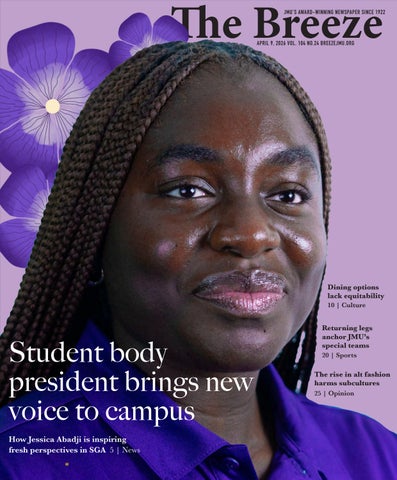
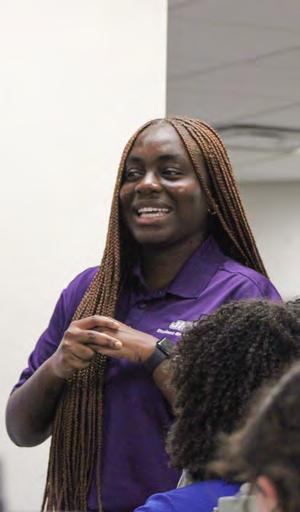
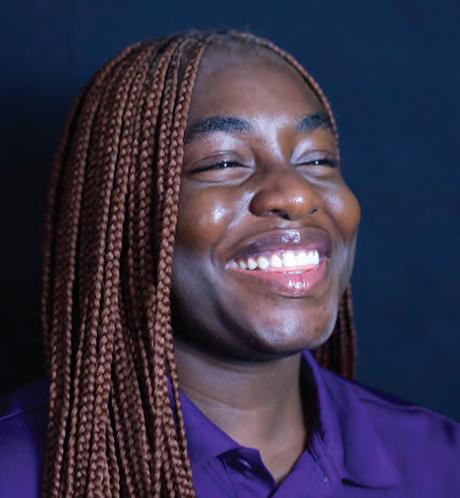
Eight years ago, sophomore biophysical chemistry major Jessica Abadji moved to Woodbridge, Virginia, from Ghana. After facing the challenges of university applications as a first-generation student, Abadji found herself at JMU. Last Wednesday, she was elected student body president.
About Abadji
Abadji said one of her greatest strengths comes from her background as an immigrant and first-generation student: adaptability.
“Coming here [was] definitely a culture shock. I had to switch up a lot of things,” Abadji said. “[There were] a lot of things I had to relearn, a lot of adjustments I had to adapt.”
She added that despite these challenges, her innate drive to succeed overcame, allowing her to excel in high school,
consistently making honor rolls while holding a variety of leadership positions.
Through college applications, Abadji said she had high ambitions, but being the first in her family to go through the process, she faced a lot of challenges.
“JMU was not my dream school … I wanted to have my bachelor’s in chemical engineering, then later on, pursue a master’s, then later on, go get my Ph.D. in chemical engineering,” she said. “But then, during college application season, being the first daughter in an immigrant household, I definitely didn’’t have that guide that I needed.”
However, Abadji said, once she visited JMU, she instantly loved it and realized that she could still pursue her passions while advancing her skillset in a supportive and collaborative community.
“Coming to JMU has been one of the best decisions I’ve made in my life,” she said. “I’m actually so very grateful that things ended up the way they did, because I formed a community I know I’m never gonna lose.”
At JMU, Abadji declared a major in biophysical chemistry, intending to work in public health, pharmaceuticals or food and waste management while serving as a role model for under-represented groups in these fields.
“I just can’t help but realize the gap between the ratio of women and men that go into engineering,” she said. “If I can do it, other young girls will see what I’m doing and be able to know that they’re able to do it as well,” she said.
Through all of these experiences, Abadji said she’s gained an understanding of the importance of around uplifting voices that are generally ignored.
Read more online at breezejmu.org
CONTACT Sam Wright at wrigh4sx@ dukes.jmu.edu & Emma Notarnicola at thebreezeweb@gmail.com. For more coverage of JMU and Harrisonburg news, follow the news desk on X @ TheBreezeJMU and on Instagram @ BreezeJMU.
By CHARLIE BODENSTEIN The Breeze
U.S. House of Representatives District 5 candidate Tom Perriello (D) visited the Shenandoah Valley on Monday to meet with farmers, mayors, elected officials and students to discuss his upcoming congressional campaign.
Although Perriello is officially running for VA05, he would represent VA-06 if elected and the redistricting amendment passes.
The former U.S. ambassador’s first stop was Verona at the Blue Ridge Area Food Bank before traveling to Harrisonburg to meet with Mayor Deanna Reed, Charlottesville Mayor Juandiego Wade and Staunton Mayor Michele Edwards, according to a press release sent to The Breeze.
Perriello also met with community members at Capital Ale House and attended the Harrisonburg City and Rockingham County Democratic Committee Meeting.
Perriello, who previously held the 5th District seat from 2009 to 2011, said November’s midterm elections could “be game over for democracy,” or it could lead to new opportunities for future generations.
“I think some people have given up on democracy and the American experiment,” he said, “but I haven’t.”
He added that the prosperity of future generations is under direct attack by the Trump administration, and the American people need to be willing to stand up for their communities.
“We read about certain periods in the history books and wonder what we would have done during those periods,” Perriello said, “this is that period.”
Perriello defends redistricting
The Virginia General Assembly first proposed the redistricting amendment last October, which will go to a vote on April 21 in a special election.
Under the current congressional district map and the proposed map, Harrisonburg and Rockingham County sit in VA-06, but areas of Rockingham County would become part of VA-05.
With this, nearby towns such as Bridgewater, Elkton, Front Royal and Winchester would also be separated into different districts.
Despite Perriello running in what is VA-05 under the current maps, he would actually represent VA-06 if elected and if the referendum passes.
The referendum has sparked debates over the ethics and legality of redistricting. Multiple states, including Texas, California, North Carolina, Ohio and Utah, have entered a redistricting war as midterm elections loom.
Nevertheless, Perriello fully supports the amendment, adding that states like Texas and North Carolina are attempting to “steal the voice of Virginia” in the midterms — which is why Virginia has responded with its own redistricting proposal.
Perriello said the referendum gives Democrats a chance to level the playing field and “put a check” on President Trump.
With this, Perriello acknowledged those who are skeptical of being misrepresented, but said that Harrisonburg’s current representative, Ben Cline (R), wasn’t representing his constituents. But with the proposed district, people would be more appropriately represented.
Perriello said, “because Ben Cline has not had to actually answer the voters.”
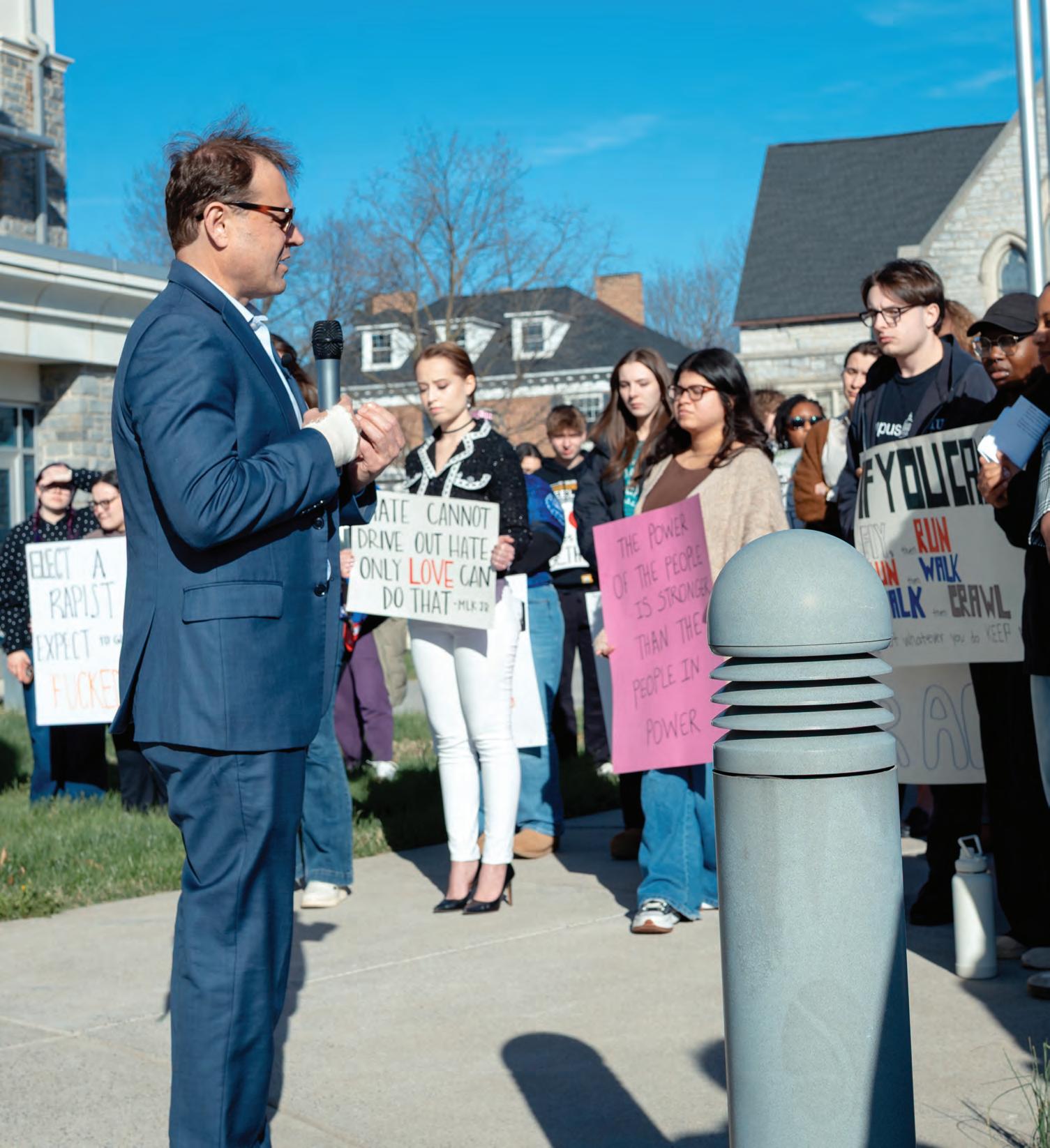
“This is creating the most even district in the state, and Ben Cline doesn’t like that,”
Perriello continued that Cline knows he can’t win a fair fight because he’s “screwed over” the community by closing rural health clinics and raising grocery and gas prices.
He added that the new 6th District would be one of the "youngest in the country," containing over 18 universities, including JMU. Notably, the proposed district would also include universities such as Virginia Tech, UVA, Liberty and Radford.
“That means people will have a disproportionate ability to shape my election and then to hold me accountable once I’m hopefully elected,” he said.
Perriello won’t sell out if elected
In a political climate where people have become more distrustful of politicians, Perriello said his track record as a representative who was willing to lose his seat over issues he believed in — and who stood up to insurance lobbyists and the fossil fuel industry — can help voters trust him.
“Voters from this area know, ‘Hey, this is a guy who’s going to put us first,’” he said, adding that if elected, he would advocate for his district every day.
He continued that his two-year term as a representative, although short, is the “best of both worlds” because he didn’t hold the seat long enough to be corrupted, but he still has political connections and sufficient experience to represent his district.
“This area hasn’t had a real fighter for a generation,” he added.
Reinforcing his track record as a representative, Perriello said that while he was in office, he helped expand healthcare coverage for millions of people, doubled the minimum wage in Virginia and made it easier to vote early. Furthermore, he said his work as an overseas ambassador shows he can successfully resolve conflicts.
As a diplomat, Perriello first served as senior advisor to the prosecutor at the Special Court for Sierra Leone from 2002 to 2003. He also worked in varying judicial and legislative roles in Sudan, Kosovo and Afghanistan.
In 2015, Perriello was appointed by thenPresident Barack Obama to serve as Special Envoy to the African Great Lakes Region and the Democratic Republic of the Congo. He also served in Burundi, Rwanda and Uganda. Perriello helped negotiate a peace deal in the Democratic Republic of Congo in 2016 between President Joseph Kabila and opposition leaders during a period when the country was on the brink of a second civil war. The agreement was the country’s first peaceful transition of power since its independence from Belgium in 1960.
Perriello said his unrelenting work in conflict zones such as Ukraine and Sierra Leone and his fights against special interest groups in Washington display his courage as a representative of his constituents.
“I’ve seen what real courage looks like when I’m standing next to Sierra Leonean women who are risking their lives to try and end a war that’s destroying an entire generation and their country,” he said.
CONTACT Charlie Bodenstein at breezenews@gmail.com. For more coverage of JMU and Harrisonburg news, follow the news desk on X @TheBreezeJMU and on Instagram @BreezeJMU.







from INAUGURATION, page 4
“It is our task to open doors to the American Dream, to everyone who seeks a degree and a better life. That passion continues to guide my actions today,” Schmidt said. “James Madison University will continue to shine as a strong beacon across higher education, setting a new model for the education we provide our students and the impact our graduates make on the world.”
Schmidt highlights the Madison Promise
Schmidt focused on the Madison Promise, which he said is the cornerstone of his strategic plan and guarantees future Dukes a quality education.
“I am energized by the vision the Madison Promise lays out, for it not only builds on our past excellence, but also outlines the actions we must tackle today, in a changing, demanding world,” Schmidt said
“I was getting recruited to do it, so I knew I could do it.” Schmidt said JMU’s next steps will be the culmination of over a century’s
worth of progress. With enthusiasm — and some inspiration he credited to rockstar Stevie Nicks — Schmidt said he’s excited to help the university become the legend it was meant to be.
“Let’s be different, unique. Let’s challenge the students and let’s challenge the status quo. Let’s dare to try and sometimes fail, but always march to the beat of a different drum,” Schmidt said.
Schmidt concluded his speech by expressing his excitement to continue forming academic, residential and community partnerships that will take JMU further into the world.
“We are thinking big — because that’s what legends do,” Schmidt said. “That’s what our future demands of us.”
CONTACT Eleanor Shaw at shaweo@dukes. jmu.edu and Sixuan Wu at wu3sx@dukes. jmu.edu. For more coverage of JMU and Harrisonburg news, follow the news desk on X @TheBreezeJMU and on Instagram @BreezeJMU.






Bella Arist & Audrey Fletcher
By LOZA WOLDESEMAIT contributing writer
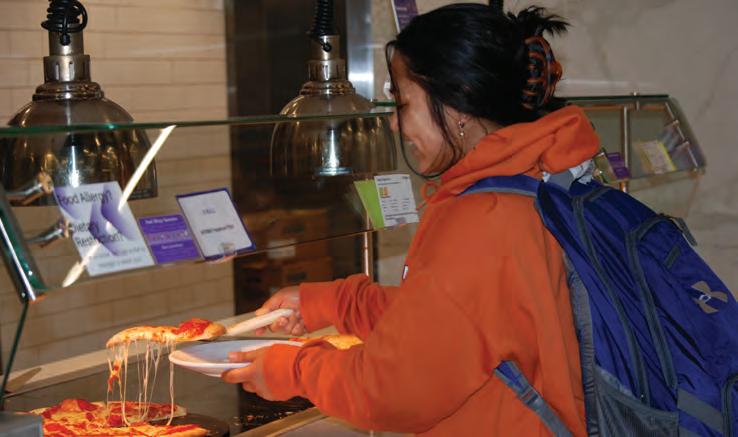
Ranked eighth in the nation for “Best Campus Food” by the Princeton Review and in its 24th consecutive year being voted in the top 20, JMU is known nationally for its dining. Here, students have no shortage of options; from D-Hall and E-Hall to Market 64 and Steak ‘n Shake, there’s a dining choice for everyone. But when it comes to healthy options, opinions from JMU students tend to be more polarized.
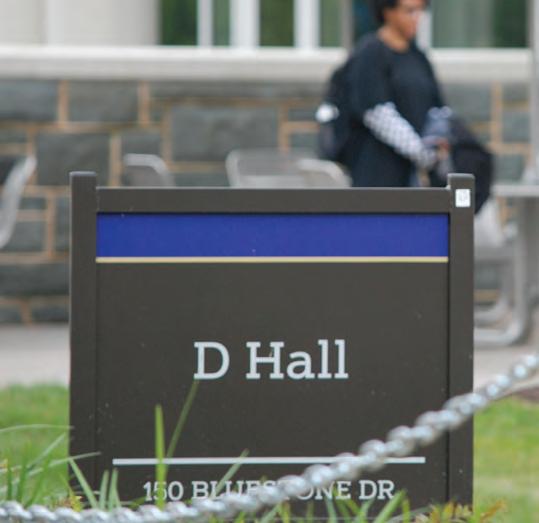
For many students, dining halls like D-Hall and E-Hall seem to be the most reliable places to find balanced meals.
“It’s super easy for me to walk in and get a balanced meal with protein, vegetables and carbs,” said Shriya Gnanasekaran, a freshman nursing major and UREC regular.
Gnanasekaran said her favorite food to get at D-Hall is “Fire Wok, because the rice bowls are customizable and flavorful.”
However, accessibility seems to be an issue. Between classes, workouts, jobs and extracurriculars, many students rely on quick, portable food options that may not be the healthiest.
That’s where Market 64 comes in. Several students praised it as one of the best places on campus for healthier grab-andgo meals.
“The Market is the easiest place to eat healthy because they have chicken or falafel salads and wraps, protein shakes, fruit cups and more,” freshman international affairs and economics
major Samaria Michael said. “The only problem is that it closes at 8 p.m. most days, which is sometimes too late for me.”
Both Gnanasekaran and Michael said that while accessible healthy options exist on campus, they’re not always equally available to all students, highlighting the broader issue between availability and accessibility.
While JMU Dining offers a variety of nutritious meals, those options can quickly become inaccessible when coming back late from UREC or finishing up an assignment due that night.
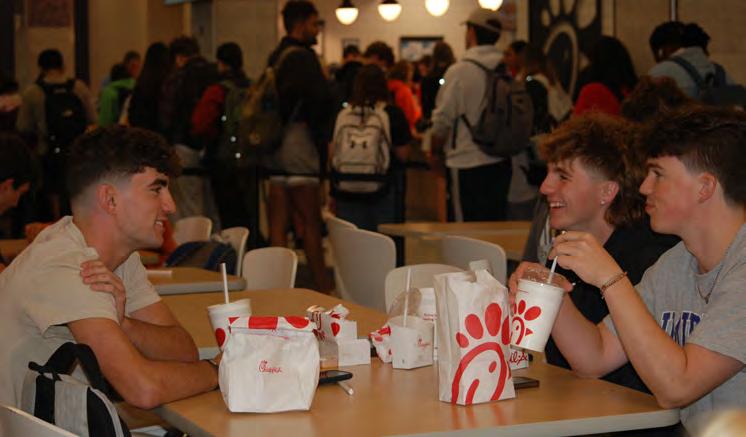
Time also plays a critical role. While dining halls offer variety and balance, they require time to sit and eat. Grab-and-go locations, like Steak ‘n Shake or Chick-fil-A, offer speed but not always the same nutritional quality, which can be highercalorie than the many dining hall options.
Ultimately, JMU does a great job providing a variety of highquality dining options. However, the issue is that the equity of those options can be inconsistent. Extending hours and distributing more nutritious choices evenly across campus could ensure that all students have access to healthier food.
CONTACT Loza Woldesemait at woldeslx@dukes.jmu. edu. For more on the culture, arts and lifestyle of the JMU and Harrisonburg communities, follow the culture desk on X @TheBreezeJMU and on Instagram @BreezeJMU.
By EDISON VRANIAN
The Breeze
Legend has it that people cry from cutting onions — but another onion is jerking tears on Instagram.
JMU Onion is an Instagram account that makes satirical storylines about what’s happening on campus. The JMU Onion posts are similar to “America’s Finest News Source,” The Onion, a Wisconsin-based newspaper known for its parody stories, according to Britannica.
There’s an X account called The Onion JMU that was created in June 2019, — but its most recent post was on March 2, 2023. The junior running the JMU Onion Instagram account, who requested to remain anonymous, said they’ve “never heard of” the X account.
However, the junior said they created the JMU Onion account after encountering a post from the University of St. Andrews’
Onion Instagram account, which the junior related to. After this inspiration, they made the account and published its first Instagram post on Feb. 22.
“My first post was about an audible sigh breaking out in class, because one guy asks another question,” the junior said. “I was annoyed at some guy in class because he asks questions.”
After the first post, the junior said ideas “come naturally” from his experiences or having conversations with other students. From these conversations, the junior comes up with jokes that inspire every post that gets created and published.
The junior published over 20 posts in the span of a few days, eventually reaching 1,261 Instagram followers as of April 7. The most popular post by JMU Onion is from Feb. 22: “Vape found on ground still works, girl says, disregarding ‘weird, brown residue’ on mouthpiece.” This post amassed roughly 12,300 views.
The junior said their favorite post was from March 6: “JMU schedules CHOICES during St. Patrick’s darties to show incoming freshmen’s parents where their money actually goes.”
Although the junior runs the account individually, they have friends and the audience sending messages on Instagram to help with ideas.
The junior said the only platform they posted on other than Instagram was Yik Yak, but they didn’t like it, adding that they don’t have plans to expand the account to other platforms, but are using the account as a “social media marketing test.”
CONTACT Edison Vranian at vraniawe@ dukes.jmu.edu. For more on the culture, arts, and lifestyle of the JMU and Harrisonburg communities, follow the culture desk on X @TheBreezeJMU and on Instagram @BreezeJMU.

By SIXUAN WU The Breeze
Standing before Donna Amenta’s office door feels like bracing oneself for a captivating story.
Visitors get a preview of the chemistry professor inside by looking at her door decorations: Photocopied documents from her days as the head of JMU’s chemistry & biochemistry department, a “Proud To Be a Chemist” card from the American Chemical Society, several memes featuring a sassy old lady in sunglasses and cards from students over the years with hearts drawn around her name.
Amenta, 83, has been working in JMU’s chemistry & biochemistry department for 52 years. In April, she’ll be recognized as one of the department’s two jubilee professors for more than 50 years of service.
Her office bears traces of the years, with books and binders filled with past teaching materials lining the shelves, many dating back to the ’90s. But the toys hiding among the books are Amenta’s true treasures: A cow in a kneeling praying yoga pose; a voodoo doll with a pushpin through the heart; two PB & J dolls, grinning and hugging each other; an ever-growing collection of rubber ducks of various colors and sizes.
“This is my Einstein duck, and there’s my Benjamin Franklin duck,” Amenta said, as she cradled each in her palm. Many students who learn about her collection gift her more rubber ducks.
Beneath the rubber ducks sits a ribboned purple box. Inside, there’s an award Amenta won in 2021 — the Provost’s Distinguished Career Award for Equity, Diversity and Inclusion — although she’s perfectly content having the ducks take the spotlight instead.
Amenta came to JMU (then known as Madison College) from Philadelphia in 1974, after her husband, Roddy, was hired in the geology department.
Back then, Madison College was a small school of just 8,000 students. There was no bridge over Interstate 81, the Village was on the outskirts of campus and East Campus was nothing but cow pastures.
During her free time — often on weekends — she collaborated with other faculty on research projects, because she couldn’t do her own research as a part-time faculty member.
“I wanted to do chemistry, so the only way I was going to be able to do chemistry in Harrisonburg, Virginia, was to have a job here,” she said.
In 1990, Amenta became a full-time, tenuretrack assistant professor under then-department head John Mosbo. She rose through the ranks over the years, becoming a full professor in 1998. For many years, she was the only female fulltime professor in the department.
When she was offered the interim department head position in 1998, Amenta was both surprised and nervous. But as it turned out, her experience rotating between the department’s roles prepared her well for the position.
“Nobody could walk in my office and tell me I didn’t understand their job, because I had done them all,” she said. “The only thing I hadn’t done was the [administrative assistant]’s job, and some days, I thought I did that too.”
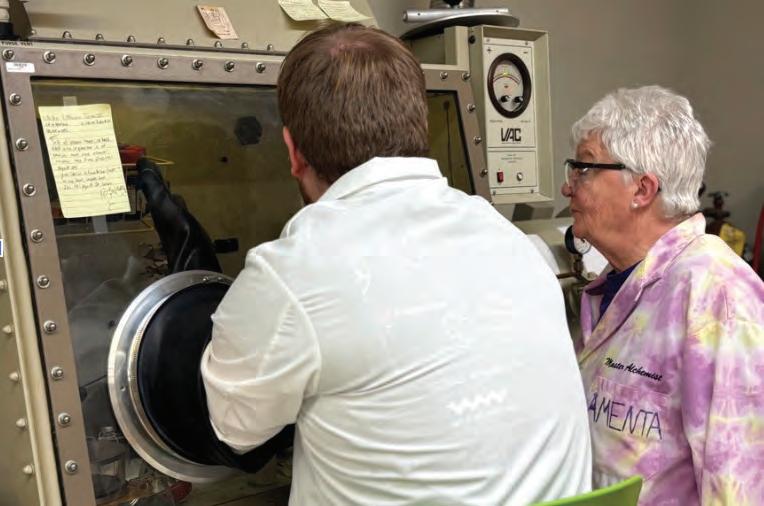
“WARNING: CRAZY CHEMIST AT WORK,” on the back.
One of her former students, Brycelyn Boardman (’03), who’s now a professor in the chemistry department, described Amenta as a “whirling dervish” in the lab with boundless energy, always excited to get her hands on experimenting with the different chemicals to create new molecules.
“She’s kind of here, there and everywhere,” Boardman said. “I don’t know where she gets all her energy from … She and my 4-year-old have a similar amount of energy.”
Amenta’s love for hands-on learning prompted her to develop a research-based organic lab in 1994 — a revolutionary notion, as undergraduate students didn’t typically engage in research at the time. She believes that students should be treated as real scientists, and never thought things were too challenging for undergraduates.
“She inspired my career path,” Boardman said. “In the lab, I really just felt at home. I felt like I learned the best there. I really had
“Look at how pretty they are,” she said, holding up a round-bottomed flask with red powdery crystals covering its bottom. “I wish there’s more, but still, look at them.”
An educator for life
For all the contributions she’s made in the department, Amenta isn’t one for the spotlight. Instead of talking about her achievements, she prefers discussing her research and feels the most comfortable in a classroom — whether that be in a lecture or a lab.
“[Amenta’s] humbleness is her kryptonite,” Boardman said.
Amenta has won five awards for her service over the years. Her favorite? The Carl L. Harter Award for Distinguished Teaching she won in 1997, which she displays on her office wall with pride because it’s a teaching award.
In the department, she’s known as “Princess Amenta” — a nickname that stuck over the years after Amenta once asked her lab students why they address the other two instructors as doctors but just call her “Amenta.”
“I kind of liked it because it was small,” Amenta said. “It was a small liberal arts college, and that’s what [I] wanted.”
Her first office was on the third floor of Burruss Hall, in a balance room where highprecision instruments for measuring chemicals were stored. The room was narrow, with folding doors she called “morgue doors,” and she shared the space with another person. Her desk was part of the bench holding the instruments, and inside temperatures were freezing during the winter.
“If there was a strong wind, you could almost get blown out of your chair,” Amenta said.
Despite holding a Ph.D. in organic chemistry, Amenta wasn’t employed as a full-time faculty member. Instead, she first taught night labs as a part-time lecturer and held various positions over the next 16 years. In addition to teaching, she ordered equipment, paid the bills, coordinated freshmen laboratories and oversaw student lab assistants.
Amenta served as department head from 1998 to 2008 and 2012 to 2014. During her tenure, she worked to increase diversity within the department — especially encouraging young female faculty to advocate for their needs.
Half of JMU’s chemistry & biochemistry’s tenured full professors are now women, in comparison to the national average of less than 20% — and the 2% when Amenta first started in 1974.
“She worked really, really hard to be where she is,” said Linette Watkins, the nowdepartment head whom Amenta recruited in 2014. “All of us, we were abused; we were disrespected, and nobody cared about any of that stuff back then … but it was awesome to come to JMU and have so many female professors … It’s just insane.”
A pioneer of research
In the lab, Amenta is a pop of color in a sea of white, always bustling about in her purpleand-yellow tie-dyed lab coat which reads
independence, and she really fostered that, and that experience is why I chose to come back to a place like JMU.”
Amenta’s lab model inspired other faculty to create labs that integrate teaching and research for all chemistry majors. Today, all tenure-track faculty in the department engage undergraduates in research and continue to publish student research.
For Amenta, the best part of research is the “aha” moments — when students make discoveries and get excited about what they’re doing.
Her current project focuses on binding a metal with ligands, which are mainly organic molecules, to form complexes that can work as a catalyst in chemical reactions. Despite challenges, she and her students are having fun.
“The whole process behind that is a good time,” said senior Colin Kress, one of Amenta’s research students. “We’re laughing, and we’re like, ‘We’re going to pray for these crystals to finally show up,’ and then when they show up, we are so excited.”
Amenta, for one, celebrated every discovery with a smile, her eyes sparking with a childlike wonder.
“Well, what do you want us to do?” the students asked. “Call you ‘Princess?’”
“That would be an improvement,” Amenta said.
Students love Amenta’s humor and candor — almost as much as they love her kindness and support. Even after they have advanced to higher-level labs, her students still rally around her, giving themselves names like “Amenta’s Angels.”
“The main reason I wanted to join her lab is because she has a lot of fun doing research, so I was like, this is someone I could work with and not stress,” Kress said.
Amenta calls herself a “hodgepodge” when describing her teaching style, although she’s constantly adapting to current learning trends and students’ needs. Despite not being the savviest with technology, she tackled remote teaching head-on during COVID-19 with her computer, iPad and headphones.
“As much as there are jokes in the department with other people, like, ‘Hey, Donna’s doing this. You can’t do this?’ … it sets a role model for younger folks,” Boardman said.
Her students’ success reflects Amenta’s commitment — almost half have received their terminal degrees.
“She can take some students and help them mature … and now they’re in Ph.D. programs at top 50 schools,” Watkins said. “That’s four years of Amenta.”
Despite saying she’s planning to retire soon, Amenta isn’t ready to say goodbye to the place she’s called home for 52 years.
“I always say they’re going to carry me out of here, but I don’t know,” she said, chuckling. “As long as I’m doing my job, I think I’d like to stay.”
CONTACT Sixuan Wu at wu3sx@dukes. jmu.edu. For more on the culture, arts, and lifestyle of the JMU and Harrisonburg communities, follow the culture desk on X @TheBreezeJMU and on Instagram @ BreezeJMU.
By SHISHIRA NAKKA
The Breeze
On March 11, the first five episodes of “Age of Attraction” dropped on Netflix, leaving a lasting impact on the dating world.
The premise? Forty single individuals flock to a remote resort with one thing on their minds: true love.
Oh, and the fact that they won’t know the age of the people they’ll be pursing. The age-old questions are being tested — is age truly just a number? Can true connection dissolve any and all obstacles? How good is Botox getting?
Some of the age differences are jawdropping when revealed. These couples are jumping into relationships with people who are younger than their own children. When one of them was born, the other was clocking into work and figuring out how to pay their taxes. When one was walking the stage at their high school graduation, the other was teaching their newborn to walk around their apartment. Because that makes sense.
They mingle. They chat and flirt, just like in the real world (in designer clothing in the middle of the Canadian woods, of course!).
If they see a future with one another, they can invite their match to the Promise Room which has red plush velvet seats surrounded by walls of cedar planks and two ring boxes awaiting the future couple.
The pair exchange promise rings, telling each other how obsessed and in love they are (it’s been a week, mind you), and then, the truth is revealed: their ages.
The participants all claim they’re just tired of modern dating and want someone “mature” who understands them — just say your exes were unemployed and made you split the bill at Taco Bell.
I am all for the search for a soulmate.
I think the greatest thing we can do as humans is to fall so deeply in love — to find yourself so enamored with another — that you’re willing to run from everything else and instead run toward a person. However, the fact that the greatest challenge of this reality show is not knowing how old someone is, is puzzling, to say the least.
At least in a show like “Love is Blind,” there’s a genuine obstacle in the way — the couples can’t see each other and are working on building a deep and genuine connection without being superficial. I’ll even give the contestents on “Love Island” a better chance at finding love.
I just don’t know if I can encourage this kind of behavior. As someone who’s watched almost every reality TV series ever (including “The Golden Bachelor”), I’m willing to give this one a chance … to an extent.
It’s still based on physical chemistry and nothing about their personality. After the
fact, they credit any problem, issue or flaw in the relationship to their age — which some might say goes against the entire point of the show.
The complexity of “Age of Attraction” lies not in the actual concept, but in the confusion of why on Earth you will find yourself entranced by it. It’s like a car crash — you just can’t look away. The couples face issues that only become amplified by their age differences. Put a 27-year-old in an apartment with a 40-something and watch the world fall apart. Learn to do laundry!
Maybe love has no age. Maybe somewhere out there, in a place that isn’t the middle-ofnowhere, Canada, a pair of people are madly in love despite their age and baggage. Is that place “Age of Attraction?”
I can’t speak in the affirmative. If a 60-something-year-old can find joy with a 30-something-year-old, then maybe I, as a 20-year-old, should stop being scared of this concept and maybe be open to it? Actually, I’m fine — my medicine cabinet is not big enough for two.
CONTACT Shishira Nakka at nakkasl@ dukes.jmu.edu. For more on the culture, arts, and lifestyle of the JMU and Harrisonburg communities, follow the culture desk on X @TheBreezeJMU and on Instagram @BreezeJMU.


By RYAN TIBBS contributing writer
If you’ve seen any of the marketing for “The Drama,” then you might’ve picked up on how some of the trailers and TV advertisements allude to one of the characters, Emma Harwood, played by Zendaya, revealing a disturbing secret.
The aforementioned secret sets off a chain of increasingly uncomfortable and stressful events, derailing the rest of her wedding week with her fiance Charlie Thompson, played by Robert Pattinson. The film heavily focused on the stress and drama that comes from this secret.
Harwood’s secret was the hook of the film that really pulled me in, seeing how the characters try to think things through and lie to themselves and others to come to terms with reality.
While the film did use Harwood’s secret as a source of comedy throughout, it was still mostly focused on trying to understand how a couple would react in a situation like this.
Thompson is an awkward man who’s slowly stressing out and questioning his future marriage. As the film goes on, his relationship seems to crumble around him, and there are points toward the end of the film when it overwhelms him, causing him to panic. Pattinson has a good sense of when to portray Thompson as more dramatic versus comedic.
Harwood has moments toward the end of the film that show how stressful revealing her secret was to her. Zendaya’s performance also shows the layers of her character.
There were a lot of scenes in the movie where Harwood and Thompson had to pretend to be okay around each other, while hiding what they were thinking. Both actors did this effectively — you can see the obvious awkwardness of them pretending to be perfectly happy, but you can also see the parts that they’re hiding.
In one scene, they go to meet the wedding photographer and take some pictures. The sound of the camera flash is exaggerated to the point that it doesn’t even sound like a camera anymore, making the entire sequence feel tense and uncomfortable. A lot of the film’s elements heightened this tension. The use of close-ups of the characters’ faces made their emotions and the awkward conversations more apparent.
Read more online at breezejmu.org










For the April 21, 2026 Special Election
Precinct 102 — East Central (Spotswood Elementary)
Will vote at: Harrisonburg City Hall
409 S. Main St.
Precinct 202 — Southwest (Keister Elementary)
Will vote at: Heritage Oaks Golf Course Club House
680 Garbers Church Rd.
Precinct 203 West (Thomas Harrison Middle School)
Will vote at: Price Rotary Senior Center (Westover Park)
309 S. Dogwood Dr.
All other polling locations in Harrisonburg will remain unchanged
POLLS OPEN 6:00 a.m. – 7:00 p.m.
TUESDAY, APRIL 21, 2026
Please verify your voter registration, polling place, and valid ID before voting.
vote.elections.virginia.gov/voterinformation

Questions? Call 540 -432-7707 or email registrar@harrisonburgva.gov
EDITORS Madi Perini & Libby Mercer EMAIL
By MADI PERINI
The Breeze
After a midseason turnaround in 2025, JMU softball finds itself in a similar position at the halfway mark of the 2026 season. The Dukes currently sit at a 16-20 record, going 4-8 in Sun Belt play — an improvement from last season’s 0-9 start to conference competition. The inconsistent start has meant JMU softball has experienced plenty of highs — and plenty of lows.
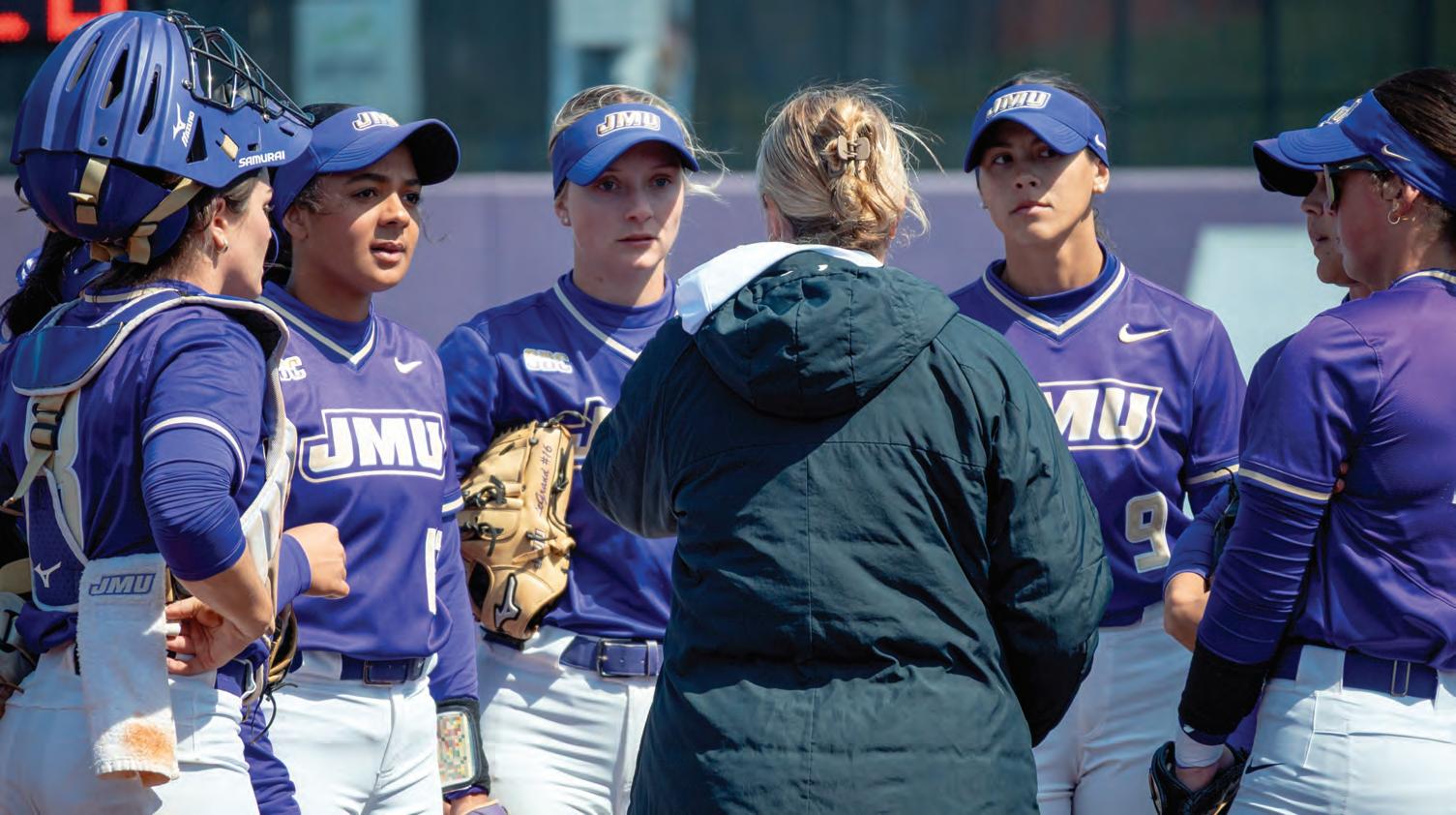
Spirit: Despite a less than ideal start to conference play, the Dukes are still standing tall in the dugout.
“The spirit is still high — I think that’s what’s going to be important,” head coach Loren LaPorte said. “When you’re going through seasons like this, it’s very easy to separate and divide and point fingers — I don’t think we’re doing that.”
There’s a mindset throughout the clubhouse that players are more than just teammates, with sophomore utility player Emily LeGrand saying, “just having each other’s backs is something that we really need to do.”
Power in the lineup: There are clear shining spots throughout the JMU lineup that allow the team to compete in such a competitive conference. The biggest standout for the Dukes right now is junior infielder Kendra Lewis, who’s playing in her first season in Harrisonburg. Lewis currently holds the second-highest batting average in the conference, posting a .434 mark through 34 appearances.
LaPorte credits Lewis for her consistency at the plate, saying, “when a team intentionally walks you, you know that they’re scared of you.”
LeGrand has stepped into an important role for JMU in her sophomore campaign. After a quiet outing last season, LeGrand has found herself a slot in the lineup in all but one game she’s appeared in this season.
LeGrand has produced a .313 batting average, supported by 22 RBIs, four doubles and seven home runs — including her first career grand slam against Coastal Carolina. On the defensive end, LeGrand has spent a bulk of the season in left field, where she’s been strong for the Dukes, recording just one error.
“She’s just really confident right now,” LaPorte said. “We always knew she could be an impact player for us — I think she just had to believe it.”
Graduate outfielder Kylee Gleason has been a vocal part of the JMU roster, playing in her fifth season in the Valley. Gleason has started all 36 games for the Dukes and holds a .347 batting average that includes two home runs and 17 RBIs, while also swiping four bags.
Gleason has also been the go-to center fielder for JMU this season, committing just two errors throughout all 36 games thus far.
The lows
Consistency: Yet to win a conference series, JMU has struggled to find a consistent level of play. Against Coastal Carolina, the Dukes dropped games one and two with scores of 16-8 and 12-3, respectively. A sharp turnaround came in game three, when JMU scored 17 runs on 10 hits to take down the Chanticleers.
After the blowout win, the Dukes went on to drop a midweek game to George Mason, followed by a series sweep at the hands of South Alabama.
“I think the biggest thing that we have to understand about this conference is that you have to bring your A-game every single time you step on the field,” LaPorte said. “We’re just not in that situation consistently enough.”
Free bases: JMU has found a significant struggle in its circle in a very specific way. The main worry doesn’t rise from home runs given up or singles up the middle — it rises from four balls.
Throughout the pitching staff, 152 walks have been given up this season, with the Dukes’ opponents only allowing 106. The bulk of these walks have come from redshirt junior infielder Payton List, who has surrendered 69 walks in 20 appearances in the circle.
“It has been our issue this year,” LaPorte said. “There’s no denying it.”
Though it’s a clear issue for a team that’s struggling to win, LaPorte still has confidence in her pitching staff and knows where improvement is necessary.
“We have really good pitching,” LaPorte said. “It’s trying to figure out game management and how to get in a situation where the offense can’t get in a rhythm against us.”
Defense: Recently, JMU has compounded its pitching woes with struggles on the defensive end. In its weekend series against Southern Miss, the Dukes committed seven errors across 29 innings of play.
“This is probably [a] weekend where I’d say our defense was shaky,” LaPorte said. “It’s not about routine [at this point] — It’s about making the plays when the game’s on the line, and that’s what’s going to be so important for us.”
With four series left in conference competition, there’s still hope for JMU to repeat last year’s mid-season comeback, which led the team to a Sun Belt Championship appearance.
“The season can turn around, and we’ve been before, and this is the time we have to do it,” LaPorte said. “I think it’s going to come from within, and [our upperclassmen last year] found a different level of play and how to play with each other, and I think that’s going to have to be the same case this year.”
CONTACT Madi Perini at breezesports@gmail.com. For more softball coverage, follow the sports desk on X and Instagram @TheBreezeSports.

By LIBBY MERCER The Breeze
Two years ago, JMU football was in a similar situation to the one it sits in right now. Left with a brand-new head coach after losing its former head coach to a Power Four program and gutted by the transfer portal, the program once again has to rebuild.
Former head coach Bob Chesney leaves head coach Billy Napier in the same position, with a similar goal of riding past success. Inheriting this familiar feat, Napier said “it’s a part of being in this place.”
The program is left with only 30% of its production from last season, ranking thirdlowest in the FBS, only above San Jose State and upcoming Sun Belt rival Southern Miss, which ranks last.
In addition to having Southern Miss on the schedule next season, JMU is facing two other schools with low rates of returning production. Out-of-conference opponent UConn is placed just two spots above the Dukes with 31% returning production, and Sun Belt rival App State ranks higher at 34%.
“I think that if you evaluate the competition that we’re going to play against next year, we each have the same set of problems,” Napier said
With some of the roster leaving, Napier said he and his staff “went and got production.”
Joining the staff while Chesney was preparing his group for the College Football
Playoffs, Napier benefitted from watching the group, he said.
“That allowed us to observe and kind of see, ‘OK, who’s leaving, who’s coming back, what do we need that is critical?’” Napier said. “This would have been much more difficult and challenging if we hadn’t had that experience.”
Looking at the incoming team, Napier said there’s a “50/50” split between returners and incoming players.
“I’d like to have a much higher percentage of veteran players coming back. But look, I think that’s the challenge of every team in our league, so for me, we embrace that,” Napier said. “I think it’s an annual process of building a team.”
Being in almost the same spot as when Chesney left, when he had 39% of production returning, Napier anticipates returners finding their emerging roles in the coming season.
“We got a lot of players amongst that 50 [percent] that are coming back, and their role is going to increase,” Napier said. “Much like two years ago, there were a lot of really good players that were waiting their turn. We have some of those here as well.”
CONTACT Libby Mercer at breezesports@ gmail.com. For more football coverage, follow the sports desk on X and Instagram @TheBreezeSports.
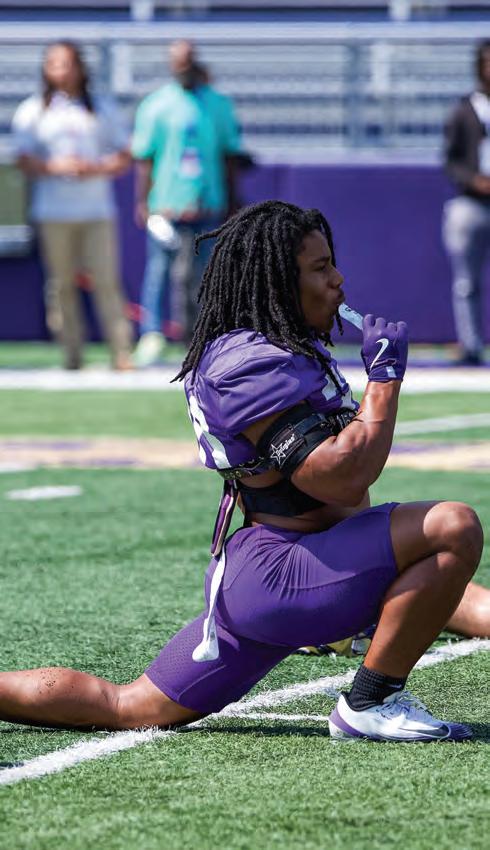



JMU baseball defeats No. 13 UVA 8-7 in 10 innings.
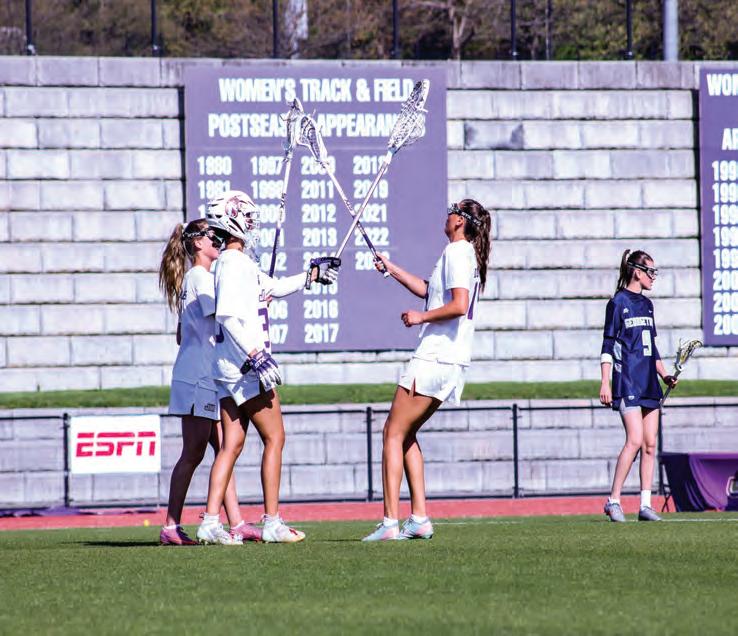
JMU lacrosse pushes past No. 22 Georgetown 13-7
By LIBBY MERCER The Breeze
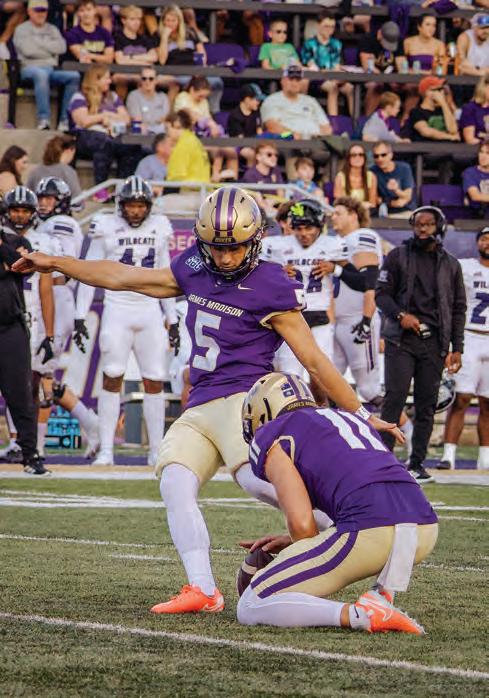
New JMU football special teams coordinator Rob Wenger’s goal is “to change the game” with the Dukes’ special teams unit.
“Game-changing plays are what we’re looking for,” he said. “The only way you can do that is to roll a dice and put a guy in position to go make a play.”
With returning redshirt senior punter Patrick Rea and graduate kicker Morgan Suarez each returning for in their last years of eligibility, the pair has solidified their roles on the unit.
“Those two guys have been exceptional. Obviously, they were here and a big part of the success that was achieved last year,” Wenger said. “When I knew that this was going to work out [and] I was going to work here, my number one priority was making sure that those two guys were going to be a part of what we do.”
Head coach Billy Napier and his staff have brought four new players to the special teams room, including a punter, two long snappers and a punter/kicker.
Wenger said his top priority when looking at a player is seeing that they’re “really great human beings before [they’re] a great kicker, punter, snapper,” which he thinks the staff “nailed.”
Wenger also looks for guys who are connected to their teammates and the game.
“You play special teams well because you love your teammates … you do it for the guys on the sideline,” Wenger said. “We got [players] that truly care about one another and the connection. Even with the new transfers coming [in], you can see the team coming together.”
Despite the coaching changes and having Wenger as the new lead on the special teams unit, Rea said Wenger’s
experience with Australian-style punting and emphasis on personal connection were a “huge draw” to stay at JMU.
“He’s had seven years of Australian experience, and I think that just knowing how we operate is huge in my mind,” Rea said. “[Wenger’s] first sentence to me was, ‘I watched all your film, love what you do. How can we build from that?’ After that, it looked like it was a partnership between coach and player.”
The Dukes emphasize the importance of having a srong special teams unit, which runs in JMU’s DNA, Napier said.
“I think that a lot of teams overlook their special teams units, but [they prove] why the special teams definitely make or break games,” Rea said. “To see a coaching staff — not just coach Wenger, but the whole operation in this building — be on board with what we’re doing in special teams is super exciting.”
Having spent the past season as a punter and kicker duo, Rea and Suarez have built “chemistry on and off the field,” which Rea said is “automatic.”
“I think that everyone in our locker room will say, ‘The more connected you are off the field with your teammates, the better you’re going to perform on Saturdays,’” Rea said. “For us to be able to trust each other in pretty much all aspects of life … going out there and hitting a field goal or PAT, knowing that we’ve got each other’s back, is pretty special for us.” As the pair head into their final season, Wenger wants to “make sure they go out the right way.”
“[Wegner] wants to send [Suarez] and I off maximizing our capabilities,” Rea said. “I think that we have the perfect staff around us and support to be able to accomplish that.” CONTACT Libby Mercer at breezesports@gmail.com. For more football coverage, follow the sports desk on X and Instagram @TheBreezeSports.











Cali Gilmer EDITOR

Want to praise someone or get something off your chest? Darts & Pats is the place to do it. Submit your own at breezejmu.org.
A “go-studentjournalism” pat to the Breeze staff for the 2025-26 school year who brought the news and more to the campus and community.
From someone who is proud to see strong student-run organizations.
A “freezing-cold” dart to the person who turned down the thermostat in our apartment when there was a freeze warning overnight.
From someone who’d much prefer to stay warm and cozy.
A “shoutout-DIY-music” pat to everyone who is volunteering to make Macrock happen downtown.
From someone who is excited to attend this DIY festival.
An “Earth-day” dart to those on campus who drop their trash on JMU grounds within steps of a trash can.
From an alumni who walks on campus weekly and picks up trash with their alumni friend.

PATRICK HANOVER Breeze columnist
The United States is an empire, with the most powerful military in the world. It’s also one of only two nations in the world with the right to bear arms enshrined in its founding legal documents, the other
of U.S. civilians. They point to tragedies, especially mass shootings, as justification for regulating firearms.
They see the “well-regulated militia” statement as a caveat that limits what firearms we can possess, claiming that “weapons of war” shouldn’t be in the hands of civilians. They see those who believe in these so-called weapons of war being in the hands of civilians as inherently taking a
must also understand what follows if we investigate the premise that the state itself has refused to self-regulate. When the state refuses to self-regulate, we can come to the conclusion that the civilian populace being armed to counter the unregulated militia becomes, in a sense, the regulation of the unregulated militia.
To those who call themselves progressive and also call themselves pro-gun control

from GUN BILLS, page 24
Is it a well-regulated militia when it’s engaging in wars to further the longstanding goals of American imperialism that benefit the richest and most powerful, such as in the 2003 invasion of Iraq and the current war in Iran? Is the U.S. government a well-regulated militia when it violates Americans’ constitutional rights, prioritizes corporate interests and targets people based on race?
To me, the answer is no, in all of these cases. Nevertheless, gun-control advocates seem to believe that the government and military is more entitled than the civilian populace, which does not engage in these acts. The irony, to me, is that many within the gun-control advocacy sphere also happen to oppose at least one or more of the aforementioned operations. I join them in opposition to these actions, but I find their belief in disarming the populace to be self-defeating.
In any case, the Virginia Democrats have held full control of the general assembly and the governorship in Virginia, since their sweeping victory in November 2025. When they strengthened their control in the government in November 2019, they attempted gun control legislation, including an assault weapons ban, but abandoned the attempt in 2020. Now, in 2026, the political landscape is different. The Virginia Democrats not only have the votes juridically, but also the drive to push forth highly restrictive gun legislation that might violate the Second Amendment.
The worst of them all is Senate Bill 749, which bans any weapons defined as “assault weapons,” stretching the original definition of the national ban on assault weapons to semiautomatic rifles and other similar firearms. It also bans magazines that can hold more than 15 rounds. This bill has a “grandfather clause,” which means firearms banned under this law remain legally possessed if obtained before the law took effect. To possess a grandfathered firearm under this legislation, you must be at least 21 years old. Violating the law is a Class 1 misdemeanor, of which reckless driving and some domestic abuse crimes also fall under the category in Virginia.
The grandfather clause might seem like a sweet deal for those who have these weapons, but it has implications that I see as rather alarming. Transgender people have recently begun to see gun ownership as a necessity, considering the stochastic terrorism that has been incited against them over the past five years. If Gov. Abigail Spanberger signs the bill into law, she’s kneecapping them from obtaining certain firearms. A similar parallel can be drawn from the Nuclear Non-Proliferation Treaty of 1968, which, if not juridically, did effectively have a grandfather clause in a similar sense
for nations that had already obtained nuclear weapons. While this was framed as a cornerstone of international law to stop the spread of nuclear weapons, it also gave rise to the landscape that gave special credence to imperial domination to nations that already had them. This has led to significant power imbalances, as well as international law becoming somewhat of a hypocritical mental gym.
There’s also Senate Bill 496, which makes it a Class 4 misdemeanor to leave a handgun in an unattended vehicle where the gun isn’t securely stored in a locked container. The locked container also has to be secured to the vehicle’s interior through some form of modification, such as welding. This means that if you report a crime of theft to the police, they could end up citing you. This will likely mean many similar crimes of theft will go unreported, which could lead to an increased risk of smash-and-grab in Virginia.
Beyond just bans and storage laws are laws that expand the state’s capacity to disarm, such as Senate Bill 495, and restrictions on your ability to carry, such as Senate Bill 727. S.B. 495 expands the eligibility for filing a petition to a court to have a judge order the disarmament of an individual. Now, struggling with alcohol use could be enough to justify a petition for disarmament by a spouse or other close individual. The threat of violence does not even need to be present.
In my view, being drunk a couple of nights or having periodic alcohol struggles shouldn’t by itself be a reason for a judge to justify forced disarmament. If there’s no threat of violence, the petition should end instantly. S.B. 727 bans carrying semi-automatic firearms with magazines over 10 rounds in public. The bill also bans open carry for a significant number of firearms already owned by many Virginians.
As mentioned earlier, these laws may violate the Second Amendment, but some judges and justices may not acknowledge this. That being said, Clarence Thomas — despite being controversial in many ways — has been very skilled in either rallying the Supreme Court behind landmark decisions strengthening the Second Amendment, writing strong concurrences in favor of gun rights and dissenting in rulings against gun rights. At least two landmark Supreme Court cases in favor of the Second Amendment were written by him, namely In New York State Rifle & Pistol Ass’n v. Bruen (2022) and Garland v. Cargill (2024). The hope is that, in the wave of gun control going on across states in 2026, Thomas will be able to replicate that strategy and mobilize at least four other justices to create a 5-4 majority in favor of striking down these gun laws.
In New York State Rifle & Pistol Ass’n v. Bruen, in a 6-3 majority, the Supreme Court decided that restrictive licensing laws in New York were unconstitutional. Thomas writes that
“to support that claim, the burden falls on respondents to show that New York’s proper-cause requirement is consistent with this Nation’s historical tradition of firearm regulation.”
Thomas saved New York from irrational licensing requirements that year. That being said, I even quibble at his wording here. I don’t believe that an originalist interpretation is even necessary for gun rights absolutism, nor do I believe it’s an ideal or rational path to take. Gun control is rooted in racism and classism. Current gun owner culture, however, is highly individualistic and not based on community defense. The Black Panther Party understands the necessity for weapons that can match, at least to some degree, the state and its institutions.
The media has disparaged the likes of the Black Panther Party for decades, deriding them as overly radical and dangerous. I merely see them as militant, to which they have a right to be. The likes of Fred Hampton, Malcolm X and Assata Shakur pushed for a more developed social consciousness surrounding the reality of American imperialism and racism. Even MLK, who was against any militant rhetoric or militant organizing, couldn’t deny the reality that peaceful civil rights activists of the time — including himself — returned home to highly armed communities after protesting for a reason.
In February 2025, white supremacists and neo-nazis marched into Lincoln Heights, Ohio. The Black community held an armed watch to ensure these outside actors did not cause harm to their community. There are pictures of people armed with semi-automatics during this event, which are legal to carry openly in Ohio. These people were in full justification to be on high alert. This is highly understood by the Black community following the Tulsa Race Massacre of 1921. Those who make the argument that the presence of arms in the hands of civilians goes both ways should understand that having no arms in the hands of civilians renders groups who are primary targets of discrimination entirely toothless, which I see as much worse than the current landscape.
CONTACT Patrick Hanover at hanovepv@dukes. jmu.edu. For more editorials regarding the JMU and Harrisonburg communities, follow the opinion desk on X @TheBreezeJMU and on Instagram @BreezeJMU.

In 2020, you couldn’t open TikTok without seeing the algorithm’s version of “alt” — smeared eyeliner, striped sleeves, chains, dyed hair, etc. What may have appeared as a long-overdue embrace of individuality was, in reality, the beginning of something far more shallow. Alternative fashion didn’t just become popular; It became flattened, packaged and sold back to the very people it once stood against.
During the pandemic, social media was one of the only sources of social interaction, which resulted in the explosion of TikTok use, particularly among teenagers. There were close to 313 million TikTok downloads in 2020 alone. With that surge came the divide between “alt TikTok” and “straight TikTok.” Being “alt” was framed as the more interesting, fun and desirable identity. And just like that, something rooted in nonconformity became the very thing people were trying to conform to.
That contradiction is the problem.
What everyone needs to understand is that alternative fashion has never been just about clothes. Historically, it’s been tied to rebellion against social norms, beauty standards and systems of power. For example, punk wasn’t an aesthetic, it was a DIY movement built on anti-establishment anger and a rejection of mass-produced culture. Its fashion — ripped
shirts, safety pins and thrifted pieces — was deliberately anticonsumerist, a way of turning clothing into protest rather than product.
Goth also emerged from underground music scenes, evolving into a lifestyle defined by a dark aesthetic, specific music tastes and shared cultural spaces. Emo followed a similar trajectory, growing from hardcore punk with a focus on emotional expression, later developing a recognizable style tied to music scenes and online communities.
These subcultures were also deeply tied to physical spaces. Punk scenes existed in basements, small clubs and record stores. Goth communities formed through concerts, late-night gatherings and niche publications. Even early online forums functioned as spaces for discussion, music sharing and community building. Participation required time and involvement. People didn’t just adopt the style; it was developed through the music, references and attitudes that defined the culture. It was an identity created through experience rather than aesthetic imitation.
To dress “alternative” meant something important. It meant you were resisting social norms, were part of a community with similar ideals and had an identity shaped by music, politics and lived experience.
Now, it only signals trend awareness.
What we’ve seen over the past several years isn’t a revival of alternative culture — it’s a detachment from it. People take on this aesthetic without any of its substance, the look without
any of the history. Goth, punk, emo — these were never interchangeable costumes. They’re distinct subcultures with their own sounds, values, aesthetics and communities. But social media collapsed them into one vague and algorithmfriendly identity: “alt.” It’s much easier to consume that way, and of course, easier to sell.
And that’s where things get even worse.
Alternative fashion once had the goal of rejecting mass production and corporate control. It thrived in thrift stores and DIY projects. Now, fast-fashion giants like Shein and Amazon churn out “alt” clothing by the millions, turning rebellion into just another category on a website. These corporations are mass-producing alternative styles to capitalize on their popularity. This results in a subculture built on resisting the consumerism that is now being sustained by it.
Fast fashion doesn’t just reproduce the clothing; it erases the conditions that gave it meaning. DIY fashion required creativity and resourcefulness. People modified thrifted items, patched clothing together and reused materials because they rejected the idea of constantly buying new products. When companies mass-produce pre-distressed jeans, factory-made chains and “punk” graphic tees, they remove the creativity and labor that once defined the style. another prepackaged product ready to ship in two days.
from ALTERNATIVE FASHION, page 25
You can’t claim to reject the system while funding it at the same time.
Still, the draw toward alternative fashion often comes from an authentic place. Many people discover these different subcultures while struggling with identity, confidence and a sense of not belonging. That part hasn’t changed. What has changed is the environment surrounding that discovery,


because it’s now controlled by norms presented on social media. These platforms demand performance. Instead of exploring identity, users curate it for an audience.
Metrics now shape identity in ways that older subcultures never experienced. Likes, shares and views subtly influence what people choose to wear or post. When certain outfits or aesthetics perform better online, they are repeated and refined to maximize engagement. Over time, the algorithm quietly pushes people toward a narrower version of what “alt” is supposed to look like. The result is a cycle where individuality is constantly filtered through what performs best on the platform.
This is where the ultimate irony emerges. Alternative fashion, which was once a rejection of social pressure, is now driven by it. People aren’t dressing differently to stand apart and resist expectations; they’re doing it to belong to a different group, one that has simply rebranded conformity as individuality.
Even the definition of “alternative” has lost its meaning. It no longer refers to a consistent set of values or aesthetics. It just means “whatever isn’t mainstream right now.” And since trends shift so quickly, “alternative” is constantly absorbed back into the mainstream. What was once oppositional is now temporary.
If everything is alternative, nothing is.
This isn’t about gatekeeping fashion choices or music tastes. It’s about recognizing that when a subculture is stripped of its history, ethics and purpose, it stops being a subculture at all. It becomes another trend. And trends don’t challenge systems — they feed into them.
Alternative fashion was never meant to be comfortable. It wasn’t supposed to be easily accessible, widely accepted or neatly organized on a Shein website. It was messy, political and deeply personal. It was the resistance people used to push back.
Now, it sells. And if that doesn’t feel like a loss, it should.
CONTACT Cali Gilmer at breezeopinion@gmail. com. For more editorials regarding the JMU and Harrisonburg communities, follow the opinion desk on X @TheBreezeJMU and on Instagram @BreezeJMU.





































EDITOR-IN-CHIEF Hannah Kennedy breezeeditor@gmail.com
NEWS EDITORS Charlie Bodenstein & Emma Brown breezenews@gmail.com
COPY EDITORS Kayla Katounas & Luke Faircloth breezecopy@gmail.com

“Hitchin’ a Ride” by Green Day
“Big River” by Johnny Cash
“Virginia Slims” by Futurebirds
“Float On” by Modest Mouse
“Shake It Out” by Florence and the Machine
“Knowing Me, Knowing You” by ABBA

“Joy.” by RAYE
“Cherry-Coloured Funk” by Cocteau Twins

@BreezeJMU!
568-7889

PRINT MANAGING EDITOR Preston Comer breezepress@gmail.com
CULTURE EDITORS Bella Arist & Audrey Fletcher thebreezeculture@gmail.com
PHOTO EDITORS Landon Shackelford & Annabel Dewey breezephotography@gmail.com
ONLINE MANAGING EDITOR Emma Notarnicola thebreezeweb@gmail.com
SPORTS EDITORS Madi Perini & Libby Mercer breezesports@gmail.com
AUDIENCE EDITORS Isabel Lewis & Grace Heberer thebreezesocials@gmail.com
OPINION EDITOR Cali Gilmer breezeopinion@gmail.com
ART DIRECTOR Summer Solis thebreezeartdirector@gmail.com
TV NEWS DIRECTOR Lauren Keller jmubreezetv@gmail.com
(4/4/26): A previous version of the article “Finding Touse: Exploring JMU students’ choices for top 5 frats” misidentified one of the fraternities. The online article has since been updated with the correct information.

Los Angeles Times Daily Crossword Puzzle
Edited by Patti Varol
By Michael Hobin



Madison Marketplace is open for business, and all text-only listings are FREE ! Post job listings, announcements, rentals and more using our online placement tool. Ads run two weeks online and in two print editions.
PT Professional
Wanted: P/T by Project. Professional Assistant. Critical Thinker. Familiar with para-legal or related, court filings, start up Llc, research & record keeping. Advertising our performance, Attend Local / County meetings and establish contacts within VA. Positive Energy Required ....... will not be boring assignments - promise! 767 645-6868 540 456-2668

Career Opportunity - Police Recruit - $10,000 HIRING INCENTIVE AVAILABLE TO NEW OFFICERS
The City of Harrisonburg is currently accepting applications for non-certified individuals interested in joining HPD, which offers a rewarding career plus an excellent benefits package, including enhanced hazardous duty through the Virginia Retirement System (VRS). $10,000 HIRING INCENTIVE AVAILABLE TO NEW OFFICERS* ... *Find out more/apply online: https:// www.harrisonburgva.gov/employment. EOE.
Join our team of compassionate therapists!
Planning a career in speech language therapy or behavior therapy? Join The Speech and Language Center as a behavior tech/RBT, BCBA, SLP, or SLPA. Now hiring half/full day RBTs (undergrads welcome to apply!), school/clinic SLP, and school SLPAs for the 2026-2027 year. Contact Kristin Wenger: kristin@slccares.com.
John Van Deusen - 2026 Tour
https://www.songsforvalley.org/



Are you searching for your next career move with an organization that values your subject-matter expertise while leading strategic transportation planning efforts? If so, consider applying to become the Public Works Planning Manager with the City of Harrisonburg! Find out more/apply online: https:// www.harrisonburgva.gov/employment. EOE.





SUMMER STUDENT STORAGE SERVICES. Going home for the summer? Leave your belongings in storage We will pick them up, store them and deliver them to your new place in August. Call 540-810-1196, email MikePackett@aol. com or check out www.Adventures-NTravel.com for details. Local business and competitive.
Hey JMU Students! SwiftHaul Moving Services makes your move easy and affordable! From dorms to storage, apartments, or home, we’ve got you covered with the best prices and friendly, reliable service.
Contact us today at 434-665-1259 or maceevan03@gmail.com for a stressfree experience!

Abortion is at risk in Virginia if Donald Trump rigs the midterm elections.
MAKE YOUR PLAN TO VOTE AND DEFEND YOUR RIGHT TO ABORTION.
YOU CAN REGISTER AND VOTE ON ELECTION DAY WITH YOUR CAMPUS ADDRESS.
Remember to bring an acceptable form of ID with you (including student ID!)
Fair Elections