The Breeze
Behind the scenes of JMU athletic training
By MADISON HRICIK The Breeze
In 2018, during JMU head athletic trainer Bryan Schneider’s (‘18) first year in Harrisonburg, he responded to one of the worst medical emergencies — a stroke.
In the middle of the weight room, a former student-athlete fell unconscious and began showing the symptoms of a stroke. Jumping into action, Schneider and the rest of the medical team identified the problem, alerted U.Va. Hospital and got the student-athlete the tests they needed.
That student-athlete made a full recovery — his extremities, speech and brain function all remained completely intact. While this particular athlete never returned to the field, Schneider said he knew in that circumstance he’d done more than get someone back on the field. He saved their life.
“Those are the moments where you sit back and go, you know, ‘I just helped somebody,’” Schneider said. “I didn’t help somebody recover from an ACL. I helped somebody see the next day and see out the rest of their JMU career as a college student, healthy.”
Student-athletes train everyday, from 6 a.m. lifts, two- to three-hour practices and game days; it all adds up to immense wear-and-tear on their bodies.
Every time an athlete is injured, the athletic trainer comes onto the field to check on them. Oftentimes, they’re one of the most trusted members of a team’s support staff, and in some cases, they’re the reason any athlete gets back on the field.
These trainers work for years to earn opportunities with Division I programs, often learning from trainers who work for professional teams. They’re considered some of the most selfless people and they dedicate their life’s work to the well-being of student-athletes.
“I think they get better care because it’s just me and I’m able to cater to them,” JMU lacrosse athletic trainer Alex Lovgren said.
see ATHLETIC TRAINING, page 18
JMU’s award-winning newspaper since 1922
March 30, 2023 VOL. 101 NO.23 BREEZEJMU.ORG
Harrisonburg drag scene pushes forward after national threats to the craft
By K. MAUSER The Breeze
Gov. Bill Lee (Tenn.) signed a bill March 2 that will make Tennessee the first state to ban all public drag shows starting July 1. Harrisonburg drag queen Jayda Knight said she’s fearful this ban will reach the Friendly City.
This bill, which JMU political science professor Marty Cohen describes as attempting to “quote-unquote, ‘protect children from the LGBTQ,’” will forbid any performances in public by topless, go-go or exotic dancers, strippers or male or female impersonators who’ve been deemed “harmful to minors,” according to The New York Times.
“It’s a big deal because a significant percentage of the population is concerned with these issues,” Cohen said. “It’s a very politically controversial issue and it does get people fired up and get them going to the polls.”
Knight, CEO of drag company Rhinestone Productions, said the ban on drag in Tennessee is both “saddening” and “disheartening.”
“I was like, ‘Is this real? This can’t be real,’” Knight said.
Knight said she’s been doing drag shows in Harrisonburg for over 20 years. She said the group does monthly events, such as its drag brunch and performances at various pride events.
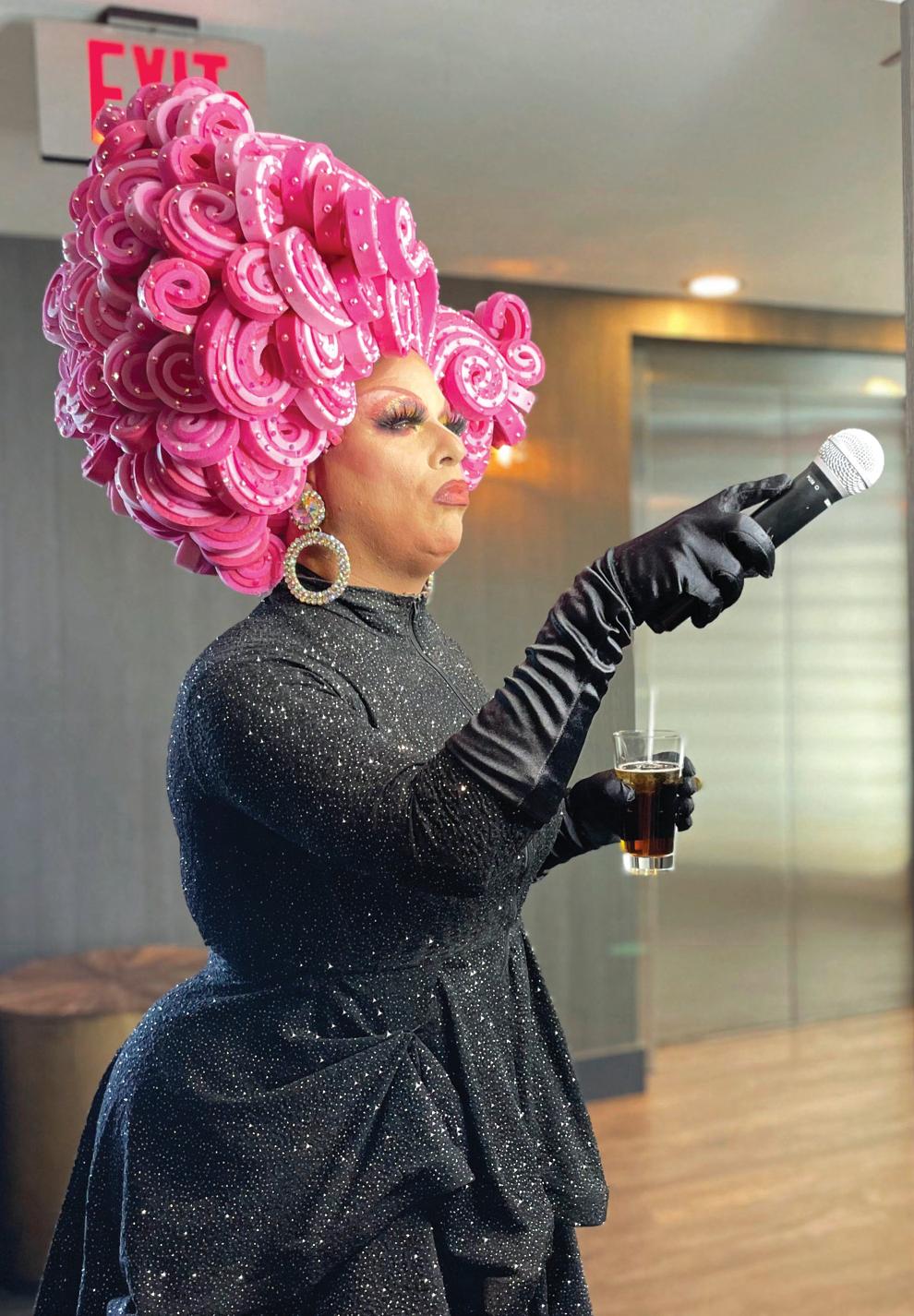
“We have a good foundation [for our] support system,” Knight said. “I think our audience members are growing rapidly. We meet new people with every event, new faces, which is amazing.”
For many years, drag had been underground, Knight said. She said it became much more popular and accepted in recent years.
“Drag brings a lot of joy and laughter … It’s a safe space for people of all walks of life to come together and celebrate themselves,” she said. “It’s empowering.”
see DRAG, page 10
Students who died in crash live on through memories of loved ones
By CHARLOTTE MATHERLY & SHIRIN ZIA FAQIRI The Breeze
After the passing of three JMU students — John “Luke” Fergusson, Joshua Mardis and Nicholas Troutman — in a car accident on Feb. 3, The Breeze has reported on the events that followed, the vigil and the memorial services, as well as how their families are grieving and finding healing and support. This week, The Breeze takes a look at the lives and legacies of Luke, Joshua and Nicholas. Family and friends share their memories of those who passed.
Luke’s sister says he was a great older brother, and others
close to him say he had a passion for sports, especially the Washington Commanders. Luke’s pastor said his friends found him so entertaining that they liked not just watching the game, but watching him watch the game.
Joshua’s loved ones remember him as outgoing and willing to strike up a conversation with anyone. They say he was resilient and hard-working, and even though he had Alabama football in his blood, he loved being a Duke.
Nicholas’ family and friends say he was kind and goofy and “had no rizz whatsoever.” His mom said Nicholas loved his friends, but he also loved coming home to rest and recharge and binge TV shows with his family.
Broken up into three profile pieces, each article delves into how they’re remembered by those who love and care about them. If you or anyone you know needs mental health help or counseling, please contact the JMU Counseling Center or call 540-568-6552
see LUKE, page 4 see JOSHUA, page 5 see NICHOLAS, page 6
Jayda Knight, drag queen and CEO of Rhinestone Productions, interacts with people on social media as she holds up her microphone to a ring light. She said the company will “take the course of action as needed” if the Tennessee drag ban reaches Virginia. K. Mauser / The Breeze
SPORTS OPINION 4 18 24 NEWS
2 Thursday, March 30, 2023
Letter from the editors: goodbye 2022-23 staff
The first day we, except Zia because she was in London, interviewed you all, it was raining. Pouring, actually.
It was cold. We came into the office bundled up in our jackets. But you guys came in full of light and joy — excited, energetic and ready to make The Breeze better.
To Kasey Trapuzzano, our news editor: The fact you’ve been a news editor by yourself is honestly astounding. Doing this job with two people is hard enough, and you’ve done the work of two people and more, every single day. You built up an absolutely tiny staff of news writers to a big group of solid writers that we could rely on. Here’s to you going to get court records, calling people on deadline and Charlotte and Ashlyn rewriting stories at 10 p.m. Savannah thanks you for ripping stories in class, the writers needed it. Zia says you kind of killed the solo editor thing and she hopes that you can get some sleep now that your term is done.
To Avery Goodstine and Michael Russo, our culture editors: You guys bring this office to life. We couldn’t be more proud of how you’ve built the culture section this year and we know you’re ready to take on your new roles — keep Grant in check this year. You’ve carried the culture crown well and have carried on the legacy of keeping culture the prettiest section. Ashlyn apologizes for taking culture stories and putting them in news. Savannah’s going to be honest with you: She does make up the keywords number. Zia says she has no worries that you both are going to kill it next year.
To Madison Hricik and Grant Johnson, our sports editors: We never had to push you because you challenged yourselves every single day — and our paper is better because of it. You’ve become a staple in providing indispensable sports news. You’ve navigated difficult situations with grace, and we never ever want you to stop pushing. Grant, please take care of Charlotte’s red pens. Madie, if there ever comes a time Charlotte misses you
writing on Wednesdays, she’ll be sure to let you know. Madie, Savannah begs you to make sure your photo caption is the correct font, and Grant, you conquered. Bucket-getter is a good headline. And as a sports noob, Ashlyn still thinks we should explain more sports terms. Zia says she wants to go to a hockey game and she’ll see you on ESPN one day.
To Evan Weaver, our opinion editor: Evan, you are the best of us and in our eyes; you can do no wrong. You really revived the opinion section this year (yay to not writing all the opinion stories yourself). We’re your number one fan. The fact that you design almost everything in InDesign is frankly astounding. Here’s to next year and hopefully breaking the penny out of the top five. Charlotte and Ashlyn apologize for the editorial boards on deadline. Zia doesn’t apologize because she writes her parts fast and succinctly. Savannah says remember to wave, and you’re right, letters to the editors don’t have summaries.
To Emma Johnson, Madison Mills and Haley Thomas, our copy editors: Thank you endlessly for all the grueling work of reading every single story each week. Copy editors don’t always get the recognition they deserve — but you’ve helped us be the best publication we can be. Here’s to Ashlyn always asking copy questions because they’re pretty sure they know AP Style, but they always want to check. Charlotte thanks you for staying several extra hours just to read the cover. The Breeze will always need dedicated people like you. Zia and Savannah say we wouldn't even be able to function without all of the hours you put into this organization and that they're sorry for making you stay late in the office all the time.
To Ben Moulse, our art director: We’re so lucky you came to work with us. We really don't deserve you. From asking for last-minute graphics to making you change the cover, probably about 30 times, you’ve done an incredible amount of work in such a short time with us. We cannot thank you
Editorial Staff
EDITOR-IN-CHIEF CHARLOTTE MATHERLY breezeeditor@gmail.com
NEWS EDITOR KASEY TRAPUZZANO breezenews@gmail.com
COPY EDITORS EMMA JOHNSON & HALEY THOMAS breezecopy@gmail.com
Advertising Staff
EXECUTIVE EDITOR SHIRIN ZIA FAQIRI breezepress@gmail.com
SPORTS EDITORS MADISON HRICIK & GRANT JOHNSON breezesports@gmail.com
AUDIENCE EDITOR ALI MCCALEB thebreezesocials@gmail.com
enough for entertaining our multitude of requests, and you’re a gem of a designer. Thanks for always cookin’ something up at 6 p.m. on a Wednesday when Charlotte inevitably changes the cover design. Savannah praises you for your talent and thanks you for being creative, she isn’t. Zia and Ashlyn still want to play a DnD campaign with you.
To Ali McCaleb, our audience editor: You are so incredibly amazing. Zia says we were so blessed to have you pop into our lives and completely change the social media game in this organization. You jumped right in and knocked it out of the park, even taking on things you didn’t have much experience in. Ashlyn thinks the Mario Kart video is probably the funniest thing they’ve ever seen. Charlotte is astounded by your Canva talents, and there’s never been a quick hits post she didn’t 100% love. Your passion and drive truly set you apart and we cannot wait to see what you accomplish in the future. Good luck in Germany! Savannah apologizes for the delay on sending the BLOX verification code. She forgot to check her phone.
To Abi Middleton and Ryan Sauer, our photo editors: Young but mighty. You two stepped into the position and made it your own and turned our photo section into something we couldn't have dreamed of, and we’re so, so proud of you. Abi, you led the section like a champ. You grew the staff and you trained some of the best photographers in the state. You’re incredible, never stop smiling. Ryan, you joined and we instantly knew you would excel. We thank you for the laughs, jokes and memes. Stay yourself and be unstoppable. Savannah promises to write her captions eventually. Zia says she hopes she doesn’t get a strike for leaving. Ashlyn will always have your back when you have to be mean. Charlotte can’t wait to see you both become managing editors one day — you were meant to lead The Breeze.
To Zoe Mowery, Maggie Rickerby, Kayla Brown, Dani Ellsworth and Moses Harris, Breeze TV’s exec team: It's been an honor and
a pleasure collaborating with you guys. This year is the closest our staff have ever been and it's such a joy knowing we're leaving this organization closer than it's ever been. Zoe, you slayed this year, and we’re so excited to see someone with so much energy continue to work so diligently. Maggie, your love of talking to people and telling stories hasn't gone unnoticed. You're one of the best mentors we know and we also know you’ll teach the new wave of future anchors well. Dani, you were amazing taking on the role of studio director as a sophomore and proving you were the right person for the job and will be the right person for years to come. Kayla, your constant drive for hard-hitting stories is so inspiring, and you’re going to go so far —` never stop asking hard questions. Moses, thank you for taking on the inaugural role of assistant news director.
To the entire 2022-23 staff: Thank you for being not only a phenomenal staff but our closest friends and family. Through hard times and difficult stories, we’ve served as the indispensable news source for JMU each and every day. Wherever you go, some of you graduating and others moving up The Breeze ladder, know that we are forever proud of you and we can’t wait to see what you do next. We wouldn’t trade this for the world. Savannah thanks you guys for laughing at analytics and responding to question of the day. Fun fact: She’ll miss you all. Ashlyn will miss yelling about, well, anything and everything every week, but especially threatening to fight anyone who messes with you. Zia says that you were a good staff and you should be proud of yourselves. Charlotte's gonna miss every 3 a.m. supplement night and brutally long day in the office — you all made it fun and you all made it worth it.
From Charlotte Matherly, Shirin Zia Faqiri, Savannah Reger and Ashlyn Campbell
The Breeze
JMU’S AWARD-WINNING NEWSPAPER SINCE 1922
1598 S. Main St. Harrisonburg, VA 22801
ONLINE MANAGING EDITOR SAVANNAH REGER thebreezeweb@gmail.com
CULTURE EDITORS MICHAEL RUSSO & AVERY GOODSTINE thebreezeculture@gmail.com
PHOTO EDITORS ABI MIDDLETON & RYAN SAUER breezephotography@gmail.com
CREATIVE DIRECTOR AD DESIGNER
PRINT MANAGING EDITOR ASHLYN CAMPBELL breezeinvestigations@gmail.com
OPINION EDITOR EVAN WEAVER breezeopinion@gmail.com
ART DIRECTOR BEN MOULSE thebreezeartdirector@gmail.com
PHONE: (540) 568-6127
FAX: (540) 568-7889

MISSION
The Breeze, the student-run newspaper of James Madison University, serves student, faculty and staff readership by reporting news involving the campus and local community. The Breeze strives to be impartial and fair in its reporting and firmly believes in First Amendment rights.
Published on Thursday mornings, The Breeze is distributed throughout James Madison University and the local Harrisonburg community. Single copies of The Breeze are distributed free of charge. Additional copies are available for 50 cents by contacting our business office. Comments and complaints should be addressed to Charlotte Matherly, editor.
COVER PHOTO BY: K. MAUSER / THE BREEZE
3
A ‘stand-up dude’
Loved ones, friends remember Luke Fergusson
By KASEY TRAPUZZANO, AVERY GOODSTINE & MICHAEL RUSSO The Breeze
from LUKE, page 1
John “Luke” Fergusson and Wilbur Hayes became friends in fourth grade while attending St. Christopher’s School and continued to grow closer throughout high school.
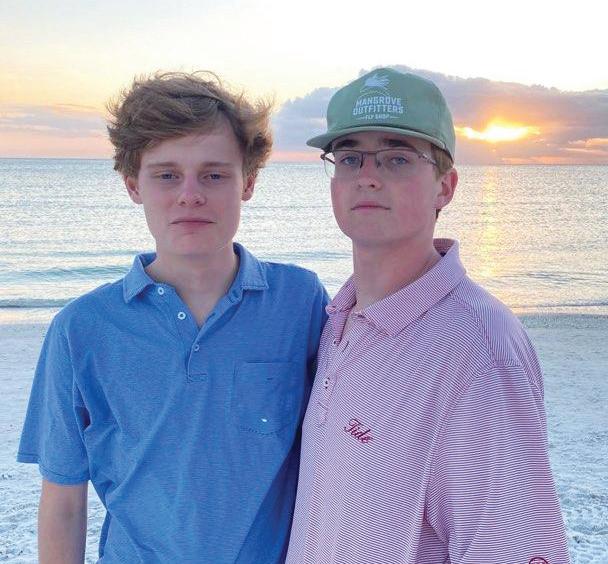
Their friendship blossomed after Luke invited Hayes to his river house for the first time, he said. The river house in Deltaville, Virginia, was the main hangout spot for their friend group, Hayes said, and often served as a place they’d vacation to as well.
His favorite memories of Luke are from their times at the river house, including one day when they were 8 years old fly fishing on the river. Hayes accidentally hooked Luke’s little sister, Liza, on her wrist.
“We just spent so many nights staying up until, literally, like, sometimes til the morning,” Hayes said. “He was a night owl.”
Hayes described Luke as his “first mate” on the boat when they explored the waterways in Deltaville.
“A lot of times we would go out there and Luke would outfish me or something, which was, just, like, kind of unheard of,” Hayes said. “He would out-fish me but … he’d be too humble to come back and say anything about it because he knew that I cared about it.”
Hayes has vacation photos with the Fergussons at their river house instead of vacation photos with his own family.

“There’s too much good stuff to talk about,” Hayes said.

Hayes described Luke as a “very wise person.”
“His emotional experiences that he had been through and the advice that he gave you, it was almost like he had lived multiple other lifetimes,” Hayes said.
A lot of people might describe Luke as quiet, Hayes said, but he’d really think about his words before he said them. Luke listened to people instead of just talking all the time, Hayes said, and he always gave great advice.
Robert Hancock, Luke’s friend and roommate this year, said Luke was introverted but hilarious, and that he’d always be there for you. Even though Luke was quiet and reserved, “you knew he had your back,” Hancock said.
“You didn’t even realize how much he was … a good dude,” Hancock said. “He was super humble, he wouldn’t make it a big deal or anything.”
Hancock said his dad always joked around and said Luke was his favorite son.
Luke was selfless, Hayes said. He was a “stand-up dude” and
always went out of his way to help someone, even if he didn’t really know them, Hayes said.
“It’s rare that you can meet people like that and know them so well,” Hayes said.
Trip Fishburne met Luke through Hayes and Nicholas Troutman, who also died in the accident. Fishburne said his connection with Luke was one like no other.
“I don’t think I’ve ever immediately connected with a person so much,” Fishburne said. “I felt like within a day of knowing him, I could basically talk to him about anything.”
As other friends describe him, Fishburne said Luke was “the most humble person.”
“He never bragged and he didn’t like to talk about himself. He wanted to hear about how you were doing, and I like talking about myself, so that was nice,” Fishburne said. “He was no judgment at all, no matter what — that type of person.”
Fishburne said Luke often surprised his friends with jokes out of nowhere when the quiet, listening friend became the source of laughter.
“Nick was always super, super loud, and Ferg was always very quiet and very calculating in everything he said,” Fishburne said. “We’d have these hilarious one-liners where he didn’t speak much, but every time he spoke, you laughed so hard.”
Hayes said Luke was a “really good” sports journalist and was active with the media publications at their high school. Hayes said Luke was always trying to get him to watch sports with him and teach him about them.
“It would just amaze me because I’d be watching a random NFL football game and he would know every single player,” Hayes said.
Likewise, Fishburne said Luke was “super passionate” about sports and knew every statistic — talents he could’ve used as he talked about making sports journalism his career.
Hancock said when they lived together, it was common for him to go downstairs and see Luke watching a Washington Commanders football game. Fishburne echoed this and said he found Luke watching the game to be more entertaining than watching the game itself. And despite his otherwise reserved demeanor, Fishburne said, Luke would get “so rowdy” watching the Commanders, especially if they won.
“He would throw the pillow at the TV, throw his can on the ground,” Fishburne said. “If your team was playing the Commanders and somehow the Commanders won — because they weren’t a good team — you would hear about it from Ferg.”
Three days before the accident, Hayes said he was with both Luke and Nick at Redpoint, cooking burgers and tortillas on a sheet pan over a bonfire.
Since the accident, Fishburne got two tattoos in honor of Luke and Nick to serve as reminders to “keep going.” On his left wrist is the date of the accident, and on his right thigh, both his friends’ initials are inked.
Fishburne said he’s found a large support system made up of people who Luke and Nick also impacted, even if they only had a few encounters with them.
“That makes me so proud, just knowing that they touched other people’s lives the same as they did with me,” Fishburne said.
A good person and student
Anne Fergusson, Luke’s mom, said her favorite thing about Luke was “everything.” He was exceptional, Anne said, a good person and funny.
“He could find the humor in almost anything,” Anne said. “Even when the situation sometimes didn’t call for humor, he could find humor in it.”
John Fergusson, Luke’s dad, said Luke was always in a good mood and was a good student.
Anne said Luke always loved Star Wars, Legos and lightsabers and grew into loving sports and the Commanders.
“He never gave up the lightsaber thing,” Elizabeth “Liza” Fergusson, Luke’s sister, said. “He would go down in our basement and he’d be down there with his friends a little bit, like, over winter break and they’d be having lightsaber fights. It was really strange, but it was funny.”
John and Anne said Luke loved McDonald’s and recalled a time back when he was 3 or 4 years old talking about the fastfood restaurant.
“He just didn’t understand why we would want to go eat anywhere else,” John said. “He would say, ‘McDonald’s — they got hamburgers, they got fries, they got everything. Why would you want to go anywhere?’”
John said Luke and Liza were close and that she’d always get excited when Luke came home from JMU.
“He’d literally dropped his bags on the floor and Liza would go, ‘OK, time for us to go to somewhere,’” John said. “She was normally going with her friends or sometimes by herself, but as soon as he dropped his bag, she was going with him and it wasn’t a question … even if he didn’t want to, he was gonna go with her.”
CONTACT Kasey Trapuzzano at breezenews@gmail.com and Michael Russo and Avery Goodstine at thebreezeculture@ gmail.com. For more coverage of JMU and Harrisonburg news, follow @BreezeNewsJMU on Twitter.
EDITOR EMAIL 4 NEWS Kasey Trapuzzano breezenews@gmail.com @BreezeNewsJMU Thursday, March 30, 2023
Charlotte Matherly & Shirin Zia Faqiri contributed to this report.
From left to right: Wilbur Hayes, Luke Fergusson and Liza Fergusson as children. Photos courtesy of Wilbur Hayes
Luke Fergusson (left) and Wilbur Hayes pose for a photo at the beach. The two often spent time fishing together on the beach.
By SHIRIN ZIA FAQIRI & CHARLOTTE MATHERLY The Breeze
from JOSHUA, page 1
Joshua Mardis was born into Alabama football — literally.
It was November 2002, and Kirk Mardis, Joshua’s dad, had rushed home to find his wife on the floor going into labor. He looked up at the TV, and Alabama was about to kick off versus LSU. But “as luck would have it,” Kirk said, they weren’t quite ready for surgery when they got to the hospital, so they watched the entire football game in his wife’s room. Alabama beat LSU 31-0 that night, and Joshua was born.
“It was kind of a cool night,” Kirk said.
Joshua, like his family, was a big Alabama football fan. He got accepted to go to college there but chose JMU instead. When he got his JMU acceptance email on the bus ride back from a varsity soccer game in Norfolk, Virginia, he called his mom, Yvette, to tell her.
Yvette said he was so nervous that he asked a friend on the bus to open the email for him.
“He was so excited, so thrilled, and so that’s how you knew that was ultimately where he wanted to go all along,” Yvette said. “That was where he had worked toward going. That was where he wanted to be. And so he was thrilled to become a Duke.”
Loved ones who spoke to The Breeze mentioned how Joshua was outgoing, kind and a social butterfly, someone who put himself out there and could make friends anywhere.
Joshua was the first person Ryan Muncy met at JMU. Muncy, now a sophomore, said the day he moved into his freshman dorm, Joshua just walked in and struck up a conversation.
Muncy said that wasn’t a rare occurrence for Joshua, who lived in the room right across the hall. He likened him to Kramer’s character on “Seinfeld,” remembering how whenever Muncy got back to his room, Joshua would knock on the door, almost like a “sixth sense” that he knew he just got back.
“He’d come in and, you know, we would start hanging out and play Madden or 2K or whatever, go grab lunch at D-Hall,” Muncy said. “Every time I sit and think about it, there’s not a bad memory that I have. Every single memory’s a great memory.”
Muncy said this helped him when the accident happened. He said Joshua’s freshman roommate, Quin Robinson, immediately came over to his apartment after hearing the news, and they spent the afternoon talking about Joshua.
“As sad and as surreal as everything was, it was hard to even be sad because every single memory, like, made us laugh,” Muncy said. “I think it just speaks about Josh and … what a happy, overall amazing guy he was. It’s the fact that, you know, every time you think about him you sit there with a smile on your face and kind
of, like, laugh to yourself about something.”
David Andrews met Joshua in fall 2021 before a Pi Beta Chi (PBX) rush event when Joshua showed up three hours early while some of the brothers were playing cornhole. Andrews remembers Joshua didn’t need him to hold his hand or lend any help making friends. Instead, the two of them talked about their pasts, their families and their futures for hours.
Joshua was also just a kind person — everyone remembered him as a happy and positive kid.
Kirk said there was a student in Joshua’s residence hall who was a bit of a loner, and Joshua hung out with him in the common room.
“I told Josh, ‘If you want to have friends, you got to be a friend,’” Kirk said. He choked up as he talked. “Josh would go down and watch comedy shows with him and, kind of, spend time with him so that he wasn’t alone. That speaks to Josh.”
Yvette said a grandfather recently commented on Joshua’s obituary website and said that even though Joshua didn’t know him or his granddaughter, he stopped on the side of the road to help her fix a flat tire.
“That spoke volumes of his character, you know, good people do good deeds and they don’t brag about good deeds. That’s what makes a good person,” Yvette said. “That’s what we admire most, is Joshua had a really, really big heart.”
Joshua and his sister, Haley Mardis (’21), competed in the traditional sibling rivalries. Haley, who’s four years older, remembers the moment she realized she couldn’t “physically overpower him anymore.” But before then, as young as 5 years old, Joshua knew Haley had what Yvette called an “unnatural” fear of aliens. One night, to get back at her, he looked in her closet and told her there was an alien in there — and for days afterward, Kirk and Yvette stayed with her until she fell asleep.
Haley also remembered a time at summer camp when the counselors said there was a towel in the lost and found. Joshua immediately raised his hand and said it was his. Later, Haley said, she found out it wasn’t his at all.
“He’s like, ‘No, that wasn’t my towel. It just looked like a nice towel, and I wanted it,’” Haley said, laughing.
Even though he’s no longer with us, the Mardis’s said they “talk to Josh all the time.”
Yvette said she tells Joshua every day that she loves and misses him and that “we’re so sad that he’s not here anymore,” knowing that he can’t talk back but that he’s there and can hear her. Kirk said he tells Joshua “how proud I am of him.” Haley said she also tells him she misses him but just talks to him “like normal” or “just how you would do to a sibling.”
Kirk asked Haley if she still gives Josh “a hard time.”
Haley responded with a laugh and said “something inconvenient will happen…to me, I’m like, ‘Oh my god Josh, thanks, you’re messing with me’ ... He was the typical annoying little brother.”
Yvette said she wants to see a sign that he’s OK but also doesn’t think she’s ready for that yet.
“We’re still so in such deep grief … Maybe I’m gonna be able to look around one day and just see him, you know, see him everywhere and that’s gonna give me comfort and I’ll be able to be open to that and seeing the signs that he’s fine,” Yvette said. “I so much just want to hug him or just just feel him, just give him a kiss.”
In her study, Yvette recently noticed a candle with a wax imprint of Joshua’s hand from when he was little. She said that it’s become “the most precious thing” to her.
“I just, I hold it, I hold the wax hand, because it’s, to me, it’s the closest thing I’m gonna have right now to being able to touch him…it gives me comfort,” Yvette said. “Nothing can ever happen to that wax hand … It’s like holding his hand.”
Kirk recalled the first time he called back home when he was deployed to Iraq in 2005 for a year. Joshua was 2 1/2 years old at the time and spoke two words: “Daddy home?”
“That inspired me to come home, and I know that Josh is home now. And he’s safe,” Kirk said.
Kasey Trapuzzano contributed to this report.
CONTACT Charlotte Matherly at breezeeditor@gmail.com and Shirin Zia Faqiri at breezepress@gmail.com. For more JMU and Harrisonburg news, follow the news desk on Twitter at @BreezeNewsJMU.
5 Thursday, March 30, 2023
‘Every single memory’s a great memory’
Joshua Mardis’ close friends, family reflect on their time with him
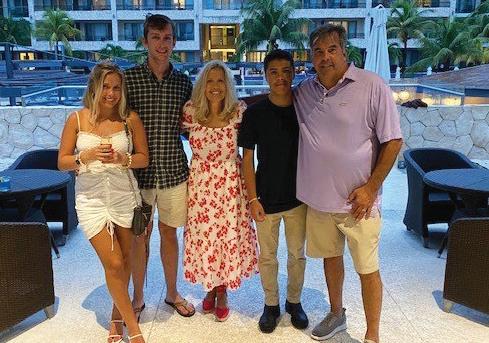
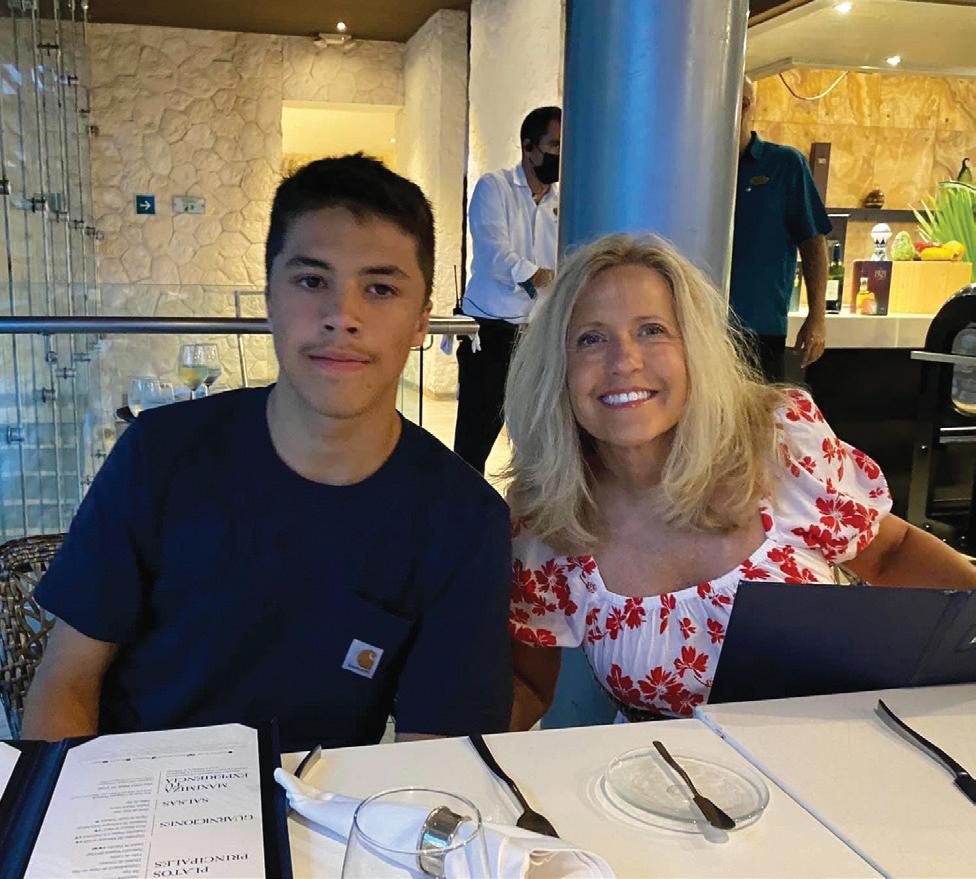
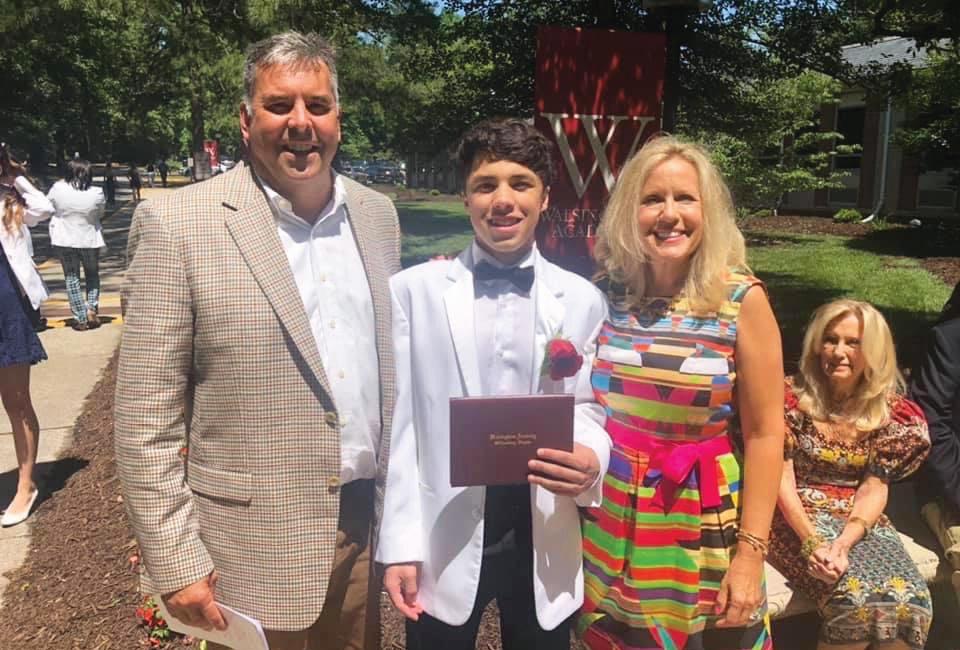
From left to right: Haley Mardis, Haley’s boyfriend, Yvette Mardis, Joshua Mardis and Kirk Mardis. Photos courtesy of Haley Mardis
Joshua (middle) poses with his parents, Kirk and Yvette at his high school graduation.
NEWS
Loved ones described Josh as outgoing, kind and a social butterfly.
‘The best friend I could ever ask for’ Friends, family share memories of Nicholas Troutman
By KASEY TRAPUZZANO, AVERY GOODSTINE & MICHAEL RUSSO The Breeze
from NICHOLAS, page 1
Trip Fishburne met Nicholas Troutman in seventh grade when they both tried out for their middle school football team. Fishburne said they weren’t the best players, so, naturally, they became friends and developed a tighter bond throughout middle and high school. When it came time to decide on college, they both landed at JMU.
Though they decided to live separately their freshmen years and joined different fraternities — Fishburne in Sigma Phi Epsilon and Nicholas in Pi Beta Chi (PBX) — Fishburne said their friendship only strengthened.

“I thought what I did was the best thing for me, and what he did was the best thing for him, and we never really, like, talked about it,” Fishburne said. “I think having a space we could go where we weren’t always together actually, like, when we were together, it made it better.”
Mikey Yarborough first met Nicholas last year as a freshman when they both lived in Eagle Hall. Yarborough and his roommate, Jack McGowan, made quick friends with Nicholas and his roommate, Wilbur Hayes, who’s been friends with Nicholas since the fifth grade.
Yarborough said the four “clicked immediately” and always hung out in each other’s rooms. Hayes said he felt “really lucky” to have lived with Nicholas last year, and while already having a close friendship with Nicholas, the two got even closer living together.
Yarborough said their floor in Eagle Hall — a group of about 30 students — was the “best floor you probably could’ve had as a freshman,” and credits the closeness of the hall to Nicholas.
“Nick was one of the main pieces of the puzzle that really kept everybody going whenever they didn’t think they could go,” Yarborough said. “He was just someone you really want to be around. So much joy is in the room whenever he was around.”
Yarborough said Nicholas always had a smile on his face, no matter the circumstances. He was constantly dancing, joking around and really just made other people smile whenever they were having a bad day, Yarborough said.
“He would constantly be there and support you no matter what it was,” Yarborough said.
Yarborough and Hayes both said Nicholas was naturally goofy. He didn’t take anything too seriously, but in a good way, Yarborough said, and he didn’t overthink things. Nicholas addressed situations and moved on, Yarborough said.
A football fan, friend and student
Nicholas was the friend that got people up and doing things, Yarborough said. Hayes said Nicholas would often “drag” him to the gym and supported him when he struggled with his relationship with food.
“I always felt like Nick was there to protect me,” Hayes said. “If I didn’t have Nick last year, my face would look a lot different,” he added, laughing.
During their second semester of freshman year, Yarborough said he snapped his wrist in half and was “stuck in his dorm” unable to play club baseball at JMU. Yarborough said it was one of the worst times of his life. He was in a “dark place.” He said if it weren’t for McGowan, Hayes and Nicholas specifically, he probably wouldn’t be at JMU today.
Nicholas was “always offering words of encouragement,” Hancock said.
“Somehow, someway, Nick had a smile every time he was in the room with me,” Yarborough said, “And I just, I’m gonna cherish that for the rest of my life and I don’t think that I am going to come across somebody like that again — that has that control over someone naturally without even trying — because it was all natural. It was just him.”
Yarborough said Nicholas was “as intelligent as you can be.” During their freshman year, he, Nicholas, McGowan and Hayes were all business majors, but Nicholas was the only one who stuck with it.
“Nick was like the only one that really understood any of it,” Yarborough said, laughing. “Because now, me, Wilbur and Jack are all communications majors.”
Yarborough said Nicholas was someone who was motivated, whether it was “grinding” on his school work or going to the gym every day, and that he kept to his schedule. Nicholas knew he was at JMU for a reason, Yarborough said, and prioritized his academics before anything else.
“It’d be a Thursday night and he’d be like, ‘Okay, hold on, let me check my schedule,’” Yarborough said. “I don’t think I know any other 19, 20-year-old that would just be like, ‘Oh, let me check my schedule.’”
Yarborough recalled a time last semester during the NFL season when he called Nicholas and asked him to come over to watch football.
“He was a diehard Eagles fan,” Yarborough said, “And he was at our apartment that Sunday when they won the NFC and then he didn’t get to see them playing the Super Bowl. But I’m glad that that last memory of him seeing his team be so successful was with us and all the boys in my apartment.”
Last semester, Yarborough and Nicholas had music class together in the morning, which was time with Nicholas that he cherished.
“Being with Nick in that class, like, made me want to get out of bed at 8:30 in the morning to go to music class at 9 in the morning — walking across campus just to be with Nick,” Yarborugh said.
Yarborough said he couldn’t put into words how Nicholas’s presence made him feel.
“I didn’t even realize it until it happened but, Nick was like my best friend in the first semester,” Yarborough said.
Robert Hancock was Nicholas’s friend and roommate last semester. He described Nicholas as very outgoing, always wanting to talk to people.
This year, Nicholas lived with Fishburne, Hancock, John “Luke” Fergusson, who also died in the accident, and Baird Weisleder, another passenger in the car. Fishburne recalled a time when Weisleder’s toilet clogged and leaked into Nicholas’s room on the floor below, getting all over his belongings.
“I got a call from him, and he’s like, ‘It’s raining in our house right now. I don’t know what to do,’” Fishburne said. “And he was putting pots and pans everywhere trying to catch all the water and it was just not enough.”
Fishburne now has two tattoos in honor of Nicholas and Luke that serve as daily reminders of “why I gotta keep going, and why I need to try.” One of them is the date of the accident on his left wrist, and the other is his friends’ initials on his right thigh.
Remembered as a son and brother
Jessica Troutman, Nicholas’s mom, said Nicholas was “born with a smile on his face” and, growing up, he was “always the goofy one,” constantly dancing and singing.
“He just, you know, enjoyed the fun of life,” Jessica said.
Jessica said Nicholas valued his relationships with his friends and family. Since Nicholas’s death, Jessica and John Troutman, Nicholas’s dad, said they’ve heard from many of his friends who’ve said he had a good heart and really cared about his friends.
“We always knew he had a lot of friends,” Jessica said. “And we’ve just been blown away by the friends that have reached out to us and shared that not only was he a lot of fun, but that he was there for them when they needed him.”
Both Jessica and John said Nicholas was a hard worker with great discipline. He was the type of student who came home from school and immediately started his homework so he wouldn’t have to worry about it the rest of the day, John said.
Jessica said socializing and trying new activities were “kind of his things.” She said Nicholas was heavily involved in his fraternity, PBX. Recently, one of Nicholas’s fraternity brothers told the Troutmans he ran for four or five different officer positions within the fraternity and wrote a different speech tailored to each position.
“Don’t ask me why,” Jessica said, laughing. “Sometimes we don’t know, like, what is going through this kid’s head. He did tell me, like, ‘Mom … I’m not an upperclassman. I don’t
expect to get these positions, but you know, I’d like to do something.’ So that’s one thing about him, he did not worry about what people thought, so he ran for every position.”
Jessica recalled another time when Nicholas was in seventh grade on the middle school football team. The team’s center was injured and Nicholas, who’d never played center before, raised his hand in practice and volunteered to be the team’s new center.
“He came home and he said to his older brother Jack, ‘You have to teach me how to play center,’” Jessica Troutman said. “And so they’re out in the front yard, like, practicing, like, him hiking the ball and everything. He just, you know, he wasn’t afraid to try new things, even if he wasn’t going to be great at them. He wasn’t afraid to try new things and give them his all.”
Charlotte Matherly & Shirin Zia Faqiri contributed to this report.
CONTACT Kasey Trapuzzano at breezenews@gmail.com and Michael Russo and Avery Goodstine at thebreezeculture@ gmail.com. For more coverage of JMU and Harrisonburg news, follow @BreezeNewsJMU on Twitter.
Thursday, March 30, 2023 NEWS 6
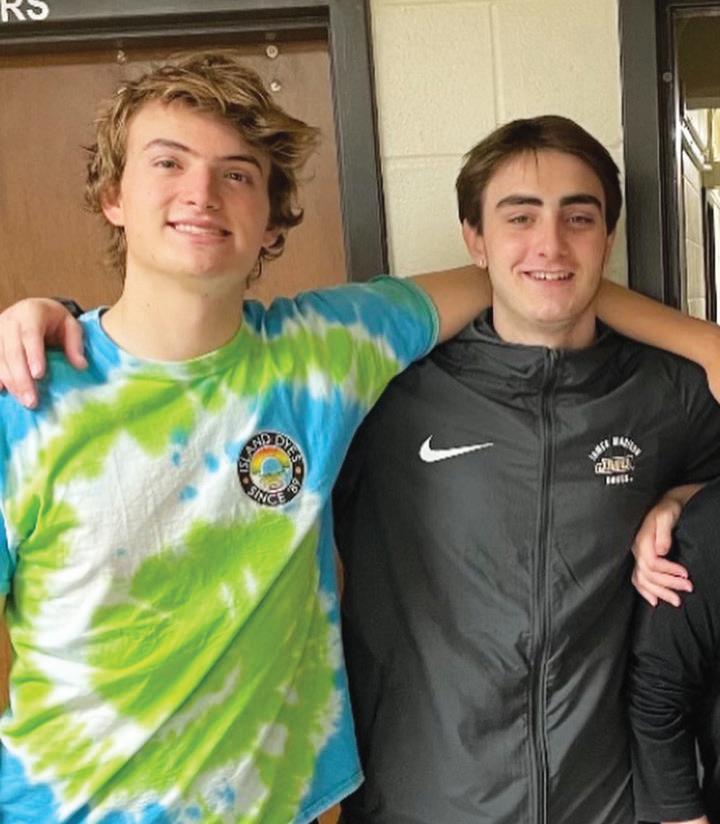
Nicholas Troutman (left) poses with his friend, Mikey Yarborough. Photos courtesy of Mikey Yarborough
Nicholas Troutman (right) dresses up with a friend for a trip to Cookout.
No contingency, no problem

SGA pulls money from previous years to fund organizations after running out of contingency
By ASHLEE THOMPSON The Breeze
The Student Government Association (SGA) has begun pulling money from a reserve fund after running out of contingency money.
The group gave out the last of its contingency funds during the Feb. 21 meeting, executive treasurer Brandon Market said. The fund consists of unused contingency from previous years, with this being the first time since 2017 the SGA has run out of contingency.
Contingency funds come from student fees and are given to organizations for operational needs, such as holding events and going to conferences, according to SGA’s website. All JMU organizations in good standing with the Office of Student Activities and Involvement for four months and chartered with a Constitution are eligible to request contingency funds, with a maximum request of $3,000 per semester — with the exception of the two most recent requests.
The SGA emptied its contingency funds during the Feb. 21 Senate meeting when the gave money to Chabad Jewish Student Group, JMU Young Life and Note-oriety. In order to continue funding organizations on campus for the rest of the semester, the Senate began pulling from a reserve fund, Market said.
This reserve fund currently has $189,597.08 in it, Fiscal Manager Meredith Bauer said. She says the amount will cover all of the SGA contingency requests for the remainder
funds
of the year.
During the Feb. 28 meeting, the Senate began giving out funds from the new pool of money, giving BluesTones $3,000. Market, at the meeting and also in an email to The Breeze, said he was unsure of the total in the reserve fund but believes it’ll get them through the rest of the semester.
“My boss [Bauer] made this decision and said we could continue giving out contingency money to support the student organizations that were still coming to us for funding,” Market said.
The Senate running out of contingency in February was seen as good by members of SGA. Market said it was “not a bad thing at all” because the funds go out on a first-come, first-served and needs basis.
SGA senator and junior Parker Boggs said during the Feb. 21 meeting that running out of funds was “a good thing” because it was the first time the Senate has run out of contingency funds since COVID-19, showing that the campus’ organizations are beginning to host events and go on trips again.
This year, $45,751 has been given out to 17 different organizations on campus, which Bauer said is comparable to past years.

CONTACT Ashlee Thompson at thomp6ab@ dukes.jmu.edu. For more coverage of JMU and Harrisonburg news, follow the news desk on Twitter @BreezeNewsJMU.
Eleanor Shaw / The Breeze
7 Thursday, March 30, 2023 NEWS
This week’s key takeways from SGA Senate
By ELEANOR SHAW The Breeze
The Student Government Association (SGA) Senate approved budgets for the 2023-24 academic year, adjusted contingency funds and passed a student organization resolution during Tuesday’s meeting.
SGA approves FEB budgets
The SGA Senate unanimously approved all front-end budgeting (FEB) groups’ budgets for the 2023 academic year after undergoing the mandatory two-week sitting period. The FEB funding adds up to $129,081.
FEB groups, according to SGA’s website, are organizations whose missions are seen as crucial to the university. These groups get prioritized front-end budgeting to ensure funds for their needs. All FEB groups are funded by student fees.
After the meeting, senior Brandon Market, SGA’s executive treasurer, said the FEB groups have already been allocated the money and that none of the numbers changed from last year.
The groups included Madison Equality, Safe Rides, Latinx Student Alliance, Black Student Alliance, National Association for the Advancement of Colored People (NAACP) and Student Ambassadors.
Junior Matt Haynicz, an SGA representative and the executive treasurer-elect, presented on behalf of Madison Equality and the NAACP, which were allocated $25,698 and $17,485 respectively.
Haynicz said Madison Equality plans to use its funds for guest speakers, festivals, conferences, a charity ball and Dukes Pride Week: a week of giveaways, events and information sessions. NAACP will use its funds for its Black Excellence Gala, Martin Luther King Jr. (MLK) Week and an alternative break program that’ll involve community service-learning and general membership fees, Haynicz said.
Market presented on behalf of Safe Rides and Student Ambassadors, who were allocated $24,490 and $16,225 respectively.
Safe Rides will use the funds for gas, cleaning supplies, office supplies, travel accommodations, a semi formal and a gala, Market said, and Student Ambassadors will use the funds for its Operation Season’s Cheer Show, Kicks for Carrie event, tour materials and executive board stipends.
Junior Mahek Shroff, SGA’s finance liaison, presented on behalf of the Black Student Alliance (BSA) and Latinx Student Alliance (LSA). The organizations were allocated $20,558 and $24,625 respectively.
Shroff said BSA will use the funds for recruitment, its annual MLK Gala, cultural exposure events, welcome back event, end-ofyear pizza party and a co-sponsorship event. LSA will use the funds for “bigs” and “littles”. events, Bienvenida Latina, guest speakers, Noche de Sabor, Celebracion Latina and its semi-formal.
SGA converts program grant requests
The SGA Senate unanimously passed program grants for two groups — the Lambda Chi chapter of the Alpha Kappa Alpha sorority and DREAM Weekend — during last week’s meeting. Now the Senate has converted those program grants into contingency requests.
According to the SGA’s website, contingency funds come from student fees given to organizations, while program grants are funds set aside during the FEB process for organizations to use to finance specific events.
In a written statement to The Breeze, Shroff said SGA accepted the program grant requests because they were submitted before SGA stopped accepting requests.
After the meeting, Market said this was because program grants take five to six weeks at a minimum to process, making it impractical to pass a grant this time of year.
“Program grants are usually passed during the fall semester,” Market said. “The reason why we extended it is because we wanted to give the opportunity to students, but the timing didn’t work out in this instance.”
Shroff said SGA has stopped processing program grant requests for this year and converted the groups’ requests into contingency funds for this reason.
During the Feb. 21 Senate meeting, the SGA ran out of contingency funds. After SGA’s March 6 meeting, Market said the SGA has received an unspecified amount of money from JMU’s finance office.
SGA passes SAI resolution
SGA’s encouraging the Student Activities and Involvement (SAI) Department to “create a window of time in the summer session for current students to create new organizations on campus,” according to a resolution the Senate passed unanimously.
The resolution invites SAI to develop a one-week period during summer sessions to give students the chance to apply before the academic year and relieve stress on organizations that may come from the “oversaturation” of requests.
Junior senator Parker Boggs submitted the amendment, saying the idea came from his own experience creating JMU’s chapter of Young Americans for Freedom (YAF), a conservative organization that “inspires students to become bold advocates for freedom,” according to its Instagram bio.
While Boggs created the club on the first day of the 2022 fall semester he said it took almost two months to get the club “fully off the ground.” Boggs said this set his club back when it came to organizing events.
“I wanted to be advocating, not pushing. the SAI department to do this,” Boggs said. “I wanted ... students like us [to] show them students agree with this.”
CONTACT Eleanor Shaw at shaweo@dukes. jmu.edu. For more coverage of JMU and Harrisonburg news, follow the news desk on Twitter @BreezeNewsJMU.
8 NEWS THEY
YOU WHAT’S HAPPENING... BUT WE WILL. SIGN UP NOW!
For a twice-weekly newsletter from JMU’s news source, The Breeze.
WON’T TELL
http://www.breezejmu.org/newsletters/
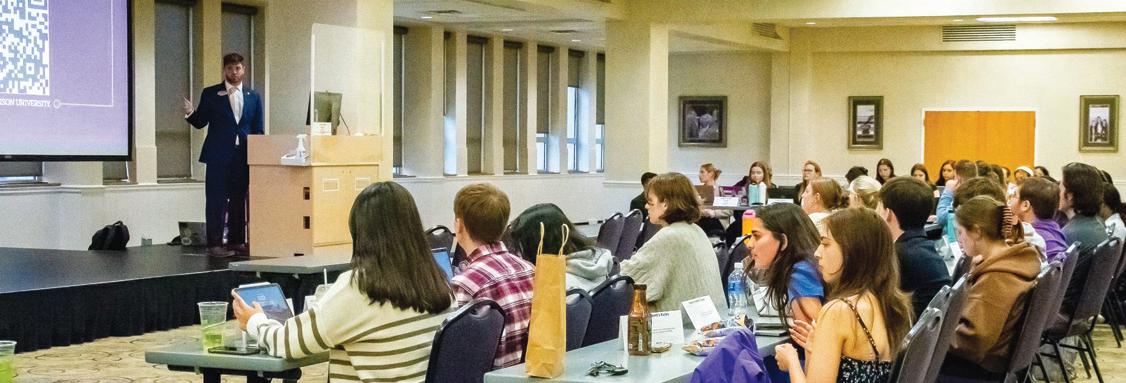
The SGA Senate approved front-end budgets, converted program grant requests and passed a Student Activities and Involvement resolution. Valerie Chenault / The Breeze

Thursday, March 30, 2023 9
Not Backing down
Harrisonburg drag community reacts to Tennessee drag ban
from DRAG , page 1
Mason Vales, a sophomore JMU Musical Theatre major, said his home state of Texas has a much larger drag presence than Harrisonburg does, with more trophies and money involved. He said he thinks there’s not enough of a drag scene in Harrisonburg for the city to cultivate a fanbase.
Both Knight and Vales said they’re fearful the ban on public drag performances will reach Virginia.
Knight said she had to stay focused on connecting with and empowering the local community, and if the bill does come to Virginia, Rhinestone Productions will “take the course of action as needed.”
Vales said the ban on drag was “absolutely insane” to him and he thinks Harrisonburg might be in trouble. Cohen, however, said he doesn’t think the drag ban will reach Virginia due to the mixed nature of political ideologies across the state.
“Virginia is, as a state, not as conservative as Tennessee,” Cohen said. “Certainly, there are portions of the state of Virginia that are similar, I would imagine, to parts of Tennessee, but overall, I don’t know that the governor would be wading into this.”
Other bills presented in Tennessee, such as its censorship of books in schools, have made an attempt to protect children from what lawmakers designate as “adult” content. The Tennessean lists some examples of this type of content as themes of sexuality or difficult topics like rape or pornography; however, this bill doesn’t give exact parameters around the specifics of what’s considered appropriate content —it leaves that up to the teachers themselves.
This isn’t just an issue in Tennessee; Harrisonburg has also been navigating book restrictions. In 2021 “Gender Queer” was taken off shelves and Harrisonburg has made efforts to reform its book review process; these changes may butt heads with proposed Virginia standardized policy, as reported by The Breeze on March 2, 2023.
Cohen also said there’s a history of targeting repressed groups and minorities, including the LGBTQ community in Virginia. He said it’s really a focus of protecting “traditional values,” and there are plenty of people in liberal areas across Virginia who’d view this ban as discrimination.
Rhinestone Productions will continue to perform at shows across Harrisonburg, Knight said. She also said the company’s recently tapped into Eastern Mennonite University and Bridgewater College, creating more opportunities for the Harrisonburg community to be exposed to drag.
“I think people are learning more and more,” Knight said.
“It’s a beautiful thing, a powerful thing.”
Vales said he’d love to see more active entertainers locally and that Harrisonburg could use a lot more shows across town. He said he considers drag an art form.
“We have women who dress up as drag queens, we have women who dress up as drag kings, we have men who dress up as drag kings and men who dress up as drag queens,” Vales said. “Drag is everything … everyone can do it.”
Cohen said the relationship between students and curriculum relates to the cultural wars that have been exceedingly evident in politics.
“It just shows there’s a large divide in this country over what people think is acceptable,” he said, “and it will continue.”

Vales said he thinks the conversations taking place currently are important for the drag community to excel and win this fight.
“Rhinestone Productions is not going anywhere,” Knight said. “Simple as that.”
Cohen said this should be seen as the latest in a longlasting battle between the forces of progressivism and traditionalism. And while Tennessee’s drag scene is in flux, Knight said the same isn’t the case in Harrisonburg.
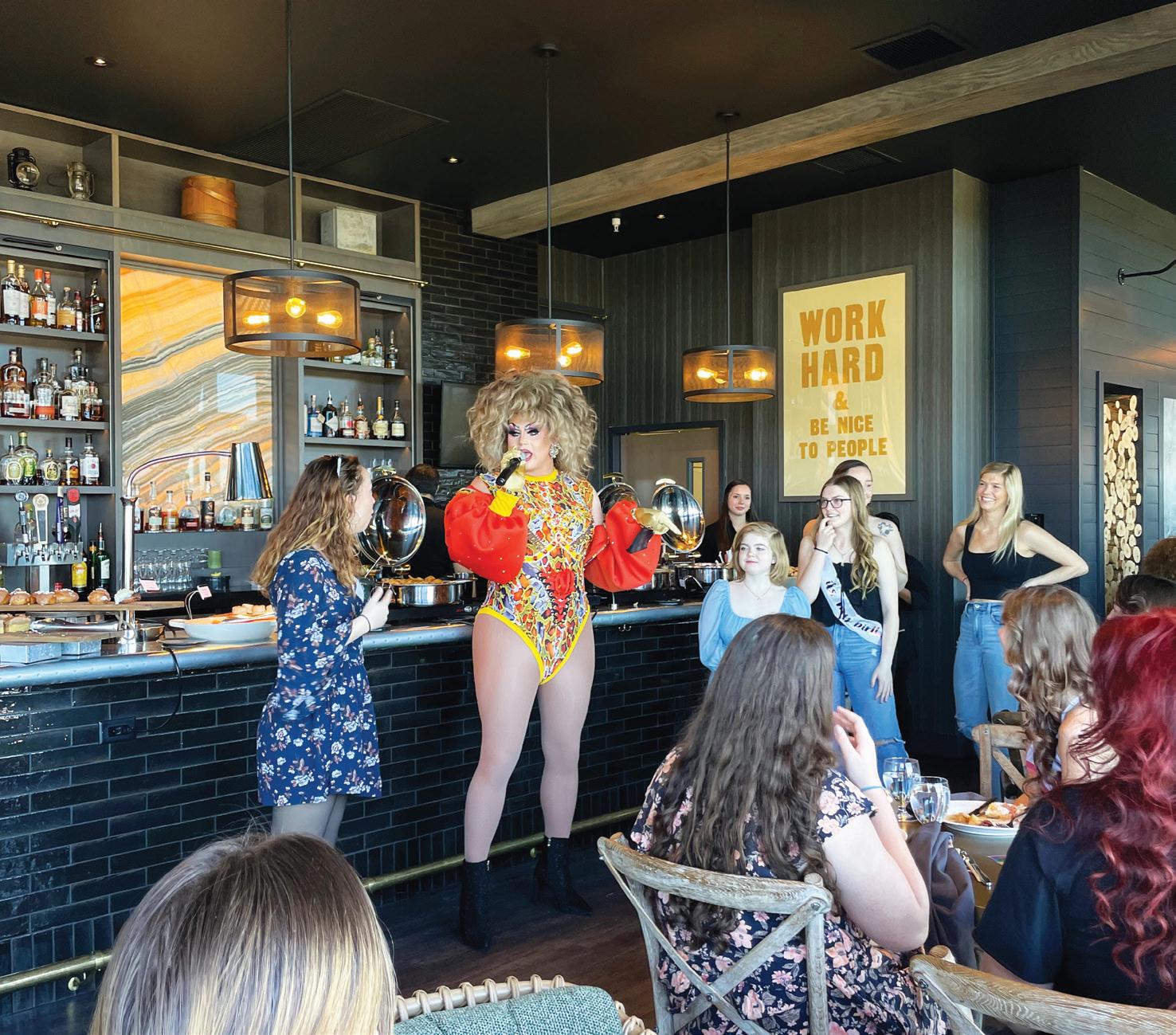

“We gotta stand together as a community for all the queens in Tennessee and unite as one,” Knight said. “Don’t quit fighting.”
CONTACT K. Mauser at mauserkk@dukes.jmu.edu. For more on the culture, arts and lifestyle of the JMU and Harrisonburg communities, follow the culture desk on Twitter and Instagram @Breeze_Culture.
10 Thursday, March 30, 2023 EDITORS EMAIL CULTURE
thebreezeculture@gmail.com @Breeze_Culture
Michael Russo & Avery Goodstine
Local drag preformers said they won’t be deterred by news of the drag ban in Tennessee.
Photos by K. Mauser / The Breeze
JMU political science professor Marty Cohen said that the Tennessee drag ban is the latest in a long-lasting battle between the forces of progressivism and traditionalism.
“[Drag is] a beautiful thing, a powerful thing.”
Jayda Knight CEO of Rhinestone Productions
Empowerment through academia
JMU faculty utilize positions to honor women
By MORGAN VUKNIC The Breeze
Women have long been making major contributions to society, such as Ida B. Wells, who was a civil rights leader and one of the founders of the National Association for the Advancement of Colored People (NAACP); Betty Friedan, who wrote the Feminist Mystique, which led to the start of the second-wave of feminism in the 1960s and ’70s; and Audre Lorde, who was a poet and feminist whose work focused on racism, women’s rights, homosexual relationships and homophobia, and how modern feminist movements weren’t intersectional enough.
Even with these accomplishments, women still face less pay than their male counterparts, increased rates of domestic and sexual violence and the overturning of Roe v. Wade, among other obstacles.
“Women, queer and feminized folks in general are still suffering from inequality,” Verónica Dávila Ellis, assistant professor and Latinx studies cohort member, said. “They still have trouble accessing resources and they are doubly oppressed if they are a person of color.”
To combat the inequalities faced by women, many JMU faculty are working to educate students on feminist topics in different areas such as political science, foreign languages, university marketing and women’s, gender and sexuality studies.
Promoting equality through music and sound
While Dávila Ellis is a professor in the foreign language department, their main area of research is in reggaetón, Latino and Caribbean music with focuses on gender, LGBTQ+ people and sound.
They come from a family of musicians and have always been interested in exploring different types of music. Dávila Ellis said they have a background in literature but was moved by a book about salsa music to pursue how music and gender interact with each other.
“I was inspired to look into reggaetón, which is the genre I grew up with,” Dávila Ellis said. “I realized that not only was gender important, but that there are issues of race and class that not many people in academia were paying attention to that I wanted to explore.”
Through their research, Dávila Ellis said they found a passion for music in the Dominican Republic. They were born and raised in Puerto Rico and began to realize the Dominican Republic helped develop certain rhythms associated with being strictly Puerto Ricans. For example, since 1960, over 100,000 Dominicans
have settled in Puerto Rico. With this large Dominican population in Puerto Rico, elements of their traditional music, such as bachata, have made their way into reggaetón and other Puerto Rican music.
This link between the Dominican Republic and Puerto Rico made them do a deep dive into the inequalities that female, feminine presenting, queer and transgender artists face in the music industry.
“You see male Puerto Rican artists making it big in the U.S. and you have to ask yourself, ‘What are they doing that makes them thrive?’ I quickly realized that women and queer and trans folks don’t get as much success.”
The area Dávila Ellis studies is niche, but they said they believe it’s their job as faculty to help educate students about female and female presenting topics. They said as faculty, they have access to educational resources about women, gender and the LGBTQ+ community that they can share with students. But along with this, students need to go out of their way to learn about these topics.
“For students and other community members, take a women’s studies class, talk to the professors, go to an event or join a group that discusses a topic that interests you,” Dávila Ellis said. “Your peers are a great resource as they might have different experiences from you and may be able to answer questions you have.”
Global feminism and gender equality
Similar to Dávila Ellis, assistant political science professor Jaimee Swift takes an international look at feminism. Her research specifically deals with Afro-Brazilian, LGBTQ women organizing in Salvador da Bahia, Brazil, and how their organizing is critical to challenging anti-Black, anti-LGBTQ violence and femicide in Brazil as well as globally.
“I’m interested in any feminist politics that focuses on people who are typically left out of mainstream conversations,” Swift said. “Without these types of people, I would not be here and many of us would not be here. Whether it’s women’s history, women’s rights or feminism, I think it’s not just about who we see now, but also who are we not seeing?”
Along with her research, Swift also is passionate about teaching global Black feminist politics. She was the inaugural Oxford College of Emory University’s Office of the Provost Postdoctoral Teaching Fellow, where she taught the school’s first global Black feminist politics course.
Swift’s been at JMU since 2022. She teaches classes about global and intuitive Black politics. Next year, she’ll be expanding her courses with a
class on African American, African and Diaspora Studies (AAAD).
“Everything at JMU has been great so far,” Swift said. “The students are very inquisitive and I enjoy being able to introduce and start a dialogue about transnational Black politics.”
Outside of teaching, Swift also founded Black Women Radicals, an advocacy organization that, according to its website, is “dedicated to uplifting and centering Black women and gender expansive people’s radical political activism.” The organization fulfills its goal of uplifting Black women and gender expansive people through research, events and its blog and database, which holds resources about global Black feminism.
Swift said the work she does is important because the fight for women’s rights won’t be accomplished by just one person but everyone working together.
“Gender equality can’t exist without the people who are left out,” Swift said. “I think that’s vital in the struggle for gender equality, racial equity and LGBTQ rights. It’s not just one group of people doing the work, it’s tons of groups of people doing the work. We cannot claim to be for women’s rights if we are not intersectional in our approach.”
Empowering women through philanthropy
Women for Madison is a group of JMU alumni, parents, students and faculty who allow women to participate in opportunities to invest in JMU’s future. The group celebrates JMU’s women through holding events, such as the upcoming Women Who Amaze Summit from May 19-20, when notable JMU alumni Vonya Allyne (’93), Lindsay Czarniak (’00) and Sarah Montana (’09) will be speaking.
Cannie Campbell, vice president for constituent engagement and executive director, (’95, ’20) has been running the organization for the past seven years. Currently, Women for Madison’s biggest initiative is raising scholarship money for students through is Amethyst Circle, a group of 200 women pledging $5,000 to fund scholarships with the goal of raising $1 million every two years.
Campbell said her goal is to empower women to know what JMU’s needs are and how to best help students. She said the organization works to uplift and empower all women and feminine presenting individuals.
“We have a lot of women at this university who do amazing things,” Campbell said. “Being able to highlight these accomplishments is very important to me. So at our events we always try to have keynote speakers or students who are doing great things so we can learn about what
they’re doing and then we share those out into the greater JMU Nation.”
While Women for Madison empowers women through philanthropy, Campbell said everyone can work to uplift women in some way.
“Everyone knows someone who identifies as a woman,” Campbell said. “Being knowledgeable about issues that impact women is super important whether that be through reading, taking classes or going to see speakers.”
The growing field of women’s, gender and sexuality studies

The Women’s, gender and sexuality studies (WGSS) minor was created in the 1990s. The minor was crafted by students coming to faculty and expressing a want to learn more about women’s related topics. With an increased interest in WGSS from students, English professor and WGSS program coordinator Mary Thompson said she and other faculty members are working on creating a Bachelor of Arts degree in gender studies.
“Change happens through the influence of students,” Thompson said. “Students are really powerful on college campuses and I think they don’t always recognize that. Even with the new queer studies minor, it’s something faculty is interested in doing, but they also feel that it’s a necessary thing because of student interest — it’s really a reflection of student interest.”
Although Thompson teaches in the English department, her specialized areas are women’s literature, feminist theory, body studies, motherhood studies and reproductive justice. Because of this, she said she tries to incorporate feminist topics into all of her teachings.
Thompson said students are always interested in learning about issues that face women, such as equal pay, reproductive rights and genderbased violence. Although students are interested in these topics, she said she thinks they’re often unaware of how these issues aren’t improving for women globally.
“I think there’s a mistaken perception with every generation of classes I teach that things are getting better,” Thompson said. “These issues show that the patriarchy is constantly reinventing itself so we need to stay vigilant and we need to support all women in our culture. I love teaching in this field because of the students in my intro classes. They’re great, they see so much and I know that they’re going to continue the fight as well, but I think they need to see these problems too.”I think they get better care because it’s just me and I’m able to cater to them,” JMU lacrosse athletic trainer Alex Lovgren said.
see JMU WOMEN, page 12
11 Thursday, March 30, 2023 CULTURE
Ben Moulse / The Breeze
from JMU WOMEN , page 11

Even if students don’t fully grasp the scale of the issues that women deal with, Thompson said it’s still crucial for all students to learn about women and gender.
“It’s crucial to learn about women’s and gender studies because it’s the world that we live in and it’s the world that undergraduates will be entering,” Thompson said. “We need people who are versed in social justice issues and who have the ability to recognize oppressive systems and to propose solutions.”
Honoring and empowering women throughout the year
March is Women’s History Month, an annual celebration honoring women’s contributions to history. While it’s distinguished in March, Swift, Dávila Ellis and Thompson
agree that women and female presenting people need to be celebrated and honored all year because they’re always making history.
Thompson said, as a society, we’re still focused mostly on men’s ideals and contributions. She said months like March work to make people more aware of the accomplishments of women but that these accomplishments need to be celebrated all the time, not just in March.
“I think there’s real value in acknowledging the accomplishments and contributions of women and we’re not at that 50/50 balance yet,” Thompson said. “It’s important to challenge ourselves in an androcentric culture to challenge those voices that have been muted and to bring those voices and stories back to the center of awareness.”
For Dávila Ellis, Women’s History Month is a time to educate yourself on women’s issues. They said improvements can’t be
made unless everyone educates themselves on feminist topics.
“The purpose of such a month and the purpose of doing feminist work is to highlight women’s realities and to work towards addressing these situations,” Dávila Ellis said. “I think it’s a responsibility for all of us to learn about people in our society who are oppressed and marginalized. We all know a woman and we know that they are a contributing force to the community so it’s our responsibility to learn and mobilize for more gender equality.”
CONTACT Morgan Vuknic at vuknicma@dukes.jmu. edu. For more on the culture, arts and lifestyle of the JMU and Harrisonburg communities, follow the culture desk on Twitter and Instagram @Breeze_ Culture.
Thursday, March 30, 2023 12
CULTURE
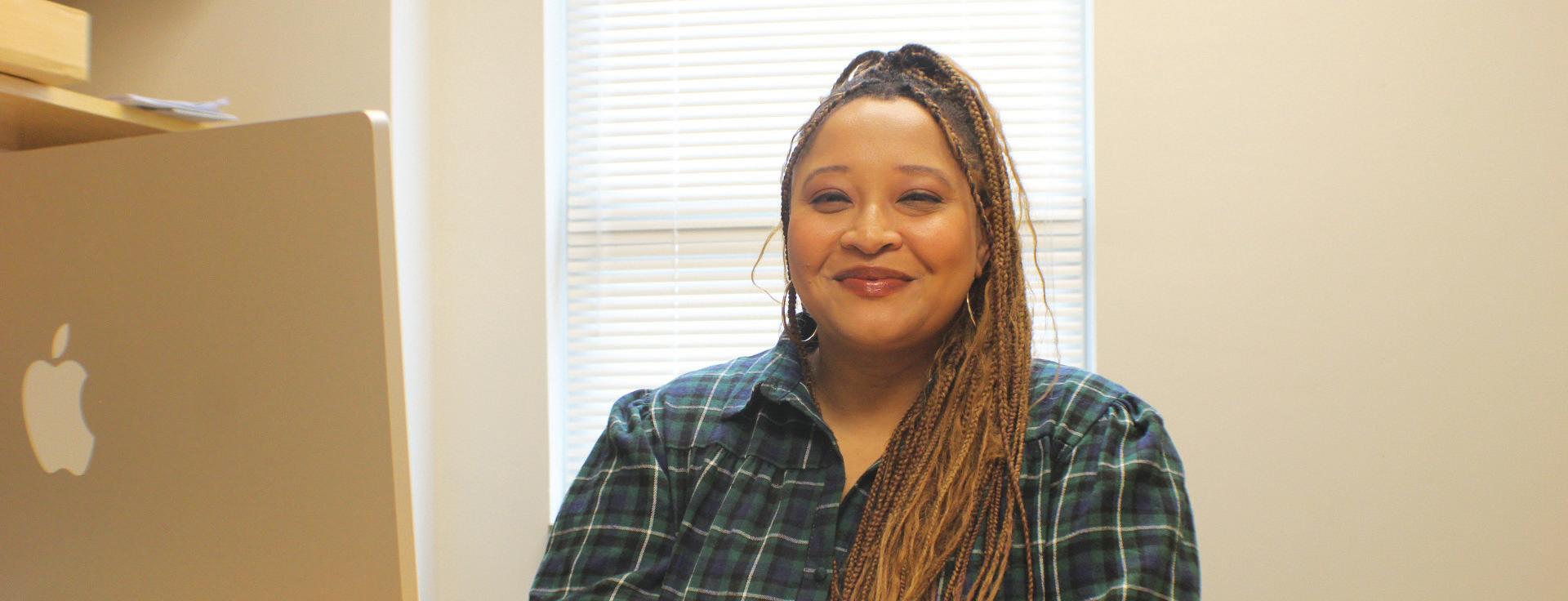
Political science professor Jamie Swift takes an international look at feminism. Emma Connelly / The Breeze
harrisonburgmill.com


OUR FLOOR PLAN

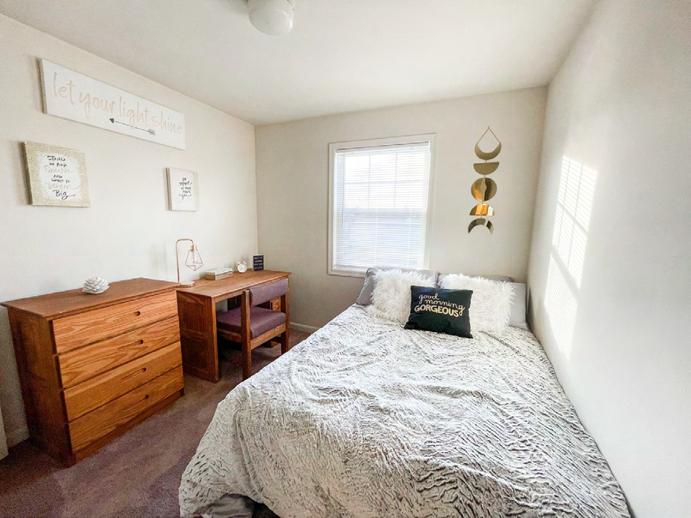
The Mill has one of the largest floor plans out of all JMU off-campus housing communities and is consistently voted “Best Place To Live” by JMU students. Our apartments include four bedrooms, two full bathrooms, full-size washer and dryer in extra large storage room, entertaining style floor plan, and thoughtful roommate design.

540-438-3322
WHO WE ARE
The Mill is an off-campus student housing community located right here in Harrisonburg! Our property caters to JMU students and our apartments come fully furnished and include cable, wifi, and utilities making life easy for our residents. We host monthly community events, giveaways, and many more fun and exciting things! Our hammock garden and outdoor area are the perfect place for students to study, relax, and unwind.
COMMUNITY PERKS
Fully Furnished
Utilities Included*
Washer/Dryer in Unit
Laundry/Storage Area
Central A/C and Heating
24/7 Emergency Services
Newly Upgraded Units
Wifi Included
*$20 electric cap
Walk/Ride to Campus
Corn Hole
Hammock Park
Basketball Court
FREE Parking
Pet Friendly
Individual Leases
Thursday, March 30, 2023 13
It takes a village

JMU nonprofit intern uses skills to capture mission trip media
By SABINE SOLTYS The Breeze
Hannah McAllister walks along the brown dirt road observing the small cinder block houses and shops ranging from the size of a closet to a small bedroom sitting on either side of her. Dogs scamper by and the smell of manure hits her nose as she passes by the cows and pigs. McAllister smiles at the moms walking by as they stroll through the street carrying their babies in brightly patterned sashes balancing them on their hips. The sound of laughter and early morning chatter fills the air as she makes her way to her social work class, held in one of the homes of villager Josefina Hernandez.
McAllister, a junior media arts and design (SMAD) major with a digital video and cinema (DVC) concentration and independent scholars double major, is an intern at the Village to Village Christian nonprofit in downtown Harrisonburg. She
went on a trip with the organization to Guatemala from Feb. 22 to March 1.
“The reason why I wanted to go on this trip is because I noticed that we did not have a lot of good images that represented what we did in Guatemala,” McAllister said. “I really wanted to offer my talents as a service to them … And it ended up being so much different than I expected in the best way possible.” By working with a nonprofit, McAllister gained a more positive professional experience than she had been getting in a classroom setting.
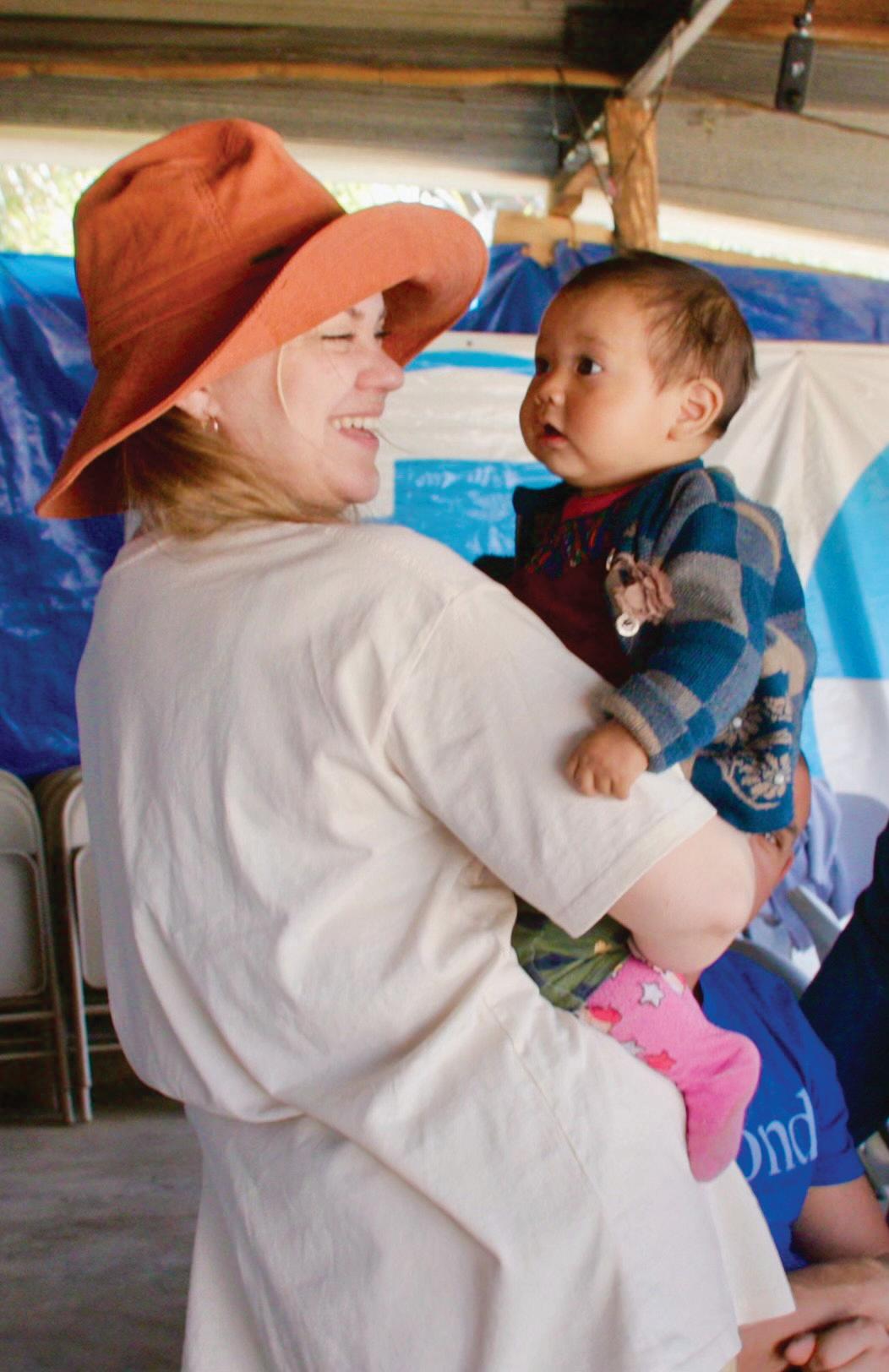
McAllister traveled with Village to Village Director Heidi Dove and nine other members of the organization to the small village of Bola de Oro, right outside the city of Antigua in Guatemala. There are around 550 families in this Mayan-indigenous village. McAllister said she loved how friendly and welcoming everyone was and she worked with many of these families hands on. In the morning, McAllister and other volunteers
helped with social work-type classes where they’d teach members of the village sustainable skills that would help them in the long run, such as nutrition, cooking and first aid. After lunch and classes, they’d complete home visits. It was during these home visits that the volunteers listened to the families and shared stories with them about how God had worked in all of their lives. They also helped them with anything they needed around the house.
“It was really cool to see how these families really opened up to us and started treating us like friends,” McAllister said.
On this trip, McAllister also took photos and videos to create more media for the trip. McAllister said she wanted to use her photography and videography skills from the DVC concentration to help serve and increase awareness of this trip, especially because Village to Village has been working in Guatemala for about eight years, but there’s very little evidence of it on their social media.
Thursday, March 30, 2023 14
Hannah McAllister traveled with Village to Village Director Heidi Dove and nine other members of the organization to the small village of Bola de Oro in Gautemala. Christian Wright / The Breeze
CULTURE
Dove and McAllister said they’ve been partnering with This is Vida spends every day in Bola de Oro and has formed a longstanding relationship with the community, allowing Village to Village to easily work there because of its previously formed relationship with Bola de Oro.
“The main goal is getting to know the families and getting them to be self-sufficient,” Dove said. “It is all kind of the same thing, just helping them to get on their feet without money and teaching them to live on their own.”
Village to Village also has the same mission in Harrisonburg: to help refugee families. As a Christian nonprofit, it works to resettle refugees by helping them find affordable housing, moving them in and hosting dinners.
“We just really try to walk alongside the refugee families past the government stages because they don’t last very long,” McAllister said.
“It is kinda cool because we build these long-term friendships and connections with them and it is just a very unique program and then abroad we do development and humanitarian work.”
While McAllister said the Guatemalan trip was an amazing experience, it wasn’t her initial reason for joining Village to Village. McAllister said she took an
introduction to humanities class, taught by Daniel Beers, the associate professor for the Department of Justice Studies and board member for Village to Village. It was during this class that Beers encouraged her to join Village to Village.
“I could just tell that she had a particular fire for this stuff,” Beers said. “So when I had conversations with her outside of the class about what she was thinking about doing in the long term and I knew that she was interested in communication and representation of aid beneficiaries, I thought she would be a great person to link up with Village to Village.”
When McAllister joined Village to Village, she said she saw a way to bridge SMAD, her humanitarian studies and her desire to serve. She said SMAD teaches her the technical side of things and independent scholars teaches her the statistics. But by working with Village to Village and getting hands-on experience, she said she’s also learning the professional side. She stated that she’s gained experience in serving and working with people, as opposed to simply studying it and finding new approaches to give back to the community.
“One of our main mottos is to live simply so that others can simply live,” Dove said. “It is about making decisions focused on saying, ‘I may not have a lot of money but what can I do with the time that I have?’”


For McAllister, she said she’s personally experienced this through serving refugees and families by using the skills and talents she’s acquired at JMU to tell these powerful stories. She said she hopes to continue working with Village to Village for as long as they’ll have her and she wants to go back to Guatemala to make a documentary video on the group’s work.
“You don’t have to go internationally to do amazing things,” McAllister said. “It can be right here in JMU too.”
CONTACT Sabine Soltys at soltysms@ dukes.jmu.edu. For more on the culture, arts and lifestyle of the JMU and Harrisonburg communities, follow the culture desk on Twitter and Instagram @Breeze_Culture.
Thursday, March 30, 2023 CULTURE
15
Hannah McAllister was able to use her SMAD, humanitarian and service skills to create new content on the trip. Photo courtesy of Hannah McAllister
“One of our main mottos is to live simply so that others can simply live.”
Heidi Dove Director of Village to Village
Thursday , March 30, 2023 16 Any delivery charge is not a tip paid to your driver. Please reward your driver for awesomeness. Drivers carry less than $20. ©2021 Domino’s IP Holder LLC. Domino’s®, Domino’s Pizza® and the modular logo are registered trademarks of Domino’s IP Holder LLC. 2101004 reunited reunited AND IT TASTES SO GOOD FOCUS ON YOUR FRIENDS AND FAMILY. LEAVE THE FOOD TO US.
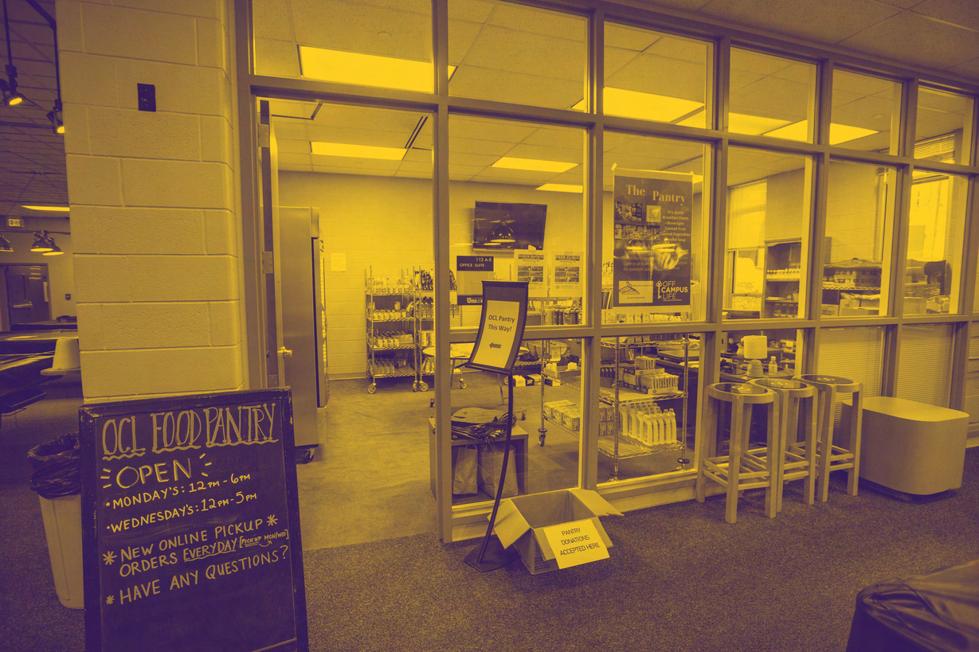


17 Thursday, March 30, 2023 TAYLOR DOWN UNDER ROOM 112 IN THE UNION PLACE AN ANONYMOUS ORDER AND PICK UP EITHER CHECK OUT MORE RESOURCES @ THE STUDENT SUPPORT HUB THE PANTRY
Shopin person Order on the app FLASH YOUR JAC CARD WEIGH GROCERIES @ GRACE ST PARKING DECK SHOP OR what we offer FOOD BASIC SCHOOL SUPPLIES HYGIENE ITEMS SAFER SEX CENTER ON THE RAPID PICKUP SHELF @ THE PANTRY CURBSIDE OR JMU.EDU/SSH
what to expect
Heroes off the field
JMU athletic trainers share stories of how they grew into profession, highlight parts of job
from ATHLETIC TRAINING, page 1
Why collegiate athletic training
Growing up in Rochester, New York, Lovgren is all too familiar with lacrosse. Western New York is well known for the sport, but Lovgren decided to go to Ohio for undergraduate and North Carolina for her master’s degree. With the Tar Heels, she worked with field hockey and track & field, being a part of field hockey’s 2018 and 2019 national championships.
Lovgren said she originally wanted to be a physical therapist after she experienced a shoulder injury in high school. She said she enjoyed seeing the recovery process and was convinced physical therapy was her ultimate goal — at least until she found out it was athletic training she was interested in, not physical therapy.
“I talked to her [cousin] about it and realized that athletic training was definitely more what I wanted to do,” Lovgren said. “Working with athletes and getting to go out to practices, there's more facets to athletic training versus physical therapy.”
Since deciding athletic training was her goal, Lovgren said she’s had opportunities to work with ice hockey programs, on top of her graduate program with UNC.
Lovgren said working with lacrosse is very different compared to ice hockey. She said that when working with ice hockey, she encountered more injuries dealing with blunt force trauma from players checking into the boards of the rink, whereas in lacrosse those injuries aren’t as common. She compared lacrosse injuries to those from women’s soccer, like ACL tears and other lower body injuries.
While Lovgren worked with hockey injuries related to blunt force trauma, Schneider faces the same, but with football.
Schneider said he had aspirations to work as an electrical engineer until the early 2000s. During that time, he said he saw many people lose opportunities due to instability in the job market — something Schneider said he never liked.
“I wanted stability in my life,” Schneider said. “I really like helping people, and so I went back to school to do medical school.”
While in medical school he saw his classmates wearing athletic training shirts. As he began to ask around about what the shirts meant, Schneider became more intrigued about the field. Soon after, he realized he was interested in the athletic training field and joined one of the rotations that assisted Texas State football.
“There was just something about the chaotic nature of football,” Schneider said. “The breadth of the injuries and illnesses, the emergency planning and just everything about a ‘no day is ever the same,’ I said, ‘I really liked this.’”
Relationship with student-athletes
Schneider went on to work with multiple professional football teams, such as the Detroit Lions, Jacksonville Jaguars and Houston Texans. As he continued to work with the NFL athletic training departments, he realized that with such a professional standard being held at this level of play, he was missing out on the relationship aspect with his patients.
“Every Tuesday we'd bring guys in, we would do tryouts. If they beat somebody out, they would just cut somebody and then add those people to the roster,” Schneider said. “So you would be sitting there trying to work on guys, if a guy was injured, maybe missing a little practice, they would just cut them and then add somebody in, so you kind of lost that relationship building process with them.”
Schneider said he enjoyed working with college athletics because athletes would come into the university as a 17 or 18-year-old, and from there, the trainers would have a few years to watch them grow and develop while also building a personal relationship with them.
Like Schneider, Lovgren said she enjoys being able to solely work with JMU lacrosse because of how she’s able to build personal relationships with her athletes.
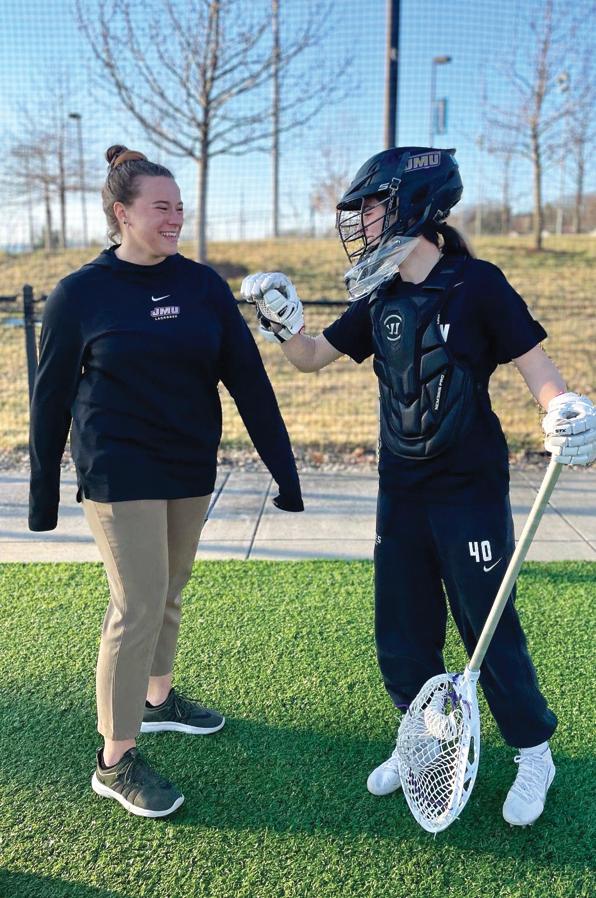
“I would say some of the biggest benefits are that I really get to know the girls on a personal level,” Lovgren said. “Also, you know their injury history as well, but getting to know their personalities a lot better and they get to know me because I can spend more time with them. I'm not getting pulled in multiple directions.”
Lovgren said because she’s building friendships with the players, it can be difficult to witness the injuries firsthand.
“Honestly, every time I have to watch when my athletes go through that injury, I find it very emotional,” Lovgren said. “I feel very attached to my athletes and seeing, you know, the look on their face, they know what happened. And you can just see, like, hope drain out of their face.”
Most student-athletes at JMU become extremely close with their trainers throughout their recovery process, even during some of their lowest moments in their collegiate career, seventh year defensive lineman Isaac Ukwu said. In some cases, like when former running back Percy Agyei-Obese had seasonending ankle surgery in 2021, or Ukwu tore his ACL, both worked closely with Schneider to get back on the field for the 2022 football season.
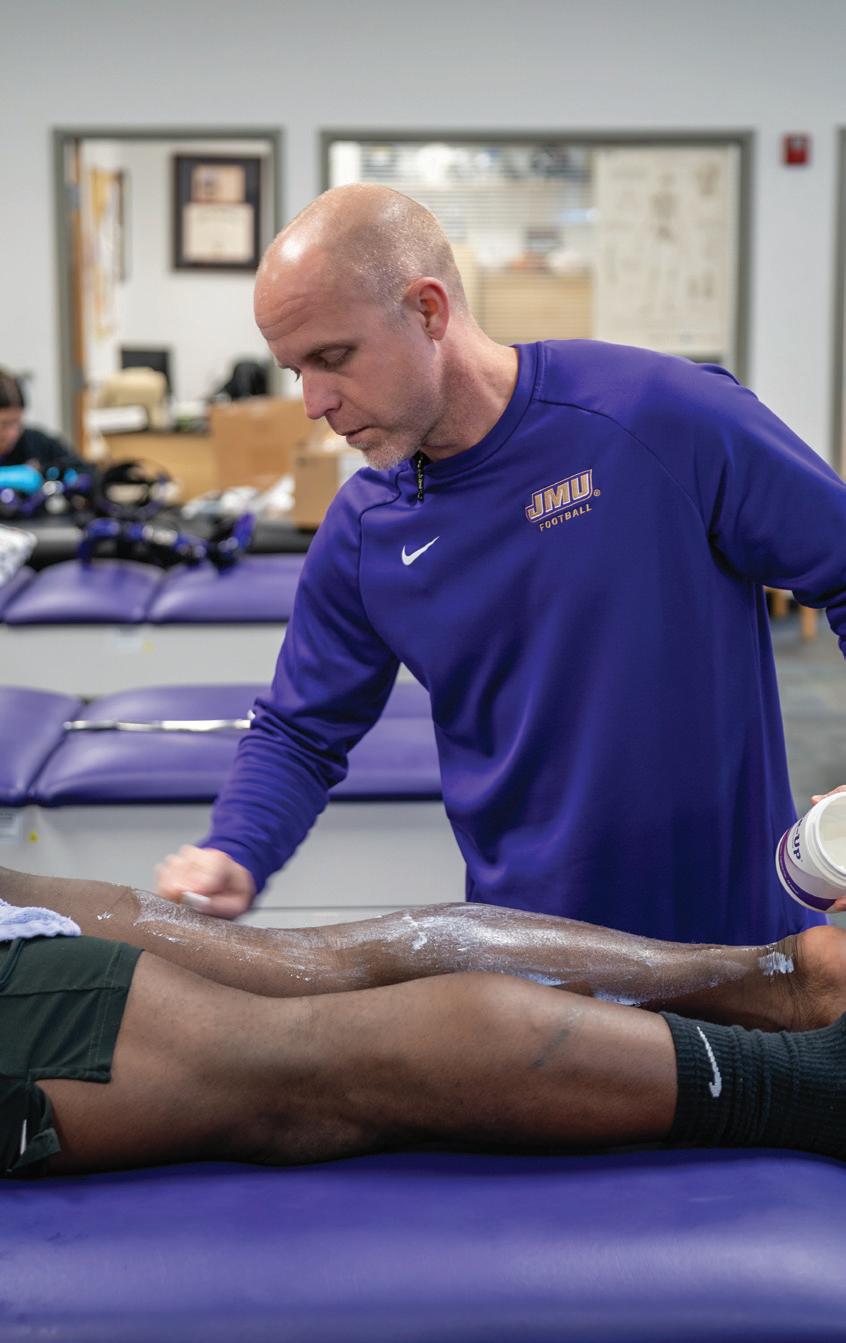
When both captains finally found their way back onto the football field last September, Schneider said his feeling of pride was worth the heartbreak he helped those two endure.
“Those guys, when they come back and they score the first touchdown and they get that first big play, I'm looking for him on the sideline, we're going and jumping and giving hugs and stuff,” Schneider said. “Because, man, that's awesome. You know, they work their tails off to get back to that level, and it's fun to be just a little part of that.”
Resource availability
When Schneider dealt with his patient who was suffering a stroke, he and the rest of the athletic training team went through the motions of activating the emergency action plan (EAP) and managed to transport the patient to U.Va. where the athlete was able to receive surgery and eventually make a full recovery.
Schneider’s team consists of masters program students who work alongside the rest of the athletic trainers. These students,
along with the ones found in Schneider’s work study, are all CPR and AED trained.
Eastern Mennonite University’s athletic trainer, Ian Smith, explained how for each situation comes a different action plan for the trainers to put into action.
He explained how for each of their athletic sites there’s an EMT available, and if there’s any sort of breathing issue or instance where a player is unconscious, the EMT will step in to help identify the problem.
Smith also explained how often, if the team’s able to, they'll take the players back into their designated locker rooms to evaluate for the sake of privacy and comfortability.
“Typically, we’ll get him back off the field and back into the training room,” Smith said. “I don’t like to do it on the sidelines because … it’s a little bit more comfortable here.”
Even though EMU, Bridgewater College and JMU athletic trainers may not overlap with their schedules often, Schneider said the process to become a trainer is still the same, it’s difficult to connect with one another because of schedules, particularly in the middle of the athletic year.
“We're all next door, right? But it's hard, we get in our own silos. We're here like 12-15 hours a day,” Schneider said. “So, after you work 12 hours, you want to spend time with your family, right? Go home, see my wife and my daughter and that kind of thing. It's hard to kind of break out of your silo and do those things.” That doesn’t mean connections don’t exist. Amidst the rainy, cold weather during Family Weekend on Oct. 1, JMU football hosted Texas State — Schneider’s alma mater. It was the third time the trainer had faced his former program, and he’s now 3-0.
Going out across the field for his pregame meeting with the Bobcats’ athletic trainers, he saw a few people he worked with and they took a group photo. While there are thousands of student-athletes across the country, there are only so many athletic training positions for those schools.
Schneider said it’s “a small world,” but that small world makes everyone better — Division I, II, or III.
“If you think about it, there's only like 130 head football trainers in the country in college. Right? And so there's only 130 of those spots,” Schneider said. “So we all know each other, we all lean on each other, and it's really cool.”
Kaiden Bridges contributed to this report.
CONTACT Madison Hricik at breezesports@gmail.com For more sports coverage, follow the sports desk on Twitter @TheBreezeSports.
18 Thursday, March 30 , 2023 @TheBreezeSports SPORTS
EDITORS Madison Hricik & Grant Johnson EMAIL breezesports@gmail.com
Athletic trainer Alex Lovgren shares a laugh with redshirt senior goalie Kat Buchanan at a JMU lacrosse practice.
Photo courtesy of JMU Athletics Communications
Athletic trainer Bryan Schneider performs muscle scraping on a JMU student-athlete. Christopher Timothy / The Breeze
IT TAKES TWO
Inside the across-the-board challenge scheduling presents JMU as top mid-major
By KAIDEN BRIDGES & JACKSON HEPHNER The Breeze
Some undisclosed top-25 football teams haven’t wanted to play JMU, Assistant Athletic Director for Communications Kevin Warner said. JMU women’s basketball has the same issue with high-major programs, head coach Sean O’Regan said: He rattled off Penn State, Pittsburgh, U.Va., Wake Forest and NC State as teams that didn’t want to play the Dukes this past season.
O’Regan credited many reasons why these teams didn’t want to play JMU — coaching staff transitions, scheduling conflicts or not wanting to commit to a full series. For football, the reasoning given for not playing JMU was simple.
“We’ve had several schools say, ‘no, you’re too good for us,’” Warner said.
These are just a few of the hurdles JMU coaches and administration face when creating schedules. In recent years, joining the Sun Belt Conference and the lingering impact of COVID-19 has added a whole new set of challenges. But through it all, JMU has put out a schedule for every sport — sometimes with a few wrinkles.
ThE mEThOd bEhInd ThE mAdnESS
When crafting a schedule, one of the biggest concerns for all sports is location. Warner said the school’s main focus was geographic location when first considering a move to the Sun Belt. He said there wasn’t an FBS conference that made geographical sense for JMU to join before the current rendition of the Sun Belt came along with Old Dominion and Marshall.
Prior to this year, the closest school to JMU in the Sun Belt was Appalachian State in Boone, North Carolina, a four-plus-hour drive on Interstate-81 south. But now with Old Dominion in Norfolk and Marshall in Huntington, West Virginia, JMU is still the most northern team, but “not on an island,” Warner said.
However, playing in a southern conference added an extra wrinkle to nonconference scheduling. Warner said that for all coaches, where opposing teams are located can be a big factor in designing schedules. One component is preserving recruiting areas and alumni connections — a task that has been emphasized due to the Sun Belt move.
Warner said that, historically, most of JMU’s students and alumni are from north of the Virginia-North Carolina border up to greater Boston. The Sun Belt’s footprint goes in the opposite direction, with Marshall and JMU being the most northern teams and the conference going as deep into the South as Texas and Louisiana.
“That is an important factor for all of our coaches in nonconference scheduling is making sure that we are playing in that mid-atlantic to northeast corridor to stay connected with alumni and to stay connected with recruiting areas,” Warner said.
Warner said women’s basketball’s participation in the Hawk Classic at Saint Joseph’s in Philadelphia was a good example of this. Philadelphia is a “big area for JMU,” Warner said, adding that many current men’s basketball players and incoming football recruits are from northeast areas like Pennsylvania, New Jersey and New York.
ThE
‘COVId hAngOVEr’
JMU women’s basketball spent the 202223 season playing nonconference teams like North Carolina and Maine at home, while traveling to play in-state foes like VCU and Longwood. O’Regan said JMU did a good job keeping distance in mind when scheduling this year.
He said he also believes this was an easier year to schedule women’s basketball because of the home-and-home series that JMU was finishing up, such as the North Carolina series. O’Regan introduced the fact that the team was overcoming the last hump of a “COVID hangover.”
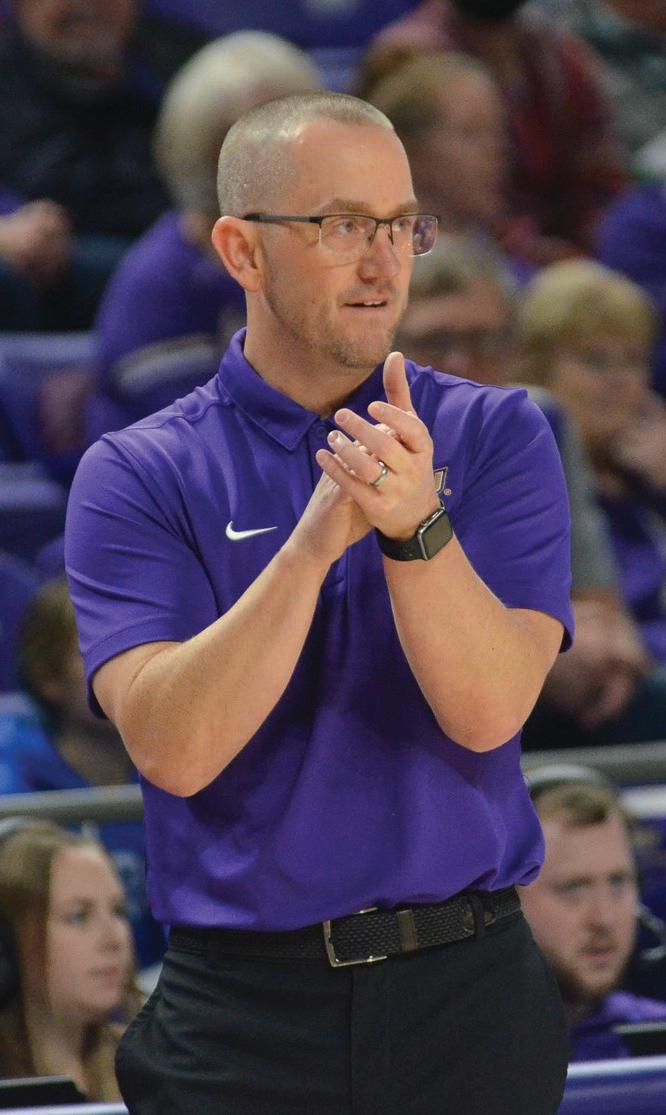
Because of the cancellation of games during the 2020 season, O’Regan had to add other teams to JMU’s schedule, such as Maryland and West Virginia, to fill out the rest of the season. With these extra additions, he said because other schools agreed to play JMU, the Dukes had to return the favor and play them at their home venues.
“I just wanted to play a game for our players back then,” O’Regan said. “So this year was the first year we got off of those COVID contracts. So for me, it was an easier scheduling year because we were freed up a little bit to start some new series.”
With being on the tail end of the COVID hangover, O’Regan said he enjoyed facing some bigger teams this year. This past season, women’s basketball finished 28-6 (13-5 Sun Belt) and made March Madness but lost to Ohio State in the first round 80-66. Scheduling doesn’t always work out the way coaches want, O’Regan said. He highlighted how he hasn’t been able to work out games with Virginia Tech in the past, and how JMU’s home-and-home finale with Maryland had to be postponed to a future season.
When including the desires of what a coach feels like a team needs in their nonconference stretch of a season, the science behind scheduling becomes much more elaborate.
“I think you have to prioritize what you want and try your best to go get it, which is not a guarantee,” O’Regan said.
TACKlIng fOOTbAll SChEdulIng
The scheduling process becomes different when crafting football’s, though. Most often coaches develop series between teams far in advance compared to other sports like basketball and soccer.
Football is also the only sport at JMU that has a team of administrators who help draft the schedules for the upcoming seasons, whereas in other sports, it’s the coach’s job. But not only do the coaches have to approve and sign off on their draft but also the other various departments that keep JMU athletics in order.
Once the coaches believe they have the draft of their schedule finished, it then has to be approved by the sport administrator, facility staff and JMU’s compliance staff, ensuring that facilities will be free for use the day of the game and that the schedule follows NCAA guidelines, like not exceeding the maximum number of games. Once all groups involved approve, the schedule can be released.
Warner said the biggest change in regards to scheduling games in the Sun Belt, as opposed to the CAA, is the singlegame financial guarantees. With nonconference games against Power 5 schools, the prices increase because Power 5s can beat JMU and it now counts toward bowl eligibility, which drives the market rate for single-game guarantees higher.
The change is steep: JMU in 2019 received $550,000 to play West Virginia as an FCS school and in 2027 will get $1.4 million for playing Maryland. The Louisville (2022, $600,000) agreement was signed before JMU moved to the FBS, Warner said in a followup message to The Breeze on March 28, and therefore it’s below market value. He said U.Va. (2023, $550,000), while signed after the Dukes’ FBS jump, was viewed as a “unique opportunity” and the lower guarantee isn’t indicative of future agreements with U.Va. or other ACC teams.
Power 5 schools within a close proximity to JMU are also appealing, Warner said. Administration sees that if two close teams play against one another, such as JMU versus North Carolina, Virginia Tech, Virginia or Maryland, more tickets will be sold because of easy travel to and from these games for the opposing fans, he said.
Sometimes, though, proximity has to be conceded to fill holes in the schedules. In this upcoming football season, JMU is currently set to play Utah State in Logan, Utah, on Sept. 23. But the Dukes have the Aggies returning the home-and-home series in 2025 in Harrisonburg.
Warner explained that the process behind scheduling Utah State was that not only were there limited options as to who had open matchup spots, but since BYU is becoming a member of the Big 12 many of its regular season game contracts had to be canceled, which leaves teams like Utah State with an open hole that needs to be filled by another nonconference team.
“This is only the second time we’re ever going to have played west of the Mississippi River,” Warner said. “So if we’re going to become more national, planning some of these West Coast teams will help us to expand.”
nEW fOES fOr ThE Sun bElT
New additions to JMU’s opponents includes the Sun Belt-MAC Challenge, meaning that starting in the 2023-2024 season, each Sun Belt basketball team will be playing two Mid-Atlantic Conference teams, one at home and one on the road.
“We’re just excited about the possibilities at these partnerships,” Sun Belt Deputy Commissioner Kathy Keene said. “To me, when you look at nonconference scheduling, they’re so critical. They’re really just another piece to making a better nonconference schedule work for everyone. We’re hoping that it is the first of many when it comes to working with the MAC.”
Keene also added that this challenge between the two conferences in a model that the Sun Belt would be open to experimenting with other conferences, too. She said she also wants to open the floor to other sports too, not just basketball. Keene used softball and baseball as examples she said she believes would make sense to implement the Sun Belt-MAC challenge into.
“I think these partnerships are going to be critical to not only looking at things kind of a little bit out of the box,” Kenne said. “They help from a financial standpoint, and also help from a nonconference scheduler standpoint when it comes to strategizing, how to schedule and how to really create a better balance in your schedule.”
Despite some of the bumps in the road that occur for coaches when scheduling, switching to the Sun Belt and opportunities to compete against top nonconference programs have been beneficial to JMU teams across the board.
“I think when you come here and sign to play for JMU, that’s what you’re doing this for,” O’Regan said. “You want to be challenged.”
Read the full story online at breezejmu.org
CONTACT Kaiden Bridges at Bridg4ke@ dukes.jmu.edu. Contact Jackson Hephner at Hephnejt@dukes.jmu.edu. For more sports coverage, follow the sports desk on Twitter @TheBreezeSports.
Thursday, March 30, 2023 19 SPORTS
Women’s basketball head coach Sean O’Regan watches his team face Troy on Jan. 21. Ryan Sauer / The Breeze
Preview | The Ragin’ Cajuns come to Harrisonburg
JMU softball to test No. 25 Louisana’s 75-series Sun Belt streak
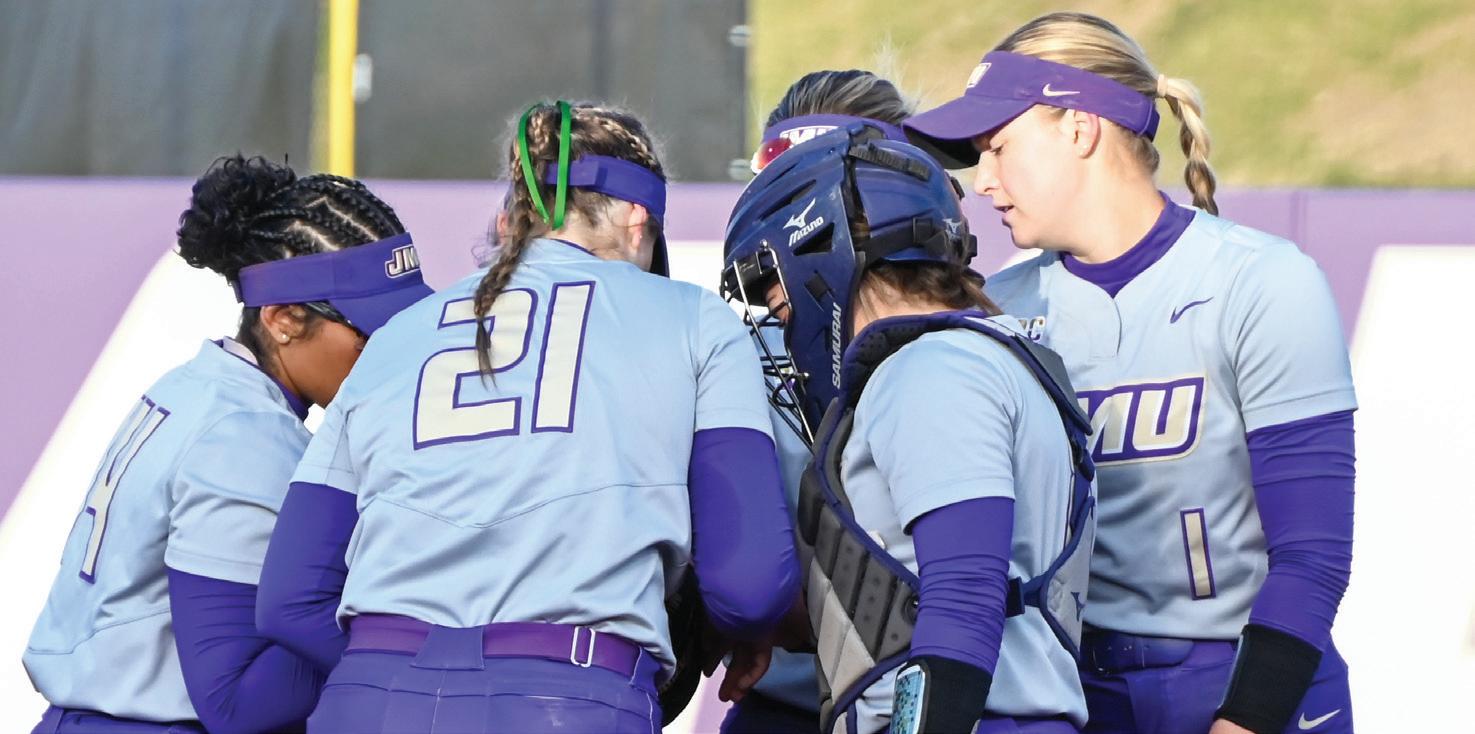 By RYAN MCGOWAN The Breeze
For the first time since the Women’s College World Series, JMU softball’s won seven games in a row. Suffice to say, the Dukes are hot heading into their second home Sun Belt Conference series. Their opponent: No. 25 Louisiana, the winner of 75 straight Sun Belt series matchups and the conference preseason favorite. This weekend marks the first series ever between two midmajors with World Series appearances.
This series will be the third matchup between these teams. They last played in 2014, a game that ended in a 3-0 JMU victory. This is the first time since a 6-4 loss to No. 4 Florida on Feb. 27, 2022, that the Dukes are matched up with a ranked opponent.
The Ragin’ Cajuns have been Sun Belt softball royalty for the last 10 years. Since 2013, Louisiana has made every NCAA tournament with two super regional and a WCWS appearance. In the last five years, the team hasn’t made it out of the regional round but has made appearances in the regional finals.
Pitching matchups will be essential to success as both teams rely heavily on two starters; freshman Kylah Berry and junior Alissa Humphrey for the Dukes and sophomore Sam Landry and senior Meghan Schorman for the Ragin’ Cajuns.
Humphrey has appeared in 19 of the Dukes’ 27 games, starting 14 with a 8-4 record. She’s thrown for 88.1 innings, nearly half of the team’s total innings pitched. Berry has taken an increased role in recent weeks following sophomore pitcher Rebecca Muh’s injury. She has an 8-0 record with five starts in 12 appearances. She leads the team in ERA with 1.77 and is second in innings behind Humphrey with 51.1.
In recent series, either Humphrey or Berry has started the game, with the other coming in to relieve the starter. This was true in JMU’s series against Georgia Southern — the Dukes only played Humphrey or Berry in all three games. With this pattern expected to continue, it’s important that both starters are sharp and fresh against Louisiana.
The Ragin’ Cajuns sport a pitching duo with differing experience levels and stability. Kentucky transfer Schorman has the experience for Louisiana, landing on the All-Sun Belt Second Team in 2022 and posting 79 strikeouts through about 70 innings pitched. Landry offers youth and a different look to hitters but also is a strikeout pitcher. The sophomore has 71 in 63.2 innings pitched.
JMU and Louisiana have a deep stable of hitters, forcing pitchers to battle with multiple threats in both lineups.
Former No. 4 softball recruit KK Mathis has looked as good as billed for the Dukes, especially
following an offensive explosion last week.
Mathis has become one of the Dukes’ most complete offensive threats in her first season, leading the team in hits, RBIs and ranking second among starters in home runs and batting average.
In last week’s series against George Mason and Georgia Southern, Mathis had 12 RBIs in five games, with a go-ahead grand slam and a walkoff single to defeat George Mason in a doubleheader March 22.
Along with newcomer Mathis, JMU relies heavily on veterans who took part in the Dukes’ 2021 run to the WCWS. Graduate infielders Hallie Hall and Hannah Shifflett are two of the team’s leaders in the locker room and on the field. The two have had strong starts to their final seasons in purple and gold, starting all 27 games and leading the team in OPS — a measure of on-base percentage and slugging — meaning that Hallie and Shifflett threaten hitters with their power and ability to get on base.
Junior outfielder Kylee Gleason and sophomore infielder Jasmine are less experienced than Shifflett and Hallie but are looking to build off their roles from last season. Jasmine had a breakout freshman season, earning Second Team all CAA honors. She started 31 games in her first season, finishing with the fourth most hits for the team with 34. She’s on pace to break that mark as she already has 26 hits through 27 games and has already surpassed her mark of 19 RBIs last season.
Gleason had a limited role last season, only starting 12 games. This season, she’s claimed a consistent starting spot. She joins Shifflett, Mathis, Jasmine and Hallie as the only Dukes with 20 plus hits through 27 games. Like Jasmine, the development of Gleason and other veterans growing into expanded roles will prove crucial in defeating the preseason favorite Ragin’ Cajuns both in this weekend’s series and the final Sun Belt standings.
South Carolina transfer Karly Heath leads the Ragin’ Cajuns with 24 RBIs this season and seven home runs. The senior also has a team-high 30 hits. Louisiana also had six players named to the All-Sun Belt team, more than any other team in the conference.
Both JMU and Louisiana are on the heels of Sun Belt leaders Marshall, which is undefeated in conference play amid an impressive 17 game win streak. The weekend series will provide both teams with an opportunity to distance themselves from the other and potentially pass Marshall should they falter in their series against Georgia State.
Savannah Reger contributed to this report.
CONTACT Ryan McGowan at mcgow3sr@dukes. jmu.edu. For more softball coverage, follow the sports desk on Twitter @TheBreezeSports.

20 Thursday, March 30 , 2023 SPORTS
Graduate first baseman Hannah Shifflett, graduate third baseman Hallie Hall, junior pitcher Alissa Humphrey and others huddle up in the Dukes’ 6-2 win against Saint Joseph’s on March 9. Savannah Reger / The Breeze
MAKE MAKE THE THE CHOICE CHOICE TO LIVE... TO LIVE... SAFE with

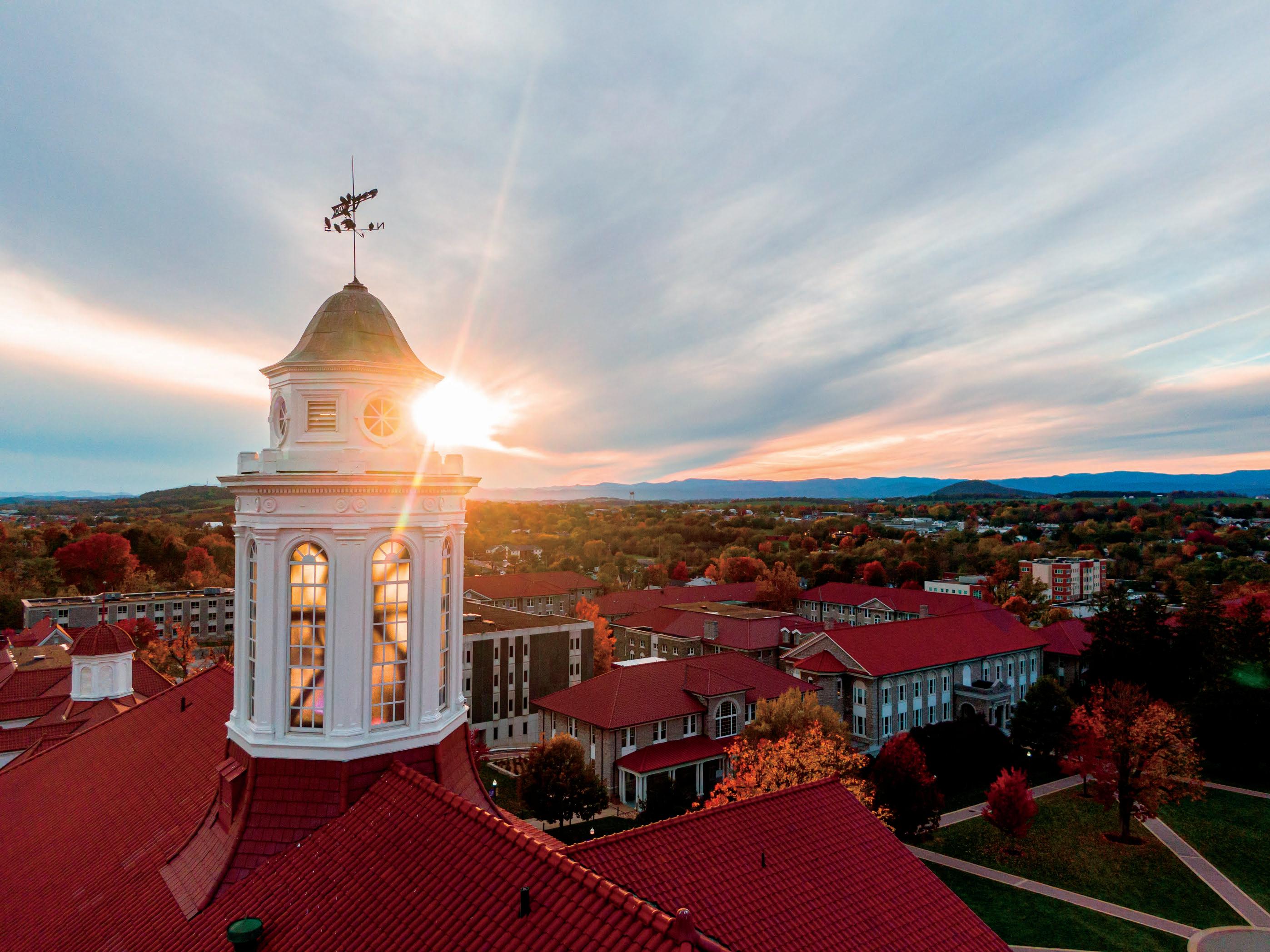
CLOSE SUPPORTED CONNECTED


21 Thursday, March 30, 2023
Family business
Trio of sisters provides feeling of family for JMU lacrosse
By ZACH MENDENHALL The Breeze
For JMU lacrosse, family ties run deep. Facebook groups, email chains and tailgating are just a few of the many ways that JMU parents stay connected. But amongst the team, that connection is even easier, especially when three pairs make sisters.
This season, the Dukes have three sets of sisters, two of which are twins. Each pair primarily plays a different position, with one on defense, one in the midfield and one on attack. 47 goals and 59 points have been contributed to the team’s total so far from the sisters
The Dukes are the only team across the AAC to have three sets of sisters, but five of the seven AAC teams have at least one. Sister duos are present at Old Dominion, Florida, East Carolina and Vanderbilt, who have two. Across JMU, the only other team to contain a set of siblings is the football team.
One pair is a minute apart from each other, one pair traveled from Minnesota and the other contains the team’s top goalscorer. Each duo is unique in their position and where they come from, but each can agree that JMU Lacrosse feels like family.
The Pirisinos
Junior defender Lizzy Pirisino and junior midfielder Alex Pirisino played together in high school, but playing together in college is a whole new level of competition, Lizzy said. Along with games that are more competitive, the intensity of practice is “crazy different,” Lizzy said.
Alex, the older of the twins by a minute, said the first year of playing in college for her and her sister wasn’t easy, as their connection was “a little rocky” at first. Lizzy often pushed her sister to do better during practices, she said. Now that the pair both play defense together, Alex feels it’s the “best thing ever,” as their chemistry has come alive.
“I feel like I’m definitely more on the intense side compared to Alex, and I tend to get on her a lot in practice, but I’ve learned to let her be her own person,” Lizzy said. “She’s let me be my own person and we’ve grown separately, so it’s good.”
As a defender, it’s important for Lizzy to
control the middle and ensure her team is connected in the back, head coach Shelley Klaes said. “Lizzy Pirisino is the leader, the terrier in there commanding,” Klaes said.
Alex not only has accomplishments in lacrosse, but soccer too. She was a dual athlete in high school playing for both her lacrosse and soccer team, even helping take her team to an IAAM title her freshman year. As for lacrosse, she started for the varsity team all four years.
Lizzy has 14 ground balls and eight caused turnovers this season and earned her firstcareer assist against Virginia Tech on Feb. 15. Alex registered two goals in four games during her first season, but hasn’t scored since.
“I think that our ability to push each other and to always be honest really makes us a family,” Lizzy said. “On the field we have great connections … We know a lot of things about each other and we’re honest.”
After this season concludes, the two will have one more year to play together at JMU.
The Mattises
When they attended high school in Lakeville, Minnesota, junior midfielder Geneva Mattis and redshirt sophomore attacker Olivia Mattis were both star players for their team, but after coming to college, the two have been driven to learn to adapt to different scenarios together.
“It’s definitely special, being able to come to college so far away from home and having someone you know and who you can live with and have that built-in best friend,” Olivia said. Having her sister there makes it feel like a “piece of home” is always with her, Olivia said.
Geneva said the two stood out in high school, each sister earning First Team All-State nominations and Geneva ranking first in the state while her sister second, but have learned to adapt to different situations together and in college. It’s fun to watch each other grow on different levels, Geneva said, allowing them to push each other in different areas.
Before this season, the two hadn’t played with each other since junior year of high school. Geneva tore her ACL junior year of high school, both contracted COVID-19 in senior year of high school and Olivia tore her ACL freshman year of college. Last season, Geneva only played two games, while in her nine games for the
Dukes, Olivia scored five goals and earned two assists.
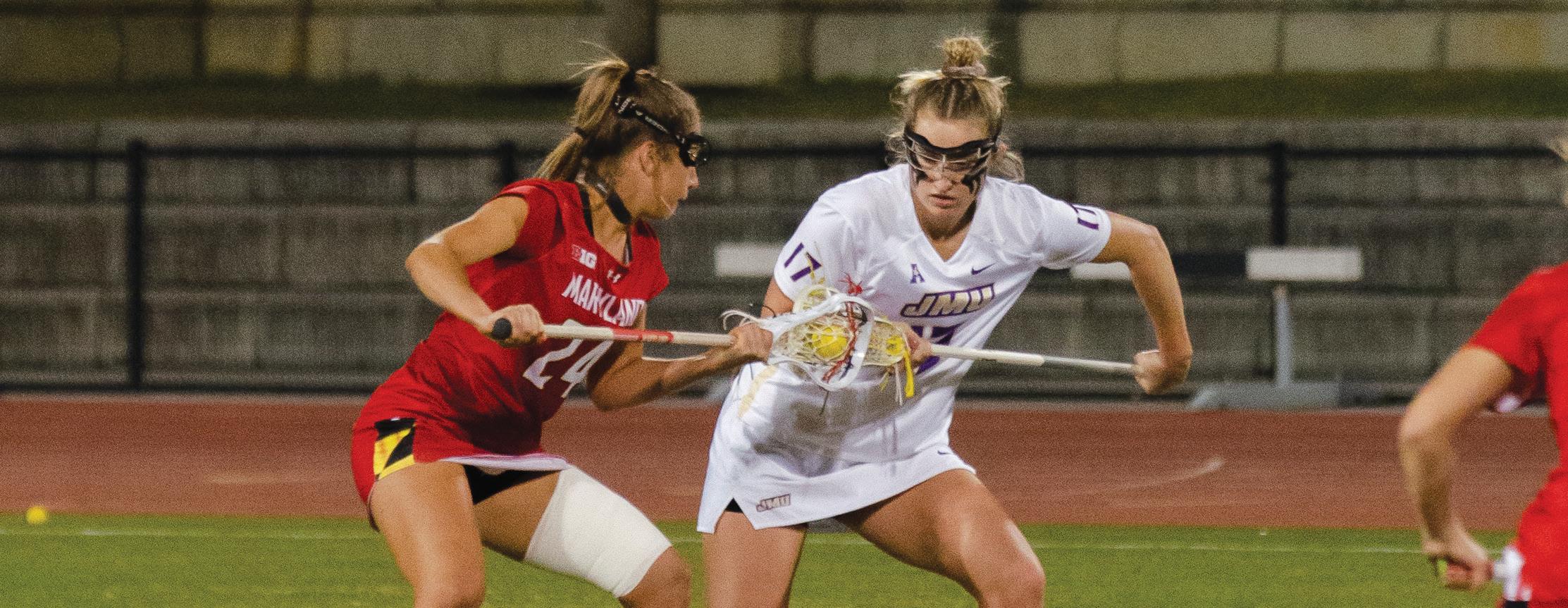
“It’s fun to finally play together again,” Olivia said, “and know that the chemistry is still there.”
Olivia said it’s nice to have a twin sister on her team in college. The two know when they need to push each other and where they can both do better, and say “it’s a learning experience,” Olivia said.
“I think it’s just nice to be able to mature and grow together,” Geneva said. “Our connection has just grown stronger because we can relate to each other, athletics and school.”
The twins are used to being far away from home together. After Hurricane Harvey wiped out multiple Texas cities in 2019, they traveled to Vidor, Texas during that summer to rebuild the city.
“I can go to anyone on the team to talk to because they’re all like family, but having immediate family there is really helpful,” Geneva said. “Being so far away from home, it feels like a piece of home is there with you.”
The two both said they’re excited about how the team and them are playing. After their loss to Loyola in the second round of the NCAA Tournament last year, they have a “chip on their shoulder,” and are hungry and ready to show everyone how hard they have been training.
Beside having personal goals of improving confidence and play, each sister wants to go “all the way” this season.
“We’re really there, we’re with the team, we want to win and we want to win big,” Olivia said.
The Petersons
With 72 goals in 19 starts last season, redshirt junior attacker Isabella Peterson has already established herself as the top goal-scorer for JMU; she’s tacked on another 43 goals through 11 games in 2023 — fourth-most in the country. But a new member on the team may be looking to follow in her footsteps in the future — Isabella’s sister, freshman attacker Jordan Peterson.
Both sisters began playing lacrosse when Isabella was 7 years old and Jordan was 4. They’ve been playing together since Jordan was in fourth grade. The last time the two played together was Isabella’s senior year and Jordan’s freshman year on the Hereford High School
team in Sparks, Maryland.
Their father, Eric Peterson, said the two played for different club teams growing up, as Jordan always “did her own thing”. This led to Isabella being unsure if Jordan was going to end up at the same school as her, but when the decision was final, she was happy Jordan had found a place where she wanted to be, Isabella said.
Now with her sister on board, there are still places for Isabella to grow.
“We’re looking to make her more vocal,” Klaes said. “She’s been a leader by example for a while now just doing it for us and showing us it can be done and now we’re excited … to get a little more inside of what she thinks and what her standards are.”
Jordan is one of eight new additions to the team this year, and one of two new attackers. She hasn’t started any games this season so far, but she earned Presidents List in the Fall 2022 semester, and her father called Jordan “the smartest person I know.”
“Jordan I think is more methodical at everything that she does,” Eric said. “She reminds me of an engineer or a CPA or a numbers person, where she needs to know everything exactly.”
With time, it became easier and easier for Jordan to “picture herself” at JMU, she said. She already feels close to the team, saying that a sense of family is something that is “embedded into the program.”
“Now that she’s here, it feels like how it did in high school, obviously at a higher pace,” Isabella said.
Jordan said that one major difference from high school is the time commitment. She feels she’s been with every member of the team since the fall season, where in high school it was only a 2-3 month ordeal.
Jordan may not have the height that her sister does, but her dad says she’s a “physical specimen.” She was deadlifting 225 pounds at age 14, Eric said, on top of running a six-minute mile. He said her intelligence also stands out,as she’s the type of person to earn a 99% on a test and wonder why she missed one point.
22 Thursday, March 30, 2023 SPORTS
Redshirt junior attacker Isabella Peterson draws against a Maryland player on March 1. Isabella plays for the Dukes alongside her sister, freshman attacker Jordan Peterson. Ryan Sauer / The Breeze
Once Eric saw Isabella thriving at JMU, he said he was “all for” Jordan tagging along. Schools like Villanova and Towson were also interested in Jordan, Eric said,, but he said at the end of the day, she wanted to be with her sister.
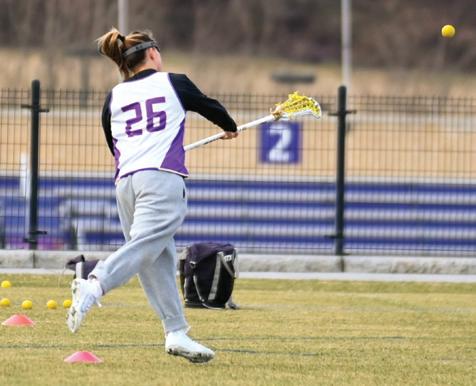
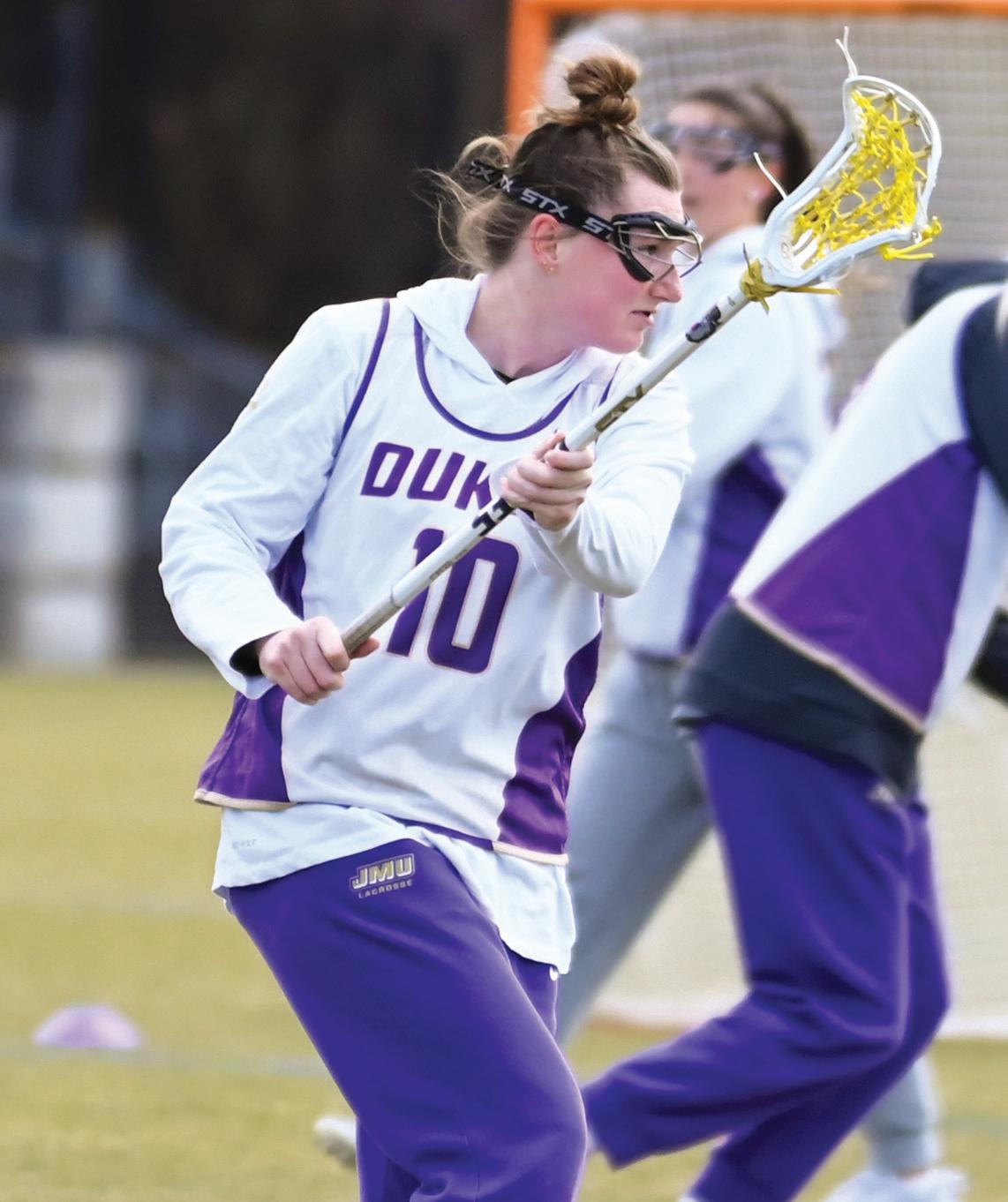
“Every high school athlete looking to play in college knows recruiting is difficult … but having Isabella go here, I had a little bit more exposure to what the program was like and I loved it,” Jordan said. “Initially I hadn’t really visited or seen the campus much … but after going to a couple games and meeting people on the team, that’s when I kind of started to realize, ‘This is where I want to be.’”
When one of the sisters is having a rough day, the other is always available to talk to the other, Jordan said, adding that being alongside someone as experienced as Isabella is nice, as she’s always receiving tips and pointers to improve her game.
“Every pair of sisters know that sisters fight but in the end we are best friends, and I know she’s always there for me and we can rely on each other,” Jordan said. “We’re always there for each other all the time.”
The duo feels their connection will only continue to grow while playing together. Having played together while growing up, they each know how one another plays the game, allowing for their connection to only continue over the next two years of competition, Isabella said.
“We are always doing extra work together,” Isabella said. The days that she shows up to the field earlier than everyone else, so does her sister. Jordan said it’s nice to have the extra work and be alongside someone as experienced as her sister. The two are able to hold each other accountable.
“We see a lot more of each other, which I love,” Jordan said. “I’m so happy that we’re here together because we’re so close and we’ve always been close … We’re not afraid to talk to
each other like, ‘Hey I’m open next time, pass me the ball,’ and with that on-field connection, I only see it growing.”
The Petersons will be together one more year after this season concludes, as next year will be Isabella’s last. When her sister is gone, Jordan is unsure of where she’ll be on the team, but she plans to continue working as hard as she has in the past and see where the future takes her.
Klaes said she believes the presence of three sister duos reinforces the “family environment” already intact among the team. It also promotes individuality, as each sister can still be their own person.
“I love that people are confident enough in this program that they want to follow their older sister or bring their twin with them and just go through it together,” Klaes said.

Thursday, February 16, 2023 23 SPORTS
CONTACT Zach Mendenhall at mendenzl@ dukes.jmu.edu. For more field hockey coverage, follow the sports desk on Twitter @TheBreezeSports.
Redshirt sophomore attacker Olivia Mattis run downs the field during a practice. Savannah Reger / The Breeze
Junior Alex Pirisino fires a shot during a practice. Savannah Reger / The Breeze
OPINION
Evan Weaver breezeopinion@gmail.com EDITOR EMAIL @Breeze_Opinion

Goodbye graduates
Senior editors say farewell and remember their time at The Breeze
CHARLOTTE MATHERLY Editor-in-Chief
A “this-is-a-conspiracy” dart to my professors who assigned essays that were due the same week.
From
I’ve been writing this column in my head for the past two years. When I came in as a baby freshman culture writer, you couldn’t have convinced me that I’d be where I am today. I applied to The Breeze on a whim my first week on campus, thinking it’d be fun to learn a new kind of writing.
But the more time I spent here, the more I knew this was something special for me. When I started as a culture editor in 2021, I couldn’t help but start drafting what I wanted to say when it finally came my time to leave. For so long, this seemed so far away, in the distant future. And somehow, as I write this, I’m still struggling to come up with the words.
It’s hard to sum up four years of inside
A “that’s-a-relief” pat to getting a job offer this week.
From a senior who has one less thing to worry about.
jokes and kickass journalism. Four years of late nights, mistakes, laughter and tears. I’ve spent the last two years in our little office on South Main Street, probably more time than I’ve spent at my own house, and I’m so much better for it.
When I came here, I really didn’t know what I wanted to do. I was just kinda sorta sure I wanted to do journalism. I’m happy to report that I still don’t have it narrowed down — but, if anything, I got such a wide range of experience here that I’ve had the chance to do it all. And I’ve loved every part of it.
I’ve tried my hand at all different types of reporting, including but not limited to investigations and enterprise, local news, politics, features and business. I even did an interview on Breeze TV (scary!) and shot
A “this-is-unacceptable” dart to the Chic-fil-A on East Market Street for being closed.
From a regular customer who can’t wait for renovations to finish.
A “best-of-luck” pat to the graduating members of The Breeze.
From your replacements.
multiple galleries chronicling JMU sports (photo girlies, ily). And I pride myself on having a byline in every section of The Breeze — even sports, which if you know me at all, you know that’s a huge accomplishment for me.
I’ve had the time of my life here. But as fun as it’s been, leading this paper is the hardest thing I’ve ever done.
I’ve covered and led this staff through lots of tragedy and difficult reporting. We’ve had tough conversations about how we should cover topics like student deaths, mental health, gun violence and sexual assault — heartbreak and crises that as a journalist, a student and a member of this JMU and Harrisonburg community, I’d hoped we’d never have to go through.
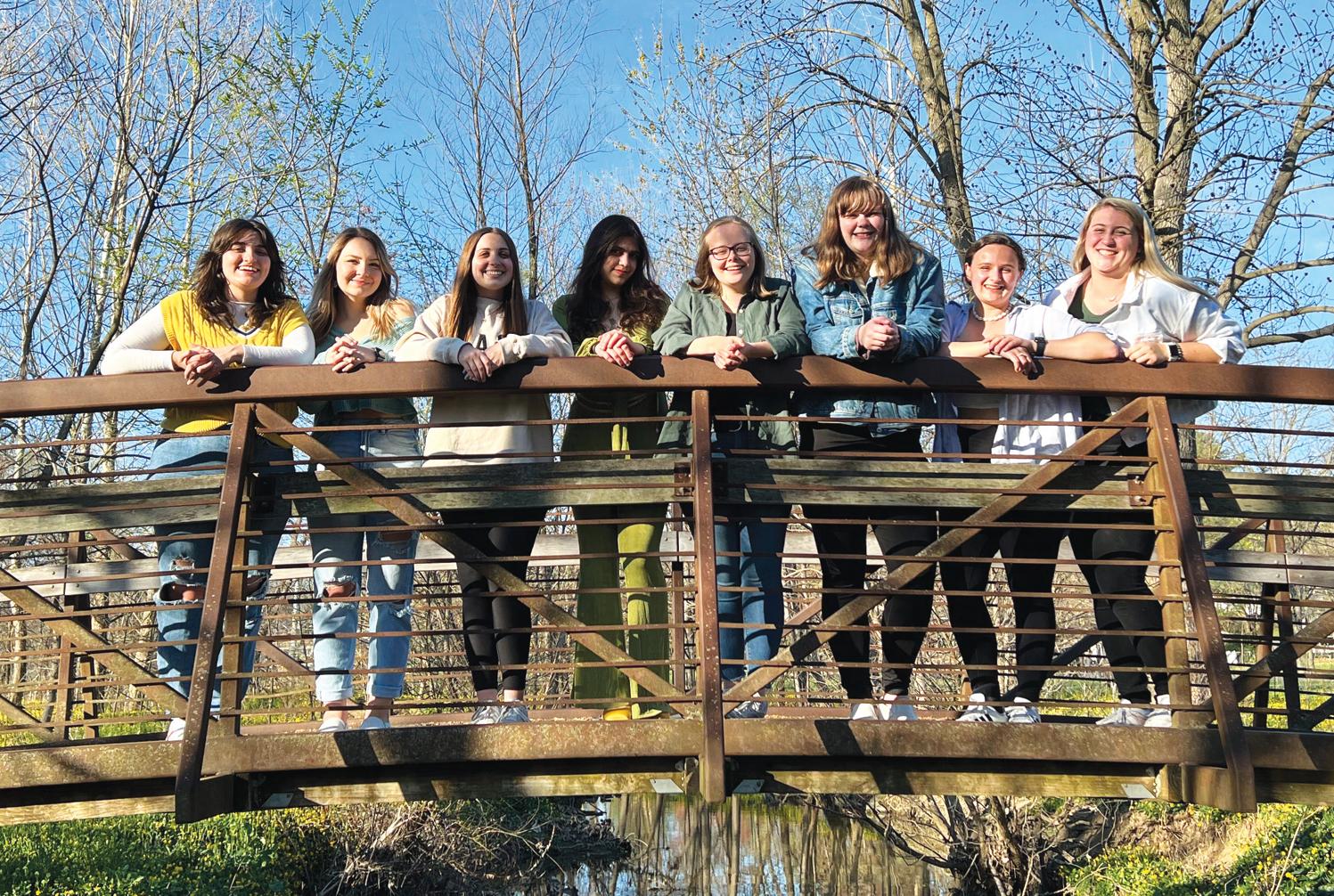
24 Thursday, March 30, 2023
someone who has a hard time concentrating on more than one thing at a time.
The Breeze 1598 S. Main Street Harrisonburg, VA 22801 Editorial Policies The Breeze welcomes and encourages readers to voice their opinions through letters and guest columns. Letters must be no longer than 250 words. Guest columns must be no more than 650 words. The Breeze reserves the right to edit submissions for length, grammar and if material is libelous, factually inaccurate or unclear. The Breeze assumes the rights to any published work. Opinions expressed in this page, with the exception of editorials, are not necessarily those of The Breeze or its staff. Letters and guest columns should be submitted in print or via e-mail and must include name, phone number, major/year if author is a current student (or year of graduation), professional title (if applicable) and place of residence if author is not a JMU student.
Want to praise someone or get something off your chest? Darts & Pats is the place to do it. Submit your own at breezejmu.org.
Senior staff members on their last week at The Breeze. Blake Shepherd / The Breeze
Even so, I’m proud to say we covered these most difficult moments with care, sensitivity and respect. And none of that is possible without the careful attention and dedication of this staff.
This year and this organization are special because of every staff member and editor who’s given their all to make it special. I’m extremely proud of all the hard work we’ve done. You all are incredible journalists and people, and I consider all of you among my best friends.
To Zia Faqiri (first name: Zia, last name: Mia, occupation: your mom) — Sure, things went sideways as soon as you got back from London last year. But there’s no one I’d rather take to get a tetanus shot. Thanks for always pushing me out of my comfort zone and for being my ride or die. We truly went through the best and worst parts of this year together. I can’t wait to frolic with you and make the most of our last month of college together.
To Savannah Reger — Ah! Best friend, my other half, miss girl, I love you. Coming into this year, I had no idea how close we’d get. It’s a little scary how we always know exactly what the other’s thinking. I will always love our Dukes Dining dates and lying on my office floor with you and kicking the soccer ball down the hallways of the Breeze office. Savannah, you are so much more talented than you give yourself credit for. I’m so proud of you, and The Breeze is better because you were here. I can’t wait to live our city girl
dream this summer.
To Ashlyn Campbell — Yelling about journalism with you is my favorite pastime. Thank you for everything this year. Thank you for always pushing me to take risks and to fight the good fight — the world needs more journalists like you. Thank you for tackling the hardest, scariest stories with me. There’s no one I’d rather have in my corner. And if you ever end up going to live in the woods and making a newspaper for bears, hit me up.
To Madie Hricik: Thank you for growing up with me. I remember our first French classes together and studying for SMAD 101 exams, and I’m amazed at how far we’ve come. We were section writers together and editors together, and honestly, it’s gonna be a little weird to do journalism without you sitting right across the room. I’m so proud of everything you’ve accomplished, and I can’t wait to see you thrive post-grad.
To Kailey Cheng, Traci Rasdorf and Amy Needham: You guys are my core Breeze memories. Kailey and Traci, thank you for taking a chance on a shy freshman who just really liked to write. Amy, you will forever be the best co-editor, and I miss you every day. I still listen to The Cure in your honor. We all need a culture girlies reunion soon!
To Michael Russo, Avery Goodstine and Grant Johnson: I know you’re ready for whatever next year throws at you. I’ve seen each of you grow into your own this year, and I couldn’t be more proud of you. Each of
SHIRIN ZIA FAQIRI Executive Editor
Life is so strange. I’m completely different from the me I was four years ago when I first came to JMU my freshman year. The first risk I ever took at JMU was going to a Breeze TV show early in the fall of my freshman year and I was TERRIFIED. The studio was so big and everyone else seemed larger than life running around, speaking in this code that I hadn’t quite deciphered yet with vernacular that was foreign to me. I was panicking and about to run out the door when the then news director, John Kelly, came to talk to me. He was my counselor for my yearbook camp in high school and we were co-counselors that previous summer. I was surprised to see him and even more surprised when he told the studio director, Julia Weaver, to put me on a camera because he knew I could “handle it.” I guess he was right because from that day forward I came to every show, and then eventually every pitch meeting, then every production night. For the next few years, my life was filled with Breeze TV and journalism. I was addicted to the energy that came from putting on a show. Being around these people I wanted to be more than who I was. I wanted to be the person I had only dreamed of being. For
you care so much, and with your dedication and drive, I know I’m leaving this paper in capable hands. Take a deep breath, take it one day at a time and enjoy every moment. I’m always a text or a phone call away and I’m always rooting for you.
To Brad Jenkins, Blake Shepherd, Roger Soenksen, Gwyn Mellinger and Joe Hinshaw: The Breeze wouldn't exist without you, and everything we’ve done these past few years wouldn't have happened without your support and advice. Thanks for always taking my (sometimes panicky) phone calls at all hours of the day. You have always had our backs, and The Breeze is lucky to have you championing our journalism.
To Ryan Alessi — I can’t count the hours I’ve spent in your office. I’ve come to Harrison 0255 close to tears so many times this year, and every time, I leave with a renewed fire and hope. Thank you for being an incredible mentor, adviser and friend, and for teaching me that when it seems like something’s impossible, there’s always another way. Your advice, energy and encouragement have made me a better journalist and a better person. I hope I’m half as cool as you when I grow up.
To my family: Thank you for being my biggest cheerleaders. Thanks for letting me bounce ideas off you and cry on your shoulders, and thanks for being so understanding every time I’ve had to excuse myself from family plans to deal with
whatever mishaps, shenanigans and fires I had to put out. I’d be nothing without you. I love you.
Because of The Breeze, I’m ready to move on to my next big thing. But this newspaper will always be my home and have a special place in my heart. This will always be my circus, and you will always be my monkeys.
It’s weird to say goodbye to something that’s so ingrained in your everyday life, something that’s a part of you. I joke that I’ve “sold my soul” to The Breeze, but it’s true: My friends are here, my passion is here, my life is here. So what do I do now that it’s my turn to leave?
After way too many consecutive 16-hour work days and the growing pains and the blood, sweat and tears I’ve put into this newspaper, I guess all I can do is hold on to everything I’ve learned and all the memories and friends I’ve made.
And when all is said and done, I’m proud to leave this beautiful thing better than when I found it.
So, last but not least, to the next staff — I’m so excited for you, and I’m confident that we’re leaving The Breeze in the best hands. My advice is simple: Give it your all. Take the time to do this right and enjoy it. Cherish every day you have here, every grueling hour spent in the office, because I promise you’re going to miss it someday. I can’t wait to watch you all grow. Go knock it out of the park.
And please, for the love of God, don’t forget to turn the lights off when you leave.
my last year here at JMU I had the incredible opportunity to oversee both the print and TV side of the organization. I’m proud to say that I have accomplished everything I had set out to do this year and more. I am so grateful to the people in my life who pushed me to be the best version of myself and believed in me.
To John Kelly: Thank you for trusting me my first day and believing in me. That was all I needed.
To Julia Weaver: I love you so much. You were like my big sister in this organization and you taught me to be confident in myself.
To Alli Baxter: I miss you endlessly. Thank you for being there for me during the good and the bad, I love you.
To Colby Johnson: We’ve run into each other a lot this year, but you probably won’t see much of me anymore from now on, take care and I wish you all the best.
To Charlotte Matherly: Besides you interviewing me a few times for the SMAD website, we didn’t know much of each other before this year but boy does a few months stuck in the office change that. This was a strange year and I wouldn’t have been able to get through it without you, you’re the best EiC I could have hoped for.
To Savannah Reger: We really stuck it out
until our senior year, huh. I loved growing with you and exchanging print and broadcast stories with each other. Now I guess we have to grow away from each other, I can’t wait to see what you do on your path through the industry.
To Ashlyn Campbell: Whenever I was on a hard assignment, you were always the first one to ask if I was okay. In the world of news and deadlines, I always admired your kindness and consideration.
To Michael Russo, Kayla Brown and Grant Johnson: You’ll push this organization to new heights. I’m just sad I won’t be there to see it.
To Zoe Mowery and Maggie Rickerby: Watching you two grow has been one the greatest pleasures I’ve had in my few years here. You are both amazingly talented young women with the experience to back it up. Be the guiding light for your staffers that I know you can be.
To Ryan Alessi, Brad Jenkins and Ryan Parkhurst: Every year is different, and every year was more challenging than the last. Things came up that none of us could have predicted. Thank you for advising me and being some of the people I could trust.
To Jon Wenger and John Hodges: You keep this organization afloat and I am so grateful
that you two were only a few steps away from the studio to help out with any bizarre complications.
To Dr. Mellinger and Dr. Soenksen: You both taught me valuable lessons in a way I will never forget and were always there to support us and answer any questions we had. That’s all any student journalist can hope for, so thank you.
To Dr. Joe Hinshaw: You were always honest with me and that is a quality I value, especially from those with more experience than me. Thank you.
To my lovely print and broadcast staffers: You all have the potential to be one of the greats in any field you choose. I've loved getting to know you all and work alongside you this year. One of my greatest pleasures in being executive editor was listening to you all and finding solutions to your problems. I’m always a DM or phone call away, and that applies to any staffer.
I had gotten close to so many seniors in my time here and it broke my heart every time to see them leave. Now it’s my turn.
When I walk into the Alison B. Parker studio now, everything looks so small, but the people are still larger than life. Even though they’re not the same people I knew my freshman year, The Breeze attracts the hungry and determined.
25 Thursday, March 30, 2023 OPINION
SAVANNAH REGER Online Managing Editor
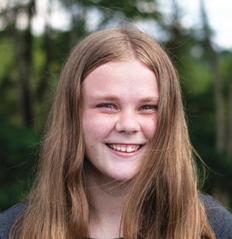
A girl stands in the basement of Roop Hall. This freshman at JMU has her hair down and wears an overall dress.
She has a black T-shirt on as the base and wears the Birkenstocks her grandma bought her for her 17th birthday. She’s just finished her first day at college but isn’t done for the day.
She walks into a room with her roommate. Side by side, the two squeeze in the doorway and see two couches. On one of the couches sits the only girl in the room, her legs crisscrossed, and a guy sits in a chair. The girl and her roommate who enter the room take a seat on the other couch.
The boy in the chair turns and looks at them. “You’re here for sports, right? Because video is in G18.”
“Yes” both respond. “We’re here for sports.” “Cool,” the boy says. He has a Murray State sweatshirt on. “I’m Noah.”
“And I’m Catie,” The girl on the couch says, “We’re your sports editors.”

The girl, who entered the room, smiled. She watched them talk about JMU football in awe. She watched her editors get excited about how they’re going to practice. That’s what she wants, that’s what she’s always wanted.
The girl applied and got sports editor as a tiny freshman. She was so excited. But COVID19 struck. The girl was sent home and didn’t return for five months.
From there, the girl learned about herself. She learned what it took to make a newspaper and learned how to train writers. A year later, she covered an unprecedented spring football season. She lived her dream by following JMU softball to the Women’s College World Series. She covered JMU’s move to the Sun Belt. She went to Fargo, North Dakota, and watched the Dukes compete in the FCS semifinals. She rose to managing editor and got to watch people grow around her. She picked up photography
and found out she was just as passionate about that. She grew the entire organization, the one constant in her life for four years.
Her name is Savannah.
To mom and dad: I love you guys so much. You have no idea. I wouldn’t be anywhere without you. No matter what’s happened and what life has thrown my way, you’ve been there. You guys are my rock. Thank you for reading every little story I’ve sent you and looking through my countless photos. Thank you for always supporting me and telling me when I was wrong — I needed to hear it. I love you, forever
To Catie Harper: I made it my own. I couldn’t have done it without you.
To Katelyn Foster, Ivan Jackson and Alexa Fitzpatrick: You took a chance on a tiny freshman who had idea what was in store for her. Thank you for giving me the opportunity to live out my dream. I’m forever grateful to all of you.
To Noah Ziegler: Thank you for being the big brother I always needed. Noah, before the school year started, you told me you hoped sports editor would be me. You have no idea how much confidence that gave me. I always looked up to you and I’m so happy you were my first co-editor. You’re one of my best friends and I know no matter what, you’ll have my back. Thank you, endlessly.
To Jake Conley: You always hated my one-liners, so that’s what you get :)
To Moonball Nation: Thank you for being my best friends that I could tell anything too. Thank you for the memes and jokes that made us giggle at budget. You guys are the best friends I always needed. I love y’all.
To my 2022-23 staff: You guys were quiet at first. But you still light up the room. Never change. Never quit. Guess what, our analytics were better than last year for a reason. You impressed me each and every day. I love you guys.
To JMU softball: Thank you for being my absolute favorite sport to cover. Thank you for letting me in your life to tell the most important stories possible.
Thank you for the trip to Oklahoma City and letting me watch something I’d only ever dreamed of. Fly high 22 <3
To Ah-be and Ryan: You’ve turned the photo section into everything I ever dreamed of. Abi, words can’t express how proud I am of you. You took over the photo section and handled it so well. Be proud of yourself, be confident. I’m always going to be rooting for you. Ryan, you are the best photographer to come through here in four years. Your drive can’t be matched. You are absolutely incredible and never fail to make me laugh. Never forget who you are.
To Michael Russo and Avery Goodstine: My two baby culture editors are now leadership. It never doesn’t make me smile. I am so, so proud of you guys. Your smiles light up the room and it resonates on the rest of the staff. Stay true to yourselves and trust your gut — you were born for this moment.
To Zia Faqiri: Look at us. We did it. We survived COVID-19 and we became leaders of the organization we grew up in. We became powerful and we became a force to be reckoned with. I’ve had you by my side through it all — my Breeze TV half. Thank you for everything. You’re one of my best friends through and through. By the way, we have to go to another Caps game.
To Ashlyn Campbell: Remember SMAD 210? Remember sitting outside and listening to you know who ramble about who knows what? Yet, I would hear your class exercise ledes. They were amazing. I knew you would be incredible and you are. I’m so proud of everything you’ve done and endured. You’re a champion and always come out on top. In a way, you saved me. Thank you, Ashlyn
To Grant Johnson: You will never know how proud I am of you. Grant, when your name appeared on the screen at Media Fest, I started crying. I cried on the phone with Noah afterward and I could tell whe had tears in his eyes too. We knew you would be exceptional from the start. And you were. I mean, the Washington Post? Absolutely incredible. But guess what? I’m not surprised because you’ve
earned it. My little writer is now the Editor-in-Chief of The Breeze. I’m so proud. Don’t lose who you are kid, and I’ll always be rooting for you.
To Charlotte Matherly, Cha and Miss Girl: Look at us. Look at where we ended up. God, I can’t imagine you not being here with me. You are my rock and my absolute best friend. Like 100% one of my bridesmaids. I love you and you make leaving The Breeze so much harder. Charlotte I mean it when I say there’s nothing I wouldn’t do for you. You made everything worth it. I know this year hasn’t been easy for a lot of us. But even at my worst, you were there lifting me up. I’ll miss our escalator trips, mirror selfies and our Dukes dates. Babe, I’ll always save your seat.
To Madie Hricik: We knew we were destined to be roommates. We took SMAD 101 together and had our first staff meeting together. You and I both grew up at The Breeze but also with each other. We stood through the pouring rain at Valley Baseball League games, “girlbossed” in your car before football games and woke up at 2 a.m. to get on a plane to North Dakota. We lay off our beds in Chandler Hall giggling and talking about stories. We joked that JMU Athletics thinks we don’t leave each others sides and burst into each others rooms constantly. And yet, through it all, we’ve figured out who we are. When we left Chandler for COVID, I wrote you a note. I told you to never lose yourself and that you are the sister I’ve never had. I still mean that. It’s you and I homegirl, no matter where life takes us.
I have a wall in my room of every print story I’ve ever had. It starts with my first-ever print story, Decades of Success, about JMU volleyball head coach Lauren Steinbrecher and ends with a pitching piece for JMU softball. I read the stories from time to time and each time I’ve seen how much I and The Breeze have grown. I love it here. It’s brought me my best friends and the people I will always turn to. So thank you, and have a great week!!
26 Thursday, March 30, 2023 OPINION
ASHLYN CAMPBELL Print Managing Editor
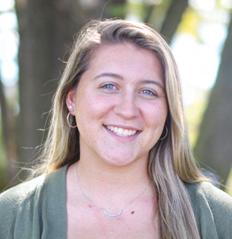
I really never thought I was going to be a journalist. Actually, at one point I’m pretty sure I told my parents that I didn’t want to do journalism. But I joined The Breeze in the fall of my sophomore year because I had a miserable freshman year and had almost no friends and I needed to do something and have somewhere to go in the midst of COVID-19.
After writing for literally a semester, my news editors Connor Murphy and Carley Welch suggested that I apply for a news editor position, and honestly, I was scared shitless. I have crippling anxiety and felt completely out of my league, but I applied because they told me to.
It completely changed my life.
Covering anything and everything, from suing JMU to diversity initiatives to politics, I’ve gained so much experience and confidence. I’ve learned so much from other people and have been shown how important it is to have a community of student journalists to cover some of the most difficult topics in college life today.
I’m pretty sure when I first joined the staff my sophomore year, I didn’t talk to anyone. Now I can’t imagine going a day without talking to some of you. The Breeze and its staff has completely taken over my life and I can’t imagine a better way to make friends and impact our community.
Honestly, there are probably so many stories and jokes that I won’t be able to remember for this column. My brain is broken and my memory is terrible, and I’m sure when I go back to read this, I’ll kick myself for forgetting one thing or the other. To everyone at The Breeze, even if I don’t name you, know that I love and admire you, and I can’t wait to see the work you all accomplish, but now isn’t the time for a Jake Conley article. So, here we go:
To Connor and Carley: Thank you for asking me, and for some reason trusting me to apply for new editor. I probably wouldn’t have done it without y’all.
To Jake. Thanks for yelling “NEWS!” and making me run around Harrisonburg like every other day.
To Kamryn Koch: My former co-editor and my gay news sweaty :), I can’t imagine navigating being a news editor without your help. The constant freaking out about stories and dealing with *** was made so much more tolerable with you by my side.
To Kasey Trapuzzano, thank you so much for putting up with us. You reminded me a lot of myself, being a writer for a semester and getting
MADIE HRICIK Sports Editor
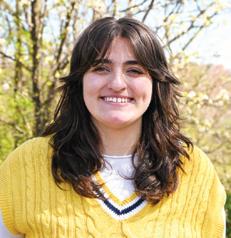
There were two sayings I grew up on: Happiness is a choice and always finish strong.
The second was something my coaches always told me, but I think the saying applies here too.
I’ve been dreading writing this piece since I knew it was a thing my freshman year. Since day one, my college experience has been surrounded by nothing but The Breeze — and I won’t lie, it was the main reason I came to JMU.
But now as I look back on four years of Wednesday deadlines, endless tweets, Zoom
thrown right into news editor. You’ve taken it all in stride, even when it was really frustrating (and I know it’s really frustrating).
To Madie Hricik: My (former) desk buddy, honestly watching you do kickass work in sports has been incredibly inspiring. I’m constantly astounded by all of the hard work you do. Watching you makes me tired.
To my family: Thanks for listening whenever I called to complain about the world or yell about journalism. I know it’s not always the most interesting thing but you listen anyway, and I can’t thank y’all enough.
To Zia Faqiri, I think I’ve told you this before, but thank God you’re executive editor. I can’t imagine anyone who would’ve done a better job, and I admire your ability to not take anyone’s shit. You make me want to be a better journalist.
To Savannah Reger: The second half of the managing editors, thank God we were together at the beginning of last spring. Thank you for talking with me when life was hard. You’re a phenomenal journalist and I ‘m jealous of your storytelling ability. Working with you as a managing editor has been the most fun.
To Charlotte Matherly: Thank you for fearlessly leading The Breeze. You’ve done an amazing job navigating so many weird and hard situations with so much grace. You’re thoughtful and kind and handle difficult topics and situations with so much nuance. Thank you for always genuinely listening and hearing me out, you make me feel seen.
To Grant Johnson, Michael Russo and Avery Goodstine: I knew the minute y’all were applying for leadership that The Breeze was in good hands. You all bring so many different strengths to the table, it’s one of the most exciting things I’ve seen. Be kind, listen, go into situations with an open mind and focus on nuance. But don’t be afraid to push for the truth, and push hard. And don’t make my mistake and not post the crossword answers.
To the new staff: I am so incredibly excited for you all to embark on the weirdest journey of being a student journalist. It’s weird and hard and a lot of fun, and I know every single one of you are going to do phenomenal work. Never stop asking the hard questions, even if it pisses people off. Especially if it pisses people off.
Mostly, thank you to everyone, both old staff and new, for putting up with me and my daily rants and my bad moods and my constant oversharing. And most of all, for making me feel like I finally had a home.
And that’s my narrative.

and Blindr interviews, and way too many cups of coffee, I can sit here and say I made it.
It’s crazy to think that it all ends in just a blink of an eye. If I’m honest, I’m not sure how I should feel, since so much of my last four years have been dedicated to The Breeze. If you know me, you know I’ve always gotten excited for the littlest things. And for me, that was going to my first game as a reporter, my first story in print, the first time I broke JMU news, the day I got sports editor. I didn’t know the first thing about college sports coming to JMU — it was all new and exciting.
see GOODBYE , page 28
Thursday, March 30, 2023 27 OPINION
from GOODBYE, page 27
But I never did a single thing alone. Even before I covered my first game, I had my best friend and roommate, Savannah Reger, right by my side. We stayed up until midnight on FaceTime writing our Breeze applications together, walked to meetings from Chandler Hall and eventually took on the world as co-editors. She’s been my girlboss everyday as we did the impossible together.
So, to Savannah: We did it. We made it to the other side. And by some miracle, we came out even better. Saying goodbye sucks, but just like how we started together, I’m seeking comfort in saying goodbye together.
I remember standing in line at the Ulta in Valley Mall after a mere four hours of sleep the night before, getting the call I got sports editor — and then I remember neither of my parents picking up the phone when I tried to tell them.
So I called the next two people who needed to know — Catie Harper and Noah Ziegler, my first editors.
To Catie and Noah: You both never gave up on me and you have no idea how much that meant to me. I hope I’ve lived up to your expectations and I hope to keep making you both proud every single day. P.S. We still need to do a reunion night.
To the sports staff: You guys truly made my college experience. Even when I questioned if I was good enough to do this, you all were always there to remind me why I’ve loved this job. Keep being a bunch of goofballs. It makes things so much more entertaining.
To the coaches and players who I’ve covered for the last four years: You all made these stories real. Thank you for trusting me. I hope you’ve enjoyed at least a few of the stories I’ve written about you all (even if you just liked the photos).
To mom and dad: I never felt unsupported by you both. You always told me to go the extra mile and stay true to myself. Mom, I know the last four months have been incredibly difficult for all of us, but thank you for not allowing me to give up on myself or waiver on my goals throughout it all. And dad, I hope I keep making you proud while you watch from Heaven.
To Kaiden Bridges and Jackson Hephner: It’s your section now. Don’t let anything or anyone stand in your way. You both have worked so hard to get to this moment, so savor it and buckle up.
To Grant Johnson: Take care of the paper, bud, it’s all your call now.


And finally, to the mentors, editors and bosses that have guided me along the way: Without your faith in me, I’d never be anywhere as confident, as hungry or as anything as I am now. I can’t ever thank you all enough, and I hope to keep making you all proud throughout these next steps.
I don’t think I could ever thank every single person enough for what they’ve meant and done to me — there’s too many. But I can say this: I’ve never felt more proud to leave an organization that’s better than I found it.
This world isn’t perfect. But in my four years here, The Breeze has always been perfect.
28 OPINION
KASEY TRAPUZZANO News Editor
Coming into JMU, I had no idea what I wanted to do with my life. I began SMAD as a creative advertising concentrator and felt like an imposter sitting in those classes. I was uninterested and disengaged. Little did I know it was because The Breeze and the journalism world were calling my name.
While I’ve only been a part of The Breeze for a short 1.5 years, it’s since shaped my time at JMU. The Breeze has given me a passion and a purpose that I’ve never felt before in any aspect of my life. It’s given me the best guidance, friendships and reallife experiences that I couldn’t have ever imagined gaining during my four years in college.

To Professor Alessi: You’ve truly had the greatest impact on my time at JMU and changed the trajectory of my academic career and route after graduation. I don’t think I could ever thank you enough. Your enthusiasm in our SMAD 210 class single-handedly made me realize my love for journalism and want to switch into the journalism concentration. You pushed me out of my comfort zone by telling me I should write for The Breeze, and if it wasn’t for that, I probably never would’ve. As a somewhat quiet person, I never thought any of my professors at JMU would know my name, let alone become my mentor and friend. Thank you for always being so supportive, giving me advice and answering my many emails no matter the time of day. I’ll miss stopping by your office next year to chat, but I hope we keep in touch!
To Ashlyn Campbell and Kamryn Koch: Thank you for encouraging me to apply for news editor and seeing something in me that I didn’t yet see in myself. Thank you for pushing me. I quite literally wouldn’t be in this position if it wasn’t for y’all and the 8 p.m. “Kasey, I have a proposition for you” text last spring. Ashlyn, my news bestie and my righthand, I wouldn’t have made it through the year


without your constant help and support. It was scary and intimidating beginning this role without a co-news editor, but I always knew you were in my corner. You’re a force to be reckoned with, and you’re going to do great things, whether it’s in journalism or something else. I’m happy our paths crossed. Please keep in touch! P.S.- I’m sorry I was bad at color checks.
To Emma Johnson and Madison Mills: Thank you for keeping me sane. Good luck next year. I’ll miss you both!
To Charlotte Matherly, Zia Faqiri and Savannah Reger: You three are absolute queens and I’m so happy I had the opportunity to work on your editorial staff. I can’t wait to see what y’all do after graduation. Please keep in touch! P.S. — Savannah, if I ever hear, “I need you to add five more keywords” again in my life, it’ll be too soon.
To my co-news editor: Oh, wait!
To my news writers: Thank you for being the best section of staff writers and for making my job easy. When I started last spring, I had a sad little section made up of three writers. Now, I have a group of 13 solid writers. Y’all have continued to impress me week after week and it’s been my pleasure leading you this year. Good luck and continue doing great things!

To Lizzie Stone and Eleanor Shaw: You two are an absolute dream team, and I couldn’t be more confident in handing you the reins of the news section. It’s made me so proud to watch you both grow as writers and journalists this year and I’m happy I had the opportunity to be a part of your journey at The Breeze. Remember me when you’re both famous journalists!
When I look back on my time at JMU, I’ll think of The Breeze and the place that quickly became my home. While I don’t know what life has in store for me after graduation, I know The Breeze equipped me to succeed in anything that comes my way. I’ll forever cherish my time as both a news writer and a news editor for The Breeze. Thank you. Goodbye!
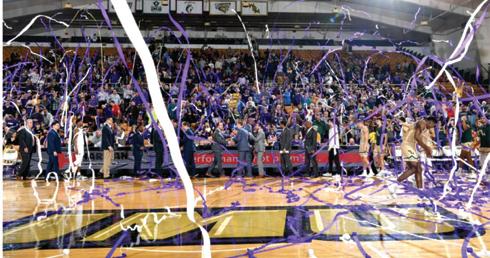 HALEY THOMAS Copy Editor
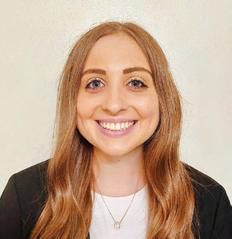
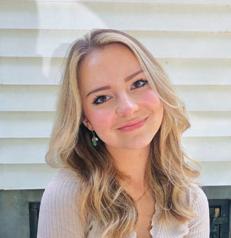
I debated doing an introduction for this column, then I was told, “People know who you are.”

How on earth do you sum up The Breeze in 500 words? The answer is simple: You can’t. I started working at The Breeze at the beginning of my junior year. I was the most introverted, self-judgmental person in the world. I knew I loved writing and I wanted it to be a part of my life forever, but I never dared to show my work to anyone else. Now, I’d give anything in the world to have joined this incredible team sooner.
I applied to write for The Breeze’s culture section on a whim and ended up falling in love with writing, with the people of JMU, and most importantly, with their stories. I owe it all to my culture editors, Michael Russo and Avery Goodstine, who encouraged me week after week to pursue the stories I was passionate about. Telling those stories brought me solace, contentment. It saved me. When I applied to be a copy editor for The Breeze, I thought it would be a good way to learn from others’ writing. It served that purpose, but it also brought me lifelong friends.
To The Breeze staff, you’ve made me fall even more in love with journalism and with the people in this world. I think I’ll spend the rest of my life searching for coworkers like you. I looked forward to every
Wednesday, to every day I got to spend with you all. Never, ever change.
To the people who’ve told me their stories, thank you for sharing such formative parts of your life with me. It has been an honor to tell your stories, and you’re the reason I am where I am. Thank you for being so open and vulnerable. Keep making strides at JMU and in life as a whole. I adore you.
To Ryan Alessi, who encourages me to this day to write from my soul. I can’t thank you enough for sharing your passion with me. You’ve not only encouraged me to be a better journalist, but to be a better human. You made me believe that every person on this planet has a story and you’ve fueled my fire to find and tell them. I will live by “Ryan’s Rules” for the rest of my life, and I can’t thank you enough for being the first person who made me fully believe in myself. You’re the reason why I am where I am today, and I’d use my dying breath to tell you that.
To JMU, thank you. Thank you for giving me a voice, for supporting this newspaper. Thank you for your love and your support. The Breeze has made me so aware of my passion, and I plan to uphold its values for the rest of my career. Please never stop supporting student journalism, and more importantly, never stop supporting one another. I will cherish this experience for the rest of my life. I may be a writer, but I can’t put this experience into words. The Breeze has my heart for forever.

29 Thursday, March 30, 2023 Online 24/7 at BreezeJMU.org In print on Thursdays TheBreezeJMU@TheBreezeJMU BreezeVideobreezejmu DUKES WIN e Breeze
Breeze JMU’s Award-Winning Newspaper Since 1922
e
Los Angeles Times Daily Crossword Puzzle
 Edited by Patti Varol and Joyce Lewis


 By Zachary David Levy
30 Thursday, March 30, 2023
RELEASE MARCH 27, 2023 ACROSS 1 Blow a gasket 6 Tediously familiar 11 “That’s a pretty low __” 14 Angled cut 15 Love, in Italian 16 Female sheep 17 Swimming trunks worn by some surfers 19 Youngster 20 One playing hooky 21 From stem to __ 23 Country music’s __ Brown Band 26 Plant family that includes tomatoes and eggplant 28 Cold-weather coat 31 Cheek colorers 32 Old Delta rival 33 Sample 36 Lemons 37 Guardian angel, e.g. 40 Telephone-onthe-web tech 42 Muslim scholar 43 Gumption 46 Consume, as food 48 Make precious 49 Salad vegetable that may be red, yellow, or green 53 Genetic material 54 Pay increase 55 Mount where Noah landed 58 Citrus drink suffix 59 Common time for homework, and where to find the starts of 17-, 26-, 37-, and 49-Across 64 La Brea __ Pits 65 Inform against 66 Delivery room helper 67 Calm part of a hurricane 68 Scissors sounds 69 Blubbers DOWN 1 Flow back 2 __ Speedwagon 3 Charlottesville sch. 4 Jaunty 5 Abbr. before a synopsis 6 Persian faith that promotes spiritual unity 7 In the middle of 8 Word with due or true 9 Installation object 10 Not as much 11 Under fire 12 Bestowed, as a grant 13 Sign of irritation 18 Pocketed, as a pool ball 22 Landed hard 23 Hit with a laser 24 “Love, Victor” actress Ortiz 25 “The Godfather” right-hand man 27 Pants, slangily 29 Descends, as a rock wall 30 “Who __ to judge?” 33 Low-lit 34 “When will u b here?” 35 Studio whose films begin with a roaring lion 38 Ceremonial event 39 Roadside lodging 40 Text alert option 41 Like many multivitamins 44 Passenger transport 45 Span of time 47 Asparagus units 48 __ on the side of caution 50 Punk icon Smith 51 Area before surgery, briefly 52 Works hard for 56 “Thunderstruck” rock band 57 Recurring role for Chris Hemsworth 60 Groupie 61 French “yes” 62 Nashville’s Grand __ Opry 63 __ Vegas Aces ©2023
LLC
3/27/23 Saturday’s Puzzle Solved find the answers online www.breezejmu.org/ site/crossword answers/
FOR
Tribune Content Agency,
MADISON MARKETPLACE
Madison Marketplace is open for business, and all text-only listings are FREE ! Post job listings, announcements, rentals and more using our online placement tool. Ads run two weeks online and in two print editions.
MORE CITY OF HARRISONBURG JOBS
Career Opportunity - Transit Bus Operator
Are you seeking a challenging yet rewarding full-time, benefits-eligible position that allows you to utilize your customer service and driving skills? If so, the Department of Public Transportation’s Transit Bus Operator positions may be the right opportunity for you! Find out more/apply online: https://www. harrisonburgva.gov/employment. EOE.
Career Opportunity - Technician II (Grounds Maintenance)
Do you want to use your technical skills to enhance the public’s quality of life by developing/maintaining open spaces/facilities for the use/enjoyment by the public? If so, the Parks and Recreation Department’s Technician II - Grounds Maintenance position may be the right career for you! Find out more/apply: https:// www.harrisonburgva.gov/employment. EOE.
Seasonal Job Opportunity - Park Grounds Maintenance Laborer
Are you looking for a seasonal job that allows you to work primarily outdoors and utilize your maintenance skills to upkeep various park grounds? If so, apply to the City of Harrisonburg’s seasonal Park Grounds Maintenance Laborer position! Find out more/apply online: https:// www.harrisonburgva.gov/employment. EOE.
Job Opportunity - Water Service Technician
Do you want a part-time job that helps provide a meaningful service to the community through in-field customer service and related work? If so, the Public Utilities Department’s Water Service Technician may be the right job for you! Find out more/apply online: https://www.harrisonburgva.gov/employment. EOE.
Pianist/Music Leader at Church
Mount Hermon UMC, located near Bayse, VA, is seeking an energetic and talented pianist and music leader for Sunday services at 9:30 a.m. Music leader would work with Pastor Josh Orndorff, JMU Ph.D. student. Email him at orndorjr@dukes.jmu.edu for more information. Pay is $100 per worship service.
Career Opportunity - Van/Car Driver
Do you have an excellent driving record and enjoy driving? If so, apply to become a Van/Car Driver in the Harrisonburg Department of Public Transportation and get paid for doing what you love! (A CDL is not required for this position.) Find out more/apply online: https://www.harrisonburgva.gov/employment. EOE.
Career Opportunity - Technology Support Specialist
Do you want to make a difference in the community by leveraging technology that will effectively serve internal and external customers? If so, the City of Harrisonburg’s Technology Support Specialist position may be a great fit for you! Find out more/apply online: https://www.harrisonburgva.gov/employment. EOE.
Seasonal Job Opportunity - Public Utilities Trainee
Do you want a part-time job that allows you to work outside while making a direct impact in the local community? If so, consider applying for the Public Utilities Trainee position! Multiple opportunities available in various project areas. Find out more/ apply online: https://www.harrisonburgva.gov/ employment. EOE.

COMMUNITY
CITY OF HARRISONBURG JOBS COMMUNITY

Springfield
Interstate Moving Summer Jobs and student internship program. * Gym Membership * know of anyone looking for summer work $100 per referral to anyone who refers somebody - once their hired. Contact Jenny for details and to be set up with an interview: Jenny Pardo 571-220-6485

STUDENT ASSISTANT: JMU International Study Center


20hrs/week, $10/hour, May or August start date. The International Study Center is a pathway program for international students at JMU that is run by Study Group, LLC. Submit resume to Jennifer Little, littl2jr@jmu.edu.
Dance Instructor
NOW HIRING Dance Teachers for Fall 2023-Spring 2024 at well-established studio in downtown Harrisonburg. Seeking teachers with extensive dance training, performance experience and love of teaching! Send resume to dancencompany@gmail.com and call 540810-3631 to begin the interview process. Interviews begin in April-Call Now! More info - dancenco.com/ employment-opportunities.
Personal Care Attendant
ISO of Care Attendant for my disabled 16 year old boy in my home for summer. Perfect experience for nursing student. Hours would be 7:30 am to 6 pm. Hours could be split between multiple attendants. Pay is $12.70/hour. If interested email resume to thelopezflores@msn.com.
Thursday, March 30, 2023 31





32 • RENOVATED CLUBHOUSES • • NEW HARDWOOD FLOORS • • UPDATED APARTMENTS • APPLY FREE ONLINE BEST VALUE AT JMU 540.432.0600 | LIVE-THEHILLS.COM THEHILLSJMU
