Bluffton Sun

![]()

By Sasha Sweeney Editor
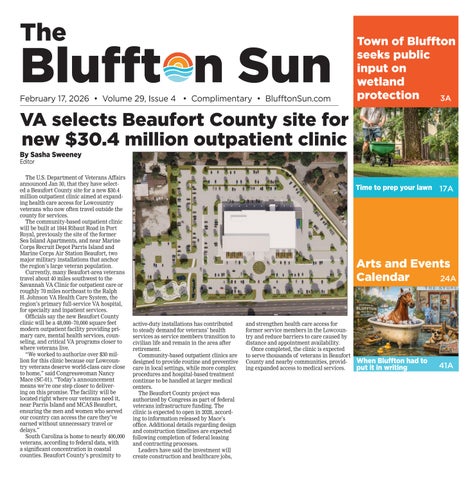
The U.S. Department of Veterans Affairs announced Jan 30, that they have selected a Beaufort County site for a new $30.4 million outpatient clinic aimed at expanding health care access for Lowcountry veterans who now often travel outside the county for services.
The community-based outpatient clinic will be built at 1844 Ribaut Road in Port Royal, previously the site of the former Sea Island Apartments, and near Marine Corps Recruit Depot Parris Island and Marine Corps Air Station Beaufort, two major military installations that anchor the region’s large veteran population. Currently, many Beaufort-area veterans travel about 40 miles southwest to the Savannah VA Clinic for outpatient care or roughly 70 miles northeast to the Ralph H. Johnson VA Health Care System, the region’s primary full-service VA hospital, for specialty and inpatient services.
Officials say the new Beaufort County clinic will be a 48,000–70,000 square feet modern outpatient facility providing primary care, mental health services, counseling, and critical VA programs closer to where veterans live.
“We worked to authorize over $30 million for this clinic because our Lowcountry veterans deserve world-class care close to home,” said Congresswoman Nancy Mace (SC-01). “Today’s announcement means we’re one step closer to delivering on this promise. The facility will be located right where our veterans need it, near Parris Island and MCAS Beaufort, ensuring the men and women who served our country can access the care they’ve earned without unnecessary travel or delays.”
South Carolina is home to nearly 400,000 veterans, according to federal data, with a significant concentration in coastal counties. Beaufort County’s proximity to

active-duty installations has contributed to steady demand for veterans’ health services as service members transition to civilian life and remain in the area after retirement.
Community-based outpatient clinics are designed to provide routine and preventive care in local settings, while more complex procedures and hospital-based treatment continue to be handled at larger medical centers.
The Beaufort County project was authorized by Congress as part of federal veterans infrastructure funding. The clinic is expected to open in 2028, according to information released by Mace’s office. Additional details regarding design and construction timelines are expected following completion of federal leasing and contracting processes.
Leaders have said the investment will create construction and healthcare jobs,
and strengthen health care access for former service members in the Lowcountry and reduce barriers to care caused by distance and appointment availability.
Once completed, the clinic is expected to serve thousands of veterans in Beaufort County and nearby communities, providing expanded access to medical services.


eaufort Memorial is expanding access to heart care in the Lowcountry with the addition of an experienced cardiologist to its team.
Dr. Terry Grainger, board-certified in cardiovascular disease and fellowship-trained in cardiology, has joined Beaufort Memorial Heart Specialists and is seeing patients in both Beaufort and Okatie. With more than 30 years of experience, he offers a compassionate, expert approach to diagnosing and treating conditions such as coronary heart disease, congestive heart failure, and hypertension.
Dr. Grainger also brings expertise in sleep and obesity medicine, including treatment for sleep apnea. He joins Beaufort Memorial from Prisma Health in Columbia, S.C., where he cared for patients with a wide range of heart and sleep disorders.
Focused on preventive cardiology, Dr. Grainger works closely with patients to encourage healthy habits and reduce the risk of heart disease.

“I treat patients the way I want my own family to be treated,” he said. “Building strong relationships is one of the most rewarding parts of my work.”
Board-Certified – Cardiovascular Disease
Fellowship – Cardiology
East Carolina University Brody School of Medicine, Greenville, N.C.
Residency – Internal Medicine
Pitt County Memorial Hospital, Greenville, N.C.
Doctor of Medicine
Medical University of South Carolina, Charleston, S.C.
At the practice, Dr. Grainger joins board-certified interventional cardiologists Drs. Stuart Smalheiser and Francis O’Neill, as well as physician assistant Tara Kay, MMS, PA-C and nurse practitioner Nicole Gray, MSN, FNP-C, AGACNP-BC.

By Sasha Sweeney Editor
Bluffton officials are asking residents and the development community to comment on proposed updates to the town’s wetland protections, a set of rules adopted last year after federal protections for some wetlands were narrowed by the U.S. Supreme Court.
The comment period runs from Feb. 2 through March 2, according to town documents.
Bluffton adopted its current Wetland Protection Ordinance in June 2025, requiring a 50-foot undisturbed buffer around wetlands. The town says it acted after the Supreme Court’s 2023 Sackett v. Environmental Protection Agency decision, which limited when wetlands fall under federal Clean Water Act jurisdiction.
The new proposal keeps the 50-foot buffer requirement but would revise the Unified Development Ordinance to clarify how the rules work and align them with new wetland-mapping tools used by the town, according to the

town’s press release.
Among the changes, the draft adds new definitions for “wetland buffer” and “heavy machinery,” and updates the definition of “wetland delineation.” The proposal would generally require delineations prepared within the last five years and specifies that delineations must follow the U.S. Army Corps of Engineers’ 1987 delineation manual.
The draft also lays out exceptions when a delineation would not be required, including for some sites under five acres if multiple conditions are met, including a notarized owner affidavit and the absence of wetlands on prior delineations or specified mapping sources.
Other proposed updates extend beyond buffer language into stormwater and construction standards.
A section of the draft would require offsite discharge points to be identified on site plans and calls for a licensed South Carolina professional engineer to certify that receiving conveyance systems can safely handle certain storm events without harming
downstream properties. The proposal also includes updated “Overbank Flood Protection” and “Extreme Flood Protection” standards tied to the town’s stormwater design manual, including requirements related to 100-year overflow paths.
The draft adds language stating that “mass grading and clearing-cutting shall not be permitted,” and would make it unlawful to conduct land disturbance of 5,000 or more square feet — or to reach that threshold through accumulated impervious surface — without an approved grading plan.
Maintenance and enforcement provisions are also addressed. The proposal includes a requirement for inspection reports for structural stormwater best management practices, with an initial report one year after as-built certification and subsequent reports every three years, prepared by a certified post-construction inspector or a registered South Carolina professional engineer or landscape architect. It also details operation-and-maintenance agreements to be recorded with the Beaufort County Register

of Deeds.

For wetlands specifically, the draft states that wetland and wetland buffer inspections are authorized to determine compliance, and it lays out what activities are prohibited or allowed in wetland buffers, including limited allowances for certain paths, utilities and water-dependent uses under specified conditions.
The proposal also includes provisions addressing how local rules interact with federal permits. It would exempt certain activities authorized under valid U.S. Army Corps of Engineers permits issued on or before Sept. 8, 2023, while stating that permits issued after that date govern federally jurisdictional wetlands, with local requirements, including the 50-foot buffer, applying after completion of federally permitted activities.
Comments may be emailed to Andrea Moreno, Bluffton’s watershed management division manager, at amoreno@townofbluffton.com. The draft ordinance amendments are available on the town’s website www. townofbluffton.com.
SHOWROOM HOURS: Mon-Fri 9am-5pm Sat 10am-2pm Closed Sun
Current Circulation Via USPS is 25,111
Editor
Sasha Sweeney editor@blufftonsun.com
Page Designer
Cary Howard cary@blufftonsun.com
Advertising
Mary Ann Kent, Sales & Marketing Manager
843-575-4151
BJ Frazier, 843-422-2321
Claudia Chapman, 814-434-3665
Mary Pat Gifford, 912-414-7122
Contributors
Abby Bird
Rich Bernstein
Lisa Hostetler Brown
Chad Cannon
Ryan Chowansky
Danie Connolly
Zach Deloach
Collins Doughtie
Willy Fanning
Kevin Fitzpatrick
David Hackett
Glenda Harris
Jean Harris
Jamie Harrison
Annelore Harrell
Channing Heiss
Andrea Hoerner
Kenneth Horup
Wendy Kushel
Nanette Makrauer
Nick Martin
Tamela Maxim
Weston Newton
Francis O’Neill
Leslie Rohland
Chris Roosa
Lucy Rosen
Joy Ross
Gary Smythe
Lindsay Roberg Spratling
Paul Tollefson
Joe Turino
Mark F. Winn
Tracy Winslow
Contact us PO Box 2056, Bluffton, SC 29910 843-757-9507
Physical address: 181 Bluffton Rd., Ste F103-2, Bluffton, SC 29910 BlufftonSun.com
All contents are copyrighted by Beaufort Media Group LLC. All rights reserved. Nothing may be reprinted in whole or in part without written permission from the publisher. All submissions must include name, address and phone number. The Editor reserves the right to edit or reject any material, including advertisements. The Bluffton Sun does not verify for licenses, endorse nor warrant any advertised businesses or services. The opinions and views expressed in the editorials are not necessarily those of the Editor and Publisher. Hilton Head Island-Bluffton Chamber of Commerce, Greater Bluffton Chamber of Commerce, Old Town Bluffton Merchants Society.
THE BLUFFTON SUN Issue 4, February 17, 2026, is published twice monthly by Beaufort Media Group, LLC, 181 Bluffton Rd Suite F103-2 Bluffton, SC 29910. Periodicals Postage paid at Bluffton, SC and at additional mailing offices.
POSTMASTER: Send address changes to THE BLUFFTON SUN, PO Box 2056, Bluffton, SC 29910-2056.
By Rep. Weston Newton Contributor

Typically, the first few weeks of each legislative year are slow, as committee meetings focus on advancing bills to the floor for debate. This year our pace is different.
The SC General Assembly just wrapped up the 4th week of the 2026 legislative session, and the House Judiciary Committee, which I chair, has been busy. We continue to hold subcommittee meetings, hearing public testimony on a number of bills and convened a number of full Judiciary Committee meetings advancing multiple bills that have already been or will soon be debated on the House floor.
As I have required since being elected Judiciary Chair – all of our meetings are streamed live and archived to ensure that the public business we are responsible to discuss is done in public. Protecting life, promoting women’s safety and standing up for girls remain priorities from me.
That’s why I introduced legislation that the House approved the first week of February aimed at addressing illegal chemically induced abortions. The bill closes a “mail order” loophole that has allowed abortion pills to be sent into South Carolina with little accountability and stops bad actors from flooding our state with dangerous abortion drugs. It classifies mifepristone and misoprostol as Schedule IV drugs, requiring a prescription from a South Carolina doctor and ensuring proper oversight and patient safety.
The drugs remain available for all legal medical procedures emphasizing that the legislation targets illegal distribution rather than medical care.
Commonsense was on full display a couple of weeks ago when the House passed the Student Physical Privacy Act (commonly known as the “Bathroom Bill”) legislation designed to protect student privacy and maintain clear, common-sense standards in our schools
by making permanent the temporary law (budget proviso) which has been in place for the past 2 years. Every child deserves to feel safe, and no student should have to sacrifice their privacy in locker rooms or restrooms. It was clear from extensive public testimony from parents that they don’t want their daughters placed in uncomfortable or inappropriate situations. They want schools focused on learning, safety, and respect. The debate on the legislation was spirited but the final vote was 96-19 to send it to the Senate.
Finally, in the short time we have been reconvened this year, the legislation that I sponsored to strengthen protections for children online (H3431) passed both bodies and was officially signed into law by the Governor.
This new law creates clear, commonsense standards for social media platforms operating in South Carolina and puts parents back in the driver’s seat when it comes to their children’s online activity. This new law is the result of thoughtful work of the Judiciary Committee, extensive stakeholder input and a shared commitment to protecting children while respecting free speech.
A Judiciary Subcommittee also advanced legislation aimed at protecting children online by addressing the growing mental health and safety risks posed by addictive social media platforms. This bill (H4591) requires reasonable age verification, parent consent and increased transparency, giving families more control over how and when minors access social media. As the parent of three children who have grown up in the social media era, I have personally witnessed the dangers posed to our young people.
These commonsense protections help
limit screen addiction and safeguard the well being of South Carolin’s youth. I look forward to taking up this bill when the full Judiciary Committee meets again. I am proud to see South Carolina take a leading role in addressing the real would harms of social media and standing up for families.
With regard to legislation moving through committees other than Judiciary, The Ways and Means Committee passed legislation to cut taxes and reduce burdens on small businesses. Small business make up more than 99% of all business in SC and employ over 42% of our state’s workforce. This legislation (H5006) exempts the first $10,000 of small business assets, saving employers time and money on paperwork, cutting costly red tape and ending a burdensome tax on investments. In closing, as discussed in this column last year the DUI reforms the House included in the Liquor Liability legislation, were not included by the Senate in that final legislation but this week the Senate unanimously passed an overhaul of the state laws against drunk driving in an effort to reduce the unenviable ranking of SC having one of the nation’s highest drunk driving fatality rates – with nearly half of all fatal crashes in SC involving a drunken driver. I look forward to taking up this bill in the Judiciary Committee in the near term.
It is an honor to serve the citizens of the low country in the SC House of Representatives please do not hesitate to call on me if I may be of assistance.
Weston Newton is the representative for District 120 in the State House of Representatives. WestonNewton@schouse.gov


Whether
Palmetto State Bank announces new chief credit officer and chief operating officer
Palmetto State Bank, a $600 million South Carolina banking company, announced the appointment of Stephen (Steve) M. Leonard as Chief Credit Officer and Chief Operating Officer.
Leonard brings more than 25 years of banking experience, most recently serving as Executive Vice President and Chief Credit Officer at AgSouth Farm Credit. His background includes extensive expertise in credit administration, risk management, and banking operations.
“We are thrilled to welcome Steve to our executive management team,” said Andy Westbrook, President and CEO. “He brings strong leadership, a practical approach to banking, and a deep commitment to team development and customer advocacy.”
Founded in 1907, Palmetto State Bank is a community bank providing personal, commercial, and mortgage services throughout South Carolina.
Collins Group Realty has added Marley Burgess to its team as listings marketing manager, a newly specialized role supporting the firm’s growth and marketing efforts across the Lowcountry.
Burgess brings experience in real estate operations, marketing coordination and client communication. She relocated to the Lowcountry from Maryland just over a year ago after years of visiting Hilton Head Island and seeking to build her career near the coast.
Before joining Collins Group Realty, Burgess worked for two years in her family’s real estate business in Maryland as an administrative assistant and licensed Realtor®, supporting agents, managing transaction workflows and assisting with listing preparation and digital marketing. She also previously worked on Hilton Head Island as an assistant property manager and vacation planner.
“Marley’s experience on both the administrative and marketing sides of real estate gives her a strong understanding of what it takes to bring a listing to market,” said Chip Collins, broker-in-charge. Burgess will oversee the coordination and execution of listing marketing
assets, working with agents and vendors to ensure consistency and quality across all listings.
The Lowcountry Women’s Network is expanding with the launch of a third group, following strong participation and interest in its first two cohorts.
The network, founded by Lucy Rosen, is a relationship-driven community for women entrepreneurs and professionals. Rosen brings decades of experience creating professional communities for women, beginning with the founding of Women on the Fast Track, an international networking organization she launched in the mid-1980s to support women business owners.
Rosen is also the author of Fast Track Networking: Turning Conversations into Contacts, which emphasizes building authentic, trust-based relationships rather than transactional connections.
“The philosophy behind this network isn’t new—it’s proven,” Rosen said. “I’ve spent my career watching what works and what doesn’t. Real opportunity comes from trust, consistency, and genuine connection, not from rushing the process.”
Unlike traditional networking groups, the Lowcountry Women’s Network does not include formal pitches or competitive structures. Instead, it focuses on relationship-first networking, allowing participants to get to know one another organically before collaboration develops.
The network currently hosts two monthly meeting groups that include women from a range of industries, including marketing, real estate, wellness, finance, design, hospitality and professional services. Meetings are designed to encourage meaningful conversation, shared insight and mutual support.
The expansion comes as demand continues to grow for professional communities centered on connection, trust and long-term collaboration.
Participation in the Lowcountry Women’s Network is free, reflecting its emphasis on accessibility and community-building rather than transactions. Organizers said women interested in joining or learning more about the newly forming third group are encouraged to email directly to express interest to Lucy@smartmarketingcommunications. com.


By Dr. Francis O’Neill Contributor

Heart attacks rarely resemble the dramatic scenes from movies, where someone clutches their chest in sudden, severe pain.
While chest pain is still the most common heart attack symptom, those portrayals can be misleading, especially for women.
In women, heart attack symptoms are often more subtle and less recognizable. Knowing what to look for could save your life or the life of someone you love.
Compared to men, women are more likely to experience symptoms that don’t immediately point to the heart, including:
• Cold sweats
• Extreme fatigue or weakness
• Shortness of breath
• Lightheadedness
• Nausea or vomiting
• Heartburn or indigestion
• Pain or discomfort in the back, jaw, neck, stomach, throat or arms
• Squee zing, fullness or pressure in the center of the chest
• Tooth pain
Because these symptoms can feel vague or unrelated, many women minimize them or mistake them for anxiety, the flu or acid reflex, which can lead to dangerous delays in seeking care.
Timing matters, too – symptoms that appear during physical activity or exertion and improve with rest are a red flag and should be taken seriously.
Women are also more likely than men to experience a “silent heart attack,” which occurs with little or no noticeable symptoms. In these cases, damage to the heart may not be discovered until weeks or months later, often during an electrocardiogram (EKG) performed for another reason.
While you may not recognize a silent heart attack as it’s happening, understanding your risk factors can help reduce your chances of having one.
Coronary artery disease is the leading

cause of heart attacks in both women and men. Shared risk factors include being overweight, diabetes, high blood pressure, high LDL (“bad”) cholesterol, smoking, physical inactivity, chronic stress, depression, kidney disease, inflammatory conditions such as rheumatoid arthritis, an unhealthy diet and a family history of heart disease.
Women also have unique risk factors related to hormonal and reproductive health, including early menstruation, early menopause, polycystic ovary syndrome (PCOS), pregnancy-related complications such as gestational diabetes or preterm delivery and a history of heart problems during pregnancy.
Having risk factors does not mean that you will have a heart attack, but making heart-healthy choices – especially
when you have risk factors that can’t be changed – is one of the most powerful steps you can take.
Heart disease remains the leading cause of death for women in the United States, and women have higher mortality rates after a heart attack then men, so awareness, prevention and early action are critical.
Annual physical exams with blood pressure checks, cholesterol and blood sugar testing, and, when appropriate, an EKG can provide valuable insight into your heart health. Regular exercise is another powerful tool, not only for prevention, but also as a personal barometer. If your usual walk or workout suddenly becomes difficult due to fatigue, shortness of breath or discomfort, don’t ignore it. If you or someone you know is experiencing heart attack symptoms, call 911 immediately. Acting quickly can save a life.
Francis O’Neill, M.D., is an interventional cardiologist with Beaufort Memorial Heart Specialists in Beaufort and Okatie and is board-certified in internal medicine and fellowship-trained in cardiovascular medicine and interventional cardiology.


Thursday, March 5, 2026
1:00PM-4:00PM
Spaces are limited, call Nancy Rosen to reserve your spot. (843)815-7890


By Sasha Sweeney Editor
The Hilton Head Island Deep Well Project has been named the 2025 PGA TOUR Charity of the Year, earning a $30,000 grant to support housing assistance programs on the island.
Organization staff members were surprised with the recognition during a recent outing to repair a local resident’s home. The honor was announced by the PGA TOUR. Deep Well Project is a nonprofit beneficiary of the RBC Heritage, Hilton Head Island’s annual PGA TOUR event.
Founded in 1973 to provide clean drinking water on Hilton Head Island, Deep Well has expanded its mission over the decades to provide emergency financial assistance, with a focus on housing stability for members of the island’s workforce.
Through its Emergency Rent/Mortgage Program, the organization pays all or part of housing costs for residents who have experienced an unexpected loss of income or expense that places them at risk of homelessness. In the first 10 months of 2025, Deep Well reported paying $516,000 in rent and mortgage assistance, helping approximately 1,600 people remain housed.
The nonprofit also operates a Livable Housing Home Repair Program, which provides critical repairs to ensure homes are safe and habitable. The organization said it has repaired 100 homes and expected to complete an additional 10 to 15 by the end of 2025.
“Decent and affordable housing for neighbors who comprise our workforce is a challenge across the country, but it’s especially concerning in resort areas like Hilton Head Island,” said Sandy Gillis, executive director of Deep Well Project. “Land costs are high, and when you’re a barrier island, expansion isn’t an option. This amazing recognition from the PGA TOUR, and its grant will power the housing assistance work that Deep Well Project is doing. It will help us be a safety net for neighbors, while also keeping our tourism-based economy firing on all cylinders.”
The $30,000 Charity of the Year grant will support both the rent and mortgage assistance program and the home repair initiative.
The Heritage Classic Foundation, the charitable arm of the RBC Heritage tournament, supports more than 90 local charities across six focus areas. Since 1987, the foundation has distributed $59.5 million to charities in South Carolina and Georgia, according to tournament officials.
“This recognition reflects the incredible impact The Deep Well Project has made in our community, and we couldn’t be prouder to support their mission,” said Steve Wilmot, president and tournament director of the RBC Heritage. “Their dedication and compassion inspire us all, and we look forward to standing beside them as they continue to change lives on Hilton Head Island.”
The PGA TOUR reports that its tournaments collectively have generated more than $4 billion for charitable causes to date.

From
By Mark F. Winn Contributor

As a trust and estate lawyer for more than 20 years, I often remind clients of a simple truth: estate planning isn’t just about “who” gets your assets - it’s about “how” they receive them. For many families, leaving an inheritance outright can create problems you never intended. Trusts are one of the most effective tools we have to protect loved ones from financial missteps, outside risks, and even well-meaning mistakes.
One common concern I hear is this: “I love them, but they’re just not good with
money.” That’s more common than people admit. Some beneficiaries struggle with budgeting, impulse spending, addiction issues, or simply lack the experience to manage a significant sum responsibly. By leaving assets in trust, you can name a trustee—someone you trust or a professional fiduciary—to manage and distribute those assets for the beneficiary’s benefit. The beneficiary still enjoys the support and security of the inheritance, but without the risk of it being squandered or of it stifling their initiative.
Trusts are also critical when a loved one receives government benefits due to a disability. Programs like Supplemental Security Income (SSI) and Medicaid have strict asset limits. Leaving money directly to that person—even with the best intentions—can unintentionally disqualify them from benefits they rely on for medical care and daily living. A properly drafted special needs or supplemental needs trust allows you to provide financial support without jeopardizing those
benefits. The trust can pay for extras that improve quality of life—education, travel, therapies, and personal needs—while preserving eligibility for government assistance.
Another major advantage of trusts is protection from divorces and lawsuits. When assets are distributed outright, they often become vulnerable. In a divorce, an inheritance can be commingled and end up part of a marital estate. In a lawsuit or bankruptcy, inherited funds may be exposed to creditors. Assets held in a well-structured trust, however, are generally shielded from a beneficiary’s divorcing spouse and from many creditor claims. That protection can make all the difference.
Trusts also help ensure that what you’ve built stays in the family. If a beneficiary passes away unexpectedly, assets left outright may end up with in-laws, former spouses, or people you never intended to benefit. With a trust, you decide what happens next. You can specify that remaining
assets pass to children, grandchildren, or other family members, keeping your legacy intact for generations.
The beauty of trusts is flexibility. They can be as simple or as detailed as your situation requires. You can tailor distributions based on age, life milestones, health needs, or financial responsibility. And while trusts are powerful, they don’t have to be intimidating or overly complex when designed correctly.
If you’ve worked hard to build your assets, you owe it to yourself and the people you love to think beyond a basic will. A thoughtful trust-based plan can provide protection, stability, and peace of mind long after you’re gone. With the right planning, you can leave more than money. You can leave confidence, security, your values, and a multigenerational benefit.
Mark F. Winn, J.D., Master in Estate Planning, a local tax, asset protection and estate planning attorney.


By The Bluffton Sun
Hampton Hall Club has approved a $6.6 million renovation and expansion of its main clubhouse, marking the first phase of a broader master plan aimed at updating facilities and enhancing member amenities.
Club officials said the project received more than 80% approval from members at the end of 2025. Construction is expected to begin in 2026.
“This clubhouse renovation is the first step in a much larger, long-term vision for Hampton Hall,” said Eric Bischofberger, the club’s general manager and chief operating officer. “It represents our commitment to continually reinvesting in the member experience through a thoughtful, member-driven process, not just today but well into the future.”
Plans call for renovating underused areas of the existing clubhouse and adding approximately 1,900 square feet of new space. Improvements include a new porte cochère, expanded casual dining areas, a redesigned dinner-focused social space, a renovated kitchen and a larger bar area.
In addition to member-focused upgrades, the project includes a new em-

“Delivering
operations.

those experiences to life,” Bischofberger said. “These operational improvements allow our team to perform at a high level and reinforce Hampton Hall’s reputation as one of the most desirable employers in Beaufort County.”
The club has partnered with Chambers, an architecture and master planning firm specializing in private clubs, to guide the long-term planning process. Construction will be handled by Shoreline Construction, a regional general contractor with experience in private club projects.
Club officials said the renovation will be funded without a member assessment, citing what they described as strong financial performance.
“Our financial strength allows us to invest proactively rather than reactively,” Bischofberger said. “We are able to fund this project responsibly while preserving flexibility for future phases, all without placing an additional burden on our members.”
Hampton Hall is a private, member-owned community in Bluffton that features a Pete Dye-designed golf course along with dining, fitness and racquet facilities.


By Lisa Hostetler Brown Contributor

For many families, their home is far more than an asset. A home is often a symbol of a lifetime of hard work.
One of the most common questions people ask when planning for long term care is: “Can nursing home costs really put my home at risk?”
The honest answer is yes, if you don’t plan ahead. But with the right legal tools in place, you can protect your home while ensuring your loved one receives the care they need. Medicaid and the home: what you should know
Nursing home care can cost upwards of
$10,000 per month, and Medicaid is often the only program that helps cover those costs.
While Medicaid does not require you to sell your home while you’re living, the real risk appears after you pass away. The state may attempt to recover expenses from your estate, including your home, through a process called Estate Recovery.
This is where planning becomes essential.
1. Life estate deeds
A life estate deed allows you the right to live in your home for life while naming someone else as the future owner.
Why this helps:
• The home passes automatically to your chosen beneficiary when you pass away.
• That transfer avoids probate, protecting the home from Medicaid Estate Recovery.
• You retain control and the right to live in the home as long as you choose.
Life Estate Deeds can be a strong planning tool, but they must be prepared correctly and well in advance of needing care.
2. Irrevocable Trusts
An irrevocable trust is one of the most powerful ways to protect a home from nursing home costs.
How it works:
• You transfer the home into a trust that you design.
• You no longer own the home directly, but you can still have the right to use it.
• After a cer tain period (often five years), the home is generally protected if you need long term care, both from eligibility and estate recovery.
Why families choose this:
• It shields the home from long term care costs and Medicaid estate recovery.
• It ensures the home passes to your chosen beneficiaries exactly as you intend.
• It offers flexibility and control.
3. The Importance of Early Planning
The key to protecting the home is not waiting until a crisis hits. Starting the conversation early gives you more options, more control, and more peace of mind.
Even if long term care is not needed now,
putting protections in place today means:
• Your home remains secure.
• Your family avoids stressful last-minute decisions.
• Your assets are preserved for the next generation.
Final Thought
Nursing home costs can be overwhelming, but losing your home doesn’t have to be part of the equation. With tools like these, families can protect what matters most both financially and emotionally.
If you’re concerned about safeguarding the family home and long term care needs, your next step is to speak with an experienced elder law attorney who can tailor a plan to your situation.
For educational purposes only. This is not legal advice. Lisa Hostetler Brown is a Certified Elder Law Attorney certified by the National Elder Law Foundation. 2 Hampton Hall Blvd, Ste 100, Bluffton, SC 29910. | 843-757-5294 | LawyerLisa.com.


By Zach Deloach Contributor
I hope everyone has been staying warm as winter makes its sweep across South Carolina. According to Punxsutawney Phil, our groundhog meteorologist, we can expect 6 more weeks of cool weather. I can not tell you how accurate those predictions might be, but I can tell you a few things that can be done to your lawn and landscape to prepare during this time.
The primary driver of all outdoor plant activity is soil temperature. Soil temperatures dictate when certain plants grow or stop growing, when specific weeds germinate, when funguses appear, and when plants bloom; along with many other things. This is very important to take into account when applying any products to the lawn. There are a few preventative measures that can be done at this time that will save you a lot of time and hassle as we begin to warm up.
With the temperature increase you will begin to see changes in your landscape. You will see positive changes such as growth and color change along with some

negatives such as new weed germination and fungal developments.
Now is the time you want to make sure to get your pre-emergent weed controls down. This will suppress the germination of weeds that thrive in warmer tempera-
tures. Pre-emergents will not prevent all weeds from occurring but will minimize the amount you see making it easier to stay on top throughout the season.
A light watering is beneficial for getting pre-emergents into the ground and help-
ing to prevent germination. It is also very important to keep a close eye on the temperatures when it comes to watering and feeding the lawn with fertilizer. Pushing the lawn to grow too soon often does more harm than good.
Typically we see our last cold snap around St. Patrick’s day, therefore we encourage waiting until April to automate your sprinklers or do any nitrogen fertilization. It is okay to manually water once every 2-3 weeks as needed if temperatures continue to rise but you do not want to exceed that due to risk of fungus.
As you might have noticed, many of our plants were affected by the cold temperatures this past month. Do not panic, the majority of your plant life will recover this spring and summer. We suggest cutting out any dead branches once we are past the cold to allow for new growth. For struggling or damaged plants a deep root feeding in the spring will spark new life into your plants.
Pure Med Spa is here to assist you in achieving your skincare goals.
Fine Lines | Wrinkles | Elasticity | Firmness Even Tone | Vibrancy | Skin texture
Enlarged Pores | Oily or Congested skin
DR. KLENKE’S APPROACH

“At Pinnacle, we want our patients to feel like they are part of our family and we strive to treat them that way from the first time they visit. We pride ourselves on the customer experience. It is important to always keep up with the latest advances, but our practice uniquely separates the gimmicks from the options that produce results. It is our philosophy to listen first to our patients’ goals and then help guide them to the treatments and procedures that will help us all work toward that shared goal. Your inner and outer you should be in harmony.”
Audrey Klenke, MD, FACS, Board Certified


By Dr. Jean Harris Contributor
The weather has the ability to impact the conditions of the golf course and your ability to handle these conditions. High winds, cold temperatures, afternoon thunderstorms, heat and humidity all affect course conditions in different ways. The weather also affects the putting greens.
As a golfer you should never leave your house without checking the weather forecast. You should always be ready to prepare for inclement weather.
Things to wear or have in your golf bag
• Umbrella
• Rain jacket
• Hand warmers
• Towels
• Extra gloves
• Hat or ski cap
Cold Temperatures
Cold weather makes it harder to compress the ball. When a golf ball gets cold it feels harder and you get less distance. You also have to wear more clothing that restricts your range of motion.
Hot Temperatures
Hot weather makes it easier to compress the ball and get more distance. Humidity on hot mornings cause the greens to become wet and slow down the speed of your putts. Make sure you stay hydrated and keep your head covered. A good pair of sun glasses may help you see the breaks on the green.
Heavy rain
Rain affects your game in many ways. It obviously affects the speed of the putting greens. Rain causes issues with your grips and gloves. The key is to keep your grips and glove dry. There are also some good rain gloves on the market. Have
plenty of towels available and a good umbrella that you can attach the towels.
During rain, the course will play longer so you will need to modify your club selection. You will not get your normal roll out on your shots. You will also tend to hit some fat shots due to the wet ground.
Wind I believe that the wind has the most effect on a golf ball. You need to know how the different wind directions can affect your club selections.
Headwinds – are when the wind is blowing in your face. These winds cause the ball to lose speed and lift, resulting in shorter distances. A 10-mile-an-hour wind in your face can reduce carry 10-12 yards. Take extra club and play the ball back in your stance.
Tailwinds – are when the wind is blowing in the same direction as your shot. This will increase your distance and cause the ball to roll more after landing. Crosswinds – the wind is blowing left to right or right to left. These winds can cause more curve on the ball resulting in more slices and hooks.
Weather affects the putting green the most. The speed will change with changing conditions. Wind has the most impact on putting. It affects the speed of the green as well as the length of your stroke. The wind affects your balance and you will need a wider stance. Heavy rain also affects putting. Wet putting greens slow down the putts. You must hit firmer putts and play less break.
Dr. Jean Harris is an LPGA Master Professional and teaches at local golf courses. jean.golfdoctor.harris@gmail. com; golfdoctorjean.com
By Channing Heiss Contributor
Able South Carolina will host the annual South Carolina Youth Leadership Forum training program June 21 through June 24, 2026, at Presbyterian College in Clinton.
The free program for disabled South Carolina residents ages 15-23 is a four-day and three-night immersive training in leadership skills, team building, and advocacy and featuring a variety of activities and guest speakers. Chosen delegates typically live on the college campus during the program.
South Carolina is one of 29 states operating a program affiliated with the National Association of Youth Leadership Forums. The founding goal of NAYLF is to improve employment and independent living outcomes of young people with disabilities who are transitioning from high school to adulthood and to promote both leadership and self-advocacy.
In order to be an approved affiliate of


the California-based 501c3 organization, NAYLF information explains that programs in all states must follow the California Model Youth Leadership Forum for Students with Disabilities. This model was developed in 1992 by what was known then as the Governor’s Committee for Employ-
ment of Disabled Persons. It is based on other successful youth leadership models and leadership principles. According to records, this leadership training model has been in use and development in South Carolina in various forms for over a decade and the annual forum has become an
established event.
Organizers say the event is an opportunity not only to cultivate leadership skills, but also to meet other young adults from across the state, network for career opportunities, and learn while having fun.
Those who would like to become a sponsor or a member of the peer staff may apply by following the link on the SCYLF website. The link to the application for prospective delegates is also on the website. In addition to meeting the age and residency requirements, candidates must have demonstrated leadership potential.
The application deadline for the Youth Leadership Forum is March 16 though organizers say extensions may be allowed by arrangement on an individual basis. For more information, visit the Able South Carolina website www.able-sc.org or the South Carolina Youth Leadership Forum online at www.scylf.org.
Channing Heiss is a freelance writer and a member of the Beaufort County disAbilities Coalition.


By Sasha Sweeney Editor
Coastal States Bank donated $136,000 to charities and nonprofit organizations in Georgia and South Carolina in 2025 through an employee-supported giving initiative, the bank announced.
The donations were distributed through the bank’s Community Commitment program, an employee-funded and bank-matched initiative that provides grants to nonprofits serving communities in metro Atlanta, North Georgia, Savannah and South Carolina’s Lowcountry.
According to the bank, the program supported more than 45 charitable organizations last year, focusing on financial literacy, childhood education, veteran support, health and wellness and senior care. Bank employees also contributed more than 575 volunteer hours in connection with the initiative.
“Each year, I am proud of our team for demonstrating our core values of

community, commitment, and character through their generosity and service,” said Stephen R. Stone, the bank’s president and chief executive officer. “Their commitment to giving both time and resources each year reflects who we are as a community bank.”
Established in 2017, the Community Commitment program has contributed more than $742,000 to over 100 charitable organizations, according to the bank. Coastal States Bank operates community banking offices in Hilton Head Island, Bluffton, Beaufort and Charleston in South Carolina, as well as Savannah and the Atlanta metropolitan area.
The Agency Hilton Head has been named the recipient of the Global Red Heart Award, the highest philanthropic honor given by its parent company, The Agency.
The award, announced Jan. 27, recognizes one office across the company’s global network of about 150 locations for community service and charitable impact. The Hilton Head-area office was selected for its local initiatives and hands-on involvement in nonprofit efforts throughout the Lowcountry.
“We are incredibly honored by this recognition. We launched our Hilton Head office less than two years ago, and to already see this level of impact is deeply meaningful to our entire team,” said Alison Melton, managing partner of The Agency Hilton Head. “Our goal has always been to show up for this community in real, tangible ways.”
Among the efforts cited was the office’s inaugural Big Dill Charity Pickleball Tournament, which raised funds for Habitat for Humanity of the Lowcountry

through a partnership with Giveback Homes. The event drew nearly 50 players and more than 100 spectators, according to the release.
In addition to fundraising, agents from The Agency Hilton Head participated directly in home construction alongside Habitat for Humanity volunteers. The combined financial support and volunteer labor helped a local family move into a new home before the holidays.
The office has also served as title sponsor of the Berkeley Hall Charity Cup golf tournament, which benefits the Berkeley Hall Charitable Foundation. Grants from the foundation support more than 25 nonprofits in Bluffton and Beaufort County.
Other initiatives have included school supply drives, toy drives and brokerage-supported sponsorships that allow individual agents to support local causes.
The Agency Hilton Head is located at 5790 Guilford Place, Suite 200, in Bluffton. Additional information is available at theagencyhiltonhead.com.
By Nanette Makrauer Contributor

Income-Related Monthly Adjustment Amount (IRMAA) is a surcharge added to some original Medicare premiums for people with higher incomes. The thresholds are established for each new year.
The Medicare premiums affected by IRMAA are:
• Medicare Part B (doctor visits, outpatient care)
• Medicare Part D (prescription drug plans)
To determine if an individual or couple owes an IRMAA, Medicare looks at your income from 2 years ago (a 2-year look back). For example, your 2026 Medicare premiums are based on your 2024 tax return. They look specifically at your modified adjusted gross income (MAGI) from your IRS filing. Next, they compare this MAGI to the IRMAA brackets to determine your particular surcharge. The brackets are broken down into income tiers much like tax brackets. The higher your income, the higher the surcharge.
There are different brackets or thresholds for single filers, married filing jointly, and married filing separately
yet, Medicare sends you a bill.

and these thresholds change slightly each year.
If you are over a threshold, you pay the original Medicare Part B monthly premium, plus an added surcharge based on the tier structure. In addition, you will pay your Part D plan premium, plus a separate IRMAA surcharge for (paid to Medicare, not your drug plan).
IRMAA is typically deducted from your Social Security check, however, if you’re not collecting Social Security
There are some common situations that trigger IRMAA. If that two-year look back was a year that you had a one-time income spike—this can cause IRMAA, such as: selling a business or property, large capital gains, required minimum distributions (RMDs), ROTH conversions, and bonuses or severance pay to name a few.
The good news is that if it was a one-time occurrence causing the spike in income, you can appeal IRMAA for the next year of that 2-year look back.
In addition, you may be able to get IRMAA reduced or removed if your income dropped due to a life-changing event, such as: retirement or reduced work hours; death of a spouse; divorce; loss of income-producing property; and employer settlement payout that is ending.
The appeal needs to be filed by both spouses if you are filing a joint return. You utilize Form SSA-44 from Social Security—and you can fax it into your local SS office.
Keep in mind that IRMAA is not a penalty—it’s an income-based surcharge. It is based on old tax data (2 years back). It can be appealed if your current income is lower. And most importantly, planning income in retirement can help avoid or reduce IRMAA, so working closely with a CFP or CPA is advisable.
Nanette Makrauer is an independent insurance broker and Certified Medicare Advisor residing in Bluffton. nanette@health-wealth-insurance.com (www. health-wealth-insurance.com)


By Willy Fanning Contributor

February is a natural time in the Lowcountry to start thinking about home projects that can make a difference down the road whether you plan to sell in 2026 or simply want to protect and enjoy one of your biggest investments.
Homeowners
often ask which improvements truly add value and which projects tend to deliver the strongest return. The good news is that meaningful upgrades do not always require major renovations. Strategic, well-timed updates can enhance everyday living while positioning a home well for the future.
Here are several projects that consistently make an impact.
1. Start with the curb: First impressions matter
Sellers frequently ask how much curb
appeal really matters. The answer is a great deal. Simple changes such as a freshly painted front door, updated house numbers, and modern exterior lighting can noticeably elevate a home’s first impression.
Spring landscaping is another worthwhile focus. Fresh mulch, trimmed shrubs, colorful planters, and clean walkways can make an exterior feel well cared for before anyone steps inside.
2. Make your kitchen shine
Another common question is whether a full kitchen remodel is necessary. In many cases, it is not. Small updates such as swapping outdated hardware, adding a backsplash, or replacing an old faucet often provide excellent results.
Energy efficient appliances are also appealing both for resale value and for everyday utility savings.
3. Brighten things up with lighting
Lighting is one of the most overlooked upgrades. Replacing dim or dated fixtures with brighter, modern options can completely change how a space feels. LED bulbs remain a smart choice, and dimmer switches in main living areas can create flexibility and comfort.

Homeowners routinely wonder whether energy upgrades are worth the investment. In today’s market, efficiency is increasingly important. Sealing drafts, insulating attics, and maintaining HVAC systems are practical steps that improve comfort while lowering long term costs.
Smart thermostats and solar features are also becoming more common as homeowners look ahead.
5. Refresh the walls and floors
Fresh paint continues to be one of the most cost-effective improvements available. Neutral, light tones such as soft grays, warm beiges, and creamy whites help homes feel bright and move in ready.
Flooring upgrades can also be impactful whether that means refinishing hardwood, replacing worn carpet, or installing luxury vinyl plank flooring.
Some of the biggest impressions come from the smallest details. Addressing squeaky doors, mismatched hardware, loose handles, and scuffed trim signals that a home has been carefully maintained. A thorough deep clean including grout lines and baseboards can further elevate the overall presentation.
Investing in a home thoughtfully over time is often what separates a good sale from a great one. By focusing on projects that enhance function, efficiency, and visual appeal, homeowners can enjoy the benefits now while preparing for the future.
Willy Fanning is an Active-Adult & 55+ Specialist Licensed Realtor. He can be reached at willyfanning.com or (843) 6038137.


Hilton Head Island Gullah Celebration
February (locations and times vary)
Monthlong series includes Cultural Stewardship Speaker Series, Gospel Series: Friends & Family Night, Voices of Gullah, and Roots & Recipes Reunion. www.gullahcelebration.org
Bluffton Library Special Adult Programs
Bluffton Branch Library
Feb. 17–26; times vary
Programs include Book Brunch, Dementia 101, Neurodiverse Social, Caregiver Support Group and Trading Treasures Arts & Craft Supply Swap. Information: beaufort.librarycalendar. com or call 843-255-6503.
Artist in Residence: Mary Benson
Feb. 19-21, 2026
Palmetto Bluff
Charleston-based painter Mary Benson will lead three workshops during her residency.
palmettobluff.com/experience/the-artsinitiative and palmettobluff.com/explore/ artist-in-residence/mary-benson
Palmetto Quilt Guild workshop
Friday, February 20, 9 a.m.–3 p.m.
Palmetto Electric Community Room, Hardeeville, S.C.
Workshop supporting preparations for the March 2026 Quilt Festival. palmettoquiltguild.org
Fridays at the FOODseum: Hardee Greens
Friday, Feb. 27, 10:30 a.m.-12:30 p.m.
I Love You, You’re Perfect, Now Change Feb. 20–March 8
Sea Glass Stage at Coligny Musical revue exploring relationships, marriage and modern love through comedic sketches and songs. Tickets: www.sgstage.org
Ellis Island: The Dream of America
Sunday, Feb. 22, 2026, 4 p.m.; Monday, Feb. 23, 2026, 7:30 p.m.
Show hangs through March 26 1263-B May River Road, Bluffton www.fourcornersgallerybluffton.com
Author Talk with Dasha Kiper
Friday, Feb. 27, 10 a.m.–noon
Grace Community Church, Hilton Head Memory Matters 2026 Speaker Series featuring Dasha Kiper, author of Travelers to Unimaginable Lands, discussing dementia from a caregiver’s perspective. Registration required; space limited. mymemorymatters.org/events

TCL Culinary Institute of the South, 1 Venture Drive, Buckwalter Place, Bluffton Workshop featuring Jennifer and Chase Harsta of Hardee Greens; cooking demonstration and tasting with Chef Damon Dickerson; FOODseum tour follows. $75. Register: tcl.edu/ foodseumfridays. chirsch@tcl.edu or 843-684-0923.

First Presbyterian Church, 540 William Hilton Parkway, Hilton Head Island Multimedia orchestral performance blending immigrant stories, historic images and live music. Conducted by John Morris Russell with Lean Ensemble Theater. Tickets available online hhso.org
Through the Lens, Through the Flame Exhibit
Reception February 26, 5-8 p.m.
Four Corners Gallery Photographer Peter Cram and glass artist John Poirer
Sun City Lions Club presents Evolution March 5, 7 p.m.
Sun City Magnolia Hall, 118 Magnolia Lane, Bluffton, S.C.
Fundraiser featuring Evolution, an 18-piece variety band, with guest artist Mary Manges on vocals and flute. Admission $35.
Ticket information: 516-457-3707.

By Leslie Rohland Contributor

This Creamy Spinach Soup is light yet rich, comforting without being heavy; the kind of recipe that feels just right as the Lowcountry moves from cooler winter days into early spring.
Built on a simple base of extra virgin olive oil, onion, carrots, and garlic, the soup develops depth from gentle aromatics and a pinch of crushed red pepper flakes for subtle warmth. Chicken broth creates a savory foundation, while a fresh diced tomato adds brightness and balance. Rotini or fusilli pasta gives the soup body and heartiness.Fresh baby spinach goes into the broth, adding color, texture, and a boost of nutrients. A splash of heavy cream brings everything together,
creating a smooth, velvety finish without overpowering the fresh flavors.
From a nutrition standpoint, this soup strikes an easy balance. Spinach delivers iron, fiber, and vitamins A and C, while carrots contribute antioxidants and natural sweetness. The olive oil provides healthy fats, and the pasta offers comforting energy. Finished with crispy croutons and a sprinkle of grated Parmesan, each bowl offers contrast, richness, and just enough indulgence.
Leslie Rohland, 2024 SC Chef Ambassador, Chef and Proprietor of The Cottage Cafe, The Bluffton Pasta Shoppe, the Juice Hive, and May River Coffee Roasters. (843) 757-0508, 38 Calhoun St, Bluffton, SC.
Ingredients
• 3 tablespoons Extra Virgin Olive Oil
• 1 yellow onion, finely chopped
• 2 carrots, finely chopped
• 4 cloves garlic, minced
• ½ teaspoon crushed red pepper flakes
• 4 cups chicken broth
• 1 fresh tomato, diced

• 1 (8.8 ounce) bag Rotini or Fusilli pasta
• 1 (6 ounce) bag fresh baby spinach
• 1/3 cup heavy cream
• 1 teaspoon kosher salt
• ½ teaspoon cracked black pepper
• 1 cup croutons, store-bought or homemade
• Parmesan cheese, grated, for garnish
Directions
1. Heat the oil in a large stockpot. Once hot, add onion and carrots; cook until soft. Stir in garlic and red pepper flakes, stir gently.
2. Add broth and diced tomatoes; increase heat and bring mixture to a simmer.

3. Add the pasta, let it cook until soft, about 10 minutes. Bring soup to a boil. Reduce heat and simmer, uncovered, for 8 to 10 minutes.
4. Add the spinach, heavy cream, salt, and pepper and cook for another 3 to 4 minutes.
5. Ladle soup into bowls, top with croutons and garnish with freshly grated Parmesan cheese, cracked black pepper, and a drizzle of olive oil.


By Sasha Sweeney Editor
A new movement-based class in Bluffton is combining hip-hop dance, yoga and mindfulness to help children develop emotional awareness, self-regulation and social connection.
Piece by Peace Therapy has introduced Hip Hop + Yoga for Youth, a weekly class for children ages 5 to 13 that blends expressive movement with grounding practices. The program is designed to help children connect with their bodies and emotions in a supportive, nonjudgmental environment.
The class was created by Leslie Slemmons, a licensed therapist and mother of four, who said the program grew


out of her professional and personal experience working with children navigating stress, anxiety and emotional overwhelm.
Rather than focusing on performance, the class emphasizes awareness and connection. Through dance, children are encouraged to express feelings that may be difficult to put into words, while yoga and mindfulness practices are used to promote calm, balance and self-regulation.
“Dance is the expression,” Slemmons said. “Yoga is compassion.”
Participants explore physical concepts such as balance, strength and spinal movement, while also learning how emotions can show up in the body. The class incorporates social-emotional learning through movement, giving
children opportunities to practice recognizing boundaries, responding to peers and noticing physical cues related to safety, comfort and care.
An additional focus of the program is helping children understand and respond to anxiety. Through guided movement, breathwork and partner exercises, children are taught to view anxiety as a signal rather than something to fear or suppress, and to develop tools to support themselves when it arises.
Each class follows a consistent structure, beginning with hip-hop dance for release and play, followed by yoga to strengthen the mind-body connection, and concluding with mindfulness practices that support awareness and choice.

The class is inclusive and
open to children of all genders. While it may be particularly helpful for children experiencing anxiety, difficulty focusing, digestive issues, big emotions or low confidence, the program is open to all participants.
Hip Hop + Yoga for Youth meets from 5 to 6 p.m. at MindState Movement, located at 102 Buckwalter Parkway. The cost is $75 per month, with the first class offered at no charge. Visitpeacebypiecetherapy.care for more information.
Piece by Peace Therapy is a holistic therapy practice that works with children, teens and adults using movementand mindfulness-based approaches to support emotional wellness and resilience.
By Sasha Sweeney Editor
Local chefs will compete to transform rescued food into fine cuisine later this month as part of a new fundraising event aimed at reducing hunger across the South Carolina Lowcountry.
Second Helpings will host its inaugural Rescue Gourmet culinary competition on Thursday, Feb. 26, from 5:30 to 7:30 p.m. at the University of South Carolina Beaufort’s Hilton Head campus, located at 1 Sand Shark Drive.
The event brings together four prominent Lowcountry chefs, each tasked with creating original dishes using food that would otherwise go to waste. The dishes will be judged by a panel of local media figures, chefs and community personalities.
Competing chefs include Brian Coseo, executive chef at Sea Pines Country Club; Lynn Michelle, known professionally as “The East Coast Chef”; Josh O’Neill, executive chef at Colleton River Club; and Robert Wysong, executive chef at Wexford Country Club.
The competition will be evaluated by a panel of judges drawn from local media and the culinary

community. The event will be hosted by Andrew Davis of WSAV-TV, a longtime broadcast journalist.
In addition to the competition, attendees will be offered heavy hors d’oeuvres, complimentary beer, wine and soft drinks, and tastings of the chefs’ original creations. Proceeds will support Second Helpings’ food rescue operations throughout the region.
“We’re thrilled to offer this exciting, first-of-itskind event,” said Amy Colin, executive director of Second Helpings. “We’re grateful for the participation and support of these amazing chefs, and we encourage their fans to come out and cheer them on.”
Second Helpings is a nonprofit organization that collects surplus food and redistributes it at no cost to partner agencies serving people in need. According to the organization, its volunteers distributed 3.6 million pounds of food in 2025 to 55 agencies across Beaufort, Jasper and Hampton counties, reaching more than 14,000 people each week. The organization is a United Way agency.
Tickets and additional information are available at www.secondhelpingslc.org/rescuegourmet. More information about the organization can be found at www.secondhelpingslc.org.


The Lowcountry Wind Symphony will present the world premiere of The Hope of Humanity during two free performances later this month in Beaufort and Bluffton.
The 70-member concert band, under the direction of Donald F. Jemella, will debut the new work by composer Stephen Melillo. The composition was commissioned for the ensemble’s audience and musicians.
According to program notes, the concert will also feature the “Berceuse and Finale” from Igor Stravinsky’s Firebird Suite, along with additional works by Melillo.
Soprano Mary Osegura Lara will appear as a guest soloist, performing selections including “You Raise Me Up,” “You’ll Never Walk Alone,” “Love Not War” and “Eternal Father,” accompanied by the band.
The concerts are free and open to the public, though donations will be accepted.
Performances are scheduled for:
7 p.m. Friday, Feb. 20, at Beaufort High School, 84 Sea Island Parkway, Beaufort.
4 p.m. Sunday, Feb. 22, at Bluffton High School, 12 H.E. McCracken Circle, Bluffton.
The Lowcountry Wind Symphony is based in Beaufort and is supported in part by the South Carolina Arts Commission, which receives funding from the National Endowment for the Arts.
Information is available at lowcountrywindsymphony.com.


FEBRUARY 20 - MARCH 8
FRIDAY 7:30 SATURDAY 7:30 SUNDAY 2:00
By Glenda Harris Contributor

Greetings fellow bookworms!
With winter still hanging on, and the recent celebration of National Book Reading Day, readers are finding plenty of new fiction on bookstore shelves, with more on the way.
Several
high-profile titles arrived late last year and in January, launching what is shaping up to be a busy year for fiction across genres, including thrillers, romance, fantasy and literary fiction.
Included in the late 2025 releases that are drawing attention are Brimstone by Callie Hart, as a continuation of her novel Quicksilver, with a deluxe version featuring a gorgeous cover and metallic edges. Also released late last year was Black Wolf by Louise Penny, a novel centered on a domestic terror attack in Montreal and connected to her earlier prequel, Grey Wolf.

January brought a wave of new fiction. Recent thriller releases include Woman Down by Colleen Hoover, featuring a character named Petra Rose; Anatomy of an Alibi by Ashley Elston, following her bestseller First Lie Wins; and Dear Debbie by Freida McFadden. Romance readers also saw new titles arrive, including the intense The Odds of You by Kate Dramis and The Night We Met by Abby Jimenez.
Another early-2026 release is A Box Full of Darkness by Simone St. James. She is also known for her previous novel, The Sun Down Motel.
The Astral Library by Kate Quinn

marks a shift into magical realism for this author, (best known for historical fiction)and asks the question, “Have you ever wished you lived inside a book?”
Looking ahead to the coming months, publishers have scheduled several notable releases. March releases are expected to include South of Somewhere by T.I. Lowe, set in the Lowcountry, and centered on themes of recovery and hope.
In May, readers can enjoy a take on vengeance and romance with The Ballad of Falling Dragons by Sarah A. Parker, a sequel to When the Moon Hatched, as well as explore the power of friendship among strong women in The Calamity Club by Kathryn Stockett, author of The Help. Those looking to escape into romance and secrets can look no further than Summer State of Mind by Kristy Woodson Harvey.
Summer and midyear releases include Whistler by Ann Patchett. Whistler is the name of a horse from years past. You can expect nothing less than a beautifully written story by this writer. Also coming soon is Road Trip by Mary Kay Andrews, set in Ireland, and Cool Machine by Colson Whitehead, author of Harlem Shuffle and Crook Manifesto. Another anticipated summer title is Country People by Daniel Mason, blending themes of change, relocation, folklore and reality.
Note: Publishers caution that release dates may change. R
I hope to have more new titles for you soon, so stay tuned and happy reading!
A former Bluffton resident, Glenda finds stories everywhere and writes about nature, travel, healthy living and books.


By Sasha Sweeney Editor
Memory Matters will open its 2026 Memories Do Matter Speaker Series this month with a presentation by author and clinical psychologist Dasha Kiper focused on the neuroscience and emotional realities of caregiving.
The free event is scheduled for 10 a.m. to noon Friday, Feb. 27, at Grace Community Church, 450 Spanish Wells Road, Hilton Head Island.
Kiper is the author of Travelers to Unimaginable Lands, a book that examines the psychological and neurological dimensions of dementia and caregiving. Her work draws on clinical experience and research, along with accounts from caregivers navigating memory loss in loved ones.
“Memory is so integrated into every aspect of life – from thinking, to communicating, to forming and sustaining relationships, to creating continuity, meaning, and coherence – that its disappearance is incomprehensible. We simply have no cog-
nitive framework that allows for its absence in others,” Kiper writes.
Organizers say the program is designed for caregivers, families and professionals seeking a deeper understanding of dementia and the challenges associated with providing care. The session will explore why self-care can be difficult for caregivers and what neuroscience suggests may help support mental and emotional resilience.
The February program is the first of four planned for 2026 as part of the organization’s speaker series, presented by Dave Ekedahl. The series focuses on translating brain-health research into practical strategies for families and individuals affected by memory loss.
The event is free and will include refreshments, though advance registration is required at www.mymemorymatters.org/ events.
Memory Matters is a Hilton Head Island–based nonprofit that provides brain-health education, caregiver support and programs for individuals living with memory loss.


Curious About Your Family History –But Not Sure Where to Begin?
Discover the stories that tell your story.
Our experienced genealogy volunteers are here to guide you through the process – helping you understand available records, interpret historical data, and take meaningful steps toward discovering and preserving your family’s history.
Life is lived forward, but understood backward.
Join us for a one-on-one guided research session and let us help you look back, connect the pieces, and better understand where you come from.
Monday, February 9, 2026
10:30am - 12:00 Noon or 1:00 - 2:30pm
Saturday, April 11, 2026
10:30am - 12:00 Noon or 1:00 - 2:30pm
Registration is required and seating is limited. $10 per person
The Heritage Library, 2 Corpus Christi, Suite 100, Hilton Head Island, SC 29928
Learn to use a free, easy, online AI site to create info graphics, slide decks, timelines, and other items to enhance your genealogy. You can even make a quiz for family reunions. You provide the input based on your research and let the program do the rest!
Thursday, Feb 26, 2026
1:30 - 2:45pm (Zoom only)
$10 per person | Instructor: Carol Clemens
TO REGISTER FOR CLASSES.

By Lucy Rosen Contributor

You are carrying a camera with you right now. Not a fancy one with interchangeable lenses or complicated menus—but the same one you probably just used to check a text, scroll Instagram, or order shrimp and grits to go. Your phone.
That little rectangle of distraction is also one of the most powerful creative tools most of us own. The question is—are you using it to capture life, or just to keep up with it?
Here in the Lowcountry, where light can turn an ordinary morning into something quietly remarkable, your phone can become a way to see differently. You don’t need to chase a pelican with a 600mm lens or wake up before dawn with the pros (though if you do, bring coffee). You just need to start noticing.
Lowcountry photographer and photography educator Sophia Schade teaches cell phone photography, and her approach is refreshingly simple: awareness first, technol-

ogy second.
One of the most useful things she shows people is how to control light—something many don’t realize their phone already allows them to do. Tap your subject on the screen and a small sun icon appears. Slide your finger up to brighten the image or down to darken it. That single adjustment can save a bright sky, bring detail back into white birds, or add drama to a sunset. A quick snapshot becomes a thoughtful photograph.

Sophia also emphasizes getting closer instead of zooming. Phone zoom is mostly digital, which means quality drops quickly. Taking a few steps forward and filling the frame gives your subject weight and intention. It forces you to decide what the photo is really about.
And then there’s the background—the quiet deal-breaker in so many phone photos. Phones make it easy to shoot fast, but clutter sneaks in. Before you tap the shutter, take a second to look behind your subject. A small shift left, right, higher, or lower can remove distractions and strengthen the image dramatically.
The best phone photographers aren’t the ones with the newest devices. They’re the ones who notice. The curl of a shrimp boat’s wake at sunrise. The way Spanish moss moves in a coastal breeze. The reflection of sky in a tide pool.
Cell phone photography isn’t about fancy equipment. It’s about awareness—of light, angle, and simplicity. Your phone is smart. But your eye is the artist.
Go ahead. Turn the camera on your own life. Capture it.
Lucy Rosen is a Lowcountry-based writer and bird photographer who observes the natural world through a patient, thoughtful lens. Follow her work on Instagram @ LucyGRosen or visit www.lucygrosenphotography.com.


By Lindsay Roberg Spratling Contributor
For nearly five decades, Friends of Caroline has stood beside Lowcountry families during some of their most vulnerable moments. What began in 1977 as a quiet, community-led promise to ensure no one journeys alone through serious illness has grown into a full continuum of hospice, palliative, and grief support services that now reach hundreds of patients and families each year.
As we continue to grow, our foundation remains unchanged: dignity, comfort, and compassion for every person in our care.
Meeting rising community needs
The Lowcountry continues to expand rapidly, bringing both opportunities and new challenges in serious-illness care. In recent years, we have seen increased demand for inpatient symptom management, earlier referrals to hospice, and more families seeking emotional and grief support.
In response, Friends of Caroline has strategically enhanced our ability to serve:
• Expanded staf fing and geographic reach, allowing us to care for patients across a broader service area with improved response times and continuity of care.
• Enhanced inpatient services at Caroline’s Cottage, now serving a higher census and supporting patients requiring complex symptom management or respite care.
• Strengthened home-based hospice coordination, with closer integration among physicians, hospitals, and community partners to streamline referrals and transitions.
• Growth in grief support offerings, ensuring no-cost programs remain accessible to children, adults, and caregivers throughout the region. Each step forward reflects our commitment to remain a trusted nonprofit hospice—one that responds not just to trends, but to the lived realities of our neighbors.


As we grow, we hold fast to core promises that define who we are:
1. To provide exceptional, patient-centered care grounded in dignity and compassion.
2. To serve families and caregivers as part of the unit of care, recognizing their needs are inseparable from the patient experience.

3. To never turn a patient away due to financial barriers. Charity care remains a cornerstone of our mission, made possible through community support, grants, and philanthropy.
4. To walk with families through the full continuum of illness, loss, and


healing.
These promises ensure that growth never comes at the expense of purpose.
The work ahead is exciting. From strengthening inpatient care and community partnerships to enhancing clinical excellence and investing in our workforce, Friends of Caroline is planning for a future that meets the evolving needs of our region.
Growth for us is not simply about serving more patients—it is about serving well, serving ethically, and honoring the deeply personal nature of end-of-life care. Families trust us with moments that matter. That trust is why we remain here, and why we continue to strengthen this organization for the decades to come. As we look forward, we do so with gratitude for the donors, partners, volunteers, clinicians, and families who make this mission possible. Together, we ensure the promise made in 1977 continues today: compassionate care for every neighbor who needs us.


By Joy Ross Contributor
Aging hair is one of those sneaky life changes that almost everyone notices, but nobody really prepares you for. One day you’re brushing your hair without a second thought, and the next you’re wondering when it started feeling thinner, drier, or just... different.
For both men and women, hair aging is a totally normal part of getting older, even though it can sometimes feel personal or unfair. As we age, our hair goes through a lot behind the scenes. Hair follicles slow down, growth cycles shorten, and strands may grow finer than they used to. This is why hair often looks less full over time.
Add in hormonal shifts-like menopause for women or gradual testosterone changes for men—and the texture, density, and even color of hair can change. Gray hair shows up when pigment cells decide to retire early, and while some people embrace it, others spend a small fortune trying to convince it to go away.
For men, aging hair is often tied to thinning at the crown or a receding hairline. Genetics plays a big role here, so if dad or grandpa lost their hair early, chances are it runs in the family. While male pattern hair loss is common, it can still hit confidence hard. Hair is often tied to youth and vitality, so watching it thin can feel like a visible reminder that time is moving forward-whether you’re ready for that or not.
Joy Ross is the owner of Style It Salon. styleitsalon.com, 843-338-1530.
By Sasha Sweeney Editor
A major national study has found that structured lifestyle changes — including exercise, diet, cognitive engagement and social activity — can improve thinking and memory in older adults at risk for cognitive decline.
The findings come from the U.S. POINTER study conducted by the Alzheimer’s Association, a nearly two-year, multisite clinical trial designed to test whether practical, community-based lifestyle interventions could help protect brain health.
Researchers evaluated two lifestyle programs that targeted physical activity, improved nutrition, cognitive and social engagement, and health monitoring. Both groups showed cognitive improvement over the study period, with participants in the more structured program experiencing greater benefits.
The study builds on previous international research suggesting that multiple lifestyle factors — rather than a single intervention — may help reduce the risk of cognitive decline.


Local nonprofit Memory Matters said the national findings reinforce its longstanding approach to brain health education in the Lowcountry.
“These results are exciting because they reinforce a hopeful message: there are meaningful steps we can take, starting today, to support brain health,” said Debbie Anderson, community education director for Memory Matters. “At Memory Matters, these evidence-based lifestyle approaches are woven into our everyday brain health education, including our popular Brain Boosters course.”
Memory Matters focuses on five key areas that align with the study’s findings: exercise, a brain-healthy diet, lifelong learning, social connection andrestfulness including stress management and quality sleep.
The organization provides brain health education, caregiver support and programs for individuals and families affected by memory loss across the region.
More information about local brain health programs is available at mymemorymatters. org.

By Dr. Kenneth Horup Contributor

February can be one of the hardest months on the body. The holiday excitement is over, winter is still lingering, and many people find themselves exercising less than usual. There is a reason February is recognized as American Heart Month, because this time of year can quietly place extra stress on circulation — and circulation plays a major role in nerve health.
Not long ago, a patient walked into our office and said, “Doc, every winter my feet feel colder and more numb. I figured it was just age catching up with me.” To which I then told him, “Sometimes it is not age… sometimes it is circulation or
nerve irritation asking for attention.”
Neuropathy is a condition that affects nerves, most commonly in the feet and hands. It can cause numbness, tingling, burning, pain, weakness, or balance problems. Many patients describe it as feeling like they are walking on pillows, stepping on ice cubes, or wearing socks they cannot take off — which sounds cozy until you realize it can seriously affect balance and safety.
Your nerves rely heavily on blood flow to stay healthy. Blood delivers oxygen and nutrients that allow nerves to communicate with the brain and spinal cord. When circulation slows down, nerves can become irritated or damaged. I often explain it to patients like this: nerves are like electrical wiring, and blood flow is the power supply. When the power weakens, signals begin to flicker.
It is also important to understand that neuropathy symptoms do not always originate in the feet themselves. Sometimes nerve irritation can begin in the lower back, where nerves exit the spine and travel down into the legs and feet. Conditions such as disc problems, spinal


narrowing, or joint irritation can affect these nerve pathways and contribute to symptoms that feel like neuropathy. Often, it can be a combination of spinal nerve involvement and circulation changes working together.
Cold winter temperatures can make circulation worse. When the body gets cold, blood vessels naturally tighten to conserve heat. Unfortunately, that protective response can reduce circulation to the hands and feet, which is why many people notice symptoms worsening this time of year.
One patient recently joked, “Doc, my recliner and I have built a very committed winter relationship.” I told him, “That relationship is great for watching football… but your nerves prefer an active social life.”
Movement and exercise is extremely important because muscles act like pumps that help circulate blood through the body. Less movement often means less circulation and less nerve stimulation.
Here is something many people do not realize: balance is actually one of the earliest warning signs of nerve problems.
Long before severe pain begins, nerves that help your brain sense where your feet are in space can quietly weaken. That is why early evaluation is so important. The good news is that improving circulation, stimulating nerves, and addressing spinal nerve irritation can often help slow or improve neuropathy symptoms. February may challenge circulation, but it can also be the perfect time to take control of your nerve health and prepare your body for a safer, stronger, and more active spring.
If you are experiencing burning, tingling, numbness, or balance problems, it may be more than just discomfort — it may be your feet trying to tell you something. Our bodies are incredibly smart and often whisper before they shout. Listening to those whispers and acting early can help protect your nerves, your balance, and your ability to stay active and independent for years to come.
Dr. Kenneth Horup, DC is a Chiropractic Physician at Discover Specific Chiropractic, Certified in Neuropathy.


By Nick Martin Contributor

It’s no surprise that the role of artificial intelligence (AI) is on the rise. According to McKinsey’s
“The State of AI” report, 78% of respondents say their organizations use AI in at least one business function, up from 55% a year earlier.
AI is being adopted across multiple industries, from manufacturing and logistics to banking and healthcare. It’s not just a product of technology companies anymore.
Given its increasing adoption, there’s a chance your portfolio already contains investments related to AI. So, what does that mean for you? Does it all point to opportunity, or should you proceed with caution?
Evaluating the potential benefits
As with any transformative technology, companies leading AI development or adoption may experience faster growth than those that don’t. They sit at the forefront of innovation, where growth may follow. Including AI-driven companies in your portfolio may provide exposure to high-growth potential. And the opportunity is expected to be significant: A United Nations Trade and Development report projects AI could become a $4.8 trillion market by 2033, up from $189 billion in 2023.
Investing in AI doesn’t necessarily mean having a tech-heavy portfolio. Because AI is being adopted in many sectors, these investments can be diversified by nature. In healthcare, AI is being used for diagnostics and drug discovery. In manufacturing, robotics and maintenance. In retail, personalization and supply chain optimization. Companies leveraging AI within their industries may have a competitive edge worth considering.
Recognizing the risks
One of the most highly publicized risks of AI is misinformation. Genera-
tive AI can produce content that sounds authoritative but isn’t always accurate. Because it learns from past information, AI can pick up and reinforce biases hidden in the historical. If companies fail to manage these risks, they may face consequences like loss of credibility and diminished customer trust, which can affect market performance.
Privacy is another major concern as governments tighten AI regulations. Future compliance requirements may require companies to invest in auditing and safety measures. That can slow the pace of AI adoption and increase compliance costs, which can put pressure on profit margins.
Backed by the most widely held AI stocks, the Morningstar Global Artificial Intelligence & Big Data Consensus Index outperformed the broader Morningstar Global Target Market Exposure Index by 35% from November 2022 to May 2025.* However, this outperformance came with higher volatility and steeper declines, reflecting the risk of investing in emerging, high-growth technologies. There are multiple vehicles through which you can invest in AI. One approach is to potentially reduce your risk by investing in exchange-traded funds or mutual funds that offer broader exposure to AI. This approach relies less on picking a winner and more on investing in AI’s overall potential across industries. You may also want to consider your personal values, to ensure you’re comfortable with where your money is invested.
As with any investment, it’s important to consider the benefits and risks in alignment with your big-picture financial situation and goals. AI may be an exciting investment prospect, but it deserves the same careful considerations as any other investment in a well-diversified portfolio.
Nick Martin is a financial planner and the founder of Bluffton Financial Planning. Bluffton Financial Planning is not a registered broker/dealer, and is independent of Raymond James Financial Services. Investment advisory services offered through Raymond James Financial Services Advisors, Inc.

By Rich Bernstein Contributor

I’ll admit it — it’s my own fault.
I’ve no one to blame but myself, and having played golf for many years, I should have seen this coming. What started as an innocent question posed by a well-intentioned friend has cast a doomsday, Armageddon-like spell over my golf game, pitting the forces of good versus evil, with good most often finishing a distant second.
It wasn’t my friend’s blameless “How’s your golf game?” inquiry that initiated my downfall. It was my too-quick, overconfident response that brought about this mysterious, destructive magic. My “Actu-
ally, my game’s been great — I’m hitting the ball better than I have in years” comment apparently poked the bear.
Although I instantly regretted my reckless response, I knew it was too late, as they say, what’s done is done, and you can’t unring a bell.
I might have gotten away with it had my reply been whispered, or jotted down on a pad to be handed in silence to my friend, but my self-assured, bravado-like reaction was spoken out loud in the hallowed halls of the clubhouse — where they live, where they sleep, where they scheme each day to dish out rewards or punishment to unsuspecting players — they, the golf gods, I mean.
Although we don’t understand how, we do know with certainty the golf gods possess powers to release limitless trickery, covering the entire course like pixie dust, drifting over every tee, fairway, bunker and green. The driving range and short-game practice areas also receive a covering of golf god dust. After all, the gods would never miss an opportunity to

dole out some pre-round overconfidence, fragile as it subsequently might prove under the pressures of actual play. It doesn’t take much to stir the angst of golf’s supreme beings; a confident smirk, a twirl of a club, a breakfast ball, a mid-round mulligan, a nudge of a ball from a bad lie, a gimme putt outside the circle of friendship, disrespecting your golf buddy’s birdie tee honors, a mid-flight plea promising that if you are granted a good break you will never make that swing fault again are all sure-fire ways to get their attention.
The 2026 pro golf tour season is off and running, and no one, regardless of skill level, is exempt from the fury of the golf gods. At this year’s Dubai Invitational, golfing great Tommy Fleetwood shot successive opening rounds of 69 and 78. His second-round flare-up was inexplicable, defying all logic and making no sense unless, of course, you consider the influence of the golf deities, who clearly rejoiced as they attacked his otherwise outstanding performance, leaving their telling finger-
prints on his Round 2 scorecard.
Thinking about our own games, is there any plausible, physical explanation for previously unprecedented actions resulting in our whiffs, yips, shanks or missed two-footers? Of course not. The only possible answer is the universal, paranormal, supernatural influence of the golf gods. When our strengths become our weaknesses and our weaknesses, following a few successful shots, tease us with false confidence, there is no interpretation other than the indisputable, undeniable existence of the golf gods.
When we’ve been disappointed and threatened to give up the game after seventeen holes of poor play, is there any reason, other than the existence of golf’s teasing supreme beings, for our unexpected perfect play on the final hole?
Rich Bernstein is a resident of Sun City - Hilton Head. Rich has been experiencing the joy, challenges and frustrations of golf since his selection as the 6th player on his 5-player high school golf team.


By Danie Connolly Contributor

While perusing the aisles of my favorite store, I spied satin pillowcases on sale. I had noticed a dry spot on the back of my noggin and that’s all I needed to justify my purchase. No more matted hair for me! The following week the entire bed sheet set was available and since I’ve already invested in the pillowcases, it was a done deal. I raced home, tore off the old set and slapped these new threads on the bed. They were hermetically sealed, and seeing how I’m the president of instant gratification that was fine with me. That night, when BBB entered the bedroom suite (I know that sounds rather la Dee da) he was excited. “This will be easier for me to move around in,” he declared. That’s me - generous to a fault as long as it matches the decor.
We were so proud of ourselves looking mighty fine in our satin pink sheets we could have posed for an advertisement for a movie. Around 11:30 I found myself rotating trying to get comfortable. You would’ve thought I was a rotating $4.99 chicken at the deli. I was slipping and sliding like a verse from that 1950s recording. I tried to sleep but I was exhausted from trying to get comfortable. I could feel BBB wrestling with the sheets too. I didn’t want to wake him up to tell him how unusually slippery they were. Finally, I drifted off to sleep. The next morning, as we sat down at
3 o’clock this morning because these sheets are crazy feeling.” That’s when I raised my hand and said “I’m sorry, honey, but these sheets are too slippery for us. I can’t sleep. Maybe we’re not satin people. I slid off them a million times.”
We finally came up with a compromise. We’d get rid of the top sheet and cover ourselves in Velcro. It sounded like a plan, but ultimately, we decided not to Velcro ourselves. Surely, we couldn’t be as miserable as we were the night before. We were so exhausted from the lack of shut eye, you have thought we could sleep. But no, we kept on sliding off and the pillows kept on sliding off each other. Maybe if we had maids when we were young who ironed our sheets when we were kids we would have been used to the satin.
The following morning, we had the same results except I was getting bags under my eyes. He complained he was losing his beauty sleep. When he came down the stairs he told me he slid out of bed and almost ended it on the floor. He dragged me upstairs and reenacted his perilous plot.
“I was getting on the bed, and my feet hit the floor and I missed the rug and slid off the edge.
Man, these sheets are so slippery.”
That was the straw that broke the camel’s back. All he needed was a broken hip. We don’t have time for that foolishness, then I got to thinking how many broken hips there might be because people slept in satin sheets.
That’s it - we’re cotton people - that’s all there is to it! I’m a pronto kind of gal. If I know something is not right or dangerous, I change it. We ripped those killer sheets off the bed faster than you could say “satin sheets to lie on!”
All is not lost; I have them in the wash and I’m gonna have them ready for company that overstays their invitation.


JANUARY 28 - FEBRUARY 22
A hapless amateur theater troupe attemps to stage a 1920s MURDER MYSTERY , but everything that can go wrong, DOES . The cast’s increasingly desperate efforts to finish the show lead to HILARIOUS, CATASTROPHIC results.


FEB 26 | 7:30PM & FEB 27 | 4:00 & 7:30PM
An evening of Craic (fun), Ceol (music) and Traidisiún (tradition) Get swept away in the enchanting harmonies of the Celtic Angels as they present an impassioned homage to their beloved Emerald Isle.
By Ryan Chowansky Contributor

One way to not do it, is to skip the planning phase, then rush decisions or change your mind halfway through. Don’t talk to the subs and tell them what to do behind the project managers back or start building without clear drawings, pricing, or priorities. Then get really upset when things go sideways. That’s not fun, for anyone.
The data does not lie, homeowners who save the most money are not the ones who cut corners. They are the ones who plan early and plan thoroughly.
Most people think planning is an added cost. In reality, it is the cheapest insurance policy you can buy during a build.
The Construction Industry Institute found that every dollar spent on pre-construction planning saves between three and ten dollars

during construction. That is a 300% to 1000% return on investment before a single shovel hits dirt.
Why does this matter? Because every decision you do not make early becomes exponentially more expensive once construction starts, labor is on site and materials are ordered.
Once permits are pulled, changing direction at that point is not creative. It is catastrophic to your wallet.
The real cost of “we will figure it out later”
Here is what bad planning actually looks like in dollars.
The Business Roundtable studied 1,500 construction projects and found that inadequate planning increases project costs by an average of 33%. One third of your budget evaporated because you did not do the homework upfront.
Harvard Business Review analyzed billions in construction spending and discovered that projects without detailed planning phases experienced cost overruns averaging 27% above initial estimates. Meanwhile, projects with robust planning phases came in within 2% of budget.
This is why I preach about designing and

planning the project before starting. I have done it that hard way, trust me. You don’t want to deal with that and neither does your contractor.
When homeowners take time to finalize layouts, materials, and scope before breaking ground, crews work faster, materials get ordered once, and timelines compress. Time saved equals money saved.
Planning controls material and labor costs
Material cost fluctuate and labor availability changes. Planning early gives builders the ability to lock in pricing and schedule trades efficiently.
According to research from Stanford University and the University of California Berkeley, poor project planning and last minute deviations, are the single largest contributor to construction waste, responsible for up to 85% of schedule delays and budget overruns.
Every change order adds 5% to 15% to the affected scope. Stack enough of them, and you are suddenly 30% over budget wondering what happened.
A calm intentional process leads to better decisions and better results.
FMI Corporation research proves this
out. They studied residential construction projects and found homeowners who invested in thorough planning reported satisfaction scores 47% higher than those who rushed into construction.
You sleep better. Your family experiences less disruption. And your finished home actually reflects what you wanted instead of what you settled for under pressure. Guess who else sleeps better? The contractor.
Planning is where winning happens. Anyone can build, not everyone can lead a process.
The best builders front load decisions, align expectations early, and treat planning as the foundation of every successful project. That approach protects your investment, your timeline, and your peace of mind. If you want the cheapest way to upgrade your home, do not wing it.
Start with a plan. Start with a design. Because the most expensive construction project is the one that could have been done right the first time.
Ryan Chowansky is the owner of Bluffton Builders, LLC, www.bluffton.builders.

By Abby Bird aka Alphadog Contributor
What does it mean when your dog has distance-threshold reactivity? It usually means that, at some distance, whether short, medium, or long, your dog becomes reactive to a distraction. In many cases, that distraction might be seeing another dog or loud vehicles. If they are reactive at all to these types of distractions, each dog reacts differently and at a different distance threshold. Some dogs will start to lunge, pull, or bark. Some will actually turn toward their owner or even another dog that is being walked with them and become aggressive.
When a dog’s brain engages in this way, it is very difficult to unwind during the incident. It actually requires quite a lot of training to break a dog from being overly reactive because they lose their self-control and stop listening entirely once they get into that mode. Some dogs are reactive at a short distance, while others can see the distraction quite a ways away and begin acting out.
What kind of training can you do preemptively to work on this very unwanted community behavior? Most of it revolves around teaching a few basic skills initially in a zero- to low-distraction environment. Then, as they get better at their skills and paying attention in those environments, start practicing the skills when the dog is more highly distracted.
We are trying to set your dog up for success, not for failure. In order to do that, we don’t just plunge your dog into the midst of something they are highly reactive to. Instead, we let them work up to higher-level distractions by beginning in a quieter situation where they can pay attention to their owner.
For the most part, you want to keep this training as positive as possible. However, it does require you to understand your own dog in order to choose which techniques, at which distraction level, might work better for both you and the dog.
A good example of this would be the following: if I have a dog that is highly reactive from a distance, I will work on side sits while the dog is walking, randomize how many steps I take with the dog, and then side-sit the dog again. In some cases, I may be moving toward
the distraction while the distraction is likewise moving toward us, and I’m taking only a few steps and sitting the dog, then walking again and sitting the dog—or one step and sitting the dog, or 10 steps and sitting the dog.
By closing that distance threshold and keeping the dog’s attention on the owner—usually using some kind of “pay attention” cue such as “focus,” “look,” or “watch,” along with a treat and a hand signal to get the dog to follow the hand with the treat from the dog’s nose all the way up to your eyes—this allows the owner to shorten the distance while keeping the dog’s attention on them, thereby limiting pulling and barking.
Once the distance is quite short, you must sit and stay your dog by your side in order to teach them self-control while the distraction is moving past them. By integrating both of these techniques, you can increase the measure of success dramatically as your dog learns what’s expected of them. By doing it in this manner, we are reducing reactivity, increasing self-control, and increasing their willingness and desire to pay attention to you as you are moving toward distractions.
If you work on keeping this positive with treat training, a neutral voice, and consistency, you can gradually redirect your dog more often toward your eyes and listening to you, and neutralize much of the unwanted behavior in their reactivity. Over time, the goal would be for your dog to automatically sit in a distracting situation or look up at you for guidance as to what is expected. Then we have a happy community, happy owners, and a happy dog.
Abby Bird is the owner of Alphadog Training Academy. AlphadogTrainingAcademy@gmail.com


By Wendy Kushel Contributor

There are three types of people who quietly erode trust in everyday life: the interrupters, the latecomers, and the half-donkeys. They show up in offices, salons, meetings, friendships, and businesses, often without realizing the message they’re sending. Or worse—realizing it and sending it anyway. Let’s start with the interrupters. These are the people who believe that what they have to say is more important than what anyone else is saying. They interrupt not because the conversation requires it, but because they assume their experience carries more weight, their insight more value,
their voice more urgency. Interrupting is not enthusiasm; it’s entitlement. It communicates, “What I know matters more than what you’re in the middle of saying.” And once that pattern is noticed, it’s impossible to unhear.
Then there’s the late crowd. These are the people who don’t believe time is neutral—it’s hierarchical. And their time is clearly more valuable than yours. The latecomer often comes armed with explanations: traffic, a previous appointment, a long drive. But here’s the thing— traffic isn’t new. Roads didn’t just appear this year. Planning for delays is part of respecting other people’s schedules. When someone rushes to be on time, rearranges their morning, moves meetings, or skips breakfast just to arrive promptly, only to be kept waiting, the message is loud and clear: “You adjusted. I didn’t need to.”
Being late isn’t about minutes; it’s about mindset.
And finally, the half-donkeys. Perhaps the most baffling group of all. These are the people who do something poorly—not


because they can’t do better, but because they decide not to. What’s ironic is that it takes just as much mental energy to justify doing something halfway as it does to do it properly. Excuses are work. Rationalization is work. Convincing yourself that one leg on a sculpture is “fine” takes thought. All of that energy could have been used to simply finish the job.
Being a donkey is a choice. A loud one.
What ties these three groups together is not behavior—it’s belief. A belief that effort is optional, that respect is flexible, and that other people’s time, attention, and standards are negotiable.
But here’s the quiet truth: people notice. They remember who listens, who shows up, and who takes pride in doing things right. And over time, those small, daily decisions define reputations far more than talent ever could.
Respect, after all, isn’t declared. It’s demonstrated—without interruption, without delay, and without cutting cor ners.


By Paul Tollefson Contributor

Bluffton has never been the kind of town that went looking for rules. But every now and then, something happened so many times that someone finally sighed, looked around the room, and said, “Alright. We need to say this out loud.”
That’s how some of Bluffton’s most entertaining old laws came to be.
Take Sundays. There was a time when Bluffton treated them with a seriousness that feels almost quaint now. You could stroll through town after church, greet your neighbors, and admire the goods in a shop window, but buying certain things was off limits. Silverware, clocks, even musical instruments were meant to wait until Monday. Browsing was acceptable. Purchasing spoons was not.
Then there’s pinball. When those flashing machines first arrived, they weren’t seen as harmless fun. They were lumped in with gambling, temptation, and general moral decline. Teenagers chasing high scores were viewed with suspicion, as if a silver ball and a flipper might lead directly to trouble. Somewhere in Bluffton’s past, a young person became a cautionary tale, and pinball ended up regulated.
Romance also found its way into the rule book. Old South Carolina law once made it illegal for a man to seduce a woman under a false promise of marriage. In a small town where reputation mattered and word traveled faster than the river tide, a broken promise wasn’t just personal, it was public. Bluffton, it seems, believed heartbreak should come with consequences.
Animals caused their fair share of trouble as well. Long before zoning laws and fenced yards, horses were as common as pickup trucks. Houses were small, plumbing was limited, and someone, somewhere, tried something creative involving a bathtub. The result was a law so oddly specific it practically tells its own story. If Bluffton felt the need to ban horses from bathtubs, you can be sure it wasn’t hypothetical. Dogs, too, made their mark. Early town rules addressed roaming or aggressive dogs, less out of cruelty and more out of

survival. In a tight community, one unruly animal could disrupt an entire neighborhood. Before animal control trucks and phone numbers, rules were the only tool available.
There were also strict expectations around public behavior. Disorderly conduct laws covered everything from drunken antics to loud disturbances, the kind of catch all rule that suggests Bluffton occasionally needed to remind folks that the whole town could hear them. Small places don’t offer much privacy, and the law sometimes acted as a referee. Even commerce had its boundaries. Peddlers and door to door sellers were often regulated or discouraged altogether. Bluffton valued neighbors, not strangers
knocking with goods to sell. If you were going to do business, it was expected you’d be known, or at least vouched for.
What makes these laws so enjoyable now isn’t how strange they sound, but how human they are. Each one hints at a moment when something went just a little too far. Someone tried to buy something they shouldn’t have on a Sunday. Someone took pinball too seriously. Someone broke a promise. Someone definitely brought a horse indoors. Someone let their dog wander one too many yards.
Bluffton wasn’t trying to be eccentric. It was trying to keep the peace.
Today, most of these laws sit quietly in old books and dusty records, rarely enforced and mostly forgotten, until some-
one stumbles across them and laughs. But they tell us something important. Bluffton has always been a town shaped by people, not polish. A place where problems were handled face to face, and when that failed, written down.
Paul Tollefson is the Director of Tennis at the Hampton Hall Club. After moving from Hilton Head to Bluffton he became enthralled with the history of the town and the people and cultures that call it home. He has found a passion in writing and enjoys being able to share the stories and pictures of long-time locals. He is the co-creator of the Facebook page “Bluffton Then and Now.”
By Kevin Fitzpatrick Contributor

Sunny bright is an often perfect description of a lowcountry daybreak, usually followed up by pale moonlit nights. One of the things that continues to strike me, even after almost five years here, is how much more daylight there seems to be on average. The sun seems to come up earlier and, even more noticeably, it seems to stay lighter, even in the depths of the winter season
While we did get a very quaint, picturesque coating of rare snow the other evening, it quickly melted and was far less impactful than what happened almost exactly a year ago. The “morning after” was one of those sunny bright mornings, and even though the temperature was far colder than usual, by the afternoon almost
all of the snow had disappeared entirely.
While I have never been clinically diagnosed with seasonal affective disorder (interestingly and appropriately shortened to SAD), sunlight and warmth have always lifted my mood and remains, as you faithful readers know, the main reason we sought out this little town of ours.
Father Time continues to mess with my psyche and while I was looking very much forward to living in a place where year round outdoor exercise was easy, some of that has been blocked by some small hiccups.
Never one to just let it go, I looked for and found a fabulous addition to being active. SupernaturalVR, a full blown workout program using a virtual reality headset. My lovely wife, Sue, started it over a year ago and kept urging me to try it. It took a while for this blockheaded boy (sorry for being totally redundant), to catch on, but I did and now I love it and look forward to it every day.
A funny thing happened along that road, the coaches, none of whom I have ever met, became friends, almost family. Social media allowed me to follow their
journeys outside of the game and along with the entire online community of similar minded users a real bond developed.
Then, out of nowhere, a few weeks back, a ton of bricks dropped. The entire coaching and development team was dropped. The program announced that there would be no new programs. They were in the habit of releasing a series of new workouts every Monday and everyone looked forward to the “new stuff.” The coaches immediately took to social media and encouraged the “family” to “ride it until the wheels fall off.”
The large community of users (Sue and I among them) went through a period of sadness, though bolstered by all the world wide users who kept the encouragement going. As of this writing, it is still going strong, though the worry that it will one day not be there when the headset is fired up is always hanging over like the sword of Damocles.
sunshine and let it take you where it is going. Whether you are out in the sunshine or just watching it from afar, I hope it makes you smile.
Time to let Dan Fogelberg play us out with the concluding part of his song Netherlands (especially since I borrowed the title of this piece from part of that),
“Once in a vision
I came on some woods
And stood at a fork in the road
My choices were clear
Yet I froze with the fear
Of not knowing which way to go
One road was simple
Acceptance of life
The other road offered sweet peace
When I made my decision
My vision became my release.”
Kevin Fitzpatrick is a retired teacher who, along with his wife Sue (also a retired teacher) is enjoying exploring life in the lowcountry and all it has to offer.

Back to the sunny bright mornings: I am beginning to understand (only took me 73+ years), that sometimes when things are beyond your immediate control, the best option is to ride the unicorn into the


By Sasha Sweeney Editor
Outside Brands collected more than 500 jackets and nearly 125 pairs of shoes during its annual winter donation drive, company officials said.
The 2026 Recycle Your Jacket & Shoes initiative was held Jan. 17–31 and invited community members to donate gently used cold-weather gear. In addition to jackets and shoes, the drive collected two boxes of winter accessories, including hats and gloves.
The effort took place during a period of unusually cold temperatures in the region, increasing the demand for winter clothing among local assistance organizations.
“This initiative has always been about stewardship—caring for each other, caring for our environment, and caring for the gear we use to experience the outdoors,” said Mike Overton, founder and chief executive officer of Outside Brands. “We are deeply grateful for the generosity shown

this year. And with the clear need and response around footwear, we’re excited to announce that we will now be collecting gently used shoes year-round.”
Donations are accepted at the company’s three retail locations: Outside Hilton Head at 50 Shelter Cove Lane in The Plaza at Shelter Cove; Outside Palmetto Bluff at 37 Boat House St. at Wilson Landing; and
Company officials said cold-weather clothing remains among the most requested items by service organizations in the South Carolina Lowcountry and coastal Georgia. The newly announced yearround shoe collection program is intended to extend the impact of the winter drive
beyond the seasonal campaign.
Founded in 1979 as a windsurfing school, Outside Brands has expanded into outdoor recreation, retail and destination management services in the Lowcountry and coastal Georgia.
More information is available at www. outsidebrands.com.
Encompass Health is the largest system of rehabilitation hospitals, trusted by patients, caregivers and medical professionals.
We are proud to support the American Heart Association’s Heart Ball.


By Sasha Sweeney Editor
TCL places in Top 100 in national cybersecurity competition
The Technical College of the Lowcountry has, for the third year running, made the Top 100 “power rankings” in the National Cyber League’s (NCL) Fall 2025 “ethical hacking competition.”
Coached by TCL’s Cybersecurity Program Director Angel Kern and Cybersecurity Program Director Ronnie Bustamante, this year’s team placed 83rd in overall performance in the national competition which saw more than 8,500 participants from 490 colleges nationwide.
Every year students from across the United States participate in the NCL competitions, which offer a way for students to prepare and test themselves against cybersecurity challenges they will likely face in the workforce. Students performed such tasks as identifying hackers from forensic data, running industry tests and audits, recovering from ransomware at-
tacks and other challenges. The rankings measure the students’ abilities to work individually and as a team.
This year’s team included cybersecurity faculty and students: Kenneth Casavant, Olivia Ward, Jared Jimenez, Jonathan Eleuterio Candelario, Christian Osborne, Jennifer Crews, Ethan Ascencion, Nicholas Moser, Katherine Ellis, Mark Douglas, Lionel Grant, Gaston Langford, Brandon Biggins, Kenneth Kelch, Michael Freney, Daniel Taylor, Joshua Albridge, Danniella Bekisz, Abigail Mitchum, Randall Noriega, David Andiano, Grant Laseter, Walt Gnann and Guillermo Genovese.
For more information on TCL’s cybersecurity program visit www.tcl.edu/ cybersecurity.
Plans are underway to build new student housing at the University of South Carolina Beaufort. One residence hall will be constructed on USCB’s main campus in Bluffton and the other will be built on the university’s Hilton Head Island campus.
The master planning for the residence halls will begin in March 2026, and last six

to eight months. The master plan needs to be completed prior to the bidding process and construction phase of the projects.
The Bluffton residence hall will be designed for the success of first-year students. It will be located near Finland Field, home of the Sand Sharks women’s soccer team.
USCB’s Hilton Head Island student housing will be designed for upper-class students majoring in hospitality management. It’s the first residence hall on the island since the USCB campus opened at the world-class resort in 2019. As envisioned, it will be located next to the current university building on Sand Shark Drive, connected by a walkway.
The Beaufort-Jasper Higher Education Commission approved the residence hall projects at its January 2026 meeting.
According to ranking and review website Niche.com, USCB’s student housing is rated No. 1 in South Carolina.
The Beaufort County School District’s Office of Early Childhood held a ribbon-cutting ceremony for its new travel-
ing preschool bus on February 4, at Port Royal Elementary School.
The mobile preschool will travel throughout Beaufort County, offering early childhood learning experiences for children and their families.
The bus is packed with hands-on educational tools and activities, ranging from dramatic play and blocks to art and housekeeping, all aimed at supporting young children during the most critical years of development.
The new bus, which is the district’s second traveling preschool bus, offers more sensory activities and newer technology. For example, it features a state-of-the-art interactive sand table that incorporates virtual technology. Students can dig for dinosaur bones, build volcanoes and watch them erupt, and even catch crabs while exploring an ocean environment. However, support continues beyond the time spent on the bus. Families can access helpful brochures, pamphlets, videos, free children’s books, and more to take home and continue the learning.
Referrals to family support services are also an important part of the work. “We connect families to whatever resources


and additional services they need, right then and there,” said Ashley Gould, Director of Readiness.
Those services may include referrals to pediatricians, Head Start, private childcare centers, or social service providers, according to Gould.
For more information, visit the Beaufort County School District Office of Early Childhood on Facebook.
The Town of Bluffton is accepting scholarship applications through March 1, 2026, for up to five $1,500 scholarships which the Town will award to local seniors and college students who are safe driving ambassadors.
The “Stay Safe, Bluffton!” scholarships are awarded to honor academic and


civic achievement while encouraging all students to influence their peers to be safe drivers in order to reduce vehicle incidents.
These scholarships are a component in the Town’s “Stay Safe, Bluffton!” safe driving campaign, to reduce traffic collisions in our region and raise awareness of mindful driving, especially among our town’s younger residents.
The five scholarship winners will be


chosen from Bluffton High School, May River High School, private high schools, homeschooled seniors, or a local college/ vocational school student.
Scholarship winners will be announced in May.
More details and the application are available on the Town’s website: https://www.townofbluffton.sc.gov/639/ Stay-Safe-Bluffton-Scholarship


By Collins Doughtie Contributor
In an earlier column, I talked about what it was like growing up here in the Lowcountry way before development changed everything. So why am I taking this bumpy ride down the dirt road called memory lane? I would have to say it’s because whenever someone learns that I have lived here since 1961 they almost always bombard me with questions about what it was like and almost without exception, they get this glazed look as I describe a place that has little resemblance to what they now see. With that said, I’ll keep on going.
In this chapter I want to tell you about the people that lived here as well as the places they lived. For instance, what prompted my father and mother to gather up all their five kids and move us to some unknown island off the South Carolina coast? My dad was a very successful fixture in the New York City advertising scene and to make such a move had to have been downright scary. I asked him that question before he passed away and his reasoning is not much different than what brought many of you here. It was all about quality of life. I can relate to that because during my long career in advertising and design, I passed up numerous offers to move to the big city, big money all in favor of that very lifestyle my father chose. The apple doesn’t fall far from the tree and I have never regretted the decision to stay here and live a charmed lifestyle that visitors pay big money to experience for just a few days out of the year.
There were so few people around, you pretty much knew everyone. There was one grocery store, the Piggly Wiggly at Coligny Plaza which is still there but with a name change to the Red & White. For more specific items it took a trip to Savannah to get these things. The only courier service around belonged to Charlie Simmons, an elderly black man who drove an old, rickety school bus. The amusing part of Charlie’s delivery service was he toted everything from fine furniture to boxes of fish and shrimp. My folks opened the first shop on the island, The island Shop, where they sold a bit of everything and the slogan was “The unsuaul from all over the world,”and I


can remember my dad and mom having to leave that fine furniture outside for days so that the fish smell could be aired out. It was just the way it was.
Hunting was big back then and most everybody carried a shotgun around in his or her car. Sea Pines and Port Royal Plantation were the only two developments on Hilton Head and the majority of the land in both of these places was undeveloped. I would hunt ducks and wild turkeys in Sea Pines and there was no shortage of either. Where Colleton River Plantation now sits was called Foot Point Plantation, owned by the Cram family and it was one of my favorite places to explore. Long, winding dirt
roads snaked through this huge piece of property and during a whole day of walking the only living thing you might encounter were deer, pigs, turkeys and an occasional rattlesnake basking in the sun on one of the sandy roads. It was magical.
As a matter of fact, the first duck I ever shot was in one of ponds at Foot Point. It was a cold winter morning and I was woefully underdressed for the occasion. I shot a black duck with my dad’s old twenty-gauge shotgun but the duck dropped way out in the pond and having no dog to retrieve it and no waders, I swam out to retrieve that damn duck. Needless to say, I spent the next five days in bed with a cold but it was worth it!
Alligators were everywhere and one of my favorite childhood activities was catching baby gators. I learned how to mouth call the momma gator away from her babies and then run over to the where the babies were hidden and using a crab net, try and catch as many as I could before she came after me. In addition, angry gators regularly chased me, usually as I tried to drag a fish out of the water before the gator could get it. It was a great form of entertainment.
Old South Golf Links was nothing but tomato fields owned by the Ulmer family, Palmetto Dunes on Hilton Head was the Pope Hunting Club and Honey Horn Plantation was a working farm. Pinckney Colony Road had a working dairy farm, a pig farm and was the site of a monkey farm that burned down and all the monkeys escaped, though in all my years I never did see one.
This whole area was meant for exploring and for the relatively small group of kids around my age, that was pretty much all we did. It was paradise pure and simple. Maybe I’ll tell you about catching rattlesnakes, hanging out at the Golden Rose Park and getting our vegetables off of an ox drawn cart as an old black fellow sang old Gullah songs but that will have to wait. I will tell you this, all of these things happened long ago but for me right here, right now, it was just yesterday.
Collins Doughtie is a 60-year resident of the Lowcountry, is a sportsman, graphic artist, and lover of nature. collinsdoughtie@icloud.com


By Chad Cannon Contributor

When most people think about getting healthy, they often mainly focus on weight loss, calorie counting, or pushing harder during workouts. While these are great in improving health, focusing on true wellness goes much deeper. Longterm health isn’t just about looking fit. Now that I’m 54 my wellness goals are to move well, be strong, and protect my body from injury, for years to come. Yes, I want to look good, but I’d rather be able to do the everyday lifestyle things I want to do. These are the things we should be focusing on as we age. Two of the most overlooked components of long-term wellness are proper nutrition and injury prevention exercises. When combined, they create a powerful foundation that supports strength, energy, and overall quality of life.
Nutrition: fueling the body for performance and recovery
Nutrition should should be seen as fueling the body to perform daily tasks, exercise effectively, and recover properly. If you know anything about me, you’d know that I’m almost always craving a good doughnut, so I indulge every now and then. But mainly eating to fuel my body - for the day, for my workouts, for burning extra calories.
A long-term simple approach to nutrition includes focusing on balanced meals. Prioritizing lean protein such as chicken and fish, supports muscle maintenance and repair, which becomes even more important as we age. Protein helps maintain strength, supports metabolism, and assists the body in recovering from exercise. Complex carbohydrates, such as whole grains, fruits, and vegetables, provide the body with steady energy throughout the day. These are the foods that give us energy to be active, be mentally focused and even burn calories when we are not working out.
Hydration is an essential factor that is frequently overlooked. Proper water intake supports the function of muscles, lubrication of the joints, and overall health.

• Family Primary Care
• Bio-Identical Hormone Replacement Therapy
• Weight Loss
o Semaglutide
o Tirzepatide
o Lipotropic B12
o Phentermine
• Laser Treatments
o Hair Removal
o Skin Resurfacing
o Vein Removal
o Dark Spots
o Nail Fungus
o Acne
Tiffany Daley, FNP-C

Even mild dehydration can negatively affect performance and recovery.
Rather than striving for perfection, consistency is the key, as it is in almost everything. Developing consistent, longterm eating habits will give more results than short-term dieting.
Injury prevention: training the body to move properly
Many people approach exercise with a mindset of pushing harder and lifting heavier. While progressive training is important, not including injury prevention exercises often leads to setbacks that can interrupt fitness progress. College and pro athletes focus on injury prevention with their workouts to stay in the game. Shouldn’t we be doing the same?
Injury prevention focuses on strengthening stabilizing muscles, improving flexibility, and enhancing mobility. When is the last time you added stabilization, flexibility, or mobility into your workouts? Aim to get stronger, more flexible and have more mobility, not just to look better.
Simple exercises such as balance training, core stability work, and controlled mobility movements can dramatically reduce injuries. Strengthening smaller supporting muscles around the hips,

shoulders, and knees helps protect major joints during everyday movements like walking, lifting, and reaching.
Mobility and flexibility are especially crucial. Incorporating stretching, foam rolling, and recovery exercises into regular fitness routines helps maintain joint health and movement quality.
Building a sustainable wellness routine
The most effective wellness routines combine proper nutrition, strength training, cardiovascular exercise, mobility work, and recovery. No single component works alone. Each plays a vital role in helping individuals stay active and independent throughout life.
The goal of fitness should not simply be to look better for a short period of time. The true goal is to create a body that is strong, resilient, and capable of supporting an active lifestyle for decades, and building a foundation for lasting health and wellness.
Chad Cannon is a Health & Fitness Coach, Success Coach and owner of the CannonFit Transformation Center in Bluffton. Chad can be reached at www. cannonfit.com

By Tracy Winslow Contributor

Airports are weird. They’re tiny, fluorescent-lit microcosms of society, where people whose lives would never otherwise intersect, are forced together by a shared desire to leave. A woman dressed head-to-toe in Chanel, carrying a dog in a bag that costs more than most cars, stands shoulder-to-shoulder with someone who looks like they panic-packed from the rejected pile behind a Goodwill at 3 a.m.
There’s something about crossing the threshold into this microcosm that causes otherwise functional adults to completely lose their minds. Any shred of common sense they arrived with evaporates, and they begin behaving as though they’ve
entered a foreign country where rules are unclear, time has no meaning, and shoes are suddenly optional. This creates a hard divide among the inhabitants into two distinct societies: those who know how to travel: The Know-Hows, and those who absolutely do not: The Know-Nots. There is no middle ground. No airport purgatory. You either understand the basics of airport etiquette, or you are actively ruining it for everyone else.
The Know-Hows don’t even attempt to hide their disdain for the Know-Nots, sighing audibly as the security line grinds to a halt for things like, “We can’t bring switchblades on a plane?” Understandable, if you’ve been cryogenically frozen since 1974. Their outfit supports this this theory.
Recently, I was standing in the security line at Savannah/Hilton Head International Airport. I always book the first flight out, so there were only a handful of people waiting to be scanned in the TSA herding corral. I stood patiently with my boarding pass and licensed when I suddenly wondered if I needed more caffeine to fully

process what I was witnessing.
A woman decided that walking the 300 steps required by the security line was simply not for her. She first attempted to unclip the retractable belt stanchion, failed, and then moved on to plan B: under the barriers. Her overstuffed backpack hit everything but the lottery as she tried to duck beneath multiple rows lane dividers, dragging the designated belts behind her like a turtle who had just crossed the finish line but didn’t know it.
The belts snagged on her backpack and began pulling her backward, transforming her into a reluctant contestant in a fieldday Bungee Run. She couldn’t understand why she wasn’t making forward progress until the stanchion posts toppled like dominoes, taking her down with them in a metallic cacophony that echoed through the terminal. And I watched it all unfold, powerless to look away from the slow, inevitable implosion of hubris, nylon webbing, and airport authority.
She could have been at her gate and halfway through her third game of Candy Crush by the time she finished untangling herself from her self-inflicted web of laziness, had they not left their common sense and phone in the Uber. She was all straps and carry-on detritus while I moved on as any normal human would have.
The larger the airport, the more obvious the divide becomes and the more unhinged the behavior. People having very loud speakerphone conversations, casually sharing information that would shock even Howard Stern. A parade of outfits that appear to have been looted
from homeless encampments, smelling exactly as bad as they look. Parents herding exhausted, bored children like feral cats armed with juice boxes and Goldfish. If you’re not sprinting from one end of the concourse to the other, it’s a fascinating glimpse into human behavior. If you are sprinting, I hope you’re not doing it in sixinch heels and baggy sweatpants that keep falling down, but you do you.
In the end, airports are just temporary microcosms where calamity wears a giant sweatshirt that could double as a storm shelter, and has absolutely no idea how to pull up its boarding pass on its phone. For a few fluorescent-lit hours, Chanel dogs, feral children, Know-Hows, and KnowNots all share the same zip code and sit in the least comfortable furniture created since the iron torture chair. Some of us move through it efficiently, shoes off, liquids compliant, with plenty of time to get to our gate. Others attempt to outsmart the system, convinced rules are suggestions, shortcuts are earned, and security protocols are optional. And every so often, one of them drags half of TSA behind her like a turtle making terrible choices with full confidence and zero common sense.
Tracy Winslow is the owner of the premier yarn store in the Low Country, Shrimp & Knits. When she isn’t observing public acts of baffling laziness, she’s helping people make beautiful things to cope with the madness of their personal microcosms. Come discover how to create your own soft and squishy buffer to reality… www.shrimpandknits.com.

By Annelore Harrell Contributor

Winter came to the Lowcountry and decided to stay for a few days.
To make sure we really understood she was serious, there was more than just a dusting of snow. Not serious snow, mind you. Not blinding blasts, making it impossible to see beyond your car’s headlights. This snow was more like someone shaking out a mop, except it was snow, not dust. Then, the snow really began to get serious. Covered the driveway, rooftops, the yard. On the deck, the birdbath was full of snow. No worries, not a bird in sight.
Winter was really letting us know. Here I come, ready or not.
I was born and raised in Savannah, Georgia. We only do cold long enough to show off our winter wardrobe and vintage furs.
We only knew Hollywood’s version of snow in movies filmed on sound stages, where rumor had it one director used bleached cornflakes for snow.
By the time I married and went in 1954 to Landstuhl Army Medical Center in Germany as an Army wife, I was looking forward to seeing snow, real snow.
The first snow of the season was rather pathetic. Didn’t matter. I stood at the window and looked out, transfixed. Snow, real snow. There wasn’t half an inch on the ground that November day before my friend Carolyn Conselmann ran down from her apartment across the street, scooped up


a handful of snow, and rushed upstairs to our front door and rang the bell.
I opened the door.
Gotcha, she yelled and smushed that snowball right in my face.
It was later that year, in February, and bitter cold, snow everywhere, when I took the train from Landstuhl for my Grandfather Stelljes’ funeral in Bremen. I had missed the service, but my Aunt Martha practically frog-marched me down the street to the cemetery.” It’s only a little way,” she said. Hah.
Snow on the ground, on the sidewalk. I had no boots. I soldiered on and by the time the gravestone was duly admired and respects paid, my feet in their Troyling high heels were beyond frozen.
I plopped down on a nearby marble bench. “I’m so cold,” I chattered. “Here, put your feet in my shoes.” And she sat down beside me, took off her shoes, and I took off mine and put my feet in her practical, super large, flat-heeled, ugly-to-the-bone shoes that felt like an oven turned up to 500 degrees.
Bliss.
The worst, absolutely worst snow was going to my Grandmother’s 90th birthday celebration in Bremen. We left Bad Kreuznach at five in the AM, the four children and I. We took the scenic route along the Rhine River to Cologne, pitch black dark, couldn’t see a thing except streetlights

and snow, then north passing tractor trailers which had slid on the ice and rested all doubled out in fields adjoining the Autobahn.
No one was awake by the time we got to Bremen, so we drove the thirty miles on to Bremerhaven down a road with snow drifts higher than our car.
We couldn’t leave one set of grandparents without seeing the other, so after finally getting to Schwachhauserheerstrasse and wishing Omi Stelljes a happy 90th birthday, we headed south to my Mama’s family in Donsel, a group of five farmhouses out in the north German boonies. We spent most of the time in the kitchen, where the stove fueled with blocks of peat kept the room lovely warm.
The next day Uncle Heinrich took the girls for a sleigh ride through the woods and brought them back blue lipped and glassy eyed. It was cold, refrigerator freezer cold.
Past time to say, “Auf Wiedersehen, y’all.”
The children did learn to ski and had a blast going on trips with the AYA (Army Youth Association) to Austria, Switzerland, and down the road to Garmisch and Berchtesgaden.
These days, only daughter Tamela, queen of the bunny slopes and her husband Nick Maxim, a former Olympic contender, who challenges every double black diamond run he can find, head for the ski slopes at least once a year.
That’s nice.
Did I ever have a fun snow day?
I’m thinking. I’m thinking.
Um. Still thinking.
Annelore Harrell’s journey is a tapestry woven with fascinating experiences and extraordinary accomplishments. Even at 92, Annelore’s energy and zest for life continue to inspire.
ESTILL: Thursday & Friday 10 AM -5 PM, Saturday 10 AM -4 PM

By Tamela Maxim Contributor
Day 26: Into the Aberdare Highlands
Like most safari days, it began quietly at 6 a.m., followed by breakfast with the group. Internet access was pitiful, but it hardly mattered, the day ahead promised adventure.
A few early photographs captured flamingos and a large bird in the distance. As we drove, our guide Sande explained that the Aberdares had been home to the Mau Mau resistance movement during Kenya’s struggle for independence, particularly among the Kikuyu people. The region is also known for producing many of the country’s renowned long-distance runners. We also learned that resorts here intentionally keep their lights low at night to avoid attracting insects.
Whenever we stopped, children approached our jeep asking for sweets. As we drove along, we passed two cyclists from a rally, with a support vehicle, and motorcycles with passengers riding “shish kebab” style, a common sight in East Africa.
Then the landscape shifted, opening
into one of Kenya’s most remarkable agricultural regions: the Rose Belt, a high-altitude plateau where enormous greenhouse complexes stretch for miles. This corridor is part of the larger Rift Valley floriculture zone, famous for supplying a major share of Europe’s cut rose market. From the road, the long white greenhouses seemed endless. This region thrives as a floriculture hub because of its extraordinary natural advantages: cool nights, strong equatorial sunlight, volcanic, welldrained soil, irrigation from nearby rivers and lakes, abundant, skilled Kenyan labor with decades of experience, and proximity to Nairobi’s airport, where flowers depart for Europe every day.
A stop at Thomson’s Falls Lodge in Nyahururu brought glimpses of colobus monkeys perched on the cliffs.
Around mid-morning, I noticed Star of David symbols on buildings and asked Sande about them. He explained that a Jewish community had settled in the area generations earlier. My next question was about a cluster of military personnel. Sande warned that photography was strictly forbidden. No need to tell me twice.
Lunch at the fancy Aberdare Country

Club offered scenic gardens, colorful flowers, and resident wildlife—peacocks, bushbucks, and even a children’s playground.

From there, we continued deeper into Aberdare National Park toward the famed Ark Hotel, an elevated lodge modeled after Noah’s Ark. This was the very forest where Princess Elizabeth slept in a treehouse, and awoke as Queen Elizabeth II in 1952, following her father’s death during her stay.
The Ark offered spectacular wildlife viewing platforms. Elephants grazed so close that we could observe their social patterns in detail. Hyenas slipped through the shadows nearby, their movements furtive, fluid, creepy. The lodge used a unique nighttime alarm system to alert guests of major animal sightings: one ring for an elephant, two for a rhino, three for a leopard (chui), and four for any significant action worth waking up for. We hoped for but didn’t receive a bell alert that night.
Tamela is a proofreader and book editor; she hosts paint parties for adults, art and drama camp for kids, and is the art teacher at May River Montessori. www.tamelamaxim.com www.artposseproductions.com


