The Bluffton Sun • April 7, 2026

Page 1


Blufft n Sun

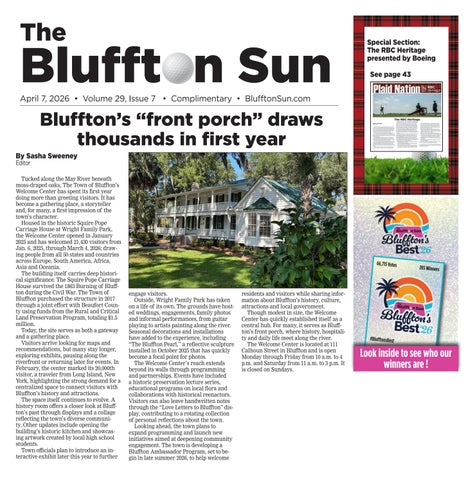
Bluffton’s “front porch” draws thousands in first year

Tucked along the May River beneath moss-draped oaks, The Town of Bluffton’s Welcome Center has spent its first year doing more than greeting visitors. It has become a gathering place, a storyteller and, for many, a first impression of the town’s character.

Housed in the historic Squire Pope Carriage House at Wright Family Park, the Welcome Center opened in January 2025 and has welcomed 21,430 visitors from Jan. 6, 2025, through March 4, 2026; drawing people from all 50 states and countries across Europe, South America, Africa, Asia and Oceania.

The building itself carries deep historical significance. The Squire Pope Carriage House survived the 1863 Burning of Bluffton during the Civil War. The Town of Bluffton purchased the structure in 2017 through a joint effort with Beaufort County using funds from the Rural and Critical Land Preservation Program, totaling $1.5 million.

Today, the site serves as both a gateway and a gathering place.

Visitors arrive looking for maps and recommendations, but many stay longer, exploring exhibits, pausing along the riverfront or returning later for events. In February, the center marked its 20,000th visitor, a traveler from Long Island, New York, highlighting the strong demand for a centralized space to connect visitors with Bluffton’s history and attractions.

The space itself continues to evolve. A history room offers a closer look at Bluffton’s past through displays and a collage reflecting the town’s diverse community. Other updates include opening the building’s historic kitchen and showcasing artwork created by local high school students.

Town officials plan to introduce an interactive exhibit later this year to further

engage visitors.

Outside, Wright Family Park has taken on a life of its own. The grounds have hosted weddings, engagements, family photos and informal performances, from guitar playing to artists painting along the river.

Seasonal decorations and installations have added to the experience, including “The Bluffton Pearl,” a reflective sculpture installed in October 2025 that has quickly become a focal point for photos.

The Welcome Center’s reach extends beyond its walls through programming and partnerships. Events have included a historic preservation lecture series, educational programs on local flora and collaborations with historical reenactors. Visitors can also leave handwritten notes through the “Love Letters to Bluffton” display, contributing to a rotating collection of personal reflections about the town.

Looking ahead, the town plans to expand programming and launch new initiatives aimed at deepening community engagement. The town is developing a Bluffton Ambassador Program, set to begin in late summer 2026, to help welcome

residents and visitors while sharing information about Bluffton’s history, culture, attractions and local government.

Though modest in size, the Welcome Center has quickly established itself as a central hub. For many, it serves as Bluffton’s front porch, where history, hospitality and daily life meet along the river.

The Welcome Center is located at 111 Calhoun Street in Bluffton and is open Monday through Friday from 10 a.m. to 4 p.m. and Saturday from 11 a.m. to 3 p.m. It is closed on Sundays.

Best Hospital & Best Urgent Care TO HAVE BEEN CHOSEN We’re Proud

When Beaufort Memorial opened its doors in 1944, no one could have envisioned then the robust, independent, multispecialty community-focused hospital and provider network we would become.

Today, we’re looking to the future and fulfilling our promise to improve access and expand health care services for residents north and south of the Broad River and well beyond. Since we opened our first Bluffton facility in 2006, we’ve continued to expand services to meet the needs of the area’s growing population, and are now preparing to open a new 28-bed, $103 million Beaufort Memorial Bluffton Community Hospital later this year, providing additional access to quality care for residents.

Thank you for entrusting us to be your health care provider.

the readers of the Bluffton Sun

New YMCA to begin phased opening

The Beaufort-Jasper YMCA of the Lowcountry has rescheduled and combined its grand opening events for a new facility at 11010 East Argent Parkway, off Highway 170, with a joint ribbon-cutting now set for noon April 9.

The ceremony for the James Fisher Memorial Foundation YMCA will be held in partnership with both the Jasper County Chamber of Commerce and the Greater Bluffton Chamber of Commerce, bringing together local leaders, officials and supporters for a single celebration.

The opening will mark the start of a phased launch for the new facility, with some amenities available immediately and others expected to roll out over time.

During the initial phase, members will have access to the fitness center, aquatics complex and child watch area. A limited group exercise schedule will also be offered, with plans to expand classes and operating hours as staffing increases.

“This soft opening gives our community the opportunity to get started while also helping shape what comes next,” said Michael Bostwick, CEO of the Beaufort-Jasper YMCA of the Lowcountry.

“We’re excited to welcome members in and learn directly from them as we build out programs and services that best meet their needs.”

YMCA officials said the organization is continuing to hire staff and expects to add programming in the coming weeks. Aquatics offerings, including swim lessons and water fitness classes, are expected to begin once staffing is in place.

Future plans for the facility include after-school care programs for the 2026-27 school year, along with additional health and wellness offerings as development continues.

Leaders said the phased approach allows the YMCA to expand services in a controlled way while responding to community demand.

The April 9 event will include remarks from YMCA leadership and community partners, followed by tours of the new facility.

The James Fisher Memorial Foundation YMCA was developed to address several community needs, including access to affordable child care, expanded aquatics programming and additional health and wellness resources for residents.

The facility is part of the Beaufort-Jasper YMCA of the Lowcountry, which serves the region through programs focused on youth development, healthy living and social responsibility.

More information about the James Fisher Memorial Foundation YMCA and its programs is available online at beaufort-jasperymca.org.

Beaufort

Our Staff

Current Circulation Via USPS is 24,973

Editor

Sasha Sweeney

editor@blufftonsun.com

Page Designer

Cary Howard cary@blufftonsun.com

Advertising

Mary Ann Kent, Sales & Marketing Manager

843-575-4151

BJ Frazier, 843-422-2321

Claudia Chapman, 814-434-3665

Mary Pat Gifford, 912-414-7122

Contributors

Rich Bernstein

Lisa Hostetler Brown

Ryan Chowansky

Chip Collins

Ronald Finger

Brandon A. A. J. Davis

Tom Dorsal

Collins Doughtie

Thomas Dowling

Rhoda Gordon

Emma June

Grosskopf

Annelore Harrell

Jean Harris

Jamie Harrison

Kenneth Horup

Edwina Hoyle

Kevin Fitzpatrick

Ken Kanter

Patty Kappmeyer

Wendy Kushel

Nanette Makrauer

Nick Martin

Tamela Maxim

Dan Prud’homme

Lucy Rosen

Cinda Seamon

Murray Sease

Christopher L. Thompson

Matt Uppenbrink

Sandro Virag

Tracy Winslow

Mark F. Winn

LETTER TO THE EDITOR

Preserving Beaufort County’s Human Services Department:

A vital safety net for complex needs

Beaufort County’s proposal to dismantle the Human Services Department and shift its programs under Nexus Care is a misguided move that risks leaving countless residents without access to the vital resources they need. While Nexus Care offers critical services for issues related to alcohol, tobacco, and drugs, it is no substitute for the broad-based support provided by Human Services. This consolidation threatens to erode the unique safety net that addresses complex, non-substance-related challenges faced by our community. The Human Services Department is uniquely positioned to provide assistance for residents navigating life’s most intricate hurdles, such as housing insecurity, mental health struggles, and food scarcity. Unlike Nexus Care, whose mission is more narrowly focused on substance-related concerns, the Human Services Department operates as a bridge, guiding residents toward the resources they need to survive and thrive. Its programs are broad in scope and inclusive by design, making it an indispensable resource for individuals and families facing challenges that don’t fall neatly into the categories of addiction or substance use.

Contact us

PO Box 2056, Bluffton, SC 29910

843-757-9507

Physical address: 181 Bluffton Rd., Ste F103-2, Bluffton, SC 29910 BlufftonSun.com

All contents are copyrighted by Beaufort Media Group LLC. All rights reserved. Nothing may be reprinted in whole or in part without written permission from the publisher. All submissions must include name, address and phone number. The Editor reserves the right to edit or reject any material, including advertisements. The Bluffton Sun does not verify for licenses, endorse nor warrant any advertised businesses or services. The opinions and views expressed in the editorials are not necessarily those of the Editor and Publisher. Hilton Head Island-Bluffton Chamber of Commerce, Greater Bluffton Chamber of Commerce, Old Town Bluffton Merchants Society.

THE BLUFFTON SUN Issue 7, April 7, 2026, is published twice monthly by Beaufort Media Group, LLC, 181 Bluffton Rd Suite F103-2 Bluffton, SC 29910. Periodicals Postage paid at Bluffton, SC and at additional mailing offices.

POSTMASTER: Send address changes to THE BLUFFTON SUN, PO Box 2056, Bluffton, SC 29910-2056.

Critically, Human Services does not just provide direct aid but works as a connector, ensuring residents can access the right services from a multitude of local resources. Since 2013, the department has also administered nearly $400,000 annually in county-funded grants to nonprofits that promote community well-being. These grants support local organizations specializing in everything from mental health to housing, amplifying the mission of Human Services and extending its reach far beyond what its modest budget and small staff of five employees could achieve alone. This is not duplication of services—

it is the glue that holds the county’s social safety net together.

Consolidating this department under Nexus Care jeopardizes its mission. Nexus Care is well-equipped to address substance-related issues, but it lacks the broad framework needed to serve residents whose challenges extend beyond addiction. For those struggling with issues unrelated to alcohol, tobacco, or drugs, the shift could serve as a deterrent, making them feel their needs are secondary or overlooked. The county risks creating gaps in its support system, leaving vulnerable populations with nowhere to turn.

Moreover, the financial justification for this move is alarmingly weak. The Human Services Department operates on a budget of just $634,000—a modest amount that reflects its efficiency and commitment to doing more with less. Eliminating the department in the name of saving taxpayer dollars will result in a negligible reduction in millage, while the costs to the community could be catastrophic. This is a case of penny-wise, pound-foolish decision-making that prioritizes short-term budget adjustments over long-term community health and resilience.

Vice Chair Tab Tabernik’s assertion that taxpayers should decide how to donate to nonprofits misses the point entirely. The county’s grant program, administered by Human Services, ensures that

taxpayer dollars are allocated strategically to proven organizations that address pressing community needs. This approach is far more effective than leaving individual residents to navigate the complexities of charitable giving on their own. It reflects a commitment to leveraging public funds for maximum community impact—a responsibility the county should embrace, not abandon.

Beaufort County has an obligation to serve all its residents, especially those in crisis. Eliminating the Human Services Department sends the wrong message: that the county is willing to put cost-cutting ahead of compassion, and efficiency ahead of equity. Instead of dismantling this critical resource, the county should invest in its continued success and ensure that it remains a lifeline for those who need it most.

Let us not forget that the strength of a community is measured by how it treats its most vulnerable members. By preserving the Human Services Department, Beaufort County can reaffirm its commitment to a resilient, inclusive future.

Diana Gill,

University of South Carolina Beaufort

Bluffton Financial Planning is a boutique wealth management firm committed to delivering quality advice to a fiduciary standard, personalized service, tax-efficient investment strategies and comprehensive financial planning.

Nick and Izaac are a unique team characterized by the quality of their education, their veteran backgrounds and their combined 24 years financial planning experience. They understand the shifting dynamics when preparing for retirement, transitioning to retirement and living in retirement.

Market volatility is here, Bluffton Financial Planning is providing value through quality advice and effective communication. Let’s talk!

Foodseum highlights history of Southern cuisine

Food brings people together. It is a shared bond through which friendship, family and fun come to life. Most people have a favorite memory tied to food, and for many, Southern food holds a special place in their hearts.

For those interested in learning more about Southern cuisine, the Foodseum in Bluffton offers an interactive experience. The Culinary Institute of the South at the Technical College of the Lowcountry recently marked the one-year anniversary of the Foodseum, the first public, interactive food museum in the South.

The roughly 1,000-square-foot space is designed to celebrate Southern and Lowcountry cuisine while giving residents and visitors a chance to learn more about the region’s rich culinary heritage.

According to Mary Lee Carns, vice president for advancement and workforce development, the exhibits were researched using a scholarly approach to ensure accuracy in telling the story of Southern food and culture.

The Foodseum features interactive and rotating exhibits that focus on Southern food topics, local culinary talent and a collection of Lowcountry cookbooks by regional authors, including Pat Conroy. Visitors can explore iconic Southern dishes such as chicken bog and Frogmore stew using touch screens. Carrie Hirsh, Foodseum program coordinator, said she often dispels the myth that frogs are included in Frogmore stew.

A reading bench sits outside the glass-enclosed SERG Show Kitchen, where visitors can watch culinary students at work. Guests can also take a trivia quiz and try to beat the current high score.

Display cases feature a variety of artifacts, including hand-held mixers, a pie cabinet, milk jugs and other kitchen tools. The items often spark memories of earlier generations and home cooking traditions.

A 12-foot table serves as the centerpiece of the space, encouraging conversation about Southern food and its history. The table was handcrafted by the Sun City Hilton Head Woodworkers and Modelmakers Guild. Made from poplar, its base is designed to resemble rice trunks used in

South Carolina rice cultivation centuries ago. Mindy Lucas, communications manager for marketing and public relations, said the structures were an engineering achievement brought to America by enslaved people.

Beyond exhibits, the Foodseum also offers educational programming, including a monthly “Fridays at the Foodseum” workshop series. Guest experts include chefs, farmers, restaurateurs, artists and culinary storytellers. Each two-hour session includes a presentation, cooking demonstration, tastings and access to the Foodseum. The cost is $75, and registration is required due to limited space. Carns said the Culinary Institute of the South was privately funded in collaboration with Beaufort County. The institute, one of four campuses of the Technical College of the Lowcountry, opened in November 2021. The Foodseum, located on the first floor, was part of the institute’s original vision and opened March 10, 2025. The institute is free and open to the public Monday through Thursday from 9 a.m. to 3 p.m. It is located at 1 Venture Drive in Bluffton. More information is available at tcl.edu/foodseum.

Edwina Hoyle is a freelance writer in Bluffton.

Riverton Pointe

Almost New | Standout Kitchen | 3BD/2.5BA

$874,999 | MLS#503878

78 FOXBRIAR COURT

Riverton Pointe

2 BD + Office | Private Golf Community

$649,900 | MLS#505040 2114 LAUREL OAK AVENUE

The Haven - Active Adult

Over Half Acre | ~2,454 SqFt | 3 BD / 2.5 BA

776 ST. SOMEWHERE DRIVE

Margaritaville

~2,338 SqFt | Many Upgrades | Screened Lanai

$719,900 | MLS#504088 4 WATERVIEW COURT

Old Town Bluffton Built in 2024 | On-Trend | Lagoon Views

$1,430,000 | MLS#504610

Hampton Lake

2 BD/2 BA | Screened Lanai | Updates

$669,900 | MLS#506040

313 DANNER DRIVE

Bluff

Ample Room & Spacious | Fenced Backyard

$660,000 | MLS#505215 668 DESTINY DRIVE Sun City New in 2023 & Fully Furnished

$499,900 | MLS#504871 6 MIRAMAR COURT

$699,000 | MLS#503692 804 DANNER DRIVE

Malind Bluff

Loaded w/Upgrades | Fireplace | Lagoon Views

$549,900 | MLS#505145

Malind

New center aims to link economic growth, cultural preservation

The Beaufort County Black Chamber of Commerce recently hosted its inaugural Beaufort In Black Gala, launching what leaders say will become an annual event while introducing a new initiative focused on economic development and cultural preservation.

commitment to building opportunity while preserving the culture and traditions that make this community unique.”

The gala also recognized several individuals and businesses for their contributions to the community.

The event, held at Dataw Island Country Club, brought together business leaders, elected officials and community members to celebrate local entrepreneurship and outline the organization’s future efforts.

During the gala, the chamber unveiled its Center for Culture and Commerce, an initiative aimed at expanding business opportunities, workforce development and community revitalization across Beaufort County. The center is designed to support entrepreneurs, small businesses and creative industries while promoting the region’s cultural heritage.

Leaders said the effort is intended to connect economic growth with cultural preservation, with programming focused on education, training and small business development.

“The energy in the room reflected the pride people feel for Beaufort’s history and the excitement for what comes next,” said Marilyn Harris, executive director and president of the chamber. “The Center for Culture and Commerce represents our

Among them was Mobley’s Shoe Repair, a family-owned business founded in 1962 that has served generations of Beaufort residents. Organizers cited the business as an example of long-standing local entrepreneurship.

The chamber also established a scholarship in honor of William Marshel, a founder of the organization and associated with Marshel’s Wright-Donaldson Home for Funerals, a funeral home that has served the community for decades.

Attorney Bernard McIntyre, another founding member of the chamber, was recognized for his work in the legal profession and his contributions to the community.

Chamber leaders said the gala reflects growing support for the organization’s mission as it expands programming through the new center. Future efforts will focus on supporting entrepreneurs, artists and residents while strengthening economic opportunities across the region.

Organizers said the Beaufort In Black Gala is expected to continue as an annual event highlighting local businesses, community leadership and cultural heritage.

The power of the knock

Every weekday morning, Monday through Friday, including Thanksgiving and Christmas, Meals on Wheels Bluffton–Hilton Head begins its quiet work.

Between 8 and 10 a.m., volunteers arrive at two local distribution sites to pack meals, stage routes and load their own vehicles. By 11 a.m., hot meals and wellness checks are delivered across Bluffton and Hilton Head to neighbors who depend on this daily visit not only for nourishment, but for reassurance, routine and human connection.

Last year alone, Meals on Wheels Bluffton–Hilton Head served more than 31,000 meals, supported by a network of more than 300 volunteers, community partners, donors and a small but experienced staff. While the logistics are significant, the real impact happens one doorstep at a time.

It is often described simply as the knock.

The power of the knock

In every community, there are neighbors whose needs can be easily overlooked, especially those living alone, recovering from illness or no longer able to cook safely. For many homebound elders, a once-simple task like preparing a meal can become overwhelming or even dangerous. When nutrition becomes difficult and days grow quieter, health can decline rapidly, and isolation can intensify.

That is why Meals on Wheels Bluffton–Hilton Head exists: to bring nourishment, safety and human connection directly to the doorstep.

Each delivery includes a nutritious meal and a wellness check, an intentional moment of care that helps clients remain stable at home. Just as important, it offers something many people are missing: a familiar face, a kind conversation and the reassurance of being seen.

This is the power of the knock.

It is the steady, compassionate presence that arrives day after day. It’s knowing someone will show up. It’s noticing when something feels off. It’s the quiet dignity of support offered with respect.

Behind every knock is a coordinated network of volunteers, staff, partners and donors working together to ensure no one is left to struggle alone.

The volunteers who notice Meals on Wheels Bluffton–Hilton Head relies on volunteers who use their own vehicles, cover their own expenses and give their time freely. Many serve the same routes for years, getting to know clients by name, habit and story.

They are often the most consistent presence in a client’s life. They notice changes, ask questions and take the time to pause when needed. When something does not seem right, they act.

That awareness is supported by an experienced operations team.

One recent morning, a volunteer driver called in with concerns about a sponsored client whose wife had passed away just a week earlier. The client—who cannot speak due to the loss of his vocal cords—had not answered the door. The situation felt wrong.

Client Services Coordinator Celeste Crago, who has been with Meals on Wheels Bluffton–Hilton Head for 18 years, is often described as the calm center of the organization. She answers calls when neighbors need help, connects volunteer drivers with clients, and responds immediately when something doesn’t feel right. When a driver raises a concern, Celeste is the one calling a family member, Hospice, or 911—ensuring no client is ever left without support. Her steady presence allows volunteers to do what they do best, knowing there is always someone on the other end of the phone who will act quickly, thoughtfully, and with deep compassion.

This is neighbors serving neighbors, not as a single act of charity, but as a circle of care.

When the knock changes a life

Two client stories illustrate what that care looks like.

Suzanne was referred to Meals on Wheels after her cousin, Arlene, a longtime volunteer, noticed a sharp decline in her health. Living alone, Suzanne had been unable to cook for herself and had become severely malnourished, losing 50 pounds in four months.

After enrolling, daily visits brought consistent meals and regular check-ins. Over time, that reliability helped restore a sense of safety and connection.

Hal’s story reflects a different need. At 104, he experienced a stroke that limited his mobility. Cooking became difficult, and his daughter, who lives out of the area, worried about his safety and nutrition.

Meals on Wheels began delivering meals and providing regular wellness checks. Months later, Hal celebrated his 105th birthday, supported by a routine that brought both

nourishment and connection.

The message is consistent. The meal matters, but the knock matters just as much.

The network behind the work

Each delivery depends on a coordinated system behind the scenes.

Daily operations are based at Central Church, which provides space for meal preparation and route coordination. A second distribution site at The Sequins Ballroom in Bluffton helps expand service across the region.

Community partners have also supported the organization through equipment, refrigeration and other resources to ensure service continues without interruption.

These contributions, though often unseen, are essential to keeping the program running each day.

Why support matters

Support allows neighbors who can no longer cook or shop safely to continue living at home with dignity. It provides families with reassurance that someone is checking in regularly.

Meals on Wheels Bluffton–Hilton Head is more than a meal program. It is a system of trust, built one visit at a time.

And it continues because people show up.

How to get involved

Community members can support Meals on Wheels Bluffton–Hilton Head by volunteering, sponsoring meals or making financial contributions.

For more information, call 843-802-0919 or visit mowblufftonhiltonhead.org.

Lucy Rosen has spent 40+ years helping women find business success. Based in Bluffton, she also runs the Lowcountry Women’s Network, a monthly gathering for women in business. Reach: Lucy@smartmarketingcommunications.com.

LUCY ROSEN

What to know about home inspections in the Lowcountry

In the Lowcountry real estate market, once a property goes under contract, the next significant milestone is the home inspection. In Bluffton and Hilton Head Island, inspections are widely viewed as a standard step in the transaction — not a warning sign that something is wrong.

A licensed home inspector is hired to evaluate the property’s overall condition on a specific day. The inspection typically includes a review of major components such as the roof, plumbing, electrical systems, HVAC equipment, appliances, and visible structural elements. Inspectors focus on safety, functionality, and observable concerns. Their role is to document what they see and provide an objective assessment of how the home is performing at that time.

In coastal markets, environmental conditions are an important factor. Moisture intrusion, humidity levels, exterior wear, and the impact of salt air can all influence a home’s systems and materials. As a result, inspectors in the Lowcountry often pay close attention to areas where water may enter, ventilation performance in crawl spaces

or attics, and the condition of exterior components. They may use tools such as moisture meters and thermal imaging devices as part of a noninvasive evaluation designed to provide a clear snapshot of the home’s current state.

Several common misconceptions surround home inspections. First, inspections are not pass-or-fail tests. Even newer or well-maintained homes typically generate detailed reports that include multiple pages of notes and photographs. This documentation is normal and reflects the thoroughness of the process rather than the severity of issues.

Second, an inspection is not the same as a code compliance review. Inspectors are not determining whether a property meets the latest building codes. Instead, they are evaluating condition and performance based on what is visible and accessible at the time of the inspection.

Third, the length of a report does not necessarily indicate major problems. Many items included are routine maintenance recommendations, deferred upkeep, or minor repairs that are common in everyday homeownership.

For buyers, the inspection serves as an important educational step. It provides insight into the home’s systems and helps identify which items may require attention immediately and which can be planned for over time. In most cases, inspectors walk buyers through their findings, explaining what is typical for a property of that age and location versus what may warrant further review by a specialist. This clarity allows buyers to make informed decisions and proceed with greater confidence.

SKIP THE DRIVE. KEEP THE VIBE.

For sellers, inspection findings are expected in nearly every transaction. It is uncommon for a property — regardless of age — to produce a report with no recommendations at all. Minor repair requests are a routine part of negotiations and, when handled reasonably, rarely prevent a transaction from moving forward. Some homeowners opt to complete a pre-listing inspection before bringing their property to market. Doing so can help identify potential concerns early, provide time to address them, and reduce surprises once a buyer is under contract.

As activity continues across the Lowcountry, real estate professionals emphasize that inspections are designed to create transparency. They are not intended to alarm either party, but rather to ensure that both buyer and seller have a clear understanding of the home’s condition before closing.

In markets like Bluffton and Hilton Head Island, where coastal conditions add unique considerations, preparation and realistic expectations go a long way. If you’re buying, selling, or simply planning your next move, connect with our team for trusted local insight and steady guidance. We’re here to help you navigate each step — from contract to closing — with clarity and confidence.

Chip Collins is the Broker-Owner of Collins Group Realty founded in 2002. Find Chip at chip@collinsgrouprealty. com or collinsgrouprealty.com.

From your home to our airport – in a just a short drive. Enjoy the convenience of a 10-minute drive to the airport, quick check-in and easy parking at the Hilton Head Island airport. With nonstop flights to hub cities and one-stop connections worldwide, you can get to anywhere you need to be, on your choice of major airlines – right from our island’s own airport.

CHIP COLLINS

Local students recognized as Heritage scholars

Eleven high school seniors from Beaufort County have been named Heritage Classic Foundation scholars for the 202526 academic year, continuing a long-running program tied to one of the region’s most prominent charitable organizations.

The students, representing five high schools, were selected through a competitive process open to seniors in Beaufort and Jasper counties. Applications were evaluated based on academic achievement, community service, essays and financial need, with 14 finalists advancing to interviews before final selections were made.

The selected scholars are Sophia Brown, Laurel Hinderliter, James Riddle and Halle Tran of Beaufort High School; Tamyra Bolden, Katherine Seraiah Riddle and Rebecca Wohn of Bluffton High School; Jackson Hollman and Kaden Stewart of Hilton Head Island High School; William Carter Cole of Legacy Christian Academy; and Myla Greene of May River High School.

During the awards presentation, Heri-

tage Classic Foundation Chairman Simon Fraser praised the group’s accomplishments.

“This is always an exciting day for the Heritage Classic Foundation,” Fraser said. “We believe the résumés of these young adults are stronger than ever. The teachers and administrators of our school systems, as well as the award winners, deserve special praise.”

Fraser added that the recipients reflect more than academic success.

STOP LETTING TIGHTNESS WIN.

“You are not just straight A students. You are leaders in your schools, communities and churches. Your interests range from volunteerism to sports to caring for the environment,” he said.

Six of the students will receive scholarships totaling $16,000 over four years, while four others were awarded scholarships valued at $20,000. Those awards include scholarships honoring former committee leaders John Zimmerman and Mike Malanick, as well as the Charlie

Brown Award and the Tartan Club Award, which is funded through community donations.

An additional one-year $4,000 Kirby Scholarship, named in memory of former committee chairman Ward Kirby, is awarded annually.

The foundation also provides scholarships to local colleges, including four $2,500 annual awards to the University of South Carolina Beaufort and two $1,500 awards to the Technical College of the Lowcountry.

With this year’s class, a total of 49 students from Beaufort and Jasper counties will be receiving foundation support next fall, with combined funding of $194,000. Since its inception, the program will have awarded $5.75 million to 408 students following the 2026 distribution.

The Heritage Classic Foundation, which organizes the RBC Heritage golf tournament, has contributed more than $61.8 million to charitable and educational initiatives across South Carolina since 1987.

Officials said the scholarship program remains a central part of the foundation’s mission, supporting local students as they pursue higher education and future careers.

Heritage Classic Foundation

With over 35 years of trusted expertise, Lawn Doctor has been helping lawns thrive and neighbors smile season after season. We’re proud of the roots we’ve grown in this community, and even prouder of the lush, healthy lawns that tell our story.

Scan our QR code to submit a free lawn evaluation request today!

Top Dressing Top Dressing

Our special nutrient-rich compost blend sparks deeper growth, richer color, and stronger, healthier lawns throughout the Lowcountry.

Weed Control

Core aeration relieves soil compaction, allowing air, water, and nutrients to reach the roots and produce thicker growth, deeper roots, and a stronger, healthier lawn.

Sand helps to fill in low spots, prevent waterlogging by improving drainage, promoting healthier, more resilient turf.

Insect Control

Fertilization

Tree and Shrub Fertilization

Fungicide Applications

Lime Applications

Liquid Soil Enhancements

Mole Cricket & Fire Ant Prevention

Sod Webworm Applications

Tree & Shrub Deep Root Feedings

Low inventory, rising demand drive Bluffton’s housing market

The Bluffton real estate market continues to deliver a very clear message as we move deeper into the spring selling season. While there are always broader economic factors at play, the local numbers are telling a story that buyers and sellers need to pay close attention to right now.

Let’s start with inventory, because this is the headline. Bluffton currently has 791 homes for sale, up from 720 last month, representing a 9.9% increase. While that may sound like a meaningful jump, context matters. At this same time last year, there were approximately 1,100 homes on

the market. Even more telling, the ten-year average for this time of year is 1,201 homes. That means we are still dramatically undersupplied. In fact, this is the lowest inventory level Bluffton has ever seen for this time of year, even lower than 2022 when we had 835 homes available. This level of constraint is a strong indicator that upward pressure on pricing is likely to continue.

Days on market has improved slightly, dropping to 94 days from 98 days last month, a 4.1% decrease. Compared to this time last year at 90 days, we are still very much in line with recent trends. Homes are taking a bit longer than the peak frenzy years, but they are still moving at a healthy pace given current conditions.

Pending sales are where things get really interesting. Year to date, we are sitting at 595 pending transactions compared to 485 at this same time last year. That is a 22.7% increase in buyer activity, and it is

happening despite significantly lower inventory. That tells you demand is not just strong, it is competing for limited supply.

Closed sales are also up, with 478 year-to-date compared to 435 last year, a 9.9% increase. This confirms that the momentum we saw building last month has continued, and the market is gaining strength as we move into peak season.

The absorption rate currently sits at 3.9 months of inventory, compared to 4.1 months last month, a decrease of about 5%. We continue to move further and further into a strong seller’s market.

From a pricing standpoint, what we are seeing right now is a normalization. Over the past couple of months, many of the aspirational list prices that entered the market have been adjusted back to reality. The data is showing us clearly that annual appreciation is settling into single digit growth, not the double-digit pace we experienced during the pan-

demic surge.

That said, this is not a weakening market. Quite the opposite. We are in the middle of a meaningful shift from a neutral market back into a seller’s market. With inventory at historic lows and demand accelerating, the foundation is being laid for a big move upward.

If geopolitical tensions ease and we see a change in direction from the Federal Reserve, there is a strong likelihood that double digit appreciation returns. Until then, expect steady, sustainable price growth as this market continues to tighten. Right now, Bluffton is not just stable. It is primed. Talk soon, Bluffton!

Dan Prud’homme is the Visionary & Success Coach of The Prud’homme Team at William Raveis Real Estate. dan@ danprudhomme.com Theprudhommeteam.com.

DAN PRUD’HOMME

MORE THAN NEIGHBORS

The Masters: Traditions like no other tournament

I love this time of year because I get to see great golf tournaments in person. Having lived in Athens, Georgia, for 40 years, I was able to attend the Masters every year. I have continued going to the tournament with my LPGA friends since it is a relatively short drive from Bluffton.

What I like most about the Masters Tournament is the history and traditions associated with it. I started watching the tournament as a young girl and loved seeing the great players of that time: Arnie, Jack and Gary.

There are so many Masters traditions: Green jacket for the winner — The winner gets to wear the green jacket for a year and must return it to Augusta National the following year.

Champions Dinner — Held on Tuesday evening, the defending champion selects the menu and hosts the evening. It reflects their heritage and favorite foods. This year, Rory McIlroy has chosen the following menu:

Appetizers: peach and ricotta flatbread, rock shrimp tempura, bacon-wrapped dates and grilled elk sliders

First course: yellowfin tuna carpaccio

Second course: option of wagyu filet mignon or seared salmon

Dessert: sticky toffee pudding

Only past champions and the Augusta National chairman attend. The evening is known for shared stories and camaraderie.

Par 3 Contest — Held on Wednesday afternoon, players carry only a few clubs, and family members often serve as caddies, wearing the traditional white jumpsuits. The event is lighthearted, with players interacting with fans. Notably, no winner of the Par 3 Contest has gone on to win the Masters in the same year.

Ceremonial first tee shot — The tournament opens Thursday with honorary starters teeing off on the first hole. This year, Jack Nicklaus, Gary Player and Tom Watson will participate.

Caddies in uniform — Caddies wear Augusta National’s traditional white jumpsuit and green cap.

Patrons — Fans are referred to as patrons and are expected to follow strict etiquette. Weekly passes, known as patron badges, have been sold out for years. Practice round tickets are available through a lottery but are difficult to obtain. Cellphones are not permitted on the course.

Concession prices — Food and beverage prices remain notably low. Pimento cheese, egg salad and barbecue sandwiches are $1.50. The Masters club sandwich is $3. Beer and wine are $6, and soft drinks and water are $2. A Georgia peach ice cream sandwich costs $3.

Newer traditions include:

Drive, Chip and Putt Contest — Held the Sunday before tournament week, this national youth competition began in 2014. Boys and girls from across the country qualify through regional events. Notably, former participant Akshay Bhatia later qualified for the Masters as a professional.

Augusta National Women’s Amateur — Established in 2019, this event features top amateur women competing, with the final round played at Augusta National. Many participants have gone on to play on the LPGA Tour.

The Masters is the major championship every golfer hopes to win. It remains one of the most anticipated events in the sport, known for its traditions and competitive field.

Dr. Jean Harris is an LPGA Master Professional and teaches at local golf courses. jean.golfdoctor.harris@gmail. com; golfdoctorjean.com.

Assisted Living • Memor y Care

Assisted Living

• Memor

te Care

Care

Care

Monitoring shorebirds during beach renourishment

As beach renourishment projects reshape portions of Hilton Head Island’s shoreline, understanding how wildlife responds is an important part of the process. For Allie Hayser, a shorebird biologist with Manomet Conservation Sciences leading this work on Hilton Head, this means tracking how birds use the beach before, during and after these efforts, while monitoring how shorebirds use the island’s beaches throughout the year. When a large project such as beach renourishment occurs, it becomes especially important to understand where birds are feeding, resting and gathering so scientists can track their response over time.

Manomet leads ongoing shorebird monitoring on Hilton Head in partnership with the Town of Hilton Head Island, the South Carolina Department of Natural Resources, the U.S. Fish and Wildlife Service and volunteers. Hayser conducts field monitoring and works closely with partners to better understand how birds use key areas of the island.

This work focuses on locations that consistently support high numbers of birds, including Fish Haul Beach, Pine Island and the Port Royal Sound shoreline. Fish Haul is one of the most important sites on the island. Its mudflats, sandbars and shoreline provide essential habitat for birds that rely on quiet places to rest and feed during migration and throughout the winter. These areas are especially important at high tide, when feeding habitat is covered and birds gather in concentrated roosting areas.

To understand how birds use these habitats, Hayser conducts regular monitoring surveys, recording species, counts and behaviors such as feeding, resting or flying. She also documents disturbance events, such as people or dogs approaching birds, and environmental conditions that may influence where birds gather.

Another key component is resighting banded birds. Many migratory shorebirds carry small leg flags that allow researchers to identify individuals and track

their movements across the hemisphere, contributing to a broader understanding of migration along the Atlantic Flyway. Recent surveys have documented a wide range of species using Hilton Head’s north-end habitats, including red knots and piping plovers, both species of conservation concern, as well as American oystercatchers, sanderlings, black-bellied plovers, ruddy turnstones, marbled godwits, willets and several tern species. Many gather in large groups on sandbars near Fish Haul Creek, particularly during high tide.

Monitoring has also identified important high-tide roost areas where birds rest when feeding grounds are unavailable. These locations often overlap with popular areas for walking and exploring sandbars, increasing the potential for unintentional disturbance.

To address this, partners are working on a community-focused effort centered on a proposed voluntary Wildlife Beach Area at Fish Haul. The goal is to highlight the importance of the shoreline, particularly the sandbars and mudflats near the spa area, and encourage simple stewardship practices such as giving birds space.

This effort includes developing signage with the Town of Hilton Head Island and engaging volunteers to share information directly with beach visitors. Outreach is designed to be friendly and informative, helping people understand how small actions can make a difference.

As Hilton Head seeks to balance coastal management with conservation, monitoring continues to show its vital role for shorebirds, especially the piping plover. Each winter, plovers from the Great Lakes, Atlantic and Great Plains populations return to the island to feed and rest, underscoring how essential these beaches are and how community awareness helps protect them for future generations.

To learn more, visit manomet.org/project/ ga-bight-shorebird-conservation.

Patty Kappmeyer is a photographer and writer based on Hilton Head Island. She is the owner of LowcountryBirdsandNature.com and serves on the Board of Hilton Head Audubon.

Bluffton Fire Commission adds Williams

Glenn Williams has been appointed to the Bluffton Township Fire District Fire Commission as an at-large member, filling a vacant seat on the governing board.

The Beaufort County Council approved the appointment during its Feb. 23 meeting. Williams was sworn in by Acting Chairman William “Bill” Rickett during the commission’s regular meeting.

Williams succeeds Drew Bedingfield, who stepped down from the board. The appointment carries a four-year term that runs through February 2030. Williams brings more than 30 years of experience in fire service and public safety. His career includes roles as a firefighter, apparatus operator, shift captain, deputy fire marshal and battalion chief. He retired as an assistant chief with Lexington County Fire Service after more than 27 years.

In addition to his fire service background, Williams has worked in law enforcement and served as an instructor in fire and emergency services.

“Mr. Williams brings a wealth of knowledge and experience to the Fire Commission,” Rickett said. “His lifelong commitment to public safety and leadership in the fire service will be a tremendous asset as we continue to serve our community and plan for the future.”

Down in the mouth

Do people ever come up to you and ask, “Why do you look sad?”

Even when you feel perfectly happy, repeated questions like that can leave you feeling, well, sad or annoyed.

A common complaint from patients is that they appear sad or angry even when they are not. In many cases, it comes down to genetics. Some people have stronger muscles, such as the depressor anguli oris, or DAO, which pulls the corners of the mouth downward. You can counteract this by smiling, but constantly smiling is not practical and may even seem inappropriate in some situations.

Don’t worry, look happy

Think of Jack Nicholson as the Joker in “Batman.” While smiling is a good thing, doing it all the time can look unnatural. So what is the alternative?

Solutions

Fillers such as Restylane, Juvederm or Sculptra can help in some cases. Botox or Dysport can also lift the corners of the mouth by weakening the DAO. These treatments may improve the appearance but may not completely correct it.

If fillers or neurotoxins are not enough, another option is PDO lifting threads. These can lift the cheeks, jowls, neck, corners of the mouth and even the brows under local anesthesia.

Another option is the Everesse radiofrequency device. This treatment thickens the skin and increases elastin and collagen production without needles, numbing or recovery time. It can also restore volume to the face, which often diminishes with age. When appropriate, a combination of these treatments can be effective with minimal recovery time. Patients should carefully weigh

their options as part of the decision-making process. An added benefit of these procedures is improvement in marionette lines.

Sad or angry eyes

Another feature that can make someone appear unhappy or angry is the presence of frown lines between the brows. These are caused by the corrugator muscles, which can become stronger over time due to re-

peated frowning or squinting. Like any muscle, the more it is used, the stronger it becomes. Over time, these lines can remain even when a person is relaxed or happy.

Solutions

A common treatment is Botox or Dysport injected into the muscle with a fine needle. With consistent treatment, the muscle weakens, and the lines become less pronounced, often requiring less frequent injections over time.

Fillers can also be used to soften these lines, though they must be applied carefully. For a drooping outer brow that contributes to a sad appearance, a brow lift or PDO lifting threads may also be effective. If your outward expression does not match how you feel, there may be options to help address it. And that may be something to smile about.

Dr. Ronald Finger, MD, FACS is a board-certified plastic surgeon with offices in Savannah and Bluffton.

Reverend Randall Haase
Anna Marie Kuether Director
DR. RONALD FINGER
PDO Lifting threads to face followed in 3 weeks with the Everesse.

At 107, Nancy Nelson finds joy in art and life

Born Feb. 16, 1919, Nancy Nelson celebrated her 107th birthday last month.

“The day my birthday arrived, I woke up and I was very surprised,” Nelson said. “I’ve been very fortunate and smart enough to know it.”

She said the secret to her longevity is a naturally happy disposition and a positive attitude.

Nelson is originally from Grand Rapids, Michigan, and majored in art at Michigan State University. She put her art on hold to work as a flight attendant for TWA.

“I loved being a flight attendant while my husband, Bob, was in the Navy in the Far East during World War II,” she said.

Nelson gave birth to her son, James, before her husband returned from the war. She later had

two daughters, Marilyn, who died in 2010, and Susan. She has three grandchildren and three great-grandchildren. The Nelsons retired to Hilton Head Island in 1980.

“That’s when I renewed my interest in art,” she said. “I started drawing when I was about 3 years old. I’d sit on the floor and copy the cartoon characters in the funny papers. I was always drawing my whole life. My art is something I was made to do.”

Nelson specialized in watercolor and tempera paints and said she painted anything she found interesting, including the faces of strangers she passed. Her strong observation skills allowed her to remember details. She sold her paintings and notecards and, at age 80, held a one-woman art show. She has also been a member of the local PEO (Philanthropic Educational Organization) for 22 years.

Edwina Hoyle is a freelance writer in Bluffton.

Combahee Heritage of Rice Festival

The Combahee Heritage of Rice Festival is set for 10 a.m. to 3 p.m. Saturday, April 18, at the Green Pond Community Center, 915 Ivenia Brown Road in Green Pond.

The event will highlight Gullah Geechee heritage tied to rice cultivation along the Combahee River, an area with deep historical and cultural significance in the Lowcountry.

Organizers say the festival will include historical exhibits, educational displays and opportunities for ancestral research. Food vendors will offer traditional dishes reflecting the region’s culinary roots.

Rice cultivation played a central role in shaping the Lowcountry’s economy and culture. Enslaved Africans brought specialized knowledge of rice growing, helping establish South Carolina as a major rice-producing region in the 18th and 19th centuries. That legacy remains closely connected to the Gullah Geechee community today.

The festival will also recognize the history of freedom seekers along the Combahee River, including events tied to the Civil Warera Combahee River Raid, during which hundreds of enslaved people gained their freedom.

Organizers say the event is designed to educate visitors of all ages while celebrating the traditions and contributions of the Gullah Geechee community. The festival is free and open to the public. For more information, visit gphps.com.

The trouble with faith and politics

As a new resident and pastor of one of the oldest churches in our community, I am delighted to have been extended the opportunity to convey my thoughts and to offer pastoral wisdom and encouragement through this newspaper. I see this moment as an opportunity to introduce myself and my pastoral passions for community and unity across our varying faith traditions. Recently, I’ve been contemplating the relationship between faith and politics, and how they influence each other. While I am not certain there is such a world where these words exist together, they have, for a while, been part of the political narratives and rhetoric driving much of today’s conversations. For years, people have asserted that our faith in God should outweigh our political musings and should, for all intents and purposes, differ from what we see others do politically. However, as I’ve taken a serious look at political theology, particularly in my faith tradition, I have discovered a missed connection between belief in God and in political systems and structures that govern the world. The current political climate is shifting, with issues

and concerns changing daily. In total honesty, it is often difficult to determine what will matter to people. Even with the political landscape shifting, particularly as our government and political leaders are taking steps to infringe on the right to vote, to protest, and to exercise freedom of speech – to name a few. The climate in Columbia, SC, and Washington, DC, is filled with political rhetoric used as a stratagem to hide the truth of individuals’ political intent. The danger of it all is that many of them identify their political motivations with their faith; yet, for some, their political expediency seems to shift when it comes to matters of racism, stricter voting laws, redlining, and redistricting.

As we continue the fight for social justice, economic and human equality, there needs to be a blending of understanding. The agency of faith and political structures must not be seen as opposites, but rather as inherently motivating people to do the right thing toward everyone, not just a select few. Here is where I want to pause and say that, while I am not uncomfortable with speaking to the hard and sometimes undesirable conversations within society, as a pastor, I wholeheartedly believe it is part of my calling and responsibility as a shepherd and a leader. I do this work with sensitive hands because what creates the divide within the community is sometimes the inconvenience of our humanity and the inability to see, hear, and understand where the other person is coming from. Therefore, let me emphatically say, while not ignoring others, that the Church cannot remain silent in address-

ing the narratives and rhetoric that come from our State and the US Legislative bodies. There is more than ever a need for a communal understanding as to what it means to care for our neighbor and to view oneself in light of their neighbor’s circumstances. In doing so, I believe we can articulate the relationship between religious beliefs and societal structures in a more realistic and positive light.

On Sunday mornings at Historic Campbell, I have the privilege of reading the decalogue (Ten Commandments) as a reminder of our role in life and society. The summary of the decalogue for me is what drives the essence of the ten laws of God for social behavior: “Hear what Christ our savior said: thou shalt love the Lord thy God with all thy heart, with all thy soul, and with all thy mind, and the second is like unto it, thou shalt love thy neighbor as thyself.”

Beloved, it makes it increasingly difficult to do the simplest of these commandments when the laws and political systems that exist are being interpreted with malicious intent to harm our neighbors. Just as love does no harm, our faith and political leanings shouldn’t either. Both should, at their core, seek the greater good in people. Amen.

Dr. Brandon A. A. J. Davis is the 30th Senior Pastor of Historic Campbell Chapel AME Church, Bluffton, and an adjunct professor in the Department of Religion at Simmons College, Louisville, KY. He is married, a lover of books, and enjoys a great conversation.

DR. BRANDON DAVIS

What Is Elder Law?

The seasons change

“The Man in the Arena,” written by Theodore Roosevelt, said it better than I ever could: “The credit belongs to the man in the arena, whose face is marred by dust and sweat and blood, who comes short again and again, because there is no effort without error and shortcoming…”

Reread that last part. There is no effort without error. Unfortunately, that is an absolute fact. If you are in a season right now where the issues and errors feel like they are stacking up faster than the wins, know this: you are not failing, you are in the arena. This is the part where you might wonder if I am talking about myself. If you think I am, you are correct. But I know I am not the only one, so let’s pull ourselves up together.

Social media is a highlight reel. Everyone is closing deals, launching things, posting wins, on vacation, buying a new car. Win, win, win. Nobody posts the month when the bank account gets tight. Nobody posts sitting in the driveway for 20 minutes trying to find the energy to shift from work mode to family time, because they deserve a better version of you walking into that house than the one about to step out of that truck.

There are checked-out employees saying things are getting done when they are not. Issues get swept under the rug. Employees are afraid to share what they have been seeing for months. I have had weeks where I was solving ten problems a day and creating zero momentum. That is an exhausting place to be. The temptation in that season is to either quit or ignore it. Both are traps. Quitting ends momentum and creates a real loss. Ignoring it only delays the inevitable.

Here is what I have learned. In construction, there are issues of varying degrees on every project. Every one.

A supplier misses a delivery. Rain disrupts your schedule. The client changes their mind for the third time. A project manager lets the timeline slip. You cannot control those things. What you can control is what happens next.

The business owners who are still standing after 20 or 30 years are not the ones who never had a bad project. They are the ones who took a hit on Tuesday and showed up Wednesday with a plan and executed it.

Life is no different.

Maybe money is tight right now. Maybe a relationship is strained. Maybe the business you thought would take off is barely staying afloat. Or maybe you are just tired, running on fumes and wondering when things get easier. It gets easier when you stop looking at losses as setbacks and start treating them as lessons. Every difficult experience teaches something you could not have learned any other way. Bad estimates teach you to sharpen your numbers. Tough clients teach you to communicate earlier. Cash flow problems teach you to build better systems. You may not enjoy those lessons, but they matter.

Think of it like a renovation. Sometimes you have to strip everything down to the studs before you can build something better. That phase is messy. It is loud. It is not what you expected. Nobody posts about the expensive surprises of demolition day. But it is often the most important part, because without it, you are just putting new paint on old problems.

So if you are in that season right now, stay with it. The season will change. The numbers will improve. Clarity will come. But only if you keep working and address the problems in front of you.

The people who succeed long term are not luckier or smarter. They are simply persistent. They take the lessons, adjust and keep going.

The season you are looking for is on the other side of the work most people avoid.

Ryan Chowansky is the owner of

Bluffton Builders, LLC, www.bluffton. builders.
RYAN CHOWANSKY

The startup toolkit nobody talks about

Nobody tells you this part. They tell you about branding, vision boards, “finding your why.” They do NOT tell you that what you really need… is a knife. A good one. Not your kitchen scissors. Not the dull thing from the junk drawer. I’m talking a legit box cutter. Because guess what? You’re in business now—things arrive in boxes. A LOT of boxes. And you’re not standing there wrestling cardboard like it’s your opponent in a cage match. Get the knife.

While we’re here—get a hand truck.

“Oh I’ll just carry it.” No, you won’t. Not the third shipment. Not when it’s 92 degrees, you’re sweating through your shirt, and UPS just dropped off what feels like a refrigerator filled with dreams and inventory. Get the hand truck. And please—learn how to use it before you take out your own ankle.

Next: the tape gun.

You think, “How hard could it be?”

Oh… it can be hard. There is technique. There is finesse. There is a right way so your box doesn’t look like it got into a fight and lost. You will absolutely end up on YouTube at some point typing: “How to load packing tape without losing my mind.” Just accept it.

Speaking of securing things—bungee cords. Zip ties.

You don’t know why yet. You just will. You will need to attach things to other

things in ways that defy logic. Booth setup? Zip ties. Display falling apart? Zip ties. Life unraveling? Honestly… zip ties. Now let’s talk wardrobe.

Ladies—yoga pants with pockets. Non-negotiable. You need somewhere to put your phone, your knife, your lip balm, your sanity. Jeans? Phone falls out. Dresses? Don’t even get me started—who designed women’s clothes with NO pockets? Like we’re just floating around with no responsibilities? No. We are running businesses. We need pockets. Also—wear sneakers. You are not cute. You are working. You will get dirty. You will be on your feet. Even if you own a “boutique,” guess what—you’re still opening boxes in the back like a boss. Get gloves. Real work gloves. Because your hands will take a beating—and yes, you still want them to look good. Which brings me to: dip manicure. Regular polish? Gone in 12 minutes. Dip lasts. This is strategy. You need steel. Internal steel. Because you’re going to hear “no.” A lot. Not one no. Not two no’s. Not even ten. Try 100. Try 1,000. And every time, you’ve got to pick up your box cutter, tape up your next shipment, roll that hand truck forward, and keep going like you didn’t just get shut down. Because that’s the real toolkit. Knife. Tape. Zip ties. Yoga pants. And a backbone that says: I’m not done yet.

Now go. Open the box.

Wendy Kushel is the owner of Wendala’s LowCountry Sugar Scrub, LLC based in Bluffton. Her background includes stand-up comedy, film, TV and a lot of sales and marketing. For more information about Wendala’s® LowCountry Sugar Scrub visit www.lowcountrysugarscrub.com or call/text 843-949-8933.

Engagement Builds

Pure Med Spa is here to assist you in achieving your skincare goals.

APPROACH

“At Pinnacle, we want our patients to feel like they are part of our family and we strive to treat them that way from the first time they visit. We pride ourselves on the customer experience. It is important to always keep up with the latest advances, but our practice uniquely separates the gimmicks from the options that produce results. It is our philosophy to listen first to our patients’ goals and then help guide them to the treatments and procedures that will help us all work toward that shared goal. Your inner and outer you should be in harmony.”

WENDY KUSHEL
The Bluffton Sun and Hilton Head Sun invite you to like and follow our socials, as we will be more active on our social media channels moving forward to keep an

Ask the Expert: Waiting is the most dangerous estate planning decision you can make

One of the hardest conversations I have with families is the one that starts too late. Someone finally decides they’re ready to “get their affairs in order,” but by the time they reach out, capacity has slipped, documents can’t legally be signed, and the family has lost the ability to make decisions privately. At that point, the only option left is often a court-controlled guardianship and/or conservatorship — a process families want to avoid.

Almost every time, they say the same heartbreaking words: “We knew we needed

to do something… we just waited.”

Many people assume estate planning is something they can put off until “later,” but later often arrives suddenly and with significant changes. Conditions like dementia can progress slowly for years before a crisis pushes the issue to the surface. What most families don’t realize is that a diagnosis alone does not eliminate the ability to sign documents, but waiting until the condition has progressed absolutely can.

Once someone loses the legal capacity to sign a Durable Power of Attorney (DPOA) or Health Care Power of Attorney (HCPOA), there is no one with the legal authority to make decisions. As such, the family must go to court and have someone appointed to make these important decisions. That means hearings, filings, attorneys, waiting periods, and public oversight of a person’s finances and care.

Most families are shocked to learn that by doing nothing, they unintentionally hand control over to the state.

A

proper durable power of attorney is protection

Another issue I see frequently is people coming in with a Durable Power of Attorney that isn’t strong enough. Maybe it was downloaded online years ago or prepared by someone unfamiliar with elder law. Sometimes it’s so limited that it can’t be used to protect assets, apply for benefits, or authorize essential planning. In those cases, the result is the same as having nothing at all.

A well-crafted and comprehensive DPOA should empower your chosen decisionmaker to act quickly and thoroughly on your behalf.

Planning early keeps families together

Waiting doesn’t just create legal problems. It creates emotional ones. When there’s no clear plan, families are left guessing. Siblings disagree. Spouses feel overwhelmed. Decisions feel heavier, and tensions rise at the exact moment families need unity.

Early planning is the antidote. It gives your loved ones clarity, confidence, and

permission to follow your wishes without conflict or guilt.

The bottom line: if you’re over 18, it’s time

Estate planning isn’t about age, wealth, or fear. It’s about control. It’s about dignity. And it’s about giving your family the roadmap they’ll need long before they think to ask for it.

Whether you’re 18 or 80, with a modest portfolio or a substantial estate — the greatest danger is never making a plan.

If you’re looking for actionable next steps, consider connecting with a trusted local elder law attorney. They can provide clarity, confidence, and peace of mind in preparing you and your family for the future.

For educational purposes only. This is not legal advice. Lisa Hostetler Brown is a Certified Elder Law Attorney certified by the National Elder Law Foundation. 2 Hampton Hall Blvd, Ste 100, Bluffton, SC 29910. | 843757-5294 | LawyerLisa.com.

What Your Matched Gift Supports:

When you designate Memory Matters through Birdies for Charity, your support helps provide:

Caregiver training and education

Adult day respite services

Brain health programs like Brain Boosters

Community outreach and screenings

Because of you, families facing memory loss receive guidance, connection, and compassionate care. If you’re participating in Birdies this year, we’d love to be your designation.

Help us DRIVE change, one SWING at a time!

The 2026 RBC Heritage - Birdies for Charity Program - is running now through Sunday, April 19, 2026. Pledge a specific amount for every birdie made at the RBC Heritage. Your donation goes directly to your chosen charity. Plus, the Heritage Classic Foundation contributes an extra 20% on top of your total! your

LISA HOSTETLER BROWN

In ballroom, presentation makes a difference

This might come as a surprise, but presentation matters as much as technique in ballroom competitions. Judges see you before they begin to evaluate your dancing. Good grooming creates a clean, confident first impression. Grooming, makeup and hair are not just for appearance; they are essential performance tools that enhance lines, expressions and overall professionalism. When done well, they support your movements and help your dancing read clearly from across the floor.

Avoid trying any new products right before the event. Use what you know works.

Nails should be neat and neutral. Chipped polish can be a distraction.

Well-shaped brows and professional makeup will elevate the overall look.

Professional grooming shows respect for the competition and signals that you take your dancing seriously.

Ballroom makeup is stage makeup. It may look too strong up close but will likely appear subtle under bright lights and from the judges’ table.

Strong eyeliner, defined brows and false eyelashes help your eyes communicate expression and purpose.

Contouring and highlighting can help define facial structure and prevent features from being washed out. Add warmth and dimension with blush and bronzer. Avoid pale tones.

For lipstick, choose long-wearing colors that complement your costume and will not fade during the competition.

Hair must stay in place. Use strong-hold products and secure styles with plenty of bobby pins. Avoid loose pieces of hair that might distract or cover your face. Sleek, controlled styles such as buns or French twists highlight clean lines and elegant shaping. For Latin or rhythm dances, tighter and more dramatic styles such as slick ponytails or sculpted waves may be appropriate. Test your hairstyle during practice to ensure it holds up under movement and sweat. Your grooming, hair, makeup and costume should present one cohesive look. When everything works together, your presentation enhances your dancing. It may not win the competition, but poor presentation can affect placement. Aim for an appearance that is polished, intentional and confident.

Sandro Virag is a partner and instructor at Hilton Head Ballroom Dance Studio of Hilton Head, hiltonheadballroom.com

$18,800 donated

by Sun City Group

Members of 100+ Sun City Women Who Care present an $18,800 donation to the Society of Saint Vincent de Paul of Bluffton on Feb. 16. The contribution supports direct assistance for residents facing urgent needs, including help with housing, utilities and food. Representative Marilyn Bastardi said the funds are already helping families secure stable housing and complete critical vehicle repairs, key to maintaining employment and independence. Founded in 2017, the women’s group has donated $393,800 to charities across Beaufort and Jasper counties, reflecting its ongoing commitment to meeting immediate community needs through collective giving. For more information about the organization, contact 100SCWomenWhoCare@ gmail.com.

Regions Bank names Savannah market executive

Regions Bank has named longtime Savannah banker Brian Jackson as market executive to lead commercial banking growth in Savannah and the Lowcountry. Jackson is an experienced commercial banker who has served business clients throughout the area since 2015, will oversee expansion efforts across coastal Georgia and southern Beaufort County, including Hilton Head Island and Bluffton. He previously held leadership roles with Great Oaks Bank, Cadence, Wells Fargo and Bank of America. Regions officials cited the area’s economic growth, driven by port activity, tourism and manufacturing. For more information, visit regions.com.

Bluffton Self Help earns chamber honors

Bluffton Self Help has been named the 2025 Non-Profit of the Year and received the Pearl Award from the Greater Bluffton Chamber of Commerce.

“This honor belongs not just to our organization, but to our volunteers, donors, partners, and the entire community that makes this work possible.” said Carli Anselmi, Development Director of Bluffton Self Help.

The awards recognize leadership, community impact and collaboration. The organization, which has served Beaufort and Jasper counties for nearly 40 years, provides support services to individuals and families in need. For more information, visit blufftonselfhelp.org.

LDSS to host Night of Champions, hiring expo

The Lowcountry Down Syndrome Society will host its 17th annual Night of Champions and Hiring Expo on April 30 at the Savannah Marriott Riverfront. Night of Champions highlights employers helping close that gap by creating environments where individuals of all abilities can contribute, succeed and grow. The evening will also feature a Hiring Expo designed to connect businesses with job seekers and demonstrate the value of inclusive hiring. The evening will include dinner and an awards ceremony. Proceeds support LDSS programs, including Camp Buddy and the Buddy Walk. For tickets and information, visit ldssga.org/ night-of-champions.

SYNERGY HomeCare earns national award

SYNERGY HomeCare of the Lowcountry has received the 2026 Best of Home Care Provider of Choice Award from Activated Insights. The award highlights agencies that consistently receive high marks from their clients, reflecting a strong commitment to quality care, service, and trust. SYNERGY HomeCare of the Lowcountry is proud to be recognized among a select group of home care providers nationwide who have met these rigorous standards.. The company said it has received the honor for seven consecutive years since opening in 2019. Owners said the recognition reflects their commitment to compassionate care. For more information, visit synergylowcountry.com.

Dr. Rebecca Keith joins Beaufort Memorial OB-GYN team

With the addition of an experienced, board-certified OBGYN to the team, Beaufort Memorial is continuing to expand access to much-needed women’s health services in the Lowcountry.

Dr. Rebecca A. Keith has joined Beaufort Memorial Obstetrics & Gynecology Specialists, bringing more than 30 years of clinical expertise – including several years practicing on Hilton Head Island and in Hardeeville. She will provide comprehensive, patient-centered care for women of all ages at the practice’s Beaufort and Okatie locations, and with a special interest in high-risk obstetrics, she is committed to creating a respectful, supporting environment for patients at every stage of life.

“Dr. Keith’s experience and patient-focused approach make her a tremendous asset to Beaufort Memorial and to meeting the growing demand for women’s healthcare services in our region,” said Beaufort

Memorial President and CEO Russell Baxley. “We are pleased to welcome her back to the Lowcountry.”

Dr. Keith decided to pursue a career in medicine at a young age, and she earned her medical degree from Indiana University and completed her post-graduate training at Methodist Hospital in Indianapolis.

Although Dr. Keith’s early career began in the Lowcountry serving Hilton Head Island, Bluffton and Hardeeville, much of her career was spent in Greenville. Throughout that career, she has delivered more than 5,000 babies and built lasting relationships with her patients and their families.

“I enjoy getting to know my patients and their families, and, working together, we find individualized solutions,” she said. “I want my patients to feel comfortable, heard and understood, no matter their needs.”

At Beaufort Memorial, Dr. Keith will provide general obstetric and gynecologic care, including diagnosis and treatment of common women’s health conditions. She

is also passionate about supporting young women through their first pelvic exams and serving as a trusted, knowledgeable resource for education and guidance.

Outside of work, Dr. Keith enjoys spend-

ing time with her two adult children, Ryan and Rachel, traveling and participating in outdoor activities like hiking, canoeing and horseback riding.

At the practice, Dr. Keith joins board-certified physicians Drs. Tiffany Bersani, Curtis J. Elam and Tempest Allen, as well as certified nurse practitioner Melissa Mesenburg, certified physician assistant Peyton Erb McManus and certified nurse midwife Catherine Tambroni-Parker.

With locations in the Beaufort Medical Plaza, at 989 Ribaut Road in Beaufort, and Okatie Medical Pavilion, at 122 Okatie Center Boulevard North, the practice provides the full range of women’s health services, including comprehensive obstetrical and gynecological care for patients at every stage of their lives. The latest screening and diagnostic technologies, among them state-of-the art digital ultrasound, are available in both locations. To schedule an appointment with Dr. Keith or any of the practice providers, call (843) 522-7820.

Nature’s Way

Recollections from a dusty corner of my brain

It has been some time since I talked about the early days here in the Lowcountry, and since it is the dead of winter, it seems like the perfect time to see if I can remember tidbits from those earlier days.

It was just so different. In some ways, it was inconvenient to have to drive to Savannah for everyday items or, in my brothers’ and sister’s case, school. We were up at 5 a.m., and because most roads had only two lanes, it made for a long day. The bridge over the Savannah River was a toll bridge, and all it took was one hiccup, like a stubborn cow on the highway or a fender bender, and we not only left in the dark but would not get home until well after the sun had set.

We had two TV stations, both out of Savannah. Keep in mind, this was when the South was, well, the South. Revivals were broadcast almost every day, as were shows like “The Porter Wagoner Show.” Other than “Superman,” one of my most memorable programs was the weather forecast.

I had not yet reached the weather-geek stage of my life, but I swear if that format were brought back today, it would be a hit. It started with a jingle I can still recite word for word. Then came Capt. Sandy in his sailor attire and captain’s hat. Using a grease pencil on a map of the good old United States, he would draw where the weather activity was happening.

But it was his props that made the show. First, Wilbur the Weather Bird would drop down. If he was wearing a raincoat, you knew what was coming. Shorts and a T-shirt meant the opposite. Then there was “Aurther-moneter,” or “our thermometer.” My favorite character was behind a wooden Davy Jones’ locker door. His name was “Calamity Clam.” This clam had big googly eyes and a mouth that opened and closed. Capt. Sandy would try to snatch business cards with tide information from the clam’s mouth without getting his fingers snapped. That battle went on for years, and I would howl when the clam won.

It was great television. If you search for Capt. Sandy online, you can still watch his broadcasts from the 1960s.

So what did we kids do for fun? Just about everything. Our house was in Sea Pines, and there were only a handful of kids, so it was not like you could go to a mall or recreation center. The outdoors was our playground. There was essentially one sheriff’s deputy and, occasionally, a highway patrol trooper. They knew all of us kids on the island and were fairly forgiving if we pushed the limits. We built bonfires on the beach and drove the length of the island without headlights on full-moon nights. As reckless as that may sound, we rarely encountered another vehicle.

The island was full of wildlife. On any given night, shadows moved across my bedroom curtains. It was not the wind in the trees but herds of deer. On Friday nights during the summer, Sea Pines hosted raccoon hunts, and I can still remember the rhythmic baying of the hounds until they treed one. Then the barking would turn frantic.

I was never a fan of raccoon hunting, but it was an experience. During the cooler months, those hunts were replaced with deer and wild hog hunts. I was never much of a big-game hunter, but I did go on a few. One stands out.

It was a bow-and-arrow hog hunt in Sea Pines. I was around 11 or 12 and was dropped off and told to sit at the base of a tree and wait for the dogs to run a hog past me. The problem, at least in my mind, was they only gave me one arrow. From experience, I knew wild hogs could be dangerous. One of our basset hounds had its leg badly cut by one. So I climbed the nearest tree and never once considered notching my arrow.

Mid-island had the Roadside Rest restaurant, Abe’s Driftwood Lounge and, on the south end, an open-air beach souvenir shop called the Arcade, where visitors could buy trinkets, beach towels and soda. There was not much else, except beauty in every direction.

As I sit here writing, more memories keep surfacing from some dusty corner of my brain. It makes me think I might sit down and write a book. I just wonder if you all could handle some of the stories that would likely never make it into this column.

Collins Doughtie is a 60-year resident of the Lowcountry, is a sportsman, graphic artist, and lover of nature. collinsdoughtie@icloud.com.

Plaid Nation

The RBC

Heritage

Welcome to Plaid Nation

This year’s Heritage week represents 58 years of the PGA Tour coming to Hilton Head. The tournament has come a long way since my favorite golfer, Arnold Palmer, won it in 1969. The original purse was $100,000, with the winner receiving $20,000. In 2026, the purse is now $20 million, with the winner receiving $3.6 million.

The Heritage has been designated as a “Signature Event.” This means the top players will compete in a nocut tournament. As a result, you will get to see the entire field on Saturday and Sunday. The winner will receive 700 FedEx Cup points.

The professionals enjoy coming to the relaxed atmosphere of Hilton Head after the intensity of the Masters Tournament. Players often bring their families to experience the beach, biking, restaurants and more.

Last year, after the tournament ended, Harbour Town Golf Links closed for a major renovation. The course was originally designed by Pete and Alice Dye, with assistance from Jack Nicklaus. The layout at Harbour Town has always been known for its narrow fairways and small greens.

Davis Love III, a five-time winner of the Heritage, was asked to lead the restoration. Love was committed to

“protecting the strategy and integrity of Dye’s original design.” It remains the original Pete Dye design. They were able to refer to many photographs and videos from the early days. Love’s role was to honor Pete Dye, which is why the project was called a “restoration.” He did not want his name listed as a designer out of respect for one of Dye’s masterpieces. His design company improved the agronomy, rebuilding all greens and bunkers, and reconstructing the bulkheads. The TifEagle greens and Celebration Bermuda tees, fairways and rough remained the same.

John Farrell, director of sports operations, said “Davis Love offered a tour player’s expertise and was in tune with management’s desire to keep the course fun, exciting and challenging for the other 51 weeks of the year.” Most of the changes will primarily affect tour players. The addition of a dozen pot bunkers places them in areas where professionals are more likely to hit than amateurs. Some of the course changes include:

• Improvements to the agronomy; all greens, bunkers and bulkheads were rebuilt.

• Changes to the front-side par-3s, including the elimination of bridges over the lagoons.

• The large fairway bunker on the left side of hole No. 2 has been moved seven yards to the right to make it more in play on tee shots. Another bunker has been

added behind the green to catch aggressive shots.

• On the par-5 fifth hole, the lagoon on the left side is more in play. On the right side, an oak tree was uprooted and moved 20 feet, creating a forced carry.

• The par-4 ninth hole has a new pot bunker that can catch an errant approach shot.

• The 13th hole, designed by Alice Dye, has several changes. Bulkheads were replaced, and the putting surface now sits closer to a large bunker that wraps around the green on three sides.

• Hole No. 14, one of the most difficult holes on the course, has noticeable changes. Two pot bunkers were reintroduced on the left side of the green. With water to the right, the bunkers come into play as players avoid the hazard. The difficulty of the hole attracts many spectators, and a hospitality house adds to the atmosphere.

• The 15th hole’s green has been reshaped to provide more hole locations.

The course will still be a challenge for the pros, since accuracy remains more important than length.

Dr. Jean Harris is an LPGA Master Professional and teaches at local golf courses. jean.golfdoctor.harris@gmail. com; golfdoctorjean.com

Heritage Classic Foundation

RBC Heritage offers weeklong schedule of golf

The RBC Heritage presented by Boeing returns to Harbour Town Golf Links with a full week of events that extend beyond tournament play, offering a mix of competition, tradition and community gatherings.

The 58th edition of the PGA TOUR event is scheduled for April 14-19 at Sea Pines Resort, with activities beginning Tuesday and continuing through Sunday’s final round and trophy presentation.

Tournament week opens April 14 with the annual opening ceremony and parade at Harbour Town. The event begins at noon, starting at Liberty Oak in Harbour Town Yacht Basin and concluding on the 18th green. The parade typically includes the defending champion, tournament officials, volunteers and dignitaries, accompanied by music from The Citadel’s Regimental Pipe Band.

Practice rounds for PGA TOUR players will take place throughout the day Tuesday, allowing competitors to familiarize themselves with the course ahead of competition.

On April 15, the RBC Heritage Pro-Am will be held with tee times beginning in the morning and early afternoon from

both the first and 10th tees. The day also includes a separate golf outing in the afternoon that does not include professional players.

Official tournament play begins April 16 with the first round. All players are scheduled to tee off from the first tee, with play expected to begin around 7:30 a.m. The second round follows April 17 under a similar format.

Saturday’s third round on April 18 will coincide with “Plaid Nation Day,” a tradition that encourages spectators to wear plaid in recognition of the tournament’s Scottish heritage. Activities will also include the Plaid Nation Games on the Heritage Lawn from noon to 2 p.m.

The tournament concludes April 19 with the final round. A sunrise service will be held at 7:30 a.m. at Liberty Oak and is open to the public without a ticket. The non-denominational service typically includes local clergy and music.

Play in the final round is expected to begin around 7:30 a.m., with the trophy presentation taking place on the 18th green immediately following the conclusion of play.

The RBC Heritage is one of the longest-running events on the PGA TOUR and remains a signature stop on the schedule, drawing players and spectators from across the country to Hilton Head Island each year.

Heritage Classic Foundation

Spectator Guide: What to know before you go

Spectators planning to attend the RBC Heritage presented by Boeing at Harbour Town Golf Links can expect a structured entry process, updated policies and a range of amenities designed to manage large crowds during tournament week. All attendees must present a valid digital ticket for entry and will receive a credential to wear while on tournament grounds. Gates open daily at 7 a.m., with ticket service locations available near the Harbour Town Clubhouse and on Liberty Oak Lawn to assist with digital ticketing questions.

Organizers emphasize that all spectators will be subject to security screening, including bag inspections and metal detector checks. Tickets must be visible at all times while inside the venue.

The tournament includes a youth access policy that allows children 15 and under to enter free when accompanied by a ticketed adult. Additional rules apply for hospitality venues, where younger children may require specific tickets depending on age. Mobile device use is permitted, but restrictions are in place. Phones must be set to silent mode, and while photos and videos are allowed for personal use, live streaming and real-time coverage are prohibited. Phone calls are limited to designated areas such as concession zones and roadways.

Autographs are limited to a designated area near the driving range and are available only to children. On-course autograph requests are not permitted during practice or competition rounds.

Spectators are also advised to review

the list of prohibited and permitted items before arriving. Restrictions include limits on bag size, cameras during competition rounds and outside food and beverages. Certain personal items, such as small clear bags, empty reusable water bottles and collapsible chairs without bags, are allowed.

Once inside the course, fans will find several designated areas and services. Bleacher seating is available throughout the course on a first-come, first-served basis, with accessible viewing areas also provided.

The Heritage Lawn serves as a central gathering space with large video boards, activities and concessions, while the Liberty Oak Expo area offers interactive

Additional amenities include first aid stations, a family care suite for parents and nursing mothers and a special assistance shuttle operating throughout the course for those needing mobility support.

Tournament officials encourage attendees to plan ahead, follow posted guidelines and allow extra time for entry and transportation to ensure a smooth experience. Visit online for tournament info rbcheritage.com.

Parking

Fans attending the RBC Heritage presented by Boeing will rely on a network of off-site parking areas, shuttle services and

alternative transportation options during tournament week.

There is no general spectator parking available in the Sea Pines Resort during the tournament.

General spectator parking will be available at the Coastal Discovery Museum at Honey Horn, where complimentary shuttle service will transport attendees to and from Harbour Town Marina. Shuttles will operate from 6:30 a.m. to 9:30 p.m. Tuesday through Sunday, with travel time estimated at about 20 minutes.

An additional shuttle option will run from the Coligny Beach parking area, with buses dropping off near Liberty Oak Lawn in Harbour Town. Service will operate on the same schedule as the Honey Horn location. Parking at Coligny is available on a first-come, first-served basis.

Bicycle parking is available for those traveling by bike. Designated areas are located inside Sea Pines near the Harbour Town Golf Links clubhouse parking lot and along the 13th green. Cyclists must enter through designated gates and present a valid digital ticket or volunteer credential. Electric bicycles are not permitted within Sea Pines during tournament operations.

Accessible parking for individuals with disabilities will be located near the shuttle loading area at Honey Horn. Shuttle buses equipped for accessibility will operate from both Honey Horn and Coligny Beach from 6:30 a.m. to 7 p.m. The designated drop-off point is at the intersection of Lighthouse Road and Plantation Drive. A separate special assistance shuttle service using golf carts will operate within Harbour Town Golf Links throughout

displays near the Harbour Town Lighthouse.
Heritage Classic Foundation

WHAT TO KNOW

the week. The service will follow a fixed route with multiple stops and will run from 7 a.m. to 6:30 p.m. Tuesday through Sunday.

For those using taxis or ride-share services, the designated pick-up and dropoff location during tournament hours is The Shops at Sea Pines Center. After play concludes each day, ride-share and taxi services may access additional locations closer to Harbour Town.

Tournament organizers encourage spectators to plan ahead and use shuttle services to reduce congestion and improve access to the course.

Dining & Refreshment

Those attending the RBC Heritage will find a wide range of food and beverage options throughout Harbour Town Golf Links during tournament week.

From casual concessions to specialty venues, the tournament offers multiple locations for fans to eat and drink while following play across the course.

One of the featured dining locations is Fraser’s Tavern at the Pavilion, located near the Harbour Town Clubhouse between the ninth green and 10th tee. The

FROM PAGE33

venue will serve a selection of smokehouse-style dishes, as well as grab-and-go items and lighter fare. Among the menu offerings is the “5-Time Champion Burger,” created by Davis Love III. A portion of proceeds from each burger sold will support charities backed by the Heritage Classic Foundation.

Concession stands are positioned throughout the course, including areas near the first and ninth fairways, second green, eighth green, 10th fairway and several back-nine holes. These stands feature food and beverage items provided by the SERG Restaurant Group and are staffed by volunteers from local civic and nonprofit organizations.

Several hospitality-style venues are also available for spectators of legal drinking age. Tito’s Golf Club and the Michelob Ultra Club, both located on the Heritage Lawn, offer beer and cocktails. The Lunazul Tequila Cantina, also on the Heritage Lawn, serves specialty tequila-based drinks.

The 1 & 9 Village provides an open-air gathering space between the first and ninth holes. The area includes the Elijah Craig Speakeasy and the Wicked Weed Beer Bar, along with seating and viewing

areas for fans to watch tournament coverage on a large video board.

Food and beverage offerings are spread across the course to allow spectators to access refreshments without straying far from tournament action. Organizers have continued to emphasize a mix of local ven-

dors and well-known brands as part of the overall fan experience.

The RBC Heritage is one of the longest-running events on the PGA TOUR and draws thousands of spectators to Hilton Head Island each year.

Heritage Classic Foundation
Chris & Ryan Raveis at Top Agent
Bill Raveis celebrating with agents in South Carolina
Bill Raveis celebrating #1 with South Carolina agents Best of Nantucket, Best Real Estate Office2

Plaid Nation: where tartan is always in style

At most professional golf tournaments, spectators blend into the background. At the RBC Heritage, they are part of the show.

Each April, thousands of fans arrive at Harbour Town Golf Links dressed in bold tartan patterns, transforming the course into a sea of red, black, green and blue. Known as “Plaid Nation,” the tradition has become one of the most recognizable in professional golf and a defining feature of the tournament’s identity.

That fan-driven atmosphere has earned national recognition. The PGA TOUR named the RBC Heritage its 2025 “Most Fan First Event,” highlighting the tournament’s commitment to delivering a worldclass experience for every attendee.

“The RBC Heritage sets the standard for a fan-forward event by providing a world-class experience for every attendee, regardless of ticket type,” said Angela McSwain, marketing and communications director. “With a diverse array of ticket options and hospitality venues, fans enjoy premier amenities, seamless logistics, en-

gaging activities and exceptional viewing opportunities throughout the tournament. With ‘Plaid Nation’ making up the event’s loyal fanbase, the event has become a weeklong celebration rooted in Southern hospitality.”

The plaid tradition dates to the tournament’s founding in 1969, when organizers awarded the winner a tartan jacket inspired by Scottish golf heritage. Over time, that symbol extended beyond the players and into the galleries, as fans adopted plaid attire as a way to take part in the experience.

The celebration peaks during the third round, known as Plaid Nation Day, when spectators are encouraged to wear plaid and participate in themed activities that highlight the connection between the tournament and its audience.

Beyond its distinctive look, Plaid Nation reflects a broader sense of community.

The RBC Heritage, one of the longest-running events on the PGA TOUR, is known for its relaxed atmosphere and close interaction between players and fans.

Many attendees return year after year, treating the tournament as both a sporting event and a social tradition. Families,

longtime residents and visitors from across the country take part in activities that extend beyond the course, including local events and charitable initiatives throughout Hilton Head Island.

The Heritage Classic Foundation, which organizes the tournament, has long emphasized the importance of community in shaping the event. Plaid Nation remains a

defining element that sets the RBC Heritage apart from other stops on the tour.

While professional golf remains at the center of the week, the tournament’s identity is shaped just as much by the fans who fill the course in plaid.

For many, wearing plaid is more than a nod to tradition. It is a way to be part of it.

Experience affordable golf on the Island with the only par-3 course–perfect for instruction, children, and senior play. Driving range and putting green are open to everyone. $10 donation for adults, $5 donation for kids – all you can play. You don’t need to bring clubs – the pros at the First Tee will lend you a set at no charge!

Heritage Classic Foundation

Heritage Classic Foundation names tournament co-chairs

The Heritage Classic Foundation has named longtime board members Don Calhoon and Rick Reichel as co-chairmen of the 2026 RBC Heritage Presented by Boeing, one of South Carolina’s premier sporting events.

Both men accepted the role ahead of their transition to emeritus status later this year, when they turn 75, according to the foundation.

Calhoon joined the Heritage Classic Foundation in 2006 and has held several leadership roles during his tenure. A native of Columbus, Ohio, he earned a degree in journalism from The Ohio State University in 1973 and built a career in marketing and public relations.

He spent 27 years with Wendy’s, serving in executive marketing positions before retiring in 2004 as chief marketing officer. After retiring, Calhoon and his wife, Joanne, moved to Hilton Head Island.

Within the foundation, Calhoon has

served as vice chairman and chaired multiple committees, including long-range planning, marketing and annual planning. He has also contributed to the Scholars, Pro-Am and Executive committees.

Reichel, who has served on the foundation’s board of trustees since 2005, currently serves as treasurer and chairs the Finance and Budget Committee. He is

also a member of the Pro-Am Committee. Originally from Pennsylvania, Reichel is a graduate of Cornell University’s School of Hotel Administration and brings more than five decades of experience in resort and club management. His career also includes work in the development of multifamily and master-planned communities.

In 2017, Reichel co-founded South Coast Property Investments, a company focused on mixed-use and multifamily development across the Southeast. He and his wife, Gay, have lived on Hilton Head Island for decades and have two daughters.

Reichel’s ties to the island date back to 1973, when he arrived to work with The Sea Pines Resort. He first became involved with the RBC Heritage in 1975.

As tournament co-chairmen, Calhoon and Reichel will represent the Heritage Classic Foundation at community events and take part in the tournament’s opening ceremony.

The RBC Heritage is played annually at Harbour Town Golf Links in Sea Pines and is a regular stop on the PGA Tour. The 58th edition of the tournament is scheduled for April 13-19, 2026.

The Heritage Classic Foundation, which organizes the tournament, has contributed millions of dollars to charitable causes across South Carolina since its founding. More information about the event is available at rbcheritage.com.

Heritage Classic Foundation

Heritage Classic Foundation celebrates giving

While the RBC Heritage draws attention each year for its place on the PGA TOUR schedule, the tournament’s charitable arm continues to play a significant role in supporting communities across South Carolina.

The Heritage Classic Foundation, established in 1987 by Hilton Head Island residents, was created to ensure the long-term future of the tournament. Over time, the organization expanded its mission to focus on charitable giving, using proceeds generated by the event to fund local programs and initiatives.

Since its founding, the foundation has distributed more than $61.8 million to charitable organizations, according to foundation data. The organization operates as a nonprofit and directs funding toward a range of community needs, including education, health care and environmental initiatives.

Foundation leaders describe their work as centered on improving quality of life across the state. Funding

is organized around several priority areas, including children’s programs, scholarships, health and welfare, arts and culture, environmental causes and education.

In 2025, the foundation reported distributing funding across those categories, including support for health and welfare programs, which received the largest share of contributions. Children’s programs and arts and culture initiatives also received significant funding, along with support for education, environmental efforts and scholarship programs for South Carolina students.

The organization’s scholarship program provides both need-based and merit-based assistance to high school students pursuing higher education. Other funding supports early childhood education, workforce development and access to basic needs such as housing, food and medical care.

Environmental initiatives supported by the foundation include conservation efforts and programs focused on protecting natural resources in the Lowcountry. Arts and cultural funding helps support local museums, performing arts orga-

nizations and programs that preserve regional history.

The foundation’s work is closely tied to the success of the RBC Heritage, which serves as its primary fundraising vehicle. Organizers have said the combination of a nationally recognized sporting event and a local philanthropic mission has helped sustain the foundation’s longterm impact.

The Heritage Classic Foundation continues to operate with a focus on expanding its reach while maintaining its role as a central part of the tournament’s identity.

$61.8 million in total charitable distributions

Nearly $135 million annual economic impact

More than 120,000 spectators each year Founded in 1987

2025 Giving Highlights

Health and welfare: $1.92 million

Children’s programs: $929,000

Arts and culture: $775,500

Education: $363,000

Environment: $243,700

Scholarships: $189,000

Heritage Classic Foundation Impact

RBC Heritage delivers major economic impact to South Carolina

The RBC Heritage presented by Boeing is widely known for its place on the PGA TOUR schedule, but its impact extends far beyond the golf course, generating significant economic activity across Hilton Head Island and the state of South Carolina.

A 2024 economic impact study conducted by Clemson University found that the tournament contributes approximately $134.9 million annually to the state’s economy. The event draws tens of thousands of spectators each year, bringing increased business to hotels, restaurants and retail establishments throughout the region.

Tournament week is one of the busiest periods of the year for many local businesses, particularly in the hospitality and service industries. Visitors travel from across the country and beyond, filling accommodations on the island and in surrounding communities.

The economic effect is not limited to tourism spending. The event also sup-

ports jobs and generates tax revenue tied to lodging, dining and other visitor-related activity. Local vendors and service providers benefit from increased demand throughout the week, while national exposure from the tournament’s broadcast helps promote the region as a travel destination.

The RBC Heritage is broadcast internationally, reaching audiences in more than 200 countries and in multiple languages. That level of exposure provides additional long-term value by showcasing Hilton Head Island and the Lowcountry to a global audience.

In addition to its economic contributions, the tournament plays a central role in charitable giving through the Heritage Classic Foundation. Since its creation in 1987, the foundation has distributed more than $61.8 million to charitable organizations, supporting initiatives in education, health care, environmental conservation and community services.

The foundation’s charitable model is tied directly to the success of the tournament, with proceeds helping fund programs that serve residents across the

region. Each year, dozens of nonprofit organizations receive support, extending the impact of the event well beyond tournament week.

Local government has also recognized the tournament’s value, providing financial support to help sustain and grow the event. Officials have cited both the direct economic benefits and the broader visibil-

ity the tournament brings to the area.

The RBC Heritage is one of the longest-running events on the PGA TOUR and has become a cornerstone of the region’s spring calendar. Its combination of tourism, charitable giving and international exposure continues to make it a significant contributor to the local and state economy.

Heritage Classic Foundation

RBC Heritage Tournament Map

Restrooms

Concessions

Tartan Bar* (spirits)

Novant Health First Aid

Driving Range

Bicycle Parking Presented by Duke Energy

Putting Green

Harbour Town Yacht Basin

ADA Accessible Viewing

Autograph

What defines a great wealth manager?

When it comes to managing wealth, performance often takes center stage. Investment returns, market trends and economic forecasts tend to dominate the conversation. But over time, many investors come to realize that what defines a great wealth manager goes beyond the numbers.

Three qualities consistently rise to the top: integrity, competence and experience.

Integrity is the foundation of any trusted advisory relationship. Clients need confidence that their adviser is acting in their best interest, especially when navigating complex or uncertain financial decisions. True integrity is demonstrated not just in words but in consistent actions, through transparency, honesty and a commitment to doing what is right, even when it may not be easy or immediately beneficial.

Competence is equally essential. Today’s financial landscape is more interconnected than ever, and effective wealth management requires more than selecting investments. It involves understanding tax strategies, estate planning, risk management and how each element works

together within a broader plan. A skilled adviser helps simplify this complexity, offering clear guidance that allows clients to make informed decisions with confidence. Experience often brings both integrity and competence into focus. Advisers who have guided clients through multiple market cycles, periods of growth, volatility and uncertainty offer a level of perspective that cannot be replicated by theory alone. They understand how plans perform in real-world conditions and how to adapt when circumstances change. Just as importantly, experience working with clients in similar situations can help ensure advice is both relevant and practical.

Beyond these three qualities, another factor plays a critical role: the strength of the relationship itself. The

most effective wealth management relationships are built on communication, trust and a genuine understanding of what matters most to the client. This includes not only financial goals but also personal values, family priorities and long-term aspirations.

In communities like Bluffton and Hilton Head Island, where many individuals and families are navigating significant life transitions, this relationship-driven approach becomes even more meaningful. Whether building a business, planning for retirement or thinking about the next generation, financial decisions are rarely made in isolation. They are connected to larger life goals and often involve multiple moving parts.

Ultimately, wealth is deeply personal. It is not simply about accumulating assets or outperforming benchmarks. It is about creating a plan that supports the life you want to live, provides clarity in times of uncertainty and helps ensure that your resources are aligned with your purpose.

A great wealth manager understands this. They bring not only technical expertise but also perspective, discipline and a commitment to putting the client first, helping turn complexity into clarity and long-term plans into lasting confidence.

Thomas M. Dowling, CFA, CFP®, CIMA® is the Head of Wealth Management at Alliance Global Partners of the Lowcountry on Hilton Head. He can be reached at infohh@ allianceg.com or (843) 420-1993.

THOMAS DOWLING

Keep what’s yours in the family: Why smart estate planning matters more than you think

Many families in South Carolina assume that once they are gone, their assets will naturally go to their children and that their intentions will be clear. Unfortunately, life rarely works that neatly. Without careful planning, your hard-earned property can end up in the hands of people you never intended, including in-laws or even creditors. Family disputes, court delays and unintended outcomes are common when estates are left unstructured. Even when parents think they are doing the right thing by leaving everything outright to their children, problems

can arise. In South Carolina, once an inheritance passes to a child outright, it becomes the child’s property. That means it can be:

• divided in a divorce, potentially benefiting a son- or daughter-in-law;

• reached by creditors if the child faces financial troubles;

• redirected through the child’s own estate plan in ways never intended. Without planning, your legacy can drift far from your original intentions, even in the strongest families. Consider a real-world example: Jack and Julie, married residents of South Carolina, have two daughters, Lucille and Maxine. They want to ensure that their assets ultimately benefit their daughters and, someday, their grandchildren. But like many parents, they worry about their children’s spouses. What happens if Lucille or Maxine divorces, remarries or faces financial challenges? If Jack and Julie simply leave everything outright to their daughters, there is a real risk that portions of the estate could end up

outside the family line.

The solution is thoughtful, structured estate planning. Instead of passing assets outright, Jack and Julie can use trusts and other planning tools to:

(a) keep inherited property separate from a child’s marital estate;

(b) protect assets from creditors;

(c) ensure that, after the child’s lifetime, the remaining assets pass to grandchildren or other family members, not in-laws;

(d) provide clear guidance on how and when assets should be used.

A well-designed plan balances flexibility with protection. It allows Lucille and Maxine to benefit during their lifetimes while safeguarding the ultimate goal of keeping the property in the family.

Beyond protecting against unintended inheritance, estate planning also helps families avoid probate. Probate in South Carolina can be time-consuming, costly and public, and it often creates emotional stress for family members. When a plan is missing or unclear, disagree-

ments can escalate, sometimes lasting years. A clear, structured estate plan reduces court involvement, minimizes conflict and keeps family matters private.

Estate planning is about more than dividing assets. It is about control, protection and clarity. If your goal is to preserve your legacy, keep assets in your family line, avoid unnecessary probate and minimize the risk of disputes, you must plan ahead.

Jack and Julie’s story is not unique. It is the reality facing families across South Carolina. By taking steps now, you can ensure that your intentions are honored and your family is protected. Because if you do not make a plan, life, and the law, will decide for you.

Mark F. Winn, J.D., Master in Estate Planning, a local tax, asset protection and estate planning attorney.

MARK F. WINN

for Renovations & Remodeling

Whether

The future of Social Security: What you need to know today

Social Security’s outlook continues to raise concerns. But while you may hear the program is in danger of becoming insolvent, that isn’t the case. The problem isn’t insolvency – it’s a challenge of changing demographics. Understanding those changes, and what solutions are on the table, is key for anyone planning for retirement.

Social Security benefits are funded by payroll taxes collected from today’s workers. It’s a pay-as-you-go system; if workers are paying payroll taxes, Social Security benefits will be paid.

For decades, the Social Security system collected more in payroll taxes and other income than the benefits it paid out, creating a reserve. In 2021, when the program’s costs began exceeding its revenue, it started drawing from this reserve.

When those reserves are depleted – expected in about 10 years – benefits will be reduced by an estimated 17%. If Congress takes no advance action, the fund is expected to be able to pay 83% of current benefits in 2035, declining to 73% in 2098.

Today’s baby boomers have a greater life expectancy than those in earlier generations. At the same time, younger generations are getting smaller, meaning fewer workers are paying into Social Security. And a smaller percentage of Americans’ income is subject to the payroll taxes funding Social Security because the earnings of the highest-paid workers have grown faster than those of the average worker.

Sixty-seven million Americans receive Social Security payments each month – it’s the main source of income for people 65 and older – making its future important. To patch the shortfall, Congress has some options.

Option 1: Increase tax revenue

The most obvious way to increase Social Security funding is raising payroll taxes. Employers and employees currently each pay 6.2% for social security. Increasing to 15.75% shared between employers and em-

ployees could ensure solvency for 75 years but that may be unaffordable for lower-income workers.

Another option is adding new tax sources. The American Academy of Actuaries has suggested taxing investment income or increasing estate and gift taxes – an idea likely to face resistance.

Additionally, the Social Security tax rate applies to annual wages up to $176,100. Removing that cap and taxing all earned income could eliminate 78% of the shortfall. Traditionally, earners above $176,100 are subject to a wage cap to prevent higher taxation that may not justify the benefits. Social Security’s political support comes from the idea that you can receive back a benefit you have paid into; removing the cap could undermine that support.

Option 2: Reduce benefits for high earners

Another idea is to reduce future benefits for high earners not yet collecting Social Security, based on the assumption they’ll rely on it less. But this alone wouldn’t curb Social Security expenditures enough to address the problem.

Option 3: Raise the retirement age

Today the full retirement age (FRA) is 66 and two months for those born in 1955, gradually increasing to 67 for anyone born in 1960 or later. Some lawmakers propose raising the FRA to 70 to reflect today’s longer life expectancy. This alone could eliminate nearly a third of the Social Security trust fund’s 75-year deficit. However, working to an older age could be especially challenging for low-income Americans and those in physically demanding jobs.

No easy answers

Odds are a solution would comprise some combination of these actions – higher taxes for some, lower benefits for some, more years on the job for some. And any proposal is likely to face opposition. The sooner policymakers act, the more options they will have, and the more time pre-retirement Americans will have to prepare for changes.

Nick Martin is a financial planner and the founder of Bluffton Financial Planning. Bluffton Financial Planning is not a registered broker/dealer, and is independent of Raymond James Financial Services. Investment advisory services offered through Raymond James Financial Services Advisors, Inc.

NICK MARTIN

Golf season is warming up Are your feet ready?

On Hilton Head Island, you know spring has arrived when the practice ranges fill up and golf carts line up like they are waiting for coffee. Drivers come out of storage. Putters get blamed for last year’s mistakes.

And suddenly, everyone believes this is the year their short game improves.

Heritage season is around the corner. But here is a question most golfers do not ask: Are your feet ready?

Golf may look calm and controlled, but it demands more from your feet than many people realize. Every swing starts from the ground up. Balance, stability and weight shift all depend on clear sensory feedback from the bottom of your feet to your brain. When that feedback changes, so does your stability.

Peripheral neuropathy affects an estimated 20 million Americans. It is especially common in people with diabetes or prediabetes, and many do not realize they have either. Studies suggest nearly one in three adults older than 50 may have some degree of peripheral nerve damage.

The earliest symptoms are often subtle: numbness, tingling or burning at night. Some describe it as walking on marshmallows. Others say it feels like their socks are bunched up under their toes, even when they are not wearing any.

Here is why that matters for golfers: Your feet contain thousands of sensory receptors that send constant information about position and pressure to your brain. That input helps control posture and balance without conscious effort. When sensation decreases, the brain receives less accurate information. The result can be subtle changes in balance, especially on uneven or sloped terrain. On flat ground, you may not notice much. But stand in the rough, step out of a cart onto uneven grass or shift your weight during a backswing, and reduced

sensation can begin to affect stability.

Some golfers say they feel less steady. Others blame their shoes. One golfer even blamed his caddie, which was creative but not entirely accurate.

Nerves rely on healthy blood flow and stimulation. When circulation decreases, nerves struggle. Unlike a golf swing, nerve damage does not correct itself with practice alone.

The encouraging news is that early evaluation can help determine whether symptoms are mild, progressing or related to another condition. Not every balance issue is neuropathy, but persistent numbness or tingling is worth investigating.

Golfers often fine-tune their equipment down to the smallest detail. Your foundation deserves the same attention. If you notice numbness, tingling, burning or that marshmallow-like sensation, your feet may be signaling a problem. It may be time to have them evaluated by a doctor, especially before small sensory changes become larger balance concerns.

The goal this season is not just a lower handicap. It is walking 18 holes with confidence, enjoying the round and finishing steady on the 18th green without blaming the putter.

That starts from the ground up.

Dr. Kenneth Horup, DC is a Chiropractic Physician at Discover Specific Chiropractic, Certified in Neuropathy.

DR. KEN HORUP

Joining medicare in your later years

Full retirement age (FRA) is the age when you can collect 100% of your Social Security retirement benefit with no early-filing reduction. FRA is age 66 or 67, depending on your birth year. FRA applies to Social Security, not Medicare. Medicare eligibility begins at age 65, regardless of FRA.

As a result, many people delay taking Social Security until they reach FRA and continue to work. They may also delay enrolling in Medicare without penalty, as long as their employer offers creditable coverage for Part B (medical insurance) and Part D (prescription drugs). Creditable coverage is coverage considered at least as good as the standard coverage offered by Medicare. The following explains the coverage and penalty details for each part.

Medicare Part B: If you or your spouse are actively working and the employer has 20 or more employees, the employer coverage is generally considered creditable for delaying Part B enrollment. If you do not sign up for Medicare Part B when you are first eligible and you do not have qualifying employer coverage, you may pay a penalty. The penalty is 10% of the Part B premium for every full 12-month period you were eligible but did not enroll. In most cases, this penalty lasts for life.

Shelley & Gary Elliott, The Elliott Team of Charter One Realty

Stokes Honda of Beaufort

Stokes Toyota Hilton Head Terminix

The Bedminster Group

The UPS Store Belfair

Vaux Marscher Berglind P.A.

Well Being Health Care

Whitaker-Myers Wealth Managers

Wilson Plumbing & Home Services

Wooster Dental Care

Medicare Part D: Employer or union drug coverage is considered creditable if it is expected to pay, on average, as much as or more than Medicare Part D. If you

keep creditable employer drug coverage, you can delay enrolling in Medicare Part D without a late-enrollment penalty. If the coverage is not creditable and you delay Part D, you may owe a permanent penalty later.

You may owe a Part D penalty if you go 63 days or more in a row without Part D or creditable prescription drug coverage, such as coverage from an employer or union. The penalty is calculated as 1% of the national base beneficiary premium multiplied by the number of full months you were without coverage. The result is added to your monthly Part D premium, often for life.

Employers are required to notify you each year, and whenever coverage changes, whether your drug coverage is creditable. Save that “Notice of Creditable Coverage,” as you may need it later as proof when you enroll in Medicare.

Note: COBRA coverage is not considered creditable for Medicare Part B and does not count as active employment coverage. You cannot delay Part B enrollment based on COBRA. If you rely on COBRA instead of enrolling in Part B, you may face a late-enrollment penalty. However, COBRA can be considered creditable coverage for Medicare Part D.

Second note: If you are contributing to a health savings account (HSA) and enroll in Medicare at age 65, you must stop HSA contributions when Medicare coverage begins. If you enroll in Medicare after age 65, you must stop HSA contributions six months before enrolling in Part B to avoid an IRS penalty.

Nanette Makrauer is an independent insurance broker and Certified Medicare Advisor residing in Bluffton. nanette@ health-wealth-insurance.com (www. health-wealth-insurance.com)

NANETTE MAKRAUER

What AI can (and can’t) do for your family photos

If you have opened your phone lately and seen it recognize faces, group photos or even surface memories from years ago, you have already experienced artificial intelligence at work. It can feel almost magical. For many people, it also brings a sense of relief, the idea that maybe, finally, technology will take care of organizing their growing photo collections.

And in some ways, it is helpful.

AI-powered tools can group similar faces, detect duplicates and estimate when and where a photo was taken. You may already see albums created automatically, with vacations, holidays or familiar faces

appearing together. These features make it easier to search and rediscover moments you have not looked at in years.

But there is an important piece missing.

AI can recognize a face, but it does not know that the person in the photo is your Aunt Sally, who always hosted Sunday dinners. It can group images by location, but it does not understand why that place mattered to your family. Technology can organize images, but it cannot preserve the meaning behind them.

This is where many people run into trouble. They assume that once their photos are digitized or uploaded, the system will take care of everything. Without a plan, collections become what I often call “digital spaghetti,” thousands of images grouped loosely but without clear structure or story. When that happens, finding a specific photo or understanding its significance can be just as difficult as before.

Once your photos are grouped into face collections, that is your opportunity to step in. Take a few minutes to name those faces so the system learns who is

who. Most platforms also allow you to add captions or descriptions. This is where the real value is created. Adding names, relationships, dates and short notes turns a collection of images into a meaningful family record that can be understood for years to come.

The most effective approach is to combine the strengths of both AI and your knowledge. Start by organizing your photos in a simple, thoughtful way, grouping by time period, identifying key people and capturing names and details while they are still fresh. Once that foundation is in place, AI tools can enhance your collection, making it easier to search, share and enjoy.

I often remind clients that technology is a powerful assistant, but it is not a storyteller.

Your photos carry meaning that only you and your family can provide. This spring, as you think about organizing your memories, consider using AI as a tool, not a substitute, for preserving the stories that matter most.

Rhoda Gordon, a local Certified Photo Manager, is the owner of Sunflower Photo Solutions and the creator of DIG YOUR PHOTOS!™, a DIY photo organizing kit. Discover more tips, tricks, and how-tos on her YouTube channel: youtube.com/@digyourphotos, and visit sunflowerphotosolutions.com or digyourphotos.com for expert guidance and support with your media collection and organizing projects.

RHODA GORDON

From the shadow of the cross to the hope of the empty tomb

As the calendar turns to April, the life of the church moves into one of its most powerful and meaningful seasons, Holy Week and Easter. For Christians, this time is not simply a remembrance of events long ago; it is a living story that continues to shape our faith, our hope and our daily walk with God.

In ancient times, Holy Week carried deep significance for the early followers of Jesus. It marked the final days of Christ’s earthly ministry, beginning with the triumphant entry into Jerusalem on Palm Sunday, moving through the solemn moments of Maundy Thursday, the sacrifice of Good Friday and culminating in the joy of Easter morning. For those who first experienced these events, it was a whirlwind of emotions, celebration, confusion, sorrow and ultimately overwhelming joy.

The resurrection of Jesus changed everything.

When the women approached the tomb on that first Easter morning, they expected to find death. Instead, they were met with a powerful question recorded in Luke 24:5: “Why do you look for the living among the dead?” Those words still echo through the centuries and into our lives today.

Too often, we spend our time searching for life in places

where it simply cannot be found, old regrets, broken situations, past failures or habits that keep us spiritually stuck. Yet Easter reminds us that Christ is not found among the things that hold us down. He is risen. He is alive. And because He lives, new life is always possible.

The trusted choice for inpatient rehabilitation

The trusted choice for inpatient rehabilitation

For us today, April becomes more than a date on the calendar. It becomes a reminder that God is still in the business of resurrection. The same power that rolled the stone away continues to move in our lives, our churches and our communities.

Perhaps one of the greatest gifts of the Easter story is the reminder of God’s relentless grace. Day after day, week after week, month after month and year after year, God continues to extend mercy toward humanity. Scripture reminds us again and again that God desires that none should be lost. Every sunrise is another opportunity for restoration, forgiveness and renewal.

Even when we stumble, God does not give up on us. That truth is beautifully captured in the promise found in Jeremiah 29:11:

“For I know the plans I have for you,” declares the Lord, “plans to prosper you and not to harm you, plans to give you hope and a future.”

Easter is the living proof of that promise. The cross showed the depth of God’s love, and the empty tomb revealed the power of God’s plan.

Rev. Dr. Christopher L. Thompson is pastor of St. Luke’s United Methodist Church in Okatie, S.C.

The trusted choice for inpatient rehabilitation

The trusted choice for inpatient rehabilitation

The trusted choice for inpatient rehabilitation

Encompass Health is the largest system of rehabilitation hospitals, trusted by patients, caregivers and medical professionals.

Encompass Health is the largest system of rehabilitation hospitals, trusted by patients, caregivers and medical professionals.

Encompass Health is the largest system of rehabilitation hospitals, trusted by patients, caregivers and medical professionals.

Encompass Health is the largest system of rehabilitation hospitals, trusted by patients, caregivers and medical professionals.

Encompass Health is the largest system of rehabilitation hospitals, trusted by patients, caregivers and medical professionals.

We are proud to support the American Heart Association’s Heart Ball.

We are proud to support the American Heart Association’s Heart Ball.

We are proud to support the American Heart Association’s Heart Ball.

We are proud to support the American Heart Association’s Heart Ball.

We are proud to support the American Heart Association’s Heart Ball.

Gen X meets Gen Z What Beaufort County employers need to

Across Beaufort County, employers are navigating a quiet but powerful shift in workplace dynamics. It’s not just about technology or policy — it’s generational. Gen X leaders are hiring, managing, and mentoring Gen Z employees who bring radically different expectations to the table. The result? A workplace remix that demands new strategies, fresh communication, and a whole lot of flexibility.

Gen X, often at the helm of local businesses, nonprofits, and healthcare organizations, is known for its grit and independence. These leaders came up through fax machines, face-to-face meetings, and “fig-

ure it out” workflows. They’ve weathered recessions, restructures, and the rise of digital everything. But now, they’re facing a new challenge: translating decades of experience into formats Gen Z can absorb — think short videos, Slack threads, and emoji-laced feedback.

Gen Z, born into smartphones and social justice, isn’t just looking for a paycheck. They want purpose, flexibility, and psychological safety. They ask “why” — why this policy, why this schedule, why this tone? And they’re not afraid to challenge systems that feel outdated or inequitable.

In Beaufort County, where the hiring pool is tight and turnover can be costly, these generational dynamics matter more than ever. Employers can’t afford to lose good talent over outdated onboarding or rigid policies. With fewer candidates and more competition, retaining Gen Z means meeting them where they are — and building workplaces that feel inclusive, responsive, and human.

One strategy gaining traction is

micro-mentorship — short, informal exchanges of wisdom and support that happen in real time. Instead of formal mentorship programs, think quick tips shared during shift changes, tech hacks passed between coworkers, or a seasoned manager offering a story about navigating a tough client. It’s agile, reciprocal, and builds trust across generations.

Here are a few ways employers can implement this and other generational strategies:

• Rethink onboarding: Gen Z values clarity and connection. A branded welcome packet, short video intros, and a clear “day one” roadmap go a long way.

• Encourage micro-mentorship: Create space for informal knowledge-sharing. Pair new hires with rotating “micro-mentors” for their first month. Celebrate these moments publicly to reinforce culture.

• F lex your policies: Rigid dress codes, time tracking, and communication styles may need a refresh. Ask your-

self: does this policy serve the mission, or just tradition?

• Feedback is fuel: Gen Z thrives on frequent, emotionally intelligent feedback. A quarterly review won’t cut it. Try weekly check-ins or digital shout-outs.

• Lead with empathy: Gen X brings the grit. Gen Z brings the spark. Your job is to create a workplace where both can thrive — and that starts with listening.

The future of work isn’t one-size-fitsall. It’s multi-generational, emotionally intelligent, and deeply human. And for Beaufort County employers, adapting to this shift isn’t optional — it’s essential.

Jamie Harrison is the CEO of Wolff Engagement Solutions, a Bluffton-based HR & Organizational Development consultancy helping businesses align people, culture, and strategy during growth, compliance pressure, or transition.

JAMIE HARRISON

Before I ever teed up a ball and took my first swing, it was clear, simply by listening to golf’s words, phrases, intonations and inflections, that it was destined to become my lifelong passion.

I still remember watching “Shell’s Wonderful World of Golf,” when I was instantly captivated by its language. Descriptive narrations, provided by British commentator Henry Longhurst, would express simple happenings in a most theatrical and intriguing manner. Longhurst would describe how a topped golf ball hit into a creek was “lashed in a most wicked manner and had regrettably found its watery grave.”

Do you speak golf?

Golf’s language is complex, with a diverse vocabulary and many dialects. But is that any wonder? The language of golf accurately mirrors the sport it expresses. Golf is a sport steeped in history, tradition and courtesy, and much of its vocabulary is reflective of those qualities. But it is also a sport with a schizophrenic nature, in which a single misaligned shot can instantly evoke an entirely different dialect with its own vocabulary, accompanied by previously unseen moods, physical gestures and facial characteristics.

Terminology concerning rules violations can tell you much about a sport. Penalties in hockey, like elbowing, high-sticking, kneeing, slashing and spearing, are, at times, considered minor. Football players are called for encroachment, clipping, personal fouls and illegal use of hands. A five-year mandatory stint in the slammer might be more appropriate. Golf, with its violations for breaking off a twig from a tree, touching a grain of sand with your club or playing with more than 14 clubs, keeps it all in much

better perspective. “You have the honor. I believe you are away. Watch as I address the ball …” How can you not love a sport with language like that?

Many other sports sound so barbaric and uncivilized. Take the field or playing surface as an example. Give me plush fairways and undulating greens over “the boards,” “the ice,” “the canvas” or “alleys and gutters” anytime. Wouldn’t you rather spend those moments, when not actually playing, relaxing on the verandah of a spacious clubhouse, or would you prefer to sit in the dugout, on the bench, in the corner or in the penalty box? After all, are we out there to have a good time, or are we participating for some punitive gratification?

If you want inner peace and relaxation, just think of these golf terms: “Strokes, loose impediments,” your eyes are getting heavy. “Rub of the green, casual water,” they’re beginning to close. “Provisional ball,” you’re getting sleepy. “Play it as it lies,” your eyelids are shutting. “The ball is at rest.” Zzzzzz …

Golf is complicated and can, at times,

be extremely illogical. Beginning with the basic premise that the lower the score, the better the play, many of golf’s expressions and terms are not to be carelessly assumed. Better or best ball doesn’t refer to Callaway or Titleist, fairways are often unfair, woods are usually made of metal, and the nearest point of relief is not the closest restroom. Now that you’re familiar with the nuances of the language of golf, the next time you’re out on the links, “pull the cover off the big dog, stick the peg in the ground, grip it and rip it, keep it out of the cabbage, avoid hitting a hosel rocket, stripe it onto the dance floor and roll your rock into the side door.” The time has come to not only walk the walk. Golf is so much more fun when we’re able to talk the talk.

Rich Bernstein is a resident of Sun City - Hilton Head. Rich has been experiencing the joy, challenges and frustrations of golf since his selection as the 6th player on his 5-player high school golf team.

RICH BERNSTEIN

A season of faith and shared connections

This is one of the most profound and meaningful months of the year for many of our religious communities. For the Jewish community, it was Passover and for the Christian communities, it was Easter. We learn so much from those sacred religious days—not only liturgy and ritual, but something much more personal. Maybe that was a lesson you learned from your parents or grandparents, teachers or clergy, friends or family. Family is the motivation for so much that we do, and these past days of Passover and Holy Week culminating with Easter. Since many of our Bluffton community are newcomers to Bluffton, this season teaches that our

new congregants and friends know that they can create a local family, no matter how far away theirs might actually be by coming to our Temple Oseh Shalom for Passover, or the many churches and worship locations of their faiths. They can find like-minded people who share an emotional bond that is very strong and powerful regardless of their ages. Worship, surrounded by fellow congregants and friends, is like the link of a golden chain that connects us to the past and through us to the future.

Over the years at our Temple Oseh Shalom I have heard many times “this was the first time I have been away from my family on Passover and it was like being with a huge family.” Or “I am so glad you convinced me to come to the seder. Being with these people at our table introduced me to a whole new group of friends.” I am sure my Christian clergy colleagues have heard the same from newcomers to their congregations and communities, at your Holy Week worship as well.

For many of us both the Passover meal, called the Seder, or the Easter celebrations are a poignant and visual

SUN CITY/RIVERBEND AREA RESIDENTS HIGHLY RECOMMEND!

reminder of those whom we love, who used to be participants—the grandparents who taught us the Passover story, or the lessons of Easter. The siblings and cousins who found more easter eggs than we did or found the hidden piece of matzah, the afikomen, in that traditional children’s game at Passover.

It marks the passage of time as well. At our annual Passover celebration, I assign the liturgical parts for our seder meal and as I looked at the participants from the previous year, I remember those who were missing from our table this year, but were with us last year. Some were absent due to other plans or distance, others have passed to the blessings of life eternal. It is also a night to recognize and honor the many new people who have come into our Congregational life since last year and now mean so much.

The sense of family is the one aspect of life shared by every culture, race and people. For some it is a burden, for others a responsibility, but for most of us it is an inestimable treasure. Passover and Easter are for most of us the gate to our own personal passages. Passover and

Easter are gates in another way; the gate between spring and summer, between this generation and the last, this generation and the next.

Passover and Easter were our times of sharing the foods, stories, songs, prayers, smiles, laughter, and memories that touch our lives each year.

In just a few days from now, another deeply powerful and profound event will be shared with the Jewish community around the world, a heartfelt day of memories, tributes, sadness, grief, and storytelling will take place, Yom Hashoah, the day of commemoration for the Holocaust. A deeply personal, poignant, and powerful reminder of those tragic days eighty years behind us, six million people we loved and lost, and lessons we must learn for today and tomorrow. May we remember what these days taught us and how we must teach them for our future.

Rabbi Ken Kanter currently serves the local Jewish congregation at the Temple Oseh Shalom in Bluffton, SC.

RABBI KANTER

Connecting to family from your new home Staying together across generations

The RBC Heritage tournament week transforms Hilton Head Island into a multigenerational celebration. Grandparents and grandchildren gather along Harbour Town’s fairways, sharing barbecue sliders, cheering for favorite players and creating lasting memories. For many Lowcountry families considering independent living communities, a question often arises: How can those connections be maintained or even strengthened from a new home base?

The answer may be unexpected. Community living can often strengthen grandparent-grandchild relationships rather than limit them.

Creating new traditions

Independent living communities offer advantages for hosting family visits. Many include guest suites, allowing grandchildren and relatives to stay onsite. Visits can feel like shared getaways rather than short stays. Families attending events such as Heritage week can experience them together while staying close and connected.

Research shows that strong intergenerational relationships contribute to well-being and life satisfaction for both older adults and younger family members. The key is not proximity, but meaningful interaction.

Activity-rich environments

Community amenities can provide natural gathering spaces for visiting families. Pools, fitness centers, game rooms and outdoor areas offer activities without the need for constant planning. Visits might include time at the pool, bike rides or games in shared spaces. An active lifestyle also sets an example. Grandchildren see older family

o Tirzepatide

o Lipotropic B12

o Phentermine • Laser Treatments

o Hair Removal

o Skin Resurfacing

o Vein Removal

o Dark Spots

o Nail Fungus

members participating in fitness activities and social events, reinforcing the idea that aging can remain active and engaged.

Simplified hosting

Hosting can become less stressful in a community setting. Without the demands of home maintenance or extensive preparation, more time can be spent with family. Dining options and support services can also make visits easier to manage.

Some families find visits become more frequent, as adult children may feel more comfortable leaving grandchildren in an environment with added support and safety measures.

Staying connected

Between visits, technology can help maintain relationships. Video calls and virtual interactions allow families to stay in touch and share everyday experiences.

The National Institute on Aging notes that intergenerational connections can

provide cognitive and emotional benefits that support healthy aging. These relationships can offer a sense of purpose for older adults and meaningful connection for younger family members.

The Lowcountry setting

Beaufort County offers a range of attractions that draw families together, including beaches, parks and cultural events. Independent living communities can serve as a starting point for those shared experiences rather than a limitation.

For many grandparents, the transition to community living can create new opportunities to connect with family. With fewer daily responsibilities and more support, time and energy can be focused on building memories that last across generations.

Matt Uppenbrink, MS Gerontology, is the Executive Director of The Seabrook of Hilton Head. To learn more about The Seabrook of Hilton Head or to schedule a tour: visit www.theseabrook.com or call

MATT UPPENBRINK

The Mental Minute

Three steps for using imagery in sports

Incorporating imagery, or visualization, into your game is more than just entertaining a pretty picture. It involves three steps: First, stand behind the shot, that is, looking down the path of the shot with the ball between you and the target. For example, in bowling, stand at the back of the approach area with the ball in front of you, looking down the alley at the pins. In golf, it would be at the back of the tee, looking over your teed-up ball and down the fairway. From these vantage

points, vividly visualize the shot as you intend it to go.

Next, walk into the shot and position yourself to execute it. Then take one last look down the path of the shot to visualize it again.

Finally, and most importantly, execute the shot and visualize it very intently one more time, this time before you look to see the result. So if it were a tennis serve, you would still be looking up at where you saw the racquet hit the ball, while your mind’s eye would already be seeing the ball going to its intended destination inside the service box on the other side of the net. This is all happening before you let your head come down to check on the actual result.

This last visualization is all-important, even though it happens in a split second. In golf, for example, it happens in the moment after you have struck the ball, before your shoulder turn naturally brings your head up. It

How Do You Define Wealth?

Thomas Dowling, Head of Wealth Management at AGP of the Lowcountry, has launched Defining Wealth: Beyond the Numbers

Each 20-minute episode explores how local business and leaders measure wealth, while highlighting the relationships, purpose, and passions that matter most.

happens in about the amount of time your brain can say, “I see it,” that is, the perfect shot in your mind shaping toward the target.

This visualization should be so vivid that you are shocked if it has not actually happened when you ultimately see the result. Indeed, an Olympic softball pitcher once said that she saw the ball in the catcher’s glove before the ball ever left her hand.

Jack Nicklaus said that he went to the movies in his head before each shot, while Tiger Woods said he “putted to the picture.” Amy Alcott looked the line back from the hole and then, without delay, putted her ball back into that line.

Visualization is not for everyone. A dominant right hemisphere of your brain is the main mental component you need. You see, the left hemisphere is analytical, breaking things down into parts and paying attention to details. In contrast, the right hemi-

sphere is more integrative, putting things back together and seeing the big picture. Therefore, this “picturing” right hemisphere is where imagery occurs.

However, even if you are left hemisphere dominant, it might be worth trying to exercise your right hemisphere as much as you can. It is not as though you are totally without a right hemisphere; you are just more inclined to use your left hemisphere. And it seems that some of the best athletes in history have developed their right hemisphere to create visualization.

Dr. Tom Dorsel is Professor Emeritus of Psychology and a clinical/sport psychologist on Hilton Head Island. His best-selling book is “GOLF: The Mental Game.” Reach Dr. Tom on Facebook or at tom@dorsel.com.

New episodes released each week. Available on YouTube, Apple Podcasts, and Spotify.

The Village at Wexford Hilton Head Island 843.420.1993 infohh@allianceg.com agplowcountry.com LISTEN NOW.

TOM DORSEL

Eighth-grade juried art exhibit returns

Arts and Events Calendar

Bluffton Library Adult Programs

Bluffton Branch Library, Bluffton

April 14, 11 a.m.–noon: Empowered Caregiver Series

April 18, 1–3 p.m.: Writing is My Joy! Local Authors Panel & Workshop

April 22, 1–2:30 p.m.: Alzheimer’s/Dementia Caregivers Support Group

April 24, 10–11:30 a.m.: Clemson Extension Talk & Walk Local Trees. 843-255-6503

Gregg Russell Spring Concerts

March 30–April 10 Mondays, Wednesdays & Fridays, 7:30–9 p.m.

Liberty Oak Tree, Harbour Town, Hilton Head Island Family-friendly outdoor concerts.

www.seapines.com/ experiences

Music & Taste on the Harbour Thursdays: April 9, 16, 23, 30 Shelter Cove Harbour & Marina, Hilton Head Island Free outdoor concert series with food vendors and waterfront views. sheltercovehiltonhead.com

From Axle Nuts to Walnuts

April 11, 2026, 10 a.m.–2 p.m. 6637 Okatie Highway, Ridgeland Car show and garage sale hosted by the Carolina Dreamers Car Club and

Clearview Automotive.

Vendor spaces: $25. Car show registration: $20. carolinadreamers.info

Palm Trees & Pistons Car Show

April 11, 9–11 a.m.

NALAS Beach Bar & Grill

parking lot, Hilton Head Island

Monthly car show featuring vintage, antique, exotic and muscle cars. Free and open to the public. Weather dependent.

Opera Night

April 12, 4 p.m.; April 13, 7:30 p.m.

First Presbyterian Church, Hilton Head Island

Concert featuring the Hilton Head Symphony Orchestra

Chorus and guest artists performing works by major composers. hhso.org

Rose Hill Charity Polo Match

April 12, 2–6 p.m.

Rose Hill Equestrian Center, Bluffton

Community polo event benefiting Equus Charities of the Lowcountry. equuscharitiesofthelowcountry. org

RBC Heritage Presented by Boeing

April 13–19

Harbour Town Golf Links, Hilton Head Island

PGA Tour event featuring top golfers. rbcheritage.com

Author Luncheon & Book

Signing with Allegra Goodman

April 14, noon

Belfair Clubhouse, Bluffton Luncheon and book signing with the bestselling author. Cost: $67. Registration required by April 8. uscbcenterforthearts.com

“Layers of Life” – Artwork by Debi West

April 14–May 15

Art League Gallery, 14 Shelter Cove Lane, Hilton Head Island

Exhibit with opening reception

April 15 (5–7 p.m.), artist demo April 15 (1–3 p.m.), classes April 22 and April 25, and ongoing community collage. 843-681-5060

“Intimate Apparel”

April 17–26

May River Theatre, 20 Bridge St., Bluffton

Play by Lynn Nottage.

Performances Fridays & Saturdays at 7:30 p.m.; Sundays at 2 p.m. Tickets: $30–$35. onthestage.tickets

Birdies & Bogies Beach

Putting Tournament

April 18, 10 a.m.–2:30 p.m.

Beach House Resort, Coligny Beach, Hilton Head Island

Team putting competition with prizes. Entry: $10 per team. Register: www.beachhousehhi. com/beach-putt-tournament

“Hairspray: The Broadway Musical”

April 22–May 24

Arts Center of Coastal Carolina, Hilton Head Island

Musical set in 1960s Baltimore featuring popular songs and themes of social change. artshhi.com/theater-series

Coastal Discovery Museum Art Market

April 25–26

Historic Honey Horn, Hilton Head Island

Juried outdoor art show featuring more than 80 artists, food vendors and live entertainment. coastaldiscovery.org

Libraries for Kids World Book Day Fundraiser

April 25, 5–9 p.m.

Port Royal Sound Maritime Center, 310 Okatie Highway, Okatie

Annual fundraiser with food, entertainment and cultural programming. libraries4kids.org

Bluffton Mayfest

May 9

Old Town Bluffton

Annual arts, food and music festival and finale of the Historic Bluffton Arts & Seafood Festival. blufftonrotary.org/page/ mayfest

Eighth-grade juried art exhibit returns

A juried art exhibition featuring work by Bluffton-area eighth-grade students will open April 1 at the Bluffton Library, 120 Palmetto Way, Bluffton, with public voting continuing through early May.

The 2026 Bluffton 8th Grade Juried Art Show includes 30 selected pieces chosen from 56 submissions by a threejudge panel from the Society of Bluffton Artists. Organizers said the annual event highlights student creativity while providing young artists with an opportunity to engage with the broader community.

The show, established in 2015, was created to give students with artistic talent a platform similar to what athletics offers their peers. Organizers noted that eighth grade is a transitional time for students, and opportunities for community recognition are often limited to sports. The exhibition aims to broaden that exposure by showcasing visual arts.

Five Bluffton-area schools participate in the annual show, with art teachers and school administrators playing a key role in supporting student involvement. Organizers said the juried format helps elevate the quality of the exhibition while encouraging students to take pride in their work.

The Bluffton Library serves as a primary partner by providing space and support for the exhibition. The Society of Bluffton Artists coordinates the judging process

and selects both the featured works and top entries.

The selected pieces have been professionally prepared for display with assistance from The Great Frame Up in Bluffton. Owner Stephen Ball has donated materials and services to mount the artwork, continuing the business’s longstanding support of the program.

Visitors to the library are invited to participate in a people’s choice vote from April 1 through May 2. Ballots are available on-site, and results will be combined with juried selections to determine award recipients.

An artists’ reception is scheduled for May 7 at 5:30 p.m., when cash prizes and ribbons will be presented to top student artists. Bluffton Mayor Larry Toomer is expected to present the awards. Additional recognitions, including

honorable mentions, will also be announced. Custom ribbons for the people’s choice awards are provided by Buf’s in Beaufort, another longtime supporter of the event.

The exhibition will remain on display through May 9.

EARLY BIRD DINING

MONDAY - THURSDAY 3:00 P.M - 5:30 P.M

SOBA to celebrate reopening

The Society of Bluffton Artists will mark the reopening of its gallery and art school with a daylong celebration April 11 featuring student artwork, local artists and community activities in Old Town Bluffton.

The free event is scheduled from 10 a.m. to 4 p.m. and will begin at the Bluffton Public Library before continuing at SOBA’s new location on Church Street, across from its former gallery.

The morning portion of the event will spotlight student artists from three Bluffton high schools. A reception from 10 a.m. to noon at the library will feature a juried exhibition of student work. All artwork will be available for purchase, with proceeds going directly to the students.

Activities will shift to SOBA’s new gallery and art school at noon, where visitors can tour the space and view artwork created by more than 90 local artists. The organization said the new location is part of an effort to expand its presence in Bluffton’s historic arts district and provide additional opportunities for exhibitions and education.

A ribbon-cutting ceremony is scheduled for 1 p.m. at the Church Street site.

Throughout the afternoon, visitors can meet artists, view outdoor displays and participate in hands-on activities designed for all ages. Organizers said the event is intended to highlight both the region’s creative community and SOBA’s role in supporting local artists.

“This reopening celebrates not only our new space but also the incredible community that supports the arts in Bluffton,” said SOBA President Karen Richards. “We’re excited to welcome residents and visitors alike for a day filled with creativity, connection, and celebration.”

The Society of Bluffton Artists is a nonprofit organization that offers exhibitions, classes, scholarships and outreach programs. Its gallery at 7 Church St. is open from 10 a.m. to 5 p.m. Monday through Saturday and from 11 a.m. to 3 p.m. on Sundays.

More information is available at sobagallery.com.

Music and Taste on the Harbour returns

A popular outdoor concert series is returning this spring to Shelter Cove Harbour & Marina, offering a mix of live music, local food and waterfront views on Thursday evenings.

Music and Taste on the Harbour will be held weekly from 6 to 9 p.m. through May 14. The event is free and open to the public and takes place at Shelter Cove Harbour, on Hilton Head Island.

The series features performances by local and regional bands, with a rotating lineup scheduled throughout the spring. According to organizers, Deas Guyz will perform on April 9, April 23, April 30 and May 14. The Nice Guys are scheduled for April 16, and Target with Headliner Horns will take the stage May 7.

In addition to live music, several Shelter Cove Harbour restaurants will offer food and beverages during the event. Vendors will be set up around

the Neptune statue, serving a variety of specially priced light appetizers, along with beer and wine.

The event is pet-friendly and designed as a casual, family-friendly outing. Organizers encourage attendees to bring their own chairs, as seating is limited at the venue.

Guests are also asked to bring a canned food donation to benefit The Deep Well Project, a nonprofit organization that provides assistance to individuals and families in need on Hilton Head Island.

Outside food and beverages, including coolers, are not permitted at the event.

All performances are held outdoors and are weather permitting.

Additional details and updates are available through Shelter Cove Harbour & Marina’s website sheltercovehiltonhead.com/music-and-taste

It’s a beautiful time of year for art in Bluffton

It’s already been an exciting spring in the eclectic art community of Bluffton, South Carolina. As you read this, we will have just experienced the Bluffton Flower Show, organized and hosted by Babbio Guscio of The Store. It took place March 21 in and around Martin Park and the historic Heyward House grounds and was sure to inspire with wonderful flower arrangements, plant sales and art vendors. There was even an inaugural pound cake tasting and competition. Look forward to this event returning in 2027.

Next up for Bluffton this year is the Old Town Bluffton Spring Fling, a weekend of art-filled events and fun. Beginning Friday, April 10, from 3 to 7 p.m., the Spring Art Walk will feature downtown shops and galleries serving refreshments while offering the best in local art, chic clothing and unique gifts.

On Saturday, April 11, enjoy live art demonstrations at downtown galleries, art exhibits and children’s art activities, along with face painting and ice cream. At La Petite Gallerie, we will feature glass artist Kathy Oda and jeweler Patricia Mothershead, along with our gallery artists demonstrating their creative skills. We will also have a large collaborative canvas available for visitors to try

HERITAGE

LIBRARY SPRING HISTORIC TOURS

COLONIAL ERA CEMETERY TOUR

their hand at painting. Our artists will be there to help you become an artist for the day. Live bluegrass music in our garden will serenade you.

Sunday, April 12, rounds out the weekend with brunch and lunch featuring local cuisine at downtown establishments. Spring Fling drinks will be available at participating restaurants.

On neighboring Hilton Head Island, even more art events are coming up. The Art League of Hilton Head is hosting a Plein Air Paint Out event April 9-10. This two-day outdoor painting event offers participants the opportunity to paint en plein air at locations throughout the island. Visit artleaguehhi.org for more information.

Then, April 25-26, the Art Market at Historic Honey Horn will feature a juried fine art and craft show with artists from across the region. Held on the grounds of Honey Horn and hosted by the Coastal Discovery Museum, the event will also include food trucks offering lunch. Visit coastaldiscovery.org for more information.

Wherever you are, consider visiting for some artsy fun, shopping and dining this April.

Murray Sease is an artist at La Petite Gallerie, 56 Calhoun Street, Bluffton, SC. lapetitegallerie.com

HISTORIC FORT MITCHEL TOUR

Visit the gravesites of four Revolutionary War heroes and find out about the bloody skirmish that was fought just steps away. Site on the SC Liberty Trail. Corner of Hwy. 278 & Mathews Dr.

TUESDAYS March 17 - June 9 10:00-11:00am

$10/LIBRARY MEMBERS

$12/NON-MEMBERS

CHILDREN 12 & UNDER FREE Registration required.

Fort Mitchel contains the remains of a coastal defense battery erected in 1862 to protect the Port Royal Sound by way of Skull Creek from incursions by Confederate gunboats. 65 Skull Creek Dr., Hilton Head Plantation

THURSDAYS March 19 - June 11 10:00-11:00am

$10/LIBRARY MEMBERS

$12/NON-MEMBERS CHILDREN 12 & UNDER FREE Registration required.

SPRING FLiNG

Friday

Author Allegra Goodman to speak at Bluffton luncheon

Bestselling author Allegra Goodman will be featured at a luncheon and book signing scheduled for April 14 at the Belfair Clubhouse in Bluffton.

The event begins at noon and includes lunch, followed by a discussion of Goodman’s latest novel, This Is Not About Us, which was selected for The Late Show with Stephen Colbert Book Club.

Goodman is the author of several acclaimed novels, including Isola, a Reese’s Book Club selection and Libby Award winner, and Sam, a Read With Jenna Book Club selection. Her earlier works include The Chalk Artist, which won the Massachusetts Book Award, as well as Intuition, The Cookbook Collector, Paradise Park

and Kaaterskill Falls, a National Book Award finalist.

Her short fiction has appeared in publications such as The New Yorker and has been included in The O. Henry Awards and Best American Short Stories.

Raised in Honolulu, Goodman studied English and philosophy at Harvard University and earned a doctorate in English literature from Stanford University. She has received a Whiting Writer’s Award, the Salon Award for Fiction and fellowships from the MacDowell Colony and the Radcliffe Institute for Advanced Study. She lives in Cambridge, Massachusetts, with her family.

Tickets for the luncheon and book signing are $67. Registration is required by April 8 and can be completed through the USC Beaufort Center for the Arts website: www.uscbcenterforthearts.com

Annual Art Market brings artists, music and food to Honey Horn

The Coastal Discovery Museum will mark a milestone this spring with its 25th annual Art Market, a juried fine art and craft show set for April 25-26 at Historic Honey Horn on Hilton Head Island.

The two-day outdoor event will feature more than 85 artists from across the country and the Southeast, selected for the quality and range of their work. Offerings will include ceramics, fiber art, glass, jewelry, wood, metalwork, paintings, drawings, photography and sculpture.

Organizers say the annual market has become one of the museum’s signature events, drawing visitors to browse and purchase original artwork while engaging directly with artists.

“The Art Market is one of our most anticipated events each year, with new artists to discover and returning favorites,” said Elizabeth Greenberg, the museum’s director of exhibitions. “When someone purchases a piece, they’re not only taking home original artwork, they’re directly supporting independent artists and help-

ing sustain a vibrant artistic community in the Lowcountry and beyond.”

In addition to artist booths, the event will include live music, food and beverage vendors, and seating areas beneath the Mary Ann Peeples Pavilion. Scheduled vendors include The Loyal Cup, Sweets Obsessed, Local Pie, Gordon’s Hop Stop and Gloria’s Filipino Food, among others.

Admission is $5 for adults, while children 12 and under are admitted free. Tickets will be available at the gate and online. Parking is free, according to organizers. Pets are not permitted, though service animals are allowed.

Proceeds from the Art Market support the museum’s year-round programming, exhibitions and events focused on the region’s natural and cultural heritage.

The event will run from 10 a.m. to 5 p.m. on Saturday, April 25, and 10 a.m. to 4 p.m. on Sunday, April 26, at 70 Honey Horn Drive.

Founded in 1985, the Coastal Discovery Museum is a Smithsonian Affiliate that offers exhibitions, educational programs and public events centered on the ecology, history and culture of the Lowcountry. For more information, visit www. coastaldiscovery.org.

APRIL 17 - APRIL 26

FRIDAY 7:30 SATURDAY 7:30 SUNDAY 2:00 for a 10% Discount on groups of 20+

Directed by Camille Jenkins
May River Theatre Presents

Student art exhibition returns to Coastal Discovery Museum

The Coastal Discovery Museum is showcasing artwork by Beaufort County high school students in a juried exhibition that opened April 1, museum officials said.

The 5th annual Beaufort County High School Regional Art Exhibition features more than 100 works by students from public and private schools, including Beaufort High School, Bluffton High School, Bridges Preparatory School, Cross Schools, Hilton Head Island High School, Hilton Head Preparatory School, May River High School and Heritage Academy. The exhibition will be on view through May 5 in the museum’s main gallery. The image for the exhibition’s postacard was designed by Elliot Pearson, a ninth-grade student at Hilton Head Island High School.

An opening reception is scheduled for April 9 from 5 to 7 p.m., with an awards presentation at 6 p.m. Admission is free.

“Walking through the exhibition, you see how our high school students are

experimenting and expressing themselves through art,” said Elizabeth Greenberg, the museum’s director of exhibitions.

“Across painting, photography, ceramics, mixed media, and digital art, it’s a

reflection of the value of arts education to inspire creativity and innovation.”

This year’s juror is Jessie Peterson Tarazi, a contemporary painter based on Hilton Head Island and a graduate of the South Carolina Governor’s School for the Arts and Humanities. She earned a Master of Fine Arts degree from the New York Academy of Art and has studied with contemporary painters Jenny Saville and Vincent Desiderio.

“As someone who was raised in this community and has built a career as a professional artist, it’s especially meaningful to see the museum’s continued commitment to supporting emerging talent,” Tarazi said. “The students demonstrated an impressive level of creativity, technical skill, and individuality—the depth of talent on display is truly inspiring.”

The museum is located at 70 Honey Horn Drive. Hours are 9 a.m. to 4:30 p.m. Monday through Saturday and 11 a.m. to 4:30 p.m. Sunday. The museum and grounds will be closed April 5, April 18 and April 19.

May River Theatre to stage ‘Intimate Apparel’

May River Theatre will present Intimate Apparel, a drama by Pulitzer Prize-winning playwright Lynn Nottage, during a limited run April 17 through April 26.

The production, directed by Camille Jenkins, will be staged at the theater’s venue on Bridge Street. Performances are scheduled over two weekends, with evening shows at 7:30 p.m. on Fridays and Saturdays and matinee performances at 2 p.m. on Sundays.

Set in New York City in 1905, the play follows Esther, a skilled seamstress whose work creating custom lingerie attracts a wide range of clients. Despite her professional success, Esther struggles with loneliness and the desire for a deeper personal connection.

The story explores themes of race, class and identity, while examining the ways people seek companionship and understanding. Through Esther’s experiences, the play addresses questions of belonging and self-worth.

“This play invites audiences to search for actualized intimacy in their lives,

whether that is through their sensuality, self-discovery, or their art,” Jenkins said. “I want audiences to walk away with the desire to find ways to connect with others and themselves. To know that being intimately familiar with oneself is the key to having intimacy with others.”

The cast includes Naomi LaRonde-King as Esther, Tracey Graves as Mayme and La’Don Williams as George. Additional cast members include Beca Salgado, Noah Pine and Grace Black.

The creative team includes assistant director Scenarious Thurmond, set designer Cindy Palko, costume designer Elizabeth Schlieger, lighting designer David McLaughlin and sound designer Jayme Brinson. Projection design is by Lubomir Kocka, and Noah Pine also serves as composer and music director.

Tickets range from $30 to $35, with discounts available for groups of 20 or more. Tickets can be purchased online through the May River Theatre ticketing site.

May River Theatre is a community-based organization in Bluffton that produces a range of live performances and provides opportunities for local artists to participate in theater productions.

Public forum on local government

A public forum aimed at explaining how local government operates will be held Saturday, April 18, at the Bluffton Library.

The program, titled Behind the Decisions: How Local Government Works, is scheduled from 10 a.m. to noon and is free to attend.

Hosted by the League of Women Voters of Hilton Head Island-Bluffton Area, the event will feature a panel of local elected officials, including Hilton Head Town Council member Steve Alfred, Beaufort County Council Chair Alice Howard and Bluffton Town Council member Dan Wood.

The panel will focus on the role of town and county council members in overseeing budgets and managing the day-to-day functions of local government. Speakers are expected to discuss their reasons for seeking office, outline their responsibilities and explain how local governments coordinate with other agencies. They will also address current and future projects affecting their communities.

Audience members will have an opportunity to ask questions during the event.

Attendence is free, but registration is required For more information and to register, visit my.lwv.org/south-carolina/hilton-head-island-bluffton-area.

“I got a dollar in my pocket, there ain’t a cloud up above…”

One of the major adjustments we had to make when we decided to uproot and relocate a thousand or so miles from friends and family was the separation. No longer could we make a spontaneous decision to get together for dinner, drinks or just to spend time together. It seems that everything now requires planning, usually pretty far in advance, and even though Sue and I are retired and have no real commitments, Sue puts in great work as a volunteer at the Palmetto Animal League shelter and frequently goes to get her pet —

All that heaven will allow

mostly cat — fix since we lost Abbey, the dog.

When it comes to our friends and family visiting, life frequently gets in the mix once planning starts, so it was with great joy that I got a text from my son a couple of weeks back saying he wanted to take a quick, spontaneous trip down to spend a few days.

One of the things we have enjoyed most with regard to visits and trips, both our own and those of friends and family coming down, is the ease and proximity of the Savannah airport. While many flights require connections, coming from the New York metro area, where all of our aforementioned folks are based, allows for multiple options for direct, nonstop flights. So off I went and happily picked up my son, with plans to have some great dinners and relaxed conversation in the short window he was going to be here. Joelle in Bluffton and Charlie’s on the island were the choices, as he had not been to either, and both turned out to be fabulous, as

has been our experience.

Part of our conversation, and I suspect part of the reason he wanted to come, was to get a feel for how we were doing, healthwise, and how we were feeling in a very tumultuous time. He seemed very happy and satisfied when he got a sense of how we are both working hard to stay active and mobile. He got an up-close look at how much effort goes into the VR workouts we both use, and I know that helped ease his mind a bit. He was also very happy to have arrived as the weather was warming, having just been through the blizzard of ’26 back in New Jersey, and really enjoyed having an outdoor lunch at Tin and Tallow prior to his return to the airport and flight home.

Driving back from the airport after dropping him off, Sue and I talked a lot about his health “inquiries,” and I laughed and reminded her how, even at 73-plus, I still see “16” when I look in the mental mirror I carry around. It just reminded me how fortunate we

are and how, even though I struggle with the idea of my position on the cradle-to-grave timeline, I still see a long, comfortable road ahead. I hope he got that same feeling, and as luck would have it, a Bruce Springsteen song happened to come on during the ride home, capturing everything I feel about where I am and what I’m looking forward to.

“Now some may wanna die young man

Young and gloriously Get it straight now, mister Hey buddy, that ain’t me

‘Cause I got something on my mind, yeah

That sets me straight and walkin’ proud

And I want all the time All that heaven will allow”

Kevin Fitzpatrick is a retired teacher who, along with his wife Sue (also a retired teacher) is enjoying exploring life in the lowcountry and all it has to offer.

KEVIN FITZPATRICK
Burrell

Two Champagnes (and a pile of self pity)

Friends keep telling me it’s time to leave my cave of sadness and re-enter society. My husband and I separated over a year ago, and apparently the world needs to meet Single Tracy.

The problem is… I have no idea who that person is.

I haven’t been single since my 20s - back when dating involved flip phones, limited social media, and significantly less emotional trauma. I barely know how to “human” these days - let alone single. Add a little discomfort, and I babble about inappropriate things and look completely unhinged.

My friend is over my excuses about “not being ready” and gets us tickets for an upcoming event. The concept? Bring a bottle of wine to share, meet some new people, mingle, sparkle, live your best life. Sounds easy enough, right?

Wrong.

I am a chronic overthinker. I build this night up in my head like I’m being interviewed on death row. Each frantic thought stacks on the next until it crescendos into a full-blown panic attack. I have no idea what Single Tracy should wear, say or even if she can be around people anymore.

I’m moments from backing out when my friend arrives. “Get in the car. You are coming to this event to socialize, not get married. I brought Veuve.” Ugh. Ok. Fine.

During the drive, she excitedly mentions she has gone on a few dates with a new man. I am thrilled for her, and of course, want every single lurid detail so I can live vicariously. I hang on to every morsel until we arrive at the event.

There’s a guy playing lovely music. Lots of round tables with seats for the hundreds of promised attendees. However, they are mostly empty except for a few couples who

appear to have been married since Jesus was a boy and have less than zero interest in making new friends. Oh, and, a tiny table with a tray of cheese and crackers. Um, hello? Where is the advertised crowd of people bringing the fun and frivolity? And that’s it for SNACKS? I PUT ON MASCARA FOR THIS?!?

My friend and I drink our champagne and nibble on our allotted mouse portions of cheese while waiting for the promised crowd of people to arrive. Which never happens. Not one person even comes over to chat with us. The only real conversation going on is my friend texting the new paramour “I can’t wait to see you. I’ll be there soon.”

This is my big comeback? The world ushering me in with a scoop of brie and lies to accompany the Veuve, which we had to bring? No people. No energy. No hope. And now I’m learning no ride home - because my friend is making plans to meet up with the beau and she drove us to the event.

A car service is my only option of escape before I start to sob and ruin that stupid mascara.

The driver arrives to rescue me. He only speaks Spanish. I am a Spanish professor, but I am utterly petrified of embarrassing myself in a conversation with native speakers. But the Veuve is kicking in, tag teaming with self-pity for my pathetic life - always a dangerous concoction. And for reasons that cannot be explained by science, logic, or basic self-control, I start talking. And I do not stop.

I babble about whatever Spanishy words stumble into my mouth. The driv er responds and I think asks questions? I have no idea. He is very soft-spoken, and I have a hard time hearing him over my incessant chatter.

And then, at some point, he says: “Eres bonita” and that he likes my “manera de hablar.”

This man has been trapped in a moving vehi cle with me while I unravel.

And still… bonita?

Wait, WHAT? Did you just call me bonita? And you like how I speak?

Well, that just blows the lid right off Pandora’s box of oversharing. Verbal chaos pours out of my soul. Politics. Life. Fears. Probably my blood type. Maybe my social security number? The Macarena could have made an appearance. Who knows? Honestly, there are no reliable witnesses.

Were the sentences grammatically correct? No. But were they coherent? Also no.

Just forty minutes of uninterrupted what may or may

My driver pulls up to my house, and I tip him like I’m a gangster asking him to forget he ever laid eyes on me. I get out, grateful this hideous night has ended. Chapter closed. Dignity… pending investi-

The next morning, I grab my phone to tell my friend she is never allowed to drive on girls’ night out again, and this

And just like that… apparently, I’m

When Tracy Winslow isn’t avoiding the real world by hiding in her pain cave with a gallon of Latte Cookies and Cream ice cream as her only comfort, she works and can’t fathom why Mr. Right hasn’t wandered into her yarn shop, Shrimp and Knits. Just kidding. She knows why. But don’t swipe left (or is it right?) on the best yarn, classes, notions, and events in the Low Country. Maybe you can meet someone new? shrimpand-

TRACY WINSLOW

East Africa Education, the equator and the endangered

We left Samburu Simba Lodge before dawn, heading south toward Sweetwaters. Since the lodge is inside the Buffalo Springs National Reserve and directly connected to Samburu National Reserve, we started seeing wildlife as soon as our jeep pulled out of the parking area: oryx, jackals and the region’s distinctive hartebeest, also known as kongoni, a large, fast (40-plus mph) antelope.

We stopped for an impromptu roadside lesson from guide Sande on the resurgence of sisal, a traditional fiber now in renewed demand following Kenya’s 2017 ban on single-use plastics. “It resists insects and termites,” he explained, “and it’s returning as a sustainable roofing and household material.”

I was disappointed that clouds obscured Mount Kenya as we drove on to Nanyuki, where we stood on the equator and watched water swirl clockwise on one side and counterclockwise on the other. Coach Roy Austin, who collects African carved wooden animals, happily traded his hat for a wooden carving he needed for his collection.

At our next stop, Mt. Kenya Primary School, I admired the sign at the gate that listed the school’s core values: teamwork, empathy, courtesy, integrity, respect and tolerance. Another sign in the courtyard read, “Intelligence minus character is very dangerous.”

As we entered a classroom to observe, I first noticed the warm welcome from the students, dressed in their red and green uniforms, with some of the girls wearing white Muslim head coverings. The next thing that caught my eye was a large handwritten banner of the Kenyan national anthem.

Libraries for Kids International provides books for this and thousands of other East African schools, enabling them to have libraries for research and leisure. We could only visit a few schools, but the enthusiasm we received at each location is a memory I will cherish forever.

The afternoon brought a sobering and inspiring visit to the 90,000-acre Ol Pejeta Conservancy, where we toured the museum, observed chimpanzees at

the Sweetwaters Chimpanzee Sanctuary and spent time with Baraka, a blind rhino.

The sanctuary was founded in 1993 in partnership with the Jane Goodall Institute. Our guide, Phillip, took us through the museum and then to the sanctuary, where we viewed the chimpanzees through a tall chain-link fence. Coach Roy was eager to tell us about his favorite, the alpha male, coincidentally named Roy.

Like many of the chimpanzees in the sanctuary, Roy was orphaned by the illegal bushmeat trade. Before Roy became the alpha male, a chimp named Safari held that position. Safari spent his early years in a small outdoor cage in Burundi, where tourists teased him. He was later rescued and brought to Ol Pejeta. His behavior was initially erratic, but he eventually adapted and became more social in his new environment.

Watching the chimps in their natural habitat was fascinating. Baby chimps climbed over patient adults. Some were shy, but many came close enough for us to observe their behavior.

At the rhino rescue center, part of the 100-acre Endangered Species Sanctuary, we had the chance to hand-feed Baraka, a blind black rhino whose name means “blessing” in Swahili. He remained calm and focused on the branches we offered him.

Baraka lost his right eye in a territorial fight in 2008 and later lost sight in his remaining eye due to infection and cataracts, leaving him completely blind. Caretakers at Ol Pejeta now care for him, and he serves as an ambassador for the sanctuary.

As the sun set behind the acacia trees, we returned to the lodge. Silhouettes of eland and buffalo moved across the plains, along with birds such as the lilac-breasted roller and vulturine guineafowl, a fitting close to the day.

After dinner, we retired for the night with a renewed appreciation for the wildlife and landscapes of East Africa.

Tamela is a proofreader and book editor; she hosts paint parties for adults, art and drama camp for kids, and is the art teacher at May River Montessori. www. tamelamaxim.com www.artposseproductions.com.

Our experienced carpenters painstakingly reface the cabinet boxes with premium furniture-grade 1 ⁄4” solid hardwood We install brand new Amish-crafted solid wood doors and drawer fronts –cabinets look and perform JUST LIKE NEW AGAIN!

“I happily give American Wood Reface FIVE STARS! I absolutely love my new cabinets. The whole experience was great, and everyone who we met could not have been nicer, or more professional. I did some shopping around before I selected AWR, and I obviously picked the right folks to do my kitchen! I highly recommend American Wood Reface.”~ K.G.

Huge selection of styles, colors, and wood finishes in eight different domestic woods.

Beautiful new stone countertops.

Modify and customize cabinets: change function, extend, reduce or add new cabinets. Roll-outs† and drawer banks for accessibility and convenience.

“We chose AWR after looking at a neighbor’s kitchen they did. Our job went very well. Workmanship could not be better. Quality is great – their solid wood refacing makes for a good looking and durable kitchen. Combined with their lifetime warranty, you can’t go wrong. Would recommend them to anyone. Wish we had done this years ago.”~ Online review

Once a year, come rain or shine, Bluffton Rotarians have an oyster roast, except during COVID, when public socializing in the Lowcountry came to a screeching halt.

The much-anticipated Rotary-sponsored oyster roasts began by offering these delectable delights in the Michael C. Riley Elementary School parking lot, a bare-bones affair with folding tables salvaged from who knows where, all fancied up Bluffton style with cloth napkins furnished by Resort Services Inc., multiple bottles of ketchup and sleeves of saltine crackers.

You were smart to bring your own oyster knife. Soft drinks were cooled in ice-filled washtubs, and naturally, there were kegs of beer. You can hardly eat oysters without beer, even if it’s an O’Doul’s. More importantly, there was Bluffton Gemütlichkeit. You could count on one hand the people you didn’t know.

That was back in 1988, and they were only held there for one year before moving down to Toomer’s Oyster Factory at the end of Wharf Street on the Maye River. In case you’ve forgotten, Arizona and Andrew Palmer were the first cooks, with son Al taking over in 1997.

Things have changed.

These days, Bluffton Rotarians use Oyster Factory Park for their annual roast. Fancy. Organized to a fare-thee-well and

Oyster roast

then some.

This year’s roast was supposed to be on Jan. 31, 2026, but freezing temperatures were expected, which scared even hardy Rotarians born and raised in Chicago, so they moved the date to March 6, which proved to be a mild, sweater-weather sort of day.

Unfortunately, sand gnats, also known as biting midges or no-see-ums, miserable blood-sucking creatures that they are, also love warm weather and like to swarm at sunset, or, put another way, just as you get out your oyster knife at 5 p.m. and prepare to indulge, they get you. So those in the know bring bug spray, wear long sleeves and go where there is a breeze.

The Rotary Club oyster roast entrance

fee covered everything. There were French fries, grilled brats and chili. No limit. Want another brat? Get in line. You did pay for water, soft drinks, beer and wine, if that was your pleasure.

Best of all, there was music from 5 p.m. until 9 p.m., with scarcely a break. Vannah and the Rump Shakers. Savannah Edwards, what a voice that girl has. John O’Gorman and Mike Allen played songs from the ’70s, songs with understandable lyrics, toe-tapping, finger-snapping tunes.

I sat listening to the group, looking across the Bay of Bluffton and remembering other oyster happenings, simpler times.

Mama picking up oysters from under our dock on Myrtle Island, just a few,

Close before you doze

shucking enough to make Daddy his favorite oyster stew.

Stopping by Dolores Highland’s cottage on Kirk’s Bluff one afternoon, where her children were roasting oysters, and I just happened to have my handy-dandy oyster knife with me.

The elegant oyster roast Lucy and Harry Cram gave on Devil’s Elbow Island, where Sarge acted as self-designated major domo. First time I was ever offered champagne with oysters.

Bluffton Men’s Club held their annual oyster roast inside the factory building, a marvel of concrete floors and two waisthigh counters that ran the length of the room, counters with holes where shells were dropped into containers, and, bless the saints, you didn’t have to worry about gnats. Sometimes at these roasts, Cecil Reynolds, who claimed not to like oysters, would stand next to me and shuck them for me. Between my knife and his, I managed to get my share and more.

Oyster roasts at our house on Myrtle Island were a familial mélange of grownups, children and dogs, where soft drinks and hot dogs were on the menu, where we used a piece of metal from an old water tank supported by bricks, a wood fire burning hard underneath, the oysters laid out on the slab, covered with a croaker sack, spritzed with a water hose and steamed just that long. Dip in melted butter. Wash down with icy beer.

Nothing better.

Annelore Harrell’s journey is a tapestry woven with fascinating experiences and extraordinary accomplishments. Even at 92 in 2025, Annelore’s energy and zest for life continue to inspire. Annelore Harrell’s story is a testament to living with passion, resilience, and an unquenchable thirst for adventure.

Should your bedroom door be closed at night when you go to bed? The answer is yes, because it could save your life in the event of a fire. About 50% of fire-related deaths occur between 11 p.m. and 7 a.m. A study by the Fire Safety Research Institute found that a room with a closed door reached about 100 degrees, while a room with an open door reached about

1,000 degrees. Those in the room with the closed door would be able to survive much longer, allowing more time for rescue or escape.

Because of synthetic materials used in furniture and modern construction, fires spread faster than in the past. Closing your bedroom door can slow the spread of flames and help prevent heat and smoke from entering the room. Forty years ago, people had about 17 minutes to escape a fire. Today, that time has been reduced

to about three minutes. A closed door can also help reduce carbon monoxide exposure.

Since you may have only three minutes or less to escape, it is important to have a fire escape plan. Make sure everyone in your household knows at least two ways out and where to meet once outside. If there is smoke, practice staying low and crawling to an exit.

Children should be familiar with the plan, as they may become frightened and

need clear direction during an emergency. Consider installing an escape ladder if your home has a second floor. Another important step is to have working smoke alarms. After 10 years, the sensors can lose effectiveness, so alarms should be replaced at that time. Remember to close before you doze.

Cinda Seamon is the Community Risk Reduction & Outreach Program Coordinator for Hilton Head Island Fire Rescue.

ANNELORE HARRELL

Turn static files into dynamic content formats.

Create a flipbook
The Bluffton Sun • April 7, 2026 by The Bluffton Sun - Issuu