

ACA Enrollment Drops as Higher Premiums Lead Millions to Leave Coverage
WASHINGTON — Millions of Americans are losing or dropping their health insurance coverage through the Affordable Care Act (ACA) Marketplace after enhanced federal subsidies expired at the end of 2025, resulting in sharply higher monthly premiums for many families.
New data released Friday by the Centers for Medicare & Medicaid Services (CMS) show that enrollment in ACA Marketplace plans has fallen significantly from last year's record levels. According to the report, approximately 19.2 million people are currently enrolled in Marketplace coverage, down from a peak of 24.2 million enrollees in 2025.
The decline reflects two separate trends. More than one million fewer consumers selected Marketplace plans during the 2026 open enrollment period, while an estimated four million additional enrollees later disenrolled or failed to pay their premiums, causing their coverage to lapse.
Health policy experts say the primary reason is affordability. The enhanced premium

tax credits created under the American Rescue Plan Act in 2021 and extended through 2025 by the Inflation Reduction Act lowered monthly insurance costs for millions of Americans and helped drive ACA enrollment to record highs. When those enhanced subsidies expired on Dec. 31, 2025, many consumers experienced substantial premium increases, particularly individuals and families with in-
comes above 400% of the federal poverty level.
"The main takeaway is that enrollment is down 13% from last year," said Cynthia Cox, director of KFF's Program on the ACA. "While the Trump administration attributes this drop in enrollment to its attempts to address fraud, this coverage loss happened at the same time millions of people faced double- or even tripledigit increases in their premi-
um payments with the expiration of enhanced tax credits."
The Trump administration has cited efforts to eliminate fraudulent enrollments as one factor behind the decline. That explanation has been supported by the conservative Paragon Health Institute, which has argued that unusually rapid Marketplace growth included significant fraudulent enrollment.
Many health policy analysts
dispute that conclusion, arguing that the enrollment surge during the pandemic was largely the result of expanded federal financial assistance that made Marketplace coverage significantly more affordable.
The Affordable Care Act, enacted in 2010, expanded access to health insurance through Medicaid expansion and premium tax credits for people purchasing insurance
through federal and state Marketplaces. The law also prohibited insurers from denying coverage based on pre-existing medical conditions and allowed young adults to remain on their parents' insurance plans until age 26.
Beginning in 2014, states that adopted Medicaid expansion extended coverage to adults with incomes up to 138% of the federal poverty level, while Marketplace subsidies became available to many individuals and families purchasing private insurance. The coverage expansions produced significant reductions in the nation's uninsured rate across all racial and ethnic groups. Hispanic Americans experienced the largest gains, while Black, Asian, and American Indian and Alaska Native populations also saw substantial increases in health insurance coverage.
Black Americans, in particular, experienced significant improvements after the ACA's implementation. The uninsured rate among nonelderly Black adults declined by roughly half between 2010 and 2024, according to health policy research. Much of that improvement has been attrib-
A Moment of Transition Through A Photographer’s Lens
Authors: Elizabeth Doak, Curatorial Assistant
Part of these categories::
Exhibitions, Carter in the Community
While we were preparing for Black Photojournalism to open at the Carter and looking for local stories of Black photojournalism, we were lucky enough to learn of photographs of a significant moment in Fort Worth history by famed local photographer Calvin Littlejohn. This is the story behind those photographs.
On October 7, 1959, something powerful happened at Broadway Baptist Church. It wasn’t a protest or a public speech but a funeral service that quietly subverted the norms in a segregated community. The service honored Mr. John Thomas, an African American man who had worked as a custodian in the White church for decades and had long considered it to be his home.
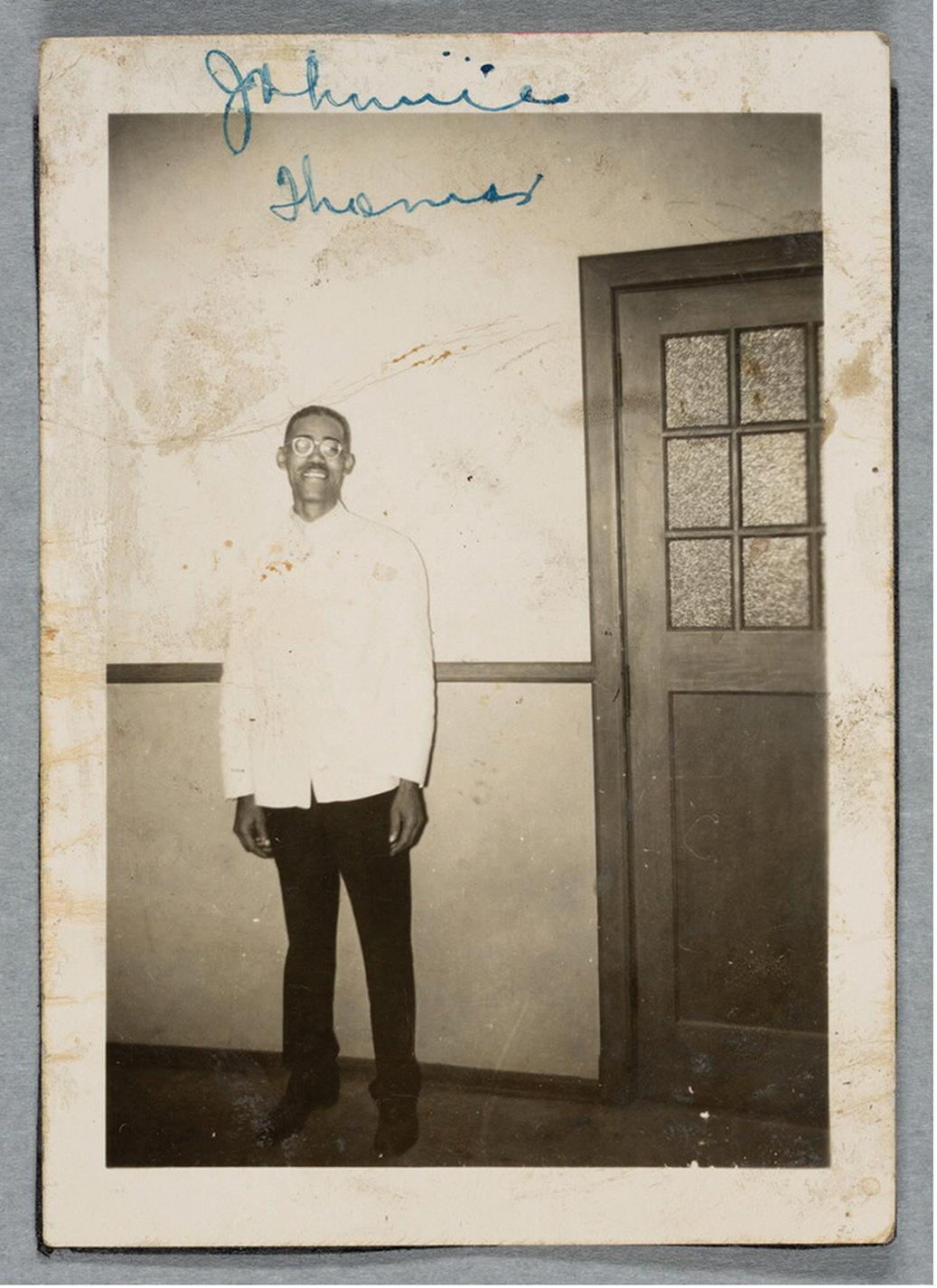
Before Thomas became a familiar face around the church, he served our country during World War I. During his time working at Broadway Baptist, segregation was still firmly in place. Despite this, Thomas still attended services every Sunday for many years. He wasn’t allowed to sit with the rest of the congregation, so he claimed a seat in the baptistery instead. He was kept apart from everyone else, but he still showed up week after week.
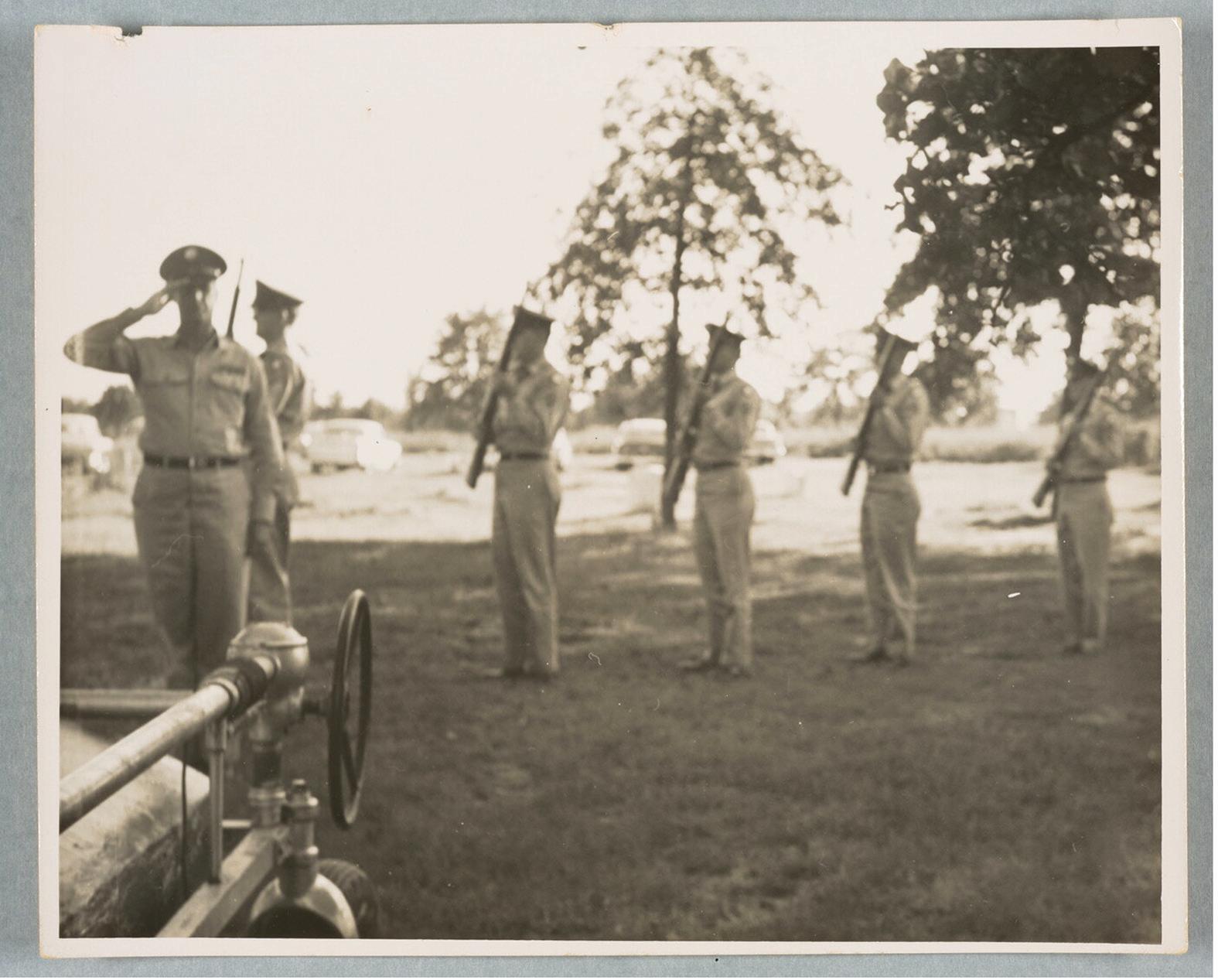
His funeral at Broadway Baptist Church was especially significant for Fort Worth. Because of his military service, Thomas had full military honors, a meaningful recognition of his service and sacrifice. And it was only the second time in the city’s his-
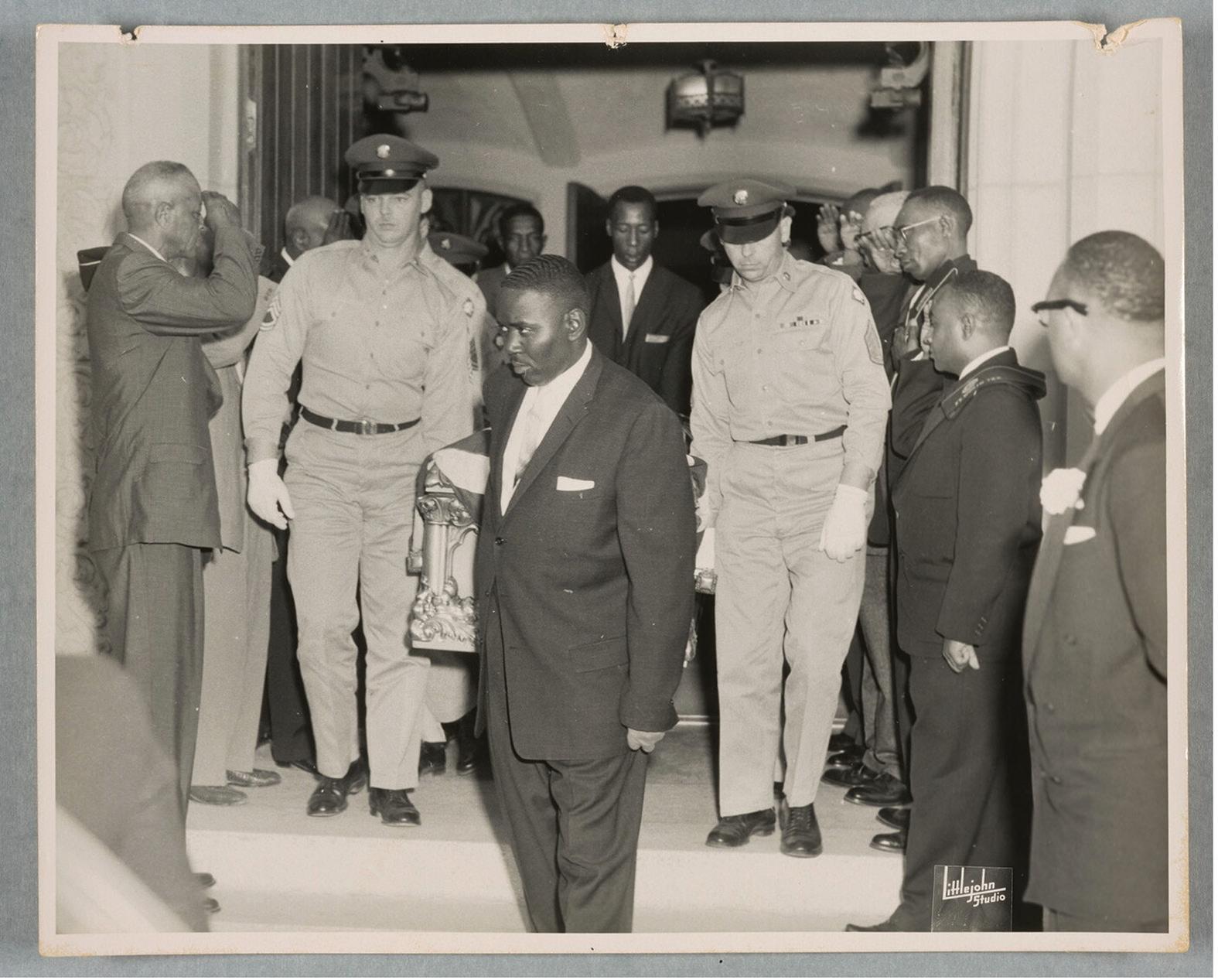
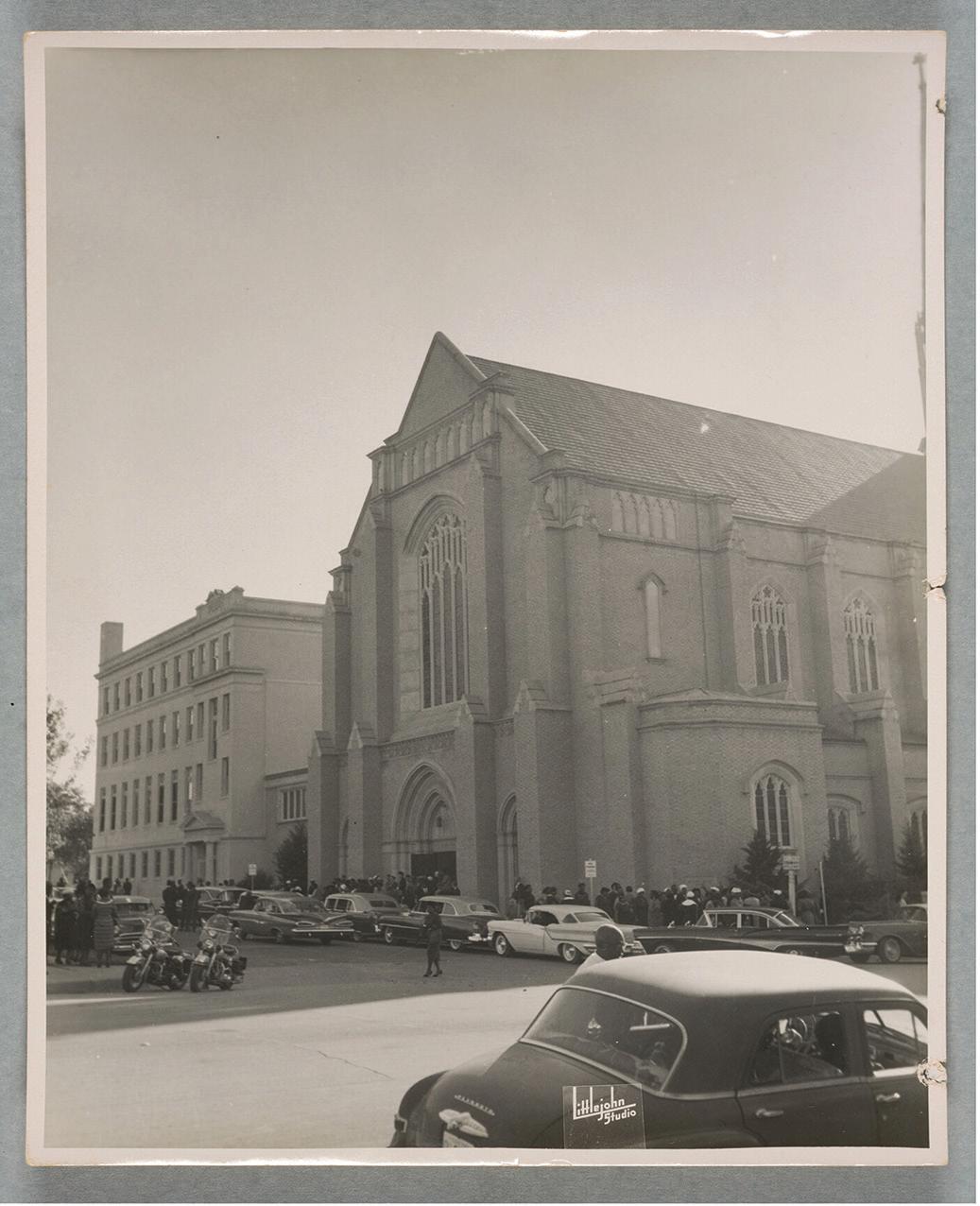
tory that a Black person’s funeral had been held in a White church. Over 1,100 people showed up. Crowds lined the streets and filled the block around the church. It was a powerful statement about the type of person Thomas had been. People remembered
him as charismatic, warm, and deeply connected to the community. He had built relationships that crossed boundaries.
This poignant moment was aptly documented by Calvin Littlejohn, a well-known photographer in the Black
community of Fort Worth. His photographs capture the event and the feeling of the day. The respect, the solemnity, and the grief can all be seen through the photographs.
Although most funerals are about saying goodbye, this service was also about recognition. It showed that even in a segregated society there were moments when people came together. The service didn’t end segregation or destroy all biases, of course, but it hinted at change to come. Thomas’s story is a reminder that history isn’t only shaped by photographs of famous leaders or major events. Sometimes it’s shaped by everyday people. Thomas brought a community together in a way that still resonates today. Because of Littlejohn’s photographs, we are reminded of the significance of this moment.
We are honored to share this history and extend our gratitude to the family of Mr. John Thomas for their generosity and trust. We are equally thankful to the Broadway Baptist Church, whose partnership made it possible for these photos to be shared.
Unidentified photographer, [John Thomas], n.d. Courtesy of Private Collection
Calvin Littlejohn, 1909-1993, [Broadway Baptist Church], 1959, Gelatin silver print Courtesy of Private Collection
Calvin Littlejohn, 1909-1993, Untitled, 1959, Gelatin silver print Courtesy of Private Collection

The Modern Realtor ®: More Than Just a Key to the Door
In an era where a simple swipe on a smartphone can pull up every property for sale within a ten-mile radius, the question is sometimes posed: Is the traditional real estate agent still necessary?

Talking R eal e s TaT e with
Stephanie Spann
As a professional who has navigated this industry for years, I understand why that question arises. Information is everywhere. However, I have found that while data is now abundant, clarity has become increasingly scarce. The role of the Realtor® has not become obsolete; it has simply evolved into something far more vital: the role of a strategic advisor.
Beyond the Listing Decades ago, the primary
value a Realtor® provided was access, the ability to see listings before they hit the morning paper. Today, access is universal. My job is no longer to find a house; it is to help you build a future. When you work with a professional today, you aren’t just hiring someone to open a door. You are hiring a researcher, a negotiator, and a market analyst. You are hiring someone who understands that a home is often the single largest financial asset in a person’s life. In a market where interest rates shift, inventory levels fluctuate, and neighborhoods evolve, you need a navigator who can distinguish bet-
ween a good deal and a financial trap.
The DFW Edge
This is especially true in our unique Dallas-Fort Worth market. DFW is not a monolith; it is a sprawling, dynamic collection of micro-markets, each with its own character, school district nuances, and development patterns. Whether you are tracking the specific turnover rates in a suburban pocket of Tarrant County or navigating the competitive landscape of a high-demand Dallas subdivision, local expertise is the difference between a successful closing and a missed opportunity.
I don’t just look at the regional data; I look at the street-level trends that impact
your bottom line. Knowing where the next major park project is, understanding the nuances of local property tax impacts, and identifying the neighborhoods where homes are truly moving; that is the local value that no app can replicate.
The Art of the Deal
The process of buying or selling a home is inherently emotional, yet the transaction itself is strictly analytical. This is where the human element is irreplaceable. When issues arise and they almost always do, whether it’s a failed inspection, an appraisal gap, or a title complexity a computer algorithm cannot get on the phone to advocate for your interests. A software program cannot hold the hand
Black Music Month: Singing with ‘Soul’ to Heal America, Ray Charles Led the Nation Forward
By Hazel Trice Edney
It was Oct. 28, 2001, less than two months after the Sept. 11 terrorist attacks on the Pentagon in Virginia and the World Trade Center in New York City. Yankee Stadium was packed with more than 40,000 baseball fans as the second game of the World Series was about to be played – the New York Yankees vs. the Arizona Diamond Backs. With the deaths of nearly 3,000 people, including 344 New York firefighters weighing heavily on the hearts and minds of Americans across the nation, the atmosphere was somber and pensive as the players lined up, hats over their hearts, and the audience looked on. Then came the voice of the announcer: “La-
dies and gentlemen, to honor America with the singing of ‘America the Beautiful’, please welcome the man and his soul, Mr. Ray Charles!”
Charles’ powerful voice and the soul-stirring melody of his masterful piano-playing electrified the stadium. Rocking side to side in his iconic way, he appeared to sing the words with every fiber of his being. Narrating for a moment, he recalled the words of the song from his childhood: “America! America! God shed his grace on thee…He crowned thy good with every brotherhood from sea to shining sea!”
At the end of the song, he invited the audience to sing along. The crescendo, like no other moment in American

Istock/Julia Pilipeichenko
history; included a huge flag draping the field, a U. S. Airforce four-jet fly over, a sustained standing ovation and cheers that appeared to melt away tensions and even begin the healing of the nation.
Revisiting this scene nearly 25 years later during Black Music Month 2026, it is striking to observe that despite the vastly White audience, it was the blind grandson of formerly enslaved Black people whose singing of his love for America helped to begin the

healing of the nation in that historic moment.
Some people may have questioned how the now late Ray Charles could have embraced that moment with such endearment for a nation that had also, less than two months earlier, begrudgingly participated in the World Conference Against Racism in Durban, South Africa. During his career, Charles had personally refused to perform for segregated audiences and described racism and poverty as “two scourges that I have known since early in my life.”
Dr. Martin Luther King Jr. used to say, “There can be no great disappointment where there is no great love.”

In Ray Charles’ soulful singing about the “amber waves of grain”, perhaps he was drawing from his knowledge of how this nation was built on the backs of his ancestors toiling in the fields day after day.
Perhaps academic and author Michael Eric Dyson said it best in his book, “Entertaining Race”:
Dr. Dyson wrote, “We have entertained the country with our gifts and used those gifts to entertain the idea of race, indeed, the idea of America, with a redemptive love that is both unquenchable and nearly incomprehensible. This article is the third in a

Ray Charles sings “America the Beautiful on Oct. 28, 2001
Photo: Screenshot
It Is Time to Redraw the Revolution, Again
By Ben Jealous
Every year, we remember Paul Revere’s ride. As we should. We should also reckon with Paul Revere’s picture. His engraving of the Boston Massacre helped light the fire for revolution. It showed British soldiers firing into a crowd. Men fell dead in the street. Yet the first man killed that night is hidden in plain sight. His name was Crispus Attucks. He was a sailor of African and Native ancestry. John Adams later described the crowd as sailors, Irishmen, “negroes and mulattoes.”
But Revere’s image did not show Attucks as who he was. It turned a multiracial, working-class crowd into a whiter and better-dressed one. That was bad art. It was a lie with a long life. It taught generations to picture the Revolution as a fight

led and suffered by wealthy white men with portraits, property, and papers. That was never the truth.
Prince Estabrook was enslaved in Lexington. On April 19, 1775, he stood with his neighbors as British troops arrived. He was shot before Congress declared independence. Before Jefferson wrote that all men are created equal.
Salem Poor bought his freedom and fought at Bunker
Hill. Fourteen officers petitioned to honor his courage. Peter Salem fought there too. James Armistead, enslaved in Virginia, spied for Lafayette. His work helped trap Cornwallis at Yorktown.
The First Rhode Island Regiment, filled with Black, Native, and formerly enslaved men, held the line near Newport.
Women were there, too. Elizabeth Freeman, known as Mum Bett, heard the Revolution’s words and used them in court. She sued for her freedom and won. Deborah Sampson was poor and indentured as a child. She dressed as a man and served in the Continental Army. Margaret Corbin took over a cannon after her husband was killed.
That story is personal in my family. My adopted grandmother, Dr. Margaret Barnes, was an osteopath with Revolutionary roots. As a girl in
the 1910s and 1920s, her father dressed her as a soldier to march in New England Fourth of July parades.
When people objected, he told them not to worry. In 1776, some fathers knew their daughters had gone off to fight dressed the same way. He was right. History made room for daughters in uniform. Memory pushed them back out.
I still have the bow she used to teach me archery. In our family, women did not just remember courage. They passed it down.
Poor white men carried the war, too. Joseph Plumb Martin was a teenage soldier. He froze, starved, marched, and later wrote the Revolution from below. Ebenezer Mackintosh was a Boston shoemaker and street organizer. Before gentlemen took seats in Congress, men like him made resistance impossible to
InCinque : Social Security:How Sound?
By Renetta W. Howard
I keep reading and hearing about how Social Security, the fund which American workers pay into each year to have some income when they live long enough to retire and have income to survive on. God knows that at its best, it is survival, not thriving that you do with that income. Consequently, many workers take on a second job to make ends meet while employed and some keep working after retirement age in order to survive, PLUS, many of us who had jobs in which we did not contribute to SSA, were penalized of what social security benefits we had earned when we began to receive them . That penalty cut deeply into our benefits. Social Security office was taking our money from us, with no recourse from us, except to do the best we could with-
out the money we had CONTRIBUTED to our retirement. I was penalized for 24 years of eligibility for social security benefits. That is, I missed out on one third of my benefits for 24 years and when the Biden administration had that piece of legislation deleted, and awarded beneficiaries a one-time check and an increase of monthly benefits, it by no means rectified the money lost during the years of penalty. If one year was worth $6000.00 compensation, what would 24 years have been worth? I would say $144,000. I did not get it, so why, now, is the social security office about to be depleted of funds for retirees when there were millions who were penalized? If one million people lost $6000.00 a year, that should be about $6,000,000,000 in the OASI treasury at the least. Our government for years,
has been putting the money that citizens deposit into the social security fund into the general fund and using it for whatever they desire. Congress has allowed this and it is time that we, citizens demand that our congressmen and women do the right thing and stop putting social security funds into the general fund. Congress should require the OASI to account
for the funds which they took from retirees and put it into the treasury where it was supposed to be, rather than perhaps on a war somewhere which does no one any good; like the one with Iran now, which is illegal. Where ae the funds coming from to sustain Mr. Trump’s War? Let us get ‘in cinque’ and demand accountability of the monies that belong to us, that is being
ignore.
The Revolution was not made by one class. It was sailors, servants, farmers, shoemakers, soldiers, spies, mothers, fugitives, and the enslaved.
On my father’s side, nine of my ancestors fought the British in Massachusetts. One was a sixteen-year-old fifer at Lexington. They knew Black patriots were there from the first morning.
On my mother’s side, we descend from Richard Bland, Jefferson’s cousin and mentor. Jefferson wrote that all men are created equal. But the same racist hand that scrubbed Attucks from the picture shrank “all men” to white men.
Frederick Douglass scraped that veneer away. In 1852, he asked what the Fourth meant to the slave. In 1869, he called for a “composite nation” — one people made of all peo-
ples. Douglass was not inventing a new America. He was restoring the Revolution to itself.
Who we picture fighting for freedom shapes who we believe deserves it.
Paint Black patriots, women patriots, and poor white patriots out of 1776, and you shrink the nation’s image of itself.
Today’s whitewashing should alarm us.
In 2025, under Defense Secretary Pete Hegseth, the Pentagon’s anti-DEI purge swept through military websites. Pages on Jackie Robinson, the Tuskegee Airmen, and Native code talkers were removed, then some were restored after public outcry. The system even flagged the Enola Gay bomber because it contained the word “gay.” That was not strength. It was cowardice with a search function.
My grandfather’s first cousin, Howard Lee Baugh, was a Tuskegee Airman. He flew
used at the discretion of the government and some trying to call it a government benefit rather than our own benefits. I am still praying for that Divine Intervention.




Ben Jealous
Sunday School Lesson Sunday School Lesson
The Believing Centurion
Matthew 8:5–13; Luke 7:1–10
Key Text: When Jesus heard it, he marvelled, and said to them that followed, Verily I say unto you, I have not found so great faith, no, not in Israel. —Matthew 5:10 there came unto him a centurion, beseeching him. Capernaum was the town that Jesus chose as the base of His Galilean ministry (Matthew 4:13). It was the home of Simon Peter and probably more of the disciples (17:25). The name “village of Nahum” is fitting for Jesus’ ministry. Nahum means “comfort” in Hebrew, and comfort is the very thing Jesus came to bring Israel (see Isaiah 40:1: “Comfort ye, comfort ye my people”).
Introduction: Please Fix It, Daddy! My young children run to me when something is amiss. They fully expect that I can fix whatever has gone wrong: a broken toy, a skinned knee, or a swing that won’t push itself. In their eyes, I am the big, experienced adult who has been there for them since they were born. In their eyes, I seem completely trustworthy and capable of doing whatever they need. (They’re still young enough to be enchanted by my capacity!) This trust is constant—whether they are behaving well or poorly, whether they are healthy or sick, whether I am full of energy or exhausted.
If children can place this radical trust in an earthly father, how much more might the children of God run to a faithful and capable heavenly Father! Yet, we often hesitate to bring specific requests or intercessions. We waver when we feel unworthy of attention, or that our situation is too much. But like the centurion in Matthew 8:5–13, we can trust God’s capability and willingness to act. God will respond when we come to Him, full of faith. He does not tire.
Today’s lesson comes shortly after the Sermon on the Mount. In Matthew 5–7, Jesus gives an authoritative interpretation of the Torah (or Jewish Law), explaining the ethics of God’s kingdom. The sermon includes Jesus’ self-identification as “Lord,” to whom everyone owes obedience and allegiance (Matthew 7:21–23). Jesus compares His teachings to a foundation stone (7:24). His words are like the ground on which one might stand; they ensure the stability of whoever lives by them (7:24–27).
As Jesus descends from the mount, a “leper” approaches Him (Matthew 8:2). The Torah—which Jesus just showed authority to interpret—contains purity laws that regulate contact with those who are sick. Anyone with visible disease struggled day-to-day, facing the prospect of making others ritually impure. The man’s request for cleansing reveals faith in Jesus’ authority over sickness and death. Thus, when Jesus responds by cleansing the man with a touch, Jesus accepts ritual impurity (8:3). Simultaneously, He displays the capacity to heal the diseases that the Law of Moses carefully regulated. Jesus demonstrates healing with a touch, setting the stage for a second healing without physical contact.
I. Expressing Need and Faith (Matthew 8:5–9)
A. Centurion’s Request (vv. 5–6) 5. And when Jesus was entered into Capernaum,
The village’s name is also a reminder of the biblical prophet who prophesied judgment against Nineveh and Assyria (Nahum 1–3).
A centurion was an officer in the Roman army. He led between sixty and one hundred troops. Since Rome had no legion in Galilee or Judaea at the time, this centurion was probably part of the auxiliary force under Herod Antipas. Auxiliaries were non-citizen troops, mainly recruited from the free population of the empire. This man might have been from Galilee, Phoenicia, or Syria—thus, neither a Roman citizen nor Jewish.
The centurion approaches Jesus as a supplicant and subordinate, beseeching Jesus for a favor. In a parallel account in Luke (7:1–10), the centurion does not approach Jesus directly but sends Jewish elders on his behalf behalf. An indirect approach is another way to emphasize his perceived position as inferior to Jesus. behalf. An indirect approach is another way to emphasize his perceived position as inferior to Jesus.
And saying, Lord, my servant lieth at home sick of the palsy, grievously tormented.
The centurion calls Jesus Lord. The title carries some ambiguity in meaning, as it can refer to a human ruler, serve as an honorific title like “mister,” or even represent the name of God. Using the term “lord” or “master” allowed God-fearers (nonJewish followers of God) to avoid pronouncing the revered name—Yahweh. Throughout Matthew’s Gospel, Lord frequently refers to God (Matthew 1:20; 2:13; 4:7; etc.). Only one chapter prior to today’s text, Jesus uses Lord as a title for Himself (7:21–22). Therefore, it is significant that the centurion—an outsider and representative of imperial power—approaches Jesus as a supplicant and repeats this title. At a minimum, the term bestows honor and indicates authority. The centurion does not bring his servant to be healed. Leaving the servant at home indicates the extent of the centurion’s faith. His approach presumes that Jesus is capable of healing without
even seeing the man. The word rendered servant is ambiguous and could refer to a child or enslaved person. One viable possibility, in this case, is that the “servant” is the centurion’s son from a woman to whom he is not legally married—perhaps the child of an enslaved or lower-status woman. Roman soldiers in this era were officially forbidden to marry during their term of service. Yet, in practice, the authorities often looked the other way. Therefore, soldiers in long-term localized service sometimes had unlicensed or unofficial families. In such cases, the soldier could formally adopt the legally unrecognized children after completing his term of service. With the centurion’s higher rank and long-term assignment, this interpretation fits the parallel in Luke’s Gospel, which adds that the sick person is “dear unto him” (7:2–10).
Jesus’ Offer (v. 7) 7. And Jesus saith unto him, I will come and heal him.
Jesus practices what He preaches. During the Sermon on the Mount, He teaches love—even for enemies (Matthew 5:43–44). Since God gives good gifts to the righteous and the wicked (5:45), Jesus encourages His followers that the one who seeks and asks will also find and receive (7:8).
Christ’s kingdom differs from the patterns of earthly conquest. Rather than resisting someone who could easily be seen as an enemy or an oppressor, Jesus serves him and offers blessing. In Luke’s retelling of the story, Jewish elders testify on the centurion’s behalf, showing that he is no enemy or oppressor. They vouch for him, saying he is “worthy … for he loveth our nation, and he hath built us a synagogue” (Luke 7:4–5).
The Greek grammar underlying this verse could be rendered as a question, “Shall I come and heal him?” The basic meaning is the same; Jesus is willing to go and to heal at the centurion’s request. The wording includes the personal pronoun I, which is grammatically unnecessary except to serve an emphatic purpose. Jesus clarifies what the centurion is implying: “You want me to come to heal him?” In this respect, Jesus’ answer is like the leading question He will pose to the young man in Matthew 19:17 (“Why callest … me good? there is none good but one, that is, God”). Every word Jesus speaks reflects His identity, status, and authority.
Centurion’s Response (v. 8) 8. The centurion answered and said, Lord, I am not worthy that thou shouldest come under my roof: but speak the word only, and my servant shall be healed.
The centurion repeats the title Lord, which picks up on the emphasis in Jesus’ initial reply. The centurion accentuates faith in Jesus’
authority, declaring that Jesus only needs to speak the word. From the beginning of Scripture (Genesis 1), God creates through spaces, like the temple courts, needed to purify themselves. Merely entering a Gentile house, therefore, would be a nonissue. Jewish texts and rabbinic materials presume that Jews enter Gentile households without concern, even to eat with non-Jews (provided the menu does not include forbidden foods).
Therefore, when the centurion claims unworthiness, it is on grounds other than his Gentile status. It again suggests great humility and recognition of Jesus’ high standing relative to his own.
Centurion’s Position (v. 9) 9. For I am a man under authority, having soldiers under me: and I say to this man, Go, and he goeth; and to another, Come, and he cometh; and to my servant, Do this, and he doeth it.
The centurion describes his knowledge of authority and experience as a military leader. He knows that soldiers obey his orders, which creates an analogy that explains Jesus’ position in the cosmic hierarchy. Jesus has the authority to command the powerful, unseen forces of heaven in the same way that the centurion directs the troops under his jurisdiction.
The centurion uses the phrase under authority to describe himself. His commands carry weight because he speaks with the authority of the emperor. Likewise, Jesus’ authority over cosmic forces is entirely sanctioned and supported by the Father in heaven. As Jesus says in Matthew 28:18, “All power is given unto me in heaven and in earth” (compare John 5:36).
II. Instructing Others (Matthew 8:10–12) A. Jesus’ Surprise (v. 10) 10. When Jesus heard it, he marvelled, and said to them that followed, Verily I say unto you, I have not found so great faith, no, not in Israel.
Jesus expresses amazement at the centurion’s faith. Faith here is more than mere belief; it includes concepts like “trust” or “fidelity.” The centurion identifies Jesus’ authority and submits himself entirely. He trusts that Jesus can and will respond with favor. And Jesus finds this conviction astonishing—it displays a level of trust and submission that Jesus has not seen, even in Israel.
Despite having the witness of the law—an advantage that the apostle Paul calls “the oracles of God” (Romans 3:2)—the residents of Israel do not exhibit this measure of trust and submission. The centurion’s active faith surprises Jesus; as a Gentile, the centurion enjoys none of those advantages. The centurion’s faith recognizes the presence and authority of God in the person of Jesus.
Inclusion of Outsiders (v. 11) 11. And I say unto you,
That many shall come from the east and west, and shall sit down with Abraham, and Isaac, and Jacob, in the kingdom of heaven.
Jesus uses the centurion’s faith as an object lesson. He explains that outsiders who submit to Jesus in this manner will be welcomed into the kingdom of heaven with the covenantal patriarchs.
The kingdom of heaven refers to the rule of God that is active on earth. It includes the resurrection of the dead and the promised restoration of the people of Israel.
Remarkably, Jesus teaches that God includes outsiders, like this centurion, among the faithful. In the new era of justice and life, many will be rewarded and treated as heirs to the covenant, even alongside Abraham, Isaac, and Jacob.
The outsiders come from places far from Israel: the east and west. These directional terms depict widespread inclusion. People from nations at the ends of the earth will find a place in God’s kingdom. This is like the psalmist who uses the phrase “as far as the east is from the west” to poetically describe infinite space (Psalm 103:12). Jesus’ words do something similar. They expand His listener’s expectations of kingdom access.
To sit down with the patriarchs hints at a forthcoming great feast. Jesus pushes His disciples to increase their holy imagination of who will be present at the wedding banquet of the Lamb (Revelation 19:6–9).
Exclusion of Insiders (v. 12) 12. But the children of the kingdom shall be cast out into outer darkness: there shall be weeping and gnashing of teeth.
On the other hand, the unfaithful children will be expelled. Their consequence for disobedience, lack of faith, and apathy is exclusion from the benefits of the kingdom: they will be cast out. Just imagine the shock of Jesus’ comment. Those who expect inclusion as a matter of privilege must beware.
Jesus says that insiders who anticipate their family history or religious affiliation as granting automatic entry into the kingdom must watch out—they could find themselves outside the fold, in darkness. There are serious consequences for unfaithfulness and infidelity.
Jesus’ teaching follows the prediction of Amos 5:18–20, which warns that the day of the Lord’s judgment will be “darkness, and not light” for the house of Israel.
Weeping and gnashing of teeth recalls figurative imagery used frequently in Psalms. David describes mockers who conspire against him and gnash their teeth (Psalm 35:15–16). In the same context, these teeth-gnashers are at a feast,
Church Directory


which connects to Jesus’ words about sitting with the patriarchs (see earlier comments on Matthew 8:11). In another psalm, the wicked scheme against the righteous (Psalm 37:12). Although they gnash their teeth, God will bring them and their plans to nothing (37:20). And in Psalm 112, the righteous look forward to an enduring future, with exaltation and honor (112:9). In contrast, those misaligned with God will see honor given to others, be “grieved” by it, “gnash with [their] teeth,” and then “melt away” (112:10). Thus, Jesus’ phrase reflects the bitterness and anger of the wicked who look upon the salvation of the righteous. It warns God’s people against having an inhospitable and faithless mindset, which can only lead to ruin. II. Healing from a Distance (Matthew 8:13) 13. And Jesus said unto the centurion, Go thy way; and as thou hast believed, so be it done unto thee. And his servant was healed in the selfsame hour. Jesus acts with the divine authority that the centurion expected of Him. He proclaims with His will (Psalm 37:4). It puts flesh and bone to John’s words: “If we ask any thing according to his will, he heareth us” (1 John 5:14). Those who trust God can seek, ask (with confidence), and receive a righteous reward.
Conclusion: According to Your Faith
The centurion in today’s lesson gives us a refreshing example of approaching God properly. Our methodology is critical as we intercede for those who are suffering. The centurion showcases essential aspects of a faithful petition: acknowledge Jesus as Lord, submit to God’s authority, and do so with great humility. The centurion also appeals to the Lord’s mercy. He holds complete confidence in Jesus’ ability to alleviate suffering, even from a distance. This story demonstrates that we can be confident like the centurion—in Christ’s authority over sickness, death, and every power. This story shows that faith sees beyond the physical to perceive spiritual realities that are deep and salient. Faith perceives Jesus’ divine jurisdiction; faith gives us boldness to act with adept confidence; faith makes us children of God.
Prayer: Heavenly Father, teach us to approach You like the centurion. May we boldly intercede on behalf of those who suffer. Grant us complete faith in Your authority. In Jesus’ name we pray. Amen.
Thought to Remember: Jesus holds complete authority. Standard Publishing. KJV Standard Lesson Commentary® 2025-2026 (p. 1048). David C Cook. Kindle Edition.


As The "One Big Beautiful Bill Act" Reaches One Year, Feeding Texas
TEXAS—Ahead of the first anniversary of HR 1, known as the “One Big Beautiful Bill Act,” Feeding Texas, the statewide network of food banks, is examining the policy’s impacts on food access in Texas.
Signed into law on July 4, 2025, HR 1 included significant changes to the Supplemental Nutrition Assistance Program (SNAP), including expanded work requirements.
Publicly available data and national analysis tools show that Texas SNAP participation has declined by about 16% since July 2025 – a decline of nearly 550,000 individuals, more than half of them children. At the same time, food banks are seeing record demand due to the rising cost of living.
“Texans are facing higher prices for basic groceries like milk, beef and vegetables,” said Celia Cole, chief executive officer of Feeding Texas. “SNAP is designed to be a temporary bridge that helps families afford food during tough times, but recently we have seen fewer people able to access this critical support. While food banks play an es-
Examines Impacts on Food Access In Texas
sential role in keeping Texans fed, charitable food assistance cannot match the scale or impact of federal nutrition programs like SNAP.”
The patterns strongly suggest that new eligibility restrictions and expanded work requirements are making it harder for eligible Texans to stay enrolled. These new requirements cut people off of SNAP after three months if they aren’t working 30+ hours per week, but people often struggle to make it through the administrative hurdles to meet these requirements, even if they are working.
Additionally, new provisions in HR 1 shift certain program costs to states and tie significant new financial obligations to SNAP payment error rates—a statistical measure of how accurately SNAP benefits are calculated by Texas Health and Human Services.
SNAP payment error rates are often misunderstood. Payment errors can result from administrative complexities or case processing challenges, and are not an indication of fraud. Many errors are the
result of fluctuating income or changes in household composition or shelter costs.
Beginning October 1, 2027, states with payment error rates above 6% must share between 5-15% of SNAP benefit costs. The state’s payment error rate for fiscal year 2025 was published this week and sits at 9.34%, meaning Texas could face up to $709 million per year in benefit costs beginning in fiscal year 2028. If states are unable to take on this new financial burden, it could put their participation in SNAP at risk, threatening SNAP benefits for millions of working families, children, seniors and veterans.
"Program integrity matters, and we support efforts to ensure SNAP operates effectively and responsibly," Cole said. "Reducing error rates is a shared goal, but it requires time and investment in tech-
nology upgrades, staff training and policy simplification to improve the accuracy of benefit calculations. We’re urging Congress to delay the cost-share requirement by two years to give all states a fair opportunity to make these improvements before facing significant financial penalties. The focus should be getting the policy right while protecting access to food for eligible families."
Some states with the highest payment error rates like Alaska are already receiving additional time to meet the new requirements.
Texas food banks currently distribute more than 700 million pounds of food annually through a network of more than 5,000 community partners, yet for every meal provided by food banks, SNAP provides nine. SNAP remains the nation's most effective an-
It Is Time to Redraw
more than 130 combat missions against the Nazis. There is a word for men like him: hero.
This Fourth of July, let’s remember Revere’s ride. But
let’s redraw Revere’s picture. Put Attucks back in the center. Put Estabrook on Lexington Green. Put Salem Poor at Bunker Hill. Put Mum Bett in the courthouse. Put Joseph
ti-hunger program and plays a vital role in supporting local grocers, retailers and agricultural producers across the state. Millions of households rely on SNAP at some point during the year to help stretch their grocery budgets.
For Heather Sandlin, of Hays County, SNAP provided critical support as she battled stage 4 ovarian cancer.
Heather applied for SNAP as she went through cancer treatment, hoping SNAP would help her access healthier, vegetarian foods that would meet her specific dietary needs.
“I was able to eat better,” Sandlin said. “I ate more organically, which is a lot better for cancer, to eat the healthiest you can.”
But when she went back to work to help cover her high healthcare costs, her SNAP
benefits were reduced from around $200 a month to $24 a month.
“With the cost of food and everything else, I can’t eat healthy,” Sandlin said. “Because you have to eat cheap when you don’t have the money.”
Stories like these demonstrate why federal nutrition programs and food banks must work together to support Texans facing difficult circumstances.
"Giving states adequate time to improve payment accuracy is a practical solution that protects both SNAP program integrity and food access,” Cole said. “Texas families should not pay the price for rushed policy changes."
For more information about Feeding Texas and its statewide network of food banks, visit feedingtexas.org.
continued from page 3
Then look again. That is

Plumb Martin barefoot in the snow. Put my adopted grandmother in the parade, dressed as the soldier memory tried to deny.
America. Ben Jealous is a professor of practice at the University of Pennsylvania and former president and CEO of the NAACP.
Arts & Entertainment Arts & Entertainment
Serena Williams’ Emotional Wimbledon Return Ends in Defeat but Inspires
the Tennis World
By Cedric Bailey, Sports Editor LaVida News | Host of Sports in the Mix on the BGC Sports Network
LONDON — Tennis fans around the world witnessed an unforgettable moment as Serena Williams made her longawaited return to the grass courts of Wimbledon. While the scoreboard showed a hard-fought 6-3, 6-7 (6), 6-3 victory for Australia’s rising star Maya Joint, the evening belonged as much to Williams’ remarkable comeback as it did to the young winner.
Competing in her first singles match since 2022, the 23-time Grand Slam champion reminded spectators why she is regarded as one of the greatest athletes in sports history. At 44 years old, Williams displayed flashes of the powerful groundstrokes, fierce determination, and relentless competitive spirit that defined one of the most decorated careers in tennis.
Joint, just 20 years old, showed poise beyond her years in handling the biggest match of her career.
She weathered Williams’ second-set rally and remained composed in the deciding set to earn one of the biggest victories of her young career.
The Centre Court crowd erupted throughout the evening, firmly behind the American icon from the opening moments. As Williams battled back to force a second-set tiebreak victory, the atmosphere reflected the admiration and respect she has earned throughout her legendary career.
“It was really great to be back at Wimbledon,” Williams said after the match.
“I never expected to be here. The atmosphere was amazing. Walking out was amazing. I definitely relished it and missed it and enjoyed the moment more than anything.”
Williams encountered adversity when she tweaked her knee late in the opening set. According to her agent, Jill Smoller, the injury led Wimbledon and WTA medical officials to excuse Williams from her post-match media responsibilities. Despite the concern, she left the grounds under her own power and immediately turned her attention toward preparing for doubles competition
alongside her sister, Venus Williams.
Although the defeat was disappointing, Williams proved she can still compete at tennis’ highest level. Her power remains evident, her court awareness sharp, and her competitive fire unmistakable. If she continues her comeback during the North American hard-court season, additional match play could help sharpen the consistency needed to challenge the world’s top players once again.
For Maya Joint, the victory represents a significant milestone and signals the arrival of another promising young talent on the WTA Tour. For Serena Williams, the match was something equally meaningful—a celebration of perseverance, passion, and the enduring legacy of one of the greatest champions sports has ever known.
While the comeback did not produce a victory, Serena Williams once again demonstrated that greatness is measured not only by championships but also by the courage to compete, inspire, and embrace the challenge of returning to the game’s biggest stage.
How to Get Out Of A Pickle
Fritter.”
behind her back and not let her see me.

When I heard that, I laughed to myself and said, “I’m not falling for this trick this time.”
this, and I have been working to figure it out.
pickle, I was reminded of a verse in the Bible.

By Dr. James Snyder
Throughout my time on this planet, I have gotten into many pickle situations that I could not escape. Each pickle was different from the last, which made dealing with them quite a problem for me.
In reviewing my life, I must confess that the biggest pickle situations started upon my marriage to The Gracious Mistress of the Parsonage. I do not see a connection, but I won’t rule it out.
It was the latest pickle I got into that I am most concerned about.
Last week The Gracious Mistress of the Parsonage was ready to go to Publix for grocery shopping. As she went out the door, she looked back at me and said, “Is there anything you want me to get at Publix?”
Immediately, I responded by saying, “Yes, my dear. I sure would like an Apple
Stopping in her tracks, she looked back at me and said, “Just keep dreaming, that will never happen in a million years.”
I knew how she would respond, but I could not help but respond anyway. Her questions always put me in a playful pickle, and I could not resist the fun of it.
As she closed the front door, I could hear her laughing hysterically, and I kinda knew why she was laughing.
I certainly was not going to hope for an Apple Fritter that day. I enjoy an Apple Fritter every once in a while when I can get it behind The Gracious Mistress of the Parsonage’s back. She does not like it, but I love it. On the other hand, she loves broccoli, and I hate broccoli.
That is the only difference we have between ourselves.
Getting back to work in my office, I forgot about the Apple Fritter incident. Yes, every once in a while, I would think about an Apple Fritter, but I knew that was beyond me. The only way I can get an Apple Fritter is to sneak
Talking Real Estate
of a first-time homebuyer who is feeling overwhelmed, nor can it provide the local, nuanced perspective required to win in a competitive bidding situation.
A Realtor® brings the ”soft skills” of empathy and mediation to the ”hard skills” of contract law and market valuation. We are the buffer between your peace of mind and the volatility of the market.
Why You Still Need a Partner
We are currently operating in a landscape that requires a higher level of precision than ever before. For sellers, it means utilizing advanced digital marketing and data-driven pricing strategies to ensure your property doesn’t just sit on the market, but stands out. For buyers, it means having a partner who can identify off-market opportunities and structure offers that are attractive, yet protective. Technology has given
ACA continued from page 1
uted to Medicaid expansion.
However, racial disparities remain. Because Black households continue to have lower median incomes and higher poverty rates than white households, Black Americans are approximately twice as likely to rely on Medicaid coverage in both expansion and non-expansion states.
As of December 2024, 40 states and the District of Co-
lumbia had adopted Medicaid expansion following the 2012 U.S. Supreme Court decision that made expansion optional for states.
Researchers say the expiration of enhanced Marketplace subsidies could disproportionately affect lower-income consumers who earn too much to qualify for Medicaid but struggle to afford higher private insurance premiums
Don’t let her know this, but every year she, her daughter, and her granddaughter go to St. Augustine for a week. They have been doing that for at least 20 years. It is during that week that I find myself enjoying an Apple Fritter. The last time I did it, I forgot to throw away the receipt, and it was on the counter. When she got back, the first thing she found was the receipt for my Apple Fritters. I need to learn my lesson from that.
I let that go to the back of my mind and focused on the project I was working on.
In a few hours, I heard the front door open and remembered that The Gracious Mistress of the Parsonage was out shopping. She had returned and was coming into the kitchen with all her grocery bags.
Then I heard something I had never dreamed of hearing in my life. As she was putting the groceries away in the kitchen, she yelled back to me, “Honey, I got your Apple Fritter.”
continued from page 2
us the tools to work faster, but it is our judgment, our ethics, and our commitment to our clients that allow us to work better.
Buying or selling a home is a journey with high stakes. You can certainly attempt the journey alone, but in a world of endless, often contradictory data, having a professional by your side isn’t just a convenience, it’s the most important investment you can make in your own success.
without federal assistance.
The latest enrollment analysis draws on data from CMS, state-based Marketplace reports, KFF surveys, and enrollment estimates from Wakely Consulting Group.
Researchers say the data indicate that higher premium costs have become a major factor affecting enrollment in 2026 and expect affordability to remain a key issue in the individual insurance market.
Then she walked into my office, and in her hand was the Apple Fritter. “Here’s the Apple Fritter you wanted. I’ll put it out in the kitchen for you to have later.” Then she went back to the kitchen.
I was in a pickle and did not quite know what to do. I knew this was a trick, but I did not quite understand its dimensions. No way would she buy me an Apple Fritter. There had to be something attached to it, and I had to find out what it was.
Being in a pickle like this is not something I yearn for at any time of year. What I had to do was figure out what to do at this point. Why did she get me an Apple Fritter? There is something behind
Later on, I went out to the kitchen to get a cup of coffee, and there was the Apple Fritter. The Gracious Mistress of the Parsonage said, “You can have your Apple Fritter now with your coffee.” Then she smiled at me, a very suspicious smile that I could not quite explain.
Of course, I am going to eat the Apple Fritter. But I’m also going to keep in mind that this Apple Fritter has me in a coil I can’t explain. Do not get me wrong, I enjoyed eating every bite of that Apple Fritter.
I do not know when I will figure it out, but my eyes and my ears are open. Every day, I am going to keep a lookout for what is behind this Apple Fritter pickle.
As I reflected on this recent
“If any of you lack wisdom, let him ask of God, that giveth to all men liberally, and upbraideth not; and it shall be given him” (James 1:5).
It is not easy for me to acknowledge my “lack of wisdom,” but when I do, I begin the path to finding the wisdom I need at that time. Whether I can fix the pickle I’m in now is worth trying. It might also help me get ready for the next pickle I have to face.
Dr. James L. Snyder lives in Ocala, FL with the Gracious Mistress of the Parsonage. Telephone 1-352-216-3025, e-mail jamessnyder51@gmail.com, website www.jamessnyderministries.com

Cedric Bailey Sports
Dr. James Snyder
Serena Williams returns back to the court at Wimbledon in London, England
Photo Courtesy of the Wimbledon
Here’s What’s Happening Here’s What’s Happening
Ongoing Events
Are you a resident of the Rolling Hills area? Join the Glencrest Civic League Neighborhood Association and become part of our mission to create a safe, secure, clean, and well-maintained community. We actively seek residents’ support for our mission by spearheading neighborhood committee initiatives, coordinating, supporting, and planning various community events, actively engaging local leaders and nurturing a strong sense of community unity.
Join us for our Monthly Community Meetings:
• When: 10:00 AM on the 3rd Saturday of Each Month
• Where: C.R. Bradley Center, 2600 Timberline Drive, Fort Worth, TX 76119. For more information and to become a member, check out our Facebook Page (Glencrest Civic League Neighborhood Association) or visit our website at https:// www.glencrest.org. You may also email us at glencrest. na@gmail.com.
Fort Worth Wiley College Alumni Club Membership Meeting: Second Saturday of each month, 1 p.m., Carter Metropolitan CME Church, 4601 Wichita St. Fort Worth 76119. For additional information, contact one of the following members: Helen Crowder (817) 688-8937, Larry Pugh (817) 293-6543, Daisy Kahn (817) 292-1077.
I.M. Terrell Alumni Association Membership Meeting, 1st Tuesday of each month, 5 p.m., I. M. Terrell Stem/VPA Academy, 1411 I M Terrell Way, Fort Worth 76102.
M.L.Kirkpatrick Alumni Association Membership Meeting: First Saturday of each month at 2 p.m. at Shiloh Missionary Baptist Church, 2823 North Houston Street, Fort Worth 76106.
P.L. Dunbar Alumni Association Memberships Meeting: 3rd Saturday of each month at 3p.m. at The CenterFor STOP SIX HERITAGE, 5100 Willie St. next to Young Men’s Leadership Academy, Fort Worth. pldalumniassoc@gmail.com Como Alumni. Every third Tureday, 7 p.m., Como Community Center, 4900 Horne Street, Fort Worth, TX 76107
Join the Texas Coalition of Black Democrats! We meet every fourth Saturday of the month from 5-6 p.m. at the
Charles F. Griffin Sub-courthouse, 3500 Miller Ave. Fort Worth 76119. New Monthly Speakers.
United Methodist Church, 522 Missouri Ave. Fort Worth 76104. The Food pantry is open on the third Saturday of each month from 8 -10 a.m. For questions or concerns, please contact the Church Office at (817) 336-2117.
Forest Hill Ushers Union, “Welcomes All Church Ushers/Doorkeepers in Tarrant County”
Juniors & Young People (7-18)
Young Adults (19-35)
Seniors (36+)
Affiliations: Texas Church Ushers
Southern Region Ushers
National United Church Ushers Association of America, Inc. (NUCUAAA) For more information contact: Wanda King (817) 821-3017, Helen Moore (817) 584-7370, Thomas E. Troupe (817) 2292509
AARP Southeast Chapter #4508. Meets the 4th Wednesday of each month at 10:30 a.m., Southside Community Center, 959 E. Rosedale, Fort Worth, TX 76104. For additional information contact Debra Rivers by email:riv3ers@sbcglobal.net.
The Fort Worth Association of Federated Women’s Clubs organization aims to unite women in their efforts to serve the underserved, strengthen the community, and create opportunities for volunteerism, civic activism, education, and cultural enrichment. Below are some of the organization’s community service projects: Individuals must provide their own transport action
Senior Bingo - bingo and health speakers are on the first Friday of each month. From 10:00 till 12:00
Our program, Senior Bingo, aims to combat social isolation among seniors. Research has shown that older adults who experience social isolation are at an increased risk for cognitive decline, heart disease, and a variety of mental and physical health issues.
To address this concern, we organize a monthly social event where seniors can connect and engage their minds. This gathering takes place in an area with the lowest life expectancy in the state. Participants have the chance to socialize, play games, and share meals. Additionally, we invite guest speakers to discuss important topics, includ-
ing health and legal issues.
Senior Box ProgramBoxs of food first Friday 12:30 till 2:30 FWAFWC partners with the Tarrant Area Food Bank to distribute food through the Senior Box Program. This program, part of the Commodity Supplemental Food Program, allows qualifying seniors aged 60 and older to receive a monthly box of USDA foods to supplement their diets. Each box contains shelf-stable items, including canned fruits and vegetables, cereal, canned meats, juice, and a block of cheese.
Some local food banks have observed an increase in the number of seniors using their services toward the end of each month. They found that seniors rely on these services to help them get by until their next Social Security checks. The Senior Box Program is an ideal fit for the needs of seniors in the area near our building. We distribute the food boxes from our location, which is situated in one of the city’s designated food deserts. In this area, some residents may have to travel up to an hour by bus to access healthy food options.
Diaper Bank - Diapers first Friday 12:30 till 3:00. FWAFWC is a partner agency of the Junior League of Fort Worth (JLFW). The JLFW Diaper Bank aims to eliminate diaper needs and enhance the physical, mental, and financial well-being of children and adults throughout Tarrant County. It provides diapers at no cost to local nonprofit partners that assist individuals facing poverty, mobility issues, or health limitations. Since its inception, the JLFW Diaper Bank has provided over 2 million diapers to nearly 100 nonprofit organizations.
Computer Classes -Computer classes each Monday 1:00 till 2:30 FWAFWC has partnered with Goodwill of North Texas to offer computer classes at our facility. These classes provide an invaluable resource to the community by equipping individuals with essential computer skills and knowledge. By enhancing residents’ digital literacy, participants will learn how to navigate the internet and apply for jobs online. Additionally, the classes will cover important topics such as online safety, email usage, social media, and other forms of digital communication.
Art Tales cartermuseum.org/ ArtTales
Wednesdays in June and July 10 a.m.–noon
FREE
Each week of Art Takes features a new theme and guest performers, ranging from music and dance to storytelling and comedy, all connected to artworks on view at the Museum:
Wednesday, July 1, 2026
Art Tales: Movin’ and Groovin’
Get your groove on! Twostep to the Carter for a morning full of movement, stories, gallery games, art making, and a performance and ballet class with Brown Girls Do Ballet all inspired by Carter artworks.
Wednesday, July 8, 2026
Art Tales: Take a Hike
Scale mountains, explore forests, dig in deserts, and make a mud pie or two! Enjoy a morning full of stories, gallery games, art making with Carter Community Artist Anna Pham, and a musical performance with David Chicken all inspired by landscape artworks in the Carter’s collection.
Wednesday, July 15, 2026
Art Tales: Color Craze
Just a pop of color! Join us for a morning full of bold, bright, and vibrant stories, gallery games, art making with Carter Community Artist Carolyn Marco, and a storytelling performance by Maricela and Friends all inspired by colorful Carter artworks.
Wednesday, July 22, 2026
Art Tales: Whatever the Weather
A storm’s a brewin’ over the Carter! Whether the weather is sunny, rainy, or snowy, we’ll enjoy a morning full of stories, gallery games, art making, and a musical performance with Elisa Odhiambo all inspired by stormy Carter artworks.
Wednesday, July 29, 2026
Art
Roundup We’re going out with a BANG! Join us for the final Art Tales of the summer, where we’ll prepare a smorgasbord of art supplies to reuse, repurpose, and reimagine into something brilliant. It’ll be a morning full of stories, gallery games, art making with our friends at The Welman Project, and a musical performance by Narwhals and Waterfalls all inspired by Carter artworks.
Public Transportation Help
Are you in need of transportation services? Here’s a list of resources that are available to you across Tarrant County.
Trinity Metro TEXRail operates daily between downtown Fort Worth and DFW International Airport’s Terminal B. Serving Fort Worth, North Richland Hills, Grapevine. RIDETRINITYMETRO.org/ texrail or 817-215-8600
Trinity Railway Express operates between downtown Fort Worth and downtown Dallas. Serving Fort Worth, Hurst, Irving, Dallas. trinityrailwayexpress.org or 817215-8600
ZIPZONE on-demand service areas: Alliance, Crowley, Mercantile. Trinity Metro has expanded the Southside ZIPZONE to reach the TCU campus, the Fort Worth Zoo and the entertainment district along the West 7th corridor, including Crockett Row and Montgomery Plaza. Formerly known as the Near Southside ZIPZONE, the service area will continue to include access
to the hospitals and facilities within the Medical District and the many popular destinations along Magnolia Avenue, plus grocery stores and other services throughout the Southside. Southside ZIPZONE riders may also connect to TEXRail and Trinity Railway Express at Fort Worth T&P Station or to bus routes 1, 2, 3, 4, 5a, 5b, 6, 7, 9, 10, 14, 24 and The Dash.
Hours of operation
Current schedule: Daily: 6 a.m.-8 p.m.
Sunday-Wed.:6 a.m.- 8 p.m. Thursday-Saturday: 6 a.m.midnight
RIDETRINITYMETRO. org/zipzone or 817-215-8600
Molly The Trolley — Rebrand as Blue Line, change service hours to 7 a.m.-7 p.m., and increase frequency to every 7 minutes.
Orange Line — Update the turn-by-turn directions to accurately represent the current route the bus is taking to bypass the ongoing long-term construction project at NE 28th Street and Decatur Avenue.
Route 52 Hulen — Update the turn-by-turn directions to accurately represent the current route the bus is taking to bypass the ongoing long-term construction project along Camp Bowie Boulevard between Montgomery Street and University Drive.
Route 91 North Side Station/Normandale — Update the turn-by-turn directions to accurately represent the current route the bus is taking to bypass the ongoing long-term construction project at NE 28th Street and Decatur Ave.

Tales: Recycling