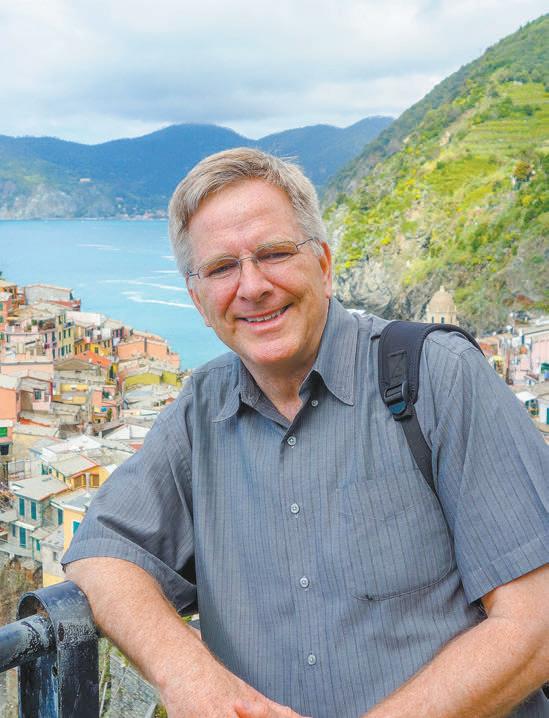

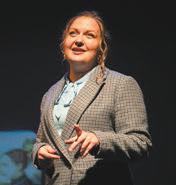
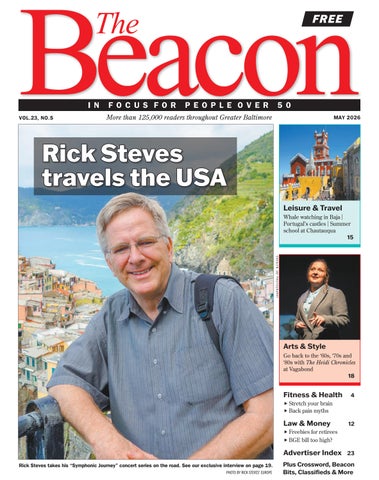
Rick Steves takes his “Symphonic
PHOTO
Willie Mays has always been my favorite baseball player. He could hit for average and power, steal bases, catch every ball that came his way in centerfield, and throw like no one else. He loved playing baseball and he played with the childhood joy that was forever captured in his immortal nickname, the “Say Hey Kid.”
In fact, it was said of Mays that the only thing he could not do on a baseball diamond was stay young forever. Willie played too long after his skills had declined, and the joy was harder to find. Those last years were not kind.

sary intellectually and owning that choice through emotional acceptance. Retirement is the classic head/heart decision.
But owning and even embracing the realization that our time here is limited, unpredictable and sacred can help us live well.
tirement, and took what I called a gap year. During that time, I wrote, consulted for nonprofits and led heritage tours. My first trip in this new role was to Japan, an endlessly fascinating part of the world.
write essays and give lectures, all of which have led to a new appreciation for the diversity and wonder around me.
By David J. Brown
We’re all the young Willie Mays early in life, believing we can chase down fly balls forever.
Yet dropping an identity without a real sense of where the new path may lead is seriously scary stuff. After all, leaving a career takes certain hopes and dreams out of our lives, probably forever.
When one has to make a decision to let go of a workplace, there can be a big difference between understanding what’s neces-
“The paradoxical reward for accepting reality’s constraints,” Oliver Burkeman notes, “is that they no longer feel so constraining.” The sooner we accept that fact, the sooner we can live the only life we have more fully.
When it came to retirement, my father taught us not to be defined by our jobs. He was proud of his career as an engineer, yet he retired in his early 60s and easily moved on. Tom Brown enjoyed life. Every day was a new day.
After more than four decades in the nonprofit world, I decided 2019 was my year to follow Dad’s example. It was a scary decision and involved letting go not just of the perception of control but of dreams. So I hedged my bets, described the step as “not quite” re-
I found I enjoyed researching and crafting stories that fellow travelers would find of interest. I started reading outside my comfort zone, discovering indigenous writers, fungal networks, immigrant perspectives, beavers, liberation theology and so much more. I began reading with curiosity and wonder. With a sense of awe. “The beginning of awe is wonder,” wrote Rabbi Abraham Joshua Heschel, “and the beginning of wisdom is awe.”
Mary Oliver’s recommendation to writers — “Pay attention. Be astonished. Tell about it.” — had become my North Star. Yet I still self-described myself as “semiretired.” Being employed somehow remained at the core of my existence. It can take months or years after we’ve crossed the intellectual threshold to finally accept those decisions emotionally. When I’ve made a choice but haven’t fully owned it, life seems out-of-whack.
Ironically it was only at someone else’s retirement party that I took the plunge, finally telling friends my life consisted of exploring the world I’d missed during the decades I was a busy nonprofit executive.
Now I read, travel, have conversations,
Unwrapping and sharing those discoveries with others brought me joy. Some never lose their childhood curiosity. I’m reclaiming mine.
No longer semi-retired, I have a new life description: I am bashing into joy. I’m discovering new worlds while diving deeper into things I love. The sum of traditions, memories, myths and associations connecting people and place over time — history’s soul — remains utterly fascinating. I find joy in sharing these personal and collective explorations in essays and lectures.
Letting go, whether it’s the loss of a career, relationship or long-held expectation, can bring a sense of transience and fragility. But there are other ways to look at letting go. We can lose to find, give away to gain. We may be making room for something more wonderful.
But letting go is hard. “Disappearance,” Kathryn Schulz writes, “reminds us to notice, transience to cherish, fragility to defend. We are here to keep watch, not to keep.”
Pay attention. Be astonished. Tell about it. And when we let go, we find there truly is more to come.
To read more of David J. Brown’s writing, visit moretocome.net.

IN FOCUS FOR PEOPLE OVER 50
The Beacon is a monthly newspaper dedicated to inform, serve and enter tain the citizens of the Greater Baltimore area, and is privately owned. Other editions serve Howard County, Maryland and Greater Washington, D.C.
Subscriptions are available via first-class mail ($50) or third-class mail ($20), prepaid with order. Maryland residents: add 6% for sales tax. Send subscription order to the office listed below.
Publication of advertising contained herein does not necessarily constitute endorsement. Signed columns represent the opinions of the writers, and not necessarily the opinion of the publisher.
Gordon Hasenei, Publisher, CEO
Steve Gurney, Associate Publisher
Margaret Foster, Editor
Kyle Gregory, Art Director
Roger King, Vice President of Operations
Advertising Representatives:
Jill Joseph, Steve Levin, M.K. Phillips
Ana Preger Hart, Assistant Editor
Tori Cleveland, Editorial Assistant
Stuart & Judy Rosenthal, Founders


The Beacon, P.O. Box 2227, Silver Spring, MD 20915 (410) 248-9101 • Email: info@thebeaconnewspapers.com Website: www.theBeaconNewspapers.com
Submissions: The Beacon welcomes reader contributions. Deadline for editorial is the 1st of the month preceding the month of publication. Deadline for ads is the 1st of the month preceding the month of publication. See page 23 for classified advertising details. Please mail or email all submissions.
© Copyright
The Beacon Newspapers, Inc.
Readers are encouraged to share their opinions on any matter addressed in the Beacon as well as on political and social issues of the day. Mail your Letter to the Editor to The Beacon, P.O. Box 2227, Silver Spring, MD 20915, or email info@thebeaconnewspapers.com.
Please include your name, address and telephone number for verification.
Dear Editor:
Elliot Raphaelson in “The Savings Game” column of the last issue of the Beacon listed the options to address the potential huge deficit facing Social Security and Medicare as follows:
“Reduce benefits, or increase age of receiving benefits, or reduce the annual inflation adjustment.” Then, almost as an afterthought, Raphaelson wrote, “Finally, Congress could alter the cap on FICA taxes.”
Raphaelson has this backward. He should have stated, “First, Congress could (and most assuredly should) alter the cap on paying FICA taxes.”
Billionaires only have to pay FICA taxes on only the first $184,500 of earned income. Is this fair?
Dale Barnhard Silver Spring, MD
Dear Editor:
I am a volunteer at several facilities for Alzheimer’s residents and want to pass along some tips I have learned. Some read-
ers who are also caregivers might find this helpful.
Although residents may not recognize or remember visitors, you can bring them moments of happiness. Sometimes they may not make sense, but they just want to be heard. Just listen and mirror their emotions.
Residents also like hearing stories about my life. They often can’t hold conversations but crave hearing people talk to them. Often I show them pictures of my family, especially children. They enjoy telling me how cute my grandchildren are, and I love hearing it.
One activity I have found that people with dementia enjoy is playing catch with a small beach ball. (We use two balls, since some people just like to hold the ball.)
If you are a senior like me and are looking for a meaningful volunteer activity, consider contacting your local assisted living or memory care facility.
Rita Grotsky Olney, MD


o v r many families, caregiveers et become som thing far greater e than just a practical hellper. Tey ad are ste dy y presences during m uncertainty.T tyy. Trrusted co panions in t the quiet of early mornings v and long eveenings. Partners in v y preservviing dignity. . Oveertime, they y can become part of the family. . , w A At t Family & Nursing Care we e t are reminded of this tru hmost e w fu poowwerfully in th woords families e w shar wiith us, especially afer a lovovveed one passes. Teir refections u ce speak not only to ex ellent care, but t v d lo y to humanity, , connection, an ovvee.
“Part of Our Family”
’ if s w Afer hi wife e s long illness, one w utt sa husbandwwrrote to u abbout the two o d b s w caregivveer whho stoo by y her side —
l c a ug s — t and hi thro gh the fn chhapter erlif of h fee: Connie and Paula. f t w He described them as “two o o the v d k fnest an kiindest caregiveers one ef ew .couldimagine ”In th weeek b foore if s w hi wife e passed, Connie and Paula a spent long dayys at the hospital, t mf provovviiding co foort and continuity y u during an uncertain time. Pa la e s b wa by y her side h lping up until an ef hour b foore she passed. w , do y ur w “O whhole family, owwn n to our v grandkkiids, love e Connie and Paula,” hewwrote. “Tey are extraordinary e t in t their jobs, and mor than extraordinary human beings.”
if , a w t In anothher message wife e er w v a n t refected o thhe c regive whho d in t a supported her husban n thhe vy slif l y fna yeears of hi fee:Marvyynnwas n w a yt ev “ evveer thhing and more than we e could ver a d f havavve e expecte frrom a c regiver. . ”
wa “He was al ayys on time. He got r.M m my y husband’s sense of humor. My y n w vy husband missed Marvyyn whhen it
t a a a f — t a was his day y o that t sayys i all,” ealifet v e ga shewwrote. “H avveem fe the o li s, w ur k t f las feew years. O kiid wh h ivve
l f ef , w way r a fa awayy, weere so grat fu u foor him.
y He is part of our family.”
a lies f Fami frrequently sh re similar v t t ts a sentimen abbou their caregiveers.
a et Tese refections ar the nattural
s w a f w result o whhat happpen whhen f m skkiilled, co passionate profeessionals g lif t show up consisten ly durin fee’s era t vu mos uln abble moments.
sfu v Behind eveery succes ful a e caregivviing r lattionship is c a fu ugtho ghtfulmat t hing, ongoing communicaattion, and deep respect
r t f fo o the human side of care.
v o “Wek We knnowwthat caregiveers ofen m become trusted comppanions and, in many cases, extensions of , V e a , y, y the famil ”sayys K lly Salb Viice v President of Client Serviices at Family & Nursing Care.
“Our responsibility is to ts w h c c fu ugtho ghtfully mat cllien with caregivveers based on care needs, u preffeerences, and sched les.
k Caregivveers bring skiill, experience, and a deep commitment to m provviiding comppassionate, a d t consistent support — an that t k a s w human connection i whhat t makees edifth feerence.”

to us. Tey refect the im a caregivers havve on people during extraordinary tim a w t sho that t home care is m helping someone remain sa at home. It i abbout prese mppact v ’ e s livees mes, and more than f n safeely ervviing
dignitytyy, , nurt walkkiing alon flif some o fee’s T To o learn m 410-697-820 at mily f fa a ilynnur
00
turing connection, and ug ngside families thro gh h derc s most ten chhapters. a more, c ll us at 0 e r v o viisit our webbsite r rsingcaree.com
BACK PAIN MYTHS
By Lauran Neergaard
“Exercise your brain,” experts advise people hoping to stave off dementia. But how? Stretching your brain might be the better description.
Do a crossword puzzle a day, and you may just get good at crosswords. Instead, research increasingly shows that a variety of habits and hobbies are like a cognitive workout, building knowledge and skills that may beef up parts of the brain as we get older.
One recent study linked a lower risk of Alzheimer’s disease and cognitive decline to lifelong learning, meaning intellectually stimulating experiences — reading and writing, learning another language, playing chess, solving puzzles, going to museums — from childhood into retirement.
“They kind of stretch your brain and your thinking. You’re using your different cognitive systems,” explained neuropsychologist Andrea Zammit of Rush University Medical Center in Chicago, who led that study.
If you didn’t embrace what Zammit calls cognitively enriching activities early in life, it’s not too late to get started. Middle age offers an important window for protecting brain health, and scientists are examining a wide range of possible ways to stay sharp,
from taking up music to birdwatching and brain-training games.
Physical health is critical to brain health, too. That’s why experts also recommend the work-up-a-sweat kind of exercise as well as low blood pressure, good sleep and even later-in-life vaccination.
There’s no magic recipe to prevent either dementia or the normal cognitive decline of aging, cautioned Dr. Ronald Petersen, an Alzheimer’s specialist at the Mayo Clinic. But lifestyle changes offer a chance to “slow down the arc of deterioration,” he said.
New study shows protection
Zammit’s study on lifelong learning enrolled nearly 2,000 older adults, ranging from age 53 to 100, who started out dementiafree and were tracked for eight years.
Researchers quizzed them about educational and other cognitively stimulating activities in their youth, middle and older ages, and administered a battery of neurologic tests.
Some eventually were diagnosed with Alzheimer’s disease — but it struck five years later in those with the highest amount of lifelong learning compared to those with the least amount, Zammit’s team reported in the journal Neurology. And staying more men-
tally active in middle age and beyond was linked to a slower rate of cognitive decline.
More interesting, Zammit said, were autopsy findings from 948 participants who died during the study: Even when their brains harbored Alzheimer’s hallmarks, the more cognitively “enriched” people had better memory and thinking skills and a slower decline before their death.
That’s what scientists call cognitive reserve. It means that learning strengthened neural connections in various regions, helping the brain to be more resilient, able to work around damage from aging or disease at least for a while.
The Rush study can’t prove cause-andeffect — but it shows an association between cognitive stimulation and dementia risk. Other studies offer similar clues, such as those linking brain health to playing a musical instrument.
Another study hinted that brain “speed training” — using an online program that requires spotting images as a screen flashes increasing distractions — also may help. A study funded by the National Institutes of Health now is examining if there’s benefit to long-term computerized
Bed rest isn’t the best medicine. Prevent pain with exercise
NATURAL STRESS RELIEF
Birdwatching — or just being outdoors — lowers blood pressure RINGING IN THE EARS
Hearing loss can cause tinnitus, but some hearing aids can help BACK OFF ON BENADRYL
Some common medications, including allergy meds, can cause brain fog
exercises that aim to improve attention and reaction time.
How fast our brains process information affects how we multitask or drive, said Jessica Langbaum of the Banner Alzheimer’s Institute, who isn’t involved with the brain training research. For now, she advises choosing activities that help you think on your feet — maybe joining a book club for social connection.
Lots of chronic health problems that strike in middle age can increase the risk of later-inlife Alzheimer’s or other forms of dementia.
For example, high blood pressure damages blood vessels, which is bad for the heart and reduces blood flow to the brain. Poorly controlled diabetes can spur damaging inflammation in the brain.
That means key recommendations for heart health — get regular exercise, eat lots of fruits and vegetables, avoid obesity and control diabetes, high blood pressure and high cholesterol — also are good for brain health.
A bonus step: Get vaccinated against shingles. It not only prevents that incredibly painful rash, but growing research shows the vaccinated have a lower risk of developing dementia. —AP
By Colin Poitras
Aging in later life is often portrayed as a steady slide toward physical and cognitive decline. But a new study by scientists at Yale University suggests an alternate narrative — that older individuals can and do improve over time, and their mindset toward aging plays a major part in their success.
Analyzing more than a decade of data from a large, nationally representative study of older Americans, lead author Dr. Becca R. Levy, PhD, a professor of social and behavioral sciences at the Yale School of Public Health, found that nearly half of adults aged 65 and older showed measurable improvement in cognitive function, physical function, or both, over time.
The improvements were not limited to a small group of exceptional individuals and, notably, were linked to a powerful but often overlooked factor: how people think about aging itself.
“Many people equate aging with an inevitable and continuous loss of physical and cognitive abilities,” Levy said.
“What we found is that improvement in later life is not rare; it’s common, and it should be included in our understanding of the aging process.”
The findings were published in the journal Geriatrics in March.
For the study, researchers followed more than 11,000 participants in the Health and Retirement Study, a federally supported longitudinal survey of older Americans.
The research team tracked changes in cognition using a global performance assessment, and physical function using walking speed — often described by geriatricians as a “vital sign” because of its strong links to disability, hospitalization and mortality.
Over a follow-up period of up to 12 years,
45% of participants improved in at least one of the two domains, according to the study.
About 32% improved cognitively, 28% improved physically, and many experienced gains that exceeded thresholds considered clinically meaningful.
When participants whose cognitive scores remained stable over that period (rather than declining) were included, more than half defied the stereotype of inevitable deterioration in cognition.
“What’s striking is that these gains disappear when you only look at averages,” said Levy, author of the book Breaking the Age Code: How Your Beliefs About Aging Determine How Long & Well You Live.
“If you average everyone together, you see decline,” Levy continued. “But when you look at individual trajectories, you uncover a very different story. A meaningful percentage of the older participants that we studied got better.”
The authors also examined potential reasons for why some people improve and some do not.
They hypothesized that an important factor could be participants’ baseline age beliefs — or, specifically, whether they had assimilated more positive or more negative views about aging by the start of the study.
In support of this hypothesis, they found that those with more positive age beliefs were significantly more likely to show improvements in both cognition and walking speed, even after accounting for factors such as age, sex, education, chronic disease, depression and length of follow-up.
The findings build on Levy’s stereotype embodiment theory, which suggests that age stereotypes absorbed from culture — through social media and advertisements
By Meghan E. Murphy, M.D.
Dear Mayo Clinic: My back’s been bothering me, and everyone seems to have ideas what’s causing the pain. Can you help?
A : Back pain is more common than homeownership in the U.S. While about 65% of adults own a home, nearly 80% of adults will have back pain at some point.
Despite how common this type of pain is, myths about it persist. We clarify several misconceptions below.
Myth: Lifting heavy objects is the main cause of back pain.
Fact: Lifting heavy objects with poor form can contribute to back pain, but the major culprits are a sedentary lifestyle, poor posture, obesity and genetic factors.
Myth: Bed rest will make my back pain better.
Fact: Probably not, but it depends on the
From page 4
— eventually become self-relevant and biologically consequential.
Levy’s prior studies have found negative age beliefs predict poorer memory, slower walking speed, higher cardiovascular risk and biomarkers associated with Alzheimer’s disease.
The current study shows that those who have assimilated more positive age beliefs often show improvement, Levy said.
“Our findings suggest there is often a reserve capacity for improvement in later life,” she said. “And because age beliefs are modifiable, this opens the door to interventions at both the individual and societal level.”
The improvements were not limited to people who started out with impairments. Even among participants who had normal
cause of your pain. If it’s muscle strain, taking it easy for a few days may help.
However, bed rest can also make back pain last longer or even worsen. If your pain is from nerve compression, a disc issue or joint degeneration, inactivity can cause tighter muscles, more pain, loss of physical condition and more debility.
In these cases, you should modify your activities, switch to low-impact exercises like walking and swimming, and avoid movements like bending, twisting or lifting. Maintaining some degree of physical activity can help you heal faster.
Myth: Back pain is always due to a serious underlying condition.
Fact: Back pain is usually caused by muscle strains or sprains, not by a serious condition like a disc or vertebrae issue. Most back pain resolves on its own.
Myth: You should avoid exercise
cognitive or physical function at baseline, a substantial proportion improved over time.
That challenges the assumption that later-life gains reflect only people getting better after being sick or rebounding from earlier setbacks, the authors said. Dr. Martin Slade, MPH, PhD, a lecturer at Yale School of Medicine, is co-author of the study.
The authors hope their findings will reverse the popular perception that continuous decline is inevitable and encourage policy makers to increase their support for preventive care, rehabilitation and other health-promoting programs for older persons that draw on their potential resilience.
This research was supported by funding from the National Institute on Aging.
This article was originally published by the Yale School of Public Health. Reprinted with permission.
when experiencing back pain.
Fact: Exercise and physical activity are usually recommended for managing and preventing back pain. Strengthening the core muscles — including your back muscles — improving flexibility, and maintaining a healthy weight can contribute to a healthier back.
Depending on your pain, you may need to modify your activity. You know your body best, so listen to it. If something isn’t getting better or grows progressively worse, contact a healthcare professional for an evaluation.
Myth: Surgery is the only solution for chronic back pain.
Fact: Back pain is often caused by issues that aren’t relieved with surgery. Nonsurgical treatments like physical therapy,
medications, injections and lifestyle modifications are often effective in managing and reducing chronic back pain. Surgery may be necessary if your pain:
• intensifies, especially at night or when you lie down
• spreads down one or both legs
• causes weakness, numbness or tingling in one or both legs
• occurs with new bowel or bladder control problems.
Seek an immediate medical evaluation if you experience any of these symptoms.
Myth: A firm mattress is the best for alleviating back pain.
Fact: The ideal mattress firmness varies from person to person. Some people may
For free materials about area housing communities, just complete and clip this coupon and mail, or take a picture and email, to the Beacon.
Housing Communities
o Brightview Senior Living (see ad on page 11)
o Charlestown/Erickson (see ad on page 7)
o Christ Church Harbor Apts (see ad on page 10)
o Oak Crest/Erickson (see ad on page 7)
o Park View Laurel (see ad on page 16)
o Park View Towson (see ad on page 16)
o Park View Fullerton (see ad on page 16)
o Park View Rosedale (see ad on page 16)
o Pickersgill (see ad on page 10)
o Roland View Towers (see ad on page 10)
o Virginia Towers (see ad on page 6)
o Warren Place Senior Apartments (see ad on page 13)
o Westminster House (see ad on page 13)
o Exercise & Sleep Study/mPATH (see ad on page 9)
o Memory & Sleep Study/TAILOR Sleep (see ad on page 8)
o Smell Test Study (see ad on page 9)
o SPRING Clinical Trial (see ad on page 9)
Check the boxes you’re interested in and return this form to: The Beacon, P.O. Box 2227, Silver Spring, MD 20915 or take a picture and email to housing@thebeaconnewspapers.com.
By Casey Glickman
When Janete Gonzalez went to the Druid Hill Park farmers market in the fall of 2022, she was a new Baltimore City resident, having just moved after a house fire destroyed everything she owned. That day, she expected to leave the northern Baltimore market with food and maybe some healthcare products. Instead, she left with solar panels.
“I originally assumed that solar panels were for people who had bigger land or lived in a better neighborhood,” Gonzalez said. “I just didn’t think it was for us.”
But Civic Works, a nonprofit working to improve energy accessibility in Maryland, is changing that.
Gonzalez is one of more than four dozen Baltimore City residents who have received free solar panel installations as part of the Baltimore Shines program.
The program emerged as a partnership between the Baltimore City Department of Housing and Community Development and Civic Works as an affordable solution for
From page 5
find relief with a firm mattress, while others may prefer a medium or soft one.
low-income residents to lower their electricity bills and make a positive impact on the environment.
Baltimore Shines started this round of solar installs in 2024 and as of December had completed 50 solar installations for income-qualifying homeowners. By the end of 2026, the program hopes to bring that number to 170 installations.
“Our goal is to really make it as easy and worry-free a process as possible for the resident,” said Eli Allen, the senior program director at Civic Works.
After Gonzalez’s first introduction to Baltimore Shines, she went through an almost yearlong process of information sessions, online applications, a roof assessment and several house visits. Her solar panels were installed in June 2023, and by December, they were generating power.
Now Gonzalez saves about 50% on her Baltimore Gas and Electric Company bill.
Bills that came in around $400 now average $176-$230 a month, she said.
“It gives that safeguard to really embrace the house that you have and lets you focus on family life,” Gonzalez said.
Those savings add up. According to 2024 fiscal year data from the Maryland Energy Administration, Baltimore Shines has cut residents’ electricity bills by an average of $1,500 annually.
Solar panels convert sunlight into electrical energy through photovoltaic panels. That means that during the winter months, with fewer hours of sunlight, solar systems produce less energy.
“It’s great for the summer, not too much for the winter,” said Baltimore Shines participant Tyresa German.
In the winter, German said she saves about $50 per month; BGE bills that used to come in around $250 now average $200 per month. But once summer rolls around, German’s bills drop to $10-$30 a month.
“My friends hate me,” German joked.
“Prior to getting the solar panels, I was doing a lot of overtime just so I could not feel drowned in the BGE bill.”
Baltimore Shines also ensures city residents aren’t drowned by the cost of solar panels, which can cost between $15,000 and $18,000, said Victor Walters, associate director of outreach and intake at Civic Works.
That price tag makes solar energy a luxury that is out of reach for some.
With Baltimore Shines, residents pay zero out-of-pocket costs — but only low-income homeowners qualify for the program. Income limits range from $26,338 for a single-person household to $54,600 for a family of four to $92,260 for a family of eight.
Under the program, Civic Works owns and operates the solar panels it installs on homes for a 20-year lease term, covering
When shopping for a new mattress, look for one that provides support and comfort based on your preferences and needs. Many companies offer generous return policies, so you can try a mattress for a few weeks, or even a few months, before deciding if it’s right for you.

Myth: Poor posture doesn’t contribute to back pain.
Fact: Many people spend hours slouching while staring at a computer rather than sitting at attention; others bend their necks to focus on cellphones. These habits can strain muscles and joints, causing body pain over time.
muscles, including abdominal and intrinsic back muscles, can help take the stress off your spine.
• Stay active. Regular movement is essential for keeping your body active.
Meghan E. Murphy, M.D., Neurosurgery, Mayo Clinic Health System, Mankato, Minnesota

















Practice good posture habits and take advantage of ergonomic office equipment to help prevent and alleviate back pain.
Some back issues can’t be avoided, like those caused by injuries, arthritis or genetics. To preserve the health of your back:
• Maintain an ideal body weight. Excess weight causes increased stress on all joints, including the spine.
• Strengthen your core. Stronger core
Mayo Clinic Q & A is an educational resource and doesn’t replace regular medical care. This Mayo Clinic Q&A represents inquiries this healthcare expert has received from patients. For more information, visit mayoclinic.org.
© 2026 Mayo Foundation for Medical Education and Research. All Rights Reserved. Distributed by Tribune Content Agency, LLC.

By Howard LeWine, M.D.
Q: Is the association of poor sleep and a higher risk of cognitive decline related to chronic inflammation?
A: Sleep deprivation is a condition that occurs when you don’t get enough sleep, or enough good quality sleep. Research has found that sleep deprivation is associated with markers of inflammation, such as increases in inflammatory molecules — including cytokines, interleukin-6 and Creactive protein.
While these signs of inflammation could be attributed to other factors — stress, smoking or obesity, for example — they do suggest that sleep deprivation plays a role in the inflammatory process.
Inflammation is the body’s natural response to disease and injury; it is usually a temporary response and serves as an effective defense mechanism.
But when inflammation doesn’t let up, it contributes to the development of heart disease, diabetes, stroke, cancer and Alzheimer’s disease.
How does a lack of sleep contribute to inflammation? One theory focuses on blood vessels.
During sleep, blood pressure drops and blood vessels relax. When sleep is restricted, blood pressure doesn’t decline as it should, which could trigger cells in blood
vessel walls that activate inflammation. A lack of sleep might also alter the body’s stress response system.
In addition, a sleep shortfall interferes with the normal function of the brain’s housecleaning system, termed the glymphatic system (not to be confused with the lymphatic system in the rest of the body). In the deepest sleep phases, cerebrospinal fluid rushes through the brain, sweeping away betaamyloid protein linked to brain cell damage.
Without a good night’s sleep, this housecleaning process is less thorough, allowing the protein to accumulate — and inflammation to develop. Then, a vicious cycle sets in. Betaamyloid buildup in the brain’s frontal lobe starts to impair deeper, non-REM slow-wave sleep. This damage makes it harder both to sleep and to retain and consolidate memories.
Just one night of lost sleep can keep betaamyloid levels higher than usual. The problem is not so much a single night’s poor sleep, which you can compensate for, but a cumulative pattern of sleep loss. That leads to decreases in the structural integrity, size and function of brain regions like the thalamus and hippocampus, which are especially vulnerable to damage during the early stages of Alzheimer’s disease.
Q: In the past, I have sometimes seen streaks in my vision. They go away so quickly I don’t know if it is in
one or both eyes. But now I have a lacy black spot in my right eye that I only see sometimes. Are they related?
A: What you describe sounds like flashes and floaters. Both commonly happen as we get older.
The eye consists of two major compartments — the front (including the cornea, iris and lens) and the back (the rear twothirds of the eyeball, including the retina and a large cavity filled with vitreous gel that attaches to the retina).
Flashes, the quick streaks of light you describe, tend to be most noticeable in the dark. They occur when the vitreous gel bumps, rubs, or tugs against the retina. This action can lead to small areas of vitreous detachment, a sudden separation between the vitreous gel and the retina.
The small black spot you see in one eye sounds like a typical floater. People often notice occasional floaters — spots, squiggly





By Anita Snow
Wearing an oxygen pack on her back for her COPD, Marcia OBara led a group of nature enthusiasts on a mission to see birds this winter. They carried walking sticks on the flat trails, moving at their own pace, without pressure or competition and enjoying a sense of community.
This is Birding for Every BODY, one of numerous such excursions offered each month by the nonprofit Tucson Bird Alliance with Arizona’s Pima County.
It’s part of a growing national movement to help people with physical and other limitations experience birding and nature in general.
“It’s an opportunity for people to get out and see birds without pressure, no matter how long it takes or how many birds we see,” said OBara, a retired nurse who has been leading the accessible outings for three years.
Disabled people often cannot keep up on traditional outings, especially when competitive birders are focused on checking off a list of the greatest possible number of species.
So, on her accessible walks, OBara ensures that all trails are easily traversable, and bathrooms are open and large enough to accommodate mobility scooters and wheelchairs. She checks on the availability of drinking water, shade and benches.
Once a walk gets underway, OBara checks to ensure everyone is keeping up,
then modulates the pace as needed.
“I used to work in rehab, so I usually know what people need,” OBara said.
While the outings are open to those with wheelchairs and mobility scooters, people who use those devices rarely attend the walks, OBara said, perhaps because they don’t think they’ll be able to keep up.
“But we’d encourage them to come,” OBara said.
On one of several walks she led in February at Tucson-area parks, OBara pointed out birds to a small group.
“It’s nice to just be outside and not think of anything else,” said Rhea Guertin, a retired Rhode Island snowbird who spends four months in Tucson each winter. She used a walking pole for stability.
“I’m just slow,” she explained.
Evelyn Spitzer, a retired Tucson-area teacher, used a walking pole for her heart condition and the lingering effects of a recent surgery.
The organized effort to share birding with people with limitations goes back at least to 2018, when retired Texas teacher Virginia Rose founded the nonprofit Birdability. Rose has used a wheelchair since suffering a spinal injury at age 14.
“Our vision is that birding be truly for ev-
Baltimore Humane Society’s free bereavement group helps people cope with the loss of a beloved pet. The group is open to all and meets on the first Tuesday of each month from 7 to 9 p.m. at 1601 Nicodemus Rd., Reisterstown. For more information and to register, call (410) 833-8848, ext. 219, or email cemetery@bmorehumane.org.





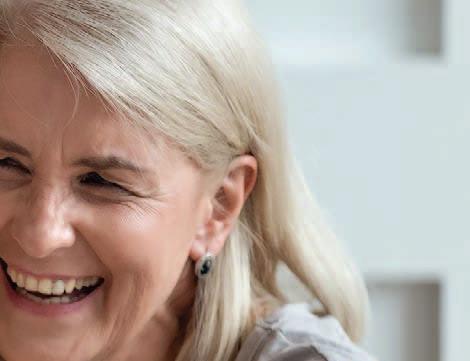

erybody and every BODY, regardless of disability,” said Cat Fribley, Birdability’s executive director.
She said participants’ limitations include mobility issues, blindness or low vision, chronic illness, intellectual or developmental disabilities and mental illness. Some are neurodivergent, deaf, hard of hearing or have other health concerns.
Fribley, who has a mobility scooter for multiple disabilities, said she can go five or six miles while birding on the accessible paths in her residential community in Iowa City, Iowa.
“In the winter, I bird on my back deck with my coffee,” she said.
Other examples of accessible birding include watching from a car, from a canoe on a river, or simply through a kitchen window, advocates said.
Birdability has helped compile a crowdsourced map of accessible birding locations nationwide in partnership with the National Audubon Society, and offers advice to ablebodied birders on how to be more welcoming and inclusive.
The group’s website has many other resources and adaptive devices, such as carwindow mounts for cameras and apps such as Merlin that blind people and others can use to identify and record birdsong.
From page 6
any maintenance issues or replacements residents may need.
To finance the program, Civic Works receives grants from a variety of sources, which previously included funding from a program called Solar for All.
However, after the U.S. Environmental Protection Agency terminated $7 billion in grants for Solar for All programs in August 2025, Baltimore Shines was forced to restructure to adjust for the lack of funding.
“We have had to cap the size of the solar system we are installing to be able to offer solar to more community residents,” Walters said.

Occupational therapist Freya McGregor recommends binocular harnesses, which are strapped around the back and chest, saying they’re easier on the shoulders and neck than binoculars that hang around the neck.
McGregor — who has a permanent knee injury — runs Access Birding, which trains nature organizations such as state parks and local Audubon chapters on making trails accessible.
Birding “really brings you joy,” said Jerry Berrier, a 73-year-old Massachusetts birder who has been blind since birth. “There is happiness from being out in nature.”
Berrier, who got hooked on birding as a college student, captures avian songs and calls for his website, birdblind.org, to help blind bird enthusiasts record and share their own. Last year, he launched the Any Bird Any Body podcast with his friend, Gary Haritz. He also helped organize the first national bird-a-thon for blind enthusiasts in the U.S. It drew several hundred participants last year, who reported the birdcalls they heard over 24 hours. The event goes international this year on May 3.
“We encourage people to reach out to local organizations to help blind people with the bird-a-thon,” Berrier said. “A disability can be very isolating.” —AP
The chance to switch to solar matters for Baltimore City residents as BGE utility rates continue to climb. Since January 2025, BGE customers have seen multiple increases in their energy bills, with residents expecting to pay an average of $26.06 more per month for gas and electric bills, according to 2025 energy bill information for BGE customers. (See story on page 12.)
Low-income residents bear the brunt of the energy burden. The median household in Baltimore spent 3% of its income on its energy bill, yet median low-income Baltimore households spent 10.5%.
For more information about the solar program, visit civicworks.com/solar, email info@civicworks.com or call (410) 366-8533. —Capital News Service
Caregivers and their loved ones are invited to a study about sleep and daily life. You will join a guided conversation, and both will wear a Fitbit for a week to track sleep patterns. Your insights will help design a tailored home-based sleep support program.




Compensation will be provided.
By Margaret Foster
Can gum disease speed up Alzheimer’s disease? Yes, according to last year’s study that linked bacteria in the mouth to Alzheimer’s disease.
In fact, the study showed that the bacteria accelerated the disease in patients. Patients who had gum disease declined faster than Alzheimer’s patients without the bacteria.
Now a nationwide clinical trial is testing an investigational oral drug to see if it can reduce the bacteria’s damage to the brain. San Francisco-based Lighthouse Pharmaceuticals developed the drug to inactivate the enzymes from the bacteria, P. gingivalis, which can infect
From page 7
lines, rings or opaque flecks — drifting across their line of vision.
Floaters are tiny clusters of cells or clumps of gel that have formed in the vitreous cavity. What the person sees is the shadow that these little clumps cast on the retina.
People often become more aware of floaters when they look at a book page, a
the brain and worsen Alzheimer’s disease.
Last year the National Institute on Aging awarded $49.2 million to Lighthouse Pharmaceuticals for this Phase 2 clinical trial.
Called the SPRING trial (Stopping PRogression of P. gINGivalis associated Alzheimer’s disease), the study will is enrolling 300 patients with mild to moderate dementia from across the country.
The investigational drug “represents a significant advancement in our effort to target a bacterial driver of Alzheimer’s disease with a high-precision oral medication,” Michael Detke, MD, PhD, chief medical officer at Lighthouse
computer screen, or a solid, light-colored background. Floaters can also be more noticeable when you’re tired. Unlike flashes, floaters don’t disappear. However, over time, they become much less noticeable for several reasons. The brain eventually filters out unimportant or repetitive information, including floaters. The clumps of gel can also shift position and move away from your central vision. © 2026 Harvard University. Distributed by Tribune Content Agency, LLC.
Pharmaceuticals, said in a statement.
“We are excited to be enrolling and expanding the number of patients across the United States in 2026.”
Local site
One of the SPRING study’s locations is right here in Pikesville, Maryland. PharmaSite
Research, a clinical research site just off Reisterstown Road, opened 20 years ago and has been conducting studies on anxiety, Lyme disease and other disorders.
People 55 to 80 with an Alzheimer’s diagnosis are eligible.
For more information about the study, call PharmaSite at (855) 367-8834.
ts (65+) t g f W We e are lookin foor older adul to o a paarrticipatte in a research study on personalized d e w a ta exxeercise. Learn ho aiilore exxercise program e y ov e u f p y can hel yo o feeel l stronger and improvve
Y e thaheal anndwelll-bein Yoou will be compensatted t r y f fo o yoour time and participa ion upon successful dy completion of the stu y. . :Dr n Principal Invvestigator r. . Junxin Li - IRB # 00396390 e inf For mor foormation, please scan the QR code, call 443-692-7169 or email mpathstudy@jh.edu






Ongoing smell loss may be one of the most important signals of brain health as we age.
A new study from The Michael J. Fox Foundation for Parkinson’s Research is exploring this link. We’re calling on everyone with and without Parkinson’s to request a simple scratch-and-sniff test and contribute to important research. Test Challenge Today


Request your test at or scan the QR code.
Request your test at 877-525-PPMI (7764) mysmelltest.org /beacon or scan the QR code.
You’ve probably heard the word “anticholinergic” in television commercials or in one of my articles and mentally checked out because it sounds technical.
Don’t. It’s actually simple. It just means the drug blocks acetylcholine, a chemical messenger that your body uses all day, every day.
Let me boil it down to seven things you should know about acetylcholine before you take a drug that blocks it:
1. Acetylcholine keeps your brain
sharp and your body regulated.
2. Blocking it can mimic aging.
3. Some medications are strong blockers and cross into the brain.
4. Even mild drugs can add up when stacked together.
5. Older adults are especially vulnerable.
6. Anticholinergic burden is linked to increased dementia risk.
7. Dryness is your biggest clue. Some drugs have very strong anticholin-



-24/7 On-Site Maintenance and Reception Desk
-Beauty/Barber Shop
-Pet-Friendly
-Social and Exercise Events
-Two Blocks From Hampden’s “The Avenue”
Our community features two charming high-rise buildings in the heart of Roland Park and Hampden!
*Income guidelines apply and subject to change.

ergic effects. Diphenhydramine (Benadryl), amitriptyline, oxybutynin, cyclobenzaprine and paroxetine are among the bigger offenders. These meds cross into the brain and can noticeably affect cognition, especially in older adults.
Other medications carry milder activity, including newer antihistamines and bladder drugs.
Even when each one seems modest, the cumulative burden adds up. One allergy pill, one bladder medication, one sleep aid, and suddenly acetylcholine is significantly suppressed. Then your mind is affected, or you get constipation and blurry vision.
creased risk of constipation) and increase urinary retention.

PHARMACIST
By Suzy Cohen
Older adults should pay the closest attention to changes like this when taking anticholinergic medications. Acetylcholine is central to memory circuits in the hippocampus.
In fact, medications used to treat Alzheimer’s disease (i.e., donepezil) actually work by increasing acetylcholine. Therefore, blocking it chronically can worsen memory and recall and increase dementia risk.
People with dementia, chronic constipation or prostate enlargement are also more vulnerable because anticholinergic drugs can worsen confusion, slow gut motility (in-
Babies and toddlers can react strongly as well, sometimes with paradoxical agitation.
Check medication labels
How would you know if you were taking an anticholinergic drug? You could ask your local pharmacist, look it up online, or consider the primary side effect: dryness.
Feeling “dry” is one of the biggest clues. Acetylcholine stimulates secretions. When you block it, things dry up. If you have persistent dry mouth, dry eyes, dry skin or constipation, it could be a side effect of your medicine, as opposed to imbalanced hormones or natural aging.
Here’s what I tell people: If you need an antihistamine during peak allergy season, that’s okay. Just don’t live on it for weeks. Use it short-term. If the tablet is scored, sometimes half is enough.
If you have allergies, do saline rinses to bring moisture back. Use a good HEPA filter at home. Shower after high-pollen days so you’re not sleeping in whatever you
Here, assisted living is living, with the right amount of personal assistance


Pickersgill assisted living residents are rarely in l their rooms! Instead, , theyy’re out and about— participating in a community activity or event or dining with friends.

Living in n this community—ttucked d into a beautiful West Towson neighborhood —you or your loved one beau njoy a warm welcome and daily activities, and they’ll appreciate the will enj paths, beautifully landscaped grounds, lovely gardens and more. walking path


tour. h




Each assisted liv g resident enjoys three chef-prepared meals per day, ing re y services, medication administration, help with daily housekeeping and laundry se quest, and all included in a reasonable monthly tasks and more—always by reques o all of the fee. Each h resi s dent also has access to all Pickersgill ameni l ties. private, full bath, and residents are Our assisted living g residences include a priv wish. Tis is a lifestyle dedicated to encouraged to decoraate their homes as they al staf. independence and assured by a caring, professionalfessionalstasttaf.





By Jim Miller
Dear Savvy Senior,
What treatments are recommended to help with tinnitus? I started noticing a subtle ringing in my ears about 10 years ago, but it’s gotten much more bothersome since I turned 60.
—Ringing Ronnie
Dear Ronnie,
Tinnitus is actually one of the most common health conditions in the country. According to the National Institute on Deafness and Other Communication Disorders, around 10% of the U.S. adult population — over 25 million Americans — experience some form of tinnitus.
For most people tinnitus is merely annoying, but roughly 5 million people struggle with chronic tinnitus, and 2 million find it debilitating.
While there’s no cure, there are a range of different strategies you can try to reduce the symptoms and make it less bothersome. Here’s what you should know.
Tinnitus (pronounced TIN-a-tus or tinNIGHT-us) is the sensation of hearing a ringing, buzzing, roaring, hissing or whistling sound in one or both ears when no external sound is present.
The sounds, which can vary in pitch and loudness, are usually worse when background noise is low, so you may be more aware of it at night when you’re trying to fall asleep in a quiet room.
Tinnitus itself is not a disease, but rather a symptom of some other underlying health condition. The best way to find out what’s causing your tinnitus is to see an audiologist, or an otolaryngologist — a doctor who specializes in ear, nose and throat diseases (commonly called an ENT). The various things that can cause tinnitus are:
• Hearing loss, which is the most common cause
• Middle ear obstructions usually caused
From page 10
walked through. If dry mouth kicks in, xylitol lozenges can stimulate saliva.
Your physiology doesn’t care what the drug is for, whether it’s allergies, overactive bladder, sleep or depression. It responds to total chemical load.
Sometimes anticholinergic medication is appropriate. Sometimes it quietly creates brain fog, dryness and slowdown that gets blamed on aging.
If you want a deeper dive and a list of the most common offenders, I’ve posted a longer article at suzycohen.com so you can review your own medication list.
This information is opinion only. It is not intended to treat, cure or diagnose your condition. Consult with your doctor before using any new drug or supplement.
Suzy Cohen is a registered pharmacist and author of The 24-Hour Pharmacist and Real Solutions from Head to Toe
by a buildup of earwax deep in the ear canal
• Side effects of many different prescription and over-the-counter medicines like aspirin, ibuprofen, certain blood pressure medicines and diuretics, some antidepressants, cancer medicines and antibiotics
• Various medical conditions such as high blood pressure, vascular disease, diabetes, allergies, thyroid problems, ear or sinus infections, Menière’s disease, Lyme disease, fibromyalgia, otosclerosis, temporomandibular joint (TMJ) disorder, a tumor, an injury to the head or neck, traumatic brain injury, depression, stress and more.
There are many ways to treat tinnitus, depending on the cause. For example, if your tinnitus is caused by a wax buildup in your ears or a medical condition like high blood pressure or a thyroid prob-
lem, treating the problem may reduce or eliminate the noise.
Or, if you’re taking a medication that’s causing the problem, switching to a different drug or lowering the dosage may provide some relief.
If you have hearing loss, getting a hearing aid can help mask your tinnitus by improving your ability to hear actual sounds. Some hearing aids even have a setting to reduce your perception of tinnitus.
Another strategy that can help suppress or mask the sound so it’s less bothersome is “sound therapy.” This can be as simple as a fan or white-noise machine, or you can use sound therapy apps like ReSound Tinnitus Relief, myNoise or Naturespace.
Cognitive behavioral therapy and psychological counseling can also be helpful, as can tinnitus retraining therapy (TRT). This combines counseling and sound
therapy to train your brain to ignore the sound in your ears. The new MindEar app offers TRT, and some hearing aids have a setting that tunes out tinnitus.
There are even new innovations, like the FDA-approved device Lenire (lenire.com), that use electrical stimulation of the tongue to alleviate symptoms.
While there are no FDA-approved drugs specifically designed to treat tinnitus, some anti-anxiety drugs and antidepressants have been effective in relieving symptoms. Your audiologist or ENT can help you figure out the best treatment options.
Other things you can do to help quiet the noise is to avoid things that can aggravate the problem, like fatty foods, salt, artificial sweeteners, sugar, alcohol, tonic water, tobacco and caffeine.
Be sure to drink plenty of water, as dehydration can worsen symptoms.






























By Kathryn Pomroy and Bob Niedt
Everything’s getting pricier — food, healthcare, housing, you name it. Prices are climbing, and wallets are feeling the squeeze.
Thankfully, some things in life are still free — senior discounts on everything from going to the movies to riding the bus are ripe for the taking. We gathered a collection of our favorite retirement-friendly freebies.
Tap into the RxAssist database to find free or low-cost medications from the patient assistance programs of pharmaceutical manufacturers. Not all drugs are included here. Some have eligibility requirements, such as income limits, and usually require that the applicant have no prescription insurance.
Some supermarket chains, including Meijer, Publix, Kroger, Family Fare, Sam’s Club and more, offer select medications for free.
For lower priced (but not free) meds, Blink Health offers more than 55 medications on its site that are well below standard pharmacy costs — and shipping is always free to all 50 states. You can also compare prices at goodrx.com.
If you’re still dreaming about going back to school, it’s never too late. Some states require state-supported colleges and universities to waive tuition for older
residents, as long as there’s space available in the class. (See story on page 13.)
One example: Virginians age 60 and up can audit up to three classes per term at any of the state’s colleges or universities.
Similarly, at the University System of Maryland (UMD), retirees 60 or older can get their tuition waived at any of the state’s schools for up to three courses per semester.
Bonus: If you apply and receive UMD’s Golden Identification Card, you will be “eligible for any privileges” (for example, library access or student events).
Traditional Medicare offers about 18 services with no out-of-pocket costs, including free yearly wellness exams, seasonal vaccines, colorectal screenings and yearly mammograms.
EyeCare America, a public service program of the American Academy of Ophthalmology, provides free eye exams and up to one year of care for any disease diagnosed during the exam.
This free service is available to anyone age 65 or older who doesn’t have private insurance and hasn’t visited an eye doctor in at least three years.
You must fill out a short survey to see if you qualify for the program. Check EyeCare America for program guidelines.
Several state park systems — among them Maryland, New Hampshire, New York and Texas — offer older adults free
admission or free annual passes. (Maryland charges $10 for its Golden Age Pass for people 62 and older.)
Don’t forget about the Senior Pass, available to people 62 and older for admission to all National Parks. It’s not free, but it’s well worth the cost. The Senior Lifetime Pass is valid for life and costs $80. The Senior Annual Pass is valid for one year and costs $20.
Project Gutenberg and the University of Pennsylvania’s Online Books Page let you legally download thousands of books that have expired copyrights, including War and Peace, Moby Dick and Little Women
If you’d rather listen than read, the apps Libby and Hoopla let you access thousands of audiobooks free from your local library. Or listen to classics on digitalbook.io or loyalbooks.com.
More into music? Check out musicstreaming services, such as Pandora, iHeartRadio and Spotify. All three offer some variation of a free subscription.
Many of the best travel credit cards come with free rental-car insurance, and some will cover the cost of your vacation if you have to cancel your trip or pay for lost or damaged luggage.
Other credit card perks include free extended warranties, free cellphone replacement and free museum admission. Contact your card issuer to find out about perks.
To limit your landline costs or avoid using precious minutes on your mobile phone plan, try using a free calling service such as Microsoft Teams, WhatsApp, Viber or FaceTime.
All four allow you to make free calls to other users of these same services, and all can be installed on mobile phones or computers.
Staying in shape is one way to live better and longer. Even if you’re 65 or older, staying active can add more than five years to your life, according to a 2025 study in the British Journal of Sports Medicine.
The study found that if everyone age 40 and older moved like the most active seniors — brisk walks, gardening, dancing or light strength training — average life expectancy could increase by 5.3 years.
Some gym memberships are costly, but thankfully, many fitness centers offer discounted or free memberships through health insurers for people age 65 and older. The most well-known one, SilverSneakers, gives eligible seniors access to thousands of gym and fitness center locations nationwide — for free through their Medicare Advantage plan.
Cameron Huddleston contributed to this article.
© 2026 The Kiplinger Washington Editors, Inc. Distributed by Tribune Content Agency, LLC.
By Olivia Borgula
A few blocks away from Lexington Market in Baltimore, in a six-story building adorned with intricate detailing, there’s a data center that uses enough electricity to power a city roughly the size of Dundalk, Maryland.
The company that runs the 150,000square-foot facility announced in 2024 it would triple the data center’s capacity over the next few years to meet the needs of the booming artificial intelligence (AI) industry. That’s just one of the dozens of data centers in Maryland. Opponents say these fa-
cilities put more pressure on the state’s already fragile energy grid and contribute to rising electricity costs.
Maryland ranks 13th in the U.S. for its residential electricity prices as of October 2025, according to the U.S. Energy Information Administration. Between October 2024 and October 2025, average residential electricity prices in the state rose by about 18%.
That could be just the start. Data centers’ proportion of the regional electricity grid supplying power to Maryland and other nearby states will triple between 2024 and 2029, according to a report by the grid operator.
A sudden surge in power demand, supply issues and a long, bureaucratic approval process for bringing on new power have led to higher electricity prices in Maryland — costs that are only expected to increase, thanks to data centers.
“This isn’t a community hospital or a school or even a highway that everybody might use,” said Steve Black, president of Frederick County’s Sugarloaf Alliance, one of six local organizations that make up the Maryland Data Centers Analysis Group.
“These facilities, these data centers, exist to make money for a private company, and
we are all paying for their capital need.”
Maryland’s
One reason for the rising cost of electricity in Maryland is the pressure data centers are putting on PJM Interconnection LLC, a regional organization that coordinates the movement of wholesale electricity across 13 states between Illinois and New Jersey. It’s run by 10 board members without a financial stake in any company in PJM’s market.
One part of ratepayers’ bill is the “supply”
DATA CENTERS, page 14
By Kathryn Pomroy
Every state in the U.S. offers free or almost free college courses for older people, where you may be asked to attend on-campus or you may find a class online.
Learning new skills can help senior citizens stay youthful, boost cognitive function, memory and emotional well-being. The studies back it up:
Scientific American shows that older adults aged 60 to 90 in a structured learning program for one year improved memory and attention to levels comparable to adults 50 years younger.
And Harvard Health found that engaging in complex skill-learning strengthens cognitive reserve, helping seniors maintain focus and memory despite age-related brain changes.
So, if your goal is to stay active and engaged, check out these eight online platforms with courses that range from languages to investment strategies, and everything in between.
Some platforms charge a fee per course, while others are offered at no charge.
1. AARP Senior Planet: If you want a program that is specifically geared to older adults, check out Senior Planet, a program of AARP. From technology tips to exercise sessions, it’s a good bet you’ll find fun, educational classes without the stress of weekly tests.
At SeniorPlanet.org, you’ll also find a guide that includes helpful tips and tricks on how to navigate online learning platforms and maximize the benefits of these courses.
2. Open Learning Initiative: The Open Learning Initiative is a series of courses offered by Carnegie Mellon University. The courses are self-paced and self-guided, so you can take your time.
You can’t earn credit for the classes you
take, but you can gain new knowledge and learn new skills. Study a language, refresh your math skills, or explore human anatomy so you can impress the doctor on your next visit.
3. EdX: EdX offers free online education courses from MIT, Berkeley, Harvard and many other colleges and universities.
The courses are self-paced, meaning you can go at your own speed, with topics that include nutrition science, private markets and investment strategies.
Want to try something in the arts? They also offer an introduction to music theory and graphic design.
You won’t pay a thing for taking edX open courses when you enroll in the free audit track; however, this version doesn’t offer certificates or grade your work. If you want to earn a certificate, there is a fee that ranges from $90 to $300.
4. Coursera: If you want to further your knowledge with degrees and professional certificates from world-class universities like Duke and the University of Michigan, then Coursera might be for you. It offers thousands of paid and free online courses.
For example, you can learn the latest advances in data science or earn a certificate as a Microsoft project manager in four months. Plus, you can get started with a free trial.
5. Academic Earth: Academic Earth is a fantastic way to dive into high-quality education from top universities like Princeton and Oxford.
The self-paced, at-home setup is perfect for flexible learning about business, science, humanities or law — anything specific you want to explore, all free of charge.
6. The Great Courses: The Great Courses offers hundreds of online courses across every subject, from “Ancient Cities


of the Mediterranean” to the “Art of Travel Photography.” They are taught by topnotch professors and subject-matter experts. Besides that, you can learn at your own pace.
The platform is compatible with Apple TV and Kindle Fire and even offers DVDs. It has a pay-per-course pricing module and comes with lifetime access when you sign up. At various times of the year, you can also find discounts on many of the best courses, so check back.
7. YouTube: Finally, YouTube is an amazing platform (and personal favorite) where you can pick up a new hobby, learn to cook pasta, find out about climate change or try beginner yoga poses. Most classes are free, but some charge a small subscription fee. Some of the top learning channels on YouTube include Crash Course, Vsauce and SmarterEveryDay. © 2026 The Kiplinger Washington Editors, Inc. Distributed by Tribune Content Agency, LLC.












section, which is driven by PJM’s annual auction.
Power companies and businesses submit bids based on how much energy they can offer and how much it costs them to keep that power reliable during high demand.
In PJM’s 2024 auction, which started af-
fecting customers in June, capacity costs jumped from about $2 billion to nearly $15 billion for the upcoming year.
The most recent auction to determine the cost for 2026-27 hit another record high at just over $16 billion, which would have been higher if not for a cap requested by Pennsylvania Gov. Josh Shapiro and backed by Maryland Gov. Wes Moore.
An analysis from the Independent Market Monitor found the capacity hikes


stemmed almost entirely from existing and projected data center loads on PJM’s grid. Experts said that is no surprise.
“If the data centers don’t foot the bill, and they come on and the grid has to pay … the ratepayers are going to carry the cost,” said Andrew Chien, a University of Chicago professor who studies sustainable computing.
Another component of electricity bills are rates set by local utility companies such as Baltimore Gas and Electric that are based on the cost of delivering that power, maintaining local infrastructure and repairing systems.
In the last 10 to 15 years, Maryland utility rates have steadily climbed, according to a report from the state’s Office of People’s Counsel, which works on behalf of Maryland’s residential customers to advocate for utility performance.
The increase stems from a variety of factors, including warmer temperatures, increased costs for energy delivery — some of which have more than doubled since 2012 — and programs that allow utilities to recoup those costs more quickly, according to the report.
Black, of the Maryland Data Centers Analysis Group, said Maryland rates are now expected to skyrocket because of the data center demand.
“It’s going to start spiking in ways that
Do you find it difficult to use a standard phone? Do people ask you to repeat yourself during telephone conversations? Do you miss important calls because you can’t hear the phone ring? The Maryland Accessible Telecommunications (MAT) program is here to help by giving Maryland residents the opportunity to apply for State-provided telecommunications equipment to independently make and receive calls. Once you qualify, a skilled evaluator meets with you to determine the best device to support your day-to-day communications. The MAT program has a variety of equipment solutions to support clearer communication, including:
• Amplified phones
• Tablets
• Ring signalers
• Phones with large and/or high contrast buttons
• Captioned Telephones
• And more
nobody, no policymaker has a good way of getting their hands around,” he said.
There are dozens of data centers in Maryland, according to an industrycreated data set, and plans to develop more in Frederick and Prince George’s County.
Advocates say data centers are a growth opportunity for Maryland’s tech sector and a potential source of high-paying jobs and local tax revenue.
Michael McHale, business manager at the International Brotherhood of Electrical Workers Local 24, headquartered in Baltimore, said data centers create jobs, especially because many are large facilities that take years to complete.
“This [Frederick] facility will probably take 10 years to build out. So in theory, at first [workers] could start there and work there for a large part of their career,” he said.
Critics of the facilities say they’re inherently unfair, however. Chris Miller, president of the Virginia-based Piedmont Environmental Council, said there’s a lack of accountability and information about the longterm impacts of data centers, which makes them hard for governments to regulate.
“Data center companies ought to be covering the direct costs and the indirect costs,” he said. “Utility bills are … going up a lot to subsidize the 10 richest companies in the world.” —Capital News Service

By Don Mankin
The large gray whale drew close to our boat. Crusty barnacles on its skin stood out like dense clusters of thread woven into an abstract tapestry.
Several people scrambled to the side to lean over and touch the majestic beast as it sidled alongside. I could have either joined them or sit back and take photos. I opted for the latter, and I’m not sure I made the right choice.
I was on a small boat with nine other people to observe gray whales at the endpoint of their annual migration from the Arctic to Magdalena Bay on the Pacific Ocean side of the Baja Peninsula, where they give birth to their newborn calves.
For three days, we ventured out into Magdalena Bay in wooden fishing boats called pangas, skiffs pressed into service for the whale-watching season from January to March. The pangas, covered with large blue tarps to offer protection from the unrelenting Baja sun, are powered by huge outboard motors to zip around the vast bay in search of whales.
Although our main goal was to see whales, the setting was stunning, well worth the several hours we spent on the water each day. The sapphire bay is framed by untouched barrier islands with stark desert mountains and expansive, deserted beaches.
We saw plenty of whales, often at a distance, sometimes up close, occasionally right alongside the boat. At times, they would stick their snouts out of the water to “spy hop” — raise their heads above the water to check out the view and decide which boats to grace with their presence.
It’s not known why some whales, known as “friendlies,” approach the boats so closely. But it’s clearly their choice, as they have the entire sea in which to hang out.
Our up-close encounter was, hands down, the highlight of our three-day whale watching adventure. It happened on our last day, about an hour before we had to return to camp and head back to La Paz, the city where we started our trip.
I have had several close encounters with large marine mammals over the years — orcas in Alaska, gray whales in British Columbia, walruses in Siberia, and whale sharks in Indonesia, among others — but
the experience still makes my heart pound.
The whales weren’t the only highlight of the trip. Playful dolphins, pelicans, frigate birds and cormorants were our frequent companions. On the second day, we stopped for lunch on a beach on one of the barrier islands. We had the pristine beach to ourselves. In this day and age, that solitude alone would almost be worth the time and expense of the trip.
Every afternoon, we retired to our camp, a mile or so down a rough, dusty road from the formerly sleepy fishing village of Puerto Chale, now a bustling whale watching hub.
In the camp, large tents lined a bluff overlooking a lagoon and a small beach, offering stunning sunset views of the bay and the mountains on the distant barrier islands from pretty much every angle.
Each tent was outfitted with two cots, air mattresses and sleeping bags. Our camp chef, Vickie, served us excellent Mexican home-cooked meals in a big communal dome tent, which we also used for happy hour cocktails, presentations about whales and just hanging out.
At the edge of the camp was a small tent with a rudimentary toilet, essentially the same “facility” you would find on any organized camping trip. With the warm sun, pristine sand and glistening water, it was much like a beach resort, albeit without plumbing.
In my many years of adventure trips, I have found that you meet certain kinds of people on these trips who add significantly to the experience. The people I meet on these expeditions are almost as important to my enjoyment of the trip as the wildlife, wilderness and cultural attractions. This journey was no exception.
In addition to me and my wife, Katherine, there were two couples from London, a couple from China and two women friends from California. They were all personable, lively and smart. We made good use of the communal tent for stimulating conversations and cocktails every afternoon and evening after our daily whale watching excursions.
Our naturalist guides, all from Mexico, were also exceptional — informative, helpful and just fun to hang out with. We rapidly

formed an instant community of fellow likeminded adventurers.
La Paz, the capital of the state of Baja California Sur, Mexico, is well worth a visit in its own right. A short two-hour flight from Los Angeles, La Paz is an appealing city with many attractions, including the Malecon, a scenic 3.5-mile-long waterfront promenade with 180-degree views of the Bay of La Paz.
Numerous Mexican restaurants line the street across from the promenade and serve a wide variety of seafood, including fish and shrimp tacos, the local specialty.
It is also the starting point for a separate five-day kayak trip around Espiritu Santo Island, a desert island six miles off La Paz in the Sea of Cortez.
I took that same trip, one of my all-time favorite kayak trips, in 1989. On that excursion, I tried snorkeling for the first time; it is still some of the best snorkeling I have ever experienced. I loved the area so much that I returned several years later, first on a sailboat and later on another kayak excursion.
Those adventures opened my eyes to the wonders of this magical region — its
scenery, waters, marine life, desert, mountains and whales.
I may not have had the opportunity to stroke that curious whale’s mottled, crusty skin, but at least I have the photos to remind me of a wildlife encounter like none other.
Round-trip flights with two stops to La Paz on Delta start at around $650. Or you can fly to Los Angeles and catch a nonstop Alaska Airlines flight to La Paz for about $700.
The Seven Crown Centro Hotel (centro.hotelsevencrown.com) offers a discounted rate of about $120/night for clients of Sea Kayak Adventures (seakayakadventures.com), the tour operator for this trip, which hosted me and my wife.
Sea Kayak Adventures also offers a fiveday kayak trip on Espiritu Santo Island. Most of the people on our trip also took the kayak trip the week before our whale watching adventure.
Nim Restaurante in La Paz offers an upscale, fusion dining experience. The menu at the rooftop restaurant at the Seven Crown Hotel on the Malecon is more prosaic, but the views of the harbor and the bay are outstanding.
By Sandi Barrett
Lisbon, Portugal’s capital city, is often passed by for Paris, Barcelona and other touristy counterparts. Yet with its historic castles, public squares and amazing cuisine, the charming riverfront city is perfect for a short jaunt.
I recently had the opportunity to enjoy my second visit to Lisbon, this time with a group of six friends. Our gang of curious travelers discovered quite a few favorite places and delectable restaurants and vowed to return someday.
We started our tour at the Jerónimos Monastery, a massive complex dedicated to the burial site of Portuguese kings and explorers, including Vasco da Gama. The Manueline-style (Portugal’s late Gothic) architectural monument is a UNESCO World
Heritage Site and a popular tourist spot. The queue is perpetually long, so go early.
The nearby Belém Tower was built in 1519 to guard the Tagus River, the longest waterway of the peninsula. Adjacent to the tower is the 170-foot-tall Monument to the Discoveries statue, a 1960 marble statue which depicts the country’s famous explorers.
Across town, the medieval São Jorge Castle and surrounding Castle Town sit high above the city, offering stunning views of the river and red-tiled roofs below. The fortress has existed in some form since the 7th century B.C.
Strolling through the castle is a lovely way to enjoy an afternoon in Lisbon. Take a taxi uphill to save your legs. On the way down, a tuk-tuk ride is a hoot; they navigate through narrow back streets, giving you a local view and a somewhat wild ride.
If you stay for a few days, take time to venture out of the city and see the scenic countryside.
A day trip to the picturesque mountain village of Sintra is a wonderful way to learn about Portugal’s history. The former summer residence of the royal family, it was a favorite for poet Lord Byron, who called it “the most beautiful village in the world.”
Sintra’s crown jewel, Pena Palace, sits high on a rocky ledge, a stunning, yellow fairytale castle. One can only imagine the fancy parties held in such a beautiful setting.
An hour north of Lisbon is the magical town of Óbidos. A charming Portuguese village enclosed within the ramparts of the Medieval castle, Óbidos transports you back in time. Bright white houses draped with vibrant pink and fuchsia bougainvillea hem in narrow cobblestone streets. The
Igreja de Santa Maria is a beautiful church filled with quintessential blue and white Portuguese tiles.
Venture to the Alentejo region to taste Portugal’s delicate wines, silky olive oil and culinary delights and wander around the country’s cork forests. Porco Preto (black Iberian pig) is a tasty regional offering.
One of my favorite things to do in a new city like Lisbon is to explore the food scene with a local food tour. The food and wine walking tour with Inside Lisbon was a wonderful way to get the lay of the land and enjoy some local delicacies. On our tour, we enjoyed codfish cakes with green wine, Port wine with São Jorge cheese, bifana (pork sandwich) with a local draft beer, and the infamous ginjinha (cherry liquor).
Pastry connoisseurs should try a pastel de nata, a delicate, flaky puff pastry tart with a creamy, caramelized custard filling. The famed original bakery Pastéis de Belém near the Jerónimos Monastery is the spot for these perfectly executed, mouthwatering tarts.
If you want to avoid the many touristy restaurants and cafés, do a little sleuthing and you will find some unique eateries serving up traditional local dishes.
The nearly impossible-to-find Casa do Alentejo is well worth the hunt. Located on Lisbon’s pedestrian walkway, Rua das Portas de Santo Antão, the restaurant is accessible through an unremarkable door with a small sign.
Once inside, you venture to the second floor, where a magnificent entryway greets you. The dining room, up another floor, offers simple tables surrounded by beautiful, tiled walls.
Hearty local cuisine like fried codfish with chickpeas, grilled pork tenderloin and fried pork in red pepper sauce with clams grace the menu. Leave room for fluffy honey cake, made with olive oil, cinnamon and lemon zest.
Whether you go to Lisbon on a three-day jaunt during a city-hopping European vacation or stay a full week, “Lisbon is a good city to get lost in,” as Patti Smith put it.
Round-trip flights from BWI start at $800. A 40-minute train to Sintra costs less than $5, or you can book a $95 guided bus tour through Viator.com.
We stayed at the stunning Sofitel Lisbon Liberdade in the city center. Located on Avenida da Liberdade, the main thoroughfare in Lisbon, it’s perfectly situated near cafés, luxury stores and tourist attractions.
By Glenda C. Booth
Last summer, I plunked myself in a classroom with 50 other adults and learned that bats’ wing bones are human-like fingers. The next day, I was immersed in a talk titled “Middle East Chaos.”
The Chautauqua Institution in southwestern New York is like college without essays or exams — a week of screen-free indulgence in academics, arts, nature, recreation, meditation and exploration. Theodore Roosevelt called it “America at its best” during his 1905 visit.
Chautauqua’s mission is to enrich lives intellectually, spiritually, emotionally and physically. Today’s offerings have greatly expanded beyond its origins, an 1874 summer camp for religious Sunday-school teachers.
Around 100,000 people enjoy the summer programs at this New York institution from late June to late August. Some come for the whole summer, some during the “shoulder seasons,” some for a week or two, some for a day.
Chautauqua has a village feel, with many single-family homes fronted by broad porches designed to foster conversation. Streets limit vehicles and encourage walking.
The 750-acre complex, built along two miles of Chautauqua Lake, includes gardens, trails, an amphitheater, an opera house, several churches, a synagogue, art
and dance studios, a “play-based” preschool, a summer day camp, a library, cafés and a medical clinic. Around the central plaza are a few shops, galleries and a post office.
Historian David McCullough nailed it: “There is no place like it. No resort. No spa. Not anywhere else in the country, or anywhere in the world. It is at once a summer encampment and a small town, a college campus, an arts colony, a music festival, a religious retreat and the village square — and there’s no place — no place — with anything like its history.”
Words over the dining hall entrance read, “Every man has the right to be all he can be, to know all that he can know,” spoken by John Heyl Vincent, a Chautauqua cofounder, in 1888.
During my week there, I took this quote to heart. In addition to taking classes on bats and the Middle East, I also had a lesson on how to lead “a poetic life.” I learned about the lives of former U.S. presidents Jimmy Carter and Ronald Reagan. I delved into the role of food in foreign policy, taught by Philip Shull, a former U.S. State Department diplomat, who commended the class: “I’m impressed you are spending money to learn.”
The summer program offers in-depth
talks by academics, government officials, writers, religious leaders and other experts. In 2025, for example, historian Doris Kearns Goodwin and actor Morgan Freeman gave presentations. In 2026, lecturers include Rt. Rev. Mariann Edgar Budde, Bishop of the Episcopal Diocese of Washington, part of the “Women Who Change the World” series.
There are several lodging options. I shared a room with a friend in the 150-room historic Athenaeum Hotel, built in 1881, when rooms were $3 a day and guests used chamber pots. Wide porches with comfy rocking chairs and the communal dining room encourage conversation. The hotel has the Heirloom Restaurant, and there are several cafés on campus.
Lodging options include house rentals, “denominational houses” of religious organizations and a dormitory.
Architecturally, the campus’ buildings are an intriguing mix. One is the first prefabricated house in the U.S., built in 1857 and shipped in pieces. The house was designed by Lewis Miller, the other cofounder of the institution. His daughter, Mina, and her husband, Thomas Edison, later spent summers in the cottage, which is now a National Historic Landmark.
Several Arts and Crafts-style houses exist
on the campus, including one built by John M. Studebaker. He left his family’s wagonmaking business in Indiana and made a fortune in California making wheelbarrows for gold diggers during the Gold Rush.
If you are traveling in a group, Chautauqua also offers family programs and recreational activities like swimming, tennis, sailing, trail walks and golf. For youngsters there are field trips and arts, theater and STEM classes.
New Yorker Alan Nelson has been going to Chautauqua every summer since childhood. “It’s a wonderful place — the lectures, fine musicians, artists, symphony and orchestra are phenomenal,” he told me.
Buffalo has the closet airport to the New York Chautauqua, with daily shuttles from the Buffalo Niagara International Airport for around $200 round-trip. Amtrak travels to Buffalo from New York City. It’s a sixhour drive from our area.
Prices vary depending on the length of your stay and your choices of programs, lodging and meals. A one-week stay for one adult at the Chautauqua Institution costs around $650 for a gate pass, which provides access to the campus and events. You’ll pay around $1,000 more for lodging and food, depending on where you stay and eat.
For more information, see chq.org.




























All Marylanders 100 years of age and older, or who will be age 100 by December 31, 2026, are
All family and friends of centenarians are also welcome. Donation: $65. Centenarians admitted free with registration. For more information or to register, call (410) 664-0911 or email doctorodd@comcast.net www.mdcentenarians.org SPONSORS:

By Dan Collins
In the art world, perspective is defined as the way an artist can make a scene feel intimate, vast, small, realistic. The resulting work can make a plain, flat space appear three-dimensional and rich in detail.
Perspective is not only a tool of painters, but also writers. Take, for example, Pulitzer Prize-winning playwright Wendy Wasserstein and her work of art, The Heidi Chronicles, which debuted on Broadway in 1989. The play is now on stage at Vagabond Players in Fells Point through May 3.
The play’s two acts both begin at the same time and place: It’s 1989 in a New York City lecture hall, and the title character, Heidi Holland (expertly played by Chelsey Megli), leads a slideshow of works by 16th- to 19thcentury female painters. These parallel scenes foreshadow the key themes of each act: Act One shows how women’s contributions to society are often ignored, as well as the backlash of the 1960s. Act Two focuses on how the idealism of youth may fade amid the struggle to have it all.
After the opening, we travel with Heidi back to 1965 Chicago, a time vast with possibilities, such as love in the form of journal-


ist Scoop Rosenbaum (William ‘BJ’ Darden) and close friendship with gay pediatrician Peter Patrone (Colin Tillery). It’s here the audience meets the real star of this production: Wasserstein’s brisk, comic, erudite script, delivered with aplomb by the cast.
The dialogue teems with references that only fans of American history or Baby Boomers are apt to pick up: “clean for Eugene,” referencing how so-called “longhaired hippie freaks” would need to “clean up their act” and get a haircut to appear more acceptable as they canvassed for 1968 Democratic presidential candidate Eugene McCarthy.
As we travel with Heidi through the years, there are references to the Beatles, the Nixon administration, consciousnessraising groups, exercise class culture (remember those Jane Fonda videos?), etc.
And to help sell the point, as each scene takes us through another portion of the three decades, images are cast onto a large screen that serves as the backdrop for the play. It’s a very effective, engaging device that helps the audience better follow the timeline and marks Heidi’s growth from a

high school student to single parent.





A particularly comic yet telling scene comes in the second act as Heidi, Scoop and Peter appear on an ‘80s TV talk show to discuss the Boomer generation. Heidi is sandwiched between the two men, and they serve as a vise, squeezing her out of the conversation, asserting their male privilege — a phenomenon that a largely female audience seemed all too familiar with, given their murmured reactions.
Strong acting Wasserstein deserves credit for making Heidi’s key support characters threedimensional, rather than stereotypes or caricatures. Kudos to Aparna Sri (Susan Johnston), Nava Rastegar (Jill/Lisa), Penelope Chan (Debbie/Betsy), Maggie Dennis (Becky, Clara, Denise) Danae Nick (Fran/Molly/April) and Nathan Trexler (Chris Boxer, Mark, Waiter, Ray) for





















By Margaret Foster
Rick Steves has been called a travel guru, a TV personality and a hippie backpacker. But he prefers the term travel teacher. Since the late 1970s, Steves, now 70, has been teaching others how to travel.
“In a lot of ways, travel is a fountain of youth,” he said in an interview with the Beacon. “You can travel with a youthful spirit.”
This year, he’ll give audiences an armchair tour of Europe in “Rick Steves’ Europe: A Symphonic Journey.”
Steves acts as a tour guide of sorts as he introduces the stirring sounds of Verdi, Beethoven and Strauss, along with video footage from nine countries, including our own.
Part history lesson, part concert, the “Symphonic Journey” was Steves’ idea, he said.
“I have the love of music, the historical background, the passion for tour guiding, and a huge reservoir of beautiful images that I can share on the big screen when we play the music of the Czech Republic or England or Norway or Italy, so we can take people there visually.”
The traveling concert, which has already toured Cincinnati, Austin and Fairfax, Virginia, highlights 11 classical music pieces from all over the world. The show begins in America, with our scenery and music, then moves on to other countries.
“You feel the pitter-patter in your heart when you hear ‘America the Beautiful,’ and then you go to Austria, and you think, ‘Oh, the people here love their waltz,’ and you go to Norway, and think, ‘Oh, the people in Norway love their fjords and their [Edvard] Greig,’” Steves said.
The idea, Steves said, is to understand the patriotism of other countries.
From page 18
bringing depth and humor to their multiple roles.
Director Lee Conderacci does a masterful job in choreographing each scene as she weaves these nine actors through prologues and 11 separate scenes, ranging from New Hampshire to Michigan, an apartment to a TV studio, a restaurant to the Plaza Hotel to a pediatric ward, from the era of John Gunther’s Death Be Not Proud to the AIDS crisis of the Reagan ‘80s.
What does Heidi learn about herself, who she is, what she wants? Wasserstein paints a work reflecting the intimacy of friends and lovers, the painful yet joyful reality of family, all against the expanse of history, all seen through Heidi’s perspective.
The Heidi Chronicles is running at the Vagabond Players, located at 806 S. Broadway in Baltimore, now through May 3. For tickets and more information, visit vagabondplayers.org or call (410) 563-9135.
“As a tour guide, I’ve always been sort of a crusader against ethnocentrism.”
From hippie backpacker to TV star
Steves was born in Barstow, California, but when he was 12 his father, a piano tuner and importer, moved the family to the Seattle suburb of Edmonds, Washington. His parents brought him to Norway to visit relatives when he was 14, and he was hooked on travel.
The day after Steves graduated from high school, he and a friend, Gene Openshaw, backpacked around Europe on $3 a day in “the best trip of my life,” he said on X last year. Thus began a lifetime of travel.
At the University of Washington, Steves majored in business administration and
European history, the perfect combination for his life’s work. At first, he dabbled in teaching travel classes through the university as well as piano lessons, which he’d taught since high school.
“I used to be a piano teacher. That was the only other job I’ve ever had,” said Steves, who still plays piano.
The summer after his college graduation, however, a pivotal trip to Asia changed his trajectory. On that trip, Steves, then 23, discovered 10 countries with his travel buddy Openshaw.
“Good travel is more than selfies and bucket lists,” Steves later wrote in his book about that trip, On the Hippie Trail from Istanbul to Kathmandu. Instead, the goal should be to “come home with that most
valuable souvenir: a broader perspective.”
When he returned from Asia, Steves made some life changes. He transformed his hometown piano recital hall into a lecture hall and began a career as a travel teacher, launching a business he called Europe Through the Back Door.
Two years later, he self-published his first guidebook with that name. Today he has more than 50 titles in print, and his company, Rick Steves’ Europe Inc., has more than 100 employees and is still based in Edmonds.
Steves ventured into public television in
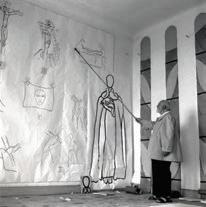
March 29 – June 28, 2026
Discover the making of Henri Matisse’s monumental Stations of the Cross, a masterpiece of spiritual depth. This once-in-a-lifetime exhibition presents more than 70 rare sketches and drawings— many never before on view.
From page 19
1991 with 30-minute segments on budget travel. With his boyish, average-Joe manner and gee-whiz curiosity about people and places, Steves convinces viewers that they, too, can learn to navigate the Paris Metro and the alleys of Athens.
Since 2000, he has hosted a TV series on PBS called “Rick Steves’ Europe,” which brought him international fame. The show, which celebrated its 25th anniversary last fall, has aired 157 episodes over 13 seasons. The latest season, which included episodes in Iceland and Poland, aired in October.
In each segment, Steves meets with locals, sharing fondue in Switzerland or learning a Hungarian folk dance. His good humor and humility come through in the blooper reels at the end of each episode.
Love your neighbor
Steves made headlines last year for what he called “the best Christmas present I could give myself.”
Steves, who had previously donated a $4 million apartment complex to the YWCA of Seattle to house single mothers, purchased the nearby Lynnwood Hygiene Center for $2.5 million.
Last fall Steves noticed an article in his local newspaper about the impending closure of a hygiene center, a building where
people can shower, do laundry, pick up used clothing and even fix their bicycles.
“I didn’t even know what a hygiene center was,” Steves said. “And I thought, are you kidding me? We can’t afford that?...Well, somebody’s got to step up, and I’ve got the money, so I just bought the hygiene center,” he said.
He lives by the credo “Love your neighbor” and has empathy for unhoused people, he said.
“I was unhoused in all my early travels, that’s for sure. I know the value of a shower and the value of a good meal and the value of a roof over your head. Of course I’m a privileged, white American man, so I can’t pretend to understand what it’s like to be a homeless person in the streets.”
Empathy and fearlessness are the natural byproducts of seeing the world, he said.
“A lot of people don’t know the joy of giving, and that’s a function of fear. And I’m not afraid because I travel. I’m not particularly courageous; I’ve just had the opportunity to travel,” Steves said.
Steves frequently gives inspirational talks about how travel can be a “political act” by changing our worldviews.
“Tragically, I think we have a problem where a lot of comfortable and wealthy Americans are more afraid of homelessness — and angry about homelessness — than they are compassionate about homelessness. That’s not who we are. We’re better people
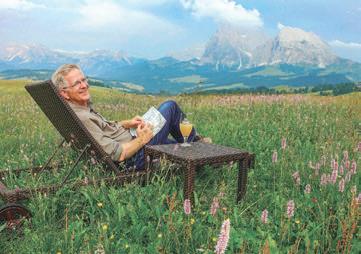
than that, but fear gets in our way,” he said. Steves has seen firsthand how other countries support their unhoused population and knows we can do better.
“We can be people that want walls, or we can be people that want bridges. And I think the best way to be a society we’re proud of, and the best way to actually be safe, is to have more bridges and less walls,” he said.
Despite a prostate cancer diagnosis and
surgery in 2024, Steves still keeps a rigorous travel schedule. He estimates that he’s spent a third of his life traveling. This winter he spent a week hiking in the Dolomites. “I’m doing my best to keep mobile, but yeah, I’m getting older,” Steves conceded. “But in my travels, I’ve learned that age only matters if you’re a cheese,” he joked. “I just keep on moving.”
For more information or to watch a Symphonic Journey performance, visit ricksteves.com/symphony.




























By Mark Dreisonstok
As we all know by now, Dorothy is not in Kansas anymore.
Recent decades have revised Dorothy and Frank L. Baum’s fairytale series The Wizard of Oz. Diana Ross taught us to “ease on down the road” in the 1978 film The Wiz, and the 2003 Broadway musical Wicked presented a new take on good and evil that veers off from the original story and 1939 film.
This season, Toby’s Dinner Theatre in Columbia presents the Broadway incarnation of Hollywood’s The Wizard of Oz in a manner reminiscent of the voices and movements of the original movie cast — with a few surprises.
At the same time, though, the Toby’s production is a more intense version of the darker sides of the tale, with benighted forests of nets, disturbing sounds and ghostly images of the tornado.
In this show, directed by Mark Minnick, live sinister poppies and apple trees threaten Dorothy, the Scarecrow, the Tin Man and the Cowardly Lion, the famous foursome who are on their way to Oz to procure a trip home, a brain, a heart and courage.
Performers channel famous actors
The performances are excellent, with Emily Signor presenting with utter sincerity Dorothy as an ingénue in the Land of Oz, after singing her beautiful rendition of “Over the Rainbow.”
David James is limber in his dance movements as Scarecrow, as is Jeffrey Shankle as the Tin Man — once he has been properly oiled, of course
The standout performer is likely Jordan B. Stocksdale as the Cowardly Lion, imitating with uncanny accuracy the mannerisms and vocal patterns of the beloved Bert Lahr from the film. Robert Biedermann is wonderful in his avuncular dual roles as Professor Marvel and the Wizard of Oz.
MaryKate Brouillet makes for a sweet and charming Glinda the Good Witch, whereas Tina Marie DeSimone is delightfully wicked as both the Wicked Witch and Miss Gulch, Dorothy’s nemesis. In fact, in some poses and interactions, Glinda and the Wicked Witch of this stage version will remind viewers of Glinda and Elphaba in Wicked.
Familiar tunes and a new number
In addition to “Over the Rainbow,” audience members will enjoy the familiar tunes from the original 1939 film “(Follow the) Yellow Brick Road,” “We’re Off to See the Wizard,” “If I Only Had a Brain” and “If I Were King of the Forest.”
Yet it is in the lesser-known “Jitterbug” where the orchestra and the excellent choreography of director Minnick especially thrive.
The original film was produced during the swing era and its jitterbug dance craze, and one scene featuring jitterbug swing dancing was deleted from the final film.
In the Broadway version and Toby’s production, however, “Jitterbug” is restored, affording audiences an opportunity to view an otherwise unseen part of cinematic history. The soaring clarinet, wailing saxophone, screaming trumpet and drum solos testify to the musical prowess of Toby’s orchestra, superbly conducted by Ross Scott Rawlings.
“Jitterburg” takes on a spooky tone, with the large bug eyes of the jitterbug creatures resembling something out of a monster film. Because this and other scenes are more frightening than one might expect, the musical might present an intensely scary experience for young children.
The costumes, coordinated by Sarah King and Janine Sunday, switch from drab on the farm to exquisitely beautiful in the Land of Oz, reminding one of the film’s famous transition from black-and-white to color as Dorothy is transported from her Kansas farm to the fairytale land of her dreams.
The sets of Shane Lowry are highly effective, including a movable yellow brick road which follows Dorothy and her new friends in Oz.
Toby’s, as a dinner theater in the round, often finds clever ways to obviate complicated set structures, and this is true in this show. A stylized scene that finds the friends in a field of poppies with falling snow to break a sleep spell is especially memorable.
The production is so fine it could be said to be “defying gravity,” to borrow a song title from the Broadway musical Wicked
In the words of Professor Marvel, “You

can’t do these things without reaching out into the Infinite.”
The show runs through June 7 at Toby’s Dinner Theatre, located at 5900 Symphony Woods Rd., Columbia.
Tickets range from $84 to $92 for adults.

People 65 and older pay $74 for Tuesday evening or any Wednesday performance; children 4 and older are $64 to $67. Tickets are available from the box office by calling (410) 730-8311 or online via Ticketmaster (with a service fee).




Across
1. Items in sorority house dressers
5. Response to “Who’s there?”
10. DWI prosecutors
13. Get some fresh air
14. Set to the correct vibration
15. Brief talent of many Stephen King characters
16. The first one was sent back to the kitchen due to imperfection
18. Stomach bug
19. Nerdish
20. More like a basketball than a bowling ball
22. “Understand?”
24. Dollar bill word with the highest font size
25. This one was sent back for being South of the state line
31. Water cooler maker
32. Test graders for profs.
33. Cat on ___ Tin Roof
34. Quick-witted
36. Kindergarten teacher’s request
39. It is at the center of a CONTRARIAN
40. Sonny and Cher, in the 70s
42. “Money is the root of all ___”
43. This time the problem was that it was too short
46. With “C” and 52 Down, the world’s best known drink logo
47. Donnybrook
48. Greets warmly
51. Lets the genie out of the bottle
56. Most alarm clock times
57. The final try was sent back due to high rents
59. Bro, sis, and the rest
60. “It’s time for the human race to ___ the solar system.” (Dan Quayle)
61. End for meteor- and method-
62. Slalom path
63. An AI Detector can determine if it was written by a human
64. Sings along with Cardi B
Down
1. Timely benefit
2. Military group that requires a 2.5 GPA
3. “Bundle your home and ___ insurance!”
4. One of several partners of Larry and Moe
5. Addams Family cousin
6. Tele___ (Po, Tinky-Winky, Dipsy and La-La)
7. Disdainful
8. List of drink options
9. It is younger than Adam, but older than Eve
10. Unambiguous
11. In dreamland
12. Cowboy boot attachment
13. Wildebeest
17. Smoke and carbon monoxide devices
21. Crown worn when Charles III was named king in 2023
23. It was transferred from DoT to DHS in 2003
25. Grp. with Heat and Suns
26. Settings in Chicago Med and The Pitt
27. Clever sayings
28. Write about the day
29. Vandal
30. Second word in most bible translations
35. ___ chi (martial art)
37. You can’t spell “special agent” without it
38. Lodge member
40. Low-calorie Lipton
41. www.omahasteaks.com, for example
43. Pappas’ partners
44. In 1994, you could shop in 2,486 of them
45. Like senor or signore, but in Portuguese
48. Bank vault
49. Fencer’s blade
50. Peyton and Eli, to Archie
52. See 46 Across
53. Surmounting
54. Score counters in cribbage
55. Conniving
58. Ending for brew- and brib-
The Beacon prints classified advertising under the following headings: Business & Employment Opportunities; Caregivers; Computer Services; Entertainment, Financial, For Sale; For Sale/Rent: Real Estate; Free; Health; Home/ Handyman Services; Legal Services; Miscellaneous; Personals; Personal Services; Vacation Opportunities; and Wanted. For submission guidelines and deadlines, see the box on the right.
CAVEAT EMPTOR!
The Beacon does not knowingly accept obscene, offensive, harmful, or fraudulent advertising. However, we do not investigate any advertisers or their products and cannot accept responsibility for the integrity of either. Respondents to classified advertising should always use caution and their best judgment.
EMPLOYMENT & REAL ESTATE ADS:
We will not knowingly or intentionally accept advertising in violation of federal, state, and local laws prohibiting discrimination based on race, color, national origin, sex, familial status or handicap in connection with employment or the sale or rental of real estate.
PROPER PLACEMENT REFERRAL SERVICE for the Elderly — Needing to locate the proper home setting assisted living for your love one according to his/her health disorders? There's no charge to locate the proper assisted living for interested party. Call M's Scott at 443.712.4964 and leave a message to set up a personal assessment.
I AM A COMPANION/CAREGIVER with 35 yrs. experience. I work part time at $20.00 an hour. I have CPR and first aid training. I live in Nottingham, MD. Call Robin at 410-336-0066.
MOBILE HAIR & NAIL SERVICES - WE COME TO YOU. Professional Licensed Hair Stylist. Women and Men’s Services - All Hair Types. Cuts, Styles, Roller Sets, Color, Perms, Men’s Cuts & Facial Grooming, Manicures & more. Call 410-415-1760.
PATIENT, PRACTICAL, PERSONAL & INPERSON, 20+ years experience. Don’t let tech frustrate you. Get comfortable & confident with smartphones, tablets, laptops, TV, Alexa & more. Learn how to avoid scams. Julia: 443-4362612, tech.coach4all@gmail.com
SHOP • MINGLE • EAT. Visit Vendor Members Group’s exclusive events: the Markets of CRAFTS GALORE! held 1st Saturdays of Apr, May, (JuneLocation TBD), Sep, Oct, Nov, Dec 9:30AM–2:30PM at Timonium UMC 2300 Pot Spring Rd Timonium, MD 21093. A juried showcase of artistic talent offering affordable, one-of-a-kind handmade treasures for all ages (art, cozy textiles, personal goods, jewelry, whimsical decor, gourmet treats, and more!). Bring the family. Savor tasty bites. Discover something extraordinary while supporting local brands. Free Admission. VendorMembersGroup.com #CraftsGalore!
PRIME TIMERS OF BALTIMORE is a welcoming community for mature gay and bisexual men. The Prime Timers offer social activities that cater to the mind and body. We meet for dinners, a book club, potlucks, hiking, tours, bowling, and more! Join us! Visit baltimoreprimetimers.org or email info@ptbalto.org for info.
UP TO $15,000.00 OF GUARANTEED LIFE INSURANCE! No medical exam or health questions. Cash to help pay funeral and other final expenses. Call Physicians Life Insurance Company866-212-1092 or visit www.Life55plus.info/beacon
BECHSTEIN GRAND PIANO - stunning burlwood finish, 7’8” — Model III built c1896 features a spectacular recently restored burlwood finish by Cantabile in New York, perfect for any vintage grand piano enthusiast or someone looking for a unique addition to their home. The piano is being sold as-is. The piano includes a built in DamppChaser system which maintains humidity levels, and a premium bench. 571-781-0178.
NEW WINDOWS FROM WINDOW NATION. Special money saving offer - zero down, zero payments, zero interest for TWO years AND buy 2 windows and get 2 FREE! Offer is valid for select models. Labor not included. Other restrictions apply. Call Window Nation today! 855-909-2278.
SELLING YOUR HOME? Why Pay 5-6% Commission? My Fee only 1%! Full Service - Not Full Price! Save Thousands in Commissions. www.Baltimorediscountrealtor.com. WANT TO BUY A HOME? Need Down Payment Money? $20k Down Payment/Closing Cost $$ Available. www.Getdownpaymentmoney.com. Robert Holmes - Realtor - 22 yrs experience - C- 443794-8297 - Samson Properties - O- 443-317-8125.
DENTAL INSURANCE from Physicians Mutual Insurance Company. Coverage for 400 plus procedures. Real dental insurance - NOT just a discount plan. Do not wait! Call now! Get your FREE Dental Information Kit with all the details! 1-844366-1003 www.dental50plus.com/320 #6258
MOBILEHELP, America’s Premier Mobile Medical Alert System. Whether You’re Home or Away. For Safety and Peace of Mind. No Long Term Contracts! Free Brochure! Call Today! 1-240-650-9189.
PORTABLE OXYGEN CONCENTRATOR May Be Covered by Medicare! Reclaim independence and mobility with the compact design and long-lasting battery of Inogen One. Free information kit! Call 855-851-0949.
DON’T LET THE STAIRS LIMIT YOUR MOBILITY! Discover the ideal solution for anyone who struggles on the stairs, is concerned about a fall or wants to regain access to their entire home. Call AmeriGlide today! 1-866-365-5170.
All classified ads must be submitted and paid for online, via our website, www.thebeaconnewspapers.com/classifieds Deadlines and Payments: To appear in the next issue, your ad text and payment must be entered by the 5th of the preceding month for Baltimore and Howard County editions; by the 20th for Washington edition.
Cost will be based on the number of characters and spaces in your ad: • $25 for 1-250 • $35 for 251-500 • $50 for 501-750 (maximum length). The website will calculate this for you.
Note: Maryland contractors must provide a valid MHIC number. Each real estate listing qualifies as one ad. All ads are subject to publisher’s discretion. Payment will be refunded if unacceptable for any reason.
NO MORE CLEANING OUT GUTTERS. Guaranteed! LeafFilter is the most advanced gutter protection for your home, backed by a noclog guarantee and lifetime transferrable warranty. Call today 1-855-977-6078 to schedule a FREE inspection and no obligation estimate. Plus get 20% off! Seniors and military save an additional 10%. Restrictions apply, see representative for warranty and offer details.
THE BATHROOM OF YOUR DREAMS in as little as 1 day. Limited Time Offer - $1000 off or No Payments and No Interest for 18 months for customers who qualify. BCI Bath & Shower. Many options available. Quality materials & professional installation. Senior & Military Discounts Available. Call Today! 1-855-653-0087.
CONSUMER CELLULAR - the same reliable, nationwide coverage as the largest carriers. No long-term contract, no hidden fees and activation is free. All plans feature unlimited talk and text, starting at just $20/month. For more information, call 1-833-742-1303.
BECOME A PUBLISHED AUTHOR. We want to Read Your Book! Dorrance PublishingTrusted by Authors Since 1920. Book manuscript submissions currently being reviewed. Comprehensive Services: Consultation, Production, Promotion and Distribution. Call for Your Free Author’s Guide 1-833-992-0110 or visit dorranceinfo.com/beacon
DIRECTV - All your entertainment. Nothing on your roof! Sign up for Directv and get your first three months of Max, Paramount+, Showtime, Starz, MGM+ and Cinemax included. Choice package $84.99/mo. Some restrictions apply. Call DIRECTV 1-888-572-4953.
I BUY LP RECORD ALBUM COLLECTIONS for Top Cash! I come to you and haul. Rock, Metal, Alternative Rock, Punk, Soul, Jazz, Funk, Rap, Audiophile Collections. Sorry no classical, crooners, orchestra. Text/call 410900-5657 or go to kronysrecords.com
PAYING TOP CASH FOR ANTIQUES AND COLLECTIBLES. House calls made with prompt, courteous service seven days a week and 25 years of experience! Buying toys, trains, militaria, glassware, advertising merchandise, paper items and much more! Contact Mason or Megan at: 443-306-8816.