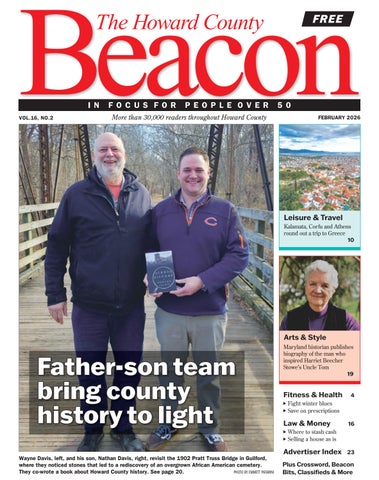
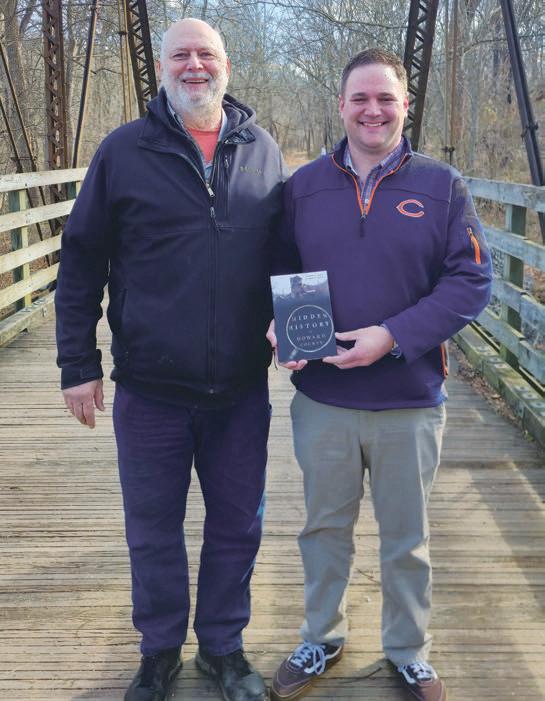
Wayne Davis, left, and his son, Nathan Davis, right, revisit the 1902 Pratt Truss Bridge in Guilford, where they noticed stones that led to a rediscovery of an overgrown African American cemetery. They co-wrote a book about Howard County history. See page 20.
How I learned to be brave
My November column, “How We Learn to Be Afraid,” garnered more responses from readers than anything I have written in years. So I thought I would press my luck and write this companion piece about bravery. Appropriately, it also happens to be the column in which I announce my retirement from the Beacon
Yes, 36 years after my wife, Judy, and I began publishing this monthly newspaper — originally called Senior Beacon of Greater Washington — I am hanging up that hat and donning my “pianist and composer” cap for what I intend to be my encore career.
and head into uncharted waters. I think a few defining experiences early in my life helped me learn to follow my inner voice — even (or especially) when it diverged from “common wisdom.”
FROM THE FOUNDER
By Stuart P. Rosenthal
Regular readers will know that I have taken several short sabbaticals in recent years to test-drive a career in music. Since those have been among the most pleasant times I have ever spent, I am happily giving it a go long-term.
I enter this new phase of my life with the same sense of excitement — plus a soupçon of fear — that I felt when I started the Beacon decades ago. At the time, I left a large law firm where I was a senior associate. While many people clearly thought I was nuts, several fellow associates stopped by my office and told me how much they wished they had the guts to walk away like that.
Over the years, I’ve been asked where I got the chutzpah to abandon a good thing
Scene one: In a gradeschool math class, the teacher put a problem on the board and asked two students, including me, to solve it. We came up with different answers. After each of us explained our reasoning, the teacher asked the class to vote on which answer was correct.
The first vote was split. The teacher asked for another vote; this time only one or two students voted with me. She asked yet again. With my heart pounding, I continued to insist that my answer was correct. This time, I stood alone.
The teacher then announced — rather dramatically — that only I had gotten the correct answer, and she praised me for sticking to my guns even when everyone else disagreed.
Scene two: When I was in college, I became interested in the stock market but had little money to invest. My father offered to match whatever I put into a single stock so I could get my feet wet.
I regularly flew Braniff Airlines to and from school and had read that the company was in bankruptcy. The stock had cratered but was still trading as Braniff at-
The Howard County
tempted to reorganize under Chapter 11. I suggested to my father that it was a good airline and that the stock was a bargain. He expressed doubt but supported me. By the time I graduated, our investment had more than doubled. While at least part good luck, this experience also suggested I could trust my intuition.
I’m not saying those experiences led me to start the Beacon. I left law and started a newspaper for older adults because my heart — and my wife — told me I would wake up with more energy if I did work that better used my talents, allowed me to be my own boss, and helped as many people as possible along the way.
But any new beginning takes courage. And I think those earlier moments in my life that gave me some practice acting courageously have helped me to approach later challenges in life — whether starting a business or retiring from one — and see them as opportunities.
I will deeply miss working every day with the phenomenal Beacon team, who have been like an extension of my family — most of them for 15, 20, and even more than 25 years. Throughout that time, they have devoted themselves heart and soul to making the Beacon what it has become, which is to say an institution beyond my wildest dreams. (By the way, Judy will con-
tinue working with the Beacon for a while longer. She’s younger than I!)
I will also miss engaging with our dedicated readers and longtime advertisers throughout the year at our Expos, on county and nonprofit boards, and at networking and social events.
Even as I say farewell to my role at the Beacon, I hope to continue connecting with you through music. In addition to composing original songs and posting them on my website (please visit stuartsmelodies.com), I plan to perform them along with classical and contemporary favorites at small gatherings throughout the DMV. Activity coordinators, take note: I’m available for bookings!
If you’d like to help give my new career a boost, I invite you to visit my channel on YouTube (search “Stuart’s Melodies”), listen to a piece or two, and hit “subscribe.” There’s no charge — it simply means you’ll be notified when I post something new.
Of course, I also hope you will continue to read the Beacon, patronize its advertisers, and recommend it to your friends. I would love to hear from you. You can respond to this column at info@thebeaconnewspapers.com or write to me personally at stuart@stuartsmelodies.com.
It’s been an amazing and rewarding 36 years. Thank you all!
Beacon
IN FOCUS FOR PEOPLE OVER 50
The Beacon is a monthly newspaper dedicated to inform, serve and enter tain the citizens of the Howard County area, and is privately owned. Other editions serve Greater Baltimore, Maryland and Greater Washington, D.C.
Subscriptions are available via first-class mail ($50) or third-class mail ($20), prepaid with order. Maryland residents: add 6% for sales tax. Send subscription order to the office listed below.
Publication of advertising contained herein does not necessarily constitute endorsement. Signed columns represent the opinions of the writers, and not necessarily the opinion of the publisher.
Gordon Hasenei, Publisher, CEO
SteveGurney, Associate Publisher
MargaretFoster, Editor
KyleGregory, Art Director
RogerKing, Vice President of Operations
Advertising Representatives: Jill Joseph, Steve Levin, M.K. Phillips, Alan Spiegel
Ana Preger Hart, Assistant Editor
Tori Cleveland, Editorial Assistant
Stuart & Judy Rosenthal,Founders
The Beacon, P.O. Box 2227, Silver Spring, MD 20915
Berries, whole grains and other fiber-rich foods keep you feeling full all day and lower your blood sugar
PARKINSON’S SYMPTOMS
Loss of smell, restless sleep and other symptoms may indicate Parkinson’s DRUG DISCOUNTS
Don’t pay full price at the pharmacy before checking for discounts, called Patient Assistance Programs
Ways to find light in dark winter months
By Stefanie Dazio
The winter solstice was Dec. 21, marking the shortest day and longest night of the year in the Northern Hemisphere. While sunlight increases daily after that, winter won’t be over for a while yet.
The Associated Press spoke to experts in Norway, Sweden and Finland about how they cope with the winter blues. Here’s how they suggest looking for light, literally and figuratively, during the darkest months of the year:
Maintain sleep and social habits
The dark winter affects our circadian rhythm. With limited daylight, our internal body clocks cannot reset or synchronize properly, and it throws off our sleep. We may sleep longer in the winter, but we don’t wake up refreshed and can remain tired the rest of the day.
Try a dawn simulator, sometimes known as a sunrise alarm clock, to gradually light up your bedroom and ease you awake, suggested Dr. Timo Partonen, a research professor at the Finnish Institute for Health and Welfare.
In addition to being more tired, we’re more likely to withdraw from others in the wintertime. We’re more irritable, Partonen said, and more prone to arguments.
It’s important to maintain our relation-
ships, he said, because symptoms rarely improve in isolation.
And since keeping up with exercise is also key to combating the winter blues, consider inviting a friend along for a workout.
It could also help keep off the wintertime weight gain — typically 4 to 11 pounds a year, Partonen said — that’s fed by cravings for carbohydrates, especially in the evenings.
Light therapy
Millions of people worldwide are estimated to suffer from seasonal depression. Also known as seasonal affective disorder, or SAD, patients typically have episodes of depression that begin in the fall and ease in the spring or summer.
Scientists are learning how specialized cells in our eyes turn the blue wavelength part of the light spectrum into neural signals affecting mood and alertness. Sunlight is loaded with blue light, so when the cells absorb it, our brains’ alertness centers are activated, and we feel more awake and possibly even happier.
Researcher Kathryn Roecklein at the University of Pittsburgh tested people with and without SAD to see how their eyes reacted to blue light. As a group, people with SAD were less sensitive to blue light than others, especially during winter months.
That suggests a cause for wintertime depression.
In severe cases, people need clinical support and antidepressant medications.
Christian Benedict, a pharmacology professor at Uppsala University in Sweden, suggests light therapy for people with SAD as well as those who have a milder case of the winter blues.
“It’s not like it’s a fate, an annual or a seasonal fate, and you cannot do anything about it,” Benedict said.
A routine of morning light therapy, using devices that emit light about 20 times brighter than regular indoor light, can be beneficial for both people with and without SAD.
Research supports using a light that’s about 10,000 lux, a measure of brightness, for 30 minutes every morning. Special lights run from $20 to $400, though some products marketed for SAD are not bright enough to be useful. Your insurance company might cover at least part of the cost if you’ve been diagnosed with SAD.
Partonen recommended using both a dawn simulator and a light therapy device each day before noon.
Yale has tested products and has a list of recommendations, and the nonprofit Center for Environmental Therapeutics has a consumer guide to selecting a light.
Prioritize a positive outlook
And don’t forget to, well, look on the bright side. It’s crucial to embrace winter instead of dreading it, according to Ida Solhaug, an associate professor in psychology at the University of Tromsø, also known as the Arctic University of Norway — the world’s northernmost university.
Prioritize a positive outlook as a survival strategy and learn to appreciate the seasons. It’s a typical Norwegian way of thinking, she said, that can make all the difference when there’s very little daylight for months.
“It’s part of the culture,” Solhaug said. And don’t forget to take advantage of both outdoor and indoor hobbies, she said. Inside, channel hygge — the Danish obsession with getting cozy — and snuggle up on the couch with blankets and a movie. But don’t hibernate all winter. After the film finishes, head outside. Even during cloudy days, a quick walk in the fresh air will help, she said. And if you’re brave enough, do a cold plunge.
“Challenge yourself to look for light in the darkness,” she said.
After all, as many Nordic people say, there’s no such thing as bad weather — only bad clothing.
My husband and I are relocating to a nearby state to be closer to our daughter and will need to find a new primary care physician when we arrive. We are both in our late 70s and are interested in getting a geriatrician to oversee our healthcare going forward. Any suggestions for finding someone?
—Searching for Care
primary care doctor with an age-friendly philosophy may be all you need. Here’s what you should know.
Dear Searching, Choosing a geriatrician as your primary care doctor in your 70s is a good idea, especially if you’re dealing with various age-related health problems.
But if you’re in relatively good health, you may not need a geriatrician. A good
Who needs a geriatrician?
Geriatricians are primary care doctors that have additional specialized training in treating older patients. Those who can benefit the most from seeing a geriatrician are seniors age 75 and older with multiple health and age-related problems such as cardiovascular disease, diabetes, hyper tension, incontinence, osteoporosis, cognitive decline, frailty, depression or trouble with balance and falls.
Geriatricians are also particularly adept at tackling medication problems. Because
many seniors take multiple medications at the same time for various health conditions, and because aging bodies often absorb and metabolize drugs differently than younger adults, unique side effects and drug interactions are not uncommon. A geriatrician will evaluate and monitor your medications to be sure they are not affecting you in a harmful way.
Geriatricians can also help their patients and families determine their long-term care needs, like how long they can remain in their own homes safely without assistance, and what type of services may be necessary when they do need some extra help.
Unfortunately, there’s a shortage of geriatricians in the U.S., so finding one may be difficult.
To help you locate one in your new area, use Medicare’s online find and compare
search tool. Just go to Medicare.gov/carecompare and click on “Doctors & Clinicians” and type in your location, then type in “geriatric medicine” in the “Name & Keyword” box. You can also get this information by calling Medicare at 1-800-6334227. The American Geriatrics Society also has a geriatrician-finder tool on their website at HealthinAging.org.
If you’re enrolled in a Medicare Advantage plan, contact your plan for a list of network geriatricians in your new area.
Keep in mind, though, that locating a geriatrician doesn’t guarantee you will be accepted as a patient. Many doctors already have a full patient roster and don’t accept any new patients. You’ll need to call the individual doctor’s office to find out.
SAVVY SENIOR
By Jim Miller
Extra virgin olive oil is best for heart
By Julie Corliss
Olive oil has a reputation as a hearthealthy fat. Now, new research suggests that one particular type of olive oil is most beneficial.
Researchers focused on 7,102 people who were part of a trial looking at the effects of the Mediterranean diet (which includes generous amounts of olive oil) in people at high risk for cardiovascular problems.
After a median follow-up of nearly five years, the researchers found that a high intake of extra-virgin olive oil (EVOO) was linked to a lower risk of heart-related problems, while intake of common olive oil was not.
EVOO is created by mechanically pressing
Doctors
From page 4
Age-friendly PCPs
If you and your husband are in relatively good health or if you can’t find a geriatrician in your new area, a good primary care physician (PCP) that practices age-friendly care would also be a viable choice.
To search for new PCPs, use the previously listed Medicare tools. Once you locate a few, call their office and ask if they’re accepting new patients and if they practice the 4Ms of age-friendly care, which include:
ripe olives to extract the oil. As a result, it retains high levels of compounds called polyphenols that reduce inflammation, a known contributor to heart disease.
Common olive oil is mostly refined. This process, which relies on heat and chemicals, gives the oil a neutral flavor and longer shelf life but destroys the polyphenols.
According to the study authors, the high polyphenol content of EVOO likely explains its connection to better cardiovascular health.
You can also research new doctors at sites like Healthgrades.com and Vitals.com.
If you’re finding it hard to get into a new practice, you might even consider looking for a geriatric nurse practitioner or advanced practice registered nurse to serve as your PCP.
Send your questions or comments to questions@savvysenior.org, or to Savvy Senior, P.O. Box 5443, Norman, OK 73070.
GRIEF SUPPORT GROUP (VIRTUAL)
If you are mourning the death of a spouse or life partner, you’re not alone. Join a virtual support group, Loss of Life Partner/Spouse, on the second Tuesday of each month from 10:30 a.m. to noon on Zoom. The next meeting is Feb. 10, then March 10. Registration is required; call 1-888-501-7077 or email griefinfo@chesapeakelifecenter.org. For a complete list of in-person and virtual support groups organized by Chesapeake Life Center, a Hospice of the Chesapeake program service, visit hospicechesapeake.org/events.
MEMORY SCREENINGS
Free memory screenings are available for adults concerned about memory loss or experiencing warning signs of dementia. The Alzheimer’s Foundation of America offers free screening appointments via smartphone, computer or tablet. You can schedule an appointment at bit.ly/memoryscreenings or by calling 1-866-232-8484.
Department
Cataract Surgery • Laser Surgery
MEDICARE ASSIGNMENT ACCEPTED
LENARD H. HAMMER, M.D., F.A.C.S.
GORDON LUI, M.D.
SCOTT B. BECKER, M.D.
YIYUN ZHOU, M.D.
MAIL OR EMAIL FOR FREE
For free materials about area housing communities, just complete and clip this coupon and mail, or take a picture and email, to the Beacon.
Housing Communities
o Brooke Grove (see ad on page 24)
o Charlestown (see ad on page 6)
o Lutheran Village at Miller’s Grant (see ad on page 11)
o Park View at Colonial Landing (see ad on page 17)
o Park View at Columbia (see ad on page 17)
o Park View at Ellicott City (see ad on page 17)
o Park View at Emerson (see ad on page 17)
o Residences at Vantage Point (see ad on page 9)
Clinical Health Study
o Smell Test Study (see ad on page 8)
Name
Check the boxes you’re interested in and return this form to: The Beacon, P.O. Box 2227, Silver Spring, MD 20915 or take a picture and email to housing@thebeaconnewspapers.com.
Sneak more fiber into your diet this year
By Victoria Whittington
How we eat during the holidays can be very different from the rest of the year. One big change during this season? Your fiber intake may have taken a hit. Consuming enough dietary fiber daily supports your health in many ways. After age 50, women should have around 22 grams of fiber per day, while men should aim for 28 grams per day.
Check out these dietitian-approved tips for eating more fiber in the new year.
1. Start early in the day: Julia Stevens, M.P.H., RDN, CPT, registered dietitian with Active Nutrition, recommends starting the day with a fiber-packed breakfast.
“It’s hard to catch up on your fiber later in the day,” she said. “I recommend adding a tablespoon of chia seeds to breakfast. Mix it into your oatmeal, overnight oats, yogurt or a smoothie to boost that fiber and get you started on the right foot,” Stevens added. One tablespoon of chia seeds has about 5 grams of fiber.
Another idea for a fiber-packed breakfast is to make an egg and veggie bake.
“It is easy to make and can be prepared ahead so that your breakfast is ready to be warmed up in the microwave throughout the week. Add a variety of vegetables to get in more fiber,” said Kate Reeder, M.C.N., RDN, a registered dietitian.
2. Use fruits in desserts: Fruit is a sweet treat and an excellent source of fiber. That’s why Lilian Shepherd, RD, CDCES, suggests choosing dessert recipes packed with fruit.
Berries with whipped cream are one dessert she recommends. You can also make a berry mix to serve over Greek yogurt.
3. Add almonds or nuts: One strategy to increase fiber intake is to add nuts to your meals, according to Patricia Kolesa, M.S., RDN, founder of Dietitian Dish. “Almonds can be easily added as part of a charcuterie board or cheese plate as an appetizer, blended into an almond butter spread, or used in desserts like cookies and clusters,” Kolesa said. A 1-ounce serving of almonds has about 3.5 grams of fiber.
4. Give vegetables a starring role: Instead of making vegetable side dishes, make them the star of the show. Shepherd suggests combining roasted Brussels
sprouts and squash and roasting the vegetables in the same pan. Cranberries can add a sweet-tart edge.
5. Eat more chilis, stews and soups: Enjoying more soups, stews, and chilis during the winter is a simple and satisfying way to boost your fiber intake. “Packed with fiber-rich ingredients like beans, lentils, vegetables and whole grains, these hearty dishes help you stay fuller longer while supporting digestive health,” Shepherd said.
6. Eat consistently throughout the day: Many people skip meals and snacks around the holidays to “save up” for the meals they’ll enjoy later, but this can be more harmful than helpful. Not only does it interfere with your fiber intake, but meal skipping may also lead to headaches, irritability and overeating.
Eating consistently while consciously choosing high-fiber foods will help you eat more fiber. It also keeps blood sugar levels stable and increases feelings of fullness, helping to prevent overeating later in the day.
EatingWell is a magazine and website devoted to healthy eating as a way of life; visit eatingwell.com.
Ta e U h Unnited Stattes is in the midst ra of a historic demog apphic shift t U According to recen U..S. Census daatta, between 2020 and 2024, the number of adults aged 65 and older a y 13%, w grew b while the popul tion under age 18 declined by 1.7%.
k Perhaps even more stri ing: 11 a staattes now havve more older adults p f en—u than childr u frrom just three staattes in 2020.
This tend is reshaping families, communities, and the way our . W u society must think abo t care ith a f feewer younger rel tives available to provide support and more older adults choosing to age in place, the f d f nee foor profeessional caregiving is d ra g a growin at t an unprecedente atte.
What This Means for Families and the Care Industry
A Assthe ratio of older adults to
younger caregivers continues to shift, many families are finding it increasingly difficult to balance the demands of work, parenting, g f and carin foor aging loved ones. A Attthe same time, older adults are ef expressing a strong pr feerence to e ra in a rema at hom atther than move into long-term care facilities.
a The esult is a gre ter reliance f on profeessional home care — not just as supplemental support, but as essential partners in y f f lif g q ensurin quuality o fee, safeety, , and ce f independen foor older adults.
Why Home Care Matters
More Than Evveer
ff Home care offers families peace of mind, knowing that their loved ones can receive personalized, one-on-one assistance in the comffoort of their own home. For
otion: What th n Motion: the Rise in anningT rCarePl Tooday n Older
older adults, this support ranges f frrom help with daily activities and medication reminders to companionship and specialized careffoor conditions like dementia.
As the aging population f expands, profeessional caregivers are fillig a critical gap. Home care helps relieve the pressure on families, health systems, and communities — providing a sustainable, compassionate n f solutio foor a nation in demographic transition.
Family & Nursing Care: ed Partner for T A Trust Tooday and T Toomorrow
A At t Family & Nursing Care, we recognize the challenges and ra opportunities this demog aphic gs. W shiftbrin Wiith more than 57 years of experience, we are
yp, uniquely positioned to meet the growing demand with responsive, compassionate, and highly coordinated services. Families can a rely on us 24/7/365, knowing th t we are always just a phone call awayy.
.
ra “The demog aphic trends are clear: we are moving into an era f w whhere profeessional caregiving will be central to how families es, support their loved on ,”said tz, V w Mitch Markowi i Viice President of Business Development at Family & Nursing Care. “Our role er is to step in as a trusted partn r, , ensuring older adults can age with nf y w dignit whhile families ca foocus a on their relattionships, not just the responsibilities of care.”
As the number of older adults continues to rise, care planning has never been more urgent. Families
anning T l
who prepare today will be best e f a posiitioned to navvigate th fuuture with confidence nd peace of mind. r Learn moreeabout how Family
What are the early signs of Parkinson’s?
By Jim Miller
Dear Savvy Senior,
Dear Curious,
—Curious Wife
Recognizing the early signs of Parkinson’s disease is challenging because the
What are the early signs of Parkinson’s disease? My husband was recently diagnosed after noticing a slight thumb tremor, but we’re wondering if we missed any other early warning signs.
symptoms are often subtle and/or similar to those of other health conditions, which means they can easily be overlooked, dismissed or misdiagnosed.
Parkinson’s disease, which afflicts around 1 million Americans, is a degenerative disorder that occurs when the brain’s dopamineproducing neurons die or become impaired. This happens in the part of the brain that controls movement, which can cause tremors, stiffness, and difficulty with walking, balance and coordination.
The symptoms usually begin gradually and get worse over time, and the progression of symptoms is often different from one person to another. Some people with Parkinson’s become severely disabled, while others may experience only minor motor disruptions.
While the cause of Parkinson’s disease is unknown, scientists believe genetics and environmental factors (exposure to certain toxins) play a key role.
Most people with Parkinson’s first develop the disease around age 60 or older, and men are more likely to develop it than are women.
Early warning signs
Parkinson’s disease is difficult to diagnose because there’s no definitive test to confirm it. Doctors, usually neurologists, will do an examination and evaluate a combination of warning signs, but symptoms can vary greatly by patient, which often leads to confusion and misdiagnosis.
That said, here are some of the key signs and symptoms everyone should be aware of:
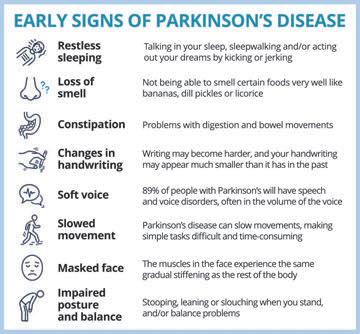
Restless sleeping : Talking in your sleep, sleepwalking and/or acting out your dreams by kicking or jerking. This is a REM sleep behavior disorder and one of the strongest and earliest pre-diagnostic symptoms of Parkinson’s disease.
Loss of smell: Not being able to smell
certain foods very well like bananas, dill pickles or licorice. This early symptom occurs in around 70 to 90% of Parkinson’s patients.
Constipation: Problems with digestion and bowel movements are a big issue for people with Parkinson’s, and an early sign that can occur up to 20 years before this disease is diagnosed.
Changes in handwriting : Writing may become harder to do, and your handwriting may appear much smaller than it has in the past.
Soft voice: According to the Parkinson’s Foundation, 89% of people with Parkinson’s will have speech and voice disorders, which often shows up first in volume of the voice, meaning that you may speak more softly.
Tremors: Slight shaking or tremor in your finger, thumb, hand or chin. The tremor usually happens at rest, and when you move the extremity, it may disappear.
This is the most common and recognizable outward sign of Parkinson’s disease, but by the time tremors start, the brain has already lost more than half of its dopamineproducing cells.
Slowed movement: Over time, Parkinson’s disease can slow movements, making simple tasks difficult and time-consuming. Your steps may become shorter when you walk. It may be difficult to get out of a chair. You may drag your feet as you try to walk.
Masked face: The muscles in the face experience the same gradual stiffening as in the rest of the body, which results in lack of smiling and facial expressions.
Impaired posture and balance : Stooping, leaning or slouching when you stand, and/or balance problems can all be an early sign of Parkinson’s.
Having these symptoms doesn’t
How to save money on prescriptions
Have you ever been standing at the pharmacy counter, minding your own business, when the clerk says, “That’ll be $958,” and you briefly exit your body? I used to be that pharmacist delivering the sticker shock, though I always tried to soften the blow.
I’ve seen people turn pale, mutter words I can’t print here, and leave the pharmacy crying. Back in the 1990s, we didn’t have Google at our fingertips or smartphones in our pockets, and patient assistance programs (PAPs) were mostly reserved for people with no insurance at all.
save a small fortune if you know how. Here’s an example: A friend’s husband was prescribed Xifaxan for stubborn stomach symptoms. His doctor prescribed 42 tablets (a two-week supply). The pharmacy price comes up at $2,448. The poor guy nearly needed CPR. His wife (my friend) texted me in a panic. I said, “Don’t pay that — give me a minute.”
DEAR PHARMACIST
By Suzy Cohen
Today, I want to be your hero and explain more about PAPs and how they can slash the cost of many brand-name prescriptions. These programs are offered by the manufacturer, not the pharmacy, and you can
Step 1: I Googled “Xifaxan copay card.”
Ten seconds. I see that the manufacturer has a savings program on their website. Many brandname drugs do. I let her know.
Step 2: They filled out the form, which requires name, email, insurance info, and 30 seconds later — boom! The site instantly generated a digital “card” with four magic numbers: BIN, PCN, group and ID.
Step 3: She read those numbers to the pharmacist.
The price dropped from $2,448 to about $759. That’s a 70% savings in under five minutes! Tell me that isn’t sorcery.
Another quick example: A doctor prescribed a topical analgesic product called Pennsaid for knee pain. The item is priced at $1,500. (Just FYI, Pennsaid is just diclofenac, what you probably know as Voltaren Gel.) I found a PAP for Pennsaid itself, and the price dropped from $1,500 to free for this particular patient!
You might be wondering, why doesn’t the pharmacy tell me if there’s a PAP for a medicine? Because they’re juggling interactions, insurance rejections, refills and long lines.
Besides, it’s always up to the consumer to find the best price on things they want to buy. Just so you know, pharmacists are salaried, so it doesn’t affect their pay whether you’re charged a sky-high price
or get your medication for nothing.
So you have to become a savvy patient. Here’s how:
1. Google your medication name plus “savings program” or “copay card.”
2. Click ONLY the manufacturer’s website.
3. Fill out the quick form.
4. Screenshot the card with the BIN, PCN number, group number and ID.
5. Call the pharmacy and read the numbers.
6. Watch the price collapse.
If you’d like the full, expanded version of this article with even more money-saving examples and tips, just head over to suzycohen.com and sign up for my free newsletter. This information is opinion only. It is not intended to treat, cure or diagnose your condition. Consult with your doctor before using any new drug or supplement.
Suzy Cohen is a registered pharmacist and author of The 24-Hour Pharmacist and Real Solutions from Head to Toe
Early detection leads to earlier treatment, which can improve a person’s overall quality of life.
For more information, visit the Parkinson’s Foundation at Parkinson.org or the Michael J.
necessarily mean that a person has Parkinson’s disease. But if you are experiencing any of them, and you’re over age 60, you should consider talking with your doctor, who may order a DaT scan or Syn-One (Skin Biopsy) Test to help diagnose it.
Fox Foundation at michaeljfox.org. Send your questions or comments to ques-
tions@savvysenior.org, or to Savvy Senior, P.O. Box 5443, Norman, OK 73070.
Tell them you saw it in the Beacon!
Travel Leisure &
We missed the olive harvest but loved Greece
By Tony Glaros
Less than an hour after my wife, Mary, and I arrived in Athens, we hit the road again, jet lag aside. We hopped aboard a bus for a twisty, three-hour ride to Kalamata.
For my wife, seeing the renowned olivegrowing region in the southern Peloponnese, between the Gulf of Messenia and the foothills of the Taygetos Mountains, had been on her bucket list for years.
Her late mother, misty-eyed and bursting with energy, would mesmerize us with tales about her hometown of Kalamata — how, as a young woman, she would walk an hour each way to school. This journey resonated with me, too. Both of us wanted to see the village where the nervous wartime bride set sail to a new world.
We arrived in October, hoping to time our 150-mile excursion to the upcoming olive harvest. Greece, with as many as 170 million olive trees, ranks third in global olive production (after Spain and Italy).
For years, I’d heard about the unique olive harvest in Kalamata and the surrounding region. These characteristic plump, purple, almond-shaped beauties hold power over me whenever I spot them at Whole Foods. For the most part, Kalamata farmers still harvest them in the ancient way, by beating branches with sticks until the olives freefall onto a tarpaulin on rocky soil.
The harvest season typically runs from late November until late December, even into January, depending on the weather.
While I had aimed for our trip to coincide with reaping, it turned out we had shown up about two to three weeks too early.
A young hotel manager broke the news to us. “The harvest times vary. You never know,” he said, standing ramrod straight like a Spartan warrior.
The olive industry, he went on, “has always been a part of my life here in Kalamata. My family has 43 trees. We have never bought olive oil from a store.”
For the most part, he told us, olive growers are small, family-run enterprises. It’s not uncommon, though, for a farmer with thousands of trees to merge with another large grower.
After all, the act of getting olives off the tree “is one of the hardest things you can do,” he said. “You spend eight hours under the sun, inside the trees.”
Greece’s Fourth of July
Although missing the harvest was a disappointment, we realized that we were just in time for a grand celebration: Oxi Day.
Growing up in Maryland, I had heard snatches of conversation from Greek immigrants about the significance of October 28. Based on the carnival atmosphere in the city, I had a moment of clarity: This holiday is tantamount to the Fourth of July.
On October 28, 1940, during World War II, Italian dictator Benito Mussolini ordered Greece to relinquish control of portions of its land. Failure to do so would result in an attack by the Axis powers.
Tiny and neutral as Greece was, however, it adamantly refused. That action set the stage for what would become a national holiday known as Oxi — “no” in Greek — Day.
To celebrate, schools, offices, and many small businesses across the country shut down. There’s free admission to museums and archeological sites, including the Acropolis.
On this crisp fall morning, my wife and I decided to walk the three miles downtown to watch the parade, to be swept up in the glow.
Flapping from every direction were blueand-white Greek flags, including those on weatherbeaten fishing boats chugging through the calm, turquoise water toward the harbor. Of course, restaurants and cafés, hoping to convert a slice of unfettered patriotism into euros, were open.
On the way, we came across a neighborhood eatery. How could we resist an early lunch?
“Excuse me,” I said to our server, trying to salvage the Greek I learned as a child. “Can you please bring butter?”
The server, a woman in her 70s, cast a pitying look in my direction. “No butter,” came her terse reply. “Here, we only use olive oil on bread.”
Embarrassed, I remembered that this was Kalamata. No wonder she reacted the way she did.
In the far corner of the unadorned dining room, a worker sat snapping green
beans for a signature stew called fasolakia Every few minutes, the waitstaff, balancing trays of moussaka, pastitsio and avgolemono soup, would bump against each other in the narrow aisles.
Flavoring the scene were the unfiltered sounds floating from the kitchen. Though they sounded like arguments, these squabbles had the lifespan of a dinner plate smashed at a Greek wedding: over and out. My mind jumped back to a T-shirt my sister bought me decades ago that read, “I’m Not Yelling. I’m Greek. This is How We Talk.”
While awaiting our food, we chatted with another customer, who, it turned out, had lived in Kalamata his whole life.
“I tell everyone if they really want to take a vacation, we have the best beaches, and we have the best Mediterranean food,” he said. “It’s like a small city. Not a lot of cars. Not a lot of people. Almost no crime.”
On to Corfu
While most discussions about visiting Greece inevitably pivot to the seductive Aegean islands, the Peloponnese offers more than olive groves.
Buoyed by the loveliness of Kalamata, we decided to remain on the western side of the country to see Corfu.
Unlike the parched Aegean landscape, Corfu is lush and green, reminiscent of Italy.
Olive groves surround the seaside city of Kalamata, situated on the Peloponnese peninsula in southern Greece.
Kalamata is famous for its olives. See story below.
The Greek island of Corfu has hidden beaches, hiking trails and a historic Old Town, now a UNESCO Heritage Site.
PHOTO BY GREG
MONTANI/PIXABAY
PHOTO BY ALA GRACZYK
From page 10
Its dominant architectural influence comes from its years as a Venetian stronghold. Other conquerors included the Byzantines, French and British. Given the islanders’ emphasis on building fortifications, the Turks never touched Corfu, unlike most of Greece.
When we arrived on a rainy morning, we immediately set out for Corfu’s Old Town, named a UNESCO World Heritage Site in 2007. Its cobblestone alleys were dotted with a variety of tavernas, or cafés. Bakeries displayed kumquat and sykomaida , a beloved fig cake and favorite among islanders. Several Greek Orthodox churches stood practically within the shadows of one another.
As raindrops slid down the canopy outside a shop that sold coffee and kumquats, the owner spoke to us. “When people think of Greek islands,” he said, “they think of Mykonos, Santorini, Crete.”
Forming a clockwise sweep with his thick arm, he added, “But they are too busy. We need tourists’ money. But we also like the peace.”
Back to Athens
With our time in Greece’s west at an end, we headed back to Athens. We stayed in a sweet gem of a hotel in the historic center where the staff learned our names. The front desk served trays overflowing
with confections called loukoumi
With the Parthenon beckoning from on high, we had to see it up close. Since it was Monday morning, we assumed the crowd would be thin. We thought wrong.
Humanity crossing every conceivable demographic joined us in scaling level upon level of slippery rocks. Some trekkers wondered aloud where the elevator was located. Negatives aside, reaching the summit was well worth the pain involved.
Later, our son, Andrew, joined us in Athens, and we all walked to the National Archaeological Museum of Athens. Inside, we marveled at its many pieces of ancient Greek art. Its most famous work is a Roman copy of a statue of Athena that used to stand in the Acropolis.
One of our favorite displays wasn’t art at all: A device known as the Antikythera mechanism is an ancient analog computer used to calculate time and solar eclipses. While I gawked at this tool that didn’t run on bandwidth, my son checked out the statues, like the Jockey of Artemision , a stunning bronze statue of a galloping horse and child rider.
Greek values
Most of the people we met in Greece shared an outspokenness that we loved. For instance, one cab driver admitted that he wasn’t a big fan of the Parthenon: “I understand seeing it once, but twice or three times? It’s just a pile of rocks.”
Later, we chatted with a local woman about ways Greece could bolster its economy beyond tourism, noting that many visitors come away with glowing reports about the country’s easier, less complicated lifestyle.
I asked her what the government’s plans were to make life better in the birthplace of western civilization.
“There is no plan,’’ she asserted. “Here, people throw up their hands and say, ‘Opa! Let’s go out for lunch!’”
Join us for a unique way to celeb your sweetheart, or just treat yo chocolate truffles while discover is made. Enjoy tasting six wines grapes, vineyard and sustainable Registration: 410-313-0400.
er af Join us f foor a cozy wint ftternoon of creativity and conne all ages to come together to make fun and festive ar ts and fdliiht C kithij fl t g y(
ec tion! This program invites af d cr ftts while sipping a warm !If h f 4103130860
e!Inf
cup of delicious hot cocoa. Come soak in this joyful atmospher foo:410-313-0860or www.howardcountymd.gov/htcc.
g
All ages Harriet Tubman Ctr
RP4468.601Feb 71-3:30pmSa$5
Magic of the Maple Tree
ome out f C foor a special, family-friendly program to learn about the art of maple sugaring – when the sap from trees is collected to make syrup. Enjoy a hike to learn about maple sugaring, a sap cooking demonstration, and a tasting of a variety of maple . Inf syrups. All children must be accompanied by a registered adult fo: 410-313-0400. 5 yrs + Robinson Nature Ctr
RP4829.601Feb 710-11:15amSa$12
RP4829.602Feb 711am-12:15pmSa$12
NEW! Unfulfilled romises, Shifting Allegiances, and Black Freedom: Self Determination of Enslaved People
During Three American Wars (HoCo250)
’ Come listen to Keenan Holmes presentation about the Maryland and greater Mid’ Atlantic region’ssenslaved population. Learn more about their actions during war times in order to try and secure freedom. Hear about how African Americans escaped and fought during the Revolutionary War; the War of 1812; and the Civil War. There will be a book giveaway for children and families on related topics at the end of the segment. Info: Keenan Holmes, kholmes@howardcountymd.gov or 410-313-0419.
brate Valentine s Day! Bring a frien ourself to learning the ar t of handring more about the plant from wh from Linganore Winecellars and le e practices. Leave with 10 hand-ro
Nature Ctr
RP4847.601Feb 141-3pm
RP4847.602Feb 144-6pm
Sa$29
Sa$29
y Bird Bonanza
Come celebrate birds! Enjoy bird or live rapt r. . Gather at the campfi bird walk with the Howard Coun science project, the Great Backya accompanied by a registered adu 3 yrs + Robinson Nature Ctr
af -themed cr ftts, games, and ac tivi re and enjoy a warm beverage as y nty Bird Club. Help with the worldw ard Bird Count. Beginners encoura . Inf ult foo/Registration: 410-313-04
RP4815.601Feb 15Noon-4
tr member 4pm Su $6, c r, , $8,
NEW!M
diG
Have fun while immersing yours traditional New Orleans culture Inffoo: 410-313-0860 or w ww.ho
All ages Harriet Tubman Ctr
g W! Mardi Gras C
Celebration self in the rich history and culture ough music and f thr foood wardcountymd.gov/htcc.
RP4469.601Feb 17 6:30-9
pm TuFree
kt y stations. Meet a you await your guided wide community ged! Children must be 400. nonmember of Mardi Gras! Enjoy p
A Wedd
lyer or or W an
y Mansion . d, rolling delectable hich chocolate earn about their . Inf olled truffles fo/
ont M at Belm
Iconic Artifacts and Remains from
In their quest to reconstruct the past, archaeologists and h excavated thousands of sites and recovered signature artif to our understanding of human history. This presentation diagnostic artifacts/remains and primary source documen throughout the world. All have been instrumental in our u and, in many cases, rewriting it.
50 yrs + Instructor: M. Lee Preston Jr.Classes: 1
T nf • I foo: Teessa Hurd, 4 410-313-7311 or thurd@howardcountymd.gov. , 410-3 dkins y A Trac foo: I • nf ins@howard 313-7279 or tadk dcountymd.gov. y
RP3506602 R C t CC F b 9 101130 o ea – surr ernoon t t ft beautiful af nnapolis and ern in A v oldest ta ern and the e v e of the ta natur he building h T cademy. al A Nav oric dist ed within the hist locat hu t position on C ominen In a pr e Te y s Da Valentine’s ’ T Taavern: Reynolds T
RP3506.602Roger Carter CCFeb 910-11:30am e/T
m Our Past: Part 2 uman paleontologists have acts and remains critical includes examples of local ts, and those from sites nderstanding of our past; M $9 y! or y hist unded b or a fo tates ed S one of the oldest in the Unit . Join us f ern is the Taav . Reynolds y entur e of the 18th C leganc T orking t the w eflec o r ed beautifully t estor as been r tates ed S , and the Unit estaurants , r , shops t ric onveniently ern is c Taav oric Reynolds , hist ircle ch C r T
Y Mastering Yoour Mobile Devic Ta a Learn how to connect your iPhone with your iPad. Discove phone. Learn about backing up your phone and how to us gain inffoormation. Bring your smart phone and/or tablet. 50 yrs + Instructor: Constance LoweClasses: 1
y
RP3523.601N Laurel CCFeb 1110-11amW
nnapolis a in A
Beginner/Intermediate Soul Line
RP4599.601 ovided us pr B p y 18 yrs + M$9 ablet ee apps f er useful fr foor your se voice communication to $25 e
Dance Explore your own style of dance while learning fun, that can be done at weddings, holiday functions and more f designed foor all levels. Line up and learn the step-by-step f Instructor Jessie Barnes. Multiple dances are per foormed to blues music.
50 yrs + Instructor: Jessie BarnesClasses: 6
$159 F m-2pm y
arden: Museum, and G
Exhibition
Beginner/IntermediateSoulLine , th ood t Hillw y a w on displa no ood al F ener wner of G and the o ape! Marjorie Me ernoon esc t afft enu onic v , ic isit this amazing V
RP4585.601 ovided us pr p B ll ages A equired ing r walk
RP3511.602Harriet Tubman CtrFeb 1711am-noo
DancingffoorFunMixer
Dancing for Fun Mixer
Enjoy moving to the music while trying a variety of dance ballroom, swing to Latin, we try them all! This class, led by you the chance to get active and have fun! No partner is n 50 yrs + Classes: 4
y
RP3513.602HarrietTubmanCtrFeb241-1:45pm
’ Beginner ’s s Guide to Genealogy
Learn about the world of genealogy! Participants gain an of family history research, important tools needed to rese
e t a beautiful v ea a ernoon t t afft s Washington’s ood one of Hillw ’ xpe e and e esidenc ormer r her f , g p , popularr, , social line dances e. The class is partner-free and choreography taught by o great pop and rhythm and onTu$59
g
t made ouches tha t personal t y elegan e the man erienc
9:30a 20 Feb
hakespea olger S F
e op ar tage of this r an e adv Taak T
y and the ar ch libr esear citing r x isit this e V y! tunit por y ar e Libr ar $169 F am-4pm ate . Moder t menu tfully elegan enue with a deligh essive or an impr . Join us f able homes most memor
e fe r, y F la y C Henr olger, and his wif y ar he libr T urope. ritain and E B teria e ma ar y houses r repositor tion of th ollec gest c s lar world’s y ’ styles. From line dancing to ellner T y instructor Toom S r, , gives ecessary.
RP4617.601 ovided us pr p B 18 yrs + e , bak es ous lunch choic numer uill and t the new Q wn a our o y
tful lunch on y a deligh njo . E olger dan F mily Jor , E an businessman, meric y A ealth y w as established b w om the early modern period (1500–1750) in als fr
10am 26 Feb
RP3500.602Gary J Arthur CCFeb 271-2:30pm yur ,g
Tu$45 understanding of the basics arch, how to navigate $129 Th m-4pm ffeeeandtea. , and snacks alongside c d goods off e with omplet , c t Hall rea ed in the G at , loc afé umb C r d C
. Participants should have em to each class as there will research.
F$72
tin e t or mortrips f .com/RPrl
an the QR code or v ours! trips & t visit
y his primar T espeare illiam Shak W orks of ed w t e prin y yy,p the inffoormation, and strategies to organize their research. computer literacy and bring their laptop or tablet with the be hands-on activities that require using their devices for 50 yrs + Instructor: Karen GieseClasses: 3
HoCo H
Suppororrt t ome Share ts Aging in Place
the
HooCo Home Share is needs in Howard C many older adults to mai Operaatted by Bridges to H services to Howard Coun s w homeowner who have a ff affordable place to live. Th thaattstrengthenfinncial
t strengthen finncial stabilit , social connection and housing choice. y y f The rogram prioritizes safeety, , compatibility and privac y. . All ef participants are screened through background and r feerence checks, y f d f homes are inspecte foor safeety, , participants are matched based on compatibilityy, , and potential matches are introduced gradually –ady g inf if without sharing ident fyyin foormation until both parties are re dyy. .
a Participants work together to creatte a written home-sharing agreement y that clarifies expectations around privacy, , shared spaces and household norms. Renters also sign a lease with the homeowner. Free mediation suuppport is provided throughout the process.
ur r o o fo l le p sib d acces n e a clusiv y in ultr ace f y a ount d C owar g H akin o m t t commitmen ur ues o ntin n co la n P ctio y A ount d C Howar ge-Friendly e 2025-2029 A h , t eleased t r Jus cutive nty Exe ou d C r Howa
ince s. S ear lder y eir o h e in t hriv o t ts t residen
o s t rogram d p n ies a menit s a orld-clas h w it s w enter t 50+ C the-ar tate-of- d s Weeopene v g li llinlfiu fu n y a ealth ad h o le ts t residen df es.W lder ur o r o o fo tunitppor d o n aces a p d s eate e cr av e h in 2019, w ies f nitiative y I ge-Friendl ur A d o aunche t l s e fi w
ur t o a ther h o it e w gag d en n e a tiv y ac tay o s ts t ul lder ad r o o fo spaces f a s utdoor d o Weecreate solatio e i creas d de n n a atio ocia e s encourag liza n.W
Taables n t a o s L tnes y Fi ge-Friendl e A h g t cludin ks, in ar l p loca dT
Weellbeing, Health & W an n P io c w A e e n esses two pressing sts and the desire of e in their own homes. has provided housing the program matches ividuals seeking an fic al arrangements onandhousingchoice
bilit fLi Pill K th f Pl ti A Th onnection. r C o fo f
Inclusion, w
of C even g s urin y d ountC hared o s h s w member sing d u velope s de wa oward y H Age-Friendl d ac n n, a atiocollabora ppor et o arg o t s t r u o fo f nc h, o whic
oadmap s a r e a v er l s il , w P, d b approve ce a y AARP y & ommunit d C n , a obility, g & M Livin y : y va f L s o ar y P e e K hre n t es o foocus n
a a new program that t addre County: rising housing cos intain their independence , w y Housing Stability, which h esidentsf nty r n foor 35 years, a spare bedroom with indi u The results: m tually benefi stabilityy,,socialconnectio uppport. ur s o r y o fo o k y n y a.Th uf u md.gov/Age-Friendlly. d t at la n p tio e ac h w t ie d v n e a or
L oal e g hes e t achiev
www unt
ntty
a ital eir v s. Th ession g s stenin y li mmunit n co oward y H ge-Friendl n A r a o fo isio eir v h d t n f mmunity n 100 co ha e t or m m frro inpututf lan e p h n, t ollaboratio f C e o hem y t ount d C he y t d b uide ies. G riorit y p mmunit n co t o c ffective gag t, en provemen r im o fo tunities f e in eff
afeety. lic s pub f y ousing, n, h tattioranspor es lie: t halleng ur
a Bridges values the role thattthe Office of Aging and Independence osi ’ l u (OAI) is taking in outtreach to older adultts. OAI’s s trusted p ittion in the l communiitty and deep understanding of aging-in-place needs he p ensure a ug u n a l thaat t older adu ts lear abbo t home sharing thro gh a reliabble and familiar t, u ’ eni tw source. “Home sharing works bes wh h it sbuilt on trust and supppor ” i ic ennif r u saayys Bridges’ Executtive Director, , J feerBroder ck.“Partnering w th OAI a ts in a wa l allows us to reach older adu ay y that t respects their independence
ies. uni
ff w whhile offering practical housing opport it ” y’ Home sharing also advances Howard Count ’ssAge-Friendly goals. e-f “Home sharing is an important part of building a livable, ag frriendly r Of community,y,”says OAI Administrato feelia Ross Ott. “Programs ff like HoCo Home Share help address affordable housing needs while allowing older adults to remain in their homes, maintain independence, y and stay connected to their community. . OAI is pleased to support this
ef work by r feerring resi housing option.”
idents and raising awareness of this innovative
Some participants wil a reassurance that t come choice and control. “ Th Broderick emphasizes finncial and social w of f health.”
ll also value the added sense of connection or e – w es f frrom sharing a hom while maintaining y u Thisis abouttaging in place with dignity, , ” a s, “and having options th t support both well-being. Thee are also key determinants
T Toogether, Bridges and of existing homes – su community connectio HoCo Home Share is y’ the Count ’s s Departm einf For mor foormation call 410-312-5760 x12
d OAI are helping residents make the most y ff upporting independence, affordability, , and ons.
g f o f e f f frre foor all participants, thanks t fuundin frrom ment of Housing and Community Development. n, visit wwww..bridges2hs.org/hoco-home-share, 21 or email hocohomeshare@bridges2hs.org.
The 50+ Connection
uar Febr
Glenwood 50+ Center • Cardiovascular disease
U.S.,butprogressison
Johns Hopkkiins: Ca
y Events r
s at Howa
ardiovascular Disea
ase Advances
• February 5, 9 – 10:30 a.m remains the leading caus thehorizon.EricSchwar
m. • A03636.600
se of death in the rtz,MD,Chairman,
the horizon. Eric Schwar ne at Johns Hopkins How latest advances in cardiac Events@jh.edu.
rtz, MD, Chairman, ward County Medical y c technolog y. . RSVP to
Third Annual Kick
k-Out Canceer r Even
nt
Bain 50+ Center • Febru f W In honor o Woorld Can f foor a good cause. This
uary 4, 8:30 – 9:30 a.m. • A y ncer Day, , j oin us to punc Cardio Kickboxing class
A01495.600
ch, kick and sweat s is a collaboration
with the Claudia Mayer/Tina Broccolino Canc ef a $5 donation ben fiits the CMTBCRC. No kick required. For questions, contact Michelle Rosen
er Resource Center; kboxing experience nffe eld at 410-313-7394.
Black History Month: Name That Fa iv y T Black Histor Tr r viia
amous P Peerson
Bain 50+ Center • February 10, 11 a.m. – noon • A s f Join u foor an interactive trivia game celebrating
A015540.600 g influential Black
ard Coun
ing Solo T Thriv Toog
Bain 50+ Center • Febr
y 50+ C nt
Centers
getheer r Meet & Gree ruary 24, 1 – 2 p.m. • A011
Meet others living solo f fo ocusedonplanning,a
o and learn about the new advocatingandthrivingin
cused on planning, a in March, Thiving Sol by OAI’s SeniorsTogeth Karen Hull at 410-313-
advocating and thriving in o Together is a facilitated rinf her. Fo foormation or to -7466 or khull@howardco
WillYYoou Be My V
V Vaalentine?
Ellicott City 50+ Cente
n th ture. Coming d group sponsored o register, contact ountymd.gov.
et 23.601 w support group ntheffuuture.Coming U.S., but progress is on Department of Medicin Center, will discuss the Kirsten Potter, JHHC-E
m. • A0277444.602
Visiting Angels will ho Ennj joy an afternoon fill
jy
er • February 27, 2 – 3 p.m y T t a V s Va alentine’s Da Te ea P ed with conversation, swe v
Party at the center. eet treats, and a gg
selection of teas to cele connection. Cost: $2.
arn to Pla Le ay y Che
Elkridge 50+ Center • W
A05611.602
-f
ss in this beginner fr riendly class. Each session lesson to develop confidence nd skill as you J historical figues. Partic about notable individua civil rights — and then
g cipants will listen to short y ls in histor y, , arts, culture guess who the person is.
t biographies or clues , science, sports, and
Learn how to play ches builds on the previous ,, e f ebrat fr riendship, kindness and the joy of ess r dnesda W We e ayys, Marcch 4
Lunar New Y Yeear C
Celebbrration with C
Bain 50+ Center • Febru
e Y Let’s ring in th Ye ear of we honor tradition, sha
A & KAS CASSA SA A
uar y 17, 10:30 – 11:30 a.m. the Fire Horse together! f re joyfu ul moments, and w
• A01726.600
.
e f Join th feestivities as welcome a bright new p
e f learn th fuundamentals r inf class. Fo foormation o
DIY Winteer r Lum
p s of the game. C ost: $5. B or to register, call 410-31 inar y
Elkridge 50+ Center • M
r Marcch 5, 1:30 – 3 p.m. • A0
Create a glowing jar wi candle to brighten your a bring your cre tive spir
f th colorfu ul tissue paper a r winter décor. No exper a oen rit t njjoy convers tion a
y ring a chess set to 3-5192.
05555.600 and a fli kering LED rience needed; just g f and craftin fuun. ef year. Light R frreshment
Kindred
Spirits So
Glenwood 50+ Center •
Join us in the Connectio ff to meet staff, learn abou early-stage memory los einf served. For mor foorm fhd ts served.
ocial Club Open House
• February 12, 10 a.m. – noon mf ons Roo foor a Kindred Spirits Open House ut the social club and meet others with ef s and their families. Light r frreshments mation, contact Felicia Stein at 410-313-1425 d or fstein@howardcountymd.govv.
ith O W Waalk w OAAI at the Mall in Colum February 20, 8:30 – 9:30 a.m. • A2007712.601
Join a group walk around the Mall with OAI Fitn Higdon (all walking levels welcome). This vent ader eff walking sponsorship and bro fforts to prom g f livin foor older adults. bia
ness Coordinator, Jen is part of OAI’s Mall y mote healthy, , active
Selling a house “as is” doesn’t always protect the seller. See story on page 18.
MoneyMoney Law & Ditch traditional retirement expectations
By Richard P. Himmer
In the mid-1800s, a young Hungarian doctor named Ignaz Semmelweis made a discovery that should have saved countless lives.
While working at the Vienna General Hospital, he noticed that women giving birth in the doctors’ ward were dying from childbed fever at a staggering rate — five times higher than those in the midwives’ ward.
After months of observation, Semmelweis realized the horrifying truth: Doctors were performing autopsies in the morning, then delivering babies immediately afterward without washing their hands.
He proposed something radical — wash with a chlorine solution before touching a patient. The results were miraculous. Death rates dropped from nearly 30% to just 1 to 2%.
But rather than celebrating him, his peers ridiculed and rejected him. Why? Because his discovery challenged tradition.
The medical establishment believed that “a gentleman’s hands are clean,” and to suggest otherwise was an insult to their pride. Their refusal to adapt cost thousands of lives.
Semmelweis’ story offers a parallel to another tradition — one that quietly claims lives today. It’s the way many people approach retirement.
A tradition that no longer works
For generations, the traditional mindset
about retirement has been singular:
Accumulate enough money to stop working.
Success was measured in account balances, not in the quality or purpose of one’s days. The goal was to retire “on time” with a full nest egg and spend your later years in comfort — or, at least, in security.
That approach once made sense. In the industrial era, retirement was short. People retired around age 65 and lived, on average, less than 10 more years.
But in the 21st century, that same model is fatally outdated.
Today, many retirees will live 25 to 30 years after leaving the workforce. That’s an entire second adulthood. Yet most people still plan as if money alone will ensure fulfillment, health and longevity. It won’t.
Research consistently shows the opposite: Those who retire without structure, purpose or social connection experience faster cognitive decline, higher rates of depression, even shortened life expectancy.
It’s not that money doesn’t matter — it does. But money is not the goal; it’s the means to sustain the life you want to live.
The real risk: running out of meaning
Every financial planner has heard it: “I just want to make sure I don’t outlive my money.” But the data tells a deeper story.
According to the study “Association Between Life Purpose and Mortality Among U.S. Adults Older Than 50 Years,” published on JAMA Network Open ,
retirees who lack purpose are more likely to experience early mortality — even when they’re financially secure.
Purpose, structure and social connection are as essential to health as nutrition or exercise.
When work ends, so do many of the routines and relationships that define our days. Without something meaningful to replace them, the mind and body start to atrophy.
This is where the “Semmelweis effect” creeps into modern retirement: People resist change not because they don’t know better, but because they’re trapped by tradition.
The old formula — save, stop working, relax — is so deeply ingrained that questioning it feels almost heretical. Yet, clinging to it can be deadly.
Redefining retirement
The future of retirement planning must evolve beyond numbers on a page. The best advisers are starting to recognize this shift, helping clients design lives, not just portfolios.
Financial security should serve a bigger purpose — to enable a lifestyle rich in meaning, relationships, health and contribution.
This approach asks new questions:
• What will give your days structure after work ends?
• Who will you spend time with?
• How will you stay mentally and
physically engaged?
• What personal or community goals will drive you forward?
Money becomes the supporting actor, not the star. It funds experiences, enables generosity, supports wellness and removes barriers to engagement. It’s the tool that gives life shape — but it’s not life itself.
A call to action
Today’s retirees — and the professionals who guide them — must admit that their old models of retirement are no longer healthy.
A fulfilling retirement doesn’t begin with a balance sheet; it begins with a blueprint for living. Financial freedom is only meaningful when it supports a life of purpose, connection and vitality.
Perhaps it’s time to do what Semmelweis urged his peers to do — wash our hands of outdated traditions and embrace the science of living well.
The goal of retirement isn’t merely to avoid running out of money. It’s to avoid running out of life.
To learn more, pick up my new book, Your Encore Years: The Psychology of Retirement.
Q: I am confused by the advantages, if any, of using qualified charitable distributions (QCDs) to contribute to charity after I reach 70½, as I am not required yet to take minimum distributions from my IRA. I have read different conclusions. Some sources indicate that there are no tax advantages. In your columns, you have indicated that there are tax advantages. Which is correct?
A: There are definite tax advantages. Slott points out that when you make a contribution to a qualified charity by way of a QCD, you are allowed to reduce your modified adjusted income by the amount of
your QCD contribution, so you are, in effect, reducing your taxes by the amount of your QCD multiplied by your marginal tax bracket. The IRS concurs with this.
Q: In a recent column, you suggested that readers contact their congressional representatives to pass legislation that will provide more income to Social Security so that benefits will not have to be cut in the future. Isn’t it true that the recent legislation did not impact Social Security regulations?
A: That is correct. However, the legislation that was passed at the end of 2024 to repeal the Windfall Elimination Provision (WEP) and Government Pension Offset (GPO) increased benefits for Social Secu-
rity recipients by hundreds of millions of dollars per year.
Although the new legislation passed in 2025 did not provide additional benefits to Social Security participants, the legislation did not provide any new sources of income to the government regarding Social Security. Without significant changes to Social Security regulations in the next few years, it is highly likely that Social Security benefits will have to be reduced in the future.
Q: I plan on purchasing gold coins for investment and possibly provide gifts to some relatives. What are the tax considerations if there are increases in value?
A: An excellent source for this issue is
“Your Guide to Paying Taxes on Precious Metals” by Hero Bullion (herobullion.com; (214) 210-9948).
If you hold the coins for longer than one year before you redeem them, then you can report the gains as long-term capital gains on your tax return.
If you only hold the coins for less than a year, then you have to report the gains and pay tax based on your marginal tax rate. You are allowed to deduct any expenses such as sales tax or storage expenses on your return.
Having a flexible plan is a wise way to handle an uncertain future for savers, especially with decreasing returns on some accounts. The Federal Reserve has cut rates at each of its last three meetings due to weak job growth.
Will that continue into 2026? It’s hard to say. Inflation remains stubborn, and with a new Fed chair taking over in May, it’s anyone’s guess how things will unfold.
Despite the uncertainty, there are plenty of viable options to help you achieve strong returns. Whether you’re working to reach your retirement or savings goals, here are smart solutions to consider.
Budgeting apps
Sometimes it helps to have a fresh perspective on your finances, as it clues you in on where your money is going, and it may present some savings opportunities you missed before.
The best budgeting apps also make it easier to manage your finances, even if you have multiple accounts with different banks. Having this information at your fingertips is integral for ensuring you reach your goals. And if you want a new one to try out, here are some of our favorites:
Empower: This is a great app for investors and savers alike. The platform is easy to use, and you can integrate your personal and investing accounts within minutes. What I like about it is that you can also add other financial accounts to gain a fuller picture, such as 529 accounts, mortgage and more. You can download the app for free on Google Play or the App Store.
Honeydue: Staying on the same financial page as a spouse or loved one can be difficult with life’s hustle and bustle. With the Honeydue app, you can track all expenses on joint accounts, giving you both a complete overview of shared accounts. Best of all, it’s free.
Build a financial safety net
Life has a way of throwing financial surprises. An unexpected bill or job loss can seriously challenge even the savviest of budgets. It’s why having an emergency fund is a smart move.
I built mine using a high-yield savings account (HYSA). Because the best high-yield savings accounts offer a rate well above 4%, it made it easier to grow my balance quickly. I would set automatic transfers from my checking to my savings on payday and leave that money in savings alone.
And if you go with an online bank, you won’t have to contend with monthly fees or
minimum balance requirements. Explore options with the high-yield savings finder tool from Bankrate (bankrate.com).
Meanwhile, what if you already have an emergency fund where you want it? A high-yield savings account is still a smart move for short-term goals.
Another reason I like HYSAs is that you can withdraw your money whenever you need it. It means if the Fed continues to cut rates and APYs on these accounts dip to the point where inflation is eating your earnings, then you can pivot quickly to other investments that earn more.
CDs impervious to rate cuts
If you don’t want to worry about rate cuts and your emergency savings are at a comfortable level, another option to consider is a certificate of deposit (CD).
A CD differs from a high-yield savings
account in that you receive a fixed interest rate. Say you sign up for a one-year CD today. Even if the Fed cuts rates twice over the next year, it won’t change your rate.
Good brokers
A broker might be a smart option to review your current investments, ensure your choices align with your risk profile and keep you on track to reach your goals. Here are two worth considering:
Fidelity: Kiplinger ranked Fidelity the best overall online broker, thanks to its full advisory services, the lowest fees you’ll find from a brokerage, and a great mix of retirement-planning tools.
Interactive Brokers: Kiplinger ranked them high thanks to a great mobile app, an ample array of investment choices, and educational resources. With more than 160 emerging markets, it’s perfect if you’re
looking for international markets.
Setting yourself up for success in 2026
While 2026 offers some uncertainty for savers, there are steps you can take to help you reach your goals. The first step is to receive a fresh perspective through budgeting apps to ensure your cash flow is where it needs to be.
Next, build an emergency fund with high-yield savings and shelter some of your earnings from rate cuts while achieving short-term goals with CDs.
Does this sound familiar? A longtime client, Dr. “G,” dropped by our legal office with a question: “I want to sell the home I inherited from my parents years ago ‘as is’ and by myself, without a real estate agent. Why pay a large commission? I’m educated. How complicated can it be?”
He went on to say that the house had been a rental property for more than 20 years. He had “no idea of its condition, and the tenants never complained about a thing. Because we kept the rent low, they took care of all repairs themselves,” he said.
“I read an online story that said putting ‘as is’ on the sale ads and the contract means that if anything goes wrong with the home, the seller can’t be successfully sued for anything.
“Is that true? Or do you think I should have my own real estate agent?”
Know what you are getting into
When I ran this question by Southern California-based real estate attorney Luke Carlson, he said, “Your client is correct; it is possible to sell a home without having a seller’s agent. But should you? Do you know what you are getting yourself into?”
He pointed out, “There are two issues here — selling a home yourself and selling it as is. Both have significant risks if you do not
understand and meet your legal obligations.”
To that, I would add there are enough moving parts to the sale of a house by the owner (known as an FSBO) to give anyone unfamiliar with the complexity of this transaction motion sickness.
Carlson listed some of the pitfalls:
1. You could overvalue or undervalue the home.
Do you know how much homes in your area are actually selling for? Ask too much and the house just sits on the market.
Underpricing may raise suspicions that there’s something wrong with the property. Or you could end up selling for far less than the market price.
A real estate agent has the tools to establish a reasonable price for your neighborhood.
2. Lack of knowledge: You don’t know what you don’t know.
Without the guidance of a real estate agent, you may not be aware of all the necessary legal documents or how to properly complete them.
The closing process is complex, and it can involve a number of steps that are typically handled by lawyers or legal professionals, depending on the state where you reside.
3. You could waste valuable time dealing with unvetted buyers.
When selling privately, folks often lack
experience in sniffing out unvetted buyers and can wind up dealing with people who aren’t financially qualified to purchase the home.
The result is frustration, disappointment and wasted time when the deal falls through.
Responsibility still applies
It’s a myth that selling your home “as is” frees you from all responsibility. Carlson highlighted a risky assumption some as-is buyers make.
“One of the most dangerous beliefs floating around is that (some sellers think that) simply writing ‘as is’ on sales material, contracts — anything connected to the sale — is a get-out-of-jail-free card, and they are immune from being sued. The false message is that the seller can just walk away from any issues the house could have.”
The legal requirement is transparency, he noted. “Using the words ‘as is’ when selling doesn’t mean you can sweep problems under the rug. Do so, and don’t be surprised if you find yourself in hot water, as there still is a legal obligation to disclose known issues with your property.”
If after the sale, a buyer discovers an issue that they feel should have been disclosed, “You may be given a choice,” Carlson said. “‘Pay to repair the damage, or we go to court.’”
So what would be considered “known issues”? Carlson pointed out, “This typically means revealing serious problems, such as water damage, structural issues or hazardous conditions like asbestos, lead paint, electrical problems, tendency to flood — the list could go on for pages.”
Carlson suggested a seller should invest in a home inspection and give the written findings to the buyer. “This would prove valuable in the event of a claim that you covered something up,” he noted.
What does ‘as is’ really mean?
“Listing your home ‘as is’ means that it is in its current condition, and you are not making repairs,” Carlson explained. “You are disclosing all the defects of which you are aware, and the buyer is accepting the house as it is.”
Carlson had this caveat: “Sellers often choose to sell as is when they can’t or don’t want to invest in repairs. Common situations include inherited properties, estate sales or financial issues. Selling as is typically results in lower offers and fewer interested buyers.”
Dennis Beaver welcomes comments and questions at Lagombeaver1@gmail.com.
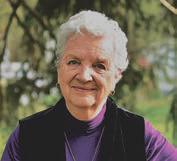
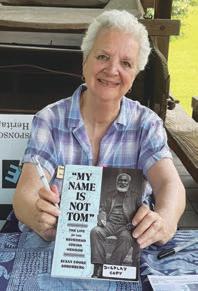
At 80 years old, Marylander Susan Cooke Soderberg has published the latest in a line of six history books.
In My Name Is Not Tom: The Life of the Reverend Josiah Henson , published last year by Georgetown University Press, Soderberg highlights Josiah Henson, who supposedly inspired the Uncle Tom character in Uncle Tom’s Cabin
“History has always been a passion of mine; finding the facts,” Soderberg said in an interview with the Beacon. “I’m a seeker of truth.”
The book was 10 years in the making. During her research, Soderberg and her husband, Bill, traveled to several of the places Henson lived and visited, gathering information from archives, libraries and museums.
“We tend to think along linear lines when we look at history,” Soderberg said. “African American history and the history of slavery and white history…it’s all our history. We share this history.”
The historical Uncle Tom
Harriet Beecher Stowe originally published Uncle Tom’s Cabin in 1852. The only
book to sell more copies than Uncle Tom’s Cabin in the entire 19th century was the Bible.
Stowe, an abolitionist, was looking for inspiration from someone with enough Christian piety to become a self-sacrificial martyr. She came across the 1849 autobiography of a man named Josiah Henson.
A devout Christian, Henson had developed a talent for preaching and orating, and Stowe decided he fit the bill. Since then, Henson has been associated with the subservient character of Uncle Tom.
Long before he was labeled “the real Uncle Tom,” Henson was born into slavery in Charles County, Maryland. He was maimed at a young age by his owner’s neighbor and as a result was unable to raise his hands above his shoulders for the rest of his life.
Henson achieved a degree of fame years before Uncle Tom’s Cabin was published. He became an abolitionist and Underground Railroad conductor and encountered many important people, including Frederick Douglass. On his book tour, he even met Queen Victoria.
Unlike his fictional counterpart, who was whipped to death, Henson had a hap-
pier ending: He purchased his own freedom in 1829, at the age of 33. He then escaped to Canada with his wife and four children, who were still enslaved, in 1830.
Later, Henson became frustrated with being introduced or referred to as “Uncle Tom.” In fact, the title of Soderberg’s book, My Name Is Not Tom, is taken from a speech Henson gave while on a book tour in Scotland.
A historian’s story
Soderberg fell in love with history while growing up in Colonial Williamsburg, Virginia. She received her bachelor’s degree in art history from the College of William and Mary and a master’s degree in American Studies from George Washington University.
When Soderberg’s two daughters were Girl Scouts, they wanted to receive their Local Lore badges, but it was difficult to find information on
See BIOGRAPHY , page 21
Historian Susan Cooke Soderberg, pictured at Heritage Days at Button Farm Living History Center last year, has more than 40 years of experience as a public historian. Her most recent book, My Name Is Not Tom, will be published as an audiobook later this year.
PHOTO COURTESY OF SUSAN COOKE SODERBERG
When Wayne Davis and his son, Nathan, got curious about county history, they rediscovered a cemetery and wrote a book. See cover story on p. 20.
PHOTO BY EMMETT PATARINI
Unearthing Howard County’s Black history
By Elias M. Taye
When Wayne S. Davis and his son, Nathan S. Davis, wandered down a familiar hiking trail in Guilford, Maryland, a decade ago, they had no idea that a simple walk would spark a years-long journey into some of the county’s overlooked history.
The Davis family moved to Howard County in 1992, and Nathan grew up near those paths. As a child, he often climbed across the old Pratt through-truss bridge near Old Guilford Road long before it was transformed into a pedestrian bridge around 2002.
Although the stones along the trail had caught their attention for years, it wasn’t until 2016, during one of their regular walks, that they noticed something different: The shapes were irregular. Some rocks had corners. Others had holes,
which suggested a deeper story.
Father and son paused at the interpretive signs installed shortly after the bridge’s pedestrian reopening, but the brief explanations left them with more questions than answers.
“We kept asking, ‘Where did this bridge come from? What used to be here?’”
Nathan Davis recalled. “That curiosity opened the door to a much bigger history we had never heard about, especially about Guilford and the communities that lived and worked there.”
Through their research, the Davises learned that the Pratt truss bridge dated back to 1902 and had originally been part of a twin bridge in Ohio before being relocated to Maryland to serve the Patuxent Branch line of the B&O Railroad for the Maryland
Peace of Mind is Priceless
Granite Company’s quarry nearby.
What began as casual curiosity evolved into an excavation of stories largely missing from Howard County’s public narrative, especially those of African American families who shaped Guilford and surrounding communities.
“I wasn’t looking for the topic of Black history; I was just looking for the topic of history,” Wayne Davis said.
During Black History Month, the Davises’ work offers a powerful reminder of how much of America’s local Black history remains buried, sometimes literally, beneath silence, misinformation or simple neglect.
Cemetery rediscovery
The Davises’ research led them to one of the county’s most haunting sites: a forgotten cemetery. Curious about the stones, Wayne Davis contacted the county’s Recreation and Parks division, who connected him with another local researcher.
“I just kept on wanting to know more,” Wayne said.
Following a tip from a neighbor, the Davises, their neighbor, a graduate student and a quarry expert visited the neglected site near Route 32 on a cold December day in 2017.
“We saw something was there,” Wayne remembered. Under the thick brush, they noticed an engraved granite headstone.
With only two visible headstones and almost no surviving local memory, Wayne reached out to experts, including cadaver dog teams, to confirm the cemetery’s boundaries and importance.
Their findings suggest as many as 80 African American burials exist there, all predating the Civil War. They are likely African American graves, as indicated by plain markers that face east.
Experts have confirmed the existence of burials there, including an archaeologist from State Highway Administration and the Coalition to Protect Maryland Burial Sites. In 2020, the Towson-based nonprofit Chesapeake Search Dogs detected human remains throughout the burial area and
beyond its boundaries, originally recorded in a long-forgotten county plat.
“Were they enslaved? Were they free?” Wayne Davis said. “We don’t know yet. But they deserve recognition. They were buried with care. Their lives mattered.”
So far, about a dozen stones have been uncovered at the overgrown site, which the Davises have dubbed the Guilford Quarry Cemetery.
The State Highway Administration cleared the site in spring of 2018, and several other volunteer cleanups have taken place since then. Most recently, the Coalition to Protect Maryland Burial Sites cleared debris away from markers that date to 1829.
Father-son collaboration
The Davises’ early Facebook posts soon expanded into Hidden History of Howard County, published by Arcadia Publishing in 2023.
Since then, the father-son team has given museum talks and lectures to a growing community of residents eager to learn what lies beneath their feet.
Nathan Davis, a history major at UMBC, brought his love of archives and storytelling to the book. Wayne Davis, a retired Environmental Protection Agency scientist, contributed a methodical, investigative approach shaped by decades of scientific research.
“Nathan brought the world of historical research to me,” Wayne said. “Scientific research teaches you to verify facts, but history requires a different kind of detective work: different archives, different kinds of sources, and a willingness to question long-held narratives.”
Their partnership quickly found a rhythm: As Wayne drafted chapters, Nathan refined them with deeper context, analysis and additional sources. Their shared commitment to accuracy and to challenging longstanding county legends became one of their greatest strengths.
“What struck me,” Nathan said, “is how many stories in Howard County get repeat-
Black history
From page 20
ed without primary evidence. They persist because they’re familiar, not because they’re true.”
Forgotten stories
One of the most compelling narratives they uncovered was that of the Carter family of Guilford. Their research traced Willis Carter from Virginia, where he worked as a quarry foreman, to Guilford, where he helped build an early Black community. His descendants became central to the development of African American education in the county.
“They founded the first school for Black children in Guilford,” Wayne explained. “They raised the money, built it themselves, and kept it going, often without meaningful support.”
The family’s legacy stretched across generations. In fact, Roger Carter, a de-
Biography
From page 19
local history in the area. Soderberg decided to record the history herself by writing a weekly history column for the Gazette newspaper.
Since then, she has published multiple books and scholarly articles. Her book Lest We Forget: A Guide to Civil War Monuments in Maryland was developed from her master’s thesis and led her to serve on the Governor’s Commission on Maryland Military Monuments. She also published books about the B&O Railroad, Civil War correspondents, and the history of Germantown, Maryland, where she lives.
Soderberg also worked as a professional historian. In her job as public historian with the Montgomery County Park and Planning Commission, which she held from 1999 until 2008, she created exhibits for a historic slave cabin and a farmstead. She also helped create the Underground Railroad Experience Trail in Sandy Spring.
After her retirement, Soderberg was able to devote more time to writing.
Next book in the works
Looking forward, Soderberg plans to write more books, including a biography of Jane Claudia Saunders Johnson, who founded a women’s hospital in Baltimore after the Civil War.
In the meantime, her hope for My Name Is Not Tom is that it will help readers better understand slavery in America and its repercussions.
In the book, Soderberg pays special attention to how Henson was mistreated throughout his life — by his owners, by his editors and publishers, and even by Stowe. Writing the book, she said, was a way to try to right the wrongs of the past.
“I don’t have much money to give for reparations,” Soderberg said. “This is my contribution.”
scendant, ran Howard County’s first Blackowned school bus service which is a business his daughter later continued.
Behind the men, the Davises found evidence of generations of women who managed land, kept books, organized community resources and held those early institutions together.
“It was emotional,” Nathan said. “These families accomplished so much, and their stories were never formally documented.”
Challenging myths
Not all of their discoveries were welcomed. Some popular stories, like the claim that Harriet Tubman visited Howard County, had no primary-source support.
Other widely shared narratives about the Warfield and Dorsey families overlooked their deep ties to pro-slavery activism and the Lost Cause movement.
“People get uncomfortable when you complicate the legacies of prominent families,” Nathan said. “But history is compli-
cated. Ellicott City wasn’t a purely Quaker, slavery-free town. Free Black residents lived beside enslaved people. Struggle and progress coexisted.”
For the Davises, telling the full story isn’t about rewriting history — it’s about telling it honestly.
As their book gains traction, Wayne and Nathan hope young people will see history as something they can touch, investigate and question.
“We want students to experience history firsthand,” Wayne said. “Learn cursive so you can read original documents. Look at deeds, wills, petitions. Don’t rely on what someone tells you; go see for yourself.”
They hope their book becomes part of local school curricula, perhaps during the county’s Week of Action each February.
Another book in the works
After dozens of talks, the Davises are taking a brief break, but not from research. Their next book, Lost Howard
County, will explore more forgotten stories, including early newspapers, the Washington Branch of the B&O Railroad, and influential but little-known figures like civil engineer Jonathan Jessup.
“There was too much to fit in one book. We had to cut 20,000 words,” Nathan said. “The next volume will finally give those stories space.”
They haven’t completed the next book yet because their research is still expanding (and Nathan is adjusting to new fatherhood). They plan to pitch the manuscript to The History Press only when they feel ready to meet firm deadlines.
For Wayne and Nathan Davis, unearthing Howard County’s hidden history is more than a pastime — it’s a mission. After all, much of our history lies just below the surface, waiting for someone curious enough to start asking questions.
For more information, visit facebook.com/ groups/FriendsGuilfordHistory or guilfordmdhistory.org.
Scrabble answers on p. 20
Crossword Puzzle
Across
1. More than just willing
5. Take the Enterprise to the Delta Quadrant
9. Good place to quaff some ale
12. Center of “CIRCLE GAME”
13. Banned apple spray
14. Items in a shipping container
16. Concern that the hot chocolate line is too long
18. “Welcome to Honolulu”
19. Suffix that King James likely used
20. Sport ___ (all-purpose vehicle)
21. Deserve
23. The cha-cha-cha has more than three
25. Deal that brings you back to the toy store
28. Ruff acting performance in The Wiz
31. Provoke
32. Cause a wedgie
34. Indecisive person’s drawn-out words
35. Uses allocated funds
37. Send a prude into a tizzy
41. Moment of fresh insight
42. DoubleTree or Home2Suites brand owner
44. Pined away for
48. Touching your opponent’s horse, for example
52. A bit crazy, south of the border
54. One shunned by society
55. It puts color in your cheeks
56. Part of a freshman’s email address
58. Mai ___
59. Scoundrel
61. One appears near the end of Dallas Cowboys: The Complete Illustrated History
64. Reset magnetic tape
65. Raised in captivity
66. The Titanic’s was about one inch thick
67. Say ___ to the Dress
68. Puerto Rico’s flag has one
69. Eye sore
1. Lobbyist’s value proposition 2. Drunk as a skunk
By Stephen Sherr
3. Tres ___ (Mexican cake)
4. Freudian agent
5. Drift out of a bakery
6. Medicinal plant
7. 1981 rebrand of the Dodge D series truck
8. Brief ad
9. Diplomatic system of rules
10. Yuck!
11. Part of a Hulkamania costume
14. Song on SeriusXM’s Holly channel
15. Excuse
17. Texas home of the SXSW festival
22. CBS logo feature since 1951
24. Dermatologist’s concern
25. “Are ___ kidding me?”
26. Cindy, Jan, or Marcia
27. Tiebreakers, briefly
29. Like Michael Jordan’s, Wayne Gretzky’s and Babe Ruth’s jersey numbers
30. New Age musician John
33. ___ Alto (Silicon Valley city)
35. “Get out of here!”
36. Insulin producer
38. Club hosted by Tammy Faye Bakker
39. Accumulate water
40. The last of Henry VIII’s wives to die
41. European peak
43. Nasdaq debut
45. Henchmen
46. Give the slip to
47. Snoopy or Scooby-Doo
49. Unsubscribe
50. With fastidious care
51. Black and orange bird
53. Proofs of on-line identity
56. Source material for the movie Clueless
57. One who takes the bull by the horns
59. Mark Twain Award winner, Tina
60. Hot temper
62. Source of popular non-dairy creamers
63. Fed dept. that oversees the FDA
CLASSIFIEDS
The Beacon prints classified advertising under the following headings: Business & Employment Opportunities; Caregivers; Computer Services; Entertainment; For Sale; For Sale/Rent: Real Estate; Free; Health; Home/ Handyman Services; Legal Services; Miscellaneous; Personals; Personal Services; TV/Cable, Vacation Opportunities; and Wanted. For submission guidelines and deadlines, see the box on the right.
CAVEAT EMPTOR!
The Beacon does not knowingly accept obscene, offensive, harmful, or fraudulent advertising. However, we do not investigate any advertisers or their products and cannot accept responsibility for the integrity of either. Respondents to classified advertising should always use caution and their best judgment.
EMPLOYMENT & REAL ESTATE ADS:
We will not knowingly or intentionally accept advertising in violation of federal, state, and local laws prohibiting discrimination based on race, color, national origin, sex, familial status or handicap in connection with employment or the sale or rental of real estate.
DRIVERS WANTED / GREAT FOR RETIREES / Locally 35-year-old family-owned company is looking for dependable people to make delivers to businesses. / Make your own schedule / Call (410) 234-3100 for more information and schedule an appointment to apply.
MOBILE HAIR & NAIL SERVICES - WE COME TO YOU. Professional Licensed Hair Stylist. Women and Men’s Services - All Hair Types. Cuts, Styles, Roller Sets, Color, Perms, Men’s Cuts & Facial Grooming, Manicures & more. Call 410-415-1760.
SAVVY SENIOR TECH HUB - Friendly 1:1 tech support designed for seniors! Learn smartphones, tablets & computers at your own pace. Patient instruction, affordable rates. Don’t let technology intimidate you - master it! Call/text Stefan at 443-281-3638.
VALENTINE’S DAY BALLROOM DANCE. Saturday, February 14, 2026, 8 pm - 11 pm. Featuring Blue Moon Big Band, a 20-piece orchestra playing dance favorites. Refreshments, DJ fills between breaks, non-stop dancing! $30 at the door. Hollywood Ballroom Dance Center, Silver Spring. Visit www.hollywoodBallroom.com for details.
UP TO $15,000.00 OF GUARANTEED LIFE INSURANCE! No medical exam or health questions. Cash to help pay funeral and other final expenses. Call Physicians Life Insurance Company866-212-1092 or visit www.Life55plus.info/beacon
CEMETERY PLOTS Fort Lincoln Cemetery. Brentwood, MD. 4 plots Section K-B Lot 30 Sites 1-4. Single depth. Monument privilege. Number of plots and PRICE NEGOTIABLE. Contact Steve Frank. stevefrank22@verizon.net. 301-807-5645. NEW WINDOWS FROM WINDOW NATION. Special money saving offer zero down, zero payments, zero interest for TWO years AND buy 2 windows and get 2 FREE! Offer is valid for select models. Labor not included. Other restrictions apply. Call Window Nation today! 855-909-2278.
DISCOVER NORTH STAR NAVIGATORS:
Your Trusted Partner in Elder Support Services. At North Star Navigators, we are dedicated to making a positive impact in the lives of our aging population. We understand the challenges that come with aging and are driven by a personal quest to enhance the well-being of seniors. Our telehealth services include: - Comprehensive Assessments & Recommendations - Golden Years PlanningHealthy Ship (Membership). Get Ready to Set Sail with North Star Navigators! Where YOU remain the Captain, and our Stars guide the way. Visit NorthStarNavigators.net or call 833-735-1983 for more information. Your Trusted Team: Anchored in Compassion, Driven by Passion.
MOBILEHELP, America’s Premier Mobile Medical Alert System. Whether You’re Home or Away. For Safety and Peace of Mind. No Long Term Contracts! Free Brochure! Call Today! 1240-650-9189.
PORTABLE
OXYGEN CONCENTRATOR
May Be Covered by Medicare! Reclaim independence and mobility with the compact design and long-lasting battery of Inogen One. Free information kit! Call 855-851-0949.
DENTAL INSURANCE from Physicians Mutual Insurance Company. Coverage for 400 plus procedures. Real dental insurance - NOT just a discount plan. Do not wait! Call now! Get your FREE Dental Information Kit with all the details! 1-844366-1003 www.dental50plus.com/320 #6258
JACUZZI BATH REMODEL can install a new, custom bath or shower in as little as one day. For a limited time, waiving ALL installation costs! (Additional terms apply. Subject to change and vary by dealer. (Offer ends 9/30/25.) Call 1-833-994-0538.
NO MORE CLEANING OUT GUTTERS.
Guaranteed! LeafFilter is the most advanced gutter protection for your home, backed by a noclog guarantee and lifetime transferrable warranty. Call today 1-855-977-6078 to schedule a FREE inspection and no obligation estimate. Plus get 20% off! Seniors and military save an additional 10%. Restrictions apply, see representative for warranty and offer details.
THE BATHROOM OF YOUR DREAMS in as little as 1 day. Limited Time Offer - $1000 off or No Payments and No Interest for 18 months for customers who qualify. BCI Bath & Shower. Many options available. Quality materials & professional installation. Senior & Military Discounts Available. Call Today! 1-855-653-0087.
HOW TO PLACE A CLASSIFIED AD
All classified ads must be submitted and paid for online, via our website, www.thebeaconnewspapers.com/classifieds
Deadlines and Payments: To appear in the next issue, your ad text and payment must be entered by the 5th of the preceding month (for Baltimore and Howard County editions); by the 20th (for Washington edition).
Cost will be based on the number of characters and spaces in your ad:
• $25 for 1-250 • $35 for 251-500. • $50 for 501-750 (maximum length). The website will calculate this for you.
Note: Maryland contractors must provide a valid MHIC number.
• Each real estate listing qualifies as one ad. • All ads are subject to publisher’s discretion. Payment will be refunded if unacceptable for any reason.
classified ad,
DON’T LET THE STAIRS LIMIT YOUR MOBILITY! Discover the ideal solution for anyone who struggles on the stairs, is concerned about a fall or wants to regain access to their entire home. Call AmeriGlide today! 1866-365-5170.
ESTATE PLANNING - FREE CONSULTATION! Understand your options and achieve your goals! Get recommendations for fully customized legal documents —- choose estate managers, beneficiaries to inherit assets and guardians for minor children; avoid probate, family disputes and guardianships; protect assets and preserve public benefits with trusts; make provisions for pets and charities; understand estate tax and inheritance tax implications. Proposal includes asset protection and tax evaluation. Trustee & Beneficiary Representation | Probate | Trust Litigation. Justin M. Ginsburg, Esq., LL.M. | Elville and AssociatesRockville/Columbia/Annapolis | justin@elvilleassociates.com | (443) 393-7696 | Maryland/DC/US Tax Court. Interpreters available.
CONSUMER CELLULAR - the same reliable, nationwide coverage as the largest carriers. No long-term contract, no hidden fees and activation is free. All plans feature unlimited talk and text, starting at just $20/month. For more information, call 1-833-742-1303.
BECOME A PUBLISHED AUTHOR. We want to Read Your Book! Dorrance PublishingTrusted by Authors Since 1920. Book manuscript submissions currently being reviewed. Comprehensive Services: Consultation, Production, Promotion and Distribution. Call for Your Free Author’s Guide 1-833-992-0110 or visit dorranceinfo.com/beacon
DIRECTV - All your entertainment. Nothing on your roof! Sign up for Directv and get your first three months of Max, Paramount+, Showtime, Starz, MGM+ and Cinemax included. Choice package $84.99/mo. Some restrictions apply. Call DIRECTV 1-888-572-4953.
PAYING TOP CASH FOR ANTIQUES AND COLLECTIBLES. House calls made with prompt, courteous service seven days a week and 25 years of experience! Buying toys, trains, militaria, glassware, advertising merchandise, paper items and much more! Contact Mason or Megan at: 443-306-8816.
O UP UPCOMIN
U
ed All progra located at 1 ho
s so ar t ms As experts in se seminars and c ams w ill be held in-per 18131 Slade School Roa at Br o h la r t G c o e ph enior care, Brooke Grove sses t hat promot hy y on in the Gathering Roo ad on the Sandy Spring,
o ke Gr ov e i h e pu l en e en S v ov ement V e Retir Viillage is p ysical, spirit ual and ment
om at Brooke Grovve e R Maryland, campus of B etirement sin ll-b G e g ff r ov leased to offer tal w ll-being.
habilit ation and Nur Brooke Grovve e Retiremen ll age il g Center, nt Villa ge.
SLEEP ISSUES
GO ARKINSON’
LIVING WELL S “ PS: OD NIGHT’S
AY
Presented by Nicholas Sc MONDAYY, , FEBR 10:3011:45AM t gis W T HO
10:30-11:45 A.M.
SEMINAR: AP , MD, DF hor S IN O GET A S REST” c r, FAPA A RUARY 16 M a Re ter as indic e lo Offer ANCED MIND t ed in par HEAL A LTTHY LIVING “BALANCED BOD BAL
nership with March 2 through April 10 MONDAYYS & FRID 1-1:45PM t T ed be w or contac Toon @ A g UpliftY Y CLASS: DY, , D” Up
11:45 P.M.
ion nership w t ed in par VED ONES GIVER SUPP Offer OR L f f CAREO FO DEMENTIA ith Me foor Successfuul A ging & Ellis Ho SECOND & FOURTH EACHMONTH•1-2 rg w ith questions . LIVING WITH A ORT GROUP dStar Health’s Center ouse H FRIDAY Y OF 2PM
EACH MONTH 12 P.M.
We e will look at the biological and fuunctional under pinnings of sleep dist urbance as it relates to P rkinson’s Disease as well as what t reatment s and feest yle changes can help.
FREE To o register, v isit: bit lyy/S WeellBG
HEAL leepW .l . T lif ar f W
LTTHY LIVING SEMINAR: “HEARTY FL AVVORS LTTHY FO UNDATTIONS!”
Presented b y Chef Der r ic reegg g and Regist reedDietician, Grace Gehlhausen
TUESDAYY, , FEBRUARY 17
10:30-11:45 A.M.
Brooke Grove e Retir Viillage is pleased to announce an upcoming Culinar y Explorations Cooking Demonst ration. This interactive session will hi h hlighht culinar y techniques paired with expert nut rition guidance to promot njjoyable, health-foocused cooking. All participant s are nv vited to obser ve, learn, and engage with i i f il
This class, geared to ol beneficial to ALL, int ro effective techniques to balance and agilit y whi of simple st rength t rain movement. Each class with breathing and gro which, paired with clas to reduce your risk of f feeeling st rong, energize
foor entir x--week
lder adult s and oduces simple and grea ly y improve your ile sneaking in a bit ning and energizing will begin and end ounding techniques s exercises, can help faalls and leavve you ed and balanced. session.
To o register, v isit: bit lyy/BodyBalanceBG
LIVING WELL SE “KEEPING SENIO
reesented b y Bill Pe yser and Count y Department of Polic
THURSDAYY, , MARC
10:30-11:45 A.M.
MINAR: ORS SAFE” the Montgoomer y ce H 19
In this interactive discu over v ew w of how scams in-depth guidance to h fraudbefooreitistoola
Sponsored by the Alzheimer’s A ssociation, this group is desi fo faamily, friends and others engaged in the care and s feet y of someone touched by dementia. In this s fe e and confident nv v ironment, you can deve foormal and mut ly y supportive social relationships, gain understanding, share caregiv ing tips and discover other he fu foor attion.
.l . T ma ul inf lpf
FREE To o register, v isit: bit lyy/ GAAlzSupport
EXER CISE FOR PARKINSON’S
Offered in partnership with the Parkinson’s Foound ation, NCA
MONDAYYS & WEDNESDAYYS 12 NO ON-1 P.M.
uall lop inf ial en af af or f gned f ill f . W g a tl
T his cla s foor t hose w it h Park inson’s or ot her neurodegenerat ive dise a se s aims to improve post ure, balance and circ ulat ion while also incre a sing st reng t h, muscle cont rol and mobilit y.
FREE. To o register, v bit lyy/HealthFoodB m and se ional benefit r ut of ition pr feessionals as asonal vegetable s nutrits.
he y and nu ulinar .l T our c ty prepare a warm soup and discuss its
ussion, get an s are per pet rated and help spot and stop ate We e w foocus on niques scammers of the most prevalent aigns and fraudulent w you how to
FREE To o register, visit bit lyy/ScamFreeMeBG
visit: BG .l . T if fraud be e it is too la the manipulation techn use and discuss some o scams, phishing campa text messages, and show ident fy y the red flags.
FREE To o register, v isit: bit lyy/ RVVPar xeercise