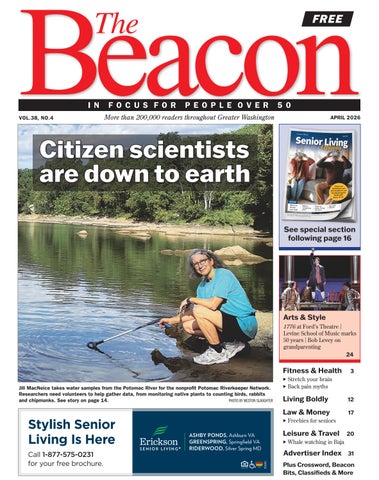
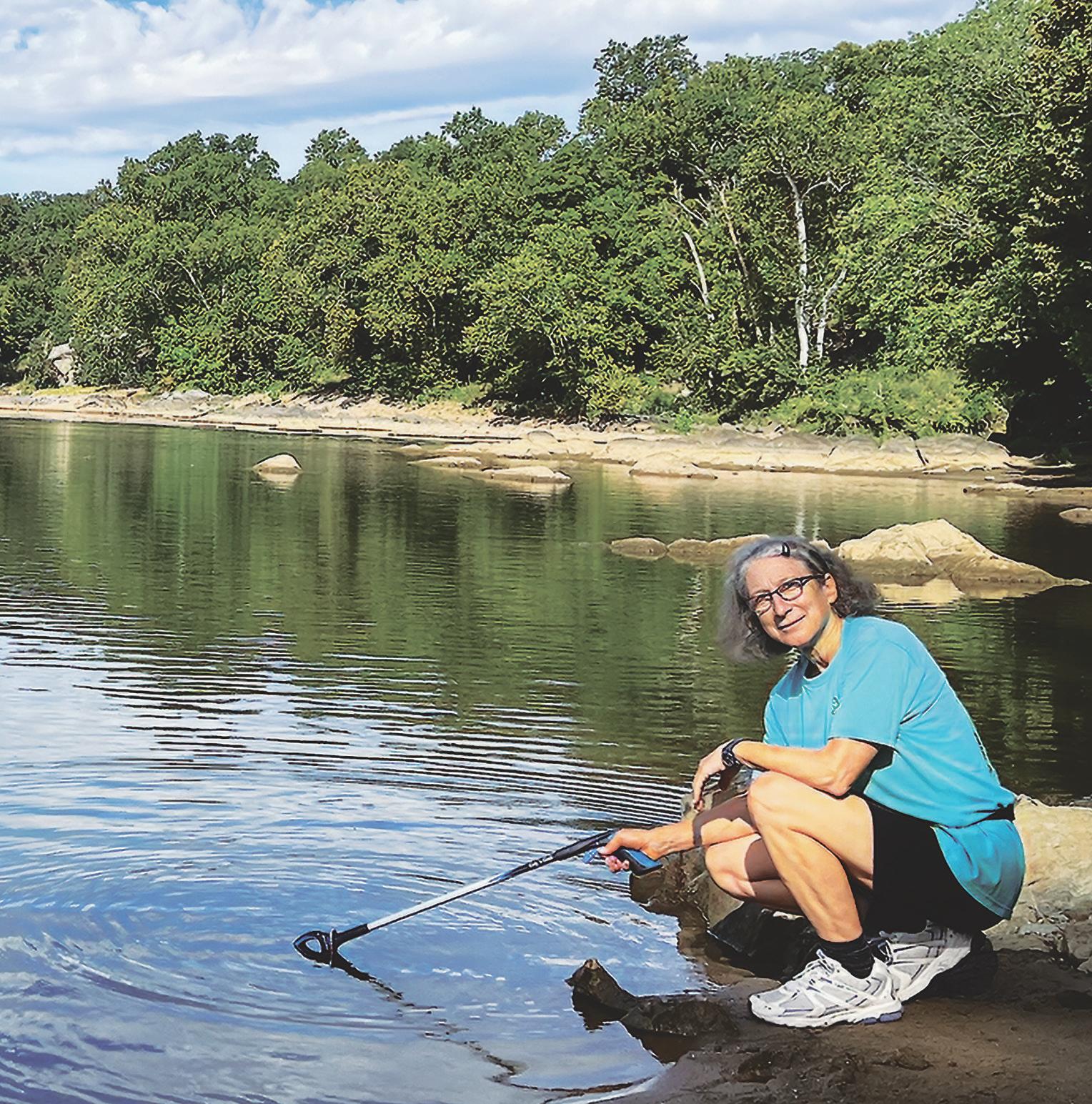
Jill MacNeice takes water samples from the Potomac River for the nonprofit Potomac Riverkeeper Network. Researchers need volunteers to help gather data, from monitoring native plants to counting birds, rabbits and chipmunks. See story on page 14.
PHOTO BY WESTON SLAUGHTER
Joining a dream team
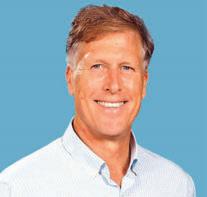
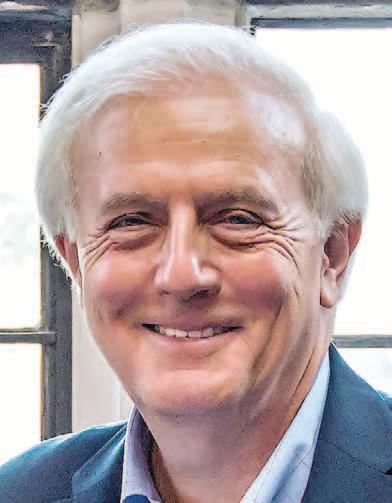
My name is Steve Gurney, founder of Positive Aging, and I am honored to now serve as associate publisher of the Beacon Newspapers following the recent merger of our organizations.
Over the years, I have deeply admired the Beacon, especially for its powerful, reallife stories that highlight the experiences, wisdom and voices of older adults. The Beacon has long been an invaluable and trusted source of news and information for our community, and I am truly thrilled to join the team.
That experience inspired me to create a comprehensive guidebook to help other families navigate similar challenges. What started as a small project grew into a fulfilling career in aging services spanning more than three decades.
FROM THE ASSOCIATE PUBLISHER
By Steve Gurney
I am especially excited about the potential of our combined platforms. Together, we can expand how we connect with Beacon readers and engage more deeply with professionals, families and older adults throughout our region.
Like many in the senior housing field, my journey began with a personal family experience. In the late 1980s, I watched my family help my grandfather make the difficult transition from his longtime home to a nursing center.
When the pandemic hit, I began exploring new ways to help people connect online. This led to the creation of the Positive Aging Community — an interactive platform where older adults, families and professionals come together to talk with authors, thought leaders and each other about everything from aging to longevity to living with purpose.
Last month, I joined Margaret Foster, editor of the Beacon, for a live conversation with renowned broadcaster Kojo Nnamdi. He shared insights from his brand-new podcast, Young at Heart, on WAMU. I hope you could tune in! If you missed the live event, you can catch the recording on the Beacon’s website, thebeaconnewspapers.com, or at ProAging.com.
At the heart of it all, I am passionate about
helping people live their lives with purpose, no matter their age or ability. Like the Beacon, I’ve found that sharing authentic, personal stories is one of the most powerful ways to connect people with resources, remind them that they have choices, and show that they don’t have to walk their journey alone.
If you’re looking for a resource or solution, please don’t hesitate to reach out to me personally at gurney@thebeaconnewspapers.com. And if you have a story that you believe could inspire others, we would love to hear from you.
Stay tuned for many exciting things to come. I encourage you to pick up your copy of the Beacon every month and become part
of our growing combined community.
Thank you for reading the Beacon. I look forward to connecting with you as we continue celebrating Positive Aging together.
Scan
Letters to the editor
Readers are encouraged to share their opinions on any matter addressed in the Beacon as well as on political and social issues of the day.
Mail your Letter to the Editor to The Beacon, P.O. Box 2227, Silver Spring, MD 20915, or email to info@thebeaconnewspapers.com. Please include your name, address and telephone number for verification.
Dear Editor:
Beacon The
IN FOCUS FOR PEOPLE OVER 50
The Beacon is a monthly newspaper dedicated to inform, serve and enter tain the citizens of the Greater Washington D.C. area, and is privately owned. Other editions serve Greater Baltimore and Howard County, Maryland.
Subscriptions are available via first-class mail ($50) or third-class mail ($20), prepaid with order. D.C. and Maryland residents: add 6% for sales tax. Send subscription order to the office listed below.
Publication of advertising contained herein does not necessarily constitute endorsement. Signed columns represent the opinions of the writers, and not necessarily the opinion of the publisher.
Gordon Hasenei, Publisher, CEO
SteveGurney, Associate Publisher
MargaretFoster, Editor
KyleGregory, Art Director
RogerKing, Vice President of Operations
Advertising Representatives: Jill Joseph, Steve Levin, M.K. Phillips, Alan Spiegel
Submissions: The Beacon welcomes reader contributions. Deadline for editorial is the 10th of the month preceding the month of publication. Deadline for ads is the 15th of the month preceding the month of publication. See page 31 for classified advertising details. Please mail or email all submissions.
Inc.
Two recent Beacon columns, “How we learn to be afraid” (November 2025) and “How I learned to be brave” (February 2025), carry an important message for our community.
They remind us that courage and compassion are learned — and that each generation must teach the next. We must guide our children toward kindness and courage, showing them how to live without harming others and how to stand up for what is right.
At the same time, we must not forget our senior citizens. Many older people feel lonely and forgotten. A simple visit, a conversation, or a few hours of our time can mean the world to them. Too often we spend more time raising our children but give too little time to our aging parents.
Thoughtful journalism like the Beacon’s helps remind us of these responsibilities. I hope more readers will reflect on these values and act on them.
Eric K. H. Wang Rockville, MD
Dear Editor:
As a historian and near-70-year-old Boomer whose Greatest Generation mom was a Rosie the Riveter, I beg to differ from some of Bob Levey’s statements about women’s athletics and strengths in his March 2026 column, “On the road, Father didn’t always know best.” Levey writes that “sexism denied women the chance to play competitive sports.”
By the 1950s, women in the U.S. played competitive sports in high school and college, had shown their strength in WWII factories, and could look for exemplars to the fabled “League of Their Own” (the AllAmerican Girls Professional Baseball League).
While it’s true that the male-dominant Eisenhower Era didn’t exactly cheerlead for
female athletic accomplishment, many women, including my own mom in Baltimore, were fiercely competitive basketball players in school.
Perhaps the historian Richard Bell (“A History of Women in Sport Prior to Title IX,” Sport Journal , March 14, 2008) best pointed out why so much of this record of athletic achievement has been masked and forgotten when he wrote that “sports for women have been largely unrecognized… because competition was within college between students (intramural) rather than between the institutions (extramural).”
Mike Reis Silver Spring, MD
Dear Editor:
I am a volunteer at several facilities for Alzheimer’s residents and want to pass along some tips I have learned. Some readers who are also caregivers might find this helpful.
Although residents may not recognize or remember visitors, you can bring them moments of happiness. Sometimes they may not make sense, but they just want to be heard. Just listen and mirror their emotions.
Residents also like hearing stories about my life. They often can’t hold conversations but crave hearing people talk to them. Often I show them pictures of my family, especially children. They enjoy telling me how cute my grandchildren are, and I love hearing it.
One activity I have found that people with dementia enjoy is playing catch with a small beach ball. (We use two balls, since some people just like to hold the ball.)
If you are a senior like me and are looking for a meaningful volunteer activity, consider contacting your local assisted living or memory care facility.
Rita Grotsky Olney, MD
this code to watch Steve Gurney read this column:
Fitness & Health
BACK PAIN MYTHS
Bed rest isn’t always the best medicine. Prevent pain with exercise
RINGING IN THE EARS
Hearing loss can cause tinnitus, and some hearing aids can help
BACK OFF ON BENADRYL
Some common medications, including allergy meds, can cause brain fog
BEST BREAKFAST CEREALS
Many cereals are sugary, but Cheerios and Shredded Wheat are good choices
Challenge your brain to keep it healthy
By Lauran Neergaard
“Exercise your brain,” experts advise people hoping to stave off dementia. But how? Stretching your brain might be the better description.
Do a crossword puzzle a day, and you may just get good at crosswords. Instead, research increasingly shows that a variety of habits and hobbies are like a cognitive workout, building knowledge and skills that may beef up parts of the brain as we get older.
One recent study linked a lower risk of Alzheimer’s disease and cognitive decline to lifelong learning, meaning intellectually stimulating experiences — reading and writing, learning another language, playing chess, solving puzzles, going to museums — from childhood into retirement.
“They kind of stretch your brain and your thinking. You’re using your different cognitive systems,” explained neuropsychologist Andrea Zammit of Rush University Medical Center in Chicago, who led that study.
If you didn’t embrace what Zammit calls cognitively enriching activities early in life, it’s not too late to get started. Middle age offers an important window for protecting brain health, and scientists are examining a wide range of possible ways to stay sharp,
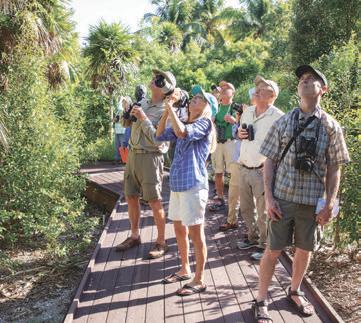
from taking up music to birdwatching and brain-training games.
Physical health is critical to brain health, too. That’s why experts also recommend the work-up-a-sweat kind of exercise as well as low blood pressure, good sleep and even later-in-life vaccination.
There’s no magic recipe to prevent either dementia or the normal cognitive decline of aging, cautioned Dr. Ronald Petersen, an Alzheimer’s specialist at the Mayo Clinic. But lifestyle changes offer a chance to “slow down the arc of deterioration,” he said.
New study shows protection
Zammit’s study on lifelong learning enrolled nearly 2,000 older adults, ranging from age 53 to 100, who started out dementiafree and were tracked for eight years.
Researchers quizzed them about educational and other cognitively stimulating activities in their youth, middle and older ages, and administered a battery of neurologic tests.
Some eventually were diagnosed with Alzheimer’s disease — but it struck five years later in those with the highest amount of lifelong learning compared to those with the least amount, Zammit’s team reported in the journal Neurology. And staying more mental-
ly active in middle age and beyond was linked to a slower rate of cognitive decline.
More interesting, Zammit said, were autopsy findings from 948 participants who died during the study: Even when their brains harbored Alzheimer’s hallmarks, the more cognitively “enriched” people had better memory and thinking skills and a slower decline before their death.
That’s what scientists call cognitive reserve. It means that learning strengthened neural connections in various regions, helping the brain to be more resilient, able to work around damage from aging or disease at least for a while.
More clues that exercising the brain matters
The Rush study can’t prove cause-andeffect — but it shows an association between cognitive stimulation and dementia risk. Other studies offer similar clues, such as those linking brain health to playing a musical instrument.
Another study hinted that brain “speed training” — using an online program that requires spotting images as a screen flashes increasing distractions — also may help.
A study funded by the National Institutes of Health now is examining if there’s benefit
to long-term computerized exercises that aim to improve attention and reaction time.
How fast our brains process information affects how we multitask or drive, said Jessica Langbaum of the Banner Alzheimer’s Institute, who isn’t involved with the brain training research. For now, she advises choosing activities that help you think on your feet — maybe joining a book club to combine solo reading with discussion and social connection.
Other steps to lower dementia risk
Lots of chronic health problems that strike in middle age can increase the risk of later-inlife Alzheimer’s or other forms of dementia. For example, high blood pressure damages blood vessels, which is bad for the heart and reduces blood flow to the brain. Poorly controlled diabetes can spur damaging inflammation in the brain.
That means key recommendations for heart health — get regular exercise, eat lots of fruits and vegetables, avoid obesity and control diabetes, high blood pressure and high cholesterol — also are good for brain health.
A bonus step: Get vaccinated against shingles. It not only prevents that incredibly painful rash, but growing research shows the vaccinated have a lower risk of developing dementia. —AP
Many older adults can improve with age
By Colin Poitras
Aging in later life is often portrayed as a steady slide toward physical and cognitive decline. But a new study by scientists at Yale University suggests an alternate narrative — that older individuals can and do improve over time, and their mindset toward aging plays a major part in their success.
Analyzing more than a decade of data from a large, nationally representative study of older Americans, lead author Dr. Becca R. Levy, PhD, a professor of social and behavioral sciences at the Yale School of Public Health, found that nearly half of adults aged 65 and older showed measurable improvement in cognitive function, physical function, or both, over time. The improvements were not limited to a small group of exceptional individuals and, notably, were linked to a powerful but often overlooked factor: how people think about aging itself.
“Many people equate aging with an inevitable and continuous loss of physical and cognitive abilities,” Levy said.
“What we found is that improvement in later life is not rare; it’s common, and it should be included in our understanding of the aging process.”
The findings were published in the journal Geriatrics in March.
Large, 12-year study
For the study, researchers followed more than 11,000 participants in the Health and Retirement Study, a federally supported longitudinal survey of older Americans.
The research team tracked changes in cognition using a global performance assessment, and physical function using walking speed — often described by geriatricians as a “vital sign” because of its strong links to disability, hospitalization and mortality.
Over a follow-up period of up to 12 years,
45% of participants improved in at least one of the two domains, according to the study. About 32% improved cognitively, 28% improved physically, and many experienced gains that exceeded thresholds considered clinically meaningful.
When participants whose cognitive scores remained stable over that period (rather than declining) were included, more than half defied the stereotype of inevitable deterioration in cognition.
“What’s striking is that these gains disappear when you only look at averages,” said Levy, author of the book Breaking the Age Code: How Your Beliefs About Aging Determine How Long & Well You Live.
“If you average everyone together, you see decline,” Levy continued. “But when you look at individual trajectories, you uncover a very different story. A meaningful percentage of the older participants that we studied got better.”
Attitude matters
The authors also examined potential reasons for why some people improve and some do not.
They hypothesized that an important factor could be participants’ baseline age beliefs — or, specifically, whether they had assimilated more positive or more negative views about aging by the start of the study.
In support of this hypothesis, they found that those with more positive age beliefs were significantly more likely to show improvements in both cognition and walking speed, even after accounting for factors such as age, sex, education, chronic disease, depression and length of follow-up.
The findings build on Levy’s stereotype embodiment theory, which suggests that age stereotypes absorbed from culture — through social media and advertisements
Adults improve
From page 3
— eventually become self-relevant and biologically consequential.
Levy’s prior studies have found negative age beliefs predict poorer memory, slower walking speed, higher cardiovascular risk and biomarkers associated with Alzheimer’s disease.
The current study shows that those who have assimilated more positive age beliefs often show improvement, Levy said.
“Our findings suggest there is often a reserve capacity for improvement in later life,” she said. “And because age beliefs are modifiable, this opens the door to interventions at both the individual and societal level.”
The improvements were not limited to people who started out with impairments. Even among participants who had normal
BEACON BITS
Ongoing
cognitive or physical function at baseline, a substantial proportion improved over time.
That challenges the assumption that later-life gains reflect only people getting better after being sick or rebounding from earlier setbacks, the authors said. Dr. Martin Slade, MPH, PhD, a lecturer at Yale School of Medicine, is co-author of the study.
The authors hope their findings will reverse the popular perception that continuous decline is inevitable and encourage policy makers to increase their support for preventive care, rehabilitation and other health-promoting programs for older persons that draw on their potential resilience.
This research was supported by funding from the National Institute on Aging.
This article was originally published by the Yale School of Public Health. Reprinted with permission.
LIVING ALONE GROUP (VIRTUAL)
Sharing experiences can be helpful to those living alone, whether by choice or circumstance. Sibley Senior Association hosts a discussion group on solo living. The meetings are free and take place on the third Monday of each month from noon to 1 p.m. via Zoom. For more information and to register, call (202) 364-7602 or email Ken Gordon at kengordon@alum.mit.edu at least two weeks before a meeting.
GRANDCHILDREN CAMP
June
Enjoy a fun week with your grandchildren this summer at the Empowering the Ages headquarters, 401 N. Washington St., Suite 600, Rockville, MD. This summer camp for grandparents and grandchildren (ages 4 to 11) runs from 9 a.m. to noon, Monday through Friday, from June 22 to 26. The cost is $200 for one adult and one child, with an additional $75 for each extra child. There is no extra charge for more grandparents. Fill out a camp interest form at empoweringtheages.org/campETA. For more information, email eta@empoweringtheages.org or call (301) 476-0186.
MAIL OR EMAIL FOR FREE INFORMATION
For free materials about area housing communities, just complete and clip this coupon and mail, or take a picture and email, to the Beacon.
Housing Communities
District of Columbia
o Asbury Dwellings (See ad on page 16)
o Chevy Chase House (See ads on pages B6, B7)
o Knollwood (See ad on page B10)
Maryland
o Bethany House (See ad on page B9)
o Brooke Grove (See ads on pages B4, B5)
o Churchill Senior Living (See ad on page 15)
o Discovery Village Chevy Chase (See ads on page B3)
o Grandview, The/Erickson (See ads on pages 4, B8)
o Homecrest House (See ads on page B2)
o Park View Bladensburg (See ad on page 9)
o Park View Columbia (See ad on page 9)
o Park View Emerson (See ad on page 9)
o Park View Laurel (See ad on page 9)
o Riderwood/Erickson (See ads on pages 1, 4, B8)
Virginia
o Ashby Ponds/Erickson (See ads on pages 1, 4, B8)
o Culpepper Garden (See ad on page 7)
o Greenspring/Erickson (See ads on pages 1, 4, B8)
o The Reserve at Falls Church (See ads on pages B10, B11)
o Tribute at the Glen (See ad on page B11)
o Vinson Hall (See ad on page B3)
o Woodleigh Chase (See ads on pages 4, B9)
Clinical Health Studies
o C. diff Vaccine Study (See ad on page 8)
o Smell Test Study (See ad on page 8)
Check the boxes you’re interested in and return this form to: The Beacon, P.O. Box 2227, Silver Spring, MD 20915 or take a picture and email to housing@thebeaconnewspapers.com.
Feel free to return this coupon together with the coupon found on page B-16 of this issue.
Common myths about back pain persist
By Meghan E. Murphy, M.D.
Dear Mayo Clinic: My back’s been bothering me, and everyone seems to have ideas what’s causing the pain. Can you help?
A : Back pain is more common than homeownership in the U.S. While about 65% of adults own a home, nearly 80% of adults will have back pain at some point.
Despite how common this type of pain is, myths about it persist. We clarify several misconceptions below.
Myth: Lifting heavy objects is the main cause of back pain.
Fact: Lifting heavy objects with poor form can contribute to back pain, but the major culprits are a sedentary lifestyle, poor posture, obesity and genetic factors.
Myth: Bed rest will make my back pain better.
Fact: Probably not, but it depends on the cause of your pain. If it’s muscle strain, taking it easy for a few days may help.
However, bed rest can also make back pain last longer or even worsen. If your pain is from nerve compression, a disc issue or joint degeneration, inactivity can cause tighter muscles, more pain, loss of physical condition and more debility.
In these cases, you should modify your activities, switch to low-impact exercises like walking and swimming, and avoid movements like bending, twisting or lifting. Maintaining some degree of physical activity can help you heal faster.
Myth: Back pain is always due to a
A Kiss for Your Skin at Every Age Volufiline Skincare That
serious underlying condition.
Fact: Back pain is usually caused by muscle strains or sprains, not by a serious condition like a disc or vertebrae issue. Most back pain resolves on its own.
Myth: You should avoid exercise when experiencing back pain.
Fact: Exercise and physical activity are usually recommended for managing and preventing back pain. Strengthening the core muscles — including your back muscles — improving flexibility, and maintaining a healthy weight can contribute to a healthier back.
Depending on your pain, you may need to modify your activity. You know your body best, so listen to it. If something isn’t getting better or grows progressively worse, contact a healthcare professional for an evaluation.
Myth: Surgery is the only solution for chronic back pain.
Fact: Back pain is often caused by issues that aren’t relieved with surgery. Nonsurgical treatments like physical therapy, medications, injections and lifestyle modifications are often effective in managing and reducing chronic back pain. Surgery may be necessary if your pain:
• intensifies, especially at night or when you lie down
• spreads down one or both legs
• causes weakness, numbness or tingling in one or both legs
• occurs with new bowel or bladder control problems.
Seek an immediate medical evaluation if you experience any of these symptoms.
Myth: A firm mattress is the best for alleviating back pain.
Fact: The ideal mattress firmness varies from person to person. Some people may find relief with a firm mattress, while others may prefer a medium or soft one.
When shopping for a new mattress, look
for one that provides support and comfort based on your preferences and needs. Many companies offer generous return policies, so you can try a mattress for a few weeks, or even a few months, before deciding if it’s right for you.
Myth: Poor posture doesn’t contribute to back pain.
Fact: Many people spend hours slouching while staring at a computer rather than sitting at attention; others bend their necks to focus on cellphones. These habits can strain muscles and joints, causing body pain over time. Practice good posture habits and take advantage of ergonomic office equipment to help prevent and alleviate back pain.
Preventing back pain
Some back issues can’t be avoided, like those caused by injuries, arthritis or genetics. To preserve the health of your back:
• Maintain an ideal body weight. Excess weight causes increased stress on all joints, including the spine.
• Strengthen your core. Stronger core muscles, including abdominal and intrinsic back muscles, can help take the stress off your spine.
• Stay active. Regular movement is essential for keeping your body active.
Meghan E. Murphy, M.D., Neurosurgery, Mayo Clinic Health System, Mankato, Minnesota
Mayo Clinic Q & A is an educational resource and doesn’t replace regular medical care. This Mayo Clinic Q&A represents inquiries this healthcare expert has received from patients. For more information, visit mayoclinic.org.
What treatments are recommended to help with tinnitus? I started noticing a subtle ringing in my ears about 10 years ago, but it’s gotten much more bothersome since I turned 60.
—Ringing Ronnie Dear Ronnie,
Tinnitus is actually one of the most common health conditions in the country. According to the National Institute on Deafness and Other Communication Disorders, around 10% of the U.S. adult population — over 25 million Americans — experience some form of tinnitus.
diologist, or an otolaryngologist — a doctor who specializes in ear, nose and throat diseases (commonly called an ENT). The various things that can cause tinnitus are:
• Hearing loss, which is the most common cause
• Middle ear obstructions usually caused by a buildup of earwax deep in the ear canal
• Side effects of many different prescription and overthe-counter medicines like aspirin, ibuprofen, certain blood pressure medicines and diuretics, some antidepressants, cancer medicines and antibiotics
Another strategy that can help suppress or mask the sound so it’s less bothersome is “sound therapy.” This can be as simple as a fan or white-noise machine, or you can use sound therapy apps like ReSound Tinnitus Relief, myNoise or Naturespace. Cognitive behavioral therapy and psychological counseling can also be helpful, as can tinnitus retraining therapy (TRT). This combines counseling and sound therapy to train your brain to ignore the sound in your ears. The new MindEar app offers TRT, and some hearing aids have a setting that tunes out tinnitus.
There are also medications that may help. While there are no FDA-approved drugs specifically designed to treat tinnitus, some anti-anxiety drugs and antidepressants have been effective in relieving symptoms. Your audiologist or ENT can help you figure out the best treatment options.
Other things you can do to help quiet the noise is to avoid things that can aggravate the problem, like fatty foods, salt, artificial sweeteners, sugar, alcohol, tonic water, tobacco and caffeine.
For most people tinnitus is merely annoying, but roughly 5 million people struggle with chronic tinnitus, and 2 million find it debilitating.
While there’s no cure, there are a range of different strategies you can try to reduce the symptoms and make it less bothersome. Here’s what you should know.
What is tinnitus?
Tinnitus (pronounced TIN-a-tus or tinNIGHT-us) is the sensation of hearing a ringing, buzzing, roaring, hissing or whistling sound in one or both ears when no external sound is present.
The sounds, which can vary in pitch and loudness, are usually worse when background noise is low, so you may be more aware of it at night when you’re trying to fall asleep in a quiet room.
Tinnitus itself is not a disease, but rather a symptom of some other underlying health condition. The best way to find out what’s causing your tinnitus is to see an au-
• Various medical conditions such as high blood pressure, vascular disease, diabetes, allergies, thyroid problems, ear or sinus infections, Menière’s disease, Lyme disease, fibromyalgia, otosclerosis, temporomandibular joint (TMJ) disorder, a tumor, an injury to the head or neck, traumatic brain injury, depression, stress and more.
Treatment strategies
There are many ways to treat tinnitus, depending on the cause. For example, if your tinnitus is caused by a wax buildup in your ears or a medical condition like high blood pressure or a thyroid problem, treating the problem may reduce or eliminate the noise.
Or, if you’re taking a medication that’s causing the problem, switching to a different drug or lowering the dosage may provide some relief.
If you have hearing loss, getting a hearing aid can help mask your tinnitus by improving your ability to hear actual sounds. Some hearing aids even have a setting to reduce your perception of tinnitus.
There are even new innovations, like the FDA-approved device Lenire (lenire.com), that use electrical stimulation of the tongue to alleviate symptoms.
Be sure to drink plenty of water, as dehydration can worsen symptoms. And protect yourself with earplugs.
Send your questions or comments to questions@savvysenior.org, or to Savvy Senior, P.O. Box 5443, Norman, OK 73070.
Accessible walks bring the joys of birding to all
By Anita Snow
Wearing an oxygen pack on her back for her COPD, Marcia OBara led a group of nature enthusiasts on a mission to see birds this winter. They carried walking sticks on the flat trails, moving at their own pace, without pressure or competition and enjoying a sense of community.
This is Birding for Every BODY, one of numerous such excursions offered each month by the nonprofit Tucson Bird Alliance with Arizona’s Pima County.
It’s part of a growing national movement to help people with physical and other limitations experience birding and nature in general.
“It’s an opportunity for people to get out and see birds without pressure, no matter how long it takes or how many birds we see,” said OBara, a retired nurse who has been leading the accessible outings for three years.
Disabled people often cannot keep up on traditional outings, especially when competitive birders are focused on checking off a list of the greatest possible number of species.
So, on her accessible walks, OBara ensures that all trails are easily traversable, and bathrooms are open and large enough to accommodate mobility scooters and wheelchairs. She checks on the availability of drinking water, shade and benches.
Once a walk gets underway, OBara
checks to ensure everyone is keeping up, then modulates the pace as needed.
“I used to work in rehab, so I usually know what people need,” OBara said.
While the outings are open to those with wheelchairs and mobility scooters, people who use those devices rarely attend the walks, OBara said, perhaps because they don’t think they’ll be able to keep up.
“But we’d encourage them to come,” OBara said.
Enjoying nature and community
On one of several walks she led in February at Tucson-area parks, OBara pointed out birds to a small group.
“It’s nice to just be outside and not think of anything else,” said Rhea Guertin, a retired Rhode Island snowbird who spends four months in Tucson each winter. She used a walking pole for stability.
“I’m just slow,” she explained.
Evelyn Spitzer, a retired Tucson-area teacher, used a walking pole for her heart condition and the lingering effects of a recent surgery.
The organized effort to share birding with people with limitations goes back at least to 2018, when retired Texas teacher Virginia Rose founded the nonprofit Birdability. Rose has used a wheelchair since suffering a spinal injury at age 14.
“Our vision is that birding be truly for
everybody and every BODY, regardless of disability,” said Cat Fribley, Birdability’s executive director.
She said participants’ limitations include mobility issues, blindness or low vision, chronic illness, intellectual or developmental disabilities and mental illness. Some are neurodivergent, deaf, hard of hearing or have other health concerns.
Fribley, who has a mobility scooter for multiple disabilities, said she can go five or six miles while birding on the accessible paths in her residential community in Iowa City, Iowa.
“In the winter, I bird on my back deck with my coffee,” she said.
Other examples of accessible birding include watching from a car, from a canoe on a river, or simply through a kitchen window, advocates said.
Maps and apps
Birdability has helped compile a crowdsourced map of accessible birding locations nationwide in partnership with the National Audubon Society, and offers advice to ablebodied birders on how to be more welcoming and inclusive.
The group’s website has many other resources and adaptive devices, such as carwindow mounts for cameras and apps such as Merlin that blind people and others can use to identify and record birdsong.
BEACON BITS Apr. 25+
Test
Ongoing smell loss may be one of the most important signals of brain health as we age.
A new study from The Michael J. Fox Foundation for Parkinson’s Research is exploring this link. We’re calling on everyone with and without Parkinson’s to request a simple scratch-and-sniff test and contribute to important research.
Request your test at or scan the QR code.
Request your test at 877-525-PPMI (7764) mysmelltest.org/beacon or scan the QR code.
Occupational therapist Freya McGregor recommends binocular harnesses, which are strapped around the back and chest, saying they’re easier on the shoulders and neck than binoculars that hang around the neck.
McGregor — who has a permanent knee injury — runs Access Birding, which trains nature organizations such as state parks and local Audubon chapters on making trails accessible.
Birding
by ear
Birding “really brings you joy,” said Jerry Berrier, a 73-year-old Massachusetts birder who has been blind since birth. “There is happiness from being out in nature.”
Berrier, who got hooked on birding as a college student, captures avian songs and calls for his website, birdblind.org, to help blind bird enthusiasts record and share their own. Last year, he launched the Any Bird Any Body podcast with his friend, Gary Haritz. He also helped organize the first national bird-a-thon for blind enthusiasts in the U.S. It drew several hundred participants last year, who reported the birdcalls they heard over 24 hours. The event goes international this year on May 3.
“We encourage people to reach out to local organizations to help blind people with the bird-a-thon,” Berrier said. “A disability can be very isolating.” —AP
GAS AND STEAM ENGINE SHOW
For a unique look at at a historic Maryland farm, visit the Agricultural History Farm Park on Sat., April 25 from 10 a.m. to 5 p.m., and Sun., April 26 from 10 a.m. to 3 p.m. Explore historic barns and buildings and check out the farming activity center, apple orchard and various animals. This free event takes place at 18400 Muncaster Rd., Derwood, MD. For more information, visit friendsofthefarmpark.org.
These everyday drugs can mimic aging
You’ve probably heard the word “anticholinergic” in television commercials or in one of my articles and mentally checked out because it sounds technical.
Don’t. It’s actually simple. It just means the drug blocks acetylcholine, a chemical messenger that your body uses all day, every day.
Let me boil it down to seven things you should know about acetylcholine before you take a drug that blocks it:
1.Acetylcholine keeps your brain sharp and your body regulated.
tion to changes like this when taking anticholinergic medications. Acetylcholine is central to memory circuits in the hippocampus.
In fact, medications used to treat Alzheimer’s disease (i.e., donepezil) actually work by increasing acetylcholine. Therefore, blocking it chronically can worsen memory and recall and increase dementia risk.
By Suzy Cohen
2.Blocking it can mimic aging.
3.Some medications are strong blockers and cross into the brain.
4.Even mild drugs can add up when stacked together.
5.Older adults are especially vulnerable.
6.Anticholinergic burden is linked to increased dementia risk.
7.Dryness is your biggest clue.
Some drugs have very strong anticholinergic effects. Diphenhydramine (Benadryl), amitriptyline, oxybutynin, cyclobenzaprine and paroxetine are among the bigger offenders. These meds cross into the brain and can noticeably affect cognition, especially in older adults.
Other medications carry milder activity, including newer antihistamines and bladder drugs.
Even when each one seems modest, the cumulative burden adds up. One allergy pill, one bladder medication, one sleep aid, and suddenly acetylcholine is significantly suppressed. Then your mind is affected, or you get constipation and blurry vision.
Older adults should pay the closest atten-
People with dementia, chronic constipation or prostate enlargement are also more vulnerable because anticholinergic drugs can worsen confusion, slow gut motility (increased risk of constipation) and increase urinary retention.
Babies and toddlers can react strongly as well, sometimes with paradoxical agitation.
Check medication labels
How would you know if you were taking an anticholinergic drug? You could ask your local pharmacist, look it up online, or consider the primary side effect: dryness.
Feeling “dry” is one of the biggest clues. Acetylcholine stimulates secretions. When you block it, things dry up. If you have persistent dry mouth, dry eyes, dry skin or constipation, it could be a side effect of your medicine, as opposed to imbalanced hormones or natural aging.
Here’s what I tell people: If you need an antihistamine during peak allergy season, that’s okay. Just don’t live on it for weeks. Use it short-term. If the tablet is scored, sometimes half is enough.
If you have allergies, do saline rinses to bring moisture back. Use a good HEPA filter at home. Shower after high-pollen days so you’re not sleeping in whatever you
walked through. If dry mouth kicks in, xylitol lozenges can stimulate saliva.
Your physiology doesn’t care what the drug is for, whether it’s allergies, overactive bladder, sleep or depression. It responds to total chemical load.
Sometimes anticholinergic medication is appropriate. Sometimes it quietly creates brain fog, dryness and slowdown that gets blamed on aging.
If you want a deeper dive and a list of the most common offenders, I’ve posted a longer article at suzycohen.com so you can review your own medication list.
This information is opinion only. It is not intended to treat, cure or diagnose your condition. Consult with your doctor before using any new drug or supplement.
Suzy Cohen is a registered pharmacist and author of The 24-Hour Pharmacist and Real Solutions from Head to Toe
When you sign up for a Home Tree Care 101 class with Conservation Montgomery, an arborist or Maryland Licensed Tree Care Expert will visit your community for a walking tour to evaluate the condition of individual trees. They will also show you how to prune, mulch and remove invasive vines that you can handle yourself at home. Classes are available in Montgomery County, MD, in English or Spanish, and the cost is $25. For more information and to register, visit bit.ly/HomeTreeCare101.
Lack of sleep causes inflammation
By Howard LeWine, M.D.
Q: Is the association of poor sleep and a higher risk of cognitive decline related to chronic inflammation?
A: Sleep deprivation is a condition that occurs when you don’t get enough sleep, or enough good quality sleep. Research has found that sleep deprivation is associated with markers of inflammation, such as increases in inflammatory molecules — including cytokines, interleukin-6 and Creactive protein.
While these signs of inflammation could be attributed to other factors — stress, smoking or obesity, for example — they do suggest that sleep deprivation plays a role in the inflammatory process.
Inflammation is the body’s natural response to disease and injury; it is usually a temporary response and serves as an effective defense mechanism.
But when inflammation doesn’t let up, it contributes to the development of heart disease, diabetes, stroke, cancer and Alzheimer’s disease.
How does a lack of sleep contribute to inflammation? One theory focuses on blood vessels.
During sleep, blood pressure drops and blood vessels relax. When sleep is restricted, blood pressure doesn’t decline as it should, which could trigger cells in blood
vessel walls that activate inflammation. A lack of sleep might also alter the body’s stress response system.
In addition, a sleep shortfall interferes with the normal function of the brain’s housecleaning system, termed the glymphatic system (not to be confused with the lymphatic system in the rest of the body). In the deepest sleep phases, cerebrospinal fluid rushes through the brain, sweeping away betaamyloid protein linked to brain cell damage.
Without a good night’s sleep, this housecleaning process is less thorough, allowing the protein to accumulate — and inflammation to develop. Then, a vicious cycle sets in. Beta-amyloid buildup in the brain’s frontal lobe starts to impair deeper, nonREM slow-wave sleep. This damage makes it harder both to sleep and to retain and consolidate memories.
Just one night of lost sleep can keep betaamyloid levels higher than usual. The problem is not so much a single night’s poor sleep, which you can compensate for, but a cumulative pattern of sleep loss. That leads to decreases in the structural integrity, size and function of brain regions like the thalamus and hippocampus, which are especially vulnerable to damage during the early stages of Alzheimer’s disease.
Q: In the past, I have sometimes seen streaks in my vision. They go
away so quickly I don’t know if it is in one or both eyes. But now I have a lacy black spot in my right eye that I only see sometimes. Are they related?
A: What you describe sounds like flashes and floaters. Both commonly happen as we get older.
The eye consists of two major compartments — the front (including the cornea, iris and lens) and the back (the rear twothirds of the eyeball, including the retina and a large cavity filled with vitreous gel that attaches to the retina).
Flashes, the quick streaks of light you describe, tend to be most noticeable in the dark. They occur when the vitreous gel bumps, rubs, or tugs against the retina. This action can lead to small areas of vitreous detachment, a sudden separation between the vitreous gel and the retina.
The small black spot you see in one eye sounds like a typical floater. People often notice occasional floaters — spots, squiggly lines, rings or opaque flecks — drifting across their line of vision.
Floaters are tiny clusters of cells or clumps of gel that have formed in the vitreous cavity. What the person sees is the shadow that these little clumps cast on the retina.
People often become more aware of floaters when they look at a book page, a computer screen, or a solid, light-colored
background. Floaters can also be more noticeable when you’re tired.
Unlike flashes, floaters don’t disappear. However, over time, they become much less noticeable for several reasons. The brain eventually filters out unimportant or repetitive information, including floaters. The clumps of gel can also shift position and move away from your central vision. Occasional flashes and one or two small floaters are generally harmless.
However, certain features may signal a retinal detachment, a potentially serious problem where the retina tears away from the back of the eye. Immediately call for medical advice if you experience any of the following:
• many flashes occur at once or in rapid sequence
• two or more floaters suddenly appear in the same eye
• a shadow develops in your peripheral vision
• a dark “curtain” covers some of the vision in one eye.
Howard LeWine, M.D., is an internist at Brigham and Women’s Hospital in Boston and assistant professor at Harvard Medical School. For additional consumer health information, see health.harvard.edu.
Millions of Americans are living with low vision, a visual impairment that can turn everyday moments — recognizing a friend’s face across the street, reading a recipe or checking a text message — into unexpected challenges.
Low vision isn’t a natural part of getting older, though the conditions that cause it do become more common with age.
Consider this information from the National Eye Institute to make the most of your vision and improve your quality of life.
Understanding low vision
You may have low vision if you can’t see well enough to read, drive, recognize faces, distinguish colors or see screens clearly.
Many different eye conditions can cause low vision, but the most common causes are age-related macular degeneration, cataracts, glaucoma and diabetic retinopathy, a condition that can cause vision loss in people with diabetes.
The most common types of low vision are:
•Central vision loss (not being able to see things in the center of your vision)
•Peripheral vision loss (not being able to see things out of the corners of your eyes)
•Night blindness (not being able to see in low light)
•Blurry or hazy vision
Diagnosing low vision
Your doctor can check for low vision as part of a simple, painless comprehensive dilated eye exam. He or she will ask you to read letters that are up close and far away and will check whether you can see things in the center and at the edges of your vision.
Then eye drops are used to widen your pupils and check for other eye problems, including conditions that could cause low vision.
Low vision is usually permanent, but glasses, medicine or surgery may help with daily activities or slow progression.
The City of Gaithersburg hosts its annual Active Aging Expo on Thu., May 7 from 9 a.m. to 2 p.m. at the Activity Center at Bohrer Park, 506 South Frederick Ave., Gaithersburg, MD. This free event features educational talks, demonstrations, health screenings, health and wellness information and more. For more information, email benjamingaithercenter@gaithersburgmd.gov or call (301) 258-6380.
Visit George Washington’s Mount Vernon to shop for heirloom vegetables, herbs, annual flowers, native perennials, trees and shrubs. Estate admission is not required to shop. The sale takes place on Sat., April 25 from 9 a.m. to 2 p.m. next to the production greenhouses in the Conservation Complex and Volunteer Center (CCVC) parking lot. The address is 3200 Mount Vernon Memorial Hwy., Mount Vernon, VA. For more information, call (703) 780-2000 or visit bit.ly/MtVernonPlants.
Living with low vision
If you have low vision, you aren’t alone. There are steps you can take to make life easier.
For minor vision loss, simple adjustments like using brighter lights, wearing anti-glare sunglasses and using magnifiers can help. Changing the settings on your phone or computer to increase contrast, make text larger or have the device read out loud may also help.
If your vision loss is getting in the way of everyday activities, ask your eye doctor about vision rehabilitation. These services can give you skills and resources to help manage your daily life and keep your independence. Examples include:
•Employment and job training
•Environmental modifications, like improving lighting and contrast
•Assistive devices and technologies, like magnifiers, filters and screen readers
•Adaptive strategies for daily living and independent living skills training
•Emotional support, like counseling or support groups
• Transportation and household services
Finding the right vision rehabilitation services and support may take time, but working closely with your eye doctor or care team is an important first step. Discuss your needs and goals so they can help identify the best services for you.
For additional resources and information on vision rehabilitation, visit nei.nih.gov/VisionRehab.
Dear Seniors,
DIRECTORS MESSAGE
By Charon P.W. Hines
As we welcome the month of April, we also welcome the beauty and renewal that comes with a new season. Spring is a time of growth, fresh starts, and reflection on how we care for ourselves and the world around us. April offers several important reminders about health, balance, and community, including World Health Day, Stress Awareness Month, and Earth Day. Together, they remind us that caring for our own well-being and caring for the planet go hand in hand.
Health is more than just doctor’s visits; it is about how we feel physically, mentally, and emotionally every day. This month recognizes Stress Awareness Month. This reminds us that stress can impact our health if we do not take time to manage it. Fortunately, there are many simple ways to combat stress and restore balance in our lives.
Activities such as taking daily walks, practicing deep breathing or meditation, spending time with loved ones, listening to music, or enjoying a favorite hobby can help bring calm and clarity. Staying socially connected is also one of the best ways to protect your mental well-being. Even small moments of relaxation, like sitting outside in the sunshine, can make a meaningful difference.
One of the best places to support your physical and emotional health is right here in the community through our Senior Wellness Centers. These centers provide opportunities for older adults to stay active, engaged, and connected. From fitness classes and health screenings to social activities and educational workshops, the centers are designed to help you live healthier and more fulfilling lives. I invite you to join us at any of our six locations around the city.
Ward 1
Bernice Fonteneau Senior Wellness Center
3531 Georgia Avenue, NW, Washington, DC 20011
Phone: (202) 727-0338
Wards 2 and 3
Around Town Satellite Wellness Program
4125 Albemarle Street, NW, Washington, DC 20016
Phone: (202) 895-9485
Ward 4
Hattie Holmes Senior Wellness Center
324 Kennedy Street, NW, Washington, DC 20011
Phone: (202) 291-6170
DACL National Nutrition Month Celebration
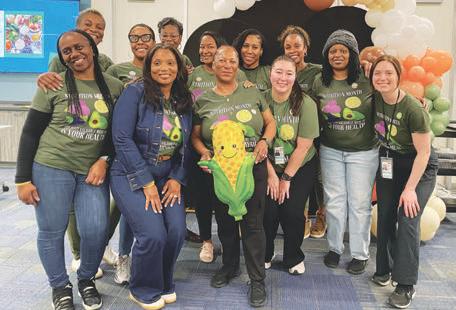
This National Nutrition Month, DACL brought wellness to life with interactive demos, live activations, and fresh food giveaways—all designed to inspire healthier habits and stronger communities. From learning to tasting, Team DACL experienced firsthand how good nutrition fuels vibrant living. A special thank you to DACL’s amazing Nutrition Team.
Ward 5
Model Cities Senior Wellness Center
1901 Evarts Street, NE, Washington, DC 20018
Phone: (202) 635-1900
Ward 6
Hayes Senior Wellness Center
500 K Street, NE, Washington, DC 20002
Phone: (202) 727-0357
Ward 7
Washington Seniors Wellness Center
3001 Alabama Avenue, SE, Washington, DC 20020
Phone: (202) 581-6010
Ward 8
Congress Heights Senior Wellness Center
3500 Martin Luther King, Jr. Avenue, SE, Washington, DC 20032
Phone: (202) 563-7225
April also encourages us to think beyond ourselves
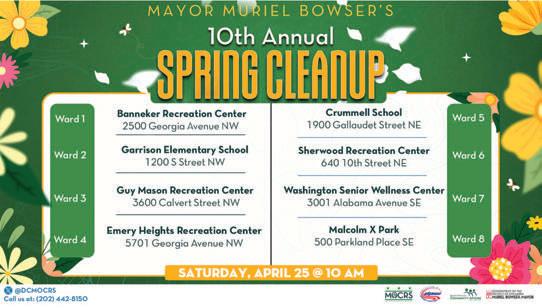
and consider the environment around us. As we celebrate Earth Day, we reflect on this year’s theme: “Our Power, Our Planet.” This message reminds us that protecting the Earth is a shared responsibility. Simple actions like recycling, conserving energy, planting flowers or trees, and keeping our neighborhoods clean can have a lasting impact on our community.
I encourage you to care for yourselves and the lives around you. When we take steps to nurture our health, manage stress, eat well, and protect our environment, we strengthen not only ourselves but our entire community.
Here is to a healthy, peaceful, and vibrant April.
In Ser vice,
Charon P.W. Hines Director, Department of Aging and Community Living
Events DC’s 3rd Annual Blossom Tea
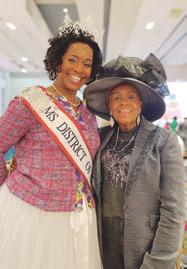
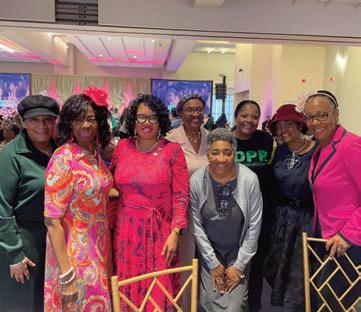
Spring was in full bloom at the Third Annual Blossom Tea. District seniors had an unforgettable time celebrating community, connection, and culture over tea, treats, and great company. From beautiful moments to meaningful conversations, this event truly captured the spirit of the season.
DC Department of Aging and Community Living for DC senior residents. Advertising contained in the Beacon is not endorsed by the DC Department of Aging and Community Living or by the publisher.
Director
Charon P.W. Hines
Editor
Amanda Washington
Photographer
Estefani Legge
Living Boldly is published by the Information Office of the
Citizen scientists are down to earth
By Glenda C. Booth
During her childhood in Atlantic City, New Jersey, Jill MacNeice was always in the water, dreaming of scuba diving with octopuses and legendary undersea explorer Jacques Cousteau.
Now living in Washington, D.C., she is still in the water, taking water samples from the Potomac River with a volunteer team of the Potomac Riverkeeper Network, a watchdog advocacy group that combats pollution and advocates for clean water. She’s one of thousands of Americans who spend their free time as “citizen scientists,” gathering data for research and other projects.
National Geographic defines citizen science as “the practice of public participation and collaboration in scientific research to increase scientific knowledge.” Projects usually do not require specialized knowledge, and volunteers often train new ones.
One of the oldest citizen-science projects is the National Audubon Society’s annual Christmas Bird Count, started in 1900. Thousands of Americans join volunteers in 20 other countries to compile the annual census.
“We truly value the work of citizen scientists,” Libby Lyons, president of a local Audubon chapter called the Northern Virginia Bird Alliance, said in an email. “For decades, they have organized local volunteers to collect data, which give … valuable insights into changes in bird populations and the environment and help mitigate threats to birds and other wildlife.”
Local impact
The importance of MacNeice’s work was accentuated last winter, when a Maryland sewer line collapse sent more than 200 million gallons of raw sewage into the Potomac River, the drinking water source for five million people in the Washington region.
From April to October, MacNeice takes weekly water samples at sites along the Potomac River from Maryland’s Seneca Creek to Belle View Marina in Fairfax County, Virginia, part of a network that extends to Colonial Beach, Virginia.
She samples for e. coli bacteria and turbidity, records air and water temperatures, and notes weather conditions. Within five hours, her samples arrive at the organization’s floating laboratory at National Harbor, where analysts determine if the water is safe.
MacNeice kayaks on the Potomac yearround, but her volunteer work has introduced her to “many interesting spots I never knew about,” she said.
“This [project] is a great opportunity to participate in citizen science and work on something dear to my heart that makes a difference. When you spread it out over many people, it becomes important — and that’s kind of special.”
As a former digital information designer for Marriott and the Library of Congress, MacNeice is also calling on her professional
skills and digitizing the riverkeepers’ information collection processes.
“In this work, I can combine my professional skills with with childhood fantasies,” she said.
Birdman of Annandale
Identifying birds and analyzing their behavior is not hush-hush top secret like Larry Cartwright’s former career in military intelligence for the Defense Intelligence Agency, but it is just as intriguing for the Annandale resident, a longtime birdwatcher, teacher and student.
Cartwright, who studied the clandestine military machinations of the Soviet Union, Iraq and Afghanistan, retired in 2014. Now he often leaves home before sunrise, binoculars and spotting scope in hand, to scour the skies, waterways, ground and trees for birds.
Since 1993, he has led an annual breeding bird survey for the Friends of Dyke Marsh, a survey that does not just identify the birds in the Fairfax County marsh but confirms they are, in fact, breeding. Volunteers observe and record those telltale behaviors, like taking nesting materials to a nest or feeding nestlings.
Cartwright is so enthralled by birds that he organizes three additional annual surveys: the Northern Virginia Bird Alliance’s winter waterfowl survey, since 2008; the bluebird nestbox survey at Huntley Meadows Park, since 2000; and the Audubon Christmas Bird Count in Northern Virginia and Maryland, since 2004. For each of them, he recruits volunteers and prepares detailed reports.
“I’m fascinated by birds,” he explained. “In today’s world, everything online seems contrived. When I go into the woods and see nature, that is the one thing you can bet on. It’s a true aspect of life. They breed, are born, live and die. It’s a reality that we share.”
Not surprisingly, Cartwright teaches bird-related classes at Northern Virginia Community College. Birds have long intrigued people, from early sculptors to the writers of the Bible to 18th-century Japanese artists, he pointed out.
Cartwright’s curiosity about birds started in childhood when he accompanied his uncle in Pennsylvania on hunting trips.
“Sitting in a deer stand freezing my butt off, I became fascinated when a pileated woodpecker would fly by,” he said. He was mesmerized by the grouses’ drumming and elaborate courtship displays.
“The depressing part is that some birds are disappearing,” he lamented. “If it all disappears, the world will be a very sad place to live in. What affects them affects us.”
Cartwright cites the adverse impacts of climate change as “one of our biggest challenges,” but adds, “There’s something we can do about it. The more you do, the more you learn.”
Gung-ho for native plants
When Clifton resident Margaret Fisher
read entomologist Doug Tallamy’s first book, Bringing Nature Home, “It completely changed my life,” she said. “The book was revolutionary.”
The book maintains that everyone can address the biodiversity crisis by planting native plants, which, Fisher pointed out, are “the basis of the ecosystem that feed the insects that birds eat. Without native plants, we won’t have insects, birds or anything else.”
Fisher, a rheumatologist and internal medicine physician for Kaiser Permanente, got hooked on native plants after she retired from her medical career in 2017.
While helping a local high school with their fundraiser, she decided that instead of compiling their traditional recipe book, she would write a booklet of gardening tips and explore how to garden in an environmentally beneficial way. Then she went door-todoor in her town of Clifton and signed up 110 property owners who promised not to use insecticides.
These first steps inspired her to bolster a fledgling organization, Plant NOVA Natives, a coalition designed to influence the landscaping culture of Northern Virginia. For the last 12 years, she has expanded the group to more than 100 partners, agencies, nonprofits and garden centers.
She helped write Native Plants for Northern Virginia and organized 65 volunteers to label native plants in garden centers so customers don’t have to research whether a plant is native or not.
“The centers really like it, and we’ve seen a noticeable increased inventory of native plants,” she said.
Fisher conducts conferences for landscape professionals in English in summer and Spanish in winter, encouraging them to
use native plants.
She also manages Fairfax Trees Rescuers, volunteers who help the million trees at risk in Fairfax County from infestations like English ivy.
“If we don’t do this as a community-wide effort, by the end of century, we will have lost most of native trees and natural areas,” Fisher said. “We must act now when we can prevent that. The longer we wait, the more expensive it gets.”
Another priority is the pollinator pathways project, which encourages neighbors to band together and create connected corridors, avoid insecticide use, and plant native plants.
With five neighborhoods on board so far, Fisher is pleased to see momentum growing.
“We make it easy for someone to do something, and they will think of themselves as environmentalists. If we can get them to do it, they will be more committed and do more,” she said.
“If you hope people will act and assume only one percent will, one percent of 1.2 million people in Fairfax County is still a lot of people. I don’t think it’s impossible, but we need a lot of dedicated people to make it happen,” she said.
Whether it’s saving injured bats, monitoring frogs, analyzing spring buds, counting salamander eggs in vernal pools or digging for artifacts, citizen scientists are giving back — and providing some human capital and data to improve our world.
“I have a motivation to do good things in the world, to help others,” Fisher said.
“It’s fun to actually become the steward of your property and save the little insects and birds right here. Every time you do that, you are taking a step to saving our environment.”
In Key West, Florida, older adults take part in the Audubon’s annual Christmas Bird Count, the longest-running citizen scientist project in the world.
PHOTO BY LUKE FRANKE COURTESY OF AUDUBON
What are the healthiest breakfast cereals?
By Lacey Muinos
While breakfast cereal is convenient, is it actually a healthy choice?
The contents of those brightly colored boxes are often the source of added sugars and lacking in substantial nutritional value, according to dietitians like Patricia Bannan, RDN.
But this doesn’t mean you should avoid cereal altogether. The cereal aisle is quite vast, and we spoke to registered dietitians about what to look for and what to avoid.
It turns out that the healthiest cereals are made with whole-grain ingredients. Read the nutrition label on the box to find the ones that are low in or free from added sugars and high in dietary fiber.
1. Whole-grain oat cereal
Oats are considered a cereal grain, so it’s no surprise that you’ll find them in some cereals. This type of cereal tends to be high in beneficial fiber. “Cereals made from whole-grain oats are particularly beneficial, as they contain beta-glucan — a type of soluble fiber that’s excellent for heart health,” Bannan said. She recommends original Cheerios.
2. Shredded wheat cereal
This variety of cereal comes recommended by both Bannan and Jenna Volpe, RDN, for its nutrition and simplicity. “Shredded wheat is 100% whole grain, and provides fiber as well as B vitamins and minerals,” Volpe explained.
Options like shredded wheat cereal have a simple ingredient list, just whole grain wheat, Bannan pointed out. However, you’ll want to watch for added sugars in this cereal type.
3. Bran cereal
Bran refers to the outer layers of certain grains, such as wheat and oats, and it’s full of nutrients. You may have heard of bran cereal, which is particularly high in fiber. If you struggle to find high-fiber cereals, you should have no issue with this category of cereal. For example, the Fiber One Bran Cereal provides a whopping 18 grams of fiber and zero added sugars per serving, Bannan notes.
4. Brown-rice cereal
“If you like mainstream cereals, try brown-rice crisps or puffs,” Volpe said. They have a similar texture and mouthfeel, but are made with better ingredients.
“Whole-grain brown rice is a good source of fiber, antioxidants and nutrients,” Volpe added, noting that this type of cereal is less likely to spike blood sugar levels. Nature’s Path Crispy Rice Cereal is one to look for.
5. Sprouted cereal
Whole-grain cereals are the gold standard for healthiest cereals, but sprouted cereals are just as good — if not better. Sprouted cereals are also made from whole grains, but the grains have been germinated, making some of the nutrients more bioavailable.
Both Bannan and Volpe recommend the Ezekiel 4:9 Almond Flake Cereal, which is made from sprouted wheat, barley, millet, lentils and more.
6. Granola
Granola is a sweet, crunchy topping perfect for snacking or adding to yogurt, but you can also add milk and enjoy it like cereal. However, not all granola is made equally,
Volpe notes. “Granola often contains added sugars to make it so sweet, so you’ll want to check the ingredients and nutrition facts.”
Cascadian Farms Cinnamon Apple Granola, which is sweetened with dates, is an excellent choice because it has no sugar added and 5 grams of both fiber and protein per serving.
7. Muesli
Muesli contains similar ingredients to granola, but it’s uncooked, making it more versatile. Enjoy it hot, cold, soaked
overnight, or as a topping for yogurt.
“Muesli not only provides fiber for healthy digestion and satiety, but it also provides protein and healthy fats,” Bannan said. She recommends the Bob’s Red Mill Old Country Style Muesli.
Real Simple magazine provides smart, realistic solutions to everyday challenges. Online at realsimple.com.
• Eye Care for All Ages • Specialists in Cataracts, Glaucoma, Diabetic Retinopathy and Macular Degeneration • Contact Lens Specialists • Plastic & Reconstructive Eye Surgery Full In-House Optical Department Outpatient No-Stitch Cataract Surgery • Laser Surgery MEDICARE ASSIGNMENT ACCEPTED
LENARD H. HAMMER, M.D., F.A.C.S.
GORDON LUI, M.D.
SCOTT B. BECKER, M.D.
YIYUN ZHOU, M.D.
A limited-run podcast exploring the new life stories that begin when careers end.
Air traffic controllers ushering at Madison Square Garden... A phone company repairman creating designer shoes... A Shakespeare scholar playing the banjo...
Through personal stories and conversations, this sixpart podcast examines how people rethink purpose, community, and creativity in the years that follow full-time work.
Retirement shouldn’t mean just sitting on the couch. It’s an opportunity to try new things, explore passions and hobbies, and engage.”
—Host Kojo Nnamdi “
Chicken, grapes and pecans make a tasty lunch
BY EVA
By Lauren Chambers
I make these wraps most weekdays for lunch as they’re easy, tasty and packed with protein. They’re also loaded with fresh raw fruits and veggies.
While I mostly opt for the lettuce wrap route, the chicken salad also works well as a spread for crackers or a sandwich filling with toasted bread.
Super Easy Chopped Chicken Salad Lettuce Wraps
Prep time: 20 minutes
Cooking: None
Serves 2
Ingredients:
2 cups cooked shredded or cubed organic chicken breast (I love using rotisserie chicken for convenience)
2 small celery ribs, diced ½cup purple grapes, rinsed and quartered
¼cup pecans, chopped 1 green onion, diced
2 tablespoons finely chopped fresh parsley
1 tablespoon finely chopped fresh chives
1 tablespoon finely chopped fresh dill or tarragon (optional)
BEACON BITS
Ongoing
½ cup avocado oil mayonnaise or full-fat unsweetened Greek yogurt
Juice of 1 small lemon (1 to 2 tablespoons)
1 teaspoon Dijon mustard
½ teaspoon sea salt
Black pepper to taste
6 large romaine lettuce leaves, rinsed and patted dry
Directions:
In a medium bowl, combine the chicken, celery, grapes, pecans, green onion, parsley, chives and dill or tarragon (if using).
Add the mayo, lemon juice, mustard, salt and pepper to the bowl and stir until well mixed. Spoon the mixture onto the center of the romaine leaves and enjoy.
Lauren Chambers is a nutrition and hormone health coach and founder of So Fresh N So Green, a business dedicated to providing clients with delicious recipes, meal plans, natural remedies and online courses.
Pepco encourages customers to prepare now to save on energy costs this summer: Set your thermostat 7 to 10 degrees Fahrenheit higher, if health permits; get your AC unit serviced and cleaned; test your home’s energy efficiency with an infrared thermometer; track your energy usage; keep cool air in and hot air out with weatherstripping; and keep the sun out with awnings and curtains. For more in-depth information and other resources, visit bit.ly/SpringEnergyEfficiencyTips.
Chicken salad on lettuce, rather than bread, makes a high-protein, low-carbohydrate lunch. Celery and pecans add a little crunch.
PHOTO
KOLENKO/VORACIOUS
Virtual reality opens doors for older people
By Michael Liedtke
Like many retirement communities, The Terraces serves as a tranquil refuge for a nucleus of older people who no longer can travel to faraway places or engage in bold adventures.
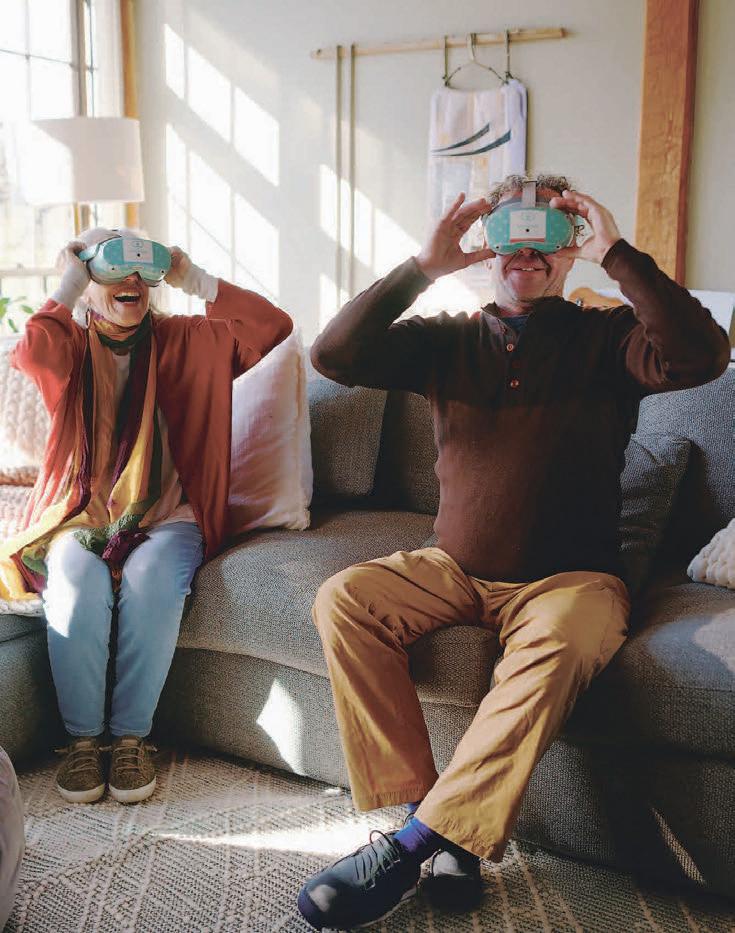
But they can still be thrust back to their days of wanderlust and thrill-seeking whenever caretakers at the community in Los Gatos, California, schedule a date for residents — many of whom are in their 80s and 90s — to take turns donning virtual-reality (VR) headsets.
Within a matter of minutes, the headsets can transport them to Europe, immerse them in the ocean depths or send them soaring on breathtaking hang-gliding expeditions while they sit near each other.
The selection of VR programming was cu-
rated by Rendever, a company that has turned a sometimes-isolating form of technology into a catalyst for better cognition and social connections in 800 retirement communities in the United States and Canada.
A group of The Terraces residents who participated in a VR session last year found themselves paddling their arms alongside their chairs as they swam with a pod of dolphins while watching one of Rendever’s 3D programs.
“We got to go underwater and didn’t even have to hold our breath!” exclaimed 81-year-old Ginny Baird following the virtual submersion.
During a session featuring a virtual ride in a hot-air balloon, one resident gasped, “Oh my God!” Another shuddered, saying, “It’s hard to watch!”
Travel to childhood home
The Rendever technology can also be used to virtually take older adults back to the places where they grew up as children. For some, it will be the first time they’ve seen their hometowns in decades.
A virtual trip to her childhood neighborhood in New York City’s Queens borough helped sell Sue Livingstone, 84, on the merits of the VR technology even though she still is able to get out more often than many residents of The Terraces, which is located 55 miles south of San Francisco.
“It isn’t just about being able to see it again; it’s about all the memories that it brings back,” Livingstone said.
“There are a few people living here who never really leave their comfort zones. But if you could entice them to come down to try out a headset, they might find that they really enjoy it,” she added.
Tested in D.C.
of a plane again. Through Rendever and their creativity, we were able to recreate that type of experience for him,” Kim Eichinger, executive director of Dynamic Living at Country Meadow, told a local TV station.
Adrian Marshall, The Terraces’ community life director, said that once word about a VR experience spreads from one resident to another, more of the uninitiated typically become curious enough to try it out.
“It turns into a conversation starter for them. It really does connect people,” Marshall said of Rendever’s VR programming.
“It helps create a human bridge that makes them realize they share certain similarities and interests. It turns the artificial world into reality.”
Grant from NIH
Rendever, based in Somerville, Massachusetts, hopes to build upon its senior living platform with a recent grant from the National Institutes of Health that will provide nearly $4.5 million to study ways to reduce social isolation among seniors living at home and their caregivers.
The technology is catching on in our area. At Inspīr Embassy Row in Washington, D.C., residents can virtually visit faraway landmarks, beaches or cities once or twice a week.
VR has proved helpful for memory-care residents, who can reconnect with familiar experiences and ease agitation.
The tech company also offers dementia and empathy training via VR, showing staff, caregivers and family members what it’s like to live with dementia.
“Virtual reality allows residents to revisit memories or explore new places, and we have consistently seen improvements in mood and reduced anxiety after virtual reality sessions,” said Madeline Diaz, memory care director at Inspīr Embassy Row.
“It has truly become an important tool in supporting our residents’ well-being and sense of independence.”
Another community, Country Meadows, with locations in Frederick, Maryland, and York, Pennsylvania, partnered with Rendever to allow its residents to fly.
“We have a World War II veteran who wanted to experience being in the cockpit
Some studies have found VR programming presented in a limited viewing format can help older people maintain and improve cognitive functions, burnish memories and foster social connections with their families and fellow residents of care facilities. Experts say the technology may be useful as an addition to and not a replacement for other activities.
“There is always a risk of too much screen time,” said Kate Dupuis, a neuropsychologist and professor who studies aging issues at Sheridan College in Canada.
Homecrest House is a non-profit, affordable, subsidized senior adult community nestled amidst 10 acres of beautifully landscaped grounds with its own lake, neighboring Leisure World. The three residential buildings on the B'nai B'rith Homecrest campus provide 235 apartments for Independent Living, some designed for adults with physical mobility challenges, and 42 apartments offering Enhanced Care Services. We invite you to come look at our elegant new appearance. Don't delay, call for a personalized tour now at 301-598-4000 ext. 79 or visit us at www.homecresthouse.org.
Donate your castoffs to a good cause
By Glenda C. Booth
A fire-engine-red taffeta flapper dress hung in my closet for decades, a snazzy frock that my mother stitched for my middle-school play. Because she made it, I hated to part with it.
My solution? I finally donated it to the little history museum in my hometown, where curators were delighted to display it, along with my two teenage charm bracelets.
Many seniors, as they try to downsize and declutter, ask themselves why they’ve kept so much stuff over the years. Frank Lloyd Wright famously did not include basements in many of his houses because he believed they encouraged clutter and materialism. Yet many attics, closets and cabinets are also crammed with unused, unneeded odds and ends. Instead of spending hours on eBay or hauling boxes to the landfill, your castoffs can do some good in the world or address a need. Here are a few options:
Clothes
More than 85% of Americans’ clothes end up in the trash — over 100 pounds per person per year, according to Helpsy. This organization finds a way to reuse or recycle used clothing. You can locate a bin or schedule a home pickup at helpsy.com.
Some nonprofits need professional clothing. Suited for Change redistributes women’s office attire and shoes to job seekers. Donate in person to their downtown D.C. office or call (202) 293-0351.
And as prom season approaches, those fancy gowns, purses and other accoutrements you don’t need could help a teenager go to the prom.
The Prom Boutique, run by the Junior League of Northern Virginia, offers gently used dresses, accessories and makeup to high school students. Visit jlnv.org/jlnvprom-dress-drive or call (703) 442-4163. Montgomery County, Maryland, accepts suits and dresses for its Prom Couture
Closet; call (240) 463-2442 to donate.
If you have a stockpile of business-casual clothing, you can help out teachers-to-be at George Mason University who can’t afford it by donating to the Teacher Clothing Closet. Visit go.gmu.edu/teachercloset or email sray4@gmu.edu.
Jewelry
Much jewelry ends up stashed away, rarely worn. The volunteer-run Association of Albanian Girls and Women (AAGW) helps survivors of sex trafficking and domestic violence in Albania overcome trauma and reclaim their lives.
You can support them by donating gently used costume jewelry to their partner, Alexandria’s The World Crafted. Survivors will remake it into bracelets, necklaces and earrings for sale. All proceeds help survivors. Visit aagw.org for details.
To help domestic violence survivors closer to home, donate to DC Safe’s shelter, which accepts linens, towels, hats, scarves, gloves, underwear and hair-care items, among other items, to help survivors of domestic violence. Email donations@dcsafe.org to schedule a pickup.
Tools, building materials
Clothes aren’t the only items you can donate to a good cause. Virginia retiree Betsy Martin’s late husband was a woodworker, and she found a home for his table saw and drill press at the local high school’s technical education program, expensive items the school welcomed. Check with local high schools to see if they accept donations.
Habitat for Humanity, which builds and repairs homes, accepts new and salvageable building materials. Visit habitatvirginia.org to schedule a pickup. In Maryland, call (301) 926-4104.
Books
The local elementary school that educat-
INDEPENDENT LIVING COMMUNITY
6251 Old Dominion Drive McLean, VA 22101 www.vinsonhall.org
Trends come and go, but there are certain things that are built to last. Vinson Hall is one. In 1959, the Naval Officers’ Wives’ Club of Washington, D.C., wanted to create a community for their widowed members that was “secure, companionable and dignified.” Two years later, the Navy Marine Coast Guard Residence Foundation was formed, and in 1969 Vinson Hall opened its doors. Over five decades, Vinson Hall transformed from an exclusive haven for naval widows into a welcoming community open to all branches of military service, government agencies, and eventually, anyone seeking exceptional retirement living. Today, Vinson Hall is embarking on Project RISE (Redevelop, Inspire, Strengthen, Evolve), a thoughtfully planned expansion adding 126 new independent living residences and enhanced community spaces. Vinson Hall’s secret? Celebrating its legacy while embracing change.
ed my sons and grandchildren took my sixinch-thick, 2,663-page Webster’s Dictionary. Schools often welcome reference books in good condition, and some libraries have secondhand bookstores where you can donate your old books.
In addition, many prisons need books for inmates to help reduce isolation and despair. Visit prisonbookprogram.org/prisonbooknetwork and booksbehindbars.info/about.
Sports equipment
Boxed up in many attics are sports paraphernalia that your children once cherished. They grew up, moved out and left behind tennis rackets, baseball bats, caps and jerseys.
To help more youngsters play sports, Leveling the Playing Field accepts donations of gently used equipment and sports gear, like cleats, helmets, bats, skates, shin guards and more. Find a donation bin location at levelingtheplayingfield.org or call (202) 556-4650.
Electronics
You can support those who served our country by giving electronics to Tech for Troops, a veterans’ organization that refurbishes used electronic devices to help train veterans in need at no or low cost.
The organization takes, for example, work-
ing and non-working laptops with power adapters, working flat panel monitors, iPads, tablets, cell phones, keyboards, mice and other computer parts and some wiring. They wipe all hard drives prior to refurbishing or recycling them. Visit techfortroops.org.
Memorabilia
Many local and state historical societies and museums accept family photographs, written materials and objects that document the past. The Lillian and Albert Small Capital Jewish Museum, for example, collects items related to “the Jewish experience in the DMV.”
The Library of Virginia is now home to about 50 vintage postcards my parents saved from places all around the state. Visit capitaljewishmuseum.org and lva.virginia.gov.
Household Items, furniture
That end table or vintage lamp from the 1950s? Try local theaters, including school drama departments. They often need objects from many eras.
People who lose their homes in floods or fires and recent refugees need to furnish their new homes. Many churches and other groups help people resettle. To donate your housewares to refugees, contact Homes
Raise Your Expectations FOR RETIREMENT
Imagine a retirement community investing in your future as thoughtfully as you have invested in your life. Introducing Project RISE, the next phase of growth at Vinson Hall. This transformative expansion will bring 126 new independent living residences, expanded amenities, and spaces designed to elevate everyday living.
READY TO START PLANNING YOUR FUTURE? Demand
Virtual reality
From page B-2
“But if you use [VR] cautiously, with meaning and purpose, it can be very helpful. It can be an opportunity for the elderly to engage with someone and share a sense of wonder.”
Never too old for tech
VR headsets may be an easier way for older people to interact with technology instead of fumbling around with a smartphone or another device that requires nav-
BEACON BITS
May 16
igating buttons or other mechanisms, said Pallabi Bhowmick, a researcher at the University of Illinois Urbana-Champaign who is examining the use of VR with older adults.
“The stereotype that older adults aren’t willing to try new technology needs to change because they are willing and want to adapt to technologies that are meaningful to them,” Bhowmick said.
“Besides helping them to relieve stress, be entertained and connect with other people, there is an intergenerational aspect that might help them build their relationships
GAITHERSBURG BOOK FESTIVAL
The Gaithersburg Book Festival celebrates books, writers and literary excellence. This free event, which includes free parking, takes place on Sat., May 16 from 10 a.m. to 6 p.m. at Bohrer Park, 506 S. Frederick Ave., Gaithersburg, MD. For a complete schedule of the festival’s programming, visit gaithersburgbookfestival.org.
REHABILITATION
18100 Slade School Road
Sandy Spring, MD 20860 www.bgf.org
Imagine an extraordinary staff and the best therapies and equipment—in a beautiful environment that rejuvenates and restores. Physical therapy spaces bathed in sunlight. The quiet comfort of a garden walk or relaxing massage. Imagine getting back to the activities that matter to you. Our new, state-of-the-art rehab addition at Brooke Grove Rehabilitation and Nursing Center offers innovative therapy services for seniors, including NeuroGym® Technologies mobility training, the Korebalance system and much more. Visit us to see why Brooke Grove Retirement Village is one of the most sought-after continuing-care retirement communities in the state. Rehab here is simply different… because what surrounds you really matters.
with younger people who find out they use VR and say, ‘Grandpa is cool!’”
Rendever CEO Kyle Rand’s interest in helping his own grandmother deal with the emotional and mental challenges of aging pushed him down a path that led him to cofound the company in 2016 after studying neuroengineering at Duke University.
“What really fascinates me about humans is just how much our brain depends on social connection and how much we learn from others,” Rand said.
“A group of elderly residents who don’t really know each other that well can come together, spend 30 minutes in a VR experience together and then find themselves sitting down to have lunch together while continuing a conversation about the experience.”
It’s a large enough market that another VR specialist, Dallas-based Mynd Immersive, competes against Rendever with services tailored for senior living communities.
Besides helping create social connections, the VR programming from both Rendever and Mynd has been employed as a possible tool for potentially slowing down the deleterious effects of dementia. That’s how another Silicon Valley retirement village, The
Donating
From page B-3
Not Borders at homesnotborders.org.
A Wider Circle helps people set up homes across the Washington region. They accept furniture, rugs, professional clothing, kitchenware and toys, for example. Visit awidercircle.org or schedule a pickup three months in advance by calling (301) 608-3504.
To support veterans in need, Vietnam Veterans of America accepts housewares, radios, televisions, bedding, drapes, small appliances, small furniture and more. Visit vva.org/pickup-locations.
Vehicles
Your old car, which may get very little as
Forum, sometimes uses the technology.
Bob Rogallo, a Forum resident with dementia that has rendered him speechless, seemed to be enjoying taking a virtual hike through Glacier National Park in Montana as he nodded and smiled while celebrating his 83rd birthday with his wife of 61 years.
Sallie Rogallo, who doesn’t have dementia, said the experience brought back fond memories of the couple’s visits to the same park during the more than 30 years they spent cruising around the U.S. in their recreational vehicle.
“It made me wish I was 30 years younger so I could do it again,” she said of the virtual visit to Glacier.
In another session at The Forum, 93year-old Almut Schultz laughed with delight while viewing a virtual classical music performance at the Red Rocks Amphitheatre in Colorado and later seemed to want to play with a puppy frolicking around in her VR headset.
“That was quite a session we had there,” Schultz said with a big grin after she took off her headset and returned to reality.
a trade-in, can help high school students learn automobile repair. Many high schools accept vehicles to train students in automotive mechanics and care.
Washington’s public radio station, WAMU, takes vehicles, operating or not. Visit wamu.org/vehicle-donations or call their vehicle experts at 1-866-WAMU-444.
Habitat for Humanity also accepts cars, trucks, boats, RVs and other vehicles to help build affordable homes. Visit habitat.org/support/donate-your-car.
Some organizations will schedule pickups, including Vietnam Veterans of America, the Salvation Army and Goodwill. And don’t forget, you may get a tax deduction for donations, but be sure to get a receipt and consult with a tax advisor before submitting the paperwork.
April–May 2026
UPCOMING SEMINARS & CLASSES
at Brooke Grove retirement village
As experts in senior care, Brooke Grove Retirement Village is pleased to offer seminars and classes that promote physical, spiritual and mental well-being.
All programs will be held in-person in the Gathering Room at Brooke Grove Rehabilitation and Nursing Center, located at 18131 Slade School Road on the Sandy Spring, Maryland, campus of Brooke Grove Retirement Village. Register as indicated below or contact Toni Davis at tdavis@bgf.org or call 301-388-7209 with questions.
HEALTHY LIVING CLASS:
“GENTLE CHAIR YOGA FOR OLDER ADULTS”
Offered in partnership with Uplift Yoga April 13 through May 22
MONDAYS & FRIDAYS · 1-1:45PM.
Yoga benefits EVERYBODY! This gentle class is designed for older adults and accessible to all, with poses done on a mat, in a chair, or standing with support. At a slow, mindful pace, you’ll build strength, balance, flexibility, and mobility.
$40 for entire six-week session.
To register, visit: bit.ly/CHAIRyogaBG
LIVING WELL SEMINAR: “SUPPORT MENTAL AND COGNITIVE HEALTH THROUGH NUTRITION & LIFESTYLE”
Presented by Lisa Jo Finstrom, MS, CNS, LDN THURSDAY, APRIL 16 · 10:30-11:45 A.M.
Learn evidence-based information to help you or a loved one optimize mental health and avoid cognitive decline. We’ll delve into nutrition and lifestyle considerations with time for questions.
FREE. To register, visit: bit.ly/NutritionBG
INDEPENDENT LIVING OPEN HOUSE
TUESDAY, MAY 19 • 11 A.M.–2 P.M.
OPTIONAL INFORMATION SESSIONS AT 11:15 A.M. & 12:15 P.M.
Westbrooke Clubhouse 18310 Slade School Road, Sandy Spring, MD 20860
Tour our independent living cottages, meet current residents, explore Westbrooke Clubhouse’s restaurant and fitness center and enjoy our 220-acre campus of lush pastures and hardwood forest.
Learn how to become a no-obligation priority list member, examine financial options and review the long-term benefits of a secure lifestyle.
LIVING WELL SEMINAR: “BUILDING A BETTER TOMORROW: HOW MONTGOMERY COUNTY IS BECOMING AGE-FRIENDLY”
MONDAY, APRIL 20 · 10:30-11:45 A.M.
Learn how Montgomery County Government is enhancing life for older adults through transportation, technology access, housing, and wellness initiatives. Join us to explore resources and programs designed to help seniors stay active, connected, and supported.
FREE. To register, visit: bit.ly/ResourceMeBG
LIVING WELL SEMINAR: “BRAIN HEALTH AS YOU AGE”
Presented by Dr. Steven Simmons
THURSDAY, MAY 21 · 10:30-11:45 A.M.
Keep your brain healthy as you age by practicing proper maintenance and learning to identify problems as they arise. Dr. Simmons, former house call physician and MedStar Aging Services medical Director at Brook Grove, will review normal and abnormal decline and best practices for addressing both. It’s never too soon to start preventing cognitive decline, or understanding it once it’s begun.
FREE. To register, visit: bit.ly/MybrainBG
Find the right retirement community for you
By Joel Theisen
In my hometown, my aunt worked at what everybody called the “old folks’ home.” I used to tag along as a boy because I liked the people who lived there.
In the old folks’ home, ageist as that term is, people had roommates and ate community meals and maybe joined a weekly bingo game for entertainment.
Oh, how times have changed.
Four decades later, shopping for a new place for my mom, 85, and my dad, 87, to live was a stark reminder of just how much housing for older people has changed. The old folks’ home? Maybe it’s still out there, but it’s definitely not the norm.
Fortunately the marketplace has been transformed in a way that gives older people unprecedented choices.
As a licensed nurse and CEO of a senior health company serving 5,500 people each day in their homes and in more than 45 senior living communities, I know something about how senior living has improved over the years — and how to look for the best fit for you.
Modern options
With more Americans turning 65 now
than at any time in history — more than 4 million per year, a total of 76 million people in the biggest generation of older people ever — the balance of power has shifted toward consumers, and older people are moving the market toward their wants.
After decades of transforming business, politics, music, education, arts and culture, Boomers are changing the way America ages.
The biggest shift from the former days of the old folks’ home is all the choices in modern senior living.
An AARP survey found that three of every four older people want to age in place at home, but professional home healthcare aides are increasingly hard to find, with agencies reporting major labor shortages that will grow to as many as 2.5 million unfilled jobs in the next decade.
Many older people are instead opting for community life. This route has developed the newest options that far surpass the former basics of the old folks’ home.
Today, older people can move to:
• Age 55-plus communities for independent living with shared amenities
• Assisted living with staff that helps with bathing, dressing and eating
Please patronize our advertisers.
• Memory care for people with Alzheimer’s and dementia
• Nursing homes with specialist nursing facilities and round-the-clock medical care
• Managed communities that allow people to live within all of the stages mentioned above as health changes over time
The key here is comparison shopping. It’s crucial to visit prospective senior living options before you need them — the idea is to see if the community, culture and space feel right for you. Many communities offer overnight stays.
Though some liken the experience of shopping for senior communities to kicking the tires on a prospective car, I think it should be more like considering a college — you may be living there for years, and the experience can change your life.
Key items for your checklist
While the typical old folks’ home of my youth had a one-size-fits-all approach to the people who lived there, modern communities reflect the Boomer culture that values personal control over health choices.
Most older people have numerous doctors and specialists in several different medical offices. It pays to look for a senior community with professionals who work as a point person to coordinate healthcare. [Ed. Note: Some retirement communities offer on-
site medical and dental appointments.]
Today there’s much greater priority on daily wellness and prevention. Workout facilities have become standard for both exercise and rehab; many offer staff who are physical therapists, personal trainers and dieticians.
Shopping for the right senior living experience means making sure the dining options serve healthy food and accommodate individual requirements for people who want vegetarian, gluten-free or low-salt diets.
Another important shopping point is to see how much personal risk each community allows you to have. Few older people want to live in a protective cocoon. How important is it for you to keep your own schedule, be outside daily or continue hobbies that may carry consequences, such as woodworking or pickleball? Check out the community ethic before committing to a new place to live.
Not too long ago, the old folks’ home was designed and run to be a basic safety net. In our lifetimes, though, senior living has become more than just a place to go — it can be a place to grow.
Last month, the first residents moved into a brand-new luxury senior living building in Alexandria, Virginia. A ribbon-cutting ceremony will make the opening of The Riviera official this month.
Located next to The Landing, an assisted living and memory-care rental building, The Riviera is an independent living community with 129 apartments for rent. If and when residents need more care, they can move to the sister property.
Members at The Riviera will experience a vibrant, engaging lifestyle from the moment they arrive,” said Jamie Houston, general manager and campus executive of The Riviera and The Landing. “We’ve created a community that combines maintenance-free living with op-
Apr. 25
portunities for connection, enrichment, and personal growth, along with the reassurance of support through our relationship with The Landing if needs evolve. It’s about giving members the freedom to fully enjoy this next chapter with both excitement and confidence.
The Riviera, developed by Silverstone Senior Living, is managed by Greystone Communities, whose communities include The Trillium in Tysons, Virginia, The Providence in Fairfax, Virginia, and The Landing in Alexandria, Virginia.
For more information or to schedule a visit, see rivieraalexandria.com or call (571) 454-9798.
A tier above assisted living
Inspīr Embassy Row, a luxury senior living community in downtown Washington, D.C., launched a new “tier” in January. Called Aura, the new lifestyle program is a step above traditional assisted living and below traditional memory care.
“For too long, the senior care industry has
INSTITUTE OF MUSICAL TRADITIONS CONCERT
Alasdair Fraser and Natalie Haas will perform a concert exploring Scottish and global music through fiddle and cello. The concert starts at 7:30 p.m. on Sat., April 25, at the Montgomery College Cultural Arts Center, Theater One, located at 7995 Georgia Ave., Silver Spring, MD. Tickets are $25. For more information and to reserve tickets, visit bit.ly/fiddleandcello.
C&O CANAL VOLUNTEER
Ongoing
The C&O Canal National Historic Park needs volunteers to help with Canal Community Days. You can volunteer alone, with your family or through an organization. To see a full list of available positions, including Canal Steward and Quartermaster, visit canaltrust.org/programs/volunteer-programs. For more information, email volunteer@canaltrust.org or call (240) 202-2624.
offered an either-or approach: assisted living or memory care,” said Shane Herlet, CoCEO of Maplewood Senior Living and Inspīr. “Many older adults live in the in-between: a space where subtle cognitive or emotional changes require support, not limitation. Aura was created to meet that need with dignity, structure and intention.”
18
With an emphasis on daily routines, Aura is tailored for people who need extra care but still want to stay active in Inspī r’s programs such as book clubs, outings, concerts and virtual reality experiences.
For more information, email embassyrowinfo@inspirsl.com or call (202) 2932100.
OLD TOWNE GAITHERSBURG AND WASHINGTON GROVE WALK
Join the Seneca Valley Sugarloafers Volksmarch Club for a walk on Sat., April 18. Participants can start anytime between 8 and 11 a.m., with a finish time by 2 p.m. The meeting and ending point is at Java Junction, Gaithersburg MARC train station, 5 S. Summit Ave., Gaithersburg, MD. The registration fee is $3 for a 10-kilometer walk, with two 5-kilometer options available. Pets are welcome, and restrooms are accessible at the start/finish location. For more information, visit sugarloafers.org or contact Tony Laing at laingat@gmail.com or (301)980-8932, or Gary Jeffers at gary.jeffers@verizon.net or (301) 468-3346.
ASSISTED LIVING COMMUNITY
Chase House
Connecticut Avenue NW Washington, DC 20015 www.chevychasehouse.com
Chevy Chase House provides boutique assisted living for older adults looking for personalized care without compromising lifestyle and active living. In addition to having 24-hour nursing available, the community features Life Inspired, the daily activities program that promotes overall wellness, socialization, and a Chef-prepared dining experience. Unique to the Chevy Chase House is its partnership with FOX Rehab to not only provide on-site physical, occupational and speech therapies, but also employ a full-time exercise physiologist to help residents with improving balance and mobility, strength training, and fall prevention programming. Conveniently located on Connecticut Avenue in D.C. Call 202-905-0708 to schedule a tour or stop by Chevy Chase House to learn more.
COMPASSIONATE PET CARE
277 S. Washington St., Suite 210 Alexandria, VA 22314 www.paupair.com
Care that feels like home - especially when life changes or travel calls. Pau Pair provides refined, in-home pet care for older adults and families supporting loved ones. With live-in or scheduled visits, our trusted companions offer a calm, consistent presence, handling walks, meals, medication, transportation, and companionship with care and discretion. No added stress - just thoughtful, reliable support tailored to your routine. Because pets are family, and their well-being brings peace of mind. Stay independent, stay at home, and travel with confidence knowing you and your pet are cared for with genuine attention. Learn more at paupair.com.
BEACON BITS Apr.
BEACON BITS
INDEPENDENT LIVING COMMUNITY
Ashby Ponds
877-664-5445
44795 Audubon Square
Ashburn, VA 20147
AshbyPonds.com
Why Choose Senior Living at Ashby Ponds?
There are countless reasons why Ashby Ponds is ideal for your retirement. Enjoy exceptional value, worry-free living, and a community that prioritizes your well-being. Stay active and engaged with a variety of enriching amenities and activities. Plus, gain peace of mind knowing our on-site care is always available when you need it. Ashby Ponds is more than just a place to live; it’s a place to thrive. Discover why Ashburn’s premier senior living community is a great choice for you. Call 1-877-664-5445 to learn more with a free brochure.
INDEPENDENT LIVING COMMUNITY
Introducing The Grandview
1-888-645-7516
6701 Democracy Blvd., Suite 150-B
Bethesda, MD 20817
TheGrandviewSeniorLiving.com
Get to Know Vibrant Senior Living in Bethesda
The Grandview , Bethesda’s brand-new senior living community, is now open!
We’re managed by Erickson Senior Living®, an industry leader with over 40 years of experience. That means you get a premier retirement with a safety net of support.
Enjoy state-of-the-art amenities like restaurants, a fitness and aquatics center, a medical center, and more. From maintenancefree living to a wide variety of stylish residences, you get everything you need all in one place.
With over 90% of homes reserved, there’s never been a better time to learn about The Grandview. Call 1-888-645-7516 to receive your free brochure.
INDEPENDENT
877-742-4390
3140 Gracefield Road
Silver Spring, MD 20904
Riderwood.com
Silver Spring’s Premier Destination for Senior Living Riderwood is the region’s favorite continuing care retirement community for a reason. Three reasons, to be precise:
1.Residences to Fit Your Budget
Choose from a variety of residences that are free from maintenance and big on modern style.
2.Resort-Style Amenities and Activities
You’ll find opportunities for dining, fitness, entertainment, education, and more just steps from your door.
3.Services to Enhance Your Well-Being
Enjoy the convenience of an on-site medical center staffed by full-time providers, plus multiple levels of care, should your needs ever change.
Get your FREE brochure today! Call 1-877-742-4390 or visit Riderwood.com.
How to find a quality nursing home
By Jim Miller Dear Savvy Senior,
Can you give me some tips on picking a good nursing home for my father? Since his stroke, I’ve been taking care of him at home, but he’s gotten to the point where it’s too much for me to handle.
—Exhausted Daughter
Dear Exhausted,
Choosing a nursing home for a loved one that provides quality is a very important decision that requires careful evaluation and some homework. Here are some steps you can take that can help you find a good facility and avoid a bad one.
Make a list: There are several sources you can turn to for referrals to top nursing homes in your area, including the Area Agency on Aging (call 800-677-1116 or visit eldercare.acl.gov for contact information); your dad’s doctor or nearby hospital discharge planner; and friends or neighbors with a loved one in a nursing home.
Also check Medicare’s nursing home compare tool at medicare.gov/care-compare. This tool will not only help you locate nursing homes in your area, but it also provides a five-star rating system on recent health inspections, staffing, quality of care and overall rating.
Also, keep in mind that it’s always best to choose a nursing home that’s close to family members and friends who can visit often, because residents with frequent visitors usually get better care.
Call your long-term care ombudsman: This is a government official who investigates nursing home complaints and advocates for residents and their families. This person can tell you which nursing homes have had complaints or problems in the past and can help you locate a good facility. Visit LTCombudsman.org for local contact information.
Contact the nursing homes : Once you’ve narrowed your search, call the nursing homes you’re interested in to verify that they can facilitate your dad’s needs. Also, find out if they have any vacancies, what they charge, and if they accept Medicaid.
Tour your top choices : During your nursing home visit, notice the cleanness and smell of the facility. Is it homey and inviting? Does the staff seem responsive and kind to its residents?
Additionally, be sure to taste the food, and talk to the residents and their family members, if available. It’s also a good idea to make multiple visits at different times of the day and different days of the week to get a broader perspective.
And be sure to find out about their staff screening and training procedures, staff-topatient ratio and the staff turnover rate.
To help you rate your visit, Medicare offers a helpful checklist of questions to ask that you can print and take with you on your visit.
Paying for care
With nursing home costs now averaging $324 per day nationally for a semi-private room and nearly $371 for a private room, paying for care is another area you may have questions about or need assistance with. Medicare only helps pay up to 100 days of rehabilitative nursing home care, which must occur after a hospital stay of at least three days.
Most nursing home residents pay for care from either personal savings, a long-term care insurance policy, or through Medicaid once their savings are depleted. Or, if your dad is a veteran, he may be able to get funds through the VA’s Aid and Attendance benefit (see VA.gov/pension/aid-attendance-housebound). To learn more about the payment options,
7440 Spring Village Drive • Springfield, VA 22150 GreenspringCommunity.com
Greenspring. Everything You Need for Vibrant Senior Living
For active living with peace of mind, all directions point to Springfield’s premier continuing care retirement community.
Fun and Enrichment Every Day
Choose from a variety of stylish residences—all just steps from amenities like a pool, fitness center, restaurants, and more.
Outstanding
One convenient Monthly Service Package covers all utilities, property taxes, and maintenance in and around your home. Health and Well-Being
Enjoy easy access to services like an on-site medical and multiple levels of care, should your needs ever change.
Get your FREE brochure today! Call 877-589-9570 or visit GreenspringCommunity.com
Nursing home
From page B-8
ask the nursing home director. You can also get help from your State Health Insurance Assistance Program (SHIP), which provides free counseling on all Medicare and Medicaid issues. Visit aging.maryland.gov/ship or call
BEACON BITS
Apr. 16
(800) 243-3425..
And for more information, see Medicare’s booklet “Your Guide to Choosing a Nursing Home” (product #02174). You can view it online at medicare.gov/publications.
Send your questions or comments to questions@savvysenior.org, or to Savvy Senior, P.O. Box 5443, Norman, OK 73070.
EARTH DAY TALK: HARMONY THROUGH NATURE
Dr. Pru Foster will discuss the growing body of research showing that contact with nature can significantly improve health and well-being. This Earth Day celebration is free. It takes place on Thu., April 16 from 3 to 5 p.m. at the Potomac Community Recreation Center, 11315 Falls Rd., Potomac, MD. For more information and to register, visit bit.ly/EarthDaytalk, email info@PotomacCommunityVillage.org, or call (240) 221-1370.
SYMPOSIUM
ON DEMENTIA CARE
May 7
This one-day symposium, Reshaping Dementia Care Through Compassionate Connection, features leading physicians and healthcare professionals, along with the latest research, techniques and approaches for working with Alzheimer’s and dementia patients and their caregivers. You can attend either in person or virtually on Thu., May 7 from 8:30 a.m. to 2:30 p.m. at the Woodmont Country Club, 1201 Rockville Pike, Rockville, MD.Tickets range from free to $40. For more information and to register, visit bit.ly/dementiacaresymposium or call (240) 833-2407.
Woodleigh Chase
1-877-211-6968
4595 Burke Station Rd. Fairfax, VA 22032
WoodleighChase.com
Woodleigh Chase Has Everything You Need for a Vibrant Retirement.
For distinctive retirement living, look no further than Woodleigh Chase,® the premier senior living community in Fairfax. Enjoy a variety of stylish floor plans, exciting amenities, and services to enhance your health and well-being—all in a location you love!
Stay active and enjoy countless opportunities to explore hobbies, entertainment, education, and more. The on-site medical center is just steps from your door and security staff trained in emergency response is just moments away.
Don’t wait to learn more!
Call 1-877-211-6968 or visit WoodleighChase.com for your free brochure.
Inspired Apartment Living
In The Heart Of Rockville
O
ur smart studio, one-, and two-bedroom apartment community is thoughtfully designed for adults 62 and better. Bethany House ofers comfort, convenience, and connection.
Bethany House is a perfect place to call home in Rockville!
Amenities
Laundry Facilities
Elevator
Landscaped Courtyard
On-Site Parking
On-Site Management
On-Site Maintenance
Public Transportation
Spacious Closets
Large Windows
Tile Bathrooms
Central Air Conditioning
Near Twinbrook Metro
Rooftop Space
Walk-in Closets*
Pet-friendly**
Solo aging in place can be bad for your health
By Neale Godfrey
For most of human history, people did not age alone. They lived in villages, extended families and small communities because sharing resources was not just a nice idea — it was survival.
Somewhere between suburban sprawl and high-rise living, we replaced that model with something far more expensive and far more isolating: aging by yourself, in a house you can no longer maintain or in a facility you can barely afford.
Knollwood Life Plan Community
202-541-0149
6200 Oregon Avenue, NW Washington, DC 20015 www.knollwoodcommunity.org
That is why I developed “The Pod” — a new way for older adults to live together
Located alongside Rock Creek Park in NW Washington, DC, Knollwood is a premier Life Plan Community designed to support independence at every stage of life—with care available when needed. Now offering move-in-ready 1-bedroom apartments, residents enjoy maintenance-free living, engaging programs, chef-prepared dining, and a welcoming, connected community. Whether planning for yourself or a loved one, Knollwood provides comfort, security, and peace of mind for today and the future. Limited availability — schedule your private tour today to explore available residences and experience the lifestyle firsthand.
that is not an institution or a lonely apartment with a panic button. It is a small, intentional community.
Okay, I didn’t invent communal living; I just made it more fun. My Pod idea is that four to eight older adults who are friends would live together in a shared home or cluster of homes.
One of you may never have downsized after your spouse died, and this is a great way to use your space. Each person has a private bedroom and bath, but shares the kitchen, living areas, outdoor space and — most importantly — daily life.
Think of it as a smart, modern version of the old neighborhood, designed specifically for people who want independence without isolation.
No long hallways. No corporate dining rooms. Just friends.
Older adults are cost-burdened
Across the U.S., many older adults want to age independently — in their own homes or apartments — but the financial realities make that increasingly difficult.
As a Harvard study deemed it, the key issue is housing cost burden, meaning people spend a high share of their income on housing. For older adults living alone on
BEACON BITS
May 16
limited and, in many cases, fixed incomes, this translates into real insecurity.
According to research from the American Society on Aging (ASA), in 2023, about 33.5% of households with someone age 65-plus spent 30% or more of their income on housing costs.
Spending more than 30% of income on housing leaves less for essentials such as food, medicine, utilities or care services — pressures that mount especially quickly when income is fixed.
Homeowners aren’t the only group struggling; older renters are also hit. Rental costs have risen sharply in many areas, even as incomes for many older adults remain stagnant or grow very slowly. As of 2024, about 58% of older renters were also cost-burdened by housing costs, according to the ASA. Even with Social Security or savings, millions of older adults have limited resources. As the National Council on Aging has highlighted, U.S. Census data shows that at least 15% of older people age 65-plus (more than 9 million people) live below the poverty line. Aging has become brutally expensive. Between the rent or mortgage, utilities, food, transportation, home maintenance,
SPRING INTO WELLNESS HEALTH EXPO
This free community event offers behavioral health and wellness resources for people of all ages. Participate in a free fitness demonstration, sign up for free giveaways, and connect with local health and wellness organizations. This event takes place on Sat., May 16 from 10 a.m. to 2 p.m. at the Southern Regional Technology & Recreational Complex, 70007 Bock Rd., Ft. Washington, MD.For more information and to register, visit bit.ly/SpringintoWellnessExpo, email PGC_LBHA@co.pg.md.us or call (301) 856-9500.
246 West Falls Station Blvd. Falls Church, VA 22046 ReserveAtFallsChurch.com
Opening in early 2027, The Reserve at Falls Church offers elevated experiences for older adults who thrive on culture and connection. With inspiring programs, chef-curated dining venues, and resort-style amenities, life at The Reserve is thoughtfully curated to foster a true sense of community. Located in the all-new West Falls neighborhood, residents will enjoy a walkable, urban environment with shops and restaurants, the dynamic open spaces of The Commons, and convenient access to Falls Church City. The Reserve at Falls Church – where every day is an opportunity to live well. Call 571-297-7233 to schedule your private tour.
Solo aging
From page B-10
health aides and emergency care, even middle-class retirees are being squeezed dry. One fall, one illness or one broken furnace can blow up a budget.
Housing costs can be bad for your health
As people age, so do their houses, and repairs are costly. Many homes may also require accessibility modifications that can be expensive.
Living alone means all housing costs fall on one person. When utilities, property taxes, maintenance and care costs all rise while incomes, especially fixed incomes, lag behind, many older adults end up:
•Cutting back on healthcare, food or utilities
•Delaying necessary home repairs or mobility modifications
•Facing instability or even homelessness
•Relying on family or community support
•Becoming depressed
•Becoming sick
These pressures make independent living far less affordable and sustainable for a large and growing segment of older Americans.
My Pod idea
My Pod was going to be all women — friends of mine who were looking forward to our “golden years” together.
I had a big house that was going to be our central living quarters. Another prospective member had a beach house in Florida, and that was to be our winter retreat.
We were going to pool resources and share expenses. Kids and grandkids could visit, but not board with us. There was a cute B&B close by, and they could all stay there.
Our goal was to live, laugh, cook and support one another through thick and thin.
The idea is not gone, but life happened. I had to sell my humongous home. A hurricane washed away my friend’s Miami home, and we still think we are young enough to live separately. We will eventually create our Pod.
Apr. 30
LITERARY READING WITH NOVELIST KATE QUINN
New York Times-bestselling author Kate Quinn will visit the Stacy C. Sherwood Community Center to discuss her new novel, The Astral Library. This event is part of the Fall for the Book festival’s spring lineup and is sponsored by the Fairfax County Public Library. See the full lineup at fallforthebook.org/schedule. The talk takes place on Thu., April 30 from 7:30 to 8:30 p.m. at 3740 Old Lee Hwy., Fairfax, VA. For more information and to reserve your tickets, visit bit.ly/KateQuinntalk, email kara@fallforthebook.org or call (703) 993-3986.
Fewer expenses, more security
Here’s the part people miss: The Pod is not just cheaper; it is financially safer.
When you live alone and something goes wrong, you pay for it alone. In a Pod, costs, risks and labor are shared, so monthly expenses drop dramatically.
The Pod shares utility bills, lawn service, even in-home caregivers. A Pod can often operate at less per person than living alone — or in assisted living — while providing more support and safety. That is not theory. That is math.
A Pod is safer, too. After all, someone notices if you do not come down for breakfast. Someone helps if you twist your knee. Someone calls your doctor before it becomes an emergency.
That reduces hospital stays, delayed care and catastrophic expenses.
We have been sold the idea that “aging in place” means staying in a house you can no longer afford or manage. The Pod offers a better version: aging in community.
Loneliness is expensive. Community is preventive medicine.
You still have your own space. You still make your own choices. You just don’t have to do everything alone — or pay for everything alone.
And in an economy where housing costs, healthcare and inflation are squeezing older Americans harder every year, that differ-
ence can mean everything.
The Pod is not a luxury. It is the future of affordable aging.
Neale Godfrey is a New York Times bestselling author of 27 books that empower families (and their kids and grandkids) to take charge of their financial lives.
Have you heard about the AgeFriendly “4 Ms”? They are Mentation, Mobility, What Matters and Medications. Read on for some tips on Medication safety and for an opportunity to contribute to scientifc research on What Matters to you!
If you’re like most older adults, you take one to fve or more prescription medications daily. As we age, our bodies react diferently to medications, and we become at greater risk of adverse drug reactions and interactions.
To protect yourself from these risks:
•Keep a list of ALL your meds — prescription, over-thecounter and supplements — in your wallet or on your phone. Include the name and dose of the medicine, how often you take it, and the name of the prescriber. Show it to every doctor on every visit.
•Ask your pharmacist to give you a free review of all your meds. They will explain how each medicine works, answer your questions and help you prepare questions to ask your other healthcare providers. If the pharmacist fnds any problems (such as potential interactions), they will work with you and your doctor to help solve them.
The University of Maryland School of Pharmacy Lamy Center’s Elder Care Medicine Network (ECMN) invites older adults, caregivers, healthcare professionals, and community members to partner in improving medication use and Age-Friendly care initiatives. ECMN focuses on patient-centered research — ensuring that the voices and experiences of older adults and those who care for them help guide healthcare decisions, education, and research priorities.
Network members have opportunities to participate in surveys, focus groups, educational programs and community discussions. Participants may also help shape research questions and develop resources that support safer, more efective medication use in aging populations.
By joining the Elder Care Medicine Network, you can help advance research that refects real-world needs, improve medication safety for older adults, and collaborate with researchers and healthcare professionals who are committed to better care for our aging communities.
To learn more or get involved, visit the Elder Care Medicine Network webpage and sign up at https:// rb.gy/z5ch67. We will be engaging ECMN members shortly in an AgeFriendly Pharmacy Survey.
Thursday, May 28, 2026 9:00 a.m. to 2:30 p.m.
Montgomery County Commission on Aging invites you to join a Public Forum at the Silver Spring Civic Center in Silver Spring, Maryland.
SOCIAL CONNECTIONS FOR OLDER ADULTS: THE KEY TO AGING WELL
Strong social connections are among the most powerful predictors of living longer and better. Meaningful relationships improve mental, emotional and physical well-being while reducing the harmful efects of loneliness and stress. When people feel seen, valued and needed, they are more likely to thrive. Together, forum participants will explore the evidence linking connection and longevity and identify practical strategies to reduce isolation, foster belonging and support healthy aging to 100.
Mark your calendars! Please plan to attend and spread the word!
Should retirees buy a second home?
By Kathryn Pomroy
Buying a second home in retirement can be a great way to gain appreciation and generate income. But it’s not without its risks and downsides.
Brett Johnson, owner and licensed real estate agent at New Era Home Buyers, has clients who purchased second homes in highly sought-after areas of the country.
Within a few years, in addition to gaining equity, the homes were paying for themselves through rentals. He also has clients who cover their mortgage, HOA and management fees with rental income and still make a little extra on the side.
“The key is to treat it like a business, price it right, and know the local regulations,” Johnson said.
Last year, mortgage rates for second homes outpaced those for primary residences, which may have led to cash-flow issues for many buyers. Lenders also imposed stricter lending requirements, including larger down payments (often exceeding the standard 20%) and required more in-depth financial information.
Additionally, many popular vacation desti-
nations where buying a second home is highly desirable have introduced short-term rental restrictions, according to Agents Gather. Yet homebuyers are getting some welcome relief as interest rates drop to around 6%. (Second-home mortgage rates are about 0.5% higher than those for primary residences.)
Technology can help check in on loved ones
By Jim Miller
Dear Savvy Senior,
After watching the coverage of the Nancy Guthrie kidnapping case, I’m worried about my own elderly mother, who lives alone in another state. I want to make sure she’s safe without being intrusive. Are there simple, affordable ways to check in on her from afar?
—Concerned Son
Dear Concerned,
You’re not alone. High-profile cases like this often heighten fears, especially for adult children whose parents live alone and may be vulnerable.
The good news is there are several free or low-cost ways to stay connected and gain peace of mind without infringing on your mother’s independence. Here are some easy options to consider.
Check-in app
If your mother uses a smartphone, a simple solution is Snug (snugsafe.com), a free app that checks in daily to confirm she’s OK. It’s used by tens of thousands of older adults who live alone and want their loved ones alerted quickly if something goes wrong.
Here’s how it works: After downloading
the app, your mother selects a daily checkin time. Snug sends several reminders leading up to that time, prompting her to confirm she’s OK by tapping a large green button on her screen.
If she doesn’t check in within 10 minutes after her scheduled time, the app automatically notifies her emergency contacts and shares her last known location so help can be sent promptly.
For added peace of mind, Snug also offers a Dispatch Plan ($20 per month or $200 per year) that includes multiple daily check-ins. If she misses one, Snug will call her directly to see if she’s OK. If there’s still no response, they can request an in-person wellness check by local authorities, who will visit her home to make sure she’s safe. The app works with both iPhone and Android devices.
Check-in calls
If your mother doesn’t use a smartphone, a daily check-in call program can provide similar reassurance. Many police or sheriff’s departments nationwide offer telephone reassurance programs, often free of charge. Typically, an automated system calls at a set time each day. If she answers, all is well. If she doesn’t pick up after repeated attempts, or the call goes to voicemail, her
emergency contact is notified. If that contact can’t be reached, backup contacts are called. As a last resort, local police or emergency services may be dispatched to her home.
[Ed. Note: Maryland residents who are 65 years old and live alone can sign up to receive a daily call. Relatives will be notified if the calls go unanswered. Sign up for the free Senior Call Check program by calling 1-866-235-0104.]
Technology aids
You might also consider simple home technology to enhance her safety. Monitored medical alert systems are among the most common. For example, a necklace or bracelet with a “help button,” some with fall detection, allows her to call for help 24/7 while immediately notifying you. These typically cost around $1 per day.
Other options include motion sensors placed around the home to track daily routines and alert you to unusual activity, or a small security camera with night vision, motion detection and two-way audio that allows you to check in visually and even speak directly with her.
Basic sensors and cameras can cost under $35, though they require Wi-Fi and do raise privacy considerations. Video doorbells like Ring or Nest charge a monthly subscription fee.
While no solution can eliminate every risk, these tools can provide meaningful peace of mind, for both you and your mother, while preserving her independence. Send your questions or comments to questions@savvysenior.org, or to Savvy Senior, P.O. Box 5443, Norman, OK 73070.
I’m a Seniors Real Estate Specialist® who is steeped in knowledge and experience. My unique marketing and master negotiating skills are wrapped up in kindness, honesty, and protective care. I guide you in how to sell for top dollar while supporting you with the very best resources. When it’s time to Rightsize your home, I am the Realtor® you want to call.
For your free copy of my “Rightsizing Guide,” “Market Ready Guide” or my “Senior Living Community Directory,” download them from the “Resources” section of EricStewartGroup.com or call me directly at (301) 252-1697 for a personal consultation on your real estate needs.
Indoor herb gardens require extra care
By Jessica Damiano
I’ve been growing herbs in the garden long enough to know they don’t require much. Just water, sunlight and my best intentions.
In the garden, herbs are forgiving plants. They aren’t fussy about soil pH, almost never need fertilizer, and can power through if you occasionally forget to water them.
But when the weather turns too cold or hot and their outdoor beds become inhospitable, I grow some of my culinary friends on a sunny kitchen windowsill, even as they become more needy.
I say “some” because herbs are tricky plants to grow indoors. Dill and fennel have large root systems, making them impractical contenders for indoor pots. Basil tends
Second home
From page B-13
If you have ample financial resources and you’re ready to swing for the fences, check out these steps (and the pros and cons) to buying a second home in retirement.
Steps to take
Before deciding to buy a second home, ask yourself how a second home fits into your retirement plans and if you have sufficient savings to support the purchase without jeopardizing your long-term goals.
Avoid risking retirement funds : Withdrawing from your 401(k) or IRA before age 59 ½ incurs a 10% penalty, plus taxes. And even after 59 ½, large withdrawals may push you into a higher tax bracket. If you have substantial savings, paying in cash avoids mortgage interest.
Vacation home, primary residence or investment: Decide if the home is for per-
to grow straggly because it requires intense sunlight, which is just about impossible to achieve indoors. And the way lavender and chamomile spread makes them best left outdoors.
Rosemary, sage, oregano, thyme and bay laurel, however, will get by indoors if cared for properly. Parsley may grow well, too, but only if planted in a deep pot, provided with supplemental artificial lighting and fertilized regularly. Cilantro is hit or miss, but there’s no harm in giving it a try.
Potted herbs are susceptible to root rot, so it’s important that containers have drainage holes at their bottoms and that you fill them with well-draining potting mix.
Place plants near the brightest light source available. In the home, that typically means near a south-facing window; west-
sonal use, rental income or eventual primary residence. In 2024, 45% of vacation home buyers were in their 50s and 60s, purchasing the property for personal use.
Research the market: Second home demand has cooled since 2020 due to high interest rates, with 23% of listings seeing price cuts in January 2025. Research local markets for price trends and rental potential if you plan to generate income.
Consider all costs : Beyond the purchase price, set a budget for ongoing expenses — maintenance, utilities, taxes and insurance (especially in high-risk areas like hurricane-prone Florida). Underestimating inflation or taxes can strain finances.
Pros of buying a second home
Peace of mind: A second home can provide personal joy, potential rental income, or serve as your future primary residence. Jacob Naig, a real estate investor, licensed agent, and contractor, said that peace of mind is a
facing is second-best.
Providing artificial lighting for 14-16 hours a day would be even better: Set fluorescent lights 5-10 inches above the tops of plants, or LED lights 15-20 inches above them, adjusting their heights as plants grow. If using grow lights, apply a balanced liquid fertilizer diluted to half-strength every two weeks.
Don’t water too often
Monitor moisture levels closely. Underwatering is preferable to overwatering, so if you’re not sure if your plants need a drink, plunge your finger into the soil up to your second knuckle and feel around for moisture. Water only when the soil starts to feel dry near the roots, but don’t let the soil remain dry for long.
preferred reason for buying a second home.
“Some of my customers say, ‘I wanted one more house that could feel like a home for us, not the kids, not work, just for us.”
Financial leverage: With equity built up in a primary residence, many retirees utilize that financial runway to buy a smaller second property outright — frequently in cash, sparing mortgage headaches, Naig added. “Some use their second home as a soft landing for relocating completely at a later date.”
Personal retreat : A second home can provide retirees with a dedicated space for vacations or seasonal escapes, eliminating the need to book accommodations.
Cons of buying a second home
Ongoing costs: Although there are obvious benefits to buying a second home, there are clear negatives too, such as ongoing costs after buying.
Liquidity risks: Most retirees maintain a fixed or retirement income, and tying up cap-
Place containers in the sink and let a very slow stream of cool water from the faucet moisten the soil until it runs out of the pot’s drainage hole.
Let the water absorb for a few minutes, then assess the soil, which should be moist but not soggy. Then return the plant to its sunny perch until the soil dries again.
Growing fresh herbs in the kitchen over winter is a cook’s dream. The plants may struggle, and they’ll likely grow slower and smaller, but it’s worth the effort to be able to pluck fragrant leaves that taste like summer at a moment’s notice. It’ll even save you a few bucks — and a trip to the market.
Jessica Damiano writes weekly gardening columns for the Associated Press and publishes the award-winning Weekly Dirt newsletter. —AP
ital in another property can affect financial mobility, particularly in fluctuating markets or when unexpected medical costs arise.
Opportunity costs: Owning a second home can divert funds from other investment opportunities. For instance, if $500,000 (the cost of your second home) is invested in an S&P 500 index fund at a 7% annual return, it could grow to $983,576 in 10 years.
On the other hand, a $500,000 home appreciating at 5% annually would reach only $814,447 in 10 years, making stock market investments more lucrative for retirement security, according to Vanguard.
• For nonpro昀t, for-pro昀t, and government employers
• Present at least 3 di昀erent job openings
When you pre-plan your funeral, you give both yourself and your family a great gix.
Your service will be exactly as you wish, and your family won’t be burdened with arrangements.
Pre-planning also fixes
FREE HOUSING AND OTHER INFORMATION
Check off advertisers of interest and mail this coupon to the Beacon with your contact information. Or you may take a picture of your completed coupon and email it to housing@thebeaconnewspapers.com.
All coupons received by May 1 will be entered into a random drawing to win baseball tickets. You need not request information to win.
Employment/Volunteer
Opportunities
r Virtual 50+ Employment Expo
Funeral Services
r Cremation Society of Maryland .
r MacNabb Funeral Home
Housing
r Ashby Ponds/Erickson
.B15
.B15
.B15
.B8
r Bethany House .
r Brooke Grove Retirement Village
r Chevy Chase House
r Grandview, The/Erickson
r Greenspring/Erickson
r Homecrest House
r HIP Homes Home Sharing
.B9
.B5, B4
.B6, B7
.B8
.B7 r Knollwood
r Reserve at Falls Church
r Riderwood/Erickson
.B10
.B10, B11
.B8
Money Law &
How retirees can get the best freebies
By Kathryn Pomroy and Bob Niedt
Everything’s getting pricier — food, healthcare, housing, you name it. Prices are climbing, and wallets are feeling the squeeze.
Thankfully, some things in life are still free — senior discounts on everything from going to the movies to riding the bus are ripe for the taking. We gathered a collection of our favorite retirement-friendly freebies.
Free prescription drugs
Tap into the RxAssist database to find free or low-cost medications from the patient assistance programs of pharmaceutical manufacturers. Not all drugs are included here. Some have eligibility requirements, such as income limits, and usually require that the applicant have no prescription insurance.
Some supermarket chains, including Meijer, Publix, Kroger, Family Fare, Sam’s Club and more, offer select medications for free.
For lower priced (but not free) meds, Blink Health offers more than 55 medications on its site that are well below standard pharmacy costs — and shipping is always free to all 50 states. You can also compare prices at goodrx.com.
Free college tuition
If you’re still dreaming about going back to school, it’s never too late. Some states require state-supported colleges and universities to waive tuition for older residents, as long as there’s space available in the class.
(See story on page 18.)
One example: Virginians age 60 and up can audit up to three classes per term at any of the state’s colleges or universities.
Similarly, at the University System of Maryland (UMD), retirees 60 or older can get their tuition waived at any of the state’s schools for up to three courses per semester.
Bonus: If you apply and receive the UMD’s Golden Identification Card, you will be “eligible for any privileges” (for example, library access or student events).
Free healthcare, eye care
Traditional Medicare offers about 18 services with no out-of-pocket costs, including free yearly wellness exams, seasonal vaccines, colorectal screenings and yearly mammograms.
EyeCare America, a public service program of the American Academy of Ophthalmology, provides free eye exams and up to one year of care for any disease diagnosed during the exam.
This free service is available to anyone age 65 or older who doesn’t have private insurance and hasn’t visited an eye doctor in at least three years.
You must fill out a short survey to see if you qualify for the program. Check EyeCare America for program guidelines.
Free entry to state parks
Several state park systems — among them Maryland, New Hampshire, New York and Texas — offer older adults free
admission or free annual passes. (Maryland charges $10 for its Golden Age Pass for people 62 and older.)
Don’t forget about the Senior Pass, available to people 62 and older for admission to all National Parks. It’s not free, but it’s well worth the cost. The Senior Lifetime Pass is valid for life and costs $80. The Senior Annual Pass is valid for one year and costs $20.
Free e-books, audiobooks, music
Project Gutenberg and the University of Pennsylvania’s Online Books Page let you legally download thousands of books that have expired copyrights, including War and Peace, Moby Dick and Little Women
If you’d rather listen than read, the apps Libby and Hoopla let you access thousands of audiobooks free from your local library. Or listen to classics on digitalbook.io or loyalbooks.com.
More into music? Check out musicstreaming services, such as Pandora, iHeartRadio and Spotify. All three offer some variation of a free subscription.
Free perks from credit cards
Many of the best travel credit cards come with free rental-car insurance, and some will cover the cost of your vacation if you have to cancel your trip or pay for lost or damaged luggage.
Other credit card perks include free extended warranties, free cellphone replacement and free museum admission. Contact your card issuer to find out about perks.
Free calls to the grandkids
To limit your landline costs or avoid using precious minutes on your mobile phone plan, try using a free calling service such as Microsoft Teams, WhatsApp, Viber or FaceTime.
All four allow you to make free calls to other users of these same services, and all can be installed on mobile phones or computers.
Free gym memberships
Staying in shape is one way to live better and longer. Even if you’re 65 or older, staying active can add more than five years to your life, according to a 2025 study in the British Journal of Sports Medicine.
The study found that if everyone age 40 and older moved like the most active seniors — brisk walks, gardening, dancing or light strength training — average life expectancy could increase by 5.3 years.
Some gym memberships are costly, but thankfully, many fitness centers offer discounted or free memberships through health insurers for people age 65 and older. The most well-known one, SilverSneakers, gives eligible seniors access to thousands of gym and fitness center locations nationwide — for free through their Medicare Advantage plan.
Bob Carlson is a recognized expert on retirement. I reviewed one of his books very favorably a few years ago. He also publishes Retirement Watch, an excellent monthly publication which covers the latest regulatory changes that impact retirement and estate planning.
In a recent publication Carlson sent to his subscribers, he discussed six threats to lifetime income security. Following are some of his observations and my own regarding these threats.
The foundations are crumbling
By Elliot Raphaelson
Congress is likely to continue to reduce benefits associated with both Social Security and Medicare. It’s no secret that Social Security is facing a large deficit. Congress has done nothing to solve the problem. Eventually, it will have to address the issue.
One option is simply to reduce your benefits. Another option is to increase the age when you can initiate benefits. A third option is to reduce the annual inflation adjustment.
Finally, Congress could alter the cap on FICA taxes. Regardless of which option Congress chooses, your benefits will be reduced. Medicare is also facing financial problems. Congress has been reducing these benefits, and there is no doubt that benefits will be reduced in the future with possible increases in taxes.
You’re on your own for medical care
Every year the costs associated with medical care continue to increase more than the inflation rate. These increased costs affect both employers’ healthcare benefits and government healthcare offerings. It is much more likely that benefits will
be reduced. The latest regulations passed by Congress reduced benefits or increased premiums.
Many individuals don’t realize that Medicare does not cover long-term care. Even with insurance coverage, which is expensive, most individuals underestimate the costs associated with long-term care.
Most
underestimate spending
Almost all of the major expenses I faced in retirement were much higher than they were previously. All of the following spending categories increased in retirement at a
See SAVINGS GAME , page 18
PHOTO BY PIXABAY/GERALT
Many classes are free for people 60 and up. See story on page 18.
Try these free (or cheap) online classes
By Kathryn Pomroy
Every state in the U.S. offers free or almost free college courses for older people, where you may be asked to attend on-campus or you may find a class online.
Learning new skills can help senior citizens stay youthful, boost cognitive function, memory and emotional well-being. The studies back it up:
Scientific American shows that older adults aged 60 to 90 in a structured learning program for one year improved memory and attention to levels comparable to adults 50 years younger.
And Harvard Health found that engaging in complex skill-learning strengthens cognitive reserve, helping seniors maintain focus and memory despite age-related brain changes.
So, if your goal is to stay active and engaged, check out these eight online platforms with courses that range from languages to investment strategies, and everything in between.
Some platforms charge a fee per course, while others are offered at no charge.
1. AARP Senior Planet: If you want a program that is specifically geared to older adults, check out Senior Planet, a program of AARP. From technology tips to exercise sessions, it’s a good bet you’ll find fun, educational classes without the stress of weekly tests.
At SeniorPlanet.org, you’ll also find a guide that includes helpful tips and tricks on how to navigate online learning platforms and maximize the benefits of these courses.
2. Open Learning Initiative : The Open Learning Initiative is a series of courses offered by Carnegie Mellon University. The courses are self-paced and self-guided, so you can take your time.
You can’t earn credit for the classes you take, but you can gain new knowledge and learn new skills. Study a language, refresh your math skills, or explore human anatomy so you can impress the doctor on your next visit.
3. EdX : EdX offers free online education courses from MIT, Berkeley, Harvard and many other colleges and universities.
The courses are self-paced, meaning you can go at your own speed, with topics that include nutrition science, private markets and investment strategies.
Want to try something in the arts? They also offer an introduction to music theory and graphic design.
You won’t pay a thing for taking edX open courses when you enroll in the free audit track; however, this version doesn’t offer certificates or grade your work. If you want to earn a certificate, there is a fee that ranges from $90 to $300.
4. Coursera: If you want to further your knowledge with degrees and professional certificates from world-class universities like Duke and the University of Michigan, then Coursera might be for you. It offers thousands of paid and free online courses.
For example, you can learn the latest advances in data science or earn a certificate as a Microsoft project manager in four months.
Savings game
From page 17
much higher rate than general inflation: new car, new home, vacations and especially healthcare.
Most advice is wrong or dangerous
Carlson points out that 90% of your returns in retirement are based on the expected returns from stock indexes. Accordingly, you should maintain a significant portion of your portfolio in equities. Federal Reserve policies generally minimize the returns you receive from the bond portion of your portfolio.
To minimize your taxes, maintain most of the equity portfolio in your retirement account rather than in accounts outside your retirement accounts.
Retirement lasts longer than most think
On average, expected life spans have increased, so many individuals retire early. Many corporations offer early retirement packages, minimizing employee expenses.
In fact, after working full-time for 34 years, I was offered an attractive early retirement package from a bank, and I retired at 58. I expect that I will have spent more years in retirement than I did as a full-time employee. Because I was offered a defined-benefit pension plan and a 401(k) plan with a 50% match, I was
Plus, you can get started with a free trial.
5. Academic Earth: Academic Earth is a fantastic way to dive into high-quality education from top universities like Princeton and Oxford.
The self-paced, at-home setup is perfect for flexible learning about business, science, humanities or law — anything specific you want to explore, all free of charge.
6. The Great Courses : The Great Courses offers hundreds of online courses across every subject, from “Ancient Cities of the Mediterranean” to the “Art of Travel Photography.” They are taught by top-notch professors and subject-matter experts. Besides that, you can learn at your own pace. The platform is compatible with Apple TV and Kindle Fire and even offers DVDs. It has a pay-per-course pricing module and comes with lifetime access when you sign up. At various times of the year, you can also find discounts on many of the best courses, so check back.
7. YouTube : Finally, YouTube is an amazing platform (and personal favorite) where you can pick up a new hobby, learn to cook pasta, find out about climate change or try beginner yoga poses.
Most classes are free, but some charge a small subscription fee. Some of the top learning channels on YouTube include Crash Course, Vsauce and SmarterEveryDay.
able to retire without a financial hardship. Yet most corporations no longer offer defined-benefit plans, so most employees who are forced to retire with only a definedcontribution plan and Social Security are likely facing a 30 years retirement with limited income.
Your taxes won’t go down
Most individuals will face higher taxes in retirement. If you have a significant portion of your portfolio in traditional (non-Roth) investments, you will be facing required minimum distributions (RMDs), which increase as you age.
Up to 85% of your Social Security income is taxed at ordinary income tax rates. The income you receive from a defined-benefit pension will be taxed at ordinary income tax rates unless the account is a Roth account.
Bottom line : Because you will likely spend many years in retirement, you should take steps to ensure that you will have sufficient income.
If you follow technology news, you’ve likely noticed a steady rise in large-scale data breaches and cyber incidents.
The growing use of artificial intelligence (AI) and modern technologies has made it easier for criminals to create and automate malware, impersonate employees and exploit weaknesses in systems quicker than before.
Investors need to be alert. Even if you practice great cyber hygiene at home — updating devices, using secure passwords, limiting online exposure — your personal data might still be at risk because it’s held by banks, insurers, medical providers and investment platforms.
Here are a few steps you can take to help protect yourself, your friends and your family.
Maintain good data hygiene
Protecting personal data starts with everyday habits. Review privacy settings on smartphones, computers and apps to limit third-party access.
Social media platforms — including Facebook and LinkedIn — offer privacy controls, but they typically default to sharing more information than necessary; 68% of social media users have changed their privacy settings to be more restrictive.
Adjusting these settings is crucial if your profile includes contact details, birthdays, employment or family. While sharing those details may seem harmless, scammers can use them to impersonate individuals.
The Federal Trade Commission reported that financial fraud reached $12.5 billion in 2024, a 25% increase on the prior year, with imposter schemes accounting for many.
Criminals have been targeting older Americans more aggressively, as they’re less likely to recognize fraudulent communication. This makes proactive protection even more critical; maintaining strong privacy can make you less visible and a more challenging target.
Remove data and close old accounts
Every new account you create online stores your data in a system. While you might stop using the platform, your emails, phone numbers, addresses and other identifiers can remain active.
Even if the company storing this data has strong security practices, its third-party processors may not — this is where breaches often occur.
While some of this is beyond your control, you can hire a company to remove your data from the internet. Providers such as Incogni, DeleteMe or Optery handle this process for you. I used Incogni, and it eliminated hours of manual submissions.
Despite growing concerns about data privacy, only 6% of American adults have ever
used a data-removal service, which means most people still have personal information circulating online without realizing it.
These sites don’t guarantee full protection, but they do help minimize your personal information’s footprint online. Websites should respond to valid requests to delete your data from their systems, which is where such services come in.
You might also want to close accounts you no longer use. The fewer inactive profiles linked to your identity, the fewer places hackers can gather data points.
This is increasingly critical, as AI datascraping systems can now rapidly compile and analyze personal details, making it even more important to limit what is publicly accessible.
Choose institutions carefully
Although evaluating data governance policies might be difficult in practice, choos-
ing institutions with strong security protocols can make a difference.
Companies are governed by different data privacy laws depending on where they are, and those in Europe — or doing business there — are subject to strict ones.
Some large Fortune 500 companies voluntarily adopt European standards and might state that in their compliance policies. Reviewing these disclosures can be daunting, but for investors, these policies can serve as a differentiator and an informed decision point.
In the financial industry, the U.S. Securities and Exchange Commission’s updated Regulation S-P is creating more consistent expectations around safeguarding client data. Regulation S-P requires service providers to notify covered institutions within 72 hours of discovering unauthorized access to customer information.
The digital landscape is evolving Cybersecurity risks will continue to evolve rapidly, especially as criminals automate attacks using AI tools and data scraping.
Recently, Anthropic disclosed that criminals attempted to use Claude AI to orchestrate a large-scale automated cyberattack, signaling where the threat environment is headed.
Investors don’t need to become cybersecurity experts, but awareness matters. Your financial adviser can help you interpret risks, monitor updates and understand when personal information might be vulnerable.
Protecting your financial life today is no longer just about managing investments — it now includes protecting personal data.
The large gray whale drew close to our boat. Crusty barnacles on its skin stood out like dense clusters of thread woven into an abstract tapestry.
Several people scrambled to the side to lean over and touch the majestic beast as it sidled alongside. I could have either joined them or sit back and take photos. I opted for the latter, and I’m not sure I made the right choice.
Whales of Magdalena Bay
I was on a small boat with nine other people to observe gray whales at the endpoint of their annual migration from the Arctic to Magdalena Bay on the Pacific Ocean side of the Baja Peninsula, where they give birth to their newborn calves.
For three days, we ventured out into Magdalena Bay in wooden fishing boats called pangas, skiffs pressed into service for the whale-watching season from January to March. The pangas, covered with large blue tarps to offer protection from the unrelenting Baja sun, are powered by huge outboard motors to zip around the vast bay in search of whales.
Although our main goal was to see whales, the setting was stunning, well worth the several hours we spent on the water each day. The sapphire bay is framed by untouched barrier islands with stark desert mountains and expansive, deserted beaches.
We saw plenty of whales, often at a dis-
tance, sometimes up close, occasionally right alongside the boat. At times, they would stick their snouts out of the water to “spy hop” — raise their heads above the water to check out the view and decide which boats to grace with their presence.
It’s not known why some whales, known as “friendlies” approach the boats so closely. But it’s clearly their choice, as they have the entire sea in which to hang out.
Our up-close encounter was, hands down, the highlight of our three-day whale watching adventure. It happened on our last day, about an hour before we had to return to camp and head back to La Paz, the city where we started our trip.
I have had several close encounters with large marine mammals over the years — orcas in Alaska, gray whales in British Columbia, walruses in Siberia, and whale sharks in Indonesia, among others — but the experience still makes my heart pound.
The whales weren’t the only highlight of the trip. Playful dolphins, pelicans, frigate birds and cormorants were our frequent companions. On the second day, we stopped for lunch on a beach on one of the barrier islands. We had the pristine beach to ourselves. In this day and age, that solitude alone would almost be worth the time and expense of the trip.
Glamping on the Bay
Every afternoon, we retired to our camp, a mile or so down a rough, dusty road from
the formerly sleepy fishing village of Puerto Chale, now a bustling whale watching hub.
In the camp, large tents lined a bluff overlooking a lagoon and a small beach, offering stunning sunset views of the bay and the mountains on the distant barrier islands from pretty much every angle.
Each tent was outfitted with two cots, air mattresses and sleeping bags. Our camp chef, Vickie, served us excellent Mexican home-cooked meals in a big communal dome tent, which we also used for happy hour cocktails, presentations about whales and just hanging out.
At the edge of the camp was a small tent with a rudimentary toilet, essentially the same “facility” you would find on any organized camping trip. With the warm sun, pristine sand and glistening water, it was much like a beach resort, albeit without plumbing.
An instant community
In my many years of adventure trips, I have found that you meet certain kinds of people on these trips who add significantly to the experience. The people I meet on these expeditions are almost as important to my enjoyment of the trip as the wildlife, wilderness and cultural attractions. This journey was no exception.
In addition to me and my wife, Katherine, there were two couples from London, a couple from China and two women friends from California. They were all personable, lively
and smart. We made good use of the communal tent for stimulating conversations and cocktails every afternoon and evening after our daily whale watching excursions. Our naturalist guides, all from Mexico, were also exceptional — informative, helpful and just fun to hang out with. We rapidly formed an instant community of fellow likeminded adventurers.
The allure of La Paz
La Paz, the capital of the state of Baja California Sur, Mexico, is well worth a visit in its own right. A short two-hour flight from Los Angeles, La Paz is an appealing city with many attractions, including the Malecon, a scenic 3.5-mile-long waterfront promenade with 180-degree views of the Bay of La Paz. Numerous Mexican restaurants line the street across from the promenade and serve a wide variety of seafood, including fish and shrimp tacos, the local specialty. It is also the starting point for a separate five-day kayak trip around Espiritu Santo Island, a desert island six miles off La Paz in the Sea of Cortez.
I took that same trip, one of my all-time favorite kayak trips, in 1989. On that excursion, I tried snorkeling for the first time; it is still some of the best snorkeling I have ever experienced. I loved the area so much that I returned several years later, first on a
A curious whale investigates a small tourist boat in Baja’s Magdalena Bay. Every spring the bay fills with migrating whales, dolphins, pelicans and other birds — but very few people.
PHOTO BY DON MANKIN
People learn outdoors at the New York Chautauqua Institute. See story on opposite page.
Kayakers circle El Hongo (the mushroom), a sandstone rock near La Paz, the capital of Baja California Sur, Mexico. The small, historic city is a perfect home base for a whale watching excursion.
Recharge, learn and play at Chautauqua
By Glenda C. Booth
Last summer, I plunked myself in a classroom with 50 other adults and learned that bats’ wing bones are human-like fingers. The next day, I was immersed in a talk titled “Middle East Chaos.”
The Chautauqua Institution in southwestern New York is like college without essays or exams — a week of screen-free indulgence in academics, arts, nature, recreation, meditation and exploration. Theodore Roosevelt called it “America at its best” during his 1905 visit.
Chautauqua’s mission is to enrich lives intellectually, spiritually, emotionally and physically. Today’s offerings have greatly expanded beyond its origins, an 1874 summer camp for religious Sunday-school teachers.
Around 100,000 people enjoy the summer programs at this New York institution from late June to late August. Some come for the whole summer, some during the “shoulder seasons,” some for a week or two, some for a day.
The New York Chautauqua has a village feel, with many single-family homes fronted by broad porches designed to foster conversation. Streets limit vehicles and encourage walking.
The 750-acre complex, built along two miles of Chautauqua Lake, includes gar-
dens, trails, an amphitheater, an opera house, several churches, a synagogue, art and dance studios, a “play-based” preschool, a summer day camp, a library, cafés and a medical clinic. Around the central plaza are a few shops, galleries and a post office.
Historian David McCullough nailed it: “There is no place like it. No resort. No spa. Not anywhere else in the country, or anywhere in the world. It is at once a summer encampment and a small town, a college campus, an arts colony, a music festival, a religious retreat and the village square — and there’s no place — no place — with anything like its history.”
Expanding the mind
Words over the dining hall entrance read, “Every man has the right to be all he can be, to know all that he can know,” spoken by John Heyl Vincent, a Chautauqua cofounder, in 1888.
During my week there, I took this quote to heart. In addition to taking classes on bats and the Middle East, I also had a lesson on how to lead “a poetic life.” I learned about the lives of former U.S. presidents Jimmy Carter and Ronald Reagan. I delved into the role of food in foreign policy, taught by Philip Shull, a former U.S. State Department diplomat, who commended the
class: “I’m impressed you are spending money to learn.”
The summer program offers in-depth talks by academics, government officials, writers, religious leaders and other experts. In 2025, for example, historian Doris Kearns Goodwin and actor Morgan Freeman gave presentations. In 2026, lecturers include Rt. Rev. Mariann Edgar Budde, Bishop of the Episcopal Diocese of Washington, part of the “Women Who Change the World” series.
Campus perks
There are several lodging options. I shared a room with a friend in the 150-room
historic Athenaeum Hotel, built in 1881, when rooms were $3 a day and guests used chamber pots. Wide porches with comfy rocking chairs and the communal dining room encourage conversation. The hotel has the Heirloom Restaurant, and there are several cafés on campus.
Lodging options include house rentals, “denominational houses” of religious organizations and a dormitory.
Architecturally, the campus’ buildings are an intriguing mix. One is the first prefabricated house in the U.S., built in 1857 and shipped in pieces. The house was
Why Lisbon should be on your bucket list
By Sandi Barrett
Lisbon, Portugal’s capital city, is often passed by for Paris, Barcelona and other touristy counterparts. Yet with its historic castles, public squares and amazing cuisine, the charming riverfront city is perfect for a short jaunt.
I recently had the opportunity to enjoy my second visit to Lisbon, this time with a group of six friends. Our gang of curious travelers discovered quite a few favorite places and delectable restaurants and vowed to return someday.
Historic sites
We started our tour at the Jerónimos Monastery, a massive complex dedicated to the burial site of Portuguese kings and explorers, including Vasco da Gama. The Manueline-style (Portugal’s late Gothic) architectural monument is a UNESCO World
Heritage Site and a popular tourist spot. The queue is perpetually long, so go early.
The nearby Belém Tower was built in 1519 to guard the Tagus River, the longest waterway of the peninsula. Adjacent to the tower is the 170-foot-tall Monument to the Discoveries statue, a 1960 marble statue which depicts the country’s famous explorers.
Across town, the medieval São Jorge Castle and surrounding Castle Town sit high above the city, offering stunning views of the river and red-tiled roofs below. The fortress has existed in some form since the 7th century B.C.
Strolling through the castle is a lovely way to enjoy an afternoon in Lisbon. Take a taxi uphill to save your legs. On the way down, a tuk-tuk ride is a hoot; they navigate through narrow back streets, giving you a local view and a somewhat wild ride.
Day trips
If you stay for a few days, take time to venture out of the city and see the scenic countryside.
A day trip to the picturesque mountain village of Sintra is a wonderful way to learn about Portugal’s history. The former summer residence of the royal family, it was a favorite for poet Lord Byron, who called it “the most beautiful village in the world.”
Sintra’s crown jewel, Pena Palace, sits high on a rocky ledge, a stunning, yellow fairytale castle. One can only imagine the fancy parties held in such a beautiful setting.
An hour north of Lisbon is the magical town of Óbidos. A charming Portuguese village enclosed within the ramparts of the Medieval castle, Óbidos transports you back in time. Bright white houses draped with vibrant pink and fuchsia bougainvillea hem in narrow cobblestone streets. The
Igreja de Santa Maria is a beautiful church filled with quintessential blue and white Portuguese tiles.
Venture to the Alentejo region to taste Portugal’s delicate wines, silky olive oil and culinary delights and wander around the country’s cork forests. Porco Preto (black Iberian pig) is a tasty regional offering.
Food scene
One of my favorite things to do in a new city like Lisbon is to explore the food scene with a local food tour. The food and wine walking tour with Inside Lisbon was a wonderful way to get the lay of the land and enjoy some local delicacies. On our tour, we enjoyed codfish cakes with green wine, Port wine with São Jorge cheese, bifana (pork sandwich) with a local draft beer, and the infamous ginjinha (cherry liquor).
Pastry connoisseurs should try a pastel de nata, a delicate, flaky puff pastry tart with a creamy, caramelized custard filling. The famed original bakery Pastéis de Belém near the Jerónimos Monastery is the spot for these perfectly executed, mouthwatering tarts.
If you want to avoid the many touristy restaurants and cafés, do a little sleuthing and you will find some unique eateries serving up traditional local dishes.
The nearly impossible-to-find Casa do Alentejo is well worth the hunt. Located on Lisbon’s pedestrian walkway, Rua das Portas de Santo Antão, the restaurant is accessible through an unremarkable door with a small sign.
Once inside, you venture to the second floor, where a magnificent entryway greets you. The dining room, up another floor, offers simple tables surrounded by beautiful, tiled walls.
Hearty local cuisine like fried codfish with chickpea, grilled pork tenderloin and fried pork in red pepper sauce with clams grace the menu. Leave room for fluffy honey cake, made with olive oil, cinnamon and lemon zest.
Whether you go to Lisbon on a three-day jaunt during a city-hopping European vacation or stay a full week, “Lisbon is a good city to get lost in,” as Patti Smith put it.
If you go
Round-trip flights from the D.C. area start at $495. A 40-minute train to Sintra costs less than $5, or you can book a $95 guided bus tour through Viator.com.
We stayed at the stunning Sofitel Lisbon Liberdade in the city center. Located on Avenida da Liberdade, the main thoroughfare in Lisbon, it’s perfectly situated near cafés, luxury stores and tourist attractions.
From page 20
sailboat and later on another kayak excursion.
Those adventures opened my eyes to the wonders of this magical region — its scenery, waters, marine life, desert, mountains and whales.
Chautauqua
From page 21
designed by Lewis Miller, the other cofounder of the institution. His daughter, Mina, and her husband, Thomas Edison, later spent summers in the cottage, which is now a National Historic Landmark.
Several arts-and-crafts-style houses exist on the campus, including one built by John M. Studebaker. He left his family’s wagonmaking business in Indiana and made a fortune in California making wheelbarrows for gold diggers during the Gold Rush.
If you are traveling in a group, Chautauqua also offers family programs and recreational activities like swimming, tennis, sailing, trail walks and golf. For youngsters there are field trips and arts, theater and STEM classes.
New Yorker Alan Nelson has been going to Chautauqua every summer since childhood. “It’s a wonderful place — the lectures, fine musicians, artists, symphony and orchestra are phenomenal,” he told me.
I may not have had the opportunity to stroke that curious whale’s mottled, crusty skin, but at least I have the photos to remind me of a wildlife encounter like none other.
If you go
Round-trip flights with two stops to La Paz on Delta start at around $650. Or you can fly to Los Angeles and catch a nonstop Alaska
Arlingtonian Patricia McCarthy loved her first visit in 2025 for its “great live music and delicious food. The Athenaeum Hotel has a history all of its own. There was so much quiet serenity and so much history.”
Colorado’s Chautauqua
The Chautauqua Movement, which began in New York, spawned programs all over the United States. At the height of the movement in the early 1900s, 12,000 communities hosted these education programs.
Colorado’s Chautauqua, which opened in 1898, is the western “sister” of the New York Chautauqua. Located in Boulder at the base of the Flatirons with more than 40 miles of hiking trails, it attracts over one million visitors a year and offers year-round programs.
Today the Chautauqua Trail organization lists 18 Chautauqua communities across the country. Most are local gatherings that provide lectures, concerts and other pro-
Airlines flight to La Paz for about $700.
The Seven Crown Centro Hotel (centro.hotelsevencrown.com) offers a discounted rate of about $120/night for clients of Sea Kayak Adventures (seakayakadventures.com), the tour operator for this trip, which hosted me and my wife.
Sea Kayak Adventures also offers a fiveday kayak trip on Espiritu Santo Island.
grams, which are not as extensive as the western or flagship Chautauqua.
If you go
Buffalo has the closet airport to the New York Chautauqua, with daily shuttles from the Buffalo Niagara International Airport for around $200 round-trip. Amtrak travels to Buffalo from New York City. It’s a sixand-a-half-hour drive from our area.
BEACON BITS
Ongoing
Most of the people on our trip also took the kayak trip the week before our whale watching adventure.
Nim Restaurante in La Paz offers an upscale, fusion dining experience. The menu at the rooftop restaurant at the Seven Crown Hotel on the Malecon is more prosaic, but the views of the harbor and the bay are outstanding.
Prices vary depending on the length of your stay and your choices of programs, lodging and meals. A one-week stay for one adult at the Chautauqua Institution costs around $650 for a gate pass, which provides access to the campus and events. You’ll pay around $1,000 more for lodging and food, depending on where you stay and eat.
For more information, see chq.org or chautauquatrail.com.
VOLUNTEER WITH JUNIOR ACHIEVEMENT
Junior Achievement Finance Park is a partnership involving DMVarea school districts, local businesses, educators and volunteer mentors aimed at inspiring, guiding and teaching students to be financially prepared and confident about their futures. Volunteers help small groups of middle school students with personal budgeting activities, including setting goals, saving money, shopping and paying bills. For a list of specific volunteer opportunities and to sign up, visit myja.org/volunteer.
ENJOY MUSIC?
Arts & Style
A new nation: 1776 at Ford’s Theatre
By Mark Dreisonstok
For the American semiquincentennial, Ford’s Theatre is currently presenting the musical 1776, a witty take on events leading to America’s Declaration of Independence.
The musical debuted on Broadway in 1969, winning three Tony Awards. The film came out in 1972, and the musical was revived on Broadway three times.
Highly engaging and tuneful, the show provides insight into the debates, often profound but sometimes humorously trivial, that took place during the final Continental Congress sessions in Philadelphia.
A great strength of Ford’s production, directed by Luis Salgado, is that it gives voice not only to the leaders who supported independence, but to those who opposed it and those who only supported the cause with major qualifications.
Especially engaging are the characterizations of pugnacious John Adams, erudite Benjamin Franklin, and the young and newly married Thomas Jefferson, the last humorously portrayed as preferring to return to his bride, Martha, than write the Declaration of Independence, in spite of his eloquent support for the revolutionary cause.
Talented cast
During the three hours (with brief intermission) of 1776 , the songs receive roughly equal treatment with the spoken portions, allowing the audience to be drawn into fascinating debates.
Core to this is Jonathan Atkinson’s performance as the stanchly pro-independence Adams as he tangles with Evan Casey’s profoundly anti-independence John Dickinson. Each gives a truly compelling performance that allows the audience to understand, perhaps for the first time, why the American Revolution was not necessarily an obvious choice for the people who lived at the time.
Bridging this divide is Benjamin Franklin, played with charm, quirkiness and humor by Derrick D. Truby Jr. While clearly proindependence, Truby’s Franklin has the wisdom to see that not everyone in America shares his opinion.
The cast is hugely talented in both word and song. The delegate from Virginia, Richard Henry Lee, is played with spirit by Michael Perrie Jr., especially when he sings “The Lees of Old Virginia.”
The song “But, Mr. Adams” features a
highly entertaining comic quintet of John Adams, Benjamin Franklin, Thomas Jefferson (Jake Loewenthal), Roger Sherman (Keenan McCarter) and Robert Livingston (Jimmy Mavrikes) with witty wordplay. In rejecting an opportunity to write the Declaration of Independence, for instance, Livingston declares, “I cannot write with any style or proper etiquette. I don’t know a participle from a predicate. I am just a simple cobbler from Connecticut!”
Kanysha Williams, as Abigail Adams, sings beautifully with Atkinson in the duet “Till Then” and in her solo “Compliments.” Justine “Icy” Moral sings Martha Jefferson in a delightful manner reminiscent of comic operetta in “He Plays the Violin.”
Declaration of Independence.
Later in the show, Joe Mallon provides a standout performance as South Carolina’s Edward Rutledge, who, in the song “Molasses to Rum,” points out the hypocrisy of those who proclaim human freedom while profiting from human suffering.
Brush up on your history
The show’s characters are so engaging it will likely move viewers to reacquaint themselves with the people who signed the
The costumes by Ivania Stack are fine recreations of Rococo-era fashions, and the scenic design of Milagros Ponce de León is strikingly similar to the chamber seen in the 1972 film version, though with classical columns added to give the proceedings a grander 18th-century feel. Music director Clay Ostwald conducts a superb orchestra that
Ruth Cogen, Diana Engel and Jackie Marlin, right, established the Levine School of Music 50 years ago. See story on page 29.
Jake Loewenthal as Thomas Jefferson sweeps Justine “Icy” Moral as Martha Jefferson off her feet in Ford’s Theatre production of 1776. The musical, directed and choreographed by Luis Salgado, runs through May 16.
PHOTO BY SCOTT SUCHMAN
MUSIC
APRIL EVE
NTS
Simone Y Romantic Titan Sibelius, Strau
Noseda: Mozart & Bach
y Khachatryan Serge
ns: uss & W Waagner
y Simone Y Led b Yooung, S traces the serene final m InternationalJeanSibel
Strauss’ od und V T To Veerklärung moments of a life. Winner of the liusViolinCompetitionSergey
Simone Young , conduc Sergey Khachatryan , v April 2–4 | Con lius Violin Competition Sergey e to Sibelius’ Violin Concerto.
ctor violin
cert Hall
Bruckner’s Seventh ys Ha Gerlach plaay ayydn
NSO Principal Trumpet William Gerlach takes center stage in one of the most celebrated pieces of his e—Ha instrument’s repertoir ayydn’s sparkling Trumpet Concerto. Gianandrea Noseda completes the evening with Bruckner’s grand Symphony No. 7, a drama of majestic horns and hushed violins building to a victorious return home.
Gianandrea Noseda , conductor William Gerlach , trumpet April 10 & 11 | Concert
nce the hea Experie avvenly drama of Mozart’s Symphony . 41, “ No “JJupiter,” along with Bach’s large-scale Brandenburg Concerto No. 1 and Loussier’s jazzinfusedneo-BachConcertoforViolinandTabla
infused, neoBach Concerto for Violin and Tabla.
Gianandrea Noseda , conductor
Marissa Regni , violin
Robert McEwan , tabla
Apr. 15–17 | Concert Hall
NSO Presents: Khatia Buniatishvili
Pianist Khatia Buniatishvili, “a rock star in the classical music world” ( w Y Ne Yoork Post ), pe rforms International Jean Sibel Khachatryan brings fire
works by Schubert and Liszt ranging from intimate poetry to high-voltage power. Opening with rt’s hea Schube avve nly Piano Sonata in B flat major D 960, the evening continues with Liszt’s arrangement of Schubert’s Gretchen am Spinnrade—along with phisto W e Liszt’s M ep Waaltz No. 1, Consolation No. 3, and Hungarian Rhapsody No. 6.
Apr. 24 | Concert Hall
O Oppera in Concert ),p
Puccini: 3 One--AAct Operas Il trittico
Step into a world of passion, tragedy, and deception with Puccini’s Il trittico , a trio of one-act operas led by world-renowned opera conductor Gianandrea Noseda. Il tabarro unveils a shadowy tale of love and a betr ayyal along the Seine. Suor Angelica plunges into the depths of sacrifice behind convent walls. Gianni Schicchi turns deception into delight in a sharp-witted comedy of intrigue. Three stories, three distinct
worlds—one unforgettable evening of O Oppe ra in Concert
Gianandrea Noseda, conductor
Sabrina Gárdez, soprano
Erika Grimaldi, soprano
Agnieszka Rehlis, mezzo-soprano
Gregory Kunde, tenor
Roman Burdenko, baritone
The Washington Chorus, Eugene Rogers, director Apr. 29 & May 1 | Concert Hall
Khatia Buniatishvili
The NSO Music Director Chair is generously Congresswoman Dori Noseda Era Fund Sup
TO OUR SEASON
Sabrina Gárdez, Erika Grimaldi, Agnieszka Gregorry y Kunde, and Roman Burdenko
The tricky art of grandparenting
The regular monthly meeting of the Grumpy Grandpa Group was called to order. We dispensed with the reading of the minutes and got straight to business.
Everybody healthy? Grunts, grimaces, nods.
Everybody rich? Snorts. Curses.
Everybody happy with the world situation? Glares. Eye rolls.
And everybody doing OK with family?
He had been arguing with his son about Grandpa’s behavior around the three grandchildren.
HOW I SEE IT
By Bob Levey
Up spoke one of our charter members, a guy who has always been sunnier than the sun itself.
His kids were always the greatest. His grandchildren were greater than great. Even the spoiled milk in his refrigerator was great. But on this day, he wanted help.
1776
From page 24
imbues the show with a classic Broadway feel.
The production, which runs through May 16, is a memorable semiquincentennial commemoration of the spirit and issues of the pivotal year 1776.
Historic Ford’s Theatre, of course, is itself
Grandpa said he has always been careful not to be That Guy — the kind of grandparent who stuffs candy in the mouths of the grands between meals, and then professes amazement that they aren’t hungry when dinner is served.
“I never spoil them. I never have. I never would,” he said.
So what’s the beef? There are several.
He corrects the behavior of the grands (ages 8, 6 and 4). Sometimes, it’s too much for them to handle.
For example, Grandpa told the group, when he is the only adult around, he will sentence one of the kids to time out for hit-
a part of American history as the site of the Lincoln assassination. An interesting museum is attached to the theater, but arrive early, as there is little time during the brief intermission to see it, and it is closed after the play.
Matinee discounts are available on weekdays for people ages 60 and older. For tickets, see fords.org or call the box office at (888) 616-0270.
ting one of his siblings.
But their parents don’t believe in time outs. They believe in confronting the offending child as if he were a reasonable human. They make him apologize to whichever sib he has mistreated.
Time outs are for day cares, the son has told the grandpa. And his kids are past day care.
For another example, the dinner table.
If the four-year-old fails to put his napkin in his lap, Grandpa will remove his plate until he does it.
But the parents don’t do any such thing.
They will wheedle, cajole and semi-beg the kid to put nap in lap. They claim it works, always, although not always right away.
And then, the third rail of all family conflict: money.
Grandpa ends every visit with his grands by handing each of them a crisp dollar bill. The kids have gotten so used to this that before they kiss him goodbye, they each stick out a hand, palm up.
The parents scream bloody murder about this one.
ANSWERS TO SCRABBLE ANSWERS TO CROSSWORD FROM PAGE 28
See BOB LEVEY, page 29
Scrabble answers on p. 27
Crossword Puzzle
Misteaken Identity By Stephen Sherr
Across
1. Items in sorority house dressers
5. Response to “Who’s there?”
10. DWI prosecutors
13. Get some fresh air
14. Set to the correct vibration
15. Brief talent of many Stephen King characters
Down
1. Timely benefit
2. Military group that requires a 2.5 GPA
3. “Bundle your home and ___ insurance!”
4. One of several partners of Larry and Moe
5. Addams Family cousin
6. Tele___ (Po, Tinky-Winky, Dipsy and La-La)
7. Disdainful
16. The first one was sent back to the kitchen due to imperfection
18. Stomach bug
19. Nerdish
20. More like a basketball than a bowling ball
22. “Understand?”
24. Dollar bill word with the highest font size
25. This one was sent back for being South of the state line
31. Water cooler maker
32. Test graders for profs.
33. Cat on ___ Tin Roof
34. Quick-witted
36. Kindergarten teacher’s request
39. It is at the center of a CONTRARIAN
40. Sonny and Cher, in the 70s
42. “Money is the root of all ___”
43. This time the problem was that it was too short
46. With “C” and 52 Down, the world’s best known drink logo
47. Donnybrook
48. Greets warmly
51. Lets the genie out of the bottle
56. Most alarm clock times
57. The final try was sent back due to high rents
59. Bro, sis, and the rest
60. “It’s time for the human race to ___ the solar system.” (Dan Quayle)
61. End for meteor- and method-
62. Slalom path
63. An AI Detector can determine if it was written by a human
64. Sings along with Cardi B
8. List of drink options
9. It is younger than Adam, but older than Eve
10. Unambiguous
11. In dreamland
12. Cowboy boot attachment
13. Wildebeest
17. Smoke and carbon monoxide devices
21. Crown worn when Charles III was named king in 2023
23. It was transferred from DoT to DHS in 2003
25. Grp. with Heat and Suns
26. Settings in Chicago Med and The Pitt
27. Clever sayings
28. Write about the day
29. Vandal
30. Second word in most bible translations
35. ___ chi (martial art)
37. You can’t spell “special agent” without it
38. Lodge member
40. Low-calorie Lipton
41. www.omahasteaks.com, for example
43. Pappas’ partners
44. In 1994, you could shop in 2,486 of them
45. Like senor or signore, but in Portuguese
48. Bank vault
49. Fencer’s blade
50. Peyton and Eli, to Archie
52. See 46 Across
53. Surmounting
54. Score counters in cribbage
55. Conniving
58. Ending for brew- and brib-
Levine School of Music celebrates five decades
By Margaret Foster
Last year Ruth Cogen and her friend Jackie Marlin had a moment of pride as they sat in the audience of the Kennedy Center.
The star of Porgy and Bess was singer Alyson Cambridge, a former student at the Levine School of Music, founded in 1976 by Cogen, 90, Marlin, 94 and the late Diana Engel.
“It was amazing. I had watched Alyson as a young girl taking lessons and singing, so it was just amazing to see her performing in Porgy and Bess,” Cogen said.
This year the Levine School of Music, Washington’s premier community music school, celebrates 50 years with a gala on April 20.
With five campuses throughout the DMV, the school has helped launch many music careers.
“I’ve had a 25-year career in the opera world, and that certainly started at Levine,” said Cambridge, who started taking voice lessons at the school’s D.C. location when she was in middle school. “It had a tremendous influence on my career. They’ve been encouraging me since I was 13.”
How it started
More than 50 years ago, after Cogen moved from New York to Washington, D.C., she was surprised to find there was no major music school in the area.
One day her friend Diana Engel called her and said, “You know, this town needs a good music school, and we should start one.”
So Cogen, Engel and Marlin (a trio of
Bob Levey
They insist that money is the province of the parents — to have, to hold, to withhold, at least until allowances kick in (they haven’t yet).
They accuse Grandpa of trying to buy affection. Grandpa says he’s merely trying to underscore the affection he already feels.
The parents have demanded that he stop with the bucks. He refuses. An epic family rupture is on the horizon.
As usual, every member of the Grumpy Grandpa Group talks at once.
You’re a loon!
You’re trying to invalidate the parents!
Your job is to support the parents, not try to replace them!
And the money business! Can’t you see why this smacks of bribery?
Grandpa was willing to listen to all of it. Then he played his ace of trumps.
When he was a little boy, this grandpa said, his grandfather used to say goodbye in a similar way.
He would shake the hand of his grandson. Inside the shake was always a dollar bill, folded so many times that it was the size of a mint.
“I don’t hand over the dollars with a handshake,” he told the group. “But every time I hand over a dollar, I think of my old cranky Gramps, long, long ago.”
New York transplants) pooled their money — $100 per family — and set up a nonprofit music school. They named it after a friend, Selma Levine, an attorney and piano player who had just died in a car accident.
Levine School of Music officially opened in September 1976 with 15 students in a small brick church on Massachusetts Avenue Northwest.
Marlin, who with Engel was co-director, reached out to the area’s professional musicians, asking them to teach lessons. Somehow she convinced National Symphony Orchestra musicians and local university professors to teach part-time at Levine.
“All it took was nerve,” Marlin said. “We decided we would pay our faculty really well so we could get the best teachers.”
When word got around that D.C.’s new music school hired talented teachers, more students signed up — and the school won a grant from the Myerberg Foundation.
Once the ball got rolling, it was clear that the school would succeed, Marlin said. “This wasn’t some cuckoo idea of ours, though we thought it might well be. But obviously there was a need.”
By the second semester, Cogen said, “We had doubled the enrollment. We were teaching on top of the baptismal font and in the nursery school with all the cribs.”
Today, the Levine School of Music teaches lessons to more than 4,000 students at its five locations: Silver Spring, Maryland; West Falls Church, Virginia; Southeast D.C.; Strathmore; and its flagship location in Friendship Heights in Upper Northwest D.C.
The most brilliant member of the group — I shave his face regularly — pointed out that Grandpa had just resolved his own dilemma.
“Tell the parents about your cranky Gramps, and how he would say goodbye. Then tell the kids. Then make that tradition your tradition.”
At the next meeting, good news cascaded from the guy who was once on the verge of being a family outcast.
“Now,” he said, “I shake with each of the kids. They each get a dollar that way, folded to within an inch of its life. Subtle. Classy. Problem solved.”
These grands have just learned a lesson
When Cogen and her friends started the music school, they never dreamed they would be launching opera stars or Grammy winners.
“Our concept when we started was clearly not that everybody’s going to be a professional musician, but we were building audiences,” Cogen said.
Notable alumni
The school’s alumni range from professional musicians like Cambridge to members of its board of trustees, a cast of luminaries in the music field.
“There’s nothing like Levine,” said Toyin Spellman-Diaz, a Grammy-winning oboe player who started taking lessons at Levine when she was 14 years old in the 1980s.
“It’s unparalleled compared to the other community music schools I’ve seen all over the country,” she said, adding, “There are so many locations of it — that’s very unusual. It has much more reach.”
As a member of the Levine orchestra, Spellman-Diaz performed for George H.W. Bush, she recalled.
“My teachers were incredible,” she said, noting that she studied with Richard White of the National Symphony Orchestra.
“He took me under his wing and began to develop the refinement of oboe playing that led me to major in music in college and go on to be a professional musician,” she said.
Securing a headquarters
Over the years, as Levine’s popularity grew, the organization has had to expand.
that goes far beyond naps-in-laps. They have learned that Grandpa has great memories to share.
BEACON BITS
Apr. 18
In 1984, Levine’s main practice hall was a rented convent behind the Duke Ellington School of the Arts — a former dormitory for nuns.
“We were outgrowing that, and we kept saying, ‘Wouldn’t it be great if we had our own building?’” Cogen said.
They found the ideal building on Upton Street in Upper Northwest. Located on more than four acres near Rock Creek Park, the former Geophysical Laboratory of the Carnegie Institute was grand — it’s a 1906 Mediterranean Renaissance revival building — but had many small rooms that were perfect for music lessons.
Levine’s Board of Trustees raised the money to purchase the property for $2.3 million in 1992. Seven years later, they completed an $8.9 million renovation of the building. Today music flows from behind almost every door at Levine’s flagship location, which houses 30 teaching studios, a recording studio and an auditorium.
Marlin and Cogen visit from time to time; Marlin is on the board of trustees, and Cogen is on its council of advisors. Cogen also stays busy as the co-chair of the music committee at Ingleside at Rock Creek, a retirement community not far from Levine’s headquarters.
Looking back, Marlin is amazed at what she and her friends accomplished.
“We did the whole thing by the seat of our pants. We didn’t know what we were doing, but there were three of us, and we could bounce ideas off each other,” Marlin said. “And it worked.”
SHAKESPEARE’S BIRTHDAY LECTURE
Visit the Folger Shakespeare Theatre on Sat., April 18 at 7 p.m. to hear Dr. Emma Smith, Professor of Shakespeare Studies at Oxford University, discuss Shakespeare’s visit to America, including to the Folger Shakespeare Library, alongside stories of migration within his works. This is a free event, but registration is required at bit.ly/Shakespearesbirthdaylecture. The theater is located at 201 E. Capitol St. SE, Washington, DC. For more information, call (202) 544-4600.
ONE BIG HAPPY By Rick Detorie
That’s worth far more than a buck a visit. Bob Levey is a national award-winning columnist.
CLASSIFIEDS
The Beacon prints classified advertising under the following headings: Business & Employment Opportunities; Caregivers; Computer Services; Entertainment; For Sale; For Sale/Rent: Real Estate; Free; Health; Home/ Handyman Services; Miscellaneous; Obituaries; Personals; Personal Services; Vacation Opportunities; and Wanted. For submission guidelines and deadlines, see the box on page 31.
CAVEAT EMPTOR!
The Beacon does not knowingly accept obscene, offensive, harmful, or fraudulent advertising. However, we do not investigate any advertisers or their products and cannot accept responsibility for the integrity of either. Respondents to classified advertising should always use caution and their best judgment.
EMPLOYMENT & REAL ESTATE ADS:
We will not knowingly or intentionally accept advertising in violation of federal, state, and local laws prohibiting discrimination based on race, color, national origin, sex, familial status or handicap in connection with employment or the sale or rental of real estate.
Caregivers
MOBILE HAIR & NAIL SERVICES - WE COME TO YOU. Professional Licensed Hair Stylist. Women and Men’s Services - All Hair Types. Cuts, Styles, Roller Sets, Color, Perms, Men’s Cuts & Facial Grooming, Manicures & more. Call 301-338-8251.
ELDERLY CARE - Female care provider. I cook, clean, help with AlD’s and take to all appointments. I’m experienced in taking care of people with Alzheimer’s, COPD, diabetes and other health issues. Excellent reference. Please call 301-275-7283.
A HOME HEALTHCARE - Experienced nurses, CNA, GNA are available 24/7. Cooking, companionship, personal care, housekeeping, driving. Full/Part-time or live-in care. 15 years’ experience. 240-533-6599.
MUSICAL ENTERTAINMENT BY MARK HANAK! I provide 60-minute shows based on music from the 1930s thru the 1970s. Also performances featuring Broadway, Hollywood, Swing and Patriotic music. All my events are fun, lively and encourage audience participation. I can also provide elegant piano music for your next event. Call 301667-5899 or email MarkHanakMusic@yahoo.com.
BETHESDA COMMUNITY GARDEN
CLUB PLANT SALE. When: Thursday, May 14, 2026. Where: Farm Women’s Market, 7155 Wisconsin Ave., Bethesda, MD 20814. Time: 9 a.m. to noon. A unique public plant sale that features over a thousand plants that will thrive in the metro area.
SHOP • MINGLE • EAT. Visit Vendor Members Group’s exclusive events: the Markets of CRAFTS GALORE! held 1st Saturdays of Apr, May, (June - Location TBD), Sep, Oct, Nov, Dec 9:30AM – 2:30PM at Timonium UMC 2300 Pot Spring Rd Timonium, MD 21093. A juried showcase of artistic talent offering affordable, one-ofa-kind handmade treasures for all ages (art, cozy textiles, personal goods, jewelry, whimsical decor, gourmet treats, and more!). Bring the family. Savor tasty bites. Discover something extraordinary while supporting local brands. Free Admission. VendorMembersGroup.com #CraftsGalore!
UP TO $15,000.00 OF GUARANTEED LIFE INSURANCE! No medical exam or health questions. Cash to help pay funeral and other final expenses. Call Physicians Life Insurance Company866-212-1092 or visit www.Life55plus.info/beacon
CEMETERY PLOTS Fort Lincoln Cemetery. Brentwood, MD. 4 plots Section K-B Lot 30 Sites 1-4. Single depth. Monument privilege. Number of plots and PRICE NEGOTIABLE. Contact Steve Frank. stevefrank22@verizon.net. 301-807-5645.
BECHSTEIN GRAND PIANO - stunning burlwood finish, 7’8” — Model III built c1896 features a spectacular recently restored burlwood finish by Cantabile in New York, perfect for any vintage grand piano enthusiast or someone looking for a unique addition to their home. The piano is being sold as-is. The piano includes a built in Dampp-Chaser system which maintains humidity levels, and a premium bench. 571-781-0178. GARDENS OF FAITH. Burial vault for 2 Asking $10,000. Individual burial lots $3000 each. Call Jim 443-425-4127.
NEW WINDOWS FROM WINDOW NATION. Special money saving offer zero down, zero payments, zero interest for TWO years AND buy 2 windows and get 2 FREE! Offer is valid for select models. Labor not included. Other restrictions apply. Call Window Nation today! 855-909-2278.
NOW LEASING — Affordable 1-Bedroom Senior Apartment (62+) in Washington, DC. Friendship Area | Immediate Move-In Available. Discover comfortable, affordable living at our 62+ senior apartment community in the heart of Washington, DC’s Friendship neighborhood. 1Bedroom Apartment Home. Starting at $1,384/month (50% AMI). Washer & Dryer in Unit. Residents Pay Electric & Water. Amenities Include: Fitness Center, Yoga Studio, Onsite Hair Salon, Hobby Room, And more! Income Requirements: Minimum Income: $38,161, Maximum Income: $54,150 (per 50% AMI guidelines). Affordable senior living in a vibrant, amenity-rich community! Contact us for open house dates and times. Call Today: 301-453-4655.
IT’S NEVER TOO LATE TO CHANGE YOUR MIND. At Mindcraft Hypnotherapy you can create the changes you want to live a life you love. Phobias - Grief - Habits - Pain - Limiting beliefs. Silver Spring, MD 20902. 240-426-2401 mindcrafthypnotherapy.com
MOBILEHELP, America’s Premier Mobile Medical Alert System. Whether You’re Home or Away. For Safety and Peace of Mind. No Long Term Contracts! Free Brochure! Call Today! 1240-650-9189.
PORTABLE OXYGEN CONCENTRATOR May Be Covered by Medicare! Reclaim independence and mobility with the compact design and long-lasting battery of Inogen One. Free information kit! Call 855-851-0949.
DENTAL INSURANCE from Physicians Mutual Insurance Company. Coverage for 400 plus procedures. Real dental insurance - NOT just a discount plan. Do not wait! Call now! Get your FREE Dental Information Kit with all the details! 1-844-366-1003 www.dental50plus.com/320 #6258
SETTLING AN ESTATE? Downsizing Specialists, LLC can help with the overwhelm. Our proven process helps you thoughtfully decide what to keep, gift, sell, donate, or discard with compassion and clarity at every step. Services include estate liquidation, downsizing, estate sales, storage unit clean-outs, junk removal. We buy estates, vehicles, & houses. Free estimates. Local. Family Owned. Licensed. Insured. Better Business Bureau A+ Certified Call/Text Philip 301219-3600 DownsizingSpecialists.com
DON’T LET THE STAIRS LIMIT YOUR MOBILITY! Discover the ideal solution for anyone who struggles on the stairs, is concerned about a fall or wants to regain access to their entire home. Call AmeriGlide today! 1-866-3655170.
NO MORE CLEANING OUT GUTTERS. Guaranteed! LeafFilter is the most advanced gutter protection for your home, backed by a no-clog guarantee and lifetime transferable warranty. Call today 1-855-977-6078 to schedule a FREE inspection and no obligation estimate. Plus get 20% off! Seniors and military save an additional 10%. Restrictions apply, see representative for warranty and offer details.
THE BATHROOM OF YOUR DREAMS in as little as 1 day. Limited Time Offer - $1000 off or No Payments and No Interest for 18 months for customers who qualify. BCI Bath & Shower. Many options available. Quality materials & professional installation. Senior & Military Discounts Available. Call Today! 1-855-653-0087.
ESTATE
PLANNING - FREE CONSULTATION! Understand your options and achieve your goals! Get recommendations for fully customized legal documents —- choose estate managers, beneficiaries to inherit assets and guardians for minor children; avoid probate, family disputes and guardianships; protect assets and preserve public benefits with trusts; make provisions for pets and charities; understand estate tax and inheritance tax implications. Proposal includes asset protection and tax evaluation. Trustee & Beneficiary Representation | Probate | Trust Litigation. Justin M. Ginsburg, Esq., LL.M. | Elville and Associates - Rockville/Columbia/Annapolis | justin@elvilleassociates.com | (443) 393-7696 | Maryland/DC/US Tax Court. Interpreters available.
PARTICIPANTS NEEDED! Join our hearing research study to find ways of improving listening in noisy situations. Who: Native English speakers between 60-85 years old with normal hearing. What: You will listen to speech while we monitor your brain activity and complete training sessions at home. Where: University of Maryland, College Park (training will take place at your home). How long: ~3 hours/week for 6-7 weeks. Please contact Charlie Fisher at hearing@umd.edu or (301) 6153867.
CONSUMER CELLULAR - the same reliable, nationwide coverage as the largest carriers. No long-term contract, no hidden fees and activation is free. All plans feature unlimited talk and text, starting at just $20/month. For more information, call 1-833-742-1303.
BECOME A PUBLISHED AUTHOR. We want to Read Your Book! Dorrance PublishingTrusted by Authors Since 1920. Book manuscript submissions currently being reviewed. Comprehensive Services: Consultation, Production, Promotion and Distribution. Call for Your Free Author’s Guide 1-833-992-0110 or visit dorranceinfo.com/beacon
LIVE-IN OR OUT PERSONAL ASSISTANT, COMPANION, & CAREGIVER. I have over 15 years of experience providing my clients with companionship, personal assistance, caregiving, management, light housekeeping & transportation services. My experience includes dealing with clients with Parkinson’s, dementia, and those who are wheelchair bound. I have a nursing assistant and a geriatric nursing assistant license, a medication technician license, and BLS & First Aid training. I enjoy what I do and love accompanying my clients to events such as the museum, movies, and dinner. Seeking fulltime employment. My services start at $2,200 weekly, depending on the job requirements. Call Ashley at 202-982-7984.
DIRECTV - All your entertainment. Nothing on your roof! Sign up for Directv and get your first three months of Max, Paramount+, Showtime, Starz, MGM+ and Cinemax included. Choice package $84.99/mo. Some restrictions apply. Call DIRECTV 1-888-572-4953.
PAYING TOP CASH FOR ANTIQUES AND COLLECTIBLES. Housecalls made with prompt, courteous service seven days a week and 25 years of experience! Buying toys, trains, militaria, glassware, advertising merchandise, paper items and much more! Contact Mason or Megan at: 443-306-8816.
WANTED: OLDER VIOLINS, GUITARS, BANJOS, MANDOLINS, UKULELES. Musician/collector will pay cash for older acoustic string instruments. Jack (240) 731-5353, leave message & phone number.
CASH FOR ESTATES; moving, downsizing, single item, or whole estate. I buy a wide range of items. Gary Roman, TheAtticLLC.com. 301520-0755.
CASH FOR RECORDS, CDS AND DVDS. Best price guaranteed. Free appraisals. All types of music {33, 45, 78 & CDs.} Also buying turntables and stereo equipment. Will make house calls with CURBSIDE PICKUPS. Call or text Steve at 301-646-5403.
I BUY GUNS: I am a licensed Firearms Dealer and buy Military/Civilian rifles, shotguns, pistols, military medals, uniforms and insignia (all wars). Tim Frank 301-201-0241 or 703-447-7243. historian1975@gmail.com. www.midatlanticmilitaryantiques.com
CASH FOR JEWELRY: Buying jewelry, diamonds, gold, platinum, silver, watches, coins, flatware, etc. Ask for Tom. Call anytime, 301-6548678 (Reg. 883).
LADY LOVES PRETTY AND INTERESTING THINGS: art, bric-a-brac, dishes, figurines, jewelry, pottery and silver. One item or entire estate. Personal favorites include Herend, Royal Copenhagen, Scandinavian pottery and glass and vintage Christmas and Halloween. Call Susan (301)785-1129. MD PML 2753.
WILL BUY MILITARY, WWII, WWI, Civil War memorabilia items. Uniforms, weapons, helmets, photos, war souvenirs, medals, photos or any other items associated with U.S., German, Japanese or other military history. Call Dave (240-4640958) or email (david.obal63@gmail.com).
WE PURCHASE ESTATES — Large or small. House calls made seven days a week. Buying furniture, art, glassware, pottery, decorative arts, jewelry, silver, coins, etc. Vintage preferred. Call Tom, anytime, day or night. All calls returned. 301-654-8678.
COINS, STAMPS, PAPER MONEY, & AUTOGRAPHS WANTED. Paying top prices. Free estimates — Will travel. No collection too large or too small. 50 years of experience. Licensed. Member of major associations. Call Dirk at 301-7045453 or email dirkkitchin@earthlink.net.
BUYING ANTIQUES, ESTATES. Cash paid for jewelry, gold, silver, old coins, wristwatches, costume jewelry, antique asian items, old toys, baseball cards, older sports memorabilia, comics, military items, firearms, knives, old books, christmas and halloween decorations. Call Tom 240476-3441.
ALWAYS BUYING Comic Books (1930’s to 1990’s), costume jewelry (pre-1980’s), old coins & paper money....U.S. & Foreign and stamp collections.....hey.... almost anything before 1980 I can hold in my arms... Call or Text Me Now: Alex at 571-426-5363.
BOOKSHELVES OVERFLOWING? Boxes of books? Stacks of CDs? We’ll haul them off — FREE pickup, same day service available. Easy declutter, no stress. Call 703-980-7421 or mdbookpickup@gmail.com.
TAX PREPARATION. Licensed CPA 35+ years, reasonable rates; will travel within 20 miles. Located in Gaithersburg MD near Rte 270/370. DIANE CHRISTEN CPA; dianechristen@aol.com; 240-355-1135 cell.
SLOWING DOWN AFTER 45 YEARS OF CONTRACTING. Small to medium jobs mainly residential but will do some commercial work. Will work all over the entire DC area. $45.00 from arrival on job. Andy 703-906-5429.
MEDICAL EXERCISE SPECIALIST available to come to you. Please call Anthony today at 410-739-3318 to set up a free evaluation. I have over 17 years of experience working with clients of all ages including getting great results with seniors.
DEL RAY GARDENFEST
The free Del Ray Gardenfest features demonstrations, information and interactive gardening activities. Stop by the Colasanto Park baseball field at the intersection of Commonwealth and Mount Vernon Avenues in Alexandria, VA, on Sun., April 26 from noon to 4 p.m. For more information, see delrayalx.wixsite.com/gardenfest2026.
WORLD MIGRATORY BIRD DAY FESTIVAL
May
16
Learn about hummingbirds, ospreys and other birds through hands-on activities, games, crafts, bird walks and more at this free event on Sat., May 16 from 10 a.m. to noon. Meet at the picnic pavilion near the South Bluemont Parking Area at Bluemont Park, 601 N. Manchester St., Arlington, VA. Register at bit.ly/migratorybirdfestival. For more information, email gulfbranch@arlingtonva.us or call (703) 228-3403.
HOW TO PLACE A CLASSIFIED AD
All classified ads must be submitted and paid for online, via our website, www.thebeaconnewspapers.com/classifieds
Deadlines and Payments: To appear in the next issue, your ad text and payment must be entered by the 5th of the preceding month for Baltimore and Howard County editions; by the 20th for Washington edition.
Cost will be based on the number of characters and spaces in your ad:
• $25 for 1-250 • $35 for 251-500 • $50 for 501-750 (maximum length).
The website will calculate this amount for you.
Note: Maryland contractors must provide a valid MHIC number.
• Each real estate listing qualifies as one ad. • All ads are subject to publisher’s discretion. Payment will be refunded if unacceptable for any reason.
To place your classified ad, visit www.thebeaconnewspapers.com/classifieds
Clinical Health Studies
C. diff Vaccine Study . . . . . .8
Smell Test Study .
Employment/ Volunteer
Opportunities
Virtual 50+ Employment Expo
Events
Brooke Grove Seminars & Classes
.8
.B15
.B5
Older Americans Month at Nationals Park . . . .B16, 22