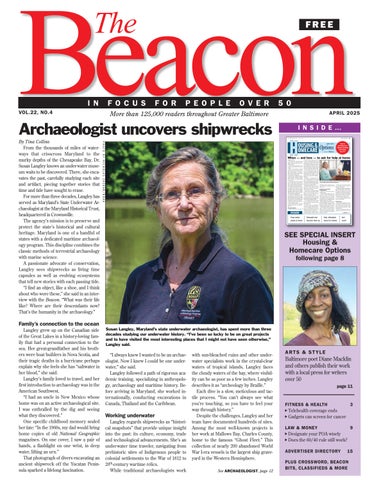

Archaeologist uncovers shipwrecks
By Tina Collins
From the thousands of miles of waterways that crisscross Maryland to the murky depths of the Chesapeake Bay, Dr. Susan Langley knows an underwater museum waits to be discovered. There, she excavates the past, carefully studying each site and artifact, piecing together stories that time and tide have sought to erase.
For more than three decades, Langley has served as Maryland’s State Underwater Archaeologist at the Maryland Historical Trust, headquartered in Crownsville.
The agency’s mission is to preserve and protect the state’s historical and cultural heritage. Maryland is one of a handful of states with a dedicated maritime archaeology program. This discipline combines the classic methods of terrestrial archaeology with marine science.
A passionate advocate of conservation, Langley sees shipwrecks as living time capsules as well as evolving ecosystems that tell new stories with each passing tide.
“I find an object, like a shoe, and I think about who wore these,” she said in an interview with the Beacon. “What was their life like? Where are their descendants now? That’s the humanity in the archaeology.”
Family’s connection to the ocean
Langley grew up on the Canadian side of the Great Lakes in a history-loving family that had a personal connection to the sea. Her great-grandfather and his brothers were boat builders in Nova Scotia, and their tragic deaths in a hurricane perhaps explain why she feels she has “saltwater in her blood,” she said.
Langley’s family loved to travel, and her first introduction to archaeology was in the American Southwest.
“I had an uncle in New Mexico whose home was on an active archaeological site. I was enthralled by the dig and seeing what they discovered.”
One specific childhood memory sealed her fate: “In the 1960s, my dad would bring home copies of old National Geographic magazines. On one cover, I saw a pair of hands, a flashlight on one wrist, in deep water, lifting an urn.”
That photograph of divers excavating an ancient shipwreck off the Yucatan Peninsula sparked a lifelong fascination.


“I always knew I wanted to be an archaeologist. Now I knew I could be one underwater,” she said.
Langley followed a path of rigorous academic training, specializing in anthropology, archaeology and maritime history. Before arriving in Maryland, she worked internationally, conducting excavations in Canada, Thailand and the Caribbean.
Working underwater
Langley regards shipwrecks as “historical snapshots” that provide unique insight into the past: its culture, economy, trade and technological advancements. She’s an underwater time traveler, navigating from prehistoric sites of Indigenous people to colonial settlements to the War of 1812 to 20th-century wartime relics.
While traditional archaeologists work
with sun-bleached ruins and other underwater specialists work in the crystal-clear waters of tropical islands, Langley faces the cloudy waters of the bay, where visibility can be as poor as a few inches. Langley describes it as “archeology by Braille.”
Each dive is a slow, meticulous and tactile process. “You can’t always see what you’re touching, so you have to feel your way through history.”
Despite the challenges, Langley and her team have documented hundreds of sites. Among the most well-known projects is her work at Mallows Bay, Charles County, home to the famous “Ghost Fleet.” This collection of nearly 200 abandoned World War I-era vessels is the largest ship graveyard in the Western Hemisphere.


Susan Langley, Maryland’s state underwater archaeologist, has spent more than three decades studying our underwater history. “I’ve been so lucky to be on great projects and to have visited the most interesting places that I might not have seen otherwise,” Langley said.
PHOTO BY NICHOLAS ZACHAR/NOAA
Say cheese!
As the grandfather of the cutest 2-yearold on Earth…oh wait, let me show you. Nope, can’t get him to do his cutest things on camera.
Have you noticed that?
Everyone seems to whip out their cellphone camera to record every little thing of interest. But the moment you do that in front of anyone age two or older, they stop doing what they were doing naturally and assume a pose for posterity.
tial observer, so even her corroboration isn’t enough to prove my claim.

FROM THE PUBLISHER
Every time my grandson erupts in his infectious giggles, I grab my phone and… gone. When we put on music and he starts dancing and “conducting” it, I begin to video him, but he immediately stops.
By Stuart P. Rosenthal
Fortunately, my wife also sees him do cute things. But neither of us is an impar-
There is a name for this phenomenon, of course: the “observer effect,” which is apparently an extension of Heisenberg’s Uncertainty Principle.
Nobel prize-winning quantum physicist Werner Heisenberg proved that the mere act of measuring particles at the quantum level inevitably affects those particles, making it impossible to be certain of both their position and momentum at the same time.
When applied to larger-than-quantum people — perhaps especially 2-year-olds — I think it means we can never record our best moments together. Our human connection is what makes those moments beautiful, and

Baltimore area, and is privately owned. Other editions serve Howard County, Md. and Greater Washington, D.C.
Subscriptions are available via third-class mail ($12), prepaid with order. Maryland residents add 6 percent for sales tax. Send subscription order to the office listed below.
Publication of advertising contained herein does not necessarily constitute endorsement. Signed columns represent the opinions of the writers, and not necessarily the opinion of the publisher.
Publisher/Editor – Stuart P. Rosenthal
President/Associate Publisher – Judith K. Rosenthal
Executive Vice President – Gordon Hasenei
Managing Editor – Margaret Foster
Art Director – Kyle Gregory
Vice President of Operations – Roger King
Advertising Representatives –Steve Levin, M.K. Phillips, Alan Spiegel
Assistant Editor – Ana Preger Hart
Editorial Intern – Tori Cleveland
pulling out a cellphone breaks that connection.
In a variation on the theme, something older humans are likely to do in front of a camera is to be on our best behavior.
If we know we’re being recorded, we may stifle our yawns, stop grimacing and wave with a smile, put down that delicate item, open the door for another person and, in short, engage in whatever behavior we would prefer to be remembered for.
I suppose that’s a good thing. Those who believe they are always being watched “from above” are (presumably) more likely to be on their best behavior even behind closed doors.
Ironically, perhaps, at a time when the number of Americans who report “no religious affiliation” on surveys is at an alltime high, technology has introduced an “eye in the sky” that’s always watching us in the form of ubiquitous security cameras.
At least one study has shown that when such cameras are visible, they reduce the incidence of crime. Unfortunately, they also may reduce the incidence of cute behavior by children.
I am an amateur photographer — or was back in my youth, when I traveled around Europe carrying dozens of rolls of film in my backpack.
I discovered then that I could interact with my surroundings, whether natural or man-made, in one of two ways. I could ei-
ther stand and take it all in, trying to pay attention to the details, feel the overall effect, sear the image in my memory, and take that feeling with me on my travels.
Or I could fiddle constantly with my camera, taking shots from every angle, switching between my wide-angle and telephoto lenses, trying different shutter speeds to improve or blur the depth of field, all hoping to come out of the experience with a cool shot I could blow up and frame on a wall back home.
Can you guess which approach I took most often? Yes, my favorite photos from those years are proudly framed on the walls of our home. And I do love looking at them.
But I have to admit, I hardly remember being in those places when I took those shots. My camera was there, but where was I?
Well, one good thing about my method of recording my travels for posterity is that I could count on the places not changing on me just because I took out my camera.
As for my grandson, I have come to love just being with him and enjoying every moment. And he really is the cutest toddler on Earth. You’ll just have to believe me.

Letters to the editor


BEACON BITS
Health Fitness &
Health Fitness &
NIGHTTIME PAIN
Why we get leg cramps at night and what can be done about it
HELP SCIENTISTS OUT
Researchers need our help to advance science or approve new medications. When you participate in a clinical trial or study, you can receive free treatments, health screenings and even compensation for your time
DEVICES USING AI
Gadgets screen for cancer, monitor diabetes and catch irregular heartbeats
Medicare telehealth coverage ended
By Donna LeValley
Prior to the Covid pandemic, Medicare covered telehealth (virtual doctor visits over the Internet) only for those in rural areas (with certain exceptions). Even then, patients were required to travel to an approved “originating site,” such as a clinic or doctor’s office in order to receive telehealth services.
To address the need to keep an eye on patients during Covid and all the related shutdowns, Medicare expanded its telehealth coverage to include patients’ homes as a permissible “originating site.”
While use of telehealth services has declined since those days, it remains nearly two times higher than pre-pandemic levels, with 12.7% of eligible Medicare beneficiaries receiving a telehealth service in the last three months of 2023.
Under current law, Medicare’s coverage of non-rural home-based telehealth ended on March 31, 2025. It was originally set to end on December 31, 2024, but was extended for three months by the American Relief Act (H.R. 10545),
passed to fund the government and avoid a shutdown.
As of April 1, you must be in an office or medical facility located in a rural area (in the U.S.) for most telehealth services. However, if you aren’t in a rural healthcare setting, there are a limited number of telehealth services you will remain eligible to get.
Telehealth coverage
Until the end of this March, Medicare Part B (medical insurance) covered certain telehealth services, and you paid the same amount for those that you would pay if you received the services in person.
You’re responsible to pay 20% of the Medicare-approved amount for your doctor or other healthcare provider/practitioner’s services, and the Part B deductible applies.
Medicare currently offers telehealth coverage for preventive health screenings, office visits and psychotherapy. The menu of covered services was expanded in 2020
to include physical and occupational therapy, emergency department virtual visits and nursing facility care.
Of course, with telehealth, you can’t receive care that includes procedures that require a physical examination, taking blood or urine samples, performing x-rays or giving injections.
Here are ways telehealth can be used to take care of your health:
• Behavioral health services. Services offered include mental health screenings, addiction counseling, to monitor and manage symptoms of anxiety and depression, and dispensing medication.
• Test results. Checking results from lab tests or x-rays.
• Follow-up care. Checking in with your provider after surgery and managing your medicines.
• Non-emergency urgent care. Getting help for common ailments such as colds or an upset stomach, and checking on common problems like headaches or infections.
• Therapeutic treatments. Physical
or occupational therapy sessions.
• Remote monitoring. You can use technology to track and share health data with your health provider. This is called remote patient monitoring or RPM. Some RPM tools track blood sugar levels, heart rates, blood pressure and weight.
Some services will continue
Telehealth services that will continue for all Medicare patients even after March 31 include:
• Monthly End-Stage Renal Disease (ESRD) visits for home dialysis
• Services for diagnosis, evaluation or treatment of symptoms of an acute stroke wherever you are, including in a mobile stroke unit
• Behavioral health services, also called mental health services, for the diagnosis, evaluation or treatment of a mental health disorder, including in your home
• Services to treat a substance use disorder or a co-occurring mental health
See TELEHEALTH , page 5
Procedure targets high blood pressure
By Lauran Neergaard
Nothing doctors prescribed controlled Michael Garrity’s dangerously high blood pressure — until they zapped away some nerves on his kidneys.
If that sounds weird, well, kidneys help regulate blood pressure in part through signals from certain nerves. The new treatment disrupts overactive renal nerves.
“My blood pressure would spike and I’d run out of breath and feel tired, and that doesn’t happen anymore,” said Garrity, 62, of Needham, Massachusetts. He still takes medicine but at lower doses, his blood pressure normal for the first time in years.
“I’m thrilled.”
About half of U.S. adults have high blood pressure. It’s a major risk for heart attacks, strokes, kidney failure, even dementia. Many people don’t even realize they have hypertension until it’s done serious damage.
“Know your blood pressure, know the numbers,” stressed Dr. Randy Zusman of Massachusetts General Hospital. He specializes in the hardest-to-treat cases and
advises people who think they’re fine to at least get a yearly check.
Not well controlled
Only a fraction of patients have their hypertension well-controlled, meaning there’s a need for novel strategies. The Food and Drug Administration (FDA) approved the “renal denervation” option about a year ago, based on studies showing a modest benefit in patients whose blood pressure remains high despite multiple medicines.
Now, after the American Heart Association (AHA) recently deemed it promising, some hospitals including Mass General Brigham are cautiously offering it as they work out who are good candidates — and whether their insurance will cover a minimally invasive procedure costing thousands of dollars.
What is high blood pressure?
Two numbers describe blood pressure. The top, “systolic” pressure, is the force blood puts on the walls of arteries as it’s pumped out of the heart. The bottom “di-
astolic” number measures that same pressure but between heartbeats.
Normal is less than 120 over 80. Blood pressure naturally fluctuates throughout the day, higher when you’re physically active or stressed.
But when it stays high — consistently 130 over 80 or higher, according to the most recent guidelines — it stiffens arteries and makes the heart work harder.
How to measure blood pressure
It doesn’t take a doctor’s visit. Pharmacies and sometimes even libraries offer blood pressure screening, and people can use inexpensive at-home monitors.
To avoid falsely high readings, the American Medical Association has tips: Sit quietly with feet on the floor, legs not crossed. Place the cuff on a bare arm, not over clothing. Don’t dangle the arm — rest it on a table.
Drugs aren’t the only treatment
To treat high blood pressure, lifestyle changes are the first step, especially for
otherwise healthy people. Guidelines urge losing weight, exercise, eating more fruits and vegetables, limiting salt and alcohol, and taking steps to handle stress.
Medicine is a must once hypertension reaches 140 over 90. The average patient requires two or three drugs, sometimes more, along with healthier living, Zusman said.
But the hypertension that Garrity has struggled with since his late 20s is treatment-resistant. Despite taking four to six drugs plus a strict diet and exercise, his blood pressure regularly reached 150 over 100 or worse.
What is renal denervation?
Doctors thread a small catheter, or tube, through blood vessels to reach the kidneys and then beam in ultrasound or radiofrequency energy.
Those pulses pass through the renal arteries to selectively target surrounding nerves, said Dr. Joseph Garasic, a Mass General interventional cardiologist who
See BLOOD PRESSURE , page 4
What to do about nighttime leg cramps
By Howard LeWine
Q: I get these brutal leg cramps at night that wake me from sleep. I can never predict when and why they happen. Are there ways to prevent them?
A: Leg cramps are muscle spasms that happen when nerves that power muscle contractions go into a nonstop firing mode.
They are more common among people with foot problems like flat feet or high arches, metabolic disorders, or neurological conditions such as Parkinson’s disease or neuropathy (nerve damage).
Dehydration and electrolyte imbalances, such as low blood potassium or magnesium levels (a common side effect
of diuretics), can increase the risk of cramping. However, many people with recurrent leg cramps cannot identify a cause.
How to stop or prevent one
To stop a foot or leg cramp once it happens, stand up and slowly lean forward. If you don’t want to get out of bed, sit up and reach forward so you can grab your toes, then slowly bend your foot up toward your head. Hold for about 20 seconds, then release. Repeat as needed.
Despite the lack of scientifically proven ways to prevent recurrent nighttime leg cramps, a few approaches may be worth trying.
Begin with stretching exercises. While facing a wall and standing about two feet away, lean forward until your hands touch the wall. Keep your legs straight and feet flat on the floor.
You should feel a stretch, but it should not be painful. Hold the position for 20 seconds and release.
Repeat the stretch four to five times. Try to do this three times per day for at least the first few weeks and then as needed. The most important time to stretch is before bedtime.
Other preventive measures include staying well hydrated, wearing well-fitting
Blood pressure
performed Garrity’s procedure. It takes about an hour.

Although already used in other countries, a key U.S. trial of renal denervation failed about a decade ago, prompting changes before researchers tried again. In November 2023, the FDA approved two catheter systems, from Recor Medical and Medtronic. It’s not a cure, and some patients get no benefit. But Garasic said multiple studies show on average an 8 to 10-point drop in blood pressure — a modest but important
supportive footwear during the day, and keeping the bedding at your feet loose during the night.
Although the evidence isn’t strong, some people find that taking a daily B-complex vitamin supplement containing eight B vitamins — B1 (thiamine), B2 (riboflavin), B3 (niacin), B5 (pantothenic acid), B6, B7 (biotin), B9 (folate), and B12 — helps prevent cramps.
Quinine is one drug known to be effective in reducing the frequency of muscle cramps. However, the drug is out-of-
improvement. Some like Garrity see a bigger drop, enough to gradually scale back medications.
The FDA deemed the procedure safe for carefully chosen patients. It wasn’t tested in those with kidney disease or narrowed arteries, for example. And studies have lasted only a few years, not long enough to tell if the nerves might eventually regenerate.
Guidance from the AHA urges would-be patients and experienced doctors to have “thoughtful and informed discussions” to decide who’s a good candidate. AP


disorder, including in your home
• Diabetes self-management training
• Medical nutrition therapy
What can you do?
Medicare Advantage (MA) plans are required to cover all Part A and Part B benefits covered under traditional Medicare, and have some flexibility to offer additional telehealth benefits, similar to their coverage of eye exams and dental check-ups.
MA plans may still to offer the expanded services regardless of the status of the temporary telehealth expansions in traditional Medicare. Check with area Medicare Advantage providers to learn what they plan to cover.
A workaround for those enrolled in tra-
Leg cramps
From page 4
bounds for most people.
Quinine has FDA approval to treat certain types of malaria. But the FDA has issued repeated warnings against using quinine to prevent or treat leg cramps because it may cause serious side effects, including severe anemia, bleeding and kidney damage.
ditional Medicare is using a provider that participates in an Accountable Care Organization (ACO).
An ACO is a group of doctors, hospitals and other healthcare providers who work together to coordinate your healthcare. They are permitted to waive these requirements and may continue to provide telehealth services without geographic restrictions, even after the flexibilities expired for Medicare generally.
Congress could vote to continue Medicare coverage of telehealth, but the legislation proposed (including the Telehealth Modernization Act of 2024) doesn’t include a repeal and only offers a temporary extension of the waiver of the requirements.
[Call or write your Congressional representatives to express your views.]
© 2025 The Kiplinger Washington Editors, Inc. All rights reserved. Distributed by Tribune Content Agency, LLC.
Although doctors can still prescribe quinine, it is recommended only when cramps are disabling and the person understands the significant risks.
Howard LeWine, M.D., is an internist at Brigham and Women’s Hospital in Boston and assistant professor at Harvard Medical School. For additional consumer health information, see health.harvard.edu.
© 2024 Harvard University. Distributed by Tribune Content Agency, LLC.
Here, assisted living is living, with the right amount of personal assistance… …at a great value.


A place of independence
Pickersgill assisted living residents are rarely in l their rooms! Instead, , theyy’re out and about— participating in a community activity or event or dining with friends.
A place of beauty

Living in n this community—ttucked d into a beautiful West Towson neighborhood —you or your loved one beau njoy a warm welcome and daily activities, and they’ll appreciate the will enj paths, beautifully landscaped grounds, lovely gardens and more. walking path
A place of caring


MAIL OR EMAIL FOR FREE INFORMATION
For free materials on housing communities and/or research studies, just complete this coupon and mail or email it to the Beacon.
Housing Communities
o Brightview Senior Living (see ad on page B2)
o Caritas House Assisted Living (see ad on page B2)
o Catholic Charities (see ad on page B2)
o Charlestown/Erickson (see ads on pages 4,B7)
o Christ Church Harbor Apts (see ad on page B7)
o Merritt Station (see ad on page B7)
o Oak Crest/Erickson (see ads on pages 4, B7)
o Park View Laurel (see ad on page B4)
o Park View Towson (see ad on page B4)


Each assisted liv g resident enjoys three chef-prepared meals per day, ing re y services, medication administration, help with daily housekeeping and laundry se quest, and all included in a reasonable monthly tasks and more—always by reques o all of the fee. Each h resi s dent also has access to all Pickersgill ameni l ties.
o Park View Fullerton (see ad on page B4)
o Park View Rosedale (see ad on page B4)
o Pickersgill (see ad on page 5)
o St. Mary’s Roland View Towers (see ad on page 12)
o Terraces at Park Heights (see ad on page B3)
o Virginia Tower Apartments (see ad on page 12)
o Warren Place Senior Apartments (see ad on page 8)
o Westminster House (see ad on page 8)
Clinical Health Studies
o Home Mobility Tracking Study (see ad on page 6)
o Long COVID Study (see ad on page 6)
o Prediabetes Blood Sugar Study (see ad on page 6)

private, full bath, and residents are

Our assisted living g residences include a priv wish. This is a lifestyle dedicated to encouraged to decorate their homes as they al staff. independence and assured by a caring, professionalfessionalstasttaff.
Call 888-877-9883 today for more information or to schedule your personal tour.


Check the boxes you’re interested in and return this form to: The Beacon, P.O. Box 2227, Silver Spring, MD 20915 or take a picture and email to housing@thebeaconnewspapers.com. You may return this coupon together with the coupon on page B5.
Health Studies INFORMATION ON AREA CLINICAL TRIALS
How clinical trials can help fight disease
By Family Features
Clinical trials are necessary for finding new ways of preventing, detecting or treating diseases.
Often, though, limited participation creates challenges for meeting clinical trial goals. Despite decades of effort and strategies to identify and address barriers to recruiting and enrolling study participants, recruitment challenges persist, particularly among women, older adults and diverse patient populations.
“Potential study participants are reluctant to get involved for a variety of reasons, including the time commitment, lack of clarity regarding safeguards for their well-being and concerns about how their medical condition will be handled during the study,” said Alan Moss, MD, chief scientific officer with
the Crohn’s & Colitis Foundation, the leading nonprofit organization focused on both research and support of people living with inflammatory bowel disease.
“Taking part in a clinical trial gives patients an opportunity to access new therapies and can help shape future treatment, including how diseases are diagnosed, treated and even prevented.”
Learning more about the role clinical trials play in health care may help you find a new treatment for a disease such as cancer or manage a condition such as IBD more effectively.
Importance of clinical trials
All U.S. Food & Drug Administration approved medicines currently available on the market are the result of clinical trials
Are you experiencing fatigue after COVID?
Who Can Participate:
• Age 50 or older
• Tested positive for COVID-19
• Experiencing fatigue for at leat 3 months
• Willing to make dietary changes for 4 months
Join our virtual nutrition study to learn if a certain diet may help reduce long-COVID symptoms. Call to see if you qualify: 512-576-3823 or visit: longCOVIDiet.com


SEEKING ADULTS FOR HOME MOBILITY TRACKING STUDY
Participants are needed to better understand movement in the home space in persons with cognitive impairment and their caregivers.
• 50-80 years of age
• Have mild cognitive impairment
MORE INFORMATION: Please call: 443-226-1478


and the patients who participated in them. When enrollment targets aren’t reached due to low patient participation, there may be delays in the drug approval process.
What you should know
There are plenty of reasons to consider participating in a clinical trial.
• Safety: Investigational treatments must be studied extensively before the FDA will approve them. Each trial follows thorough protocols to ensure the health and safety of its participants. Additionally, patients are followed continuously throughout a trial to monitor their health.
• Eligibility: Who can participate in a clinical trial depends on the study. Each clinical trial has its own goals, which means different trials have different criteria. Some trials are for patients who have moderate to severe disease, and others may seek patients with mild disease. Other trials look for patients without any diagnosis.
• Treatment: When you decide to enroll in a clinical trial, you may have access to the study drug as a form of treatment. Typically, participants will not know if they are receiving the study drug during the trial. This helps reduce potential biases and ensures the fairness of the trial. However, all participants are monitored closely. If there is any change in your medical condition while participating in the study, the research staff will inform you immediately.
• Cost: The majority of clinical trials are federally or privately funded, so there is typically no cost to participants. While fed-
eral law requires most health insurance plans to cover the majority of routine patient care costs associated with clinical trials, there are some costs you may incur, such as travel, gas or parking.
Trial sponsors commonly cover these costs, as well as any non-routine patient care that isn’t covered by insurance.
• Leaving the study: Any point you wish to drop out of the trial, you can — for any reason. In that case, it’s common for a research coordinator to ask you to complete a final visit and schedule follow-up visits, if needed.
How to learn more
If you’re interested in participating in a clinical trial, go to trusted sources to learn more and ask questions. For example, NIH, Johns Hopkins, Veterans Affairs, UMD or the Crohn’s & Colitis Foundation can point you toward clinical trial opportunities. Your doctor’s office can also be a good source of information about local studies.
If you’re hesitant about joining a trial involving a treatment but are eager to help, you might consider other types of research studies, such as prevention, diagnostic, screening or quality-of-life trials instead.
Once you identify a clinical trial that interests you and you may be eligible for, contact the research coordinator to learn more. Visit clinicaltrials.gov or crohnscolitisfoundation.org/clinical-trials-community to learn more about clinical trials and find opportunities near you.
This story was sponsored by the Crohn’s & Colitis Foundation.
SUPPLY LOAN CLOSET The 9th District Medical Supply Loan Closet is located at 1801 Glen Keith Blvd., Towson. It is open every Tuesday morning from 9:30 to 11:30 a.m. and has a wide variety of supplies, including wheelchairs, continence wear, bathroom equipment, walkers, canes and more. For more information, call (410) 887-0023.
Are you 50 years or older? Are you relatively healthy, without a diabetes diagnosis?
If so, you may be eligible for a new research study in which you learn about your daily blood sugar fluctuations and cognitive abilities.
Receive $100 for participating. For information call 410-605-7179. Mention “CAMPS”


m With T
om S To
Asanage Regional M Manager, Smith,
Sm
e ve Business Dev v
e re Nursing Car Nur & elopment,mentFamFamily
How Home C CombatD
are Can Help ome Care Expert x ert sing

Care Older Ad DepressionandIsolatio dults on Combat Depress
w people age, we e often face en uniqquue m nttal health challenges. Depression is one of the most common mental health conditions among older adults, affffe e cting an estimated 7 million people age 65 and older each year in the United States.
Compounding this is social isolation, which is prevalent among seniors and has been linked to an increased risk of mental and physical health problems, including depression, y anxiet y, , cog nitive decline and chronic diseases. What’s more, research shows that prolonged mf isolation can be as har fu u l to someone’s health as smoking.
Home care can play a crucial role in addressing these challenges, providing h d d tt h l
much-needed support to help older adults maintain their independence while improving their mental and emotional well-being.
ff Home care offeers tailored support that addresses the specific needs of older adults facing depression and isolation. Caregivers can provide the f foollowing home care services to not only alleviate practical burdens but also promote emotional and social well-being:
• Companionship and Social Interaction: Regular interactions with a caregiver ucef can help red fe e elings of df loneliness an fooster a sense of belonging. Whether it’s sharing meals, engaging in conversations, or participating in hobbies, caregivers provide
f meaning fu u l connections that can improve mental health and reduce isolation and depression.
• Encouragement of Routine and Activities: Depression often leads to withdrawal and inactivity. Caregivers can help establish and maintain daily routines, encourage participation in enjoyable activities, and even accompany clients on outings to boost mood and engagement.
• Emotional Support: Having someone to talk to and share concerns with can be ff invaluable. Caregivers offeer empathy and reassurance, which can make a significant diffffeerence in managing depression M it i d
• Monitoring and Communication: Caregivers can recognize changes in mood or behavior and alert family members or healthcare providers, ensuring timely interventions.
The Family & Nursing Care Difference:
Family & Nursing Care is a trusted leader in providing specialized home care services tailored to the needs of older ts. W adul We e understand the proffoound impact that depression and isolation can have ff on seniors, and offeera comprehensive range of services to support their mental health, including:
• Companionship Services: Our network of experienced
ion and Isol ation
p f caregivers can hel fooster deep relationships with clients, offffeer ing emotional support and g f reducin fe e elings of isolation.
f y f The fo o cus on meaning fu u l interactions that enhance emotional well-being through engaging conversations, eating meals, playing games together and more.
• Mobility and Social Access:
T Trransportation support ensures that older adults can attend social events, visit loved ones, or participate in community activities, helping them stay connected and engaged.
• Daily Living Assistance: By helping with personal care, meal preparation and household tasks, caregivers
d f reduce stress an frree up o f y f energ foor clients t fo o cus on their mental health and well-being.
At Family & Nursing Care, we are committed to enhancing the lives of older adults by addressing their physical, emotional and social needs. Our network of highly skilled caregivers provides not just care, but companionship and support that can make a world ce f f diff o ffeeren foor those facing depression and isolation.
T Tool earn more about Family ’ & Nursing Care ss ervices to help combat depression and isolation, call us at 410-6978200 or visit our website at f fa amilynursingcare.com.


Gadgets to diagnose and monitor health
Today, we’re diving into how AI (artificial intelligence) and advanced gadgets are transforming diagnostics, telehealth and personal health management.
Let’s start with diagnostics. Imagine you have a lump or need some imaging for your abdomen or knee, for example. AI can now quickly analyze your xrays, MRIs and pathology slides and catch details that might have slipped past even the most experienced specialist.
brain hemorrhages in record time, even before a radiologist reviews the scan.

DEAR PHARMACIST
For example, Aidoc’s AI helps emergency departments identify pulmonary embolisms or
By Suzy Cohen
Early
cancer detection
AI has been particularly revolutionary in spotting earlystage breast cancer and lung cancer — conditions where early detection can make a lifesaving difference.
A study published in The Lancet Digital Health in 2022 found that AI systems in mammography detected breast cancer with accuracy comparable to that of human radiologists, with fewer false negatives.


Warren Place Senior Apartments in Cockeysville, Maryland, is a 62+ senior community in a convenient location just minutes away from shopping centers, banks, pharmacies and restaurants on York Road.
Steps away from Cockeysville Senior Center to fit with your active lifestyle. We are a pet friendly community!

• All Utilities Included
• On-site Parking
• Laundry on Every Floor
• Rents are $1053–$1153
• Elevators
• Light Rail and Bus Stop Nearby
• Small Pets Welcome

But what’s truly game-changing is personalized healthcare. AI programs can analyze your unique data and consider your complex medical history, genetic details and even lifestyle factors to create customized diagnostics.
It’s like having a personal Sherlock Holmes dedicated to solving health puzzles.
For example, AI helps tailor treatment plans for complex conditions like irritable bowel syndrome. Apps like MyGIHealth analyze symptoms and dietary habits to recommend personalized lifestyle changes, all while tracking improvements over time.
Remote-monitoring devices
Real-world conditions like diabetes, hypertension or even heart arrhythmias are now more manageable with telehealth devices.
Thanks to remote patient-monitoring gadgets like KardiaMobile or the new Apple Watch, healthcare providers can track metrics such as blood pressure, heart rate or blood sugar levels in real time. Imagine catching an irregular heartbeat or an impending hypertensive crisis before it escalates.
Non-invasive glucose monitoring is the next big thing. While “Raman spectroscopybased” gadgets to analyze body fluids without needles are still in development, continuous glucose monitoring devices like the
Dexcom G7 and Abbott’s FreeStyle Libre 3 are making diabetes management easier than ever. No more finger sticks, just continuous data delivered straight to your smartphone from a tiny implanted sensor.
And it’s not just for diabetes. Health wearables like Fitbit now sync with AIpowered apps that analyze sleep, activity and even stress levels.
For example, if you’re recovering from long Covid or managing chronic fatigue syndrome, these gadgets can identify patterns and suggest tweaks to optimize your energy levels.
What does all this mean for you? It means healthcare is becoming more accessible, accurate and personalized than ever. Diagnosing early-stage cancer, managing diabetes without needles, or preventing a heart attack with a smartwatch — it’s not just possible; it is happening.
But here’s the thing: While AI and gadgets are incredible tools, they’re not replacements for the human touch in healthcare. Your doctor, pharmacist and other providers are still your most valuable resources.
Until next time, keep your health in check and your gadgets close! If you’d like more information see suzycohen.com.
Suzy Cohen is a registered pharmacist and author of The 24-Hour Pharmacist and Real Solutions from Head to Toe


By Margaret Foster
Most people want to stay in their own homes as they age: Nearly 80% of older adults say they prefer to age in place, according to AARP.
But when cooking, yardwork and stairs become too much trouble, who do you ask for help?
Dozens of home healthcare companies exist in our area, and in a matter of hours, they can send someone to your house to help make meals, shop, run errands, do light cleaning and laundry, bathe, walk or get you to doctor’s appointments.
Many families start with just a few hours of help per week, according to Tom Smith, Regional Manager of Family & Nursing Care, which has been serving Marylanders since 1968.
“A lot of times they start with a couple of hours, a couple of days a week, just to get used to the idea of having someone in their home,” Smith said. “The hope is that it’s the same caregiver, and they become friends.”
Here’s how it works: The agency sends a case manager to the home to meet the client and their family. Then, depending on the family’s needs, the client is matched with either a registered nurse or caregiver. All the while, the case manager keeps track of the older adult’s changing needs.
Some clients are surprised by how much they appreciate the extra help around the house, Smith said. They tell the company, “This has actually been life-changing. I would like someone here every day to make dinner and help me get ready for bed,” Smith said.
They don’t even have to provide a to-do list for the caregiver, he said.
“Some people just use us for companionship, if mom doesn’t have a lot of visitors,” Smith said.
Get help anywhere
Though it’s called “home” care, that real-


When — and how — to ask for help at home
ly means you can get help anywhere you are living, whether long-term or shortterm. If you’re not living in a traditional single-family home anymore, you can get some extra help in an independent living or even assisted living or long-term care community. Many people recovering in a hospital can also appreciate having someone around whose only concern is their needs.
Some communities have their own home care services right on campus. Oak Crest, located in Parkville, Maryland, has a program called “home support” — a team of private-duty, vetted certified nursing assistants who can help with activities of daily living.
For instance, said Robin Keeler, Oak Crest’s director of resident life, “We can just pop in a couple times a day and remind them to take their medication. If someone needs help getting bathed and dressed during the day, we stop in and help with that. Or if someone needs that at night.”
Think small: People can hire a helper at Oak Crest for a few hours once a year (though most companies have minimums, such as four hours per day).
“We can help you do holiday shopping or switch over your clothes from season to season. It doesn’t necessarily have to be long-term. We see what their needs are and match them with a caregiver.”
Oak Crest residents pay out-of-pocket for “home support,” but they may be reimbursed by their insurance companies. That goes for any home healthcare agency.
“A lot of people don’t realize that longterm care insurance will [in some cases] cover some in-home services as well,” Keeler pointed out.
She said it’s best to go through an agency that performs background checks.
“If you’re looking to hire someone inhome, my recommendation is always to go through an agency that has processes for vetting their employees,” Keeler said.
Oak Crest also has a Medicare-certified home health agency for urgent, short-term

rehabilitation. After a hospital stay, for instance, Oak Crest can send staffers to help with recovery.
In-home care to prevent hospitalizations
It’s best to try out in-home care before a health emergency.
“Instead of waiting until there’s a crisis, it’s better to just see about having an assessment for in-home care. That’s better than waiting for the next acute episode,” said Leana Hoover, chief operating officer of Gilchrist Services, an affiliate of Greater Baltimore Medical Center (GBMC).
Although Gilchrist, founded in 1994, is known for providing care for serious issues like chronic illnesses, end-of-life care and hospice, the company also has been providing primary care in the home for a decade.
In 2016, GBMC launched a program to reduce emergency room (ER) visits by people over 75 years old. By keeping in touch with frequent ER visitors, Gilchrist’s in-home care providers can determine the reason for their crises.
“Maybe they can’t afford their medications, and that’s why they continue to come back,” Hoover said.
Through the Support Our Elders program, Gilchrist provides a social worker to check in on the patient at home to make sure they have enough money to buy food and pay their power bills. By sending physicians, nurses and social workers directly to the patient, they can make a personal connection and help in any way necessary.
“The goal is that continuity of care so they can stop using the [ER] for their primary care,” Hoover said.
Familiar faces
Most homecare companies try to promote personal connections between clients and caregivers. They often send the same person or same team to the house so that everyone gets to know each other — which means better care.
At Family & Nursing Care, quite a few employees are family members. The com-

Grow a tidy garden with native plants
By Jessica Damiano
For decades, native plants were relegated to the “weed” section of many American gardeners’ minds. Most nurseries didn’t stock them. But that’s slowly changing.
Native plants provide food and shelter for bees, butterflies, birds and other beneficial critters. They effortlessly grow healthier and stronger than exotic species, seldom need fertilizers or other amendments, and generally require little or no supplemental water once established.
So, why don’t more people plant them?
One reason: Unless carefully selected, the plants in a native garden can get messy, a look that some people embrace but others do not.
It’s one thing if you’re growing a meadow, but you might want things neater in a small urban garden or in a suburban community with a homeowners association.
But that’s on the gardener, not the plants, because it’s absolutely possible to have a structured and beautiful native garden.
Homecare
From page B-1
pany founder’s adult children work there, and Tom Smith took a job there alongside his wife and sister.
The right plant in the right place
This old mantra emphasizes the importance of considering sunlight exposure, water accessibility and soil pH levels when selecting plants.
Familiarize yourself with the mature sizes of your fledgling plants when deciding where to place them. Don’t, for instance, plant tall natives along a walkway, where they may grow to block access or flop over by mid-season, especially after rainfall.
Place taller plants and those more likely to lean at the back of a border, with shorter, tighter ones in front to help hold them in place and keep edges tidier. For beds that can be viewed from all sides, place the taller plants in the center.
Avoid planting one-offs. Instead, planting clusters of the same species or color will make the garden appear cohesive.
Controlling spread
Because native plants aren’t sterile, as many hybridized and exotic species have been bred to be, some spread readily by
dropping seeds after they bloom. Others spread via underground runners, sending up new plants as they travel across the bed.
This does not mean they are “invasive” — a term used to describe aggressive exotic plants that spread to outcompete native species. In fact, it’s a desirable trait when aiming to fill a meadow with native plants, just perhaps less so when attempting to appease your HOA.
The solution lies in research. Look for plants with “clumping” or “mounding” habits that will stay put, and avoid those described as “runners” or “fast spreaders.”
Asclepias tuberosa (butterfly weed), for instance, will not move or migrate. Its cousin, Asclepias syriaca (common milkweed), can be aggressive, weedy and difficult to remove.
Both plants are important food sources for monarch butterfly caterpillars and considered beneficial to the ecosystem.
If plants reseed where you don’t want them, remove them and plant them elsewhere or trade them with a friend.
Dig up and divide plants every three years
to prevent crowding. And if your natives threaten to become unruly, mow them down before they set seeds at the end of the season. Don’t simply scatter wildflower seeds and expect them not to grow wild. They will, which makes them perfect for a dedicated wildflower bed or a hilly slope, but perhaps less than perfect elsewhere.
Place a ‘carpet’ around them
Consider native grasses, sedges, groundcovers and clover as substitutes for common turf grasses, which rely on ground-polluting amendments, pollinator-killing pesticides, and regular mowing while contributing little to the ecosystem.
If necessary, keep just a small lawn border to define the space (and appease your neighbors), and keep beds and borders neatly edged.
Include native shrubs in your design to retain structure year-round. Statues, arbors, benches and birdhouses also add visual interest.
© 2024 Associated Press. All rights reserved.
“My wife and my sister always spoke highly of the company, and I saw firsthand how they treated their clients,” said Smith, who previously worked as a social worker, so he joined the team, too.


“Thankfully, we get along very well,” he said. “We frustrate the rest of the family, though, when we have family gatherings
and we talk about work.”
For more information about Family & Nursing Care, call (410) 697-8200 or visit familynursingcare.com.
To see if you qualify for Gilchrist’s Support Our Elders Program, call (443) 8496257 or visit their website at gilchristservices.org/supportourelders for the full list of eligibility criteria and program benefits. Find out more about programs for older adults and home healthcare agencies by callilng (410) 396-CARE (2273) or visit Maryland Access Point at marylandaccesspoint.211md.org to search in your area.


Housing News
By Beacon Staff
Edenwald launches university program
Maryland is getting its first universitybased retirement community. Goucher College and Edenwald Senior Living have announced an innovative collaboration that aims to blend Goucher’s educational program with Edenwald’s senior living amenities.
Edenwald and Goucher College were both founded in the 1880s. In 1985, Edenwald developed its current location in Towson on land purchased from Goucher. The 284,000-square-foot expansion will be constructed on three acres of land, which Edenwald will lease from Goucher.
The planned development includes three new towers, each eight to 11 stories high, which will include 127 new one- and two-bedroom apartments ranging from 1,300 to 1,800 square feet. The shared spaces will include rooftop decks and a café.
This new university-based retirement community is designed to offer Edenwald residents unique access to a variety of Goucher’s resources. They will have the

opportunity to audit classes, participate in an international study abroad program alongside Goucher’s undergraduate students, and engage in student-led activities in a community garden.
Additionally, they will enjoy access to campus amenities such as the library, guest lectures and performing arts events.
“This partnership builds on a 140-year legacy of educational innovation at Goucher College. Now, Goucher will be the first in Maryland to bring that same innovation and commitment to academic excellence to create a university retirement community with Edenwald, our long-time next-door neighbor,” said Goucher College President Kent Devereaux.
Programming will launch with current Edenwald residents during the 2024-2025 academic year, and services will expand over time. The project is currently pending full approval and building permits from Baltimore County. The groundbreaking is anticipated next year, and the expansion is scheduled to open in 2029.
“All members of the Edenwald community are excited about this collaboration,” said Mark Beggs, President and CEO of Edenwald. “We have so many residents who are Goucher alumni and retired faculty, that it creates a shared sense of community and ownership already, so that residents and Goucher faculty working together to build the programmatic elements is just amazing.”
For more information about Edenwald, visit edenwald.org.
New senior housing in Roland Park
Construction has begun on The Gallery at Roland Park in Baltimore. NexCore Group and its senior housing operator, Experience Senior Living, is building a senior living community with 111 apartments, including independent living, assisted living and memory care units tailored to meet the changing needs of residents.
Situated in the North Roland Park area near the intersection of Falls Road and Northern Parkway, The Gallery at Roland Park is designed to foster well-being among its residents and a connection with the Baltimore community at large. The three stories will feature classic interiors and shared spaces that encourage social interactions as well as residents’ personal growth, such as a piano lounge, an activity room and a maker’s space.
Two restaurants will provide different culinary experiences, ranging from casual
everyday meals to pub-style offerings.
The planned courtyards, outdoor dining spaces, and a walking path meandering around the community will allow residents to relax and connect with their natural surroundings. They may also choose to visit the salon, spa or fitness center, or use the chauffeured transportation services for cultural outings around town.
“It’s all about bringing the experiences that our residents want to have into the community that they’re going to live in. That is what Experience Senior Living is all about,” said Laura Larson, the senior vice president of marketing for NexCore Group. “We just really want to provide a place where seniors feel like they can continue to live the life that makes them happy.”
The Gallery at Roland Park is scheduled to welcome residents in early 2027. In preparation for this, a showroom will eventually allow prospective residents and their families to explore the site firsthand.
The Gallery at Roland Park is NexCore’s first senior housing community in Maryland.
For more information about NexCore’s brand of communities, visit gallerysrliving.com.


Ten safe, livable communities for retirees
By Kathryn Pomroy
Retirement is all about freedom and choice. It’s doing what you want on your terms — like moving to a new town to be closer to family, craving warmer weather, or simply wishing for a different view from your kitchen window.
Making sure the retirement town you choose is safe and yet still provides everything you need when you retire is vital.
Analyzing data from the U.S. Census American Community Survey, Sperling’s BestPlaces and the Bureau of Labor Statistics Consumer Expenditure Survey, GoBankingRates found cities that are both “wealthy” and “safe.” Cities were considered when at least 25% of the population was age 65 or older.
Here are the top 10 ranked for safety and livability with low crime, high retirement income and affordable living for retirees:
1. Oro Valley, Arizona
Oro Valley is a suburban town six miles north of Tucson, Arizona. It sits at the base of the Santa Catalina Mountains.
In 2020, the population was 47,070. Called the “Upscale Tech Mecca” of Southern Arizona, Oro Valley has a median household income nearly 50% higher than most towns of the same size.
• Violent crime per 1,000 residents: 0.57
• Property crime rate per 1,000 residents: 11.41
• Ages 65+ average retirement income:
$52,098
• Single-family average home value:
$525,380
• Livability score: 81
2. Pinehurst, North Carolina
Pinehurst, dubbed the “Home of American Golf,” is a village in Moore County, North Carolina. In 2020, the population
was 17,581, including the village and the Pinehurst Golf Resort, which has hosted multiple U.S. Open Championships.
In the early 2020s, the area was considered one of the best micropolitan areas in North Carolina for the quality of local amenities, solid medical complexes and tourism.
• Violent crime per 1,000 residents: 0.43
• Property crime rate per 1,000 residents: 3.40
• Ages 65+ average retirement income:
$50,351
• Single-family average home value: $542,557
• Livability score: 73
3. Bella Vista, Arkansas
Bella Vista is situated at the base of the Ozark Mountains in Arkansas.
The town is considered a retirement community with low crime and abundant medical and recreational facilities aimed at
ENTERPRISE RESIDENTIAL
MOST COMMUNITIES ARE 62 AND BETTER
ANNE ARUNDEL COUNTY
The Greens at Hammonds Lane: 410-636-1141
Park View at Furnace Branch: 410-761-4150
Park View at Severna Park: 410-544-3411
BALTIMORE CITY
Ednor Apartments I: 410-243-0180
Ednor Apartments II: 410-243-4301
The Greens at Irvington Mews: 410-644-4487
Park Heights Place: 410-578-3445
Park View at Ashland Terrace: 410-276-6440
Park View at Coldspring: 410-542-4400
BALTIMORE COUNTY
Cove Point Apartments I: 410-288-2344
Cove Point Apartments II: 410-288-1660
Evergreen Senior Apartments: 410-780-4888
The Greens at English Consul: 410-789-3000
The Greens at Liberty Road: 410-655-1100
The Greens at Logan Field: 410-288-2000
The Greens at Rolling Road: 410-744-9988
Park View at Catonsville: 410-719-9464
Park View at Dundalk: 410-288-5483 • 55 & Better
Park View at Fullerton: 410-663-0665
Park View at Miramar Landing: 410-391-8375
Park View at Randallstown: 410-655-5673
BALTIMORE COUNTY (CONT.)
Park View at Rosedale: 410-866-1886
Park View at Taylor: 410-663-0363
Park View at Towson: 410-828-7185
Park View at Woodlawn: 410-281-1120
EASTERN SHORE
Park View at Easton: 410-770-3070
HARFORD COUNTY
Park View at Bel Air: 410-893-0064
Park View at Box Hill: 410-515-6115
HOWARD COUNTY
Park View at Colonial Landing: 410-796-4399
Park View at Columbia: 410-381-1118
Park View at Ellicott City: 410-203-9501
Park View at Ellicott City II: 410-203-2096
Park View at Emerson: 301-483-3322
Park View at Snowden River: 410-290-0384
PRINCE GEORGE’S COUNTY
Park View at Bladensburg: 301-699-9785 • 55 & Better
Park View at Laurel: 301-490-1526
Park View at Laurel II: 301-490-9730
retirees.
• Violent crime per 1,000 residents: 1.48
• Property crime rate per 1,000 residents: 3.81
• Ages 65+ average retirement income: $32,209
• Single-family average home value: $336,590
• Livability score: 65
4. Rancho Palos Verdes, California
Rancho Palos Verdes is located south of Los Angeles on the Pacific Ocean. It’s an affluent community with a median household income of $118,893.
It also offers plenty of opportunities for outdoor recreation, like hiking, camping and walking on the beach. The city had a population of 42,287 as of 2020.
• Violent crime per 1,000 residents: 1.18
• Property crime rate per 1,000 residents: 8.48
• Ages 65+ average retirement income: $72,238
• Single-family average home value:
$1,913,039
• Livability score: 58
5. Georgetown, Texas
Located about 30 miles north of Austin, Texas, the city has a population of 96,312, according to 2023 census estimates. The estimated median household income in 2022 was $97,533 with the average price of a single-family home of about $443,000. The crime rate is much lower than the U.S. average, and amenities for seniors are abundant.
• Violent crime per 1,000 residents: 1.59
• Property crime rate per 1,000 residents: 11.71
• Ages 65+ average retirement income: $46,886
• Single-family average home value: $442,904
• Livability score: 83
6. Centerville, Ohio
Centerville is a suburb of Dayton, Ohio, with a population of 25,156 in 2022. The town has a median income of $80,518 and the average single-family home sells for just over $329,000.
The town is known for low crime and a lower cost of living than many towns of the same size as well as a robust medical community.
• Violent crime per 1,000 residents: 0.47
• Property crime rate per 1,000 residents: 14.01
• Ages 65+ average retirement income: $36,275
• Single-family average home value: $329,817
• Livability score: 84
7. Mesquite, Nevada
Mesquite sits on the Arizona state line, about 80 miles northeast of Las Vegas. In 2020, the population was 21,992. Singlefamily home values are on the upper end of $400,000.
Crime is low, the weather is hot and winters are mild. It is a growing retirement

FREE HOUSING AND OTHER INFORMATION
For free information from advertisers in this special section, check off those that interest you below and mail, or take a picture of, and email, this coupon to the Beacon. All coupons received by May 3 will be entered into a random drawing for tickets. You need not request advertiser info to win.
Check the boxes you’re interested in and email a photo of it to housing@thebeaconnewspapers.com or mail this entire coupon to: The Beacon, P.O. Box 2227, Silver Spring, MD 20915-2227. You may return this coupon together with the coupon on page 5 of this issue.
Home equity can boost retirement income
By Donna Fuscaldo
Many retirees have built up significant home equity over the years, but surprisingly, they often overlook it in their retirement planning. With the average home equity for homeowners in the U.S. sitting at around $300,000, a house is a valuable asset that can be leveraged to support retirement.
“You can do a couple of different things with your home equity,” said Pam Krueger, founder and CEO of Bostonbased Wealthramp, an SEC-registered adviser matching platform.
“It all comes down to picturing the funnel. It starts wide at the top, and then, as you start to learn there are costs and rules, the funnel gets skinnier.”
The “how” of using home equity in retirement is straightforward — you can either cash out or borrow against it.
The “why” is a bit more complex. For some, tapping into home equity is a way to supplement retirement income, to protect and grow their nest egg.
For others, it’s a way to cover unexpected costs or fund a personal dream. But should you tap into your home equity in retirement? And if you do, what is the best way to go about it?
Downsizing is one option
If you’re worried about cash flow in retirement and are open to moving, selling your
Senior
property and downsizing to a smaller, more affordable home could free up extra money.
However, while a cheaper location might seem appealing, it’s important to assess whether it could lead to isolation or make transportation difficult.
Beyond improving your cash flow, downsizing to a smaller home and owning it outright can also reduce the risk of running out of money in retirement, according to research from Morgan Stanley.
The investment bank looked at a scenario where a retiree downsizes to a smaller home that she outright owns versus renting a comparable one.
Then, if over time her savings become depleted and she needs income, she could sell the home and live in a rental. In this scenario, the likelihood of running out of money decreases significantly.
When deciding whether cashing out is the best move, you also need to consider tax implications. If you make a profit from selling your home, you won’t have to pay taxes on the first $250,000 in profit for single filers or $500,000 for married couples filing jointly. However, any profit above that is subject to capital gains taxes, which, depending on your income tax bracket, can range from 15% to 28%.
For example, if you purchased a home for $250,000 and sold it for $800,000, you’d have a $550,000 profit. Depending on your
One- and Two-Bedroom as well as Efficiencies • Rents from $820 for efficiency, $1,015 for 1-bedroom, and $1,285 for 2-bedroom Utilities Included! • 24/7 on-site Maintenance and Reception Desk • Beauty/Barber Shop on premises • Only 2 blocks from Hampden’s ‘The Avenue’
tax bracket, you could owe between $82,500 and $154,000 in taxes. The larger your equity, the bigger the tax burden.
“This is where it makes sense to sit down with a financial advisor and do a deep dive,” Krueger said.
A line of credit is another
If you intend to stay in your home and require long-term care, a home equity line of credit (HELOC) can be a way to pay for it. HELOCs have a lower interest rate than a personal loan or credit card, and they are quick to obtain.
With a HELOC you have a drawdown period, typically 10 years, where you only pay the interest. After that you are on the hook for the interest and principal.
Currently the average rate on a HELOC is around 8.06%, while the APR on a personal loan is 19.81% and 20.1% for a credit card, according to Bankrate.
Keep in mind HELOCs have closing costs which typically range from 2% to 5% of your loan.
A HELOC can also be used as a way to weather market storms. If your retirement portfolio isn’t performing, and you have a choice between selling stocks at depressed prices to support your income or taking out a HELOC, the latter may be the more cost-effective choice. After all, stocks tend to rebound and then some.
In the economic downturns of the late 1960s, early 1970s and early 1980s, Morgan Stanley said, “Our research shows that using home equity to support income during these periods mitigated the losses on retirement holdings and allowed retirees to ride through the turbulence, without significantly damaging their portfolios.”
A HELOC, Morgan Stanley noted, “can act as a financial cushion, allowing the investor to potentially avoid selling portfolio assets at fire-sale prices to provide income.”
Downsizing can be more than moving to a cheaper home. Some people who have a lot of home equity sell their homes, downsize drastically and use some of the proceeds to pursue their dreams. Perhaps you dreamed of owning a jet ski rental in the Caribbean. Or maybe you want to dabble in the stock market with your new freedom.
Bottom line
There are many ways to leverage home equity in retirement. Whatever path you choose, it’s essential to do your research. After all, your home isn’t just where your heart lies — it can also be a tool to protect and grow your retirement nest egg, if used wisely.
© 2025 The Kiplinger Washington Editors, Inc. Distributed by Tribune Content Agency, LLC.


Where to retire
community that offers several casino resorts and golf courses.
• Violent crime per 1,000 residents: 1.89
• Property crime rate per 1,000 residents: 11.97
• Ages 65+ average retirement income:
$39,396
• Single-family average home value:
$406,306
• Livability score: 76
8. Lincoln, California
Lincoln is part of the Sacramento metropolitan area in northern California. The city grew 282% between 2000 and 2010, making it the fastest-growing city in the U.S. for cities over 10,000 people. Its population in 2022 was 52,534, with just over 23% over the age of 65. Lincoln is hot in the summer and cool and wet in the winter. Although home values are high, the Bay area and its abundant recreational activities and medical facilities nearby make Lincoln a top-10 city for retirees.
• Violent crime per 1,000 residents: 1.43
• Property crime rate per 1,000 residents: 6.91
• Ages 65+ average retirement income:
$47,966
• Single-family average home value:
$646,552
• Livability score: 67
9. Prescott, Arizona
Prescott is a picturesque city located in northern Arizona. Over the past several
years, the town has grown and flourished, and home prices have skyrocketed.
Known as a vacation spot for tourists, Prescott has low crime, warm summers and mild winters, a welcoming change for people relocating out of colder areas of the country.
• Violent crime per 1,000 residents: 3.51
• Property crime rate per 1,000 residents: 14.42
• Ages 65+ average retirement income:
$40,660
• Single-family average home value:
$614,569
• Livability score: 72
10. Huntley, Illinois
Huntley is 48 miles northwest of the Chicago Loop. A bedroom community, the population in 2022 was 28,138. The average home in Huntley goes for over $400,000. However, the crime rate is quite low.
The city’s small downtown area has restaurants and shops designed to attract the over-50 age group, and commuting into the city of Chicago makes it easy to access amenities and healthcare.
• Violent crime per 1,000 residents: 0.42
• Property crime rate per 1,000 residents: 5.19
• Ages 65+ average retirement income:
$30,962
• Single-family average home value:
$400,135
• Livability score: 73
© 2024 The Kiplinger Washington Editors, Inc. Distributed by Tribune Content Agency, LLC.


LIFE PLAN COMMUNITY
Oak Crest
1-888-429-6391
8820 Walther Boulevard Parkville, MD 21234 www.OakCrestCommunity.com
Experience Vibrant Living at Oak Crest

A warm, welcoming environment. Modern residences with contemporary finishes. Clubs, activities, and a variety of amenities for engaged living. All of this, and more awaits, you at Oak Crest®, a beautiful 87-acre senior community nestled in Baltimore County. You’ll enjoy maintenance-free living and a predictable Monthly Service Package that includes virtually all services and amenities. Our 90% Refundable Entrance Fee* provides peace of mind for you and your loved ones. Plus, should you ever need them, advanced care options are available right on campus.
Call 1-888-429-6391 to request your free brochure or schedule a tour.
*Carefully read the Residence and Care Agreement for the conditions that must be satisfied before the Provider is required to pay the Entrance Fee Refund.

The Best of Everything is at Charlestown
Experience the finest in maintenance-free senior living at our beautiful 110-acre campus. You’ll enjoy a variety of amenities, clubs and activities, delicious dining, and services that promote your health and well-being, including on-site medical care for every stage of your life. Our stylish residences feature modern finishes and floor plans to suit every need. Take the guesswork out of managing your finances and gain peace of mind with our predictable Monthly Service Package. Feel confident with our 90% Refundable Entrance Fee,* and know you’ll only pay for the services you need.

MoneyMoney Law &


Who’s best to grant power of attorney to?
By Peter Newman
Appointing someone to act on your behalf under a power of attorney (POA) is one of the most important decisions you’ll make in your estate planning process. The POA grants significant authority over your finances, healthcare or both, so choosing wisely ensures that your wishes will be respected and carried out effectively.
Here are the key qualities to look for in the person to whom you grant POA: Trustworthiness. The person named in your POA, commonly referred to as your “agent” or “attorney-in-fact,” will have legal authority to act on your behalf. It’s therefore vital that they are trustworthy, will prioritize your best interests and will follow your instructions.
Competence and expertise. Ideally, the person you choose should be organized, detail-oriented and capable of managing financial or healthcare decisions. Someone with experience in these areas — such as a professional fiduciary or financially savvy relative — can be a good choice.
Emotional stability. Your agent must remain calm and logical in high-pressure or emotional situations, such as handling end-of-life decisions or managing your assets during a medical crisis.
Proximity. While not mandatory, choosing someone who lives nearby can be helpful, especially for healthcare decisions or if frequent in-person actions are required.
Can you choose your adult child?
Choosing an agent is a critical decision, and while many people consider naming their children, this option may not always be ideal. Here are five good reasons not to name your children in your power of attorney:
1. Potential for family conflict: If you have multiple children, appointing one child as your agent can lead to disagreements or jealousy among siblings. This may strain family relationships.
2. Lack of financial or legal expertise: Managing someone else’s financial or healthcare decisions can be complex. Your child may lack the necessary knowledge to handle these responsibilities.
3. Emotional involvement: Children, no matter how well meaning, may struggle to make objective decisions during emotionally charged situations. For example, in end-of-life healthcare decisions, they might allow their emotions to override your stated wishes or act out of guilt rather than logic.
4. Conflicting priorities: Your child may already have significant personal or professional obligations, such as managing their own family or career. Adding the responsibilities of a POA could overwhelm them, leading to delays or mistakes in managing your affairs.
Willingness and availability. The role of an agent can be time-consuming and stressful. Ensure the person you choose is willing to take on the responsibility and has the time to dedicate to managing your affairs.
5. Risk of misuse or abuse of authority: Although rare, there is always a risk that a child with POA might misuse the authority, whether intentionally or unintentionally. This could include mismanaging funds, making decisions that benefit them financially, or ignoring your stated wishes. Choosing an impartial third party can mitigate this risk.
Alternative solutions
If you decide not to appoint your child, consider naming:
• A trusted, objective relative with relevant expertise
• A close friend or adviser who understands your wishes
• A professional fiduciary, attorney or institution experienced in POA duties This approach ensures decisions are made objectively, professionally, and in line with your best interests.
Consider a professional agent
If you’re concerned about conflicts of interest, emotional decision-making or lack of expertise, a professional agent might be a better option. Examples include attorneys, certified public accountants (CPAs), licensed fiduciaries and trust companies. These professionals are experienced, impartial, and legally bound to act in your best interests.
Legal and practical steps
• Define your wishes clearly. Draft
a comprehensive POA document that spells out your preferences, powers granted and any limitations.
Consult an attorney. Work with an estate planning attorney to ensure your POA document is legally valid and tailored to your specific needs and state laws. Communicate with your chosen agent. Have an open discussion with the person you’re considering to ensure they’re comfortable with their power of attorney duties and fully understand your wishes.
Review and update regularly. Life circumstances change. Revisit your POA decisions every few years to ensure your chosen representative is still the best fit.
Risks of not having a POA
If you do not designate a representative in a POA, decisions about your finances and healthcare could fall to a court-appointed guardian or conservator. This process can be lengthy and costly, and may result in someone you wouldn’t have chosen managing your affairs.
Peter Newman, a CFA with Peak Wealth Planning, LLC, provides estate guidance in the context of financial planning. For more information, email info@peakwealthplanning.com. However, your estate attorney and CPA should be the final authority on your estate documents and tax matters.
© 2025 The Kiplinger Washington Editors, Inc. Distributed by Tribune Content Agency, LLC
What you need to know about retirement
Christine Benz, the director of personal finance and retirement planning for Morningstar, has written an excellent book that I highly recommend. The book, How to Retire: 20 Lessons for a Happy, Successful and Wealthy Retirement, is based on interviews with leading experts in all phases of retirement.
What makes Benz’s book different from most retirement planning guides is that she doesn’t focus only on the financial aspects of retirement. She interviews knowledgeable individuals who are able to discuss quality-of-life issues that are crucial to
happiness in later life, including establishing important relationships.

THE SAVINGS GAME
By Elliot Raphaelson
For example, in the closing chapter, she interviews a physician who gave up a high-paying position to focus on lessons he learned about living a productive life from individuals who were at the end of their lives.
Many of the experts whom Benz interviewed, and others who have recommended this book, have written their own books that I previously have recommended because of their expertise.
These authors include Ed Slott, Wade Pfau and Mary Beth Franklin, who have all
written excellent retirement planning books.
Here are some of the topics Benz discusses with experts that will help you plan a more successful retirement:
Asset allocation
Benz interviewed William Bernstein, who recommends that in order to change your portfolio effectively as you enter retirement, you should ask yourself four questions:
What is your planned spending rate? After answering this question, you would know how aggressive you have to be in structuring your portfolio.
At what age do you plan to retire?
The expected length of your retirement also dictates how aggressive your portfo-
lio should be.
What is your risk tolerance? If you are very conservative and want to avoid large fluctuations in value, this will determine how conservative your portfolio should be. Finally, what balance do you wish to strike between making a bequest with your money and “personal safety”? Bernstein uses the example of an individual who is willing to invest conservatively because he wants to be able to endow a wing to a hospital.
Plan for healthcare
Benz interviewed Carolyn McClanahan, who emphasizes the importance of having a good primary doctor. She recommends a
A new book captures 20 retirement lessons from experts. See story below.
How to allocate a well-balanced portfolio
By Zain Jaffer
The 60/40 portfolio, consisting of 60% U.S. stocks and 40% U.S. Treasury bonds, has become the cornerstone makeup of most portfolios ever since John Bogle of Vanguard released the company’s Balanced fund several years ago.
Generally, in most years the 60/40 portfolio has provided good returns, with some years going below expectations, such as when the selected stocks in a 60% allocation were not the best choices.
Still, if you believe in the U.S. economy and government, the 60/40 allocation should work well for most people.
As the economy grows, a well-selected set of stocks from the S&P 500 coupled with long-duration Treasury bonds and some short-term bills, if managed well, should give decent returns.
Sometimes a hedge is needed
The problem is if the assumptions above are no longer true. For example, during periods of recession where the economy
Retirement
From page 9
shrinks or contracts, stock prices generally fall to reflect the projected smaller discounted present value cash flows they would get.
Or, if Congress fails to rein in spending, the U.S. debt-to-GDP ratio will keep growing. At some point, bondholders might hesitate to buy more bonds because the U.S. then becomes like a credit card holder who does not pay their bills but still insists on charging more to their card.
Then the U.S. Treasury will likely be forced to offer higher yields to attract buyers, which would raise our interest payments and thus increase our deficit even further.
Plus, when the U.S. prints more money that is backed by debt and not actual revenue from tariffs and tax collections, inflation rises and further dampens the real economy because of the excess currency in the system.
Because of these factors, I believe that with the current situation, it is wise to add an uncorrelated hedge to one’s 60/40 allocation.
An uncorrelated hedge is a protective
primary doctor who is a “board-certified geriatrician.” Make sure that you select a retirement location in which there is no shortage of doctors.
She reviews the pros and cons of different insurance options. If you select a plan that doesn’t cover dental, vision and hearing, you should have an emergency fund to cover such costs.


investment against situations where both stocks and bonds underperform, partially due to the reasons I described earlier.
In other words, you want some of your bets to win to counteract losses in others. If all your bets are correlated, then you could lose on all of them at once.
Examples of uncorrelated hedges
Some possible uncorrelated hedges to stocks and bonds include gold, silver, ETFs, cryptos, commodities, oil, futures, fine art, luxury watches and the like. The price movements of these assets do not necessarily mirror the movements of stocks (though they sometimes do).
As for how much of your portfolio to devote to such hedges, maybe 4%, more or less, but the actual ratio is up to you. Thus it might be more like 58/38/4, but you determine what it should be.
The thing to remember is that you need to keep allocations to these hedging assets small — small enough that if these were to go to zero, you might have a bad day, but
not enough of a loss to wipe you out.
You also want to pick assets that have a high chance of outperforming the S&P 500 if these do well. In plain English, if you are going to take a risky bet, it better be worthwhile if you win. Otherwise, what is the point of taking the extra risk?
In financial parlance, an asset should have a high alpha (i.e., return over the S&P 500) and ideally a low beta (i.e., volatility). However, sometimes the outsized returns come from highly volatile and very speculative assets, such as cryptos.
The best way to approach this is that if you feel that an asset is extremely volatile price-wise, but can have a potential exponential return, then size your position so that it is small.
That way, if you lose, you will not lose much; but if it goes exponentially parabolic, you at least have a small position in it that could potentially offset any losses from your “safe” 60/40 allocation.
© 2025 The Kiplinger Washington Editors, Inc. Distributed by Tribune Content Agency, LLC.
McClanahan also points out the importance of having long-term care insurance, noting that traditional Medicare does not cover long-term care in a nursing facility. The book covers all other important issues relevant to retirement, such as a comprehensive estate plan, Social Security, taxes and housing. And every important financial issue is covered by an expert. You will find this book to be a great addition to your library. © 2024 Elliot Raphaelson. Distributed by Tribune Content Agency, LLC.


Arts & Style

Three local retirees publish new work
By Eva Fraser
Writing poetry is like baking a fresh batch of oatmeal raisin cookies. At least that’s what poet John Biggs says.
For Biggs, poetry doesn’t have to be perfect but should have an insight, reflect our passions and — most importantly — be honest.
His poem “Sudsville” was recently published in Passager, a Baltimore-based literary journal highlighting the work of older writers. The poem received an honorable mention in Passager’s 2024 Poetry Contest.
Founded in Baltimore in 1990, Passager is a magazine and literary press dedicated to publishing the work of older adults. Its four editors often help people unlock their passion for writing.
Its annual poetry contest reaches out to all poets, professional and otherwise. Submissions are accepted until April 15, 2025, and the winners will be announced in June.
From therapist to poet
Music and language always inspired Biggs, a Roland Park resident who grew up fluent in English and Spanish.
He began writing poems in the 1960s, mostly to score dates. “When I first started writing poems, women liked them,” he said.
The beat poets and counterculture movement of the 60s and 70s bolstered his creative flow. But eventually, life intruded and he became a psychotherapist.
“Storytelling and language and metaphor
are an important part of the business,” he pointed out.
Although he continued writing poetry, Biggs didn’t devote much time to it until decades later, when he retired.
“The poems started to come when I decided that you could write a poem about anything, and your poem didn’t have to be ‘The Love Song of J. Alfred Prufrock,’” he said, referring to T.S. Eliot’s masterpiece. “You could just write a poem and then go on to the next poem.”
He demonstrates this easygoing approach in “Sudsville,” a poem about a man at the laundromat reading a book titled How To Be a Better Husband
In the poem, Biggs compares the laundromat to an aquarium, where fish are trapped in repetitive cycles, like clothes in a washing machine — and like a husband making the same mistakes over and over again.
“Poems give you the ability to write about a tiny snippet of life and then make some greater sense of that tiny moment,” he said.
Biggs heard about Passager’ s poetry contest from a friend, poet Nikia Leopold, who had invited him to her poetry workshop at Johns Hopkins University.
After that, he began seeking out other poets, taking workshops with acclaimed poet Tony Hoagland and former U.S. Poet Laureate Billy Collins. He also took a writing workshop with Passager’s editor, Mary Azrael.

Leopold suggested he submit his poems to the Passager Poetry Contest, which he wouldn’t have discovered otherwise.
“John’s poems are excellent company,
like the man himself,” Leopold said. “They are ever insightful, often witty, and though


See PASSAGER, page 13
Through her writing, Elaine Logan shares her memories of growing up at a tuberculosis sanitarium, where her father was a doctor. She and others, including John Biggs and Diane Macklin, have published their work with Passager, a Baltimore-based literary press for writers over age 50.
Susan Langley lectures on maritime history. Our cover story continues on page 12.
The decades have miraculously transformed the ships into artificial reefs that now serve as diverse wildlife habitats. Langley was instrumental in getting Mallows Bay designated as a National Marine Sanctuary, the second of its kind in the continental U.S.
Langley also played a key role in researching the Levin J. Marvel, a passenger schooner that sank during Hurricane Connie in 1955 and claimed the lives of 14 people. This tragedy led to the National Boating Safety Act (Bonner Act), which “saved many lives since,” she noted.
Water environments can preserve organic materials better than on land, allowing for new insights into societies of the near and distant past. New skills developed for new technology mean there is always more to learn in studying Maryland’s rich maritime history.
Though she has been an experienced diver for 40 years, Langley often uses noninvasive methods like electronic remote sensing to investigate in challenging
aquatic environments. For instance, sonar mapping uses sound waves to create detailed images of underwater landscapes.
Beyond the bay, Langley has investigated countless other famed sites such as Fort McHenry, where she helped locate 1,300 pieces of ordnance, and Pemberton Hall near Salisbury to study the remains of an 18th-century wharf, the oldest bulkhead wharf in the United States.
“I’ve been so lucky to be on great projects and visit the most interesting places that I might not have seen otherwise,” she said.
Wherever she goes and whatever she does, Langley combines a meticulous work ethic with a keen investigative mind and a sense of humor. She emphasizes the need for thorough documentation; otherwise, she said, “you’re just a treasure hunter.”
Langley revels in the diversity of places, people and disciplines she encounters in her work. This may include collaborations with historians, marine biologists, government agencies and even, yes, National Geographic staff.
“Like other people of my generation, I used to watch ‘The Undersea World of
Jacques Cousteau,’” she said. “But now I’m most interested in his wife, Simone, who was an early role model for women in the field. She was really the first female aquanaut.”
Tending to the next generation
Langley’s excitement about her job, or what she refers to as the “wow factor,” has not dimmed over time.
She is a passionate educator, lately serving as an adjunct professor at St. Mary’s College. She loves bringing history to life in lectures for students and scholars in Maryland and around the world.
She is also an avid textile historian and an apiarist, even serving as the beekeeper for Government House in Annapolis. Not one to rest on her laurels, Langley
has a pet project she would like to focus on: “One of the sites I did for my doctorate was a prototype for a World War II site where the premise was to build aircraft carriers out of ice [and wood pulp]. It was never realized, but the remnants are still in a lake in Canada. When I finally find time, I want to write a book about it.”
Whether exploring the depths of the Potomac River, tending to bees or lecturing on pirates, Langley brings abundant curiosity to every aspect of her work. By sharing the joy of discovering history, she hopes to inspire a new crop of underwater archaeologists.
“Recently I asked a friend of mine, ‘Where are all the kind of people we used to look up to?’ My friend laughed, ‘We are those people now.’”
MENDING FAMILY RELATIONSHIPS.
I’m Jane M. Connor, a licensed marriage and family therapist in Maryland, dedicated to helping families navigate these challenges. My goal is to support families in overcoming painful experiences and rebuilding relationships. Ready to take the first step? Schedule a free 15-minute consultation with me — no strings attached. Let’s explore if my approach is right for you. If not, I’ll help you find the right resources. Contact me at 202-658-5045 or janemconnor@gmail.com. Visit www.janemconnor.com for more information. Together, we can foster understanding and closeness.


GET DISH SATELLITE TV + INTER-
NET! Free Install, Free HD-DVR Upgrade, 80,000 On-Demand Movies, Plus Limited Time Up To $600 In Gift Cards. Call Today! 1844-560-5837.
BUYING VINYL RECORDS from 1950 to 1990 JAZZ, ROCK, BLUES, R&B, DISCO, SOUL, REGGAE, & GOSPEL, ANY VINYL FORMAT 33 1/3 RPM Albums, small 45 RPM’s & some 78 RPM, Also CD’s, Prefer LARGER COLLECTIONS AT LEAST 100 items, PLEASE CALL JOHN 301-596-6201. WANTED OLD MOTORCYCLES Any condition “AS IS” picked up at your location. Paying Top Dollar for 1920-1980 Harley Kawasaki Z1 KZ900 H2 Honda CB750 BMW Indian BSA Norton & others. Call for CASH offer 1-800-2209683. Website: www.wantedoldmotorcycles.com PAYING TOP CASH FOR ANTIQUES AND COLLECTIBLES. Housecalls made with prompt, courteous service seven days a week and 25 years of experience! Buying toys, trains, militaria, glassware, advertising merchandise, paper items and much more! Contact Mason or Megan at: 443-306-8816.


DIRECTV - All your entertainment. Nothing on your roof! Sign up for DIRECTV and get your first three months of Max, Paramount+, Showtime, Starz, MGM+ and Cinemax included. Choice package $84.99/mo. Some restrictions apply. Call DIRECTV 1-888-572-4953.
Peace of Mind is Priceless


Passager
From page 11
they go deep, they always hold hope.”
Living like her mother
Baltimore poet Diane Macklin was preparing to visit her mother when she got a call from a medical examiner asking her to identify her mother’s body.
This shock of grief moved Macklin to write her poem “Mother Ashes,” which Passager also published in its Poetry Contest issue last year.
Macklin taught English in middle school and became a professional storyteller in 2000. For her, storytelling is “an ancestral echo, a cellular memory,” she said.
She often told stories about her mother, who fled her birthplace in Mississippi for New York — part of the Great Migration from the American South to Northern cities to escape racism.
From working as a live-in maid in New York City to becoming the “first woman and second person of color to work in skilled trade at General Motors in Tarrytown, New York,” Macklin said, her mother always strove forward.
“They put a story on her, and she just kept defying it,” she said.
After her mother died in a car accident at age 75, Macklin knew she had to step out of her comfort zone.
“I wanted to live as boldly as my mother…there were places that I lived in fear, and one of them was putting my writing out in public.”
One of her first steps was going to the CityLit Festival, held every April in Baltimore, where she met Passager’s editors.
“Oh, these are my kind of people,” she remembers thinking. “They really care about the writers, authentically and genuinely, and are making space so that everyone has access to this,” Macklin said.
Macklin wants her writing “to be big enough for people to fit in and specific enough that I am not erased,” she said.
Childhood memories
Elaine Logan spent her childhood at a tuberculosis sanitarium in rural Pennsylvania. She wasn’t a patient; her father was a physician there.
Decades later, she began taking writing classes in her senior living community, Roland Park Place, and writing about her memories from that time. Passager included Logan’s short memoir “For Your Trouble” in its Winter 2021 magazine.
The story focuses on a man who begs Logan’s father to deliver his wife’s breech


baby. As payment, the family offers some rabbits they hunted.
“I wanted the reader to understand that there are people living in those houses up in the woods,” Logan said. “They have very little to offer anyone else, and yet they do.”
Logan first signed up for a writing workshop with the Johns Hopkins Odyssey Lifelong Learning Program. In that “exceptional” class, she recalled, a teacher led a discussion as students critiqued each other’s work.
In 2020, Logan joined a memoir workshop class with Roseanne Singer, Passager’ s assistant editor. In that setting, Logan said, there was no criticism. Everyone simply read their work out loud and encouraged their peers, regardless of their writing experience.
Singer praised Logan for her contributions to the workshop. “Elaine has been
the backbone of our memoir group since the summer of 2020,” she said in an email. “Elaine has an incredible memory of her life as a young child, and those rich details bring her work to life.”
Along with Singer, Logan received encouragement from Passager editors Azrael and Kendra Kopelke, whom she met at a University of Baltimore event.
Years later, Logan sent “For Your Trouble” to Kopelke, hoping for feedback. To her surprise, Passager wanted to include her piece in their next issue.
With her open and detailed writing, Logan continues to mine her memories to find ways to emphasize the beautiful moments in life.
For more information about Passager and its annual poetry contest, visit passagerbooks.com/submit or email editors@passagerbooks.com.


Crossword Puzzle
Across
1. Part of a racquetball, but not tennis, court
5. Harvester of wind energy
9. Helen Mirren and Angela Lansbury
14. Jai ___
15. 1/2 B x H, for a triangle
16. Greek marketplace
17. Roving
19. 75% of a G&T
3. Where a dragon keeps its gold
4. Lead actor in Barney Miller
5. She was once called Norma Jeane
6. It was once called Persia
7. Fast times at St. Raphael High
8. Sister who appeared in Michael Jackson’s Say Say Say video
9. Spreadsheet, for example
10. Highly eager


20. They were excluded from a landmark 1978 auto recall
22. Paragon of slipperiness
23. Parts of stringed toys
24. Backyard feature of a fancy house
33. Come as you ___
34. Formerly named
35. Musical pace
36. Where the price tag goes on the watermelon
38. Write your instead of you’re, for example


40. ___ in full (red stamp words)
41. Left-side item on a balance sheet
43. Last word before “blastoff!”
45. O, in a love letter
46. Annual highlight of December’s college football schedule
51. End of mob- or miss-
52. Letters in “anxious” that may make you feel anxious
53. Hearty meals that may include this puzzle’s key words
62. Stock up, pathologically
63. First version
64. Barcelona buddy
65. Outer prefix, from the Greek ektos
66. Operatic solo
67. Toothbrush bristles, usually
68. One who walks the walk
69. VCR buttons
Down
1. Thin child
2.
11. Like The Beatles’ earliest albums
12. ___ Brockovich, released 3/17/2000
13. Bunts intended to advance runners
18. Dueling sword
21. Doo-___ (harmonic song style)
24. Unit of gold purity
25. “Kiss me, I’m ___”
26. Like pure gold
27. Go steady with
28. Bird that often symbolizes purity
29. Enthusiasm
30. Largest city on the Missouri river between Sioux City and Kansas City
31. Source of morphine and heroin
32. Chalet
37. Enforcer of The Controlled Substances Act of 1970
39. Single-stranded genetic molecule
42. Wore in a dressing room
44. One who kicks out a tenant
47. Grp. with Reds and Red Sox
48. Let out a soft scream
49. Start of a pirate’s shout
50. Rolling Stone says Jimi Hendrix played it best
53. “A bad excuse is better ___ none”
54. Cozy and comfortable
55. A maglev train doesn’t touch it
56. Start of a conclusion
57. Chevron competitor
58. Record in a journal
59. It’s a string instrument, honest
60. Poem with a lot of words
61. Red, Black, and Yellow
Voice of Tina Turner or Cher
CLASSIFIEDS
The Beacon prints classified advertising under the follow ing headings: Business Employment Opportunities; Caregivers; Computer Services; Entertainment, Financial, For Sale; For Sale/Rent: Real Estate; Free; Health; Home/ Handyman Services; Legal Services; Miscellaneous; Personals; Personal Services; Vacation Opportunities; and Wanted. For sub mission guidelines and deadlines, see the box on the right.
CAVEAT EMPTOR!
The Beacon does not know ingly accept ob scene, of fensive, harmful, or fraudulent advertising. How ever, we do not investi gate any advertisers or their products and cannot accept responsibility for the integ rity of either. Respondents to classified ad vertising should always use caution and their best judgment.
EMPLOYMENT & REAL ESTATE ADS:
We will not knowingly or intentionally accept advertising in violation of federal, state, and local laws prohib iting discrim ination based on race, color, national origin, sex, famil ial status or handicap in connection with employment or the sale or rental of real estate.
MOBILE HAIR & NAIL SERVICES - WE COME TO YOU. Professional Licensed Hair Stylist. Women and Men’s Services All Hair Types. Cuts, Styles, Roller Sets, Color, Perms, Men’s Cuts Facial Grooming, Manicures more. Call 410-415-1760.
ELDERLY CARE/CAREGIVER provide care for your loved ones. do Dr appointments, daily hygiene, meal preparation, grocery shopping, daily activities, and many more. do have 34 years experience with excellent references. Call Laverne 301-996-1385.
PATIENT, PRACTICAL, PERSONAL. 20+ years experience with all skill levels. Learn how to protect from scams. Get comfortable confident with smartphones, tablets, laptops, TV, Alexa, etc. Julia: 443-436-2612. computercoachbaltimore.weebly.com
PRIME TIMERS OF BALTIMORE is a welcoming community for mature gay and bisexual men. The Prime Timers offer social activities that cater to the mind and body. We meet for dinners, a book club, potlucks, hiking, tours, bowling, and more! Join us! Visit baltimoreprimetimers.org or e-mail info@ptbalto.org for info.
UP TO $15,000.00 OF GUARANTEED LIFE INSURANCE! No medical exam or health questions. Cash to help pay funeral and other final expenses. Call Physicians Life Insurance Company 866-212-1092 or visit www.Life55plus.info/beacon
WESLEY FINANCIAL GROUP, LLC Timeshare Cancellation Experts. Over $50,000,000 in timeshare debt and fees cancelled in 2019. Get free informational package and learn how to get rid of your timeshare! Free consultations. Over 450 positive reviews. Call 855-626-8703.
NATIONAL MEMORIAL PARK CEMETERY. Choice Sites in Desirable Block DD, Regularly $7995/ea. SALE: $2500/each, or best offer Contact 917-754-3355.
PREPARE FOR POWER OUTAGES TODAY with a Generac Home Standby Generator. Act now to receive a FREE 5-Year warranty with a qualifying purchase. Call 1-301-960-3174 today to schedule a free quote. It’s not just a generator. It’s a power move.
NEW WINDOWS FROM WINDOW NATION. Special money saving offer zero down, zero payments, zero interest for TWO years AND buy windows and get FREE! Offer is valid for select models. Labor not included. Other restrictions apply. Call Window Nation today! 855-909-2278.
THINKING OF SELLING YOUR HOME?
My total listing fee 1% Why pay 5/6/7%? Save thousands full service Not full price! Over 20 yrs experience. Call/text for free home valuation. Robert Holmes, professional realtor. 443-794-8297. Home Selling Assistance, Inc. Office 410-256-3939 marylanddiscountbroker.com
DISCOVER NORTH STAR NAVIGATORS:
Your Trusted Partner in Elder Support Services. At North Star Navigators, we are dedicated to making a positive impact in the lives of our aging population. We understand the challenges that come with aging and are driven by a personal quest to enhance the well-being of seniors. Our telehealth services include: Comprehensive Assessments Recommendations Golden Years Planning Healthy Ship (Membership). Get Ready to Set Sail with North Star Navigators! Where YOU remain the Captain, and our Stars guide the way. Visit NorthStarNavigators.net or call 833-735-1983 for more information. Your Trusted Team: Anchored in Compassion, Driven by Passion.
MEDICARE HELP IS HERE. am a Senior helping Seniors...now 75 have mastered all things MEDICARE and am Licensed by the State of Maryland. An INDEPENDENT BROKER who represents all major Carriers in Maryland including AETNA, ALTERWOOD, ALLSTATE, CIGNA, HUMANA, CAREFIRST, HOPKINS, KAISER, UNITED HEALTH CARE and more. We can have a phone call...meet in person at your home, nearest Dunkin Donuts, the Library...wherever it is convenient for you...MEDICARE is complicated and is unique to each client. MEDIGAP or MED SUPP...MEDICARE ADVANTAGE...PDP PLANS...VISION DRUGS HEARING DENTAL...how do you know which Plan or Plans fit your health needs, budget, and includes your Doctors and your Prescriptions? Call “Herman” at 410-340-9324.
HOW TO PLACE A CLASSIFIED AD
All classified ads must be submitted and paid for online, via our website, www.thebeaconnewspapers.com/classifieds Deadlines and Payments: To appear in the next issue, your ad text and payment must be entered by the 5th of the preceding month (for Baltimore and Howard County editions); by the 20th (for Washington edition).
Cost will be based on the number of characters and spaces in your ad: • $25 for 1-250 • $35 for 251-500. • $50 for 501-750 (maximum length). The website will calculate this for you.
Note: Maryland contractors must provide a valid MHIC number. Each real estate listing qualifies as one ad. All ads are subject to publisher’s discretion. Payment will be refunded if unacceptable for any reason.
To place your classified ad, visit
MOBILEHELP, America’s Premier Mobile Medical Alert System. Whether You’re Home or Away. For Safety and Peace of Mind. No Long Term Contracts! Free Brochure! Call Today! 1240-650-9189.
PORTABLE OXYGEN CONCENTRATOR
May Be Covered by Medicare! Reclaim independence and mobility with the compact design and long-lasting battery of Inogen One. Free information kit! Call 855-851-0949.
DENTAL INSURANCE from Physicians Mutual Insurance Company. Coverage for 400 plus procedures. Real dental insurance NOT just a discount plan. Do not wait! Call now! Get your FREE Dental Information Kit with all the details! 1-844366-1003 www.dental50plus.com/320 #6258
LITTLE DEEDS ACCESSIBILITY SOLU-
TIONS Live independently and safely in your own home through Little modifications by licensed, skilled, and deeply caring craftspeople. Did you know we can convert your tub into a shower with a Tub-Cut for a quarter of the cost of those shower conversion companies? Little Deeds also provides no-cost, no-obligation, safety, and accessibility assessments for Aging in Place or when coming home from the hospital. Text/Call 410-450-4466 https://www.littledeeds.com/
ALL YOUR HOME NEEDS to be repaired install. Painting walls inside and outside. Installation repair of floors, windows, doors, gutters, drywall, plumbing, electrical. Over 30 years of experience and am insured bonded. Call me 667-344-8379.
THE BATHROOM OF YOUR DREAMS in as little as day. Limited Time Offer $1000 off or No Payments and No Interest for 18 months for customers who qualify. BCI Bath Shower. Many options available. Quality materials professional installation. Senior Military Discounts Available. Call Today! 1-855-653-0087.
DON’T LET THE STAIRS LIMIT YOUR MOBILITY! Discover the ideal solution for anyone who struggles on the stairs, is concerned about a fall or wants to regain access to their entire home. Call AmeriGlide today! 1866-365-5170.
SAFE STEP. North America’s #1 Walk-In Tub. Comprehensive lifetime warranty. Top-of-theline installation and service. Now featuring our FREE shower package and $1600 Off for a limited time! Call today! Financing available. Call Safe Step 1-866-478-2363.
AMERICAN RESIDENTIAL HEATING & COOLING. As temps outside start to climb, the season for savings is now. $49 cooling or heating system tune up. Save up to $2000 on a new heating and cooling system (restrictions apply.) FREE estimates. Many payment options available. Licensed and insured professionals. Call today 1-877-691-0273.
JACUZZI BATH REMODEL can install a new, custom bath or shower in as little as one day. For a limited time, waving ALL installation costs! (Additional terms apply. Subject to change and vary by dealer. (Offer ends 8/25/24.) Call 1-833-994-0538.
ELIMINATE GUTTER CLEANING FOREVER! LeafFilter, the most advanced debrisblocking gutter protection. Schedule a FREE LeafFilter estimate today. 20% off Entire Purchase. Plus 10% Senior Military Discounts. Call 1-855-977-6078.
CONSUMER CELLULAR - the same reliable, nationwide coverage as the largest carriers. No long-term contract, no hidden fees and activation is free. All plans feature unlimited talk and text, starting at just $20/month. For more information, call 1-833-742-1303.
BECOME A PUBLISHED AUTHOR. We want to Read Your Book! Dorrance PublishingTrusted by Authors Since 1920. Book manuscript submissions currently being reviewed. Comprehensive Services: Consultation, Production, Promotion and Distribution. Call for Your Free Author`s Guide 1-833-992-0110 or visit dorranceinfo.com/beacon


